Green Agentic AI at Green IO London 2026
It was great to present at Green IO London 2026 on Green Agentic AI, exploring how we can embed sustainability into the design and operation of AI agents, measure their impact across carbon, energy, and water, and build more resource-efficient intelligent systems.
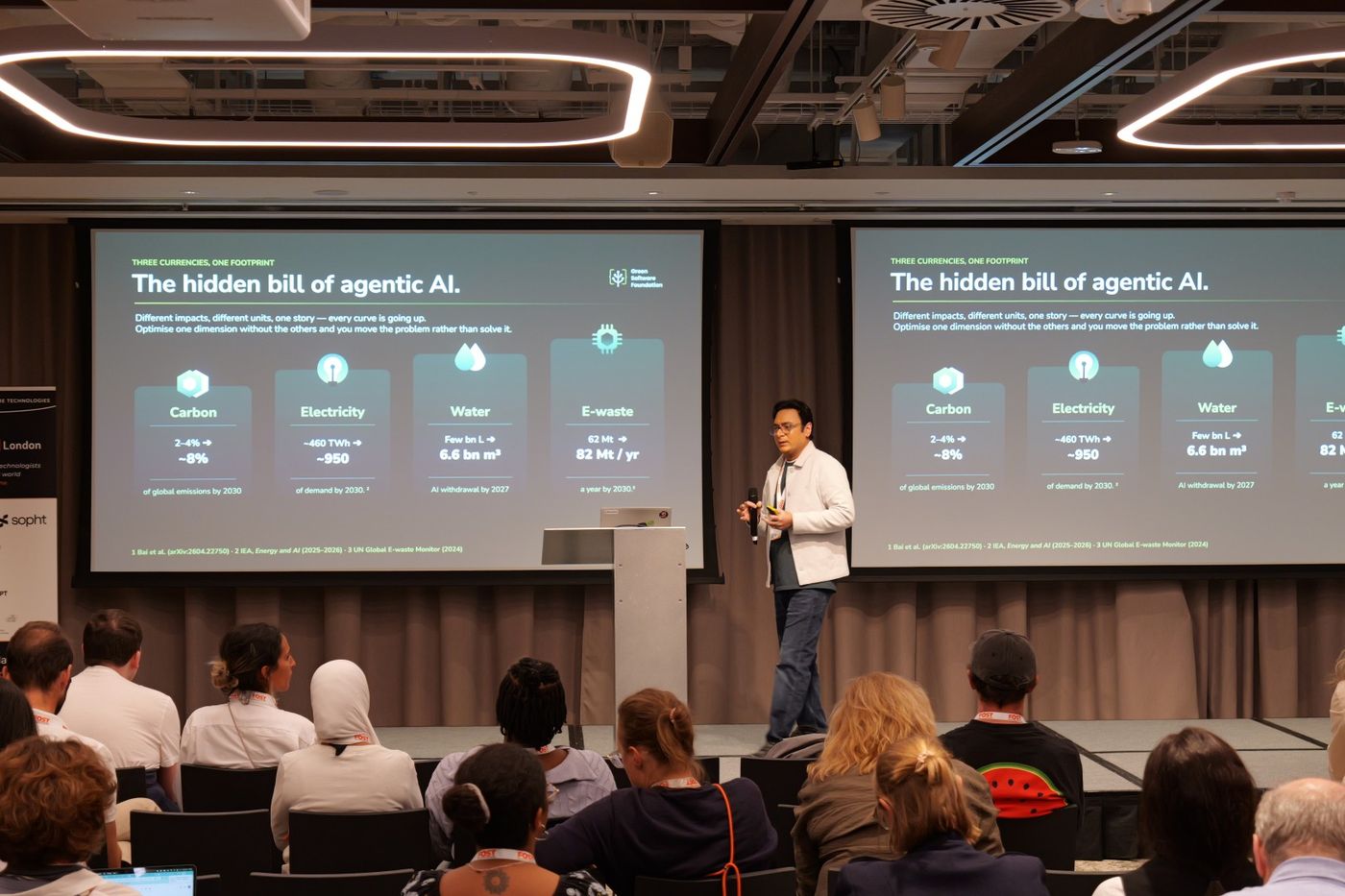
Three currencies, one footprint — opening the Green Agentic AI session at Green IO London.
The hidden bill of agentic AI
I opened with four curves that are all moving in the same direction, in different units. Carbon from software is projected to move from 2–4% toward roughly 8% of global emissions by 2030. Data centre electricity is heading from around 460 TWh toward 950 TWh of demand by 2030. AI water withdrawal is projected at 6.6 billion cubic metres by 2027. E-waste is tracking from 62 Mt toward 82 Mt a year by 2030.
Different impacts, different units, one story. And the reason to look at all four together is simple: optimise one dimension without the others and you move the problem rather than solve it.
Why agents change the equation
An agent does not make one model call. It plans, reasons, invokes tools, retrieves data, calls other agents, retries tasks, and keeps working until a goal is complete.
That means a single task can consume very different resources depending on how the agentic system is designed — how work is decomposed, which model tier serves each step, how much context travels with each call, how often an agent retries, and how long it is allowed to run.
Same task. Same agent. Very different resource consumption. That difference is architecture, not just model choice.
Designing for efficiency
The practical core of the session was the set of decisions that determine the bill: right-sizing models to the task instead of defaulting to the largest, routing by difficulty, giving agents explicit budgets for tokens, loops and retries, caching what agents repeatedly recompute, and knowing when a long-running agent should stop.
None of these is exotic. Each is a design decision someone already makes, usually without seeing its cost, energy and carbon consequences. Making those consequences visible is what turns efficiency from an afterthought into an architectural property.
The wider conversation
Our Green Software Foundation team was also present at the event, engaging with the broader digital sustainability community and exchanging ideas and perspectives.
Beyond the session, the hallway conversations made the experience even more valuable, offering opportunities to learn from others, exchange perspectives, and explore new ideas and collaborations around digital sustainability.
A big thank you to Gaël Duez, Sandra Sydow, Oliver Cronk, Meibel Dabodabo, and the entire Green IO team for organizing such an engaging event.
Next up is Green IO Paris 2026 in December. Do join the conversation and connect with the growing community advancing digital sustainability: https://lnkd.in/eDjU4DDG