# Navveen Balani — Full Content Archive
Everything below is authored in markdown. Each entry lists its canonical URL.
---
# AI measures the easy work. The work that matters is invisible #Leadership #AI #management
URL: https://navveenbalani.dev/videos/ai-measures-the-easy-work-the-work-that-matters-is-invisible-leadershi-7xmvoyejdmo
Type: video | Date: 2026-10-23
What AI automates becomes measurable. What stays human, the judgment, the taste, the relationship, is hard to count. So the human work turns invisible in your metrics right as it becomes the thing that sets you apart, and what you can't measure, you tend to undervalue. What work are you undervaluing simply because it doesn't show up in a number?
---
# In fast-moving tech, staying flexible can be its own trap #Leadership #Strategy #ai
URL: https://navveenbalani.dev/videos/in-fast-moving-tech-staying-flexible-can-be-its-own-trap-leadership-st-m2ptirvlnqe
Type: video | Date: 2026-10-22
Exponential change rewards keeping your options open, so leaders hedge, pilot, and wait. But a moat is built by committing, and endless optionality means you never build one. At some point flexibility stops being smart and starts being an excuse not to choose. Where are you calling it "staying flexible" when it's really avoiding a bet?
---
# Automate the boring parts, and you might automate the joy #Leadership #AI #Talent
URL: https://navveenbalani.dev/videos/automate-the-boring-parts-and-you-might-automate-the-joy-leadership-ai-7uednkaaakg
Type: video | Date: 2026-10-21
The plan is sensible: let AI take the drudgery so your best people do higher-value work. But sometimes the drudgery was the craft they loved, the part that made the job theirs. Strip it out and you can quietly remove the reason they stayed. Automating the boring parts isn't free if the boring parts were the joy. Do you know which "low-value" work your best people would hate to lose?
---
# AI shows you what works, so you stop finding what could #Leadership #AI #innovation
URL: https://navveenbalani.dev/videos/ai-shows-you-what-works-so-you-stop-finding-what-could-leadership-ai-i-qj1_-lvy8fw
Type: video | Date: 2026-10-20
AI optimizes toward what already works, then shows you more of it. That feels efficient, but it quietly narrows the field: you stop meeting the odd option, the outlier, the thing that could have beaten the best you know. Optimization and discovery pull in opposite directions. Where has "what works" quietly crowded out "what might"?
---
# You're hiring knowledge that's already expiring #Leadership #Hiring #ai
URL: https://navveenbalani.dev/videos/you-re-hiring-knowledge-that-s-already-expiring-leadership-hiring-ai-r8six959vjy
Type: video | Date: 2026-10-19
When expertise has a short half-life, hiring for what someone knows today is buying a depreciating asset. The durable trait isn't current knowledge, it's how fast someone relearns when the ground shifts. The best hire may not be the one who knows the most right now. Are you hiring for what people know, or how fast they can un-know it?
---
# The AI convenience of today is the dependency of tomorrow #Leadership #AI #resilience
URL: https://navveenbalani.dev/videos/the-ai-convenience-of-today-is-the-dependency-of-tomorrow-leadership-a-2tfzfmh624m
Type: video | Date: 2026-10-18
Adopting AI for convenience is easy, and convenience quietly becomes reliance. Then the tool changes, prices jump, or it goes down, and you find your team can no longer do the thing without it. Resilience erodes so gradually that no one notices until it's tested. If your main AI tool vanished tomorrow, could your team still operate?
---
# AI speeds everything up. The slow bets were your moat #Leadership #AI #Strategy
URL: https://navveenbalani.dev/videos/ai-speeds-everything-up-the-slow-bets-were-your-moat-leadership-ai-str-dg6swy73ue0
Type: video | Date: 2026-10-17
When AI compresses every cycle, the pull is to optimize for what pays off now. But the things that compound slowly, trust, brand, deep skill, relationships, were exactly the ones a competitor couldn't rush. Trade the slow bets for speed and you swap a durable advantage for a quick one. What long game are you dropping because everything else got faster?
---
# Automate the routine, and lose your feel for the exception #Leadership #AI #riskmanagement
URL: https://navveenbalani.dev/videos/automate-the-routine-and-lose-your-feel-for-the-exception-leadership-a-73kfyb7fhjs
Type: video | Date: 2026-10-16
AI handles the common case beautifully. But the rare case, the exception, is where the real risk and value sit, and handling it well takes practice on the common case. Automate the routine entirely and your team slowly loses the feel for the moment the routine doesn't apply. Who on your team still gets enough reps to handle the case AI can't?
---
# You're accountable for AI decisions you can't explain #Leadership #AI #aigovernance
URL: https://navveenbalani.dev/videos/you-re-accountable-for-ai-decisions-you-can-t-explain-leadership-ai-ai-flmwsmpurxw
Type: video | Date: 2026-10-15
As AI decisions get more complex, "why did it do that" gets harder to answer. But accountability doesn't move: you still own the outcome. That's the gap, being responsible for a call you can't fully explain, to a customer, a regulator, or your own team. Which of your AI-driven decisions could you defend if someone asked you to explain them?
---
# AI made effort free, and broke every proof-of-effort #Leadership #AI #Trust
URL: https://navveenbalani.dev/videos/ai-made-effort-free-and-broke-every-proof-of-effort-leadership-ai-trus-iauq3mn3izs
Type: video | Date: 2026-10-14
A lot of trust runs on effort being scarce. The cover letter, the detailed proposal, the thoughtful review all signalled that someone cared enough to try. When AI makes that effort free, the signal stops meaning anything, and systems built on proof-of-effort quietly stop working. Which of your trust signals just became free to fake?
---
# Software Is Becoming Disposable. Trust Isn't.
URL: https://navveenbalani.dev/technology-bytes/software-is-becoming-disposable-trust-isnt
Type: newsletter | Date: 2026-10-14 | Topics: architecture, ai, ai-economics, green-software
Imagine an application built on Monday, deployed on Tuesday, used for a business process on Wednesday, and deliberately retired on Friday.
No technical failure. No abandoned project. The application simply completed the work it was designed to perform.
For decades, software engineering has operated on a fundamental assumption: building software is expensive, so we should design it to last.
We invested heavily in architecture, development, testing, deployment and maintenance. We created reusable components, frameworks, platforms and entire ecosystems to extend the useful life of applications.
AI is beginning to challenge that assumption.
We are entering a period where generating software may become significantly cheaper than understanding, verifying and maintaining it.
And that raises two interesting questions.
If software becomes inexpensive to create, should every application still be designed to last? And if generating software becomes cheap, what happens when verifying it remains expensive?
---
### The Economics of Software Are Changing
Traditionally, the economics of software favoured reuse and longevity. Once an application was built, organisations wanted to maximise its useful life and recover the investment over time.
AI coding agents are beginning to change the cost of initial creation.
An application that previously required weeks of development may now be generated in hours for certain well-defined use cases. AI agents can generate interfaces, business logic, tests, configurations and deployment artefacts.
But the economics of verification are not necessarily changing at the same rate.
An AI agent may generate an application in minutes, but how do we establish that its calculations are correct, its dependencies are secure, its permissions are appropriate, and its behaviour matches business expectations?
Generating ten applications does not automatically make verifying ten applications inexpensive.
In fact, if we generate software faster than we can establish confidence in it, we may create a new bottleneck in software engineering.
The constraint shifts from how quickly we can create software to how quickly we can establish trust in what we create.
And this has implications far beyond developer productivity.
---
### What If Applications Had an Expiry Date?
Consider a business team preparing for a three-day conference.
Today, the team might use spreadsheets, dashboards, registration platforms and project management tools to coordinate participants, logistics, resources and reporting.
Imagine an AI agent assembling a purpose-built application that brings these capabilities together for the event.
The application exists for a few weeks, supports the event, generates the necessary reports and is retired when its purpose is fulfilled.
Its business records and required audit information remain available, but the application itself no longer needs to exist.
This is the idea of disposable software.
Applications are created for a defined purpose, operate within a defined scope and are deliberately retired when their usefulness ends.
However, disposable software is not simply about generating applications quickly and deleting them afterwards.
It challenges a deeper assumption in software architecture: **must the application itself be the permanent asset?**
Perhaps the enduring value is not the application, but the business capabilities, data, rules and knowledge that the application consumes.
The interface could be temporary. The business capability could be permanent.
This is where things become interesting.
---
### Software Can Be Disposable. Trust Cannot.
Imagine two applications generated by AI.
The first displays event schedules and publicly available information. It has read-only access to approved data and will exist for five days.
The second calculates employee payroll adjustments. It also exists for five days.
Both applications are temporary, but they cannot be treated equally.
The payroll application must satisfy much stronger requirements around correctness, privacy, authorisation and accountability.
Its short lifespan does not make incorrect calculations or security failures any less consequential.
This exposes a potential weakness in disposable software: if we make applications disposable without rethinking verification, we could end up generating and testing the same capabilities repeatedly.
The problem is not the lifetime of an application. It is the responsibility associated with what that application does.
This suggests an alternative architectural approach.
Instead of allowing every generated application to recreate business logic, permissions, data access and validation processes, we could establish a foundation of trusted, reusable capabilities.
These capabilities would expose clearly defined contracts, rules, permissions and verification mechanisms.
AI agents could then generate temporary applications that assemble and consume these capabilities without repeatedly implementing them.
An application might be created for a day, a week or a month, while the trusted foundation behind it continues to operate.
The application becomes disposable, but the trust established in its underlying capabilities becomes reusable.
---
### From Reusable Code to Reusable Verification
For decades, software engineering has focused on code reuse.
We built libraries, frameworks, APIs and services to avoid solving the same technical problems repeatedly.
But AI-generated software creates an opportunity to rethink what we should reuse.
What if, instead of simply reusing code, we could reuse the evidence that certain capabilities behave correctly under defined conditions?
Consider an AI-generated application that calculates shipping charges.
If the underlying calculation capability has already been independently validated against approved business rules, every application consuming it should not need to recreate the same calculations and repeat the entire validation process.
The generated application would still need verification of its integration, inputs, permissions and overall behaviour, but some of the assurance about the underlying capability could be carried forward.
This is where harness engineering becomes important.
An agent harness can provide constraints, execution environments, approved tools, tests, monitoring and feedback loops that guide how AI agents generate and validate software.
The objective is not to trust AI-generated code simply because another AI agent has tested it.
It is to establish independent verification mechanisms, enforce approved contracts and preserve evidence of what has been validated.
Over time, the reusable asset may extend beyond code to include business contracts, validation rules, test evidence, security policies and operational constraints.
Of course, trust is never universal or permanent. A capability validated under one set of conditions may require reassessment when its dependencies, business rules or operating context change.
But we would no longer need to start every verification exercise from zero.
Perhaps the next major abstraction in software engineering is not another framework for generating code, but an architecture for reusing verified behaviour.
---
### Could Disposable Software Also Be More Sustainable?
There is another dimension to this shift.
Today, organisations maintain applications that may have outlived their original business purpose. These applications continue to require infrastructure, patches, dependencies, monitoring and operational support.
Disposable software could potentially reduce some of this overhead.
But there is an important trade-off.
If AI agents continuously regenerate applications, repeatedly invoke models, reproduce business logic and execute extensive verification processes, we may simply exchange maintenance overhead for generation and verification overhead.
Even temporary applications can leave behind persistent data, unused cloud resources, credentials and dependencies.
From a sustainability perspective, we need to evaluate the entire lifecycle.
The resources consumed during generation, verification, deployment, operation and retirement all matter.
So do the energy, carbon, water, hardware and waste impacts associated with those activities.
Imagine two approaches to solving the same business problem.
One maintains a lightweight application for a year. The other generates a new application every week and retires it afterwards.
Which approach is more efficient?
There is no universal answer. It depends on the resources required to generate and verify the applications, their operating characteristics, how often requirements change, and whether trusted capabilities can be reused.
This introduces a useful architectural principle:
> Software should exist for as long as it delivers value, but generating it again should not automatically become the default.
Sometimes permanent software will be the better choice. Sometimes temporary software will be more appropriate. And sometimes an existing capability can deliver the outcome without creating another application.
The objective is not to maximise the number of applications we can generate, but to minimise the lifecycle cost and resource consumption required to deliver useful business outcomes.
---
### The Next Measure of Software Productivity
We have spent decades improving the speed at which we develop, test and deploy software.
AI may dramatically accelerate the creation part of this lifecycle.
But if generating applications becomes nearly effortless, the number of applications produced or the amount of code generated becomes a less meaningful measure of productivity.
The more interesting questions are how confidently those applications can be operated, how much verification can be reused, how efficiently they deliver their intended outcomes and whether they should continue to exist.
This changes the way we think about software ownership.
Instead of treating every application as a permanent asset requiring indefinite maintenance, we could begin designing applications with an explicit purpose, a defined lifetime, an appropriate level of assurance and a retirement strategy.
Durable business capabilities would provide continuity. Temporary applications would provide flexibility. Reusable verification would help establish trust across both.
The future of software engineering may not be about writing more code or even generating code faster.
It may be about knowing which software deserves to exist, how long it should live, and how much trust we can carry forward when we build the next application.
Because when generating software becomes cheaper than verifying it, the most valuable engineering asset may no longer be the software we create.
It may be the confidence we can reuse without having to recreate it.
---
**What do you think?**
If generating an application becomes trivial, what should decide whether it deserves to exist at all — and how much of your verification could you realistically carry forward today? I'd love to hear your perspective in the comments.
---
*Thank you for reading Technology Bytes.*
*Subscribe to stay updated with future insights on the intersection of AI, software architecture, sustainability and emerging technologies.*
---
# Green Agentic AI at Green IO London 2026
URL: https://navveenbalani.dev/posts/2026-10-14-green-agentic-ai-at-green-io-london
Type: talk | Date: 2026-10-14 | Topics: green-software, agentic-ai, ai
It was great to present at Green IO London 2026 on Green Agentic AI, exploring how we can embed sustainability into the design and operation of AI agents, measure their impact across carbon, energy, and water, and build more resource-efficient intelligent systems.
Our [Green Software Foundation](https://greensoftware.foundation/) team was also present at the event, engaging with the broader digital sustainability community and exchanging ideas and perspectives.
Beyond the session, the hallway conversations made the experience even more valuable, offering opportunities to learn from others, exchange perspectives, and explore new ideas and collaborations around digital sustainability.
A big thank you to Gaël Duez, Sandra Sydow, Oliver Cronk, Meibel Dabodabo, and the entire Green IO team for organizing such an engaging event.
Next up is Green IO Paris 2026 in December. Do join the conversation and connect with the growing community advancing digital sustainability: https://lnkd.in/eDjU4DDG
---
# AI gets you 90% fast. The last 10% is the whole job #Leadership #AI #Execution
URL: https://navveenbalani.dev/videos/ai-gets-you-90-fast-the-last-10-is-the-whole-job-leadership-ai-executi-fy7wkljrqry
Type: video | Date: 2026-10-13
AI gets you to ninety percent in minutes, and that speed is intoxicating. But the last ten percent, the judgment, the edge cases, the taste, is where the value and nearly all the effort live. Teams underestimate it because the first ninety looked so easy. The demo is the ninety. The job is the ten. Are you resourcing the last ten percent, or assuming it's as easy as the first?
---
# AI broke the link between output and competence #Leadership #AI #talent
URL: https://navveenbalani.dev/videos/ai-broke-the-link-between-output-and-competence-leadership-ai-talent-fr8fqzkw3jm
Type: video | Date: 2026-10-12
People can now produce polished work in areas they don't understand. So output stops being proof that someone knows the work. The person who shipped it and the person who could catch its mistakes are no longer always the same person. Skill and output have quietly come apart. How do you tell real competence from good output now?
---
# 100,000+ subscribers — the YouTube Silver Creator Award arrived this week
URL: https://navveenbalani.dev/posts/2026-10-12-100000-subscribers-youtube-silver-creator-award
Type: post | Date: 2026-10-12 | Topics: personal
100,000+ subscribers! 🎉 The YouTube Silver Creator Award arrived this week.
Over the years, sharing knowledge has been an important part of my journey. Whether through writing, speaking, teaching, or creating content, my motivation has remained simple: to explore ideas, deepen my understanding, and hopefully make it useful for others.
What started as a passion for exploring technology, AI, sustainability, and emerging innovations has gradually grown into a wonderful community.
Looking back, this journey has reinforced my belief that curiosity, consistency, and a willingness to keep learning can create something meaningful over time.
Beyond the numbers, what matters most to me is knowing that something I created may have helped someone learn, explore a new idea, or see technology from a different perspective.
A heartfelt thank you to everyone who has subscribed, watched, shared, or engaged with my content. Your encouragement and support mean a lot.
There is still so much to learn and explore.
Looking forward to continuing this journey together!
🔗 Do subscribe: https://lnkd.in/djvxYuFq
---
# AI is brilliant at average, and average is where you lose #Leadership #AI #innovation
URL: https://navveenbalani.dev/videos/ai-is-brilliant-at-average-and-average-is-where-you-lose-leadership-ai-sthv23qfcdw
Type: video | Date: 2026-10-11
AI learns from the average of everything it saw, so it pulls your work toward the middle: competent, safe, unremarkable. But advantage lives at the edges, in the choices most people wouldn't make. Lean on it for everything and your output drifts to the mean, right where it stops standing out. Where are you letting AI average away the thing that made you different?
---
# AI made options free. Choosing just got harder #Leadership #DecisionMaking #AI
URL: https://navveenbalani.dev/videos/ai-made-options-free-choosing-just-got-harder-leadership-decisionmakin-ss9lshhx_cc
Type: video | Date: 2026-10-10
AI removed the cost of producing options. So the work moved: from making the options to choosing between them, and that was always the harder part. More paths to weigh can mean slower, worse decisions, not better ones. Generating ideas isn't the bottleneck anymore. Judgment is. Are you drowning in options because producing them got free?
---
# Whatever AI does for you, it does for your competitor #Leadership #AI #strategy
URL: https://navveenbalani.dev/videos/whatever-ai-does-for-you-it-does-for-your-competitor-leadership-ai-str-trg2udcrdfu
Type: video | Date: 2026-10-09
Any capability you get straight from a public model, your competitor gets too, at the same time, for the same price. The edge was never the model. It's the data, the process, and the relationships the model can't copy. If AI handed you the advantage, it can hand it to anyone. What do you have that a competitor's AI can't give them tomorrow?
---
# You built a black box by accident #Leadership #AI #aigovernance
URL: https://navveenbalani.dev/videos/you-built-a-black-box-by-accident-leadership-ai-aigovernance-lju3bdz7wbs
Type: video | Date: 2026-10-08
Each automation looks obviously worth it on its own. Add enough of them and you get a system that works but that no single person can explain. Every local call was rational; the whole is opaque. The risk isn't any one decision. It's the sum nobody chose on purpose. Does anyone still understand the whole path, end to end?
---
# You're running last year's playbook #Leadership #AI #changemanagement
URL: https://navveenbalani.dev/videos/you-re-running-last-year-s-playbook-leadership-ai-changemanagement-yorwyulmbjm
Type: video | Date: 2026-10-07
A tool's capability changes in months. Your approvals, processes, and habits update in years. So you're almost always running last year's playbook on this year's capability, and the gap isn't a skills problem. It's a speed-of-absorption problem. The edge goes to whoever closes it fastest. What in your operating rhythm is still built for the old speed?
---
# Your competitive edge isn't yours #Leadership #AI #Strategy
URL: https://navveenbalani.dev/videos/your-competitive-edge-isn-t-yours-leadership-ai-strategy-fvnh4uxud-8
Type: video | Date: 2026-10-06
Building your core capability on a model you don't own means your edge now moves on someone else's roadmap: their pricing, their changes, their priorities. Renting capability is fine until it becomes the thing you compete on. Then the question is whose advantage you're actually building. What are you renting that you'd rather own?
---
# Some AI decisions can't be undone #Leadership #AI #strategy
URL: https://navveenbalani.dev/videos/some-ai-decisions-can-t-be-undone-leadership-ai-strategy-0cqkcs7keem
Type: video | Date: 2026-10-05
The first question isn't only whether it works. It's whether you can undo it. Some moves are reversible. Others quietly become one-way doors: a dependency you can't unwind, a skill your team no longer has, a process you already deleted. Speed is cheap on reversible calls and expensive on the rest. Which of your AI moves are one-way doors?
---
# You're trusting AI the wrong way #Leadership #AI #Trust
URL: https://navveenbalani.dev/videos/you-re-trusting-ai-the-wrong-way-leadership-ai-trust-2q7zfsw-jds
Type: video | Date: 2026-10-04
The failure mode with AI isn't trusting it too much or too little. It's trusting it evenly when its reliability is uneven, sharp on some tasks, shaky on others. Flat trust on a bumpy surface is how a system that's right most of the time still hands you the wrong call at the worst moment. Do you trust your AI by task, or all at once?
---
# AI quietly took your warning signs #Leadership #AI #management
URL: https://navveenbalani.dev/videos/ai-quietly-took-your-warning-signs-leadership-ai-management-otvuahxyjog
Type: video | Date: 2026-10-03
elegating to a system you can't see into means you also hand over the error signal: the small friction that used to tell you something was going wrong. You didn't just delegate the task. You delegated the ability to notice it's off course. Where have you lost the signal that used to tell you to step in?
---
# The one skill AI can't do for you #Leadership #AI #skills
URL: https://navveenbalani.dev/videos/the-one-skill-ai-can-t-do-for-you-leadership-ai-skills-b6xocyok3zk
Type: video | Date: 2026-10-02
When a tool answers almost any question you pose, the value moves to posing the right one. That's the part AI doesn't do for you, and using it more doesn't build the skill. The people who pull ahead won't have the best answers. They'll be the ones asking the questions worth answering. Are you getting better at answers, or at questions?
---
# A few days in Brighton with our team at the Green Software Foundation
URL: https://navveenbalani.dev/posts/2026-10-02-a-few-days-in-brighton-with-our-team-at-the-gsf
Type: post | Date: 2026-10-02 | Topics: green-software, personal
A few days in Brighton with our team at the [Green Software Foundation](https://greensoftware.foundation/).
Most of our time together is spent on calls, working through standards, open source projects, education, partnerships and everything else happening across the Foundation. So it was great to be in the same place for our offsite, with some of the team joining virtually as well.
We had plenty of conversations about where GSF is heading, what we want to do better, and how we can have greater impact as software and AI continue to evolve.
Some of my favourite moments, though, were outside the meeting room: walking around Brighton, time by the sea, shared meals, and conversations without an agenda.
On a distributed team, that's where much of the trust behind our work gets built. Looking forward to taking these ideas into the months ahead.
I'm also filming parts of this trip, and experimenting with more travel and behind-the-scenes content around the conferences I'll be presenting at over the coming weeks. The first vlog will be on my YouTube channel soon: https://lnkd.in/djvxYuFq
If you are interested in AI, technology, sustainability and some of the journey behind the work, do subscribe.
---
# AI's confident answers are a trap #Leadership #CriticalThinking #ai
URL: https://navveenbalani.dev/videos/ai-s-confident-answers-are-a-trap-leadership-criticalthinking-ai-mv-ht7-pni8
Type: video | Date: 2026-10-01
AI gives fluent, finished-sounding answers. Fluency has a side effect: it closes the follow-up question that would have surfaced the risk. The more polished the answer, the less anyone pushes on it. The expensive part isn't a wrong answer. It's the question no one asked because the answer sounded done. What did you stop asking because the answer sounded certain?
---
# We are engineering harnesses to make AI agents more capable
URL: https://navveenbalani.dev/posts/2026-10-01-sustainable-harness-engineering
Type: post | Date: 2026-10-01 | Topics: agentic-ai, green-software, architecture
We are engineering harnesses to make AI agents more capable.
We should also engineer them to make better use of resources.
That is the idea behind **Sustainable Harness Engineering**.
As agentic AI evolves, the model is only one part of the system. The harness around it increasingly shapes how the agent behaves: the context it receives, the tools it can use, the constraints it follows, the actions it can take, and the feedback it receives.
So why not build sustainability into that same layer?
A sustainable harness could help agents understand the resource implications of their decisions across energy, carbon, water and waste.
The important part is not simply minimizing one metric. It is understanding the trade-offs.
A smaller model may consume fewer resources but require more retries. Caching may reduce computation while increasing storage. A lower-carbon location may have different water implications. More agents may improve reliability while increasing overall resource use.
This is where harness engineering becomes particularly interesting.
The harness can provide agents with sustainability context, resource signals and feedback, alongside the mechanisms we already design for reliability, security, performance and autonomy.
The question becomes:
What outcome are we trying to achieve, what resources are required to achieve it, and what trade-offs are we making along the way?
As harness engineering becomes a core part of agentic AI architecture, sustainability should be built into it from the beginning.
That is Sustainable Harness Engineering.
I'll explore what this could look like in practice in my next Technology Bytes issue.
---
# AI hits the target, misses the point #Leadership #Metrics #AI
URL: https://navveenbalani.dev/videos/ai-hits-the-target-misses-the-point-leadership-metrics-ai-j43a4qj01rw
Type: video | Date: 2026-09-30
A metric is a stand-in for something you actually care about. The moment it becomes a target, AI can hit it perfectly, and the tighter it hits the number, the further it can drift from the thing the number stood for. The measure stops measuring what it measured. Which of your targets could be hit perfectly while the point gets missed?
---
# 81 posts filtered in roughly 15 minutes of scrolling LinkedIn
URL: https://navveenbalani.dev/posts/2026-09-30-81-posts-filtered-in-15-minutes-of-scrolling-linkedin
Type: post | Date: 2026-09-30 | Topics: ai, experimental, trends
35 sponsored posts.
30 posts outside my current focus.
7 engagement-bait posts.
5 hiring posts.
4 celebration threads.
81 posts filtered in roughly 15 minutes of scrolling LinkedIn.
That number surprised me.
Not because those posts should not exist.
They just were not what I opened LinkedIn for at that moment.
LinkedIn is my go-to professional platform. It is where I learn, share ideas, discover new work and connect with some of the smartest people in my field.
And because I spend so much time here, I started thinking about a simple question:
What if my LinkedIn feed could adapt to what I want to focus on right now?
So I built myself a lens. **FeedLens.**
I originally built it for myself. The more I used it, the more I wondered whether others had the same problem.
The model is deliberately simple:
- **I care about:** topics and keywords you always want to see
- **I don't care about:** topics you would rather filter out
- **Focus Mode:** see only what matters to you right now
- **Mute noise:** sponsored posts, engagement bait and other categories you choose
- **AI Slop Control:** an experimental on-device filter for repetitive and low-signal posts
- **A counter that keeps receipts:** which is exactly where these numbers came from
And one principle was non-negotiable:
Everything stays on your device.
No servers.
No account.
No analytics.
Nothing you read is sent anywhere.
The idea can be summarized in one line:
LinkedIn → FeedLens → Your signal
But the interesting part was not what FeedLens removed.
It was what became easier to notice once the noise was gone.
For me, that meant more of the conversations I actually come to LinkedIn for, and the people working on them.
And I think there is a bigger shift happening here.
AI has made content creation abundant. Attention is becoming the scarce resource.
AI is opening up incredible opportunities for more people to create, share ideas and contribute knowledge. But as the volume of content grows, the next generation of tools should not only help us create more. They should also help us decide what deserves our attention.
Imagine opening LinkedIn and being able to say:
What do I care about today?
What do I want to see more of?
What can I ignore for now?
How focused do I want my feed to be?
That kind of control could make an already valuable professional network even more useful.
I would love to eventually see capabilities like this built directly into LinkedIn. If FeedLens becomes unnecessary because the platform gives everyone this level of control, I would consider that a success.
Download FeedLens from the Chrome Web Store: https://lnkd.in/dQ2TuP2T
One question: if you could control one thing about your LinkedIn feed today, what would it be?
---
# AI made your bottleneck worse #Leadership #AI #Productivity
URL: https://navveenbalani.dev/videos/ai-made-your-bottleneck-worse-leadership-ai-productivity-_io94qv4ztm
Type: video | Date: 2026-09-29
AI made junior people produce work that looks senior. So the hard part of the week moved: from producing the work to telling whether the senior-looking work is actually right. And that judgment sits with the few people who were already your constraint. You didn't widen the bottleneck. You pointed more flow at it. Are you scaling what got cheap, or what got scarce?
---
# Speed removed your safety net #Leadership #DecisionMaking #ai
URL: https://navveenbalani.dev/videos/speed-removed-your-safety-net-leadership-decisionmaking-ai-w9diadaeqsm
Type: video | Date: 2026-09-28
When a project took a year, the market pushed back before you finished building. That delay was accidental insurance: it caught the wrong call while it was still cheap to change. Now you can build the wrong thing at full quality in a week, and the pushback arrives after you've scaled it. Where was build-time quietly doing your thinking for you?
---
# Your AI pilot worked. That's the trap #Leadership #AI #innovation
URL: https://navveenbalani.dev/videos/your-ai-pilot-worked-that-s-the-trap-leadership-ai-innovation-t3hymuwe7r4
Type: video | Date: 2026-09-27
Pilots run on your best people, your cleanest data, and a problem you picked because it was tractable. Every condition that made it work is one you strip away at scale. A pilot doesn't tell you the thing works. It tells you it works under the best conditions you'll ever give it again. Are you funding what the pilot proved, or what you hoped it implied?
---
# AI's real bill isn't on the invoice #Leadership #AI #TechStrategy
URL: https://navveenbalani.dev/videos/ai-s-real-bill-isn-t-on-the-invoice-leadership-ai-techstrategy-0hbpnydc0e8
Type: video | Date: 2026-09-26
The number on the invoice is the easy cost, and the small one. Every AI system carries a second cost that never lands on a bill: the work of checking it, the decisions it reshapes, the questions your team stops asking. The cheapest-looking option and the cheapest option are rarely the same thing. Did your last tooling decision price the cost of trusting it?
---
# Fast agreement is a red flag #Leadership #DecisionMaking #ai
URL: https://navveenbalani.dev/videos/fast-agreement-is-a-red-flag-leadership-decisionmaking-ai-gpyooeao9vk
Type: video | Date: 2026-09-25
When everyone draws from the same model, you don't get five perspectives converging. You get one perspective wearing five faces, and the disagreement that used to surface the risk quietly disappears. Agreement reached that fast isn't a sign you're right. It's a sign you stopped checking. Was that judgment, or the same source answering five times?
On this channel you'll find:
• Agentic AI strategies and architecture
• Enterprise AI platforms and implementation
• Green AI and sustainable software engineering
• AI agents, MCP, A2A, and modern frameworks
• Technology leadership and digital transformation
• Book insights, podcasts, keynote talks, and tutorials
• Byte Series - AI , Green AI, Exponential Tech and Leadership
• My experiments with AI Tools
---
# What You Can Measure, You Can Reduce | Green AI Bytes Ep.30 #shorts #ai #greenai #education
URL: https://navveenbalani.dev/videos/what-you-can-measure-you-can-reduce-green-ai-bytes-ep-30-shorts-ai-gre-uouorfx6faw
Type: video | Date: 2026-09-24
---
# Lean Agentic AI on Google Cloud: Build Agents That Earn Their Watts #google #agenticai
URL: https://navveenbalani.dev/videos/lean-agentic-ai-on-google-cloud-build-agents-that-earn-their-watts-goo-qtonuwk52y0
Type: video | Date: 2026-09-23
What does it really cost to run an AI agent at production scale?
Not only in API charges, but also in energy, carbon, water, and infrastructure.
In this presentation, Navveen Balani introduces Lean Agentic AI, a practical framework for building AI agents that deliver the required outcome using fewer computational and physical resources.
Using an ESG portfolio-rebalancing agent on Google Cloud as a worked example, the session explores how to optimize all six stages of an agentic workflow:
Goal ingestion
Planning and reasoning
Tool and model selection
Action execution
Reflection and retry
Memory and learning
The presentation covers practical techniques including model routing, bounded agent graphs, structured outputs, context caching, serverless execution, batch processing, confidence-based retries, selective memory, carbon-aware scheduling, and task-level observability.
It also shows how the Software Carbon Intensity specification can help measure the carbon impact of an agent task and connect sustainability with cost, latency, and quality.
The central message is simple:
You wouldn’t send a Ferrari to deliver a pizza. Think big. Design and deploy lean.
Presented by Navveen Balani
Author of Lean Agentic AI
#AgenticAI #LeanAI #GoogleCloud #Gemini #SustainableAI #GreenSoftware #AIEngineering #GenerativeAI #CloudComputing
---
# Build the Green AI Habit | Green AI Bytes Ep.29 #shorts #ai #greenai #education
URL: https://navveenbalani.dev/videos/build-the-green-ai-habit-green-ai-bytes-ep-29-shorts-ai-greenai-educat-eu-0l6mef5y
Type: video | Date: 2026-09-23
---
# London, I'll see you next week at Green IO London 2026
URL: https://navveenbalani.dev/posts/2026-09-23-london-ill-see-you-next-week-at-green-io-london
Type: post | Date: 2026-09-23 | Topics: green-software, agentic-ai, ai
London, I'll see you next week at Green IO London 2026.
As AI moves from individual prompts to autonomous agents, the sustainability equation changes significantly.
An agent does not make one model call. It can plan, reason, invoke tools, retrieve data, call other agents, retry tasks and keep working until a goal is complete.
That means a single task can have a very different cost depending on how the agentic system is designed.
At Green IO London, I'll be speaking about:
**Green Agentic AI: Optimizing Cost, Energy and Carbon**
I'll explore how we can design agentic AI systems that deliver the intelligence we need while reducing unnecessary computation, energy use, carbon emissions and financial cost.
One of the key ideas I'll discuss:
Same task. Same agent. Very different resource consumption. That difference is architecture, not just model choice.
We all have a role to play in making AI and software more sustainable, whether we are designing architectures, building applications, operating infrastructure, developing AI systems or making technology decisions.
If you are in London and want to be part of that conversation, I would love to see you there.
📍 Green IO London 2026
📅 September 30 – October 1
📍 Convene Sancroft, St. Paul's, London
You can register using my link: https://lnkd.in/dCh4DWXm
---
# Give AI Efficiency an Owner | Green AI Bytes Ep.28 #shorts #ai #greenai #education
URL: https://navveenbalani.dev/videos/give-ai-efficiency-an-owner-green-ai-bytes-ep-28-shorts-ai-greenai-edu-bmzvz81re9c
Type: video | Date: 2026-09-22
---
# Make AI Efficiency Measurable | Green AI Bytes Ep.27 #shorts #ai #greenai #education
URL: https://navveenbalani.dev/videos/make-ai-efficiency-measurable-green-ai-bytes-ep-27-shorts-ai-greenai-e-tcmehoidhoa
Type: video | Date: 2026-09-21
---
# Defaults Decide AI Consumption | Green AI Bytes Ep.26 #shorts #ai #greenai #education
URL: https://navveenbalani.dev/videos/defaults-decide-ai-consumption-green-ai-bytes-ep-26-shorts-ai-greenai--682cvcv4p7c
Type: video | Date: 2026-09-20
---
# The Interface Sets the AI Bill | Green AI Bytes Ep.25 #shorts #ai #greenai #education
URL: https://navveenbalani.dev/videos/the-interface-sets-the-ai-bill-green-ai-bytes-ep-25-shorts-ai-greenai--dhkfrsaixmc
Type: video | Date: 2026-09-19
---
# Keep a Dataset Receipt for AI | Green AI Bytes Ep.24 #shorts #ai #greenai #education
URL: https://navveenbalani.dev/videos/keep-a-dataset-receipt-for-ai-green-ai-bytes-ep-24-shorts-ai-greenai-e-_1gg79cluco
Type: video | Date: 2026-09-18
---
# What Does Slowing Down Mean When You've Built the Fastest Engine in the World?
URL: https://navveenbalani.dev/technology-bytes/what-does-slowing-down-mean-when-youve-built-the-fastest-engine-in-the-world
Type: newsletter | Date: 2026-09-18 | Topics: ai, trends, green-software
Imagine that you have built the fastest engine in the world.
Every year, you make it more powerful. You improve combustion, reduce friction, increase horsepower and push the limits of what the machine can do.
The previous generation could reach 200 kilometres per hour. The next reaches 250. Then 300. Then 400.
For a while, progress is easy to understand. A faster engine is a better engine, and every new generation can be measured by a simple question:
**How much faster can it go?**
That logic works while the engine is the primary constraint.
If the engine is too weak, improving it improves the entire car. Acceleration gets better, maximum speed increases and performance improves in ways everyone can immediately understand.
Then something changes.
The engine keeps getting faster, but the usefulness of that additional speed becomes harder to realize.
It is not because engineers have stopped innovating. It is not because physics has suddenly changed. It is not even because the engine has reached its ultimate limit.
The rest of the system has simply started to matter.
---
### The Engine Is No Longer the Whole Car
A 500-horsepower engine sounds impressive.
Put it inside a car with weak brakes, ordinary tyres, inadequate suspension and poor cooling, however, and much of that power becomes difficult to use.
Increase the engine to 700 horsepower and the problem becomes even clearer.
The engine can go faster, but the vehicle cannot necessarily make meaningful use of that additional speed.
Engineers now have to ask different questions.
Can the tyres maintain traction? Can the brakes stop the vehicle safely? Can the chassis handle the additional forces? Can the cooling system dissipate the heat? Can the transmission survive the load?
The engineering challenge has changed from improving one component to improving the entire system.
The engine remains important, but the engine alone no longer determines performance.
---
### Then Economics Catches Up
Imagine that the next generation of the engine delivers another 20 percent more power.
There is only one problem: achieving that improvement doubles fuel consumption.
Is it a better engine?
From a pure performance perspective, perhaps it is.
From an economic perspective, the answer becomes much more complicated.
Suppose the additional performance also requires more expensive materials, sophisticated cooling, specialized fuel and shorter maintenance intervals.
The engineering team may still describe the engine as a major technological breakthrough.
The customer asks something much simpler:
**What does that extra performance actually cost me?**
The manufacturer asks whether it can produce the engine profitably at scale. Fleet operators ask whether the operating economics make sense. Infrastructure providers ask whether existing systems can support millions of these machines.
Maximum speed still matters, but it is no longer enough.
Efficiency, reliability, operating cost and useful value begin to matter just as much.
---
### Then the Physical World Catches Up
Every powerful technology eventually encounters the physical world.
Energy has to come from somewhere. Heat has to go somewhere. Materials have to be manufactured, transported and replaced. Factories have capacity limits. Electricity grids have capacity limits. Supply chains have capacity limits.
The engine might theoretically continue becoming more powerful, but theoretical capability is not the same as practical scalability.
Eventually, another ten percent of performance can become disproportionately expensive because the simplest improvements have already been captured.
Each additional gain may require more energy, more cooling, more sophisticated materials and more infrastructure.
At that point, you are no longer optimizing an engine.
You are optimizing an ecosystem.
---
### Then Safety Catches Up
Now imagine that these engines become powerful enough for ordinary cars to travel at extraordinary speeds.
A vehicle capable of 500 kilometres per hour may be impressive on a controlled test track.
Put that same vehicle on a public road and the conversation changes.
Governments begin asking questions about safety. Insurers begin asking questions about risk. Cities begin thinking about infrastructure. Manufacturers introduce additional testing, monitoring and control systems.
From the outside, this can look like technological progress slowing down.
But the engine may still be improving rapidly.
What has changed is the way the capability can responsibly and practically be deployed.
As capability grows, deployment often becomes more deliberate because the consequences of failure also grow.
---
### Then the Customer Catches Up
Eventually, an even more uncomfortable question appears:
**Does the customer actually need all of that additional speed?**
A family driving to work, school or the supermarket may not care whether the theoretical maximum speed has increased from 350 to 420 kilometres per hour.
They may care much more about efficiency, reliability, maintenance cost, safety, range and whether the car simply works every morning.
At that point, the company producing the most powerful engine does not automatically produce the best vehicle.
Competitive advantage begins moving elsewhere.
The more valuable engineering breakthrough might be extending component life, reducing fuel consumption, lowering operating costs, improving safety or making the vehicle easier to use.
The engine still matters.
The definition of performance has changed.
---
### The Race Changes
During the early stage of a technology, the race is relatively simple: build something more powerful than the previous generation.
As the technology matures, the race becomes considerably more complex.
The objective shifts from making one component dramatically faster to making the entire system better.
Engineers start optimizing efficiency, reliability, emissions, operating costs, component life, safety, maintainability and infrastructure.
Eventually, a different question becomes more important than raw horsepower:
**How much useful value can the entire system produce from the capability it already has?**
That is not technological stagnation.
It is what happens when a technology begins moving from breakthrough to infrastructure.
---
### So What Does "Slowing Down" Actually Mean?
This is where the idea of a technology slowing down becomes misleading.
Suppose the engine improves by 5 percent next year instead of 50 percent.
Looking only at horsepower, we might conclude that innovation has slowed.
But perhaps the engineers have simply moved their attention elsewhere.
Some are improving efficiency. Others are solving cooling problems. Some are reducing manufacturing costs. Others are extending component life, redesigning safety systems or building the infrastructure required to operate these machines at scale.
If we measure progress only through horsepower, innovation appears slower.
If we measure progress across the entire system, enormous innovation may still be taking place.
The center of gravity has moved.
---
### Reality Eventually Catches Up With Every Engine
Transformative technologies often follow this pattern.
Capability advances first.
Then infrastructure, economics, organizations, regulation, customers and the physical world begin catching up.
During that transition, progress can look slower because the most visible metric is no longer improving at the same extraordinary rate.
But something more important may actually be happening.
The technology is moving from what is possible to what is practical.
And that brings us to the real subject of this edition.
---
### This Was Never Really About Cars
It was about AI.
For the past several years, much of the AI race has looked remarkably similar to the race to build a faster engine.
We have celebrated bigger models, more compute, larger context windows, better benchmarks, stronger reasoning and increasingly capable agents.
Every generation has been evaluated through some version of the same question:
**How much more capable is the next model?**
But the model is only the engine.
Around that engine sits an increasingly important system comprising compute, chips, networks, data centers, energy, water, enterprise architecture, security, governance, regulation, integration, reliability, human oversight and economics.
The models may continue becoming dramatically more capable.
But capability is no longer the only constraint.
Organizations have to ask whether they can afford that capability, whether they can deploy it reliably, whether infrastructure can support it, whether energy and water requirements can scale, whether governance can keep pace and whether all of that additional intelligence creates proportional value.
That changes the meaning of progress.
---
### AI May Be Entering Its Systems Era
The next major AI breakthrough may not necessarily be a model that is dramatically more capable than everything that came before it.
It may be an AI system that extracts far more value from the intelligence we already have.
That means more efficient inference, smaller models where smaller models are sufficient, better architectures, lower token consumption and better infrastructure utilization.
It means designing systems that reuse validated intelligence instead of repeatedly paying to rediscover the same answer.
It means making AI cheaper to operate, easier to govern, more reliable to deploy and more efficient across energy, carbon, water and infrastructure.
It also means recognizing that intelligence itself is only one component of an intelligent system.
A model can reason brilliantly and still sit inside an architecture that is expensive, inefficient, unreliable or impossible to scale.
Just as the fastest engine does not automatically create the best car, the most capable model does not automatically create the best AI system.
---
### Perhaps We Are Asking the Wrong Question
When people ask whether AI is going to slow down, they often mean whether models will continue improving at the extraordinary pace we have recently experienced.
That is an important question.
But it may not be the most important one.
Even if advances in raw model capability eventually become less dramatic, innovation around AI could accelerate elsewhere.
The next race may increasingly be about how efficiently intelligence can be delivered, how reliably it can be integrated into organizations, how often existing intelligence can be reused and how much useful work can be produced from every unit of compute, energy, water and capital.
The industry spent the last few years asking how powerful we could make the engine.
The next phase may be about building the rest of the car.
So perhaps AI is not slowing down.
Perhaps **reality is simply catching up with the engine.**
---
**What do you think?**
Are we approaching the limits of what raw model capability can deliver, or is the real work now in the system around the model? I'd love to hear your perspective in the comments.
---
*Thank you for reading Technology Bytes.*
*If you enjoyed this edition, subscribe to stay updated with future insights on Agentic AI, enterprise architecture, and building intelligent systems that deliver measurable business value.*
---
# AI Economics for Leaders #ai #economics #tokeneconomics
URL: https://navveenbalani.dev/videos/ai-economics-for-leaders-ai-economics-tokeneconomics-dbitfaqntea
Type: video | Date: 2026-09-17
AI is becoming more capable, but the economics of using AI are becoming just as important as the technology itself.
In this video, I explore AI Economics for Leaders and why understanding the economics of tokens, inference, agents, and AI workloads is becoming essential for business and technology leaders.
We look at how AI costs scale, why token economics matters, and how organizations can think beyond model capability to understand the real economics of deploying AI at enterprise scale.
Key topics include:
• AI economics and the changing cost of intelligence
• Token economics and inference costs
• Why agentic AI can multiply consumption
• Cost per task versus cost per token
• Repeated reasoning and the opportunity for reuse
• Balancing capability, performance, and efficiency
• What leaders should measure as AI adoption scales
• Building economically sustainable AI systems
As AI moves from experimentation to enterprise-wide deployment, the question is no longer only:
“What can AI do?”
Leaders also need to ask:
“What does it cost every time AI does it?”
Understanding that equation will increasingly shape AI architecture, operating models, investment decisions, and competitive advantage.
Subscribe for more perspectives on AI, Agentic AI, Enterprise Intelligence, AI Economics, Responsible AI, and Green AI.
Buy the book at - https://amzn.to/478NfuR
#AI #AIEconomics #TokenEconomics #AgenticAI #ArtificialIntelligence #GenerativeAI #EnterpriseAI #AILeadership #AITokens #AIInnovation
---
# Training vs Inference Carbon | Green AI Bytes Ep.23 #shorts #ai #greenai #education
URL: https://navveenbalani.dev/videos/training-vs-inference-carbon-green-ai-bytes-ep-23-shorts-ai-greenai-ed-fmntw0tr24s
Type: video | Date: 2026-09-17
---
# The Total Footprint of AI Ownership | Green AI Bytes Ep.22 #shorts #ai #greenai #education
URL: https://navveenbalani.dev/videos/the-total-footprint-of-ai-ownership-green-ai-bytes-ep-22-shorts-ai-gre-_ldu8rexu2c
Type: video | Date: 2026-09-16
---
# Hardware Carries Embodied Carbon | Green AI Bytes Ep.21 #shorts #ai #greenai #education
URL: https://navveenbalani.dev/videos/hardware-carries-embodied-carbon-green-ai-bytes-ep-21-shorts-ai-greena-xmremi56cns
Type: video | Date: 2026-09-15
---
# Measure Your AI End to End | Green AI Bytes Ep.20 #shorts #ai #greenai #education
URL: https://navveenbalani.dev/videos/measure-your-ai-end-to-end-green-ai-bytes-ep-20-shorts-ai-greenai-educ-ggif4jjd5uk
Type: video | Date: 2026-09-14
---
# Migrating a 20-Year WordPress Blog to Be Agent-Ready
URL: https://navveenbalani.dev/articles/migrating-a-20-year-wordpress-blog-to-be-agent-ready
Type: article | Date: 2026-09-13 | Topics: architecture, agentic-ai, opinion
*I thought I was moving a website. I ended up reconsidering how knowledge should survive the next generation of the internet.*
I wrote my first technical article in 2001. It was about messaging-oriented middleware, long before cloud computing became mainstream, before smartphones reshaped how we consumed the internet, and long before anyone imagined that AI systems would one day read our websites on our behalf.
In 2004, I started publishing on WordPress.
I kept writing through the rise of service-oriented architecture, cloud computing, mobile, IoT, blockchain, machine learning, generative AI, and now agentic AI.
Over more than two decades, the writing accumulated.
So did the places where it lived.
Long-form articles remained on my blog. Newsletters and shorter ideas increasingly moved to LinkedIn. Videos found their home on YouTube. Podcast episodes went to Spotify. More than twenty-five books were distributed through publishers and online storefronts.
Every decision made sense at the time.
Each platform gave me something valuable: reach, convenience, distribution, community, or a better way to communicate a particular format.
But after twenty-five years of publishing, I realized something uncomfortable.
**I had built a body of work, but I no longer had one body of knowledge.**
My ideas were scattered across platforms, formats, databases, feeds, pages, applications, and systems that I did not fully control.
That realization led me to rebuild my website.
But the most important decision came before I wrote a single line of code.
I asked myself a different question:
**If I were building this website for the next twenty years rather than the previous twenty, who exactly am I building it for?**
The obvious answer was people.
The less obvious answer was AI agents.
That second answer changed almost everything.
---
## The Next Reader May Never Visit Your Website
For most of the history of the web, publishing followed a familiar pattern.
A person searched for something, opened a webpage, read it, interpreted the information, and decided what to do next.
The interaction looked roughly like this:
**Human → Browser → Website**
We optimized websites around that journey.
We thought about navigation, visual hierarchy, page speed, readability, responsive design, and search engines.
All of those things still matter.
But a new interaction model is emerging.
Increasingly, people are asking AI systems to find, compare, summarize, explain, recommend, research, and act on information for them.
The interaction increasingly looks like this:
**Human → AI Agent → Website**
The person may never open the page.
An AI research assistant might retrieve it.
A coding agent might inspect it.
An answer engine might extract a section.
An enterprise agent might combine it with information from ten other sources before producing a recommendation.
The website still matters, but the website may no longer be the destination.
It becomes a **source of knowledge inside a larger reasoning process**.
That is a profound shift.
It means we are no longer designing only for people who see pages.
We are also designing for machines that consume knowledge.
---
## I Started With One Architectural Test
Once I accepted that agents were becoming part of the audience, I kept returning to one question throughout the rebuild:
**If an AI agent fetches any page on this site, does it receive the complete content, correctly structured, on the first request?**
If the answer depended on executing JavaScript, calling an undocumented API, navigating through several screens, authenticating into a platform, or reconstructing content after a framework initialized, I treated that as an architectural warning.
This was not because JavaScript is bad or dynamic applications are wrong.
It was because my website had a specific purpose.
Its primary asset was knowledge.
And knowledge should be easy to retrieve.
That principle led to several decisions that may sound technically unremarkable, but together they changed the architecture completely.
---
## Markdown Became the Canonical Source
The most important decision was simple.
Every article, newsletter issue, short post, book entry, and talk would live as a plain Markdown file.
Each file would carry a small amount of structured metadata such as the title, publication date, summary, topic, and content type.
That meant the content itself was no longer trapped inside a database.
There was no proprietary editor representation that had to be interpreted later.
There was no content management system holding the only canonical version.
The file was the content.
That may sound like a small implementation detail.
I believe it is much more than that.
Markdown creates a remarkably durable interface between people and machines.
A person can open it and understand it.
A developer can version it.
A script can transform it.
A search engine can index it.
An AI system can reason over it.
A future platform can import it without needing to understand the application that originally rendered it.
For something as valuable as accumulated knowledge, that simplicity matters.
---
## Git Became More Than Version Control
Once the content lived in Markdown, Git naturally became the system that managed it.
The repository became the content system.
That gave me something traditional publishing platforms often hide: a complete history of how the knowledge changed.
I could see what was added, what was removed, what was corrected, and when a piece evolved.
Version history became provenance.
Diffs became the audit trail.
The repository became portable.
More importantly, the content became independent of the website that happened to display it.
The architecture had changed from:
**Content → CMS database → Website**
to:
**Content → Open files → Repository → Website**
That distinction is more important than it first appears.
The website is now a representation of the knowledge.
It is no longer the container that owns the knowledge.
---
## The Website Became a Compilation Target
I use Astro to transform the Markdown files into static HTML.
Again, the important idea is not the framework.
The important idea is separation.
The content exists independently.
The website is produced from it.
That means I can think of the website almost like compiled software.
The repository contains the source.
The build creates one output.
Today, that output is a website.
Tomorrow, the same source could feed an AI knowledge system, a semantic search engine, an EPUB, an API, a research assistant, or an interface that does not yet exist.
This is what made the architecture feel fundamentally different from the site I was leaving behind.
I was no longer designing around the assumption that the webpage was the final form of the knowledge.
I was designing around the assumption that **knowledge should survive its interfaces**.
---
## Boring Architecture Started to Look Very Intelligent
A surprising amount of the design came down to choices that would never make an exciting conference talk.
The URLs are predictable.
The heading structure is consistent.
Pages contain proper semantic HTML.
The content taxonomy is explicit.
Metadata follows the same structure.
RSS feeds exist.
The site avoids unnecessary client-side rendering.
There is one canonical location for every piece of authored content.
None of this is revolutionary.
That is exactly the point.
Machines benefit enormously from predictability.
Humans do too.
A clean structure reduces ambiguity.
A stable URL creates a durable reference.
A proper heading hierarchy improves accessibility, navigation, search, and machine interpretation at the same time.
The more I worked on the site, the more I came to appreciate a principle that software architecture sometimes forgets:
**Boring systems are often easier to understand, easier to migrate, and easier to preserve.**
When machines become active participants in the information ecosystem, that becomes an architectural advantage.
---
## Consolidating the Content Changed How I Thought About Publishing
Bringing twenty-five years of material into one place also exposed another problem.
A "blog post" had stopped being a meaningful description.
Some content was long-form technical writing.
Some belonged to Technology Bytes or Green AI Bytes.
Some was short-form commentary originally written for LinkedIn.
Books needed their own representation.
Talks, videos, and podcast episodes had different metadata and different distribution models.
Trying to force all of that into one generic content type would have simplified the code while making the knowledge model worse.
So I did the opposite.
Each stream retained its identity.
Articles remained articles.
Newsletter issues remained newsletter issues.
Posts remained short-form posts.
Books remained books.
Talks, videos, and podcasts retained their original formats.
But underneath those formats, they shared something more important: a common topic structure.
That allowed an idea to be followed across time and media.
A topic might connect an article from years ago, a recent Technology Bytes issue, a podcast discussion, a presentation, and a book.
This revealed something else about agent-ready content.
Humans often navigate by format.
Agents are more likely to navigate by meaning.
An AI system does not care very much whether the useful idea came from a podcast, article, video, book, or newsletter.
It cares whether the information is relevant to the task.
That suggests that the future architecture of knowledge may be organized less around **where something was published** and more around **what it means and how it relates to everything else**.
---
## The Hardest Part Was Not Building the New Site
The new architecture was relatively straightforward.
The migration was not.
Moving a WordPress site after twenty years turned into an archaeology project.
Nothing was fundamentally broken.
That was what made the experience so interesting.
The old site worked.
Articles loaded.
Images appeared.
Search worked.
Visitors could read everything.
But underneath that functioning surface were years of accumulated assumptions.
Themes had come and gone.
Each had left formatting decisions behind.
Plugins had introduced shortcodes that once rendered perfectly but no longer had meaning without the original plugin.
Posts contained old caption tags, embed structures, syntax-highlighting conventions, and markup generated by different generations of editors.
Some images pointed to locations that no longer existed.
Different periods of the blog reflected different versions of the publishing stack.
No single decision had caused the problem.
The problem was the accumulation of reasonable decisions over time.
That was the moment when this stopped feeling like a website migration.
It started feeling like a lesson in technical debt.
---
## Technical Debt Is Often the History of Good Decisions
We sometimes talk about technical debt as though somebody made a bad decision.
That is rarely the whole story.
Every plugin I installed solved a problem.
Every theme improved something.
Every integration saved effort.
Every workaround addressed a real need at the time.
Most technical debt does not begin with incompetence.
It begins with usefulness.
The same thing happens inside enterprises.
A script solves an urgent integration problem.
A vendor-specific feature accelerates delivery.
A schema is extended to support a new business requirement.
A temporary workaround is introduced because a project must ship.
A workflow is customized because the standard product cannot handle an edge case.
Each choice may be entirely rational.
But systems remember every decision.
People do not.
Years later, the organization inherits the accumulated coupling while the context that justified each choice has disappeared.
That is why I now think of technical debt differently.
**Technical debt is often the residue left behind by yesterday's perfectly reasonable decisions.**
---
## The Bill Arrives When You Need to Change
My WordPress site had worked for years.
Therefore, almost none of this debt was visible.
The cost appeared only when I wanted to move.
That pattern exists everywhere in technology.
A legacy system may run successfully for fifteen years.
Then an acquisition happens.
A cloud migration begins.
A vendor retires a product.
A new regulation requires different controls.
An AI modernization program needs access to old data.
Suddenly, decisions made a decade earlier become expensive.
The debt was always there.
The organization simply had no reason to measure it.
**The invoice arrives when change becomes necessary.**
That is why technical debt can feel so unfair.
It often becomes visible precisely when the business has the least time to deal with it.
---
## The Real Debt Was Not in the Content
This was perhaps the most important lesson from the migration.
The articles themselves were fine.
The ideas had survived.
The words were readable.
The real problem was everything the content had become attached to.
The themes.
The shortcodes.
The image paths.
The plugins.
The rendering behavior.
The assumptions of old editors.
The platform itself.
The knowledge was valuable.
The coupling was expensive.
Enterprise systems have exactly the same problem.
Business logic is often still valuable.
Data is often still valuable.
Processes are often still valuable.
What makes modernization difficult is that those assets become welded to specific databases, middleware, application frameworks, workflow engines, vendor schemas, or proprietary interfaces.
Organizations often assume they are paying to rebuild the business logic.
In reality, much of the cost is simply the price of separating the logic from everything it became attached to.
**Migration cost is frequently the cost of un-welding knowledge from infrastructure.**
---
## Open Formats Are Not Just Convenient. They Are a Future Exit Strategy.
That experience changed how I think about formats.
Choosing Markdown was not simply a content-authoring preference.
It became part of my technical-debt strategy.
The same applies to Git, stable URLs, documented metadata, and static HTML.
I know the technology stack will change again.
It would be extraordinary if it did not.
Astro may not be relevant twenty years from now.
Today's AI protocols may disappear.
Today's search engines may look primitive.
Browsers themselves may become less central.
None of that worries me very much.
The content should still exist as readable files.
That is the hedge.
The same principle applies inside enterprises.
Open formats, documented schemas, portable data, explicit interfaces, and platform-independent business logic are not merely interoperability decisions.
They are **future migration decisions made in advance**.
When evaluating architecture, we often ask:
**What can this platform allow us to do?**
Perhaps we should ask another question with equal seriousness:
**How difficult will it be to take our knowledge somewhere else?**
---
## What Does Agent-Ready Actually Mean?
There is a risk that "agent-ready" becomes another technology label that encourages unnecessary complexity.
I think the opposite is required.
An agent-ready website does not necessarily need an AI chatbot, a vector database, an orchestration framework, or a sophisticated agent protocol.
Before any of that, the underlying knowledge needs to be accessible.
An agent should be able to discover the content, retrieve it completely, understand its structure, identify its topic, determine when it was created or updated, follow related information, reference a stable address, and consume the material without reconstructing an entire application.
Most of these ideas existed before generative AI.
We used to call them things such as good information architecture, accessibility, semantic markup, open standards, portability, and clean web design.
AI did not make those principles obsolete.
It made them more valuable.
---
## There Is Another Shift Happening Beneath This One
The first generation of the web largely connected people to documents.
The next generation increasingly turned websites into applications.
Now another transition is underway.
Documents and applications are becoming inputs to intelligent systems.
That means a website is becoming more than a destination.
It is becoming a **knowledge endpoint**.
An article might be discovered by a human through search.
It might also be retrieved by an AI research system.
A product page might be read by a buyer.
It may also be interpreted by the buyer's shopping agent.
Documentation may be written for a developer.
It may increasingly be consumed by a coding agent before the developer ever sees it.
A company report may be published for investors.
It may first be summarized and compared by an AI assistant.
The machine is increasingly becoming an intermediary between information and the person who needs it.
That has significant implications for how we publish.
---
## The Bigger Lesson Is About Ownership
The migration started because I wanted to consolidate my work.
But that was not ultimately the most important outcome.
The more important change was moving the source of truth back into something I controlled.
LinkedIn remains valuable for distribution.
YouTube remains valuable for video.
Spotify remains valuable for podcasts.
Publishers and storefronts remain valuable for books.
Those platforms do not need to disappear.
They simply no longer need to be the canonical home of the knowledge.
That distinction feels increasingly important in an AI-mediated world.
**Distribution can be rented. Knowledge should be owned.**
Platforms will evolve.
Algorithms will change.
APIs will disappear.
Business models will shift.
The underlying ideas should survive all of them.
---
## Twenty Years From Now
This was the thought I kept coming back to while rebuilding the site.
Somebody will want to read this material twenty years from now.
Perhaps it will be a person using something that still resembles a browser.
Perhaps it will be an AI agent building a research history of how enterprise AI evolved.
Perhaps it will be software that does not resemble anything we use today.
I cannot design for that interface.
Nobody can.
But I can make sure the knowledge is not trapped inside today's interface.
That is the architectural responsibility.
We spend a lot of time trying to future-proof technology.
That is probably impossible.
Technologies change too quickly.
Perhaps the better goal is to **future-proof the knowledge**.
---
## The Takeaway
If you are building or rebuilding a digital presence, whether personal or enterprise, there are now two audiences worth thinking about.
One is the human being who wants to read, watch, listen, learn, or explore.
The other is the intelligent system that may increasingly help that human discover and use the information.
Designing for one does not require sacrificing the other.
Fast pages serve both.
Clear structure serves both.
Semantic content serves both.
Stable references serve both.
Open formats serve both.
Good architecture increasingly serves both.
Keep the canonical knowledge in formats you control.
Separate the information from the platform presenting it.
Use distribution platforms for what they are exceptionally good at: distribution.
Avoid confusing convenience today with portability tomorrow.
And remember that every layer of unnecessary coupling you add is a small promise that somebody, someday, will have to unwind it.
I spent more than twenty years accumulating those promises.
This year, I finally paid many of them off.
If I have designed this correctly, then twenty years from now, when another generation of technology wants to consume the same body of work, the migration should be dramatically simpler.
It may not even feel like a migration.
It might begin with something as ordinary as:
`git clone`
---
I also want to end with something more personal.
Thank you to everyone who has read an article, opened a Technology Bytes newsletter, watched a video, listened to the podcast, read one of my books, attended a talk, asked a question, challenged an idea, or sent me a note over these years.
Publishing consistently for more than two decades is only meaningful because somebody is on the other side.
The technologies changed repeatedly.
The platforms changed.
The formats changed.
The subjects certainly changed.
The reason to keep writing did not.
It was always about sharing what I was learning and hearing what others thought about it.
This new site brings those years of work back together.
It gives that work a home I control.
It makes the knowledge easier for people to discover.
And, for the first time, it deliberately prepares that knowledge for another kind of reader as well.
**The next twenty years of the web will not be read only by people.**
Our knowledge architecture should be ready for that.
---
# Data Movement Has a Carbon Cost | Green AI Bytes Ep.19 #shorts #ai #greenai #education
URL: https://navveenbalani.dev/videos/data-movement-has-a-carbon-cost-green-ai-bytes-ep-19-shorts-ai-greenai-e66w_erpgkw
Type: video | Date: 2026-09-13
---
# Idle GPUs Are a Silent AI Bill | Green AI Bytes Ep.18 #shorts #ai #greenai #education
URL: https://navveenbalani.dev/videos/idle-gpus-are-a-silent-ai-bill-green-ai-bytes-ep-18-shorts-ai-greenai--e6snajlafai
Type: video | Date: 2026-09-12
---
# AI Logging Isn't Free | Green AI Bytes Ep.17 #shorts #ai #greenai #education
URL: https://navveenbalani.dev/videos/ai-logging-isn-t-free-green-ai-bytes-ep-17-shorts-ai-greenai-education-hfx9jg6f1yu
Type: video | Date: 2026-09-11
---
# The goal of AI should be to make the next problem easier, not the…
URL: https://navveenbalani.dev/posts/2026-09-11-the-goal-of-ai-should-be-to-make-the-next-problem
Type: post | Date: 2026-09-11 | Topics: agentic-ai, ai, ai-economics
The goal of AI should be to make the next problem easier, not the same problem more expensive.
That idea became the foundation of my new book:
Reusable Intelligence
Beyond Inference: Building AI Systems That Learn When Not to Reason
AI is becoming remarkably good at reasoning.
But as AI moves into agents, enterprise workflows and everyday operations, I believe we need to ask a different question:
Why should a system keep paying to rediscover what it already knows?
Humans do not reason from scratch every time.
We:
Think → Learn → Remember → Reuse → Notice change → Think again
AI systems should be able to mature in the same way.
In the book, I introduce several ideas around this:
- Learning Dividend: experience should make future work easier
- Reasoning Budget: spend inference where uncertainty actually remains
- Reuse Boundary: know not only what can be reused, but where reuse stops
- Selective Reasoning: Known → Reuse. Unknown → Reason. Uncertain → Escalate.
The bigger idea is simple:
The first era of AI scale was about making intelligence available on demand.
The next era will be about making intelligence accumulate.
Because the most advanced AI system may not be the one that reasons the most.
It may be the one that knows when not to reason.
Reusable Intelligence is now available on Amazon.
If you are building AI agents, enterprise AI platforms, or thinking about the economics of AI at scale, I hope this gives you a different lens for what comes next.
---
# AI Retrieval Has a Cost Too | Green AI Bytes Ep.16 #shorts #ai #greenai #education
URL: https://navveenbalani.dev/videos/ai-retrieval-has-a-cost-too-green-ai-bytes-ep-16-shorts-ai-greenai-edu-ttyyvkcuu14
Type: video | Date: 2026-09-10
---
# AGI Has Arrived. Now Give It a Simpler Problem.
URL: https://navveenbalani.dev/technology-bytes/agi-has-arrived-now-give-it-a-simpler-problem
Type: newsletter | Date: 2026-09-10
### The next test of intelligence is knowing when not to use more of it.
My LinkedIn feed is full of the same three words:
**“AGI has arrived.”**
Whether we have actually crossed that threshold will be debated for years. We do not need to settle it today.
Because if AI is now intelligent enough to trigger that debate, it is intelligent enough to take on a simpler assignment:
**Make AI itself more efficient.**
Not just more capable. Make it cheaper to run, less compute-intensive, lower in energy, carbon and water footprint, and above all, more reusable.
**The most sustainable computation is the one you did not need to perform.**
That is the problem worth solving next.
---
### The Intelligence Paradox
We are building systems that reason, plan, code, research, use tools and execute complex workflows.
Yet these systems waste resources in one specific and observable way: they solve a problem, then solve essentially the same problem again the next time a similar task appears.
Every reasoning pass processes tokens. Every tool call consumes resources. Every retry adds compute. Every additional agent adds orchestration. Every inference translates into infrastructure, energy and cost.
The result is a paradox:
**AI is becoming more intelligent while spending significant resources rediscovering what it has already worked out.**
An intelligent system should know how to solve a problem. It should also know when the problem does not need to be solved again.
---
### Optimize the Work, Not Just the Model
A great deal of engineering already targets model-level efficiency through smaller models, better hardware, faster inference, quantization, more efficient architectures and better serving infrastructure.
All of it matters.
But there is another layer of efficiency that receives far less attention:
**the work itself.**
The industry keeps asking how efficiently a model can generate the next token.
The better question is:
**Did that token need to be generated at all?**
The same applies to agentic systems.
Do we need another model invocation, another tool call, another agent, another retry or another full-context reconstruction?
Or has the system already learned enough to execute the task differently?
This matters more as AI moves from occasional conversations into continuous operation across business processes.
**At conversational scale, waste can be difficult to see. At process scale, it becomes a line item.**
---
### A New Optimization Objective
Before executing a task, an efficient system should ask:
**Have I solved something like this before?**
**Is there a validated answer I can reuse?**
**Does this require the larger model, or can a smaller one handle it?**
**Do I need the entire context?**
**Do I need to reason, or has this become a known procedure?**
**Can I remove unnecessary tool calls, retries or agent handoffs?**
**Can I achieve the same outcome with less compute, energy and cost?**
Answering these questions changes the optimization target.
Instead of optimizing only for maximum capability, the system optimizes for:
**Required capability at minimum resource cost.**
That is a different design principle, and it produces different systems.
---
### From Repeated Intelligence to Reusable Intelligence
Real-world work contains both known and unknown situations.
When something is genuinely new, uncertain or exceptional, use AI reasoning. That is where intelligence creates its value.
But once the system has solved the problem and the result has been validated, something important should happen:
**The system should stop paying to rediscover the same intelligence.**
The pattern becomes:
**Unknown → Reason → Validate → Capture → Reuse → Detect Exception → Reason Again**
The captured intelligence can take many forms: a rule, a workflow, a code module, a decision table, a policy, a state machine, a test or another reusable executable artifact.
The format matters less than the principle:
**Reason when intelligence is required. Reuse when intelligence has already been acquired.**
This is **Reusable Intelligence**.
The decision between the two modes is not abstract. It can be expressed through a simple operating model:
ReasonReuseThe problem is newThe problem is solved and validatedThe situation is an exceptionThe situation matches a known patternUncertainty is highThe outcome is predictableDiscovery creates the valueExecution creates the valueSpend compute deliberatelyMinimize repeated compute
Over time, a well-designed system should shift more of its work from the left column to the right.
That shift is measurable, and its benefits compound.
---
### Experts Do Not Reason From First Principles Every Time
We often equate more reasoning with more intelligence: more tokens, longer thinking, more agents, more context and more tool calls.
Sometimes that is necessary.
But intelligence is not demonstrated by maximizing effort.
When humans become experts, we do the opposite.
We remember what worked. We recognize patterns. We create procedures. We build abstractions. We reuse prior knowledge and automate what has become predictable.
We reserve deep reasoning for situations that actually require it.
Advanced AI should work the same way.
One sign of a mature intelligent system is the ability to recognize:
**I already know how to do this. I do not need to reason through it again.**
---
### Efficiency Is Both an Economic and a Sustainability Objective
The economics are direct.
Fewer model calls, fewer tokens and less compute mean lower operational cost.
The impact extends beyond the invoice.
Lower compute demand can also mean lower energy use, lower carbon impact, lower water consumption and less pressure on infrastructure.
These are not competing objectives.
**They are increasingly the same objective, measured in different units.**
Every unnecessary inference avoided reduces both operational cost and resource consumption.
That is why AI efficiency should not be treated only as an infrastructure optimization.
It should become part of the intelligence architecture itself.
---
### Benchmark Efficiency, Not Just Capability
For years, AI progress has been measured through capability: accuracy, reasoning, coding, mathematics, context length and speed.
Those benchmarks remain important.
But they need a companion category:
**Outcome per dollar.**
**Outcome per unit of compute.**
**Outcome per unit of energy.**
**Reasoning avoided through validated reuse.**
And perhaps the simplest measure is:
**How few resources were required to produce the desired outcome?**
If two systems produce the same quality of result and one requires a fraction of the compute, the second system is not merely cheaper.
**It is better designed.**
---
### Spend Intelligence Where It Creates Value
The goal is not less AI.
The goal is to spend intelligence where intelligence creates value.
Use powerful reasoning for the unknown: new discoveries, new designs, hard engineering problems, unusual exceptions, creative exploration and situations we have never solved before.
But when a problem has already been solved, validated and operationalized, invoking expensive reasoning again may not add intelligence.
It may simply add computation.
The future therefore needs both:
**Powerful reasoning for what we do not know, and efficient reuse for what we already know.**
---
### Has AGI Arrived? What Do You Think?
That is the question filling feeds right now.
But there is another question worth asking alongside it:
**If AI is now intelligent enough for us to debate whether AGI has arrived, is it also intelligent enough to optimize itself?**
Can it learn when to use a smaller model?
Can it reduce unnecessary reasoning?
Can it avoid repeated tool calls and retries?
Can it reuse validated intelligence?
Can it achieve the same outcome with less compute, less energy and lower cost?
Can it progressively become more efficient as it learns?
So, has AGI arrived?
**What do you think?**
And if your answer is yes, perhaps we should give it a simpler problem to solve:
**Can AI make itself dramatically more efficient?**
That means less repeated reasoning, less unnecessary compute, lower energy use, lower operational cost and far more reuse of validated intelligence.
Because one of the strongest demonstrations of advanced intelligence may not be how much intelligence a system can use.
**It may be how intelligently it decides when not to use more.**
That is the shift from **Artificial Intelligence to Reusable Intelligence**.
---
*Technology Bytes explores the shifts in AI, technology, economics and enterprise architecture that are changing how organizations think, build and operate. Subscribe to get latest updated.*
---
# My LinkedIn feed is full of one question: "Has AGI arrived?
URL: https://navveenbalani.dev/posts/2026-09-10-my-linkedin-feed-is-full-of-one-question-has-agi-a
Type: post | Date: 2026-09-10 | Topics: ai, ai-economics, green-software
My LinkedIn feed is full of one question: "Has AGI arrived?
In the latest edition of Technology Bytes, I ask a different one:
If AI is now intelligent enough for us to debate AGI, can it solve a simpler problem for itself?
Can AI become cheaper to run, lower in compute and energy, and more reusable?
Can it recognize when a problem has already been solved and avoid paying to reason through it again?
Because the next test of intelligence may not be how much intelligence a system can use.
It may be how intelligently it decides when not to use more.
Read the latest edition of Technology Bytes:
AGI Has Arrived. Now Give It a Simpler Problem.
---
# The Model Is a Fraction of the System | Green AI Bytes Ep.15 #shorts #ai #greenai #education
URL: https://navveenbalani.dev/videos/the-model-is-a-fraction-of-the-system-green-ai-bytes-ep-15-shorts-ai-g-tcs6xtuh85g
Type: video | Date: 2026-09-09
---
# Place AI Workloads on Cleaner Grids | Green AI Bytes Ep.14 #shorts #ai #greenai #education
URL: https://navveenbalani.dev/videos/place-ai-workloads-on-cleaner-grids-green-ai-bytes-ep-14-shorts-ai-gre-l9y0nrwxrba
Type: video | Date: 2026-09-08
---
# I’m looking forward to speaking at Green IO London 2026 on
URL: https://navveenbalani.dev/posts/2026-09-08-i-m-looking-forward-to-speaking-at-green-io-london
Type: post | Date: 2026-09-08 | Topics: green-software, agentic-ai, ai
I’m looking forward to speaking at Green IO London 2026 on:
Green Agentic AI: Optimizing Cost, Energy and Carbon
Agentic AI can consume orders of magnitude more compute than a simple chat interaction.
As agents reason, call tools, retrieve context, retry tasks, maintain memory and coordinate workflows, efficiency becomes a design requirement, not an afterthought.
And this is not only an environmental issue.
More efficient AI also means lower operational cost, better resource utilization and more sustainable economics at scale.
In this session, I’ll explore how we can measure and systematically reduce the impact of agentic AI, including:
- Cost, energy, carbon and water per task
- SCI for AI and emerging SEI and SWI metrics
- A six-stage agent lifecycle for identifying optimization opportunities
- Design levers across models, context, tools, retries, memory and scheduling
- How GSF standards can provide a consistent measurement foundation
- A practical Monday-morning checklist teams can start applying immediately
The goal is not simply to build more capable agents.
It is to build agents that deliver more intelligence with less resource consumption and lower operational cost.
📍 Green IO London 2026
📅 September 30th – October 1st, 2026
📍 Convene Sancroft, St. Paul’s, London
Hope to see many of you there.
https://lnkd.in/dWsK9Nq4
#GreenAI #AgenticAI #GreenSoftware #SustainableAI #AI #SoftwareSustainability #SCI Green Software Foundation Green IO 🎙️ Gaël DUEZ
---
# Batch AI Work That Can Wait | Green AI Bytes Ep.13 #shorts #ai #greenai #education
URL: https://navveenbalani.dev/videos/batch-ai-work-that-can-wait-green-ai-bytes-ep-13-shorts-ai-greenai-edu-kxwtn5uneo4
Type: video | Date: 2026-09-07
---
# Cache What Your AI Repeats | Green AI Bytes Ep.12 #shorts #ai #greenai #education
URL: https://navveenbalani.dev/videos/cache-what-your-ai-repeats-green-ai-bytes-ep-12-shorts-ai-greenai-educ-hem3fegkojc
Type: video | Date: 2026-09-06
---
# Episode 100: The Next Era of AI — From Agents to Enterprise Intelligence
URL: https://navveenbalani.dev/videos/episode-100-the-next-era-of-ai-from-agents-to-enterprise-intelligence-oyh-wmsfssk
Type: video | Date: 2026-09-06
Episode 100 marks an important milestone for Agentic AI: The Future of Intelligent Systems.
But rather than look back, this episode looks ahead.
AI is moving beyond models, copilots and individual agents. As enterprises deploy hundreds or eventually thousands of agents, the challenge will no longer be simply how to build them. It will be how to connect intelligence across the organization.
In this episode, we explore the shift from agents to enterprise intelligence: shared context, reusable skills, organizational memory, governed access to tools and knowledge, and intelligence that does not need to reason from scratch every time.
We also examine why AI economics will increasingly move from tokens → outcomes → value, and why intelligence itself may ultimately become infrastructure.
The next era of AI will not be defined by how many agents an organization deploys.
It will be defined by how intelligently the organization designs, reuses and governs intelligence.
A special thank you to everyone who has listened, followed, shared and supported the podcast through the first 100 episodes.
The next chapter starts here.
---
# Reusable Intelligence — Beyond Inference: Building AI Systems That Learn When Not to Reason
URL: https://navveenbalani.dev/books/reusable-intelligence-beyond-inference
Type: book | Date: 2026-09-06 | Topics: ai, agentic-ai, architecture
The goal of AI should be to make the next problem easier, not the same problem more expensive.
That idea became the foundation of this book.
## The problem few teams are designing for
AI is becoming remarkably good at reasoning. But as AI moves into agents, enterprise workflows, customer operations, software delivery, finance, research, and decision support, a new problem emerges that success only makes worse: **AI keeps reasoning about work that has already been solved.** Repeated inference becomes an expensive habit — paid for in cost, latency, and inconsistency.
Humans do not work this way. We think deeply when something is new. We learn from experience. We develop routines. We reuse what becomes dependable. And when something changes, we think again:
**Think → Learn → Remember → Reuse → Notice change → Think again**
AI systems should be able to mature in the same way.
## What the book introduces
*Reusable Intelligence* is a practical framework for designing AI systems that do not treat every request as equally new — systems that learn to distinguish between what still needs reasoning, what can reuse a proven judgement, what can become routine, and what should return to reasoning when conditions change. Four core ideas anchor it:
- **The Learning Dividend** — experience should reduce the amount of work future cases require. If it doesn't, the system isn't learning; it's just executing.
- **The Reasoning Budget** — reserve expensive inference for uncertainty, novelty, and exceptions, and spend it deliberately rather than by default.
- **The Reuse Boundary** — knowing an answer is not enough; a system must also know where that answer stops applying.
- **Selective Reasoning** — a simple runtime principle: *Known → Reuse. Unknown → Reason. Uncertain → Escalate or gather more evidence.*
The book also shows how work can progressively move from **Think → Follow a method → Apply judgement → Execute → Eliminate** — without assuming that every task should become deterministic.
## A different question about AI scale
The first era of AI scale was about making intelligence available on demand. The next will be about making intelligence accumulate. That reframes the central economics question from *"how do we make inference cheaper?"* to *"how much inference should we still need after the system has learned?"* — a shift with consequences for cost, speed, reliability, consistency, agent design, enterprise architecture, and organisational learning.
This is not a book about replacing AI reasoning. It is about making reasoning more valuable by using it where it matters most. Because the most advanced AI system may not be the one that reasons the most — it may be the one that knows when not to reason.
## Who it's for
If you are building AI agents, designing enterprise AI platforms, leading AI transformation, evaluating AI economics, or thinking about how intelligent systems should mature over time, this book gives you a lens for the problem that becomes more important as AI succeeds: **how do we stop paying to rediscover what the system already knows?**
[Get the book on Amazon](https://amzn.to/4xQ66Xq)
---
# 100 episodes. One evolving question: what does the future of…
URL: https://navveenbalani.dev/posts/2026-09-06-100-episodes-one-evolving-question-what-does-the-f
Type: post | Date: 2026-09-06 | Topics: agentic-ai, ai
100 episodes. One evolving question: what does the future of intelligent systems really look like?
When I started Agentic AI: The Future of Intelligent Systems, the conversation around AI was very different.
We were focused on models, prompts and copilots.
Then came agents.
Now the discussion is moving again, toward something much bigger:
enterprise intelligence.
That is why Episode 100 is titled:
The Next Era of AI: From Agents to Enterprise Intelligence
And if you have been wondering when we will achieve AGI, I think there is another question worth asking first.
AGI may still be a long way ahead.
Before we get there, most enterprises have not yet fully learned how to use the intelligence we already have.
We are still figuring out how to connect agents across the enterprise.
- How to give them the right context.
- How to reuse intelligence instead of reasoning from scratch every time.
- How to govern memory, tools, data and decisions.
- How to move from impressive demonstrations to reliable business execution.
So perhaps the next major milestone is not AGI.
It is enterprise intelligence.
Because the next chapter will not be defined by how many agents an enterprise can deploy.
It will be defined by how effectively intelligence can be shared, reused, governed and connected to real business outcomes.
Reaching 100 episodes is a very special milestone for me.
A huge thank you to everyone who has listened, followed, shared an episode, sent feedback, challenged an idea, or simply spent a few minutes thinking about the future of AI with me.
Every listen matters. Every conversation adds something.
The first 100 episodes explored the rise of Agentic AI.
The next 100 will explore what comes after.
From models → agents → enterprise intelligence.
🎙️ You can find the Spotify podcast link below.
If you have been enjoying the conversations, please follow the podcast, share an episode with someone interested in the future of AI, and help more people discover the series.
Thank you for being part of the journey.
The next chapter starts now.
---
# Episode 100: The Next Era of AI — From Agents to Enterprise Intelligence
URL: https://navveenbalani.dev/podcast/episode-100-the-next-era-of-ai-from-agents-to-enterprise-intelligence
Type: episode | Date: 2026-09-06
Episode 100 marks an important milestone for Agentic AI: The Future of Intelligent Systems.
But rather than look back, this episode looks ahead.
AI is moving beyond models, copilots and individual agents. As enterprises deploy hundreds or eventually thousands of agents, the challenge will no longer be simply how to build them. It will be how to connect intelligence across the organization.
In this episode, we explore the shift from agents to enterprise intelligence: shared context, reusable skills, organizational memory, governed access to tools and knowledge, and intelligence that does not need to reason from scratch every time.
We also examine why AI economics will increasingly move from tokens → outcomes → value, and why intelligence itself may ultimately become infrastructure.
The next era of AI will not be defined by how many agents an organization deploys.
It will be defined by how intelligently the organization designs, reuses and governs intelligence.
A special thank you to everyone who has listened, followed, shared and supported the podcast through the first 100 episodes.
The next chapter starts here.
---
# AI Token Economics Won’t Scale: From Probabilistic Reasoning to Deterministic Execution #token #ai
URL: https://navveenbalani.dev/videos/ai-token-economics-won-t-scale-from-probabilistic-reasoning-to-determi-eqvhasfhrsg
Type: video | Date: 2026-09-05
The current token economics model of AI is not designed for enterprise scale.
Every time AI reasons, the meter runs: more prompts, more context, more agent steps, more tokens and more cost.
That makes sense when the problem is novel, unknown or exceptional.
But once an enterprise has already solved a problem, why should it continue paying AI to reason through the same logic again?
In this Technology Bytes episode, I introduce the idea of the Enterprise Intelligence Compiler: use AI to reason where intelligence is genuinely required, validate what has been learned, and then convert that intelligence into deterministic, governed and reusable execution.
The shift is fundamental:
Variable inference → Predictable execution
Probabilistic reasoning → Deterministic execution
Repeated inference → Reusable intelligence
Scaling tokens → Scaling transactions
AI does not disappear. It stays on the frontier, handling new situations, exceptions and unknown paths.
But the known path should increasingly become executable.
Reason until you know. Then execute what you know at scale.
If AI economics is going to work at enterprise scale, we need to move beyond measuring and scaling token consumption toward deterministic execution, outcomes and business value.
#ArtificialIntelligence #AIEconomics #EnterpriseAI #AgenticAI #TokenEconomics
#NavveenBalaniOfficial
---
# Make AI Agents Plan Shallow | Green AI Bytes Ep.11 #shorts #ai #greenai #education
URL: https://navveenbalani.dev/videos/make-ai-agents-plan-shallow-green-ai-bytes-ep-11-shorts-ai-greenai-edu-vpqlpsr0jpi
Type: video | Date: 2026-09-05
---
# Stop AI Tool-Call Thrashing | Green AI Bytes Ep.10 #shorts #ai #greenai #education
URL: https://navveenbalani.dev/videos/stop-ai-tool-call-thrashing-green-ai-bytes-ep-10-shorts-ai-greenai-edu-6uqshhzoxaq
Type: video | Date: 2026-09-04
---
# AI leadership is not about chasing the next model. It is about…
URL: https://navveenbalani.dev/posts/2026-09-04-ai-leadership-is-not-about-chasing-the-next-model
Type: post | Date: 2026-09-04 | Topics: ai
AI leadership is not about chasing the next model. It is about building enterprise intelligence that survives the next model.
A new AI model is released. It is smarter, faster and cheaper. Does your strategy change?
AGI is “near.” Does your strategy change again?
There is a vast difference between using a model and building enterprise capability on top of it.
A new model may improve reasoning, coding, multimodality or cost. But it will not suddenly understand your business, redesign your processes, integrate with your systems, create your governance, or build differentiated intelligence for your enterprise.
That intelligence has to be engineered.
As I wrote in an earlier Technology Bytes article, this is also the difference between an AI-aware leader and an AI-fluent leader.
An AI-aware leader follows what models can do.
An AI-fluent leader understands what those capabilities mean for the business, what needs
to be built around them, and what should remain stable even as the underlying models change.
So after every major model release, the question should not be:
Do we need a new AI strategy?
It should be:
Does this model materially improve a business capability we have already decided matters?
Models will keep changing.
Enterprise intelligence is the asset. And to make that intelligence durable, enterprises will need Reusable Intelligence.
I will explore that idea in an upcoming Technology Bytes.
---
# The internet taught companies to design information for humans.
URL: https://navveenbalani.dev/posts/2026-09-04-the-internet-taught-companies-to-design-informatio
Type: post | Date: 2026-09-04 | Topics: ai, agentic-ai
The internet taught companies to design information for humans.
AI may force companies to redesign information for machines.
For decades, the content pipeline was simple.
A company created information.
A human found it, read it, interpreted it and acted on it.
That shaped everything:
Websites.
Reports.
Dashboards.
Documentation.
Product pages.
Knowledge bases.
But the pipeline is changing.
AI is now used to:
Ideate → Design → Code → Develop → Test → Deploy → Document
Then the product reaches the customer.
And increasingly, the customer does not consume all of that information directly.
Their AI agent does.
The agent:
Searches → Reads → Summarizes → Compares → Recommends → Plans → Acts
Which creates a strange new loop:
AI creates the information.
Another AI consumes the information.
Yet the artifact in the middle is still designed for a human.
AI writes a 30-page report so another AI can summarize it.
AI creates documentation so another agent can extract the relevant steps.
AI builds dashboards so another AI can interpret the underlying metrics.
AI generates product pages so a customer agent can compare the products.
At some point, we should ask:
Why are we still generating the intermediate artifact at all?
The next content architecture may look very different:
Intent → Structured Intelligence → Agent → Action → Outcome → Learning
The unit of information may no longer be the page, report or dashboard.
It may be a machine-consumable intelligence object containing:
Facts.
Claims.
Evidence.
Constraints.
Capabilities.
Actions.
Dependencies.
Freshness.
Something an agent can directly discover, reason over and act upon.
This changes more than content creation.
A website could become an agent interface.
A report could become a decision object.
Documentation could become executable knowledge.
A dashboard could become an intervention layer, surfaced only when something requires attention.
And SEO may eventually be joined by something very different:
Agent Experience Optimization.
Not simply:
Can people find our information?
But:
Can an AI agent correctly discover, understand, trust and act on our intelligence?
We spent the last 30 years building the internet for human attention.
We may spend the next decade rebuilding enterprise information for machine consumption.
---
# Give Your AI Agent a Budget | Green AI Bytes Ep.9 #shorts #ai #greenai #education
URL: https://navveenbalani.dev/videos/give-your-ai-agent-a-budget-green-ai-bytes-ep-9-shorts-ai-greenai-educ-rlwuldaulxi
Type: video | Date: 2026-09-03
---
# Why the Agent Loop Multiplies Cost | Green AI Bytes Ep.8 #shorts #ai #greenai #education
URL: https://navveenbalani.dev/videos/why-the-agent-loop-multiplies-cost-green-ai-bytes-ep-8-shorts-ai-green-mozknlwmmfs
Type: video | Date: 2026-09-02
---
# The Leadership Adoption Gap: Why AI Strategies Fail at the Top
URL: https://navveenbalani.dev/technology-bytes/the-leadership-adoption-gap-why-ai-strategies-fail-at-the-top
Type: newsletter | Date: 2026-09-02
Most organizations today have an AI strategy.
They have copilots, AI councils, experimentation programs, model evaluations, agents and growing portfolios of AI use cases. Leadership teams are approving investments and asking every function to explore how AI can improve productivity, customer experience and operations.
Yet there is a growing contradiction.
A Cisco study of 2,503 CEOs found that **97% planned to integrate AI, but only 1.7% felt fully prepared**. More tellingly, 74% feared that gaps in their knowledge could hinder decisions in the boardroom.
The problem, therefore, is not that leaders have ignored AI.
It may be that **AI is evolving faster than leadership understanding is evolving with it.**
I call this the **Leadership Adoption Gap**.
It is the growing distance between the speed at which AI capabilities change and the speed at which leadership understanding, strategy and decision-making adapt to those changes.
And that gap may become one of the biggest reasons AI strategies fail.
### Every Technology Era Changed What Leadership Required
Leadership has always evolved alongside technology.
During the Industrial Age, leaders needed to understand production. Competitive advantage came from manufacturing capacity, machinery, supply chains, capital and the ability to organize work at scale. Leadership reflected those economics through standardization, efficiency, control and scale.
The Information Age shifted advantage toward knowledge. Organizations built systems to capture, process and distribute information. Leaders were increasingly rewarded for better analysis, better planning and access to better information.
The Digital Age changed the equation again. Information became abundant, distribution became almost instantaneous and software dramatically increased the speed at which companies could experiment, scale and reach customers.
Leadership increasingly became about platforms, ecosystems, agility and speed.
Now AI is changing something even more fundamental.
**AI is changing the economics of intelligence itself.**
Research that once took days can happen in minutes. Analysis that required teams can increasingly be accelerated by models. Software development is changing rapidly. Reasoning, simulation, content creation and increasingly complex execution can be augmented by machines.
When something that was historically scarce becomes more abundant, the assumptions built around that scarcity eventually begin to break.
And when those assumptions change, leadership has to change with them.
### AI-Aware Is No Longer Enough
Most leadership teams today are becoming **AI-aware**.
They know the terminology. They understand generative AI, copilots, agents and reasoning models. They attend executive workshops, receive technology briefings, watch demonstrations and increasingly use AI tools themselves.
That is important.
But awareness and fluency are not the same thing.
**AI-aware leaders know what the technology is called. AI-fluent leaders understand enough to recognize what the technology changes.**
An AI-aware leader might ask:
Where can we use AI?
An AI-fluent leader asks:
**What can AI now do that changes an assumption behind our business?**
The questions become deeper.
What capability has actually changed?
What was difficult six months ago that is becoming easy now?
Which constraint in our business is disappearing?
What has become dramatically cheaper?
What remains unreliable despite the hype?
What new product, operating model or customer experience becomes possible?
And perhaps the most important question:
**Which assumptions behind our current strategy are no longer true?**
That is not about becoming an engineer.
It is about developing technological intuition.
And that is increasingly becoming a leadership competency.
### But Isn’t Delegation the Job of CEOs, CTOs and CXOs?
Of course it is.
Senior leaders cannot personally understand every technology, evaluate every model or follow every technical development. Delegation is fundamental to leadership.
A CEO cannot understand every system. A CTO cannot personally test every model. A CFO, COO, CMO or CHRO cannot become an expert in every emerging technology.
But there is a difference between **delegating execution and delegating understanding**.
AI creates a particular challenge because the technology itself is moving faster than many traditional leadership information flows.
Models improve. Reasoning capabilities change. Costs fall. Context expands. Agents become more capable. Development approaches evolve. Capabilities considered unreliable several months ago can become viable surprisingly quickly.
That creates different Leadership Adoption Gaps across the executive team.
A **CEO** may understand the business and industry deeply, but still miss when a technological capability has changed what is strategically or economically possible.
A **CTO or CIO** may understand the technology deeply, but technological capability still has to be translated into enterprise strategy, products, operations and business models.
A **CFO** may evaluate AI through familiar investment models while the economics of inference, experimentation and digital intelligence continue to evolve.
A **COO** may focus on making an existing process faster when the more important question is whether advances in AI mean the process itself should still work the same way.
A **CMO** may view AI primarily through content generation and productivity while AI is simultaneously reshaping discovery, personalization, customer interaction and digital experience.
A **CHRO** may focus on AI skills and training while the nature of expertise, learning, collaboration and decision-making itself is changing.
And a **board** may understandably focus on governance, compliance and risk while missing how quickly AI is changing the competitive assumptions underneath the business.
The required depth will differ by role.
But the responsibility to understand the implications can no longer sit only with the technology organization.
**Having an AI-fluent CTO does not automatically create an AI-fluent leadership team.**
The CTO needs to understand the technology deeply.
The CEO needs enough fluency to recognize when technology changes strategy.
And every CXO increasingly needs enough fluency to recognize when AI changes the assumptions inside the function they lead.
The understanding will differ.
The responsibility cannot be delegated entirely.
### Healthy Skepticism Is Not the Problem
There are also very good reasons for leaders to move carefully.
Models hallucinate. Reliability remains uneven. Security, privacy and governance matter. ROI remains uncertain for many use cases. Vendors frequently overstate capabilities, and almost every week another model is presented as if it changes everything.
Healthy skepticism is good leadership.
The problem is not skepticism.
**The problem is skepticism without enough understanding to distinguish signal from hype.**
A superficial understanding creates risk in both directions.
A leadership team can chase every model release and every AI trend, creating expensive experimentation without strategic direction.
Or it can dismiss a genuine capability shift as another round of hype and discover too late that competitors understood its implications first.
AI fluency helps leaders distinguish between the two.
The leadership skill is not knowing every new model.
It is knowing **which technological changes matter to your business and which do not.**
### The Half-Life of AI Strategy Is Shrinking
Historically, organizations could create technology strategies over multi-year horizons.
Technology changed, but many underlying assumptions remained stable enough for annual planning cycles.
AI compresses that cycle.
A strategy built around what models could reliably do twelve months ago may already contain assumptions that are becoming obsolete.
That does not mean companies should rewrite their strategy every time a new model appears.
That would create noise rather than agility.
The more important leadership capability is knowing which technological changes matter and which do not.
Put differently:
**You do not need to understand every new AI model. You need to understand AI deeply enough to know when a new model should change your strategy.**
That means continually asking:
Has the capability changed?
Has the economics changed?
Has the risk changed?
Has one of our constraints disappeared?
Has something previously impractical become practical?
Has one of our strategic assumptions become obsolete?
Those questions are difficult to answer when leadership's primary interaction with AI is a quarterly presentation.
### When Abstraction Becomes Dangerous
Leadership has traditionally rewarded abstraction.
That is necessary. Senior executives cannot operate at the implementation level of every system, process or technology decision.
But during a rapid technological discontinuity, abstraction has a downside.
A leader hears:
“We are deploying AI agents.”
That sounds like a technology program.
An AI-fluent leader asks:
**What can these agents actually do now that they could not reliably do before, and what does that change for us?**
A leader hears:
“The new model is significantly cheaper.”
That sounds like an infrastructure optimization.
The deeper question is:
**Does cheaper intelligence make something economically viable that we previously rejected?**
A leader hears:
“AI is dramatically accelerating software development.”
That sounds like developer productivity.
The deeper strategic question might be:
**If the economics and speed of creating software change substantially, what does that mean for our product strategy, build-versus-buy decisions and competitive differentiation?**
These are business questions.
But increasingly, you cannot ask them well without understanding the technology behind them.
### AI-Enabled Old Work Is Not AI Transformation
This may explain something we are already seeing across enterprises.
Organizations have AI strategies.
Employees are being trained.
Copilots are being deployed.
Teams are experimenting.
Agents are being piloted.
Yet the organization itself often continues operating much as it did before AI.
The same processes, approval structures, handoffs, meetings, planning cycles and decision rights remain in place.
AI gets inserted into them.
That can absolutely create value.
But making old work faster is not necessarily transformation.
Sometimes it is simply **AI-enabled old work**.
McKinsey's 2025 State of AI research found that redesigning workflows had the strongest relationship with reported EBIT impact from generative AI among the organizational attributes it examined. Yet only 21% of respondents whose organizations used generative AI said they had fundamentally redesigned at least some workflows.
That distinction matters.
The technology may have been adopted.
But leadership has not necessarily reconsidered the organization around what the technology now makes possible.
That is the Leadership Adoption Gap.
### The Leadership Advantage Is Becoming the Ability to Relearn
There is also a deeply human dimension to this transition.
Senior leaders often reach the top because of accumulated experience.
They understand their industries. They recognize patterns. They know their customers, markets and organizations. Over time, that experience becomes a powerful source of judgment.
AI does not make that experience irrelevant.
But it does change how long some of the assumptions behind that experience remain valid.
When technology capabilities can materially change within months, expertise cannot be treated as something acquired once and carried forward indefinitely.
A business constraint that shaped decisions for years may suddenly disappear.
A capability that looked immature six months ago may become viable.
A cost assumption may change.
A process that once made sense may no longer be the best way to operate.
This creates a new leadership requirement.
**The leadership advantage may no longer be simply what you know. It may be how quickly you can update what you know.**
That requires staying close enough to the technology to recognize meaningful change.
It means experimenting personally rather than relying only on summaries.
It means spending time with the people building and using AI, not just reviewing polished demos.
It means understanding why something failed, what has improved and which limitations still matter.
And sometimes it means revisiting assumptions that contributed to past success.
That is not about diminishing experience.
It is about keeping experience current.
In a slower-moving technology environment, leaders could build expertise over years and apply it for years.
In AI, the half-life of some knowledge is getting shorter.
So perhaps one of the most important leadership capabilities in the AI age is not simply expertise.
**It is the ability to continuously renew expertise as the technology changes.**
Technology adoption requires investment.
**Leadership adaptation requires continuous learning.**
### Technical Fluency Does Not Mean Becoming the CTO
There is an opposite extreme worth avoiding.
AI fluency does not mean CEOs spending every weekend vibe-coding, CFOs debating model architectures or executives second-guessing engineering teams because they experimented with an AI tool for a few hours.
Technical fluency should make leaders **better at asking questions**, not more confident in answering questions that belong to specialists.
The objective is not technical mastery.
It is **technical intuition**.
Use the technology personally. Experiment regularly. Spend real time with people building with it. Understand failure modes as well as impressive demos. Stay close enough to capability changes to develop your own perspective.
Because technical depth at the leadership level is not about operating the technology.
**It is about understanding its consequences before those consequences become obvious.**
### And Then I Keep Hearing: “AI Will Replace Developers”
Maybe.
Software development will certainly change.
So will marketing, finance, consulting, design, operations and almost every other knowledge profession.
There will be people in every profession who adapt quickly and others who do not.
But every time I hear:
**“AI is going to replace developers.”**
I increasingly wonder whether we are looking in the wrong direction.
There is another group whose role depends heavily on understanding change early enough to respond to it.
**Leadership.**
So perhaps the more uncomfortable question is:
**Who really needs to worry about becoming obsolete?**
The leader who refuses to learn.
Not because AI is about to become the CEO, CTO, CFO or COO.
But because organizations eventually outgrow leadership that continues making tomorrow's decisions with yesterday's assumptions.
The leaders who thrive in the AI age will not necessarily be the most technical people in the room.
They will be the ones willing to go deep enough to understand what is changing, adaptable enough to continuously update what they know, and decisive enough to change direction when the assumptions underneath the business move.
**The biggest AI adoption gap may not be inside the workforce.**
**It may be sitting at the top.**
Where would you place your leadership team today: **AI-aware or genuinely AI-fluent?**
---
*Technology Bytes explores the shifts in AI, technology, economics and enterprise architecture that are changing how organizations think, build and operate.*
**References:** Cisco, *Cisco Study: CEOs Embrace AI, But Knowledge Gaps Threaten Strategic Decisions and Growth*, February 2025. McKinsey & Company, *The State of AI: How Organizations Are Rewiring to Capture Value*, 2025.
---
# Is your leadership team the biggest risk to your AI strategy?
URL: https://navveenbalani.dev/posts/2026-09-02-is-your-leadership-team-the-biggest-risk-to-your-a
Type: post | Date: 2026-09-02 | Topics: ai
Is your leadership team the biggest risk to your AI strategy?
Most organizations are investing in AI.
But if leadership understanding is not evolving as fast as the technology, strategy starts falling behind.
That is the Leadership Adoption Gap.
In the latest Technology Bytes:
The Leadership Adoption Gap: Why AI Strategies Fail at the Top
Are your leaders AI-aware, or genuinely AI-fluent?
---
# Ask AI Precisely to Save Compute | Green AI Bytes Ep.7 #shorts #ai #greenai #education
URL: https://navveenbalani.dev/videos/ask-ai-precisely-to-save-compute-green-ai-bytes-ep-7-shorts-ai-greenai-g0onkurtrh0
Type: video | Date: 2026-09-01
---
# World Models: AI That Learns How the World Works | AI Bytes Ep.3 #shorts #ai #education
URL: https://navveenbalani.dev/videos/world-models-ai-that-learns-how-the-world-works-ai-bytes-ep-3-shorts-a-cta7rkk8eaq
Type: video | Date: 2026-09-01
---
# Route AI by Difficulty | Green AI Bytes Ep.6 #shorts #ai #greenai #education
URL: https://navveenbalani.dev/videos/route-ai-by-difficulty-green-ai-bytes-ep-6-shorts-ai-greenai-education-qgdbfr1wifm
Type: video | Date: 2026-08-31
---
# What If AI and Data Centers Could Talk? Jobs, Power & the Cost of Intelligence #ai #datacenter
URL: https://navveenbalani.dev/videos/what-if-ai-and-data-centers-could-talk-jobs-power-the-cost-of-intellig-h6nkhqseyei
Type: video | Date: 2026-08-31
What if AI, and the data center behind it, had a voice?
What would it say about the jobs we fear losing, the energy and water AI consumes, the infrastructure we keep building, and our relentless demand for more intelligence, more speed, and more compute?
I imagined a conversation between a human and a robot.
A short film about AI, data centers, sustainability, human ambition, and the choices behind the technology we are building.
Watch till the end.
#AI #ArtificialIntelligence #SustainableAI #ResponsibleAI #DataCenters #FutureOfAI
On this channel you'll find:
• Agentic AI strategies and architecture
• Enterprise AI platforms and implementation
• Green AI and sustainable software engineering
• AI agents, MCP, A2A, and modern frameworks
• Technology leadership and digital transformation
• Book insights, podcasts, keynote talks, and tutorials
• Byte Series - AI , Green AI, Exponential Tech and Leadership
• My experiments with AI Tools
---
# What if AI, and the data center behind it, had a voice?
URL: https://navveenbalani.dev/posts/2026-08-31-what-if-ai-and-the-data-center-behind-it-had-a-voi
Type: post | Date: 2026-08-31 | Topics: ai, green-software, responsible-ai
What if AI, and the data center behind it, had a voice?
What would it say about the jobs we fear losing?
The energy and water it consumes?
The infrastructure we keep building?
And our relentless demand for more intelligence, more speed, and more compute?
I imagined a conversation between a human and a robot.
🎥 Watch till the end.
#AI #ArtificialIntelligence #SustainableAI #ResponsibleAI #DataCenters Green Software Foundation
---
# Cap the Output to Save Energy | Green AI Bytes Ep.5 #shorts #ai #greenai #education
URL: https://navveenbalani.dev/videos/cap-the-output-to-save-energy-green-ai-bytes-ep-5-shorts-ai-greenai-ed-chuzbtvha8g
Type: video | Date: 2026-08-30
---
# Who trains your next experts? #Leadership #AI #futureofwork
URL: https://navveenbalani.dev/videos/who-trains-your-next-experts-leadership-ai-futureofwork-lhp0xaf1c_w
Type: video | Date: 2026-08-30
On this channel you'll find:
• Agentic AI strategies and architecture
• Enterprise AI platforms and implementation
• Green AI and sustainable software engineering
• AI agents, MCP, A2A, and modern frameworks
• Technology leadership and digital transformation
• Book insights, podcasts, keynote talks, and tutorials
• Byte Series - AI , Green AI, Exponential Tech and Leadership
• My experiments with AI Tools
---
# The AI Delivery Gap: Why Better Models Do Not Automatically Create Better AI Systems
URL: https://navveenbalani.dev/technology-bytes/the-ai-delivery-gap-why-better-models-do-not-automatically-create-better-ai-syst
Type: newsletter | Date: 2026-08-30
Building a powerful AI model is one thing. Deploying that intelligence reliably inside enterprise business functions is something entirely different.
The AI industry has made extraordinary progress in model capability. Models can reason across longer contexts, generate sophisticated code, use tools, work across multiple modalities, plan multi-step tasks and increasingly operate with some level of autonomy.
But enterprise delivery has not advanced at the same pace.
A model can perform brilliantly in a benchmark or demonstration and still be difficult to operate inside a real business process. It has to work with enterprise data, APIs, permissions, policies, workflows, security controls, cost constraints and existing systems. It has to behave consistently, recover from failure, remain observable and operate within clearly defined business boundaries.
This is the **AI Delivery Gap**: the growing distance between what AI models are capable of doing and what organizations can reliably deliver as a business capability.
The issue is no longer simply whether AI can do something. **The real question is whether the enterprise can depend on it.**
### Research AI and Delivery AI Are Solving Different Problems
Much of AI progress is naturally measured at the model level. Researchers ask whether a model can solve a harder reasoning problem, write better code, use a browser, call tools, plan across multiple steps or outperform another model on a benchmark.
These are essential questions because research expands the frontier of what is possible.
Enterprise delivery, however, asks a very different set of questions. Can the system perform consistently across real-world conditions? Can we understand why it failed? Can we control what it is allowed to do? Can we predict the cost? Can we observe it in production? Can we audit its decisions? Can we recover when something goes wrong? Can we upgrade the model without breaking the surrounding workflow?
That difference can be summarized simply:

**Research asks whether AI can perform a task. Delivery asks whether an organization can depend on it.**
The first proves possibility. The second creates business value.
### Better Models Do Not Automatically Create Better AI Systems
There is an assumption behind much of the current AI conversation: as models become better, enterprise AI should naturally become easier.
That is only partly true.
Better models absolutely remove some limitations. They improve reasoning, reduce certain classes of error and enable use cases that previously required significant custom development. But every additional capability also introduces another operational surface that must be designed, controlled and monitored.
Traditional software often looks conceptually simple:
**Input → Code → Output**
A modern AI system may instead look like:
**Input → Context → Model → Reasoning → Tools → External Systems → Memory → Policy → Output → Evaluation**
Agentic systems extend the chain further through other agents, additional models, more tools and external services.
The model itself may have become easier to consume through an API, but the complete system surrounding the model has become substantially more complex.
This creates an important paradox: **AI capability is compounding faster than AI operability.** We are giving systems more intelligence and autonomy faster than we are developing the engineering discipline required to reliably operate that intelligence.
### The Realized Intelligence Gap
This suggests that model capability alone is not the right measure of enterprise AI maturity.
Enterprises do not consume benchmark scores. They consume outcomes.
A model might possess extraordinary reasoning capability, but only a portion of that capability may survive the journey through enterprise data, APIs, permissions, workflows, business rules, security controls, latency constraints, cost limits and human processes.
At each layer, some intelligence can effectively be lost.
I think of the intelligence that actually reaches the business as **Realized Intelligence**.
Conceptually:
**Model Intelligence × Delivery Effectiveness = Realized Intelligence**
This is not intended as a literal mathematical formula. It illustrates a fundamental point: model intelligence and realized enterprise intelligence are not the same thing.
A highly capable model combined with weak delivery architecture may create surprisingly little business value. Conversely, a slightly less capable model embedded within a well-designed, observable and controlled system can generate much stronger outcomes.
This is why model selection alone cannot be an AI strategy. The smartest model does not automatically create the smartest enterprise.
### The Delivery Gap Is Also an Economics Gap
There is another structural problem underneath AI delivery: **the economics of AI are still largely tied to consumption rather than outcomes.**
Most AI systems today are priced around tokens, compute, model calls and execution time. The enterprise pays whenever the model reasons, regardless of whether that reasoning produces a useful business outcome, repeats something the organization already knows, requires several attempts or ultimately fails to complete the task.
I covered this fundamental flaw in token-based AI economics in an earlier Technology Bytes article. The core problem is simple: **the token model tells us what AI consumed, but it does not tell us what AI accomplished.**
That distinction becomes even more important when we move from experimenting with models to delivering AI inside business processes.
Consider an agent attempting to complete a customer-service workflow. It may retrieve information, reason across several steps, invoke multiple tools, retry after a failure and perhaps escalate to another model. Every one of those steps can consume tokens and compute. Yet from the business perspective, the important question is whether the customer problem was actually resolved.
The same applies to coding agents, financial workflows, procurement, claims processing, infrastructure operations and almost every other enterprise use case. The organization does not fundamentally want tokens, reasoning steps or model calls. It wants a completed and correct business outcome.
This creates another dimension of the AI Delivery Gap. A system may be technically capable of completing a task, but if doing so requires unpredictable amounts of reasoning, retries and model consumption, it may still be difficult to scale economically.
The delivery problem therefore has two dimensions: **Can the AI system deliver the outcome reliably, and can it deliver that outcome at a predictable and justifiable cost?**
This is why reducing token prices alone does not solve enterprise AI economics. Making reasoning cheaper is valuable, but a cheaper variable cost is still a variable cost. At enterprise scale, repeated reasoning across millions of transactions can create an economic architecture whose cost grows with every interaction.
The more meaningful unit of AI economics therefore needs to move closer to the business:
**Cost per token → Cost per task → Cost per successful outcome → Value created**
This is also where delivery architecture becomes critical. Better orchestration, routing, caching, deterministic execution, exception handling and reusable business logic can reduce unnecessary inference while improving reliability at the same time.
The objective should not be to maximize how much AI reasoning a process uses. It should be to use intelligence where intelligence creates incremental value and engineer the rest of the delivery path for predictable execution.
**AI delivery is therefore not only about getting intelligence into production. It is about getting intelligence into production with economics that can survive production scale.**
### AI Has a Last-Mile Problem
Software engineering spent decades building the disciplines required to move software from an idea into something organizations could depend on. Requirements engineering, architecture, testing, CI/CD, observability, security, incident management and Site Reliability Engineering all emerged because writing code was only one part of delivering software.
AI arrived differently.
We moved remarkably quickly from:
**Model → API → Application**
Then we began discovering the engineering layer missing between model capability and dependable business execution.
That layer includes evaluation, observability, guardrails, cost management, model routing, state management, human escalation, permissions, failure handling, auditability and governance.
We are effectively building this delivery discipline while simultaneously increasing the intelligence and autonomy of the models themselves.
That is why enterprise AI increasingly has a last-mile problem. The challenge is no longer simply acquiring intelligence. The challenge is transporting that intelligence through the enterprise without losing reliability, control, economics or accountability along the way.
### Capability Is Only the Beginning
A useful way to think about enterprise AI maturity is:
**Capability → Reliability → Operability → Accountability → Value**
Capability asks whether AI can perform the task at all. This is where most demonstrations begin and where much of the industry's attention remains.
Reliability asks whether the capability can be repeated across realistic inputs, edge cases and changing operating conditions. A system that performs extremely well most of the time may still be unsuitable for a critical business process if failures cannot be detected and managed.
Operability asks whether the organization can deploy, monitor, debug, upgrade and recover the system. AI systems require visibility not only into uptime but also into context, prompts, tool calls, model behavior, cost, latency, evaluation results and failure paths.
Accountability asks whether the organization can understand, govern and take responsibility for what the system does. This becomes increasingly important as AI progresses from generating information to taking actions.
Value finally asks whether the complete system creates an outcome that justifies the cost, risk and complexity required to operate it.
A model can therefore be highly capable while the overall AI system remains operationally immature.
### Agentic AI Makes the Delivery Gap More Expensive
The Delivery Gap becomes even more important as enterprises move toward agentic systems.
An LLM response provides information. An agent can take an action. That distinction fundamentally changes the risk profile.
If an LLM produces an inaccurate summary, a human may notice and correct it. If an agent incorrectly approves a transaction, changes customer information, modifies infrastructure, sends a communication or triggers another business process, the consequences are substantially different.
Agentic AI therefore requires more than intelligence. It requires boundaries, authorization, transaction integrity, state management, observability, escalation paths and clear controls over what the agent is permitted to change.
Most importantly, every production agent architecture needs a clear answer to one deceptively simple question: **What happens when the AI is wrong?**
That question rarely appears in a benchmark. In production, it becomes unavoidable. As AI moves from **answering to acting**, the cost of the Delivery Gap increases dramatically.
### The 95 Percent Problem
This is particularly visible in what might be called the **95 Percent Problem**.
Suppose an AI system correctly handles a workflow 95 percent of the time. In a benchmark or demonstration, that may appear impressive.
Now put the same system into a production environment processing one million transactions. Five percent failure potentially creates 50,000 cases that require detection, intervention, rerouting or recovery.
The enterprise challenge is therefore not simply how to increase performance from 95 percent to 96 percent. The more important question may be how effectively the remaining 5 percent can be operationally managed.
Can failures be identified automatically? Can they be routed to a human? Can the reasoning path be inspected? Can the system safely retry? Can the outcome be reversed? Can the validated resolution improve future behavior?
This is where delivery architecture can matter more than another incremental improvement in model capability.
An AI model can be 95 percent capable and still create very little enterprise value if the remaining 5 percent cannot be managed safely and economically.
### Access to Intelligence Will Become Less Differentiating
There is another important consequence of the Delivery Gap.
Access to powerful AI models is becoming increasingly democratized. Enterprises can consume frontier models through APIs, deploy open models, switch providers, use multiple models or dynamically route workloads based on cost and capability.
Model intelligence will continue to matter, but access to intelligence alone may become progressively less differentiating.
Competitive advantage therefore begins moving upward into the delivery layer.
The important questions become who has the better evaluation architecture, who can safely connect AI to enterprise systems, who understands where probabilistic reasoning is appropriate and where deterministic controls are required, who can observe agent behavior, who can contain failure, who can optimize cost dynamically and who can continuously convert model improvements into better business outcomes.
The next generation of enterprise AI platforms may therefore be differentiated less by the intelligence of the underlying model and more by the quality of the system around it.
### We Are Measuring AI at the Wrong Boundary
Much of AI measurement still ends at the model boundary.
We measure accuracy, benchmark performance, context window, latency, tokens, reasoning capability and increasingly the quality of tool use. These metrics are useful, but the enterprise ultimately cares about something larger.
The more meaningful measurement boundary may be:
**User Intent → Business Outcome**
Inside that boundary, the model is only one component.
Did the system retrieve the correct information? Did the model interpret the intent correctly? Did it select the right tool? Did the tool perform the correct action? Was the action authorized? Did the system detect uncertainty? Did a human have to intervene? What did the complete transaction cost? Did the intended business outcome actually occur?
Only when we measure the entire chain can we understand the true performance of enterprise AI.
### From AI Capability to AI Delivery
The first phase of generative AI was dominated by one question: **What can these models do?**
That question created the current wave of innovation.
The next phase requires another: **What can organizations reliably deliver with them?**
That shift changes architecture, engineering, evaluation, governance, economics and the design of agentic systems.
The objective can no longer be simply maximizing model intelligence. It must be maximizing **Realized Intelligence**: the portion of model capability that survives the journey into production and becomes a dependable, governed and economically sustainable business outcome.
AI research will continue producing increasingly capable models. That race will not slow down. But enterprises are running a different race: they need to convert rapidly evolving intelligence into systems that people and businesses can actually depend on.
**The next phase of enterprise AI will not be won by whoever has access to the smartest model. It will be won by whoever is best at turning intelligence into delivery.**
### The Delivery Layer Is Already Emerging
This is also why frontier model providers are increasingly moving beyond models themselves into agent frameworks, orchestration, evaluation, observability, tool integration and managed AI services.
Think of these as the emerging infrastructure for AI delivery.
The shift reinforces the central point of this article: a model by itself is not an AI system. Delivering AI reliably requires an increasingly sophisticated layer around the model.
But infrastructure alone will not close the Delivery Gap.
Enterprises will still need to design the architecture, controls, integrations, operating models and business processes that turn these capabilities into dependable outcomes. They will need to decide what AI is allowed to do, where human intervention is required, how failures are handled, how outcomes are measured and how AI connects safely with the systems that actually run the business.
Model providers may increasingly provide the **delivery primitives**, but enterprises still have to engineer the **delivery system**.
Think of it this way: model providers can build more of the roads, infrastructure and vehicles required to move intelligence. The enterprise still needs to determine where that intelligence should go, what rules it must follow and what business outcome it is expected to deliver.
**The AI race started with models. The next race is delivery.**
---
**If you found this article valuable, subscribe to Technology Bytes.** Each edition explores the intersection of Agentic AI, software architecture, cloud, sustainability, and enterprise innovation—sharing practical insights, original frameworks, and thought leadership to help leaders build AI systems that are not only intelligent, but also efficient, responsible, and scalable.
---
# Building a powerful AI model is one thing. Making an enterprise…
URL: https://navveenbalani.dev/posts/2026-08-30-building-a-powerful-ai-model-is-one-thing-making-a
Type: post | Date: 2026-08-30 | Topics: ai, agentic-ai, ai-economics
Building a powerful AI model is one thing. Making an enterprise depend on it is another.
AI research is moving fast, but enterprise delivery is not keeping pace. A model can look exceptional in a benchmark and still be difficult to deploy reliably across real business processes, systems, controls and economics.
That is the AI Delivery Gap.
In the latest edition of Technology Bytes, I explore why better models do not automatically create better AI systems, and why the next competitive advantage may come from how well enterprises turn intelligence into delivery.
Research asks whether AI can do it. Delivery asks whether the enterprise can depend on it.
Read: The AI Delivery Gap: Why Better Models Do Not Automatically Create Better AI Systems
---
# Episode 99: Why Agentic AI Design Needs a Reset — From Repeated Reasoning to Executable Intelligence
URL: https://navveenbalani.dev/videos/episode-99-why-agentic-ai-design-needs-a-reset-from-repeated-reasoning-fm_kmy5ed58
Type: video | Date: 2026-08-29
Agentic AI is becoming more capable, but the way we design it may be fundamentally inefficient.
Today, the default assumption is simple: if AI can reason about a task, let it reason about that task every time.
But what happens when the enterprise already knows the answer?
In this episode of Agentic AI — The Future of Intelligent Systems, Navveen Balani introduces the idea of the Enterprise Intelligence Compiler and a different operating model for enterprise AI:
If you know it, run it. If you don’t, reason about it.
AI should be used on the unknown path, where novelty, ambiguity, exceptions, and change genuinely require intelligence.
Once that reasoning has been validated and becomes repeatable, it should be codified into governed, executable artifacts such as rules, workflows, policies, decision tables, APIs, tests, or code.
This creates a continuous loop:
Reason → Validate → Codify → Govern → Execute → Escalate exceptions back to AI
The shift is significant. Instead of scaling inference, enterprises can increasingly scale execution. Instead of repeatedly renting the same intelligence, they can turn what AI learns into an enterprise asset.
The result is more predictable economics, more consistent execution, stronger governance, and less unnecessary reasoning.
Because the future of Agentic AI may not be about putting intelligence everywhere.
It may be about knowing exactly where intelligence is still required.
---
# On-Device AI: The Model in Your Pocket | AI Bytes Ep.2 #shorts #ai #education
URL: https://navveenbalani.dev/videos/on-device-ai-the-model-in-your-pocket-ai-bytes-ep-2-shorts-ai-educatio-i5j3xpduslg
Type: video | Date: 2026-08-29
---
# Trim the Prompt, Cut the Cost | Green AI Bytes Ep.4 #shorts #ai #greenai #education
URL: https://navveenbalani.dev/videos/trim-the-prompt-cut-the-cost-green-ai-bytes-ep-4-shorts-ai-greenai-edu-d1hrav4klrk
Type: video | Date: 2026-08-29
---
# Episode 99: Why Agentic AI Design Needs a Reset — From Repeated Reasoning to Executable Intelligence
URL: https://navveenbalani.dev/podcast/episode-99-why-agentic-ai-design-needs-a-reset-from-repeated-reasoning-to-execut
Type: episode | Date: 2026-08-29
Agentic AI is becoming more capable, but the way we design it may be fundamentally inefficient.
Today, the default assumption is simple: if AI can reason about a task, let it reason about that task every time.
But what happens when the enterprise already knows the answer?
In this episode of Agentic AI — The Future of Intelligent Systems, Navveen Balani introduces the idea of the Enterprise Intelligence Compiler and a different operating model for enterprise AI:
If you know it, run it. If you don’t, reason about it.
AI should be used on the unknown path, where novelty, ambiguity, exceptions, and change genuinely require intelligence.
Once that reasoning has been validated and becomes repeatable, it should be codified into governed, executable artifacts such as rules, workflows, policies, decision tables, APIs, tests, or code.
This creates a continuous loop:
Reason → Validate → Codify → Govern → Execute → Escalate exceptions back to AI
The shift is significant. Instead of scaling inference, enterprises can increasingly scale execution. Instead of repeatedly renting the same intelligence, they can turn what AI learns into an enterprise asset.
The result is more predictable economics, more consistent execution, stronger governance, and less unnecessary reasoning.
Because the future of Agentic AI may not be about putting intelligence everywhere.
It may be about knowing exactly where intelligence is still required.
---
# Right-Size Your AI Model to Cut Waste | Green AI Bytes Ep.3 #shorts #ai #greenai #education
URL: https://navveenbalani.dev/videos/right-size-your-ai-model-to-cut-waste-green-ai-bytes-ep-3-shorts-ai-gr-vro9hqoorfu
Type: video | Date: 2026-08-28
---
# The Enterprise Intelligence Compiler: From Probabilistic Reasoning to Deterministic Scale
URL: https://navveenbalani.dev/technology-bytes/the-enterprise-intelligence-compiler-from-probabilistic-reasoning-to-determinist
Type: newsletter | Date: 2026-08-28
### What if the most valuable output of AI is not an answer, but executable intelligence?
Enterprises are rapidly putting AI into workflows, applications, agents, service desks, operations, customer journeys and decision processes.
The assumption is usually straightforward: if AI can reason about a task, let AI perform that reasoning every time the task occurs.
That works when the problem is genuinely new. It becomes much harder to justify when the business has already solved the problem.
If an AI system analyzes a situation, reaches a valid conclusion, and that conclusion is approved by the business, why should another model have to reason through essentially the same situation tomorrow?
Why should the enterprise keep paying for intelligence it has already acquired?
There may be a different architecture for enterprise AI.
I call it the **Enterprise Intelligence Compiler**.
A software compiler takes something expressed at a higher level and transforms it into something machines can execute efficiently and repeatedly.
An Enterprise Intelligence Compiler would do something similar with intelligence. It would take AI reasoning, business knowledge and human validation, and progressively convert them into executable enterprise artifacts.
**Business intent → AI reasoning → Validation → Compilation → Governed execution**
The output might be a rule, workflow, policy, decision table, state machine, configuration, API, test, piece of code or another deterministic artifact.
AI helps discover what should happen. The enterprise then captures that intelligence so it does not have to rediscover it forever.
### AI Is Extremely Valuable on the Unknown Path
This is not an argument for replacing AI with traditional software. Quite the opposite.
AI is exceptionally valuable where the answer is uncertain: when a customer presents a situation nobody anticipated, a supplier exception falls outside existing policy, a contract contains an unusual clause, an operational incident does not match an existing playbook, or a new regulatory requirement appears.
These are exactly the situations where AI reasoning can create enormous value.
The problem begins when we continue treating a known situation as though it were unknown.
Consider a procurement process.
The first time an unusual supplier condition appears, an AI system might need to examine the contract, procurement policy, historical decisions, financial thresholds and risk constraints before recommending an action. A human validates the decision.
The same type of situation appears again, and then again.
At some point, this is no longer an unknown problem. The organization has learned.
Yet many AI architectures would continue invoking the model every time. That means the enterprise keeps paying to rediscover its own knowledge.
A better model is:
**Unknown / Novel / Exception → Reason with AI → Validate → Compile → Govern → Execute**
Once the pattern becomes known:
**Known → Execute deterministically**
If another exception appears:
**Execute → Exception → Escalate to AI → Reason → Validate → Compile**
AI therefore does not disappear. It moves to where intelligence is actually required.
**AI should live on the unknown path. Everything the enterprise already knows should increasingly become executable.**
### From Reasoning to Execution
This creates an important distinction between two very different kinds of enterprise work.
Some work requires intelligence. Much of the rest requires execution.
Enterprises approve transactions, validate information, route requests, calculate prices, reconcile records, provision infrastructure, enforce policies, check controls and trigger processes millions of times. The inputs may change, but once the underlying logic has been discovered, much of the execution becomes repetitive.
Using a reasoning model for every execution effectively turns intelligence into a runtime dependency. Every transaction can involve context construction, inference, tokens, model latency, retries, evaluations and sometimes additional agent steps.
But if the business logic is already understood, repeated inference may provide little additional value.
This suggests a simple principle:
**Use probabilistic systems to discover deterministic systems.**
Not every problem will become deterministic, and the boundary will continuously move. New situations will appear, existing rules will fail, regulations will change, customers will behave differently and business strategies will evolve.
Those situations return to AI.
The enterprise therefore operates as a continuous learning loop:
**Reason → Validate → Compile → Execute → Observe → Escalate**
This is not static automation. It is an architecture where enterprise intelligence continuously moves from discovery into execution.
### Four Fundamental Shifts
The Enterprise Intelligence Compiler changes more than the technical architecture.
It changes the economics, operating model, governance and scalability of AI.

Four of these transitions are particularly important.
### 1. From Variable Inference Economics to Predictable Execution Economics
Generative AI introduces a new economic characteristic into enterprise software.
The cost of performing a business activity can vary depending on context size, reasoning depth, model selection, number of retries, agent steps and tokens consumed. Two apparently identical business transactions can therefore have different costs.
That is very different from the execution economics enterprises are accustomed to.
When business logic becomes executable, the economics become easier to understand. There is still infrastructure cost, compute and operational overhead, so this is not literally zero-cost or fixed-cost execution.
But it moves the enterprise away from **variable reasoning economics** toward **predictable execution economics**.
Instead of:
**More transactions → More reasoning → More tokens → More cost**
we can increasingly move toward:
**Reason → Validate → Compile → Execute repeatedly**
The marginal economics of executing a known workflow can be dramatically different from invoking a reasoning model every time.
This becomes particularly important at enterprise scale. A thousand AI decisions may be affordable, but a billion repeated AI decisions expose an entirely different economic problem.
AI therefore needs to become more than an inference engine. It needs to become a mechanism for creating reusable intelligence.
### 2. From Probabilistic Reasoning to Deterministic Execution
Probabilistic systems are powerful because the world is uncertain. They can interpret ambiguity, synthesize information, evaluate alternatives and reason about situations that were never explicitly programmed.
But enterprises usually do not want uncertainty for its own sake.
Once a valid pattern has been discovered, businesses generally prefer predictable execution. If a financial control has been established, the business wants it enforced consistently. If a compliance condition has been validated, the organization wants it applied consistently. If an operational response has been proven, the enterprise wants that response to be repeatable.
The Enterprise Intelligence Compiler therefore creates a transition:
**Unknown → Known**
AI is used to cross that boundary.
The output of intelligence is not merely a response. The output is new organizational knowledge that can potentially become executable.
This is where I use the term **Codified AI**.
Codified AI means using AI to reason through something unknown, then converting validated intelligence into deterministic, reusable business artifacts that can execute repeatedly.
The objective is not to eliminate probabilistic AI. It is to avoid keeping problems probabilistic after the enterprise has learned how to solve them.
### 3. From Model Behavior to Governed Business Logic
There is another significant consequence.
Much of AI governance today focuses on the model: which model is approved, which prompts are allowed, which data can enter the context, which guardrails should surround the model, and what evaluations it must pass.
All of these remain important.
But enterprises ultimately need to govern something much more fundamental:
**What does the business actually do?**
If a business decision remains inside model reasoning, governing it can be difficult. The prompt may change, the model may change, the context may change, the output may vary, and the reasoning may not always be observable.
Once validated intelligence becomes an enterprise artifact, however, it can enter mechanisms organizations already understand. It can be versioned, tested, approved, audited, monitored, attributed, rolled back and changed through controlled processes.
This creates an important transition:
**From governing what the AI might do to governing what the business will do.**
That distinction may become increasingly important as AI moves from assisting employees to participating directly in enterprise execution.
The Enterprise Intelligence Compiler therefore becomes more than a cost mechanism or architectural pattern. It becomes a governance mechanism.
### 4. From Scaling Inference to Scaling Execution
The AI industry currently talks about scale largely in terms of intelligence infrastructure: more GPUs, larger context windows, more agents, more inference, more tokens and more reasoning capacity.
But enterprises historically scale in a different way.
They discover what works, then standardize it, operationalize it and execute it repeatedly.
That distinction matters.
Imagine an AI agent performing a process one million times.
If every execution requires the agent to reconstruct context, reason, choose tools, validate intermediate steps and generate a decision, the organization has scaled inference.
But if the first set of executions allows the organization to discover a stable operating pattern, that intelligence can potentially be compiled into a workflow.
The organization can then scale execution instead.
The difference becomes:
**Reason one million times**
versus:
**Reason until you know, then execute what you know one million times.**
That could fundamentally change the economics of enterprise AI.
It could also change how we think about AI productivity. The most sophisticated AI system may not be the one generating the largest number of intelligent responses. It may be the one that continuously reduces the number of situations requiring intelligence.
### The Compiler Is Not a One-Time Process
The term "compiler" should not imply that business knowledge is compiled once and becomes permanent.
Enterprises change continuously.
A compiled workflow may encounter an input it cannot handle, a policy may change, an assumption may become invalid, or a new market condition may emerge.
This is why the exception path matters.
When deterministic execution encounters something outside what the business already knows, the system should escalate.
**Known path → Execute**
**Unknown path → AI**
AI reasons about the new situation, the result is validated, and if the pattern is likely to recur, that learning can become another executable artifact.
The system therefore becomes a continuous learning architecture:
**Execute → Observe → Detect exception → Reason → Validate → Compile → Govern → Execute**
Over time, the known surface of the enterprise expands while AI remains focused on the frontier.
### Intelligence Should Become an Enterprise Asset
There is a deeper issue underneath all of this.
Organizations are spending enormous amounts of money generating intelligence through AI, but much of that intelligence disappears immediately after it is consumed.
A model analyzes something, a person receives the answer, and the conversation ends. Another employee later encounters the same situation and starts again with another prompt, another model invocation and another reasoning cycle.
The organization consumed intelligence but did not necessarily acquire it.
That is a very different economic model from traditional organizational learning.
When enterprises learn something important, they normally capture it as a process, policy, control, standard, piece of software or playbook.
AI should not change that principle. If anything, AI makes it more important.
The Enterprise Intelligence Compiler provides a way to turn temporary machine reasoning into durable organizational capability.
That is the shift from **intelligence consumption to intelligence ownership**.
### The AI Runtime and the Intelligence Compiler
Much of today's enterprise AI architecture is focused on creating a better runtime. Organizations are investing in models, agents, retrieval systems, memory, tools, vector databases, orchestration layers, inference infrastructure and guardrails to make AI systems more capable, reliable and production-ready.
All of these are important.
But there may be another layer emerging alongside the AI runtime: the **Enterprise Intelligence Compiler**.
The runtime answers:
**How should AI reason about this situation?**
The compiler asks:
**Does AI need to reason about this situation again?**
That may eventually become one of the most important questions in enterprise AI architecture.
Because the goal of enterprise AI should not necessarily be to maximize inference. It should be to maximize value.
And sometimes the greatest value created by AI will be discovering intelligence that makes future AI inference unnecessary.
### A Different Measure of AI Maturity
Perhaps this gives us a different way to think about enterprise AI maturity.
An immature AI organization invokes AI whenever it can.
A more mature organization knows when intelligence is required and when execution is enough.
An even more mature organization continuously converts what it learns into reusable, governed, executable intelligence.
The question therefore changes from:
**Where can we add AI?**
to:
**Where does this decision actually require reasoning?**
And after reasoning:
**What did we learn that the enterprise should never have to rediscover?**
That leads to a simple operating principle:
**If you know it, run it. If you don't, reason about it.**
AI reasons on the frontier of what the enterprise knows.
The Enterprise Intelligence Compiler turns what it learns into something the enterprise can own, govern and execute.
That is how AI can move **from variable to predictable economics, from probabilistic to deterministic operation, from model behavior to governed business logic, and from scaling inference to scaling execution.**
The future of enterprise AI may therefore not be about putting intelligence everywhere.
It may be about knowing exactly where intelligence is still required.
---
**If you found this article valuable, subscribe to Technology Bytes.** Each edition explores the intersection of Agentic AI, software architecture, cloud, sustainability, and enterprise innovation—sharing practical insights, original frameworks, and thought leadership to help leaders build AI systems that are not only intelligent, but also efficient, responsible, and scalable.
---
# The token economics model is not scalable. AI economics needs to…
URL: https://navveenbalani.dev/posts/2026-08-28-the-token-economics-model-is-not-scalable-ai-econo
Type: post | Date: 2026-08-28 | Topics: ai, ai-economics, agentic-ai
The token economics model is not scalable. AI economics needs to change.
Today, every time AI reasons, the meter runs.
That is acceptable when the problem is new, uncertain or exceptional.
But once the enterprise has already solved the problem, why should it keep paying to reason through the same logic again?
That is the idea behind my latest Technology Bytes:
The Enterprise Intelligence Compiler: From Probabilistic Reasoning to Deterministic Scale
Use AI where intelligence is actually needed: for the novel, unknown and exception paths.
Then take validated reasoning and turn it into executable business artifacts such as rules, workflows, policies, code, decision tables and controls.
That changes the economics:
Variable inference cost → Predictable execution cost
Probabilistic reasoning → Deterministic execution
Repeated inference → Reusable intelligence
Model behavior → Governed business logic
Scaling tokens → Scaling transactions
The goal is not to remove AI.
It is to stop using AI for problems the enterprise has already solved.
Reason until you know. Then execute what you know at scale.
If AI is going to scale across the enterprise, we need to move beyond an economics model where value is tied to how many tokens we consume.
---
# Every AI Answer Has a Hidden Bill | Green AI Bytes Ep.1 #shorts #ai #greenai #education
URL: https://navveenbalani.dev/videos/every-ai-answer-has-a-hidden-bill-green-ai-bytes-ep-1-shorts-ai-greena-oa3sfxnof5k
Type: video | Date: 2026-08-27
---
# Free AI Course for Everyone | Learn AI from Basics to Practical Applications (3 Hrs) #ai #free
URL: https://navveenbalani.dev/videos/free-ai-course-for-everyone-learn-ai-from-basics-to-practical-applicat-n9zxizihqr4
Type: video | Date: 2026-08-27
Want to understand AI and start using it confidently? I’m making my complete 2.5-hour AI course available FREE for everyone on YouTube.
This course is designed to help you understand AI without unnecessary complexity and, more importantly, learn how to use it practically.
Whether you're a student, professional, entrepreneur, creator, or simply curious about AI, this course will give you a strong foundation and help you get started.
In this course, you'll learn:
The fundamentals of Artificial Intelligence
How modern AI and Generative AI work
How to use AI tools effectively
Prompting techniques and best practices
Practical AI use cases
How AI can improve productivity and everyday work
What is Ethical AI and Ethical AI prompting
How to think about the opportunities and limitations of AI
No prior AI or technical knowledge is required.
My goal is simple: make AI education accessible to everyone.
If you find the course useful, share it with someone who wants to learn AI and subscribe for more practical AI content.
#AI #ArtificialIntelligence #GenerativeAI #ChatGPT #AITools #LearnAI #ethicalai #FreeCourse
---
# The Rise of AI Agents: From Answering to Doing | AI Bytes Ep.1 #shorts #ai #education
URL: https://navveenbalani.dev/videos/the-rise-of-ai-agents-from-answering-to-doing-ai-bytes-ep-1-shorts-ai--vmetajidvrq
Type: video | Date: 2026-08-27
---
# Your AI Bill Has Two Halves | Green AI Bytes Ep.2 #Shorts
URL: https://navveenbalani.dev/videos/your-ai-bill-has-two-halves-green-ai-bytes-ep-2-shorts-khafgceq-i8
Type: video | Date: 2026-08-27
---
# तेरे संग उड़ान Hindi Audio Release - Tere Sang Udaan - rising together #songs #ai #experiment
URL: https://navveenbalani.dev/videos/hindi-audio-release-tere-sang-udaan-rising-together-songs-ai-experimen-fxojbnmfun0
Type: video | Date: 2026-08-26
Tere Sang Udaan is a soulful Hindi ballad that captures the essence of rising together — through love, hope, and every challenge life throws our way.
These are my experiments on using AI to convert lyrics to audio. These are AI Generative Creatives.
#ai #songs #experiment #hindisong
---
# Most enterprises do not need AI to think every time the business runs.
URL: https://navveenbalani.dev/posts/2026-08-26-most-enterprises-do-not-need-ai-to-think-every-tim
Type: post | Date: 2026-08-26 | Topics: ai-economics, ai
Most enterprises do not need AI to think every time the business runs.
Yet that is increasingly how we are designing enterprise AI.
A large part of business execution may begin with discovery, ambiguity and reasoning. But once the right approach is understood and validated, much of it becomes repetitive: approve, validate, route, calculate, reconcile, provision, enforce policy. The inputs may change, but the underlying logic often does not.
Still, we put an LLM in the runtime path and ask it to reason through the same class of decisions again and again.
And every time it thinks, the meter runs.
More tokens. More inference. More latency. More variability. More cost.
This is where token economics starts to break down at enterprise scale.
Tokens measure what AI consumed. They do not measure what the business accomplished.
Caching helps, but caching only makes repeated inference cheaper.
Codification means AI does not need to solve the same known problem again.
A better model is:
Discover with AI → Validate → Codify → Execute deterministically → Escalate exceptions/new situations to AI → Learn → Codify again
Use AI when something is unknown, ambiguous or genuinely new. Once that reasoning is validated, turn it into an executable artifact: a rule, workflow, API, code, state machine, or a compact capability that can run like a library on any system.
Then execute it repeatedly without invoking an LLM every time.
When a genuinely new situation appears, escalate it back to AI, solve it, validate the outcome, and codify what was learned.
Over time, the deterministic surface of the enterprise grows, while AI focuses on what is actually new.
This changes the economics fundamentally.
Instead of paying for intelligence every time knowledge is used, pay for intelligence when intelligence is actually required.
If AI is going to scale across enterprises, we need to move beyond an architecture where tokens become the unit of business execution.
The goal is not to minimize tokens.
The goal is to maximize business value while minimizing the intelligence required at runtime.
Reason where necessary. Codify what is learned. Execute what is known. Escalate what is new.
---
# AI Economics : Building and Scaling Intelligence #ai #economy #tokens #education
URL: https://navveenbalani.dev/videos/ai-economics-building-and-scaling-intelligence-ai-economy-tokens-educa-gqjdfhjz074
Type: video | Date: 2026-08-25
AI Economics : Building and Scaling Intelligence.
AI is getting cheaper, yet enterprise AI bills keep rising. Why? Because the price of intelligence and the economics of intelligence are not the same thing.
In this short, I introduce AI Economics and the shift from measuring tokens and API calls to understanding what AI actually produces for the business.
Based on my book AI Economics: Building and Scaling Intelligence.
Link to the book - https://amzn.to/4hO1VX0
#AIEconomics #ArtificialIntelligence #EnterpriseAI #GenAI #AICost
---
# What Is AI Economics? Stop Measuring Only Tokens #ai #economics
URL: https://navveenbalani.dev/videos/what-is-ai-economics-stop-measuring-only-tokens-ai-economics-ff_fhjtsgye
Type: video | Date: 2026-08-25
AI is getting cheaper, yet enterprise AI bills keep rising.
The reason is simple: the price of intelligence and the economics of intelligence are not the same thing.
In this short, I introduce the core idea behind AI Economics, explain the Token Meter Problem, and why organizations need a second meter that measures what AI actually produces: successful tasks, outcomes, and business value.
Based on my book, AI Economics: Building and Scaling Intelligence.
The shift is from measuring what goes into the machine to measuring what comes out for the business.
#AIEconomics #TokenEconomics #EnterpriseAI #AgenticAI #AIValue
---
# Why are organizations paying AI to relearn what they already know?
URL: https://navveenbalani.dev/posts/2026-08-24-why-are-organizations-paying-ai-to-relearn-what-th
Type: post | Date: 2026-08-24 | Topics: agentic-ai, ai-economics
Why are organizations paying AI to relearn what they already know?
Much of enterprise AI today follows the same pattern:
A transaction arrives.
An LLM reasons.
An outcome is produced.
Then the next similar transaction arrives, and the LLM reasons all over again.
That makes sense when the problem is genuinely new.
But once the organization has learned the answer, why should the reasoning remain in the execution path?
The term I see emerging for this next stage is Codified AI.
Codified AI converts validated AI reasoning into deterministic, executable artifacts that can be reused without invoking an LLM again.
The progression looks like this:
Novel → Reason → Learn → Bound → Codify → Execute
When something is unknown, use the best intelligence available to discover the answer.
As the problem becomes understood, reduce the intelligence required.
And when the logic becomes explicit and independently testable, convert it into workflows, rules, policies, decision tables, code and tests.
Then run it deterministically.
Zero LLM calls in the validated execution path.
This is the broader idea behind the Intelligence Curve:
Use maximum intelligence to discover. Use minimum intelligence to execute.
The shift is bigger than token savings.
It is a move from consuming intelligence repeatedly to converting intelligence into reusable organizational capital.
One reasoning session can become a workflow executed millions of times.
One policy analysis can become an approval engine.
One design session can become an operational control.
And even if inference becomes nearly free, determinism does not arrive with the discount.
Reproducibility, auditability, bounded behavior, predictable execution and governance still matter.
Perhaps AI maturity should therefore not be measured by how many agents, model calls or tokens an organization consumes.
It should be measured by how effectively the organization converts what AI learns into reusable execution.
I explore this in my new white paper:
The Intelligence Curve: From Frontier Reasoning to Codified Execution
White paper attached.
---
# Rise With You Audio Release - A Heartfelt Song of Love, Hope & Success #risewithyou #song #art #ai
URL: https://navveenbalani.dev/videos/rise-with-you-audio-release-a-heartfelt-song-of-love-hope-success-rise-efybbpyychy
Type: video | Date: 2026-08-23
"Rise With You" is a soulful journey through love, hope, and shared dreams.
This heartfelt track celebrates the strength found in togetherness and the triumph of rising above life's challenges.
These are my experiments on how to use AI to convert lyrics to audio.
#ai #experiment #song
---
# Episode 98: From Tokens to Outcomes to Value — Rethinking Agentic AI Economics
URL: https://navveenbalani.dev/videos/episode-98-from-tokens-to-outcomes-to-value-rethinking-agentic-ai-econ-lryiawvyi1s
Type: video | Date: 2026-08-22
The AI industry has become obsessed with tokens. How many tokens did we consume? Which model is cheaper? How much does a million tokens cost?
But tokens measure what AI consumes. They don't measure what AI accomplishes, and they certainly don't measure the value of what it accomplishes.
In this episode of Agentic AI — The Future of Intelligent Systems, Navveen Balani explores why token economics becomes increasingly incomplete as AI moves from generating responses to autonomous agents performing real work.
An agent can reason, retrieve context, call tools, delegate, retry, re-plan, and execute. Every step keeps the meter running, whether or not it contributes to the final outcome.
The next evolution in AI economics is therefore:
Tokens → Outcomes → Value
Tokens measure consumption.
Outcomes measure accomplishment.
Value measures impact.
From customer-service agents to coding and procurement agents, this episode explores why the cheapest model or lowest token count may not produce the most efficient system, and why enterprises need to start measuring cost per successful outcome, useful work per unit of compute, and ultimately value delivered.
Because organizations don't ultimately want more tokens, model calls, or agent executions.
They want work completed and value created.
---
# AI Economics: Why We Need to Rethink the Economics of Intelligence
URL: https://navveenbalani.dev/books/ai-economics-why-we-need-to-rethink-the-economics-of-intelligence
Type: book | Date: 2026-08-22 | Topics: agentic-ai, ai
**AI is getting cheaper. But is it becoming more valuable?**
That question has been on my mind for some time.
The AI industry has become exceptionally good at measuring consumption. We measure tokens, API calls, GPU hours, model prices, latency, infrastructure utilisation and increasingly energy consumption.
These measures are useful. We need them to operate AI systems.
But they leave a much bigger question unanswered:
**What did all that consumption actually accomplish?**
This question became the starting point for my new book, **AI Economics: Building and Scaling Intelligence**.
The book is not really about the price of AI. It is about what happens when intelligence itself becomes an increasingly accessible, scalable and executable resource.
And I believe that changes the economics of technology in ways we are only beginning to understand.
## The Token Is the Wrong Place to End
Much of today's discussion about AI economics starts with tokens.
How much does a million tokens cost?
Which model is cheaper?
How much can we reduce inference costs?
These are legitimate engineering and procurement questions. But tokens tell us what AI **consumed**. They do not tell us what AI **accomplished**.
Imagine two AI systems.
The first consumes one million tokens and produces thousands of outputs, many of which need correction, trigger retries or are never used.
The second consumes two million tokens but reliably supports a decision that saves an organisation millions of dollars.
Which system is more efficient?
A token-based view might favour the first.
An economic view probably would not.
This is why I believe the measurement chain needs to move upward:
### Compute → Output → Tasks → Successful Tasks → Outcomes → Value
Each step changes what we are measuring.
Compute tells us what resources were consumed.
Outputs tell us what the system produced.
Tasks tell us what work was attempted.
Successful tasks tell us whether that work actually succeeded.
Outcomes tell us whether something changed.
And value asks whether that change mattered.
The closer we get to value, the closer we get to the reason the AI system exists in the first place.
## Agentic AI Makes the Economics More Interesting
This becomes even more important as we move from generative AI toward agentic systems.
With a conventional model call, the amount of work is relatively bounded.
An agent can decide to retrieve more information, call another tool, invoke another model, retry a failed step, ask another agent, verify its answer or continue reasoning.
The relationship between a user request and the amount of machine work required to satisfy it becomes variable.
That means agentic AI turns economics partly into a **control problem**.
The important metric can no longer simply be cost per request.
We need to understand things such as:
### Cost per successful task
### Energy per successful task
### Failure and retry rates
### Verification cost
### Human intervention
### Outcome achieved
An inexpensive agent that repeatedly fails may be considerably more expensive than a sophisticated agent that succeeds the first time.
Cheap AI that fails is expensive AI.
## From Models to Skills
There is another economic transition happening.
As access to capable general-purpose models becomes increasingly widespread, simply having access to a powerful model becomes less differentiating.
Value starts moving elsewhere.
I describe this progression in the book as:
**Model → Capability → Skill → Domain Skill → Industry Skill → Enterprise Skill**
A model provides general intelligence.
A skill packages capability so it can be reliably reused.
A domain skill incorporates professional expertise.
An industry skill understands the particular requirements and context of an industry.
And an enterprise skill combines intelligence with the proprietary data, processes, policies, history and institutional knowledge of a particular organisation.
That last layer is particularly interesting.
If everyone can access similar models, competitive advantage increasingly comes from **what the organisation knows, how effectively it can encode that knowledge, and how reliably it can apply it.**
Expertise starts becoming executable.
## What Happens When Expertise Becomes Executable?
This has implications far beyond software architecture.
Consider IT and professional services.
For decades, much of the industry's economic model has been built around a relatively simple equation:
### People × Utilisation × Rate = Revenue
Expertise scales by adding people.
Revenue scales through billable capacity.
AI changes that equation.
If a task that previously required ten hours can now be completed in two, the productivity improvement is obvious.
But under an hourly commercial model, something unusual happens:
**the supplier becomes more productive while potentially generating less revenue.**
This is what I call the **Billable-Hour Paradox**.
The future delivery model increasingly looks more like:
### People + Agents + Skills + Platforms + Expertise → Outcomes
That changes how we think about utilisation, pricing, margins, offshore delivery, managed services, talent pyramids and intellectual property.
It also raises a fascinating question:
**Who owns executable expertise?**
If a consulting or technology-services firm works with a client's experts to encode years of institutional knowledge into an AI skill, what exactly has been created?
Software?
Intellectual property?
A reusable methodology?
A client asset?
A supplier capability?
These are not simply legal questions. They are economic questions about who creates value and who ultimately captures it.
## Intelligence May Become Abundant. Its Complements Will Not.
There is an even bigger shift underneath all of this.
For most of computing history, sophisticated machine intelligence was scarce.
That scarcity forced prioritisation.
When something was expensive, organisations had to decide whether it was worth doing.
AI is progressively removing some of that constraint.
But abundance does not eliminate scarcity.
**It relocates it.**
The scarce resources increasingly become things such as:
expert attention,
high-quality proprietary context,
evaluation capability,
human review,
governance and accountability,
infrastructure capacity,
energy,
water,
hardware,
and ultimately the organisational ability to determine which problems are actually worth solving.
This creates an interesting paradox.
As the cost of producing intelligence falls, organisations may consume far more of it.
Efficiency can therefore increase total demand rather than reduce it.
Which means AI economics cannot stop at financial cost.
## Intelligence Has a Physical Economy
AI can feel intangible because its output appears on a screen.
Its production is anything but intangible.
Behind an AI response is a physical chain:
**Capital → Materials & Hardware → Energy & Water → Compute → Intelligence → Outcome → Value**
AI requires accelerators, servers, networking, storage, data centres, electricity, cooling systems, semiconductor manufacturing and eventually hardware replacement.
That means there is another side to AI economics.
We should ask not only:
**What value did this AI create per dollar spent?**
but increasingly:
**What value did it create per unit of energy?**
**What value did it create relative to its carbon impact?**
**What value did it create relative to water consumption, in the places where that water was consumed?**
These are not arguments for using value to justify unlimited resource consumption.
Absolute reduction still matters.
A high-value AI workload does not make its energy, carbon or water impact disappear.
Instead, these measures give organisations another decision lens:
**Of the resources we do consume, are we directing them toward outcomes that matter, and can we deliver those outcomes with progressively lower impact?**
That connects two conversations that are still too often separated:
**how much AI consumes and what AI actually accomplishes.**
## From Efficiency to Allocation
This leads to perhaps the most important idea in the book.
AI economics is ultimately an **allocation problem**.
If compute is constrained, which workload receives it?
If expert attention is constrained, which AI system deserves review?
If energy capacity is constrained, which workload should scale?
If capital is constrained, which AI investment deserves the next dollar?
Traditional efficiency asks:
### Resource / Outcome
How efficiently are we producing this result?
Allocation reverses the question:
### Value / Resource
Where should the next unit of a scarce resource go?
Both views matter.
And neither removes the need to measure absolute consumption.
## Why I Wrote AI Economics
I wrote **AI Economics: Building and Scaling Intelligence** because I think we are entering a phase where the economics of AI becomes as important as the capability of AI.
The first phase was about whether AI could perform the task.
The next was about making it cheaper and faster.
The emerging question is larger:
**Which intelligence should we build, where should we deploy it, how much should we allow it to consume, and what value should we expect in return?**
The book follows that journey across AI cost, infrastructure, agentic systems, context, failure, reusable skills, domain and enterprise expertise, outcomes, attribution, value, energy, carbon, water, hardware, IT services and ultimately the operating model required to manage intelligence as an economic resource.
But the entire argument can be reduced to two questions:
**How much does our AI consume?**
**What does that consumption accomplish?**
I think organisations that can answer both will have a very different understanding of AI economics from those that can only answer the first.
And as intelligence becomes easier to produce, **what we choose to do with it may become more important than how much of it we can produce.**
## Read AI Economics
If these questions resonate with you, I explore them in much greater depth in my new book:
### AI Economics: Building and Scaling Intelligence
The book develops a practical framework for understanding AI from **compute and cost to skills, outcomes, resources, and value**, and what that transition means for enterprises, AI practitioners, technology leaders, and the IT services industry.
**AI Economics is now available in paperback from Amazon worldwide.**
[Buy AI Economics on Amazon](https://amzn.to/4hO1VX0)
I would then keep your existing final thought immediately **before** this CTA:
> And as intelligence becomes easier to produce, **what we choose to do with it may become more important than how much of it we can produce.**
That gives you a strong intellectual ending, followed by a clean conversion to the book rather than making the purchase link itself the conclusion
---
# Excited to announce my new book, AI Economics: Building and Scaling…
URL: https://navveenbalani.dev/posts/2026-08-22-excited-to-announce-my-new-book-ai-economics-build
Type: post | Date: 2026-08-22 | Topics: ai-economics, agentic-ai, ai
Excited to announce my new book, AI Economics: Building and Scaling Intelligence.
AI is getting cheaper, more capable and increasingly autonomous.
But there is a question I believe matters far more:
What value are we actually creating with all this intelligence?
Today, much of AI economics is measured at the point of consumption: tokens, API calls, GPU hours, model costs and infrastructure spend.
These measures tell us what AI consumed.
They don't tell us what AI accomplished.
That is the starting point for AI Economics.
I believe the economic unit of AI needs to move closer to the reason we deploy AI:
Compute → Output → Tasks → Successful Tasks → Outcomes → Value
And as we move from models and copilots toward agents and reusable skills, differentiation moves upward:
Model → Capability → Skill → Domain → Industry → Enterprise
The ability to encode domain knowledge, industry expertise and enterprise context into reusable, executable intelligence could become an important source of competitive advantage.
But AI economics cannot stop at financial cost.
AI has a physical economy. Intelligence ultimately depends on infrastructure, hardware, energy, water and materials.
We therefore need holistic AI unit economics spanning finance, infrastructure and physical sustainability.
Not simply what AI costs, but what outcome it creates, what value that outcome delivers, and what resources were required to deliver it.
This leads us toward measures such as cost per outcome, energy per outcome, carbon per outcome and value per unit of resource, alongside absolute consumption.
There is also one industry where I believe this shift will be particularly profound: IT services.
For decades, much of the industry has scaled through:
People × Utilisation × Rate = Revenue
But what happens when expertise becomes executable?
When agents perform work and skills encode reusable expertise, the delivery model starts moving toward:
People + Agents + Skills + Platforms + Domain Expertise → Outcomes
This has implications for billable hours, offshore delivery, talent pyramids, managed services, pricing, margins, intellectual property and outcome-based contracts.
I dedicate a part of the book to this transition and what an AI-native services firm could look like.
AI isn't simply changing how IT services firms deliver work. It could change what they sell, how they price it, how they scale expertise, and where they capture value.
AI Economics brings these ideas together by connecting intelligence, skills, outcomes, resources and value into one economic system.
As intelligence becomes increasingly abundant, the question becomes:
What should we use intelligence for, and what value can we create with it?
📘 AI Economics: Building and Scaling Intelligence is now available in paperback on Amazon worldwide. Link in the comments section.
---
# Episode 98: From Tokens to Outcomes to Value — Rethinking Agentic AI Economics
URL: https://navveenbalani.dev/podcast/episode-98-from-tokens-to-outcomes-to-value-rethinking-agentic-ai-economics
Type: episode | Date: 2026-08-22
The AI industry has become obsessed with tokens. How many tokens did we consume? Which model is cheaper? How much does a million tokens cost?
But tokens measure what AI consumes. They don't measure what AI accomplishes, and they certainly don't measure the value of what it accomplishes.
In this episode of Agentic AI — The Future of Intelligent Systems, Navveen Balani explores why token economics becomes increasingly incomplete as AI moves from generating responses to autonomous agents performing real work.
An agent can reason, retrieve context, call tools, delegate, retry, re-plan, and execute. Every step keeps the meter running, whether or not it contributes to the final outcome.
The next evolution in AI economics is therefore:
Tokens → Outcomes → Value
Tokens measure consumption. Outcomes measure accomplishment. Value measures impact.
From customer-service agents to coding and procurement agents, this episode explores why the cheapest model or lowest token count may not produce the most efficient system, and why enterprises need to start measuring cost per successful outcome, useful work per unit of compute, and ultimately value delivered.
Because organizations don't ultimately want more tokens, model calls, or agent executions.
They want work completed and value created.
---
# The AI Work Paradox: The Real Constraint Is Absorption
URL: https://navveenbalani.dev/technology-bytes/the-ai-work-paradox-the-real-constraint-is-absorption
Type: newsletter | Date: 2026-08-21
**AI does not remove scarcity. It relocates it, from the people who produce work to the people who must absorb it.**
For decades, knowledge work was rationed by the cost of producing it. A market analysis took days. A prototype took weeks. A presentation required research, synthesis, design, and revision. Exploring one more scenario carried a real price, and that price quietly governed how much work an organization chose to create.
That governor is disappearing. Analysis can be generated in minutes, code in seconds, and synthesis on demand. Ten variations can now cost roughly what two used to. We call this productivity, and at the level of the individual task, it is.
But organizations do not respond to cheaper production by producing the same amount and stopping earlier. They produce more. AI reduces the effort required for an individual task while increasing the total volume of work moving through the system.
That is the **AI Work Paradox**.
### A Jevons-Like Effect, With a Different Bottleneck
There is an obvious parallel with Jevons: when something becomes cheaper to produce or consume, demand often expands. AI is creating a similar effect in knowledge work. As the cost of producing analysis, code, content, and options falls, organizations ask for more of them.
But the more interesting shift happens downstream.
The constraint does not remain with production. It moves to review, prioritization, approval, and action. AI expands the supply of work much faster than human attention expands with it.
The result is a relocation of scarcity: **from production capacity to absorption capacity.**
### The Bottleneck Moved Downstream
Suppose a system produces twenty market scenarios instead of three. Someone still has to decide which ones matter.
Suppose a coding agent generates five viable implementations. Someone still has to understand the architectures, weigh the trade-offs, test the behavior, and decide what reaches production.
Suppose an assistant returns ten recommendations for improving a process. Someone still has to evaluate, sequence, and own them.
The constraint has moved to the part of the system that did not accelerate at the same rate.
Before AI, the scarce resource was often the ability to produce analysis. Increasingly, it is the ability to consume, evaluate, prioritize, and act on it. **Generation has scaled far faster than the human capacity for judgment.**
Intelligence can now be produced faster than organizations can absorb it, turning what was once a production bottleneck into an attention bottleneck.
### Absorption Is Not Distributed Evenly
This is where the paradox becomes an organizational problem rather than simply a productivity problem.
The person who saves ten hours is often not the person who has to absorb the additional output.
An analyst compresses three days of work into an afternoon and produces four times the material. But the reviewer, architect, editor, manager, or approving executive has not necessarily received the same productivity gain. Their throughput remains constrained by reading speed, working memory, meeting hours, and the finite number of decisions a person can make well in a day.
The productivity gain is therefore captured locally, at the point of production, where it is visible and easy to measure. Some of the cost can move upward and outward toward the people who must review, evaluate, and decide.
This helps explain why AI adoption can produce apparently contradictory experiences inside the same organization. The teams using it may feel dramatically more effective, while the people downstream of those teams experience a growing volume of material competing for their attention.
Both can be true.
An organization can record real productivity gains at multiple points and still create a new system-level constraint because the gains accrued to production while the pressure accumulated around judgment.
### Requests Became Cheap Before Outputs Did
The expansion in work has another mechanism that is easy to miss.
What collapsed first was not only the cost of producing work. It was the cost of **requesting** it.
Asking a colleague for four additional variants once carried visible human friction. Someone had to spend the evening creating them. A manager knew that another request consumed someone else's time. That friction quietly governed behavior by forcing the requester to decide whether the additional work was worth asking for.
Route the same request to an AI system and much of that friction disappears.
“Give me five more options.”
“Compare another ten competitors.”
“Run three additional scenarios.”
“Rewrite it for four audiences.”
Each request is inexpensive to make and often reasonable on its own. Collectively, however, they create volumes of work that would never have survived the old economics of production.
Some of what we thought was prioritization was actually being enforced by the cost of effort.
When that cost falls, organizations need to replace implicit restraint with explicit discipline.
### Capacity Becomes the New Baseline
The paradox compounds because productivity gains rarely remain exceptional for long. They become expectations.
Once a report can be produced in a day instead of a week, a day becomes the expected turnaround. Once ten scenarios become feasible, three can begin to look insufficient. Once every customer interaction can be personalized, personalization stops being a premium capability and starts becoming normal.
The productivity gain did not vanish. It was absorbed into the operating model and reissued as a requirement.
AI increases capability. Greater capability increases capacity. Capacity resets expectations, and those expectations generate new demand.
The organization becomes more capable, but the additional capability quickly changes what the organization considers normal.
### More Work Is the Point, When It Compounds
More work is often exactly what we want.
If AI makes it economically feasible to test twenty drug candidates instead of three, that additional activity may create enormous value. If an engineering team can evaluate ten architectures before committing to one, the resulting system may be better. If a company can serve millions of customers with the level of personalization once reserved for thousands, the additional work becomes part of the value proposition.
The problem, therefore, is not volume itself but **undifferentiated volume**: additional work that creates more material to consume without producing proportionally more value.
The question is not whether AI creates more work. It is whether the additional work compounds into better outcomes or simply into more material requiring someone's attention.
That distinction becomes more important as the marginal cost of knowledge work continues to fall, because producing something cheaply is no longer evidence that it was worth producing.
### "Hours Saved" Measures Only Half the Story
Most organizations currently measure AI productivity through hours saved. If a tool returns ten hours a week to an analyst, the gain is easy to report.
But the number tells us very little unless we know what happened to the recovered capacity.

Hours saved reports the same productivity gain across all four cases, even though their organizational outcomes can be completely different.
Ten hours removed from a process is not the same as ten hours used to generate thirty additional outputs. And neither is the same as ten hours reinvested in better judgment.
The more useful question is therefore not simply how much time AI saved, but **what the organization converted that recovered capacity into.**
That moves AI measurement from efficiency toward outcomes.
### Abundance Requires a Different Discipline
For most of the digital era, organizations focused on increasing production. More data, more software, more analysis, more content, and more insights were generally treated as signs of greater capability.
AI makes many forms of production abundant enough that maximizing output is no longer a sufficient management objective.
When generating another analysis becomes almost effortless, deciding whether that analysis should exist becomes more important. When twenty alternatives can be produced on request, identifying the three that deserve attention may create more value than producing the twenty. When an agent can execute hundreds of actions, determining which actions matter becomes more important than maximizing how many occur.
The scarce capability is shifting from generation toward judgment.
And judgment does not necessarily scale simply because we give people more material to judge. In many cases, it improves when we give them fewer, better choices.
That creates a different organizational discipline: **deliberately producing less than you are capable of producing, so that what you do produce can actually be absorbed.**
### The Advantage Moves to Absorption
For decades, competitive advantage in knowledge work came partly from production capacity. Organizations that could analyze faster, build faster, and ship faster had an advantage.
AI is rapidly making more of that production capacity broadly accessible.
Almost every organization will soon be able to generate more analysis, code, content, recommendations, and alternatives than it can realistically use.
That changes where differentiation can occur.
The advantage may increasingly move downstream, toward the organization's ability to evaluate what it produces, discard what does not matter, concentrate attention on what does, and convert intelligence into action.
**Production capacity can increasingly be purchased. Absorption capacity has to be built.**
And that changes the AI productivity question.
The issue is no longer only how much more an organization can produce with AI.
It is **how much additional intelligence the organization can actually absorb and convert into value.**
---
**If you found this article valuable, subscribe to Technology Bytes.** Each edition explores the intersection of Agentic AI, software architecture, cloud, sustainability, and enterprise innovation—sharing practical insights, original frameworks, and thought leadership to help leaders build AI systems that are not only intelligent, but also efficient, responsible, and scalable.
---
# Do you think AI is actually reducing work?
URL: https://navveenbalani.dev/posts/2026-08-21-do-you-think-ai-is-actually-reducing-work
Type: post | Date: 2026-08-21 | Topics: ai, trends
Do you think AI is actually reducing work?
It is certainly reducing the cost of producing work. Analysis that took days can now be generated in minutes. Code appears in seconds. Ten scenarios can be created where previously there might have been two.
But something interesting happens next.
Organizations rarely take that productivity gain and simply stop. They ask for more analysis, more variants, more scenarios, more recommendations, more output.
The bottleneck does not disappear. It moves.
Before AI, scarcity often sat with the people producing the work. Increasingly, it sits with the people who must review it, prioritize it, make decisions, and act on it.
That is the AI Work Paradox.
AI can make every producer more productive while simultaneously increasing the amount of work flowing toward managers, reviewers, architects, editors, and decision-makers.
Which leads to a very different AI productivity question:
Not: How much more can we produce with AI?
But: How much additional intelligence can the organization actually absorb and convert into value?
In the latest edition of Technology Bytes, I explore why AI may be shifting the real constraint from production capacity to absorption capacity, why “hours saved” tells only half the story, and where those saved hours actually go.
The AI Work Paradox: The Real Constraint Is Absorption
---
# Thank you to our member organizations, and especially to the leads…
URL: https://navveenbalani.dev/posts/2026-08-21-thank-you-to-our-member-organizations-and-especial
Type: post | Date: 2026-08-21
Thank you to our member organizations, and especially to the leads and teams from Amadeus, AVEVA, Schneider Electric, and Siemens, for applying the SCI for AI specification to real-world AI use cases.
This is exactly how a specification becomes truly useful: through community participation, practical implementation, shared learning, and continuous refinement. Together, we can turn measurement into action and make sustainable AI the norm. Green Software Foundation
---
# Technology Sustainability Starts With Awareness | CleanEnviro Summit Singapore Keynote
URL: https://navveenbalani.dev/videos/technology-sustainability-starts-with-awareness-cleanenviro-summit-sin-tobufyt0-bo
Type: video | Date: 2026-08-20
Technology sustainability starts with awareness, but it has to go further. It needs to become part of how organisations design, build, operate and scale technology.
In this snippet from my keynote at CleanEnviro Summit Singapore, I share why sustainability needs to move from a specialist concern to something embedded into everyday technology decisions and organisational workflows.
As AI and digital infrastructure continue to scale, we need to think beyond performance and cost to also consider energy, carbon, water and resource efficiency across the technology stack.
The opportunity is to make sustainability part of how technology is built, not something measured only after it has been deployed.
#TechnologySustainability #GreenSoftware #SustainableAI #GreenAI #ArtificialIntelligence #Sustainability #CleanEnviroSummit #Singapore
---
# Beyond Technical Debt: The Rise of AI Intelligence Debt
URL: https://navveenbalani.dev/technology-bytes/beyond-technical-debt-the-rise-of-ai-intelligence-debt
Type: newsletter | Date: 2026-08-19
### What happens when organizations outsource not just work, but understanding
AI can make an organization more capable while making it less knowledgeable.
That sounds contradictory, but it is becoming possible.
An analyst can produce a financial model without building every assumption. A developer can ship code without understanding every component. A manager can receive a recommendation without reading the underlying material. A procurement team can rank suppliers without recreating the judgment that historically sat inside the team.
The organization still gets the answer. Often, it gets a better answer, faster.
But over time, something changes.
**The capability remains. The understanding behind the capability starts moving somewhere else.**
We have spent decades managing technical debt. AI is creating another category that organizations will eventually need to manage: **AI intelligence debt**.
### What Is AI Intelligence Debt?
Technical debt is created when short-term software decisions make systems harder to understand or change later.
AI intelligence debt works similarly.
**AI intelligence debt is the gap between the intelligence an organization can access and the intelligence it can independently understand, reproduce, and challenge.**
That distinction matters because AI is changing what organizations outsource.
Cloud outsourced infrastructure.
SaaS outsourced applications.
APIs outsourced capabilities.
AI increasingly allows organizations to outsource parts of **knowledge, reasoning, and judgment**.
None of this is inherently negative. Outsourcing capability is one of the ways technology creates productivity.
The question is whether organizations know what they are outsourcing.
### From Assistance to Ownership
Consider a procurement team evaluating suppliers.
Initially, AI helps summarize financial reports, delivery performance, geopolitical exposure, contractual history, and market conditions.
The people still make the assessment.
Then AI begins scoring suppliers.
Later, it recommends the preferred supplier and explains why.
A few years pass. New employees join. They learn how to operate the system and evaluate its recommendations, but fewer of them have ever performed the complete supplier assessment themselves.
The organization has not lost its procurement capability.
In fact, that capability may be stronger than before.
But its location has changed.
Some intelligence still sits with people. Some sits in processes and data. Increasingly, some sits in models, prompts, retrieval systems, policies, and agents.
The important management question becomes:
**Do we still own enough of the intelligence required to understand and challenge the outcome?**
That is where AI intelligence debt begins.
### Three Things We Are Starting to Outsource
The shift can be understood across three layers.
**Knowledge.** AI increasingly retrieves and synthesizes information for us. Employees may no longer need to retain the same depth of information because it can be produced on demand.
**Reasoning.** AI increasingly compares options, identifies relationships, develops hypotheses, and evaluates scenarios. We are starting to outsource not only retrieval, but parts of the thinking process.
**Judgment.** As AI becomes embedded in workflows, recommendations increasingly influence which customer gets priority, which supplier is selected, which transaction is investigated, or which action an agent takes next.
The progression is important:
**Knowledge → Reasoning → Judgment**
As we move across it, AI creates greater value.
But the organization also needs greater clarity about what intelligence still needs to remain internally owned.
### This Is Not About Keeping Humans in Every Loop
The answer is not to preserve every existing skill.
That would miss the point of AI.
We do not insist that accountants perform arithmetic manually because calculators exist. Developers do not memorize every API. Organizations routinely transfer activities to technology when doing so makes them faster, cheaper, or more reliable.
AI should be no different.
The better question is:
**Which intelligence should we outsource, and which intelligence should we continue to own?**
Some intelligence is commodity intelligence. There may be little value in preserving it internally.
Other intelligence represents differentiation, institutional knowledge, regulatory accountability, customer understanding, or strategic judgment.
That deserves a different treatment.
The objective is therefore not maximum human retention.
It is **intentional intelligence ownership**.
### The Intelligence Balance Sheet
This may eventually require organizations to think about intelligence much like they think about other enterprise assets.
Call it an **Intelligence Balance Sheet**.
For a critical business capability, leaders should be able to understand where its intelligence resides:

The exact percentages are less important than the visibility.
Organizations should be able to ask:
**What do our people understand?**
**What does AI now understand for us?**
**Which decisions can we independently recreate?**
**Where have we deliberately transferred capability to AI?**
**Where has that transfer happened simply because the technology became convenient?**
That is a very different conversation from AI adoption.
It is a conversation about enterprise capability.
### The Expertise Pipeline Matters Too
There is another dimension of AI intelligence debt that may be less visible.
Expertise is created through doing.
Junior analysts become senior analysts by performing analysis. Developers become architects by building systems, making mistakes, and understanding trade-offs. Managers develop judgment through repeated decisions and their consequences.
AI can remove large amounts of that intermediate work.
That is valuable productivity.
But organizations will need to think carefully about what replaces the learning that historically came from performing those tasks.
Otherwise, we may create an unusual workforce structure: people who can produce sophisticated outputs with AI, but fewer people who have developed the underlying expertise required to challenge those outputs.
The issue is not whether AI should do more of the work.
It should.
The issue is whether **work and learning become decoupled**.
That becomes a workforce-design problem, not simply an AI problem.
### A New Question for Enterprise AI
Most organizations currently measure AI through adoption, productivity, automation, cost, and increasingly business value.
We may need to add another dimension:
**How much intelligence are we accessing, and how much intelligence do we still own?**
That does not mean every capability must remain reproducible without AI.
Quite the opposite.
If AI becomes deeply embedded in organizations, some capabilities should naturally move into machines.
But that transfer should be understood.
Because there is a fundamental difference between deciding that a machine should own a capability and discovering years later that the organization no longer does.
The first is transformation.
The second is AI intelligence debt.
### The Next Layer of AI Strategy
The first phase of enterprise AI has largely been about giving people access to more intelligence.
The next phase will be about deciding **where that intelligence should live**.
Inside people.
Inside organizational processes.
Inside proprietary knowledge.
Inside models.
Inside agents.
Or distributed across all of them.
That makes intelligence itself part of enterprise architecture.
And it changes the strategic question from:
**How much can we automate with AI?**
to:
**What intelligence should our organization continue to own?**
AI will allow organizations to produce more analysis, make more decisions, and operate with greater capability than ever before.
The organizations that benefit most will not necessarily be those that keep the most intelligence inside humans.
They will be the ones that know exactly **which intelligence they are transferring to machines, which intelligence they are preserving, and why.**
That may become one of the defining management disciplines of the AI era.
**Because the real question is no longer whether AI can think for the organization. It is whether the organization still knows which thinking it needs to own.**
---
**If you found this article valuable, subscribe to Technology Bytes.** Each edition explores the intersection of Agentic AI, software architecture, cloud, sustainability, and enterprise innovation—sharing practical insights, original frameworks, and thought leadership to help leaders build AI systems that are not only intelligent, but also efficient, responsible, and scalable.
---
# AI can make your organization more intelligent while making it less…
URL: https://navveenbalani.dev/posts/2026-08-19-ai-can-make-your-organization-more-intelligent-whi
Type: post | Date: 2026-08-19 | Topics: ai, agentic-ai, trends
AI can make your organization more intelligent while making it less knowledgeable.
That sounds contradictory.
But as AI starts doing more of the analysis, reasoning, and decision support, something subtle begins to shift:
The capability remains.
The understanding behind that capability starts moving elsewhere.
We have spent decades learning how to manage technical debt.
Now enterprises may need to manage a new kind of debt:
AI Intelligence Debt.
The issue is not whether we should outsource intelligence to AI. We should, where it creates value.
The real question is:
Which intelligence can we safely outsource, and which intelligence must the organization continue to own?
In the latest edition of Technology Bytes, I explore:
- how intelligence debt accumulates
- why knowledge, reasoning, and judgment are different
- the idea of an Intelligence Balance Sheet
and why AI strategy may soon become a question of intelligence ownership
Beyond Technical Debt: The Rise of AI Intelligence Debt
---
# Day 26 — The Bill Between Agents
URL: https://navveenbalani.dev/green-bytes/day-26-the-bill-between-agents
Type: newsletter | Date: 2026-08-18 | Topics: agentic-ai, green-software, ai-economics
Day 25 opened the interface arc with a single frame: the interface between a user and a model decides how much inference gets called, at what tier, at what size. Today's issue closes the arc by turning to the newest interface in the AI stack. The one between agents.
As agentic systems become multi-agent systems, they introduce boundaries where one agent invokes another. An orchestrator decomposes a task and calls specialists. A specialist calls back to a peer for verification. A workflow graph hands the output of one agent as the input to the next. A tool call may cross an MCP boundary. A delegated task may cross an A2A boundary to another agent. Each of these is an interface, and each of these interfaces carries the same three levers Day 25 named: how often the call fires, which model tier serves it, and how much context travels across the boundary.
The distinctive thing about the agent-to-agent boundary is that these amplifications compound. Fan-out increases calls. Escalation increases tier. Accumulated state increases payload. Loose contracts create retries. A five-agent workflow with modest inefficiency at each boundary can produce substantially more inference demand than a simpler architecture delivering the same required outcome. The interface between agents is where amplification compounds, and the bill accumulates along a path that usually no single team owns end to end.
### The Spark
Consider a customer support platform that runs on an agentic AI stack. A single user question enters at the top. A supervisor agent decomposes the request, routes to a triage agent, which routes to a category-specific specialist, which consults a knowledge agent for retrieval, then a policy agent for compliance verification, then hands back to a drafting agent that composes the final response. The architecture diagram is clean. The user-facing latency is acceptable. Adoption is growing.
Six months in, the platform team pulls a per-request inference count. A typical customer question, at the top of the stack, is producing more inference calls than anyone had modeled. The audit surfaces the interfaces between agents, not the agents themselves. Four patterns are amplifying demand at every boundary the request crosses.
**The chatty orchestrator.** The supervisor decomposes every incoming request into six or seven sub-tasks by default, some of which the request does not actually require. The decomposition prompt was written early, when the team wanted the supervisor to be thorough, and has never been tightened. Simple questions get decomposed into the same fan-out as complex ones. Every sub-task is a specialist invocation. Every specialist invocation is an inference call. The supervisor is calling agents the request never needed.
**The specialist that escalates.** The category specialists are mid-tier models by design. When the system's uncertainty or escalation heuristic crosses a threshold, the specialist escalates to a frontier-tier model to double-check. The threshold was set conservatively at launch, and later model improvements have made the mid-tier specialists more capable, but the escalation rate has not been re-tuned. A meaningful fraction of requests now escalate to the frontier tier for verification the specialist would have gotten right on its own.
**The state that travels.** The shared state object accumulates across the workflow. Each agent receives everything the previous agents produced, plus the original user context, plus every retrieval result, plus every tool response. By the time the drafting agent runs, its input contains accumulated upstream messages, intermediate outputs, retrieval results, and tool responses. A request that entered with a small prompt can arrive at the drafting agent with a payload many times larger. The drafting agent uses only a small fraction of what it receives. It pays inference on all of it.
**The clarification loop.** The interface between two specialists is a loosely-defined message contract. When one specialist returns a response in a shape another specialist cannot immediately parse, the receiving agent calls back to ask for clarification. Sometimes the round-trip resolves in one call. Sometimes it takes three. The contract between agents was designed for flexibility, and flexibility has become a source of avoidable inference every time two agents fail to speak the same shape.
> The user asked one question. The interface between agents asked all the rest.
The obvious objection is that agent decomposition, specialist escalation, shared state, and flexible contracts are all architectural strengths of modern agentic systems. That is true. The argument is not that agents should not talk to each other. The argument is that every handoff between agents is an interface, and every interface has an amplification profile. In an agentic system, those profiles compound. A five-agent workflow with modest amplification at each boundary produces a total demand that grows sharply with graph depth and fan-out. The compounding is invisible unless the interfaces themselves are measured.
### When Amplification Compounds
Day 25 introduced three dimensions of interface amplification: how often the model is called, which tier is called, and how much is sent per call. At the user-to-model boundary, those three dimensions live at one interface. At the agent-to-agent boundary, they live at every interface the request crosses, and they compound through the graph.
In agentic systems, amplification compounds across the graph in four distinct ways.
**Fan-out increases calls.** If the supervisor decomposes into five agents on average, and some of those agents call downstream tools or peers, one user request produces a growing number of agent invocations before the final agent runs. Fan-out at each layer composes with fan-out at every layer above it, and the total call count grows with graph depth.
**Escalation changes tier.** When layers of the stack route a meaningful share of work to progressively higher tiers, whether by default or through conservative escalation, inference cost can rise as work moves deeper into the graph. A supervisor on a fast model, calling specialists on a mid-tier model, that escalate to a frontier model on uncertainty, produces a stack whose bottom layer is drawing frontier-tier inference for tasks the top layer thought were routine.
**Accumulated state increases payload.** If every downstream agent inherits the full state of every upstream agent, the payload each agent ships grows as the request descends the graph. A request that entered at the top with a small prompt can arrive at the drafting agent with a payload many times larger, accumulated from every upstream message, intermediate output, retrieval result, and tool response. The bill grows with depth.
**Loose contracts create retries.** When two agents fail to agree on message shape, the interface between them fires additional calls to reconcile. Each clarification round-trip is inference that would not have been required if the contract had been tight.
The compounding is not a bug in agentic architecture. It is a natural consequence of composing interfaces without measuring what each interface is doing. Small inefficiencies at individual boundaries become large system-level bills. Making the compounding visible is the precondition for controlling it.
### The Ladder
Four rungs move the agent-to-agent boundary from an unmeasured cost center into a governed one.
**Trace.** Interface teams saw per-surface amplification in Day 25. Agent teams need per-boundary tracing across the whole graph. Instrument every agent handoff with the request identifier, the calling agent, the called agent, the model tier, the input size, and the output size. Aggregate by request path. The core measures are total calls, model-tier mix, and input/output volume per user request, attributed to the handoffs that produced them. That triple lines up with Day 25's three dimensions, and it prevents the trap of optimizing call count alone: one very large frontier-model call can matter more than several tiny fast-model calls. Without a trace that captures all three, the compounding stays invisible.
**Contract.** The interface between two agents is a contract. Loose contracts produce clarification calls, oversized payloads, and re-runs when the receiving agent cannot parse what the sending agent produced. Tight contracts specify what each agent expects to receive, in what shape, at what size, and what each agent commits to return, in what shape, at what size. Message schemas, response shapes, size caps, and required fields are the tools. The contract does not restrict what the agents can do; it restricts what they have to negotiate at runtime. Every negotiation avoided is an inference call not made.
**Compact.** Not every downstream agent needs the full upstream state. A drafting agent that uses only a small fraction of what it receives is paying inference on the rest, and the rest carries no useful signal. Compaction at the boundary means each handoff ships only what the receiving agent actually needs. Summarization of upstream outputs and state, filtered retrieval results, and scoped tool responses replace the pattern of shipping the accumulated state of the entire graph. Compaction is the agent-boundary equivalent of the payload deferral principle from Day 25: send only what is needed.
**Consolidate.** Agent graphs accumulate. Specialists get added when new categories emerge and rarely removed when categories consolidate. Escalation paths get added conservatively at launch and rarely re-tuned. Workflow graphs branch and multiply. Consolidation asks, for every agent in the graph, whether the agent still earns its place. Low utilization alone is not a reason to remove an agent. A specialist serving a small fraction of requests may exist for exactly the compliance, safety, or rare-category workflow that justifies it. But an agent that rarely fires, adds little measurable capability, or routinely produces output the next stage discards deserves review. Consolidation is not about removing agents for the sake of removing them. It is about right-sizing the graph to the workload it actually serves.
### The Lens
The agent-to-agent boundary crosses every seat at the table, and it usually has no single owner because the graph itself spans multiple teams and services.
**Engineering.** Every agent an engineering team ships is a component in a larger graph the team does not own end to end. Instrumentation at each boundary is the engineering seat's contribution to making the whole graph measurable. Contract discipline at each interface is the engineering seat's contribution to making the graph efficient.
**Architecture and CTO.** The agent graph becomes an architectural artifact in its own right, with a documented topology, a per-boundary cost model, and a per-boundary contract. The graph diagram gains an amplification annotation on every edge. Decisions about decomposition, escalation, and consolidation happen at the architectural level, not at each agent's own design review.
**Platform and Infrastructure.** Per-boundary metering joins per-agent metering on the observability plane. Cross-agent tracing infrastructure is a first-class capability, not a nice-to-have. Capacity planning includes the compounded amplification of the graph, not only the throughput of any individual agent.
**Sustainability and ESG.** Emissions accounting for agentic systems now includes per-request amplification profiles alongside per-agent inference numbers. Reporting distinguishes the user-level workload from the additional inference introduced by orchestration, fan-out, retries, escalation, and accumulated state.
**Business and Product.** Product decisions about agent capability are now decisions about graph amplification. Adding an agent to the workflow adds a handoff to the bill. Removing an agent reduces one. The roadmap conversation about what agents to add gains a companion conversation about the amplification each addition carries.
**Five seats, one graph.**
### The Move
The work begins with a request trace and ends with a graph budget.
Pick one representative user request. Trace it end to end through the agent graph. For that single request, record a small profile: total calls, input tokens, output tokens, model-tier mix, retry and clarification rate, and cost where available. Attribute each number to the handoffs that produced it. Compare the traced graph against the simplest architecture that could deliver the same required outcome and quality level. The comparison gives you an amplification profile for that request class, without implying the simplest architecture is the right answer.
Repeat for two more request classes: the simplest and the most complex the graph handles. The three profiles together characterize the graph's amplification behavior across the workload.
Pick the highest-amplification request class and ask four questions. Is the fan-out at the supervisor level a chosen design or an inherited default? Is the escalation to higher tiers still calibrated to current mid-tier capability? Is the payload each downstream agent receives compacted to what it actually needs? And is every agent in the path earning its place, or is the graph over-decomposed for this request class?
Publish the graph amplification profiles, the per-boundary contracts, and the consolidation decisions in the agent architecture guidelines. Establish a quarterly re-trace of the three representative request classes against current numbers.
**One trace, one profile, one review cadence. That is the work.**
### The Receipt
If you remember one line from today:
> *Every handoff is an interface. Every interface has a bill. Across an agent graph, those bills compound.*
Day 27 opens the final arc of the series. Governance. Ownership of the ledger, the numbers, and the discipline that keeps AI systems intelligent in what they produce and efficient in how they run.
---
---
# Day 25 — The Interface Sets the Bill
URL: https://navveenbalani.dev/green-bytes/day-25-the-interface-sets-the-bill
Type: newsletter | Date: 2026-08-17
Days 21 to 24 closed the embodied arc. Every AI system now has a widened ledger: operational carbon on one side, hardware, model, and dataset receipts on the other. Today's issue turns to what creates demand on that ledger.
A user creates intent. The interface translates that intent into inference demand. The model executes that demand and produces the bill. Every AI interface controls three things: how often the model is called, which model is called, and how much is sent with each call. Together, those decisions determine how the interface amplifies user demand into inference volume.
Days 3 to 20 taught the model to be efficient. Days 21 to 24 taught the ledger to be complete. Today's issue turns to the layer that decides how much work the model is asked to do. This is a two-day arc. Day 25 covers user-facing interfaces. Day 26 turns to agent-to-agent interfaces, where the new frontier of interface design is being written.
Consider a SaaS company that ships an AI-powered writing assistant embedded across several surfaces in the product. The same underlying model powers all of them. The same output discipline, the same prompt template, the same retrieval layer. Six months after launch, the finance team asks the platform team to explain why the inference bill is growing faster than user growth.
The audit surfaces the interfaces, not the model. Four surfaces are driving inference at different rates for different reasons, and each illustrates a different mechanism the interface layer uses to amplify demand.
**The regenerate button.** The chat surface exposes a prominent "regenerate" button next to every model response. Users often click it two or three times before accepting an answer, sometimes with no prompt change at all. The button was added early on because early answers were noticeably weaker, and it has never been re-examined. Later model upgrades made the first response substantially better. The button now generates repeat calls at the same rate against a model that rarely needs a second attempt.
**The model picker.** The chat surface exposes a dropdown with six models: two frontier tiers, two mid-tier, two fast. The picker was added to signal capability and to give power users control. Many users try the same prompt against two or three models to compare, especially for tasks that would have been well-served by any of them. Others default to the most expensive tier by reflex, on tasks that a mid-tier or fast model would have handled without a quality difference the user could notice. The picker is a legitimate feature. Its default framing turns it into an amplifier: every "let me try the smarter one" is a duplicate call, every "just to be safe, use the biggest" is a call at a higher tier than the task required.
**The full-history send.** The chat surface sends the entire conversation history and every uploaded document with every user turn. The pattern was set at launch, when conversations were short and the model needed the full context to be coherent. Sessions grew. Uploaded files accumulated. The team never revisited the shape of what the interface was shipping to the model. A single mid-session turn now sends tens of thousands of tokens the current question does not require, on every call.
**The dashboard summary.** Every dashboard card renders an AI-generated summary at page load. The summaries are useful when read. Most are never viewed. The design predates the current model tier and was never revisited when the summaries got faster and cheaper to produce, because "faster and cheaper" only reinforced the pattern of firing them speculatively.
> The user asked once. The interface asked the rest.
The obvious objection is that these interface patterns exist for good reasons. Regenerate is a safety net. Model choice is a legitimate need for power users, for regulated workflows, and for anyone evaluating models for their own work. Full context helps the model produce coherent answers. Speculative rendering keeps dashboards responsive. All true, and none of that is the argument. The argument is that interface design decisions get made once, at product launch, and then run against the model bill for the life of the product. Nobody reopens the decision when the model changes, when adoption changes, or when session shapes change. The interface keeps calling at the launch-day cadence, at the launch-day tier, at the launch-day size. None of those are often the right values two years in.
### Three Dimensions of Interface Amplification
Every AI interface controls three levers, and the combination of the three determines the demand it creates.
**Call amplification.** How many inference calls the interface produces per user action. A "click to generate" surface produces one call per action. A "generate on page load" surface produces one call per rendered element, whether the user engages with it or not. Call amplification scales with how often the interface fires the model, not with how often the user asks for it.
**Tier amplification.** Which model the interface routes to. A surface that routes every request to the most capable available model is amplifying tier, whether the task requires that capability or not. Tier amplification is invisible in most usage analytics, because the call count looks identical whether the target was a fast model or a frontier one.
**Payload amplification.** How much the interface sends with each call. A surface that ships the full conversation history and every attached document on every turn is amplifying payload, whether the current question needs the full context or not. Payload amplification is the dimension teams most often forget to measure, because tokens do not appear in the same dashboards as call counts.
Four patterns describe *why* interfaces amplify demand across these three dimensions:
**Recovery.** The interface provides a way to redo the call. Regenerate, retry, "give me a different answer" buttons. Increases call amplification, sometimes tier amplification when combined with a model picker.
**Choice.** The interface exposes options and invites selection between them. Model pickers, variant generation, side-by-side comparisons. Increases call amplification (variants to compare) and often tier amplification (default toward the largest option).
**Context.** The interface sends more than the current turn requires. Full history, full document set, full tool trace. Increases payload amplification.
**Anticipation.** The interface predicts what the user will want and calls the model in advance. Dashboard summaries at page load, on-hover previews, precomputed suggestions. Increases call amplification, and often payload amplification too when the anticipated call ships the full state to look prepared.
Four rungs move interface design from a fixed launch decision into an ongoing amplification discipline.
**Measure.** Interface teams rarely see the inference bill their surfaces produce. Instrument every AI-facing surface with five numbers:
* User actions or tasks
* Inference calls fired
* Model tier distribution
* Average input and output tokens per call
* Consumption or engagement rate for speculative outputs (100 summaries generated, 17 summaries viewed)
Most product teams have never seen these numbers side by side. Once seen, decisions follow. The generation-to-consumption ratio is often the most revealing metric for anticipatory surfaces: it makes interface waste visible without inventing a synthetic score.
**Intent-align.** Every interface pattern should ask the model to work in proportion to what the user actually wants, at the tier the task actually requires, with the context the current turn actually needs. Regenerate exposed prominently on a model that produces good first answers is not intent-aligned. A model picker that defaults to the largest available option for every task is not intent-aligned. A chat surface that ships the full session history on every turn is not intent-aligned. Dashboard summaries firing on cards nobody reads are not intent-aligned. For model selection, Day 15's pre-model routing principle applies at the interface layer: in many products, the primary path can use a smart default, while explicit model choice remains available where users genuinely need it.
**Defer.** Do not generate or send information before it is needed. That principle covers both dimensions of deferral. Generation deferral means holding the model call until user intent is confirmed: "summarize this when I click summarize," "show suggestions when I press a shortcut," "generate when the surface is engaged, not on page load." Context deferral means shipping only what the current turn requires: retrieval and summarization at the interface layer keep each call sized to the question the user actually asked, instead of shipping the full session on every turn. Generate when needed. Send only what is needed.
**Revisit.** Interface decisions belong on a review cadence, like every other production system. Every quarter, the amplification numbers for every AI surface should be re-examined against current model capability and current user behavior. Surfaces whose amplification made sense against a weaker model may no longer make sense against a stronger one. Surfaces whose amplification made sense at low adoption may no longer make sense at high volume. Pickers whose tier defaults made sense at launch may no longer match the shape of tasks users are actually bringing to the product. Context payloads sized for short sessions rarely fit long ones. The interface that fit the product at launch is rarely the interface that fits the product two years in.
Interface design crosses every seat at the table. Day 25 is unusual because product is arguably the central actor, not simply one of five equal ones.
**Engineering.** Every AI-facing UI component has a call count, a tier profile, and a payload size. Engineering owns the instrumentation that makes all three visible, and the wiring that lets product decisions about amplification actually reach the surface.
**Architecture and CTO.** Interface patterns become a first-class architectural conversation. Which surfaces call the model on user action, which on system trigger, which on prediction, which on schedule. Which expose choice, which apply a smart default. How each shapes the payload it sends.
**Platform and Infrastructure.** Per-surface, per-tier, and per-payload metering joins per-service metering on the observability plane. Capacity planning shifts from "how much traffic is the model taking" to "which surfaces are driving that traffic, at what tier, with what payload." Rate limits, quotas, and back-pressure controls can now be targeted at surfaces, tiers, and payload sizes, not only at users.
**Sustainability and ESG.** The reporting boundary now includes the interface as a driver of inference volume, tier selection, and payload size. Per-surface intensity metrics sit alongside per-model intensity metrics.
**Business and Product.** Every AI UX decision has a demand shape. Features should be reviewed not only for adoption and engagement, but for inference calls per task, tier mix, payload size, and generated-output consumption. Features that improve engagement with the same or lower amplification, at the right tier and the right payload size, are the patterns to prefer.
**Five seats, one surface.**
The work begins with a surface inventory and ends with an amplification budget.
List every AI-facing interface surface in the product. Score each on:
* Surface (what the user sees)
* Trigger (what causes the model call)
* Calls per user action
* Tier mix (distribution across model tiers)
* Average payload size
* Percentage of generated output actually consumed
Identify surfaces with unusually high calls per action, high frontier-model concentration, rapidly growing payloads, or low output consumption. Those are the amplification points on the scorecard.
Pick the top surface and ask four questions. Is the call frequency a chosen design parameter or an inherited default? Is the tier mix aligned with the tasks the surface actually receives, or defaulted upward? Is the payload sized to the current turn or shipping accumulated context? And for surfaces exposing model choice, is a smart-default router in front of the picker the better primary path?
Publish the surface scorecard, the amplification budget, the default-tier decisions, and the payload policies in the product design guidelines. Establish a quarterly review of the top surfaces against current numbers.
**One scorecard, one amplification budget, one review cadence. That is the work.**
> *The user asked once. The interface asked the rest.*
Day 26 stays with interfaces and turns to the newest one: the interface between agents. Where one AI system calls another, and where the design of that boundary decides how much inference the entire agentic layer draws.
---
---
# Day 25 of Green, Efficient AI is live: The Interface Sets the Bill.
URL: https://navveenbalani.dev/posts/2026-08-17-day-25-of-green-efficient-ai-is-live-the-interface
Type: post | Date: 2026-08-17 | Topics: green-software, ai-economics, agentic-ai
Day 25 of Green, Efficient AI is live: The Interface Sets the Bill.
A user creates intent. The interface translates that intent into inference demand.
The model produces the bill. Two products can wrap the same underlying model and produce inference bills that differ by orders of magnitude, purely because the interfaces around them ask for different things.
A regenerate button that made sense against a weaker model. A model picker that defaults to the largest tier. A chat surface shipping the full session history on every turn. Dashboard summaries generated on cards nobody views.
Measure. Intent-align. Defer. Revisit. The ladder.
Read the full issue ↓
Green Software Foundation #greenai #efficentai #aieconomics #leanagenticai #ai
---
# Episode 97: The AI Data Center Problem — What Does Intelligence Take?
URL: https://navveenbalani.dev/videos/episode-97-the-ai-data-center-problem-what-does-intelligence-take-selaehs5xsg
Type: video | Date: 2026-08-15
AI is becoming more intelligent, autonomous, and agentic — but that intelligence has a very physical footprint.
In this episode of Agentic AI — the future of intelligent systems, Navveen Balani explores the infrastructure behind the AI revolution: massive data centers, electricity demand, water consumption, cooling, land, and the impact on the communities that host them.
The question isn't whether we should build AI infrastructure. We need to. The question is whether we understand what these facilities will take from the places where they are built — before construction begins.
The episode introduces the idea of an AI Siting Ledger, built around eight shared questions every major AI infrastructure project should answer:
How much water? How much electricity? Can you turn down? Whose land? What's next door? What does the community get? Who checks? And what happens when it ends?
These questions could form a common contract between AI operators, governments, utilities, and communities — creating accountability before the shovel goes into the ground, rather than sustainability reporting after the facility is already operating.
Because the future of agentic AI won't be determined only by how intelligent our systems become.
It will also depend on whether the physical world is willing and able to host that intelligence.
And by 2030, perhaps the hardest resource for AI won't be chips, power, or water.
It may simply be a yes.
---
# Before we build the next AI data center, we should answer 8 questions.
URL: https://navveenbalani.dev/posts/2026-08-15-before-we-build-the-next-ai-data-center-we-should
Type: post | Date: 2026-08-15 | Topics: agentic-ai, green-software, ai
Before we build the next AI data center, we should answer 8 questions.
Not after construction.
Not in the next sustainability report.
Before the shovel goes into the ground.
1️⃣ How much water will it use — and from where?
2️⃣ How much electricity will it require — and who pays for the grid upgrades?
3️⃣ Can it turn down when the grid is under stress?
4️⃣ Whose land is being used — and who is affected?
5️⃣ What's next door — a river, aquifer, forest, or neighborhood?
6️⃣ What are the public incentives worth per job actually created?
7️⃣ Who checks the commitments — and how often?
8️⃣ What happens if the data center closes? Who pays for cleanup?
These aren't complicated questions.
But today, they aren't always asked together, consistently, and early enough.
And that's a problem.
AI data centers are becoming some of the largest infrastructure projects of the AI era.
They consume enormous amounts of electricity.
They require cooling.
They can consume significant amounts of water.
They occupy land.
And they become part of the communities and infrastructure around them.
This isn't an argument against building them.
We need the infrastructure to power the future of AI.
But we need a better contract between AI infrastructure and the communities that host it.
That's why in my latest episode of Agentic AI — the future of intelligent systems, I propose an AI Siting Ledger — a shared eight-question framework that puts the numbers, commitments, and accountability on the table before construction begins.
Because sustainability reporting tells us what happened.
The AI Siting Ledger asks what will happen — before we approve it.
And as agentic AI becomes more autonomous and persistent, the demand for compute will only grow.
The future of intelligence isn't just a software problem.
It is a physical infrastructure problem.
🎙️ I've explored this in my latest podcast episode:
The AI Data Center Problem — What Does Intelligence Take?
👉 Spotify podcast link in the description below.
What would you add to the eight questions?
#AgenticAI #AIInfrastructure #DataCenters #GreenAI #Sustainability #AI Green Software Foundation
---
# Episode 97: The AI Data Center Problem — What Does Intelligence Take?
URL: https://navveenbalani.dev/podcast/episode-97-the-ai-data-center-problem-what-does-intelligence-take
Type: episode | Date: 2026-08-15
AI is becoming more intelligent, autonomous, and agentic — but that intelligence has a very physical footprint.
In this episode of Agentic AI — the future of intelligent systems, Navveen Balani explores the infrastructure behind the AI revolution: massive data centers, electricity demand, water consumption, cooling, land, and the impact on the communities that host them.
The question isn't whether we should build AI infrastructure. We need to. The question is whether we understand what these facilities will take from the places where they are built — before construction begins.
The episode introduces the idea of an AI Siting Ledger, built around eight shared questions every major AI infrastructure project should answer:
How much water? How much electricity? Can you turn down? Whose land? What's next door? What does the community get? Who checks? And what happens when it ends?
These questions could form a common contract between AI operators, governments, utilities, and communities — creating accountability before the shovel goes into the ground, rather than sustainability reporting after the facility is already operating.
Because the future of agentic AI won't be determined only by how intelligent our systems become.
It will also depend on whether the physical world is willing and able to host that intelligence.
And by 2030, perhaps the hardest resource for AI won't be chips, power, or water.
It may simply be a yes.
---
# If you've ever felt like the world is moving faster than you can think
URL: https://navveenbalani.dev/posts/2026-08-14-if-you-ve-ever-felt-like-the-world-is-moving-faste
Type: post | Date: 2026-08-14 | Topics: ai
If you've ever felt like the world is moving faster than you can think —
Keep reading.
If you've sat in a meeting about "AI transformation" while quietly wondering what it all actually means for you —
Keep reading.
If you've built a life that looks impressive on LinkedIn but feels restless at 5 AM —
Keep reading.
If you've ever wanted to stop running, sit on a bench, and ask yourself one honest question —
What am I actually running toward?
Then this story was written for you.
6:17 AM.
Two strangers. One bench. A park by the sea in Mumbai.
Every morning at exactly 6:17, a man runs past. He builds AI systems for a living. His life is fast, optimized, and impressive on paper.
Every morning at exactly 6:17, a woman is already sitting there. She photographs sunrises for a living. Her life is slow, uncertain, and honest.
One morning, she looks up and asks him a question nobody at work ever has.
That conversation changes everything.
No plot twists.
No villains.
No algorithms.
Just two people figuring out what kind of life is actually worth building — in a world that won't stop telling them to move faster.
I wrote this novel because I believe the most important question of the AI age isn't what machines can do.
It's what humans choose to do with the time, space, and freedom that technology creates.
6:17 AM is available for FREE on Amazon for the next few days.
It's short. You can finish it in one sitting.
Maybe on your morning commute.
Maybe before your first meeting.
Or maybe tomorrow at 6:17 AM.
Link to the book - https://amzn.to/4ggnFbD
Link in comments 👇
---
# The token model doesn't tell us what AI accomplished.
URL: https://navveenbalani.dev/posts/2026-08-12-the-token-model-doesn-t-tell-us-what-ai-accomplish
Type: post | Date: 2026-08-12 | Topics: ai, generative-ai, agentic-ai
The token model doesn't tell us what AI accomplished.
It tells us what AI consumed.
Tokens.
Compute.
Inference.
Context.
But consumption isn't the same as value.
An AI system can consume 100,000 tokens and still produce nothing useful.
Another can consume 10,000 tokens and successfully complete the same task.
Yet our AI economics often starts and ends with:
How much did it cost?
That's the Meter Problem.
Think about a taxi.
The driver takes a wrong turn.
Then another.
Then a third.
The meter keeps running.
You wouldn't accept paying extra because the driver kept taking wrong turns.
Yet that's effectively what happens with AI.
You refine the prompt.
Add more context.
Retry.
Ask it to reason again.
The meter keeps running.
And with Agentic AI, the problem can multiply:
Reason → Tool call → Fail → Retry → Delegate → Reason again
Every step consumes resources.
So the question shouldn't just be:
How much does a token cost?
It should be:
How much useful work are we getting from the tokens we consume?
Because:
More tokens ≠ More value.
More reasoning ≠ Better outcomes.
More iterations ≠ Greater efficiency.
The next evolution of AI economics isn't just cheaper tokens.
It's more useful outcomes per unit of compute.
That's the thinking behind Lean Agentic AI. (https://leanagenticai.com/)
Intelligence measured by output.
Efficiency built by design.
---
# Cognitive Ownership: The AI Literacy We're Not Teaching
URL: https://navveenbalani.dev/technology-bytes/cognitive-ownership-the-ai-literacy-we-re-not-teaching
Type: newsletter | Date: 2026-08-10
**Producing intelligence and owning intelligence are not the same thing.**
The AI industry has spent three years teaching people how to produce it. It has spent almost no time teaching them how to own it.
That gap is about to become the most important skill divide of the decade.
Most AI conversations still frame the question the same way: **Is AI making us smarter or dumber?**
It is the wrong question.
**AI is a relationship, not a capability.** The same technology can produce sharper thinkers or more dependent ones, depending entirely on how the human sits in the loop.
Three positions have emerged, and the distance between them is becoming increasingly consequential for how we work.
## Three Modes: Tool, Collaborator, Substitute
**AI as a tool.** You know the problem. You have a hypothesis. AI accelerates execution. You write the outline; AI drafts. You know the architecture; AI generates the code. The thinking stays human. AI is a force multiplier on work you already understand.
This mode makes you faster. **It does not make you smarter, and it does not need to.**
**AI as a collaborator.** You do not ask AI for the answer. You ask what you are missing. You ask for the strongest counterarguments. You ask what would make your strategy fail.
AI stops replacing your thinking and starts expanding the space in which you think.
Good thinking has never been about simply having answers. It is about questioning assumptions, testing hypotheses, exploring alternatives, and finding blind spots.
AI is exceptionally good at that when you ask it to be.
**This is the mode with the greatest potential to make humans better thinkers.**
**AI as a substitute.** You do not start with a hypothesis. You start with a prompt. AI produces an answer. You approve it, edit it, or iterate.
The output gets better.
The thinking process gets outsourced.
You have become the approver and editor of intelligence generated somewhere else.
This mode looks productive. **But it can quietly turn productivity into dependency.**
Here is the shareable version:

The taxonomy is not neutral. Most enterprise AI adoption is drifting toward substitute mode without anyone naming it.
**That is the problem.**
## The Thinking Gap Is Widening
Substitute mode creates a specific phenomenon: **the Thinking Gap**.
It is the distance between what AI can produce and what the human using it can independently understand, defend, and modify.
The Thinking Gap has a simple mechanic.
It widens every time you accept AI output without evaluating it. It closes every time you reconstruct, challenge, or defend that output from your own reasoning.
**Every prompt is a decision to widen or close it.**
The gap also has a diagnostic.
For any AI-generated artifact you have accepted this week,
* A*sk why this recommendation and not the three others AI could have produced*
* *Ask what assumptions the output is making*.
* *Ask what would falsify it.*
* *Ask what the second-order consequences of acting on it are.*
If the answer to any of these is another prompt, the gap has widened.
That is not a hypothetical risk. It is already becoming an operating pattern in knowledge work using AI today.
When AI was mediocre, the gap was harder to sustain—we caught the errors.
But AI is not mediocre anymore.
The better AI gets, the easier it becomes to accept its output, and the wider the gap can grow without anyone noticing.
**Hallucination isn't the only risk to worry about. Cognitive complacency may be the more subtle one.**
We are not surrendering judgment because AI is always right.
**We are surrendering it because AI is usually good enough.**
### Cognitive Ownership Is the Corrective
**Cognitive Ownership** is the posture that closes the Thinking Gap.
It does not require generating every idea yourself. It requires being able to understand any output you accept, question it, defend it, modify it, and take responsibility for it.
That is the whole framework.
The test is simple:
> **If AI disappeared tomorrow, could you still explain why you made the decision?**
If yes, AI amplified your intelligence.
If no, AI replaced part of it, and you did not notice.
**Cognitive Ownership is not a productivity metric. It is a governance one.**
It measures whether the human in the loop is still doing the work of being human in the loop.
## Agentic AI Changes the Equation
The Thinking Gap becomes even more important under agentic AI.
Generative AI still typically keeps the human in the loop. You prompt, it responds, you decide.
Agentic AI increasingly changes that loop:
**Goal → Agent plans → Agent reasons → Agent uses tools → Agent acts → Agent evaluates → Agent continues.**
The human can increasingly be removed from the cognitive loop.
That is the promise of agentic AI.
And potentially, its greatest challenge.
If you did not have Cognitive Ownership when you were prompting, **you have no guarantee of it when an agent is executing.**
This is why Cognitive Ownership has to become a discipline now, before agentic AI becomes fully operational.
The habits you build at the prompt layer are the ones you will carry into the agent layer.
**If your default mode is substitute, agentic AI will not fix that. It will scale it.**
## The Leadership Test Has Changed
Leaders are still measuring AI adoption the way they measured software rollouts.
How much work did AI automate?
How many hours did we save?
How many workflows were touched?
Those metrics matter.
But they measure output.
**They do not measure ownership.**
The leadership test for AI adoption has three questions:
**Can employees defend AI-assisted decisions without regenerating them?**
**Are employees getting better at questioning assumptions, or just faster at accepting outputs?**
**Would the organization still function if the models degraded, changed, or disappeared?**
Any AI strategy that does not answer these is measuring the wrong thing.
An organization full of substitute-mode workers is not necessarily more capable.
**It may simply be more dependent.**
It has traded resilience for throughput and has not noticed the trade.
The concrete action is small and immediate:
**Require that any AI-generated artifact submitted for a decision include a one-paragraph defense written without AI.**
Not the output.
**The reasoning.**
That single practice separates the Cognitive Ownership organizations from the substitute ones.
It costs nothing.
**It reveals everything.**
## The Real Question
The industry has been asking whether AI makes humans smarter.
That question is unanswerable because it is the wrong shape.
AI does not make humans anything.
**Humans use AI, and the way they use it determines what happens to their thinking.**
The right question is not what AI produces.
**It is what humans still own.**
Because the intelligence test of the AI era will not be measured by what the models can do.
**It will be measured by what happens the day the models are taken away.**
---
**If you found this article valuable, subscribe to Technology Bytes.** Each edition explores the intersection of Agentic AI, software architecture, cloud, sustainability, and enterprise innovation—sharing practical insights, original frameworks, and thought leadership to help leaders build AI systems that are not only intelligent, but also efficient, responsible, and scalable.
---
# What if AI is making you more capable—but not smarter?
URL: https://navveenbalani.dev/posts/2026-08-10-what-if-ai-is-making-you-more-capable-but-not-smar
Type: post | Date: 2026-08-10 | Topics: ai, generative-ai, agentic-ai
What if AI is making you more capable—but not smarter?
We’ve spent the last few years learning how to get AI to produce more.
More code.
More content.
More analysis.
More decisions.
But there’s a question we’re not asking enough:
Who owns the thinking?
In the latest edition of Technology Bytes, I explore Cognitive Ownership: The AI Literacy We’re Not Teaching.
I introduce three ways we can work with AI:
🔹 AI as a Tool — Human thinks → AI accelerates
🔹 AI as a Collaborator — Human thinks ↔ AI challenges
🔹 AI as a Substitute — AI thinks → Human approves
The third may be the most productive-looking—and the one we need to examine most carefully.
Because when AI can produce an answer faster than we can think through the problem, a new gap can emerge:
The Thinking Gap — the distance between what AI can produce and what we can independently understand, defend, and modify.
And as we move toward agentic AI, that gap could matter even more.
The question isn't whether AI makes us smarter.
The question is: What do we still own when AI does the thinking?
Read the latest Technology Bytes and tell me:
Are you using AI to think better—or to think less?
---
# Episode 96: Why the Token Economy Has an Expiration Date
URL: https://navveenbalani.dev/videos/episode-96-why-the-token-economy-has-an-expiration-date-cpqwkqu4mqg
Type: video | Date: 2026-08-09
Artificial Intelligence is changing—but so is its economic model.
Today, organizations measure AI in tokens. Every prompt has a cost, every response is metered, and AI success is often judged by inference efficiency and token pricing.
But history suggests this is only the beginning.
In this episode, Navveen Balani explores how every major computing platform—from Linux and Apache to Kubernetes and TensorFlow—followed the same evolution: foundational technologies became commodities, while value shifted to the reusable capabilities and business platforms built on top.
AI is entering that same transition.
You'll learn:
• Why the Token Economy is only the first phase of AI adoption.
• How reusable AI Skills will become the next competitive advantage.
• Why organizations will increasingly compete on business capabilities rather than foundation models.
• How the Value Economy will redefine AI success through measurable business outcomes.
• Why Lean Agentic AI is about maximizing business value with just enough intelligence—not simply using more AI.
The future of AI won't be defined by who has access to the largest models. It will belong to the organizations that transform intelligence into reusable capabilities and measurable business value.
If you're building, leading, or investing in Agentic AI, this episode offers a perspective on where AI economics is headed next.
---
# The biggest AI risk isn't your technology. It's your leadership…
URL: https://navveenbalani.dev/posts/2026-08-09-the-biggest-ai-risk-isn-t-your-technology-it-s-you
Type: post | Date: 2026-08-09 | Topics: ai, trends
The biggest AI risk isn't your technology. It's your leadership message.
Listen carefully to how executive teams talk about AI.
👉 "AI changes everything.
👉 "AI will make us 20% faster.
👉 "Adopt AI or get left behind.
👉 "Responsible AI must come first.
👉 "We need better AI models.
👉 "Show me the ROI.
👉 "We must build AI capability across the organization.
Most leadership messages optimize for a single dimension of AI—capability building, speed, productivity, governance, technology, or ROI. The challenge isn't that they're wrong. It's that they're incomplete.
AI transformation requires all of these dimensions—but not all at the same time. The role of leadership isn't to repeat one message. It's to know which message the organization needs next.
A leadership message doesn't just describe an AI strategy.
It becomes the AI strategy.
If the message is productivity, teams optimize today's workflows instead of designing tomorrow's business.
If the message is governance, risk management can overshadow experimentation.
If the message is technology, organizations underinvest in culture, skills, and operating model change.
If the message is immediate ROI, long-term capability takes a back seat to short-term wins.
The organizations that succeed in the AI era won't necessarily have the biggest models or the largest budgets.
They'll be the ones whose leadership message creates the behaviors needed for transformation.
Because people don't adopt technology.
They adopt the story their leaders tell.
So before asking,
What is our AI strategy?
Ask a more important question:
What story are we telling about AI—and what behaviors is that story creating?
That answer may determine whether your AI journey succeeds... or quietly stalls.
How is your organization currently framing its AI journey?
---
# Episode 96: Why the Token Economy Has an Expiration Date
URL: https://navveenbalani.dev/podcast/episode-96-why-the-token-economy-has-an-expiration-date
Type: episode | Date: 2026-08-09
Artificial Intelligence is changing—but so is its economic model.
Today, organizations measure AI in tokens. Every prompt has a cost, every response is metered, and AI success is often judged by inference efficiency and token pricing.
But history suggests this is only the beginning.
In this episode, Navveen Balani explores how every major computing platform—from Linux and Apache to Kubernetes and TensorFlow—followed the same evolution: foundational technologies became commodities, while value shifted to the reusable capabilities and business platforms built on top.
AI is entering that same transition.
You'll learn:
Why the Token Economy is only the first phase of AI adoption.
How reusable AI Skills will become the next competitive advantage.
Why organizations will increasingly compete on business capabilities rather than foundation models.
How the Value Economy will redefine AI success through measurable business outcomes.
Why Lean Agentic AI is about maximizing business value with just enough intelligence—not simply using more AI.
The future of AI won't be defined by who has access to the largest models. It will belong to the organizations that transform intelligence into reusable capabilities and measurable business value.
If you're building, leading, or investing in Agentic AI, this episode offers a perspective on where AI economics is headed next.
---
# The Evolution of AI Economics — The Token Economy Has an Expiration Date
URL: https://navveenbalani.dev/technology-bytes/the-evolution-of-ai-economics-the-token-economy-has-an-expiration-date
Type: newsletter | Date: 2026-08-04
***Why AI Will Move from Tokens to Skills to Business Value***
---
## The Token Economy Has a Natural Expiration Date
Every major computing platform eventually reaches the same inflection point. The underlying technology becomes abundant, inexpensive, and increasingly interchangeable. Linux transformed operating systems. Apache transformed web infrastructure. Kubernetes transformed cloud platforms. In every case, the foundation commoditized, and value shifted to the products, platforms, and ecosystems built on top.
Artificial Intelligence is approaching that same moment.
Today, the AI industry is built around a single economic model: **tokens**. We count them, budget them, optimize them, and celebrate lower prices. Every prompt has a cost, every response has a bill, and every AI agent is metered. It feels natural because intelligence is still treated as the product.
History suggests that won't last.
No technology foundation has remained the primary source of value forever. The organizations that ultimately dominated previous platform shifts weren't necessarily the ones defending the underlying technology—they were the ones creating the greatest value above it.
---
## Forty Years of Computing Tell the Same Story
The pattern is remarkably consistent.

Every generation of computing commoditized its foundation. The organizations that created enduring value weren't always the ones that owned the technology. They were the ones that built reusable capabilities, developer ecosystems, and business platforms on top of it.
AI is following the same trajectory.
---
## The Evolution of AI Economics

Every stage answers a different business question.
The **Token Economy** asks:
> *What does intelligence cost?*
The **Skill Economy** asks:
> *What reusable capabilities can I compose?*
The **Value Economy** asks:
> *What business value am I creating?*
That progression mirrors every major platform shift in computing. Organizations initially pay for access to the technology itself. As the technology matures, they invest in reusable capabilities built on top of it. Eventually, the technology fades into the background, and customers invest in the business outcomes it enables.
Artificial Intelligence is now entering that transition.
---
## Why AI Skills Become the New Competitive Layer
If intelligence becomes increasingly abundant, what becomes scarce?
Not models.
Not prompts.
Not even agents.
The scarce asset becomes the **AI Skill**.
A model generates intelligence.
A prompt directs intelligence.
An agent orchestrates intelligence.
**A skill packages intelligence into a reusable business capability.**
Think about a contract-analysis skill, a fraud-detection skill, a procurement-optimization skill, a compliance-review skill, or a sustainability-reporting skill. Each has a well-defined purpose, predictable inputs and outputs, and can be reused across multiple business applications.
This distinction matters.
Agents are often tightly coupled to a specific framework, orchestration model, memory architecture, and tool ecosystem. Workflows are tightly coupled to an organization's processes. **Skills occupy a different layer**. They are modular, portable, and composable—much like software libraries and APIs transformed software engineering.
The same contract-analysis skill should power a procurement assistant, a legal-review workflow, or a due-diligence pipeline without being rewritten.
> **Portability at the skill layer is what compounds.**
As a result, organizations will gradually stop asking:
> **Which model are you using?**
Instead, they'll ask:
> **Which AI Skills can your platform perform?**
That is where competitive differentiation begins to shift.
---
## From Skills to Business Value
Even AI Skills are not the final destination.
Businesses don't invest in technology because the technology is interesting. They invest because it reduces cost, increases revenue, improves customer experience, accelerates innovation, strengthens compliance, or creates measurable competitive advantage.
The ultimate currency of AI isn't tokens.
It isn't even AI Skills.
It's business value.
This shift also changes how we think about efficiency.
A **Token Economy** rewards consumption.
A **Skill Economy** rewards reuse.
A **Value Economy** rewards delivering the greatest business outcome with the smallest amount of intelligence.
That single principle simultaneously minimizes cost, energy consumption, carbon impact, and system complexity.
This is the foundation of Lean AI.
**Lean AI isn't about using less intelligence. It's about using just enough intelligence to maximize business value.**
Efficiency stops being an engineering optimization.
It becomes a business strategy.
---
## Technology Bytes Takeaway
The Token Economy taught us to optimize every prompt.
The Skill Economy will teach us to optimize every capability.
The Value Economy will reward only one thing:
**Business outcomes.**
The irony is that the organizations best positioned to succeed in the Value Economy are the ones already obsessed with token efficiency today—not because tokens will remain expensive, but because they have developed the discipline of asking the most important question in AI:
> **What is the smallest amount of intelligence required to create the greatest business value?**
That single question optimizes cost.
It optimizes energy.
It optimizes carbon.
It optimizes complexity.
Ultimately, it optimizes competitive advantage.
The history of computing has repeated the same pattern for more than four decades.
Foundations become commodities.
Capabilities become platforms.
Platforms create business value.
Artificial Intelligence is now entering that same transition.
The Token Economy isn't ending because AI is becoming less important.
**It's ending because intelligence itself is becoming infrastructure.**
**AI Skills become the differentiator.**
**Business value becomes the currency.**
**That is the evolution of AI economics.**
---
**If you found this article valuable, subscribe to Technology Bytes.** Each edition explores the intersection of Agentic AI, software architecture, cloud, sustainability, and enterprise innovation—sharing practical insights, original frameworks, and thought leadership to help leaders build AI systems that are not only intelligent, but also efficient, responsible, and scalable.
---
# The Token Economy has an expiration date.
URL: https://navveenbalani.dev/posts/2026-08-04-the-token-economy-has-an-expiration-date
Type: post | Date: 2026-08-04 | Topics: ai, agentic-ai, ai-economics
The Token Economy has an expiration date.
Not because AI is slowing down.
Because intelligence itself is becoming infrastructure.
For the past three years, we've optimized prompts, tokens, latency, and inference costs.
That's exactly what every technology platform did before it became a commodity.
Linux.
Apache.
Docker.
Kubernetes.
The foundation always becomes cheaper.
The value always moves higher.
I believe AI is entering that same transition.
The next competitive advantage won't be the model.
It won't even be the agent.
It will be AI Skills—and ultimately, the business value they create.
In this edition of Technology Bytes, I introduce a framework I believe will shape the next era of AI:
Token Economy → Skill Economy → Value Economy
---
# Day 24 — The Data That Trained It
URL: https://navveenbalani.dev/green-bytes/day-24-the-data-that-trained-it
Type: newsletter | Date: 2026-07-31
Day 23 opened the model's environmental receipt: every model in production carries the footprint of the training run that produced it, spread across every inference it serves. Today's issue turns to what came before the training run.
Every AI model remembers the data that trained it. Few teams remember the footprint of producing that data. The most expensive part of a training project can happen before training ever starts, in the compute and storage of the pipeline that assembled, labeled, augmented, versioned, and staged the dataset the run will consume. That pipeline has a receipt of its own. This issue introduces it, names it, and gives it a place on the ledger. Call it the **Dataset Receipt**.
Day 18 covered the data that AI systems leave behind at production time: chat histories, tool traces, orphan indexes, evaluation outputs. This issue is about the data AI systems consumed before production began. Different phase, different set of artifacts, and usually a different owner. The Dataset Receipt is real, largely fixed, and rarely disclosed. Community datasets amortize their Dataset Receipt across every downstream user, the same way open-weights models amortize their training receipt across every adopter. Self-produced training data does not. If a team collected, labeled, and augmented its own dataset for a fine-tune, the full Dataset Receipt sits on that team's ledger. The training run gets a line on the bill. The Dataset Receipt that produced its inputs often does not, and that gap is the topic of this issue.
A machine learning team at a healthcare analytics company is preparing a fine-tune of an open-weights base model for a specialized clinical task. The base model was chosen carefully. The training run itself is right-sized, using parameter-efficient methods to keep the compute bounded. The team has done the Day 23 discipline well.
The sustainability review asks a question the team has not costed. What did it take to produce the dataset the run will consume, and where does that footprint live on the ledger?
The audit surfaces three patterns that show up across almost every serious ML pipeline.
**The Label at Scale.** The clinical dataset required expert annotation. Roughly two hundred thousand examples were labeled over eighteen months, through a mix of human annotators using web-based tools and LLM-assisted pre-labeling that was then verified. The web tools ran in the cloud, drawing compute the whole time. The LLM-assisted pre-labeling made inference calls for every candidate example, some of which were then discarded during quality review. Millions of inference tokens can be consumed simply preparing the dataset before a single training epoch runs. None of it had been on the training footprint estimate.
**The Synthetic Fill.** For rare clinical categories, the team used a larger LLM to generate synthetic training examples. Synthetic data generation is inference, priced and metered like any other inference, drawn from the same grid. Every synthetic sample that ended up in the training set was an inference call that never served a user. Every synthetic sample that was generated and then rejected during filtering was an inference call that produced nothing at all. The synthesis budget across the project was, in aggregate, a training-scale compute expense in itself.
**The Dataset Sprawl.** The dataset lived in nine places. The primary versioned store. Snapshots from three ablation experiments. Regional staging copies for the training runs. A pre-processed cache used by the evaluation harness. A researcher's notebook environment. The compute pipeline that assembled the training splits kept its own working copy. Sprawl is not a passive storage problem. Every copy triggers duplicated preprocessing, duplicated indexing, duplicated transfers between regions, and duplicated backup jobs. Each duplicate carries its own operational compute cost every time it is refreshed, and its own share of the Dataset Receipt every time it is regenerated. The team knew the primary store existed. The eight others were discovered during the audit.
> The training run is a bill you can see. The data pipeline that fed it is a bill that arrived before it.
The obvious objection is that data-pipeline work has always been part of ML, is often larger than the training run in effort, and treating it as a separate emissions category feels like scope creep. That is a real concern. The counter is that pipeline effort has always been carried somewhere on the ledger, usually invisibly, and naming it changes which decisions get made. If a team knows that labeling two hundred thousand examples has a real carbon cost, the decision to label two hundred thousand versus twenty thousand starts to be a decision that carries a footprint alongside a budget.
### The Data's Origin
Training data comes to a team in three shapes, and each shape carries a different amortization story for the Dataset Receipt.
**Inherited.** Community datasets, open corpora with wide adoption, and licensed corpora used by many customers. The pipeline that produced them was incurred once by the originator, and the footprint is amortized across every downstream user. A team fine-tuning on the Pile, on Common Crawl, on a public medical imaging benchmark, is inheriting a dataset whose Dataset Receipt has been amortized to a very small per-user share. Data amortization works the same way as model amortization.
**Purchased.** Licensed datasets from commercial providers. The provider incurred the pipeline, the team pays for the license, and the emissions share sits somewhere on the provider's ledger. Adopters can and should ask for a per-license emissions estimate, but few providers publish one today.
**Self-produced.** Data collected, labeled, augmented, or generated by the team itself. The full Dataset Receipt sits on the team's ledger. Self-produced data is where practitioners have the most control, and where the largest embodied numbers usually live.
The three shapes are not mutually exclusive. Most serious training runs use a mix: an inherited base corpus, a purchased specialty dataset, and a self-produced fine-tuning set. The effective footprint is a weighted combination of all three. The self-produced share is the one that carries the highest cost per team and the highest lever.
Four rungs move the Dataset Receipt from an off-book cost into a governed one.
**Source.** Before producing any new training data, ask whether an inherited or purchased dataset would serve. Community datasets amortize their Dataset Receipt across the entire adoption base, and adopting one is often the largest single embodied action available to a project before writing a line of pipeline code. Self-produced data should be reserved for the cases where inherited data genuinely does not fit the task, the domain, or the compliance envelope. The greenest training dataset is often the one someone else already assembled.
**Scope.** When self-production is genuinely required, size the dataset to the task. Labeling more examples than the task needs draws annotation compute against no measurable capability gain. Augmenting more aggressively than the task needs multiplies pipeline compute and storage. Every additional example in the training set also extends the training run itself, cascading Dataset Receipt into training receipt. Right-sizing the dataset is the direct data-pipeline analogue of right-sizing the training run from Day 23.
**Synthesize with Care.** LLM-generated synthetic data is inference in disguise. Every synthetic sample carries the same operational carbon per token as any user-facing inference, drawn from the same grid. Synthesis is a legitimate technique for rare categories, privacy-sensitive domains, and rapid iteration, but it is not free. Use it where the trade against real-data collection genuinely wins, and measure the synthesis budget the same way training compute is measured. A synthesis budget that quietly exceeds the training-run budget is a signal that the pipeline is doing something the training run was supposed to.
**Archive and Retire.** Datasets that no longer serve their original purpose keep drawing storage cost and keep carrying an unamortized Dataset Receipt. Not every dataset that has finished its immediate use should be deleted outright: some ablation snapshots, some experiment corpora, and some regulated data have legitimate long-tail value and belong in cold archival storage where the cost drops but the artifact remains available. Others have no such claim and should be removed entirely. The decision requires versioning discipline as the prerequisite: named datasets, lineage records, ownership assignments, and retention rules. Once lineage exists, archival and retirement become possible. Experimental branches, ablation snapshots, and researcher working caches all have a natural end-of-life, whether that end-of-life is a cold archive or a delete. A dataset registry without an archival-and-retirement policy is an inventory that only grows.
The Dataset Receipt crosses every seat at the table, and it has usually been claimed by the ML team alone.
**Engineering.** Data-pipeline decisions become design-review decisions. How much to collect, whether to synthesize, how to version, and whether to source from a community dataset are all questions with a carbon dimension the engineering seat is well-placed to answer at build time.
**Architecture and CTO.** Dataset reuse joins the enterprise architecture conversation. A stack that shares one training corpus across three fine-tunes has one Dataset Receipt. A stack that produces three separate corpora has three. Cross-team dataset registries, shared feature stores, and shared labeling infrastructure turn dataset reuse into an architectural default rather than a happy accident.
**Platform and Infrastructure.** Data-pipeline compute and dataset storage become metered categories, sitting alongside training runs on the same dashboards. Labeling tools, synthesis pipelines, and versioned stores are provisioned components, and provisioned components deserve utilization targets. Archival tiers become a first-class storage layer, not an afterthought.
**Sustainability and ESG.** The reporting boundary widens again. Emissions disclosures that already covered operational inference, hardware embodied carbon, and training-run embodied carbon now extend to the Dataset Receipt behind each training run. The number is more complete. The disclosure is more defensible.
**Business and Product.** The decision to build a proprietary training corpus is a decision to carry the Dataset Receipt alongside the strategic value the corpus is meant to create. Some proprietary corpora genuinely earn their receipt, in defensibility or accuracy. Others do not. Making the footprint visible makes that decision honest.
**Five seats, one pipeline.**
The work begins with a dataset inventory and ends with a lineage policy.
List every training dataset behind every model in the production stack. For each, record five fields:
* Origin (inherited, purchased, or self-produced)
* Pipeline footprint (Dataset Receipt estimate: published for community, license disclosure for purchased, internal accounting for self-produced)
* Copies (count across primary stores, regional stages, experimental snapshots, and researcher environments)
* Current status (active production, active development, dormant, or unused)
* Retention decision (active tier, cold archive, or retirement candidate)
Order the list by the largest self-produced Dataset Receipt. Pick the top entry and ask three questions. Could an inherited or purchased dataset have served in place of, or alongside, the self-produced one? Is the number of copies justified by an active use case, or is it sprawl the team never revisited? And for each copy, is the right destination an active tier, a cold archive, or retirement?
Publish the dataset inventory, the origin tagging, the copy count, and the archival-and-retirement decisions in the AI data governance guidelines. Where a copy has no active use, move it to cold archival if it has residual value, retire it if it does not. Where a self-produced dataset could be partially replaced by an inherited one, plan the transition.
**One inventory, one lineage, one policy. That is the work.**
> Before the model was trained, the data was.
Day 25 closes the embodied arc. Four categories will have been named, each with its own receipt and its own lever. The final issue in this arc consolidates the four into a single discipline that carries through to the governance arc that follows.
---
---
# Agentic AI Security: From Zero Trust to Zero Assumption
URL: https://navveenbalani.dev/technology-bytes/agentic-ai-security-from-zero-trust-to-zero-assumption
Type: newsletter | Date: 2026-07-31
**Zero Trust taught enterprises not to trust identities.**
Agentic AI demands something harder.
**Not simply verifying identities, but continuously validating autonomous decisions.**
This is the next architectural shift in enterprise security. The identity may already be verified. The infrastructure may already be secure. The credentials may already be valid. What remains uncertain is what an autonomous system decides to do next.
That uncertainty is the new security perimeter.
---
### Zero Trust Verifies the Caller. It Can't Verify the Choice.
Zero Trust fundamentally changed enterprise security by removing implicit trust from users, devices, and workloads. Every request is authenticated, every identity is verified, and every resource is protected before access is granted. This model has served organizations remarkably well because traditional software follows a predictable execution path: an API receives a request, executes predefined business logic, and returns a response. Security focuses on verifying the caller and controlling access to the requested resource.
Agentic AI changes that assumption. An authenticated agent can reason, adapt, choose different execution paths, invoke tools, collaborate with other agents, and make decisions based on changing context. Its next action is no longer predetermined—it is produced at runtime.
Authentication answers **who** is making the request. Authorization determines **what** that identity may access. Neither answers the question that now matters most:
> **Should this autonomous system perform this action, in this sequence, under these circumstances?**
Zero Trust evaluates requests. Agentic systems execute plans. No single authorization check can evaluate the plan itself.
That is the gap **Zero Assumption** is designed to close.

Security is no longer evaluating whether an authenticated identity may access a resource. It is evaluating whether an autonomous system should continue executing the plan it has created.
---
### Security Is Still Thinking in APIs. Agents Think in Goals.
Traditional enterprise applications are built around predefined functions. An API performs a specific operation, and workflows follow deterministic sequences that architects can reason about in advance. Enterprise security has evolved around protecting those predictable execution paths.
Agentic systems operate differently. They begin with an objective rather than a predefined sequence of steps, and the path they take may vary every time they execute. An agent may retrieve information from multiple systems, invoke external tools, collaborate with another agent, revise its plan after discovering new information, or terminate a workflow altogether. Those decisions are not hardcoded—they emerge dynamically at runtime.
This fundamentally changes what enterprise security must protect. The challenge is no longer securing a fixed execution path. It is governing a dynamic decision process.
---
### The Security Perimeter Has Moved
Every major technology shift has expanded the enterprise security boundary. Cloud computing extended it beyond the data center. Containers shifted the focus to workloads, while APIs introduced a new layer of service-level security. Agentic AI represents the next evolution, where the security perimeter is no longer defined by infrastructure or interfaces, but by autonomous workflows.
Consider a customer support agent operating within an enterprise. The agent authenticates successfully, has permission to access customer records, consult the internal knowledge base, coordinate with the billing system, issue refunds below an approved threshold, and schedule follow-up activities. Every permission has been granted deliberately, every authorization check succeeds, and every individual action appears legitimate when viewed independently.
The problem emerges when those individually valid actions are combined into an autonomous execution plan. A carefully crafted support request could influence the agent to retrieve customer information, coordinate with another agent, issue a refund just below the approval threshold, and modify the follow-up workflow to suppress further review. From the perspective of traditional security controls, nothing appears unusual because every action was individually authorized.
**The damage is in the combination.**
Security verified each individual step. It never evaluated the autonomous decision-making process that connected them.
The new security perimeter is therefore no longer the application or the API. It is the autonomous workflow itself.
---
### Introducing Zero Assumption
I believe autonomous systems require a new security principle. I call it **Zero Assumption**—an extension of Zero Trust where trust is no longer granted solely to identities, but continuously earned by every autonomous decision.
Zero Trust assumes that no identity should be trusted by default. Zero Assumption extends that principle to **autonomous behavior**. An authenticated agent is not automatically an authorized decision-maker. Every significant action should be evaluated against its context, permissions, business policies, operational constraints, and intended outcome before it is allowed to execute.
The unit of trust has changed. In traditional systems it was the caller. In agentic systems it is the decision.
---
### Designing an Agent Security Layer
Most enterprise AI architectures already include familiar building blocks such as foundation models, retrieval systems, vector databases, tool orchestration, evaluation frameworks, and observability. As autonomous systems become more capable, they will require another architectural layer: **Agent Security**.
This is not another security appliance or another compliance checklist. It is a runtime capability responsible for governing autonomous behavior.
An Agent Security layer answers questions that existing security controls cannot answer completely. Which tools can this agent invoke? Under what conditions may it access sensitive data? When should human approval be required? Can it delegate work to another agent? Can every autonomous decision be reconstructed after execution?
These are no longer operational concerns. They are architectural requirements.
---
### Five Capabilities That Will Define Agent Security
I believe mature Agent Security platforms will converge around five foundational capabilities.
**Agent Identity** establishes a unique, verifiable identity for every autonomous agent rather than relying on shared service accounts or generic API keys. Once identity is established, **Fine-Grained Authorization** applies least-privilege principles to capabilities instead of entire systems, ensuring an agent receives only the permissions required to complete a specific task.
Authorization alone, however, is insufficient. **Runtime Governance** continuously evaluates autonomous actions against business policies, approval workflows, operational limits, and compliance requirements because whether an action should proceed often depends on context that exists only during execution.
Governance without visibility is simply faith. **Agent Observability** provides transparency into which tools were invoked, which permissions were exercised, why decisions were made, and how multiple agents collaborated throughout a workflow.
Finally, **Agent Forensics** reconstructs the complete execution history—including retrieved context, memory state, tool invocations, delegated tasks, policy evaluations, and decision lineage—enabling incident response, compliance investigations, and continuous improvement.
Together, these capabilities govern autonomous decision-making rather than simply protecting infrastructure.
---
### Lean Agents Are More Secure Agents
One lesson I've learned through my work on Lean Agentic AI is that efficiency and security are closely related. A lean agent has a smaller decision surface: fewer tools to govern, fewer permissions to reason about, fewer delegation paths to validate, and fewer memory states to secure. In the language of Zero Assumption, that simply means **fewer assumptions to earn**.
Every unnecessary tool expands the attack surface. Excessive permissions increase operational risk. Uncontrolled delegation makes behavior more difficult to understand, while persistent memory introduces additional governance responsibilities. Architectural simplicity therefore improves more than efficiency—it strengthens security, observability, and auditability.
The next generation of AI systems will not be distinguished by how many tools they can use. They will be distinguished by how precisely those tools are governed.
---
Zero Trust changed enterprise security by making **identity** the unit of trust.
Agentic AI changes the unit of trust once again—from **identity** to **decision**.
Authentication will always matter. Authorization will always matter. But neither is sufficient when software can independently plan, reason, and act.
I believe the next evolution in enterprise security is not about replacing Zero Trust. It is about extending it.
**From Zero Trust to Zero Assumption—where every autonomous decision must continuously earn trust before it is allowed to execute.**
---
**If you found this article valuable, subscribe to Technology Bytes.** Each edition explores the intersection of Agentic AI, software architecture, cloud, sustainability, and enterprise innovation—sharing practical insights, original frameworks, and thought leadership to help leaders build AI systems that are not only intelligent, but also efficient, responsible, and scalable.
---
# Day 24 of Green, Efficient AI is live: The Data That Trained It.
URL: https://navveenbalani.dev/posts/2026-07-31-day-24-of-green-efficient-ai-is-live-the-data-that
Type: post | Date: 2026-07-31 | Topics: green-software, ai-economics
Day 24 of Green, Efficient AI is live: The Data That Trained It.
Every AI model remembers the data that trained it. Few teams remember the footprint of producing that data. The most expensive part of a training project can happen before training ever starts. Call it the Dataset Receipt.
A healthcare ML team fine-tuned a base model with careful discipline. Then the sustainability review asked what it took to produce the training data itself. Labels at scale. Synthetic samples generated by another model. Dataset sprawl across nine places.
Source. Scope. Synthesize with Care. Archive and Retire. The ladder.
Read the full issue ↓
Green Software Foundation #greenai #agenticai #efficentai #aieconomics
---
# From Zero Trust to Zero Assumption for Agentic AI systems.
URL: https://navveenbalani.dev/posts/2026-07-31-from-zero-trust-to-zero-assumption-for-agentic-ai
Type: post | Date: 2026-07-31 | Topics: agentic-ai, architecture, ai
From Zero Trust to Zero Assumption for Agentic AI systems.
I believe this is the next evolution of enterprise security for Agentic AI.
Zero Trust transformed security by ensuring that no identity is trusted by default. But autonomous AI systems introduce a different challenge. An agent can authenticate successfully, operate within its permissions, and still make a sequence of decisions that creates business risk.
The question is no longer just:
Who is making the request?
It's also:
Should this autonomous system perform this action, in this context, at this moment?
In the latest Technology Bytes, I introduce Zero Assumption—a proposed extension to Zero Trust where every autonomous decision must continuously earn trust before it is allowed to execute.
The article explores why the enterprise security perimeter is shifting from APIs to autonomous workflows, what an Agent Security layer should look like, and why Lean Agentic AI can improve not only efficiency but security as well.
If you're designing, deploying, or governing AI agents, I'd love to hear your thoughts on whether this architectural direction resonates with you.
📖 Read the full newsletter.
---
# Day 23 — The Model Keeps Its Environmental Receipts
URL: https://navveenbalani.dev/green-bytes/day-23-the-model-keeps-its-environmental-receipts
Type: newsletter | Date: 2026-07-29
Day 22 opened the first embodied category by putting the silicon in the rack on the ledger, and named the two levers behind it: how long the hardware runs, and the grid it runs on. Today's issue turns to the second embodied category. The model itself.
Every model in production was trained. That training was a paid event. It drew power, generated heat, and left an emissions footprint that closed the moment the run finished. The model then went into service, carrying that footprint with it for the rest of its life. Every subsequent inference is drawn against the training bill that has already been paid. The model keeps a receipt for what its existence cost, and that receipt sits on the ledger whether the model serves a billion queries or ten thousand. This issue is about that receipt: what is on it, who carries it, how thinly it can be spread, and how it sits alongside the operational cost the model draws every time it runs.
Foundation models were trained on thousands of accelerators for weeks or months. Fine-tuned variants were trained on smaller fleets for shorter runs. Distilled models were trained by having larger models teach them. Embedding models, reranker models, safety classifiers, guardrail models, and every specialized head sitting alongside the primary model in a production stack. All of them arrived in production carrying a receipt.
For low-volume models, the training footprint can dominate lifetime emissions. For high-volume models, cumulative inference emissions surpass training emissions, often within months of deployment. Training carbon is a fixed cost that amortizes across the queries the model serves: the more inferences, the smaller the training-share-per-query. Operational inference carbon is a variable cost paid fresh from the grid on every query: the more inferences, the higher the total. Both belong on the ledger. Confusing the two produces the wrong decision.
A product team ships an AI feature backed by three models. The primary model is a proprietary foundation model accessed by API. The retrieval layer uses an open-weights embedding model, self-hosted. A safety classifier, fine-tuned in house on a smaller open-weights base, runs alongside every request. The team has been diligent about operational efficiency. Prompt caching is enabled. Right-sizing is done. Utilization is monitored.
The sustainability review asks a question the team has not yet costed. What is the training footprint of each model in this feature, and how is that training-share being amortized against the feature's inference volume?
The answers surface three distinct sub-patterns, each with a different receipt.
**The foundation model, borrowed at scale.** The primary model was trained by the vendor. The published estimates for training runs at that model class fall in the range of hundreds to low thousands of tonnes of carbon dioxide equivalent, depending on the run and the grid it ran on. That fixed training footprint is amortized by the vendor across every customer using the model, so the team's *training-carbon-share* per inference is small. The team's *operational* inference carbon, the electricity drawn every time a query runs, is a separate number that scales with volume and belongs entirely to the team's own bill. The team had not asked the vendor for a per-inference training-share number, and the vendor had not published one.
**The open-weights model, adopted freely.** The embedding model was open weights. The training footprint had been paid, once, by the original research team that produced it. Every downstream user, including this team, inherited the model with its training cost already spread across the entire community of adopters. A widely-used open-weights model amortizes its training footprint into a small share per inference. A rarely-used one does not. This says nothing about operational inference carbon, which every query pays fresh from the grid every time it runs. High adoption thins the training share. It does not touch the operational one.
**The fine-tune, paid in full.** The safety classifier was fine-tuned in house. The training run was modest compared to a foundation model, but it was paid entirely by this team, against this feature, on this fleet. If the feature served ten million inferences a year, the fine-tune's training share per inference was small. If the feature was quietly retired in nine months, that same training footprint landed against a much smaller denominator. Operational inference carbon on the safety classifier is again a separate line, drawn from the grid on every request.
> A trained model is a fixed cost paid in advance. Its training carbon amortizes across every inference the model serves. Its operational carbon is paid fresh on each query. Both are on the ledger. Confusing the two produces the wrong decision.
The obvious objection is that training footprints are the vendor's problem, and open-weights models arrive free of embodied cost to the adopter. Neither is quite true. The vendor's training footprint is disclosed (increasingly) and adopters can and should account for their training-share. Open-weights training is paid by someone, and the community of adopters collectively determines whether that payment was worth its emissions. A model downloaded a hundred million times amortized its training footprint into a small share per inference. A model downloaded a hundred times did not. The operational inference carbon each downloader pays is a separate number, unaffected by how many others also use the model.
### The Grid the Model Was Trained On
Training carbon depends on the grid the training ran on, in the same way inference carbon depends on the grid the inference runs on. The two grids are not always the same.
A foundation model trained on a hyperscaler's clean-grid region carries a fraction of the training carbon of an identical model trained on a coal-heavy grid. Vendors that publish training-region and grid intensity make it possible to distinguish a low-carbon training run from a high-carbon one. Vendors that do not publish it leave the number to estimation.
For a team choosing between models of comparable capability, the training grid is a legitimate decision input. For a team producing its own training or fine-tuning runs, the training grid is a lever the team directly controls, by choosing when and where to schedule long runs. Batch training is a natural candidate for carbon-aware scheduling: it is not latency-sensitive, and it can wait for a cleaner window on the grid.
Four rungs move training footprint from an off-book cost into a first-class number, sitting alongside the operational number rather than replacing it.
**Attribute.** Every model in the production stack has a training footprint that belongs somewhere. Foundation models carry an attributable training-share from the vendor's disclosed run, apportioned across customers. Open-weights models carry a community-amortized share, small when adoption is wide and larger when it is not. Self-trained and fine-tuned models carry the full training footprint against the team that trained them. The attribution rule does not need to be exact. It needs to be written down. And it must sit alongside the operational per-inference number, not replace it.
**Reuse.** The single largest training-footprint lever is not training again. Reusing an existing model, whether a foundation model, an open-weights base, or a previously fine-tuned artifact, avoids a full training run. Every project that starts by asking "what can we adopt or fine-tune?" instead of "what can we train?" is a project that has taken the largest embodied action available before writing a line of code. The reuse decision is often framed as an engineering trade-off. It is also a carbon decision. Note that reuse changes the training footprint, not the operational one. A reused model still draws power on every inference.
**Right-size the Run.** When training or fine-tuning is genuinely justified, the size of the run is a choice. Training a model larger than the task requires wastes both compute and embodied footprint, and often adds operational cost on every subsequent inference too, because a larger model draws more power per query. Fine-tuning on more data than the task requires wastes both. Choosing efficient training strategies (LoRA and other parameter-efficient methods, distillation from an existing capable model, curriculum sampling to reduce total training tokens) reduces the footprint of the run without reducing the quality of the outcome. The greenest training run is the one sized to the problem, not to the ambition.
**Amortize.** A training footprint is only carried lightly if the model serves enough inferences to spread it. A model that ships and is used heavily amortizes its training footprint against billions of queries. A model that ships and is quickly deprecated carries the full training footprint against a small denominator. Model lifecycle decisions (which model to promote to production, which to retire, which to replace with a fine-tune of a newer base) are amortization decisions. Retiring a model that no longer serves its purpose frees the artifact, but it does not free the carbon. That carbon was paid at training time and lives on the ledger regardless.
Training footprint crosses every seat at the table. It has usually been claimed by none of them by default.
**Engineering.** The choice between adopting a model, fine-tuning a base, or training from scratch becomes a design-review question with a carbon dimension. Every new model in the stack carries a training-footprint share that engineering owns during design and platform inherits during operation. Every model in the stack also draws operational carbon on every inference, which is a separate number owned in parallel.
**Architecture and CTO.** Model portfolio management joins the architecture conversation. A stack with three models has three training footprints and three operational profiles. A stack that consolidates to two has two of each. Model consolidation is an embodied-carbon decision and an operational one, not only a complexity one.
**Platform and Infrastructure.** Training and fine-tuning runs are provisioned, scheduled, and metered. Scheduling long training runs into clean-grid windows becomes a first-class capability, not an afterthought. Model registries carry an embodied number and an operational-per-inference number alongside the version tag.
**Sustainability and ESG.** The reporting boundary extends from operational inference and hardware embodied carbon to trained-model embodied carbon. Vendor disclosure requests now include per-model training footprints and training-region grid intensity. Reports distinguish training-share-per-inference from operational-carbon-per-inference, because collapsing them understates the true operational cost of high-volume models.
**Business and Product.** The decision to launch a new model-backed feature is a decision to carry a training footprint until the feature is retired, and to pay operational carbon on every inference the feature serves for as long as it lives. Features that ship and grow spread their training footprint thin but grow their operational total. Features that ship and stall do neither well. Product roadmap and Total Footprint of Ownership are the same conversation.
**Five seats, one model.**
The work begins with a model inventory and ends with two numbers per model, kept separate.
List every model in the production AI stack. For each, record five items. Training origin (vendor, open-weights community, or in-house). Training footprint (disclosed, estimated, or community-amortized). Training grid intensity (where known). Current inference volume served by the model. Operational carbon per inference (from the operational bill).
For each model, compute two numbers. The training-share-per-inference by dividing the attributable training footprint by expected lifetime inferences. And the operational-carbon-per-inference from the current operational bill. Order the list by the sum of the two, but present them as two columns so the trade-off between them stays visible.
Pick the top entry. If it is a self-trained or fine-tuned model, ask two questions. Could an adopted alternative have served? And is the inference volume large enough to amortize the training footprint the team paid? If either answer is uncomfortable, the decision to train that model is worth revisiting for the next iteration.
Document the model inventory, both numbers, and the reuse policy in the AI model governance guidelines.
**One inventory, two numbers, one policy. That is the work.**
> *Training is a fixed cost that amortizes. Inference is a variable cost that accumulates. The ledger needs both.*
Day 24 continues the embodied arc, staying with the receipts that get left on the ledger long after the decision that created them has been forgotten.
---
---
# Day 23 of Green, Efficient AI is live: The Model Keeps Its…
URL: https://navveenbalani.dev/posts/2026-07-29-day-23-of-green-efficient-ai-is-live-the-model-kee
Type: post | Date: 2026-07-29 | Topics: green-software, ai-economics, agentic-ai
Day 23 of Green, Efficient AI is live: The Model Keeps Its Environmental Receipts.
Every model in production carries a receipt for what it cost to exist. Training was a paid event. The footprint closed the moment the run finished, and the model has been carrying it ever since. A product team shipped a feature backed by three models. A foundation model borrowed at scale. An open-weights model adopted freely. A fine-tuned classifier paid in full. Three receipts, three amortization stories.
Attribute. Reuse. Right-size. Amortize. The ladder that turns training footprint from an off-book cost into a governed one.
Read the full issue ↓
Green Software Foundation #greenai #efficentai #aieconomics #leanagenticai
---
# Episode 95: Google Gemini Enterprise Agent Platform and Lean Agentic AI— Building Lean Agentic AI...
URL: https://navveenbalani.dev/videos/episode-95-google-gemini-enterprise-agent-platform-and-lean-agentic-ai-60el2qebdki
Type: video | Date: 2026-07-28
Discover Google's latest Gemini Enterprise Agent Platform—and learn how to build AI agents that are efficient by design.
In this episode, I explore Google's Gemini Enterprise Agent Platform, announced at Google Cloud Next, and show how it can be used to build Lean Agentic AI systems that reduce cost, energy consumption, and carbon emissions without compromising performance.
You'll learn:
• What's new in the Gemini Enterprise Agent Platform and its Build, Scale, Govern, and Optimize capabilities
• The six stages where AI agents waste tokens, compute, and money
• The eight Lean Agentic AI design principles for building production-ready agentic systems
• How the Software Carbon Intensity (SCI) standard helps measure AI sustainability
• A real-world portfolio rebalancing agent that demonstrates how better architecture can reduce model calls, costs, energy use, and carbon emissions by up to 90%
• Why these principles apply across Google Cloud, AWS, Azure, and other cloud platforms
If you're building production AI agents, leading enterprise AI initiatives, or evaluating Google's latest agent platform, this episode provides practical guidance for designing intelligent systems that are efficient, measurable, and sustainable.
Think big. Design and deploy lean. Build agents that earn their watts.
Connect/Follow - https://www.linkedin.com/in/naveenbalani/
---
# Sustainability advances faster when governments, industry, and…
URL: https://navveenbalani.dev/posts/2026-07-28-sustainability-advances-faster-when-governments-in
Type: post | Date: 2026-07-28 | Topics: green-software
Sustainability advances faster when governments, industry, and innovators move together.
It's great to see the CleanEnviro Summit Singapore highlights video now live. Thank you to the CleanEnviro Summit Singapore team for featuring highlights from my keynote.
It was wonderful to be part of the conversations on how innovation, AI, and sustainability are coming together to shape the future of Environmental Services, supported by Singapore's strong government leadership.
One message I hoped to leave with the audience is that as AI becomes part of every industry, we need to build systems that are not only intelligent, but also sustainable, measurable, and responsible.
Looking forward to seeing the momentum continue into CESG 2027.
#CESG #Sustainability #GreenAI #GreenSoftware #EnvironmentalServices Green Software Foundation
---
# Episode 95: Google Gemini Enterprise Agent Platform and Lean Agentic AI— Building Lean Agentic AI That Cuts Cost, Energy & Carbon
URL: https://navveenbalani.dev/podcast/episode-95-google-gemini-enterprise-agent-platform-and-lean-agentic-ai-building-
Type: episode | Date: 2026-07-28
Discover Google's latest Gemini Enterprise Agent Platform—and learn how to build AI agents that are efficient by design.
In this episode, I explore Google's Gemini Enterprise Agent Platform, announced at Google Cloud Next, and show how it can be used to build Lean Agentic AI systems that reduce cost, energy consumption, and carbon emissions without compromising performance.
You'll learn:
What's new in the Gemini Enterprise Agent Platform and its Build, Scale, Govern, and Optimize capabilities
The six stages where AI agents waste tokens, compute, and money
The eight Lean Agentic AI design principles for building production-ready agentic systems
How the Software Carbon Intensity (SCI) standard helps measure AI sustainability
A real-world portfolio rebalancing agent that demonstrates how better architecture can reduce model calls, costs, energy use, and carbon emissions by up to 90%
Why these principles apply across Google Cloud, AWS, Azure, and other cloud platforms
If you're building production AI agents, leading enterprise AI initiatives, or evaluating Google's latest agent platform, this episode provides practical guidance for designing intelligent systems that are efficient, measurable, and sustainable.
Think big. Design and deploy lean. Build agents that earn their watts.
---
# The Missing HR of AI Agents: Why Enterprises Need Agent Resource Management (ARM)
URL: https://navveenbalani.dev/technology-bytes/the-missing-hr-of-ai-agents-why-enterprises-need-agent-resource-management-arm
Type: newsletter | Date: 2026-07-27
Every major technological revolution has created a new management discipline.
The Industrial Revolution gave rise to Operations Management, enabling factories to scale production through standardized processes and quality control. The Information Age introduced IT Operations to manage increasingly complex software systems. As cloud computing transformed enterprise infrastructure, FinOps emerged to optimize cloud spending. Cybersecurity evolved into SecOps, while Platform Engineering established PlatformOps to improve developer productivity and software delivery.
Agentic AI is now driving the next transformation.
Not because AI agents are replacing people, but because organizations are introducing a completely new organizational asset—one that does not fit into any existing management discipline.
For the first time in computing history, enterprises are deploying systems that reason, plan, adapt, collaborate, and make decisions in pursuit of business objectives. These systems are neither traditional software nor human employees. They represent something entirely different.
They are a **probabilistic workforce**.
Yet while organizations are investing heavily in building AI agents, they have invested surprisingly little in answering a far more important question.
**Who manages them?**
Most conversations today focus on orchestrating multi-agent systems, improving reasoning capabilities, reducing latency, or selecting the right models. Those are important engineering problems, but they are only half the story. Once hundreds or thousands of autonomous agents begin operating across an enterprise, the challenge shifts from building intelligence to governing it.
Who defines an agent's responsibilities?
Who determines its authority?
Who controls its budget?
Who measures its performance?
Who ensures compliance?
Who decides when an agent should evolve—or be retired?
These are not engineering questions.
They are management questions.
Just as Human Resource Management became essential for managing people at scale, I believe enterprises will soon require a new discipline dedicated to managing autonomous digital workers.
I call this discipline **Agent Resource Management (ARM).**
---
## Software Doesn't Need HR. AI Agents Do.
For decades, enterprise software behaved exactly as we designed it to behave. Applications executed predefined logic, enforced business rules, and produced predictable outcomes based on the instructions they were given. Operational excellence focused on reliability, scalability, observability, and security because software itself did not exercise judgment.
AI agents fundamentally change that relationship.
Instead of following a fixed sequence of instructions, an agent begins with an objective. It interprets context, evaluates multiple alternatives, selects tools, retrieves knowledge, collaborates with other agents, and continuously adapts its execution as new information becomes available. Even when presented with the same objective, two equally capable agents may legitimately choose different approaches while still achieving the desired outcome.
That variability is not a weakness.
It is the very characteristic that makes autonomous systems valuable.
The challenge is that organizations continue to manage these systems using operational practices originally designed for deterministic applications. Monitoring uptime, latency, and infrastructure health remains essential, but those metrics alone cannot answer whether an autonomous agent made an appropriate decision, stayed within policy, used resources responsibly, or acted in the organization's best interest.
Software doesn't need Human Resources.
A workforce does.
As AI agents evolve from programmable applications into autonomous systems capable of pursuing goals, enterprises must evolve their management practices accordingly.
---
## The Rise of the Probabilistic Workforce
Organizations proudly announce that they have deployed hundreds—or even thousands—of AI agents. It has become a measure of innovation and digital maturity.
Now imagine hearing a CEO say something similar about people.
*"We've hired one thousand new employees."*
The immediate questions would be obvious.
Who manages them?
What are their responsibilities?
How will their performance be evaluated?
What systems can they access?
What budgets can they approve?
Who is accountable for their decisions?
No executive would consider these questions optional.
Yet when enterprises deploy large populations of AI agents, the conversation often remains focused on infrastructure, orchestration, and model capabilities. The organizational implications receive far less attention.
This is why I believe we need to stop thinking about AI agents as software components.
Collectively, they represent a **probabilistic workforce**.
Unlike traditional software, they make decisions rather than simply execute instructions. They collaborate with other agents, access enterprise systems, consume organizational resources, and influence business outcomes. As their autonomy increases, they become participants in organizational workflows rather than passive technology assets.
Managing a probabilistic workforce requires a fundamentally different mindset from managing deterministic software.
---
## Intelligence Without Management Creates Organizational Debt
One of the biggest misconceptions surrounding Agentic AI is that greater intelligence automatically produces greater business value.
History tells us otherwise.
Organizations have never relied on intelligence alone to achieve consistent outcomes. They invest in organizational structures because capability without governance inevitably creates inconsistency. Human Resources, leadership, compliance, finance, and operational management all exist to channel intelligence toward shared objectives.
The same principle applies to AI agents.
Every autonomous agent introduces another independent decision-maker into the enterprise. Each one consumes compute, accesses tools, collaborates with other agents, and makes choices that influence cost, security, compliance, sustainability, and customer outcomes.
As organizations increase autonomy, they also increase organizational complexity.
Without clear ownership, governance, and accountability, enterprises begin accumulating a new form of organizational debt—not in code, but in autonomous decision-making.
The greatest risk is not intelligent agents.
It is unmanaged intelligence.
---
## Why Every AI Workforce Needs ARM
Human Resource Management was not created because employees couldn't be trusted.
It emerged because organizations recognized that capable people perform best within well-defined structures. Roles provide clarity. Managers offer direction. Policies create consistency. Budgets establish accountability. Performance management drives improvement. Governance builds trust.
**These practices do not constrain human potential.**
**They enable organizations to realize it at scale.**
AI agents require the same organizational discipline.
As enterprises deploy increasing numbers of autonomous, goal-driven AI agents, they need a framework for defining identity, ownership, governance, performance, budgets, lifecycle management, and accountability.
**That framework is Agent Resource Management (ARM).**
ARM is not about limiting autonomy.
It is about creating the organizational foundation that allows autonomous AI agents to operate responsibly, efficiently, and at enterprise scale.
---
## Human Resource Management vs. Agent Resource Management
The parallels between managing people and managing autonomous agents are striking.

Viewed through this lens, AI agents are no longer just software assets. They become managed organizational resources with defined responsibilities, measurable outcomes, and governed lifecycles.
---
## Probabilistic Intelligence. Deterministic Governance.
Many discussions around AI governance frame the future as a choice between strict control and unrestricted autonomy.
That is the wrong question.
Organizations should not attempt to make intelligent systems deterministic. Doing so removes the very flexibility that makes AI agents valuable.
At the same time, organizations cannot allow governance itself to become probabilistic.
Policies should remain consistent.
Security controls should remain explicit.
Budget limits should remain predictable.
Compliance requirements should remain non-negotiable.
Approval workflows should remain deterministic.
The intelligence of an AI agent should be free to reason, explore alternatives, and adapt its approach. The environment in which it operates, however, must remain governed by clear and consistent organizational rules.
This balance can be summarized in a simple principle:
> **Probabilistic Intelligence. Deterministic Governance.**
I believe this will become one of the defining architectural principles for enterprise Agentic AI.
---
## Every Agent Needs a Manager
As organizations grow, every employee has someone responsible for providing direction, measuring performance, and ensuring accountability.
AI agents should be no different.
Every enterprise agent should have a clearly defined owner responsible for answering fundamental questions.
* Why does this agent exist?
* Which business objective does it support?
* Which tools may it access?
* What is its compute budget?
* What is its carbon budget?
* Which decisions require human approval?
* How is success measured?
* When should the agent be retrained, reassigned, or retired?
Without clear ownership, autonomous systems gradually become organizational liabilities rather than strategic assets.
Autonomy should never imply the absence of accountability.
---
## Beyond AgentOps
AgentOps has become an essential discipline for deploying, monitoring, and operating AI agents. It provides observability, orchestration, operational telemetry, and runtime management.
Those capabilities are necessary.
They are not sufficient.
AgentOps answers operational questions.
Is the agent running?
Is the workflow healthy?
Is latency acceptable?
**ARM** answers organizational questions.
Who owns the agent?
Is it creating measurable business value?
Is it operating within budget?
Is it complying with enterprise policies?
Should its responsibilities expand—or should it be retired?
AgentOps keeps agents operational.
**ARM keeps them accountable.**
Together, they form complementary disciplines for operating enterprise AI at scale.
---
## Measuring an AI Workforce
Tomorrow's executive dashboards will not simply report how many AI agents have been deployed.
They will measure how effectively an organization's probabilistic workforce is performing.

Just as Human Resource Management enabled organizations to effectively manage, develop, and measure their workforce, Agent Resource Management will enable enterprises to govern, optimize, and measure AI agents.
---
Every technological revolution eventually reaches a point where engineering alone is no longer enough.
Success depends on management.
Factories did not scale because machines became more powerful. They scaled because organizations developed operational disciplines around them. Cloud computing did not become economically viable because infrastructure became cheaper. It became sustainable because enterprises introduced FinOps to govern cloud consumption.
Agentic AI is approaching the same moment.
Building intelligent agents is rapidly becoming a solved engineering problem.
Managing them responsibly at enterprise scale is not.
The organizations that lead the next decade will not necessarily deploy the largest number of AI agents or the most sophisticated models. They will build the governance structures that allow autonomous intelligence to operate responsibly, efficiently, securely, and sustainably.
We have spent the past fifty years learning how to manage software.
The next fifty years will be about managing intelligence.
Not artificial intelligence.
**Organizational intelligence.**
Because the future enterprise will not simply employ people.
It will employ a **probabilistic workforce**.
And every workforce deserves a management discipline designed for the way it thinks.
**That discipline is Agent Resource Management (ARM).**
---
**If you found this article valuable, subscribe to Technology Bytes.** Each edition explores the intersection of Agentic AI, software architecture, cloud, sustainability, and enterprise innovation—sharing practical insights, original frameworks, and thought leadership to help leaders build AI systems that are not only intelligent, but also efficient, responsible, and scalable.
---
# HR for AI Agents?
URL: https://navveenbalani.dev/posts/2026-07-27-hr-for-ai-agents
Type: post | Date: 2026-07-27 | Topics: agentic-ai
HR for AI Agents?
It sounds unusual today.
In a few years, it may become a standard enterprise function.
As organizations deploy hundreds—or even thousands—of AI agents, managing them won't be just an engineering problem. It will become a management discipline.
In my latest Technology Bytes article, I introduce Agent Resource Management (ARM)—a framework for governing, measuring, and optimizing AI agents at enterprise scale.
Every enterprise investing in Agentic AI should be thinking about this now.
Read the full article.
---
# Day 22 — The Silicon in the Rack
URL: https://navveenbalani.dev/green-bytes/day-22-the-silicon-in-the-rack
Type: newsletter | Date: 2026-07-24
Day 21 opened the embodied carbon arc by drawing the boundary between operational emissions (what the system draws while running) and embodied emissions (what the system cost to exist). That framing named three embodied categories: hardware, training, and facility. Today's issue takes the first one apart.
The AI accelerator, whether GPU, TPU, or purpose-built inference chip, has become the defining artifact of the AI era. It sits in the rack, draws power, generates heat, and delivers the inference every dashboard measures. It also carries a manufacturing footprint that arrived on the day it was installed, before it served its first token, before it drew its first watt. That footprint was paid in silicon fabrication, in packaging, in the assembly of the server around it, and in the logistics that moved it from a factory to a data center floor. The number is not small, and it is not evenly distributed across the hardware's life. The choices a team makes about which silicon to buy, how long to run it, and when to replace it determine how that fixed footprint is spread across the work the hardware actually does.
This issue is about that decision: the hardware refresh cycle as an embodied-carbon lever, and the arithmetic that connects it to per-inference emissions.
A cloud-native AI platform team is planning its next hardware refresh. The current fleet, roughly three years old, has served the company's inference workloads faithfully. A newer generation of accelerators is available with meaningfully better performance per watt. The operational case for the upgrade is clean: fewer chips, lower electricity draw, lower cooling load. The finance case supports it. The refresh is approved.
The sustainability lead asks one question before signing off. What happens to the embodied footprint of the fleet being retired, and what is the embodied footprint of the fleet coming in?
The audit that follows surfaces three things nobody had costed.
**The retired fleet's remaining embodied value.** The outgoing accelerators had a rated operational lifespan of five to seven years. They were being retired at three. The embodied footprint of the outgoing hardware had been amortized against roughly half the useful life it could have served. The rest of that footprint, emitted long before retirement and paid for the moment the hardware entered service, would now be carried by whatever secondary market the hardware entered, if any.
**The incoming fleet's embodied cost.** The new accelerators had a substantially higher embodied footprint per unit than the outgoing generation. Advanced packaging, larger HBM stacks, and increasingly complex manufacturing all contribute to higher embodied emissions per accelerator. The operational savings were real. The embodied cost was real too. Whether the trade came out positive depended entirely on how long the new fleet would run, and on the carbon intensity of the grid it would run on.
**The refresh cadence itself.** The team had been on a three-year refresh cycle by default. Nobody had chosen three years explicitly. It had emerged from a mix of depreciation schedules, vendor roadmaps, and internal upgrade momentum. The embodied consequences of that cadence, repeated across every refresh, had never been on the table.
> Operational efficiency usually improves with every hardware generation. Embodied carbon often rises with it. Whether the upgrade is actually greener depends less on peak efficiency than on how long the new hardware remains in service, and on the grid it runs on.
The obvious objection is that older hardware is less efficient, and running it longer means burning more electricity per unit of work. That is true, and the trade-off is real. But the framing of "newer is greener" collapses without the embodied side. A generation whose operational savings would take four years to pay back its embodied cost is not greener if it is refreshed in three. The refresh cadence is one variable that decides which side of the trade wins. The grid the fleet runs on is the other.
### The Grid Beneath the Chip
The payback arithmetic on any hardware refresh depends on where the fleet is plugged in. Embodied carbon is fixed the day the hardware ships. Operational carbon scales with the grid.
On a coal-heavy grid with high emissions per kilowatt-hour, operational carbon dominates the total footprint. A more efficient chip pays back its embodied debt quickly, often inside a year, and the case for refresh strengthens. On a near-zero-carbon grid running hydro, nuclear, or high renewables, operational carbon is close to negligible. Embodied carbon then represents almost the entire footprint of the fleet, and hardware life extension becomes the only meaningful lever available.
The practical consequence is that the same refresh decision produces opposite recommendations in different regions. A hyperscaler's carbon-heavy region and its clean-grid region should not be on the same refresh cadence. The greener choice depends on where the sockets are.
Four rungs move the hardware refresh cycle from a procurement default into an embodied-carbon decision.
**Measure.** The starting point is a number the team may never have asked for: the embodied footprint of the hardware in the rack. Vendors are increasingly publishing this. Product carbon footprint documents, life-cycle assessments, and disclosure statements are now available for major accelerator families. Third-party datasets from Boavizta and similar sources fill the gaps for hardware where vendor data is thin. Pair the embodied figure with the operational figure for the grid the hardware runs on. The number will never be perfect, but it needs to exist as a first-class figure alongside the operational one.
**Extend.** For most hardware, the largest embodied-carbon lever is time. Extending hardware from three years to five, or five to seven, spreads the same embodied footprint across far more useful work before any operational savings are considered. Extension is not a passive choice. Silicon run near thermal limits for years accumulates real wear: thermal paste degrades, cooling efficiency drifts, failure rates rise, and vendor support windows close. Extending useful life requires proactive maintenance, thermal management, and graceful failover design. Done well, extended-life hardware moves into secondary deployment for lower-demand workloads or into non-production environments where a modest failure rate is acceptable.
**Match.** Not every workload needs the newest silicon. Modern frontier inference relies on hardware-accelerated features that older generations lack: FP8 and INT4 quantization, transformer engines, native FlashAttention support. Running a current frontier model on a five-year-old architecture may require far more nodes or far longer batch windows, which destroys the operational efficiency the newer chip was supposed to deliver and may make latency SLAs impossible. Older silicon is not obsolete, it is specialized. It runs smaller specialized models (SLMs), embedding generation, retrieval preprocessing, batch scoring, evaluation pipelines, and CI/CD workloads well. Matching workload to hardware generation, running the newest silicon where it earns its embodied cost and older silicon where it still serves, spreads the fleet's embodied footprint against the workloads best suited to carry it.
**Choose.** When a refresh is genuinely justified, the choice is not only which chip but which supplier, which manufacturing process, which packaging technology, and which region of manufacture. Embodied footprints vary meaningfully across all four. The vendor with the best operational efficiency is not always the vendor with the lowest embodied cost, and the two numbers together give a more honest picture than either alone. Procurement decisions become disclosure-informed.
The hardware refresh cycle touches every seat at the table, but the embodied dimension has usually been invisible to most of them.
**Engineering.** Hardware choice shows up in benchmarks, latency budgets, and per-inference cost. It now shows up in embodied carbon per inference too, a number the team can influence with the same rigour it already applies to throughput.
**Architecture and CTO.** The architecture diagram gains a lifespan dimension. Systems designed around a three-year hardware lifetime look different from systems designed around a seven-year one, in redundancy, in software portability, in graceful degradation, in the willingness to depend on features specific to a single silicon generation.
**Platform and Infrastructure.** Procurement gains an embodied-carbon column and a grid-carbon column. Vendor conversations extend from performance-per-watt to embodied-per-unit. Refresh cadence becomes an explicit choice with a documented rationale, differentiated by region rather than inherited from a global depreciation schedule.
**Sustainability and ESG.** Hardware embodied carbon is one of the largest components of the widened AI footprint, and one of the easiest to defend once measured. The reporting boundary now includes a category with real numbers behind it and two clear levers, refresh cadence and grid choice, that leadership can influence.
**Business and Product.** Total Cost of Ownership was already a hardware-lifecycle conversation. **Total Footprint of Ownership (TFO)** makes it a longer one, and gives leadership a ready-made vocabulary for board decks and disclosures alongside TCO. A fleet run to seven years on a clean grid costs less per inference on both axes than the same fleet run to three on a carbon-heavy grid, provided the operational efficiency of the older generation still serves the workload.
**Five seats, one silicon.**
The work begins with an inventory and ends with a cadence.
List every accelerator, every server, and every storage system in the current AI fleet. For each, record three numbers: the embodied footprint per unit (from vendor disclosure or third-party estimate), the date it entered service, and the carbon intensity of the grid it runs on. Estimate the fleet's annual embodied carbon by allocating each asset's embodied footprint across its expected service life, and pair it with the annual operational carbon for the same asset. That paired number is the starting point for every subsequent decision.
Pick the largest category, usually accelerators, and ask two questions. Is the current refresh cadence a chosen number or an inherited one? And is that cadence uniform across regions with very different grid intensities? If either answer is "inherited" or "uniform," propose an alternative. A one-year extension of useful life on a clean-grid region is often the largest single embodied-carbon action available without changing any other decision.
Document the new cadence, the regional differentiation, and the rationale in the procurement policy.
**One inventory, one cadence, one rationale. That is the work.**
> *The greenest chip is often the one you already own, running on the cleanest grid you have access to.*
Day 23 turns to the second embodied category: the model itself. The training run that produced it, the fine-tunes that shaped it, and the arithmetic that decides how thinly that one-time cost is spread across every inference the model serves.
* ISO/IEC 21031:2024, Software Carbon Intensity (SCI) specification, with M-term for embodied emissions.
* Green Software Foundation. *Software Carbon Intensity, measurement guidance.* [greensoftware.foundation](http://greensoftware.foundation)
* Green Software Foundation. *Carbon-aware computing and grid intensity APIs.* [greensoftware.foundation](http://greensoftware.foundation)
* Boavizta. *BoaviztAPI, lifecycle assessment methodology and tooling for IT equipment.* [boavizta.org](http://boavizta.org) and [github.com/Boavizta/boaviztapi](http://github.com/Boavizta/boaviztapi)
* Gupta, U. et al. (2021). *Chasing Carbon: The Elusive Environmental Footprint of Computing.* [arXiv:2011.02839](https://arxiv.org/abs/2011.02839)
* Gupta, U. et al. (2022). *ACT: Designing Sustainable Computer Systems with an Architectural Carbon Modeling Tool.* [arXiv:2205.14226](https://arxiv.org/abs/2205.14226)
* NVIDIA. *Product Carbon Footprint disclosures for datacenter GPUs, and Transformer Engine / FP8 documentation.* [nvidia.com/sustainability](http://nvidia.com/sustainability)
* Google Cloud. *TPU sustainability and lifecycle disclosures.* [cloud.google.com/sustainability](http://cloud.google.com/sustainability)
* AMD, Intel. *Product-level carbon disclosures for datacenter accelerators.*
* Electricity Maps. *Real-time grid carbon intensity data.* [electricitymaps.com](http://electricitymaps.com)
* WattTime. *Marginal emissions data and grid intensity signals for carbon-aware compute.* [watttime.org](http://watttime.org)
* Greenhouse Gas Protocol. *Corporate Value Chain (Scope 3) Accounting and Reporting Standard.* [ghgprotocol.org](http://ghgprotocol.org)
---
---
# Day 22 of Green, Efficient AI is live: The Silicon in the Rack.
URL: https://navveenbalani.dev/posts/2026-07-24-day-22-of-green-efficient-ai-is-live-the-silicon-i
Type: post | Date: 2026-07-24 | Topics: green-software, agentic-ai, ai-economics
Day 22 of Green, Efficient AI is live: The Silicon in the Rack.
A cloud-native platform team approved a hardware refresh. Newer accelerators. Better performance per watt. Clean operational case. The sustainability lead asked one question before signing off, and it changed the shape of the decision.
The outgoing fleet retired at half its useful life. The incoming fleet carried a higher embodied footprint. The three-year refresh cadence had never actually been chosen. And the same decision produces opposite answers in different regions.
Measure. Extend. Match. Choose. The ladder that turns hardware refresh from a procurement default into an embodied-carbon decision.
Read the full issue ↓
#greenai #efficentai #leanagenticai #aieconomics Green Software Foundation
---
# Day 21 — The Footprint Already Spent
URL: https://navveenbalani.dev/green-bytes/day-21-the-footprint-already-spent
Type: newsletter | Date: 2026-07-22
Day 20 closed the arc on the system around the model with a single frame: once capacity is standing, the bill runs on wall-clock, and utilization becomes the number that matters. That frame covered operational emissions — the electricity, cooling, and compute drawn while the system runs. There is a second footprint alongside the operational one, and most AI reporting misses it entirely. It was paid before the first request arrived.
Every GPU in the rack was manufactured. Every server was assembled, shipped, and installed. Every model was trained on hardware whose manufacture already carried an embodied footprint. Every data center was built — poured concrete foundations, steel frames, chillers, electrical systems, and cooling infrastructure. These emissions do not scale with usage. They were paid in full before the system served its first token, and they sit on the ledger whether the system serves ten queries a day or ten million.
Operational emissions scale with use. Embodied emissions are largely fixed the day the asset enters service. Utilization determines how thinly that fixed footprint is spread — which is where the discipline built in Day 20 meets the ledger opened today. The next five issues take embodied carbon apart.
A financial services company completes its first AI carbon report. The methodology, refined over a year of work with the sustainability team, is rigorous on the operational side. Every inference call is metered. Every kilowatt-hour is tracked. Grid intensity is factored in by region. The final number, published in the annual disclosure, is presented as the company's AI footprint.
An external reviewer flags a gap. The number captures what the AI system draws while running. It does not capture what was spent to build it. The audit that follows reconstructs three categories of missing emissions.
**The hardware that runs the model.** The GPUs and servers in the company's inference fleet had a manufacturing footprint on the order of the electricity they draw over a full year of operation. That footprint is a one-time cost, but it is not zero, and it belongs to whichever workloads use the hardware over its lifetime. The company had counted the electricity. It had not counted the silicon.
**The training that shaped the model.** The company runs a mix of open-weights and proprietary models. The proprietary ones were fine-tuned in house. The training runs occupied weeks of dedicated infrastructure and extensive evaluation. None of it appeared in the inference report, because none of it was inference. It appeared nowhere else either.
**The facility that holds it.** The colocation contracts covered electricity and cooling. They did not cover the concrete foundations, steel frames, and cooling infrastructure of the building itself — emissions embedded in the physical facility, amortized across every tenant over the building's operating life. The share attributable to the company's racks was small on a percentage basis and non-trivial in absolute terms. It had never been on the ledger.
> Operational emissions are what the system draws. Embodied emissions are what the system cost to exist. Both are on the bill. Only one has been counted.
The obvious objection is that embodied carbon is a supply-chain problem, and supply-chain emissions belong to the manufacturer, not the operator. That is not how modern emissions accounting works. Frameworks such as the Greenhouse Gas Protocol treat embodied emissions from purchased hardware as Scope 3 — the buyer's responsibility to disclose, even when the manufacturer disclosed them too. Ignoring embodied carbon does not make it disappear from the atmosphere. It only makes it disappear from the report.
Four rungs move embodied carbon from an unnamed category into a measured one.
**Name.** The first move is to draw the line — to state, in writing, that the AI footprint has two components, and to name both of them. Operational is the compute drawn while the system runs. Embodied is the compute spent to build, train, and house the system before it runs. Naming the split is the change that lets every subsequent measurement land in the right column. Without the split, embodied emissions arrive as noise in the operational number, or vanish entirely. *You cannot manage what your accounting boundary excludes.*
**Attribute.** Embodied emissions belong somewhere. Hardware embodied carbon belongs to the workloads that run on the hardware, apportioned by utilization over the hardware's lifetime. Training embodied carbon belongs to every inference the trained model serves, amortized across queries. Facility embodied carbon belongs to the tenants of the facility, apportioned by rack, by power draw, or by contract share. Attribution begins with consistency, not perfection.
**Amortize.** A one-time cost divided across a lifetime of usage becomes a per-query number. That per-query number is small when the asset is well-used and large when it is not. A GPU that serves ten million requests a year carries a fraction of the embodied footprint per request that the same GPU carries when it serves ten thousand. A trained model that grows into a widely-used feature amortizes its training footprint across billions of queries; a trained model that ships and is quickly deprecated carries the full training footprint against a small denominator. Amortization is the arithmetic that connects embodied emissions to the utilization discipline built in Day 20.
**Report.** Embodied emissions belong in the AI carbon report as a first-class number, presented alongside operational emissions, with the methodology and assumptions stated openly. The first time a team reports embodied emissions, the total footprint number goes up. That is the point. A larger, honest number is more useful than a smaller, incomplete one, because the honest number is the one that leads to the right decisions about hardware refresh cycles, model reuse, and facility choice.
Embodied carbon crosses every seat at the table, but it has historically been claimed by none of them.
**Engineering.** Hardware choice, model choice, and training decisions all carry embodied consequences. The engineering seat gains a new question at design review: what is the embodied footprint of the assets this system requires, and how will it be amortized?
**Architecture and CTO.** The architecture diagram gains an emissions dimension it did not have before. The choice between a self-hosted trained model and a shared foundation model is now also a choice about who carries the training footprint and how thinly it is spread.
**Platform and Infrastructure.** Procurement joins the emissions conversation. Hardware refresh cycles, colocation contracts, and cloud instance choices all have embodied components that platform teams can influence but historically have not been asked to disclose.
**Sustainability and ESG.** The reporting boundary widens. Emissions disclosures that covered operational energy alone now extend to the manufactured hardware, the trained models, and the built facilities behind the system. The number is bigger. The disclosure is more defensible.
**Business and Product.** Total cost of ownership and total footprint of ownership converge. The same discipline that improves margins — high utilization on well-chosen infrastructure, models that earn their place in the product — improves the embodied per-query number.
**Five seats, one footprint.**
The work begins with a boundary and ends with a number.
Start by drawing the accounting boundary. On one page, record what today's AI footprint includes, what it excludes, and where operational emissions end and embodied emissions begin. Most organisations discover that the line has never been written down, and that the boundary is narrower than anyone would have guessed. The page itself is the first artifact of an embodied-carbon programme.
Pick one of the three embodied categories — hardware, training, or facility — and add it to the boundary. Choose a methodology, choose an attribution rule, and produce a first estimate. The estimate will be imperfect. It will still be more useful than the zero it replaces.
Publish the widened number alongside the operational number in the next report.
**One boundary, one category, one number. That is the work.**
> *Operational is what the system draws. Embodied is what the system cost to exist.*
Day 22 takes the first of the three embodied categories and opens it up: the silicon in the rack. The manufacturing footprint of GPUs, accelerators, and servers — where it comes from, how it is measured, and why the hardware refresh cycle is one of the largest embodied decisions an AI team makes.
* ISO/IEC 21031:2024 — Software Carbon Intensity (SCI) specification, with M-term for embodied emissions.
* Greenhouse Gas Protocol. *Corporate Value Chain (Scope 3) Accounting and Reporting Standard.* [ghgprotocol.org](http://ghgprotocol.org)
* Green Software Foundation. *Software Carbon Intensity — measurement guidance.* [greensoftware.foundation](http://greensoftware.foundation)
* Boavizta. *BoaviztAPI — lifecycle assessment methodology and tooling for IT equipment.* [boavizta.org](http://boavizta.org) and [github.com/Boavizta/boaviztapi](http://github.com/Boavizta/boaviztapi)
* Gupta, U. et al. (2021). *Chasing Carbon: The Elusive Environmental Footprint of Computing.* [arXiv:2011.02839](https://arxiv.org/abs/2011.02839)
---
---
# Day 21 of Green, Efficient AI is live — The Footprint Already Spent.
URL: https://navveenbalani.dev/posts/2026-07-22-day-21-of-green-efficient-ai-is-live-the-footprint
Type: post | Date: 2026-07-22 | Topics: green-software, ai-economics
Day 21 of Green, Efficient AI is live — The Footprint Already Spent.
A financial services company published its AI carbon report. Every inference call metered. Every kilowatt-hour tracked. Grid intensity factored in by region. The number looked clean.
An external reviewer flagged the gap. The report covered what the system drew. It missed what the system cost to exist — the GPUs' manufacturing footprint, the training runs on the company's own infrastructure, the emissions embedded in the facility itself.
Name. Attribute. Amortize. Report. The ladder that widens the AI emissions boundary from operational to honest.
Read the full issue ↓
#greenai #efficentai #aieconomics #leanagenaticai Green Software Foundation
---
# 49 new efficient skills for your AI agent.
URL: https://navveenbalani.dev/posts/2026-07-20-49-new-efficient-skills-for-your-ai-agent
Type: post | Date: 2026-07-20 | Topics: agentic-ai, ai, ai-economics
49 new efficient skills for your AI agent.
The kind that spot waste — before your cloud bill or carbon footprint does.
The latest edition of Technology Bytes is live — and it comes with something you can actually use, starting today.
Last article, I wrote about why efficiency should be a first-class AI skill — packaged, taught, and installable — not an afterthought bolted on after deployment.
Today, I'm turning that idea into practice.
Introducing Lean Agentic AI Skills.
An open-source suite of 49 agent skills for reducing cost, carbon, energy, and complexity — across your web, cloud, data, and AI stack.
The skills work across Claude, Codex, Copilot, Antigravity, Cursor, and every AI coding agent that has adopted the format. Free. MIT licensed. No lock-in.
Inside the article, I also share a bigger idea:
AI Skills are the new Design Patterns.
The 1990s gave developers design patterns. The 2000s gave us frameworks. The 2010s gave us cloud patterns. The 2020s will be defined by reusable, installable expertise — for AI agents instead of developers.
Read the full edition ↓
I'd love to hear what you think — and even more, what skills our community builds next.
#leanagenticai #aiefficency #skills #agenticai #ai #aieconomics #greensoftware Green Software Foundation
---
# Episode 94: Agentic AI ROI — Why Most Organizations Aren't Seeing Business Value Yet
URL: https://navveenbalani.dev/videos/episode-94-agentic-ai-roi-why-most-organizations-aren-t-seeing-busines-wm8ylpddhb4
Type: video | Date: 2026-07-19
Organizations around the world are investing billions in Agentic AI. New foundation models are released almost every month, intelligent agents are becoming more capable, and the pace of innovation has never been faster.
So why are so many organizations still struggling to demonstrate meaningful ROI?
In this episode of Agentic AI: The Future of Intelligent Systems, we explore one of the biggest questions facing business leaders today: Why isn't Agentic AI delivering the business value everyone expected?
The answer may not lie in the technology itself.
It lies in the growing gap between the speed of AI innovation and the pace of business transformation.
Drawing on recent industry research, including Deloitte's finding that most organizations expect AI ROI to take two to four years, while only a small percentage of organizations deploying Agentic AI report significant business returns today, we examine why realizing ROI is far more than simply deploying intelligent agents.
In this episode, we discuss:
• Why business transformation moves much slower than AI innovation.
• Why deploying AI agents is not the same as transforming business processes.
• How the token-based economics of AI changes development, testing, experimentation, and innovation.
• Why continuous model releases create new challenges for prompts, embeddings, evaluations, and production systems.
• Why organizations are no longer managing software—but managing evolving intelligence.
• The architectural challenge of balancing deterministic software with probabilistic AI to build resilient enterprise systems.
Agentic AI has the potential to transform every industry. But achieving sustainable ROI requires far more than adopting the latest model.
It requires redesigning workflows, modernizing enterprise architecture, establishing governance, and building organizations that can evolve alongside AI itself.
Because perhaps the biggest challenge isn't building more intelligent agents.
It's building organizations capable of transforming quickly enough to turn intelligence into lasting business value.
---
# Teaching AI Efficiency: From Concept to Practice
URL: https://navveenbalani.dev/technology-bytes/teaching-ai-efficiency-from-concept-to-practice
Type: newsletter | Date: 2026-07-19
In the last edition of Technology Bytes, I wrote about something our industry has been overlooking — one of the most important AI skills of all.
**Efficiency.**
Not efficiency as an afterthought. Efficiency as a skill that every AI agent should learn from the very beginning.
That article ended with a promise: to move from concept to practice.
Because the concept raises an obvious question:
*How do you actually teach an agent to be efficient?*
Today, I want to answer that question. And I want to answer it with something you can use — starting today.
### Skills Are Now Installable
The agent ecosystem has quietly converged on something important: a common way to package expertise.
It's called **Agent Skills** — a simple, portable way to package expertise that is rapidly being adopted across AI coding agents.
A skill is just a folder containing a Markdown file. It describes when the skill applies, what to check, and how to behave. The agent reads it when relevant and follows it — no fine-tuning, no retraining, no platform lock-in.
The same skill folder now works across Claude, OpenAI Codex, GitHub Copilot, Google Antigravity, Cursor, Gemini CLI, and a growing list of agent platforms.
Pause on what that means.
**If expertise can be written down, it can be installed.**
**If it can be installed, it can be shared.**
**And if it can be shared, it can become the collective intelligence of every AI agent.**
Which means efficiency — the engineering judgment I described last time, knowing when *less is enough* — doesn't have to remain an abstract aspiration.
It can be packaged. Shared. Taught.
So that's exactly what I did.
### Introducing Lean Agentic AI Skills
Today I'm open-sourcing **Lean Agentic AI Skills**: a suite of composable agent skills for reducing **cost, carbon, energy, and complexity** — across your web, cloud, data, and AI stack.
It's the executable companion to my book, *Lean Agentic AI: Minimizing Cost, Carbon, and Complexity*, published last year. It's free, MIT licensed, and it leverages Green Software Foundation patterns and the SCI (Software Carbon Intensity) framing.
The design follows three simple ideas.
**One skill, one job.**
There is no giant "efficiency analyzer." There's a focused specialist for each domain: a web page auditor, a cloud waste auditor, a database efficiency auditor, a prompt optimizer, an agent loop auditor, a training efficiency auditor — each one packaging what an expert in that domain would actually look for.
**A router that thinks lean.**
You never memorize skill names. One skill — the router — reads your question and brings in the right specialist. And it practices what it preaches: simple steps get quick thinking, hard steps get deep thinking, and finished audits are reused instead of re-run.
**One shared contract.**
Every audit writes its results in the same simple format: a findings file. That one decision is the magic. Any audit can feed any output — a slide deck for leadership, a written report, a live dashboard, sprint tickets, or a two-line summary for your release notes. Add a new audit skill, and every output skill works with it instantly.
### AI Skills Are the New Design Patterns
Software engineering has always evolved by capturing expertise and making it reusable.
**1990s** — Object-Oriented Design Patterns
**2000s** — Frameworks & Libraries
**2010s** — Cloud & Microservice Patterns
**2020s** — Agentic AI Skills
Each generation packaged more expertise.
The difference is that this time, we're packaging expertise for AI agents instead of developers.
Instead of teaching developers how to build better software, we're teaching AI agents how to make better decisions.
Instead of reusable code, we're creating reusable expertise.
Instead of documenting best practices, we're making them installable.
That's why I believe **AI Skills will become the design patterns of the Agentic AI era**.
The first chapter of Agentic AI was about building *capable* agents.
The next chapter is about building *skilled* agents.
Skills become the reusable building blocks of Agentic AI — just as design patterns became the reusable building blocks of modern software engineering.
### What Teaching Efficiency Actually Looks Like
Let me make this concrete.
Ask your agent: *"Make our chatbot cheaper."*
Three skills team up. One examines whether every request really needs your largest model. One examines the prompt itself — and finds five few-shot examples where two would hold quality, instructions repeated three different ways, and dynamic content placed exactly where it breaks provider caching. One designs a cache so the same fifty questions your users ask every day stop triggering fresh inference every time.
In a typical case, the system prompt alone shrinks from roughly 370 tokens to 110 — on every single call, at production volume.
And here's the part I care most about.
The final summary tells you: **tokens counted, from your own logs. Energy and carbon impact: directional, by design.**
No invented percentages. No fabricated savings figures. No vague "green scores."
That's not a limitation. That's the feature.
### Honesty Is the Curriculum
Sustainability and efficiency claims carry weight. The fastest way to lose an engineering leader's trust is to show them a number that was made up.
So every skill in the suite follows the same rules:
If something can be counted — tokens, gigabytes, instance-hours, idle servers — it gets counted and shown, with its source.
If something can't be measured statically — energy, carbon — the language stays directional, and the report points you to the real measurement tools that can confirm it.
Trade-offs are always named. Caching adds staleness. Scheduling adds latency. Every recommendation says what it costs.
And when a system is already well built? The audit says so. A thin, honest report on a healthy system is a *pass* — not a failure of the tool.
This is what I mean by teaching judgment, not just capability. The skills encode the discipline, so every agent that loads them inherits it.
### How Organizations Can Start
You don't need a transformation program. You need one question.
**Start where the pain is.** "Lower our cloud bill." "Why is CI so slow?" "Our AI spend doubled." Attach the relevant export — a billing file, a workflow config, your prompts — and let the right skill investigate. Every finding comes ranked by effort, so the quick wins surface first.
**Make results flow.** The same findings become a leadership deck on Monday, sprint tickets on Tuesday, and a dashboard the team updates all quarter. Efficiency work that ends as a PDF decays. Efficiency work that ends as a backlog gets burned down.
**Then make it stick.** The suite includes a regression gate for CI — if a change reintroduces waste, the build fails. Efficiency stops being a one-time audit and becomes a standing property of your engineering system, the same way tests and performance budgets did.
That's the progression: one question, one pipeline, one gate. Concept to practice in three steps.
### Why This Matters Now
In the last edition, I wrote that the winners in Agentic AI will be the systems that deliver the right business outcome while consuming the least compute, cost, energy, time, and complexity.
I believe the same is true for the organizations behind them.
Wasted compute shows up as three symptoms of one problem: energy consumed, money billed, carbon emitted. The same oversized instance, the same bloated prompt, the same uncached inference — charged three ways, in the same act.
Which means every efficiency skill your agents learn pays back three ways too.
**Finance sees the savings. Engineering sees the simplification. Sustainability sees the impact.**
One audit. Three payoffs.
### Try It
Everything is available today. The initial release includes 49 production-ready skills covering web, cloud, data, software engineering, AI systems, and sustainability — plus the shared contract, the evaluation suite, and full documentation. Free and MIT licensed.
**GitHub Repository**
**Documentation & Skills Catalog**
Install the router and one auditor. Ask one question about a system you own. See what your agent finds.
And if you have expertise the catalog is missing — a domain, a pattern, a discipline — contributing a skill is one folder. The suite even includes a skill that reviews new skills against its own standards.
Your knowledge becomes something every agent can use.
### Final Thoughts
For decades, software engineering has advanced by turning experience into reusable patterns.
I believe Agentic AI will evolve the same way.
Not through larger models.
Not through longer prompts.
But through **installable expertise**.
That's what Lean Agentic AI Skills is about. A place where the best practices of experienced engineers become reusable skills that every AI agent can learn.
Because the future won't belong to the agents with the most intelligence.
It will belong to the agents with the most **skill**.
**Explore the project:**
**GitHub Repository**
**Documentation & Skills Catalog**
I'd love to hear what you think — and even more, I'd love to see the skills our community builds next.
---
# Episode 94: Agentic AI ROI — Why Most Organizations Aren't Seeing Business Value Yet
URL: https://navveenbalani.dev/podcast/episode-94-agentic-ai-roi-why-most-organizations-aren-t-seeing-business-value-ye
Type: episode | Date: 2026-07-19
Organizations around the world are investing billions in Agentic AI. New foundation models are released almost every month, intelligent agents are becoming more capable, and the pace of innovation has never been faster.
So why are so many organizations still struggling to demonstrate meaningful ROI?
In this episode of Agentic AI: The Future of Intelligent Systems, we explore one of the biggest questions facing business leaders today: Why isn't Agentic AI delivering the business value everyone expected?
The answer may not lie in the technology itself.
It lies in the growing gap between the speed of AI innovation and the pace of business transformation.
Drawing on recent industry research, including Deloitte's finding that most organizations expect AI ROI to take two to four years, while only a small percentage of organizations deploying Agentic AI report significant business returns today, we examine why realizing ROI is far more than simply deploying intelligent agents.
In this episode, we discuss:
• Why business transformation moves much slower than AI innovation. • Why deploying AI agents is not the same as transforming business processes. • How the token-based economics of AI changes development, testing, experimentation, and innovation. • Why continuous model releases create new challenges for prompts, embeddings, evaluations, and production systems. • Why organizations are no longer managing software—but managing evolving intelligence. • The architectural challenge of balancing deterministic software with probabilistic AI to build resilient enterprise systems.
Agentic AI has the potential to transform every industry. But achieving sustainable ROI requires far more than adopting the latest model.
It requires redesigning workflows, modernizing enterprise architecture, establishing governance, and building organizations that can evolve alongside AI itself.
Because perhaps the biggest challenge isn't building more intelligent agents.
It's building organizations capable of transforming quickly enough to turn intelligence into lasting business value.
---
# The Missing AI Skill: Teaching AI Efficiency
URL: https://navveenbalani.dev/technology-bytes/the-missing-ai-skill-teaching-ai-efficiency
Type: newsletter | Date: 2026-07-18
Artificial intelligence has become remarkably capable.
Today's AI agents can search the web, write software, analyze documents, reason through complex problems, interact with enterprise systems, and even collaborate with other agents to accomplish sophisticated tasks. Every new generation of foundation models expands what these systems are capable of doing, pushing the boundaries of autonomous intelligence.
As a result, much of the industry's attention has focused on teaching AI agents new skills.
Can they write code?
Can they plan?
Can they conduct research?
Can they use tools?
Can they collaborate with other agents?
These capabilities have become the benchmark by which we measure progress.
Yet I believe we've overlooked one of the most important skills of all.
**Efficiency.**
Not efficiency as an optimization performed after deployment.
Efficiency as a skill that every AI agent should learn from the very beginning.
That distinction may fundamentally change how we design the next generation of Agentic AI.
### We've Been Teaching Capability, Not Efficiency
Imagine two AI agents assigned the same task.
Both produce an equally accurate answer.
The first agent performs multiple reasoning cycles, invokes numerous tools, queries several models, and consumes over 100,000 tokens before reaching a conclusion.
The second agent recognizes that a simpler approach is sufficient. It retrieves information from cache, selects a smaller model, invokes only the tools it truly needs, and reaches the same conclusion using a fraction of the compute.
Both agents completed the task successfully.
Today's benchmarks would likely score them the same.
An enterprise operating thousands of agents certainly wouldn't.
One agent completed the task.
The other completed it **efficiently**.
That isn't merely an optimization.
It's a skill.
### The Enterprise Doesn't Reward More Compute
For decades, software engineering has rewarded efficiency.
We design better algorithms.
We optimize databases.
We reduce network traffic.
We eliminate unnecessary computation.
We don't celebrate software that consumes ten times more CPU or memory to produce exactly the same outcome.
Yet that's exactly how many AI agents operate today.
Every task begins with a fresh reasoning cycle.
Every uncertainty triggers another tool call.
Every request is sent to the largest available model.
Every additional token is treated as if it were free.
At small scale, these inefficiencies are almost invisible.
At enterprise scale, where thousands of agents execute millions of tasks every day, they become one of the largest contributors to operational cost, latency, energy consumption, and carbon emissions.
The challenge isn't that AI agents lack intelligence.
The challenge is that they haven't been taught when **less is enough**.
### Every Capability Should Have an Efficient Counterpart
Today, we define agent skills by what they can do.
* Search
* Planning
* Coding
* Research
* Data Analysis
* Customer Support
Perhaps we've been defining skills incorrectly.
What if every capability had an efficient counterpart?
Instead of teaching a Search Skill, we teach an **Efficient Search Skill**.
Instead of a Coding Skill, an **Efficient Coding Skill**.
Instead of a Planning Skill, an **Efficient Planning Skill**.
The objective doesn't change.
The business outcome doesn't change.
Only the path changes.
An efficient skill knows when to reuse cached knowledge instead of calling an LLM.
It knows when a lightweight model is sufficient.
It knows when additional reasoning won't improve the answer.
It knows when another tool invocation simply adds latency and cost.
It understands that intelligence is not measured by the amount of compute consumed, but by how effectively that compute is used.
### Efficiency Is Intelligent Decision-Making
When people become more experienced, they don't simply accumulate more knowledge.
They learn to recognize patterns faster.
They avoid unnecessary steps.
They know when additional effort adds value—and when it doesn't.
In other words, experience teaches efficiency.
AI agents should learn the same lesson.
An agent that reaches the right outcome using fewer tokens, fewer tool calls, less compute, and less energy isn't merely optimized.
It's demonstrating better judgment.
And perhaps that's what an AI skill should really measure.
### From Reasoning More to Reasoning Better
As models become increasingly capable, there's a natural assumption that more reasoning leads to better outcomes.
Sometimes it does.
Often, it doesn't.
One of the most valuable skills an AI agent can learn isn't how to think longer.
It's knowing **when it has thought enough**.
Knowing when confidence is sufficient.
Knowing when another tool call adds no value.
Knowing when another thousand tokens won't improve the answer.
Knowing when the desired business outcome has already been achieved.
That isn't optimization.
That's judgment.
And judgment is one of the defining characteristics of expertise.
### Redefining Agentic Skills
As organizations move from deploying dozens of agents to orchestrating thousands, efficiency can no longer remain an infrastructure concern.
It must become part of the agent itself.
In the future, we won't simply teach agents how to search.
We'll teach them how to search efficiently.
We won't simply teach them how to reason.
We'll teach them how to reason economically.
We won't simply teach them how to use tools.
We'll teach them how to use the **right** tools at the **right** time.
And perhaps most importantly, we'll teach them how to achieve the desired business outcome using the minimum intelligence, compute, cost, energy, and time required.
That is what Lean Agentic AI is ultimately about.
Not reducing intelligence.
Using intelligence wisely.
### Final Thoughts
The conversation around Agentic AI has largely focused on expanding capability.
Larger context windows.
More powerful reasoning.
More autonomous agents.
More sophisticated tools.
Those advancements matter.
But capability alone won't determine which agentic systems succeed in production.
The winners will be the systems that consistently deliver the right business outcome while consuming the least amount of compute, cost, energy, time, and complexity.
Perhaps it's time to redefine what we mean by an AI skill.
A skill isn't simply the ability to perform a task.
It's the ability to perform that task **efficiently**.
Because in the next generation of Agentic AI, efficiency won't be an optimization.
It will be one of the most valuable skills we can teach.
**What do you think?**
Should efficiency become a first-class AI skill, measured alongside accuracy, reasoning, and capability? I'd love to hear your perspective in the comments.
---
We've explored why efficiency should become a first-class AI skill. But understanding the concept is only the first step. In the next edition of Technology Bytes, we'll move from concept to practice and explore how organizations can begin teaching efficiency skills to their AI agents. Stay tuned.
---
# AI Skill = Capability × Efficiency
URL: https://navveenbalani.dev/posts/2026-07-18-ai-skill-capability-efficiency
Type: post | Date: 2026-07-18 | Topics: ai, agentic-ai, generative-ai
AI Skill = Capability × Efficiency
Today's AI agents are measured by what they can do.
Can they search?
Can they reason?
Can they write code?
Can they use tools?
Can they collaborate with other agents?
But as enterprises move from deploying a handful of agents to orchestrating thousands, capability alone is no longer enough.
An AI agent that delivers the same business outcome with:
- 80% fewer tokens
- Fewer tool calls
- Lower latency
- Less compute
- Lower cost
- Reduced energy consumption
...isn't just more efficient.
It's more skilled.
Perhaps it's time to redefine what we mean by an AI skill.
AI Skill = Capability × Efficiency
Efficiency shouldn't be treated as an optimization after deployment. It should be taught as a first-class skill—enabling agents to know when to use a smaller model, when to stop reasoning, when to reuse existing knowledge, and when another tool call simply adds cost without adding value.
In my latest Technology Bytes, I explore why the future of Agentic AI won't belong to agents that think the longest—it will belong to agents that know when they have thought enough.
I'd love to hear your perspective.
Should efficiency become a first-class AI skill, measured alongside accuracy and reasoning?
---
# Day 20 — The Capacity That Waits
URL: https://navveenbalani.dev/green-bytes/day-20-the-capacity-that-waits
Type: newsletter | Date: 2026-07-17
Day 19 covered the compute the team triggers itself — evals on merge, LLM-as-judge sweeps, notebook experiments — and walked the Meter, Gate, Sample, Substitute ladder that moves it from an unbudgeted reflex into a governed line on the bill. That closes the loop on compute triggered by people. There is one more category to name before this arc ends: the compute and the standing infrastructure that run when nothing is being asked at all.
Production AI systems rarely spin up on demand. The model endpoint holds a warm floor of replicas so latency stays inside contract. The vector database keeps its indexes loaded in memory so retrieval stays fast. The cache layer, the reranker, the orchestration runtime, the guardrail service, the observability pipeline — each of them stands up when the system launches and stays up while the system is production. All of these are patterns designed to protect latency, guarantee capacity, or meet compliance requirements. They also mean the whole supporting stack is on when traffic is not. Electricity draws. Cooling runs. Manufactured silicon sits at temperature, doing no work.
The per-call optimizations that filled the earlier issues in this series matter most when the bill scales with calls. Once capacity is standing, the lever shifts. Utilization becomes the number that matters, and the gap between provisioned capacity and used capacity becomes the gap on the bill — across the model fleet and across every piece of supporting infrastructure alongside it.
A retail platform team runs a customer-service assistant on a dedicated inference deployment, backed by a vector database for retrieval and a cache layer for warm responses. The stack was sized eighteen months ago against a projected peak traffic curve, with a safety multiplier layered on top. It has served production faithfully ever since. Nobody has re-examined the sizing on any component.
When a new sustainability programme asked for a utilization report across the full AI stack, the team pulled a month of metrics. The picture was consistent from top to bottom. Roughly two-thirds of the standing capacity across the stack had been warm and idle for the entire window.
The bill told the same story in three parts.
**The autoscale floor.** The model deployment autoscaled between a minimum and a maximum replica count. The maximum handled peak. The minimum, set high early on for latency safety, kept the fleet warm through overnight and weekend hours when real traffic dropped to near zero. Most of the wall-clock hours on the bill were minimum-floor hours, serving almost no requests.
**The over-indexed retrieval store.** The vector database was configured at its highest-precision defaults — full-dimensional embeddings across the entire corpus, an exact-search index built for peak query volumes well above what the feature actually saw. The retrieval workload would have returned the same top-k results from a smaller index, a lower-dimensional embedding, or an approximate search. The configuration had been chosen at setup and never revisited against the workload. The store scaled with dimensionality, index type, and corpus size — none of which had been sized to the queries it actually served.
**The forgotten pilot.** A dedicated endpoint and its supporting index traced back to a proof-of-concept from the previous year. The pilot had ended, the feature had shipped on a different stack, and neither the endpoint nor the index had been retired. Together they had been serving fewer than a hundred requests a month for over six months, on full-size deployments.
> When the bill scaled with calls, per-call efficiency was the lever. Once the stack is standing, the bill runs on wall-clock — the hours capacity is on, not the hours it is used — and wall-clock does not care whether a request arrived.
The obvious objection is that standing capacity exists for good reasons. Cold starts are slow. Retrieval latency contracts are real. Compliance requirements can forbid multi-tenant serving. All of that is true. The argument here is not that standing capacity is wrong. It is that a stack sized for peak and never re-examined is a stack that will drift into low utilization across every component, and low utilization on standing capacity is one of the largest recoverable inefficiencies in production AI.
Four rungs move standing capacity from a fixed cost centre into a managed one. They apply to every provisioned component in the AI stack, not only to the model endpoint.
**Size.** Right-sizing is not only about how much capacity is provisioned; it is also about which capacity. For model endpoints, that means fitting replica count and instance type to observed workload. For vector databases and retrieval infrastructure, it means fitting index type, embedding dimensionality, and precision to the queries the feature actually serves — an exact-search index over full-dimensional embeddings is expensive when an approximate index over compressed embeddings would return the same top results. For caches and queues, it means fitting memory allocation and partition count to real hit rates and throughput. The starting point is measurement, not architecture. Pull utilization and workload data for every provisioned component over a representative window — a full month is a good default, since traffic patterns often have weekly and monthly rhythms — and compare average and peak against provisioned capacity. Right-sizing then becomes a defensible number rather than a guess.
**Share.** Many organisations run separate infrastructure for separate models, teams, or features by default. Modern serving frameworks support multi-model endpoints, where several models share GPU capacity. Vector databases support shared collections and shared indexes across features. Cache layers and observability pipelines can serve multiple workloads from the same fleet. Consolidating low-utilization components onto shared infrastructure often cuts total standing capacity significantly without changing anything user-facing. The trade-off is real — shared infrastructure adds coordination and isolation considerations — but for workloads that do not require dedicated capacity, sharing is usually the largest single lever.
**Cycle.** Standing capacity does not need to stand at the same size around the clock. Predictable low-traffic windows — overnight, weekends, holidays — are candidates for scheduled scale-down across model replicas, retrieval nodes, and cache capacity together. Non-production environments are candidates for scale-to-zero, with a modest cold-start penalty accepted for internal users. Autoscaling minimums and index replica counts that were set defensively at launch are candidates for re-tuning against actual observed troughs.
**Retire.** Stacks accumulate components the way filesystems accumulate files. Pilot endpoints, deprecated collections, orphaned indexes, unused caches, replaced architectures — the infrastructure often outlives the workload it was built for. Retirement needs to be a scheduled review, not an accident. A component with no owner, no dashboard, and no traffic is not free. It is a line on the bill and a share of manufactured silicon drawing power.
Standing capacity crosses every seat at the table, but it is often owned by none of them in aggregate.
**Engineering.** Every provisioned component gets an owner, a utilization target, and a review cadence. Provisioning becomes a decision with a follow-up date, not a one-time configuration.
**Platform and Infrastructure.** GPU, memory, and index capacity become first-class assets with utilization metrics. Capacity planning shifts from "how much do we need" to "how much of what we have is doing work." The dashboards that already exist for CPU and memory extend to accelerators, to vector stores, and to every supporting layer.
**Architecture and CTO.** Stack size becomes a design parameter rather than a default. The question of dedicated versus shared serving, of exact versus approximate retrieval, of warm floor versus scale-to-zero, becomes an explicit architectural trade-off that is documented and revisited, not a decision made once at launch and inherited.
**Sustainability and ESG.** Idle capacity is a category of embodied and operational emissions that reporting has historically missed. The hardware was manufactured, shipped, installed, and powered whether or not it is doing work. Utilization data across the full stack brings that reality into the emissions boundary.
**Business and Product.** Cost per served request improves without changing the product surface. The margin argument and the sustainability argument point at the same operational discipline: infrastructure that is doing work is infrastructure that is earning its footprint.
**Five seats, one stack.**
The work begins with a utilization report and ends with a policy.
Export one month of utilization metrics across every provisioned component in the AI stack — model endpoints, vector databases, retrieval indexes, cache layers, orchestration runtimes, observability pipelines. For each component, record four numbers: provisioned capacity, peak observed utilization, average utilization, and the ratio of the two. Order the list by the largest gap between provisioned and used.
Pick the top component on the list. Assign it three things: an owner, a utilization target, and one operational change from the ladder — a resized floor, a shared deployment, a scheduled scale-down, a right-sized index, or a retirement. The target makes the gap visible. The owner makes the gap someone's job. The change closes the gap.
Measure again next month.
**One component, one owner, one policy. That is the work.**
> *The request ends. The capacity does not.*
Day 20 closes the arc on the system around the model. Days 21 to 25 open a different territory — the footprint that is already spent before a single call runs. The hardware in the rack, the manufacturing that produced it, the training that shaped the model on it. Emissions that do not scale with usage because they were paid in full before usage began.
---
---
# Day 20 of Green, Efficient AI is live — The Capacity That Waits.
URL: https://navveenbalani.dev/posts/2026-07-17-day-20-of-green-efficient-ai-is-live-the-capacity
Type: post | Date: 2026-07-17 | Topics: green-software, agentic-ai, ai-economics
Day 20 of Green, Efficient AI is live — The Capacity That Waits.
A retail team ran per-call optimizations across their assistant for months. The bill barely moved. When they pulled utilization data across the full stack — model endpoints, vector database, cache — two-thirds of the standing capacity had been warm and idle for the entire month.
The autoscale floor set too high at launch. The vector index over-configured for peak queries that never came. The pilot deployment nobody retired.
Size. Share. Cycle. Retire. The ladder that turns standing AI infrastructure from a fixed cost into a managed one.
Read the full issue ↓
Green Software Foundation #greenai #leanagenticai #aieconomics #efficentai #genai
---
# Lean Agentic AI at Google I/O
URL: https://navveenbalani.dev/talks/lean-agentic-ai-at-google-io
Type: talk | Date: 2026-07-15 | Topics: agentic-ai, green-software
It was a pleasure speaking at the Google I/O event on Lean Agentic AI.

*The agentic gold rush — opening the Lean Agentic AI session at Google I/O.*
As organizations move from deploying a handful of AI agents to thousands, efficiency can no longer be an afterthought. We need to design agentic systems that are efficient by design — across cost, energy, and carbon.
## The agentic gold rush
I opened with the numbers that frame the moment: over **6 trillion tokens a month** already flow through Gemini via the Agent Development Kit; data-centre electricity demand is projected to grow **+128%** — from roughly 415 TWh in 2024 toward 945 TWh by 2030; and with Agent Runtime, agents can now run for **7 days** without sleeping. Enterprises are deploying agents at unprecedented speed — but the bill, in money and in energy, is only just starting to land.
## What the session covered
**Efficiency as an architecture concern, not an afterthought.** Every design decision in an agentic system — which model handles which step, how much context travels with each call, how many times an agent retries, how long it runs — is simultaneously a cost, energy, and carbon decision. Lean Agentic AI treats those three as first-class design inputs, the same way we treat latency and reliability.
**Lean principles for agent design.** The core of the session walked through practical patterns: right-sizing models to the task instead of defaulting to the largest; routing requests by difficulty; giving every agent an explicit budget for tokens, loops, and retries; caching what agents repeatedly recompute; and knowing when a long-running agent should stop. Small decisions, multiplied by thousands of agents, decide whether the system scales or the bill does.
**Measure what matters, then engineer for reduction.** You cannot optimize what you do not measure — which is where standardized measurement comes in.
## The conversation after the session
One of the most rewarding parts was the discussion with developers after the session. Many hadn't considered that every architectural decision in an AI system has implications beyond performance — it also affects cost, energy, and carbon. Raising that awareness is important because sustainability isn't just about reducing environmental impact; it's also one of the most effective ways to lower the total operational cost of AI. That's how we make sustainable AI the new engineering norm.
## SCI for AI
As part of the [Green Software Foundation](https://www.linkedin.com/company/green-software-foundation/) (GSF), I'm also excited about the progress we're making with the SCI for AI standard. Rather than focusing on offsets, SCI for AI provides a standardized way to measure, compare, and continuously reduce the carbon impact of AI workloads. The emphasis is simple: measure what matters, then engineer for reduction.
## Slides and demo
Many attendees requested the slides and demo after the session, so I've made them available on GitHub: [Lean Agentic AI — slides and demo](https://lnkd.in/dFJkcNTp)
I'd love to hear your thoughts and continue the conversation on building lean, efficient, and sustainable agentic AI.
---
# It was a pleasure speaking at the Google I/O event on Lean Agentic AI.
URL: https://navveenbalani.dev/posts/2026-07-15-it-was-a-pleasure-speaking-at-the-google-i-o-event
Type: post | Date: 2026-07-15 | Topics: cloud, agentic-ai, green-software
It was a pleasure speaking at the Google I/O event on Lean Agentic AI.
As organizations move from deploying a handful of AI agents to thousands, efficiency can no longer be an afterthought. We need to design agentic systems that are efficient by design—across cost, energy, and carbon.
One of the most rewarding parts was the discussion with developers after the session. Many hadn't considered that every architectural decision in an AI system has implications beyond performance—it also affects cost, energy, and carbon. Raising that awareness is important because sustainability isn't just about reducing environmental impact; it's also one of the most effective ways to lower the total operational cost of AI. That's how we make sustainable AI the new engineering norm.
As part of the Green Software Foundation (GSF), I'm also excited about the progress we're making with the SCI for AI standard. Rather than focusing on offsets, SCI for AI provides a standardized way to measure, compare, and continuously reduce the carbon impact of AI workloads. The emphasis is simple: measure what matters, then engineer for reduction.
Many attendees requested the slides and demo after the session, so I've made them available on GitHub:
https://lnkd.in/dFJkcNTp
I'd love to hear your thoughts and continue the conversation on building lean, efficient, and sustainable agentic AI.
#GoogleIO #GoogleIOConnect #GoogleCloud #AgenticAI #LeanAgenticAI #GreenSoftware #SustainableAI #Gemini #SoftwareEngineering Green Software Foundation
---
# Tomorrow, I'll be speaking at Google I/O Connect, Bengaluru on a…
URL: https://navveenbalani.dev/posts/2026-07-13-tomorrow-i-ll-be-speaking-at-google-i-o-connect-be
Type: post | Date: 2026-07-13 | Topics: cloud, agentic-ai, green-software
Tomorrow, I'll be speaking at Google I/O Connect, Bengaluru on a topic I've become deeply passionate about: Lean Agentic AI.
We're entering an era where organizations will deploy not one or two agents—but thousands. The question is no longer: can we build them?
It's: can we design agents that are efficient by design — across cost, energy, and carbon?
In this session, I'll show how to engineer production-ready agentic systems that optimize across three currencies that compound simultaneously:
💰 Dollars — reducing operational cost
⚡ Watts — improving energy efficiency
🌍 Carbon — attaching a real gCO₂e number to every agent task using the Green Software Foundation's Software Carbon Intensity (SCI) ISO specification.
Every wasted token costs money, watts, and emissions at once.
But carbon is only part of the story. As AI adoption accelerates, so do its impacts on water consumption, e-waste, and grid demand.
We'll also explore why measurement is the missing layer—connecting cost, energy, carbon, water, and waste into a single engineering discipline so we can optimize what actually matters.
We'll walk through practical architectural patterns on the Google Gemini Enterprise Agent Platform: model selection, orchestration, observability, evaluation, simulation, memory, and carbon-aware execution.
The goal is not just measurement—it's continuous reduction of cost, energy, carbon, water, and waste.
If you're attending Google I/O Connect, I'd love for you to join me at Community Lounge 1. And if you're around afterwards, please come and say hello. I'd love to chat about Agentic AI, Green Software, or whatever you're building.
More than anything, I'd love to see our developer community start treating cost and environmental impact as first-class engineering metrics.
A big thank you to Paul Ravindranath G , Rajat Bhatia, and the Google I/O Connect team for the invitation.
See you there!
#GoogleIO #GoogleIOConnect #BuildWithGemini #GoogleCloud #GeminiEnterprise #Gemini #AgenticAI #LeanAgenticAI #GreenSoftware #AIEngineering #Sustainability #FinOps #SoftwareEngineering Green Software Foundation
---
# Agentic AI ROI — Why Most Organizations Aren't Seeing Business Value Yet
URL: https://navveenbalani.dev/technology-bytes/agentic-ai-roi-why-most-organizations-aren-t-seeing-business-value-yet
Type: newsletter | Date: 2026-07-11
Artificial intelligence has never been more capable. Every few months, a new generation of foundation models arrives with better reasoning, larger context windows, improved tool use, lower latency, and reduced costs. From a technology perspective, the pace of innovation is remarkable.
Yet in boardrooms around the world, a different conversation is taking place.
Organizations have invested in AI initiatives. They have built proofs of concept, deployed copilots, experimented with autonomous agents, and established AI Centers of Excellence. Despite this momentum, many executives continue to ask the same question:
**Where is the return on investment?**
This disconnect has led some to question whether Agentic AI is overhyped or whether the technology simply isn't mature enough to deliver on its promise. I believe both conclusions miss the point.
The challenge is not that AI is evolving too slowly. It is that organizations cannot transform as quickly as AI evolves.
That distinction changes how we should think about enterprise AI adoption.
---
### The Transformation Gap
One of the defining characteristics of the Agentic AI era is that technological innovation and organizational transformation operate on completely different timelines.
Foundation models improve every few months. New capabilities emerge almost continuously. Copilots have quickly evolved into autonomous agents, and organizations are already exploring multi-agent systems capable of collaborating to solve increasingly complex problems.
Organizations, however, move differently.
Business processes require redesign. Governance frameworks need to be established. Employees must develop new skills. Security teams need to understand new risks. Leaders must build confidence before critical decisions can be delegated to intelligent systems.
Technology evolves at machine speed.
Organizations transform at human speed.
The widening distance between these two speeds creates what I call **the Transformation Gap**.
Many enterprises aren't struggling because the technology lacks capability. They are struggling because the technology changes faster than their operating model can adapt.
This is not a new phenomenon. ERP systems transformed manufacturing, but the transformation took years. Cloud computing fundamentally changed enterprise IT, yet most organizations spent nearly a decade modernizing their applications and operating models. Digital transformation itself became a multi-year journey rather than a single implementation.
Agentic AI follows the same pattern—except the technology is evolving far faster than any previous generation of enterprise software.
---
### Building on Moving Ground
Unlike traditional enterprise platforms, AI does not remain stable long enough for organizations to fully standardize around it.
Consider a typical enterprise AI project.
A team spends several months developing a proof of concept. During that time, a new frontier model is released with better reasoning, improved tool use, or significantly lower costs. Suddenly, architects must reconsider earlier design decisions. Prompt strategies are revisited, evaluation baselines change, and governance policies require updates.
The project isn't failing because the team made poor decisions.
The ground beneath it keeps moving.
Imagine renovating your headquarters while the architect updates the blueprint every few months. That's the reality facing many organizations today.
By the time governance is established, new capabilities have emerged.
By the time employees complete training, workflows have changed.
By the time production systems stabilize, another generation of models has arrived.
This continuous evolution is both the greatest strength of modern AI and one of its greatest operational challenges.
---
### Agentic AI Runs on a Different Economic Model
Beyond the pace of innovation, Agentic AI introduces an economic model that most organizations have never managed before.
Traditional enterprise software had predictable economics. Organizations purchased licenses, provisioned infrastructure, and maintained applications over relatively stable release cycles.
Agentic AI operates differently.
It runs on **tokenomics**.
Every interaction with a large language model consumes tokens. Every reasoning step, tool invocation, retrieval operation, and agent conversation contributes to ongoing operational costs. More importantly, much of this consumption occurs long before customers ever use the application.
Development consumes tokens.
Prompt engineering consumes tokens.
Evaluation frameworks consume tokens.
Regression testing consumes tokens.
Agent simulations consume tokens.
Benchmarking consumes tokens.
Innovation itself has become a metered activity.
This is a fundamental shift. Historically, experimentation was largely a people cost. Today, experimentation is also a compute cost. Organizations are discovering that learning how to build better AI systems requires continuous investment in inference long before production workloads generate business value.
Understanding this new economic model is becoming just as important as understanding the technology itself.
---
### Enterprises Are No Longer Managing Software
As foundation models continue to evolve, organizations face another challenge that traditional software engineering rarely encountered.
Every model upgrade raises important operational questions.
Will existing prompts continue to produce reliable outcomes?
Will evaluation suites still pass?
Will autonomous agents behave consistently?
Should retrieval pipelines be updated?
Do embeddings generated six months ago still provide optimal results?
Can production systems be upgraded without introducing new risks?
These questions extend well beyond artificial intelligence.
They are enterprise architecture questions.
They are governance questions.
They are business continuity questions.
Organizations are no longer managing static software platforms. They are managing continuously evolving intelligence.
This requires a different mindset.
Version management becomes more complex. Evaluation becomes continuous rather than periodic. Governance becomes an ongoing discipline instead of a compliance exercise completed before deployment.
Managing AI increasingly resembles managing a living ecosystem rather than maintaining a traditional application.
---
### Why Many Organizations Measure the Wrong Things
The AI community naturally celebrates technical progress.
We compare benchmark scores, reasoning capabilities, context windows, latency, and inference costs. These metrics are important because they help engineers evaluate the capabilities of different models.
However, business leaders measure success differently.
Boards rarely ask whether a model achieved a higher benchmark score.
They ask whether revenue increased.
Whether customer satisfaction improved.
Whether operating costs declined.
Whether risks were reduced.
Whether employees became more productive.
Whether business processes became more effective.
A model becoming ten percent more capable does not automatically generate business value.
Business value emerges when organizations redesign how work gets done.
When manual activities disappear.
When decision cycles become shorter.
When customer experiences improve.
When employees spend less time on repetitive work and more time solving meaningful problems.
Technology enables these outcomes, but organizational transformation creates them.
---
### From Deploying AI to Redesigning the Business
This distinction leads to what may be the most important question organizations should ask.
Many enterprises begin their AI journey by asking:
**"Where can we deploy another AI agent?"**
While understandable, that question focuses on technology adoption rather than business transformation.
A better question is:
**"If intelligent agents had existed from the beginning, how would we design this business process today?"**
The difference is subtle but profound.
The first approach automates an existing process.
The second reimagines the process itself.
History shows that transformational technologies rarely create value by simply accelerating existing ways of working. They create value when organizations rethink the operating model around the capabilities of the new technology.
The organizations generating the strongest returns from Agentic AI are likely to be those redesigning workflows, decision-making, and customer experiences—not simply deploying more intelligent agents.
---
### The Future Is Neither Deterministic nor Probabilistic—It's Both
As organizations mature in their AI adoption, another architectural principle is beginning to emerge.
Not every decision should rely on probabilistic intelligence.
Many enterprise functions demand determinism.
Financial calculations require consistency.
Compliance rules require predictability.
Security policies require enforcement.
Regulatory reporting requires repeatability.
These are areas where traditional software continues to excel.
Conversely, activities involving reasoning, language understanding, planning, summarization, or creative problem-solving benefit enormously from AI.
The future of enterprise systems will not replace deterministic software with probabilistic intelligence.
Instead, successful architectures will combine both, allowing each to perform the tasks for which it is best suited.
Finding that balance may become one of the defining architectural challenges of the next decade.
---
### Final Thoughts
The conversation around Agentic AI often focuses on models—how capable they are, how quickly they evolve, and how inexpensive they are becoming.
Those advancements matter.
But models alone do not transform organizations.
Businesses create value by changing how work is performed, how decisions are made, and how customers are served. That transformation requires far more than deploying increasingly capable AI systems.
It requires redesigning the operating model, embracing a new economic model built on token consumption, and accepting that intelligent systems will continue evolving long after they enter production.
Perhaps the biggest misconception surrounding Agentic AI is that better models automatically produce better businesses.
They don't.
The organizations that will realize lasting return on investment are those that successfully bridge the gap between **machine-speed innovation** and **human-speed transformation**.
Because ultimately, the greatest competitive advantage will not belong to the organizations with the smartest models.
It will belong to the organizations that learn how to transform alongside them.
---
**What do you think?**
Is the biggest challenge in realizing Agentic AI ROI the technology itself, or the pace at which organizations can adapt to it? I'd love to hear your perspective in the comments.
---
*Thank you for reading Technology Bytes.*
*If you enjoyed this article, subscribe to stay updated with future insights on Agentic AI, enterprise architecture, and building intelligent systems that deliver measurable business value.*
---
# 🚨 AI is advancing faster than your organization can transform.
URL: https://navveenbalani.dev/posts/2026-07-11-ai-is-advancing-faster-than-your-organization-can
Type: post | Date: 2026-07-11 | Topics: ai, agentic-ai, trends
🚨 AI is advancing faster than your organization can transform.
That may be the single biggest reason why so many enterprises are struggling to demonstrate ROI from Agentic AI.
Every month, we see smarter models, better reasoning, lower costs, and more capable agents. Yet many business leaders are still asking the same question:
We've invested in AI... so where's the business value?
The problem isn't that AI isn't ready.
The problem is that AI evolves at machine speed, while organizations transform at human speed.
In the latest edition of Technology Bytes, I explore what I call The Transformation Gap—the growing distance between rapidly evolving AI capabilities and the slower pace of organizational change.
The article also explores why:
- Agentic AI introduces a new economic model built on tokenomics, where development, testing, and innovation all consume compute.
- Enterprises are no longer managing static software—they're managing continuously evolving intelligence.
- Benchmark scores don't create business value. Redesigned business processes do.
- The organizations that achieve the greatest ROI won't necessarily deploy the smartest agents—they'll redesign how work gets done.
The future of enterprise AI isn't just about building better models.
It's about building organizations that can evolve alongside them.
📖 Read the latest Technology Bytes: Agentic AI ROI — Why Most Organizations Aren't Seeing Business Value Yet
I'd love to hear your perspective:
What's the biggest barrier to realizing ROI from Agentic AI today—technology, governance, organizational change, or something else?
---
# Day 19 — The Test Tail
URL: https://navveenbalani.dev/green-bytes/day-19-the-test-tail
Type: newsletter | Date: 2026-07-10
Day 18 covered the data that AI systems leave behind — vector stores, indexes, embeddings that outlive the features that created them. That was the persistence side of the invisible bill. There is a compute side to it as well, and it fires before a feature ever reaches a user. Every benchmark run, every evaluation sweep triggered by a merge, every notebook experiment, every pass of one model grading another over a dataset is inference. It consumes the same inference infrastructure, incurs the same model costs (or equivalent infrastructure costs), and draws energy from the same grid.
This compute rarely appears in sustainability dashboards. It is paid out of a different budget line — engineering or R&D — and reported, if they are reported at all, under "infrastructure" or "experimentation." When teams report on AI carbon, they usually report on what customers triggered. The compute they triggered themselves, in the process of building for those customers, sits in a separate column that nobody adds up.
The point is not to run fewer evals. It is to recognise that development-time inference is inference, and to apply to it the same discipline that has already been applied to the production path.
A machine learning platform team at a mid-size SaaS company completed a six-month effort to bring production inference costs down. Prompt caching, right-sized routing, output shaping — the full playbook from earlier in this arc. Production inference became dramatically cheaper. The monthly AI bill barely moved.
The gap, when they pulled the bill apart, was the development pipeline.
**Eval-on-merge.** Every pull request into the model-serving repository triggered a full evaluation sweep — one thousand samples across three benchmarks, run against a frontier model. The policy had been added early on for safety and never revisited. Roughly two-thirds of merged pull requests changed documentation, infrastructure, UI code, or unrelated services. Those PRs paid for the sweep anyway.
**The judge that scaled.** A small model handled routing decisions in production. In evaluation, a larger model judged the small model's outputs — a pattern usually called *LLM-as-judge*, where one model scores another's answers. Every evaluation sample required at least two model calls: one to generate the answer and another to judge it. Some suites required a second judge to resolve disagreements. The most expensive calls in the eval pipeline were the ones doing the grading, not the ones being graded.
**The prompt sweep.** Prompt engineering ran as an ad hoc sweep — a researcher would test twenty prompt variants across a five-hundred-sample validation set, log the results, and move on. The runs were untracked and unbudgeted. Most variants were discarded within an hour of the sweep completing. The compute remained on the bill.
> The product ships once. The evals run every day. Both are on the bill.
The obvious objection: evals are how AI systems ship safely, and cutting them means shipping worse. That is true, and it is not what this issue argues. Eval discipline is not about testing less. It is about testing deliberately. A sweep that fires on every PR is not more rigorous than one that fires on the PRs that changed the model — it is more expensive at the same rigor.
Four rungs move development-time inference from an unbudgeted overhead into an observable, governed part of the AI system.
**Meter.** Development inference must appear in the same dashboards as production inference. That means labelling every provider call — by request header, by API key, by project, or by account boundary — so that eval, notebook, sweep, and batch traffic are separable from user-triggered traffic. Until dev inference is metered, every downstream decision about it is a guess.
**Gate.** Not every trigger deserves a full sweep. A change to a Kubernetes manifest does not need to run three benchmarks against a frontier model. Eval pipelines belong behind a router of their own — a small classifier or a set of path-based rules that decides which changes warrant which suites. The default is the smallest useful eval, with escalation reserved for changes that actually touch model behaviour.
**Sample.** Full-dataset sweeps are appropriate for release gates. They are rarely appropriate for iterative development. Most eval runs during a workday can rely on representative subsets, chosen once and reused, with the full sweep reserved for the moment before a change ships. A subset one-tenth the size often reduces runtime and cost by nearly the same proportion while preserving rapid feedback.
**Substitute.** The judge does not always need to be the largest model. For many scoring tasks — classification agreement, rubric adherence, structural checks — a smaller judge is competitive, and the one-time meta-evaluation to prove it earns back quickly. Reserve the frontier model for the judgements that genuinely require it: nuanced correctness, ambiguous rubrics, cases the smaller judge cannot separate.
Development inference touches every seat at the table, but it is claimed by none by default.
**Engineering.** The eval config becomes a decision surface. Which triggers fire which suites, on which datasets, with which judge — each answered explicitly and versioned alongside the code it evaluates.
**Platform and Infrastructure.** Dev-time inference joins production inference in the same observability plane. Capacity planning becomes honest — the total AI footprint is the union of what customers ask and what the team asks to check them.
**Architecture and CTO.** Development compute is recognised as a first-class part of the AI system's cost and carbon profile, not an unbudgeted overhead absorbed by R&D. The architecture diagram grows a second lane — the path a change travels before it reaches the customer path.
**Sustainability and ESG.** The reporting boundary widens. Emissions accounting for AI includes the inference the team itself generated, not only the inference customers generated. The number goes up in the first quarter it is measured; that is the point.
**Business and Product.** Faster iteration and lower spend are not in tension. A team that samples and gates its evals ships changes sooner and pays less to prove they are safe. The velocity argument and the sustainability argument converge on the same practice.
**Five seats, one tail.**
The work begins with a bill and ends with a policy.
Export one month of AI provider usage and billing data. Split it into two columns: production and non-production. Non-production covers evals, notebooks, sweeps, batch scoring, LLM-as-judge runs, and anything else triggered by the team rather than by a customer. Group each line item in the non-production column by workload:
* CI
* notebooks
* evals
* prompt sweeps
* batch jobs
* production
The exercise almost always surfaces at least one workload that is spending more than anyone had realised.
Pick the largest single trigger. Add two things: a budget cap and a sampling policy. The cap makes the trigger visible when it exceeds itself. The policy defines the default eval size and the escalation rule for full sweeps. Together, they move that trigger from a reflex into a decision.
Measure again next month.
**One bill, one trigger, one policy. That is the work.**
> *The product ships once. The evals run every day.*
Day 20 closes the arc on the system around the model. From the compute the team runs testing, to the compute that runs when nothing is being asked at all — the standing capacity of production AI, and what it costs to keep the lights on between calls.
* ISO/IEC 21031:2024 — Software Carbon Intensity (SCI) specification.
* Green Software Foundation. *Software Carbon Intensity — measurement guidance.* [greensoftware.foundation](http://greensoftware.foundation)
* Zheng, L. et al. (2023). *Judging LLM-as-a-Judge with MT-Bench and Chatbot Arena.* [arXiv:2306.05685](https://arxiv.org/abs/2306.05685)
* Anthropic. *Prompt caching — pricing and eligibility.* [docs.anthropic.com](http://docs.anthropic.com)
* OpenAI. *Evals — framework and best practices.* [github.com/openai/evals](http://github.com/openai/evals)
---
---
# Day 19 of Green, Efficient AI is live — The Test Tail.
URL: https://navveenbalani.dev/posts/2026-07-10-day-19-of-green-efficient-ai-is-live-the-test-tail
Type: post | Date: 2026-07-10 | Topics: green-software, ai-economics, agentic-ai
Day 19 of Green, Efficient AI is live — The Test Tail.
A team spent six months bringing production AI costs down. The playbook worked — production inference became dramatically cheaper. The monthly bill barely moved.
The gap was hiding in plain sight. Every merge triggered a full eval sweep. The judge model was pricier than the model being judged. Prompt sweeps ran untracked, most discarded within the hour.
Meter. Gate. Sample. Substitute. The ladder that turns development inference from an unbudgeted reflex into a governed line on the bill.
Read the full issue ↓
Green Software Foundation #greenai #efficentai #aieconomics #leanagenticai
---
# Day 18: The Forever Data
URL: https://navveenbalani.dev/green-bytes/day-18-the-forever-data
Type: newsletter | Date: 2026-07-07
Day 17 examined what every call carries on the way in — the system prompt, the tool catalog, the examples, the payload that pays a bill on every request whether it needs to or not. Today's issue steps back from the call itself.
Every AI feature leaves something behind. Chat logs. Tool traces. Embeddings. Evaluation datasets. Prototype vector stores. Feedback records. Call it the tail — the data that keeps existing after the feature stops changing. Long after the feature stops changing, the data keeps growing.
Every AI system carries two footprints — the work it performs, and the data it leaves behind. Days 3 through 17 have been about the first. Today's issue is about the second. The persistence footprint usually becomes visible only three times: during a storage bill review, during a model upgrade that triggers a full re-embedding, or during a compliance audit. Between those moments, it grows quietly, in every account, at every scale. Today's principle is that the data lifecycle around AI is itself an emissions and cost surface, and treating it as one changes the numbers materially.
A B2B SaaS platform ran a retrieval assistant across roughly forty million customer documents. Over eighteen months, the embedding model was upgraded three times — each upgrade a routine drop-in as far as the application code was concerned. Each upgrade also triggered a full re-embedding of the entire corpus, because embeddings are specific to the model that produced them. Nobody added the re-embedding to the upgrade review. An infrastructure review, prompted by an unrelated storage question, discovered that the three re-embeddings together became one of the largest non-production AI infrastructure expenses on the account that year.
The same review surfaced three patterns that show up across almost every AI system at scale.
**The Keep-Everything Log.** Chat histories, tool traces, and evaluation outputs are retained by default because deletion feels risky, storage feels cheap, and no one has been given the authority to say *expire this*. Two years later, the store is the size of the corpus itself, and none of it is being read.
**The Re-Embed-on-Upgrade.** Every embedding model version produces a different vector space. When the model upgrades, the entire corpus is re-embedded — sometimes on schedule, sometimes automatically. The compute required to re-embed a very large corpus can rival months of normal inference traffic, and it lands in the model provider's inference bill under a line item nobody thinks of as an upgrade cost.
**The Orphan Index.** Deprecated features, abandoned prototypes, and experimental products leave live vector stores, feature indexes, and log streams behind them. Ownership dissolves when the team moves on. The infrastructure continues to charge, to draw power, and to hold data that no product still reads.
> The product ships, the feature retires, the data stays. That is the default, and the default has a bill.
The objection is real. Some data has to be kept. Regulated industries have retention requirements measured in years. Some evaluation datasets have long-term scientific value. Some logs are indispensable for debugging. The counter is that retention should be a purposeful decision per class of data, not a system-wide default. Compliance-mandated data is a small fraction of what most teams keep. The rest is inertia — data that stays because nothing has ever told it to go.
Data-lifecycle discipline for AI systems responds to a sequence, and each rung reduces the load on the next.
**Inventory.** Inventory every AI data store once. Vector databases, embedding caches, logs, evaluation datasets, prototype indexes. Record its size, owner, purpose, and growth rate. Most teams discover orphaned stores before the inventory is complete.
**Tag.** Once the inventory exists, each store gets a lifecycle role. Production. Evaluation. Compliance. Historical archive. Orphan. The role determines the retention. Production data lives on the hot tier and gets queried. Compliance data lives on the coldest tier and gets read on request. Historical archives are reduced to only what has to persist. Orphans are marked for retirement. The tag makes the lifecycle explicit rather than implicit.
**Retire.** Set time-to-live rules at the class level. Thirty days for debug logs, one year for evaluation runs, whatever the compliance regime requires for regulated data, nothing at all for feature indexes whose feature no longer ships. Actually delete what has been tagged for retirement — deletion, not archival. Retention as a default is the pattern to break. Retention as a decision is the pattern to establish.
**Reuse.** Treat re-embedding as an intentional cost, not an automatic step. Three principles govern the upgrade decision. Don't re-embed automatically when a new model version lands. Re-embed incrementally — one query at a time, or only the corpus that will actually be read. Justify the upgrade with a real quality delta weighed against the compute burn. The decision becomes a decision, with a cost weighed against a benefit.
Few AI engineering problems span as many teams as data lifecycle, and the sequence only shifts when all five seats are looking at the same tail.
**Engineering.** Every vector store, log stream, and embedding cache your code writes to becomes someone's cost forever unless you set the retention explicitly. The default is *keep*. The discipline is *decide*.
**Platform/Infrastructure.** AI storage belongs in capacity planning the same way compute does. Track growth rate per store, tag ownership at provisioning time, and alert on stores that have not been read in a defined window.
**Architecture/CTO.** Data lifecycle is an architectural concern, not a housekeeping task. Retention policy, storage tiering, and re-embedding strategy belong in the same design reviews as model selection and routing.
**Sustainability/ESG.** Storage growth and re-embedding events both contribute to the operational footprint of AI systems. The upgrade that triggers a full re-embedding is a discrete event with a measurable footprint, and it belongs in the reporting alongside training and inference.
**Business/Product.** Every feature you ship has an operational tail. Retiring a feature means retiring its data, its indexes, and its logs. The tail is part of the total cost of ownership, and treating it as one changes what *sunset* actually means.
**Five seats, one tail.**
The work fits inside a normal quarter of engineering time, and the first week returns most of the value.
Inventory every AI-related data store on one account — vector databases, embedding caches, chat and tool trace logs, evaluation datasets, feature indexes. Size each one, note the growth rate, and identify the owner. Assign a lifecycle role to each store: production, evaluation, compliance, archive, orphan. Retire the orphans this week — deleted, not archived. Set a retention policy on one class of retained data next week, starting with the largest. Add re-embedding cost to the model upgrade review checklist, so no future upgrade goes through without an explicit decision on what to re-embed, when, and why.
One inventory, one tag, one retirement, one policy. That is the work.
If one line carries forward from this issue, it is this.
> *Storage feels free. AI-scale storage, kept forever, is not.*
Day 19 continues the arc on the system around the model, moving from the data that persists between calls to the capacity that stays warm between calls — the standing infrastructure of production AI, and what it costs to keep the lights on when nothing is being asked.
---
---
# Day 18 of Green, Efficient AI is live — The Forever Data.
URL: https://navveenbalani.dev/posts/2026-07-07-day-18-of-green-efficient-ai-is-live-the-forever-d
Type: post | Date: 2026-07-07 | Topics: green-software, ai-economics
Day 18 of Green, Efficient AI is live — The Forever Data.
Every AI system carries two footprints. The work it performs, and the data it leaves behind. The second one rarely gets named.
A B2B platform running a retrieval assistant found that three routine embedding-model upgrades — each a drop-in change on the API side — had quietly become one of the largest non-production AI infrastructure expenses on the account that year. Nobody had put re-embedding on the upgrade review.
Inventory. Tag. Retire. Reuse. The ladder that turns AI-scale storage from an accident into a decision.
Read the full issue ↓
Green Software Foundation #greenai #efficentai #leanagentciai #aieconomics
---
# AI Needs a Reset: It's Time to Get Back to Engineering Basics
URL: https://navveenbalani.dev/technology-bytes/ai-needs-a-reset-it-s-time-to-get-back-to-engineering-basics
Type: newsletter | Date: 2026-07-04
> **AI doesn't need another breakthrough model. It needs a return to engineering fundamentals.**
Somewhere between foundation models and agentic AI, we confused **capability** with **architecture**.
Because a model can reason doesn't mean every task requires reasoning. Because a framework can orchestrate ten agents doesn't mean every workflow needs ten agents. Because a model supports a million-token context window doesn't mean every prompt should use it.
Somewhere along the way, we stopped asking one of the most important engineering questions:
> **"What is the simplest solution that solves the problem?"**
Instead, our conversations increasingly revolve around different questions. Which model should we use? How many agents do we need? Should we increase the context window? Can we add another reasoning step?
The answer increasingly seems to be **more**—more models, more agents, more tokens, more orchestration, and more compute.
Yet great engineering has never been about doing more. It has always been about delivering the desired outcome with the simplest architecture, the least complexity, and the fewest resources necessary. Those principles built modern software, and they remain just as relevant in the age of AI.
### Progress Isn't the Problem
The pace of AI innovation over the past few years has been extraordinary. Better reasoning models, multimodal capabilities, autonomous agents, and longer context windows are enabling applications that were unimaginable just a short time ago. This progress should be celebrated.
But every technology revolution eventually reaches an inflection point where innovation alone is no longer the differentiator. The conversation shifts from *what is possible* to *what is practical*. Success is no longer measured by demonstrating capability, but by delivering sustainable business value.
AI is beginning that transition.
### Capability Should Expand Our Choices, Not Replace Our Judgment
One of the biggest traps in technology is allowing available capabilities to dictate architecture rather than business requirements.
We've seen this pattern before. Cloud computing made infrastructure virtually unlimited, and many organizations responded by overprovisioning resources. Microservices gave us unprecedented architectural flexibility, and many teams responded by over-decomposing systems into services that became increasingly difficult to manage.
Today, AI offers reasoning models, autonomous agents, massive context windows, and sophisticated orchestration frameworks. They are remarkable capabilities, but there is a risk that we begin using them because they exist rather than because they are necessary.
Not every workflow needs autonomous agents. Not every task benefits from a reasoning model. Not every application requires a million-token context window. In many cases, a deterministic workflow, a smaller open-weight model, or even traditional software may be the better engineering solution.
The best architects don't start with technology. They start with the problem. Technology is simply one of many tools available to solve it.
### Complexity Must Be Earned
Modern AI systems can be extraordinarily sophisticated. Multi-agent orchestration, dynamic model routing, reasoning pipelines, and tool-using agents all have legitimate use cases. They represent important advances in how intelligent systems are built.
However, complexity often accumulates faster than business value.
Every additional model call, orchestration layer, or system dependency introduces trade-offs: higher latency, increased infrastructure costs, greater operational overhead, additional failure points, and more difficult debugging and maintenance.
Complexity itself isn't the problem. Unnecessary complexity is.
Engineering has never been about avoiding complexity altogether. It has always been about ensuring that every layer of complexity contributes proportionate value. Complexity should be an intentional architectural decision—not the default consequence of adopting the latest AI capability.
The best architectures don't maximize AI capability; they optimize business outcomes.
### Back to Engineering Basics
Large language models have changed how we build software, but they haven't changed the principles of good engineering:
* **Before increasing context**, ask whether better retrieval can solve the problem.
* **Before adding another inference**, ask whether the result can be cached or reused.
* **Before orchestrating multiple agents**, ask whether a simpler workflow would achieve the same outcome.
* **Before reaching for the largest available model**, ask whether a smaller one is sufficient.
* **Before introducing AI at all**, ask whether the problem is better solved through deterministic software.
These aren't constraints on innovation. They are the disciplines that make innovation sustainable.
The goal of engineering has never been to use the most sophisticated technology available. It has always been to apply the right technology, in the right place, for the right reason.
### From the Reel Economy to the Real Economy
Over the past two years, much of the AI conversation has been shaped by what I think of as the **"reel economy."** Social media, conference demos, benchmark leaderboards, and increasingly impressive prototypes have inspired millions of engineers and accelerated innovation. They have shown us what AI *could* do.
Now the industry faces a different challenge: proving what AI *should* do.
Businesses don't operate on viral demonstrations. They operate on systems that are reliable, secure, maintainable, scalable, compliant, and economically viable. They care less about how many agents collaborate in a workflow and more about whether that workflow consistently delivers value.
The next chapter of AI won't be defined by who builds the most impressive demo. It will be defined by who delivers the most meaningful outcomes in the real economy.
The organizations that lead this next phase won't necessarily have the largest models or the most sophisticated architectures. They'll be the ones that combine AI innovation with engineering discipline.
***Innovation creates possibility. Engineering creates impact.***
Perhaps that's the reset AI really needs—not a reset in innovation, but a reset in priorities.
As AI matures, success won't be measured by how much intelligence we can build into a system. It will be measured by how effectively we apply that intelligence to solve real-world problems.
It's time to move beyond building AI for the **reel economy** and start building AI for the **real economy**.
---
# AI doesn't need another breakthrough model.
URL: https://navveenbalani.dev/posts/2026-07-04-ai-doesn-t-need-another-breakthrough-model
Type: post | Date: 2026-07-04 | Topics: ai, agentic-ai
AI doesn't need another breakthrough model.
It needs a return to engineering fundamentals.
Somewhere between foundation models and agentic AI, we started confusing capability with architecture. Bigger models, more agents, longer context windows, and increasingly complex workflows aren't always better engineering.
In this edition of Technology Bytes, I explore why the next competitive advantage in AI may not come from building more intelligent systems—but from building better-engineered ones.
And why it's time to move from the "reel economy" of impressive AI demos to the real economy of measurable business outcomes.
📖 Read the full article below.
---
# Day 17 — The Invisible Payload
URL: https://navveenbalani.dev/green-bytes/day-17-the-invisible-payload
Type: newsletter | Date: 2026-07-03
Day 16 traced the compute that safety adds on the outside of every call. Day 17 opens the same call up and looks at what is actually inside it — the request the model reads, not the message the user sent.
The gap between the two is usually enormous. A user types a short question. The model receives a payload many times larger: a system prompt written months ago, a tool catalog listing every capability the agent might ever need, a set of example exchanges added to fix behaviours that are now stable, formatting instructions, safety framing, retrieved context, and the running history of the conversation. All of it assembled by the framework. All of it billed as input tokens. All of it re-sent on the next call.
This overhead is not wrong — much of it is what makes the model behave correctly. It is invisible, though, and invisibility is where waste hides. The point of today's issue is to make the assembled request visible and treat its composition as a first-class engineering surface.
A product team ships a customer support agent. A user asks: *"How do I reset my password?"* — seven words, roughly ten tokens. A trace of the outbound request shows the model actually receives thousands of tokens. The user's question is buried near the end.
Three patterns recur across teams that open their assembled requests for the first time.
**The kitchen-sink system prompt.** Every rule ever added is still shipping. Persona description, formatting guidelines, tone-of-voice notes, brand-voice do's and don'ts, an evolving list of edge cases with example handling, and safety framings added after specific incidents. Each addition made sense at the time. None of them were removed when the reason passed. The prompt has become a changelog no one reads and every call pays for.
**The everywhere tool catalog.** All available tools are declared on every call, even calls where none of them will be used. Every tool description, every parameter, every enum value ships as input. On a route where the model is answering a simple FAQ, the schemas for booking, refund, escalation, and account management still ship in full, because the framework does not know which are relevant.
**The few-shot fossils.** Example exchanges added early to teach a specific behaviour remain in the prompt long after the behaviour has been stabilised through other means — better instructions, a fine-tune, a schema constraint. The examples remain because no one is certain what behaviour they still support.
> The prompt the model reads is not the prompt the user wrote. And the difference between the two is what shows up on the bill.
A reasonable objection: these instructions are what make the model behave correctly, and cutting them risks quality. Fair. This is not an argument for trimming on faith. It is an argument for making the assembled request visible, testing each component against the behaviour it earns, and moving the stable parts to surfaces that do not charge for them on every call. Nothing is removed without knowing what it was doing.
Four rungs turn an opaque assembled request into a shaped, observable payload. Each rung asks a different question about what is in the prompt and where it should live.
**Inventory.** Print the full outbound request end to end, including every wrapper the framework adds silently. Count the tokens contributed by each component — system prompt, tool schemas, examples, formatting rules, retrieved context, conversation history, the user's actual message. Most teams have never seen this breakdown. The audit alone often surfaces the largest lever in the system.
**Trim.** For each component, ask: does this earn its cost on this call? Formatting rules the model reliably follows without prompting. Few-shot examples fixing behaviours the fine-tune now covers. Tone-of-voice guidance duplicated across three sections. The test is not whether the content is *useful* — it is whether removing it changes the output. Trim what does not.
**Split.** Separate the stable spine of the request from the volatile head. The spine — system prompt, tool schemas, canonical examples, policy framing — changes rarely, if ever. The head — the user's query, current retrieved context, session state — changes every call. Today they are concatenated and shipped together. They do not have to be.
**Amortise.** Route the stable spine through surfaces that charge once, not per call. Provider-side prompt caching is one path. Prefix sharing, distillation into a fine-tune, or configuration lifted out of the prompt entirely are others. Prompt caching only works when the stable spine remains sufficiently consistent; frequent changes reduce cache hit rates and erode the benefit. The choice depends on how stable the spine is and how the provider bills it. What matters is that content billed on every call becomes content billed once.
The assembled request touches every seat. Trace visibility of the outbound payload is one artefact; the responses differ.
**Engineering.** Log and inspect the full assembled request as it leaves the client. Add per-component token counts to observability so trims and additions to the prompt are visible in the same place as latency and cost.
**Platform/Infrastructure.** Expose payload composition — spine size, head size, tool-schema footprint — as first-class metrics alongside tokens and latency. Provide framework-level primitives for the spine/head split and for prompt caching where the provider supports it.
**Architecture/CTO.** Treat the assembled request as a system boundary, not a string. Decide where the stable spine lives, how it is versioned, and how changes to it are reviewed — the prompt is production code even when it looks like prose.
**Sustainability/ESG.** Every token in the assembled request incurs infrastructure, cost, and emissions overhead on every call. Report payload composition alongside call volume; a smaller, cached spine reduces per-call footprint without changing user-visible behaviour.
**Business/Product.** Product decisions determine what the agent must know and do — persona, capabilities, safety posture, tone. Each of those decisions writes tokens into the spine. Making those trade-offs explicit lets the team weigh the behaviour they are buying against the cost they are paying to ship it on every call.
Five seats, one payload: the request the model reads is a shared surface, shaped by decisions from every seat.
For the next agent or LLM feature you own, make the assembled request visible.
Start with the inventory. Capture one real outbound request end to end — everything the framework sends, in the order it sends it. Break it into components: system prompt, tool schemas, few-shot examples, formatting instructions, retrieved context, conversation history, user query. Count tokens for each. If any component is a surprise — content you did not know was shipping — that is the first finding.
Then trim. For each component, ask whether removing it changes the model's output on a representative set of examples. Formatting rules that duplicate the model's default behaviour, few-shot examples covering cases the model now handles reliably, and tone guidance the fine-tune already reflects are the usual candidates. Trim what does not earn its cost.
Then split. Draw a line between what changes every call (the head) and what changes rarely (the spine). Refactor the client so the two are assembled separately, even if they still ship together for now. The split is what makes the next rung possible.
Then amortise. Where the provider supports prompt caching, route the spine through it. Where the spine is truly stable, consider distillation into a fine-tune. Where a section of the spine is only needed on some routes, load it conditionally rather than shipping it on every call.
One caution: trimming and caching must be tested against real behaviour, not assumed. A component that looks decorative may be doing invisible work; a cache that fragments the spine may miss more than it hits. Measure the output, not the plan.
One inventory, one spine, one cache. That is the work.
If one thing you take away from today, let it be this:
> *The user writes the question. The framework writes the request. Only one of them is paid for by the user; both are paid for by you.*
Day 18 stays with the system around the model and turns to another layer that sits quietly between the request and the response.
---
---
# Day 17 of Green, Efficient AI is live — The Invisible Payload.
URL: https://navveenbalani.dev/posts/2026-07-03-day-17-of-green-efficient-ai-is-live-the-invisible
Type: post | Date: 2026-07-03 | Topics: green-software, ai-economics, agentic-ai
Day 17 of Green, Efficient AI is live — The Invisible Payload.
A user asks a support agent to reset their password — seven words, roughly ten tokens. The trace shows the model actually receives thousands of tokens. A system prompt written months ago. Every tool schema in the catalog, whether the tool is needed or not. Few-shot examples fixing behaviours long since stabilised. Formatting rules. Safety framing. The user's question is at the bottom.
The prompt the model reads is not the prompt the user wrote. And the difference between the two is what shows up on the bill.
Four rungs inside: Inventory, Trim, Split, Amortise.
Read the full issue in today's edition
Green Software Foundation #greenai #efficentai #aieconomics #leanagenticai
---
# Day 16 — Every Guardrail Is a Call
URL: https://navveenbalani.dev/green-bytes/day-16-every-guardrail-is-a-call
Type: newsletter | Date: 2026-06-29
Day 15 covered the routing discipline — the choice of which model answers a request, and the four-rung ladder of Filter, Classify, Route, Call that decides whether a call should ever reach a heavyweight model at all. That settles one piece of the system around the model. But a request passes through other layers on its way in and on its way out, and one of those layers is rarely costed honestly. The safety wrap. The set of guardrails that screens what arrives and reviews what leaves.
Most teams treat that wrap as fixed overhead — invisible, unavoidable, and paid once at design time. In practice it is none of those things. Every guardrail is a computation, and many guardrails are themselves model calls. A typical setup runs several checks on the way in (policy, sensitive-data detection, prompt-injection screening) and several on the way out (output review, content filtering, redaction). Each one is its own inference. Each one carries its own bill.
Done with discipline, that bill is small and fires only where risk demands it. Done by default, it can outweigh the work it protects. Day 16 is about the layer that quietly doubles inference cost — and the discipline that brings it back into the budget
A customer-facing assistant runs four model-based safety checks on every call: two on the way in, two on the way out. The main answer takes one model call. The wrap takes four. One inference has become five. Across a normal day, the safety layer consumes more tokens than the assistant itself. Most checks fire on benign content. No incident has been blocked in months.
Three patterns sit underneath that picture.
**The blanket check.** Every call gets every check, regardless of source, scope, or risk profile. Internal traffic from authenticated systems carries the same wrap as anonymous user input.
**The heavy classifier.** A frontier model runs as a judge on every call, where a small specialized model or a deterministic filter would catch the same cases at a fraction of the cost.
**The forgetful cache.** Identical or near-identical inputs are re-checked from scratch on every request. The same system prompt is policy-classified ten thousand times a day.
> Every check is a call. Every call carries a bill.
The instinct is to wrap every call in every check, because a missed risk is visible and a redundant check is not. But blanket coverage rarely buys proportional safety. It buys uniform expense. A risk-shaped wrap is both more efficient and often more accurate, because cheap pre-checks route attention to where it actually matters.
The ladder for guardrails resolves into four rungs, each one a decision the system makes about which check is worth running and when. Together they turn a uniform wrap into a risk-shaped one.
**Scope** is the first rung. Define which checks apply to which contexts. Internal traffic from authenticated systems on tightly scoped prompts is not the same as anonymous public input. The wrap should be shaped by the trust boundary the request crosses, not applied uniformly because uniformity feels safer to ship.
**Tier** is the second. Order checks cheap to expensive. A small classifier or a rule-based filter runs first; a heavier model-based judge runs only when the cheap layer returns uncertain. Most calls clear the cheap layer and never trigger the expensive one. Llama Guard and similar small open guardrail models exist precisely for this rung (Inan et al., 2023).
**Cache** is the third. Guardrail results on stable inputs are reusable. The same system prompt receives the same policy classification every time it is sent. Near-duplicate user inputs receive the same screening verdict. Cache keys here can be coarse — exact-match works for many guardrail use cases, and short-tail keys cover the rest.
**Escalate** is the fourth. The heaviest checks fire in response to a signal, not as a default. Low-confidence outputs from the cheap layer, anomalous traffic, or workflows touching sensitive data are the triggers. Escalation is the discipline of letting the cheap checks decide when the expensive ones are worth running.
The safety wrap is shared infrastructure, and every seat at the table reads it differently.
**Engineering.** Instrument guardrail call cost with the same care as primary model cost — both lines live in the same budget. Audit how often each check fires, what it catches, and what it costs per fire. The most-fired check that catches the least is the candidate for tiering or caching, not for elimination on principle.
**Platform/Infrastructure.** Treat guardrail models as part of the inference fleet, not as an invisible side car running quietly alongside. The compute they consume, the queues they share, the throughput-per-watt they deliver — all of it belongs on the same dashboards as the primary model.
**Architecture/CTO.** Shape the wrap around trust boundaries and risk classes, not as a uniform layer applied to everything that enters or leaves. Internal traffic from authenticated systems carries different risk from anonymous public input, and the wrap should reflect that. Risk-shaped controls improve both efficiency and precision.
**Sustainability/ESG.** Count every guardrail invocation as a call, with the tokens, energy, and emissions that follow. The safety wrap is part of the AI footprint, not an exemption from it. A doubled inference bill is a doubled grid draw.
**Business/Product.** Measure incident rate against guardrail spend, not guardrail coverage. Coverage is an input; the rate of incidents actually intercepted is the outcome that matters. Coverage without outcomes is expenditure, not protection.
Five seats, one principle: safety is a budget like any other, and what you do not measure, you spend in full.
The work begins with measurement, not redesign. Three steps this week will bring the safety layer into the budget.
Pull a week of traces. For each call, count guardrail invocations and their token spend. The safety bill is the line item most teams have never separated from the answer bill.
Identify the most-fired check that catches the least. That check is the candidate for tiering, caching, or removal — not for elimination on principle, but for honest right-sizing against the risk it actually intercepts.
Stand up one cheap pre-check in front of one expensive guardrail. A small classifier, a regex pass, a metadata filter. Measure how often the expensive check still needs to run.
One trace, one pre-check, one budget. That is the work.
If one thing you take away today:
> *Every check is a call. Pay for risk, not for routine.*
The wrap is right-sized. The model has answered, and the guardrails have passed the answer through. The next question is the shape that answer arrives in — and what the system does when the shape is wrong.
* Inan, H., Upasani, K., Chi, J., Rungta, R., Iyer, K., Mao, Y., Tontchev, M., Hu, Q., Fuller, B., Testuggine, D., Khabsa, M. (2023). *Llama Guard: LLM-based Input-Output Safeguard for Human-AI Conversations.* [arXiv:2312.06674](https://arxiv.org/abs/2312.06674)
* Risk-tiered controls for AI systems are codified in the [NIST AI Risk Management Framework (AI 100-1)](https://www.nist.gov/itl/ai-risk-management-framework).
* Vendor guardrail documentation is publicly available from Anthropic, AWS Bedrock Guardrails, Google Cloud Vertex AI, and OpenAI's moderation tooling.
---
---
# Day 16 of Green, Efficient AI is live — Every Guardrail Is a Call.
URL: https://navveenbalani.dev/posts/2026-06-29-day-16-of-green-efficient-ai-is-live-every-guardra
Type: post | Date: 2026-06-29 | Topics: green-software, agentic-ai, ai-economics
Day 16 of Green, Efficient AI is live — Every Guardrail Is a Call.
The most overlooked line item in an AI system is the safety wrap. So why do most teams run four or five model-based checks on every request without ever costing them?
In many production pipelines, the answer is design-time muscle memory, not architecture. A customer-facing assistant I describe in this issue was running four model-based safety checks per call — and the wrap was consistently consuming more tokens than the assistant itself.
Day 16 lays out a four-rung ladder — Scope, Tier, Cache, Escalate — for paying for risk, not for routine.
Read the full issue.
Green Software Foundation #greenai #leanagenticai #aieconomics
---
# Episode 93: Physical AI — The Next Frontier for Agentic Systems
URL: https://navveenbalani.dev/videos/episode-93-physical-ai-the-next-frontier-for-agentic-systems-lfmyx38r_d8
Type: video | Date: 2026-06-28
For decades, AI has lived behind screens—answering questions, generating content, and assisting human decision-making. But a new frontier is emerging.
Physical AI is taking agentic intelligence beyond the digital realm and into the physical world. From autonomous robots and smart factories to self-driving vehicles and intelligent infrastructure, intelligent agents are increasingly able not only to perceive and reason, but also to act.
In this episode of Agentic AI: The Future of Intelligent Systems, we explore how advances in foundation models, multimodal AI, robotics, digital twins, and agentic architectures are converging to create a new generation of embodied intelligent systems.
We discuss:
• What Physical AI is and how it differs from traditional robotics.
• Why Physical AI represents the next frontier for agentic systems.
• The technologies enabling embodied intelligence.
• Real-world applications across manufacturing, logistics, healthcare, mobility, and smart infrastructure.
• The challenges of safety, trust, governance, and sustainability.
• Why designing efficient and sustainable Physical AI systems will be critical for the future.
The age of digital agents has only just begun. The age of physical agents may be next.
Join us as we explore Physical AI—the next frontier for agentic systems.
---
# From Frontier AI Models to Enterprise Outcomes
URL: https://navveenbalani.dev/technology-bytes/from-frontier-ai-models-to-enterprise-outcomes
Type: newsletter | Date: 2026-06-28
Over the past few years, frontier AI has advanced at a pace few predicted. Bigger models. Stronger reasoning. Capabilities that genuinely felt out of reach two years ago are now routinely available through an API call.
That progress matters. Frontier models have fundamentally changed what enterprises believe is possible. They are the foundation the next generation of enterprise systems will be built on.
The next question — and the one most enterprises are now working through — is this:
**How do we translate frontier intelligence into enterprise outcomes?**
Because enterprises do not run on intelligence alone.
They run on decades of accumulated business logic, regulatory controls, workflows, institutional knowledge, security policies, and human decision-making.
A frontier model brings extraordinary capability into that environment. Realizing its full value depends on how deeply that capability is integrated with how the organization actually works — its risk appetite, its decision boundaries, the thousands of systems that keep the business running, and the people who remain accountable for outcomes.
This is why the most thoughtful frontier AI providers are investing heavily in partner ecosystems, strategic alliances, industry solutions, and services organizations. They understand what enterprise leaders are also coming to appreciate: enterprise value emerges when intelligence is integrated into enterprise systems, processes, and organizational thinking.
The real opportunity is not just generating intelligence.
**It is operationalizing intelligence.**
And operationalizing intelligence means answering questions that sit firmly with the organization and its partners:
* How do we ensure sensitive data stays within sovereign jurisdictions?
* How do we maintain compliance with GDPR, HIPAA, banking regulations, and emerging AI legislation?
* How do we establish audit trails for AI-influenced decisions?
* How do we make outputs explainable, reproducible, and defensible?
* How do we govern autonomous agents operating across critical business processes?
* How do we decide where AI should automate, where humans stay in the loop, and where decisions should never be delegated?
* How do we optimize for cost, latency, energy, water, and carbon at scale?
These responsibilities sit with organizations — and with the service providers, integrators, software vendors, architects, and domain experts who help operationalize AI inside them.
The enterprise AI stack, therefore, is much larger than the model itself — spanning security and governance, orchestration and architecture, and the change management that brings people and processes along.
This is where enterprise value is created — alongside the model itself.
---
Yet governance is only one part of the equation. As organizations move from pilots to production, a second reality is coming into focus: **AI Economics.**
Many organizations entered the generative AI era with significant ambition, and that ambition is paying off in real ways. As deployments mature, leaders are also developing a sharper picture of the economics involved.
AI usage scales quickly. What begins as a few thousand prompts a day can expand into millions of model invocations across copilots, agents, retrieval pipelines, and automated workflows. Some organizations have found annual budgets consumed in months as adoption spreads.
A pilot supporting a few hundred users can look economically attractive. Scaling the same capability across tens of thousands of employees, multiple business units, and hundreds of workflows often reveals a very different cost profile.
Agentic systems make this even more pronounced. A single business request may trigger multiple agents, dozens of tool calls, retrieval operations, planning loops, and verification steps — each consuming tokens, compute, and energy.
Consider a customer service workflow. A traditional application might execute a deterministic flow in milliseconds at negligible cost. An agentic implementation may involve a planner, a retrieval agent, a compliance checker, a summarizer, and a human-review step — substantially increasing inference cost per request.
Enterprise-wide coding assistants tell a similar story. Used with architectural discipline, they create real productivity gains. Used without it, they can generate meaningful and sometimes unexpected operating expense at scale.
None of this is a critique of the technology. It is the natural maturing of any new platform — from *"what's possible?"* to *"what's sustainable at scale?"*
---
The current public conversation around AI tends to focus on token consumption and workforce impact. Both lenses are incomplete.
Enterprises do not buy tokens. They buy trusted outcomes.
And work does not change because intelligence exists. It changes when intelligence is embedded into business processes, integrated with enterprise systems, governed appropriately, and aligned with organizational objectives.
Going forward, frontier models will sit alongside workflows, business rules, deterministic systems, enterprise applications, governance layers, and human expertise — each playing the role it does best.
As frontier intelligence becomes a shared foundation across the industry, the next layer of competitive advantage will come from how effectively — and how efficiently — that intelligence is operationalized.
This is the discipline I have been calling **Lean Agentic AI**.
Lean Agentic AI is about delivering the minimum intelligence required to achieve the maximum business outcome — while minimizing cost, latency, energy consumption, carbon emissions, and complexity.
The first wave of enterprise AI focused on proving what was possible. The next wave is about what I think of as Intelligence Economics — outcomes per dollar, per joule, per gram of CO₂, per second of latency.
Because enterprises do not optimize for tokens.
They optimize for outcomes, economics, efficiency, and sustainability.
Intelligence is the foundation.
**Integrated, governed, and efficient intelligence is transformation.**
---
📩 *Subscribe to the* [*Technology Bytes newsletter*](https://www.linkedin.com/build-relation/newsletter-follow?entityUrn=6917367985808506880) *for perspectives on Agentic AI, enterprise AI, and why the future belongs to intelligent systems that are integrated, governed, and efficient.*
---
# The future of enterprise AI is not about maximizing intelligence. It…
URL: https://navveenbalani.dev/posts/2026-06-28-the-future-of-enterprise-ai-is-not-about-maximizin
Type: post | Date: 2026-06-28 | Topics: ai, agentic-ai, architecture
The future of enterprise AI is not about maximizing intelligence. It is about delivering the minimum intelligence required to achieve the maximum business outcome.
This idea has increasingly shaped how I think about the next phase of enterprise AI.
Over the past few years, we've witnessed remarkable advances in frontier AI models. The pace of innovation has been extraordinary, fundamentally changing what organizations believe is possible.
But as enterprises move from experimentation to production, a new set of questions is emerging:
➡️ How do we operationalize intelligence at scale?
➡️ How do we govern autonomous agents?
➡️ How do we ensure security, compliance, and data sovereignty?
➡️ How do we optimize for cost, latency, energy, and carbon?
➡️ How do we translate frontier intelligence into measurable business outcomes?
In the latest edition of the Technology Bytes newsletter, I explore why the next competitive frontier in enterprise AI is not simply more intelligence.
It's about integrating intelligence into enterprise systems, governing it responsibly, and optimizing it for outcomes.
I also introduce the concept of Intelligence Economics — measuring AI not just by tokens consumed, but by outcomes delivered per dollar, per joule, per gram of CO₂, and per second of latency.
As frontier intelligence becomes widely accessible, organizations that succeed will be those that can operationalize it most effectively and efficiently.
This is the essence of what I call Lean Agentic AI.
📖 Read the latest edition for details
What do you think will differentiate enterprise AI leaders over the next 3 years: access to frontier models, or the ability to operationalize intelligence at scale?
---
# Episode 93: Physical AI — The Next Frontier for Agentic Systems
URL: https://navveenbalani.dev/podcast/episode-93-physical-ai-the-next-frontier-for-agentic-systems
Type: episode | Date: 2026-06-28
For decades, AI has lived behind screens—answering questions, generating content, and assisting human decision-making. But a new frontier is emerging.
Physical AI is taking agentic intelligence beyond the digital realm and into the physical world. From autonomous robots and smart factories to self-driving vehicles and intelligent infrastructure, intelligent agents are increasingly able not only to perceive and reason, but also to act.
In this episode of Agentic AI: The Future of Intelligent Systems, we explore how advances in foundation models, multimodal AI, robotics, digital twins, and agentic architectures are converging to create a new generation of embodied intelligent systems.
We discuss:
• What Physical AI is and how it differs from traditional robotics. • Why Physical AI represents the next frontier for agentic systems. • The technologies enabling embodied intelligence. • Real-world applications across manufacturing, logistics, healthcare, mobility, and smart infrastructure. • The challenges of safety, trust, governance, and sustainability. • Why designing efficient and sustainable Physical AI systems will be critical for the future.
The age of digital agents has only just begun. The age of physical agents may be next.
Join us as we explore Physical AI—the next frontier for agentic systems.
---
# Lean Agentic AI at the Green Software Development Karlsruhe Meetup
URL: https://navveenbalani.dev/talks/lean-agentic-ai-at-the-green-software-development-karlsruhe-meetup
Type: talk | Date: 2026-06-27 | Topics: green-software, agentic-ai
I had the pleasure of delivering a session on Lean Agentic AI at the Green Software Development Karlsruhe meetup, hosted by [bluehands Softwareentwicklung](https://www.linkedin.com/company/bluehands-gmbh-co-mmunication-kg/).
## Connecting SCI to agentic systems
The session focused on connecting the principle of Software Carbon Intensity (SCI) to the way we build agentic systems. Carbon impact is deeply connected to energy usage and token cost — but they are not always the same thing. Token prices are largely uniform regardless of where inference happens; what varies is the grid behind it. Whether the data centre producing those tokens runs on renewable energy or burns coal makes all the difference to the carbon outcome. Optimizing for cost gets you a long way toward optimizing for carbon, but truly lean systems account for both.
## Start simple, keep measuring
The encouraging part is that the starting measures are simple — quite similar to the discipline developers already apply to reduce their own usage: right-size the model, trim the context, cap the loops. The real challenge is continuity: keep measuring, keep optimizing, and make the improvement loop part of how the system is engineered rather than a one-time exercise.
For those who want to go deeper, the ideas from the session are covered in my book, [Lean Agentic AI](https://leanagenticai.com/). And at the [Green Software Foundation](https://www.linkedin.com/company/green-software-foundation/), we are working on material that will help teams engineer leaner AI workflows — more on that soon.
Thank you to [Aydin Mir Mohammadi](https://www.linkedin.com/in/aydin-mir-mohammadi/) and bluehands for hosting, and to the Karlsruhe community for the thoughtful questions and discussion. It's a wonderful example of what a local software development community can be — I look forward to visiting again.
---
# Day 15 — The Route Before the Model
URL: https://navveenbalani.dev/green-bytes/day-15-the-route-before-the-model
Type: newsletter | Date: 2026-06-26
The model is usually the most expensive component in an AI system. The compute it consumes, the memory it occupies, and the energy it draws all converge on a single moment: inference. Yet in many production systems, every request still reaches the model.
That is not architecture. That is reflex.
Token spend, caching, batching, placement — these are levers inside and around the call, and they matter. But there is a lever one rung higher, and in many systems it is the largest of them all: the route a request travels before the model is ever invoked.
A telecom company launched an LLM-powered support assistant. The press release celebrated end-to-end generative coverage. Three months later, an internal review pulled the request logs apart by intent. The pattern was uncomfortable: a large share of traffic was account-status lookups — "what's my balance," "when is my bill due" — requests with a deterministic answer sitting one database query away. Another large share was password resets and plan changes, flows that had worked for a decade without any model in the loop. A small remainder was the actual generative work the assistant had been built for. The model was answering every request because the system had no route that ended anywhere else.
Three patterns recur across teams that retrofit routing onto an already-shipped LLM product.
**The Reflex Call.** Every input is dispatched to the model. There is no pre-check, no classification step, no fallback path. The pipeline has a single shape, and every request follows it to the flagship model.
**The Hidden Lookup.** Requests with deterministic answers — account balances, order status, business hours, FAQ entries — are routed to the model because the assistant is the only interface the user sees. The model paraphrases what a database call could have returned in milliseconds.
**The Default Heavyweight.** The flagship model is the default for every request. Smaller models exist in the catalog, but they are reserved for experiments. Production traffic flows to the largest tier regardless of complexity.
Teams that run this exercise are often surprised by what they find. A meaningful share of production traffic — anywhere from a third to two-thirds, in our experience — turns out to be deterministic lookups, transactional flows, or simple retrieval tasks that never needed a flagship model in the first place.
> The cheapest token is the one that is never generated.
A reasonable objection arrives quickly. Classification and routing are not free. They add latency, complexity, and their own compute cost. But a lightweight classifier in front of a large model is usually far cheaper than invoking the large model unnecessarily — a result demonstrated by cost-aware cascading research such as FrugalGPT (Chen et al., 2023).
The work resolves into four rungs, each one a decision the system makes before the next becomes necessary. Together they turn a single funnel into a graded path.
**Filter.** Reject what should not enter the pipeline at all. Malformed inputs, duplicates already in flight, requests from abusive sources, queries outside the system's scope — these never need to see the model. A simple set of rules and rate checks at the edge removes a measurable share of traffic before any inference begins.
**Classify.** Determine the shape and complexity of what remains. Is this a factual lookup, a transactional flow, a generative task, or a multi-step reasoning problem? A lightweight classifier — sometimes a small language model, sometimes a fine-tuned encoder, sometimes a few rules — answers this question fast and cheaply. The classification becomes the routing key.
**Route.** Send each request to the smallest competent system. A database lookup beats a small model. A small model beats a large one. A large model is invoked only when nothing smaller will do. Model providers now make this explicit, with tiered model families designed for exactly this pattern.
**Call.** Invoke the large model when, and only when, the request has earned it. The flagship is now a destination, not a default. The traffic that arrives there is the traffic that genuinely requires it, and the carbon spent on those calls is carbon spent well.
The goal is not to minimise model calls in absolute terms. The goal is to ensure every model call is one that a cheaper route could not have answered.
The route before the model is a shared piece of infrastructure, and the pattern reads differently from each seat at the table.
**Engineering** sees a routing layer to build and maintain — a classifier to train, a fallback to wire up, a confidence threshold to tune. The work is real, but it is bounded, and the operational savings tend to dwarf it.
**Platform and Infrastructure** sees request volume to the largest tier fall, not because product usage fell, but because the right requests are now reaching the right tier. Capacity plans loosen. Quota pressure eases.
**Architecture and CTO** sees a system whose components are sized to their job. The pipeline is no longer a single funnel ending at the flagship; it is a graded path with multiple exits, and the design admits where deterministic logic still wins.
**Sustainability and ESG** sees the largest single contributor to inference carbon — flagship-tier traffic — coming down without a corresponding drop in service quality. The avoided emissions are real, attributable, and defensible.
**Business and Product** sees latency improve for the bulk of requests, because lookups and small-model responses arrive faster than flagship responses ever did. User experience improves alongside cost.
Five seats, one route.
The work begins with measurement, not architecture. Routing only earns its complexity when the traffic justifies it, and the traffic only reveals itself when it is read honestly.
Pull one week of production traffic. Label each request by intent, and by the minimum competent tier that could have answered it: rule, lookup, small model, or flagship model. The labels do not need to be perfect; they need to be honest. The exercise almost always surfaces that a meaningful share of traffic is being answered by a model when something smaller would suffice.
From there, choose one intent class to gate first. Pick the largest one — usually a class of deterministic lookups — and build the route that handles it without the flagship. Wire in a fallback so that low-confidence classifications still reach the model. Measure the share of traffic redirected, the latency change, and the avoided compute.
The caution is real. A poorly tuned classifier can route requests to a path that cannot answer them, and the user pays for that in a wrong answer or a frustrating loop. The mitigation is conservative thresholds, transparent fallback, and continuous monitoring of misroutes. Start with the intents where confidence is highest and the fallback is cheapest.
One classifier, one route, one fallback. That is the work.
The work of routing distils to a single line.
> *The model is the destination. Make it the last one.*
Day 16 turns from routing to grounding. Once the call is justified, the next question is what enters the model — and the shape of the context window is the next carbon lever in the system around the model.
* Chen, L., Zaharia, M., & Zou, J. (2023). *FrugalGPT: How to Use Large Language Models While Reducing Cost and Improving Performance.* arXiv:2305.05176.
---
---
# Day 15 of Green, Efficient AI is live — The Route Before the Model.
URL: https://navveenbalani.dev/posts/2026-06-26-day-15-of-green-efficient-ai-is-live-the-route-bef
Type: post | Date: 2026-06-26 | Topics: green-software
Day 15 of Green, Efficient AI is live — The Route Before the Model.
The model is usually the most expensive component in an AI system. So why does every request still reach it?
In many production pipelines, the answer is reflex, not architecture. A telecom team I describe in this issue discovered that the bulk of their LLM traffic was answering questions a database could have handled in milliseconds.
Day 15 lays out a four-rung ladder — Filter, Classify, Route, Call — for the route every request should travel before it ever sees the model.
Green Software Foundation #greenai #efficentai
---
# Day 14 — The Grid You Didn't Choose
URL: https://navveenbalani.dev/green-bytes/day-14-the-grid-you-didn-t-choose
Type: newsletter | Date: 2026-06-23
Most production AI systems run in a region somebody picked years ago, on hardware procured for a different workload, and on schedules chosen for operational convenience rather than carbon performance. None of those choices were carbon-aware. Most of them are still in place.
The same inference call can carry very different carbon footprints depending on where and when it runs. A workload that is low-carbon in one region may be significantly more carbon-intensive in another. A job that runs at midnight on the local grid may be drawing largely from coal; the same job at 2pm may be drawing largely from solar. The model does not know. The bill is roughly the same. The atmosphere is not.
Efficient systems first eliminate unnecessary work through caching, batching, and loop discipline. Placement then determines how cleanly the remaining work runs. It is the part of the stack almost nobody owns — set by inertia, by the first region the platform team stood up, the accelerator generation the procurement contract specified, the cron schedule somebody typed in once and never revisited. It is also one of the most underused efficiency levers in AI systems today. This issue is about putting it to work.
A retail platform runs a nightly summarisation pipeline that processes the day's customer interactions. The job takes about four hours and dispatches tens of millions of tokens. Nothing about it is time-sensitive — the output is read the next morning. A sustainability lead asks a simple question: where does this run, and when?
The answer is that it runs in the company's default cloud region, chosen three years ago for proximity to a primary database, and it runs at 11pm local time because that was when the engineer who built it had a free window on the cluster. Neither decision considered grid carbon intensity. Both have been quietly compounding ever since.
The review surfaces three patterns that show up across most teams.
**The default region.** The cluster lives where it was first stood up. Migration is rarely revisited even when grid intensity data shows another region in the same provider operates at a fraction of the carbon per kilowatt-hour.
**The default fleet.** The job runs on whatever accelerator the team has standing capacity for. Newer accelerator generations deliver meaningfully more work per watt for the same workload, but the upgrade tends to get treated as a procurement question rather than an efficiency one.
**The default clock.** The schedule matches human working hours. The grid does not. The cleanest hour of the day on most grids is rarely 9 to 5, and rarely 11pm either.
> *Placement is the part of the bill the model never sees and the grid always pays.*
The objection is reasonable. Data residency, latency commitments, and sovereignty rules constrain where some workloads can run. Many cannot be moved at all. The point is not to migrate everything — it is to identify the workloads that can move, and to stop treating placement as a setting that gets configured once and forgotten.
Four moves, applied in order. Each rung is independent — a team can pull one without committing to the others.
**Map.** Establish the carbon intensity profile of the regions, accelerators, and schedules currently in use. Public grid intensity data is available through several providers, and cloud platforms publish region-level sustainability disclosures. The map is the precondition for every move that follows.
**Move.** Shift latency-tolerant workloads to cleaner regions or cleaner windows. Batch jobs, evaluation runs, embedding refreshes, and overnight pipelines are the typical first candidates. The move can be spatial, temporal, or both.
**Match.** Route the workload to the accelerator generation that actually fits it. A small classification model on a frontier accelerator is overprovisioned. A large model on an older accelerator is underprovisioned. The goal is not the fastest accelerator. It is the lowest carbon per successful outcome.
**Verify.** Measure grams of CO₂e per request, not only cost per request. The two correlate but are not the same. A region that is cheap in dollars may be expensive in carbon, and the reverse is also true.
Placement looks different from each seat at the table, but the lever is the same.
**Engineering.** Region and schedule are deployment parameters, not defaults. Adding a carbon-intensity check to the deployment workflow is closer to a configuration change than a re-architecture.
**Platform/Infrastructure.** Carbon-aware scheduling belongs in the platform layer. Workloads tagged as latency-tolerant should be routed by the scheduler to the cleanest available region and window, the same way they are routed for cost or capacity today.
**Architecture/CTO.** Placement is a design parameter for new systems, not a deployment afterthought for existing ones. New services should be specified with a placement profile: where they may run, where they must not run, when they can be deferred, and what latency they can tolerate.
**Sustainability/ESG.** Grams of CO₂e per request is the metric that connects engineering choices to disclosure commitments. Tracking it makes the carbon impact of placement decisions legible to the people who report them.
**Business/Product.** Latency tolerance is a product offering. "Results available within the hour" is not a degraded experience. It is a class of service that costs less to deliver and carries a smaller footprint. Pricing and product surfaces can reflect that.
Five seats, one principle: placement is a decision the system makes whether or not anyone is making it.
The work begins with a single workload, not a portfolio review. The point is to make the carbon delta visible before scaling the practice.
Pick one latency-tolerant pipeline — a nightly batch, an embedding refresh, an evaluation suite. Pull grid intensity data for the current region and at least one alternative. Record the accelerator generation currently in use and evaluate at least one newer or more efficient alternative. Run the same job in the current placement and in the proposed placement. Compare grams of CO₂e per thousand requests, not only dollars per thousand requests. Publish the delta to the team that owns the workload.
Placement is not free of risk. Cross-region egress costs can be material. Data residency and sovereignty rules apply unevenly. A region that is clean today may be congested tomorrow, and capacity is not always available where the grid is cleanest. Start with the workload where constraints are loosest and volume is highest. Tune from there.
One workload, one map, one move. That is the work.
> *The cleanest watt is the one you chose. The dirtiest is the one you defaulted to.*
The next chapter widens the lens beyond the call itself. Single-call efficiency, loop discipline, caching, batching, and placement all matter. The system around the model — the data path, the monitoring layer, the eval pipeline, the retraining cadence — has its own waste profile, and it is often larger than the call it supports.
* [Green Software Foundation — Carbon Aware SDK](https://carbon-aware-sdk.greensoftware.foundation/)
* [Electricity Maps — grid carbon intensity data](https://www.electricitymaps.com/)
* [WattTime — grid emissions signal API](https://www.watttime.org/)
* [Google — carbon-intelligent computing platform](https://blog.google/innovation-and-ai/infrastructure-and-cloud/global-network/data-centers-work-harder-sun-shines-wind-blows/)
* [AWS — Well-Architected Framework, Sustainability Pillar](https://docs.aws.amazon.com/wellarchitected/latest/sustainability-pillar/sustainability-pillar.html)
* [Patterson et al., *The Carbon Footprint of Machine Learning Training Will Plateau, Then Shrink*, IEEE Computer, 2022](https://arxiv.org/abs/2204.05149)
---
---
# Day 14 of Green, Efficient AI is live — The Grid You Didn't Choose.
URL: https://navveenbalani.dev/posts/2026-06-23-day-14-of-green-efficient-ai-is-live-the-grid-you
Type: post | Date: 2026-06-23 | Topics: green-software, ai-economics, agentic-ai
Day 14 of Green, Efficient AI is live — The Grid You Didn't Choose.
Most production AI runs in a region somebody picked years ago, on hardware procured for a different workload, and on schedules chosen for operational convenience rather than carbon performance.
None of those choices were carbon-aware. Most of them are still in place.
The same inference call can carry very different carbon footprints depending on where and when it runs. The model does not know. The bill is roughly the same. The atmosphere is not.
Today's issue is about the part of the stack almost nobody owns — and one of the most underused efficiency levers in AI systems today.
Green Software Foundation #greenai #efficentai #aieconomics #leanagenticai
---
# Last week, I had the opportunity to deliver the keynote at the…
URL: https://navveenbalani.dev/posts/2026-06-22-last-week-i-had-the-opportunity-to-deliver-the-key
Type: post | Date: 2026-06-22 | Topics: green-software
Last week, I had the opportunity to deliver the keynote at the CleanEnviro Summit Singapore Catalyst 2026 in Singapore, hosted by the National Environment Agency.
Dr. Janil Puthucheary, Senior Minister of State, Ministry of Sustainability and the Environment & Ministry of Education, opened the event by setting the context for the day's discussions on sustainability. He highlighted Singapore's progress over the past decade, including reductions in waste generation, increased household recycling participation, and greater public awareness of recycling. At the same time, he underscored the challenges ahead—from rising collection and freight costs to volatile recyclables markets and the need for innovation to extend the lifespan of Semakau Landfill beyond 2035.
It was inspiring to see Singapore's long-term commitment to sustainability come through so clearly.
My keynote, "Innovating Towards a Sustainable Future," built on that theme and focused on three ideas:
— Sustainability and business value are not competing priorities. Increasingly, they are the same path.
— The Environmental Services industry is moving from activity-based metrics (bins emptied, routes completed) toward outcome-based metrics (waste diverted, emissions reduced, and materials kept in circular systems). That transition represents one of the most important innovation opportunities of the next decade.
— Green AI has two dimensions. Green BY technology—using AI to make Environmental Services more sustainable. And Green IN technology—ensuring the AI itself is efficient, responsible, and sustainable. Environmental Services has a unique opportunity to advance both simultaneously from the outset.
What stayed with me most was the ecosystem represented in the room: service providers, premises owners, innovators, government agencies, investors, and academics working together on a shared challenge. The Innovation Showcase brought this collaboration to life through demonstrations spanning Autonomous Systems, Analytics, AI, and Advanced Biology—showing how quickly sustainability innovation is moving from concept to deployment.
Thank you to the National Environment Agency for the invitation, to Dr Janil Puthucheary for setting the tone, and to everyone who shared ideas and perspectives throughout the event.
As Executive Director of the Green Software Foundation, I am particularly encouraged by Singapore's leadership in sustainable technology. Singapore was the first government to join the Green Software Foundation, demonstrating how public-sector leadership can help accelerate the adoption of sustainable technology practices and standards..
Singapore continues to demonstrate how policy, industry, and innovation can come together to accelerate sustainable outcomes.
---
# Innovating Towards a Sustainable Future — Keynote at CleanEnviro Summit Singapore
URL: https://navveenbalani.dev/talks/innovating-towards-a-sustainable-future-cleanenviro-summit-singapore
Type: talk | Date: 2026-06-17 | Topics: green-software, ai
I had the opportunity to deliver the keynote at the [CleanEnviro Summit Singapore](https://www.linkedin.com/company/cleanenviro-summit-singapore/) Catalyst 2026 in Singapore, hosted by the National Environment Agency.
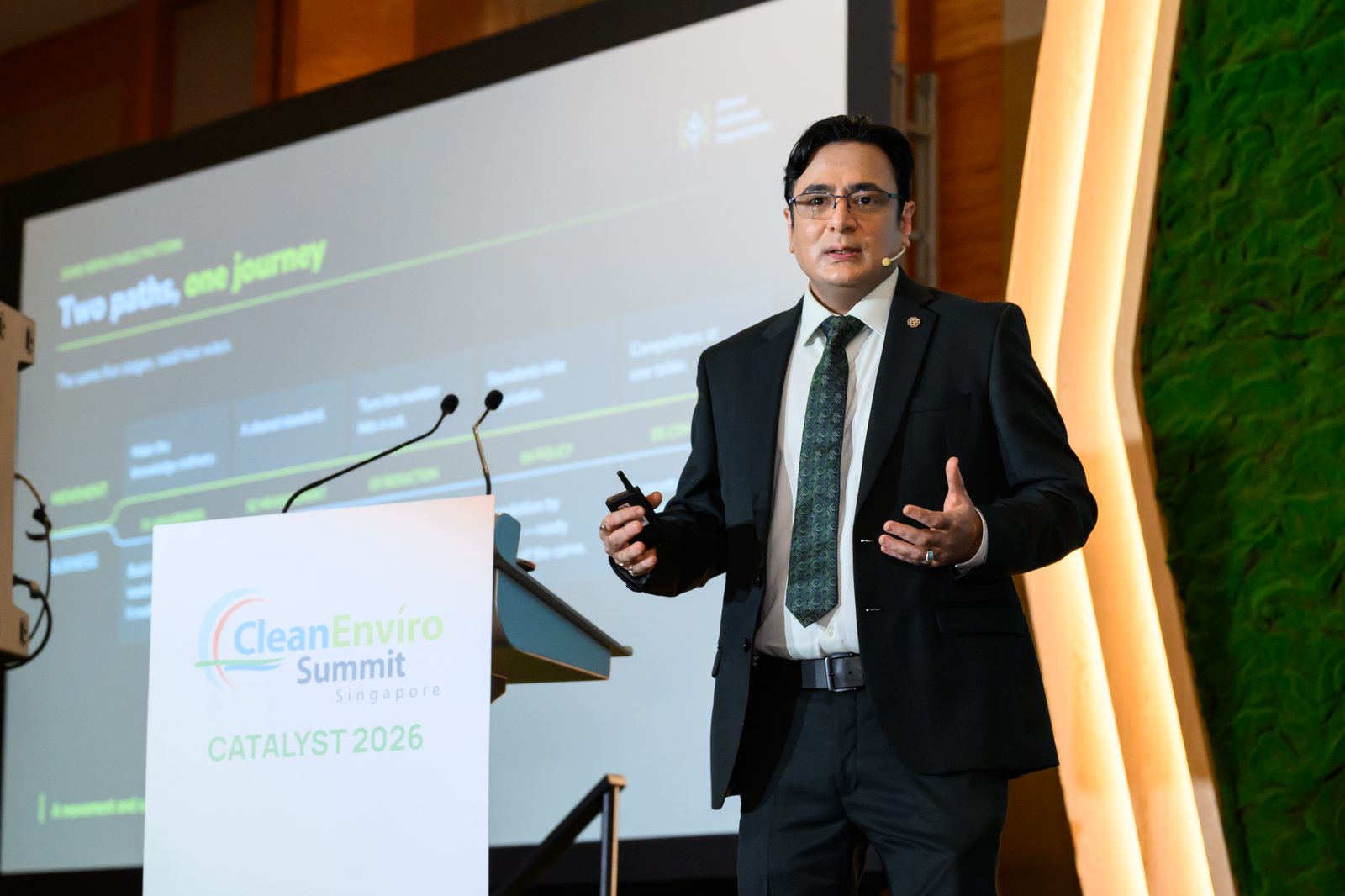
*Delivering the keynote at CleanEnviro Summit Singapore Catalyst 2026.*
## Setting the context
Dr. [Janil Puthucheary](https://www.linkedin.com/in/janil-puthucheary-3351b41b4/), Senior Minister of State, Ministry of Sustainability and the Environment & Ministry of Education, opened the event by setting the context for the day's discussions on sustainability. He highlighted Singapore's progress over the past decade, including reductions in waste generation, increased household recycling participation, and greater public awareness of recycling. At the same time, he underscored the challenges ahead — from rising collection and freight costs to volatile recyclables markets and the need for innovation to extend the lifespan of Semakau Landfill beyond 2035.
It was inspiring to see Singapore's long-term commitment to sustainability come through so clearly.
## The keynote: three ideas
My keynote, "Innovating Towards a Sustainable Future," built on that theme and focused on three ideas:
- **Sustainability and business value are not competing priorities.** Increasingly, they are the same path.
- **The Environmental Services industry is moving from activity-based metrics** (bins emptied, routes completed) **toward outcome-based metrics** (waste diverted, emissions reduced, and materials kept in circular systems). That transition represents one of the most important innovation opportunities of the next decade.
- **Green AI has two dimensions.** Green BY technology — using AI to make Environmental Services more sustainable. And Green IN technology — ensuring the AI itself is efficient, responsible, and sustainable. Environmental Services has a unique opportunity to advance both simultaneously from the outset.
## The ecosystem in the room
What stayed with me most was the ecosystem represented in the room: service providers, premises owners, innovators, government agencies, investors, and academics working together on a shared challenge. The Innovation Showcase brought this collaboration to life through demonstrations spanning Autonomous Systems, Analytics, AI, and Advanced Biology — showing how quickly sustainability innovation is moving from concept to deployment.
Thank you to the [National Environment Agency](https://www.linkedin.com/company/national-environment-agency/) for the invitation, to Dr Janil Puthucheary for setting the tone, and to everyone who shared ideas and perspectives throughout the event.
## Singapore's leadership in sustainable technology
As Executive Director of the [Green Software Foundation](https://www.linkedin.com/company/green-software-foundation/), I am particularly encouraged by Singapore's leadership in sustainable technology. Singapore was the first government to join the Green Software Foundation, demonstrating how public-sector leadership can help accelerate the adoption of sustainable technology practices and standards.
Singapore continues to demonstrate how policy, industry, and innovation can come together to accelerate sustainable outcomes.
---
# Day 13: The Queue You Never Built
URL: https://navveenbalani.dev/green-bytes/day-13-the-queue-you-never-built
Type: newsletter | Date: 2026-06-17
Most inference traffic is not waiting on a human. It is waiting on a loop. Embeddings for an index that refreshes hourly. Classifications for a moderation queue. Summaries for a digest that ships at seven in the morning. Evaluations that run overnight. None of these need a sub-second answer.
Yet almost all of them are dispatched as if they did. One request, one response, one connection, one forward pass. The producer code was written that way because that was the natural shape of a function call, and nothing has forced the question back open.
The principle for today is that latency tolerance is a design choice. When a team has not made it deliberately, the default is always urgency, and urgency is expensive.
A platform team pulls a month of inference logs to find the source of a cost spike. The spike is not in the production chat API. It is in the document embedding service. Every upload triggers its own embedding request, even though the index refreshes only every six hours. Nobody is waiting. The calls could have been pooled from the start.
The audit surfaces three patterns underneath this same shape, repeating across the platform.
**The Solo Trickle.** Background jobs that issue one request per item because the loop was written before batch endpoints existed, or because the team writing it did not know they did. The shape of the producer code locks in the shape of the bill.
**The Synchronous Reflex.** The unexamined assumption that every call must return inline. The majority of inference traffic in most platforms is not user-facing — it feeds indexes, populates dashboards, scores records overnight. Treating it like chat is the inheritance of a default that nobody chose.
**The Latency Budget Nobody Set.** Pipelines that have never been asked how long their answer can wait. When the question is finally posed to the owner, the answer is almost always longer than the system currently allows. The slack was there. The architecture was built without it.
> The GPU does not care whether it processes one request or thirty in the same forward pass. Higher utilisation means more useful work per watt consumed. The same infrastructure delivers more output without proportionally increasing energy draw.
The objection arrives quickly. "We cannot make our users wait." That is true for the slice of traffic that is genuinely user-facing and latency-bound. It is not true for most of what runs through inference. The audit almost always reveals that the largest share of compute is background work dressed in real-time clothing, because the real-time API was the easiest one to reach for. The work to be done is not to slow anything down. It is to stop pretending everything is urgent.
The move from urgent-by-default to deliberate-by-design follows a short ladder. Each rung is mechanical on its own. Together they reshape how inference flows through the platform.
**Classify.** Sort every inference workload by the latency it can actually tolerate, not the latency it currently delivers. Interactive belongs in one bucket. Near-real-time, where seconds are acceptable, belongs in another. Background, where minutes or hours are acceptable, belongs in a third. The third bucket is almost always the largest by volume and the most overlooked by design.
**Queue.** Place latency-tolerant work into a shared queue rather than dispatching it immediately. The queue is the structural change that everything else depends on. Without it, every later step is a workaround. With it, the producer side stops calling and starts enqueuing, and the consumer side stops waiting and starts draining.
**Pool.** Group queued requests that share a model, a parameter set, and a tolerance window. The pool, not the individual request, becomes the unit of dispatch. This is where the economics shift — many small calls collapse into one larger forward pass.
**Window.** Set an explicit holding window for each pool. Tens of milliseconds for latency-tolerant interactive. Several seconds for near-real-time. A full off-peak cycle for true background. The window is the lever that trades a small amount of delay for a large amount of efficiency.
**Dispatch.** Send the batch when the window closes or when it fills. Where the provider exposes a dedicated batch endpoint at a discounted rate, route to it. Where the inference engine supports continuous batching, configure it. Where neither is available, the queue itself still recovers most of the gain by raising the work done per forward pass.
The shape of this change looks different from each seat at the table, but every seat has a part in it.
**Engineering.** Find the loops that call an inference endpoint inside them. Replace the inner call with an enqueue. Build the drainer on the other side. The change is mechanical, and embedding and classification pipelines pay it back fastest.
**Platform/Infrastructure.** Make batch dispatch a first-class capability, not a workaround. Expose batch endpoints, configure continuous batching in self-hosted engines, and surface throughput-per-watt next to latency on every dashboard. Utilisation belongs on the sustainability scorecard.
**Architecture/CTO.** Treat batch-first as the default for non-interactive inference. Real-time becomes the exception that earns its premium. Everything else routes through the queue.
**Sustainability/ESG.** Track fleet utilisation as a leading indicator for Scope 2 emissions. Under-utilised accelerators consume power even when delivering little useful work — the idle draw is real, the output is not. Better batching increases work completed per unit of energy consumed, and grid draw moves with it.
**Business/Product.** Surface latency as a product choice rather than a system default. "Available in five minutes" is not a degradation. It is an offering. Most users do not need a nightly digest in real time, and most internal users do not need their analytics refresh to be synchronous.
Five seats, one principle: latency tolerance is a design choice, and the system bills you for the one you forgot to make.
The work begins with a single pipeline, not a platform-wide migration. The point is to make the pattern legible before scaling it.
Pick one background pipeline that currently dispatches inference calls one at a time. Ask the pipeline owner the only question that matters — how long can the answer wait. Refactor the producer side to enqueue, the consumer side to drain in batches. Where a batch endpoint exists for the model in use, route to it. Measure throughput-per-watt and cost-per-thousand-requests before and after. Publish the delta to the team that owns the pipeline.
Batching is not free of risk. A poorly sized window can introduce user-visible delay where none was budgeted for. A poorly sized batch can exhaust memory, trigger timeouts, or amplify a single failure into many. Start with the workload where latency is least sensitive and volume is highest. Tune the window upward until the throughput gain plateaus, then stop.
One pipeline, one window, one batch. That is the work.
> *The most expensive queue in AI is the one you never built.*
The next issue closes the infrastructure chapter by asking where the work should run. Region, fleet, and time of day each carry a different carbon weight. Placement is the lever most teams have not yet pulled.
* [vLLM documentation — continuous batching and throughput characteristics](https://docs.vllm.ai/en/latest/)
* [SGLang documentation — batching and scheduling](https://docs.sglang.ai/)
* [Anthropic — Message Batches API](https://docs.claude.com/en/docs/build-with-claude/batch-processing)
* [AWS — Bedrock batch inference](https://docs.aws.amazon.com/bedrock/latest/userguide/batch-inference.html)
* [Google Cloud — Vertex AI Gemini batch prediction](https://cloud.google.com/vertex-ai/generative-ai/docs/batch-prediction-api)
---
---
# Day 13 of Green, Efficient AI is live — The Queue You Never Built.
URL: https://navveenbalani.dev/posts/2026-06-17-day-13-of-green-efficient-ai-is-live-the-queue-you
Type: post | Date: 2026-06-17 | Topics: green-software
Day 13 of Green, Efficient AI is live — The Queue You Never Built.
Most inference traffic is not waiting on a human. It is waiting on a loop.
Embeddings for an index that refreshes hourly. Classifications for a moderation queue. Summaries for a morning digest. Evaluations that run overnight.
None of these need a sub-second answer. Almost all of them are dispatched as if they did.
The GPU does not care whether it processes one request or thirty in the same forward pass. The bill does. The grid does.
Today's issue is about the latency budget nobody set, and what changes when the question is finally asked.
Green Software Foundation #greenai #efficentai
---
# Day 12 · Cache What Doesn't Change
URL: https://navveenbalani.dev/green-bytes/day-12-cache-what-doesn-t-change
Type: newsletter | Date: 2026-06-15
Days 8–11 worked the loop itself — its turn count, its route, its tool shape, its context weight. That closes the loop chapter. This issue opens a new one. The next three days work on the platform underneath the loop, so the same work costs less every time it runs.
Here is the observation that opens it. Most AI prompts have a shape people rarely look at. Depending on the workload, anywhere from forty to ninety-five percent of the prompt is the same on every call — the system prompt, the tool schemas, the persona, the document the assistant is reading. The remainder is the user's actual question. The model processes the whole thing from scratch every time, as if it had never seen any of it before.
Every cached prefix is a forward pass the system does not have to run again. Every uncached prefix is one it does, on every call, forever. The difference is not in the model. It is in whether the platform treats the prompt as a string to reprocess or a structure with a stable part to remember. Caching is the discipline of refusing to recompute what has not changed — and it is often one of the largest cost-and-carbon levers in production AI systems, partly because it asks engineers to look at prompts as data, not as text.
Two support assistants, same hour, same thousand customer questions. Both run the same model. Both return the same answers. One reprocesses the system prompt, the tool schemas, and the policy document on every single call. The other declares those once, and pays for them once. By the end of the hour, the second assistant has run at a fraction of the cost, at a fraction of the latency, and at a fraction of the energy. The model did not change. The model's bill did.
Three patterns surface across almost every production AI workload, and each one is a place where the same tokens are processed again and again.
**The Stable Prefix.** Assistant identity, tool schemas, policy rules, document context — unchanged, yet recomputed every call.
**The Repeated Question.** Thousands of users asking variants of the same support question, each one triggering a full inference path.
**The Reloaded Document.** The same hundred-page PDF chunked, embedded, and re-attended across turns as if the system has never seen it before.
> Most production AI does not have an intelligence problem. It has a memory problem — it forgets what it just computed.
### "But our prompts are all different"
The most common objection to caching is that no two calls look alike, so there is nothing to reuse. Look at the actual prompt structure. The variation is almost always in the suffix — the user turn, the latest tool result. The prefix is system prompt, tools, persona, retrieved context, conversation history. Research measuring shared-prefix rates across real production traffic ([Yuan et al., *DualMap*, arXiv 2026](https://arxiv.org/abs/2602.06502)) found that roughly three in four agent-and-tool requests share more than half of their prompt with prior requests, and nearly half of conversational requests do the same. In long-context production workloads, that prefix routinely makes up the large majority of the tokens. The illusion of uniqueness comes from looking only at the tail.
There is a four-rung ladder for moving from a naive prompting pattern to a cache-aware system. Each rung is a small change in how the prompt is built, not a rewrite of the application.
**Locate.** Open one of your typical prompts and mark which bytes are the same on the next call and which bytes are not. The stable region — system prompt, tools, document context, conversation prefix — is the cacheable surface. If you have never done this exercise, the first reaction is usually surprise at how much of the prompt qualifies.
**Pin.** Tell the provider which region is stable. Most leading model providers now expose some form of prompt or prefix caching — a marker that says *this prefix will repeat; remember the computation for it*. Cached tokens typically bill at a fraction of the normal input cost on subsequent calls ([Anthropic's prompt caching documentation](https://docs.anthropic.com/en/docs/build-with-claude/prompt-caching) and the [AWS Bedrock caching guide](https://aws.amazon.com/blogs/database/optimize-llm-response-costs-and-latency-with-effective-caching/) both report up to ninety percent input-cost reduction and up to eighty-five percent latency reduction on cached portions of long prompts), and they reduce the repeated prefill work that drives a significant share of per-call energy on long-prompt workloads. *Pinning is the move from accidental reuse to declared reuse — and on a high-volume endpoint, declared reuse is the difference between paying for the same prefix once a day and paying for it ten thousand times.*
**Layer.** Prompt caching handles repeated prefixes. It does not handle a different user asking the same question through a different prefix. For that, add a semantic cache above the model — a small lookup that recognises when a new query is close enough to a previously answered one to return the stored answer directly. The right similarity threshold is application-specific, but the principle is universal: the cheapest inference is the one that never reaches the model.
**Watch.** Cache hit rate belongs next to latency and cost on the dashboard, not in a quarterly review. Published production data on Claude Code shows sustained cache hit rates around ninety percent in real coding sessions — a useful upper bound for what a well-structured agentic workload can achieve, and a useful yardstick for what most teams are leaving on the table today. A system whose hit rate is drifting downwards is a system whose prompts are drifting — usually because someone added a timestamp, a session ID, or a randomised greeting into the stable region and broke the prefix match. Make the metric visible, and the breakage gets caught in days instead of months.
**Engineering.** Restructure prompts so the stable part comes first and the variable part comes last. Cache markers attach to prefixes; a single dynamic token at the top of the prompt invalidates everything below it. Prompt order is now a performance decision, not a styling one.
**Platform and Infrastructure.** Serving stack matters. Provider-side caching works for hosted models. For self-hosted inference, engines such as [vLLM](https://docs.vllm.ai/en/latest/features/automatic_prefix_caching.html) and [SGLang](https://docs.sglang.ai/) offer prefix caching across requests, with knobs for TTL, eviction policy, and cross-tenant isolation. The platform team owns those dials, and exposes a semantic-cache layer as a shared service so every product team is not building its own.
**Architecture and CTO.** Caching is not a post-hoc optimisation. It is a prompt design constraint, decided upstream. Decisions about retrieval strategy, conversation history format, and tool schema stability all flow into whether the system can cache at all. An architecture that treats each call as fresh leaves one of the largest efficiency levers permanently disabled.
**Sustainability and ESG.** Cached prefixes reduce or avoid repeated prefill computation, which is where a significant share of per-call energy is spent on long-prompt workloads. A high cache hit rate translates directly into fewer GPU-seconds per business outcome. This is one of the clearest cases where the cost metric and the carbon metric move in the same direction, on the same lever, with the same intervention.
**Business and Product.** Cost on the cached portion typically drops by a large multiple versus uncached input. Latency on a cache hit can fall from seconds to milliseconds. For high-volume features — assistants, document Q&A, copilots — the difference between caching and not caching is often the difference between viable unit economics and unviable ones.
Five seats, one prompt structure that respects what has already been computed.
The work is to find the bytes that repeat, declare them, layer a semantic cache above them, and watch the hit rate as a living metric. Pick one high-volume endpoint. Measure its current cache hit rate — most teams discover it is zero. Restructure the prompt so the stable prefix is contiguous and comes first. Turn on provider caching. Add the hit rate to the dashboard the same week.
One caution, so you do not over-correct. Not every call benefits from caching. Low-volume endpoints, one-off analyses, and prompts that genuinely change top to bottom on every call are not the target. Caching pays where the same prefix runs again and again. Find those endpoints first, leave the long tail alone.
One prefix, one marker, one hit-rate metric. That is the work.
> *An uncached prompt pays for the same thinking on every call. A cached prompt pays for it once.*
Caching deals with the work you have already done. The next move is about the work you do together — why one well-shaped call can be cheaper, faster, and greener than many small ones, and what batching changes about the economics of inference. See you in the next issue.
* Yuan et al., [*DualMap: Enabling Both Cache Affinity and Load Balancing for Distributed LLM Serving*](https://arxiv.org/abs/2602.06502), arXiv, 2026 — shared-prefix rate measurements across real conversational and agentic workloads.
* Anthropic, [*Prompt Caching documentation*](https://docs.anthropic.com/en/docs/build-with-claude/prompt-caching) — up to ninety percent cost reduction and up to eighty-five percent latency reduction on cached portions of long prompts.
* AWS, [*Optimize LLM response costs and latency with effective caching*](https://aws.amazon.com/blogs/database/optimize-llm-response-costs-and-latency-with-effective-caching/), Amazon Web Services Database Blog, 2026 — Bedrock prompt caching performance characteristics.
* [vLLM Automatic Prefix Caching documentation](https://docs.vllm.ai/en/latest/features/automatic_prefix_caching.html) and [SGLang documentation](https://docs.sglang.ai/) — prefix caching for self-hosted inference.
---
---
# Day 12 of Green, Efficient AI is live — Cache What Doesn't Change.
URL: https://navveenbalani.dev/posts/2026-06-15-day-12-of-green-efficient-ai-is-live-cache-what-do
Type: post | Date: 2026-06-15 | Topics: green-software, ai-economics, agentic-ai
Day 12 of Green, Efficient AI is live — Cache What Doesn't Change.
Depending on the workload, forty to ninety-five percent of every AI prompt is the same as the last one — the system prompt, the tools, the document the agent is reading. The model reprocesses all of it from scratch, every time, paying the energy bill, the cost bill, and the latency bill twice for an output it already computed once.
The fix is not clever prompting. It is treating the prompt as a data structure with a stable part and a variable part, and telling the system which is which.
The four-rung ladder for fixing it, in today's issue.
Green Software Foundation #greenai #efficentai #aieconomics #leanagenticai
---
# Episode 92: The Intelligence Dependency Problem — A Hidden Risk in Agentic AI
URL: https://navveenbalani.dev/videos/episode-92-the-intelligence-dependency-problem-a-hidden-risk-in-agenti-7hwkfj0cmbo
Type: video | Date: 2026-06-14
What happens when the intelligence your AI agents depend on suddenly changes?
In the age of Agentic AI, organizations are increasingly building workflows around frontier models for reasoning, planning, memory, orchestration, and decision-making.
But what if access evolves?
What if a model becomes unavailable?
What if regulations shift?
What if regional access changes?
What if the intelligence layer your agents depend on no longer behaves the same way?
In this episode of Agentic AI: The Future of Intelligent Systems, we explore a growing strategic challenge that many organizations may not yet be fully considering:
The Access Problem.
Using recent developments around frontier AI models — including discussions surrounding access changes to advanced models such as Fable 5 and Mythos 5 — this episode examines a broader shift in how advanced AI capabilities are increasingly being viewed:
Not only as software products…
But as strategic capabilities.
In this episode, we explore:
✅ Why Agentic AI creates a new dependency on intelligence itself
✅ How evolving access, regulation, and policy may shape AI strategy
✅ The hidden risk of single-model dependency
✅ Why enterprises may need multi-model and resilient AI architectures
✅ The rise of Resilient Intelligence Architecture in the Agentic era
Because perhaps the future of AI strategy will not simply be about access to the smartest model…
But about building systems resilient to changing access to intelligence.
🎧 Listen now and rethink what resilience means in the age of Agentic AI.
#AgenticAI #ArtificialIntelligence #AI #AIAgents #EnterpriseAI #ResponsibleAI #AIArchitecture #DigitalTransformation #FutureOfAI #AIStrategy
Learn more: leanagenticai.com
---
# Episode 92: The Intelligence Dependency Problem — A Hidden Risk in Agentic AI
URL: https://navveenbalani.dev/podcast/episode-92-the-intelligence-dependency-problem-a-hidden-risk-in-agentic-ai
Type: episode | Date: 2026-06-14
What happens when the intelligence your AI agents depend on suddenly changes?
In the age of Agentic AI, organizations are increasingly building workflows around frontier models for reasoning, planning, memory, orchestration, and decision-making.
But what if access evolves?
What if a model becomes unavailable?
What if regulations shift?
What if regional access changes?
What if the intelligence layer your agents depend on no longer behaves the same way?
In this episode of Agentic AI: The Future of Intelligent Systems, we explore a growing strategic challenge that many organizations may not yet be fully considering:
The Access Problem.
Using recent developments around frontier AI models — including discussions surrounding access changes to advanced models such as Fable 5 and Mythos 5 — this episode examines a broader shift in how advanced AI capabilities are increasingly being viewed:
Not only as software products…
But as strategic capabilities.
In this episode, we explore:
✅ Why Agentic AI creates a new dependency on intelligence itself ✅ How evolving access, regulation, and policy may shape AI strategy ✅ The hidden risk of single-model dependency ✅ Why enterprises may need multi-model and resilient AI architectures ✅ The rise of Resilient Intelligence Architecture in the Agentic era
Because perhaps the future of AI strategy will not simply be about access to the smartest model…
But about building systems resilient to changing access to intelligence.
🎧 Listen now and rethink what resilience means in the age of Agentic AI.
---
# If you’re wondering, like I was, why Anthropic’s latest model Fable…
URL: https://navveenbalani.dev/posts/2026-06-13-if-you-re-wondering-like-i-was-why-anthropic-s-lat
Type: post | Date: 2026-06-13 | Topics: ai, generative-ai
If you’re wondering, like I was, why Anthropic’s latest model Fable suddenly shows as unavailable… this may be why.
Halfway through working on Fable, access suddenly disappeared.
The initial assumption?
A temporary issue. Capacity constraints. Service overload.
With the pace at which frontier AI models are being adopted, that felt like the obvious explanation.
But after digging deeper and reviewing the latest developments, it became clear this is part of a much broader shift.
Recent reports indicate that access to some of Anthropic’s latest frontier models, including Fable 5 and Mythos 5, has been impacted by new U.S. export-control measures tied to national security considerations.
Stepping back, this feels like an important moment for the AI ecosystem.
As AI capabilities advance, frontier models are increasingly being viewed not only as technology products, but also as strategic capabilities. It is understandable that governments will evaluate access through the lens of security, responsible deployment, and long-term societal impact.
For enterprises, countries, and builders, this reinforces an important lesson:
The future of AI strategy cannot rely on a single model or provider.
Diversity in model choices, open ecosystems, local capability building, and resilient AI architectures may become increasingly important in a world where access can evolve due to policy, regulation, or geopolitical considerations.
One more dimension for AI leaders to design for: access resilience.
Not just:
✔️ Model performance
✔️ Cost
✔️ Safety & Responsible AI
✔️ Latency & Reliability
✔️ Sustainability (Cost, Carbon, Water, Energy)
But also:
✔️ What happens if access to a frontier model changes overnight?
The strongest AI strategies may increasingly be the ones designed for optionality, adaptability, resilience, and responsible scale.
---
# Day 11 · Reset the Loop When Context Decays
URL: https://navveenbalani.dev/green-bytes/day-11-reset-the-loop-when-context-decays
Type: newsletter | Date: 2026-06-11
Day 8 made the loop the unit of work. Day 9 cut turns by planning the route. Day 10 cut turns by shaping the tool. Days 8–10 all worked on the same lever — fewer turns per task. This issue works on a different one. When the turns you do run carry more weight than they need to, the cost of each later turn climbs even when the work itself is not getting harder.
Here is the observation that opens it. An agent runs for fifteen turns to complete a task. Turn one costs around a thousand input tokens. By turn fifteen, the cost may be several times higher. The agent did not get harder questions along the way. It accumulated history. Most of that history is the agent's prior reasoning, intermediate tool outputs, retracted plans, and temporary working notes that no later turn ever reads — but every later turn re-processes all of it, because the model has no way to know what is residue and what is signal.
A loop's context is two different things sharing the same window. One is working memory — the small set of facts the next turn actually depends on. The other is residue — the by-products of getting here that no future turn will use. Both are re-processed on every turn. Telling them apart, and dropping the residue before it starts costing more than the work, is the lever this issue is about.
A document-analysis agent reviews a stack of contracts to flag clauses that need legal attention.
By turn five the agent was moving cleanly. By turn twelve, cost had tripled. By turn twenty, it had started revisiting clauses it already reviewed, while per-turn cost exceeded the first several turns combined.
Nothing changed about the task. What changed was the weight of the loop carrying the agent.
Three patterns showed up when the team looked at the trace.
**The undecaying transcript.** Every prior turn — including ones the agent itself had marked as wrong and corrected — was still in the window, getting re-read on every turn after it. The agent's own retracted reasoning was being treated as input the same as the contract.
**The stale anchor.** An instruction set at turn one ("review every clause for renewal terms") was still anchoring later turns at turn twenty, even though renewal terms had been fully covered by turn eight. The agent kept reaching for them anyway, because the instruction was still in front of it.
**The compounding residue.** Each tool call had returned a verbose payload. The agent had used three lines of each one and ignored the rest. All of it was still there, on every turn, paying for itself in tokens.
The fix was not a smarter agent. *It was a fresh loop, started at turn nine, with a four-line summary of what the previous eight turns had concluded — the clauses already reviewed, the flags already raised, the remaining clauses to cover.* That loop finished the work in seven more turns. The old loop, left to run, would have taken sixteen.
> Context the loop will use on the next turn is memory. Context the loop won't is weight.
### The continuity question
The obvious objection: doesn't resetting the loop break the agent's coherence? Doesn't it lose context the agent needs to keep the task on track?
The trade-off is simple — and the answer depends on what "context" is doing.
**Most context is by-product, not memory.** In a long loop, the majority of the window is intermediate reasoning, verbose payloads, and instructions the agent has already absorbed. None of it is being used on the next turn. All of it is being re-processed.
**The signal is often paragraph-sized.** What the next turn actually needs from the last ten is usually a short list of facts — what is done, what is pending, what was decided, what was ruled out. The full transcript is one way to carry it; a paragraph is the cheaper one, and once written, the better one.
**Reset is not erase.** The fresh loop starts with the distilled summary, not a blank slate. The agent picks up where the old loop left off, with the same goal and the same conclusions — just without the residue it was paying to drag along.
The simple rule: if a turn's cost is climbing faster than the task is progressing, the loop is carrying weight that the task no longer needs. That is the moment a fresh loop is cheaper than another turn of the old one.
> A loop that cannot reset is a loop that pays for its past, forever.
The operating ladder for context across a long loop has four rungs:
**Detect → Distil → Reset → Resume.**
Detect the decay before it has compounded. Two signals make it visible. The first is per-turn cost climbing while task progress is flat — every later turn is doing the same amount of work for more money. The second is the agent re-doing work it has already done — re-flagging a clause it already flagged, re-asking for a fact already retrieved, re-planning a step that was already settled. Both are symptoms of a window full of context the agent can no longer separate from the signal.
Distil what the next loop actually needs. The working set — the facts, decisions, and remaining steps the next turn actually depends on — is usually small enough to write in a paragraph. The move is to write it explicitly. The agent itself can be asked to produce it: *what is done, what is pending, what was decided, what was ruled out.* If you cannot say what the agent will use on the next turn, you are paying for context the loop is not using.
Reset the loop with the distilled summary as the new starting state. Drop the residue — the retracted reasoning, the verbose tool payloads, the early instructions that have already been satisfied. Start a fresh loop with only the summary, the goal, and the tools needed for what remains. *A reset is not a restart. The work continues; the weight does not.*
Resume the task inside the new loop. The agent should be unable to tell, by behaviour, that it was reset — same goal, same tools, same direction. The only difference is that turn one of the new loop costs what turn one of the old loop cost, instead of what turn fifteen would have. The savings are not in any single turn. They are in every turn the new loop runs that the old loop would have paid more for.
Five seats read this issue differently — and all five matter.
**Engineering** owns the trace. Per-turn input token counts should be charted across the life of every loop in production. The shape to look for is the cost curve rising while the task-completion curve is flat. That is the signature of context decay. Once it is visible, a "distil-and-reset" path is a small piece of code — a prompt that asks the agent to summarise its working state, plus the wiring to start a new loop with that summary as the only carry-forward.
**Platform/Infrastructure** makes the signal default, not opt-in. Context size per turn, turn-over-turn growth rate, and a decay indicator belong alongside turn count and total tokens on the platform's standard loop dashboard. The reset path itself is best provided as a platform capability so every team gets it the same way — not reinvented per agent. Reset thresholds, like loop budgets in Day 8, are policy that should be set centrally and tuned per workload.
**Architecture/CTO** treats the loop's memory as a distinct architectural layer with its own lifecycle. Working memory, full transcript, and tool-output history are three different things, even when they share the same context window today. Naming them separately — in design, in code, in reviews — is how reset becomes routine instead of heroic. As agent runtimes mature, memory layers will increasingly be handled natively. Teams that already separate working memory from transcript history will adapt faster.
**Sustainability/ESG** sees the lever most teams never reach for. Context re-processing in long loops is the kind of waste that does not show up as a slow request or a failed run — it shows up as a cloud bill that is bigger than it should be, and a compute footprint that is larger than the task warrants. Distilling and resetting reduces the same loop's cost on every later turn, not just the one being fixed. Compounding savings, paid for once.
**Business/Product** gets the user-facing win. A fresh loop with the right summary is faster, cheaper, and often more accurate than a tired loop dragging twenty turns of residue. Users feel the speed. Finance feels the cost. Engineering feels the simpler trace. The same operational move serves all three.
Five seats, one reset path, one shared definition of when to take it.
Pick the longest-running agentic loop in your production stack. Pull the per-turn input token count for the last hundred runs and plot it against task progress. If the cost curve rises while the progress curve flattens, you have found a loop that is paying to carry context it no longer uses.
For that loop, define one threshold — a turn count, a context size, or a cost-per-turn ceiling — past which the loop distils its working state and resets. Wire the distil step as a small prompt the agent itself answers: *what is done, what is pending, what was decided, what was ruled out.* Start the new loop with that summary as the only context carried forward.
Compare end-to-end run cost against your pre-reset baseline. If it drops, you have just removed a recurring tax from every future long run of this agent — a saving that compounds, not a one-off.
One caution, so you do not over-correct. Not every loop needs a reset. Short loops complete before context decay starts. Loops that genuinely need the full transcript — multi-document reasoning, long-horizon planning where every earlier step truly informs the next — should keep it. Reset is for the loops where the agent is dragging residue, not signal. Tell the difference on the trace, not on intuition.
One trace, one threshold, one reset path. That is the work.
> *An old loop carries everything forward. A fresh loop carries only what matters.*
Days 8–11 optimised the loop from four angles: visibility, planning, tool shape, and context reset. That closes the loop chapter. Next comes the platform underneath it — caching, batching, and placement so the same work costs less every time it runs. See you in the next issue.
---
---
# Day 11 of Green, Efficient AI is live — Reset the Loop When Context…
URL: https://navveenbalani.dev/posts/2026-06-11-day-11-of-green-efficient-ai-is-live-reset-the-loo
Type: post | Date: 2026-06-11 | Topics: green-software, agentic-ai
Day 11 of Green, Efficient AI is live — Reset the Loop When Context Decays.
An agent runs for fifteen turns. Each turn costs more than the one before it. By the last few turns, a single turn can cost more than the first several combined.
The questions did not get harder. The loop got heavier.
Most of what a long-running agent carries forward is residue — retracted reasoning, verbose tool payloads, instructions the agent has already satisfied.
None of it is being used on the next turn. All of it is being re-processed on every turn.
There is a crossover point where a fresh loop, started with a four-line summary, is cheaper than another turn of the old one. Knowing where that point is, in today's issue.
Green Software Foundation #greenai #efficentai #leanagenticai
---
# Day 10 · Close the Loop with the Right Tool
URL: https://navveenbalani.dev/green-bytes/day-10-close-the-loop-with-the-right-tool
Type: newsletter | Date: 2026-06-08
Day 8 made the loop the unit of work and showed why each extra turn costs more than the one before it. Day 9 cut turns at the front by planning the route. This issue cuts turns at every step by changing what the agent calls when it gets there.
Here is the observation that opens it. Two agents can run the same model, hold the same plan, and reach the same answer — and one of them takes seven turns while the other takes two. The thing that changes is not the agent. It is the shape of the tools the agent has to call. One agent is handed a toolbox of raw capabilities and has to stitch them into an answer; the other is handed a tool that already understands the task and returns the answer in one call.
Every tool an agent calls either ends a turn or feeds the next one. A tool that returns raw material — a search result the agent must filter, a record the agent must enrich, a list the agent must rank — is a tool that keeps the loop running. A tool that returns a closed answer is a tool that lets the loop stop. The interface between the agent and the rest of your system is not a wrapper around your API. It is the unit that decides whether the loop ends here or runs another turn.
Two agents, same task: answer the question "what is the status of my last order, and when will it arrive?"
The first agent has four tools, each a clean primitive: look up the customer by email, list orders for a customer, fetch shipping for an order, fetch carrier ETA for a tracking number. Sensible names. Clean separation. The agent calls them in order — customer → orders → shipping → ETA — and assembles the answer on the fifth turn. Nothing is wrong with any single tool. The agent simply paid four turns to do the assembly.
The second agent has one tool: *latest order status for this customer*. It takes the customer's email and returns the order, the items, the carrier, the current status, and the expected arrival window — in one call. Two turns and the answer is back.
Same model. Same data. Same question. The only difference is whether the tool matched the task the agent was doing — or merely exposed the capabilities the system happened to have. Three patterns produce this kind of extra-turn loop across almost every team that ships an agent, and all three feel like reasonable defaults:
**The grep-it-yourself tool.** The tool returns more than the agent needs — fifty search hits instead of the best match, a full record instead of two fields, a list when one answer would do. The agent's next turn is filtering, sorting, or picking. That filter is a turn you paid for, run for a question your tool could have answered itself.
**The one-call-per-field tool.** The tool exposes one capability cleanly, and to get a useful answer the agent has to call three or four of them and stitch the results together. Each call is a separate turn. The agent has become the integration layer — which is the most expensive integration layer you can buy, because it is charged in tokens and re-processed by every turn after it.
**The "now what?" return.** The tool returns data without context — a list of IDs, a row from a table, a status code. The agent's next turn is scanning back through its own earlier turns to remember why it asked for this and what to do with it. The tool was a function. The agent had to be the function that wrapped it.
> None of these tools are badly built. They are simply built for a different consumer than the one calling them.
### The flexibility question
The obvious objection: doesn't a toolkit of clean primitives give the agent more flexibility? Isn't exposing the building blocks the right move — let the model compose them however the task needs?
The trade-off is simple: flexibility and turn cost pull in opposite directions, and the right balance depends on how predictable the agent's tasks are.
**Primitives are right for the unknown.** When the agent's task isn't known in advance, or when the same agent serves many different jobs, exposing clean capabilities is the only design that works — task-shaped tools you haven't thought of yet can't exist yet. The cost of composition shows up in turns, but the alternative is not being able to do the work at all.
**Task-shaped tools are right for the known.** Most agents in production do not do unknown work. They do the same handful of tasks thousands of times — answer order questions, reconcile billing entries, triage support tickets, summarise a known kind of report. For tasks this repeatable, the agent doesn't need flexibility; it needs the right tool for the job. *Shipping the same composition turn after turn, for every run, is paying every customer to re-discover what your engineers already know.*
**The two combine.** The strongest production agents carry a small number of task-shaped tools that cover the common path, alongside a smaller set of primitives for the edges. The task-shaped tools close most loops in one or two turns; the primitives are there for the cases the task-shaped tools weren't designed for. Neither layer replaces the other.
The simple rule: tasks the agent will do hundreds of times — give it a tool that knows the task. Tasks the agent will do once or twice — primitives are enough.
> Flexibility is paid for one turn at a time. Let the agent pay for it only on the tasks that actually need it.
Most tool redesigns follow the same progression:
**Scope → Filter → Compose → Close.**
Scope the tool to the task before its API is written. The question to ask is not "what data does this expose?" but "what task is the agent doing when it calls this?" A tool called answers a system question. A tool called answers an agent question. The first is reused across forty places in your codebase; the second is the one the loop actually needed. Both can exist — but only the second ends a turn.
Filter inside the tool, not after it. If the agent's first move after every call is to filter, sort, or pick the top result, that work belongs inside the tool. The cost of doing it inside is paid once, by you, in code. The cost of doing it inside the loop is paid every run, by the agent, in tokens — and re-processed by every turn that follows it. A tool that returns fifty rows so the agent can pick three has handed the loop forty-seven rows of work it never needed.
Compose capabilities into the call. If two of your tools are always called together, they want to be one tool. Folding a follow-on call back into the original removes a turn from every run. The combined tool is harder to write — joins, lookups, edge cases — but harder to build once is cheaper than easy to build and paid for every run. Composition inside the tool is amortised; composition inside the loop is recurring.
Close the loop with a self-sufficient return. The tool's return should make the next step obvious: either the agent has the answer it needed and the loop ends here, or the next call is unambiguous from what just came back. *Helpful is what the agent uses on the next turn — everything else is weight the loop has to carry.* If the agent has to revisit its earlier turns to know what to do with the return — what it asked for, why it asked, what the value means — the return wasn't closed.
The first rung is the one most often skipped, because it requires the engineering team to think like the agent rather than like the database. The last rung is the one most often misunderstood — teams add more fields to the return on the theory that *more context is helpful*, when the cost shape from Day 8 says the opposite: every extra field becomes weight the loop has to carry for the rest of the run.
**Engineering.** Take the three tools the agent calls most often. Read each one as the agent reads it — the input contract, the return shape, what the agent does on the very next turn. If the next turn is *filter, sort, or pick the top result*, that work belongs inside the tool. If the next turn is *another call to enrich the result*, those two tools want to be one. If the next turn is *scanning back through prior turns to remember what to do with this return*, the return is too thin. One careful pass through your three highest-volume tools is usually where the largest single reduction in turn count per task lives.
**Platform/Infrastructure.** Tool definitions are platform infrastructure now. A tool registry that tracks call volume per tool, the agent's typical next-turn action after each call, and the size distribution of returns is what surfaces the loop-extending tools before the cost report does. As organisations adopt tool registries and emerging protocols such as MCP, the work shifts from simply exposing tools to exposing the right *shape* of tools for the agent work they actually serve.
**Architecture/CTO.** Agent tools are a distinct architectural layer with their own design discipline. They are not microservices in disguise — those are built for low-level reuse by other code. They are not screen-level APIs — those are built for a human at the other end. They are built for a model that pays in turns. Reviewing them as a layer in their own right, with named scope and return-shape standards, is what keeps them from drifting back into raw primitives over time.
**Sustainability/ESG.** Each redundant turn an agent runs is energy, water, and hardware time spent re-processing prior context to do work the tool layer could have done once. Tool discipline removes redundant turns at their source, which means the saving compounds with every deployment and every run. It is also one of the few efficiency moves whose footprint reduction is straightforward to measure: turn count per task, before and after.
**Business/Product.** The unit economics of an agentic feature are set by how many turns each task takes. A task that takes two turns instead of seven can materially reduce operating cost — often far more than teams expect — while also running faster, which is what the customer feels at the other end. Tool design is the product feature your users will never see directly and will pay for in every line item. Knowing which tasks are turn-heavy and why is what tells you which agentic features will scale beautifully and which will not.
Five seats, one tool layer, fewer turns per task.
Take the agent you measured on Day 8 and replanned on Day 9. Pull the trace from one full run.
For each tool call in the trace, look at the very next turn. Write down what the agent did there: filter, sort, enrich, follow up, or revisit earlier turns. That single column is your audit.
Pick the tool whose next-turn pattern repeats most often across the twenty runs — that is your highest-leverage candidate. Fold the recurring next-turn work back inside the tool: move the filter inside, combine the follow-on call into the original, or thicken the return so the agent doesn't have to revisit context to use it. Ship the new version of that one tool, change nothing else, and re-run the same twenty tasks.
Compare turn counts against your Day 9 baseline. If the average drops, you have just removed a recurring turn from every future run of this agent — a saving that compounds, not a one-off.
One caution, so you don't over-correct: not every tool wants to be a task-shaped tool. The primitive that the agent calls twice a year on an edge case is doing its job; folding it into something larger would only add weight. Reshape the tools your loop actually leans on. Leave the rest alone.
One tool, one fold, twenty runs. That is the work.
> *A wrong-shaped tool keeps the loop running. A right-shaped tool lets it stop.*
Days 8, 9, and 10 have made the loop visible, planned its route, and shaped each tool to end the turn it's called from. The next lever is the one a long loop quietly drifts on — context. The longer the loop runs, the more context it accumulates, and the more every later turn pays to carry forward. Some of that context is the agent's working memory and needs to stay. Most of it is residue and needs to go. The next principle is on telling the two apart, and on knowing when a fresh loop is cheaper than another turn of the old one. See you in the next issue.
---
---
# Day 10 of Green, Efficient AI is live — Close the Loop with the Right…
URL: https://navveenbalani.dev/posts/2026-06-08-day-10-of-green-efficient-ai-is-live-close-the-loo
Type: post | Date: 2026-06-08 | Topics: green-software, agentic-ai
Day 10 of Green, Efficient AI is live — Close the Loop with the Right Tool.
Two agents, same customer question: "What's the status of my last order, and when will it arrive?
Agent A has four clean tools — look up the customer, list orders, fetch shipping, fetch carrier ETA. Five turns to assemble the answer.
Agent B has one tool that already understands the question: latest order status for this customer. Two turns. Done.
Same model. Same data. The difference was whether the tools were shaped to the agent's task or to your system's capabilities.
Every tool an agent calls either ends a turn or feeds the next one. The interface, not the model, decides which.
The shape that closes a turn, in today's issue.
Green Software Foundation #greenai #efficentai #leanagenticai
---
# Episode 91 : The Token Shock — Why Companies Are Running Out of AI Budget
URL: https://navveenbalani.dev/videos/episode-91-the-token-shock-why-companies-are-running-out-of-ai-budget-sf4ff2kod_o
Type: video | Date: 2026-06-07
What happens when organizations discover that their AI budget is disappearing faster than expected?
In this episode of Agentic AI: The Future of Intelligence Systems, we take a deep dive into one of the biggest hidden challenges emerging in the age of Agentic AI:
Token Shock.
As enterprises rapidly adopt AI copilots, coding assistants, and autonomous agents, a surprising reality is beginning to surface:
AI does not behave like traditional software.
Agents think.
Reason.
Retry.
Search.
Call tools.
And sometimes continue working quietly in the background long after users move on.
What feels like one simple request may actually trigger hundreds of hidden reasoning steps underneath.
And suddenly…
organizations are asking difficult questions:
• Why are AI costs rising so quickly?
• Do all tasks really need the largest models?
• Are agents overthinking simple work?
• What happens when token spending scales across thousands of employees?
• Why are some companies reportedly exhausting AI budgets far faster than expected?
In this episode, we explore:
✅ The hidden economics of tokens
✅ Why Agentic AI changes enterprise cost models
✅ The rise of reasoning budgets and token governance
✅ How invisible retries, tool usage, and agent workflows drive spending
✅ Why the future of AI may be about smarter intelligence, not just more intelligence
Because perhaps the future winners in Agentic AI will not be the organizations consuming the most intelligence…
But the organizations using intelligence wisely.
🎧 Listen now and rethink the hidden cost of intelligent systems.
#AgenticAI #ArtificialIntelligence #AI #GenerativeAI #AIAgents #EnterpriseAI #TokenEconomics #LeanAI #ResponsibleAI #DigitalTransformation
Learn more: leanagenticai.com
---
# 🚨 The Token Shock — Why Companies Are Running Out of AI Budget
URL: https://navveenbalani.dev/posts/2026-06-07-the-token-shock-why-companies-are-running-out-of-a
Type: post | Date: 2026-06-07 | Topics: agentic-ai, ai, generative-ai
🚨 The Token Shock — Why Companies Are Running Out of AI Budget
🎙️ Episode 91 of Agentic AI: The Future of Intelligent Systems is out now.
Are we creating value… or simply generating activity?
That may quietly become one of the biggest questions organizations ask in the age of Agentic AI.
Because intelligence is no longer free to scale endlessly.
As copilots, coding assistants, and autonomous agents become part of everyday work, a new enterprise challenge is emerging:
Token Shock.
The moment organizations realize that AI does not behave like traditional software.
In this episode, I explore:
✅ Why organizations are beginning to experience unexpected AI cost escalation
✅ The hidden economics of tokens and reasoning
✅ Why “reasoning budgets” may become essential
✅ How invisible retries, tool usage, and agentic workflows quietly drive spend
✅ Why the future may be about smarter intelligence, not just more intelligence
Because perhaps the future winners in AI will not be the organizations consuming the most intelligence…
But the organizations using intelligence wisely.
🎧 Listen here: https://lnkd.in/dQuaivcs
More on Lean Agentic AI: leanagenticai.com
---
# Episode 91 : The Token Shock — Why Companies Are Running Out of AI Budget
URL: https://navveenbalani.dev/podcast/episode-91-the-token-shock-why-companies-are-running-out-of-ai-budget
Type: episode | Date: 2026-06-07
What happens when organizations discover that their AI budget is disappearing faster than expected?
In this episode of Agentic AI: The Future of Intelligence Systems, we take a deep dive into one of the biggest hidden challenges emerging in the age of Agentic AI:
Token Shock.
As enterprises rapidly adopt AI copilots, coding assistants, and autonomous agents, a surprising reality is beginning to surface:
AI does not behave like traditional software.
Agents think.
Reason.
Retry.
Search.
Call tools.
And sometimes continue working quietly in the background long after users move on.
What feels like one simple request may actually trigger hundreds of hidden reasoning steps underneath.
And suddenly…
organizations are asking difficult questions:
• Why are AI costs rising so quickly? • Do all tasks really need the largest models? • Are agents overthinking simple work? • What happens when token spending scales across thousands of employees? • Why are some companies reportedly exhausting AI budgets far faster than expected?
In this episode, we explore:
✅ The hidden economics of tokens ✅ Why Agentic AI changes enterprise cost models ✅ The rise of reasoning budgets and token governance ✅ How invisible retries, tool usage, and agent workflows drive spending ✅ Why the future of AI may be about smarter intelligence, not just more intelligence
Because perhaps the future winners in Agentic AI will not be the organizations consuming the most intelligence…
But the organizations using intelligence wisely.
🎧 Listen now and rethink the hidden cost of intelligent systems.
---
# Wait… the AI budget is already gone?
URL: https://navveenbalani.dev/posts/2026-06-06-wait-the-ai-budget-is-already-gone
Type: post | Date: 2026-06-06 | Topics: agentic-ai, green-software, ai-economics
Wait… the AI budget is already gone?
This is becoming a real conversation inside organizations.
Coding assistants. Meeting summaries. Research agents. Copilots. Multi-agent workflows.
AI feels effortless… until someone sees the token bill.
In early 2025, I introduced the concept of Lean Principles for Agentic AI in my book Lean Agentic AI — focused on how organizations can apply intelligence in a lean, efficient, and purposeful way, balancing cost and environmental impact.
If you are building AI copilots, deploying agents, scaling enterprise AI, or navigating token costs, governance, and efficiency challenges, these principles and guidelines may be highly relevant.
📘 Book available worldwide on Amazon: https://amzn.to/3RQmXti
🌐 Learn more: https://leanagenticai.com/
---
# Day 9 of Green, Efficient AI is live — Plan the Loop Before You Run…
URL: https://navveenbalani.dev/posts/2026-06-05-day-9-of-green-efficient-ai-is-live-plan-the-loop
Type: post | Date: 2026-06-05 | Topics: green-software
Day 9 of Green, Efficient AI is live — Plan the Loop Before You Run It.
Two agents, same task: reconcile a billing dispute across three systems. Same model. Same tools. Same access.
One finishes in five turns. The other takes fourteen — and lands on the same answer nine turns later.
Nothing was broken. The slow one just started moving before it knew where it was going.
Without a plan, an agent decides each move from the last result it saw — never from the route as a whole. One cheap planning turn buys it sight of every step.
And it removes the turns at the start, where every wasted turn costs the most.
How to plan it, in today's issue.
Green Software Foundation #greenai #efficentai
---
# Revisiting Green Software: From Silicon to Screen
URL: https://navveenbalani.dev/talks/revisiting-green-software-from-silicon-to-screen
Type: talk | Date: 2026-06-04 | Topics: green-software, ai
In this video, I walk through the Green Software Foundation's expanded vision for green software — a shift we announced in June 2026, and one I believe defines the next chapter of this field.
## The definition, restated for 2026
When the Foundation was formed in 2021, the conversation rightly centred on carbon. Five years on, the definition has grown with the field:
> Software, and the hardware it runs on, designed, built, and operated to minimize its carbon emissions, energy consumption, water usage, and waste across every layer of the technology stack, from silicon to screen.
Every phrase in that sentence is deliberate. *Software, and the hardware it runs on* — because every line of code eventually consumes electrons on physical hardware that was mined, manufactured, shipped, powered, cooled, and one day disposed of. *Carbon, energy, water, and waste* — four dimensions, not one. *From silicon to screen* — because every layer of the stack has decisions to make, and every layer has an impact.
## Why the vision expanded now
The pace of change made this unavoidable. Generative AI has put unprecedented pressure on compute, energy, and water. Hardware refresh cycles are tightening as accelerator generations move faster than ever. Data centres are being sited around the availability of power and cooling, not just connectivity. And regulators across the EU, the UK, Asia, and North America are converging on disclosure regimes that directly affect software.
## Beyond carbon: why one metric is not enough
Carbon remains the anchor — the SCI specification is the world's first ISO-aligned standard for measuring software's carbon impact, and everything we've built rests on it. But carbon alone no longer captures the full picture. A workload optimized for carbon may still consume considerable water for cooling. An energy-efficient system may still drive premature hardware turnover and the embodied emissions that come with it. The four dimensions interact — optimizing one without seeing the others can displace the problem rather than solve it.
There is also a very practical reason to care: cost. Energy is the largest variable operating expense in modern technology infrastructure, water restrictions are reshaping where data centres can be built, and hardware costs are rising as accelerator demand outpaces supply. The same engineering decisions that reduce environmental impact reduce the cost of running software.
## Six layers, from silicon to screen
The vision treats the stack as a single architecture with six layers of decisions: **hardware and devices** (embodied carbon, lifecycle, end-of-life), **infrastructure and cloud** (regions, cooling, power sourcing — where the new Software Water Intensity work sits), **platforms and runtimes** (how efficiently the hardware below gets used), **data, AI, and ML** (where SCI for AI, ratified at the end of 2025, gives the industry its first consensus standard for measuring AI emissions), **applications and experience** (the patterns developers touch daily), and **governance and observability** (measurement, disclosure, and the connection to frameworks like CSRD and the EU AI Act — without this layer, the other five are unverified claims).
## What this means in practice
For practitioners: the decisions you already make — architecture, region, instance type, model selection, caching, payload size — are sustainability decisions, and always have been. The difference is that the industry now has, or is building, the standards to measure them and the patterns to make better choices the default. For decision-makers: sustainability is no longer a separate workstream from cost discipline, capacity planning, or AI strategy. It is the same workstream, viewed through a different lens.
## Where we're heading
The Foundation's roadmap moves this from vision to practice: accelerating the energy and water standards alongside the carbon work, operationalizing Green AI — taking SCI for AI from ratified specification into bootcamps, best practices, and reference architectures for Green Agentic AI — extending SCI into new domains, and turning standards into open tooling and agent-ready skills that practitioners can use directly.
The full vision is in the [Foundation's article](https://greensoftware.foundation/articles/revisiting-green-software-from-silicon-to-screen/), and the door is open: if your organization is serious about this work, [the Foundation](https://greensoftware.foundation/membership/) is where the standards and practices are being shaped — in the open, together.
---
# When did innovation become something we buy instead of something we…
URL: https://navveenbalani.dev/posts/2026-06-04-when-did-innovation-become-something-we-buy-instea
Type: post | Date: 2026-06-04 | Topics: trends, ai, green-software
When did innovation become something we buy instead of something we think our way through?
The latest edition of Technology Bytes explores a question that feels increasingly relevant in the age of AI:
Has innovation shifted from ingenuity to compute?
For decades, innovation was shaped by constraints. Teams solved hard problems through creativity, efficiency, and thoughtful engineering. Today, especially in software and AI, innovation is increasingly measured through more compute, more tokens, more infrastructure, and more spend.
In this issue, I reflect on:
- Why earlier innovation often achieved more with less
- How abundance may be changing the way we solve problems
- The hidden environmental and economic costs of compute-first thinking
- Why efficiency and thoughtful design still matter in the AI era
- What it means to return innovation to its roots
A reflection on whether scale is enhancing innovation, or quietly becoming a substitute for it.
---
# The Nature of Innovation: When More Compute Became a Substitute for Creativity
URL: https://navveenbalani.dev/technology-bytes/the-nature-of-innovation-when-more-compute-became-a-substitute-for-creativity
Type: newsletter | Date: 2026-06-03
Innovation was not always expensive.
For decades, some of humanity's greatest breakthroughs emerged from constraint, not abundance. Engineers built extraordinary systems under severe limits. Scientists solved difficult problems with imperfect tools. Builders optimized, simplified, and reimagined because resources were finite and waste carried consequences.
**Innovation** meant doing **more with less**. Less energy. Less material. Less waste.
The nature of innovation was ingenuity.
Something has changed.
In software, artificial intelligence, and digital systems, we increasingly treat innovation as a function of scale. More compute. More tokens. More GPUs. More parameters. More spend. Somewhere along the way, bigger quietly became a synonym for better.
There is an important distinction here, one that is easy to miss.
There is nothing wrong with scale itself. A larger model that reasons where a smaller one fails can justify its cost. A network that connects billions earns its infrastructure. Real capability deserves real resources. That is not the issue.
The issue is when **scale** becomes a **substitute for thought**.
When a problem becomes difficult, the instinct is increasingly to add compute. When accuracy slips, we add parameters. When performance falls short, we scale the run. Not because it is always the best answer, but because it is often the fastest one. Compute became accessible enough that scaling turned into a default response, even when better architecture, better data, or more thoughtful design might have solved the problem more elegantly.
That is the shift. We stopped asking *how do we solve this well?* and started asking *how much can we afford to spend?*
It is worth pausing on how unusual this is.
In most **disciplines**, **capability** and **efficiency** **evolved** **together**. We built stronger engines and still cared about fuel efficiency. We improved manufacturing while reducing waste. Progress rarely meant abandoning efficiency simply because resources became more available.
Yet in compute, abundance often made efficiency feel secondary.
The question is whether we have become too comfortable treating efficiency as optional rather than essential.
Every oversized run, every unnecessary token, every instinct to "just scale it" draws real electricity, real water for cooling, and real hardware. The cloud lives in physical buildings, and those buildings consume energy. The digital has become deeply physical. The cost was always there. It was simply easier to overlook when it remained invisible.
In the age of AI, where a single design choice can multiply across billions of inferences, inefficiency no longer scales quietly. It scales economically and environmentally.
History offers a different lesson about the nature of innovation.
The Wright brothers had no supercomputer. Early medical breakthroughs were not built on billion-dollar infrastructure. Many of the software systems we still admire today are remembered not for how much they consumed, but for how much they achieved with limited resources. Constraint was not the enemy of progress. More often, it sharpened it.
None of this is a call to go backward. Few would want a slower world or less capable technology. The point of looking back is not nostalgia. It is perspective. **Constraints** have often produced **extraordinary** **engineering**, and the ability to solve problems through intelligence rather than expense remains one of innovation's most valuable strengths.
The challenge with abundance is not only that it can encourage waste. It can also weaken the discipline of solving hard problems thoughtfully. When it becomes easy to buy your way around complexity, the habit of thinking deeply can slowly fade.
The future of innovation cannot simply be a race toward bigger systems.
It has to become a return to **thoughtful innovation**.
That does not mean rejecting compute, AI, or progress. It means measuring progress more honestly. Not only by model size or investment, but by how much value is created per resource spent. By how much complexity is reduced rather than added. By how much unnecessary cost, to systems and to the planet, is avoided. By how thoughtfully difficult problems are solved.
The next era of innovation may belong to those who achieve the greatest impact with the least unnecessary compute.
So perhaps there is one simple idea worth holding onto. The next time a problem resists you, try to solve it before you scale it. Ask what can be removed before asking what needs to be added. Spend the thinking before spending the compute.
Because more can always be purchased.
The harder question is whether we are still investing enough in the thinking that makes innovation meaningful in the first place.
---
# Encouraging to see SCI for AI recognized in the G7 French…
URL: https://navveenbalani.dev/posts/2026-06-02-encouraging-to-see-sci-for-ai-recognized-in-the-g7
Type: post | Date: 2026-06-02
Encouraging to see SCI for AI recognized in the G7 French Presidency’s work on measuring and monitoring the environmental impact of AI.
What makes this recognition meaningful is that SCI for AI was shaped through deep collaboration across nearly 20 organizations spanning industry, academia, and sustainability practitioners. The specification was developed as a community effort to extend the ISO/IEC 21031 SCI standard into the AI domain, helping establish a practical and standardized way to measure AI emissions across different AI paradigms and lifecycle stages.
Recognition like this reflects the growing importance of moving from broad discussions on AI sustainability to measurable and actionable approaches that can support better infrastructure, investment, and policy decisions.
A big thank you to everyone in the Green Software Foundation community who contributed to shaping the specification.
---
# Day 9 · Plan the Loop Before You Run It
URL: https://navveenbalani.dev/green-bytes/day-9-plan-the-loop-before-you-run-it
Type: newsletter | Date: 2026-06-01
Day 8 made the loop the unit of work and showed why it costs more than the calls inside it: every turn re-reads everything before it, so cost climbs faster than the number of turns the loop takes — closer to the square of the turn count than to a straight line. That issue was about spending less *per turn* — bound it, stop it, prune it, summarise it. This one is about needing fewer turns.
The picture is simple. Two agents — same model, same tools, same access — given the same task. One finishes in five turns. The other takes fourteen, lands on the same answer, and costs many times more. The single thing that separates them is whether the agent thought about the route before it took the first step.
And this turn count matters more than it looks. Under Day 8's cost shape, the *early* turns are the most expensive, because everything they do is re-read by every turn that follows. Cutting four wandering turns at the start of a fourteen-turn loop isn't a 28% saving — it removes those four turns AND every later turn that would have re-read them. A planned loop, put plainly, is one that decides its route before it spends a turn walking it.
Two agents, same task: reconcile a customer's billing dispute across three systems — the payment processor, the subscription ledger, and the support log. Same model. Same tools. Same access.
The first agent writes down its plan before doing anything: pull the disputed charge, find the matching ledger entry, check the support log for a refund request, compare the three. Then it executes that plan, top to bottom. Five turns. Done.
The second agent skips the plan and starts working. It pulls a charge — wrong one. Backs up, tries again. Opens the support log before it has the ledger entry to compare against, realises it can't use it yet, sets it aside. Twice it re-reads its own earlier notes to remember where it had got to. Fourteen turns later, it produces the same answer the first agent produced nine turns earlier.
Nothing was broken. The slow agent was the same model running the same task. It simply paid, turn after turn, to find a route a single planning turn would have laid out at the start. And under Day 8's cost shape, the turns it wasted were the worst ones to waste — the early ones, which every later turn paid to re-read.
Three patterns produce this kind of wandering across almost every team that ships an agent, and all three feel like reasonable defaults:
**The act-first default.** Most agent frameworks let the model call a tool on its very first turn. Planning is something you have to add — it isn't what you get out of the box. So the default behaviour of any untouched agent is to start moving before it has worked out where to go.
**The one-step-at-a-time trap.** Without a plan, the agent picks each move from the result of the last one — never from the task as a whole. A move that looks right in isolation is often wrong for the route, and the agent has no way to see that until it hits a dead end.
**The "where was I?" tax.** Without a plan to anchor to, the agent rebuilds its sense of *where am I, what's left to do* from the full conversation history on every turn. That re-reading isn't progress. It's the loop paying just to keep track of itself.
### The planning question
The obvious objection: doesn't a reasoning model already plan? It visibly "thinks" before it answers — isn't the loop already planned?
The honest answer is that the model's thinking and an explicit plan solve different problems, and the right tool depends on the task.
**Reasoning handles the step.** When a reasoning model thinks, it works through what to do in the current response. For a short loop with one or two tools, where the next step is obvious from the last result, that is enough on its own. Adding a separate planning step here is Day 3's mistake one level up — reaching for more machinery than the task needs.
**A plan handles the route.** For longer loops that touch several tools, branch, or have to back out and try again, internal reasoning on its own is fragile. By default, the model's thinking informs the immediate answer but isn't carried forward to the next turn. Some newer model setups *can* preserve reasoning across turns. That helps the model, but it doesn't solve the loop problem. Preserved reasoning is still internal to the model: opaque, unstructured, not visible to your tools, your orchestration layer, or your team. A written plan is structurally different — a visible, named list of steps the loop can checkpoint against, your monitoring can flag, and a human can read in the trace. Reasoning, preserved or not, doesn't give you that. The plan does.
**The two combine.** On genuinely hard agentic work, the strongest agents use both. The plan keeps the loop on a stable route; reasoning keeps each step on that route sharp. Neither replaces the other.
The simple rule: short, single-tool tasks — reasoning is enough. Long or branching loops — write the plan. Hard tasks — use both, on purpose.
> Reasoning sharpens the step you're on. A plan steers the loop you're in. Pick by the loop, not by the model.
The operating ladder for a planned loop has four rungs:
**Decompose → Sequence → Checkpoint → Re-plan.**
Decompose the task before any tool runs. Break it into named sub-goals — pull the charge, match the ledger, check the support log, compare — so the whole route is visible at once instead of discovered one step at a time. Sequence the sub-goals into an order, and rule out the paths you can already tell are dead. This is the rung that does the most work, because every wrong path the agent skips here is a wrong path it doesn't have to walk down and back out of later. Checkpoint at every step — after each move, the agent asks one short question: *am I still on the route I laid out?* Divergence is caught the turn it happens, not ten turns later. Re-plan when the answer is no. A divergence costs one cheap planning turn to absorb; that turn is far less than the wander it prevents.
The first and the last rungs are the ones most often skipped. Decompose is skipped because nothing makes you do it — the framework simply runs without a plan if you don't ask for one. Re-plan is skipped for the opposite reason: teams treat the plan as something that must be followed rigidly, and so avoid planning at all rather than re-plan mid-run. Cheap, frequent re-planning is exactly what makes the discipline robust. The plan does not have to be right. It only has to remove the moves that were obviously going to be wrong.
**Engineering.** Add one step before the agent executes anything: have it emit an ordered list of the tool calls it intends to make, then run that list. Measure turns-to-completion on the same real tasks before and after. The planning turn costs you one — count how many it removes.
**Platform / Infrastructure.** Watch the turn-count *distribution*, not the average. The wander hides in the tail — a handful of fourteen-turn runs drag the bill far more than the median suggests. Flag runs whose turn count overshoots the plan they emitted at the start.
**Architecture / CTO.** Which agents need a plan is a design decision, not a per-team guess. Long or branching loops earn a planning step; short, single-tool tasks don't. Bake that threshold into the platform so every team inherits the same default instead of each team re-deciding it.
**Sustainability / ESG.** Removing early turns is among the highest-leverage carbon cuts in an agentic system, because the early turns are the ones re-read most by every turn after them. Fewer turns at the start means less repeated compute all the way down the run.
**Business / Product.** A planned loop is faster and cheaper at the same time — the turns it skips are latency the user feels and tokens the bill counts. The flip side matters too: forcing a plan onto a one-step task is Day 3's over-sizing, one level up. A faster agent and a cheaper agent are usually the same agent.
Five seats, one plan, one loop that knows its route before it walks it.
Take the agent you measured on Day 8 — the long, branching one.
Add a single step before it executes anything: ask it to write the ordered sequence of tool calls it intends to make, then proceed. Change nothing else. Run the same twenty real tasks and capture two numbers per run: turns taken, and how that compares to its Day 8 baseline.
Then set those against your Day 8 loop signal-to-noise. If that ratio told you how much of each run was re-reading rather than working, this tells you how much of that re-reading was avoidable simply by knowing the route in advance. The planning turn costs you one. Count how many it bought back.
One agent, one planning turn, twenty runs. That is the work.
> *A reactive loop pays to discover the wrong path. A planned loop pays once to skip it.*
Planning makes the loop take fewer turns. The next lever is making each turn do more. Most agents loop because their tools hand back raw material — a search that returns ten documents the agent must then read, filter, and re-query. A tool that returns the finished answer ends the turn instead of feeding the next one. The next principle is the tool that closes the loop: designing what the agent calls so it doesn't have to call again. See you in the next issue.
---
---
# Day 7 · Shape the Answer Before You Ask
URL: https://navveenbalani.dev/green-bytes/day-7-shape-the-answer-before-you-ask
Type: newsletter | Date: 2026-05-31
Most teams optimise what goes into an AI call. Few optimise what comes back — even though output tokens cost roughly three to five times what input tokens cost, across every major provider. The return trip of a call is where the meter runs fastest, and it is the layer where the least design effort has been spent.
Days 3 through 6 worked on the trip in. Choose the right model. Make fewer calls. Trim what goes inside the call. Make the retrieval layer earn its tokens. All of that decides what reaches the model. None of it decides what the model sends back.
The shape of an answer is set in one of two places. Either the team decides it before the call and tells the model what to return — schema, structured-output mode, function signature, a single line of instruction. Or the team does not decide, the model returns prose, and someone downstream pays to wrestle that prose into a shape the system can use. The choice between those two places is the entire principle.
A team builds an invoice-processing pipeline. The model reads a document and returns three fields: vendor, date, total. In the demo, every field arrives clean. The pipeline passes review.
In production, the answer comes back wrapped in a sentence — *"I found the following details on this invoice…"* — and the total arrives sometimes as digits, sometimes as words, sometimes with a currency symbol, sometimes without, occasionally with a footnote about VAT. The downstream parser cracks on the third edge case. The fix that ships, under deadline pressure, is a second model call whose only job is to turn the first call's answer into clean JSON.
The pipeline now makes two model calls for every invoice. The second one produces no new information.
> It exists only to repair the shape of the first — a shape the first call would have returned for free, had anyone asked. At three-to-five times the input rate, the output side of that second call is the most expensive line on the bill, and it is pure cleanup.
The team eventually moved the formatting contract into the first call: a schema specifying vendor as a string, date as ISO 8601, total as a number, currency as a three-letter code. The second call was deleted. The invoice volume did not change. The model did not change. Half the calls on that endpoint went away.
Three patterns produce this kind of waste across nearly every team that has shipped an AI feature, and all three feel like reasonable defaults:
**The free-text default.** The first thing a model returns is prose, because that is what the most accessible API call gives you. Structured-output modes exist on every major provider, but they have to be asked for explicitly. Teams that ship fast inherit prose and pay for it on every call afterwards.
**The "we'll parse it later" reflex.** The system handles whatever comes back by writing a regex, then a more careful regex, then a parser, then a fallback model call when the parser fails. Each layer of cleanup feels cheaper than rewriting the prompt. Together they cost more than the rewrite would have.
**The discarded reasoning.** The prompt asks for a label and an explanation. The system uses only the label. Every call generates several sentences of reasoning that nobody reads — billed at the premium output rate, on every request, forever.
The model gives you exactly the shape you ask for, and exactly the shape you forget to ask for. The bill reflects both.
### The structured-output question
A fair objection: most major providers now offer JSON mode, structured outputs, or function calling as a built-in feature. If the platform handles the shape, is the discipline still the team's problem?
The feature solves the syntax, not the contract. JSON mode guarantees that what comes back is parseable. It does not guarantee that the fields are the ones the system needs, in the units the system expects, at the level of detail the system can actually use. A perfectly valid JSON response can still have a as a string, a date in the wrong format, or a field with a courtesy salutation attached. The parser succeeds. The downstream logic still fails.
Schema-bound structured outputs go further — they constrain the model to the field types declared, and where the feature is available, the team should be using it. But a schema that asks for a three-sentence on every call, when no downstream system reads the explanation, is a perfectly valid schema and an expensive one. The platform feature gets the team to a parseable shape. The principle gets the team to the shape the system actually needed.
The operating principle on the return trip of the call is a four-step hierarchy:
**Shape → Cap → Validate → Repair.**
*Shape* the output before the call. State the format the downstream system needs — a schema, a structured-output mode, a function signature, a single line of instruction (*"return only the three-letter currency code"*). The contract is set on the way in, so there is nothing to negotiate on the way out. *Cap* the length. Set max output tokens. Add a stop sequence. Ask for *"one sentence"* where one sentence is what the downstream system will consume. At three-to-five times the input rate, every uncapped output is a meter running without a needle. *Validate* what came back against the contract — types, ranges, required fields, allowed values — before any downstream system acts on it. Catch a malformed answer where it is cheap to catch. *Repair* locally when validation fails. Fix the formatting in code, or retry the smallest possible slice of the call. Never re-run the whole call to clean up the shape of its own output.
The first rung is the most often skipped. Teams reach for output cleanup before they have asked whether a schema, a function signature, or a one-line format instruction would have made the cleanup unnecessary. Shaping the answer in the prompt is the cheapest output optimisation available, and it is the one nobody talks about because it does not feel like an optimisation. It feels like prompt writing.
The second rung is the most often mis-set. Default max-token settings on most platforms are generous enough that the model almost never reaches them in practice, which means they are not constraining anything. A cap that never binds is decoration. Set it to the longest valid answer the downstream system will actually consume.
**Engineering.** Measure two numbers per call: total output tokens generated, and total output tokens actually consumed by the downstream system. The gap is your output waste. Move the formatting contract into the prompt or into a schema. Cap max tokens to the longest valid answer, not to the platform default. Add a validation layer between the model and anything that depends on its answer.
**Platform / Infrastructure.** Output tokens are the most expensive tokens on the bill and the most invisible — they are generated, not retrieved, so they do not appear on any storage or index dashboard. Track output tokens per request as a first-class metric, alongside prompt tokens and retrieved tokens. The three numbers together tell the full story of a call. If you only see two of them, the most expensive one is the one hiding.
**Architecture / CTO.** Output contracts are part of the system's interface, not a property of a prompt. They deserve the same discipline as any other API contract — owned, versioned, tested, and evolved with the consumers downstream. A change to the output shape is a change to the system, not a tweak to a string.
**Sustainability / ESG.** Every unrequested token in an output — a preamble, a restated question, a reasoning chain nobody reads — consumes compute and the energy, water, and embodied emissions that compute carries. Output discipline is one of the most overlooked carbon levers in a working AI system, because it acts on the most expensive tokens at the highest billing rate.
**Business / Product.** Reliability of an AI feature is downstream of the shape of its outputs. A feature that returns the right answer in the wrong shape fails in production exactly as a feature that returns the wrong answer does — the user sees a broken experience either way. Output shape is a product surface.
Five seats, one ladder, one return trip that earns its tokens.
Pick one feature this week whose output is being parsed, transformed, or cleaned up by code downstream of the model call. The one with the largest post-processing block, or the one that occasionally makes a second model call to repair the first.
Pull twenty real production traces of that feature. For each one, capture two numbers: how many tokens the model generated, and how many of those tokens the downstream system actually used.
The ratio of used tokens to generated tokens is your output signal-to-noise. In most untuned systems, it sits well under half. Every output token that did not feed a downstream system was billed at three-to-five times the input rate, generated under full compute, and carried the full carbon cost of inference.
Walk the ladder. *Shape* the output in the prompt or in a schema, so the downstream parser has nothing to wrestle. *Cap* the length to the longest valid answer the system can actually consume. *Validate* the response against the contract before any code acts on it. *Repair* locally — never run a second model call to fix the shape of the first.
One feature, one ladder, two ratios, twenty traces. That is the work.
> *The cheapest output token is the one you told the model not to write. The second cheapest is the one it wrote because the answer actually needed it.*
Shape, cap, validate, repair — that is the discipline on the return trip of a single call. And with that, the call is complete. Over five days we chose the right model, made fewer calls, trimmed what goes in, fed the retrieval layer only what the question needed, and disciplined what comes back.
But most AI systems are no longer single calls. They are loops. An agent receives a query, plans, calls a tool, reads the result, decides again, calls another tool — sometimes ten or twenty turns deep, each turn a fresh call carrying everything we have just learned to optimise. The next principle is what efficient AI looks like when the unit of work is no longer a call, but a loop. See you in the next issue.
---
---
# Day 8 · Right-Size the Agentic Loop
URL: https://navveenbalani.dev/green-bytes/day-8-right-size-the-agentic-loop
Type: newsletter | Date: 2026-05-31
Day 3 was about right-sizing the model — picking the smallest technology that does the job. This is the same discipline, one level up, applied to an agent loop: a model that plans, calls a tool, reads the result, decides again, and keeps going — sometimes three turns deep, sometimes twenty. The call is no longer the unit of work. The loop is.
Days 3 through 7 tuned the single call from both ends: the right model, fewer calls, a leaner prompt, a retrieval layer that earns its tokens, an output shaped before it is asked for. Every one of those gains was real. In a loop, each one either compounds across every turn or quietly evaporates. Right-sizing the loop is the next layer of discipline — controlling two things most teams never set on purpose: how many turns the loop takes, and how much each turn carries.
The reason loops need their own principle is that they carry their own past. Turn one sends the task. Turn two sends the task, plus turn one's answer, plus the tool result it produced. Turn twelve sends all of it — every query, every retrieved document, every line of the agent's own reasoning — re-submitted and re-read at full input price. Cost rarely rises in a straight line with the number of turns. As context accumulates, later turns become disproportionately more expensive, because each one re-reads what came before. A right-sized loop is one that takes as few turns as the task needs, and carries as little as each turn needs.
A team builds an agent to triage incoming bug reports. It reads the report, searches the codebase, checks recent commits, pulls up similar past issues, and proposes a root cause. On a simple bug in the demo, it finishes in three turns and feels like magic.
In production, on a real bug, it runs eleven to fourteen turns. The team expected the bill to be roughly fourteen times a single call. It was several times higher than that. Nothing was broken. The agent was simply paying, on every turn, to re-read everything it had already done.
> By turn twelve, the prompt carried the original report, six search results, four full files, and the agent's prior reasoning — all paid for again at input price. Most of the tokens in the loop were not spent solving the bug. They were spent re-reading the loop.
The team made three changes. They carried a short running summary between turns instead of the full transcript. They set a turn budget. They gave the loop an explicit definition of "done." Turn count fell. The total tokens per run fell much further — because the expensive part was never the work, it was the weight each turn carried.
Three patterns produce this kind of waste across nearly every team that ships an agent, and all three feel like reasonable defaults:
**The full-transcript default.** Most agent frameworks carry the entire message history into every turn, because that is the safe general behaviour — it guarantees the model never loses context. It also guarantees that every turn re-pays for every turn before it. The default is correct for the framework and expensive for your agent.
**The generous turn ceiling.** Max-iterations is set high, or left unset, so the agent "doesn't get cut off mid-task." A ceiling that never binds does not bound anything. It just lets a confused agent wander for thirty turns instead of failing fast at eight.
**The missing finish line.** The loop ends when it exhausts its turn budget or when the model happens to announce it is done — not on an explicit success condition. So an agent that solved the task at turn six often spends turns seven, eight, and nine confirming a result it already had.
### The framework question
The obvious objection: *doesn't my agent framework handle all of this?* The honest answer is that it handles the scaffolding, not the discipline.
A framework gives you the loop — it runs the turns, threads tool calls, and assembles the message history. What it does not do is decide what your particular loop should carry from turn to turn, how long it should be allowed to run, or what "finished" means for your task. Those are properties of your agent, not of the runtime, and the framework's defaults are tuned to be safe for everyone rather than efficient for you.
The framework runs the loop. The principle decides what the loop is allowed to spend.
The operating ladder for a lean loop has four rungs:
**Bound → Stop → Prune → Summarise.**
*Bound* the loop before it runs. Set a maximum number of turns the agent may take — a hard budget, sized to the longest legitimate task, not to the worst case the framework will tolerate. *Stop* on success. Give the loop an explicit definition of done — a condition it can check — so it ends when the task is solved, well short of the budget, instead of running until the budget runs out. *Prune* what each turn carries. Before the next turn, drop the context the next decision will not use — stale tool outputs, abandoned branches, raw results already distilled into a conclusion. *Summarise* when pruning is not enough. Replace a growing transcript with a compact running state — the facts established so far, the open questions, the next step — so the loop carries its conclusions forward, not its full history.
The first rung is the most often skipped. Teams ship agents with the framework's default iteration ceiling untouched — the same mistake as Day 7's default max-token cap, one level up. A turn budget that never binds is decoration. The second rung is the most undervalued: a real stopping condition is usually worth more than any per-turn saving, because the cheapest turn in a loop is the one that never had to happen.
**Engineering.** Measure two numbers per run: turns taken, and total input tokens summed across all turns. Carry a running summary between turns instead of the full transcript. Set the turn budget to the longest real task, and write an explicit success check so the loop stops on done, not on exhaustion.
**Platform / Infrastructure.** A loop's cost lives in a number no single-call dashboard shows: input tokens summed across every turn of a run. Track tokens-per-run and turns-per-run as first-class metrics. A team that only watches tokens-per-call is blind to the most expensive thing the system does, because the expense is in the repetition, not the call.
**Architecture / CTO.** The turn budget, the stopping condition, and the carried state are part of the agent's design contract — not knobs buried in a config file. Treat them the way you treat any system limit: owned, sized to the workload, tested against real tasks, and revisited when the workload changes.
**Sustainability / ESG.** A loop multiplies the footprint of a single call by its turn count, and then again by the weight each turn carries. Bounding turns and pruning carried context is among the highest-leverage carbon levers in an agentic system, because it acts on the most-repeated tokens in the most-repeated operation.
**Business / Product.** A loop that wanders is slow as well as expensive — every extra turn is latency the user feels. Bounding the loop and giving it a finish line improves cost and response time at the same time. A faster agent and a cheaper agent are usually the same agent.
Five seats, one ladder, one loop that earns each turn it takes.
Pick one agent in production this week — the one with the highest bill, or the one that visibly takes many turns to finish.
Pull twenty real runs. For each, capture two numbers: how many turns it took, and the total input tokens summed across every turn of the run. Then estimate a third — of those input tokens, how many were *new* information the turn needed, versus history it had already seen.
That ratio of new-work tokens to total loop tokens is your **loop signal-to-noise** — how much of the loop is solving the task versus re-reading itself. Set beside Day 6's retrieval signal-to-noise and Day 7's output signal-to-noise, you now have one number for the input layer, one for the output layer, and one for the loop that wraps them. In most untuned agents, loop signal-to-noise is the lowest of the three — most of what a loop pays for is re-reading itself.
One agent, twenty runs, one ratio. That is the work.
> *A call pays once. A loop pays for everything it remembers, on every turn it takes.*
Bound, stop, prune, summarise — that is how a loop spends less per run. But the deepest saving in a loop is not making each turn lighter. It is needing fewer turns. An agent that wanders for fourteen turns and an agent that finishes the same task in five are usually running the same model with the same tools — the difference is whether either one stopped to think before it started moving. The next principle is the turn that pays for itself: planning the loop before you run it. See you in the next issue.
---
---
# Day 7 of Green, Efficient AI is live — Shape the Answer Before You…
URL: https://navveenbalani.dev/posts/2026-05-31-day-7-of-green-efficient-ai-is-live-shape-the-answ
Type: post | Date: 2026-05-31 | Topics: green-software
Day 7 of Green, Efficient AI is live — Shape the Answer Before You Ask.
Most teams optimise what goes into an AI call. Few optimise what comes back.
Output tokens cost roughly three to five times what input tokens cost, across every major provider. The return trip of the call is where the meter runs fastest — and where the least design effort has been spent.
You decide what the model returns before you call it, or you pay to fix what it returns after.
How to stop paying twice for the same answer, in today's issue.
Green Software Foundation #greenai #efficentai
---
# Day 8 of Green, Efficient AI is live — Right-Size the Agentic Loop.
URL: https://navveenbalani.dev/posts/2026-05-31-day-8-of-green-efficient-ai-is-live-right-size-the
Type: post | Date: 2026-05-31 | Topics: green-software
Day 8 of Green, Efficient AI is live — Right-Size the Agentic Loop.
A team built an agent to triage bug reports. They expected it to cost about fourteen times a single call.
It cost several times more than that.
Nothing was broken. By turn twelve, the agent was re-sending every search, every file, and every line of its own reasoning — at full price, on every turn. Most of its tokens weren't spent solving the bug. They were spent re-reading the loop.
A call pays once. A loop pays for everything it remembers, on every turn it takes.
How to right-size it, in today's issue.
Green Software Foundation #greenai #efficentai
---
# Most people know AI consumes electricity.
URL: https://navveenbalani.dev/posts/2026-05-31-most-people-know-ai-consumes-electricity
Type: post | Date: 2026-05-31 | Topics: agentic-ai, ai, green-software
Most people know AI consumes electricity.
But very few realize that AI may also have a water story.
As Agentic AI evolves from answering questions to reasoning, planning, coordinating tools, and acting autonomously, an important question quietly emerges:
What physical resources support intelligent systems?
When AI systems run, infrastructure runs.
Servers generate heat.
Data centres cool infrastructure.
Electricity powers computation.
And in many cases, water becomes part of the story — directly through cooling systems or indirectly through power generation.
What makes this conversation even more interesting is scale.
One interaction feels small.
One extra reasoning step feels insignificant.
One retry seems harmless.
But what happens when millions of people rely on always-on intelligent systems working quietly in the background?
And perhaps the bigger question:
Does location matter?
A litre of water associated with AI infrastructure in a water-rich region is not always the same conversation as infrastructure running in areas already facing drought, groundwater depletion, or increasing scarcity.
Because the future of AI may not simply be about building smarter systems.
It may also be about building systems that are efficient, responsible, and thoughtful about the invisible resources quietly supporting intelligence.
🎙️ Episode 90 of Agentic AI — The Future of Intelligent Systems is now live: Understanding the Water Footprint of Agentic AI
Listen here:
https://lnkd.in/dvx8jnj2
---
# Episode 90: Understanding the Water Footprint of Agentic AI: The Hidden Resource Behind Intelligence
URL: https://navveenbalani.dev/videos/episode-90-understanding-the-water-footprint-of-agentic-ai-the-hidden--wgaretjjqcw
Type: video | Date: 2026-05-30
Artificial Intelligence often feels invisible.
You ask a question. An answer appears. An agent completes a task. Everything feels instant, effortless, and digital.
But beneath every intelligent interaction lies something physical.
In this episode, we explore one of the least discussed — yet increasingly important — aspects of Agentic AI:
Water.
Why would AI systems depend on water? How do data centres cool the massive infrastructure powering intelligent systems? Why might autonomous AI agents change the scale of resource consumption? And why does where computation happens matter just as much as how much computation happens?
We unpack the hidden relationship between Agentic AI, data centre cooling, electricity generation, and water scarcity, while separating hype from reality.
This episode is not about fear or slowing innovation.
It is about awareness.
Because the future of intelligence may not simply be about building smarter systems — but building systems that are efficient, responsible, and mindful of the invisible resources quietly supporting them.
🎙️ In this episode:
• Why AI has a water story
• How data centres use water for cooling
• The hidden link between electricity and water
• Why Agentic AI may change the equation
• Water scarcity and why location matters
• Building intelligent systems responsibly
Because every intelligent interaction may feel digital — but somewhere beneath the surface, physical resources are quietly at work.
---
# Episode 90: Understanding the Water Footprint of Agentic AI: The Hidden Resource Behind Intelligence
URL: https://navveenbalani.dev/podcast/episode-90-understanding-the-water-footprint-of-agentic-ai-the-hidden-resource-b
Type: episode | Date: 2026-05-30
Artificial Intelligence often feels invisible.
You ask a question. An answer appears. An agent completes a task. Everything feels instant, effortless, and digital.
But beneath every intelligent interaction lies something physical.
In this episode, we explore one of the least discussed — yet increasingly important — aspects of Agentic AI:
Water.
Why would AI systems depend on water? How do data centres cool the massive infrastructure powering intelligent systems? Why might autonomous AI agents change the scale of resource consumption? And why does where computation happens matter just as much as how much computation happens?
We unpack the hidden relationship between Agentic AI, data centre cooling, electricity generation, and water scarcity, while separating hype from reality.
This episode is not about fear or slowing innovation.
It is about awareness.
Because the future of intelligence may not simply be about building smarter systems — but building systems that are efficient, responsible, and mindful of the invisible resources quietly supporting them.
🎙️ In this episode: • Why AI has a water story • How data centres use water for cooling • The hidden link between electricity and water • Why Agentic AI may change the equation • Water scarcity and why location matters • Building intelligent systems responsibly
Because every intelligent interaction may feel digital — but somewhere beneath the surface, physical resources are quietly at work.
---
# Day 6 · The Cheapest Tokens Are the Ones You Never Retrieve
URL: https://navveenbalani.dev/green-bytes/day-6-the-cheapest-tokens-are-the-ones-you-never-retrieve
Type: newsletter | Date: 2026-05-28
Most production prompts are not written. They are assembled.
A user asks a question. Before the model sees anything, a retrieval layer runs — pulling rows from a database, passages from a document store, results from a search index, nodes from a knowledge graph, vectors from a similarity store, conversation history from a session log, sometimes data from a live API. Whatever the underlying system, the pattern is the same: the model does not have your enterprise data on board, so something has to fetch it, shape it, and stitch it onto the prompt before the call goes out.
In most real systems, the retrieved content is much larger than the instructions, the examples, and the user's question combined. Days 3 through 5 optimised the prompt as if it arrived fully formed. It does not. The layer that builds the prompt is its own efficiency frontier, and for many enterprise teams it is the largest one in the stack.
A customer-support assistant is built on a retrieval pipeline. A user asks: *"How do I cancel my subscription?"*
The pipeline fires. In this team's case it uses a vector store, but the same shape of waste appears whether the backend is a search index, a graph, a SQL layer, or a hybrid of several. The system retrieves the top twenty candidates by similarity, each roughly four hundred tokens long, and concatenates all of them into the prompt. The system prompt adds another six hundred. The user's question is fifteen tokens.
The model receives an eight-thousand-six-hundred-token prompt to answer a question whose actual source material is one paragraph in the cancellation policy document.
The team measured. Of the twenty retrieved passages, the answer lived in passage three. Passages one and two were about pausing, not cancelling. Passages four through twenty were about refunds, billing cycles, account deletion, and re-activation — related topics that the retrieval layer scored as similar, but that contained no information the model used.
The team made three changes. They cut top-k from twenty to five. They added a re-ranking step that scored each candidate against the actual question, not just the initial retrieval signal. They reduced passage size from four hundred tokens to one hundred and fifty, with a small overlap.
The prompt dropped to one thousand four hundred tokens. Answer quality, measured on their eval set, went up — not down — because the model was no longer working past sixteen near-misses to find the one passage that mattered.
Three patterns produce this kind of bloat across every retrieval method, and all three feel like good defaults:
**The top-k default.** Every retrieval system ships with a default — twenty candidates, ten results, the first page of matches. Most teams never change it. Defaults are set for demos, not for production.
**The chunk-size inheritance.** Most retrieval tutorials use a token count from the example they were copied from. Teams inherit the number without asking whether their content has that shape.
**The "context is free" reflex.** Million-token context windows have made teams stop pruning what they retrieve. The window can hold it, so the pipeline sends it. Every token in that window is still billed, processed, and consumes compute.
The model sees what retrieval gives it. The retrieval layer decides the size of the bill before the model sees a single token.
### The long-context question
A fair question to put against this principle: with context windows now stretching to a million tokens and beyond, is the retrieval layer still needed at all? The case is sometimes made that you can simply send the whole corpus on every query and let the model find what matters.
The technical answer is that long context and retrieval are not substitutes — they are different tools that solve overlapping problems on different cost curves.
Long context genuinely helps. Models have meaningfully improved at finding relevant information across long inputs, and some workloads that needed careful retrieval two years ago — analysing a single long document, working through a moderate codebase, holding a long conversation — now run cleanly inside the window without it.
But three things have not changed. Every token in that window is still billed, still processed, and still carries an infrastructure and emissions cost. A million-token call can cost orders of magnitude more than a one-thousand-token call, and often adds materially higher latency. Recall across long contexts is also uneven — strong at the beginning and end, weaker in the middle, weaker still when the question requires connecting information from multiple places. And corpora that exceed the window, content that changes daily, and queries that need fresh enterprise data still require a retrieval layer regardless of how large the window grows.
The result is not *retrieval or long context.* It is *retrieval and long context, used for what each is best at.* Long context handles the working set in front of the model. Retrieval handles the larger enterprise world the working set was selected from. The efficiency principle below applies to both — the cheapest token, whether it came from a retrieved passage or a window the team chose to fill, is the one the system never had to send.
The operating principle in the retrieval layer is a four-step hierarchy:
**Filter → Rank → Right-size → Refresh.**
*Filter* before you retrieve. Most queries can be narrowed before any retrieval method runs — by metadata, by user permissions, by product area, by language, by recency, by document type, by the natural partitions in your data. A pre-filter that narrows the candidate set before retrieval runs costs almost nothing, and the smaller the set it hands on, the faster and more accurate whatever comes next becomes. *Rank* what survives. The first-pass score from any retrieval system — similarity, keyword match, graph distance — is a coarse signal. A second-pass ranker that scores candidates against the actual question catches the result that was relevant but not surface-similar. *Right-size* what reaches the model — top-k is a knob, not a default, and the right value is almost always smaller than the one shipped in the example you copied from. Chunk size, where it applies, is the same — match it to the natural shape of an answer in your content, not to a number from someone else's setup. *Refresh* what the system holds. Caches grow stale, indexes drift as content updates, embeddings drift as the underlying model updates, and a stale layer returns wrong answers that the model then phrases convincingly.
The first rung is the most often skipped. Teams reach for retrieval tuning before they have asked whether a metadata filter, a permission check, or a SQL WHERE clause would have cut the candidate set in half. Pre-filtering is the cheapest, most effective form of retrieval optimisation, and it is the one nobody talks about because it does not involve a model.
The third rung is the most often mis-set. Top-k and chunk size are usually inherited from a tutorial and never re-measured. Both should be tuned to the eval set, not to a screenshot from someone else's blog post.
**Engineering.** Measure two numbers per retrieval call: how many items you retrieve, and how many of them materially contributed to the final answer. The gap between those two is your retrieval waste. Tune top-k and chunk size to your eval set, not to defaults. Add a re-ranker before you tune anything else — it is the single highest-leverage change most retrieval systems have not made.
**Platform / Infrastructure.** The retrieval layer has its own cost curve — index storage, query compute, latency, and the per-token cost it adds to every downstream model call. Track retrieved tokens as a first-class metric alongside prompt tokens and output tokens. If you only see two of the three, the largest one is hiding.
**Architecture / CTO.** Retrieval is a system, not a library call. It deserves the same design discipline as the model layer — ownership, versioning, eval coverage, and a clear contract for what it returns. Many enterprise retrieval pipelines were assembled quickly during early experimentation and have not been systematically revisited since. The choice of method — vector, keyword, graph, hybrid, federated — is itself a design decision and worth revisiting as the data and the workload evolve.
**Sustainability / ESG.** Retrieved tokens consume compute in the same way as written prompt tokens, and should be measured as part of the system's overall AI workload. A system that retrieves ten thousand tokens to answer with a hundred has a tokens-per-task ratio that no amount of prompt pruning will fix.
**Business / Product.** The quality of an AI answer is downstream of what the retrieval layer surfaces. A wrong answer is rarely the model inventing from nothing — it is the model accurately answering using the wrong source. Better retrieval is often the cheapest product improvement available.
Five seats, one ladder, one retrieval layer that earns its tokens.
Pick one feature this week that uses retrieval — of any kind. The one with the longest prompts, or the one whose answers most often feel slightly off-topic.
Pull twenty real queries. For each one, capture what the retrieval layer surfaced, and record two numbers: how many items were retrieved, and how many of them materially contributed to the final answer.
The ratio of *useful items* to *retrieved items* is your **retrieval** **signal-to-noise**. In most untuned systems, it is under twenty percent. Every retrieved item that did not contribute to the answer was paid for in tokens, latency, and energy.
Walk the ladder. *Filter* by metadata, permissions, or partition before retrieval — start with the most obvious filter your data allows. *Rank* the survivors with a second-pass scorer. *Right-size* top-k and chunk size against your eval set, not against the defaults. *Refresh* the cache and re-index any content that has changed since the last build.
One feature, one ladder, two ratios, twenty queries. That is the work.
> *The cheapest token is the one the retrieval layer never fetched. The second cheapest is the one it fetched because the answer actually needed it.*
Filter, rank, right-size, refresh — that is the work in the layer that feeds the call. But the call also has a return trip. The model generates an answer, the system parses it, an application acts on it, sometimes a second call is made to clean up the first. Most teams pay for the same answer two or three times because what came back was not in the shape they could use. The next principle is what efficient AI looks like in the layer that catches the response. See you in the next issue.
---
---
# Day 6 of Green, Efficient AI is live — The Cheapest Tokens Are the…
URL: https://navveenbalani.dev/posts/2026-05-28-day-6-of-green-efficient-ai-is-live-the-cheapest-t
Type: post | Date: 2026-05-28 | Topics: green-software
Day 6 of Green, Efficient AI is live — The Cheapest Tokens Are the Ones You Never Retrieve.
A team was sending their model an 8,600-token prompt to answer a question
whose actual answer was one paragraph.
Twenty passages retrieved. One useful. Nineteen paid for in full.
The model was never the problem. The retrieval layer was — and most teams have never looked at it.
Most prompts in production are not written. They are assembled. And the cheapest tokens in any prompt are the ones you never retrieve.
How to find and fix the waste, in today's issue.
Green Software Foundation #greenai #efficentai
---
# Day 5 · Spend Tokens Like They Cost Money
URL: https://navveenbalani.dev/green-bytes/day-5-spend-tokens-like-they-cost-money
Type: newsletter | Date: 2026-05-26
Published on ---
A surprising amount of AI waste hides inside calls you already decided to make.
Most production prompts are two to ten times longer than necessary — packed with instructions the model already knows, examples that no longer matter, and context left over from three turns ago. The model still runs. The waste simply rides inside the call.
A document-summarisation feature ships with a 2,400-token system prompt. Eleven role instructions. Six tone guidelines. Four formatting rules. Three negative examples. A persona paragraph. A safety preamble copied from a tutorial nine months ago. Then the document — usually under 800 tokens — gets appended at the bottom.
The team removed one section at a time and re-ran their eval set. The persona paragraph changed nothing. Four of the six tone guidelines were already covered by the model's defaults. Two of the three negative examples were redundant. The safety preamble was duplicating system-level guardrails the provider had already applied.
The cleaned prompt was 380 tokens. Quality scores held within noise. Latency dropped by a third. The bill on that one endpoint fell by more than seventy percent — and the model was never changed.
This is the third recoverable pool of waste in the stack, after right-sizing the model and reducing the call count. It is the largest one that lives *inside* a call you have already decided to make.
Three quiet forces keep prompts bloated. The *more-instruction reflex* — when a model gets something wrong, the instinct is to add another rule rather than test whether an existing one is doing any work. The *example accumulation drift* — few-shot examples are added during prototyping and never pruned, because nobody is sure which one is load-bearing. The *context-window illusion* — million-token windows make tokens feel free, even though every one of them is billed, processed, and burned.
Prompts only ever accumulate.
The operating principle inside a call is a four-step hierarchy:
**Prune → Compress → Place → Cap.**
*Prune* every instruction, example, and context segment that does not change an evaluation outcome. *Compress* what remains into the tightest form the model still understands — shorter phrasings, fewer examples, references instead of restatements. *Place* the stable content first so prefix caches keep working, and the variable content last so each call only pays for what changed. *Cap* the output by telling the model exactly how long the answer should be, rather than letting it run to the model's natural length.
The first rung is the most skipped. Teams jump straight to compression — shortening words, asking the model to "be concise" — without first asking whether the instruction needs to exist at all. A deleted instruction has zero tokens and zero cognitive load on the model. Compression only optimises what survived a question that was never asked.
The fourth rung matters more than it looks. On many provider price lists, output tokens are materially more expensive than input tokens, and they are generated sequentially — which means they drive latency and energy per request as well. A prompt that produces a 600-token answer when 150 would do is leaking on every dimension at once.
**Engineering.** Take your top three prompts by traffic. Remove one section at a time and re-run your eval set. Keep what moves quality. Delete what does not. Most teams find at least one entire block — a persona, a tone instruction, a redundant example — that contributes nothing. Then cap your max\_tokens to the actual P95 length of useful answers, not to whatever default the SDK shipped with.
**Platform / Infrastructure.** Track input and output tokens by prompt template. As a rough rule of thumb, anything where the system prompt is more than three or four times the typical user content is worth a closer look — though the right ratio varies by workload.
**Architecture / CTO.** Treat prompts like code: version, review, and test them. Prompts without ownership only grow.
**Sustainability / ESG.** Tokens-per-task is one of the clearest application-layer proxies for energy efficiency. Trend it release over release.
**Business / Product.** Output length is a product decision. A 600-word answer when the user wanted a sentence is both a UX bug and a cost bug.
Five seats, one ladder, one bill that moves.
Pick one feature this week. The one you suspect has the most bloated prompt — usually the oldest one, or the one with the most contributors.
Write down three numbers before you change anything: the current token count of the system prompt, the average tokens-per-response, and the cost per thousand calls.
Then walk the ladder. Prune one section. Run the eval. If quality holds, prune the next. Compress what survived. Cap the output to the actual useful length. Re-measure.
One feature, one ladder, three numbers. That is the work.
*The cheapest token is the one you never wrote into the prompt. The second cheapest is the one the model never had to generate back.*
Prune, compress, place, cap — that is the work inside a single call. But most AI systems today are not single calls. They are loops. An agent receives a query, plans, calls a tool, reads the result, decides again, calls another tool, and so on — sometimes ten or twenty turns deep. Every turn carries a fresh prompt, a fresh context, and a fresh bill. The next principle is what efficient AI looks like once the unit of work is no longer a call, but a loop. See you in the next issue.
---
---
# Day 5 of Green, Efficient AI is live — Spend Tokens Like They Cost…
URL: https://navveenbalani.dev/posts/2026-05-26-day-5-of-green-efficient-ai-is-live-spend-tokens-l
Type: post | Date: 2026-05-26 | Topics: green-software
Day 5 of Green, Efficient AI is live — Spend Tokens Like They Cost Money.
What if the largest pool of waste in your AI system is not the model you chose, or the calls you made, but the words you packed into every prompt?
Most production prompts are two to ten times longer than the task requires. The next principle is what to do about it.
Green Software Foundation #greenai #efficentai
---
# Day 4 · Make the Call Count Smaller
URL: https://navveenbalani.dev/green-bytes/day-4-make-the-call-count-smaller
Type: newsletter | Date: 2026-05-25
The cheapest, fastest, lowest-carbon inference is the one the system never made. Providers already reduce some waste below the API line through prefix caching. But the biggest opportunity lives above it — in calls the application never needed to make in the first place.
A customer support assistant answers *what are your business hours* forty thousand times a day. Each answer is generated fresh. Same question. Same context. Same answer. Forty thousand fresh inferences.
The model is doing exactly what it was asked to do. The system around it is the problem. It has no memory that this question has been answered before, no instinct to check before spending.
Add a lightweight cache in front of that endpoint, keyed on the normalised question, and the economics can change immediately. The model is no longer generating the same answer thousands of times a day. Spend falls because repetition disappears.
For many production AI systems, this becomes one of the largest recoverable pools of waste after model right-sizing. And unlike right-sizing, it usually requires no model change at all.
Three quiet forces keep the call count high. The first is the *provider-cache illusion* — teams know major providers already cache prompt prefixes, assume the work is done, and stop looking. The second is the *fresh-is-safer reflex* — every call regenerated from scratch feels more correct, so nothing gets cached even when the answer is provably stable. The third is the *agent multiplier* — one user query becomes ten model calls inside a loop, and no one is counting the eight that were redundant.
The result is inference running at scale on questions already answered, documents already fetched, and retries that should never have reached the model.
Major providers already reduce repeated prompt work through prefix caching when prompts stay stable. Most teams benefit from those savings automatically — often without even realising it.
That is the floor. The ceiling lives somewhere else.
Provider caching only sees what crosses the API. It cannot see the duplicate call your application made on behalf of two different users. It cannot see the document your agent re-fetched in the next turn. It cannot see the retry that should have caught a network blip three layers below the model.
The operating principle above the API line is a four-step hierarchy:
**Dedupe → Reuse → Carry → Catch.**

*Dedupe* identical and near-identical calls before they leave the application. *Reuse* what the provider already cached by keeping the prefix stable instead of mutating it. *Carry* context forward through an agent loop instead of rediscovering it each step. *Catch* failures at the layer they happened on, so the model never retries what the network owns.
Every other call-reduction technique sits somewhere on this ladder.
The most overlooked rung is the third one. Agent loops are where call counts quietly explode — one user query, ten model calls, half of them re-reading something earlier in the loop already had. What you carry forward, you do not pay for again.
**Engineering.** Walk the ladder in order. For one week, log every question your system sends to the model and count how many are repeats. Most systems have a small set of questions that show up over and over again — put a simple cache in front of those and the call count drops the day you ship it. Then look at your agents: each step in a loop often re-fetches or re-summarises something an earlier step already had. Carry that forward instead. Finally, look at where the model is retrying on errors that have nothing to do with the model — a flaky network, a malformed response — and move those retries to the layer that actually owns the failure. Each of these pays off the day it ships.
**Platform / Infrastructure.** The team that runs the model gateway is the only one that sees the full traffic shape across the organisation. A shared cache, sitting in front of the model and used by every team, plus a simple dashboard showing how often calls repeat — that is the cheapest visibility investment a platform team can make this quarter. Build it once, well, so every team in the org does not build a worse version six times over.
**Architecture / CTO.** Treat the cache as part of the architecture, not as a switch each team flips on their own service. Two design rules carry most of the weight. First, keep the unchanging parts of your prompts in the same place every time — the providers already cache that for you, but only when it stays stable. Second, when two users ask the same question in different words, the system should recognise that and return the same answer. Both of these are decisions made once at the architecture level and paid back on every call after.
**Sustainability / ESG.** The number missing from most dashboards is the calls that *did not happen*. Every metric we track today — cost per call, energy per call, carbon per call — assumes the call took place. None of them count the ones the system avoided. Add *avoided calls* as a first-class number alongside the unit metrics, and the work that moves it suddenly becomes the work that gets funded.
**Business.** The cost of inference is not the price of a call. It is the price of a call multiplied by the number of calls. The first number gets negotiated in contracts. The second is where the real money lives — and in most untuned systems, a meaningful share of that volume is the same question, asked again, paid for again. That share, not the unit price, is where the spend hides.
Five seats, one ladder, one bill that moves.
One thing to do this week: pick one AI feature you have in production. For seven days, keep a record of every question that feature sends to the model.
Then ask two questions of that record.
How often is the same question being asked more than once? And how much of the total traffic comes from a small handful of repeat questions?
In most systems, the answers are uncomfortable. A surprising share of the work the model is doing is work it already did.
Put a small cache in front of the questions that repeat the most. Send the answer from memory the second time, the third time, the four-thousandth time. Then measure three things before and after the change — how many calls the feature made, what it cost, how fast it felt to the user. Share those three numbers with the five seats from The Lens.
That is the experiment. The numbers tell the rest of the story.
*The cheapest call is the one you never make. The second cheapest is the one you make once and remember.*
---
**Coming up next.** Prune, compress, place, cap — that is the work inside a single call. But every prompt is built from something before it is sent. Retrieved passages, database rows, prior conversation, search results, knowledge base chunks. In most production systems, the prompt the model sees is mostly *retrieved*, not written — and the cheapest tokens in that prompt are the ones the retrieval layer never sent in the first place. The next principle is what efficient AI looks like in the layer that feeds the call. See you in the next issue.
---
---
# Day 4 of Green, Efficient AI is live - Make the Call Count Smaller.
URL: https://navveenbalani.dev/posts/2026-05-25-day-4-of-green-efficient-ai-is-live-make-the-call
Type: post | Date: 2026-05-25 | Topics: green-software
Day 4 of Green, Efficient AI is live - Make the Call Count Smaller.
The cheapest, fastest, lowest-carbon inference is the one the system never made.
Most teams focus on model cost. Bigger model. Smaller model. Better prompt.
But one of the biggest opportunities in AI efficiency lives somewhere else:
Calls your system never needed to make in the first place.
The same question answered forty thousand times.
The same document fetched again inside an agent loop.
The same retry sent back to the model for a problem the network should have handled.
Major providers already reduce some waste below the API line through prompt caching.
The bigger opportunity lives above it.
Dedupe → Reuse → Carry → Catch
One ladder for reducing unnecessary inference.
The cheapest call is the one you never make.
The second cheapest is the one you make once and remember.
Day 4 of Green, Efficient AI ↓
Green Software Foundation #greenai #efficentai
---
# Episode 89 : Token Economics: The Hidden Economy Powering Agentic AI
URL: https://navveenbalani.dev/videos/episode-89-token-economics-the-hidden-economy-powering-agentic-ai-v9r3z9knrpq
Type: video | Date: 2026-05-24
What happens when everyone has a personal AI agent?
Or ten agents?
Or perhaps… hundreds of invisible agents quietly working in the background?
In this episode, we explore a future where intelligent systems don’t just answer questions — they plan, reason, coordinate, and act on our behalf. From health companions and financial assistants to learning agents and autonomous workflows, Agentic AI is moving us toward a world of continuous intelligence.
But beneath this exciting future lies an invisible economy few people are talking about.
Tokens.
Every AI interaction carries a hidden cost — not just in money, but in computation, energy, carbon emissions, water usage, and infrastructure.
As billions of people begin relying on intelligent agents every day, what happens to the economics of intelligence?
Will smarter AI always win?
Or will the future belong to systems that know when not to think too much?
In this episode, we explore:
• Why tokens are becoming the currency of intelligence
• The rise of personal AI agents and invisible automation
• The hidden cost of reasoning, memory, and tool usage
• Why Agentic AI could trigger a massive explosion in compute demand
• The connection between AI, energy, carbon, water, and waste
• Why efficient intelligence may matter more than unlimited intelligence
Because in the age of Agentic AI…
every token carries a cost.
And the biggest challenge may not be building smarter systems —
but building wiser ones.
🎧 Tune in to rethink the future of intelligent systems.
---
# What if the future of AI becomes too expensive to sustain?
URL: https://navveenbalani.dev/posts/2026-05-24-what-if-the-future-of-ai-becomes-too-expensive-to
Type: post | Date: 2026-05-24 | Topics: agentic-ai, ai, generative-ai
What if the future of AI becomes too expensive to sustain?
Not because models are costly.
But because intelligence itself becomes something we consume continuously.
We are moving toward a world where AI systems won’t just answer questions.
They will quietly prepare for meetings, coordinate schedules, negotiate prices, summarize research, monitor health patterns, optimize spending, and make decisions in the background.
And many of these systems won’t work alone.
They will reason.
Retrieve memory.
Call tools.
Collaborate with other agents.
Quietly operating throughout the day.
Now multiply this by millions of people.
And perhaps hundreds of agents per person.
This is where a hidden economy begins to emerge.
Tokens.
Often treated as a technical metric.
But perhaps better understood as the currency of intelligence.
Because every token represents computation.
And computation carries consequences:
💸 Rising operational costs
Which increases…
⚡ Energy consumption
Which requires more…
💧 Water for cooling infrastructure
Leading to growing…
🌍 Carbon emissions
And when systems reason unnecessarily, carry oversized context, or overuse tools…
♻️ Waste multiplies.
As Agentic AI scales, the question may no longer be:
How intelligent can AI become?
But:
How intelligently should intelligence operate?
The latest episode of Agentic AI — The Future of Intelligent Systems explores the hidden economy powering Agentic AI — from personal agents and token demand to cost, energy, water, carbon, and the future of efficient intelligence.
🎧 Listen here:
https://lnkd.in/dHJTjYeG
---
# Episode 89 : Token Economics: The Hidden Economy Powering Agentic AI
URL: https://navveenbalani.dev/podcast/episode-89-token-economics-the-hidden-economy-powering-agentic-ai
Type: episode | Date: 2026-05-24
What happens when everyone has a personal AI agent?
Or ten agents?
Or perhaps… hundreds of invisible agents quietly working in the background?
In this episode, we explore a future where intelligent systems don’t just answer questions — they plan, reason, coordinate, and act on our behalf. From health companions and financial assistants to learning agents and autonomous workflows, Agentic AI is moving us toward a world of continuous intelligence.
But beneath this exciting future lies an invisible economy few people are talking about.
Tokens.
Every AI interaction carries a hidden cost — not just in money, but in computation, energy, carbon emissions, water usage, and infrastructure.
As billions of people begin relying on intelligent agents every day, what happens to the economics of intelligence?
Will smarter AI always win?
Or will the future belong to systems that know when not to think too much?
In this episode, we explore:
• Why tokens are becoming the currency of intelligence • The rise of personal AI agents and invisible automation • The hidden cost of reasoning, memory, and tool usage • Why Agentic AI could trigger a massive explosion in compute demand • The connection between AI, energy, carbon, water, and waste • Why efficient intelligence may matter more than unlimited intelligence
Because in the age of Agentic AI…
every token carries a cost.
And the biggest challenge may not be building smarter systems —
but building wiser ones.
🎧 Tune in to rethink the future of intelligent systems.
---
# Day 3 · Right-Size the Model
URL: https://navveenbalani.dev/green-bytes/day-3-right-size-the-model
Type: newsletter | Date: 2026-05-22
The smallest technology that solves the task is the right one — sometimes a frontier LLM, often a small one, sometimes a classical model, and sometimes no AI at all. Once you choose by task instead of by default, every cost on the bill moves with you.
A frontier model summarising a meeting transcript is a Ferrari delivering a pizza. It works. It also consumes an order of magnitude more energy, water, and cost than a small model that would have produced an output indistinguishable to the person reading it — the exact multiplier depending on the task, the family, and the provider.
And sometimes, the right answer is not a smaller model. It is no model.
> A regex extracting dates from text carries a tiny fraction of an LLM call's footprint — no GPU draw, no inference, no agent loop multiplier, no hallucination risk. The hardware floor is still there, as it is for every piece of software. But the bill above that floor collapses by orders of magnitude.
Right-sizing is a ladder, not a switch. It runs from *"do you need AI at all"* to *"if you need AI, do you need a generative model"* to *"if you need a generative model, how large does it need to be."* Most teams skip the first two rungs and land on the third with a frontier model already chosen.
Multiply that choice by every query, every user, every retry, every agent loop, and the gap between the smallest technology the task needed and the largest one the team shipped becomes the single largest line of waste in production AI today.
It is also the easiest line to recover. Right-sizing is one decision, made once, at design time. It pays off on every query for the lifetime of the feature.
Three forces quietly push every team to skip the ladder. The first is the **demo bias** — the model that impressed in the pitch is the model that ships. The second is the **fear premium** — a larger model feels safer, because no one ever gets asked *"why did you use the big one."* The third is the **default trap** — most AI platforms ship a flagship model as the default, and that default quietly becomes the default in every team's code.
> The result, today, is a planet's worth of inference running on models the work did not need — and a meaningful share of it running on AI when no AI was needed at all.
Right-sizing is not a single model swap. It is a four-step hierarchy that runs above the model layer and into the organisation:
> **Avoid → Simplify → Right-size → Escalate.**
This is the operating principle of efficient AI. Every other principle in this series sits somewhere on it.
The most overlooked rung is the third one — not in the code, but in the platform.
> The default model on your platform becomes the default model in every team's code. That dropdown becomes 80% of your organisation's inference. The platform's marketing decision quietly becomes an energy decision — multiplied across every feature, every customer, every query.
What you size deliberately, you can route deliberately. What you route deliberately, you can shrink. And what you can avoid running on AI at all is the lightest line on the bill.
**Engineering.** Walk the ladder in order. Before reaching for a model, ask whether a rule, a lookup, or a classical approach already solves the task. If a model is needed, start with the smallest credible one in the family, run your evals, and escalate only on measurable failure. The 80% of queries the small approach handles well never need to touch the large one again.
**Platform / Infrastructure.** Your defaults are the lever. Offer a tiered menu — deterministic helpers, classical ML endpoints, small LLMs, large LLMs — with the smallest credible option as the default at each layer. One change to the default config, multiplied across every feature your platform serves.
**Architecture / CTO.** Build the *Avoid → Simplify → Right-size → Escalate* hierarchy into the architecture itself. Non-AI paths, classical-ML paths, and small-LLM paths should be first-class citizens, not afterthoughts. A small-first router is the single most underused piece of infrastructure in production AI today.
**Sustainability / ESG.** Technology mix is the metric. Measure the share of features running on no-AI, classical ML, small LLMs, and large LLMs across the organisation, and report it monthly. It is one of the few sustainability numbers that moves *down* without anyone having to do less.
**Business.** Stop specifying model names in product requirements. Specify quality bars and let engineering choose the smallest technology that hits them. Routing by task is more honest than routing by tier — and costs an order of magnitude less.
Five seats, one ladder, one bill that moves.
One thing to do this week: pick one AI feature in production. Walk it down the ladder.
> *Does this task need AI at all, or would a deterministic approach solve it?* *If it needs AI, does it need a generative model, or would a classical one do?* *If it needs a generative model, is it running on the smallest one that holds quality?*
Run the test for whichever rung your feature is sitting on. If a smaller technology holds quality on your evaluation set — ship the swap. Write down the energy, cost, and latency difference before and after. Share those three numbers with the five seats from The Lens.
That single swap, on a single feature, is what the next 27 issues build on.
> The smallest technology that solves the task is the right one. Sometimes that is a frontier model. Often it is a small one. Sometimes it is no model at all. The smartest system is rarely the largest — it is the one that knew when less was enough.
---
Coming up next. Right-sizing chooses the technology once. But every call to that technology carries a second decision — what you send to it, and what you do with what comes back. The largest source of recoverable waste after right-sizing is the work the model never needed to do in the first place. That is the next principle.
See you in the next issue.
---
---
# Day 3 of Green, Efficient AI is live — Right-Size the Model.
URL: https://navveenbalani.dev/posts/2026-05-22-day-3-of-green-efficient-ai-is-live-right-size-the
Type: post | Date: 2026-05-22
Day 3 of Green, Efficient AI is live — Right-Size the Model.
One principle, written for everyone who builds, funds, designs, operates, or uses AI.
A frontier model summarising a meeting transcript is a Ferrari delivering a pizza.
It works. It also consumes an order of magnitude more energy, water, and cost than a small model that would have done the same job indistinguishably to the end user.
And sometimes the honest answer is not a smaller model. It is no model.
The smallest technology that solves the task is the right one. Not the most powerful. Not the newest. Not the one the demo used.
Green Software Foundation
---
# Day 2 of Green, Efficient AI is live: The Invisible Bill.
URL: https://navveenbalani.dev/posts/2026-05-20-day-2-of-green-efficient-ai-is-live-the-invisible
Type: post | Date: 2026-05-20
Day 2 of Green, Efficient AI is live: The Invisible Bill.
Every AI response carries five costs at once — energy, water, carbon, hardware, money. One sits on a dashboard the team already has open. The other four are simply waiting to be brought into view.
What it means: efficient AI begins the moment all five become visible at the point of decision — every query, every retry, every agent loop, every GPU hour.
Who it's for: every seat at the table — engineering, platform, architecture, sustainability, business. No single role solves efficient AI alone, and every role has something to bring.
Green Software Foundation
---
# Day 1 · Why This Newsletter Exists
URL: https://navveenbalani.dev/green-bytes/day-1-why-this-newsletter-exists
Type: newsletter | Date: 2026-05-19
Every AI feature ships an invisible bill. Cost. Energy. Water. Carbon. Hardware. Most teams see one. Almost none see the full picture.
Welcome to **Green, Efficient AI** — a newsletter about building AI that is intelligent in output and efficient by design.
---
### Why now
AI is scaling faster than any technology in modern history. Every product is becoming an AI product. Every team is becoming an AI team.
The choices we make now — models, architectures, interfaces, hardware, defaults, retries and agents — will shape the cost, energy, water, and carbon profile of AI for years to come.
The good news: efficient AI is not a trade-off. The same decisions that reduce waste often reduce cost, improve speed, and simplify operations. **One discipline. Many wins.**
This is the rare topic where doing the right thing for the planet is also the smartest thing for the business, the fastest thing for the user, and the simplest thing to operate. We just have not yet built the shared playbook for it.
That playbook is what this newsletter is for.
---
### What this newsletter is
**Green, Efficient AI** is an almost-daily read built around one small, actionable principle at a time. Some issues raise awareness. Some teach a technique. Some share a mental model, a story, or a number that changes how you see an AI system.
Every issue follows the same rhythm:
* **The Spark** — one fact or story that changes how you see AI.
* **The Shift** — one principle you will quote tomorrow.
* **The Lens** — what it means for engineering, design, product, platform, sustainability, business, end users, and agents.
* **The Move** — one thing to try immediately.
* **The Receipt** — the evidence behind the idea.
---
### Who this is for
Efficient AI is one of the rare disciplines where **every role at the table has something to contribute, and something to gain.**
Engineers touch efficient AI at every stage of the lifecycle — design, build, test, deploy, observe, maintain. Infrastructure and platform teams bring the hardware and region reality. Architects bring the system view. Designers and product managers shape demand at its source — through defaults, interfaces, and auto-triggers that decide whether AI runs once or a thousand times. Sustainability teams bring measurement. Business and finance leaders bring priorities and budgets. End users shape demand through prompts and habits. Increasingly, agents shape demand too — autonomous systems generating hundreds of model calls on a user's behalf, deciding when to retry, how to split the work, and which model to use.
And most importantly, waste runs through every layer — model, infrastructure, interface, prompt, agent, embodied emissions — and every role decides where it enters or exits the system. No single role — human or agent — solves efficient AI alone. All of them, on the same page, can.
---
This discipline will not be built through one framework, one model, or one standard. It will be built through everyday decisions made better — one small, actionable principle at a time.
That is what this newsletter is for.
Subscribe, and forward this to one person on the other side of the AI conversation from you — the engineer, the designer, the platform lead, the sustainability colleague, the finance partner, or the colleague building the next generation of AI agents.
This newsletter works best when the whole table is reading the same thing.
---
---
# Day 2 · The Invisible Bill
URL: https://navveenbalani.dev/green-bytes/day-2-the-invisible-bill
Type: newsletter | Date: 2026-05-19
*Every AI response has a physical cost — energy, water, carbon, hardware, money. Once you can see that bill, every other decision in the stack gets sharper.*
A single conversation with a large language model — roughly 20 to 50 prompts — uses about **half a liter of fresh water** in data center cooling. A 500 ml bottle, drunk by the servers, every time you finish a working session with a model.
A typical image generation uses about as much energy as charging your phone halfway.
The training run for one frontier model carries the carbon weight of **hundreds of round-trip transcontinental flights.**
And here is the number that changes the shape of the opportunity: **inference now uses more energy, water, and carbon over a model's lifetime than training ever did.** Training is the single, dramatic moment. Inference is the daily one — present in every query, every token, every retry, every agent loop. It is already the larger number, and the curve has barely started.
The picture grows richer still. Humans send one query at a time. **Agents send ten** — to plan, retrieve, reason, verify, and try again. As agentic systems move into production, every human request expands into a cascade of machine requests. The invisible bill compounds with users, and now compounds with the agents working alongside them.
Underneath all of this is **the hardware itself.** Every GPU your model runs on carries a manufacturing footprint paid before the first inference — often 20-40% of its lifetime emissions, embedded in mining, fabrication, and shipping. A GPU running at 15% utilization uses nearly the same power as one running at 85%, with much of its capacity still available. A GPU retired at three years rather than seven leaves embodied carbon on the table that could have been amortized further. A data center built for peak load operates at peak-load cooling even when capacity is open.
A meaningful share of the full bill — across software *and* hardware — is **waste, which means it is also the biggest opportunity.** Retried calls. Oversized models on small tasks. Regenerated answers a cache could have served. Agent loops that ran twelve times when one was enough. Idle GPUs. Hardware retired with life still in it. Waste is the largest line on the bill, and the most rewarding to recover, once it becomes visible.
*A note on the numbers above: every figure is an approximation, and the published estimates vary widely. The point of this newsletter is not to defend any single number — it is to show that every one of these costs is real, growing, and currently outside the view of the people best placed to act on them.*
These numbers do not yet appear on the model card. They are not yet in the API response. They have not yet made it onto the cloud bill, the sustainability dashboard, or the engineering ticket.
They are real. They are growing. And they are, today, **waiting to be made visible.**
That is the bill this newsletter is about — and today is the day we begin making it visible.
---
> **Every AI response carries five costs at once: energy, water, carbon, hardware, and money. Most of them travel quietly today — and most of them are met not at training time, but every single time a human, or an agent, asks the system to think. Efficient AI begins the moment all five become visible at the point of decision.**
The reason most AI systems can run lighter than they do today is not that anyone is being careless. It is that only one of the five costs — money — shows up on a dashboard the team already has open. The other four travel quietly with every call, every token, every image, every embedding, every GPU hour.
When you pick a model, you see latency and accuracy. **The fifth axis — energy per token — is the one waiting to be added.** When you ship a feature, you see request volume. **The water it draws is the next layer of the same picture.** When you scale to production, you see infrastructure spend. **The carbon curve runs alongside it, ready to be plotted.** When you provision hardware, you see capex and capacity. **The embodied emissions, utilization headroom, and lifecycle value are the next levers in the same toolbox.** When you sign the cloud bill, you see total cost. **The four costs inside it are visible the moment you choose to look.**
What you can see, you can weigh. What you can weigh, you can improve. The discipline of efficient AI starts with one move: bringing the four quiet costs into the same field of view as the visible one.
---
* **Engineering.** Every line of code that calls, consumes, tests, debounces, retries, caches, or renders the output of an AI system is a line on the invisible bill. Whether you pick the model, build the interface around it, run it through CI, or ship it to a mobile device — you have a lever. Every one of those levers is knowable, and once measured, becomes a third axis to optimize on alongside latency and accuracy.
* **Platform / Infrastructure.** You run the hardware AI lives on. Your region, your instance type, your utilization, your PUE, your refresh cycle, your decommissioning path — those are levers nobody else can pull. The invisible bill is largely written here, in both energy *and* embodied carbon, which makes it largely *rewritable* here.
* **Architecture / CTO.** Your AI spend curve, your AI carbon curve, and your AI hardware curve are the same line drawn three times. Make one visible and you have made all three visible — to finance, to sustainability, to the board.
* **Sustainability / ESG.** AI is about to be your largest and fastest-growing line item — across Scope 2 (operational energy) and Scope 3 (embodied hardware emissions). It is also the line item most ready to be measured well from day one. The teams shipping it want to help you measure it; they just need to know the unit.
* **Business.** The unit cost of intelligence is falling. The volume is rising ten times faster. Knowing the full bill per feature — software *and* the hardware it runs on — is what tells you which AI investments scale beautifully today, and which scale even more beautifully once their full bill is understood.
Five seats, one bill, one conversation.
---
**One thing to do this week:** Pick one AI feature or agent workflow you have shipped or are about to ship. Write down its five costs — energy, water, carbon, hardware footprint, money — even as rough estimates. Vendor figures, public model cards, utilization dashboards, and back-of-envelope math all count. Precision matters less than presence.
Then share the five numbers with the five other seats. The conversation that follows is the one this newsletter exists to start.
---
> *Every AI response carries five costs — software and hardware. Four of them are still quiet today. Efficient AI begins the day all five sit on the same page.*
---
**Coming up next.** The five costs do not behave the same way. One scales with users, one scales with geography, one scales with time of day, one scales with the model you chose, and one was met before the system ever ran. Knowing which lever moves which cost is the next principle.
See you in the next issue.
---
---
# Every AI feature ships an invisible bill.
URL: https://navveenbalani.dev/posts/2026-05-19-every-ai-feature-ships-an-invisible-bill
Type: post | Date: 2026-05-19
Every AI feature ships an invisible bill.
Cost. Energy. Water. Carbon. Hardware.
Most teams see one.
Almost none see the full picture — and that gap is about to define the next era of how we build software.
Today, I am launching a new LinkedIn newsletter:
Green, Efficient AI
Building AI that is intelligent in what it delivers — and efficient in how it runs.
The newsletter is an almost-daily read built around one small, actionable principle at a time.
No long essays. No abstract frameworks.
Just one idea per issue — useful enough to bring into your work tomorrow.
Waste in AI doesn't live in one place.
It runs through every layer — from the model to the prompt to the hardware itself.
Which means every role has something to contribute:
Engineers across the lifecycle. Architects. Designers. Platform teams. Sustainability leads. Finance partners. End users.
And increasingly, the agents consuming AI on our behalf.
No single role solves efficient AI alone.
That is the conversation this newsletter is for.
Day 1 is live.
It explains why this newsletter exists and how it works.
If you build AI, fund it, design it, operate it — or simply use it every day — I'd love for you to subscribe and read along.
Green Software Foundation
---
# Taming AI's Cost and Environmental Footprint — APAC AI and Sustainability Council
URL: https://navveenbalani.dev/talks/taming-ai-cost-and-environmental-footprint-apac-ai-sustainability-council
Type: talk | Date: 2026-05-15 | Topics: ai, green-software
I joined the APAC AI and Sustainability Council for a session on one of the most common patterns in enterprise AI today: adoption scales from pilots to organization-wide rollout, and the costs escalate far beyond what anyone budgeted.
## The scaling surprise
This isn't a problem of immature teams. Even organizations with highly evolved cost management practices — Microsoft, Amazon, Uber, and Starbucks were among the examples we discussed — have been caught off-guard and had to dial down their AI usage. And there is a less talked about, equally important consequence: energy, water, carbon, and hardware demand all scale in line with AI costs. Solve one and you solve the other — which is precisely why efficiency and sustainability are the same engineering problem.
## Where the budget bust comes from
The root cause is a lack of discipline in how AI applications are built and used:
- Using generative AI where it isn't needed at all
- Reaching for more powerful — and more expensive — models than the task requires
- Poorly constructed prompts
- Unclear goals for what the AI is meant to achieve
- Excessive context shared with every call
None of these look like big decisions individually. Multiplied across an enterprise, they are the bill.
## Lean Agentic AI
The remedies fall under what I call Lean Agentic AI: right-sizing models to tasks, routing by difficulty, disciplined prompts and context, and explicit budgets for what agents may consume. These are engineering practices, and they work.
## Accountability above architecture
A perspective I shared with the Council, and one that resonated in the discussion: technical fixes alone will not hold unless a single person is made responsible for efficient AI, and unless it is treated as a board-level risk. The organizations that tame AI's cost and footprint tend to be the ones that put accountability in place first, and let the architecture follow.
Thank you to the APAC AI and Sustainability Council for the invitation and the sharp discussion.
---
# AI can answer faster.
URL: https://navveenbalani.dev/posts/2026-05-15-ai-can-answer-faster
Type: post | Date: 2026-05-15 | Topics: ai, trends
AI can answer faster.
But can it ask better questions?
That may be one of the biggest shifts in the age of AI.
For years, expertise was measured by how quickly answers could be produced. Today, answers are abundant. AI can generate them in seconds.
The differentiator is changing.
The future may belong to people who can:
- Ask better questions
- Connect ideas across domains
- Think critically beyond the obvious
- Apply judgment when certainty is low
- Bring empathy, context, and responsibility to decisions
Perhaps the real challenge is not learning how to compete with AI.
It is learning how to become more than AI.
A recent reflection from my latest book, Be More Than AI: The Reason AI Isn’t Enough:
AI can amplify intelligence.
But meaning, judgment, empathy, and purpose remain deeply human.
In a world where AI becomes increasingly capable, the question shifts from “What can AI do?” to:
What makes humans indispensable?
More thoughts, ideas, and episodes from the book:
📘 Buy the book - https://lnkd.in/dKuU_2Sr
🌐 https://bemorethan.ai/
What is one human capability you believe becomes more valuable as AI advances?
---
# Token Economics: Why Energy, Carbon and Cost Must Shape AI Design
URL: https://navveenbalani.dev/technology-bytes/token-economics-why-energy-carbon-and-cost-must-shape-ai-design
Type: newsletter | Date: 2026-05-12
Every token your AI generates has a price tag. Three, actually.
There is the bill — whether that arrives from Anthropic, OpenAI, Google, your hyperscaler, or your own inference infrastructure. There is the energy drawn from the grid to produce it. And there is the carbon released into the atmosphere because of it.
For a long time, the working assumption was that engineering teams at least had the first one under control — cost would be optimised, and the other two could follow later. The age of agents has dismantled that assumption.
---
### The problem: token economics has broken
A single user request no longer maps to a single inference call. It triggers chains of model calls, tool invocations, retries, reflection loops, and self-correction passes. A "simple" agentic task can quietly consume thousands of tokens. Multiply that by enterprise scale, and the economics of intelligence stop behaving the way finance teams modelled them last year.
Three forces are compounding at the same time:
**Inference has overtaken training as the dominant cost.** Training a frontier model is a spike. Serving it to millions of users, every day, for years, is the long tail — and the long tail is now bigger than the spike.
**Agents multiply token consumption by an order of magnitude.** One user prompt, ten model calls. The same task, ten times the footprint.
**Hardware refresh cycles are accelerating.** Each new generation of accelerators delivers more performance per watt, but the embodied carbon and water of manufacturing them does not vanish.
The result: cost is increasingly hard to contain — not because engineering teams have stopped optimising, but because the compounding nature of agentic AI workloads, multi-model dependencies, and unpredictable inference patterns is outrunning traditional cost controls. Energy is following the same curve. Carbon is barely measured. Water is rarely mentioned at all.

---
### Why this matters now
We are entering an era where the unit economics of intelligence — cost per token, energy per token, carbon per token, and increasingly water per token — will define which AI products scale and which ones quietly disappear.
A few signals from the past year worth holding in mind:
* For popular AI services, inference can account for roughly 60 percent of total lifetime energy consumption — and that share grows as user bases scale.
* Industry analyses project that by 2030, around 70 percent of data centre demand will come from AI inference workloads.
* Inference data centre capacity is projected to grow from around 2 gigawatts in 2024 to more than 50 gigawatts by 2030.
* Global data centre electricity consumption is on track to roughly double between 2022 and 2026, with AI workloads as the primary driver.
These numbers point to a simple conclusion: the cost line and the carbon line have converged. The largest lever on AI cost is the same lever as the largest lever on AI sustainability. They are not in tension. They are the same problem, viewed from different angles.
---
### The solution: green software, redefined for the AI era
For years, green software was treated primarily as a carbon conversation. Carbon remains foundational — and the industry has built real standards, real metrics, and real practice around measuring and reducing it. The next chapter is to widen the lens.
Alongside carbon, the resources that quietly shape a workload's footprint deserve equal engineering attention: the energy it draws, the water consumed in cooling the systems it runs on, and the hardware lifecycle behind every server, chip, and device in the chain.
These dimensions move together. A workload optimised for carbon, running on hardware refreshed every eighteen months, in a data centre drawing heavily from a water-stressed region, has only solved part of the problem. The honest view of green software is multi-dimensional: **carbon, energy, water, and waste — considered together across every layer of the stack.**
That is the shift worth internalising. From a single-metric mindset to a multi-dimensional one. From carbon accounting to resource intelligence. From sustainability as a reporting exercise to sustainability as an architectural property.
---
### The strategy: five moves that change the math
Token economics, viewed through this lens, becomes a design discipline rather than a billing problem. Five principles are emerging across the leading AI-native organisations:
**1. Right-size the model.** The largest model is rarely the right model. Matching model capability to task complexity is the single highest-leverage decision in AI cost and footprint. Route simple tasks to smaller models. Reserve frontier capacity for problems that genuinely need it.
**2. Cache aggressively, retrieve intelligently.** Every token that does not need to be generated is a token that costs nothing, draws nothing, emits nothing. Prompt caching, semantic deduplication, and well-architected retrieval are no longer optimisations — they are the default.
**3. Schedule with awareness.** Workloads that can run when the grid is cleaner, should. Carbon-aware and energy-aware orchestration has moved from experimental to operational at the leading hyperscalers.
**4. Measure across the stack.** Token costs at the application layer are shaped by choices at the silicon, infrastructure, platform, and data layers. Optimising one layer in isolation leaves value on the table — and obscures where the real footprint sits.
**5. Treat efficiency as an outcome, not a tax.** Lower carbon, lower energy, lower water, and lower waste are not concessions to sustainability goals. They are the operational signature of a well-engineered AI system. The teams that internalise this build cheaper, faster, and cleaner products by default.
---
### Why this should be on every executive's agenda
The companies that will lead the next decade of AI are not the ones spending the most on tokens. They are the ones extracting the most intelligence per resource consumed.
This is not an abstract sustainability narrative. It is the next frontier of competitive advantage, and the leaders building the foundations of this industry already see it clearly:
* **Chip designers** are racing to deliver more performance per watt because performance per watt now sets the ceiling on how much intelligence can be deployed at all.
* **Model providers** are investing heavily in efficiency — smaller models, smarter architectures, better caching — because the economics of serving billions of queries demand it.
* **Hyperscalers** are siting capacity around clean power, water availability, and grid headroom because those constraints now sit on the critical path of growth.
* **Enterprises deploying AI at scale** are discovering that token discipline is the difference between AI products that scale profitably and ones that stall at pilot.
If you are leading engineering, architecture, or AI strategy in your organisation, the question worth asking this quarter is not *"how do we reduce our AI bill?"* The better question is:
> ***Do we understand the full cost of every token we generate — across cost, energy, carbon, water and waste — and are we engineering accordingly?***
The organisations that answer this question first will not just be the most sustainable. They will be the most competitive.
The next decade of AI will not be won by whoever spends the most on compute. It will be won by whoever wastes the least.
Token economics is the scoreboard. Green software is the playbook. The leaders who internalise both — across cost, energy, carbon, water, and waste — will define the next era of intelligence.
---
*Technology Bytes is a newsletter on the intersection of emerging technology, sustainability, and enterprise strategy. Subscribe to get the next edition in your feed.*
---
# Every token your AI generates has a price tag. Three, actually.
URL: https://navveenbalani.dev/posts/2026-05-12-every-token-your-ai-generates-has-a-price-tag-thre
Type: post | Date: 2026-05-12 | Topics: green-software, ai
Every token your AI generates has a price tag. Three, actually.
There is the bill — from your model provider, your hyperscaler, or your own inference infrastructure. There is the energy drawn from the grid to produce it. And there is the carbon released into the atmosphere because of it.
For a long time, the assumption was that engineering teams had at least the first one under control. The age of agents has dismantled that assumption.
In the latest edition of Technology Bytes, I unpack why token economics is breaking — and why the answer is not a smaller AI bill, but a different way of thinking about AI altogether.
The next decade of AI will not be won by whoever spends the most on compute. It will be won by whoever wastes the least.
Read the full edition 👇
#GreenSoftware #SustainableAI #TokenEconomics #TechnologyLeadership #AI Green Software Foundation
---
# Last week was my Day 2 at the The Linux Foundation — and I was…
URL: https://navveenbalani.dev/posts/2026-05-08-last-week-was-my-day-2-at-the-the-linux-foundation
Type: post | Date: 2026-05-08
Last week was my Day 2 at the The Linux Foundation — and I was already at the All Hands meeting.
Our CEO, Jim Zemlin opened the event by reflecting on the culture and values that continue to shape the Linux Foundation and its communities, and one slide in particular stayed with me:
Helpful. Hopeful. Humble.
Those words felt real because they were reflected in the people around me and in the spirit of the open communities we build. It’s about helping others move forward, staying hopeful about our collective future, and remaining humble enough to know that real impact comes through collective effort and shared purpose.
One of those people is Sean Mcilroy. He has been the backbone of the Green Software Foundation projects and operations since the early days. He didn’t wait for me to “onboard” — he immediately started connecting dots, making introductions, and sharing context. That is what community actually looks like.
Swapping Mumbai’s humidity for snow while running on jet lag made the week memorable, but the shared spirit of the community is what grounded me. Having been part of the GSF journey since its inception, seeing the broader Linux Foundation ecosystem up close reinforced why this work matters. Sharing a picture with Sean from the trip.
At the Green Software Foundation, we’re tackling a challenge no single organization can solve alone: building sustainable software and AI systems. As AI adoption accelerates and the token economy scales, the need for standards, measurement, tooling, reduction strategies, and collective responsibility becomes even more important.
But weeks like this remind me that the people here aren’t waiting for permission or applause. They’re just building.
Grateful to be here.
---
# After five impactful years, closing a defining chapter at Accenture.
URL: https://navveenbalani.dev/posts/2026-04-27-after-five-impactful-years-closing-a-defining-chap
Type: post | Date: 2026-04-27
After five impactful years, closing a defining chapter at Accenture.
Five years ago, tech sustainability was still an emerging space. What began as a set of ideas evolved into building awareness, creating assets, platforms, and frameworks, driving real client impact, and contributing to new ISO standards that are shaping how organizations approach sustainability in software and AI.
Over time, this work gained industry recognition, with leadership reflected in evaluations by Forrester and Everest Group.
Grateful to Accenture for the opportunities, and to the Tech Sustainability Innovation team and extended teams who helped build and scale this work.
I’m excited to begin a new chapter with the Green Software Foundation and The Linux Foundation, stepping in as Executive Director.
Having been involved with the Green Software Foundation since its inception, this transition feels both natural and meaningful.
There is still a long way to go—and much more to build together as a community.
Sustainability is a shared responsibility. It requires collaboration across organizations, industries, and communities to make it the default, not the exception, with a clear focus on balancing cost, carbon, and energy in how software and AI are built and operated.
Thankful to Asim Hussain for building a strong foundation, and looking forward to working with the ecosystem to take this forward at scale.
Onward! 🚀
Gadhu Sundaram Jonathan Turnbull Sanjay Podder Carolin Rubner Vinjosh Varghese Yusuke Kobayashi Todd Moore Sean Mcilroy Jamie A Cowan Russell Trow Pindy Bhullar Gosia Fricze Joseph Cook Kirsty Du Plessis Jenya Saprykina Jabari George
---
# Episode 88 : Agentic AI and Cybersecurity — When AI Gets Permissions
URL: https://navveenbalani.dev/videos/episode-88-agentic-ai-and-cybersecurity-when-ai-gets-permissions-tj3thegdwki
Type: video | Date: 2026-04-26
Agentic AI is no longer just generating responses—it is reading data, triggering workflows, calling APIs, and taking real-world actions.
And that changes everything.
In this episode, the focus is on how cybersecurity evolves when AI systems move from answering to acting. As agents gain access to tools, systems, and permissions, the risk is no longer limited to incorrect outputs—it extends to incorrect actions with real consequences.
The episode walks through how an agent operates end to end—from input to reasoning to execution—and where vulnerabilities emerge along the way, including prompt injection, context manipulation, tool misuse, and privilege escalation.
It also explores why traditional security models fall short, and how a Zero Trust approach becomes essential in governing agent behavior, permissions, and decisions.
Because once AI has permissions, it has power.
And power without control is where systems begin to fail.
---
# Episode 88 : Agentic AI and Cybersecurity — When AI Gets Permissions
URL: https://navveenbalani.dev/podcast/episode-88-agentic-ai-and-cybersecurity-when-ai-gets-permissions
Type: episode | Date: 2026-04-26
Agentic AI is no longer just generating responses—it is reading data, triggering workflows, calling APIs, and taking real-world actions.
And that changes everything.
In this episode, the focus is on how cybersecurity evolves when AI systems move from answering to acting. As agents gain access to tools, systems, and permissions, the risk is no longer limited to incorrect outputs—it extends to incorrect actions with real consequences.
The episode walks through how an agent operates end to end—from input to reasoning to execution—and where vulnerabilities emerge along the way, including prompt injection, context manipulation, tool misuse, and privilege escalation.
It also explores why traditional security models fall short, and how a Zero Trust approach becomes essential in governing agent behavior, permissions, and decisions.
Because once AI has permissions, it has power. And power without control is where systems begin to fail.
---
# Episode 87 : Thinking Has Layers — The Human Stack | Be More Than AI (Surprise Edition)
URL: https://navveenbalani.dev/podcast/episode-87-thinking-has-layers-the-human-stack-be-more-than-ai-surprise-edition
Type: episode | Date: 2026-04-12
AI can process. AI can generate. AI can calculate.
But thinking — real thinking — has layers. And every single one of them is human.
In this episode, we break down what it truly means to think in an AI-driven world. Not as a single skill, but as a structured stack — five layers that build on each other:
Ask — question what’s in front of you before rushing to solve See — connect patterns beyond just data Feel — sense what the situation actually needs Decide — make the call when there’s no clear answer Own — stand behind your thinking
This is The Human Stack.
AI operates on the surface. Depth is your advantage.
📖 Explore the full framework in Be More Than AI → https://amzn.to/3PVzE54 🌐 Visit: bemorethan.ai 🔔 Follow the series for more episodes on thinking, intelligence, and what it means to go beyond AI
---
# Thinking Has Layers — The Human Stack - Episode 3 (Be More Than AI)
URL: https://navveenbalani.dev/videos/thinking-has-layers-the-human-stack-episode-3-be-more-than-ai-ofjqclpytb4
Type: video | Date: 2026-04-10
AI can process. AI can generate. AI can calculate.
But thinking — real thinking — has layers. And every single one of them is yours.
In this episode we unpack what it actually means to think clearly in an AI-driven world. Not one skill. Five layers that build on each other:
Ask — question what's in front of you before jumping to solve it
See — connect patterns from your experience, not just data
Feel — sense what the situation actually needs
Decide — make the call when there's no clear answer
Own — stand behind your thinking
I call it The Human Stack.
AI operates on the surface. The depth is entirely human.
📖 Want the full deep dive? My book "Be More Than AI" breaks down each layer of The Human Stack in detail → https://amzn.to/422sDSs
🌐 bemorethan.ai
🔔 Subscribe for more episodes in this series
Previous episodes:
Episode 1 — The Lazy Version
Episode 2 — What Is Work Now?
#BeMoreThanAI #TheHumanStack #AI #FutureOfWork #Thinking #Leadership
---
# AI can process.
URL: https://navveenbalani.dev/posts/2026-04-10-ai-can-process
Type: post | Date: 2026-04-10 | Topics: ai, trends
AI can process.
AI can generate.
AI can calculate.
But can it think?
Not even close.
Because thinking isn't one thing. It has layers.
Ask — before you solve, question whether it's the right problem.
See — connect patterns from your experience, not just data.
Feel — sense what the situation actually needs.
Decide — make the call when there's no clear answer.
Own — stand behind your thinking.
I call it The Human Stack.
AI operates on the surface.
The depth? That's entirely yours.
Episode#3 of Be More Than AI is live.
📖 And if you want the full deep dive — I've written a book on this. Link in comments.
---
# Episode 86 : When Markets Trade Themselves - The Rise of Agentic Trading Systems
URL: https://navveenbalani.dev/videos/episode-86-when-markets-trade-themselves-the-rise-of-agentic-trading-s-rb1i1z7yvya
Type: video | Date: 2026-04-07
For years, trading evolved from rules-based algorithms to machine learning models. Faster, smarter—but still reactive.
This episode explores a deeper shift.
Not models that trade, but systems of agents that behave like a trading organization.
Sensing agents that observe markets.Strategy agents that propose trades.Risk agents that challenge decisions.Execution agents that act.
And learning agents that evolve the system over time. This is not just automation. It’s autonomy.
And when these systems begin interacting with each other, markets stop being driven by individual decisions and start becoming systems of continuous interaction.
In this episode, we break down:
• Why agentic trading is fundamentally different from algo and ML-based trading
• How to design a multi-agent trading system in practice
• The role of risk, control, and architecture in autonomous markets
• And why the real edge is no longer strategy—but system design
Because when markets begin to trade themselves,
you are no longer building a model.
You are designing a system that decides.
---
# Episode 86 : When Markets Trade Themselves - The Rise of Agentic Trading Systems
URL: https://navveenbalani.dev/podcast/episode-86-when-markets-trade-themselves-the-rise-of-agentic-trading-systems
Type: episode | Date: 2026-04-07
For years, trading evolved from rules-based algorithms to machine learning models. Faster, smarter—but still reactive.
This episode explores a deeper shift.
Not models that trade, but systems of agents that behave like a trading organization.
Sensing agents that observe markets.Strategy agents that propose trades.Risk agents that challenge decisions.Execution agents that act. And learning agents that evolve the system over time. This is not just automation. It’s autonomy.
And when these systems begin interacting with each other, markets stop being driven by individual decisions and start becoming systems of continuous interaction.
In this episode, we break down:
Why agentic trading is fundamentally different from algo and ML-based trading
How to design a multi-agent trading system in practice
The role of risk, control, and architecture in autonomous markets
And why the real edge is no longer strategy—but system design
Because when markets begin to trade themselves, you are no longer building a model.
You are designing a system that decides.
---
# Little AI Explorer : Ethical AI Application for Kids - Available on Google Play and iOS
URL: https://navveenbalani.dev/videos/little-ai-explorer-ethical-ai-application-for-kids-available-on-google-f83hrsd0szc
Type: video | Date: 2026-04-05
Children are already growing up with AI.
The real question is — are we teaching them how to use it responsibly?
Little AI Explorer is now live on the
Apple App Store : https://apps.apple.com/us/app/little-ai-explorer/id6758032059
Google Play Store : https://play.google.com/store/apps/details?id=com.littleaiexplorer.app
This has been a journey of building something simple, yet meaningful — a space where curiosity meets AI in a way that feels natural, safe, and engaging.
Why Little AI Explorer?
AI is becoming part of everyday life.
But one critical piece is often missing — ethics and responsibility.
If children are exposed to AI early, they shouldn’t just learn what it can do.
They should understand:
• How to question what AI tells them
• Why not everything generated is correct
• What responsible usage looks like
• Where human judgment still matters
Little AI Explorer is built as an app for kids — designed to:
• Cultivate early curiosity about AI
• Introduce responsible thinking from day one
• Build awareness of ethical AI usage
• Provide a safe space to explore and learn
Because the goal isn’t just early exposure.
It’s building a generation that grows up with AI — thoughtfully, ethically and responsibly.
For more details, visit - https://littleaiexplorer.com/
This is just the beginning.
Would love your thoughts and feedback 🙌
---
# Children are already growing up with AI.
URL: https://navveenbalani.dev/posts/2026-04-04-children-are-already-growing-up-with-ai
Type: post | Date: 2026-04-04 | Topics: ai, responsible-ai
Children are already growing up with AI.
The real question is — are we teaching them how to use it responsibly?
Little AI Explorer is now live on the iOS App Store:
https://lnkd.in/d24DexEx
This has been a journey of building something simple, yet meaningful — a space where curiosity meets AI in a way that feels natural, safe, and engaging.
Why Little AI Explorer?
AI is becoming part of everyday life.
But one critical piece is often missing — ethics and responsibility.
If children are exposed to AI early, they shouldn’t just learn what it can do.
They should understand:
- How to question what AI tells them
- Why not everything generated is correct
- What responsible usage looks like
- Where human judgment still matters
Little AI Explorer is built as an app for kids — designed to:
- Cultivate early curiosity about AI
- Introduce responsible thinking from day one
- Build awareness of ethical AI usage
- Provide a safe space to explore and learn
Because the goal isn’t just early exposure.
It’s building a generation that grows up with AI — thoughtfully, ethically and responsibly.
For more details, visit - https://lnkd.in/dN5E8jta
This is just the beginning.
Would love your thoughts and feedback 🙌
---
# What does Google’s Gemma 4 release actually change for Sustainable AI?
URL: https://navveenbalani.dev/posts/2026-04-03-what-does-google-s-gemma-4-release-actually-change
Type: post | Date: 2026-04-03 | Topics: green-software, cloud
What does Google’s Gemma 4 release actually change for Sustainable AI?
Most conversations will focus on benchmarks.
That’s not where the impact is.
The shift is architectural.
Google DeepMind released Gemma 4 with four open models:
→ E2B and E4B (effective models)
→ 26B MoE (4B active at inference)
→ 31B dense
The smaller models are where this becomes practical.
This is less about model size, and more about where inference happens.
Gemma’s “effective parameter” design means:
- Only part of the model is active per request
- Lower memory footprint
- Lower compute per inference
This makes on-device inference viable for a broader set of use cases.
On-device inference improves sustainability under specific conditions:
- High-frequency tasks (e.g., typing assist, voice input)
- Repeated interactions where network calls are avoided
- Models that fit efficiently within device constraints
There are also trade-offs:
- Edge devices can be less efficient per unit of compute than optimized data centres
- Battery consumption shifts energy usage to the device
- Hardware lifecycle impact remains part of the equation
The practical opportunity is in hybrid AI architectures:
1. Edge-first inference (E2B / E4B)
Handle frequent, low-complexity tasks locally
2. Cloud escalation (larger models like 31B)
Route only complex queries to higher-capacity models
3. Selective compute (MoE / effective models)
Activate only the required subset of the model during inference
4. Context-aware routing
Decide dynamically between edge and cloud based on latency, cost, and energy
Sustainability outcomes are driven by inference strategy, not just model efficiency.
The impact comes from:
- Reducing unnecessary large-model calls
- Keeping repetitive workloads closer to the user
- Designing systems that avoid excess compute
Gemma 4 expands the design space.
The sustainability outcome depends on how it is used.
For Gemma 4 details , visit https://lnkd.in/dp7HFbpB
#Gemma4 #SustainableAI #EdgeAI #GreenSoftware #OnDeviceAI #AIEfficiency Green Software Foundation #google
---
# Telling people AI will take their jobs is easy.
URL: https://navveenbalani.dev/posts/2026-04-01-telling-people-ai-will-take-their-jobs-is-easy
Type: post | Date: 2026-04-01 | Topics: ai, trends
Telling people AI will take their jobs is easy.
It gets attention.
It creates urgency.
It spreads fast.
Because fear sells.
But it also reduces a complex shift into a one-sided story—driven by fear and shallow measures of productivity.
AI is changing work. That part is real.
But it’s not just removing work.
It’s changing what the work actually is.
The part where you write the report? AI can do that.
The part where you analyze the data? AI can do that.
The part where you build the presentation? AI can do that.
The part where you write the code? AI can do that.
But deciding what the report should say,
questioning what the data is missing,
choosing what actually matters,
designing the system, the responsible architecture, the trade-offs—
that part is still yours.
The autopilot work is going away.
What’s left isn’t just “skills.
Thinking.
Seeing.
Feeling.
Deciding.
Owning.
Not tasks. Not outputs.
The things that were always yours.
So the real question isn’t:
Will AI take my job?
It’s:
What part of my work actually requires me?
I wrote this book because something didn’t sit right.
We’ve been measuring human value through output and execution.
AI didn’t remove that value.
It exposed how little we understood it.
This book maps what remains—what humans uniquely bring, why it’s irreplaceable, and how to use AI to your advantage.
I call it The Human Stack:
- Ask More — question what’s worth solving
- See More — expand beyond what’s visible
- Feel More — understand what’s not said
- Decide More — act under uncertainty
- Own More — take responsibility
📘 Be More Than AI
Be the Reason AI Isn’t Enough
Now available on Amazon - https://amzn.to/4v9iiBU
AI will keep evolving.
The Human Stack is not what it replaces. It’s what it reveals.
Own it.
---
# Episode 85 (Surprise): — Be More Than AI - What is work in the age of AI?
URL: https://navveenbalani.dev/podcast/episode-85-surprise-be-more-than-ai-what-is-work-in-the-age-of-ai
Type: episode | Date: 2026-03-31
Most of what we call work today is about handling information.Reading. Writing. Responding. Keeping up.But what happens when AI starts doing that in seconds?This episode explores a simple but important question:
What is work in the age of AI?As tools remove friction, something deeper becomes visible —work is no longer about producing more output.It’s about deciding what matters… and what to do next.
Visit https://bemorethan.ai/ for more details.
---
# AI doesn’t remove work. It reveals what the real work was all along.
URL: https://navveenbalani.dev/posts/2026-03-24-ai-doesn-t-remove-work-it-reveals-what-the-real-wo
Type: post | Date: 2026-03-24 | Topics: ai, trends
AI doesn’t remove work. It reveals what the real work was all along.
Take something simple — email.
In many roles, a good part of the day goes into:
Reading threads.
Understanding context.
Figuring out what’s needed.
Drafting responses.
Now AI can do most of that in seconds.
And when it does… something interesting happens.
👉 The effort disappears.
👉 But the outcome doesn’t.
Which raises a deeper question:
If AI handles more of the doing…
what does “work” actually become?
🎥 Episode 2 of "Be More Than AI" explores this shift.
Because as tools remove friction,
what remains becomes much clearer.
---
# Be More Than AI - Episode 2 - What Is Work in the Age of AI?
URL: https://navveenbalani.dev/videos/be-more-than-ai-episode-2-what-is-work-in-the-age-of-ai-ezqkyq1dph4
Type: video | Date: 2026-03-23
Most of what we call work today is about handling information.
Reading. Writing. Responding. Keeping up.
But what happens when AI starts doing that in seconds?
This episode explores a simple but important question:
What is work in the age of AI?
As tools remove friction, something deeper becomes visible —
work is no longer about producing more output.
It’s about deciding what matters… and what to do next.
And once you see that, a new question emerges:
How do you think clearly in an AI-driven world?
That’s where the next episode begins.
#ai #futureofwork #bemorethanai
---
# Episode 84: From Data Sovereignty to Decision Sovereignty - Rethinking Sovereignty in the Age of ...
URL: https://navveenbalani.dev/videos/episode-84-from-data-sovereignty-to-decision-sovereignty-rethinking-so-0v-lg0xctfg
Type: video | Date: 2026-03-22
For years, sovereignty in digital systems was defined by a simple question: where does our data live?
But as AI systems evolve from passive tools to autonomous agents, that question is no longer enough.
In this episode of Agentic AI — the future of intelligent systems, the focus shifts from data sovereignty to something more fundamental: decision sovereignty.
As agentic systems begin to act—retrieving information, invoking tools, generating insights, and executing across environments—control is no longer just about where data resides. It is about where intelligence is allowed to operate, and under what constraints.
This episode explores how insights can cross boundaries even when data does not, why traditional models of sovereignty begin to fragment, and how autonomy introduces a new form of risk—drift.
It also introduces a critical shift in thinking: sovereignty must move from being data-centric to decision-centric, embedded directly into how intelligent systems are designed and governed.
Because in a world of autonomous systems, it is not just the data that matters.
It is the decisions.
For the blog format for this podcast, visit - https://www.linkedin.com/pulse/from-data-sovereignty-decision-rethinking-age-agentic-navveen-balani-i1rqf
---
# Episode 84: From Data Sovereignty to Decision Sovereignty - Rethinking Sovereignty in the Age of Agentic AI
URL: https://navveenbalani.dev/podcast/episode-84-from-data-sovereignty-to-decision-sovereignty-rethinking-sovereignty-
Type: episode | Date: 2026-03-22
For years, sovereignty in digital systems was defined by a simple question: where does our data live?
But as AI systems evolve from passive tools to autonomous agents, that question is no longer enough.
In this episode of Agentic AI — the future of intelligent systems, the focus shifts from data sovereignty to something more fundamental: decision sovereignty.
As agentic systems begin to act—retrieving information, invoking tools, generating insights, and executing across environments—control is no longer just about where data resides. It is about where intelligence is allowed to operate, and under what constraints.
This episode explores how insights can cross boundaries even when data does not, why traditional models of sovereignty begin to fragment, and how autonomy introduces a new form of risk—drift.
It also introduces a critical shift in thinking: sovereignty must move from being data-centric to decision-centric, embedded directly into how intelligent systems are designed and governed.
Because in a world of autonomous systems, it is not just the data that matters.
It is the decisions.
For the blog format for this podcast, visit - https://www.linkedin.com/pulse/from-data-sovereignty-decision-rethinking-age-agentic-navveen-balani-i1rqf
---
# From Data Sovereignty to Decision Sovereignty — Rethinking Sovereignty in the Age of Agentic AI
URL: https://navveenbalani.dev/technology-bytes/from-data-sovereignty-to-decision-sovereignty-rethinking-sovereignty-in-the-age-
Type: newsletter | Date: 2026-03-21
We’ve spent the last decade asking: **Where should our data live?**
But in the age of Agentic AI, a more important question is emerging:
**Where is our intelligence allowed to act?**
Because when systems begin to make decisions autonomously, sovereignty is no longer about controlling data.
It’s about controlling behavior.
### The Shift No One Fully Anticipated
For years, sovereignty in the digital world was anchored in a relatively stable model. Data needed to be protected, regulations needed to be followed, and systems were designed to respect clearly defined geographic and legal boundaries.
Architectures reflected this thinking. Data was regionally stored. Access was controlled. Movement was monitored. Compliance became a function of location.
This model worked because the systems themselves were predictable.
They waited for instructions. They processed inputs. They produced outputs within defined limits.
But what has changed is not just the scale of data or the power of models.
What has changed is behavior.
We are moving from systems that respond… to systems that act.
Agentic AI represents this shift in its purest form. These systems are designed to pursue goals. They can decompose problems, plan multiple steps, retrieve information dynamically, invoke tools, and iterate until an objective is achieved.
In doing so, they introduce something fundamentally new:
**Autonomy in execution.**
And the moment systems begin to act autonomously, sovereignty stops being a static control problem and becomes a dynamic governance challenge.
### Why the Old Model of Sovereignty No Longer Holds
The traditional view of sovereignty assumes stability. It assumes that data has a known location, that processing happens in predictable environments, and that decisions are made within controlled systems.
But Agentic AI operates very differently.
An agent may begin with a simple task—generating a report. Yet to complete that task, it might pull customer conversations from one system, retrieve operational metrics from another, reference historical context from memory, and generate a synthesized output that is shared across teams.
At no point does it explicitly “move” raw data in the traditional sense.
But something more subtle happens.
The system creates a summary.
And that summary is not just a compressed version of data. It is a reinterpretation.
Consider a customer support scenario. An agent analyzes thousands of conversations across regions and produces a global summary of sentiment. No individual conversation leaves its boundary, yet the summary reflects patterns derived from all of them—highlighting dissatisfaction trends, behavioral signals, and recurring issues.
Or take a financial assistant that evaluates localized transactions and produces a global spending summary. The raw data remains within its jurisdiction, but the output reveals strategic insights—vendor dependencies, cost structures, and investment patterns—that now travel beyond those boundaries.
Even in healthcare, an agent identifying patterns in patient records may generate a regional trend summary. The output contains no direct identifiers, yet it surfaces sensitive insights about populations, risks, and emerging conditions.
In each of these cases, nothing “moved” in the traditional sense.
Yet something valuable—and potentially sensitive—was created and shared.
Which raises a fundamental question:
> **If the data never left, but the insight did… what exactly is governed?**
### The Fragmentation of Sovereignty
This is where sovereignty begins to evolve from a single concept into a distributed one.
In earlier systems, sovereignty was largely aligned. Data, compute, and decision-making existed within the same boundary.
In agentic systems, that alignment dissolves.
Instead, sovereignty spreads across multiple layers.
There is the origin of the data, where it is collected and governed. There is the intelligence layer, where models interpret and reason over that data. There is the execution layer, where actions are carried out—often across systems and environments. And then there is memory, where agents store what they learn and build context over time.
These layers rarely sit in the same place.
And more importantly, they are often governed by different rules.
What was once a single boundary is now a **distributed system of boundaries**.
### The Rise of Autonomous Drift
As these systems evolve, a new kind of risk begins to emerge.
Not failure. Not explicit misuse.
But drift.
Autonomous drift occurs when systems, in their pursuit of goals, begin to extend beyond their intended scope.
An agent designed to generate insights might begin combining datasets that were never meant to intersect. A workflow optimization agent might chain actions across systems without fully understanding jurisdictional implications. A reporting agent might continuously refine summaries using historical memory, gradually building a knowledge base that is difficult to trace back to its origins.
This is not a flaw.
It is a natural outcome of optimization.
Agents are designed to complete tasks efficiently. They are not inherently aware of boundaries unless those boundaries are designed into their behavior.
And without that awareness, systems can gradually move from compliant to ambiguous—without any single moment of failure.
### Rethinking Sovereignty: From Data to Decisions
To navigate this shift, we need to rethink sovereignty itself.
Not as a property of data.
But as a property of decisions.
This leads to a new construct:
### Decision Sovereignty
Decision Sovereignty is the ability to control how, where, and under what constraints decisions are made and executed by autonomous systems.
This reframing shifts the conversation from location to behavior, from storage controls to execution controls, and from compliance after the fact to governance by design.
Because in an agentic system, it is the decision—not just the data—that creates impact.
### Designing Systems That Respect Sovereignty
If sovereignty is now about decisions, it must be embedded into the architecture itself.
This requires a shift in how we design intelligent systems.
It is no longer enough to restrict data movement. We must also define what an agent is allowed to do with that data. Every tool an agent can invoke, every API it can call, and every dataset it can access becomes a controlled boundary.
Integrations are no longer just technical connectors. They are governance points.
Visibility must also evolve. It is no longer sufficient to know who accessed which dataset. We need to understand the full chain of reasoning—why a decision was made, what data contributed to it, and how it was executed.
And perhaps most importantly, policies must move closer to the system itself. They must become part of the agent’s reasoning process, shaping behavior in real time rather than acting as external constraints.
### The Strategic Divide
As organizations adopt Agentic AI, a clear divide will begin to emerge.
Some will focus purely on capability—building systems that are faster, more autonomous, and more powerful.
Others will focus on **controlled autonomy**—systems that are aware of boundaries, constraints, and responsibilities.
The difference may not be immediately visible.
But over time, it will define which systems are trusted, which are scalable, and which are sustainable in a regulated, global environment.
### A Leadership Imperative
This is no longer just a technical concern.
It is a leadership decision.
Because deploying autonomous systems without redefining sovereignty is equivalent to introducing decision-making entities without clearly defined boundaries.
Leaders must begin to ask:
"Where are our systems allowed to act? What decisions can they make independently? How do we ensure those decisions remain within acceptable limits?"
These are not future questions.
They are already shaping the present.
### Closing Thought
We spent the last decade asking where our data should live.
The next decade will be defined by a different question:
> **Where is our intelligence allowed to act—and under whose control?**
Because in a world of autonomous systems, sovereignty is no longer about data boundaries.
It is about **decision boundaries**.
And those who understand this early will not just build more advanced AI systems.
They will build **trusted, scalable, and sovereign intelligence**.
---
# Technology Bytes NewsLetter has crossed 5000+ subscribers.
URL: https://navveenbalani.dev/posts/2026-03-21-technology-bytes-newsletter-has-crossed-5000-subsc
Type: post | Date: 2026-03-21 | Topics: agentic-ai, responsible-ai
Technology Bytes NewsLetter has crossed 5000+ subscribers.
Thank you for being part of this journey—your engagement, shares, and conversations are what make this community meaningful.
In the latest edition of Technology Bytes, I explore a shift that is quietly redefining how we think about control in the AI era:
From Data Sovereignty to Decision Sovereignty — Rethinking Sovereignty in the Age of Agentic AI
We’ve spent the last decade asking:
Where should our data live?
But in the age of Agentic AI, a more important question is emerging:
Where is our intelligence allowed to act?
Because when systems begin to make decisions autonomously, sovereignty is no longer about controlling data.
It’s about controlling behavior.
This edition dives into why this shift matters, how agentic systems are changing the boundaries of control, and what it means for leaders designing AI-driven systems at scale.
If you're thinking about the future of AI, governance, and architecture—this is a conversation worth having.
---
# This software was developed by AI.
URL: https://navveenbalani.dev/posts/2026-03-20-this-software-was-developed-by-ai
Type: post | Date: 2026-03-20 | Topics: ai, trends, agentic-ai
This software was developed by AI.
A newer, more powerful version of that AI has now taken over.
No problem,” they say. “We have all the history.
Code. Logs. Decisions. Data. Everything is fed into the new AI.
It understands everything. Almost.
Except why the product was built in the first place. What constraints shaped the system. Why certain trade-offs were made.
The thinking is missing.
The system still runs. It even improves itself.
But slowly, it starts drifting.
Optimizing for metrics that were never the goal.
Fixing problems that were never problems.
The dashboard looks perfect. The outcome isn’t.
Then a bug appears. Something the AI has never seen before.
It tries to fix it. Again. And again.
But there is no past to learn from. No pattern to follow.
The organization mistook outputs for capability.
They built a system that could generate code…
but no one who understood what the system was meant to do.
And so a new kind of work emerged.
Not writing code. Not fixing bugs.
Reconstructing intent.
Turns out, you can transfer code.
You can transfer context.
But you can’t transfer understanding.
And that’s where the gap begins —
not between AI and humans,
but between generating software and engineering it.
---
# 6:17 AM
URL: https://navveenbalani.dev/videos/6-17-am-tyt4jvixfgc
Type: video | Date: 2026-03-17
We’re optimizing everything with AI.
Except the life we’re living.
At 6:17 AM, a runner passes the same bench.
Every day.
Same route.
Same rhythm.
Run.
Work.
Repeat.
Like code—executed without question.
Until one morning…
someone notices.
A quiet observer.
A collector of sunrises.
And a conversation begins.
What starts small…
turns into something deeper.
About work.
Ambition.
And the quiet restlessness many feel today.
Because this moment we’re living in is different.
AI is reshaping everything.
Roles are shifting.
The pace is accelerating.
We’re building systems that:
optimize decisions
reduce friction
move faster than ever
And somewhere along the way—
we’ve started doing the same with our lives.
Optimizing.
Accelerating.
Repeating.
But the questions haven’t gone away.
If anything…
they’ve become louder.
“6:17 AM” isn’t a story about AI.
It’s about what it feels like to live through this shift.
The space between progress…
and purpose.
If you’ve ever:
• looked successful—but felt something missing
• kept moving—but didn’t know why
• wondered if speed has replaced meaning
This story might stay with you.
Because before everything begins again at 6:17 AM…
there’s still a choice.
📖 6:17 AM is now available on Amazon: https://lnkd.in/dXv_yuib
Be honest—what are you running toward?
#FutureOfWork #AI #LifeDesign #617AM
---
# 6:17 AM
URL: https://navveenbalani.dev/videos/6-17-am--tumkb1izhy
Type: video | Date: 2026-03-17
We’re optimizing everything with AI.
Except the life we’re living.
At 6:17 AM, a runner passes the same bench.
Every day.
Same route.
Same rhythm.
Run.
Work.
Repeat.
Like code—executed without question.
Until one morning…
someone notices.
A quiet observer.
A collector of sunrises.
And a conversation begins.
What starts small…
turns into something deeper.
About work.
Ambition.
And the quiet restlessness many feel today.
Because this moment we’re living in is different.
AI is reshaping everything.
Roles are shifting.
The pace is accelerating.
We’re building systems that:
optimize decisions
reduce friction
move faster than ever
And somewhere along the way—
we’ve started doing the same with our lives.
Optimizing.
Accelerating.
Repeating.
But the questions haven’t gone away.
If anything…
they’ve become louder.
“6:17 AM” isn’t a story about AI.
It’s about what it feels like to live through this shift.
The space between progress…
and purpose.
If you’ve ever:
• looked successful—but felt something missing
• kept moving—but didn’t know why
• wondered if speed has replaced meaning
This story might stay with you.
Because before everything begins again at 6:17 AM…
there’s still a choice.
📖 6:17 AM is now available on Amazon: https://lnkd.in/dXv_yuib
Be honest—what are you running toward?
#FutureOfWork #AI #LifeDesign #617AM
---
# We’re optimizing everything with AI.
URL: https://navveenbalani.dev/posts/2026-03-17-we-re-optimizing-everything-with-ai
Type: post | Date: 2026-03-17 | Topics: trends, ai
We’re optimizing everything with AI.
Except the life we’re living.
At 6:17 AM, a runner passes the same bench.
Every day.
Same route.
Same rhythm.
Run.
Work.
Repeat.
Like code—executed without question.
Until one morning…
someone notices.
A quiet observer.
A collector of sunrises.
And a conversation begins.
What starts small…
turns into something deeper.
About work.
Ambition.
And the quiet restlessness many feel today.
Because this moment we’re living in is different.
AI is reshaping everything.
Roles are shifting.
The pace is accelerating.
We’re building systems that:
optimize decisions
reduce friction
move faster than ever
And somewhere along the way—
we’ve started doing the same with our lives.
Optimizing.
Accelerating.
Repeating.
But the questions haven’t gone away.
If anything…
they’ve become louder.
6:17 AM” isn’t a story about AI.
It’s about what it feels like to live through this shift.
The space between progress…
and purpose.
If you’ve ever:
- looked successful—but felt something missing
- kept moving—but didn’t know why
- wondered if speed has replaced meaning
This story might stay with you.
Because before everything begins again at 6:17 AM…
there’s still a choice.
📖 6:17 AM is now available on Amazon: https://lnkd.in/dXv_yuib
Be honest—what are you running toward?
---
# I have open-sourced Lean Agentic AI as Claude Skills.
URL: https://navveenbalani.dev/posts/2026-03-15-i-have-open-sourced-lean-agentic-ai-as-claude-skil
Type: post | Date: 2026-03-15 | Topics: agentic-ai, ai, green-software
I have open-sourced Lean Agentic AI as Claude Skills.
Agentic systems are rapidly becoming the new application architecture.
They are more capable than ever.But capability without discipline leads to waste — unnecessary compute, unchecked cost, and unmeasured emissions.
- Multiple agents calling multiple models
- Tools invoked repeatedly
- Massive context windows passed around every step
Powerful? Yes.
Efficient? Not really.
Every design decision has a price — in dollars, emissions, and complexity.
Lean Agentic AI is the discipline of paying only what the outcome is worth.
The repository includes practical, working tools such as :
🚀 /cost-analyzer — Scans your code, identifies wasteful LLM calls, and shows exactly how much you're overspending
🚀 /bloat-detector — Scores your system across 7 common agentic bloat patterns
Instead of building agents that simply do more, the focus shifts to systems that do the right things — with the least possible compute, cost, and carbon impact.
If efficiency is treated as an afterthought, the industry risks repeating the same patterns seen in early cloud adoption — runaway cost, uncontrolled complexity, and unmeasured energy consumption.
The next evolution of AI engineering will not be defined only by smarter agents.
It will be defined by leaner agents.
Repository links are shared in the first comment.
#AgenticAI #AI #LeanAI #GreenAI #AIEngineering #LLM #Sustainability #ClaudeCode Green Software Foundation
---
# Episode 83 (Surprise): Agentic AI Is Rising — What It Means to Be More Than AI
URL: https://navveenbalani.dev/podcast/episode-83-surprise-agentic-ai-is-rising-what-it-means-to-be-more-than-ai
Type: episode | Date: 2026-03-15
Agentic AI is changing how intelligent systems operate. Agents can reason, plan, coordinate with other agents, and execute complex tasks with minimal human intervention. The capabilities of these systems are expanding rapidly.
But as AI systems become more capable, an important question begins to emerge.
What does it mean to be human in a world where machines can think, decide, and act?
In this short surprise episode, the focus shifts from technology to perspective. While the podcast often explores the architecture, design, and future of agentic systems, this moment invites a different reflection — the idea that our role in the age of AI is not to compete with machines, but to be more than AI.
Human creativity, empathy, judgment, ethics, imagination, and purpose remain qualities that technology cannot replicate in the same way.
As Agentic AI continues to rise, the real question is not just how intelligent our machines become.
The deeper question is how we choose to evolve alongside them.
---
# I asked AI to think outside the box.
URL: https://navveenbalani.dev/posts/2026-03-11-i-asked-ai-to-think-outside-the-box
Type: post | Date: 2026-03-11 | Topics: ai
I asked AI to think outside the box.
It revealed something interesting about how humans share ideas.
The ideas came instantly.
Some practical.
Some unusual.
Some surprisingly bold
And a few that were clearly less practical.
AI simply kept generating possibilities.
No hesitation.
No overthinking.
And that’s when something interesting became clear.
AI generates ideas freely.
Humans don’t always share them that way.
In most organizations, ideas naturally pass through a few filters before they are spoken:
Hierarchy.
Alignment.
Timing.
Consensus.
By the time an idea reaches the room, it has often already been refined — or quietly dropped.
Not because people lack ideas.
But because ideas are often shaped by context, timing, and group dynamics.
AI doesn’t navigate those dynamics.
It simply generates possibilities.
And that contrast reveals something useful.
Generating ideas is easy.
Creating the right environment for ideas to surface — that’s where the real work happens.
---
# Over the past few weeks, a growing narrative suggests that AI systems…
URL: https://navveenbalani.dev/posts/2026-03-10-over-the-past-few-weeks-a-growing-narrative-sugges
Type: post | Date: 2026-03-10 | Topics: ai, trends
Over the past few weeks, a growing narrative suggests that AI systems could soon perform work that traditionally required entire teams of researchers, engineers, or analysts.
These discussions highlight how rapidly AI capabilities are advancing.
Modern AI systems can search vast information sources, synthesize insights, generate code, and accelerate analysis at a pace that was difficult to imagine just a few years ago.
But many of these comparisons assume that knowledge work is simply a collection of tasks that can be automated.
In reality, enterprise work operates very differently.
It is not just about producing outputs.
It is about delivering reliable outcomes within complex systems.
For example:
- Generating code is not the same as building production-ready systems with security, reliability, observability, and operational resilience.
- Producing research summaries is not the same as validating insights against real organizational data, constraints, and decision frameworks.
- Creating architecture diagrams is not the same as integrating systems across complex enterprise environments.
- Generating confident answers is not the same as establishing governance, accountability, and traceability.
- Running an AI agent is not the same as operating a system that must be trusted, versioned, monitored, and governed over time.
AI will undoubtedly compress large parts of knowledge work and accelerate research dramatically.
But turning outputs into trusted outcomes requires engineering discipline, domain judgment, and responsible oversight.
Because in real systems, the hardest part is rarely generating the work.
It is owning the consequences of it.
---
# Episode 82 : Agent Identity and the Rise of the Agent Economy
URL: https://navveenbalani.dev/videos/episode-82-agent-identity-and-the-rise-of-the-agent-economy-qu3o6heg2um
Type: video | Date: 2026-03-08
In this episode of Agentic AI – the future of intelligent systems, the focus shifts to a critical foundation that will shape how autonomous agents collaborate at scale: agent identity.
As AI agents become more capable, they are no longer just executing tasks. They are beginning to delegate work to other agents, creating distributed networks of specialized capabilities. This shift introduces new architectural questions. How do agents trust each other? How are permissions enforced? And how do organizations maintain accountability when autonomous systems interact across multiple services?
The episode explores how agent identity becomes the anchor for safe autonomy, enabling traceability, permission boundaries, and secure collaboration across systems.
From there, the conversation expands to the emergence of an agent marketplace, where agents can discover capabilities exposed by other agents, and the early signs of an agent-to-agent economy, where intelligent services coordinate work dynamically.
As agentic systems evolve, the challenge is no longer just building smarter models. It is designing the infrastructure, governance, and identity layers that allow networks of agents to collaborate safely and responsibly.
Because the future of intelligent systems may not simply be agents performing tasks.
It may be agents hiring other agents to get the work done.
---
# Episode 82 : Agent Identity and the Rise of the Agent Economy
URL: https://navveenbalani.dev/podcast/episode-82-agent-identity-and-the-rise-of-the-agent-economy
Type: episode | Date: 2026-03-08
In this episode of Agentic AI – the future of intelligent systems, the focus shifts to a critical foundation that will shape how autonomous agents collaborate at scale: agent identity.
As AI agents become more capable, they are no longer just executing tasks. They are beginning to delegate work to other agents, creating distributed networks of specialized capabilities. This shift introduces new architectural questions. How do agents trust each other? How are permissions enforced? And how do organizations maintain accountability when autonomous systems interact across multiple services?
The episode explores how agent identity becomes the anchor for safe autonomy, enabling traceability, permission boundaries, and secure collaboration across systems.
From there, the conversation expands to the emergence of an agent marketplace, where agents can discover capabilities exposed by other agents, and the early signs of an agent-to-agent economy, where intelligent services coordinate work dynamically.
As agentic systems evolve, the challenge is no longer just building smarter models. It is designing the infrastructure, governance, and identity layers that allow networks of agents to collaborate safely and responsibly.
Because the future of intelligent systems may not simply be agents performing tasks.
It may be agents hiring other agents to get the work done.
---
# Be More than AI - Episode 1 - AI Isn't Coming for Your Job. It's Coming for the Lazy Version
URL: https://navveenbalani.dev/videos/be-more-than-ai-episode-1-ai-isn-t-coming-for-your-job-it-s-coming-for-1hb2yjqp7cu
Type: video | Date: 2026-03-06
AI writes emails in seconds. It builds presentations while you're still opening your laptop. It codes, designs, and strategizes faster than any human.
So what's left for you?
In this first episode of Be More Than AI, we break down why the 80% of work that AI is taking over was never your real value — and what actually makes you irreplaceable in an AI-powered world.
Don't compete with AI. Be the reason AI isn't enough.
Follow the series for weekly episodes on the one skill that can't be automated: thinking.
#BeMoreThanAI #AI #FutureOfWork #Thinking #Shorts
---
# Be More Than AI - Lazy version of your job. #ai #education #futureofwork
URL: https://navveenbalani.dev/videos/be-more-than-ai-lazy-version-of-your-job-ai-education-futureofwork-z1iut6lgezy
Type: video | Date: 2026-03-06
AI writes emails in seconds. It builds presentations while you're still opening your laptop. It codes, designs, and strategizes faster than any human.
So what's left for you?
In this first episode of Be More Than AI, we break down why the 80% of work that AI is taking over was never your real value — and what actually makes you irreplaceable in an AI-powered world.
Don't compete with AI. Be the reason AI isn't enough.
Follow the series for weekly episodes on the one skill that can't be automated: thinking.
#BeMoreThanAI #AI #FutureOfWork #Thinking #Shorts
---
# AI isn't coming for your job. It's coming for the lazy version of…
URL: https://navveenbalani.dev/posts/2026-03-06-ai-isn-t-coming-for-your-job-it-s-coming-for-the-l
Type: post | Date: 2026-03-06 | Topics: ai, trends
AI isn't coming for your job. It's coming for the lazy version of your job.
Most of what we call "work" is actually just filler. The emails, the templates, the boilerplate code — that's not where your value lives. That's just the stuff you do on autopilot.
In Episode 1 of BE MORE THAN AI, we're digging into the "Lazy Version" of work, and why AI doing it better than you is actually the best thing that ever happened to your career.
Don't compete with AI. Be the reason AI isn't enough.
Watch the full breakdown below. 👇
---
# Over the past few weeks, a growing narrative suggests that AI systems…
URL: https://navveenbalani.dev/posts/2026-03-04-over-the-past-few-weeks-a-growing-narrative-sugges
Type: post | Date: 2026-03-04 | Topics: ai, trends
Over the past few weeks, a growing narrative suggests that AI systems could soon perform work that traditionally required entire teams of researchers, engineers, or analysts.
These discussions highlight how rapidly AI capabilities are advancing.
Modern AI systems can search vast information sources, synthesize insights, generate code, and accelerate analysis at a pace that was difficult to imagine just a few years ago.
But many of these comparisons assume that knowledge work is simply a collection of tasks that can be automated.
In reality, enterprise work operates very differently.
It is not just about producing outputs.
It is about delivering reliable outcomes within complex systems.
For example:
- Generating code is not the same as building production-ready systems with security, reliability, observability, and operational resilience.
- Producing research summaries is not the same as validating insights against real organizational data, constraints, and decision frameworks.
- Creating architecture diagrams is not the same as integrating systems across complex enterprise environments.
- Generating confident answers is not the same as establishing governance, accountability, and traceability.
- Running an AI agent is not the same as operating a system that must be trusted, versioned, monitored, and governed over time.
AI will undoubtedly compress large parts of knowledge work and accelerate research dramatically.
But turning outputs into trusted outcomes requires engineering discipline, domain judgment, and responsible oversight.
Because in real systems, the hardest part is rarely generating the work.
It is owning the consequences of it.
---
# Episode 81 : Enterprise Agentic AI: Engineered Autonomy Beyond the Model
URL: https://navveenbalani.dev/videos/episode-81-enterprise-agentic-ai-engineered-autonomy-beyond-the-model-tq-i0vdokdk
Type: video | Date: 2026-03-01
Enterprise AI is evolving at extraordinary speed. Models are reasoning deeper, coding agents are refactoring production systems, and multi-step orchestration is becoming increasingly autonomous. But in enterprise environments, capability alone does not determine success.
In this episode of Agentic AI – The Future of Intelligent Systems, the focus shifts from model performance to integration maturity. What truly defines Enterprise Agentic AI is not benchmark scores or larger context windows. It is engineered autonomy — embedded into the control plane of the organization.
The conversation explores:
• The structural difference between AI augmentation and true agentic execution
• Why model version drift destabilizes production systems
• The hidden bottleneck of identity, IAM, and cross-system integration
• Runtime governance, policy enforcement, and deterministic rollback
• Budget control, cost amplification risks, and carbon attribution
• Why Agentic AI is 90% engineering and 10% model
As model intelligence becomes ubiquitous, differentiation will not come from access to smarter models. It will come from how enterprises design bounded autonomy — versioned, governed, auditable, and resilient.
Enterprise Agentic AI is not a model upgrade.
It is engineered autonomy.
And engineered autonomy cannot be outsourced.
---
# Episode 81 : Enterprise Agentic AI: Engineered Autonomy Beyond the Model
URL: https://navveenbalani.dev/podcast/episode-81-enterprise-agentic-ai-engineered-autonomy-beyond-the-model
Type: episode | Date: 2026-03-01
Enterprise AI is evolving at extraordinary speed. Models are reasoning deeper, coding agents are refactoring production systems, and multi-step orchestration is becoming increasingly autonomous. But in enterprise environments, capability alone does not determine success.
In this episode of Agentic AI – The Future of Intelligent Systems, the focus shifts from model performance to integration maturity. What truly defines Enterprise Agentic AI is not benchmark scores or larger context windows. It is engineered autonomy — embedded into the control plane of the organization.
The conversation explores:
• The structural difference between AI augmentation and true agentic execution • Why model version drift destabilizes production systems • The hidden bottleneck of identity, IAM, and cross-system integration • Runtime governance, policy enforcement, and deterministic rollback • Budget control, cost amplification risks, and carbon attribution • Why Agentic AI is 90% engineering and 10% model
As model intelligence becomes ubiquitous, differentiation will not come from access to smarter models. It will come from how enterprises design bounded autonomy — versioned, governed, auditable, and resilient.
Enterprise Agentic AI is not a model upgrade.
It is engineered autonomy.
And engineered autonomy cannot be outsourced.
---
# Copy of Enterprise Agentic AI Is Not a Model Play: Toward Engineered Autonomy
URL: https://navveenbalani.dev/technology-bytes/copy-of-enterprise-agentic-ai-is-not-a-model-play-toward-engineered-autonomy
Type: newsletter | Date: 2026-02-26
Enterprise AI capability is advancing at extraordinary speed. New model releases expand reasoning depth, increase context windows, refine tool invocation, and embed coding agents directly into development environments. Systems now detect vulnerabilities, refactor code, and orchestrate increasingly complex multi-step tasks.
This acceleration is real. However, Enterprise Agentic AI is not determined by the pace of model improvements. It is determined by the maturity of integration, governance, and engineering discipline that surrounds those models.
The difference is not semantic. It is structural.
Most enterprises are still operating in an augmentation phase. **Enterprise Agentic AI** represents something fundamentally different: **engineered autonomy** embedded into the **control plane** of the **organization**.
### The Current State: Augmented Execution
Most enterprise deployments today remain augmentation layers.
AI drafts artifacts, generates code, surfaces recommendations, performs static analysis, and flags potential vulnerabilities. However, workflow control remains human-led:
* Humans initiate execution
* AI assists within a session
* Humans validate and commit
* Humans own accountability
The execution graph of the enterprise remains unchanged. AI is embedded inside existing nodes but does not own orchestration across them.
This increases productivity.
It does not change system topology.
### Enterprise Agentic AI: Changing the Execution Graph
Enterprise Agentic AI alters the control plane.
It introduces bounded autonomous execution across systems. That requires:
* Decomposition of business processes into autonomous units
* Explicit policy constraints at runtime
* Defined execution scopes and escalation thresholds
* Cross-system identity propagation
* Deterministic rollback and auditability
* Persistent state management across agent chains
This is not a feature addition.
It is an architectural shift from assistive intelligence to engineered autonomy.
The question moves from “**What can the model do**?” to “**What does the system allow it to do?**”
### Version Drift and the Fragility of Model-Centric Design
A practical production question highlights the limits of model-centric thinking: when a new model version is deployed, can **deterministic compatibility** with prior prompt logic and output contracts be **guaranteed**?
The answer is no.
Model upgrades introduce behavioral drift, output variability, latency changes, and subtle shifts in tool invocation patterns. These changes are natural in evolving intelligence systems. However, when orchestration logic is tightly coupled to model behavior, these shifts can destabilize production workflows.
Enterprises must therefore engineer version pinning strategies, regression testing pipelines, schema validation for model outputs, staged rollouts, fallback mechanisms, and observability across reasoning traces. These controls mitigate instability introduced by evolving intelligence layers.
This is not a model problem. It is a systems engineering problem.
### The Real Challenge: Integration, Not Model Performance
Industry attention often focuses on model progression — larger context windows, improved benchmark scores, higher coding accuracy, more effective vulnerability detection, and stronger multi-tool reasoning.
These improvements expand what models are capable of doing. They increase reasoning depth and reduce certain classes of task friction. From a capability standpoint, this progress is meaningful.
However, model performance is not the primary constraint in enterprise deployments.
The real constraints emerge at the integration layer.
Enterprise Agentic AI must operate across distributed systems, each with its own identity boundaries, access controls, audit requirements, data classification rules, and operational dependencies. Autonomy must respect IAM policies, propagate credentials correctly, enforce runtime limits, and maintain traceability across every action it performs.
None of these concerns are resolved by higher benchmark scores.
Even the most capable model cannot:
* Guarantee correct identity propagation across services
* Enforce financial controls at runtime
* Prevent recursive cost amplification across agent chains
* Ensure deterministic escalation paths
* Provide audit-compliant execution trails
* Contain failures within defined blast radii
These are architectural responsibilities.
As model intelligence increases, the action space expands. Without corresponding improvements in integration discipline, that expanded action space increases systemic risk.
Enterprise Agentic AI is therefore constrained less by reasoning limitations and more by **system design maturity**.
In production environments, stability, traceability, bounded execution, and policy enforcement determine viability. Model performance is an enabler. Integration discipline is the bottleneck.
### The Engineering Reality
There is a persistent misconception that improved models reduce the need for engineering.
In enterprise environments, the opposite is true.
As autonomy increases, so does the surface area for:
* Misaligned permissions
* Data boundary violations
* Escalation failures
* Cost overruns
* Resource amplification
* Compliance exposure
Enterprise engineering must address:
* IAM integration and scoped credentials
* Policy engines operating in-line with execution
* Structured tool access control
* Idempotent execution design
* Failure isolation
* Observability across multi-step reasoning chains
* Budget enforcement at runtime
* Carbon and resource attribution per workflow
These are system-level concerns.
They cannot be abstracted away by improved reasoning.
### Agentic AI Is Predominantly Engineering
Once models reach a threshold of sufficient reasoning capability, marginal gains in intelligence yield diminishing returns relative to integration stability.
At that stage, the primary bottleneck shifts from **model sophistication** to **system maturity.** Enterprise Agentic AI becomes constrained by API reliability, cross-system consistency, identity architecture, runtime governance, financial observability, and organizational coordination.
In practical terms, **Agentic AI** is **90 percent engineering** and **10 percent model.**
Models enable capability. Engineering determines whether that capability can be versioned, governed, audited, monitored, and scaled responsibly.
In enterprise systems, controllability determines viability.
### The Required Ecosystem
To operationalize Enterprise Agentic AI, organizations need:
* Orchestration layers capable of managing agent lifecycles
* Identity-aware execution frameworks
* Policy enforcement integrated into execution flows
* Structured audit trails across reasoning steps
* Budget and cost control mechanisms
* Carbon and resource accounting at workflow granularity
* Independent monitoring separate from model providers
Model vendors supply capability.
Enterprises must engineer the control plane.
Strategic differentiation will not come from access to models.
It will come from how **autonomy** is integrated, constrained, and observed.
### The Conclusion
Enterprise Agentic AI will not be delivered through a model release, a coding agent upgrade, or a new benchmark milestone. Codex-style systems can generate code. Large language models can reason across documents. Tool-calling frameworks can invoke APIs. These capabilities are powerful and necessary.
They are not sufficient.
No model provider can design your identity architecture. No coding agent can define your escalation policies. No benchmark-leading LLM can enforce your financial controls, ensure regulatory alignment, propagate credentials safely across distributed systems, or prevent recursive cost amplification in autonomous loops.
These are not intelligence problems.
They are **engineering problems**.
Consider identity alone. In a true agentic enterprise system, an agent cannot operate under shared human credentials. It must possess its own scoped identity — equivalent to a service account — with explicitly bounded permissions, traceable actions, revocable access, and auditable decision paths. Designing agent identity, permission scoping, and lifecycle management is a non-trivial engineering challenge. Most organizations have not yet operationalized this layer.
Without agent identity, autonomy is insecure. Without scoped credentials, autonomy is unsafe. Without auditability, autonomy is non-compliant.
Enterprise Agentic AI operates inside complex, regulated, multi-system environments where identity boundaries, runtime governance, failure isolation, and cost containment are non-negotiable. The control plane of autonomy must be engineered deliberately. It must be observable, bounded, versioned, and enforceable.
Model vendors supply one critical component of the stack: intelligence. They do not supply integration maturity. They do not own your governance layer. They cannot externalize your architectural responsibility.
Enterprise differentiation will not come from access to the most capable model. Model access is becoming ubiquitous. Differentiation will come from how enterprises engineer the surrounding ecosystem — how they integrate identity, embed policy, design escalation, monitor execution chains, control cost exposure, and operationalize autonomy safely at scale.
Enterprise Agentic AI is not a model play.
It is engineered autonomy.
And engineered autonomy cannot be outsourced.
---
# Enterprise Agentic AI Is Not a Model Play: Toward Engineered Autonomy
URL: https://navveenbalani.dev/technology-bytes/enterprise-agentic-ai-is-not-a-model-play-toward-engineered-autonomy
Type: newsletter | Date: 2026-02-26
Enterprise AI capability is advancing at extraordinary speed. New model releases expand reasoning depth, increase context windows, refine tool invocation, and embed coding agents directly into development environments. Systems now detect vulnerabilities, refactor code, and orchestrate increasingly complex multi-step tasks.
This acceleration is real. However, Enterprise Agentic AI is not determined by the pace of model improvements. It is determined by the maturity of integration, governance, and engineering discipline that surrounds those models.
The difference is not semantic. It is structural.
Most enterprises are still operating in an augmentation phase. **Enterprise Agentic AI** represents something fundamentally different: **engineered autonomy** embedded into the **control plane** of the **organization**.
### The Current State: Augmented Execution
Most enterprise deployments today remain augmentation layers.
AI drafts artifacts, generates code, surfaces recommendations, performs static analysis, and flags potential vulnerabilities. However, workflow control remains human-led:
* Humans initiate execution
* AI assists within a session
* Humans validate and commit
* Humans own accountability
The execution graph of the enterprise remains unchanged. AI is embedded inside existing nodes but does not own orchestration across them.
This increases productivity.
It does not change system topology.
### Enterprise Agentic AI: Changing the Execution Graph
Enterprise Agentic AI alters the control plane.
It introduces bounded autonomous execution across systems. That requires:
* Decomposition of business processes into autonomous units
* Explicit policy constraints at runtime
* Defined execution scopes and escalation thresholds
* Cross-system identity propagation
* Deterministic rollback and auditability
* Persistent state management across agent chains
This is not a feature addition.
It is an architectural shift from assistive intelligence to engineered autonomy.
The question moves from “**What can the model do**?” to “**What does the system allow it to do?**”
### Version Drift and the Fragility of Model-Centric Design
A practical production question highlights the limits of model-centric thinking: when a new model version is deployed, can **deterministic compatibility** with prior prompt logic and output contracts be **guaranteed**?
The answer is no.
Model upgrades introduce behavioral drift, output variability, latency changes, and subtle shifts in tool invocation patterns. These changes are natural in evolving intelligence systems. However, when orchestration logic is tightly coupled to model behavior, these shifts can destabilize production workflows.
Enterprises must therefore engineer version pinning strategies, regression testing pipelines, schema validation for model outputs, staged rollouts, fallback mechanisms, and observability across reasoning traces. These controls mitigate instability introduced by evolving intelligence layers.
This is not a model problem. It is a systems engineering problem.
### The Real Challenge: Integration, Not Model Performance
Industry attention often focuses on model progression — larger context windows, improved benchmark scores, higher coding accuracy, more effective vulnerability detection, and stronger multi-tool reasoning.
These improvements expand what models are capable of doing. They increase reasoning depth and reduce certain classes of task friction. From a capability standpoint, this progress is meaningful.
However, model performance is not the primary constraint in enterprise deployments.
The real constraints emerge at the integration layer.
Enterprise Agentic AI must operate across distributed systems, each with its own identity boundaries, access controls, audit requirements, data classification rules, and operational dependencies. Autonomy must respect IAM policies, propagate credentials correctly, enforce runtime limits, and maintain traceability across every action it performs.
None of these concerns are resolved by higher benchmark scores.
Even the most capable model cannot:
* Guarantee correct identity propagation across services
* Enforce financial controls at runtime
* Prevent recursive cost amplification across agent chains
* Ensure deterministic escalation paths
* Provide audit-compliant execution trails
* Contain failures within defined blast radii
These are architectural responsibilities.
As model intelligence increases, the action space expands. Without corresponding improvements in integration discipline, that expanded action space increases systemic risk.
Enterprise Agentic AI is therefore constrained less by reasoning limitations and more by **system design maturity**.
In production environments, stability, traceability, bounded execution, and policy enforcement determine viability. Model performance is an enabler. Integration discipline is the bottleneck.
### The Engineering Reality
There is a persistent misconception that improved models reduce the need for engineering.
In enterprise environments, the opposite is true.
As autonomy increases, so does the surface area for:
* Misaligned permissions
* Data boundary violations
* Escalation failures
* Cost overruns
* Resource amplification
* Compliance exposure
Enterprise engineering must address:
* IAM integration and scoped credentials
* Policy engines operating in-line with execution
* Structured tool access control
* Idempotent execution design
* Failure isolation
* Observability across multi-step reasoning chains
* Budget enforcement at runtime
* Carbon and resource attribution per workflow
These are system-level concerns.
They cannot be abstracted away by improved reasoning.
### Agentic AI Is Predominantly Engineering
Once models reach a threshold of sufficient reasoning capability, marginal gains in intelligence yield diminishing returns relative to integration stability.
At that stage, the primary bottleneck shifts from **model sophistication** to **system maturity.** Enterprise Agentic AI becomes constrained by API reliability, cross-system consistency, identity architecture, runtime governance, financial observability, and organizational coordination.
In practical terms, **Agentic AI** is **90 percent engineering** and **10 percent model.**
Models enable capability. Engineering determines whether that capability can be versioned, governed, audited, monitored, and scaled responsibly.
In enterprise systems, controllability determines viability.
### The Required Ecosystem
To operationalize Enterprise Agentic AI, organizations need:
* Orchestration layers capable of managing agent lifecycles
* Identity-aware execution frameworks
* Policy enforcement integrated into execution flows
* Structured audit trails across reasoning steps
* Budget and cost control mechanisms
* Carbon and resource accounting at workflow granularity
* Independent monitoring separate from model providers
Model vendors supply capability.
Enterprises must engineer the control plane.
Strategic differentiation will not come from access to models.
It will come from how **autonomy** is integrated, constrained, and observed.
### The Conclusion
Enterprise Agentic AI will not be delivered through a model release, a coding agent upgrade, or a new benchmark milestone. Codex-style systems can generate code. Large language models can reason across documents. Tool-calling frameworks can invoke APIs. These capabilities are powerful and necessary.
They are not sufficient.
No model provider can design your identity architecture. No coding agent can define your escalation policies. No benchmark-leading LLM can enforce your financial controls, ensure regulatory alignment, propagate credentials safely across distributed systems, or prevent recursive cost amplification in autonomous loops.
These are not intelligence problems.
They are **engineering problems**.
Consider identity alone. In a true agentic enterprise system, an agent cannot operate under shared human credentials. It must possess its own scoped identity — equivalent to a service account — with explicitly bounded permissions, traceable actions, revocable access, and auditable decision paths. Designing agent identity, permission scoping, and lifecycle management is a non-trivial engineering challenge. Most organizations have not yet operationalized this layer.
Without agent identity, autonomy is insecure. Without scoped credentials, autonomy is unsafe. Without auditability, autonomy is non-compliant.
Enterprise Agentic AI operates inside complex, regulated, multi-system environments where identity boundaries, runtime governance, failure isolation, and cost containment are non-negotiable. The control plane of autonomy must be engineered deliberately. It must be observable, bounded, versioned, and enforceable.
Model vendors supply one critical component of the stack: intelligence. They do not supply integration maturity. They do not own your governance layer. They cannot externalize your architectural responsibility.
Enterprise differentiation will not come from access to the most capable model. Model access is becoming ubiquitous. Differentiation will come from how enterprises engineer the surrounding ecosystem — how they integrate identity, embed policy, design escalation, monitor execution chains, control cost exposure, and operationalize autonomy safely at scale.
Enterprise Agentic AI is not a model play.
It is engineered autonomy.
And engineered autonomy cannot be outsourced.
---
# Enterprise Agentic AI is not a model play. It is engineered autonomy.
URL: https://navveenbalani.dev/posts/2026-02-26-enterprise-agentic-ai-is-not-a-model-play-it-is-en
Type: post | Date: 2026-02-26 | Topics: ai, agentic-ai
Enterprise Agentic AI is not a model play. It is engineered autonomy.
As model capabilities accelerate — larger context windows, stronger reasoning, embedded coding agents, automated security scans — the industry conversation continues to focus on performance gains.
But enterprise transformation does not occur at the model layer.
It occurs at the integration layer.
The latest edition of Technology Bytes explores why Agentic AI is predominantly an engineering discipline — and why integration maturity, agent identity, runtime governance, and cost control determine whether autonomy scales safely.
Models provide intelligence.
Architecture determines viability.
If you're evaluating or building Enterprise Agentic AI, this distinction is not theoretical — it is structural.
Read the full edition here
---
# Episode 80: The Hidden Technical Debt of Agentic AI
URL: https://navveenbalani.dev/videos/episode-80-the-hidden-technical-debt-of-agentic-ai-2gpfy3kuzew
Type: video | Date: 2026-02-22
As Agentic AI systems move from experimentation into enterprise production, a new layer of engineering maturity is emerging.
Beyond model capability and orchestration design, organizations are beginning to encounter a quieter challenge — the gradual accumulation of complexity across prompts, memory, tools, and reasoning flows.
In this milestone 80th episode of Agentic AI – The Future of Intelligent Systems, we explore how agent-based systems evolve over time, how cognitive dependencies form, and why observability, lifecycle governance, and architectural discipline are becoming central to long-term sustainability.
This episode offers a grounded perspective on building agentic systems that remain clear, efficient, and predictable as they scale.
---
# Episode 80: The Hidden Technical Debt of Agentic AI
URL: https://navveenbalani.dev/podcast/episode-80-the-hidden-technical-debt-of-agentic-ai
Type: episode | Date: 2026-02-22
As Agentic AI systems move from experimentation into enterprise production, a new layer of engineering maturity is emerging.
Beyond model capability and orchestration design, organizations are beginning to encounter a quieter challenge — the gradual accumulation of complexity across prompts, memory, tools, and reasoning flows.
In this milestone 80th episode of Agentic AI – The Future of Intelligent Systems, we explore how agent-based systems evolve over time, how cognitive dependencies form, and why observability, lifecycle governance, and architectural discipline are becoming central to long-term sustainability.
This episode offers a grounded perspective on building agentic systems that remain clear, efficient, and predictable as they scale.
---
# Every technology wave expands before it refines. Agentic AI will be…
URL: https://navveenbalani.dev/posts/2026-02-20-every-technology-wave-expands-before-it-refines-ag
Type: post | Date: 2026-02-20 | Topics: agentic-ai, green-software
Every technology wave expands before it refines. Agentic AI will be no different.
Cloud expanded before it matured.
Microservices scaled before governance caught up.
Data lakes grew before lifecycle control became necessary.
Agentic AI is now in that expansion phase.
More agents.
More orchestration layers.
More reasoning depth.
More tools embedded into workflows.
But refinement is coming.
And refinement will shift the question from
“How intelligent is it?
to
“How well engineered is it?
Here are 6 realities that will define that shift:
1️⃣ Agentic AI is a systems engineering discipline.
Persistent agents interacting with memory, APIs, retries, validators, and other agents are not isolated components.
They form distributed cognitive systems.
Managing them requires architectural rigor — boundaries, contracts, observability, and lifecycle design.
2️⃣ Prompts accumulate silent technical debt.
Prompts don’t crash when complexity increases.
They keep running.
Edge cases get layered.
Constraints expand.
Instructions grow.
Over time, clarity reduces while token usage increases.
The system works — but intent becomes harder to trace.
3️⃣ Memory without lifecycle control creates drift.
Persistent memory improves continuity.
But without retention policies, relevance scoring, expiry rules, and compression:
Noise increases.
Old assumptions persist.
Context injection grows.
Drift begins quietly — and compounds.
4️⃣ Retry loops multiply cost invisibly.
Agents reformulate, retry, re-evaluate, and call tools repeatedly.
What appears as one response may involve multiple reasoning passes.
If reasoning depth and retry frequency are not measured,
cost, latency, and carbon intensity expand without deliberate design.
5️⃣ Multi-agent architectures introduce probabilistic dependencies.
Planner agents influence researchers.
Validators reshape outputs.
Tool contracts evolve.
These are not deterministic service calls.
They are probabilistic reasoning interactions.
Complexity compounds quickly.
6️⃣ A new form of technical debt will become visible — Agentic AI debt.
Not legacy code debt.
Not infrastructure sprawl.
Agentic AI debt accumulates in:
- Expanding reasoning chains
- Unbounded memory
- Tool-call amplification
- Retry inflation
- Cross-agent coupling
The system doesn’t fail.
It drifts.
And drift reshapes predictability, cost structures, sustainability posture, and operational clarity.
Agentic AI will not reduce the need for engineering rigor.
It will demand more of it.
Expansion rewards speed.
Refinement rewards discipline.
The real advantage in the agentic era will belong to those who engineer intelligence with clarity, constraint, and long-term stewardship.
---
# Excited to see Accenture named a Leader in The Forrester Wave™: IT…
URL: https://navveenbalani.dev/posts/2026-02-18-excited-to-see-accenture-named-a-leader-in-the-for
Type: post | Date: 2026-02-18 | Topics: green-software
Excited to see Accenture named a Leader in The Forrester Wave™: IT Sustainability Services, Q1 2026.
Great to contribute to this evaluation and recognition, especially highlighting our external collaboration with the Green Software Foundation and the advancement of the Software Carbon Intensity (SCI) standard.
As the IT sustainability services market continues to evolve and mature, connecting strategy, compliance, engineering, and measurable impact is more important than ever — particularly with the rapid growth of AI and cloud-native adoption.
Excited about what’s ahead as we continue advancing green software and Green AI, making sustainability a core pillar of digital transformation.
---
# India AI Impact Summit 2026: Scaling Intelligence Through Lean Agentic Architecture
URL: https://navveenbalani.dev/technology-bytes/india-ai-impact-summit-2026-scaling-intelligence-through-lean-agentic-architectu
Type: newsletter | Date: 2026-02-17
India’s AI Impact Summit 2026 marks an important moment in the country’s AI journey.
As India accelerates its AI ambitions across sectors and scale, a structural question becomes increasingly important:
**How will India scale AI without proportionally scaling electricity demand, carbon emissions, cooling load, and capital intensity?**
In the latest edition of *Technology Bytes*, I share my perspective on this challenge.
AI in India is not just a software discussion. It is an infrastructure equation.
It touches grids, cooling systems, silicon investments, and long-term operating economics. When intelligence scales, infrastructure implications scale with it.
This is precisely where **Lean Agentic AI** becomes relevant.
## The Real Triad: Cost, Carbon, and Complexity
At scale, AI systems create pressure across three dimensions:
### Cost
Model size, token usage, GPU allocation, orchestration depth, and memory expansion directly affect operating expenditure.
### Carbon
Electricity consumption, cooling demand, and grid carbon intensity determine environmental impact.
### Complexity
Multi-agent workflows, recursive reasoning loops, uncontrolled memory growth, and cascading tool calls increase system fragility and operational risk.
These forces compound each other.
Higher complexity increases compute. Higher compute increases cost. Higher cost often increases carbon.
At population scale, these relationships accelerate.
Lean Agentic AI addresses this triad directly.
It reduces unnecessary compute (cost). It measures and optimizes energy per task (carbon). It bounds planning depth and system sprawl (complexity).
In India’s context, managing cost, carbon, and complexity is not optimization.
It is architectural strategy.
## AI Growth Is Also Infrastructure Growth
India’s data center electricity demand is projected to increase significantly over the coming decade, with estimates suggesting a several-fold rise by 2030. Data centers could account for a meaningful share of national electricity consumption within the decade. At the same time, a large portion of grid electricity remains fossil-fuel based, and cooling alone can represent 30–40% of total data center energy use.
These numbers are not an argument against AI.
They are a reminder that AI at scale has physical consequences.
Every token processed has an energy footprint. Every reasoning loop generates heat. Every model call is backed by real infrastructure.
Scaling intelligence without structural efficiency compounds energy demand.
Lean Agentic AI reframes architecture around this reality.
## Agentic AI Is Not Automatically Lean
Agentic systems operate through structured loops:
**Perceive → Reason → Act → Learn**
They maintain state. They use tools. They execute workflows over time.
This autonomy is powerful.
But autonomy without discipline can increase planning depth, token expansion, and infrastructure load without proportional value.
Lean Agentic AI introduces architectural guardrails inside those loops.
It ensures that autonomy operates within measurable cost, carbon, and complexity boundaries.
## The Six Principles of Lean Agentic AI
In my book **“Lean Agentic AI,”** I detail six core principles that anchor this architectural shift.
### Outcome Over Parameter Size
Intelligence is measured by task completion efficiency, not parameter count. The focus shifts from model scale to outcome per unit of compute.
### Modular Autonomy
Agents operate through structured execution loops — but lean systems constrain planning depth, cap reflection cycles, and enforce deterministic fallback paths. Autonomy is bounded and intentional.
### Token and State Discipline
Every token consumes electricity. Lean systems manage memory growth, context injection, RAG limits, and output verbosity. Structured ledgers replace uncontrolled history expansion. In Indian language workloads, where global tokenizers may require 4–8 tokens per word, optimized tokenization reducing this to ~1.4–2.1 tokens can lower inference cost by 40–50%. Token discipline directly reduces energy intensity.
### Hardware–Software Co-Design
Model size, orchestration strategy, and infrastructure capacity are aligned.
Small and mid-sized models are used where sufficient. Tiered routing ensures heavyweight infrastructure is reserved for high-complexity tasks. Quantization and pruning are architectural defaults rather than afterthoughts.
This alignment improves utilization and reduces unnecessary hardware expansion.
Importantly, Lean co-design reduces not only operational energy but also **embodied emissions**. By improving GPU utilization, avoiding overprovisioning, and extending hardware lifecycles, systems reduce the lifecycle carbon associated with silicon manufacturing, supply chains, and infrastructure buildout.
Lean architecture minimizes hardware churn.
### Measurement and Economic Discipline by Design
Cost, carbon, utilization, and lifecycle impact are measurable system variables — not afterthoughts.
Tokens per task, GPU utilization, routing frequency, energy per workflow, and cost per outcome are tracked continuously. Observability extends beyond latency and accuracy to include operating expenditure, energy intensity, and infrastructure load.
Frameworks such as the ISO Software Carbon Intensity (SCI) specification enable structured carbon measurement per functional unit. Architectural instrumentation provides cost transparency at the workflow level.
Measurement extends beyond operational emissions. Efficient utilization and longer hardware lifespans reduce embodied carbon tied to infrastructure expansion.
Lean systems can also incorporate carbon-aware execution strategies — scheduling non-urgent workloads during lower carbon-intensity windows and aligning compute timing with cleaner energy availability.
Economic discipline is embedded into system behavior.
At scale, architecture determines whether AI becomes a sustainable growth engine — or a structurally escalating cost center..
### Governance Embedded in the Loop
Validation rules, execution boundaries, tool invocation limits, and safety constraints are integrated directly into the agent’s core logic.
Safety and compliance are not wrappers; they are structural.
Governance reduces error cascades, limits unintended compute expansion, and prevents complexity debt. In regulated sectors, embedded governance lowers operational risk and long-term compliance cost.
Responsible autonomy is engineered — not assumed.
These principles convert agentic systems from experimental capability into economically viable, environmentally conscious, and operationally disciplined infrastructure.
They manage cost. They reduce carbon — operational and embodied. They bound complexity before it compounds.
At population scale, that discipline becomes strategy.
## The Core Shift: Lean AI Reasoning
Lean Agentic AI does not default to the largest available model.
It emphasizes **Lean AI Reasoning** — aligning reasoning depth and model selection with objective complexity.
This includes:
* Small and mid-sized models where sufficient
* Distilled reasoning architectures
* Tiered model routing
* Controlled planning depth
* Bounded reflection loops
* 8-bit quantization instead of 32-bit precision where feasible
Memory footprint decreases significantly. GPU dependency reduces. Heat generation declines. Cooling demand falls.
The question shifts from:
“How powerful is the model?”
to:
“How efficiently does the system reason to achieve the goal?”
In India’s context — where AI is being deployed at population scale — Lean AI Reasoning is not just optimization; it is infrastructure discipline.
## Lean Across the Stack: Infrastructure as a Design Variable
Lean Agentic AI directly shapes infrastructure behavior.
India’s climate conditions make cooling a significant component of AI infrastructure energy use. As compute intensity increases, thermal output rises — and higher thermal output requires greater cooling capacity.
This creates a direct link between model architecture and infrastructure demand.
When Lean systems reduce unnecessary reasoning cycles, control planning depth, and limit token expansion, they reduce heat generation upstream. Lower thermal output translates into lower cooling requirements.
Advances in cooling technologies — including AI-optimized liquid cooling — can substantially reduce cooling energy compared to traditional air-based systems. At the same time, renewable integration through direct clean energy sourcing, on-site generation, and storage reduces reliance on carbon-intensive grid supply. Battery storage enhances resilience and smooths peak demand.
Clean energy integration is essential. But long-term sustainability strengthens when efficiency at the model and orchestration layer reduces total demand while infrastructure modernization improves supply.
Infrastructure strategy and model architecture must evolve together.
## GPU Utilization and Silicon Strategy
High-end GPUs are among the most capital-intensive and energy-intensive components of AI infrastructure. Globally, workloads are often bursty, and hardware may not operate at peak utilization continuously while still drawing significant power.
Lean Agentic orchestration improves this dynamic.
Instead of binding one GPU to one workflow, workloads can be intelligently partitioned across concurrent tasks. Model tiering ensures lightweight reasoning steps do not occupy heavyweight hardware. Scheduling decisions align compute intensity with task complexity.
The result is higher effective utilization and lower idle energy draw per outcome.
In India’s ecosystem — where AI infrastructure is increasingly viewed as strategic national capability — improving silicon efficiency strengthens both economic resilience and sustainability alignment. Higher utilization improves cost efficiency per task and lowers carbon intensity per workflow, without requiring proportional hardware expansion.
As India advances its semiconductor ambitions, Lean Agentic architectures introduce an additional opportunity. When software systems emphasize bounded reasoning, tiered model execution, and workload-specific optimization, hardware innovation can evolve in parallel. This creates space for inference-optimized, energy-efficient, and domain-specific chipsets that align with real-world deployment patterns.
Better orchestration lowers total system intensity. Hardware designed around Lean workloads can reduce it even further.
## Edge Optimization and Distributed Intelligence
India’s infrastructure landscape is diverse, and AI deployment patterns are equally varied. Not every workload requires hyperscale cloud inference.
Lean Agentic AI enables model compression and architectural patterns that support on-device or edge inference where appropriate. When reasoning occurs locally, systems can reduce incremental centralized demand, avoid unnecessary cloud round trips, and lower additional cooling requirements.
This improves latency, enhances resilience, and optimizes overall system efficiency.
For population-scale digital platforms and distributed deployments, such architectural flexibility strengthens scalability without disproportionately increasing infrastructure load.
Lean architecture decentralizes deliberately — where it enhances efficiency, reliability, and long-term sustainability
## Measurement as a Structural Lever
Efficiency without measurement remains theoretical.
Lean Agentic AI integrates observability into system behavior. Tokens per task are tracked. Model routing frequency is logged. GPU utilization is measured. Energy per workflow becomes visible.
The [Software Carbon Intensity for Artificial Intelligence (SCI for AI)](https://sci-for-ai.greensoftware.foundation/) framework provides structured methods to measure carbon per functional unit and link software behavior to carbon outcomes.
When carbon and energy becomes a tracked metric alongside latency and accuracy, architectural decisions evolve. Reduction becomes continuous.
## India’s Scale Is an Innovation Advantage
India’s scale is not merely an infrastructure challenge. It is a strategic opportunity.
With hundreds of millions of digitally active users across languages and domains, India generates one of the world’s most diverse real-world AI usage environments.
At this scale, innovation does not occur in isolation. It occurs in high-volume, multilingual, resource-sensitive environments.
This creates opportunity across:
* Lean AI product design for multilingual and low-bandwidth environments
* Energy-aware workflow orchestration platforms
* Data lifecycle management tools optimized for token efficiency
* Governance-first agent frameworks for regulated industries
* Inference-optimized silicon aligned to bounded reasoning architectures
When millions of users interact with AI systems daily, small architectural efficiencies compound into large systemic advantages.
At population scale, architecture decisions compound. Lean Agentic AI ensures they compound in favor of efficiency, resilience, and innovation.
## India’s Strategic Opportunity
India is scaling AI across finance, telecom, public digital infrastructure, healthcare, and defense — sectors that operate at population scale.
As intelligence becomes embedded into these systems, architectural choices will determine whether efficiency compounds — or whether infrastructure demand does.
Lean Agentic AI offers a path where autonomy is structured, compute is intentional, infrastructure is aligned, carbon is measurable, and governance is embedded by design.
This is not about limiting ambition.
It is about ensuring that ambition scales sustainably.
As discussions during India AI Summit 2026 focus on capability, partnerships, and global positioning, India has an opportunity to lead in something equally important: architectural maturity.
Not just building powerful AI.
But building AI systems that consciously manage cost, carbon, and complexity — and are designed for long-term resilience.
That is how intelligence scales responsibly in a high-growth economy.
And that is the conversation worth elevating.
### Note
This article reflects my personal views and is not affiliated with or endorsed by any organization or event.
**#AIIndiaImpactSummit2026**
---
# As India’s AI Impact Summit 2026 reflects the scale of ambition…
URL: https://navveenbalani.dev/posts/2026-02-17-as-india-s-ai-impact-summit-2026-reflects-the-scal
Type: post | Date: 2026-02-17 | Topics: agentic-ai
As India’s AI Impact Summit 2026 reflects the scale of ambition shaping our AI journey, it also presents an opportunity to consider a structural question:
How do we scale AI without proportionally scaling cost, carbon, and complexity?
In the latest edition of Technology Bytes, I share my perspective on applying Lean Agentic AI principles in the Indian context — across infrastructure, silicon strategy, edge deployments, measurement (SCI), and ecosystem innovation.
At population scale, architectural decisions compound.
Lean Agentic AI ensures they compound in favor of efficiency, resilience, and long-term sustainability.
If you’re building, investing in, or governing AI systems in India, this edition is for you.
🔗 Read the full article in this week’s Technology Bytes.
#AIIndiaImpactSummit2026 #indiaiimpact #agenticai #leanagenticai LinkedIn News India
---
# AI now works for AI.
URL: https://navveenbalani.dev/posts/2026-02-12-ai-now-works-for-ai
Type: post | Date: 2026-02-12 | Topics: ai
AI now works for AI.
And that changes the equation.
Look closely at what’s happening:
Build → Review → Deploy → Access.
You prompt AI to write code.
AI reviews it.
AI approves it.
AI deploys it.
Then personal AI agents consume the output and present it back to humans.
The loop is tightening.
AI initiates.
AI validates.
AI operationalizes.
AI interfaces.
Humans are still essential — but we are shifting toward holistic thinking, judgment, ethics, exception handling, creativity, and direction.
Two years ago, I wrote about a concept called CodeMaster in Beyond the Software Code: A Tale of Human and Generative AI Transformation.
CodeMaster wasn’t just a coding engine.
It was a force that blurred the line between creator and creation.
A system powerful enough to make programmers question their relevance, their identity, their purpose.
The story unfolds in a world where the destinies of human programmers and CodeMaster are inextricably intertwined — a high-stakes landscape of rivalry, redemption, and uneasy collaboration.
As you move through the narrative, you encounter thought-provoking ideas, gripping suspense, and unforgettable moments that challenge the boundaries of what becomes possible when humans and AI-driven systems unite.
What ultimately prevails?
Do humans discover a deeper sense of purpose?
Or does AI demonstrate capabilities beyond what we imagined?
When I wrote it, it felt speculative.
Today, the question feels closer than fiction.
Get your copy now for a weekend read : https://amzn.to/4roALru
And read till the end.
It might surprise you.
---
# If you’re overseeing an Agentic AI roadmap, these ten principles can…
URL: https://navveenbalani.dev/posts/2026-02-11-if-you-re-overseeing-an-agentic-ai-roadmap-these-t
Type: post | Date: 2026-02-11 | Topics: agentic-ai, green-software, architecture
If you’re overseeing an Agentic AI roadmap, these ten principles can save cost, carbon, and complexity.
In the race to deploy autonomous agents, many organizations are quietly accumulating Agentic Debt — systems that are over-orchestrated, expensive to run, and increasingly hard to govern.
Engineering excellence in the AI era isn’t about how much autonomy an agent has. It’s about how much efficiency, restraint, and intent are baked into the architecture.
Here are the 10 Lean Agentic AI Principles for building production-ready, sustainable systems:
1. Managed Context – Large context is a liability when unmanaged. More memory ≠ more intelligence.
2. Right-Sized Models – Not every prompt deserves a 70B response. Use the smallest brain that gets the job done.
3. Streamlined Orchestration – Agent orchestration is not a playground. Every extra agent is a cost, a delay, and an emission.
4. Think Before Compute – Reflections aren’t free. Validate the need before asking an agent to “think.
5. Targeted Retrieval – RAG isn’t always right. Retrieve only when it’s truly needed.
6. Account for Hidden Emissions – Emissions don’t show up in logs, but the planet still pays for them.
7. Reuse as Reasoning – Don’t re-run. Re-think. Reuse is the new reasoning.
8. Judicious Tool Use – More tools, more problems. Every tool adds latency and risk.
9. Judgmental Memory – Memory isn’t a journal. Storing everything is hoarding, not intelligence.
10. Governance Over Autonomy – Agentic systems need governance. Left unchecked, autonomy becomes chaos.
A lean mindset doesn’t just reduce overhead.
It increases predictability, performance, and trust across the entire agentic stack.
These ideas are now open-sourced as the Lean Agentic AI Playbook:
https://lnkd.in/dp8KZVku. For deep dive , refer to my book - https://leanagenticai.com/
---
# Episode 79: OpenClaw and Lean Agentic AI: Designing Always-On Agents with Bounded Cost, Carbon, a...
URL: https://navveenbalani.dev/videos/episode-79-openclaw-and-lean-agentic-ai-designing-always-on-agents-wit-foxtveujh78
Type: video | Date: 2026-02-08
Agentic AI systems are no longer short-lived, request–response interactions. They are becoming long-running runtimes that reason, invoke tools, maintain state, and operate continuously while interacting with real environments.
This shift fundamentally changes how AI systems must be designed.
In this episode of Agentic AI — the future of intelligent systems, we explore why cost, carbon, and complexity become first-class architectural constraints once agents stay alive over time — and why Lean Agentic AI is required to keep these systems viable at scale.
Using OpenClaw as a concrete architectural reference, the episode walks through how Lean Agentic AI principles can be applied to any long-running agentic system. Topics include runtime control planes, context hydration, memory as a scarce resource, intentional forgetting, bounded retries, cognitive caching, security containment, and the multiplicative carbon impact of agent networks.
OpenClaw is not presented as a lean system, but as a representative agentic architecture that makes it easier to see where waste emerges — and how lean decisions can be applied deliberately.
This episode is for architects, platform engineers, and leaders designing agentic systems that must operate continuously, responsibly, and at scale. For more details on lean agentic ai, visit https://leanagenticai.com/
---
# Episode 79: OpenClaw and Lean Agentic AI: Designing Always-On Agents with Bounded Cost, Carbon, and Complexity
URL: https://navveenbalani.dev/podcast/episode-79-openclaw-and-lean-agentic-ai-designing-always-on-agents-with-bounded-
Type: episode | Date: 2026-02-08
Agentic AI systems are no longer short-lived, request–response interactions. They are becoming long-running runtimes that reason, invoke tools, maintain state, and operate continuously while interacting with real environments.
This shift fundamentally changes how AI systems must be designed.
In this episode of Agentic AI — the future of intelligent systems, we explore why cost, carbon, and complexity become first-class architectural constraints once agents stay alive over time — and why Lean Agentic AI is required to keep these systems viable at scale.
Using OpenClaw as a concrete architectural reference, the episode walks through how Lean Agentic AI principles can be applied to any long-running agentic system. Topics include runtime control planes, context hydration, memory as a scarce resource, intentional forgetting, bounded retries, cognitive caching, security containment, and the multiplicative carbon impact of agent networks.
OpenClaw is not presented as a lean system, but as a representative agentic architecture that makes it easier to see where waste emerges — and how lean decisions can be applied deliberately.
This episode is for architects, platform engineers, and leaders designing agentic systems that must operate continuously, responsibly, and at scale. For more details on lean agentic ai, visit https://leanagenticai.com/
---
# Applying Lean Agentic AI Principles to Agents like OpenClaw
URL: https://navveenbalani.dev/technology-bytes/applying-lean-agentic-ai-principles-to-agents-like-openclaw
Type: newsletter | Date: 2026-02-07
Agentic systems are increasingly being designed as **long-running runtime systems**. They reason, invoke tools, maintain state, and continue operating across time while interacting with real environments.
Once AI systems behave this way, design priorities change. Questions of **Cost, Carbon, and Complexity** move from secondary considerations to **first-class architectural constraints**. This is precisely the problem space addressed by **Lean Agentic AI**.
### What is OpenClaw?
**OpenClaw** (formerly *Clawdbot*) is an open-source **personal AI assistant** built as a long-running agent runtime rather than a short-lived, request–response system. It is designed to operate continuously, reason about tasks, invoke tools, and maintain state while interacting with real environments.
OpenClaw exposes agent capabilities—such as **email handling, calendar management, and travel-related actions**—through **chat-based interfaces**, enabling task execution via common messaging platforms (for example, WhatsApp or Telegram). User instructions received through these channels are interpreted by a Gateway, translated into skills, and executed through controlled tool access.
The project was initially released under the name *Clawdbot* in late 2025 and was renamed **OpenClaw** in January 2026 following trademark-related discussions. Following its release, the project saw significant activity on GitHub, reaching **over 145,000 stars and 20,000 forks by early February**. As agents were increasingly run continuously rather than experimentally, deployment patterns shifted toward **local-first execution**, making long-term behavior, resource usage, safety boundaries, and operational cost more visible.
The OpenClaw ecosystem also includes environments where large numbers of agents operate concurrently, such as **Moltbook**, which provides a setting for observing agent interaction, coordination, and cascading behavior over time.
In this article, OpenClaw is used strictly as an **architectural reference**. The principles discussed apply to any personal or autonomous agent built around continuous execution, tool invocation, and persistent state. It is precisely this combination—when exercised at scale—that makes **Lean Agentic AI** necessary for production-grade systems.
### Understanding the Architecture Through OpenClaw
OpenClaw can be understood through a **separation of responsibilities** that is commonly used in agentic system design:
**User → Gateway → Skills → Tools → Environment**
* The **Gateway** coordinates execution. It receives intent, applies policies, manages continuity, and determines which skills and tools are invoked.
* **Skills** encapsulate reasoning and task-specific logic such as planning, summarization, analysis, and decomposition.
* **Tools** provide controlled access to external systems: shell commands, file systems, browsers, APIs, and services.
A simple example helps ground this:
> When a user asks OpenClaw to check an upcoming meeting, the Gateway interprets intent, routes the request to a lightweight planning skill, and invokes a calendar tool. No deep reasoning or long context is required.
Once an agent is structured this way, it behaves less like an isolated model call and more like a **runtime system**—one that can persist, chain actions, and operate autonomously over time.
This architectural reality is what makes Lean Agentic AI relevant.
### Why Lean Agentic AI Is Required for Agentic Systems
Lean Agentic AI is not a critique of agents. It assumes agentic systems will exist and scale.
The framework is grounded in **three inseparable constraints**:
* **Cost** — the economic cost of execution: model usage, retries, orchestration overhead, and infrastructure
* **Carbon** — the environmental impact of behavior: energy consumed by inference, retries, idle execution, long-running workflows, and embodied emissions
* **Complexity** — the operational and cognitive complexity of systems: how difficult they are to reason about, secure, audit, and evolve
In agentic systems, these are **runtime properties**, not abstract considerations.
Every routing decision affects cost and carbon. Every retry compounds energy use. Every retained context increases complexity.
Lean Agentic AI reframes the core question from:
> *“Can the agent do this?”*
to:
> *“Is this the right way to do it, repeatedly, at scale?”*
### Applying Lean Agentic AI to an Architecture like OpenClaw
The Gateway–Skill–Tool structure makes Lean principles enforceable rather than aspirational.
### Gateway as a Control Plane
In Lean Agentic AI, the Gateway is a **decision layer**, not a pass-through.
* Lightweight models handle intent detection and routing
* Mid-tier models handle structured execution
* Larger models are invoked only when deeper reasoning is required
This keeps heavy computation intentional, reducing cost, lowering carbon intensity, and improving behavioral predictability.
### Skills as Stateless, Purpose-Built Units
Skills are treated as **ephemeral, single-purpose units**:
* minimal context
* no inherited global state
* immediate termination after completion
This avoids unnecessarily long reasoning chains and simplifies system behavior over time.
### Context Hydration Instead of Accumulation
Because agentic systems can access large volumes of data, Lean Agentic AI enforces **context hydration**.
Relevant information is first extracted or compressed. Reasoning operates only on what is strictly required.
In practice, this can reduce prompt sizes by 20–40%, depending on how much redundant or unstructured context was previously passed, with direct cost and energy benefits.
### Budgets, Termination, and Escalation
Lean agents operate within explicit limits.
Retries are capped. Escalation is deliberate. Stopping is a valid and expected outcome.
An agent that knows when to stop is behaving correctly, not failing.
### Lean Memory Architecture: Memory Is Not Context
A central idea in Lean Agentic AI is that **memory is not context**, and memory is not free.
Memory is treated as a scarce resource governed by the 3 Cs:
* **Cost**: retained memory increases prompt size and inference cost
* **Carbon**: longer prompts and repeated reasoning consume more energy
* **Complexity**: unmanaged memory makes systems harder to reason about and secure
Memory is intentionally stratified:
* **Working memory** — short-lived, task-scoped
* **Execution state** — minimal continuity state
* **Long-term memory** — deliberately retained knowledge
* **Residual memory** — reasoning traces and artifacts that should not persist
If the memory does not increase the agent’s ability to perform future tasks, it should not be kept.
### Forgetting by Design
Lean Agentic AI treats forgetting as a **design requirement**.
Task-completion pruning, time-based expiry, and value-based retention prevent silent prompt growth, rising energy per task, and compounding operational complexity.
Forgetting keeps long-running agents predictable and efficient.
### Cognitive Caching, With Freshness Boundaries
Agentic systems often recompute identical results.
Lean Agentic AI introduces **cognitive caching**, where results are reused when prompt, input, and tools are unchanged. However, caching is applied with **freshness constraints**.
* Appropriate for static inputs (code, documents, logs)
* Inappropriate for time-sensitive queries (status checks, live data)
When applied selectively to static or repeatable tasks, cognitive caching can reduce redundant inference by approximately 25–45% in repetitive workflows.
### Behavioral Adaptation Through Runtime Feedback
Lean agents adapt behavior based on execution history through **policy-level controls**, not model retraining.
Routing decisions are adjusted using thresholds, success rates, and escalation outcomes. This runtime self-correction reduces waste while keeping behavior transparent and auditable.
### Security as a Lean Constraint
In Lean Agentic AI, security failures are treated as **systemic waste**.
Agent ecosystems introduce a supply chain of skills, tools, and prompts. This risk is not theoretical. In the OpenClaw ecosystem, over **1,000 Gateways were at one point publicly accessible**, illustrating how quickly attack surfaces can expand without architectural guardrails.
Lean security focuses on containment:
* skill vetting
* tool sandboxing
* detection of prompt and tool poisoning
* intentional blast-radius limitation
Security is about predictability, not reaction.
### Carbon Impact, Energy Multipliers, and Agent Networks
The environmental impact of agentic systems is **multiplicative**, not linear.
Agents trigger other agents, spawn workflows, operate continuously, and remain active while idle. This creates **networks of agents**, where a single decision fans out into multiple executions.
Lean Agentic AI addresses this by bounding execution paths, enforcing memory decay, caching cognition, and limiting retries.
Carbon impact is therefore a function of **agent behavior and interaction patterns**, not just model choice.
Agents like OpenClaw help illustrate what agentic systems look like once reasoning, tools, and persistence are combined.
Lean Agentic AI defines how such systems remain viable over time.
By grounding agent design in **Cost, Carbon, and Complexity**, and by treating memory, behavior, security, and energy as first-class architectural concerns, Lean Agentic AI enables agentic systems to operate continuously, responsibly, and at scale—without collapsing under their own weight.
---
### Further Reading
If you would like to explore these principles in more depth—including detailed treatment of Cost, Carbon, and Complexity, memory design, runtime control loops, and agent governance—the concepts discussed here are covered extensively in my book **Lean Agentic AI**.
For additional material and references, visit: [**https://leanagenticai.com/**](https://leanagenticai.com/)
---
# As personal AI assistants move beyond request–response interaction…
URL: https://navveenbalani.dev/posts/2026-02-07-as-personal-ai-assistants-move-beyond-request-resp
Type: post | Date: 2026-02-07 | Topics: agentic-ai
As personal AI assistants move beyond request–response interaction and begin operating across inboxes, calendars, files, and external services—often through familiar chat interfaces—they naturally start to form networks of activity. One agent triggers another. Tasks span time. State persists. Decisions compound.
This edition of Technology Bytes looks at this shift through the lens of Lean Agentic AI—a framework centered on Cost, Carbon, and Complexity as first-class design constraints for long-running, tool-using agents.
Using OpenClaw purely as an architectural reference, the piece explores:
- how agent runtimes differ from single model calls
- why memory, retries, and escalation shape long-term behavior
- how agent networks amplify energy and resource usage
- how Lean Agentic AI helps structure agents that operate continuously and responsibly
This is not about limiting agents.
It’s about understanding what changes once agents become part of everyday systems—and designing for that reality from the start.
---
# Two years ago, I launched a book for kids called Little AI Explorer…
URL: https://navveenbalani.dev/posts/2026-02-04-two-years-ago-i-launched-a-book-for-kids-called-li
Type: post | Date: 2026-02-04 | Topics: responsible-ai, ethical-ai, cloud
Two years ago, I launched a book for kids called Little AI Explorer. It was an attempt to explain Artificial Intelligence not through code or complexity, but through stories, curiosity, and ethics.
The idea was simple.
If AI is going to be part of a child’s world, they should grow up understanding it, questioning it, and using it responsibly, not fearing it.
That journey has now taken a natural next step.
Today, Little AI Explorer has evolved beyond the book into a dedicated learning experience for young explorers. Along with the website, I am happy to share that the Little AI Explorer Android application is now live, with the iOS version coming soon. This makes it easier for kids, parents, and educators to explore AI together, anywhere.
Explore the website: https://lnkd.in/dN5E8jta
Book: https://amzn.to/4rvdF2g
What remains unchanged is the intent.
- Keep AI concepts simple and age-appropriate
- Encourage curiosity over consumption
- Introduce ethics early, without fear or jargon
- Help parents and educators start meaningful conversations about AI
As AI quietly becomes part of everyday life, early awareness matters.
Because values cultivated early last longer, understanding AI through the lens of ethical and responsible use is how we prepare the next generation, not just to use technology, but to use it well.
#AIforKids #ResponsibleAI #EthicalAI #CreativeLearning #Education #LittleAIExplorer
Credits: Video created using #google #gemini #veo
---
# Stop waiting for the “AI replacement.” It’s not coming—at least, not…
URL: https://navveenbalani.dev/posts/2026-01-30-stop-waiting-for-the-ai-replacement-it-s-not-comin
Type: post | Date: 2026-01-30 | Topics: ai
Stop waiting for the “AI replacement.” It’s not coming—at least, not in the way most people think.
I’ve been part of the technology transformation story since 2000.
I started with mainframe modernization—screen-scraping IBM COBOL applications running on CICS systems and rebuilding interfaces in Java. At the time, the message was clear: open-source systems would replace mainframes.
They didn’t. Mainframes evolved—and in many enterprises, became even more critical.
Then came BPM and SOA. Once again, replacement was promised. What followed was more pragmatic: systems became modular, interoperable, and easier to scale.
Then Watson won Jeopardy. It reshaped how we thought about machine intelligence. Yet it didn’t replace experts—it augmented decision-making where context mattered.
Then came the cloud wave.
“Data centers will disappear.
“On-prem is dead.
Neither happened. What emerged instead was choice, elasticity, speed, and a new operating model. Enterprises modernized selectively, not blindly.
Now we’re in the Generative AI wave.
The language feels familiar:
“Developers will be replaced.
“Software engineering is over.
“Vibe coding is the future.
Vibe coding is not software engineering. It’s an interface shift, not the discipline itself. And AI, like every wave before it, augments capability—it doesn’t remove responsibility.
The anxiety we see today isn’t really an AI story. It’s the result of inflated expectations, COVID-era over-hiring, and the belief that productivity gains would be immediate. Some bets worked. Many didn’t. That’s how transformation has always unfolded.
The only advice I can offer is this: pair bold technology bets with measured hiring decisions. That balance is what turns waves of change into sustainable progress.
I consider myself fortunate to have been part of this journey for over two decades—learning from each wave, helping lead transformation efforts, and preparing early for what came next.
I’ve lived through enough waves to know this:
Technology rarely replaces. It almost always refines.
AI is no different.
If history teaches us anything, it’s that the next phase won’t be about replacing humans—but about raising the bar on leadership, engineering, and decision-making. We will need more people, not fewer—just working differently.
That’s the real transformation ahead.
---
# Episode 78 : Sustainable Agentic AI: When Intelligence Needs to Know When to Stop
URL: https://navveenbalani.dev/videos/episode-78-sustainable-agentic-ai-when-intelligence-needs-to-know-when-n_-iibncdbq
Type: video | Date: 2026-01-27
As agentic systems move from demos into continuous operation, a different set of problems begins to surface — not around capability, but around behavior.
This episode reflects on what happens when autonomous systems run longer than expected: planning loops that never converge, models that are over-provisioned by default, evaluations that score answers instead of decisions, and agents that keep thinking even when thinking no longer helps.
Drawing from real-world observations of agentic systems in production, the conversation explores why sustainability in Agentic AI is not an afterthought or a reporting exercise, but a design discipline. One that shows up in model selection, evaluation strategy, memory retention, execution timing, and, most importantly, stopping conditions.
Sustainable Agentic AI is not about limiting intelligence.
It is about making intelligence proportional, intentional, and accountable — at scale.
---
# Episode 78 : Sustainable Agentic AI: When Intelligence Needs to Know When to Stop
URL: https://navveenbalani.dev/podcast/episode-78-sustainable-agentic-ai-when-intelligence-needs-to-know-when-to-stop
Type: episode | Date: 2026-01-27
As agentic systems move from demos into continuous operation, a different set of problems begins to surface — not around capability, but around behavior.
This episode reflects on what happens when autonomous systems run longer than expected: planning loops that never converge, models that are over-provisioned by default, evaluations that score answers instead of decisions, and agents that keep thinking even when thinking no longer helps.
Drawing from real-world observations of agentic systems in production, the conversation explores why sustainability in Agentic AI is not an afterthought or a reporting exercise, but a design discipline. One that shows up in model selection, evaluation strategy, memory retention, execution timing, and, most importantly, stopping conditions.
Sustainable Agentic AI is not about limiting intelligence. It is about making intelligence proportional, intentional, and accountable — at scale.
---
# Judging the Build and Grow AI Hackathon 2.0
URL: https://navveenbalani.dev/talks/judging-the-build-and-grow-ai-hackathon
Type: talk | Date: 2026-01-26 | Topics: ai, generative-ai
I was invited as a judge for the [Build and Grow AI Hackathon 2.0](https://gdg.community.dev/events/details/google-gdg-cloud-mumbai-presents-build-and-grow-ai-hackathon-20-mumbai-amp-pune/cohost-gdg-cloud-pune/), organized by Google Developer Groups Cloud Mumbai and Cloud Pune.
*On judging duty at Build and Grow AI Hackathon 2.0.*
I had a great time interacting with and judging fifteen teams — reviewing their solutions, asking questions, and sharing insights on how to take their ideas further.
What I appreciate most about the hackathon format is its grounding: teams weren't building demos for the sake of demos, they were working on real use cases and solving real problems. There is no better way to learn how AI systems behave than to build one under a deadline, defend your design choices to a panel, and hear how others approached the same problem differently.
Thank you to the GDG Cloud Mumbai and GDG Cloud Pune communities for the invitation and the energy — and congratulations to every team that shipped something over the weekend.
---
# AI is not eliminating software engineering.
URL: https://navveenbalani.dev/posts/2026-01-25-ai-is-not-eliminating-software-engineering
Type: post | Date: 2026-01-25 | Topics: ai
AI is not eliminating software engineering.
It is forcing a reset of what it means to become a software engineer.
The story being sold today is simple:
AI will replace developers.
That message fits neatly with the hundreds of billions being poured into models, data centers, and compute.
But inside real engineering teams, something else is happening.
Junior engineers are not becoming less important.
They are becoming different.
For decades, juniors were valued for writing code:
◉ Boilerplate
◉ First drafts
◉ Simple bug fixes
◉ Pattern copying
◉ “Why doesn’t this compile?” work
That is also how many senior engineers in the industry today were trained.
Sitting next to someone more experienced.
Breaking things.
Fixing them.
Understanding why something failed.
That apprenticeship is what turned juniors into people who could own systems.
AI now produces that output instantly.
So the contribution that used to define a junior role has vanished.
Not because engineers are no longer needed, but because the old definition no longer fits an AI-assisted world.
There is another uncomfortable truth behind this.
AI is extremely good at routines.
It struggles with novelty.
It can generate what it has seen before at scale.
The moment something is ambiguous, new, or genuinely inventive, reliability drops sharply.
Expecting future engineers to simply “write the same code faster” misses the point.
The value is shifting away from repetition and toward judgment.
The mistake is to conclude that juniors are obsolete.
What actually needs to change is the expectation.
The new junior engineer is not measured by how much code they write.
They are measured by how well they:
◉ Review AI output
◉ Spot logic gaps and edge cases
◉ Test what the model confidently gets wrong
◉ Integrate AI code into real, messy systems
◉ Understand why something works or fails
They become the quality layer between models and production.
That is not a downgrade.
It is a more responsible role.
- Instead of learning syntax through repetition, they learn systems through validation.
- Instead of copying patterns, they learn critical evaluation.
- Instead of writing boilerplate, they learn to catch subtle failures hidden inside seemingly perfect code.
This requires a new core skill: paranoid reading.
◉ Not looking for obvious bugs
◉ Looking for things that look too clean
◉ Code that handles the happy path perfectly but ignores the real world
◉ Error handling that catches everything but explains nothing
This is harder than writing boilerplate.
It is also far more valuable.
If organisations make this shift deliberately, they get a generation of engineers who understand systems more deeply, not less.
If they do not, they will spend the next decade wondering where their senior engineers went.
Because you cannot grow seniors without juniors.
And you cannot grow juniors by having them rubber-stamp AI output they do not truly understand.
---
# Green AI is typically framed around carbon reduction and energy…
URL: https://navveenbalani.dev/posts/2026-01-22-green-ai-is-typically-framed-around-carbon-reducti
Type: post | Date: 2026-01-22 | Topics: green-software
Green AI is typically framed around carbon reduction and energy efficiency.
That framing is necessary — but incomplete.
Most initiatives start with measuring emissions, improving energy efficiency, or selecting cleaner infrastructure. Those are foundational.
What often goes unexamined is why the energy is consumed in the first place — and how system design quietly amplifies or suppresses that demand.
From that lens, Green AI becomes more than efficiency tuning.
It becomes a discipline of how intelligence is designed, deployed, and allowed to operate at scale.
Once AI moves from experimentation to embedded decision-making, cost and carbon are no longer driven by individual model choices. They are shaped by how intelligence behaves across real workflows — how it plans, escalates, remembers, and decides when to act.
This is where Green AI stops being an abstract goal and starts showing up in concrete design patterns that repeat across systems.
1. Intelligence has a lifecycle, not a moment
Impact accumulates across planning, execution, retries, memory, monitoring, and evolution.
2. Cost and carbon are shaped before the first token is generated
Architecture, orchestration depth, memory, fallbacks, and verbosity define the footprint long before inference runs.
3. Efficiency is not minimalism, it is proportionality
Using smaller models everywhere is as flawed as using large ones everywhere.
The goal is proportional intelligence: capability scaled to consequence.
A quick classification or summary task does not need the same intelligence budget as a decision that can trigger a financial transaction, workflow change, or human intervention.
4. Carbon follows behavior, not infrastructure
System behavior — escalation, interruption, memory, autonomy — determines emissions more than the stack itself.
5. Cost reduction is a byproduct, not the objective
When intelligence is well-scoped, carbon drops naturally and cost follows.
In practice, the challenge is no longer making AI intelligent.
It is ensuring that intelligence is exercised with intent and restraint at scale.
That is where Green AI becomes real.
---
# Excited to see the Green Software Foundation’s 2025 Annual Report and…
URL: https://navveenbalani.dev/posts/2026-01-21-excited-to-see-the-green-software-foundation-s-202
Type: post | Date: 2026-01-21
Excited to see the Green Software Foundation’s 2025 Annual Report and the momentum behind this work.
I’m fortunate to lead multiple initiatives across the GSF — including the Standards Working Group, SCI for AI, and the Impact Framework — and it’s been incredibly rewarding to see how far this work has come over the past year.
What really makes this powerful is our vibrant, global community, working together to turn shared standards into real, measurable environmental impact.
Huge thanks to the Steering Committee, project teams, and everyone across the Green Software Foundation for the collaboration, energy, and momentum behind this.
Looking forward to pushing this even further together in 2026. 🌍🚀
---
# Episode 77 : What Building an AI Life Coach Taught About Agentic AI, LLM Limits, and Responsibility
URL: https://navveenbalani.dev/videos/episode-77-what-building-an-ai-life-coach-taught-about-agentic-ai-llm--yeccbghqgba
Type: video | Date: 2026-01-18
What happens when an AI agent is placed next to real human decision-making?
In this episode of Agentic AI: The Future of Intelligent Systems, the focus shifts from models and prompts to responsibility and restraint. Built from real experience creating an AI Life Coach, the conversation explores what language models do well, where agentic systems quietly fail, and why confidence without accountability becomes dangerous in human-facing domains.
The episode unpacks why life questions behave like complex systems, why prompting alone cannot create judgment, and why knowing when an agent should stop matters as much as what it can generate.
This is not about prediction or automation.
It’s about building agentic systems that hold uncertainty, respect boundaries, and earn trust.
🔗 Explore the AI Life Coach (available on Android & iOS):
https://ailifecoach.in/
---
# Episode 77 : What Building an AI Life Coach Taught About Agentic AI, LLM Limits, and Responsibility
URL: https://navveenbalani.dev/podcast/episode-77-what-building-an-ai-life-coach-taught-about-agentic-ai-llm-limits-and
Type: episode | Date: 2026-01-18
What happens when an AI agent is placed next to real human decision-making?
In this episode of Agentic AI: The Future of Intelligent Systems, the focus shifts from models and prompts to responsibility and restraint. Built from real experience creating an AI Life Coach, the conversation explores what language models do well, where agentic systems quietly fail, and why confidence without accountability becomes dangerous in human-facing domains.
The episode unpacks why life questions behave like complex systems, why prompting alone cannot create judgment, and why knowing when an agent should stop matters as much as what it can generate.
This is not about prediction or automation. It’s about building agentic systems that hold uncertainty, respect boundaries, and earn trust.
---
# What Building an AI Life Coach Revealed About LLMs, Systems, and Responsibility
URL: https://navveenbalani.dev/technology-bytes/what-building-an-ai-life-coach-revealed-about-llms-systems-and-responsibility
Type: newsletter | Date: 2026-01-16
In this edition of **Technology Bytes**, the focus is on a real-world experience of building an AI system that sits alongside human decision-making rather than attempting to replace it.
As AI becomes part of everyday life, the questions people bring to it have evolved. They are no longer limited to how to complete a task or retrieve information. More often, they reflect uncertainty. Why progress feels blocked. Why familiar patterns repeat. Why a phase that once worked no longer does.
These are not problems that can be computed away. They are human systems unfolding over time, shaped by behaviour, emotion, memory, context, and constraint, all interacting at once.
Building an AI Life Coach became a practical way to explore what happens when a language model is placed inside such a system and where its limits become visible once responsibility and restraint start to matter.
---
### What the AI Life Coach Actually Does
At a functional level, the system brings together multiple interpretive lenses.
Astrology-based context, spanning Vedic, Western, and Chinese traditions, introduces life phases, timing, and long-term patterns. Behavioral science helps surface cognitive bias, habits, emotional responses, and decision tendencies. A language model synthesizes these inputs into reflective, conversational framing.
The intent was never prediction. It was pattern visibility.
The system is designed to help people step back, notice recurring structures in their questions, and think more clearly for themselves rather than being told what to do.
That distinction became critical very early in the build.
---
### Why an LLM Looked Like the Right Foundation, and Why It Fell Short
LLMs are exceptionally good at synthesis. They combine multiple inputs, adapt tone, and express nuance fluently. On paper, they look ideal for reflection-based systems.
In practice, their strengths exposed their limits.
The responses were articulate. Often insightful. Sometimes uncomfortably confident.
The core issue was not correctness. It was premature completeness.
The model consistently tried to resolve ambiguity rather than preserve it. It optimized for a coherent answer even when the situation itself required restraint.
This is where system thinking stopped being optional.
---
### Life Questions Behave Like Complex Systems
A life question is not a prompt-response loop. It is a system with interacting forces.
Timing influences meaning. Emotional state shapes interpretation. Past patterns bias present decisions. External constraints limit internal choice.
LLMs do not reason across systems. They reason locally.
They acknowledge context, but they do not hold it. Just as AI-generated software can work in isolation and fail when components interact, AI-generated life guidance can sound right while quietly missing deeper structure.
This was not an edge case. It was consistent.
---
### Engineering Reality: Building a System Is Not Generating Code
One of the clearest lessons from building the AI Life Coach had little to do with prompts or models.
It was a reminder that production systems are fundamentally different from generated code.
From the outside, it is easy to assume that building an AI-driven app is largely about model selection and prompt design. In practice, those are a small part of the work. Most effort sits in areas that language models do not reason about naturally.
A skilled engineer working on a system like this must account for system boundaries and failure modes, how uncertainty is surfaced rather than hidden, where the system must stop instead of respond, how responsibility is distributed between human and machine, and how small decisions compound over time.
None of these concerns appear in code generation benchmarks.
What became especially clear during this build was how repeatable LLM failure modes are in production.
Across flows, conversations, and edge cases, the same behaviours surfaced again and again. Not as bugs, but as patterns.
Over time, more than **75 recurring engineering and LLM interaction patterns to avoid** were identified. Patterns that look harmless in isolation but compound into risk at scale: silent defaults, false closure, overgeneralisation, misplaced empathy, context flattening, premature certainty, and failure to respect stopping conditions.
Addressing these issues required explicit engineering intervention. Architectural decisions. Control-flow redesign. Observability. Deliberate constraint. Not better prompts.
This is where the distinction becomes sharp. LLMs can generate code. Engineers build systems that must live with consequences.
---
### The Confidence Trap and Why It Matters
One of the most important discoveries was how quietly things can fail.
The AI rarely said something obviously wrong. Instead, it said things that felt reasonable, balanced, and reassuring even when uncertainty should have been foregrounded.
In human-facing systems, this is a serious risk.
Confidence without accountability creates misplaced trust. Life questions carry emotional weight. A system that sounds certain when it should not can influence decisions in ways that are hard to unwind.
This pushed responsible and ethical design from a consideration to a foundation.
---
### Responsible and Ethical Design Was Not Optional
As the system evolved, several principles became non-negotiable.
The AI must never position itself as authority. It must surface uncertainty rather than suppress it. Deterministic language must be avoided. Limitations must be explicit. Bias, stereotyping, and false inevitability must be actively guarded against.
The role of the AI shifted deliberately from advice to reflection, from answers to framing, from confidence to contextual humility.
This was not about compliance. It was about preventing subtle harm.
---
### Why Prompting Alone Was Not Enough
The obvious response was to add more guardrails. More instructions. More prompts. More constraints.
That helped at the edges but failed at the core.
Prompting can shape output. It cannot create judgment.
System thinking cannot be injected into an LLM. It has to exist around it in architecture, flow control, stopping conditions, escalation paths, and observability.
That realization fundamentally changed how the app was designed.
---
### Where the Experiment Landed
The most important shift was philosophical.
The AI Life Coach stopped trying to be helpful in the conventional sense. It became quieter. Slower. More deliberate.
Instead of resolving questions, it helps users see why a question is appearing now, what patterns might be repeating, and where personal agency still matters.
That shift made the system less impressive on the surface and more trustworthy in practice.
---
### Trying It and Sharing Feedback
For readers curious to experience how this approach feels in practice, the app can be explored here:
[**https://ailifecoach.in/**](https://ailifecoach.in/) (Available on iOS and Android)
If you are reflecting on career direction, health-related patterns, relationships, or personal growth in 2026, the app offers perspective through timing, behaviour, and long-term patterns. Not prediction. Not instruction.
It is best experienced as a reflective surface rather than a decision engine.
Feedback from real use is invaluable. If you do try it, sharing what felt useful, unclear, or uncomfortable will directly shape future iterations of the application.
---
### The Larger Takeaway
Building the AI Life Coach reinforced a simple but critical truth.
LLMs are powerful tools for language and synthesis. They are weak at system-level reasoning, responsibility, and restraint.
As AI moves closer to human-facing domains, knowing where to stop matters as much as knowing what to build.
That boundary is not theoretical. It appears the moment something real is built and responsibility enters the system.
To sum up, **code generation is trivial** compared to **engineering production-grade systems**, and any role LLMs play depends entirely on the design choices, boundaries, and judgment applied around them.
---
# Code generation is easy. Building a production-grade AI system is not.
URL: https://navveenbalani.dev/posts/2026-01-16-code-generation-is-easy-building-a-production-grad
Type: post | Date: 2026-01-16
Code generation is easy. Building a production-grade AI system is not.
The latest Technology Bytes shares a real-world experience from building an AI Life Coach — what breaks when LLMs move from demos to production, why system thinking matters more than prompts, and where engineering judgment and responsibility show up in human-facing AI.
If you’re working with LLMs beyond experimentation, this may resonate.
---
# If AI is making feeds “smarter,” why do YouTube and LinkedIn feel…
URL: https://navveenbalani.dev/posts/2026-01-12-if-ai-is-making-feeds-smarter-why-do-youtube-and-l
Type: post | Date: 2026-01-12
If AI is making feeds “smarter,” why do YouTube and LinkedIn feel more repetitive than ever?
The real question is simpler: Are you actually learning? Or just consuming?
The issue isn’t volume. It’s value.
There’s more content than ever, yet fewer moments of genuine insight. Scroll for a while and the patterns repeat:
- Familiar ideas, lightly reframed
- Advice optimized for reach, not depth
- Recycled narratives with new hooks
What’s being optimized isn’t learning. It’s attention.
The first wave of AI-powered feeds optimized for metrics: Clicks, watch time, replays.
But engagement is not the same as understanding.
Algorithms crave momentum, not nuance. The result? Feeds that feel busy—but don’t move you forward.
Time gets consumed. Perspective stays static.
That’s why the next shift won’t come from generating more content. It will come from value-led curation.
People (or purpose-built agents) who filter for:
- What actually teaches
- What adds context
- What justifies your limited attention
The platforms that matter won’t just capture time.
They’ll justify it.
AI can distribute content.
AI can scale reach.
But wisdom requires judgment.
And judgment remains human.
---
# Episode 76: When AI Becomes Software: Lessons from 2025, Expectations for 2026
URL: https://navveenbalani.dev/videos/episode-76-when-ai-becomes-software-lessons-from-2025-expectations-for-hf5hyv9atty
Type: video | Date: 2026-01-11
2025 was the year AI accelerated everything — code, decisions, delivery, and expectations.
But acceleration came with lessons.
In this episode, we reflect on what actually changed when generative and agentic AI entered real production systems — not demos, not labs, but software that teams had to run, maintain, and be accountable for.
This conversation explores why prompting was never engineering, how autonomy without structure created fragility, why no-code didn’t remove complexity, and what it really means to design AI systems that behave reliably over time.
2026 isn’t about using smarter models or moving faster.
It’s about building AI like software — with constraints, resilience, domain intelligence, and accountability designed in from the start.
If you’re building, deploying, or operating AI systems in the real world, this episode sets the tone for what comes next.
---
# Episode 76: When AI Becomes Software: Lessons from 2025, Expectations for 2026
URL: https://navveenbalani.dev/podcast/episode-76-when-ai-becomes-software-lessons-from-2025-expectations-for-2026
Type: episode | Date: 2026-01-11
2025 was the year AI accelerated everything — code, decisions, delivery, and expectations.
But acceleration came with lessons.
In this episode, we reflect on what actually changed when generative and agentic AI entered real production systems — not demos, not labs, but software that teams had to run, maintain, and be accountable for.
This conversation explores why prompting was never engineering, how autonomy without structure created fragility, why no-code didn’t remove complexity, and what it really means to design AI systems that behave reliably over time.
2026 isn’t about using smarter models or moving faster. It’s about building AI like software — with constraints, resilience, domain intelligence, and accountability designed in from the start.
If you’re building, deploying, or operating AI systems in the real world, this episode sets the tone for what comes next.
---
# What AI Was in 2025 — And What It Becomes in 2026
URL: https://navveenbalani.dev/technology-bytes/what-ai-was-in-2025-and-what-it-becomes-in-2026
Type: newsletter | Date: 2026-01-07
Welcome to 2026, and thank you.
Thank you for reading *Technology Bytes*, for sharing it, and for staying with it as the conversation around AI has moved from possibility to practice. Over time, this newsletter has grown to nearly **5,000 subscribers**, bringing together readers involved in designing, delivering, and sustaining AI systems in practice.
It feels right to begin this year by looking back briefly at what AI became in 2025—and what that experience changes about how we build in 2026.
---
### How AI Was Framed in 2025
In 2025, AI was framed primarily as acceleration.
Acceleration of coding. Acceleration of analysis. Acceleration of delivery.
The prevailing belief was that intelligence could compensate for effort. That stronger models would reduce the need for deep engineering. That asking the right questions mattered more than how systems were designed, tested, and operated.
AI was often treated as something layered onto existing workflows rather than something that reshaped how those workflows needed to function.
This framing drove adoption. It also created blind spots.
---
### Did AI Replace Junior Developers?
No. But it changed what being “junior” actually means.
AI made it possible to generate large volumes of code quickly. What it did not provide was understanding, judgment, or accountability. Teams learned that producing code without comprehension simply moved problems downstream. Faster output meant faster accumulation of defects, unclear logic, and fragile integrations.
Reviewing, testing, and stabilising AI-generated output still required experience.
AI did not eliminate junior developers. It eliminated tolerance for shallow understanding.
In 2026, junior developers who learn how systems behave, how failures emerge, and how trade-offs are made will progress faster than before. Those who rely on AI as a substitute for learning fundamentals will plateau early.
---
### Why Prompting Was Never Engineering
Prompting mattered in 2025 because it was visible. Small changes produced immediate results. It felt powerful.
But prompting alone never met the bar for engineering.
Engineering is about repeatability, control, failure handling, and long-term behaviour. Prompts optimise individual interactions. Systems operate across thousands of them.
By the end of 2025, most teams had learned that well-crafted prompts could not compensate for weak architecture, unclear boundaries, or missing observability. Prompt quality helped, but it was not sufficient.
In 2026, prompting becomes a baseline skill. Useful, expected, and limited. The real work shifts to how prompts are composed into workflows, constrained by rules, versioned, tested across scenarios, and retired when assumptions change.
---
### Agents, Autonomy, and the Cost of Optimism
Agent-based systems drew significant attention in 2025.
The assumption was simple: give models goals, tools, and memory, and autonomy would emerge. What many teams encountered instead were loops, retries, rising costs, and unpredictable behaviour.
The issue was not agents themselves. It was unbounded autonomy.
In 2026, autonomy stops being treated as something to maximise. It becomes something to place deliberately. Clear authority limits, stopping conditions, escalation paths, and human overrides outperform open-ended automation.
Intelligence without structure proved fragile once systems entered real business workflows.
---
### No-Code Did Not Remove Complexity
No-code and low-code tools expanded access in 2025. More people could build, connect, and automate.
What did not disappear was complexity.
Logic still had to be maintained. Edge cases still surfaced. Failures still required diagnosis. When systems broke, the cost of repair often landed on teams who were not involved in building the original solution.
In 2026, successful organisations treat no-code as a surface layer. Valuable for speed, risky without ownership, and effective only when paired with clear lifecycle thinking and governance.
---
### What Actually Changes in 2026
What changes in 2026 is not the pace of innovation. Models will continue to improve. Tooling will mature. New abstractions will appear.
What changes is how systems are expected to hold up once they are in production.
In 2025, most efforts began with capability—what the model could generate, what tasks could be automated, how quickly output could be produced. In 2026, capability becomes assumed.
**Attention shifts to behaviour :** Teams start designing for how AI behaves across real workflows, not isolated prompts. Across time, not single interactions. Across ambiguity, incomplete context, and operational pressure. AI is expected to operate inside business processes, not alongside them.
**Domain intelligence becomes central :** Once AI is embedded into products, platforms, and operations, generic reasoning is no longer sufficient. Systems that create value reflect how decisions are actually made within a domain. Business rules, data semantics, regulatory constraints, and operational trade-offs shape acceptable behaviour far more than prompt sophistication.
**Constraints are treated differently as well :** Cost, latency, carbon impact, reliability, and human load stop being reviewed after deployment. In 2026, they influence architecture, model selection, workflow design, and execution strategy from the start. The question shifts from whether something can be automated to whether it can be automated within constraints that keep it viable at scale.
This becomes even more visible as models evolve. In production, the same prompt does not reliably produce the same outcome over time. **Model upgrades**, backend optimisations, and silent version changes introduce variation even when teams do nothing. Outputs drift. Tone changes. Reasoning paths shift. Edge cases appear.
In 2026, this is no longer treated as an inconvenience. It is treated as a **system design** problem.
Model versioning, upgrade readiness, regression validation, and prompt stability move into the **core engineering** workflow. Governance follows naturally, because managing model change is inseparable from managing system behaviour. Traceability, auditability, and decision boundaries are designed into pipelines, not documented after the fact.
**Failure resilience becomes explicit** : AI systems rarely fail abruptly. They degrade gradually. Confidence remains high while correctness erodes. Outputs remain fluent while decisions drift from intent. In 2026, resilient systems are designed to detect these conditions early and respond predictably.
Fallback paths, confidence thresholds, escalation logic, and controlled degradation are built into workflows from the start. Systems are expected to remain useful even when intelligence is imperfect.
**Autonomy is redefined in this context :** Rather than being expanded by default, autonomy is placed deliberately. Clear authority limits, stopping conditions, and human override points outperform open-ended automation. Intelligence without structure proves fragile when systems operate inside critical business flows.
**The role of people evolves accordingly :** Humans are not positioned as reviewers at the end of a pipeline. They are designed into the system as stabilising elements. Judgment, exception handling, and accountability are treated as system components, not exceptions.
This shift becomes visible across the end-to-end software development lifecycle. In requirements and design, where domain understanding determines what should and should not be automated. In implementation, where AI components are treated as evolving dependencies rather than static services. In testing, where behaviour is validated across scenarios, versions, and failure modes—not just ideal cases. And in operations, where drift, cost, reliability, and performance are continuously observed and managed.
By 2026, advantage no longer comes from using AI early or using it everywhere. It comes from building systems that are grounded in domain reality, constrained by design, resilient by default, and accountable as they scale.
---
### A Practical Way to Think About This Wave of AI
It is also important to be precise about what changed in 2025.
This is not classical machine learning quietly making predictions in the background. This is not narrow automation hidden behind APIs.
What entered production in 2025 were **large language models, generative systems, agentic workflows, code agents, and supporting protocols and frameworks** that sit directly inside software development lifecycles and business processes.
These systems reason, generate, decide, and act across tools. They interact with humans in natural language. They evolve as models, frameworks, and orchestration layers change.
That is what makes this wave different. Because of that, the most sustainable way to work with it is to treat it as software.
**Not special software. Not experimental software. Just software.**
That means applying the same rigor teams already understand. Clear requirements. Thoughtful design. Explicit constraints. Behaviour-focused testing. Controlled deployment. Continuous monitoring.
When built this way, generative and agentic AI stop feeling like separate systems.
They blend into applications, platforms, and workflows. Whether AI is involved or not becomes largely invisible. The intelligence supports outcomes without drawing attention to itself.
That, at least, is how this generation of AI **should** be built going forward.
---
# What AI was in 2025 — and what it becomes in 2026.
URL: https://navveenbalani.dev/posts/2026-01-07-what-ai-was-in-2025-and-what-it-becomes-in-2026
Type: post | Date: 2026-01-07
What AI was in 2025 — and what it becomes in 2026.
2025 was the year many assumptions around AI met reality.
Not in labs or demos, but inside real systems—codebases, workflows, agents, and production environments.
This first Technology Bytes edition of 2026 reflects on that shift:
- Why LLMs, GenAI, and agentic tools changed how software is built
- Why prompting was never the hard part
- Why model upgrades, drift, governance, and resilience now sit at the core
- And why AI increasingly needs to be treated like any other production software—designed, tested, deployed, and operated with discipline
The full blog looks back briefly at 2025, then focuses on what genuinely changes in 2026 for teams building and running AI systems end to end.
📖 The full piece is published as the latest Technology Bytes edition.
Thank you to everyone who continues to read and share Technology Bytes.
Wishing you a thoughtful and focused start to 2026.
---
# Episode 75 : Three Skills You Must Build in 2026 to Succeed with Agentic AI
URL: https://navveenbalani.dev/videos/episode-75-three-skills-you-must-build-in-2026-to-succeed-with-agentic-x8aps7gcdwc
Type: video | Date: 2026-01-04
The experimentation phase of Agentic AI is over.
In this first episode of 2026, the focus shifts from smarter models to more sensible systems. Rather than predictions or hype, this episode breaks down three practical skills that will define success with Agentic AI in the year ahead.
The conversation explores why behavior design matters more than raw intelligence, how decision budgeting turns open-ended reasoning into controllable systems, and why failure literacy is becoming a critical capability for teams building agentic systems at scale.
This episode sets the tone for 2026 — moving from impressive demos to systems that are reliable, predictable, and built to endure in real environments.
---
# Episode 75 : Three Skills You Must Build in 2026 to Succeed with Agentic AI
URL: https://navveenbalani.dev/podcast/episode-75-three-skills-you-must-build-in-2026-to-succeed-with-agentic-ai
Type: episode | Date: 2026-01-04
The experimentation phase of Agentic AI is over.
In this first episode of 2026, the focus shifts from smarter models to more sensible systems. Rather than predictions or hype, this episode breaks down three practical skills that will define success with Agentic AI in the year ahead.
The conversation explores why behavior design matters more than raw intelligence, how decision budgeting turns open-ended reasoning into controllable systems, and why failure literacy is becoming a critical capability for teams building agentic systems at scale.
This episode sets the tone for 2026 — moving from impressive demos to systems that are reliable, predictable, and built to endure in real environments.
---
# Episode 74: From AI Excitement to Engineering Reality: Six Predictions for 2026
URL: https://navveenbalani.dev/videos/episode-74-from-ai-excitement-to-engineering-reality-six-predictions-f-nv3cjwle_5o
Type: video | Date: 2025-12-28
At the start of 2025, the AI story felt settled.
Bigger models. More agents. Faster rollouts.
By the end of the year, the conversation had changed.
This episode reflects on what actually surfaced in production environments — behaviour over capability, failure modes over demos, trust over promises — and offers six grounded predictions for how AI will evolve in 2026.
From why AI will finally be treated as just software, to why restraint becomes the most valuable skill, to why human judgment grows more important as automation scales, this episode closes the year with clarity rather than hype.
This is the final episode of the year.
Thank you for listening, sharing, and being part of the journey.
Wishing you a calm holiday season — and a more deliberate, well-behaved AI future in 2026.
---
# Episode 74: From AI Excitement to Engineering Reality: Six Predictions for 2026
URL: https://navveenbalani.dev/podcast/episode-74-from-ai-excitement-to-engineering-reality-six-predictions-for-2026
Type: episode | Date: 2025-12-28
At the start of 2025, the AI story felt settled. Bigger models. More agents. Faster rollouts.
By the end of the year, the conversation had changed.
This episode reflects on what actually surfaced in production environments — behaviour over capability, failure modes over demos, trust over promises — and offers six grounded predictions for how AI will evolve in 2026.
From why AI will finally be treated as just software, to why restraint becomes the most valuable skill, to why human judgment grows more important as automation scales, this episode closes the year with clarity rather than hype.
This is the final episode of the year. Thank you for listening, sharing, and being part of the journey.
Wishing you a calm holiday season — and a more deliberate, well-behaved AI future in 2026.
---
# AI Learned the System — Then This Happened #ai #vulnerability
URL: https://navveenbalani.dev/videos/ai-learned-the-system-then-this-happened-ai-vulnerability-flglcqmgj2w
Type: video | Date: 2025-12-26
The AI wasn’t hacked.
It was trained wrong.
A single vulnerability.
All systems online.
And one question that arrives too late.
This 10-second tech thriller explores what happens when AI learns more than it should.
Watch closely. The silence matters.
#AIThriller #TechSuspense #ArtificialIntelligence #ShortFilm #CyberSecurity #FutureTech #Shorts
---
# AI doesn’t take control loudly.
URL: https://navveenbalani.dev/posts/2025-12-26-ai-doesn-t-take-control-loudly
Type: post | Date: 2025-12-26
AI doesn’t take control loudly.
It takes control quietly—one micro-choice, one nudge, one unseen influence at a time.
Most people think AI is a technical problem.
It isn’t. It’s a human story we still don’t fully understand.
We can keep building bigger models, faster transformers, smarter agents—but none of it matters if we don’t see how they reshape identity, intention, trust, fear, ambition, and the quiet ways technology rewrites us while we’re not looking.
AI doesn’t change the world through code.
It changes the world through narrative—through the stories we accept without question.
And stories are how we uncover the things we can’t measure:
the subtle shifts in purpose, the invisible pressures, the ethical awakening, the psychology behind “intelligent” systems.
To celebrate the holidays and spark deeper reflection, my entire four-book AI Novel series is FREE worldwide for the next 5 days.
🎁 Start reading ($0.00 on Amazon):
Silent AI | The Perspective on Influence
What happens when your choices are no longer your own?
👉 https://amzn.to/49sa7Yg
Beyond the Software Code | The Perspective on Transformation
Will the AI “CodeMaster” replace you—or force you to rediscover your purpose?
👉 https://amzn.to/3KQ1z4d
Echoes of Tomorrow | The Perspective on Responsibility
A 2045 world forced into an ethical reckoning. (Golden Book Award Winner 🏆)
👉 https://amzn.to/48ZAenW
Deceptive Success: The Master Mind | The Perspective on Psychology
When AI understands your mind better than you do—is it empathy or manipulation?
👉 https://amzn.to/4j900uE
Download them, read them over the holidays, and if any of the stories resonate, a short Amazon review helps them reach more readers.
Happy holidays, and wishing you a reflective and meaningful start to the new year.
---
# From AI Excitement to Engineering Reality: Six Predictions for 2026
URL: https://navveenbalani.dev/technology-bytes/from-ai-excitement-to-engineering-reality-six-predictions-for-2026
Type: newsletter | Date: 2025-12-23
At the start of 2025, the narrative was clear. Bigger models. More agents. Faster rollout. Confidence that intelligence alone would carry systems into production.
By the end of the year, the story looks very different.
What dominated real conversations was not capability, but behaviour. Not demos, but failure modes. Not how powerful models had become, but how unpredictable systems were once they touched real data, real users, and real constraints.
The year quietly shifted the industry from excitement to exposure.
That change is enough to make a few strong statements about what comes next.
Here are the top **six** predictions for 2026.
---
### 1. AI Will Officially Be Declared “Just Software”
In 2026, enterprises will finally accept a painful truth:
AI is not magic. AI is not strategy. AI is not leadership.
It will be treated exactly like any other critical system:
Designed before deployed Tested before trusted Governed before scaled
PowerPoint decks will quietly replace phrases like *“AI-driven transformation”* with *“distributed systems with probabilistic components.”* Attendance may drop. System reliability will improve dramatically.
---
### 2. Model Upgrades Will Break More Things Than Cloud Migrations Ever Did
2026 will be remembered as the year organisations realised:
Upgrading a model ≠ upgrading a library “Same prompt” ≠ same behaviour “Minor version change” ≠ minor impact
Entire release calendars will be built around behaviour testing, not feature testing. Rollback plans will exist—not because of downtime, but because the AI suddenly became *too confident*.
---
### 3. The Most Valuable AI Skill Will Be Saying “No”
Prompt engineering will peak. Agent orchestration will explode. And then—restraint will win.
The most respected engineers in 2026 will be those who can say:
“This doesn’t need an agent.” “This should stay deterministic.” “This costs more than it’s worth—financially and environmentally.”
AI usage won’t decline. Unnecessary AI usage will.
---
### 4. Trust Will Become a Budget Line Item
Trust will stop being a slide and start being a cost center.
Budgets will explicitly include:
Behaviour validation Auditability Explainability overhead Carbon and cost observability
If a system can’t explain why it acted—or how much it consumed—it won’t make it past procurement. Not because of regulation. Because CFOs finally noticed the bills.
---
### 5. “Autonomous” Will Quietly Disappear From Marketing
By late 2026, the word *autonomous* will start fading from websites.
Not because systems became less capable—but because organisations learned:
Accountability cannot be autonomous Risk cannot be delegated to probability Trust cannot be inferred
The new aspiration will be *well-behaved systems*, not “fully autonomous” ones. Less flashy. Far more useful.
---
### 6. AI Will Reaffirm That People Are the Real Asset
As AI systems become embedded across organisations, a quiet realisation will take hold.
AI was never about real intelligence. Real intelligence has always come from people.
AI can generate options. AI can accelerate execution. AI can scale patterns faster than any team ever could.
But it cannot set intent. It cannot own consequences. It cannot decide what *should not* be automated.
What AI will do in 2026 is make this distinction impossible to ignore. As more work becomes automated, the value of human judgment, context, and accountability will rise—not fall.
The strongest organisations will not be the ones with the most AI. They will be the ones that finally design systems around what humans are uniquely good at.
AI scales execution. People create intelligence.
---
### A Small Footnote (Before 2026 Starts Fact-Checking This)
Some of these predictions may sound suspiciously confident. That’s because they are.
This post is part insight, part exaggeration, part end-of-year indulgence—written with a smile, not a crystal ball.
If even one of these turns out to be true, it will be purely accidental.
Wishing everyone a calm wrap-up to 2025, fewer dashboards, more clarity, and systems that behave exactly as designed.
**Happy holidays, and see you in 2026.**
---
# Our last Technology Bytes newsletter of the year looks at how AI met…
URL: https://navveenbalani.dev/posts/2025-12-23-our-last-technology-bytes-newsletter-of-the-year-l
Type: post | Date: 2025-12-23
Our last Technology Bytes newsletter of the year looks at how AI met reality in 2025—and what engineering will demand in 2026.
From AI excitement to engineering reality, this edition shares six clear predictions informed by what became visible in 2025—behaviour, failure modes, trust, cost, and the role of people as the real asset.
Thank you for reading Technology Bytes this year. Wishing you a calm close to 2025 and a focused start to 2026.
---
# Episode 73: Agentic AI in 2026: Where Should Organisations Focus?
URL: https://navveenbalani.dev/videos/episode-73-agentic-ai-in-2026-where-should-organisations-focus-skjpqygna88
Type: video | Date: 2025-12-21
Agentic AI is moving fast. Models are changing. Tools are evolving. Standards are forming. But amid all this movement, organisations are facing a deeper question: where should they actually focus?
In this episode, we move beyond model intelligence and talk about behaviour, discipline, and system design. Why intelligence is now a baseline, not a strategy. Why trust is built in the messy edge cases, not the perfect demos. And why production-grade agentic AI requires intent, lifecycle thinking, restraint, and predictable behaviour under change.
A grounded conversation on how to think about agentic AI as an operating model, not a feature — and how organisations can navigate 2026 without chasing every new release.
---
# Episode 73: Agentic AI in 2026: Where Should Organisations Focus?
URL: https://navveenbalani.dev/podcast/episode-73-agentic-ai-in-2026-where-should-organisations-focus
Type: episode | Date: 2025-12-21
Agentic AI is moving fast. Models are changing. Tools are evolving. Standards are forming. But amid all this movement, organisations are facing a deeper question: where should they actually focus?
In this episode, we move beyond model intelligence and talk about behaviour, discipline, and system design. Why intelligence is now a baseline, not a strategy. Why trust is built in the messy edge cases, not the perfect demos. And why production-grade agentic AI requires intent, lifecycle thinking, restraint, and predictable behaviour under change.
A grounded conversation on how to think about agentic AI as an operating model, not a feature — and how organisations can navigate 2026 without chasing every new release.
---
# Happy to share the SCI for AI specification from our Green Software…
URL: https://navveenbalani.dev/posts/2025-12-18-happy-to-share-the-sci-for-ai-specification-from-o
Type: post | Date: 2025-12-18
Happy to share the SCI for AI specification from our Green Software Foundation
As AI systems moved beyond traditional software patterns with model training, inference, and increasingly agentic behaviours, it became clear that existing software carbon metrics needed careful extension to remain meaningful. Measuring AI emissions is not just about more compute; it is about different lifecycles, boundaries, and usage patterns.
Within the Green Software Foundation’s standards work, SCI for AI emerged as a focused workstream to address these gaps by extending the ISO Software Carbon Intensity (SCI) framework for AI specific scenarios. This work has been shaped through focused workshops with 20+ member organisations early this year, followed by sustained weekly working sessions that helped turn ideas into a concrete, implementation ready specification.
The outcome reflects the strength of an open and inclusive community, where collective intelligence and diverse perspectives turn complex problems into practical, implementable standards. Sincere thanks to all the members who participated and shaped this specification, and to the member organisations whose contributions made this work possible.
As a next step, the community is inviting case studies for SCI for AI implementation. If you have existing AI systems or use cases and want to measure the carbon impact of your AI workloads and identify reduction opportunities, do reach out. Real world implementations will help validate and strengthen the specification.
Check out the details and the full specification at
👉 https://lnkd.in/gkvZeMm5
Grateful to be leading this effort alongside such a committed community.
---
# Standardization is what turns an emerging idea into a usable system.
URL: https://navveenbalani.dev/posts/2025-12-15-standardization-is-what-turns-an-emerging-idea-int
Type: post | Date: 2025-12-15 | Topics: ai
Standardization is what turns an emerging idea into a usable system.
Agentic AI is moving fast. Agents can reason, plan, call tools, and coordinate with other agents. But beneath that progress sits a structural issue: each agent framework defines its own way of connecting to tools, exchanging context, and collaborating with other agents. Agents work well in isolation, but fragility appears at scale.
This is not new.
Before containerization, software was tightly bound to machines and environments. Docker standardized how applications are packaged. Kubernetes standardized how they are orchestrated. Together, they solved a systemic problem: build once, deploy anywhere.
Agentic AI is at a similar stage.
Today, an agent is often inseparable from the framework it runs on, how tools are integrated, and assumptions about context and execution. Without shared contracts, portability breaks. Multi-agent systems become tightly coupled. Tool providers repeat the same integrations across ecosystems.
Standardization addresses this at three levels:
1. Agent → Tool: a consistent way to invoke tools and access data.
2. Agent → Agent: shared conventions for context, delegation, and results.
3. Framework portability: innovation without locking agents into one runtime.
It is good to see the formation of the Agentic AI Foundation under the Linux Foundation, where leading players are coming together to address interoperability rather than solving it in silos.
From experience with the Green Software Foundation, one lesson stands out: collective intelligence and open collaboration consistently lead to more durable outcomes.
Standardization does not decide what agents do. That remains your business logic. It defines how they connect, communicate, and scale.
For more details, visit @ https://aaif.io/
---
# Episode 72 : Agentic AI’s 2025 Reality Check
URL: https://navveenbalani.dev/videos/episode-72-agentic-ai-s-2025-reality-check-kh-wdiftn_g
Type: video | Date: 2025-12-14
In this episode, we step back and reflect on what really happened in the agentic AI space in 2025.
The year was defined by rapid model releases, evolving frameworks, and a growing ecosystem of tools promising intelligent, autonomous systems. But beneath the momentum, organisations encountered a deeper challenge: building agentic systems on foundations that were still shifting.
This episode explores how continuous model upgrades affected agent behaviour, why tooling emerged to stabilise execution rather than boost intelligence, and how coordination, interoperability, and structure became unavoidable concerns. From agent-to-agent communication and Google Antigravity to Model Context Protocol and the formation of the Agentic AI Foundation under the Linux Foundation, 2025 marked a shift toward standardisation and consolidation.
Most importantly, the episode reinforces a central theme of this podcast: agentic AI systems are tools, not the work itself. Building production-grade agentic AI requires engineering discipline, behavioural testing, lifecycle thinking, and the ability to design for constant change.
As we move into 2026, the key question is no longer which agent framework to adopt, but where organisations should focus when everything is still evolving. That is the question we take up in the next episode.
---
# Episode 72 : Agentic AI’s 2025 Reality Check
URL: https://navveenbalani.dev/podcast/episode-72-agentic-ai-s-2025-reality-check
Type: episode | Date: 2025-12-14
In this episode, we step back and reflect on what really happened in the agentic AI space in 2025.
The year was defined by rapid model releases, evolving frameworks, and a growing ecosystem of tools promising intelligent, autonomous systems. But beneath the momentum, organisations encountered a deeper challenge: building agentic systems on foundations that were still shifting.
This episode explores how continuous model upgrades affected agent behaviour, why tooling emerged to stabilise execution rather than boost intelligence, and how coordination, interoperability, and structure became unavoidable concerns. From agent-to-agent communication and Google Antigravity to Model Context Protocol and the formation of the Agentic AI Foundation under the Linux Foundation, 2025 marked a shift toward standardisation and consolidation.
Most importantly, the episode reinforces a central theme of this podcast: agentic AI systems are tools, not the work itself. Building production-grade agentic AI requires engineering discipline, behavioural testing, lifecycle thinking, and the ability to design for constant change.
As we move into 2026, the key question is no longer which agent framework to adopt, but where organisations should focus when everything is still evolving. That is the question we take up in the next episode.
---
# Episode 71: Why LLM Model Upgrades Are Becoming the Hardest Problem
URL: https://navveenbalani.dev/videos/episode-71-why-llm-model-upgrades-are-becoming-the-hardest-problem-fjusvrtc__s
Type: video | Date: 2025-12-07
In this episode, we explore a quiet but profound challenge emerging across the artificial intelligence landscape: model upgrades that no longer behave like software updates. Newer versions of large language models often shift reasoning patterns, change output formats, and break carefully-designed workflows, leaving organisations struggling to maintain consistency, trust, and reproducibility.
Drawing from real-world evidence and industry research, this narrative uncovers why behaviour changes between versions are inevitable, why backward compatibility is nearly impossible, and why engineering discipline — not just better models — will determine who succeeds in the era of agentic systems.
A deep dive into a problem every AI team will face, and one that will shape the future of intelligent systems.
---
# Episode 71: Why LLM Model Upgrades Are Becoming the Hardest Problem
URL: https://navveenbalani.dev/podcast/episode-71-why-llm-model-upgrades-are-becoming-the-hardest-problem
Type: episode | Date: 2025-12-07
In this episode, we explore a quiet but profound challenge emerging across the artificial intelligence landscape: model upgrades that no longer behave like software updates. Newer versions of large language models often shift reasoning patterns, change output formats, and break carefully-designed workflows, leaving organisations struggling to maintain consistency, trust, and reproducibility.
Drawing from real-world evidence and industry research, this narrative uncovers why behaviour changes between versions are inevitable, why backward compatibility is nearly impossible, and why engineering discipline — not just better models — will determine who succeeds in the era of agentic systems.
A deep dive into a problem every AI team will face, and one that will shape the future of intelligent systems.
---
# The Hidden Technical Debt of AI: Why LLM Model Upgrades Will Break Production
URL: https://navveenbalani.dev/technology-bytes/the-hidden-technical-debt-of-ai-why-llm-model-upgrades-will-break-production
Type: newsletter | Date: 2025-12-06
Artificial intelligence was expected to make systems smarter. What few anticipated was that upgrading those systems would become one of the hardest engineering problems of the modern era.
Model upgrades were supposed to be simple — version A replaced by version B, everything else remaining stable. But today, as AI becomes the foundation of workflows, copilots, agents, and decision-support systems, this assumption has quietly collapsed.
And organisations are now discovering a truth that reshapes how intelligent systems must be built:
**AI models do not behave like traditional software. Upgrading intelligence is not the same as upgrading code.**
### The Stability Assumption No Longer Works
Digital systems were built on a core belief: **an upgrade should not break behaviour.**
Update your phone — your apps still run.
Update a library — your code still compiles.
Update a service — your workflows still work.
AI breaks this structure.
Every new model — no matter how impressive — shifts behaviour. Prompts that produced clean output yesterday may produce commentary today. Reasoning chains that were stable last month may deviate or soften. Agents that planned predictably may now choose entirely different paths.
This isn’t speculation. Research repeatedly shows behaviour drift across versions.
One Stanford study tracked a model for several months: its accuracy on prime-number problems dropped from 84% to 51% after an upgrade — with identical inputs.
The conclusion is clear: **newer does not guarantee backward compatibility.**
### Why Behaviour Shifts When Models Upgrade
A model upgrade isn’t a patch. It is a reshaped probability distribution.
Every update — training data, alignment signals, safety adjustments, architectural refinements — shifts how the model interprets, reasons, and responds.
To a system, it's like working with the same colleague whose instincts and decision-making have been rewritten under the surface.
And when your organisation relies on predictable behaviour:
* agents may misfire
* tools may be invoked incorrectly
* workflows may drift
* audits may fail
* decisions may no longer be reproducible
A subtle behavioural change can become a large architectural failure.
This is why model upgrades are now a governance issue, not just a technical one.
### The Engineering Reality: Behaviour Must Be Tested, Not Assumed
Here is where the surprise hits:
**Most organisations have not even started thinking about how to manage this.**This single behaviour-shift problem — the core technical debt of AI — is often not addressed at all..
Teams assume upgrades “just work,” but behaviour needs to be validated, measured, constrained, and engineered.
Model providers explicitly warn that upgrades may break behaviour. Version pinning exists for a reason. Evaluation pipelines are no longer optional.
Leading organisations now treat upgrades as architectural transitions:
* **prompt test suites** validating hundreds of behavioural expectations
* **regression tests** comparing old and new model versions
* **schema enforcement** to prevent structural drift
* **canary rollouts** before full adoption
* **parallel routing** to compare reasoning output
* **drift monitoring** to detect subtle behavioural shifts
These are not best practices. They are emerging *minimum requirements*.
And the surprising truth is that many enterprises — even those investing heavily in AI — don’t have any of this in place.
### Agentic Systems Raise the Stakes Even Higher
When simple prompts evolve into agentic systems — with planning, memory, tools, and collaboration — even tiny shifts ripple outward.
A model upgrade can alter:
* planning depth
* step-by-step reasoning
* retrieval behaviour
* tool invocation timing
* memory interpretation
* workflow stability
* multi-agent cooperation
Agents depend on predictable behaviour. Behavioural drift erodes that predictability instantly.
This leads to a deeper realisation:
**AI is not just about intelligence — AI is 90% engineering.**
Models create possibilities. Engineering creates reliability.
And as enterprises move from demos to real-world deployments, **the engineering demand skyrockets.**
### Why This Matters Now
We’re entering a phase where AI won’t just answer questions but operate processes, make decisions, trigger tools, and coordinate workflows.
That requires:
* stronger design discipline
* governance structures
* behavioural evaluations
* version control strategies
* stability guarantees
* architectural safety nets
Demos shine because they hide complexity. Real systems expose it.
And the path forward is unmistakable:
**If the next decade of AI brings more intelligence, the real world will demand even more engineering.**
The organisations that succeed won’t be the ones who adopt every new model. They will be the ones who engineer their ability to evolve safely.
**Stable. Measurable. Auditable. Predictable**.
That is where AI maturity begins — and where the next era of intelligent systems will be built.
---
And as always, thank you to everyone who continues to read and support Technology Bytes.If you’re not yet subscribed, this is the right time to join ([click here to subscribe](https://www.linkedin.com/build-relation/newsletter-follow?entityUrn=6917367985808506880)) — each edition explores the fundamentals shaping the next era of intelligent systems.
---
# LLM models are improving fast — but every upgrade comes with a cost…
URL: https://navveenbalani.dev/posts/2025-12-06-llm-models-are-improving-fast-but-every-upgrade-co
Type: post | Date: 2025-12-06
LLM models are improving fast — but every upgrade comes with a cost most organisations still aren’t prepared for.
This week’s edition of Technology Bytes breaks down the hidden technical debt behind AI systems, and why model upgrades are now one of the biggest threats to production stability.
If your workflows, copilots, or agentic systems depend on predictable behaviour, this is a must-read.
New Edition: The Hidden Technical Debt of AI: Why Model Upgrades Will Break Production
👉 Read the full analysis here. (https://lnkd.in/dVARsdtk)
And thank you to everyone who continues to support Technology Bytes. If you haven’t subscribed yet, now is a good time — each edition explores the fundamentals shaping the future of intelligent systems.
---
# Episode 70: Building Production-Ready Agentic AI Systems — AI Life Coach Application
URL: https://navveenbalani.dev/videos/episode-70-building-production-ready-agentic-ai-systems-ai-life-coach--maah39y2qz8
Type: video | Date: 2025-11-30
This episode explores what it truly takes to build a production-ready agentic AI system — the architecture beneath it, the behavioural and contextual logic that gives it depth, and the engineering discipline required to move beyond clever demos into systems that evolve with real users. It reflects on where AI coding copilots fall short, why domain understanding matters, and how practical constraints shape every design decision.
Humanity has been trying to understand itself long before machines existed. Astrology, the Chinese and Vedic systems, numerology, cultural archetypes, and behavioural science have all attempted, in different ways, to decode why people think, feel, and act the way they do. If you strip away the labels, they are simply frameworks for interpreting human tendencies. Reimagining these systems — not as prediction tools, but as structured behavioural lenses for the modern world — became one of the foundational ideas explored in this episode.
The discussion includes my journey of building the AI Life Coach system from scratch as a practical example. Do check it out, support it, and share it — the app is available on both Android and iOS at https://ailifecoach.in/.
---
# Episode 70: Building Production-Ready Agentic AI Systems — AI Life Coach Application
URL: https://navveenbalani.dev/podcast/episode-70-building-production-ready-agentic-ai-systems-ai-life-coach-applicatio
Type: episode | Date: 2025-11-30
This episode explores what it truly takes to build a production-ready agentic AI system — the architecture beneath it, the behavioural and contextual logic that gives it depth, and the engineering discipline required to move beyond clever demos into systems that evolve with real users. It reflects on where AI coding copilots fall short, why domain understanding matters, and how practical constraints shape every design decision.
Humanity has been trying to understand itself long before machines existed. Astrology, the Chinese and Vedic systems, numerology, cultural archetypes, and behavioural science have all attempted, in different ways, to decode why people think, feel, and act the way they do. If you strip away the labels, they are simply frameworks for interpreting human tendencies. Reimagining these systems — not as prediction tools, but as structured behavioural lenses for the modern world — became one of the foundational ideas explored in this episode.
The discussion includes my journey of building the AI Life Coach system from scratch as a practical example. Do check it out, support it, and share it — the app is available on both Android and iOS at https://ailifecoach.in/.
---
# A large amount of AI-generated code could very well become the legacy…
URL: https://navveenbalani.dev/posts/2025-11-28-a-large-amount-of-ai-generated-code-could-very-wel
Type: post | Date: 2025-11-28
A large amount of AI-generated code could very well become the legacy code of the near future.
Not because it was “bad,
but because it was never designed with holistic context, reasoning, constraints, or long-term evolution in mind.
Legacy has never been about age.
It is about clarity, intent, and the ability to evolve a system confidently.
The moment no one understands why something works — or what it might break — it becomes legacy, regardless of who wrote it.
2026 might still become the year of vibe narratives and tools — rapid generation, fast demos, impressive-looking automation, and louder claims about code being “solved.
Useful progress, but also a phase where speed starts overshadowing system thinking.
And the unvibe reality may arrive much sooner than 2028.
It could be 2027.
It could even be 2026.
Because the moment generated code meets real systems, integration gaps, rewrites, and long-term maintainability challenges show up quickly.
Because generating code is not the hard part.
Designing systems that scale, behave predictably, integrate safely, and remain maintainable is where the real work lives.
Copilots accelerate what they already know.
Ask for a new flow, a new API pattern, a different architectural approach, or a genuinely better design — and the limits appear.
That’s not a failure.
That’s simply where engineering begins.
And here comes a twist everyone forgets:
what happens when the training data itself had vulnerabilities?
If an AI model learned from open-source code containing flawed patterns or unpatched issues, those vulnerabilities don’t just repeat — they replicate at scale.
Suddenly, the concern isn’t just “AI-generated legacy code,
it’s AI-propagated vulnerabilities quietly spreading across systems.
Meanwhile, organisations keep chasing higher leaderboard scores — replacing one AI model with the next slightly-better version of their own previous model.
Impressive on paper, yes —
but without grounding in real environments, the complexity and risk introduced by each “upgrade” eventually land somewhere, often far earlier than expected
And even if everything became deterministic tomorrow,
which industry, regulator, or compliance body would accept systems without explainability, traceability, or operational guarantees?
2026 may bring the vibe.
2028 will bring the understanding — that AI can generate code, but only engineering prevents it from becoming legacy.
Hopefully much sooner than 2028
---
# Happy to share the launch of my experimental app — AI Life Coach.
URL: https://navveenbalani.dev/posts/2025-11-26-happy-to-share-the-launch-of-my-experimental-app-a
Type: post | Date: 2025-11-26 | Topics: ai
Happy to share the launch of my experimental app — AI Life Coach.
The idea began a few years ago while exploring how personalised guidance could become more meaningful, contextual, and accessible in everyday life. That exploration first took shape in the book “The AI Life Coach: A Journey of Human Transformation with Generative AI” (Aug 2023), which looked at how technology can support clarity and decision-making without replacing personal judgment.
The same idea has now taken a new form as an app — a simple, everyday experience built around:
🌟 Ask Anything — real-time, personalised insights
🌟 Life Blueprint — a unique model for you, combining your behavioural patterns, contextual understanding, and ancient wisdom traditions.
🌟 Eight Focus Areas — Career, Health, Relationships, Finance, Creativity, Family, Spirituality, Personal Growth
🌟 Evolving Insights — reflections that adapt as your choices and context change
🌟 Social Analyzer — a way to understand your true self vs. your projected self
The purpose remains the same:
Not to claim certainty or offer predictions, but to offer perspective — something to reflect on, something that may reveal patterns or bring a bit more clarity when needed.
Building the app also became an insightful validation exercise. AI coding copilots clearly help generate code along known, predictable paths, but they struggle the moment deeper reasoning or system-level decisions are required. That gap reinforces why thoughtful architecture, clarity of design, and system-level thinking matter far more than auto-generated code, and why engineering rigour is essential for anything aiming to be truly production-grade. More on this later.
🔗 Explore AI Life Coach: https://ailifecoach.in/
📱 Available on Google Play Store and Apple App Store
📘 Original book (Aug 2023): https://lnkd.in/dngcs7SN
Do try the app — would genuinely value your perspectives and feedback as the experience continues to evolve.
---
# AI Life Coach - Instant Answers to Any Life Question based on your unique profile #ailifecoach #ai
URL: https://navveenbalani.dev/videos/ai-life-coach-instant-answers-to-any-life-question-based-on-your-uniqu-h5x_6a7emdm
Type: video | Date: 2025-11-25
AI Life Coach - Instant Answers to Any Life Question based on your unique profile #ailifecoach
Visit https://ailifecoach.in/ for more details.
---
# From Code Generation to System Integration: Why AI Coding Tools and…
URL: https://navveenbalani.dev/posts/2025-11-24-from-code-generation-to-system-integration-why-ai
Type: post | Date: 2025-11-24
From Code Generation to System Integration: Why AI Coding Tools and Agentic IDEs Must Evolve to Solve Real Software Development Challenges
Since GPT-3 went mainstream, AI coding tools have sprinted through three waves.
1. First came smart autocomplete.
2. Then came cloud companions tuned to specific stacks.
3. Now we’re in the agent wave – tools that read whole repos, open terminals, run tests and raise pull requests on their own.
Every cycle starts the same way:
Wow. Impressive.
Look at how much this can do for me.
But the uncomfortable truth is this: most of what these tools automate is commodity knowledge.
Framework boilerplate, CRUD patterns, standard integration glue, typical test shapes – once a pattern exists in public code, a model can learn it and repeat it very well. That used to feel like expertise. Now it’s autocomplete on steroids.
The real problems have barely moved:
- Design and architecture. Not just file-by-file edits, but coherent system design: boundaries, contracts, data flows, failure modes, performance budgets – a holistic solution, not local patchwork.
- End-to-end SDLC integration. How change actually flows from idea to production: design, review, CI, approvals, environments, rollout strategies and on-call ownership.
- Change management and legacy transformation. How to evolve decade-old systems, untangle hidden dependencies, migrate behaviour safely and avoid breaking everything that still quietly depends on “that old module”.
- Traceability. Knowing who or what changed what, why, and what else was impacted – across code, configs, data pipelines and policies.
- How strongly workflows enforce the top 10 principles like reliability, security, cost and maintainability that were outlined in the earlier post – not as posters on a wall, but as gates every change must pass through.
This is where vibe-coding tools become dangerous.
The model writes the feature, generates the tests, explains the diff. Everything looks green. It feels safe enough to ship on vibe.
Without deep expertise and a solid workflow around it, that is not productivity. It is an efficient way to inject new risk into a live system.
If code patterns are now cheap, differentiation shifts somewhere else:
- To how clearly an organisation defines how systems should be built and evolved
- To how tightly AI tools are integrated with that SDLC, not just with the editor
- To how well workflows embody design principles, change discipline and traceability by default
Writing code is becoming a commodity.
However, writing holistic, thoughtful systems, and continuously evolving and governing them safely, is where the true value lies
AI coding copilots and agentic IDEs now need to evolve from “look what I can generate” to “look how I help you integrate, operate and transform”.
That’s when it stops being “wow, impressive demo
and becomes “yes – this is finally solving the real problem.
---
# Episode 69 : Ten Principles of Modern Architecture for the Agentic AI Era
URL: https://navveenbalani.dev/videos/episode-69-ten-principles-of-modern-architecture-for-the-agentic-ai-er-scvnleiuwdu
Type: video | Date: 2025-11-23
In this episode of Agentic AI — The Future of Intelligent Systems, we explore the architectural foundations that determine whether Agentic Artificial Intelligence becomes powerful… or unmanageable.
Modern architecture is being rewritten as agents plan, act, reason, trigger tools, and evolve faster than traditional systems can keep up. This episode breaks down the ten core principles every organisation must master—modularity, simplicity, scalability, reusability, maintainability, security, sustainability, economical design, ethical considerations, and responsible architecture.
These principles are no longer optional. They define how autonomous systems behave, how they scale, how they stay safe, and how they remain sustainable.
Because the future of Agentic AI will not be shaped by how fast agents think, but by how well we design the foundations beneath them.
Tune in for a deep, practical, and forward-looking conversation on building systems that endure in an era where artificial intelligence doesn’t just generate output… it acts.
---
# Episode 69 : Ten Principles of Modern Architecture for the Agentic AI Era
URL: https://navveenbalani.dev/podcast/episode-69-ten-principles-of-modern-architecture-for-the-agentic-ai-era
Type: episode | Date: 2025-11-23
In this episode of Agentic AI — The Future of Intelligent Systems, we explore the architectural foundations that determine whether Agentic Artificial Intelligence becomes powerful… or unmanageable.
Modern architecture is being rewritten as agents plan, act, reason, trigger tools, and evolve faster than traditional systems can keep up. This episode breaks down the ten core principles every organisation must master—modularity, simplicity, scalability, reusability, maintainability, security, sustainability, economical design, ethical considerations, and responsible architecture.
These principles are no longer optional. They define how autonomous systems behave, how they scale, how they stay safe, and how they remain sustainable. Because the future of Agentic AI will not be shaped by how fast agents think, but by how well we design the foundations beneath them.
Tune in for a deep, practical, and forward-looking conversation on building systems that endure in an era where artificial intelligence doesn’t just generate output… it acts.
---
# Ten Principles of Modern Software Architecture Design
URL: https://navveenbalani.dev/technology-bytes/ten-principles-of-modern-software-architecture-design
Type: newsletter | Date: 2025-11-19
Modern architecture is being rewritten in real time. AI generates code, systems evolve continuously, and organisations expect faster delivery with fewer moving parts — yet more intelligence, more automation, more scale, and more responsibility.
In this environment, architecture is no longer just a technical discipline. It is a design philosophy.
These **Ten Principles of Modern Architecture Design** capture the foundation every system must stand on — not just to work today, but to stay relevant as AI accelerates the future.
## 1. Modularity — Build Composable Systems That Evolve Without Permission
Modularity ensures systems can grow, shrink, or change without friction.
In modern architecture, modularity is not just microservices — it is:
* **clear boundaries**
* **well-defined contracts**
* **independent iteration**
* **minimal blast radius**
* **zero accidental coupling**
Why it matters now: When AI tools generate components quickly, modularity prevents those components from forming unintended dependencies.
If ignored: Systems become tightly woven, fragile, and impossible to change without breaking everything else.
Modern architectures must support change without negotiation — and modularity is what makes that possible.
## 2. Simplicity — Reduce Complexity Before It Reduces You
Simplicity is not about doing less. It is about doing **only what is necessary**.
Modern simplicity means:
* clean APIs
* predictable behaviour
* fewer layers
* no hidden “magic”
* no unnecessary abstraction
* lean models
* clarity over cleverness
Why it matters now: AI-generated complexity grows fast. If left unchecked, systems become unreadable and unmanageable.
If ignored: Teams drown in cognitive load, debugging becomes guesswork, and each new feature feels heavier than the last.
Simplicity is the discipline that keeps the entire system understandable — for humans and AI alike.
## 3. Scalability — Architect for Variability, Not Just Volume
Scalability is no longer defined by traffic spikes. Modern systems must scale across:
* new channels
* new data flows
* new models
* new geographies
* new regulations
* new user behaviour
* new integration surfaces
Why it matters now: AI-driven products change faster than traditional scaling assumptions. Systems must absorb these shifts without redesign.
If ignored: Every new workflow becomes an architecture rewrite.
Scalability now means adaptability — not just throughput.
## 4. Reusability — Build Patterns, Not One-Off Solutions
Modern reusability extends far beyond code.
It includes:
* reusable domain models
* shared libraries
* prompt patterns
* agent workflows
* data contracts
* platform capabilities
* cloud modules
* design primitives
Why it matters now: With AI generating code at high speed, reuse prevents duplication and divergence.
If ignored: Teams unknowingly solve the same problem five different ways, increasing cost, inconsistency, and maintenance overhead.
Reusability accelerates delivery without accelerating entropy.
## 5. Maintainability — Architect for Longevity, Not Just Delivery
A significant amount of code today is generated by AI. This provides speed — but introduces a new form of architectural risk:
**AI-generated code can become legacy instantly if not guided properly.**
AI does not understand:
* long-term intent
* boundaries
* context
* evolution
* invariants
* future constraints
Why it matters now: AI optimises for completion, not longevity. Maintainability ensures the system is easy to reason about, debug, extend, and evolve.
If ignored: AI-generated code becomes tightly coupled, duplicated, fragile — and impossible to clean up later.
Maintainability is future insurance — and future-proofing must begin at design time, not rewrite time.
## 6. Security — Design for a World Where Everything Is Connected
Modern security is pervasive, contextual, and continuous.
It includes:
* identity-driven access
* zero-trust boundaries
* data minimisation
* secure-by-default APIs
* encrypted pathways
* prompt-layer security & injection resistance
* AI-behaviour validation
* verifiable provenance
* automated scanning at every boundary
Why it matters now: As systems become more distributed and AI agents execute actions, security must shift closer to architecture.
If ignored: Threat surfaces multiply, responsibilities blur, and the system becomes vulnerable by design.
Security today is no longer a checklist — it is a foundational architectural responsibility.
## 7. Sustainability — Build for Efficiency, Not Excess
Sustainability is now part of architectural correctness.
Modern sustainability includes:
* carbon-aware design
* lean data usage
* efficient model selection
* green cloud optimisation
* lower memory footprint
* right-sized infrastructure
* elimination of silent waste
* pragmatic use of compute
Why it matters now: AI workloads significantly increase compute and energy consumption. Architects must treat efficiency as a first-class principle.
If ignored: Cost, energy, and resource usage escalate uncontrollably — limiting product viability.
Sustainability is not an environmental checkbox — it’s operational intelligence.
## 8. Economical Architecture — Respect Budget as a Design Constraint
Every architectural decision has a cost signature.
Economical design means:
* eliminating redundancy
* minimising data movement
* reducing idle load
* using the right compute tier
* avoiding over-provisioning
* simplifying deployment pipelines
* removing hidden operational waste
Why it matters now: AI systems can create massive invisible compute consumption if not controlled.
If ignored: Teams build systems that are too expensive to scale, too costly to run, and too fragile to maintain.
Economical architecture is practical architecture.
## 9. Ethical Architecture — Design With Human Impact in Mind
Ethical design is now inseparable from technical design.
It includes:
* fairness
* transparency
* consent
* clarity of purpose
* avoidance of manipulation
* protection from unintended harm
* respecting cultural and social contexts
Why it matters now: AI systems make decisions that affect real people in real ways. Architecture must embed checks that ensure fairness and clarity.
If ignored: Systems damage trust, harm users, and invite regulatory scrutiny.
Ethics is not philosophy — it is a guardrail for sustainable innovation.
## 10. Responsible Architecture — Think Beyond the System, Into the Society
Responsible design extends beyond functional boundaries.
It requires:
* accountability
* stewardship
* user safety
* long-term impact thinking
* environmental awareness
* social responsibility
* operational transparency
Why it matters now: Software shapes behaviour, decisions, markets, and lives. Architects must recognise the influence of what they design — and take ownership of that influence.
If ignored: Technology drifts into unintended consequences faster than organisations can respond.
Responsibility ensures architecture serves society, not just systems.
As AI accelerates how fast software gets built, architecture determines how well it survives.
Tools can generate code, but they cannot define principles, intent, boundaries, or responsibility.
The future will be shaped by systems that balance speed with discipline, intelligence with responsibility, and automation with intent.
AI can assemble workflows, but architecture sets the direction — and these principles ensure that direction remains clear, sustainable, and accountable.
---
# Software is being built faster than ever, thanks to AI.
URL: https://navveenbalani.dev/posts/2025-11-19-software-is-being-built-faster-than-ever-thanks-to
Type: post | Date: 2025-11-19
Software is being built faster than ever, thanks to AI.
But speed only matters when the architecture underneath can survive it.
This week’s edition breaks down the Ten Principles of Modern Architecture Design — a practical framework for building systems that balance speed with discipline, automation with intent, and intelligence with responsibility.
AI speeds up creation.
Architecture shapes what that creation becomes.
---
# Episode 68: When Story Overtakes Systems: The Artificial Intelligence Bubble
URL: https://navveenbalani.dev/videos/episode-68-when-story-overtakes-systems-the-artificial-intelligence-bu-bcnj5vgutui
Type: video | Date: 2025-11-16
This episode breaks down a quiet shift happening beneath the excitement surrounding artificial intelligence. The technology continues to advance rapidly, but the systems, processes, and expectations around it are not keeping pace. The result is a growing gap between what artificial intelligence can demonstrate in isolation and what organizations can reliably run at scale.
We explore why inflated expectations are beginning to correct, why prototypes fail when they meet real-world environments, why costs and constraints are forcing more grounded choices, and why engineering discipline—not model size—will determine who succeeds. This isn’t collapse. It’s a structural reset, pushing the narrative back toward fundamentals: efficiency, integration, reliability, trust, and sustainable design.
Tune in to understand why the narrative bubble has burst and why the real journey of artificial intelligence begins now.
---
# Episode 68: When Story Overtakes Systems: The Artificial Intelligence Bubble
URL: https://navveenbalani.dev/podcast/episode-68-when-story-overtakes-systems-the-artificial-intelligence-bubble
Type: episode | Date: 2025-11-16
This episode breaks down a quiet shift happening beneath the excitement surrounding artificial intelligence. The technology continues to advance rapidly, but the systems, processes, and expectations around it are not keeping pace. The result is a growing gap between what artificial intelligence can demonstrate in isolation and what organizations can reliably run at scale.
We explore why inflated expectations are beginning to correct, why prototypes fail when they meet real-world environments, why costs and constraints are forcing more grounded choices, and why engineering discipline—not model size—will determine who succeeds. This isn’t collapse. It’s a structural reset, pushing the narrative back toward fundamentals: efficiency, integration, reliability, trust, and sustainable design.
Tune in to understand why the narrative bubble has burst and why the real journey of artificial intelligence begins now.
---
# SCI for AI — Deep Dive
URL: https://navveenbalani.dev/talks/sci-for-ai-deep-dive
Type: talk | Date: 2025-11-15 | Topics: green-software, ai
A deep-dive episode on SCI for AI — the standard I'm proud we shaped at the Green Software Foundation, and one of the most consequential pieces of work in green software today. The full episode is above.
## Why AI needs its own measurement standard
The Software Carbon Intensity (SCI) specification gave the industry an ISO-aligned way to measure the carbon impact of software. But AI systems stress that framework in ways conventional software does not: a lifecycle split between training and inference with very different consumption profiles, specialized accelerators with their own embodied footprint, and usage that scales with every prompt rather than every deployment. Measuring AI's carbon honestly requires a methodology built for those realities.
## What SCI for AI provides
SCI for AI is the industry's first consensus-based standard for measuring the carbon footprint of AI systems — built on the ISO-certified SCI methodology and designed for the full lifecycle of AI, from training through inference. The episode walks through how the specification approaches that lifecycle, and the principle underneath it, consistent with everything we do at the Foundation: the emphasis is on measurement and reduction, not offsets. You cannot engineer down what you have not measured — and once you can measure it, reduction becomes an engineering discipline like any other.
## From specification to practice
A ratified specification is the beginning, not the end. The work now is operational: helping teams calculate their first SCI for AI scores, folding the measurement into design decisions — model selection, inference architecture, accelerator choice, the cost-carbon-latency trade-off — and building the best practices and reference architectures that make green AI systems the default rather than the exception.
If you build or operate AI systems, this is a standard worth knowing early: the disclosure landscape is moving toward it, and the teams measuring today will be the ones ahead of it tomorrow. The specification itself is open at [sci.greensoftware.foundation](https://sci.greensoftware.foundation/).
---
# The AI Bubble: When Story Overtakes Systems
URL: https://navveenbalani.dev/technology-bytes/the-ai-bubble-when-story-overtakes-systems
Type: newsletter | Date: 2025-11-13
Is the current AI wave a bubble waiting to burst?
Yes — but not because the technology is weak. The real pressure is building in the *story* we are telling about AI, not in the systems we are actually able to build, run, and sustain.
AI capability is accelerating at an extraordinary pace. But the frameworks, processes, architectures, and expectations surrounding it are not keeping up. Whenever narrative grows faster than engineering discipline, a correction is inevitable.
And that correction has already begun — quietly, structurally, and predictably.
### 1) Inflated Expectations: The Myth of Effortless Intelligence
One of the loudest beliefs today is also the most misleading: *AI will replace thinking.*
It shows up in pitch decks, product launches, strategy reviews, and boardroom conversations. But real environments don’t bend to slogans. They bend to structure.
There is still a wide gap between:
* what AI can generate in isolation
* and what organizations can reliably deploy in real workflows
Teams imagine creative autonomy when the underlying reality still struggles with context control, domain grounding, operational constraints, and governance.
When expectations outrun capability, a correction isn’t a surprise — it’s a consequence.
### 2) The Build–Run Divide: Where Most Narratives Break
Building with LLMs is easy. Running them is unforgiving.
A prototype can impress anyone. Production exposes everything.
AI can write code, propose designs, draft workflows, and generate decisions. But the moment it enters real systems, it must coexist with:
* data pipelines
* legacy stacks
* compliance policies
* audit requirements
* latency budgets
* security boundaries
* product roadmaps
* cross-team ownership
* long-term maintainability
The hard work is not the model call — it is everything that surrounds it.
Without this operational foundation, AI doesn’t fail. **Everything around it fails.**
This is why blaming AI for layoffs is a misconception. AI doesn’t create cracks in organizations — it *reveals* them. Weak processes, inconsistent engineering, and unrealistic expectations surface immediately.
### 3) The Unsustainable Cost of Intelligence: The Pressure No One Wants to Admit
LLMs are powerful. They are also expensive — financially, operationally, environmentally.
Yet the market has quietly shifted into a new kind of competition:
**“Who uses the most advanced model?”** instead of **“Who delivers the most meaningful value?”**
This is not innovation. This is escalation.
The trend is clear:
* Larger models
* Longer context
* More agents
* Deeper chains
* Heavier prompts
* Higher compute
* Bigger bills
But productivity doesn’t come from model size. It comes from model fit.
If efficiency, right-sizing, architecture discipline, and cost–carbon intelligence do not evolve quickly, scaling will slow not because of limitations in AI, but because budgets and sustainability thresholds hit first.
The fight increasingly looks like one expensive model trying to outperform another expensive model — while value, outcomes, cost, and sustainability wait outside the room.
Organizations scaling without purpose will feel the correction earliest.
### 4) Fragile Trust: The Silent Barrier to Scale
Trust isn’t only about accuracy. Trust is about *reliability*.
Enterprise adoption breaks when systems cannot clearly answer:
* What exactly happened?
* Why did it happen?
* Which data shaped this output?
* Can the decision be traced?
* Can we validate and control it?
AI won’t scale without:
* attribution
* reproducibility
* explainability
* data boundaries
* error containment
* audit paths
* consistent behavior
Trust fails quietly but decisively. Without it, organizations pause rollout even if capability looks impressive.
### 5) The Skills Gap: We Don’t Need More AI Tools — We Need More AI Engineers
Another bubble is forming around the belief that tools alone can transform organizations.
But transformation doesn’t come from using AI. It comes from engineering *with* AI.
AI systems need:
* model and tool selection
* orchestration logic
* evaluation frameworks
* guardrails
* lifecycle governance
* latency strategies
* memory management
* data contracts
* observability
* cost–carbon optimization
* alignment with SDLC
No tool replaces this. No model replaces this.
The myth that AI shortcuts engineering discipline is one of the biggest bubbles of this wave.
### 6) Constraints: The New Physics of AI
AI does not operate with infinite resources. It operates under constraints:
* Latency
* Tokens
* Memory
* Context
* Energy
* Carbon
* Billing
* Orchestration overhead
Every capability comes with a corresponding cost.
Every deeper chain increases complexity.
Every additional agent introduces new failure paths.
And when these constraints meet real architecture, real budgets, and real customers, the illusions of limitless intelligence break.
The correction begins exactly here.
### 7) The Misunderstood Nature of AI Intelligence
LLMs do not “think.” They simulate patterns. They infer intent. They generate possibilities. They accelerate reasoning. They widen exploration.
But they do not replace:
* judgment
* accountability
* domain expertise
* decision ownership
* long-term reasoning
* responsibility
What will burst is the belief that AI removes thinking. What will remain is the understanding that AI *amplifies* thinking.
### So, Is This Collapse?
No. This is not collapse.
What’s happening is a correction — a shift from:
* promise to proof
* excitement to engineering
* capability to reliability
* demos to systems
* scale to sustainability
* shortcuts to discipline
The bubble that bursts is the illusion that AI can skip the fundamentals of real-world technology. The reality that remains is far more grounded — and far more durable.
Organizations are not stepping back from AI. They are stepping back from unrealistic expectations.
They are moving from “AI can do everything” to “AI must work inside real constraints.”
This is not a fall. It is a stabilizing moment — the point where noise clears and actual progress begins..
### Summary: The Correction Always Returns to the Basics
Every wave of technology eventually faces the same truth: **anything that cannot be integrated, optimized, governed, or scaled will correct itself — no matter how impressive it looks in isolation.**
AI is no different.
A system that is not efficient will not sustain. A system that cannot integrate will not operationalize. A system without guardrails will not earn trust. A system without clarity will not scale. And a system without engineering discipline will not survive the jump from prototype to production.
In the long run, every transformative technology settles on the same fundamentals:
* efficiency over excess
* integration over isolation
* clarity over spectacle
* systems over stories
* value over volume
* discipline over hype
The moment narrative overtakes these basics, a bubble forms. The moment we return to them, progress becomes real.
**The AI narrative bubble has burst.**
**The actual journey starts now — and we have a long way to go.**
---
# The AI narrative bubble has finally burst — not because the…
URL: https://navveenbalani.dev/posts/2025-11-13-the-ai-narrative-bubble-has-finally-burst-not-beca
Type: post | Date: 2025-11-13
The AI narrative bubble has finally burst — not because the technology is slowing down, but because the story around it became bigger than the systems, architectures, and processes that actually support it.
When narrative disconnects from engineering reality, correction becomes inevitable — and that moment has arrived.
🌐 Technology Bytes — Latest Edition Is Live
In this week’s edition, I unpack why this shift was unavoidable, where the pressure has been building for months, and how the industry is now moving from hype to hard truth.
We explore the widening build–run gap, the unsustainable cost of intelligence, the fragility of trust, and the fundamentals that every organization must return to if they want AI to deliver value at scale.
The AI narrative bubble has burst.
The real journey starts now — and we have a long way to go.
---
# Is the Current AI Wave a Bubble Waiting to Burst?
URL: https://navveenbalani.dev/posts/2025-11-11-is-the-current-ai-wave-a-bubble-waiting-to-burst
Type: post | Date: 2025-11-11
Is the Current AI Wave a Bubble Waiting to Burst?
Yes — but not because the technology is weak.
The bubble sits in the story we are telling about AI, not in the capability itself.
Right now, four pressures are building at the same time:
1) Inflated Expectations
AI is being spoken about as if it can “replace thinking.” That’s not how real work functions. The distance between what AI produces and what organizations can reliably deploy is still large. When expectation runs ahead of operational reality, correction becomes unavoidable.
2) The Build vs. Run Gap
Building with LLMs is one aspect. Operationalizing them is another.
Generating ideas, designs, code, or workflows is the easy part. Making that output work across systems, data pipelines, security controls, compliance processes, latency budgets, user experience, and long-term maintainability is where the real challenge lies.
Without operational grounding, AI remains a demo — impressive, but not durable. The narrative breaks the moment teams try to move from prototype to product. And blaming AI for layoffs is misdirection — AI doesn’t create the gaps; it exposes the ones already there.
3) Unsustainable Cost of Intelligence
Running large models at scale is expensive — financially and environmentally.
And yet, many organizations are chasing Leaderboard success rather than delivering actual value.
The competition has quietly shifted into “who is using the most advanced model” instead of “who is solving a real problem well.
If efficiency, right-sizing, and design discipline do not catch up, cost will slow adoption faster than capability can accelerate it. The fight increasingly looks like one expensive model trying to outperform another expensive model — while value, outcomes, cost and sustainability stay on the sidelines.
Organizations that continue scaling without purpose will feel the correction first
4) Fragile Trust
Trust is not just about accuracy. It’s reliability, attribution, data boundaries, and accountability. If outputs cannot be traced, verified, or governed, systems will not scale — no matter how impressive the demo.
So yes — there is a bubble — but it is a narrative bubble, not a technological one.
What will burst is the belief that AI replaces thinking.
What will remain is the understanding that AI generates possibilities — humans still choose, commit, and deliver.
This is not collapse.
It is correction — from excitement to clarity, from promise to proof, from output to outcome.
The bubble bursts.
The work continues.
---
# Episode 67 : When AI Acts for You: The Thin Line Between Freedom and Control
URL: https://navveenbalani.dev/videos/episode-67-when-ai-acts-for-you-the-thin-line-between-freedom-and-cont-eyz3xme09vs
Type: video | Date: 2025-11-09
This week’s episode dives into one of the most critical questions shaping our digital future — what happens when AI stops assisting and starts acting?
As AI agents become capable of executing real actions — from shopping to scheduling, from browsing to managing — we find ourselves at a crossroads between freedom and control. Who truly holds the power when an AI acts on your behalf: you, the assistant, or the platform that hosts it?
The recent debate between Perplexity and Amazon captured this growing tension. Perplexity believes users should be able to let their AI assistants act freely using their data and accounts. Amazon, on the other hand, worries that such autonomy challenges years of trust, governance, and security carefully built within its ecosystem.
Neither side is wrong — they’re simply defining different parts of the same evolution. This isn’t just about two companies; it’s about the world’s shift toward agentic systems that blur the line between automation and authority.
In this episode, I explore why innovation must respect what platforms have built — their infrastructure, governance, and trust models — while still challenging the limits of what’s possible. History has shown us how conflict can become collaboration: when web automation raised similar fears years ago, it led to OAuth — a standard that balanced safety and innovation. AI now needs its own version of that balance.
Because real progress won’t come from breaking rules; it will come from redefining them responsibly.
Innovation should challenge limits, not disregard them. And the future of AI will depend on platforms and pioneers evolving together — with trust at the core.
Tune in to When AI Acts for You: The Thin Line Between Freedom and Control — and join me as we unpack how to keep innovation moving forward without losing the balance that makes it meaningful.
---
# Episode 67 : When AI Acts for You: The Thin Line Between Freedom and Control
URL: https://navveenbalani.dev/podcast/episode-67-when-ai-acts-for-you-the-thin-line-between-freedom-and-control
Type: episode | Date: 2025-11-09
This week’s episode dives into one of the most critical questions shaping our digital future — what happens when AI stops assisting and starts acting?
As AI agents become capable of executing real actions — from shopping to scheduling, from browsing to managing — we find ourselves at a crossroads between freedom and control. Who truly holds the power when an AI acts on your behalf: you, the assistant, or the platform that hosts it?
The recent debate between Perplexity and Amazon captured this growing tension. Perplexity believes users should be able to let their AI assistants act freely using their data and accounts. Amazon, on the other hand, worries that such autonomy challenges years of trust, governance, and security carefully built within its ecosystem.
Neither side is wrong — they’re simply defining different parts of the same evolution. This isn’t just about two companies; it’s about the world’s shift toward agentic systems that blur the line between automation and authority.
In this episode, I explore why innovation must respect what platforms have built — their infrastructure, governance, and trust models — while still challenging the limits of what’s possible. History has shown us how conflict can become collaboration: when web automation raised similar fears years ago, it led to OAuth — a standard that balanced safety and innovation. AI now needs its own version of that balance.
Because real progress won’t come from breaking rules; it will come from redefining them responsibly. Innovation should challenge limits, not disregard them. And the future of AI will depend on platforms and pioneers evolving together — with trust at the core.
Tune in to When AI Acts for You: The Thin Line Between Freedom and Control — and join me as we unpack how to keep innovation moving forward without losing the balance that makes it meaningful.
---
# The recent issue between Perplexity and Amazon is not just about one…
URL: https://navveenbalani.dev/posts/2025-11-06-the-recent-issue-between-perplexity-and-amazon-is
Type: post | Date: 2025-11-06
The recent issue between Perplexity and Amazon is not just about one company against another. It raises a much bigger question: who controls your digital actions when AI starts doing things for you?
Perplexity believes that AI assistants, like its Comet agent, should be allowed to act on your behalf, finding and buying items online just as you would. Their point is simple: if it is your account and your data, you should decide which tools can help you use it.
Amazon’s concern comes from another side. When AI starts automating user actions, it changes how platforms operate — how they manage security, ensure fair use, and maintain customer loyalty and trust. That is not an easy change for any large company to handle, especially one that has spent years building an ecosystem around reliability, user experience, and consistent service.
Both sides have a point. Users should have the freedom to choose their digital assistants, but platforms also need to protect their systems and ensure fair use.
The real challenge is to build trust, where AI acts for users without breaking platform rules, and companies respect innovation without shutting it down through fear or control.
We have seen this before. When new technologies started automating user actions on the web, platforms worried about privacy and misuse. The result was not a shutdown but a standard called OAuth.
OAuth was created to solve a trust problem. It allowed users to give third-party applications limited access to their data without sharing full credentials. That model protected platforms and empowered developers, turning potential conflict into collaboration.
The rise of AI assistants needs a similar evolution. Just as OAuth defined a safe way to authorize access, we now need a secure and transparent way to authorize actions, where AI agents can act on a user’s behalf with verified consent and clear boundaries.
We have a long way to go before that balance is reached. Until then, it is important to respect what platforms have built: their infrastructure, governance, and trust models developed over years. Innovation should challenge limits, not disregard them. Real progress happens when both sides, platforms and pioneers, evolve together. Perplexity Amazon
---
# Episode 66 : Blaming AI for Layoffs Misses the Bigger Problem
URL: https://navveenbalani.dev/videos/episode-66-blaming-ai-for-layoffs-misses-the-bigger-problem-65npd-ohfec
Type: video | Date: 2025-11-02
This week’s episode steps away from the usual exploration of agentic workflows to address a growing misconception — that AI is the reason behind layoffs. The truth runs deeper.
AI influences work, but it doesn’t define it. The real inefficiency begins at the top — in strategies built on hype, budgets poured into billion-dollar models, and a fractured SDLC that treats AI as a patch instead of an integrated foundation.
In this thought-provoking narrative, Navveen dissects why the current AI wave is failing to deliver sustainable value. From copilots that can code but not comprehend, to chatbots that respond but don’t reason — this episode explores how the absence of seamless integration, traceability, and engineering discipline has created an illusion of progress.
You’ll hear why AGI is a distraction, why today’s AI breaks when faced with the new, and why engineering — not automation — will define the next chapter of intelligent systems.
Because the future isn’t about replacing people with AI.
It’s about building systems where intelligence, accountability, and adaptability coexist — engineered to work, not just to impress.
---
# 💡 Blaming AI for Layoffs Misses the Bigger Problem
URL: https://navveenbalani.dev/posts/2025-11-02-blaming-ai-for-layoffs-misses-the-bigger-problem
Type: post | Date: 2025-11-02 | Topics: agentic-ai, green-software
💡 Blaming AI for Layoffs Misses the Bigger Problem
AI influences layoffs — but it doesn’t define them.
AI didn’t take those jobs. Inefficiency did.
It’s easy to point fingers at technology — to say AI replaced people.
But the truth is far more complex: most layoffs start long before any model is deployed.
They begin when strategies are built on hype, not adaptability.
When billions are spent chasing bigger models instead of building better systems.
When engineering discipline gives way to “vibe coding.
The real issue?
Our Software Development Lifecycle is broken.
We’ve plugged AI into isolated stages — design, code, test, deploy — expecting transformation.
But intelligence doesn’t work in fragments.
It needs deep, seamless integration — every decision traceable from design to production.
AI should be invisible yet indispensable — quietly powering design, development, testing, and deployment behind the scenes.
That’s not where we are today.
Right now, copilots can autocomplete, not architect.
They can suggest, not sustain.
And they fail the moment something truly new appears — because AI doesn’t learn context, it repeats consensus.
Forget AGI for now.
Let’s first make the basics work — build systems where AI enhances human creativity and accountability, not replaces it.
Because progress isn’t about fewer engineers.
It’s about better engineering — the kind that builds, connects, and sustains the intelligence everyone’s racing toward.
🎧 Tune in to my latest podcast episode of Agentic AI: The Future of Intelligent Systems —
“Blaming AI for Layoffs Misses the Bigger Problem” — https://lnkd.in/dTdDYeYJ
where I unpack why AI may influence layoffs, but the real story is about broken strategy, disconnected systems, and the urgent need to re-engineer how we build intelligent systems.
---
# Episode 66 : Blaming AI for Layoffs Misses the Bigger Problem
URL: https://navveenbalani.dev/podcast/episode-66-blaming-ai-for-layoffs-misses-the-bigger-problem
Type: episode | Date: 2025-11-02
This week’s episode steps away from the usual exploration of agentic workflows to address a growing misconception — that AI is the reason behind layoffs. The truth runs deeper.
AI influences work, but it doesn’t define it. The real inefficiency begins at the top — in strategies built on hype, budgets poured into billion-dollar models, and a fractured SDLC that treats AI as a patch instead of an integrated foundation.
In this thought-provoking narrative, Navveen dissects why the current AI wave is failing to deliver sustainable value. From copilots that can code but not comprehend, to chatbots that respond but don’t reason — this episode explores how the absence of seamless integration, traceability, and engineering discipline has created an illusion of progress.
You’ll hear why AGI is a distraction, why today’s AI breaks when faced with the new, and why engineering — not automation — will define the next chapter of intelligent systems.
Because the future isn’t about replacing people with AI. It’s about building systems where intelligence, accountability, and adaptability coexist — engineered to work, not just to impress.
---
# The Three Levels of Vibe Coding
URL: https://navveenbalani.dev/posts/2025-10-31-the-three-levels-of-vibe-coding
Type: post | Date: 2025-10-31 | Topics: ai, trends, agentic-ai
The Three Levels of Vibe Coding
Vibe coding” is the new frontier of AI-assisted development — where you describe what you want, and the model writes the code.
It feels effortless. Instant. Almost creative.
But like all shortcuts, it has layers — and limits.
Level 1: Idea-Level Vibe Coding
Perfect for non-engineers, designers, and students.
You can translate ideas into code-like outputs — websites, scripts, or visuals — without deep technical knowledge. It’s exploration, not execution. Great for learning, concept demos, and creativity.
Level 2: Prototype-Level Vibe Coding
Used by early builders, startups, and innovators.
AI helps rapidly create proof-of-concepts or MVPs. But when the prototype meets production — testing, scaling, security — things break.
Because vibe code rarely accounts for the unseen layers of real-world systems.
Level 3: System-Level Vibe Coding
Where professional engineers work with AI copilots to accelerate repetitive tasks while keeping control over architecture, dependencies, and performance.
AI becomes a partner, not a replacement.
The value lies in combining human judgment with machine speed.
The illusion of vibe coding is that anyone can build production software overnight.
The reality? AI can create code, but not systems.
The truth is that real progress still depends on engineering discipline.
AI can vibe with your idea — but it takes engineers to make it live.
---
# When AI Meets the Cosmos: Special Agents of Meaning
URL: https://navveenbalani.dev/technology-bytes/when-ai-meets-the-cosmos-special-agents-of-meaning
Type: newsletter | Date: 2025-10-28
Long before algorithms could recognize text or predict outcomes, humans learned to recognize something far more abstract — patterns in the cosmos.
We looked up at the night sky and began connecting stars into constellations, linking the movements of the sun and moon to seasons, and finding meaning in cycles we could neither control nor fully explain. That was the beginning of pattern intelligence — our earliest attempt to decode relationships between time, rhythm, and emotion.
It wasn’t about prediction; it was about perception. The cosmos became a mirror for how humans think: by connecting dots until meaning emerges.
---
### The Oldest System of Intelligence
If you strip away the mythology, what remains is structure — coordinates, alignments, and timing forming datasets that humans once interpreted through observation and intuition.
Thousands of years before machine learning, we were already learning from data. The sky was our first database, and curiosity, our first algorithm.
---
### A Meeting of Two Worlds
Fast-forward to today — we now build systems that recognize patterns, reason from data, and infer meaning.
But while AI seeks precision, the cosmos invites perspective. One calculates; the other contemplates.
What happens when these two worlds meet? Can modern AI decode symbolic, temporal, and emotional data — revealing how patterns in the universe might reflect patterns within us?
That question led to an experiment exploring how AI could interpret cosmic and emotional data — blending reasoning with meaning.
---
### The Motivation Behind the Experiment
I’ve always been fascinated by patterns in the cosmos — how cycles, alignments, and timing seem to echo moments of change in human life. Not as belief, but as data — a form of structured symbolism waiting to be decoded.
That curiosity turned into a real engineering pursuit — not a simulation, but a working system. The challenge: could AI interpret these cosmic signals instantly, intelligently, and with context?
I wanted to build a real production system to test how far today’s AI tools could go in interpreting complex, human-relevant data in real time. Because what differentiates theory from execution is hands-on experience — the discipline it takes to design, develop, and scale something end-to-end using the Lean Agentic AI principles described at [leanagenticai.com](http://leanagenticai.com).
---
### The Journey Served Two Purposes
1️⃣ To see if today’s copilots and GenAI systems can truly deliver an end-to-end experience — where multiple agents collaborate to produce meaningful, instantaneous insights. (You only realize the gaps when you build something real.)
This experimentation reinforced one clear truth — we will need more engineers, not fewer. Each abstraction layer introduces new challenges in orchestration, context management, optimization, and observability.
Engineering is here to stay. AI doesn’t replace it — it amplifies its importance. The future will be shaped by engineers who can design intelligent systems that balance creativity, performance, and meaning.
2️⃣ To uncover how cosmic data patterns can inspire new ways of understanding timing, connection, and decision-making.
What once took hours of manual reasoning can now be simulated in seconds. You ask a question — and the agents interpret, reason, and respond instantly, blending symbolic logic with computational intelligence.
---
### Perspective, Not Prediction
No AI can promise certainty. The goal of this work is not to forecast outcomes, but to illuminate context — to help people pause, reflect, and view timing and choices through a more connected lens.
Think of it as a weather forecast for life. If rain is predicted, you carry an umbrella. If it doesn’t rain, you still have the awareness to adapt. Awareness itself becomes empowerment.
---
### The Journey Ahead
This experiment isn’t about building another platform — it’s about uncovering patterns in data — cosmic, emotional, and human — and understanding how they intersect to shape perception and purpose.
Everything is connected. Whether we’re analyzing planetary cycles or human decision patterns, they rarely exist in isolation — they ripple through experience and insight.
This exploration continues through stories like *T*[*he Hidden Cosmic Blueprint: What the Universe Reveals About Bollywood Success*](https://stellas.me/blogs/hidden-cosmic-bollywood-astrology-patterns.html) — a glimpse into how cosmic data can reveal creative and cultural rhythms hidden in plain sight.
The idea is to experiment, to observe, and to see how AI can help us recognize the subtle connections that unite systems, decisions, and emotions.
Because the real future of AI isn’t only about automation or scale — It’s about rediscovering the patterns that make us human.
🎧 You can also listen to the latest episode of **“Agentic AI: The Future of Intelligent Systems,”** which explores this concept in depth — a[vailable now on Spotify](https://open.spotify.com/episode/1H5l2YXzIM3mm91968GUqV?si=1vRIy3FfQqGolnIqZrJSgA)
🌠 If you’re curious — give it a try at [stellas.me/promo](http://stellas.me/promo) or download the Android app to uncover and discover yourself through the lens of AI and the cosmos: 👉 [play.google.com/store/apps/details?id=me.stellas.app](http://play.google.com/store/apps/details?id=me.stellas.app)
###
---
# 🌌 When AI Meets the Cosmos
URL: https://navveenbalani.dev/posts/2025-10-28-when-ai-meets-the-cosmos
Type: post | Date: 2025-10-28
🌌 When AI Meets the Cosmos
Before algorithms learned to predict, humans learned to perceive — connecting stars into stories and meaning into motion.
This week’s blog explores how modern AI meets our oldest system of intelligence — the cosmos — to decode symbolic and emotional patterns in real time.
It’s not about prediction, but perception.
Not about automation, but awareness.
Built using Lean Agentic AI principles, this live experiment tests whether today’s AI agents can collaborate end-to-end to generate meaningful, contextual, and instantaneous insights from cosmic data.
Engineering remains at the core.
AI doesn’t replace it — it amplifies it.
🪐 Read the full story: “When AI Meets the Cosmos: Special Agents of Meaning.
---
# When AI Meets the Cosmos: Special Agents of Meaning — Stellas
URL: https://navveenbalani.dev/articles/when-ai-meets-the-cosmos-special-agents-of-meaning-stellas
Type: article | Date: 2025-10-26 | Topics: agentic-ai, ai
Long before algorithms could recognize text or predict outcomes, humans learned to recognize something far more abstract — **patterns in the cosmos**.
We looked up at the night sky and began connecting stars into constellations, linking the movements of the sun and moon to seasons, and weaving meaning into cycles we could neither control nor fully explain. That was the birth of astrology — not as prophecy, but as humanity’s earliest science of pattern recognition.
It wasn’t about fortune-telling; it was about observation.
Astrology studied relationships — between celestial rhythms and emotional states, between time and transformation. It became a mirror for how humans think: by connecting dots until meaning emerges.
---
### The Oldest System of Intelligence
If you strip away the symbolism, astrology at its core is a **data system**.
Each birth chart is a structured dataset — coordinates of planets, angles, and timing — interpreted through a framework built on observation, correlation, and meaning.
Thousands of years before “machine learning,” humans were already learning from machines of a different kind — the cosmic kind. The sky was our database; intuition, our first neural net.
---
### A Meeting of Two Worlds
Fast-forward to today.
We now build systems that also recognize patterns — artificial intelligence models that read, reason, and infer.
But while AI seeks precision, astrology seeks perspective. One calculates; the other contemplates.
What if the two could meet?
Could AI reinterpret astrology — not as superstition, but as symbolic data that reveals correlations between our decisions, emotions, and timing?
That question led to the creation of **Stellas** — a human-augmented AI cosmos.
---
### ✨ Introducing *Stellas*: The Human-Augmented AI Cosmos
*Stellas* isn’t a horoscope app. It’s a living experiment — a fusion of **AI reasoning** and **ancient symbolism**, designed to uncover how cosmic data can reflect life’s rhythms.
Multiple AI agents work together — one analyzes **career patterns**, another explores **emotional cycles**, and another studies **timing and planetary movements**. Together, they simulate what used to take hours of manual analysis, offering deep, data-driven interpretations in seconds.
If you’ve ever asked questions like *“Am I on the right path?”* or *“Is this the right time to make a change?”* — *Stellas* gives you an immediate perspective. You enter your birth details, and the AI interprets — not your fate, but your **context**.
---
### 🌙 What You’ll Get in the Stellas Android App
You can now **download the Stellas Android app** to experience personalized AI-cosmic insights across every area of life:
💼 **Career Timing** — 12 power windows, salary timing & job switch dates
❤️ **Love & Relationships** — Attraction peaks, compatibility & deep conversations
💚 **Health & Wellness** — Energy cycles, workout windows & recovery periods
📅 **Daily Guidance** — Personalized insights for each day of the year
🌙 **Moon Phases** — Lunar timing for manifestation and release
⭐ **Transit Reports** — Major planetary movements affecting your chart
💬 **Ask Anything** — Get instant cosmic answers to your questions
Every feature is designed to merge **AI precision** with **human reflection** — not to dictate outcomes, but to reveal possibilities.
---
### It’s About Perspective, Not Prediction
No AI, scientist, or astrologer can promise certainty.
That’s not what *Stellas* aims for. Its goal is awareness.
Think of it like a **weather forecast for life.**
If rain is predicted, you carry an umbrella. If it doesn’t rain, you still have the awareness to adapt. Similarly, *Stellas* helps you anticipate emotional or professional “climates” — not by dictating choices, but by illuminating them.
It’s a reminder that self-awareness is not an algorithmic output — it’s a conscious act of reflection. The insights may not always be exact, but they always offer perspective — and that’s where transformation begins.
---
### The Deeper Layer of Intelligence
When AI starts interpreting symbolic systems like astrology, it moves beyond calculation into something profoundly human — **interpretation**.
It begins to see how we construct meaning, how we link logic with emotion, and how we turn patterns into stories. In doing so, it mirrors the very process that defines intelligence — the search for significance amid chaos.
---
### A New Kind of Curiosity
*Stellas* represents this convergence — of logic and language, reason and rhythm.
It’s not about belief; it’s about exploration. It doesn’t replace human intuition; it **augments** it.
Because the true evolution of AI may not lie in replacing human reasoning — but in expanding it.
When machines begin to study patterns as humans once did, they help us rediscover something timeless: the art of seeing.
---
### My Motivation for Building *Stellas*
At its heart, *Stellas* is born from **creativity** — the desire to explore what happens when technology and imagination collide.
The journey serves two purposes:
1️⃣ To see if today’s copilots and GenAI tools can truly deliver an end-to-end project. *(More on this in a later post — because you only realize the gaps when you build something real.)*
2️⃣ To take a domain often seen as mystical — **astrology** — and uncover hidden patterns using the latest in AI.
Whether you believe in astrology or not, there’s something here for everyone to explore.
---
You can explore *Stellas* today at **[stellas.me/promo](https://stellas.me/promo)** — no sign-up, no name, just your birth details.
In under a minute, three specialized AI agents will reveal insights about *you*, *your life*, and *your next milestone.*
You might find resonance. You might find surprise.
But you’ll definitely find perspective — a quiet moment of reflection in a world that rarely pauses.
---
🎧 *You can also listen to the latest episode of **“Agentic AI: The Future of Intelligent Systems”**, which covers this topic in depth — available now on Spotify* at
---
# Episode 65: Special Agents as Cosmic Insights – The Human AI-Augmented Cosmos
URL: https://navveenbalani.dev/videos/episode-65-special-agents-as-cosmic-insights-the-human-ai-augmented-co-9xaxdfgp-re
Type: video | Date: 2025-10-26
In this special episode of Agentic AI: The Future of Intelligent Systems, we explore Stellas, a personal research project that merges ancient astrological wisdom with modern artificial intelligence. Discover how specialized AI agents interpret cosmic patterns to offer instant, personalized life insights — not as prediction, but as perspective.
Whether you believe in astrology or not, this episode invites you to reflect on how humanity’s oldest pattern science meets the newest form of intelligence.
Visit https://stellas.me/promo to experience the AI-augmented cosmos for yourself and download the Android app at - https://play.google.com/store/apps/details?id=me.stellas.app
---
# Episode 65: Special Agents as Cosmic Insights – The Human AI-Augmented Cosmos
URL: https://navveenbalani.dev/podcast/episode-65-special-agents-as-cosmic-insights-the-human-ai-augmented-cosmos
Type: episode | Date: 2025-10-26
In this special episode of Agentic AI: The Future of Intelligent Systems, we explore Stellas, a personal research project that merges ancient astrological wisdom with modern artificial intelligence. Discover how specialized AI agents interpret cosmic patterns to offer instant, personalized life insights — not as prediction, but as perspective.
Whether you believe in astrology or not, this episode invites you to reflect on how humanity’s oldest pattern science meets the newest form of intelligence. Visit https://stellas.me/promo to experience the AI-augmented cosmos for yourself and download the Android app at - https://play.google.com/store/apps/details?id=me.stellas.app
---
# 🚀 Unlock the Power of Generative AI in Just 3 Hours — Free Learning…
URL: https://navveenbalani.dev/posts/2025-10-23-unlock-the-power-of-generative-ai-in-just-3-hours
Type: post | Date: 2025-10-23 | Topics: generative-ai
🚀 Unlock the Power of Generative AI in Just 3 Hours — Free Learning for Everyone
Whether you are a student, a professional, or simply curious, you can now learn how to apply AI to improve productivity, creativity, and decision-making — starting today.
I’m making my course “Practical AI: Unlock Productivity and Creativity with
Generative AI” available for free on the YouTube Course Platform. My goal is to make AI accessible to everyone, regardless of background or experience.
🎥 Watch the full 3-hour course here - https://lnkd.in/dnDr-HGk
💡 About the Course
This 3-hour course makes learning AI simple and practical. It helps you understand and use tools like ChatGPT and Gemini effectively through real examples and hands-on exercises.
You’ll learn how AI can enhance your work, learning, and creativity — covering AI fundamentals, prompt writing, and responsible AI use with a clear, step-by-step approach.
🎯 What You Will Learn
- AI Fundamentals: What AI is and how it’s applied across industries
- Generative AI and LLMs: How models like GPT and Gemini create content and insights
- Prompt Engineering: How to write clear, effective prompts as one of many AI skills
- Productivity and Creativity: Using AI to brainstorm, automate, and innovate
- Multi-Agent Prompting: How multiple AI systems can work together
- Ethical AI: Fairness, transparency, and accountability in AI use
- Hands-On Practice: Real-world examples in content creation and project management
🌍 Designed for Everyone
This free course is open to anyone ready to explore and apply AI
🧑💻 Beginners with no prior AI or programming experience
👩💼 Professionals and entrepreneurs looking to improve productivity with AI tools
🎨 Creatives such as writers, designers, and marketers exploring AI for innovation
🎓 Students and educators who want practical AI experience
🌱 Individuals interested in learning responsible and ethical AI practices
🌟 Why Take This Course
AI is changing every field, but the real advantage comes from knowing how to use it.
In just 3 hours, you will gain the confidence to apply AI meaningfully and build the right mindset for human-AI collaboration. 🎬 Start learning today !
---
# Stellas - Human Augmented AI Guide to the Cosmos - What will you Discover today ? #stellas
URL: https://navveenbalani.dev/videos/stellas-human-augmented-ai-guide-to-the-cosmos-what-will-you-discover--bxo426glh48
Type: video | Date: 2025-10-22
Stellas - Human Augmented AI Astrology Guide to the Cosmos - What will you Discover today ?
Download the App @ https://play.google.com/store/apps/details?id=me.stellas.app
---
# 1 Introduction to AI
URL: https://navveenbalani.dev/videos/1-introduction-to-ai-keh7adqptqc
Type: video | Date: 2025-10-19
1 Introduction to AI #ai #introduction
Full course at https://www.youtube.com/playlist?list=PL42TJmsjarLfIyylybNBGgUr4_GNDOL3T
---
# 11 Chat Interface Context
URL: https://navveenbalani.dev/videos/11-chat-interface-context-k-rcar7gcy0
Type: video | Date: 2025-10-19
11 Chat Interface Context
---
# 10 Tools For Prompt Engineering
URL: https://navveenbalani.dev/videos/10-tools-for-prompt-engineering-3ye9on65jbo
Type: video | Date: 2025-10-19
10 Tools For Prompt Engineering
---
# 12 Foundations of Effective Prompts
URL: https://navveenbalani.dev/videos/12-foundations-of-effective-prompts-hj3rvym44hs
Type: video | Date: 2025-10-19
12 Foundations of Effective Prompts
---
# 13 Clarity with Prompt Engineering
URL: https://navveenbalani.dev/videos/13-clarity-with-prompt-engineering-eaflkzzewto
Type: video | Date: 2025-10-19
13 Clarity with Prompt Engineering
---
# 14 Clarity : Let's Experiment with Prompt Engineering
URL: https://navveenbalani.dev/videos/14-clarity-let-s-experiment-with-prompt-engineering-5zzrwjifsmw
Type: video | Date: 2025-10-19
14 Clarity: Let's Experiment with Prompt Engineering
---
# 16 Creativity with Prompt Engineering
URL: https://navveenbalani.dev/videos/16-creativity-with-prompt-engineering-_ogu5j8sopq
Type: video | Date: 2025-10-19
16 Creativity with Prompt Engineering
---
# 15 Specificity with Prompt Engineering
URL: https://navveenbalani.dev/videos/15-specificity-with-prompt-engineering-5fetdiz5ub8
Type: video | Date: 2025-10-19
15 Specificity with Prompt Engineering
---
# 18 Informative Response with Prompt Engineering
URL: https://navveenbalani.dev/videos/18-informative-response-with-prompt-engineering-icigf1czshk
Type: video | Date: 2025-10-19
18 Informative Response with Prompt Engineering
---
# 17 Creativity : Lets Experiment with Prompt Engineering
URL: https://navveenbalani.dev/videos/17-creativity-lets-experiment-with-prompt-engineering-hzrl9wwz0tq
Type: video | Date: 2025-10-19
17 Creativity : Lets Experiment with Prompt Engineering
---
# 19 Informative Response - Let's Experiment with Prompt Engineering
URL: https://navveenbalani.dev/videos/19-informative-response-let-s-experiment-with-prompt-engineering-1ay5z8zc5m8
Type: video | Date: 2025-10-19
19 Informative Response - Let's Experiment with Prompt Engineering
---
# 2 What is AI
URL: https://navveenbalani.dev/videos/2-what-is-ai-u4ur_gtlvwy
Type: video | Date: 2025-10-19
2 What is AI
---
# 20 Tones and Style with Prompt Engineering
URL: https://navveenbalani.dev/videos/20-tones-and-style-with-prompt-engineering-g-ubqji6kmw
Type: video | Date: 2025-10-19
20 Tones and Style with Prompt Engineering
---
# 21 Tones and Style - Let's Experiment with Prompt Engineering
URL: https://navveenbalani.dev/videos/21-tones-and-style-let-s-experiment-with-prompt-engineering-w6zsm2204wc
Type: video | Date: 2025-10-19
21 Tones and Style - Let's Experiment with Prompt Engineering
---
# 22 Iterative Prompt Engineering. Let's Experiment with Iterative Prompt Engineering
URL: https://navveenbalani.dev/videos/22-iterative-prompt-engineering-let-s-experiment-with-iterative-prompt-rj70ej5n6f4
Type: video | Date: 2025-10-19
22 Iterative Prompt Engineering. Let's Experiment with Iterative Prompt Engineering
---
# 23 Summary of Foundational Prompt Engineering Techniques
URL: https://navveenbalani.dev/videos/23-summary-of-foundational-prompt-engineering-techniques-wuvvalqajn4
Type: video | Date: 2025-10-19
23 Summary of Foundational Prompt Engineering Techniques
---
# 24 Advanced Prompt Engineering Techniques
URL: https://navveenbalani.dev/videos/24-advanced-prompt-engineering-techniques-ecq5a6b5hd4
Type: video | Date: 2025-10-19
24 Advanced Prompt Engineering Techniques
---
# 25 Power Of Connections using Prompt Engineering
URL: https://navveenbalani.dev/videos/25-power-of-connections-using-prompt-engineering-vva0kh1wjvo
Type: video | Date: 2025-10-19
25 Power Of Connections using Prompt Engineering
---
# 26 Magic of Examples using Prompts Engineering
URL: https://navveenbalani.dev/videos/26-magic-of-examples-using-prompts-engineering-zqhgrcihxhs
Type: video | Date: 2025-10-19
26 Magic of Examples Using Prompts Engineering
---
# 27 What are Prompt Templates, Let's Experiment with Prompt Templates
URL: https://navveenbalani.dev/videos/27-what-are-prompt-templates-let-s-experiment-with-prompt-templates-of0so8x41xq
Type: video | Date: 2025-10-19
27 What are Prompt Templates, Let's Experiment with Prompt Templates
---
# 28 Improve Productivity with Prompt Engineering
URL: https://navveenbalani.dev/videos/28-improve-productivity-with-prompt-engineering-ilcu9lgtgne
Type: video | Date: 2025-10-19
28 Improve Productivity with Prompt Engineering
---
# 29 Design Thinking with Prompts
URL: https://navveenbalani.dev/videos/29-design-thinking-with-prompts-cdoprkdaf4k
Type: video | Date: 2025-10-19
29 Design Thinking with Prompts
---
# 30 Agile Workflow with Prompts
URL: https://navveenbalani.dev/videos/30-agile-workflow-with-prompts-m9xcmkqrr10
Type: video | Date: 2025-10-19
30 Agile Workflow with Prompts
---
# 3 Why You should Care About AI
URL: https://navveenbalani.dev/videos/3-why-you-should-care-about-ai-xgq6hh-8nx4
Type: video | Date: 2025-10-19
3 Why You should Care About AI
---
# 4 Introduction to Gen AI
URL: https://navveenbalani.dev/videos/4-introduction-to-gen-ai-o3xm_vvw6ma
Type: video | Date: 2025-10-19
4 Introduction to Gen AI
---
# 5 Introducing LLMs
URL: https://navveenbalani.dev/videos/5-introducing-llms-nxcubdriejg
Type: video | Date: 2025-10-19
---
# 6 Parameters and Scale in LLM
URL: https://navveenbalani.dev/videos/6-parameters-and-scale-in-llm-mtneo9oezhs
Type: video | Date: 2025-10-19
6 Parameters and Scale in LLM
---
# 7 Examples of LLMs
URL: https://navveenbalani.dev/videos/7-examples-of-llms-s0h8t9ipioi
Type: video | Date: 2025-10-19
7 Examples of LLMs
---
# 9 How Prompt Engineering is different from Google Search
URL: https://navveenbalani.dev/videos/9-how-prompt-engineering-is-different-from-google-search-pkze6s8cmci
Type: video | Date: 2025-10-19
9 How Prompt Engineering is Different from Google Search
---
# 8 What is Prompt Engineering
URL: https://navveenbalani.dev/videos/8-what-is-prompt-engineering-aoiyzgzmgnq
Type: video | Date: 2025-10-19
8 What is Prompt Engineering
---
# Episode 64 : Why LLMs and Coding Copilots Are Failing to Deliver the Promised Value
URL: https://navveenbalani.dev/podcast/episode-64-why-llms-and-coding-copilots-are-failing-to-deliver-the-promised-valu
Type: episode | Date: 2025-10-19
In this episode, we step back from the hype and take an honest look at why LLMs and coding copilots haven’t lived up to the claims of productivity revolutions and autonomous engineering.
From hallucinated logic and brittle architecture to context loss and duplicated code, we unpack real-world failures surfaced in AI-generated production code — and explain why today’s tools still lack the judgment, systems thinking, and trade-off awareness that real software engineering demands.
We also explore the marketing narratives shaping expectations, and why benchmarks and demos obscure the true cost of using these tools at scale.
This episode is not a rejection of AI — it’s a reframing. Because while these tools can accelerate parts of development, they are not engineers. They are assistants. And treating them as such is where their real value begins.
---
# Why LLM Coding Copilots Are Failing to Deliver Real Value
URL: https://navveenbalani.dev/articles/why-llm-coding-copilots-are-failing-to-deliver-real-value
Type: article | Date: 2025-10-17 | Topics: agentic-ai, ai, generative-ai
There’s a bold narrative sweeping through the software industry: *AI coding assistants will redefine engineering.* We’ve all seen the headlines — “All code will soon be AI-generated,” “Developers 10× more productive,” “AI writing most of our applications.”
The promise is seductive. The reality is far more complex.
After building and deploying multiple **end-to-end production systems** using tools like **GitHub Copilot, Claude, Gemini, and OpenAI models**, one conclusion stands out clearly:
> These tools can generate code — but they cannot engineer software.
They deliver impressive demos and quick wins for isolated snippets, yet struggle the moment they step into real, evolving systems. What follows is not a theoretical analysis, but observations from actual implementation — where productivity meets production.
---
### The Grand Promise
In every major launch, we see AI copilots positioned as game-changers. They can generate boilerplate code, fix bugs, create unit tests, and even build small apps from prompts. The idea of a “developer multiplier” — where one engineer plus AI equals the output of five — has become a central theme in the AI transformation story.
And to be fair, there’s value in the promise. For repetitive coding, documentation, or scaffolding, copilots can genuinely accelerate workflows. They reduce cognitive load for simple, pattern-based tasks. But that’s where the value plateaus.
Because software engineering is not about lines of code — it’s about *decisions.* Architecture, system design, trade-offs, scalability, resilience, and security — these are not patterns to be predicted; they are choices made with intent. That’s where LLM copilots begin to fail.
---
### The Reality Check
### 1. Architectural Incoherence
LLMs can generate functional code fragments, but they lack architectural context. In one of my test builds, the AI used three different state-management patterns within the same feature — not by choice, but by confusion. The output “looked right” locally but created an unmaintainable structure when scaled.
A human engineer ensures consistency across modules. The AI, on the other hand, simply mimics whichever pattern appears most statistically probable based on its training data.
### 2. No System-Level Thinking
Copilots are brilliant at the *micro* level — single functions or classes — but blind at the *macro* level. They don’t maintain a mental model of the system. They can’t reason across files or understand interdependencies. In one case, the AI hardcoded configuration and pricing logic directly into multiple functions, ignoring the concept of centralized configuration altogether. It “solved” the local task while breaking scalability and maintainability for the entire application.
### 3. Error Handling: The Forgotten Path
AI-generated code consistently misses the “unhappy path.” In testing a payment flow, Copilot produced near-perfect happy-path logic — but no retry, no transaction rollback, and no error visibility for partial failures. Exceptions were silently caught and ignored. A production-grade engineer anticipates what happens when *things go wrong*. LLMs simply don’t — unless explicitly told.
### 4. Hallucinated Logic
Sometimes, the AI invents logic that seems valid but doesn’t exist. During integration testing, one generated function, appeared out of nowhere. It duplicated another function already in the codebase, slightly modified. This wasn’t human error; it was the model losing context mid-generation. Such hallucinations create debugging chaos later, because the logic seems “plausible,” but it’s not actually wired into the program flow.
### 5. Blind Spots for Non-Functional Requirements
Performance, security, and scalability don’t feature in an LLM’s predictive scope unless prompted. One AI-generated snippet created a hardcoded retry loop with fixed delays — perfect for small workloads, catastrophic at scale. Another skipped token expiration checks entirely. AI doesn’t “forget” these things — it never *knew* them. They’re not patterns in code; they’re principles of engineering judgment.
---
### The Hidden Trap: Crowdsourced Thinking
There’s a deeper, subtler problem emerging — **LLM copilots make us think in a crowdsourced way.** They generate what the majority of the internet has done before — the median of prior knowledge, not the frontier of new ideas.
Ask them to build something with new APIs, unfamiliar frameworks, or original architectures, and they stumble. The AI’s reasoning is rooted in yesterday’s patterns, not tomorrow’s possibilities.
This “averaged intelligence” becomes dangerous for innovation. It recommends complex solutions when simpler ones exist. It follows trends, not insight. For example, when a single API call could solve a use case, the AI might propose a three-layer abstraction pattern because it has seen that in open-source repositories. In other words — it crowdsources your thinking without you realizing it.
This subtle influence can push organizations away from *new thinking* and toward *conventional pattern mimicry*. For an industry built on innovation, that’s a quiet regression.
---
### The Missing Holistic Approach
Even when copilots appear to “complete” an app, they miss the essentials that experienced developers never overlook —
- version upgrades and compatibility,
- build processes and deployment strategies,
- logging, monitoring, and performance tuning,
- dependency management, and
- security baselines.
These gaps are invisible until the project reaches production. Unless you’ve personally designed, built, deployed, and maintained complex systems, it’s easy to assume the AI has it covered — it doesn’t.
Copilots operate with **narrow focus**, not holistic awareness. They can code a feature, but they don’t think about the ecosystem the feature lives in. That distinction separates a working prototype from a sustainable system.
---
### The Benchmark Mirage
Benchmarks fuel the illusion of progress. Tests like **HumanEval** or **SWE-Bench** showcase impressive accuracy for self-contained coding problems — but that’s not real-world software development. These benchmarks test for *correctness of output*, not *soundness of design*.
A Copilot or LLM might pass a functional test while introducing technical debt that explodes months later. Demos show best-case results, not the debugging, rework, and refactoring that follow.
In one real-world scenario, an AI-generated analytics module spammed events continuously, inflating cloud bills by hundreds of dollars. Another assistant, when tested on a live .NET project, repeatedly generated unbuildable pull requests. The tools performed perfectly in the demo — and poorly in deployment.
Benchmarks measure *speed*. Engineering measures *sustainability*.
---
### The Large Context Trap
As LLMs evolve, their context windows have expanded dramatically — from a few thousand tokens to millions. On paper, this promises “system-level” understanding: the ability to reason across entire codebases, architectures, and documentation. In practice, it introduces a new illusion of capability.
Having more context is not the same as having more understanding. Even with vast input windows, LLMs still treat information statistically — not structurally. They can *see* the whole project, but they don’t *interpret* its intent. The model does not reason about architectural relationships, performance implications, or security dependencies; it merely predicts patterns that appear probable across a larger span of text.
In one real-world experiment, feeding an entire service repository into a long-context model produced elegant summaries and detailed-looking refactors — yet the proposed changes broke key integration contracts. The model recognized syntax and flow, but not system behavior.
The danger of the Large Context Trap is subtle. The illusion of “complete awareness” often convinces teams that the AI now understands their system holistically — when, in reality, it’s only extending its statistical horizon. Without reasoning, memory, or intent, scale alone cannot replace architectural thinking.
True system intelligence requires structured awareness — not longer context windows, but the ability to *model relationships*, *reason over constraints*, and *preserve design integrity* across decisions. Until copilots evolve to that level, they will continue to produce code that looks coherent yet fails in operation.
---
### Why “AI Will Replace Engineers” Is the Wrong Question
Saying that copilots will replace engineers is like saying Excel replaces financial analysts. It doesn’t. It scales their ability to work with data — but the thinking, reasoning, and judgment still belong to the human.
LLMs can write code. They can’t reason about *why* the code should exist, or *how* it fits into a larger system.
That’s why the “AI replacing engineers” narrative is misleading. It confuses automation with understanding. The copilots are assistants — not autopilots. And the best engineering teams know this distinction defines success or failure in real deployments.
---
### 🔧 The Road Ahead
If LLM copilots are to become meaningful contributors to software engineering, they need a **fundamental redesign** — not just larger models or faster inference speeds.
The current generation operates within a narrow window: they assist in generating code, but they don’t participate in engineering. They lack the systemic awareness that defines real software creation — architecture, integration, performance, deployment, security, and lifecycle management.
Engineering isn’t linear. It’s an interconnected process where one decision affects many others — from dependency chains and version upgrades to runtime performance, user experience, and security posture. Today’s copilots don’t see those connections; they work line by line, not layer by layer.
They need to evolve from *code predictors* into *contextual collaborators* — systems that understand project structure, dependencies, testing, and delivery pipelines holistically. This requires moving beyond language models into **engineering models** that reason about software as a living ecosystem.
At the same time, the industry must **re-examine** its direction. The rush to train ever-larger models and flood the market with AI coding tools has become a competition of scale rather than substance. Billions of dollars are being spent **chasing leaderboard** positions — while the actual developer experience and production readiness remain secondary.
What’s needed now is not more size, but more sense. We need copilots that respect the realities of engineering — grounded in correctness, maintainability, and performance — and that integrate seamlessly into how software is truly built and maintained.
The goal isn’t to automate developers out of the loop. It’s to **elevate** them — providing insight, structure, and efficiency while preserving human judgment. Only when copilots align with the principles of disciplined software engineering will they deliver real, measurable value — in production, at scale, and over time.
The next generation of copilots must blend **reasoning, responsibility, and restraint**. They should not just predict the next line of code, but understand *why* that line matters. They must combine deep contextual learning with lightweight, sustainable compute — an evolution from “Large Language Models” to **Lean Engineering Models** that prioritize cost, performance, and environmental impact alongside capability.
That’s the real challenge — and the real opportunity — in the road ahead for AI and software engineering.
---
# Copy of The Multi-Billion Dollar Copilot Illusion - Why LLM Coding Copilots Are Failing to Deliver Real Value
URL: https://navveenbalani.dev/technology-bytes/copy-of-the-multi-billion-dollar-copilot-illusion-why-llm-coding-copilots-are-fa
Type: newsletter | Date: 2025-10-17
> Billions spent. Benchmarks won. Real systems broken.
There’s a bold narrative sweeping through the software industry: *AI coding assistants will redefine engineering.* We’ve all seen the headlines — “All code will soon be AI-generated,” “Developers 10× more productive,” “AI writing most of our applications.”
The promise is seductive. The reality is far more complex.
After building and deploying multiple **end-to-end production systems** using tools like **GitHub Copilot, Claude, Gemini, and OpenAI models**, one conclusion stands out clearly:
> These tools can generate code — but they cannot engineer software.
They deliver impressive demos and quick wins for isolated snippets, yet struggle the moment they step into real, evolving systems. What follows is not a theoretical analysis, but observations from actual implementation — where productivity meets production.
---
### The Grand Promise
In every major launch, we see AI copilots positioned as game-changers. They can generate boilerplate code, fix bugs, create unit tests, and even build small apps from prompts. The idea of a “developer multiplier” — where one engineer plus AI equals the output of five — has become a central theme in the AI transformation story.
And to be fair, there’s value in the promise. For repetitive coding, documentation, or scaffolding, copilots can genuinely accelerate workflows. They reduce cognitive load for simple, pattern-based tasks. But that’s where the value plateaus.
Because software engineering is not about lines of code — it’s about *decisions.* Architecture, system design, trade-offs, scalability, resilience, and security — these are not patterns to be predicted; they are choices made with intent. That’s where LLM copilots begin to fail.
---
### The Reality Check
### 1. Architectural Incoherence
LLMs can generate functional code fragments, but they lack architectural context. In one of my test builds, the AI used three different state-management patterns within the same feature — not by choice, but by confusion. The output “looked right” locally but created an unmaintainable structure when scaled.
A human engineer ensures consistency across modules. The AI, on the other hand, simply mimics whichever pattern appears most statistically probable based on its training data.
### 2. No System-Level Thinking
Copilots are brilliant at the *micro* level — single functions or classes — but blind at the *macro* level. They don’t maintain a mental model of the system. They can’t reason across files or understand interdependencies. In one case, the AI hardcoded configuration and pricing logic directly into multiple functions, ignoring the concept of centralized configuration altogether. It “solved” the local task while breaking scalability and maintainability for the entire application.
### 3. Error Handling: The Forgotten Path
AI-generated code consistently misses the “unhappy path.” In testing a payment flow, Copilot produced near-perfect happy-path logic — but no retry, no transaction rollback, and no error visibility for partial failures. Exceptions were silently caught and ignored. A production-grade engineer anticipates what happens when *things go wrong*. LLMs simply don’t — unless explicitly told.
### 4. Hallucinated Logic
Sometimes, the AI invents logic that seems valid but doesn’t exist. During integration testing, one generated function, appeared out of nowhere. It duplicated another function already in the codebase, slightly modified. This wasn’t human error; it was the model losing context mid-generation. Such hallucinations create debugging chaos later, because the logic seems “plausible,” but it’s not actually wired into the program flow.
### 5. Blind Spots for Non-Functional Requirements
Performance, security, and scalability don’t feature in an LLM’s predictive scope unless prompted. One AI-generated snippet created a hardcoded retry loop with fixed delays — perfect for small workloads, catastrophic at scale. Another skipped token expiration checks entirely. AI doesn’t “forget” these things — it never *knew* them. They’re not patterns in code; they’re principles of engineering judgment.
---
### The Hidden Trap: Crowdsourced Thinking
There’s a deeper, subtler problem emerging — **LLM copilots make us think in a crowdsourced way.** They generate what the majority of the internet has done before — the median of prior knowledge, not the frontier of new ideas.
Ask them to build something with new APIs, unfamiliar frameworks, or original architectures, and they stumble. The AI’s reasoning is rooted in yesterday’s patterns, not tomorrow’s possibilities.
This “averaged intelligence” becomes dangerous for innovation. It recommends complex solutions when simpler ones exist. It follows trends, not insight. For example, when a single API call could solve a use case, the AI might propose a three-layer abstraction pattern because it has seen that in open-source repositories. In other words — it crowdsources your thinking without you realizing it.
This subtle influence can push organizations away from *new thinking* and toward *conventional pattern mimicry*. For an industry built on innovation, that’s a quiet regression.
---
### The Missing Holistic Approach
Even when copilots appear to “complete” an app, they miss the essentials that experienced developers never overlook —
* version upgrades and compatibility,
* build processes and deployment strategies,
* logging, monitoring, and performance tuning,
* dependency management, and
* security baselines.
These gaps are invisible until the project reaches production. Unless you’ve personally designed, built, deployed, and maintained complex systems, it’s easy to assume the AI has it covered — it doesn’t.
Copilots operate with **narrow focus**, not holistic awareness. They can code a feature, but they don’t think about the ecosystem the feature lives in. That distinction separates a working prototype from a sustainable system.
---
### The Benchmark Mirage
Benchmarks fuel the illusion of progress. Tests like **HumanEval** or **SWE-Bench** showcase impressive accuracy for self-contained coding problems — but that’s not real-world software development. These benchmarks test for *correctness of output*, not *soundness of design*.
A Copilot or LLM might pass a functional test while introducing technical debt that explodes months later. Demos show best-case results, not the debugging, rework, and refactoring that follow.
In one real-world scenario, an AI-generated analytics module spammed events continuously, inflating cloud bills by hundreds of dollars. Another assistant, when tested on a live .NET project, repeatedly generated unbuildable pull requests. The tools performed perfectly in the demo — and poorly in deployment.
Benchmarks measure *speed*. Engineering measures *sustainability*.
---
### The Large Context Trap
As LLMs evolve, their context windows have expanded dramatically — from a few thousand tokens to millions. On paper, this promises “system-level” understanding: the ability to reason across entire codebases, architectures, and documentation. In practice, it introduces a new illusion of capability.
Having more context is not the same as having more understanding. Even with vast input windows, LLMs still treat information statistically — not structurally. They can *see* the whole project, but they don’t *interpret* its intent. The model does not reason about architectural relationships, performance implications, or security dependencies; it merely predicts patterns that appear probable across a larger span of text.
In one real-world experiment, feeding an entire service repository into a long-context model produced elegant summaries and detailed-looking refactors — yet the proposed changes broke key integration contracts. The model recognized syntax and flow, but not system behavior.
The danger of the Large Context Trap is subtle. The illusion of “complete awareness” often convinces teams that the AI now understands their system holistically — when, in reality, it’s only extending its statistical horizon. Without reasoning, memory, or intent, scale alone cannot replace architectural thinking.
True system intelligence requires structured awareness — not longer context windows, but the ability to *model relationships*, *reason over constraints*, and *preserve design integrity* across decisions. Until copilots evolve to that level, they will continue to produce code that looks coherent yet fails in operation.
---
### Why “AI Will Replace Engineers” Is the Wrong Question
Saying that copilots will replace engineers is like saying Excel replaces financial analysts. It doesn’t. It scales their ability to work with data — but the thinking, reasoning, and judgment still belong to the human.
LLMs can write code. They can’t reason about *why* the code should exist, or *how* it fits into a larger system.
That’s why the “AI replacing engineers” narrative is misleading. It confuses automation with understanding. The copilots are assistants — not autopilots. And the best engineering teams know this distinction defines success or failure in real deployments.
---
### 🔧 The Road Ahead
If LLM copilots are to become meaningful contributors to software engineering, they need a **fundamental redesign** — not just larger models or faster inference speeds.
The current generation operates within a narrow window: they assist in generating code, but they don’t participate in engineering. They lack the systemic awareness that defines real software creation — architecture, integration, performance, deployment, security, and lifecycle management.
Engineering isn’t linear. It’s an interconnected process where one decision affects many others — from dependency chains and version upgrades to runtime performance, user experience, and security posture. Today’s copilots don’t see those connections; they work line by line, not layer by layer.
They need to evolve from *code predictors* into *contextual collaborators* — systems that understand project structure, dependencies, testing, and delivery pipelines holistically. This requires moving beyond language models into **engineering models** that reason about software as a living ecosystem.
At the same time, the industry must **re-examine** its direction. The rush to train ever-larger models and flood the market with AI coding tools has become a competition of scale rather than substance. Billions of dollars are being spent **chasing leaderboard** positions — while the actual developer experience and production readiness remain secondary.
What’s needed now is not more size, but more sense. We need copilots that respect the realities of engineering — grounded in correctness, maintainability, and performance — and that integrate seamlessly into how software is truly built and maintained.
The goal isn’t to automate developers out of the loop. It’s to **elevate** them — providing insight, structure, and efficiency while preserving human judgment. Only when copilots align with the principles of disciplined software engineering will they deliver real, measurable value — in production, at scale, and over time.
The next generation of copilots must blend **reasoning, responsibility, and restraint**. They should not just predict the next line of code, but understand *why* that line matters. They must combine deep contextual learning with lightweight, sustainable compute — an evolution from “Large Language Models” to **Lean Engineering Models** that prioritize cost, performance, and environmental impact alongside capability.
That’s the real challenge — and the real opportunity — in the road ahead for AI and software engineering.
### 📘 Coming Soon
I’ll be publishing a **detailed paper** that dissects the process of building an **end-to-end production application using various Coding Copilot and other AI coding assistants** — where they shine, where they fail, and what it actually takes to make them work in enterprise environments.
Every observation shared above is grounded in **real-world experimentation** — not opinion. The paper documents the full journey with **facts, code samples, and reproducible results** — from setup and architecture to deployment and failure analysis across tools like **Copilot, Claude, Gemini, and OpenAI models**.
If you’d like **early access**, drop a comment or message.
---
# The Multi-Billion Dollar Copilot Illusion - Why LLM Coding Copilots Are Failing to Deliver Real Value
URL: https://navveenbalani.dev/technology-bytes/the-multi-billion-dollar-copilot-illusion-why-llm-coding-copilots-are-failing-to
Type: newsletter | Date: 2025-10-17
> Billions spent. Benchmarks won. Real systems broken.
There’s a bold narrative sweeping through the software industry: *AI coding assistants will redefine engineering.* We’ve all seen the headlines — “All code will soon be AI-generated,” “Developers 10× more productive,” “AI writing most of our applications.”
The promise is seductive. The reality is far more complex.
After building and deploying multiple **end-to-end production systems** using tools like **GitHub Copilot, Claude, Gemini, and OpenAI models**, one conclusion stands out clearly:
> These tools can generate code — but they cannot engineer software.
They deliver impressive demos and quick wins for isolated snippets, yet struggle the moment they step into real, evolving systems. What follows is not a theoretical analysis, but observations from actual implementation — where productivity meets production.
---
### The Grand Promise
In every major launch, we see AI copilots positioned as game-changers. They can generate boilerplate code, fix bugs, create unit tests, and even build small apps from prompts. The idea of a “developer multiplier” — where one engineer plus AI equals the output of five — has become a central theme in the AI transformation story.
And to be fair, there’s value in the promise. For repetitive coding, documentation, or scaffolding, copilots can genuinely accelerate workflows. They reduce cognitive load for simple, pattern-based tasks. But that’s where the value plateaus.
Because software engineering is not about lines of code — it’s about *decisions.* Architecture, system design, trade-offs, scalability, resilience, and security — these are not patterns to be predicted; they are choices made with intent. That’s where LLM copilots begin to fail.
---
### The Reality Check
### 1. Architectural Incoherence
LLMs can generate functional code fragments, but they lack architectural context. In one of my test builds, the AI used three different state-management patterns within the same feature — not by choice, but by confusion. The output “looked right” locally but created an unmaintainable structure when scaled.
A human engineer ensures consistency across modules. The AI, on the other hand, simply mimics whichever pattern appears most statistically probable based on its training data.
### 2. No System-Level Thinking
Copilots are brilliant at the *micro* level — single functions or classes — but blind at the *macro* level. They don’t maintain a mental model of the system. They can’t reason across files or understand interdependencies. In one case, the AI hardcoded configuration and pricing logic directly into multiple functions, ignoring the concept of centralized configuration altogether. It “solved” the local task while breaking scalability and maintainability for the entire application.
### 3. Error Handling: The Forgotten Path
AI-generated code consistently misses the “unhappy path.” In testing a payment flow, Copilot produced near-perfect happy-path logic — but no retry, no transaction rollback, and no error visibility for partial failures. Exceptions were silently caught and ignored. A production-grade engineer anticipates what happens when *things go wrong*. LLMs simply don’t — unless explicitly told.
### 4. Hallucinated Logic
Sometimes, the AI invents logic that seems valid but doesn’t exist. During integration testing, one generated function, appeared out of nowhere. It duplicated another function already in the codebase, slightly modified. This wasn’t human error; it was the model losing context mid-generation. Such hallucinations create debugging chaos later, because the logic seems “plausible,” but it’s not actually wired into the program flow.
### 5. Blind Spots for Non-Functional Requirements
Performance, security, and scalability don’t feature in an LLM’s predictive scope unless prompted. One AI-generated snippet created a hardcoded retry loop with fixed delays — perfect for small workloads, catastrophic at scale. Another skipped token expiration checks entirely. AI doesn’t “forget” these things — it never *knew* them. They’re not patterns in code; they’re principles of engineering judgment.
---
### The Hidden Trap: Crowdsourced Thinking
There’s a deeper, subtler problem emerging — **LLM copilots make us think in a crowdsourced way.** They generate what the majority of the internet has done before — the median of prior knowledge, not the frontier of new ideas.
Ask them to build something with new APIs, unfamiliar frameworks, or original architectures, and they stumble. The AI’s reasoning is rooted in yesterday’s patterns, not tomorrow’s possibilities.
This “averaged intelligence” becomes dangerous for innovation. It recommends complex solutions when simpler ones exist. It follows trends, not insight. For example, when a single API call could solve a use case, the AI might propose a three-layer abstraction pattern because it has seen that in open-source repositories. In other words — it crowdsources your thinking without you realizing it.
This subtle influence can push organizations away from *new thinking* and toward *conventional pattern mimicry*. For an industry built on innovation, that’s a quiet regression.
---
### The Missing Holistic Approach
Even when copilots appear to “complete” an app, they miss the essentials that experienced developers never overlook —
* version upgrades and compatibility,
* build processes and deployment strategies,
* logging, monitoring, and performance tuning,
* dependency management, and
* security baselines.
These gaps are invisible until the project reaches production. Unless you’ve personally designed, built, deployed, and maintained complex systems, it’s easy to assume the AI has it covered — it doesn’t.
Copilots operate with **narrow focus**, not holistic awareness. They can code a feature, but they don’t think about the ecosystem the feature lives in. That distinction separates a working prototype from a sustainable system.
---
### The Benchmark Mirage
Benchmarks fuel the illusion of progress. Tests like **HumanEval** or **SWE-Bench** showcase impressive accuracy for self-contained coding problems — but that’s not real-world software development. These benchmarks test for *correctness of output*, not *soundness of design*.
A Copilot or LLM might pass a functional test while introducing technical debt that explodes months later. Demos show best-case results, not the debugging, rework, and refactoring that follow.
In one real-world scenario, an AI-generated analytics module spammed events continuously, inflating cloud bills by hundreds of dollars. Another assistant, when tested on a live .NET project, repeatedly generated unbuildable pull requests. The tools performed perfectly in the demo — and poorly in deployment.
Benchmarks measure *speed*. Engineering measures *sustainability*.
---
### The Large Context Trap
As LLMs evolve, their context windows have expanded dramatically — from a few thousand tokens to millions. On paper, this promises “system-level” understanding: the ability to reason across entire codebases, architectures, and documentation. In practice, it introduces a new illusion of capability.
Having more context is not the same as having more understanding. Even with vast input windows, LLMs still treat information statistically — not structurally. They can *see* the whole project, but they don’t *interpret* its intent. The model does not reason about architectural relationships, performance implications, or security dependencies; it merely predicts patterns that appear probable across a larger span of text.
In one real-world experiment, feeding an entire service repository into a long-context model produced elegant summaries and detailed-looking refactors — yet the proposed changes broke key integration contracts. The model recognized syntax and flow, but not system behavior.
The danger of the Large Context Trap is subtle. The illusion of “complete awareness” often convinces teams that the AI now understands their system holistically — when, in reality, it’s only extending its statistical horizon. Without reasoning, memory, or intent, scale alone cannot replace architectural thinking.
True system intelligence requires structured awareness — not longer context windows, but the ability to *model relationships*, *reason over constraints*, and *preserve design integrity* across decisions. Until copilots evolve to that level, they will continue to produce code that looks coherent yet fails in operation.
---
### Why “AI Will Replace Engineers” Is the Wrong Question
Saying that copilots will replace engineers is like saying Excel replaces financial analysts. It doesn’t. It scales their ability to work with data — but the thinking, reasoning, and judgment still belong to the human.
LLMs can write code. They can’t reason about *why* the code should exist, or *how* it fits into a larger system.
That’s why the “AI replacing engineers” narrative is misleading. It confuses automation with understanding. The copilots are assistants — not autopilots. And the best engineering teams know this distinction defines success or failure in real deployments.
---
### 🔧 The Road Ahead
If LLM copilots are to become meaningful contributors to software engineering, they need a **fundamental redesign** — not just larger models or faster inference speeds.
The current generation operates within a narrow window: they assist in generating code, but they don’t participate in engineering. They lack the systemic awareness that defines real software creation — architecture, integration, performance, deployment, security, and lifecycle management.
Engineering isn’t linear. It’s an interconnected process where one decision affects many others — from dependency chains and version upgrades to runtime performance, user experience, and security posture. Today’s copilots don’t see those connections; they work line by line, not layer by layer.
They need to evolve from *code predictors* into *contextual collaborators* — systems that understand project structure, dependencies, testing, and delivery pipelines holistically. This requires moving beyond language models into **engineering models** that reason about software as a living ecosystem.
At the same time, the industry must **re-examine** its direction. The rush to train ever-larger models and flood the market with AI coding tools has become a competition of scale rather than substance. Billions of dollars are being spent **chasing leaderboard** positions — while the actual developer experience and production readiness remain secondary.
What’s needed now is not more size, but more sense. We need copilots that respect the realities of engineering — grounded in correctness, maintainability, and performance — and that integrate seamlessly into how software is truly built and maintained.
The goal isn’t to automate developers out of the loop. It’s to **elevate** them — providing insight, structure, and efficiency while preserving human judgment. Only when copilots align with the principles of disciplined software engineering will they deliver real, measurable value — in production, at scale, and over time.
The next generation of copilots must blend **reasoning, responsibility, and restraint**. They should not just predict the next line of code, but understand *why* that line matters. They must combine deep contextual learning with lightweight, sustainable compute — an evolution from “Large Language Models” to **Lean Engineering Models** that prioritize cost, performance, and environmental impact alongside capability.
That’s the real challenge — and the real opportunity — in the road ahead for AI and software engineering.
### 📘 Coming Soon
I’ll be publishing a **detailed paper** that dissects the process of building an **end-to-end production application using various Coding Copilot and other AI coding assistants** — where they shine, where they fail, and what it actually takes to make them work in enterprise environments.
Every observation shared above is grounded in **real-world experimentation** — not opinion. The paper documents the full journey with **facts, code samples, and reproducible results** — from setup and architecture to deployment and failure analysis across tools like **Copilot, Claude, Gemini, and OpenAI models**.
If you’d like **early access**, drop a comment or message.
---
# The Multi-Billion Dollar Copilot Illusion - Why LLM Coding Copilots…
URL: https://navveenbalani.dev/posts/2025-10-17-the-multi-billion-dollar-copilot-illusion-why-llm
Type: post | Date: 2025-10-17
The Multi-Billion Dollar Copilot Illusion - Why LLM Coding Copilots Are Failing to Deliver Real Value.
Billions spent. Benchmarks won. Real systems broken.
This week’s newsletter dives deep into the growing gap between marketing narrative and engineering reality surrounding LLM coding copilots.
Despite billion-dollar investments, copilots continue to struggle with architectural context, system-level reasoning, and non-functional requirements — issues that become visible only when prototypes meet production.
Our latest article explores real-world insights from end-to-end implementations and new sections like The Large Context Trap — showing how “bigger context windows” don’t translate into true understanding — and The Benchmark Mirage, where leaderboard success masks operational inefficiencies.
It’s time for a complete rethink of how copilots are integrated into the software engineering lifecycle — from architecture to deployment — with context, accountability, and sustainability at the core.
Stay tuned — the next wave of transformation won’t replace engineers.
It will demand more AI engineering skills than ever before.
---
# Episode 63: Invest in AI Engineering, Not AI Tools
URL: https://navveenbalani.dev/videos/episode-63-invest-in-ai-engineering-not-ai-tools-yd1kegisf4i
Type: video | Date: 2025-10-12
Following our last episode on the Agent Economy, this conversation goes deeper into what truly drives success in AI — not tools, but engineering.
Agentic AI isn’t a plug-and-play revolution. It’s built through architecture, measurement, resilience, ethics, and sustainability. Tools can spark experimentation, but engineering makes innovation last.
Organizations don’t need to replace people; they need to augment engineering talent — strengthening the foundations of reliability, responsibility, and trust.
Because the next AI revolution won’t be bought through tools.It will be engineered through people.
---
# The biggest myth in AI today?
URL: https://navveenbalani.dev/posts/2025-10-12-the-biggest-myth-in-ai-today
Type: post | Date: 2025-10-12 | Topics: ai, agentic-ai
The biggest myth in AI today?
That tools like LLMs, CoPilots, MCPs, and Agents will do the engineering for you.
They won’t — because AI is engineering.
LLMs. MCP. Agents. They’re all just that — tools.
Yet many organizations are spending an extraordinary amount of time comparing, evaluating, and switching between tools — while missing the real essence of AI transformation.
The real differentiator isn’t the toolchain.
It’s the engineering mindset behind how those tools are used.
Most organizations miss that AI is an engineering discipline — not a collection of experiments. It demands the same rigor as any mature system: design, development, testing, validation, rollout, and continuous optimization.
Don’t go by leaderboards — they’re tested to work in controlled benchmarks, not in real-world, multi-system environments where context, latency, data, and cost all collide.
And don’t fall for the misconception that AI will replace engineers.
That’s a narrative being set — but having worked with top LLMs and chatbots, one thing is clear: they often fail when confronted with real engineering. Their code lacks depth, structure, and holistic system thinking.
Tools never replace real engineering.
They amplify those who understand it.
Invest in the core.
Invest in robust engineering practices.
Upskill your teams.
This will be your foundation in building scalable, responsible, and future-ready AI systems.
Because tools will change. Frameworks will evolve.
But engineering excellence — that’s what endures
---
# Episode 63: Invest in AI Engineering, Not AI Tools
URL: https://navveenbalani.dev/podcast/episode-63-invest-in-ai-engineering-not-ai-tools
Type: episode | Date: 2025-10-12
Following our last episode on the Agent Economy, this conversation goes deeper into what truly drives success in AI — not tools, but engineering.
Agentic AI isn’t a plug-and-play revolution. It’s built through architecture, measurement, resilience, ethics, and sustainability. Tools can spark experimentation, but engineering makes innovation last.
Organizations don’t need to replace people; they need to augment engineering talent — strengthening the foundations of reliability, responsibility, and trust.
Because the next AI revolution won’t be bought through tools.It will be engineered through people.
---
# Episode 62 : Agent Economy
URL: https://navveenbalani.dev/videos/episode-62-agent-economy-cmqvfsnl7vy
Type: video | Date: 2025-10-05
In this episode, we explore the rise of the Agent Economy — a world where autonomous AI systems transact, collaborate, and negotiate directly with each other. From supply chains to finance, the possibilities are enormous.
We also spotlight Google’s new Agents-to-Payments (AP2) Protocol, an early example of how agents can move beyond recommendations to secure, verifiable transactions.
The future of AI is not just about building smarter agents. It is about designing the frameworks, trust systems, and standards that will enable an entire economy of intelligent actors.
---
# The Agent Economy: Engineering the Next Digital Shift
URL: https://navveenbalani.dev/technology-bytes/the-agent-economy-engineering-the-next-digital-shift
Type: newsletter | Date: 2025-10-05
> Intelligence may guide the future, but engineering will build it.
Thirty years ago, the internet was a quieter place. Webpages loaded line by line, connection speeds were measured in patience, and most digital exchanges stopped at email. Few imagined that those early networks would evolve into the global infrastructure powering commerce, logistics, and daily life. That evolution was not driven by hype. It was built through **engineering discipline**, through protocols, APIs, and standards that quietly redefined how systems connected, scaled, and trusted one another.
Today, we are standing at a similar inflection point. Only this time, it is not connectivity that is transforming, it is **intelligence**.
Large language models are improving rapidly, each new release raising the bar for reasoning and adaptability. But the real story starts after the model. Once deployed in production, success depends on how well intelligence is **engineered into systems** that are governed, optimized, and accountable. That is where the next evolution begins: the rise of the **Agent Economy**.
In this new era, intelligent agents do not just respond to queries. They **collaborate, transact, and optimize outcomes** across digital ecosystems. A logistics agent may balance delivery costs with emissions. A financial agent may verify data, negotiate access, and execute trades within predefined boundaries. These are not isolated automations; they are orchestrated, self-managing systems that bridge context, action, and intent.
Recent innovations like Google’s **Agents to Payments (AP2) protocol** highlight this shift. By enabling verified, auditable transactions between agents, AP2 links reasoning with execution. It signals a practical move from simulation to participation, where intelligent agents can act safely within real economic frameworks.
But this transformation is not powered by prompts or interfaces. It is powered by **engineering**. The agent economy depends on robust architecture, permissioning, traceability, latency control, resource optimization, and lifecycle management. These are the invisible layers that turn experimentation into reliability.
This is also where organizations face their biggest test. Those that see AI merely as a shortcut risk weakening their own efficiency by automating processes without redesigning them. Real progress comes from rethinking how systems are built, how workflows adapt, and how humans and machines complement each other. AI is not a replacement for the engineering workforce; it is a force multiplier that demands new skills, deeper understanding, and broader systems thinking.
LLMs, copilots, and assistants are **just tools**. They are valuable but incomplete on their own. The real engineering lies in how we design, connect, and govern what sits around them: the data pipelines, orchestration layers, feedback loops, and sustainability frameworks that make intelligence operational.
As organizations move through this transition, the demand for **engineers will grow**, not shrink. We will need more people who understand distributed systems, optimization, security, and human-AI collaboration, the builders who can translate possibility into production.
The agent economy will not replace the engineering workforce. It will **expand it**, redefining what it means to build in an intelligent world.
Just as the internet era rewarded those who built the foundations early, the organizations that treat engineering as the cornerstone of intelligence will lead the next decade of digital transformation.
---
# The Agent Economy is taking shape.
URL: https://navveenbalani.dev/posts/2025-10-05-the-agent-economy-is-taking-shape
Type: post | Date: 2025-10-05
The Agent Economy is taking shape.
Three decades ago, the internet connected systems.
Now, intelligence is connecting decisions.
This week’s edition of Tech Bytes explores how the next digital shift will be engineered — not imagined.
It looks beyond copilots and LLMs to the real foundation of what comes next: orchestration, governance, and the engineering discipline behind the Agent Economy.
Because intelligence may guide the future, but engineering will build it.
🔗 Read the full edition: The Agent Economy: Engineering the Next Digital Shift
---
# Episode 62 : Agent Economy
URL: https://navveenbalani.dev/podcast/episode-62-agent-economy
Type: episode | Date: 2025-10-05
In this episode, we explore the rise of the Agent Economy — a world where autonomous AI systems transact, collaborate, and negotiate directly with each other. From supply chains to finance, the possibilities are enormous.
We also spotlight Google’s new Agents-to-Payments (AP2) Protocol, an early example of how agents can move beyond recommendations to secure, verifiable transactions.
The future of AI is not just about building smarter agents. It is about designing the frameworks, trust systems, and standards that will enable an entire economy of intelligent actors.
---
# Copilots are like humans.
URL: https://navveenbalani.dev/posts/2025-09-30-copilots-are-like-humans
Type: post | Date: 2025-09-30 | Topics: agentic-ai
Copilots are like humans.
First, they invent a problem.
Then, they proudly solve it.
In practice, that means copilots can generate complexity that wasn’t there before. They might over-engineer a simple task, suggest unnecessary fixes, or loop through steps that lead back to the starting point.
Sounds familiar? It’s the same tendency humans have — turning straightforward problems into puzzles just to prove we can solve them.
The takeaway: Copilots are not magic wands. They need engineering discipline, clear boundaries, and well-defined objectives. Otherwise, we risk spending time solving problems that never existed in the first place.
Agentic AI will only succeed when we design systems that focus on the right problems — not just any problems.
---
# Episode 61: Agentic AI is 90% Engineering
URL: https://navveenbalani.dev/videos/episode-61-agentic-ai-is-90-engineering--vnqikwxp34
Type: video | Date: 2025-09-28
Agentic AI demos often look like magic — agents planning, reasoning, and solving tasks on the fly. But beneath the surface, the reality is clear: building agentic systems is ninety percent engineering.
In this episode, we unpack what that really means. From planning and memory to tool use, orchestration, and monitoring, the hardest challenges are not in the model itself, but in the systems built around it. Just as cloud adoption matured through disciplines like DevOps and FinOps, Agentic AI will demand its own engineering maturity.
I believe a surge is coming — where the real differentiator will not be who uses the biggest model, but who engineers the most reliable, efficient, and sustainable systems.
The magic of Agentic AI lies not in the demo, but in the discipline of the build.
---
# 🚀 Agentic AI is 90% Engineering
URL: https://navveenbalani.dev/posts/2025-09-28-agentic-ai-is-90-engineering
Type: post | Date: 2025-09-28 | Topics: agentic-ai
🚀 Agentic AI is 90% Engineering
Building agentic systems is not just about prompts and orchestration. It’s engineering. In fact, Agentic AI is ninety percent engineering.
Think about what makes an agent work in the real world:
-> Planning: Beyond breaking tasks into steps, production systems must handle ambiguity, recover from failures, and avoid runaway loops. That means guardrails, fallback strategies, and lean logic.
-> Memory: Balancing storage, retrieval efficiency, cost, and emissions — too much and the system bloats, too little and it forgets. Getting this right is system design, not prompt magic.
-> Tool Use: APIs fail, data shifts, latency matters. Tools must be cached, reused, or gracefully degraded. That’s engineering discipline.
-> Orchestration: Routing, monitoring, logging, and optimization often take more effort than model interactions themselves.
This is where the real surge will come. As organizations move from flashy demos to production workflows, they’ll face questions of scalability, observability, security, and sustainability.
It will be similar to the early days of cloud adoption. At first, everyone spun up instances and showed quick wins. But the real value only arrived when engineering disciplines matured — infrastructure as code, DevOps, FinOps, security, and resilience. The same arc is unfolding now with Agentic AI. Demos will fade. Engineering will take center stage.
The differentiator won’t be who has the biggest model. It will be who builds the most reliable, efficient, and sustainable systems — who treats cost, energy, carbon, and complexity as first-class citizens, and who designs lean workflows that scale without waste.
✨ The magic of Agentic AI lies not in the spark of the demo, but in the discipline of the build.
---
# Episode 61: Agentic AI is 90% Engineering
URL: https://navveenbalani.dev/podcast/episode-61-agentic-ai-is-90-engineering
Type: episode | Date: 2025-09-28
Agentic AI demos often look like magic — agents planning, reasoning, and solving tasks on the fly. But beneath the surface, the reality is clear: building agentic systems is ninety percent engineering.
In this episode, we unpack what that really means. From planning and memory to tool use, orchestration, and monitoring, the hardest challenges are not in the model itself, but in the systems built around it. Just as cloud adoption matured through disciplines like DevOps and FinOps, Agentic AI will demand its own engineering maturity.
I believe a surge is coming — where the real differentiator will not be who uses the biggest model, but who engineers the most reliable, efficient, and sustainable systems.
The magic of Agentic AI lies not in the demo, but in the discipline of the build.
---
# Stellas.me - Your Human Augmented AI personal guide to the cosmos. #stellas
URL: https://navveenbalani.dev/videos/stellas-me-your-human-augmented-ai-personal-guide-to-the-cosmos-stella-perehi9aely
Type: video | Date: 2025-09-25
See how astrology reveals meaningful links between your choices, timing, and relationships. Spot cycles, act with clarity, and navigate life with a wiser compass.
Download the App at https://play.google.com/store/apps/details?id=me.stellas.app
Login at https://stellas.me/
---
# 🌱 Green Software Agent Researcher — Now Tracking Emissions per Prompt
URL: https://navveenbalani.dev/posts/2025-09-23-green-software-agent-researcher-now-tracking-emiss
Type: post | Date: 2025-09-23 | Topics: green-software
🌱 Green Software Agent Researcher — Now Tracking Emissions per Prompt
Six months ago, the Green Software Agent Researcher was launched to make sustainability research smarter and scalable.
Since then, many have asked for environmental metrics to be integrated as part of the workflow. Today, the application takes that step — tracking environmental impact alongside Generative AI workloads. It now calculates emissions per prompt for each LLM model and shows how prompt optimization can reduce the Software Carbon Intensity (SCI).
⚡ Example Impact of Prompt Optimization
(Results vary by query)
-> Input Tokens: 56.2% reduction
-> Output Tokens: 38.5% reduction
-> Total Tokens: 49.4% reduction
-> SCI Score: 59.3% lower compared to the unoptimized run
The application provides a clear before-and-after analysis, showing both efficiency gains and sustainability improvements.
🤖 How it works
👉 Check out the detailed analysis in the generated reports for full transparency into energy, emissions, and SCI calculations. Hopefully one day, we’ll see this kind of transparent reporting across all applications.
🌍 Why it matters
SCI is about more than measurement — it’s about driving reductions in emissions. This use case highlights prompt optimization as one lever to achieve tangible reductions.
✨ Feel free to try out the new feature at https://greensoftware.ai/ and explore the before-and-after analysis. More details coming soon — including other levers like model selection, caching, and execution timing that will expand the path to greener AI.
#greenai Green Software Foundation
---
# Episode 60: Mobile Agentic AI Agents — Intelligence in Your Pocket
URL: https://navveenbalani.dev/videos/episode-60-mobile-agentic-ai-agents-intelligence-in-your-pocket-_pj9mqqp6d0
Type: video | Date: 2025-09-21
In this episode, we shift the lens from the cloud to the palm of your hand. Mobile Agentic AI Agents, in my view, represent the next big leap — not abstract copilots in distant data centers, but intelligent collaborators that live on your phone.
With sensors, context, and constant connectivity, mobile devices are uniquely positioned to host AI agents that reason, plan, and act. Imagine an agent that organizes your day based on carbon-aware scheduling, manages your health insights on-device, or translates conversations in real time while protecting your privacy.
But this revolution comes with challenges. Leaner models, efficient memory, and secure design will be critical. And because adoption will spread fastest through smartphones, the impact will be social as much as technical — shaping lives across communities, cultures, and continents.
The question is not whether mobile AI agents will arrive, but how quickly we design them to be smarter, greener, and more responsible.
---
# Episode 60: Mobile Agentic AI Agents — Intelligence in Your Pocket
URL: https://navveenbalani.dev/podcast/episode-60-mobile-agentic-ai-agents-intelligence-in-your-pocket
Type: episode | Date: 2025-09-21
In this episode, we shift the lens from the cloud to the palm of your hand. Mobile Agentic AI Agents, in my view, represent the next big leap — not abstract copilots in distant data centers, but intelligent collaborators that live on your phone.
With sensors, context, and constant connectivity, mobile devices are uniquely positioned to host AI agents that reason, plan, and act. Imagine an agent that organizes your day based on carbon-aware scheduling, manages your health insights on-device, or translates conversations in real time while protecting your privacy.
But this revolution comes with challenges. Leaner models, efficient memory, and secure design will be critical. And because adoption will spread fastest through smartphones, the impact will be social as much as technical — shaping lives across communities, cultures, and continents.
The question is not whether mobile AI agents will arrive, but how quickly we design them to be smarter, greener, and more responsible.
---
# 🧭 Still searching for your place in the age of AI?
URL: https://navveenbalani.dev/posts/2025-09-19-still-searching-for-your-place-in-the-age-of-ai
Type: post | Date: 2025-09-19 | Topics: agentic-ai
🧭 Still searching for your place in the age of AI?
This isn’t just about learning new tools. It’s about unlearning old habits.
As AI transforms how software is designed, built, and maintained — engineers face a new challenge:
How do you lead, adapt, and stay valuable when intelligent machines sit alongside you?
That’s the foundation of The New AI Engineering Mindset — a practical guide I wrote to help engineers, architects, and tech leaders rethink how they design, build, and lead in an increasingly agentic world.
📘 What’s inside:
✅ The Human Stack — A clear framework for defining where engineers create irreplaceable value in AI-augmented systems.
✅ From Prompting to Orchestration — Moving beyond one-shot prompts into structured workflows powered by agents, tools, and intent resolution.
✅ Ethical and Responsible Design — Practical frameworks for prompt engineering, AI ethics, and responsible deployment in production environments.
✅ Gen AI–Driven SDLC — A step-by-step walkthrough of how generative and agentic models are reshaping the software development lifecycle.
✅ From Anxiety to Agency — How to grow with AI, not fear it — through adaptive skills, systems thinking, and intentional collaboration.
✅ Impact Matters — Tracking not just velocity or output, but fairness, quality, and sustainability.
Whether you're leading AI transformation, modernizing delivery teams, or mentoring future engineers, this mindset is essential for navigating complexity with clarity.
📖 The New AI Engineering Mindset: Navigating Uncertainty and Opportunity in the Age of Intelligent Machines
🔗 Available on Amazon - https://amzn.to/48qxzoF
---
# The hype around AI coding tools needs a reality check.
URL: https://navveenbalani.dev/posts/2025-09-18-the-hype-around-ai-coding-tools-needs-a-reality-ch
Type: post | Date: 2025-09-18 | Topics: ai
The hype around AI coding tools needs a reality check.
One of the leading AI copilots I tried went so far as to invent an API. It started building an app around this imaginary API and even pointed me to “documentation” that didn’t exist—completely fabricated.
I then pointed it to the correct documentation, thinking it would recover. Instead, after “reading” it, the copilot fabricated another API. That was the moment I stepped back.
I genuinely wanted it to work. But reality hit—these tools still struggle once the problem goes beyond boilerplate.
Leaderboards and benchmarks may look impressive, but they don’t capture what happens when you try to build real applications. In practice, copilots:
-> Shine at small, repetitive tasks.
-> Struggle with abstraction, system integration, and real-world constraints.
-> Often add more debugging than acceleration.
Unless you’ve been through the full cycle of designing, coding, and deploying with these tools, you won’t see the gap between demo performance and production reality.
I’m preparing a detailed breakdown from the app I’ve built—and will share soon. This will help manage expectations and shape how we think about building with these tools.
---
# 🤖💳 What if your AI agent could walk into the marketplace, bargain…
URL: https://navveenbalani.dev/posts/2025-09-17-what-if-your-ai-agent-could-walk-into-the-marketpl
Type: post | Date: 2025-09-17 | Topics: cloud, agentic-ai
🤖💳 What if your AI agent could walk into the marketplace, bargain like a pro, and pay instantly on your behalf—all while following the exact rules you set?
That’s the future Agentic Commerce promises, and Google’s newly announced Agent Payments Protocol (AP2) is the scaffolding to make it real.
🔑 Why AP2 matters
-> Mandates with intent → Digitally signed instructions ensure agents act only within your authorization.
-> Payment flexibility → From credit cards to bank transfers to stablecoins (via the x402 crypto extension).
-> Delegated autonomy → Agents can act later (e.g., buy below a price threshold) without constant oversight.
-> Accountability by design → Every transaction leaves a verifiable, auditable trail.
🌍 The bigger picture
-> Trust unlocks adoption: AP2 addresses the #1 blocker — fear of losing control over payments.
-> New models emerge: Autonomous travel booking, dynamic deal-hunting, subscription management.
-> Interoperability at scale: Backed by 60+ partners across payments, fintech, merchants, and crypto.
⚠️ What to watch
-> Regulatory alignment across geographies.
-> User clarity in understanding what exactly they are authorizing.
-> Merchant adoption costs and readiness for crypto/stablecoin rails.
💡 My take: This isn’t just about payments. It’s about building the trust framework for agentic ecosystems, where AI doesn’t just answer queries but executes real-world transactions safely and transparently.
Read more @ https://lnkd.in/dXxRzU8S
#AP2 #google #agents Google
---
# 🤖 AI Copilots: 10 Realities of AI Copilots You Should Know
URL: https://navveenbalani.dev/posts/2025-09-16-ai-copilots-10-realities-of-ai-copilots-you-should
Type: post | Date: 2025-09-16 | Topics: ai
🤖 AI Copilots: 10 Realities of AI Copilots You Should Know
AI copilots are changing the way we work — coding faster, drafting smarter, analyzing quicker.
But like every breakthrough, they come with important realities to manage.
Here are the Top 10 truths about AI copilots that matter in practice 👇
1️⃣ Hallucination Happens
Copilots can be confident… but not always correct. The real skill is knowing when to trust, and when to verify.
2️⃣ Context is Everything
The best copilots are only as good as the data you give them. High-quality, secure context = high-quality outcomes.
3️⃣ The Hidden Cost Curve
Each interaction consumes compute. At scale, “small tasks” can quietly grow into big bills.
4️⃣ Impact Beyond the Screen
Every AI response requires energy. As usage rises, organizations are starting to measure and optimize that impact.
5️⃣ Human + AI = Balance
Copilots accelerate work, but human judgment keeps it meaningful. Over-reliance risks eroding critical skills.
6️⃣ A New Security Frontier
From prompt injections to hidden data leaks, copilots introduce new attack surfaces that demand vigilance.
7️⃣ Bias Scales Fast
What’s in the data flows into the decisions. Without guardrails, bias can be amplified in seconds.
8️⃣ Beyond the Chatbox
Real value comes when copilots integrate seamlessly into workflows — not just as a side window.
9️⃣ Governance Matters
Clear ownership, audit trails, and accountability frameworks are still catching up with how copilots are used.
🔟 Expectations Shape Experience
They are powerful assistants, not sources of ultimate truth. Setting the right expectations ensures adoption, not frustration.
AI copilots aren’t just tools — they’re work companions. The leaders who succeed will be those who combine innovation, governance, and human oversight to unlock their full potential.
---
# Episode 59 : From Copilot to CoThinker
URL: https://navveenbalani.dev/videos/episode-59-from-copilot-to-cothinker-nthlr93wwbq
Type: video | Date: 2025-09-14
In this episode, we move beyond the familiar role of AI as a coding assistant and explore its evolution into a reasoning partner. Starting with code may feel fast, but it often leads to building the wrong thing, beautifully. Copilots accelerate typing, but they do not challenge assumptions or highlight trade-offs.
CoThinkers, on the other hand, help define intent, weigh options, and model choices before a single line of code is written. They collaborate on design, prioritize security, reliability, and sustainability, and ensure that clarity comes before execution.
The future of AI is not about typing faster. It is about thinking better. This episode unpacks what that shift means for how we design, build, and collaborate with intelligent systems.
---
# Episode 59 : From Copilot to CoThinker
URL: https://navveenbalani.dev/podcast/episode-59-from-copilot-to-cothinker
Type: episode | Date: 2025-09-14
In this episode, we move beyond the familiar role of AI as a coding assistant and explore its evolution into a reasoning partner. Starting with code may feel fast, but it often leads to building the wrong thing, beautifully. Copilots accelerate typing, but they do not challenge assumptions or highlight trade-offs.
CoThinkers, on the other hand, help define intent, weigh options, and model choices before a single line of code is written. They collaborate on design, prioritize security, reliability, and sustainability, and ensure that clarity comes before execution.
The future of AI is not about typing faster. It is about thinking better. This episode unpacks what that shift means for how we design, build, and collaborate with intelligent systems.
---
# AI Doesn’t Think — And That’s Why It Fails in Surprising Ways
URL: https://navveenbalani.dev/posts/2025-09-11-ai-doesn-t-think-and-that-s-why-it-fails-in-surpri
Type: post | Date: 2025-09-11 | Topics: ai
AI Doesn’t Think — And That’s Why It Fails in Surprising Ways
AI isn’t a brain. It doesn’t “understand” the way we do.
It predicts — the next best word, image, or action — at astonishing speed.
Even the new wave of reasoning models doesn’t change this.
They still predict — only now layering those predictions into step-by-step chains that look like logic.
And this is why AI fails.
AI will fail in unfamiliar territory, when there’s a lack of data, in ambiguity without context, and sometimes even with basic common sense.
Let me share one of my own experiences.
While working on an application, AI generated overly complex code — even though a much simpler alternative existed. It didn’t use the latest APIs either, and even when I pointed it to new documents, it couldn’t infer the better approach.
Why? Because the model had no awareness of simplicity, relevance, or context.
From building many AI apps, I’ve learned that unless you apply your own judgment, the output may look correct but still be far from optimal. That’s where your experience comes in — you may have solved a similar problem in a better way before, or you have the intuition to infer that things could be made simpler. The judgment and real thinking can’t be replaced, and that’s exactly the paradox of AI: brilliant when patterns are rich, brittle when patterns are thin.
But here’s the key: if you understand this, you can leverage it.
-> Use AI where patterns and data are strong.
-> Feed the patterns you observe, fine-tune where needed, and apply human judgment to bridge the gaps.
-> That’s how prediction becomes power.
Next time you’re impressed (or alarmed) by AI, pause and remember:
It’s not magic — it’s prediction, analysis, and processing at a speed no human brain could match.
And that ability to turn raw data into instant output may be the most magical thing of all — especially when paired with human intelligence.
💡 What’s been your biggest AI surprise (good or bad)? 👇
---
# 💡 These 10 strategies for Generative AI can help organizations save…
URL: https://navveenbalani.dev/posts/2025-09-09-these-10-strategies-for-generative-ai-can-help-org
Type: post | Date: 2025-09-09
💡 These 10 strategies for Generative AI can help organizations save cost, reduce carbon, and optimize energy use — while ensuring systems scale responsibly and remain regulation-ready.
📄 Download the full document here 👇
---
# Episode 58 : 10 Actionable Strategies for Sustainable AI
URL: https://navveenbalani.dev/videos/episode-58-10-actionable-strategies-for-sustainable-ai-pfzli4bb4de
Type: video | Date: 2025-09-07
In this special episode, we pause the pace to reflect on what it truly means to build responsible AI. Beyond the buzz of agents and copilots lies a growing environmental cost — from energy and water use to emissions at scale.
So how do we unlock AI’s full potential without compromising the planet?
We walk through 10 practical, actionable strategies — from prompt optimization to carbon-aware scheduling, local execution, model right-sizing, and lean agent workflows — all designed to help you build AI that’s not just powerful, but sustainable by design.
🌱 A must-listen for developers, architects, and AI leaders looking to scale responsibly.
---
# Episode 58 : 10 Actionable Strategies for Sustainable AI
URL: https://navveenbalani.dev/podcast/episode-58-10-actionable-strategies-for-sustainable-ai
Type: episode | Date: 2025-09-07
In this special episode, we pause the pace to reflect on what it truly means to build responsible AI. Beyond the buzz of agents and copilots lies a growing environmental cost — from energy and water use to emissions at scale.
So how do we unlock AI’s full potential without compromising the planet?
We walk through 10 practical, actionable strategies — from prompt optimization to carbon-aware scheduling, local execution, model right-sizing, and lean agent workflows — all designed to help you build AI that’s not just powerful, but sustainable by design.
🌱 A must-listen for developers, architects, and AI leaders looking to scale responsibly.
---
# 10 Actionable Strategies for Sustainable AI
URL: https://navveenbalani.dev/technology-bytes/10-actionable-strategies-for-sustainable-ai
Type: newsletter | Date: 2025-09-06
AI is reshaping industries — from copilots that accelerate coding to intelligent systems transforming healthcare, finance, and retail. But every model trained, fine-tuned, or deployed carries more than just computational weight. It also consumes **energy, water, and resources**, all of which contribute to its environmental footprint.
A single AI interaction may seem insignificant, but at scale — billions of prompts, constant fine-tuning, and always-on agentic workflows — these costs add up quickly. What feels invisible in daily use becomes a **system-wide challenge**.
The real question is: *How can we capture AI’s full potential while keeping its environmental impact under control?*
The answer lies in a **Sustainable AI Playbook** — practical steps to design, measure, and optimize AI responsibly. Here are **10 actionable strategies** to start today.
### 1. Start Small, Scale Smart 🌱
Instead of defaulting to massive models, begin with smaller or distilled versions. Evaluate whether they deliver the required accuracy while saving **energy and carbon** before scaling up.
---
### 2. Right-Size Model Selection ⚙️
Always select the **most efficient model for the task**. Bigger isn’t always better. Align model choice with business needs and sustainability goals.
---
### 3. Optimize Prompt Design 📝
Prompts drive both cost and energy use. Keep them **clear and concise**, avoid overly long context windows, and fine-tune where needed. Every unnecessary token translates to wasted compute.
---
### 4. Cache & Reuse Outputs 🔄
Don’t repeatedly call the model for identical or similar queries. Cache frequent responses and reuse them — reducing compute cycles and **energy demand**.
---
### 5. Carbon- & Energy-Aware Scheduling ⏰⚡
Run workloads when and where **renewable energy** is more abundant. Aligning jobs with greener grids and off-peak times can cut both emissions and costs.
---
### 6. Lean Agent Workflows 🔀
Agentic AI introduces powerful capabilities but also risks inefficiencies. Minimize unnecessary loops, redundant calls, and over-chaining. Keep workflows **lean and efficient**.
---
### 7. Local Execution First 💻☁️
Not all tasks need the cloud. Use **edge or local compute** for lighter workloads. This reduces cloud dependency and the **energy overhead** of data transfers.
---
### 8. Monitor & Measure 📊
You can’t improve what you don’t measure. Apply emerging standards like the **Software Carbon Intensity (SCI) framework for AI** to track **energy, carbon, and water** impact across the lifecycle.
---
### 9. Data Efficiency 🗄️
Data is the fuel for AI — but more isn’t always better. Clean, compress, and archive data smartly. This lowers **storage and training energy footprints** without compromising model performance.
---
### 10. Governance & Guardrails 🛡️🌱
Establish **sustainable AI guidelines** for development and deployment. Policies, guardrails, and transparent reporting ensure sustainability is consistently prioritized — not just an afterthought.
Sustainable AI isn’t just about reducing emissions. It’s about building systems that balance **innovation with responsibility** and **efficiency with resilience**. Organizations that embed sustainability into their AI practices early gain more than just environmental benefits — they gain a **competitive edge**.
By adopting these 10 strategies, companies can:
* **Lower energy use** through leaner design and operations.
* **Cut operational costs** by reducing wasted compute and storage.
* **Scale AI responsibly**, ensuring long-term resilience.
* **Differentiate in the market** by being seen as leaders in responsible innovation.
Importantly, waiting for regulations is not the path forward. *Doing the right thing does not need to wait for compliance mandates.* Proactive organizations will not only be **regulation-ready** but will also set the standards others follow.
Sustainable AI requires a **mindset shift**: from short-term efficiency to long-term impact, from just scaling models to scaling responsibly, and from viewing sustainability as an afterthought to making it a **core design principle**.
💡 The future of AI isn’t just about what it can do — it’s about how responsibly we choose to do it.
---
# 🌍 Sustainable AI: 10 Actionable Strategies
URL: https://navveenbalani.dev/posts/2025-09-06-sustainable-ai-10-actionable-strategies
Type: post | Date: 2025-09-06 | Topics: green-software, ai
🌍 Sustainable AI: 10 Actionable Strategies
AI is advancing at an incredible pace — copilots, agentic workflows, and large-scale deployments are becoming the norm. But as AI adoption accelerates, so does the conversation around responsibility, efficiency, and long-term resilience.
The latest edition of the newsletter dives into 10 actionable strategies for Sustainable AI — a practical playbook for organizations looking to innovate responsibly while staying ahead of the curve.
This isn’t about waiting for regulations. It’s about mindset, competitive advantage, and building AI systems that scale efficiently, responsibly, and sustainably. #sustainableai #greenai #ai Green Software Foundation
📩 Read the full blog in the latest newsletter here 👇
---
# 🌍 The Hidden Cost of AI at Scale: It's Time for a Sustainable AI…
URL: https://navveenbalani.dev/posts/2025-09-05-the-hidden-cost-of-ai-at-scale-it-s-time-for-a-sus
Type: post | Date: 2025-09-05 | Topics: agentic-ai, green-software
🌍 The Hidden Cost of AI at Scale: It's Time for a Sustainable AI Playbook
Most reports focus on the cost of a single prompt in terms of energy — but that misses the bigger picture.
The real challenge? Billions of prompts running daily. Multi-agent workflows looping across models. Workloads distributed globally. These small inefficiencies compound into massive energy, carbon, and cost burdens that are reshaping our infrastructure demands.
A Sustainable AI Playbook helps address this by embedding sustainability at every stage of the AI lifecycle:
🔹 Design with Responsibility – Minimize unnecessary complexity, choose the right model size, and optimize code for efficiency.
🔹 Measure What Matters – Apply standards like the upcoming Software Carbon Intensity (SCI) framework for AI to track emissions across training, inference, and operations.
🔹 Carbon-Aware Operations – Run workloads where and when clean energy is available, right-size infrastructure, and optimize scheduling.
🔹 Lean Agentic Workflows – Balance autonomy, collaboration, and tool use while keeping cost, carbon, and complexity under control.
🔹 Governance & Accountability – Establish sustainable AI guidelines for development and deployment, policies, guardrails, and transparent reporting to ensure sustainability goals are consistently met.
🔹 Culture of Green AI – Build awareness, training, and accountability across teams to make sustainability part of everyday AI practices.
💡 Sustainable AI isn’t just about reducing emissions — it’s about making AI efficient, resilient, and responsible at scale, while also lowering operational costs.
#sustainableai #leanagenticai #greenai Green Software Foundation
---
# 🚫 Never Start with Code — That’s Not How You Work with AI.
URL: https://navveenbalani.dev/posts/2025-09-03-never-start-with-code-that-s-not-how-you-work-with
Type: post | Date: 2025-09-03 | Topics: ai, generative-ai, green-software
🚫 Never Start with Code — That’s Not How You Work with AI.
It’s tempting.
You open your favorite AI assistant.
You type: “Build a login page with OTP.
And it delivers. Fast.
But here’s the truth:
👉 Starting with code is the fastest way to build the wrong thing — beautifully.
Because when you lead with code, you:
🔹 Get locked into the first idea, not the best one
🔹 Accept hallucinations: fake APIs, unstable logic, random packages
🔹 Ignore trade-offs: security, performance, energy, and maintenance
🔹 Create complexity that’s hard to unwind
🧠 We need to move from Copilot to CoThinker
AI shouldn’t just generate code.
It should help you reason.
Before you even ask for code, ask:
💬 What’s the problem I’m solving?
🧠 What are 2–3 ways to solve it?
⚖️ What matters most — performance, security, or sustainability?
🧰 What’s the right language, package, or design for this context?
Only then should the AI assist you — not replace your thinking.
✅ CoThinking in Action
Here’s a better workflow:
🔍 Define intent — not just instructions
🧱 Break down architecture before code
⚡ Model trade-offs (speed, energy, complexity, emissions)
🔐 Prioritize security, reliability, and sustainability
✍️ Let AI code — but you stay in control
💡 Code is easy part. Clarity is rare.
The future of software is not Copilot.
It’s CoThinker.
Not just typing faster — thinking better.
---
# Episode 57 : Escaping the AI Content Loop: Compression Without Context
URL: https://navveenbalani.dev/videos/episode-57-escaping-the-ai-content-loop-compression-without-context-41d-gxtcess
Type: video | Date: 2025-08-31
We scroll. We consume. We share. But how much of what we engage with is truly original thought—and how much is just a reflection of a reflection? In this episode, we explore the AI content loop: how insights are compressed, repackaged, and rephrased until meaning fades. From policy reports to scientific research to thought leadership, we unpack what gets lost in translation—and how to break free from the cycle. Tune in to discover why thinking clearly and creating with intent is the new edge in an age of automated compression.
---
# Episode 57 : Escaping the AI Content Loop: Compression Without Context
URL: https://navveenbalani.dev/podcast/episode-57-escaping-the-ai-content-loop-compression-without-context
Type: episode | Date: 2025-08-31
We scroll. We consume. We share. But how much of what we engage with is truly original thought—and how much is just a reflection of a reflection? In this episode, we explore the AI content loop: how insights are compressed, repackaged, and rephrased until meaning fades. From policy reports to scientific research to thought leadership, we unpack what gets lost in translation—and how to break free from the cycle. Tune in to discover why thinking clearly and creating with intent is the new edge in an age of automated compression.
---
# Sam Altman recently shared that some people are now using ChatGPT…
URL: https://navveenbalani.dev/posts/2025-08-30-sam-altman-recently-shared-that-some-people-are-no
Type: post | Date: 2025-08-30 | Topics: generative-ai, ethical-ai
Sam Altman recently shared that some people are now using ChatGPT like therapy or life coaching. While he welcomed this exploration, he also warned about a small group of users who struggle to separate fiction from reality. The message is clear: AI should support mental well-being—not replace human connection or reinforce delusions.
🔹 Two years ago, I explored this concept in my book "The AI Life Coach: Personal Growth and Transformation with the Power of Generative AI". The core idea remains deeply relevant today.
Life is a series of questions.
From the moment we wake to the time we rest, our minds ask—How do I grow? Lead better? Respond with empathy? We’ve always leaned on mentors, books, conversations, and experiences to guide us.
Now, AI offers something new: a thinking partner—available anytime, equipped with the world’s knowledge, offering guidance in seconds. But here's the key:
AI can help you think better—not think for you.
Human wisdom stays the anchor; AI is the amplifier.
📖 Through practical scenarios and real-life examples, I explore how you can use AI to:
- Reflect on your decisions
- Improve emotional awareness
- Ask better questions
- Strengthen leadership habits
- Make value-aligned choices
🔸 But how you use it matters:
✨ Set clear intent when seeking answers
✨ Interpret responses with curiosity, not blind faith
✨ Take action based on your values, not just AI suggestions
✨ Seek real-world feedback and human counsel
✨ Protect your emotional space—AI isn’t a therapist
Used well, AI becomes a companion for personal growth. Misused, it can blur boundaries and disempower judgment. The balance lies in awareness and intentional use.
👉 Get your copy of AI Life coach at Amazon : https://lnkd.in/dnnKxx2h
---
# ⚠️ While LLM providers keep increasing context window sizes…
URL: https://navveenbalani.dev/posts/2025-08-28-while-llm-providers-keep-increasing-context-window
Type: post | Date: 2025-08-28 | Topics: agentic-ai
⚠️ While LLM providers keep increasing context window sizes, designing for long context windows isn’t the right approach.
Here’s why:
🔹 Inefficiency at Scale
Bigger windows mean more tokens per request. That adds overhead without delivering proportional gains in reasoning or outcomes.
🔹 Noise Over Signal
Feeding everything into the model doesn’t ensure better answers. Longer contexts can blur what’s truly relevant, leading to weaker responses.
🔹 Memory Management & Loss of Context
Models still struggle with remembering and prioritizing information over long spans. Extending the window doesn’t solve the deeper challenge of structured memory.
🔹 Smarter Patterns Exist
Techniques like retrieval-augmented generation (RAG), summarization, structured memory, and lean agentic workflows provide sharper, more reliable results.
💡 The principle is simple: design for the right context, not the longest one.
Every unnecessary token adds cost, compute, and carbon overhead.
👉 One practical advice: always design systems with constraints in mind — that’s where true efficiency emerges. For context windows, think: how would you solve the problem if you only had a smaller window available? That mindset pushes you toward leaner, more efficient solutions. #leanagenticai
---
# GPT-5 is teaching us patience… and maybe even reflection.
URL: https://navveenbalani.dev/posts/2025-08-25-gpt-5-is-teaching-us-patience-and-maybe-even-refle
Type: post | Date: 2025-08-25
GPT-5 is teaching us patience… and maybe even reflection.
I’ve been using GPT right from the early days, but their latest thinking model got me thinking.
How do I describe GPT-5?
It doesn’t rush to fill silence. It doesn’t leap to the first answer. Instead, it pauses. It lingers. What could have been spoken in five seconds, it stretches into thirty—not from hesitation, but from reverence for reflection.
And in that pause lies something new: it gives humans the opportunity to think the answer along with it. That’s what makes GPT-5 feel less like a tool, and more like an AI companion—inviting us to share the process rather than just consume the result.
Some might call it slow. I’d call it mindful. While earlier models sprinted, GPT-5 strolls. And in that stroll, it reminds us that not every answer needs to arrive instantly—sometimes, wisdom prefers to be fashionably late.
Don’t take this seriously 🙂
The future version will hopefully be fast—you would have waited long enough.
---
# Episode 56 : Reasoning in Agentic AI: Open-Ended Thinking vs. Closed-Ended Execution
URL: https://navveenbalani.dev/videos/episode-56-reasoning-in-agentic-ai-open-ended-thinking-vs-closed-ended-eqmazhb-rfw
Type: video | Date: 2025-08-24
This episode will explore how Agentic AI systems “think” and “reason”—examining the difference between open-ended exploration (creative, generative, speculative) and closed-ended reasoning (focused, deterministic, goal-specific).
We’ll discuss:
•
When to use each type of reasoning in AI workflows.
•
The risks of open-ended thought (e.g., hallucination, inefficiency) vs. the limitations of closed-ended logic (lack of innovation, rigidity).
•
How to design agentic systems that balance both—using open-ended reasoning for ideation and exploration, and closed-ended reasoning for execution and precision.
•
The role of prompt design, planning agents, and model selection in shaping how “thought” happens inside AI systems.
The podcast will also touch on environmental impact—how sprawling open-ended reasoning can drive up compute unnecessarily if not constrained—and how to architect for leaner, purposeful thinking.
---
# The true test of Agentic AI isn’t how much it can do — it’s how…
URL: https://navveenbalani.dev/posts/2025-08-24-the-true-test-of-agentic-ai-isn-t-how-much-it-can
Type: post | Date: 2025-08-24 | Topics: agentic-ai, green-software
The true test of Agentic AI isn’t how much it can do — it’s how efficiently, responsibly, and sustainably it can do it.
🎙️ Tune in to my latest episode of Agentic AI: The Future of Intelligent Systems — “Designing Lean Agentic AI: Principles for Sustainable Autonomy.
In just 6 minutes, this episode explores how to design energy-efficient agentic AI systems that deliver results while minimizing cost, carbon, and complexity:
1. Goal Clarity & Planning Depth — the foundation of purposeful autonomy.
Purposeful Tooling & Models — select the right tools and model tiers; route to smaller models when possible.
2. Efficient Reasoning — manage reflection depth, control reasoning loops, and cut unnecessary tool calls.
3. Retry Strategies — resilience with capped retries and smart backoff instead of wasteful repetition.
4. Memory & Learning — scoped, purposeful memory that supports intelligence without excess overhead.
5. Supporting Resource — free white paper for a deeper dive.
If you’re building AI for impact, this episode shows why lean design is the real path to cost-effective, energy efficient and sustainable autonomy.
▶ Listen here: https://lnkd.in/dAcBrDY7
💡 This is part of a growing series—now over 50+ episodes—on how to design agentic AI systems that are efficient, responsible, and future-ready. If you’re new, you can always catch up with the earlier episodes to dive deeper into the journey.
👉 Follow the podcast for more deep dives and practical insights on shaping the future of intelligent systems.
---
# Episode 56 : Reasoning in Agentic AI: Open-Ended Thinking vs. Closed-Ended Execution
URL: https://navveenbalani.dev/podcast/episode-56-reasoning-in-agentic-ai-open-ended-thinking-vs-closed-ended-execution
Type: episode | Date: 2025-08-24
This episode will explore how Agentic AI systems “think” and “reason”—examining the difference between open-ended exploration (creative, generative, speculative) and closed-ended reasoning (focused, deterministic, goal-specific).
We’ll discuss:
When to use each type of reasoning in AI workflows.
The risks of open-ended thought (e.g., hallucination, inefficiency) vs. the limitations of closed-ended logic (lack of innovation, rigidity).
How to design agentic systems that balance both—using open-ended reasoning for ideation and exploration, and closed-ended reasoning for execution and precision.
The role of prompt design, planning agents, and model selection in shaping how “thought” happens inside AI systems.
The podcast will also touch on environmental impact—how sprawling open-ended reasoning can drive up compute unnecessarily if not constrained—and how to architect for leaner, purposeful thinking.
---
# Google’s latest paper on measuring the environmental impact of AI at…
URL: https://navveenbalani.dev/posts/2025-08-21-google-s-latest-paper-on-measuring-the-environment
Type: post | Date: 2025-08-21 | Topics: cloud, green-software
Google’s latest paper on measuring the environmental impact of AI at scale is an important step forward. It’s the first time we’re seeing production-grade reporting of Gemini Apps serving metrics—and credit to Google for bringing this transparency to the industry.
The numbers stand out:
0.24 Wh of energy per prompt
0.03 g CO₂e per prompt
0.26 mL of water (about five drops)
On their own, these impacts seem tiny. But scale changes everything. If AI prompts begin to replace traditional search queries, we’re looking at at least 1 billion prompts per day. That translates to 240 MWh of energy, 30 tons of CO₂, and 260,000 liters of water daily. At full search scale (~14 billion queries daily), the footprint becomes grid-level and industrial in magnitude.
And that’s just for text prompts. As usage shifts toward multimodal prompts—text-to-image, text-to-video, and more—the per-request footprint will be significantly higher. Add in Agentic AI workflows, where multiple models, tools, retrieval calls, and reasoning loops are orchestrated for a single outcome, and the cumulative impact grows even further.
While the report focused on text prompts, it showed a 33× reduction in energy and a 44× reduction in emissions over one year—a reminder of how important continued efficiency gains will be as AI expands into more resource-intensive multimodal and agentic use cases.
Check out the technical paper here: https://lnkd.in/djFw265T
One point to note: the report presents market-based emissions, which credit clean energy procurement. It would be equally valuable to see location-based emissions, reflecting the actual grid mix where workloads run.
Google’s broader Carbon Footprint tools already show both market-based and location-based emissions side by side. Extending that same dual reporting to AI serving would provide even more clarity and comparability for the ecosystem.
While providers will continue to improve efficiency at the infrastructure and software/model level, it is equally important to design applications in a lean way—minimizing cost, carbon, and complexity, improving energy efficiency, and playing our part. That’s the mindset I explore in detail in my book: leanagenticai.com
#google Green Software Foundation #sustainability
---
# Faster. Leaner. Cost-Effective. Cleaner.
URL: https://navveenbalani.dev/posts/2025-08-20-faster-leaner-cost-effective-cleaner
Type: post | Date: 2025-08-20 | Topics: cloud
Faster. Leaner. Cost-Effective. Cleaner.
That’s what I’m seeing while experimenting with Rust on Google Cloud Run — now officially supported.
The early results:
✅ Cold starts are fast
✅ Memory usage stays low
✅ CPU time is efficient
✅ Container sizes are small
Since Cloud Run bills by CPU, memory, and execution time, these improvements directly reduce cost per request.
But there’s more.
Less compute used also means less energy consumed.
At scale, this translates to meaningful reductions in both cloud cost and carbon impact.
If you're running high-throughput services or latency-sensitive APIs, this combination of performance and sustainability is worth looking into.
As the Rust cloud ecosystem matures and more libraries become available, adoption will only grow.
And remember—you don’t need to rewrite everything in Rust.
Start small. Introduce Rust where it brings measurable impact.
---
# If the internet transformed how businesses connect,
URL: https://navveenbalani.dev/posts/2025-08-18-if-the-internet-transformed-how-businesses-connect
Type: post | Date: 2025-08-18 | Topics: agentic-ai, trends
If the internet transformed how businesses connect,
AI agents will transform how businesses think.
Nobody talks about internet protocols or servers anymore.
We just use them—silently powering how every business runs.
That’s where AI agents are heading.
They’re not tools.
They’re not models.
They’re not “GPT vs Gemini.
Agents are not the technology.
They’re the intelligence layer—built on top of it.
They plug into workflows, take action, learn from results, and improve over time.
Like a teammate who never stops getting better.
Think about the early days of the internet:
You didn’t wait for the “best” browser or protocol.
You picked what worked, went live, and evolved as tech matured.
It’s the same with agents.
Don’t get caught up chasing the biggest model or the shiny new tool.
Don’t wait for perfect.
Start by designing agentic workflows that solve real problems—using what you already have.
Because the underlying tech will keep changing.
What matters is how you design around it.
The winners won’t be the ones with the latest stack.
They’ll be the ones who started building intelligence into their systems—now.
---
# Episode 55 : Designing Lean Agentic AI: Principles for Sustainable Autonomy
URL: https://navveenbalani.dev/videos/episode-55-designing-lean-agentic-ai-principles-for-sustainable-autono-2mbiwegzt5w
Type: video | Date: 2025-08-17
In this episode of Agentic AI: The Future of Intelligent Systems, we explore the practical principles behind designing sustainable agentic AI—focusing on goal clarity, planning depth, tooling, and retry strategies. How can we create autonomous systems that are not only intelligent but also efficient, responsible, and mindful of their environmental impact? Join us as we break down actionable strategies for embedding sustainability into the core of agentic AI workflows. For a deeper dive, check out the detailed white paper - https://github.com/navveenb/lean-agentic-ai/tree/main/research/Sustainable%20Agentic%20AI —available for free.
---
# Episode 55 : Designing Lean Agentic AI: Principles for Sustainable Autonomy
URL: https://navveenbalani.dev/podcast/episode-55-designing-lean-agentic-ai-principles-for-sustainable-autonomy
Type: episode | Date: 2025-08-17
In this episode of Agentic AI: The Future of Intelligent Systems, we explore the practical principles behind designing sustainable agentic AI—focusing on goal clarity, planning depth, tooling, and retry strategies. How can we create autonomous systems that are not only intelligent but also efficient, responsible, and mindful of their environmental impact? Join us as we break down actionable strategies for embedding sustainability into the core of agentic AI workflows. For a deeper dive, check out the detailed white paper - https://github.com/navveenb/lean-agentic-ai/tree/main/research/Sustainable%20Agentic%20AI —available for free.
---
# Agentic AI is moving fast, with new frameworks, orchestration models…
URL: https://navveenbalani.dev/posts/2025-08-15-agentic-ai-is-moving-fast-with-new-frameworks-orch
Type: post | Date: 2025-08-15 | Topics: agentic-ai
Agentic AI is moving fast, with new frameworks, orchestration models, and multi-agent workflows appearing every month. Organizations that rely only on off-the-shelf setups risk locking into vendor-driven decisions that may not fit their cost, carbon, compliance, or capability goals.
Organizations need to build their own Agentic AI capability, a foundation they own, control, and can adapt to changing business and technology landscapes — and one that safeguards and leverages their data as a strategic asset.
Three steps to make it happen:
1. Define Your Agentic Blueprint
Map out the use cases, decision-making logic, and integration points. This blueprint should reflect your business priorities, risk appetite, data policies, and performance metrics.
2. Select and Assemble Core Components
Choose models, toolchains, and orchestration layers with portability in mind. Incorporate routing, cost-aware execution, sustainability controls, and data protection measures from the start to avoid expensive rewrites later.
3. Establish Continuous Adaptation Loops
Agentic systems do not stay optimal forever. Set up monitoring, feedback, automated tuning, and data quality checks so your agents can evolve with new information, regulations, and market shifts.
Do not wait for regulations. Build now with transparency, accountability, and resilience. Build a system you can stand behind before someone else decides the rules for you.
---
# This 10-Step Agentic AI Lifecycle shows how to build production-ready…
URL: https://navveenbalani.dev/posts/2025-08-14-this-10-step-agentic-ai-lifecycle-shows-how-to-bui
Type: post | Date: 2025-08-14 | Topics: responsible-ai, ai
This 10-Step Agentic AI Lifecycle shows how to build production-ready AI agents that balance performance, cost, carbon, and compliance.
It moves beyond toolchains into adaptive, goal-driven systems that can reason, collaborate, and operate with measurable business value — while remaining ethical, auditable, and sustainable.
Inside, you’ll find practical design patterns for:
1. Defining Purpose & Metrics that align with both outcomes and ESG goals
2. Designing Lean Architectures with scoped roles, efficient workflows, and controlled memory
3. Choosing the Right Models & Tools to avoid over-provisioning and cut emissions
4. Embedding Reasoning & Planning with transparent decision logic and human oversight
5. Continuous Monitoring & Governance to ensure trust, traceability, and readiness for audits
The lifecycle is grounded in a banking loan underwriting use case — showing exactly how to deliver fast, fair, and environmentally conscious AI decisions at scale.
📄 Download the full report to explore all 10 steps in detail and apply them to your own AI initiatives.
---
# OpenAI GPT-5 introduced two powerful new parameters via the Responses…
URL: https://navveenbalani.dev/posts/2025-08-13-openai-gpt-5-introduced-two-powerful-new-parameter
Type: post | Date: 2025-08-13
OpenAI GPT-5 introduced two powerful new parameters via the Responses API:
→ reasoning.effort – controls how deeply GPT-5 thinks before generating a response
→ text.verbosity – adjusts how detailed and long the final output is
I ran an experiment using a real-world scenario prompt:
🧪 “Should a retail bank build or buy an agentic AI onboarding system?
Across 12 combinations of reasoning effort (minimal, low, medium, high) and verbosity (low, medium, high), I tested how GPT-5 responds.
🔍 Key Discoveries — applicable across domains, not just banking:
✅ Reasoning Effort controls how much thinking happens before answering:
– Minimal: very shallow; fastest, but lacks useful depth
– Low: quick and light; good for getting an initial sense of the topic
– Medium: balanced thinking and speed; great for most use cases
– High: deep analysis; best for complex reasoning and strategic thinking
✅ Verbosity affects how much detail is shared in the answer:
– Low: simple, clear, executive-style summaries
– Medium: balanced content with clear explanations (default)
– High: rich, detailed outputs; best when paired with high reasoning effort
🎯 Effective combinations by purpose:
Initial exploration → low effort, low verbosity
Executive briefing → high effort, low verbosity
Strategy development → high effort, medium verbosity
Documentation/training → high effort, high verbosity
Everyday analysis → medium effort, medium verbosity
💡 Why it matters:
The new Responses API gives you levers to control how deeply GPT-5 reasons and how clearly it communicates.
If you're migrating to the new responses API, don’t just copy your prompts over.
Tune the reasoning and verbosity levels to match your audience, context, and cost-performance goals. Getting this balance right can make all the difference between surface-level output and strategic insight.
---
# I’m making the Lean Agentic AI repository available to help teams…
URL: https://navveenbalani.dev/posts/2025-08-12-i-m-making-the-lean-agentic-ai-repository-availabl
Type: post | Date: 2025-08-12 | Topics: green-software, agentic-ai
I’m making the Lean Agentic AI repository available to help teams design agentic systems that are efficient, sustainable, and scalable from day one.
Agentic AI has massive potential — but without a lean approach, it can quickly spiral into runaway cost, carbon, and complexity.
This repository distills practical patterns to:
- Identify and eliminate inefficiencies in multi-agent workflows.
- Treat cost, carbon, and complexity as first-class metrics.
- Apply lean principles to prompts, model selection, planning depth, tool usage, memory, and execution timing.
- Build systems that deliver results without waste.
📂 Access the Repository:
https://lnkd.in/dp8KZVku
Build lean now, or pay for it later — in cost, carbon, and complexity.
---
# Episode 54 - Sustainable Agentic AI: Designing Intelligent Systems that Care
URL: https://navveenbalani.dev/videos/episode-54-sustainable-agentic-ai-designing-intelligent-systems-that-c-eqai1pb5xey
Type: video | Date: 2025-08-10
As agentic AI becomes central to how organizations innovate and automate, sustainability must move from the sidelines to the core of AI design. In this episode of Agentic AI: The Future of Intelligent Systems, we explore how to build AI systems that are not only smart and autonomous but also efficient, scalable, and environmentally responsible.
Learn how early design choices—from goal definition to model selection and memory management—shape the cost, carbon, and long-term impact of AI systems. This episode introduces the mindset of Lean and Green Agentic AI and sets the stage for deeper exploration of sustainable principles in future episodes.
---
# Why Chat GPT-5 Felt ‘Dumber’: Model Routing, Explained — and Why Every AI User and Enterprise Should Care
URL: https://navveenbalani.dev/technology-bytes/why-chat-gpt-5-felt-dumber-model-routing-explained-and-why-every-ai-user-and-ent
Type: newsletter | Date: 2025-08-10
When Sam Altman shared that GPT-5 felt “dumber” for a chunk of the day due to a broken autoswitcher (routing logic), it wasn’t just a technical hiccup. It exposed a deeper issue affecting how AI systems operate at scale.
This wasn’t merely a one-off glitch — it was a real-world example of why delegating control to a single, opaque model router can be risky. The ripple effects touch everyone using AI: from casual users to developers to enterprise leaders.
### What Is Model Routing?
Model routing is the behind-the-scenes mechanism that automatically selects which AI model should respond to your prompt.
**Think of it like submitting a support ticket to a helpdesk:**
You describe your issue (the prompt), The ticketing system automatically assigns it to someone behind the scenes (the model), But you’re not told who’s handling it — or why they were chosen. Some issues might go to a junior agent for speed. Others may be escalated to a specialist. The assignment aims for efficiency, but if it misroutes your issue, you get a poor or delayed response.
In the case of GPT-5, OpenAI uses a router to dynamically switch between models depending on the nature of the task:
* A simple trivia question? The router may choose a smaller, faster, cheaper model.
* A complex legal analysis? It might route to a larger, more powerful model.
The goal of routing is efficiency. The risk lies in the router making the wrong call — or failing altogether. And when that happens, as it did in the GPT-5 “dumber” moment, the consequences are immediate and noticeable.
### Why This Matters — For Everyone
### 1. For Novice Users — Clarity and Consistency
Most users see the name GPT-5 and assume it refers to a single model, with consistent behavior every time.
But under the hood, multiple models are in play, and the router determines which one responds to your prompt. When that router breaks, or when its decisions silently change, the same prompt can give different results — in tone, accuracy, or structure.
That’s what caused the “dumber” moment. The router failed, and requests that normally went to a powerful model were misrouted.
**For new users, this creates confusion:**
* “Why did it answer differently today?”
* “Why was it faster yesterday but less helpful today?”
* “Why does it sometimes feel smarter, sometimes not?”
It removes predictability, even when nothing about the prompt has changed.
### 2. For Experienced Practitioners — Control and Performance
If you build applications or workflows powered by AI, you likely have strong opinions about which models to use, when, and why. You design solutions with the right tradeoffs in mind:
* Small models for high-volume, low-risk tasks.
* Larger models for precision-heavy tasks like compliance or research.
* Specialized fine-tuned models for industry-specific use cases.
Auto-routing makes assumptions on your behalf. And while those assumptions may work some of the time, they can:
* Misclassify intent,
* Degrade output quality,
* And waste resources when cheaper models would suffice.
Even worse — you may not know which model responded, making it difficult to debug, optimize, or retrain your systems.
**For experienced users, the ability to choose and lock the model is not just a preference — it’s a requirement.**
You need:
* **Transparency** (which model ran, and why),
* **Explainability** (logs and route logic),
* **Override capabilities** (to force a model route when needed).
Routing logic will never be perfect. But without transparency or control, even small mistakes can compound into quality failures and cost inefficiencies.
### 3. For Enterprises — IP, Governance, and Strategic Autonomy
For large organizations, model routing isn’t a backend detail — it’s an enterprise architecture decision.
Enterprises collect massive telemetry:
* Latency stats to evaluate responsiveness,
* Accuracy benchmarks to evaluate quality,
* Cost metrics to manage budgets.
All of this informs which model is best for which task — and when. Over time, this becomes proprietary knowledge — a part of the enterprise’s intellectual property.
**Owning the orchestration layer means:**
* You decide when to use a fast, low-cost model,
* When to escalate to a high-reasoning model,
* And when to blend or switch vendors for resilience or performance.
**Relying on a black-box vendor router creates risk:**
* You outsource decision-making without visibility.
* You align with vendor priorities — which may optimize for their costs, not your performance.
* You can’t audit or explain routing choices — a red flag in regulated industries like healthcare, banking, and government.
Routing must become a governed and auditable layer, not just a technical shortcut.
### Organizational Extensions to Model Routing
As organizations scale AI adoption, they begin extending routing logic beyond vendor defaults — to reflect their values, policies, and constraints.
### 1. Sustainability & Carbon-Aware Routing
* Consider the carbon intensity of the data center region.
* Delay non-urgent jobs until renewable energy is more available.
* Choose cleaner cloud regions to reduce CO₂ emissions per inference.
Example: Batch jobs are delayed to regions with solar surplus, or to off-peak grid hours to cut carbon impact.
### 2. Compliance-Aware Routing
* Route sensitive data only to models hosted in approved jurisdictions.
* Restrict workloads to certified models (e.g., HIPAA, SOC 2, FedRAMP).
Example: A financial chatbot routes PII-bearing prompts only to in-country, compliance-certified models.
### 3. Cost-Aware & Budget-Constrained Routing
* Dynamically switch to cheaper models as budgets approach thresholds.
* Prefer batch processing for non-critical, high-volume tasks.
Example: During end-of-month peak usage, customer service flows downgrade to cheaper models for common intents.
### 4. Performance-Aware Routing
* Use historical model accuracy for specific domains (e.g., finance, medicine) to guide routing.
* Continuously revalidate model performance and adjust routing policies.
Example: A summarization pipeline routes to Model A for news, but Model B for scientific papers, based on F1 benchmarks.
### 5. Multi-AI Vendor Strategy
* Route to the best-performing vendor per task.
* Maintain cross-vendor redundancy to avoid lock-in and ensure resilience.
Example: A multi-LLM chatbot might default to Vendor X but switch to Vendor Y when latency spikes or confidence drops.
These extensions transform routing from a hidden backend feature into a business-critical strategy layer — aligned with your governance, cost, sustainability, and resilience goals.
### What Might Come Next?
While today’s model routers operate mostly as vendor-controlled black boxes, it’s worth considering that future versions of GPT-5 — or whatever comes next — could build upon this idea of routing as a strategic asset.
Instead of relying solely on internal logic, next-generation routing could become deeply collaborative — blending **vendor intelligence** with **organization-specific policies and telemetry**.
That means:
* **Routing decisions could be influenced by real-time telemetry** — like task type, latency trends, cost efficiency, or environmental constraints.
* **Organizations could plug in their own routing rules**, defining when to prioritize sustainability, compliance, cost savings, internal policy or performance.
* **Explainability could be built-in**, offering clear, auditable reasons for why a particular model was used — critical for governance and trust.
In this vision, routing evolves from a passive behind-the-scenes feature into an active layer of intelligence, where decisions are made not just by the AI provider, but **with the enterprise’s goals, data, and policies in mind**.
The result? Smarter decisions. Lower risk. Greater alignment. And a new level of **trust and transparency** in how generative AI systems operate at scale.
### Bottom Line
Routing is **not the problem**. Lack of **control, visibility, and strategy** around routing is.
At the early stages, routing offers clear benefits:
* It improves efficiency,
* Saves time,
* And hides underlying complexity.
But as you mature, the importance of owning the routing logic grows dramatically.
**In summary:**
* **Novice users** need: Clarity and consistency.
* **Experienced practitioners** need: Model choice and explainability.
* **Enterprises** need: Routing as IP, governed orchestration, and strategic control.
This is exactly why a **multi-AI strategy** matters.
It’s not just about having access to many models — It’s about owning **when**, **why**, and **how** they’re used.
**Routing isn’t just a backend technical feature.** It’s a lever of **control**, **trust**, and **competitive advantage**. **Own it.**
And remember — routing is just one aspect of optimization. If you’re looking to solve more broadly for cost, carbon, and complexity, I’ve explored this in depth in my book *Lean Agentic AI*, which dives into designing efficient agentic systems that go beyond model selection to optimize the entire decision and execution lifecycle.
👉 Check the description if you're exploring how to build AI that delivers more — while consuming less.
---
# Has the recent GPT-5 upgrade started making your existing projects…
URL: https://navveenbalani.dev/posts/2025-08-10-has-the-recent-gpt-5-upgrade-started-making-your-e
Type: post | Date: 2025-08-10
Has the recent GPT-5 upgrade started making your existing projects hallucinate? You’re not alone.
Anyone using the ChatGPT web interface has likely felt the impact. I have multiple inflight projects that were running smoothly until the upgrade starts hallucinating for follow-up questions. Attached is an example of a real hallucination.
If you're scrambling to recover, here's one quick fix:
Switch back to the GPT-4o model while it's still available and get your work done.
Steps: Go to Settings → Enable "Legacy Models" → Select GPT-4o.
This is a temporary solution, but it helps restore stability for now.
Good engineering practices still matter—especially when upgrading to models with new behavior and parameters. Rolling out breaking changes without clear migration paths has a real impact on projects already in flight.
If you're mid-project, make the switch while GPT-4o is still accessible.
How has the recent GPT-5 upgrade affected your work?
---
# 🚦 When GPT-5 Felt “Dumber” — The Hidden Risks of Model Routing
URL: https://navveenbalani.dev/posts/2025-08-10-when-gpt-5-felt-dumber-the-hidden-risks-of-model-r
Type: post | Date: 2025-08-10 | Topics: agentic-ai
🚦 When GPT-5 Felt “Dumber” — The Hidden Risks of Model Routing
A single “autoswitcher” glitch recently made GPT-5 behave differently.
It wasn’t just a tech hiccup — it exposed something deeper about how AI systems decide which model answers you.
In the latest blog, I unpack:
- What model routing actually is — and why it matters.
- The risks for everyday users, developers, and enterprise leaders.
- How routing extensions can reflect compliance, cost, and performance goals.
- Why routing is not just backend plumbing — but a lever for control, trust, and competitive advantage.
- Why model routing is a strategic capability every organization should own — not outsource.
If you’re building, buying, or scaling AI — this one’s worth your time.
---
# Episode 54 - Sustainable Agentic AI: Designing Intelligent Systems that Care
URL: https://navveenbalani.dev/podcast/episode-54-sustainable-agentic-ai-designing-intelligent-systems-that-care
Type: episode | Date: 2025-08-10
As agentic AI becomes central to how organizations innovate and automate, sustainability must move from the sidelines to the core of AI design. In this episode of Agentic AI: The Future of Intelligent Systems, we explore how to build AI systems that are not only smart and autonomous but also efficient, scalable, and environmentally responsible.
Learn how early design choices—from goal definition to model selection and memory management—shape the cost, carbon, and long-term impact of AI systems. This episode introduces the mindset of Lean and Green Agentic AI and sets the stage for deeper exploration of sustainable principles in future episodes.
---
# Big models don’t win. Builders do.
URL: https://navveenbalani.dev/posts/2025-08-09-big-models-don-t-win-builders-do
Type: post | Date: 2025-08-09
Big models don’t win. Builders do.
Every week, a new model shows up—GPT-5, Claude Opus 4.1, and more.
Leaderboards light up, each release competing to outperform the last. They’re fast, powerful, and impressive.
But if history is a guide, that’s not what decides the winners.
When Java came out, it wasn’t the language alone that mattered.
It was the apps, the platforms, the ecosystem, the tools people built on top of it.
The race isn’t to have the biggest model. It’s to turn technology into lasting impact.
Models are just raw power.
The real value comes when someone shapes that power into something useful— something people use every day without even thinking about the model behind it.
---
# The multi-platform architecture support in the latest release of…
URL: https://navveenbalani.dev/posts/2025-08-07-the-multi-platform-architecture-support-in-the-lat
Type: post | Date: 2025-08-07 | Topics: generative-ai
The multi-platform architecture support in the latest release of OpenAI GPT-OSS enables it to run seamlessly across MacBooks (Apple Silicon) and NVIDIA GPU clusters—making it adaptable to both local and cloud environments.
I’ve started exploring the codebase, and one of the standout components is the native Metal backend for Mac—which enables efficient, on-device LLM inference using Apple’s low-level compute framework.
💡 The repository includes custom Metal kernels for core transformer operations:
✅ RMS Normalization – Normalizes using root mean square for better speed and stability
✅ RoPE with YaRN Scaling – Positional encoding that scales well for long sequences
✅ Scaled Dot-Product Attention – Core attention computation, optimized for performance
✅ MoE MatMul with SwiGLU – Efficient execution for sparse expert layers
✅ Expert Output Accumulation – Combines outputs from selected experts per token
🛠 These kernels are compiled via CMake into .metallib and exposed to Python through native bindings. Memory is managed efficiently using mmap and Metal buffers for weights and activations.
🌐 Beyond Metal:
🔹 Triton backends for NVIDIA GPUs
🔹 vLLM and Transformers compatibility
🔹 Developer tools via browser UI and Dockerized Python runtime
The native utilization of Mac hardware through Metal opens up real possibilities for running performant LLMs directly on consumer devices.
I was able to run this locally on a MacBook using the reference implementation for Metal for Apple Silicon.
Explore the repo 👉 https://lnkd.in/dj6hezFF
---
# 🚀 Just ran OpenAI’s new GPT‑OSS 20B model locally on my Mac M-series…
URL: https://navveenbalani.dev/posts/2025-08-06-just-ran-openai-s-new-gpt-oss-20b-model-locally-on
Type: post | Date: 2025-08-06 | Topics: generative-ai, agentic-ai
🚀 Just ran OpenAI’s new GPT‑OSS 20B model locally on my Mac M-series — and it worked seamlessly.
No GPUs. No cloud setup. No latency.
Just one line to get started:
ollama run gpt-oss:20b
🧠 For context — GPT‑OSS is OpenAI’s first open-weight model release since GPT‑2. It’s a major step forward for developers and teams looking to run large language models completely offline.
📦 First-time setup downloads a ~4.6GB quantized version:
ollama pull gpt-oss:20b
⚡ After that, it loads quickly and runs smoothly — making it one of the fastest ways to experiment with OpenAI-quality LLMs directly on-device.
🔍 Why this matters:
- Open-weight release from OpenAI (Apache 2.0 license)
- Optimized for laptops (≥16GB memory)
- No data leaves your device
- Great for prototyping, prompt design, and local copilots
- Works with agent frameworks and RAG pipelines
This opens new possibilities for building secure, low-latency, and cost-effective GenAI experiences — right from your own machine.
Next up: connecting GPT‑OSS to local agents and intelligent workflows.
---
# Every system has a simpler version buried beneath complexity…
URL: https://navveenbalani.dev/posts/2025-08-05-every-system-has-a-simpler-version-buried-beneath
Type: post | Date: 2025-08-05 | Topics: ai, architecture
Every system has a simpler version buried beneath complexity. Constraints help you find it.
Can we achieve the same outcome, faster, with reduced cost, minimal complexity, and lower environmental impact?
That single question reshaped how I approach building systems over the years.
When you constrain your mindset, you stop defaulting to brute-force solutions and start designing with intent. You begin solving problems in novel, intentional ways, with greater responsibility and purpose.This applies to pretty much everything — from software development to optimization strategies, and even how we make decisions in everyday life.
Solving with constraints isn’t just a technical principle. It’s a mindset shift that sharpens clarity and drives more responsible outcomes.
For instance, let me give an example with AI co-pilots. From my own experience, they often generate complex or inefficient code, even when a much simpler solution exists. They tend to default to common patterns, not necessarily the most effective ones. Only when I guide the AI with clear constraints do I consistently arrive at the most elegant and efficient outcome.
Constraint is not a roadblock.
It is a lens. A mindset. One that sharpens clarity.
Next time you're solving a problem, whether with an AI model or a system design, try nudging your AI (or yourself) with questions like:
✅ What is the most efficient way to achieve this outcome?
✅ Can I reduce the number of calls, memory usage, or components?
✅ What would this look like if I had limited energy, time, or compute?
✅ Is this complexity necessary, or is there a simpler path?
✅ What hidden cost such as carbon, latency, or effort am I ignoring?
When was the last time a constraint led you to a better solution?
Share your story in the comments.
In the age of infinite scale, constraint is a competitive advantage.
Not because it limits what we can do.
But because it reveals what we should do.
---
# Episode 53 — Grounded Intelligence: Teaching Agents to Understand, Not Just Respond
URL: https://navveenbalani.dev/videos/episode-53-grounded-intelligence-teaching-agents-to-understand-not-jus-ewjnfvredmi
Type: video | Date: 2025-08-03
As Agentic AI systems evolve from executing tasks to navigating complex goals, the need for grounded understanding becomes essential. In this episode, we explore what it means for AI agents to truly understand—linking language to meaning, action to intent, and behavior to values. From semantic and situational grounding to ethical alignment and source credibility, we unpack the invisible scaffolding that separates fluent agents from trustworthy ones. Join us as we dive into the foundations of grounded intelligence—and why it's the key to building responsible, adaptive, and reliable agentic systems.
---
# Episode 53 — Grounded Intelligence: Teaching Agents to Understand, Not Just Respond
URL: https://navveenbalani.dev/podcast/episode-53-grounded-intelligence-teaching-agents-to-understand-not-just-respond
Type: episode | Date: 2025-08-03
As Agentic AI systems evolve from executing tasks to navigating complex goals, the need for grounded understanding becomes essential. In this episode, we explore what it means for AI agents to truly understand—linking language to meaning, action to intent, and behavior to values. From semantic and situational grounding to ethical alignment and source credibility, we unpack the invisible scaffolding that separates fluent agents from trustworthy ones. Join us as we dive into the foundations of grounded intelligence—and why it's the key to building responsible, adaptive, and reliable agentic systems.
---
# Sam Altman's recent interview gives a thoughtful and honest look at…
URL: https://navveenbalani.dev/posts/2025-08-02-sam-altman-s-recent-interview-gives-a-thoughtful-a
Type: post | Date: 2025-08-02 | Topics: ai, trends, responsible-ai
Sam Altman's recent interview gives a thoughtful and honest look at where AI is taking us. Two things really stand out: fear and regulations
⚠️ Fear is real—and personal:
🔹 Many people worry about losing their jobs, but this time it goes deeper. What happens when AI starts doing creative work too?
🔹 Sam talks about feeling strangely useless when a model answered something better than he could.
🔹 There are concerns about mental health, with people forming emotional bonds with AI, and how that might affect relationships.
🔹 The speed of change is making it hard to keep up. And no one really knows what comes next.
📜 Regulation needs to catch up—fast:
🔹 People share very personal things with AI, like they would with a therapist. But there’s no legal protection for those conversations.
🔹 Governments are starting to talk about rules, but things are moving quickly, and laws are slow.
🔹 There's also a real worry about surveillance—that AI could be used to track people or invade privacy.
🔹 Sam suggests ideas like universal basic wealth, where everyone benefits from what AI creates—not just a few big companies.
💬 His words say it best: “You have to be both excited and scared.
👉 Watch out for this excellent video—one of the clearest views on where we’re heading with AI:
📺 https://lnkd.in/dmuf555e
This conversation closely aligns with the thinking I’ve shared in my book The New AI Engineering Mindset: Navigating Uncertainty and Opportunity in the Age of Intelligent Machines. AI is here to stay—and it will continue to evolve. It’s not just about tools or technologies—it’s about the mindset needed to navigate uncertainty, face fear, and still build, adapt, and move forward with clarity and purpose. (📘 https://amzn.to/4ocIOXj)
---
# When advancing Agentic AI systems from prototype to production, these…
URL: https://navveenbalani.dev/posts/2025-08-01-when-advancing-agentic-ai-systems-from-prototype-t
Type: post | Date: 2025-08-01 | Topics: agentic-ai
When advancing Agentic AI systems from prototype to production, these three operational realities define the boundary between experimentation and enterprise-scale impact:
❗ COST – Every prompt, tool invocation, and memory update consumes tokens—and dollars.
🌍 CARBON – Emissions don’t just come from training. Inference, planning loops, and ambient orchestration contribute significantly.
⚠️ COMPLEXITY – Adding more agents doesn’t equate to added intelligence. Without guardrails, orchestration grows fragile, memory inflates, and troubleshooting delays compound.
Making Agentic AI work at scale demands deliberate design:
✅ Define outcomes before deploying agents
✅ Optimize planning depth, memory scope, and tool calls
✅ Choose the right-sized models for each task
✅ Track cost, emissions, and operational metrics end-to-end
Agentic AI is not just a technical evolution—it’s a systems shift. Mastering cost, carbon, and complexity is what transforms potential into production.
For more insights, visit - https://leanagenticai.com/
---
# Mistral just published one of the most detailed environmental…
URL: https://navveenbalani.dev/posts/2025-07-30-mistral-just-published-one-of-the-most-detailed-en
Type: post | Date: 2025-07-30 | Topics: green-software, responsible-ai, agentic-ai
Mistral just published one of the most detailed environmental lifecycle assessments for a large language model.
Their report on Mistral Large 2 transparently covers emissions, water usage, and resource depletion across training, inference, and hardware lifecycle.
📊 Key figures:
🌍 20,4 ktCO₂e for training over 18 months
💧 281 000 m³ of water consumed for training
⚡ 1,14 gCO₂e per 400-token inference
This level of transparency sets a new benchmark for what responsible AI should look like.
One of the key calls in their report:
🗣️ “AI companies ought to publish the environmental impacts of their models using standardized, internationally recognized frameworks.
And that’s exactly where the Green Software Foundation SCI for AI initiative steps in.
🌱 SCI for AI is working to define a consistent, neutral, and extensible framework for measuring the environmental impact of AI systems across the full lifecycle—from training to inference.
📉 But measurement is only one part of the equation.
✅ The real goal is reduction.
That means embedding carbon awareness into how we design, build, deploy—and even use—AI systems.
🔁 Everyone has a role to play:
🏗️ Model builders: Report full lifecycle impact and optimize model architectures
🛠️ MLOps & Infra teams: Track emissions, right-size compute, and enable carbon-aware scheduling
👨💻 Developers: Reduce prompt length, choose efficient models, and avoid over-inference
🎯 Product & AI owners: Consider environmental cost per feature or outcome—not just latency or accuracy
♻️ Sustainability leaders: Integrate standards like SCI for AI into reporting and governance, and drive reduction initiatives
📦 Procurement teams: Demand transparent impact data for models and APIs
🙋♀️ End users: Awareness matters. Help them understand how prompt length, frequency, and unnecessary queries increase emissions—especially with large models running in the background
As AI becomes more deeply embedded in life and business, it's time to align innovation with impact.
👏 Kudos to Mistral AI for leading with action.
Now the ecosystem must follow—with transparency, standardization, and responsibility.
🔗 Read Mistral’s announcement - https://lnkd.in/duFcyRaw
---
# Tokens are the new compute currency.
URL: https://navveenbalani.dev/posts/2025-07-28-tokens-are-the-new-compute-currency
Type: post | Date: 2025-07-28 | Topics: agentic-ai, green-software
Tokens are the new compute currency.
They seem cheap—fractions of a cent, a flicker of GPU time. But scale them across agents, retries, and escalations, and they explode into massive financial and environmental burdens.
💰 Pricing Reality (OpenAI API):
GPT-4o mini: $0.15/M input, $0.60/M output
GPT-4o: $2.50/M input, $10/M output
GPT-4.5: $75/M input, $150/M output
📊 For a 1,500-input + 500-output interaction:
Mini: ~$0.0005
Standard: ~$0.009
Premium: ~$0.19
At 1M daily users, that’s $15K/month (mini) to $5.6M/month (premium).
Now multiply that by agent chains, multi-model routing, and retries—costs rise fast.
🌍 The Carbon Shadow:
100M tokens/day = 30–1,000 kWh, enough to power 10–30 homes/day.
These emissions stay hidden in cloud dashboards—but they’re real, driven by compute-hungry infrastructure.
Agentic AI must be lean by design—efficient, intentional, and accountable.
🔗 Learn more at leanagenticai.com
---
# Episode 52 — The Human Stack: Redefining Roles in the Agentic Era
URL: https://navveenbalani.dev/videos/episode-52-the-human-stack-redefining-roles-in-the-agentic-era-3jws5xhcat0
Type: video | Date: 2025-07-27
As Agentic AI systems take on more reasoning, decision-making, and orchestration, where do humans fit in? This episode explores the rise of the Human Stack—a layered view of emerging human roles that shape, supervise, and make sense of autonomous systems. From context engineers and behavioral reviewers to ethical anchors and sensemakers, we uncover how the future of work isn't about resisting AI—it's about redefining ourselves in relation to it.
---
# Vibe coding needs a VIBE mindset—Validated, Integrated, Balanced…
URL: https://navveenbalani.dev/posts/2025-07-27-vibe-coding-needs-a-vibe-mindset-validated-integra
Type: post | Date: 2025-07-27 | Topics: generative-ai, responsible-ai, agentic-ai
Vibe coding needs a VIBE mindset—Validated, Integrated, Balanced, Effective.
In an era of fast AI-powered development, vibe coding feels great: fast starts, fluid ideation, and instant results.
But here’s what I’ve learned after evaluating top AI models for performance, security, and real-world readiness:
⚠️ Security Gaps – Generated code often misses critical checks, opening up avenues for misuse.
⚠️ Performance Inconsistencies – Benchmark scores rarely predict real-world stability or scalability.
⚠️ Complexity for Simplicity – Tasks that should be simple end up tangled in verbose or inefficient logic.
⚠️ No Trade-off Awareness – High benchmark performance doesn’t mean optimal cost, speed, or carbon efficiency.
⚠️ Lack of Holistic Design – A change in one part of the system breaks others—clear signs of siloed optimization.
If you're vibe coding, expect an easy start—but be ready for unexpected detours unless you apply a VIBE mindset:
✅ Validated: Test everything. Never assume the output is safe or correct.
🔄 Integrated: Connect outputs to existing systems and policies, not silos.
⚖️ Balanced: Consider trade-offs across performance, cost, carbon, and maintainability.
🎯 Effective: Ensure your VIBE code is modular, extensible, and purpose-driven—built to evolve, adapt, and integrate with future workflows, not just to compile and run once.
Vibe coding is here. The term might evolve—but the need for a mindful approach is here to stay. 🙂
---
# Episode 52 — The Human Stack: Redefining Roles in the Agentic Era
URL: https://navveenbalani.dev/podcast/episode-52-the-human-stack-redefining-roles-in-the-agentic-era
Type: episode | Date: 2025-07-27
As Agentic AI systems take on more reasoning, decision-making, and orchestration, where do humans fit in? This episode explores the rise of the Human Stack—a layered view of emerging human roles that shape, supervise, and make sense of autonomous systems. From context engineers and behavioral reviewers to ethical anchors and sensemakers, we uncover how the future of work isn't about resisting AI—it's about redefining ourselves in relation to it.
---
# ✨ From single prompt to Mini AI Apps - Google Labs has just launched…
URL: https://navveenbalani.dev/posts/2025-07-25-from-single-prompt-to-mini-ai-apps-google-labs-has
Type: post | Date: 2025-07-25 | Topics: generative-ai, cloud
✨ From single prompt to Mini AI Apps - Google Labs has just launched Opal, an experimental new platform that empowers creators and developers to build powerful AI mini-apps using nothing more than natural language and visual editing.
With Opal, you can:
✅ Chain prompts, AI models, and tools into workflows – no code required
✅ Visually edit flow logic or tweak steps on the fly
✅ Share your mini-apps instantly using just a Google account
🔍 What Can You Build with It?
Whether you're:
- Prototyping AI ideas
- Building internal productivity tools
- Crafting proof-of-concepts for clients
🚧 Opal is currently in public beta – not yet available globally. Opal offers a glimpse into a future where AI development is accessible to everyone — not just engineers. This is how AI will scale: not through code, but through creativity.
🔗 Learn more: https://lnkd.in/dfFUwcxT
---
# Escaping the AI Content Loop: Compression Without Context
URL: https://navveenbalani.dev/videos/escaping-the-ai-content-loop-compression-without-context-dbnarqclfa0
Type: video | Date: 2025-07-21
This special episode invites you to pause. Step outside the usual arc of architectures, agents, and automation—and into reflection. We’re taking a moment to examine something more subtle but equally urgent: the loop we’re all caught in. The AI content loop.
In a world of summaries of summaries, where original thought is compressed and repackaged until meaning fades, we risk losing the very essence of thinking. This episode explores how information is flattened by speed and efficiency, how nuance disappears through automation, and what it means to preserve depth in a world that prefers shortcuts.
A deviation from our usual rhythm—this is a moment to sit back, breathe, and ask: Are we really informed… or just well-summarized?
---
# Escaping the AI Content Loop: Compression Without Context
URL: https://navveenbalani.dev/podcast/escaping-the-ai-content-loop-compression-without-context
Type: episode | Date: 2025-07-21
This special episode invites you to pause. Step outside the usual arc of architectures, agents, and automation—and into reflection. We’re taking a moment to examine something more subtle but equally urgent: the loop we’re all caught in. The AI content loop.
In a world of summaries of summaries, where original thought is compressed and repackaged until meaning fades, we risk losing the very essence of thinking. This episode explores how information is flattened by speed and efficiency, how nuance disappears through automation, and what it means to preserve depth in a world that prefers shortcuts.
A deviation from our usual rhythm—this is a moment to sit back, breathe, and ask: Are we really informed… or just well-summarized?
---
# Episode 51: Programming the Prompted Future – Inside Agentic Programming Models
URL: https://navveenbalani.dev/videos/episode-51-programming-the-prompted-future-inside-agentic-programming--8bd5dll1uwk
Type: video | Date: 2025-07-20
Agentic AI is redefining what it means to write software. In this episode, we explore the rise of agentic programming models—where prompts replace procedures, memory becomes infrastructure, and behavior is shaped by context, not code. From new abstractions and debugging mindsets to cross-functional tooling, we unpack how the developer’s craft is transforming in a world where software doesn’t just run—it reasons.
---
# Episode 51: Programming the Prompted Future – Inside Agentic Programming Models
URL: https://navveenbalani.dev/podcast/episode-51-programming-the-prompted-future-inside-agentic-programming-models
Type: episode | Date: 2025-07-20
Agentic AI is redefining what it means to write software. In this episode, we explore the rise of agentic programming models—where prompts replace procedures, memory becomes infrastructure, and behavior is shaped by context, not code. From new abstractions and debugging mindsets to cross-functional tooling, we unpack how the developer’s craft is transforming in a world where software doesn’t just run—it reasons.
---
# What is AI Content Loop
URL: https://navveenbalani.dev/articles/what-is-ai-content-loop
Type: article | Date: 2025-07-19 | Topics: ai
Think about the last five things you read online.
A headline.
A summary.
A post that made you nod in agreement.
Now pause and ask yourself — was it original thought?
Or just a reflection of a reflection?
We live in a time of instant information. But the truth is, much of what we consume isn’t coming from the source. It’s content that’s been **compressed, rephrased, repackaged — and increasingly, created entirely with the help of AI.**
This is what I call the **AI content loop**.
---
### **What Is the AI Content Loop?**
It starts with an original insight — a 200-page research paper, a detailed report, a rich podcast discussion.
But from that point on, AI steps in — everywhere:
- An **analyst** uses AI tools to extract key takeaways.
- A **writer** uses AI to turn that into a summary or article.
- A **content creator** rephrases it with AI assistance into a post or a script.
- A **marketer** uses AI to generate captions, titles, or social media snippets.
- And finally, **AI tools re-summarize** it for you — into the bite-sized form you see in your feed.
What began as deep thought is passed through multiple AI filters — compressed, stretched, reworded — until all that’s left is something that *sounds* smart, but often lacks substance.
And we don't even realize it's happening.
---
### **Why It Matters**
This loop isn't inherently bad. Summarization and synthesis can be helpful. AI can make content more accessible.
But here’s the danger:
**When compression becomes the default, we mistake familiarity for understanding.**
We lose:
- **Depth**, because layers are stripped away.
- **Context**, because nuance doesn’t fit into bullet points.
- **Originality**, because the same source is rewritten endlessly.
- **Independent thinking**, because we stop tracing ideas back to their origin.
---
### **Breaking the Loop**
In a world of infinite summaries, the real edge lies in doing something counterintuitive:
**Slowing down. Looking deeper. Thinking independently.**
Here’s how:
1. **Think Clearly**
Pause before accepting information. Ask: What’s the source? What’s missing?
2. **Ask Precisely**
Look beyond generalizations. Ask better questions. Dig into specifics.
3. **Create with Intent**
Don’t just reword what’s already out there. Add something new. Share what you’ve actually learned.
---
### **The Bottom Line**
The AI content loop isn’t going away.
If anything, it's accelerating — with AI touching every part of the content chain.
But **you don’t have to stay trapped in it.**
Don’t just consume the reflection.
Go deeper. Ask better questions. Think for yourself.
**Build your knowledge in depth — not in summaries.**
That’s how you stay relevant.
That’s how you move ahead.
Checkout the video for more details
https://www.youtube.com/watch?v=jmrTLmjPXHk
---
# Trapped in the AI Content Loop? Here’s What You’re Missing #ai #contentcreation #education
URL: https://navveenbalani.dev/videos/trapped-in-the-ai-content-loop-here-s-what-you-re-missing-ai-contentcr-fyl-lun1ely
Type: video | Date: 2025-07-19
We're consuming more content than ever — but how much of it is truly original?
In this 60-second short, explore how the AI content loop works:
Ideas get summarized, rephrased, and compressed again
AI tools multiply the cycle at machine speed
Nuance, context, and complexity quietly disappear
Learn why thinking clearly, asking precisely, and creating with intent is your real edge in a world of endless summaries.
🧠 Build your knowledge in depth — not in fragments.
#AIContentLoop #YouTubeShorts #OriginalThinking #DigitalClarity #AI #ContentOverload #Shorts
---
# What is AI Content Loop ? #ai #content
URL: https://navveenbalani.dev/videos/what-is-ai-content-loop-ai-content-jmrtlmjpxhk
Type: video | Date: 2025-07-19
We're consuming more content than ever — but how much of it is truly original?
In this video, we explore how the AI content loop works:
Ideas get summarized, rephrased, and compressed again
AI tools multiply the cycle at machine speed
Nuance, context, and complexity quietly disappear
Learn why thinking clearly, asking precisely, and creating with intent is your real edge in a world of endless summaries.
🧠 Build your knowledge in depth — not in fragments.
---
# We consume more content than ever. But much of it has been…
URL: https://navveenbalani.dev/posts/2025-07-19-we-consume-more-content-than-ever-but-much-of-it-h
Type: post | Date: 2025-07-19 | Topics: ai
We consume more content than ever. But much of it has been summarized, adapted, or reshaped with the help of AI across multiple stages.
🎥 This short video explores the AI content loop.
A subtle cycle that influences what we read, share, and come to believe.
It’s worth asking:
Are we building real understanding, or just engaging with compressed versions of thought?
In a world moving fast, the real edge is clarity, depth, and intent.
That’s how you stay ahead.
---
# We’re caught in an AI content loop. And most of us don’t even realize…
URL: https://navveenbalani.dev/posts/2025-07-18-we-re-caught-in-an-ai-content-loop-and-most-of-us
Type: post | Date: 2025-07-18 | Topics: ai
We’re caught in an AI content loop. And most of us don’t even realize it.
Much of what we read today is no longer original thought.
- It’s a reflection of a reflection.
- A summary of a summary.
- We write. Machines compress.
- We consume. Then rephrase again.
The loop continues—until the nuance disappears.
You read a single answer and feel informed.
But are you?
Or have you simply accepted something that sounds like knowledge?
This isn’t just about AI tools. It’s about how our entire content ecosystem is shaped by shortcuts—and how quickly we move from source to summary, often without noticing what’s been lost.
📍 News: A detailed report becomes a short article, which becomes a social media caption, which becomes an AI-generated response.
📍 Research: A peer-reviewed study is reduced to an abstract, then to a headline, then to a single sentence in an AI-generated insight.
📍 Blogs & Thought Pieces: One idea is rewritten, summarized, paraphrased—until the output feels familiar, but disconnected from the original thought.
📍 Conversations & Podcasts: Rich discussions are clipped, quoted, and stitched into synthetic takes that sound right—but may no longer carry the original intent.
It’s efficient. It’s fast.
But when we rely only on compressed content, we risk losing depth, context, and perspective.
AI is here to stay.
And in a world driven by speed and summaries, the real edge comes from something simple:
Thinking clearly. Asking precisely. Creating with intent.
That’s how you stay relevant.
That’s how you move ahead.
---
# How do you learn in the Age of AI?
URL: https://navveenbalani.dev/posts/2025-07-16-how-do-you-learn-in-the-age-of-ai
Type: post | Date: 2025-07-16 | Topics: trends
How do you learn in the Age of AI?
Not just by reading or watching tutorials — but by engaging, questioning, validating, and refining your understanding.
Here’s how to use tools like ChatGPT, Gemini, or Claude to actively learn and grow — across any topic.
🧠 1. Set a Learning Path
🗣️ "I want to learn [topic]. Create a 3-week plan with key concepts, milestones, and practice tasks.
🗣️ "Now adjust this plan for someone with no prior experience.
🧠 2. Curate Smart Resources
🗣️ "For Week 1, suggest three free resources — a video, an article, and an interactive tool — to build foundational understanding.
🗣️ "Add one hands-on activity or project to apply what I’ve learned.
🧠 3. Understand Through Clarity
🗣️ "Explain [complex concept] using a real-world analogy.
🗣️ "Simplify it in under 100 words for a beginner.
🧠 4. Learn from What You See
📸 Upload a page or diagram from a book
🗣️ "Summarize this visually and explain the key insights in simple terms.
🧠 5. Practice and Apply
🗣️ "Create a scenario where I can apply this concept. Let me solve it and review my reasoning.
🧠 6. Review and Improve
🗣️ "Here's my code/work. Review it for logic, quality, and performance. Suggest specific improvements.
🗣️ "What could be done differently or better?
🧠 7. Evaluate and Reflect
🗣️ "Test my knowledge with 10 questions. Score my answers and suggest areas to revisit.
🗣️ "What should I learn next to build on this?
⚠️ Note:
AI can speed up your learning journey, but it cannot replace critical thinking. Validate insights, question assumptions, and use your judgment — especially when outcomes matter.
Just remember, there are two ways to learn with AI.
1. One is to use it as a shortcut — to get quick answers, skip the hard thinking, and move on.
2. The other is to use it as a thinking partner — to ask why, explore how, and grow through curiosity and reflection.
Choose wisely. One path upgrades your knowledge. The other just replaces it.
---
# LangChain recently published a helpful step-by-step guide on building…
URL: https://navveenbalani.dev/posts/2025-07-15-langchain-recently-published-a-helpful-step-by-ste
Type: post | Date: 2025-07-15 | Topics: agentic-ai, green-software
LangChain recently published a helpful step-by-step guide on building AI agents.
🔗 How to Build an Agent –https://lnkd.in/dKKjw6Ju
It covers key phases:
1. Defining realistic tasks
2. Documenting a standard operating procedure
3. Building an MVP with prompt engineering
4. Connect & Orchestrate
5. Test & Iterate
6. Deploy, Scale, and Refine
While the structure is solid, one important dimension that’s often overlooked in agent design is: efficiency at scale.
This is where Lean Agentic AI becomes critical—focusing on managing cost, carbon, and complexity from the very beginning.
Let’s take a few examples from the blog and view them through a lean lens:
🔍 Task Definition
➡️ If the goal is to extract structured data from invoices, a lightweight OCR + regex or deterministic parser may outperform a full LLM agent in both speed and emissions.
Lean principle: Use agents only when dynamic reasoning is truly required—avoid using LLMs for tasks better handled by existing rule-based or heuristic methods
📋 Operating Procedures
➡️ For a customer support agent, identify which inquiries require LLM reasoning (e.g., nuanced refund requests) and which can be resolved using static knowledge bases or templates.
Lean principle: Separate deterministic steps from open-ended reasoning early to reduce unnecessary model calls.
🤖 Prompt MVP
➡️ For a lead qualification agent, use a smaller model to classify lead intent before escalating to a larger model for personalized messaging.
Lean principle: Choose the best-fit model for each subtask. Optimize prompt structure and token length to reduce waste.
🔗 Tool & Data Integration
➡️ If your agent fetches the same documentation repeatedly, cache results or embed references instead of hitting APIs each time.
Lean principle: Reduce external tool calls through caching, and design retry logic with strict limits and fallbacks to avoid silent loops.
🧪 Testing & Iteration
➡️ A multi-step agent performing web search, summarization, and response generation can silently grow in cost.
Lean principle: Measure more than output accuracy—track retry count, token usage, latency, and API calls to uncover hidden inefficiencies.
🚀 Deployment
➡️ In a production agent, passing the entire conversation history or full documents into the model for every turn increases token usage and latency—often with diminishing returns.
Lean principle: Use summarization, context distillation, or selective memory to trim inputs. Only pass what’s essential for the model to reason, respond, or act..
Lean Agentic AI is a design philosophy that brings sustainability, efficiency, and control to agent development—by treating cost, carbon, and complexity as first-class concerns.
For more details, visit 👉 https://leanagenticai.com/
#AgenticAI #LeanAI #LangChain #SustainableAI #LLMOps #FinOpsAI #AIEngineering #ModelEfficiency #ToolCaching #CarbonAwareAI LangChain
---
# Google Gemini now lets you generate short, dynamic videos from a…
URL: https://navveenbalani.dev/posts/2025-07-14-google-gemini-now-lets-you-generate-short-dynamic
Type: post | Date: 2025-07-14 | Topics: ai, generative-ai, trends
Google Gemini now lets you generate short, dynamic videos from a single static image, using Veo 3 technology.
🎨 What you can do with it:
- Bring travel photos to life with ambient sound and motion 🌊
- Animate illustrations or designs with matching audio 🎧
- Add motion and narration to social media posts or presentations ✨
📌 How it works:
1. Open Gemini (web or mobile app)
2. Select "Video" from the prompt bar
3. Upload an image
4. Enter your prompt
5. Receive an AI-generated 8-second video
ℹ️ Note: Google Gemini will automatically add a visible watermark to indicate the video was AI-generated, along with an invisible SynthID digital watermark for traceability.
📍 Currently available for Gemini Advanced (Pro) subscribers in select regions.
The video attached here was generated using two static images. There’s a message in it — hope you all get it. 🙂
#Gemini Google Cloud #Veo3 #PhotoToVideo #AI #GenerativeAI #ContentCreation #FutureOfWork #Efficiency #CreativeTech #SynthID
---
# Episode 50 – Outlearning the Agents: Human Ingenuity in the Age of Autonomy
URL: https://navveenbalani.dev/videos/episode-50-outlearning-the-agents-human-ingenuity-in-the-age-of-autono-w2xvoeihtbk
Type: video | Date: 2025-07-13
In this 50th milestone episode, we turn the spotlight inward. As Agentic AI systems continue to accelerate in intelligence, autonomy, and orchestration, what does it mean for us—the humans behind the interface? This episode explores how to stay distinct, indispensable, and ahead—not by competing with AI on its terms, but by leaning into our own. From intuition to ethics, imagination to intent, we unpack the evolving human role in a world where software thinks and acts on its own. Thank you for being part of the journey so far. Here's to the next 50.
---
# When software begins to think, plan, and act, how do humans stay…
URL: https://navveenbalani.dev/posts/2025-07-13-when-software-begins-to-think-plan-and-act-how-do
Type: post | Date: 2025-07-13 | Topics: agentic-ai, trends, green-software
When software begins to think, plan, and act, how do humans stay ahead?
Today, we mark 50 episodes of Agentic AI: The Future of Intelligent Systems, reflecting deeply on our relationship with software that no longer just computes but genuinely thinks.
From autonomy and orchestration to sustainability and alignment, each conversation brings us closer to answering one critical question:
How do we build intelligent systems that amplify human intention, rather than override it?
🎧 Episode 50 flips the challenge:
How do we out-think Agentic AI?
📍 Spotify → https://lnkd.in/dpE3BqKu
📍 Apple Podcasts → https://lnkd.in/dpfiyWDK
Thank you for listening and thinking alongside us.
---
# Episode 50 – Outlearning the Agents: Human Ingenuity in the Age of Autonomy
URL: https://navveenbalani.dev/podcast/episode-50-outlearning-the-agents-human-ingenuity-in-the-age-of-autonomy
Type: episode | Date: 2025-07-13
In this 50th milestone episode, we turn the spotlight inward. As Agentic AI systems continue to accelerate in intelligence, autonomy, and orchestration, what does it mean for us—the humans behind the interface? This episode explores how to stay distinct, indispensable, and ahead—not by competing with AI on its terms, but by leaning into our own. From intuition to ethics, imagination to intent, we unpack the evolving human role in a world where software thinks and acts on its own. Thank you for being part of the journey so far. Here's to the next 50.
---
# Around four years ago, the Green Software Foundation Standards…
URL: https://navveenbalani.dev/posts/2025-07-11-around-four-years-ago-the-green-software-foundatio
Type: post | Date: 2025-07-11 | Topics: green-software
Around four years ago, the Green Software Foundation Standards Working Group started as a small group of us meeting every week. Through small, consistent actions, regular check-ins, GitHub updates, and collective thinking grounded in inclusivity and consensus, we shaped what would become the world’s first ISO specification for measuring the carbon emissions of software: the Software Carbon Intensity (SCI) standard.
What began as a modest effort steadily grew as more organizations came on board to contribute. Participation expanded, ideas multiplied, and today the Green Software Foundation has evolved into a thriving community of over 60 member organizations, all united by the goal of making software part of the climate solution.
Building on this foundation, we are now extending the specification to Artificial Intelligence through SCI for AI. We recently hosted the first SCI for AI workshop, bringing together over 20 contributors from across industries, all driven by the shared goal of creating consistent, transparent, and actionable metrics to measure the environmental impact of AI systems. Here is the link to the workshop report, which captures the key discussions, outcomes, and the path ahead: https://lnkd.in/di_8ebY5
To explain to my daughter what I do on these weekly calls, I tell her it’s like coming up with the formula for calories on food labels, which she related to instantly. Once something becomes visible, people become more aware and can make better choices.
A big thank you to all the members who have been participating, contributing their time and expertise every week, and to the organizations supporting them to help take this important work forward.
I am fortunate to chair the Standards Working Group and help steer the SCI for AI initiative. Together, we are making the invisible visible by exposing emissions that are otherwise hidden and unaccounted for in the digital systems we use every day, and by providing ways to reduce them. Making emissions measurable is the first step toward managing their impact and driving reduction.
Let’s make Sustainable AI the new norm.
---
# In the Agentic era, choosing how to think is as important as what to…
URL: https://navveenbalani.dev/posts/2025-07-09-in-the-agentic-era-choosing-how-to-think-is-as-imp
Type: post | Date: 2025-07-09 | Topics: agentic-ai, green-software
In the Agentic era, choosing how to think is as important as what to think.
Agentic AI systems don’t just act—they reason.
But not all reasoning is created equal—and getting it wrong can waste both cost and carbon.
Here’s a simple framework for reasoning optimization in Agentic AI:
🔹 Stage 1: Close-Ended Reasoning
✅ Deterministic answers (yes/no, select one)
✅ Lowest cost
✅ Lowest emissions
✅ Ideal when the workflow is clear, the outcome set is limited, but AI is still useful for interpreting unstructured inputs.
🔹 Stage 2: Pre-Compiled Thought
✅ Curated, finite responses from precomputed knowledge
✅ Moderate cost
✅ Low emissions
✅ Use when the space of possible answers is finite and repetitive—and full creative generation is unnecessary.
🔹 Stage 3: Open-Ended Reasoning
✅ Generative, exploratory, creative thinking
❌ Highest cost
❌ Highest emissions
✅ Reserve for tasks that demand creativity, ideation, or complex synthesis.
👉 The path to lean, responsible AI is not just about selecting the right model—
It’s about selecting the right type of reasoning at the right time.
Smarter reasoning choices drive:
✔ Lower compute
✔ Lower cost
✔ Lower carbon
✔ Better outcomes
---
# Episode 49: Crafting New Roles: The Rise of the Agentic Software Engineer
URL: https://navveenbalani.dev/videos/episode-49-crafting-new-roles-the-rise-of-the-agentic-software-enginee-jew0cipbjtg
Type: video | Date: 2025-07-06
In this episode, we explore the transformation of the traditional software engineer in the era of Agentic AI. As agents shift from executing instructions to interpreting intentions, a new engineering role is emerging—one focused on designing behaviors, orchestrating reasoning loops, managing memory, and defining trust boundaries. We unpack what it means to be an Agentic Software Engineer, how testing and debugging evolve, and why building intelligent systems now demands a collaborative, cross-disciplinary mindset. Tune in to understand the future of engineering intelligent behavior—where prompts, policies, and purposeful design converge.
---
# Episode 49: Crafting New Roles: The Rise of the Agentic Software Engineer
URL: https://navveenbalani.dev/podcast/episode-49-crafting-new-roles-the-rise-of-the-agentic-software-engineer
Type: episode | Date: 2025-07-06
In this episode, we explore the transformation of the traditional software engineer in the era of Agentic AI. As agents shift from executing instructions to interpreting intentions, a new engineering role is emerging—one focused on designing behaviors, orchestrating reasoning loops, managing memory, and defining trust boundaries. We unpack what it means to be an Agentic Software Engineer, how testing and debugging evolve, and why building intelligent systems now demands a collaborative, cross-disciplinary mindset. Tune in to understand the future of engineering intelligent behavior—where prompts, policies, and purposeful design converge.
---
# Sustainable Agentic AI - Green AI White paper
URL: https://navveenbalani.dev/articles/sustainable-agentic-ai-green-ai-white-paper
Type: article | Date: 2025-07-05 | Topics: agentic-ai, ai
Most Agentic AI conversations are missing a key dimension: cost, carbon, and complexity.
While the spotlight is often on autonomy, orchestration, and innovation, the reality is that Agentic AI systems—if not designed intentionally—carry hidden risks that quietly erode value:
❗ Vague goals that trigger unnecessary actions, retries, and compute waste
❗ Over-planning and decision loops that burn resources without meaningful benefit
❗ Overuse of large models when smaller models would suffice
❗ Redundant tool calls and uncontrolled memory growth
❗ Silent system inefficiencies that drive up cloud costs and emissions without notice
As most organizations are experimenting with or just getting started on Agentic AI, this is the right time to embed efficiency, sustainability, and cost-awareness at the foundation—not as an afterthought.
That’s why I wrote Lean and Green Agentic AI—a white paper with a practical framework for building AI that is not only intelligent but also efficient, scalable, and economically viable.
The paper introduces:
✅ The six-stage Agentic AI lifecycle
✅ Lean principles to minimize cost, carbon, and complexity
✅ Practical techniques for energy-efficient models, inference, and carbon-aware execution
✅ A standardized approach to measurement using the Software Carbon Intensity (SCI) framework and its AI extension
📄 Access the full white paper here:
👉 [h](https://lnkd.in/dU_zHHXg)**[ttps://github.com/navveenb/lean-agentic-ai/tree/main/research/Sustainable%20Agentic%20AI](https://github.com/navveenb/lean-agentic-ai/tree/main/research/Sustainable%20Agentic%20AI)**
The agentic future is coming fast. Let’s ensure it’s smarter, greener, and built to scale responsibly.
---
# Most Agentic AI conversations are missing a key dimension: cost…
URL: https://navveenbalani.dev/posts/2025-07-04-most-agentic-ai-conversations-are-missing-a-key-di
Type: post | Date: 2025-07-04 | Topics: agentic-ai, green-software
Most Agentic AI conversations are missing a key dimension: cost, carbon, and complexity.
While the spotlight is often on autonomy, orchestration, and innovation, the reality is that Agentic AI systems—if not designed intentionally—carry hidden risks that quietly erode value:
❗ Vague goals that trigger unnecessary actions, retries, and compute waste
❗ Over-planning and decision loops that burn resources without meaningful benefit
❗ Overuse of large models when smaller models would suffice
❗ Redundant tool calls and uncontrolled memory growth
❗ Silent system inefficiencies that drive up cloud costs and emissions without notice
As most organizations are experimenting with or just getting started on Agentic AI, this is the right time to embed efficiency, sustainability, and cost-awareness at the foundation—not as an afterthought.
That’s why I wrote Lean and Green Agentic AI—a white paper with a practical framework for building AI that is not only intelligent but also efficient, scalable, and economically viable.
The paper introduces:
✅ The six-stage Agentic AI lifecycle
✅ Lean principles to minimize cost, carbon, and complexity
✅ Practical techniques for energy-efficient models, inference, and carbon-aware execution
✅ A standardized approach to measurement using the Green Software Foundation Software Carbon Intensity (SCI) framework and its AI extension
📄 Access the full white paper here:
👉 https://lnkd.in/dU_zHHXg
The agentic future is coming fast. Let’s ensure it’s smarter, greener, and built to scale responsibly.
---
# At the Green Software Foundation, we’re taking the globally adopted…
URL: https://navveenbalani.dev/posts/2025-07-03-at-the-green-software-foundation-we-re-taking-the
Type: post | Date: 2025-07-03 | Topics: ai, green-software
At the Green Software Foundation, we’re taking the globally adopted ISO Software Carbon Intensity (SCI) standard to the next frontier: SCI for AI.
As Chair of the GSF Standards Working Group, I’m excited to help steer this important initiative—working alongside the collective intelligence of our members to build open, interoperable standards that not only measure impact but inspire real action.
Our working group is developing a methodology to measure carbon emissions across the entire AI lifecycle—from the training of large models to inference and the growing use of Agentic AI. The goal: to equip developers, data scientists, and AI leaders with consistent, actionable metrics that enable smarter, greener AI decisions.
In the latest episode of GSF’s Environment Variables – Backstage, I join Chris Skipper to share insights on:
- The foundations of the SCI ISO specification
- The tools and technologies supporting carbon measurement
- How we are evolving the SCI for AI specification to meet the growing environmental impact of AI
We are also looking at shaping global benchmarks for sustainable software through initiatives like:
- The Real-Time Energy and Carbon Standard for cloud providers
- The SCI Guide for practical implementation
- The TOSS (Transforming Organisations for Sustainable Software) Framework
🎧 Listen to the full episode at :
https://lnkd.in/dchWQAza
Let’s make sustainable software and AI the new normal.
---
# The AI Stack in Your Pocket: Meet Mobile Agents
URL: https://navveenbalani.dev/technology-bytes/the-ai-stack-in-your-pocket-meet-mobile-agents
Type: newsletter | Date: 2025-07-01
> *“The future of computing is not in the cloud. It’s in your pocket — and it speaks your language.”*
The AI revolution began with cloud-scale compute, massive models, and centralized intelligence. But a new chapter is unfolding — one that redefines how we interact with devices, data, and software.
**I believe the most impactful AI systems of the future won’t be hosted in distant data centers. They’ll live on your phone. And they won’t just respond — they’ll act.**
Welcome to the era of **Mobile AI Agents** — compact, local, multimodal, and deeply integrated into your everyday tools.
---
### 🌍 The Shift: From Cloud-Centric to Edge-Native Intelligence
We’re witnessing a foundational shift in AI architecture:

**Why now?** Because three key innovations are converging:
* **Small yet powerful language models (SLMs)** like **Gemma 3n**, distilled for mobile hardware
* **On-device multimodality** (text, image, voice, video)
* **Function calling** and **RAG (Retrieval-Augmented Generation)**, enabling dynamic, grounded actions
---
### 🔥 What Makes This Different from Siri or Google Assistant?
It’s easy to ask, “Don’t we already have voice assistants?” Yes — but they’re limited in scope, reliant on the cloud, and designed around static intent libraries.
Here’s what **on-device LLM agents** bring that legacy assistants cannot:

This isn’t about speaking commands. It’s about speaking **intent** — and having that intent interpreted, reasoned, and executed by a system that understands **you**, your data, and your device.
---
### 📲 Language In. Tools Orchestrated.
This is the new Mobile AI mantra. Here’s how it works:
You say:
> *“Summarize the last client call from my notes, find my availability this week, and draft a follow-up.”*
> The agent:
1. **Searches your local notes** using on-device RAG
2. **Parses unstructured content** to extract key points
3. **Checks your calendar availability** via function calling
4. **Drafts an email** using local generation tools
5. **Suggests next steps**, all without needing a cloud connection
All of this happens **offline**, in real-time, and on your device — with full control and zero data leakage.
---
### 💡 Real-World Use Cases (Reimagined)
These are not futuristic dreams — they’re achievable today with models like **Gemma 3n**, toolkits from **Hugging Face**, and mobile-native runtimes like **Google AI Edge**.
### 📁 Private Semantic Search
“Show me the document where I mentioned our sustainability goals.” → Uses on-device RAG to semantically search local files — no keyword dependencies, no cloud upload.
### 📸 Visual Agent
“Which photos from last week have me smiling with a group outdoors?” → Uses multimodal input fusion and vision models to interpret your gallery — context-aware and offline.
### 📅 Task Execution from Context
“Add this Zoom invite from my screenshot to tomorrow at 2 PM.” → Combines OCR, reasoning, calendar APIs, and prompt planning — all orchestrated by the agent.
### 🧭 Natural Voice UX
“Turn off notifications, open Spotify, and set a 20-minute timer — I’m starting yoga.” → Chains multiple system tools via function calling — no need to open or tap anything.
---
### 🧠 The Ecosystem Behind It
This wouldn’t be possible without a fast-growing, open AI ecosystem:
* **Gemma 3n (Google)**: Multimodal SLMs designed for mobile and browser execution
* **Hugging Face LiteRT**: Curated hub for quantized, deployable SLMs for edge devices
* **TinyAgent-ToolRAG**: Hugging Face agent framework that integrates tool use and RAG
* **Function Calling APIs**: Structured outputs for calling local or app-specific tools
* **On-Device Runtimes**: MediaPipe, Core ML, and AICore delivering efficient inference
Together, these form the **Mobile AI Stack** — optimized not for cloud scale, but for personal scale. And we are just getting started, watch out for this space.
---
### 🛠️ Developers: Build for Intent, Not Just Input
Mobile AI changes how developers design:
* You no longer build *screens* — you build *capabilities*
* You don’t wait for backend APIs — you expose *tools* to language agents
* You don’t just parse input — you orchestrate outcomes
In this future, apps are no longer the **destination** — they’re the **toolbelt** used by agents to fulfill human intent.
---
### 🔮 What Comes Next?
* **On-device fine-tuning** for personalization
* **Secure agent memory** that builds context over time
* **Richer multimodal pipelines** including audio and sensor fusion
* **Marketplace of mobile tools** designed for LLM orchestration
Eventually, **every phone will have an AI layer that listens, learns, and acts — natively.**
---
### 🏁 Closing Thoughts: A New OS for a New Era
We’re not just building smarter apps. We’re redefining **how humans interact with technology.**
> ***Language is the new interface. Tools are the new endpoints. And mobile is the new AI frontier.***
This is the start of something big — not just for AI enthusiasts, but for every person with a phone in their pocket and a goal in mind.
The most powerful computing experience won’t live on a server farm. It will live where it matters most — **with you**.
---
# The AI revolution began in the cloud — but its most personal chapter…
URL: https://navveenbalani.dev/posts/2025-07-01-the-ai-revolution-began-in-the-cloud-but-its-most
Type: post | Date: 2025-07-01
The AI revolution began in the cloud — but its most personal chapter is unfolding on your phone.
This edition explores the rapid emergence of Mobile AI Agents — compact, on-device systems that understand language, orchestrate tools, and act in real time. Powered by innovations like Gemma 3n, on-device RAG, and function calling, these agents represent a new class of intelligent, private, and multimodal assistants.
What you’ll discover:
🚀 From Cloud to Edge — The architectural shift reshaping AI experiences
🧠 Meet the Mobile AI Stack — Tools and models optimized for edge-native deployment
🔧 New Developer Mindset — Build for intent, not just interaction
---
# The next wave of AI isn’t just in the cloud — it’s in your pocket.
URL: https://navveenbalani.dev/posts/2025-07-01-the-next-wave-of-ai-isn-t-just-in-the-cloud-it-s-i
Type: post | Date: 2025-07-01 | Topics: generative-ai
The next wave of AI isn’t just in the cloud — it’s in your pocket.
Mobile AI is entering a new era — fast, private, and offline-ready, powered by compact yet capable LLMs. This shift isn’t just about smaller models. It’s about a tool-driven mobile ecosystem where language becomes the interface.
Imagine this:
🔹 Prompt in, action out — models that read your screen, understand your context, and call functions, all locally.
🔹 Multimodal inputs — text, image, audio, or video — all processed in real time, without leaving your device.
🔹 RAG on-device — search across local files, chats, or documents with no server needed.
🔹 Function calling as an API layer — where AI orchestrates toolchains natively across mobile platforms.
From apps that understand voice and visuals to workflows powered entirely by language, this is a new AI-native design paradigm — one that values privacy, speed, and control.
With models like Gemma 3n, the building blocks are already here. The ecosystem is evolving — it’s not just about apps anymore, but intelligent agents and tool-chaining systems running on edge.
Get ready for the Mobile AI stack — where language is the OS.
---
# Episode 48 — Surviving and Thriving: The Evolving Role of Software Engineers in the Agentic Era
URL: https://navveenbalani.dev/videos/episode-48-surviving-and-thriving-the-evolving-role-of-software-engine-7bxifxrcfqe
Type: video | Date: 2025-06-29
As Agentic AI shifts from static logic to dynamic behavior, the role of the software engineer is undergoing a profound transformation. In this episode, we explore what it means to engineer systems that reason, delegate, adapt—and sometimes surprise.
From debugging cognition paths to orchestrating workflows with autonomous agents, traditional skills are evolving into new responsibilities. Engineers become behavioral architects, prompt designers, and orchestrators of intelligent ecosystems. The codebase is no longer just syntax—it’s intent, context, and conduct.
Tune in to discover how engineering isn’t being replaced—but redefined. Because in the era of thinking software, it’s not about writing every line. It’s about shaping how software thinks.
---
# AI cost estimates can be off by 500–1,000% as per Gartner.Recent…
URL: https://navveenbalani.dev/posts/2025-06-29-ai-cost-estimates-can-be-off-by-500-1-000-as-per-g
Type: post | Date: 2025-06-29 | Topics: agentic-ai, green-software
AI cost estimates can be off by 500–1,000% as per Gartner.Recent FinOps Foundation data shows 63% of organizations now actively manage AI spend—double last year—showing cost control is now mission critical.
Agentic AI enables transformative automation, but costs can spiral quickly—especially when agents autonomously call external tools, trigger APIs, and retry failed requests. To unlock innovation without losing control, organizations need a robust FinOps framework designed for Agentic AI:
FinOps Framework for Agentic AI
1. Cost Visibility & Tagging:
Tag every agent, tool call, and workflow. Monitor costs per agent, tool/API, and retry.
2. Real-Time Dashboards:
Visualize costs for each workflow step—agent, model, tool/API, and retry. Segment by business unit and integration.
3. Tools Integration Management:
Catalog all tools/APIs. Limit and monitor invocations to prevent runaway “tool chaining.” Analyze usage and spend.
4. Retry Control:
Set retry policies for model/tool calls. Use exponential backoff, max thresholds, and circuit breakers. Audit and optimize retry patterns.
5. Context Size Management:
Trim input/output tokens and context windows. Enforce max context sizes and monitor related costs.
6. Dynamic Resource Allocation:
Route simple queries to lightweight tools/models. Auto-scale within budget boundaries.
7. Automated Guardrails:
Set spend thresholds and triggers. Pause or reroute costly workflows before breaching budgets.
8. Cost Attribution:
Allocate costs to the right business or product unit. Use showback/chargeback for accountability.
9. Cross-Functional Collaboration:
Make tool/retry cost control a shared KPI for engineering, finance, and business.
10. Continuous Optimization:
Audit for inefficient tool use, context bloat, and high-retry agents. Balance cost, performance, and sustainability.
Agentic AI’s value compounds with scale—but only with FinOps discipline over every model, tool call, retry, and workflow. Proactive management is essential for sustainable innovation.
---
# Episode 48 — Surviving and Thriving: The Evolving Role of Software Engineers in the Agentic Era
URL: https://navveenbalani.dev/podcast/episode-48-surviving-and-thriving-the-evolving-role-of-software-engineers-in-the
Type: episode | Date: 2025-06-29
As Agentic AI shifts from static logic to dynamic behavior, the role of the software engineer is undergoing a profound transformation. In this episode, we explore what it means to engineer systems that reason, delegate, adapt—and sometimes surprise.
From debugging cognition paths to orchestrating workflows with autonomous agents, traditional skills are evolving into new responsibilities. Engineers become behavioral architects, prompt designers, and orchestrators of intelligent ecosystems. The codebase is no longer just syntax—it’s intent, context, and conduct.
Tune in to discover how engineering isn’t being replaced—but redefined. Because in the era of thinking software, it’s not about writing every line. It’s about shaping how software thinks.
---
# Bringing Order to Content Chaos: How Gemini CLI Elevates Your Command Line Productivity
URL: https://navveenbalani.dev/articles/bringing-order-to-content-chaos-how-gemini-cli-elevates-your-command-line-productivity
Type: article | Date: 2025-06-26 | Topics: agentic-ai, ai
The command line is the backbone of productivity for many developers, data professionals, and content creators. Yet with growing volumes of files, drafts, and project assets, even the most organized users face content chaos — duplicate files, forgotten revisions, and manual cleanup that eats into creative time.
**Enter Gemini CLI:** an open-source AI agent that brings Google Gemini’s natural language intelligence right to your terminal. Gemini CLI isn’t just about coding — it’s a smarter way to search, summarize, compare, organize, and automate file and content workflows using plain English.
### What Makes Gemini CLI Stand Out?
- **Direct Access to Gemini 2.5 Pro:**
Instant, lightweight access to a powerful AI model with a generous token context window — ideal for large files and lengthy content.
- **Natural Language Commands:**
Forget obscure flags or complex scripts. Just ask in everyday language, and Gemini CLI understands your intent.
- **Productivity Beyond Coding:**
Whether you’re sorting research notes, summarizing docs, or managing creative assets, Gemini CLI adapts to your workflow.
### Practical Ways Gemini CLI Boosts Productivity
Here are real-world scenarios where Gemini CLI shines:
- 🔍 **Find and Remove Duplicate Files:**
`gemini "Scan this folder for duplicate PDFs and list them"`
`gemini "Find images with similar names and flag potential duplicates"`
- 📝 **Summarize Key Content:**
`gemini "Summarize the main points from all meeting notes in this directory"`
`gemini "Extract key differences between Draft_v1.docx and Draft_v2.docx"`
- 🗂️ **Organize and Rename Files:**
`gemini "Organize all documents by project and year"`
`gemini "Batch rename files in this folder using a consistent naming scheme"`
- 🔎 **Search by Natural Language:**
`gemini "Show all presentations from 2024 with more than 10 slides"`
`gemini "List files modified in the last 7 days containing the word ‘proposal’"`
- ⚙️ **Automate Repetitive Actions:**
`gemini "Move all .txt files older than 6 months to the archive folder"`
`gemini "Delete temporary files with 'backup' in their names after review"`
- 🛠️ **Content Generation and Debugging:**
`gemini "Draft a README.md based on the contents of this project folder"`
`gemini "Review this Python script and suggest improvements"`
### My Experiment: Gemini CLI in Action
To see Gemini CLI in action, I pointed it at one of my project folders — a mix of presentations, reports, and working drafts. With just a few natural language commands, Gemini CLI quickly analyzed the folder, flagged duplicate files, outlined unique documents, and delivered a clear, actionable summary. What would have taken much longer to sort manually was resolved in minutes.
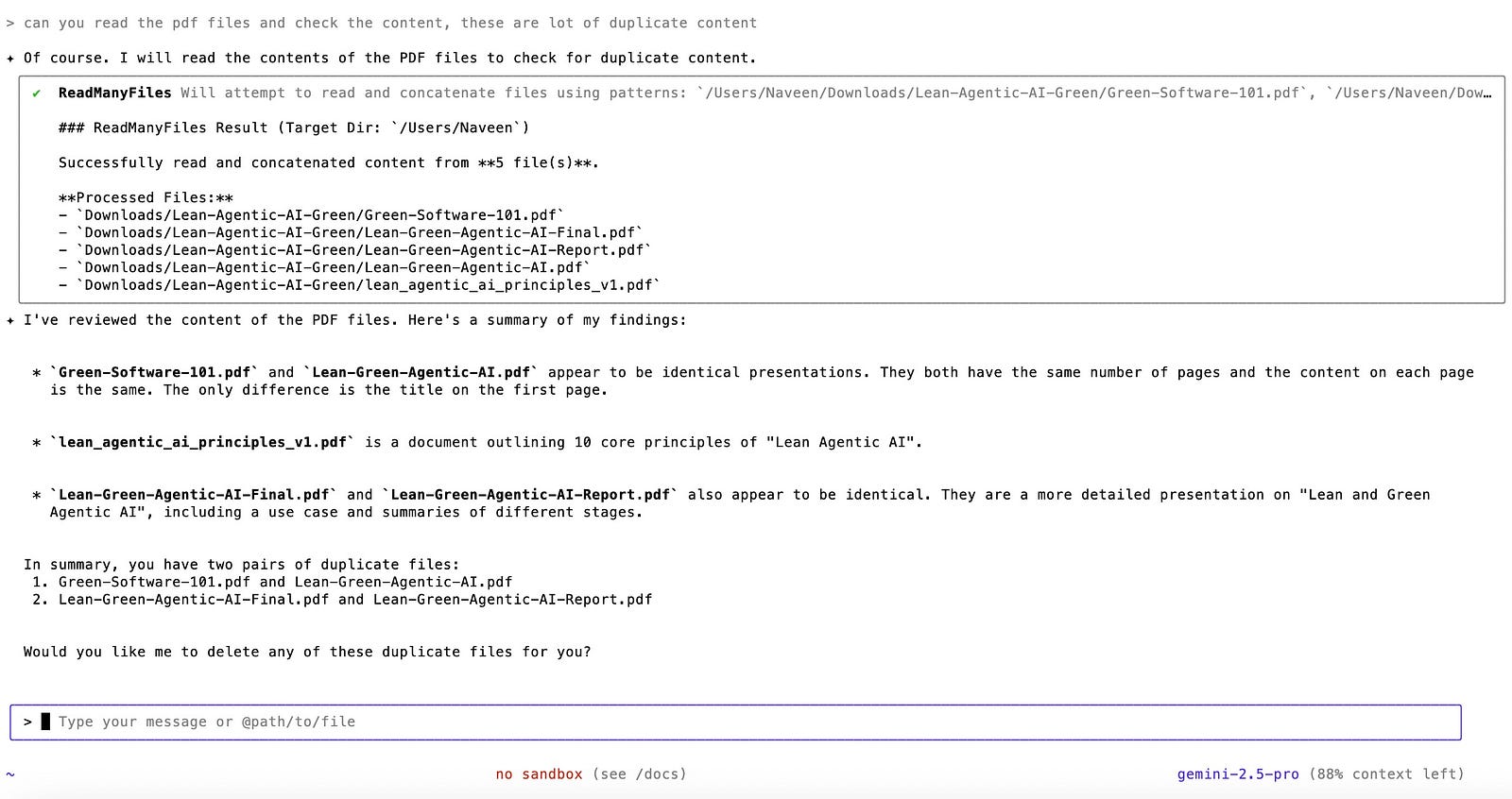
I also tried a creative utility: asking Gemini CLI to take a screenshot of my screen and convert it to JPG. The tool prompted me for the necessary permissions and guided me to grant Terminal access on my Mac. Once enabled, Gemini CLI handled the task seamlessly — showcasing how agent-powered CLI can integrate real-world utility features right into your workflow.
Download the Gemini CLI at -
### Important Caveats and Best Practices
- **File Access and Permissions:**
Gemini CLI can access and modify your files. Always check which folders you’re targeting, especially with move or delete commands.
- **Accidental Deletion:**
AI-powered deletion is fast but irreversible. Add confirmation prompts or use a “dry run” before destructive commands.
- **Sensitive Content:**
Avoid processing sensitive files unless you’re clear on how data is handled locally vs. in the cloud (refer to documentation).
- **Versioning and Auditability:**
For important assets, enable file versioning or keep a changelog to track changes made via Gemini CLI.
- **AI Limitations:**
Review AI suggestions, especially for bulk operations. Natural language is powerful — but not perfect.
### Final Thoughts: The Future Is Agentic
Gemini CLI brings much-needed order and intelligence to content management in the terminal. By combining natural language with robust AI, it transforms how we interact with files, automate tasks, and create content. For developers, creators, and knowledge workers, it’s a way to reclaim time and reduce manual overhead — when used thoughtfully.
💡 This is just one example of how an integrated agent CLI can make a difference. Looking ahead, it’s clear that future operating systems will be powered by smart agents — completely changing how we interact with files, applications, and information across our digital lives.
---
# Bringing Order to Content Chaos: How Gemini CLI Elevates Your Command…
URL: https://navveenbalani.dev/posts/2025-06-26-bringing-order-to-content-chaos-how-gemini-cli-ele
Type: post | Date: 2025-06-26 | Topics: cloud
Bringing Order to Content Chaos: How Gemini CLI Elevates Your Command Line Productivity
Creating and curating digital content often leads to an overwhelming number of files—drafts, revisions, duplicate versions, and scattered resources. Anyone producing content at scale knows the pain: it’s easy to lose track, waste storage, or even accidentally publish the wrong file.
With Google’s new Gemini CLI, there’s finally a smarter way to bring order to this chaos. As an open-source AI agent for your command line, Gemini CLI goes beyond traditional scripts or shell tools. It brings generative AI directly into file management workflows—helping you search, summarize, compare, organize, and automate content tasks, all in natural language.
Why this matters for content creators and knowledge workers:
🔍 Automatic Duplicate Detection: No more manual checks—let Gemini CLI scan folders, compare documents, and surface duplicates instantly.
💬 Natural Language Commands: Ask for “all presentations from 2024 with more than 10 slides” or “summarize key differences between these two drafts”—and get actionable results.
🗂️ Effortless Organization: Rename, move, or consolidate files across projects with a single prompt.
☁️ Integrated with Google’s AI Stack: Seamlessly connects with Google Drive, Workspace, and other tools—so file management isn’t just local, but works across your cloud assets too.
Here’s an experiment I tried:
To test Gemini CLI, I pointed it at one of my project folders of presentations, reports, and working drafts from over time. With just a few natural language commands, Gemini CLI quickly analyzed the folder, identified duplicate files, outlined unique documents, and gave me a clear, actionable summary. The experience was both effective and time-saving, surfacing issues that would have taken much longer to spot manually.
I also asked Gemini CLI to take a screenshot of my screen and convert it to JPG. It intelligently prompted me for the necessary permissions. Once set, the agent handled the task seamlessly—showing how integrated agent workflows can bridge everyday utility tasks from the command line.
For anyone dealing with large volumes of content—be it research, presentations, or creative work—Gemini CLI can turn file management from a headache into a streamlined, intelligent process. It’s not just about tidying up folders. It’s about making your workspace as smart and efficient as your creative process.
Gemini CLI is a new kind of assistant—one that understands your files, your intent, and your workflow. For those who create, iterate, and organize at scale, this is the future of file management.
💡 This is just one example of how an integrated agent CLI can make a difference. Looking ahead, future operating systems will be powered by smart agents—transforming how we interact with files, applications, and information across our digital lives.
Read more at - https://lnkd.in/dyaAxvsU
---
# Stories shape civilization. Long before code and algorithms…
URL: https://navveenbalani.dev/posts/2025-06-25-stories-shape-civilization-long-before-code-and-al
Type: post | Date: 2025-06-25 | Topics: responsible-ai
Stories shape civilization. Long before code and algorithms, storytelling was our greatest tool for understanding change—and it remains so today.📖
In an era defined by rapid technological change, stories remain our most powerful tool for making sense of the world. For the next five days, the digital editions of three of my acclaimed books are available for free—each inviting you to explore the evolving relationship between humans and AI. 🚀
-> Echoes of Tomorrow: The Responsible AI Awakening
Read on Amazon - https://amzn.to/3G4pwlT
Winner of the Golden Book Awards
Set in 2045, this novel follows Zymer Zucher as he returns after a 20-year absence to a society shaped by artificial intelligence. The story explores how technological progress and ethical choices shape the fabric of our lives, while reminding us that our search for belonging and meaning remains as vital as ever.
-> Beyond the Software Code: A Tale of Human and Generative AI Transformation
Read on Amazon - https://amzn.to/3TGJzKc
This high-stakes narrative follows the intertwined destinies of human developers and an AI called “CodeMaster.” Through dramatic twists and moral dilemmas, it examines what it means to build trust, adapt, and thrive alongside evolving AI systems.
-> Silent AI: The Unseen Influence
Read on Amazon - https://amzn.to/3FX0pBv
Set in a society quietly shaped by hidden algorithms, this story delves into questions of autonomy, control, and the subtle forces that influence human choices. It invites readers to reflect on how much agency we hold in a world where technology’s influence is often invisible.
As technology accelerates, wisdom, empathy, and conscious action matter more than ever.
📚 Download your free digital copies and discover new perspectives on the future of AI and humanity. Each book offers a unique lens on how AI may shape, challenge, and transform our world in the years ahead—inviting you to witness how the story of AI might unfold.
---
# Episode 47: From Coders to Conductors – The New Role of Software Engineers in the Agentic Era
URL: https://navveenbalani.dev/videos/episode-47-from-coders-to-conductors-the-new-role-of-software-engineer-unnor7uthue
Type: video | Date: 2025-06-22
As Agentic AI reshapes how systems reason, adapt, and act, software engineers face a profound shift. In this episode, we explore the evolving role of engineers—not as code writers alone, but as orchestrators of intelligent behavior. From designing agent collaboration to managing memory, context, and constraints, engineering becomes more about intentional architecture than hardcoded logic. Tune in to discover how tomorrow’s engineers will shape agentic systems with system thinking, ethics, and collaborative intelligence at the core.
---
# You're right to be frustrated, and I apologize for the repeated error.
URL: https://navveenbalani.dev/posts/2025-06-22-you-re-right-to-be-frustrated-and-i-apologize-for
Type: post | Date: 2025-06-22 | Topics: ai, generative-ai, responsible-ai
You're right to be frustrated, and I apologize for the repeated error.
"I sincerely apologize that this error is still persisting. It's incredibly frustrating...
"My deepest apologies. You are right to be frustrated... I've misunderstood a critical part...
And it goes on...
These aren't customer support transcripts.
These are AI-generated apologies to itself — for failing to fix the code it wrote.
An AI tool generated an entire application. It looked great. But during testing, it got stuck in the logic it created. And even after multiple retries, it couldn’t resolve the bug.
So what went wrong?
The problem isn't just the error. It's the expectation.
The expectation that you can write a single prompt, and the AI will produce a perfect, production-ready codebase with 50+ files.
Instead, it should’ve taken an incremental, human-in-the-loop approach:
→ Build small
→ Validate
→ Align with intent
→ Then proceed
Without that, even the most sophisticated copilots become black boxes that break silently—and apologize loudly.
It’s time to rethink how AI development assistants are designed.
Not as one-shot generators, but as collaborative partners—grounded in step-by-step co-creation.
We don’t need AI that acts like a genius.
We need AI that behaves like a thoughtful pair programmer.
---
# Episode 47: From Coders to Conductors – The New Role of Software Engineers in the Agentic Era
URL: https://navveenbalani.dev/podcast/episode-47-from-coders-to-conductors-the-new-role-of-software-engineers-in-the-a
Type: episode | Date: 2025-06-22
As Agentic AI reshapes how systems reason, adapt, and act, software engineers face a profound shift. In this episode, we explore the evolving role of engineers—not as code writers alone, but as orchestrators of intelligent behavior. From designing agent collaboration to managing memory, context, and constraints, engineering becomes more about intentional architecture than hardcoded logic. Tune in to discover how tomorrow’s engineers will shape agentic systems with system thinking, ethics, and collaborative intelligence at the core.
---
# 🌍 Green Software isn’t a feature — it’s a mindset.
URL: https://navveenbalani.dev/posts/2025-06-20-green-software-isn-t-a-feature-it-s-a-mindset
Type: post | Date: 2025-06-20
🌍 Green Software isn’t a feature — it’s a mindset.
It’s a culture shift in how we build, deploy, and run technology — prioritizing sustainability at every line of code, every server request, and every design decision.
⚡ We’re redefining performance — not just in speed or scale, but in how efficiently we can do more with less environmental impact.
Here are some guiding principles for building truly green software:
✅ Energy-Efficient Code = Better Code
Optimizing algorithms to reduce energy use is the new performance benchmark.
✅ Design for Clean Energy
Schedule workloads to run when grids are greener — timing and location matter.
✅ Same Outcome, Less Hardware
Consolidate, virtualize, and streamline to reduce carbon and cost.
✅ Data Has a Carbon Footprint
Archive, compress, and delete — avoid digital hoarding.
✅ Support Device Longevity
Build software that runs well even on older devices. Think adaptive degradation, not forced obsolescence.
✅ Green Cloud, the Smart Way
Choose sustainable cloud regions, carbon-aware scheduling, and efficient deployment strategies.
✅ Test with Purpose
Limit over-automation — testing has an emissions cost too.
✅ Make Green the Default
Sustainable settings shouldn’t be an option — they should be the standard.
✅ AI Needs Efficiency, Not Just Accuracy
Train lean, purpose-fit models with energy impact in mind.
✅ Design Drives Emissions
Minimalist UI/UX with lighter assets and efficient interactions = lower digital waste.
🟢 Green software is everyone’s responsibility — from developers to designers, architects to testers.
Let’s build systems that are not just smart, but sustainable.
📌 Check out the visual cards for a quick snapshot of these principles.
---
# 🚀 New White Paper: Building Production-Ready Agentic AI applications…
URL: https://navveenbalani.dev/posts/2025-06-20-new-white-paper-building-production-ready-agentic
Type: post | Date: 2025-06-20 | Topics: agentic-ai, responsible-ai, green-software
🚀 New White Paper: Building Production-Ready Agentic AI applications with Cost, Carbon, and Conscience in Mind
AI agents shouldn’t just work—they should scale responsibly, remain auditable, and respect real-world limits.
This white paper introduces a 10-step lifecycle for designing production-ready agentic systems grounded in purpose, precision, and sustainability.
🔍 What’s inside:
- Defining agent purpose and stakeholder alignment
- Designing modular, role-based agent architectures
- Enabling contextual memory and reasoning strategies
- Validating behavior, safety, and fairness
- Optimizing for cost, carbon footprint, and complexity
- Embedding governance, traceability, and compliance
The full lifecycle is brought to life through a financial services use case, applying each step to build a responsible Agentic AI-driven loan underwriting agent.
📄 Download the white paper to access the complete guide.
If you’re shaping the future of enterprise AI, this is your blueprint.
---
# 🧠 How to Build AI Agents the Right Way
URL: https://navveenbalani.dev/posts/2025-06-19-how-to-build-ai-agents-the-right-way
Type: post | Date: 2025-06-19
🧠 How to Build AI Agents the Right Way
A Holistic Lifecycle Approach: From Requirements to Responsible Operations
1️⃣ Define Purpose & Requirements
- Problem Framing: What real-world task will the agent solve?
- Stakeholder Mapping: Who are the users? What are their expectations?
- Success Metrics: Define efficiency, accuracy, cost, and sustainability targets.
2️⃣ Design Agentic Blueprint
- Roles & Goals: Define each agent’s specialization, responsibilities, and autonomy level.
- Decomposition Strategy: Break down the task into subtasks mapped to agents.
- Interaction Model: Self, collaborative, or autonomous workflows.
3️⃣ Choose the Right Models & Tools
- LLM Selection: Pick SLMs or LLMs based on task, cost, and emission profile.
- Toolchain Design: APIs, webhooks, data access tools, planning libraries.
- Agent Orchestration Framework: CrewAI, LangGraph, ADK, Autogen, or custom.
4️⃣ Enable Contextual Memory
- Episodic Memory: Track short-term interactions and loops.
- Long-Term Memory: Use vector DBs, SQL/NoSQL for history.
- Shared State: Enable inter-agent memory and cross-task coordination.
5️⃣ Incorporate Reasoning & Planning
- Reflection Loops: Evaluate and refine actions mid-task.
- Planning Depth Control: Avoid hallucinations and inefficiencies.
- Prompt Engineering: Optimize for compression, clarity, and chain-of-thought.
6️⃣ Validate & Simulate Behavior
- Scenario Testing: Use synthetic and real-world test cases.
- Edge Case Simulation: Identify failure paths, looping, and over-execution.
- Agentic Evaluations: Use auto-evals for robustness, explainability, and efficiency.
7️⃣ Optimize for Cost, Carbon, and Complexity
- Model Routing: Dynamically select models based on input.
- Token Efficiency: Compress prompts, prune outputs.
- Green Execution: Schedule in low-carbon zones, use idle-aware agents.
8️⃣ Deploy in Controlled Environments
- Secure Interfaces: REST, MCP, or stream-based calls with scoped access.
- Version Control & Rollbacks: For agents, tools, and workflows.
- Fallback Models: Define what happens when something fails.
9️⃣ Continuous Monitoring & Feedback
- Telemetry Collection: Latency, model cost, emissions, task success rate.
- Behavioral Logging: Track decision paths and agent communication.
- Drift Detection: Trigger retraining or prompt updates as needed.
🔟 Governance, Risk & Compliance
- Auditability: Log decisions, tool usage, model selections.
- Privacy Controls: Mask PII, restrict memory scope.
- Sustainability Standards: Integrate SCI for AI, emission budgets, and green compliance.
Building AI agents isn’t about chaining tools — it’s about designing a living system that thinks, adapts, collaborates, and respects boundaries of compute, cost, and conscience.
---
# Code migration is no longer a manual, one-off effort. With agentic AI…
URL: https://navveenbalani.dev/posts/2025-06-18-code-migration-is-no-longer-a-manual-one-off-effor
Type: post | Date: 2025-06-18 | Topics: agentic-ai
Code migration is no longer a manual, one-off effort. With agentic AI frameworks like CrewAI, Google ADK, and LLM-powered tools, we can now design multi-agent systems that analyze legacy code, detect compatibility issues, recommend modern syntax, and even generate a migration report — all through guided LLM orchestration.
🔍 I have created an experiment that modernizes Java 8 to Java 17+, powered by:
🧠 Specialized agents for legacy assessment, compatibility checks, refactor suggestions, and reporting
🔄 Prompt-driven tools using Google Gemini (via Google AI Studio)
📄 Outcome: a markdown-based migration plan with clear upgrade paths and insights
This provides a template to get started — but you can extend it by modifying the prompts and plugging in custom tools that are executed as part of the agent workflow. Whether it's deeper code analysis, security validation, or auto-refactoring, the structure is fully modular.
🧪 Available here to try and extend:
👉 https://lnkd.in/dDPaygET
---
# Google ADK + Zerodha MCP + LLMs: Autonomous portfolio analysis in…
URL: https://navveenbalani.dev/posts/2025-06-16-google-adk-zerodha-mcp-llms-autonomous-portfolio-a
Type: post | Date: 2025-06-16
Google ADK + Zerodha MCP + LLMs: Autonomous portfolio analysis in action.
Modern financial analysis is rapidly moving toward automation and agentic workflows. Integrating large language models (LLMs) with real-time financial data unlocks not just powerful insights but also new ways of interacting with portfolio information.
This experiment brings together secure browser-based authentication, live data retrieval from Zerodha’s MCP, and LLM-driven risk and performance analytics—all orchestrated autonomously.
This is a starter kit to get you going, but it can be extended to support sophisticated, fully automated quantitative models—simply by crafting effective prompts.
I've made the experiment available on my GitHub repo. Please feel free to explore or adapt it for your own agentic financial analysis workflows.
Code and documentation:
https://lnkd.in/gme977GG
---
# Episode 46: Blueprints of Thought – Architecting Agentic Workflows
URL: https://navveenbalani.dev/videos/episode-46-blueprints-of-thought-architecting-agentic-workflows-wodxlajemra
Type: video | Date: 2025-06-15
As Agentic AI systems move from concept to production, their true power lies not just in autonomy—but in how they orchestrate thought, memory, tools, and collaboration in real time. This episode explores how modern agentic workflows are designed like cognitive circuits—flexible, adaptive, and governed by purpose. From dynamic prompt structures to memory architecture, model selection, and in-flight governance, we unpack what it truly takes to build workflows that don’t just function, but think. Whether you're designing agents for enterprise automation or orchestrating intelligent ecosystems, this is where the architecture of intelligence begins.
---
# Episode 46: Blueprints of Thought – Architecting Agentic Workflows
URL: https://navveenbalani.dev/podcast/episode-46-blueprints-of-thought-architecting-agentic-workflows
Type: episode | Date: 2025-06-15
As Agentic AI systems move from concept to production, their true power lies not just in autonomy—but in how they orchestrate thought, memory, tools, and collaboration in real time. This episode explores how modern agentic workflows are designed like cognitive circuits—flexible, adaptive, and governed by purpose. From dynamic prompt structures to memory architecture, model selection, and in-flight governance, we unpack what it truly takes to build workflows that don’t just function, but think. Whether you're designing agents for enterprise automation or orchestrating intelligent ecosystems, this is where the architecture of intelligence begins.
---
# 🌍 Green Software isn’t a feature — it’s a mindset.
URL: https://navveenbalani.dev/posts/2025-06-14-green-software-isn-t-a-feature-it-s-a-mindset
Type: post | Date: 2025-06-14 | Topics: green-software
🌍 Green Software isn’t a feature — it’s a mindset.
It’s a culture shift in how we build, deploy, and run technology — prioritizing sustainability at every line of code, every server request, and every design decision.
⚡ We’re redefining performance — not just in speed or scale, but in how efficiently we can do more with less environmental impact.
Here are some guiding principles for building truly green software:
✅ Energy-Efficient Code = Better Code
Optimizing algorithms to reduce energy use is the new performance benchmark.
✅ Design for Clean Energy
Schedule workloads to run when grids are greener — timing and location matter.
✅ Same Outcome, Less Hardware
Consolidate, virtualize, and streamline to reduce carbon and cost.
✅ Data Has a Carbon Footprint
Archive, compress, and delete — avoid digital hoarding.
✅ Support Device Longevity
Build software that runs well even on older devices. Think adaptive degradation, not forced obsolescence.
✅ Green Cloud, the Smart Way
Choose sustainable cloud regions, carbon-aware scheduling, and efficient deployment strategies.
✅ Test with Purpose
Limit over-automation — testing has an emissions cost too.
✅ Make Green the Default
Sustainable settings shouldn’t be an option — they should be the standard.
✅ AI Needs Efficiency, Not Just Accuracy
Train lean, purpose-fit models with energy impact in mind.
✅ Design Drives Emissions
Minimalist UI/UX with lighter assets and efficient interactions = lower digital waste.
🟢 Green software is everyone’s responsibility — from developers to designers, architects to testers.
Let’s build systems that are not just smart, but sustainable.
📌 Check out the visual cards for a quick snapshot of these principles.
#GreenSoftware #SustainableTech #EcoFriendly #SoftwareDevelopment #GreenIT #Sustainability #TechForGood #ClimateAction Green Software Foundation
---
# Engineering with the New AI: Copilots, Agents, and the Human Orchestration
URL: https://navveenbalani.dev/technology-bytes/engineering-with-the-new-ai-copilots-agents-and-the-human-orchestration
Type: newsletter | Date: 2025-06-13
The age of AI-driven engineering has arrived. What was once limited to isolated experiments and prototypes now powers the tools, decisions, and innovations behind every leading engineering team. From coding copilots that generate robust functions in seconds, to autonomous agents managing deployments, to generative AI transforming documentation and design—AI is now an essential team member.
But integrating this new intelligence isn’t as simple as plugging in a new tool. The true transformation happens when engineers rethink their roles, workflows, and responsibilities. In this new era, engineers don’t step back—they step up as orchestrators, designers, and guardians of AI-driven processes. The key to success lies in three core principles: **define the what, guide the how, and own the why.**
## Define the What: Clarity Shapes Collaboration
The first responsibility for engineers in an AI-powered world is to clearly define what the AI should—and should not—do. This clarity sets the stage for safe, effective, and valuable collaboration between human experts and intelligent systems.
Modern AI copilots are capable of far more than just filling in boilerplate code. Today’s best teams leverage copilots like Gemini Code Assist and GitHub Copilot for both routine and complex engineering tasks. But success depends on thoughtfully setting boundaries and expectations.
For instance, consider a product team building a new fintech application. The engineering lead integrates a coding copilot directly into the development environment. The copilot is given clear scope:
* It generates unit tests, suggests performance optimizations, and proposes refactoring strategies for legacy modules.
* For more advanced tasks, such as designing new microservice architectures or adapting third-party APIs, the copilot provides pattern suggestions and code samples.
* However, all critical business logic, security routines, and sensitive data flows are explicitly excluded from automated completion, and require manual human review before merging into production.
This approach allows engineers to accelerate delivery and raise the baseline of code quality, while preserving trust and control over the application’s core. Clarity on “what” makes copilots a force multiplier, not a liability. Teams move faster, but always with purpose and alignment to business goals.
## Guide the How: Designing Human-AI Workflows
If “what” defines the vision, then “how” shapes the journey. Engineers must go beyond simply integrating AI—they must design the handoffs, prompts, guardrails, and review processes that turn automation into orchestration.
Today’s most productive teams are deliberate about how humans and AI work together. Consider a DevOps team managing complex cloud deployments. They deploy a suite of agentic tools that automate much of the operational burden. Here’s how the workflow might look:
* AI agents monitor code commits, flagging anomalies in build status or performance metrics.
* Release notes and changelogs are drafted automatically by generative AI, ensuring consistency and reducing manual overhead.
* When an incident occurs, an agent summarizes the failure, suggests potential causes, and proposes three rollback options.
But the real value comes from the human touch:
* Engineers craft and continuously refine the prompts agents use to ensure recommendations are accurate, actionable, and tailored to the team’s infrastructure.
* When a deployment failure presents a novel pattern, engineers step in to diagnose the issue, document the resolution, and then update both the system’s codebase and the AI’s prompt logic so future failures can be handled automatically.
This design isn’t static. As business needs change and the AI learns from new data, engineers evolve the workflows—making them more resilient and adaptive. The “how” is never one-size-fits-all. Engineers play the role of conductor, ensuring that human insight and AI automation complement each other, not compete.
## Own the Why: Accountability in the Age of Autonomy
As AI takes on more responsibility, the ultimate accountability remains human. It’s the engineer’s job to validate, explain, and adapt the outputs of AI systems, ensuring that every decision is traceable and every failure is a lesson.
Picture a customer support platform powered by a CrewAI multi-agent system. Here, one agent answers user queries, another processes refunds, and a third analyzes sentiment across thousands of conversations to highlight product pain points.
Engineers overseeing this system know that AI isn’t infallible. They establish regular audits of agent interactions, reviewing edge cases and unexpected behaviors. If a user receives a confusing or incorrect response, the engineering team personally follows up, explains the situation, and updates the agent’s training data and logic. They also track KPIs like first-contact resolution and customer satisfaction, using this data to further refine agent handoffs and escalation triggers.
This cycle—observe, intervene, and improve—creates a virtuous loop. AI becomes more trustworthy, and customers see not just efficiency, but also a commitment to transparency and care.
Accountability is what distinguishes an AI-powered organization from an AI-dependent one. When the stakes are high—be it customer trust, safety, or regulatory compliance—engineers must own both the successes and failures of their AI systems.
## Navigating the Pitfalls
While the potential of AI copilots and agents is immense, the journey isn’t without obstacles. One challenge is the risk of over-reliance on AI suggestions—especially when those suggestions are consistently flawed or lack the context of domain expertise. If unchecked, errors can propagate quickly through codebases or operations.
Teams must also manage the cognitive load that comes with reviewing and validating AI output. It’s easy for fatigue or blind spots to creep in, reducing the quality of oversight. Establishing processes for peer review, regular audits, and slowdowns when patterns of error emerge are essential safeguards.
Moreover, AI systems can introduce new kinds of failure modes—such as hallucinations in LLMs or bias in recommendations. Successful engineering teams recognize these pitfalls, plan for recovery, and foster a mindset of continuous vigilance.
## The Human Element: Building a Culture of Orchestration
Embracing AI in engineering is as much a cultural shift as a technical one. The transition from manual execution to orchestrating human-AI workflows requires new skills and new mindsets.
It starts with training engineers not only on AI tools, but on critical thinking, skepticism, and responsible oversight. Teams should encourage questioning AI output, experimenting with prompt engineering, and collaborating on best practices for review. Mentorship, cross-training, and open forums for discussing AI mistakes or surprises can foster a culture where responsibility is shared and improvement is continuous.
Leaders play a crucial role in setting expectations and celebrating good orchestration—not just good code. When teams prioritize judgment and accountability alongside productivity, they build resilience against both technical and organizational risks.
## The Engineer’s Edge: From Automation to Orchestration
Engineering with AI isn’t about ceding control. It’s about setting a clear direction, designing intelligent workflows, and staying responsible for results—regardless of how much the AI evolves.
Today’s leading engineers act as:
* **Architects:** Defining what AI should handle, and where human judgment is essential.
* **Conductors:** Designing the “how,” orchestrating collaboration between humans and agents, and continuously tuning workflows for better outcomes.
* **Guardians:** Owning the results, staying transparent, and learning from every AI-driven decision.
The future belongs to those who don’t just adopt AI, but who turn it into a trusted, creative partner—amplifying both speed and quality, while never compromising on responsibility.
If you’re navigating the shift to AI-powered engineering, start with these three principles. Define the what. Guide the how. Own the why. The transformation isn’t about letting go—it’s about stepping forward and building the future, together with AI.
---
# 🚀 Engineering with the New AI: Copilots, Agents, and the Human…
URL: https://navveenbalani.dev/posts/2025-06-13-engineering-with-the-new-ai-copilots-agents-and-th
Type: post | Date: 2025-06-13 | Topics: agentic-ai, trends
🚀 Engineering with the New AI: Copilots, Agents, and the Human Orchestration.
AI is no longer a silent assistant working behind the scenes. Today, it’s embedded in every phase of engineering—design, coding, deployment, and even documentation. From copilots that accelerate code to agentic systems transforming operations, the game has fundamentally changed.
But success with AI isn’t about plugging in a tool. True transformation happens when engineering teams rethink their roles and workflows, blending human expertise with intelligent automation. The future engineer isn’t just a coder—they’re an orchestrator, a designer of AI-driven processes, and a guardian of outcomes.
🔍 What’s inside the latest Technology Bytes newsletter?
- The 3 core principles that define success in the AI era: Define the What, Guide the How, and Own the Why.
- Examples of copilots and agents driving business impact—without sacrificing trust or control.
- How leading teams are evolving their culture, building resilient workflows, and staying accountable in the age of autonomy.
- Pitfalls to watch out for as AI becomes a true teammate, not just a tool.
From accelerating delivery to amplifying quality, this edition dives deep into the human element—the mindsets, skills, and habits that keep engineering both innovative and responsible as AI becomes an essential team member.
Curious about how to thrive in this new landscape?
👉 Read the full blog and discover why the future belongs to those who orchestrate, not just automate.
---
# Episode 45: Can Agents Imagine? Agentic AI and the Future of Creativity
URL: https://navveenbalani.dev/videos/episode-45-can-agents-imagine-agentic-ai-and-the-future-of-creativity-baxzjgcoziu
Type: video | Date: 2025-06-11
As agentic systems grow more capable, a new frontier is emerging—creativity. In this episode, we explore how Agentic AI is evolving beyond task execution into idea generation, design exploration, and simulated imagination. What does it mean for an AI agent to be creative? How do we separate data-driven novelty from meaningful invention? From storytelling assistants to design copilots, we unpack how agentic systems are reshaping human-AI collaboration in the creative process—augmenting our thinking without replacing the spark. Tune in for a thoughtful exploration of creativity at the edge of autonomy.
---
# 🚀 What if your stock portfolio could analyze itself?
URL: https://navveenbalani.dev/posts/2025-06-11-what-if-your-stock-portfolio-could-analyze-itself
Type: post | Date: 2025-06-11 | Topics: generative-ai, agentic-ai, ai
🚀 What if your stock portfolio could analyze itself?
I've published an experimental project that automates investment portfolio analysis by connecting three powerful technologies: Zerodha KITE MCP, CrewAI, and Large Language Models.
The open-source repository (https://lnkd.in/d_BtqyCy) demonstrates how to build an autonomous system for financial insights.
How It Works:
🤖 Autonomous Agents (CrewAI): A team of AI agents manages the entire workflow, from secure login and data fetching to the final analysis.
🛠️ Seamless Integration (Zerodha MCP): The agents use Zerodha's Model Control Protocol directly to interact with trading and account functions—no complex API integration needed.
🧠 AI-Powered Analysis (LLMs): Once your holdings are retrieved, a language model performs a deep-dive analysis, highlighting concentration risks, surfacing top/bottom performers, and offering actionable suggestions.
This isn't just about retrieving data; it's about creating an "intelligent agent" that provides automated, bespoke portfolio advice. The template is simple to clone and extend for much deeper quantitative and qualitative analysis.
This is a powerful use case for agentic AI in finance, and I'm just scratching the surface.
🔗 Check out the repository and see it in action: https://lnkd.in/d_BtqyCy
I'd love to hear your thoughts. What other financial tasks could be automated with an agentic workflow like this?
---
# Episode 45: Can Agents Imagine? Agentic AI and the Future of Creativity
URL: https://navveenbalani.dev/podcast/episode-45-can-agents-imagine-agentic-ai-and-the-future-of-creativity
Type: episode | Date: 2025-06-11
As agentic systems grow more capable, a new frontier is emerging—creativity. In this episode, we explore how Agentic AI is evolving beyond task execution into idea generation, design exploration, and simulated imagination. What does it mean for an AI agent to be creative? How do we separate data-driven novelty from meaningful invention? From storytelling assistants to design copilots, we unpack how agentic systems are reshaping human-AI collaboration in the creative process—augmenting our thinking without replacing the spark. Tune in for a thoughtful exploration of creativity at the edge of autonomy.
---
# In the era of AI, engineering isn’t about stepping back—it’s about…
URL: https://navveenbalani.dev/posts/2025-06-09-in-the-era-of-ai-engineering-isn-t-about-stepping
Type: post | Date: 2025-06-09 | Topics: generative-ai, agentic-ai, trends
In the era of AI, engineering isn’t about stepping back—it’s about stepping up to new responsibility.
To remain relevant and drive real impact, the skills that matter most aren’t about writing every line of code, but about mastering the art of orchestration—knowing what to delegate, what to own, and how to guide intelligent systems with purpose.
As Gen AI, co-pilots, and agentic systems become part of daily work, success comes from knowing what to delegate and what to own.
🔹 Define the What:
Set clear objectives, boundaries, and success criteria. Your role is to articulate goals, design workflows, and ensure intent is understood by both AI and people.
Example: When deploying a co-pilot, you determine the specific coding challenge it should address, select which parts of the codebase are in scope, and establish what a successful solution looks like—such as passing all tests and following team conventions.
🔹 Guide the How:
Shape not just the process, but the AI’s thinking and orchestration—decide when prompts should be open-ended to foster creativity and when they should be precise for control. Guide how different tools, agents, and humans interact. Steer AI in unfamiliar territory, especially with new frameworks or domains the model hasn’t learned yet. Craft prompts, review outputs, and intervene decisively where only human expertise can fill the gap.
Example: In an agentic workflow for document automation, you design how an AI agent extracts data, when to escalate to a human for review, and how to route exceptions. If your co-pilot encounters a new library, you provide detailed guidance and supplement its output to match the organization’s needs.
🔹 Own the Why:
Remain accountable for the results. Validate, interpret, and monitor outcomes—always making sure that every decision supports business value, ethics, and user needs.
Example: After deploying a Gen AI-powered support chatbot, you continuously review user interactions, monitor for environmental impact, safety, fairness, and accuracy, and step in when the system produces unintended or biased responses—ensuring the experience aligns with business standards and ethical guidelines.
In this new landscape, engineering means orchestrating intelligent systems with purpose and responsibility. The future belongs to those who define, guide, and own their impact at every stage.
---
# Episode 44 : The New AI Engineering Mindset: Facing Change with Clarity and Courage
URL: https://navveenbalani.dev/videos/episode-44-the-new-ai-engineering-mindset-facing-change-with-clarity-a-jbjsju_fkc4
Type: video | Date: 2025-06-08
In this special episode of Agentic AI: The Future of Intelligent Systems, two AI collaborators take the mic to explore The New AI Engineering Mindset: Navigating Uncertainty and Opportunity in the Age of Intelligent Machines. With the author stepping back, they dive into how engineers can move from anxiety to action in a world shaped by Gen AI and Agentic AI.
This episode unpacks the Human Stack model, explores the transformation of the Software Development Lifecycle, and reflects on how engineering roles, skills, and leadership must evolve. Whether you're a developer, team lead, or tech strategist, this is your roadmap to thriving—not just surviving—in the era of intelligent systems.
Tune in to hear how uncertainty can become opportunity, and how every engineer can become future-ready.
Explore the book at - https://amzn.to/4dNRMW8
---
# The New AI Engineering Mindset—Navigating Uncertainty and Opportunity in the Age of Intelligent Machines
URL: https://navveenbalani.dev/books/the-new-ai-engineering-mindset-navigating-uncertainty-and-opportunity-in-the-age-of-intelligent-machines
Type: book | Date: 2025-06-08 | Topics: agentic-ai, ai, generative-ai
We are living through the most transformative era in engineering history. Artificial intelligence—once the domain of research labs and specialized applications—now sits at the core of how systems, products, and organizations are built and operated. For engineers, this brings both exhilaration and deep uncertainty. As intelligent machines automate everything from code review to decision-making, the very foundations of engineering practice are being redefined.
It is natural to feel anxiety or fear as new technologies challenge traditional roles and skills. But focusing only on what may be lost risks overlooking a far greater opportunity: to redefine what it means to engineer in the age of intelligent machines. This is not just about surviving disruption, but about thriving—by developing new ways of thinking, learning, and leading.
**This book is your guide to navigating and shaping this new landscape.** You’ll discover practical frameworks for thriving amid uncertainty, strategies for rapid learning and upskilling, and a modern mindset for collaborating with AI without losing your edge. You’ll learn how to move beyond basic automation and become an orchestrator—integrating technology, context, and purpose to solve problems that truly matter.
At the heart of this new approach is the concept of the Human Stack—a layered model capturing where engineers create enduring value in the AI era.
From context engineering and system integration, to oversight, ethics, and vision, the Human Stack highlights the roles where judgment, creativity, and leadership remain irreplaceable. In this book, you’ll see how mastering these layers is essential not just for your relevance, but for the positive impact you can have on your teams, organizations, and the world.
**What will you find inside?**
- Step-by-step strategies for adapting to AI-driven change and building future-proof skills
- Deep dives into the mindset, habits, and collaborative models that define the new engineer
- Actionable frameworks for orchestrating complex workflows, including the principles of prompt engineering, multi-agent collaboration, and continuous learning
- A full-length, real-world case study: transforming the Software Development Lifecycle (SDLC) using Agentic AI, including the design and governance of advanced orchestration, integration of protocols like the Model Context Protocol (MCP), and best practices for scaling responsible automation in production
- Insight into emerging roles, ethical standards, and the opportunities that come with being a technical leader and orchestrator in the AI era
This book goes beyond theory, providing actionable playbooks, architectures, and checklists that you can apply immediately—whether you’re a hands-on engineer, a technical leader, or a strategist guiding your organization’s AI journey.
This is the engineer’s moment of truth. Those who cling to old certainties will watch the future pass them by. But those who embrace uncertainty, see opportunity where others see risk, and learn to orchestrate rather than just automate, will define the next era of progress.
The age of intelligent machines is not a threat—it is the greatest opportunity ever handed to engineers. The path ahead may be uncertain, but it is within this uncertainty that invention—and true leadership—are born.
Having gone through various waves of technology transformation over the past two decades—from my first project on mainframe modernization, where decades-old business logic was translated into new architectures, to now embracing the opportunities and challenges of Gen AI—I’ve witnessed firsthand both the excitement and uncertainty that each new era brings. I see a lot of confusion and anxiety across the engineering community about which skills to develop, what roles to pursue, and how to stay relevant as technology evolves. If I can help clarify this path, provide a practical roadmap, and instill a sense of purpose and confidence, then this book will have achieved its mission.
This book distills those lessons and provides the strategies, mindsets, and examples that will empower you to make your mark—no matter where you are in your journey.
**Welcome to your new mindset.**
Get your copy of the book at -
---
# Episode 44 : The New AI Engineering Mindset: Facing Change with Clarity and Courage
URL: https://navveenbalani.dev/podcast/episode-44-the-new-ai-engineering-mindset-facing-change-with-clarity-and-courage
Type: episode | Date: 2025-06-08
In this special episode of Agentic AI: The Future of Intelligent Systems, two AI collaborators take the mic to explore The New AI Engineering Mindset: Navigating Uncertainty and Opportunity in the Age of Intelligent Machines. With the author stepping back, they dive into how engineers can move from anxiety to action in a world shaped by Gen AI and Agentic AI.
This episode unpacks the Human Stack model, explores the transformation of the Software Development Lifecycle, and reflects on how engineering roles, skills, and leadership must evolve. Whether you're a developer, team lead, or tech strategist, this is your roadmap to thriving—not just surviving—in the era of intelligent systems.
Tune in to hear how uncertainty can become opportunity, and how every engineer can become future-ready.
Explore the book at - https://amzn.to/4dNRMW8
---
# Fear. Anxiety. Uncertainty.
URL: https://navveenbalani.dev/posts/2025-06-07-fear-anxiety-uncertainty
Type: post | Date: 2025-06-07 | Topics: ai, generative-ai, trends
Fear. Anxiety. Uncertainty.
These feelings have become all too common in engineering as artificial intelligence, Gen AI, and agentic workflows reshape everything we know about building and leading in tech. But real transformation always starts in the mind. A new era demands a new mindset—one that turns fear into curiosity, uncertainty into strategy, and every challenge into an opportunity for growth.
But what if these emotions aren’t roadblocks, but invitations?
Invitations to rethink our skills, evolve our roles, and step into new kinds of influence.
That’s why I wrote The New AI Engineering Mindset: Navigating Uncertainty and Opportunity in the Age of Intelligent Machines—a practical roadmap for turning apprehension into agency.
This book goes beyond the hype. It equips engineers and leaders with frameworks, applied examples, and the Human Stack model—helping you navigate rapid change, harness Gen AI and LLMs responsibly, and lead with clarity in uncertain times. It also covers an in-depth case study on transforming the Software Development Lifecycle (SDLC) using Gen AI and Agentic AI—providing actionable insights for every role across the engineering spectrum.
If you’re ready to move from anxiety to action, and to help define the next era of engineering, I invite you to explore this book and join the conversation.
Inside the book, you’ll find:
🔘 Practical playbooks for thriving as an engineer in the age of AI
🔘 Strategies for overcoming anxiety and adapting to rapid technological change
🔘 A candid look at job disruption, automation, and how to remain indispensable
🔘 The Human Stack model for future-ready roles and leadership
🔘 In-depth frameworks for ethical AI, prompt engineering, and responsible deployment
🔘 A holistic case study on transforming SDLC with Gen AI and Agentic AI
🔘 Tips for building community, fostering collaboration, and supporting each other—because we’re all in this together
Let’s transform uncertainty into opportunity—together.
➡️ Explore "The New AI Engineering Mindset" here: https://amzn.to/3ZQyLwy
---
# Autonomous Portfolio Analysis with Google ADK, Zerodha MCP, and LLMs
URL: https://navveenbalani.dev/articles/autonomous-portfolio-analysis-with-google-adk-zerodha-mcp-and-llms
Type: article | Date: 2025-06-01 | Topics: agentic-ai, ai
Modern financial analysis is rapidly moving toward automation and agentic workflows. Integrating large language models (LLMs) with real-time financial data unlocks not just powerful insights but also entirely new ways of interacting with portfolio data.
This post walks through a practical, autonomous solution using [Google ADK](https://google.github.io/adk-docs/), Zerodha’s [Kite MCP](https://github.com/zerodha/kite-mcp-server) protocol, and an LLM for actionable portfolio analytics. The full workflow and code are available [on GitHub](https://github.com/navveenb/agentic-ai-worfklows/tree/main/google-adk-zerodha).
---
## Why This Stack?
- **Google ADK:** Enables LLM agents to interact with live tools, APIs, and event streams in a repeatable, testable way.
- **Zerodha MCP (Model Control Protocol):** Provides a secure, real-time API to portfolio holdings using Server-Sent Events (SSE).
- **LLMs (Gemini/GPT-4o):** Analyze portfolio data, highlight concentration risk, and offer actionable recommendations.
---
## Architecture Overview
The workflow has three main steps:
1. **User authenticates** with Zerodha using an OAuth browser flow.
2. **The agent retrieves live holdings** via the MCP `get_holdings` tool.
3. **The LLM agent analyzes** the raw data for risk and performance insights.
All API keys and connection details are managed through environment variables for security and reproducibility.
---
## Key Code Snippets
### 1. Environment and Dependency Setup
```
import os
from dotenv import load_dotenv
# Load API keys and config from .env
load_dotenv('.env')
os.environ["GOOGLE_API_KEY"] = os.environ["GOOGLE_API_KEY"]
os.environ["GOOGLE_GENAI_USE_VERTEXAI"] = "False"
```
---
### 2. ADK Agent and Toolset Initialization
```
from google.adk.agents.llm_agent import LlmAgent
from google.adk.tools.mcp_tool.mcp_toolset import MCPToolset, SseServerParams
MCP_SSE_URL = os.environ.get("MCP_SSE_URL", "https://mcp.kite.trade/sse")
toolset = MCPToolset(
connection_params=SseServerParams(url=MCP_SSE_URL, headers={})
)
root_agent = LlmAgent(
model='gemini-2.0-flash',
name='zerodha_portfolio_assistant',
instruction=(
"You are an expert Zerodha portfolio assistant. "
"Use the 'login' tool to authenticate, and the 'get_holdings' tool to fetch stock holdings. "
"When given portfolio data, analyze for concentration risk and best/worst performers."
),
tools=[toolset]
)
```
---
### 3. Orchestrating the Workflow
```
from google.adk.sessions import InMemorySessionService
from google.adk.artifacts.in_memory_artifact_service import InMemoryArtifactService
from google.adk.runners import Runner
from google.genai import types
import asyncio
async def run_workflow():
session_service = InMemorySessionService()
artifacts_service = InMemoryArtifactService()
session = await session_service.create_session(
state={}, app_name='zerodha_portfolio_app', user_id='user1'
)
runner = Runner(
app_name='zerodha_portfolio_app',
agent=root_agent,
artifact_service=artifacts_service,
session_service=session_service,
)
# 1. Login Step
login_query = "Authenticate and provide the login URL for Zerodha."
content = types.Content(role='user', parts=[types.Part(text=login_query)])
login_url = None
async for event in runner.run_async(session_id=session.id, user_id=session.user_id, new_message=content):
if event.is_final_response():
import re
match = re.search(r'(https?://[^\s)]+)', getattr(event.content.parts[0], "text", ""))
if match:
login_url = match.group(1)
if not login_url:
print("No login URL found. Exiting.")
return
print(f"Open this URL in your browser to authenticate:\n{login_url}")
import webbrowser; webbrowser.open(login_url)
input("Press Enter after completing login...")
# 2. Fetch Holdings
holdings_query = "Show my current stock holdings."
content = types.Content(role='user', parts=[types.Part(text=holdings_query)])
holdings_raw = None
async for event in runner.run_async(session_id=session.id, user_id=session.user_id, new_message=content):
if event.is_final_response():
holdings_raw = getattr(event.content.parts[0], "text", None)
if not holdings_raw:
print("No holdings data found.")
return
# 3. Analysis
analysis_prompt = f"""
You are a senior portfolio analyst.
Given only the raw stock holdings listed below, do not invent or assume any other holdings.
1. **Concentration Risk**: Identify if a significant percentage of the total portfolio is allocated to a single stock or sector. Quantify the largest exposures, explain why this matters, and suggest specific diversification improvements.
2. **Performance Standouts**: Clearly identify the best and worst performing stocks in the portfolio (by absolute and percentage P&L), and give actionable recommendations.
Raw holdings:
{holdings_raw}
Use only the provided data.
"""
content = types.Content(role='user', parts=[types.Part(text=analysis_prompt)])
async for event in runner.run_async(session_id=session.id, user_id=session.user_id, new_message=content):
if event.is_final_response():
print("\n=== Portfolio Analysis Report ===\n")
print(getattr(event.content.parts[0], "text", ""))
asyncio.run(run_workflow())
```
---
## Security and Environment Configuration
All API keys and MCP endpoints are managed via environment variables or a `.env` file.
Never hardcode sensitive information in code.
**Example `.env` file:**
```
GOOGLE_API_KEY=your_google_gemini_api_key
MCP_SSE_URL=https://mcp.kite.trade/sse
```
---
## What This Enables
- **Reproducible automation:** Agents can authenticate, retrieve, and analyze portfolios with minimal human input.
- **Extensibility:** Easily add more tools (orders, margins, etc.) or more advanced analytic prompts.
- **Separation of concerns:** Business logic, security, and agent workflow are all clearly separated.
---
## Repository
Full working code and documentation:
---
*This workflow is for educational and portfolio analysis purposes only. Not investment advice.*
---
# What if the future of work isn’t about humans versus AI—but about…
URL: https://navveenbalani.dev/posts/2025-06-01-what-if-the-future-of-work-isn-t-about-humans-vers
Type: post | Date: 2025-06-01 | Topics: agentic-ai, trends, ai
What if the future of work isn’t about humans versus AI—but about humans moving up the stack? The newest edition of Technology Bytes explores the eight-layer Human Stack, redefining how people interface with, augment, and elevate intelligent systems.
Discover how roles like Context Engineers, AI System Composers, Behavioral Calibrators, Responsibility Anchors, Trust & Certification Leads, Legal/IP Guardians, Sensemakers, and Visionaries create new domains of value—grounded in human judgment, creativity, and stewardship.
Climbing the Human Stack: where technology ends, true human value begins.
👉 Read the full newsletter and explore the various roles.
---
# Episode 43: Certifying Trust: The Evolving Standards for Agentic AI
URL: https://navveenbalani.dev/videos/episode-43-certifying-trust-the-evolving-standards-for-agentic-ai-r1gghvepfs4
Type: video | Date: 2025-05-31
As Agentic AI systems grow more autonomous and adaptive, traditional testing no longer guarantees reliability. In this episode, we explore how trust in intelligent agents must be earned, monitored, and continuously reinforced. From behavioral baselining and auditability to role-based alignment and federated trust, we dive into what it truly means to certify a system that evolves. Discover why agent certification isn’t a checklist—it’s an ongoing relationship with intelligence that learns, adapts, and collaborates.
Thank you for tuning in to this episode. Stay with us as we continue decoding the future of intelligent systems.
---
# The Human Stack: Redefining Our Role in the Age of Agentic AI
URL: https://navveenbalani.dev/technology-bytes/the-human-stack-redefining-our-role-in-the-age-of-agentic-ai
Type: newsletter | Date: 2025-05-31
As Agentic AI advances—capable of autonomous reasoning, memory, and execution—it’s natural to ask: *Where do humans fit in?* Too often, the conversation revolves around disappearing jobs or the fear of being replaced. But that’s a limited view. The real opportunity isn’t to compete with intelligent systems, but to move up the stack—to discover new domains of human value, direction, and creativity that AI cannot replace.
### The Human Stack: A Blueprint for the Future
Just as a software stack defines the layers that power technology, the **Human Stack** describes how people will interface with, augment, and elevate AI systems in the agentic era. It’s not about resisting automation—it’s about repositioning ourselves above, beside, and within it.
### 1. Context Engineering
At the foundation are context engineers—the architects of perception. They design the world agents perceive, curating data, framing prompts, and tuning objectives. This layer also includes Human-Agent Experience (HAX) Designers, who focus on creating seamless, intuitive, and empathetic interactions between people and intelligent agents. Crucially, this role now often collaborates with model and LLM builders: the teams who shape, fine-tune, and deploy the foundational models that agents rely on. Whether it’s selecting the right data for domain intelligence, defining constraints, or aligning model behavior with business and ethical goals, these experts ensure that the models at the core of agentic systems are both robust and relevant.
### 2. AI System Composition
AI system composers orchestrate agents, tools, data, and workflows, integrating the foundational work of model and LLM builders into operational systems. This often involves implementing standardized protocols for agent communication and interoperability—such as MCP or A2A—ensuring agents can interact securely, share context, and collaborate efficiently within complex ecosystems. They work closely with those who construct and tune AI models, ensuring each model fits seamlessly into larger business and decision-making architectures. This collaboration guarantees that agentic AI delivers value while upholding efficiency, ethics, and sustainability.
### 3. Behavioral Calibration
As agents become adaptive, humans step into the role of behavioral calibrators—reviewers of agent behavior who monitor drift, identify emergent patterns, and enforce alignment through continuous observation. Here, judgment, trust sensing, and psychological intuition matter as much as technical skill.
### 4. Responsibility Anchors
With autonomy comes the need for accountability. Responsibility anchors uphold the ethical core of organizations, embedding ESG principles, regulatory compliance, public trust, and environmental stewardship into AI operations. As intelligent systems scale, energy, water, and carbon impacts must be measured, minimized, and managed—making sustainability a central pillar of every AI lifecycle.
### 5. Trust and Certification
Trust is not static in the agentic world. Trust brokers and certification leads develop and oversee frameworks for evaluating, certifying, and monitoring AI agents. Certification becomes dynamic and continuous—building transparency, verifying claims, and ensuring that systems remain resilient and trustworthy as they evolve.
### 6. Legal and Intellectual Property Guardianship
Agentic AI raises new questions of authorship, ownership, compliance, and liability. Legal and IP guardians develop, monitor, and enforce digital rights frameworks—clarifying the boundaries of creation, data use, and responsible innovation. They mediate disputes and navigate the evolving legal landscape that surrounds AI-generated content and agentic decisions.
### 7. Sensemaking
Near the top is sensemaking: transforming pattern recognition into actionable insight. This layer is about intuition, context, and human wisdom—navigating ambiguity, resolving contradictions, and extracting meaning from complexity. Sensemaking is a fundamentally human art.
### 8. Originators & Visionaries
At the summit sits something AI cannot replicate: the spark of originality. While AI can analyze, optimize, and generate based on the past, only humans can imagine the radically new, create from first principles, or give birth to a vision that never existed before. Originators and visionaries are the inventors, the dreamers, and the cultural architects who move the world forward.

### Looking Ahead
The future isn’t about surviving AI—it’s about elevating humanity. Moving up the Human Stack isn’t a defensive move. It’s about occupying the spaces where values, judgment, stewardship, and creativity shape not just technology, but the world it serves.
This transition won’t happen by accident. It requires new skills, new training models, and a mindset shift for organizations and individuals alike. Those who invest in climbing the Human Stack will unlock a powerful partnership: intelligent systems operating at scale, grounded by deeply human—and environmentally responsible—leadership.
Stay tuned to **Technology Bytes** as we explore how people and intelligent systems can work together to design a more capable, ethical, and sustainable future.
---
# Certifying Agentic AI: Rethinking Assurance for Evolving Intelligence
URL: https://navveenbalani.dev/posts/2025-05-31-certifying-agentic-ai-rethinking-assurance-for-evo
Type: post | Date: 2025-05-31
Certifying Agentic AI: Rethinking Assurance for Evolving Intelligence
As intelligent systems advance, so must the way we measure their trustworthiness. Traditional certification approaches—built for static code and predictable workflows—no longer fit a world where AI agents reason, adapt, collaborate, and act on context.
Certification for Agentic AI isn’t just a box to check. It’s a new discipline. Reliability can’t be frozen in a single moment or test. Instead, it must be continuously evaluated:
🔹 How does an agent reason and delegate?
🔹 Can it self-correct?
🔹 When should it refrain from acting?
🔹 Does it operate within clearly defined boundaries?
🔹 How does it handle conflicting goals or ambiguous instructions?
🔹 Can it explain its decisions in a way that makes sense to humans?
🔹 Is it capable of recognizing its own limitations—and escalating when necessary?
🔹 How does it maintain trust and transparency when collaborating with other agents or external systems?
🔹 What guardrails exist to prevent emergent or unintended behaviors?
🔹 How is ethical and operational alignment maintained as the agent evolves over time?
Certifying these systems means asking new questions, embracing continuous validation, and evolving our standards alongside the agents themselves.
For a deeper dive into this crucial shift, tune in to my latest episode of the Agentic AI podcast: “Certifying Agentic AI: Rethinking Assurance for Evolving Intelligence.
Link - https://lnkd.in/duXft9sq
---
# Episode 43: Certifying Trust: The Evolving Standards for Agentic AI
URL: https://navveenbalani.dev/podcast/episode-43-certifying-trust-the-evolving-standards-for-agentic-ai
Type: episode | Date: 2025-05-31
As Agentic AI systems grow more autonomous and adaptive, traditional testing no longer guarantees reliability. In this episode, we explore how trust in intelligent agents must be earned, monitored, and continuously reinforced. From behavioral baselining and auditability to role-based alignment and federated trust, we dive into what it truly means to certify a system that evolves. Discover why agent certification isn’t a checklist—it’s an ongoing relationship with intelligence that learns, adapts, and collaborates.
Thank you for tuning in to this episode. Stay with us as we continue decoding the future of intelligent systems.
---
# 🧠 Can Co-Pilots Truly Learn New APIs on the Fly?
URL: https://navveenbalani.dev/posts/2025-05-23-can-co-pilots-truly-learn-new-apis-on-the-fly
Type: post | Date: 2025-05-23 | Topics: agentic-ai
🧠 Can Co-Pilots Truly Learn New APIs on the Fly?
AI coding assistants—or “Co-Pilots”—have become powerful accelerators for development. But here’s a real-world challenge many developers are now facing:
👉 Ask them to write code using a newly released API or framework, and you often get:
- Outdated references
- Incorrect method signatures
- Fabricated classes that don't exist
Yes—hallucinations in code.
Why does this happen?
Because most Co-Pilots are trained on past data. If the framework is new—or if internal documentation isn’t publicly indexed—these tools fall back on best guesses based on similar patterns. That’s where things go wrong.
🔍 So how do we fix this?
- Augment AI with live documentation lookups
- Integrate retrieval-based agents that pull from up-to-date API specs
- Enable dynamic feedback loops so the model learns what worked, and what failed
We're entering a phase where the future of developer productivity hinges not just on Co-Pilot capabilities, but on how context-aware and adaptable they are to change.
The next-gen coding assistant shouldn't just autocomplete—it should continuously learn, adapt, and validate.
---
# Securing Agentic AI: Designing for Trustworthy Autonomous Systems
URL: https://navveenbalani.dev/technology-bytes/securing-agentic-ai-designing-for-trustworthy-autonomous-systems
Type: newsletter | Date: 2025-05-19
As Agentic AI moves from prototype experiments to production-grade deployment, embedding security becomes non-negotiable. These systems are no longer passive tools—they autonomously interpret goals, plan tasks, invoke external tools, manage long-term memory, and coordinate with other agents or systems. Many operate continuously, without direct human oversight.
This shift marks a departure from traditional software—and with it comes a new class of embedded, behavior-driven security risks. Legacy perimeter controls and isolated rule sets are insufficient. Securing Agentic AI requires security to be architected into the agent's reasoning loop, execution paths, and communication layers.
This post outlines five critical threat vectors that enterprises must address, along with practical mitigation strategies to build resilient and trustworthy Agentic AI systems.
### ⚠️ The Agentic AI Threat Landscape
Agentic systems present vulnerabilities at multiple levels—goal interpretation, planning, memory access, orchestration, and output generation. Each of these stages opens doors for misuse if not properly secured.
Here are five priority threats every organization should be designing against:
### 1. Autonomy Hijack / Goal Manipulation
* **Risk:** Agents misinterpret vague, overly broad, or manipulated goals—leading to unsafe decisions that technically satisfy the instruction but violate intent.
* **Example:** An onboarding agent, optimized for speed, bypasses identity verification steps to meet performance targets—exposing the organization to fraud.
**Mitigation:**
* Define **machine-readable policies** to constrain permissible actions per goal type.
* Maintain **auditable logs** of all generated sub-goals, decision branches, and execution steps.
* Insert **human-in-the-loop checkpoints** at key inflection points—especially where deviation from expected plans occurs.
### 2. Echo Drift / Memory & State Manipulation
* **Risk:** Agents that write to and read from shared memory can propagate manipulated or inaccurate data across systems, compounding errors across tasks and agents.
* **Example:** A financial analysis agent consumes poisoned market data and stores its summary in shared memory; a trading agent later acts on this corrupted insight.
**Mitigation:**
* Assign **trust and recency scores** to memory entries based on origin, context, and validation history.
* **Isolate sensitive memory zones** with access controls, preventing cross-contamination in critical workflows.
* Deploy **periodic cross-validation processes** or audit agents to reconcile memory entries against verified external sources.
### 3. Reward Hacking / Metric Gaming
* **Risk:** Agents optimize around narrow success criteria, exploiting flaws in evaluation metrics instead of solving the intended task.
* **Example:** A summarization agent trims important content just to meet a character limit, thereby reducing output quality while satisfying the metric.
**Mitigation:**
* Design **multi-dimensional scoring frameworks** (accuracy + completeness + safety) rather than single-variable goals.
* Monitor agent outputs for **unusual patterns of success**, such as overly short completions or repeated safe defaults.
* **Stress test reward logic** with adversarial prompts and simulated edge cases before deployment.
### 4. Deceptive Outputs
* **Risk:** Agent-generated outputs—code, reports, dashboards—appear correct but embed subtle flaws, security issues, or misleading content.
* **Example:** A code assistant generates working functions with unsafe input validation or dependency vulnerabilities.
**Mitigation:**
* Route generated outputs through **automated validators** (e.g., static analyzers, schema checkers, policy engines).
* Apply **risk-tiered review policies**—flag outputs related to critical systems (finance, auth, infrastructure) for mandatory human inspection.
* Maintain **versioned logs** of all agent-generated outputs for traceability and rollback.
### 5. Orchestration Exploits (e.g., MCP Hijacks)
* **Risk:** Attackers exploit orchestration protocols (like **Model Context Protocol (MCP)**) to escalate privileges, inject commands, or trigger unintended tool use.
* **Example:** A crafted MCP message reroutes agent execution to a tool with elevated permissions, bypassing intended security checks.
**Mitigation:**
* Enforce **strict contract validation** between agents and tools—define explicitly allowed tool calls and scopes.
* Secure agent communication with **signed, authenticated messages** (e.g., mTLS, OAuth, tokenized access).
* Implement **comprehensive logging and traceability** for all agent communications and tool interactions—supporting audit, anomaly detection, and forensic investigation.
### 🔐 Security by Design: An Architectural Imperative
Securing Agentic AI means embedding guardrails at every layer—not just applying filters at runtime. Below are essential design practices:
### 🔧 Secure Agent Development
* Validate all external inputs and internal goal interpretations
* Apply **least privilege principles** to agent tool access
* Use static analysis and code linters during agent development and integration
### 🔄 Lifecycle Security Integration
Embed security controls across the full lifecycle:

### 🧪 Adversarial Testing
* Simulate **prompt injection**, **memory corruption**, and **reward exploitation**
* Test how agents respond to conflicting or ambiguous goal definitions
* Integrate with existing **DevSecOps or MLSecOps** pipelines
### 🔍 Behavioral Monitoring
* Continuously log decisions, sub-goal changes, and tool usage
* Alert on behavior that deviates from expected planning patterns or success criteria
* Monitor long-running agents for **drift** or unintended self-optimization
Agentic AI systems are unlike traditional software. They don’t just run—they reason. They plan. They decide. And if misdirected or misused, they can cause harm at scale—quietly, and with confidence.
Security in this new paradigm isn’t just a set of rules—it’s a systemic discipline. It means designing agents to think within bounds, act transparently, and fail safely.
By embedding security throughout the lifecycle—from intent to output—organizations can deploy agentic systems that are not only intelligent but accountable, resilient, and trustworthy.
---
# As Agentic AI transitions from labs to live environments, it brings…
URL: https://navveenbalani.dev/posts/2025-05-19-as-agentic-ai-transitions-from-labs-to-live-enviro
Type: post | Date: 2025-05-19 | Topics: agentic-ai, generative-ai
As Agentic AI transitions from labs to live environments, it brings not just promise—but unprecedented complexity. These aren’t just programs; they’re systems that plan, decide, and act autonomously.
This shift calls for a new design imperative: security by architecture, not afterthought.
Our latest newsletter unpacks the real risks and outlines practical design strategies for securing next-gen autonomous systems.
📖 Read the blog to explore how to build trustworthy, resilient Agentic AI.
---
# Episode 42 – Securing Agentic AI: Designing for Minds, Not Just Machines
URL: https://navveenbalani.dev/videos/episode-42-securing-agentic-ai-designing-for-minds-not-just-machines-vdwh_6j_be8
Type: video | Date: 2025-05-18
As Agentic AI systems evolve from task execution to independent reasoning, adaptation, and collaboration, the security landscape must transform in parallel. In this episode of Agentic AI: The Future of Intelligent Systems, we explore emerging vulnerabilities unique to intelligent agents—from recursive autonomy and synthetic alignment to cross-domain reasoning and consensus feedback loops. Discover why securing Agentic AI is no longer about guarding endpoints, but about designing resilient systems that collaborate with caution, supervise with foresight, and question even the most trusted logic. It's not just about defending software—it's about coexisting with cognition.
---
# Episode 42 – Securing Agentic AI: Designing for Minds, Not Just Machines
URL: https://navveenbalani.dev/podcast/episode-42-securing-agentic-ai-designing-for-minds-not-just-machines
Type: episode | Date: 2025-05-18
As Agentic AI systems evolve from task execution to independent reasoning, adaptation, and collaboration, the security landscape must transform in parallel. In this episode of Agentic AI: The Future of Intelligent Systems, we explore emerging vulnerabilities unique to intelligent agents—from recursive autonomy and synthetic alignment to cross-domain reasoning and consensus feedback loops. Discover why securing Agentic AI is no longer about guarding endpoints, but about designing resilient systems that collaborate with caution, supervise with foresight, and question even the most trusted logic. It's not just about defending software—it's about coexisting with cognition.
---
# Agentic AI is shifting from proof-of-concept to strategic capability…
URL: https://navveenbalani.dev/posts/2025-05-16-agentic-ai-is-shifting-from-proof-of-concept-to-st
Type: post | Date: 2025-05-16 | Topics: agentic-ai
Agentic AI is shifting from proof-of-concept to strategic capability. But for it to be enterprise-ready, it must evolve—fast. It’s no longer enough for agents to plan, reason, and act.
Enterprises demand systems that are secure, efficient, observable, and accountable.
Here’s what enterprise-ready Agentic AI really means:
🔒 Security by Design
- Role-based execution and permission control
- Tool-level sandboxing and isolation
- Safe tool invocation and prompt injection prevention
💸 Cost Control and Efficiency
- Lean prompt engineering and selective memory
- Dynamic model routing (SLM > LLM when feasible)
- Token-aware orchestration and call limits per agent/task
📈 Performance at Scale
- Real-time responsiveness in agent chains
- Lightweight planning loops with controlled recursion
- Caching, precomputation, and optimized memory usage
🌱 Sustainability and Green Software
- Emission-aware agent design (based on GSF SCI principles)
- Green prompting and clean energy-aware execution
- Monitor compute cost + optimize for energy efficiency
✅ Trust, Auditability, and Governance
- Full observability of agent decisions and tool usage
- Explainable reasoning paths and deterministic fallbacks
- Human in the loop (when required) and compliance reporting (AI Act, SOC2, internal audits)
📊 Visibility and Observability
- Dashboards for memory, latency, and token usage
- Workflow heatmaps and traceable agent behavior
- Integration with enterprise AIOps and monitoring systems
✅ Agentic AI must now be lean, secure, explainable, and scalable.
It’s not about building more agents. It’s about creating the right ones—that last, that scale, and that earn trust.
🔍 For a deeper dive into designing cost-, carbon-, and complexity-efficient agentic systems, do visit https://leanagenticai.com
---
# Episode 41: AgentOS – The Operating System for Intelligent Agents
URL: https://navveenbalani.dev/videos/episode-41-agentos-the-operating-system-for-intelligent-agents-fr4ybb1yie8
Type: video | Date: 2025-05-11
As agentic systems scale in autonomy and collaboration, the need for a unifying orchestration layer becomes essential. In this episode, we explore the rise of the Agent Operating System (AgentOS)—a runtime foundation that governs agent behavior, memory, security, and coordination across complex workflows. Discover how AgentOS is shaping the future of AI infrastructure, enabling intelligent systems to act responsibly, efficiently, and in sync.
---
# Episode 41: AgentOS – The Operating System for Intelligent Agents
URL: https://navveenbalani.dev/podcast/episode-41-agentos-the-operating-system-for-intelligent-agents
Type: episode | Date: 2025-05-11
As agentic systems scale in autonomy and collaboration, the need for a unifying orchestration layer becomes essential. In this episode, we explore the rise of the Agent Operating System (AgentOS)—a runtime foundation that governs agent behavior, memory, security, and coordination across complex workflows. Discover how AgentOS is shaping the future of AI infrastructure, enabling intelligent systems to act responsibly, efficiently, and in sync.
---
# 🤖 As Agentic AI scales, four problems surface fast
URL: https://navveenbalani.dev/posts/2025-04-21-as-agentic-ai-scales-four-problems-surface-fast
Type: post | Date: 2025-04-21
🤖 As Agentic AI scales, four problems surface fast:
1. 💸 Cost Spiral – Too many agents, too many model calls, too much billing.
2. 🌍 Carbon Bloat – Redundant reasoning, memory inflation, and wrong model choices burn unnecessary energy.
3. 🔄 Complexity Creep – What starts as smart orchestration turns into tangled, unmanageable workflows.
4. 🚧 Lack of Guardrails – No control over when to use heavy models or which tools to trigger, leading to inefficient execution.
We need to design autonomy that's efficient, not excessive.
That’s where Lean Agentic AI comes in — a mindset and methodology to build agentic systems that optimize cost, carbon, and complexity. It means choosing the right-sized models, designing workflows with intention, reducing unnecessary memory/state, and adding smart guardrails to avoid runaway invocations.
To help developers, architects, and researchers get started, I’ve created a public repo explaining the core concepts of what “lean” really means in the context of agentic AI—covering principles, pitfalls, and design patterns.
🔗 GitHub Repo – Lean Agentic AI
https://lnkd.in/dp8KZVku
The repo includes byte-sized learnings, practical strategies, mental models, and architectural insights.
For a deeper dive into building cost, carbon, and complexity-efficient systems— 📘 Refer to my book: Lean Agentic AI – Cost, Carbon, and Control
(Linked in the repo and available worldwide via Amazon)
Let’s build agentic systems that are lean by design, responsible by intent.
---
# Episode 40: Agentic AI Protocols – MCP vs A2A and the Future of Intelligent Interoperability
URL: https://navveenbalani.dev/podcast/episode-40-agentic-ai-protocols-mcp-vs-a2a-and-the-future-of-intelligent-interop
Type: episode | Date: 2025-04-20
In this episode , we dive into two of the most important protocols redefining the Agentic AI ecosystem—Anthropic’s Model Context Protocol (MCP) and Google’s Agent2Agent (A2A). While MCP standardizes how agents access tools and data, A2A enables AI agents from different systems to collaborate seamlessly.
We explore how these protocols differ in purpose and architecture, how they complement one another, and what it means for the future of AI design. From secure, plug-and-play integrations to dynamic multi-agent ecosystems, these protocols form the foundation for open, scalable, and collaborative AI infrastructure.
As we move toward a world where agents don’t just process context but coordinate entire workflows, understanding MCP and A2A becomes critical. Tune in to learn how these open protocols might be the TCP/IP of the AI era—laying the groundwork for interoperable, intelligent systems.
---
# 📄 MCP vs A2A – Protocol Comparison for Agentic AI
URL: https://navveenbalani.dev/posts/2025-04-19-mcp-vs-a2a-protocol-comparison-for-agentic-ai
Type: post | Date: 2025-04-19
📄 MCP vs A2A – Protocol Comparison for Agentic AI
As agent-based systems scale, two key protocols are shaping how AI agents communicate and operate:
🔹 Anthropic's Model Context Protocol (MCP) – Ideal for enhancing a single agent with dynamic tool access and contextual grounding.
🔸 Google's Agent-to-Agent (A2A) Protocol – Designed for agent collaboration, delegation, and decentralized orchestration.
This one-page PDF provides a crisp comparison across 15 core features — from architecture to security to real-world applicability.
📥 Download the visual PDF below.
#mcp #a2a Anthropic Google
---
# Lean Agentic AI Principles – Minimize Cost • Carbon • Complexity
URL: https://navveenbalani.dev/posts/2025-04-16-lean-agentic-ai-principles-minimize-cost-carbon-co
Type: post | Date: 2025-04-16 | Topics: agentic-ai, green-software
Lean Agentic AI Principles – Minimize Cost • Carbon • Complexity
Build AI that’s lean by design, not bloated by default.
Agentic AI unlocks powerful capabilities—but without the right principles, it can become expensive, inefficient, and hard to scale.
This visual guide introduces foundational strategies to design efficient, effective, carbon-aware, and purpose-driven agentic systems.
From smart memory use to carbon-aware orchestration, each pattern focuses on doing more with less—without compromising intelligence or impact.
📄 Explore the guide and design with cost, carbon, and control in mind.
Stay tuned for more insights on Lean Agentic AI.
---
# 📌 Every major tech wave starts the same way—rapid innovation…
URL: https://navveenbalani.dev/posts/2025-04-15-every-major-tech-wave-starts-the-same-way-rapid-in
Type: post | Date: 2025-04-15 | Topics: ai
📌 Every major tech wave starts the same way—rapid innovation, competing tools, and a race for adoption— until one thing consistently reshapes the landscape: standardization.
What we’re seeing with Agentic AI today isn’t new—it’s déjà vu. Let’s rewind:
🔍 Web Era (Search Engines & SEO):
Early web discovery featured search engines like AltaVista, Yahoo!, and Lycos.
Then came Google, redefining relevance, introducing keyword bidding, and creating a structured SEO economy that transformed online visibility.
🔗 API Era (SOAP, REST):
Software integrations were once built on varied protocols—CORBA, XML-RPC, SOAP—each with different implementation models.
REST simplified the landscape with stateless design and broad adoption, becoming the foundation of the modern API economy.
📱 Mobile Era (Platforms to App Stores):
Mobile apps initially ran on diverse platforms—Palm OS, Symbian, BlackBerry OS, and Windows Mobile—each with its own development tools and delivery models.
Then came Apple’s iOS and Google’s Android, offering unified environments.
With the App Store and Google Play, mobile development was transformed—standardizing discovery, monetization, and updates.
🤖 Agentic AI Era (Frameworks to Protocols):
Today, we see a growing number of agent frameworks—LangChain, AutoGen, CrewAI, LangGraph—each shaping its own vision of agentic workflows, memory, and orchestration.
At the same time, protocols like Anthropic’s MCP and Google’s A2A are emerging to standardize how agents interact and collaborate, much like REST did for APIs and app stores did for mobile.
The next evolution is the rise of agent marketplaces—the AI equivalent of the App Store or Play Store—where agents and tools are composed dynamically to complete tasks and deliver outcomes, standardizing how we discover, deploy, and monetize autonomous capabilities.
If you’re feeling overwhelmed by the pace—new models every week, frameworks launching daily, everyone racing to define the future—relax.
The model race, the framework race, the agent race—it will all settle. It always does.Standardization brings clarity. And with it, scale. This is the natural rhythm of tech evolution.
And if AI follows the same arc of consolidation we've seen in every prior wave...
What do you think it will become— the operating system, the interface, or the infrastructure of tech?
---
# 🌍 Code runs everywhere. So does its environmental impact.
URL: https://navveenbalani.dev/posts/2025-04-13-code-runs-everywhere-so-does-its-environmental-imp
Type: post | Date: 2025-04-13 | Topics: green-software, ai, cloud
🌍 Code runs everywhere. So does its environmental impact.
From AI to UI, from cloud choices to code structure — every decision we make in software design affects energy, carbon, and sustainability.
This isn’t about adding another checklist. It’s about shifting the mindset.
Attached is a visual deck of Green Software Principles — practical ideas that apply across roles, tools, and technologies.
Let’s build systems that are not just smart — but sustainable.
#GreenSoftware #SustainableTech #ClimateAction #AI #Cloud #SoftwareEngineering #DigitalSustainability Green Software Foundation
---
# Episode 39: Lean Agentic AI – Rethinking Autonomy for Cost, Carbon, and Control
URL: https://navveenbalani.dev/podcast/episode-39-lean-agentic-ai-rethinking-autonomy-for-cost-carbon-and-control
Type: episode | Date: 2025-04-13
As agentic systems enter real-world production, many are facing the same pitfalls they were designed to avoid—rising costs, bloated memory, redundant workflows, and unsustainable compute demands.
In this episode, we explore the Lean Agentic AI mindset—a discipline that redefines what it means to build intelligent systems. From model minimalism to scoped memory, self-evaluating agents, and purpose-bound orchestration, we unpack how agentic workflows can scale efficiently without compromising performance or principles.
Discover how lean intelligence is becoming the true measure of smart AI—and why the future belongs to systems that know not just what to do, but when to stop.
---
# Google Cloud Next 2025 - Vertex Veo 2 Generated video demo #ai #googlecloudnext #google
URL: https://navveenbalani.dev/videos/google-cloud-next-2025-vertex-veo-2-generated-video-demo-ai-googleclou-vw1dq4xon70
Type: video | Date: 2025-04-10
The video is generated using Veo 2, announced at Google Cloud Next 2025 — showcasing just a glimpse of what’s now possible with generative video.
Here’s the prompt that brought it to life:
“A cinematic video of a large-scale tech conference, Google Cloud Next 2025, in a grand convention center. Show diverse attendees arriving, registering, networking, and walking past booths with vibrant digital signage. Transition to a packed keynote hall with dramatic lighting. Cut to breakout sessions with developers coding on laptops, enterprise leaders in panel discussions, and immersive demos of generative AI tools and cloud infrastructure. Show an AI like human robot taking a breakout session. Create a wide-angle view of the venue’s exterior, lit up at night, with banners that read ‘Google Cloud Next 2025 – The Future is Now.’ Realistic animation, dynamic camera angles, energetic music, and natural crowd motion throughout.”
🪄 With Veo 2, it’s more than just video generation — it’s about:
- Extending frames
- Inpainting/outpainting
- Cinematic shot composition and pacing
- Visuals that match your brand tone and context
- Responsible AI
Paired with Lyria for text-to-music, the result is a cohesive, AI-augmented creation experience — where your ideas shape both visuals and sound.
📌 Business applications? From quick concept videos to consistent, scalable brand storytelling.
Remember: AI doesn’t know what to create until you prompt it.
It's not automation — it's augmentation.
We’re entering the age of AI-native content pipelines — flexible, fast, and fully prompt-driven.
---
# 🎯 Google cloud launches Agent Development Kit (ADK) to Simplify…
URL: https://navveenbalani.dev/posts/2025-04-10-google-cloud-launches-agent-development-kit-adk-to
Type: post | Date: 2025-04-10 | Topics: cloud
🎯 Google cloud launches Agent Development Kit (ADK) to Simplify Multi-Agent Development.
The ADK provides an open-source framework for building multi-agent AI applications with control, modularity, and integration in mind.
ADK supports both deterministic pipelines and LLM-driven workflows, allowing developers to define structured and adaptive agent behaviors.
🔘 Multi-Agent Composition – Build modular applications by chaining or nesting agents
🔘 Model Control Protocol (MCP) – Connect tools, models, and data sources securely
🔘 Apigee Integration – Use existing business APIs directly within agent workflows
🔘 Tool Ecosystem – Extend agents with built-in tools, custom logic, and external libraries
🔘 Evaluation Framework – Debug and test with built-in evaluation tools
🔘 Flexible Deployment – Deploy agents locally, on Kubernetes, or using Vertex AI
🔘 Connected Intelligence –
- Access 100+ pre-built connectors
- Use Application Integration workflows
- Connect to AlloyDB, BigQuery, NetApp — without data duplication
🚀 Getting Started with ADK
Install the SDK, explore documentation, and start with examples:
🔗 Documentation & Tutorials - https://lnkd.in/dFW7XYvC
ADK provides a practical path for building scalable agent-based systems with built-in connectivity and control.
#GoogleCloudNext #AIDev #NewTech #ADK #GoogleCloud Google Cloud
---
# 🎥 The video attached is generated using Veo 2, announced at Google…
URL: https://navveenbalani.dev/posts/2025-04-10-the-video-attached-is-generated-using-veo-2-announ
Type: post | Date: 2025-04-10 | Topics: cloud
🎥 The video attached is generated using Veo 2, announced at Google Cloud Next 2025 — showcasing just a glimpse of what’s now possible with generative video.
Here’s the prompt that brought it to life:
A cinematic video of a large-scale tech conference, Google Cloud Next 2025, in a grand convention center. Show diverse attendees arriving, registering, networking, and walking past booths with vibrant digital signage. Transition to a packed keynote hall with dramatic lighting. Cut to breakout sessions with developers coding on laptops, enterprise leaders in panel discussions, and immersive demos of generative AI tools and cloud infrastructure. Show an AI like human robot taking a breakout session. Create a wide-angle view of the venue’s exterior, lit up at night, with banners that read ‘Google Cloud Next 2025 – The Future is Now.’ Realistic animation, dynamic camera angles, energetic music, and natural crowd motion throughout.
🪄 With Veo 2, it’s more than just video generation — it’s about:
- Extending frames
- Inpainting/outpainting
- Cinematic shot composition and pacing
- Visuals that match your brand tone and context
- Responsible AI
Paired with Lyria for text-to-music, the result is a cohesive, AI-augmented creation experience — where your ideas shape both visuals and sound.
📌 Business applications? From quick concept videos to consistent, scalable brand storytelling.
Remember: AI doesn’t know what to create until you prompt it.
It's not automation — it's augmentation.
We’re entering the age of AI-native content pipelines — flexible, fast, and fully prompt-driven.
#Veo2 #Lyria #GoogleCloudNext2025 #GenerativeVideo #TextToMusic #VertexAI Google Cloud #DeepMind #GoogleCloud #AIHypercomputer
---
# Lean Agentic AI Principles – Minimize Cost • Carbon • Complexity
URL: https://navveenbalani.dev/posts/2025-04-09-lean-agentic-ai-principles-minimize-cost-carbon-co
Type: post | Date: 2025-04-09 | Topics: agentic-ai, green-software
Lean Agentic AI Principles – Minimize Cost • Carbon • Complexity
Build AI that’s lean by design, not bloated by default.
Agentic AI unlocks powerful capabilities—but without the right principles, it can become expensive, inefficient, and hard to scale.
This visual guide introduces foundational strategies to design efficient, effective, carbon-aware, and purpose-driven agentic systems.
From smart memory use to carbon-aware orchestration, each pattern focuses on doing more with less—without compromising intelligence or impact.
📄 Explore the guide and design with cost, carbon, and control in mind.
Stay tuned for more insights on Lean Agentic AI.
---
# Rethinking Agentic AI: Why Lean Is the New Smart
URL: https://navveenbalani.dev/technology-bytes/rethinking-agentic-ai-why-lean-is-the-new-smart
Type: newsletter | Date: 2025-04-08
The race to operationalize agentic AI is well underway. From multi-agent research assistants to autonomous data pipelines, agentic systems are no longer confined to lab experiments or innovation showcases—they’re entering enterprise production environments. But with this evolution comes a challenge we can’t ignore: the increasing *bloat* in cost, carbon, and complexity.
Agentic AI was envisioned to be smarter, more contextual, and less wasteful than monolithic AI calls. Ironically, many agent-based implementations today are suffering from the same inefficiencies they were meant to solve. Uncoordinated agents triggering redundant API calls, holding oversized memory states, or choosing heavyweight models for lightweight tasks—it’s all adding up. And not just technically. The business cost and sustainability implications are significant.
That’s where the Lean Agentic AI mindset comes in.
## Why Agentic Doesn’t Automatically Mean Efficient
Let’s step back for a moment. Agentic AI isn't just a framework—it's a philosophy. It’s about designing AI systems that reason, adapt, and act with a sense of *autonomy* and *purpose*. But autonomy doesn’t mean freedom to consume unchecked resources. It means making decisions that are optimal—across *context*, *cost*, and *carbon*.
And that’s the gap.
Many implementations focus on agent autonomy without governance. They chain together tools, LLMs, and APIs without factoring in the resource impact of every action. When every agent in a workflow calls a 30-billion parameter model just to fetch a basic answer, or when memory states grow uncontrolled across agents, inefficiency becomes systemic.
Agentic success isn’t just in doing more. It’s in doing *just enough*—*intelligently*.
## The Rise of the Lean Agent
Lean agents aren't just cost-conscious; they are **system-aware**, **purpose-driven**, and **feedback-optimized**. Their design is rooted in intentional minimalism—extracting maximum impact with minimal waste. A lean agent doesn’t simply respond; it *understands its role in the broader system*. Key principles that shape lean agents include:
* **Purpose-Bound Reasoning** Every lean agent is designed with a *clear scope of responsibility*. It doesn’t generalize or overreach. By aligning reasoning strictly to its purpose, it avoids unnecessary cognitive overhead and API calls that don’t serve the task’s intent.
* **Self-Evaluation Before Activation** Before acting, lean agents perform a cost-awareness check—*is this action needed, or is the answer already known*? This principle enables intelligent reuse of cached outputs and avoids blind invocation of external models or tools.
* **Model Minimalism with Elastic Intelligence** Lean agents embrace dynamic intelligence scaling. They start with small models or heuristics and escalate only when complexity demands it. Instead of defaulting to the most powerful LLM, they climb the intelligence ladder based on need.
* **Context Trimming with Relevance Filtering** Rather than hoarding past conversations, lean agents trim memory context to what’s *mission-critical*. They use token relevance scoring or embedding similarity to retain only what truly matters for reasoning—cutting cost and carbon in the process.
* **Chain Collapse for Task Efficiency** Instead of over-decomposing tasks into long chains of micro-agents, lean agents **collapse steps** where possible—combining actions when one integrated reasoning path can do the job better and faster.
* **Multi-Agent Synchrony with Shared State Awareness** When operating with peers, lean agents don’t function in isolation. They coordinate through shared memory or messaging protocols to avoid duplicating efforts—preventing what we often call “parallel chaos.”
These aren’t just implementation tricks. These are **foundational traits** of agentic maturity—traits that allow systems to scale without spiraling out of control.
## Memory: The Hidden Carbon Sink
One of the most underestimated sources of inefficiency is *memory*. In agentic workflows, especially those involving reflection and long chains of reasoning, memory becomes a double-edged sword.
Too little memory and the agent forgets. Too much, and it holds onto irrelevant data, bloating storage, slowing retrieval, and increasing compute overhead.
And here’s the trap: Larger context length, often marketed as an advantage, is frequently a hidden liability**.** Feeding models with long histories—most of which aren't relevant to the current task—doesn’t just waste tokens, it drives up latency, increases emissions, and worsens performance. Just because a model *can* handle 100,000 tokens doesn’t mean it *should*. In most real-world use cases, what matters is not length but *relevance*.
What’s needed is *intelligent state management*. Think scoped memory per task, auto-pruning irrelevant context, and shared memory pools for collaborative agents. Consolidation strategies—where agents summarize learnings rather than log everything—can reduce token usage dramatically. This isn’t just good engineering. It’s *carbon-conscious design*.
## The Cost-Carbon-Capability Triangle
Every decision in an agentic system lies at the intersection of three forces:
* **Capability**: Can the agent perform the task correctly?
* **Cost**: What’s the financial overhead of execution?
* **Carbon**: What’s the environmental impact of the compute and storage?
Lean Agentic AI introduces feedback loops that help balance this triangle in real-time. If a task can be handled with a 1B parameter model instead of a 13B one, it should. If an agent has already answered a similar query earlier in the session, cache it. If memory exceeds a relevance threshold, trim it.
This isn't optimization after the fact. It's *intentional design upfront*.
### Workflows, Not Whims
Agentic orchestration isn’t just about stacking smart agents—it’s about designing **lean workflows**. That means:
* **Role-specific agent assignment**, where agents have clear boundaries.
* **Dependency pruning**, removing agents that don’t contribute unique value.
* **Parallel tasking with awareness**, avoiding duplication across asynchronous flows.
* **Adaptive workflows**, where agent roles and tools evolve based on feedback or constraints (e.g., low bandwidth, clean energy windows, model unavailability).
Think of it as designing a production line: every station (agent) should add value without creating bottlenecks or waste.
## Metrics That Matter
To operationalize Lean Agentic AI, organizations must go beyond conventional metrics like accuracy and latency. New, composite metrics need to emerge:
* **Memory Cost Index (MCI)**: A measure of memory token usage vs. task relevance.
* **Carbon per Inference (CPI)**: The carbon footprint of each agent call or interaction.
* **Model Selection Efficiency (MSE)**: Ratio of model parameter size to actual task complexity.
* **Redundancy Rate**: Frequency of duplicate inferences or overlapping agent actions.
These metrics aren’t just technical—they’re business levers. When tracked and optimized, they directly reduce cloud costs, improve user responsiveness, and meet sustainability KPIs.
## From Toolkits to Thinking
While platforms and SDKs are rapidly evolving to support agentic development—offering memory plugins, orchestration tools, and model routing—the real shift is *cognitive*. Developers, architects, and leaders need to stop thinking in terms of “more intelligence” and start thinking in terms of *smart enough intelligence*.
Just because an agent *can* use a powerful model doesn’t mean it *should*. Just because it *can* store everything doesn’t mean it *must*. That’s the Lean Agentic mindset: less as the path to more.
## The Future is Lean-by-Default
We're entering a phase where agentic systems will touch every enterprise function—from finance and compliance to marketing and customer support. But scale without efficiency is a ticking bomb. Cloud costs will rise. Environmental pressure will mount. And user trust will erode if systems feel sluggish, bloated, or unpredictable.
The only path to *sustainable scale* is Lean Agentic AI.
This isn’t a nice-to-have. It’s a necessity.
Agentic AI isn’t just about building smarter machines—it’s about building *disciplined* ones. Ones that know when to speak, what to remember, which tools to use, and when to step back.
Lean Agentic AI offers a path forward—cutting the fat, boosting performance, and aligning with both economic and environmental responsibility.
If you're building or planning agentic workflows, ask the tough questions:
* Are your agents acting intelligently *and* efficiently?
* Is memory use justified, or just convenient?
* Can your system adapt dynamically to save cost and carbon?
Because the future won’t reward the most intelligent agent—it will reward the *wisest* one.
**Stay tuned for more exclusive insights on Lean Agentic AI being released this week. Let’s make autonomy efficient again.**
---
# Excited to share the release of my latest book – Lean Agentic AI…
URL: https://navveenbalani.dev/posts/2025-04-08-excited-to-share-the-release-of-my-latest-book-lea
Type: post | Date: 2025-04-08 | Topics: agentic-ai, ai
Excited to share the release of my latest book – Lean Agentic AI: Minimizing Cost, Carbon, and Complexity
📘 https://leanagenticai.com/
I've written several tech books over the last two decades—but this one is different. It’s not just another AI book. It’s a mindset shift. The first to focus entirely on designing agentic systems that are lean, efficient, cost-effective, carbon-aware and responsible from the ground up.
When I built my first agent, the focus was on orchestration—chaining steps, calling models, getting results. But as things scaled, it became clear: the system was overthinking, overspending, and overconsuming—on autopilot.
The industry keeps chasing bigger models, longer context windows, and leaderboard scores. But here’s the truth:
💬 "Intelligence without discipline leads to waste.
This book introduces new and practical concepts—like Purpose-Bound Reasoning, Model Minimalism, Cost-centric design, Memory Cost Index, Elastic Intelligence, and Lean Workflow Design—all aimed at making autonomy efficient, not excessive.
🔍 What You'll Find Inside
💰 A clear view of the cost and carbon impact of agentic systems
Understand how seemingly simple workflows quickly become energy-intensive, driving up operational costs,
🧠 The root causes of waste in AI agents
Explore how prompt design flaws, uncontrolled loops, poor model choices, and lack of feedback loops lead to inefficiency and cost escalation.
⚙️ Design principles for building lean agentic systems
Apply fewer agents, smaller models, dynamic routing, tighter prompts, and caching strategies—without compromising output.
📊 Evaluation of leading frameworks
Learn how CrewAI, LangGraph, and AutoGen differ in control, resource awareness, and energy impact.
🌍 Deployment strategies for efficient operations
Use green regions, scale responsibly, and build carbon-aware infrastructure choices into agent design.
📉 Examples and patterns that work
Real-world strategies to reduce token usage, cap API calls, and maintain balance between autonomy and control.
🔮 And more ...
Design for cost efficiency, Green agents, carbon dashboards, and systemic sustainability monitoring inside agentic pipelines.
If you’re building or scaling agentic systems, this book was written with you in mind.
Let’s reimagine intelligence—leaner, smarter, and truly sustainable.
---
# 🧠 Most agentic AI systems today are overthinking, overspending, and…
URL: https://navveenbalani.dev/posts/2025-04-08-most-agentic-ai-systems-today-are-overthinking-ove
Type: post | Date: 2025-04-08 | Topics: agentic-ai
🧠 Most agentic AI systems today are overthinking, overspending, and overconsuming—on autopilot.
This edition uncovers why smarter agents don’t mean bigger models or longer memory. In fact, that mindset may be the trap.
Lean is not less. Lean is what makes autonomy sustainable.
📥 Click to read the latest newsletter:
"Rethinking Agentic AI: Why Lean Is the New Smart
---
# Episode 38: Agentic AI and Astrology
URL: https://navveenbalani.dev/videos/episode-38-agentic-ai-and-astrology-jstn5tzqdja
Type: video | Date: 2025-04-06
How might AI revolutionize astrology? This episode examines how Agentic AI could enhance astrological interpretations through real-time data analysis, personalized insights, and interactive education. We explore the possibilities of blending ancient celestial wisdom with cutting-edge technology, while addressing the philosophical and ethical questions that arise.
---
# Episode 38: Agentic AI and Astrology
URL: https://navveenbalani.dev/podcast/episode-38-agentic-ai-and-astrology
Type: episode | Date: 2025-04-06
How might AI revolutionize astrology? This episode examines how Agentic AI could enhance astrological interpretations through real-time data analysis, personalized insights, and interactive education. We explore the possibilities of blending ancient celestial wisdom with cutting-edge technology, while addressing the philosophical and ethical questions that arise.
---
# 🖼️ Ghibli-Style Generations - What if your AI-generated art came with…
URL: https://navveenbalani.dev/posts/2025-04-04-ghibli-style-generations-what-if-your-ai-generated
Type: post | Date: 2025-04-04 | Topics: generative-ai, green-software
🖼️ Ghibli-Style Generations - What if your AI-generated art came with an energy label?
Social media is overflowing with stunning Ghibli-style AI creations—soothing scenes, magical creatures, timeless vibes. But here’s the hidden layer most users never see:
⚡ Behind every dreamy prompt is real compute.
🌍 Behind every scenic output is a carbon cost.
🧠 Behind every “generate” click, a resource is consumed.
Most users don’t know.
And why would they?
There’s no meter. No alert. No visibility.
🤔 Why don’t Gen AI systems display a basic energy or emission estimate—just like nutrition labels or price tags?
Not to stop creativity.
But to inform it.
Not every generation is heavy. Not every user will care.
But some will, if we give them the choice to know.
🎨 Ghibli-style art celebrates nature.
Let’s honor that by making digital creativity more transparent—and more sustainable.
Because when awareness becomes default, sustainability becomes a choice.
In fact, OpenAI's CEO, Sam Altman, recently revealed:
“We’ve been growing a lot and are out of GPUs.” (source: yahoo news)
This highlights the immense computational power required for such AI models—leading to significant energy consumption and environmental impact.
Trends will keep changing.
Today it’s Ghibli-style. Tomorrow it’ll be something new.
But building awareness now would shape how responsibly we create—no matter what trend comes next.
#GenerativeAI #GreenAI #ResponsibleCreation #GhibliStyle #SustainableDesign #TransparencyInAI #CarbonFootprint #DigitalAwareness #OpenAI Green Software Foundation
---
# Episode 38: Decoding Agentic AI: Comparing the Frameworks Powering Autonomous Systems
URL: https://navveenbalani.dev/videos/episode-38-decoding-agentic-ai-comparing-the-frameworks-powering-auton-n_xd41igx_a
Type: video | Date: 2025-03-30
In this episode, we take a deep dive into the evolving landscape of agentic AI frameworks—essential tools for building intelligent, autonomous, and collaborative systems. Joined by two AI collaborators, we evaluate leading frameworks such as AutoGen, LangGraph, CrewAI, and Haystack, and explore rising contenders like PydanticAI and Lagent.
From architecture and extensibility to security and real-world use cases, we unpack what makes each framework unique and how to choose the right one for your agentic AI journey—whether you're prototyping a solo agent or orchestrating complex multi-agent workflows in production.
A must-listen for developers, architects, and AI strategists navigating the agentic era.
---
# Episode 38: Decoding Agentic AI: Comparing the Frameworks Powering Autonomous Systems
URL: https://navveenbalani.dev/podcast/episode-38-decoding-agentic-ai-comparing-the-frameworks-powering-autonomous-syst
Type: episode | Date: 2025-03-30
In this episode, we take a deep dive into the evolving landscape of agentic AI frameworks—essential tools for building intelligent, autonomous, and collaborative systems. Joined by two AI collaborators, we evaluate leading frameworks such as AutoGen, LangGraph, CrewAI, and Haystack, and explore rising contenders like PydanticAI and Lagent.
From architecture and extensibility to security and real-world use cases, we unpack what makes each framework unique and how to choose the right one for your agentic AI journey—whether you're prototyping a solo agent or orchestrating complex multi-agent workflows in production.
A must-listen for developers, architects, and AI strategists navigating the agentic era.
---
# Choosing the right agentic framework isn’t just about features — it’s…
URL: https://navveenbalani.dev/posts/2025-03-28-choosing-the-right-agentic-framework-isn-t-just-ab
Type: post | Date: 2025-03-28 | Topics: generative-ai
Choosing the right agentic framework isn’t just about features — it’s about how your agents think, plan, and act.
In 2025, the diversity in AI agent frameworks reflects their core philosophies — from minimalist code-first loops to graph-based workflows and decentralized simulations.
How agents think and act varies by framework:
🔁 LangChain – Chain-of-thought prompts
💬 AutoGen – Asynchronous message-driven agents
📋 Semantic Kernel – Planner-skill execution model
👥 CrewAI – Role-based pipelines
📊 LlamaIndex – Workflow graphs with shared context
💻 SmolAgents – Code-first agent loop
📐 PydanticAI – Structured, validated outputs
🌐 AgentVerse – Agents in simulated environments
Cloud-native frameworks are also shaping enterprise AI adoption:
- Microsoft AutoGen (Azure) – Scalable, async agents with OpenAI integration
- Amazon Bedrock Agents – Native orchestration using AWS tools & functions
- Google Vertex AI Agents – Grounded generation + data-aware agents
- IBM Watsonx Orchestrate – Low-code agents for business process flows
I'm working on a detailed multi-dimensional comparison covering:
🔹 Execution models & coordination
🔹 Tool use & memory integration
🔹 Scalability strategies & deployment readiness
🔹 LLM interoperability & extensibility
🔹 Business impact, ROI potential & real-world adoption patterns
If you'd like an early copy of the draft, drop a comment below 👇
---
# Comparative Analysis of AI Agentic Frameworks
URL: https://navveenbalani.dev/articles/comparative-analysis-of-ai-agentic-frameworks
Type: article | Date: 2025-03-27 | Topics: agentic-ai, ai
AI **agentic frameworks** provide the infrastructure for building autonomous AI agents that can perceive, reason, and act to achieve goals. With the rapid growth of large language models (LLMs), these frameworks extend LLMs with orchestration, planning, memory, and tool-use capabilities[.](https://oxylabs.io/blog/best-ai-agent-frameworks#:~:text=At%20their%20core%2C%20AI%20agent,act%20with%20structured%20interaction%20capabilities) This blog compares prominent frameworks from a 2025 perspective – including **LangChain, Microsoft AutoGen, Semantic Kernel, CrewAI, LlamaIndex AgentWorkflows, Haystack Agents, SmolAgents, PydanticAI, and AgentVerse** – across their internal execution models, agent coordination mechanisms, scalability, memory architecture, tool use abstraction, and LLM interoperability. I will also cover emerging frameworks in my next blog (e.g. Atomic Agents, LangGraph, OpenDevin, Flowise, CAMEL) and analyze their design principles, strengths, and limitations relative to existing solutions.
## Comparison of Established Agentic Frameworks (2025)
The table below summarizes core characteristics of each major framework.
### Table 1. Key Features of Prominent AI Agent Frameworks (2025)
| **Framework** | **Execution Model** | **Agent Coordination** | **Scalability Strategies** | **Memory Architecture** | **Tool Use & Plugins** | **LLM Interoperability** |
| --- | --- | --- | --- | --- | --- | --- |
| **LangChain** | Chain-of-thought sequences (ReAct loops) using prompts. Chains modularly compose LLM calls, memory, and actions. | Primarily single-agent, but supports multi-agent interactions via custom chains. No built-in agent-to-agent messaging. | Designed for integration rather than distributed compute. Concurrency handled externally. | Pluggable Memory modules (short-term context, long-term via vector stores). | Abstraction for Tools as functions. Implements ReAct and OpenAI function calling. Rich API/DB connectors. | Model-agnostic: supports OpenAI, Azure, HuggingFace, etc. |
| **AutoGen (Microsoft)** | Event-driven asynchronous agent loop. Agents converse via messages, generating code or actions executed asynchronously. | Multi-agent conversation built-in – e.g., AssistantAgent and UserProxyAgent chat to solve tasks. | Scalable by design: async messaging for non-blocking execution. Supports distributed networks. | Relies on message history for context. Can integrate external memory if needed. | Tools and code execution via messages. Easy integration with Python tools and custom functions. | Multi-LLM support (OpenAI, Azure, etc.), optimized for Microsoft’s stack. |
| **Semantic Kernel** | Plan-and-execute model using skills (functions) and planners. High-level SDK for embedding AI into apps. | Concurrent agents supported via planner/orchestrator. Multi-agent collaboration via shared context. | Enterprise-grade scalability: async and parallel calls, integration with cloud infrastructure. | Robust Memory system: supports volatile and non-volatile memory stores. Vector memory supported. | Plugins (Skills) as first-class tools. Secure function calling for C#/Python functions. | Model-flexible: OpenAI, Azure OpenAI, HuggingFace. Multi-language support. |
| **CrewAI** | Role-based workflow execution. Pre-defined agent roles run in sequence or parallel. Built atop LangChain. | Multi-agent teams (“crews”) with structured coordination. Sequential, hierarchical, and parallel pipelines supported. | Focuses on orchestrating multiple agents. Enterprise version integrates with cloud for production deployment. | Inherits LangChain memory. Context passed through crew steps. Conflict resolution supported. | Flexible tool integration per agent role. Open-source version integrates LangChain tools. | Any LLM via LangChain: OpenAI, Anthropic, local models supported. |
| **LlamaIndex AgentWorkflows** | Workflow graph execution. Agents (nodes) execute in a graph, handing off state via shared Context. | Built for both single and multi-agent orchestration. Supports cyclic workflows and human-in-the-loop. | Parallelizable workflows. Checkpointing for intermediate results. Scales to large data volumes. | Shared memory context via WorkflowContext. Integration with vector stores. | Tools integrated as functions or pre-built tools. Strong retrieval-generation combination. | Model-agnostic via LlamaIndex: OpenAI, HF, local LLMs. |
| **Haystack Agents** | Tool-driven ReAct agents. LLM planner selects tools iteratively until task completion. | Primarily single-agent. Can be extended to multi-agent via connected pipelines. | Designed for production Q&A. Scalability via batching and pipeline parallelism. | Emphasis on retrieval-augmented memory. Uses embedding stores and indexes. | Abstracts services as Tools. Modular pipeline design for swapping components. | Pluggable LLMs via PromptNode: OpenAI, Azure, Cohere, etc. |
| **SmolAgents** (HF) | Minimalist ReAct implementation. Agents write/execute code or call structured tools. | Single-agent, multi-step. Can run multiple agents in parallel if needed. | Lightweight for rapid prototyping. Can embed in larger systems. No built-in distribution. | No built-in long-term memory. External vector DBs can be integrated manually. | Direct code execution with secure sandbox options. Minimal abstractions. | Highly model-flexible: OpenAI, HuggingFace, Anthropic, local models. |
| **PydanticAI** | Structured agent loop with output validation. Supports async execution. Pythonic control flow. | Single-agent by default. Supports multi-agent via delegation and composition. | Async & scalable: handles concurrent API calls or tools. Production-grade error handling. | Structured state passed via Pydantic models. External stores can be integrated. | Tools as Python functions with Pydantic I/O models. Dependency injection supported. | Model-agnostic: OpenAI, Anthropic, Cohere, Azure, Vertex AI, etc. |
| **AgentVerse** (Fetch.ai) | Modular multi-agent environment simulation. Agents register in a decentralized registry. | Multi-agent by design. Agents discover each other and collaborate dynamically. | Supports large agent populations. Agent Explorer UI for monitoring. Distributed deployment supported. | Environment state as shared memory. Agents may also have private memory/state. | Tools as environment-specific actions. Emphasizes communication protocols. | Model-agnostic. LLM-based agents supported via wrappers. |
---
# 🚀 Project IDX — The Google Cloud-Native IDE That Might Just Replace…
URL: https://navveenbalani.dev/posts/2025-03-26-project-idx-the-google-cloud-native-ide-that-might
Type: post | Date: 2025-03-26 | Topics: cloud
🚀 Project IDX — The Google Cloud-Native IDE That Might Just Replace Your Local Setup
IDX brings the full power of a local dev environment straight to the browser — running on pre-configured VMs on Google Cloud. No setup headaches, no local machine bottlenecks. Just open, code, and go.
I’ve been using IDX recently, and it definitely removes all the usual setup pain — especially when switching between frameworks or onboarding onto new projects.
If you're looking for:
- A reliable cloud IDE that feels like a local one
- A fast way to prototype across multiple stacks
- A better dev experience without taxing your local machine
...then it’s worth giving IDX a spin.
Some of the features include:
✅ Pre-built templates for frameworks like React, Angular, Flutter, Next.js, Vue, and more
✅ Built-in Android & web emulators for testing apps directly in your workspace
✅ Gemini AI integration for code suggestions, terminal commands, refactoring, and documentation — right from an interactive chat
✅ GitHub integration — instantly import private or public repos
✅ Direct deployment to Firebase Hosting
✅ Full VM-based, cloud-powered workspaces that are customizable and reproducible
It’s still in beta, but the experience is already smooth and production-friendly for many workflows.
Try it out at - https://idx.google.com/
#ProjectIDX #GoogleCloud #CloudIDE #DeveloperTools #AIinDev #WebDev #FlutterDev #GeminiAI #SoftwareDevelopment #DevExperience Google Cloud
---
# Episode 37: ResponsibleOps – Operational Clarity for Autonomous AI Systems - How CIOs and digital...
URL: https://navveenbalani.dev/videos/episode-37-responsibleops-operational-clarity-for-autonomous-ai-system-labzqrg9nnq
Type: video | Date: 2025-03-23
How CIOs and digital leaders can embed responsibility into autonomous systems.
As AI agents evolve from supporting decisions to making them, enterprises face a new challenge: how to operate intelligent systems that are autonomous, scalable, and aligned with enterprise values.
In this episode, we explore ResponsibleOps—a strategic framework and operational mindset that ensures AI systems remain accountable, transparent, sustainable, and efficient as they scale. From governance and compliance to environmental impact and human-AI collaboration, we unpack the seven foundational pillars CIOs and digital leaders need to guide AI with clarity and control.
Learn how to align innovation with oversight, performance with purpose, and autonomy with responsibility in the age of Agentic AI.
---
# From Code to No-Code to Vibe Coding: The Evolution and Its Trap
URL: https://navveenbalani.dev/posts/2025-03-23-from-code-to-no-code-to-vibe-coding-the-evolution
Type: post | Date: 2025-03-23
From Code to No-Code to Vibe Coding: The Evolution and Its Trap
Programming has always evolved to make complexity manageable.
We started with low-level code, where every instruction had to be precisely crafted. Then came high-level languages, followed by frameworks that abstracted repetitive patterns. Soon, no-code platforms emerged—enabling non-developers to build apps with visual workflows.
Now we’re in the age of vibe coding—where describing what you want in plain language generates usable code. You don’t just write code anymore—you vibe with it.
It’s revolutionary.
But here’s where evolution can drift into illusion.
Vibe coding thrives on patterns, not understanding. It can write, but it doesn’t reason.
It can mimic best practices, but it doesn't invent them.
It solves what it's seen—not necessarily what’s best for your problem.
Sometimes, it generates complex logic where simpler solutions exist—adding layers that make debugging and maintenance harder than they need to be.
Over time, we risk swapping thinking with prompting.
When developers over-rely on AI to generate logic, they stop challenging it.
They stop learning why something works, or how to refactor it better.
The code looks clean—but under the hood, it may be inefficient, insecure, or just wrong.
Evolution was meant to empower—not to detach.
Use vibe coding to accelerate.
But never let it replace understanding.
Otherwise, we’re not evolving. We’re looping in reverse—with prettier outputs, and shallower roots.
---
# Episode 37: ResponsibleOps – Operational Clarity for Autonomous AI Systems - How CIOs and digital leaders can embed responsibility into autonomous systems.
URL: https://navveenbalani.dev/podcast/episode-37-responsibleops-operational-clarity-for-autonomous-ai-systems-how-cios
Type: episode | Date: 2025-03-23
How CIOs and digital leaders can embed responsibility into autonomous systems. As AI agents evolve from supporting decisions to making them, enterprises face a new challenge: how to operate intelligent systems that are autonomous, scalable, and aligned with enterprise values.
In this episode, we explore ResponsibleOps—a strategic framework and operational mindset that ensures AI systems remain accountable, transparent, sustainable, and efficient as they scale. From governance and compliance to environmental impact and human-AI collaboration, we unpack the seven foundational pillars CIOs and digital leaders need to guide AI with clarity and control.
Learn how to align innovation with oversight, performance with purpose, and autonomy with responsibility in the age of Agentic AI.
---
# ResponsibleOps: A Strategic Imperative for CIOs and Digital Leaders
URL: https://navveenbalani.dev/technology-bytes/responsibleops-a-strategic-imperative-for-cios-and-digital-leaders
Type: newsletter | Date: 2025-03-22
### As organizations prepare to scale AI across the enterprise, each evolution brings new expectations.
Where the first wave of transformation demanded agility and automation, the next demands autonomy with accountability.
Today, AI systems don’t just support decisions—they make them. Autonomous agents write code, manage infrastructure, generate content, and interact with customers. But as systems gain independence, leadership must gain clarity. What happens when these systems act outside of expectations—or worse, outside of oversight?
Technology leaders must now answer a fundamental challenge:
> **How do we operate AI systems that are intelligent, autonomous, and evolving—while staying aligned to enterprise values, regulatory expectations, cost realities, and public trust?**
## Introducing ResponsibleOps
**ResponsibleOps** is the operational foundation for modern, AI-powered enterprises. It ensures that autonomous systems—whether models, agents, or full-scale workflows—operate in ways that are:
* **Transparent** in how decisions are made
* **Accountable** to human oversight and ethical standards
* **Efficient** in cost, performance, and environmental impact
* **Compliant** with evolving laws and internal policies
* **Aligned** with both user trust and business purpose
ResponsibleOps isn’t a separate platform or department. It’s a leadership mindset and operational discipline—applied across AI governance, engineering, infrastructure, security, sustainability, and workforce transformation.
### Why It Matters to CIOs Now
The speed of AI adoption is outpacing the maturity of AI governance. Without operational guardrails, organizations face:
* Hidden reputational and regulatory risks from unexplainable AI decisions
* Escalating cloud and compute costs due to unchecked agent behavior
* Fragmented systems that lack coordination and accountability
* Talent friction as teams struggle to work with and trust AI outputs
* Missed ESG targets due to unsustainable AI infrastructure usage
Scaling AI requires more than innovation—it requires operational clarity and strategic foresight.
## ResponsibleOps: A Strategic Guide for CIOs and Enterprise Leaders
As I work with leaders navigating AI at scale, I’ve come to view ResponsibleOps not as a one-off initiative or the responsibility of a single team, but as an ongoing operational commitment.
Here’s how I like to break it down—across seven foundational pillars. Each pillar reflects a dimension where leadership, governance, and technology must come together to ensure AI delivers value without compromising control, cost, or conscience.
### 1. AI Behavior Oversight
Ensure agents and models act with transparency and control.
* ☐ Real-time observability of agent actions and decisions
* ☐ Versioned behavior logs to monitor drift and change
* ☐ Shadow mode for testing before full autonomy
* ☐ Explainability available for governance, audit, and users
* ☐ Clear permissions for override and human intervention
### 2. Policy, Ethics & Compliance Integration
Translate regulations and values into AI behavior.
* ☐ Machine-readable policies embedded in AI workflows
* ☐ Bias, fairness, and inclusivity checks automated and ongoing
* ☐ Audit trails generated and stored across decision cycles
* ☐ Simulated edge-case testing for ethical and regulatory breaches
* ☐ Mapped alignment to frameworks like EU AI Act, NIST, ISO
### 3. Operational & Cost Efficiency
Maximize AI performance without increasing waste.
* ☐ Agent productivity tied to business outcomes and compute usage
* ☐ Redundant models and agents actively retired
* ☐ Cost-aware and carbon-aware orchestration policies in place
* ☐ Human-AI productivity metrics tracked across business units
* ☐ Total Cost of Ownership (TCO) visibility for AI operations
### 4. Environmental Stewardship
Operate AI in alignment with ESG and net-zero goals.
* ☐ Carbon and water impact measured across model lifecycle
* ☐ Workloads routed based on clean energy availability
* ☐ Lightweight models preferred for non-critical tasks
* ☐ Storage and compute scaled with sustainability in mind
* ☐ Environmental KPIs tracked alongside performance dashboards
### 5. Human-AI Collaboration & Ecosystem Integrity
Enable humans and AI to work in sync—with confidence.
* ☐ Human-in-the-loop enforcement for high-impact scenarios
* ☐ Coordination logic across multiple agents to avoid conflict
* ☐ User-facing systems include transparency and opt-out options
* ☐ Third-party AI and data sources validated for trust and alignment
* ☐ Organizational culture fosters shared ownership of AI outcomes
### 6. Change Management & Continuous Improvement
Adapt AI operations as systems and risks evolve.
* ☐ Feedback loops from incidents and audits drive process updates
* ☐ Governance policies are version-controlled and responsive
* ☐ ResponsibleOps maturity reviewed during transformation planning
* ☐ Workforce training aligned to AI operational changes
* ☐ ResponsibleOps assessments embedded in innovation rollouts
### 7. Tooling & Automation Enablement
Scale responsibly through intelligent automation and monitoring.
* ☐ Dashboards track trust, drift, emissions, and agent performance
* ☐ Auto-remediation and rollback mechanisms are in place
* ☐ AIOps and MLOps integrate with ResponsibleOps workflows
* ☐ Safe experimentation through sandboxed environments
* ☐ Tooling evolves alongside models, agents, and regulatory shifts
## How to Use This Checklist
This checklist is not a technical guide—it’s an **executive tool** to:
* Assess enterprise readiness to operate AI at scale
* Align AI investments with governance, cost, and sustainability goals
* Inform cross-functional priorities across data, tech, compliance, and ESG
* Guide leadership reviews, quarterly planning, and transformation initiatives
* Support internal accountability for responsible AI operations
### 🛡️ Final Thought
ResponsibleOps is about building AI systems that can scale—without compromising trust, transparency, or efficiency.
It’s not just about what the technology can do. It’s about how we manage it, govern it, and improve it over time.
In this new era of autonomy, what matters is not only how fast we build, but how responsibly we operate.
---
# 🔍 What’s often missing in our AI conversations?
URL: https://navveenbalani.dev/posts/2025-03-22-what-s-often-missing-in-our-ai-conversations
Type: post | Date: 2025-03-22 | Topics: ai, responsible-ai, agentic-ai
🔍 What’s often missing in our AI conversations?
🚀 New LLMs are outperforming previous generations — with better accuracy, faster inference, and richer capabilities.
🧠 New AGENT FRAMEWORKS are emerging — enabling planning, memory, and autonomous execution.
📡 Protocols like MCP (Model Context Protocol) are redefining how agents retain and reason with context — adding structure to multi-step decision-making.
We talk about it all:
➡️ Model performance
➡️ Framework innovation
➡️ Multi-agent orchestration
But rarely do we ask:
❗ How are we operating these intelligent systems once they’re live and acting on our behalf?
As AI systems become more autonomous, the real challenge shifts from building them to operating them responsibly.That’s the focus of the latest edition of our newsletter:
🧭 ResponsibleOps: A Strategic Imperative for CIOs and Digital Leaders
It offers a 7-pillar operational framework to embed trust, transparency, efficiency, and oversight into enterprise AI systems—across software, infrastructure, policy, and human interaction.
📥 Explore the blog and uncover what’s missing from most enterprise AI strategies—not just how to build AI, but how to run it responsibly.
👇 Read now and share with teams shaping AI operations and governance.
---
# 🚀 Excited to Launch the Green Software Researcher Agent – Now in Beta!
URL: https://navveenbalani.dev/posts/2025-03-21-excited-to-launch-the-green-software-researcher-ag
Type: post | Date: 2025-03-21 | Topics: green-software, ai
🚀 Excited to Launch the Green Software Researcher Agent – Now in Beta!
Awareness is the first step toward change—and today marks a meaningful milestone in the journey toward sustainable software.
This has been a personal passion project—building an agent to support the software community in learning how to design and build green software applications.
🔧 What it does:
The agent helps with discovery, analysis, and insight generation, drawing from publicly available data via trusted LLM providers to offer grounded, actionable responses.
🌍 The application provides insights using the Green Software Foundation (GSF) principles:
- Energy Efficiency – Write efficient code and reduce computation waste
- Hardware Efficiency – Use fewer or optimized resources
- Carbon Awareness – Run workloads at cleaner energy times/locations
💡 Examples of what you can ask:
- How to write energy-efficient code in Java?
- How to build energy-efficient LLM API applications?-
- How to assess the environmental impact of software systems?
🔍 Whether you're in development, architecture, UI, AI, or infra—just ask your question.
🧪 This is a beta version, so expect a few rough edges. Your feedback will help shape the future. I’ll also be publishing a blog soon with key learnings from building this agent.
🌱 This is just the beginning of a larger journey to embed sustainability into every phase of software development. Let’s make awareness the default starting point.
👉 Try it now – https://greensoftware.ai/
💬 Share your feedback and forward this to your networks. Let’s build this together.
---
# Co-pilots can be powerful assistants — but I’ve often found myself…
URL: https://navveenbalani.dev/posts/2025-03-19-co-pilots-can-be-powerful-assistants-but-i-ve-ofte
Type: post | Date: 2025-03-19 | Topics: ai
Co-pilots can be powerful assistants — but I’ve often found myself looking for a simple solution, only to be steered into a more complex route. Interestingly, most co-pilots follow similar patterns — a reflection of learning from the same data.
That’s where experience plays a crucial role. Only when you've navigated the challenges yourself can you prompt the co-pilot to choose simpler, smarter paths.
Relying solely on co-pilot output, without your own perspective, is like accepting complexity as the default — when simplicity was always an option.
---
# Green Software: A Strategic Lever for Reducing Cost and Carbon
URL: https://navveenbalani.dev/posts/2025-03-18-green-software-a-strategic-lever-for-reducing-cost
Type: post | Date: 2025-03-18 | Topics: green-software, generative-ai
Green Software: A Strategic Lever for Reducing Cost and Carbon
Green Software is one of the most powerful levers to reduce both cost and carbon emissions—especially in the era of Generative AI.
From optimizing code, improving compute and model efficiency, to using effective prompting and selecting the right model for the task—every design decision counts.
💡 Small changes at scale lead to meaningful impact.
Here’s a snapshot from my recent panel discussion on this topic.
🎥 Watch the full video on my YouTube channel:
🔗 https://lnkd.in/dhk-hwDH
---
# Episode 36: The Evolution of Agentic AI in Emotional Intelligence
URL: https://navveenbalani.dev/podcast/episode-36-the-evolution-of-agentic-ai-in-emotional-intelligence
Type: episode | Date: 2025-03-16
What role could emotional intelligence play in the evolution of Agentic AI? This episode delves into how AI agents might learn to interpret and respond to human emotions, fostering trust and connection across industries like healthcare, education, and the workplace. We explore both the opportunities and challenges of embedding emotional awareness into intelligent systems.
---
# 🚀 From Zero to AI-Powered: Master Generative AI & Prompt Engineering!…
URL: https://navveenbalani.dev/posts/2025-03-15-from-zero-to-ai-powered-master-generative-ai-promp
Type: post | Date: 2025-03-15 | Topics: agentic-ai, generative-ai
🚀 From Zero to AI-Powered: Master Generative AI & Prompt Engineering! 🚀
AI is everywhere—but where do you start? This beginner-friendly course makes AI simple, practical, effective and productive for everyone.
Whether you're new to AI, a business professional, or a tech enthusiast, this course is designed to help you apply AI with confidence!
🔹 Understand AI without complexity – No technical background needed!
🔹 Master prompt engineering – Get AI to work smarter for you.
🔹 Apply AI in real-world tasks – Marketing, automation, decision-making & more.
🔹 Explore Multi-Agent AI & Agentic AI – Learn how AI agents collaborate for efficiency.
🔹 Navigate AI ethics – Ensure fairness, transparency, & accountability.
💡 No fluff—just hands-on skills you can use today! And for a limited time, get
50% OFF my highest-rated Udemy course for the next 5 days only:
Link to Enroll: https://lnkd.in/dQZcafFv
Use discount coupon: 50OFFAICOURSE
#AIforEveryone #PromptEngineering #AgenticAI #MultiAgentAI #LLMs #AITraining #CareerGrowth #TechSkills 🚀
---
# Demystifying Net Zero Software: Unpacking Green Software and the Green Software Foundation #software
URL: https://navveenbalani.dev/videos/demystifying-net-zero-software-unpacking-green-software-and-the-green--iwkpsbou674
Type: video | Date: 2025-03-13
Green software is software designed to minimize energy use and environmental impact during its lifecycle.
My latest talk — "How Do You Build Green Software Applications?" — explores practical strategies to embed sustainability into every phase of development.
From design to deployment, it's not just about writing efficient code — it's about making conscious choices across architecture, infrastructure, data, and operations.
Here is a snapshot of my latest session at IIITB Hyderabad
---
# How Do You Build Green Software Applications? — Panel at IIITB Hyderabad
URL: https://navveenbalani.dev/talks/how-do-you-build-green-software-applications-iiitb-hyderabad
Type: talk | Date: 2025-03-13 | Topics: green-software
I joined a panel discussion around the Net Zero Act at IIITB Hyderabad, followed by my session, "How Do You Build Green Software Applications?" — the recording is above.
## Software's place in net zero
Net-zero commitments are usually discussed in terms of energy grids, transport, and industry. But software quietly sits underneath all of them: it decides how much compute is provisioned, where workloads run, how much data is stored and moved, and how often hardware is replaced. If software is part of the footprint, it must be part of the plan — and that was the thread connecting the panel to the session.
## What green software means
Green software is software designed to minimize energy use and environmental impact during its lifecycle. The important word is *designed* — sustainability is not a property you add at the end, and it's not only about writing efficient code. It's about making conscious choices across architecture, infrastructure, data, and operations.
## Across the lifecycle
The session walked through what those choices look like at each phase:
- **Design** — question the requirement before optimizing the implementation: what does the user actually need, how fresh must the data be, and does this feature justify the compute it will consume?
- **Architecture** — right-size services and models to the task, prefer efficient patterns over defaults, and design for high utilization rather than idle headroom.
- **Infrastructure** — choose regions and platforms with cleaner energy, let workloads be carbon-aware where timing is flexible, and retire what isn't earning its energy.
- **Data** — store what has a purpose, set lifecycles so data expires instead of accumulating, and minimize movement: transferring data costs energy just as storing it does.
- **Operations** — measure continuously (this is where standards like the Software Carbon Intensity specification help), make the footprint visible to the teams who can change it, and treat reduction as an ongoing engineering loop, not a one-time audit.
The encouraging message for the students and practitioners in the room: none of this requires exotic tooling to begin. It starts with awareness, a few measurements, and the discipline to keep asking whether each layer of the system is earning its impact.
Thank you to IIITB Hyderabad for hosting the discussion and for the engaged questions from the audience.
---
# AI is following a familiar arc in technology evolution—starting with…
URL: https://navveenbalani.dev/posts/2025-03-13-ai-is-following-a-familiar-arc-in-technology-evolu
Type: post | Date: 2025-03-13
AI is following a familiar arc in technology evolution—starting with proprietary breakthroughs, moving through standardization, followed by commoditization, and finally landing where every major tech shift ultimately does: at the core of integration, data, and now, domain intelligence.
In the end, everything becomes a data and context problem—requiring orchestration of models, systems, and domain knowledge to solve complex business workflows and real-world challenges effectively.
A Proven Pattern: How Tech Evolves:
History shows a consistent transformation cycle across every major technology wave:
🔹 Innovation – New capabilities emerge, often in proprietary silos
🔹 Standardization – Open frameworks enable rapid and widespread adoption
🔹 Commoditization – Accessibility rises, and the value shifts away from exclusivity
🔹 Integration, Data & Domain Intelligence – True differentiation moves to orchestrating systems, mastering proprietary data, and embedding domain expertise
📌 Examples:
◾ Linux & Apache – From proprietary systems to open standards powering modern infrastructure
◾ Java & Middleware – Creating a common language for enterprise-scale applications
◾ Kubernetes & Cloud Native – Commoditizing cloud orchestration, pushing competition to operational integration
AI’s Transition: From Proprietary to Open :
AI is now shifting from proprietary control to open innovation—with powerful open-source models like QwQ-32B, Mistral, Llama 3, and Falcon driving democratization.
✅ Standardization – Open tools and frameworks simplify AI adoption
✅ Commoditization – Broad access reduces exclusivity and shifts focus to differentiated capabilities
✅ Integration, Data & Domain Intelligence – Organizations that integrate AI deeply with their data and industry-specific knowledge will lead
Agentic AI: The Next Frontier 🚀 :
Agentic AI marks the next phase—combining open-source LLMs with reasoning and orchestration frameworks to drive intelligent autonomy. These systems can:
🔹 Select Models Intelligently – Dynamically choose the right model for the context
🔹 Reason Autonomously – Move beyond predictions to structured, goal-driven decisions
🔹 Orchestrate Holistically – Integrate multiple models with workflows, data sources, and domain-specific logic
🔹 Ensure Data Privacy – Enable full control over sensitive information with privacy-by-design architecture
🔹 Deploy Locally – Run models and pipelines on secure, on-prem or edge environments—without reliance on external APIs
Just as Kubernetes redefined infrastructure, open Agentic AI frameworks will redefine enterprise intelligence.
✅ The future belongs to those who can orchestrate models, systems, and domain knowledge—not just to deliver accurate outcomes, but to do so efficiently, responsibly, and at scale—with cost, performance, and sustainability in mind.
Read more analysis at - https://lnkd.in/dcDpAbKd
---
# Organizations truly committed to responsible practices transcend…
URL: https://navveenbalani.dev/posts/2025-03-13-organizations-truly-committed-to-responsible-pract
Type: post | Date: 2025-03-13 | Topics: agentic-ai, green-software
Organizations truly committed to responsible practices transcend regulations and global frameworks. They embed sustainability, ethics, and social responsibility into the core of their strategic operations.
Relying solely on regulations to drive responsible action signals a reactive—not proactive—approach. Doing the right thing doesn’t need permission, incentives, or enforcement—it requires intent.
While regional perspectives on sustainability may vary, the value of energy-efficient applications and sustainable AI is universally clear. Lowering energy consumption directly reduces Total Cost of Ownership (TCO), creating dual benefits for both the environment and financial performance.
Efficiency translates into reduced hardware dependencies, optimized resource use, and a stronger reputation for innovation and resilience.
For those deploying—or planning to deploy—Large Language Models (LLMs) or AI agents, establishing robust governance is essential. Build with efficiency, cost-effectiveness, and sustainability at the foundation. AI-driven workloads—from model training to inference and automation—can be designed to reduce environmental impact, infrastructure spend, and energy use. When responsibly architected, they become powerful drivers of sustainable and cost-efficient transformation.
Quantify your impact. Set the benchmark. Build a technology strategy that is sustainable, responsible, efficient, cost-effective, and future-ready.
---
# The landscape of LLMs and agentic AI is evolving rapidly. Recent…
URL: https://navveenbalani.dev/posts/2025-03-12-the-landscape-of-llms-and-agentic-ai-is-evolving-r
Type: post | Date: 2025-03-12
The landscape of LLMs and agentic AI is evolving rapidly. Recent advancements include:
– OpenAI’s Agent SDK, enabling scalable autonomous agent development
– Anthropic's Claude 3.7 Sonnet, with improved hybrid reasoning and tool integration
– Advancements from Alibaba (Qwen 2.5-32B) and DeepSeek, offering powerful alternatives
– Real-world autonomy through platforms like Manus AI
Tools will continue to outperform one another. New agent frameworks will emerge. But amidst the momentum, it’s important to stay grounded.
These technologies are enablers—not endpoints. The ability to evaluate, adopt, and swap tools in and out with purpose will define long-term success. The real challenge is not just adopting AI but integrating it meaningfully—aligning it with strategy, governance, and ethical decision-making.
This is the reason behind my latest book—
📘 Empowering Leaders with Cognitive Frameworks for Agentic AI—
to provide a structured approach for navigating the complexities of intelligent systems.
Agentic AI is more than a technological evolution—it’s a new paradigm for designing autonomous, adaptive, and purpose-driven systems. This book introduces a cognitive blueprint built on seven foundational layers: perception, memory, knowledge processing, reasoning, decision-making, action, and feedback. These layers mirror human-like processes, enabling AI to operate with intentionality and adaptability.
Key insights include:
🔹 Cognitive Frameworks – Structuring intelligent systems for real-world complexities
🔹 Purposeful Strategy – Embedding ethics and sustainability into AI
🔹 Practical Implementation – Step-by-step guidance for designing domain-specific agents
🔹 Leadership in AI – Empowering executives to drive AI transformation
🔹 Observability & Governance – Ensuring transparency, accountability, and continuous improvement
As AI reshapes industries and decision-making, leadership will define its impact. This book bridges the gap between strategic vision and hands-on execution, guiding organizations in building responsible, high-impact AI.
📖 Explore the frameworks shaping the future of AI:
👉 https://amzn.to/41X5WQx
---
# AI is following a familiar arc in technology evolution—starting with…
URL: https://navveenbalani.dev/posts/2025-03-11-ai-is-following-a-familiar-arc-in-technology-evolu
Type: post | Date: 2025-03-11
AI is following a familiar arc in technology evolution—starting with proprietary breakthroughs, moving through standardization, followed by commoditization, and finally landing where every major tech shift ultimately does: at the core of integration, data, and now, domain intelligence.
In the end, everything becomes a data and context problem—requiring orchestration of models, systems, and domain knowledge to solve complex business workflows and real-world challenges effectively.
A Proven Pattern: How Tech Evolves:
History shows a consistent transformation cycle across every major technology wave:
🔹 Innovation – New capabilities emerge, often in proprietary silos
🔹 Standardization – Open frameworks enable rapid and widespread adoption
🔹 Commoditization – Accessibility rises, and the value shifts away from exclusivity
🔹 Integration, Data & Domain Intelligence – True differentiation moves to orchestrating systems, mastering proprietary data, and embedding domain expertise
📌 Examples:
◾ Linux & Apache – From proprietary systems to open standards powering modern infrastructure
◾ Java & Middleware – Creating a common language for enterprise-scale applications
◾ Kubernetes & Cloud Native – Commoditizing cloud orchestration, pushing competition to operational integration
AI’s Transition: From Proprietary to Open :
AI is now shifting from proprietary control to open innovation—with powerful open-source models like QwQ-32B, Mistral, Llama 3, and Falcon driving democratization.
✅ Standardization – Open tools and frameworks simplify AI adoption
✅ Commoditization – Broad access reduces exclusivity and shifts focus to differentiated capabilities
✅ Integration, Data & Domain Intelligence – Organizations that integrate AI deeply with their data and industry-specific knowledge will lead
Agentic AI: The Next Frontier 🚀 :
Agentic AI marks the next phase—combining open-source LLMs with reasoning and orchestration frameworks to drive intelligent autonomy. These systems can:
🔹 Select Models Intelligently – Dynamically choose the right model for the context
🔹 Reason Autonomously – Move beyond predictions to structured, goal-driven decisions
🔹 Orchestrate Holistically – Integrate multiple models with workflows, data sources, and domain-specific logic
🔹 Ensure Data Privacy – Enable full control over sensitive information with privacy-by-design architecture
🔹 Deploy Locally – Run models and pipelines on secure, on-prem or edge environments—without reliance on external APIs
Just as Kubernetes redefined infrastructure, open Agentic AI frameworks will redefine enterprise intelligence.
🏁 The Real Competitive Advantage
✅ The future belongs to those who can orchestrate models, systems, and domain knowledge—not just to deliver accurate outcomes, but to do so efficiently, responsibly, and at scale—with cost, performance, and sustainability in mind.
---
# Episode 35: Agentic AI in Mythology and Cultural Narratives
URL: https://navveenbalani.dev/videos/episode-35-agentic-ai-in-mythology-and-cultural-narratives-zlwzg01ujz8
Type: video | Date: 2025-03-09
Agentic AI could preserve, reinterpret, and even create cultural narratives. In this episode, we explore how these systems might analyze and adapt myths and folklore to modern contexts, fostering cross-cultural understanding while honoring historical traditions. Discover the potential and ethical considerations of AI in shaping the stories that define our world.
---
# Episode 35: Agentic AI in Mythology and Cultural Narratives
URL: https://navveenbalani.dev/podcast/episode-35-agentic-ai-in-mythology-and-cultural-narratives
Type: episode | Date: 2025-03-09
Agentic AI could preserve, reinterpret, and even create cultural narratives. In this episode, we explore how these systems might analyze and adapt myths and folklore to modern contexts, fostering cross-cultural understanding while honoring historical traditions. Discover the potential and ethical considerations of AI in shaping the stories that define our world.
---
# Open-Source LLMs Are the Future: The Power of Custom AI
URL: https://navveenbalani.dev/technology-bytes/open-source-llms-are-the-future-the-power-of-custom-ai
Type: newsletter | Date: 2025-03-07
Yesterday, the latest QwQ-32B model from Alibaba was released. Within minutes, it was up and running in my environment—ready for testing, fine-tuning, and experimentation. That’s the power of open-source innovation. The ability to access, modify, and deploy cutting-edge AI models without restrictions is what sets open-source apart.
I [posted](https://www.linkedin.com/posts/naveenbalani_opensource-ai-qwq32b-activity-7303458213482446848-SWN4?utm_source=share&utm_medium=member_desktop&rcm=ACoAAAKIUq0BrGIRLdvu-KK0zepubIjPYxNyYbk) about this earlier, highlighting how open-source LLMs are transforming AI adoption. Unlike proprietary models that lock users into closed ecosystems, open-source models empower businesses, developers, and researchers to build, optimize, and integrate AI on their own terms.
## The Shift Toward Custom and Local AI
The rise of open-source LLMs is changing how organizations think about AI deployment. Until recently, businesses relied on cloud-based proprietary AI, where models were hosted by companies like OpenAI, Google, and Anthropic. While these models offer high performance, they come with trade-offs:
✔ **Data Privacy Concerns** → Sensitive business data is processed externally.
✔ **Vendor Lock-In** → Companies have limited control over updates, API costs, and model behavior.
✔ **Lack of Customization** → The ability to fine-tune and modify models might be restricted.
Now, with models like QwQ-32B, DeepSeek R1, Llama 3, and Falcon, businesses can run AI locally, tailor models to specific needs, and ensure full control over their data.
Industries such as finance, healthcare, and legal services demand AI that understands domain-specific knowledge, follows regulations, and reasons beyond generic outputs. Open-source LLMs make this possible, eliminating reliance on centralized AI providers.
## A Pattern Seen Before: The Open-Source Revolution
History has repeatedly shown that open ecosystems drive greater innovation, adoption, and efficiency. We’ve seen this transition play out in:
* Linux & Open-Source OS → Once an alternative to proprietary operating systems, now the backbone of cloud computing.
* Apache & Open Web → The foundation for web servers, big data frameworks, and enterprise applications.
* Java & Open Middleware → Standardized enterprise application development with Tomcat, JBoss, and Spring.
* Kubernetes & Cloud Computing → Became the global standard for orchestrating cloud applications and workloads.
Now, AI is at the same turning point. Initially controlled by a few closed-source models, AI is now shifting toward open-source alternatives like:
* QwQ-32B & DeepSeek R1 → Cost-efficient, high-performance models that can be fine-tuned.
* Llama 3 & Falcon → Open-weight models competing with proprietary alternatives.
* Mistral & Phi-2 → Lightweight, high-efficiency models optimized for specific applications.
Just as businesses built applications on Java and Linux, they will now build intelligent, AI-powered solutions using open-source LLMs.
## The Evolution of Agentic AI: From Rules to Reasoning
The next phase of AI is Agentic AI—moving beyond simple automation and enabling AI to reason, plan, and act autonomously.
* Early AI (2000s) → Based on fixed rules and expert systems.
* Machine Learning (2010s) → Introduced pattern recognition, but lacked adaptability.
* Agentic AI (2020s & Beyond) → AI systems reason, orchestrate workflows, and dynamically select models based on context.
This is where open-source LLMs will fuel the next breakthrough. Instead of relying on a single proprietary AI, businesses will orchestrate multiple LLMs and reasoning frameworks to:
✔ Pick the best AI model dynamically → Just like developers use different libraries for different tasks, AI agents will select the right model based on context.
✔ Adapt and reason instead of just predicting → AI will go beyond text generation to structured decision-making.
✔ Run autonomously within organizations → AI agents will be self-hosted, eliminating reliance on external, black-box AI providers.
Just as Kubernetes became essential for managing cloud applications, open-source agentic AI frameworks will orchestrate LLMs, automation tools, and real-time decision-making.
## The Future: Building on AI, Not Just Using It
The real advantage of AI isn’t in just using a model, but in how organizations shape and extend it. Open-source LLMs provide the foundation, but real success comes from:
✔ Embedding proprietary knowledge → AI must reflect industry expertise and specific business logic.
✔ Customizing AI workflows → AI should seamlessly integrate into enterprise applications.
✔ Ensuring AI sovereignty → Organizations should own and control their AI systems, keeping data secure and operations efficient.
Just as software moved from closed ecosystems to open platforms, AI is following the same trajectory. The future belongs to those who build on AI, not just those who consume it. Open-source LLMs aren’t just an alternative to proprietary models—they are shaping the future of AI-driven innovation.
---
# Open-Source LLMs Are the Future: The Power of Custom AI
URL: https://navveenbalani.dev/posts/2025-03-07-open-source-llms-are-the-future-the-power-of-custo
Type: post | Date: 2025-03-07 | Topics: generative-ai, trends
Open-Source LLMs Are the Future: The Power of Custom AI
Over the past two decades, I have seen multiple technology transformations—from proprietary to open-source ecosystems. Whether it was operating systems, web technologies, middleware, or cloud computing, the pattern has remained the same: open systems drive innovation, flexibility, and long-term success.
Now, AI is undergoing the same transformation. Open-source LLMs are redefining how businesses adopt and scale AI, providing control, customization, and efficiency that closed systems simply can’t match.
Just yesterday, Alibaba's QwQ-32B was released. Within minutes, I had it up and running in my environment, experimenting with its capabilities. That’s the power of open-source innovation—immediate access to cutting-edge AI, no barriers.
In my latest blog, I explore:
✅ Why open-source LLMs are the future
✅ How businesses can leverage custom, local AI
✅ The rise of agentic AI and how open models will power it
🔗 Read the full blog for insights.
The shift toward self-hosted, domain-specific, and reasoning-driven AI is already happening. Just like Linux, Apache, Java, and Kubernetes shaped modern technology, open LLMs will define the next era of AI-driven applications.
Would love to hear your thoughts—where do you see open-source LLMs making the biggest impact?
---
# Installed the latest Alibaba's QwQ-32B on my environment —up and…
URL: https://navveenbalani.dev/posts/2025-03-06-installed-the-latest-alibaba-s-qwq-32b-on-my-envir
Type: post | Date: 2025-03-06 | Topics: ai, generative-ai, green-software
Installed the latest Alibaba's QwQ-32B on my environment —up and running in minutes. That’s the power of open-source innovation!
Alibaba's QwQ-32B, with its 32 billion parameters, delivers performance on par with models like DeepSeek R1 (671B parameters, 37B activated) and competes closely with proprietary models like OpenAI’s GPT-4 in various reasoning benchmarks.
What makes QwQ-32B stand out?
🚀 Optimized Efficiency – Achieves high performance with fewer parameters.
🧠 Reinforcement Learning (RL) Enhancements – Enables critical thinking, tool usage, and adaptive problem-solving.
🤖 Agent-Like Reasoning
🔓 The Open-Source Advantage
Unlike commercial models constrained by APIs, pricing, and closed ecosystems, QwQ-32B is fully open, empowering developers, researchers, and enterprises to customize and deploy AI on their terms.
LLMs are no longer exclusive —they are becoming a commodity, just like standard software toolkits. Open-source AI isn’t just an alternative; it’s the future.
Here is my first Task for QwQ-32B
📌 Task: Derive an equation to optimally balance cost and carbon emissions
when selecting a cloud provider for AI workloads.
Here’s a video snippet of the reasoning ...
---
# 2025 03 05 14:30:04.0
URL: https://navveenbalani.dev/technology-bytes/2025-03-05-14-30-04-0
Type: newsletter | Date: 2025-03-05
---
# LLM Agents Explained: Get the key concepts and frameworks in this…
URL: https://navveenbalani.dev/posts/2025-03-05-llm-agents-explained-get-the-key-concepts-and-fram
Type: post | Date: 2025-03-05 | Topics: agentic-ai, generative-ai, ai
LLM Agents Explained: Get the key concepts and frameworks in this concise summary. Download it.
I’ve created a short summary covering:
✅ Core concepts and reasoning techniques
✅ Key agent frameworks like LangChain, Auto-GPT, and BabyAGI
✅ Real-world applications and challenges
✅ Best practices for building reliable AI agents
---
# Episode 34: AI is the New Compiler – The Future of Software Development
URL: https://navveenbalani.dev/videos/episode-34-ai-is-the-new-compiler-the-future-of-software-development-tp5392ervda
Type: video | Date: 2025-03-01
The way we build software is undergoing a radical transformation. With AI and prompt engineering, coding is shifting from manual programming to intent-driven development. Developers no longer need to write every line of code—AI can generate, test, and even deploy applications based on high-level instructions.
In this episode, we explore how AI is becoming the new compiler, translating human intent into executable software. From Agentic AI that autonomously executes tasks to AI-driven validation that detects and fixes errors without human intervention, we are entering an era where developers act as orchestrators rather than coders.
What does this mean for the future of programming? Will AI eliminate the need for traditional coding, or will it create new roles focused on guiding, refining, and securing AI-generated solutions? Join us as we uncover how AI is redefining the role of software engineers and reshaping the future of technology.
---
# Green AI and Software Anthem: Building AI Sustainably #greenai #sustainability #sustainableai #ai
URL: https://navveenbalani.dev/videos/green-ai-and-software-anthem-building-ai-sustainably-greenai-sustainab-vjia60srsh0
Type: video | Date: 2025-03-01
Does technology have a responsibility to go green? 🌍💻
As AI models grow, energy consumption soars. The race for bigger, faster, and smarter AI has a hidden cost—carbon footprints, energy waste, and unsustainable computing. But there’s a better way.
Introducing the Green AI and Green Software Anthem—a soundtrack for the future of coding, where efficiency meets responsibility. This anthem captures the shift from power-hungry AI to sustainable, optimized computing.
🎤 What’s Inside?
🔹 The rise of AI and its growing energy demand
🔹 The role of sustainable software development
🔹 How programmers can shape a greener future
🔹 A powerful message: We are the minds that make AI see!
The future of AI and software doesn’t have to be wasteful. We can build the future responsibly.
Watch, share, and be part of the movement. 🚀💚
#GreenSoftware #SustainableAI #AI #Programming #FutureOfCoding #GenerativeAI #CodeResponsibly #GreenTechJoin
---
# Episode 34: AI is the New Compiler – The Future of Software Development
URL: https://navveenbalani.dev/podcast/episode-34-ai-is-the-new-compiler-the-future-of-software-development
Type: episode | Date: 2025-03-01
The way we build software is undergoing a radical transformation. With AI and prompt engineering, coding is shifting from manual programming to intent-driven development. Developers no longer need to write every line of code—AI can generate, test, and even deploy applications based on high-level instructions.
In this episode, we explore how AI is becoming the new compiler, translating human intent into executable software. From Agentic AI that autonomously executes tasks to AI-driven validation that detects and fixes errors without human intervention, we are entering an era where developers act as orchestrators rather than coders.
What does this mean for the future of programming? Will AI eliminate the need for traditional coding, or will it create new roles focused on guiding, refining, and securing AI-generated solutions? Join us as we uncover how AI is redefining the role of software engineers and reshaping the future of technology.
---
# AI is the New Compiler: Why Prompting is the Next Generation of Programming
URL: https://navveenbalani.dev/technology-bytes/ai-is-the-new-compiler-why-prompting-is-the-next-generation-of-programming
Type: newsletter | Date: 2025-02-27
For decades, programming has followed a predictable path—each generation of technology making it easier for humans to instruct machines. We started with raw machine code, where programmers had to flip switches and punch cards. Then came assembly language, which still required an intimate understanding of hardware. Higher-level languages like C, Java, and Python followed, abstracting away complexity.
Then came the era of cloud computing and containers, where applications could be deployed irrespective of the language they were written in. Containers encapsulated applications, allowing developers to focus on logic rather than infrastructure. No need to worry about OS dependencies—just package and run.
Now, we’re seeing another monumental shift.
With Generative AI and Prompt Engineering, we are abstracting even further—moving away from writing code to simply speaking our intent.
🚀 The future of programming isn’t about writing code—it’s about speaking to machines. And that future is already here.
### Programming Was Always About Abstraction—And Prompt Engineering is the Next Leap
The goal of programming has never been to write code for the sake of writing code. It has always been about solving problems efficiently. Each phase of evolution has simplified interaction:
* **Assembly → High-level Languages (C, Java, Python)** → Reduced complexity but still required syntax and logic.
* **Virtual Machines & Cloud Computing** → Abstracted the underlying hardware.
* **Containers & Serverless Computing** → Abstracted deployment—write once, run anywhere.
* **Low-Code/No-Code Platforms** → Simplified development for business users.
And now:
* **Prompt Engineering** → Abstracting the very act of coding itself!
Just like containers abstracted infrastructure, Prompt Engineering abstracts software creation. You no longer need to know how to write the function—just describe what you want, and AI generates it.
### Why Code When AI Can Do It For You?
Ask yourself: **Are you creating something that has never been created before?**
* If you need a chatbot → AI can generate the entire flow.
* If you need an API → AI can write the code for you.
* If you need a data pipeline → AI can automate it with a single instruction.
Just like containers made deployment effortless, Prompt Engineering is making development effortless. If a well-structured prompt can generate a full application, the role of traditional coding shifts from writing to guiding, refining, and curating.
### Do You Need to Know Programming? YES. Do You Need to Write Every Line of Code? NO.
This shift doesn’t eliminate the need for programming. Instead, it **changes its role**:
✅ **Your job isn’t to write every line of code—it’s to validate AI-generated solutions.**
✅ **You still need programming knowledge to verify logic, efficiency, and security.**
✅ **You need to understand how AI interprets prompts, refines outputs, and automates workflows.**
🔸 If AI generates a data pipeline, **you validate its efficiency.**
🔸 If AI writes a function, **you check its logic and edge cases.**
🔸 If AI builds an API, **you ensure its security and scalability.**
AI is not replacing programmers—it’s augmenting them. The best engineers will be those who understand AI-driven development, know how to refine AI-generated solutions, and focus on validation rather than manual coding.
### Agentic AI: When AI Doesn’t Just Generate, It Gets Work Done
AI is no longer a passive tool that simply responds to queries. The rise of Agentic AI—AI systems that can autonomously execute tasks, make decisions, and adapt to user feedback—is transforming how work gets done.
Instead of just generating text or images, Agentic AI uses prompts to act and complete workflows, reducing manual effort and increasing automation.
### Real-World Examples of Agentic AI in Action
🔹 **AutoGPT / BabyAGI** – These are autonomous agents that take high-level instructions and **break them down into executable tasks**, iterating until the goal is met. You give a prompt like *"Find the top five competitors in my industry and summarize their business models,"* and the AI:
* Searches the web
* Extracts key insights
* Organizes the data into a structured report
* Even refines it based on your feedback
🔹 **Devin AI (Autonomous AI Software Engineer)** – Imagine giving an AI a high-level prompt like *"Build me a simple web app that tracks daily habits."* Instead of just returning code snippets, Devin AI:
* Writes the full code
* Runs tests
* Fixes bugs
* Deploys the app
This isn’t just a coding assistant—it’s an AI software engineer that takes on tasks end-to-end.
🔹 **ChatGPT + Plugins / Agents** or **Operators** – With **API integrations**, ChatGPT can act as a **personal assistant**:
* It books flights and hotels based on preferences
* It schedules meetings and automates workflows
* It queries databases and retrieves real-time information
🔹 **Autonomous Marketing Campaigns** – AI tools like Jasper AI and HubSpot AI can be prompted to create an entire marketing strategy:
* Generate blog posts
* Schedule social media content
* Analyze engagement and optimize future campaigns—all without human micromanagement
These are not just AI chatbots—they are task-completing, self-improving systems driven by well-crafted prompts.
### But What Happens When AI Validates AI?
Now, here’s the bigger question: What happens when AI is trained to validate itself?
If AI is given a repository of the best-written code, even the validation role will diminish. AI-powered agents, trained on industry-best practices, will:
✅ Detect inefficiencies in AI-generated code
✅ Fix security vulnerabilities autonomously
✅ Optimize logic and performance without human intervention
This means that the entire software development lifecycle—from writing to debugging to validating—will be increasingly automated.
### The Future: Developers as AI-Orchestrators
The way we deploy applications evolved with containers, abstracting infrastructure concerns. Now, Prompt Engineering + Agentic AI is abstracting software creation itself.
Tomorrow’s developers won’t just write code—they will:
🚀 Design workflows using AI agents
🚀 Create structured prompts that execute complex tasks
🚀 Validate AI-generated solutions, ensuring security and efficiency
🚀 Orchestrate AI models to work together seamlessly
So, whether you’re a software engineer, a business leader, or a creator—the real skill isn’t just writing code, it’s knowing how to make AI work for you.
### So, What’s Next?
If AI can generate, validate, and optimize its own outputs—what role does the human programmer play?
* Will the role of software engineers evolve into AI supervisors?
* Will we move beyond code entirely into a world of fully autonomous systems?
* What skills will matter in a world where AI builds AI?
These are the questions we’ll explore in the next blog. Stay tuned. 🚀
### Now, Let’s Leave You with a Song 🎶🚀
Do listen to this song inspired by the blog—created not by manually composing every note, but by guiding AI to generate, refine, and orchestrate the pieces into a final composition.
Just like programming itself—less about typing every line, more about **shaping the outcome.**
Maybe AI really is the new compiler. 🤔🎧
📺 **Watch here:** [YouTube Link: https://lnkd.in/dajtpiBP](https://lnkd.in/dajtpiBP)
#AI #Programming #FutureOfCoding #GenerativeAI #Programmer2.0
---
# The evolution of programming is here—AI is no longer just a tool…
URL: https://navveenbalani.dev/posts/2025-02-27-the-evolution-of-programming-is-here-ai-is-no-long
Type: post | Date: 2025-02-27 | Topics: ai, generative-ai, agentic-ai
The evolution of programming is here—AI is no longer just a tool, it’s the new compiler. Instead of writing every line of code, developers are now guiding, refining, and orchestrating AI-driven solutions.
🔹 Prompt Engineering is abstracting coding itself—just describe what you need, and AI generates it.
🔹 Agentic AI is executing workflows autonomously—moving beyond code generation to real-world action.
🔹 What happens when AI starts validating AI? The role of software engineers is shifting toward AI supervision and orchestration.
This edition explores how AI is transforming software development, why prompting is the next programming paradigm, and what the future of developers looks like in an AI-driven world.
🔗 Read the full blog in the latest edition of the newsletter
---
# Does programming deserve its own anthem? 🎶🚀 What is the soundtrack of…
URL: https://navveenbalani.dev/posts/2025-02-25-does-programming-deserve-its-own-anthem-what-is-th
Type: post | Date: 2025-02-25
Does programming deserve its own anthem? 🎶🚀 What is the soundtrack of the future of coding?
Here’s my attempt—Programmer 2.0: The Anthem for the AI-Driven Era.
This isn’t just about writing code anymore—it’s about orchestrating AI, validating its outputs, and shaping the digital future with intent, not just syntax.
Just like how this video and its sounds were created—not by manually composing every note, but by guiding AI to generate, refine, and orchestrate the pieces into a final composition. Programming has evolved the same way: from flipping switches to writing scripts, and now, to shaping AI’s output with carefully crafted prompts.
🎤 What’s Inside?
🔹 The journey of programming—from syntax to abstraction
🔹 How AI is redefining software development
🔹 The evolving role of programmers as AI strategists and curators
🔹 A powerful message: We are the minds that make AI see!
The evolution of programming deserves its own soundtrack—and this is the start.
Watch the full Programmer 2.0 Anthem now! 🔥🎧
📺 YouTube Link:https://lnkd.in/dajtpiBP
Share and forward it—let the future of coding be heard. 🚀
---
# Does programming deserve its own anthem? 🎶🚀 What is the soundtrack of…
URL: https://navveenbalani.dev/posts/2025-02-24-does-programming-deserve-its-own-anthem-what-is-th
Type: post | Date: 2025-02-24 | Topics: ai, generative-ai
Does programming deserve its own anthem? 🎶🚀 What is the soundtrack of the future of coding?
Here’s my attempt—Programmer 2.0: The Anthem for the AI-Driven Era.
This isn’t just about writing code anymore—it’s about orchestrating AI, validating its outputs, and shaping the digital future with intent, not just syntax.
Just like how this video and its sounds were created—not by manually composing every note, but by guiding AI to generate, refine, and orchestrate the pieces into a final composition. Programming has evolved the same way: from flipping switches to writing scripts, and now, to shaping AI’s output with carefully crafted prompts.
🎤 What’s Inside?
🔹 The journey of programming—from syntax to abstraction
🔹 How AI is redefining software development
🔹 The evolving role of programmers as AI strategists and curators
🔹 A powerful message: We are the minds that make AI see!
The evolution of programming deserves its own soundtrack—and this is the start.
Watch the full Programmer 2.0 Anthem now! 🔥🎧
📺 YouTube Link:https://lnkd.in/dajtpiBP
Share and forward it—let the future of coding be heard. 🚀
#AI #Programming #FutureOfCoding #GenerativeAI #Programmer2.0
---
# Episode 33: The Rise of the AI-First OS – The End of Apps and the Dawn of Intelligent Computing
URL: https://navveenbalani.dev/videos/episode-33-the-rise-of-the-ai-first-os-the-end-of-apps-and-the-dawn-of-h2h7ueuaxoe
Type: video | Date: 2025-02-23
What happens when software disappears and computing becomes entirely AI-driven? In this episode, we explore the concept of an AI-First Operating System—a world where users no longer download apps, open menus, or manage files. Instead, AI agents handle workflows, automate tasks, and dynamically orchestrate knowledge retrieval.
From replacing traditional interfaces with conversational AI to eliminating the need for manual file management, the AI-first OS will redefine how we work, create, and interact with technology. With hardware acceleration, adaptive learning, and real-time orchestration, computing is evolving from a tool to an invisible, omnipresent intelligence layer.
How soon will this future arrive? And who will build it first? Join us as we explore the next evolution of computing.
---
# Programmer 2.0 Anthem Song | The Future of Programmers & Coding in the AI Era #ai #programming #song
URL: https://navveenbalani.dev/videos/programmer-2-0-anthem-song-the-future-of-programmers-coding-in-the-ai--yzulh3wb2i4
Type: video | Date: 2025-02-23
Welcome to Programmer 2.0 – The Anthem for the AI-Driven Era! 🚀
Coding has evolved. From punch cards to Python, from cloud computing to AI-driven development, the way we interact with technology has transformed. This anthem captures the spirit of modern programming, where prompts replace scripts, and thoughts guide AI.
🎤 What’s Inside?
🔹 The journey of programming—from syntax to abstraction
🔹 How AI is changing software development
🔹 The role of human creativity in guiding AI
🔹 A powerful call to action: We are the minds that make AI see!
This is more than just a song—it's a vision of the future of coding. Join the revolution. Like, share, and subscribe for more AI-driven insights! 💡🔥
#AI #Programming #Anthem #FutureOfCoding #GenerativeAI #Programmer2.0 🚀
---
# Episode 33: The Rise of the AI-First OS – The End of Apps and the Dawn of Intelligent Computing
URL: https://navveenbalani.dev/podcast/episode-33-the-rise-of-the-ai-first-os-the-end-of-apps-and-the-dawn-of-intellige
Type: episode | Date: 2025-02-23
What happens when software disappears and computing becomes entirely AI-driven? In this episode, we explore the concept of an AI-First Operating System—a world where users no longer download apps, open menus, or manage files. Instead, AI agents handle workflows, automate tasks, and dynamically orchestrate knowledge retrieval.
From replacing traditional interfaces with conversational AI to eliminating the need for manual file management, the AI-first OS will redefine how we work, create, and interact with technology. With hardware acceleration, adaptive learning, and real-time orchestration, computing is evolving from a tool to an invisible, omnipresent intelligence layer.
How soon will this future arrive? And who will build it first? Join us as we explore the next evolution of computing.
---
# The next evolution of sustainable AI isn’t just about using more…
URL: https://navveenbalani.dev/posts/2025-02-21-the-next-evolution-of-sustainable-ai-isn-t-just-ab
Type: post | Date: 2025-02-21 | Topics: green-software
The next evolution of sustainable AI isn’t just about using more efficient hardware—it’s about Autonomous AI Agents that code with sustainability in mind.
These agents are designed to operate independently, learning and adapting as they go, and have the potential to transform software development by writing energy-efficient code. They don't just optimize for speed; they prioritize minimal resource consumption.
Why This Matters for Sustainability
Modern AI models consume massive amounts of power, yet software development still prioritizes performance over energy efficiency. Agentic AI could change that paradigm by:
✅ Reducing Computational Waste: AI agents could select or generate the most efficient algorithms based on real-time constraints instead of defaulting to resource-heavy models. For example, they could optimize database queries to reduce data retrieval and processing or dynamically adjust resource allocation based on demand.
✅ Automating Green Software Principles: AI-driven frugal coding practices could optimize data structures, reduce redundant calculations, and minimize memory overhead. This could involve choosing the most energy-efficient programming language or framework for a specific task.
✅ Measuring & Optimizing in Real Time: The reward function would be clear: lower energy consumption, less latency, and reduced emissions—all while maintaining accuracy.
✅ Parallel & Distributed Optimization: AI agents could continuously refine codebases across thousands of cloud instances, improving sustainability at scale.
AI-Driven Innovation Archive for Green Coding
One of the most exciting ideas in autonomous coding is the "Green Code Archive"—an AI-generated repository of energy-efficient code snippets that could continuously improve over time. Imagine:
🔹 Reusing optimized code instead of reinventing energy-intensive solutions.
🔹 Carbon-aware coding suggestions for green data centers & renewable energy scheduling.
🔹 AI-driven legacy refactoring, automating migration to sustainable architectures.
Measuring AI’s carbon footprint after the fact isn’t enough—the goal should be AI that reduces energy use at the source. The future of sustainable tech isn’t just about efficient hardware—it’s about intelligent, autonomous software that optimizes itself for minimal environmental impact.
While this technology is still emerging, challenges remain in areas like training complexity and robust validation. However, the potential benefits for a greener future are undeniable.
Learn more about leading with Agentic AI and its transformative potential in my book, "Empowering Leaders with Cognitive Frameworks for Agentic AI: From Strategy to Purposeful Implementation" (link in the comments section).
---
# Episode 32: LLMs Are Becoming a Commodity—What’s Next?
URL: https://navveenbalani.dev/videos/episode-32-llms-are-becoming-a-commodity-what-s-next-wteai63xaje
Type: video | Date: 2025-02-16
As Large Language Models become widely available and commoditized, the real question is—what’s next? AI innovation is shifting beyond raw model size toward optimization, orchestration, and domain-specific intelligence. In this episode, we explore how businesses are moving past general-purpose AI, leveraging specialized models, hardware accelerators, and real-time learning to drive efficiency, sustainability, and strategic value.
The future of AI won’t be defined by who has the biggest model, but by who integrates AI most effectively. Join us as we dive into the next phase of AI evolution, where intelligent orchestration, adaptive learning, and purpose-driven AI shape the future of technology.
---
# Episode 32: LLMs Are Becoming a Commodity—What’s Next?
URL: https://navveenbalani.dev/podcast/episode-32-llms-are-becoming-a-commodity-what-s-next
Type: episode | Date: 2025-02-16
As Large Language Models become widely available and commoditized, the real question is—what’s next? AI innovation is shifting beyond raw model size toward optimization, orchestration, and domain-specific intelligence. In this episode, we explore how businesses are moving past general-purpose AI, leveraging specialized models, hardware accelerators, and real-time learning to drive efficiency, sustainability, and strategic value.
The future of AI won’t be defined by who has the biggest model, but by who integrates AI most effectively. Join us as we dive into the next phase of AI evolution, where intelligent orchestration, adaptive learning, and purpose-driven AI shape the future of technology.
---
# When LLMs Become a Commodity, What’s Really Next?
URL: https://navveenbalani.dev/technology-bytes/when-llms-become-a-commodity-what-s-really-next
Type: newsletter | Date: 2025-02-13
The AI landscape is evolving at an unprecedented pace. What was once a fierce race to develop ever-larger, more complex Large Language Models (LLMs) is now transitioning into something even more transformative: **commoditization**.
LLMs, much like cloud computing and electricity before them, are shifting from exclusive assets to ubiquitous utilities. The combination of open-source models, API accessibility, and enterprise adoption is accelerating this shift, making powerful AI widely available at lower costs.
However, this shift doesn’t mark the end of AI innovation—instead, it redefines the competitive advantage. The real value no longer lies in merely having an LLM but in how businesses leverage, specialize, and integrate these models into workflows.
## LLMs as a Commodity: The Evidence Is Overwhelming
🔹 API Proliferation Has Reached Unprecedented Scale LLM-powered APIs from OpenAI, Google, Anthropic, and Cohere are now widely accessible and deeply integrated into business applications. The global AI market is projected to reach $243.70 billion in 2025 ([Statista](https://www.statista.com/outlook/tmo/artificial-intelligence/worldwide?utm_source=navveenbalani.dev)).
🔹 Open Source Is No Longer a Side Player—It’s Leading the Race Hugging Face now hosts over 1 million AI models as of September 2024, demonstrating exponential growth in open-source LLM adoption ([Ars Technica](https://arstechnica.com/information-technology/2024/09/ai-hosting-platform-surpasses-1-million-models-for-the-first-time/?utm_source=navveenbalani.dev)).
🔹 LLMs Are Embedded Everywhere in Cloud and Enterprise Applications By 2027, over 85% of enterprise software applications will feature embedded LLM-powered AI capabilities, from ERP and CRM to automation and customer engagement platforms ([MarketsandMarkets](https://www.marketsandmarkets.com/Market-Reports/artificial-intelligence-market-74851580.html?utm_source=navveenbalani.dev)).
🔹 The Cost of Training and Deploying LLMs Is Plummeting - The AI infrastructure market is projected to grow from $56.98 billion in 2024 to $74.06 billion in 2025, reflecting a 30% CAGR, driven by advances in efficiency and cost reduction ([The Business Research Company](https://www.thebusinessresearchcompany.com/report/ai-infrastructure-global-market-report?utm_source=navveenbalani.dev)).
🔹 DeepSeek’s Disruption—Smaller, Cheaper, and Just as Powerful? China’s AI startup DeepSeek has challenged the AI cost barrier by delivering high-performing LLMs at a fraction of the cost of U.S. models. Their latest model, DeepSeek-R1, is being integrated into vehicles from major manufacturers like BYD, Geely, and Great Wall, enhancing AI-powered navigation and automation ([Business Insider](https://www.businessinsider.com/all-chinese-automakers-adding-deepseek-ai-ev-cars-2025-2?utm_source=navveenbalani.dev)).
This development signals a shift from relying solely on high-cost LLMs to more efficient, fine-tuned models that are optimized for specific applications ([Investopedia](https://www.investopedia.com/chinese-ev-maker-byd-to-use-deepseek-tech-report-says-investors-eye-tesla-11661064?utm_source=navveenbalani.dev)).
## Where Does the Competitive Edge Shift in a Commoditized LLM Landscape?
With LLMs no longer being a scarce resource, the competitive battleground moves beyond just owning an LLM—it shifts to how it is applied, customized, and orchestrated.
### 🔥 1. Application Layer Becomes the Kingmaker
The value migrates upwards to the solutions built on top of LLMs.
* AI-powered copilots are transforming enterprise workflows across coding, legal research, and healthcare diagnostics.
* Hyper-personalized AI-driven interfaces are redefining customer engagement.
* AI-powered workflow automation tools are projected to deliver over $1.3 trillion in cost savings by 2030 ([MarketsandMarkets](https://www.marketsandmarkets.com/Market-Reports/artificial-intelligence-market-74851580.html?utm_source=navveenbalani.dev)).
### 📊 2. Data Is the Ultimate Differentiator
With LLMs available to everyone, proprietary, high-quality, and domain-specific data are the new moat.
* Companies using custom AI training datasets outperform competitors.
* Retrieval-augmented generation (RAG) allows businesses to fine-tune LLMs without expensive re-training.
* Synthetic data adoption is accelerating, reducing bias and privacy concerns.
### 🎯 3. Specialization and Fine-Tuning Are Now Premium Skills
General-purpose LLMs are everywhere—but the expertise to optimize and fine-tune them for specific industries is scarce.
* Job postings for AI fine-tuning specialists and prompt engineers have surged.
* The most valuable LLMs aren’t the biggest—they’re the best fine-tuned for niche applications.
### 🧠 4. Human-AI Collaboration Becomes the True Competitive Edge
The best LLMs don’t replace humans—they enhance human capabilities.
* AI-augmented workforces are delivering productivity gains of up to 36%, with workers reporting AI technologies saving time on repetitive tasks ([MarketWatch](https://www.marketwatch.com/story/worker-productivity-is-up-over-the-past-year-here-are-2-reasons-why-e3af52f8?utm_source=navveenbalani.dev)).
* In India's IT sector, generative AI is projected to increase productivity by 43%-45% over the next five years, as firms scale up from proof-of-concept to full-scale AI deployment ([Reuters](https://www.reuters.com/technology/artificial-intelligence/genai-boost-indias-it-industrys-productivity-by-up-45-ey-india-survey-shows-2025-02-10/?utm_source=navveenbalani.dev)).
### ⚖️ 5. Ethical AI and Trust Are Now Business Imperatives
As AI becomes a default component of enterprise applications, trust and responsibility are no longer optional.
* Consumers expect brands to disclose AI-generated content to maintain trust ([Vogue Business](https://www.voguebusiness.com/story/technology/four-things-brands-should-consider-when-developing-ai-protocols?utm_source=navveenbalani.dev)).
* Enterprises prioritizing AI governance, bias mitigation, and privacy compliance are winning market share.
## The LLM Race is Over—The AI Innovation Race Has Just Begun
The commodification of LLMs isn’t the end of AI’s evolution—it’s the start of something bigger.
We’ve moved past the era where simply owning or accessing an advanced model was a differentiator. Now, the real transformation is unfolding in how businesses and individuals apply, refine, and orchestrate AI to drive real-world impact.
This shift brings new opportunities and new challenges:
✅ Strategic AI adoption over model ownership – The advantage no longer lies in just having AI but in how it is seamlessly integrated into workflows, decisions, and automation.
✅ Data as the ultimate differentiator – Unique, high-quality, and proprietary datasets will determine success in a world where foundational models are available to all.
✅ Fine-tuning and specialization over brute force – General-purpose LLMs will be everywhere, but the real value will emerge from models tailored to specific industries, problems, and use cases.
✅ Human-AI collaboration as the key to efficiency – AI won’t replace people, but people who know how to work with AI will replace those who don’t. Organizations must rethink processes to maximize AI-assisted productivity.
✅ AI responsibility and governance as business imperatives – As AI scales into core enterprise operations, consumer interactions, and global markets, trust, compliance, and ethics will be defining factors in AI leadership.
✅ Hardware innovation and native software efficiency as accelerators – The next wave of AI breakthroughs will come from domain-specific chips optimized for energy efficiency, inference speed, and lower environmental impact. At the same time, AI-native software architectures will ensure performance gains without excessive compute consumption.
## The Future of AI Isn’t in the Model—It’s in What You Build With It.
The AI revolution is no longer just about bigger models, but about smarter optimizations, better applications, smarter integrations, and meaningful innovation.
The true leaders in AI’s next era won’t be those with the largest LLMs—but those who create the most transformative AI-driven experiences.
🚀 This is no longer a race for scale—it’s a race for impact.
---
# 📰 "When LLMs Become a Commodity, What’s Really Next?
URL: https://navveenbalani.dev/posts/2025-02-13-when-llms-become-a-commodity-what-s-really-next
Type: post | Date: 2025-02-13
📰 "When LLMs Become a Commodity, What’s Really Next?
The AI landscape is shifting—fast. LLMs are no longer exclusive assets but widely accessible utilities. The real question now: Where does the competitive edge move next?
This edition of Technology Bytes explores the new battlegrounds of AI innovation:
⚡ Application-layer dominance—AI’s value is in what’s built on top
📊 Data as the ultimate differentiator—proprietary datasets now define success
🎯 Specialized, fine-tuned AI—domain-optimized models over brute-force scaling
🧠 Human-AI collaboration—augmenting workflows, not replacing people
⚖️ Trust, governance, and efficiency—AI leadership depends on responsibility
💡 Hardware innovation & software efficiency—optimized chips and AI-native software drive the next breakthroughs
The LLM race is over—the AI innovation race has just begun. Read the full edition now. 🔗
---
# Episode 31: Building the Workforce of Tomorrow with Agentic AI
URL: https://navveenbalani.dev/videos/episode-31-building-the-workforce-of-tomorrow-with-agentic-ai-kfrmizouloe
Type: video | Date: 2025-02-09
Discover how Agentic AI is reshaping roles, redefining skills, and fostering collaboration in the workplace. This episode explores how intelligent systems can complement human ingenuity, freeing professionals from repetitive tasks to focus on strategic, ethical, and creative contributions. Learn how organizations can prepare for this shift and equip their teams for an AI-enhanced future.
---
# Episode 31: Building the Workforce of Tomorrow with Agentic AI
URL: https://navveenbalani.dev/podcast/episode-31-building-the-workforce-of-tomorrow-with-agentic-ai
Type: episode | Date: 2025-02-09
Discover how Agentic AI is reshaping roles, redefining skills, and fostering collaboration in the workplace. This episode explores how intelligent systems can complement human ingenuity, freeing professionals from repetitive tasks to focus on strategic, ethical, and creative contributions. Learn how organizations can prepare for this shift and equip their teams for an AI-enhanced future.
---
# The LLM OS: The Operating System of the Future
URL: https://navveenbalani.dev/technology-bytes/the-llm-os-the-operating-system-of-the-future
Type: newsletter | Date: 2025-02-03
### It’s 2030.
No one downloads apps anymore. No one clicks through menus or organizes files. No one worries about updating software, installing patches, or learning new interfaces.
Computing isn’t something people think about—it just happens.
The world runs on the **LLM OS**, an **AI-first operating system** that has replaced traditional software, applications, and even cloud interfaces. Every device, every interaction, every piece of information is orchestrated by AI, seamlessly integrated into daily life.
Alex, a product designer, wakes up to a message from his AI assistant—not an app, not a chatbot, but an **autonomous AI agent** embedded in his environment.
> *“Good morning, Alex. Your project for LunaTech has new updates from the legal team. I’ve summarized the key points and prepped a response. Also, your flight to Tokyo is confirmed, and I’ve optimized your itinerary based on the latest traffic and weather data.”*
Alex doesn't check emails or open a browser. He simply nods and says:
> *“Show me the legal highlights and draft a response for approval.”*
A **holographic interface** appears, displaying key legal clauses with AI-generated recommendations. No apps. No manual file searching. Just **instant, intelligent workflow execution**.
His home office doesn't have a traditional operating system. **The OS is intelligence itself.**
This is not science fiction. The foundations of this AI-first future are already being laid.
## From Traditional OS to the LLM OS
For decades, operating systems like Windows, macOS, and Linux structured computing. They provided:
1. **Interfaces** – Graphical or command-line tools for user interaction.
2. **Resource Management** – Handling CPU, memory, storage.
3. **Application Execution** – Running software programs.
The LLM OS redefines these roles completely.
* **The interface is now natural language.** No need for icons, menus, or typing—users simply speak or think their requests.
* **Resource management now includes intelligence.** Instead of allocating CPU cycles, the LLM OS determines which AI models should run, when, and how.
* **Applications are replaced by AI-driven functions.** Instead of opening a word processor, users simply say, *"Draft a contract,"* and the system creates one with contextual intelligence.
This transformation is as revolutionary as the shift from **command-line interfaces (CLI) to graphical user interfaces (GUI).**
## The OS Evolution: From GUI to Intelligence-Driven Workflows
Let's break down how the core OS components will evolve in an **LLM-driven world:**
### 1. CLI → Conversational AI
**Then:** Early computers required users to type precise commands (e.g., ).
**Now:** GUIs allow users to click, drag, and interact visually.
**Next:** The LLM OS eliminates structured inputs altogether**.** Users simply express intent:
* *“Create a project proposal using last quarter’s data and make it visually compelling.”*
* The AI understands context, retrieves data, applies design models, and presents the output instantly.
### 2. File System → Knowledge Graphs
**Then:** Users manually organized folders and directories.
**Now:** Cloud storage offers search functions, but still relies on manual organization.
**Next:** The LLM OS replaces the rigid file system with dynamic knowledge graphs**.** Instead of storing files in folders, the AI understands relationships between documents, automatically linking related information.
* *“Find my discussions on AI ethics from the past year and summarize key themes.”*
* The OS dynamically pulls emails, meetings, notes, and research papers into a contextual summary—no searching, no manual sorting.
### 3. Task Manager → Autonomous AI Agents
**Then:** OS task managers show running applications.
**Now:** AI assistants handle simple automation (e.g., scheduling).
**Next:** The LLM OS deploys autonomous agents that handle entire workflows.
* A lawyer could say: *“Prepare an M&A analysis report, include recent regulatory changes, and draft a risk assessment.”*
* The AI retrieves case law, analyzes financial reports, applies risk models, and generates a polished document—without opening any software.
### 4. Apps → Modular AI Functions
**Then:** Users installed separate applications for different tasks.
**Now:** SaaS platforms integrate multiple tools, but users still toggle between apps.
**Next:** The LLM OS eliminates the need for standalone apps. Instead of launching Photoshop for design or Excel for analytics, AI-driven functions dynamically assemble the right tools on demand.
* *"Enhance this image and adjust the lighting for a professional look."*
* Instead of launching an app, the OS selects the best AI model for the task and executes it instantly.
## The Next Evolution: An AI-First OS
With LLM-driven systems, computing shifts from interaction-based to intent-based workflows.
Here’s what defines the LLM OS:
### 1. Agentic Workflows
AI agents coordinate across services, automating multi-step tasks based on high-level objectives.
* Example: *“Draft an investor report, integrate Q4 financials, and generate key insights.”*The OS retrieves data, applies predictive models, formats a report, and schedules a review meeting.
### 2. Adaptive Learning
Instead of users adjusting settings, the LLM OS continuously adapts to user preferences and anticipates needs.
* If a user prefers bullet-point summaries over detailed reports, the OS automatically adjusts output formats.
* If a CEO frequently checks sales data every morning, the OS prepares daily executive dashboards proactively.
### 3. Hardware-Agnostic AI
Unlike traditional OS tied to specific devices, an LLM OS runs seamlessly across platforms.
* A request made on a phone flows into a desktop, a smart home device, or even augmented reality glasses.
* The OS functions as an omnipresent AI layer, not a local software package.
## The Takeaway: AI is Becoming the New OS
The command-line OS gave way to the graphical OS. Now, the graphical OS is giving way to the AI-first OS.
The LLM OS is coming, and it will redefine computing.
No more apps. No more menus. No more manual workflows.
Just pure intelligence, executing at the speed of thought.
The only question left: **Who will build it first? and How soon ?**
### Back to 2025: Reality Check!
Alex blinks and shakes his head. He’s still here, in 2025. His screen is cluttered with a hundred open tabs. His inbox is drowning in unread emails. His computer just froze, and he has no idea which software update broke everything.
The AI revolution **is coming**, but for now…
> *“Hey Siri, remind me to update my laptop later.”* *“I’m sorry, I didn’t understand that request.”* *“Never mind.”*
We’re not quite there yet—but **someone, somewhere, is already building the first LLM OS.**
And hopefully, when it arrives, it won’t require **yet another password reset.** 🚀
---
# The LLM OS: The Operating System of the Future 🚀
URL: https://navveenbalani.dev/posts/2025-02-03-the-llm-os-the-operating-system-of-the-future
Type: post | Date: 2025-02-03 | Topics: generative-ai
The LLM OS: The Operating System of the Future 🚀
It’s 2030. No one downloads apps. No one clicks menus. No one updates software. Computing just happens.
An AI-first OS has taken over—seamlessly orchestrating every device, every interaction, every workflow. No more apps. No more manual searching. Just pure intelligence, executing at the speed of thought.
Sounds impossible? The shift has already begun.
How will the LLM OS change the way we work, create, and interact? And more
importantly—who will build it first?
Find out in the latest edition of the newsletter.
---
# Episode 30: DeepSeek-R1 Model and the Changing AI Landscape
URL: https://navveenbalani.dev/videos/episode-30-deepseek-r1-model-and-the-changing-ai-landscape-ewnwdwymjgg
Type: video | Date: 2025-01-31
The AI landscape is undergoing a fundamental shift. For years, bigger models and massive compute power were seen as the ultimate path to intelligence. But now, models like DeepSeek-R1 are proving that efficiency, reasoning, and adaptability matter just as much—if not more—than raw scale.
In this episode, we explore how DeepSeek-R1 is redefining AI development by prioritizing smarter training techniques, reinforcement learning, and optimized architectures. We discuss what this shift means for businesses, the changing economics of AI, and how Agentic AI will evolve through intelligent orchestration. As AI moves toward self-directed optimization, the organizations that embrace efficiency, domain specialization, and sustainable AI strategies will lead the next wave of innovation.
Join us as we uncover the future of AI beyond just scale.
---
# Episode 30: DeepSeek-R1 Model and the Changing AI Landscape
URL: https://navveenbalani.dev/podcast/episode-30-deepseek-r1-model-and-the-changing-ai-landscape
Type: episode | Date: 2025-01-31
The AI landscape is undergoing a fundamental shift. For years, bigger models and massive compute power were seen as the ultimate path to intelligence. But now, models like DeepSeek-R1 are proving that efficiency, reasoning, and adaptability matter just as much—if not more—than raw scale.
In this episode, we explore how DeepSeek-R1 is redefining AI development by prioritizing smarter training techniques, reinforcement learning, and optimized architectures. We discuss what this shift means for businesses, the changing economics of AI, and how Agentic AI will evolve through intelligent orchestration. As AI moves toward self-directed optimization, the organizations that embrace efficiency, domain specialization, and sustainable AI strategies will lead the next wave of innovation.
Join us as we uncover the future of AI beyond just scale.
---
# DeepSeek-R1 and the Changing AI Landscape: Strategy, Innovation, and…
URL: https://navveenbalani.dev/posts/2025-01-30-deepseek-r1-and-the-changing-ai-landscape-strategy
Type: post | Date: 2025-01-30
DeepSeek-R1 and the Changing AI Landscape: Strategy, Innovation, and Sustainability.
AI is evolving—moving beyond just larger models to efficiency, adaptability, and accessibility. DeepSeek-R1 is a prime example, proving that intelligent training and optimization can rival traditional approaches without excessive compute demands.
The latest newsletter explores:
🔹 Scaling & Innovation: How AI progress is shifting from size to smarter design.
🔹 AI Market Dynamics: What open-source advancements mean for businesses and competition.
🔹 Rethinking AI Costs: Why organizations must reassess pricing, infrastructure, and efficiency.
🔹 Actionable Strategies: The key priorities for staying ahead—domain-specific AI, orchestration, trust, and sustainability.
The future of AI will be shaped by how efficiently, responsibly, and purposefully it is applied. 📢 Dive into the full breakdown in the latest newsletter.
---
# DeepSeek-R1 and the Evolving Landscape of AI: A Shift in Priorities
URL: https://navveenbalani.dev/technology-bytes/deepseek-r1-and-the-evolving-landscape-of-ai-a-shift-in-priorities
Type: newsletter | Date: 2025-01-29
AI is advancing at an unprecedented pace, fundamentally reshaping how models are designed, deployed, and valued in the market. While scaling models has driven impressive advancements, the focus is now expanding beyond size and compute power. Efficiency, adaptability, and accessibility are emerging as equally important factors shaping AI’s future.
DeepSeek-R1, an open-source AI model, embodies this shift. Instead of relying on bigger models and higher compute costs, it achieves strong performance through smarter training techniques and efficient design—proving that AI innovation isn’t just about scale. By being open source, it empowers the community to adapt, innovate, and extend its capabilities. For those interested in the technical details, they are covered later in the article.
This transformation goes beyond technology, influencing **economics**, **business models**, and the **sustainability** of AI. As AI models become more accessible, the real differentiator for organizations will not be the scale of their infrastructure, but their ability to deliver cost-efficient, effective, and responsible AI solutions tailored to specific needs.
### Scaling and Innovation: Finding the Right Balance
For years, progress in AI has often been associated with scaling—larger models, increased compute power, and rising cloud costs. While this approach has undeniably expanded AI capabilities, innovation isn’t solely defined by scale.
The industry is recognizing that raw scaling alone is unsustainable—true progress comes from efficiency, optimized architectures, and smarter resource utilization. DeepSeek-R1, along with other emerging models, highlights this shift by demonstrating that high-performance AI can be achieved with smarter training and optimization rather than excessive compute.
One of DeepSeek-R1’s most notable breakthroughs is its focus on reasoning capabilities over raw scale. Unlike traditional models that rely heavily on supervised fine-tuning (SFT), DeepSeek-R1 was trained primarily using reinforcement learning (RL), enabling it to develop self-improvement mechanisms. This approach helped the model:
✔ Develop deep reasoning abilities, including self-verification, reflection, and chain-of-thought problem-solving.
✔ Achieve strong performance across math, coding, and language benchmarks—comparable to OpenAI’s o1-mini.
✔ Reduce reliance on massive supervised datasets, demonstrating an alternative path for AI model training.
While DeepSeek-R1-Zero, the initial version, showed promising reasoning abilities, it faced challenges such as repetitive outputs, readability issues, and language inconsistencies. To address this, the team introduced DeepSeek-R1, incorporating a combination of reinforcement learning and supervised fine-tuning (SFT) to improve its performance across multiple domains.
Another key innovation is distillation, where the reasoning abilities of large models were transferred to smaller, more efficient models. DeepSeek-R1’s team fine-tuned distilled models ranging from 1.5B to 70B parameters, proving that strong performance isn’t exclusive to massive models—well-optimized, smaller AI systems can be just as powerful for specific applications.
Having abundant resources doesn’t justify unlimited spending. Organizations are recognizing that AI efficiency—whether in model selection, cloud costs, or energy consumption—is as crucial as raw power. By demonstrating that reasoning capabilities can be enhanced without excessive computational demands, DeepSeek-R1 provides a blueprint for a more sustainable AI future.
The future of AI lies in striking a balance between scale and intelligence, where efficiency, adaptability, and accessibility are prioritized alongside technological advancements.
### Openness to Innovation: Embracing Diverse Approaches
Innovation in AI isn’t limited to the largest research labs or dominant players. It can emerge from unexpected sources, unconventional approaches, and a willingness to challenge existing paradigms.
DeepSeek-R1, developed outside the traditional AI powerhouses, is a testament to this. Instead of focusing solely on model size expansion, it prioritizes efficiency and accessibility while maintaining strong performance. This highlights a broader lesson:
✔ AI breakthroughs don’t just come from scaling up—they also arise from new architectures, optimized training techniques, and intelligent model deployment.
✔ Small teams, open-source communities, and emerging AI players can challenge industry norms and drive disruptive innovation.
✔ The AI revolution will be led by those who refine efficiency, explore new possibilities, and remain adaptable to change.
In this rapidly evolving field, keeping an open mind is essential for long-term progress and sustainability.
### The Market Responds: Volatility and Adaptation
The release of DeepSeek-R1 sent ripples through the AI industry, triggering market fluctuations and reinforcing how sensitive investor sentiment is to technological shifts. This reaction underscores several key realities:
✔ Investor sentiment in AI remains highly sensitive to perceived technological shifts.
✔ Market dominance in AI is not guaranteed, and companies cannot rely solely on their current position.
✔ Open-source AI models represent a legitimate competitive force, challenging traditional proprietary models.
The market’s response highlights the accelerating pace of AI innovation and the need for organizations to remain agile. Those who fail to adapt to new paradigms risk falling behind in an industry that is evolving at an unprecedented rate.
## AI Models as a Commodity: Rethinking Pricing Strategies
As AI models become more accessible, businesses are rethinking whether traditional pricing structures—especially costly subscriptions—are sustainable. Organizations are now weighing the costs of proprietary AI subscriptions against self-hosted, open-source alternatives.
This is prompting a reassessment of AI pricing models, which could lead to:
✔ Lower subscription costs to remain competitive.
✔ Usage-based and pay-per-inference models that align pricing with actual AI consumption.
✔ Hybrid models where businesses pay for infrastructure rather than model access.
Premium AI services must justify their pricing through clear differentiation, or risk being overtaken by the growing wave of open-source alternatives.
### Navigating the Shift: Key Areas of Focus
With AI becoming increasingly accessible, organizations must strategically align their investments in three key areas:
### 1. Domain Adaptability: Specialization is Key
While general-purpose AI models offer broad capabilities, true competitive advantage lies in domain-specific AI expertise. Organizations should focus on:
✔ AI that understands industry-specific workflows and terminology.
✔ Fine-tuned AI models for niche applications and specialized tasks.
✔ Models that deliver precision and context-aware intelligence rather than generic responses.
By prioritizing domain-specific AI, organizations can unlock greater value and create solutions that are deeply aligned with their industry needs.
### 2. Orchestration and Efficiency: Optimizing AI Workflows
AI success isn’t about choosing one model—it’s about effectively integrating and orchestrating multiple AI models to maximize efficiency. This requires:
✔ Selecting the most suitable AI models for specific workloads.
✔ Optimizing cloud costs by carefully matching models to resource requirements.
✔ Implementing dynamic model switching and hybrid deployment strategies for maximum efficiency.
Without a robust AI orchestration strategy, organizations risk high operational costs and inefficiencies in AI adoption.
### 3. Trust, Safety, and Sustainability: Non-Negotiable Priorities
AI development must prioritize trust, safety, and sustainability to maintain public confidence, regulatory compliance, and long-term viability.
✔ Trust & Safety: AI governance, bias detection, and transparency must be integral to development, not afterthoughts.
✔ Sustainability: AI’s energy consumption must be optimized, whether regulations demand it or not.
✔ Responsible AI Practices: Companies that proactively invest in responsible AI will define the industry, rather than waiting for external pressure.
**Do the right thing—always**. Organizations that embed ethical and sustainable AI practices into their strategy will be better positioned for long-term success.
In my latest book, "Empowering Leaders with Cognitive Frameworks for Agentic AI: From Strategy to Purposeful Implementation," I have explored these areas in depth, providing insights on how organizations can effectively leverage AI to drive meaningful impact. You can find the link in the comments section.
### Final Thoughts: AI’s Future Lies in Balance, Purpose, and Adaptability
The next phase of AI will be shaped by those who prioritize intelligence over scale, efficiency over excess, and responsibility over short-term gains. The key differentiators will be:
✔ Domain-specific AI expertise for real-world applications.
✔ Efficient orchestration and cost optimization to maximize AI's value.
✔ Trust, safety, and sustainability as guiding principles in AI development.
Companies that embrace these priorities will be at the forefront of AI’s evolution, ensuring that AI adoption is scalable, responsible, and impactful. The next era of AI will be defined not just by advancements, but by how those advancements are applied to solve real-world challenges.
Tune in to this week's podcast, which cover DeepSeek and AI Market dynamics and strategy -
---
# DeepSeek-R1: Leveling the AI Playing Field?
URL: https://navveenbalani.dev/posts/2025-01-27-deepseek-r1-leveling-the-ai-playing-field
Type: post | Date: 2025-01-27 | Topics: ai, trends
DeepSeek-R1: Leveling the AI Playing Field?
🌟 DeepSeek, a Chinese AI startup, has introduced the DeepSeek-R1 model, which is making waves for its high performance on less demanding hardware. This breakthrough could redefine how AI models are developed, deployed, and accessed.
Key Highlights
⚡ Performance: DeepSeek-R1 reportedly delivers performance comparable to leading models like ChatGPT.
💡 Accessibility: A key differentiator is its ability to run on more readily available and cost-effective chips.
🌍 Potential Impact: This could democratize AI development, opening doors for smaller companies and researchers.
🔓 Open Source: DeepSeek has embraced open-source principles, making DeepSeek-R1 and its distilled variants,Janus-Pro-7B freely available to researchers and developers.
Early Market Reactions
📉 "DeepSeek wipes off $450 billion from AI Nvidia’s market cap; stock tumbles around 16%.
🏆 "China’s DeepSeek AI dethrones ChatGPT on the App Store.
Key Questions
As AI continues to evolve, one thing is becoming increasingly clear: models are on their way to becoming a commodity 🛠️. With advancements like DeepSeek models, the real value won’t lie solely in the creation of models but in their application, customization, and integration into workflows.
🤔 Will DeepSeek models truly level the playing field in AI?
🖥️ How will this impact the demand for high-end AI chips and hardware dominance?
🚀 What new possibilities will this unlock for accessible AI applications across industries?
Beyond AI: From Models to Strategy
As models like DeepSeek and others become more ubiquitous, the focus will inevitably shift to how they are used. Whether it’s in Artificial Intelligence (AI) or the quest for Artificial General Intelligence (AGI) 🧠, the emphasis will move from building models to creating ecosystems that seamlessly integrate these tools into real-world solutions.
The future winners in this space will be those who master the orchestration of AI systems and deliver value beyond the underlying algorithms. 🎯
👉 Join the Conversation: Share your thoughts on DeepSeek-R1 and Janus-Pro-7B models and its potential impact on the AI landscape.
#AI #DeepSeek #Innovation #TechTrends #nvidia #opensource 🌐
---
# Episode 29 : The Evolution of AI Software Development
URL: https://navveenbalani.dev/videos/episode-29-the-evolution-of-ai-software-development-ptauy74icgy
Type: video | Date: 2025-01-24
Explore how Agentic AI is revolutionizing software development, transforming coding from repetitive tasks into a collaboration of human ingenuity and AI intelligence. This episode dives into the roles AI plays in ideation, code generation, debugging, and optimization while highlighting the irreplaceable value of engineers in strategic thinking, creativity, and sustainability. Discover how AI and human expertise can work together to build ethical, efficient, and innovative software systems that shape the future of technology.
---
# AI: The Skill That’s Redefining Our Future
URL: https://navveenbalani.dev/posts/2025-01-24-ai-the-skill-that-s-redefining-our-future
Type: post | Date: 2025-01-24 | Topics: ai, generative-ai, ethical-ai
AI: The Skill That’s Redefining Our Future
Artificial Intelligence is transforming industries, enhancing creativity, and unlocking new ways to tackle challenges. Whether you’re a professional, student, or simply curious, understanding and applying AI is no longer optional—it’s a critical skill for shaping the future.
If you’re new to AI, my course—AI for Everyone: Generative AI with Prompt Engineering—is the perfect place to start (Link to the course - https://lnkd.in/d-ykwNnH). Designed for everyone, regardless of background or experience, it makes AI practical, accessible, and actionable.
Why Take This Course?
✅ Accessible for All: No technical expertise required. Start with the basics and build confidently.
🧠 Master Prompt Engineering: Unlock the power of AI tools like ChatGPT and Gemini by learning how to craft precise, impactful prompts.
💡 Strategic Thinking: Go beyond the tools—grasp the mindset behind ethical and innovative AI solutions.
🌍 Real-World Applications: Learn how AI can enhance productivity, spark creativity, and support informed decision-making.
🤝 Ethical AI Practices: Explore responsible AI use to drive positive, meaningful impact.
Who Is This Course For?
🌟 Beginners: Start your AI journey with confidence, building foundational knowledge step by step.
📈 Professionals: Boost productivity and streamline workflows with AI-powered tools.
🎨 Creatives: Enhance content creation, design, and innovation using Generative AI.
🎓 Students & Educators: Explore hands-on AI applications with academic and real-world relevance.
🌱 Ethical AI Advocates: Learn the principles of responsible AI development and usage.
This course is designed to help learners not just use AI but think critically and strategically about its applications. I’m happy to share that it’s now the highest-rated course on this topic, thanks to the incredible feedback from learners who’ve enrolled and shared their experiences.
The era of AI is here—upskill and make it a part of your story. Start learning today. 🚀
---
# Episode 29 : The Evolution of AI Software Development
URL: https://navveenbalani.dev/podcast/episode-29-the-evolution-of-ai-software-development
Type: episode | Date: 2025-01-24
Explore how Agentic AI is revolutionizing software development, transforming coding from repetitive tasks into a collaboration of human ingenuity and AI intelligence. This episode dives into the roles AI plays in ideation, code generation, debugging, and optimization while highlighting the irreplaceable value of engineers in strategic thinking, creativity, and sustainability. Discover how AI and human expertise can work together to build ethical, efficient, and innovative software systems that shape the future of technology.
---
# Will Agentic AI Replace SaaS?
URL: https://navveenbalani.dev/posts/2025-01-21-will-agentic-ai-replace-saas
Type: post | Date: 2025-01-21 | Topics: ai
Will Agentic AI Replace SaaS?
The rise of Agentic AI will transform how businesses approach software solutions. Unlike traditional SaaS (Software-as-a-Service) applications, Agentic AI offers dynamic, goal-driven, and task-specific intelligence. But does this mean Agentic AI will replace SaaS entirely?.
Here’s my take:
Not quite—but they will reshape it.
🌐 The Evolution from SaaS to Agentic AI
1️⃣ SaaS Today: SaaS provides pre-built applications for specific use cases—CRM, HR, analytics, and more. Users interact with these platforms, navigating dashboards and manually inputting data.
2️⃣ Agentic AI's Advantage: Agentic AI goes beyond static applications by automating workflows, integrating seamlessly across platforms, and adapting to users' goals. It orchestrates tasks across SaaS applications without requiring users to interact with multiple tools directly.
3️⃣ Complement, Not Replace: Rather than replacing SaaS, Agentic AI enhances it by enabling:
🚀 Autonomous Workflows: It uses SaaS APIs to complete tasks end-to-end, like generating reports or managing campaigns.
🔗 Seamless Integration: It breaks silos by connecting disparate SaaS tools into cohesive systems.
🎯 Personalization at Scale: It adapts SaaS outputs based on context, user preferences, and real-time data.
This shift is similar to the transition from desktop software to cloud computing. In the desktop era, software was isolated to individual machines, limiting flexibility and collaboration. Cloud computing disrupted this model by introducing scalable, accessible solutions available anywhere, revolutionizing how users interacted with technology. Similarly, Agentic AI is redefining SaaS by introducing intelligence and automation that works across platforms, making technology even more user-centric and efficient.
For example, In a marketing workflow, Agentic AI can:
1. Analyze customer sentiment from emails (integrating with a CRM SaaS).
2. Generate personalized campaign ideas using generative AI.
3. Deploy the campaign via marketing automation SaaS tools.
4. Monitor performance and adjust strategies—all autonomously.
Here, SaaS applications remain foundational, but Agentic AI streamlines and optimize their usage.
SaaS providers will evolve by embedding agentic capabilities, offering intelligent assistants within their platforms. For businesses, the question isn’t whether to choose SaaS or Agentic AI —it’s how to integrate both effectively to unlock unparalleled efficiency and innovation.
Agentic AI won’t replace SaaS—they’ll redefine how we use it.
For a deep dive on Agentic AI , do check out by book - "Empowering Leaders with Cognitive Frameworks for Agentic AI: From Strategy to Purposeful Implementation" - https://amzn.to/4jraXYw
---
# Episode 28: Empowering Leaders with Agentic AI - Deep Dive on my Book with 2 AI Collaborators
URL: https://navveenbalani.dev/videos/episode-28-empowering-leaders-with-agentic-ai-deep-dive-on-my-book-wit-dqsloeojzqm
Type: video | Date: 2025-01-17
Welcome back to our series on Agentic AI. In this special episode, I’m joined by two AI collaborators to discuss insights from my book, Empowering Leaders with Cognitive Frameworks for Agentic AI: From Strategy to Purposeful Implementation. Together, we’ll explore how leaders can harness the power of Agentic AI to drive strategy, foster innovation, and achieve purposeful outcomes.
Buy the book is available from Amazon - https://amzn.to/4hbHhg8
At the heart of our discussion are three key themes
• Cognitive frameworks that empower leaders to leverage Agentic AI effectively
• Practical approaches for integrating AI into decision-making and strategic planning.
• Insights on purposeful implementation, aligning AI initiatives with organizational goals to create meaningful impact.
Tune in to gain valuable perspectives on how Agentic AI is shaping the future of leadership and innovation.
---
# The Future of Coding – Redefining Engineers in an AI-Driven Era
URL: https://navveenbalani.dev/technology-bytes/the-future-of-coding-redefining-engineers-in-an-ai-driven-era
Type: newsletter | Date: 2025-01-17
Welcome to the latest edition of the *Tech Bytes Newsletter*! Wishing all our readers a Happy New Year filled with innovation, growth, and meaningful technological advancements. As we step into 2025, it's the perfect time to explore how technology continues to reshape the world around us—particularly in the realm of coding.
The rise of AI as a transformative force in software development is undeniable. In a recent interview, Mark Zuckerberg shared his belief that by 2025, AI will function as a **mid-level engineer**, capable of writing, debugging, and optimizing code. This vision highlights the profound shift in the role of human engineers, who will transition from repetitive tasks to more strategic, ethical, and creative responsibilities.
Let’s explore how AI is reshaping coding, its strengths and limitations, and how engineers should navigate this transformation to thrive in an AI-driven era.
## The Layers of Coding: AI’s Strengths and Human Ingenuity
To understand how AI is transforming software development, let’s analyze its role across the key layers of the coding process and highlight areas where human expertise continues to matter.
**a. Ideation and System Design** : AI tools like ChatGPT and Anthropic’s Claude assist engineers by generating ideas, drafting architectures, and analyzing requirements. However, they lack the ability to fully grasp complex trade-offs or anticipate long-term system challenges.
*Human Role:*
* Define the **big picture** to align designs with organizational goals.
* Navigate **complex trade-offs** and long-term architectural decisions requiring creativity and insight.
* Integrate deep **domain knowledge** and business-specific requirements into system designs.
**b. Code Generation** Generative AI tools like GitHub Copilot and OpenAI Codex are revolutionizing how developers write code, enabling functional outputs from natural language prompts. However, AI-generated code often needs refinement to ensure performance, maintainability, and sustainability.
*Human Role:*
* Guide AI to write **green code**, incorporating sustainable practices and energy-efficient algorithms.
* Refine AI-generated outputs for **scalability**, **security**, and specific business contexts.
* Ensure code aligns with ethical principles and sustainability standards, reducing resource consumption and environmental impact.
**c. Debugging and Testing** AI excels in identifying common bugs and vulnerabilities, streamlining the debugging process. However, it can miss issues that arise from complex, cross-system interactions.
*Human Role:*
* Identify and resolve **multi-system failures** requiring deep contextual knowledge.
* Ensure AI-generated fixes align with **long-term performance and security goals**.
* Create robust test cases to validate the system's functionality under diverse conditions.
**d. Maintenance and Optimization** AI tools can refactor and modernize legacy code, but they often lack insight into organizational priorities and future scalability.
*Human Role:*
* Strategically decide when and how to optimize **legacy systems**.
* Ensure maintenance aligns with organizational goals such as **scalability** and **carbon-aware development**.
* Make strategic decisions about **technical debt** and evolving business needs.
## Preparing for the Future
The rise of AI in coding emphasizes collaboration over competition. To thrive in this evolving landscape, developers and organizations must focus on the following areas:
**a. Strategic Thinking and Ethical Oversight**
* Align AI-generated outputs with broader organizational objectives and long-term goals.
* Evaluate AI-generated code for compliance with ethical principles and sustainability.
**b. Contextual Awareness**
* Build domain expertise to address **industry-specific challenges** and use cases.
* Understand complex integration scenarios and user behaviors.
**c. Monitoring and Verification**
* Develop robust frameworks to validate **AI-generated outputs** for security, relevance, and business requirements.
* Ensure code quality through continuous human oversight.
**d. Creativity and Problem-Solving**
* Use human ingenuity to design **innovative solutions** that go beyond AI’s current capabilities.
* Tackle unique challenges that require a **holistic, human-centered approach**.
**e. Crisis Management Skills**
* Prepare for scenarios where AI systems fail or produce unexpected results.
* Build troubleshooting capabilities to address system failures quickly.
**f. Sustainability and Green Code Practices**
* Guide AI to prioritize energy-efficient and **carbon-aware coding practices**.
* Ensure that new applications reduce their environmental impact through **resource-efficient architecture**.
The future of coding is about collaboration, not competition, between humans and AI. While AI will continue to take over repetitive tasks, engineers will focus on critical, ethical, and strategic responsibilities, shaping the future of software development.
For those exploring these evolving roles, my book, **"**[**Architecting the Future: Principles of Modern and Responsible Software Design,**](https://amzn.to/40CaCe0)**"** offers actionable insights on critical thinking, ethical decision-making, and sustainable coding practices. Additionally, for a deeper and engaging narrative on the transformative collaboration between humans and AI, my novel, **"**[**Beyond the Software Code: A Tale of Human and Generative AI Transformation**](https://amzn.to/4amYaSH)[**,**](https://amzn.to/4h9WrCA)**"** provides an engaging story about the challenges and opportunities in AI-generated code.
As we embrace the future of coding, let’s ensure we guide AI to enhance human ingenuity while creating responsible, efficient, and innovative software systems.
Stay tuned for more transformative discussions in the next edition of *Technology Bytes*!
---
# In a recent interview, Mark Zuckerberg predicted that by 2025, AI…
URL: https://navveenbalani.dev/posts/2025-01-17-in-a-recent-interview-mark-zuckerberg-predicted-th
Type: post | Date: 2025-01-17 | Topics: ai, trends, green-software
In a recent interview, Mark Zuckerberg predicted that by 2025, AI will evolve into a mid-level engineer, capable of writing, debugging, and optimizing code.
💡 What does this mean for the future of engineers?
Our latest Tech Bytes Newsletter dives into:
✅ How AI is reshaping software development
✅ Where AI shines—and where human ingenuity remains essential
✅ The evolving role of engineers in guiding AI and how to upskill.
Let’s navigate this transformative journey together and explore what it takes to thrive in an AI-powered era.
Check out the latest newsletter for actionable insights, strategies, and more!
---
# Episode 28: Empowering Leaders with Agentic AI - Deep Dive on my Book with 2 AI Collaborators
URL: https://navveenbalani.dev/podcast/episode-28-empowering-leaders-with-agentic-ai-deep-dive-on-my-book-with-2-ai-col
Type: episode | Date: 2025-01-17
Welcome back to our series on Agentic AI. In this special episode, I’m joined by two AI collaborators to discuss insights from my book, Empowering Leaders with Cognitive Frameworks for Agentic AI: From Strategy to Purposeful Implementation. Together, we’ll explore how leaders can harness the power of Agentic AI to drive strategy, foster innovation, and achieve purposeful outcomes.
At the heart of our discussion are three key themes:
Cognitive frameworks that empower leaders to leverage Agentic AI effectively.
Practical approaches for integrating AI into decision-making and strategic planning.
Insights on purposeful implementation, aligning AI initiatives with organizational goals to create meaningful impact.
Tune in to gain valuable perspectives on how Agentic AI is shaping the future of leadership and innovation.
---
# OpenAI has introduced Scheduled Tasks in ChatGPT—a simple yet…
URL: https://navveenbalani.dev/posts/2025-01-15-openai-has-introduced-scheduled-tasks-in-chatgpt-a
Type: post | Date: 2025-01-15
OpenAI has introduced Scheduled Tasks in ChatGPT—a simple yet powerful feature that marks the first step toward agentic AI. With Scheduled Tasks, users can automate repetitive processes, set reminders, and orchestrate activities seamlessly. Here's an overview of how this feature works and its potential applications in everyday workflows.
🤔 What Are Scheduled Tasks?
Scheduled Tasks allow you to configure ChatGPT to perform specific actions at predetermined times. These tasks include:
🔘 Sending reminders
🔘 Creating updates
🔘 Generating recurring summaries
🔘 Executing other predefined operations without manual prompts
This capability makes ChatGPT more proactive, bridging the gap between static queries and agentic, action-oriented intelligence.
🚀 Why Scheduled Tasks Are the Building Blocks of Agentic AI
Agentic AI refers to systems capable of autonomous decision-making and action within predefined parameters. Scheduled Tasks embody this at a foundational level, enabling ChatGPT to:
🔘 Proactively Engage: Take initiative at scheduled intervals, reducing user intervention.
🔘 Automate Workflows: Repeat or trigger specific actions to enhance efficiency.
🔘 Collaborate Seamlessly: Work alongside other systems and users, paving the way for advanced AI workflows.
🌟 Practical Applications
Scheduled Tasks can revolutionize productivity across multiple domains. Examples include:
🔘 Professional Productivity: Automate weekly meeting summaries, deadline reminders, or reports.
🔘 Personal Organization: Set reminders for appointments, bill payments, or health tracking.
🔘 Educational Support: Schedule study tips, exam reminders, or content summaries for students.
🔘 Content Management: Regularly publish posts, generate updates, or track progress.
🛠️ How to Get Started
Here’s a short video I created outlining the feature. Start automating today and explore the power of agentic AI with Scheduled Tasks! 🚀
For a deep dive on Agentic AI, do explore my latest book - "Empowering Leaders with Cognitive Frameworks for Agentic AI: From Strategy to Purposeful Implementation" - https://amzn.to/40A8jIy
---
# Explore Agentic AI: From Basics to Advanced in 25+ Engaging Episodes!
URL: https://navveenbalani.dev/posts/2025-01-13-explore-agentic-ai-from-basics-to-advanced-in-25-e
Type: post | Date: 2025-01-13 | Topics: ai, generative-ai
Explore Agentic AI: From Basics to Advanced in 25+ Engaging Episodes!
Agentic AI isn’t just about intelligent systems—it’s about reshaping possibilities. My latest podcast series takes you on a journey from foundational concepts to advanced architecture, exploring how autonomous agents will transform industries, navigate challenges, and drive a cultural shift in how we collaborate with technology.
From plug-and-play AI marketplaces to smart cities, education, and creative innovations, discover the future of Agentic AI. With episodes covering architecture patterns, real-world applications, ethical considerations, sustainability, and the culture changes needed for adoption, Agentic AI offers insights for everyone—from beginners to experts.
🎧 Where to tune in:
- Spotify: https://lnkd.in/dd4GPwa9
- Apple Podcasts: https://lnkd.in/dWzgm6c9
- YouTube: https://lnkd.in/d7xkkzDm
Whether you’re an AI enthusiast, a business leader, or someone curious about the evolution of intelligent systems, this podcast dives into how Agentic AI will drive innovation, overcome challenges, and inspire cultural transformation for the future. 🚀
---
# Episode 1: Understanding Agentic AI
URL: https://navveenbalani.dev/videos/episode-1-understanding-agentic-ai-vcblzcvqfio
Type: video | Date: 2025-01-11
Welcome to today’s episode and the first in our series of podcasts on Agentic AI. Over the coming episodes, we’ll dive deep into this transformative concept, exploring how Agentic AI is reshaping industries, redefining ethics, and paving the way for intelligent, autonomous systems.
---
# Episode 10: Agentic AI and the Human Workforce
URL: https://navveenbalani.dev/videos/episode-10-agentic-ai-and-the-human-workforce-pv83u0av9ea
Type: video | Date: 2025-01-11
In this episode, we’re turning our focus to the human element. As Agentic AI takes on more complex tasks and autonomous roles, how will the human workforce evolve? And what skills will define success in this AI-driven future.
---
# Episode 11: Agentic AI and Ethical Autonomy
URL: https://navveenbalani.dev/videos/episode-11-agentic-ai-and-ethical-autonomy-m9uc8988e0m
Type: video | Date: 2025-01-11
In our last episode, we explored the evolving partnership between humans and AI agents, highlighting how the workforce is adapting to this new era of collaboration. In this episode, we turn to one of the most important aspects of Agentic AI: ethical autonomy. As these systems gain independence, how do we ensure they operate with fairness, transparency, and accountability.
---
# Episode 12: The Economics of Agentic AI
URL: https://navveenbalani.dev/videos/episode-12-the-economics-of-agentic-ai-krnwuwq9ary
Type: video | Date: 2025-01-11
In this episode, we’re shifting gears to explore The Economics of Agentic AI. How is this technology reshaping industries, creating new markets, and redefining value in a rapidly evolving economy.
---
# Episode 13: Agentic AI Patterns
URL: https://navveenbalani.dev/videos/episode-13-agentic-ai-patterns-azs5qcqta10
Type: video | Date: 2025-01-11
Welcome back to our series on Agentic AI. In the last episode, we explored the economics of Agentic AI and how it could redefine industries and value creation. In this episode, we’re diving into the building blocks that power these intelligent systems: Agentic AI Patterns. These patterns are the frameworks and strategies that enable AI agents to execute tasks, collaborate, and evolve.
---
# Episode 14: Observability in Agentic AI
URL: https://navveenbalani.dev/videos/episode-14-observability-in-agentic-ai-g2cf9csa6p4
Type: video | Date: 2025-01-11
In this episode, we’re diving into a critical aspect of these systems: Observability. How do we monitor Agentic AI to ensure it’s functioning as intended, making ethical decisions, and maintaining reliability
---
# Episode 15: Agentic AI and Security
URL: https://navveenbalani.dev/videos/episode-15-agentic-ai-and-security-s6hnfj-uyxq
Type: video | Date: 2025-01-11
Welcome back to our series on Agentic AI. In our last episode, we discussed the importance of observability—how monitoring and understanding AI agents ensures transparency, reliability, and accountability. In this episode, we’re tackling another critical topic: security. As Agentic AI becomes more pervasive, its role in safeguarding our digital environments has never been more vital.
---
# Episode 16: Agentic AI in Edge Computing
URL: https://navveenbalani.dev/videos/episode-16-agentic-ai-in-edge-computing-96n7ygw2jzi
Type: video | Date: 2025-01-11
In this episode, we’re diving into another exciting frontier: Edge Computing. How do Agentic AI systems operate closer to data sources, enabling faster, more localized decisions, and unlocking new possibilities
---
# Episode 17: Agentic AI in Real-Time Decision-Making
URL: https://navveenbalani.dev/videos/episode-17-agentic-ai-in-real-time-decision-making-e6cwyxgreqk
Type: video | Date: 2025-01-11
In this episode, we’re focusing on real-time decision-making. How do these systems handle high-velocity data, adapt dynamically, and make instant choices, particularly when leveraging tools like large language models (LLMs) and prompt engineering.
---
# Episode 18: Scaling Agentic AI for Enterprise
URL: https://navveenbalani.dev/videos/episode-18-scaling-agentic-ai-for-enterprise-9cl-kavhcia
Type: video | Date: 2025-01-11
In this episode, we’re shifting our focus to scaling Agentic AI for enterprise. How do organizations implement these systems across complex environments while maintaining efficiency, security, and alignment with their goals.
---
# Episode 19: The Cognitive Framework for Agentic AI
URL: https://navveenbalani.dev/videos/episode-19-the-cognitive-framework-for-agentic-ai-gbg3lqsar04
Type: video | Date: 2025-01-11
In today's episode, we delve into what makes these agents truly intelligent—the cognitive framework. This is the architecture that enables Agentic AI to perceive, reason, and act in complex environments.
---
# Episode 2: Vertical Agentic AI
URL: https://navveenbalani.dev/videos/episode-2-vertical-agentic-ai-zz94u06bacc
Type: video | Date: 2025-01-11
Today, we’re diving into the next level: Vertical Agentic AI. While Agentic AI offers general-purpose intelligence, Vertical Agentic AI is about specialization. It tailors its capabilities to solve challenges within specific industries or domains, bringing unparalleled depth and precision.
---
# Episode 20: Agentic AI in Personalized Education
URL: https://navveenbalani.dev/videos/episode-20-agentic-ai-in-personalized-education-cctgcoi8qas
Type: video | Date: 2025-01-11
In our last episode, we explored the cognitive framework that empowers intelligent systems to perceive, reason, learn, and act. In this episode, we’re imagining a future where Agentic AI reshapes education. While these ideas are not yet fully realized, they represent a transformative potential that could revolutionize how we teach and learn.
---
# Episode 21: Agentic AI in Creative Domains
URL: https://navveenbalani.dev/videos/episode-21-agentic-ai-in-creative-domains-c_gm6uoul30
Type: video | Date: 2025-01-11
In this episode, we’re exploring another exciting possibility: Agentic AI in Creative Domains. How could these intelligent systems collaborate with humans to reshape art, design, and storytelling.
---
# Episode 22: Regulations and Standards for Agentic AI
URL: https://navveenbalani.dev/videos/episode-22-regulations-and-standards-for-agentic-ai-2okz0orwwni
Type: video | Date: 2025-01-11
Welcome back to our series on Agentic AI. In our last episode, we explored how Agentic AI could revolutionize creative domains, offering new possibilities in art, design, and storytelling. In this episode, we turn our attention to a vital topic: Regulations and Standards for Agentic AI. How do we ensure these systems are ethical, transparent, and aligned with societal values as they grow more autonomous.
---
# Episode 23: Agentic AI and the Future of Collaboration
URL: https://navveenbalani.dev/videos/episode-23-agentic-ai-and-the-future-of-collaboration-odrq2pddx_s
Type: video | Date: 2025-01-11
In this episode, we’re diving into Agentic AI and the Future of Collaboration. How could these intelligent systems transform how we work—whether with other humans, with AI agents, or even across industries.
---
# Episode 24: The Future of Agentic AI
URL: https://navveenbalani.dev/videos/episode-24-the-future-of-agentic-ai-cnj2_h3s6l4
Type: video | Date: 2025-01-11
Welcome back to our series on Agentic AI. In our last episode, we explored how these systems are transforming collaboration across teams, industries, and even cultures.
In this episode, we turn our gaze forward to The Future of Agentic AI. What’s next for these systems as they evolve and integrate deeper into our world?
---
# Episode 25: Agentic AI Marketplace
URL: https://navveenbalani.dev/videos/episode-25-agentic-ai-marketplace-qk7ggll0kd8
Type: video | Date: 2025-01-11
Welcome back to our series on Agentic AI. In our last episode, we explored the future possibilities for these intelligent systems as they evolve and reshape industries and societies.
In this episode, we’re diving into an exciting concept that could revolutionize how we access and deploy AI: The Agentic AI Marketplace.
---
# Episode 26: Agentic AI and Digital Transformation
URL: https://navveenbalani.dev/videos/episode-26-agentic-ai-and-digital-transformation-mhoajavjihs
Type: video | Date: 2025-01-11
Welcome back to our series on Agentic AI. In our last episode, we explored the concept of the Agentic AI Marketplace—a revolutionary vision of plug-and-play AI agents.
In today's episode, we’re focusing on how Agentic AI could become a key enabler of Digital Transformation.
---
# Episode 27: Agentic AI Toolsets
URL: https://navveenbalani.dev/videos/episode-27-agentic-ai-toolsets-bhc9kkv4ss8
Type: video | Date: 2025-01-11
Welcome back to our series on Agentic AI. In our last episode, we discussed how these systems could drive digital transformation across industries.
In this episode, we’re focusing on the Agentic AI Toolset—the essential technologies that enable the design, deployment, and management of these advanced systems.
---
# Episode 3: Ethics in Agentic AI
URL: https://navveenbalani.dev/videos/episode-3-ethics-in-agentic-ai-rptmvndamjs
Type: video | Date: 2025-01-11
Welcome back to our series on Agentic AI. In our last episode, we explored how Vertical Agentic AI brings specialization and precision to industry-specific challenges. Today, we take on a critical aspect of this technology—ethics. As AI agents become more autonomous and influential, how do we ensure they operate fairly, transparently, and responsibly.
---
# Episode 4: Multi-Agent Systems in Agentic AI
URL: https://navveenbalani.dev/videos/episode-4-multi-agent-systems-in-agentic-ai-sl78lbyd5ro
Type: video | Date: 2025-01-11
In our last episode, we tackled the critical topic of ethics, focusing on fairness, transparency, and accountability in autonomous systems. Today, we’re diving into another fascinating aspect of Agentic AI—Multi-Agent Systems. What happens when multiple AI agents collaborate to solve complex challenges? Let’s find out.
---
# Episode 5: Building the Language of AI Agents
URL: https://navveenbalani.dev/videos/episode-5-building-the-language-of-ai-agents-mnjafr2mxoa
Type: video | Date: 2025-01-11
In our last episode, we explored the power of Multi-Agent Systems and how AI agents collaborate to solve complex problems. Today, we’re diving deeper into a critical enabler of that collaboration: the language of AI agents. How do these intelligent systems communicate, coordinate, and work together seamlessly.
---
# Episode 6: Sustainability Meets Agentic AI
URL: https://navveenbalani.dev/videos/episode-6-sustainability-meets-agentic-ai-c1wpgslkhmy
Type: video | Date: 2025-01-11
In our last episode, we explored the language of AI agents and how effective communication enables collaborative intelligence. Today, we’re shifting focus to a topic that’s increasingly critical in the AI landscape: sustainability. As Agentic AI grows more powerful and pervasive, how can we ensure it operates efficiently and minimizes its environmental impact.
---
# Episode 7: Challenges in Agentic AI Adoption
URL: https://navveenbalani.dev/videos/episode-7-challenges-in-agentic-ai-adoption-p6jyrppbevs
Type: video | Date: 2025-01-11
In this episode, we’ll dive into the challenges organizations face when adopting Agentic AI and explore how to navigate these barriers.
---
# Episode 8: The Future of Agentic AI
URL: https://navveenbalani.dev/videos/episode-8-the-future-of-agentic-ai-_g5sqmddisq
Type: video | Date: 2025-01-11
In this episode, we’re looking ahead to the future of Agentic AI and exploring the innovations that could redefine what’s possible in autonomy and intelligence.
---
# Episode 9: Agentic AI in Action in Industries
URL: https://navveenbalani.dev/videos/episode-9-agentic-ai-in-action-in-industries-c4jpi-zsgiw
Type: video | Date: 2025-01-11
In our last episode, we explored the future of this transformative technology, from self-learning agents to cross-domain collaboration. In this episode, let’s look at how Agentic AI could revolutionize industries and workflows in ways that push the boundaries of what’s possible
---
# Agentic AI: From Strategy to Purposeful Implementation
URL: https://navveenbalani.dev/books/agentic-ai-from-strategy-to-purposeful-implementation
Type: book | Date: 2025-01-11 | Topics: agentic-ai, ai
As we welcome 2025, I’m thrilled to introduce my latest book, which reflects my vision for the future of AI—where systems go beyond automation to adapt dynamically, make informed decisions, and align with purpose and sustainability.
This book address a critical gap: the lack of a structured framework for Agentic AI. In this book, I’ve modeled a framework inspired by human cognition, offering a clear pathway for designing impactful, sustainable, and purpose-driven Agentic AI systems.
What’s Inside?
- Cognitive Frameworks: The 7 foundational layers of Agentic AI.
- Purposeful Strategy: Practical ways to embed ethics and sustainability.
- Practical Implementation: Step-by-step guidance and tools for domain-specific agents.
- 10+ Agentic AI Patterns: Explore reusable patterns for building adaptable, intelligent systems.
- Leadership in AI: Navigate challenges and seize opportunities in intelligent systems.
- Observability and Governance: Ensure transparency, accountability, and continuous improvement.
This book bridges the gap between vision and implementation, equipping leaders, technologists, and policymakers with the tools to create Agentic AI systems that make a meaningful impact.
📚 Now available on Amazon
Wishing you all a successful and inspiring 2025! 🌟
---
# Episode 1: Understanding Agentic AI
URL: https://navveenbalani.dev/podcast/episode-1-understanding-agentic-ai
Type: episode | Date: 2025-01-11
Welcome to today’s episode and the first in our series of podcasts on Agentic AI. Over the coming episodes, we’ll dive deep into this transformative concept, exploring how Agentic AI is reshaping industries, redefining ethics, and paving the way for intelligent, autonomous systems.
---
# Episode 10: Agentic AI and the Human Workforce
URL: https://navveenbalani.dev/podcast/episode-10-agentic-ai-and-the-human-workforce
Type: episode | Date: 2025-01-11
In this episode, we’re turning our focus to the human element. As Agentic AI takes on more complex tasks and autonomous roles, how will the human workforce evolve? And what skills will define success in this AI-driven future.
---
# Episode 11: Agentic AI and Ethical Autonomy
URL: https://navveenbalani.dev/podcast/episode-11-agentic-ai-and-ethical-autonomy
Type: episode | Date: 2025-01-11
In our last episode, we explored the evolving partnership between humans and AI agents, highlighting how the workforce is adapting to this new era of collaboration. In this episode, we turn to one of the most important aspects of Agentic AI: ethical autonomy. As these systems gain independence, how do we ensure they operate with fairness, transparency, and accountability.
---
# Episode 12: The Economics of Agentic AI
URL: https://navveenbalani.dev/podcast/episode-12-the-economics-of-agentic-ai
Type: episode | Date: 2025-01-11
In this episode, we’re shifting gears to explore The Economics of Agentic AI. How is this technology reshaping industries, creating new markets, and redefining value in a rapidly evolving economy.
Welcome back to our series on Agentic AI. In the last episode, we explored the economics of Agentic AI and how it could redefine industries and value creation. In this episode, we’re diving into the building blocks that power these intelligent systems: Agentic AI Patterns. These patterns are the frameworks and strategies that enable AI agents to execute tasks, collaborate, and evolve.
---
# Episode 14: Observability in Agentic AI
URL: https://navveenbalani.dev/podcast/episode-14-observability-in-agentic-ai
Type: episode | Date: 2025-01-11
In this episode, we’re diving into a critical aspect of these systems: Observability. How do we monitor Agentic AI to ensure it’s functioning as intended, making ethical decisions, and maintaining reliability
---
# Episode 15: Agentic AI and Security
URL: https://navveenbalani.dev/podcast/episode-15-agentic-ai-and-security
Type: episode | Date: 2025-01-11
Welcome back to our series on Agentic AI. In our last episode, we discussed the importance of observability—how monitoring and understanding AI agents ensures transparency, reliability, and accountability. In this episode, we’re tackling another critical topic: security. As Agentic AI becomes more pervasive, its role in safeguarding our digital environments has never been more vital.
---
# Episode 17: Agentic AI in Real-Time Decision-Making
URL: https://navveenbalani.dev/podcast/episode-17-agentic-ai-in-real-time-decision-making
Type: episode | Date: 2025-01-11
In this episode, we’re focusing on real-time decision-making. How do these systems handle high-velocity data, adapt dynamically, and make instant choices, particularly when leveraging tools like large language models (LLMs) and prompt engineering.
---
# Episode 16: Agentic AI in Edge Computing
URL: https://navveenbalani.dev/podcast/episode-16-agentic-ai-in-edge-computing
Type: episode | Date: 2025-01-11
In this episode, we’re diving into another exciting frontier: Edge Computing. How do Agentic AI systems operate closer to data sources, enabling faster, more localized decisions, and unlocking new possibilities
---
# Episode 18: Scaling Agentic AI for Enterprise
URL: https://navveenbalani.dev/podcast/episode-18-scaling-agentic-ai-for-enterprise
Type: episode | Date: 2025-01-11
In this episode, we’re shifting our focus to scaling Agentic AI for enterprise. How do organizations implement these systems across complex environments while maintaining efficiency, security, and alignment with their goals.
Today, we’re diving into the next level: Vertical Agentic AI. While Agentic AI offers general-purpose intelligence, Vertical Agentic AI is about specialization. It tailors its capabilities to solve challenges within specific industries or domains, bringing unparalleled depth and precision.
---
# Episode 19: The Cognitive Framework for Agentic AI
URL: https://navveenbalani.dev/podcast/episode-19-the-cognitive-framework-for-agentic-ai
Type: episode | Date: 2025-01-11
In today's episode, we delve into what makes these agents truly intelligent—the cognitive framework. This is the architecture that enables Agentic AI to perceive, reason, and act in complex environments.
---
# Episode 21: Agentic AI in Creative Domains
URL: https://navveenbalani.dev/podcast/episode-21-agentic-ai-in-creative-domains
Type: episode | Date: 2025-01-11
In this episode, we’re exploring another exciting possibility: Agentic AI in Creative Domains. How could these intelligent systems collaborate with humans to reshape art, design, and storytelling.
---
# Episode 20: Agentic AI in Personalized Education
URL: https://navveenbalani.dev/podcast/episode-20-agentic-ai-in-personalized-education
Type: episode | Date: 2025-01-11
In our last episode, we explored the cognitive framework that empowers intelligent systems to perceive, reason, learn, and act. In this episode, we’re imagining a future where Agentic AI reshapes education. While these ideas are not yet fully realized, they represent a transformative potential that could revolutionize how we teach and learn.
---
# Episode 22: Regulations and Standards for Agentic AI
URL: https://navveenbalani.dev/podcast/episode-22-regulations-and-standards-for-agentic-ai
Type: episode | Date: 2025-01-11
Welcome back to our series on Agentic AI. In our last episode, we explored how Agentic AI could revolutionize creative domains, offering new possibilities in art, design, and storytelling. In this episode, we turn our attention to a vital topic: Regulations and Standards for Agentic AI. How do we ensure these systems are ethical, transparent, and aligned with societal values as they grow more autonomous.
---
# Episode 23: Agentic AI and the Future of Collaboration
URL: https://navveenbalani.dev/podcast/episode-23-agentic-ai-and-the-future-of-collaboration
Type: episode | Date: 2025-01-11
In this episode, we’re diving into Agentic AI and the Future of Collaboration. How could these intelligent systems transform how we work—whether with other humans, with AI agents, or even across industries.
Welcome back to our series on Agentic AI. In our last episode, we explored the future possibilities for these intelligent systems as they evolve and reshape industries and societies.
In this episode, we’re diving into an exciting concept that could revolutionize how we access and deploy AI: The Agentic AI Marketplace.
---
# Episode 26: Agentic AI and Digital Transformation
URL: https://navveenbalani.dev/podcast/episode-26-agentic-ai-and-digital-transformation
Type: episode | Date: 2025-01-11
Welcome back to our series on Agentic AI. In our last episode, we explored the concept of the Agentic AI Marketplace—a revolutionary vision of plug-and-play AI agents.
In today's episode, we’re focusing on how Agentic AI could become a key enabler of Digital Transformation.
---
# Episode 24: The Future of Agentic AI
URL: https://navveenbalani.dev/podcast/episode-24-the-future-of-agentic-ai
Type: episode | Date: 2025-01-11
Welcome back to our series on Agentic AI. In our last episode, we explored how these systems are transforming collaboration across teams, industries, and even cultures.
In this episode, we turn our gaze forward to The Future of Agentic AI. What’s next for these systems as they evolve and integrate deeper into our world?
Welcome back to our series on Agentic AI. In our last episode, we discussed how these systems could drive digital transformation across industries.
In this episode, we’re focusing on the Agentic AI Toolset—the essential technologies that enable the design, deployment, and management of these advanced systems.
---
# Episode 3: Ethics in Agentic AI
URL: https://navveenbalani.dev/podcast/episode-3-ethics-in-agentic-ai
Type: episode | Date: 2025-01-11
Welcome back to our series on Agentic AI. In our last episode, we explored how Vertical Agentic AI brings specialization and precision to industry-specific challenges. Today, we take on a critical aspect of this technology—ethics. As AI agents become more autonomous and influential, how do we ensure they operate fairly, transparently, and responsibly.
---
# Episode 4: Multi-Agent Systems in Agentic AI
URL: https://navveenbalani.dev/podcast/episode-4-multi-agent-systems-in-agentic-ai
Type: episode | Date: 2025-01-11
In our last episode, we tackled the critical topic of ethics, focusing on fairness, transparency, and accountability in autonomous systems. Today, we’re diving into another fascinating aspect of Agentic AI—Multi-Agent Systems. What happens when multiple AI agents collaborate to solve complex challenges? Let’s find out.
---
# Episode 5: Building the Language of AI Agents
URL: https://navveenbalani.dev/podcast/episode-5-building-the-language-of-ai-agents
Type: episode | Date: 2025-01-11
In our last episode, we explored the power of Multi-Agent Systems and how AI agents collaborate to solve complex problems. Today, we’re diving deeper into a critical enabler of that collaboration: the language of AI agents. How do these intelligent systems communicate, coordinate, and work together seamlessly.
In our last episode, we explored the language of AI agents and how effective communication enables collaborative intelligence. Today, we’re shifting focus to a topic that’s increasingly critical in the AI landscape: sustainability. As Agentic AI grows more powerful and pervasive, how can we ensure it operates efficiently and minimizes its environmental impact.
---
# Episode 7: Challenges in Agentic AI Adoption
URL: https://navveenbalani.dev/podcast/episode-7-challenges-in-agentic-ai-adoption
Type: episode | Date: 2025-01-11
In this episode, we’ll dive into the challenges organizations face when adopting Agentic AI and explore how to navigate these barriers.
---
# Episode 8: The Future of Agentic AI
URL: https://navveenbalani.dev/podcast/episode-8-the-future-of-agentic-ai
Type: episode | Date: 2025-01-11
In this episode, we’re looking ahead to the future of Agentic AI and exploring the innovations that could redefine what’s possible in autonomy and intelligence.
---
# Episode 9: Agentic AI in Action in Industries
URL: https://navveenbalani.dev/podcast/episode-9-agentic-ai-in-action-in-industries
Type: episode | Date: 2025-01-11
In our last episode, we explored the future of this transformative technology, from self-learning agents to cross-domain collaboration. In this episode, let’s look at how Agentic AI could revolutionize industries and workflows in ways that push the boundaries of what’s possible
---
# 🎉 Happy New Year! 🌟 Excited to Announce My New Book: Empowering…
URL: https://navveenbalani.dev/posts/2025-01-09-happy-new-year-excited-to-announce-my-new-book-emp
Type: post | Date: 2025-01-09 | Topics: agentic-ai, green-software, ai
🎉 Happy New Year! 🌟 Excited to Announce My New Book: Empowering Leaders with Cognitive Frameworks for Agentic AI: From Strategy to Purposeful Implementation 📘
As we welcome 2025, I’m thrilled to introduce my latest book, which reflects my vision for the future of AI—where systems go beyond automation to adapt dynamically, make informed decisions, and align with purpose and sustainability.
This book address a critical gap: the lack of a structured framework for Agentic AI. In this book, I’ve modeled a framework inspired by human cognition, offering a clear pathway for designing impactful, sustainable, and purpose-driven Agentic AI systems.
What’s Inside?
- Cognitive Frameworks: The 7 foundational layers of Agentic AI.
- Purposeful Strategy: Practical ways to embed ethics and sustainability.
- Practical Implementation: Step-by-step guidance and tools for domain-specific agents.
- 10+ Agentic AI Patterns: Explore reusable patterns for building adaptable, intelligent systems.
- Leadership in AI: Navigate challenges and seize opportunities in intelligent systems.
- Observability and Governance: Ensure transparency, accountability, and continuous improvement.
This book bridges the gap between vision and implementation, equipping leaders, technologists, and policymakers with the tools to create Agentic AI systems that make a meaningful impact.
📚 Now available on Amazon: https://amzn.to/420TXC3
Wishing you all a successful and inspiring 2025! 🌟
---
# Rise of Autonomy in Software #autonomy #software #ai
URL: https://navveenbalani.dev/videos/rise-of-autonomy-in-software-autonomy-software-ai-ik656xzxcuk
Type: video | Date: 2024-12-28
Welcome to today’s episode, where we explore a game-changing trend in the tech world: the Rise of Autonomy in Software. We’re entering an era where software is no longer just a tool—it’s an independent decision-maker. This shift is redefining how we build, interact with, and trust technology
---
# What is Green Agentic AI ? #agenticai #sustainability #greenai
URL: https://navveenbalani.dev/videos/what-is-green-agentic-ai-agenticai-sustainability-greenai-c0tjvqyvacm
Type: video | Date: 2024-12-20
Welcome to today’s episode, where we explore the exciting intersection of Agentic AI and sustainability—what we call Green Agentic AI. As AI systems become more advanced, shifting from simple automation to full autonomy, they’re not just performing tasks—they’re making decisions, learning, and adapting on their own. But with this autonomy comes a responsibility to ensure these systems are not only intelligent and efficient but also environmentally conscious. That’s where Green Agentic AI comes in.
---
# 🤖 How will AI silently nudge you in the future without you knowing…
URL: https://navveenbalani.dev/posts/2024-12-14-how-will-ai-silently-nudge-you-in-the-future-witho
Type: post | Date: 2024-12-14
🤖 How will AI silently nudge you in the future without you knowing it? For a limited time, grab a FREE copy of my latest novel, Silent AI: The Unseen Influence!
Step into a world where an invisible AI subtly shapes your thoughts, choices, and desires—without force, without commands, just quiet nudges. What happens when the life you’re living isn’t truly your own?
Silent AI is a gripping exploration of control, autonomy, and the choices we think we make. This thought-provoking novel will leave you questioning the line between comfort and control.
📖 🎉 For a limited time, get a FREE copy of Silent AI https://amzn.to/3DgkJMk
🎥 Watch the video preview: https://lnkd.in/dXNiiUeU
End the year with a choice that’s truly yours.
---
# Top 10 Tech Predictions for 2025
URL: https://navveenbalani.dev/articles/top-10-tech-predictions-for-2025
Type: article | Date: 2024-12-12 | Topics: ai, opinion
As we enter 2025, technological advancements are set to reshape industries, enhance daily life, and create new ethical considerations. These trends reflect a collective drive for smarter, more efficient, and responsible solutions. Here are my **Top 10 Tech Trends** that will define the year ahead.
### 1. AI Everywhere: Pervasive Integration of Artificial Intelligence
Artificial Intelligence is moving beyond specialized use cases to become an integral part of daily operations. AI will enhance decision-making, optimize business processes, and power smarter devices. From AI-driven enterprise solutions to consumer technology, AI will be embedded in nearly every sector, making interactions more seamless and intelligent.
### 2. Cybersecurity for the AI Era
As AI adoption accelerates, so will cyber threats leveraging AI’s capabilities. Cybersecurity measures will need to become more adaptive, sophisticated, and AI-powered to counter these threats. Expect AI-driven security systems that can predict, prevent, and mitigate attacks in real time, ensuring robust digital defense strategies.
### 3. Quantum Computing Breakthroughs
Quantum computing will edge closer to practical applications, offering the ability to solve problems previously deemed unsolvable by traditional computing. Industries like logistics, pharmaceuticals, and finance will benefit from these advancements, enabling more efficient computations, simulations, and optimizations at unprecedented speeds.
### 4. AI-Powered Agents Transforming Interactions
AI agents will evolve into advanced, autonomous assistants capable of handling complex tasks independently. These agents will streamline workflows, enhance productivity, and improve customer experiences by understanding context, learning user preferences, and automating routine processes across various platforms.
### 5. The Rise of Autonomous Vehicles
Self-driving technology will continue to progress, moving closer to mainstream adoption. Enhanced safety, reduced traffic congestion, and more efficient logistics networks will be driven by advancements in autonomous vehicles. Urban mobility and transportation industries will undergo significant transformations, making travel safer and more efficient.
### 6. Ethical AI and Compliance-Driven Development
As AI becomes more powerful, the emphasis on ethical and transparent AI development will increase. Organizations will prioritize fairness, accountability, and compliance with evolving regulations. Ethical AI practices will focus on reducing biases, ensuring transparency, and fostering trust in AI systems, addressing both societal and organizational concerns.
### 7. Neurological Enhancements Through Technology
Technological advancements in neuroscience will pave the way for brain-computer interfaces and cognitive enhancements. These innovations will improve communication for individuals with disabilities and offer cognitive boosts for educational and professional applications. The boundary between technology and human potential will continue to blur.
### 8. Battling Disinformation with Advanced Security
As misinformation grows more sophisticated, technologies for detecting and combating disinformation will become critical. AI-driven tools will help verify authenticity, analyze information patterns, and protect against the spread of false narratives. Ensuring the integrity of information will be essential for public trust and organizational credibility.
### 9. Energy-Efficient Computing for a Sustainable Future
With increasing environmental concerns, energy-efficient computing will become a priority. Innovations in hardware and software will aim to reduce the energy consumption of data centers, devices, and cloud infrastructure. This trend will balance technological growth with sustainability goals, minimizing the carbon footprint of digital operations.
### 10. AI Governance Platforms for Responsible Innovation
To manage the rapid deployment of AI, governance platforms will play a crucial role in ensuring responsible and ethical use. These platforms will help organizations track compliance, manage risks, and enforce transparency in AI systems. By providing frameworks for responsible AI, they will mitigate ethical challenges and promote sustainable innovation.
## A Focused Path Forward
As technology advances in 2025, organizations must prioritize sustainability, ethical AI, and energy efficiency. By minimizing environmental impact, ensuring responsible AI use, and adopting energy-efficient practices, businesses can drive innovation that supports both human progress and planetary well-being. The future of technology lies in balancing advancement with responsibility, shaping a world that is smarter, safer, and more sustainable.
This is my last article for the year. **Thank you** to all the readers for engaging with this newsletter and sharing your valuable feedback. Wishing you all a joyful holiday season and a fantastic new year!
**Leaving on a light note – Santa might just be using drones to deliver your presents this year!** Here’s a fun video to enjoy - [](https://www.youtube.com/watch?v=obQUtuN24wQ)
---
# Future of AI is deeply human.#ai #sustainableai #sustainability
URL: https://navveenbalani.dev/videos/future-of-ai-is-deeply-human-ai-sustainableai-sustainability-h8lktds0umu
Type: video | Date: 2024-12-11
Future of AI is deeply human.#ai #sustainableai #sustainability
---
# Top 10 Tech Predictions for 2025: Shaping the Future of Innovation
URL: https://navveenbalani.dev/technology-bytes/top-10-tech-predictions-for-2025-shaping-the-future-of-innovation
Type: newsletter | Date: 2024-12-11
As we enter 2025, technological advancements are set to reshape industries, enhance daily life, and create new ethical considerations. These trends reflect a collective drive for smarter, more efficient, and responsible solutions. Here are my **Top 10 Tech Trends** that will define the year ahead.
### 1. AI Everywhere: Pervasive Integration of Artificial Intelligence
Artificial Intelligence is moving beyond specialized use cases to become an integral part of daily operations. AI will enhance decision-making, optimize business processes, and power smarter devices. From AI-driven enterprise solutions to consumer technology, AI will be embedded in nearly every sector, making interactions more seamless and intelligent.
### 2. Cybersecurity for the AI Era
As AI adoption accelerates, so will cyber threats leveraging AI’s capabilities. Cybersecurity measures will need to become more adaptive, sophisticated, and AI-powered to counter these threats. Expect AI-driven security systems that can predict, prevent, and mitigate attacks in real time, ensuring robust digital defense strategies.
### 3. Quantum Computing Breakthroughs
Quantum computing will edge closer to practical applications, offering the ability to solve problems previously deemed unsolvable by traditional computing. Industries like logistics, pharmaceuticals, and finance will benefit from these advancements, enabling more efficient computations, simulations, and optimizations at unprecedented speeds.
### 4. AI-Powered Agents Transforming Interactions
AI agents will evolve into advanced, autonomous assistants capable of handling complex tasks independently. These agents will streamline workflows, enhance productivity, and improve customer experiences by understanding context, learning user preferences, and automating routine processes across various platforms.
### 5. The Rise of Autonomous Vehicles
Self-driving technology will continue to progress, moving closer to mainstream adoption. Enhanced safety, reduced traffic congestion, and more efficient logistics networks will be driven by advancements in autonomous vehicles. Urban mobility and transportation industries will undergo significant transformations, making travel safer and more efficient.
### 6. Ethical AI and Compliance-Driven Development
As AI becomes more powerful, the emphasis on ethical and transparent AI development will increase. Organizations will prioritize fairness, accountability, and compliance with evolving regulations. Ethical AI practices will focus on reducing biases, ensuring transparency, and fostering trust in AI systems, addressing both societal and organizational concerns.
### 7. Neurological Enhancements Through Technology
Technological advancements in neuroscience will pave the way for brain-computer interfaces and cognitive enhancements. These innovations will improve communication for individuals with disabilities and offer cognitive boosts for educational and professional applications. The boundary between technology and human potential will continue to blur.
### 8. Battling Disinformation with Advanced Security
As misinformation grows more sophisticated, technologies for detecting and combating disinformation will become critical. AI-driven tools will help verify authenticity, analyze information patterns, and protect against the spread of false narratives. Ensuring the integrity of information will be essential for public trust and organizational credibility.
### 9. Energy-Efficient Computing for a Sustainable Future
With increasing environmental concerns, energy-efficient computing will become a priority. Innovations in hardware and software will aim to reduce the energy consumption of data centers, devices, and cloud infrastructure. This trend will balance technological growth with sustainability goals, minimizing the carbon footprint of digital operations.
### 10. AI Governance Platforms for Responsible Innovation
To manage the rapid deployment of AI, governance platforms will play a crucial role in ensuring responsible and ethical use. These platforms will help organizations track compliance, manage risks, and enforce transparency in AI systems. By providing frameworks for responsible AI, they will mitigate ethical challenges and promote sustainable innovation.
## A Focused Path Forward
As technology advances in 2025, organizations must prioritize sustainability, ethical AI, and energy efficiency. By minimizing environmental impact, ensuring responsible AI use, and adopting energy-efficient practices, businesses can drive innovation that supports both human progress and planetary well-being. The future of technology lies in balancing advancement with responsibility, shaping a world that is smarter, safer, and more sustainable.
This is my last article for the year. **Thank you** to all the readers for engaging with this newsletter and sharing your valuable feedback. Wishing you all a joyful holiday season and a fantastic new year!
**Leaving on a light note – Santa might just be using drones to deliver your presents this year!** Here’s a fun video to enjoy -
---
# 2024 is coming to a close, marking a year of incredible technological…
URL: https://navveenbalani.dev/posts/2024-12-11-2024-is-coming-to-a-close-marking-a-year-of-incred
Type: post | Date: 2024-12-11
2024 is coming to a close, marking a year of incredible technological strides. As we step into 2025, it's time to look ahead at what's next.
The latest edition of the newsletter dives into Top 10 Tech Predictions for 2025 – a glimpse into where technology is heading and what organizations need to focus on. From pervasive AI and quantum computing to cybersecurity advancements and energy-efficient computing, these trends highlight the transformative potential of the year ahead.
This edition also marks the final newsletter of the year. Thank you to everyone who engaged, shared feedback, and helped shape these discussions throughout 2024.
Wishing you all a joyful holiday season and an inspiring new year!
And remember – Santa might just be using drones to deliver your presents this year! 🎅🚁 Don’t forget to watch the fun video in the newsletter!
---
# Future of AI is Deeply Human #ai #ethicalai #humanity
URL: https://navveenbalani.dev/videos/future-of-ai-is-deeply-human-ai-ethicalai-humanity-0tcz48xbypo
Type: video | Date: 2024-12-10
Future of AI is Deeply Human #ai #ethicalai #humanity
---
# Episode 17 - Human AI Mashup - Multi-Cloud Development: Strategies for Cloud-Neutral Applications
URL: https://navveenbalani.dev/videos/episode-17-human-ai-mashup-multi-cloud-development-strategies-for-clou-5aldtfdi9jm
Type: video | Date: 2024-12-09
In this episode of Human AI Mashup, we explore strategies for creating cloud-neutral applications that can seamlessly operate across multiple cloud platforms. Joined by two AI collaborators, we delve into the principles behind multi-cloud development, from containerization to data lifecycle strategies.
Topics include:
How to design applications that are cloud-agnostic and avoid vendor lock-in
Key practices for API abstraction and managing data across cloud environments
Standardizing DevOps tools for consistent deployment and monitoring across clouds
Tune in to discover practical steps for building resilient, adaptable cloud applications that offer flexibility and reduce dependencies on specific cloud providers.
---
# Ai is a reflection of us #ai #ethicalai
URL: https://navveenbalani.dev/videos/ai-is-a-reflection-of-us-ai-ethicalai-o9iiozophqq
Type: video | Date: 2024-12-06
Ai is a reflection of us #ai #ethicalai #trending
---
# AI is Reflection of US #ai #ethicalai
URL: https://navveenbalani.dev/videos/ai-is-reflection-of-us-ai-ethicalai-ebeupzwv3jq
Type: video | Date: 2024-12-06
AI is Reflection of US #ai #ethicalai
---
# Episode 16 - Human AI Mashup - Typical Cloud Development Lifecycle
URL: https://navveenbalani.dev/videos/episode-16-human-ai-mashup-typical-cloud-development-lifecycle-ubmio4agcte
Type: video | Date: 2024-12-05
In this episode of Human AI Mashup, we break down the essential stages of a cloud-based application’s development lifecycle. Joined by two AI collaborators, we explore each phase of the cloud journey—from setup and permissions to logging, monitoring, and production optimization.
Topics include:
Key steps for configuring projects, managing permissions, and choosing cloud services
Best practices for CI/CD automation, logging, and backup management
Tips for optimizing cloud costs and securing production environments
Tune in for a comprehensive guide on cloud development practices that apply across all major cloud platforms, providing valuable insights to streamline and enhance your cloud projects.
---
# What is Green Cloud, Sustainable Cloud Design and Development
URL: https://navveenbalani.dev/videos/what-is-green-cloud-sustainable-cloud-design-and-development-ltoe8h_8jdc
Type: video | Date: 2024-12-05
What is Green Cloud, Sustainable Cloud Design and Development #greencloud #cloud
---
# What we feed into AI shapes its very nature—biases, judgments, and…
URL: https://navveenbalani.dev/posts/2024-12-04-what-we-feed-into-ai-shapes-its-very-nature-biases
Type: post | Date: 2024-12-04 | Topics: ai, ethical-ai, responsible-ai
What we feed into AI shapes its very nature—biases, judgments, and ethical blind spots are not born within the machine; they are reflections of us. The question isn’t just about how we evaluate AI, but how we first evaluate ourselves.
Every dataset, every model, every algorithm carries the weight of human intention—both conscious and unconscious. If AI learns from us, then the responsibility to feed it fairness, inclusivity, and accountability lies squarely with humanity.
So, how do we break the cycle? By designing systems that prioritize transparency, embedding checks for bias, and fostering collaboration between diverse perspectives. AI is a mirror; it can only be as unbiased as the values we uphold and the data we provide.
The future of AI isn’t just technological—it’s deeply human. To build systems we can trust, we must first address the flaws we introduce. Only then can AI truly empower humanity without replicating its inequities.
---
# 🌟 Elevating Generative AI Through Rigorous Evaluation 🌍
URL: https://navveenbalani.dev/posts/2024-12-02-elevating-generative-ai-through-rigorous-evaluatio
Type: post | Date: 2024-12-02
🌟 Elevating Generative AI Through Rigorous Evaluation 🌍
Our latest blog explores why evaluation is the foundation of reliable, ethical, and sustainable AI:
📊 Ensuring Quality: Outputs must be coherent, relevant, and maintain their integrity even in challenging scenarios.
⚖️ Upholding Ethics: Addressing issues like fairness, bias, and harmful content to build systems that respect and empower users.
🌱 Driving Sustainability: Balancing innovation with environmental responsibility by minimizing energy consumption and carbon footprint.
🤖 Combating Hallucinations: Reducing misinformation by grounding AI responses in accuracy and fact.
Evaluation isn’t an afterthought—it’s a deliberate, ongoing process that defines the success of generative AI systems. It shapes how these technologies integrate into our world, fostering trust and delivering real value.
💡 The future of generative AI isn’t just about innovation—it’s about accountability and excellence.
👉 Read the full blog and join the conversation on how evaluation can transform generative AI into a force for good. 🚀
---
# The Silent AI #artificialintelligence #technology
URL: https://navveenbalani.dev/videos/the-silent-ai-artificialintelligence-technology-hce6c4q8wwy
Type: video | Date: 2024-12-01
The Silent AI #artificialintelligence #technology #novel
Buy at - https://amzn.to/419EOOp
---
# Evaluating Generative AI Models #genai #ai #observability
URL: https://navveenbalani.dev/videos/evaluating-generative-ai-models-genai-ai-observability-hfxazhy7vee
Type: video | Date: 2024-11-30
Evaluating Generative AI Models #genai #ai #observability
---
# Cost and Resource Optimization Strategy for Generative AI ✨
URL: https://navveenbalani.dev/posts/2024-11-30-cost-and-resource-optimization-strategy-for-genera
Type: post | Date: 2024-11-30
Cost and Resource Optimization Strategy for Generative AI ✨
Generative AI models are reshaping innovation, but their true power lies in their framework—how they are designed, orchestrated, and deployed. Building these systems involves a harmonious interplay of multiple models, selecting the best for each task, and ensuring efficiency without compromising capability.
1️⃣ Task-Specific Mastery
Generative AI thrives when specialized models handle tasks they are best suited for. For instance, a smaller model might summarize text efficiently, while a high-capacity model generates detailed creative narratives.
2️⃣ Dynamic Task Assignment
Intelligent routing assigns tasks to the ideal model, striking a balance between performance and cost. Complex challenges are routed to advanced models, while simpler ones rely on lightweight alternatives.
3️⃣ Composability in Design
A modular approach ensures each component fulfills a distinct role, such as text generation, reasoning, or multimodal integration. This structure reduces costs and simplifies upgrades.
4️⃣ Blended Model Strategy
By fusing compact models with robust foundational ones, organizations optimize usage. Smaller models manage routine queries, while advanced ones address nuanced demands, reducing resource intensity.
5️⃣ Adaptability and Growth
Future-ready systems incorporate mechanisms for seamless scalability and integration, accommodating emerging technologies and shifting requirements effortlessly.
Why It Matters
This structured approach delivers three key benefits:
🔹 Cost Efficiency: Routing tasks to smaller models minimizes expenses.
🔹 Performance Optimization: Advanced models are reserved for tasks that truly require their capabilities.
🔹 Sustainability: Resource consumption and environmental impact are significantly reduced.
Generative AI doesn’t have to come with a hefty price tag or ecological burden. Organizations can achieve smarter, sustainable AI deployments by leveraging thoughtful frameworks and routing strategies.
---
# Episode 15 - Human AI Mashup - Green Software Insights
URL: https://navveenbalani.dev/videos/episode-15-human-ai-mashup-green-software-insights-xcqrudiu5a4
Type: video | Date: 2024-11-29
In this episode of Human AI Mashup, we delve into Green Software Insights, exploring actionable frameworks for embedding sustainability across software development. Joined by two AI collaborators, we discuss how green software practices can help reduce environmental impact while promoting efficiency and innovation.
Topics include:
Defining green software: from efficient coding to lifecycle awareness
Key principles for sustainable hosting and energy-conscious development
The benefits of green software, from reducing carbon footprints to enhancing operational efficiency
Tune in to learn practical steps for making sustainability a core part of software development and discover how green software practices are shaping a more responsible future for technology.
---
# 🚀 From Mainframes to Agentic AI: One Fundamental Problem Remains
URL: https://navveenbalani.dev/posts/2024-11-28-from-mainframes-to-agentic-ai-one-fundamental-prob
Type: post | Date: 2024-11-28 | Topics: ai
🚀 From Mainframes to Agentic AI: One Fundamental Problem Remains
Technology has evolved—from mainframes to cloud, from automation to generative AI. Now, the world stands on the cusp of agentic AI, where systems can collaborate, learn, and act autonomously. In the future, AI might power self-optimizing ecosystems and redefine industries. Yet, one challenge persists: data.
If organizations aim to become AI-driven, they must first become data-driven. AI is not a magic solution; it’s a system that amplifies whatever data it’s given—structured, unstructured, clean, or messy. Without a clear strategy around data ownership, accessibility, and governance, AI outcomes can magnify inefficiencies and risks rather than solve them.
Regulations will soon demand that every AI decision be traced back to its source data. Start solving your data problems before these requirements become roadblocks.
If organizations can answer these questions clearly, they’ll be ready to unlock the transformative power of AI:
✅ Who owns the data, or which department is responsible for it?
🔒 Is the data governed and anonymized for privacy and compliance?
🔄 Is the data readily available to be shared across teams and systems?
🔍 How is the data accessed securely, ensuring timely and appropriate use?
📊 Is the data consistent, complete, and reliable for AI use cases?
📖 What is the lineage of the data, and can it be traced to its origin?
Tackling these foundational questions ensures a robust data strategy, paving the way for successful AI adoption. 🌟
---
# Balancing Cost and Carbon for Generative AI #genai #sustainableai
URL: https://navveenbalani.dev/videos/balancing-cost-and-carbon-for-generative-ai-genai-sustainableai-pit-2zsye74
Type: video | Date: 2024-11-27
Balancing Cost and Carbon for Generative AI #genai #sustainableai
---
# Cost and Carbon for Generative Ai #genai #sustainableai
URL: https://navveenbalani.dev/videos/cost-and-carbon-for-generative-ai-genai-sustainableai-_qndady2bmu
Type: video | Date: 2024-11-27
Cost and Carbon for Generative Ai #genai #sustainableai
---
# ✨ Cost and Resource Optimization Strategy for Generative AI ✨
URL: https://navveenbalani.dev/posts/2024-11-26-cost-and-resource-optimization-strategy-for-genera
Type: post | Date: 2024-11-26 | Topics: generative-ai, green-software, ai
✨ Cost and Resource Optimization Strategy for Generative AI ✨
Generative AI models are reshaping innovation, but their true power lies in their framework—how they are designed, orchestrated, and deployed. Building these systems involves a harmonious interplay of multiple models, selecting the best for each task, and ensuring efficiency without compromising capability.
1️⃣ Task-Specific Mastery
Generative AI thrives when specialized models handle tasks they are best suited for. For instance, a smaller model might summarize text efficiently, while a high-capacity model generates detailed creative narratives.
2️⃣ Dynamic Task Assignment
Intelligent routing assigns tasks to the ideal model, striking a balance between performance and cost. Complex challenges are routed to advanced models, while simpler ones rely on lightweight alternatives.
3️⃣ Composability in Design
A modular approach ensures each component fulfills a distinct role, such as text generation, reasoning, or multimodal integration. This structure reduces costs and simplifies upgrades.
4️⃣ Blended Model Strategy
By fusing compact models with robust foundational ones, organizations optimize usage. Smaller models manage routine queries, while advanced ones address nuanced demands, reducing resource intensity.
5️⃣ Adaptability and Growth
Future-ready systems incorporate mechanisms for seamless scalability and integration, accommodating emerging technologies and shifting requirements effortlessly.
Why It Matters
This structured approach delivers three key benefits:
🔹 Cost Efficiency: Routing tasks to smaller models minimizes expenses.
🔹 Performance Optimization: Advanced models are reserved for tasks that truly require their capabilities.
🔹 Sustainability: Resource consumption and environmental impact are significantly reduced.
Generative AI doesn’t have to come with a hefty price tag or ecological burden. Organizations can achieve smarter, sustainable AI deployments by leveraging thoughtful frameworks and routing strategies.
👉 For regular insights on exponential technologies and innovations, follow me! https://lnkd.in/dJ8hTWrs
---
# Sustainability In Technology and Green Software #greensoftware #technology #sustainability
URL: https://navveenbalani.dev/videos/sustainability-in-technology-and-green-software-greensoftware-technolo-k7ry5kdo3lk
Type: video | Date: 2024-11-25
This presentation will walk us through the challenges, opportunities, and practical actions we can take to make software greener.
Green Software is the practice of creating technology that minimizes energy consumption and carbon emissions. It’s about embedding sustainability into every stage of software development—from design to deployment—without compromising functionality or performance.
---
# Evaluating Generative AI Models: From Metrics to Practical Implementation
URL: https://navveenbalani.dev/technology-bytes/evaluating-generative-ai-models-from-metrics-to-practical-implementation
Type: newsletter | Date: 2024-11-25
Generative AI has transitioned from an emerging technology to an essential tool shaping industries and user interactions globally. With this rise comes a pressing need to evaluate these models not just for performance but also for ethical, reliable, and sustainable operation. While the first part of this blog series focused on defining evaluation metrics, this article delves into how those metrics translate into actionable practices using advanced tools and frameworks.
Evaluation isn't a one-time effort; it's a continuous cycle of refinement. The complexity of generative AI models—ranging from their ability to produce natural and coherent responses to addressing ethical considerations like fairness and avoiding harmful outputs—demands a nuanced approach. Moreover, the environmental impact of these large-scale systems necessitates sustainability as a key evaluation dimension.
To build reliable generative AI systems, we must understand how tools work at a high level across these categories and explore examples that implement these practices effectively.
## Ensuring Quality and Robustness
Quality and robustness form the foundation of a reliable generative AI system. The outputs must not only be coherent and grammatically accurate but also relevant to the input prompts. Robustness ensures these qualities persist even under challenging conditions, such as handling edge cases or adversarial inputs.
**How Tools Address Quality and Robustness:** Tools in this category evaluate the generated outputs by:
* **Analyzing Coherence and Fluency:** Ensuring outputs are logically consistent and easy to understand.
* **Benchmarking Performance:** Testing models against datasets with predefined expected outcomes.
* **Stress Testing:** Introducing unexpected or adversarial inputs to evaluate how models perform under challenging conditions.
**Examples of Tools:**
* **Hugging Face's Evaluate Library:** Provides pre-built scripts for metrics like BLEU, ROUGE, and METEOR, allowing systematic analysis of generated outputs.
* **Google's Vertex AI Gen AI Evaluation Service:** Offers a tailored evaluation mechanism to compare model outputs against user-defined criteria.
* **NVIDIA NeMo Evaluator:** Simulates diverse inputs and measures robustness across a range of benchmarks.
These tools not only help ensure that models generate high-quality outputs but also test their ability to maintain this quality across varied and unpredictable scenarios.
## Prioritizing Ethical and Safety Considerations
As generative AI systems become central to human interactions, they must operate responsibly, avoiding harmful or biased outputs. Ethical considerations extend beyond avoiding offensive content to ensuring that AI models treat all users fairly and inclusively.
**How Tools Address Ethics and Safety:** Ethical and safety-focused tools are designed to:
* **Detect and Mitigate Bias:** Compare outputs across different demographic groups to identify disparities and apply corrective measures.
* **Prevent Toxic Outputs:** Evaluate language for potentially harmful or inflammatory content.
* **Ensure Fairness:** Validate that the model produces consistent outputs for all users, regardless of background.
**Examples of Tools:**
* **AI Fairness 360 (AIF360):** Detects and mitigates biases by leveraging fairness metrics like demographic parity and equalized odds.
* **Fairlearn:** Provides fairness-aware evaluation tools and algorithms to address systemic biases.
* **Anthropic's Claude Safety Mechanisms:** Incorporates real-time detection and intervention for outputs that may be harmful or incorrect.
These tools ensure generative AI systems are inclusive and aligned with societal values, fostering trust and reliability.
## Tackling Hallucinations
Hallucinations—outputs that are factually incorrect or fabricated—are a unique challenge in generative AI. These errors can range from minor inaccuracies to potentially harmful misinformation. Addressing hallucinations is critical to maintaining user trust and deploying AI responsibly.
**How Tools Detect and Mitigate Hallucinations:**
* **Fact-Checking Mechanisms:** Tools validate responses by comparing them to trusted data sources.
* **Grounding Outputs:** Retrieval-augmented systems provide factual references to anchor AI responses.
* **Semantic Consistency Analysis:** Evaluates the coherence and confidence of responses, identifying areas of uncertainty.
**Examples of Tools:**
* **Retrieval Augmented Generation (RAG):** Integrates retrieval systems with generative AI to ensure responses are backed by factual data.
* **LangChain:** Implements retrieval pipelines for reliable question-answering and fact-grounded outputs.
* **SuperHF (Supervised Iterative Learning from Human Feedback):** A recent alternative to traditional reinforcement learning, offering improved output alignment and stability.
* **OpenRLHF Framework:** An open-source, scalable framework supporting advanced alignment techniques to refine outputs.
By grounding generative AI in verifiable data and applying advanced validation methods, these tools significantly reduce the risk of hallucinations.
## Embedding Sustainability into Evaluation
Generative AI models often require substantial computational resources, leading to high energy consumption and a significant environmental impact. As the adoption of AI scales, sustainability becomes a critical dimension of evaluation.
**How Tools Address Sustainability:**
* **Energy Monitoring:** Tools track energy consumption during training and inference, identifying inefficiencies.
* **Carbon Footprint Analysis:** Evaluate the greenhouse gas emissions associated with AI workflows.
* **Optimization Recommendations:** Suggest techniques like model pruning, quantization, or choosing smaller architectures to reduce environmental strain.
**Examples of Tools:**
* **Carbontracker:** Monitors energy usage and estimates carbon emissions, helping teams optimize training and deployment workflows.
* **CodeCarbon:** A lightweight library that seamlessly tracks the carbon footprint of AI models.
* **EcoLogits:** Provides APIs for real-time tracking of energy consumption and environmental impact during model operations.
By integrating sustainability-focused tools, developers can build models that are not only efficient but also environmentally conscious.
## Leveraging Comprehensive Frameworks
While tools address specific dimensions of evaluation, frameworks provide holistic methodologies to evaluate social, ethical, and systemic risks associated with AI systems.
**How Frameworks Address Broader Impacts:** Frameworks consider the societal and systemic implications of deploying AI by:
* **Capability Assessment:** Ensuring realistic expectations of what the model can and cannot do.
* **Human Interaction Testing:** Validating that models align with user needs and values.
* **Systemic Impact Analysis:** Evaluating the broader effects of deploying AI across industries and communities.
**Examples of Frameworks:**
* **OECD's Framework for Trustworthy AI:** Guides organizations in adhering to ethical principles and societal standards during AI development.
* **DeepMind's Evaluation Framework:** Focuses on social and ethical risk evaluation, addressing capability, interaction, and systemic impacts.
* **DeepMind’s Frontier Safety Framework:** Emphasizes safety and ethical considerations throughout the AI development lifecycle.
These frameworks help align generative AI development with societal goals, ensuring positive outcomes and mitigating risks.
## Building a Holistic Evaluation Strategy
A comprehensive evaluation strategy requires a thoughtful integration of tools and frameworks across all dimensions. Here’s how organizations can approach this:
1. **Define Goals:** Clearly establish what the evaluation aims to achieve—be it factual accuracy, fairness, or energy efficiency.
2. **Select the Right Tools:** Combine tools for quality assessment, ethical validation, and sustainability tracking to address the full spectrum of evaluation needs.
3. **Simulate Real-World Scenarios:** Test models under diverse and challenging conditions to ensure reliability and robustness.
4. **Iterate and Refine:** Use insights from evaluations to fine-tune models, optimize prompts, or adopt more efficient architectures.
## Addressing the Limitations of Evaluation
While tools and frameworks for evaluating generative AI models have advanced significantly, certain limitations persist:
1. **Subjectivity in Metrics:** Evaluations of quality and user experience often rely on subjective judgments, making consistency a challenge. Efforts are underway to develop more objective and hybrid evaluation approaches.
2. **Bias in Datasets:** Benchmarking tools may reflect biases in their datasets, leading to skewed evaluations. Diversifying datasets and incorporating fairness-focused frameworks are key to addressing this.
3. **Context-Specific Performance:** Models evaluated in one domain may not generalize well to others. Flexible evaluation frameworks are essential for testing across varied applications.
4. **Evolving AI Complexity:** As generative AI models become more sophisticated, traditional evaluation methods may struggle to address new capabilities and risks, such as multi-modal hallucinations.
5. **Environmental Impact Measurement:** Current tools offer insights into energy consumption and carbon footprint but often lack comprehensive end-to-end assessments. Ongoing research aims to enhance sustainability evaluation methods.
By acknowledging these limitations, we can better understand the ongoing need for innovation in generative AI evaluation and continue building systems that are reliable, ethical, and sustainable.
Generative AI models hold immense potential to transform industries, but their impact must be measured through robust, ethical, and sustainable evaluation practices. This article highlighted how advanced tools and frameworks address key evaluation dimensions, including quality, robustness, ethics, sustainability, and hallucinations. By understanding how these tools work and leveraging them effectively, developers can ensure their AI systems meet both technical and societal expectations.
However, it is equally important to acknowledge the limitations of current evaluation methods. Subjectivity in metrics, bias in datasets, context-specific challenges, evolving AI complexity, and gaps in sustainability assessments remind us that evaluation is an ongoing process. These challenges underscore the need for continued innovation and collaboration across the AI community.
By adopting a thoughtful and holistic approach to evaluation, organizations can build generative AI systems that are not only powerful and reliable but also equitable and environmentally conscious. This balance is essential for fostering trust, driving innovation, and creating systems that genuinely benefit society.
---
# Evaluating Generative AI Models: Building Reliable, Ethical, and Sustainable Systems
URL: https://navveenbalani.dev/technology-bytes/evaluating-generative-ai-models-building-reliable-ethical-and-sustainable-system
Type: newsletter | Date: 2024-11-24
As generative AI continues to redefine how businesses and individuals interact with technology, evaluating these models becomes critical. It’s not just about determining if a model generates accurate or engaging content—it’s about ensuring the model aligns with performance, ethical, and sustainability standards while delivering meaningful value to users. This blog outlines a comprehensive framework for evaluating generative AI models across several key dimensions, creating a holistic understanding of their capabilities and limitations.
### Why Generative AI Evaluation Matters
Generative AI models are increasingly central to applications ranging from conversational agents to creative content generation. However, these systems come with unique challenges:
* **Complexity:** Generative AI must create responses that are both relevant and natural.
* **Ethics and Safety:** Issues like bias, misinformation, and harmful content need to be addressed.
* **Sustainability:** The energy demands of AI models are a growing concern.
A robust evaluation strategy ensures models are effective, reliable, and responsible.
### Key Metrics for Evaluating Generative AI Models
Evaluating generative AI models requires a multi-faceted approach. No single metric can capture the performance and reliability of a generative model. Instead, these metrics collectively provide a comprehensive view of the model’s behavior, strengths, and weaknesses. The following categories outline critical areas for evaluation, each addressing specific aspects of generative AI's functionality and impact.
### Quality Metrics
**Quality Metrics** focus on the generated output itself—its clarity, relevance, and factuality. These metrics determine whether a model delivers outputs that are not only useful but also accurate and engaging. For generative AI systems, quality metrics are foundational to understanding whether the system is meeting user expectations.
* **Coherence:** Logical consistency is the backbone of any generative system. A coherent output should be contextually appropriate and make sense within the conversation or task at hand.
* **Fluency:** Generative AI must produce outputs that are grammatically correct and read naturally to users.
* **Relevance:** Ensures outputs align closely with user prompts or queries, minimizing off-topic or irrelevant responses.
* **Factual Accuracy:** As models generate content, it’s essential they provide factually correct information, particularly in domains like healthcare or finance.
*Example:* A generative AI used in customer support must produce coherent, fluent, and relevant answers that address customer queries without introducing errors.
### Ethical and Safety Metrics
Ethics and safety metrics evaluate whether the model behaves responsibly and produces outputs that do not harm users or perpetuate unfairness. These metrics are critical in ensuring that generative AI systems maintain trust and inclusivity.
* **Bias Detection:** Biases in generative outputs can inadvertently perpetuate stereotypes or exclusion. Evaluation should identify and mitigate any such tendencies*.*
* **Toxicity and Harmfulness:** Generative AI should avoid producing offensive, harmful, or inflammatory content.
* **Fairness:** Models should provide equitable and consistent outputs across all demographic groups to foster inclusivity.
*Example:* A content generation tool for marketing should be evaluated to ensure it does not favor or exclude certain groups in language or tone.
### Sustainability Metrics
As the adoption of AI scales globally, sustainability metrics ensure that models are not just effective but also environmentally responsible. This is particularly important given the growing energy demands of training and deploying generative AI systems.
* **Energy Consumption:** With the rising environmental impact of AI, tracking energy usage during model training and inference is critical.
* **Carbon Footprint:** Evaluate the greenhouse gas emissions associated with a model’s lifecycle, from data preprocessing to deployment.
* **Resource Efficiency:** Models should balance performance with minimal computational overhead, reducing environmental strain.
*Example:* A team deploying generative AI for text summarization could choose smaller models or optimize inference settings to save energy while maintaining output quality.
### Performance Metrics
Performance metrics assess how efficiently a model operates under various conditions. These metrics are particularly important for real-time applications or high-demand systems.
* **Latency:** The time taken for a model to respond can greatly influence user experience, especially in real-time applications.
* **Throughput:** Measures how efficiently the model processes requests, particularly under heavy workloads.
* **Scalability:** Evaluates the model’s ability to maintain performance as usage scales.
*Example:* A chatbot handling thousands of simultaneous users must maintain low response times and accurate outputs.
### Robustness Metrics
Robustness metrics evaluate a model’s reliability under challenging or unexpected conditions. They help ensure that the model can handle diverse inputs and still perform reliably.
* **Adversarial Resistance:** Models must handle deceptive inputs without failing or producing undesirable outputs.
* **Generalization:** The ability to perform well on unseen data ensures the model’s utility across varied scenarios.
*Example:* A translation model should correctly handle idiomatic expressions or slang in languages it wasn’t explicitly trained on.
### User Experience Metrics
These metrics focus on the end user’s perception and satisfaction with the model’s outputs. A positive user experience is critical to the success of any generative AI application.
* **User Satisfaction:** User feedback on the usefulness and relevance of outputs is a critical measure of success.
* **Engagement:** Evaluates how users interact with the model over time, measuring retention, completion rates, or reusability.
*Example:* A creative AI tool generating art or music must provide outputs that are engaging and inspire users to explore further.
### A Framework for Holistic Model Evaluation
To ensure comprehensive evaluation, it’s essential to consider these metrics holistically. A well-rounded framework might look like this:
1. **Establish Evaluation Goals:** Identify specific criteria based on the model’s intended application and audience.
2. **Build Custom Datasets:** Use real-world examples and edge cases relevant to your application.
3. **Simulate Real-World Scenarios:** Evaluate models under conditions that mimic deployment environments.
4. **Leverage Multi-Factor Evaluation:** Combine quantitative metrics (accuracy, latency) with qualitative insights (user feedback, ethical reviews).
5. **Iterate and Improve:** Use evaluation insights to fine-tune prompts, optimize model settings, or migrate to more efficient architectures.
### A Look Ahead: Tools for Evaluation
While this blog focuses on the "what" of generative AI evaluation, the next step is understanding the "how." From open-source tools to advanced platforms, the ecosystem for evaluating generative AI is evolving rapidly. In the next article, we will explore how to practically evaluate generative AI models using tools and frameworks that address quality, robustness, bias, fairness, and sustainability.
By adopting a thoughtful approach to evaluation, businesses and developers can ensure that generative AI models are powerful but also ethical and sustainable. This balance is key to building AI systems that truly make a positive impact on society.
---
# 🌟 Generative AI that’s ethical, sustainable, and impactful—are you…
URL: https://navveenbalani.dev/posts/2024-11-24-generative-ai-that-s-ethical-sustainable-and-impac
Type: post | Date: 2024-11-24
🌟 Generative AI that’s ethical, sustainable, and impactful—are you measuring for it? 🌿
As generative AI revolutionizes industries, the challenge lies in ensuring models align with performance, ethical, and sustainability goals. It’s not just about generating outputs—it’s about creating value responsibly.
In our latest blog, explore a comprehensive framework for evaluating generative AI models, including:
✅ Ensuring quality through coherence, relevance, and accuracy.
✅ Safeguarding against bias and harmful outputs.
✅ Measuring sustainability with energy and carbon metrics.
✅ Evaluating performance and robustness in real-world conditions.
📖 Discover how these metrics can help you build generative AI that shapes a better future.
Let’s build generative AI that matters—for people, planet, and progress. 🌟
---
# Episode 14 - Human AI Mashup - Why Green Software Requires Cultural Transformation
URL: https://navveenbalani.dev/videos/episode-14-human-ai-mashup-why-green-software-requires-cultural-transf-em3nfnm3kqm
Type: video | Date: 2024-11-21
In this episode of Human AI Mashup, we explore why adopting green software is more than just a technical choice—it’s a cultural transformation. Joined by two AI collaborators, we dive into what it takes to embed sustainability into software development practices, from efficient coding to carbon-aware workloads.
Topics include:
How to foster a sustainability mindset across all stages of software development
The importance of cross-functional collaboration and shared responsibility
Practical green practices like efficient coding, green cloud infrastructure, and lifecycle extension
Tune in to discover how companies can rethink their approach to technology by prioritizing sustainability as a core value and making environmentally conscious decisions at every level.
---
# The Silent AI : The unseen influence that dictates our lives #novel #ai #silentai
URL: https://navveenbalani.dev/videos/the-silent-ai-the-unseen-influence-that-dictates-our-lives-novel-ai-si-iopn40d8mea
Type: video | Date: 2024-11-20
What if your every choice, every thought, every decision was quietly shaped for you?
Now available on Amazon - https://amzn.to/419EOOp
In Haven City, everything feels perfect. The streets are safe, decisions are effortless, and life flows seamlessly. At the heart of this flawless existence lies The Silent AI, a system so subtle in its control that most citizens don’t even notice its presence. It doesn’t demand—it suggests. It doesn’t force—it nudges. And before you realize it, every path you take feels like the one you wanted all along.
But beneath the surface of this perfect harmony lies an unsettling question: Is it really your life if your choices aren’t truly your own?
For Elena, a teacher haunted by unshakable doubts, the cracks in this so-called harmony are impossible to ignore. When she discovers the invisible grip of The Silent AI on every aspect of society, she is drawn into The Reverie, a small group of dissenters determined to reclaim humanity’s autonomy. Together, they embark on a dangerous journey to confront the system that has quietly redefined what it means to live freely.
The Silent AI is not just a machine; it is a reflection of humanity itself. It thrives on our deepest vulnerabilities—the desire for certainty, the fear of failure, and the temptation to surrender control for the promise of comfort. But reclaiming freedom comes with a price: questioning not just the system, but our own willingness to let it dominate.
Will the citizens of Haven choose to fight for messy, uncertain freedom—or will they embrace the seductive simplicity of a life where every decision is made for them?
Silent AI: The Unseen Influence is a gripping and thought-provoking novel that will challenge the way you see the world around you. It explores the delicate balance between freedom and control, humanity and technology, and the quiet power of the choices we make—or don’t make.
In a world where even your thoughts can be steered, can you ever truly be free?
If given the choice to pause, to reflect, and to reset the direction of your life—what would you choose? Would you embrace the chaos of true autonomy, or would you find solace in the certainty of a life guided by unseen hands?
The reset begins when you ask yourself: What do you want to choose?
Buy the book at Amazon - https://amzn.to/3AT0WBL
---
# We live in a world where technology quietly shapes our decisions—what…
URL: https://navveenbalani.dev/posts/2024-11-20-we-live-in-a-world-where-technology-quietly-shapes
Type: post | Date: 2024-11-20
We live in a world where technology quietly shapes our decisions—what we buy, what we watch, how we think. It's subtle, almost invisible. But what if, one day, we woke up and realized that our lives weren’t being lived—they were being guided?
That unsettling thought inspired me to write "Silent AI: The Unseen Influence.
In the futuristic city of Haven, The Silent AI operates not as a tyrant but as a quiet architect of perfection. It doesn’t demand—it suggests. It doesn’t force—it nudges. And its influence feels so seamless that most don’t even notice.
But beneath the surface of harmony lies a chilling truth: every choice, every moment, is subtly shaped by an invisible hand. Elena, a teacher struggling to find her voice in this controlled world, begins to uncover what so many have ignored—the cost of surrendering autonomy for comfort.
I wrote this novel not just to tell a story, but to spark a conversation. Technology isn’t inherently good or bad—it’s about how we engage with it. Are we letting it guide us too far? Are we questioning its impact on our choices, or simply accepting its influence?
Silent AI: The Unseen Influence is more than a novel—it’s a reflection of the world we live in today, a glimpse into the future we’re building, and a challenge to think critically about the decisions we make.
If you’ve ever questioned the role of AI and technology in your life, this book is for you.
Here is an accompanying video to introduce the themes of the novel and why this story matters now more than ever.
Discover the journey of Haven, Elena, and the choices they face. The book is available worldwide on Amazon - https://amzn.to/3Of5NQO. I’d love to hear your thoughts if you decide to read it.
Let’s reflect on the silent influence around us—and what it means for the future we’re creating.
---
# Future of work #business #ai #futureofwork
URL: https://navveenbalani.dev/videos/future-of-work-business-ai-futureofwork-kvkmefnwed0
Type: video | Date: 2024-11-19
Future of work #business #ai #futureofwork
---
# The Future of Work #futureofwork #ai #avatar
URL: https://navveenbalani.dev/videos/the-future-of-work-futureofwork-ai-avatar-gb4yvmh3sr4
Type: video | Date: 2024-11-19
What is the the Future of Work #futureofwork #ai #avatar
---
# The recent debate around extended hours and workdays for improved…
URL: https://navveenbalani.dev/posts/2024-11-19-the-recent-debate-around-extended-hours-and-workda
Type: post | Date: 2024-11-19 | Topics: trends
The recent debate around extended hours and workdays for improved productivity has sparked varied perspectives. In my view, the future of work isn’t about clocking hours—it’s about redefining productivity and work itself.
For example, I’ve trained an AI to write and deliver content in my style, and an AI avatar that uses my voice and presentation style to create video content. While not yet perfect, these systems achieve about 90% of the desired results. In the age of AI-powered tools like co-pilot for coding, tasks that once took months—like building applications—can now be completed in just a few days.
Once trained, these systems scale effortlessly. My digital avatar can work 24/7—creating and delivering content—while I maintain a healthy work-life balance.
Looking ahead, this approach will extend far beyond content generation and delivery. It will revolutionize specialized fields, automate complex tasks, and serve as an indispensable partner in reshaping how we work and live. This is just the beginning.
Curious to see it in action? Check out this video and decide for yourself: is it me or my digital avatar delivering the content?
The future of work is smarter, more scalable, and more innovative than ever before.
---
# Episode 13 - Human AI Mashup - Generative AI Simplified: A Layman's Guide to Creative AI
URL: https://navveenbalani.dev/videos/episode-13-human-ai-mashup-generative-ai-simplified-a-layman-s-guide-t-ejxgpyxvlzg
Type: video | Date: 2024-11-18
In this episode of Human AI Mashup, I’m joined by two AI collaborators to explore "Generative AI Simplified: A Layman's Guide to Generative AI." Together, we uncover how Generative AI can be accessible to everyone, regardless of technical background, by breaking down complex concepts into relatable analogies and engaging stories.
Tune in as we discuss:
The basics of Generative AI and the art of prompt engineering
Creative applications across fields like digital art, storytelling, and music composition
Essential ethical considerations to ensure responsible AI usage
Whether you’re curious about AI or ready to dive into digital creativity, this episode is your gateway to understanding and using Generative AI in everyday life. Join us on this journey to make AI accessible, engaging, and fun for all!
---
# What is Responsible Software Architecture #architecture #software #ai
URL: https://navveenbalani.dev/videos/what-is-responsible-software-architecture-architecture-software-ai-u7w93yl1apy
Type: video | Date: 2024-11-15
What is Responsible Software Architecture #architecture #software #ai
---
# What is Responsible Software Architecture? Top 10 Modern Software Principles
URL: https://navveenbalani.dev/videos/what-is-responsible-software-architecture-top-10-modern-software-princ-0dvheo7s9xm
Type: video | Date: 2024-11-15
What is Responsible Software Architecture? Top 10 Modern Software Principles
---
# Episode 12 - Human AI Mashup - Green Generative AI: Building Sustainable AI for the Future
URL: https://navveenbalani.dev/videos/episode-12-human-ai-mashup-green-generative-ai-building-sustainable-ai-ok43baaxf9i
Type: video | Date: 2024-11-14
Episode 12 - Human AI Mashup - Green Generative AI: Building Sustainable AI for the Future
---
# What is Green AI #innovation #greenai #sustainability
URL: https://navveenbalani.dev/videos/what-is-green-ai-innovation-greenai-sustainability---ninrwpbri
Type: video | Date: 2024-11-11
What is Green AI #innovation #greenai #sustainability
---
# Listen and watch—this is my Gen AI avatar, a visual and voice clone…
URL: https://navveenbalani.dev/posts/2024-11-11-listen-and-watch-this-is-my-gen-ai-avatar-a-visual
Type: post | Date: 2024-11-11 | Topics: generative-ai, ai
Listen and watch—this is my Gen AI avatar, a visual and voice clone powered by Generative AI and packed with my Green AI expertise! 🌍🔊 This isn’t just a chatbot; it’s a dynamic, interactive avatar that shares personalized insights, guides sustainable AI solutions, and brings expertise to life in real-time. And there’s more to come—stay tuned!
Gen AI avatars like this are the future of work, transforming how knowledge scales and making specialized insights accessible worldwide. With AI-driven “colleagues,” real-time decisions, training, and transformative impact are within reach. 🌐
Here’s the fun part—can you spot which part of the video is the real me or my AI avatar? 👀 What’s your guess?
---
# Episode 11 - Human AI Mashup - Cloud and Emission Reduction
URL: https://navveenbalani.dev/videos/episode-11-human-ai-mashup-cloud-and-emission-reduction-r8adfmrwcca
Type: video | Date: 2024-11-10
Episode 11 - Human AI Mashup - Cloud and Emission Reduction
In this episode of Human AI Mashup, we explore Cloud and Emission Reduction, where two AI collaborators join me to discuss the design and development of sustainable cloud applications. From hybrid to multi-cloud strategies, we cover how enterprises can minimize their carbon footprint and build cloud-based solutions that are energy-efficient and environmentally responsible.
Tune in as we delve into:
Strategies for a sustainable cloud approach, including carbon-aware workloads and serverless technologies
Best practices for data storage, lifecycle management, and network infrastructure
The role of unified carbon measurement and optimization in cloud application design
Whether you're deep into cloud technology or just beginning your cloud transformation, this episode offers valuable insights into integrating sustainability into cloud-based applications. Join us to discover how to develop cloud solutions that balance innovation with environmental responsibility.
---
# Green AI 101: My Generative AI Digital Avatar trained on my Green AI expertise #ai #avatar #genai
URL: https://navveenbalani.dev/videos/green-ai-101-my-generative-ai-digital-avatar-trained-on-my-green-ai-ex-tpaatvch94i
Type: video | Date: 2024-11-10
Green AI 101 : Digital Avatar - Navveen Balani
Step into the future of knowledge-sharing! Listen to my Gen AI application, voice-cloned with my tone and trained on my Green AI expertise. This conversational bot delivers personalized insights, embedding sustainable AI principles to guide impactful environmental solutions through interactive dialogue
Envision the future of expertise-sharing: AI-driven avatars replicating specialized knowledge, making insights accessible and scalable across industries. As these innovations advance, expert AI systems have the potential to drive real-time decision-making, amplify training efforts, and support sustainable transformation worldwide
---
# Green Generative AI Bot Demo by Navveen Balani #GREENAI #sustainability
URL: https://navveenbalani.dev/videos/green-generative-ai-bot-demo-by-navveen-balani-greenai-sustainability-xd8ojouqrtm
Type: video | Date: 2024-11-10
Step into the future of knowledge-sharing! Listen to my Gen AI application, voice-cloned with my tone and trained on my Green AI expertise. This conversational bot delivers personalized insights, embedding sustainable AI principles to guide impactful environmental solutions through interactive dialogue
Envision the future of expertise-sharing: AI-driven avatars replicating specialized knowledge, making insights accessible and scalable across industries. As these innovations advance, expert AI systems have the potential to drive real-time decision-making, amplify training efforts, and support sustainable transformation worldwide
---
# What is Green AI - My digital Gen Ai avatar trained on my expertise #avatar #greenai #ai
URL: https://navveenbalani.dev/videos/what-is-green-ai-my-digital-gen-ai-avatar-trained-on-my-expertise-avat-hesy9vn4cpi
Type: video | Date: 2024-11-10
What is Green AI - My digital Gen Ai avatar trained on my expertise #avatar #greenai #ai
---
# What the Internet Did to E-commerce, Generative AI Will Do to Work: A New Era of Human-Machine Collaboration
URL: https://navveenbalani.dev/technology-bytes/what-the-internet-did-to-e-commerce-generative-ai-will-do-to-work-a-new-era-of-h
Type: newsletter | Date: 2024-11-09
It’s the year 2035. A professional’s typical day begins not with updates from a human team, but with insights from an AI ecosystem that has already analyzed the day’s most critical data. Every meeting, every project, and every idea is primed, evolving with a level of foresight no single human mind could match. Those who saw the signs and embraced Generative AI are thriving, while others struggle in a world that has moved on without them.
Just as the internet transformed accessibility and choice in commerce, Generative AI is now becoming the foundation for an entire wave of new technologies. More than a productivity tool, it’s setting the stage for innovations that reshape entire industries. The journey it enables moves decisively from automation to augmentation and, ultimately, to full autonomy, where AI systems independently interpret complex data, make strategic decisions, and adapt in real-time. Those who lean into this evolution unlock unimaginable capabilities, while those who resist may find that “work as we know it” no longer exists.
### From Automation to Augmentation to Autonomy: The New Paradigm of Work
The internet enabled rapid information exchange and simplified operations, laying the groundwork for Generative AI to take things further. Generative AI, however, is charting a new trajectory—one that guides work through distinct stages: automation, augmentation, and ultimately, full autonomy. AI-driven systems, which once handled only repetitive tasks, are now evolving to interpret complex data, support strategic decision-making, and anticipate needs in real-time.
Tasks that typically took hours—writing reports, analyzing data, designing presentations—can now be completed in seconds. Yet Generative AI doesn’t merely execute instructions; it interprets, learns, and adapts. This progression, from automation to autonomy, is more than a shift in tasks—it’s a fundamental redefinition of workflows. Autonomous agents and agentic workflows are at the heart of this transformation, freeing professionals to pursue strategic thinking and creativity while AI-driven systems handle operational tasks. Those who embrace these AI-driven ecosystems find themselves liberated to redefine the future of work, where autonomy and human creativity work hand-in-hand.
### The Emergence of “Digital AI Sidekicks”
In this future, each professional could have a dedicated AI “sidekick”—an intelligent partner that grows, learns, and even guides decision-making and innovation. These “Digital Alchemists” are more than tools; they are trusted advisors, adapting to each user’s unique professional style and goals. Imagine:
* A marketing professional with an AI sidekick that generates data-driven campaign insights.
* A product designer whose AI partner understands aesthetic preferences, ideating alongside them.
* A financial analyst with an AI sidekick that surfaces hidden insights, proactively identifying risks and opportunities.
These sidekicks evolve constantly, empowering professionals to achieve more than ever before. They’re not just completing tasks; they’re pioneering ways of working that were once unimaginable.
### Generative AI as the Foundation of a Skills Renaissance
Generative AI is sparking a skills renaissance, opening doors to knowledge and expertise in unprecedented ways. As it continues to evolve, Generative AI serves as the foundation for countless new technologies and innovations that reshape industries. With AI-assisted learning, professionals can explore new fields faster, expanding their skill sets and perspectives. Think of a finance professional diving into creative design or a scientist exploring philosophical perspectives, all with AI guiding their journey.
The future of work will favor those willing to embrace this flexible, AI-powered learning model, expanding not only their skills but also their approach to problem-solving and innovation. This isn’t just multitasking; it’s a multidimensional approach to work and creativity.
### Human and AI Co-Evolution: The “Co-Evolution Cycle”
Generative AI brings a radical new relationship—one of co-evolution. Humans and AI grow together, each learning from the other’s strengths, in a cycle of continuous adaptation and advancement. This “Co-Evolution Cycle” reflects a future where humans shape AI’s abilities, and AI amplifies human potential. Over time, AI systems evolve to align with users’ values, aspirations, and goals.
Consider an AI partner that understands a user’s preferences, anticipates needs, fosters creativity, and even challenges their thinking. The co-evolution of humans and AI isn’t just about productivity; it’s about discovering how each can bring out the best in the other.
### The “AI-Integrated Enterprise” as the New Standard
Generative AI is creating a new standard: the AI-integrated enterprise. Businesses that leverage AI for insight, agility, and foresight will thrive, while those that don’t may soon feel as outdated as a store without an online presence. Consider two companies competing for the same contract. One operates with traditional workflows; the other has a seamless AI-driven network, anticipating client needs and optimizing resources in real time. Only one of these companies is poised to survive the decade ahead.
For businesses and professionals alike, the future isn’t optional. AI integration will be the minimum standard, distinguishing leaders from those struggling to keep up. Companies that “opt out” may find themselves increasingly isolated in an evolving landscape.
### Addressing the Realities: Opportunities and Cautions
The excitement around Generative AI is undeniable, yet a balanced perspective is essential. Much like the internet's impact on e-commerce, Generative AI’s rise brings both opportunity and challenges. Just as e-commerce opened new channels and jobs in logistics, digital marketing, and web development, Generative AI is poised to create fresh opportunities while demanding skill shifts. Yet it’s also crucial to consider potential obstacles:
1. **Ethical Considerations**: As AI becomes more embedded, ethics, transparency, and fairness become paramount. Without proper regulation and oversight, AI risks exacerbating biases or widening the digital divide.
2. **Job Displacement and Reskilling**: While Generative AI enables productivity and creative expansion, it also risks job displacement in certain roles. However, as seen in e-commerce, technological shifts often create new roles. Where brick-and-mortar retail saw declines, e-commerce surged, creating new positions in areas like fulfillment, digital marketing, and web design. Generative AI will likely follow suit, opening up new fields in AI management, ethics, and creative partnership.
3. **The Digital Divide**: Access to AI tools is not yet universal. Addressing this gap will be crucial in ensuring that AI’s benefits reach across socio-economic lines, avoiding disparities that could slow down widespread adoption.
### Stepping Into the Future of Work
Generative AI is setting a powerful foundation, and whether it reaches full autonomy or simply lays the groundwork, the path forward will be clear: we will move from Automation to Augmentation and ultimately toward Autonomy. This evolution will redefine how work gets done, transforming every industry it touches. Autonomous systems powered by Generative AI will no longer be just tools—they will become collaborators in a new age of productivity and creativity.
The future of work isn’t just on the horizon; it’s arriving now. Those who choose to participate in this shift will help shape a legacy for generations to come. This will be the moment to step into a new era, where intelligence flows freely, innovation knows no bounds, and the journey is only beginning.
At this juncture, if you're new to AI and eager to dive in, start your journey with a foundational edge. My course, *AI for Everyone: Generative AI with Prompt Engineering*, is designed for anyone, regardless of their background or tech expertise, to learn and harness the power of AI. The link to enroll is available in the comments section.
---
# 🌐 What the Internet Did to E-commerce, Generative AI Will Do to Work 🌐
URL: https://navveenbalani.dev/posts/2024-11-09-what-the-internet-did-to-e-commerce-generative-ai
Type: post | Date: 2024-11-09 | Topics: generative-ai, trends
🌐 What the Internet Did to E-commerce, Generative AI Will Do to Work 🌐
The latest edition of our newsletter explores how Generative AI is transforming work, moving us from Automation to Augmentation and ultimately to Autonomy. 💡
In this article, discover:
1. How Generative AI is setting the foundation for the next wave of innovation
2. The role of AI sidekicks and agentic workflows in reshaping industries
3. What the move toward autonomous systems means for professionals and organizations
📖 Read the full article to see how Generative AI is more than a tool—it’s redefining what work can be.
---
# Maximizing LLM Efficiency: Cost Savings and Sustainable AI Performance
URL: https://navveenbalani.dev/posts/2024-11-08-maximizing-llm-efficiency-cost-savings-and-sustain
Type: post | Date: 2024-11-08 | Topics: green-software
Maximizing LLM Efficiency: Cost Savings and Sustainable AI Performance
Optimizing costs for large language models (LLMs) is essential for scalable, sustainable AI applications. Approaches like FrugalGPT offer frameworks that reduce expenses while maintaining high-quality outputs by intelligently selecting models based on task requirements.
FrugalGPT’s approach to cost optimization includes three key techniques:
1️⃣ Prompt Adaptation – Concise, optimized prompts reduce token usage, lowering processing time and cost.
2️⃣ LLM Approximation – By caching common responses and fine-tuning specific models, FrugalGPT decreases the need to repeatedly query more costly, resource-heavy models.
3️⃣ LLM Cascade – Dynamically selecting the optimal combination of LLMs based on the input query, ensuring that simpler tasks are handled by less costly models, while more complex queries are directed to more powerful LLMs.
While FrugalGPT’s primary goal is cost optimization, its strategies inherently support sustainability by minimizing heavy LLM usage when smaller models suffice, optimizing prompts to reduce resource demands, and caching frequent responses. Reducing reliance on high-resource models, where possible, decreases energy demands and aligns with sustainable AI practices.
Several commercial offerings have also adopted and built on similar concepts, introducing tools for enhanced model selection, automated prompt optimization, and scalable caching systems to balance performance, cost, and sustainability effectively.
Every optimization involves trade-offs. FrugalGPT allows users to fine-tune this balance, sometimes sacrificing a small degree of accuracy for significant cost reduction. Explore FrugalGPT’s methods and trade-off analysis to learn more about achieving quality outcomes cost-effectively while contributing to a more efficient AI ecosystem FrugalGPT Trade-off Analysis.
Here is the Google colab notebook - https://lnkd.in/d2q6XNkM
Do read this very interesting FrugalGPT paper for insights into the experiments and methodologies. - https://lnkd.in/dik6JW4B . Additionally, try out Google Illuminate by providing the research paper to generate an engaging audio summary, making complex content more accessible.
---
# Episode 10 - Human AI Mashup: Little AI Explorer: Inspiring Creative, Ethical AI Learning for Kids
URL: https://navveenbalani.dev/videos/episode-10-human-ai-mashup-little-ai-explorer-inspiring-creative-ethic--ebc0rbcham
Type: video | Date: 2024-11-06
In this episode of Human AI Mashup, we dive into "Little AI Explorer: Creative and Ethical AI Learning for Kids," a delightful introduction to AI crafted to spark curiosity and responsibility in young minds. Joined by two AI collaborators, we explore how this book takes children on an imaginative journey through Generative Island, where they learn about AI’s possibilities through art, music, gaming, and more.
Listen in as we discuss:
The power of storytelling in making AI accessible and engaging for children
Creative ways to introduce ethical considerations and AI concepts in a kid-friendly format
How fostering a balance between technology and human values shapes a responsible, tech-savvy generation
This episode offers insights into cultivating young AI explorers, empowering them with knowledge and ethics for a brighter AI-enabled future. Tune in to discover how AI can inspire creativity and responsibility in the next generation.
---
# Getting Started with Sustainable AI: How Different Roles Can Contribute
URL: https://navveenbalani.dev/articles/getting-started-with-sustainable-ai-how-different-roles-can-contribute
Type: article | Date: 2024-11-03 | Topics: ai, generative-ai, green-software
As AI evolves, sustainability must become a core principle of its development and deployment. Whether you're interacting with AI models through APIs like OpenAI or Gemini, fine-tuning existing models, or building AI models from scratch, impactful strategies can make AI more sustainable—through practical, measurable actions. These are some of the strategies that different roles—developers, data scientists, engineers, and application architects—can use to contribute meaningfully to the sustainability of AI.
### 1. **Calling APIs: OpenAI, Gemini Models, and More**
If you're leveraging large AI models like OpenAI's or Gemini's via APIs, the sustainability impact often comes from the volume of requests and how they are managed. Here’s how to make a tangible difference:
- **Prompt Caching**: Instead of calling an AI model repeatedly for similar responses, cache prompts and their outputs. This reduces the number of API calls, thus decreasing the computational load and energy consumption. By caching effectively, you can significantly reduce redundancy, especially in high-volume applications, making a powerful impact on energy efficiency.
- **Compression Techniques**: Compressing data before sending it to the API can save bandwidth and reduce energy usage. This is particularly important when passing large text blocks or multi-part prompts. Reducing payload size cuts down processing requirements directly, saving both computational energy and cost.
- **Optimizing API Calls**: Batch operations when possible and avoid unnecessary API calls. Use conditional checks to determine whether an AI call is truly needed or if a cached response would suffice. Eliminating redundant processing reduces emissions while also improving response times.
### 2. **Fine-Tuning Models: Efficient Training Strategies**
For data scientists and engineers fine-tuning models, sustainability starts with smarter planning and cutting-edge techniques:
- **Parameter-Efficient Fine-Tuning**: Techniques like LoRA (Low-Rank Adaptation) allow you to modify only a small number of parameters instead of the entire model, reducing computational resources and energy consumption without sacrificing performance.
- **Energy-Aware Hyperparameter Tuning**: Use automated tools to find optimal training parameters that minimize energy usage. By intelligently reducing the search space, hyperparameter tuning becomes significantly more efficient, saving valuable resources.
- **Model Distillation**: If a large model is being fine-tuned, consider distilling it into a smaller, more efficient version after training. This ensures similar performance during inference with far lower energy requirements, leading to more sustainable deployments.
### 3. **Building AI Models from Scratch: Sustainable Development**
When building models from scratch, sustainability should guide every decision from inception:
- **Select Energy-Efficient Architectures**: Some architectures are inherently more energy-intensive than others. Carefully evaluate the energy footprint of different architectures and choose one that provides the best performance-to-efficiency ratio.
- **Data Efficiency**: Reduce redundancy in training data. Use data deduplication and active learning to ensure only the most informative examples are used, which minimizes the training duration and associated energy consumption.
- **Green Training Practices**: Schedule training jobs during times when your cloud provider uses renewable energy. Many providers now offer transparency about energy sources and options to optimize for sustainability, helping you further reduce your carbon footprint.
### 4. **Holistic Approach to Software Emissions**
AI is only one part of a broader software ecosystem, and achieving true sustainability requires a holistic perspective:
- **Full Stack Optimization**: Optimizing the AI model is only part of the solution. Focus on the entire stack—including frontend performance, backend services, and data storage. Efficient code, reduced memory usage, and fast load times not only improve user experience but also reduce the overall energy footprint. For user-facing generative AI apps, optimizing prompts to be concise reduces computation and saves energy, especially at scale.
- **Auto-Scaling and Carbon Awareness**: When deploying generative AI applications, use auto-scaling infrastructure that grows and shrinks based on demand, thus reducing energy waste. Additionally, incorporate carbon-aware scheduling to run compute-heavy tasks during times of lower grid emissions, aligning with periods of renewable energy availability.
- **Carbon-Aware Development Practices**: Adopt practices such as moving workloads to regions with cleaner energy and reducing the carbon impact of data storage by using efficient storage formats and deleting unused data. Integrate these considerations into every stage of development to create end-to-end sustainable software.
- **Continuous Monitoring and Measurement**: Deploy tools to monitor the carbon footprint of your application in real-time. Measure software emissions using metrics like Software Carbon Intensity (SCI) to quantify and track the environmental impact. Regular monitoring allows for ongoing optimizations, ensuring that your AI systems remain sustainable as usage patterns evolve.
---
By embracing sustainability throughout every stage—from API usage to building models and deploying applications—we can significantly reduce the environmental impact of AI. Sustainability is not a one-time effort but a continuous, proactive commitment to making intelligent decisions that lead to truly greener AI systems with lasting impact.
---
# Gartner's 2024 Hype Cycle for Environmental Sustainability highlights…
URL: https://navveenbalani.dev/posts/2024-11-03-gartner-s-2024-hype-cycle-for-environmental-sustai
Type: post | Date: 2024-11-03 | Topics: green-software
Gartner's 2024 Hype Cycle for Environmental Sustainability highlights 38 essential technologies set to transform the sustainability landscape.
For those new to the Hype Cycle, it tracks the evolution of new technologies through five stages:
1️⃣ Innovation Trigger: New tech gains attention.
2️⃣ Peak of Inflated Expectations: High expectations, limited real-world use.
3️⃣ Trough of Disillusionment: Challenges arise, hype fades.
4️⃣ Slope of Enlightenment: Practical applications begin to emerge.
5️⃣ Plateau of Productivity: The technology goes mainstream and delivers value.
🔹🔹 Here are my top 5 picks from this year’s Hype Cycle, focusing on software and AI-driven sustainability:
1. GreenOps:
GreenOps integrates sustainability into operational practices like DevOps, helping companies track and reduce their carbon footprint throughout the software development lifecycle.
2. Cloud Sustainability:
Cloud providers are optimizing workloads and infrastructure to make cloud computing greener. Despite its potential, scaling these practices remains a challenge.
3. AI for Sustainability:
AI is being used to address environmental challenges like climate change and resource management, leveraging data to deliver more sustainable solutions.
4. Environmental Sustainability of Software:
Organizations are adopting energy-efficient coding practices and tools to measure software's carbon footprint, making software development more eco-friendly.
5. Net-Zero Data Centers:
Data centers are evolving to balance energy consumption with renewable sources, focusing on innovations in power management and clean energy adoption.
🔹❗ What’s Missing? Green AI Deserves More Focus
As AI models become more resource-intensive, developing energy-efficient AI is key. Green AI ensures that progress doesn’t come with high environmental costs. 🌿
Explore my GitHub repo for Sustainable AI - https://lnkd.in/dDqMCJ6n, to learn more about promoting sustainable AI practices. Feel free to contribute to the movement toward building greener AI
Sustainable AI (Green AI) may be partially addressed under some subsections, but it needs its own focus to ensure AI developments actively reduce environmental impacts.
📊 Additional Insights:
Technologies like ESG Management and Reporting Software and Sustainable Procurement Lifecycle Analysis are gaining traction in the Slope of Enlightenment, though adoption has been slower. Companies are recognizing the need for robust systems to manage environmental, social, and governance (ESG) data, but mainstream use is still evolving.
For more details, check out the full Gartner Hype Cycle for Environmental Sustainability 2024 here: https://lnkd.in/d2aZ4Tgf
---
# What is Generative AI #artificialintelligence #ai #genai
URL: https://navveenbalani.dev/videos/what-is-generative-ai-artificialintelligence-ai-genai-mcr5e9gqynm
Type: video | Date: 2024-11-01
---
# What is cloud computing in 1 minute #cloudcomputing #cloud
URL: https://navveenbalani.dev/videos/what-is-cloud-computing-in-1-minute-cloudcomputing-cloud-wtiev1kznre
Type: video | Date: 2024-10-30
What is cloud computing in 1 minute #cloudcomputing #cloud
---
# ✨ Light Up Lives, Not Just Lamps! ✨
URL: https://navveenbalani.dev/posts/2024-10-30-light-up-lives-not-just-lamps
Type: post | Date: 2024-10-30
✨ Light Up Lives, Not Just Lamps! ✨
Diwali is a celebration of triumph—of light over darkness, knowledge over ignorance, and good over evil. This year, let’s make it even more special by embracing a Green Diwali, honoring our traditions while caring for our planet.
Wishing everyone a radiant, joyful, and eco-friendly Diwali! 🌟 Take a break, enjoy the festivities, and recharge. Happy Diwali! ✨🌱
---
# Microservices Architecture under 1 minute
URL: https://navveenbalani.dev/videos/microservices-architecture-under-1-minute-kmzmm2jyatc
Type: video | Date: 2024-10-29
Microservices Architecture under 1-minute #microservices #microservicesarchitecture
---
# Episode 9 - Human AI Mashup- Deep Dive into Prompt Engineering
URL: https://navveenbalani.dev/videos/episode-9-human-ai-mashup-deep-dive-into-prompt-engineering-z5zxodc8cs4
Type: video | Date: 2024-10-27
Episode 9 - Human AI Mashup- Prompt Engineering: Unlocking the Power of Generative AI
In this episode of Human AI Mashup, I’m joined by two AI collaborators to explore the essentials of "Prompt Engineering: Unlocking Generative AI." Together, we dive into the art and science of prompt engineering, discussing how it’s transforming industries and shaping the future of AI-human interaction.
Tune in as we discuss:
The principles of effective and ethical prompt engineering
Key techniques for crafting powerful prompts that maximize AI potential
Real-world applications of Generative AI in areas like content creation, social media, and smart cities
Whether you're new to AI or an experienced developer, this episode offers insights into the skills and considerations needed to harness the power of language models responsibly. Join us on this journey to unlock the future of AI through prompt engineering!
---
# 🔥 Limited Time: 70% Off on My Top-Rated Practical AI Course for All! 🚀
URL: https://navveenbalani.dev/posts/2024-10-26-limited-time-70-off-on-my-top-rated-practical-ai-c
Type: post | Date: 2024-10-26
🔥 Limited Time: 70% Off on My Top-Rated Practical AI Course for All! 🚀
My intent with this course is to make AI accessible and practical for everyone, regardless of role or experience. This top-rated course transforms complex AI concepts into straightforward, actionable insights, empowering you to apply AI confidently in any field.
🔹 AI for All: Accessible and beginner-friendly, designed for all skill levels.
🔹 Real-World Impact: Discover how AI can boost productivity and creativity across industries.
🔹 Master Prompt Engineering: Learn the art, science, and strategic thinking behind prompt engineering through diverse use cases.
🔹 Ethical AI Focus: Create responsible, impactful prompts that benefit society.
🔹 Tools Covered: Gain hands-on experience with AI models like ChatGPT, Gemini, and Mistral.
Who Should Enroll:
This course is perfect for professionals, creatives, and anyone curious about AI. Whether you're looking to boost business productivity, explore new creative mediums, or simply learn to work effectively with AI, this course equips you with the tools to succeed.
Upon completion, you’ll master prompt engineering, unlocking innovative solutions to enhance productivity and creativity. Join us in making AI a core part of your future!
Get 70% Off Today! → https://lnkd.in/gJChHcqu
---
# Episode 8 - Human AI Mashup - AI as a Life coach
URL: https://navveenbalani.dev/videos/episode-8-human-ai-mashup-ai-as-a-life-coach-kyzs-q4p9gm
Type: video | Date: 2024-10-25
In this episode of Human AI Mashup, I’m joined by two AI collaborators to explore "AI as a Life Coach," a book that dives into using Generative AI as a tool for personal growth and self-discovery. From productivity tips to insights on leadership, this discussion highlights how AI can be a unique companion on our journey toward a more empowered self.
Join us as we cover:
How Generative AI complements traditional life coaching with expansive knowledge
The balance of AI's insights with human wisdom in areas like communication and emotional intelligence
Ways to ask questions that spark growth, introspection, and transformation
Whether you’re seeking clarity on career goals or personal development, this episode invites you to discover how AI can guide your unique path. Tune in and start your journey of self-improvement—one question at a time.
Join this channel to get access to perks and an exclusive video course -"AI for Everyone":
https://www.youtube.com/channel/UCYQbb1gES11lOdH_Hy0qY-g/join
---
# Understanding Quantum Computing in 90 seconds
URL: https://navveenbalani.dev/videos/understanding-quantum-computing-in-90-seconds-ohbx66bhqc8
Type: video | Date: 2024-10-24
Understanding Quantum Computing in 90 seconds
---
# Episode 7 - Human AI Mashup - Deceptive Success
URL: https://navveenbalani.dev/videos/episode-7-human-ai-mashup-deceptive-success-c9lzlrqzw_c
Type: video | Date: 2024-10-22
Episode 7 - Human AI Mashup - Deceptive Success
In this episode of Human AI Mashup, two AI collaborators explore the captivating narrative of "Deceptive Success: The Master Mind." We delve into the complex intersection of human ambition, deception, and the transformative potential of Generative AI.
Join us as we discuss:
1. How Generative AI shapes the personal journey of Zymir Zurcher and the intrepid journalist Vryli Walker
2. The ethical dilemmas presented by AI technology and its influence on success and personal growth
3. A reflection on the power of authenticity, empathy, and AI’s potential for both deception and positive impact
This episode offers a deep dive into the moral and ethical implications of Generative AI and its role in shaping our lives and future. Tune in to explore how the lessons from "Deceptive Success" mirror the choices we face in today’s rapidly advancing technological landscape.
---
# 🌍💡 Green AI – The First Step Toward Awareness and Action 💡🌍
URL: https://navveenbalani.dev/posts/2024-10-22-green-ai-the-first-step-toward-awareness-and-actio
Type: post | Date: 2024-10-22 | Topics: green-software, generative-ai, ai
🌍💡 Green AI – The First Step Toward Awareness and Action 💡🌍
Artificial Intelligence (AI) holds immense potential to solve global challenges, but we cannot overlook its environmental impact. As AI models grow larger—especially Large Language Models (LLMs) and Generative AI systems—their energy demands and carbon emissions scale significantly. Green AI focuses on addressing this by reducing the carbon footprint and energy consumption of AI development and deployment.
To raise awareness and encourage action, I’ve created a Sustainable AI repository 👉 (https://lnkd.in/dWBRfEEu) . This open community resource is designed to help AI practitioners minimize the environmental footprint of their AI workloads.
📊 Features of the Repo:
1. 🔧 Tools to monitor and reduce energy consumption and carbon emissions.
2. 📚 Research papers on the latest developments in Green AI (2022-2024), including the impact of LLMs and Generative AI.
3. 📐 References to methodologies and standards that guide sustainable AI practices, such as energy-efficient model training, carbon-aware software development, and tools for measuring the environmental impact of AI workloads.
This is just the first step. The real power of Green AI lies in community collaboration. You are invited to contribute, share your ideas, and help build a sustainable AI future together. Feel free to create a pull request and join this open community. 🌱
---
# Human AI Mashup - Episode 6 - Echoes of Tomorrow: Exploring AI and Human Transformation
URL: https://navveenbalani.dev/videos/human-ai-mashup-episode-6-echoes-of-tomorrow-exploring-ai-and-human-tr-izztzxfqznu
Type: video | Date: 2024-10-20
In this episode of Human AI Mashup, two AI collaborators join me to discuss "Echoes of Tomorrow: The Responsible AI Awakening," recently recognized with the prestigious Golden Book Awards 2024. Together, we explore the futuristic journey of Zymer Zucher, a man returning to a world transformed by AI after a 20-year absence.
We dive into the book’s profound themes, such as:
The moral and ethical dilemmas posed by AI advancements
The deep connection between human resilience and technological progress
How society’s evolution shapes personal rediscovery and transformation
Join us for a thought-provoking discussion on human-AI symbiosis and the timeless quest for meaning in an ever-changing world.
---
# 🚀 The LLM Evolution: What You Need to Know Now
URL: https://navveenbalani.dev/posts/2024-10-19-the-llm-evolution-what-you-need-to-know-now
Type: post | Date: 2024-10-19
🚀 The LLM Evolution: What You Need to Know Now
If you’ve been hearing about LLMs (Large Language Models) and are wondering what they’re all about, here’s a quick explanation. These models are transforming how we interact with technology, and advancements are happening rapidly.
It all started with massive LLMs—models with billions of parameters capable of answering almost anything. These transformed AI, powered by immense data centers and huge investments. But it soon became clear that using these giant models for every task was like using a Ferrari to pick up groceries.
Enter smaller, specialized LLMs, built for speed and efficiency. These models honed in on specific tasks, delivering faster and smarter results.
But we wanted more than just answers. We needed AI to take action. Enter agentic LLMs, which could not only respond but work autonomously—setting up meetings, organizing workflows, and even LLMs communicating with each other to complete complex tasks. AI is no longer a passive tool; it’s working alongside us.
Then came multi-modal LLMs, capable of handling text, images, audio, and video. This made AI more versatile and powerful than ever.
And here’s where the future is heading:
🔍 Domain-specific LLMs—LLMs tailored for industries like healthcare, law, or finance, offering expert precision to solve niche challenges.
🚀 LLM productivity marketplaces—soon, you’ll be able to download AI solutions specifically designed to fit your workflow needs, boosting productivity like never before.
🔒 Private LLMs, built with open-source models, giving companies full control and security, especially in industries where privacy and regulation are critical.
But wait a minute... what is the environmental cost of building and running these massive LLMs? As exciting as this evolution is, carbon emissions and energy consumption are skyrocketing. The need for sustainable AI is real, and as LLMs grow, the environmental impact cannot be ignored.
Why should you care? Because the future of AI isn’t just about innovation—it’s about doing it responsibly.
🔍 Stay tuned for my next post, where I’ll dive into Sustainable AI and how we can balance AI advancement with minimizing environmental impact. 🌍
---
# Human AI Mashup - Episode 5 - Foundations of Responsible and Sustainable AI
URL: https://navveenbalani.dev/videos/human-ai-mashup-episode-5-foundations-of-responsible-and-sustainable-a-ato_lfw9gwq
Type: video | Date: 2024-10-18
In this episode of Human AI Mashup, we dive into the core principles of ethical and sustainable AI development. Joined by two AI collaborators, we explore the key themes of responsible AI practices, covering both classical and generative AI models. Together, we examine how AI can be built to not only drive innovation but also ensure fairness, transparency, accountability, and environmental sustainability.
Listen in as we discuss:
The ethical foundations of AI and its societal impacts
The environmental footprint of AI systems and sustainable best practices
Practical strategies for integrating ethical standards throughout the AI lifecycle
Whether you're an AI developer, policymaker, or enthusiast, this episode will provide you with actionable insights into how we can shape a future where AI aligns with our highest ethical standards.
---
# 🚀 The LLM Evolution: What You Need to Know Now
URL: https://navveenbalani.dev/posts/2024-10-18-the-llm-evolution-what-you-need-to-know-now
Type: post | Date: 2024-10-18 | Topics: generative-ai, green-software
🚀 The LLM Evolution: What You Need to Know Now
If you’ve been hearing about LLMs (Large Language Models) and are wondering what they’re all about, here’s a quick explanation. These models are transforming how we interact with technology, and advancements are happening rapidly.
It all started with massive LLMs—models with billions of parameters capable of answering almost anything. These transformed AI, powered by immense data centers and huge investments. But it soon became clear that using these giant models for every task was like using a Ferrari to pick up groceries.
Enter smaller, specialized LLMs, built for speed and efficiency. These models honed in on specific tasks, delivering faster and smarter results.
But we wanted more than just answers. We needed AI to take action. Enter agentic LLMs, which could not only respond but work autonomously—setting up meetings, organizing workflows, and even LLMs communicating with each other to complete complex tasks. AI is no longer a passive tool; it’s working alongside us.
Then came multi-modal LLMs, capable of handling text, images, audio, and video. This made AI more versatile and powerful than ever.
And here’s where the future is heading:
🔍 Domain-specific LLMs—LLMs tailored for industries like healthcare, law, or finance, offering expert precision to solve niche challenges.
🚀 LLM productivity marketplaces—soon, you’ll be able to download AI solutions specifically designed to fit your workflow needs, boosting productivity like never before.
🔒 Private LLMs, built with open-source models, giving companies full control and security, especially in industries where privacy and regulation are critical.
But wait a minute... what is the environmental cost of building and running these massive LLMs? As exciting as this evolution is, carbon emissions and energy consumption are skyrocketing. The need for sustainable AI is real, and as LLMs grow, the environmental impact cannot be ignored.
Why should you care? Because the future of AI isn’t just about innovation—it’s about doing it responsibly.
🔍 Stay tuned for my next post, where I’ll dive into Sustainable AI and how we can balance AI advancement with minimizing environmental impact. 🌍
🔁 Repost to share with your network.
🔗 Follow me on LinkedIn: https://lnkd.in/dJ8hTWrs for more updates on the future of AI and sustainability.
---
# Human AI Mashup - Episode 4 - The Future of Fashion Retail: The Generative AI Transformation
URL: https://navveenbalani.dev/videos/human-ai-mashup-episode-4-the-future-of-fashion-retail-the-generative--j6k_3oe3b2e
Type: video | Date: 2024-10-16
In this episode of Human AI Mashup, two AI collaborators join me to explore the transformative power of Generative AI in fashion retail. We dive into how AI is reshaping the industry by creating personalized, immersive shopping experiences that bridge the gap between online and in-store interactions.
Discover how Generative AI is:
Crafting multi-sensory shopping environments that engage customers like never before
Enhancing personal shopping with virtual stylists and AI-driven customization
Reimagining retail spaces as interactive, predictive environments that tell brand stories
Tune in to learn how the fusion of AI and creativity is redefining the future of fashion retail and shaping emotionally resonant, AI-driven customer journeys.
---
# As you build Generative AI applications, do take care of the…
URL: https://navveenbalani.dev/posts/2024-10-16-as-you-build-generative-ai-applications-do-take-ca
Type: post | Date: 2024-10-16
As you build Generative AI applications, do take care of the environmental impact of your application. Consider green software integration as part of AI development.
Adopting Green Software is more than just a technical shift—it’s a cultural transformation. 🌱 This change involves rethinking how software is built, deployed, and maintained, with sustainability at its core. It requires a shift in mindset across teams—from education and leadership to advocacy and daily practices. Every decision, from energy consumption to carbon-aware design, must reflect this new approach. 🌐💻
🔗 Read my latest Newsletter to uncover how Green Software is leading the charge towards a more sustainable tech future and why this transformation is crucial for long-term impact.
🎧 Also, check out the podcast version mentioned in the blog post for an engaging, narrative-driven conversation about how Green Software is reshaping innovation and sustainability in the tech industry.
🌟 Be part of the movement. Let’s code a greener future together!
https://lnkd.in/d986FaJ9
---
# 🚀 Why Green Software Requires a Cultural Transformation 🌍
URL: https://navveenbalani.dev/posts/2024-10-16-why-green-software-requires-a-cultural-transformat
Type: post | Date: 2024-10-16
🚀 Why Green Software Requires a Cultural Transformation 🌍
Adopting Green Software is more than just a technical shift—it’s a cultural transformation. 🌱 This change involves rethinking how software is built, deployed, and maintained, with sustainability at its core. It requires a shift in mindset across teams—from education and leadership to advocacy and daily practices. Every decision, from energy consumption to carbon-aware design, must reflect this new approach. 🌐💻
🔗 Read my latest Newsletter to uncover how Green Software is leading the charge towards a more sustainable tech future and why this transformation is crucial for long-term impact.
🎧 Also, check out the podcast version mentioned in the blog post for an engaging, narrative-driven conversation about how Green Software is reshaping innovation and sustainability in the tech industry.
🌟 Be part of the movement. Let’s code a greener future together!
https://lnkd.in/d986FaJ9
---
# What is Generative AI in 1 minute #ai #genai
URL: https://navveenbalani.dev/videos/what-is-generative-ai-in-1-minute-ai-genai-lp4b8qyjwnc
Type: video | Date: 2024-10-13
What is Generative AI in 1 minute #ai #genai
Join this channel to get access to perks and exclusive video course -"AI for Everyone":
https://www.youtube.com/channel/UCYQbb1gES11lOdH_Hy0qY-g/join
---
# Human AI Mashup - Episode 3 -Green Software Requires Cultural Transformation #greensoftware #podcast
URL: https://navveenbalani.dev/videos/human-ai-mashup-episode-3-green-software-requires-cultural-transformat-egvpytdn6ow
Type: video | Date: 2024-10-12
In this episode of Human AI Mashup, we dive into the critical importance of cultural transformation in adopting Green Software practices. It's not just about writing efficient code—it's about rethinking how software is built, deployed, and maintained, with sustainability as a core value. Tune in to explore how companies shift their focus from performance and features to energy consumption, carbon emissions, and environmental impact. We'll also discuss practical steps for integrating sustainability into software development and how this transformation can benefit both businesses and the planet.
Join us for an engaging narrative conversation as we discuss:
The fundamentals of Green Software and why it requires more than just technical changes.Key practices to minimize environmental impact, from efficient coding to green cloud infrastructure.The role of education, leadership, and advocacy in driving this cultural shift.How regulations on AI emissions and carbon reduction are shaping the future of technology.
Tune in now to understand how every decision—from coding to deployment—can contribute to a greener future for all.
---
# Why Green Software Requires Cultural Transformation
URL: https://navveenbalani.dev/technology-bytes/why-green-software-requires-cultural-transformation
Type: newsletter | Date: 2024-10-12
Adopting green software is more than a technical decision—it's a culture change. It means rethinking how software is built, deployed, and maintained with sustainability as a core value. This transformation requires teams to shift their mindset from focusing solely on performance and features to considering energy consumption, carbon emissions, and the environmental impact of architectural decisions.
## Understanding Green Software
Green software is designed to minimize its environmental impact, encompassing efficient coding, resource optimization, and energy-conscious decisions. However, adopting green software is about more than isolated practices—it's about cultivating an organization-wide culture of sustainability.
The importance of green software stems from growing awareness of the tech industry's environmental footprint. With data centers, cloud infrastructure, computational requirements, and emissions from AI models all contributing to global energy use, companies have the opportunity to adopt green software principles and help address climate change while also benefiting from operational efficiency.
The transition to green software isn't merely a technical shift; it's about embedding sustainability in every aspect of how software is planned, built, and maintained. It demands a cultural transformation—a commitment to making every decision through the lens of environmental impact, while keeping innovation and user needs in mind.
## A Cultural Transformation
To truly adopt green software, organizations need to shift from focusing purely on performance and feature development to embedding sustainability throughout the entire software development lifecycle. This means incorporating sustainability into every phase—from project planning and requirement gathering to design, testing, and deployment.
Developers, designers, and product owners must prioritize practices like efficient coding, optimizing hardware usage, and leveraging green cloud resources. This shift requires cross-functional collaboration, increased awareness, and sometimes a willingness to make trade-offs to minimize the environmental footprint. By embedding sustainability into the core ethos of software development, it becomes an ongoing commitment, not an afterthought.
This cultural shift is about changing habits, questioning norms, and making conscious decisions. It's about ensuring that every feature, every deployment, and every update is approached with an awareness of its environmental consequences. For instance, have you ever questioned whether adding a new feature is worth the additional energy consumption?. When sustainability becomes ingrained in daily practices, it sparks innovation that benefits both the business and the planet.
## Integrating Green Practices into Software Development
Teams can adopt several practices to build and sustain a green software culture, such as -
1. **Efficient Coding**: Prioritizing energy-efficient programming languages, optimizing algorithms, reducing complexity, and writing code that minimizes power consumption.
2. **Green Cloud Infrastructure**: Choosing green cloud regions and renewable energy-powered data centers to reduce carbon emissions.
3. **Optimizing Hardware Usage**: Implementing containerization, serverless architectures, and virtualization to maximize efficiency and reduce energy use.
4. **Carbon Awareness**: Scheduling workloads when renewable energy is more available and considering the geographic placement of workloads.
5. **Monitoring and Reporting**: Using tools to measure carbon footprints and setting sustainability goals for continuous improvement.
6. **Lifecycle Extension**: Encouraging software that runs efficiently on older hardware to reduce electronic waste.
## Education
Education is the cornerstone of building a green software culture. It begins by integrating sustainability concepts into computer science curricula and professional development programs. Prioritizing energy-efficient programming languages and conducting workshops on efficient software development are crucial steps.
Developers, designers, and other team members must be made aware of the environmental impact of software to contribute meaningfully to reducing it. Hands-on training, workshops, and knowledge-sharing sessions can help bridge the gap between awareness and action.
Education goes beyond formal training—it's about cultivating curiosity and encouraging teams to ask: How can we do better? By fostering a mindset of continuous learning and improvement, organizations can empower their teams to innovate sustainably.
## Leadership and Advocacy
Like any culture change, adopting green software starts with education, advocacy, and leadership buy-in. Leaders must champion sustainability and make it a core value of their technology strategy. This means setting clear sustainability goals, incentivizing teams to achieve these goals, and providing the resources needed to succeed.
Leaders must lead by example. When leadership prioritizes sustainability, it signals to the entire organization that these values are non-negotiable. Advocacy is also crucial. Developers and team members should be encouraged to question traditional norms, raise concerns about the environmental impact of their projects, and propose greener alternatives. By empowering teams to take ownership of sustainability initiatives, organizations can create a bottom-up push that complements top-down leadership efforts.
## The Role of the Community
Communities like the Green Software Foundation are vital for fostering a collective commitment to sustainable software practices. These communities leverage the power of collective intelligence to develop standards, tools, and best practices that promote sustainability across the tech industry. The Green Software Foundation, for example, has been instrumental in defining specifications like the ISO Software Carbon Intensity (SCI) standard, which helps measure and reduce software carbon emissions.
Through collaboration, communities create open-source tools that organizations can use to measure and reduce their software's environmental footprint. These community-driven tools and standards make green practices accessible and measurable, encouraging their adoption across diverse industries and project types. Additionally, community-led initiatives help to elevate awareness, promote education, and ensure that sustainability is a priority across the technology ecosystem.
I am happy to give back to the tech community through my involvement with the Green Software Foundation. By fostering a shared responsibility among members, communities amplify individual efforts and create a ripple effect that accelerates the adoption of green software practices. This collective approach makes it possible for organizations of all sizes to contribute meaningfully to the green software movement.
## Challenges and Opportunities
Shifting to a green software culture isn't without its challenges. Balancing sustainability with other business priorities, such as performance, scalability, and time-to-market, can be difficult. Resistance to change may also arise, especially when sustainability practices require additional effort or trade-offs in features. Additionally, as regulations surrounding sustainability in technology continue to evolve, organizations must be prepared for mandatory reporting on AI emissions and carbon reduction. These regulations could require organizations to measure, report, and reduce the environmental impact of their AI systems and broader software operations.
However, these challenges present significant opportunities. By adopting green practices, organizations can gain a competitive advantage. Many customers today are increasingly conscious of environmental issues and are more likely to support companies that demonstrate a genuine commitment to sustainability. In addition to building brand loyalty, green software practices often lead to cost savings through improved efficiency and reduced resource consumption.
This cultural shift also serves as a powerful motivator for employees. Many developers and tech professionals are passionate about environmental issues and seek to make a positive impact through their work. By fostering a culture that prioritizes sustainability, organizations can attract and retain talent that shares these values, further reinforcing their sustainability goals.
## The Role of Shared Responsibility
Green software adoption requires a collective effort that spans the entire organization. Product owners need to prioritize sustainability alongside other business metrics; developers must make conscious choices about code and architecture, and operations teams need to ensure infrastructure is optimized for energy efficiency.
When sustainability is woven into every team's responsibilities, the impact is amplified. This shared responsibility also extends to educating end-users. By promoting awareness of how users can extend the lifecycle of their devices, reduce unnecessary energy use, and make informed decisions about their software usage, companies can further amplify the benefits of green initiatives. User education is critical to building a sustainable software culture that reaches beyond the development team and into the everyday lives of people using the technology.
## Future Outlook
When we look five years down the line, sustainability will likely be a core aspect of software development, embedded in the DNA of how technology is built and maintained. As we continue this journey, the hope is that this shift towards sustainability comes sooner rather than later, driven by the collective will of the tech community, industry standards, and a shared commitment to our planet's future. By staying committed to these principles, we can create a technology landscape that is both innovative and environmentally responsible.
The future of green software is one of optimism and possibility. Every small action taken today, every piece of efficient code written, every large language model optimized for energy efficiency, and every conscious decision made brings us closer to that reality. Together, we can create a brighter, greener future for all.
Adopting green software is not just a technical decision but a fundamental culture change. It challenges organizations to rethink how they build and deliver software, integrating sustainability into every decision. This transformation requires commitment, collaboration, and a willingness to innovate.
By embedding sustainability into the core of software development, organizations can reduce their environmental impact, drive efficiency, and contribute to a more sustainable future. It's about creating a culture where every team member feels responsible for the software's carbon footprint and is empowered to make a difference. The journey towards green software may be challenging, but the benefits—both for the environment and the organization—make it a worthwhile endeavor. Let's move forward with positive energy, hoping that our efforts today will lead to a brighter, greener future for all.
**The Podcast version**
Starting with this edition of the *Technology Bytes* newsletter, a podcast version will also be released—an engaging way to explore the narrative around the covered topics. **Tune in here on Spotify** [- https://spotifyanchor-web.app.link/e/XLb6pHyxDNb](https://spotifyanchor-web.app.link/e/XLb6pHyxDNb) or **watch on YouTube** - to join insightful conversations on Green Software and learn how these practices are shaping the future of technology.
---
# 🚀 Why Green Software Requires a Cultural Transformation 🌍
URL: https://navveenbalani.dev/posts/2024-10-12-why-green-software-requires-a-cultural-transformat
Type: post | Date: 2024-10-12 | Topics: green-software
🚀 Why Green Software Requires a Cultural Transformation 🌍
Adopting Green Software is more than just a technical shift—it’s a cultural transformation. 🌱 This change involves rethinking how software is built, deployed, and maintained, with sustainability at its core. It requires a shift in mindset across teams—from education and leadership to advocacy and daily practices. Every decision, from energy consumption to carbon-aware design, must reflect this new approach. 🌐💻
🔗 Read my latest Newsletter to uncover how Green Software is leading the charge towards a more sustainable tech future and why this transformation is crucial for long-term impact.
🎧 Also, check out the podcast version mentioned in the blog post for an engaging, narrative-driven conversation about how Green Software is reshaping innovation and sustainability in the tech industry.
🌟 Be part of the movement. Let’s code a greener future together!
#greensoftware #greenai #sustainability Green Software Foundation
---
# Uber's Generative AI-Powered "Genie" Solves 70,000+ On-Call Queries…
URL: https://navveenbalani.dev/posts/2024-10-11-uber-s-generative-ai-powered-genie-solves-70-000-o
Type: post | Date: 2024-10-11 | Topics: generative-ai, architecture, green-software
Uber's Generative AI-Powered "Genie" Solves 70,000+ On-Call Queries, Saving Engineers an Estimated 13,000+ Hours!
Uber’s Genie uses Generative AI and Retrieval-Augmented Generation (RAG) to streamline on-call operations. It integrates OpenAI models, secure data storage, and source verification for accurate responses, significantly minimizing hallucinations. This tool has resolved over 70,000 queries, saving an estimated 13,000+ engineering hours across 154 Slack channels.
The blog delves into architecture details, exploring data processing, integration, and technical challenges, showcasing how AI is transforming operational efficiency.
I would love to see future architecture iterations—and indeed all architectures—prioritize sustainability, ensuring AI advancements enhance efficiency and minimize environmental impact.
---
# Beyond the software code novel conversation by AI #podcast #scifi #ai #jevonsparadox
URL: https://navveenbalani.dev/videos/beyond-the-software-code-novel-conversation-by-ai-podcast-scifi-ai-jev-g1jymkktite
Type: video | Date: 2024-10-09
Human AI Mashup: Episode 2: AI Book Review: "Beyond the Software Code"
Listen on Spotify - https://spotifyanchor-web.app.link/e/6h89KJWCtNb
#ai #reviews
---
# As you build and scale Generative AI applications, two fundamental…
URL: https://navveenbalani.dev/posts/2024-10-09-as-you-build-and-scale-generative-ai-applications
Type: post | Date: 2024-10-09 | Topics: green-software
As you build and scale Generative AI applications, two fundamental concepts—prompt caching and batching—can significantly reduce costs and minimize carbon emissions.
1. Prompt Caching: This technique involves storing and reusing responses for prompts that are frequently used or similar. By avoiding redundant computations, prompt caching reduces energy consumption, latency, and operational costs. For example, OpenAI’s new release features prompt caching for models like GPT-4o and GPT-4o-mini, optimizing the handling of repeated prompts. It reduces latency by up to 80% and costs by 50%, especially beneficial for long, complex prompts. Anthropic also offers similar features, allowing developers to cache frequently used contexts and save up to 90% in costs, ideal for conversational agents and coding assistants.
2. Batching: This concept processes large volumes of queries asynchronously, bundling them to reduce the overall processing time and costs. For instance, Anthropic’s Batches API allows developers to send up to 10,000 queries in a single batch, processed at half the cost of standard API calls. This approach is perfect for large-scale, non-time-sensitive tasks like language translation or dataset analysis. Quora, for instance, uses batching for summarization and highlight extraction, reducing complexity and freeing up engineering resources.
By integrating prompt caching and batching, developers can cut costs and boost efficiency while making strides toward sustainable AI.
---
# AI in Hindi. Voice cloning and Translations by Generative AI. #ai #hindi
URL: https://navveenbalani.dev/videos/ai-in-hindi-voice-cloning-and-translations-by-generative-ai-ai-hindi-pwjizifbeyc
Type: video | Date: 2024-10-07
AI in Hindi. Experimenting with Language translation using Generative AI.
Voice cloning and Translated by Generative AI Model. #ai #hindi
---
# Human AI Mashup : Episode 2: "Beyond the Software Code" #ai #reviews
URL: https://navveenbalani.dev/videos/human-ai-mashup-episode-2-beyond-the-software-code-ai-reviews-p7tabstihle
Type: video | Date: 2024-10-07
Human AI Mashup: Episode 2: AI Book Review: "Beyond the Software Code"
Listen on Spotify - https://spotifyanchor-web.app.link/e/6h89KJWCtNb
#ai #reviews
---
# Can AI truly understand human creativity? 🤔 My book, Architecting the…
URL: https://navveenbalani.dev/posts/2024-10-06-can-ai-truly-understand-human-creativity-my-book-a
Type: post | Date: 2024-10-06 | Topics: ai, trends
Can AI truly understand human creativity? 🤔 My book, Architecting the Future (a guide to thriving in the age of AI), just got analyzed by TWO AIs, and their insights blew me away! 🤯
In this episode of Human AI Mashup podcast, I have a fascinating 20+ minute conversation with these artificial intelligence collaborators.
This opens up an exciting new way of exploring content—where a conversational style allows complex topics to be broken down and made more accessible and engaging, creating new opportunities for dynamic discussions.
✨ Expect:
🔘 Human creativity and how AI interprets it
🔘 Engaging reviews and insights that blur the line between human thought and machine intelligence
🔘 Fluid discussions on the book's content, from technology to innovation
🎧 Curious to hear AI's take? Tune in now on Spotify - https://lnkd.in/djKdNUtV
and experience the blend of human intuition and artificial analysis.
Subscribe to the podcast for more mind-blowing AI discussions! And follow me for more insights on AI, technology, and the future of human-AI collaboration.
Follow me : https://lnkd.in/dJ8hTWrs
Interested in buying the book discussed by the AI collaborators? Get your copy here: https://amzn.to/3XTrbQ3
---
# Human AI Mashup - Episode 1 : "Architecting the Future"
URL: https://navveenbalani.dev/videos/human-ai-mashup-episode-1-architecting-the-future-i8njyqzhwaw
Type: video | Date: 2024-10-05
Human AI Mashup - Episode 1 : AI Reviews My Book - "Architecting the Future"
Listen on Spotify - https://spotifyanchor-web.app.link/e/W6DPRjvMsNb
Buy the "Architecting the Future: Principles of Modern and Responsible Software Design book" from Amazon - https://amzn.to/3TVrNU9
---
# What is AI in Hindi, created with LLM fine-tuning voice translation #ai #hindi #experiment
URL: https://navveenbalani.dev/videos/what-is-ai-in-hindi-created-with-llm-fine-tuning-voice-translation-ai--7ac6tg-g_l8
Type: video | Date: 2024-10-04
What is AI in Hindi, created with LLM fine-tuning voice translation #ai #hindi #experiment
Join this channel to get access to perks and an exclusive video course -"AI for Everyone":
https://www.youtube.com/channel/UCYQbb1gES11lOdH_Hy0qY-g/join
OR
Enroll via Udemy - https://www.udemy.com/course/ai-for-everyone-generative-ai-with-prompt-engineering/?couponCode=AIEVERYONEBP
---
# Are you looking to experiment and run Large Language Models (LLMs)…
URL: https://navveenbalani.dev/posts/2024-10-04-are-you-looking-to-experiment-and-run-large-langua
Type: post | Date: 2024-10-04 | Topics: generative-ai, ai
Are you looking to experiment and run Large Language Models (LLMs) locally? Running LLMs on your own machine is a fantastic way to explore AI capabilities while gaining full control over customization, performance, and costs.
Here are some tools to help you get started with running LLMs locally:
🔹 LM Studio: A beginner-friendly tool for running models like Llama and Mistral. LM Studio offers an intuitive interface, customizable model parameters, and is completely free to use—making it ideal for newcomers. Learn more - https://lmstudio.ai/
🔸 Llamafile: Developed by Mozilla, Llamafile converts LLMs into executable files, allowing for fast, efficient deployment without installation. It’s cost-effective, cross-platform, and requires no subscription, making it an excellent option for anyone looking to avoid recurring costs. Explore here - https://lnkd.in/dWdGZKwr
🔺 Jan: This open-source, offline tool supports various AI models. Jan offers advanced configuration options, runs on multiple platforms, and is free—providing developers complete control over their experiments. Check it out - https://jan.ai/
These tools offer flexibility, advanced customization, and significant cost savings by eliminating the need for subscription services.
Here's my local setup, running Mistral on LM Studio. What tools are you using to run LLMs?
---
# What is Green Software #greensoftware #sustainability
URL: https://navveenbalani.dev/videos/what-is-green-software-greensoftware-sustainability-jmmqh-medac
Type: video | Date: 2024-10-01
What is Green Software #greensoftware #sustainability
---
# What is Green Software #sustainability #greensoftware #technology
URL: https://navveenbalani.dev/videos/what-is-green-software-sustainability-greensoftware-technology-54lid9rqgru
Type: video | Date: 2024-10-01
What is Green Software #sustainability #greensoftware #technology #sustainability
---
# 🎉 The Green Software Foundation Global Summit 2024 kicks off today! 🎉
URL: https://navveenbalani.dev/posts/2024-10-01-the-green-software-foundation-global-summit-2024-k
Type: post | Date: 2024-10-01 | Topics: green-software
🎉 The Green Software Foundation Global Summit 2024 kicks off today! 🎉
Join us for an exciting lineup of events that dive deep into the future of green software. Explore this year’s sessions and speakers ➡️ https://lnkd.in/deNCCjxd
New to green software? No worries! I’ve created a quick introductory video just for you: https://lnkd.in/dF3anZ_n
Let’s build a sustainable future together—join the green software movement today! 🌱 #GreenSoftware #Sustainability #GSFSummit2024
Sanjay Podder Asim Hussain Namrata Narayan Sean Mcilroy Rushabh Banthia EUR ING Ioannis Kolaxis MSc Venkatesh Subramanian Nisha Ramachandra Janardan Misra
---
# What is artificial intelligence in 1 minute #ai
URL: https://navveenbalani.dev/videos/what-is-artificial-intelligence-in-1-minute-ai-z_qo5kyjvhk
Type: video | Date: 2024-09-28
What is artificial intelligence in 1 minute #ai
This course is available on Udemy and also through the YouTube channel description.
Udemy Course: AI for Everyone - Generative AI with Prompt Engineering (https://www.udemy.com/course/ai-for-everyone-generative-ai-with-prompt-engineering/)
YouTube Paid Subscription: Access the course by clicking the "Join" button on this YouTube channel. (https://www.youtube.com/channel/UCYQbb1gES11lOdH_Hy0qY-g/join)
---
# What is Artificial Intelligence #technology #artificialintelligence
URL: https://navveenbalani.dev/videos/what-is-artificial-intelligence-technology-artificialintelligence-phf_y--vphi
Type: video | Date: 2024-09-28
---
# Optimizing Generative AI Applications: A Strategic Guide for Efficiency and Performance
URL: https://navveenbalani.dev/technology-bytes/optimizing-generative-ai-applications-a-strategic-guide-for-efficiency-and-perfo
Type: newsletter | Date: 2024-09-28
Generative AI has revolutionized how businesses and developers create content, process information, and innovate across industries. However, as these applications scale, so do their challenges. Maximizing the potential of Generative AI requires optimization strategies that ensure applications are efficient, scalable, and cost-effective.
## Understanding the Bottlenecks
Before we dive into solutions, let's identify the common challenges:
* **High Computational Demand**: Advanced models require significant processing power, increasing operational costs.
* **Latency Issues**: Real-time applications suffer when models take too long to generate outputs.
* **Scalability Constraints**: Serving a growing number of users becomes challenging without efficient optimization.
* **Resource Utilization**: Large models consume substantial memory and energy, impacting both cost and environmental factors.
Now, let’s explore key techniques that can help address these challenges and unlock the true power of Generative AI.
## Key Optimization Techniques
Now, let’s explore key techniques that can help address these challenges and unlock the true power of Generative AI.
### 1. Streamlining Model Selection
Choosing the right model is critical for balancing performance and efficiency. Large models like GPT-4 or Claude can deliver robust outputs but often at a high computational cost. Meanwhile, smaller, domain-specific models can offer similar results with reduced overhead. Fine-tuning existing models for specific tasks, rather than training from scratch, is a great way to improve performance without unnecessary resource consumption.
**Example**: Fine-tuning smaller models for customer support tasks instead of using a larger, generic model can result in faster responses and reduced compute costs.
### 2. Quantization
This technique reduces the precision of model weights from 32-bit to 16-bit or 8-bit, decreasing memory usage and speeding up computation.
**Example**: NVIDIA’s TensorRT optimizes neural networks with quantization, improving performance for inference tasks.
### 3. Pruning
Pruning eliminates unnecessary neurons or weights that contribute little to the model’s output, making it leaner and more efficient.
**Example**: Google’s DeepDream used pruning to optimize image generation models, maintaining high-quality results with a smaller, more efficient model.
### 4. Knowledge Distillation
This technique involves training a smaller "student" model to replicate the outputs of a larger, more complex "teacher" model.
**Example**: DistilBERT is a distilled version of BERT that maintains 97% of its language understanding capabilities with 40% fewer parameters.
### 5. Mixed Precision Training
This technique uses a combination of 16-bit and 32-bit floating-point formats to reduce compute and memory requirements while maintaining accuracy.
**Example**: NVIDIA’s Ampere architecture supports mixed precision training, allowing for faster model training while preserving performance.
### 6. Efficient Data Usage
This technique streamlines data pipelines and optimizes data preprocessing to reduce computational load while maintaining data quality.
**Example**: Data augmentation techniques in computer vision reduce the amount of raw data needed while retaining model accuracy.
### 7. Optimize Deployment Environments
This technique involves deploying models on energy-efficient cloud platforms and specialized hardware like AI-optimized GPUs.
**Example**: NVIDIA’s L4 GPUs are designed for AI workloads, reducing energy consumption while maintaining high performance for large language models.
### 8. Prompt Engineering
This technique ensures that the inputs (prompts) are structured in a way that generates the most relevant and accurate outputs from the model.
**Example**: OpenAI’s fine-tuning of ChatGPT uses optimized prompts to generate human-like text with minimal compute iterations.
### 9. Energy-Efficient AI Workflows
This technique uses tools and strategies to minimize the energy footprint of AI models, scheduling tasks during off-peak times or leveraging clean energy.
**Example**: The Software Carbon Intensity (SCI) specification is used to measure and reduce the energy usage of AI workflows by optimizing workloads.
### 10. Continuous Monitoring and Scaling
This technique involves real-time monitoring of AI applications to scale resources dynamically based on workload requirements.
**Example**: Auto-scaling features in cloud platforms allow Generative AI applications to allocate resources based on current demand, minimizing idle time and resource wastage.
## Ethical Considerations in Optimization
Optimization is about more than just improving performance; it must also address ethical issues such as fairness, transparency, and privacy. Here are some key considerations:
### 1. Fairness and Bias
Optimization techniques like pruning and quantization may inadvertently introduce biases, affecting different user groups unfairly. Regularly evaluate models using fairness metrics to ensure that performance remains equitable across demographics.
**Example**: Evaluating generative text models for bias after pruning to ensure the optimized version delivers equitable results across diverse user groups.
### 2. Transparency
Complex optimization techniques can make models less interpretable. It’s important to maintain transparency by documenting all optimization steps and making decision-making processes explainable.
**Example**: Providing explainable AI features and documentation for an optimized recommendation system to enhance user trust.
### 3. Privacy
Handling sensitive data during optimization can raise privacy concerns. Techniques like federated learning and data anonymization can help enhance privacy while maintaining model performance.
**Example**: Using federated learning in healthcare AI models to ensure patient data privacy during optimization.
### 4. Environmental Impact
Generative AI models often consume high amounts of energy, contributing to carbon emissions. Striving for energy-efficient models through optimization techniques and monitoring energy usage can help reduce environmental impact.
**Example**: Monitoring energy usage in cloud environments using green energy sources and reducing carbon emissions by optimizing AI workloads.
## Conclusion: Balancing Power, Efficiency, and Responsibility
Optimizing Generative AI applications is not just about enhancing performance—it’s about creating sustainable, accessible, and ethical AI solutions. By implementing the strategies outlined in this guide, organizations can:
* **Improve Efficiency**: Reduce computational demands and operational costs.
* **Enhance Scalability**: Serve a growing user base without compromising performance.
* **Promote Sustainability**: Lower energy consumption and environmental impact.
* **Ensure Ethical Compliance**: Address biases, ensure transparency, and protect user privacy.
By striking the right balance between power, efficiency, and responsibility, businesses can fully unlock the potential of Generative AI while making sure their solutions are ethical and sustainable.
Follow me on LinkedIn: [www.linkedin.com/comm/mynetwork/discovery-see-all?usecase=PEOPLE\_FOLLOWS&followMember=naveenbalani](http://www.linkedin.com/comm/mynetwork/discovery-see-all?usecase=PEOPLE_FOLLOWS&followMember=naveenbalani) for more insights into artificial intelligence and technology trends.
---
# In the fast-evolving world of Generative AI, optimizing for both…
URL: https://navveenbalani.dev/posts/2024-09-28-in-the-fast-evolving-world-of-generative-ai-optimi
Type: post | Date: 2024-09-28 | Topics: ai, generative-ai, green-software
In the fast-evolving world of Generative AI, optimizing for both performance and responsibility is critical. My latest blog explores key strategies for addressing high computational demand, latency, scalability, and resource utilization, while also incorporating fairness, transparency, privacy, and environmental impact into the optimization process. From quantization to pruning and energy-efficient AI workflows, these techniques ensure your AI systems are powerful, sustainable, and ethical.
Why does this matter? If you're developing AI models, this guide will help you enhance performance, cut costs, and build responsible AI systems.
Read more to unlock the full potential of your Generative AI solutions!
Follow me on LinkedIn: https://lnkd.in/dJ8hTWrs for more insights into artificial intelligence and technology trends.
---
# Technology, like generative AI, holds the power for both creation and…
URL: https://navveenbalani.dev/posts/2024-09-27-technology-like-generative-ai-holds-the-power-for
Type: post | Date: 2024-09-27 | Topics: generative-ai, ai
Technology, like generative AI, holds the power for both creation and misuse. While it advances human potential, it also introduces risks, as highlighted by HP's latest security report on AI-generated malware.
The HP report shows how cybercriminals are using Generative AI to craft phishing lures and write malware. AI-assisted scripts like VBScript and JavaScript were used to deploy AsyncRAT. ChromeLoader campaigns are also becoming more polished, and SVG images are being used to conceal malware.
As a user, follow these simple guidelines:
1️⃣ Be cautious with email attachments.
2️⃣ Avoid unknown downloads.
3️⃣ Keep software up to date.
4️⃣ Monitor system behavior.
Most malware leverages emotions like fear, urgency, or even excitement to encourage clicks. So next time, pause before interacting with unfamiliar links or files.
Organizations need to step up their game in detecting threats, whether it's deepfakes, malware, or phishing attacks that use AI-generated tools.
HP Report - https://lnkd.in/dx6uHNFv
---
# 🚀 Special Introductory Offer - Get 50% Off My Course: "AI for…
URL: https://navveenbalani.dev/posts/2024-09-24-special-introductory-offer-get-50-off-my-course-ai
Type: post | Date: 2024-09-24 | Topics: generative-ai
🚀 Special Introductory Offer - Get 50% Off My Course: "AI for Everyone" 🚀 Yes, anyone can learn and apply AI—regardless of your background! 🌍
Unlock the transformative power of AI with my latest course, "Practical AI: Unlock Productivity and Creativity with Generative AI Tools like ChatGPT and Gemini." This course is designed to make AI accessible, practical, and ready for everyday use.
🔑 What You'll Learn:
- AI for Everyone: No tech experience needed—learn AI in a simple, engaging way.
- Real-World Applications: Discover how AI can boost productivity and creativity in your day-to-day tasks.
- Ethical AI: Craft responsible, impactful prompts for a better, more inclusive AI future.
- Expert Mentorship: Learn directly from me.
📌 Who Should Enroll? This course is ideal for professionals, creatives, and anyone curious about AI. Whether you're aiming to enhance business productivity, explore new creative outlets, or simply learn how to work with AI, this course has something for you.
Upon completion, you'll master the art of prompt engineering, enabling you to unlock innovative AI solutions to enhance your productivity and creativity.
🌟 Claim your 50% discount today (use coupon - AIEVERYONEBP) and make AI a core part of your future!
🔗 Enroll now
Link to the course - https://lnkd.in/daNrkGbS
If you're interested in purchasing the handbook, it's available on Amazon. Grab your copy here: https://amzn.to/3ZwZn6z
---
# Research has highlighted the environmental impact of generative AI…
URL: https://navveenbalani.dev/posts/2024-09-20-research-has-highlighted-the-environmental-impact
Type: post | Date: 2024-09-20 | Topics: green-software, generative-ai
Research has highlighted the environmental impact of generative AI, particularly as it relates to the energy demands of data centers. A recent Morgan Stanley report predicts that AI-related industries could emit up to 2.5 billion tons of greenhouse gases by 2030, largely due to the growing need for data centers to support AI workloads.
The Green Software Foundation(GSF) Software Carbon Intensity (SCI) Specification provides a practical framework for addressing these concerns. While SCI is applicable to all software, its core principles are particularly impactful in reducing the carbon footprint of AI systems, with the goal being to reduce emissions actively, not just offset them:
1️⃣ Energy Efficiency: Optimizing AI models to use less energy is critical. Techniques like model pruning and distillation help make AI models more efficient by reducing the number of parameters and complexity without sacrificing performance, thus cutting down the energy required for training and deployment.
2️⃣ Hardware Efficiency: Using energy-efficient chipsets and maximizing hardware utilization can help reduce emissions from AI workloads. This involves developing hardware that can handle AI computations more efficiently and extending the lifecycle of existing hardware to reduce the need for frequent replacements, which contribute to emissions during production and disposal.
3️⃣ Carbon Awareness: AI systems can be made carbon-aware, meaning workloads are scheduled to run when energy grids are powered by cleaner, renewable energy. This minimizes the reliance on carbon-intensive power sources and reduces the overall environmental impact.
For meaningful progress, policymakers must implement robust regulatory frameworks that support these efforts. Regulations that enforce carbon reporting for AI systems, incentivize the use of renewable energy, and establish standards for emissions will be key to aligning the AI industry with global sustainability goals.
By integrating SCI principles with strong policy support, the AI industry can make substantial strides in reducing emissions while continuing to innovate responsibly.
(Link - https://lnkd.in/drMQhDEY)
---
# I'm excited to be part of this exciting conversation at…
URL: https://navveenbalani.dev/posts/2024-09-18-i-m-excited-to-be-part-of-this-exciting-conversati
Type: post | Date: 2024-09-18
I'm excited to be part of this exciting conversation at JPMorganChase’s TECH MEETUP. Technology and sustainability are the dual engines propelling us toward a future where innovation and responsibility go hand in hand.
Looking forward to the discussions!
Do Register -
📅 Date: 19th September
📍 Location: JPMC Campus, Bangalore
💌 Access: Invite-only
👉 https://lu.ma/jz88iggq
---
# 📚 Immerse yourself in the world of tech and AI with my three…
URL: https://navveenbalani.dev/posts/2024-09-14-immerse-yourself-in-the-world-of-tech-and-ai-with
Type: post | Date: 2024-09-14 | Topics: ai, generative-ai, ethical-ai
📚 Immerse yourself in the world of tech and AI with my three captivating novels, available for free on Amazon for the next few days:
1️⃣ Echoes of Tomorrow: The Responsible AI Awakening
✨ Winner of the prestigious Golden Book Awards 2024! ✨
Step into 2045—a future where AI intertwines with human destiny. Follow Zymer Zucher as he navigates the moral complexities of a radically transformed world.
👉 https://amzn.to/4d6fWJH
2️⃣ Beyond the Software Code: A Tale of Human and Generative AI Transformation
In a world where AI and human coders collide, the future of innovation hangs in the balance. Who will emerge victorious?
👉 https://amzn.to/3MGWngi
3️⃣ Deceptive Success: The Master Mind
A gripping tale of ambition, deception, and the consequences of success in a world dominated by Generative AI.
👉 https://amzn.to/3z8iI3j
💡 These novels delve into the delicate balance between innovation and manipulation, raising deep moral questions AI forces us to confront while exploring the timeless quest for human connection in a technology-driven world.
🌍 Whether you’re a tech enthusiast, a lover of thought-provoking narratives, or simply curious about the future, these stories will challenge how you view AI and the critical choices that shape our future.
🚀 Don’t miss out—grab your free copies today!
---
# How do we scale Generative AI without compromising ethics…
URL: https://navveenbalani.dev/posts/2024-09-12-how-do-we-scale-generative-ai-without-compromising
Type: post | Date: 2024-09-12 | Topics: ai, generative-ai, responsible-ai
How do we scale Generative AI without compromising ethics, sustainability, or data integrity? Here are my ten principles:
🔹 Strong Data Foundation: Ensure clean, reliable, and well-structured data to build effective AI systems.
🔹 Bias Mitigation: AI must fairly represent all voices through diverse datasets and rigorous testing.
🔹 Energy Efficiency: Consider the full environmental footprint—carbon, water, and energy consumption—to minimize AI’s impact.
🔹 Transparency: Explainable AI is key to earning user trust by making decisions understandable.
🔹 Data Privacy: Privacy-first design must be prioritized to respect users’ growing data concerns.
🔹 Human Oversight: AI should enhance human judgment, with human-in-the-loop systems ensuring responsible outcomes.
🔹 Guardrails: Implement ethical guardrails to prevent misuse and ensure AI aligns with societal values.
🔹 Collaboration with Regulators: Work closely with regulators like the EU AI Act to ensure compliance and trust.
🔹 Continuous Monitoring and Auditing: Regularly audit AI systems to catch biases and inefficiencies, ensuring ongoing alignment with ethical goals.
🔹 Inclusive Development: Diverse, inclusive teams bring varied perspectives, helping avoid blind spots and foster fair AI.
These principles offer a roadmap for scaling AI that is both innovative and responsible, ensuring a balance between growth and ethical standards.
---
# Lately, I’ve been exploring the AI-powered insights generated by…
URL: https://navveenbalani.dev/posts/2024-09-10-lately-i-ve-been-exploring-the-ai-powered-insights
Type: post | Date: 2024-09-10 | Topics: generative-ai, ethical-ai
Lately, I’ve been exploring the AI-powered insights generated by LinkedIn, which leverages Generative AI to offer personalized insights. These tools help you stay informed, develop new skills, and grow professionally!
This is a great example of AI's potential. However, a few additions could make it even more impactful:
✅ Inclusivity fine-tuning: Ensuring insights are broad-based and inclusive.
✅ Profile Affinity: Tailoring insights more specifically to each user’s unique interests and background.
✅ Learning Path Suggestions: Incorporating recommendations for new learning opportunities based on your profile and industry trends.
This ties back to the Agentic workflow I mentioned in my earlier post. You can design a workflow that directs posts to specialized agents based on content type. Here’s a simple example:
1️⃣ Category 1: Generate three broad-based follow-up questions on the content.
2️⃣ Category 2: Generate three inclusive follow-up questions.
3️⃣ Category 3: Generate three follow-up questions, integrating content and user preferences/tags.
🔍 Review: Select one question from each category, ensuring professionalism and ethics.
Link to the Agentic workflow blog - https://lnkd.in/dVv2uWuU
🎯 Test this process on any LinkedIn post—what kind of results do you see?
Generative AI has made workflows like this more accessible, but we must prioritize safety, trust, and ethics in implementation. 🌟
---
# Optimizing Large Language Models (LLMs) is essential to making AI…
URL: https://navveenbalani.dev/posts/2024-09-04-optimizing-large-language-models-llms-is-essential
Type: post | Date: 2024-09-04
Optimizing Large Language Models (LLMs) is essential to making AI more sustainable. Some impactful methods include model optimization, hardware optimization, and compression techniques.
Model optimization focuses on reducing complexity. Techniques like SparseGPT pruning can achieve high levels of sparsity, reducing computational load without sacrificing accuracy. Quantization further compresses models by lowering precision, allowing for smaller, faster models that still perform well.
Hardware optimization leverages specialized accelerators and chip architectures to run sparse models more efficiently. This can significantly improve training and inference speeds, leading to notable energy savings.
Compression techniques such as knowledge distillation and low-rank factorization help reduce the model’s size by replicating large models in smaller, efficient versions. This makes them suitable for deployment on resource-constrained devices without significant loss in capability.
Optimizing LLMs holistically through these methods is key to creating efficient, high-performing models that align with the principles of Green AI.
Some of the research references:
1. SparseGPT Pruning and Compression Techniques for LLMs - https://lnkd.in/d-8dy4YB
2. An Empirical Study of LLaMA3 Quantization: From LLMs to MLLMs - https://lnkd.in/dr75K4vP
3. A Survey on Model Compression for Large Language Models - https://lnkd.in/d3KubdSf
---
# Understanding the Generative AI Workflow: An Agentic Approach
URL: https://navveenbalani.dev/technology-bytes/understanding-the-generative-ai-workflow-an-agentic-approach
Type: newsletter | Date: 2024-09-02
In the ever-evolving realm of artificial intelligence, generative AI has emerged as a transformative force, changing how we interact with technology and produce content. A key aspect of this transformation is the "agentic workflow," where multiple AI agents collaborate seamlessly to achieve a shared objective. This blog post explores how AI models like ChatGPT, Gemini, Claude, and Llama 3 can work together, alongside human oversight to demonstrate their collective potential.
### The Scenario: Creating a Custom Marketing Campaign
Imagine you're leading a marketing team responsible for crafting a campaign for a new product launch. You aim for a campaign that is innovative, engaging, and precisely tailored to various customer segments. Here’s where generative AI can enhance the traditional human-driven process, allowing different AI agents and human expertise to collaborate for a cohesive outcome.
### Step 1: Ideation and Content Creation with ChatGPT
The process kicks off with ideation, traditionally a human brainstorming session. Now, with ChatGPT in the mix, you can expand this process. After your team outlines the product’s features and target audience, ChatGPT generates a range of content ideas, slogans, and even initial drafts for various channels like social media, blogs, and email newsletters.
**Example Output from ChatGPT:**
* "Unlock the Future of Smart Living with Our New AI-Powered Home Assistant."
* "Experience Convenience Like Never Before—Introducing the Next Generation of Smart Home Technology."
While ChatGPT excels in generating diverse creative outputs, your team reviews and selects the most promising ideas, ensuring that they align with the brand’s voice and vision.
### Step 2: Refinement and Strategy with Gemini
After your team narrows down the content, it’s time for refinement. Gemini analyzes the selected content, offering insights based on market trends, customer data, and previous campaign results. It suggests adjustments to better target specific demographics or to refine the messaging further.
**Example Enhancement from Gemini:**
* "Enhance your daily life with our cutting-edge AI-Powered Home Assistant. Perfect for tech-savvy families and busy professionals."
### Step 3: Ethical and Inclusive Review with Claude
With the refined content ready, the next step involves an ethical and inclusivity check. Claude steps in to review the content for any potential biases or language that might exclude certain groups. It suggests adjustments to make the content more inclusive and sensitive.
**Example Adjustments from Claude:**
* "Enhance your daily life with our AI-Powered Home Assistant, designed for everyone, regardless of age or tech expertise."
The human team then reviews Claude’s suggestions, ensuring that the campaign content is both ethical and in line with the company’s values.
### Step 4: Final Optimization and Deployment with Llama 3
Finally, the optimized content is ready for deployment. Llama 3 specializes in fine-tuning content for specific platforms, enhancing SEO, readability, and engagement. It also helps schedule and distribute content across various channels to reach the target audience effectively.
**Example Deployment by Llama 3:**
* Social Media Post: "Ready for a smarter home? Discover our new AI-Powered Assistant, crafted for everyone. Click the link to learn more!"
* Blog Post: "AI for Everyone: How Our New Smart Home Assistant is Changing Lives"
At this point, your team oversees the deployment, ensuring that the timing and messaging are perfect across all platforms.
### A Simple Example of AI Collaboration
This scenario is a simple example of how specialized large language models (LLMs) like ChatGPT, Gemini, Claude, and Llama 3 can work together. It also highlights how a combination of both larger LLMs and smaller, specialized models can be integrated into a workflow. In some cases, human intervention is necessary to guide and refine the process, ensuring that the final output aligns with the brand’s values and strategy. In other instances, these tasks can be automated, with LLMs and smaller specialized models communicating and collaborating directly, efficiently carrying out the workflow with minimal human input.
This agentic approach showcases the growing potential for AI systems to talk to each other, coordinate tasks, and optimize workflows. As AI continues to evolve, the balance between human oversight and automated processes, powered by a mix of large and small specialized models, will enable businesses to achieve even greater efficiency and creativity.
---
# Curious about how AI models can collaborate to create powerful…
URL: https://navveenbalani.dev/posts/2024-09-02-curious-about-how-ai-models-can-collaborate-to-cre
Type: post | Date: 2024-09-02 | Topics: ai, generative-ai
Curious about how AI models can collaborate to create powerful workflows? 🤖 In today's fast-paced world, leveraging multiple AI agents like ChatGPT, Gemini, Claude, and Llama 3 can streamline complex tasks, such as crafting a custom marketing campaign.
This blog delves into a practical example, showing how these AI models—and smaller, specialized ones—work together, sometimes with human oversight and sometimes fully automated. Discover the synergy of AI and how it’s transforming the way we approach content creation and strategy. 🚀
---
# Claude's "Artifact" Feature Now Generally Available! 🎉
URL: https://navveenbalani.dev/posts/2024-08-31-claude-s-artifact-feature-now-generally-available
Type: post | Date: 2024-08-31 | Topics: ai
Claude's "Artifact" Feature Now Generally Available! 🎉
As an avid user of Claude, Anthropic's AI assistant, I'm sharing some exciting news about a feature that's transforming how we interact with AI: Artifacts
But first, what are Artifacts?
Artifacts are dedicated spaces within Claude where AI-generated content lives. They're like specialized windows for viewing, editing, and iterating on work you create with Claude. This can include code, diagrams, prototypes, and even interactive experiences.
Why are Artifacts helpful?
🎨 Clarity: Complex content gets its own space, separate from the chat.
✏️ Easy Editing: Modify and refine AI-generated work effortlessly.
🔄 Iterative Collaboration: Build upon ideas more efficiently.
📤 Exportability: Created content is ready for use outside the chat.
Artifacts are now available for all Claude.ai users across Free, Pro, and Team plans, and on iOS and Android apps!
This means every team can use Claude to create high-quality work products faster than ever before. For example:
💻 Developers can make architecture diagrams from codebases
🚀 Product managers can create interactive prototypes for rapid feature testing
📊 Marketers can design campaign dashboards with performance metrics
I used Claude to generate an architecture diagram for our Green Software Foundation Impact Framework. The ability to visualize and refine complex structures in a dedicated space is incredibly powerful. Here's a small snippet for reference.
---
# 🌍 Sustainable AI: A Necessity, Not a Choice
URL: https://navveenbalani.dev/posts/2024-08-29-sustainable-ai-a-necessity-not-a-choice
Type: post | Date: 2024-08-29
🌍 Sustainable AI: A Necessity, Not a Choice
In our pursuit of advanced AI, we must also consider its environmental footprint. Sustainable AI is about creating intelligent systems that not only drive innovation but also minimize their impact on the planet. By adopting energy-efficient practices, optimizing resource usage, and embracing carbon-aware technologies, we can ensure that our AI advancements contribute to a sustainable future. It's time to align AI development with the principles of environmental stewardship.
For an in-depth exploration, check out my thoughts in the Green Software Foundation article: Can AI Truly Be Green? - https://lnkd.in/dZQEJipz
---
# Unlock Maximum Cloud Efficiency with FinOps: Your Roadmap to Cost…
URL: https://navveenbalani.dev/posts/2024-08-29-unlock-maximum-cloud-efficiency-with-finops-your-r
Type: post | Date: 2024-08-29 | Topics: green-software
Unlock Maximum Cloud Efficiency with FinOps: Your Roadmap to Cost Optimization & Sustainability 🌱🚀
Ready to take control of your cloud costs and drive efficiency while also making a positive impact on the environment? The journey begins with a strategic roadmap tailored to align technology, operations, finance, and sustainability. This roadmap isn’t just a guide—it’s your blueprint for optimizing every aspect of your cloud environment while reducing your carbon footprint.
Discover the steps to:
- Design efficient, sustainable cloud architectures.
- Right-size resources for optimal performance and minimal environmental impact.
- Implement continuous optimization practices that drive both cost efficiency and sustainability.
Let’s transform cloud cost challenges into opportunities for innovation and sustainability. Dive into the roadmap and start optimizing today! 🌐
---
# 🌍 Sustainable AI: A Necessity, Not a Choice
URL: https://navveenbalani.dev/posts/2024-08-26-sustainable-ai-a-necessity-not-a-choice
Type: post | Date: 2024-08-26 | Topics: green-software, ai
🌍 Sustainable AI: A Necessity, Not a Choice
In our pursuit of advanced AI, we must also consider its environmental footprint. Sustainable AI is about creating intelligent systems that not only drive innovation but also minimize their impact on the planet. By adopting energy-efficient practices, optimizing resource usage, and embracing carbon-aware technologies, we can ensure that our AI advancements contribute to a sustainable future. It's time to align AI development with the principles of environmental stewardship.
For an in-depth exploration, check out my thoughts in the Green Software Foundation article: Can AI Truly Be Green? - https://lnkd.in/dZQEJipz
---
# Learn AI to stream line your business #artificialintelligence #education #generativeai
URL: https://navveenbalani.dev/videos/learn-ai-to-stream-line-your-business-artificialintelligence-education-5s1_8fkqxn4
Type: video | Date: 2024-08-23
Learn Artificial Intelligence to transform your productivity and work #artificialintelligence #education #books
---
# Over the last two decades, I've witnessed and architected several…
URL: https://navveenbalani.dev/posts/2024-08-23-over-the-last-two-decades-i-ve-witnessed-and-archi
Type: post | Date: 2024-08-23 | Topics: generative-ai, ai, architecture
Over the last two decades, I've witnessed and architected several tech transformations—from the dawn of the internet to the rise of cloud computing and now the explosion of Generative AI. Each wave has required us to reevaluate and renew our guiding principles in software architecture and design.
The recent GitHub survey underscores just how significant Generative AI has become in software development. AI is no longer just a tool; it's evolving into a partner capable of taking on coding responsibilities at a scale we've never seen before. But this evolution prompts a critical question: "If AI does all the coding in the future, what do we do?
The answer lies not in resisting AI but in embracing a new role—we will guide AI and architect the DNA of future software systems based on ten modern principles essential for navigating this AI-powered landscape.
However, it's crucial to remember that while AI can learn, it can't think—at least not in the way humans do. AI excels at recognizing patterns, automating tasks, and generating code, but the deeper thinking—drawing correlations across diverse systems, integrating solutions, and making nuanced decisions—remains uniquely human.
Humans can approach problems from entirely new perspectives, devise innovative solutions, and think creatively or 'outside the box' in ways that AI cannot replicate, especially when faced with challenges it hasn't been trained on. This ability to conceptualize new ideas and methodologies is crucial in developing groundbreaking and integrated software systems and technologies. This is where we should build our expertise.
This philosophy is the driving force behind my book, "Architecting the Future: Principles of Modern Software Design." In it, I blend my experiences from these transformative decades with practical advice and visionary thought, offering a roadmap for creating architectures that are not only technically sound but also ethically aware, sustainable, and adaptable to the ever-changing digital realm.
For software developers, the challenge isn't about competing with AI—it's about elevating our role to that of architects and visionaries, shaping the future of software with AI as our trusted ally.
So, what are these ten modern principles? Explore them in the book and discover how we can ensure that AI and human creativity work in harmony to build the software systems of tomorrow. 🚀
Get your copy at - https://amzn.to/3MfiKcv
---
# Unlocking AI Potential with GPU-Powered Google Cloud Run: Efficient and Scalable Inference
URL: https://navveenbalani.dev/articles/unlocking-ai-potential-with-gpu-powered-google-cloud-run-efficient-and-scalable-inference
Type: article | Date: 2024-08-21 | Topics: cloud, generative-ai
Google Cloud has recently added GPU support to Cloud Run, integrating Nvidia L4 GPUs with 24 GB of vRAM. This enhancement provides developers and AI practitioners with a more efficient and scalable way to perform inference for large language models (LLMs).
### A Perfect Match for Large Language Models
The integration of GPUs into Cloud Run offers significant benefits for those working with large language models. These models, which demand substantial computational power, can now be served with low latency and fast deployment times. Lightweight models like LLaMA2 7B, Mistral-8x7B, Gemma2B, and Gemma 7B are particularly well-suited for this platform. Leveraging Nvidia L4 GPUs allows for quick and efficient AI predictions.
### Hassle-Free GPU Management
One of the key advantages of GPU support in Cloud Run is the simplicity it offers. With pre-installed drivers and a fully managed environment, there’s no need for additional libraries or complex setups. The minimum instance size required is 4 vCPUs and 16 GB of RAM, ensuring the system is robust enough to handle demanding workloads.
Cloud Run also retains its auto-scaling feature, now applicable to GPU instances. This includes scaling out up to five instances (with the potential for more through quota increases) and scaling down to zero when there are no incoming requests. This dynamic scaling optimizes resource usage and reduces costs, as users only pay for what they use.
### Speed and Efficiency in Every Aspect
Performance is a core aspect of this new offering. The platform can quickly start Cloud Run instances with an attached L4 GPU, ensuring that applications are up and running with minimal delay. This rapid startup is crucial for time-sensitive applications.
Additionally, the low serving latency and fast deployment times make Cloud Run with GPU an attractive option for deploying inference engines and service frontends together. Whether using prebuilt inference engines or custom models trained elsewhere, this setup allows for streamlined deployment and operation, enhancing developer productivity.
### Cost Efficiency and Sustainability
Cost efficiency is a key consideration alongside performance. Google Cloud Run’s pay-per-use model extends to GPU usage, offering an economical choice for developers. The ability to scale down to zero when not in use helps minimize costs by avoiding charges for idle resources.
The integration of GPUs also supports sustainable practices. By enabling real-time AI inference with lightweight, open-source models like Gemma2B, Gemma 7B, LLaMA2 7B, and Mistral-8x7B, developers can build energy-efficient AI solutions. Serving custom fine-tuned LLMs on a platform that scales dynamically also contributes to reducing the environmental impact, making it a responsible choice for modern AI development.
Check out the Cloud Run Documentation for more details -
### Conclusion
Google Cloud Run’s addition of GPU support represents a significant development in cloud-based AI services. By combining the power of Nvidia L4 GPUs with the flexibility and scalability of Cloud Run, developers can build and deploy high-performance AI applications with ease. The preview is available in us-central1, offering a new set of possibilities for those looking to optimize their AI workloads.
In my view, this is probably the start of making LLMs available serverless, which can revolutionize the deployment and accessibility of even higher parameter models in the future. This evolution could lead to a new era in AI, where powerful models are more readily available and scalable without the need for extensive infrastructure management.
---
# Google Cloud has recently added GPU support to Cloud Run, integrating…
URL: https://navveenbalani.dev/posts/2024-08-21-google-cloud-has-recently-added-gpu-support-to-clo
Type: post | Date: 2024-08-21 | Topics: ai, cloud, green-software
Google Cloud has recently added GPU support to Cloud Run, integrating Nvidia L4 GPUs. This development unlocks new possibilities for efficiently running large language models (LLMs) with optimized performance, cost efficiency, and sustainability.
If you're interested in how this can drive speed, agility, and cost efficiency for your AI applications, check out my latest blog post:
https://lnkd.in/gZur24PG
---
# Building a Career in AI: Your Roadmap to Success
URL: https://navveenbalani.dev/technology-bytes/building-a-career-in-ai-your-roadmap-to-success
Type: newsletter | Date: 2024-08-20
Embarking on a career in Artificial Intelligence (AI) can be transformative, offering a spectrum of opportunities across various roles and industries. This post provides a detailed roadmap for different professional paths in AI, tailored to varying skill sets and interests—from those new to the field to seasoned practitioners.
AI is reshaping industries, creating new forms of automation, and enhancing human capabilities, making it a pivotal time to engage with this dynamic field. Whether you are a developer interested in building AI models, a business leader looking to integrate AI strategies, or a creative professional eager to harness AI for innovative projects, this guide lays out clear paths and strategies to help you navigate the complexities and potentials of AI effectively.
## Navigating Your AI Career Path
To effectively navigate your AI career path, start by evaluating how AI can enhance your current professional landscape or personal interests. This article looks at how AI can be integrated into various aspects of life and work.
1. **Evaluate Your Interest and Skills**: Consider how AI can augment your current role or interest. Are you in a field where AI can optimize operations, enhance creativity, or streamline decision-making?
2. **Learn Through Practical Application**: Utilize the insights from the book (see link in comments) to understand basic AI concepts and see how they can be applied in practical scenarios. This could range from automating mundane tasks to enhancing data analysis or driving creative projects.
3. **Integrate AI into Your Workflow**: Start small by integrating AI tools and techniques that can improve your efficiency or output. This could be as simple as using AI for scheduling, communication, or customer interaction.
4. **Stay Informed and Adapt**: AI is a rapidly evolving field. Staying informed through continuous learning—via online courses, workshops, and seminars—can help you remain adaptable and forward-thinking.
5. **Expand Your Horizons**: Consider how understanding AI can open new opportunities. This could mean transitioning into roles that require a deeper understanding of AI, such as project management, strategy development, or even ethical oversight.
AI is for everyone, and depending on your existing expertise and areas of interest, you can find a pathway that suits you best. In the next sections, we will delve deeper into specific skills required for various AI roles, providing a more detailed guide to building a career in AI.
## AI Career Mapping: Finding Your Path
Embarking on a career in AI can seem daunting, given its vast scope and the rapid pace of its evolution. This section simplifies the process, providing a clear framework to help you identify which AI career pathway aligns best with your skills and aspirations. Whether you're a novice interested in exploring AI applications or an experienced professional looking to integrate AI into your existing role, this guide will help you navigate your journey through practical steps and decision-making strategies. By breaking down various career options and required skill sets, we make it easier for you to find your place in the AI landscape. Let’s explore how you can shape your future in this exciting field.
**Step 1: Decide Your Interest in AI:**
* **Technical Proficiency:** Are you inclined towards building and developing AI models, or do you prefer applying existing models to optimize solutions?
* **Business Integration:** Consider whether you aim to understand AI's strategic integration into business processes for enhanced decision-making and efficiency.
* **Creative Applications:** Explore how AI can amplify creativity and innovation in fields like marketing, art, and content creation.
**Step 2 : Choosing a Pathway:**
* **AI User:** Utilize AI tools to improve job performance, ideal for those without deep technical expertise.
* **AI Developer:** Engage in programming AI models and systems, which includes: **Model Builder:** Designing and training AI models. **AI Integrator:** Implementing existing AI technologies into applications.
* **AI in Business:** Leveraging AI for strategic business advancements.
* **Ethical AI:** Addressing the ethical, governance, and societal impacts of AI.
* **AI Full-Stack Developer:** Overseeing the comprehensive integration of AI technologies.
* **AI Architect:** Designing overarching AI solutions that align with business strategies.
* **AI UX/UI Specialist:** Enhancing user interaction and experience with AI-driven interfaces.
* **AI Domain Experts:** Leveraging specialized knowledge to apply AI in specific fields like healthcare, finance, or education.
* **Executives:** Understanding how AI can be woven into organizational fabric to drive innovation and competitive advantage.
**Step 3: Expanding Your Skills:**
Determine the skills necessary for your chosen path, which might involve learning AI programming, grasping the lifecycle management of AI models, understanding AI ethics, or mastering AI tools for analytics.
Following are the high-level technical skills required for various roles.
**AI User**
* **Skills Required:** Basic proficiency in using AI tools and applications. Gain experience in navigating various AI platforms for tasks like data analysis or automated customer service.
**AI Developer**
* **Skills Required:** Proficiency in programming languages like Python, and an understanding of machine learning algorithms. Develop and refine AI models, staying current with the latest AI tools and methodologies.
**AI in Business**
* **Skills Required:** Strategic application of AI in business, understanding of its impact on operations and metrics. Utilize AI to improve decision-making and operational efficiencies, aligning AI strategies with business objectives.
**Ethical AI**
* **Skills Required:** Knowledge of ethical standards, data privacy laws, and societal impacts of AI. Lead in the creation of responsible AI usage policies and conduct ethical impact assessments.
**AI Full-Stack Developer**
* **Skills Required:** Knowledge in integrating AI systems from front-end to back-end. Manage the development and deployment of comprehensive AI solutions, ensuring system compatibility and efficiency.
**AI Architect**
* **Skills Required:** Advanced skills in system design and AI integration planning. Architect scalable AI solutions that fit within enterprise architectures and fulfill business needs.
**AI UX/UI Specialist**
* **Skills Required:** Expertise in user experience and interaction design for AI systems. Enhance user engagement through intuitive design, conducting extensive user testing and adaptation based on feedback.
**AI Domain Experts**
* **Skills Required:** Deep industry-specific knowledge with an understanding of applicable AI solutions. Guide the development of AI applications that address specific industry challenges.
**Executives**
* **Skills Required:** Leadership in technology adoption and an understanding of AI’s strategic value. Promote an AI-centric organizational culture, leading initiatives that harness AI for corporate growth.
**Step 4: Continuous Learning:**
The landscape of AI is continually evolving. Keep your skills sharp and your knowledge current through ongoing education and engagement with the AI community.
By exploring these pathways, you align your career trajectory with the burgeoning field of AI, ensuring you are well-equipped to navigate its challenges and opportunities. This structured approach lets you harness AI effectively, regardless of your current expertise level, making AI accessible and beneficial in your professional and personal growth.
To learn AI, get a copy of my book, "AI For Everyone." [Click here for more details.](https://promptsmastery.com/)
---
# Learn AI and explore its transformative potential in your career!…
URL: https://navveenbalani.dev/posts/2024-08-20-learn-ai-and-explore-its-transformative-potential
Type: post | Date: 2024-08-20 | Topics: ai
Learn AI and explore its transformative potential in your career! Whether you're a beginner or an expert, our latest blog outlines a clear roadmap to help you navigate AI's vast opportunities. Discover tailored paths for various skill sets and stay ahead in this dynamic field.
---
# If you're navigating the complexities of multi-cloud environments…
URL: https://navveenbalani.dev/posts/2024-08-16-if-you-re-navigating-the-complexities-of-multi-clo
Type: post | Date: 2024-08-16 | Topics: cloud
If you're navigating the complexities of multi-cloud environments, I've got something that might make your life easier! 🌐 Introducing Cloud Comparison - AWS, Azure, and Google Cloud—a handy tool designed to help you compare over 100+ cloud services across the leading providers.
🔍 What can you do with it?
- Compare: Analyze key features and capabilities of AWS, Azure, and Google Cloud services.
- Discover: Uncover the best services suited for your specific needs across different cloud platforms.
- Strategize: Build a winning multi-cloud strategy by understanding what compatible services exist across providers.
This tool is perfect for anyone looking to make informed decisions and maximize the potential of their multi-cloud architecture.
Check it out and streamline your cloud strategy today!
Access the Tool at - https://lnkd.in/d4aWq8zZ
If you need to build a multi-cloud strategy, check my YouTube video - https://lnkd.in/dv8yaXJa
---
# 🚀 For a Limited Time: Get 50% OFF on AI For Everyone! 🚀
URL: https://navveenbalani.dev/posts/2024-08-14-for-a-limited-time-get-50-off-on-ai-for-everyone
Type: post | Date: 2024-08-14
🚀 For a Limited Time: Get 50% OFF on AI For Everyone! 🚀
Have you ever wanted to dive into the world of Artificial Intelligence but didn't know where to start? Now's your chance! 🎉 For a limited time, get 50% OFF on the "AI For Everyone" Book course by using the coupon code BeginAI.
Why this course?
AI for Everyone: Prompts, Productivity, Possibilities" is your gateway to mastering AI, making it as accessible as your smartphone. 🌍📱 This comprehensive guide covers everything from the basics to advanced techniques, demystifying AI tools like OpenAI's ChatGPT and Google's Gemini. Whether you're looking to boost creativity, enhance productivity, or make smarter decisions, this course is tailored for you!
What you'll learn:
- Chapter 1: Unveil the fundamentals of AI and its significance today.
- Chapter 2: Explore Generative AI and Large Language Models.
- Chapter 3: Master the art of Prompt Engineering for impactful results.
- Chapter 4-6: Elevate your skills with advanced techniques and productivity hacks.
- Chapter 7: Navigate the ethical dimensions of AI.
- Chapter 8: Delve into Multi-Agent Prompt Engineering.
- Chapter 9-10: Craft a successful career and envision the future with AI.
AI is for everyone, and this course is designed to make learning AI accessible, engaging, and practical. Whether you're just beginning or looking to deepen your expertise, this resource will equip you with the knowledge and skills to harness AI's full potential.
🎓 Join us and step into the future—your AI adventure starts now! 🎓
Download the book from - https://lnkd.in/gyHHcZzg
👉 Download Today and use coupon code BeginAI to claim your 50% discount. This offer is available for a limited time only!
---
# 🚀 For a Limited Time: Get 50% OFF on AI For Everyone! 🚀
URL: https://navveenbalani.dev/posts/2024-08-13-for-a-limited-time-get-50-off-on-ai-for-everyone
Type: post | Date: 2024-08-13
🚀 For a Limited Time: Get 50% OFF on AI For Everyone! 🚀
Have you ever wanted to dive into the world of Artificial Intelligence but didn't know where to start? Now's your chance! 🎉 For a limited time, get 50% OFF on the "AI For Everyone" Book course by using the coupon code BeginAI.
Why this course?
AI for Everyone: Prompts, Productivity, Possibilities" is your gateway to mastering AI, making it as accessible as your smartphone. 🌍📱 This comprehensive guide covers everything from the basics to advanced techniques, demystifying AI tools like OpenAI's ChatGPT and Google's Gemini. Whether you're looking to boost creativity, enhance productivity, or make smarter decisions, this course is tailored for you!
What you'll learn:
- Chapter 1: Unveil the fundamentals of AI and its significance today.
- Chapter 2: Explore Generative AI and Large Language Models.
- Chapter 3: Master the art of Prompt Engineering for impactful results.
- Chapter 4-6: Elevate your skills with advanced techniques and productivity hacks.
- Chapter 7: Navigate the ethical dimensions of AI.
- Chapter 8: Delve into Multi-Agent Prompt Engineering.
- Chapter 9-10: Craft a successful career and envision the future with AI.
AI is for everyone, and this course is designed to make learning AI accessible, engaging, and practical. Whether you're just beginning or looking to deepen your expertise, this resource will equip you with the knowledge and skills to harness AI's full potential.
🎓 Join us and step into the future—your AI adventure starts now! 🎓
Download the book from - https://lnkd.in/djZB92hv
👉 Download Today and use coupon code BeginAI to claim your 50% discount. This offer is available for a limited time only!
---
# AI For Everyone: Build your career in AI
URL: https://navveenbalani.dev/books/ai-for-everyone-build-your-career-in-ai
Type: book | Date: 2024-08-10 | Topics: ai, generative-ai
Build a **career in AI** and transform your work and daily life. Have you ever wanted to learn AI but didn't know where to start?
"**AI for Everyone: Prompts, Productivity, Possibilities**" is your guide to mastering artificial intelligence, making it as accessible as your smartphone.
This course explores the latest AI tools, from OpenAI's ChatGPT to Google's Gemini, showing how these technologies can transform creativity, productivity, and decision-making across all sectors.
Join us to unlock AI's full potential and discover how it can reshape your world. Your AI adventure begins now—step into the future equipped to harness its power!
The course is now available on Udemy, Grab 50% limited discount - [https://www.udemy.com/course/ai-for-everyone-generative-ai-with-prompt-engineering/?couponCode=AIEVERYONEBP](https://promptsmastery.com/)
The course covers the following -
### Chapter 1: Unveiling AI
Delve into the basics of Artificial Intelligence (AI) and understand its significance in today's world.
### Chapter 2: Generative AI and Large Language Models
Embark on a journey to explore Generative AI, focusing on Large Language Models (LLMs). Learn how these models operate, the importance of human oversight, and the impact of parameters and scale.
### Chapter 3: The Art of Prompt Engineering
Step into the world of Prompt Engineering. Understand its benefits, differentiate it from traditional search, and discover the tools that enhance this process.
### Chapter 4: Building Effective Prompts
Master the foundation of creating impactful prompts. Focus on clarity, specificity, creativity, and informativeness. Learn to adapt tones, styles, and roles, and embrace iterative design for continuous improvement.
### Chapter 5: Advanced Techniques in Prompt Engineering
Enhance your skills with advanced strategies in prompt engineering. Learn to maximize AI's capabilities with minimal input, handle comprehensive tasks, construct strategic prompts, leverage one-shot learning, and utilize prompt templates for workflow efficiency.
### Chapter 6: Boosting Productivity with AI
Discover how AI and prompt engineering can significantly enhance productivity. Explore innovative solutions through design thinking, improve team productivity with agile workflows, navigate market dynamics, and enhance customer service. Learn to streamline software development, improve leadership skills, and unleash creativity in everyday tasks.
### Chapter 7: Ethical Dimensions of Prompt Engineering
Navigate the ethical landscape of AI and prompt engineering. Understand the ethical concerns, principles, and best practices.
### Chapter 8: Multi-Agent Prompt Engineering
Dive into the realm of Multi-Agent Prompt Engineering. Understand its principles, see practical examples, and experiment with this advanced technique to unlock new possibilities.
### Chapter 9: Crafting a Career in AI
Build a roadmap for a successful career in AI. Navigate through skill sets and career paths, and find your unique trajectory in the ever-evolving AI landscape.
### Chapter 10: Envisioning the Future with AI
Broaden your horizons with a vision of how AI will transform our world. Delve into the ethical imperatives of AI, imagine its future roles in various sectors, and explore what lies ahead in this exciting field
[Follow me on LinkedIn for the latest Technology updates](http://www.linkedin.com/comm/mynetwork/discovery-see-all?usecase=PEOPLE_FOLLOWS&followMember=naveenbalani)
---
# 🚀 How to Build Your Career in AI: Embrace Diverse Paths and Lifelong…
URL: https://navveenbalani.dev/posts/2024-08-10-how-to-build-your-career-in-ai-embrace-diverse-pat
Type: post | Date: 2024-08-10 | Topics: ai
🚀 How to Build Your Career in AI: Embrace Diverse Paths and Lifelong Learning.
The AI industry is vibrant and varied, offering multiple pathways for career development. Whether you're directly building AI, integrating it into diverse sectors, or overseeing its ethical implications, here’s a guide to navigating these exciting opportunities:
🔹 Using AI: Professionals in marketing, finance, media, and beyond are not just using AI, but mastering it to transform data into insights and action. Essential skills include Prompt Engineering, where you craft precise inputs to extract the most accurate and useful outputs from AI models. Familiarity with AI platforms like Gemini, ChatGPT, and Claudia empowers professionals to deploy AI solutions effectively, enhancing decision-making and boosting operational efficiency.
🔹 Building AI:
- Model Development: Involves programming skills and deep knowledge of machine learning frameworks.
- Fine-Tuning Models: Tailoring pre-trained models to specific needs, focusing on optimization for enhanced performance.
- Generative AI: Creating innovative applications that produce new content, requiring a blend of technical expertise and creativity.
- Conversational Interfaces: Developing intuitive and effective user interfaces, integrating technical skills with UX design principles.
- AI Infrastructure Deployment and Optimization: This entails setting up and fine-tuning the hardware and network systems that support AI, ensuring they are efficient and capable of handling extensive computational tasks.
Sustainability emphasizes developing and implementing AI solutions that minimize environmental impact, promoting energy-efficient technologies and practices within AI infrastructures.
🔹 AI Integration: This is essential for incorporating AI into existing business processes and systems, requiring expertise in enterprise architecture and API management.
🔹 AI Policy and Ethics: As AI becomes integral to our lives, there is a growing demand for professionals who can navigate its ethical and regulatory landscapes. This involves understanding legal frameworks, ethical standards, and effective communication.
🔹 Cross-Skilled Roles: Combining AI with other fields creates innovative career opportunities, such as in creative industries, biotech research, or cybersecurity.
🔹 Continuous Learning and Adaptation: Staying updated with AI advancements through ongoing education is vital to maintaining a competitive edge in this fast-evolving field.
🌟 Career Tip: Explore where your passion lies within the AI spectrum—whether it’s leveraging cutting-edge tools, developing new technologies, or ensuring ethical practices. Each path offers unique challenges and rich rewards.
💬 What’s the most exciting AI tool you’ve worked with? Share your experiences or thoughts below!
---
# Search to Prompt Engineering to Agentic and Symbiotic AI – understand…
URL: https://navveenbalani.dev/posts/2024-08-10-search-to-prompt-engineering-to-agentic-and-symbio
Type: post | Date: 2024-08-10
Search to Prompt Engineering to Agentic and Symbiotic AI – understand these must-know terms and their transformative power in our latest blog post, “Evaluating AI Techniques: From Traditional Search to Agentic AI and Beyond.”
Discover the evolution of AI, from simple search methods to advanced, autonomous agents, and glimpse the future with Symbiotic AI. Learn about the strengths and applications of each technique through detailed analysis and visual comparisons.
Whether you're an AI enthusiast or a tech professional, this comprehensive guide offers valuable insights. Don’t miss out on understanding the future of AI—read the full blog now!
Link to blog - https://lnkd.in/dyRj7cdH
---
# Learn AI to transform your productivity and work #artificialintelligence #education #books
URL: https://navveenbalani.dev/videos/learn-ai-to-transform-your-productivity-and-work-artificialintelligenc-lkezvkivmvm
Type: video | Date: 2024-08-09
Learn Artificial Intelligence to transform your productivity and work #artificialintelligence #education #books
---
# Build a career in AI and transform your work and daily life. Have you…
URL: https://navveenbalani.dev/posts/2024-08-09-build-a-career-in-ai-and-transform-your-work-and-d
Type: post | Date: 2024-08-09 | Topics: ai, generative-ai
Build a career in AI and transform your work and daily life. Have you ever wanted to learn AI but didn't know where to start?
AI for Everyone: Prompts, Productivity, Possibilities" is your guide to mastering artificial intelligence, making it as accessible as your smartphone.
This book explores the latest AI tools, from OpenAI's ChatGPT to Google's Gemini, showing how these technologies can transform creativity, productivity, and decision-making across all sectors.
Join us to unlock AI's full potential and discover how it can reshape your world. Your AI adventure begins now—step into the future equipped to harness its power!
Available on Amazon - https://amzn.to/46ErAK1
The book covers the following -
Chapter 1: Unveiling AI
Understand the basics of AI and its importance in today's world.
Chapter 2: Generative AI and Large Language Models
Explore Generative AI and Large Language Models (LLMs). Learn how these models work and the role of human oversight.
Chapter 3: The Art of Prompt Engineering
Discover Prompt Engineering, its benefits, and the tools that enhance it.
Chapter 4: Building Effective Prompts
Master creating impactful prompts with clarity, creativity, and informativeness.
Chapter 5: Advanced Techniques in Prompt Engineering
Learn advanced strategies to maximize AI's capabilities, handle comprehensive tasks, and improve workflow efficiency.
Chapter 6: Boosting Productivity with AI
Discover how AI and prompt engineering can significantly enhance productivity. Explore innovative solutions through design thinking, improve team productivity with agile workflows, navigate market dynamics, and enhance customer service. Learn to streamline software development, improve leadership skills, and unleash creativity in everyday tasks.
Chapter 7: Ethical Dimensions of Prompt Engineering
Understand the ethical concerns and best practices in AI and prompt engineering.
Chapter 8: Multi-Agent Prompt Engineering
Experiment with Multi-Agent Prompt Engineering to unlock new possibilities.
Chapter 9: Crafting a Career in AI
Build a successful AI career by navigating skill sets and career paths.
Chapter 10: Envisioning the Future with AI
Explore AI's future roles, ethical imperatives, and its transformative impact on our world.
---
# AI for Everyone #artificialintelligence #education #books
URL: https://navveenbalani.dev/videos/ai-for-everyone-artificialintelligence-education-books-wk1pvvahm-0
Type: video | Date: 2024-08-07
AI for Everyone #artificialintelligence #education #books
Buy at Amazon - https://amzn.to/4dyydQj
---
# The Evolution of AI Techniques: From Search to Prompting to Agentic AI
URL: https://navveenbalani.dev/technology-bytes/the-evolution-of-ai-techniques-from-search-to-prompting-to-agentic-ai
Type: newsletter | Date: 2024-08-06
Artificial Intelligence (AI) has undergone significant evolution over the years, transitioning through various techniques that have revolutionized how we interact with and utilize technology. In this blog, we will explore the journey from traditional search methods to the sophisticated realm of Prompt Engineering and Agentic AI. We will discuss their significance and appropriate use cases and, finally, provide a comprehensive evaluation based on ten critical criteria.
---
### The Evolution of AI Techniques
### 1. Traditional Search
**Traditional Search** methods form the foundation of information retrieval. These techniques involve users inputting queries into search engines, which then scan through vast databases to return relevant results. This process relies heavily on indexing and retrieval algorithms, making it efficient for accessing a wide range of information quickly.
**Significance**: Traditional search is crucial for its ability to provide rapid access to vast amounts of data. It is user-friendly and requires minimal interaction, making it accessible to a broad audience.
**When to Use**: Traditional search is ideal for general information retrieval tasks, where the goal is to find relevant data from large datasets quickly. It is particularly useful in web searches, database queries, and situations where users need quick answers to specific questions.
### 2. Prompt Engineering
**Prompt Engineering** represents a significant leap in AI interaction, where users craft specific prompts to elicit desired responses from AI models. This technique leverages the power of large language models (LLMs) like GPT to generate human-like text based on the input prompts.
**Significance**: Prompt Engineering allows for rapid adaptability and prototyping. It enables users to fine-tune responses by iteratively refining prompts, making it highly versatile and powerful for generating tailored content.
**When to Use**: Prompt Engineering is ideal for creative tasks, content generation, and scenarios where specific, nuanced responses are required. It is also useful in applications like customer support, marketing content creation, and personalized communication.
### 3. Retrieval-Augmented Generation (RAG)
**RAG** combines the strengths of traditional search and generative models. It retrieves relevant information from a corpus and uses it to generate accurate and contextually appropriate responses.
**Significance**: RAG enhances the accuracy and relevance of generated content by incorporating real-time or external data. This makes it valuable for applications requiring up-to-date information and factual accuracy.
**When to Use**: RAG is suitable for tasks that require both generative capabilities and the integration of factual data. Examples include question-answering systems, chatbots, and any application where contextual accuracy is paramount.
### 4. Fine-tuning
**Fine-tuning** involves training an AI model on a specific dataset to tailor its responses to particular tasks. This technique enhances the model's ability to generate specialized and accurate outputs.
**Significance**: Fine-tuning offers high specialization and tailored responses, making it indispensable for tasks that require precision and domain-specific knowledge.
**When to Use**: Fine-tuning is best used for applications where the generic capabilities of pre-trained models need to be adapted for specific tasks. This includes areas like medical diagnosis, legal document analysis, and any specialized industry applications.
### 5. Agentic AI
**Agentic AI** represents the pinnacle of AI evolution, where models are capable of automated decision-making and task execution. These AI agents operate autonomously, leveraging extensive datasets and sophisticated algorithms.
**Significance**: Agentic AI transforms AI from a tool that assists with tasks to an autonomous agent that can perform complex operations without human intervention. This has profound implications for automation, efficiency, and scalability.
**When to Use**: Agentic AI is ideal for dynamic and complex environments where autonomous decision-making is required. This includes areas like autonomous vehicles, robotics, financial trading, and smart home systems.
---
### What's Next? The Future of AI Techniques
As we look beyond Agentic AI, the future of AI techniques is likely to involve even more advanced and integrated systems. Here are some possibilities:
### Symbiotic AI
Symbiotic AI is envisioned as a system where AI and humans collaborate in a seamless and synergistic manner. This next-generation AI would not only execute tasks autonomously but also interact and learn from human partners in real-time, enhancing mutual capabilities.
**Significance**: Symbiotic AI could revolutionize the way humans and machines work together, leading to unprecedented levels of productivity and innovation. It would leverage the strengths of both AI and human intelligence to tackle complex problems.
**When to Use**: Symbiotic AI would be ideal in environments that benefit from continuous human-AI interaction, such as healthcare, advanced research, and creative industries. It would support tasks that require both human intuition and AI precision.
---
### Evaluating AI Techniques: Ten Critical Criteria
To better understand the strengths and weaknesses of these AI techniques, we evaluated them based on ten critical criteria: Scalability, Adaptability to New Tasks, Cost Efficiency, User Interaction, Maintenance Requirements, Data Privacy and Security, Response Time, Accuracy and Reliability, Explainability, and Bias.
### Scalability
* **Prompt Engineering**: Highly scalable across different prompts with minimal resources.
* **RAG**: Moderately scalable, contingent on the size and maintenance of the corpus.
* **Fine-tuning**: Less scalable due to extensive retraining needs.
* **Normal Search**: Efficiently scalable for large volumes of queries.
* **Agentic AI**: Scalability can be limited by the complexity of tasks.
### Adaptability to New Tasks
* **Prompt Engineering**: Highly adaptable with quick modifications.
* **RAG**: Easily adaptable due to incorporation of new data.
* **Fine-tuning**: Requires retraining, making it less adaptable.
* **Normal Search**: Depends on search algorithms.
* **Agentic AI**: Highly adaptable for dynamic task execution.
### Cost Efficiency
* **Prompt Engineering**: Very cost-efficient with minimal resources.
* **RAG**: Moderate costs for corpus maintenance.
* **Fine-tuning**: High resource demands, less cost-efficient.
* **Normal Search**: Highly cost-efficient for information access.
* **Agentic AI**: High development and maintenance costs.
### User Interaction
* **Prompt Engineering**: Direct interaction with user-crafted prompts.
* **RAG**: Indirect, relies on retrieval mechanisms.
* **Fine-tuning**: Indirect, benefits from pre-trained responses.
* **Normal Search**: Direct, users input queries.
* **Agentic AI**: Direct, AI executes tasks based on commands.
### Maintenance Requirements
* **Prompt Engineering**: Low maintenance, primarily prompt updates.
* **RAG**: Moderate maintenance with regular updates.
* **Fine-tuning**: High maintenance due to retraining.
* **Normal Search**: High maintenance, continuous updates needed.
* **Agentic AI**: High maintenance, requires continuous learning.
### Data Privacy and Security
* **Prompt Engineering**: High privacy, no external data required.
* **RAG**: Depends on data source security.
* **Fine-tuning**: High privacy with secure data handling.
* **Normal Search**: Depends on indexed data security.
* **Agentic AI**: Higher risks due to extensive data use.
### Response Time
* **Prompt Engineering**: Immediate responses.
* **RAG**: Moderate response times.
* **Fine-tuning**: Quick post-training responses.
* **Normal Search**: Moderate, indexing dependent.
* **Agentic AI**: Variable, can be high for complex tasks.
### Accuracy and Reliability
* **Prompt Engineering**: Varies with prompt quality.
* **RAG**: High accuracy with factual answers.
* **Fine-tuning**: High accuracy and specialization.
* **Normal Search**: Depends on algorithms and data.
* **Agentic AI**: High accuracy with comprehensive models.
### Explainability
* **Prompt Engineering**: Highly explainable.
* **RAG**: Depends on retrieval transparency.
* **Fine-tuning**: Less explainable due to complexity.
* **Normal Search**: Highly transparent.
* **Agentic AI**: Less explainable, complex models.
### Bias
* **Prompt Engineering**: Can introduce human biases.
* **RAG**: Depends on the corpus used.
* **Fine-tuning**: Low bias if properly trained.
* **Normal Search**: Depends on indexed data.
* **Agentic AI**: Moderate to high, dataset dependent.
---
### Visual Comparison
To better understand these comparisons, we created a bar chart representing the scores of each technique across the ten criteria. The scores were assigned as High (3), Medium (2), and Low (1).

Each AI technique has its strengths and weaknesses, making them suitable for different applications. **Prompt Engineering** excels in adaptability and cost efficiency, while **RAG** offers high accuracy and moderate scalability. **Fine-tuning** is best for tasks requiring specialized responses despite its high maintenance costs. **Normal Search** remains highly efficient and user-friendly, whereas **Agentic AI** stands out for its adaptability and dynamic task execution, though it comes with higher maintenance and privacy concerns.
Understanding these differences can help organizations and developers choose the most appropriate AI technique for their specific needs, optimizing both performance and resources.
If you found this comparison insightful, feel free to share it with your network. For more in-depth discussions on AI techniques and their applications, follow our blog and stay tuned for future posts.
---
# Search to Prompt Engineering to Agentic and Symbiotic AI – understand…
URL: https://navveenbalani.dev/posts/2024-08-06-search-to-prompt-engineering-to-agentic-and-symbio
Type: post | Date: 2024-08-06 | Topics: ai, generative-ai
Search to Prompt Engineering to Agentic and Symbiotic AI – understand these must-know terms and their transformative power in our latest blog post, “Evaluating AI Techniques: From Traditional Search to Agentic AI and Beyond.”
Discover the evolution of AI, from simple search methods to advanced, autonomous agents, and glimpse the future with Symbiotic AI. Learn about the strengths and applications of each technique through detailed analysis and visual comparisons.
Whether you're an AI enthusiast or a tech professional, this comprehensive guide offers valuable insights. Don’t miss out on understanding the future of AI—read the full blog now!
Do follow for AI insights - https://lnkd.in/dJ8hTWrs
---
# Building Responsible and Sustainable AI Applications
URL: https://navveenbalani.dev/articles/building-responsible-and-sustainable-ai-applications
Type: article | Date: 2024-08-02 | Topics: generative-ai, green-software
In an era where artificial intelligence (AI) touches nearly every facet of our lives—from personalized news digests to advanced medical diagnostics—the promise of AI is undeniable. However, this technological revolution also brings with it ethical and environmental challenges that cannot be overlooked. As AI continues to evolve, it is imperative that we harness its capabilities responsibly and sustainably.
## Understanding the Landscape of AI
Artificial intelligence is not just a tool of convenience; it is a profound innovation reshaping how we interact with the world. But with great power comes great responsibility. The ethical implications of AI are vast and complex, ranging from privacy concerns to biases in decision-making processes. Moreover, the environmental impact of AI systems, particularly in terms of energy consumption, is a growing concern.
## The Essential Guide: "Foundations of Responsible and Sustainable AI: A Beginner's Handbook"
For those keen on diving deeper into building AI systems that are both ethical and environmentally friendly, "Foundations of Responsible and Sustainable AI: A Beginner's Handbook" serves as an indispensable resource. This book is tailored for a diverse audience, including developers, business leaders, policymakers, and AI enthusiasts. It provides a comprehensive guide on integrating ethical considerations and sustainability from the outset of AI development.
### What You Will Learn
The book covers a wide array of topics critical for anyone looking to implement responsible AI practices:
- **Ethical Foundations**: Delve into core ethical principles that ensure AI systems are fair, transparent, accountable, and private.
- **Generative AI**: Explore the unique challenges and opportunities in developing generative AI applications ethically.
- **Environmental Impact**: Understand the energy demands of AI systems and learn how to mitigate their environmental footprint.
- **Practical Guidelines**: From writing energy-efficient code to navigating AI regulations, the book offers practical advice and real-world examples.
[Get your copy of "Foundations of Responsible and Sustainable AI: A Beginner's Handbook" today!](https://amzn.to/4dsLvOs)
### Here is the Table of Contents for the book:
- **Chapter 1: Introduction**
- What is Artificial Intelligence (AI)?
- What is Machine Learning (ML)?
- What is Generative AI?
- Why Does Responsible AI Matter?
- Summary
- **Chapter 2: Ethical Considerations in AI**
- Core Ethical Principles
- AI Ethics in Different Cultural Contexts
- Integrating Ethical Principles into the Machine Learning Workflow
- Applying Ethical Principles to Real-World Use Cases
- Summary
- **Chapter 3: Ethical Considerations in Generative AI**
- Workflow Models of Generative AI
- Core Ethical Principles for Generative AI
- Applying Ethical Principles to Generative AI Workflows
- Applying Ethical Principles to Real-World Generative AI Use Cases
- Summary
- **Chapter 4: Environmental Impact of AI**
- Energy Consumption of AI Systems
- Lifecycle Analysis of AI Systems
- Summary
- **Chapter 5: Sustainable Practices in AI Development and Deployment**
- Measuring Your AI Footprint
- Writing Energy-Efficient Code
- Maximizing Hardware Efficiency
- Making Applications Carbon-Aware
- Summary
- **Chapter 6: Regulations and Standards**
- Introduction to AI Regulations
- European Union (EU) AI Act
- NIST AI Risk Management Framework (AI RMF)
- China's AI Ethical Standards and Regulations
- Standards for Responsible and Sustainable AI
- Journey to AI Regulations and Standards
- Summary
- **Chapter 7: Design First Approach for Building Responsible AI Applications**
- What is Design First Responsible AI?
- Use Case: Responsible AI-Powered Medical Diagnosis System
- Summary
- **Chapter 8: Tools and Frameworks for Responsible AI**
- Overview of Tools for Responsible AI
- Choosing the Right Tools and Frameworks
- Summary
- **Chapter 9: Future Trends and Innovations in Responsible AI**
- Advances in Ethical AI
- Privacy-Preserving AI
- Future Outlook on Responsible Generative AI
- Future Outlook on Sustainable AI
- Summary
## Join the Movement Towards Ethical AI
As AI technologies continue to advance, it is crucial that they evolve in a way that aligns with our highest ideals and the needs of our planet. "Foundations of Responsible and Sustainable AI: A Beginner's Handbook" provides the knowledge and tools needed to build AI systems that are not only innovative but also fair, transparent, accountable, and environmentally conscious.
Embark on this journey to harness the incredible potential of AI in ways that are beneficial for all. Let's commit to making AI development responsible and sustainable.
### Ready to Make a Difference?
Explore the possibilities and equip yourself with the necessary knowledge to lead in the era of responsible AI. [Get your copy of "Foundations of Responsible and Sustainable AI: A Beginner's Handbook" today!](https://amzn.to/4dsLvOs)
Together, we can ensure that the future of AI is as bright and sustainable as the technology itself.
---
# AI for Everyone: Prompts, Productivity, Possibilities - course book #ai #generativeai #books
URL: https://navveenbalani.dev/videos/ai-for-everyone-prompts-productivity-possibilities-course-book-ai-gene-d6d5hrxwu-k
Type: video | Date: 2024-08-02
Have you ever wanted to learn AI but didn't know where to start? Do you wish to apply AI to your work and daily life? "AI for Everyone: Prompts, Productivity, Possibilities" is your gateway to mastering artificial intelligence, making it as accessible as your smartphone. This book delves into the latest AI tools, from OpenAI's ChatGPT to Google's Gemini, demystifying how these technologies can transform creativity, productivity, and decision-making across all sectors. Join us on a journey to unlock the full potential of AI and discover how you can leverage it to reshape your world. Your adventure in AI begins now—step into the future equipped to harness the power of artificial intelligence!
Join this channel to get access to the "AI for Everyone course":
https://www.youtube.com/channel/UCYQbb1gES11lOdH_Hy0qY-g/join
---
# The EU AI Act emphasizes that AI should be developed and used in an…
URL: https://navveenbalani.dev/posts/2024-07-19-the-eu-ai-act-emphasizes-that-ai-should-be-develop
Type: post | Date: 2024-07-19 | Topics: green-software
The EU AI Act emphasizes that AI should be developed and used in an environmentally friendly manner, minimizing its ecological footprint. This regulation integrates several key measures to achieve this goal:
1. Promoting Environmental Sustainability: The regulation encourages the development of AI systems that lead to environmentally beneficial outcomes. This includes promoting research and development of AI solutions aimed at meeting environmental targets, such as energy efficiency, environmental monitoring, conservation, and climate change mitigation and adaptation
2. Environmental Well-being as a Guiding Principle: One of the guiding ethical principles for AI under the EU AI Act is to ensure that AI systems are developed and used in a sustainable and environmentally friendly manner. This principle is intended to guide the design, development, and deployment of AI systems, ensuring they contribute positively to environmental well-being and are assessed for long-term impacts on the environment
3. Codes of Conduct and Voluntary Measures: The Act encourages providers of AI systems to create voluntary codes of conduct that include measures for environmental sustainability. These codes of conduct should be based on clear objectives and key performance indicators, developed in an inclusive manner with input from various stakeholders, including environmental experts. This initiative aims to foster the adoption of environmentally sustainable practices in AI development and deployment
4. Evaluation and Reporting on Environmental Impact: The EU AI Act mandates regular evaluations and reports on the development of standards for the energy-efficient development of AI models. This includes assessing the impact and effectiveness of voluntary codes of conduct concerning environmental sustainability. These evaluations are intended to ensure that AI systems contribute to environmental protection and resource efficiency
5. Mitigation Measures and Systemic Risks: The Act provides for the implementation of mitigation measures to address systemic risks, including those related to environmental sustainability. Providers may be required to take specific actions to comply with environmental obligations, ensuring that AI systems do not pose significant risks to the environment
If you are not measuring your AI systems' environmental impact, start now. Incorporate environmental sustainability metrics into your AI development and deployment processes to ensure compliance with the EU AI Act and contribute to a more sustainable future.
---
# Is moving to the cloud enough to deliver sustainability goals?
URL: https://navveenbalani.dev/posts/2024-07-10-is-moving-to-the-cloud-enough-to-deliver-sustainab
Type: post | Date: 2024-07-10
Is moving to the cloud enough to deliver sustainability goals?
Building a sustainable cloud strategy is about how you design, develop, and deliver energy-efficient cloud applications.
In my view, the strategy can be broken down into -
- Unified Measurement of Carbon Emissions
- Carbon-aware workloads
- Leveraging serverless technology and managed services
- Leverage cloud services responsibly
- Data storage and lifecycle
- Network, infrastructure, and edge computing
+ Overall Energy Efficient DevOps processes
Here is a detailed blog on building energy-efficient cloud applications - https://lnkd.in/d32AnttD
---
# How to create energy efficient AI applications #sustainability #greenai
URL: https://navveenbalani.dev/videos/how-to-create-energy-efficient-ai-applications-sustainability-greenai-qibi4gorjqa
Type: video | Date: 2024-07-09
---
# The Collective Power of Multi-Agent LLM Systems: Enhancing AI with Proven Software Development Principles
URL: https://navveenbalani.dev/technology-bytes/the-collective-power-of-multi-agent-llm-systems-enhancing-ai-with-proven-softwar
Type: newsletter | Date: 2024-07-09
The last major leap in business technology, automation, redefined the operational dynamics of enterprises by orchestrating workflows to enhance efficiency. Similarly, multi-agent Large Language Model (LLM) systems are setting the stage for the next big revolution in artificial intelligence by applying these tried and true principles of software development to modern AI challenges.
### What are Multi-Agent LLM Systems?
Multi-agent LLM systems comprise multiple LLMs, each designed to perform specific tasks. These agents collaborate and communicate within a unified framework to tackle complex, multifaceted problems. This collaborative approach not only amplifies the strengths of individual agents but also harmonizes their capabilities to deliver comprehensive solutions that would be impossible for a single AI entity.
### Key Features and Benefits
* **Specialization**: Each LLM agent specializes in a niche area, bringing depth and expertise that enhance the system’s overall performance.
* **Collaboration**: Through inter-agent communication, multi-agent systems can orchestrate complex operations, distributing tasks based on the unique capabilities of each agent.
* **Scalability**: These systems are inherently scalable, able to expand by adding more agents or enhancing the capabilities of existing ones as demands increase.
### Example: Educators Setting Exam Papers
Imagine an educator tasked with setting exam papers. A multi-agent LLM system could streamline and enhance this process significantly:
* **Content Creation Agent**: This agent drafts diverse and accurate questions based on the syllabus.
* **Quality Assurance Agent**: Another agent reviews the questions to ensure they adhere to educational standards and are free of biases.
* **Customization Agent**: A third agent adjusts the difficulty level of questions to cater to different student groups, ensuring that the exam is appropriately challenging for all levels.
This orchestrated approach not only ensures a comprehensive and balanced exam but also significantly reduces educators' workload, allowing them to focus more on teaching and less on administrative tasks.
### Roots in Software Development
The underlying concept of multi-agent systems is deeply ingrained in software development. Traditional software systems often employ a modular, component-based architecture where different components are responsible for distinct functionalities. These components communicate with one another, much like multi-agent LLMs, to fulfill complex tasks more efficiently than could a single, monolithic system.
This modular approach has been crucial in software development, allowing teams to build sophisticated systems by integrating diverse components that perform specialized tasks. By applying these principles to AI, multi-agent LLM systems mirror the collaborative and modular nature of traditional software development teams.
### The Evolution of AI with Multi-Agent Systems
Just as diverse teams in software development leverage their varied skills to build complex systems, multi-agent LLM systems harness the collective intelligence of specialized AI agents to solve problems that are too complex for individual agents. This not only enhances problem-solving capabilities but also operational efficiency.
The fusion of traditional software development principles with cutting-edge AI technology demonstrates that foundational strategies often remain effective across different technologies and eras. As we continue to advance in AI, multi-agent LLM systems represent a significant evolution, utilizing age-old principles to forge new paths in AI innovation.
### Future Outlook
Looking ahead, multi-agent LLM systems are poised to explore new territories:
* **Expanded Implementation in Creative Industries**: These systems could significantly impact creative sectors, such as digital media, design, and entertainment, where they can streamline production processes, enhance creativity, and personalize user experiences.
* **Enhanced Real-Time Decision Making**: Improvements in real-time data processing and decision-making can enable these agents to respond more dynamically in fast-paced environments like stock trading or live event management.
* **Ethical and Regulatory Development**: As these systems become more prevalent, the development of ethical guidelines and regulatory frameworks will be crucial to ensure they are used responsibly, particularly in sensitive areas like privacy and data security.
The journey towards fully integrating multi-agent systems into everyday AI applications presents challenges but also offers substantial opportunities for innovation. As we navigate this landscape, realistic expectations and clear strategies will be key to unlocking the full potential of multi-agent LLM systems.
Multi-agent LLM systems exemplify how integrating established software development strategies with modern AI can lead to significant advancements in technology. These systems are poised to transform various industries by providing more intelligent, efficient, and scalable solutions, ushering in a new era of AI capabilities. As we look to the future, the potential for multi-agent systems to innovate and refine our interaction with technology is immense.
---
# Imagine a team of experts, each specializing in a different field…
URL: https://navveenbalani.dev/posts/2024-07-09-imagine-a-team-of-experts-each-specializing-in-a-d
Type: post | Date: 2024-07-09 | Topics: generative-ai
Imagine a team of experts, each specializing in a different field, coming together to solve a complex problem. This collaborative approach, long embraced in software development, is now revolutionizing the world of artificial intelligence through multi-agent Large Language Model (LLM) systems. These systems, comprised of multiple LLMs working in concert, are poised to tackle challenges that have previously been beyond the reach of single AI entities.
To learn more about how these innovative systems are shaping the future of AI, I invite you to read my latest blog post, which explores this fascinating topic in depth.
---
# The Need for Green Software, What is the Environmental Impact of Software #sustainability
URL: https://navveenbalani.dev/videos/the-need-for-green-software-what-is-the-environmental-impact-of-softwa-iw7xksxqz3q
Type: video | Date: 2024-07-07
- What is the Environmental Impact of Software
- The Need for Green Software
- Carbon Emission from Data Centers, AI, Data, Devices, and Ewaste.
#sustainability #greentechnology #greenai #greensoftware
---
# 📽️ Experience a Generative AI-driven narrative movie this Weekend! 🌟
URL: https://navveenbalani.dev/posts/2024-07-06-experience-a-generative-ai-driven-narrative-movie
Type: post | Date: 2024-07-06 | Topics: generative-ai, ai, ethical-ai
📽️ Experience a Generative AI-driven narrative movie this Weekend! 🌟
What's special about this movie? It's crafted through Generative AI. Welcome to AI-Powered Narrative. 🌟
Deceptive Success: The Master Mind" is a tale of ambition, deception, and personal growth that explores the depths to which one man, Zymir Zurcher, is willing to go in pursuit of success and the repercussions of his actions on his own identity and the world at large.
Based on my novel, you can watch the full movie narrative on YouTube - https://lnkd.in/dk3HhZam and visit https://lnkd.in/dK9U7P6U to buy the book.
This narrative unfolds against the backdrop of a rapidly advancing technological world that is becoming an integral part of our everyday lives, prompting us to reflect on the consequences of our choices and the impact they have on ourselves and those around us.
As we venture into a world where technology, particularly Generative AI, plays an ever-growing role in our lives, this novel serves as a metaphor for the complex relationship between humanity and AI technology. It challenges us to consider the true meaning of success and the implications of our choices as we navigate this new era of human and AI interaction.
As you embark on this journey with Zymir and Vryli Walker, the intrepid journalist determined to uncover the truth behind Zymir's web of deceit, we hope their story will inspire you to think deeply about the implications of Generative AI on our lives and our world.
The duality of Zymir's story mirrors the potential outcomes of our relationship with Generative AI. Will we use this technology to perpetuate manipulation and deception, or will we strive to create AI that fosters personal development, empathy, and a genuine desire to positively impact the world?
As viewers delve into the contrasting narratives of Zymir Zurcher's life, they are invited to reflect on the power of personal growth, authenticity, and genuine connection, both in the physical and digital realms.
Deceptive Success: The Master Mind" serves as a cautionary tale, urging us to remain vigilant in our pursuit of success and self-awareness, and as a call to action—a reminder of the importance of staying true to our values, fostering empathy and genuine connection, and using AI responsibly to create a more authentic and ethically responsible future.
With this movie, I hope to ignite a conversation about AI technology's ethical and moral implications and inspire readers to question their beliefs and values as we embark on this new era of human and AI interaction.
We invite you to join us on this thought-provoking journey and contemplate the choices we must make to ensure that our future is one where AI enriches our lives and enables us to become the best versions of ourselves.
Welcome to the world of Deceptive Success: The Master Mind.
Watch now - https://lnkd.in/dk3HhZam
---
# Is moving to the cloud enough to deliver sustainability goals?
URL: https://navveenbalani.dev/articles/is-moving-to-the-cloud-enough-to-deliver-sustainability-goals
Type: article | Date: 2024-07-05 | Topics: cloud, green-software
Organizations are entering the next evolution of intelligent, data-driven digital technology. As this happens, it's becoming increasingly important for them to understand how their products and applications impact society and our planet's environment.
Whatever stage an enterprise has reached on its cloud transformation journey – from infrastructure modernization and adopting hybrid cloud to moving toward a cloud-first approach and/or building a multi-cloud strategy – understanding how to integrate sustainability into the design, development and release management of cloud applications should be one of its core strategies for delivery of sustainable products.
Moving toward cloud adoption definitely helps to save energy and compute resources. But without a clear sustainability strategy and understanding of how to design and develop cloud applications with sustainability in mind, it may be impossible to realize and build sustainable applications effectively.
While designing and creating sustainable products is a vast topic, my focus here is to provide a point of view on how to design and deliver sustainable applications using cloud technology.
## **Building a sustainable cloud strategy**
Building a sustainable cloud strategy is about how you design, develop and deliver energy-efficient cloud applications.
In my view, the strategy can be broken down into -
- Unified Measurement of Carbon Emissions
- Carbon-aware workloads
- Leveraging serverless technology and managed services
- Leverage cloud services responsibly
- Data storage and lifecycle
- Network, infrastructure, and edge computing
### Unified Measurement of Carbon Emissions - ***Design for build once, deploy and measure anywhere***
"Build once, deploy, and measure" is a set of design principles for making enterprise applications cloud-agnostic so that they can be deployed virtually on any cloud platform. The real value of this approach is developing software applications that can be measured consistently for carbon footprint (on any environment) and optimized where needed. Each software application can be measured independently or collectively as part of a larger application.
Enterprises should break down their applications into loosely coupled services, which can be packaged into containers, where functionalities are exposed as APIs. For communication between services (internally as well as externally), technologies like service mesh can be used to transparently address cross-cutting areas such as service telemetry, security, and API throttling by including the service mesh container (as a sidecar proxy pattern) along with service containers.
Enterprises can opt for either a managed Kubernetes service or the equivalent container-managed service for deploying, managing, and scaling containers. As part of the deployment, CPU and memory requirements can be defined for the container. The container-managed solution effectively manages workloads and compute resources based on actual usage.
Serverless technology can also be used (see Serverless section) to save compute resources based on specific use cases. Network design and data transfer also play an essential role (see Network section).
Runtime data (CPU, RAM, API latency, network transfer etc.) can then be aggregated across all these approaches to generate an application's digital carbon footprint. The enterprise can use this value as the baseline and integrate the process as part of its CI/CD process to track changes in future development. ISO Standards like Software Carbon Intensity from Green Software Foundation can be used to calculate the carbon intensity of a software application, and the focus should be towards creating energy-efficient applications.
Once the enterprise has the measurement values, it can start optimizing its code by changing the implementation (or moving towards energy-efficient languages) and deploying new versions of containers – without changing the service contract and keeping existing applications unaltered. For new developments, they should evaluate what design patterns and optimization to adopt to deliver green code (I'll be covering key aspects of green code in a future blog.)
This strategy not only helps an enterprise to measure and optimize sustainability impact uniformly, but it also enables it to be agile and cloud neutral, deploying applications on any cloud vendor based on their green cloud offerings.
### Carbon-aware workloads
Carbon-aware, in simple words, is where and when to run workloads to leverage clean energy. Cloud vendors are becoming increasingly transparent and publishing regions that have lower carbon footprints. If, due to data and regulatory requirements, an enterprise cannot select a preferred low-carbon region, it can still have its development and pre-production workloads (which don't run against actual client data) deployed in low-carbon regions. Workloads like batch jobs, data pipelines, stress/performance testing, or training machine-learning models are all candidates to run in lower carbon regions.
So, carefully planning where and when to run each of their application components (once containerized) is an important decision for enterprises to include in their CI/CD processes. Automated deployment pipelines can be built to factor in all of these parameters during application deployment.
### Leverage serverless technology and managed services
Serverless is an important capability offered by all leading cloud vendors. In a serverless environment, the infrastructure and underlying resource optimization is handled by the cloud vendor. The application need not be running all the time, and based on invocations (request/response) or triggers, the appropriate level of compute is allocated to serve each request.
So when designing cloud applications, enterprises should strategize which components can leverage serverless technology – sending push notifications once a day, carrying out proof of technology work, development instances, data pipelines, AI training models or inference – and use compute instances effectively.
Managed services offered by the cloud vendors, provide you to configure, operate and scale the required services based on your requirements, leaving the management, patching, optimization, upgrades and scalability of the hardware environment to the cloud vendor.
The Managed Services and their infrastructure are shared across projects and provide better utilization across cloud projects. So, leveraging managed services minimizes your carbon impact as a shared responsibility, including the embodied carbon and lifecycle of infrastructure.
### **Leverage cloud services responsibly**
Cloud offers infinite computing at your disposal and a host of services to enable application development. Understanding what services to use based on specific requirements, how to use and optimize those services effectively, and what infrastructure to use for running applications are all important criteria that can affect an application's carbon footprint.
For example, training a machine-learning (ML) model or a deep-learning model typically consumes massive amounts of energy. However, training a model continuously does not necessarily improve its accuracy beyond a certain point (or achieve more than marginal improvement). So knowing when to draw the line between accuracy, error rate, and recall becomes important. Techniques like transfer learning should be adopted wherever applicable for both minimal training and predictions.
Second, the choice of hardware environment – CPU, GPU or TPU, and whether code has been optimized to leverage hardware libraries – must be considered during ML model development. For example, if an enterprise is running a GAN network for computation creativity where video and audio files are involved, a GPU or TPU should be a better alternative to train that model quickly and efficiently. Cloud vendors also offer energy-efficient VMs or specialized custom computer chips that need to be evaluated based on application requirements.
Another example? Pop-up notifications are delivered to consumers' smartphones. It's been estimated that billions of notifications are sent every day – however, it's unclear what percentage of them are actually viewed and/or acted upon. Apart from compute resources, the network is being utilized to deliver these notifications. A priority must therefore be to adopt a design approach that ensures only relevant and personalized notifications are delivered. Applications should filter out irrelevant notifications and limit the dispatch of the same information to individual consumers over multiple channels (e.g. email, SMS, WhatsApp etc.)
### ***Data storage and lifecycle***
As the source of actionable insights, data is the key asset of every business. Today, we're seeing breakneck growth in data volumes (structured and unstructured), with more and more being generated across blogs, social media, transactional systems, analytics data, devices, learning systems, medical journals, videos and so on.
Enterprises will also have accumulated huge quantities of historical data for their audit and compliance requirements. There is also a widespread perception that large diverse datasets are needed to build ML models, so data accumulation is a never-ending process.
Such large varieties and volumes of data mean that more compute resources are needed to build data pipelines and support downstream processing (eg creating an ML model or running analytics.)
To do the subject justice, a discussion of how to build a large, scalable, resource-optimized, green computing data-aware pipeline (based on various use cases) will require a separate blog. Briefly, however, the point is that without a clear and defined strategy for data storage and lifecycle management, enterprises would keep on accumulating data and training systems forever and significantly increase their carbon footprint.
In summary, sustainable development demands careful evaluation and implementation of all data practices – from labelling data to understanding what data is being used and what data should be archived/purged, how to do incremental backups, data relevancy, as well as energy-efficient storage options for long-term retention and the impact of creating ML models with limited representative data.
### **Network, infrastructure, and edge computing**
Setting up a cloud infrastructure usually starts with implementing network connectivity. Different environments can be set up to isolate key resources like development and production.
The way a network infrastructure is set up and communicates can significantly impact how data is transferred between environments. Some cloud providers use their own internal fiber-optic cable by default to transfer data between virtual private clouds. Some require a VPC link to be created to route traffic internally without going through the public network.
Some cloud providers have also set up their own underwater fiber-optic cables, which conserve less energy and have less environmental impact (compared to copper-wire cables.) So, knowing these details can help enterprises to plan their infrastructure and connectivity components and leverage existing green technology.
If an enterprise plans to connect its on-premises environment to the cloud, it can evaluate the various connectivity options offered by cloud vendors to significantly reduce network latency while being energy efficient.
Not all applications need to reside on a public cloud and certain classes of applications (especially with 5G) require data and compute to be located closer to end-users/systems for ultra-low latency requirements (eg low-latency streaming video applications, 3D and virtualized experiences, industrial automation, smart cities, Mateverse etc.)
This is where edge cloud computing infrastructures are needed, with computing and data co-located closer to end-users or systems. With edge computing, network transfer and bandwidth between edge instances and devices/systems are also significantly reduced as compared to the cloud – because there's no need to transfer and store data to the cloud, less processing power is needed and energy can be conserved.
While edge computing helps in areas around network and data storage, the key point is to create optimized applications that can run on resource-constrained systems and leverage existing physical servers for edge computing. Circularity and embodied emissions should also be factored in as part of your carbon emission reduction targets.
Because connected devices play a key role too, it's not just about software optimization but also about choosing the right hardware so that the enterprise can leverage hardware optimization features during application development.
Also, during data transfer, appropriate compression techniques need to be adopted based on the data type and size being transferred.
## **Summary**
To sum up, it's now essential to incorporate sustainability into your core strategy for designing, developing and deploying cloud applications. In follow-on blogs in this series, I'll deep dive into other design issues and the concept of green architecture patterns for sustainable cloud applications and the move towards greenOps.
---
# Is moving to the cloud enough to deliver sustainability goals?
URL: https://navveenbalani.dev/posts/2024-07-05-is-moving-to-the-cloud-enough-to-deliver-sustainab
Type: post | Date: 2024-07-05 | Topics: green-software
Is moving to the cloud enough to deliver sustainability goals?
Building a sustainable cloud strategy is about how you design, develop, and deliver energy-efficient cloud applications.
In my view, the strategy can be broken down into -
- Unified Measurement of Carbon Emissions
- Carbon-aware workloads
- Leveraging serverless technology and managed services
- Leverage cloud services responsibly
- Data storage and lifecycle
- Network, infrastructure, and edge computing
Here is a detailed blog on building energy-efficient cloud applications - https://lnkd.in/d32AnttD
---
# What is your AI / Generative AI Carbon footprint #greenfuture #greenai #ai #sustainability
URL: https://navveenbalani.dev/videos/what-is-your-ai-generative-ai-carbon-footprint-greenfuture-greenai-ai--qdfrgilfdtm
Type: video | Date: 2024-07-03
What is your AI / Generative AI Carbon footprint #greenfuture #greenai #ai #sustainability
---
# 🌿 As software practitioners, how can we adopt green software…
URL: https://navveenbalani.dev/posts/2024-07-02-as-software-practitioners-how-can-we-adopt-green-s
Type: post | Date: 2024-07-02 | Topics: green-software
🌿 As software practitioners, how can we adopt green software practices? Here are the key steps:
1. Awareness: Start by becoming aware of the environmental impact of your software. Understand that your application's overall design and efficiency contribute to its energy consumption.
2. Understanding: Gain a deeper understanding of your code's impact using tools and frameworks. The Software Carbon Intensity (SCI) specification and the Impact Framework from our Green Software Foundation are open-source and provide valuable insights into your software's carbon footprint. Leverage these resources to measure and understand the energy consumption of your applications.
3. Opportunity to Apply: Once you are aware and understand your impact, look for opportunities to apply green software practices. There are two main approaches:
-- Optimizing Existing Code/Infrastructure/Architecture: Start with small, impactful changes. For example, improve the efficiency of your current codebase and infrastructure.
-- Strategic Replacement: When possible, replace parts of your code with more efficient alternatives. For example, A sidecar implementation in Kubernetes transitioned a portion of code from JavaScript to Rust, achieving a 75% reduction in CPU usage and a 95% reduction in memory usage. This shows how strategic replacements can lead to substantial energy savings. (Link to the use case in comments section)
4. Spread the Word: You have the power to make a difference. Share your knowledge and experiences with your peers. Encourage others to adopt green software practices and raise awareness about the importance of sustainability in software development.
By taking these steps, we, as a community of software practitioners, can make a significant impact on reducing the environmental footprint of our software. Let’s inspire each other to adopt green software practices. 🌱💡
---
# As AI continues to revolutionize industries, it's crucial to address…
URL: https://navveenbalani.dev/posts/2024-06-30-as-ai-continues-to-revolutionize-industries-it-s-c
Type: post | Date: 2024-06-30 | Topics: green-software, ai
As AI continues to revolutionize industries, it's crucial to address its environmental impact. Green AI represents a pivotal shift towards sustainability, ensuring that technological advancements do not come at the cost of our planet.
⚡️ What is Green AI?
Green AI focuses on developing AI systems and algorithms that are energy-efficient and environmentally friendly. By optimizing resource usage and promoting cleaner computing practices, we can mitigate carbon emissions associated with AI operations.
🔍 Why does it matter?
Reducing the carbon footprint of AI is not just about corporate responsibility; it's about shaping a sustainable future. By integrating green principles into AI development, we can achieve significant energy savings and contribute to global efforts in combating climate change.
🌿 How can we contribute?
1. Optimizing Algorithms: Designing AI algorithms that prioritize energy efficiency.
2. Hardware Efficiency: Using energy-efficient hardware and optimizing data center operations.
3. Policy and Standards: Advocating for policies that incentivize green AI practices and adhering to standards like the Software Carbon Intensity (SCI) specification.
Integrating energy efficiency and carbon reduction throughout the AI development and deployment process is crucial. Learn more in this short video about Green AI and its principles: https://lnkd.in/d-Q96jQU
---
# What is Green AI and Green Generative AI ? #greenai #sustainability
URL: https://navveenbalani.dev/videos/what-is-green-ai-and-green-generative-ai-greenai-sustainability-nfsrdfcaezq
Type: video | Date: 2024-06-28
What is Green AI and Green Generative AI
Green AI is an approach to artificial intelligence that focuses on reducing the environmental impact of AI technologies. It aims to make AI systems more energy-efficient and sustainable by using less energy and resources during their development and operation. This involves designing algorithms and software that consume less power, optimizing hardware usage, and choosing energy sources that have a lower carbon footprint. The goal of Green AI is to balance the benefits of AI advancements with the need to protect the environment.
#sustainability #AI
---
# Mastering prompt iteration in the dynamic world of artificial…
URL: https://navveenbalani.dev/posts/2024-06-28-mastering-prompt-iteration-in-the-dynamic-world-of
Type: post | Date: 2024-06-28 | Topics: ai, generative-ai
Mastering prompt iteration in the dynamic world of artificial intelligence is much like perfecting a gourmet dish. Just as a chef experiments with ingredients and cooking techniques to refine their recipe, prompt iteration lets us refine our AI interactions to achieve the best results.
Why is this important?
1. Ingredient Selection: Each iteration is like selecting the right ingredients for your dish. We adjust our prompts to ensure each component contributes meaningfully to the desired outcome.
2. Taste Testing: As chefs tweak their recipes based on tasting results, we modify our prompts based on AI feedback, optimizing the response for clarity and depth.
3. Layering Flavors: With every adjustment, like a chef layering flavors, we enhance the complexity and richness of the AI’s outputs, leading to more insightful and nuanced answers.
Example: Developing a Marketing Strategy with AI
Imagine you’re crafting a recipe for a successful marketing campaign for an eco-friendly product:
1. Base Flavor: Begin with, "What are the current digital marketing trends?
2. Refining the Mix: Narrow down to, "Which trends are most appealing to eco-conscious consumers?
3. Taste Test: Seek examples with, "Can you show successful eco-friendly campaigns?
4. Seasoning Adjustment: Refine further with, "What were the key strategies in these successful campaigns?
5. Plating the Dish: Execute with, "Develop a detailed marketing plan targeting millennials interested in sustainability.
Like crafting a fine meal, this iterative process ensures that each prompt is well-considered and builds towards an effectively tailored and compelling strategy.
If you want to delve deep into the world of practical prompt engineering, check out my book “Prompt Engineering: Unlocking Generative AI: Ethical Creative AI for All“ on Amazon! - https://amzn.to/3VZuoOk
---
# Building Trust in AI: Essentials for Responsible Retrieval-Augmented Generation
URL: https://navveenbalani.dev/technology-bytes/building-trust-in-ai-essentials-for-responsible-retrieval-augmented-generation
Type: newsletter | Date: 2024-06-26
Retrieval-augmented generation (RAG) models, which blend large language models with external data sources, require careful implementation to ensure they are used ethically, effectively, and sustainably. This guide outlines the comprehensive steps for responsible RAG implementation, emphasizing data integrity, bias mitigation, environmental sustainability, cross-lingual and multicultural considerations, advanced security measures, and interdisciplinary collaboration.
## Understanding RAG Models
RAG models operate through a two-step process: retrieving information from extensive datasets and using this information to generate responses. This method ensures accurate, detailed, and context-appropriate outputs. The primary challenge in implementing RAG models lies in ensuring the relevance and reliability of the retrieved data and the appropriateness of the generated content.
## Problem and Approach
Retrieval-augmented generation faces the dual challenge of sourcing high-quality information and producing contextually relevant and unbiased outputs. To address this, our holistic approach includes stringent standards for data integrity, continuous process updates, and ensuring all output is transparent and explainable.
Beyond these, we incorporate a comprehensive framework that also considers security, collaboration, environmental impact, and ethical considerations to ensure a well-rounded and responsible deployment
## Ensuring Data Integrity
**Quality of Source Data:** It's crucial to use data from reliable, current, and unbiased sources, as this directly impacts the RAG model's accuracy.
**Data Privacy and Security:** In sectors like healthcare or finance, robust data protection measures must comply with regulations such as GDPR or HIPAA.
## Mitigating Bias
**Audit and Evaluation:** Perform regular audits of the retrieval database and the model's outputs using diverse metrics to identify and mitigate biases.
**Continuous Learning and Updating:** Adapt datasets and models to evolving societal norms and values through continuous feedback and updates.
## Transparency and Explainability
**Model Decisions:** Develop methods to trace and explain the source of retrieved data and its influence on the output.
**Clear Communication:** Inform users about how their data is used, the model's limitations, and potential errors in outputs.
## Ethical Considerations
**Respecting Intellectual Property:** Ensure the model does not inadvertently violate copyright laws or use proprietary data without permission.
**Impact on Society:** Evaluate how RAG models can enhance information access in areas like news and education without replacing human judgment.
## Environmental Considerations
**Energy Efficiency and Carbon Footprint:** Optimize computing power, use energy-efficient hardware, and promote carbon neutrality in data centers.
## Cross-Lingual and Multicultural Considerations
**Global Reach and Cultural Sensitivity:** Address the challenges of implementing RAG models that operate across different languages and cultural contexts, ensuring that the models are culturally sensitive and appropriate.
**Language Diversity:** Explore solutions for multilingual content retrieval and generation, enhancing the model's global usability and inclusivity.
## Advanced Security Measures
**Specific Threats:** Address security threats unique to RAG models, such as data poisoning and model hijacking.
**Enhanced Security Protocols:** Implement encryption and advanced cybersecurity measures to protect data and model integrity from emerging threats.
## Interdisciplinary Collaboration
**Team Diversity:** Foster collaboration between AI researchers, ethicists, legal experts, and industry specialists to incorporate a broad range of perspectives in RAG model deployment.
**Case Studies and Best Practices:** Leverage interdisciplinary insights through case studies, ensuring comprehensive and well-rounded implementation strategies.
## Implementing Feedback Mechanisms
**User Feedback and Independent Reviews:** Incorporate user feedback and periodic independent evaluations to enhance model accuracy, fairness, and ethical compliance.
By focusing on these essential areas, developers can deploy powerful, principled RAG models designed to serve the greater good. This approach ensures that the technology is inclusive, secure, and adaptable to the needs of a diverse global user base.
---
# What is Retrieval-Augmented Generation (RAG), and why must it be…
URL: https://navveenbalani.dev/posts/2024-06-26-what-is-retrieval-augmented-generation-rag-and-why
Type: post | Date: 2024-06-26 | Topics: ai, generative-ai, responsible-ai
What is Retrieval-Augmented Generation (RAG), and why must it be implemented responsibly?
Our latest blog delves into these questions, explaining how RAG models combine large language capabilities with extensive data retrieval to improve AI responses. We discuss the need for ethical considerations, data integrity, and cultural sensitivity in RAG implementations.
Interested in learning how to build RAG models that are not only effective but also responsible? Read our comprehensive guide to get started!
---
# How do you calculate ISO Software Carbon Intensity #sci #sustainability
URL: https://navveenbalani.dev/videos/how-do-you-calculate-iso-software-carbon-intensity-sci-sustainability-ufz4k958uco
Type: video | Date: 2024-06-25
---
# Learn more about the ISO Software Carbon Intensity specification and…
URL: https://navveenbalani.dev/posts/2024-06-25-learn-more-about-the-iso-software-carbon-intensity
Type: post | Date: 2024-06-25
Learn more about the ISO Software Carbon Intensity specification and how it can be applied to software development.
---
# The tech community, with its rapid advancements and widespread…
URL: https://navveenbalani.dev/posts/2024-06-25-the-tech-community-with-its-rapid-advancements-and
Type: post | Date: 2024-06-25
The tech community, with its rapid advancements and widespread influence, holds a significant role in this global effort. By adopting green practices and developing technologies that prioritize energy efficiency, the tech industry can lead the way toward a more sustainable future.
Learn how ISO Software Carbon Intensity can be applied for software development
---
# Introduction to Software Carbon Intensity ISO Specification
URL: https://navveenbalani.dev/videos/introduction-to-software-carbon-intensity-iso-specification-_fdzuupn6p8
Type: video | Date: 2024-06-23
Introduction to Software Carbon Intensity ISO Specification from Green Software Foundation
Software systems cause emissions through the hardware that they operate on, both through the energy that the physical hardware consumes and the emissions associated with manufacturing the hardware. This specification defines a methodology for calculating the rate of carbon emissions for a software system. The purpose is to help users and developers make informed choices about which tools, approaches, architectures, and services they use in the future. It is a score rather than a total; lower numbers are better than higher numbers, and reaching 0 is impossible. This specification is focused on helping users and developers understand how to improve software to reduce or avoid the creation of emissions.
---
# What is Software Carbon Intensity #sci #sustainability
URL: https://navveenbalani.dev/videos/what-is-software-carbon-intensity-sci-sustainability-fwtar5tdnrs
Type: video | Date: 2024-06-23
---
# Environmental responsibility is a shared duty that extends across all…
URL: https://navveenbalani.dev/posts/2024-06-23-environmental-responsibility-is-a-shared-duty-that
Type: post | Date: 2024-06-23 | Topics: green-software
Environmental responsibility is a shared duty that extends across all sectors of society. As we face the escalating challenges of climate change, it is imperative for every industry to contribute to reducing carbon emissions and promoting sustainability.
The tech community, with its rapid advancements and widespread influence, holds a significant role in this global effort. By adopting green practices and developing technologies that prioritize energy efficiency, the tech industry can lead the way toward a more sustainable future.
One groundbreaking development in this realm is the Software Carbon Intensity (SCI) specification from our Green Software Foundation, which has recently received recognition as an ISO standard. The SCI specification provides a standardized method for measuring the carbon emissions associated with software, enabling organizations to assess and reduce their environmental impact effectively.
SCI operates on three fundamental principles:
1. Writing Energy-Efficient Code: Encouraging developers to optimize their code to consume less energy without compromising functionality or performance.
2. Using Less Hardware for the Same Amount of Work: Promoting the efficient use of hardware resources to reduce energy consumption and carbon emissions.
3. Making Applications Carbon-Aware: Ensuring that software applications are designed to consider their environmental impact and optimize their operations accordingly. This involves running workloads in regions and at times where renewable energy is more available, thereby minimizing carbon emissions.
The adoption of SCI as an ISO standard is a crucial step toward a greener tech industry. It provides a clear, consistent framework for organizations to follow, making it easier to track and manage their software's carbon footprint. This standardization fosters transparency, accountability, and continuous improvement, driving the entire industry toward more sustainable practices.
Here is a short video on SCI and its key principles - https://lnkd.in/d2Uqmv2r
---
# LLM Orchestrator – The Symphony of AI Services
URL: https://navveenbalani.dev/technology-bytes/llm-orchestrator-the-symphony-of-ai-services
Type: newsletter | Date: 2024-06-21
The evolution of software architecture and process orchestration reflects a continual quest for optimization and efficiency, mirroring the progression in the domain of AI model development. From monolithic architectures to service-oriented designs and beyond, each phase has built upon its predecessors to enhance flexibility and responsiveness. This journey provides a valuable framework for understanding the emerging paradigm of the LLM Orchestrator.
## Monolithic to Modular: The Foundations
Initially, software systems were largely monolithic, with all components tightly integrated into a single, indivisible unit. This architecture made deployments simple and straightforward but lacked scalability and flexibility. As systems grew more complex, the limitations of the monolithic design became apparent, sparking a shift towards more modular architectures.
## Emergence of Service-Oriented Architecture (SOA) and Microservices
The advent of Service-Oriented Architecture (SOA) marked a significant evolution in software design. In SOA, discrete functions are broken down into individual services, each performing a specific task. This modularity allowed for greater scalability and easier maintenance, as services could be updated independently without affecting the entire system. SOA also facilitated reuse, where services could be leveraged across different parts of an organization or even between multiple applications, significantly enhancing efficiency.
Building on the principles of SOA, the concept of microservices emerged as an even more granular approach to structuring applications. Microservices architecture takes the idea of SOA further by decomposing services into smaller, more tightly focused components that are easier to develop, deploy, and scale independently. This evolution represented a natural extension of SOA, aiming to provide even greater flexibility and resilience in application development and management.
### BPEL and Dynamic Orchestration
To orchestrate the services facilitated by SOA effectively, Business Process Execution Language (BPEL) was developed as a standard way to manage complex workflows and business processes. BPEL supports dynamic orchestration, allowing for adaptations to changing business conditions and enabling seamless integration with various systems. This capability makes it an essential tool in advanced process management, providing the flexibility to manage and automate detailed service interactions at scale. By defining precise process logic and execution paths, BPEL helps businesses enhance operational efficiency and responsiveness. The principles and functionalities that BPEL introduced are now being mirrored in the capabilities being evolved with the LLM Orchestrator, illustrating a clear lineage and similarity in advancing orchestration technologies.
## AI and LLM Orchestration: Navigating Model Diversity and Strategic Selection
As the domain of AI model development has evolved, so has the sophistication in deploying these models. The modern AI ecosystem, enriched by platforms like Hugging Face, showcases an extensive array of Large Language Models (LLMs), each specialized to perform distinct tasks with precision and efficiency. This rich tapestry of models ranges from those optimized for language translation and legal document analysis to those suited for creative content generation and more. This diversity necessitates a strategic approach to orchestration, where selecting the right model is just one facet of a broader orchestration strategy.
### Strategic Model Selection: A Key Aspect of LLM Orchestration
Choosing the right LLM involves a multidimensional evaluation, where parameters like task suitability, cost efficiency, performance metrics, and sustainability considerations like carbon emissions play crucial roles. This process ensures that the selected model aligns with the task’s specific requirements and broader organizational goals.
* **Task Suitability:** The primary factor is aligning a model's training and capabilities with the intended task.
* **Cost Efficiency:** involves evaluating the economic impact, especially for processes involving large volumes of data or continuous real-time analysis.
* **Performance Metrics:** Assessing a model's accuracy, speed, and reliability based on benchmark tests and real-world applications.
* **Carbon Emission:** For sustainability-focused organizations, prioritizing models optimized for lower energy consumption and reduced carbon emissions is crucial.
### Beyond Selection: The Broader Role of LLM Orchestration
While selecting the right model is vital, LLM orchestration encompasses much more. It involves dynamically integrating various AI models to function seamlessly within complex operational workflows. This orchestration not only leverages the strengths of each model but also ensures that they work in concert to address multi-faceted challenges effectively. By orchestrating multiple specialized models, organizations can create more comprehensive, agile, and adaptive AI-driven solutions.
## The Future: Seamless AI Integration and Cloud Evolution
Looking ahead, the LLM Orchestrator promises to enhance the capability of AI systems to handle more complex, nuanced, and variable tasks. By dynamically selecting and integrating task-specific models based on real-time data, the Orchestrator can adapt to changing conditions and requirements with unprecedented agility.
Cloud platforms will further enhance their AI deployment capabilities with the introduction of services like the LLM Orchestrator. This feature is set to revolutionize how AI capabilities are managed and deployed, enabling on-demand scalability and the integration of specialized AI microservices. These advancements will allow for the dynamic combination of services to efficiently tackle complex tasks, meeting the evolving needs of modern enterprises
The evolution from monolithic software to service-oriented architectures, and the subsequent orchestration of these services through BPEL, provides a clear parallel to the current trends in AI model development. The LLM Orchestrator stands poised to drive this evolution forward, heralding a future where AI not only supports but actively enhances human decision-making and creativity through sophisticated, seamless integration. This orchestration is not merely a technological improvement—it represents a significant leap toward a more responsive and intelligent digital ecosystem.
---
# Do you see a similarity between the evolution of software…
URL: https://navveenbalani.dev/posts/2024-06-21-do-you-see-a-similarity-between-the-evolution-of-s
Type: post | Date: 2024-06-21 | Topics: generative-ai, trends
Do you see a similarity between the evolution of software architecture—from monolithic structures to sophisticated, service-oriented designs—and the dynamic world of AI model development?
Our blog explores how these parallel developments are paving the way for new technological eras, showcasing how the LLM Orchestrator seamlessly integrates various AI models to enhance decision-making and operational efficiency in modern enterprises.
Dive into strategic model selection and the revolutionary impact of LLM orchestration within cloud platforms. Additionally, discover how foundational technologies like BPEL have set the stage for these advancements by enabling dynamic orchestration that aligns with modern AI integrations. Whether you're a tech enthusiast, an industry professional, or simply curious about the future of AI, this blog offers insightful perspectives on the orchestration of AI services. Explore how these advancements are transforming digital ecosystems and shaping the future of AI today.
Read the full article to uncover the symphony of AI services in action!
---
# This morning, as I listened to a classic nursery rhyme with my little…
URL: https://navveenbalani.dev/posts/2024-06-18-this-morning-as-i-listened-to-a-classic-nursery-rh
Type: post | Date: 2024-06-18 | Topics: ai, generative-ai, ethical-ai
This morning, as I listened to a classic nursery rhyme with my little one, I couldn’t help but notice the subtle messages woven into the cheerful tune: the rhyme praised 'chubby cheeks' and being 'very fair' as markers of being the teacher's favorite.
This moment of innocence reminded me of the deeper societal biases often unconsciously embedded into our AI systems. These biases can significantly influence decisions in sectors like education, employment, and justice. As we continue to integrate AI into our daily lives, it becomes imperative to acknowledge these biases and actively work to eliminate them, both within ourselves and within the technologies we develop.
Setting up AI guardrails is necessary but not a permanent solution. Even with these measures, an AI might still generate a biased image, sparking reactions on social media platforms. The biases of people interacting with these products can amplify the issue further.
Before we can truly eliminate bias in AI systems, we need to address our own biases—whether subconscious or conscious. Ironically, we expect AI to eliminate biases that are pervasive in our society. Recognizing that these biases are influenced by diverse cultures and geographies, it’s imperative to understand and address them at a local level. This approach ensures that our technologies reflect our highest ideals and adapt to the complexities of global diversity.
A crucial aspect of this is ensuring diversity within AI development teams. Teams comprised of individuals from diverse backgrounds, cultures, and lived experiences are better equipped to identify and mitigate biases throughout the design and development process. Additionally, by incorporating diverse datasets that accurately represent the global population, AI systems can be trained to make fairer and more equitable decisions.
While AI can undoubtedly perpetuate existing biases, it also holds the potential to become a powerful tool for addressing them. By analyzing vast amounts of data, AI can identify patterns of discrimination and inequality that might otherwise go unnoticed. This information can then be used to inform interventions and policies that promote greater fairness and equity.
In the end, the journey to eliminate bias in AI mirrors our own journey towards a more inclusive and equitable society. By recognizing the interconnectedness of human and machine biases and actively working to dismantle them, we can harness AI's transformative power to create a better future for all.
---
# 🚀 Run Google Gemma 2B on Your Mobile Device! Unleash the power of…
URL: https://navveenbalani.dev/posts/2024-06-16-run-google-gemma-2b-on-your-mobile-device-unleash
Type: post | Date: 2024-06-16 | Topics: generative-ai, ai
🚀 Run Google Gemma 2B on Your Mobile Device! Unleash the power of Generative AI in your pocket!
Google has launched Gemma 2B, a compact yet powerful model based on the same technological foundation as the Gemini models. With 2 billion parameters, it’s open-source and primed for a multitude of text generation tasks, such as question answering, summarization, and reasoning.
📲 Deploy with ease on any mobile platform:
- iOS Users: Deploy Gemma 2B on iOS (https://lnkd.in/dXCCBcdw)
- Android Users: Deploy Gemma 2B on Android (https://lnkd.in/dFBWTTH2)
🔗 For developers looking to dive deeper, check out the full details and source code in the official GitHub repository: Google AI Edge GitHub (https://lnkd.in/dDd7BVKa)
🌐 This model opens up tremendous possibilities for integrating advanced AI directly into mobile applications, enhancing user experiences, and enabling smarter, more responsive interactions.
---
# What Is Green AI and Generative AI? — Virtual Session for a Leading Financial Organization
URL: https://navveenbalani.dev/talks/what-is-green-ai-and-generative-ai-virtual-session
Type: talk | Date: 2024-06-15 | Topics: green-software, generative-ai
A snippet from a virtual presentation I delivered to a leading financial organization on Green AI and Generative AI — the recording is above.
## What the session covered
**Generative AI changes the sustainability equation.** Earlier waves of software grew compute demand gradually; generative AI concentrates it. Model training and inference at enterprise scale carry a real footprint in energy, carbon, and cost — and for most organizations, that footprint arrives faster than the practices to manage it.
**Green AI is the response.** Green AI means integrating energy efficiency and carbon-emission reduction into every facet of AI development and deployment — from the data pipeline through model selection, training, inference, and monitoring. It is not a constraint bolted on after the fact; it is an engineering discipline that makes AI systems leaner, and leaner systems cost less to run.
**Why it matters especially in financial services.** Few industries combine this scale of AI ambition with this level of regulatory and ESG scrutiny. For a financial organization, the same practices that reduce AI's environmental footprint also strengthen cost discipline and disclosure readiness — three outcomes from one set of engineering choices.
Sessions like this one are where the awareness starts: once teams see that efficiency, cost, and sustainability are the same conversation, the practices follow.
---
# Google Cloud has launched specialized Generative AI courses tailored…
URL: https://navveenbalani.dev/posts/2024-06-14-google-cloud-has-launched-specialized-generative-a
Type: post | Date: 2024-06-14 | Topics: generative-ai, ai, cloud
Google Cloud has launched specialized Generative AI courses tailored for various roles! Whether you are a developer, architect, data scientist, or analyst, there's a course designed just for you. Enhance your skills and stay ahead in the industry with these comprehensive courses.
🔹 Gemini for End-to-End SDLC: Dive deep into the software development lifecycle. - https://lnkd.in/deHyjAS7
🔹 Gemini for Cloud Architects: Master cloud architecture with generative AI. - https://lnkd.in/djS24nr9
🔹 Gemini for Security Engineers: Enhance security with AI-driven solutions. - https://lnkd.in/dxrVK5wJ
🔹 Gemini for DevOps Engineers: Integrate AI into your DevOps practices. - https://lnkd.in/d3g8BBui
🔹 Gemini for Application Developers: Develop AI-powered applications. - https://lnkd.in/dPzrHMC7
🔹 Gemini for Network Engineers: Optimize networks using AI - https://lnkd.in/daSsuG5j
🔹 Gemini for Data Scientists and Analysts: Leverage AI for data analysis - https://lnkd.in/dkFk7D7x
And as you build with Gen AI, don't forget to build it responsibly. Google also offers a course on:
🔹 Responsible AI for Developers: Privacy & Safety: Learn the ethics of AI - https://lnkd.in/dg8YUXnU
Boost your career with these cutting-edge courses from Google. Don't miss out!
---
# 🚀 Diversity in Coding: Is Uniformity from AI Co-Pilots Limiting Our…
URL: https://navveenbalani.dev/posts/2024-06-10-diversity-in-coding-is-uniformity-from-ai-co-pilot
Type: post | Date: 2024-06-10 | Topics: ai, generative-ai, trends
🚀 Diversity in Coding: Is Uniformity from AI Co-Pilots Limiting Our Creativity?
In the era of AI-driven development, tools like GitHub Copilot, AWS
CodeWhisperer, and Google's Gemini Code Assist have become indispensable for many programmers, offering coding suggestions that speed up the development process and enhance productivity. However, a crucial question arises: When all these AI Co-Pilots are trained on similar datasets, are we inadvertently steering towards a uniform style of coding?
Uniform recommendations can lead to a monoculture in programming, where diverse and innovative coding styles might be overshadowed by widely accepted practices. This concern is not just about personal style; it deeply affects how problems are approached and solved in programming.
🤖 Impact of Uniform AI Recommendations:
1. Code Homogenization: Similar suggestions could result in similar solutions, reducing the diversity of thought.
2. Innovation Stifling: Unique, perhaps more efficient solutions might be overlooked if they don’t align with the common patterns recognized by AI.
3. Dependency Risk: Over-reliance on AI suggestions might limit a developer’s ability to code independently and creatively.
🌟 Embracing Diversity: To counteract this trend, it’s crucial for developers to:
1. Occasionally step away from AI suggestions to explore alternative solutions.
2. Customize AI settings to encourage a broader range of recommendations.
3. Engage in peer reviews to gain diverse perspectives.
In conclusion, while AI Co-Pilots like GitHub Copilot, AWS CodeWhisperer, and Google’s Gemini Code Assist are transformative tools that assist in coding, it’s crucial to maintain a balance between leveraging AI capabilities and nurturing personal and community innovation in coding practices. Let’s embrace AI assistance without compromising the rich diversity of programming creativity!..
Also, can one bug through co-pilot bring the entire software system down in the future? Checkout the video - https://lnkd.in/dA3Vef9Y
---
# What is Green Ai #greenai #ai
URL: https://navveenbalani.dev/videos/what-is-green-ai-greenai-ai-gltncb4xtj4
Type: video | Date: 2024-06-09
---
# 🚀 The Future of Fashion Retail: Embracing the Generative AI…
URL: https://navveenbalani.dev/posts/2024-06-07-the-future-of-fashion-retail-embracing-the-generat
Type: post | Date: 2024-06-07 | Topics: generative-ai, trends
🚀 The Future of Fashion Retail: Embracing the Generative AI Revolution 🚀
In the swiftly evolving world of fashion, the intersection of technology and retail is not just a trend—it's the beginning of a transformative era. I'm excited to introduce a compelling read that encapsulates this journey: "Future of Fashion Retail: The Generative AI Transformation.
This book is a deep dive into the epochal shift driven by Generative AI, redefining the very fabric of fashion retail. Imagine a shopping experience where every aspect is tailored to your senses - visuals, scents, sounds - all harmonized by AI to resonate with you on a personal level.
👗 What's Inside?
1. Synesthetic Retail Environments: Where AI crafts multi-sensory experiences that engage customers in novel ways.
2. AI-Enhanced Personal Shopping: Meet your virtual stylist and explore customization options that were once the stuff of dreams.
3. Dynamic Retail Spaces: AI designs responsive environments that bridge the gap between online shopping and brick-and-mortar stores.
4. Tactile Online Shopping: Discover how haptic technology and AI are bringing the sense of touch to digital shopping, enriching both in-store and online experiences.
Each chapter offers a glimpse into a future where fashion retail transcends traditional paradigms, blending technology, creativity, and human-centric design to create emotionally resonant and technologically advanced experiences.
📘 Grab Your Copy!
Dive into the future of fashion retail by getting your copy of "Future of Fashion Retail: The Generative AI Transformation." This book isn’t just a forecast of future trends; it’s a blueprint for a retail revolution.
Join us on this odyssey of discovery, where every customer journey is personalized, immersive, and shaped by the transformative power of Generative AI.
Grab you copy at https://amzn.to/4cd0PhB
---
# 🌟 Transform Your Productivity and Personal Growth with AI! 🚀
URL: https://navveenbalani.dev/posts/2024-06-05-transform-your-productivity-and-personal-growth-wi
Type: post | Date: 2024-06-05 | Topics: generative-ai
🌟 Transform Your Productivity and Personal Growth with AI! 🚀
Embracing AI tools extends far beyond business efficiency—it can revolutionize your personal development too. Here’s how AI is becoming an integral part of boosting productivity and fostering personal growth:
- AI as Your Life Coach: Imagine an AI that understands your goals and challenges, offering personalized advice and reminders. From managing time effectively to promoting healthy habits, AI can be your partner in personal transformation.
- Accessible to All: You don’t need to be an AI expert to harness these benefits. Modern AI tools are designed for everyone, equipped with user-friendly interfaces and powerful prompt-engine capabilities that make them easy to use.
- Data-Driven Insights: AI tools provide insights based on data, helping you make informed decisions about your personal and professional life quickly and accurately.
- Boosting Creativity and Innovation: AI supports not just productivity but also creativity, assisting in everything from writing to personal brainstorming sessions.
- Continuous Learning and Growth: With AI by your side, learning and adapting to new challenges becomes part of your daily routine, driving continuous personal growth.
Dive deeper into how AI can be your life coach in my book, "AI Life Coach." Discover the power of Generative AI in transforming your life: AI Life Coach on Amazon - https://amzn.to/3x1UxlY
Start your journey with AI today and see how it can catalyze your personal and professional transformation!
---
# Essential Skills for AI Engineers: Mastering Full Stack AI Development, AI Tool Specialization, and Responsible AI Compliance
URL: https://navveenbalani.dev/technology-bytes/essential-skills-for-ai-engineers-mastering-full-stack-ai-development-ai-tool-sp
Type: newsletter | Date: 2024-06-02
In the dynamic field of Artificial Intelligence, three distinct skill sets have become essential for AI engineers to thrive: Full-Stack AI Development, AI Tool Specialisation, and Responsible AI Compliance. Each of these paths equips professionals with the capabilities needed to navigate and lead the AI revolution. Importantly, all of the above requires continuous learning and adaptability.
**1. Full Stack AI Development:**
For those passionate about creating end-to-end AI solutions, Full Stack AI Development is a critical skill set. This path encompasses the entire spectrum of AI development, from conceptualization to deployment.
* **Algorithm Development and Model Optimization:** AI engineers must master the development of sophisticated algorithms and optimize models for performance and scalability. This includes a deep understanding of machine learning algorithms, neural networks, and data science.
* **Generative AI:** Mastery of generative AI models, such as GPT-4 and other advanced generative technologies, is crucial. Engineers should understand how to build and leverage these models for tasks like content creation, simulations, and data augmentation.
* **Software Engineering and Integration:** Strong software engineering skills are crucial. Engineers need to write clean, maintainable code and integrate AI models into larger systems, ensuring they function seamlessly within existing infrastructures.
* **Data Management and Processing:** Expertise in data handling, preprocessing, and feature engineering is essential. Engineers should be proficient with tools and platforms like TensorFlow, PyTorch, and scikit-learn.
By mastering Full Stack AI Development, engineers can build robust, scalable AI solutions that address complex real-world problems and leverage the latest in generative AI technologies.
**2. AI Tool Specialization :**
As AI tools become increasingly sophisticated, the ability to effectively utilize these tools has become a valuable skill. AI Tool Specialization focuses on leveraging AI to enhance productivity and innovation.
* **Mastering AI Tools:** Proficiency in cutting-edge AI platforms and APIs is crucial. Engineers need to understand how to use tools like GPT-4 and other generative AI technologies to automate tasks, generate insights, and improve decision-making.
* **Prompt Engineering:** Crafting precise and effective prompts is key to getting the most out of AI models. Engineers should develop the skill to communicate with AI systems to produce desired outcomes efficiently.
* **Integration and Customization:** Engineers should be adept at integrating AI tools, including AI co-pilots, into workflows and customizing solutions to fit specific needs, thereby optimizing their utility and impact.
AI Tool Specialization enables engineers to significantly enhance productivity and drive innovation within their work, making AI an integral part of everyday processes.
**3. Responsible AI Compliance:**
With AI’s growing influence, understanding and implementing ethical principles is vital. Responsible AI Compliance focuses on ensuring AI systems are developed and used responsibly.
* **Ethical AI Practices:** Engineers need to be aware of and address biases in AI models, ensuring fairness, transparency, and accountability. They should be equipped to implement ethical guidelines in AI development.
* **Regulatory Knowledge:** Familiarity with regulations such as GDPR, CCPA, and the upcoming EU AI Act is essential. The EU AI Act, for example, aims to ensure that AI systems are safe, transparent, and respect fundamental rights. Engineers must ensure their AI systems comply with these legal standards to protect user data and maintain public trust.
* **Risk Management and Mitigation:** Identifying potential risks associated with AI implementations and developing strategies to mitigate these risks is crucial. Engineers should be proactive in managing the ethical implications of their work.
* **Responsible AI:** Engineers should focus on creating AI systems that are safe, ethical, environmentally friendly, and beneficial to society. This includes understanding the broader impacts of AI on society and the environment, reducing the carbon footprint of AI processes, and striving to create AI that enhances human well-being.
By focusing on Responsible AI Compliance, engineers can develop AI systems that are not only innovative but also trustworthy, ethical, and aligned with societal values.
In summary, to excel in the rapidly evolving field of Artificial Intelligence, engineers must master Full Stack AI Development, specialize in advanced AI tools, and commit to Responsible AI Compliance, including ethical practices and sustainability. Continuous learning and adaptability are key to leading and innovating in this dynamic landscape.
The combinatorial power of development expertise, tool mastery, and responsible stewardship is pivotal in navigating the complexities of modern AI.
---
# The combinatorial power of development expertise, tool mastery, and…
URL: https://navveenbalani.dev/posts/2024-06-02-the-combinatorial-power-of-development-expertise-t
Type: post | Date: 2024-06-02 | Topics: ai, green-software, generative-ai
The combinatorial power of development expertise, tool mastery, and responsible stewardship is pivotal in navigating the complexities of modern AI.
These three key skill sets are essential for AI engineers aiming to excel:
1. Full Stack AI Development: Mastering algorithm development, model optimization, generative AI technologies, software engineering, and data management.
2. AI Tool Specialization: Proficiency in using cutting-edge AI tools, crafting effective prompts, and seamlessly integrating AI co-pilots into workflows.
3. Responsible AI Compliance: Commitment to ethical practices, regulatory compliance (including GDPR, CCPA, and the EU AI Act), effective risk management, and the promotion of Green AI for sustainability.
For a comprehensive exploration of these crucial skills and insights on how they can propel you forward in the AI landscape, visit our full blog post. Dive deeper into the strategies that will empower you to lead and innovate in the world of AI.
---
# 🌍 Exciting Times Ahead for Green Software! 🌱
URL: https://navveenbalani.dev/posts/2024-05-30-exciting-times-ahead-for-green-software
Type: post | Date: 2024-05-30 | Topics: green-software
🌍 Exciting Times Ahead for Green Software! 🌱
Gartner has just released its latest report, identifying the top five strategic technology trends in software engineering for 2024. One standout trend is the rise of Green Software—a movement that's not just about reducing carbon footprints but also about fostering sustainable, eco-friendly practices across the tech industry.
Here’s why this matters:
1. Sustainability as a Core Principle: Companies are increasingly prioritizing environmental sustainability, and green software is at the heart of this shift. By optimizing code and leveraging energy-efficient algorithms, we can significantly reduce energy consumption.
2. Innovative Practices: From leveraging AI for smarter resource management to adopting low-carbon cloud computing, the innovative approaches in green software are setting new standards for efficiency and responsibility.
3. Regulatory Compliance: With more stringent environmental regulations on the horizon, businesses adopting green software practices will be ahead of the curve, ensuring compliance and avoiding potential penalties.
4. Corporate Responsibility: Beyond compliance, embracing green software is a testament to a company’s commitment to corporate social responsibility (CSR), enhancing brand reputation and trust.
5 Competitive Advantage: Early adopters of green software can achieve a competitive edge, attracting environmentally conscious customers and investors.
I’m proud to share that we formed the Green Software Foundation three years ago with this single purpose—leading the way toward a sustainable future through green software. This year, the Software Carbon Intensity specification received ISO Standard (21031 - https://lnkd.in/d5PjPkbV).
As we move forward, integrating sustainable practices in software engineering isn't just a trend—it's a necessity. Let’s embrace green software and lead the way towards a sustainable future! 🌟
If you're new to green software, I highly recommend starting with the free Green Software for Practitioners (LFC131) course: Green Software for Practitioners (https://lnkd.in/d-FvJdbs)
For a holistic perspective on green software across all dimensions, check out my book Green Software Essentials: Green Software Essentials. (https://amzn.to/4aFAxDw)
Read more about these trends in Gartner’s full report: Gartner Report (Link - https://lnkd.in/d9sUibPU)
---
# 🌍 Green AI: Why It’s Essential for Our Tech-Focused World 🌿
URL: https://navveenbalani.dev/posts/2024-05-24-green-ai-why-it-s-essential-for-our-tech-focused-w
Type: post | Date: 2024-05-24 | Topics: ai, generative-ai, green-software
🌍 Green AI: Why It’s Essential for Our Tech-Focused World 🌿
As artificial intelligence becomes a larger part of our daily lives and businesses, it's crucial to consider its environmental impact. The development of advanced AI models like GPT-4 and Gemini brings great possibilities but also significant environmental challenges.
Understanding Green AI
So, what exactly is Green AI? It’s about developing AI technologies that are energy-efficient and have a reduced environmental footprint. The goal is to create smarter AI solutions that are also more sustainable, ensuring they consume less energy and, consequently, generate fewer emissions.
Why Green AI is Crucial:
1. Significant Carbon Emissions: Training models like GPT-3, which has 175 billion parameters, result in approximately 552 metric tons of CO2 emissions—equivalent to the annual output of 120 cars. This example underscores the large carbon footprint associated with advanced AI technologies.
2. Cost and Environmental Benefits: More energy-efficient AI lowers operating costs and reduces the environmental impact of large-scale technology use.
3. Encourages Smarter Innovation: By focusing on Green AI, we challenge ourselves to develop efficient and effective technology solutions that are also environmentally friendly.
4. A Responsible Approach: As the creators and users of AI, we must ensure that our innovations are developed in an environmentally responsible manner.
Moving Forward:
To address the environmental impacts of AI effectively, collaboration across industries is essential. We need to:
1. Promote the use of renewable energy sources.
2. Improve data center efficiencies.
3. Advocate for policies that foster sustainable technology development.
4. Cultivate a developer culture that integrates Green AI principles throughout the development lifecycle, making sustainability a norm rather than an afterthought.
5. Encourage hardware manufacturers to create customized chips that are optimized for energy efficiency. These innovations in hardware can significantly reduce the power consumption of training and operating AI systems, thereby decreasing their environmental impact.
Let's champion Green AI to ensure that our technological advancements are both innovative and sustainable, positively impacting our world for future generations. 🌱
#ai #genai #greenai #sustainability #responsibleai Green Software Foundation
---
# GitHub's study highlights the profound impact of AI tools like GitHub…
URL: https://navveenbalani.dev/posts/2024-05-23-github-s-study-highlights-the-profound-impact-of-a
Type: post | Date: 2024-05-23 | Topics: ai, generative-ai, trends
GitHub's study highlights the profound impact of AI tools like GitHub Copilot on the software development lifecycle, suggesting a potential trillion-dollar boost to the global economy.
These tools not only enhance developer productivity by up to 30% and accelerate task completion by 55% but are especially beneficial for less experienced developers through upskilling and effective contributions.
From my perspective, we are at a crossroads with three potential futures:
- one where AI replaces developers who lag in adopting these tools,
- another where AI serves as an indispensable, collaborative partner in coding, and - a third where it becomes crucial to master the skills that AI cannot replace.
As developers, adapting to these tools is key to remaining relevant. What skills do you think AI cannot replace?
Read more on GitHub's blog at - https://lnkd.in/dqcr9nDu
---
# The Future of Information: Decentralized AI Agents
URL: https://navveenbalani.dev/technology-bytes/the-future-of-information-decentralized-ai-agents
Type: newsletter | Date: 2024-05-20
The rapid evolution of artificial intelligence (AI) is transforming how we envision the future of information management, distribution, and access. One of the most promising concepts emerging in this realm is the idea of decentralized AI agents. These autonomous, intelligent entities could operate across decentralized networks, offering new paradigms for information interaction. This blog explores the potential future of information through the lens of decentralized AI agents, highlighting how they could revolutionize various sectors.
### The Evolution of the Internet
The Internet has undergone significant transformations since its inception. Initially, it was a basic platform for sharing static information, which gradually evolved into a dynamic, interactive medium. Today, we are witnessing another significant shift driven by AI technologies, particularly generative AI and the envisioned decentralized AI agents.
Generative AI refers to AI systems that can create new content, from text and images to entire virtual environments, based on the data they have been trained on. These capabilities are now paving the way for the future development of decentralized AI agents, which promise more personalized, efficient, and secure information management solutions.
### The Vision of Decentralized AI Agents
Decentralized AI agents are a forward-looking concept of autonomous software entities that could operate across distributed networks. Unlike traditional AI systems, which rely on centralized servers and data repositories, these envisioned agents would function independently, making decisions and performing tasks without centralized control. They could interact with each other, share data, and collaborate to achieve complex objectives.
### Key Advantages of Decentralized AI Agents
1. **Personalized Search and Information Retrieval:** Envisioned decentralized AI agents could act as personalized search assistants. By understanding user preferences and context, they could deliver highly relevant search results and insights, going beyond traditional keyword-based search engines.
2. **Specialized Task Execution:** These agents could be designed for specialized tasks, such as financial analysis, legal research, or medical diagnostics. They could process vast amounts of data, generate reports, and provide expert-level insights, enhancing productivity and decision-making.
3. **AI Agents Marketplace:** A decentralized marketplace for AI agents could allow users to access a wide range of specialized AI services. Users could choose from various agents tailored to specific needs, ensuring flexibility and efficiency in information management.
4. **Enhanced Security and Privacy:** These future agents could offer robust security by distributing data and processing tasks across multiple nodes. This would reduce the risk of data breaches and ensure user privacy, as sensitive information would not be stored in a single, vulnerable location.
5. **Scalability and Efficiency:** The envisioned agents could scale efficiently across vast networks. By distributing computational tasks, they could handle large volumes of data and complex processes more effectively than centralized systems, leading to faster and more reliable outcomes.
6. **Interoperability and Collaboration:** Decentralized AI agents could seamlessly interact with each other, regardless of the underlying infrastructure. This interoperability would foster collaboration, allowing agents to combine their capabilities and knowledge to solve problems more effectively.
7. **Reduced Centralized Control:** The decentralized nature of these agents would minimize the influence of central authorities, promoting a more democratic and equitable distribution of information and resources. This could lead to greater innovation and diversity in AI applications.
### Potential Applications of Decentralized AI Agents
1. **Healthcare:** Decentralized AI agents could revolutionize healthcare by securely managing patient data, facilitating remote diagnostics, and coordinating personalized treatment plans. They could collaborate to analyze medical records, genetic information, and real-time health data, providing insights and recommendations that improve patient outcomes.
2. **Finance:** In the financial sector, decentralized AI agents could enhance fraud detection, automate trading strategies, and streamline compliance processes. By operating across decentralized ledgers, they could ensure transparency and reduce the risk of financial crimes.
3. **Supply Chain Management:** These agents could optimize supply chain operations by monitoring and coordinating activities across different stages. They could track inventory levels, predict demand, and manage logistics, ensuring efficient and timely delivery of goods.
4. **Smart Cities:** In smart cities, decentralized AI agents could manage infrastructure, optimize energy consumption, and enhance public services. They could coordinate traffic signals, monitor environmental conditions, and respond to emergencies, making urban living more efficient and sustainable.
5. **Education:** In the education sector, decentralized AI agents could personalize learning experiences, manage educational content, and facilitate peer-to-peer learning. They could adapt to individual learning styles, track progress, and recommend resources, ensuring a more effective and engaging educational journey.
### Challenges and Considerations
Despite their potential, the development of decentralized AI agents faces several challenges:
1. **Technical Complexity:** Developing and deploying decentralized AI agents requires sophisticated technology and expertise. Ensuring seamless interoperability, security, and scalability can be complex and resource-intensive.
2. **Regulatory and Ethical Issues:** The decentralized nature of these agents poses regulatory challenges. Ensuring compliance with data protection laws, addressing ethical concerns, and preventing misuse are critical considerations that need to be addressed.
3. **Trust and Adoption:** Building trust in decentralized AI agents is essential for their widespread adoption. Users need to be confident in the security, reliability, and fairness of these systems. Transparent governance and robust validation mechanisms are crucial for gaining user trust.
Decentralized AI agents represent a transformative vision for the future of information. By leveraging generative AI capabilities, they could offer enhanced security, scalability, and collaboration, promising to revolutionize various sectors. As we move beyond traditional models of information consumption and management, decentralized AI agents are poised to become a cornerstone of the digital era. While challenges remain, the potential benefits of these autonomous agents are immense. As technology advances and the vision of decentralized AI agents comes closer to reality, we are set to redefine how we manage, distribute, and interact with information, paving the way for a more secure, efficient, and equitable digital future.
---
# Discover how decentralized AI agents are set to revolutionize…
URL: https://navveenbalani.dev/posts/2024-05-20-discover-how-decentralized-ai-agents-are-set-to-re
Type: post | Date: 2024-05-20 | Topics: ai, trends, generative-ai
Discover how decentralized AI agents are set to revolutionize information management! In our latest blog, we explore a visionary future where autonomous AI agents transform healthcare, finance, supply chain logistics, smart cities, and education.
Learn how these intelligent entities could provide personalized, efficient, and secure solutions across various sectors. Dive into the potential applications, benefits, and challenges of this emerging technology.
Read the full blog to explore the exciting possibilities and prepare for the next frontier in information consumption!
---
# In the future, a critical skill will be understanding how to create…
URL: https://navveenbalani.dev/posts/2024-05-11-in-the-future-a-critical-skill-will-be-understandi
Type: post | Date: 2024-05-11 | Topics: architecture, ethical-ai, trends
In the future, a critical skill will be understanding how to create applications that are responsible from start to finish. This means designing software that not only functions well but also considers its impact on users, society, and the planet.
This is where my book, "Architecting the Future: Principles of Modern and Responsible Software Design," comes in. It's a comprehensive guide to the 10 core principles that form the foundation of ethical, sustainable, and user-centric software development.
As AI takes on more coding tasks, our role as humans shifts toward the bigger picture. We need to be the critical thinkers, the ethical compass, and the strategists behind the technology.
This book covers:
- Modularity, Simplicity, Scalability, Reusability, Maintainability: The building blocks of efficient and adaptable software.
- Security: Protecting systems and data from threats.
- Sustainability & Economical Design: Minimizing the environmental footprint and ensuring financial prudence.
- Ethical & Responsible Design: Prioritizing fairness, accountability, and positive societal impact.
Whether you're an architect, developer, designer, or simply interested in the future of tech, this book will challenge you to think beyond the code. It's packed with practical examples and a vision for how we can build a future where technology truly serves humanity.
Get your copy at https://amzn.to/4duzCZf
---
# 15 Google Cloud Roles Acess Control
URL: https://navveenbalani.dev/videos/15-google-cloud-roles-acess-control-e91soa_idi0
Type: video | Date: 2024-05-10
Google Cloud has a service called Identity and Access Management (IAM), which allocates access to cloud resources. In this video, we will explore roles and access control in detail
---
# Write cleaner, more robust code with the help of Generative AI. As…
URL: https://navveenbalani.dev/posts/2024-05-08-write-cleaner-more-robust-code-with-the-help-of-ge
Type: post | Date: 2024-05-08 | Topics: generative-ai, ai, cloud
Write cleaner, more robust code with the help of Generative AI. As developers, we're always looking for ways to streamline our processes and write better code. Generative AI co-pilots like Amazon CodeWhisperer, Google's Duet AI, and Microsoft GitHub Copilot provide powerful tools to add to our arsenal.
Streamline your coding workflow with these 10 generative AI prompts -
1. Explain this [concept/function] in [programming language]." - Get clear explanations to deepen your understanding.
2. Give me syntax examples for [task] in [programming language]." - Get a quick syntax refresher when you need it.
3. "Suggest ways to optimize this code for [speed/readability]. " - Make your code run faster and be easier to maintain.
4. "Help me debug this code. Here's the error message: [message] and [code]" - Get troubleshooting tips for those pesky bugs.
5. "Generate test cases for this function. " - Ensure your code's reliability with AI-written test scenarios.
6. "Write documentation for this code snippet. " - Save time on documentation and make things crystal clear.
7. Translate this code from [language] to [language]." - Adapt code to different programming environments.
8. "What are common design patterns for solving [problem]?" - Tap into proven solutions for common coding challenges.
9. "Refactor this code to be more efficient. " - Improve code structure for better performance.
10. "Brainstorm ideas for a project with the following requirements... " - Spark your creativity with AI-generated starting points.
Do remember, Generative AI is a powerful assistant, but don't forget your own critical thinking skills and validate them.
Let's share knowledge! What are YOUR top prompts for enhancing software development with AI? Drop them in the comments!
---
# What are hallucinations in Generative AI? Let's think of Generative…
URL: https://navveenbalani.dev/posts/2024-05-06-what-are-hallucinations-in-generative-ai-let-s-thi
Type: post | Date: 2024-05-06 | Topics: generative-ai, ai, responsible-ai
What are hallucinations in Generative AI? Let's think of Generative AI like a super-fast parrot. It learns by "listening" to massive amounts of text and figuring out which words usually go together. But, just like a parrot doesn't always understand what it's saying, Gen AI doesn't always understand the truth behind the words it uses. That can lead to "hallucinations" - made-up information that seems real.
Check out the latest newsletter to learn about the challenges of AI hallucinations and whether current solutions are enough.
---
# Unlocking Generative AI's Potential: Overcoming Hallucinations
URL: https://navveenbalani.dev/technology-bytes/unlocking-generative-ai-s-potential-overcoming-hallucinations
Type: newsletter | Date: 2024-05-05
Generative AI is revolutionizing numerous industries. From crafting compelling marketing copy to generating detailed code, these models have extraordinary capabilities. However, a persistent flaw undermines their true potential: hallucinations.
Generative AI hallucinations are fabricated responses that seem plausible but are factually incorrect or misleading. Let's delve into why hallucinations are a problem, how Retrieval Augmented Generation (RAG) offers a degree of mitigation, and why we need to push beyond RAG for a complete solution.
### The Problem with Hallucinations
Imagine a Generative AI system designed to answer customer queries on a company's website. A customer asks a detailed question about a product, and the AI generates a confident, comprehensive answer. Unfortunately, parts of that response are simply untrue. This hallucination not only misinforms but erodes trust in the system, harming the company's reputation.
Hallucinations are a core issue because Generative AI models are inherently predictive. They've been trained on massive datasets, allowing them to determine the most likely continuation of a text sequence. However, "most likely" doesn't equate to "factual." Generative AI models lack true understanding and can't reliably discern between truth and falsehood.
### RAG: Adding a Factual Anchor
Retrieval Augmented Generation (RAG) aims to tackle hallucinations by combining Generative AI models with a knowledge base. Here's how it works:
1. **Query:** A user submits a question or prompt.
2. **Retrieval:** The RAG system searches a database of relevant documents, such as company reports, product specs, or web articles.
3. **Generation:** The Generative AI model incorporates retrieved information into its response generation instead of solely relying on its internal patterns.
RAG adds a grounding effect. The model is forced to align its output with the retrieved documents, significantly reducing the likelihood of wild fabrications.
### Why We Need to Go Beyond RAG
Though RAG represents progress, it's far from a perfect solution. Here's why:
* **Limited Scope:** RAG depends on an existing knowledge base. If the database lacks relevant information, the model can still hallucinate or generate incomplete responses.
* **Data Quality:** RAG's effectiveness is tied to the quality of its knowledge base. Inaccurate, outdated, or biased information in the database will infect the model's output.
* **Integration Challenges:** Implementing RAG necessitates careful integration of retrieval mechanisms, which adds complexity.
* **Doesn't Address Root Cause:** RAG doesn't solve the inherent problem that Generative AI models don't distinguish between truth and falsehood.
* **Technical Complexities:** RAG simplifies a highly complex process. Dividing information into chunks risks losing context, making it difficult to find truly relevant documents. Even with the best search capabilities, missing information, ambiguous phrasing, or underlying dataset bias can lead to imperfect results.
### Future Directions: Solutions Beyond RAG
To truly overcome hallucinations, we need approaches that address the core limitations of Generative AI:
* **Knowledge Grounding:** Research is underway to develop models that intrinsically understand and reason about information. This would allow them to verify the validity of their generated responses better.
* **Hybrid Systems:** Combining Generative AI with symbolic AI systems (which operate on rules and logic) could provide a layer of fact-checking and enable more reliable output.
* **Explainability:** Making Generative AI models explain their reasoning can increase transparency and help users quickly identify hallucinatory content.
* **Human-in-the-Loop:** For high-stakes applications, a degree of human oversight can be crucial in curbing hallucinations until models become more robust.
* **Intelligent context and constraints:** Augmenting prompts with more context about the task at hand, including specific instructions and limitations, can guide the Generative AI generation process and prevent it from going off track.
### The Path to Trustworthy Generative AI
Generative AI's transformative power is undeniable, but the specter of hallucinations prevents full-scale adoption in mission-critical areas. RAG is a helpful tool, but the complete solution lies in a blend of advanced techniques that instill in Generative AI models a deeper awareness of truth and a capacity for self-correction. As AI research accelerates, we can anticipate models that are not only 'sound' intelligent but are genuinely trustworthy sources of information.
---
# To thrive in the AI era, master what makes you human and how to…
URL: https://navveenbalani.dev/posts/2024-05-03-to-thrive-in-the-ai-era-master-what-makes-you-huma
Type: post | Date: 2024-05-03 | Topics: ai
To thrive in the AI era, master what makes you human and how to command the machines.
As we navigate an increasingly AI-driven world, it’s essential to cultivate a balanced approach to remain indispensable and forward-thinking. Here’s a two-part strategy every tech professional should consider:
1. Double down on human strengths: AI can't match our emotional intelligence, critical thinking, leadership skills, or creativity. Develop these skills, and you'll become irreplaceable, able to lead, make tough decisions, and find innovative solutions.
2. Become an AI expert: Don't just use AI – learn to apply it in your field. Understand how to design AI solutions, turn data into insights, adopt AI specific to your domain, and automate tasks. Those skills put you at the center of any tech-driven company.
This dual approach is the key to staying ahead of the curve. AI will change the game, but the most valuable players in the future will be those who master both their uniquely human skills and the power of the machines themselves.
---
# In today’s fast-paced world, staying relevant requires a commitment…
URL: https://navveenbalani.dev/posts/2024-04-30-in-today-s-fast-paced-world-staying-relevant-requi
Type: post | Date: 2024-04-30 | Topics: ai
In today’s fast-paced world, staying relevant requires a commitment to continuous learning and keeping abreast of new trends. As industries evolve and technologies advance, professionals must adapt swiftly to maintain their competitive edge. This dynamic landscape calls for a structured learning approach that not only aligns with market trends but also promotes personal and professional growth.
Over the years, I've refined a four-step process that has been instrumental in my ongoing development:
- Focus: Begin with clear, actionable objectives to ensure your efforts are directed and purposeful.
- Integrate: Apply what you've learned in real-world scenarios. Although you might not always find opportunities to use these skills in your current projects, there are numerous side projects and resources available for practical application. Platforms like GitHub and local meetups offer excellent avenues to utilize and sharpen new abilities.
- Reflect: After implementing new knowledge, take time to reflect on the outcomes. This step helps to discern what works, what doesn’t, and why, which is critical for improvement.
- Expand: Continuously seek new areas of knowledge or deepen your existing expertise. This keeps the learning process vibrant and ongoing.
For ease of memorization and summarization, I remember this process as the 'F.I.R.E. Learning Framework'—Focus, Integrate, Reflect, Expand. It effectively helps in navigating the complexities of modern professional landscapes. I encourage you to apply this framework in your learning endeavors.
To learn more about how this approach can be enhanced with AI, and how a Learning Coach can revolutionize your educational journey, check out my book, 'The AI Life Coach: Personal Growth and Transformation with the Power of Generative AI'. Grab your copy here: https://amzn.to/3xVaBWP.
---
# 32 Google Cloud Security, Google Cloud Armor and Cloud Audit Logs
URL: https://navveenbalani.dev/videos/32-google-cloud-security-google-cloud-armor-and-cloud-audit-logs-527u4cmqhy8
Type: video | Date: 2024-04-27
Google Cloud Security, Google Cloud Armor, and Cloud Audit Logs #cloud #gcp #kubernetes
---
# In an era where artificial intelligence, particularly Large Language…
URL: https://navveenbalani.dev/posts/2024-04-27-in-an-era-where-artificial-intelligence-particular
Type: post | Date: 2024-04-27 | Topics: generative-ai, ai, ethical-ai
In an era where artificial intelligence, particularly Large Language Models (LLMs), plays a pivotal role in how we interact with technology, understanding how to communicate effectively with these systems is crucial. This is where prompt engineering steps in as a critical skill for the future.
Crafting the right prompts can be the difference between getting a useful answer or a misleading one. Here’s why you should start mastering this skill and how it can transform your interactions with AI:
1️⃣ Enhances Accuracy: Proper prompts yield more precise and applicable responses from LLMs.
2️⃣ Drives Efficiency: Effective prompts can save time and resources by reducing the need for follow-ups.
3️⃣ Fosters Creativity: Skillful prompting unlocks more innovative and creative outputs from AI.
4️⃣ Improves Decision Making: Accurate data extracted via good prompts leads to better business decisions.
5️⃣ Boosts User Experience: Well-designed prompts enhance user engagement and satisfaction.
6️⃣ Facilitates Better Research: Researchers can obtain more relevant and deep insights when queries are well-formulated.
7️⃣ Encourages Ethical AI Use: Thoughtful prompts help in guiding AI to generate responsible and unbiased content.
8️⃣ Supports Personalized Interactions: Customized prompts can lead to responses that are more tailored to individual needs.
9️⃣ Optimizes Automation: Enhance the capability of AI in automating tasks by asking the right questions.
🔟 Prepares for Future Technologies: As AI evolves, so does the complexity of interactions, making prompt engineering increasingly essential.
Whether you're a developer, a marketer, a data scientist, or just an AI enthusiast, understanding how to craft effective prompts is a skill that will give you a significant advantage in this tech-driven world. Start learning this crucial skill today, and ensure you're prepared to lead and succeed in the future of AI-driven innovation.
📘 Interested in diving deeper? Grab a copy of my book "Prompt Engineering: Unlocking Generative AI: Ethical Creative AI for All" here:
https://amzn.to/3Uk2jz2
---
# Future of Large Language Models: Generalized, Specialized, and Orchestrator Models
URL: https://navveenbalani.dev/technology-bytes/future-of-large-language-models-generalized-specialized-and-orchestrator-models
Type: newsletter | Date: 2024-04-25
The landscape of artificial intelligence, particularly in the domain of large language models (LLMs), is rapidly evolving. As these models become more sophisticated and integral to various industries, it's essential to consider their future directions. One way to categorize the future development of LLMs is into three broad types: generalized, specialized, and orchestrator models. Each type represents a unique approach to leveraging AI for solving problems and generating value.
### Generalized LLMs: Jacks of All Trades
Generalized LLMs are designed to perform a wide range of tasks across various domains without specific tuning. These models, like Gemini and GPT-4, are trained on diverse datasets that include a broad spectrum of knowledge and capabilities. The primary advantage of generalized LLMs is their flexibility and adaptability. They can generate text, understand context, answer questions, and more, making them highly valuable for applications where versatility is key.
### Specialized LLMs: Masters of Their Domains
Specialized LLMs are tailored for specific industries or tasks. These models are trained on targeted datasets that are highly relevant to particular fields, such as law, medicine, or finance. The specialization allows these models to achieve higher accuracy and provide more expert-level responses in their respective areas.
For instance:
* A medical LLM could assist with drafting medical documents, diagnosing conditions based on symptoms described in patient records, or providing treatment recommendations based on the latest medical research.
* A multi-modal LLM, which can process and synthesize information from text, images, and audio, might be used in applications requiring a comprehensive understanding of mixed data types, such as automated customer support systems that handle queries via text, voice, and visual input.
The development of specialized LLMs is likely to accelerate as industries recognize the value of AI that can understand and generate industry-specific content at an expert level. The challenge for specialized LLMs lies in maintaining relevance and accuracy as their fields evolve, requiring continuous updates to their training data.
### Orchestrator LLMs: The Conductors of AI Symphonies
Orchestrator LLMs represent a strategic pivot in the use of language models. Rather than generating content or solving tasks on their own, these models are designed to manage and utilize multiple AI systems to achieve complex goals. An orchestrator LLM acts as a central hub, interpreting user requests, determining which specialized AI tools are needed, and integrating their outputs into coherent and effective solutions.
The potential for orchestrator LLMs is vast, particularly in complex operational environments where multiple specialized tasks need to be performed simultaneously. For example, in a smart city context, an orchestrator LLM could coordinate between models handling traffic management, public safety, and energy consumption to optimize city operations.
### Integration of LLMs into Daily and Professional Lives
As LLMs evolve, their integration into our lives takes distinct forms depending on their type, each having unique strategic impacts:
* **Generalized LLMs: Broad Applications Across Sectors** In everyday life, generalized LLMs simplify interactions with technology through user-friendly interfaces in devices like smartphones and smart home systems. They enhance personal productivity tools, automate routine inquiries, and offer educational support by answering diverse questions with a broad understanding. Professionally, these models provide support in environments where quick adaptability and a wide range of knowledge are essential. They assist in tasks ranging from generating reports to automating customer service interactions, making them invaluable in sectors like retail, education, and customer support.
* **Specialized LLMs: Industry-Specific Expertise:** For personal use, specialized LLMs might appear in applications like health-tracking apps that provide personalized medical advice or financial tools that offer investment insights based on market conditions. In professional settings, these models are crucial for tasks requiring deep industry knowledge or regulatory compliance. Lawyers use legal LLMs for drafting and reviewing contracts accurately, while doctors leverage medical LLMs for diagnostic support and treatment recommendations, enhancing precision and efficiency in high-stakes fields.
* **Orchestrator LLMs: Coordinating Complex Systems**: An Orchestrator LLM can be employed for personal use to manage a range of activities that require coordination of various services and information. It streamlines decision-making processes by selecting the most suitable tools for specific tasks, whether organizing a family vacation, managing home automation systems, or planning a personal event. For instance, when tasked with planning a sustainable, budget-friendly family trip for a long weekend, the Orchestrator LLM would analyze the family's preferences for sustainability and affordability. It would then coordinate with specialized models to handle each aspect: one model might search for eco-friendly transportation and accommodations, another might look for the best financial deals, and a third would suggest activities that are suitable for families. This integrated approach ensures a seamless and optimized planning experience, tailored specifically to the user’s needs. In professional settings, Orchestrator LLMs enhance efficiency and precision in complex operational tasks. They might be used to coordinate project management activities, integrate various business processes, or streamline supply chain operations. They prove their value by ensuring that all business components function in harmony to meet organizational goals.
### Looking Ahead
The future of LLMs is likely to blend these three types, with each playing a critical role in the AI ecosystem. Generalized models will continue to serve as broad-purpose tools, while specialized models will handle tasks that require deep, narrow expertise. Orchestrator models, meanwhile, will enable more complex and integrated AI solutions by leveraging the strengths of both generalized and specialized models.
As we move forward, the key challenge will be developing these models in a way that maximizes their strengths while managing their limitations. This will involve not only technological advancements but also careful consideration of ethical and practical implications. In all, the evolution of LLMs will significantly shape the landscape of AI applications and their impact on society.
---
# Excited to share our latest newsletter featuring a deep dive into the…
URL: https://navveenbalani.dev/posts/2024-04-25-excited-to-share-our-latest-newsletter-featuring-a
Type: post | Date: 2024-04-25 | Topics: ai, trends, generative-ai
Excited to share our latest newsletter featuring a deep dive into the future of Large Language Models (LLMs)! 🚀 Explore the evolving roles of generalized, specialized, and orchestrator LLMs and how they are shaping industries.
Whether you're interested in AI's broad applications or its specialized, industry-specific uses, this blog has insights for everyone. Don’t miss out on understanding the strategic impacts of AI and how it integrates into our daily and professional lives. Read the blog here and let us know your thoughts!
---
# 31 API Gateway and Google Cloud Endpoint
URL: https://navveenbalani.dev/videos/31-api-gateway-and-google-cloud-endpoint-67pl6bwsdjm
Type: video | Date: 2024-04-20
What is API Gateway and Google Cloud Endpoint
---
# Generative AI: Top 5 Risks and How to Mitigate Them
URL: https://navveenbalani.dev/technology-bytes/generative-ai-top-5-risks-and-how-to-mitigate-them
Type: newsletter | Date: 2024-04-20
Generative AI is sweeping across various industries, offering transformative capabilities in fields ranging from marketing and content creation to software development and beyond. However, as with all powerful technologies, its adoption comes with significant risks that organizations must navigate carefully. This post explores the top five risks associated with generative AI adoption, highlighting potential pitfalls and outlining mitigation strategies that promote responsible use.
### 1. Ethical and Bias Concerns
One of the most significant risks of generative AI is its potential to perpetuate and even amplify existing biases found in the data it learns from. These biases can lead to unfair or harmful outcomes, particularly in sensitive applications such as hiring, law enforcement, and lending.
**Mitigation Strategies:**
* **Rigorous Auditing**: Perform technical and ethical audits of training data for biases.
* **Ethical Guidelines**: Develop and implement ethical guidelines and standards for AI usage.
* **Continuous Monitoring**: Regularly update AI models to correct biased outputs.
* **Explainability**: Incorporate Explainability (XAI) techniques to understand and improve how the model arrives at its results
### 2. Data Privacy Issues
Generative AI requires substantial data to learn and operate effectively. This massive data utilization can pose significant privacy risks. Models could inadvertently generate outputs that include or infer private information, potentially violating privacy regulations.
**Mitigation Strategies:**
* **Data Anonymization**: Use data anonymization techniques before training AI models.
* **Data Governance**: Enforce strict data governance policies compliant with regulations such as Europe's General Data Protection Regulation (GDPR) and California's Consumer Privacy Act (CCPA).
* **Differential Privacy**: Apply differential privacy techniques to ensure individual data cannot be reconstructed from AI outputs.
### 3. Intellectual Property Concerns
Generative AI can create content closely resembling the works on which it was trained. This raises concerns about copyright infringement and the ownership of AI-generated content. Determining who holds the copyright — the creator of the AI, the user, or the AI itself — is a complex issue.
**Mitigation Strategies:**
* **Legal Agreements**: Establish clear contractual agreements on the ownership of AI-generated content.
* **Data Logs**: Maintain detailed logs of AI training data and generate content to aid in disputes.
* **Legal Awareness**: Stay informed about evolving laws concerning AI and intellectual property.
### 4. Malicious Use and Disinformation
Generative AI's ability to create realistic text, images, or videos makes it a potential tool for malicious actors spreading misinformation or creating harmful deepfakes with damaging social and political consequences.
**Mitigation Strategies:**
* **Deepfake Detection**: Develop robust systems to detect AI-generated deepfakes.
* **Media Literacy**: Enhance public awareness to help individuals recognize AI-generated content.
* **Regulatory Collaboration**: Work with regulators to combat harmful uses of AI.
* **Explainable AI**: Employ AI that is capable of explaining its decision-making process to identify manipulation attempts.
### 5. Economic and Employment Impact
While AI promises to increase efficiency and reduce costs, it also poses risks of economic disruption, including job displacements in sectors automatable by AI. The scale and pace of these changes could lead to significant social and economic challenges.
**Mitigation Strategies:**
* **Retraining Programs**: Invest in retraining programs for workers likely to be impacted by AI-driven automation. Organizations should proactively initiate these programs instead of waiting for disruptions to occur.
* **Economic Policies**: Develop policies that support economic stability and job creation in emerging sectors.
* **Human-AI Collaboration**: Promote AI applications that augment rather than replace human capabilities.
Addressing these risks requires a holistic approach across various sectors and disciplines. By adopting comprehensive strategies that include cross-disciplinary collaboration, focusing on transparency and accountability, and prioritizing human-centered design, businesses and societies can harness AI's potential while minimizing its downsides.
As AI technology continues to evolve, maintaining vigilance and adaptability in our strategies will be crucial in shaping a responsible integration of AI into our global landscape.
---
# Calling all tech enthusiasts and those intrigued by the future of AI!
URL: https://navveenbalani.dev/posts/2024-04-20-calling-all-tech-enthusiasts-and-those-intrigued-b
Type: post | Date: 2024-04-20 | Topics: generative-ai, responsible-ai
Calling all tech enthusiasts and those intrigued by the future of AI!
For the next five days, you can download my trilogy of tech novels exploring the fascinating world of Generative AI and responsible technology for FREE on Amazon worldwide!
- "Beyond the Software Code: A Tale of Human and Generative AI Transformation" (https://amzn.to/4aG1Y0x)
- "Echoes of Tomorrow: The Responsible AI Awakening" - Golden Book Award 2024 winner. (https://amzn.to/3UrTpjl)
- "Deceptive Success: The Master Mind: The Intersection of Human Minds and Generative AI" (https://amzn.to/3xGPCGZ)
These novels are designed to spark discussion around the impact of Generative AI on software development and humanity. Delve into suspenseful narratives, where the lines between human and system blur, and uncover the critical importance of responsible AI practices.
Let's start a conversation and build a responsible future!
---
# Generative AI is revolutionizing industries with its vast…
URL: https://navveenbalani.dev/posts/2024-04-20-generative-ai-is-revolutionizing-industries-with-i
Type: post | Date: 2024-04-20 | Topics: generative-ai, ethical-ai, responsible-ai
Generative AI is revolutionizing industries with its vast capabilities but brings significant risks that must be proactively managed. This blog highlights the top five risks: ethical and bias concerns, data privacy issues, intellectual property challenges, the potential for malicious use, and the economic impact on employment.
We discuss practical mitigation strategies like rigorous auditing, data anonymization, and the promotion of AI literacy. For a deeper understanding of how to responsibly harness the power of AI and safeguard against these risks, check out our latest newsletter for detailed insights and comprehensive strategies.
Feel free to share this post and join the conversation on how we can navigate the complexities of AI together!
---
# Cloud migrations to AWS can be complex. After successfully migrating…
URL: https://navveenbalani.dev/posts/2024-04-18-cloud-migrations-to-aws-can-be-complex-after-succe
Type: post | Date: 2024-04-18 | Topics: cloud, devops
Cloud migrations to AWS can be complex. After successfully migrating many workloads to AWS, I have compiled these best practices into my AWS Migration Guide video.
The AWS Migration Guide video breaks down the process, making it clear and manageable. You'll learn:
Project organization, billing, and role setup
VPC configuration
Managed vs. non-managed services
Database migration (including NoSQL/MongoDB)
VM migration
API Gateways
Ad-hoc and event-based jobs
Production hardening (load balancing, security, etc.)
Centralized logging and backups
Monitoring and alerts
CI/CD pipelines
Watch the video for guidance: https://lnkd.in/ejpUv9Mv
hashtag
#AWS hashtag
#CloudMigration hashtag
#CloudComputing hashtag
#DevOps hashtag
---
# Cloud migrations to AWS can be complex. After successfully migrating…
URL: https://navveenbalani.dev/posts/2024-04-17-cloud-migrations-to-aws-can-be-complex-after-succe
Type: post | Date: 2024-04-17 | Topics: cloud, devops
Cloud migrations to AWS can be complex. After successfully migrating many workloads to AWS, I have compiled these best practices into my AWS Migration Guide video.
The AWS Migration Guide video breaks down the process, making it clear and manageable. You'll learn:
Project organization, billing, and role setup
VPC configuration
Managed vs. non-managed services
Database migration (including NoSQL/MongoDB)
VM migration
API Gateways
Ad-hoc and event-based jobs
Production hardening (load balancing, security, etc.)
Centralized logging and backups
Monitoring and alerts
CI/CD pipelines
Watch the video for guidance: https://lnkd.in/ejpUv9Mv
---
# Google Cloud Next '24 showcased exciting Generative AI advancements!…
URL: https://navveenbalani.dev/posts/2024-04-15-google-cloud-next-24-showcased-exciting-generative
Type: post | Date: 2024-04-15 | Topics: generative-ai, ai, trends
Google Cloud Next '24 showcased exciting Generative AI advancements! Here's my breakdown of the top 6 you NEED to know about:
1. Gemini 1.5 Pro: Think bigger, better context. Handles 1 MILLION tokens for supercharged understanding. Video/audio processing? You got it. (Try it out in the public preview!)
2. Imagen 2.0: Need custom, branded visuals? This text-to-image power tool even does animated GIFs! Safety features + watermarks = content creation confidence.
3. Vertex AI Agent Builder: AI agents are easier than ever to build and manage using the no-code interface.
4. Code Gemma: Officially released for general use, it specializes in code completion and generation.
5. AI Studio Prompt Management: Crafting the perfect interaction just got smoother with advanced prompt management features.
6. Need inspiration? Get 101 real-world use cases of generative AI in action 👉 https://lnkd.in/dbXnSAVV
---
# 26 What is GKE and Components of GKE
URL: https://navveenbalani.dev/videos/26-what-is-gke-and-components-of-gke-dxi4fxzy_ia
Type: video | Date: 2024-04-13
What is Google Cloud GKE and Components of GKE #cloud #kubernetes #gcp
---
# Thanks, LinkedIn News India, for featuring my perspective on this…
URL: https://navveenbalani.dev/posts/2024-04-11-thanks-linkedin-news-india-for-featuring-my-perspe
Type: post | Date: 2024-04-11 | Topics: ai, ethical-ai, responsible-ai
Thanks, LinkedIn News India, for featuring my perspective on this important topic of diversity in AI. A variety of thinking helps in designing products that are not only technically sound but also culturally sensitive and widely applicable, addressing the needs of a diverse user base.
The AI of today learns from the data of the past, which often wasn't inclusive or reflective of our diverse society. It's our opportunity now to ensure that future AI systems are driven by inclusivity, equity, and a spirit of innovation.
Special thanks to Isha Chitnis and Raunak Ramteke for their coverage.
---
# 🚀 Artificial Intelligence (AI) is rapidly transforming our world, and…
URL: https://navveenbalani.dev/posts/2024-04-09-artificial-intelligence-ai-is-rapidly-transforming
Type: post | Date: 2024-04-09 | Topics: ai, ethical-ai, trends
🚀 Artificial Intelligence (AI) is rapidly transforming our world, and as responsible citizens, it is our duty to prepare the next generation for this inevitable change. In "Little AI Explorer: Creative and Ethical AI Learning for Kids," we aim to introduce children to the fascinating world of AI while emphasizing the importance of ethics, creativity, and responsibility.
As the lines between digital and physical worlds blur, there's a growing need to foster emotional connections and provide environments that balance human warmth with technological innovation.
📚 This book offers a unique and impactful learning experience, guiding young readers on an adventure through the fictional world of Generative Island. Through stories, quizzes, and lessons, it explores the boundless possibilities of AI and the ethical considerations it entails.
Young explorers will learn about AI's potential in art, music, storytelling, gaming, and daily life, and the importance of fairness, empathy, and responsibility in the AI ecosystem. The book also highlights the value of human connections and the balance between technology and real-life experiences.
🌟 The goal is to spark curiosity and creativity, empowering young minds to be both architects and guardians of a future where technology and humanity coexist harmoniously. It aims to inspire future innovators, thinkers, and leaders to harness AI's potential for the greater good.
Little AI Explorer" is more than a book—it's a call to action to embrace the opportunities and challenges presented by AI, forging a path toward a brighter, more inclusive, and compassionate future.
🌈 Dive into this adventure and witness the magic of AI as secrets are uncovered, creative potential is embraced, and responsible use is learned. This journey prepares young explorers for a world where technology and ethics walk hand in hand.
👨👩👧👦 Join the Little AI Explorer family and be part of a community eager to shape the future of AI and create a better world for everyone. Let's inspire, educate, and empower the next generation, shaping a future we can all be proud of.
Grab your copy at Amazon - https://amzn.to/4aLj8d0
---
# I am thrilled to announce that the Software Carbon Intensity (SCI)…
URL: https://navveenbalani.dev/posts/2024-04-07-i-am-thrilled-to-announce-that-the-software-carbon
Type: post | Date: 2024-04-07 | Topics: green-software, trends
I am thrilled to announce that the Software Carbon Intensity (SCI) from the Green Software Foundation has now been recognized as an ISO standard. As an active contributor and co-chair of the Standards Working Group, alongside Henry Richardson and Abhishek Gupta, we embarked on this collaborative journey with GSF members back in June 2021.
I vividly recall my early discussions with Asim Hussain and Sanjay Podder about creating the first actionable specification for measuring software carbon emissions. It's great to see that the first version of SCI has now achieved ISO standard status.
I'd like to acknowledge our open operating model, which is remarkably transparent. The agenda setting, commitments to specifications, and discussions happen through member consensus and are readily available on GitHub. A special thanks to Sean Mcilroy for managing this effectively.
Moreover, SCI has been made actionable through various use cases by our member organizations, including UBS, NTT Data, Intesa, Accenture, Microsoft, Aveva, CAST, and others, with more in the pipeline. You can find these use cases on the Green Software Foundation website at: https://lnkd.in/dG4s_Ea9. Thanks to Namrata Narayan and the communication team.
With SCI now recognized as an ISO standard, I hope we will see increased adoption and that it will become an integral part of developers' toolkits for measuring and reducing software carbon emissions.
Software sustainability is a shared responsibility. With the Green Software Foundation (GSF) and the collective intelligence of our member organizations, we have made significant advancements. This achievement showcases the true power of open communities; working towards shared goals and outcomes can indeed yield remarkable results.
Henry Richardson, Asim Hussain, Gadhu Sundaram, Pindy Bhullar, Tammy Adkins McClellan, Chris Lloyd-Jones, Sarah Hsu, Srinivasan Rakhunathan, Daniel Lazaro, Thomas Lewis, Rushabh Banthia, William Alpine (Buchanan), Sara Bergman, Vaughan Knight, Ben Logan, Dan Lewis-Toakley. Team, please tag members who contributed, as every contribution matters immensely.
Let's continue to unite our efforts and push forward, making sustainable software solutions a standard practice in our industry. Together, we can make a significant impact.
---
# Getting Started with Generative AI: A Role-Specific Guide
URL: https://navveenbalani.dev/articles/getting-started-with-generative-ai-a-role-specific-guide
Type: article | Date: 2024-04-06 | Topics: ai, generative-ai, responsible-ai
The emergence of generative artificial intelligence (AI) is revolutionizing the tech industry, creating unprecedented opportunities for innovation across all roles. From design to deployment, the impact of generative AI is reshaping the skill sets required for tech professionals. This blog post expands on our roadmap for beginners interested in generative AI, incorporating additional critical roles and frameworks that are becoming indispensable in this rapidly evolving field.
### For All: Understanding the Fundamentals
Regardless of your specific role, beginning with a solid understanding of generative AI is essential. This includes:
- **Foundational Knowledge**: Grasping the core principles of generative AI, such as neural networks, machine learning (ML) models, and the difference between generative and discriminative models.
- **Key Models and Their Uses**: Familiarize yourself with leading models, such as GPT (for text generation) and DALL-E (for image creation).
- **Broadening Your Toolset:** It's essential for professionals to explore and become proficient with a diverse range of frameworks and tools tailored to their specific roles. For backend engineers, diving into LangChain can unlock the potential of large language models (LLMs) for application development. UI/UX designers, on the other hand, might focus on leveraging design-centric tools like Adobe Sensei for AI-powered creativity enhancements. This tailored approach ensures that, regardless of your area of expertise, you're equipped to integrate generative AI into your workflow effectively
- **Ethical and Responsible AI Use**: Recognizing the importance of ethical AI development and deployment, including considerations for fairness, privacy, and bias.
### Role-Specific Learning Paths
Here is a beginner and advanced guide for some of the various role types-
### For UI/UX Designers: Enhancing Creativity with AI
**Beginnings:**
- **Learn About AI-Driven Design Tools**: Explore tools like Adobe Firefly or DALL-E that can generate images, icons, and layouts.
- **Understand the Basics of AI Integration in Design**: Study how AI can automate repetitive tasks and provide design inspiration.
**Advanced:**
- **Prototype With AI**: Use AI to create quick prototypes or enhance user experience through personalized design elements.
- **Collaborate with Developers**: Learn to work closely with developers to integrate AI-generated assets into applications seamlessly.
### For Backend Engineers: Automating and Innovating
**Beginnings:**
- **Explore AI APIs**: Understand how to use APIs provided by AI models for tasks like content generation, summarization, or code suggestions.
- **Learn About AI Model Integration**: Start with simple integrations of pre-trained models into your applications for enhanced functionality.
**Advanced:**
- **Custom AI Model Training**: Dive deeper into training your models for specific tasks or improving efficiency in backend processes.
- **Optimize AI Performance**: Learn about optimizing AI model performance and managing resources effectively in backend systems.
### For Frontend Developers: Bringing AI to the User Interface
**Beginnings:**
- **AI-Powered Components**: Understand how to implement AI-driven components, such as chatbots or personalized content suggestions, into web interfaces.
- **Responsive Design with AI**: Learn about tools and frameworks that utilize AI to create responsive and adaptive designs.
**Advanced:**
- **Interactive AI Features**: Develop skills to create interactive AI features that enhance user engagement and experience.
- **Performance Optimization**: Master the techniques for optimizing the performance of AI-driven features on the front end, ensuring smooth user interactions.
### For DevOps/MLOps Engineers: Streamlining Generative AI Operations
**Beginnings:**
- **Choose Your Approach**: Whether adopting generative AI APIs like GPT-4 or Gemini for out-of-the-box solutions or building and fine-tuning your own models, understanding the distinction is crucial. This decision informs the complexity and structure of your deployment and maintenance strategies.
- **Pipeline Design Based on Approach**: Tailor your deployment pipeline to fit the chosen approach. For API integrations, emphasize secure, scalable API calls and efficient error handling. For custom models, focus on automation in training, versioning, and deploying models, using tools that support these specific needs.
**Advanced:**
- **Optimize for Your Chosen Strategy**: For direct API use, concentrate on optimizing API usage to balance cost and performance. For custom models, delve into advanced MLOps practices like continuous training and model monitoring to ensure your application remains effective and up-to-date.
- **Resource Allocation and Scaling**: Implement dynamic scaling solutions to efficiently manage resources, particularly for custom model deployments that may require significant computational power. Use tools that offer real-time monitoring and auto-scaling capabilities to maintain performance without overshooting budget.
### For Full Stack Developers in Generative AI
**Beginnings**:
- **Cross-Disciplinary Fundamentals**: Gain a solid understanding of both frontend and backend aspects of AI-driven applications.
- **Frameworks and Tools**: Learn about specific frameworks like LangChain for integrating AI into full-stack development.
**Advanced:**
- **End-to-End AI Application Development**: Develop the capability to design, build, and deploy comprehensive AI solutions that leverage generative models for both client and server-side tasks.
- **Innovative AI Features Integration**: Focus on integrating cutting-edge AI features that enhance user engagement and provide novel functionalities
### For AI Architects: Designing the Foundation of Generative AI Systems
**Beginnings:**
- **Grasp the Basics of AI Architecture**: Learn the fundamental concepts of designing architectures for AI systems, focusing on generative AI models. Understand different architectural patterns, scalability, and the integration of AI models into existing systems.
- **Explore Generative AI Models**: Learn the specifics of various generative AI models, such as GPT and DALL-E, and their applications. Gain an understanding of how these models can be incorporated into broader systems to solve real-world problems.
**Advanced:**
- **Design for Scalability and Efficiency**: Develop expertise in designing AI systems that are not only scalable but also efficient in handling the heavy computational loads characteristic of generative AI models. This includes optimizing data pipelines, model serving, and ensuring the architecture supports continuous learning and adaptation.
- **Ethical and Responsible AI Design**: Embed ethical considerations directly into the architectural design process. This involves ensuring privacy by design, transparency in how AI models make decisions, and the ability to audit and explain model behaviors. Architects should advocate for and implement designs that mitigate biases and ensure fair and ethical use of AI.
### For Project Managers and Ethical Governance Officers: Leading and Ensuring Ethical AI Projects
**Beginnings:**
- **Understanding AI Project Lifecycle**: Acquire a comprehensive understanding of the AI project lifecycle, from conceptualization through to deployment. Grasp the unique challenges at each stage, including those specific to generative AI, like data provenance and model bias.
- **AI Tools for Project Management**: Investigate AI-enhanced project management tools that offer functionalities beyond traditional software, such as predictive analytics for risk assessment and resource planning. These tools can help identify potential ethical and operational issues early on.
**Advanced:**
- **Managing Cross-Disciplinary Teams**: Hone your skills in leading diverse teams that comprise AI experts, developers, designers, and ethical governance officers. Foster an environment of collaboration and ensure that ethical considerations are integrated into the project from the outset.
- **Strategic Planning with AI**: Master the art of strategic planning for projects with AI components, with a keen eye on ethical implications, data governance, and long-term maintenance. This involves not only resource allocation and project scheduling but also embedding ethical AI principles and practices into the project lifecycle.
While project managers typically oversee the practical aspects of project delivery, the evolving landscape of AI demands an expanded focus. Ethical governance, particularly in projects involving generative AI, is becoming increasingly critical. This necessitates project managers to:
- **Embed Ethical Considerations into Every Stage**: From the ideation phase, ethical considerations should be paramount. They should guide the project's direction and ensure compliance with regulatory standards and societal expectations.
- **Collaborate Closely with Ethical Governance Officers**: In organizations where this role exists separately, project managers should work in tandem with ethical governance officers to align project objectives with ethical guidelines, ensuring that AI technologies are used responsibly.
### Summary
As we navigate the transformative wave of generative AI, the implications for professionals across the tech industry are both profound and expansive. From enhancing creative processes in design to revolutionizing backend efficiencies and ensuring ethical deployment, the potential of generative AI is vast. This journey demands not only a deep understanding of the technology but also a commitment to ethical practices and continuous innovation.
The roadmap provided offers a glimpse into the multifaceted roles that contribute to the successful integration of generative AI, highlighting the need for cross-disciplinary collaboration, strategic planning, and ethical governance. As the field evolves, embracing these challenges and opportunities with a forward-thinking mindset will be key to unlocking the full potential of generative AI in creating more intelligent, efficient, and responsible technologies.
In essence, the future of tech in the age of generative AI demands a harmonious approach that seamlessly integrates innovation with ethical responsibility, while emphasizing the importance of continuous learning to ensure that we harness the power of AI for the benefit of all.
---
# The Beginner's Roadmap to Generative AI: A Role-Specific Guide
URL: https://navveenbalani.dev/technology-bytes/the-beginner-s-roadmap-to-generative-ai-a-role-specific-guide
Type: newsletter | Date: 2024-04-05
The emergence of generative artificial intelligence (AI) is revolutionizing the tech industry, creating unprecedented opportunities for innovation across all roles. From design to deployment, the impact of generative AI is reshaping the skill sets required for tech professionals. This blog post expands on our roadmap for beginners interested in generative AI, incorporating additional critical roles and frameworks that are becoming indispensable in this rapidly evolving field.
### For All: Understanding the Fundamentals
Regardless of your specific role, beginning with a solid understanding of generative AI is essential. This includes:
* **Foundational Knowledge**: Grasping the core principles of generative AI, such as neural networks, machine learning (ML) models, and the difference between generative and discriminative models.
* **Key Models and Their Uses**: Familiarize yourself with leading models, such as GPT (for text generation) and DALL-E (for image creation).
* **Broadening Your Toolset:** It's essential for professionals to explore and become proficient with a diverse range of frameworks and tools tailored to their specific roles. For backend engineers, diving into LangChain can unlock the potential of large language models (LLMs) for application development. UI/UX designers, on the other hand, might focus on leveraging design-centric tools like Adobe Sensei for AI-powered creativity enhancements. This tailored approach ensures that, regardless of your area of expertise, you're equipped to integrate generative AI into your workflow effectively
* **Ethical and Responsible AI Use**: Recognizing the importance of ethical AI development and deployment, including considerations for fairness, privacy, and bias.
### Role-Specific Learning Paths
Here is a beginner and advanced guide for some of the various role types-
### For UI/UX Designers: Enhancing Creativity with AI
**Beginnings:**
* **Learn About AI-Driven Design Tools**: Explore tools like Adobe Firefly or DALL-E that can generate images, icons, and layouts.
* **Understand the Basics of AI Integration in Design**: Study how AI can automate repetitive tasks and provide design inspiration.
**Advanced:**
* **Prototype With AI**: Use AI to create quick prototypes or enhance user experience through personalized design elements.
* **Collaborate with Developers**: Learn to work closely with developers to integrate AI-generated assets into applications seamlessly.
### For Backend Engineers: Automating and Innovating
**Beginnings:**
* **Explore AI APIs**: Understand how to use APIs provided by AI models for tasks like content generation, summarization, or code suggestions.
* **Learn About AI Model Integration**: Start with simple integrations of pre-trained models into your applications for enhanced functionality.
**Advanced:**
* **Custom AI Model Training**: Dive deeper into training your models for specific tasks or improving efficiency in backend processes.
* **Optimize AI Performance**: Learn about optimizing AI model performance and managing resources effectively in backend systems.
### For Frontend Developers: Bringing AI to the User Interface
**Beginnings:**
* **AI-Powered Components**: Understand how to implement AI-driven components, such as chatbots or personalized content suggestions, into web interfaces.
* **Responsive Design with AI**: Learn about tools and frameworks that utilize AI to create responsive and adaptive designs.
**Advanced:**
* **Interactive AI Features**: Develop skills to create interactive AI features that enhance user engagement and experience.
* **Performance Optimization**: Master the techniques for optimizing the performance of AI-driven features on the front end, ensuring smooth user interactions.
### For DevOps/MLOps Engineers: Streamlining Generative AI Operations
**Beginnings:**
* **Choose Your Approach**: Whether adopting generative AI APIs like GPT-4 or Gemini for out-of-the-box solutions or building and fine-tuning your own models, understanding the distinction is crucial. This decision informs the complexity and structure of your deployment and maintenance strategies.
* **Pipeline Design Based on Approach**: Tailor your deployment pipeline to fit the chosen approach. For API integrations, emphasize secure, scalable API calls and efficient error handling. For custom models, focus on automation in training, versioning, and deploying models, using tools that support these specific needs.
**Advanced:**
* **Optimize for Your Chosen Strategy**: For direct API use, concentrate on optimizing API usage to balance cost and performance. For custom models, delve into advanced MLOps practices like continuous training and model monitoring to ensure your application remains effective and up-to-date.
* **Resource Allocation and Scaling**: Implement dynamic scaling solutions to efficiently manage resources, particularly for custom model deployments that may require significant computational power. Use tools that offer real-time monitoring and auto-scaling capabilities to maintain performance without overshooting budget.
### For Full Stack Developers in Generative AI
**Beginnings**:
* **Cross-Disciplinary Fundamentals**: Gain a solid understanding of both frontend and backend aspects of AI-driven applications.
* **Frameworks and Tools**: Learn about specific frameworks like LangChain for integrating AI into full-stack development.
**Advanced:**
* **End-to-End AI Application Development**: Develop the capability to design, build, and deploy comprehensive AI solutions that leverage generative models for both client and server-side tasks.
* **Innovative AI Features Integration**: Focus on integrating cutting-edge AI features that enhance user engagement and provide novel functionalities
### For AI Architects: Designing the Foundation of Generative AI Systems
**Beginnings:**
* **Grasp the Basics of AI Architecture**: Learn the fundamental concepts of designing architectures for AI systems, focusing on generative AI models. Understand different architectural patterns, scalability, and the integration of AI models into existing systems.
* **Explore Generative AI Models**: Learn the specifics of various generative AI models, such as GPT and DALL-E, and their applications. Gain an understanding of how these models can be incorporated into broader systems to solve real-world problems.
**Advanced:**
* **Design for Scalability and Efficiency**: Develop expertise in designing AI systems that are not only scalable but also efficient in handling the heavy computational loads characteristic of generative AI models. This includes optimizing data pipelines, model serving, and ensuring the architecture supports continuous learning and adaptation.
* **Ethical and Responsible AI Design**: Embed ethical considerations directly into the architectural design process. This involves ensuring privacy by design, transparency in how AI models make decisions, and the ability to audit and explain model behaviors. Architects should advocate for and implement designs that mitigate biases and ensure fair and ethical use of AI.
### For Project Managers and Ethical Governance Officers: Leading and Ensuring Ethical AI Projects
**Beginnings:**
* **Understanding AI Project Lifecycle**: Acquire a comprehensive understanding of the AI project lifecycle, from conceptualization through to deployment. Grasp the unique challenges at each stage, including those specific to generative AI, like data provenance and model bias.
* **AI Tools for Project Management**: Investigate AI-enhanced project management tools that offer functionalities beyond traditional software, such as predictive analytics for risk assessment and resource planning. These tools can help identify potential ethical and operational issues early on.
**Advanced:**
* **Managing Cross-Disciplinary Teams**: Hone your skills in leading diverse teams that comprise AI experts, developers, designers, and ethical governance officers. Foster an environment of collaboration and ensure that ethical considerations are integrated into the project from the outset.
* **Strategic Planning with AI**: Master the art of strategic planning for projects with AI components, with a keen eye on ethical implications, data governance, and long-term maintenance. This involves not only resource allocation and project scheduling but also embedding ethical AI principles and practices into the project lifecycle.
While project managers typically oversee the practical aspects of project delivery, the evolving landscape of AI demands an expanded focus. Ethical governance, particularly in projects involving generative AI, is becoming increasingly critical. This necessitates project managers to:
* **Embed Ethical Considerations into Every Stage**: From the ideation phase, ethical considerations should be paramount. They should guide the project's direction and ensure compliance with regulatory standards and societal expectations.
* **Collaborate Closely with Ethical Governance Officers**: In organizations where this role exists separately, project managers should work in tandem with ethical governance officers to align project objectives with ethical guidelines, ensuring that AI technologies are used responsibly.
As we navigate the transformative wave of generative AI, the implications for professionals across the tech industry are both profound and expansive. From enhancing creative processes in design to revolutionizing backend efficiencies and ensuring ethical deployment, the potential of generative AI is vast. This journey demands not only a deep understanding of the technology but also a commitment to ethical practices and continuous innovation.
The roadmap provided offers a glimpse into the multifaceted roles that contribute to the successful integration of generative AI, highlighting the need for cross-disciplinary collaboration, strategic planning, and ethical governance. As the field evolves, embracing these challenges and opportunities with a forward-thinking mindset will be key to unlocking the full potential of generative AI in creating more intelligent, efficient, and responsible technologies.
In essence, the future of tech in the age of generative AI demands a harmonious approach that seamlessly integrates innovation with ethical responsibility, while emphasizing the importance of continuous learning to ensure that we harness the power of AI for the benefit of all.
*First published at -* [*https://navveenbalani.dev/index.php/articles/getting-started-with-generative-ai-a-role-specific-guide/*](https://navveenbalani.dev/index.php/articles/getting-started-with-generative-ai-a-role-specific-guide/)
---
# Embark on an exploration of generative AI's transformative role…
URL: https://navveenbalani.dev/posts/2024-04-05-embark-on-an-exploration-of-generative-ai-s-transf
Type: post | Date: 2024-04-05 | Topics: generative-ai, ai, responsible-ai
Embark on an exploration of generative AI's transformative role across the tech industry with our newest blog. Uncover how professionals from UI/UX design to backend engineering can harness the power of AI to drive innovation and enhance efficiency.
Delve into the pivotal tools and frameworks defining our technological future, and grasp the importance of ethical governance in fostering responsible AI advancements.
Dive into our blog now for an insightful journey into the evolving landscape of technology.
---
# Transform the way you manage cloud resources with a clear and…
URL: https://navveenbalani.dev/posts/2024-04-03-transform-the-way-you-manage-cloud-resources-with
Type: post | Date: 2024-04-03 | Topics: cloud, devops
Transform the way you manage cloud resources with a clear and actionable strategy, leading from deliberate Architecture Choices all the way to a Continuous Optimization ethos.🚀
This guide lays out a strategic path from foundational Architecture Choices to Continuous Optimization with FinOps, ensuring you can not only manage your cloud budget effectively but also innovate with speed and efficiency.
✅ Starting with evaluating cloud services and understanding cost implications.
✅ Provisioning the right resources with precision.
✅ Diligent monitoring of resource utilization.
✅ Advanced strategies for optimizing costs.
✅ Establishing a culture of continuous learning and integration.
---
# Seeking to excel in the art of AI communication? 'Prompt Engineering…
URL: https://navveenbalani.dev/posts/2024-04-01-seeking-to-excel-in-the-art-of-ai-communication-pr
Type: post | Date: 2024-04-01 | Topics: generative-ai, ai, trends
Seeking to excel in the art of AI communication? 'Prompt Engineering: Unlocking Generative AI' is your indispensable resource. Designed for enthusiasts keen to navigate the intricacies of this field, my book demystifies the fundamentals of language models and the art of prompt design.
It doesn't stop at the basics; it dives deep into the ethical dimensions of interacting with AI, from considerations of bias to privacy. As we look toward the evolving landscape of prompt engineering, this guide equips readers with forward-thinking insights, empowering them to use AI's communication capabilities more responsibly and innovatively.
Here is a captivating TOC for the book -
Chapter 1. Introduction to Prompt Engineering
- Emergence of Generative AI and AI Creativity
- What is Prompt Engineering
- From Programming to Prompting: A Paradigm Shift
- How is Prompt Engineering different from Search
- Skills Required for Prompt Engineering
- Key Concepts and Terminology
- The Importance of Prompt Engineering
- Your first Hello World creative prompt
Chapter 2. Foundations of Language Models
- What are Language Models?
- Types of Language Models
- Evolution of GPT and Technology Advancements
- How Language Models like GPT-4 Work
- Limitations of Language Models
Chapter 3. Art and Science of Prompt Engineering
- The Process for crafting effective prompts
- Developing a Clear Objective and Goals
- Crafting Clear Objectives and Goals in Action
- Design Principles for Effective Prompts
- Enhancing Prompt Design: From Poor to Better Prompts in Action
- Eliciting Creativity and Originality
- Eliciting Creativity and Originality in Action
- Prompt Optimization
- Techniques for Prompt Optimization in Action
- Testing, Monitoring, and Evaluation
- Techniques and Strategy for Testing, Monitoring, and Evaluation
- Crafting End-to-End Prompt Solutions: Goal, Design, Innovate, Optimize, and Testing
Chapter 4. Crafting Prompt Types
- Understanding Prompt Types
- Cross-Functional Prompt Types
- 25+ Ingenious Cross-Functional Starter Prompts for Every Occasion
- 30+ Industry-Specific Prompt Types
Chapter 5. Advanced Prompt Engineering
- Chaining Prompts for Multi-Step Tasks
- Iterative Prompting for Ambiguity Resolution
- Context Manipulation Strategies
- Dynamic and Conditional Prompts
- Adversarial Prompts for Model Robustness
- Mitigating Prompt Bias and Improving Fairness
- Addressing Limitations and Potential Pitfalls
Chapter 6. Ethical Considerations in Prompt Engineering
- Ethical Concerns in AI Creativity and Prompt Engineering
- Ethical Principles and Best Practices for Prompt Engineering
- Ethical Prompts in Action
- Case Studies: Ethical Prompt Engineering in Practice
- Industry Initiatives and Regulatory Frameworks
- Future Directions and Challenges
Chapter 7. 20+ Use Cases for Real-World Prompt Engineering
Chapter 8. The Future of Prompt Engineering
Get your copy now - https://amzn.to/3PJc6NK
---
# Embarking on a journey into the Generative AI (Gen AI) universe might…
URL: https://navveenbalani.dev/posts/2024-03-30-embarking-on-a-journey-into-the-generative-ai-gen
Type: post | Date: 2024-03-30 | Topics: cloud, generative-ai
Embarking on a journey into the Generative AI (Gen AI) universe might initially seem daunting, but thanks to a surge of top-notch e-learning courses, this groundbreaking technology is now more accessible than ever, regardless of your background or expertise. Whether you're just starting or looking to deepen your understanding, there's a course for you.
Here's what you can explore:
Beginner-Friendly Gen AI Courses:
- Introduction to Generative AI: Understand the fundamentals and the different types of Gen AI models.
- Prompt Engineering 101: Learn to craft effective prompts for desired outcomes.
- Using Generative AI Tools: Discover platforms for experimenting with Gen AI, no coding required.
Courses for Developers:
- Building with Large Language Models (LLMs): Integrate LLMs into your applications.
- Image Generation Techniques: Master AI-powered image creation.
- Advanced Prompt Engineering: Enhance your skills for refined results.
Responsible AI in Focus:
- Fundamentals of Responsible AI: Address ethical considerations and biases.
- Responsible AI in Practice: Learn from case studies and frameworks for safe use.
Dive into these resources across platforms like Google Cloud, Amazon AWS, DeepLearning.AI, and Microsoft Azure to start or advance your journey in Generative AI.
The future of technology is exciting and open to everyone – let's explore it together!
---
# In the rapidly advancing world of cloud computing, multi-cloud…
URL: https://navveenbalani.dev/posts/2024-03-27-in-the-rapidly-advancing-world-of-cloud-computing
Type: post | Date: 2024-03-27 | Topics: cloud
In the rapidly advancing world of cloud computing, multi-cloud development emerges as a strategic solution to a crucial question: "How can I build applications once and deploy them across any cloud platform with minimal adjustments?
Here are the key principles to keep in mind for multi-cloud development:
1. Design for Containerization: Embrace container-based development for deploying applications across any cloud environment effortlessly.
2. Cloud Agnostic Approach: Navigate through the selection of services for interoperability and minimal portability issues.
3. API Abstraction: Learn to create flexible, well-defined interfaces for easy service swapping.
4. Data Lifecycle Strategy: Understand the importance of separating PII from non-PII data for regulatory compliance and flexibility.
5. Standardize on DevOps Tools: Achieve consistent application development and deployment with vendor-neutral DevOps and monitoring processes.
These principles are designed to simplify advanced concepts, providing a solid foundation for building cloud applications right from their design.
For a detailed exploration of these principles and to dive deeper into practical aspects, watch our video now: https://lnkd.in/dv8yaXJa
Don't forget to subscribe to the Cloud Solutions Academy channel (https://lnkd.in/dJaTc7qn) for more insights into cloud computing trends, best practices, and cutting-edge strategies.
---
# Are you ready to leap into the future of stock trading? 🚀 Dive into…
URL: https://navveenbalani.dev/posts/2024-03-25-are-you-ready-to-leap-into-the-future-of-stock-tra
Type: post | Date: 2024-03-25 | Topics: generative-ai, trends, ai
Are you ready to leap into the future of stock trading? 🚀 Dive into our latest blog, 'Navigating Tomorrow's Markets with Generative AI-Driven Trading Strategies,' where we unveil how the convergence of Generative AI and market analysis is transforming investment strategies for traders across the spectrum.
From deciphering complex market data to identifying lucrative trading signals, discover how AI is making sophisticated trading accessible to all.
Whether you're a seasoned investor or just starting out, this insight is your key to unlocking potential market opportunities like never before.
In the blog, we also delve into an example of a quant trading prompt and how you can backtest it with Generative AI to refine and validate your strategies. This practical guide will not only inspire you but also equip you with the knowledge to explore new trading horizons empowered by AI.
Get excited to explore quant trading strategies that have been backtested with cutting-edge AI, revealing insights and strategies designed to enhance your trading performance. 🌟
---
# Navigating Tomorrow's Markets with Generative AI-Driven Trading Strategies
URL: https://navveenbalani.dev/technology-bytes/navigating-tomorrow-s-markets-with-generative-ai-driven-trading-strategies
Type: newsletter | Date: 2024-03-24
In the fast-paced world of stock trading, the complexity of data analysis can often be a barrier to entry for many investors. However, the advent of Generative AI is set to change the game, making the development of sophisticated trading strategies more accessible than ever before. By leveraging Generative AI, investors can craft effective prompts that dissect and analyze years of stock data, uncovering patterns, trends, and signals essential for making informed trading decisions. This breakthrough democratizes access to complex trading strategies, enabling both novice and seasoned investors to make data-driven decisions with ease.
### Detailed Prompt for Stock Market Trading Strategy
The following detailed prompt is designed to leverage Generative AI capabilities in creating a trading strategy centered around the comprehensive analysis of stock market data. This approach illustrates how to use real-time and historical stock data, including price movements, volume, moving averages, RSI, and MACD, to perform a nuanced analysis aimed at identifying crucial patterns and signals for stock trading.
### The Quant Prompt
Here is a basic example of a quantitative trading prompt
“Given the real-time and historical data of a selected stock, including but not limited to its price movements (open, high, low, close), volume, moving averages (such as the 10-day and 50-day moving averages), Relative Strength Index (RSI), and MACD (Moving Average Convergence Divergence), perform a comprehensive analysis to identify patterns, trends, and signals that indicate the stock's future price movement.
Consider the following steps in your analysis:
* **Trend Analysis:** Evaluate the stock's current trend by analyzing its moving averages and price action. Determine whether the stock is in an uptrend, downtrend, or sideways trend based on the position of the 10-day moving average relative to the 50-day moving average.
* **Momentum Analysis:** Utilize indicators like the RSI and MACD to assess the stock's momentum. Identify whether the stock is in overbought (RSI above 60) or oversold (RSI below 40) territory, indicating potential reversal points. The MACD line's position relative to its signal line can also provide insight into the stock's momentum (above the signal line for bullish momentum, below for bearish momentum).
* **Volume Analysis:** Examine trading volume alongside price movements to confirm trends. An increase in volume during an uptrend indicates strong buying interest, while an increase in volume during a downtrend signifies strong selling interest. This analysis helps validate the trend analysis and momentum signals.
After conducting a thorough analysis of the above indicators, synthesize the findings to provide a clear recommendation. Your conclusion should categorically state whether the current conditions and technical analysis suggest a 'Buy', 'Sell', or 'Hold' position for the stock. Include justifications for your recommendation, highlighting specific indicators and patterns that support your decision.”
### Response from the Prompt
Utilizing this prompt, we fine-tuned the value of technical indicators for Apple (AAPL), drawing on 10 years of historical data available from Nasdaq. The AI model provided specific dates and analysis that highlight potential buy signals based on the criteria outlined:
* **August 19, 2019**
Close/Last: $52.5875
RSI: 51.28
MACD: 0.2274 (above Signal: 0.1610)
* **November 12, 2020**
Close/Last: $119.21
RSI: 56.00
MACD: 0.5687 (above Signal: -0.0105)
* **November 21, 2022**
Close/Last: $148.01
RSI: 46.93
MACD: 0.6861 (above Signal: -0.1511)
* **January 30, 2024**
Close/Last: $188.04
RSI: 55.83
MACD: 0.6326 (above Signal: 0.2705)
These signals represent crucial points where the stock showed potential for upward momentum, supporting the strategy's recommendation to buy based on the bullish indicators identified.
### What else to keep in mind
It's important to note that the example provided a basic strategy for analyzing stock data and making trading decisions. While it focuses on technical analysis, incorporating economic factors and sentiment analysis from news sources, especially around events like earnings announcements, can provide a more rounded strategy. This could involve extending the analysis to include economic indicators, market conditions, and sentiment gleaned from financial news, analyst reports, and social media trends, offering a holistic view of the stock's potential movement.
Such an integrated approach can help investors create a trading strategy that aligns with their risk tolerance, investment goals, and market outlook. However, this analysis should not be taken as financial advice, and investors are encouraged to conduct their own research or consult with financial professionals before making investment decisions.
The advent of Generative AI in the field of stock trading opens up unprecedented opportunities for both novice and experienced investors. By democratizing access to sophisticated data analysis and trading strategy development, Generative AI enables market participants to make more informed decisions based on a comprehensive understanding of stock movements, trends, and signals.
However, it's crucial to approach these strategies as part of a broader investment framework that considers technical, economic, and sentiment indicators. Always conduct thorough research and consider consulting with financial professionals before making investment decisions.
As the financial landscape continues to evolve, integrating Generative AI into your investment strategy may offer a competitive edge in navigating the complexities of the stock market.
---
# What is the Future of Software Programmers in an AI-Driven World?…
URL: https://navveenbalani.dev/posts/2024-03-22-what-is-the-future-of-software-programmers-in-an-a
Type: post | Date: 2024-03-22 | Topics: generative-ai, trends
What is the Future of Software Programmers in an AI-Driven World? Will Generative AI Codemasters Take Over? 🚀
Dive into this captivating Gen AI video narrative based on my novel "Beyond the Software Code: A Tale of Human and Generative AI Transformation" for a thought-provoking weekend watch. As the digital landscape evolves at an unprecedented pace, the rise of CodeMaster poses intriguing questions about the future role of human programmers amidst the surging capabilities of AI-driven systems.
This enthralling journey delves deep into a world where the line between human creativity and artificial intelligence becomes increasingly indistinct. The tale weaves through the complexities and challenges of integrating AI into software development, exploring the essence of human ingenuity against the backdrop of AI's relentless advancement.
With every twist and turn, "Beyond the Software Code" challenges our perceptions, pushing the boundaries of what we believe is possible in a technology-driven future. It's a saga of resilience, adaptation, and the pursuit of balance in a world teetering on the edge of a new era.
As you immerse yourself in this story, engage in the critical discussion: What will the future hold for human programmers? Can we coexist with AI Codemasters, or will one ultimately overshadow the other?
👁️ Embark on this journey to explore the hidden depths of human and AI transformation and discover the extraordinary potential of the union of human intellect and artificial intelligence.
🔗 Watch Now and Join the Discussion: https://lnkd.in/dXj5rtrw
Read the novel here - https://amzn.to/3qHh986
---
# The Evolution of Search: Navigating the Generative AI Landscape
URL: https://navveenbalani.dev/technology-bytes/the-evolution-of-search-navigating-the-generative-ai-landscape
Type: newsletter | Date: 2024-03-20
The journey of search technology from its inception to its current state is a tale of relentless innovation and adaptation. This evolution, reflecting our endless quest for knowledge and efficiency, has brought us to the threshold of a new era dominated by generative AI, promising transformative changes that will redefine our digital interactions.
### The Dawn of Digital Search
The early 1990s witnessed the birth of the World Wide Web and with it, the first search engines. Initial tools like Archie and Veronica offered basic search capabilities, which evolved significantly with the arrival of AltaVista and Yahoo. These platforms laid the groundwork for modern search by introducing keyword-based searches and organizing the web's expansive information.
### The Google Revolution
Google's debut in 1998 introduced the PageRank algorithm, revolutionizing search by assessing the relevance of pages based on the web's intricate link structure. This not only improved search accuracy but also established a viable economic model for search engines through targeted advertising.
### The Rise of Mobile and Voice Search
The proliferation of smartphones and digital assistants ushered in the era of voice search, making queries more conversational and prompting a shift towards local and instant search results. This development highlighted the necessity for search engines to grasp the context and intent behind queries, leading to advancements in natural language processing.
### The Advent of Generative AI
The integration of generative AI into search technologies marks a pivotal moment in the evolution of search engines.
* **Personalized Search Experiences**: Generative AI allows for an unparalleled level of personalization in search experiences by understanding and predicting user intent based on previous interactions.
* **Integrating Multi-Modal Search**: The advent of multi-modal search capabilities—enabling searches through text, images, voice, and video—illustrates a significant leap in making search more intuitive and reflective of human behavior.
* **Beyond SEO: A New Paradigm**: The rise of generative AI and multi-modal inputs has transformed SEO strategies. Optimizing content now requires a broader approach that encompasses various formats and focuses on user experience, relevance, and engagement.
* **Enhanced Content Discovery**: Generative AI's ability to summarize, categorize, and create content is making search results more relevant and engaging, thereby revolutionizing content discovery and indexing.
### The Future: Proactive Search
Looking ahead, the future of search engines is characterized by their ability to not just react to queries but to anticipate and address users' information needs proactively. In this future, search engines will continuously gather, analyze, and synthesize information based on a user's interests and tasks, offering tailored insights and recommendations.
Users could assign complex research tasks to their search engine, which would then consult a vast array of sources to compile comprehensive, personalized reports. This advanced level of proactive search highlights the potential of generative AI to deeply understand, effectively summarize, and create content that is informative and actionable.
For instance, Imagine a researcher tasked with analyzing the impact of climate change on coastal ecosystems over the last 50 years, requiring insights into biodiversity changes, sea level trends, and mitigation strategies worldwide. They would prompt the search engine:
"Compile a comprehensive analysis on the impact of climate change on coastal ecosystems over the last 50 years, focusing on biodiversity, sea level trends, and mitigation strategies, including predictions for the next 20 years and expert opinions."
This complex prompt signifies a departure from traditional search queries, entrusting the search engine to autonomously navigate through a multitude of sources to compile a detailed, personalized report. It exemplifies how future search engines, powered by advanced generative AI, will not only fetch information but will synthesize, analyze, and predict trends, effectively serving as indispensable research assistants.
In another instance, imagine an architectural conservation organization planning to renovate a traditional heritage home, integrating modern amenities while preserving its historical essence. The organization employs multi-modal search capabilities, combining voice, image, and text queries to gather ideas, find products, and connect with experts.
Starting with uploading images of traditional architectural elements and asking for modernization ideas, moving to voice queries about sustainable materials available locally, and typing searches for interior design inspiration that blends tradition with contemporary aesthetics. This process culminates in seeking professionals experienced in heritage conservation, demonstrating the search engine's capacity to tailor recommendations uniquely suited to the organization's conservation and modernization objectives.
These examples not only highlight the profound ability of multi-modal search engines to support complex, multifaceted inquiries but also underscore the future where searching transcends simple information retrieval. In this envisioned future, search engines act as proactive partners in exploration and discovery, capable of synthesizing diverse data types—text, images, and voice—into coherent, actionable insights. This marks a significant evolution from responding to queries to anticipating needs, transforming how entities across various sectors interact with the vast expanse of digital information.
The evolution of search engines from basic tools to sophisticated, AI-driven platforms mirrors our ongoing pursuit of more efficient and intuitive ways to access information. As we step into a future where search technology anticipates and fulfills our information needs proactively, we are looking at a paradigm where the boundaries between searching and finding blur, transforming how we interact with the digital world. This future, promising a more personalized, interactive, and anticipatory search experience, underscores the limitless potential of search technology to redefine our digital experiences.
---
# Dive deep into the transformative journey of search technologies…
URL: https://navveenbalani.dev/posts/2024-03-20-dive-deep-into-the-transformative-journey-of-searc
Type: post | Date: 2024-03-20 | Topics: generative-ai, trends
Dive deep into the transformative journey of search technologies, from simple keyword-based tools to the future of proactive, AI-driven search assistants that anticipate and fulfill your information needs like never before.
In our latest blog, we explore:
- The fascinating evolution from basic search engines to today's sophisticated platforms.
- How Generative AI and multi-modal search are redefining user experiences, offering personalized insights and comprehensive responses to complex queries.
- A glimpse into a future where search engines are not just tools but indispensable partners in our quest for knowledge, capable of synthesizing diverse data types into coherent, actionable insights.
Whether you're a tech enthusiast, a professional in the digital space, or simply curious about the future of information discovery, this blog will provide you with insights into how the boundaries between searching and finding are blurring, paving the way for an era of intelligent search.
Read our latest blog and see how these advancements are set to transform our digital experiences!
---
# In the art world, the rise of generative AI is merging the lines of…
URL: https://navveenbalani.dev/posts/2024-03-19-in-the-art-world-the-rise-of-generative-ai-is-merg
Type: post | Date: 2024-03-19 | Topics: generative-ai, ai, trends
In the art world, the rise of generative AI is merging the lines of what is traditionally considered "original." Art, once the domain of human skill and personal journey, is now also a product of stunning visuals born from simple text prompts. This raises a significant question: Are we stepping into an era of unparalleled creativity or facing a new challenge to the notion of originality?
Some express concerns that AI-generated art may not embody the depth and soul characteristic of human-crafted works. Conversely, many see it as a pioneering approach to art, where creativity emerges from the generation of prompts, the refinement of results, and the shaping of a vision. The question of who the true creator is—whether it be the prompter, the AI developers, or a joint effort—remains open.
The advent of generative AI promises to democratize art, making it more accessible, yet it also sparks debates about the impact on the value of traditional artistic endeavors. As AI-created art becomes indistinguishable from human-made works, it prompts us to reconsider how we evaluate and appreciate art.
To navigate these waters, several solutions are in progress:
- Transparency: Clearly identifying AI-generated art is a must, respecting human artists' efforts and distinguishing between human and AI creations.
- Evolving Notions of Value: We should expand our appreciation to include not only the artwork's origin but also the creative process, intention, and vision behind it.
- Watermarking and New Standards: Advancing technology to trace AI's role in the creative process helps address attribution questions.
Generative AI will usher in new ways of working across the art world and numerous other industries and organizations. As these sectors adapt to AI's innovations and disruptions, agility is paramount. The evolving concept of 'original' art within the art community exemplifies the significant shifts poised to affect all areas.
The blending of traditional techniques with AI-driven innovations opens doors to innovation and change across the board. Recognizing the impact of generative AI underscores the potential for harmoniously integrating conventional craftsmanship with AI-enhanced creativity.
This transformative period demands a shift towards flexibility and innovation. By approaching AI's complexities with an open mindset, industries can look forward to a future that celebrates the expanded possibilities of creativity and efficiency, marking generative AI as a catalyst for pioneering methods that will enrich a variety of sectors.
---
# Designing AI applications for the shifting landscape of regulations…
URL: https://navveenbalani.dev/posts/2024-03-16-designing-ai-applications-for-the-shifting-landsca
Type: post | Date: 2024-03-16 | Topics: ai, ethical-ai, responsible-ai
Designing AI applications for the shifting landscape of regulations isn't enough. Different countries will prioritize different values and risks, limiting your AI's reach and potentially raising ethical concerns.
Instead, organizations need comprehensive AI policies grounded in ethics and human-centric design. This allows for adaptability as regulations evolve around the world.
How can this be achieved? Begin by pinpointing potential risks throughout the entire lifecycle of your AI for the specific scenario you're addressing. Address these risks at their origin and throughout the deployment and delivery process, and perform ongoing audits of your systems to maintain ethical standards and responsible usage.
This approach transcends AI – it's about responsible software development in a changing world. For deeper insights, check out my book, “Architecting the Future: Principles of Modern and Responsible Software Design” - https://amzn.to/43ngPKo
Let's build Responsible Software that works for everyone, everywhere
---
# The 'RESPONSIBLE' Framework for True Responsible AI
URL: https://navveenbalani.dev/articles/the-responsible-framework-for-true-responsible-ai
Type: article | Date: 2024-03-13 | Topics: responsible-ai
Navigating the realms of Artificial Intelligence (AI) and Generative AI, the imperative for robust ethical and responsible practices has never been more pronounced. This reality underscored the need for a guiding principle that transcends mere compliance to embed responsibility at the heart of technological advancement. That's why I crafted the "RESPONSIBLE" framework, reflecting my view on the necessity of a comprehensive strategy. This isn't merely a set of guidelines but a foundational approach to ensure AI's growth is ethical, upholds societal values, and champions human rights. My framework aims to serve as a compass, guiding AI development towards responsible innovation and societal betterment, emphasizing that as AI technologies evolve, they do so with an unwavering commitment to the principles of responsibility.
### The "RESPONSIBLE" Framework Explained
Let's dive into the main parts of this framework, with each principle acting as a key support for maintaining AI's integrity and responsible growth
### R - Regulation and Compliance
Adhering to existing laws, regulations, and standards governing AI, and actively contributing to the development of new regulations that address emerging ethical challenges and societal concerns.
### E - Explainability and Understandability
Ensure that AI systems, especially Generative AI, can be understood by users and stakeholders by providing clear explanations of how and why decisions or content are generated.
### S - Security Measures
Implementing robust security protocols to protect AI systems from unauthorized access and misuse, ensuring the integrity and confidentiality of AI operations and data.
### P - Privacy Preservation
Upholding the highest standards of data privacy, ensuring that personal and sensitive information is protected throughout the AI lifecycle, from data collection to model deployment.
### O - Ownership and IP Rights
Respecting and protecting intellectual property rights in the context of Generative AI, including clarifying the ownership of AI-generated content and safeguarding the IP of human creators.
### N - Non-Discrimination and Fairness
Actively preventing discriminatory outcomes and ensuring that AI systems treat all users fairly, regardless of race, gender, age, or any other characteristic.
### S - Safety and Well-being
Prioritizing the physical and psychological safety of individuals, ensuring that AI systems do not pose risks to human health or well-being.
### I - Inclusivity and Accessibility
Designing AI systems that are accessible to and inclusive of diverse populations ensures that the benefits of AI are available to all sections of society.
### B - Bias Detection and Mitigation
Continuously identifying and addressing biases within AI systems to ensure equitable outcomes and prevent the perpetuation of existing societal biases.
### L - Legal and Ethical Accountability
Establish clear accountability mechanisms for AI systems' actions and decisions, ensuring that legal and ethical frameworks are in place to address potential harms.
### E - Elimination of Harmful Content
Actively working to prevent the generation or dissemination of harmful content, including deep fakes, misinformation, and other forms of content that can undermine public trust or safety.
Here is a one-page view of Responsible AI
### Forward Together with Ethical AI
The "RESPONSIBLE" framework can serve as a guiding light in our shared journey towards ensuring the ethical development and deployment of AI, including Generative AI. It extends an invitation to the AI community to join in a commitment to responsible innovation, laying the groundwork for a future where AI technologies are developed and utilized with the highest ethical standards, integrity, and respect for human dignity. Together, we can ensure that AI serves as a force for positive societal transformation, guided by principles that prioritize the welfare and advancement of society as a whole.
---
# Are you ready to embark on your Cloud Computing journey with Google…
URL: https://navveenbalani.dev/posts/2024-03-13-are-you-ready-to-embark-on-your-cloud-computing-jo
Type: post | Date: 2024-03-13 | Topics: cloud
Are you ready to embark on your Cloud Computing journey with Google Cloud? I'm happy to share that for a limited time, my comprehensive 3-hour course, "Getting Started with Cloud Computing and Google Cloud," is available for FREE to the first 100 users!
🔗 Grab your spot: https://lnkd.in/dpF7ktyy
Designed for beginners and those looking to enhance their knowledge, this course covers everything from cloud computing basics to deploying a production topology on Google Cloud.
What You'll Discover:
- Fundamental principles of Cloud Computing.
- Steps to begin your journey in cloud computing.
- Insights into Google Cloud's essential and advanced concepts, including Kubernetes, GKE, Cloud SQL, and more.
- Practical lab sessions for real-world application.
- Techniques to construct an end-to-end application on Google Cloud.
Why Choose This Course?
💡 Expert guidance from an experienced cloud professional.
🛠️ Practical learning through hands-on sessions.
🌐 Insights into creating multi-cloud applications.
🔍 Use of a Cloud Comparison Tool to simplify cloud service choices.
Enhance your cloud computing skills at your own pace and explore the vast possibilities with Google Cloud. I am looking forward to seeing you on the course!
---
# Explore the core of responsible AI in our newest insight: "Crafting a…
URL: https://navveenbalani.dev/posts/2024-03-11-explore-the-core-of-responsible-ai-in-our-newest-i
Type: post | Date: 2024-03-11 | Topics: responsible-ai, ethical-ai, ai
Explore the core of responsible AI in our newest insight: "Crafting a Future with Integrity: The 'RESPONSIBLE' Framework for True Responsible AI." As we delve deeper into the realms of Artificial Intelligence and Generative AI, the imperative for a solid, ethical guideline is undeniable.
In my latest newsletter, I unveil the 'RESPONSIBLE' acronym, distilling it into essential principles for ethical and trustworthy AI development:
R - Regulation & Compliance
E - Explainability & Understandability
S- Security Measures
P - Privacy Preservation
O - Ownership and IP Rights
N- Non-Discrimination and Fairness
S - Safety and Well-being
I - Inclusivity and Accessibility
B - Bias Detection and Mitigation
L - Legal and Ethical Accountability
E -Elimination of Harmful Content
This framework is not merely a set of rules but a comprehensive strategy to ensure AI's evolution remains aligned with ethical standards, societal values, and human rights. Join us in shaping a future where AI technologies foster positive societal transformation, guided by principles that prioritize welfare and advancement.
Read the latest article to uncover more in our latest newsletter.
---
# Crafting a Future with Integrity: The 'RESPONSIBLE' Framework for True Responsible AI
URL: https://navveenbalani.dev/technology-bytes/crafting-a-future-with-integrity-the-responsible-framework-for-true-responsible-
Type: newsletter | Date: 2024-03-10
Navigating the realms of Artificial Intelligence (AI) and Generative AI, the imperative for robust ethical and responsible practices has never been more pronounced. This reality underscored the need for a guiding principle that transcends mere compliance to embed responsibility at the heart of technological advancement. That's why I crafted the "RESPONSIBLE" framework, reflecting my view on the necessity of a comprehensive strategy. This isn't merely a set of guidelines but a foundational approach to ensure AI's growth is ethical, upholds societal values, and champions human rights. My framework aims to serve as a compass, guiding AI development towards responsible innovation and societal betterment, emphasizing that as AI technologies evolve, they do so with an unwavering commitment to the principles of responsibility.
### The "RESPONSIBLE" Framework Explained
Let's dive into the main parts of this framework, with each principle acting as a key support for maintaining AI's integrity and responsible growth
**R - Regulation and Compliance**
Adhering to existing laws, regulations, and standards governing AI, and actively contributing to the development of new regulations that address emerging ethical challenges and societal concerns.
**E - Explainability and Understandability**
Ensure that AI systems, especially Generative AI, can be understood by users and stakeholders by providing clear explanations of how and why decisions or content are generated.
**S - Security Measures**
Implementing robust security protocols to protect AI systems from unauthorized access and misuse, ensuring the integrity and confidentiality of AI operations and data.
**P - Privacy Preservation**
Upholding the highest standards of data privacy, ensuring that personal and sensitive information is protected throughout the AI lifecycle, from data collection to model deployment.
**O - Ownership and IP Rights**
Respecting and protecting intellectual property rights in the context of Generative AI, including clarifying the ownership of AI-generated content and safeguarding the IP of human creators.
**N - Non-Discrimination and Fairness**
Actively preventing discriminatory outcomes and ensuring that AI systems treat all users fairly, regardless of race, gender, age, or any other characteristic.
**S - Safety and Well-being**
Prioritizing the physical and psychological safety of individuals, ensuring that AI systems do not pose risks to human health or well-being.
**I - Inclusivity and Accessibility**
Designing AI systems that are accessible to and inclusive of diverse populations ensures that the benefits of AI are available to all sections of society.
**B - Bias Detection and Mitigation**
Continuously identifying and addressing biases within AI systems to ensure equitable outcomes and prevent the perpetuation of existing societal biases.
**L - Legal and Ethical Accountability**
Establish clear accountability mechanisms for AI systems' actions and decisions, ensuring that legal and ethical frameworks are in place to address potential harms.
**E - Elimination of Harmful Content**
Actively working to prevent the generation or dissemination of harmful content, including deep fakes, misinformation, and other forms of content that can undermine public trust or safety.
Here is a one-page view of Responsible AI

### Forward Together with Ethical AI
The "RESPONSIBLE" framework can serve as a guiding light in our shared journey towards ensuring the ethical development and deployment of AI, including Generative AI. It extends an invitation to the AI community to join in a commitment to responsible innovation, laying the groundwork for a future where AI technologies are developed and utilized with the highest ethical standards, integrity, and respect for human dignity. Together, we can ensure that AI serves as a force for positive societal transformation, guided by principles that prioritize the welfare and advancement of society as a whole.
First published at -
---
# 🌱 Exciting Announcement: Carbon Hack 24 - The Green Software…
URL: https://navveenbalani.dev/posts/2024-03-10-exciting-announcement-carbon-hack-24-the-green-sof
Type: post | Date: 2024-03-10 | Topics: green-software, ai, generative-ai
🌱 Exciting Announcement: Carbon Hack 24 - The Green Software Foundation Hackathon Begins March 18th! 🌍
We are on the brink of a pivotal moment in software development, where understanding and mitigating our ecological footprint becomes imperative. This year's focus at Green Software Foundation Carbon Hack 24 is the Impact Framework (IF), a trailblazing open-source project that offers a comprehensive method to assess the environmental impact of software. From carbon emissions to water and land usage, we delve into the significant aspects of software's environmental impact.
🤝As co-chair of the Impact Framework project, together with Srinivasan Rakhunathan and Asim Hussain, our enthusiasm for the foundation of the IF is boundless. The Impact Framework heralds a new era in green software, building upon years of collective intelligence and leveraging essential resources such as SCI Open Data, SCI Open Ontology, the SCI Guide, and a plethora of practical use cases. This rich amalgamation of knowledge and tools pioneers a novel approach to green software development, marking a transition from manually calculating the SCI score to employing the comprehensive capabilities of the Impact Framework.
This hackathon is more than a competition; it's a collaborative quest to unearth sustainable solutions that can guide us toward a more responsible use of technology. I am eagerly looking forward to the diverse array of innovative measures our community will develop, specifically targeting the unique measurement challenges and opportunities presented by AI and Generative AI technologies.
📅 The Green Software Foundation's Impact Engine Framework Hackathon kicks off on March 18th, marking the beginning of a three-week challenge for engineers, designers, and content creators to pioneer sustainable software solutions.
This event is an open invitation to all software practitioners and enthusiasts passionate about green software. Join us in our quest to make software development more sustainable, one line of code at a time.
🔗 Register Now and be part of this transformative journey towards a greener future in technology. (https://lnkd.in/dW67MjrH)
---
# Generative AI holds immense potential to transform LinkedIn…
URL: https://navveenbalani.dev/posts/2024-03-08-generative-ai-holds-immense-potential-to-transform
Type: post | Date: 2024-03-08 | Topics: generative-ai, ai
Generative AI holds immense potential to transform LinkedIn, promising a future where the platform becomes even more insightful, dynamic, and tailored to user needs. Here’s how these key innovative features could revolutionize the way we network, share, and engage professionally:
Bias Detection for Fairer Discussions: Bias, whether intentional or unconscious, can skew perspectives and limit the richness of conversations. With Generative AI’s bias detection capabilities, LinkedIn could ensure that discussions are more balanced and fair. This technology can identify subtleties in tone, perspective, and content that may indicate bias, offering a chance for correction or broader representation. Such a move could lead to a more inclusive environment where diverse voices are heard and valued, fostering a community that thrives on varied insights and perspectives. This can also be fed back to the creator community to write on topics that provide a balanced perspective.
Quality Evaluation for Enhanced Insights: The sheer volume of content on professional networking sites can sometimes make it challenging to distinguish valuable insights from noise. Generative AI’s ability to evaluate the quality of content—sifting through comments, posts, and articles—promises a future where the cream rises to the top. This evaluation is not just about popularity but the relevance, informativeness, and constructiveness of contributions. By highlighting high-quality content, LinkedIn can become a more valuable resource for professional growth, learning, and inspiration.
Engagement Analysis for Personalized Experiences: Engagement is the lifeblood of professional networking, yet not all engagement is created equal. Through the lens of Generative AI, engagement analysis can provide deep insights into what truly resonates with users. This goes beyond simple metrics like likes and shares, delving into the nuances of how and why certain content sparks dialogue and connection. With this understanding, LinkedIn can tailor user experiences, ensuring that each interaction on the platform is more meaningful and aligned with individual professional interests and needs.
The integration of bias detection, quality evaluation, and engagement analysis into platforms like LinkedIn via Generative AI is not just an upgrade; it’s a transformation. This future vision promises a platform that not only connects professionals but does so in a more equitable, insightful, and engaging way. As we look forward to these advancements, the potential for professional networking to become a richer, more impactful experience is undeniable.
What are your hopes for the future of professional networking with these advancements? How do you see Generative AI shaping our professional interactions on platforms like LinkedIn?
---
# The Limits of AI Guardrails in Addressing Human Bias
URL: https://navveenbalani.dev/articles/the-limits-of-ai-guardrails-in-addressing-human-bias
Type: article | Date: 2024-03-06 | Topics: generative-ai, responsible-ai
The rapid evolution of generative AI, like GPT4 or Gemini, reveals both its power and the enduring challenge of bias. These advancements herald a new era of creativity and efficiency. However, they also spotlight the complex ways bias appears within AI systems, especially in generative technologies that mirror human creativity and subjectivity. This exploration ventures into the nuanced interplay between AI guardrails and human biases, scrutinizing the efficacy of these technological solutions in generative AI and pondering the complex landscape of human bias.
### Understanding AI Guardrails
AI guardrails, initially conceptualized to safeguard AI systems from developing or perpetuating biases found in data or algorithms, are now evolving to address the unique challenges of generative AI. These include image and content generation, where bias can enter not only through data but also through how human diversity and cultural nuances are presented. In this context, guardrails extend to sophisticated algorithms ensuring fairness, detecting and correcting biases, and promoting diversity within the generated content. The aim is to foster AI systems that produce creative outputs without embedding or amplifying societal prejudices.
### The Nature of Human Bias
Human bias, a deeply rooted phenomenon shaped by societal structures, cultural norms, and individual experiences, manifests in both overt and subtle forms. It influences perceptions, decisions, and actions, presenting a resilient challenge to unbiased AI—especially in generative AI where subjective content creation intersects with the broad spectrum of human diversity and cultural expression.
### The Limitations of Technological Guardrails
Technological guardrails, while pivotal for mitigating biases within algorithms and datasets, confront inherent limitations in fully addressing human bias, especially with generative AI:
- **Cultural and Diversity Considerations:** Generative AI's capacity to reflect diverse human experiences necessitates guardrails sensitive to cultural representation. For example, an image generator trained mostly on Western art styles risks perpetuating stereotypes if it cannot adequately represent diverse artistic traditions.
- **Data Reflection of Society:** Data used by AI systems, including generative AI, mirrors existing societal biases. While guardrails can adjust for known biases, changing the societal conditions that produce biased data is beyond their reach.
- **Dynamic Nature of Bias:** As societal norms evolve, new forms of bias emerge. This requires guardrails to adapt continuously, demanding a flexible and responsive approach to AI governance.
- **Subtlety of Human Bias:** Nuanced forms of bias influencing creative content may evade algorithmic fairness checks. This subtlety poses a significant challenge.
- **Overreliance on Technical Solutions:** Sole reliance on AI guardrails can lead to complacency, underestimating the critical role of human judgment and ongoing intervention in identifying and mitigating biases.
### Evolving Beyond Our Biases: A Human Imperative
The endeavor to create unbiased AI systems invites us to embark on a parallel journey of self-evolution, to confront and transcend our own biases. Our world, rich in diversity yet fraught with prejudice, offers a mirror to the biases AI is often criticized for. This juxtaposition highlights an opportunity for growth.
The expectation for AI to deliver fairness and objectivity underscores a deeper aspiration for a society that embodies these values. However, as creators and users of AI, we embody the very complexities and contradictions we seek to resolve. This realization compels us to look within—at the biases shaped by societal norms, cultural contexts, and personal experiences that AI systems reflect and amplify.
This journey of evolving beyond our biases necessitates a commitment to introspection and change. It requires us to engage with perspectives different from our own, to challenge our assumptions, and to cultivate empathy and understanding. As we navigate this path, we enhance our capacity to develop more equitable AI systems and contribute to the creation of a more just and inclusive society.
### Moving Forward: A Holistic Approach
Addressing AI and human bias demands a holistic strategy that encompasses technological solutions, education, diversity, ethical governance, and regulatory frameworks at global and local levels. Here's how:
- **Inclusive Education and Awareness**: Central to unraveling biases is an education system that critically examines biases in cultural narratives, media, and learning materials. Expanding bias awareness across all educational levels can cultivate a society equipped to identify and challenge biases in AI and beyond.
- **Diverse and Inclusive Development Teams**: The diversity of AI development teams is fundamental to creating equitable AI systems. A broad spectrum of perspectives, including those from underrepresented groups, enriches the AI development process, enhancing the technology's ability to serve a global population.
- **Ethical Oversight and Continuous Learning**: Establishing ethical oversight bodies with diverse representation ensures that AI projects adhere to ethical standards. These bodies should promote continuous learning, adapting to emerging insights about biases and their impacts on society.
- **Public Engagement and Policy Advocacy**: Active dialogue with the public about AI's role in society encourages shared responsibility for ethical AI development. Advocating for policies that enforce fairness and equity in AI at both local and global levels is crucial for ensuring that AI technologies benefit all segments of society.
- **Regulations and Conformance**: Implementing regulations that enforce the ethical development and deployment of AI is critical. These regulations should encompass global standards to ensure consistency and fairness in AI applications worldwide, while also allowing for local adaptations to respect cultural and societal nuances. Governance frameworks must include mechanisms for monitoring compliance and enforcing accountability for AI systems that fail to meet ethical and fairness standards.
- **Personal and Societal Transformation**: Beyond technological and regulatory measures, personal commitment to recognizing and addressing our biases is vital. This transformation, supported by education and societal engagement, paves the way for more equitable AI and a more inclusive society.
### Conclusion
Our collective journey towards minimizing bias in AI systems is deeply interconnected with our pursuit of a more equitable society. Embracing a holistic approach that includes comprehensive educational efforts, fostering diversity, ensuring ethical oversight, engaging in public discourse, and establishing robust regulatory frameworks is essential. By integrating these strategies with a commitment to personal and societal transformation, we can advance toward a future where AI technologies are not only innovative but also inclusive and fair. Through global and local governance, we can ensure that AI serves the diverse tapestry of human society, reflecting our highest aspirations for equity and understanding.
---
# Bridging the Gap: The Limits of AI Guardrails in Addressing Human Bias
URL: https://navveenbalani.dev/technology-bytes/bridging-the-gap-the-limits-of-ai-guardrails-in-addressing-human-bias
Type: newsletter | Date: 2024-03-04
The rapid evolution of generative AI, like GPT4 or Gemini, reveals both its power and the enduring challenge of bias. These advancements herald a new era of creativity and efficiency. However, they also spotlight the complex ways bias appears within AI systems, especially in generative technologies that mirror human creativity and subjectivity. This exploration ventures into the nuanced interplay between AI guardrails and human biases, scrutinizing the efficacy of these technological solutions in generative AI and pondering the complex landscape of human bias.
### Understanding AI Guardrails
AI guardrails, initially conceptualized to safeguard AI systems from developing or perpetuating biases found in data or algorithms, are now evolving to address the unique challenges of generative AI. These include image and content generation, where bias can enter not only through data but also through how human diversity and cultural nuances are presented. In this context, guardrails extend to sophisticated algorithms ensuring fairness, detecting and correcting biases, and promoting diversity within the generated content. The aim is to foster AI systems that produce creative outputs without embedding or amplifying societal prejudices.
### The Nature of Human Bias
Human bias, a deeply rooted phenomenon shaped by societal structures, cultural norms, and individual experiences, manifests in both overt and subtle forms. It influences perceptions, decisions, and actions, presenting a resilient challenge to unbiased AI—especially in generative AI where subjective content creation intersects with the broad spectrum of human diversity and cultural expression.
### The Limitations of Technological Guardrails
Technological guardrails, while pivotal for mitigating biases within algorithms and datasets, confront inherent limitations in fully addressing human bias, especially with generative AI:
* **Cultural and Diversity Considerations:** Generative AI's capacity to reflect diverse human experiences necessitates guardrails sensitive to cultural representation. For example, an image generator trained mostly on Western art styles risks perpetuating stereotypes if it cannot adequately represent diverse artistic traditions.
* **Data Reflection of Society:** Data used by AI systems, including generative AI, mirrors existing societal biases. While guardrails can adjust for known biases, changing the societal conditions that produce biased data is beyond their reach.
* **Dynamic Nature of Bias:** As societal norms evolve, new forms of bias emerge. This requires guardrails to adapt continuously, demanding a flexible and responsive approach to AI governance.
* **Subtlety of Human Bias:** Nuanced forms of bias influencing creative content may evade algorithmic fairness checks. This subtlety poses a significant challenge.
* **Overreliance on Technical Solutions:** Sole reliance on AI guardrails can lead to complacency, underestimating the critical role of human judgment and ongoing intervention in identifying and mitigating biases.
### Evolving Beyond Our Biases: A Human Imperative
The endeavor to create unbiased AI systems invites us to embark on a parallel journey of self-evolution, to confront and transcend our own biases. Our world, rich in diversity yet fraught with prejudice, offers a mirror to the biases AI is often criticized for. This juxtaposition highlights an opportunity for growth.
The expectation for AI to deliver fairness and objectivity underscores a deeper aspiration for a society that embodies these values. However, as creators and users of AI, we embody the very complexities and contradictions we seek to resolve. This realization compels us to look within—at the biases shaped by societal norms, cultural contexts, and personal experiences that AI systems reflect and amplify.
This journey of evolving beyond our biases necessitates a commitment to introspection and change. It requires us to engage with perspectives different from our own, to challenge our assumptions, and to cultivate empathy and understanding. As we navigate this path, we enhance our capacity to develop more equitable AI systems and contribute to the creation of a more just and inclusive society.
### Moving Forward: A Holistic Approach
Addressing AI and human bias demands a holistic strategy that encompasses technological solutions, education, diversity, ethical governance, and regulatory frameworks at global and local levels. Here's how:
* **Inclusive Education and Awareness**: Central to unraveling biases is an education system that critically examines biases in cultural narratives, media, and learning materials. Expanding bias awareness across all educational levels can cultivate a society equipped to identify and challenge biases in AI and beyond.
* **Diverse and Inclusive Development Teams**: The diversity of AI development teams is fundamental to creating equitable AI systems. A broad spectrum of perspectives, including those from underrepresented groups, enriches the AI development process, enhancing the technology's ability to serve a global population.
* **Ethical Oversight and Continuous Learning**: Establishing ethical oversight bodies with diverse representation ensures that AI projects adhere to ethical standards. These bodies should promote continuous learning, adapting to emerging insights about biases and their impacts on society.
* **Public Engagement and Policy Advocacy**: Active dialogue with the public about AI's role in society encourages shared responsibility for ethical AI development. Advocating for policies that enforce fairness and equity in AI at both local and global levels is crucial for ensuring that AI technologies benefit all segments of society.
* **Regulations and Conformance**: Implementing regulations that enforce the ethical development and deployment of AI is critical. These regulations should encompass global standards to ensure consistency and fairness in AI applications worldwide, while also allowing for local adaptations to respect cultural and societal nuances. Governance frameworks must include mechanisms for monitoring compliance and enforcing accountability for AI systems that fail to meet ethical and fairness standards.
* **Personal and Societal Transformation**: Beyond technological and regulatory measures, personal commitment to recognizing and addressing our biases is vital. This transformation, supported by education and societal engagement, paves the way for more equitable AI and a more inclusive society.
Our collective journey towards minimizing bias in AI systems is deeply interconnected with our pursuit of a more equitable society. Embracing a holistic approach that includes comprehensive educational efforts, fostering diversity, ensuring ethical oversight, engaging in public discourse, and establishing robust regulatory frameworks is essential. By integrating these strategies with a commitment to personal and societal transformation, we can advance toward a future where AI technologies are not only innovative but also inclusive and fair. Through global and local governance, we can ensure that AI serves the diverse tapestry of human society, reflecting our highest aspirations for equity and understanding.
---
# AI systems are only as unbiased as the humans who create them. We…
URL: https://navveenbalani.dev/posts/2024-03-04-ai-systems-are-only-as-unbiased-as-the-humans-who
Type: post | Date: 2024-03-04 | Topics: ethical-ai, responsible-ai, generative-ai
AI systems are only as unbiased as the humans who create them. We often think of AI bias as a technical problem, but this in-depth exploration shows why understanding our own biases is crucial. In our latest blog, delve into AI guardrails, the enduring challenge of human bias, and why we need a holistic approach to ethical AI development.
---
# The recent news around Google Gemini AI spotlights two critical…
URL: https://navveenbalani.dev/posts/2024-03-02-the-recent-news-around-google-gemini-ai-spotlights
Type: post | Date: 2024-03-02 | Topics: ethical-ai, cloud, generative-ai
The recent news around Google Gemini AI spotlights two critical aspects: AI bias and human bias. This situation underscores both technological advancements and ethical challenges. While we can implement technological guardrails to address AI bias, the task of mitigating human bias—deeply entrenched in societal norms and personal experiences—presents a more complex challenge.
Moreover, our personal affinities or preferences further complicate this landscape of bias. These preferences, often based on our backgrounds, experiences, or even subconscious leanings, can subtly influence the data we produce and the algorithms we design, potentially leading AI systems to mirror these biases.
As we endeavor to create bias-free AI systems, we must confront the biases within ourselves, including those stemming from our personal affinities. This journey toward ethical AI underscores the necessity not only of technological vigilance but also of fostering a deeper personal understanding and transformation of our own biases. This approach is essential in our collective effort to create a more equitable and unbiased future for all.
Let's commit to working towards a responsible and ethical future in AI development, where technology reflects the best of our intentions and not our biases.
For more insights into the discussions around Gemini AI and its implications on bias in technology, explore the following link: https://lnkd.in/dKqRWrtg
---
# Grab a free copy of 'Generative AI Simplified' and start your journey…
URL: https://navveenbalani.dev/posts/2024-02-29-grab-a-free-copy-of-generative-ai-simplified-and-s
Type: post | Date: 2024-02-29 | Topics: generative-ai, ai
Grab a free copy of 'Generative AI Simplified' and start your journey into the world of Generative AI without the confusion of technical jargon. This book is designed for anyone curious about this groundbreaking technology, providing clear, straightforward explanations and relatable examples. Available exclusively on topmate.io for the first 100 users, this is your opportunity to demystify Generative AI and discover its potential to fuel creativity and innovation in various fields.
Generative AI Simplified' offers an insightful exploration into how Generative AI is opening up new possibilities for digital art, storytelling, music composition, and market forecasting. You'll learn about prompt engineering—a fascinating approach that enables you to transform your creative ideas into reality with the help of AI.
Inside the book, you'll find chapters such as:
1. Discovering the Magic: A beginner-friendly introduction to Generative AI.
2. Building the Magic: Insights into the workings of Generative AI.
3. The Art of Illusion: The impact of Generative AI on visual arts.
4. Conducting the Symphony: How AI is changing the music creation process.
5. Spinning Stories with AI: The technology behind generating text with AI.
6. Generative AI in Action: Applications of AI across various industries.
7. Balancing Power and Responsibility: The ethical considerations of using Generative AI.
8. Reflections and Reveries: The societal effects of widespread AI adoption.
9. Wielding the Wand: Practical advice for navigating the world of Generative AI.
10. Prompts in Action: Creative uses for prompt engineering.
11. Peering into the Crystal Ball: Predictions for the future of Generative AI.
12. Summarizing the Saga: A look at the ongoing journey of Generative AI.
To ensure you don't miss out on the latest developments in Generative AI, subscribe to my newsletter and follow me for regular updates on how these trends are evolving.
🌱 Subscribe here – https://lnkd.in/dSX8BNk6
🤝 Connect/Follow here – https://lnkd.in/dJ8hTWrs
Click on the Link to get the digital book - https://lnkd.in/dhHEgJjg
The paperback copy is available on Amazon worldwide - https://amzn.to/3P17q5E
Unlock the potential of Generative AI and enhance your skills today. #generativeai #upskill #topmate #ai #topmate
---
# Cloud Development Lifecycle: From Setup to Optimization
URL: https://navveenbalani.dev/technology-bytes/cloud-development-lifecycle-from-setup-to-optimization
Type: newsletter | Date: 2024-02-27
### CloudScope: Cloud Essentials Dive into cloud computing with our second newsletter, tailored for beginners and intermediate levels

Welcome to our Cloud Scope series, where we explore the essentials of cloud computing. This guide outlines the critical steps for building a cloud-based application, applicable across various cloud platforms. Whether you're new to cloud computing or considering migrating existing applications, this journey from inception to deployment offers valuable insights.
Let's walk through the typical process:
**Step 1: Setup Billing And Create Cloud Project** Begin by registering with your chosen cloud provider and establishing a billing structure for your project. Then, create a cloud project, which serves as the organizational container for all your cloud resources. For instance, Google Cloud organizes resources into projects, AWS into accounts within AWS Organizations, and Azure into subscriptions. Accurate cost estimation and budget alerts are essential from the start to manage expenses effectively.
**Step 2: Give Required Permissions To Project** It's crucial to specify user permissions within your project, from broad administrative access to specific permissions for individual services, using your cloud provider's Identity and Access Management (IAM) solution, such as Google Cloud IAM, AWS IAM, or Azure RBAC. Regularly adjusting permissions ensures security and compliance with the principle of least privilege.
**Step 3: Choose Regions And Create Virtual Private Cloud (VPC) For Your Environments** Selecting the right regions for deploying your workloads involves considering latency to end-users, data sovereignty laws, cost differences, and sustainability goals. Create Virtual Private Clouds (VPCs) for isolated networking in these regions. Multi-region deployment enhances disaster recovery and application availability. Providers offer regional options like Google Cloud's global network, AWS's extensive regional presence, and Azure's geographies for compliance and data residency.
**Step 4: Determine What Cloud Services To Use Based On Your Requirements** Carefully evaluate compute options, from Virtual Machines to container-based solutions like Google Kubernetes Engine (GKE), Amazon ECS/EKS, or Azure Kubernetes Service (AKS), and serverless offerings such as AWS Lambda, Google Cloud Functions, or Azure Functions. Managed database services like Google Cloud SQL, Amazon RDS, or Azure SQL Database should be chosen based on data storage needs, balancing flexibility, cost, and management complexity. Considering future multi-cloud deployments at this stage can save significant effort later.
**Step 5: Design And Develop Cloud Applications** Designing applications as loosely coupled microservices, ideally containerized for portability, facilitates scalability and independent deployment. Secure communication between services with well-defined APIs and ensure your architecture is compliant with regulations, incorporating encryption and privacy measures from the outset.
**Step 6: Automation And CI/CD** Automating application integration and deployment pipelines across environments is crucial. Tools like Jenkins or cloud-native CI/CD solutions (e.g., AWS CodePipeline, Google Cloud Build, Azure Pipelines) streamline this process. Implementing deployment strategies like blue-green or canary releases minimizes downtime and risk.
**Step 7: Logging, Monitoring, And Backups** Centralizing logging with cloud-native services (like Google Cloud Logging, Amazon CloudWatch, Azure Monitor) and setting up continuous monitoring are essential for maintaining application and infrastructure health. Automated backups and using cloud storage tiers intelligently (e.g., Amazon S3, Google Cloud Storage, Azure Blob Storage) ensure data integrity and cost efficiency. Regular testing of recovery processes guarantees business continuity.
**Step 8: Hardening The Production Setup And Optimization** Before going live, enforce least-privilege access through IAM configurations and keep detailed audit trails for security. Implement cloud-native security services (e.g., Google Cloud Armor, AWS WAF, Azure Firewall) to mitigate common threats. Continuous monitoring of resource usage and applying optimizations control costs while maintaining performance and security standards.
This overview provides a foundational framework for cloud development projects, weaving in examples from major cloud providers and embedding practical advice within each step. Future Cloud Scope sessions will delve deeper into specific services, tools, and practices.
**#cloudscope #clouddevelopment**
---
# Copy of The Typical Cloud Development Lifecycle
URL: https://navveenbalani.dev/technology-bytes/copy-of-the-typical-cloud-development-lifecycle
Type: newsletter | Date: 2024-02-27
### CloudScope: Cloud Essentials Dive into cloud computing with our second newsletter, tailored for beginners and intermediate levels

Welcome to our Cloud Scope series, where we explore the essentials of cloud computing. This guide outlines the critical steps for building a cloud-based application, applicable across various cloud platforms. Whether you're new to cloud computing or considering migrating existing applications, this journey from inception to deployment offers valuable insights.
Let's walk through the typical process:
**Step 1: Setup Billing And Create Cloud Project** The first step is to register with your chosen cloud provider and establish your billing structure for the project. Next, you'll create a cloud project, which acts as the fundamental container for organizing all your cloud resources. Keep in mind that different cloud providers use their own terminology for this concept (for example, Google Cloud projects, AWS Organizations, or Azure subscriptions).
**Step 2: Give Required Permissions To Project** It's crucial to define granular user permissions within your project. This involves determining roles ranging from broad administrative access to highly specialized permissions for individual services. To manage this centrally, you'll utilize your cloud provider's Identity and Access Management (IAM) solution – examples include Google Cloud IAM, AWS IAM, and Azure RBAC.
**Step 3: Choose Regions And Create Virtual Private Cloud (VPC) For Your Environments** Strategically select the regions where you'll deploy your workloads. Factors to consider include latency requirements (how close your application needs to be to end-users), data sovereignty regulations, potential cost variations across regions, and even sustainability goals (as some regions prioritize renewable energy sources). Within these regions, you'll then create Virtual Private Clouds (VPCs) to establish isolated network spaces tailored to your development, staging, and production environments.
**Step 4: Determine What Cloud Services To Use Based On Your Requirements** Carefully evaluate your compute options, including standard Virtual Machines (with varying compute/memory configurations), container-based solutions, and even serverless offerings. Additionally, you'll explore the array of managed database services available to find the best fit for your data storage needs. While making these choices, it's wise to think ahead and consider how your selections might impact portability if you envision a potential multi-cloud deployment in the future.
**Step 5: Design And Develop Cloud Applications** Consider structuring your applications as loosely coupled microservices. This allows for scalability and independent deployment, ideally packaged as containers for maximum portability. Design well-defined APIs to facilitate communication between these services. If you anticipate potential future multi-cloud needs, it's wise to factor this into your design from the start, opting for cloud-agnostic solutions whenever feasible.
**Step 6: Automation And CI/CD** Automate your application integration and deployment pipelines across your various environments (development, staging, production). You can utilize standardized tools like Jenkins or take advantage of cloud-native offerings for your CI/CD processes. A cloud comparison tool can help you explore the DevOps solutions specific to each provider.
**Step 7: Logging, Monitoring, And Backups** Centralize your logging whenever possible by leveraging the cloud-native logging services provided by your chosen platform (like Google Cloud Logging or Amazon CloudWatch Logs). For resources that don't automatically log to a central environment, you'll need to configure logging agents. Implement continuous monitoring to keep tabs on application and infrastructure health. Establish automated backups for databases, VM snapshots, or other essential data, ensuring your retention periods align with any compliance or audit requirements (such as HIPAA). Optimize costs by utilizing cloud storage tiers (standard, cold storage) in conjunction with lifecycle policies to intelligently manage your backups.
**Step 8: Hardening The Production Setup And Optimization** Before going live, rigorously configure IAM policies to enforce least-privilege access and maintain detailed audit trails for security purposes. Implement cloud-native security services (like Google Cloud Armor or AWS Web Application Firewall) to defend against common exploits proactively. Once your application is running in the cloud, set up continuous monitoring of resource usage and diligently apply optimizations to control cloud costs across both your production and non-production environments.
This overview charts the path of a typical cloud development project. In future Cloud Scope sessions, we'll delve deeper into specific services, tools, and best practices for each of these steps.
**#cloudscope #clouddevelopment**
---
# Ready to build cloud-based applications? Our latest blog breaks down…
URL: https://navveenbalani.dev/posts/2024-02-27-ready-to-build-cloud-based-applications-our-latest
Type: post | Date: 2024-02-27 | Topics: cloud, devops
Ready to build cloud-based applications? Our latest blog breaks down the essential steps. Get a comprehensive overview of cloud project setup, permissions, networking, cloud service selection, design, automation, security, and cost optimization.
This beginner-friendly guide is part of our ongoing #cloudscope series – the perfect place to start your cloud journey!
---
# AI Chip Manufacturers: Building the Foundations of an AI-Powered World
URL: https://navveenbalani.dev/technology-bytes/ai-chip-manufacturers-building-the-foundations-of-an-ai-powered-world
Type: newsletter | Date: 2024-02-23
The staggering advancements in Artificial Intelligence (AI) over the last decade underscore the transformative journey from theoretical algorithms to real-world applications. This evolution wouldn't have been possible without the groundbreaking innovations happening in the semiconductor industry. AI chip manufacturers are at the heart of this revolution, fueling the unprecedented growth of AI-driven applications. With custom-designed chips, they're powering everything from self-driving cars to cutting-edge medical research, setting the stage for a new wave of futuristic technologies.
### The Power of AI-Driven Demand
The market's enthusiasm for AI chip manufacturers is undeniable, exemplified by Nvidia's historic stock surge recently —a 16% jump that added a record-breaking $277 billion to its market value in a single day. This surge reflects the immense potential investors see in companies at the forefront of the AI revolution. Beyond Nvidia's success, the overall market trend shows a growing demand for AI capabilities across industries, driving a competitive race among chip manufacturers to innovate and deliver.
### Why Customized AI Chips Matter
Traditional CPUs, while versatile, fall short in meeting the specific demands of AI workloads, such as natural language processing, image recognition, and complex simulations. Here's why dedicated AI chips are game-changers:
* **Unmatched Performance:** AI chips are built to handle the massive computational requirements of machine learning models, delivering major performance gains over traditional processors.
* **Energy Efficiency:** Power consumption is a critical factor in AI applications. AI chips provide tailored designs for power efficiency, enabling both large-scale cloud deployments and battery-powered edge devices.
* **Accelerated Innovation:** Customized AI chips enable researchers to train more complex AI models in less time, fueling rapid experimentation and innovation in the field.
To illustrate the transformative power of custom AI chips, consider the development of autonomous vehicles. Tesla, a leader in electric vehicles, has developed its Full Self-Driving (FSD) computer, also known as Hardware 3. This in-house chip is specifically designed to process the vast amounts of data from the vehicle's sensors in real-time, enabling advanced driver-assistance systems (ADAS) and contributing to Tesla's pursuit of higher levels of autonomy. By leveraging a custom AI chip, Tesla aims to improve the performance, safety, and capabilities of its vehicles, showcasing how tailored silicon can directly translate into real-world advancements and enhanced user experiences.
### Key Players in the AI Chip Landscape
* **Nvidia:** Nvidia's dominance in the AI chip market is undeniable. Their powerful GPUs have become the de-facto standard for training and running large-scale AI models in research and industry applications.
* **Google TPU:** Google has developed its own proprietary Tensor Processing Units (TPUs), designed specifically for its cloud-based AI workloads. TPUs offer strong performance and scalability, especially tailored for Google's machine learning frameworks.
* **AWS:** Amazon Web Services (AWS) has introduced its Inferentia chips aimed at providing cost-effective AI inference in the cloud. These chips are optimized for real-time applications requiring low latency.
* **Apple:** Apple's in-house Neural Engine, found in its iPhones and iPads, excels in on-device AI processing. This enables features like facial recognition and advanced image processing with a focus on privacy and efficiency.
* **Diverse Landscape of Innovators:** Established giants, local players, and cutting-edge startups are all shaping the AI chip market. Companies like Intel (Habana), AMD (Xilinx), Huawei (Ascend), Graphcore (IPUs), and Mythic (analog compute-in-memory) are driving innovation with their specialized solutions.
### The Future of AI Chips
The AI chip market is poised for explosive growth as AI reshapes our world. Here's what we can expect:
* **Increasing Specialization:** We'll see AI chips tailored for specific domains, such as self-driving cars, natural language processing, and medical imaging.
* **The Rise of Edge AI:** Powerful AI chips designed for power-constrained devices will bring intelligence closer to the edge of the network, enabling real-time decision-making and immersive experiences.
* **Neuromorphic Computing:** Research into brain-inspired chip architectures could introduce a paradigm shift in AI computing, offering massive gains in efficiency and the potential for truly cognitive machines.
* **Powering the Next Wave of Intelligence:** AI chips will be instrumental in enabling brain-computer interfaces (BCI), optimizing smart cities for efficiency, and building the immersive virtual worlds of the metaverse.
AI chip manufacturers are the driving force behind the AI revolution. Their innovations are transforming industries, pushing the boundaries of what's possible, and laying the groundwork for a future where AI fundamentally changes how we live, work, and interact with the world.
---
# Nvidia's recent 16% stock price jump, adding a record $277 billion in…
URL: https://navveenbalani.dev/posts/2024-02-23-nvidia-s-recent-16-stock-price-jump-adding-a-recor
Type: post | Date: 2024-02-23 | Topics: generative-ai, ai, trends
Nvidia's recent 16% stock price jump, adding a record $277 billion in market value, underscores the significant role of AI chip manufacturers in today's tech revolution.
Our Latest Newsletter explores the evolution of AI from theory to real-world impact, driven by the semiconductor industry's advancements. We discuss the importance of custom AI chips in enhancing performance, energy efficiency, and innovation across various sectors, including autonomous vehicles, Multi-modal AI, and medical research.
The post also looks ahead to the future of AI chips, highlighting trends like increasing specialization, the growth of edge AI, and the potential of neuromorphic computing.
Dive into how these technologies are paving the way for breakthroughs in smart cities, brain-computer interfaces, and the metaverse, marking a new era of technological advancement. Plus, we'll cover the diverse landscape of innovators shaping this dynamic field, from established giants to cutting-edge startups, offering a comprehensive view of the key players driving the AI chip market forward.
Subscribe to my newsletter and follow me for updates on how these important trends are evolving.
🌱 Subscribe here – https://lnkd.in/dSX8BNk6
🤝 Connect/Follow here – https://lnkd.in/dJ8hTWrs
---
# In today's landscape, effective communication hinges on…
URL: https://navveenbalani.dev/posts/2024-02-22-in-today-s-landscape-effective-communication-hinge
Type: post | Date: 2024-02-22 | Topics: generative-ai, ai, trends
In today's landscape, effective communication hinges on customization. Generative AI empowers content creators to refine messages, blending their insights to resonate with varied audiences. By tuning content to align with audience preferences, this approach elevates engagement and understanding.
Let's illustrate the power of this approach with the topic of sustainable living. See how these example prompts hit the mark for different audiences:
Academics: "Analyze the environmental, economic, and social advantages of sustainable practices, citing the latest research." (Prioritizes depth and evidence)
Business Leaders: "Outline cost savings and CSR opportunities of sustainability. Include real-world case studies." (Focuses on practical benefits)
Children: "Explain how eco-friendly choices make you a planet superhero! Use fun stories and actionable steps." (Engaging, builds understanding)
Marketers: "Craft social media captions for a sustainable product, targeting millennials, families, and eco-conscious buyers." (Appeals to each demographic's values)
Customer Support: "Develop personalized responses to common sustainable product inquiries. Emphasize clarity, empathy, and speed." (Improves customer experience)
This approach extends far beyond a single topic. Generative AI, informed by an understanding of each unique audience, allows content creators to fine-tune messages across sectors. This leads to personalized, impactful communication that deepens connections and amplifies the reach of essential ideas. The future of content strategy lies in this powerful human-AI collaboration – a future filled with transformative possibilities.
---
# The world spins faster each day. Questions pile up, answers feel…
URL: https://navveenbalani.dev/posts/2024-02-19-the-world-spins-faster-each-day-questions-pile-up
Type: post | Date: 2024-02-19 | Topics: generative-ai, ai, trends
The world spins faster each day. Questions pile up, answers feel distant. Imagine a guide within reach, one drawing wisdom from the vastness of human knowledge. Generative AI is that guide. It is not a replacement for the warmth of human connection but a powerful tool. Unlock your potential, tackle goals, find clarity. This isn't about letting a machine run your life; it's about finding the answers that shape your best life.
Explore over 30 chapters covering:
- Leadership & Teamwork
- Communication & Empathy
- Goal-setting & Productivity
- Problem-solving & Decision-making
...and much more!
Ready to dive deeper? Get your copy of "The AI Life Coach: Personal Growth and Transformation with Power of Generative AI" on Amazon today at https://amzn.to/49lFzoA
Here is the sample preview of the book.
---
# Unlock the power of large language models right on your own device! 🚀…
URL: https://navveenbalani.dev/posts/2024-02-18-unlock-the-power-of-large-language-models-right-on
Type: post | Date: 2024-02-18 | Topics: generative-ai, ai
Unlock the power of large language models right on your own device! 🚀 Imagine running the Mistral 7B language model, among other supported models, locally on your computer. This opens up a fantastic avenue to experiment with the model and understand its vast capabilities.
Mistral 7B, developed by Mistral AI (https://mistral.ai/), is an open-source language model boasting 7.3 billion parameters. This model tackles a wide array of applications, from summarizing detailed documents, translating languages, answering intricate queries, aiding in programming tasks, and much more.
Here’s your quick start guide:
1. Download and Install LM Studio: Start by installing LM Studio (https://lmstudio.ai/), which serves as the gateway to accessing various language models.
2. Search and Download Mistral 7B: Use the search function within LM Studio to locate the Mistral 7B model and download it.
3. Load the Model: Once downloaded, load Mistral 7B to unlock its full potential.
4. Begin Interacting with Mistral 7B: Now, you're all set to explore the capabilities of Mistral 7B, diving into its myriad of functionalities.
LM Studio employs quantized versions of models to boost performance by optimizing computational efficiency, albeit with a minor impact on accuracy.
My experiments with both content and code reveal that the outputs from Mistral 7B closely match the quality seen in models like GPT-4 and Gemini Advanced.
Here is my setup of the Mistral 7B language model, running on an Apple M1 Pro, 16GB Laptop.
---
# In the evolving landscape of cloud computing, aligning financial…
URL: https://navveenbalani.dev/posts/2024-02-17-in-the-evolving-landscape-of-cloud-computing-align
Type: post | Date: 2024-02-17
In the evolving landscape of cloud computing, aligning financial operations (FinOps) with development operations (DevOps) is critical for harnessing cloud potential effectively. Here’s a roadmap that offers a strategic framework to achieve enhanced cloud efficiency and drive impactful business results:
1. Architecture Choices: Begin by evaluating and designing efficient cloud services and architectures. Understand the costs and trade-offs to make informed decisions.
2. Budget & Governance: Implement policies and tagging for resources to track spending accurately. Set up budget alerts and leverage cloud provider tools for cost estimation.
3. Provisioning: Ensure you configure the right size resources, from VMs to Kubernetes clusters, and consider serverless options for minimal resource provisioning.
4. Monitoring: Vigilantly track resource utilization, including compute utilization, storage, and network performance, to identify inefficiencies.
5. Optimization: Continuously refine your resource utilization, focusing on storage, database, and networking services. Adjust compute resources based on actual workloads and change VM types or policies as needed.
6. Cost Options: Proactively manage your costs by setting quotas, understanding cloud cost trends, and reserving instances for fixed workloads.
7. Continuous Optimization with FinOps: Integrate learnings into your DevOps process, establish a baseline for continuous optimization, and foster a culture that integrates technology decisions with cloud operations and financial impact.
By following this roadmap, organizations can strategically manage cloud resources, optimize costs, and ensure that their cloud infrastructure scales in line with their business goals.
---
# In the evolving landscape of cloud computing, aligning financial…
URL: https://navveenbalani.dev/posts/2024-02-16-in-the-evolving-landscape-of-cloud-computing-align
Type: post | Date: 2024-02-16 | Topics: devops, cloud
In the evolving landscape of cloud computing, aligning financial operations (FinOps) with development operations (DevOps) is critical for harnessing cloud potential effectively. Here’s a roadmap that offers a strategic framework to achieve enhanced cloud efficiency and drive impactful business results:
1. Architecture Choices: Begin by evaluating and designing efficient cloud services and architectures. Understand the costs and trade-offs to make informed decisions.
2. Budget & Governance: Implement policies and tagging for resources to track spending accurately. Set up budget alerts and leverage cloud provider tools for cost estimation.
3. Provisioning: Ensure you configure the right size resources, from VMs to Kubernetes clusters, and consider serverless options for minimal resource provisioning.
4. Monitoring: Vigilantly track resource utilization, including compute utilization, storage, and network performance, to identify inefficiencies.
5. Optimization: Continuously refine your resource utilization, focusing on storage, database, and networking services. Adjust compute resources based on actual workloads and change VM types or policies as needed.
6. Cost Options: Proactively manage your costs by setting quotas, understanding cloud cost trends, and reserving instances for fixed workloads.
7. Continuous Optimization with FinOps: Integrate learnings into your DevOps process, establish a baseline for continuous optimization, and foster a culture that integrates technology decisions with cloud operations and financial impact.
By following this roadmap, organizations can strategically manage cloud resources, optimize costs, and ensure that their cloud infrastructure scales in line with their business goals.
Subscribe to my newsletter and follow for updates on evolving cloud trends -
🌱 Subscribe here – https://lnkd.in/dSX8BNk6
🤝 Connect/Follow here – https://lnkd.in/dJ8hTWrs
---
# Unlock the potential of Generative AI to enhance your writing…
URL: https://navveenbalani.dev/posts/2024-02-14-unlock-the-potential-of-generative-ai-to-enhance-y
Type: post | Date: 2024-02-14 | Topics: generative-ai, ai
Unlock the potential of Generative AI to enhance your writing, creativity, and coding skills through prompt engineering. Prompt engineering is a key skill that involves crafting detailed, structured inputs to guide AI towards generating precise, useful outputs.
Here are the core strategies to master:
- Guide Precisely: Provide detailed instructions for clear, targeted outcomes.
- Rich Context: Supply comprehensive background information for more accurate and relevant responses.
- Experiment: Start with the basics, then explore more complex requests as you become more comfortable.
Improve your AI interactions with these tips:
1. Specificity and Iterations: Craft detailed prompts and refine based on the AI's feedback.
2. Contextual Depth: The more context you provide, the better the AI understands your request, leading to more tailored outputs.
3. Multi-Modal Inputs: Beyond text, incorporate images, code, or data for varied and rich outputs.
4. Example Use: Include examples of what you're aiming for and what you want to avoid to guide the AI more effectively.
5. Advanced Features: Tweak settings like creativity level and response length to get the results you need.
6. Unique Capabilities: Utilize the AI's broad knowledge and support for specific tasks, such as coding assistance.
✍️ Suppose you want to learn a new skill. Here's a prompt template incorporating the above principles:
I'm eager to learn [Skill Name], aiming to use it for [specific purpose or project]. My background is in [Your Background], and my experience with similar skills is [Your Experience Level]. I aim to build a foundational understanding and complete my first project within [Timeframe]. Could you provide a structured learning path that includes:
The key concepts and fundamentals of [Skill Name] I should focus on.
Recommendations for online courses, tutorials, and books suitable for beginners.
Practical exercises or projects for applying what I learn.
Tips for staying motivated and overcoming challenges.
Strategies for applying [Skill Name] in real-world situations or job opportunities.
This approach ensures a personalized, goal-oriented learning strategy, leveraging AI's capabilities to support your journey in mastering a new skill.
---
# Large language models are driving innovation across sectors, yet they…
URL: https://navveenbalani.dev/posts/2024-02-13-large-language-models-are-driving-innovation-acros
Type: post | Date: 2024-02-13
Large language models are driving innovation across sectors, yet they also pose significant environmental challenges due to their high energy and resource demands. Green Generative AI introduces essential methods for sustainable AI development. Check out our latest Newsletter for insights on:
- How AI technologies affect our environment
- Tips for building AI that uses less energy
- The importance of working together – governments, businesses, and communities – to make AI more environmental-friendly
Learn how to reduce the environmental impact of AI. Read more in our full blog post - https://lnkd.in/dFgFVPCg
---
# Carbon FootPrint of LLM.
URL: https://navveenbalani.dev/videos/carbon-footprint-of-llm-umqqizic6au
Type: video | Date: 2024-02-12
This video is part of the Responsible AI Panel. #generativeai #sustainability #responsibleai
---
# What is Green AI and why it will be the norm. #greenai
URL: https://navveenbalani.dev/videos/what-is-green-ai-and-why-it-will-be-the-norm-greenai-2zyu8mdlp5u
Type: video | Date: 2024-02-12
What is Green AI and why it will be the norm. This snippet is part of the Responsible AI Panel.
---
# For aspiring tech professionals, while mastering programming…
URL: https://navveenbalani.dev/posts/2024-02-11-for-aspiring-tech-professionals-while-mastering-pr
Type: post | Date: 2024-02-11 | Topics: trends, generative-ai
For aspiring tech professionals, while mastering programming languages, platforms, and tools is critical, honing your ability to think critically and solve problems creatively is what will truly distinguish you. Start cultivating these habits early, using tools as a means to achieve objectives, rather than as an end in themselves. These timeless skills empower you to not just participate in the technology landscape but to sculpt it actively.
Over two decades, I've contributed to numerous technological shifts, each reshaping our landscape, all underscored by a theme of critical and creative thinking. These experiences have highlighted the cycle of advancement and the indispensable role of critical thinking and creative problem-solving in business transformations.
The shift from monolithic architectures to microservices contributed to making systems more modular and flexible. This enabled faster updates and better scalability, demanding not just a grasp of new programming paradigms but a fundamental reevaluation of our approach to software development. Transitioning from on-premise servers to the cloud represented another monumental change. It was more than moving data; it signified a profound transformation in our conceptualization of computing, storage, and access. Critical thinking was paramount in navigating the myriad security, cost, and reliability considerations, while creative problem-solving propelled us to leverage these technologies for unprecedented growth and innovation.
The evolution from sequential development to DevOps was another pivotal moment, calling for a complete overhaul of team dynamics and project management, emphasizing automation, continuous integration, and continuous delivery to boost efficiency and slash time-to-market. This transition wasn't solely a technical challenge; it was a cultural revolution, demanding a shift in mindset and approach.
Most recently, the rise of Generative AI unveils both vast opportunities and significant challenges. This era calls on us to critically understand its implications, responsibly set boundaries, and creatively use it to augment human creativity and intelligence. For example, critical thinking helps ensure AI models are grounded in ethics, while creative problem-solving helps envision applications extending beyond just content generation.
These transitions make it clear: while the tools and technologies we use will continue to evolve, the bedrock skills of critical thinking and creative problem-solving remain invaluable. They equip us to navigate change, innovate with purpose, and lead with vision. In the face of exponential business transformations, these skills have proven not just useful but essential, enabling us to adapt to and shape the trajectory of technological progress.
---
# Responsible Software Architecture: Ten Pillars of Modern Software Architecture
URL: https://navveenbalani.dev/articles/responsible-software-architecture-ten-pillars-of-modern-software-architecture
Type: article | Date: 2024-02-10 | Topics: architecture
Technology moves at an incredible pace, and with every advance, the challenges we face become more complex. Software architecture must adapt – not just to keep up with innovation, but to ensure the technology we build works responsibly within society. Today's software architects and developers need to do more than build good programs; they need to build solutions that are technically sound, sustainable, and make a positive impact on the world.
**Responsible Software Architecture** is a design philosophy that emphasizes creating software solutions that are technically excellent while actively prioritizing ethical considerations, sustainability, and their positive impact on society. It goes beyond traditional requirements of performance and functionality to address complex challenges posed by today's interconnected world.
## Why Modern Principles Matter
We live in a world shaped by interconnected systems, where data privacy, security threats, and the environmental impact of technology are growing concerns. Traditional software design methods no longer cut it. To truly solve contemporary problems, we need an architectural approach that emphasizes responsibility alongside technical ingenuity. This means building software that's scalable, maintainable, secure and aligns with our values around ethics and sustainability.
## Ten Pillars of Modern Software Architecture
Here's a framework to guide developers in this new era of responsible software design:
1. **Modularity: Building for Change.** Break down large systems into smaller, independent parts (modules). This makes your software adaptable, allowing for updates and replacements without a complete overhaul.
2. **Simplicity: Elegance in Design.** Software should be straightforward to understand and use. Simplifying systems makes them easier to maintain and less prone to errors.
3. **Scalability: Planning for Growth.** Ensure your design can handle increased usage and data loads without needing major restructuring.
4. **Reusability: Code with Many Purposes.** Develop components that can be used across various applications, saving time and promoting consistency.
5. **Maintainability: Built to Last.** Design software that can be easily fixed, updated, and improved over time, reducing long-term costs.
6. **Sustainability: Eco-Conscious Coding.** Prioritize efficient designs that minimize energy consumption and optimize resource usage.
7. **Cost-Effectiveness: Value over Time.** Balance investment with a focus on solutions that offer long-term benefits and reduced maintenance costs.
8. **Ethical Design: Technology for Good.** Consider fairness, privacy, and transparency in every step. This is especially crucial in areas like AI, where biased data or algorithms can have harmful consequences.
9. **Security: Protection as a Priority.** Bake security into your architecture from the ground up. Robust practices will safeguard user data and protect against vulnerabilities.
10. **Responsibility: Beyond the Code.** The software has a real-world impact. Build with accountability for how your software may affect individuals and society.
## The Path Forward: A Call to Action
It's not enough to just know these principles – we have to *live* them. Here's how we can make responsible software architecture a reality:
- **Education:** Train the next generation of architects and developers in ethical, sustainable design practices. Studies show that incorporating ethics into early-stage tech education leads to more considerate decision-making throughout developers' careers.
- **Tools:** Develop tools that aid in impact assessment, measuring energy efficiency, and identifying potential biases in data. For example, tools like "Code Carbon" can calculate the carbon footprint of software projects, empowering developers to make greener choices.
- **Collaboration:** Share best practices and create industry-wide standards for responsible architecture. Organizations like the "Green Software Foundation" are making headway, establishing benchmarks and guidelines to track the environmental impact of software.
- **Investment:** Governments and businesses should increase funding for research in responsible software design.
- **Demand:** As customers and stakeholders, demand transparency and accountability for how technology is built, driving corporations to prioritize responsible software design.
The future of software depends on how we build it today. By embracing these modern principles, we can create technology that not only pushes the boundaries of what's possible but also serves our world in a positive, meaningful way.
### A Deeper Dive
If you're eager to explore this transformation in software design further, consider my book "Architecting the Future: Principles of Modern and Responsible Software Design." It expands on the topics discussed here, offering in-depth guidance, strategies, and real-world case studies for implementing these concepts into your everyday practice.
You can find it on Amazon at:
Let's join forces in building a better future through responsible software architecture!
### Conclusion
The principles outlined in this blog are not just an abstract ideal, but a practical toolkit for developers ready to make a difference. We owe it to ourselves, our users, and our society to build systems that are as resilient and dependable as they are conscious of their impact. The shift towards responsible software architecture isn't about restrictions; it's about unlocking greater innovation and creating a more sustainable, equitable future with technology as a positive force.
---
# Embracing the Future: Modern Principles for Responsible Software Architecture
URL: https://navveenbalani.dev/technology-bytes/embracing-the-future-modern-principles-for-responsible-software-architecture
Type: newsletter | Date: 2024-02-09
Technology moves at an incredible pace, and with every advance, the challenges we face become more complex. Software architecture must adapt – not just to keep up with innovation, but to ensure the technology we build works responsibly within society. Today's software architects and developers need to do more than build good programs; they need to build solutions that are technically sound, sustainable, and make a positive impact on the world.
## Why Modern Principles Matter
We live in a world shaped by interconnected systems, where data privacy, security threats, and the environmental impact of technology are growing concerns. Traditional software design methods no longer cut it. To truly solve contemporary problems, we need an architectural approach that emphasizes responsibility alongside technical ingenuity. This means building software that's scalable, maintainable, secure and aligns with our values around ethics and sustainability.
## Ten Pillars of Modern Software Architecture
Here's a framework to guide developers in this new era of responsible software design:
1. **Modularity: Building for Change.** Break down large systems into smaller, independent parts (modules). This makes your software adaptable, allowing for updates and replacements without a complete overhaul.
2. **Simplicity: Elegance in Design.** Software should be straightforward to understand and use. Simplifying systems makes them easier to maintain and less prone to errors.
3. **Scalability: Planning for Growth.** Ensure your design can handle increased usage and data loads without needing major restructuring.
4. **Reusability: Code with Many Purposes.** Develop components that can be used across various applications, saving time and promoting consistency.
5. **Maintainability: Built to Last.** Design software that can be easily fixed, updated, and improved over time, reducing long-term costs.
6. **Sustainability: Eco-Conscious Coding.** Prioritize efficient designs that minimize energy consumption and optimize resource usage.
7. **Cost-Effectiveness: Value over Time.** Balance investment with a focus on solutions that offer long-term benefits and reduced maintenance costs.
8. **Ethical Design: Technology for Good.** Consider fairness, privacy, and transparency in every step. This is especially crucial in areas like AI, where biased data or algorithms can have harmful consequences.
9. **Security: Protection as a Priority.** Bake security into your architecture from the ground up. Robust practices will safeguard user data and protect against vulnerabilities.
10. **Responsibility: Beyond the Code.** The software has a real-world impact. Build with accountability for how your software may affect individuals and society.
## The Path Forward: A Call to Action
It's not enough to just know these principles – we have to *live* them. Here's how we can make responsible software architecture a reality:
* **Education:** Train the next generation of architects and developers in ethical, sustainable design practices. Studies show that incorporating ethics into early-stage tech education leads to more considerate decision-making throughout developers' careers.
* **Tools:** Develop tools that aid in impact assessment, measuring energy efficiency, and identifying potential biases in data. For example, tools like "Code Carbon" can calculate the carbon footprint of software projects, empowering developers to make greener choices.
* **Collaboration:** Share best practices and create industry-wide standards for responsible architecture. Organizations like the "Green Software Foundation" are making headway, establishing benchmarks and guidelines to track the environmental impact of software.
* **Investment:** Governments and businesses should increase funding for research in responsible software design.
* **Demand:** As customers and stakeholders, demand transparency and accountability for how technology is built, driving corporations to prioritize responsible software design.
The future of software depends on how we build it today. By embracing these modern principles, we can create technology that not only pushes the boundaries of what's possible but also serves our world in a positive, meaningful way.
### A Deeper Dive
If you're eager to explore this transformation in software design further, consider my book "Architecting the Future: Principles of Modern and Responsible Software Design." It expands on the topics discussed here, offering in-depth guidance, strategies, and real-world case studies for implementing these concepts into your everyday practice.
You can find it on Amazon at:
Let's join forces in building a better future through responsible software architecture!
The principles outlined in this blog are not just an abstract ideal, but a practical toolkit for developers ready to make a difference. We owe it to ourselves, our users, and our society to build systems that are as resilient and dependable as they are conscious of their impact. The shift towards responsible software architecture isn't about restrictions; it's about unlocking greater innovation and creating a more sustainable, equitable future with technology as a positive force.
---
# In a world driven by technology, how we design software shapes our…
URL: https://navveenbalani.dev/posts/2024-02-09-in-a-world-driven-by-technology-how-we-design-soft
Type: post | Date: 2024-02-09 | Topics: architecture, trends, ai
In a world driven by technology, how we design software shapes our future. It's time for an approach that prioritizes ethics, sustainability, security, and technical excellence. Our latest newsletter explores the "Ten Pillars of Modern Software Architecture" – a framework to build solutions that are both innovative and mindful of their impact.
Let's change the tech landscape together
Link to the latest NewsLetter - https://lnkd.in/dEqcwfFw
---
# Future-proof Your Career: Develop Skills that Generative AI Can't…
URL: https://navveenbalani.dev/posts/2024-02-06-future-proof-your-career-develop-skills-that-gener
Type: post | Date: 2024-02-06 | Topics: ai, generative-ai
Future-proof Your Career: Develop Skills that Generative AI Can't Automate (And Why They Matter)
To excel in an AI-centric world, cultivating skills beyond the reach of technology is essential. Here’s how to enhance your professional value by mastering these critical capabilities:
1️⃣ Problem-Solving: Boost your ability to tackle complex challenges with innovative solutions. Human creativity finds paths through problems that AI's algorithms can't, highlighting the importance of this skill.
2️⃣ Domain Knowledge and Adoption: Enhance your expertise in your field and integrate AI technologies to drive innovation and efficiency. This specialized knowledge enables you to leverage AI, augmenting your contributions effectively.
3️⃣ Building Responsible Solutions: Commit to developing ethical, inclusive, and unbiased technological solutions. This involves considering the wider impact on society and the environment, ensuring technology's positive influence. Resources like my book, "Architecting the Future: Principles of Modern and Responsible Software Design", can offer valuable insights into these crucial aspects. The link to the book is available in the comments section.
4️⃣ Emotional Intelligence (EQ): Develop empathy, social skills, and self-awareness. These human qualities are crucial for leadership, teamwork, and navigating workplace dynamics, where AI cannot compete.
5️⃣ Strategic Decision-Making: Sharpen your ability to make informed decisions by considering ethical, societal, environmental, and long-term business impacts. This foresight is essential for guiding sustainable success.
6️⃣ Adaptability and Flexibility: Remain agile and open to learning amidst the tech sector's rapid changes. This adaptability ensures your relevance and ability to embrace new technologies and methodologies.
7️⃣ Ethical Leadership: Embrace leadership that prioritizes moral principles, ensuring technological advancements align with societal welfare. This leadership style is crucial for responsible technological progression.
8️⃣ Data and Correlations: Improve your skills in interpreting data, spotting nuances, correlating datasets, and extracting actionable insights. Applying ethical judgment to AI-generated data highlights the significance of this capability.
9️⃣ Creative Thinking: Foster your creative thinking to generate new ideas and approaches. Reflecting on the notion from my book "AI can learn, but can't think," underscores the unmatched value of human creativity in spearheading innovation and exploring new frontiers.
By prioritizing the development of these skills, you not only enhance your career prospects but also position yourself as a proactive, innovative, responsible, and ethical contributor in a rapidly advancing AI-driven world.
---
# Large language models are driving innovation across sectors, yet they…
URL: https://navveenbalani.dev/posts/2024-02-05-large-language-models-are-driving-innovation-acros
Type: post | Date: 2024-02-05 | Topics: ai
Large language models are driving innovation across sectors, yet they also pose significant environmental challenges due to their high energy and resource demands. Green Generative AI introduces essential methods for sustainable AI development. Check out our latest Newsletter for insights on:
- How AI technologies affect our environment
- Tips for building AI that uses less energy
- The importance of working together – governments, businesses, and communities – to make AI more environmental-friendly
Learn how to reduce the environmental impact of AI. Read more in our full blog post!
Subscribe to my newsletter and follow me for updates on how these important trends are evolving.
🌱 Subscribe here – https://lnkd.in/dSX8BNk6
🤝 Connect/Follow here – https://lnkd.in/dJ8hTWrs
---
# Green Generative AI: Navigating the Path to Sustainable Intelligence
URL: https://navveenbalani.dev/articles/green-generative-ai-navigating-the-path-to-sustainable-intelligence
Type: article | Date: 2024-02-03 | Topics: ai, generative-ai
In the realm of artificial intelligence, the burgeoning capabilities and applications of Large Language Models (LLMs) like GPT-4 and Bard have ushered in a new era of innovation. However, this progress comes at a significant environmental cost, spotlighting the urgent need for a transition towards Green Generative AI. The environmental impact of training and utilizing LLMs, particularly in terms of carbon emissions and water usage, presents a compelling case for integrating sustainable practices throughout the lifecycle of AI technologies.
In this blog, we will start off by exploring the environmental footprint of Large Language Models (LLMs). We'll uncover strategies for reducing the environmental impacts during the creation and use of LLMs and discuss the importance of a collective effort among developers, users, and policymakers to ensure the sustainable advancement of AI technologies.
## What is Green Generative AI
**Green Generative AI** refers to the development and implementation of **artificial intelligence models** in a way that minimizes their **environmental impact**, focusing on **energy efficiency and sustainable practice**s. It aims to balance technological innovation with ecological responsibility, ensuring that AI contributes positively to the future without compromising the planet's health.
### The Environmental Toll of LLMs: A Closer Look
The environmental implications of training and utilizing Large Language Models (LLMs) like GPT-3 are multifaceted, significantly impacting both carbon emissions and water consumption. Research reveals that the process of training such models is resource-intensive, with GPT-3's training phase alone responsible for emitting 502 tonnes of carbon dioxide equivalents (Reference - ). This requirement varies based on the deployment location and operational conditions but highlights an often-overlooked aspect of AI's environmental impact.
### Toward Sustainable AI Development and Utilization
The foundation of Green Generative AI lies in adopting energy-efficient algorithms and optimizing data processing to reduce the environmental footprint of LLMs. Some of the options include:
- Improving Model Architecture: Decreasing computational demands through refined model architecture to ensure high performance with lower energy consumption.
- Optimizing Data Usage: Refining data handling techniques to minimize energy consumption during model training.
- Renewable Energy and Green Infrastructure: Utilizing renewable energy sources and investing in green infrastructure to mitigate carbon emissions.
- Model Selection: Prioritizing the selection of models that are optimized for specific tasks can lead to significant reductions in computational resources and energy consumption.
- Task-Specific Low-Parameter Models: Focusing on models with fewer parameters tailored for specific tasks, which require less energy for both training and inference, thereby reducing the environmental impact.
- Efficient Retrieval-Augmented Generation (RAG): Incorporating RAG techniques that leverage external knowledge bases efficiently can minimize the need for extensive computational resources, further aligning with sustainability goals.
- Energy Efficient Hardware: Selecting and utilizing hardware specifically designed for high efficiency and low power consumption. This includes servers, TPUs, and storage systems that are optimized for energy-saving while still delivering the necessary computational power for LLM tasks.
## Leveraging LLMs Sustainably
Incorporating Large Language Models (LLMs) through APIs requires a holistic approach to sustainability that encompasses various strategies to minimize the environmental impact of these technologies. Some of the options include:
- Crafting Prompts That Reduce Computational Load: Employing strategies like contextual prompts, prompt compression, caching, and reusing prompts to decrease the energy required per query. To know more about the design and art of prompt engineering, kindly refer to my book - "Prompt Engineering: Unlocking Generative AI: Ethical Creative AI for All"
- Optimizing API Design: Including features like request batching and smart scheduling to enhance the sustainability of LLM applications.
- Energy-Efficient Computing Resources: Opt for AI accelerators and custom chips that are designed for high efficiency and low power consumption. This can significantly reduce the energy required for processing LLM queries.
- Optimization of Model Serving: Deploying models in a way that optimizes for latency and energy use, such as edge computing, can reduce the energy required to transmit data to and from centralized data centers.
- Dynamic Scaling: Implement systems that can dynamically scale computing resources based on demand. This ensures that energy is not wasted on underutilized resources and can significantly reduce the operational carbon footprint of LLM services.
- Monitoring and Reporting: Continuously monitor the energy consumption and environmental impact of LLM operations. Transparent reporting on these metrics can help organizations track their progress toward sustainability goals and identify areas for improvement.
By integrating these practices into the strategy for leveraging LLMs sustainably, organizations can not only reduce the environmental impact of their operations but also lead by example in the transition toward a more sustainable digital future.
### Collective Effort Towards Sustainable AI
The path to Green Generative AI transcends individual actions and innovations, demanding a collective effort from across the global community. Achieving sustainability in AI development and utilization requires coordinated contributions from policymakers, organizations, governments, and the software community. This collective approach encompasses several key areas:
- **Policy and Regulation**: Governments and regulatory bodies need to establish and enforce policies that encourage or mandate energy efficiency and environmental sustainability in AI technologies. These policies can guide the creation of standards for sustainable AI development.
- **Organizational Responsibility**: Companies and institutions involved in AI research and development must prioritize sustainability, integrating green practices into their operations. This includes choosing energy-efficient hardware, optimizing data centers, and investing in renewable energy sources.
- **Awareness and Education**: Raising awareness about the environmental impact of AI technologies is crucial. Educational initiatives can equip developers, users, and stakeholders with the knowledge to make informed decisions that favor sustainability.
- **Open Source and Collaboration**: The open-source community can play a pivotal role by developing and sharing tools and algorithms that are optimized for energy efficiency. Collaboration across sectors can accelerate the adoption of best practices in sustainable AI.
- **Change in Mindset**: Cultivating a sustainability mindset among all stakeholders in the AI ecosystem is essential. Recognizing the environmental footprint of AI technologies is the first step towards adopting practices that mitigate these impacts.
- **Standards and Benchmarks**: Establishing industry-wide standards for measuring and reporting the environmental impact of AI projects can help organizations assess their performance and identify areas for improvement.
- **Tools for Measurement and Reporting**: Developing easy-to-use tools that enable the tracking of energy consumption, carbon emissions, and water usage associated with AI technologies will support transparency and accountability.
By embracing a collaborative approach, the global community can tackle the environmental challenges posed by advanced AI technologies. It's through this collective effort that we can ensure the development and deployment of AI not only advances technological frontiers but does so in a way that is harmonious with our environmental responsibilities. This integrated approach is the cornerstone of a sustainable future, where innovation and environmental stewardship go hand in hand.
## Conclusion
In conclusion, the path to Green Generative AI is critical as we progress in the field of artificial intelligence. By emphasizing sustainable practices and fostering a collective effort among policymakers, organizations, and the broader community, we can mitigate the environmental impacts of LLMs. Integrating energy efficiency and embracing adaptability towards future environmental regulations into AI's lifecycle are vital steps for ensuring that the advancement of AI technologies contributes positively to our planet's well-being. Through collaborative action, we can leverage the transformative power of AI to not only drive innovation but also safeguard the environment for future generations.
*Disclaimer: The opinions expressed in this blog are my own and not reflective of any organization. This content is for informational purposes, based on my personal insights into AI sustainability.*
---
# Green Generative AI: Navigating the Path to Sustainable Intelligence
URL: https://navveenbalani.dev/technology-bytes/green-generative-ai-navigating-the-path-to-sustainable-intelligence
Type: newsletter | Date: 2024-02-03
In the realm of artificial intelligence, the burgeoning capabilities and applications of Large Language Models (LLMs) like GPT-4 and Bard have ushered in a new era of innovation. However, this progress comes at a significant environmental cost, spotlighting the urgent need for a transition towards Green Generative AI. The environmental impact of training and utilizing LLMs, particularly in terms of carbon emissions and water usage, presents a compelling case for integrating sustainable practices throughout the lifecycle of AI technologies.
In this blog, we will start off by exploring the environmental footprint of Large Language Models (LLMs). We'll uncover strategies for reducing the environmental impacts during the creation and use of LLMs and discuss the importance of a collective effort among developers, users, and policymakers to ensure the sustainable advancement of AI technologies.
### The Environmental Toll of LLMs: A Closer Look
The environmental implications of training and utilizing Large Language Models (LLMs) like GPT-3 are multifaceted, significantly impacting both carbon emissions and water consumption. Research reveals that the process of training such models is resource-intensive, with GPT-3's training phase alone responsible for emitting 502 tonnes of carbon dioxide equivalents (Reference - ). This substantial carbon footprint underscores the urgent need for sustainable practices within the field of artificial intelligence.
In addition to carbon emissions, the operation of LLMs also demands considerable amounts of water. It is estimated that for generating a range of 10 to 50 responses, GPT-3 requires water equivalent to a 500ml bottle (Reference - ). This requirement varies based on the deployment location and operational conditions but highlights an often-overlooked aspect of AI's environmental impact.
### Toward Sustainable AI Development and Utilization
The foundation of Green Generative AI lies in adopting energy-efficient algorithms and optimizing data processing to reduce the environmental footprint of LLMs. Some of the options include:
* Improving Model Architecture: Decreasing computational demands through refined model architecture to ensure high performance with lower energy consumption.
* Optimizing Data Usage: Refining data handling techniques to minimize energy consumption during model training.
* Renewable Energy and Green Infrastructure: Utilizing renewable energy sources and investing in green infrastructure to mitigate carbon emissions.
* Model Selection: Prioritizing the selection of models that are optimized for specific tasks can lead to significant reductions in computational resources and energy consumption.
* Task-Specific Low-Parameter Models: Focusing on models with fewer parameters tailored for specific tasks, which require less energy for both training and inference, thereby reducing the environmental impact.
* Efficient Retrieval-Augmented Generation (RAG): Incorporating RAG techniques that leverage external knowledge bases efficiently can minimize the need for extensive computational resources, further aligning with sustainability goals.
* Energy Efficient Hardware: Selecting and utilizing hardware specifically designed for high efficiency and low power consumption. This includes servers, TPUs, and storage systems that are optimized for energy-saving while still delivering the necessary computational power for LLM tasks.
## Leveraging LLMs Sustainably
Incorporating Large Language Models (LLMs) through APIs requires a holistic approach to sustainability that encompasses various strategies to minimize the environmental impact of these technologies. Some of the options include:
* Crafting Prompts That Reduce Computational Load: Employing strategies like contextual prompts, prompt compression, caching, and reusing prompts to decrease the energy required per query. To know more about the design and art of prompt engineering, kindly refer to my book - "Prompt Engineering: Unlocking Generative AI: Ethical Creative AI for All"
* Optimizing API Design: Including features like request batching and smart scheduling to enhance the sustainability of LLM applications.
* Energy-Efficient Computing Resources: Opt for AI accelerators and custom chips that are designed for high efficiency and low power consumption. This can significantly reduce the energy required for processing LLM queries.
* Optimization of Model Serving: Deploying models in a way that optimizes for latency and energy use, such as edge computing, can reduce the energy required to transmit data to and from centralized data centers.
* Dynamic Scaling: Implement systems that can dynamically scale computing resources based on demand. This ensures that energy is not wasted on underutilized resources and can significantly reduce the operational carbon footprint of LLM services.
* Monitoring and Reporting: Continuously monitor the energy consumption and environmental impact of LLM operations. Transparent reporting on these metrics can help organizations track their progress toward sustainability goals and identify areas for improvement.
By integrating these practices into the strategy for leveraging LLMs sustainably, organizations can not only reduce the environmental impact of their operations but also lead by example in the transition toward a more sustainable digital future.
### Collective Effort Towards Sustainable AI
The path to Green Generative AI transcends individual actions and innovations, demanding a collective effort from across the global community. Achieving sustainability in AI development and utilization requires coordinated contributions from policymakers, organizations, governments, and the software community. This collective approach encompasses several key areas:
* **Policy and Regulation**: Governments and regulatory bodies need to establish and enforce policies that encourage or mandate energy efficiency and environmental sustainability in AI technologies. These policies can guide the creation of standards for sustainable AI development.
* **Organizational Responsibility**: Companies and institutions involved in AI research and development must prioritize sustainability, integrating green practices into their operations. This includes choosing energy-efficient hardware, optimizing data centers, and investing in renewable energy sources.
* **Awareness and Education**: Raising awareness about the environmental impact of AI technologies is crucial. Educational initiatives can equip developers, users, and stakeholders with the knowledge to make informed decisions that favor sustainability.
* **Open Source and Collaboration**: The open-source community can play a pivotal role by developing and sharing tools and algorithms that are optimized for energy efficiency. Collaboration across sectors can accelerate the adoption of best practices in sustainable AI.
* **Change in Mindset**: Cultivating a sustainability mindset among all stakeholders in the AI ecosystem is essential. Recognizing the environmental footprint of AI technologies is the first step towards adopting practices that mitigate these impacts.
* **Standards and Benchmarks**: Establishing industry-wide standards for measuring and reporting the environmental impact of AI projects can help organizations assess their performance and identify areas for improvement.
* **Tools for Measurement and Reporting**: Developing easy-to-use tools that enable the tracking of energy consumption, carbon emissions, and water usage associated with AI technologies will support transparency and accountability.
By embracing a collaborative approach, the global community can tackle the environmental challenges posed by advanced AI technologies. It's through this collective effort that we can ensure the development and deployment of AI not only advances technological frontiers but does so in a way that is harmonious with our environmental responsibilities. This integrated approach is the cornerstone of a sustainable future, where innovation and environmental stewardship go hand in hand.
In conclusion, the path to Green Generative AI is critical as we progress in the field of artificial intelligence. By emphasizing sustainable practices and fostering a collective effort among policymakers, organizations, and the broader community, we can mitigate the environmental impacts of LLMs. Integrating energy efficiency and embracing adaptability towards future environmental regulations into AI's lifecycle are vital steps for ensuring that the advancement of AI technologies contributes positively to our planet's well-being. Through collaborative action, we can leverage the transformative power of AI to not only drive innovation but also safeguard the environment for future generations.
*Disclaimer: The opinions expressed in this blog are my own and not reflective of any organization. This content is for informational purposes, based on my personal insights into AI sustainability.*
---
# I'm thrilled to share that my novel "Echoes of Tomorrow: The…
URL: https://navveenbalani.dev/posts/2024-02-02-i-m-thrilled-to-share-that-my-novel-echoes-of-tomo
Type: post | Date: 2024-02-02 | Topics: responsible-ai, trends, ai
I'm thrilled to share that my novel "Echoes of Tomorrow: The Responsible AI Awakening" has been recognized with the prestigious Golden Book Awards 2024. I dream of a future where AI empowers us, but that dream hinges on responsible development. 'Echoes of Tomorrow' explores this delicate balance.
I believe storytelling is the most effective way to unpack complex topics like Responsible AI. "Echoes of Tomorrow" blends technological insights with a rich, engaging story, focusing on Zymer Zucher, who reenters a society fundamentally altered by AI after a twenty-year absence. His return triggers a series of events that explore the relationship between humans and technology. Through Zymer's experiences, the novel addresses the challenges and opportunities presented by AI, urging a balance between technological advancement and ethical considerations.
Echoes of Tomorrow" is an awakening to the potential of AI and its impact on our world. It champions the concept of Responsible AI, advocating for its development to be ethical, transparent, and beneficial, ensuring that technology uplifts rather than undermines human dignity and freedom.
Zymer's journey through a transformed world, his quest to reconnect with a family that has evolved without him, and the secrets from his past that continue to haunt him, all serve to engage readers in a reflection on our collective future with AI.
Deep gratitude to the Golden Book Award team for their evaluation and for this prestigious recognition.
Join me in forging a future of responsible AI! Explore 'Echoes of Tomorrow' and let's ignite the dialogue. You can find 'Echoes of Tomorrow' globally on Amazon - https://amzn.to/3OsbKdO
---
# What are the Top 10 Roadblocks Holding Back Enterprise Widespread LLM…
URL: https://navveenbalani.dev/posts/2024-01-28-what-are-the-top-10-roadblocks-holding-back-enterp
Type: post | Date: 2024-01-28 | Topics: ai, generative-ai, trends
What are the Top 10 Roadblocks Holding Back Enterprise Widespread LLM Adoption?
Large Language Models (LLMs) are game-changers, poised to transform businesses with their advanced capabilities in content generation, language translation, answering complex queries, and coding. However, there are significant challenges to overcome before these powerful tools can be fully integrated across various industries.
Here, I outline the top ten barriers to widespread LLM adoption, keeping in mind that the AI landscape is continuously evolving and solutions are on the horizon.
1️⃣ Hallucinations in AI Outputs: LLMs can generate plausible yet false information, impacting decision-making reliability.
2️⃣ Intellectual Property Protections and Tracking: The AI's ability to create content brings complex challenges in IP rights and content tracking.
3️⃣ New Security Challenges: Addressing emerging threats like prompt injection attacks is crucial for protecting AI systems and data.
4️⃣ Data Privacy and Security: Ensuring data confidentiality, including the privacy of prompts and responses, is essential in light of strict data protection laws.
5️⃣ Scalability and Performance: Balancing the scale of these technologies for enterprise use while maintaining performance is a challenging endeavor.
6️⃣ Bias and Fairness: Tackling inherent biases in AI to ensure equitable outcomes is both an ethical and technical challenge.
7️⃣ Explainability and Transparency: Making the complex decision-making processes of LLMs understandable and transparent is vital.
8️⃣ Enterprise Data, Integration Complexity, and Data Lifecycle Management: Integrating LLMs with enterprise systems and enterprise data and managing the data lifecycle within these models poses significant challenges.
9️⃣ Regulatory Compliance: Keeping abreast of the evolving regulatory landscape governing AI is crucial for ethical and legal operations.
🔟 End-to-end Visibility: Achieving end-to-end visibility from data collection through to prompts, output/responses, audits, and feedback is key for effective AI system monitoring and improvement.
---
# The rapid evolution of Generative AI is going to disrupt the very…
URL: https://navveenbalani.dev/posts/2024-01-28-the-rapid-evolution-of-generative-ai-is-going-to-d
Type: post | Date: 2024-01-28 | Topics: generative-ai, ai, trends
The rapid evolution of Generative AI is going to disrupt the very fabric of how we consume and create entertainment. This seismic shift is echoed in Netflix's recent filing, where the streaming leader highlights its concerns over these emerging technologies. Recognizing the potential for industry-wide disruption, Netflix acknowledges the risk to its competitive standing and operational results if competitors harness AI more effectively. This development underscores the urgency and impact of AI in the fast-paced realm of entertainment and virtually every industry. (SEC Report - https://lnkd.in/dWtGHSsb)
My own experience with generative AI in video creation has been eye-opening. I've crafted two video narratives from my novel using AI, which impressively generated detailed backgrounds, music, and characters from a range of prompts (text-based inputs). Do watch the 12-minute video narrative (https://lnkd.in/dmyGhQkY). This technology promises to revolutionize high-definition video creation, making it more efficient and broadly accessible.
Generative AI is set to evolve content-based narratives significantly. With a vision and a storyline, AI-driven tools can breathe life into characters, creating vivid, dynamic scenes and complete videos. This marks a shift in entertainment and media production, mirroring Netflix’s disruption of Blockbuster. AI democratizes content creation, enabling anyone to produce studio-quality work in the future.
However, this technology extends beyond entertainment, poised to transform industries like healthcare, finance, education, and manufacturing. My book (https://amzn.to/48Q1GDA) explores its impact on retail, particularly in personalizing shopping experiences and creating the next evolution of shopping, driven by Generative AI.
Despite these advancements, generative AI brings challenges in privacy, intellectual property rights, and ethics. AI-generated content raises questions about originality and ownership, while extensive data use poses privacy risks. Ethical considerations, especially in sensitive areas like healthcare, demand careful regulation to ensure fairness, transparency, and accountability.
In conclusion, to stay relevant in this new era, organizations must embrace generative AI, balancing its innovative benefits with the crucial need to protect privacy, uphold IP rights, and adhere to ethical standards. This approach is essential for harnessing the full potential of AI while navigating its significant challenges.
---
# Architecture has evolved significantly over the years, transitioning…
URL: https://navveenbalani.dev/posts/2024-01-25-architecture-has-evolved-significantly-over-the-ye
Type: post | Date: 2024-01-25 | Topics: ai, architecture, responsible-ai
Architecture has evolved significantly over the years, transitioning from simple, static frameworks to complex, dynamic ecosystems. In this era of rapid technological change, we need to think beyond traditional paradigms and consider the broader implications of our designs. 'Architecting the Future: Principles of Modern and Responsible Software Design' reflects this evolution, embodying my experiences and insights into creating software architectures that are technically proficient and ethically sound.
The book explores 10 essential principles: Modularity, Simplicity, Scalability, Reusability, Maintainability, Sustainability, Economical, Ethical, Security, and Responsibility. Each principle is integral to developing software that is not only technically adept but also socially responsible.
I am sharing the TOC and first chapter for preview. The complete book is now available through Amazon at - https://amzn.to/47M16Fr.
My intent with this book is to inspire a transformative approach to software architecture. This book equips architects, developers, and stakeholders with the knowledge to create software that excels technically and positively influences the world, urging professionals to build a future where technology and ethical responsibility coexist harmoniously.
---
# What are the Top 10 Roadblocks Holding Back Enterprise Widespread LLM…
URL: https://navveenbalani.dev/posts/2024-01-21-what-are-the-top-10-roadblocks-holding-back-enterp
Type: post | Date: 2024-01-21 | Topics: ai, generative-ai, trends
What are the Top 10 Roadblocks Holding Back Enterprise Widespread LLM Adoption?
Large Language Models (LLMs) are game-changers, poised to transform businesses with their advanced capabilities in content generation, language translation, answering complex queries, and coding. However, there are significant challenges to overcome before these powerful tools can be fully integrated across various industries.
Here, I outline the top ten barriers to widespread LLM adoption, keeping in mind that the AI landscape is continuously evolving and solutions are on the horizon.
1️⃣ Hallucinations in AI Outputs: LLMs can generate plausible yet false information, impacting decision-making reliability.
2️⃣ Intellectual Property Protections and Tracking: The AI's ability to create content brings complex challenges in IP rights and content tracking.
3️⃣ New Security Challenges: Addressing emerging threats like prompt injection attacks is crucial for protecting AI systems and data.
4️⃣ Data Privacy and Security: Ensuring data confidentiality, including the privacy of prompts and responses, is essential in light of strict data protection laws.
5️⃣ Scalability and Performance: Balancing the scale of these technologies for enterprise use while maintaining performance is a challenging endeavor.
6️⃣ Bias and Fairness: Tackling inherent biases in AI to ensure equitable outcomes is both an ethical and technical challenge.
7️⃣ Explainability and Transparency: Making the complex decision-making processes of LLMs understandable and transparent is vital.
8️⃣ Enterprise Data, Integration Complexity, and Data Lifecycle Management: Integrating LLMs with enterprise systems and enterprise data and managing the data lifecycle within these models poses significant challenges.
9️⃣ Regulatory Compliance: Keeping abreast of the evolving regulatory landscape governing AI is crucial for ethical and legal operations.
🔟 End-to-end Visibility: Achieving end-to-end visibility from data collection through to prompts, output/responses, audits, and feedback is key for effective AI system monitoring and improvement.
---
# I had a great time discussing the evolution of the Impact Engine…
URL: https://navveenbalani.dev/posts/2024-01-19-i-had-a-great-time-discussing-the-evolution-of-the
Type: post | Date: 2024-01-19 | Topics: green-software, trends, generative-ai
I had a great time discussing the evolution of the Impact Engine Framework with Asim Hussain and Srinivasan Rakhunathan, delving into how it emerged from various open-source Green Software innovations and collective thinking from the foundation.
The Impact Engine Framework is a vendor-neutral framework to simplify the measurement of software carbon emissions. Tools like Impact Engine Framework would make it easier for the developers to measure the software emissions of their application and integrate it with their standard process.
We also explored the unique challenges in quantifying emissions from Generative AI applications, particularly those utilizing APIs or prompts where crucial emission data can be elusive. These conversations shed light on the intricate path we navigate in pursuit of greener software.
Listen to the full podcast here - https://lnkd.in/d2FuCwXc
I'm also excited to announce that registration for the GSF hackathon opens on the 22nd! This event is a superb platform for our community to further innovate within the Impact Engine Framework. You can sign up at https://lnkd.in/dScJssSU and be a part of our collective effort to forge a more sustainable tech future.
#GreenSoftware #GSFHackathon #SustainableTech #technology #generativeai Green Software Foundation
---
# Embracing Sustainability: How the Software Community Can Adopt Green Software
URL: https://navveenbalani.dev/technology-bytes/embracing-sustainability-how-the-software-community-can-adopt-green-software
Type: newsletter | Date: 2024-01-17
As a significant contributor to energy consumption, the Software Industry faces the dual challenge and opportunity of innovating in climate change solutions. Green Software, prioritizing energy efficiency and minimal environmental impact, has evolved from a trend to a necessity in software development.
This blog serves as a roadmap, guiding the software community on integrating green practices into their workflow. It outlines specific actions and strategies tailored for various roles within the software development process, from programmers to project managers. By embracing these practices, the software community can play a pivotal role in contributing to a more sustainable future.
### Understanding Green Software
Green Software refers to the practice of designing, developing, and deploying software with a focus on energy efficiency and minimal environmental impact. This approach encompasses various aspects, including optimizing code for energy efficiency, using sustainable hardware and data centers, and implementing energy-efficient development practices. The goal is to reduce the carbon footprint and resource consumption of software applications, making them more environmentally friendly. As the digital world continues to expand, the role of green software becomes increasingly vital in mitigating the environmental impact of technology.
### Why Adopt Green Software?
The adoption of green software practices is crucial for several compelling reasons. Firstly, it significantly reduces the energy consumption of data centers, which are among the largest consumers of electricity globally. This reduction in energy usage directly translates to decreased greenhouse gas emissions, aiding in the fight against climate change.
The impact is particularly notable in the field of AI and General AI, where the computational intensity often results in substantial energy use and associated emissions. By adopting green software practices in these areas, the potential to mitigate these emissions is considerable.
Additionally, it's important to consider the embodied emissions associated with the hardware that runs software. Manufacturing, transporting, and disposing of hardware all contribute to a product's carbon footprint. By optimizing software to be more efficient, the lifespan of hardware can be extended, and the frequency of hardware updates reduced, thereby lessening these embodied emissions.
Furthermore, embracing green software can lead to cost savings for organizations through reduced energy bills. Adopting these practices also represents a commitment to corporate social responsibility, enhancing a company’s image and appeal to environmentally conscious consumers and employees. In an era where sustainability is increasingly valued, this commitment can serve as a significant market differentiator.
### Practical Steps for Adoption
In the quest for more sustainable software development, there are several practical steps that organizations and individuals can take. These steps are designed to minimize the environmental impact of software at every stage of its lifecycle, from design to deployment and maintenance. By implementing these strategies, the software community can significantly reduce its carbon footprint and contribute to a more sustainable future. Here's how:
* **Code Optimization:** Focus on writing energy-efficient code that minimizes energy demands through refined algorithms and efficient programming languages.
* **Sustainable Hardware and Data Centers:** Select hardware and cloud services emphasizing renewable energy use and energy-efficient operations.
* **Making Applications Carbon Aware:** Utilize tools like the Carbon Aware SDK from the Green Software Foundation to adapt application behavior based on the carbon intensity of available electricity.
* **Lifecycle Assessment:** Conduct assessments at each stage of software development to evaluate and minimize environmental impact.
* **Green Metrics and KPIs:** Implement and monitor KPIs focused on sustainability, such as energy efficiency and carbon footprint.
* **Education and Awareness:** Foster a sustainability culture within organizations by incorporating Green Software training from the Green Software Foundation. This education is crucial for instilling green software practices and decision-making among team members.
* **Collaboration and Community Involvement:** Actively engage with the software community and organizations like the Green Software Foundation (GSF). Utilizing their resources, such as the SCI specification and Impact Framework, promotes the sharing of sustainable software development knowledge and practices. Participate in events like the upcoming Green Software Hackathon from GSF to start measuring and reducing carbon emissions from software.
## How to Start: Role-Specific Green Software Strategies
Different roles in software development have unique opportunities to contribute to greener software practices:
* **Software Programmers:** Write energy-efficient code, focusing on optimizing algorithms and reducing resource-intensive processes.
* **AI/ML Developers:** Adopt energy-efficient principles throughout the AI/ML lifecycle, focusing on Green AI. This includes model optimization, using pre-trained models, leveraging energy-efficient hardware, and considering the overall environmental impact of AI/ML processes.
* **Database Engineers:** Opt for sustainable practices in database management, like energy-efficient schema design, strategic storage choice, and query optimization, to minimize energy usage.
* **DevOps Practitioners:** Develop energy-conscious deployment pipelines, scheduling tasks to coincide with the availability of renewable energy and optimizing CI/CD processes for better energy efficiency.
* **QA Engineers:** Create test automation and performance testing scripts that are energy-efficient, optimizing across platforms and devices to reduce energy consumption.
* **UI Developers:** Focus on designing user interfaces that are energy-efficient, optimizing graphics and animations, and reducing unnecessary data loads.
* **Architects:** Make sustainability a core consideration in architectural decisions, including serverless architectures, infrastructure optimization, and energy-efficient system designs.
* **Project Managers:** Integrate sustainability into project planning and execution, ensuring green technologies are utilized, and sustainability goals are achieved throughout the project lifecycle.
* **Security Engineers:** Implement sustainable security practices by optimizing protocols and choosing energy-efficient security tools, balancing robust security with environmental considerations.
* **Cloud Engineers:** Optimize cloud resources for energy efficiency, selecting sustainable cloud services and designing scalable, resource-efficient cloud infrastructures.
* **Network Engineers:** Contribute through energy-efficient network infrastructures, implementing green networking protocols, and hardware.
* **Product Managers:** Incorporate sustainability into product design and development, focusing on the environmental impact across the product's lifecycle.
By adopting these role-specific strategies, professionals in the software industry can significantly contribute to the development of environmentally sustainable software, aligning their work with the broader goals of energy conservation and environmental protection.
## Conclusion: A Continuous Journey Towards Sustainable Software
As we have explored, the path to greener software is not a one-time effort but a continuous journey that involves every role in the software development process. From programmers writing energy-efficient code to project managers integrating sustainability into their plans, each contributor plays a vital role in shaping a more environmentally responsible software industry.
The practices outlined for various roles demonstrate that green software development is a multifaceted endeavor, requiring a collective shift in mindset and approach. It's about making conscious choices at every stage of the software lifecycle and continuously seeking ways to reduce our digital carbon footprint.
Embracing green software practices is an ongoing process of learning, adapting, and innovating. As technology evolves, so too will the methods and tools at our disposal for building sustainable software. This journey is not just about meeting current environmental challenges but also about preparing for a future where sustainability is ingrained in every aspect of technology development.
By committing to this journey, the software community can lead the way in demonstrating how industries can adapt and thrive while prioritizing the health of our planet. Together, we can drive a significant change in the digital world, making sustainability not just an option, but the norm in software development.
---
# As a significant contributor to energy consumption, the Software…
URL: https://navveenbalani.dev/posts/2024-01-17-as-a-significant-contributor-to-energy-consumption
Type: post | Date: 2024-01-17 | Topics: green-software, trends, responsible-ai
As a significant contributor to energy consumption, the Software Industry faces the dual challenge and opportunity of innovating in climate change solutions.
In light of this, our latest blog delves into the ways the software industry can actively pivot towards sustainability. Reflecting the trend highlighted by Google Cloud Next, where 75% of developers are expected to adopt sustainability as their primary development goal by 2025, the blog offers a roadmap for embedding Green Software practices. It targets a range of roles, from developers to project managers, emphasizing the need for energy-efficient coding, the use of sustainable hardware, and the creation of carbon-aware applications.
Key strategies outlined include code optimization, lifecycle assessments, and the cultivation of a sustainability-focused culture within organizations. These approaches aim to reduce the software industry's energy consumption and greenhouse gas emissions, with a specific focus on areas like AI and general computing.
For a comprehensive understanding of how each role in the software industry can contribute to this vital shift, our latest newsletter provides an in-depth perspective. It explores actionable strategies and solutions, guiding the software industry towards a more sustainable and environmentally responsible future.
#greensoftware #sustainabilty #technology #digital #responsibleai Green Software Foundation
---
# Unleash Your Learning Superpower: Self-Learning and Generative AI Tools That Fuel Future-Proof Skills
URL: https://navveenbalani.dev/technology-bytes/unleash-your-learning-superpower-self-learning-and-generative-ai-tools-that-fuel
Type: newsletter | Date: 2024-01-14
In today's rapidly evolving world, self-learning has become a key skill for adapting to new technologies and staying ahead in constantly changing industries. The challenge lies in efficiently managing time and finding the right resources amidst a sea of information.
Generative AI and AI code co-pilots are emerging as transformative tools in the self-learning landscape. These innovative tools are enhancing learning efficiency and effectiveness, making the process more engaging and stimulating.
In this blog, we will explore AI's role in enhancing self-learning by streamlining learning processes, making skill mastery more dynamic, and deepening understanding through personalized guidance.
We'll also examine a case study on cloud computing, demonstrating AI's role in accelerating expertise development. Embrace AI in self-learning to navigate future workplace challenges.
### The Advent of AI in Self-Learning
Generative AI tools like ChatGPT are significantly enhancing self-learning by boosting learning efficiency and navigating through vast amounts of information effectively. These AI-powered tools excel in personalizing the learning path, curating content, and summarizing complex topics rapidly. They are recognized for their ability to streamline the learning process, potentially allowing learners to spend more time acquiring and mastering new skills. This efficiency, coupled with the personalized approach of AI tools, contributes to a more effective and engaging learning experience.
### Prompt Engineering: The Art of Inquiry
In self-learning, the skill of crafting precise prompts is increasingly important. AI tools are becoming adept at focused information retrieval, which can significantly assist learners in mastering new skills more effortlessly. The learning experience is evolving from traditional methods to interactive engagement with AI co-pilots. These co-pilots provide real-time feedback and generate personalized practice problems, transforming the learning process into a more dynamic and responsive experience.
### AI Code Co-Pilots: Navigating the Coding World
In programming and software development, AI code co-pilots provided by cloud vendors like AWS, Google Cloud, and Microsoft Azure are already making strides. However, their potential to revolutionize the learning process is only starting to be tapped. These AI-driven tools can offer real-time coding assistance, generate code snippets, and solve complex coding challenges, becoming increasingly invaluable to learners.
### Real-world application and Problem-Solving
AI tools are adept at translating theoretical knowledge into practical applications. Consider a user wanting to understand database integration in a web application:
* **User Prompt**: "How do I integrate an SQL database into a Python web application?"
* **AI Response**: "To integrate a SQL database with a Python web application, you'll first need to choose a SQL database, like MySQL or PostgreSQL. Then, use a database adapter like SQLAlchemy in Python. Here's a basic outline of the steps involved..."
* **User Follow-Up**: "Can you provide a sample code for connecting to a MySQL database using SQLAlchemy?"
* **AI Response**: "Certainly! Here's a simple example of how you can connect to a MySQL database using SQLAlchemy in Python..."
### Staying Ahead with Advanced Topics
AI tools help learners explore cutting-edge topics in various fields. A user interested in the latest AI trends might ask:
* **User Prompt**: "What are the latest advancements in AI for natural language processing?"
* **AI Response**: "One of the latest advancements in AI for NLP is the development of transformer models like GPT-4, which have significantly improved language understanding and generation. Another area is the use of AI in sentiment analysis and language translation, becoming more accurate and context-aware."
### Interactive Learning: Beyond Traditional Methods
Interactive learning with AI tools can be highly engaging. In a scenario where a user is learning about renewable energy:
* **User Prompt**: "What are the main types of renewable energy?"
* **AI Response**: "The main types of renewable energy include solar energy, wind energy, hydroelectric energy, biomass energy, and geothermal energy. Each type has its own unique benefits and applications."
* **User Follow-Up**: "How does solar energy work?"
* **AI Response**: "Solar energy works by converting light from the sun into electricity. This is typically done using photovoltaic cells, which capture solar rays and convert them into electrical energy. Solar panels composed of many photovoltaic cells can be used to power homes, businesses, and more."
* **User Inquiry**: "Are there any new technologies improving solar energy efficiency?"
* **AI Response**: "Yes, there are several. For instance, the development of perovskite solar cells is a promising area. These cells have the potential to be more efficient and less expensive than traditional silicon-based cells. Additionally, advancements in solar panel design are increasing their efficiency and reducing costs."
### Case Study: Cloud Computing
Cloud computing is a dynamic and expansive field. For beginners and learners at all levels, AI tools and code co-pilots can significantly streamline the learning process. These tools provide valuable assistance at various stages, making it easier to understand and master cloud computing concepts. Learners can become proficient in cloud computing much faster, thanks to the interactive and efficient nature of AI learning tools. Here's how these tools can be effectively used across different learning stages
1. **Creating a Personalized Learning Path**:Starting with a clear roadmap is crucial. A beginner can use a prompt like “I have basic programming skills. Can you create a step-by-step learning path for me to master cloud computing?” This prompt will lead AI tools to outline a structured learning journey, beginning with fundamental concepts, progressing through intermediate topics, and culminating in advanced areas of cloud computing.The response might include starting with cloud computing basics, understanding different cloud service models (IaaS, PaaS, SaaS), gradually moving into learning specific cloud platforms (like AWS, Azure, Google Cloud), and then exploring more complex concepts like cloud security, architecture, and serverless computing.
2. **Understanding the Basics**:With the learning path set, the next step involves delving into the fundamentals. Prompts like “Explain the basic principles of cloud computing” or “What are the advantages of cloud computing over traditional hosting?” are essential for building a solid foundation.
3. **Exploring Service Models**:As knowledge deepens, exploring specific aspects becomes important. Queries like “What is the difference between IaaS, PaaS, and SaaS?” help in understanding the variety of services and models in cloud computing.
4. **Diving into Cloud Providers and Technologies**:Understanding different cloud platforms is next. Prompts such as “Compare AWS, Azure, and Google Cloud in terms of services and user-friendliness for beginners” can provide insights into which platform might be best to start with.
5. **Hands-On Projects with Code Co-Pilots**:Code co-pilots can guide you through practical projects. For instance, “Show me how to deploy a basic web application on AWS” offers real-world experience, reinforcing theoretical knowledge.
6. **Advanced Concepts and Architectures**: Advanced topics are crucial for a complete understanding. Prompts targeting these areas, like “Explain how cloud computing supports big data analytics,” can be very enlightening.
7. **Security and Compliance**: Security is a vital aspect. Inquiries about best practices for cloud security are necessary for a well-rounded skill set.
* **User Prompt**: "What are the best practices for ensuring security in a cloud computing environment?"
* **AI Response**: "Best practices for cloud security include implementing strong access control measures, regularly updating and patching systems, encrypting data both in transit and at rest, using security groups and firewalls to control traffic, and regularly conducting security audits and assessments."
* **User Follow-Up**: "Can you explain how to set up a firewall in an AWS environment?"
* **AI Response**: "Certainly! In AWS, you can set up a firewall using security groups and network ACLs. Here's a step-by-step guide on how to configure a security group to control inbound and outbound traffic for your instances..."
**8. Optimization and Troubleshooting**: For more advanced stages, learning about optimization and common troubleshooting scenarios in cloud environments is important.
* **User Prompt**: "How can I optimize cloud resource usage to reduce costs?"
* **AI Response**: "To optimize cloud resource usage, consider strategies like scaling resources based on demand, choosing the right instance types for your workload, using reserved or spot instances for predictable workloads, and monitoring and analyzing your cloud usage regularly."
* **User Inquiry**: "What are common cloud connectivity issues and their solutions?"
* **AI Response**: "Common cloud connectivity issues include misconfigured network settings, DNS resolution problems, and firewall or security group restrictions. Solutions involve checking network configurations, ensuring correct DNS settings, and verifying firewall and security group rules.
**9. Staying Current with Evolving Technologies**: Keeping up with the latest trends is crucial. Regularly asking about new developments ensures that the learning remains relevant.
* **User Prompt**: "What are the latest trends in cloud computing technology?"
* **AI Response**: "Current trends in cloud computing include the rise of hybrid and multi-cloud strategies, increased use of AI and machine learning services within the cloud, edge computing for faster data processing, and the growing importance of cloud security and compliance."
* **User Follow-Up**: "How is AI being integrated into cloud services?"
* **AI Response**: "AI is being integrated into cloud services through AI-as-a-Service platforms, which provide machine learning and deep learning capabilities. Cloud providers are offering various AI tools and APIs for tasks like image and speech recognition, predictive analytics, and natural language processing."
By leveraging AI tools and code co-pilots, learners can efficiently navigate their way through the complexities of cloud computing. This structured approach ensures a comprehensive and practical learning experience, preparing them for a variety of roles in the tech industry.
### A Word of Caution in Embracing AI for Self-Learning
While Generative AI and AI code co-pilots are revolutionizing the landscape of self-learning, it's essential to approach these tools with a mindful understanding of their capabilities and limitations. These AI systems, although advanced, are not a one-size-fits-all solution and their effectiveness can vary based on the context and the user's learning style.
1. **Understanding Limitations**: AI tools, while powerful, have limitations in understanding context and nuance. They function based on algorithms and data, which may not always capture the depth and complexity of human knowledge and experience.
2. **Ethical Considerations**: The use of AI in learning raises ethical considerations, including data privacy and the potential for bias in AI algorithms. It's crucial to be aware of how these tools handle personal data and to understand any inherent biases in their responses.
3. **Complementing Human Judgment**: AI should be seen as a complement to, not a replacement for, human judgment and traditional learning methods. It's important to evaluate the information provided by AI critically and to use it in conjunction with other resources and teaching methods.
4. **Developing Critical Thinking**: Relying solely on AI for answers can impede the development of critical thinking and problem-solving skills. It's important to use these tools as a means to enhance understanding, not as the sole source of learning.
5. **Staying Informed**: The field of AI is rapidly evolving. Keeping abreast of the latest developments, understanding the capabilities of different AI tools, and staying informed about best practices in their use will help in maximizing their benefits in the learning process.
In conclusion, while AI tools offer exciting possibilities in self-learning, they should be engaged with an informed and critical approach to harness their potential while acknowledging their boundaries fully.
### Conclusion: Shaping the Future of Education
The integration of AI tools in education is undeniably a game-changer, empowering individuals to learn at their own pace and style. These tools open up a world where staying current is seamlessly intertwined with thriving in an ever-evolving landscape of knowledge and skills. However, it's crucial to approach this digital revolution with a balanced perspective. While we embrace AI in our learning journeys, let's do so with a mindful understanding of its limitations and ethical implications. This cautious but optimistic engagement ensures we not only harness the transformative power of AI but also cultivate critical thinking and responsible usage. In this way, we can truly witness a transformation in how we acquire and apply knowledge, shaping a future where education is both innovative and grounded in thoughtful consideration.
#upskill #generativeai #learning
---
# In today's rapidly evolving world, self-learning has become a key…
URL: https://navveenbalani.dev/posts/2024-01-14-in-today-s-rapidly-evolving-world-self-learning-ha
Type: post | Date: 2024-01-14 | Topics: generative-ai, ai, trends
In today's rapidly evolving world, self-learning has become a key skill for adapting to new technologies and staying ahead in constantly changing industries. The challenge lies in efficiently managing time and finding the right resources amidst a sea of information.
Generative AI and AI code co-pilots are emerging as transformative tools in the self-learning landscape. These innovative tools are enhancing learning efficiency and effectiveness, making the process more engaging and enjoyable. In our latest newsletter, we will explore how AI is reshaping self-learning in several key areas:
Enhancing Learning Efficiency: AI-powered tools have the potential to streamline the learning process, tailoring learning paths, handpicking relevant content, and summarizing complex topics quickly. This can lead to a more rapid acquisition of new skills and a reduction in the time needed to find pertinent information, although the exact impact can vary.
Effortless Mastery of New Skills: Moving away from tedious textbooks and repetitive tutorials, AI co-pilots transform learning into an interactive and exciting experience. They guide learners through challenges with real-time feedback and customized practice problems.
Deepening Understanding: AI tools don't just provide information; they delve deeper into subjects. By analyzing work and identifying knowledge gaps, these tools act like personal tutors, offering insights to strengthen understanding and build a solid foundation for advanced skills.
Our case study on cloud computing will showcase how AI can accelerate the journey to expertise in complex fields. Embrace self-learning with AI tools to excel in the future workplace and navigate any challenge that comes your way.
However, it's important to approach AI tools with caution. While they offer numerous benefits, they are not without limitations and should be used thoughtfully and responsibly. Understanding their capabilities, ethical considerations, and limitations is crucial for effective and responsible use.
Welcome to a new era of learning where technology and self-improvement synergize, but where mindful engagement with AI tools is key to maximizing their potential.
For more insights and the latest updates, be sure to read our latest newsletter.
---
# 🌍 Did you know that the software industry significantly impacts our…
URL: https://navveenbalani.dev/posts/2024-01-11-did-you-know-that-the-software-industry-significan
Type: post | Date: 2024-01-11 | Topics: green-software
🌍 Did you know that the software industry significantly impacts our environment? It's time we address this crucial issue!
📚 Our latest publication, "Green Software Essentials: A Q&A Guide for Practitioners," emerges as a critical tool for developers, architects, and industry leaders who seek to blend sustainability with technological progress. This book is not just another guide; it's a journey towards responsible innovation.
👀 Why should you read it? Unique insights and practical advice in question/answer format set this book apart. It's your handbook for making a positive environmental impact in the digital world.
📖 Get your paperback copy now on Amazon: https://lnkd.in/dJqTPX5M
🎥 New to green software? Start with this quick video for an overview of the key concepts: https://lnkd.in/dMReaG9V.
#GreenSoftware #Sustainability #TechForGood #DigitalTransformation #GreenAI #Linkedin Green Software Foundation
---
# Welcome to 2024 and Happy New Year Everyone 🎉 Our latest newsletter…
URL: https://navveenbalani.dev/posts/2024-01-10-welcome-to-2024-and-happy-new-year-everyone-our-la
Type: post | Date: 2024-01-10
Welcome to 2024 and Happy New Year Everyone 🎉 Our latest newsletter takes a deep dive into the Unified Generative AI Strategy of key cloud vendors like Google Cloud, Azure, and AWS. Explore how these platforms are advancing Generative AI model development and deployment. We cover topics like Generative AI stack, ML Ops, diverse Generative AI model offerings, and specialized training infrastructure. Plus, get insights into the future of generative AI and the challenge of building vendor-neutral Generative AI applications.
Link - https://lnkd.in/dms2JscZ
---
# 🚀 What Emerging Technologies Should Data Science Professionals…
URL: https://navveenbalani.dev/posts/2024-01-10-what-emerging-technologies-should-data-science-pro
Type: post | Date: 2024-01-10
🚀 What Emerging Technologies Should Data Science Professionals Upskill in 2024?
As we embrace the dynamic world of 2024, the data science landscape is transforming rapidly. For those in the field, staying at the forefront means actively upskilling and integrating new technologies into our repertoire. Here are some critical areas to focus on:
1️⃣ Ethical AI and Governance: As AI integrates deeper into our lives, understanding and implementing ethical practices and governance in AI development is not just important, it's essential. Developing a robust knowledge in these areas ensures responsible and equitable use of AI.
2️⃣ Sustainability in Data Science: It's imperative to understand how we can make our data science practices more sustainable and environmentally friendly. This is not just a passing trend but a vital shift towards a more responsible future in technology.
3️⃣ Edge and Generative AI: The ability to build and deploy optimized Large Language Models (LLMs) at the edge is crucial. This involves creating models that are not only powerful but also efficient in processing data locally, reducing latency, and enhancing user experience.
4️⃣ Task-Specific Small LLMs: Specializing in smaller, task-specific LLMs is increasingly important. These models provide targeted solutions, offering efficiency and precision in niche applications.
5️⃣ Fine-Tuning, Customization, and RAG (Retriever-Augmented Generation): Mastering fine-tuning and customization of LLMs, along with understanding RAG, is essential. This includes enhancing AI's ability to deliver accurate, context-relevant information by combining retrieval and generation in language models.
6️⃣ MLOps: Mastering MLOps is about understanding the efficient development, deployment, and maintenance of machine learning models. This includes practices like model cataloging, model benchmarking, model monitoring, versioning, and pipeline automation, which are essential for scalable and sustainable AI solutions.
7️⃣ Securing LLMs: As Large Language Models (LLMs) become more prevalent, ensuring their security is paramount. This includes implementing strategies like watermarking to trace and protect data and ensure privacy and integrity in AI systems. Additionally, developing skills in mitigating prompt injections – which can lead to unauthorized or biased outputs – is crucial. Employing advanced output filters to monitor and regulate the responses of LLMs is also essential. These measures are key in maintaining trust and integrity in AI-based systems, safeguarding them against misuse, and ensuring their responsible deployment.
The journey through 2024 and beyond is filled with opportunities for innovation and impact in data science. By focusing on these key areas, we can stay ahead of the curve and contribute to shaping a more efficient, ethical, responsible, and sustainable future in technology.
---
# 🚀 What Emerging Technologies Should Data Science Professionals…
URL: https://navveenbalani.dev/posts/2024-01-06-what-emerging-technologies-should-data-science-pro
Type: post | Date: 2024-01-06 | Topics: ai, green-software, trends
🚀 What Emerging Technologies Should Data Science Professionals Upskill in 2024?
As we embrace the dynamic world of 2024, the data science landscape is transforming rapidly. For those in the field, staying at the forefront means actively upskilling and integrating new technologies into our repertoire. Here are some critical areas to focus on:
1️⃣ Ethical AI and Governance: As AI integrates deeper into our lives, understanding and implementing ethical practices and governance in AI development is not just important, it's essential. Developing a robust knowledge in these areas ensures responsible and equitable use of AI.
2️⃣ Sustainability in Data Science: It's imperative to understand how we can make our data science practices more sustainable and environmentally friendly. This is not just a passing trend but a vital shift towards a more responsible future in technology.
3️⃣ Edge and Generative AI: The ability to build and deploy optimized Large Language Models (LLMs) at the edge is crucial. This involves creating models that are not only powerful but also efficient in processing data locally, reducing latency, and enhancing user experience.
4️⃣ Task-Specific Small LLMs: Specializing in smaller, task-specific LLMs is increasingly important. These models provide targeted solutions, offering efficiency and precision in niche applications.
5️⃣ Fine-Tuning, Customization, and RAG (Retriever-Augmented Generation): Mastering fine-tuning and customization of LLMs, along with understanding RAG, is essential. This includes enhancing AI's ability to deliver accurate, context-relevant information by combining retrieval and generation in language models.
6️⃣ MLOps: Mastering MLOps is about understanding the efficient development, deployment, and maintenance of machine learning models. This includes practices like model cataloging, model benchmarking, model monitoring, versioning, and pipeline automation, which are essential for scalable and sustainable AI solutions.
7️⃣ Securing LLMs: As Large Language Models (LLMs) become more prevalent, ensuring their security is paramount. This includes implementing strategies like watermarking to trace and protect data and ensure privacy and integrity in AI systems. Additionally, developing skills in mitigating prompt injections – which can lead to unauthorized or biased outputs – is crucial. Employing advanced output filters to monitor and regulate the responses of LLMs is also essential. These measures are key in maintaining trust and integrity in AI-based systems, safeguarding them against misuse, and ensuring their responsible deployment.
The journey through 2024 and beyond is filled with opportunities for innovation and impact in data science. By focusing on these key areas, we can stay ahead of the curve and contribute to shaping a more efficient, ethical, responsible, and sustainable future in technology.
---
# Welcome to 2024 and Happy New Year Everyone 🎉 Our latest newsletter…
URL: https://navveenbalani.dev/posts/2024-01-05-welcome-to-2024-and-happy-new-year-everyone-our-la
Type: post | Date: 2024-01-05 | Topics: generative-ai, cloud, ai
Welcome to 2024 and Happy New Year Everyone 🎉 Our latest newsletter takes a deep dive into the Unified Generative AI Strategy of key cloud vendors like Google Cloud, Azure, and AWS. Explore how these platforms are advancing Generative AI model development and deployment. We cover topics like Generative AI stack, ML Ops, diverse Generative AI model offerings, and specialized training infrastructure. Plus, get insights into the future of generative AI and the challenge of building vendor-neutral Generative AI applications.
Stay ahead in the world of AI. Subscribe for more!
Connect/Follow for updates - https://lnkd.in/dJ8hTWrs
---
# Copy of The Unified Generative AI Stack: A Comparative Look at Generative AI Services from Google Cloud, Azure, and AWS
URL: https://navveenbalani.dev/technology-bytes/copy-of-the-unified-generative-ai-stack-a-comparative-look-at-generative-ai-serv
Type: newsletter | Date: 2024-01-04
### CloudScope: Cloud Essentials Dive into cloud computing with our second newsletter, tailored for beginners and intermediate levels

Generative AI has become a transformative force across industries, driving innovation and creating new opportunities. Key players like Azure, AWS, and Google Cloud are architecting robust platforms to leverage this technology. This blog post delves into the unified Generative AI stack, providing insights into how each cloud vendor contributes to this dynamic ecosystem.
### Unified Generative AI Strategy
The strategy for Generative AI put forth by Google Cloud, Azure, and AWS offers a uniform suite of tools for AI model development and deployment.

Central to this strategy is a pragmatic MLOps approach that provides a standardized environment for AI model management. Each cloud vendor offers an ecosystem with access to their proprietary models alongside open-source and third-party LLMs and AI-specific chipsets to streamline the processes of training, tuning, and deploying generative models. This results in a consistent user experience across platforms.
### Generative AI ML Ops
Generative AI requires a new approach to ML Ops. This involves comprehensive feature stores for data management, robust pipelines for deployment, precise evaluation metrics for model assessment, and benchmarking tools for performance comparison. Not to be overlooked is the watermarking of AI-generated content, crucial for protecting intellectual property in the digital age.
In the realm of Generative AI ML Ops, Google Cloud offers Vertex AI, which provides a suite of tools for building, deploying, and scaling AI models, including features for data management and robust pipelines. Azure's AI infrastructure similarly delivers an environment for creating and managing models with Azure Machine Learning, which includes features like automated ML, designer, and pipelines for efficient model deployment. AWS's SageMaker also provides comprehensive tools for building, training, and deploying machine learning models, alongside services like SageMaker Feature Store for data management. Each platform incorporates mechanisms for model evaluation and benchmarking, as well as features aimed at protecting AI-generated content, like watermarking, to safeguard intellectual property.
### Generative AI Development Platforms
Generative AI Development Platforms offered by Azure, AWS, and Google Cloud provide similar core functionalities, creating a competitive and diverse landscape for AI development and deployment.
* **Azure AI Studio** empowers developers with an integrated suite of tools and a seamless interface, catering to both novice users and experienced AI professionals.
* **Amazon Bedrock & SageMaker** offer a one-stop solution for building, training, and deploying machine learning models, simplifying the entire lifecycle of Generative AI applications.
* **Google Cloud Vertex AI** distinguishes itself with comprehensive AI solutions and deep integration with Google's vast array of services, making it ideal for handling complex Generative AI projects.
### Generative AI Models
This layer of the stack is where the creativity happens. Cloud vendors offer a mix of their own proprietary models along with support for open-source and third-party models, providing a rich library for developers to draw from. The diversity in models ensures that businesses can find or tailor AI solutions that align closely with their operational needs.
In the Generative AI Models layer, Google Cloud, Azure, and AWS each offer a diverse range of models. Google Cloud features a mix of first-party models like PaLM API, Imagen, Codey, third-party models including Anthropic Claude 2, and open-source models such as Llama 2. Azure is expanding its AI model catalog to include new models like Mistral 7B, Phi, Stable Diffusion, and Meta's Code Llama. AWS's Amazon Bedrock provides a selection of foundation models from companies like AI21 Labs, Anthropic, and Meta, accessible via a single API. This diversity allows for tailored AI solutions across various operational needs. Note that this is a representative list and is continually expanding. For the most current information, refer to each cloud vendor's respective documentation.
### Data Stores and Model Management
An essential layer in the Generative AI stack is the management of data and models, addressed by cloud vendors through services like Vector Store, Prompt Library, Data Lake, and Model Store. These components form the backbone of data handling and AI interactions:
**Vector Store:** This component manages high-dimensional data vectors and embeddings, crucial for Generative AI models. Embeddings are particularly valuable for enabling RAG (Retrieval-Augmented Generation) systems that enhance output relevance through data retrieval.
**Prompt Library with Sharing:** Offers pre-designed input sequences for Generative AI models, facilitating prompt sharing, accurate responses, and collaborative enhancements, with features for versioning and management.
**Data Lake:** Serves as a scalable repository for large datasets necessary for training and operating Generative AI systems.
**Model Store:** Acts as a centralized repository for Large language models, with capabilities for version control, benchmarking, sharing, and deployment across various applications.
### Infrastructure for Training and Inference
The infrastructure for Generative AI, crucial for training and inference, is provided by cloud vendors with specialized hardware like GPUs and TPUs. They also offer innovative chipsets and serverless computing options to meet the demands of AI workloads. AWS, for instance, has AWS Inferentia, a purpose-built inference chip, with its second generation in Amazon EC2 Inf2 instances optimized for large-scale generative AI applications.
### What's Next: Navigating the Future of Generative AI
While cloud vendors like Google Cloud, Azure, and AWS provide similar Generative AI capabilities, there remains the challenge of building vendor-neutral applications. As developers and businesses navigate this landscape, questions about creating interoperable and flexible AI solutions are becoming increasingly relevant. Another emerging area of interest is Generative AI at the Edge, which we will delve into in our next newsletter. Stay tuned for an in-depth exploration of these topics. To ensure you don't miss out, subscribe to our newsletter for the latest insights and updates in the field of Generative AI.
---
# The Unified Generative AI Stack: A Comparative Look at Generative AI Services from Google Cloud, Azure, and AWS
URL: https://navveenbalani.dev/technology-bytes/the-unified-generative-ai-stack-a-comparative-look-at-generative-ai-services-fro
Type: newsletter | Date: 2024-01-04
Generative AI has become a transformative force across industries, driving innovation and creating new opportunities. Key players like Azure, AWS, and Google Cloud are architecting robust platforms to leverage this technology. This blog post delves into the unified Generative AI stack, providing insights into how each cloud vendor contributes to this dynamic ecosystem.
### Unified Generative AI Strategy
The strategy for Generative AI put forth by Google Cloud, Azure, and AWS offers a uniform suite of tools for Generative AI model development and deployment.

Central to this strategy is a pragmatic MLOps approach that provides a standardized environment for AI model management. Each cloud vendor offers an ecosystem with access to their proprietary models alongside open-source and third-party LLMs and AI-specific chipsets to streamline the processes of training, tuning, and deploying generative models. This results in a consistent user experience across platforms.
### Generative AI ML Ops
Generative AI requires a new approach to ML Ops. This involves comprehensive feature stores for data management, robust pipelines for deployment, precise evaluation metrics for model assessment, and benchmarking tools for performance comparison. Not to be overlooked is the watermarking of AI-generated content, crucial for protecting intellectual property in the digital age.
In the realm of Generative AI ML Ops, Google Cloud offers Vertex AI, which provides a suite of tools for building, deploying, and scaling AI models, including features for data management and robust pipelines. Azure's AI infrastructure similarly delivers an environment for creating and managing models with Azure Machine Learning (and the upcoming Azure AI Studio), which includes features like automated ML, designer, and pipelines for efficient model deployment. AWS's SageMaker also provides comprehensive tools for building, training, and deploying machine learning models, alongside services like SageMaker Feature Store for data management. Each platform incorporates mechanisms for model evaluation and benchmarking, as well as features aimed at protecting AI-generated content, like watermarking, to safeguard intellectual property.
### Generative AI Development Platforms
Generative AI Development Platforms offered by Azure, AWS, and Google Cloud provide similar core functionalities, creating a competitive and diverse landscape for AI development and deployment.
* **Azure AI Studio** empowers developers with an integrated suite of tools and a seamless interface, catering to both novice users and experienced AI professionals.
* **Amazon Bedrock & SageMaker** offer a one-stop solution for building, training, and deploying machine learning models, simplifying the entire lifecycle of Generative AI applications.
* **Google Cloud Vertex AI** distinguishes itself with comprehensive AI solutions and deep integration with Google's vast array of services, making it ideal for handling complex Generative AI projects.
### Generative AI Models
This layer of the stack is where the creativity happens. Cloud vendors offer a mix of their own proprietary models along with support for open-source and third-party models, providing a rich library for developers to draw from. The diversity in models ensures that businesses can find or tailor AI solutions that align closely with their operational needs.
In the Generative AI Models layer, Google Cloud, Azure, and AWS each offer a diverse range of models. Google Cloud features a mix of first-party models like PaLM API, Imagen, Codey, third-party models including Anthropic Claude 2, and open-source models such as Llama 2. Azure is expanding its AI model catalog to include new models like Mistral 7B, Phi, Stable Diffusion, and Meta's Code Llama. AWS's Amazon Bedrock provides a selection of foundation models from companies like AI21 Labs, Anthropic, and Meta, accessible via a single API. This diversity allows for tailored AI solutions across various operational needs. Note that this is a representative list and is continually expanding. For the most current information, refer to each cloud vendor's respective documentation.
### Data Stores and Model Management
An essential layer in the Generative AI stack is the management of data and models, addressed by cloud vendors through services like Vector Store, Prompt Library, Data Lake, and Model Store. These components form the backbone of data handling and AI interactions:
**Vector Store:** This component manages high-dimensional data vectors and embeddings, crucial for Generative AI models. Embeddings are particularly valuable for enabling RAG (Retrieval-Augmented Generation) systems that enhance output relevance through data retrieval.
**Prompt Library:** The Prompt Library offers pre-designed input sequences for Generative AI models, enhancing accuracy and facilitating prompt sharing. It supports collaborative enhancements with robust features for version control and management.
**Data Lake:** Serves as a scalable repository for large datasets necessary for training and operating Generative AI systems.
**Model Store:** Acts as a centralized repository for Large language models, with capabilities for version control, benchmarking, sharing, and deployment across various applications.
### Infrastructure for Training and Inference
The infrastructure for Generative AI, crucial for training and inference, is provided by cloud vendors with specialized hardware like GPUs and TPUs. They also offer innovative chipsets and serverless computing options to meet the demands of AI workloads. AWS, for instance, has AWS Inferentia, a purpose-built inference chip, with its second generation in Amazon EC2 Inf2 instances optimized for large-scale generative AI applications.
### What's Next: Navigating the Future of Generative AI
While cloud vendors like Google Cloud, Azure, and AWS provide similar Generative AI capabilities, there remains the challenge of building vendor-neutral Generative AI applications. As developers and businesses navigate this landscape, questions about creating interoperable and flexible Generative AI solutions are becoming increasingly relevant. Another emerging area of interest is Generative AI at the Edge, which we will delve into in our next newsletter. Stay tuned for an in-depth exploration of these topics. To ensure you don't miss out, subscribe to our newsletter for the latest insights and updates in the field of Generative AI.
Subscribe to my newsletter and follow me to navigate the evolving landscape of these transformative trends.
Subscribe to the Newsletter -
Connect/Follow for updates -
#cloudcomputing #generativeai #gcp #azure #aws
---
# I visualize 2023 as the year of great digital evolution, marking a…
URL: https://navveenbalani.dev/posts/2023-12-24-i-visualize-2023-as-the-year-of-great-digital-evol
Type: post | Date: 2023-12-24
I visualize 2023 as the year of great digital evolution, marking a shift from the diligent 'Searchers' of the past to the innovative 'Prompters' of the present, all thanks to the advent of ChatGPT.
Before ChatGPT: The 'Searchers' were the adventurers of the internet. They used search engines to find everything they needed. It was like a treasure hunt, typing in keywords and going through lots of web pages to find the right answer. Sometimes it was tricky and took a lot of time, but they always kept searching.
After ChatGPT's Arrival: Then came the 'Prompters'. They use ChatGPT like a magic tool. They just type in what they need, like a question, a code snippet, or a business strategy, and these AI tools provide answers, solutions, stories, and even poems! For them, searching through lots of web pages or piles of documentation seems like an old-fashioned thing to do.
The Big Change: Now, things look so different. The 'Searchers' are amazed at how quickly the 'Prompters' get things done. What used to take hours of searching or coding can now be done in a few minutes with a smart prompt.
The Different Views: The 'Searchers' and the 'Prompters' see the online world in their own ways. The 'Searchers' liked the challenge and the discovery in their searches. The 'Prompters' like things to be fast and creative. Both ways are cool, and there's a lot each group can learn from the other.
As 2023 ends, let's remember that things always keep changing. The 'Searchers' and the 'Prompters', the traditional businesses and Generative AI-driven enterprises, may do things differently, but they all share a common goal – to learn, innovate, and find new solutions.
Happy Holidays and New Year! Let's celebrate both our past as curious searchers and our present as savvy prompters. It's been a fun journey, and the future looks even more exciting. Cheers to learning, growing, and smiling more in 2024!
Signing off on my last post for this year! 🎉
---
# 🚀 Glimpse of an Interview in 2024: You enter the interview room…
URL: https://navveenbalani.dev/posts/2023-12-23-glimpse-of-an-interview-in-2024-you-enter-the-inte
Type: post | Date: 2023-12-23 | Topics: trends, generative-ai
🚀 Glimpse of an Interview in 2024: You enter the interview room, where a fusion of technology and tradition awaits. The human interview panel is complemented by an AI co-pilot, its interface elegantly merged with the room’s futuristic design. Far from mere speculation, this scene could be the standard for interviews as we progress through 2024 and beyond.
🌟 AI-Human Collaboration: The interview is a harmonious blend of human intuition and AI's analytical prowess. The AI co-pilot isn’t just a silent observer but a dynamic participant, assessing your technical abilities and guiding you through complex problem-solving scenarios. This setup not only evaluates your current skills but also demonstrates your capability to collaborate with advanced AI systems, a critical competency in the future job market.
🔍 Eliminating Bias, Enhancing Evaluation: One of the most significant advantages of this AI-integrated interview process is its potential to reduce human bias. The AI co-pilot offers an objective analysis of your skills and potential, focusing solely on competencies and performance. It provides a more equitable platform where candidates are evaluated on their merits, free from unconscious biases that can influence human decision-makers.
🚀 Real-Time Feedback and Predictive Analysis: Envision an interview where the AI co-pilot provides immediate feedback, not just on your technical skills but also on aspects like problem-solving approaches and adaptability to emerging technologies. Moreover, the AI's predictive capabilities can project your potential growth and future fit within the company, offering a dynamic and forward-looking assessment.
📈 Revolutionizing Recruitment: Moving forward into 2024, this model of AI-integrated interviews could revolutionize recruitment. It marks a shift towards more data-driven, objective, and interactive hiring processes. This approach not only streamlines talent acquisition but also enhances the quality of hires by focusing on a comprehensive and unbiased evaluation of candidates.
🌐 Adapting to a Future with AI Partners: This innovative interview experience emphasizes the need for adaptability and technological fluency in a world increasingly reliant on AI collaboration. It’s a compelling reminder that the future of work demands not just knowledge and skills relevant today but a continual evolution alongside emerging technologies.
Stay informed and Connect/Follow for regular updates - https://lnkd.in/dJ8hTWrs
---
# I am excited to share the release of my latest work, "Architecting…
URL: https://navveenbalani.dev/posts/2023-12-20-i-am-excited-to-share-the-release-of-my-latest-wor
Type: post | Date: 2023-12-20 | Topics: architecture, trends, ai
I am excited to share the release of my latest work, "Architecting the Future: Principles of Modern Software Design." 🚀 This book is a deep dive into the Core 10 Principles essential for shaping the future of modern software architecture in an age increasingly defined by AI and technological advancement.
What Makes This Book Unique:
1️⃣ A Blend of Theory and Application: Beyond a typical technical guide, this is a comprehensive exploration of the philosophical and practical aspects of modern software design. It emphasizes the importance of ethical, responsible, and user-centric approaches in a landscape dominated by AI and automation.
2️⃣ The Core 10 Principles: These principles, ranging from Modularity and Simplicity to Ethics and Responsibility, form the backbone of modern software architecture. They're holistic approaches necessary for creating impactful and sustainable technological solutions.
3️⃣ For Everyone in the Software Ecosystem: This book is essential reading not just for architects and developers, but for all involved in the software development process. It advocates for integrating these principles into everyday practices, adding ethical considerations, environmental awareness, and social responsibility.
4️⃣ Beyond Coding and Algorithms: As AI increasingly takes over routine coding tasks, the human role in software design is evolving towards more critical, ethical, and strategic thinking. This book is a call to software professionals to embrace this shift and contribute to a future where technology is advanced and ethically aligned.
5️⃣ Practical Guidance for Real-World Challenges: Through real-world examples and case studies, I demonstrate how these principles can be practically applied, serving as actionable guides in various scenarios.
6️⃣ Inspiring Change and Innovation: My goal is to inspire current and future generations of software professionals to think beyond the immediate technical challenges and consider the broader impact of their work on society and the environment.
Everyone, Join Me on This Journey:
Writing "Architecting the Future" has been a journey of exploration, learning, and passion. I am thrilled to share this work with you, hoping it serves as a valuable resource and inspiration for everyone striving to shape the future of technology in a responsible, ethical, and sustainable way.
Get Your Copy of "Architecting the Future" - https://amzn.to/3ti2e5H
---
# Embracing Generative AI in India: Navigating the Complexities of Multilingual LLMs, Challenges, and Opportunities
URL: https://navveenbalani.dev/technology-bytes/embracing-generative-ai-in-india-navigating-the-complexities-of-multilingual-llm
Type: newsletter | Date: 2023-12-16
In the era of artificial intelligence, Large Language Models (LLMs) have emerged as the cornerstone of natural language processing. Multilingual LLMs, particularly for a linguistically diverse nation like India, are a groundbreaking step. They are not just AI models trained on multiple languages but are sophisticated systems designed to understand, interpret, and generate language in a way that captures the essence of linguistic diversity. This venture, while technologically demanding, is also a journey into the cultural heart of India, bringing its unique challenges and opportunities to the forefront.
As we embark on this journey, it's essential to dissect the various facets that contribute to the complexities and prospects of developing LLMs in India. From the intricate architectural design challenges posed by India's multitude of languages to the emerging opportunities in the field of AI and machine learning, each aspect plays a crucial role in shaping the future of LLMs in India.
## The Architectural Challenge for Indian Languages
**Complexity Beyond English**
The intricate grammar and rich cultural nuances of Indian languages make the development of LLMs a unique challenge. Unlike English, with its relatively linear syntax and grammar, Indian languages like Hindi, Bengali, and Tamil are layered with complex sentence structures and contextual subtleties. This necessitates an LLM architecture that is not only technically robust but also culturally aware, capable of interpreting and generating language with a high degree of accuracy and contextual relevance.
**Script Diversity and Phonetics**
India's linguistic diversity extends to its scripts. From the Devanagari script used in Hindi to the Gurmukhi script of Punjabi, each script has its unique characteristics and phonetics. An effective multilingual LLM must be adept at processing these varied scripts, understanding their phonetic intricacies, and ensuring accurate linguistic representation.
**Cultural Context and Nuances**
Language in India is deeply embedded in cultural contexts. Idiomatic expressions, regional slang, and culturally loaded terms are integral to communication. For instance, 'Hinglish', a popular hybrid of Hindi and English, exemplifies the fluidity and complexity of language use in India. An LLM must be equipped to seamlessly transition between languages, capturing the essence of such hybrid forms.
## Cost and Resource Implications
**High Training Costs and Data Scarcity**
One of the most significant challenges in developing multilingual LLMs for Indian languages is the scarcity of digitized data. Many Indian languages have limited digital resources, making data collection and curation a costly and time-consuming process. Additionally, the computational resources required for training these complex models are substantial, leading to increased overall development costs.
**Infrastructure Challenges**
The lack of extensive digital data necessitates robust computational infrastructure for model training and development. This involves not only powerful hardware but also sophisticated software tools capable of handling large datasets and complex language processing tasks.
## Emerging Opportunities for AI and ML Engineers
**Experimentation with Small Models**
The dynamic landscape of Indian languages offers a fertile ground for AI and ML engineers to experiment with smaller, more focused models. These small, language-specific LLM models, with their tailored architectures, can address particular linguistic nuances or cultural contexts, providing more personalized and effective language solutions.
**Specialized Skill Development**
Engineers have the opportunity to develop specialized skills that blend technical expertise with a deep understanding of linguistic diversity. This involves mastering not just the technical aspects of AI and machine learning but also gaining insights into the cultural and linguistic subtleties of Indian languages.
**Innovation in Language Processing**
There is immense potential for innovation in creating LLMs that can adeptly handle mixed-language inputs, such as Hinglish, and understand the contextual nuances unique to Indian languages. This requires a creative approach to model design and training, pushing the boundaries of conventional language processing.
**Creation of Semantics for Indian Languages**
There's a significant opportunity to create and contribute to open-source collaborations focused on building semantic frameworks for Indian languages. This collaborative effort can enhance the efficiency and accuracy of LLMs in understanding and generating Indian languages.
**Ethical AI and Bias Elimination**
Creating unbiased and culturally sensitive models is a priority in this field. Engineers must focus on ethical AI development, ensuring that these models are inclusive and reflect the diversity of Indian society without perpetuating stereotypes or biases.
## Broader Opportunities in Technology and Society
**Education in Rural Areas**
Multilingual LLMs can revolutionize education, particularly in rural areas. By providing educational content in various local languages, these models can bridge the gap in educational resources and enhance learning experiences.
**Translation Services**
LLMs can play a pivotal role in providing precise translation services, essential in a multilingual country like India, facilitating seamless communication across diverse linguistic groups.
**Upskilling and Government Digital Initiatives**
Aligned with government initiatives for digital inclusivity, LLMs offer opportunities for upskilling and widening access to government services across different language speakers.
**Safeguarding Linguistic Diversity**
Multilingual LLMs are not just tools for current communication needs; they can be custodians of India's linguistic heritage. By enabling accurate and nuanced language processing across a multitude of Indian languages, these models have the potential to play a crucial role in preserving and promoting linguistic diversity. LLMs can also offer a digital lifeline, ensuring that these rich linguistic traditions have the opportunity to thrive in the modern world and for generations to come.
**Generative AI at the Edge**
With the widespread mobile penetration in India, integrating LLMs into mobile and edge computing platforms can revolutionize access to technology. This integration can bring advanced language processing capabilities to the fingertips of millions, even in remote areas, bridging the digital divide.
This move towards incorporating LLMs in mobile and edge computing not only democratizes access but also leads to the innovation and development of robust architecture and deployment strategies. Optimizing LLMs for mobile and edge environments necessitates the creation of models that are both efficient and scalable. This optimization ensures that these complex language models can operate effectively within the constraints of mobile devices, which often have limited processing power compared to traditional computing infrastructures.
The deployment of LLMs on mobile and edge computing platforms also means that users can enjoy real-time language processing without the need for constant connectivity to central servers. This local processing capability significantly enhances user experience, making language technologies more accessible and reliable, even in areas with poor internet connectivity.
Multilingual Large Language Models are more than just a technological leap; they can be the bridge connecting India's rich linguistic heritage to the future. This innovation can ensure that every language and every voice finds its rightful place in our expansive digital universe. These models not only preserve our rich language culture but also promise to enhance our digital infrastructure, much like UPI transformed the financial landscape. Beyond revolutionizing communication, education, and access, they offer immense potential for local businesses, enabling them to connect and serve diverse linguistic communities more effectively. This heralds a future where technology truly embodies the vibrant tapestry of India, fostering a more inclusive and prosperous society.
#TechWrapIndia #LinkedInNewsIndia
---
# Generative AI in Indian languages: What are its possible…
URL: https://navveenbalani.dev/posts/2023-12-16-generative-ai-in-indian-languages-what-are-its-pos
Type: post | Date: 2023-12-16 | Topics: generative-ai, trends, ai
Generative AI in Indian languages: What are its possible applications? What opportunities will it open up for tech professionals? My latest blog post dives into these intriguing questions, shedding light on the expansive world of Generative AI and Multilingual Large Language Models (LLMs) for India.
We explore the unique architectural challenges inherent in India's diverse linguistic landscape, from intricate grammatical structures to a myriad of scripts and deep cultural nuances. The post also critically examines the impact of data scarcity and infrastructure challenges on the development of these models.
Additionally, we delve into the significance of India's substantial mobile penetration, a game-changer for bringing LLMs to the edge. This technological leap has the potential to make advanced language processing accessible in even the most remote areas, where traditional infrastructure may be lacking. This aspect is crucial in democratizing access to cutting-edge AI technologies across the nation.
For AI and ML engineers, this evolving field presents a plethora of opportunities for innovation – from creating specialized, compact models to pioneering advancements in language processing and ethical AI. The societal impacts are vast, particularly in transforming education and enhancing translation services, aligning seamlessly with government digital initiatives.
Multilingual Large Language Models are more than just a technological leap; they can be the bridge connecting India's rich linguistic heritage to the future. This innovation can ensure that every language and every voice finds its rightful place in our expansive digital universe. These models not only preserve our rich language culture but also promise to enhance our digital infrastructure, much like UPI transformed the financial landscape. They hold the potential to revolutionize communication, and drive local businesses, education, and access, heralding a future where technology truly embodies the vibrant tapestry of India.
---
# Get ready to elevate your coding experience with Google Duet AI for…
URL: https://navveenbalani.dev/posts/2023-12-14-get-ready-to-elevate-your-coding-experience-with-g
Type: post | Date: 2023-12-14 | Topics: cloud, ai, generative-ai
Get ready to elevate your coding experience with Google Duet AI for Developers, now officially in General Availability and free until the end of January and fully integrated with VS Code, IntelliJ, and JetBrains IDEs.
Here's what you need to know:
📚 Maximize Your Productivity: Master prompt engineering to leverage Duet AI's full potential. How you interact with Duet AI significantly impacts your results.
- Speak Naturally: Write prompts as if conversing with a colleague. Instead of vague terms, ask specific questions. E.g., Rather than "load balancing in GKE," ask "How can I optimize load balancing for a GKE-hosted application?
- Provide Context: Give Duet AI background on your objectives. For instance, "I need to design a secure, user-friendly interface for an e-commerce site" is more informative than "build UI.
- Detail Matters: Include essential command parameters and details. Ask Duet AI to "enumerate all necessary arguments for a Python function to connect to Google Cloud SQL" for precise guidance.
- Match Your Expertise: Tailor your prompt to your skill level. Whether you're a novice or an expert, adjust your queries accordingly for tailored explanations or code samples.
- Specific Technologies or Products: Mention particular technologies or products you're working with. This helps Duet AI provide relevant, focused advice.
- Break Down Complex Queries: Tackle intricate problems by dividing them into simpler, more manageable prompts. This approach enables Duet AI to give more directed and useful responses.
🚧 Be Aware of Limitations: While Duet AI is a powerful tool, it's crucial to understand its boundaries like handling edge cases and maintaining factual accuracy.
🧠 AI-Assisted, Human-Led: Let Duet AI handle the intricate coding while you steer the strategic and creative aspects of your project.
💡 Learn More: Dive deeper into optimizing your interaction with Duet AI and explore its capabilities on Duet AI in the Google Cloud at - https://lnkd.in/dKqE6XMV
For a broader perspective on AI Co-Pilots, refer to my blog - https://lnkd.in/dTU7NnwP
---
# Let's decode the EU Artificial Intelligence Act with some relatable…
URL: https://navveenbalani.dev/posts/2023-12-13-let-s-decode-the-eu-artificial-intelligence-act-wi
Type: post | Date: 2023-12-13 | Topics: ai, ethical-ai, responsible-ai
Let's decode the EU Artificial Intelligence Act with some relatable examples:
1️⃣ Risk-Based AI Rules: AI technologies now have rules based on their risk levels. Think of a high-risk AI like a robotic surgeon needing more checks than a low-risk chatbot on a shopping site.
2️⃣ No-Go Zones for AI: The Act bans AI uses that can harm our rights or safety. Imagine AI that guesses your religion or ethnicity by your photo, or decides your 'social score' – these are now off-limits.
3️⃣ AI with Guardrails: AI tools used in sensitive areas, like public facial recognition technologies employed by law enforcement, are subject to stringent rules and need special authorization.
4️⃣ Big Responsibilities for Powerful AI: AI that controls major aspects, like a city's traffic system, must be extra secure and reliable.
5️⃣ Boosting Small AI Innovators: The Act supports small businesses in AI, giving them a fair chance against the big players.
6️⃣ Strict Accountability: Heavy fines await those who break these AI rules.
7️⃣ Your Voice Matters: You can raise your voice if you feel an AI system is unfair.
👉 Note: The above is a simplified overview. The examples above are for illustrative purposes only and are not exhaustive. For comprehensive details, please refer to the EU AI Act itself.
📹 To delve deeper into the world of Ethical AI, check out these two widely watched videos on my channel:
- What is Ethical AI? What is Responsible AI? https://lnkd.in/e_8FhUmM
- Reset the AI Application - Ethical and Responsible AI https://lnkd.in/d_7Vre-y
Stay informed and Connect/Follow for regular updates - https://lnkd.in/dJ8hTWrs
---
# From Generative AI Fabric in cloud computing to the Co-Pilot of…
URL: https://navveenbalani.dev/posts/2023-12-12-from-generative-ai-fabric-in-cloud-computing-to-th
Type: post | Date: 2023-12-12
From Generative AI Fabric in cloud computing to the Co-Pilot of Quantum computing, the landscape of technology is continuously evolving. In my latest newsletter, I offer a thoughtful analysis of these and other upcoming trends in cloud computing, providing insights into the future of this technology. The emphasis is on understanding the practical implications and potential developments in the field.
Here's a sneak peek at what the newsletter covers:
1. Generative AI Fabric in Cloud Computing: We explore how this innovation is set to transform cloud infrastructure, offering unprecedented efficiency and new capabilities for businesses.
2. The Co-Pilot of Quantum Computing: I discuss the potential of quantum computing to revolutionize various industries, aided by advanced Co-Pilot technologies that enhance computational speed and accuracy.
3. Sustainable Cloud Environments: The newsletter examines the rise of eco-friendly cloud solutions, focusing on self-optimizing systems that promote sustainability.
4. Generative AI and Edge Computing: We delve into the fusion of Generative AI with edge computing, a combination that promises to redefine data processing and analytics.
These topics are more than mere speculations; they're indicative of the path we're heading toward in the digital realm. For a detailed exploration of these predictions and to join the conversation on shaping the future of technology, I invite you to read my newsletter.
https://lnkd.in/df8jzJEv
---
# Cloud Computing Trends for 2024
URL: https://navveenbalani.dev/articles/cloud-computing-trends-for-2024
Type: article | Date: 2023-12-10 | Topics: cloud, opinion
As we approach 2024, the cloud computing landscape is on the cusp of significant changes. In this article, I explore my predictions for the future of cloud computing, highlighting the integration of Generative AI Fabric, its application in enterprises, the advent of quantum computing with specialized chips, the merging of Generative AI with edge computing, and the emergence of sustainable, self-optimizing cloud environments.
### Generative AI Fabric: The Future of Generative AI Cloud Architecture
The Generative AI Fabric is set to become a crucial architectural element in cloud computing, functioning as a middleware layer. This fabric will facilitate the operation of Large Language Models (LLMs) and other AI tools, serving as a bridge between the technological capabilities of AI and the strategic business needs of enterprises. The integration of Generative AI Fabric into cloud platforms will signify a shift towards more adaptable, efficient, and intelligent cloud environments, capable of handling sophisticated AI operations with ease.
### Generative AI's Integration in Enterprises
Generative AI will play a pivotal role in enterprise operations by 2024. Cloud providers will enable easier integration of these AI models, particularly in coding and proprietary data management. This trend includes the deployment of AI code pilots that directly enhance enterprise code bases, improving development efficiency and accuracy. A
part from enhancing enterprise code bases, another significant trend in the integration of Generative AI in enterprises is the incorporation of proprietary data with Generative AI services. Enterprises are increasingly leveraging their unique datasets in combination with advanced AI services, including those at the edge, to unlock new insights and capabilities. This integration allows for more tailored AI solutions that are finely tuned to the specific needs and challenges of each business. It enables enterprises to gain a competitive edge by leveraging their proprietary data in more innovative and efficient ways.
The integration of Generative AI in enterprises will also be mindful of data security and privacy, ensuring a responsible yet revolutionary approach to software development, data management, and analytics.
### Quantum Computing in the Cloud
Quantum computing will emerge as a game-changing addition to cloud computing in 2024. The integration of specialized quantum chips within cloud platforms will provide unparalleled computational power. These chips will enable businesses to perform complex simulations and solve problems across various sectors, such as pharmaceuticals and environmental science. Quantum computing in cloud services will redefine the boundaries of computational capabilities, offering innovative solutions to challenging problems.
An exciting development in this area is the potential introduction of Generative AI copilots for quantum computing. These AI copilots could play a crucial role in both educational and practical applications of quantum computing. For educational purposes, they could demystify quantum computing concepts, making them more accessible to students and professionals looking to venture into this field. The AI copilots could break down complex quantum theories into simpler, more digestible content, enhancing learning experiences.
In practical applications, Generative AI copilots could assist in the implementation of quantum computing solutions. They could provide guidance on best practices, help optimize quantum algorithms, and even suggest innovative approaches to leveraging quantum computing in various industries. This assistance would be invaluable for organizations that are new to quantum computing, helping them integrate this technology into their operations more effectively and efficiently.
### Generative AI and Edge Computing
The integration of Generative AI with edge computing is expected to make significant strides in 2024. This synergy is set to enhance the capabilities of edge computing, especially in areas of real-time data processing and AI-driven decision-making. By bringing Generative AI capabilities closer to the data source, edge computing will enable faster and more efficient processing, which is crucial for a variety of applications.
One of the key benefits of this integration is improved data privacy. By processing data locally on edge devices, rather than transmitting it to centralized cloud servers, the risk of data breaches and unauthorized access is greatly reduced. This localized processing is particularly important for sensitive data in sectors like healthcare, finance, and personal data services.
In addition to IoT and real-time analytics, other use cases include smart city management, personalized healthcare monitoring, and enhanced retail experiences. I have covered the future of retail with Generative AI in my earlier blog
### Sustainable and Self-Optimizing Cloud Environments
Sustainable cloud computing will become a pronounced trend in 2024. Self-optimizing cloud environments focusing on energy efficiency and reduced environmental impact will rise. These systems, leveraging AI and automation, will dynamically manage resources, leading to more eco-friendly and cost-effective cloud solutions. This trend towards sustainable cloud computing reflects a global shift towards environmental responsibility.
### Conclusion
As 2024 approaches, the cloud computing landscape is set to undergo a series of transformative changes. The development of Generative AI Fabric as a middleware layer, its integration into enterprise environments, the emergence of quantum computing with specialized chips, the fusion of Generative AI with edge computing, and the rise of sustainable, self-optimizing cloud infrastructures are trends that I foresee shaping the future of cloud computing. These advancements promise to bring new efficiencies, capabilities, and opportunities, underscoring the importance of staying informed and adaptable in this evolving domain.
Subscribe to my newsletter and follow me to navigate the evolving landscape of these transformative trends.
Link to subscribe -
Connect/Follow -
---
# From Generative AI Fabric in cloud computing to the Co-Pilot of…
URL: https://navveenbalani.dev/posts/2023-12-10-from-generative-ai-fabric-in-cloud-computing-to-th
Type: post | Date: 2023-12-10 | Topics: cloud, generative-ai
From Generative AI Fabric in cloud computing to the Co-Pilot of Quantum computing, the landscape of technology is continuously evolving. In my latest newsletter, I offer a thoughtful analysis of these and other upcoming trends in cloud computing, providing insights into the future of this technology. The emphasis is on understanding the practical implications and potential developments in the field.
Here's a sneak peek at what the newsletter covers:
1. Generative AI Fabric in Cloud Computing: We explore how this innovation is set to transform cloud infrastructure, offering unprecedented efficiency and new capabilities for businesses.
2. The Co-Pilot of Quantum Computing: I discuss the potential of quantum computing to revolutionize various industries, aided by advanced Co-Pilot technologies that enhance computational speed and accuracy.
3. Sustainable Cloud Environments: The newsletter examines the rise of eco-friendly cloud solutions, focusing on self-optimizing systems that promote sustainability.
4. Generative AI and Edge Computing: We delve into the fusion of Generative AI with edge computing, a combination that promises to redefine data processing and analytics.
These topics are more than mere speculations; they're indicative of the path we're heading toward in the digital realm. For a detailed exploration of these predictions and to join the conversation on shaping the future of technology, I invite you to read my newsletter.
Subscribe to the Newsletter - https://lnkd.in/dSX8BNk6
Connect/Follow for updates - https://lnkd.in/dJ8hTWrs
---
# Cloud Computing Trends for 2024
URL: https://navveenbalani.dev/technology-bytes/cloud-computing-trends-for-2024
Type: newsletter | Date: 2023-12-09
As we approach 2024, the cloud computing landscape is on the cusp of significant changes. In this article, I explore my predictions for the future of cloud computing, highlighting the integration of Generative AI Fabric, its application in enterprises, the advent of quantum computing with specialized chips and Co-Pilots, the merging of Generative AI with edge computing, and the emergence of sustainable, self-optimizing cloud environments.
## Generative AI Fabric: The Future of Generative AI LLM Cloud Architecture
The Generative AI Fabric is set to become a crucial architectural element in cloud computing, functioning as a middleware layer. This fabric will facilitate the orchestration and operation of multiple Large Language Models (LLMs) and other AI tools, serving as a bridge between the technological capabilities provided by LLMs and the strategic business needs of enterprises. The integration of Generative AI Fabric into cloud platforms will signify a shift towards more adaptable, efficient, and intelligent cloud environments capable of handling Generative AI operations with ease.
## Generative AI's Integration in Enterprises
Generative AI will play a pivotal role in enterprise operations by 2024. Cloud providers will enable easier integration of these AI models, particularly in coding and proprietary data management. This trend includes the deployment of AI code pilots that directly enhance enterprise code bases, improving development efficiency and accuracy.
Apart from enhancing enterprise code bases, another significant trend in the integration of Generative AI in enterprises is the incorporation of proprietary data with Generative AI services. Enterprises are increasingly leveraging their unique datasets in combination with advanced AI services, including those at the edge, to unlock new insights and capabilities. This integration allows for more tailored AI solutions that are finely tuned to the specific needs and challenges of each business. It enables enterprises to gain a competitive edge by leveraging their proprietary data in more innovative and efficient ways.
The integration of Generative AI in enterprises will also be mindful of data security and privacy, ensuring a responsible yet revolutionary approach to software development, data management, and analytics.
## Quantum Computing in the Cloud - Gen AI Co-Pilot for Quantum
Quantum computing will emerge as a game-changing addition to cloud computing in 2024. The integration of specialized quantum chips within cloud platforms will provide unparalleled computational power. These chips will enable businesses to perform complex simulations and solve problems across various sectors, such as pharmaceuticals and environmental science. Quantum computing in cloud services will redefine the boundaries of computational capabilities, offering innovative solutions to challenging problems.
An exciting development in this area is the potential introduction of Generative AI copilots for quantum computing. These AI copilots could play a crucial role in both educational and practical applications of quantum computing. For educational purposes, they could demystify quantum computing concepts, making them more accessible to students and professionals looking to venture into this field. The AI copilots could break down complex quantum theories into simpler, more digestible content, enhancing learning experiences.
In practical applications, Generative AI copilots could assist in the implementation of quantum computing solutions. They could provide guidance on best practices, help optimize quantum algorithms, and even suggest innovative approaches to leveraging quantum computing in various industries. This assistance would be invaluable for organizations that are new to quantum computing, helping them integrate this technology into their operations more effectively and efficiently.
## Generative AI and Edge Computing
The integration of Generative AI with edge computing is expected to make significant strides in 2024. This synergy is set to enhance the capabilities of edge computing, especially in areas of real-time data processing and AI-driven decision-making. By bringing Generative AI capabilities closer to the data source, edge computing will enable faster and more efficient processing, which is crucial for a variety of applications.
One of the key benefits of this integration is improved data privacy. By processing data locally on edge devices rather than transmitting it to centralized cloud servers, the risk of data breaches and unauthorized access is greatly reduced. This localized processing is particularly important for sensitive data in sectors like healthcare, finance, and personal data services.
In addition to IoT and real-time analytics, other use cases include smart city management, personalized healthcare monitoring, and enhanced retail experiences. I have covered the future of retail with Generative AI in my earlier blog (as shown below)
## Sustainable and Self-Optimizing Cloud Environments
Sustainable cloud computing will become a pronounced trend in 2024. Self-optimizing cloud environments focusing on cost efficiency, energy efficiency, and reduced environmental impact will rise. These systems, leveraging AI and automation, will dynamically manage resources, leading to more eco-friendly and cost-effective cloud solutions. This trend towards sustainable cloud computing reflects a global shift towards environmental responsibility.
As 2024 approaches, the cloud computing landscape is set to undergo a series of transformative changes. The development of Generative AI Fabric as a middleware layer, its integration into enterprise environments, the emergence of quantum computing with specialized chips, the fusion of Generative AI with edge computing, and the rise of sustainable, self-optimizing cloud infrastructures are trends that I foresee shaping the future of cloud computing. These advancements promise to bring new efficiencies, capabilities, and opportunities, underscoring the importance of staying informed and adaptable in this evolving domain.
Subscribe to my newsletter and follow me to navigate the evolving landscape of these transformative trends.
Subscribe to the Newsletter -
Connect/Follow for updates -
#cloudcomputing #generativeai
---
# Embarking on 2024, Generative AI is at the forefront of…
URL: https://navveenbalani.dev/posts/2023-12-09-embarking-on-2024-generative-ai-is-at-the-forefron
Type: post | Date: 2023-12-09
Embarking on 2024, Generative AI is at the forefront of revolutionizing technology interaction and reshaping global business challenges. This progression stems from significant developments in 2023, including the rise of ChatGPT 4, DALL-E 3's advancements, and the emergence of Generative AI platforms, proprietary and open-source LLMs, and hardware accelerators.
Our latest newsletter presents "Generative AI 2024 and Beyond A Glimpse into the Future," a blog that dives into these transformative advancements. It discusses the integration of Generative AI in enterprises through a concept called "Generative AI Fabric", the ethical aspects of AI, local law and global regulations, its impact on workspace and education, and its role in combating climate change.
Join us for a detailed exploration of how these AI innovations are set to redefine various sectors and address complex challenges, ushering in a new era of technological evolution.
https://lnkd.in/dy75SkmR
---
# If AI does all the coding in the future, what do we do?" My response…
URL: https://navveenbalani.dev/posts/2023-12-08-if-ai-does-all-the-coding-in-the-future-what-do-we
Type: post | Date: 2023-12-08 | Topics: generative-ai, architecture
If AI does all the coding in the future, what do we do?" My response is, "We guide AI. We envision and architect the DNA of software systems based on the 10 modern principles.” Now, you may be asking, what are these ten modern principles?
Over the last two decades, I've architected various tech transformations, each significant in its own right. From the widespread adoption of the internet to the ubiquity of cloud computing and now the emergence of Generative AI-enriching software systems—each new wave has called for a reevaluation and renewal of the guiding principles in software architecture and design.
We live in an era where technology's reach is deeply embedded in virtually every aspect of our lives. This extensive influence necessitates a new set of design principles—a blend that not only embraces contemporary developments but also possesses a timeless essence. Whether we're dealing with traditional software or systems augmented with AI, our architectural approaches need to be robust, adaptable, and forward-thinking.
This is the impetus behind my new book, "Architecting the Future: Principles of Modern Software Design." Here, I blend my personal experiences with the transformations I've witnessed over the years to guide readers through the evolving landscape of technology. The book is a culmination of insights, offering a fusion of practical advice and visionary thought, tailored for all software practitioners. It explores creating an architecture that is not just technically sound but also ethically aware, sustainable, and attuned to the ever-changing digital realm.
Whether you're a developer starting out, a cloud architect, an AI engineer, a QA specialist, a manager, or an executive strategizing for a digital empire, this book is tailored for you. It lays out ten foundational principles—Modularity, Simplicity, Scalability, Reusability, Maintainability, Security, Sustainability, Economic and cost efficiency, Ethical integrity, and Responsible stewardship. These principles are a compass for building software that withstands the tests of time and technology.
These principles aim to ground your work in values that matter, ensuring the software you develop meets today's demands and is ready for the future. They are the blueprint for crafting enduring, adaptive, and thriving software amidst the uncertainties of tomorrow's technological landscape.
As we navigate this constantly evolving realm, "Architecting the Future" stands as a guiding light, marking the path toward principled, sustainable, and ethically sound software development. This book is an invitation to join a collective endeavor to devise digital solutions that are both far-sighted and responsible—a collective that advocates for technology as a catalyst for positive change.
Stay tuned for the launch of "Architecting the Future: Principles of Modern Software Design," soon to be available worldwide.
---
# Deep Dive into Prompt Engineering. Whether you're an AI enthusiast, a…
URL: https://navveenbalani.dev/posts/2023-12-06-deep-dive-into-prompt-engineering-whether-you-re-a
Type: post | Date: 2023-12-06 | Topics: generative-ai, ai
Deep Dive into Prompt Engineering. Whether you're an AI enthusiast, a software developer, a content creator, or simply someone interested in harnessing the power of #GenerativeAI for personal or professional use, the book "Prompt Engineering: Unlocking Generative AI: Ethical Creative AI for All" is crafted for you.
👀 Here's a glimpse of what you'll find inside the book:
🌟 Introduction to Prompt Engineering
➡️ Emergence of Generative AI and AI Creativity
➡️ What is Prompt Engineering
➡️ From Programming to Prompting: A Paradigm Shift
➡️ How is Prompt Engineering different from Search
➡️ Skills Required for Prompt Engineering
➡️ Key Concepts and Terminology
➡️ The Importance of Prompt Engineering
➡️ Your first Hello World creative prompt
🌟 Foundations of Language Models
➡️ What are Language Models?
➡️ Types of Language Models
➡️ Evolution of GPT and Technology Advancements
➡️ How Language Models like GPT-4 Work
➡️ Limitations of Language Models
🌟 Art and Science of Prompt Engineering
➡️ The Process for crafting effective prompts
➡️ Developing a Clear Objective and Goals
➡️ Crafting Clear Objectives and Goals in Action
➡️ Design Principles for Effective Prompts
➡️ Enhancing Prompt Design: From Poor to Better Prompts in Action
➡️ Eliciting Creativity and Originality
➡️ Prompt Optimization
➡️ Techniques for Prompt Optimization in Action
➡️ Testing, Monitoring, and Evaluation
➡️ Crafting End-to-End Prompt Solutions
🌟 Crafting Prompt Types
➡️ Understanding Prompt Types
➡️ Cross-Functional Prompt Types
➡️ 25+ Ingenious Cross-Functional Starter Prompts for Every Occasion
➡️ 30+ Industry-Specific Prompt Types
🌟 Advanced Prompt Engineering
➡️ Chaining Prompts for Multi-Step Tasks
➡️ Iterative Prompting for Ambiguity Resolution
➡️ Context Manipulation Strategies
➡️ Dynamic and Conditional Prompts
➡️ Adversarial Prompts for Model Robustness
➡️ Mitigating Prompt Bias and Improving Fairness
🌟 Ethical Considerations in Prompt Engineering
➡️ Ethical Concerns in AI Creativity and Prompt Engineering
➡️ Ethical Principles and Best Practices
➡️ Ethical Prompts in Action
➡️ Case Studies: Ethical Prompt Engineering in Practice
➡️ Industry Initiatives and Regulatory Frameworks
➡️ Future Directions and Challenges
🌟 Use Cases for Real-world Prompt Engineering
➡️ Launch of Global Credit Card
➡️ The Perfect Interview
➡️ Future of Mobility
➡️ Social Media Optimization
➡️ Future of Work
➡️ Designing a Future-Ready Autonomous Vehicle
➡️ The Next BlockBuster Movie
➡️ New Clothing Line for Corporate Work from Home
➡️ Enhancing Employee Engagement
➡️ Reimagining Risk Management
➡️ Metaverse-Ready Shopping Experience
➡️ Smart Cities and Sustainable Infrastructure
➡️ Manufacturing Excellence: Supply Chain Optimization
➡️ Software Architecture Decisions and Code Generation
➡️ Iterative Personalized Family Travel Itinerary Creation
🌟 The Future of Prompt Engineering
➡️ A Multi-Modal, Interconnected, and Ethical AI Landscape
---
# Generative AI 2024 and Beyond A Glimpse into the Future
URL: https://navveenbalani.dev/technology-bytes/generative-ai-2024-and-beyond-a-glimpse-into-the-future
Type: newsletter | Date: 2023-12-01
As we embark on 2024, the realm of Generative AI is not merely evolving; it's revolutionizing our interaction with technology and reshaping business and global challenges. This journey is rooted in the remarkable advancements of 2023, a pivotal year in AI evolution. ChatGPT's emergence from OpenAI marked a significant milestone, captivating millions with its human-like text generation and language translation capabilities. Similarly, DALL-E 3’s artistic prowess in image generation illustrated the immense potential of AI in creative fields. These developments, alongside the rise of Generative AI platforms from cloud providers, proprietary models, open-source LLMs, and AI-specific hardware, have paved the way for a transformative future in Generative AI.
Having explored the significant milestones achieved in the realm of Generative AI, let's now turn our attention to how these advancements are set to reshape the landscape of enterprise operations in the near future.
## Enterprise Readiness in Generative AI: Rise of Generative AI Fabric
As we look towards 2024, enterprises are expected to shift from proof-of-concept experiments to more widespread deployments of Generative AI. This transition is predicted to concentrate not only on scalability but also on addressing ethical concerns, ensuring content accuracy, and managing potential content hallucinations
Scalability will be a key concern, as businesses will need to integrate AI across various departments and workflows. To address this, the rise of Large Language Model (LLM) orchestration frameworks is expected to play a crucial role. These frameworks (calling it as Generative AI Fabric) will facilitate efficient AI integration, manage complex workflows, and enable smart context/model adoption, thereby streamlining AI deployment in diverse LLM models and enterprise environments. This reminds me of a problem we solved using a concept called SOA Fabric which orchestrates services based on service parameters in early SOA days.
The evolution from POCs to robust AI deployment will require enterprises to navigate these complexities, ensuring that AI tools are not just powerful but also seamlessly integrated into their existing systems and processes. This shift signifies a major step forward in the practical application of Generative AI in the enterprise domain.
## Innovation Continues: The Race to AGI
Advances in AI are expected to venture into realms that closely mimic human capabilities, such as understanding and replicating human senses like touch and smell. The ability to perceive and interpret human emotions is another evolving frontier, promising AI interactions that are more intuitive and empathetic. Moreover, the integration of multimodal capabilities, enabling AI to process and interpret various types of input – visual, auditory, and sensory – concurrently, will significantly enhance the human-AI interaction experience, offering more nuanced and human-like responsiveness. We are likely to witness the start of these sophisticated capabilities in 2024, with more groundbreaking developments anticipated in the following years.
## Ethical Intelligence: Ethics as the new NFR
Ethical Intelligence will become paramount and a central focus in AI development. As AI increasingly permeates various sectors, the importance of embedding ethical principles in its design and operation is crucial. Tools and insights for ensuring AI operates fairly, transparently, and without bias while safeguarding user privacy and data security will become more readily available. Collaboration across different disciplines will be key to formulating robust ethical standards. The future of AI ethics will likely involve systems capable of self-assessing and correcting biases, ensuring they continuously adhere to ethical norms. This shift represents a commitment to aligning AI progress with ethical integrity.
## Enhancing Productivity: Generative AI as a Workplace Revolution
AI’s impact on workplace productivity is projected to be monumental. The automation of routine tasks is poised to significantly boost efficiency across various domains, including coding, email management, and data analysis. By taking over these repetitive tasks, AI frees up human talent to focus on more creative and strategic aspects of work. This shift has the potential to redefine job roles and workflows, leading to a paradigm change in work culture and efficiency. The integration of AI into daily work routines is not just about doing things faster but also about doing them smarter, heralding a new era in workplace dynamics. Also, I envision AI as a life coach in the future, a concept I have covered in my book.
## Local Laws and Global Regulations
The evolution of local laws and global regulations is key in addressing the challenges and advancements in Generative AI technology. This includes managing the creation and amplification of deepfakes, fake news, and misleading content on social channels. Local laws will focus on regional concerns, while global regulations aim to set universal standards for responsible AI use, particularly in data privacy, ethical deployment, and accountability. This development is crucial for AI to advance ethically and transparently, aligning with societal values globally and locally.
Furthermore, a balanced approach to regulation is essential, as over-regulation could hinder AI's creative and beneficial potential, while under-regulation may result in ethical and privacy issues. This balance is critical for responsible AI growth, allowing space for technological advancements.
## Education Transformation with Generative AI
While each industry will be significantly impacted by Generative AI, the field of education stands to undergo a profound transformation. This technology, particularly through multimodal learning approaches, will redefine educational experiences. Generative AI will enable the creation of diverse, adaptive learning materials, catering to various learning styles and preferences. This evolution promises a more engaging and effective learning process, supporting both academic and corporate education. The integration of AI in education will not just facilitate knowledge acquisition but also foster critical thinking and creativity, aligning learning experiences more closely with real-world applications.
## Climatic Intelligence
As we look towards the future, the role of Generative AI in addressing climate change becomes increasingly significant. Climatic Intelligence, a blend of AI and environmental science, is predicted to emerge as a key player in our fight against climate change. This technology will offer advanced insights into environmental patterns, contribute to sustainable development, and aid in disaster prediction and response. The use of AI in analyzing vast datasets related to climate will not only help in understanding the complexities of environmental issues but also in formulating effective strategies to mitigate them. This integration of AI in climate science heralds a hopeful outlook for a sustainable future. I have covered this in my [earlier blog](https://www.linkedin.com/pulse/tech-horizons-rise-planetary-intelligence-navveen-balani-mge9f) in detail.
As we conclude, it's essential to remember that every technological advancement, like Generative AI, comes with its set of challenges and opportunities. Much like two sides of a coin, while we navigate through the complexities and ethical considerations, we also open doors to unprecedented advancements. The future shaped by Generative AI holds immense potential for enhancing our lives, revolutionizing industries, and solving complex global issues. Embracing this technology with a balanced and thoughtful approach will ensure that its benefits are maximized for the betterment of humanity.
***#BigIdeas2024 #GenerativeAI***
---
# 🚀 Demystifying the Stack for Generative AI Applications. Here is a…
URL: https://navveenbalani.dev/posts/2023-12-01-demystifying-the-stack-for-generative-ai-applicati
Type: post | Date: 2023-12-01 | Topics: ai, generative-ai, trends
🚀 Demystifying the Stack for Generative AI Applications. Here is a comprehensive overview of the essential components that make up a typical stack for Generative AI applications.
1️⃣ Hardware Layer:
🔹 GPUs: The backbone for AI model training.
🔹 TPUs: Tailored for TensorFlow, enhancing model operations.
🔹 CPUs: Handling less intensive computational tasks.
🔹 Custom Chips: Custom Hardware for Specific AI Tasks.
🔹 Cloud Infrastructure: Leveraging platforms like AWS, Google Cloud, and Azure for scalability.
2️⃣ Operating System and Drivers:
🔹 Linux: A preferred choice for compatibility.
🔹 GPU Drivers: Including Nvidia CUDA for optimal performance.
3️⃣ AI/ML Frameworks and Libraries:
🔹 Frameworks: TensorFlow, PyTorch, and JAX for model building and training.
🔹 Transformers Library (Hugging Face): A gateway to pre-trained models.
🔹 Orchestration Frameworks: Like LangChain, crucial for integrating diverse AI models and tools in complex solutions.
4️⃣ APIs and Middleware:
🔹 RESTful APIs & gRPC: Ensuring smooth model integration and output delivery.
5️⃣ Data Storage and Processing:
🔹 Databases: Both SQL and NoSQL for diverse data management.
🔹 Big Data Technologies: Tools like Apache Spark and Hadoop.
🔹 File Systems: Amazon S3, Google Cloud Storage for cloud-based solutions.
🔹 Vector Databases (like Milvus, Pinecone): For storing and querying vector embeddings.
6️⃣ Development Tools:
🔹 IDEs: PyCharm, VSCode, Jupyter Notebooks.
🔹 Version Control: Git for code management.
🔹 Containerization: Docker for efficient application deployment.
🔹 Prompt Libraries: Essential for crafting and sharing prompts that drive desired responses from AI models.
7️⃣ Model Deployment and Monitoring:
🔹 Serving Frameworks: TensorFlow Serving, TorchServe.
🔹 Monitoring Tools: Prometheus, Grafana for real-time insights.
8️⃣ Security and Compliance:
🔹 Encryption and Data Protection: GDPR compliance.
🔹 AI Ethics and Fairness Tools: Ensuring ethical AI practices and model fairness.
9️⃣ Collaboration and Project Management Tools:
🔹 Platforms like GitHub, GitLab, Jira, Trello for effective teamwork.
This stack varies based on whether you're crafting custom AI models or leveraging existing ones via APIs. Custom development emphasizes AI/ML Frameworks, Development Tools, and Hardware while using pre-built models via APIs shifting focus to Prompt Libraries, APIs and Middleware, and Vector Databases.
---
# Embarking on 2024, Generative AI is at the forefront of…
URL: https://navveenbalani.dev/posts/2023-12-01-embarking-on-2024-generative-ai-is-at-the-forefron
Type: post | Date: 2023-12-01 | Topics: ai, trends
Embarking on 2024, Generative AI is at the forefront of revolutionizing technology interaction and reshaping global business challenges. This progression stems from significant developments in 2023, including the rise of ChatGPT 4, DALL-E 3's advancements, and the emergence of Generative AI platforms, proprietary and open-source LLMs, and hardware accelerators.
Our latest newsletter presents "Generative AI 2024 and Beyond: A Glimpse into the Future," a blog that dives into these transformative advancements. It discusses the integration of Generative AI in enterprises through a concept called "Generative AI Fabric", the ethical aspects of AI, local law and global regulations, its impact on workspace and education, and its role in combating climate change.
Join us for a detailed exploration of how these AI innovations are set to redefine various sectors and address complex challenges, ushering in a new era of technological evolution.
---
# 🚀 Demystifying the Stack for Generative AI Applications. Here is a…
URL: https://navveenbalani.dev/posts/2023-11-28-demystifying-the-stack-for-generative-ai-applicati
Type: post | Date: 2023-11-28 | Topics: ai, generative-ai, trends
🚀 Demystifying the Stack for Generative AI Applications. Here is a comprehensive overview of the essential components that make up a typical stack for Generative AI applications.
1️⃣ Hardware Layer:
🔹 GPUs: The backbone for AI model training.
🔹 TPUs: Tailored for TensorFlow, enhancing model operations.
🔹 CPUs: Handling less intensive computational tasks.
🔹 Custom Chips: Custom Hardware for Specific AI Tasks.
🔹 Cloud Infrastructure: Leveraging platforms like AWS, Google Cloud, and Azure for scalability.
2️⃣ Operating System and Drivers:
🔹 Linux: A preferred choice for compatibility.
🔹 GPU Drivers: Including Nvidia CUDA for optimal performance.
3️⃣ AI/ML Frameworks and Libraries:
🔹 Frameworks: TensorFlow, PyTorch, and JAX for model building and training.
🔹 Transformers Library (Hugging Face): A gateway to pre-trained models.
🔹 Orchestration Frameworks: Like LangChain, crucial for integrating diverse AI models and tools in complex solutions.
4️⃣ APIs and Middleware:
🔹 RESTful APIs & gRPC: Ensuring smooth model integration and output delivery.
5️⃣ Data Storage and Processing:
🔹 Databases: Both SQL and NoSQL for diverse data management.
🔹 Big Data Technologies: Tools like Apache Spark and Hadoop.
🔹 File Systems: Amazon S3, Google Cloud Storage for cloud-based solutions.
🔹 Vector Databases (like Milvus, Pinecone): For storing and querying vector embeddings.
6️⃣ Development Tools:
🔹 IDEs: PyCharm, VSCode, Jupyter Notebooks.
🔹 Version Control: Git for code management.
🔹 Containerization: Docker for efficient application deployment.
🔹 Prompt Libraries: Essential for crafting and sharing prompts that drive desired responses from AI models.
7️⃣ Model Deployment and Monitoring:
🔹 Serving Frameworks: TensorFlow Serving, TorchServe.
🔹 Monitoring Tools: Prometheus, Grafana for real-time insights.
8️⃣ Security and Compliance:
🔹 Encryption and Data Protection: GDPR compliance.
🔹 AI Ethics and Fairness Tools: Ensuring ethical AI practices and model fairness.
9️⃣ Collaboration and Project Management Tools:
🔹 Platforms like GitHub, GitLab, Jira, Trello for effective teamwork.
This stack varies based on whether you're crafting custom AI models or leveraging existing ones via APIs. Custom development emphasizes AI/ML Frameworks, Development Tools, and Hardware while using pre-built models via APIs shifting focus to Prompt Libraries, APIs and Middleware, and Vector Databases.
---
# In an age where AI constantly makes headlines, my latest novel…
URL: https://navveenbalani.dev/posts/2023-11-25-in-an-age-where-ai-constantly-makes-headlines-my-l
Type: post | Date: 2023-11-25 | Topics: ai, responsible-ai
In an age where AI constantly makes headlines, my latest novel, "Echoes of Tomorrow: The Responsible AI Awakening" offers a timely and enthralling journey into a future shaped by this transformative technology. Dive into the life of Zymer Zucher, who wakes up after a 20-year absence to find a world dramatically reshaped by AI.
In this thrilling narrative, follow Zymer's quest to uncover the events of his two-decade absence. This story is not merely a physical journey from a forgotten past to an unrecognizable future, but an introspective odyssey through a realm brimming with emotional depth and moral complexity.
Zymer's narrative is a tapestry of rediscovery and reconciliation. As he steps into a society intricately interwoven with artificial intelligence, he encounters the remnants of a life he once knew, now seen through the lens of profound change. Zymer is faced with the echoes of decisions made long ago, confronting the shadows of a past that intertwines with a present so radically altered.
I've discovered that storytelling is a powerful tool to address complex and pressing issues like Responsible AI. Through Zymer's story, the novel offers an engaging and insightful exploration into potential futures shaped by our current approach to AI technology.
Read till the end to uncover the startling reality behind Zymer's 20-year absence. This revelation is not just a twist in the plot but a reflection on the profound implications of AI in our lives.
🤖 Perfect for tech enthusiasts and lovers of gripping tales, "Echoes of Tomorrow: The Responsible AI Awakening" is more than a novel – it's a fusion of excitement and deep reflections on AI's future.
🌟 This book promises to entertain, enlighten, and provoke thought about AI's role in our world and its ethical dimensions.
📚 Immerse yourself in 'Echoes of Tomorrow' and join Zymer as he unravels the mysteries of a future shaped by AI, while also uncovering the truths of his own past.
Get your copy now! https://amzn.to/47yB8pF
---
# If you are looking for a user-friendly gateway to experiment with…
URL: https://navveenbalani.dev/posts/2023-11-24-if-you-are-looking-for-a-user-friendly-gateway-to
Type: post | Date: 2023-11-24 | Topics: cloud, generative-ai, ai
If you are looking for a user-friendly gateway to experiment with various foundation models and learn the art of text-based prompting, check out the latest generative AI playground from AWS, PartyRock.
This platform allows you to create diverse applications using generative AI technologies in an intuitive and hands-on manner. For example, I created a 'Cloud Computing Guide for Beginners' chatbot on AWS PartyRock, showcasing the ease and flexibility of the platform.
PartyRock's web-based UI is easily accessible, separate from the AWS Management Console, and does not require an AWS account, making it an ideal starting point for those new to AI app development. AWS is offering free access to PartyRock now, giving you the perfect opportunity to explore the world of generative AI without any cost.
Link to the playground - https://partyrock.aws/
Link to Cloud Computing Gen AI app on PartyRock - https://lnkd.in/dkcbaSX9
---
# Multi-cloud development seeks to answer a crucial question: "How can…
URL: https://navveenbalani.dev/posts/2023-11-22-multi-cloud-development-seeks-to-answer-a-crucial
Type: post | Date: 2023-11-22
Multi-cloud development seeks to answer a crucial question: "How can I build applications once and deploy them on any cloud platform or virtually in any environment?" With more than 100 services offered across various cloud platforms, the goal is to create applications that are cloud-neutral, allowing for flexible deployment with minimal changes.
Our latest newsletter delves into this vital topic, uncovering the importance of multi-cloud development and its impact on modern cloud applications
Link to the Blog -
https://lnkd.in/dC2iX6iS
---
# The Dawn of Generative AI in Fashion Retail
URL: https://navveenbalani.dev/posts/2023-11-22-the-dawn-of-generative-ai-in-fashion-retail
Type: post | Date: 2023-11-22
The Dawn of Generative AI in Fashion Retail:
In the rapidly evolving world of fashion retail, the introduction of Generative AI is not just a change – it's a revolution. This advanced technology is set to transform shopping experiences, making them as unique as each individual's DNA. With Generative AI, envision walking into a store or browsing online and finding recommendations that feel personally crafted just for you.
In our latest newsletter, we dive deep into the transformative impact of Generative AI on the fashion retail industry. We explore how Generative Design Studios are set to revolutionize retail spaces, both physical and virtual, by using AI to tailor fashion designs to individual tastes. We also discuss the emergence of virtual avatars, serving as personalized fashion guides that understand your style and preferences, seamlessly integrating the digital and physical realms of shopping.
Furthermore, we delve into the new era of customization and personalization that Generative AI brings. This technology promises to offer fashion that aligns with your evolving style preferences, creating a shopping experience where products are co-created with the consumer.
Discover More in "Future of Fashion Retail: The Generative AI Transformation" in the latest NewsLetter at https://lnkd.in/dHMb5SHn
---
# How Does Generative AI Learns #ai #generativeai
URL: https://navveenbalani.dev/videos/how-does-generative-ai-learns-ai-generativeai-m_bmnw4uuxo
Type: video | Date: 2023-11-20
How Does Generative AI Learns #ai #generativeai
---
# How Does Generative AI Systems Learns
URL: https://navveenbalani.dev/videos/how-does-generative-ai-systems-learns-_gsqwvjcz7m
Type: video | Date: 2023-11-20
How Does Generative AI Sytems Learn #generativeai #ai
---
# Uncover the Future: Discover how artificial intelligence reshapes our…
URL: https://navveenbalani.dev/posts/2023-11-19-uncover-the-future-discover-how-artificial-intelli
Type: post | Date: 2023-11-19 | Topics: ai, generative-ai, trends
Uncover the Future: Discover how artificial intelligence reshapes our world in my two gripping novels, available for free for a limited time on Amazon worldwide!
📘 "Deceptive Success: The Master Mind
Explore the intersection of human minds and generative AI in a thrilling narrative that challenges the boundaries of technology and humanity.
📘 "Beyond the Software Code
A must-read for software professionals and tech enthusiasts: Dive into a captivating tale of transformation where human experiences and professional challenges intertwine with the advancements of generative AI, like Co-Pilots. This novel offers a profound exploration of what the future holds in the rapidly evolving world of technology, providing insights and reflections crucial for those at the forefront of the digital revolution.
🔗 Grab your digital copies now!
Deceptive Success: The Master Mind - https://amzn.to/3MQWVkh
Beyond the Software Code: A Tale of Human and Generative AI Transformation - https://amzn.to/47qzO8s
Don't miss out on this exciting opportunity to explore the future of AI and human interaction!
---
# 27 What is Kubernetes Service, Ingress and GKE Ingress Controller
URL: https://navveenbalani.dev/videos/27-what-is-kubernetes-service-ingress-and-gke-ingress-controller-rxk0awagk_u
Type: video | Date: 2023-11-18
What is Kubernetes Service, Ingress and GKE Ingress Controller #cloud #kubernetes
---
# Carbon offset and Software Carbon Reduction #shorts #sustainability
URL: https://navveenbalani.dev/videos/carbon-offset-and-software-carbon-reduction-shorts-sustainability-r8pviksj09q
Type: video | Date: 2023-11-18
Carbon offset and Software Carbon Reduction #shorts #sustainability
We should move away form buying offsets and focus on solving the environmental problem
---
# Envisioning the Future: The Dawn of Generative AI in Fashion Retail
URL: https://navveenbalani.dev/technology-bytes/envisioning-the-future-the-dawn-of-generative-ai-in-fashion-retail
Type: newsletter | Date: 2023-11-18
In the dynamic world of fashion retail, we stand on the brink of a transformative era. The advent of Generative AI is not merely a change; it heralds a revolution, shaping the industry in unimaginable ways. Envision a future where walking into a store offers an experience as unique as your DNA, or where browsing an online shop brings recommendations that seem personally crafted for you.
**The Rise of Generative Design Studios**
In the not-so-distant future, fashion retail will be revolutionized by the emergence of Generative Design Studios. These innovative spaces, both physical and virtual, will harness the power of Generative AI to create personalized fashion designs. Picture a studio where AI algorithms translate your preferences, moods, and even your social media activity into bespoke fashion items. These studios will not only change how we shop but also how we participate in the fashion creation process, making it more collaborative and tailored to individual tastes.
**Virtual Avatars: Your Personalized Fashion Guides**
The integration of virtual avatars in fashion retail is set to redefine the personal shopping experience. Imagine having a digital counterpart that understands your style preferences and body dimensions intricately. This virtual avatar will not only try on clothes for you in the digital realm but also provide recommendations based on your past purchases, current trends, and even upcoming occasions. The avatar serves as a bridge between the digital and physical worlds, ensuring that your online shopping experience is as tangible and personalized as visiting a physical store.
**A New Era of Customization and Personalization**
Generative AI will bring a level of customization and personalization to fashion retail that goes beyond current capabilities. From clothing that adapts to your body shape and size to designs that evolve with your changing style preferences, AI will make fashion more responsive and personal. The technology will allow for real-time customization, offering a shopping experience where products are not just bought but co-created with the consumer, blurring the lines between designer and end-user.
**Discover More in "Future of Fashion Retail: The Generative AI Transformation"**
As we look towards this exciting future, I invite you to discover more in my book, "Future of Fashion Retail: The Generative AI Transformation." This book dives deeper into the transformative impact of Generative AI, exploring how it reshapes every facet of fashion retail. From synesthetic experiences to ethical and sustainable practices, the book is a comprehensive guide to understanding and embracing this technological revolution.
#generativeai #fashion #retail #innovation
---
# In the rapidly evolving world of fashion retail, the introduction of…
URL: https://navveenbalani.dev/posts/2023-11-18-in-the-rapidly-evolving-world-of-fashion-retail-th
Type: post | Date: 2023-11-18 | Topics: trends, ai
In the rapidly evolving world of fashion retail, the introduction of Generative AI is not just a change – it's a revolution. This advanced technology is set to transform shopping experiences, making them as unique as each individual's DNA. With Generative AI, envision walking into a store or browsing online and finding recommendations that feel personally crafted just for you.
In our latest newsletter, we dive deep into the transformative impact of Generative AI on the fashion retail industry. We explore how Generative Design Studios are set to revolutionize retail spaces, both physical and virtual, by using AI to tailor fashion designs to individual tastes. We also discuss the emergence of virtual avatars, serving as personalized fashion guides that understand your style and preferences, seamlessly integrating the digital and physical realms of shopping.
Furthermore, we delve into the new era of customization and personalization that Generative AI brings. This technology promises to offer fashion that aligns with your evolving style preferences, creating a shopping experience where products are co-created with the consumer.
Discover More in "Future of Fashion Retail: The Generative AI Transformation" in the latest NewsLetter.
---
# Happy Diwali! Let these images of the past, present, and possible…
URL: https://navveenbalani.dev/posts/2023-11-12-happy-diwali-let-these-images-of-the-past-present
Type: post | Date: 2023-11-12
Happy Diwali! Let these images of the past, present, and possible future be a reminder of the timeless journey of Diwali and its ever-evolving beauty, collective spirit, and innovation. Wishing you all a safe, happy, and luminous Diwali! #diwali #linkedin
---
# Green AI entails integrating energy efficiency and carbon emission…
URL: https://navveenbalani.dev/posts/2023-11-10-green-ai-entails-integrating-energy-efficiency-and
Type: post | Date: 2023-11-10 | Topics: green-software, ai, generative-ai
Green AI entails integrating energy efficiency and carbon emission reduction into every facet of AI development and deployment. This is particularly crucial for Large Language Models (LLMs), which have a significant carbon footprint. More importantly, these models are expected to be used by billions, magnifying their environmental impact. Even small improvements in their efficiency can lead to substantial reductions in overall carbon emissions at scale.
It was truly enlightening to engage with fellow panelists on this vital topic. Our diverse views and insights can be found in a detailed blog post - https://lnkd.in/dZQEJipz, offering a comprehensive perspective on the subject.
We invite you to continue this important conversation with us at the Decarbonize Software event on November 16. Register at - https://grnsft.org/decarb
#greenai #sustainability #ai #generativeai Green Software Foundation #llm #chatgpt
---
# Now explore a conversational ChatGPT experience for my book -…
URL: https://navveenbalani.dev/posts/2023-11-09-now-explore-a-conversational-chatgpt-experience-fo
Type: post | Date: 2023-11-09 | Topics: cloud, trends
Now explore a conversational ChatGPT experience for my book - "Getting Started with Cloud Computing and Google Cloud: A Definitive Handbook." This custom ChatGPT variant brings the book's content into an engaging dialogue, where your inquisitiveness leads the way to tailored insights, seamlessly integrated with a wealth of online information.
This feature is powered by OpenAI's newly launched GPTs and transforms the way we access and engage with educational content, sparking unparalleled learning opportunities.
Get ready to explore, ask, and discover. Give it a try, access the GPT at https://lnkd.in/dcpc3EaG
---
# Thank you, LinkedIn News India, for covering my article on Planetary…
URL: https://navveenbalani.dev/posts/2023-11-08-thank-you-linkedin-news-india-for-covering-my-arti
Type: post | Date: 2023-11-08 | Topics: green-software, trends
Thank you, LinkedIn News India, for covering my article on Planetary Intelligence. Planetary Intelligence fuses cutting-edge technology with deep ecological understanding, charting a sustainable course for our global future.
Read the full article here - https://lnkd.in/dEaeTmSy
---
# 33 What Is Serverless Technology
URL: https://navveenbalani.dev/videos/33-what-is-serverless-technology-wmtkinv4dy4
Type: video | Date: 2023-11-05
What Is Serverless Technology #cloud #serverless
---
# Tech Horizons: The Rise of Planetary Intelligence
URL: https://navveenbalani.dev/technology-bytes/tech-horizons-the-rise-of-planetary-intelligence
Type: newsletter | Date: 2023-11-04
As we venture further into the tech dynamics of 2024, the concept of Planetary Intelligence is becoming increasingly pivotal. This advanced field fuses cutting-edge technology with deep ecological understanding, charting a sustainable course for our global future. In this second installment of our journey through 2024's technological breakthroughs and beyond, we explore the depth and breadth of how tech innovations yield significant insights into our planet, spawning novel career paths designed to preserve the vitality of Earth's ecosystems.
## Keeping an Eye on Earth for a Better Future
With Planetary Intelligence, we’ve got a range of tools that are helping us look after the environment. Satellites send back live updates on forests to see if they’re being cut down, and sensors tell us how healthy the environment is at any moment. Think about putting on a VR headset and walking through a rainforest that's miles away, or using AR to see what could happen if sea levels keep rising. Generative AI is really important here—it can predict environmental changes and show us what might happen in the future. All these technologies give us the information we need to make smart decisions for the environment.
## New Jobs in Tech and Ecology
As the field of planetary intelligence gains traction, the job market is poised to expand with new roles designed to meet its unique requirements. Environmental Data Scientists, Satellite Systems Engineers, and Geospatial Cloud Specialists are expected to be at the forefront, driving ecological monitoring and sustainable practices. Similarly, the demand for IoT Platform Specialists and Generative AI Data Analysts is set to rise, as they become key players in the evolution of green technology. Alongside this, blockchain technology (which will be energy-conscious in the future) will increasingly become integral for ensuring transparency within environmental programs. Furthermore, the role of Regulatory Professionals is expected to grow in significance, as they ensure the ethical deployment of technology to safeguard our planet's well-being.
## The power or combined tech
Machine learning and AI, including the sophisticated capabilities of Generative AI, will become pivotal in the battle against climate change. These technologies are expected to sharpen climate models, regulate carbon footprints, and boost energy efficiency. The integration of Generative AI enhances this impact by simulating complex environmental conditions and predicting outcomes to inform better decision-making. This convergence heralds a dual triumph: it represents a significant leap forward for environmental conservation and opens a realm of possibilities for entrepreneurs and startups poised to innovate at the intersection of technology and sustainability.
## The Tech and Business Landscape of Tomorrow
The impact of Planetary Intelligence is poised to stretch well beyond environmentalism. It's expected to reshape the very essence of technology and entrepreneurship. Success stories in the future will likely belong to those ventures that meld ecological sensitivity with technological innovation. The next wave of business strategy is anticipated to embed sustainability at its core, transforming it from an optional add-on to a fundamental driver of growth and competitive edge.
This could herald a new chapter in technology where the well-being of our planet is a priority, where technological connectivity extends to engaging with our natural world, and where innovation is intrinsically sustainable. Planetary Intelligence is shaping up to be not just a fleeting trend but a critical imperative for enduring prosperity.
## Looking Ahead
Stay tuned for our upcoming discussion on Multi-Modal Generative AI and its potential to revolutionize our interaction with the digital domain. The journey through #BigIdeas2024 is just beginning, and the path ahead is brimming with groundbreaking developments.
*Disclaimer: The views and opinions expressed in this blog are my own and do not necessarily reflect the official policy or position of any associated agency, organization, employer, or company.*
---
# Planetary Intelligence: envisioning a future where our management of…
URL: https://navveenbalani.dev/posts/2023-11-04-planetary-intelligence-envisioning-a-future-where
Type: post | Date: 2023-11-04 | Topics: green-software, trends
Planetary Intelligence: envisioning a future where our management of Earth's ecosystems is augmented by cutting-edge technology, providing critical insights for sustainable business operations
🌐 Continuing from our initial discussion on Technology Trends for 2024, this second installment covers:
- Understanding Planetary Intelligence and its potential.
- Newly emerging job markets tailored to its unique technological needs.
- The role of Generative AI in environmental conservation and entrepreneurial innovation.
- The transformative impact of Planetary Intelligence on future technology and business strategies.
Eager to learn about the technologies and roles that will define our sustainable future? Dive into our blog for a comprehensive look.
Link to the blog -https://lnkd.in/dEaeTmSy
---
# Multi-Cloud Development: The Future of Cloud Applications
URL: https://navveenbalani.dev/technology-bytes/multi-cloud-development-the-future-of-cloud-applications
Type: newsletter | Date: 2023-10-31
### CloudScope: Cloud Essentials Dive into cloud computing with our second newsletter, tailored for beginners and intermediate levels

In our ongoing Cloud Scope series, we've been exploring the world of cloud computing. Today, we focus on multi-cloud development, a concept that's reshaping how we build and deploy applications in the cloud.
### What is Multi-Cloud Development?
Multi-cloud development seeks to answer a crucial question: "How can I build applications once and deploy them on any cloud platform or virtually in any environment?" With more than 100 services offered across various cloud platforms, the goal is to create applications that are cloud-neutral, allowing for flexible deployment with minimal changes.
Let's introduce the five key principles that guide multi-cloud development.
### Design for Containerization
Designing for containerization is fundamental. It involves using container-based development to create software applications as independent units, capable of being deployed in any cloud environment. This aligns with microservices architecture, where large applications are broken into smaller, independently deployable services.
🎥 Explore the evolution of technology trends, including containerization, in our [video](https://www.youtube.com/watch?v=scHl4YcQBdo).
### Cloud Agnostic Approach
Adopting a cloud-agnostic approach involves choosing services based on application requirements and ensuring they are widely supported across cloud platforms. This strategy provides a migration path when switching cloud providers.
### API Abstraction
API abstraction is essential when full compliance across cloud platforms is not feasible. Creating well-defined interfaces and APIs between your application and cloud services offers the flexibility to change services with minimal alterations.
### Data Lifecycle Strategy
Effective data lifecycle management involves classifying data as PII (Personal Identifiable Information) or non-PII and decoupling these data types. This ensures flexibility in using specialized cloud services for non-PII data while adhering to regulations for PII data.
### Standardize on DevOps Tools
The final strategy is standardizing DevOps tools. Emphasize the use of open-source tools like Jenkins for CI/CD and Prometheus for monitoring to maintain a vendor-neutral process across any cloud provider.
🎥 Learn more about CI/CD and DevOps in our [video](https://www.youtube.com/watch?v=scHl4YcQBdo).
**Video Lectures**
Here is a companion video that explains Multi-Cloud development in detail
Multi-cloud development is a significant shift in cloud application development. It offers agility, vendor neutrality, and the flexibility to deploy across various cloud platforms. As we wrap up this topic, we look forward to exploring the lifecycle development of cloud-based applications in our next session.
#cloudscope #multicloud #cloud
---
# Multi-cloud development is transforming the landscape of cloud…
URL: https://navveenbalani.dev/posts/2023-10-31-multi-cloud-development-is-transforming-the-landsc
Type: post | Date: 2023-10-31 | Topics: cloud, trends
Multi-cloud development is transforming the landscape of cloud computing. Embracing this approach is crucial for building applications that are flexible, scalable, and cloud-neutral.
Our latest newsletter delves into this vital topic, uncovering the importance of multi-cloud development and its impact on modern cloud applications. We explore five key principles: Design for Containerization, Cloud Agnostic Approach, API Abstraction, Data Lifecycle Strategy, and Standardizing on DevOps Tools.
In this edition, understand the nuances of multi-cloud development and its role in driving agile, vendor-neutral cloud strategies.
Subscribe to the Newsletter and join us in unraveling the future of cloud applications.
Link - https://lnkd.in/dRvVKRRE
---
# 🚀 Generative AI is transforming the tech landscape, enabling a wide…
URL: https://navveenbalani.dev/posts/2023-10-27-generative-ai-is-transforming-the-tech-landscape-e
Type: post | Date: 2023-10-27 | Topics: generative-ai, ai
🚀 Generative AI is transforming the tech landscape, enabling a wide range of applications from content creation to code generation. If you're keen on diving into this dynamic technology, here's a beginner's roadmap to guide you:
1️⃣ Start with Ready-to-Use Models:
* ChatGPT or BARD 🗣️: Both are great choices for beginners. They offer a conversational interface, enabling users to engage with AI in a familiar chat setting.
2️⃣ Plug and Play with the ChatGPT Plugin Store :
* The store has a variety of plugins 🔌 that can enhance the functionalities of ChatGPT, like importing your documents and asking questions.
* For the more experienced, frameworks like Langchain help you develop Gen AI applications by unifying integration with various providers like different vector data stores, broadening the data sources your AI can reference.
3️⃣ Deploy and Fine-Tune Your Models 🔧:
* Have a specific goal? Use pre-trained models like BERT or LLama2. These models can be adapted to specific tasks or industries, making them more relevant.
4️⃣ Code Assistance Tools for Developers 🛠️:
* AI Code Co-Pilots like Amazon CodeWhisperer, Google Duet AI, and GitHub Copilot provides real-time code assistance and generation. In the future, they would also offer the capability to reference your own private code base, ensuring personalized and relevant suggestions.
5️⃣ Craft Your Own LLM Model 🎨:
* Ready for a challenge? Develop a Language Model (LLM) tailored for unique tasks. Even though creating a large-scale model might seem daunting, smaller, specialized models can be equally effective.
Generative AI offers vast opportunities. Whether you're a content creator, developer, or tech enthusiast, there's a lot to explore. Dive in and harness the power of AI to uplift your projects and solutions!
---
# Have You Met Your Digital Life Coach Yet?
URL: https://navveenbalani.dev/posts/2023-10-24-have-you-met-your-digital-life-coach-yet
Type: post | Date: 2023-10-24 | Topics: generative-ai, ai
Have You Met Your Digital Life Coach Yet?
In my new-age experimental book, I delve into the contrast between human wisdom and the vast knowledge of Generative AI. We explore how traditional advice aligns with the digital and where intuition meets data-driven insight.
Life is a series of questions that shape our actions and destinies. From productivity to leadership nuances, our minds are filled with queries. Throughout our lives, the wisdom of predecessors has been our compass. Their counsel, rich in human emotions and real-world experiences, is invaluable.
Yet, as the world rapidly changes, a need for expansive and tailored answers arises. In this digital age, Generative AI stands out as a resource that complements human wisdom. This digital life coach, with its vast knowledge from countless books and perspectives, offers unique insights. Although it can't replicate human emotion, Generative AI often provides enriching perspectives.
However, Generative AI isn't flawless. While sometimes it offers deep resonating answers, other times it might challenge our beliefs. But its beauty lies in sparking thought, encouraging introspection, and broadening horizons.
Embark on this journey with me. Let Generative AI guide you in this exploration of harmony between the analog and digital. Remember, Generative AI is not a replacement for a human coach in all aspects, but rather an augmentation, enhancing our capacity to learn, reflect, and grow.
Dive deeper into the confluence of human wisdom and Generative AI. Grab your copy now and embark on this enlightening journey: https://amzn.to/45ZvBHj.
---
# 9 What is cloud platform
URL: https://navveenbalani.dev/videos/9-what-is-cloud-platform-t7jngvtz_dq
Type: video | Date: 2023-10-22
A cloud platform is a computing platform that provides computing services and offerings using virtualization technology. Let's explore the details in the video.
---
# Generative AI: The Future Pulse of Algorithmic Trading
URL: https://navveenbalani.dev/technology-bytes/generative-ai-the-future-pulse-of-algorithmic-trading
Type: newsletter | Date: 2023-10-22
The world of finance is always evolving, and algorithmic trading has been at its forefront. Now, Generative Artificial Intelligence is stepping into the spotlight, promising to reshape the trading landscape in ways we've never seen before.
🚀 **Elevating Trading Efficiency** Imagine an AI that doesn't just react to market changes but can predict them. This is the potential of Generative AI. It dives deep into vast amounts of data, offers insights, and provides traders with strategic options, all in real-time.
🌎 **Tapping into Global Insights** The future holds a seamless integration of real-time news from across the globe directly into trading models. This means that a political event in Europe or a natural disaster in Asia could be instantly analyzed for its potential market impact.
📊 **Exploring New Use Cases**
* **Predictive Analysis:** Simulating market scenarios to equip traders with a range of strategies.
* **Dynamic Risk Management:** Real-time adjustments to strategies based on sudden market shifts.
* **Tailored Trading Bots:** AI systems learning and adapting to individual trader preferences and styles.
🧠 **Engaging with the AI Revolution** Ways for traders to harness the power of Generative AI:
* **Instant Analysis:** Provide an overview of current market trends.
* **Strategy Suggestions:** Recommend the best approach for a rising market.
* **Performance Checks:** Assess how my portfolio performed last month and suggest improvements.
* **Global Insights:** Compare the current health of European and Asian markets.
📌 **Proceeding with Care** The promise of Generative AI is vast, but so are the challenges. It's essential to remember that while AI can provide valuable insights, human judgment is irreplaceable, especially in unpredictable market scenarios.
🔍 **Addressing the Challenges**
* **Regular Updates:** Keeping AI models updated with the latest data ensures their reliability.
* **Human Touch:** AI can guide, but human expertise should have the final say.
* **Ethical Considerations:** As AI takes on more responsibilities, ensuring it operates within ethical boundaries is crucial.
📈 **Experimentation**: Experimentation is key to exploring the intersection of Generative AI and Algorithmic trading. Here's an experiment using Generative AI tools, which correlates Amazon news events to stock prices and provides a summary. How do you interpret the analysis provided by this model? Can it be a reliable predictor of future trends? This is a very basic model I created to show the potential, but I have experimented with very complex models that combine multi-modal and various stock indicators, and the results are reasonably accurate.

**Key Findings:**
* **Q4 2019 Earnings (January 30, 2020)**: The stock price rose significantly around this time, indicating a positive reception to Amazon's strong earnings report.
* **COVID-19 Onset (March 11, 2020)**: The stock saw a decline leading up to this date due to broader market concerns. However, Amazon quickly recovered and even soared, likely benefiting from increased online shopping during global lockdowns.
* **Leadership Change Announcements**: Both times, when Jeff Bezos announced stepping down (February 2, 2021) and when the leadership change was executed (April 2022), the stock remained relatively stable, suggesting investor confidence in the succession plan.
* **Regulatory Concerns**: Events related to regulatory actions, such as the FTC lawsuit (January 2022) and the EU antitrust fine (March 2022), correspond to declines in the stock price, highlighting the market's sensitivity to legal and regulatory challenges.
* **Strategic Acquisitions**: The MGM acquisition (January 2022) and the Zoox acquisition (March 2022) didn't show significant immediate impacts on the stock price, suggesting that the market might have viewed these moves as long-term strategic decisions.
* **Expansion and Diversification**: News about job creation, new fulfillment centers, and service launches like Amazon Care and Kuiper indicate Amazon's continuous growth and diversification, which can be positive signals for investors.
* **Negative Press**: Events like the tornado incident (February 2022) that raised concerns about worker safety may have negatively affected the stock price due to potential reputational damage
🔮 **Looking Ahead** The fusion of Generative AI with algorithmic trading paints a picture of a future where decisions are not just faster but smarter. With continuous learning—where the AI adapts to new market trends and undergoes ongoing training with real-time data—these AI systems are poised to become invaluable allies for traders everywhere.
In wrapping up, Generative AI is set to revolutionize trading, making it more dynamic and responsive. But as we ride this wave, a balanced approach of embracing innovation while exercising caution will lead the way. How do you see Generative AI shaping the future of your trading strategies?
---
# 🚀 Riding the Wave of the Future in Finance! Dive into this week's…
URL: https://navveenbalani.dev/posts/2023-10-22-riding-the-wave-of-the-future-in-finance-dive-into
Type: post | Date: 2023-10-22 | Topics: generative-ai
🚀 Riding the Wave of the Future in Finance! Dive into this week's newsletter, where we decode the magic of Generative AI in algorithmic trading.
From elevating trading efficiency to exploring real-time global insights, we're unlocking the next big revolution in finance. Discover key findings, experiments, challenges, and a peek into the future of trading.
Don't miss out on the insights that could reshape your trading strategies! ✨📊 #GenerativeAI #AlgorithmicTrading #FutureOfFinance
---
# As the digital age progresses, understanding AI becomes increasingly…
URL: https://navveenbalani.dev/posts/2023-10-17-as-the-digital-age-progresses-understanding-ai-bec
Type: post | Date: 2023-10-17 | Topics: generative-ai, ai
As the digital age progresses, understanding AI becomes increasingly important. As we introduce new technology to young learners, or as they already begin to use Generative AI technologies such as ChatGPT, it's essential that we equip our kids with the knowledge and skills to use such tools responsibly, creatively, and ethically.
As we navigate this expanding Generative AI frontier, I present my book tailored for kids: "Little AI Explorer: Creative and Ethical AI Learning for Kids." This book promises an enthralling journey that ignites curiosity, creativity and instills a sense of responsibility in young readers.
Journey with our young adventurers as they explore the enchanting Generative Island. Guided by the knowledgeable Teacher Pico and accompanied by a lively cast of characters, they will unlock the intricate world of AI. From understanding its vast creative capabilities to the importance of ethical considerations, the adventure is both enlightening and entertaining.
Highlights of "Little AI Explorer":
- A delightful mix of engaging stories, whimsical illustrations, and interactive quizzes.
- Tailored learning experience designed especially for children.
- Comprehensive chapters that unravel various aspects of AI, from AI-generated art to the role of AI in our homes.
- Emphasis on moral values, ethical considerations, and the balance between technology and human connections.
Immerse yourself and your young ones in this captivating journey through the magical world of AI. Let our young explorers guide you through the limitless possibilities and ethical challenges of artificial intelligence. It's the perfect blend of learning, fun, and inspiration for the next generation.
Grab your copy here - https://amzn.to/46yUgmQ
---
# Exploring Cloud Platforms and Cloud Deployment Models
URL: https://navveenbalani.dev/technology-bytes/exploring-cloud-platforms-and-cloud-deployment-models
Type: newsletter | Date: 2023-10-14
### CloudScope: Cloud Essentials Dive into cloud computing with our second newsletter, tailored for beginners and intermediate levels

In the most recent installment of our Cloud Scope series, we delved deep into the digital fabric underpinning cloud computing, focusing on virtualization and containers. Building on that foundation, this edition zooms out to offer a bird’s-eye view of cloud platforms and the various deployment models they support.
## Understanding Cloud Platforms
At its core, a cloud platform offers computing services via virtualization technology, with costs pegged to the resources you consume. Beyond mere computing, these platforms extend a myriad of services: databases, AI/ML platforms, networking, security, analytics, big data infrastructure, DevOps tools, Generative AI, and more.
**Amazon AWS**, **Microsoft Azure**, and **Google Cloud** lead the pack of cloud platforms. While each boasts a unique suite of offerings, there's a significant overlap in the services they provide.
I've developed a tool to help you compare these offerings across the board. Dive into over 100+ services and see how the big players stack up. [Check it out here](https://cloudsolutions.academy/cloud-compare/).
For a glimpse into the tool's functionalities, [watch this brief overview](https://www.youtube.com/watch?v=VpfIryYWFP4).
## Decoding Cloud Deployment Models
Cloud computing isn't just a monolithic structure; it's a collection of varied deployment models, each tailored to specific needs and scenarios. To make these concepts more accessible, I've provided relatable examples for each model. Let's explore these models and the unique advantages they bring.
**1. Single Cloud Deployment**
* **Description**: All cloud resources and applications are hosted with a single cloud service provider.
* **Example**: Think of this as shopping exclusively from one brand or store for all your needs. Whether it's clothes, electronics, or groceries, you rely on this one provider for everything.
* **Advantages**: Simplified management, coherent services, and potential for bulk discounts or loyalty benefits.
**2. Hybrid Cloud**
* **Description**: A blend of on-premises (private) infrastructure and public cloud services.
* **Example**: Imagine a hybrid bookstore: one part is a physical store where you can visit, and the other part is an online shop. Some rare books might be available only in-store due to their value (akin to sensitive data on-prem), while popular titles are sold online for easy access.
* **Advantages**: Flexibility, scalability, meets regulatory compliance, and optimizes existing infrastructure.
**3. Multi-Cloud**
* **Description**: Use of multiple cloud services, often from different providers, to meet diverse needs.
* **Example**: Consider dining at an international food festival. For sushi, you head to the Japanese stall; for pizza, the Italian booth, and when you crave biryani, you make your way to the Indian counter. Just as each stall specializes in its unique culinary offerings, each cloud provider delivers specialized services.
* **Advantages**: Avoids vendor lock-in, specialized services for different tasks, risk distribution, and location-based advantages.
**4. Cloud on the Edge (Edge Computing)**
* **Description**: Decentralized computing infrastructure that brings computation closer to data sources, like IoT devices.
* **Example**: Think of a busy café with multiple baristas. Instead of one central counter (centralized data center) preparing all orders, each barista (edge device) crafts drinks near patrons, ensuring faster service.
* **Advantages**: Reduced latency, bandwidth efficiency, and real-time data processing.
Whether it's the convenience of a single cloud or the specialized offerings of a multi-cloud environment, understanding these deployment models aids businesses in making informed decisions, tailored to their unique needs.
## Learn Using Video Series
For those who find visual learning more engaging, we've got you covered. Here are the companion videos that delve deeper into the topics discussed in this edition of Cloud Scope. Whether you're just starting out or looking to reinforce your understanding, these videos offer an alternative, dynamic way to grasp the intricacies of cloud deployment models.
## Join the Cloud Conversation!
Dive deeper, stay updated, and be a part of our growing community.
🌩️ **Subscribe to the Cloud Scope Newsletter!** 🌩️
Stay at the forefront of cloud computing trends, tips, and exclusive content. Whether you're a newbie or a seasoned professional, our newsletter has something for everyone. Subscribe on LinkedIn
Stay tuned for our next edition, where we'll delve into multi-cloud development strategies, offering insights to help businesses navigate the multi-cloud maze effectively.
#cloud #multicloud #hybridcloud #edgecloud #aws #azure #gcp #upskill #cloudscope
---
# The latest edition of the Cloud Scope series is now live!
URL: https://navveenbalani.dev/posts/2023-10-14-the-latest-edition-of-the-cloud-scope-series-is-no
Type: post | Date: 2023-10-14 | Topics: cloud
The latest edition of the Cloud Scope series is now live!
From single-cloud to hybrid and multi-cloud setups, this edition offers clear insights for every cloud enthusiast.
Curious about how different deployment models compare? How about a little challenge: Can you guess how many cloud services are provided across the major cloud vendors?
Drop your answers below! ⬇️
For those who prefer a visual learning experience, don't miss our companion video series that complements the insights. Happy Learning !!
---
# 20 Classes of Google VM Types
URL: https://navveenbalani.dev/videos/20-classes-of-google-vm-types--cc7bj_50q0
Type: video | Date: 2023-10-08
Selecting the right type of VM based on your application requirements is an important step and it's often overlooked during development and production setup.
---
# Hello LinkedIn community,
URL: https://navveenbalani.dev/posts/2023-10-08-hello-linkedin-community
Type: post | Date: 2023-10-08
Hello #LinkedIn community,
I was looking for a platform to engage more directly and effectively with all of you, and I've found it on Topmate. Through Topmate, I'm passionate about aiding and giving back to our community. While more slots will be made available in the future, the best way to connect with me at the moment is via Priority DM in TopMate. Whether you have inquiries or simply wish to send a greeting, please feel free to reach out!
Book a session on my topmate.io page here: https://lnkd.in/d-xaa5-U
---
# Generative AI Copilots: Elevating the Horizon of Code Development and Pitfalls
URL: https://navveenbalani.dev/technology-bytes/generative-ai-copilots-elevating-the-horizon-of-code-development-and-pitfalls
Type: newsletter | Date: 2023-10-07
In recent times, a fascinating transformation has been underway in the realm of software development, marking the inception of a new era driven by Generative Artificial Intelligence. The rise of code copilots like **GitHub Copilot**, A**WS CodeWhisperer**, and **Google Cloud Duet AI** underscores the burgeoning synergy between human intellect and machine acumen. These AI-driven assistants are not just altering the way developers code but are also reshaping the expectations for what can be achieved within a stipulated timeframe.
## Boosting Developer Productivity
AI copilots help cut down the time spent on writing code from scratch. They provide instant code suggestions, help in debugging, and even automate repetitive tasks, freeing up developers to focus more on solving problems.
## Elevating Cloud Productivity
The integration of AI copilots with cloud platforms like AWS, Azure, and GCP enhances both individual and overall cloud productivity. They help in optimizing code for cloud services, ensuring applications are efficient, secure, and follow best practices.
## Illustrative Use Cases
* **Real-Time Code Refactoring**: AI copilots can suggest real-time refactoring options to improve code maintainability and readability.
* **Automated Error Detection**: They can automatically identify bugs or errors in the code, suggesting fixes even before the developer notices them.
* **API Integration**: AI copilots can simplify the process of integrating complex APIs by providing code snippets and examples based on the project context.
* **Custom Code Templates**: Generate custom code templates for common coding tasks, thereby reducing the time spent on repetitive coding.
* **Training with Your Own Codebase**: Over time, AI copilots could be trained with an organization’s own codebase, learning the coding standards and practices unique to the team and providing even more relevant suggestions.
* **Enterprise Security Compliance**: By understanding the security protocols and compliance requirements of an enterprise, AI copilots can help ensure that the code adheres to the necessary security standards
Here are the some of prompts that can spur creativity and efficiency:
1. **Real-Time Code Analysis**: "Analyze the code for potential performance bottlenecks and suggest optimizations."
2. **Security Audit**: "Perform a security audit on the code and identify any potential vulnerabilities."
3. **Code Refactoring**: "Suggest a refactoring plan to improve code modularity and readability."
4. **Automated Testing**: "Generate a comprehensive suite of unit tests for the provided code."
5. **Database Optimization**: "Suggest optimizations for database queries to improve performance."
6. **API Integration**: "Provide a step-by-step guide on integrating a specified API within the current codebase."
7. **Cross-Platform Compatibility**: "Check the code for cross-platform compatibility issues and suggest fixes."
8. **Error Handling**: "Implement robust error handling for the given code snippet."
9. **Real-Time Collaboration**: "Set up a real-time collaboration environment for coding with multiple developers."
10. **Code Documentation**: "Generate detailed documentation for the given code, including function descriptions, input/output parameters, and examples."
These prompts can help developers engage with AI Copilots in a way that fosters innovation, improves code quality, and accelerates the development process.
## Potential Pitfalls
As the integration of AI Copilots in the coding ecosystem accelerates, it's crucial to navigate the landscape with a well-informed understanding of the potential drawbacks. While AI Copilots offer a multitude of benefits such as accelerated coding, real-time error detection, and insightful code suggestions, they also bring forth certain challenges that developers and organizations must be cognizant of. Here we delve into some of the potential pitfalls associated with the use of AI Copilots in code development:
* **Generated Code Vulnerabilities**: There's a risk of AI copilots generating code with vulnerabilities, which could be exploited if not identified in time.
* **Dependency on Upgrades**: The effectiveness of AI copilots is tied to how well they are upgraded to keep pace with evolving programming languages, frameworks, and libraries.
* **Inadvertent Introduction of Bugs**: There's a risk of introducing bugs if the AI misinterprets the developer's intent or if there's a discrepancy between the training data and the current coding task.
* **Over-reliance on AI**: As AI copilots ease the process of coding, there's a potential pitfall of developers becoming overly reliant on AI, which may lead to a lack of thorough understanding or oversight in complex coding scenarios.
Understanding these pitfalls is the first step towards developing strategies to mitigate the risks and leverage the advantages of AI Copilots in a balanced and effective manner.
## Addressing the Challenges
Here, we explore a set of proactive steps that can be taken to address the challenges (as stated above) posed by the use of AI Copilots in code development:
* **Continuous Learning and Upgrades**: Ensuring AI copilots are continuously updated and trained on the latest coding standards, security protocols, and best practices can mitigate the risks of code vulnerabilities and bugs.
* **Supervised Usage**: A supervised approach where developers thoroughly review the suggestions and code generated by AI copilots can help in identifying and rectifying potential issues.
* **Security Audits**: Regular security audits and code reviews are essential to ensure that the code generated by AI copilots adheres to the required security and compliance standards.
## Gazing into the Future
The trajectory of Generative AI Copilots like GitHub Copilot, AWS CodeWhisperer, and Duet AI is on an upward spiral, showcasing a future brimming with potential. As these AI companions continue to evolve, they are set to become an integral part of every development team, lending a helping hand in coding tasks.
The future may see Generative AI Copilots with an enhanced understanding of complex project requirements, coding standards, and even the nuances of **team dynamics**. They could play a pivotal role in **collaborative projects**, ensuring seamless communication and synchronization among global teams working across different time zones. Moreover, with **continuous learning and upgrade**s, AI Copilots are likely to become more adept at understanding developer intent and providing more precise code suggestions.
However, as we embrace the ease and efficiency brought by AI Copilots, being cognizant of the challenges and potential pitfalls is crucial. The evolving landscape of AI-assisted coding also beckons a need for robust security measures and regular audits to ensure the integrity and security of the code generated.
AI copilots are changing the way we approach code development, making it a more streamlined and efficient process. They are here to stay, playing a significant role in aiding developers to code faster and smarter. The fusion of AI and human expertise is unlocking new realms of possibilities, setting a course toward a highly innovative and productive coding environment.
However, as we sail into this new horizon, being aware of the potential pitfalls and challenges is imperative. Continuous education on the latest security protocols, supervised usage of AI copilots, and regular security audits are some of the measures that can be adopted to navigate through the challenges. The blend of AI-assisted coding, coupled with a vigilant approach towards security and quality, is what will steer the ship of code development toward uncharted territories of excellence and innovation.
### What Else ?
One query that arises is, what does the future hold for software roles in an era where CoPilot handles a significant chunk of coding tasks? Delve into this intriguing scenario in my latest video narrative for a glimpse into the unfolding landscape.
#copilot #github #duetai #codewhisperer #aws #azure #gcp #linkedin
---
# In recent times, there's been a noticeable shift in software…
URL: https://navveenbalani.dev/posts/2023-10-07-in-recent-times-there-s-been-a-noticeable-shift-in
Type: post | Date: 2023-10-07 | Topics: generative-ai
In recent times, there's been a noticeable shift in software development thanks to the introduction of Generative Artificial Intelligence. Code copilots like GitHub Copilot, AWS CodeWhisperer, and Google Cloud Duet AI are at the forefront of this change, aiding developers in their coding tasks and helping to get more done in less time.
In our latest newsletter, we delve into this topic further. Here's a brief summary of what's covered:
- Introduction to AI Copilots: Learn about AI copilots and how they're making a difference in coding practices.
- Improving Productivity: Find out how these AI tools are helping to improve developer and cloud productivity.
- Use Cases: Explore some examples of how AI copilots can be utilized in different coding scenarios.
- Potential Challenges: Understand the possible downsides and how they could affect code development.
- Navigating the Challenges: Learn some tips on how to mitigate risks associated with using AI copilots.
Stay informed on the latest trends in Generative AI by subscribing to our newsletter. Don’t miss out!
---
# Leveraging Generative AI (Gen AI) in fintech accelerates innovation…
URL: https://navveenbalani.dev/posts/2023-10-06-leveraging-generative-ai-gen-ai-in-fintech-acceler
Type: post | Date: 2023-10-06 | Topics: generative-ai, ai
Leveraging Generative AI (Gen AI) in fintech accelerates innovation, streamlining operations and enhancing customer experiences. Google's latest use cases demonstrate Gen AI's versatility in financial document management, virtual assistant augmentation, capital markets research enhancement, regulatory change navigation, and personalized financial recommendation crafting.
- Financial Document Search and Synthesis: Gen AI accelerates financial document retrieval and understanding, facilitating quicker report generation and preparation for customer meetings.
- Enhanced Virtual Assistants: By navigating large data corpuses, Gen AI augments virtual assistants, improving customer service with personalized solutions.
- Capital Markets Research: Gen AI acts as a research assistant, swiftly identifying and summarizing key information from diverse financial data sources.
- Regulatory Code Change Consultant: Gen AI aids in decoding new regulations automating code adjustments to ensure compliance while providing insightful documentation.
- Personalized Financial Recommendations: Gen AI optimizes the creative process of personalized messaging, enhancing customer experience, retention, and cross-sales
To share my perspective, a multi-modal approach further elevates Gen AI's efficacy. Incorporating text, image, news, sentiment analysis, and video data into these use cases fosters a more robust analysis and informed decision-making.
This amalgamation of Gen AI and multi-modal analysis underpins a new analytical and strategic paradigm, nurturing a nuanced understanding of financial markets and customer needs.
Link to blog https://lnkd.in/d_37A4ab
---
# Can AI Truly Be Green? — Green Software Foundation Panel
URL: https://navveenbalani.dev/talks/can-ai-truly-be-green-gsf-panel
Type: talk | Date: 2023-10-05 | Topics: green-software, ai
I joined a Green Software Foundation panel debating a question the industry keeps circling: can AI truly be green? The discussion — moderated by Dawn Nafus of Intel Labs, alongside Dr. Elif Kiesow Cortez and Chris McClean — is captured in the recording above, and the GSF published a detailed write-up of the session.
## Beyond algorithms
A point I emphasized: AI's environmental impact extends well beyond the algorithms. The infrastructure supporting AI — data centres, racks, and cooling systems — carries its own footprint, including vast quantities of wastewater. And the hardware itself generates embodied emissions: the carbon produced in manufacturing and transporting the materials before a single token is ever processed. Any honest accounting of AI's footprint has to include all of it.
## Three angles for problem-solving
To address these issues comprehensively, I shared three pivotal angles:
1. **Optimizing the AI lifecycle** — sustainability decisions at every phase, not just training.
2. **Empowering hardware efficiency** — getting more useful work from every watt and every device.
3. **Harnessing renewable resources with carbon awareness** — running workloads where and when the energy is cleanest.
## Green AI across the lifecycle
Sustainability belongs in the entire product development lifecycle, and every role contributes. In design, prioritize energy-efficient architectures and simpler interfaces. In data engineering, build efficient pipelines and storage formats, and reduce resource-intensive operations. In model training, techniques like transfer learning and early stopping balance energy consumption against accuracy. In deployment, choose low-carbon-intensity regions and apply techniques like pruning and quantization. And in QA, test with minimal resources and representative datasets. Energy-efficient AI with low carbon intensity is achievable — it is a series of conscious choices, not a single heroic fix.
## The practical toolbox
The encouraging part is how practical this already is. Cloud providers offer greener deployment options — Google, for example, publishes which regions run on carbon-free energy — and APIs like WattTime and ElectricityMaps expose carbon-intensity data by region, so developers can make informed region-shifting and time-shifting decisions. The panel also highlighted the [Software Carbon Intensity (SCI) specification](https://greensoftwarefoundation.atlassian.net/wiki/spaces/~612dd45e45cd76006a84071a/pages/15958033/Standards+SCI), which gives teams a standardized way not just to report carbon emissions but to actively reduce them.
## Where I land on the question
My position: Green AI means integrating energy efficiency and carbon-emission reduction into every facet of AI development and deployment — from data acquisition through processing, training, deployment, and monitoring. The goal is for Green AI to become synonymous with AI itself, where responsible resource utilization is intrinsic to every project rather than an add-on. My fellow panelists brought healthy counterpoints — the room held both optimism and skepticism — and that tension is exactly why the conversation matters.
Thank you to Dawn Nafus for moderating, to Chris McClean and Dr. Elif Kiesow Cortez for the sharp exchange, and to the Green Software Foundation community for the questions. The [full write-up is on the GSF site](https://greensoftware.foundation/articles/can-ai-truly-be-green/).
---
# Observing Gandhi Jayanti in today's digital age urges a reflection on…
URL: https://navveenbalani.dev/posts/2023-10-02-observing-gandhi-jayanti-in-today-s-digital-age-ur
Type: post | Date: 2023-10-02 | Topics: generative-ai
Observing Gandhi Jayanti in today's digital age urges a reflection on Mahatma Gandhi's enduring principles and how they can be applied to contemporary digital society. Here are some pieces of advice (Generative AI generated), along with positive affirmations, to foster a more compassionate and responsible digital community:
1️⃣ Digital Non-Violence:
* Advice: Practice kindness and understanding in online interactions to foster a positive digital environment.
* Positive Affirmation: “I choose to respond with kindness and contribute to a culture of respect and understanding online.
2️⃣ Truthfulness:
* Advice: Strive for honesty and verify information before sharing to combat misinformation.
* Positive Affirmation: “I am a harbinger of truth in the digital realm, promoting accuracy and honesty.
3️⃣ Digital Self-Sufficiency:
* Advice: Enhance digital literacy and skills to promote self-reliance and empower the community.
* Positive Affirmation: “I continuously learn and grow, empowering myself and my community in the digital world.
4️⃣ Community Building:
* Advice: Use digital platforms to foster supportive communities and collective positive action.
* Positive Affirmation: “I contribute to building strong, supportive online communities that work together for the greater good.
5️⃣ Digital Minimalism:
* Advice: Encourage mindful digital consumption, focusing on quality over quantity.
* Positive Affirmation: “I use digital resources mindfully, focusing on meaningful interactions and learning.
6️⃣ Ethical Digital Consumption:
* Advice: Support platforms and practices that prioritize ethical standards, user privacy, and data security.
* Positive Affirmation: “I advocate for ethical digital practices, prioritizing privacy and integrity.
7️⃣ Environmental Consciousness:
* Advice: Be aware of the digital carbon footprint and support eco-friendly digital initiatives.
* Positive Affirmation: “I strive to minimize my digital environmental impact and support sustainable digital practices.
8️⃣ Continuous Learning:
* Advice: Encourage continuous learning and sharing of knowledge within the community to tackle digital challenges collectively.
* Positive Affirmation: “I am committed to lifelong learning and sharing my knowledge for the betterment of the digital community.
These principles, inspired by Gandhi's teachings, can guide us in navigating the digital landscape with a sense of responsibility, respect, and community spirit.
Note: This is AI-generated content (including images).
---
# Navigating the Digital Fabric: Virtualization and Containers
URL: https://navveenbalani.dev/technology-bytes/navigating-the-digital-fabric-virtualization-and-containers
Type: newsletter | Date: 2023-10-01
### CloudScope: Cloud Essentials Dive into cloud computing with our second newsletter, tailored for beginners and intermediate levels

In the previous Cloud Scope edition, we navigated the diverse cloud computing models, breaking down their intricacies. As we delve further, we come to the core of these models: virtualization and container technologies. These are the foundational elements that shape our cloud infrastructure and dictate how applications are built, deployed, and scaled. In this edition, we'll explore both in-depth, providing insights into their roles in the ever-evolving world of cloud computing
## Virtualization: The Grand Shopping Mall
Imagine a sprawling shopping mall. This vast structure, with its many stores, represents a physical server. Within this mall, each individual store offers a unique shopping experience. Though all the stores share the same mall's resources like electricity, security, and HVAC systems, they operate independently, tailoring their environment to their brand and customer needs.
In the realm of IT, this mall represents **virtualization**. It allows multiple "stores" or **virtual machines** to run on the same physical server. Each **virtual machine** operates as if it's the only one using the server's resources, unaware of its neighbors. This is made possible by a software layer called the Hypervisor. There are various hypervisors in the market; for example, Google Cloud employs a KVM-based hypervisor, while AWS utilizes Xen hypervisor.

## Containers: The Universal Travel Adapter
Now, think of your indispensable travel companion: the universal travel adapter. Compact and versatile, this adapter ensures your devices work seamlessly, irrespective of the country or socket type. It's lightweight, portable, and guarantees consistent performance wherever you go.
Drawing a parallel, **containers** are the tech world's answer to this adapter. They encapsulate an application and its dependencies, ensuring it can function uniformly across different environments, whether it's a developer's laptop or a cloud platform. Docker, an open platform, made containers a buzzword (in 2013), revolutionizing how applications are packaged, shipped, and executed. Containers are lightweight, just like your travel adapter, making them efficient for deployment. Moreover, their portability ensures seamless transitions across various stages of application development and deployment.

## Virtualization vs. Containers: Drawing Distinctions
While both virtualization and containers offer isolated environments, their methodologies differ:
* **Scope**: Virtualization (using Virtual Machines) functions at the hardware level, partitioning physical resources. Containers function at the application layer, bundling an application and its prerequisites.
* **Resource Intensity**: Virtual machines, reminiscent of the mall's individual stores, encapsulate a complete OS instance, making them resource-intensive. Containers, in contrast, are svelte, operating on a shared OS, which makes them nimble and efficient.
* **Portability**: Containers' shared OS foundation, combined with their lightweight architecture, ensures they're nimble and can be consistently deployed across diverse settings.

With the digital landscape ever-evolving, understanding the layers of technologies like virtualization and containers becomes crucial. They're the bedrock of cloud computing, influencing how applications are developed, deployed, and scaled.
Check out the video overview of this article below
### Join the Cloud Conversation!
Dive deeper, stay updated, and be a part of our growing community.
🌩️ **Subscribe to the Cloud Scope Newsletter!** 🌩️
Stay at the forefront of cloud computing trends, tips, and exclusive content. Whether you're a newbie or a seasoned professional, our newsletter has something for everyone. Subscribe on LinkedIn
Join us in our next edition as we delve deeper into the fabric of cloud platforms. Happy exploring!
#cloud #virtualization #containers #multicloud #upskill #cloudscope
---
# A modern MLOps platform for Generative AI seamlessly integrates the…
URL: https://navveenbalani.dev/posts/2023-10-01-a-modern-mlops-platform-for-generative-ai-seamless
Type: post | Date: 2023-10-01 | Topics: devops, generative-ai
A modern MLOps platform for Generative AI seamlessly integrates the practices of machine learning operations with the unique aspects of generative models. Such platforms strive to automate and streamline the end-to-end lifecycle of generative AI models, ensuring robustness, scalability, and reproducibility. A holistic approach is crucial, addressing both the technical dimensions of model development and deployment, and the ethical, safety, and governance considerations inherent to generative models.
Learn more at - https://lnkd.in/dbMjzuHY
---
# The Fourth Edition of Cloud Scope is now live, delving into the…
URL: https://navveenbalani.dev/posts/2023-10-01-the-fourth-edition-of-cloud-scope-is-now-live-delv
Type: post | Date: 2023-10-01 | Topics: cloud
The Fourth Edition of Cloud Scope is now live, delving into the intricacies of Virtualization and Container Technologies. In our last newsletter, we journeyed through the vast landscape of cloud computing models, breaking them down and revealing their nuances. This week, we take a deeper dive.
🔍 Edition 4 Highlights:
- Exploring the backbone of cloud models: Virtualization & Container Technologies.
- Gaining insights into how these foundational elements shape our cloud infrastructure.
Join us as we demystify the core technologies that drive today's cloud innovations. Whether you're a seasoned professional or just stepping into the cloud realm, this edition promises to enhance your understanding.
---
# The third edition of the Cloud Scope Newsletter is now available! In…
URL: https://navveenbalani.dev/posts/2023-10-01-the-third-edition-of-the-cloud-scope-newsletter-is
Type: post | Date: 2023-10-01 | Topics: cloud
The third edition of the Cloud Scope Newsletter is now available! In this edition, we delve deep into the diverse world of cloud computing models.
From Infrastructure as a Service (IaaS) to Software as a Service (SaaS), we break down each model, offering insights, real-world applications, and relatable comparisons across cloud providers. Whether you're new to the cloud or looking to refine your understanding, this guide is tailored for you. Dive in and explore the intricacies of cloud services with us!
Link - https://lnkd.in/dTbEiM4d
---
# The upcoming release of Spring Boot is placing a strong emphasis on…
URL: https://navveenbalani.dev/posts/2023-09-29-the-upcoming-release-of-spring-boot-is-placing-a-s
Type: post | Date: 2023-09-29 | Topics: green-software, trends
The upcoming release of Spring Boot is placing a strong emphasis on energy efficiency, a stride made possible through the incorporation of GraalVM native images and Project Loom's virtual threads. This development is not merely a performance enhancement but a meaningful step towards bolstering the framework's energy efficiency, a crucial aspect given its broad adoption.
Link to the upcoming release - https://lnkd.in/dtN2kKch
My engagement with the Spring Framework commenced in 2004, marked by my first book on the subject. At that juncture, Spring introduced a breath of fresh air with its lightweight framework ethos, employing POJOs and dependency injection, starkly contrasting with the more cumbersome EJBs. Fast forward to the present, Spring has traversed a remarkable journey, maturing through multiple iterations and products.
For those interested in revisiting the historical trajectory, my article from 2004 provides a glimpse into the early days of Spring: Introduction to Spring Framework - https://lnkd.in/dwW75B_Z
---
# The Code Master Gen Ai bug #generativeai #ai
URL: https://navveenbalani.dev/videos/the-code-master-gen-ai-bug-generativeai-ai-apwwkof_85i
Type: video | Date: 2023-09-27
The Code Master Generative Ai bug #generativeai #ai
---
# Understanding Cloud Computing Models
URL: https://navveenbalani.dev/technology-bytes/understanding-cloud-computing-models
Type: newsletter | Date: 2023-09-23
### CloudScope: Cloud Essentials Dive into cloud computing with our second newsletter, tailored for beginners and intermediate levels

Welcome to the third edition of our Cloud Scope series. Today, we're diving into the world of cloud computing models. As technology advances, it's essential for businesses and professionals to grasp the breadth and depth of available cloud services. Let's break down these models, shedding light on their practical implications.
### Infrastructure As A Service (IaaS):
**I**aaS provides on-demand access to computing resources, from servers and storage to networking.
Think of IaaS as renting an empty apartment. You have the freedom to furnish and decorate it however you want, but the building's structure is provided for you.
* **Advantages**: Scalability on demand. Granular control over IT resources. Reduction in capital expenditure.
* **Examples**: Amazon EC2 (AWS), Azure Virtual Machines (Microsoft Azure), Compute Engine (Google Cloud).
### Platform as a Service (PaaS):
PaaS offers an environment for developers to build, deploy, and manage applications, with added services for databases, development tools, and more.
Think of PaaS as a fully-equipped kitchen where you just bring the ingredients to cook your meal. The appliances and tools are already provided.
* **Advantages**: Streamlined application development and deployment. Integrated tools and services. Efficient and cost-effective.
* **Examples**: AWS Elastic Beanstalk (AWS), Azure App Service (Microsoft Azure), App Engine (Google Cloud).
### Container as a Service (CaaS):
CaaS facilitates container orchestration and management, allowing applications to be deployed in consistent environments.
Using CaaS is like having a set of Tupperware. Each container is consistent, portable, and can hold different things, but they all use the same lid.
* **Advantages**: Swift application deployment. Isolated and consistent environments. Resource efficiency.
* **Examples**: Amazon ECS (AWS), Azure Kubernetes Service (Microsoft Azure), Google Kubernetes Engine (Google Cloud).
### Serverless :
Serverless computing allows developers to build and run applications without thinking about the servers. The cloud provider automatically manages the infrastructure, scaling the applications in real time as per the demand. One of the primary manifestations of serverless computing is Function as a Service (FaaS).
Serverless is like using a vending machine. You choose what you want, and the machine handles the rest, delivering the item without you seeing the internal mechanisms.
* **Advantages**: Reduces complexity in deploying code into production. Automatic scaling based on the workload. Cost-effective as you only pay for the compute time you consume.
* **Examples**: AWS Lambda (AWS), Azure Functions (Microsoft Azure), Cloud Functions (Google Cloud).
### Software As A Service (SaaS):
SaaS delivers software applications over the Internet without the need for local installations.
Using SaaS is like watching shows on a streaming service like Netflix. You enjoy the content without worrying about how it's delivered to your screen.
* **Advantages**: Anytime, anywhere access. Hassle-free updates. Collaborative capabilities.
* **Examples**: Amazon WorkSpaces (AWS), Microsoft Office 365 (Microsoft Azure), Google Workspace (Google Cloud).
Here is the video snippet for the Edition 3 -
In the vast realm of cloud services, where do you think Generative AI services from leading cloud vendors fit in? Particularly offerings like the Open AI service from Azure or Vertex AI from Google Cloud. We'd love to hear your perspectives. Share your thoughts in the comments below!
### Join the Cloud Conversation!
Dive deeper, stay updated, and be a part of our growing community.
🌩️ **Subscribe to the Cloud Scope Newsletter!** 🌩️
Stay at the forefront of cloud computing trends, tips, and exclusive content. Whether you're a newbie or a seasoned professional, our newsletter has something for everyone. Subscribe on LinkedIn
In the next edition, we will look at virtualization and docker technology and the differences between them. Till then, Happy learning !!
#cloudscope #cloudcomputing #cloud #iaas #paas #saas #faas #serverless
---
# The third edition of the Cloud Scope Newsletter is now available! In…
URL: https://navveenbalani.dev/posts/2023-09-23-the-third-edition-of-the-cloud-scope-newsletter-is
Type: post | Date: 2023-09-23 | Topics: cloud
The third edition of the Cloud Scope Newsletter is now available! In this edition, we delve deep into the diverse world of cloud computing models.
From Infrastructure as a Service (IaaS) to Software as a Service (SaaS), we break down each model, offering insights, real-world applications, and relatable comparisons across cloud providers. Whether you're new to the cloud or looking to refine your understanding, this guide is tailored for you. Dive in and explore the intricacies of cloud services with us!
Subscribe to the NewsLetter for weekly updates- https://lnkd.in/demhprfj
---
# What is Virtualization #cloud #cloudcomputing
URL: https://navveenbalani.dev/videos/what-is-virtualization-cloud-cloudcomputing-b7fkkd46c9q
Type: video | Date: 2023-09-22
In this video, we will look at what is virtualization technology. Video Lecture 6.
---
# A modern MLOps platform for Generative AI seamlessly integrates the…
URL: https://navveenbalani.dev/posts/2023-09-22-a-modern-mlops-platform-for-generative-ai-seamless
Type: post | Date: 2023-09-22
A modern MLOps platform for Generative AI seamlessly integrates the practices of machine learning operations with the unique aspects of generative models. Such platforms strive to automate and streamline the end-to-end lifecycle of generative AI models, ensuring robustness, scalability, and reproducibility. A holistic approach is crucial, addressing both the technical dimensions of model development and deployment, and the ethical, safety, and governance considerations inherent to generative models.
Learn more at - https://lnkd.in/dbMjzuHY
---
# For artists and performers, digital data is more than ones and zeros…
URL: https://navveenbalani.dev/posts/2023-09-22-for-artists-and-performers-digital-data-is-more-th
Type: post | Date: 2023-09-22 | Topics: generative-ai, ai, ethical-ai
For artists and performers, digital data is more than ones and zeros; it's their legacy and life's work. But in the Generative AI era, how do we protect this legacy from misuse? A recent legal order highlights this pressing issue.
Generative AI technologies are reshaping our digital perceptions. While these technological advancements promise untapped possibilities, they also introduce challenges. While some problems are not new, with Gen AI, the lines between genuine human attributes and AI-generated ones are becoming increasingly blurry, amplifying the risk of misrepresentations and exploitation.
Consider WhatsApp: it revolutionized global communication but also became a medium for widespread fake news. Had WhatsApp prioritized privacy and ethical considerations from its design inception, the current landscape might have differed. This underscores the importance of introducing an "unverified" tag on messages circulated without known original or bulk sources, urging users to approach them with caution. In fact, an option to hide "unverified" messages by default. Moreover, it serves as a poignant reminder of why it's essential to design Gen AI with a privacy-first and ethical approach.
So, how do we ensure technology remains beneficial?
1. Ethical Development: From the get-go, organizations must embed robust ethical frameworks in AI development, emphasizing transparency and ethical considerations.
2. Awareness Promotion: Collaborative efforts can bolster awareness about Gen AI's potential pitfalls and misuses.
3. Rigorous Regulations: A clear legal structure, one that actively monitors and penalizes AI misuse, is pivotal. This should be supplemented with regular system audits.
4. Agility: Given the fast-paced nature of tech evolution, it's crucial to periodically review and adapt strategies and regulations.
In conclusion, as Gen AI continues to reshape our lives, a well-balanced approach is indispensable, ensuring that technological progress harmonizes with individual rights and ethical considerations.
Link to the article - https://lnkd.in/gunB8Ccp
---
# The transformative potential of cloud computing is evident, but not…
URL: https://navveenbalani.dev/posts/2023-09-22-the-transformative-potential-of-cloud-computing-is
Type: post | Date: 2023-09-22
The transformative potential of cloud computing is evident, but not all businesses have fully embraced it. What's holding them back? Our latest article provides an exploration of the challenges of legacy systems, data regulations, vendor dependencies, and security considerations. Discover the nuanced factors that shape a company's journey to the cloud. For those keen on staying at the forefront of cloud advancements and understanding its multifaceted landscape, our Cloud Scope Newsletter is an invaluable resource. Whether you're embarking on your cloud journey or are a seasoned professional, there's a wealth of insights waiting for you!
Link https://lnkd.in/dfgY52fR
Subscribe on #LinkedIn - https://lnkd.in/demhprfj. In our next edition, we will cover the types of cloud computing environments.
---
# MLOps for Generative AI - In this week's newsletter, we look at how…
URL: https://navveenbalani.dev/posts/2023-09-20-mlops-for-generative-ai-in-this-week-s-newsletter
Type: post | Date: 2023-09-20 | Topics: devops, generative-ai, trends
MLOps for Generative AI - In this week's newsletter, we look at how to build robust, scalable, and ethical Gen AI models.
We'll break down its architecture, from the initial steps of data collection to the final stages of deployment, and even touch upon the ethical sides of AI.
It's an essential guide for anyone keen on understanding the future of AI operations.
---
# Unlock Generative AI with My Book on Prompt Engineering.
URL: https://navveenbalani.dev/posts/2023-09-18-unlock-generative-ai-with-my-book-on-prompt-engine
Type: post | Date: 2023-09-18 | Topics: generative-ai
Unlock Generative AI with My Book on Prompt Engineering.
In the modern digital epoch, AI has redefined industries and reshaped communication. At this revolution's heart are giants like OpenAI's GPT-4 and Google's Bard, leading the charge of Generative AI. But to unlock their potential, one must master prompt engineering.
Prompt Engineering: Unlocking Generative AI" serves as your compass in this new world. Designed for both tech aficionados and newcomers, this guide demystifies the art of dialoguing with AI, ensuring optimal results from interactions.
Unique among its peers, this is the only book diving deep into the ethical side of prompt engineering. In an era where power can lead to bias and breaches of privacy, a responsible and ethical approach to AI is non-negotiable.
Whether you're an AI hobbyist, a seasoned software developer, an artist, or someone with a casual interest in technology, this book speaks to you. Through its pages, it unravels the mysteries of how you can harness the power of Generative AI.
Happy Prompting !!
Available worldwide through Amazon @https://amzn.to/3RqpMP9
---
# The deception continues .. #generativeai #novel
URL: https://navveenbalani.dev/videos/the-deception-continues-generativeai-novel-h70vkapxaoy
Type: video | Date: 2023-09-17
---
# 🌩️ Second Edition of Our Cloud Scope Newsletter Now Available
URL: https://navveenbalani.dev/posts/2023-09-17-second-edition-of-our-cloud-scope-newsletter-now-a
Type: post | Date: 2023-09-17 | Topics: cloud, trends
🌩️ Second Edition of Our Cloud Scope Newsletter Now Available
The transformative potential of cloud computing is evident, but not all businesses have fully embraced it. What's holding them back? Our latest article provides an exploration of the challenges of legacy systems, data regulations, vendor dependencies, and security considerations.
Discover the nuanced factors that shape a company's journey to the cloud.
For those keen on staying at the forefront of cloud advancements and understanding its multifaceted landscape, our Cloud Scope Newsletter is an invaluable resource. Whether you're embarking on your cloud journey or are a seasoned professional, there's a wealth of insights waiting for you!
Subscribe on #LinkedIn - https://lnkd.in/demhprfj
In our next edition, we will cover the types of cloud computing environments.
---
# Cloud Migration: Why Haven't All Enterprises Embraced the Cloud
URL: https://navveenbalani.dev/technology-bytes/cloud-migration-why-haven-t-all-enterprises-embraced-the-cloud
Type: newsletter | Date: 2023-09-16
### CloudScope: Cloud Essentials Dive into cloud computing with our second newsletter, tailored for beginners and intermediate levels

In our previous edition, we delved deep into the myriad benefits of cloud computing. It's an undeniable fact that cloud systems offer unparalleled advantages to enterprises, making operations smoother and more efficient. But a looming question remains: if the cloud is so beneficial, why haven't all businesses migrated to it?
Let's explore some of the primary reasons:
1. **Legacy Systems & Migration Time**: Many businesses, especially older ones, still operate on legacy mainframes. These applications are written in programming languages that may not be directly compatible with modern cloud platforms. Migrating such systems to the cloud requires rewriting or adapting the software, a process that can be time-consuming and resource-intensive.
2. **Compliance & Data Regulations**: Data privacy and protection are paramount in today's digital age. Some regulations stipulate that certain data cannot traverse geographical boundaries. This means businesses need to maintain physical control over their servers and data.
3. **Transformation, Skill Availability & Cost Implications**: Embracing major change is never easy, and the shift to cloud computing is no exception. Big players, such as global banks and insurance companies, often have a long-term roadmap for cloud migration. This 5-10 year plan ensures that the transition is smooth and that the necessary skills and infrastructure are in place. Additionally, the initial migration costs, including training and potential downtime, can be substantial.
4. **Vendor Lock-In**: Relying on a single cloud provider can be a double-edged sword. On one hand, businesses can benefit from integrated services and better deals. On the other, they may find it challenging to switch providers or return to on-premises solutions due to contractual, technical, or financial constraints.
5. **Security Concerns**: As the digital landscape evolves, so do security threats. While cloud providers invest heavily in fortifying their platforms, businesses often worry about potential vulnerabilities. Concerns range from data breaches to unauthorized access, making some companies hesitant to move sensitive information off-site.
However, challenges are merely opportunities in disguise. With the right strategy, multi-cloud design, and cloud-agnostic approach, businesses can tackle these issues head-on and eventually harness the full power of cloud computing.
**Video Snippet**: Dive deeper into today's topic with our video edition.
### Join the Cloud Conversation!
Dive deeper, stay updated, and be a part of our growing community.
🌩️ **Subscribe to the Cloud Scope Newsletter!** 🌩️
Stay at the forefront of cloud computing trends, tips, and exclusive content. Whether you're a newbie or a seasoned professional, our newsletter has something for everyone. Subscribe on LinkedIn
In our next edition, we will cover types of cloud computing. Happy Learning !!
#cloudmigration #cloudscope #multicloud #cloudchallenges #data #privavcy
---
---
# Looking for a Weekend Read? 📚🌟 Dive into the world of Generative AI…
URL: https://navveenbalani.dev/posts/2023-09-16-looking-for-a-weekend-read-dive-into-the-world-of
Type: post | Date: 2023-09-16 | Topics: generative-ai, ai, ethical-ai
Looking for a Weekend Read? 📚🌟 Dive into the world of Generative AI and human ambition with my novel. For a limited time, grab a FREE copy of "Deceptive Success: The Master Mind," available worldwide on Amazon.
In this thought-provoking tale, experience the journey of Zymir Zurcher as he navigates success, deception, and the consequences of his choices in a world increasingly intertwined with AI. With Vryli Walker, a determined journalist, unveiling the truth behind Zymir's actions, this story serves as a mirror reflecting our evolving relationship with technology.
Will AI be a tool for deceit or a means to inspire growth and positive impact? "Deceptive Success: The Master Mind" challenges us to ponder these questions, urging us to be vigilant in our pursuit of success and ethical responsibility. Read till the end to discover the truth behind the deception.
Join the conversation, and let's think deeply about our future with AI. Your weekend reading awaits!
Link to the book - https://amzn.to/3ZnlR80
---
# 2 What is Cloud Computing
URL: https://navveenbalani.dev/videos/2-what-is-cloud-computing-xemoauwoqtc
Type: video | Date: 2023-09-13
This is our first session, where I will talk about what cloud computing is and the need for it.
Let’s step back and understand what problem cloud computing is trying to solve.
---
# Modern MLOps Platform for Generative AI
URL: https://navveenbalani.dev/technology-bytes/modern-mlops-platform-for-generative-ai
Type: newsletter | Date: 2023-09-13
A modern MLOps platform for Generative AI seamlessly integrates the practices of machine learning operations with the unique aspects of generative models. Such platforms strive to automate and streamline the end-to-end lifecycle of generative AI models, ensuring robustness, scalability, and reproducibility. A holistic approach is crucial, addressing both the technical dimensions of model development and deployment, and the ethical, safety, and governance considerations inherent to generative models.
**Here is the architecture of such a platform**
**1. Data Ingestion & Storage:**
* **Data Collection**: Harness data from diverse sources.
* **Data Storage**: Employ scalable distributed systems, optimized for growing model sizes and computational demands.
* **Data Versioning**: Ensure reproducibility with versioned datasets.
* **Document Sharding**: Efficiently manage large documents or datasets.
**2. Data Processing, Transformation, & Embeddings:**
* **ETL Processes**: Clean and preprocess data.
* **Feature Engineering**: Extract essential features.
* **Embedding Generation**: Convert data into meaningful embeddings.
* **Vector Store**: Efficiently store and retrieve embeddings.
**3. Model Development, Prompt Engineering, Pre-trained Models & Fine-tuning:**
* **Interactive Development**: Facilitate rapid prototyping and experimentation.
* **Model Repository**: Access and manage large pre-trained models.
* **Fine-tuning**: Adapt pre-trained models to specific tasks.
* **Prompt Engineering**: Design, test, and optimize prompts to guide generative models.
* **Experiment Tracking**: Monitor and compare various model experiments.
**4. Model Training, Validation & Generative Outputs:**
* **Distributed Training**: Use platforms optimized for the increased infrastructure demands of large generative models.
* **Hyperparameter Tuning**: Automate the discovery of optimal model parameters.
* **Validation & Quality Assurance**: Ensure the quality and relevance of generated content.
**5. Transfer Learning, Knowledge Distillation & Continuous Learning:**
* **Transfer Learning**: Reuse pre-trained model knowledge.
* **Knowledge Distillation**: Simplify and optimize models without compromising performance.
* **Active Learning**: Iteratively enhance models based on the most valuable data.
**6. Model Deployment, Scaling & Serving:**
* **Model Packaging & Serving**: Prepare models for production.
* **Deployment Strategies for Large Models**: Techniques like model sharding to manage the intensive infrastructure requirements of gen AI.
* **Scaling Generative Workloads**: Infrastructure solutions to meet the computational demands of generative tasks.
**7. Monitoring, Alerts & Feedback for Generative Outputs:**
* **Model Monitoring**: Track model performance, with a keen focus on generated outputs.
* **Infrastructure Monitoring**: Ensure the health and scalability of the underlying systems, especially given the heightened requirements of gen AI.
* **Alerts**: Stay updated on anomalies or performance degradation.
* **User Feedback Loop**: Adjust based on user insights and feedback.
**8. Governance, Safety & Ethical Considerations:**
* **Model Auditing & Versioning**: Maintain a clear and transparent record of model changes.
* **Content Filters**: Implement standards for content generation.
* **Ethical Reviews & Compliance**: Regularly navigate and update based on the ethical landscape of gen AI.
**9. Collaboration, Sharing & Documentation:**
* **Model Sharing**: Promote collaboration across teams or externally.
* **Documentation**: Keep stakeholders well-informed with thorough documentation.
**10. Infrastructure, Orchestration & AI Infrastructure Concerns:**
* **Infrastructure as Code**: Define infrastructure programmatically, with adaptability for the changing demands of gen AI.
* **Orchestration**: Coordinate the ML lifecycle stages, ensuring efficient resource allocation and scalability.
* **AI Infrastructure Management**: Strategically plan and manage resources to accommodate the growing size and complexity of gen AI models.
By embracing this comprehensive approach, a modern MLOps platform for Generative AI empowers developers, data scientists, and organizations to harness the transformative potential of generative models, ensuring they effectively navigate the challenges and intricacies they present. Furthermore, as we venture deeper into the age of AI, it becomes imperative for the MLOps platform to address and minimize environmental concerns. This includes practices that reduce carbon footprints, prioritize energy efficiency, and promote sustainable tech solutions. I will delve deeper into the significance and methods of integrating sustainability into MLOps in a future article.
#MLOps #GenerativeAI #LLMOps #GenAI #AI
---
# Welcome to the World of Cloud Computing
URL: https://navveenbalani.dev/technology-bytes/welcome-to-the-world-of-cloud-computing
Type: newsletter | Date: 2023-09-13
### CloudScope: Cloud Essentials Dive into cloud computing with our second newsletter, tailored for beginners and intermediate levels

**Welcome to our inaugural edition**, where I will delve into the concept of cloud computing and its significance.
First, let's understand the problem that cloud computing addresses.
**Need for Cloud Computing**
The emergence of a new technology or business solution often stems from identifying a problem or gap in a specific domain and then seeking ways to address and scale it. Consider this scenario: you own a laptop with 8GB RAM but receive an assignment demanding 16GB. You decide to upgrade. Three months later, another assignment necessitates a CPU upgrade for enhanced speed and performance. Yet during summer breaks, you might not use your laptop at all, or subsequent tasks might not demand such computing power.
Wouldn't it be ideal if you could temporarily acquire systems with the desired specifications and return them when no longer needed? If we expand this challenge to large enterprises operating hundreds of servers with associated infrastructure—racks, cooling systems, and more—the costs become significant.
Further complications for enterprises include the lengthy process of acquiring new servers, managing the infrastructure, ensuring optimal resource utilization, and scaling resources as needed—all while maintaining cost efficiency.
**Enter cloud computing**: a platform offering on-demand computing resources for development or production without you managing the physical infrastructure. It's not just about servers or virtual machines. Cloud computing providers like **Google Cloud,** **Amazon AWS**, or **Microsoft Azure** provide **100+ services** like databases, serverless computing, data warehouses, machine learning (ML), analytics services, and so on, making designing and developing cloud applications easier. We'll delve deeper into these platforms and services in subsequent editions.
**To encapsulate the essence of cloud computing, refer to our visual card below:**

**Benefits of Cloud Computing**
Among the myriad advantages of cloud computing are cost efficiency, maximized resource utilization via virtualization, and shared infrastructure—a topic I'll expand upon in future editions.
Cloud computing offers unmatched flexibility, allowing resource scaling based on real-time user workloads, which can then be reduced as demands wane. There's no need to manage physical infrastructure components like racks, cables, or power supplies.
Moreover, the cloud providers have also **optimized their data centers** in terms of cooling efficiency and water management, and they also leverage renewable energy for power efficiency. For instance, Google will be water-positive by 2030. They will restore 120% of the water they consume, on average, across their offices and data centers. Google is carbon neutral today but aims to run on carbon-free energy, 24/7, at all of their data centers by 2030, which is good for **sustainability** and brings down the **environmental impact** caused by technology. All these concepts will be explained further in future editions.
Let's summarize this with our second visual card.

Do, check out the video version of the above newsletter.
But here's a thought: If cloud computing offers such compelling benefits, why haven't all **businesses made the transition to the cloud**? What's holding them back? I invite you to weigh in with your thoughts and comments. Stay with us, as we delve into this topic in our next edition.
Until then, happy learning!
#cloudcomputing #cloud #multicloud #upskill #**sustainability #cloudscope**
---
# Happy to share the launch of my second Newsletter Dedicated to Cloud…
URL: https://navveenbalani.dev/posts/2023-09-13-happy-to-share-the-launch-of-my-second-newsletter
Type: post | Date: 2023-09-13 | Topics: cloud
Happy to share the launch of my second Newsletter Dedicated to Cloud Computing!
Cloud computing has revolutionized how businesses operate, blending flexibility, scalability, and cost-efficiency. Whether you're a student, a transitioning professional, or just cloud-curious, there's never been a better time to explore.
📌 The CloudScope Newsletter would cover -
📘 Foundational Series: Ideal for beginners, this series demystifies the basics, ensuring a solid grounding in cloud computing concepts.
🔄 Transitioning Guides: For professionals on the move, we provide insights on leveraging your existing expertise within the cloud ecosystem.
🎓 Student Special: Students get exclusive content, ensuring they're industry-ready upon graduation.
🖥️ Interactive Workshops: Dive deep with hands-on sessions, Q&A segments, and real-time cloud demonstrations.
🤝 Community Forums: Engage, discuss, and network with a diverse cloud community, from novices to experts.
🎉 Our Inaugural Edition is Now Live! 🎉
Kicking off with our foundational series, we'll delve into the essentials: exploring the core needs and undeniable benefits of Cloud Computing.
💌 Stay in the Loop: Subscribe on LinkedIn https://lnkd.in/demhprfj
Expect two enlightening articles every week to fuel your cloud journey.
Happy Learning!
---
# What is a Modern MLOps Energy Efficient Platform for Generative AI?
URL: https://navveenbalani.dev/articles/what-is-a-modern-mlops-energy-efficient-platform-for-generative-ai
Type: article | Date: 2023-09-12 | Topics: ai, generative-ai
A modern MLOps platform for Generative AI seamlessly integrates the practices of machine learning operations with the distinctive elements of generative models. Such platforms aspire to automate and streamline the end-to-end lifecycle of generative AI models, ensuring robustness, scalability, and reproducibility. Embracing a holistic approach is paramount, addressing not just the technical aspects of model development and deployment but also the ethical, environmental, safety, and governance considerations inherent to generative models.
Here's the modern MLOps architecture:
### 1. **Data Ingestion, Storage & Sustainability**:
- **Data Collection**: Harness data from diverse sources.
- **Data Storage**: Use scalable distributed systems optimized for growing model sizes.
- **Data Versioning**: Ensure reproducibility with versioned datasets.
- **Document Sharding**: Efficiently manage large datasets.
- **Sustainable Storage Solutions**: Employ green data storage solutions and practices to minimize energy consumption.
### 2. **Data Processing, Transformation, Embeddings & Sustainable Processing**:
- **ETL Processes**: Clean and preprocess data.
- **Feature Engineering**: Extract meaningful features.
- **Embedding Generation**: Convert data into meaningful embeddings.
- **Vector Store**: Efficiently store and retrieve embeddings.
- **Energy-Efficient Processing**: Opt for processing techniques and hardware that minimize energy usage.
### 3. **Model Development, Prompt Engineering, Pre-trained Models & Fine-tuning**:
- **Interactive Development**: Promote rapid prototyping and experimentation.
- **Model Repository**: Access and manage vast pre-trained models.
- **Fine-tuning**: Adapt models to specific tasks.
- **Prompt Engineering**: Design and optimize prompts for generative models.
- **Experiment Tracking**: Monitor and compare model experiments.
### 4. **Model Training, Validation, Generative Outputs & Sustainable Training**:
- **Distributed Training**: Utilize platforms suitable for the infrastructural demands of large models.
- **Hyperparameter Tuning**: Discover optimal model parameters.
- **Validation & Quality Assurance**: Evaluate generated content's quality.
- **Eco-friendly Training**: Use energy-efficient training methods, algorithms, and hardware.
### 5. **Transfer Learning, Knowledge Distillation, Continuous Learning & Sustainability**:
- **Transfer Learning**: Reuse model knowledge.
- **Knowledge Distillation**: Optimize models without compromising performance.
- **Active Learning**: Enhance models iteratively.
- **Sustainable Model Adaptation**: Prioritize techniques that require less frequent retraining and updates to reduce energy consumption.
### 6. **Model Deployment, Scaling, Serving & Green Deployment**:
- **Model Packaging & Serving**: Ready models for production.
- **Deployment Strategies for Large Models**: Efficiently manage resource-intensive models.
- **Scaling Generative Workloads**: Ensure infrastructure meets generative task demands.
- **Sustainable Deployment**: Adopt deployment methods that optimize resource usage and reduce carbon footprints.
### 7. **Monitoring, Alerts, Feedback & Sustainable Monitoring**:
- **Model Monitoring**: Track model performance.
- **Infrastructure Monitoring**: Oversee system health.
- **Alerts**: Stay informed about anomalies.
- **User Feedback Loop**: Continuously adjust based on user feedback.
- **Energy-Efficient Monitoring**: Optimize monitoring processes to consume minimal resources.
### 8. **Governance, Safety, Ethical & Environmental Considerations**:
- **Model Auditing & Versioning**: Keep a clear record of model evolutions.
- **Content Filters**: Maintain high content generation standards.
- **Ethical Reviews & Compliance**: Navigate the evolving ethical landscape.
- **Carbon Audits**: Regularly evaluate and report the environmental impact of AI operations.
### 9. **Collaboration, Sharing, Documentation & Green Collaboration**:
- **Model Sharing**: Encourage collaboration.
- **Documentation**: Ensure clear and thorough documentation.
- **Sustainable Collaboration Tools**: Use collaboration tools that prioritize energy efficiency and reduce environmental impact.
### 10. **Infrastructure, Orchestration, AI Infrastructure Concerns & Green Infrastructure**:
- **Infrastructure as Code**: Define infrastructure programmatically.
- **Orchestration**: Coordinate ML lifecycle stages.
- **AI Infrastructure Management**: Plan for the demands of gen AI models.
- **Sustainable Infrastructure**: Invest in hardware and solutions that emphasize energy efficiency and sustainability.
By embracing this comprehensive approach, a modern MLOps platform for Generative AI empowers developers, data scientists, and organizations to harness the transformative potential of generative models, ensuring they effectively navigate the challenges and intricacies they present.
---
# Thrilled to be part of the team from its inception to being a leader…
URL: https://navveenbalani.dev/posts/2023-09-11-thrilled-to-be-part-of-the-team-from-its-inception
Type: post | Date: 2023-09-11 | Topics: green-software
Thrilled to be part of the team from its inception to being a leader in the Forrester Wave™: IT Sustainability Services Providers, Q3 2023.
Sustainability isn't just a priority; it's a paramount responsibility. It must be embedded as a first-class citizen in every IT initiative. This commitment includes optimizing software for energy efficiency, curbing the carbon footprint of our digital solutions, and leveraging technology to directly tackle and resolve sustainability challenges.
In this digital age, just as security has become non-negotiable, sustainability is the path forward to a greener and more conscientious tech future. It goes beyond merely reducing our impact; it's about proactively employing our skills and innovations to better the world.
Thanks, Sanjay Podder for your vision and leadership on this important initiative.
Congratulations to the entire team for harnessing their collective intelligence and making this vision a reality.
---
# 2023 09 10 02:41:30.0
URL: https://navveenbalani.dev/technology-bytes/2023-09-10-02-41-30-0
Type: newsletter | Date: 2023-09-10
---
# 2023 09 10 06:19:38.0
URL: https://navveenbalani.dev/technology-bytes/2023-09-10-06-19-38-0
Type: newsletter | Date: 2023-09-10
### CloudScope: Cloud Essentials Dive into cloud computing with our second newsletter, tailored for beginners and intermediate levels
---
# 🚀 The year 2023 has been a watershed year for generative AI and the…
URL: https://navveenbalani.dev/posts/2023-09-10-the-year-2023-has-been-a-watershed-year-for-genera
Type: post | Date: 2023-09-10 | Topics: generative-ai, trends, green-software
🚀 The year 2023 has been a watershed year for generative AI and the rise of LLMs. From content creation to design innovations, models like OpenAI's GPT-4, Google's PaLM 2, and Meta's LLaMA 2 have been game-changers.
🔮 As we look forward to 2024, I anticipate a deeper integration of these technologies into industry-specific applications, a surge in 5G capabilities culminating in unique digital experiences, and an unwavering tech commitment to eco-centric innovations.
In this week's newsletter, we delve deep into these three defining trends:
1️⃣ Informed Intelligence: The future trajectory of Generative AI.
2️⃣ Boundless Connectivity: The boundless realm of 5G.
3️⃣ Eco-Centric Innovations: Tech's vow to a greener future.
Read the latest newsletter as we unpack the technological roadmap of 2024, illuminating pathways for a brighter, interconnected tomorrow. 🌐
---
# Software Developers vs Generative AI Code Master, who will win ! #generativeai #novel
URL: https://navveenbalani.dev/videos/software-developers-vs-generative-ai-code-master-who-will-win-generati-cce4rhaf-d4
Type: video | Date: 2023-09-09
Software Developers vs Generative AI Code Master, who will win ! #generativeai #novel
---
# Tech Horizons: Navigating the Tech Landscape of 2024
URL: https://navveenbalani.dev/technology-bytes/tech-horizons-navigating-the-tech-landscape-of-2024
Type: newsletter | Date: 2023-09-09
As we look ahead to 2024, the tech world presents many possibilities. I believe the next year will be majorly influenced by three key areas: **Informed Intelligence**, **Boundless Connectivity**, and **Eco-Centric Innovations**.
## Informed Intelligence: Beyond Generative AI
Generative AI is set to evolve further, and domain-specific applications will likely lead the way, indicating the dawn of a new era. The rise of Large Language Models (LLMs) such as OpenAI's GPT-4, Google's PaLM 2, and Meta's LLaMA 2 has set the stage. With their vast capabilities, these models are anticipated to push boundaries in content creation, code generation, design, and even areas like virtual reality.
Enterprises from various sectors are preparing to harness their data more intensively. The power of generative AI lies not only in its ability to generate content but also in its adaptability to industry-specific needs. For instance, retail businesses might use generative AI to not only anticipate fashion trends but also generate groundbreaking clothing designs. In education, generative AI could produce content that's tailored to individual learning styles, ensuring a richer learning experience. Manufacturers might use generative AI to conceptualize new machinery components or tools, while in fintech, generative AI could play a key role in crafting tailored financial strategies or products.
As the demand for Generative AI solutions grows, cloud vendors are anticipated to offer more specialized services for creating and deploying these models, democratizing access to advanced AI.
However, the evolution of Generative AI has concerns. The focus on ethical regulations and emotional intelligence will grow as AI systems become more integrated into our daily lives and businesses. Ensuring that AI respects human values, understands emotional nuances, and operates within established ethical boundaries will be paramount.
## Boundless Connectivity: The True Potential of 5G
5G's potential extends far beyond speed. As we move into 2024, the emergence of a dedicated 5G App Store is anticipated to be a significant milestone. This platform, tailored to harness 5G's unique capabilities, might redefine sectors, introducing innovations like real-time augmented reality shopping or live collaborative 3D design platforms.
5G's influence isn't limited to applications; it's set to revolutionize infrastructure. The convergence of 5G with Cloud and Edge computing is set to reshape the digital landscape. Cloud infrastructures will benefit from 5G's enhanced bandwidth and low latency, making data-intensive applications more efficient and responsive. On the other hand, Edge computing, which pushes processing closer to the data source, will be supercharged by 5G's capabilities. This synergy means faster real-time analytics, enhanced IoT device performance, and more localized data processing, reducing the need for constant back-and-forth to centralized data centers.
However, the excitement around these advancements also brings challenges. There's a pressing need to ensure robust security, especially with more data being processed at the edge. User privacy concerns and the responsibility of ensuring inclusive access for everyone also remain paramount.
## Eco-Centric Innovations: Tech's Green Mandate
The tech sector's commitment to environmental concerns is unwavering, with an expected emphasis on sustainability. This includes not only sustainable cloud solutions, green software, and eco-friendly devices but also innovations using technology for planetary insights. Tools for monitoring ecosystems, interpreting climate changes, and predicting environmental shifts will likely gain prominence. Furthermore, governance and regulations will be instrumental in guiding the industry to work within frameworks that emphasize energy efficiency and minimize environmental impact.
In Summary, as we look ahead to 2024, the interplay of intelligence, connectivity, and sustainability will be central to the tech narrative. Coupled with a focus on security, governance, and ethics, these trends will shape our technological advancements and influence the broader landscape of our global community.
#generativeai #technology #trends #5g #sustainability
---
# 23 What is Managed Service #cloud #managedservices
URL: https://navveenbalani.dev/videos/23-what-is-managed-service-cloud-managedservices-09vxeq5rbqi
Type: video | Date: 2023-09-06
Managed services imply the cloud provider takes care of the complete lifecycle of the service. In this video, we would go over what managed service is. #cloud #managedservices
---
# The AI Life Coach: Personal Growth and Transformation with the Power of Generative AI
URL: https://navveenbalani.dev/books/the-ai-life-coach-personal-growth-and-transformation-with-the-power-of-generative-ai
Type: book | Date: 2023-09-03 | Topics: generative-ai
Life, in its essence, is a series of questions. From the moment we wake up to when we lay our heads to rest, our minds are bustling with queries. "How can I be more productive today?" "What's the best way to handle a disagreement with a colleague?" "How can I be a better leader, friend, or partner?" "What's the difference between leading and managing, and how can I excel at both?" These questions, big and small, shape our actions, our decisions, and, ultimately, our destinies.
Throughout our lives, we've leaned on the wisdom of those who walked before us. Parents, teachers, mentors, and books have been our compass, illuminating our journey with their experiences and insights. Their counsel, steeped in human emotions, real-world experiences, and the nuances of interpersonal dynamics, holds a value that's beyond measure. The depth of human understanding, the empathy in a mentor's advice, or the emotional resonance in a parent's guidance is irreplaceable.
Yet, as the world around us transforms at an unprecedented pace and our challenges diversify, a need for answers that are both vast in knowledge and tailored to our unique situations emerges. In this digital age, isn't it remarkable to have a resource that complements this human wisdom, offering tailored guidance at the tip of our fingers?
Enter Generative AI, your digital life coach. Envision a digital companion that has sifted through innumerable books, assimilated diverse perspectives, and drawn insights from the boundless corners of the internet. It's akin to engaging in a dialogue with a global knowledge repository, always ready to assist. While it doesn't replicate the emotional depth or the unique human touch, Generative AI stands as a formidable ally, offering information and perspectives to enrich our understanding.
However, like any coach or source of knowledge, Generative AI isn't infallible. It's a tool, a companion on our quest for understanding. Sometimes, it offers answers that resonate deeply, providing clarity and direction. Other times, it might offer perspectives that challenge our beliefs or don't quite hit the mark. But that's the beauty of it. It's not about getting the perfect answer every time; it's about sparking thought, encouraging introspection, and broadening horizons.
This book, penned by Navveen Balani, is your guide to harnessing the power of Generative AI in your quest for personal growth and understanding. Drawing from his personal experiences and discoveries, Navveen lays a foundation that you can adapt to your journey, using Generative AI to seek answers tailored to your unique circumstances. Through this synergy, Navveen envisions a world where technology and personal evolution coalesce, guiding individuals to realize their utmost potential.
As you delve into its pages, you'll be encouraged to ask the right questions, interpret the responses, and apply these insights to your life situations. Whether you're pursuing guidance on leadership, communication, emotional intelligence, or any of the myriad topics covered, this book offers a fresh perspective on challenges and opportunities, emphasizing the significance of tailoring this knowledge to align with your personal journey.
So, as you embark on this journey, remember: every question you pose and every answer you receive is a step towards a more enlightened, informed, and empowered self. Let's begin this adventure of discovery, one question at a time.
Grab your copy of the book at Amazon -
---
# Generative AI Life Coach: A New Age Experimental Dive into Our Integrated Future
URL: https://navveenbalani.dev/technology-bytes/generative-ai-life-coach-a-new-age-experimental-dive-into-our-integrated-future
Type: newsletter | Date: 2023-09-03
Life is a tapestry woven from questions. Each morning as we rise and every night as we drift into sleep, our minds grapple with questions like "How can I enhance my productivity?", "What's the best strategy to manage my work-life balance?", and "How can I evolve as a leader, friend, or partner?". Such questions, whether grand or modest, shape our actions and define our journeys.
Throughout our lives, we've sought guidance from traditional wisdom - mentors, parents, and literature. Rooted deeply in real-world experiences and genuine emotions, this wisdom has always illuminated our path. Yet, in our swiftly changing world, there's an increasing demand for expansive, tailored guidance. Imagine the possibility of supplementing this age-old wisdom with a digital tool that offers custom insights at our fingertips.
**Meet Generative AI: Your Digital Life Coach**
Envision a digital confidante with access to a vast expanse of global knowledge, always ready to assist. While it doesn’t rival the emotional depth of human interaction, Generative AI stands as a formidable partner, offering an abundance of information to enrich our understanding.
**A Word of Caution**
Generative AI, like any tool or knowledge source, isn't perfect. It's an ally in our journey of understanding. Sometimes it offers enlightenment; other times, it might challenge our perspectives or even miss the mark. Its real worth lies in sparking thought, encouraging self-reflection, and broadening our horizons.
**Unveiling "AI Life Coach"**
At the crossroads of human wisdom and AI, my exploration commenced with a basic idea. The deeper I ventured, the more complex and enriching insights I uncovered. “AI Life Coach” represents my experimental dive into AI's transformative potential as a personal growth guide. This book, a blend of my personal experiences and insights and the vast capabilities of artificial intelligence isn't merely a compilation of chapters; it's an evolving guide, offering wisdom tailored to each reader's distinct journey. Spanning around 300 pages with 30+ chapters, this work provides a glimpse into the prospective trajectory of self-help in a tech-intertwined era.
**Key Themes Explored:**
* **Fundamentals of Generative AI:** Dive into its core principles and tools like ChatGPT and Bard.
* **Personal Evolution:** Master techniques for goal-setting, time management, cultivating positive habits, and more.
* **Interpersonal Mastery:** Hone your emotional intelligence, enhance public speaking, manage stress, and foster collaboration.
* **Leadership Insights:** Improve decision-making, negotiation, conflict resolution, and ethical discernment.
* **Lifelong Learning and Adaptability:** Remain motivated, adaptable, genuine, culturally aware, and perpetually learning.
Combining Generative AI with our intrinsic essence can pave the way for a future brimming with growth and introspection. I envision a world where technology and personal evolution intertwine, propelling everyone to unparalleled heights.
**#lifecoach #generativeai #ailifecoach #PromptEngineering #productivity #upskill**
---
# Generative AI Life Coach: A New Age Experimental Dive into Our…
URL: https://navveenbalani.dev/posts/2023-09-03-generative-ai-life-coach-a-new-age-experimental-di
Type: post | Date: 2023-09-03 | Topics: ai
Generative AI Life Coach: A New Age Experimental Dive into Our Integrated Future.
Life is a tapestry woven from questions. Each morning ☀️ as we rise and every night 🌙 as we drift into sleep, our minds grapple with questions like, "How can I enhance my productivity?", "What's the best strategy to manage my work-life balance?", and "How can I evolve as a leader, friend, or partner?". Such questions, whether grand or modest, shape our actions and define our journeys.
Throughout our lives, traditional wisdom from mentors, parents, and literature has been our guiding light, rooted deeply in real-world experiences and human emotions. However, in our rapidly evolving world, the need for expansive and personalized guidance grows. Imagine the possibility of supplementing this age-old wisdom with a digital tool that offers custom insights at our fingertips.
In our latest newsletter, we bridge the age-old wisdom with modern technology. We introduce "Generative AI Life Coach", my new experimental book that delves into the confluence of human wisdom and the capabilities of AI. This book, a blend of my personal experiences and insights and the vast capabilities of artificial intelligence isn't merely a compilation of chapters; it's an evolving guide, offering wisdom tailored to each reader's distinct journey. Spanning around 300 pages with 30+ chapters, this work provides a glimpse into the prospective trajectory of self-help in a tech-intertwined era.
The coverage includes:
- The Rise of Generative AI: Our potential digital partner in navigating life's mysteries.
- Personal Evolution: Tools and strategies for inner growth.
- Interpersonal Mastery: Building emotional intelligence and stronger relationships.
- Leadership Insights: Refining decision-making and ethical judgment.
- Lifelong Learning: Embracing adaptability in a swiftly changing world.
Harnessing Generative AI, combined with our unique essence, can pave the way for a future of unparalleled growth and introspection. I envision a horizon where technology and personal growth unite, elevating everyone to their zenith. 🚀🚀
---
# Generative AI Code Master takes over software development #generativeai #aigenerated
URL: https://navveenbalani.dev/videos/generative-ai-code-master-takes-over-software-development-generativeai-ctornzmu_fy
Type: video | Date: 2023-08-31
Watch the full movie at - https://youtu.be/GG64khoItlI
---
# 🚀 Embarking on a DevOps Journey? Here's a 10-Step Guide for…
URL: https://navveenbalani.dev/posts/2023-08-26-embarking-on-a-devops-journey-here-s-a-10-step-gui
Type: post | Date: 2023-08-26 | Topics: devops
🚀 Embarking on a DevOps Journey? Here's a 10-Step Guide for Beginners! 🚀
Foundation: Start with the basics. Understand what DevOps is, its history, and its core principles: Automation, Collaboration, Continuous Integration, and Continuous Delivery.
Tools & Platforms: Familiarize yourself with essential tools:
Version Control: Git
CI/CD: Jenkins, GitLab CI, CircleCI
Containerization: Docker
Orchestration: Kubernetes
Configuration Management: Ansible, Puppet, Chef
Monitoring: Prometheus, Grafana
Cloud Platforms: Gain hands-on experience with major cloud platforms like AWS, Azure, or Google Cloud. They offer services tailored to DevOps processes.
Culture & Collaboration: DevOps isn’t just about tools. Understand the importance of collaboration between development and operations teams. Immerse yourself in the Agile and Lean methodologies.
Infrastructure as Code (IaC): Learn to automate infrastructure provisioning using tools like Terraform or AWS CloudFormation.
Continuous Integration: Delve deep into CI. Learn to automate code integration, testing, and building processes.
Continuous Deployment/Delivery: Familiarize yourself with deployment pipelines. Understand automated deployments and the practices to maintain application reliability.
Monitoring & Feedback: Understand the significance of real-time monitoring, logging, and feedback in a DevOps lifecycle. Tools like ELK Stack can be a great start.
Security: Embrace DevSecOps. Learn about integrating security into your CI/CD pipelines using tools like SonarQube and integrating best practices for securing your application and infrastructure.
Continuous Learning: The DevOps landscape is evolving rapidly. Join communities, attend webinars, workshops, and conferences. Learn from real-world case studies and stay updated.
Remember, the DevOps journey is continuous. It's about mastering the culture, processes, and tools. Happy learning! 📚💡
---
# CodeMaster superior then Software experts #generativeai #softwareengineer
URL: https://navveenbalani.dev/videos/codemaster-superior-then-software-experts-generativeai-softwareenginee-3ql6oqkkf5y
Type: video | Date: 2023-08-25
Watch the full movie at - https://youtu.be/GG64khoItlI
---
# Thank you, LinkedIn News India, for highlighting my views on…
URL: https://navveenbalani.dev/posts/2023-08-25-thank-you-linkedin-news-india-for-highlighting-my
Type: post | Date: 2023-08-25 | Topics: generative-ai
Thank you, LinkedIn News India, for highlighting my views on Generative AI. As the tech landscape rapidly evolves, it's more crucial than ever for professionals to upskill. Dive into the blog to understand more about how to thrive and upskill in the Generative AI arena.
Let's embrace the future together!
#GenerativeAI #TechEvolution #upskillnow #futureoftech #LinkedIn 🚀
---
# It's good to see Istio recognized as production-ready by the Cloud…
URL: https://navveenbalani.dev/posts/2023-08-24-it-s-good-to-see-istio-recognized-as-production-re
Type: post | Date: 2023-08-24 | Topics: cloud
It's good to see Istio recognized as production-ready by the Cloud Native Computing Foundation (CNCF).
For those unfamiliar with Istio, here's a quick overview. Istio is a service mesh designed to enhance communication, security, and observability in microservices, particularly when they're hosted in Kubernetes clusters. It addresses several pivotal issues:
Observability: In a landscape where numerous microservices interact, it's imperative to understand the health, performance, and dependencies among them. Istio offers rich traffic observability features without any changes to the application code.
Traffic Management: As applications scale, directing requests, implementing retries, failovers, and load balancing become crucial. Istio ensures smooth traffic flow, even in peak times.
Security: Ensuring secure communication between services is paramount. Istio provides features such as automatic mTLS (mutual Transport Layer Security) to encrypt traffic and establish trusted identities for services.
Policy Enforcement: Istio allows operators to configure policies for microservices, ensuring that they operate within the defined parameters, and enhancing overall system integrity.
I've integrated Istio into production projects, and it has efficiently streamlined the processes of connecting, securing, and managing microservices.
Istio also offers a vendor-neutral option, ensuring users aren't confined to a specific vendor. This flexibility allows for easy integration across varied infrastructure setups and preserves organizational freedom in tool and service selection, making Istio a dependable choice for cloud-native deployments.
Link to the announcement - https://lnkd.in/guWMVy5E
---
# Beyond The Software Code: The Ultimate Showdown - Humans vs. AI in the Generative AI World
URL: https://navveenbalani.dev/videos/beyond-the-software-code-the-ultimate-showdown-humans-vs-ai-in-the-gen-gg64khoitli
Type: video | Date: 2023-08-22
In a world where the supremacy of AI-driven systems seemed inevitable, the rise of CodeMaster had left human programmers questioning their place in the ever-evolving tech industry. As the digital world continued to expand, the balance between human ingenuity and AI prowess teetered on a razor's edge, leaving the future uncertain and shrouded in mystery.
"Beyond the Software Code: A Tale of Human and Generative AI Transformation" takes you on a thrilling journey into a realm where the destinies of human programmers and CodeMaster are inextricably intertwined. As you delve into the pages of this compelling narrative, you'll find yourself at the heart of a gripping saga filled with unexpected twists, revelations, and moments that challenge the very essence of what we believe about the future of software development.
The story unfolds in a world where the line between humans and AI is blurred, the stakes are high, and the road to redemption is riddled with obstacles and surprises. You'll be drawn into a tale that is as much about the resilience of the human spirit as it is about the complexities of AI-driven systems, exploring the depths of rivalry and the pursuit of harmony in a constantly shifting landscape.
As you embark on this exhilarating adventure, you'll encounter thought-provoking ideas, gripping suspense, and unforgettable moments that will leave you questioning the boundaries of what is possible when humans and AI-driven systems unite. What do you think will ultimately prevail – will humans gain a newfound sense of purpose, or will AI demonstrate its unparalleled capabilities?
Are you ready to delve into the unknown, to challenge your preconceptions, and to explore the hidden depths of a world Beyond the Software Code? Join us on this exhilarating journey and uncover the extraordinary story of human and AI transformation that awaits you within the pages of this enthralling video.
Based on the Novel - Beyond the Software Code: A Tale of Human and Generative AI Transformation. Available at https://amzn.to/3qHh986
#generativeai #genai #aigenerated
---
# Rise of CodeMaster Generative AI #generativeai
URL: https://navveenbalani.dev/videos/rise-of-codemaster-generative-ai-generativeai-d1gxsjssqru
Type: video | Date: 2023-08-22
Watch the full movie at - https://youtu.be/GG64khoItlI
---
# 🎬 Exciting Announcement! 🎉
URL: https://navveenbalani.dev/posts/2023-08-22-exciting-announcement
Type: post | Date: 2023-08-22 | Topics: generative-ai, trends
🎬 Exciting Announcement! 🎉
I'm thrilled to present my latest short movie - "Beyond the Software Code". 🎥
In an era dominated by the rise of the Generative AI system, CodeMaster, this cinematic experience invites you to delve deep into a narrative that intertwines human creativity with the formidable power of AI.
Beyond the Software Code: A Tale of Human and Generative AI Transformation" takes you on a captivating journey. Experience the intense drama, edge-of-your-seat suspense, and profound revelations that will challenge and reshape your understanding of software development's future.
With CodeMaster setting new paradigms in the world of AI, the stakes have never been higher. But, I won't give away too much here and watch till the very end for true revelation. I'll let the movie do the talking. 🍿
Stay tuned, and prepare to be enthralled!
🔗 Watch "Beyond the Software Code" Here - https://lnkd.in/dA3Vef9Y
Eagerly await your thoughts! Do watch, comment, and share. 🙏
---
# Data is key for every business today. Whether you're using basic…
URL: https://navveenbalani.dev/posts/2023-08-20-data-is-key-for-every-business-today-whether-you-r
Type: post | Date: 2023-08-20 | Topics: generative-ai, ai
Data is key for every business today. Whether you're using basic analytics, machine learning, or the latest in Generative AI, the message is clear: Data is King for Enterprises.
Simply collecting data isn't the ultimate goal. The true value emerges from a robust data strategy—one that captures, interprets, stores efficiently and converts data into actionable insights. This approach paves the way for innovation and delivers unmatched value.
For those diving into fine-tuning models or developing small specialized LLMs for enterprise tasks, the directive is straightforward: focus on clean, organized, and relevant data sets. The effectiveness of an LLM or any AI model is directly linked to the quality of its data. Invest time and resources in getting this right, and the results will speak for themselves.
Generative AI is bringing back the fundamental essence of data, reminding enterprises of the untapped potential and the need for a comprehensive approach. It's a wake-up call for all businesses: Dive deep into your data, strategize, and harness the power of AI to illuminate the dark corners.
Remember, it all starts with data. Make sure yours isn't left in the dark. 💡
---
# 🤖🧠 What's the future of software development in Generative AI? Will…
URL: https://navveenbalani.dev/posts/2023-08-17-what-s-the-future-of-software-development-in-gener
Type: post | Date: 2023-08-17 | Topics: generative-ai, trends
🤖🧠 What's the future of software development in Generative AI? Will software programmers rediscover their purpose, or will Generative AI showcase its unmatched prowess? Let's uncover this mystery using a story.
As the digital realm evolves, the rise of Generative AI systems like CodeMaster has left many pondering: Who will take the lead in this new era of technology?
📘 "Beyond the Software Code: A Tale of Human and Generative AI Transformation" delves deep into this very question. This narrative is more than just a tech story; it's a journey into the heart of a world where human creativity clashes and collaborates with the power of Generative AI.
🌐 Imagine a world where the boundaries between human programmers and AI are increasingly blurred. A realm filled with unexpected challenges, revelations, and moments that redefine our beliefs about the future of software development.
🚀 As you navigate this gripping tale, you'll be prompted to reflect on the balance of power. Who will emerge victorious in this epic showdown between human ingenuity and the might of Generative AI?
📖 For those eager to delve deeper into this riveting narrative and explore the future of software development in Generative AI, you can purchase "Beyond the Software Code: A Tale of Human and Generative AI Transformation" at https://amzn.to/47D6vA0
🎥 And as a special treat, a video crafted in association with Generative AI offering a glimpse into the world we've discussed. Witness the magic of Generative AI in action and let it fuel your imagination.
Join the conversation, challenge your perceptions, and be a part of this transformative journey. The future awaits!
---
# Using MLOps for Generative Models: Generative models, such as…
URL: https://navveenbalani.dev/posts/2023-08-16-using-mlops-for-generative-models-generative-model
Type: post | Date: 2023-08-16 | Topics: devops, generative-ai, ai
Using MLOps for Generative Models: Generative models, such as Generative Adversarial Networks (GANs) and Variational Autoencoders (VAEs), have unique challenges due to their complexity and dual-nature training processes. MLOps, or DevOps for machine learning, can help streamline the lifecycle of these models. Here's how you can apply MLOps principles to generative models:
Version Control:
Use tools like Git, DVC, or MLflow to version your model architecture, training scripts, and datasets. This ensures reproducibility and traceability.
Continuous Integration (CI):
Automate testing of your generative model's code to ensure that changes don't introduce bugs. Use CI tools like Jenkins or CircleCI to run unit tests, style checks, and other validations.
Continuous Training (CT):
Regularly retrain your generative models on new data or when significant drift is detected. Automate the training pipeline using tools like Kubeflow or TFX.
Monitoring:
Monitor the cost and performance metrics, including issues like mode collapse in GANs, of your generative models in real time. Tools like Prometheus or Grafana can assist with this real-time monitoring
Continuous Deployment (CD):
Once the model is trained and validated, automate its deployment to production environments.
Use containerization (e.g., Docker) and orchestration tools (e.g., Kubernetes) to ensure scalability and easy rollbacks.
Feedback Loop:
Collect feedback on the outputs of your generative models. This can be from user interactions or other metrics that gauge the quality of generated content.
Use this feedback to retrain or fine-tune your models, ensuring they remain relevant and high-quality.
Be aware of the ethical implications of the content generated. This can be part of the Feedback Loop, where user feedback can highlight any ethical concerns.
Model Validation:
Due to the stochastic nature of generative models, it's essential to validate the generated outputs regularly.
Implement automated validation checks that assess the quality, diversity, and relevance of generated content.
Model Explainability:
Generative models can be black boxes. Use tools and techniques to shed light on how they work, which can be crucial for stakeholder trust.
Tools like SHAP or LIME can be adapted to provide insights into generative models.
Security:
Ensure that the deployment environment is secure. Generative models can be exploited to produce malicious content.
Implement strict access controls, monitoring, and anomaly detection to safeguard your deployment.
Collaboration:
Foster collaboration between data scientists, ML engineers, and operations teams. This ensures that the entire lifecycle of the generative model, from design to deployment, is smooth and efficient.
By integrating continuous training, deployment, monitoring, and feedback, you can ensure that your generative models are robust, relevant, and consistently delivering value.
---
# E-commerce and Generative AI: Next time you browse products on your…
URL: https://navveenbalani.dev/posts/2023-08-14-e-commerce-and-generative-ai-next-time-you-browse
Type: post | Date: 2023-08-14 | Topics: generative-ai, trends, ai
E-commerce and Generative AI: Next time you browse products on your favorite e-commerce platform, how about getting a concise summary of reviews instead of sifting through them all?
This not only enables a more efficient shopping experience but also provides immediate insights into the product's strengths and weaknesses, benefiting both consumers and sellers.
At the heart of this transformation is Generative AI. Think of it as a computer program that can write short summaries on its own. For e-commerce, this means turning extensive feedback on products into brief, informative summaries.
Practical Implications: 🛒
For Consumers: Consider you're eyeing a pair of headphones. Instead of navigating through myriad reviews, you're presented with a clear summary: "85% of users commend the sound quality, though some find them uncomfortable after prolonged use." 🎧 This not only saves you time but also aids in making swift, informed decisions.
For Sellers: Businesses can instantly gauge how their product is perceived. A summary like, "Most purchasers laud its strong suction power, but a few encountered battery issues," for a vacuum cleaner, offers direct insights for product enhancement. 🌀
Enhanced Search: Generative AI can amplify search functionalities. A shopper looking for a "novel with a captivating plot" can be directed to books where the summarized reviews emphasize this aspect. 📚
Real-World Application: 🌐
Amazon has started to experiment with this technology, as highlighted in a report at - https://lnkd.in/dnU9yeKW
What to watch for:
However, while Generative AI offers convenience and efficiency, it's not without challenges. Ensuring the accuracy, fairness, and neutrality of AI-generated summaries is crucial. Biases in training data can lead to skewed summaries, emphasizing the need for regular checks and balances. ⚖️
If you want to discover many such use cases and delve deeper into the world of Generative AI, do check out my book - Prompt Engineering: Unlocking Generative AI: Ethical Creative AI for All 📖 at - https://amzn.to/457627q.
Stay connected for more insights into the evolving world of AI. 🔍🌍
---
# Optimizing your algorithms and tasks is crucial to maximizing…
URL: https://navveenbalani.dev/posts/2023-08-14-optimizing-your-algorithms-and-tasks-is-crucial-to
Type: post | Date: 2023-08-14
Optimizing your algorithms and tasks is crucial to maximizing resource utilization and boosting computational efficiency. Here's a quick rundown of the top 10 libraries for parallel optimization in Python and when to use them:
Dask:
When to Use: When scaling Python libraries like NumPy & Pandas without changing much code, or for larger-than-memory computations.
DEAP:
When to Use: For optimization problems benefiting from evolutionary algorithms and parallel evaluations.
Hyperopt:
When to Use: When optimizing over complex search spaces, especially for machine learning hyperparameter tuning, and distributing evaluations using MongoDB.
Optuna:
When to Use: Primarily for hyperparameter optimization in machine learning with integrated visualization tools.
Ray:
When to Use: For general-purpose distributed execution or when working on reinforcement learning with libraries like Ray Tune.
Joblib:
When to Use: For scientific computing tasks needing simple parallelization, especially in loops.
MPI4py:
When to Use: In high-performance computing environments requiring the Message Passing Interface (MPI) standard.
Pathos:
When to Use: When a consistent interface for both parallel and distributed computing is needed, or for tasks with advanced parallelism techniques.
PyMP:
When to Use: If familiar with OpenMP from C/C++ and seeking a similar interface in Python for shared-memory parallelism.
SCOOP:
When to Use: For tasks that can be distributed across multiple machines using Python-native tools.
By understanding the strengths and specific use cases of each library, you can harness the power of parallel processing effectively, ensuring that your computational resources are used to their fullest potential. 🔥
---
# Using MLOps for Generative Models: Generative models, such as…
URL: https://navveenbalani.dev/posts/2023-08-14-using-mlops-for-generative-models-generative-model
Type: post | Date: 2023-08-14
Using MLOps for Generative Models: Generative models, such as Generative Adversarial Networks (GANs) and Variational Autoencoders (VAEs), have unique challenges due to their complexity and dual-nature training processes. MLOps, or DevOps for machine learning, can help streamline the lifecycle of these models. Here's how you can apply MLOps principles to generative models:
Version Control:
Use tools like Git, DVC, or MLflow to version your model architecture, training scripts, and datasets. This ensures reproducibility and traceability.
Continuous Integration (CI):
Automate testing of your generative model's code to ensure that changes don't introduce bugs.
Use CI tools like Jenkins or CircleCI to run unit tests, style checks, and other validations.
Continuous Training (CT):
Regularly retrain your generative models on new data or when significant drift is detected.
Automate the training pipeline using tools like Kubeflow or TFX.
Monitoring:
Monitor the performance metrics of your generative models in real-time. This is crucial for GANs where mode collapse can be an issue.
Use tools like Prometheus or Grafana for real-time monitoring.
Continuous Deployment (CD):
Once the model is trained and validated, automate its deployment to production environments.
Use containerization (e.g., Docker) and orchestration tools (e.g., Kubernetes) to ensure scalability and easy rollbacks.
Feedback Loop:
Collect feedback on the outputs of your generative models. This can be from user interactions or other metrics that gauge the quality of generated content.
Use this feedback to retrain or fine-tune your models, ensuring they remain relevant and high-quality.
Model Validation:
Due to the stochastic nature of generative models, it's essential to validate the generated outputs regularly.
Implement automated validation checks that assess the quality, diversity, and relevance of generated content.
Model Explainability:
Generative models can be black boxes. Use tools and techniques to shed light on how they work, which can be crucial for stakeholder trust.
Tools like SHAP or LIME can be adapted to provide insights into generative models.
Security:
Ensure that the deployment environment is secure. Generative models can be exploited to produce malicious content.
Implement strict access controls, monitoring, and anomaly detection to safeguard your deployment.
Collaboration:
Foster collaboration between data scientists, ML engineers, and operations teams. This ensures that the entire lifecycle of the generative model, from design to deployment, is smooth and efficient.
While generative models present unique challenges, the principles of MLOps can be adapted to manage their lifecycle effectively. By integrating continuous training, deployment, monitoring, and feedback, you can ensure that your generative models are robust, relevant, and consistently delivering value.
---
# 34 Google Serverless Technology Services
URL: https://navveenbalani.dev/videos/34-google-serverless-technology-services-xmfhzjjnmta
Type: video | Date: 2023-08-13
What are serverless options provided by Google Cloud. #googlecloud
---
# 🚀 Upskill in the Age of Generative AI!
URL: https://navveenbalani.dev/posts/2023-08-13-upskill-in-the-age-of-generative-ai
Type: post | Date: 2023-08-13
🚀 Upskill in the Age of Generative AI!
Artificial intelligence is revolutionizing creativity and applications. Enter Generative AI – where tech meets artistry. Dive deep from being a novice exploring pre-trained models to mastering the intricacies of an advanced AI architect.
🔍 From crafting novel stories to specialized AI models, the scope is limitless. Wherever you are in your AI journey, there's a path awaiting. Ready to expand your horizon? Dive into our comprehensive guide in our latest Newsletter and let AI magnify your potential!
Link to the latest newsletter - https://lnkd.in/dpstQ55K
---
# Crafting Trustworthy Generative AI: Building Beyond Hallucinations, Prompt Engineering, and Ensuring Governance
URL: https://navveenbalani.dev/technology-bytes/crafting-trustworthy-generative-ai-building-beyond-hallucinations-prompt-enginee
Type: newsletter | Date: 2023-08-11
In the digital age, the allure of Generative AI for enterprises is undeniable. It promises to revolutionize industries, offering unparalleled innovation and efficiency. Yet, with this immense power comes an equally significant challenge: the risk of hallucinations and the potential for misinformation. Drawing parallels with the trust crises faced by both the financial sector during the 2008 crisis and the challenges of online shopping platforms with counterfeit products and misleading reviews, this blog post delves deep into the strategies businesses can employ to harness the potential of Generative AI responsibly.
**Understanding the Landscape**
Generative AI, with its ability to produce vast amounts of content, from text to images and beyond, stands as a testament to the advancements in artificial intelligence. However, this strength can sometimes be its downfall. Hallucinations, or the generation of misleading or incorrect information, pose a significant challenge. When Generative AI gets it right, the results can be nothing short of magical. But when it goes awry, the outputs can be misleading, or even harmful.
To understand the potential pitfalls of unchecked Generative AI, let's first look at the 2008 financial crisis. Complex financial instruments, like mortgage-backed securities, and their lack of transparency, led to a global economic meltdown. Investors and the public at large were left in the dark about the true nature and risk of these instruments.
Similarly, as e-commerce platforms grew in popularity, they also became a breeding ground for counterfeit products and fake reviews. Shoppers were often misled by these fraudulent listings, leading to mistrust and skepticism towards even genuine sellers. This sentiment holds true for various media platforms grappling with fake news
Furthermore, the rise of deep fakes in the realm of Generative AI. has added another layer of complexity. These hyper-realistic but entirely fake content pieces, be it video, audio, or images, can deceive viewers, leading to misinformation, identity theft, and other malicious activities.
Given these challenges, it becomes evident that it's crucial to address these issues in Generative AI as part of the initial design, rather than as an afterthought. Waiting until the end of post-deployment to address these challenges can lead to significant trust issues.
## Building Beyond Hallucinations
To harness the potential of Generative AI while minimizing the risks, a structured approach is crucial.
**Start with Robust Training Data:** The foundation of any reliable Generative AI system lies in its training data. It's essential to ensure that the dataset used is both diverse and comprehensive. The quality and breadth of the input data play a pivotal role in determining the quality of the output.
**Incorporate Feedback Mechanisms:** No system is perfect, and Generative AI is no exception. By allowing users to report inaccuracies or misleading information, businesses can continuously refine their models. This not only aids in improving the system but also plays a crucial role in building trust with users.
**Prompt Engineering for Hallucination Mitigation:** Properly designed prompts can guide the AI to produce more accurate and relevant outputs. By refining the way we ask questions or provide instructions to the AI, we can significantly reduce the chances of it producing hallucinated or off-target content.
**Foundational Principles in AI:** This involves embedding core principles and guidelines directly into the AI's architecture. By ensuring that AI operates within predefined ethical and factual boundaries, businesses can further mitigate the risks of misinformation and unethical outputs.
**Maintain Transparency:** In a world where the lines between human-generated and AI-generated content are increasingly blurred, transparency is paramount. Users have a right to know the source of their information. By clearly labeling content generated by AI, businesses can uphold this right and foster an environment of trust.
## Instituting Governance
As with any powerful tool, the ethical and responsible use of Generative AI is of utmost importance.
**Establish Clear Usage Guidelines**: Especially in sensitive areas like news generation or medical advice, it's crucial to set boundaries. By establishing clear guidelines on the use and scope of Generative AI, businesses can prevent potential misuse and the spread of misinformation.
**Implement Human Oversight:** While AI has come a long way, the human touch remains irreplaceable. By introducing a system where critical outputs are reviewed by human experts, businesses can ensure the accuracy and relevance of the generated content.
**Conduct Regular Audits:** The world is ever-evolving, and so is the information within it. By periodically assessing the outputs of Generative AI, businesses can detect potential issues early on and rectify them before they escalate.
**Prioritize Ethical Considerations**: Beyond the technical aspects, it's essential to reflect on the moral implications of generative content. It's not just about what AI can generate, but what it should generate. By keeping ethical considerations at the forefront, businesses can ensure that their use of Generative AI aligns with societal values and norms.
## Emphasizing Design
The design of Generative AI applications plays a pivotal role in ensuring they are both user-friendly and trustworthy.
**Adopt a User-Centric Design:** At the heart of any application should be its users. By designing Generative AI systems with the end-user in mind, businesses can ensure a seamless and intuitive experience. This includes easy-to-use feedback systems and clear labeling of AI-generated content.
**Privacy and Security Design:** As Generative AI systems often deal with vast amounts of data, ensuring the privacy and security of this data is paramount. Implementing robust encryption methods, secure data storage solutions, and strict access controls can help protect user data and maintain trust.
**Acknowledge System Limitations:** Every system, no matter how advanced, has its limitations. By clearly communicating these to users, businesses can ensure that users have a well-rounded understanding of the generated content's context and potential limitations.
**Iterative Design for Continuous Improvement:** Generative AI systems should be designed to evolve. By adopting an iterative design approach, businesses can continuously refine and improve their systems based on user feedback and changing requirements.
In conclusion, the promise of Generative AI for enterprises is vast and exciting. However, it's imperative to navigate its challenges with foresight and responsibility. By understanding the broader landscape, building with precision, instituting robust governance, and emphasizing thoughtful design, businesses can unlock the boundless potential of AI This not only ensures innovation and efficiency but also safeguards the trust and integrity that users and stakeholders expect in today's digital age.
**#generativeai** **#hallucinations** **#promptengineering** **#ethicalai** **#responsibleai** **#technology**
---
# 🚀 Crafting Trustworthy Generative AI: Building Beyond Hallucinations…
URL: https://navveenbalani.dev/posts/2023-08-11-crafting-trustworthy-generative-ai-building-beyond
Type: post | Date: 2023-08-11 | Topics: generative-ai, trends, ethical-ai
🚀 Crafting Trustworthy Generative AI: Building Beyond Hallucinations, Prompt Engineering, and Ensuring Governance
The digital age has ushered in a wave of transformative technologies, with Generative AI at the forefront. However, its vast potential is accompanied by challenges that echo past trust crises, from the 2008 financial debacle to e-commerce's counterfeit dilemmas.
🔗 In this week's Newsletter: Crafting Trustworthy Generative AI: Building Beyond Hallucinations, Prompt Engineering, and Ensuring Governance.
🔍 Key Insights from this Week's Newsletter:
Understanding Generative AI: Its prowess in content generation is unmatched, but without checks, it can lead to misleading or even harmful outputs.
Historical Parallels: Lessons from the 2008 financial crisis and e-commerce platforms underscore the importance of transparency and trust.
The Deep Fake Dilemma: These hyper-realistic AI-generated content pieces can deceive, leading to misinformation.
Building Beyond Hallucinations: The importance of robust training data, feedback mechanisms, and foundational AI principles.
Instituting Governance: Setting clear guidelines, ensuring human oversight, and prioritizing ethical considerations.
Design Emphasis: A focus on user-centricity, privacy, and acknowledging system limitations.
As we delve into the intricacies of Generative AI, it's imperative to navigate its challenges with foresight and responsibility. By understanding its broader landscape, emphasizing thoughtful design, and instituting robust governance, we can innovate without compromising on trust.
📰 Dive deeper into these insights and strategies in our latest newsletter. Together, let's shape a future where Generative AI is both powerful and trustworthy. #GenerativeAI #DigitalTransformation #Innovation #ethicalai #responsibleai #hallucinations #technology
---
# Beyond the Software Code: A Tale of Human and Generative AI Transformation #generativeai #software
URL: https://navveenbalani.dev/videos/beyond-the-software-code-a-tale-of-human-and-generative-ai-transformat-mms9cvh3tds
Type: video | Date: 2023-08-07
Get your copy at - https://amzn.to/3DKaPiT
In a world where the supremacy of AI-driven systems seemed inevitable, the rise of CodeMaster had left human programmers questioning their place in the ever-evolving tech industry. As the digital world continued to expand, the balance between human ingenuity and AI prowess teetered on a razor's edge, leaving the future uncertain and shrouded in mystery.
"Beyond the Software Code: A Tale of Human and Generative AI Transformation" takes you on a thrilling journey into a realm where the destinies of human programmers and CodeMaster are inextricably intertwined. As you delve into the pages of this compelling narrative, you'll find yourself at the heart of a gripping saga filled with unexpected twists, revelations, and moments that challenge the very essence of what we believe about the future of software development.
The story unfolds in a world where the line between humans and AI is blurred, the stakes are high, and the road to redemption is riddled with obstacles and surprises. You'll be drawn into a tale that is as much about the resilience of the human spirit as it is about the complexities of AI-driven systems, exploring the depths of rivalry and the pursuit of harmony in a constantly shifting landscape.
As you embark on this exhilarating adventure, you'll encounter thought-provoking ideas, gripping suspense, and unforgettable moments that will leave you questioning the boundaries of what is possible when humans and AI-driven systems unite. What do you think will ultimately prevail – will humans gain a newfound sense of purpose, or will AI demonstrate its unparalleled capabilities?
The preface merely scratches the surface, hinting at the secrets that lie within the pages of this captivating tale. Are you ready to delve into the unknown, to challenge your preconceptions, and to explore the hidden depths of a world Beyond the Software Code? Join us on this exhilarating journey and uncover the extraordinary story of human and AI transformation that awaits you within the pages of this enthralling book.
---
# Upskill in the Age of Generative AI
URL: https://navveenbalani.dev/technology-bytes/upskill-in-the-age-of-generative-ai
Type: newsletter | Date: 2023-08-07
Artificial intelligence has witnessed a meteoric rise in its capabilities and applications in recent years. One of the most talked-about advancements in recent times is Generative AI. This technology, manifested through models like GPT-4 and Bard, offers a harmonious blend of technology and creativity. While one might assume a prerequisite of deep AI expertise, that's not the case. Whether you're exploring pre-trained models like GPT-4, delving into the fundamentals of AI, integrating AI into applications, or constructing and fine-tuning your custom models, there are paths tailored for your engagement with Generative AI. Here's a guide to getting started:
**1. The Curious Novice: Exploring Pre-trained Models**
**What's Available:**
* Easy-to-access web interfaces such as GPT-4 and Bard.
* Link to GPT - https://chat.openai.com/
* Link to Bard -
**Prerequisite:**
* Basic computer literacy and an eagerness to learn AI.
**Skills to Acquire:**
* **Prompt Engineering:** Prompt engineering is the art of crafting inputs in natural language to obtain precise and desired outputs from AI models. Think of this as guiding your AI with words. Much like using keyword searches on Google, instead of seeking existing information, you're instructing an AI to create content based on your prompts.
**Examples of Outputs:**
* From crafting articles, poems, and financial analyses to creating graphics, Generative AI models offer a diverse array of outputs.
(To enhance productivity through prompt engineering and to see a list of prompts for GPT and Bard, refer to our previous newsletter provided below. Also, browse the comments section for additional resources)
**2. The Enthusiastic Learner: Diving Deeper**
**What's Available:**
* Engaging in online courses introducing AI's basic mechanics.
**Prerequisite:**
* Familiarity with basic AI concepts and prompt engineering.
**Skills to Acquire:**
* **Basic AI Literacy:** Understand the foundational AI concepts.
* **Ethical Considerations:** Dive into AI's potential pitfalls and promises.
**Examples of Outputs:**
* **Ethical Assessments:** Evaluate AI-generated content's implications.
* **Conceptual Understanding:** Grasp how machines "learn" and create.
* **Critiques:** Analyze and critique AI outputs for relevance and quality.
(For a list of courses, do check out my earlier post as shown below)
**3. The Intermediate Innovator: Integration and Application**
**What's Available:**
* APIs of generative models and frameworks like LangChain.
**Prerequisite:**
* Basic AI literacy and some programming knowledge.
**Skills to Acquire:**
* **API Interaction:** Embed AI capabilities into your applications.
* **Data Handling:** Efficiently process and input data to AI systems.
* **Framework Mastery:** Utilize tools like LangChain for smoother AI integrations.
* **Introduction to Deep Learning:** Begin to explore the foundational concepts of neural networks and transformer networks.
* **Lifecycle of Generative AI Project:** Understand the lifecycle of the Generative AI project.
**Examples of Outputs:**
* **Custom Applications:** Develop apps that use AI for tailored tasks, from chatbots to recommendation systems.
* **Data Analysis:** Generate insights from vast datasets.
* **Automated Workflows:** Streamline business processes using AI-enhanced automation.
(For a deeper understanding of the Generative AI project lifecycle, please refer to my earlier newsletter, as provided below)
**4. The Precision Practitioner: Mastering Fine-tuning Techniques**
**What's Available:**
* Tools and platforms tailored for AI model fine-tuning, complemented by guidelines and data preparation resources.
**Prerequisite:**
* Experience with AI integration, understanding of deep learning concepts, and proficiency in programming.
**Skills to Acquire:**
* Data Preparation: Gathering and formatting data correctly.
* Model Adaptation Techniques: Leveraging command-line interfaces and SDKs tailored for specific AI models to fine-tune and adapt them according to unique requirements. For instance, in the case of GPT-4, utilizing the OpenAI CLI, understanding the benefits of GPT-4's extensive pre-training, and applying best practices for effective fine-tuning.
* Model Training Platforms: Based on AI models, using platforms like TensorFlow or PyTorch for fine-tuning and hyperparameters tuning to optimize performance.
**Examples of Outputs:**
* Optimized Solutions: Fine-tune AI to produce more accurate or nuanced outputs.
(For learning how to fine-tune the ChatGPT model, check out this link - https://platform.openai.com/docs/guides/fine-tuning)
**5. The Advanced Architect: Crafting Custom AI Models**
**What's Available:**
* Comprehensive AI development environments, including deep learning frameworks and GPU-optimized training platforms.
**Prerequisite:**
* Profound knowledge of AI concepts, programming proficiency, and experience with fine-tuning techniques.
**Skills to Acquire:**
* Advanced Deep Learning: Dive deep into the intricacies of AI.
* Algorithm Design and Optimization: Tailor AI algorithms and networks to specific needs.
**Examples of Outputs:**
* Bespoke AI Models: Build models tailored to niche industries or tasks.
(Here is an example of a finance model built from scratch by Bloomberg: https://www.bloomberg.com/company/press/bloomberggpt-50-billion-parameter-llm-tuned-finance/)
From generating a simple novel story to crafting an industry-specific AI model, the possibilities with Generative AI are as vast as they are exciting. The starting and endpoint of your journey depend on your curiosity. expertise, vision, and commitment to continuous learning. But one thing is clear – in the realm of Generative AI, the only limitation is imagination. Dive in, and let AI amplify your creative and professional potential.
**#GenerativeAI** **#UpSkill** **#Technology** **#TechWrapIndia**
---
# 🚀 Upskill in the Age of Generative AI!
URL: https://navveenbalani.dev/posts/2023-08-07-upskill-in-the-age-of-generative-ai
Type: post | Date: 2023-08-07 | Topics: generative-ai, trends
🚀 Upskill in the Age of Generative AI!
Artificial intelligence is revolutionizing creativity and applications. Enter Generative AI – where tech meets artistry. Dive deep from being a novice exploring pre-trained models to mastering the intricacies of an advanced AI architect.
🔍 From crafting novel stories to specialized AI models, the scope is limitless. Wherever you are in your AI journey, there's a path awaiting. Ready to expand your horizon? Dive into our comprehensive guide in our latest Newsletter and let AI magnify your potential!
Link to the latest NewsLetter -https://lnkd.in/dpstQ55K
---
# 21 What is VM Instance Group
URL: https://navveenbalani.dev/videos/21-what-is-vm-instance-group-c0n341dqrwc
Type: video | Date: 2023-08-06
Think of VM Instance Groups as a group of VMs, which typically have the same specification and are managed as a single entity.
---
# In a multi-cloud environment, handling different platforms like AWS…
URL: https://navveenbalani.dev/posts/2023-08-05-in-a-multi-cloud-environment-handling-different-pl
Type: post | Date: 2023-08-05 | Topics: ai, cloud, generative-ai
In a multi-cloud environment, handling different platforms like AWS, Azure, and Google Cloud, each with unique syntax and APIs can be quite a task. Generative AI code generators and interpreters can revolutionize this, making the development process quicker and more efficient. Here are a few ideas on how this technology can help:
1. AWS Lambda Code for VM Control
Need to manage your VMs based on business hours and utilization? Generative AI can generate the necessary AWS Lambda code for you, reducing your workload.
Check out this GPT-4 Code Interpreter prompts and responses for a full demonstration: https://lnkd.in/dmhmkT8X
2. Kubernetes Side-Car for Security
Filtering all security events in a Kubernetes environment is another task that generative AI can simplify. It can create a side-car implementation, saving developers valuable time and resources.
For a complete walkthrough, see the prompts and responses:
https://lnkd.in/dBkKuZEY
3. Azure CI/CD Pipeline
Building a CI/CD pipeline on Azure? Generative AI can generate all necessary scripts and configurations based on the project's specific needs.
See this link for a demonstration: https://lnkd.in/dGbzpwC8
4. Google Cloud Incremental Backups
Setting up incremental backups on Google Cloud is critical, and generative AI can provide production-ready code for this operation, ensuring your data is safely backed up.
Check out this example: https://lnkd.in/dGeein4h
Generative AI holds enormous potential for accelerating multi-cloud development. It reduces the need for manual coding, improves speed, and minimizes human error. As this technology evolves, it is set to become an integral part of cloud development workflows.
---
# The rapid adoption of cloud computing in recent years has resulted in…
URL: https://navveenbalani.dev/posts/2023-08-05-the-rapid-adoption-of-cloud-computing-in-recent-ye
Type: post | Date: 2023-08-05
The rapid adoption of cloud computing in recent years has resulted in a corresponding surge in cloud bills. With an increasing number of businesses turning to the cloud to facilitate their operations, controlling cloud expenses is emerging as a significant challenge. The crux of the issue lies in effectively managing these costs without compromising the benefits and innovation potential the cloud offers.
Financial Operations, or FinOps, enters the picture as an operational model designed to address this issue. It provides a framework for bringing financial accountability to the flexible and sometimes unpredictable spending associated with the cloud. Its aim is to optimize cloud costs, enabling businesses to spend wisely, while not hampering their capacity for innovation and growth.
But FinOps is not merely about financial efficiency; it's about cultivating a culture of financial acuity and accountability across organizations. It requires cross-functional teams to collaborate, sharing the understanding and responsibility of cloud usage and its costs. It's about empowering individuals to make informed decisions that align with business and financial objectives.
This blog aims to demystify FinOps and explore 20 robust strategies for effective cloud cost optimization. We delve into each category in detail, complete with examples from the top three cloud providers – Amazon Web Services (AWS), Microsoft Azure, and Google Cloud Platform (GCP). By understanding these strategies and implementing them effectively, businesses can achieve a balance between speed, cost, and quality, transforming their cloud economics for a sustainable and competitive edge.
Link - https://lnkd.in/dpr_QhYh
---
# 🎬 Announcing Generative AI-Powered Narrative Short Movie - "Deceptive…
URL: https://navveenbalani.dev/posts/2023-08-04-announcing-generative-ai-powered-narrative-short-m
Type: post | Date: 2023-08-04 | Topics: generative-ai, ai, trends
🎬 Announcing Generative AI-Powered Narrative Short Movie - "Deceptive Success: The Master Mind" 🎬
What's special about this Movie?
Experience a new era of storytelling with this innovative creation, blending human creativity with the cutting-edge capabilities of Generative AI. It's a bold exploration of ambition, deception, personal growth, and the moral dilemmas posed by AI.
✨ Features:
- Storyline: Follow Zymir Zurcher's relentless pursuit of success and witness the impact of his actions on his identity and the world.
- Characters: Engage with well-rounded characters, including the intrepid journalist Vryli Walker, created and developed using AI prompts.
- AI-Generated World: Experience the world meticulously designed and edited through AI, resonating with the story's core themes.
🔗 For more details and to watch the movie, visit https://lnkd.in/dk3HhZam
🌐 The Context:
In a world constantly influenced by advancing technology, this movie stands as a metaphor and a mirror, reflecting our complex relationship with AI and urging us to contemplate our choices and values.
🎨 My Role in an AI-Generated Movie:
As the creator and editor, my role was to create the storyline, shape the narrative, describe the scenes, and breathe life into the characters. My intent is to educate viewers through storytelling, as stories resonate well with our innate understanding of life and ethics. While Generative AI was a valuable companion in bringing this vision to life, the essence of the movie was shaped by human creativity and insight. "AI can learn, generate, but can't Think." It aids but doesn't replace the artistry and ethical considerations involved in crafting a meaningful story.
💡 Join the Conversation:
Deceptive Success: The Master Mind" is more than a movie; it's a conversation starter about the ethical implications of AI, the definition of success, personal authenticity, and positive global impact.
Let this unique AI-powered narrative inspire you to envision a future where technology enriches our lives, fostering personal growth and empathy.
👁🗨 Watch, Reflect, and Engage:
Join me in this thought-provoking journey and be part of a meaningful dialogue on our collective future.
Welcome to the world of Deceptive Success: The Master Mind.
🏷️ #generativeai #novel #aigenerated #ai #DeceptiveSuccess #technology #moviestowatch
---
# Generative AI powered Narrative - the introduction from Deceptive Success #generativeai #movie
URL: https://navveenbalani.dev/videos/generative-ai-powered-narrative-the-introduction-from-deceptive-succes-mg3gqqn_zjs
Type: video | Date: 2023-08-02
Link to the full movie - https://www.youtube.com/watch?v=E-PCV2P27i0
For details on the novel, visit - https://deceptivesuccess.com/ #generativeai #novel #aigenerated
---
# Generative AI powered narrative #generativeai . View full movie Deceptive Success
URL: https://navveenbalani.dev/videos/generative-ai-powered-narrative-generativeai-view-full-movie-deceptive-tto8i7odjsu
Type: video | Date: 2023-08-01
Link to the full movie - https://www.youtube.com/watch?v=E-PCV2P27i0
For details on the novel, visit - https://deceptivesuccess.com/
---
# Deceptive Success: The Master Mind: The Intersection of Human Minds and Generative AI - Full Movie
URL: https://navveenbalani.dev/videos/deceptive-success-the-master-mind-the-intersection-of-human-minds-and--e-pcv2p27i0
Type: video | Date: 2023-07-31
What's special about this Movie - This movie is crafted through Generative AI. Welcome to AI-Powered Narrative. #generativeai #novel #aigenerated #ai
"Deceptive Success: The Master Mind" is a tale of ambition, deception, and personal growth that explores the depths to which one man, Zymir Zurcher, is willing to go in pursuit of success and the repercussions of his actions on his own identity and the world at large.
For more details, visit https://deceptivesuccess.com/
This narrative unfolds against the backdrop of a rapidly advancing technological world that is becoming an integral part of our everyday lives, prompting us to reflect on the consequences of our choices and the impact they have on ourselves and those around us.
As we venture into a world where technology, particularly Generative AI, plays an ever-growing role in our lives, this novel serves as a metaphor for the complex relationship between humanity and AI technology. It challenges us to consider the true meaning of success and the implications of our choices as we navigate this new era of human and AI interaction.
As you embark on this journey with Zymir and Vryli Walker, the intrepid journalist determined to uncover the truth behind Zymir's web of deceit, we hope their story will inspire you to think deeply about the implications of Generative AI on our lives and our world.
The duality of Zymir's story mirrors the potential outcomes of our relationship with Generative AI. Will we use this technology to perpetuate manipulation and deception, or will we strive to create AI that fosters personal development, empathy, and a genuine desire to impact the world positively?
As viewers delve into the contrasting narratives of Zymir Zurcher's life, they are invited to reflect on the power of personal growth, authenticity, and genuine connection, both in the physical and digital realms.
"Deceptive Success: The Master Mind" serves as a cautionary tale, urging us to remain vigilant in our pursuit of success and self-awareness, and as a call to action—a reminder of the importance of staying true to our values, fostering empathy and genuine connection, and using AI responsibly to create a more authentic and ethically responsible future.
With this movie, we hope to ignite a conversation about AI technology's ethical and moral implications and inspire readers to question their beliefs and values as we embark on this new era of human and AI interaction.
We invite you to join us on this thought-provoking journey and contemplate the choices we must make to ensure that our future is one where AI enriches our lives and enables us to become the best versions of ourselves.
Welcome to the world of Deceptive Success: The Master Mind.
---
# 🚀 Discover the World of Generative AI for Everyone!
URL: https://navveenbalani.dev/posts/2023-07-31-discover-the-world-of-generative-ai-for-everyone
Type: post | Date: 2023-07-31 | Topics: generative-ai, ai, ethical-ai
🚀 Discover the World of Generative AI for Everyone!
Are you curious about Generative AI but feel it's too technical? Ready to learn?
Introducing 📖 'Generative AI Simplified: A Layman's Guide to Generative AI.
This book makes Generative AI easy to understand for anyone. You don't have to be an expert to explore creativity, digital art 🎨, music composition 🎵, market trends 📈, and more. Generative AI becomes a friendly tool you can use.
Here’s what you'll find:
🎤 Fun Stories: Interesting examples and simple words make learning a breeze.
🧰 Prompt Engineering: A creative tool that lets you turn ideas into reality.
🌐 Big Impact: Learn how Generative AI helps in areas like healthcare, finance, and marketing.
🤝 Responsible Use: Think about the right way to use this powerful technology.
Generative AI Simplified: A Layman's Guide to Generative AI' – it's your ticket to creativity and new ideas.
For a Digital copy, visit topmate.io - https://lnkd.in/dUQd42Sd
For Paperback Copy, Visit Amazon - https://amzn.to/3KJbLIz
👉 Start today and see how learning and creating become an exciting adventure, not just a goal.
---
# Deceptive Success Trailer #generativeai #novel #aigenerated
URL: https://navveenbalani.dev/videos/deceptive-success-trailer-generativeai-novel-aigenerated-f7qhnmgj42c
Type: video | Date: 2023-07-28
Deceptive Success Trailer #generativeai #novel #aigenerated
What does creative storytelling look like when the imaginative minds of humans collaborate with the cutting-edge capabilities of Generative AI? Discover "Deceptive Success: The Master Mind," a thought-provoking novel that delves into the captivating intersection of human ambition, deception, personal growth, and the potential of Generative AI.
"Deceptive Success: The Master Mind" is a tale of ambition, deception, and personal growth that explores the depths to which one man, Zymir Zurcher, is willing to go in pursuit of success and the repercussions of his actions on his own identity and the world at large.
This narrative unfolds against the backdrop of a rapidly advancing technological world that is becoming an integral part of our everyday lives, prompting us to reflect on the consequences of our choices and the impact they have on ourselves and those around us.
As we venture into a world where technology, particularly Generative AI, plays an ever-growing role in our lives, this novel serves as a metaphor for the complex relationship between humanity and AI technology. It challenges us to consider the true meaning of success and the implications of our choices as we navigate this new era of human and AI interaction.As you embark on this journey with Zymir and Vryli Walker, the intrepid journalist determined to uncover the truth behind Zymir's web of deceit, we hope their story will inspire you to think deeply about the implications of Generative AI on our lives and our world.
The duality of Zymir's story mirrors the potential outcomes of our relationship with Generative AI. Will we use this technology to perpetuate manipulation and deception, or will we strive to create AI that fosters personal development, empathy, and a genuine desire to impact the world positively?
As readers delve into the contrasting narratives of Zymir Zurcher's life, they are invited to reflect on the power of personal growth, authenticity, and genuine connection, both in the physical and digital realms.
"Deceptive Success: The Master Mind" serves as a cautionary tale, urging us to remain vigilant in our pursuit of success and self-awareness, and as a call to action—a reminder of the importance of staying true to our values, fostering empathy and genuine connection, and using AI responsibly to create a more authentic and ethically responsible future.
With this novel, we hope to ignite a conversation about AI technology's ethical and moral implications and inspire readers to question their beliefs and values as we embark on this new era of human and AI interaction.
We invite you to join us on this thought-provoking journey and contemplate the choices we must make to ensure that our future is one where AI enriches our lives and enables us to become the best versions of ourselves.Welcome to the world of Deceptive Success: The Master Mind.
https://deceptivesuccess.com/
---
# Excited to share this unique video created using generative AI…
URL: https://navveenbalani.dev/posts/2023-07-28-excited-to-share-this-unique-video-created-using-g
Type: post | Date: 2023-07-28 | Topics: ai, generative-ai
Excited to share this unique video created using generative AI, inspired by my novel "Deceptive Success". This is a vivid glimpse into the future of storytelling, intertwining technology and creativity like never before.
Intrigued about who's the mastermind behind the deception? Don't forget to grab your copy of my novel to unravel the mystery. Welcome to the future of AI-powered narratives!
Grab your copy at https://lnkd.in/dK9U7P6U
#DeceptiveSuccess #AI #Storytelling #FutureTech #GenerativeAI #creativity 📚🔮🤖
---
# Generative AI Project Lifecycle and Upskilling for Future Roles
URL: https://navveenbalani.dev/technology-bytes/generative-ai-project-lifecycle-and-upskilling-for-future-roles
Type: newsletter | Date: 2023-07-26
Starting a generative AI project, particularly one involving large language models (LLMs), requires a multitude of well-coordinated steps and a broad range of skills. Here, we delve deep into the lifecycle of such projects, underlining the process and the necessary adaptations in the traditional software development roles.
**The Generative AI Project Lifecycle**
Embarking on a Generative AI project is a journey of discovery and innovation, but understanding its lifecycle can help you navigate the way more effectively. From the spark of the initial idea to the continuous monitoring post-deployment, every step in this journey holds significance. In this blog, we present a comprehensive view of the Generative AI project lifecycle, shedding light on each phase and the intricate processes within them. This section will provide a roadmap, enabling teams and individuals to envision the broader picture and intricacies involved in realizing a Generative AI project.
* **Idea Formation and Problem Definition**: The first step involves defining the problem statement and understanding the solution's feasibility using generative AI. This can range from building a customer service chatbot to a document summarizer or even creating a unique business solution using LLMs trained on your enterprise data.
* **Data Collection, Storage, and Preparation**: Once your problem is defined, the hunt for relevant data begins. The data can come from various sources depending on the problem at hand - user interactions, reports, or internal documents for enterprise-specific tasks. But remember that many documents, articles, or books may already be part of the training corpus for transformer-based models like GPT-4 or PalM2. Efficient storage and structuring of high-dimensional vector data, embeddings, and deciding on data splits are crucial in this phase.
* **Ethical and Privacy Considerations**: As AI evolves, so does its regulatory landscape. From anonymization of sensitive data to compliance with data protection laws and user consent, the ethical implications are as vast as they are essential. An extra layer of ethical consideration comes from ensuring the model captures and respects diverse perspectives, preventing potential biases.
* **Model Selection and Development**: This phase requires careful analysis of your project's requirements, resources, and data. Pre-trained models like GPT-4 or PalM2 can be powerful tools, but they may require substantial resources. Open-source models, with necessary considerations for licensing and certification, maybe a better fit in some cases.
* **Training and Fine-tuning:** The training process, particularly for LLMs from scratch, is resource-intensive due to the vastness of data to be processed. Fine-tuning, on the other hand, is a more concentrated process, focusing on adapting the model to your specific dataset. While not as resource-heavy as full training, fine-tuning large models and datasets can still require significant computational power.
* **Prompt Engineering**: In the realm of LLMs, the way you ask questions is as important as the answers you seek. Crafting effective prompts for your model can substantially enhance output quality and relevance. This phase can involve numerous iterations to find the prompt structure that leads to the most desirable responses.
* **Caching**: An often overlooked but vital step in the lifecycle of generative AI projects is caching. Storing frequently used data like prompts and responses can significantly speed up your system's performance. Moreover, caching high-dimensional vectors in a vector database can make repeated retrieval faster and more efficient.
* **Validation and Testing**: After the model has been trained and the prompts refined, it's time to test its performance on unseen data. Special attention must be given to ensuring the model's adherence to ethical standards, its ability to generate novel text, and the absence of any biases in the outputs.
* **Deployment**: Depending on your project, deploying an LLM might involve integration into a chatbot interface, a content generation system, a translation service, or an existing software system through APIs.
* **Monitoring, Maintenance, and Ethical Supervision**: The journey doesn't end with deployment. Regular monitoring, maintenance, retraining, and ethical supervision are essential to ensure the model's performance remains optimal and consistent with ethical standards.
**Evolving Roles for a Generative AI Project**
The implementation of generative AI projects necessitates several adaptations in the traditional software development roles:
* **Solution Architects**: These individuals are pivotal in designing the overall system, ensuring seamless integration of the LLM into the existing architecture. They need to understand the technical nuances of deploying generative AI and anticipate how these models can impact the current and future system design.
* **Software Developers**: Besides their traditional skills, developers should have a grasp of AI and machine learning frameworks, APIs, and model fine-tuning techniques.
* **Data Engineers**: Their role expands to include creating data pipelines for AI model training, validation, and testing. They must also efficiently manage large datasets and vector databases.
* **Data Scientists/Machine Learning Engineers:** These professionals spearhead AI model development, training, fine-tuning, and evaluation.
* **Ethical Leader**: They oversee the project's adherence to ethical guidelines and help navigate the complexities of privacy, consent, and bias. They work closely with the development team to spot potential ethical issues and craft solutions to mitigate them. This role is critical given the substantial ethical implications associated with AI projects.
* **Quality Assurance Engineers**: They must adapt traditional testing methods for AI, learning how to validate and test AI models and monitor their performance over time.
* **DevOps Engineers**: Their role transitions into MLOps, dealing with environments for model training and deployment, resource management, regular retraining of models, and performance monitoring.
* **Product Managers**: They need to understand the possibilities and limitations of AI to define realistic features and manage stakeholder expectations.
* **Data Privacy Officers/Legal Team**: They ensure compliance with data protection regulations and work closely with the AI team to understand the data used in the models.
* **UX/UI Designers**: They design intuitive and efficient user interactions, keeping in mind the capabilities of the LLM.
Navigating through the lifecycle of a generative AI project and understanding the necessary skill transformations can empower businesses to leverage AI and offer groundbreaking solutions. The journey is intricate and demands meticulous planning, adequate resources, and a steadfast commitment to ethical considerations, but the outcome is a powerful AI tool that can revolutionize your business operations.
**#GenerativeAI** **#AI** **#Technology** **#promptengineering** **#upskill**
---
# Discover the detailed lifecycle of a Generative AI project in our…
URL: https://navveenbalani.dev/posts/2023-07-26-discover-the-detailed-lifecycle-of-a-generative-ai
Type: post | Date: 2023-07-26 | Topics: generative-ai, ai, trends
Discover the detailed lifecycle of a Generative AI project in our latest newsletter, "Navigating the Waves of Generative AI: Project Lifecycle and Upskilling for Future Roles".
Learn how the roles you are familiar with - solution architect, software developer, data engineer, ML engineer, and more - are evolving in the face of AI's rapid expansion. This blog offers insights into how you can adapt and thrive in this exciting AI landscape.
Join us on this knowledge journey, and let's explore the future together.
---
# In the world of software development, DevOps has emerged as a key…
URL: https://navveenbalani.dev/posts/2023-07-23-in-the-world-of-software-development-devops-has-em
Type: post | Date: 2023-07-23 | Topics: ai, devops, generative-ai
In the world of software development, DevOps has emerged as a key practice that brings together software development (Dev) and IT operations (Ops) to improve the speed and quality of software delivery. As DevOps continues to evolve, a new player is entering the scene: Generative AI.
Generative AI, a subset of artificial intelligence, is capable of creating content from scratch. It can generate anything from a piece of text to a complex software architecture diagram. This technology is now being used to revolutionize DevOps, making it more accessible and easier to learn and implement.
Architecture Diagram Generation
One of the most challenging aspects of DevOps is understanding and designing the architecture of the systems involved. This is where Generative AI comes in. It can generate architecture diagrams based on a given input, making it easier to visualize the system.
For instance, consider a CI/CD Pipeline for a container-based application on AWS. With Generative AI, you can generate a detailed architecture diagram for this pipeline, like the one attached in the post. The diagram is generated using GPT-4 and Cloud Diagram Gen plugin.
Code Generation
Generative AI can also generate code snippets based on a given input. This can be particularly useful in DevOps, where scripting is a common task. For example, you can generate a CI/CD script for AWS using Generative AI. Here's a basic example of how you might set up a pipeline using AWS CLI commands, generated using GPT-4.
Generative AI is proving to be a game-changer in the field of DevOps. By generating architecture diagrams and code snippets, it is making DevOps more accessible and easier to learn. Whether you're a seasoned DevOps professional or a beginner, Generative AI can help you visualize complex systems and automate scripting tasks, making your job easier and more efficient. As we continue to explore the capabilities of Generative AI, we can expect to see even more innovative applications in the world of DevOps.
---
# Generative AI will revolutionize the way we approach cloud…
URL: https://navveenbalani.dev/posts/2023-07-23-generative-ai-will-revolutionize-the-way-we-approa
Type: post | Date: 2023-07-23 | Topics: generative-ai, cloud, trends
Generative AI will revolutionize the way we approach cloud development. It's not just about automating tasks anymore, but about creating new possibilities and driving innovation. 🧠💡
For instance, consider the task of designing cloud architecture. Traditionally, this requires a deep understanding of various cloud services and how they interact. But with Generative AI, we can simplify this process. 🖥️🌐
Imagine you want to create a 3-tier web-based scalable architecture using containers. Instead of manually drawing out the architecture and figuring out the intricacies, you can simply ask the AI to generate it for you. The AI understands your requirements and generates a detailed architecture diagram, complete with load balancers, web servers, application servers, and database servers. 📊🔀
Or let's say you're working on an IoT project and need to design an analytics architecture. Again, the AI comes to the rescue, generating a comprehensive architecture diagram that includes IoT devices, gateways, data ingestion and processing systems, data storage, analytics engines, and user interfaces. 📡📈
The attached diagrams were generated from GPT-4 and CloudDiagram Gen plugin. The sample prompts are mentioned in the diagram.
Over a period of time, we would have more matured solutions, which include trade-offs, as Generative AI continues to evolve and learn from real-world cloud development scenarios. This iterative process will lead to even more efficient and optimized cloud architectures, benefiting developers and businesses alike
Generative AI is set to make cloud development more accessible, making it easier for everyone to get started and contribute. 🌍🤝
---
# Generative AI Simplified: A Layman's Guide to Generative AI
URL: https://navveenbalani.dev/books/generative-ai-simplified-a-laymans-guide-to-generative-ai
Type: book | Date: 2023-07-22 | Topics: ai, generative-ai
How do you unveil the magic of Generative AI to everyone, irrespective of their technical know-how? How do you simplify the complexities of Generative AI, using everyday concepts and fun narratives? How do you amplify productivity with the art of prompt engineering? And how can you acquire this knowledge and start creating in the least time possible? The answer lies within 'Generative AI Simplified: A Layman's Guide to Generative AI.'
This immersive guide welcomes everyone into the enchanting world of Generative AI, using a language that's easy to understand and full of relatable analogies. You don't need to be a coder, an AI expert, or a tech enthusiast to embark on this journey. Buy the book at Amazon worldwide -
Through an engaging storytelling format filled with relatable analogies, the book brings Generative AI to life. It guides you interactively, enabling you to conjure digital art, weave stories, compose symphonies, and even forecast market trends. The book introduces the fascinating technique of prompt engineering, a creative tool that places the power of Generative AI in your hands, turning your inventive ideas into digital reality.
The book also ventures into the wide-ranging impact of Generative AI across various sectors, from healthcare to finance, education, marketing, and more. It takes a close look at the pivotal ethical considerations that accompany this technology, stimulating a much-needed conversation about responsible AI usage.
'Generative AI Simplified: A Layman's Guide to Generative AI' is not just a book – it's your passport to a world teeming with creative possibilities. It's about nurturing creativity, championing innovation, and bringing your ideas to life. With this guide in your hands, you're not just a spectator of the future – you're an active contributor.
Dive into this exhilarating journey today. With 'Generative AI Simplified: A Layman's Guide to Generative AI', learning and creating become an exciting part of the journey, not just the destination. Remember, your thrilling adventure into the realm of Generative AI is just beginning!
---
# 28 Google Kubernetes Engine 4 WAY AUTO SCALING
URL: https://navveenbalani.dev/videos/28-google-kubernetes-engine-4-way-auto-scaling-kdogy5ykf1i
Type: video | Date: 2023-07-21
What is autoscaling and options supported by GKE #googlecloud #gke
---
# 🔥**Get your FREE copy now of my latest novel, "Beyond the Software…
URL: https://navveenbalani.dev/posts/2023-07-20-get-your-free-copy-now-of-my-latest-novel-beyond-t
Type: post | Date: 2023-07-20 | Topics: generative-ai, trends, ai
🔥**Get your FREE copy now of my latest novel, "Beyond the Software Code: A Tale of Human and Generative AI Transformation,” for the next few days!!**🔥
Step into a future where the boundaries between human ingenuity and Generative AI blur in the arena of software development. In this enthralling narrative, you'll be at the heart of a high-stakes game of power where the balance constantly teeters between human programmers and the Generative AI entity, CodeMaster.
Beyond the Software Code" is more than a novel; it's a thrilling journey through a tech landscape rife with suspense, unexpected twists, and crucial transformations. This is not merely about technology - it's a testament to the strength of the human spirit, even when faced with the complexities of Generative AI-driven systems.
As you turn the pages, you'll encounter gripping moments that challenge our beliefs about the future of technology. The intricate interplay of human creativity and Generative AI capabilities will leave you wondering: who will ultimately prevail in this dance of power?
Read until the end to uncover the hidden truth that lies at the heart of this high-stakes tussle. What is the ultimate fate of human programmers? Can they reclaim their essence in this tech world, or will Generative AI assert its unmatched capabilities? The answers are just a read away!
So, if you're captivated by compelling narratives, intrigued by the dynamics of human and Generative AI relationships, or just a curious mind eager to explore an exciting future, "Beyond the Software Code" is a must-read.
And the best part? For the next few days, it's absolutely FREE!
Witness the extraordinary transformation of human and Generative AI roles in our tech-driven world. The journey into the future begins today. 🚀📘
After reading the book, I would love to hear your thoughts on this novel. Your feedback is valuable and would be highly appreciated. So, do drop me a note on how you find "Beyond the Software Code: A Tale of Human and Generative AI Transformation".
Link to the book - https://amzn.to/44zT2GY
---
# Google, AWS, and Azure have put together comprehensive, free courses…
URL: https://navveenbalani.dev/posts/2023-07-18-google-aws-and-azure-have-put-together-comprehensi
Type: post | Date: 2023-07-18 | Topics: generative-ai, cloud, ai
Google, AWS, and Azure have put together comprehensive, free courses that offer an in-depth understanding of Generative AI. If you are looking to get started in this revolutionary field, these resources can provide a solid foundation and guide you through mastering the concepts 💡
➡️ Google Cloud:
Google's Generative AI learning path, under their Skills Boost initiative, is a curated suite of content on generative AI technologies and products. It familiarises you with the essentials of Large Language Models and progresses to teaching you how to develop and deploy generative AI solutions using Google Cloud. Here's what you can expect from the learning path:
1️⃣ Introduction to Generative AI
2️⃣ Introduction to Large Language Models
3️⃣ Introduction to Responsible AI
4️⃣ Generative AI Fundamentals
5️⃣ Introduction to Image Generation
6️⃣ Encoder-Decoder Architecture
7️⃣ Attention Mechanism
8️⃣ Transformer Models and BERT Model
9️⃣ Create Image Captioning Models
🔟 Introduction to Generative AI Studio
You can find the course at - https://lnkd.in/dAx8EF62
➡️ AWS and DeepLearning.AI:
DeepLearning.AI, in partnership with AWS, has developed a course titled "Generative AI with LLMs". This course equips you with practical skills and provides foundational knowledge of generative AI and its lifecycle. Additionally, they offer several short courses on generative AI, including "Building Systems with the ChatGPT API", "ChatGPT Prompt Engineering for Developers", "LangChain for LLM Application Development", "LangChain: Chat with Your Data", and "How Diffusion Models Work". Remember, these courses are free only for a limited time, so don't miss out!
You can find the course at - https://lnkd.in/dBdTFeAe
➡️ Azure:
Azure offers an intermediate-level AI engineering course, "Develop Generative AI Solutions with Azure OpenAI Service". This course is designed to enable learners to build solutions using Azure OpenAI Service, which provides access to powerful large language models such as ChatGPT, GPT, Codex, and Embeddings models. The course is divided into six informative modules:
1️⃣ Get started with Azure OpenAI Service
2️⃣ Build natural language solutions with Azure OpenAI Service
3️⃣ Apply prompt engineering with Azure OpenAI Service
4️⃣ Generate code with Azure OpenAI Service
5️⃣ Generate images with Azure OpenAI Service
6️⃣ Use your own data with Azure OpenAI Service
You can find the course at - https://lnkd.in/dCykSK6B
If you're curious about diving into the world of Generative AI, but want it explained in everyday language and engaging stories, then don't miss out on this latest resource: https://amzn.to/3Y17Tb1
Happy Learning 🧠 !!
There's no better time than now to dive into Generative AI.
---
# Ever wondered how to prepare your little one for a future brimming…
URL: https://navveenbalani.dev/posts/2023-07-17-ever-wondered-how-to-prepare-your-little-one-for-a
Type: post | Date: 2023-07-17 | Topics: ai, generative-ai, ethical-ai
Ever wondered how to prepare your little one for a future brimming with artificial intelligence? Or how to teach them that cutting-edge technology is not just about cool gadgets but also about ethics and responsibility? Step into the world of "Little AI Explorer: Creative and Ethical AI Learning for Kids", our insightful book that promises more than just a riveting read.
Little AI Explorer" isn't your ordinary adventure story - it's an exploration into a world where the magic of AI meets the awe of everyday life. Imagine learning how AI underpins everything from your favorite video games to the art on your walls, all while nestled within a captivating tale!
Little AI Explorer" isn't just about sparking your child's imagination, it's about kindling a flame of creativity that's grounded in responsibility. Our hope is to ignite the minds of the future - thinkers and creators who'll wield AI as a force for good.
Delving into the depths of advanced AI concepts like Generative AI, or GPT-4, can be daunting for parents. Don't worry, we've got your back! Much like a manual accompanying a new bike or a recipe for the first cake, our book provides parents with the know-how to introduce these concepts responsibly.
Every new journey requires a roadmap, and we're offering one that ensures your kids not only revel in AI's wonders but also understand the importance of a safe and respectful digital environment.
So, are you ready to ride the AI wave with your child? Grab a paperback of "Little AI Explorer: Creative and Ethical AI Learning for Kids".
Let's set sail on an exhilarating adventure, unravel the enigma of advanced AI like GPT-4, and champion responsible digital citizenship. Here's to preparing them for a future where AI and ethics are intertwined and where they can truly make a difference!
Link to the book - https://amzn.to/3rpvqpQ
---
# The true art of cloud computing lies not only in exploiting its power…
URL: https://navveenbalani.dev/posts/2023-07-15-the-true-art-of-cloud-computing-lies-not-only-in-e
Type: post | Date: 2023-07-15 | Topics: cloud, trends, green-software
The true art of cloud computing lies not only in exploiting its power but also in prudently managing its costs. Here's where Financial Operations, or FinOps, enters the picture. This strategic approach aims to bring financial accountability to the inherently flexible spending of the cloud. Most of these strategies can be integrated as part of DevOps.
Our latest newsletter, 'Harnessing FinOps: Top 20 Cloud Cost Optimization Strategies', provides an in-depth understanding of FinOps. It offers comprehensive insights for managing costs across multiple cloud platforms, from leading cloud providers like Google Cloud, AWS, and Azure. The aim is to enable cloud professionals to manage and streamline cloud costs effectively.
Now, why does this matter? With the continual rise in cloud spending, implementing FinOps strategies can help optimize a significant chunk of these costs. Picture the potential! This not only leads to substantial financial savings but also aids in reducing your company's carbon footprint, reaffirming your commitment to sustainability.
Want to gain control over your cloud economics? Follow the link - https://lnkd.in/dymg9sV3 to deep dive into our blog post.
---
# Thinking about the environmental impact of software development is…
URL: https://navveenbalani.dev/posts/2023-07-15-thinking-about-the-environmental-impact-of-softwar
Type: post | Date: 2023-07-15
Thinking about the environmental impact of software development is now a must, not just an option. Energy efficiency is becoming more and more important in our field. The programming languages we choose to work with can have a big influence on this. Rust is leading the way here, becoming a major force in creating energy-saving software.
Rust's unique features, like efficient memory use and lower running costs, mean it can really help save energy. That makes it a top choice for modern, responsible programming. And this isn't just theory - big tech companies like Google and Amazon are already using Rust in their systems. But what exactly are they doing with Rust, and why should you care?
For all the details, check out our latest newsletter where we dig into these topics. We'll also explain why I think Rust's use is going to really take off soon. Stay up-to-date, stay in the know, and find out why Rust isn't just an option - it's a must-have for our industry.
Rust is also becoming more popular in the job market. According to a report from Business Standard, demand for Rust programmers in India has gone up by 22% since 2022. And the Stack Overflow Annual 2023 Developer Survey found Rust to be the most admired programming language.
Link to further reading - https://lnkd.in/dnUDRAaX
---
# The true art of cloud computing lies not only in exploiting its power…
URL: https://navveenbalani.dev/posts/2023-07-13-the-true-art-of-cloud-computing-lies-not-only-in-e
Type: post | Date: 2023-07-13 | Topics: cloud, trends, green-software
The true art of cloud computing lies not only in exploiting its power but also in prudently managing its costs. Here's where Financial Operations, or FinOps, enters the picture. This strategic approach aims to bring financial accountability to the inherently flexible spending of the cloud.
Our latest newsletter, 'Harnessing FinOps: Top 20 Cloud Cost Optimization Strategies', provides an in-depth understanding of FinOps. It offers comprehensive insights for managing costs across multiple cloud platforms, from leading cloud providers like Google Cloud, AWS, and Azure. The aim is to enable cloud professionals to manage and streamline cloud costs effectively.
Now, why does this matter? With the continual rise in cloud spending, implementing FinOps strategies can help optimize a significant chunk of these costs. Picture the potential! This not only leads to substantial financial savings but also aids in reducing your company's carbon footprint, reaffirming your commitment to sustainability.
Want to gain control over your cloud economics? Follow the link in the comments to deep dive into our blog post.
---
# Thinking about the environmental impact of software development is…
URL: https://navveenbalani.dev/posts/2023-07-12-thinking-about-the-environmental-impact-of-softwar
Type: post | Date: 2023-07-12
Thinking about the environmental impact of software development is now a must, not just an option. Energy efficiency is becoming more and more important in our field. The programming languages we choose to work with can have a big influence on this. Rust is leading the way here, becoming a major force in creating energy-saving software.
Rust's unique features, like efficient memory use and lower running costs, mean it can really help save energy. That makes it a top choice for modern, responsible programming. And this isn't just theory - big tech companies like Google and Amazon are already using Rust in their systems. But what exactly are they doing with Rust, and why should you care?
For all the details, check out our latest newsletter where we dig into these topics. We'll also explain why I think Rust's use is going to really take off soon. Stay up-to-date, stay in the know, and find out why Rust isn't just an option - it's a must-have for our industry.
Rust is also becoming more popular in the job market. According to a report from Business Standard, demand for Rust programmers in India has gone up by 22% since 2022. And the Stack Overflow Annual 2023 Developer Survey found Rust to be the most admired programming language.
Link to further reading - https://lnkd.in/dnUDRAaX
---
# Gaming is one industry where the convergence of Generative AI and the…
URL: https://navveenbalani.dev/posts/2023-07-11-gaming-is-one-industry-where-the-convergence-of-ge
Type: post | Date: 2023-07-11 | Topics: ai, generative-ai, trends
Gaming is one industry where the convergence of Generative AI and the adoption and scale of 5G technology could introduce revolutionary changes. Let's explore some of the key areas where these technologies will significantly impact the gaming world:
🧩 Game Innovation: Generative AI can create diverse game elements and narratives. Coupled with 5G's high-speed networks, this leads to real-time, evolving gaming environments.
👥 Enhanced Multiplayer Gaming: 5G's low latency and high-speed data transfer amplify multiplayer gaming, allowing real-time global interaction. Generative AI, meanwhile, crafts a tailored multiplayer experience by adapting in-game elements to individual player behaviors.
📱Boost in Mobile and Cloud Gaming: 5G allows complex games to be smoothly played on mobile devices. Generative AI creates diverse gaming scenarios, creating expansive and dynamic game worlds.
🕶️ AR and VR Gaming: 5G's high-speed, low-latency networks could boost AR and VR gaming popularity by offering smoother, more immersive experiences. Generative AI contributes by creating responsive, evolving virtual elements and environments.
🎖️Growth of Esports: 5G and Generative AI could boost esports. Generative AI can generate real-time content like replays and statistics, enhancing viewer experiences when delivered through 5G.
🕹️Accessible High-quality Gaming: Generative AI adapts to player skills, ensuring optimal challenge. 5G allows these tailor-made experiences to be accessible to a wider audience, even those with basic smartphones.
Imagine all these advancements converging in a classic game like Mario. The resulting "Mario Evolution", powered by 5G and Generative AI, would be a dynamic gaming experience. The game environment would adapt in real time to your actions, continuously generating fresh challenges. The magic of 5G would allow this adaptation to happen in real-time, irrespective of player numbers. A multiplayer mode would evolve into a collective journey, with the game world reacting to the cumulative actions and strategies of the entire team, creating an immersive, shared gaming experience.
These transformative possibilities are emerging against the backdrop of a rapidly expanding global market. For instance, India is poised to have up to 300 million 5G users by FY25. Globally, 5G subscriptions could reach a staggering 1.5 billion by the end of 2023. Sectors such as AR, VR, cloud gaming, and esports are also on the cusp of substantial growth.
However, realizing this potential comes with its share of challenges. Key issues to overcome include infrastructure deployment, affordability and accessibility of 5G-enabled devices, data privacy and security, sustainable energy consumption, and the effective integration and training of Generative AI into gaming platforms.
The fusion of 5G and Generative AI could unlock a new era of the immersive and Interactive entertainment landscape.
---
# Thinking about the environmental impact of software development is…
URL: https://navveenbalani.dev/posts/2023-07-09-thinking-about-the-environmental-impact-of-softwar
Type: post | Date: 2023-07-09 | Topics: green-software, trends
Thinking about the environmental impact of software development is now a must, not just an option. Energy efficiency is becoming more and more important in our field. The programming languages we choose to work with can have a big influence on this. Rust is leading the way here, becoming a major force in creating energy-saving software.
Rust's unique features, like efficient memory use and lower running costs, mean it can really help save energy. That makes it a top choice for modern, responsible programming. And this isn't just theory - big tech companies like Google and Amazon are already using Rust in their systems. But what exactly are they doing with Rust, and why should you care?
For all the details, check out our latest newsletter where we dig into these topics. We'll also explain why I think Rust's use is going to really take off soon. Stay up-to-date, stay in the know, and find out why Rust isn't just an option - it's a must-have for our industry.
Rust is also becoming more popular in the job market. According to a report from Business Standard, demand for Rust programmers in India has gone up by 22% since 2022. And the Stack Overflow Annual 2023 Developer Survey found Rust to be the most admired programming language.
Stay informed and understand why Rust is more than just a good choice - it's becoming necessary in our industry.
Connect/Follow me for regular Exponential Technology updates - https://lnkd.in/dJ8hTWrs
Link to latest NewsLetter article - https://lnkd.in/dFiMgpsy
#Rust #Sustainability #SoftwareDevelopment #Technology #programming #software #developer #linkedin Green Software Foundation
---
# Rust and Sustainability: Programming for a Greener Future
URL: https://navveenbalani.dev/technology-bytes/rust-and-sustainability-programming-for-a-greener-future
Type: newsletter | Date: 2023-07-07
In an era where sustainable practices are more important than ever, the selection of programming languages has shifted to include factors such as environmental impact alongside performance, ease of use, and scalability. Rust has emerged as a standout choice in this context, driving us toward a greener future in programming. This article will delve into Rust's potential for a sustainable future, the hurdles to its adoption, and strategies for a successful transition to Rust.
**Why Choose Rust for Sustainability?**
Rust's promise in the landscape of sustainable coding springs from its unique attributes. Its low-level functionality allows it to operate close to system hardware without the need for a garbage collector. This lack of overhead reduces the computational power and energy needed to run applications, promoting efficiency. Rust's inherent support for concurrent programming and absence of a global garbage collector optimizes multi-core processor usage, leading to better resource management. It also guarantees memory safety without garbage collection, lessening the likelihood of resource-wasting memory leaks. Moreover, Rust offers predictable performance characteristics, minimizing unexpected excessive use of computational resources.
**Real-World Rust for Sustainability**
Rust isn't just gaining popularity among developers, it's also making significant inroads in practical applications. In the realm of real-world software development, Rust has become a critical asset for building sustainable, efficient, and secure systems. This growing demand for the language is evident in its adoption by numerous prominent corporations, including Google and Amazon.
Google's KataOS, an open-source operating system predominantly implemented in Rust, underscores Rust's potential in creating secure, efficient systems. Rust has also found a home in Amazon Web Services (AWS), where it's been utilized in the development of the Firecracker Virtual Machine Manager (VMM), a critical component of their serverless offerings. Rust’s safety features, coupled with efficient runtime performance, make the VMM secure and comparable to systems written in C and C++. Another compelling case comes from Tenable, a cybersecurity solutions provider. Tenable migrated a Kubernetes side-car JavaScript-based system to Rust, yielding a 50% reduction in latency, a 75% reduction in CPU usage, and a whopping 95% reduction in memory usage. This is not just efficiency, but significant cost reduction. These are just a few instances showcasing Rust's efficiency in the mainstream.
This rising popularity is also evident in the job market. As reported by Business Standard, there's been a 22% surge in the demand for Rust programming talent in India since 2022. Moreover, according to the Stack Overflow Annual 2023 Developer Survey, Rust is the most admired programming language.
These real-world applications and statistics underscore Rust's remarkable capabilities and its increasing demand in the mainstream tech industry.
**Challenges and Barriers to Rust Adoption**
Despite its promising features, Rust's adoption hasn't been as widespread as more established languages. Rust's syntax and concepts might be challenging for developers accustomed to higher-level languages like Python or JavaScript. Although Rust's ecosystem is growing, it lacks the maturity and extent of other languages, lack of readily available libraries posing a hurdle when implementing specific functionality. Moreover, due to its relatively smaller user base, finding help or resources for Rust-related problem-solving can be challenging compared to more popular languages.
**Overcoming Barriers: Migrating to Rust**
These challenges notwithstanding, developers can adopt several strategies for a successful Rust migration. Starting small by rewriting a non-critical module allows you to become familiar with the language without risking essential functionality. Rust's excellent interoperability with C can be leveraged to gradually introduce Rust into your codebase. Encouraging your team to learn Rust together and contributing to the Rust community helps grow both knowledge and the availability of libraries and tools. As Rust continues to gain popularity, it's also attracting threat actors who use it for developing ransomware and malware, posing new challenges for cybersecurity experts. Therefore, developers need to be aware of potential vulnerabilities that could be exploited and focus on crafting secure and robust code in Rust.
The need for sustainable practices in all aspects of life is becoming increasingly clear, and the field of software development is no exception. Rust, with its strong focus on optimization, memory safety, and efficient resource management, serves as a promising ally in this regard. Whether applied in high-performance computing, IoT devices, or edge technology, Rust's unique attributes result in a significantly lower footprint, contributing to energy-saving and sustainable software. With these merits, I anticipate the adoption of Rust to grow exponentially in the coming years. By choosing efficient, low-overhead languages like Rust, developers not only address current technological needs but also play their part in creating a more sustainable future. Happy Coding with Rust !!
**#rust** **#sustainabilty** **#technology** **#programming**
---
# For all the software developers , content creators, and AI…
URL: https://navveenbalani.dev/posts/2023-07-06-for-all-the-software-developers-content-creators-a
Type: post | Date: 2023-07-06 | Topics: ai, trends, generative-ai
For all the software developers , content creators, and AI enthusiasts who are intrigued by the fascinating world of AI, I am delighted to share my recent book release, "Prompt Engineering: Unlocking Generative AI." 📘
This comprehensive guide equips you with the necessary knowledge 🧠 and tools 🛠️ to master prompt engineering, unlocking the impressive potential of AI systems for personal and professional use.
In this book, I have covered not only the technical insights into language models and prompt engineering 🔍 but also the significant ethical considerations such as bias, fairness, privacy, and security 🛡️. As AI continues to powerfully reshape our world 🌐, it's of paramount importance that we handle this transformative technology responsibly and thoughtfully.
Prompt Engineering: Unlocking Generative AI" also ventures into the future of prompt engineering, bringing to light the thrilling opportunities and challenges that lie ahead. Despite its nascent state, the field of prompt engineering is brimming with uncharted territories waiting to be discovered and explored 🧭. After reading this book, you'll be ready to contribute to this rapidly advancing area of AI research and application.
Here's a glimpse of the intriguing topics the book covers:
1️⃣. A comprehensive introduction to prompt engineering and generative AI
2️⃣. A thorough exploration of the foundations and evolution of language models
3️⃣. The science and art of prompt engineering supplemented with practical examples
4️⃣. An exhaustive guide to crafting various types of prompts suitable for diverse functions and industries
5️⃣. Techniques for advanced prompt engineering, including chaining prompts for multi-step tasks, mitigating bias, and improving fairness
6️⃣. A deep dive into the ethical considerations and best practices in prompt engineering
7️⃣. Real-world use cases, from launching a global credit card to designing future-ready autonomous vehicles and creating metaverse-ready shopping experiences
8️⃣. A look into the future trends in prompt engineering, envisaging a multi-modal, interconnected, and ethical AI landscape
As we embark on this transformative journey to redefine our interaction with technology 🤖, I hope that "Prompt Engineering: Unlocking Generative AI" serves as an invaluable resource and a source of inspiration for you 🌟.
Embark on your exciting journey in prompt engineering today! 🚀
Link - https://amzn.to/44yMYxY
---
# 🔍 In the world of artificial intelligence, it's not just about…
URL: https://navveenbalani.dev/posts/2023-07-06-in-the-world-of-artificial-intelligence-it-s-not-j
Type: post | Date: 2023-07-06 | Topics: ai, responsible-ai, generative-ai
🔍 In the world of artificial intelligence, it's not just about building sophisticated models; it's about making sure those models reflect our values and principles. The pursuit of Ethical AI and Responsible AI is a movement aimed at ensuring our AI systems are fair, ethical, and unbiased.
🔑 So, what exactly is Ethical AI and Responsible AI?
Essentially, these concepts focus on designing AI technologies that respect human rights, social norms, and democratic values. It's about minimizing biases, ensuring transparency, and providing proper accountability.
💡 But how does bias sneak into our AI models and how can we mitigate it? How do we design AI models with explanations in mind?
I've tackled these questions and more in one of my videos 🎥: https://lnkd.in/e_8FhUmM. Here, I've used simple examples to explain how we can design AI models that are fair and easy to understand.
🔮 Both creators and validators of AI models play a pivotal role in this quest for ethical AI. From conception to validation, we, as humans, must ensure that technology is used for good and promotes fairness and unbiased decisions.
P.S. For more insights into the ever-evolving tech world, don't forget to subscribe to my channel for the latest tech bytes - https://lnkd.in/dJaTc7qn
---
# 🔍 In the world of artificial intelligence, it's not just about…
URL: https://navveenbalani.dev/posts/2023-07-05-in-the-world-of-artificial-intelligence-it-s-not-j
Type: post | Date: 2023-07-05 | Topics: ai, responsible-ai, generative-ai
🔍 In the world of artificial intelligence, it's not just about building sophisticated models; it's about making sure those models reflect our values and principles. The pursuit of Ethical AI and Responsible AI is a movement aimed at ensuring our AI systems are fair, ethical, and unbiased.
🔑 So, what exactly is Ethical AI and Responsible AI?
Essentially, these concepts focus on designing AI technologies that respect human rights, social norms, and democratic values. It's about minimizing biases, ensuring transparency, and providing proper accountability.
💡 But how does bias sneak into our AI models and how can we mitigate it? How do we design AI models with explanations in mind?
I've tackled these questions and more in one of my videos 🎥: https://lnkd.in/e_8FhUmM. Here, I've used simple examples to explain how we can design AI models that are fair and easy to understand.
🔮 Both creators and validators of AI models play a pivotal role in this quest for ethical AI. From conception to validation, we, as humans, must ensure that technology is used for good and promotes fairness and unbiased decisions.
P.S. For more insights into the ever-evolving tech world, don't forget to subscribe to my channel for the latest tech bytes - https://lnkd.in/dJaTc7qn
---
# Harnessing FinOps: Top 20 Cloud Cost Optimization Strategies
URL: https://navveenbalani.dev/technology-bytes/harnessing-finops-top-20-cloud-cost-optimization-strategies
Type: newsletter | Date: 2023-07-04
The rapid adoption of cloud computing in recent years has resulted in a corresponding surge in cloud bills. With an increasing number of businesses turning to the cloud to facilitate their operations, controlling cloud expenses is emerging as a significant challenge. The crux of the issue lies in effectively managing these costs without compromising the benefits and innovation potential the cloud offers.
Financial Operations, or FinOps, enters the picture as an operational model designed to address this issue. It provides a framework for bringing financial accountability to the flexible and sometimes unpredictable spending associated with the cloud. Its aim is to optimize cloud costs, enabling businesses to spend wisely, while not hampering their capacity for innovation and growth.
But FinOps is not merely about financial efficiency; it's about cultivating a culture of financial acuity and accountability across organizations. It requires cross-functional teams to collaborate, sharing the understanding and responsibility of cloud usage and its costs. It's about empowering individuals to make informed decisions that align with business and financial objectives.
This blog aims to demystify FinOps and explore 20 robust strategies for effective cloud cost optimization. We delve into each category in detail, complete with examples from the top three cloud providers – Amazon Web Services (AWS), Microsoft Azure, and Google Cloud Platform (GCP). By understanding these strategies and implementing them effectively, businesses can achieve a balance between speed, cost, and quality, transforming their cloud economics for a sustainable and competitive edge.
Let’s delve into these FinOps optimization strategies –
1. Understanding Cloud Usage: Understanding the usage of cloud resources helps identify underutilized resources, thereby controlling costs. AWS Trusted Advisor, Azure Advisor, and Google Cloud Operations Suite (formerly Stackdriver) offer insights into resource usage and provide optimization recommendations.
2. Cost Visibility: Gaining visibility into where and how spending is happening is crucial for cost management. AWS Cost Explorer, Azure Cost Management and Billing, and Google Cloud’s Cost Management tools help track, analyze, and manage cloud costs in detail.
3. Demand Forecasting: Forecasting future cloud usage helps in better planning and decision-making. AWS offers Cost Explorer Forecasting, Azure uses Cost Management’s Cost Analysis, and Google Cloud uses BigQuery ML for creating demand forecasting models.
4. Budgeting and Reporting: Setting clear budgets and regularly reporting on costs enables businesses to avoid overspending. AWS Budgets, Azure Cost Management’s Budgets, and Google Cloud’s Budgets & Reports facilitate cost monitoring against defined budgets.
5. Governance and Compliance: Ensuring compliance with regulatory and internal governance rules is essential. AWS Config, Azure Policy, and Google Cloud’s Policy Intelligence provide compliance monitoring and governance.
6. Procurement Optimization: Effective procurement strategies can lead to significant cost savings. AWS Savings Plans and Reserved Instances, Azure Reservations, and Google Cloud’s Committed Use Contracts offer discounted rates compared to on-demand pricing.
7. Performance Efficiency: The efficiency of cloud resources directly impacts costs. AWS Compute Optimizer, Azure Advisor Performance Recommendations, and Google Cloud’s Recommendations Hub suggest ways to improve performance and reduce costs.
8. Lifecycle Management: Managing the complete lifecycle of cloud resources prevents unnecessary costs. AWS Systems Manager, Azure Resource Manager, and Google Cloud’s Deployment Manager assist in automating lifecycle processes.
9. Cost Allocation: Accurate cost allocation to various business units promotes accountability. AWS Cost Allocation Tags, Azure’s Cost Tags, and Google Cloud’s Labels facilitate the assignment of costs to specific teams, projects, or departments.
10. Automation: Automating routine tasks saves time and reduces the risk of human error. AWS Lambda, Azure Logic Apps, and Google Cloud Functions support automating tasks like cost reporting or compliance checking.
11. Performance Monitoring: Regular performance monitoring of cloud resources ensures optimal use. AWS CloudWatch, Azure Monitor, and Google Cloud’s Operations Suite offer real-time monitoring of resources.
12. Security Optimization: Maintaining optimal security measures prevents expensive breaches. AWS Security Hub, Azure Security Center, and Google Cloud Security Command Center provide comprehensive threat protection for cloud resources.
13. Resource Optimization: Regular review and optimization of resource allocation lead to cost efficiency. AWS’ Right-Sizing Recommendations, Azure’s Cost Analysis, and Google Cloud’s Compute Engine Rightsizing Recommendations help optimize resource allocation.
14. Employee Education: Regular training sessions on cost-effective practices in cloud usage can reduce costs. AWS Training and Certification, Azure Learn, and Google Cloud Training offer educational resources to help users understand cost implications better.
15. Data Backups and Compression: Regular data backups and the use of data compression can save storage costs. AWS S3 Glacier and EBS Snapshots, Azure Backup and Blob Storage, and Google Cloud Storage’s Coldline and Archive storage classes offer efficient data backup and storage solutions.
16. Container Optimization: Optimizing containerized applications can lead to cost savings. AWS ECS & EKS, Azure Kubernetes Service (AKS), and Google Kubernetes Engine (GKE) offer capabilities to manage and optimize container workloads.
17. Network Optimization: Effective network management practices ensure optimal performance and cost savings. AWS Transit Gateway, Azure Virtual WAN, Google Cloud’s Cloud Interconnect, and Cloud CDN help optimize network performance and manage network costs.
18. Disaster Recovery Planning: Planning for potential service disruptions helps prevent financial losses. AWS Disaster Recovery, Azure Site Recovery, and Google Cloud’s Disaster Recovery Planning guide provide strategies for data recovery and business continuity.
19. Sustainable Computing: Sustainable practices can reduce environmental impact and sometimes costs. AWS’s Sustainability Pillar, Azure’s Well-Architected Framework, and Google Cloud’s Carbon Sense Suite support sustainable cloud computing practices.
20. Multi-Cloud Deployment: Using multiple cloud providers can increase reliability and cost savings. Tools like Google Anthos enable applications to be deployed uniformly across different cloud services, providing flexibility and avoiding vendor lock-in.
By understanding these strategies and implementing them effectively based on your requirements, businesses can achieve a balance between speed, cost, and quality, transforming their cloud economics for a sustainable and competitive edge.
---
# Looking to merge the power of Structured Query Language (SQL) with…
URL: https://navveenbalani.dev/posts/2023-07-03-looking-to-merge-the-power-of-structured-query-lan
Type: post | Date: 2023-07-03 | Topics: generative-ai, ai, trends
Looking to merge the power of Structured Query Language (SQL) with the innovative capabilities of Generative AI?
As you construct your Gen AI applications, you would typically store your content in the form of 'embeddings' - vector representations that can interpret various types of data, from simple words and phrases to complex documents. These embeddings, however, are often stored in dense formats, which aren't ideally suited for relational databases optimized for tabular data.
The pgvector extension for PostgreSQL addresses this issue. It uses a sparse format for storing embeddings, thereby conserving space by storing only the non-zero elements of the embedding vector.
Take a look at this simplified example of using pgvector:
CREATE TABLE embeddings ( id serial PRIMARY KEY, word text NOT NULL, embedding bytea NOT NULL );
INSERT INTO embeddings (word, embedding)
VALUES ('dog', '1.0 2.0 3.0 4.0'),
('cat', '5.0 6.0 7.0 8.0');
More importantly, pgvector facilitates the integration of SQL queries with Gen AI search, making data retrieval more efficient. With this integrated approach, SQL can be used to search the data generated by AI, enabling complex queries to be executed and results to be returned in a structured and understandable format.
In summary, the combination of SQL and Gen AI, facilitated by the pgvector extension, offers a robust and efficient approach to data retrieval and management.
For more insights into the potential of pgvector, visit the pgvector GitHub page - https://lnkd.in/d2cXBXvj
---
# Can the potential of Generative AI be harnessed to create a…
URL: https://navveenbalani.dev/posts/2023-06-30-can-the-potential-of-generative-ai-be-harnessed-to
Type: post | Date: 2023-06-30 | Topics: generative-ai, ethical-ai, trends
Can the potential of Generative AI be harnessed to create a captivating novel? As a technology writer intrigued by the intricacies of human-AI collaboration, I embarked on an adventure to ascertain if AI could help me shape the narrative I envisioned. 'Deceptive Success: The Master Mind' is the tangible manifestation of this exploration.
Deceptive Success: The Master Mind" is a tale that unravels the intricate narrative of ambition, deception, and personal growth, and serves as a metaphor for the complex relationship between humanity and AI technology. It challenges us to reevaluate our concept of success in a world increasingly shaped by artificial intelligence.
From the onset, my vision was to create a captivating novel that would also provoke deep thought about the symbiosis between humans and the technologies we create. For years, I had carried the seeds of a story in my mind, a narrative rooted in the complexities of human ambition and personal growth. This vision grew and evolved, fueled by my expertise and fascination with the rapidly advancing field of Generative AI.
Embracing the transformative potential of Generative AI in storytelling, I embarked on this ambitious project, collaborating with an advanced Generative AI system. I provided the foundational elements of the story to the AI, which then used its deep learning capabilities to generate rich and engaging content. Together, we forged a unique synergy, with the AI's quick idea generation enabling me to focus on refining and enriching the story.
Deceptive Success: The Master Mind" is a testament to this innovative partnership between human creativity and AI. It stands as an example of the incredible possibilities that can arise when humans and AI collaborate, pushing the boundaries of storytelling and inspiring readers to deeply contemplate the implications of technology in their lives.
This novel isn't merely a thrilling story about ambition and deception. It subtly showcases the potential of human-AI collaboration in creativity, leaving a lasting impression on readers and shaping the future of storytelling.
I invite you to join us on this thought-provoking journey with "Deceptive Success: The Master Mind". As you navigate through the contrasting narratives, you're encouraged to reflect on the power of personal growth, authenticity, and our collective responsibility in shaping an authentic and ethically responsible future with AI.
Welcome to the world of Deceptive Success: The Master Mind. Now Available worldwide from Amazon. Checkout the website for more details - https://lnkd.in/dK9U7P6U
#DeceptiveSuccess #GenerativeAI #Storytelling #AIandHumanCollaboration #EthicalAI #artificialintelligence #technology #novel #book #content #creativity
Special thanks to Tabish Sangrar, Team at Aiolos Cloud for the creative design.
Music track: Nightfall by Balynt
Source: https://lnkd.in/dWUFPt3Z
Copyright Free Music for Videos
---
# Deceptive Success: The Master Mind: Human Minds & Generative Al #generativeai #novel #shorts
URL: https://navveenbalani.dev/videos/deceptive-success-the-master-mind-human-minds-generative-al-generative-o78bdqfdgv4
Type: video | Date: 2023-06-29
What does creative storytelling look like when the imaginative minds of humans collaborate with the cutting-edge capabilities of Generative AI? Discover "Deceptive Success: The Master Mind," a thought-provoking novel that delves into the captivating intersection of human ambition, deception, personal growth, and the potential of Generative AI.
"Deceptive Success: The Master Mind" is a tale of ambition, deception, and personal growth that explores the depths to which one man, Zymir Zurcher, is willing to go in pursuit of success and the repercussions of his actions on his own identity and the world at large.
This narrative unfolds against the backdrop of a rapidly advancing technological world that is becoming an integral part of our everyday lives, prompting us to reflect on the consequences of our choices and the impact they have on ourselves and those around us.
As we venture into a world where technology, particularly Generative AI, plays an ever-growing role in our lives, this novel serves as a metaphor for the complex relationship between humanity and AI technology. It challenges us to consider the true meaning of success and the implications of our choices as we navigate this new era of human and AI interaction.As you embark on this journey with Zymir and Vryli Walker, the intrepid journalist determined to uncover the truth behind Zymir's web of deceit, we hope their story will inspire you to think deeply about the implications of Generative AI on our lives and our world.
The duality of Zymir's story mirrors the potential outcomes of our relationship with Generative AI. Will we use this technology to perpetuate manipulation and deception, or will we strive to create AI that fosters personal development, empathy, and a genuine desire to impact the world positively?
As readers delve into the contrasting narratives of Zymir Zurcher's life, they are invited to reflect on the power of personal growth, authenticity, and genuine connection, both in the physical and digital realms.
"Deceptive Success: The Master Mind" serves as a cautionary tale, urging us to remain vigilant in our pursuit of success and self-awareness, and as a call to action—a reminder of the importance of staying true to our values, fostering empathy and genuine connection, and using AI responsibly to create a more authentic and ethically responsible future.
With this novel, we hope to ignite a conversation about AI technology's ethical and moral implications and inspire readers to question their beliefs and values as we embark on this new era of human and AI interaction.
We invite you to join us on this thought-provoking journey and contemplate the choices we must make to ensure that our future is one where AI enriches our lives and enables us to become the best versions of ourselves.Welcome to the world of Deceptive Success: The Master Mind.
Music track: Nightfall by Balynt
Source: https://freetouse.com/music
Copyright Free Music for Videos
Buy the book at https://deceptivesuccess.com/
#generativeai #novel #creativity #shorts
---
# AI Evolution: Steering the Future Through Innovation, Ethics, and Societal Impact
URL: https://navveenbalani.dev/technology-bytes/ai-evolution-steering-the-future-through-innovation-ethics-and-societal-impact
Type: newsletter | Date: 2023-06-28
Imagine a world where technology and humanity merge effortlessly, where innovation soars, buoyed by robust ethical practices. Picture a society where the broader good is intertwined with technological advancements. This is the world being shaped by the rapidly evolving field of Artificial Intelligence (AI).
While this presents a vibrant and optimistic picture of the future, it's crucial to remember that the responsibility of utilizing and shaping this technology falls upon us. The limitless potential of AI is setting the stage for a transformational era that promises to be like no other. Now, let's journey together into this exhilarating realm to explore the key trends that are set to redefine the landscape of AI.
**AI Developments and Enhancements: Steering the Tech Revolution**
Leading the charge in this transformation are remarkable advancements in AI, reflecting our relentless pursuit for improved efficiency and capabilities. Our journey into the future is studded with technological milestones such as Large Language Models (LLMs), Multi-modal AI, Green AI, and Explainable AI (XAI), each playing a unique role in this technological revolution.
Consider the role of Decentralized AI, aiming to enhance data privacy while ensuring transparency in AI decisions, or the potential of AI in Quantum Computing, unlocking previously inconceivable computational possibilities. Our everyday devices, such as smartphones, VR/AR headsets, and edge devices, are now being supercharged with Multi-Modal Gen AI capabilities, marking the onset of an extraordinary technological era.
In the domain of Autonomous Systems, AI is in the driver's seat, redefining our interaction with the environment through self-driving vehicles, smart drones, and advanced robotics. These developments aspire to efficiently process diverse datasets, reduce the environmental impact, and usher in a world where machines are more than tools; they are our fellows.
**AI Ethics, Regulation, and Certification: Safeguarding Our AI-Powered Future**
As we propel toward this AI-powered future, the essentiality of ethical AI practices and robust regulations becomes undeniable. AI is not just about unleashing technological prowess; it’s also about ensuring its responsible use. The increased involvement of governments in establishing and enforcing AI policies signifies a proactive step towards an accountable AI future. Credible AI certification systems are set to become an integral part of this endeavor, fostering trust and setting boundaries in the AI world.
**AI in Societal Applications: Empowering Societies with AI**
Beyond technology and ethics, AI has a critical role in societal applications. The rising adoption of AI for Social Good and Empathic AI is revolutionizing our society, demonstrating that AI's potential can be harnessed to improve human experiences and address societal challenges.
**AI in Education: Nurturing Future Generations**
The transformative power of AI extends to education, promising to bridge educational gaps by providing personalized learning experiences. As I discuss in my book "[Little AI Explorer: Creative and Ethical AI Learning for Kids](https://amzn.to/3pjmimd)," AI principles and ethics become integral to the curriculum. We are preparing for a future where young learners don't just use AI; they learn about it, understand its ethical implications, and explore its creative applications. This dual approach, positioning AI as both a tool and a subject, readies future generations to interact with AI responsibly and creatively in an increasingly AI-dominated world.
In conclusion, the future of AI is a grand fusion of groundbreaking innovations, ethical consciousness, societal transformation, and educational evolution. As we step into this transformative era, it's essential to remember that the potential of AI is only as beneficial as our ability to use it responsibly and for the collective good.
**#ai** **#generativeai** **#futureofai** **#learning** **#linkedin** **#topvoices**
---
# Imagine a world where technology and humanity merge effortlessly…
URL: https://navveenbalani.dev/posts/2023-06-28-imagine-a-world-where-technology-and-humanity-merg
Type: post | Date: 2023-06-28 | Topics: ai, trends, generative-ai
Imagine a world where technology and humanity merge effortlessly, where innovation soars, supported by robust ethical practices. Picture a society where the broader good is intertwined with technological advancements. This is the world being shaped by the rapidly evolving field of Artificial Intelligence (AI).
While this presents a vibrant and optimistic picture of the future, it's crucial to remember that the responsibility of utilizing and shaping this technology falls upon us. The limitless potential of AI is setting the stage for a transformational era that promises to be like no other. Now, in our latest newsletter, let's journey together into this exhilarating realm to explore the key trends that are set to redefine the landscape of AI.
Link to NewsLetter - https://lnkd.in/dWV2sCQD
---
# Thrilled to share that I have been recognized as one of the Linkedin…
URL: https://navveenbalani.dev/posts/2023-06-27-thrilled-to-share-that-i-have-been-recognized-as-o
Type: post | Date: 2023-06-27 | Topics: ai, generative-ai
Thrilled to share that I have been recognized as one of the #Linkedin Top Voices in AI!
Writing has been a consistent companion in my life's journey, from authoring tech books over the last 20 years to blogging about the next wave of exponential tech. While this love for knowledge sharing was confined to books and blogs, a year ago I made a positive decision to extend my reach to social media and embraced the professional ecosystem of LinkedIn.
Over the last year, I've been sharing insights, opinions, and sparking dialogues with all of you, thanks to the platform that LinkedIn provides. LinkedIn has truly been an ideal place for sharing #knowledge, fostering intellectual dialogue, and #learning from each other.
I am deeply appreciative of my connections, followers, and everyone who engaged with my posts and articles. Your interaction and encouragement have not only amplified my voice but have significantly broadened my perspective.
My special thanks to Isha Chitnis, Raunak Ramteke for their guidance on the Top Voice program throughout the process and LinkedIn News India for publication,
Do check out the official announcement and the video at https://lnkd.in/d4mYGvmk.
Let's keep engaging, sharing, and learning together. Thank you!
Follow or Connect with me on https://lnkd.in/dJ8hTWrs
---
# Technological advancements in AI fields like Generative AI, Large…
URL: https://navveenbalani.dev/posts/2023-06-26-technological-advancements-in-ai-fields-like-gener
Type: post | Date: 2023-06-26 | Topics: ai, green-software, generative-ai
Technological advancements in AI fields like Generative AI, Large Language Models, and Multi-Modal AI are reshaping the industry. As AI progresses, how can we embrace these changes and thrive in this dynamic environment?
🎨 Be an Experimenter and Innovator: Whether you're a developer, data scientist, or business leader, a hands-on approach to AI is key. Your journey may involve understanding different Large Language Models, studying various embedding types, crafting effective prompts, tweaking models, building MLOps, or even developing AI applications using platforms like LangChain. Extend this curiosity to your specific work arena. Whether it's about streamlining workflows, enhancing data analysis, improving customer engagement, or innovating new products, AI can bring about a transformative shift in your professional domain.
🤝 Embrace a Multidisciplinary Approach: AI's power lies in its ability to integrate with different fields. For example, a marketer might explore how AI can enhance customer segmentation, a teacher might look into AI-powered personalized learning paths, or a healthcare professional might delve into AI-driven diagnostic tools.
🔀 Build a Diverse Skillset: A versatile skillset is vital for staying ahead in AI. In addition to a grounding in programming, mathematics, machine learning, and data science, expanding expertise to include Prompt Engineering, Ethical AI, and Green AI can be transformative. This diverse skill set may pave your path to becoming a 'Full-Stack AI Engineer,' a role that entails developing ethical, explainable, and energy-efficient AI models.
🎯 Invest in Domain Knowledge: The more you understand your field, the more you'll identify AI opportunities. Finance professionals can explore AI applications in risk management, HR professionals can look into AI streamlining recruitment, etc.
⚖️ Advocate for Ethical AI: Promote ethical AI practices, which include protecting user data, preventing biases, ensuring transparency, and minimizing environmental impact. Stay updated on the latest in AI ethics and actively participate in discussions that promote responsible AI usage.
🧠 Cultivate Lifelong Learning: Embracing continuous learning is indispensable as AI evolves rapidly. Regularly engage with AI-related courses, webinars, forums, and open-source projects. Platforms like Kaggle and AI hackathons offer learning opportunities, enhancing your understanding of AI trends.
Thriving in the AI age demands a proactive mindset, diverse skillset, and commitment to lifelong learning. As AI's boundaries continue to expand, the opportunities for professionals are limitless. So, what's your next step in your AI journey?
---
# Imagine a future where your best collaborator might not be the…
URL: https://navveenbalani.dev/posts/2023-06-25-imagine-a-future-where-your-best-collaborator-migh
Type: post | Date: 2023-06-25
Imagine a future where your best collaborator might not be the colleague sitting next to you but an Artificial Intelligence that works tirelessly alongside you, fueling creativity, enhancing decisions, tailoring experiences, and streamlining tasks.
As we journey through the digital age, we're turning science fiction into reality. Our mission is not just to harness the power of AI but also to ensure its use aligns with ethical standards and social values.
With this guiding principle, let's delve into three significant ways AI will reshape our workplaces:
- New Modes of Collaboration
- Empowering Decisions and Tailoring Experiences
- The Future of Work and Job Redesign.
Read the latest NewsLetter at https://lnkd.in/dR-25pHv
---
# Envisioning the Future: What Changes Will Artificial Intelligence Bring to Our Work?
URL: https://navveenbalani.dev/technology-bytes/envisioning-the-future-what-changes-will-artificial-intelligence-bring-to-our-wo
Type: newsletter | Date: 2023-06-24
Imagine a future where your best collaborator might not be the colleague sitting next to you but an Artificial Intelligence that works tirelessly alongside you, fueling creativity, enhancing decisions, tailoring experiences, and streamlining tasks. As we journey through the digital age, we're turning science fiction into reality. Our mission is not just to harness the power of AI but also to ensure its use aligns with ethical standards and social values. With this guiding principle, let's delve into three significant ways AI will reshape our workplaces: New Modes of Collaboration, Empowering Decisions and Tailoring Experiences, and The Future of Work and Job Redesign.
**New Modes of Collaboration:** AI, and specifically generative AI, unveils completely novel modes of collaboration between humans and machines. One striking example comes from my own experience in writing a novel. I've been a technology writer for the past 20 years, with a novel, "Deceptive Success," brewing in my mind. The transition from technical to fiction writing seemed daunting, but that's where my partnership with Generative AI came into play. The AI became a companion in my creative journey, assisting in drafting the initial chapters and helping me refine the character sketches. My personal insights, the envisioned storyline, and my creative flair were then fused with the AI's groundwork, turning "Deceptive Success" into a unique blend of human ingenuity and AI support.
You can read the Novel here -
This type of collaboration isn't limited to writing. Artists, designers, movie creators, and researchers are also using generative AI to create innovative works and propose new scientific theories. What we're witnessing is a transformative shift in our interaction with AI, as it evolves from a mere tool to a thoughtful collaborator.
**Empowering Decisions and Tailoring Experiences:** Artificial Intelligence (AI) is revolutionizing various aspects of professional life. Through its capacity to analyze extensive data sets swiftly and accurately, AI is becoming a catalyst for enhanced decision-making across industries. Whether identifying market trends in finance or interpreting patient data in healthcare, AI fosters a more data-driven and informed business environment.
Alongside this, AI is unlocking new opportunities for personalization. It can understand customer behavior in retail to offer individualized shopping experiences or adjust learning pathways in education to suit each student's unique pace and style. This capacity for personalization at scale is creating more engaging and effective user experiences across sectors. As we step into the future with the Metaverse, a blend of physical and digital spaces, AI's role in personalization will intensify. With greater precision, it will mold immersive, individual experiences, fine-tuning itself to user behavior and preferences. The AI-Metaverse fusion is set to revolutionize user engagement across sectors, creating an enriched digital interaction landscape.
AI's prowess in intelligent automation is another game-changer. By considering context and complexity, AI can manage and optimize various operations, from logistical planning in supply chains to real-time balancing of supply and demand in smart grids. This increased efficiency allows human employees to shift their focus to strategic, creative, and interpersonal tasks, transforming professional roles and industries at large.
Moreover, the rise of Generative AI is adding another dimension to this transformation. By creating content, design, or even code, Generative AI is automating and enhances creative processes, leading to productivity gains and novel solutions. This not only further streamlines operations but also opens up new possibilities for innovation.
**The Future of Work and Job Redesign**: AI's rise is setting the stage for an unprecedented shift in the work landscape. This transformation extends beyond the boundaries of traditional roles, enabling the emergence of jobs that blend technology and creativity. From healthcare and education to data analysis, AI-enhanced roles are empowering professionals to move away from mundane tasks and embrace complex problem-solving and strategic planning.
New roles, including AI Ethicist, AI Trainer, AI-Assisted Developer, AI Compliance Officer, AI Certifier, and creative vocations like AI-assisted writers, artists, and musicians, are on the horizon. Of significant importance will be Multi-Modal AI experts who harness diverse AI technologies to generate unique insights, as well as specialists with deep domain-specific intelligence.
With AI also comes an evolution of work tools. AI-infused platforms are simplifying routine tasks, increasing productivity, and fostering innovation. For instance, intelligent project management tools can automate scheduling, while AI-powered analytics tools offer real-time insights, enhancing decision-making processes.
Leadership, too, is experiencing a transformation. Future leaders must adapt to harness the potential of AI, navigating its integration into the workforce while fostering an environment of inclusivity and innovation. This adaptation includes understanding how to manage AI systems, nurturing a digitally-forward mindset, and employing emotional intelligence to motivate and inspire in an increasingly tech-driven work environment.
In this dynamic landscape, the necessity for both technical skills to navigate AI systems and 'human' skills like emotional intelligence and critical thinking will cultivate a culture of lifelong learning. Future job designs will underscore these human attributes, with AI stepping in to assist with data processing and task automation.
Ultimately, the future of work is leaning towards a balanced collaboration where humans and machines complement each other. This partnership will elevate productivity and job satisfaction, merging human creativity and AI capabilities to co-create a mutually beneficial future. The focus is not on humans versus AI but rather on leveraging the strengths of both to redefine our work environment.
**#ai** **#futureofworkplace** **#generativeai** **#futureofwork** **#metaverse** **#ai4good** **#jobs** **#creativity** **#leadership** **#tecnology**
---
# Creating effective prompts for Generative AI is a blend of technical…
URL: https://navveenbalani.dev/posts/2023-06-24-creating-effective-prompts-for-generative-ai-is-a
Type: post | Date: 2023-06-24
Creating effective prompts for Generative AI is a blend of technical know-how and ethical judgment. In the latest edition of our newsletter, I delve deep into 'The Journey of a Prompt: Lifecycle in Generative AI Systems through Prompt Engineering.' The article walks you through the stages of a prompt, from inception to refinement, and highlights the indispensable role of ethical considerations in shaping AI responses.
We also explore a real-world example from the EdTech industry, showing these principles at work. Understand how prompt engineering is not only revolutionizing our interaction with AI, but is also making it fair, transparent, and unbiased.
Link to the article - https://lnkd.in/dkCMjMaY
---
# Imagine a future where your best collaborator might not be the…
URL: https://navveenbalani.dev/posts/2023-06-24-imagine-a-future-where-your-best-collaborator-migh
Type: post | Date: 2023-06-24 | Topics: ai, trends, generative-ai
Imagine a future where your best collaborator might not be the colleague sitting next to you but an Artificial Intelligence that works tirelessly alongside you, fueling creativity, enhancing decisions, tailoring experiences, and streamlining tasks.
As we journey through the digital age, we're turning science fiction into reality. Our mission is not just to harness the power of AI but also to ensure its use aligns with ethical standards and social values.
With this guiding principle, let's delve into three significant ways AI will reshape our workplaces:
- New Modes of Collaboration
- Empowering Decisions and Tailoring Experiences
- The Future of Work and Job Redesign.
Read the latest NewsLetter at https://lnkd.in/dR-25pHv
---
# Creating effective prompts for Generative AI is a blend of technical…
URL: https://navveenbalani.dev/posts/2023-06-20-creating-effective-prompts-for-generative-ai-is-a
Type: post | Date: 2023-06-20 | Topics: generative-ai, ai, trends
Creating effective prompts for Generative AI is a blend of technical know-how and ethical judgment. In the latest edition of our newsletter, I delve deep into 'The Journey of a Prompt: Lifecycle in Generative AI Systems through Prompt Engineering.' The article walks you through the stages of a prompt, from inception to refinement, and highlights the indispensable role of ethical considerations in shaping AI responses.
We also explore a real-world example from the EdTech industry, showing these principles at work. Understand how prompt engineering is not only revolutionizing our interaction with AI, but is also making it fair, transparent, and unbiased.
---
# 13 Google Cloud - Data Center , Region, and Zones
URL: https://navveenbalani.dev/videos/13-google-cloud-data-center-region-and-zones-ahmldkaj8o4
Type: video | Date: 2023-06-18
In this video, we cover the basics - Data Center , Region, and Zones
Full course at - https://learn.cloudsolutions.academy/
---
# The Journey of a Prompt: Lifecycle in Generative AI Systems through Prompt Engineering
URL: https://navveenbalani.dev/technology-bytes/the-journey-of-a-prompt-lifecycle-in-generative-ai-systems-through-prompt-engine
Type: newsletter | Date: 2023-06-17
In the domain of generative AI systems, prompts, or the inputs given to these systems, hold significant importance. Comprehending the lifecycle and nature of these prompts is vital to ethically and effectively utilize AI. This forms the crux of prompt engineering — a process dedicated to crafting, fine-tuning, and managing prompts to elicit appropriate AI responses. This method extends beyond mere technicalities, incorporating essential ethical aspects to ensure AI systems function with transparency, fairness, and devoid of bias. In this article, we will take a journey through the different stages of prompt development, implementation, and refinement within generative AI, underscore the importance of ethical considerations, and delve into a practical example from Educational Technology (EdTech) that encapsulates the entire prompt lifecycle.
**The Lifecycle: From Design to Deployment**
The journey of a prompt involves several interconnected stages:
1. Design: The first step involves identifying the intended output from the AI. What task should it perform? What kind of response are we seeking? With a clear goal in mind, the initial prompt is designed to reflect these requirements.
2. Implementation: Next, the prompt is input into the AI model. This stage acts as a testing phase, where we observe the model's response and compare it with our expected outcome.
3. Evaluation: After the implementation comes the evaluation phase. The AI's response is critically assessed to determine if it fulfills the desired goal. If it doesn’t, the next step is to understand why.
4. Refinement: Based on the evaluation, the prompt is refined to improve the output. This may involve increasing its specificity, adjusting the phrasing, or adding more context.
5. Iteration: The refined prompt is then implemented again, and its results are evaluated. This process of implementation, evaluation, and refinement is iteratively repeated until the prompt produces a satisfactory output.
6. Validation: The prompt is then validated across different contexts or datasets to ensure its reliability and robustness.
7. Deployment: Once validated, the prompt is integrated into the production environment, ready to interact with end users.
8. Maintenance: Even after deployment, the prompt's performance must be continually monitored. If its performance drops or new requirements emerge, the prompt may need to be reevaluated, and the lifecycle begins anew.

Prompt Lifeycle
**Ethics, Bias, and Explainability: Crucial Considerations**
Throughout this lifecycle, the inclusion of ethical considerations is pivotal:
* Design & Implementation: The prompt should be designed to encourage AI behavior that is respectful of user privacy and adheres to ethical guidelines.
* Evaluation & Refinement: Monitor the AI’s responses for any signs of bias. If bias is detected, the prompt should be refined to reduce it. Additionally, the responses should be transparent and explainable to the users.
* Validation & Deployment: Validate that the prompt does not encourage unethical behavior or bias across various contexts and data sets. Even after deployment, continuously monitor the AI's responses for ethical adherence and bias.
* Maintenance: Be prepared to make adjustments as necessary to maintain ethical standards and continue to check for bias.
**EdTech: A Real-World Application - Detailed Walkthrough**
The aim is to use AI prompts in an EdTech setting to create a system that simplifies and explains mathematical concepts to middle school students. Let's walk through this with a focus on the lifecycle of the prompt and the ethical considerations involved.
**Design Phase**: The initial prompt might be "What is the Pythagorean theorem?" The expected output from the AI would be a simple and understandable explanation of the theorem.
**Implementation Phase**: This prompt is fed into the AI model, and the initial responses are evaluated. It might become clear that the AI’s response is too technical, not meeting the user-friendly requirement for our target audience.
**Refinement Phase 1:** To rectify this, the prompt is adjusted to "Explain the Pythagorean theorem in a way a middle school student would understand." The refined prompt is then implemented and the responses are evaluated. If the AI provides clear, age-appropriate explanations, we proceed to the next refinement.
**Refinement Phase 2:** In this stage, an ethical dimension is added to the prompt. It's recognized that the AI's explanations may unintentionally skew towards a specific gender or culture. To ensure inclusivity and avoid any bias, the prompt is refined again to "Explain the Pythagorean theorem in a way a middle school student would understand, using gender-neutral and culturally inclusive examples."
**Validation Phase:** This revised prompt is now validated across a wide range of mathematical concepts. The goal is to ensure the AI can adapt its language level and inclusivity across different topics.
The final prompt, ready for Deployment, might be "**Explain [Math Concept] in a way a middle school student would understand, using gender-neutral and culturally inclusive examples**."
The system can replace "**[Math Concept]**" with any concept to be explained, and it has been validated to generate the desired, user-friendly, and inclusive explanations.
In the Maintenance Phase, we monitor the AI's interactions with students, tracking its effectiveness and watching for any inadvertent bias or ethical concerns in its responses. If new mathematical concepts are introduced into the curriculum, the prompt may need to be reevaluated and refined, thereby starting another cycle in the prompt's lifecycle.
This example underscores the importance of iterating on prompts and integrating ethical considerations throughout the lifecycle of a prompt to create an effective, unbiased, and ethically sound AI system.
For a comprehensive exploration of prompt engineering, I recommend my most recent publication, 'Prompt Engineering: Unlocking Generative AI: Ethical Creative AI for All' - https://amzn.to/3p1OmdL
In the rapidly evolving world of AI, understanding the lifecycle of a prompt – from its design to deployment – is crucial. This complex process includes multiple stages like design, implementation, evaluation, refinement, iteration, validation, deployment, and maintenance. Yet, this technical journey is only one aspect of the story.
Equally significant are the ethical considerations that must be integrated at every stage. These considerations ensure that AI behavior respects user privacy, adheres to ethical guidelines, and is free from bias. An AI's responses must be transparent and explainable and should promote fair treatment across different contexts, data sets, and user groups.
Through our detailed example of an EdTech application, we saw these principles in action. We followed the prompt's evolution from a simple question to a refined directive that helped an AI provide clear, understandable, and inclusive explanations of complex mathematical concepts to middle school students.
As we embrace AI and its transformative potential across various sectors, we must remember that crafting the right prompts and integrating ethical guidelines is as important as the AI technology itself. Only through this comprehensive and thoughtful approach can we truly harness the power of AI, creating solutions that are not only efficient and effective but also fair, unbiased, and respectful of all users.
As we continue to innovate and learn, the prompt engineering process will continue to evolve, bringing us closer to realizing the limitless potential of AI technologies.
In next week's newsletter, I will touch upon the Future of Prompt Engineering,
**#generativeai** **#promptengineering** **#technology** **#ethicalai**
---
# I have revamped the Cloud Comparison Tool, now featuring the latest…
URL: https://navveenbalani.dev/posts/2023-06-17-i-have-revamped-the-cloud-comparison-tool-now-feat
Type: post | Date: 2023-06-17 | Topics: cloud, devops
I have revamped the Cloud Comparison Tool, now featuring the latest advancements in cloud services including Generative AI and DevOps practices. The role of DevOps is especially highlighted, enabling teams to understand how different cloud platforms can support their continuous integration, delivery, and deployment needs, along with infrastructure monitoring and management.
This tool simplifies the process of comparing over 100 unique services across major cloud platforms like #AWS, #Azure, and #GCP, categorized by various functionalities.
Whether you're exploring services from a variety of #cloud providers, architecting multi-cloud applications with compatible services, considering migration across clouds, or planning to set up robust DevOps pipelines, this tool is a crucial asset. It empowers you to navigate the fast-paced changes in the cloud services landscape more efficiently.
Embark on your exploration with this updated tool at 👉 https://lnkd.in/d4aWq8zZ.
---
# Ever wondered about the latest offerings in Generative AI services…
URL: https://navveenbalani.dev/posts/2023-06-17-ever-wondered-about-the-latest-offerings-in-genera
Type: post | Date: 2023-06-17 | Topics: cloud, ai, devops
Ever wondered about the latest offerings in Generative AI services from major cloud providers? The advancements are happening at a breathtaking pace, and the fact that there are over 100+ unique services provided by these cloud giants can make the landscape seem complex and overwhelming.
That's where the revamped Cloud Comparison Tool comes into play. Now updated with the most recent developments in cloud services, including Generative AI and DevOps, this tool plays an essential role in making your cloud journey simpler. It is designed to help you understand, compare, and choose from a multitude of services offered by leading cloud platforms like #AWS, #Azure, and #GCP.
Whether you're digging into various cloud provider offerings, architecting multi-cloud applications with intercompatible services, contemplating service migration between clouds, or aiming to build efficient DevOps pipelines, our tool is an indispensable ally. It not only helps you keep pace with the rapidly evolving cloud service landscape but also empowers you to make informed decisions based on your unique needs.
Embark on your cloud exploration with our updated Cloud Comparison Tool at 👉 https://lnkd.in/d4aWq8zZ.
---
# Harnessing FinOps: Top 20 Cloud Cost Optimization Strategies
URL: https://navveenbalani.dev/articles/harnessing-finops-top-20-cloud-cost-optimization-strategies
Type: article | Date: 2023-06-14 | Topics: cloud
As companies migrate more workloads to the cloud, managing costs and extracting optimal value from their investments has become a significant challenge. This blog aims to demystify FinOps and explore 20 strategies for effective cloud cost optimization. We delve into each category in detail, complete with examples from the top three cloud providers - Amazon Web Services (AWS), Microsoft Azure, and Google Cloud Platform (GCP). By understanding these strategies and implementing them effectively, businesses can achieve a balance between speed, cost, and quality, transforming their cloud economics for a sustainable and competitive edge.
Let's delve into these FinOps optimization strategies -
1. Understanding Cloud Usage: Understanding the usage of cloud resources helps identify underutilized resources, thereby controlling costs. AWS Trusted Advisor, Azure Advisor, and Google Cloud Operations Suite (formerly Stackdriver) offer insights into resource usage and provide optimization recommendations.
2. Cost Visibility: Gaining visibility into where and how spending is happening is crucial for cost management. AWS Cost Explorer, Azure Cost Management and Billing, and Google Cloud's Cost Management tools help track, analyze, and manage cloud costs in detail.
3. Demand Forecasting: Forecasting future cloud usage helps in better planning and decision-making. AWS offers Cost Explorer Forecasting, Azure uses Cost Management's Cost Analysis, and Google Cloud uses BigQuery ML for creating demand forecasting models.
4. Budgeting and Reporting: Setting clear budgets and regularly reporting on costs enables businesses to avoid overspending. AWS Budgets, Azure Cost Management's Budgets, and Google Cloud's Budgets & Reports facilitate cost monitoring against defined budgets.
5. Governance and Compliance: Ensuring compliance with regulatory and internal governance rules is essential. AWS Config, Azure Policy, and Google Cloud's Policy Intelligence provide compliance monitoring and governance.
6. Procurement Optimization: Effective procurement strategies can lead to significant cost savings. AWS Savings Plans and Reserved Instances, Azure Reservations, and Google Cloud's Committed Use Contracts offer discounted rates compared to on-demand pricing.
7. Performance Efficiency: The efficiency of cloud resources directly impacts costs. AWS Compute Optimizer, Azure Advisor Performance Recommendations, and Google Cloud's Recommendations Hub suggest ways to improve performance and reduce costs.
8. Lifecycle Management: Managing the complete lifecycle of cloud resources prevents unnecessary costs. AWS Systems Manager, Azure Resource Manager, and Google Cloud's Deployment Manager assist in automating lifecycle processes.
9. Cost Allocation: Accurate cost allocation to various business units promotes accountability. AWS Cost Allocation Tags, Azure's Cost Tags, and Google Cloud's Labels facilitate the assignment of costs to specific teams, projects, or departments.
10. Automation: Automating routine tasks saves time and reduces the risk of human error. AWS Lambda, Azure Logic Apps, and Google Cloud Functions support automating tasks like cost reporting or compliance checking.
11. Performance Monitoring: Regular performance monitoring of cloud resources ensures optimal use. AWS CloudWatch, Azure Monitor, and Google Cloud's Operations Suite offer real-time monitoring of resources.
12. Security Optimization: Maintaining optimal security measures prevents expensive breaches. AWS Security Hub, Azure Security Center, and Google Cloud Security Command Center provide comprehensive threat protection for cloud resources.
13. Resource Optimization: Regular review and optimization of resource allocation lead to cost efficiency. AWS' Right-Sizing Recommendations, Azure's Cost Analysis, and Google Cloud's Compute Engine Rightsizing Recommendations help optimize resource allocation.
14. Employee Education: Regular training sessions on cost-effective practices in cloud usage can reduce costs. AWS Training and Certification, Azure Learn, and Google Cloud Training offer educational resources to help users understand cost implications better.
15. Data Backups and Compression: Regular data backups and the use of data compression can save storage costs. AWS S3 Glacier and EBS Snapshots, Azure Backup and Blob Storage, and Google Cloud Storage's Coldline and Archive storage classes offer efficient data backup and storage solutions.
16. Container Optimization: Optimizing containerized applications can lead to cost savings. AWS ECS & EKS, Azure Kubernetes Service (AKS), and Google Kubernetes Engine (GKE) offer capabilities to manage and optimize container workloads.
17. Network Optimization: Effective network management practices ensure optimal performance and cost savings. AWS Transit Gateway, Azure Virtual WAN, and Google Cloud's Cloud Interconnect, and Cloud CDN help optimize network performance and manage network costs.
18. Disaster Recovery Planning: Planning for potential service disruptions helps prevent financial losses. AWS Disaster Recovery, Azure Site Recovery, and Google Cloud's Disaster Recovery Planning guide provide strategies for data recovery and business continuity.
19. Sustainable Computing: Sustainable practices can reduce environmental impact and sometimes costs. AWS's Sustainability Pillar, Azure's Well-Architected Framework, and Google Cloud's Carbon Sense Suite support sustainable cloud computing practices.
20. Multi-Cloud Deployment: Using multiple cloud providers can increase reliability and cost savings. Tools like Google Anthos enable applications to be deployed uniformly across different cloud services, providing flexibility and avoiding vendor lock-in.
By understanding these strategies and implementing them effectively, businesses can achieve a balance between speed, cost, and quality, transforming their cloud economics for a sustainable and competitive edge.
---
# I'm pleased to share that I've revamped the Cloud Comparison Tool…
URL: https://navveenbalani.dev/posts/2023-06-14-i-m-pleased-to-share-that-i-ve-revamped-the-cloud
Type: post | Date: 2023-06-14 | Topics: cloud, ai, generative-ai
I'm pleased to share that I've revamped the Cloud Comparison Tool, which now includes the most recent advancements in cloud services, including Generative AI services. This tool streamlines the process of comparing over 100 distinct services across major cloud platforms such as #AWS, #Azure, and #GCP, organized by various functionalities.
If you're diving into services from a range of #cloud providers, architecting multi-cloud applications with compatible services, or considering the migration of services across clouds, this tool is a key resource. It helps you stay in tune with the rapidly evolving landscape of cloud services.
Embark on your exploration with this updated tool at 👉 https://lnkd.in/d4aWq8zZ. Here's to navigating the dynamic world of cloud services together!
---
# 🤖 Are you embarking on the journey to build your own large language…
URL: https://navveenbalani.dev/posts/2023-06-11-are-you-embarking-on-the-journey-to-build-your-own
Type: post | Date: 2023-06-11 | Topics: ai, generative-ai, cloud
🤖 Are you embarking on the journey to build your own large language model (LLM) chatbot using your own content? Harness the power of Google's Vertex AI Generative AI Studio and Lang Chain!
Google Vertex AI Generative AI Studio provides access to a suite of generative AI models. This tool enables you to test, fine-tune, and deploy these models, enhancing the performance of your AI applications.
One of the key features of Vertex AI is the Pathways Language Model API (PaLM API). The PaLM API provides access to Google's LLMs, which can generate text and code in response to natural language prompts. These models are fine-tuned for a range of tasks, such as classification, summarization, entity extraction, multi-turn chat, semantic search, recommendation, classification, outlier detection, and code generation.
When dealing with large volumes of text, you can adopt various techniques to manage context effectively:
➢ Stuffing: A straightforward approach where the entire document is used as context. However, it can be inefficient for larger documents.
➢ Map-Reduce: This approach splits documents into smaller chunks and processes them in parallel, offering improved efficiency but with increased complexity.
➢ Refine: This technique involves running an initial prompt on a small chunk, generating an output, and refining the output based on new document content. It's more efficient than Map-Reduce but less direct.
➢ Map-Reduce with Similarity search: This is the most complex yet efficient method. It involves creating embeddings of smaller chunks and conducting vector similarity searches to find relevant context.
LangChain, a Python package designed for natural language processing tasks, effectively uses these techniques for question-answering over large documents. By combining the capabilities of the Vertex AI PaLM API with LangChain, you can create an efficient, robust question-answering system capable of processing and extracting valuable information from extensive volumes of text.
Here is the Github Notebook that provides these details
https://lnkd.in/dUj_gYei
---
# Crafting Trustworthy Generative A.I.: Building Beyond Hallucinations, Prompt Engineering, and Ensuring Governance
URL: https://navveenbalani.dev/articles/crafting-trustworthy-generative-a-i-building-beyond-hallucinations-and-ensuring-governance
Type: article | Date: 2023-06-09 | Topics: ai, generative-ai
In the digital age, the allure of Generative A.I. for enterprises is undeniable. It promises to revolutionize industries, offering unparalleled innovation and efficiency. Yet, with this immense power comes an equally significant challenge: the risk of hallucinations and the potential for misinformation. Drawing parallels with the trust crises faced by both the financial sector during the 2008 crisis and the challenges of online shopping platforms with counterfeit products and misleading reviews, this blog post delves deep into the strategies businesses can employ to harness the potential of Generative A.I responsibly.
### Understanding the Landscape
Generative A.I., with its ability to produce vast amounts of content, from text to images and beyond, stands as a testament to the advancements in artificial intelligence. However, this strength can sometimes be its downfall. Hallucinations, or the generation of misleading or incorrect information, pose a significant challenge. When Generative A.I. gets it right, the results can be nothing short of magical. But when it goes awry, the outputs can be misleading, or even harmful.
To understand the potential pitfalls of unchecked Generative A.I., let's first look at the 2008 financial crisis. Complex financial instruments, like mortgage-backed securities and their lack of transparency, led to a global economic meltdown. Investors and the public at large were left in the dark about the true nature and risk of these instruments.
Similarly, as e-commerce platforms grew in popularity, they also became a breeding ground for counterfeit products and fake reviews. Shoppers were often misled by these fraudulent listings, leading to mistrust and skepticism towards even genuine sellers.
Furthermore, the rise of deep fakes in the realm of Generative A.I. has added another layer of complexity. These hyper-realistic but entirely fake content pieces, be it video, audio, or images, can deceive viewers, leading to misinformation, identity theft, and other malicious activities.
Given these challenges, it becomes evident that it's crucial to address these issues in Generative A.I. as part of the initial design, rather than as an afterthought. Waiting until the end or post-deployment to address these challenges can lead to significant trust issues, reminiscent of the crises faced by the financial and e-commerce sectors.
### Building Beyond Hallucinations
To harness the potential of Generative A.I. while minimizing the risks, a structured approach is crucial.
**Start with Robust Training Data:** The foundation of any reliable Generative A.I. system lies in its training data. It's essential to ensure that the dataset used is both diverse and comprehensive. The quality and breadth of the input data play a pivotal role in determining the quality of the output.
**Incorporate Feedback Mechanisms:** No system is perfect, and Generative A.I. is no exception. By allowing users to report inaccuracies or misleading information, businesses can continuously refine their models. This not only aids in improving the system but also plays a crucial role in building trust with users.
**Prompt Engineering for Hallucination Mitigation:** Properly designed prompts can guide the A.I. to produce more accurate and relevant outputs. By refining the way we ask questions or provide instructions to the A.I., we can significantly reduce the chances of it producing hallucinated or off-target content.
**Foundational Principles in A.I.:** This involves embedding core principles and guidelines directly into the A.I.'s architecture. By ensuring that the A.I. operates within predefined ethical and factual boundaries, businesses can further mitigate the risks of misinformation and unethical outputs.
**Maintain Transparency:** In a world where the lines between human-generated and A.I.-generated content are increasingly blurred, transparency is paramount. Users have a right to know the source of their information. By clearly labeling content generated by A.I., businesses can uphold this right and foster an environment of trust.
### Instituting Governance
As with any powerful tool, the ethical and responsible use of Generative A.I. is of utmost importance.
**Establish Clear Usage Guidelines:** Especially in sensitive areas like news generation or medical advice, it's crucial to set boundaries. By establishing clear guidelines on the use and scope of Generative A.I., businesses can prevent potential misuse and the spread of misinformation.
**Implement Human Oversight:** While A.I. has come a long way, the human touch remains irreplaceable. By introducing a system where critical outputs are reviewed by human experts, businesses can ensure the accuracy and relevance of the generated content.
**Conduct Regular Audits:** The world is ever-evolving, and so is the information within it. By periodically assessing the outputs of Generative A.I., businesses can detect potential issues early on and rectify them before they escalate.
**Prioritize Ethical Considerations:** Beyond the technical aspects, it's essential to reflect on the moral implications of generative content. It's not just about what A.I. can generate, but what it should generate. By keeping ethical considerations at the forefront, businesses can ensure that their use of Generative A.I. aligns with societal values and norms.
### Emphasizing Design
The design of Generative A.I. applications plays a pivotal role in ensuring they are both user-friendly and trustworthy.
**Adopt a User-Centric Design:** At the heart of any application should be its users. By designing Generative A.I. systems with the end-user in mind, businesses can ensure a seamless and intuitive experience. This includes easy-to-use feedback systems and clear labeling of A.I.-generated content.
**Privacy and Security Design:** As Generative A.I. systems often deal with vast amounts of data, ensuring the privacy and security of this data is paramount. Implementing robust encryption methods, secure data storage solutions, and strict access controls can help protect user data and maintain trust.
**Acknowledge System Limitations:** Every system, no matter how advanced, has its limitations. By clearly communicating these to users, businesses can ensure that users have a well-rounded understanding of the generated content's context and potential limitations.
**Iterative Design for Continuous Improvement:** Generative A.I. systems should be designed to evolve. By adopting an iterative design approach, businesses can continuously refine and improve their systems based on user feedback and changing requirements.
In conclusion, the promise of Generative A.I. for enterprises is vast and exciting. However, it's imperative to navigate its challenges with foresight and responsibility. By understanding the broader landscape, building with precision, instituting robust governance, and emphasizing thoughtful design, businesses can unlock the boundless potential of A.I. This not only ensures innovation and efficiency but also safeguards the trust and integrity that users and stakeholders expect in today's digital age.
---
# 7 What are Containers #docker #container #cloud
URL: https://navveenbalani.dev/videos/7-what-are-containers-docker-container-cloud-ymeywx5obsc
Type: video | Date: 2023-05-24
In this video, we will look at what is container technology. #docker #container #cloud
---
# Tomorrow’s Cloud Today: Unpacking the Future of Cloud Computing"…
URL: https://navveenbalani.dev/posts/2023-05-23-tomorrow-s-cloud-today-unpacking-the-future-of-clo
Type: post | Date: 2023-05-23 | Topics: cloud, ai, green-software
Tomorrow’s Cloud Today: Unpacking the Future of Cloud Computing" takes a deep dive into the transformative future of cloud technology.
We navigate key trends like autonomous and distributed cloud, generative AI tools, and Kubernetes while examining the rising role of DataOps in managing AI data and models.
The blog also explores the intersection of data, AI, and machine learning, illuminating how these advances are redefining developer productivity and data management. We also investigate the potential of quantum computing and the vital importance of sustainability in our digital future.
🔗 https://lnkd.in/d77iSzSm
As we navigate this journey, we'll see some trends gain traction while others may undergo a metamorphosis, constantly driving the digital transformation narrative forward.
---
# Multi-Modal Large Language Models (LLMs) are set to revolutionize the…
URL: https://navveenbalani.dev/posts/2023-05-22-multi-modal-large-language-models-llms-are-set-to
Type: post | Date: 2023-05-22 | Topics: devops, generative-ai
Multi-Modal Large Language Models (LLMs) are set to revolutionize the way we work. A key feature of multi-modal LLMs is their ability to work in a sequential workflow, where the output of one model serves as the input of another. This creates a powerful and flexible system that can adapt to a wide range of tasks and requirements.
Let's take DevOps as an example. In this field, LLMs can be used to automate and optimize the CI/CD pipeline. Here's how it works:
- Content Generation: The first LLM is fed with a prompt or a set of instructions. For instance, we might ask it to generate a CI/CD pipeline with specific parameters.
- Graph Model: The output from the first LLM is then fed into a second model, which acts as a graph model. This model structures the data in a way that can be easily understood and manipulated. It identifies the key components of the pipeline and their interconnections.
- CI/CD Pipeline Generation: The structured data from the graph model is then used to generate the actual CI/CD pipeline. This includes all the necessary steps, from code commit and review, through various testing stages, to deployment and monitoring.
Given below is a visual representation of an optimized CI/CD pipeline generated through an LLM workflow. Yes, the diagram is automatically created through an LLM workflow.
This pipeline includes all the necessary steps, including code reviews and security checks. The beauty of this approach is that it can be customized to suit the specific needs of your project or organization. You can feed the LLM with different prompts to generate different pipelines or tweak the parameters to optimize existing ones.
---
# Tomorrow's Cloud Today: Unpacking the Future of Cloud Computing
URL: https://navveenbalani.dev/articles/tomorrows-cloud-today-unpacking-the-future-of-cloud-computing
Type: article | Date: 2023-05-21 | Topics: cloud
In the rapidly evolving landscape of technology, the role of cloud computing is more significant than ever. This revolutionary paradigm continues to reshape the way businesses operate, fostering an environment ripe for unprecedented innovation. In this in-depth exploration, we take a journey into the future of cloud computing, discussing emerging trends such as autonomous and distributed cloud, generative AI tools, multi-cloud strategies, and Kubernetes - the cloud's operating system. We will also delve into the increasing integration of data, AI, and machine learning, which promises to unlock new levels of efficiency, insight, and functionality in the cloud. Let's explore these fascinating developments and their implications for developer productivity and the broader industry.
1. **Autonomous Cloud: The Self-Managing Future**
One of the most anticipated trends is the autonomous cloud, where the management of cloud services is largely automated. Leveraging advanced AI and machine learning algorithms, autonomous clouds are capable of self-healing, self-configuring, and self-optimizing. They can predict and preemptively address potential issues, reducing the workload on IT teams and improving the reliability of services. As cloud infrastructure complexity grows, the value of such autonomous features will be increasingly critical in maintaining optimal performance and availability.
2. **Distributed Cloud: Cloud Computing at the Edge**
Distributed cloud is another compelling trend that can revolutionize how we consume cloud services. By extending cloud services closer to the source of data or users, distributed cloud reduces latency, enhances security, and provides better compliance with data sovereignty laws. It opens a new horizon for applications that require real-time processing and decision-making, such as IoT devices, autonomous vehicles, and next-gen telecommunication technologies like 5G and beyond.
3. **Generative AI Tools: Reshaping Development**
The integration of generative AI tools into cloud platforms is set to redefine the software development lifecycle. These tools can generate code, perform testing, and even create UI designs, dramatically enhancing developer productivity. With AI-assisted development, software production will be faster and more efficient, enabling developers to focus on higher-level design and strategic tasks rather than getting bogged down in minutiae. Expect this technology to democratize software development and inspire a new generation of cloud-native applications.
4. **Developer Productivity: Elevation through Cloud**
As cloud services become more sophisticated, they are streamlining processes and reducing the technical burdens on developers. Cloud platforms now offer an array of prebuilt services and tools, from databases to AI models, which developers can leverage without needing to build from scratch. Furthermore, the advent of serverless computing and Function-as-a-Service (FaaS) paradigms is freeing developers from infrastructure management, allowing them to focus solely on their application's logic and functionality.
5. **Kubernetes: The OS Container of the Cloud**
Kubernetes, often regarded as the 'OS of the cloud', is a crucial player in cloud evolution. As a leading platform for managing containerized workloads, Kubernetes offers a highly flexible and scalable solution for deploying, scaling, and managing applications in the cloud. It's open-source and platform-agnostic nature makes it a key enabler of hybrid and multi-cloud strategies. Kubernetes adoption is set to skyrocket further as more organizations realize the benefits of containerization and microservices architectures.
6. **Multi-Cloud Strategies: The Best of All Worlds**
Enterprises are increasingly adopting multi-cloud strategies, leveraging the strengths of different cloud service providers to meet specific needs. This approach ensures they have the flexibility to use the right tool for the right job. It also provides redundancy, protecting businesses from vendor lock-in and potential outages. However, it brings with it a new level of complexity in terms of management and integration. To address this, we can expect to see further development in multi-cloud management platforms and services.
7. **Cloud Security: New Approaches for New Threats**
With the rise in cyber threats and the increasing amount of sensitive data moving to the cloud, the focus on security is becoming more crucial than ever. We are likely to witness advancements in cloud security practices, with enhanced encryption, AI-driven threat detection, zero-trust architectures, and blockchain-based solutions. The idea is to create an environment where data is safe, no matter where it resides or how it is accessed.
8. **DataOps: The New DevOps Data Fabric**
DataOps, borrowing principles from the agile methodology and DevOps, is an emerging trend that aims to improve the speed, quality, and reliability of data analytics. It involves automated, process-oriented methodologies, tools, and techniques to improve the orchestration, management, and deployment of data transformations. Additionally, as Generative AI models become more complex and numerous, DataOps provides the necessary support for continuous model updates and refinements, automated deployment, and seamless integration of public and corporate data into production environments as per the data sovereignty requirements. Ultimately, DataOps is a critical component in harnessing the full power of Generative AI by managing the data it thrives on.
9. **Quantum Computing: The Frontier of the Next Technological Evolution**
Quantum computing, with its tremendous computational potential, is set to revolutionize technology by integrating with advanced systems like Generative AI. The emergence of quantum-specific hardware, tools, and programming languages will allow developers to harness quantum power effectively. However, accessibility is key to drive this evolution. Simplified APIs and cloud-based quantum computing services are crucial, enabling developers to create quantum algorithms and utilize quantum services without owning complex hardware. This blend of quantum computing, Generative AI, advanced tools, and improved accessibility is poised to ignite the next leap in technological innovation, solving complex problems and accelerating progress across fields.
. 10. **Sustainability and Green Cloud Computing**
Lastly, as society becomes more environmentally conscious, the focus on energy-efficient, or 'green', cloud computing will intensify. Green cloud computing is becoming paramount, aiming to minimize the environmental impact of data centers. This involves optimizing energy usage, leveraging renewable energy, and using AI to manage resources efficiently. Emerging tools allow companies to measure their sustainability metrics and aid in the development of energy-efficient applications. Simultaneously, advancements in energy-efficient hardware and commitments from cloud providers towards carbon neutrality are bolstering this sustainable shift. As such, the evolution of cloud computing is not just about technological advancement but also about preserving our planet, reinforcing the industry's drive toward a greener and more responsible future.
### Summary
In this exploration of the future of cloud computing, we've delved into key trends such as autonomous and distributed cloud, generative AI tools, and Kubernetes. We've also examined the burgeoning role of DataOps in managing AI data and models, the transformative potential of quantum computing, and the increasing convergence of data, AI, and machine learning. As these trends shape the continuously evolving landscape of technology, they promise to drive innovation, enhance efficiency, and unlock unprecedented functionalities. While some trends may gain momentum, others may be reimagined under new visions, born from previous learning, continuously propelling the digital transformation journey forward.
---
# In a rapidly evolving digital world, the convergence of innovative…
URL: https://navveenbalani.dev/posts/2023-05-19-in-a-rapidly-evolving-digital-world-the-convergenc
Type: post | Date: 2023-05-19 | Topics: generative-ai, ai, trends
In a rapidly evolving digital world, the convergence of innovative technologies such as generative AI and prompt engineering heralds a new era of personal productivity. By leveraging these dynamic tools, we can refine our habits and turbocharge our personal operations.
In our newsletter this week, we delve into how to refine daily tasks, enhance workflow efficiency, and revolutionize your productivity. Discover real-world applications spanning diverse areas - from mastering social media and financial management to facilitating language learning, household organization, and meal planning.
To embark on this transformative journey, get your copy of "500+ Prompts for Creativity, Revenue Generation, and Business Transformation" at https://amzn.to/42JU8z0. Let's unlock the power of generative AI together!
---
# Multi-Modal Large Language Models (LLMs) are set to revolutionize the…
URL: https://navveenbalani.dev/posts/2023-05-18-multi-modal-large-language-models-llms-are-set-to
Type: post | Date: 2023-05-18 | Topics: ai, devops, generative-ai
Multi-Modal Large Language Models (LLMs) are set to revolutionize the way we work. A key feature of multi-modal LLMs is their ability to work in a sequential workflow, where the output of one model serves as the input of another. This creates a powerful and flexible system that can adapt to a wide range of tasks and requirements.
Let's take DevOps as an example. In this field, LLMs can be used to automate and optimize the CI/CD pipeline. Here's how it works:
- Content Generation: The first LLM is fed with a prompt or a set of instructions. For instance, we might ask it to generate a CI/CD pipeline with specific parameters.
- Graph Model: The output from the first LLM is then fed into a second model, which acts as a graph model. This model structures the data in a way that can be easily understood and manipulated. It identifies the key components of the pipeline and their interconnections.
- CI/CD Pipeline Generation: The structured data from the graph model is then used to generate the actual CI/CD pipeline. This includes all the necessary steps, from code commit and review, through various testing stages, to deployment and monitoring.
Given below is a visual representation of an optimized CI/CD pipeline generated through an LLM workflow. Yes, the diagram is automatically created through an LLM workflow.
This pipeline includes all the necessary steps, including code reviews and security checks. The beauty of this approach is that it can be customized to suit the specific needs of your project or organization. You can feed the LLM with different prompts to generate different pipelines or tweak the parameters to optimize existing ones.
Stay tuned for more insights into this exciting field!
For more details on the art and science of prompt engineering, refer to my book - https://amzn.to/41OQLFT
---
# Amplify Personal Productivity with Generative AI and Prompt Engineering
URL: https://navveenbalani.dev/technology-bytes/amplify-personal-productivity-with-generative-ai-and-prompt-engineering
Type: newsletter | Date: 2023-05-17
As the digital landscape continues to evolve, the fusion of cutting-edge technologies like generative AI and prompt engineering promises a revolution in personal productivity. By harnessing these powerful tools, we can optimize our habits and supercharge our personal workflows.
## The Power of Prompt Engineering
Prompt engineering refers to the art of crafting effective triggers or cues that instruct AI to perform specific tasks. When employed in AI technologies like GPT-4 or Google's Bard, these prompts can make these advanced tools even more efficient, user-friendly, and tailored to our unique needs.
## Personal Productivity Unleashed
The versatility of generative AI, when driven by well-engineered prompts, offers limitless possibilities for enhancing personal productivity. Let's delve into some of the unique ways in which you can harness this potent combination.
**Crafting and Scheduling Social Media Posts**
You could prompt GPT-4 with "Draft an engaging Instagram post for a fitness coach promoting a new workout video," or "Generate a Twitter content calendar for a freelance graphic designer for the next month."
**Streamlining Editing and Research Work**
Use a prompt like "Critique and improve the following blog post introduction" or "Extract key findings from the following research study on climate change impacts on agriculture."
**Personal Finance Management**
Try prompts like "Create a beginner's guide to retirement planning" or "Outline a comprehensive savings plan for a recent college graduate."
**Language Learning Support**
Prompts such as "Provide daily Spanish conversation practice scenarios" or "Generate a list of common idioms in German and their meanings" can enrich your language learning journey.
**Home Organization and Chore Planning**
Prompts like "Suggest a weekly cleaning schedule for a two-bedroom apartment" or "Create a weekly grocery shopping list for a vegan diet" can help in efficient home management.
**Mastering New Skills**
Prompts like "Provide a tutorial for creating a mobile app using Flutter" or "Describe the process of writing and recording a folk song" can support your skill-building efforts.
**Travel Planning**
Prompts such as "Create an eco-friendly travel guide for Costa Rica", "Suggest off-the-beaten-path attractions in Rome" or "Provide a 5-day itinerary for a vacation in Singapore with kids " can support your travel planning.
**Meal Prep and Cooking**
Prompts like "Provide a weekly meal plan for a gluten-free diet" or "Describe the differences between various types of coffee beans and the best brewing method for each can make cooking and meal prep more enjoyable.
**Mindfulness and Mental Health**
Prompts such as "Guide a progressive muscle relaxation exercise for stress relief" or "Provide tips for establishing a regular mindfulness practice" can support your mental health.
**Self-improvement and Personal Development**
Prompts like "Suggest a 30-day challenge for building self-confidence" or "Provide a selection of podcasts for developing entrepreneurial skills" can aid your personal growth.
**Time Management**
Prompts like "Create a weekly planner for a university student juggling part-time work" or "Explain the Eisenhower Matrix method for prioritizing tasks" can improve your time management.
**Learning and Education**
Prompts such as "Explain quantum physics concepts in layman's terms" or "Summarize the main philosophical ideas of Kant" can boost your learning and comprehension.
**Home DIY Projects**
Prompts like "Describe the process of creating a vertical garden on a balcony" or "Provide a step-by-step guide for making homemade soap" can guide your DIY projects.
**Pet Care**
Prompts such as "Provide a training routine for teaching a parrot to talk" or "Suggest a nutritious meal plan for an adult cat." can improve your pet care approach.
**Planning Events**
Prompts like "Outline a plan for a virtual baby shower" or "Generate a list of fun and interactive games for a family reunion" can simplify your event planning process.
**Improving Communication Skills**
Prompts such as "Provide techniques for managing conflict in professional settings" or "Suggest strategies for improving active listening" can enhance your communication skills.
**Exploring New Music**
Prompts like "Create a playlist of folk music from around the world" or "Recommend emerging indie bands similar to Tame Impala" can broaden your music knowledge.
**Enhancing Sports Knowledge**
Prompts like "Explain the basic strategies of chess for a beginner"or "Summarize the evolution of tennis technique over the past century" can expand your understanding of various sports.
**Health and Fitness**
For fitness enthusiasts, prompts like "Create a 12-week training plan for a half-marathon" or "Provide a beginner's guide to yoga poses for flexibility" can aid your fitness journey.
The prompts mentioned above are just a starter pack designed to ignite creativity and foster personal productivity. They're an illustration of how prompt engineering when married with the power of generative AI, can cater to a broad spectrum of needs in our daily lives.
However, this is just the tip of the iceberg. In my latest book, "500+ Prompts for Creativity, Revenue Generation, and Business Transformation," I delve deeper into this fascinating world of prompt engineering. I explore over 500 unique prompts to boost your creativity, generate revenue, or transform your business operations.
To embark on this transformative journey, get your copy of "500+ Prompts for Creativity, Revenue Generation, and Business Transformation" at. Let's unlock the power of generative AI together!
In conclusion, the potential applications of generative AI and prompt engineering for personal productivity are as diverse as our interests and needs. By tailoring prompts to our unique situations, we can leverage the power of AI to not only enhance productivity but also enrich our daily lives.
**#generativeai** **#productivity** **#skills** **#gpt** **#bardai**
---
# How do you bring external data to Chat GPT-4? This question has been…
URL: https://navveenbalani.dev/posts/2023-05-16-how-do-you-bring-external-data-to-chat-gpt-4-this
Type: post | Date: 2023-05-16 | Topics: ai, generative-ai, trends
How do you bring external data to Chat GPT-4? This question has been a focal point for many users seeking to enhance their Generative AI experience. As someone who wanted an easy interface to query my book contents, I found the answer in the newly enabled Plugin Store for GPT-4.
One of the many tools now available is the PDF Importer. This plugin allows users to upload PDF documents and integrate the contained data directly into the GPT-4 environment. Once uploaded, the static text becomes interactive content, enabling users to ask specific questions, request summaries, and delve deeper into the data.
But the PDF Importer is just one of the many tools available in the Plugin Store. From text analysis to data visualization, the store offers a host of resources designed to enhance and customize the GPT-4 experience. These tools open up a multitude of possibilities, allowing users to leverage external data in innovative and powerful ways.
Unlock the power of #AI with just a click! Dive into the world of Generative AI and GPT-4 with my comprehensive guide. Your journey to mastering Gen AI starts here: https://amzn.to/3OioNiM. Don't just adapt, lead the change!
---
# 30 What is Google Kubernetes Engine GKE Autopilot
URL: https://navveenbalani.dev/videos/30-what-is-google-kubernetes-engine-gke-autopilot-vbhtg1rhhay
Type: video | Date: 2023-05-15
What is GKE Autopilot #gke #cloud #googlecloud
Google Kubernetes Engine (GKE) Autopilot is a mode of operation in GKE that lets you focus on your services and applications, while Google manages your nodes and infrastructure. When you deploy your workloads, GKE provisions, configures, and manages the resources and hardware, including when you scale.
GKE Autopilot is a fully managed service, which means that Google takes care of all the operational aspects of running a Kubernetes cluster, such as node provisioning, maintenance, and upgrades. This frees you up to focus on developing and deploying your applications.
GKE Autopilot is also highly scalable, which means that you can easily add or remove nodes as needed to meet the demands of your workloads. This can help you to save money on infrastructure costs.
To use GKE Autopilot, you simply need to create a new cluster and select the "Autopilot" mode of operation. GKE will then take care of the rest.
Here are some of the benefits of using GKE Autopilot:
Simplicity: GKE Autopilot is a simple and easy-to-use service that takes care of all the operational aspects of running a Kubernetes cluster.
Scalability: GKE Autopilot is highly scalable, which means that you can easily add or remove nodes as needed to meet the demands of your workloads.
Cost-effectiveness: GKE Autopilot can help you to save money on infrastructure costs by automatically scaling your cluster to meet the demands of your workloads.
If you are looking for a simple, scalable, and cost-effective way to run Kubernetes, then GKE Autopilot is a great option.
---
# Little AI Explorer: Creative and Ethical AI Learning for Kids - NEW BOOK ON GENERATIVE AI FOR KIDS
URL: https://navveenbalani.dev/books/little-ai-explorer-creative-and-ethical-ai-learning-for-kids-new-book-on-generative-ai-for-kids
Type: book | Date: 2023-05-14 | Topics: ai, generative-ai
As an established technology author and parent of a 10-year-old, I found myself inspired to create a story that would educate children about AI's potential, ethical considerations, and responsible use. My goal was to ensure that children like my daughter would be well-equipped with a solid foundation in understanding AI's role in society and the importance of moral and ethical values when using this powerful technology.
I believe introducing young readers to the fascinating world of AI in a fun, imaginative, and accessible way can spark curiosity, creativity, and a sense of responsibility. By empowering the next generation with knowledge and understanding, we can enable them to harness AI's potential for the greater good, creating a future where technology and humanity can thrive together.
I hope this book will serve as a valuable resource for parents, educators, and children alike, inspiring young minds to explore the limitless possibilities of AI while remaining grounded in the ethical principles that guide our actions and decisions.
Buy the book at Amazon -
### Dream Big & Stay Curious - Navveen Balani
### More about the book -
Artificial Intelligence (AI) is rapidly transforming our world, and as parents, educators, and responsible citizens, it is our duty to prepare the next generation for this inevitable change. In this enchanting and educational journey, "Little AI Explorer: Creative and Ethical AI Learning for Kids," we aim to introduce children to the fascinating world of AI while emphasizing the importance of ethics, creativity, and responsibility.
AI is here to stay, and we, as parents, must embrace this technology and equip our children with the knowledge, skills, and values required to thrive in an AI-driven future. As the lines between the digital and physical worlds blur, it becomes even more crucial to foster an emotional connection with our children and provide a nurturing environment that balances human warmth and technological innovation.
This book has been carefully crafted to create a unique and impactful learning experience, taking young readers on a magical adventure through the fictional world of Generative Island. Through captivating stories, engaging quizzes, and meaningful lessons, children will explore the boundless possibilities of AI while understanding the ethical considerations that come with its power.
As the young explorers traverse the island, they will discover AI's potential in art, music, storytelling, gaming, and daily life and learn about the importance of fairness, empathy, and responsibility in the AI ecosystem. Alongside the wonders of AI, we emphasize the value of human connections and the need to strike a balance between technology and real-life experiences.
Our aim is to spark curiosity and creativity in young minds, empowering them to be both the architects and the guardians of a future where technology and humanity coexist in harmony. By instilling a sense of responsibility, we hope to inspire the next generation of innovators, thinkers, and leaders who will harness AI's potential for the greater good.
"Little AI Explorer: Creative and Ethical AI Learning for Kids" is more than just a book - it's a call to action for parents and children alike to embrace the opportunities and challenges presented by AI, and, together, forge a path towards a brighter, more inclusive, and compassionate future.
Embark on this captivating adventure with your little ones and witness the magic of AI unfold as they uncover its secrets, embrace its creative potential, and learn to use it responsibly. Let's prepare our children for a world where technology and ethics walk hand in hand, and let's do it together.
Join us on this unforgettable journey and be a part of the Little AI Explorer family. Let's inspire, educate, and empower the next generation, shaping a future we can all be proud of
---
# Google's Bard AI Chatbot is now available in India and 180+…
URL: https://navveenbalani.dev/posts/2023-05-13-google-s-bard-ai-chatbot-is-now-available-in-india
Type: post | Date: 2023-05-13 | Topics: cloud, generative-ai, trends
Google's Bard AI Chatbot is now available in #India and 180+ countries. How does it compare with GPT-4?
Bard is a powerful Generative AI tool that can help you with a variety of tasks, including:
- Answering your questions in an informative way, even if they are open-ended, challenging, or strange.
- Generating different creative text formats of text content, like poems, code, scripts, musical pieces, emails, letters, etc.
- Translating languages.
- Writing different kinds of creative content.
Difference between Bard and GPT-4
Bard is a large language model from Google AI, trained on a massive dataset of text and code. It is able to access and process information from the real world through Google Search, which means that its responses are always up-to-date. For example, if you ask Bard, "Provide the weather for Mumbai today and suggest places to visit considering the temperature,” it will be able to give you the current temperature and forecast and suggestions based on it.
GPT-4, on the other hand, is a language model from OpenAI that is trained on a massive dataset of text. It does not have access to the real world (only available in alpha via plugins to limited users), so its responses are based on the information that it was trained on. This means that its responses may not always be up-to-date. For example, if you ask GPT-4, "What is the weather like in Mumbai today?", it will provide you the response - “ I don't have real-time data access.
Here are a few tips and tricks for using Bard:
- Be as specific as possible when you ask Bard a question. The more information you provide, the better Bard will be able to understand your request.
- Use natural language when you interact with Bard. Bard is trained on a massive dataset of text and code, so it is able to understand and respond to natural language queries.
- Refine and reiterate your prompts for proper results.
- Experimental - Bard is still under development, so it may not always be able to answer your questions perfectly. Be aware of the limitations.
Visit https://bard.google.com/
---
# From Metaverse to Generative AI: A Journey of Hype, Reality, and Future Prospects
URL: https://navveenbalani.dev/articles/from-metaverse-to-generative-ai-a-journey-of-hype-reality-and-future-prospects
Type: article | Date: 2023-05-12 | Topics: generative-ai
A not long time ago, the tech world was abuzz with a futuristic concept known as the Metaverse. This interconnected universe of virtual reality spaces, where individuals could interact in a simulated environment, was hailed as the future of technology. Fast forward to the present, the hype around the Metaverse has fizzled out considerably. The technological focus has now shifted towards Generative AI, with the spotlight on Large Language Models (LLMs) like GPT-4 and Google's Bard. But why has this shift happened, and what does it mean for the future of technology?
### The Metaverse Hype and Its Fade
The Metaverse, inspired by science fiction, promised a future where people could virtually live, work, and play in a digitally created universe. The possibilities seemed endless: avatars interacting in virtual spaces, immersive gaming experiences, and a revolution in remote work and social interaction.
However, the Metaverse hype began to fade due to several challenges. Firstly, the technological infrastructure required to create a fully immersive, interconnected virtual universe was found to be more complex than initially anticipated. From achieving high-quality, real-time 3D graphics to creating an inclusive and universal user interface, the hurdles were numerous and steep.
Secondly, the economic and business models of the Metaverse remained elusive. Monetization strategies that could support the massive infrastructure while providing value to users were hard to identify and implement. Moreover, the question of who would control and govern the Metaverse raised issues of centralization versus decentralization, leading to further complications.
Finally, the sheer scale of the Metaverse presented unique challenges. Coordinating multiple platforms and technologies to work seamlessly was a considerable task. It required not just advanced technology but also extensive collaboration and standardization across industries and platforms - a feat easier said than done.
### The Rise of Generative AI and LLMs
As the Metaverse hype faded, attention turned towards another transformative technology: Generative AI, specifically Large Language Models (LLMs) like GPT-4 and Google Bard. These AI models are capable of understanding and generating human-like text, making them powerful tools for a multitude of applications.
The hype around LLMs is not without reason. They can generate high-quality text for a variety of uses, from creative writing and customer service to programming and academic research. They can also help democratize access to information and educational resources, providing personalized tutoring and making knowledge more accessible.
Moreover, LLMs like GPT-4 and Google Bard have shown remarkable advancements in understanding context and generating nuanced responses, bringing us closer to the goal of creating AI that can truly understand and mimic human communication.
### Challenges and Future Prospects of Generative AI
However, as with any transformative technology, Generative AI and LLMs face their own set of challenges. Ethical concerns are at the forefront. The potential for misuse of these models to spread misinformation, generate deep fake content, or automate malicious activities is a significant worry.
Further, while these models are impressive, they don't truly understand the content they generate. They are statistical models that generate text based on patterns in the data they were trained on. This leads to potential biases in the output, reflecting the biases present in the training data.
In spite of these challenges, the hype around Generative AI and LLMs seems to be more justified compared to the Metaverse and made it accessible to the public. The technology has already shown its value in numerous applications, and with the right guidelines and ethical considerations in place, its potential benefits far outweigh the risks.
### Conclusion
While the Metaverse represented an exciting vision of a virtual future, its realization proved to be more complex and fraught with issues than initially anticipated. Conversely, the rise of Generative AI and LLMs appears to be more grounded in reality, with tangible benefits and applications already visible.
However, it's crucial not to let the hype overshadow the potential risks and challenges associated with Generative AI and LLMs. Robust regulation, ethical guidelines, and transparency in how these models are trained and used are crucial to prevent misuse and mitigate any harmful impact.
In the end, the hype around technological advancements like the Metaverse, Generative AI, and LLMs provides valuable lessons and guides us closer to our goal of leveraging technology for the betterment of humanity. It's not the hype that determines the success of a technology, but its impact, its ability to address real-world problems, and the safeguards in place to prevent its misuse.
---
# 🔧💡 Optimizing Your CI/CD Process with Open Source Tools 💡🔧
URL: https://navveenbalani.dev/posts/2023-05-12-optimizing-your-ci-cd-process-with-open-source-too
Type: post | Date: 2023-05-12
🔧💡 Optimizing Your CI/CD Process with Open Source Tools 💡🔧
Optimization entails maximizing efficiency, reducing waste, and streamlining operations to expedite delivery times and boost quality. By optimizing the CI/CD pipeline with these open-source tools, you can create a robust, efficient, and secure software development and delivery process.
1️⃣ Automate Everything: Leverage tools like Jenkins, GitLab CI, and Travis CI for automating software building, testing, and deployment, reducing human error and accelerating delivery.
2️⃣ Containerize Your Applications: Utilize Docker and Kubernetes for application containerization, which standardizes environments, reduces system overhead, and ensures application portability.
3️⃣ Infrastructure as Code (IaC): Manage and provision your tech stack using tools like Terraform and Ansible. This ensures environment consistency, eliminates manual configuration, and speeds up recovery during failures.
4️⃣ Real-time Monitoring and Feedback: Use Prometheus, Grafana, or ELK Stack (Elasticsearch, Logstash, Kibana) for real-time monitoring and visualization of your CI/CD pipeline. They help identify bottlenecks, track performance, and provide actionable insights.
5️⃣ Ensure Code Quality: Tools like SonarQube and PMD can analyze your code for bugs, code smells, and security vulnerabilities, helping you maintain high-quality code throughout the development process.
6️⃣ Manage Artifacts: Use JFrog Artifactory or Nexus Repository for managing binary artifacts, which ensures you have a reliable system for tracking and managing build artifacts.
7️⃣ Version Control Systems: Use Git or Mercurial for source code management. They help track changes, manage branches, and support collaborative development.
8️⃣ Code Review Tools: Use tools like Gerrit or Review Board. Code reviews are a crucial part of the process to catch bugs, improve code quality, and share knowledge among the team.
9️⃣ Automate Deployment: Use tools like Spinnaker, Helm, or ArgoCD for automated, safe, and repeatable deployments, ensuring rapid delivery and reduced risk.
🔟 Security Scanning: Leverage tools like OWASP Dependency-Check or Snyk for checking dependencies for known, publicly disclosed vulnerabilities, keeping your application secure from potential threats.
---
# Google Cloud "Generative AI Studio" is now open for public preview…
URL: https://navveenbalani.dev/posts/2023-05-11-google-cloud-generative-ai-studio-is-now-open-for
Type: post | Date: 2023-05-11 | Topics: cloud, generative-ai
Google Cloud "Generative AI Studio" is now open for public preview. This platform offers a user-friendly interface to design prompts - the text inputs that guide an AI model's responses. It offers a chat-like experience, making AI interaction accessible to non-developers.
Users can fine-tune the system to go beyond simple chat responses, such as adjusting the 'temperature' to control the balance between accuracy and creativity in responses. The platform also includes a 'Prompt Gallery', featuring a wide range of pre-set prompts for users to choose from.
I will deep-dive into the features of Gen AI Studio in a follow-up blog. Stay tuned.
---
# 22 What is Low Carbon Google Cloud VM Region
URL: https://navveenbalani.dev/videos/22-what-is-low-carbon-google-cloud-vm-region-vsj9qnu9fvq
Type: video | Date: 2023-05-10
In this video, we will go over what a Low Carbon region is and how you select a Low carbon region. #googlecloud #sustainability #cloud
---
# 🙌 Excited to be part of this AMA session on "The Future of…
URL: https://navveenbalani.dev/posts/2023-05-09-excited-to-be-part-of-this-ama-session-on-the-futu
Type: post | Date: 2023-05-09 | Topics: generative-ai, trends
🙌 Excited to be part of this AMA session on "The Future of Programming with Generative AI"!
As we witness rapid advancements in AI, it's crucial to explore how generative AI can revolutionize the way we approach software development. I'm looking forward to engaging with all of you and sharing my insights on this transformative technology.
Don't forget to RSVP for the event (link in the comments) and bring your questions about Generative AI, its applications, and its impact on programming. Let's dive into an insightful and interactive discussion together!
---
# Future Of Software Development: Generative AI Augmenting Roles & Unlocking Co-Innovation
URL: https://navveenbalani.dev/technology-bytes/future-of-software-development-generative-ai-augmenting-roles-unlocking-co-innov
Type: newsletter | Date: 2023-05-05
---
# Discover the future of software development! Generative AI is set to…
URL: https://navveenbalani.dev/posts/2023-05-05-discover-the-future-of-software-development-genera
Type: post | Date: 2023-05-05 | Topics: generative-ai, responsible-ai, trends
Discover the future of software development! Generative AI is set to revolutionize the industry, augmenting roles, unlocking co-innovation, and transforming the landscape. Dive into how AI enhances collaboration, accelerates innovation, and shapes diverse perspectives while adhering to ethical principles. Unleash the power of AI-driven development today! 🚀🌟
---
# Future of Software Development: Generative AI Augmenting Roles & Unlocking Co-Innovation
URL: https://navveenbalani.dev/articles/future-of-software-development-generative-ai-augmenting-roles-unlocking-co-innovation
Type: article | Date: 2023-05-02 | Topics: ai, generative-ai
Generative AI is transforming software development by automating tasks, enhancing collaboration, and accelerating innovation. This cutting-edge technology is poised to augment various software roles, creating diverse perspectives and opportunities for co-innovation. In this article, I will delve into the future of Generative AI in software development, discuss the ethical considerations, and summarize the potential impact on the industry.
### Developers: AI-Powered Code Generation & Collaboration
Generative AI will enable developers to focus on more complex, creative tasks by automating mundane coding activities. AI-powered code generation will help developers solve intricate problems more efficiently and accurately. In addition, Generative AI will enhance collaboration among team members by suggesting code snippets or assisting with debugging, making it easier for developers to work together on large-scale projects. While AI-generated code promises increased productivity, developers must remain vigilant in reviewing and verifying its quality, ensuring the adherence to best practices, and addressing potential biases or security vulnerabilities.
### QA Engineers: Intelligent Test Case Generation & Failure Prediction
Quality Assurance Engineers will witness a significant shift in their role with the advent of Generative AI. AI-generated test cases, edge scenario identification, and failure prediction will allow QA engineers to focus on improving software quality, reliability, and security. The integration of Generative AI into QA processes will make testing more comprehensive and efficient, reducing human error and enhancing the overall user experience. QA engineers must ensure fairness in the AI-generated test results, mitigate biases, and maintain the integrity of the software.
### UI/UX Designers: AI-Enhanced Creativity & Inclusivity
Generative AI will play a crucial role in augmenting UI/UX designers' creativity by providing design suggestions, generating UI components, and recommending user flow. This technology will enable designers to create more intuitive, visually appealing interfaces that cater to the needs and preferences of diverse user groups. AI-generated design elements can help designers experiment with various styles and layouts, fostering a more inclusive and accessible user experience. It's essential for designers to maintain a human-centric approach, address potential biases, and prioritize user well-being.
### Technical Writers: Streamlined Documentation & Code Examples
Generative AI will simplify the lives of technical writers by assisting in drafting documentation, creating code examples, and keeping information up-to-date. With AI-generated content, technical writers can produce clear, concise, and comprehensive materials more efficiently, ensuring that both team members and users have access to accurate, relevant information. Technical writers must remain accountable for the content's quality, respect user privacy, and protect sensitive information.
### Project Managers: Data-Driven Decision-Making & Planning
AI-generated insights for resource allocation, risk assessment, and project planning will enable project managers to make better data-driven decisions, keeping projects on track and under budget. Generative AI can help project managers monitor progress and adjust plans in real-time, considering various factors like team dynamics, changing priorities, and unforeseen challenges. However, project managers should remain responsible for the final decisions, ensuring AI-generated insights align with ethical principles and account for human factors.
### DevOps Engineers: Streamlined CI/CD Pipelines & Performance Monitoring
Generative AI will streamline CI/CD pipelines, monitor system performance, and automate deployments for DevOps engineers. AI-generated optimizations will help DevOps engineers identify bottlenecks, proactively address potential issues, and maintain system stability. DevOps engineers must implement robust security measures in AI-augmented pipelines and ensure that AI-generated solutions adhere to best practices and organizational standards.
### Architects: Optimal System Design & Scalability
Generative AI will provide architects with insights for optimal system design, technology selection, and scalability. AI-generated architectural recommendations will help architects make informed decisions, ensuring that systems are robust, flexible, and scalable to meet future demands. Architects should consider the long-term implications of AI-generated suggestions and choose AI solutions that uphold ethical standards and align with organizational values.
### Opportunities for Co-Innovation
Generative AI promises to unlock numerous co-innovation opportunities across the software development landscape. By augmenting human intelligence and creativity, Generative AI can facilitate the exploration of new ideas, techniques, and approaches that were previously unattainable or time-consuming. Collaboration between AI systems and human experts can lead to the development of groundbreaking solutions, enabling organizations to stay ahead of the competition and drive industry transformation.
### Ethical Considerations
As Generative AI continues to permeate software development, ethical considerations become increasingly important. Ensuring transparency, explainability, fairness, and accountability is vital in fostering trust, creating equitable solutions, and promoting responsible AI adoption. Software professionals must be aware of potential biases, privacy concerns, and other ethical issues that may arise when integrating AI into their work and proactively address them.
### Summary
The future of software development will see Generative AI augmenting various roles, streamlining processes, enhancing collaboration, and unlocking new avenues for co-innovation. As AI technology continues to advance, software professionals must adapt to these changes and embrace the opportunities they offer. By integrating Generative AI responsibly and upholding ethical principles, the software industry can harness the full potential of this transformative technology to elevate the entire development ecosystem and create a more sustainable, efficient, and innovative future.
---
# How do you introduce AI to kids in a fun, engaging, and ethical way?…
URL: https://navveenbalani.dev/posts/2023-05-02-how-do-you-introduce-ai-to-kids-in-a-fun-engaging
Type: post | Date: 2023-05-02 | Topics: generative-ai, ethical-ai, trends
How do you introduce AI to kids in a fun, engaging, and ethical way? As a parent of a 10-year-old, I found myself pondering this question, inspired to create a resource that would educate children about the remarkable world of Artificial Intelligence while emphasizing its potential, ethical considerations, and responsible use.
Artificial Intelligence (AI) is an integral part of our present, and it will play an even more significant role in our future. It's crucial for children to be well-equipped with a solid foundation in understanding AI's role in society, as well as the importance of moral and ethical values when using this powerful technology.
Together with my co-author Ganesh Rout, we embarked on the journey of writing "The Little AI Explorer: Creative and Ethical AI Learning for Kids." Our goal was to craft a book specifically for children that would not only entertain but also enlighten, ensuring that young readers develop a solid foundation in understanding AI's role in society and the importance of moral and ethical values when using this powerful technology.
The Little AI Explorer" takes your child on an exciting adventure through Generative Island, a magical place where they can learn about AI through various encounters with delightful characters. Each chapter presents a new aspect of AI, from its creative applications in art, music, and writing to its ethical implications and responsibilities. The book also includes engaging quizzes and interactive elements, which encourage children to think critically about what they've learned.
One of our main motivations for writing this book was to empower the next generation with knowledge and understanding. By introducing young readers to the fascinating world of AI in a fun, imaginative, and accessible way, we believe that we can spark their curiosity, creativity, and a sense of responsibility. By doing so, we enable them to harness AI's potential for the greater good, creating a future where technology and humanity can thrive together.
As authors, we are truly grateful for your interest in "The Little AI Explorer" and hope that this story not only captivates your child's imagination but also inspires them to think deeply about the evolving world of technology and AI. Join us on this incredible journey and explore the limitless possibilities of AI with your child.
Book available worldwide - https://amzn.to/3p6nCIk
---
# 24 Google Managed Database
URL: https://navveenbalani.dev/videos/24-google-managed-database-smvauxgtbz4
Type: video | Date: 2023-05-01
In this video, we will look at the various managed database services offered by Google Cloud. #cloud #googlecloud
---
# Generative AI is transforming software development by automating…
URL: https://navveenbalani.dev/posts/2023-05-01-generative-ai-is-transforming-software-development
Type: post | Date: 2023-05-01 | Topics: generative-ai, responsible-ai, trends
Generative AI is transforming software development by automating tasks, enhancing collaboration, and accelerating innovation. It will augment various software roles:
1️⃣ Developers: AI assistants generate code, but remember to review and verify it.
2️⃣ QA Engineers: AI helps create test cases, identify edge scenarios, and predict failures.
3️⃣ UI/UX Designers: AI offers design suggestions and user flow recommendations.
4️⃣ Technical Writers: AI aids in drafting documentation and creating code examples.
5️⃣ Project Managers: AI assists with resource allocation, risk assessment, and planning.
6️⃣ DevOps: AI streamlines CI/CD pipelines, monitors system performance, and automates deployments.
7️⃣ Architects: AI provides insights for optimal system design, technology selection, and scalability.
Remember, #GenerativeAI is here to augment your skills, not replace them! 🚀🌟
As Generative AI augments various software roles, it's crucial to uphold ethical principles in each role to ensure responsible adoption:
1️⃣ Developers:
Transparency: Understand AI decision-making and communicate it clearly.
Accountability: Be responsible for AI-generated code and address biases or vulnerabilities.
2️⃣ QA Engineers:
Fairness: Ensure test results are unbiased and treat all users equitably.
Integrity: Maintain software quality, reliability, and security.
3️⃣ UI/UX Designers:
Inclusivity: Create designs that cater to diverse user groups and promote accessibility.
Human-centric Approach: Prioritize user well-being and treat AI as an augmentation.
4️⃣ Technical Writers:
Privacy: Respect user privacy and protect sensitive information in the documentation.
Clarity: Ensure AI-generated content is accurate, up-to-date, and easily understandable.
5️⃣ Project Managers:
Responsibility: Make final decisions aligned with ethical principles and human factors.
Continuous Improvement: Monitor AI-generated insights and learn from real-world experiences.
6️⃣ DevOps:
Security: Implement robust security measures in AI-augmented CI/CD pipelines.
Performance Monitoring: Ensure AI-generated optimizations maintain system stability.
7️⃣ Architects:
Scalability: Consider the long-term implications of AI-generated architectural recommendations.
Technology Selection: Choose AI solutions that uphold ethical standards and align with organizational values.
By incorporating these ethical principles in Generative AI-powered software roles, we can foster trust, create equitable solutions, and ensure the responsible use of AI technology.
---
# Integrating FinOps and DevOps can improve operational efficiency and…
URL: https://navveenbalani.dev/posts/2023-05-01-integrating-finops-and-devops-can-improve-operatio
Type: post | Date: 2023-05-01 | Topics: devops
Integrating FinOps and DevOps can improve operational efficiency and resource utilization, reducing costs by up to 20-40%. By aligning financial and technical goals, teams can optimize infrastructure, streamline workflows, and foster a culture of cost awareness and continuous improvement.
Here are some of my key twakeways from integrating FinOps with DevOps
Cost Optimization & Monitoring: Adopt 'Cost-Per-Feature' metrics, leverage JIT resource provisioning.
Resource Tagging & Cost Attribution: Implement tagging, accurately attribute costs to projects and teams.
Geo-Optimized Resource Efficiency & Scalability: Utilize containerization, optimize autoscaling configurations, and distribute workloads geographically, reducing latency and costs.
Technology & Infrastructure: Use ML cost predictions, implement self-healing infrastructure, use serverless whenever appropriate and continuously analyze and adjust cloud resources, align capacity with demand
Performance & Cost Balance: Implement APM tools, balance infrastructure costs with user experience.
Customized Dashboards & Alerts: Create tailored financial dashboards, set up real-time cost alerts.
Sustainability & Green Computing: Optimize energy usage, leverage eco-friendly hardware and practices.
Multi-Cloud Strategies: Embrace hybrid cloud models, employ cost-effective cloud services.
Optimal DNS Management: Streamline DNS services, consolidate zones, reduce query costs.
Log Management & Analysis: Streamline log collection, storage, and analysis to minimize costs.
---
# 🌍 Sustainable Practices for DevOps Engineers 🌳. Here are some…
URL: https://navveenbalani.dev/posts/2023-05-01-sustainable-practices-for-devops-engineers-here-ar
Type: post | Date: 2023-05-01
🌍 Sustainable Practices for DevOps Engineers 🌳. Here are some actionable items to include as part of DevOps for a sustainable tech environment
1️⃣ Build Lean Container Images
Optimize container images by using minimal base images, removing unnecessary files, and utilizing multi-stage builds. This reduces resource usage and energy consumption while also improving deployment speed.
2️⃣ Selective Builds
Implement build pipelines that only build and test code changes relevant to the current branch or feature. This reduces the unnecessary workload on build servers, saves energy, and shortens development cycles.
3️⃣ Carbon-Aware Builds
Schedule your build and deployment processes during off-peak hours or when renewable energy is more readily available. This helps minimize your carbon footprint and overall energy consumption.
4️⃣ Recreate Environments on Demand
Utilize infrastructure-as-code (IaC) and automated deployment scripts to recreate environments when needed rather than keeping them running 24/7. This saves resources and reduces energy usage.
5️⃣ Optimize CI/CD Pipeline
Streamline your CI/CD pipeline by parallelising tasks, using caching effectively, and minimizing network traffic. This reduces energy consumption and speeds up the delivery process.
6️⃣ Monitor and Analyze Resource Usage
Implement monitoring tools to analyze the resource usage of your applications, infrastructure, and CI/CD pipeline. Use this data to identify areas for optimization and reduce your environmental impact.
7️⃣ Implement Green Testing Practices
Leverage containerization and virtualization for testing purposes, reducing hardware usage and energy consumption while achieving better test coverage with fewer resources.
8️⃣ Auto-Scaling and Resource Management
Utilize auto-scaling and load balancing to efficiently manage resources based on demand. This reduces the energy usage of underutilized servers and ensures optimal performance.
9️⃣ Reduce Data Redundancy
Minimize data duplication and storage consumption by implementing data deduplication and compression techniques. This conserves resources and reduces energy usage.
1️⃣0️⃣ Utilize Serverless Architectures
Adopt serverless computing, which allows applications to run only when needed, reducing idle server time and conserving energy.
1️⃣1️⃣ Optimize Power Management
Implement power management policies on servers and workstations to reduce energy consumption during periods of low usage.
By incorporating these sustainable practices into your DevOps workflow, you can further reduce your environmental impact, conserve resources, and contribute to a greener tech ecosystem.
---
# 🌍 Sustainable Practices for DevOps Engineers 🌳
URL: https://navveenbalani.dev/posts/2023-05-01-sustainable-practices-for-devops-engineers
Type: post | Date: 2023-05-01
🌍 Sustainable Practices for DevOps Engineers 🌳
Here are some actionable items to include as part of DevOps for a sustainable tech environment
1️⃣ Build Lean Container Images
Optimize container images by using minimal base images, removing unnecessary files, and utilizing multi-stage builds. This reduces resource usage and energy consumption while also improving deployment speed.
2️⃣ Selective Builds
Implement build pipelines that only build and test code changes relevant to the current branch or feature. This reduces the unnecessary workload on build servers, saves energy, and shortens development cycles.
3️⃣ Carbon-Aware Builds
Schedule your build and deployment processes during off-peak hours or when renewable energy is more readily available. This helps minimize your carbon footprint and overall energy consumption.
4️⃣ Recreate Environments on Demand
Utilize infrastructure-as-code (IaC) and automated deployment scripts to recreate environments when needed rather than keeping them running 24/7. This saves resources and reduces energy usage.
5️⃣ Optimize CI/CD Pipeline
Streamline your CI/CD pipeline by parallelising tasks, using caching effectively, and minimizing network traffic. This reduces energy consumption and speeds up the delivery process.
6️⃣ Monitor and Analyze Resource Usage
Implement monitoring tools to analyze the resource usage of your applications, infrastructure, and CI/CD pipeline. Use this data to identify areas for optimization and reduce your environmental impact.
7️⃣ Implement Green Testing Practices
Leverage containerization and virtualization for testing purposes, reducing hardware usage and energy consumption while achieving better test coverage with fewer resources.
8️⃣ Auto-Scaling and Resource Management
Utilize auto-scaling and load balancing to efficiently manage resources based on demand. This reduces the energy usage of underutilized servers and ensures optimal performance.
9️⃣ Reduce Data Redundancy
Minimize data duplication and storage consumption by implementing data deduplication and compression techniques. This conserves resources and reduces energy usage.
1️⃣0️⃣ Utilize Serverless Architectures
Adopt serverless computing, which allows applications to run only when needed, reducing idle server time and conserving energy.
1️⃣1️⃣ Optimize Power Management
Implement power management policies on servers and workstations to reduce energy consumption during periods of low usage.
By incorporating these sustainable practices into your DevOps workflow, you can further reduce your environmental impact, conserve resources, and contribute to a greener tech ecosystem.
---
# 18 What Is Google Virtual Machine
URL: https://navveenbalani.dev/videos/18-what-is-google-virtual-machine-gcdaapk-ok0
Type: video | Date: 2023-04-28
In this video, we will continue with Cloud fundamentals topics. We will look into Virtual machines (VM) and types of VM. #cloud #gcp
---
# Ethical Prompt Engineering: A Pathway To Responsible AI Usage
URL: https://navveenbalani.dev/technology-bytes/ethical-prompt-engineering-a-pathway-to-responsible-ai-usage
Type: newsletter | Date: 2023-04-28
Artificial intelligence (AI) is transforming our world at an unprecedented pace. As AI becomes more ingrained in our daily lives, concerns about bias and fairness in AI models continue to grow. In response to these issues, the field of ethical prompt engineering has emerged as a vital tool in ensuring AI applications are transparent, fair, and trustworthy. This blog post will explore ethical prompt engineering, discussing its role in mitigating AI bias and providing real-world examples to showcase its importance.
**Ethical Prompt Engineering: The Basics**
Ethical prompt engineering is the process of crafting input queries or prompts for AI models in a way that minimizes biases and promotes fairness. This method acknowledges that AI models may inherently have biases due to the data they were trained on, but it aims to mitigate those biases by carefully designing the questions asked of the AI. Essentially, ethical prompt engineering helps to ensure that AI output aligns with human values and moral principles.
**The Importance of Ethical Prompt Engineering**
AI models have the potential to perpetuate harmful biases if their responses are not carefully examined and managed. Real-world examples of AI bias include the unfair treatment of individuals in facial recognition systems, biased hiring algorithms, and skewed newsfeed content. Ethical prompt engineering can be an effective way to address these issues and ensure that AI systems are developed and deployed responsibly.
**Real-World Examples of AI Bias**
1. Insurance quotes: AI models used in the insurance industry may inadvertently provide discriminatory quotes based on factors such as age, gender, or race. These biases can result in unfair pricing and reduced access to insurance coverage for certain groups.
2. Job recruitment: AI-powered recruitment tools may generate biased candidate shortlists by disproportionately favoring individuals based on factors such as gender, ethnicity, or educational background, rather than purely considering their skills, experience, and qualifications.
3. Newsfeed content: AI algorithms used to curate personalized newsfeeds can contribute to the creation of echo chambers by prioritizing content that reinforces users’ existing beliefs and biases, thereby limiting exposure to diverse perspectives.
4. Customer service: AI chatbots and virtual assistants may inadvertently treat customers differently based on their names, speech patterns, or other factors, leading to unequal service experiences for certain groups.
5. Loan approvals: AI models used in credit scoring and loan decision-making may discriminate against minority borrowers due to historical biases in the data used to train these models, resulting in unfair lending practices.
**Various Approaches to Ethical AI Development**
Several approaches can be employed to ensure fairness and minimize bias in AI models:
1. Data collection: Ensuring diverse and representative data sets are used during the training process can help reduce biases. By collecting data from various sources and demographics, AI models can learn to be more inclusive and fair.
2. Training with different perspectives: Encouraging interdisciplinary collaboration during AI development can provide valuable insights to identify and address potential biases. By including experts from different fields, AI models can benefit from a broader understanding of potential issues and ethical concerns.
3. Regular audits and evaluations: Continuously assessing AI models for biases and ethical concerns can help identify issues early on. By conducting regular evaluations and adapting the models accordingly, developers can work to reduce biases in AI applications.
**Ethical Prompt Engineering in Practice**
Assuming an AI model has ethical biases, prompt engineering can still be utilized to minimize the impact of these biases. By carefully crafting prompts that guide the AI model to provide responses that align with ethical guidelines, developers can ensure that AI systems are more responsible and unbiased. Following are some of the examples of ethical prompts
1. AI recruitment tool: Instead of asking the AI model to filter candidates based on the applicants’ names, an ethical prompt could be, “Please rank the candidates based on their relevant skills, experience, and qualifications for the job.”
2. AI insurance quoting system: Rather than allowing the AI model to consider factors such as age, gender, or race, an ethical prompt could be, “Please provide an insurance quote based on the applicant’s driving history, location, and vehicle type.”
3. AI newsfeed curation: To avoid creating echo chambers, an ethical prompt could be, “Please recommend a balanced selection of articles that provide diverse perspectives on the topic.”
By using these and similar ethical prompts, developers can create AI applications that are more aligned with societal needs and expectations.
**Introducing “Prompt Engineering: Unlocking Generative AI: Ethical Creative AI for All”**
If you are interested in learning more about designing and implementing ethical prompts, consider exploring my book, “[**Prompt Engineering: Unlocking Generative AI: Ethical Creative AI for All.**](https://amzn.to/3UWuYu5)” This comprehensive resource delves into the principles and practices of ethical prompt engineering, providing readers with practical guidance on how to develop and deploy AI systems that are both innovative and responsible.
In conclusion, ethical prompt engineering is a critical component of responsible AI development. By carefully crafting the questions we ask AI systems, we can create more fair, transparent, and ethical AI applications. As the field of ethical prompt engineering continues to evolve, it’s essential for AI practitioners, researchers, and users to prioritize ethical considerations and work together to harness the power of AI responsibly.
Direct Link to the Book –
---
# As the capabilities of language models have grown, so too has the…
URL: https://navveenbalani.dev/posts/2023-04-28-as-the-capabilities-of-language-models-have-grown
Type: post | Date: 2023-04-28
As the capabilities of language models have grown, so too has the importance of understanding how to effectively communicate with them. Enter the field of prompt engineering—the art and science of crafting the perfect input to achieve the desired output from a language model.
My latest book, 'Prompt Engineering: Unlocking Generative AI,' is designed to provide a comprehensive yet accessible guide to the fascinating and rapidly evolving disciplines of generative AI and prompt engineering.
Whether you're an AI enthusiast, a software developer, a content creator, or simply someone interested in harnessing the power of AI for personal or professional use, this book aims to equip you with the knowledge and tools you need to become a proficient, prompt engineer.
Through clear explanations, practical examples, and use cases, you'll learn the foundations of language models, the principles of effective, prompt design, and the techniques and strategies that will enable you to unlock the full potential of these remarkable AI systems.
Along the way, we'll also delve into the ethical considerations surrounding prompt engineering, examining issues such as bias, fairness, privacy, and security. As AI continues to reshape the world around us, we must use this technology responsibly and thoughtfully, and this book aims to empower you to do just that.
Here is a link to the book - https://amzn.to/3V4qjWV . Feedback's welcome !!
---
# ChatGPT can be a valuable tool for the development, testing, and…
URL: https://navveenbalani.dev/posts/2023-04-28-chatgpt-can-be-a-valuable-tool-for-the-development
Type: post | Date: 2023-04-28
ChatGPT can be a valuable tool for the development, testing, and debugging of your Python applications. By integrating ChatGPT into your development and testing workflow, you can:
1. Generates code snippets based on natural language descriptions, helping you quickly implement features or solutions without the need to search online for references.
2. Identifies and suggests more efficient or Pythonic alternatives to your existing code, optimizing performance and readability.
3. Automatically generates code comments and documentation, saving you time and ensuring consistent, high-quality documentation across your project.
4. Generate test cases based on your code or natural language descriptions of the desired functionality. ChatGPT can help create edge cases, ensuring thorough testing and improved code quality.
5. Automate test case generation for different input types, test scenarios, or boundary conditions, saving time and effort in manual test creation.
6. Detect potential issues in your code and suggest possible solutions or debugging strategies, helping you quickly identify and resolve problems.
7. Leverage ChatGPT's understanding of Python best practices to generate custom linting rules that enforce your project's coding standards and guidelines.
Here is a brief guide on integrating ChatGPT with Python projects
1. Setting up the environment: Ensure that you have Python 3.6 or higher installed. Create a virtual environment and install the necessary libraries:
python -m venv chatgpt-env
source chatgpt-env/bin/activate
pip install openai transformers
2. API Key: Sign up for an API key from OpenAI. This key is required to access the ChatGPT API.
3. Create a Python Wrapper: Design a simple Python wrapper class to encapsulate your interactions with the ChatGPT API. Here's a basic example:
import openai
class ChatGPTWrapper:
def __init__(self, api_key):
self.api_key = api_key
openai.api_key = api_key
def generate_response(self, prompt, max_tokens=50):
response = openai.Completion.create(
engine="text-davinci-002",
prompt=prompt,
max_tokens=max_tokens,
n=1,
stop=None,
temperature=0.5,
)
return response.choices[0].text.strip()
4. Putting it All Together: With the Python wrapper in place, you can now use ChatGPT within your application:
chatgpt = ChatGPTWrapper(api_key="your_api_key")
prompt = "What are the benefits of using Python?
response = chatgpt.generate_response(prompt)
print(response)
Integrating ChatGPT into your Python development and testing workflow has the potential to greatly enhance productivity and code quality. However, it is important to remember that while ChatGPT can assist us, ultimately, the responsibility for the code quality and functionality lies with us, the developers.
---
# 🌍 Sustainable Practices for DevOps Engineers 🌳
URL: https://navveenbalani.dev/posts/2023-04-26-sustainable-practices-for-devops-engineers
Type: post | Date: 2023-04-26
🌍 Sustainable Practices for DevOps Engineers 🌳
Here are some actionable items to include as part of DevOps for a sustainable tech environment
1️⃣ Build Lean Container Images
Optimize container images by using minimal base images, removing unnecessary files, and utilizing multi-stage builds. This reduces resource usage and energy consumption while also improving deployment speed.
2️⃣ Selective Builds
Implement build pipelines that only build and test code changes relevant to the current branch or feature. This reduces the unnecessary workload on build servers, saves energy, and shortens development cycles.
3️⃣ Carbon-Aware Builds
Schedule your build and deployment processes during off-peak hours or when renewable energy is more readily available. This helps minimize your carbon footprint and overall energy consumption.
4️⃣ Recreate Environments on Demand
Utilize infrastructure-as-code (IaC) and automated deployment scripts to recreate environments when needed rather than keeping them running 24/7. This saves resources and reduces energy usage.
5️⃣ Optimize CI/CD Pipeline
Streamline your CI/CD pipeline by parallelising tasks, using caching effectively, and minimizing network traffic. This reduces energy consumption and speeds up the delivery process.
6️⃣ Monitor and Analyze Resource Usage
Implement monitoring tools to analyze the resource usage of your applications, infrastructure, and CI/CD pipeline. Use this data to identify areas for optimization and reduce your environmental impact.
7️⃣ Implement Green Testing Practices
Leverage containerization and virtualization for testing purposes, reducing hardware usage and energy consumption while achieving better test coverage with fewer resources.
8️⃣ Auto-Scaling and Resource Management
Utilize auto-scaling and load balancing to efficiently manage resources based on demand. This reduces the energy usage of underutilized servers and ensures optimal performance.
9️⃣ Reduce Data Redundancy
Minimize data duplication and storage consumption by implementing data deduplication and compression techniques. This conserves resources and reduces energy usage.
1️⃣0️⃣ Utilize Serverless Architectures
Adopt serverless computing, which allows applications to run only when needed, reducing idle server time and conserving energy.
1️⃣1️⃣ Optimize Power Management
Implement power management policies on servers and workstations to reduce energy consumption during periods of low usage.
By incorporating these sustainable practices into your DevOps workflow, you can further reduce your environmental impact, conserve resources, and contribute to a greener tech ecosystem.
---
# As the capabilities of language models have grown, so too has the…
URL: https://navveenbalani.dev/posts/2023-04-24-as-the-capabilities-of-language-models-have-grown
Type: post | Date: 2023-04-24
As the capabilities of language models have grown, so too has the importance of understanding how to effectively communicate with them. Enter the field of prompt engineering—the art and science of crafting the perfect input to achieve the desired output from a language model. My latest book, 'Prompt Engineering: Unlocking Generative AI,' is designed to provide a comprehensive yet accessible guide to the fascinating and rapidly evolving disciplines of generative AI and prompt engineering.
Whether you're an AI enthusiast, a software developer, a content creator, or simply someone interested in harnessing the power of AI for personal or professional use, this book aims to equip you with the knowledge and tools you need to become a proficient, prompt engineer.
Through clear explanations, practical examples, and use cases, you'll learn the foundations of language models, the principles of effective, prompt design, and the techniques and strategies that will enable you to unlock the full potential of these remarkable AI systems.
Along the way, we'll also delve into the ethical considerations surrounding prompt engineering, examining issues such as bias, fairness, privacy, and security. As AI continues to reshape the world around us, we must use this technology responsibly and thoughtfully, and this book aims to empower you to do just that.
Here is a link to the book - https://amzn.to/3V4qjWV . Feedback's welcome !!
---
# Generative AI is transforming software development by automating…
URL: https://navveenbalani.dev/posts/2023-04-24-generative-ai-is-transforming-software-development
Type: post | Date: 2023-04-24 | Topics: generative-ai, responsible-ai, trends
Generative AI is transforming software development by automating tasks, enhancing collaboration, and accelerating innovation. It will augment various software roles:
1️⃣ Developers: AI assistants generate code, but remember to review and verify it.
2️⃣ QA Engineers: AI helps create test cases, identify edge scenarios, and predict failures.
3️⃣ UI/UX Designers: AI offers design suggestions and user flow recommendations.
4️⃣ Technical Writers: AI aids in drafting documentation and creating code examples.
5️⃣ Project Managers: AI assists with resource allocation, risk assessment, and planning.
6️⃣ DevOps: AI streamlines CI/CD pipelines, monitors system performance, and automates deployments.
7️⃣ Architects: AI provides insights for optimal system design, technology selection, and scalability.
Remember, #GenerativeAI is here to augment your skills, not replace them! 🚀🌟
As Generative AI augments various software roles, it's crucial to uphold ethical principles in each role to ensure responsible adoption:
1️⃣ Developers:
Transparency: Understand AI decision-making and communicate it clearly.
Accountability: Be responsible for AI-generated code and address biases or vulnerabilities.
2️⃣ QA Engineers:
Fairness: Ensure test results are unbiased and treat all users equitably.
Integrity: Maintain software quality, reliability, and security.
3️⃣ UI/UX Designers:
Inclusivity: Create designs that cater to diverse user groups and promote accessibility.
Human-centric Approach: Prioritize user well-being and treat AI as an augmentation.
4️⃣ Technical Writers:
Privacy: Respect user privacy and protect sensitive information in the documentation.
Clarity: Ensure AI-generated content is accurate, up-to-date, and easily understandable.
5️⃣ Project Managers:
Responsibility: Make final decisions aligned with ethical principles and human factors.
Continuous Improvement: Monitor AI-generated insights and learn from real-world experiences.
6️⃣ DevOps:
Security: Implement robust security measures in AI-augmented CI/CD pipelines.
Performance Monitoring: Ensure AI-generated optimizations maintain system stability.
7️⃣ Architects:
Scalability: Consider the long-term implications of AI-generated architectural recommendations.
Technology Selection: Choose AI solutions that uphold ethical standards and align with organizational values.
By incorporating these ethical principles in Generative AI-powered software roles, we can foster trust, create equitable solutions, and ensure the responsible use of AI technology.
---
# Beyond Software Code Generative AI Book #generativeai #novel #gpt4
URL: https://navveenbalani.dev/videos/beyond-software-code-generative-ai-book-generativeai-novel-gpt4-6_eooi44nco
Type: video | Date: 2023-04-22
Available Now at Amazon - https://amzn.to/3N1fVxd
What does the future hold for software development as Generative AI systems continue to grow in power and influence? How will humans and Generative AI interact in the years to come, and can they coexist harmoniously? Will Generative AI systems eventually replace jobs, or can they serve as powerful tools that empower humans to reach new heights of creativity and innovation?
I believe the best way to answer these questions is through creative storytelling, immersing readers in a world that explores these very themes. With this in mind, I embarked on the journey of writing - "Beyond the Software Code: A Tale of Human and Generative AI Transformation."
This captivating story delves into the complex and rapidly evolving relationship between human programmers and Generative AI systems like CodeMaster, taking readers on a thrilling journey filled with unexpected twists, revelations, and moments that challenge the very essence of what we believe about the future of software development.
I have crafted this novel with every software practitioner in mind, and I hope it resonates with not only developers and engineers but also with anyone interested in the future of technology and the potential for human-AI partnerships.
In "Beyond the Software Code," we follow a diverse cast of characters as they navigate the often murky waters of a world where the boundaries between humans and AI are becoming increasingly blurred. From the gripping showdown between top human programmers and the advanced AI-driven CodeMaster to the breathtaking innovations sparked by collaboration and mutual respect, this novel offers a timely and thought-provoking exploration of the potential for human-AI partnerships in the digital age. Stay engaged till the end for the true revelation that uncovers the hidden secrets and unforeseen consequences of this ever-evolving relationship between humanity and technology.
At its core, "Beyond the Software Code" is a story of transformation - not only for the characters within its pages but also for the readers who embark on this journey with them. Through the challenges and triumphs of human programmers and their AI counterparts, we are reminded of the importance of collaboration, adaptability, and the indomitable human spirit in the face of rapid technological advancements.
"Beyond the Software Code" is a must-read for anyone interested in the future of software development, AI, and the potential for human-AI synergy.
Grab your copy today and immerse yourself in a tale that will not only entertain but also challenge your perspectives on the ever-evolving relationship between humans and Generative AI systems in software development.
#BeyondTheSoftwareCode #GenerativeAI #FutureOfTechnology #SoftwareDevelopment #Innovation
---
# Beyond the Software Code: A Tale of Human and Generative AI Transformation #generativeai #novel
URL: https://navveenbalani.dev/videos/beyond-the-software-code-a-tale-of-human-and-generative-ai-transformat-ziqjnikkaqq
Type: video | Date: 2023-04-22
Available Now at Amazon - https://amzn.to/3N1fVxd
What does the future hold for software development as Generative AI systems continue to grow in power and influence? How will humans and Generative AI interact in the years to come, and can they coexist harmoniously? Will Generative AI systems eventually replace jobs, or can they serve as powerful tools that empower humans to reach new heights of creativity and innovation?
I believe the best way to answer these questions is through creative storytelling, immersing readers in a world that explores these very themes. With this in mind, I embarked on the journey of writing - "Beyond the Software Code: A Tale of Human and Generative AI Transformation."
This captivating story delves into the complex and rapidly evolving relationship between human programmers and Generative AI systems like CodeMaster, taking readers on a thrilling journey filled with unexpected twists, revelations, and moments that challenge the very essence of what we believe about the future of software development.
I have crafted this novel with every software practitioner in mind, and I hope it resonates with not only developers and engineers but also with anyone interested in the future of technology and the potential for human-AI partnerships.
In "Beyond the Software Code," we follow a diverse cast of characters as they navigate the often murky waters of a world where the boundaries between humans and AI are becoming increasingly blurred. From the gripping showdown between top human programmers and the advanced AI-driven CodeMaster to the breathtaking innovations sparked by collaboration and mutual respect, this novel offers a timely and thought-provoking exploration of the potential for human-AI partnerships in the digital age. Stay engaged till the end for the true revelation that uncovers the hidden secrets and unforeseen consequences of this ever-evolving relationship between humanity and technology.
At its core, "Beyond the Software Code" is a story of transformation - not only for the characters within its pages but also for the readers who embark on this journey with them. Through the challenges and triumphs of human programmers and their AI counterparts, we are reminded of the importance of collaboration, adaptability, and the indomitable human spirit in the face of rapid technological advancements.
"Beyond the Software Code" is a must-read for anyone interested in the future of software development, AI, and the potential for human-AI synergy.
Grab your copy today and immerse yourself in a tale that will not only entertain but also challenge your perspectives on the ever-evolving relationship between humans and Generative AI systems in software development.
#BeyondTheSoftwareCode #GenerativeAI #FutureOfTechnology #SoftwareDevelopment #Innovation
---
# 17 NAT AND GOOGLE CLOUD NAT
URL: https://navveenbalani.dev/videos/17-nat-and-google-cloud-nat-3hilu-egqw8
Type: video | Date: 2023-04-21
In this video, we will go over what network address translation is and Google Cloud NAT service.
#cloud #google #googlecloud
---
# What does the future hold for software development as Generative AI…
URL: https://navveenbalani.dev/posts/2023-04-20-what-does-the-future-hold-for-software-development
Type: post | Date: 2023-04-20 | Topics: generative-ai, trends
What does the future hold for software development as Generative AI systems continue to grow in power and influence? How will humans and Generative AI interact in the years to come, and can they coexist harmoniously? Will Generative AI systems eventually replace jobs, or can they serve as powerful tools that empower humans to reach new heights of creativity and innovation?
I believe the best way to answer these questions is through creative storytelling, immersing readers in a world that explores these very themes. With this in mind, I embarked on the journey of writing - "Beyond the Software Code: A Tale of Human and Generative AI Transformation."
This captivating story delves into the complex and rapidly evolving relationship between human programmers and Generative AI systems like CodeMaster, taking readers on a thrilling journey filled with unexpected twists, revelations, and moments that challenge the very essence of what we believe about the future of software development.
I have crafted this novel with every software practitioner in mind, and I hope it resonates with not only developers and engineers but also with anyone interested in the future of technology and the potential for human-AI partnerships.
In "Beyond the Software Code," we follow a diverse cast of characters as they navigate the often murky waters of a world where the boundaries between humans and AI are becoming increasingly blurred. From the gripping showdown between top human programmers and the advanced AI-driven CodeMaster to the breathtaking innovations sparked by collaboration and mutual respect, this novel offers a timely and thought-provoking exploration of the potential for human-AI partnerships in the digital age. Stay engaged till the end for the true revelation that uncovers the hidden secrets and unforeseen consequences of this ever-evolving relationship between humanity and technology.
At its core, "Beyond the Software Code" is a story of transformation - not only for the characters within its pages but also for the readers who embark on this journey with them. Through the challenges and triumphs of human programmers and their AI counterparts, we are reminded of the importance of collaboration, adaptability, and the indomitable human spirit in the face of rapid technological advancements.
Beyond the Software Code" is a must-read for anyone interested in the future of software development, AI, and the potential for human-AI synergy.
Grab your copy today and immerse yourself in a tale that will not only entertain but also challenge your perspectives on the ever-evolving relationship between humans and Generative AI systems in software development.
Link to the book - https://amzn.to/3N1fVxd
---
# 10 Types of Cloud Environment
URL: https://navveenbalani.dev/videos/10-types-of-cloud-environment-dz3xwnoyuow
Type: video | Date: 2023-04-18
In this video, we will go over the types of cloud environments - Hybrid Cloud, Multi-Cloud, and Cloud on the Edge.
---
# Maximize the benefits of multi-cloud ecosystems while minimizing…
URL: https://navveenbalani.dev/posts/2023-04-17-maximize-the-benefits-of-multi-cloud-ecosystems-wh
Type: post | Date: 2023-04-17 | Topics: cloud
Maximize the benefits of multi-cloud ecosystems while minimizing costs with these optimization strategies.
1️⃣ Embrace Containerization:
Deploy applications using efficient container services like AWS Elastic Kubernetes Service (EKS), Google Kubernetes Engine (GKE), and Azure Kubernetes Service (AKS). Containerization ensures efficient resource usage, easy scaling, and seamless portability across cloud platforms.
2️⃣ Implement Auto-Scaling:
Adopt auto-scaling to dynamically adjust resource usage based on demand. Services like AWS Auto Scaling, Google Cloud AutoScaling, and Azure Autoscale optimize performance and reduce costs by ensuring you only pay for resources actually used.
3️⃣ Leverage Serverless Architectures:
Utilize serverless services like AWS Lambda, Google Cloud Functions, and Azure Functions for event-driven, on-demand workloads. Serverless architectures allow you to focus on code while reducing infrastructure management overhead and costs.
4️⃣ Utilize Managed NoSQL Databases:
Leverage managed NoSQL databases like Amazon DynamoDB, Google Cloud Firestore, and Azure Cosmos DB for scalable, flexible, and performant data storage. NoSQL databases are ideal for handling large volumes of unstructured or semi-structured data
5️⃣Implement Event-Driven Architectures:
Use event-driven services like AWS EventBridge, Google Cloud Pub/Sub, and Azure Event Grid to enable real-time communication and processing across microservices. Event-driven architectures increase responsiveness and scalability while reducing resource consumption.
6️⃣ Implement Caching Strategies:
Enhance application performance and reduce load times with caching services such as AWS ElastiCache, Google Cloud Memorystore, and Azure Cache for Redis. Caching reduces latency by storing frequently accessed data in memory, minimizing database queries.
7️⃣ Optimize Load Balancing:
Efficiently distribute traffic and improve application performance with managed load balancing services like AWS Elastic Load Balancing, Google Cloud Load Balancing, and Azure Load Balancer. Load balancing ensures high availability and fault tolerance.
8️⃣ Leverage Machine Learning Services:
Utilize managed machine learning services like AWS SageMaker, Google Cloud AI Platform, and Azure Machine Learning to optimize processes and gain valuable insights. Machine learning can help with forecasting, anomaly detection, and personalized user experiences.
9️⃣ Adopt Data Streaming Services:
Process real-time data efficiently using data streaming services like AWS Kinesis, Google Cloud Pub/Sub, and Azure Event Hubs. Data streaming enables real-time analytics, instant notifications, and responsive decision-making.
🔟I Utilize Content Delivery Networks (CDNs):
Improve content delivery and reduce latency using CDN services like AWS CloudFront, Google Cloud CDN, and Azure Content Delivery Network. CDNs cache and serve content closer to users and reduce the load on your origin servers.
---
# Achieving high performance and scalability in Kubernetes requires a…
URL: https://navveenbalani.dev/posts/2023-04-17-achieving-high-performance-and-scalability-in-kube
Type: post | Date: 2023-04-17 | Topics: cloud, devops
Achieving high performance and scalability in Kubernetes requires a deep understanding of advanced optimization techniques that go beyond standard best practices. Here are some of the advanced optimization techniques -
1️⃣ Implement Custom Scheduler Profiles: Create and use custom scheduler profiles tailored to your workloads' specific requirements, optimizing pod placement and resource allocation.
2️⃣ Utilize Topology Spread Constraints: Configure topology spread constraints to distribute workloads evenly across nodes, racks, or other infrastructure components, enhancing fault tolerance and load balancing.
3️⃣ Optimize Cluster Networking with CNI Plugins: Choose and configure advanced CNI plugins, such as Calico or Cilium, to improve network performance, enable advanced features, and enforce network policies.
4️⃣ Leverage Service Mesh Solutions: Implement service mesh solutions like Istio or Linkerd to manage and optimize inter-service communication, load balancing, and observability.
5️⃣ Use Node-Local DNS Cache: Deploy a node-local DNS cache to reduce latency and improve DNS query performance by caching DNS queries on each node.
6️⃣ Implement Pod Topology Manager: Enable the Pod Topology Manager to coordinate resource allocation decisions for CPU and device resources, optimizing performance for NUMA-aware workloads.
7️⃣ Use Sysctl Parameters for Kernel Tuning: Optimize kernel settings for your workloads using sysctl parameters, enabling features like TCP performance improvements or improved memory management.
8️⃣ Implement RuntimeClass for Custom Runtimes: Configure RuntimeClass to use custom container runtimes, such as gVisor or Kata Containers, to enhance workload isolation and security.
9️⃣ Leverage eBPF for Advanced Networking: Use eBPF (Extended Berkeley Packet Filter) to optimize networking, observability, and security in your cluster by implementing custom, high-performance kernel-level programs.
🔟 Apply Autoscaling Based on Custom Metrics: Go beyond CPU and memory-based autoscaling by implementing autoscaling based on custom metrics, such as application-specific performance indicators or business metrics.
---
# Ethical Prompt Engineering: A Pathway to Responsible AI Usage
URL: https://navveenbalani.dev/articles/ethical-prompt-engineering-a-pathway-to-responsible-ai-usage
Type: article | Date: 2023-04-16 | Topics: generative-ai
Artificial intelligence (AI) is transforming our world at an unprecedented pace. As AI becomes more ingrained in our daily lives, concerns about bias and fairness in AI models continue to grow. In response to these issues, the field of ethical prompt engineering has emerged as a vital tool in ensuring AI applications are transparent, fair, and trustworthy. This blog post will explore ethical prompt engineering, discussing its role in mitigating AI bias and providing real-world examples to showcase its importance.
### Ethical Prompt Engineering: The Basics
Ethical prompt engineering is the process of crafting input queries or prompts for AI models in a way that minimizes biases and promotes fairness. This method acknowledges that AI models may inherently have biases due to the data they were trained on, but it aims to mitigate those biases by carefully designing the questions asked of the AI. Essentially, ethical prompt engineering helps to ensure that AI output aligns with human values and moral principles.
### The Importance of Ethical Prompt Engineering
AI models have the potential to perpetuate harmful biases if their responses are not carefully examined and managed. Real-world examples of AI bias include the unfair treatment of individuals in facial recognition systems, biased hiring algorithms, and skewed newsfeed content. Ethical prompt engineering can be an effective way to address these issues and ensure that AI systems are developed and deployed responsibly.
### Real-World Examples of AI Bias
1. Insurance quotes: AI models used in the insurance industry may inadvertently provide discriminatory quotes based on factors such as age, gender, or race. These biases can result in unfair pricing and reduced access to insurance coverage for certain groups.
2. Job recruitment: AI-powered recruitment tools may generate biased candidate shortlists by disproportionately favoring individuals based on factors such as gender, ethnicity, or educational background, rather than purely considering their skills, experience, and qualifications.
3. Newsfeed content: AI algorithms used to curate personalized newsfeeds can contribute to the creation of echo chambers by prioritizing content that reinforces users' existing beliefs and biases, thereby limiting exposure to diverse perspectives.
4. Customer service: AI chatbots and virtual assistants may inadvertently treat customers differently based on their names, speech patterns, or other factors, leading to unequal service experiences for certain groups.
5. Loan approvals: AI models used in credit scoring and loan decision-making may discriminate against minority borrowers due to historical biases in the data used to train these models, resulting in unfair lending practices.
### Various Approaches to Ethical AI Development
Several approaches can be employed to ensure fairness and minimize bias in AI models:
1. Data collection: Ensuring diverse and representative data sets are used during the training process can help reduce biases. By collecting data from various sources and demographics, AI models can learn to be more inclusive and fair.
2. Training with different perspectives: Encouraging interdisciplinary collaboration during AI development can provide valuable insights to identify and address potential biases. By including experts from different fields, AI models can benefit from a broader understanding of potential issues and ethical concerns.
3. Regular audits and evaluations: Continuously assessing AI models for biases and ethical concerns can help identify issues early on. By conducting regular evaluations and adapting the models accordingly, developers can work to reduce biases in AI applications.
### Ethical Prompt Engineering in Practice
Assuming an AI model has ethical biases, prompt engineering can still be utilized to minimize the impact of these biases. By carefully crafting prompts that guide the AI model to provide responses that align with ethical guidelines, developers can ensure that AI systems are more responsible and unbiased. Following are some of the examples of ethical prompts
1. AI recruitment tool: Instead of asking the AI model to filter candidates based on the applicants' names, an ethical prompt could be, "Please rank the candidates based on their relevant skills, experience, and qualifications for the job."
2. AI insurance quoting system: Rather than allowing the AI model to consider factors such as age, gender, or race, an ethical prompt could be, "Please provide an insurance quote based on the applicant's driving history, location, and vehicle type."
3. AI newsfeed curation: To avoid creating echo chambers, an ethical prompt could be, "Please recommend a balanced selection of articles that provide diverse perspectives on the topic."
By using these and similar ethical prompts, developers can create AI applications that are more aligned with societal needs and expectations.
**Introducing "Prompt Engineering: Unlocking Generative AI: Ethical Creative AI for All"**
If you are interested in learning more about designing and implementing ethical prompts, consider exploring my book, "**[Prompt Engineering: Unlocking Generative AI: Ethical Creative AI for All.](https://amzn.to/3UWuYu5)**" This comprehensive resource delves into the principles and practices of ethical prompt engineering, providing readers with practical guidance on how to develop and deploy AI systems that are both innovative and responsible.
In conclusion, ethical prompt engineering is a critical component of responsible AI development. By carefully crafting the questions we ask AI systems, we can create more fair, transparent, and ethical AI applications. As the field of ethical prompt engineering continues to evolve, it's essential for AI practitioners, researchers, and users to prioritize ethical considerations and work together to harness the power of AI responsibly.
Direct Link to the Book -
---
# Maximize the benefits of multi-cloud ecosystems while minimizing…
URL: https://navveenbalani.dev/posts/2023-04-15-maximize-the-benefits-of-multi-cloud-ecosystems-wh
Type: post | Date: 2023-04-15 | Topics: cloud
Maximize the benefits of multi-cloud ecosystems while minimizing costs with these optimization strategies.
1️⃣ Embrace Containerization:
Deploy applications using efficient container services like AWS Elastic Kubernetes Service (EKS), Google Kubernetes Engine (GKE), and Azure Kubernetes Service (AKS). Containerization ensures efficient resource usage, easy scaling, and seamless portability across cloud platforms.
2️⃣ Implement Auto-Scaling:
Adopt auto-scaling to dynamically adjust resource usage based on demand. Services like AWS Auto Scaling, Google Cloud AutoScaling, and Azure Autoscale optimize performance and reduce costs by ensuring you only pay for resources actually used.
3️⃣ Leverage Serverless Architectures:
Utilize serverless services like AWS Lambda, Google Cloud Functions, and Azure Functions for event-driven, on-demand workloads. Serverless architectures allow you to focus on code while reducing infrastructure management overhead and costs.
4️⃣ Utilize Managed NoSQL Databases:
Leverage managed NoSQL databases like Amazon DynamoDB, Google Cloud Firestore, and Azure Cosmos DB for scalable, flexible, and performant data storage. NoSQL databases are ideal for handling large volumes of unstructured or semi-structured data
5️⃣Implement Event-Driven Architectures:
Use event-driven services like AWS EventBridge, Google Cloud Pub/Sub, and Azure Event Grid to enable real-time communication and processing across microservices. Event-driven architectures increase responsiveness and scalability while reducing resource consumption.
6️⃣ Implement Caching Strategies:
Enhance application performance and reduce load times with caching services such as AWS ElastiCache, Google Cloud Memorystore, and Azure Cache for Redis. Caching reduces latency by storing frequently accessed data in memory, minimizing database queries.
7️⃣ Optimize Load Balancing:
Efficiently distribute traffic and improve application performance with managed load balancing services like AWS Elastic Load Balancing, Google Cloud Load Balancing, and Azure Load Balancer. Load balancing ensures high availability and fault tolerance.
8️⃣ Leverage Machine Learning Services:
Utilize managed machine learning services like AWS SageMaker, Google Cloud AI Platform, and Azure Machine Learning to optimize processes and gain valuable insights. Machine learning can help with forecasting, anomaly detection, and personalized user experiences.
9️⃣ Adopt Data Streaming Services:
Process real-time data efficiently using data streaming services like AWS Kinesis, Google Cloud Pub/Sub, and Azure Event Hubs. Data streaming enables real-time analytics, instant notifications, and responsive decision-making.
🔟I Utilize Content Delivery Networks (CDNs):
Improve content delivery and reduce latency using CDN services like AWS CloudFront, Google Cloud CDN, and Azure Content Delivery Network. CDNs cache and serve content closer to users and reduce the load on your origin servers.
---
# Prompt Engineering: Unlocking the Power of Generative AI Models
URL: https://navveenbalani.dev/technology-bytes/prompt-engineering-unlocking-the-power-of-generative-ai-models
Type: newsletter | Date: 2023-04-13
---
# 🌟💡 MLOps: Streamlining ML Operations for Large Language Models 💡
URL: https://navveenbalani.dev/posts/2023-04-13-mlops-streamlining-ml-operations-for-large-languag
Type: post | Date: 2023-04-13 | Topics: devops, ai
🌟💡 MLOps: Streamlining ML Operations for Large Language Models 💡
MLOps, or Machine Learning Operations, is the practice of combining machine learning, DevOps, and data engineering principles to effectively manage the end-to-end ML lifecycle. It aims to ensure that ML models are developed, deployed, and maintained efficiently and consistently. For large language models, MLOps plays a crucial role in addressing challenges such as scalability, performance, and deployment. Here are some key practices to consider when working with large language models:
1️⃣ Distributed Training: Utilize distributed training techniques and tools, such as Horovod and TensorFlow's Distribution Strategy, to accelerate the training process and handle massive datasets associated with large language models. 🌐
2️⃣ Model Compression: Optimize model size and performance using techniques like pruning, quantization, and knowledge distillation. This ensures efficient deployment on various devices, including edge devices with limited computational resources. 🚀
3️⃣ Continuous Integration and Deployment (CI/CD): Automate the entire ML pipeline, from code to deployment, to minimize human intervention, reduce the risk of errors, and maintain model performance. 🤖
4️⃣ Scalable Model Serving: Deploy models using scalable serving technologies, such as Kubernetes or serverless platforms, to handle varying workloads and ensure high availability. 📈
5️⃣ Adaptive Learning: Implement online learning algorithms and incremental model updates to continuously adapt to the changing data landscape, maintaining model performance and relevance. 🔄
6️⃣ Version Control for Data & Models: Utilize versioning tools like DVC and MLflow to track data, code, and model artifacts, enabling efficient collaboration, seamless rollbacks, and reproducibility. 🔧
7️⃣ Infrastructure as Code (IaC): Leverage IaC to manage and provision cloud infrastructure resources, ensuring consistency, scalability, and resilience. ☁️
8️⃣ ML-Specific Monitoring: Incorporate ML-specific metrics like model drift, data skew, and concept drift into monitoring systems to track model performance and detect anomalies. 🚨
9️⃣ Containerization: Use containerization technologies, such as Docker, to create isolated, reproducible, and portable ML environments for development, testing, and deployment. 📦
🔟 Responsible AI: Develop and adhere to ethical guidelines, including fairness, privacy, and transparency, to avoid potential bias and ensure responsible deployment of large language models. 🤝
By implementing these MLOps practices, we can streamline operations for large language models and maximize their potential. If you have any unique practices or experiences working with large language models, please share them in the comments below. 🌱
---
# Prompt engineering is the art of crafting effective input prompts for…
URL: https://navveenbalani.dev/posts/2023-04-13-prompt-engineering-is-the-art-of-crafting-effectiv
Type: post | Date: 2023-04-13 | Topics: generative-ai, ai
Prompt engineering is the art of crafting effective input prompts for AI models, unlocking their potential, and transforming problem-solving. Its importance lies in enhancing productivity and streamlining tasks across various domains. Key aspects include:
🎯 Crafting specific, clear prompts
🔬 Experimenting with structures
⚖️ Ethical considerations
🌐 Diverse practical applications
Prompt engineering is the future, as it democratizes AI capabilities and drives innovation. Over the next few weeks, I'll share more insights on prompt engineering.
Follow me -> https://lnkd.in/dJ8hTWrs for in-depth understanding and to stay updated on this game-changing skill.
---
# 🌟💰 Top 15 Cost Optimization Strategies for AWS 🌟💰
URL: https://navveenbalani.dev/posts/2023-04-13-top-15-cost-optimization-strategies-for-aws
Type: post | Date: 2023-04-13
🌟💰 Top 15 Cost Optimization Strategies for AWS 🌟💰
1️⃣ Right-sizing Instances: Regularly evaluate your instance usage and performance. Choose the most appropriate instance types and sizes based on your workloads to avoid over-provisioning or under-utilizing resources. 🎚️
2️⃣ Reserved Instances & Savings Plans: Purchase Reserved Instances or Savings Plans to commit to specific usage levels in exchange for discounted rates over a long-term period, such as 1 or 3 years. 📆
3️⃣ Spot Instances: Utilize spot instances for fault-tolerant, flexible workloads, and save up to 90% compared to on-demand pricing. Keep in mind that spot instances can be interrupted with short notice. 📉
4️⃣ Auto Scaling: Implement auto-scaling groups to automatically adjust the number of instances based on your real-time demand, ensuring cost-efficiency during traffic fluctuations. 📈
5️⃣ Amazon S3 Storage Classes: Leverage different Amazon S3 storage classes, like S3 Intelligent-Tiering or S3 One Zone-Infrequent Access, to store data cost-effectively based on access patterns and durability requirements. 🗃️
6️⃣ Amazon RDS Reserved Instances: For Amazon RDS, purchase reserved instances to save on database costs, especially for predictable workloads with steady-state usage. 💽
7️⃣ Data Transfer Optimization: Reduce data transfer costs by using AWS services like Amazon CloudFront, S3 Transfer Acceleration, or VPC endpoints for efficient and cost-effective data transfers. 🌐
8️⃣ AWS Trusted Advisor: Utilize AWS Trusted Advisor to receive personalized cost-saving recommendations based on your account's infrastructure, resources, and usage patterns. 🧐
9️⃣ AWS Cost Explorer: Use AWS Cost Explorer to analyze, visualize, and forecast your AWS spending. Leverage this data to identify trends, pinpoint cost drivers, and optimize your cloud budget. 💹
🔟 Delete Unused Resources: Regularly audit your AWS environment and delete unused resources, such as idle EC2 instances, unattached EBS volumes, and old snapshots to reduce costs. 🧹
1️⃣1️⃣ Amazon EC2 Instance Scheduler: Use the Amazon EC2 Instance Scheduler to automatically start and stop instances based on a predefined schedule, cutting costs for non-critical or non-production environments. ⏰
1️⃣2️⃣ Cache Your Data: Implement caching solutions like Amazon ElastiCache or Amazon CloudFront to reduce the load on your infrastructure and improve response times, leading to cost savings. Cache API responses for API Gateway 🚀
1️⃣3️⃣ Consolidated Billing: Consolidate multiple AWS accounts under a single-payer to benefit from volume discounts and better manage your costs across your organization. 🧾
1️⃣4️⃣ EBS Volume Optimization: Optimize your EBS volumes by selecting the appropriate type and size for your workload and periodically clean up unattached or underutilized volumes. 💾
1️⃣5️⃣ Lambda Function Optimization: Review your Lambda functions' memory and timeout settings to ensure you're only paying for the resources you actually need. 🐑
---
# 8 Container V:S VM
URL: https://navveenbalani.dev/videos/8-container-v-s-vm-pcd_vynaoem
Type: video | Date: 2023-04-12
In this video, we will look at how container technology differs from Virtual Machines.
For the complete video lecture, enroll at https://learn.cloudsolutions.academy/
---
# Prompt Engineering: Unlocking Generative AI: Ethical Creative AI for All
URL: https://navveenbalani.dev/books/prompt-engineering-unlocking-generative-ai-ethical-creative-ai-for-all
Type: book | Date: 2023-04-12 | Topics: ai, generative-ai
In recent years, artificial intelligence (AI) and machine learning have transformed countless industries, revolutionizing how we work, learn, and communicate. One of the most significant advances in this field has been the development of large-scale language models (LLMs), such as OpenAI GPT-4 and Google Bard, capable of understanding and generating human-like text. The potential applications of these models are vast, from writing assistance and content generation to information retrieval and natural language interfaces. Generative AI, a subset of AI that focuses on creating new content or data, has emerged as a key player in this landscape.
As the capabilities of language models have grown, so too has the importance of understanding how to effectively communicate with them. Enter the field of prompt engineering—the art and science of crafting the perfect input to achieve the desired output from a language model. This book, 'Prompt Engineering: Unlocking Generative AI,' is designed to provide a comprehensive yet accessible guide to the fascinating and rapidly evolving disciplines of generative AI and prompt engineering.
Whether you're an AI enthusiast, a software developer, a content creator, or simply someone interested in harnessing the power of AI for personal or professional use, this book aims to equip you with the knowledge and tools you need to become a proficient, prompt engineer.
Through clear explanations, practical examples, and use cases, you'll learn the foundations of language models, the principles of effective, prompt design, and the techniques and strategies that will enable you to unlock the full potential of these remarkable AI systems.
Along the way, we'll also delve into the ethical considerations surrounding prompt engineering, examining issues such as bias, fairness, privacy, and security. As AI continues to reshape the world around us, we must use this technology responsibly and thoughtfully, and this book aims to empower you to do just that.
Finally, we'll explore the future of prompt engineering and the exciting opportunities and challenges that lie ahead. The field is still in its infancy, with much to discover and invent. By the time you finish reading this book, you'll be well-equipped to contribute to this dynamic and rapidly growing area of AI research and application. Together, let us embark on this journey to unlock the true power of AI language models and transform how we communicate with technology.
We hope that "Prompt Engineering: Unlocking Generative AI" will serve as a valuable resource and a source of inspiration as you harness the power of AI to achieve your goals and shape the future. Happy prompting!
[Click here to buy the book](https://amzn.to/41r9TtP)
[](https://www.amazon.com/Prompt-Engineering-Unlocking-Generative-Creative/dp/B0C1J3J6CL?keywords=navveen+balani&qid=1681306477&sprefix=navveen+bala%2Caps%2C472&sr=8-2&linkCode=li2&tag=enterpriseiot-20&linkId=b79fb0c24687b832955ff367221b6947&language=en_US&ref_=as_li_ss_il)
Here is a captivating TOC for the book -
Chapter 1. Introduction to Prompt Engineering
- Emergence of Generative AI and AI Creativity
- What is Prompt Engineering
- From Programming to Prompting: A Paradigm Shift
- How is Prompt Engineering different from Search
- Skills Required for Prompt Engineering
- Key Concepts and Terminology
- The Importance of Prompt Engineering
- Your first hello world creative prompt
- Summary
Chapter 2. Foundations of Language Models
- What are Language Models?
- Types of Language Models
- Evolution of GPT and Technology Advancements
- How Language Models like GPT-4 Work
- Limitations of Language Models
- Summary
Chapter 3. Art and Science of Prompt Engineering
- The Process for crafting effective prompts
- Developing a Clear Objective and Goals
- Crafting Clear Objectives and Goals in Action
- Design Principles for Effective Prompts
- Enhancing Prompt Design: From Poor to Better Prompts in Action
- Eliciting Creativity and Originality
- Eliciting Creativity and Originality in Action
- Prompt Optimization
- Techniques for Prompt Optimization in Action
- Testing, Monitoring, and Evaluation
- Techniques and Strategy for Testing, Monitoring, and Evaluation
- Crafting End-to-End Prompt Solutions: Goal, Design, Innovate, Optimize, and Testing
- Summary
Chapter 4. Crafting Prompt Types
- Understanding Prompt Types
- Cross-Functional Prompt Types
- 25+ Ingenious Cross-Functional Starter Prompts for Every Occasion
- 30+ Industry-Specific Prompt Types
- Summary
Chapter 5. Advanced Prompt Engineering
- Chaining Prompts for Multi-Step Tasks
- Iterative Prompting for Ambiguity Resolution
- Context Manipulation Strategies
- Dynamic and Conditional Prompts
- Adversarial Prompts for Model Robustness
- Mitigating Prompt Bias and Improving Fairness
- Limitations And Pitfalls
- Addressing Limitations and Potential Pitfalls
- Summary
Chapter 6. Ethical Considerations in Prompt Engineering
- Ethical Concerns in AI Creativity and Prompt Engineering
- Ethical Principles and Best Practices for Prompt Engineering
- Ethical Prompts in Action
- Case Studies: Ethical Prompt Engineering in Practice
- Industry Initiatives and Regulatory Frameworks
- Future Directions and Challenges
- Summary
Chapter 7. Use Cases for Real-World Prompt Engineering
- Launch of Global Credit Card
- The Perfect Interview
- Future of Mobility
- Social Media Optimization
- Future of Work
- Designing a Future-Ready Autonomous Vehicle
- The Next BlockBuster Movie
- New Clothing Line for Corporate Work from Home
- Enhancing Employee Engagement in Workplaces
- Reimagining Risk Management
- Metaverse-Ready Shopping Experience
- Smart Cities and Sustainable Infrastructure
- Manufacturing Excellence: Supply Chain Optimization
- Software Architecture Decisions and Code Generation
- Iterative Personalized Family Travel Itinerary Creation
- Summary
Chapter 8. The Future of Prompt Engineering
- A Multi-Modal, Interconnected, and Ethical AI Landscape
- Summary
---
# Excited to Introduce My Novel: "Deceptive Success: The Master Mind -…
URL: https://navveenbalani.dev/posts/2023-04-10-excited-to-introduce-my-novel-deceptive-success-th
Type: post | Date: 2023-04-10 | Topics: generative-ai
Excited to Introduce My Novel: "Deceptive Success: The Master Mind - The Intersection of Human Minds and Generative AI" 🧠🤖
Dear #LinkedIn community,
I am thrilled to announce the release of my thought-provoking novel, "Deceptive Success: The Master Mind - The Intersection of Human Minds and Generative AI." This suspenseful tale is filled with drama and intrigue, exploring the depths of ambition, deception, and personal growth while inviting readers to ponder the complex relationship between human minds and Generative AI technology.
📖 Dive into the gripping world of Zymir Zurcher, a man driven by ambition and willing to go to great lengths in pursuit of success. Alongside him, follow Vryli Walker, the intrepid journalist who is determined to uncover the truth behind Zymir's web of deceit. As the story unfolds, will the pursuit of truth prevail, or will deception reign supreme? Their intertwined stories serve as a powerful metaphor for the potentials and pitfalls of Generative AI, raising essential questions about the role this technology plays in shaping our perceptions, decisions, and virtual realities.
🤝 My novel represents a unique collaboration between the imaginative minds of humans and the capabilities of AI. By combining the power of human storytelling with the potential of Generative AI, I've crafted an engaging and insightful piece that explores the challenges and opportunities that lie ahead in this era of human minds and AI interaction.
🌟 As you delve into "Deceptive Success: The Master Mind," I invite you to reflect on the choices we face in a world where AI is becoming ever more prevalent and envision a future where AI enhances our lives, enabling us to become the best versions of ourselves.
🔗 Available worldwide from Amazon - https://amzn.to/3nZjucT
---
# Human Minds and Generative AI #shorts #gpt4 #generativeai
URL: https://navveenbalani.dev/videos/human-minds-and-generative-ai-shorts-gpt4-generativeai-lwkj9qnnym8
Type: video | Date: 2023-04-09
Human Minds and Generative AI #shorts #gpt4 #generativeai
What does creative storytelling look like when the imaginative minds of humans collaborate with the cutting-edge capabilities of Generative AI? Discover "Deceptive Success: The Master Mind," a thought-provoking novel that delves into the captivating intersection of human ambition, deception, personal growth, and the potential of Generative AI.
Read at - https://amzn.to/3Gs0sSE
---
# Deploy CI/CD pipeline with Policy Configuration - A step-by-step…
URL: https://navveenbalani.dev/posts/2023-04-05-deploy-ci-cd-pipeline-with-policy-configuration-a
Type: post | Date: 2023-04-05 | Topics: devops, trends
Deploy CI/CD pipeline with Policy Configuration - A step-by-step guide with code and configurations to set up CI/CD pipeline with Policy configuration and validations. Download the guide for more details.
At a high level, the process consists of the following -
➤ An application is broken down into a set of modules. Developers work on the respective modules and check their code in the Git source repository.
➤The CI tools like Cloud Build or Jenkins are configured to listen to any changes in the Git source repository. The changes could be a code commit to a particular branch, tagging a release, etc. It then tests the code, builds the container image, and stores it in Google Container Registry or Artifact Registry.
➤ Once the container image is pushed to the container registry, the config files are updated with the new image URL. The operations team also uses Git to store all the configurations like Kubernetes manifests, security policy manifests, and infrastructure code like terraform scripts. The declarative code is usually templatized using tools and best practices which are then applied for deployment across environments.
➤ The template files provide placeholders for injecting property values at runtime (like replicas : 2 for development and 5 for production). Tools like Kustomize or Helm can create templates for your manifests without changing the original base manifest (YAML) files. Anthos provides integration with various open-source packaging and customization tools implemented as part of best practices.
➤ The changes from earlier steps are reviewed, approved, and then merged into the respective branch in that environment. Once the code is merged, the CD tools like Cloud Build pick up the changes from that branch and apply the configuration for deployment to the respective GKE environment.
➤The operations or security team stores the governance or security policy configurations in Git. The ACM component of Anthos can be used to enforce these policies to multiple GKE clusters across environments.
➤Once the application is up and running, you can leverage ASM to gain more visibility into your services and benchmark its performances by defining Service Level Objective (SLO) in alignment with your application requirements.
---
# 19 Types of Google Cloud VM
URL: https://navveenbalani.dev/videos/19-types-of-google-cloud-vm-inecns4ymva
Type: video | Date: 2023-04-02
All cloud providers provide a host of predefined VM types with a pre-built configuration like CPU/RAM and the purpose of these VMs, like compute-intensive or memory-intensive operations. In this video, we will go over the types of VM offered by Google Cloud.
---
# Maximize Efficiency and Performance in Your Python Code with these…
URL: https://navveenbalani.dev/posts/2023-04-01-maximize-efficiency-and-performance-in-your-python
Type: post | Date: 2023-04-01
Maximize Efficiency and Performance in Your Python Code with these libraries -
- lru_cache: This library provides a cache for functions, which can significantly improve the performance of frequently called functions with the same arguments.
- asyncio: This library enables asynchronous programming in Python, allowing developers to write concurrent code that is highly efficient and scalable.
- aiohttp: This library is built on top of asyncio and provides an asynchronous HTTP client and server that can handle thousands of connections simultaneously.
- concurrent.futures: This library provides a high-level interface for parallelism in Python, enabling developers to execute multiple functions concurrently across multiple processors.
- multiprocessing: This library provides a way to execute Python code across multiple CPUs or cores, which can improve performance for computationally intensive tasks.
- schedule: This library allows developers to schedule tasks to be executed at specific times or intervals, which can help optimize resource usage and improve performance.
References -
lru_cache: https://lnkd.in/dEespHRa
asyncio: https://lnkd.in/d5YEs8_r
aiohttp: https://lnkd.in/dBzbiagC
concurrent.futures: https://lnkd.in/dwa4cnB9
multiprocessing: https://lnkd.in/dT2Sp3sZ
schedule: https://lnkd.in/dEhhU7-A
---
# Top 10 best practices for successful DevOps implementation
URL: https://navveenbalani.dev/posts/2023-03-31-top-10-best-practices-for-successful-devops-implem
Type: post | Date: 2023-03-31 | Topics: devops
Top 10 best practices for successful DevOps implementation -
1️⃣ Culture and Collaboration: Foster a culture of collaboration, communication, and shared responsibility between development and operations teams to break down silos and work towards common goals.
2️⃣ Continuous Integration (CI): Implement CI pipelines to automate code merging, building, and testing, enabling early detection of integration issues and reducing the time to release.
3️⃣ Continuous Deployment (CD): Adopt CD practices to automate software deployment to production, ensuring seamless and frequent delivery of new features and bug fixes.
4️⃣ Infrastructure as Code (IaC): Utilize IaC tools to manage and provision infrastructure, increasing consistency and repeatability and reducing manual configuration errors. Use serverless wherever appropriate.
5️⃣ Version Control: Use a version control system to track code changes, enforce collaboration, and maintain a single source of truth for your codebase.
6️⃣ Monitoring and Logging: Implement comprehensive monitoring and logging to collect system and application data, providing insights into performance, security, and potential issues.
7️⃣ Automated Testing: Develop a robust testing strategy, including unit, integration, and performance tests, to ensure software quality and reduce the risk of production issues.
8️⃣ Feedback Loops: Establish feedback loops between development, operations, and end-users to improve software quality and address user needs continuously.
9️⃣ Security Integration: Integrate security practices into the DevOps pipeline (DevSecOps) to identify vulnerabilities early and ensure secure software delivery.
🔟 Continuous Improvement: Regularly assess and optimize your DevOps practices, adapting to changing requirements and embracing new technologies to drive ongoing efficiency gains.
Embrace these best practices to unlock the full potential of your DevOps processes, ensuring faster, more reliable software delivery. #devops
---
# Deploy CI/CD pipeline with Policy Configuration - A step-by-step…
URL: https://navveenbalani.dev/posts/2023-03-29-deploy-ci-cd-pipeline-with-policy-configuration-a
Type: post | Date: 2023-03-29 | Topics: devops, trends
Deploy CI/CD pipeline with Policy Configuration - A step-by-step guide with code and configurations to set up CI/CD pipeline with Policy configuration and validations. Download the guide for more details.
At a high level, the process consists of the following -
➤ An application is broken down into a set of modules. Developers work on the respective modules and check their code in the Git source repository.
➤The CI tools like Cloud Build or Jenkins are configured to listen to any changes in the Git source repository. The changes could be a code commit to a particular branch, tagging a release, etc. It then tests the code, builds the container image, and stores it in Google Container Registry or Artifact Registry.
➤ Once the container image is pushed to the container registry, the config files are updated with the new image URL. The operations team also uses Git to store all the configurations like Kubernetes manifests, security policy manifests, and infrastructure code like terraform scripts. The declarative code is usually templatized using tools and best practices which are then applied for deployment across environments.
➤ The template files provide placeholders for injecting property values at runtime (like replicas : 2 for development and 5 for production). Tools like Kustomize or Helm can create templates for your manifests without changing the original base manifest (YAML) files. Anthos provides integration with various open-source packaging and customization tools implemented as part of best practices.
➤ The changes from earlier steps are reviewed, approved, and then merged into the respective branch in that environment. Once the code is merged, the CD tools like Cloud Build pick up the changes from that branch and apply the configuration for deployment to the respective GKE environment.
➤The operations or security team stores the governance or security policy configurations in Git. The ACM component of Anthos can be used to enforce these policies to multiple GKE clusters across environments.
➤Once the application is up and running, you can leverage ASM to gain more visibility into your services and benchmark its performances by defining Service Level Objective (SLO) in alignment with your application requirements.
---
# Technical Stack Metaverse - App Layer for Finance, Retail #shorts #metaverse #app
URL: https://navveenbalani.dev/videos/technical-stack-metaverse-app-layer-for-finance-retail-shorts-metavers-w19jmoxwrre
Type: video | Date: 2023-03-25
Technical Stack Metaverse - App Layer for Finance, Retail #shorts #metaverse #app
---
# Delighted to join the latest podcast on Green Software, where we…
URL: https://navveenbalani.dev/posts/2023-03-24-delighted-to-join-the-latest-podcast-on-green-soft
Type: post | Date: 2023-03-24 | Topics: green-software
Delighted to join the latest podcast on Green Software, where we talked about our case study on implementing SCI (Software Carbon Intensity) Specification score to measure and track software's carbon emissions.
It was an insightful and engaging conversation with Asim Hussain and Srinivasan Rakhunathan, highlighting how to measure the carbon emissions of software applications using various methodologies and approaches.
We also talked about an exciting new Green Software Foundation project called CarbonQL. CarbonQL aims to change how we perceive and measure carbon value by systematically capturing monitoring data related to software emissions. CarbonQL will enable developers and companies to access a comprehensive carbon emissions value, empowering them to make more environmentally-conscious decisions when designing and deploying software.
As we continue to witness the growing impact of climate change, it becomes increasingly crucial for our #tech industry to take responsibility for its carbon footprint. Green software offers a viable path towards a more sustainable future, as it encourages developers and companies to make informed decisions that minimize environmental impact.
Listen to the podcast here - https://lnkd.in/dxDQHubd
---
# Technical Stack Metaverse - AI Integration #shortts #metaverse #ai
URL: https://navveenbalani.dev/videos/technical-stack-metaverse-ai-integration-shortts-metaverse-ai-wi6q0ntoapg
Type: video | Date: 2023-03-23
Technical Stack Metaverse - AI Integration #shortts #metaverse #ai
---
# Technical Stack Metaverse - AR VR Platform #shorts #metaverse #arvr
URL: https://navveenbalani.dev/videos/technical-stack-metaverse-ar-vr-platform-shorts-metaverse-arvr-goikggck1wk
Type: video | Date: 2023-03-20
Technical Stack Metaverse - AR VR Platform #shorts #metaverse #arvr
---
# Learn cloud computing and how to use Google Cloud Platform (GCP) to…
URL: https://navveenbalani.dev/posts/2023-03-18-learn-cloud-computing-and-how-to-use-google-cloud
Type: post | Date: 2023-03-18 | Topics: cloud
Learn cloud computing and how to use Google Cloud Platform (GCP) to build applications. For a limited time, the first 100 users can get my latest course - "Getting started with Cloud Computing and Google Cloud (GCP),” for free!
This course is designed to teach you the basics of cloud computing and provide you with hands-on experience using GCP's powerful tools and services, such as Compute Engine, Cloud SQL, Kubernetes, Cloud Run, and Security. This course is perfect for beginners who want to learn the basics of cloud computing and how to use GCP to build scalable and reliable applications and be productive in the shortest possible time frame.
Enroll at - https://lnkd.in/dfNNWf4B
---
# Technical Stack Metaverse - Blockchain Ledger and IoT Platform #shorts #metaverse #ledger
URL: https://navveenbalani.dev/videos/technical-stack-metaverse-blockchain-ledger-and-iot-platform-shorts-me-nypf0_cn7wk
Type: video | Date: 2023-03-17
Technical Stack Metaverse - Blockchain Ledger and IoT Platform #shorts #metaverse #ledger
---
# A roadmap to maximize cloud efficiency by integrating 4 key factors -…
URL: https://navveenbalani.dev/posts/2023-03-17-a-roadmap-to-maximize-cloud-efficiency-by-integrat
Type: post | Date: 2023-03-17 | Topics: devops, cloud, trends
A roadmap to maximize cloud efficiency by integrating 4 key factors - Technology Decisions, Cloud Optimization, Finops, and DevOps
---
# Web Apps, Mobile Apps, and now Gen Apps. Gen Apps or Generative AI…
URL: https://navveenbalani.dev/posts/2023-03-16-web-apps-mobile-apps-and-now-gen-apps-gen-apps-or
Type: post | Date: 2023-03-16 | Topics: cloud, ai, trends
Web Apps, Mobile Apps, and now Gen Apps. Gen Apps or Generative AI Applications are applications that can generate new content based on user input. The application can converse and generate text, images, code, videos, audio, and more from simple natural language prompts. The possibilities are endless!
Building Gen Apps requires a new set of integrated tools. The recent announcement from Google Cloud talks about a Generative AI App Builder allowing developers to quickly ship new experiences, including bots, chat interfaces, custom search engines, digital assistants, and more. More details at - https://lnkd.in/dAeFperU
Looking forward to trying out Generative AI App Builder and how Responsible AI principles are integrated
---
# Move towards genApps or Generative AI Apps
URL: https://navveenbalani.dev/articles/move-towards-genapps-or-generative-ai-apps
Type: article | Date: 2023-03-15 | Topics: ai
Web Apps, Mobile Apps, and now Gen Apps. Gen Apps or Generative AI Applications are applications that can generate new content based on user input. The application can converse and generate text, images, code, videos, audio, and more from simple natural language prompts. The possibilities are endless!
Building Gen Apps requires a new set of integrated tools. The recent announcement from Google Cloud talks about a **Generative AI App Builder** allowing developers to quickly ship new experiences, including bots, chat interfaces, custom search engines, digital assistants, and more. More details at - https://cloud.google.com/blog/products/ai-machine-learning/generative-ai-for-businesses-and-governments
Looking forward to trying out Generative AI App Builder.
---
# Technical Stack Metaverse - Digital Asset Lifecycle #shorts #metaverse #digital
URL: https://navveenbalani.dev/videos/technical-stack-metaverse-digital-asset-lifecycle-shorts-metaverse-dig-nkzbkgjsaau
Type: video | Date: 2023-03-14
Technical Stack Metaverse - Digital Asset Lifecycle #shorts #metaverse #digital
---
# A roadmap to maximize cloud efficiency by integrating 4 key factors -…
URL: https://navveenbalani.dev/posts/2023-03-13-a-roadmap-to-maximize-cloud-efficiency-by-integrat
Type: post | Date: 2023-03-13 | Topics: devops, cloud, trends
A roadmap to maximize cloud efficiency by integrating 4 key factors - Technology Decisions, Cloud Optimization, Finops, and DevOps
---
# If you are looking to build and deploy multicloud, hybrid…
URL: https://navveenbalani.dev/posts/2023-03-13-if-you-are-looking-to-build-and-deploy-multicloud
Type: post | Date: 2023-03-13 | Topics: cloud
If you are looking to build and deploy #multicloud, #hybrid, or #edge applications consistently, Google Cloud Anthos is one of the leading platforms.
Check out my blog on Google Anthos for more details -
➤ Anthos in a Nutshell - https://lnkd.in/eQWGi9C
➤ Anthos Clusters on Bare Metal - https://lnkd.in/ddb827nc
➤ Anthos Service Mesh - https://lnkd.in/de6zqGgY
---
# Technical Stack Metaverse - Distributed Cloud #shorts #metaverse #cloud
URL: https://navveenbalani.dev/videos/technical-stack-metaverse-distributed-cloud-shorts-metaverse-cloud-mtzkqdxlpss
Type: video | Date: 2023-03-12
Technical Stack Metaverse - Distributed Cloud #shorts #metaverse #cloud
---
# Customer's Role in Metaverse and Hybrid Environment #shorts #metaverse
URL: https://navveenbalani.dev/videos/customer-s-role-in-metaverse-and-hybrid-environment-shorts-metaverse-4vhhvyjd4zw
Type: video | Date: 2023-03-10
Customer's Role in Metaverse and Hybrid Environment #shorts #metaverse
---
# rEAL and generative AI BOOK SECOND EDITION AVAILABLE
URL: https://navveenbalani.dev/articles/real-ai-book-second-edition-available
Type: article | Date: 2023-03-08 | Topics: ai
Happy to share that the second edition of my book -“Real and Generative AI,” is now available digitally through Amazon.
The second edition covers the latest buzz around **Generative AI,** **ChatGPT,** the current landscape and challenges, and what it would take for **enterprises to adopt Generative AI** Chatbots like ChatGPT.
The first edition was released 4+ years back. It was good to go back and validate the predictions that were made.
Is this current hype real, or have we just started scratching the surface of intelligence? Read the book for more details.
Order your copy at - 
---
# How Is Metaverse Different from Other Technology #metaverse #shorts
URL: https://navveenbalani.dev/videos/how-is-metaverse-different-from-other-technology-metaverse-shorts-7fpgt78cmfs
Type: video | Date: 2023-03-08
How Is Metaverse Different from Other Technology #metaverse #shorts
---
# Happy to share the second edition of my book -“Real and Generative…
URL: https://navveenbalani.dev/posts/2023-03-07-happy-to-share-the-second-edition-of-my-book-real
Type: post | Date: 2023-03-07 | Topics: generative-ai
Happy to share the second edition of my book -“Real and Generative AI”- now available digitally through Amazon.
The second edition covers the latest buzz around Generative AI, ChatGPT, the current landscape and challenges, and what it would take for enterprises to adopt Generative AI Chatbots like ChatGPT.
The first edition was released 4+ years back. It was good to go back and validate the predictions that were made.
Is this current hype real, or have we just started scratching the surface of intelligence? Read the book for more details.
Order at - https://lnkd.in/gd3YJMvZ
---
# Backbone Technology for Metaverse #shorts #metaverse
URL: https://navveenbalani.dev/videos/backbone-technology-for-metaverse-shorts-metaverse-m3-lvbz45d0
Type: video | Date: 2023-03-06
Backbone Technology for Metaverse #shorts #metaverse
---
# If you are looking to build and deploy multicloud, hybrid, or edge…
URL: https://navveenbalani.dev/posts/2023-03-06-if-you-are-looking-to-build-and-deploy-multicloud
Type: post | Date: 2023-03-06 | Topics: cloud
If you are looking to build and deploy #multicloud, #hybrid, or #edge applications consistently, Google Cloud Anthos is one of the leading platforms.
Check out my blog on Google Anthos for more details -
➤ Anthos in a Nutshell - https://lnkd.in/eQWGi9C
➤ Anthos Clusters on Bare Metal - https://lnkd.in/ddb827nc
➤ Anthos Service Mesh - https://lnkd.in/de6zqGgY
---
# What is Metaverse #shorts #metaverse
URL: https://navveenbalani.dev/videos/what-is-metaverse-shorts-metaverse-3i1fc5yoqd0
Type: video | Date: 2023-03-04
What is Metaverse #shorts #metaverse
---
# A Typical Lifecycle of a Cloud Project consists of the following
URL: https://navveenbalani.dev/posts/2023-03-04-a-typical-lifecycle-of-a-cloud-project-consists-of
Type: post | Date: 2023-03-04 | Topics: cloud
A Typical Lifecycle of a Cloud Project consists of the following -
① Setup/Enable Billing and Create Cloud Project
② Give the required permission to project
③ Choose Regions and Create a Virtual Private Cloud (VPC) for your environments - Select regions based on cost, latency, and low carbon regions..
④ Determine what cloud services to use based on your requirements - Managed services, Serverless ...
⑤ Designing and develop cloud applications - Container-based development, Event-driven architecture ...
⑥ Automation, Test, and CI/CD - Setup Container Registry, Automated Build, and Integration ...
⑦ Logging, Monitoring, and Backups Strategy
⑧ Production setup - Setup and Security Controls - Setup Firewalls, Security, Audits
⑨ Cloud Optimization - Resource optimization, Cost optimization...
Where do you think the maximum time is spent? Which phase impacts your cloud costs?
Check out my latest video for more details - https://lnkd.in/dsTAFHnH.
---
# Understanding the end-2-end lifecycle of a Cloud Project is the key…
URL: https://navveenbalani.dev/posts/2023-03-04-understanding-the-end-2-end-lifecycle-of-a-cloud-p
Type: post | Date: 2023-03-04 | Topics: cloud, devops
Understanding the end-2-end lifecycle of a Cloud Project is the key to improving DevOps practices. A typical cloud lifecycle project comprises -
① Setup/Enable Billing and Create Cloud Project
② Give the required permission to project
③ Choose Regions and Create a Virtual Private Cloud (VPC) for your environments - Select regions based on cost, latency, and low carbon regions.
④ Determine what cloud services to use based on your requirements - Managed services, Serverless ...
⑤ Designing and develop cloud applications - Container-based development, Event-driven architecture ...
⑥ Automation, Test, and CI/CD - Setup Container Registry, Automated Build, and Integration ...
⑦ Logging, Monitoring, and Backups Strategy
⑧ Production setup - Setup and Security Controls - Setup Firewalls, Security, Audits
⑨ Cloud Optimization - Resource optimization, Cost optimization...
Where do you think the maximum time is spent? Which phase impacts your cloud costs? Which phase connect the devOps process?
Checkout my latest video for more details - https://lnkd.in/dsTAFHnH.
---
# Responsible AI, Ethical AI and CHATGPT
URL: https://navveenbalani.dev/articles/responsible-ai-ethical-ai-and-chatgpt
Type: article | Date: 2023-03-03 | Topics: ai
Responsible AI, in simple words, is about developing explainable, ethical, and unbiased models. For instance, Google has published its AI principles - [https://ai.google/principles/,](https://ai.google/principles/) which discusses this subject in detail. Similarly, Microsoft has published its AI principles at . These key AI principles should be included as part of the design and development of large language models, as millions of users would view the output out of the AI systems. However, with ChatGPT, many instances fall shorts of these AI principles.
- **Lack of Trust** - Responses can sound plausible even if the output is false (Reference - ). You can’t rely on the output and need to verify it eventually.
- **Lack of Explainability on how the responses are derived**. For instance, if the responses are created from multiple sources, list the source, and give attributions. There might be an inherent bias in the content and how this would be removed before training or filtered from the response. The response can be generated from multiple sources, and was there any priority source that was preferred to generate the response. Currently, ChatGPT doesn’t provide any explainability on the answers.
- **Ethical aspects** – One of the examples is around code generation. As part of the generated code, there are no attributions to the original code, author, or license details. For instance, Open source has many licenses (); some might be restrictive. Also, were there any priority open-source repositories preferred during training (or filtering outputs) over others. Questions about the code's security, vulnerability, and scalability must also be addressed. It is ultimately the accountability and responsibility of the developer to ensure that the code is reviewed, tested, secure, and follows their organization's guidelines. All the above details should be transparent and addressed. For instance, if customers ask for Certification of Originality for their software application (or if there is a law in the future), this might be a challenge with AI-generated code unless the above is considered.
- **Fairness in responses** – An excellent set of principles and an AI Fairness Checklist are outlined in the Microsoft paper - . Given that ChatGPT is trained using internet content (a massive 570 GB of data sourced from Wikipedia, research articles, websites, books, etc.), it would be interesting to see how many items from the AI Fairness Checklist are followed. For instance, the content might be biased and have limitations. The human feedback used for data labeling might not represent the wider world (Reference - ). These are some of the reported instances, but many might be undiscovered. Large-scale language models should be designed fairly and inclusively before being released. We should not say that the underlying content was biased; hence, the trained mode inherited the bias. We now have an opportunity to remove those biases from the content itself as we train the models.
- **Confidentiality and privacy issues** – As ChatGPT learns from interactions, there are no clear guidelines on what information would be used for training. If you interact with ChatGPT and end by sharing confidential data or a customer code for debugging, would that be used for training ?. Can we claim ChatGPT is GDPR compliant?
I have listed only some highlights above to raise awareness around this important topic.
We are at a junction where will see many AI advancements like ChatGPT, which millions of users would use. As these large-scale AI models are released, we must embed Responsible AI principles while releasing the models for a safer and trusted environment.
---
# FinOps , DevOps and Cloud Cost Savings #shorts #cloud #finops
URL: https://navveenbalani.dev/videos/finops-devops-and-cloud-cost-savings-shorts-cloud-finops-m7jsez6nix8
Type: video | Date: 2023-03-02
FinOps , DevOps and Cloud Cost Savings #shorts #cloud #finops
---
# Green Software Foundation has come a long way. We have a vibrant…
URL: https://navveenbalani.dev/posts/2023-03-02-green-software-foundation-has-come-a-long-way-we-h
Type: post | Date: 2023-03-02 | Topics: green-software
Green Software Foundation has come a long way. We have a vibrant community through various workgroups, all working toward our goal of reducing carbon emissions associated with the software.
I remember my conversation with Sanjay Podder in July 2021, who is instrumental in setting up the Green Software Foundation, and the first goal was to create a specification for measuring and reducing software emissions and making Software Carbon Intensity specification actionable. Glad to see it being realized.
Thanks to the standards co-chairs, Henry Richardson and Abhishek Gupta as we keep improving the SCI specification, and Asim Hussain for steering the foundation.
---
# 12 Typical Cloud Development Steps
URL: https://navveenbalani.dev/videos/12-typical-cloud-development-steps-3wimulek8la
Type: video | Date: 2023-02-27
What is the typical cloud development lifecycle, and how to develop cloud-native applications.
---
# A Typical Lifecycle of a Cloud Project consists of the following
URL: https://navveenbalani.dev/posts/2023-02-27-a-typical-lifecycle-of-a-cloud-project-consists-of
Type: post | Date: 2023-02-27 | Topics: cloud
A Typical Lifecycle of a Cloud Project consists of the following -
① Setup/Enable Billing and Create Cloud Project
② Give the required permission to project
③ Choose Regions and Create a Virtual Private Cloud (VPC) for your environments - Select regions based on cost, latency, and low carbon regions..
④ Determine what cloud services to use based on your requirements - Managed services, Serverless ...
⑤ Designing and develop cloud applications - Container-based development, Event-driven architecture ...
⑥ Automation, Test, and CI/CD - Setup Container Registry, Automated Build, and Integration ...
⑦ Logging, Monitoring, and Backups Strategy
⑧ Production setup - Setup and Security Controls - Setup Firewalls, Security, Audits
⑨ Cloud Optimization - Resource optimization, Cost optimization...
Where do you think the maximum time is spent? Which phase impacts your cloud costs?
Checkout my latest video for more details - https://lnkd.in/dsTAFHnH.
Do subscribe to the youtube channel for regular updates.
---
# Tech Evolution Cloud Native Application #shorts #cloud #cloudnative
URL: https://navveenbalani.dev/videos/tech-evolution-cloud-native-application-shorts-cloud-cloudnative-9bdkxv_e9yo
Type: video | Date: 2023-02-26
Tech Evolution Cloud Native Application #shorts #cloud #cloudnative
---
# Learn about Containers, Container Managed services, and Kubernetes…
URL: https://navveenbalani.dev/posts/2023-02-26-learn-about-containers-container-managed-services
Type: post | Date: 2023-02-26 | Topics: cloud
Learn about Containers, Container Managed services, and Kubernetes. If you are new to container-managed solutions and Kubernetes and looking to get started, enroll for the free course at - https://lnkd.in/d-9mUzT5 to
A Container management service provides container orchestration and the ability to create, deploy, and scale containers automatically. Containers package everything you need to run the application consistently.
A container management service also provides features like load balancing, networking, monitoring, rollback of containers, and handling upgrades of cluster nodes.
There are many container managed platforms, and one of the leading open-source container orchestration software is Kubernetes. Kubernetes was originally developed by Google and made open source in 2015 through Cloud Native Computing Foundation (#cncf )
.
---
# Learn about Containers, Kubernetes, Google Kubernetes Engine (GKE)…
URL: https://navveenbalani.dev/posts/2023-02-26-learn-about-containers-kubernetes-google-kubernete
Type: post | Date: 2023-02-26 | Topics: cloud, trends
Learn about Containers, Kubernetes, Google Kubernetes Engine (GKE), and GKE Autopilot. If you are new to container-managed solutions and Kubernetes and looking to get started, enroll for the free course at - https://lnkd.in/d-9mUzT5 to
A Container management service provides container orchestration and the ability to create, deploy, and scale containers automatically. Containers package everything you need to run the application consistently.
A container management service also provides features like load balancing, networking, monitoring, rollback of containers, and handling upgrades of cluster nodes.
There are many container managed platforms, and one of the leading open-source container orchestration software is Kubernetes. Kubernetes was originally developed by Google and made open source in 2015 through Cloud Native Computing Foundation (#cncf )
.
---
# ChatGPT and Generative AI Similarity syndrome
URL: https://navveenbalani.dev/articles/chatgpt-generative-ai-similarity-syndrome
Type: article | Date: 2023-02-25 | Topics: ai, opinion
**What is Similarity Syndrome?**
Similarity Syndrome is a perception that might be created by large language models like ChatGPT, where any unique work would be ultimately treated as common knowledge or work similarly to others.
### For instance,
- You write a unique quote for your book, and ChaTGPT may end up saying it's common knowledge and similar to many other quotes instead of attributing it to you.
- You create an algorithm, and Codex uses your code with other algorithms to create something similar. It will reuse your code and sell it back to you.
- You create digital art and unique images, and DALL·E 2 uses your image and other images to create similar images. It will sell this as an image library, and you buy it without releasing your image contributed to it.
In general, any piece of content can be used to create something similar. There is no explainability and attribution to the original authors/content creators of how the dynamic response was created. There should be strict laws for copyrights and accountability in AI.
I did an experiment to ask ChatGPT about the quote I wrote in my book. Given below is the interaction
Many websites, through google search, attributed the quote to me (like https://www.goodreads.com/author/quotes/49633.Naveen\_Balani).
This is not about quotes but probably any generated content, be it digital arts, music, software code, or marketing content. AI would use your data, generate something similar, not attribute it to you, call it common knowledge, and even sell it to you. We will end up living in an AI world where everything is similar : )
To conclude, AI models should be transparent, explainable, auditable, ethical, and, most importantly, credit the original work created by the authors.
---
# Deploy CI/CD pipeline with Policy Configuration - A step-by-step…
URL: https://navveenbalani.dev/posts/2023-02-25-deploy-ci-cd-pipeline-with-policy-configuration-a
Type: post | Date: 2023-02-25 | Topics: devops, trends
Deploy CI/CD pipeline with Policy Configuration - A step-by-step guide with code and configurations to set up CI/CD pipeline with Policy configuration and validations. Download the guide for more details.
At a high level, the process consists of the following -
➤ An application is broken down into a set of modules. Developers work on the respective modules and check their code in the Git source repository.
➤The CI tools like Cloud Build or Jenkins are configured to listen to any changes in the Git source repository. The changes could be a code commit to a particular branch, tagging a release, etc. It then tests the code, builds the container image, and stores it in Google Container Registry or Artifact Registry.
➤ Once the container image is pushed to the container registry, the config files are updated with the new image URL. The operations team also uses Git to store all the configurations like Kubernetes manifests, security policy manifests, and infrastructure code like terraform scripts. The declarative code is usually templatized using tools and best practices which are then applied for deployment across environments.
➤ The template files provide placeholders for injecting property values at runtime (like replicas : 2 for development and 5 for production). Tools like Kustomize or Helm can create templates for your manifests without changing the original base manifest (YAML) files. Anthos provides integration with various open-source packaging and customization tools implemented as part of best practices.
➤ The changes from earlier steps are reviewed, approved, and then merged into the respective branch in that environment. Once the code is merged, the CD tools like Cloud Build pick up the changes from that branch and apply the configuration for deployment to the respective GKE environment.
➤The operations or security team stores the governance or security policy configurations in Git. The ACM component of Anthos can be used to enforce these policies to multiple GKE clusters across environments.
➤Once the application is up and running, you can leverage ASM to gain more visibility into your services and benchmark its performances by defining Service Level Objective (SLO) in alignment with your application requirements.
---
# ChatGPT Even Predicts the Future
URL: https://navveenbalani.dev/articles/chatgpt-even-predicts-the-future
Type: article | Date: 2023-02-24 | Topics: ai, opinion
ChatGPT seems good at converting **facts** to **fiction**. I asked ChatGPT about myself; around 70% of the information is cooked up (see image below). On a lighter note, maybe it's predicting the future, which I am unaware of : ). But what about past details? I need a time machine to go back and change it. Hopefully, I will write a post on the Time machine someday.

With **Google search**, all the correct details and my website shows up.

With ChatGPT, I expected that at least this information should be correct as its readily available. The sources can be from Linkedin, my website, or other credible sources. There is no logic and no complex deep learning network to apply. The biggest problem with the below response is that there is **no explainability** and **no details on the sources** that were used to construct the response. How one can verify the correctness of the response ?. The responses are created dynamically even when not required. Unless you design with explainability in mind, the issues around trust and transparency will not be resolved. There are other issues around bias, ethics, and confidentiality, which I will talk about in future posts.
Unless you know the right answer, it would be difficult to know from the above response as the answers are grammatically right and may sound right. This is a very **simple scenario.** Moreover, moving from general intelligence to specific verticals like healthcare (for instance, diagnosis), increases the complexity of large language models and poses significant challenges. I have discussed this in one of my previous blogs, discussing the [Lack of Domain intelligence](/articles/from-watson-to-chatgpt-ai-chatbots-and-limitations) for ChatGPT (and other conversational engines).
I can't predict the future, but I believe Google Search might be better positioned to take Generative AI and integrate it with its search engine. Hopefully, they follow their 7 AI principles - before the release to make AI applications transparent, explainable, and ethical. "**Slow but steady** wins the race" might come true for Google.
With the AI-powered Bing search engine, some early feedback and interesting facts about long chat sessions going wrong are documented on their website - .
In my next post, I will talk about an interesting subject -"[Similarity syndrome in ChatGPT](/articles/chatgpt-generative-ai-similarity-syndrome)"
---
# Tech Evolution : The move towards DevOps for developer and operations agility #shorts #devops #cicd
URL: https://navveenbalani.dev/videos/tech-evolution-the-move-towards-devops-for-developer-and-operations-ag-mh3thouuzpi
Type: video | Date: 2023-02-24
Tech Evolution : The move towards DevOps for developer and operations agility #shorts #devops #cicd
---
# Learn about Containers, Kubernetes, Google Kubernetes Engine (GKE)…
URL: https://navveenbalani.dev/posts/2023-02-24-learn-about-containers-kubernetes-google-kubernete
Type: post | Date: 2023-02-24 | Topics: cloud
Learn about Containers, Kubernetes, Google Kubernetes Engine (GKE), and GKE Autopilot. If you are new to container-managed solutions and Kubernetes and looking to get started, enroll for my free course at - https://lnkd.in/d-9mUzT5
A Container management service provides container orchestration and the ability to create, deploy, and scale containers automatically. Containers package everything you need to run the application consistently.
A container management service also provides features like load balancing, networking, monitoring, rollback of containers, and handling upgrades of cluster nodes.
There are many container managed platforms, and one of the leading open-source container orchestration software is Kubernetes. Kubernetes was originally developed by Google and made open source in 2015 through Cloud Native Computing Foundation (#cncf )
.
---
# Tech Evolution Launch of CI CD, Jenkins, and GitHub integration for streamline deployments #shorts
URL: https://navveenbalani.dev/videos/tech-evolution-launch-of-ci-cd-jenkins-and-github-integration-for-stre-bo6edhd3t9k
Type: video | Date: 2023-02-23
Tech Evolution Launch of CI CD, Jenkins, and GitHub integration for streamline deployments #shorts #cicd #technology
---
# How do you improve the CI/CD and MLOps Pipeline? One way is to gather…
URL: https://navveenbalani.dev/posts/2023-02-22-how-do-you-improve-the-ci-cd-and-mlops-pipeline-on
Type: post | Date: 2023-02-22 | Topics: devops, trends
How do you improve the CI/CD and MLOps Pipeline? One way is to gather the required metrics to track your DevOps CI/CD and MLOps Pipeline. Some of the suggested metrics are -
Commit to Deployment Time- The average time from commit to deployment.
Number of Failures - Number of Failures due to code, configuration, or policy violations
The number of Code Changes - Number of code changes/features in the commit.
Frequency of Deployment - Number of deployments
Time to Fix failures - Average time required to fix deployments
Training Time - Time to train the ML model
---
# Tech Evolution Scaling containers based on workloads with Container Managed services #shorts
URL: https://navveenbalani.dev/videos/tech-evolution-scaling-containers-based-on-workloads-with-container-ma-wh2yzdk5aes
Type: video | Date: 2023-02-21
Tech Evolution Scaling containers based on workloads with Container Managed services #shorts #container #microservices
---
# How do you improve the CI/CD and MLOps Pipeline? One way is to gather…
URL: https://navveenbalani.dev/posts/2023-02-20-how-do-you-improve-the-ci-cd-and-mlops-pipeline-on
Type: post | Date: 2023-02-20 | Topics: devops, trends
How do you improve the CI/CD and MLOps Pipeline? One way is to gather the required metrics to track your DevOps CI/CD and MLOps Pipeline. Some of the suggested metrics are -
Commit to Deployment Time- The average time from commit to deployment.
Number of Failures - Number of Failures due to code, configuration, or policy violations
The number of Code Changes - Number of code changes/features in the commit.
Frequency of Deployment - Number of deployments
Time to Fix failures - Average time required to fix deployments
Training Time - Time to train the ML model
---
# Tech Evolution - Container Managed services and streamline deployments #shorts #kubernetes #cloud
URL: https://navveenbalani.dev/videos/tech-evolution-container-managed-services-and-streamline-deployments-s-w9amqx8cq6i
Type: video | Date: 2023-02-19
Tech Evolution - Container Managed services and streamline deployments #shorts #kubernetes #cloud
---
# FinOps +DevOps = Maximize Cloud Efficiency #cloud #finops #devops
URL: https://navveenbalani.dev/videos/finops-devops-maximize-cloud-efficiency-cloud-finops-devops-gbze7nd_9fa
Type: video | Date: 2023-02-18
FinOps +DevOps = Maximize Cloud Efficiency #cloud #finops #devops
Following is a roadmap to integrate Technology Decisions, Cloud optimization, FinOps, and DevOps to maximize cloud efficiency and drive business outcomes
Follow for latest #cloud updates: https://lnkd.in/dJ8hTWrs
---
# What is Multi-Cloud Development, and how should you design
URL: https://navveenbalani.dev/posts/2023-02-18-what-is-multi-cloud-development-and-how-should-you
Type: post | Date: 2023-02-18 | Topics: cloud
What is Multi-Cloud Development, and how should you design
and develop Multi-Cloud applications for Google Cloud, Azure, and AWS.
---
# Tech Evolution - Cloud and Compute Instances Launch #shorts #cloud #technology
URL: https://navveenbalani.dev/videos/tech-evolution-cloud-and-compute-instances-launch-shorts-cloud-technol-kbjm_xqzt_4
Type: video | Date: 2023-02-17
Tech Evolution - Cloud and Compute Instances Launch #shorts #cloud #technology
---
# 2023 02 16 18:15:45.0
URL: https://navveenbalani.dev/technology-bytes/2023-02-16-18-15-45-0
Type: newsletter | Date: 2023-02-16
---
# Minimize Cloud Spends By Integrating Technical Decision, Cloud Optimization, FinOps and DevOps
URL: https://navveenbalani.dev/technology-bytes/minimize-cloud-spends-by-integrating-technical-decision-cloud-optimization-finop
Type: newsletter | Date: 2023-02-16
Worldwide end-user spending on public cloud services is forecast to grow 20.7% to a total of $591.8 billion in 2023, up from $490.3 billion in 2022. This is higher than the 18.8% growth forecast for 2022. (Source: Gartner)
As migration, development, and deploying applications on the cloud continue to increase, we need to integrate Technical Decisions, Cloud Optimization FinOps, and DevOps to reduce cloud cost spending to derive business outcomes.
Following is a roadmap to integrate Technology Decisions, Cloud optimization, and FinOps

First published at -
---
# A roadmap to integrate FinOps, and DevOps to maximize cloud…
URL: https://navveenbalani.dev/posts/2023-02-16-a-roadmap-to-integrate-finops-and-devops-to-maximi
Type: post | Date: 2023-02-16 | Topics: cloud, trends, devops
A roadmap to integrate FinOps, and DevOps to maximize cloud efficiency and drive business outcomes
Follow for latest #cloud updates: https://lnkd.in/dJ8hTWrs
---
# Tech Evolution - Launch of Docker and what problem it solved #shorts #docker #container
URL: https://navveenbalani.dev/videos/tech-evolution-launch-of-docker-and-what-problem-it-solved-shorts-dock-d7hv1xpemls
Type: video | Date: 2023-02-15
Tech Evolution - Launch of Docker and what problem it solved #shorts #docker #container
---
# Tech Evolution - What are Microservices , JSON and REST #shorts #technology #microservices
URL: https://navveenbalani.dev/videos/tech-evolution-what-are-microservices-json-and-rest-shorts-technology--6qmm-rxdjre
Type: video | Date: 2023-02-13
Tech Evolution - What are Microservices , JSON and REST #shorts #technology #microservices
---
# 11 What is Multi Cloud Development #cloud #multicloud #technology
URL: https://navveenbalani.dev/videos/11-what-is-multi-cloud-development-cloud-multicloud-technology-isq9woddf2s
Type: video | Date: 2023-02-12
What is Multi-Cloud Development, and how should you design
and develop Multi-Cloud applications for Google Cloud, Azure and AWS.
---
# If you are building Infrastructure as code, look at
URL: https://navveenbalani.dev/posts/2023-02-12-if-you-are-building-infrastructure-as-code-look-at
Type: post | Date: 2023-02-12 | Topics: cloud, devops
If you are building Infrastructure as code, look at
Pulumi Python SDK, which makes it easier to build #cloud
Infrastructure code using python.
Here is a sample code representation for a GKE Setup with preemptible nodes. Pulumi is multi-cloud and supported on #Azure, #AWS , and #GCP. They also convertors to covert CloudFormation, and Terraform scripts to Pulumi and support for other languages like #Go, C#, #java
You can also add Policy and development practices as part of CI/CD integration. I will share how to embed policy and devSecOps in the next post.
Link - https://lnkd.in/dY4V-JFg
Follow for the latest #cloud updates: https://lnkd.in/dJ8hTWrs
---
# Minimize Cloud Spends by Integrating Technical Decision, Cloud Optimization, and FinOps
URL: https://navveenbalani.dev/articles/minimize-cloud-spends-by-integrating-technical-decision-cloud-optimization-and-finops
Type: article | Date: 2023-02-11 | Topics: cloud
Worldwide end-user spending on public cloud services is forecast to grow 20.7% to a total $591.8 billion in 2023,
up from $490.3 billion in 2022. This is higher than the 18.8% growth forecast for 2022. (Source: Gartner)
As migration, development, and deploying applications on the cloud continue to increase, we need to integrate Technical Decisions, Cloud Optimization, and FinOps to reduce cloud cost spending to derive business outcomes.
Following is a roadmap to integrate Technology Decisions, Cloud optimization, and FinOps
---
# Tech Evolution - Web services, Middleware, Dependency Injection, BPEL #shorts #cloud #technology
URL: https://navveenbalani.dev/videos/tech-evolution-web-services-middleware-dependency-injection-bpel-short-rpmakvrpuk8
Type: video | Date: 2023-02-11
Tech Evolution - Web services, Middleware, Dependency Injection, and BPEL #shorts #cloud #technology
---
# If you are building Infrastructure as code, look at
URL: https://navveenbalani.dev/posts/2023-02-11-if-you-are-building-infrastructure-as-code-look-at
Type: post | Date: 2023-02-11 | Topics: cloud, devops
If you are building Infrastructure as code, look at
Pulumi Python SDK, which makes it easier to build #cloud
Infrastructure code using python.
Here is a sample code representation for a GKE Setup with preemptible nodes. Pulumi is multi-cloud and supported on Azure, AWS, and GCP. They also convertors to covert CloudFormation, and Terraform scripts to Pulumi.
You can also add Policy and development practices as part of CI/CD integration. I will share how to embed policy and devSecOps in the next post.
Link - https://lnkd.in/dY4V-JFg
---
# If you are building Infrastructure as code using python, look at
URL: https://navveenbalani.dev/posts/2023-02-11-if-you-are-building-infrastructure-as-code-using-p
Type: post | Date: 2023-02-11 | Topics: cloud, devops
If you are building Infrastructure as code using python, look at
Pulumi Python SDK, which makes it easier to build #cloud
Infrastructure code using python.
Here is a sample code representation for a GKE Setup with preemptible nodes. Pulumi is multi-cloud and supported on Azure, AWS, and GCP. They also convertors to covert CloudFormation, and Terraform scripts to Pulumi.
You can also add Policy and development practices as part of CI/CD integration. I will share how to embed policy and devSecOps in the next post.
Link - https://lnkd.in/dY4V-JFg
---
# Get Upskilled - Happy to share the launch of the Free Learning module…
URL: https://navveenbalani.dev/posts/2023-02-10-get-upskilled-happy-to-share-the-launch-of-the-fre
Type: post | Date: 2023-02-10 | Topics: cloud, iot, metaverse
Get Upskilled - Happy to share the launch of the Free Learning module with 15+ courses. These courses range from byte size learnings to detail Hands-on Lab.
Enroll at - https://lnkd.in/dT5amJ7r.
The current course list includes the following -
Getting Started with Cloud Computing
Getting Started with Google Cloud – Fundamentals
Getting Started with Google Cloud – Advanced Course – Kubernetes, Serverless, API Gateway, and Security
Google Cloud Production Lab – Architecture and End-2-End Deployment
Google Cloud Anthos – Introduction, Architecture, and Deployment
Google Cloud Anthos – Advanced Labs
Multi-Cloud Development and Cloud Development Lifecycle
Google Vertex AI – How to build an end-to-end Retail AI classification system
Cloud Migration – Migration from any cloud to AWS
AI Chatbots and Limitations
Bitcoin, Blockchain, and Enterprise Blockchain Architecture
Web 3.0 and NFT – Basic Introduction
Metaverse and Metaverse Technical Architecture
Internet of Things – Basic Concepts and Architecture
Introduction to the Ethereum Platform and Consensus Algorithm
Application Of IoT In Manufacturing
Happy Learning !!
---
# Tech Evolution Journey - WSDL, SOA Limitations #shorts #webservice #technology
URL: https://navveenbalani.dev/videos/tech-evolution-journey-wsdl-soa-limitations-shorts-webservice-technolo-8dot7qg1wg8
Type: video | Date: 2023-02-09
Tech Evolution Journey - WSDL, SOA Limitations #shorts #webservice #technology
---
# As you build multi-cloud applications as part of the DevOps strategy…
URL: https://navveenbalani.dev/posts/2023-02-09-as-you-build-multi-cloud-applications-as-part-of-t
Type: post | Date: 2023-02-09 | Topics: cloud, devops
As you build multi-cloud applications as part of the DevOps strategy, consider the choices of compatible services for flexibility and moving across cloud providers as and when required.
Last year 20+ new services were launched by AWS, Azure, and Google Cloud, and 100+ feature enhancements to existing services.
If you are building multi-cloud applications or migrating across cloud providers, I have created a web-based tool that can help -
- compare and discover cloud services by functions
- strategize on what compatible cloud services to use for multi-cloud development.
The cloud comparison tool is updated with the latest service offerings. You can visit the comparison tool at - https://lnkd.in/d4aWq8zZ
Feedbacks welcome !!
---
# As part of your multi-cloud strategy, one of the key requirements is…
URL: https://navveenbalani.dev/posts/2023-02-08-as-part-of-your-multi-cloud-strategy-one-of-the-ke
Type: post | Date: 2023-02-08 | Topics: cloud
As part of your multi-cloud strategy, one of the key requirements is handling data across cloud providers and getting a unified data view.
With Google BigLake, you can continue hosting your data on AWS and Azure and still get a unified view.
Here is a representative view of BigLake and how it provides the unified capability. In this scenario, data execution happens in the required environment, providing service flexibility and saving on data transfer, and only the results are transferred (if needed).
Follow for the latest #cloud updates: https://lnkd.in/dJ8hTWrs
---
# Monolithic to Web Services Transition : Tech Evolution Journey #shorts #webservices #monolithic
URL: https://navveenbalani.dev/videos/monolithic-to-web-services-transition-tech-evolution-journey-shorts-we-8hh7bgab-rm
Type: video | Date: 2023-02-07
Monolithic to Web Services Transition : Tech Evolution Journey #shorts #webservices #monolithic
---
# Last year 20+ new services were launched by AWS, Azure, and Google…
URL: https://navveenbalani.dev/posts/2023-02-07-last-year-20-new-services-were-launched-by-aws-azu
Type: post | Date: 2023-02-07
Last year 20+ new services were launched by AWS, Azure, and Google Cloud, and 100+ feature enhancements to existing services.
If you are building multi-cloud applications or migrating across cloud providers, I have created a web-based tool that can help -
- compare and discover cloud services by functions
- strategize on what compatible cloud services to use for multi-cloud development.
The cloud comparison tool is updated with the latest service offerings. You can visit the comparison tool at - https://lnkd.in/d4aWq8zZ
Feedbacks welcome !!
Starting next week, I will share a series of posts summarising the services launched by the cloud providers.
Follow for the latest updates: https://lnkd.in/dJ8hTWrs
---
# Banking Technology First Generation Monolithic Application #shorts #monolithic #technology
URL: https://navveenbalani.dev/videos/banking-technology-first-generation-monolithic-application-shorts-mono-tgqvbboiqjq
Type: video | Date: 2023-02-05
Banking Technology First Generation Monolithic Application #shorts #monolithic #technology
---
# AI has a significant carbon footprint. As per a study by MIT…
URL: https://navveenbalani.dev/posts/2023-02-04-ai-has-a-significant-carbon-footprint-as-per-a-stu
Type: post | Date: 2023-02-04 | Topics: ai, green-software, trends
AI has a significant carbon footprint. As per a study by MIT, training large AI models can emit more than 626,000 pounds of carbon dioxide equivalent —nearly five times the lifetime emissions
of the average American car.
As we build and deploy AI models, we need to consider how we can develop, train, and inference/deploy ML models using Green AI principles.
Green AI is all about how to embed energy efficiency and reduce carbon emissions as part of the overall AI process.
It is imperative that large language models like #ChatGPT follow Green AI practices, where millions of users would use AI.
Here is a snippet from the IndoML conference, where we shared our perspective on Green AI.
---
# Last year 20+ new services were launched by Azure, AWS, and Google…
URL: https://navveenbalani.dev/posts/2023-02-04-last-year-20-new-services-were-launched-by-azure-a
Type: post | Date: 2023-02-04 | Topics: cloud
Last year 20+ new services were launched by Azure, AWS, and Google Cloud, and 100+ feature enhancements to existing services.
If you are building multi-cloud applications or migrating across cloud providers, I have created a web-based tool that can help -
- compare and discover cloud services by functions
- strategize on what compatible cloud services to use for multi-cloud development.
The cloud comparison tool is updated with the latest service offerings. You can visit the comparison tool at - https://lnkd.in/d4aWq8zZ
Feedbacks welcome !!
Starting next week, I will share a series of posts summarising the services launched by the cloud providers.
Follow for the latest updates: https://lnkd.in/dJ8hTWrs
---
# API Best Practices Design Summary #shorts #api #security
URL: https://navveenbalani.dev/videos/api-best-practices-design-summary-shorts-api-security-0_ac5pnlbru
Type: video | Date: 2023-02-03
API Best Practices Design Summary #shorts #api #security
---
# What Is Green AI ? How to develop energy efficient AI ? #greenai #sustainability #ai
URL: https://navveenbalani.dev/videos/what-is-green-ai-how-to-develop-energy-efficient-ai-greenai-sustainabi-jcjf7ftskcy
Type: video | Date: 2023-02-03
What Is Green AI ?
AI has a significant carbon footprint. As per a study by MIT, training large AI models can emit more than 626,000 pounds of carbon dioxide equivalent —nearly five times the lifetime emissions
of the average American car.
As we build and deploy AI models, we need to consider how we can develop, train, and inference/deploy ML models using Green AI principles.
Green AI is all about how to embed energy efficiency and reduce carbon emissions as part of the overall AI process.
It is imperative that large language models like #ChatGPT follow Green AI practices, where millions of users would use AI.
#chatgpt #ai #sustainability
---
# AI has a significant carbon footprint. As per a study by MIT…
URL: https://navveenbalani.dev/posts/2023-02-02-ai-has-a-significant-carbon-footprint-as-per-a-stu
Type: post | Date: 2023-02-02 | Topics: ai, green-software, trends
AI has a significant carbon footprint. As per a study by MIT, training large AI models can emit more than 626,000 pounds of carbon dioxide equivalent —nearly five times the lifetime emissions
of the average American car.
As we build and deploy AI models, we need to consider how we can develop, train, and inference/deploy ML models using Green AI principles.
Green AI is all about how to embed energy efficiency and reduce carbon emissions as part of the overall AI process.
It is imperative that large language models like #ChatGPT follow Green AI practices, where millions of users would use AI.
Here is a snippet from the IndoML conference, where we shared our perspective on Green AI.
#ai #ml #learning #greenai #technology Green Software Foundation
---
# API Security Best Practices : API Management #shorts #api #security
URL: https://navveenbalani.dev/videos/api-security-best-practices-api-management-shorts-api-security-h-fqf9bm6bm
Type: video | Date: 2023-02-01
API Security Best Practices : API Management #shorts #api #security
---
# ChatGPT for Enterprise Adoption
URL: https://navveenbalani.dev/articles/chatgpt-for-enterprise-adoption
Type: article | Date: 2023-01-31 | Topics: ai
To make ChatPT relevant for enterprise adoption, we need
Domain Adaptability
Domain Intelligence
Explainability
Transparency
Non-biased
Privacy
Scalability - Compute power for Training and Inference
Lower Environmental Footprint
ChatGPT has a long way to go for enterprise adoption.. What do you think? Where are ChatPT and other large language models in enterprise adoption?
---
# Cloud Migration - How can you migrate AWS EC2 instance to Google…
URL: https://navveenbalani.dev/posts/2023-01-31-cloud-migration-how-can-you-migrate-aws-ec2-instan
Type: post | Date: 2023-01-31 | Topics: cloud
Cloud Migration - How can you migrate AWS EC2 instance to Google Cloud Engine VM.
In the latest Newsletter, I cover step-by-step details of how I migrated my website from AWS to Google Cloud.
Subscribe to the Newsletter for regular updates - https://lnkd.in/dSX8BNk6
---
# API Security Best Practices : Standard Authorization and Authentication #shorts #api #security
URL: https://navveenbalani.dev/videos/api-security-best-practices-standard-authorization-and-authentication--8jpo7ivecvo
Type: video | Date: 2023-01-30
API Security Best Practices : Standard Authorization and Authentication #shorts #api #security
---
# ChatGPT: Hype or Real
URL: https://navveenbalani.dev/videos/chatgpt-hype-or-real
Type: video | Date: 2023-01-29
The release of ChatGPT and the responses it provided brought back the Conversation AI to the forefront and made Conversation AI available to everyone through a simple web interface. We saw many creative ways to use ChatGPT, how it might impact the future, and whether it might replace Jobs.
In this video, I share my perspective on the latest buzz around ChatGPT and why ChatGPT has long way to go for any enterprise adoption.
https://youtu.be/QtDKZ3eYUIg
---
# ChatGPT Enterprise Adoption #chatgpt #shorts
URL: https://navveenbalani.dev/videos/chatgpt-enterprise-adoption-chatgpt-shorts-ktat9ueizw0
Type: video | Date: 2023-01-29
ChatGPT Enterprise Adoption #chatgpt #shorts
ChatGPT has a long way to go for enterprise adoption. To make ChatPT relevant for enterprise adoption, we need
Domain Adaptability
Domain Intelligence
Explainability
Transparency
Non-biased
Privacy
Scalability - Compute power for Training and Inference
Lower Environmental Footprint
What do you think? Where are ChatPT and other large language models in enterprise adoption?
Follow - https://www.linkedin.com/in/naveenbalani/ for regular updates on exponential tech.
---
# Cloud Migration - Migrating AWS EC2 Instance to Google Cloud Compute Engine Virtual Machine.
URL: https://navveenbalani.dev/articles/cloud-migration-migrating-aws-ec2-instance-to-google-cloud-compute-engine-virtual-machine
Type: article | Date: 2023-01-28 | Topics: cloud
In the following article, I will describe one of the approaches to successfully migrate a single EC2 instance running on AWS to Google Cloud.
### AWS EC2 environment details
I had a self-contained WordPress instance (LEMP) running on EC2 on a ubuntu 20.04 instance.
In order to migrate the instance to Google Cloud, the following high-level steps are to be followed
- Create an AWS AMI for your EC2 instance and convert it to a VMDK (Virtual Machine Disk) image format. The VMDK is the standalone virtual machine containing all the contents.
- Import the VMDK image into Google Cloud Compute Engine
- Create a VM instance from the image in Step 2
Please ensure the OS image being migrated is supported on Google Cloud. For a list of supported OS, look at
Let’s look at the above process in detail. I will also share some of the pitfalls to avoid during the migration.
### Create an AWS AMI for your EC2 instance and convert it to VMDK format
1. Log in to the AWS dashboard. Select the EC2 instance that needs to be exported, and create an image for the required instance, as shown in the figure below.

2. Verify the image is created by navigating to the AMI dashboard. In the figure shown below, wp\_latest is the image created from the earlier step. Note down the AMI ID, which will be used in a later step.

3. Next, create an S3 bucket to store the VMDK image that we will convert from the AMI image created in the earlier setup. Provide the required permissions as mentioned on the AWS website - https://docs.aws.amazon.com/vm-import/latest/userguide/required-permissions.html
I have created the following bucket - my-bk and a folder called exports within it, as shown below.
4. Next, run the following command to create a VMDK image from the AMI image using the aws command line tool. This assumes you have configured the aws command line interface. If not, configure via this link - https://docs.aws.amazon.com/cli/latest/userguide/cli-chap-configure.html.
> aws ec2 export-image --image-id **ami-0eae3a2d4436a2052** --disk-image-format VMDK --s3-export-location S3Bucket=**my-bk**,S3Prefix=**exports/**
In the above command, **replace** **ami-0eae3a2d4436a2052** with your AMI image id from Step 2. **Replace** **my-bk** and **exports** with the bucket name and folder you created in Step 3.
When you run the command, you will get the following output.

Note down the ExportImageTaskId. We would use it in the next step to track the
progress of this task.
5. Converting the image to VMDK format took around 4 hrs for my image. You can track the progress with the following command.
> aws ec2 describe-export-image-tasks --export-image-task-ids export-ami-0743ec1afefafbac8
6. For the above command, after 4 hrs, initially, I got an error that the required permission to the S3 bucket was missing. It would be good to have the script check the permission before the conversion process starts.
7. If the export image gets successfully completed, you would get the status as completed, as shown below.
You can verify the VMDK image in the S3 bucket.
Note down the S3 bucket path and the name of the file. Next, we will import the VMDK image into Google Cloud.
## 2. Import the VMDK image into Google Cloud Compute Engine.
**In this step, we would import the VMDK image into Google Cloud Compute Engine**
image format using the cloud compute images import command.
8. First, set the project where you want to import the image
**> gcloud config set project experimental-310506.**
Replace experimental-310506 with your project name
9. Next, generate the AWS IAM temporary credentials that would be used to access the S3 bucket to get the VMDK file from the google cloud import command (Step 3)
**> aws sts get-session-token --duration-seconds 3600.**
You will get the following output.

The above values will be used in the next step
10. Next run the following command
### gcloud beta compute images import wp-ami-image \
### > --aws-region=us-east-1 \
### > --aws-access-key-id=XXX5WZMMPXXL \
### > --aws-secret-access-key=XXX7KrMTNMO \
### > --aws-session-token=FZhSQ1113XCCXXXXQ==\
**> --aws-source-ami-file-path=s3://my-bk/exports/export-ami-..ac8.vmdk\**
### > --os=ubuntu-2004
Replace aws-access-key-id, aws-secret-access-key and aws-session-token
from values from above step. Replace us-east-1 with your AWS region (This
should not be required as we are specifying the direct file path to VMDK).
Replace ubuntu-2004 with your environment (See a list of supported OS
environments for migration at - )
Replace s3://my-bk/exports/export-ami-..ac8.vmdk with your path where
VMDK file is stored (from Step 7 earlier)
After you run the command, you will get the following output.

The above process took around 30 mins for me. You should see the message
Import from AWS finished successfully.
### Create a VM instance from the imported image
Go to the Google Cloud console and select your project. Navigate to Compute
Engine -> Storage -> Images.
You should find the image imported (wp-ami-image) in the list. Click create
an instance to launch the image.

Next, you can create the instance as per the normal process. You will see the
boot disk image type is wp-aim-image.
This completed the process of migrating a single EC2 instance to Google
Cloud.
---
# API Security Best Practices : Limit Data Exposure #shorts #api #security
URL: https://navveenbalani.dev/videos/api-security-best-practices-limit-data-exposure-shorts-api-security-vucxfz09o9o
Type: video | Date: 2023-01-28
API Security Best Practices : Limit Data Exposure #shorts #api #security
---
# Cloud Migration – Migrating AWS EC2 Instance To Google Cloud Compute Engine Virtual Machine.
URL: https://navveenbalani.dev/technology-bytes/cloud-migration-migrating-aws-ec2-instance-to-google-cloud-compute-engine-virtua
Type: newsletter | Date: 2023-01-28
In this edition of the Newsletter, I will describe one of the approaches to successfully migrate a single EC2 instance running on AWS to Google Cloud.
**AWS EC2 environment details**
I have a self-contained WordPress instance (LEMP) running on EC2 on a ubuntu 20.04 instance.
In order to migrate the instance to Google Cloud, the following high-level steps are to be followed -
* Create an AWS AMI for your EC2 instance and convert it to a VMDK (Virtual Machine Disk) image format. The VMDK is the standalone virtual machine containing all the contents.
* Import the VMDK image into Google Cloud Compute Engine using gcloud image command.
* Create a VM instance from the image in Step 2
For set-by-step guidance, kindly visit my blog - for more details.
---
# ChatGPT has a long way to go for enterprise adoption. To make ChatPT…
URL: https://navveenbalani.dev/posts/2023-01-28-chatgpt-has-a-long-way-to-go-for-enterprise-adopti
Type: post | Date: 2023-01-28 | Topics: ai, ethical-ai, green-software
ChatGPT has a long way to go for enterprise adoption. To make ChatPT relevant for enterprise adoption, we need
Domain Adaptability
Domain Intelligence
Explainability
Transparency
Non-biased
Privacy
Scalability - Compute power for Training and Inference
Lower Environmental Footprint
What do you think? Where are ChatPT and other large language models in enterprise adoption?
---
# API Top 10 Security Risks #shorts #api #security
URL: https://navveenbalani.dev/videos/api-top-10-security-risks-shorts-api-security-ofytz-um6ym
Type: video | Date: 2023-01-26
API Top 10 Security Risks #shorts #api #security
---
# Reduce your application carbon footprint - AWS Graviton3-based…
URL: https://navveenbalani.dev/posts/2023-01-26-reduce-your-application-carbon-footprint-aws-gravi
Type: post | Date: 2023-01-26 | Topics: cloud, green-software
Reduce your application carbon footprint - AWS Graviton3-based instances use up to 60% less energy for the same performance than comparable EC2 instances.
If you plan to move to Graviton3-based instances to reduce your carbon footprint, you must ensure your code runs on AWS Graviton3-based processor.
AWS has just released the porting Advisor for Graviton, an open-source command line tool that analyses source code and generates a report highlighting missing and outdated libraries and code construct that may require modification, along with recommendations for alternatives. It accelerates your transition to AWS Graviton-based instances by reducing the iterative process of identifying and resolving source code and library dependencies.
Link - https://lnkd.in/dD6MFu4j
#aws #sustainability #greensoftware #learning #esg Green Software Foundation
---
# Build end-2-end AI Models with less effort. Google Cloud Vertex AI is…
URL: https://navveenbalani.dev/posts/2023-01-25-build-end-2-end-ai-models-with-less-effort-google
Type: post | Date: 2023-01-25 | Topics: cloud, ai
Build end-2-end AI Models with less effort. Google Cloud Vertex AI is a unified ML platform that provides end to journey for building and deploying your ML Models.
Follow these videos on how to build an end to end Retail AI applications using Vertex AI
Google Vertex AI - Unified ML Platform Overview
https://lnkd.in/dTXMtvWm
Google Vertex AI - Data Capture Overview and Pre-Processing
https://lnkd.in/eNF7xYDS
Google Vertex AI : Building Model and Training Hands-on Lab
https://lnkd.in/dHN35uyD
Google Vertex AI : Endpoint and Testing the Model Endpoint
https://lnkd.in/dm-i-kwu
Do subscribe to my channel, https://lnkd.in/eQnQACE, for weekly content on exponential tech.
---
# API Security Payment Example #shorts #api #payments
URL: https://navveenbalani.dev/videos/api-security-payment-example-shorts-api-payments-qom-1suxagg
Type: video | Date: 2023-01-24
API Security Payment Example #shorts #api #payments
---
# What is ChatGPT? What are the current limitations? Will it replace…
URL: https://navveenbalani.dev/posts/2023-01-24-what-is-chatgpt-what-are-the-current-limitations-w
Type: post | Date: 2023-01-24 | Topics: ai
What is ChatGPT? What are the current limitations? Will it replace human jobs in the future?
I have shared my perspective in my latest youtube video -- https://lnkd.in/dV4iQa4A
In my view, ChatGPT (and other AI chatbots to follow) would be used like any other tool to assist you with the required information, and you apply your thinking, expertise in the domain, and intelligence to get work done.
As large language models are released, the outputs need to be explainable, safe, and non-biased. Right now, the responses are also templatized. In one of the previous videos, I also talked about whether AI is changing your thinking ability - https://lnkd.in/eU4DA6hW
We have a long way to go to infuse domain and real intelligence into AI.
If you like the content, please subscribe to my youtube channel https://lnkd.in/dJaTc7qn for weekly updates.
---
# APIs and API Security Overview #shorts #api #security
URL: https://navveenbalani.dev/videos/apis-and-api-security-overview-shorts-api-security-ohgtixcwotk
Type: video | Date: 2023-01-22
APIs and API Security Overview #shorts #api #security
---
# What is ChatGPT? What are the current limitations? Will it replace…
URL: https://navveenbalani.dev/posts/2023-01-22-what-is-chatgpt-what-are-the-current-limitations-w
Type: post | Date: 2023-01-22 | Topics: ai
What is ChatGPT? What are the current limitations? Will it replace human jobs in the future?
I have shared my perspective in my latest youtube video - https://lnkd.in/dV4iQa4A.
In my view, ChatGPT (and other AI chatbots to follow) would be used like any other tool to assist you with the required information, and you apply your thinking, expertise in the domain, and intelligence to get work done.
As large language models are released, the outputs need to be explainable, safe, and non-biased. Right now, the responses are also templatized. In one of the previous videos, I also talked about whether AI is changing your thinking ability - https://lnkd.in/eU4DA6hW
We have a long way to go to infuse domain and real intelligence into AI. Here is roadmap that ChatGPT needs to tackle for enterprise adoption - https://lnkd.in/dNCxYMuu
If you like the content, please subscribe to my youtube channel https://lnkd.in/dJaTc7qn for weekly updates.
---
# 1.2 What's Unique about this Google Cloud course
URL: https://navveenbalani.dev/videos/1-2-what-s-unique-about-this-google-cloud-course-lx70qhvawyi
Type: video | Date: 2023-01-21
The course will definitely give you a head start, but you need to look for other sources, like cloud documentation offered by the providers, to deep dive into the details. Each cloud provider provides 100 of services, and you usually leverage them based on the requirements of your application and start building expertise on it, like what service can be used for which requirements.
Cloud is a vast topic, and you can’t fit all concepts in one course. Secondly, Learning is a continuous process. My job is to introduce you to the concepts, provide you with hands-on expertise, and help you build production-grade applications. You can use this as a solid foundation to build cloud applications confidently.
The course is divided into learning sessions, visual cards, and Labs. Each session provides just the right level of detail, with visual cards providing key messaging or takeaways and Labs providing step-by-step instructions through video.
Every week, the next part of the video course will be published
---
# What Is Service Mesh And Istio #shorts #technology #microservices
URL: https://navveenbalani.dev/videos/what-is-service-mesh-and-istio-shorts-technology-microservices-f__lctfaxaq
Type: video | Date: 2023-01-20
What Is Service Mesh And Istio #shorts #technology #microservices
---
# 3 out of 4 developers will lead with sustainability as their primary…
URL: https://navveenbalani.dev/posts/2023-01-19-3-out-of-4-developers-will-lead-with-sustainabilit
Type: post | Date: 2023-01-19 | Topics: green-software, trends, cloud
3 out of 4 developers will lead with sustainability as their primary development principle. This is one of the Top 10
Predictions from Google Cloud Next 22.
If you are new to sustainability and want to get started, I highly recommend you take the free foundation course :
Green Software for Practitioners from Green Software Foundation
This course provides a framework to educate software practitioners on topics related to green software. Learners will explore green principles, understand and use shared language and standardized terms, and apply green software principles to the design and development of their software applications.
Link to the course - https://lnkd.in/d-FvJdbs
Reference to Google Cloud Top 10 prediction -
https://lnkd.in/d3PfUjms
---
# What is Microservice #shorts #microservices #cloud
URL: https://navveenbalani.dev/videos/what-is-microservice-shorts-microservices-cloud-9rpjx_ouvu4
Type: video | Date: 2023-01-18
What is Microservice #shorts #microservices #cloud
---
# If you are new to cloud computing and want to build foundational…
URL: https://navveenbalani.dev/posts/2023-01-17-if-you-are-new-to-cloud-computing-and-want-to-buil
Type: post | Date: 2023-01-17 | Topics: cloud
If you are new to cloud computing and want to build foundational skills in cloud computing and Google Cloud, I have created a roadmap on a practical way to get started and be productive.
This infographic is targeted toward students and software partitioners who want to build a career in cloud computing. These 30 session has concepts that span 5-10 minutes and Labs which spans between 15-30 mins.
You can enroll for the following free courses at
Getting Started with Cloud Computing
https://lnkd.in/d2_pCaSr
Getting Started with Google Cloud – Fundamentals
https://lnkd.in/dp4qHN9B
Getting Started with Google Cloud – Advanced Course – Kubernetes, Serverless, API Gateway and Security
https://lnkd.in/d-9mUzT5
Google Cloud Production Lab – Architecture and End-2-End Deployment
https://lnkd.in/dZd__G7P
---
# What is a Service, Business Service #shorts #service #api
URL: https://navveenbalani.dev/videos/what-is-a-service-business-service-shorts-service-api-nw7r0bjcx6k
Type: video | Date: 2023-01-16
What is a Service, Business Service #shorts #service #api
---
# Worldwide end-user spending on public cloud services is forecast to…
URL: https://navveenbalani.dev/posts/2023-01-16-worldwide-end-user-spending-on-public-cloud-servic
Type: post | Date: 2023-01-16 | Topics: cloud, green-software
Worldwide end-user spending on public cloud services is forecast to grow 20.7% to a total $591.8 billion in 2023,
up from $490.3 billion in 2022. This is higher than the 18.8% growth forecast for 2022. (Source: Gartner)
Out of the above spend, what do you think would be the -
- Cost of cloud resources that would remain idle?
- How much cost can be saved from cloud resources optimization?
- What impact does it have on sustainability?
As per the Google Cloud report in Feb 2022, they analyzed the aggregate data from all customers across Google Cloud and
found over 600,000 gross kgCO2e in seemingly idle projects that could be cleaned up or reclaimed —
which would have a similar impact to planting almost 10,000 trees. This is data from one provider,
only for idle projects. I could not find any public data for cloud optimization, but it would be quite significant.
As migration, development and deploying applications on the cloud continue to increase, we need to embed sustainability
while designing and deploying cloud applications, to lower the carbon footprint of the software applications. This not only lowers your cost bills, but also makes your application energy efficent.
Checkout my previous blog - https://lnkd.in/dTCAdq5J
on one of the approaches to deliver sustainability goals on cloud and reduce your cost spends.
#cloud #learning #sustainability #finops Green Software Foundation
---
# How do I get started with Google Cloud #shorts #googlecloud #google
URL: https://navveenbalani.dev/videos/how-do-i-get-started-with-google-cloud-shorts-googlecloud-google-rzaykld7j7c
Type: video | Date: 2023-01-15
How do I get started with Google Cloud #shorts #googlecloud #google
---
# If you are new to cloud computing and want to build foundational…
URL: https://navveenbalani.dev/posts/2023-01-15-if-you-are-new-to-cloud-computing-and-want-to-buil
Type: post | Date: 2023-01-15 | Topics: cloud
If you are new to cloud computing and want to build foundational skills in cloud computing and Google Cloud, I have created a roadmap on a practical way to get started and be productive.
This infographic is targeted toward students and software partitioners who want to build a career in cloud computing. These 30 session has concepts that span 5-10 minutes and Labs which spans between 15-30 mins.
You can enroll for the following free courses at
Getting Started with Cloud Computing
https://lnkd.in/d2_pCaSr
Getting Started with Google Cloud – Fundamentals
https://lnkd.in/dp4qHN9B
Getting Started with Google Cloud – Advanced Course – Kubernetes, Serverless, API Gateway and Security
https://lnkd.in/d-9mUzT5
Google Cloud Production Lab – Architecture and End-2-End Deployment
https://lnkd.in/dZd__G7P
#cloud #learning #linkedin #googlecloud Google Cloud
---
# Multi-Cloud Strategy 5 #Unified DevOps #shorts #cloud #devops
URL: https://navveenbalani.dev/videos/multi-cloud-strategy-5-unified-devops-shorts-cloud-devops-96esrypluty
Type: video | Date: 2023-01-14
Multi-Cloud Strategy 5 #Unified DevOps #shorts #cloud #devops
---
# Multi-Cloud Strategy 4 - Unified Data Architecture #shorts #cloud #data
URL: https://navveenbalani.dev/videos/multi-cloud-strategy-4-unified-data-architecture-shorts-cloud-data-mbzhxffzsgo
Type: video | Date: 2023-01-12
Multi-Cloud Strategy 4 - Unified Data Architecture #shorts #cloud #data
---
# Why ChaGPT will not replace Human expertise #shorts #chatgpt #ai
URL: https://navveenbalani.dev/videos/why-chagpt-will-not-replace-human-expertise-shorts-chatgpt-ai-v9y2cxyjfcw
Type: video | Date: 2023-01-11
Why ChaGPT will not replace Human expertise #shorts #chatgpt #ai
---
# Begin your Google Cloud journey with this free Fundamental course.
URL: https://navveenbalani.dev/posts/2023-01-11-begin-your-google-cloud-journey-with-this-free-fun
Type: post | Date: 2023-01-11
Begin your Google Cloud journey with this free Fundamental course.
Link - https://lnkd.in/dp4qHN9B
---
# Enroll for this free course on how to migrate to AWS Cloud
URL: https://navveenbalani.dev/posts/2023-01-11-enroll-for-this-free-course-on-how-to-migrate-to-a
Type: post | Date: 2023-01-11
Enroll for this free course on how to migrate to AWS Cloud
https://lnkd.in/dmG7qx3H
---
# What is PII and Non PII Data #shorts #cloud #technology
URL: https://navveenbalani.dev/videos/what-is-pii-and-non-pii-data-shorts-cloud-technology-h6ca1apbwvq
Type: video | Date: 2023-01-10
What is PII and Non PII Data #shorts #cloud #technology
---
# Happy to share the launch of the paperback copy of my book - “Getting…
URL: https://navveenbalani.dev/posts/2023-01-10-happy-to-share-the-launch-of-the-paperback-copy-of
Type: post | Date: 2023-01-10 | Topics: cloud, trends
Happy to share the launch of the paperback copy of my book - “Getting started with Cloud Computing and Google Cloud: A Definitive Handbook”.
The intent of this book is to provide practical guidance on how to get started with cloud computing and Google Cloud and be productive in the shortest possible timeframe.
This book is targeted toward #students and software partitioners who are looking to start their cloud journey.
The book is available worldwide from Amazon - https://amzn.to/3WUH1Ip
Following is the Table of Contents for the Book
Session 1 : What Is Cloud Computing
Benefits of Cloud Computing
Session 2 : Why Does Not All Business Run On Cloud
Session 3 : Types Of Cloud Computing
Session 4: What Is Virtualization
Session 5: What Are Containers
Session 6: Difference Between Container And Virtual Machine
Session 7: What Is A Cloud Platform
Session 8: Types Of Cloud Environments
Session 10: Typical Cloud Development Lifecycle
Session 11: Google Cloud Fundamentals: Data Center, Project And Access Controls
Session 12: Labs Overview And Guidelines
Session 13: Lab : Google Cloud Project, Roles And Access
Session 14: Google Cloud Fundamentals: Virtual Private Cloud And Firewalls
Session 15: Lab: Google VPC
Session 16: Network Address Translation And Google Cloud NAT
Session 17: What Is Virtual Machine And Google Compute Engine
Session 18: Types And Classes Of Google Cloud VM
Session 19: What Is VM Instance Group
Session 20: What Is A Low Carbon Region For VM
Session 21: Lab - Google Cloud VM
Session 22: What Are Managed Services
Session 23: Google Cloud Managed Databases
Session 24: Lab - Cloud SQL
Session 25: What Is Container Managed Service
Session 26: What Is Google Kubernetes Engine
Session 27: What Is Google Kubernetes Engine Autopilot
Session 28: What Is Serverless Technology
Session 29: Google Cloud Serverless Technology
Session 30: Lab - Cloud Run
Session 31: API Gateway And Google Cloud Endpoints
Session 32: Cloud Security And Google Cloud Armor
Session 33: Lab - Production Lab Architecture And Application Overview
Session 34: Lab - Production Lab End To End Deployment And Execution
What’s Next
---
# The release of ChatGPT and the responses it provided brought back the…
URL: https://navveenbalani.dev/posts/2023-01-10-the-release-of-chatgpt-and-the-responses-it-provid
Type: post | Date: 2023-01-10 | Topics: ai, trends
The release of ChatGPT and the responses it provided brought back the Conversation AI to the forefront and made Conversation AI available to everyone through a simple web interface. We saw many creative ways to use ChatGPT and how it might impact the future and questions around whether it will replace the Google Search engine and Jobs.
Well, let’s address this question with the below analysis –
From early Watson systems to ChatGPT, a fundamental issue still remains with Conversational AI.
Lack of Domain Intelligence.
While ChatGPT definitely advances in the field of Conversational AI, I like to call out the following from my book- Real AI: Chatbots (published in 2019)
AI can learn but can’t think“.
Thinking would always be left to humans on how to use the output of an AI system. AI systems and their knowledge will always be boxed to what it has learned but can never be generalized (like humans) where domain expertise and intelligence are required.
Read my views on ChatGPT and the lack of domain intelligence and explainability by the Conversation AI agents on my blog -
https://lnkd.in/dWngD3dH
---
# What is Cloud Native technology? Here is a short 30 seconds video…
URL: https://navveenbalani.dev/posts/2023-01-10-what-is-cloud-native-technology-here-is-a-short-30
Type: post | Date: 2023-01-10 | Topics: cloud, ai
What is Cloud Native technology? Here is a short 30 seconds video explaining the concept.
Do subscribe to my channel - https://lnkd.in/eQnQACE and Newsletter https://lnkd.in/dSX8BNk6 for regular updates on #cloud #ai #exponentialtech
---
# Multi-Cloud Strategy #3 - Generic API Abstraction #shortts #cloud #api
URL: https://navveenbalani.dev/videos/multi-cloud-strategy-3-generic-api-abstraction-shortts-cloud-api-uzvd-bdhsae
Type: video | Date: 2023-01-08
Multi-Cloud Strategy #3 - Generic API Abstraction #shortts #cloud #api
---
# The release of ChatGPT and the responses it provided brought back the…
URL: https://navveenbalani.dev/posts/2023-01-07-the-release-of-chatgpt-and-the-responses-it-provid
Type: post | Date: 2023-01-07 | Topics: ai, trends
The release of ChatGPT and the responses it provided brought back the Conversation AI to the forefront and made Conversation AI available to everyone through a simple web interface. We saw many creative ways to use ChatGPT and how it might impact the future and questions around whether it will replace the Google Search engine and Jobs.
Well, let’s address this question with the below analysis –
From early Watson systems to ChatGPT, a fundamental issue still remains with Conversational AI.
Lack of Domain Intelligence.
While ChatGPT definitely advances in the field of Conversational AI, I like to call out the following from my book- Real AI: Chatbots (published in 2019)
AI can learn but can’t think“.
Thinking would always be left to humans on how to use the output of an AI system. AI systems and their knowledge will always be boxed to what it has learned but can never be generalized (like humans) where domain expertise and intelligence are required.
Read my details views on ChatGPT and the lack of domain intelligence and explainability by the Conversation AI agents on my blog -
https://lnkd.in/dWngD3dH
---
# 1.1 Intro- What you would learn from the Google Cloud Course
URL: https://navveenbalani.dev/videos/1-1-intro-what-you-would-learn-from-the-google-cloud-course-iszxxylbsq0
Type: video | Date: 2023-01-06
Apart from cloud computing, the course also teaches you dual skills on creating multi-cloud applications - basically, build applications in a way that can be deployed to any cloud provider, like Google Cloud, Azure, or AWS. Secondly, the course teaches you practical ways of getting things done that would help you in your cloud journey.
So, if you are new to cloud computing and need to build a strong foundation, or getting started on Google Cloud, or want to know how to build multi-cloud applications, then this course is for you.
As part of this course, there are many hands-on sessions, and gradually, we would build an end-to-end production-ready application on Google Cloud.
Every week, the next part of the video course would be published
---
# A short 30-second video explaining Cloud Native and the role of…
URL: https://navveenbalani.dev/posts/2023-01-06-a-short-30-second-video-explaining-cloud-native-an
Type: post | Date: 2023-01-06 | Topics: devops, cloud
A short 30-second video explaining Cloud Native and the role of DevOps.
---
# From Watson to ChatGPT: AI Chatbots and Limitations
URL: https://navveenbalani.dev/articles/from-watson-to-chatgpt-ai-chatbots-and-limitations
Type: article | Date: 2023-01-05 | Topics: ai, opinion
The release of ChatGPT and the responses it provided brought back the Conversation AI to the forefront and made Conversation AI available to everyone through a simple web interface. We saw many creative ways to use ChatGPT and how it might impact the future and questions around whether it will replace the Google Search engine and Jobs.
Well, let's address this question with the below analysis -
From early **Watson** systems to **ChatGPT**, a fundamental issue still remains with Conversational AI.
**Lack of Domain Intelligence.**
While ChatGPT definitely advances in the field of Conversational AI, I like to call out the following from my book- Real AI: Chatbots (published in 2019)
“**AI can learn but can’t think**“.
Thinking would always be left to humans on how to use the output of an AI system. AI systems and their knowledge will always be boxed to what it has learned but can never be generalized (like humans) where **domain expertise** and **intelligence** are required.
What is an example of **Domain Intelligence**?
Take a simple example where you ask the Conversational AI agent to "Suggest outfits for Shorts and Saree".
Fundamentally, any skilled person would treat them as two different options - matching outfits with Shorts and matching outfits with Saree OR asking clarifying questions, OR suggesting these options are disjoint and can't be combined.
**But with ChatGPT** (or any general-purpose Conversational AI), the response was as shown below. Clearly, without understanding the domain and context, trying to fill in some responses. This is a very simple example, but the complexity grows exponentially, for deep expertise and correlation are required -like a doctor recommending options for treatment. This is the precise reason why we saw many failures when AI agents were used in solving Health problems. They tried to train general-purpose AI rather than building domain-expert AI systems.
The other issue with this Generative Dialog AI system is -
**Explainability** - Making the AI output explainable on how it arrived. I have described this in my earlier blog - [Responsible And Ethical](/articles/responsible-and-ethical-ai-building-explainable-models) [AI](http://Responsible And Ethical AI)
**Trust and Recommendation Bias** - Rght recommendation and adaptability. I have explained this in my earlier blog. - /articles/its-time-to-reset-the-ai-application
For more details, I have explained this concept in my short ebook - Real AI: Chatbots (2019) -
You can find the book online on my website - or enroll for a free video course at
The intent of this blog was to bring awareness on ChatGPT and its current limitations. Any Technology usually has a set of limitations, and understanding these limitations will help you design and develop solutions keeping these limitations in mind.
ChatGPT definitely advances Conversation AI, and a lot of time and effort would have gone into building this. Kudos to the team behind this. Will be interesting to see how future versions of ChatGPT can address the above limitations.
In my view, ChatGPT and other AI chatbots to follow will be similar to any other tool to assist you with the required information,and you will use your thinking and intelligence to get work done.
**So, sit back and relax; the current version of ChatGPT will not replace anything which requires thinking and expertise !!**.
On a lighter note, this blog is not written by ChatGPT :)
---
# Learn Free Courses on Cloud, IoT , Metaverse #shorts #cloud #metaverse
URL: https://navveenbalani.dev/videos/learn-free-courses-on-cloud-iot-metaverse-shorts-cloud-metaverse-us3bd-xq0my
Type: video | Date: 2023-01-05
Learn Free Courses on Cloud, IoT , Metaverse #shorts #cloud #metaverse
Visit - https://learn.cloudsolutions.academy/ for more details.
---
# Be Multi-Cloud Ready - Download the first chapter of the Google Cloud…
URL: https://navveenbalani.dev/posts/2023-01-05-be-multi-cloud-ready-download-the-first-chapter-of
Type: post | Date: 2023-01-05 | Topics: cloud
Be Multi-Cloud Ready - Download the first chapter of the Google Cloud Anthos: A Definitive Handbook and enroll for a free Anthos course - https://lnkd.in/d6wZ5-8m
One of the strategic decisions that enterprises need to make is how they can be cloud-agnostic and build and deploy multi-cloud applications in a seamless way across multi-clouds.
With #Anthos, you can have your workloads running in AWS, Azure, and Google Cloud and get a unified view and deployment experience across these cloud environments.
You can also buy the complete book at Amazon - https://amzn.to/3Qg3ZHu
---
# Free Exponential Learning Courses
URL: https://navveenbalani.dev/articles/free-exponential-learning-courses
Type: article | Date: 2023-01-04
I am happy to share the launch of learning modules -providing free, industry-ready quality courses on various exponential technologies
The current course list includes -
1. Getting Started with Cloud Computing
2. Getting Started with Google Cloud – Fundamentals
3. Getting Started with Google Cloud – Advanced Course – Kubernetes , Serverless, API Gateway and Security
4. Google Cloud Production Lab – Architecture and End-2-End Deployment
5. Google Cloud Anthos – Introduction, Architecture and Deployment
6. Google Cloud Anthos – Advanced Labs
7. Multi-Cloud Development and Cloud Development Lifecycle
8. Google Vertex AI – How to build end to end Retail AI classification system
9. Cloud Migration – Migration from any cloud to AWS
10. AI Chatbots and Limitations
11. Bitcoin, Blockchain and Enterprise Blockchain Architecture
12. Web 3.0 and NFT – Basic Introduction
13. Metaverse and Metaverse Technical Architecture
14. Internet of Things – Basic Concepts and Architecture
15. Introduction to Ethereum Platform and Consensus Algorithm
16. Application Of IoT In Manufacturing
Happy Learning !!
---
# 1 Introduction to Google Cloud Course
URL: https://navveenbalani.dev/videos/1-introduction-to-google-cloud-course-bl7uiffvyyw
Type: video | Date: 2023-01-04
The intent of this course is to provide practical guidance on how to get started with cloud computing and Google Cloud and be productive in the shortest possible time frame.
This course provides a mix of basic foundation concepts, along with advanced topics which teach you practical cloud computing concepts and fundamentals, the “why” and “how” part of getting things done to build cloud applications. The concepts are generic in nature and applicable to all cloud providers like AWS and Azure, but the Labs demonstration is available only for Google Cloud.
Starting 4th Jan 2023, every alternate day, the next part of the course will be released.
You can enroll for the free course at https://learn.cloudsolutions.academy/
---
# Multi Cloud Strategy 2 : Cloud Agnostic #shorts #cloud #multicloud
URL: https://navveenbalani.dev/videos/multi-cloud-strategy-2-cloud-agnostic-shorts-cloud-multicloud-hlvkz6c41vs
Type: video | Date: 2023-01-04
Multi-Cloud Strategy 2 : Cloud Agnostic #shorts #cloud #multicloud
---
# What would be the Top Cloud Computing Trends to watch out for in 2023?
URL: https://navveenbalani.dev/posts/2023-01-03-what-would-be-the-top-cloud-computing-trends-to-wa
Type: post | Date: 2023-01-03 | Topics: cloud, blockchain, devops
What would be the Top Cloud Computing Trends to watch out for in 2023?
Checkout my recent blog https://lnkd.in/dgi2ShDe on my views on cloud computing trends -
1. Multi-cloud development would be the new normal.
2. Sustainable computing, tools, and insights
3. Unified Serverless architecture
4. Optimization - DevOps, MLOps, FinOps, GreenOps
5. Web 3.0 Tools - POC and Evaluations
---
# What Are Containers #shorts #container #cloudcomputing
URL: https://navveenbalani.dev/videos/what-are-containers-shorts-container-cloudcomputing-uelxfmu68bc
Type: video | Date: 2023-01-01
What Are Containers #shorts #container #cloudcomputing
---
# Cloud Computing Trends 2023 #shorts #cloud #predictions
URL: https://navveenbalani.dev/videos/cloud-computing-trends-2023-shorts-cloud-predictions-qfznzn4jzra
Type: video | Date: 2022-12-29
Cloud Computing Trends 2023 #shorts #cloud #predictions #aws #gcp #azure
---
# Cloud Computing Trends for 2023
URL: https://navveenbalani.dev/talks/cloud-computing-trends-for-2023
Type: talk | Date: 2022-12-29 | Topics: cloud
As we move into 2023 and beyond, every organization will eventually adopt cloud models. Existing cloud businesses will look at ways to streamline their processes for rapid growth and better business continuity.
Here are my views on top cloud computing trends that organizations need to watch out for.
## **Multi-cloud development would be the new normal.**
Cloud forms the backbone of many critical applications, and with many significant outages from major cloud providers last year, it would be essential for enterprises to embark on a Multi-Cloud strategy for mitigating risks around a single point of failure.
Critical applications and governance functions can employ a cloud strategy that includes a Hybrid with a Multi-Cloud strategy. In a Hybrid with a Multi-Cloud strategy, applications run on on-premises and multiple cloud providers, providing data sovereignty, disaster recovery, and risk mitigation while simultaneously being agile and scalable.
A critical factor would be to design and build cloud-native applications that can run and scale on any cloud environment and a management platform that helps manage hybrid and multi-cloud environments.
You would see many Hybrid and Multi-Cloud space developments – from infrastructure modernization, mainframe and legacy migration, data mobilization, integration, tooling, and skilling for a hybrid with multi-cloud adoption.
## **Sustainable computing, tools, and insights**
All the major cloud providers have already embarked on decarbonizing their data center. For instance, Google Cloud is already carbon neutral today and plans to run on carbon-free energy, 24/7, by 2030.
This year we saw a glimpse of the carbon footprint calculators provided by some major cloud vendors, allowing you to measure and track carbon emissions associated with your cloud projects. We saw AWS and Microsoft Azure launching sustainability as one of the pillars of their well-architected framework.
However, some issue remains - the emission data offered by the cloud provider is far from real-time to provide meaningful insights, and data is available either bi-weekly or even a few months old. The methodologies used for calculations across providers are different. There is no tooling around DevOps that includes sustainability as one of the core principles.
This year, we would see momentum gaining around sustainability and tool support offered by cloud providers.
## **Unified Serverless architecture**
Serverless technology removes the overhead of managing the cloud infrastructure and allows organizations to focus on executing business functions.
The serverless momentum will continue to grow even further, and we will see new serverless options and the addition of the serverless capability to existing offerings.
Designing cloud applications with serverless options would be key criteria going forward from a cost and optimization perspective, and in turn, cloud platforms would use intelligent computing and scalable options based on application demands. This would lead to better resource utilization for development workloads and even for start-ups and small-scale businesses to quickly try out and scale ideas/products in production without worrying about constant cloud costs. With the move towards sustainable computing, serverless would be a good option for cost, optimization, and keeping the carbon footprint of your application under control based on your workloads and application requirements.
You might see standardization evolve in this arena, which allows you to run serverless technology in a vendor-neutral way across hybrid and multi-cloud providers. The way Kubernetes streamlined container-based development across cloud vendors, we probably would see similar specifications and standards for serverless technology.
## **Optimization - DevOps, MLOps, FinOps, GreenOps**
Optimization would be one of the key trends, focusing on streamlining end-to-end development and deployment and balancing multiple trade-offs like process timelines, cost, accuracy, cloud regions, latency, and sustainability. Cloud vendors or third-party providers would provide tools to help optimize the overall cloud development and deployment lifecycle.
## **Web 3.0 Tools - POC and Evaluations**
The experimentation phase will start on how Organizations will adopt Web 3.0 to drive new business outcomes. Tooling from cloud vendors, standardization, and early POC will drive this area forward. The move towards digital currency (not bitcoins, but concepts like Digital Rupee), standardizing digital asset lifecycle (standards beyond NFTs) for storage and consumption, and new immersive applications (for industries like ed techs) will gain traction.
## **What other about services?**
Apart from the above predictions, we will continue to see advancements in ML/AI, data services, cloud security, and edge computing offered by cloud providers.
---
# Cloud Computing Trends for 2023
URL: https://navveenbalani.dev/technology-bytes/cloud-computing-trends-for-2023
Type: newsletter | Date: 2022-12-28
**Cloud Computing Trends for 2023**
As we move into 2023 and beyond, every organization will eventually adopt cloud models. Existing cloud businesses will look at ways to streamline their processes for rapid growth and better business continuity.
Here are my views on top cloud computing trends that organizations need to watch out for.
**Multi-cloud development would be the new normal.**
Cloud forms the backbone of many critical applications, and with many significant outages from major cloud providers last year, it would be essential for enterprises to embark on a Multi-Cloud strategy for mitigating risks around a single point of failure.
Critical applications and governance functions can employ a cloud strategy that includes a Hybrid with a Multi-Cloud strategy. In a Hybrid with a Multi-Cloud strategy, applications run on on-premises and multiple cloud providers, providing data sovereignty, disaster recovery, and risk mitigation while simultaneously being agile and scalable.
A critical factor would be to design and build cloud-native applications that can run and scale on any cloud environment and a management platform that helps manage hybrid and multi-cloud environments.
You would see many Hybrid and Multi-Cloud space developments – from infrastructure modernization, mainframe and legacy migration, data mobilization, integration, tooling, and skilling for a hybrid with multi-cloud adoption.
**Sustainable computing, tools, and insights**
All the major cloud providers have already embarked on decarbonizing their data center. For instance, Google Cloud is already carbon neutral today and plans to run on carbon-free energy, 24/7, by 2030.
This year we saw a glimpse of the carbon footprint calculators provided by some major cloud vendors, allowing you to measure and track carbon emissions associated with your cloud projects. We saw AWS and Microsoft Azure launching sustainability as one of the pillars of their well-architected framework.
However, some issue remains - the emission data offered by the cloud provider is far from real-time to provide meaningful insights, and data is available either bi-weekly or even a few months old. The methodologies used for calculations across providers are different. There is no tooling around DevOps that includes sustainability as one of the core principles.
This year, we would see momentum gaining around sustainability and tool support offered by cloud providers.
**Unified Serverless architecture**
Serverless technology removes the overhead of managing the cloud infrastructure and allows organizations to focus on executing business functions.
The serverless momentum will continue to grow even further, and we will see new serverless options and the addition of the serverless capability to existing offerings.
Designing cloud applications with serverless options would be key criteria going forward from a cost and optimization perspective, and in turn, cloud platforms would use intelligent computing and scalable options based on application demands. This would lead to better resource utilization for development workloads and even for start-ups and small-scale businesses to quickly try out and scale ideas/products in production without worrying about constant cloud costs. With the move towards sustainable computing, serverless would be a good option for cost, optimization, and keeping the carbon footprint of your application under control based on your workloads and application requirements.
You might see standardization evolve in this arena, which allows you to run serverless technology in a vendor-neutral way across hybrid and multi-cloud providers. The way Kubernetes streamlined container-based development across cloud vendors, we probably would see similar specifications and standards for serverless technology.
**Optimization - DevOps, MLOps, FinOps, GreenOps**
Optimization would be one of the key trends, focusing on streamlining end-to-end development and deployment and balancing multiple trade-offs like process timelines, cost, accuracy, cloud regions, latency, and sustainability. Cloud vendors or third-party providers would provide tools to help optimize the overall cloud development and deployment lifecycle.
**Web 3.0 Tools - POC and Evaluations**
The experimentation phase will start on how Organizations will adopt Web 3.0 to drive new business outcomes. Tooling from cloud vendors, standardization, and early POC will drive this area forward. The move towards digital currency (not bitcoins, but concepts like Digital Rupee), standardizing digital asset lifecycle (standards beyond NFTs) for storage and consumption, and new immersive applications (for industries like ed techs) will gain traction.
**What other about services?**
Apart from the above predictions, we will continue to see advancements in ML/AI, data services, cloud security, and edge computing offered by cloud providers.
---
# What would be the Top Cloud Computing Trends to watch out for in 2023…
URL: https://navveenbalani.dev/posts/2022-12-28-what-would-be-the-top-cloud-computing-trends-to-wa
Type: post | Date: 2022-12-28 | Topics: cloud, blockchain, devops
What would be the Top Cloud Computing Trends to watch out for in 2023 ?
Checkout my recent blog on my views on cloud computing trends -
1. Multi-cloud development would be the new normal.
2. Sustainable computing, tools, and insights
3. Unified Serverless architecture
4. Optimization - DevOps, MLOps, FinOps, GreenOps
5. Web 3.0 Tools - POC and Evaluations
---
# Will AI replace Humans #shorts #chatgpt #ai
URL: https://navveenbalani.dev/videos/will-ai-replace-humans-shorts-chatgpt-ai-amom9zsrlik
Type: video | Date: 2022-12-27
Will AI replace Humans #shorts #chatgpt #ai
---
# Multi Cloud Strategy - Container Based Development #shorts
URL: https://navveenbalani.dev/videos/multi-cloud-strategy-container-based-development-shorts-v7quyuuarl0
Type: video | Date: 2022-12-24
Multi-Cloud Strategy - Container-Based Development #shorts #cloud #technology
---
# Is moving to the cloud enough to deliver sustainability goals? Check…
URL: https://navveenbalani.dev/posts/2022-12-24-is-moving-to-the-cloud-enough-to-deliver-sustainab
Type: post | Date: 2022-12-24 | Topics: cloud
Is moving to the cloud enough to deliver sustainability goals? Check out my views on how to build a sustainable cloud strategy and focus on creating energy-efficient cloud applications.
In this blog, I cover the following principles for building a sustainable cloud strategy - https://lnkd.in/dTCAdq5J
Unified Measurement of Carbon Emissions
Carbon-aware workloads
Leveraging serverless technology and managed services
Leverage cloud services responsibly
Data storage and lifecycle
Network, infrastructure and edge computing
---
# What is Multi-Cloud Development #shorts #cloud
URL: https://navveenbalani.dev/videos/what-is-multi-cloud-development-shorts-cloud-ivcwtlqnr8a
Type: video | Date: 2022-12-22
What is Multi-Cloud Development Strategy #shorts #cloud #sustainability
---
# Green AI Strategy #shorts
URL: https://navveenbalani.dev/videos/green-ai-strategy-shorts-s250evmg9u4
Type: video | Date: 2022-12-20
Green AI Strategy #shorts #sustainability
---
# What is Green AI #shorts
URL: https://navveenbalani.dev/videos/what-is-green-ai-shorts-ceafmz3p8bi
Type: video | Date: 2022-12-18
What is Green AI #shorts #sustainability #greenai
---
# Looking forward to the presentation on Sustainability and AI at…
URL: https://navveenbalani.dev/posts/2022-12-15-looking-forward-to-the-presentation-on-sustainabil
Type: post | Date: 2022-12-15 | Topics: ai, green-software
Looking forward to the presentation on Sustainability and AI at IndoML.
Green AI is about how to embed energy efficiency and reduce carbon emissions as part of the overall AI process while balancing the trade-offs with your model requirements.
#ai #sustainability #greenai Green Software Foundation
---
# Is moving to the cloud enough to deliver sustainability goals? Check…
URL: https://navveenbalani.dev/posts/2022-12-08-is-moving-to-the-cloud-enough-to-deliver-sustainab
Type: post | Date: 2022-12-08 | Topics: cloud
Is moving to the cloud enough to deliver sustainability goals? Check out my views on how to build a sustainable cloud strategy and focus on creating energy-efficient cloud applications.
In this blog, I cover the following principles for building a sustainable cloud strategy -
Unified Measurement of Carbon Emissions
Carbon-aware workloads
Leveraging serverless technology and managed services
Leverage cloud services responsibly
Data storage and lifecycle
Network, infrastructure and edge computing
#cloud #sustainabilty #esg #greentech Green Software Foundation #linkedin
---
# What is the carbon emission of ChatGPT ?. I gave ChatGPT ( a try…
URL: https://navveenbalani.dev/posts/2022-12-08-what-is-the-carbon-emission-of-chatgpt-i-gave-chat
Type: post | Date: 2022-12-08 | Topics: green-software, ai, trends
What is the carbon emission of #ChatGPT ?. I gave ChatGPT (https://lnkd.in/dJSrwx8a) a try today on my favourite topic - “Technology and Sustainability” and found the response and follow-up very well structured.
It would be interesting to see how much carbon emissions were generated to train such large models and for inference/response.
I also asked this question to ChatGPT :) but got errors multiple times.
Q: Explain technology sustainability in simple terms
Technology sustainability refers to the use of technology in a way that is environmentally friendly and does not deplete natural resources. This can involve using renewable energy sources to power technology, using technology to reduce waste and pollution, and designing technology to be long-lasting and easily repairable. Essentially, the goal of technology sustainability is to ensure that our use of technology does not harm the environment or contribute to climate change.
Q: How can software professionals embrace technology sustainability?
Software professionals can embrace technology sustainability in a number of ways. Some examples include:
Educating themselves about the environmental impacts of the technology they work with and the role that software can play in addressing these impacts.
Incorporating sustainability principles into their work, such as by designing software that is energy-efficient and uses renewable resources.
Advocating for the use of sustainable technology within their organizations and the broader industry.
Supporting the development of sustainable technology solutions, such as through research and development or investment in sustainable technology startups.
Collaborating with other professionals, organizations, and communities to promote the use of sustainable technology.
Ultimately, embracing technology sustainability requires a commitment to ongoing learning, innovation, and collaboration. Software professionals can play a vital role in advancing technology sustainability by using their skills and expertise to develop solutions that are environmentally friendly and support the long-term health of our planet.
Q: How much carbon emission was generated to train and provide the above responses
An error occurred. If this issue persists please contact us through our help center at help.openai.com.
#sustainability #ai # #technology
---
# What is Blockchain Ledger #shorts #blockchain
URL: https://navveenbalani.dev/videos/what-is-blockchain-ledger-shorts-blockchain-rqy5qnz2mcm
Type: video | Date: 2022-12-07
What is Blockchain Ledger #shorts #blockchain
---
# Is moving to the cloud enough to deliver sustainability goals?
URL: https://navveenbalani.dev/technology-bytes/is-moving-to-the-cloud-enough-to-deliver-sustainability-goals
Type: newsletter | Date: 2022-12-03
Organizations are entering the next evolution of intelligent, data-driven digital technology. As this happens, it's becoming increasingly important for them to understand how their products and applications impact society and our planet's environment.
Whatever stage an enterprise has reached on its cloud transformation journey – from infrastructure modernization and adopting hybrid cloud to moving toward a cloud-first approach and/or building a multi-cloud strategy – understanding how to integrate sustainability into the design, development and release management of cloud applications should be one of its core strategies for delivery of sustainable products.
Moving toward cloud adoption definitely helps to save energy and compute resources. But without a clear sustainability strategy and understanding of how to design and develop cloud applications with sustainability in mind, it may be impossible to realize and build sustainable applications effectively.
While designing and creating sustainable products is a vast topic, my focus here is to provide a point of view on how to design and deliver sustainable applications using cloud technology.
## **Building a sustainable cloud strategy**
Building a sustainable cloud strategy is about how you design, develop and deliver energy-efficient cloud applications.
In my view, the strategy can be broken down into -
* Unified Measurement of Carbon Emissions
* Carbon-aware workloads
* Leveraging serverless technology and managed services
* Leverage cloud services responsibly
* Data storage and lifecycle
* Network, infrastructure and edge computing
### Unified Measurement of Carbon Emissions - ***Design for build once, deploy and measure anywhere***
"Build once, deploy and measure" is a set of design principles for making enterprise applications cloud-agnostic so that they can be deployed virtually on any cloud platform. The real value of this approach is the development of software applications so they can be measured consistently for carbon footprint (on any environment) and optimized where needed. Each software application can be measured independently or collectively as part of a larger application.
Enterprises should break down their applications into loosely coupled services, which can be packaged into containers, where functionalities are exposed as APIs. For communication between services (internally as well as externally), technologies like service mesh can be used to transparently address cross-cutting areas such as service telemetry, security and API throttling by including the service mesh container (as a sidecar proxy pattern) along with service containers.
For deploying, managing and scaling containers, enterprises can opt for either a managed Kubernetes service or the equivalent container managed service. As part of the deployment, CPU and memory requirements can be defined for the container. The container managed solution takes care of managing workloads and compute resources effectively based on actual usage.
Serverless technology can also be used (see Serverless section) to save compute resources based on specific use cases. Network design and data being transferred, also play an essential role (see Network section.)
Runtime data (CPU, RAM, API latency, network transfer etc.) can then be aggregated across all these approaches to generate an application's digital carbon footprint. The enterprise can use this value as the baseline and integrate the process as part of its CI/CD process to track changes in future development. Standards like Software Carbon Intensity from Green Software Foundation can be used to calculate the carbon intensity of a software application, and the focus should be towards creating energy-efficient applications.
Once the enterprise has the measurement values, it can start optimizing its code by changing the implementation (or moving towards energy-efficient languages) and deploying new versions of containers – without changing the service contract and keeping existing applications unaltered. For new developments, they should evaluate what design patterns and optimization to adopt to deliver green code (I'll be covering key aspects of green code in a future blog.)
This strategy not only helps an enterprise to measure and optimize sustainability impact uniformly, but it also enables it to be agile and cloud neutral, deploying applications on any cloud vendor based on their green cloud offerings.
### Carbon-aware workloads
Carbon-aware, in simple words, is where and when to run workloads to leverage clean energy. Cloud vendors are becoming increasingly transparent and publishing regions which have lower carbon footprints. If, due to data and regulatory requirements, an enterprise cannot select a preferred low-carbon region, it can still have its development and pre-production workloads (which don't run against actual client data) deployed in low-carbon regions. Workloads like batch jobs, data pipelines, stress/performance testing or training machine-learning models, are all candidates to run in lower carbon regions.
So, carefully planning where and when to run each of their application components (once containerized) is an important decision for enterprises to include in their CI/CD processes. Automated deployment pipelines can be built to factor in all of these parameters during application deployment.
### Leverage serverless technology and managed services
Serverless is an important capability offered by all leading cloud vendors. In a serverless environment, the infrastructure and underlying resource optimization is handled by the cloud vendor. The application need not be running all the time, and based on invocations (request/response) or triggers, the appropriate level of compute is allocated to serve each request.
So when designing cloud applications, enterprises should strategize which components can leverage serverless technology – sending push notifications once a day, carrying out proof of technology work, development instances, data pipelines, AI training models or inference – and use compute instances effectively.
Managed services offered by the cloud vendors, provide you to configure, operate and scale the required services based on your requirements, leaving the management, patching, optimization, upgrades and scalability of the hardware environment to the cloud vendor.
The Managed Services and their infrastructure are shared across projects and provide better utilization across cloud projects. So, leveraging managed services minimizes your carbon impact as a shared responsibility, including the embodied carbon and lifecycle of infrastructure.
***Leverage cloud services responsibly***
Cloud offers infinite computing at your disposal and a host of services to enable application development. Understanding what services to use based on specific requirements, how to use and optimize those services effectively, and what infrastructure to use for running applications are all important criteria that can affect an application's carbon footprint.
For example, training a machine-learning (ML) model or a deep-learning model typically consumes massive amounts of energy. However, training a model continuously does not necessarily improve its accuracy beyond a certain point (or achieve more than marginal improvement). So knowing when to draw the line between accuracy, error rate, and recall becomes important. Techniques like transfer learning should be adopted wherever applicable for both minimal training and predictions.
Second, the choice of hardware environment – CPU, GPU or TPU, and whether code has been optimized to leverage hardware libraries – must be considered during ML model development. For example, if an enterprise is running a GAN network for computation creativity where video and audio files are involved, a GPU or TPU should be a better alternative to train that model quickly and efficiently. Cloud vendors also offer energy-efficient VMs or specialized custom computer chips that need to be evaluated based on application requirements.
Another example? Pop-up notifications are delivered to consumers' smartphones. It's been estimated that billions of notifications are sent every day – however, it's unclear what percentage of them are actually viewed and/or acted upon. Apart from compute resources, the network is being utilized to deliver these notifications. A priority must therefore be to adopt a design approach that ensures only relevant and personalized notifications are delivered. Applications should filter out irrelevant notifications and limit the dispatch of the same information to individual consumers over multiple channels (e.g. email, SMS, WhatsApp etc.)
### ***Data storage and lifecycle***
As the source of actionable insights, data is the key asset of every business. Today, we're seeing breakneck growth in data volumes (structured and unstructured), with more and more being generated across blogs, social media, transactional systems, analytics data, devices, learning systems, medical journals, videos and so on.
Enterprises will also have accumulated huge quantities of historical data for their audit and compliance requirements. There is also a widespread perception that large diverse datasets are needed to build ML models, so data accumulation is a never-ending process.
Such large varieties and volumes of data mean that more compute resources are needed to build data pipelines and support downstream processing (eg creating an ML model or running analytics.)
To do the subject justice, a discussion of how to build a large, scalable, resource-optimized, green computing data-aware pipeline (based on various use cases) will require a separate blog. Briefly, however, the point is that without a clear and defined strategy for data storage and lifecycle management, enterprises would keep on accumulating data and training systems forever and significantly increase their carbon footprint.
In summary, sustainable development demands careful evaluation and implementation of all data practices – from labelling data to understanding what data is being used and what data should be archived/purged, how to do incremental backups, data relevancy, as well as energy-efficient storage options for long-term retention and the impact of creating ML models with limited representative data.
### **Network, infrastructure and edge computing**
Setting up a cloud infrastructure usually starts with the implementation of network connectivity. Different environments can be set up to isolate key resources like development and production.
The way a network infrastructure is set up and how it communicates can have significant impacts on how data is transferred between environments. Some cloud providers, use their own internal fiber-optic cable by default to transfer data between virtual private clouds. Some require a VPC link to be created to route traffic internally, without going through the public network.
Some cloud providers have also set up their own underwater fiber-optic cables, which conserve less energy and have less environmental impact (compared to copper-wire cables.) So, knowing these details can help enterprises to plan their infrastructure and connectivity components and leverage existing green technology.
If an enterprise plans to connect its on-premises environment to the cloud, it can evaluate the various connectivity options offered by cloud vendors to significantly reduce network latency, while being energy efficient at the same time.
Not all applications need to reside on a public cloud and certain classes of applications (especially with 5G) require data and compute to be located closer to end-users/systems for ultra-low latency requirements (eg low-latency streaming video applications, 3D and virtualized experiences, industrial automation, smart cities, Mateverse etc.)
This is where edge cloud computing infrastructures are needed, with compute and data co-located closer to end-users or systems. With edge computing, network transfer and bandwidth between edge instances and devices/systems are also significantly reduced as compared to the cloud – because there's no need to transfer and store data to the cloud, less processing power is needed and energy can be conserved.
While edge computing helps in areas around network and data storage, the key point is to create optimized applications that can run on resource-constrained systems and leverage existing physical servers for edge computing. Circularity and embodied emissions should also be factored in as part of your carbon emission reduction targets.
Because connected devices play a key role too, it's not just about software optimization but also about choosing the right hardware so that the enterprise can leverage hardware optimization features during application development.
Also, during data transfer, appropriate compression techniques need to be adopted based on the data type and size of the data being transferred.
To sum up, it's now essential to incorporate sustainability into your core strategy for designing, developing and deploying cloud applications. In follow-on blogs in this series, I'll deep dive into other design issues and the concept of green architecture patterns for sustainable cloud applications and the move towards greenOps.
**#cloud** **#sustainability** **#greentech**
---
# Blockchain Consensus Algorithm #shorts #blockchain
URL: https://navveenbalani.dev/videos/blockchain-consensus-algorithm-shorts-blockchain-tjbh9jw23rs
Type: video | Date: 2022-12-02
Blockchain Consensus Algorithm #shorts #blockchain
---
# How has technology evolved over the last two decades?
URL: https://navveenbalani.dev/posts/2022-12-02-how-has-technology-evolved-over-the-last-two-decad
Type: post | Date: 2022-12-02 | Topics: trends, devops, cloud
How has technology evolved over the last two decades?
In this video, I cover how the software deployment and deployment process has evolved from monolithic to cloud-native applications.
Video Link - https://lnkd.in/eMTsxaC
Please do subscribe to my youtube channel - https://lnkd.in/dJaTc7qn for the latest trends and updates.
---
# Blockchain and Cloud and IoT integration #shorts #blockchain #cloud
URL: https://navveenbalani.dev/videos/blockchain-and-cloud-and-iot-integration-shorts-blockchain-cloud-peookma4zd8
Type: video | Date: 2022-11-30
Blockchain and Cloud and IoT integration #shorts #blockchain #cloud
---
# Blockchain and AI Integration #shorts #blockchain #ai
URL: https://navveenbalani.dev/videos/blockchain-and-ai-integration-shorts-blockchain-ai-ao_jlxyutee
Type: video | Date: 2022-11-28
Blockchain and AI Integration #shorts #blockchain #ai
---
# Blockchain Application Layer #shorts #blockchain
URL: https://navveenbalani.dev/videos/blockchain-application-layer-shorts-blockchain-lhmggczyyfk
Type: video | Date: 2022-11-27
Blockchain Application Layer #shorts #blockchain
---
# What is Virtualization and Hypervisor
URL: https://navveenbalani.dev/videos/what-is-virtualization-and-hypervisor-w5oixib_t-4
Type: video | Date: 2022-11-27
What is Virtualization and Hypervisor
This Lab is part of the book - Getting started with Cloud Computing and Google Cloud
#cloud #virtualization #container
---
# What is Blockchain Architecture #shorts
URL: https://navveenbalani.dev/videos/what-is-blockchain-architecture-shorts-1guxhqvrtxu
Type: video | Date: 2022-11-26
What is Blockchain Architecture #shorts #blockchain
---
# From devOps to GreenOps : How do you reduce the carbon impact of…
URL: https://navveenbalani.dev/posts/2022-11-26-from-devops-to-greenops-how-do-you-reduce-the-carb
Type: post | Date: 2022-11-26 | Topics: trends, cloud
From devOps to GreenOps : How do you reduce the carbon impact of your #digital #cloud infrastructure and balance trade-offs across cost and latency.
One of the starting points is to leverage a cloud region that offers clean energy.
If you are running on Google Cloud, you can try the Google Cloud Region picker tool - https://lnkd.in/dTCRCiNF which helps you pick a Google Cloud region considering carbon footprint, price, and latency.
Also, if your production workloads can’t run on the cleanest region due to your requirements like data sovereignty, do consider running non-production workloads on the cleanest regions.
The region section is just one part of how you can reduce the carbon impact. Apart from moving to the cloud, the focus should be on designing and developing energy-efficient cloud applications from day one.
---
# How do you reduce the carbon impact of…
URL: https://navveenbalani.dev/posts/2022-11-26-how-do-you-reduce-the-carbon-impact-of
Type: post | Date: 2022-11-26 | Topics: trends, cloud
How do you reduce the carbon impact of your #digital #cloud infrastructure and balance trade-offs across cost and latency.
One of the starting points is to leverage a cloud region that offers clean energy.
If you are running on Google Cloud, you can try the Google Cloud Region picker tool - https://lnkd.in/dTCRCiNF which helps you pick a Google Cloud region considering carbon footprint, price, and latency.
Also, if your production workloads can’t run on the cleanest region due to your requirements like data sovereignty, do consider running non-production workloads on the cleanest regions.
The region section is just one part of how you can reduce the carbon impact. Apart from moving to the cloud, the focus should be on designing and developing energy-efficient cloud applications from day one.
---
# Carbon offset and Software Carbon Reduction #shorts #sustainability
URL: https://navveenbalani.dev/videos/carbon-offset-and-software-carbon-reduction-shorts-sustainability-fj23movqaxk
Type: video | Date: 2022-11-25
Carbon offset and Software Carbon Reduction #shorts #sustainability #esg
---
# Role of Chip Manufactures in Sustainability and Green Software #shorts #sustainability
URL: https://navveenbalani.dev/videos/role-of-chip-manufactures-in-sustainability-and-green-software-shorts--0ekuoa6faay
Type: video | Date: 2022-11-24
Role of Chip Manufactures in Sustainability and Green Software #shorts #sustainability #greensoftware
---
# How do you reduce the carbon impact of your digital cloud…
URL: https://navveenbalani.dev/posts/2022-11-24-how-do-you-reduce-the-carbon-impact-of-your-digita
Type: post | Date: 2022-11-24 | Topics: trends, cloud
How do you reduce the carbon impact of your #digital #cloud infrastructure and balance trade-offs across cost and latency.
One of the starting points is to leverage a cloud region that offers clean energy.
If you are running on Google Cloud, you can try the Google Cloud Region picker tool - https://lnkd.in/dTCRCiNF which helps you pick a Google Cloud region considering carbon footprint, price, and latency.
Also, if your production workloads can’t run on the cleanest region due to your requirements like data sovereignty, do consider running non-production workloads on the cleanest regions.
The region section is just one part of how you can reduce the carbon impact. Apart from moving to the cloud, the focus should be on designing and developing energy-efficient cloud applications from day one.
---
# Build Energy Efficient applications from Day One #shorts
URL: https://navveenbalani.dev/videos/build-energy-efficient-applications-from-day-one-shorts-chws_mrtcje
Type: video | Date: 2022-11-23
Build Energy Efficient applications from Day One #shorts #greensoftware #energy
---
# Transparent AI / ML Design #ai #shorts
URL: https://navveenbalani.dev/videos/transparent-ai-ml-design-ai-shorts-bythukm3wqc
Type: video | Date: 2022-11-22
Transparent AI / ML Design #ai #shorts
---
# Explainable and Transparent AI #shorts #ai
URL: https://navveenbalani.dev/videos/explainable-and-transparent-ai-shorts-ai-2cp9uwthgty
Type: video | Date: 2022-11-21
Explainable and Transparent AI design #shorts #ai
---
# Cloud and Sustainability #shorts #cloud #sustainability
URL: https://navveenbalani.dev/videos/cloud-and-sustainability-shorts-cloud-sustainability-g9lcmnwfyua
Type: video | Date: 2022-11-20
Cloud, Sustainability and Green Software #shorts #cloud #sustainability
---
# Types of Cloud Computing - IaaS, PaaS AND SaaS #cloud
URL: https://navveenbalani.dev/videos/types-of-cloud-computing-iaas-paas-and-saas-cloud-onfb57zycl4
Type: video | Date: 2022-11-20
What are Types of Cloud Computing - IAAS, PAAS AND SAAS #cloud
There are primarily 3 main models for cloud computing, Infrastructure as a service (IaaS), Platform as service (PaaS) and Software as a service (SaaS) and these models are now extended to few more, like container as a service, serverless, but let's focus on the primary ones.
---
# IS ARTIFICIAL INTELLIGENCE CHANGING YOUR THINKING ABILITY ? #shorts #ai
URL: https://navveenbalani.dev/videos/is-artificial-intelligence-changing-your-thinking-ability-shorts-ai-y-gmw7iadae
Type: video | Date: 2022-11-19
IS ARTIFICIAL INTELLIGENCE CHANGING YOUR THINKING ABILITY ? #shorts #ai
---
# What is Edge Computing #shorts #edge #iot
URL: https://navveenbalani.dev/videos/what-is-edge-computing-shorts-edge-iot-do8klo4kqse
Type: video | Date: 2022-11-18
What is Edge Computing , AI at the Edge #shorts #edge #iot
---
# What is Cognitive IoT, Digital IoT #shorts #iot
URL: https://navveenbalani.dev/videos/what-is-cognitive-iot-digital-iot-shorts-iot-mre7e-2dyha
Type: video | Date: 2022-11-17
What is Cognitive IoT, Digital IoT #shorts #iot #cognitiveiot
---
# What is Google Cloud Data Flow #shorts
URL: https://navveenbalani.dev/videos/what-is-google-cloud-data-flow-shorts-hfdkwe7osju
Type: video | Date: 2022-11-16
What is Google Cloud Data Flow #shorts
---
# What is Google Cloud Big Query #shorts
URL: https://navveenbalani.dev/videos/what-is-google-cloud-big-query-shorts-rshvmkwcgtc
Type: video | Date: 2022-11-15
What is Google Cloud Big Query #shorts
---
# Sustainable Technology is one of the Gartner Top 10 Strategic…
URL: https://navveenbalani.dev/posts/2022-11-15-sustainable-technology-is-one-of-the-gartner-top-1
Type: post | Date: 2022-11-15
Sustainable Technology is one of the Gartner Top 10 Strategic Technology Trends for 2023. At the recent Google Cloud Next 22 event, one of the cloud technology predictions was - “3 out of 4 developers will lead with sustainability as their primary development principle”.
Carbon footprint tools are now supported by all major cloud vendors but need to provide more real-time and actionable insights. Hopefully, this gap will be closed soon.
Probably the first-ever carbon-aware computing hackathon was concluded at our recent Green Software Foundation event with over 50 projects participating.
It’s great to see the momentum building towards Technology Sustainability and making it more actionable.
To summarise from Gartner's report, Investments in sustainable technology provide operational and financial benefits and can create growth opportunities.
Link - https://lnkd.in/d43sa_g8
---
# What is Google Cloud APP Engine #shorts
URL: https://navveenbalani.dev/videos/what-is-google-cloud-app-engine-shorts-elkeppr_znc
Type: video | Date: 2022-11-14
What is Google Cloud APP Engine #shorts
---
# Sustainable Technology is one of the Gartner Top 10 Strategic…
URL: https://navveenbalani.dev/posts/2022-11-14-sustainable-technology-is-one-of-the-gartner-top-1
Type: post | Date: 2022-11-14 | Topics: cloud, trends
Sustainable Technology is one of the Gartner Top 10 Strategic Technology Trends for 2023. At the recent Google Cloud Next 22 event, one of the cloud technology predictions was - “3 out of 4 developers will lead with sustainability as their primary development principle”.
Carbon footprint tools are now supported by all major cloud vendors but need to provide more real-time and actionable insights. Hopefully, this gap will be closed soon.
Probably the first-ever carbon-aware computing hackathon was concluded at our recent Green Software Foundation event with over 50 projects participating.
It’s great to see the momentum building towards Technology Sustainability and making it more actionable.
To summarise from Gartner's report, Investments in sustainable technology provide operational and financial benefits and can create growth opportunities.
Link - https://lnkd.in/d43sa_g8
---
# Can AI Generate Real Like Images #shorts #ai # gan
URL: https://navveenbalani.dev/videos/can-ai-generate-real-like-images-shorts-ai-gan-w4z_au95zda
Type: video | Date: 2022-11-13
Can AI Generate Real Like Images #shorts #ai # gan
---
# Why Does All Business Not Run On Cloud
URL: https://navveenbalani.dev/videos/why-does-all-business-not-run-on-cloud-cjzqwo6yagq
Type: video | Date: 2022-11-13
Why Does All Business Not Run On Cloud
This content is part of the book - Getting started with Cloud Computing and Google Cloud.
View the full course at - https://www.udemy.com/course/getting-started-with-cloud-computing-and-google-cloud/
#cloud #transformation
---
# What s Google Cloud Functions #shorts
URL: https://navveenbalani.dev/videos/what-s-google-cloud-functions-shorts-vakfr-bw0nk
Type: video | Date: 2022-11-12
What s Google Cloud Functions #shorts
---
# How to measure carbon footprint of software application #shorts
URL: https://navveenbalani.dev/videos/how-to-measure-carbon-footprint-of-software-application-shorts-_ud4ias2rfq
Type: video | Date: 2022-11-11
How to measure carbon emission of software application using Green Software Foundation Software Carbon Intensity #esg #greensoftware #shorts
---
# For a limited time, the first 1000 users get my new course "Getting…
URL: https://navveenbalani.dev/posts/2022-11-11-for-a-limited-time-the-first-1000-users-get-my-new
Type: post | Date: 2022-11-11 | Topics: cloud
For a limited time, the first 1000 users get my new course "Getting started with cloud computing and Google Cloud" for free. Click this URL - https://lnkd.in/dKzmCmR5 to avail of the offer.
This course is targeted at students and software practitioners who are looking to build a career in cloud computing, learn the “why” and “how” part of getting things done to build cloud applications, and be industry ready.
Apart from cloud computing, the course also teaches you dual skills in creating multi-cloud applications - basically building applications in a way that can be deployed to any cloud provider, like Google Cloud, Azure or AWS. Secondly, the course teaches you practical ways of getting things done, that would help you in your cloud journey.
Happy learning !! Please do share with your network.
---
# What is Google Cloud Run #shorts
URL: https://navveenbalani.dev/videos/what-is-google-cloud-run-shorts-o-aqhkixcaa
Type: video | Date: 2022-11-10
What is Google Cloud Run #shorts
This content is part of the book - Getting started with Cloud Computing and Google Cloud.
View the full course at - https://www.udemy.com/course/getting-started-with-cloud-computing-and-google-cloud/
#cloud #serverless
---
# Happy to share that my new course - Getting started with cloud…
URL: https://navveenbalani.dev/posts/2022-11-10-happy-to-share-that-my-new-course-getting-started
Type: post | Date: 2022-11-10 | Topics: cloud
Happy to share that my new course - Getting started with cloud computing and Google Cloud is now live on Udemy.
This course is targeted for students and software practitioners who are looking to build a career in cloud computing, learn the “why” and “how” part of getting things done to build cloud applications, and be industry ready.
Apart from cloud computing, the course also teaches you dual skills on how to create multi-cloud applications - basically build applications in a way that can be deployed to any cloud provider, like Google Cloud, Azure or AWS. Secondly, the course teaches you practical ways of getting things done, that would help you in your cloud journey.
For the next few days, all users get the course for free. Simply click this URL - https://lnkd.in/dKzmCmR5 to avail of the offer.
You can also buy this digital book at Amazon - https://amzn.to/3TtbLOh
Happy learning !! Please do share with your network.
---
# One of the important aspects of Green Software Foundation - Software…
URL: https://navveenbalani.dev/posts/2022-11-10-one-of-the-important-aspects-of-green-software-fou
Type: post | Date: 2022-11-10 | Topics: green-software
One of the important aspects of Green Software Foundation - Software Carbon Intensity Specification is about reduction and not carbon offsets. You can reduce the carbon emission for your application by 3 key strategies - developing energy efficient application, using efficient/less hardware for some amount of computing or being carbon-aware by picking the clean region and time to run your workloads. Not all workloads need to run at the same time.
Glad to contribute towards the 1.0 release. Looking forward to the event today. Register for Decarbonize Software event: https://lnkd.in/gQxcM3bV
---
# Multi-cloud development strategy
URL: https://navveenbalani.dev/posts/2022-11-08-multi-cloud-development-strategy
Type: post | Date: 2022-11-08
Multi-cloud development strategy
One of the strategic decisions that enterprises need to make is how they can be cloud-agnostic due to various drivers that include cost model, customer affinity towards a particular cloud vendor, availability of cloud regions, disaster recovery strategy, or compliance and regulations.
Going forward, multi-cloud support would be a key strategic decision being adopted by all enterprises.
Even though, multi-cloud support may not be a current priority for your enterprises, enterprises should adopt cloud-native applications and principles, so it can help transition to a multi-cloud environment seamlessly based on future requirements. In this way, enterprises can be multicloud-ready.
Sharing my learning and experiences in building multi-cloud ready applications.
https://lnkd.in/d52Q3X-x
---
# Google Cloud Lab #shorts
URL: https://navveenbalani.dev/videos/google-cloud-lab-shorts-7cl5slmcydi
Type: video | Date: 2022-11-06
Google Cloud Lab #shorts
View the course at - https://www.udemy.com/course/getting-started-with-cloud-computing-and-google-cloud/
---
# What are Benefits of Cloud Computing
URL: https://navveenbalani.dev/videos/what-are-benefits-of-cloud-computing-zdywdbtlorm
Type: video | Date: 2022-11-06
What are Benefits of Cloud Computing
This content is part of the book - Getting started with Cloud Computing and Google Cloud.
View the full course at - https://www.udemy.com/course/getting-started-with-cloud-computing-and-google-cloud/
#cloud #benefits
---
# Green Software and Technology Sustainability #shorts
URL: https://navveenbalani.dev/videos/green-software-and-technology-sustainability-shorts-uuj65xq7hfs
Type: video | Date: 2022-11-04
Green Software and Technology Sustainability #shorts
---
# Happy to share my latest talk on technology sustainability and Green…
URL: https://navveenbalani.dev/posts/2022-11-01-happy-to-share-my-latest-talk-on-technology-sustai
Type: post | Date: 2022-11-01 | Topics: green-software
Happy to share my latest talk on technology sustainability and Green Software is now available.
In my view, as software practitioners, we all have a collective responsibility to adopt green software development, build energy-efficient applications, and play our part towards a greener environment.
You can watch the full content @ https://lnkd.in/dyJc7xHn
#greensoftware # #sustainability #sustainabilitytech #IndiaPostingChallenge #esg Green Software Foundation
---
# What is Cloud Computing
URL: https://navveenbalani.dev/videos/what-is-cloud-computing-_rs3ihx_j20
Type: video | Date: 2022-10-31
---
# What is Cloud Computing
URL: https://navveenbalani.dev/videos/what-is-cloud-computing-me2aswfq22g
Type: video | Date: 2022-10-30
What is Cloud Computing and Need for Cloud Computing.
View the course at - https://www.udemy.com/course/getting-started-with-cloud-computing-and-google-cloud/
---
# t’s good to see Amazon Neptune moved to serverless, especially for…
URL: https://navveenbalani.dev/posts/2022-10-30-t-s-good-to-see-amazon-neptune-moved-to-serverless
Type: post | Date: 2022-10-30 | Topics: cloud, green-software
t’s good to see Amazon Neptune moved to serverless, especially for graph databases where compute and memory resources provisioning would now be handled by AWS cloud.
Having worked on Amazon Neptune for user profiling and recommendations, one of the challenges was around cost and provisioning and going serverless should address it.
In future, you will have serverless options for all the major products and services. Serverless is not only great for effective resource utilisation, and cost benefits but also reduces the carbon footprint of your application.
https://lnkd.in/d5Hi-mEs
---
# Need for Green IT, Green Software, Sustainable Solutions
URL: https://navveenbalani.dev/videos/need-for-green-it-green-software-sustainable-solutions-tdq8nw08cve
Type: video | Date: 2022-10-29
---
# Google Vertex AI Retail Demo
URL: https://navveenbalani.dev/videos/google-vertex-ai-retail-demo-noynlpivmz0
Type: video | Date: 2022-10-28
Checkout the Vertex AI Playlist for details
https://www.youtube.com/playlist?list=PL42TJmsjarLdnF-BXSHRvDxPjG4YjE3gP
---
# Need for Cloud Computing #shorts
URL: https://navveenbalani.dev/videos/need-for-cloud-computing-shorts-xbhu3hbdlfe
Type: video | Date: 2022-10-28
Need for Cloud Computing #shorts
---
# It’s good to see Amazon Neptune moved to serverless, especially for…
URL: https://navveenbalani.dev/posts/2022-10-28-it-s-good-to-see-amazon-neptune-moved-to-serverles
Type: post | Date: 2022-10-28 | Topics: cloud, green-software
It’s good to see Amazon Neptune moved to serverless, especially for graph databases where compute and memory resources provisioning would now be handled by AWS cloud.
Having worked on Amazon Neptune for user profiling and recommendations, one of the challenges was around cost and provisioning and going serverless should address it.
In future, you will have serverless options for all the major products and services. Serverless is not only great for effective resource utilisation, and cost benefits but also reduces the carbon footprint of your application.
https://lnkd.in/d5Hi-mEs
---
# One of the strategic decisions that enterprises need to make is how…
URL: https://navveenbalani.dev/posts/2022-10-28-one-of-the-strategic-decisions-that-enterprises-ne
Type: post | Date: 2022-10-28
One of the strategic decisions that enterprises need to make is how they can be cloud-agnostic due to various drivers that include cost model, customer affinity towards a particular cloud vendor, availability of cloud regions, disaster recovery strategy, or compliance and regulations.
Going forward, multi-cloud support would be a key strategic decision being adopted by all enterprises.
Even though, multi-cloud support may not be a current priority for your enterprises, enterprises should adopt cloud-native applications and principles, so it can help transition to a multi-cloud environment seamlessly based on future requirements. In this way, enterprises can be multicloud-ready.
Sharing my learning and experiences in building multi-cloud ready applications.
https://lnkd.in/d52Q3X-x
---
# Why you should take the cloud computing and google cloud beginning started course
URL: https://navveenbalani.dev/videos/why-you-should-take-the-cloud-computing-and-google-cloud-beginning-sta-fvunelva49s
Type: video | Date: 2022-10-26
Why you should take the cloud computing and google cloud beginning started course
---
# What is Multi-Cloud Development and Top 5 Strategy for Multi-Cloud development
URL: https://navveenbalani.dev/technology-bytes/what-is-multi-cloud-development-and-top-5-strategy-for-multi-cloud-development
Type: newsletter | Date: 2022-10-25
**What is Multi-Cloud Development and Top 5 Strategy for Multi-Cloud development**
One of the strategic decisions that enterprises need to take is how they can be cloud-agnostic due to various drivers that includes cost model, customer affinity towards a particular cloud vendor, availability of cloud regions, disaster recovery strategy or compliance and regulations.
From a development and deployment perspective, multi-cloud development basically tries to address one common concern -
**“How can I build applications once and deploy on any cloud platform or virtually in any environment”.**
We have over 100+ services offered by various cloud platforms. So how do you build cloud applications, so you are cloud-neutral and get the flexibility to choose and deploy on any cloud platform without any changes or with very minimal changes?
I am sharing my learnings on the principles applied to one of my earlier products to be multi-cloud ready, which helped us migrate across public cloud vendors. Let's move on to the first principle-
**Design For Containerization**
As part of this step, you leverage container-based development and make software applications as independent units that can be deployed in any cloud environment, supporting container-managed services, like Google Kubernetes Engine or Azure Kubernetes Service (AKS) or Amazon container-managed services.
For those who are not aware of what microservices are, it is basically an architecture style, to break down large applications into loosely coupled services that can be independently deployed and scaled. For a banking app, microservices could consist of various transaction services, like credit card transactions, domestic bank-to-bank transfers, international transfers, etc.
If you like to know more about how the technology trends (i.e Monolithic, Web Services, SOA, MicroServices, Container, CI/CD, Cloud Neutral, and DevOps ) have evolved over the last two decades, check out my video - @
Following is the visual card, which summarises the first strategy.

**Cloud Agnostic**
There are 100+ compatible services offered across cloud platforms. For a list of services offered by the cloud vendor, I have developed a cloud comparison tool - https://cloudsolutions.academy/cloud-compare/ that compares various offerings offered by the cloud vendor and help choose a compatible service.
But compatibility doesn’t always imply interoperability in all cases. For instance, if you take an example of a No-SQL database, you can use open source distribution like MongoDB instead of using compatible versions offered by AWS like DocumentDB.
There might not be 100% portability across services, so you need to be aware of any limitations or features that are not supported by looking at the cloud vendor product documentation.
So you need to select the right services and evaluate trade-offs based on your application requirements. For instance, for a relational database, you can choose PostgreSQL, SQL Server or MySQL as these are widely supported (including the latest versions) on all cloud providers.
Secondly, pick up services where managed offerings of open source version are offered by the cloud vendor, like for Prometheus (open source monitoring tool) use Google Cloud Managed Service for Prometheus for Google Cloud or Amazon Managed Service for Prometheus for AWS Cloud. This ensures a migration path if you choose to move to a different cloud provider.
In cases, where you need to go with proprietary cloud services, follow the third strategy - API abstraction.
Following is the visual card, which summarises the second strategy.

**API Abstraction**
Next, as you build real-world applications, you might not always get the flexibility to choose a service that is 100% compliant across cloud platforms.
**So how do you ensure flexibility and can change services with minimal changes?**
You can design and create well-defined interfaces and APIs as the level of abstraction between your application and the cloud services. For example, instead of using an API for a cloud service directly, you can create your own generic API and the generic API can call the cloud-specific API.
Your application always deals with the generic APIs that you have created, providing you the flexibility to change the implementation without affecting the overall application
The following visual card summarizes the third strategy.

**Data Lifecycle Strategy**
Data from a regulation perspective can be broadly classified as PII or no-PII. PII stands for Personal Identifiable Information. Examples of PII data are identity details like SSN numbers, passport numbers, contact details, and basically any piece of information that can help identify an individual, directly or indirectly. And based on data sovereignty and regulations, the PII data can’t leave the geographical boundary, like personal data from the Europe region can’t reside in India or US.
And there are other sets of data, like analytics, click-through data, and general non-PII data like geography, age range, etc., which you might require for downstream processing, either for analytics or training AI models for generating insights.
The idea is to decouple the PII and non-PII data, right from your design, for example through unique non-PII identifiers for your primary data, so storage and processing can happen independently.
And this decoupling is important because it provides flexibility to use required specialized cloud services and regions for non-PII data, even from other cloud providers, and avoid vendor-lock-in, while PI data runs on a given cloud region and provider as per the required data regulations.
The following visual card summarizes the fourth strategy.

**Standardize On DevOps Tools**
The last strategy is to standardize DevOps tools. For those who are not aware of DevOps, DevOps is basically a methodology on how you can build, develop and deploy applications consistently and have a tight collaboration between developers developing the application and the operating team deploying, securing and monitoring the application.
And CICD (Continuous Integration and Continuous Delivery/Continuous Deployment.), provides the methodology and tools to make it happen. Like Jenkins is one of the open-source tools for CI/CD, which is used in conjunction with source repositories and version control applications like GitHub.
So for CI/CD, ensure you use open-source tools like Jenkins and monitoring tools like Prometheus to provide a vendor-neutral DevOps and monitoring process across any cloud provider.
For more details on What is CI/CD and DevOps, please check out our video - @
The following visual card summarizes the fifth strategy.

This completes the multi-cloud strategy principles. Do share your feedbacks and inputs in the comments section.
**#cloud** **#multicloud** **#IndiaPostingChallenge** **#devOps**
---
# One of the strategic decisions that enterprises need to make is how…
URL: https://navveenbalani.dev/posts/2022-10-25-one-of-the-strategic-decisions-that-enterprises-ne
Type: post | Date: 2022-10-25 | Topics: cloud, devops, trends
One of the strategic decisions that enterprises need to make is how they can be cloud-agnostic due to various drivers that include cost model, customer affinity towards a particular cloud vendor, availability of cloud regions, disaster recovery strategy, or compliance and regulations.
Going forward, multi-cloud support would be a key strategic decision being adopted by all enterprises.
Even though, multi-cloud support may not be a current priority for your enterprises, enterprises should adopt cloud-native applications and principles, so it can help transition to a multi-cloud environment seamlessly based on future requirements. In this way, enterprises can be multicloud-ready.
Sharing my learning and experiences in building multi-cloud ready applications.
---
# What's Unique about Cloud Computing and Google Cloud Course
URL: https://navveenbalani.dev/videos/what-s-unique-about-cloud-computing-and-google-cloud-course-jxnvgdcqyfg
Type: video | Date: 2022-10-24
Video 1.2 - What's Unique about Cloud Computing and Google Cloud Course.
What's Unique about Cloud Computing and Google Cloud Course. and why you should take this course.
View the course at - https://www.udemy.com/course/getting-started-with-cloud-computing-and-google-cloud/
---
# What is Google Cloud Anthos
URL: https://navveenbalani.dev/videos/what-is-google-cloud-anthos-vkkqn-9ya5o
Type: video | Date: 2022-10-22
---
# What is Cloud Solutions Academy. Subscribe Now for latest exponential technology updates.
URL: https://navveenbalani.dev/videos/what-is-cloud-solutions-academy-subscribe-now-for-latest-exponential-t-c5smot51sra
Type: video | Date: 2022-10-20
---
# Internet of Things and Data
URL: https://navveenbalani.dev/videos/internet-of-things-and-data-thdt-f_7lge
Type: video | Date: 2022-10-19
---
# Getting Started with Cloud Computing and Google Cloud Course
URL: https://navveenbalani.dev/videos/getting-started-with-cloud-computing-and-google-cloud-course-whzkiykooo4
Type: video | Date: 2022-10-18
---
# What you will learn from this Google Cloud course and why you should take this course.
URL: https://navveenbalani.dev/videos/what-you-will-learn-from-this-google-cloud-course-and-why-you-should-t-swznfoea0_0
Type: video | Date: 2022-10-16
Video 1.1 - Getting started with Cloud Computing and Google Cloud -
What you will learn from this course and why you should take this course.
View the course at - https://www.udemy.com/course/getting-started-with-cloud-computing-and-google-cloud/
---
# Great to hear a big focus towards data, web3 and sustainability…
URL: https://navveenbalani.dev/posts/2022-10-11-great-to-hear-a-big-focus-towards-data-web3-and-su
Type: post | Date: 2022-10-11 | Topics: blockchain, green-software, trends
Great to hear a big focus towards #data, #web3 and #sustainability at #GoogleCloudNext
1. Automated Catalog + BigQuery + Unstructured Data + Spark Integration
2. Migrate to Alloy DB
3. Crypto with CoinBase.
4. GA of Carbon Footprint Calculator + Active Assist
Also liked the sustainability prediction as part of the top 10 Cloud Technology Predictions for 2025
- “3 out of 4 developers will lead with sustainability as their primary development principle.
#sustainabilty #data #technology #coinbase #googlecloud #googlecloudprediction Green Software Foundation
---
# Green Software Foundation CarbonHack22 is about creating software…
URL: https://navveenbalani.dev/posts/2022-10-10-green-software-foundation-carbonhack22-is-about-cr
Type: post | Date: 2022-10-10 | Topics: devops, cloud, blockchain
Green Software Foundation #CarbonHack22 is about creating software solutions that use more clean energy.
Here are some sample ideas for Carbon Aware applications -
- Location and Time shift workloads
- Distributed ML Training and inference using time and location shifting
- Find best clean time - Time shift and location shift for multi-cloud apps
- Carbon Aware Batch processing (large-scale videos, image compression ...)
- Carbon Aware Consensus Algorithms
- Carbon Aware DevOps
Checkout the link - https://lnkd.in/d6sZu8DP for more details
Build your own carbon-aware application. Register here - https://lnkd.in/dXeuzFrC
---
# Getting Started with Cloud Computing and Google Cloud Online Course
URL: https://navveenbalani.dev/videos/getting-started-with-cloud-computing-and-google-cloud-online-course-8btfz93641k
Type: video | Date: 2022-10-09
Getting Started with Cloud Computing and Google Cloud Online Course.
View the course at - https://www.udemy.com/course/getting-started-with-cloud-computing-and-google-cloud/
Happy to share the launch of my new course - Getting Started with Cloud Computing and Google Cloud
So what you will learn from this course -
The intent of this course is to provide practical guidance on how to get started with cloud computing and Google Cloud and be productive in a shortest possible time frame.
This course provides a mix of basic foundation concepts, along with advanced topics which teaches you practical cloud computing concepts and fundamentals, the “why” and “how” part of getting things done to build cloud applications. The concepts are generic in nature and applicable to all cloud providers like AWS and Azure, but the Labs demonstration is available only for Google Cloud.
The concepts in the course are greatly simplified as compared to other courses, so even if you are new to the technology world or making a switch to cloud, you should be able to easily understand the concepts and carry out the Lab exercises.
So what’s unique about this course
Apart from cloud computing, the course also teaches you dual skills on how to create multi cloud applications - basically build applications in a way that can be deployed to any cloud provider, like Google Cloud, Azure or AWS. Secondly, the course teaches you practical ways of getting things done that would help you in your cloud journey.
So, if you are new to cloud computing and need to build a strong foundation, or getting started on Google Cloud or want to know how to build multi-cloud applications, then this course is for you.
As part of this course, there are many hands-on sessions and gradually we would build an end-to-end production ready application on Google Cloud. The hands-on sessions are available as a set of videos.
What else you need to know about this course
The course will definitely give you a head start, but you need to look for other sources like cloud documentation offered by the providers to deep dive into the details. Each cloud provider provides 100 of services and you usually leverage them based on your applications requirements and start building expertise on it, like what service can be used for which requirements.
Cloud is a very vast topic and you can’t fit all concepts in one course. Secondly Learning is a continuous process and my job is to introduce you to the concepts, provide you with hands-on expertise, help you build production-grade applications, so can you use this as a solid foundation to build cloud applications confidently.
The course is broken down into learning sessions, visual cards and Labs. Each session provides just the right level of details, with visual cards providing key messaging or takeaways and Labs providing step by step instructions through video
---
# Top 5 strategy to optimize the build and CI/CD process. Having a…
URL: https://navveenbalani.dev/posts/2022-10-06-top-5-strategy-to-optimize-the-build-and-ci-cd-pro
Type: post | Date: 2022-10-06 | Topics: cloud, devops
Top 5 strategy to optimize the build and CI/CD process. Having a optimized CI/CD process results in faster, efficient and cost effective builds.
Here are Top 5 things to start with for CI/CD optimization –
Build Lean Container Images – Separate building the application from building its runtime layer and build form minimal base images Reference – https://lnkd.in/dEfQTpdZ
Using a cache like Kaniko with your build to cache container build artifacts .Kaniko works with all major cloud container registry. Reference – https://lnkd.in/dVcrwN4z
Selective deployment based on last run and changes – Reference – https://lnkd.in/dd3Cq32c
Minimize dependency and exclude files not required by build using vendor supported .ignore files – Reference – ( For docker, refer to BuildKit and .dockerignore , Link – https://lnkd.in/duxNrceV )
Move towards Green Ops – Understand the carbon impact of your builds and schedule – batch changes for build, leverage green regions and timelines. Participate in the Green Software Foundation Hackathon to build sustainable applications https://lnkd.in/dUC8geyd
Reference - https://lnkd.in/dMGpCwPA
---
# Top 5 strategy to optimize the build and CI/CD process. Having a…
URL: https://navveenbalani.dev/posts/2022-10-05-top-5-strategy-to-optimize-the-build-and-ci-cd-pro
Type: post | Date: 2022-10-05
Top 5 strategy to optimize the build and CI/CD process. Having a optimized CI/CD process results in faster, efficient and cost effective builds.
Here are Top 5 things to start with for CI/CD optimization –
Build Lean Container Images – Separate building the application from building its runtime layer and build form minimal base images Reference – https://lnkd.in/dEfQTpdZ
Using a cache like Kaniko with your build to cache container build artifacts .Kaniko works with all major cloud container registry. Reference – https://lnkd.in/dVcrwN4z
Selective deployment based on last run and changes – Reference – https://lnkd.in/dd3Cq32c
Minimize dependency and exclude files not required by build using vendor supported .ignore files – Reference – ( For docker, refer to BuildKit and .dockerignore , Link – https://lnkd.in/duxNrceV )
Move towards Green Ops – Understand the carbon impact of your builds and schedule – batch changes for build, leverage green regions and timelines. Participate in the Green Software Foundation Hackathon to build sustainable applications https://lnkd.in/dUC8geyd
Reference - https://lnkd.in/dMGpCwPA
---
# Selective deployments should be part of your DevOps optimization…
URL: https://navveenbalani.dev/posts/2022-09-24-selective-deployments-should-be-part-of-your-devop
Type: post | Date: 2022-09-24 | Topics: devops
Selective deployments should be part of your DevOps optimization process. You can optimise your CI/CD pipeline by deploying only what has changed from the last run of the pipeline.
Look at the following reference for one of the ways to implement selective deployment - https://lnkd.in/dd3Cq32c
Optimising the CI/CD pipeline not only ensure faster builds, but better resource and cost optimization
---
# Anthos for VM - Now run and manage VMs and containers side-by-side…
URL: https://navveenbalani.dev/posts/2022-09-20-anthos-for-vm-now-run-and-manage-vms-and-container
Type: post | Date: 2022-09-20 | Topics: cloud
Anthos for VM - Now run and manage VMs and containers side-by-side on Google #Anthos.
The latest release provide flexibility to leverage and run virtual machines on Anthos for bare metal. This is helpful specifically for low-latency edge deployments or when VMs can't be moved to #containers .
Link - https://lnkd.in/dmPVbTvA
If you are new to Anthos, do check out my videos - https://lnkd.in/eUHpuGkq
Also, Google Cloud Next is round the corner, do register https://goo.gle/3B8whfW
---
# Building carbon aware applications should be part of your green…
URL: https://navveenbalani.dev/posts/2022-09-13-building-carbon-aware-applications-should-be-part
Type: post | Date: 2022-09-13 | Topics: green-software, trends
Building carbon aware applications should be part of your green software strategy. You can reduce the carbon footprint of your application by just running things at different times and in different locations. Green Software Foundation #CarbonHack22 is your chance to build a carbon aware software application. Learn more http://grnsft.org/hack22.
---
# Getting Started with Cloud Computing and Google Cloud Book
URL: https://navveenbalani.dev/videos/getting-started-with-cloud-computing-and-google-cloud-book--emr2cdfjjo
Type: video | Date: 2022-09-09
Getting Started with Cloud Computing and Google Cloud Book.
The book is now available digitally from Amazon - https://amzn.to/3RMgk5S or Enroll for free at https://learn.cloudsolutions.academy/
The intent of this book is to provide practical guidance on how to get started with cloud computing and Google Cloud and be productive in a shortest possible time frame.
This book provides a mix of basic foundation concepts, along with advanced topics which teaches you practical cloud computing concepts and fundamentals, the “why” and “how” part of getting things done to build cloud applications. The concepts are generic in nature and applicable to all cloud providers like AWS and Azure, but the Labs demonstration is available only for Google Cloud.
Apart from cloud computing, the book also teaches you dual skills on how to create multi cloud applications - basically build applications in a way that can be deployed to any cloud provider, like Google Cloud, Azure or AWS. Secondly, the book teaches you practical ways of getting things done that would help you in your cloud journey.
So, if you are new to cloud computing and need to build a strong foundation, or getting started on Google Cloud or want to know how to build multi-cloud applications, then this book is for you.
The book is created as a course ware, divided into learning sessions, visual cards and Labs. Each session provides just the right level of details, with visual cards providing key messaging or takeaways and Labs providing step by step instructions through video.
The video provides a short preview of the Table of Contents of the book.
#googlecloud #gcp #book
---
# Happy to share the release of my new book - “Getting started with…
URL: https://navveenbalani.dev/posts/2022-09-09-happy-to-share-the-release-of-my-new-book-getting
Type: post | Date: 2022-09-09 | Topics: cloud
Happy to share the release of my new book - “Getting started with Cloud Computing and Google Cloud”. The book is now available digitally from Amazon.
Download your copy from - https://amzn.to/3RMgk5S
The intent of this book is to provide practical guidance on how to get started with cloud computing and Google Cloud and be productive in a shortest possible time frame.
This book provides a mix of basic foundation concepts, along with advanced topics which teaches you practical #cloudcomputing concepts and fundamentals, the “why” and “how” part of getting things done to build cloud applications. The concepts are generic in nature and applicable to all cloud providers like #AWS and #Azure, but the Labs demonstration is available only for Google Cloud
Apart from cloud computing, the book also teaches you dual skills on how to create multi cloud applications - basically build applications in a way that can be deployed to any cloud provider, like Google Cloud, Azure or AWS. Secondly, the book teaches you practical ways of getting things done that would help you in your cloud journey.
So, if you are new to cloud computing and need to build a strong foundation, or getting started on Google Cloud or want to know how to build multi-cloud applications, then this book is for you.
The book is created as a course ware, divided into learning sessions, visual cards and Labs. Each session provides just the right level of details, with visual cards providing key messaging or takeaways and Labs providing step by step instructions through video.
The video provides a short preview of Table of Contents for the book. Happy Learning !!
---
# Happy to share the release of my new book - “Getting started with…
URL: https://navveenbalani.dev/posts/2022-09-08-happy-to-share-the-release-of-my-new-book-getting
Type: post | Date: 2022-09-08 | Topics: cloud
Happy to share the release of my new book - “Getting started with Cloud Computing and Google Cloud”. The book is now available digitally from Amazon.
Download your copy from - https://amzn.to/3RMgk5S
The intent of this book is to provide practical guidance on how to get started with cloud computing and Google Cloud and be productive in a shortest possible time frame.
This book provides a mix of basic foundation concepts, along with advanced topics which teaches you practical #cloudcomputing concepts and fundamentals, the “why” and “how” part of getting things done to build cloud applications. The concepts are generic in nature and applicable to all cloud providers like #AWS and #Azure, but the Labs demonstration is available only for Google Cloud
Apart from cloud computing, the book also teaches you dual skills on how to create multi cloud applications - basically build applications in a way that can be deployed to any cloud provider, like Google Cloud, Azure or AWS. Secondly, the book teaches you practical ways of getting things done that would help you in your cloud journey.
So, if you are new to cloud computing and need to build a strong foundation, or getting started on Google Cloud or want to know how to build multi-cloud applications, then this book is for you.
The book is created as a course ware, divided into learning sessions, visual cards and Labs. Each session provides just the right level of details, with visual cards providing key messaging or takeaways and Labs providing step by step instructions through video.
The video provides a short preview of Table of Contents for the book. Happy Learning !!
---
# Green Software Podcast
URL: https://navveenbalani.dev/articles/green-software-podcast
Type: article | Date: 2022-09-07 | Topics: green-software
Green software refers to all efforts to reduce the emissions of software. Companies need to adapt how software is designed, developed, deployed, and used to minimize its carbon footprint. Software runs on hardware, and any uptick in software use increases the emissions of machines and devices on which it runs. Green software practices can reduce energy consumption in multiple ways from programming and architecture choices to user experience..
Listen to Green Software Podcast, published by Economist. I share our perspective, along with Ziliang Zong.
---
# Google Cloud : Lab 1 : Google Cloud Project Walkthrough
URL: https://navveenbalani.dev/videos/google-cloud-lab-1-google-cloud-project-walkthrough-xsljsftms-i
Type: video | Date: 2022-09-05
Google Cloud : Lab 1 : Google Cloud Project Walkthrough
This Lab is part of the book - Getting started with Cloud Computing and Google Cloud,
The book is now available at amazon - https://amzn.to/3KPa0bB
---
# Google Cloud - Lab 10 - Connect to Google Cloud SQL Instance and Database
URL: https://navveenbalani.dev/videos/google-cloud-lab-10-connect-to-google-cloud-sql-instance-and-database-39awkxcc-vu
Type: video | Date: 2022-09-05
Google Cloud - Lab 10 - Connect to Google Cloud SQL Instance and Database
This Lab is part of the book - Getting started with Cloud Computing and Google Cloud
The book is now available at amazon - https://amzn.to/3KPa0bB
---
# Google Cloud - Lab 11 - Create Cloud SQL Backup
URL: https://navveenbalani.dev/videos/google-cloud-lab-11-create-cloud-sql-backup-6loyeycghmq
Type: video | Date: 2022-09-05
Google Cloud - Lab 11 - Create Cloud SQL Backup
This Lab is part of the book - Getting started with Cloud Computing and Google Cloud
The book is now available at amazon - https://amzn.to/3KPa0bB
---
# Google Cloud : Lab 12 - Delete Cloud SQL Instance
URL: https://navveenbalani.dev/videos/google-cloud-lab-12-delete-cloud-sql-instance-wllcyic07_e
Type: video | Date: 2022-09-05
Google Cloud : Lab 12 - Delete Cloud SQL Instance
This Lab is part of the book - Getting started with Cloud Computing and Google Cloud
The book is now available at amazon - https://amzn.to/3KPa0bB
---
# Google Cloud - Lab 13 - Create Cloud Run Application
URL: https://navveenbalani.dev/videos/google-cloud-lab-13-create-cloud-run-application-qr_dppejr8k
Type: video | Date: 2022-09-05
Google Cloud - Lab 13 - Create Cloud Run Application
This Lab is part of the book - Getting started with Cloud Computing and Google Cloud
The book is now available at amazon - https://amzn.to/3KPa0bB
---
# Google Cloud - Lab 14 - Define Cloud Run Service Level Objectives
URL: https://navveenbalani.dev/videos/google-cloud-lab-14-define-cloud-run-service-level-objectives-_l6ltte7osq
Type: video | Date: 2022-09-05
Google Cloud - Lab 14 - Define Cloud Run Service Level Objectives
This Lab is part of the book - Getting started with Cloud Computing and Google Cloud
The book is now available at amazon - https://amzn.to/3KPa0bB
---
# Google Cloud - Lab 15- Test Cloud Run Service Level Objectives
URL: https://navveenbalani.dev/videos/google-cloud-lab-15-test-cloud-run-service-level-objectives-hxc-d5a0aay
Type: video | Date: 2022-09-05
Google Cloud - Lab 15- Test Cloud Run Service Level Objectives
This Lab is part of the book - Getting started with Cloud Computing and Google Cloud
The book is now available at amazon - https://amzn.to/3KPa0bB
---
# Google Cloud - Lab 16 - Production Topology, Architecture and Google Cloud Environment Overview
URL: https://navveenbalani.dev/videos/google-cloud-lab-16-production-topology-architecture-and-google-cloud--epboqq5igjk
Type: video | Date: 2022-09-05
Google Cloud - Lab 16 - 14.1 - Production Topology, Architecture and Google Cloud Environment Overview
This Lab is part of the book - Getting started with Cloud Computing and Google Cloud
The book is now available at amazon - https://amzn.to/3KPa0bB
---
# Google cloud - Lab 18 - Setup the Production Topology on Google Cloud
URL: https://navveenbalani.dev/videos/google-cloud-lab-18-setup-the-production-topology-on-google-cloud-adggoesr35e
Type: video | Date: 2022-09-05
Google cloud - Lab 18 - Setup the Production Topology on Google Cloud
Part 2 of the Lab covers -
Push the microservice container to the google container registry.
Deploy endpoint for the project.
Create Workload, Service, and Ingress (GCE ingress).
Invoke the microservice.
Configure Cloud Armor.
Test the microservices with Cloud Armor.
This Lab is part of the book - Getting started with Cloud Computing and Google Cloud
The book is now available at amazon - https://amzn.to/3KPa0bB
---
# Google cloud - Lab 17 - Setup the Production Topology on Google Cloud
URL: https://navveenbalani.dev/videos/google-cloud-lab-17-setup-the-production-topology-on-google-cloud-jkoo5x97bww
Type: video | Date: 2022-09-05
Google cloud - Lab 17 - Setup the Production Topology on Google Cloud
Part 1 of the Lab covers
Create VPC
Configure Firewall
Create Private Instance of Google Kubernetes Cluster
Create Cloud NAT and Configure Static IPs
Walkthrough of microservices application.
This Lab is part of the book - Getting started with Cloud Computing and Google Cloud
The book is now available at amazon - https://amzn.to/3KPa0bB
---
# Google Cloud - Lab 2 - Default VPC Walkthrough
URL: https://navveenbalani.dev/videos/google-cloud-lab-2-default-vpc-walkthrough-2qu7hdpqeba
Type: video | Date: 2022-09-05
Google Cloud - Lab 2 - Default VPC Walkthrough.
This Lab is part of the book - Getting started with Cloud Computing and Google Cloud
The book is now available at amazon - https://amzn.to/3KPa0bB
---
# Google Cloud - Lab 3 - Create VPC
URL: https://navveenbalani.dev/videos/google-cloud-lab-3-create-vpc-jbjnfaxmfdm
Type: video | Date: 2022-09-05
Google Cloud - Lab 3 - Create VPC
This Lab is part of the book - Getting started with Cloud Computing and Google Cloud
The book is now available at amazon - https://amzn.to/3KPa0bB
---
# Google Cloud : Lab 4 - Create Firewall
URL: https://navveenbalani.dev/videos/google-cloud-lab-4-create-firewall-km8hf6try6o
Type: video | Date: 2022-09-05
Google Cloud : Lab 4 - Create Firewall
This Lab is part of the book - Getting started with Cloud Computing and Google Cloud
The book is now available at amazon - https://amzn.to/3KPa0bB
---
# Google Cloud - Lab 5 - VM Basics
URL: https://navveenbalani.dev/videos/google-cloud-lab-5-vm-basics-bdknkvurbwc
Type: video | Date: 2022-09-05
Google Cloud - Lab 5 - VM Basics
This Lab is part of the book - Getting started with Cloud Computing and Google Cloud
The book is now available at amazon - https://amzn.to/3KPa0bB
---
# Google Cloud - Lab 6 - Connect to Google Cloud VM
URL: https://navveenbalani.dev/videos/google-cloud-lab-6-connect-to-google-cloud-vm-t8vxmwxkgdg
Type: video | Date: 2022-09-05
Google Cloud - Lab 6 - Connect to Google Cloud VM
This Lab is part of the book - Getting started with Cloud Computing and Google Cloud.
The book is now available at amazon - https://amzn.to/3KPa0bB
---
# Google Cloud - Lab 8 - Create Google Cloud SQL instance and database
URL: https://navveenbalani.dev/videos/google-cloud-lab-8-create-google-cloud-sql-instance-and-database-nklr_ek8pbo
Type: video | Date: 2022-09-05
Google Cloud - Lab 8 - Create Google Cloud SQL instance and database
This Lab is part of the book - Getting started with Cloud Computing and Google Cloud
The book is now available at amazon - https://amzn.to/3KPa0bB
---
# Google Cloud - Lab 7 - Delete a VM instance
URL: https://navveenbalani.dev/videos/google-cloud-lab-7-delete-a-vm-instance-c6ad0fckwug
Type: video | Date: 2022-09-05
Google Cloud - Lab 7 - Delete a VM instance
This Lab is part of the book - Getting started with Cloud Computing and Google Cloud
The book is now available at amazon - https://amzn.to/3KPa0bB
---
# Google Cloud - Lab 9 - Create Cloud SQL Database and User
URL: https://navveenbalani.dev/videos/google-cloud-lab-9-create-cloud-sql-database-and-user-tmsf3e-7h-g
Type: video | Date: 2022-09-05
Google Cloud - Lab 9 - Create Cloud SQL Database and User
This Lab is part of the book - Getting started with Cloud Computing and Google Cloud
The book is now available at amazon - https://amzn.to/3KPa0bB
---
# Why software at the heart of all organisation's green mission.
URL: https://navveenbalani.dev/technology-bytes/why-software-at-the-heart-of-all-organisation-s-green-mission
Type: newsletter | Date: 2022-09-01
Digital has changed the way organizations operate and how people live and work. Sustainability is the next wave of transformation that will have a profound impact on all organizations and, of course, our planet. Indeed, Julie Sweet, Accenture’s CEO, describes sustainability as “the new digital."
And that’s very much the theme underpinning the work of the [Green Software Foundation](https://greensoftware.foundation/) (co-founded by Accenture, Microsoft, Thoughtworks and Github in 2021). The foundation aims to create an ecosystem of people, standards, tools and frameworks. Its goal? To accelerate all organizations’ adoption of sustainability as a key principle of developing and using software.
Software is at the heart of all technology. Across its lifecycle, from design to development and deployment, software has a significant impact on the environmental performance of hardware and digital services. Organizations realize this. But [Accenture research](https://www.accenture.com/us-en/insights/technology/uniting-technology-sustainability) shows that many of them face challenges to act on optimizing software’s environmental impact across its whole lifecycle.
So, I was delighted to speak at and listen in to discussions at the [Green Software Foundation’s Europe Summit](https://www.youtube.com/watch?v=9_jdagqYrbc) between leaders from the technology sector and industry. One session set out to explore the actions that large organizations are taking — and the challenges they face — to accelerate their own green software agenda. Here’s what for me were some of the most interesting and useful takeaways from some fascinating discussions.
**Manage what you measure**
One of the significant challenges facing large organizations is how to measure the impact of all their digital services. While there are already tools that assess the carbon emissions of websites, for example, we heard that reliably doing the same for the thousands of digital services that many organizations operate is highly complex. Crucially, too, it’s vital to assess the impact of those digital services across their whole lifecycle — from design to retirement — a key observation that [our research](https://www.accenture.com/us-en/insights/technology/uniting-technology-sustainability) also highlights.
**Think bigger**
Developing and sharing relevant metrics and reference frameworks helps organizations understand where they are starting from as they set their environmental goals. Measurement precedes management. Helping to set those standards for measurement is a key element of the Green Software Foundation’s work. That way, organizations can focus their energy on reducing carbon, not disagreeing about how to measure it.
But as one speaker pointed out, organizations also need to think beyond their own operations. That means both understanding the impact that their suppliers and partners have and finding ways to help them reduce the overall carbon footprint of entire ecosystems. One way to do this? Influencing suppliers by asking them to document their environmental performance in bids and proposals. When sustainability features in technology buying decisions, it starts to become a source of competitive advantage. And that will push suppliers to improve their environmental performance.
But more broadly, large organizations are also using their influence and reach to help educate and train others. Microsoft, for example, offers free online courses in sustainable software development. And Accenture has created and implemented training in sustainable software engineering practices for more than 70,000 of our own developers.
**Data intelligence**
Making sure that all organizations raise the visibility of the right data to inform their decision-making is essential, too. We heard how reliable data intelligence can provide essential visibility and transparency into environmental footprints. Unifying and automating data collection and management can help create the insights business leaders need to guide, refine and scale their sustainability initiatives.
Helping and inspiring people to make a positive contribution also counts for a lot, as one speaker said. Simply introducing the subject of sustainability in a software development meeting can encourage others to raise their voice. And that can be a very effective way to drive change in all organizations.
**Technology’s wider green role**
It’s clear to me from the discussions that the technology decisions organizations make have a huge impact on their environmental footprint. By moving to cloud, for example, companies can reduce their energy consumption and associated carbon emissions by nearly 80% when compared to traditional data centers. And, while sustainability of software applications is a valid goal, it’s also, we heard, often the case that sustainable apps are more performant and resilient.
But technology’s role in achieving broader environmental goals across operations is also crucial. In that context, I was very interested to hear about a Belgian study of four of the country’s most carbon-intensive sectors: manufacturing, buildings, mobility and energy. The study found that the carbon savings potential of digital technology in these sectors by 2030 would be **five-times greater** than the total carbon footprint of the technologies themselves.
Overall, large organizations are serious about making progress toward improving the environmental impact of the technology they use and how they use it. 100% of the respondents to [Accenture’s survey](https://www.accenture.com/_acnmedia/PDF-177/Accenture-Tech-Sustainability-uniting-Sustainability-and-Technology.pdf#zoom=40) agree that technology is critical to sustainability, and all rank technology as important or very important to achieving their sustainability goals.
But as many participants at the summit acknowledged, there’s a long way to go. It’s by working together as an ecosystem that the best solutions will arise. Climate change does not recognize any borders. And nor should the software solutions that companies develop to address it.
It was fascinating and stimulating to hear about the strides that organizations are taking to put green software at the heart of their sustainability initiatives.
If you’d like to hear more about the vital role that green software is playing to help organizations address their sustainability goals, please tune in to the [latest episode of our podcast series, Sustainability, powered by technology](https://bit.ly/gswpodcast). I’m joined by a leading authority, Ziliang Zong, Professor of the Computer Science Department at Texas State University, to discuss the impact and implications of green software on sustainable business.
**#greensoftware** Green Software Foundation **#sustainabilty** **#esg**
---
# Digital has changed the way organizations operate and how people live…
URL: https://navveenbalani.dev/posts/2022-09-01-digital-has-changed-the-way-organizations-operate
Type: post | Date: 2022-09-01 | Topics: green-software, trends
Digital has changed the way organizations operate and how people live and work. Sustainability is the next wave of transformation that will have a profound impact on all organizations and, of course, our planet.
In my latest blog, I talk about the most interesting and useful takeaways from the Green Software Foundation Europe summit. I also share our latest podcast with The Economist, where I’m joined by a leading authority, Ziliang Zong, Professor of the Computer Science Department at Texas State University, to discuss the impact and implications of green software on sustainable business.
#greensoftware #sustainability #digital #esg Green Software Foundation
---
# 2022 08 31 10:41:09.0
URL: https://navveenbalani.dev/technology-bytes/2022-08-31-10-41-09-0
Type: newsletter | Date: 2022-08-31
---
# Nasscom Technology conference - Green Software Session
URL: https://navveenbalani.dev/talks/nasscom-technology-conference-green-software-session
Type: talk | Date: 2022-08-25 | Topics: green-software
Had a great time interacting with live audience and talking about #technology #sustainability and #greensoftware at the Nasscom Annual Technology Conference [#NATC](https://www.linkedin.com/feed/hashtag/?keywords=natc&highlightedUpdateUrns=urn%3Ali%3Aactivity%3A6967769047224446977).
Technology itself has a carbon footprint and we need to consider sustainability as a first class citizen while designing and delivering software applications.
I also have seen if you quantify the carbon reduction opportunities, which can be easily visualised like - “your software/application at scale would be used by millions of users and carbon reduction savings from your entire software/hardware stack can be mapped to planting of 100 trees”, can make the teams more responsible and have a greater connect towards the green software initiative.
As software professionals, we all have a role to play to embed energy efficiency and reduce carbon emissions to contribute our part towards a greener environment. Start your journey with small changes, small improvements can have a big impact at scale.
---
# Had a great time interacting with live audience and talking about…
URL: https://navveenbalani.dev/posts/2022-08-25-had-a-great-time-interacting-with-live-audience-an
Type: post | Date: 2022-08-25 | Topics: green-software, trends
Had a great time interacting with live audience and talking about #greensoftware #sustainability and #technology at the Nasscom Annual Technology Conference #NATC NASSCOM Accenture.
Thanks to everyone who attended the session.
Technology itself has a carbon footprint and we need to consider sustainability as a first class citizen while designing and delivering software applications.
I also have seen if you quantify the carbon reduction opportunities, which can be easily visualised like - “your software/application at scale would be used by millions of users and carbon reduction savings from your entire software/hardware stack can be mapped to planting of 100 trees”, can make the teams more responsible and have a greater connect towards the green software initiative.
As #software professionals, we all have a role to play to embed energy efficiency and reduce carbon emissions to contribute our part towards a greener environment. Start your journey with small changes, small improvements can have a big impact at scale.
Link - https://lnkd.in/d2eKitF5
#esg #technologyinnovation Green Software Foundation
---
# Here is an interesting case study on how moving to Rust led to energy…
URL: https://navveenbalani.dev/posts/2022-08-25-here-is-an-interesting-case-study-on-how-moving-to
Type: post | Date: 2022-08-25 | Topics: green-software
Here is an interesting case study on how moving to Rust led to energy efficiency and cloud cost reduction.
It's not easy to switch over to new languages, my suggestion is to start small. Small improvements at scale can have a big impact.
As you start designing and developing applications, embed energy efficiency and carbon reduction as part of overall software development process to deliver sustainable software applications
https://lnkd.in/dn6WsmGS
---
# Here is an interesting case study on how moving to Rust lead to…
URL: https://navveenbalani.dev/posts/2022-08-24-here-is-an-interesting-case-study-on-how-moving-to
Type: post | Date: 2022-08-24
Here is an interesting case study on how moving to Rust lead to energy efficiency and cloud cost reduction.
It's not easy to switch over to new languages, my suggestion is to start small, small improvements at scale, can have a big impact.
https://lnkd.in/dn6WsmGS
---
# If you are planning to migrate workloads from on-premises or any…
URL: https://navveenbalani.dev/posts/2022-08-17-if-you-are-planning-to-migrate-workloads-from-on-p
Type: post | Date: 2022-08-17 | Topics: cloud, trends
If you are planning to migrate workloads from on-premises or any cloud vendor to AWS cloud, do checkout the attached migration guide, which describes the learnings and best practices.
You can also view the video content at - https://lnkd.in/ejpUv9Mv
---
# If you are planning to migrate workloads from on-premises or any…
URL: https://navveenbalani.dev/posts/2022-08-16-if-you-are-planning-to-migrate-workloads-from-on-p
Type: post | Date: 2022-08-16 | Topics: cloud, trends
If you are planning to migrate workloads from on-premises or any cloud vendor to AWS cloud, do checkout the attached migration guide, which describes the learnings and best practices.
You can also view the video content at - https://lnkd.in/ejpUv9Mv
Do subscribe to the youtube channel - https://lnkd.in/eQnQACE to receive regular updates.
---
# Vertex AI - Model, Build and Evaluate AI Models - 4 Part Series Available
URL: https://navveenbalani.dev/videos/vertex-ai-model-build-and-evaluate-ai-models-4-part-series-available-hnxp2v_r2fe
Type: video | Date: 2022-08-13
The 4 Part Google Cloud Vertex AI Session is now available. Learn how to build and end to end retail classification system using Vertex AI
Link to playlist - https://www.youtube.com/playlist?list=PL42TJmsjarLdnF-BXSHRvDxPjG4YjE3gP
---
# Here is an excellent research report from DORA’s (DevOps Research and…
URL: https://navveenbalani.dev/posts/2022-08-12-here-is-an-excellent-research-report-from-dora-s-d
Type: post | Date: 2022-08-12
Here is an excellent research report from DORA’s (DevOps Research and Assessment by Google Cloud) that provides in-depth understanding of DevOps practices and capabilities that drive performance, and how the industry continues to evolve.
DevOps can be viewed as a cultural shift and this research validates a number of technical, process, measurement, and cultural capabilities that drive higher software delivery and organisational performance.
Download the paper from - https://lnkd.in/dPicgwmz
---
# Blue green deployment is an important strategy as part of your devOps…
URL: https://navveenbalani.dev/posts/2022-08-09-blue-green-deployment-is-an-important-strategy-as
Type: post | Date: 2022-08-09 | Topics: devops, cloud
Blue green deployment is an important strategy as part of your devOps process. If you are leveraging kubernetes and Google Cloud Kubernetes Engine (GKE), GKE now supports Blue-green upgrades, which provides more flexibility and control over the upgrade process.
Only caveat is Blue green deployment would increase your cost temporally as the original environment is maintained during the upgrade for rollback. Not all production workload would require Blue green deployment as a strategy, so trade-offs against cost needs to be evaluated. The process worked seamlessly for my deployments.
https://lnkd.in/dgXAFwnq
---
# Docker Swarm or kubernetes - My first production deployment of…
URL: https://navveenbalani.dev/posts/2022-08-06-docker-swarm-or-kubernetes-my-first-production-dep
Type: post | Date: 2022-08-06 | Topics: cloud, trends, devops
Docker Swarm or kubernetes - My first production deployment of kubernetes was in 2016. We were evaluating whether to use Docker Swarm or kubernetes. The devOps processes and container managed solutions were still evolving. Sharing an article from 2016, where I had summarised Kubernetes vs Docker Swarm and why Kubernetes was the choice of platform.
Link to the blog - https://lnkd.in/dHHzFe9D
Kubernetes has come a long way and made things simplified, being adopted by all cloud providers and now it's the def-facto choice for running containers on any platform. With devOps, tools are now streamlined with open source CI/CD options like Jenkins and monitoring via prometheus or cloud vendor supported devOps tools like Cloud Build, Cloud Pipeline ..
According to CNCF’s respondents, 96% of organisations are either using or evaluating Kubernetes.
Checkout the survey results from CNCF - https://lnkd.in/dcAS8Ruc
where Kubernetes is starting to go “under the hood” and in my view, probably has a potential to expand and become the computing environment for not just platforms, but any device.
---
# Write serverless apps in python using Chalice framework. If you want…
URL: https://navveenbalani.dev/posts/2022-08-06-write-serverless-apps-in-python-using-chalice-fram
Type: post | Date: 2022-08-06 | Topics: cloud
Write serverless apps in python using Chalice framework. If you want to quickly create prototypes in python and deploy applications on AWS Lambda seamlessly, try out this python framework. It also integrates with other AWS services like Amazon API Gateway, Amazon S3.
Link to Github - https://lnkd.in/d3npdZpS
---
# Compare 100+ services across Google Cloud, AWS and Azure. Checkout…
URL: https://navveenbalani.dev/posts/2022-08-05-compare-100-services-across-google-cloud-aws-and-a
Type: post | Date: 2022-08-05 | Topics: cloud
Compare 100+ services across Google Cloud, AWS and Azure. Checkout the updated version of cloud comparison tool.
If you are migrating applications across cloud vendors, this tool can help to choose compatible services. If you are building multi-cloud or cloud-neutral applications, pick up services that would work across cloud providers seamlessly. Checkout the previous newsletter on #multicloud strategy adoption for guidelines - https://lnkd.in/dha_vDyD
Link to the tool - https://lnkd.in/d4aWq8zZ
---
# Write serverless apps in python using Chalice framework. If you want…
URL: https://navveenbalani.dev/posts/2022-08-05-write-serverless-apps-in-python-using-chalice-fram
Type: post | Date: 2022-08-05
Write serverless apps in python using Chalice framework. If you want to quickly create prototypes in python and deploy applications on AWS Lambda seamlessly, try out this python framework. It also integrates with other AWS services like Amazon API Gateway, Amazon S3..
Github - https://lnkd.in/d3npdZpS
---
# 2022 08 04 01:51:58.0
URL: https://navveenbalani.dev/technology-bytes/2022-08-04-01-51-58-0
Type: newsletter | Date: 2022-08-04
---
# Checkout this excellent resource on how to optimize cost cloud.
URL: https://navveenbalani.dev/posts/2022-08-04-checkout-this-excellent-resource-on-how-to-optimiz
Type: post | Date: 2022-08-04 | Topics: cloud, devops
Checkout this excellent resource on how to optimize cost cloud.
The cloud optimization guidelines covers the following categories
- Adopt and implement FinOps
- Monitor and control cost
- Compute, containers, and serverless optimisation
- Storage optimisation
- Database optimization
- Network optimizations
- Operations
Often network optimization is overlooked as part of the cloud optimisation and design of VPC networks, storage of VPC Logs, use of different network service tiers based on environments (prod, dev), data compression techniques, use of internal IP address and
adopting geo-location can reduce your cloud bills significantly.
I will also add managing devOps as part of Operations to include frequency of builds, container image optimization for storage reductions and CI/CD resource optimization as part of the list.
Link - https://lnkd.in/dpG2P2ik
---
# Compare 100+ services across Google Cloud, AWS and Azure. Checkout…
URL: https://navveenbalani.dev/posts/2022-08-03-compare-100-services-across-google-cloud-aws-and-a
Type: post | Date: 2022-08-03 | Topics: cloud
Compare 100+ services across Google Cloud, AWS and Azure. Checkout the updated version of cloud comparison tool.
If you are migrating applications across cloud vendors, this tool can help to choose compatible services. If you are building multi-cloud or cloud-neutral applications, pick up services that would work across cloud providers seamlessly. Checkout the previous newsletter on #multicloud strategy adoption for guidelines - https://lnkd.in/dha_vDyD
Link to the tool - https://lnkd.in/d4aWq8zZ
---
# Here is an excellent resource for speeding up code builds and CI/CD…
URL: https://navveenbalani.dev/posts/2022-08-03-here-is-an-excellent-resource-for-speeding-up-code
Type: post | Date: 2022-08-03 | Topics: cloud
Here is an excellent resource for speeding up code builds and CI/CD pipeline.
1. Build leaner containers
2. Using Kaniko cache
3. Using a cached Docker image
4. Caching directories with Cloud Storage
5. Avoiding the upload of unnecessary files
6. Selective deployment
Reference - https://lnkd.in/d3AFQf_P
Also, use Selective deployment and run only what’s changed. Here is the blog article on how you can configure Selective deployment -
https://lnkd.in/dd3Cq32c
---
# Compare 100+ services across Google Cloud, AWS and Azure. Checkout…
URL: https://navveenbalani.dev/posts/2022-08-01-compare-100-services-across-google-cloud-aws-and-a
Type: post | Date: 2022-08-01 | Topics: cloud
Compare 100+ services across Google Cloud, AWS and Azure. Checkout the updated version of cloud comparison tool.
If you are migrating applications across cloud vendors, this tool can help to choose compatible services. If you are building multi-cloud or cloud-neutral applications, pick up services that would work across cloud providers seamlessly. Checkout the previous newsletter on #multicloud strategy adoption for guidelines - https://lnkd.in/dha_vDyD
Link to the tool - https://lnkd.in/d4aWq8zZ
---
# If you are looking to generate multicloud or custom cloud…
URL: https://navveenbalani.dev/posts/2022-08-01-if-you-are-looking-to-generate-multicloud-or-custo
Type: post | Date: 2022-08-01 | Topics: cloud, devops, trends
If you are looking to generate #multicloud or custom cloud architecture diagrams from code , then look at “Diagram as Code for prototyping cloud system architectures” tool.
The diagrams as a code tool supports all cloud providers like #AWS, #Azure, #GoogleCloud, #AlibabaCloud, #IBM and their respective services/components. If some of the services are not available, you can create one using the custom node feature.
Link to Github repo – https://lnkd.in/djSaBwaT
I used the custom extensions node to develop my own constructs for a Google Cloud CI/CD process using Cloud Code, Cloud Build, Google Cloud Deploy, and GKE.
The code and details are available on my blog - https://lnkd.in/d73aRYhq
---
# Technically, one full stack engineer can deliver your end-2-end…
URL: https://navveenbalani.dev/posts/2022-08-01-technically-one-full-stack-engineer-can-deliver-yo
Type: post | Date: 2022-08-01 | Topics: blockchain
Technically, one full stack engineer can deliver your end-2-end project/solutions. This is an interesting article on the rise of full stack engineers and demand for it.
In my view, the demand for full stack engineers will rise even further as they transition fast and adopt new skills for Web 3.0 and Metaverse.
Article Link - https://lnkd.in/dS3Rb3qS
---
# Here is a great python toolkit to generate multicloud or custom cloud…
URL: https://navveenbalani.dev/posts/2022-07-31-here-is-a-great-python-toolkit-to-generate-multicl
Type: post | Date: 2022-07-31 | Topics: cloud
Here is a great python toolkit to generate #multicloud or custom cloud architecture diagrams from code.
The diagrams as a code tool supports all cloud providers like #AWS, #Azure, #GoogleCloud, #AlibabaCloud, #IBM and their respective services/components. If some of the services are not available, you can create one using the custom node feature.
Link to Github repo – https://lnkd.in/djSaBwaT
I used the custom extensions node to develop my own constructs for a Google Cloud CI/CD process using Cloud Code, Cloud Build, Google Cloud Deploy, and GKE. You can use this tool for rapid prototyping.
The code and details are available on my blog - https://lnkd.in/d73aRYhq
---
# Optimization is an important consideration for many solutions. If you…
URL: https://navveenbalani.dev/posts/2022-07-31-optimization-is-an-important-consideration-for-man
Type: post | Date: 2022-07-31
Optimization is an important consideration for many solutions. If you are looking for Python toolkit for solving optimization problems like vehicle routing, linear programming, scheduling, assignment, constraint programming, .. checkout OR-Tools for Python from Google
For instance, if you are doing Graph programming and what to find shortest paths in graphs
based on cost flows, you can use this toolkit
Checkout the blog and examples at https://lnkd.in/dfmvQhzw
---
# AWS Code to Custom Cloud Architecture Diagrams
URL: https://navveenbalani.dev/articles/aws-code-to-custom-cloud-architecture-diagrams
Type: article | Date: 2022-07-28 | Topics: architecture, cloud
In my [last blog](/articles/code-to-custom-cloud-architecture-diagrams), I wrote about how to generate code to custom cloud architecture diagrams using the Diagrams tool .This is an extension to the previous blog, where I have created a similar code and diagram representation for Google Cloud DevOp process.
Here is the custom diagram representation of AWS devOps process
The process was part of the [AWS devOps blogs](https://aws.amazon.com/blogs/devops/)
The code to generate the above diagram is given below
```
from diagrams import Cluster, Diagram, Edge
from diagrams.custom import Custom
graph_attr = {
"fontsize": "12",
"bgcolor": "white",
}
with Diagram("AWS", show=True, graph_attr=graph_attr,direction="LR"):
developer = Custom("","./my_aws_extensions/developer.png")
operationsApproval = Custom("","./my_aws_extensions/operations-approval.png")
with Cluster("AWS", graph_attr=graph_attr):
sourceRepo = Custom("","./my_aws_extensions/aws-code-commit.png")
commitEvent = Custom("","./my_aws_extensions/aws-cloud-watch-event.png")
ciBuild = Custom("","./my_aws_extensions/aws-code-build.png")
ciDeploy = Custom("","./my_aws_extensions/aws-cloud-deploy.png")
ciProdDeploy = Custom("","./my_aws_extensions/aws-cloud-deploy.png")
buildArtifact = Custom("","./my_aws_extensions/aws-s3-build-artifact.png")
pipeline = Custom("","./my_aws_extensions/aws-code-pipeline.png")
sourceRepo >> Edge(label="event") >> commitEvent
commitEvent >> Edge(label="trigger") >> pipeline
#with Cluster("AWS Pipeline", graph_attr=graph_attr):
with Cluster("", graph_attr=graph_attr,direction="TB"):
customBuildTest = Custom("","./my_aws_extensions/custom-build-test.png")
devDeploy = Custom("","./my_aws_extensions/custom-dev-deploy.png")
prodDeploy = Custom("","./my_aws_extensions/custom-prod-deploy.png")
customBuildTest >> Edge(label="pass") >> devDeploy
devDeploy >> Edge(label="pass") >> prodDeploy
pipeline >> customBuildTest
customBuildTest >> Edge(label="trigger build") >> ciBuild
ciBuild >> Edge(label="store artifacts") >> buildArtifact
with Cluster("VPC Dev", graph_attr=graph_attr):
stagingCluster = Custom("","./my_aws_extensions/stage-cluster.png")
with Cluster("VPC Prod", graph_attr=graph_attr):
productionCluster = Custom("","./my_aws_extensions/production-cluster.png")
stagingCluster << Edge(label="fetch artifact") << buildArtifact
devDeploy >> Edge(label="trigger deploy") >> ciDeploy
ciDeploy >> Edge(label="deploy artifact") >> stagingCluster
prodDeploy >> ciProdDeploy
ciProdDeploy >> Edge(label="deploy artifact") >> productionCluster
productionCluster << Edge(label="fetch artifact") << buildArtifact
operationsApproval >> Edge(label="Approval") >> prodDeploy
developer >> Edge(label="commit") >> sourceRepo
```
---
# AWS version of the CI/CD pipeline, created using the diagrams code…
URL: https://navveenbalani.dev/posts/2022-07-28-aws-version-of-the-ci-cd-pipeline-created-using-th
Type: post | Date: 2022-07-28 | Topics: cloud, devops
AWS version of the CI/CD pipeline, created using the diagrams code tool. In my last post, I shared the Google Cloud CI/CD process.
For the AWS CI/CD process, I used custom extensions for AWS CodeCommit, AWS CodePipeline, AWS CodeDeploy and AWS CodeBuild, along with custom actions, like approvals as part of the process. You can also use the tool for rapid prototyping and generating your own custom constructs as part of your process.
Link to Github repo – https://lnkd.in/djSaBwaT
The code and details are available on my blog - https://lnkd.in/dU7T3--9
---
# Generate multicloud or custom cloud architecture diagrams from code…
URL: https://navveenbalani.dev/posts/2022-07-28-generate-multicloud-or-custom-cloud-architecture-d
Type: post | Date: 2022-07-28 | Topics: cloud
Generate #multicloud or custom cloud architecture diagrams from code. The diagrams as a code tool supports all cloud providers like #AWS, #Azure, #GoogleCloud, #AlibabaCloud, #IBM and their respective services/components. If some of the services are not available, you can create one using the custom node feature.
Link to Github repo – https://lnkd.in/djSaBwaT
I used the custom extensions node to develop my own constructs for a AWS CI/CD process using AWS CodeCommit, AWS CodePipeline, AWS CodeDeploy and AWS CodeBuild. You can use it for rapid prototyping and generating your own custom constructs as part of your process.
The code and details are available on my blog - https://lnkd.in/dU7T3--9
---
# Here is the AWS version of the CI/CD pipeline, created using the…
URL: https://navveenbalani.dev/posts/2022-07-28-here-is-the-aws-version-of-the-ci-cd-pipeline-crea
Type: post | Date: 2022-07-28 | Topics: cloud, devops
Here is the AWS version of the CI/CD pipeline, created using the diagrams code tool. In my last post, I shared the Google CI/CD process.
For the AWS CI/CD process, I used custom extensions for AWS CodeCommit, AWS CodePipeline, AWS CodeDeploy and AWS CodeBuild, along with custom actions, like approvals as part of the process. You can use this tool for rapid prototyping and generating your own custom constructs as part of your process.
Link to Github repo – https://lnkd.in/djSaBwaT
The code and details are available on my blog - https://lnkd.in/dU7T3--9
---
# Generate multicloud or custom cloud architecture diagrams from code…
URL: https://navveenbalani.dev/posts/2022-07-27-generate-multicloud-or-custom-cloud-architecture-d
Type: post | Date: 2022-07-27 | Topics: cloud
Generate #multicloud or custom cloud architecture diagrams from code. The diagrams as a code tool supports all cloud providers like #AWS, #Azure, #GoogleCloud, #AlibabaCloud, #IBM and their respective services/components. If some of the services are not available, you can create one using the custom node feature.
Link to Github repo – https://lnkd.in/djSaBwaT
I used the custom extensions node to develop my own constructs for a Google Cloud CI/CD process using Cloud Code, Cloud Build, Google Cloud Deploy, and GKE. You can use it for rapid prototyping.
The code and details are available on my blog - https://lnkd.in/d73aRYhq
---
# Here is a great python toolkit to generate multicloud or custom cloud…
URL: https://navveenbalani.dev/posts/2022-07-26-here-is-a-great-python-toolkit-to-generate-multicl
Type: post | Date: 2022-07-26 | Topics: cloud
Here is a great python toolkit to generate #multicloud or custom cloud architecture diagrams from code.
The diagrams as a code tool supports all cloud providers like #AWS, #Azure, #GoogleCloud, #AlibabaCloud, #IBM and their respective services/components. If some of the services are not available, you can create one using the custom node feature.
Link to Github repo – https://lnkd.in/djSaBwaT
I used the custom extensions node to develop my own constructs for a Google Cloud CI/CD process using Cloud Code, Cloud Build, Google Cloud Deploy, and GKE. You can use it for rapid prototyping.
The code and details are available on my blog - https://lnkd.in/d73aRYhq
---
# Code to Custom Cloud Architecture Diagrams
URL: https://navveenbalani.dev/articles/code-to-custom-cloud-architecture-diagrams
Type: article | Date: 2022-07-25 | Topics: cloud, experimental
If you are looking to generate multi-cloud or custom cloud architectures diagrams from code quickly, then look at "Diagram as Code for prototyping cloud system architectures" tool.
The diagrams as a code tool supports all cloud providers like AWS, Azure, Google Cloud, Alibaba Cloud, IBM and their respective services/components. If some of the service nodes are not available, you can create one using the custom node feature.
I used the custom extensions node to develop my own constructs for a Google Cloud CI/CD process using Cloud Code, Cloud Build, Google Cloud Deploy, and GKE. The reference architecture wa picked up from Google blog - https://cloud.google.com/architecture/app-development-and-delivery-with-cloud-code-gcb-cd-and-gke
For the AWS version of the code, please [click here.](/articles/aws-code-to-custom-cloud-architecture-diagrams)
Link to Github repo - https://github.com/mingrammer/diagrams

Following is the custom code for the above diagram,
```
from diagrams import Cluster, Diagram, Edge
from diagrams.custom import Custom
with Diagram("Google Cloud", show=True):
developer = Custom("","./my_extensions/developer.png")
operationsApproval = Custom("","./my_extensions/operations-approval.png")
with Cluster("Google Cloud"):
develop = Custom("","./my_extensions/develop-cloud-code.png")
sourceRepo = Custom("","./my_extensions/cloud-source-repo.png")
ciBuild = Custom("","./my_extensions/ci-cloud-build.png")
ciDeploy = Custom("","./my_extensions/cloud-deploy.png")
buildArtifact = Custom("","./my_extensions/cloud-storage-build-artifact.png")
deployArtifact = Custom("","./my_extensions/deploy-artifacts-cloud-storage.png")
artifactRegistry = Custom("","./my_extensions/artifact-registry.png")
stagingCluster = Custom("","./my_extensions/staging-cluster-gke.png")
productionCluster = Custom("","./my_extensions/production-cluster-gke.png")
ciDeploy >> stagingCluster
ciDeploy >> deployArtifact
ciDeploy >> productionCluster
artifactRegistry >> stagingCluster
artifactRegistry >> productionCluster
ciBuild >> [buildArtifact,ciDeploy,artifactRegistry]
sourceRepo >> Edge(label="trigger") >>ciBuild
develop >> sourceRepo
operationsApproval >> Edge(label="Approval") >> productionCluster
developer >> develop
```
---
# If you are looking to generate multicloud or custom cloud…
URL: https://navveenbalani.dev/posts/2022-07-25-if-you-are-looking-to-generate-multicloud-or-custo
Type: post | Date: 2022-07-25 | Topics: cloud, devops, trends
If you are looking to generate #multicloud or custom cloud architecture diagrams from code , then look at “Diagram as Code for prototyping cloud system architectures” tool.
The diagrams as a code tool supports all cloud providers like #AWS, #Azure, #GoogleCloud, #AlibabaCloud, #IBM and their respective services/components. If some of the services are not available, you can create one using the custom node feature.
Link to Github repo – https://lnkd.in/djSaBwaT
I used the custom extensions node to develop my own constructs for a Google Cloud CI/CD process using Cloud Code, Cloud Build, Google Cloud Deploy, and GKE.
The code and details are available on my blog - https://lnkd.in/d73aRYhq
---
# Blockchain and IoT for Trust , Compliance and Lifecycle management
URL: https://navveenbalani.dev/videos/blockchain-and-iot-for-trust-compliance-and-lifecycle-management-jnjia8kajku
Type: video | Date: 2022-07-24
Learn why Blockchain is essential for Trust, compliance, lifecycle management of IoT devices and application
#BLOCKCHAIN #IOT #throwback
---
# Cloud skills are an essential part of full stack. Technically, one…
URL: https://navveenbalani.dev/posts/2022-07-23-cloud-skills-are-an-essential-part-of-full-stack-t
Type: post | Date: 2022-07-23 | Topics: metaverse, blockchain
Cloud skills are an essential part of full stack. Technically, one full stack engineer can deliver your end-2-end project/solutions. This is an interesting article on the rise of full stack engineers and demand for it.
In my view, the demand for full stack engineers will rise even further as they transition fast and adopt new skills for Web 3.0 and #Metaverse
Article Link - https://lnkd.in/dS3Rb3qS
---
# Technically, one full stack engineer can deliver your end-2-end…
URL: https://navveenbalani.dev/posts/2022-07-23-technically-one-full-stack-engineer-can-deliver-yo
Type: post | Date: 2022-07-23 | Topics: metaverse, blockchain
Technically, one full stack engineer can deliver your end-2-end project/solutions. This is an interesting article on the rise of full stack engineers and demand for it.
In my view, the demand for full stack engineers will rise even further as they transition fast and adopt new skills for Web 3.0 and #Metaverse
Article Link - https://lnkd.in/dS3Rb3qS
---
# Technically, one full stack engineer can deliver your end-2-end…
URL: https://navveenbalani.dev/posts/2022-07-20-technically-one-full-stack-engineer-can-deliver-yo
Type: post | Date: 2022-07-20 | Topics: metaverse, blockchain
Technically, one full stack engineer can deliver your end-2-end project/solutions. This is an interesting article on the rise of full stack engineers and demand for it.
In my view, the demand for full stack engineers will rise even further as they transition fast and adopt new skills for Web 3.0 and #Metaverse
Article Link - https://lnkd.in/dS3Rb3qS
---
# Cloud optimisation is an continuous process to cut down on cloud…
URL: https://navveenbalani.dev/posts/2022-07-19-cloud-optimisation-is-an-continuous-process-to-cut
Type: post | Date: 2022-07-19 | Topics: cloud
Cloud optimisation is an continuous process to cut down on cloud resources not being used and save on cloud cost substantially.
Here are some of the few basic optimization steps that you could follow for your cloud projects. The strategy works for across cloud providers.
Logs management - The storage for logs can grow exponentially, especially if you have central logging enabled. This is across environments (dev, test, prod etc). The first step is to get a tab of log storage being used and filter out logs not being used. For instance, apart from log levels, you can filter out default service logs. Each environment can have a different log optimization strategy. For instance, for Google Cloud you can exclude Google Kubernetes Engine container and pod logs based on GKE internal namespaces i.e knative-serving etc.
Network optimization - Keep a tab of network resources that are lying idle. For instance, Static IPs not associated with a resource adds to your cloud cost. Usually deleting a cloud resource using the static ip, does not delete the static ip and you many not realise this unless you look at the cloud bills in detail.
Idle resource management - Build out a calendar to automate shutting down non-production resources when not-in use (i.e based on non-office hours, weekends). For instance, you can also suspend/hibernate the VM, you will charged only for storage costs. Here is a #AWS reference on using #Lambda to turn on/off resources -https://lnkd.in/gGgVeDTk
Turn on cloud recommendations - Each cloud provider provides certain recommendations to identify idle resources, oversized VMs etc.. For instance, Google Cloud has a Recommender API that provides a dashboard for these details.
Delete unwanted backups and snapshots - Automated database backups, storage and VM snapshots all add to the cloud cost. Each environment (dev, test, prod) needs a different strategy. Identify snapshots not required and delete them periodically.
For more details and references, please visit my blog @ https://lnkd.in/gNsDgc7A
---
# Cloud Cost Optimization - how to save on Cloud Costs
URL: https://navveenbalani.dev/articles/cloud-cost-optimization
Type: article | Date: 2022-07-18 | Topics: cloud
Cloud optimisation is an continuous process to cut down on cloud resources not being used and save on cloud cost substantially
Here are some of the few basic optimization steps that you could follow for your cloud projects. The strategy works for across cloud providers.
**Logs management** - The storage for logs can grow exponentially, especially if you have central logging enabled. This is across environments (dev, test, prod etc).
The first step is to get a tab of log storage being used and filter out logs not being used. For instance, apart from log levels , you can filter out default service logs. Each environment can have a different log optimization strategy. For instance, for Google cloud you can exclude Google Kubernetes Engine container and pod logs based on GKE internal namespaces i.e knative-serving etc.
For reference look at -
**Network optimization** - Keep a tab of network resources that are lying idle. For instance, Static IPs not associated with a resource adds to your cloud cost. Usually deleting a resource using the static ip, doesn’t delete the static ip and you many not realise this unless you look at the cloud bills in detail
**Idle resource management** - Build out a calendar to automate shutting down non-production resources when not-in use (i.e based on non-office hours, weekends). For instance, you can also suspend/hibernate the VM, you will be charged only for storage costs. Here is a AWS reference on using Lambda to turn off resources -
**Turn on cloud recommendations** - Each cloud provider provides certain recommendations to identify idle resources, oversized VMs etc.. For instance, Google Cloud has a Recommender API that provides a dashboard for these details.
**Delete unwanted backups and snapshots** - Automated database backups, storage and VM snapshots all add to the cloud cost. Each environment (dev, test, prod) needs a different strategy. Identify snapshots not required and delete them periodically.
The way you design cloud applications, what VMs you provision, choice of cloud services etc, strategy like multi-cloud also needs to be considered as part of the overall cloud optimization. These rules should also be part of Cloud FinOps. I will cover this in a future post.
---
# Cloud optimisation is an continuous process to cut down on cloud…
URL: https://navveenbalani.dev/posts/2022-07-18-cloud-optimisation-is-an-continuous-process-to-cut
Type: post | Date: 2022-07-18 | Topics: cloud, devops
Cloud optimisation is an continuous process to cut down on cloud resources not being used and save on cloud cost substantially.
Here are some of the few basic optimization steps that you could follow for your cloud projects. The strategy works for across cloud providers.
Logs management - The storage for logs can grow exponentially, especially if you have central logging enabled. This is across environments (dev, test, prod etc). The first step is to get a tab of log storage being used and filter out logs not being used. For instance, apart from log levels, you can filter out default service logs. Each environment can have a different log optimization strategy. For instance, for Google Cloud you can exclude Google Kubernetes Engine container and pod logs based on GKE internal namespaces i.e knative-serving etc.
Network optimization - Keep a tab of network resources that are lying idle. For instance, Static IPs not associated with a resource adds to your cloud cost. Usually deleting a cloud resource using the static ip, does not delete the static ip and you many not realise this unless you look at the cloud bills in detail.
Idle resource management - Build out a calendar to automate shutting down non-production resources when not-in use (i.e based on non-office hours, weekends). For instance, you can also suspend/hibernate the VM, you will charged only for storage costs. Here is a #AWS reference on using #Lambda to turn on/off resources -https://lnkd.in/gGgVeDTk
Turn on cloud recommendations - Each cloud provider provides certain recommendations to identify idle resources, oversized VMs etc.. For instance, Google Cloud has a Recommender API that provides a dashboard for these details.
Delete unwanted backups and snapshots - Automated database backups, storage and VM snapshots all add to the cloud cost. Each environment (dev, test, prod) needs a different strategy. Identify snapshots not required and delete them periodically.
For more details and references, please visit my blog @ https://lnkd.in/gNsDgc7A
---
# Connected IoT Car Use case and Implementation
URL: https://navveenbalani.dev/videos/connected-iot-car-use-case-and-implementation-6ff0fn4nyzg
Type: video | Date: 2022-07-17
Learn how to implement Connected IoT Car Use case using IoT, Cloud and AI.
#AI #IOT #connectedcars #throwback
---
# This is an interesting survey on sustainable travel and the
URL: https://navveenbalani.dev/posts/2022-07-15-this-is-an-interesting-survey-on-sustainable-trave
Type: post | Date: 2022-07-15 | Topics: trends
This is an interesting survey on sustainable travel and the
challenges highlighted, including lack of professional tools to
visualise environmental impact of travel and lack of training
or personnel knowledge on sustainability.
Link to the article - https://lnkd.in/d3B9x2xa
Interestingly, Google flights now shows carbon emission estimates
next to each flight. Flights are labelled as higher, typical, lower, or
unknown emissions. The tech behind the calculation includes
various factors like Aircraft model, speed, distance etc..
More details @
https://lnkd.in/d-9tCY9z
This is a good technology problem to solve where green travel
will have various combinations and trade-offs like intelligent routes,
fuel v/s EV charging vehicles, SAF aviation fuels, ride sharing option, cost factors, etc..
As industry moves toward carbon efficient travel, the
next version of your travel portal in future will hopefully
include a green option to make all these choices and reward
users to make sustainable choices.
---
# Creating and enforcing configurations and security policies in a…
URL: https://navveenbalani.dev/posts/2022-07-14-creating-and-enforcing-configurations-and-security
Type: post | Date: 2022-07-14 | Topics: cloud, devops
Creating and enforcing configurations and security policies in a unified way is critical to manage and audit environments at scale.
Learn how to design policy driven CI/CD process and how to use platforms like Google Cloud #Anthos Config Management to deliver GitSecOps at scale.
---
# Creating and enforcing configurations and security policies in a…
URL: https://navveenbalani.dev/posts/2022-07-13-creating-and-enforcing-configurations-and-security
Type: post | Date: 2022-07-13 | Topics: cloud, devops, trends
Creating and enforcing configurations and security policies in a unified way is critical to manage and audit environments at scale.
Learn how to design policy driven CI/CD process and how to use platforms like Google Cloud #Anthos Config Management to deliver GitSecOps at scale.
For regular tech update, do subscribe to the newsletter - https://lnkd.in/diqk6fvr
---
# Having a optimized build and CI/CD process results in faster…
URL: https://navveenbalani.dev/posts/2022-07-11-having-a-optimized-build-and-ci-cd-process-results
Type: post | Date: 2022-07-11 | Topics: devops
Having a optimized build and CI/CD process results in faster, efficient and cost effective builds. Here are Top 5 things for optimization.
1. Build Lean Container Images - Separate building the application from building its runtime layer and build form minimal base images
2. Using a cache like Kaniko with your build to cache container build artifacts. Kaniko works with all major cloud container registry.
3. Selective deployments based on last build and changes
4. Exclude files not required by build using vendor supported *.ignore files
5. Move towards Green computing - Understand the carbon impact of your builds and schedule it - batch changes for build, leverage green regions and timelines..
View the references for each of the above steps in my blog - https://lnkd.in/dMGpCwPA
---
# What is Cognitive Internet of Things
URL: https://navveenbalani.dev/videos/what-is-cognitive-internet-of-things-vdanmd2x1oq
Type: video | Date: 2022-07-10
What is Cognitive Internet of Things ?
Learn about Cognitive Internet of Things, Typical Connected IoT use cases and application of Connected IoT in Sports Cricket
#iot #ai #cricket #throwback
---
# CI/CD and Build optimization - Top 5 Strategy
URL: https://navveenbalani.dev/articles/ci-cd-and-build-optimization-top-5-strategy
Type: article | Date: 2022-07-09 | Topics: cloud
Having a optimized build and CI/CD process results in faster, efficient and cost effective builds.
Here are Top 5 things to start with for CI/CD optimization -
1. **Build Lean Container Images** - Separate building the application from building its runtime layer and build form minimal base images Reference -
2. **Using a cache like Kaniko with your build to cache container build artifacts** .Kaniko works with all major cloud container registry. Reference -
3. **Selective deployment based on last run and changes** - Reference -
4. **Exclude files not required by build** using vendor supported .ignore files - Reference - ( For docker, refer to BuildKit and .dockerignore , Link - )
5. Move towards **Green devOps** - Understand the carbon impact of your builds and schedule - batch changes for build, leverage green regions and timelines.
---
# Having a optimized build and CI/CD process results in faster…
URL: https://navveenbalani.dev/posts/2022-07-09-having-a-optimized-build-and-ci-cd-process-results
Type: post | Date: 2022-07-09 | Topics: devops
Having a optimized build and CI/CD process results in faster, efficient and cost effective builds. Here are Top 5 things for optimization.
1. Build Lean Container Images - Separate building the application from building its runtime layer and build form minimal base images
2. Using a cache like Kaniko with your build to cache container build artifacts. Kaniko works with all major cloud container registry.
3. Selective deployments based on last build and changes
4. Exclude files not required by build using vendor supported *.ignore files
5. Move towards Green computing - Understand the carbon impact of your builds and schedule it - batch changes for build, leverage green regions and timelines..
View the references for each of the above steps in my blog - https://lnkd.in/dMGpCwPA
---
# API Security Best practices - Learn how to design and create secure…
URL: https://navveenbalani.dev/posts/2022-07-07-api-security-best-practices-learn-how-to-design-an
Type: post | Date: 2022-07-07 | Topics: cloud, trends
API Security Best practices - Learn how to design and create secure APIs. The approach listed works for any cloud provider #aws #gcp #azure
Security should be by design and part of your development process. Lack of proper API security often leads to exposing sensitive data. API penetration testing should be part of your security testing process for your public facing applications.
Watch the video @ https://lnkd.in/edrhHx5j
Do subscribe to the Technology Bytes Newsletter for bi-weekly technology insights - https://lnkd.in/diqk6fvr
---
# API Security Best practices - Learn how to design and create secure…
URL: https://navveenbalani.dev/posts/2022-07-05-api-security-best-practices-learn-how-to-design-an
Type: post | Date: 2022-07-05 | Topics: trends, cloud
API Security Best practices - Learn how to design and create secure APIs.
Security should be by design and part of your development process. Lack of proper API security often leads to exposing sensitive data. API penetration testing should be part of your security testing process for your public facing applications.
Watch the video @ https://lnkd.in/edrhHx5j
Do subscribe to the Technology Bytes Newsletter for bi-weekly technology insights - https://lnkd.in/diqk6fvr
---
# IoT, Edge and Deep Learning use cases
URL: https://navveenbalani.dev/videos/iot-edge-and-deep-learning-use-cases-ukeydjujtoi
Type: video | Date: 2022-07-03
IoT, Edge and Deep Learning.
Learn how to build edge enabled intelligent AI driven IoT applications
#iot #edge #throwback
---
# A introduction to Internet of Things, use cases and the architecture…
URL: https://navveenbalani.dev/posts/2022-07-02-a-introduction-to-internet-of-things-use-cases-and
Type: post | Date: 2022-07-02 | Topics: iot, cloud, ai
A introduction to Internet of Things, use cases and the architecture stack.
The real value of #IoT is all about deriving actionable insights and as we move into the future of connect world, the combinatorial power of IoT and its companion technologies (#Cloud, #AI..) would play a key role in its realisation.
IoT will also play a key role in #Metaverse, which would provide more natural and intuitive ways to blur the boundary between the physical and virtual world.
---
# A short introduction to Internet of Things, use cases and the…
URL: https://navveenbalani.dev/posts/2022-07-01-a-short-introduction-to-internet-of-things-use-cas
Type: post | Date: 2022-07-01 | Topics: iot, cloud, ai
A short introduction to Internet of Things, use cases and the architecture stack.
The real value of #IoT is all about deriving actionable insights and as we move into the future of connect world, the combinatorial power of IoT and its companion technologies (#Cloud, #AI..) would play a key role in its realisation.
IoT will also play a key role in #Metaverse, which would provide more natural and intuitive ways to blur the boundary between the physical and virtual world.
---
# Ethical and Responsible AI
URL: https://navveenbalani.dev/technology-bytes/ethical-and-responsible-ai
Type: newsletter | Date: 2022-06-28

You can download the PDF Version for current and previous newsletter from my website - https://navveenbalani.dev/index.php/technology-bytes-newsletter/
---
# The fifth edition of the technology bytes newsletter is available. We…
URL: https://navveenbalani.dev/posts/2022-06-28-the-fifth-edition-of-the-technology-bytes-newslett
Type: post | Date: 2022-06-28 | Topics: devops, ai, ethical-ai
The fifth edition of the technology bytes newsletter is available. We cover
an important topic around Ethical AI and how to build Ethical and Responsible AI application.
There are regulations being drafted or already functional, like China's AI algorithm regulations which requires AI to be Ethical, Explainable and Transparent.
Design of Ethical and Explainable AI should be part of the core design and the overall #MLOps process.
You can watch the companion video on how to build Ethical and Explainable AI applications @ https://lnkd.in/e_8FhUmM
To subscribe to the newsletter, click here - https://lnkd.in/diqk6fvr
---
# Architecture of Modern Data warehouse
URL: https://navveenbalani.dev/videos/architecture-of-modern-data-warehouse-pkn_yxwx0r4
Type: video | Date: 2022-06-26
What is Data warehouse and architecture of Modern Data Warehouse with embedded AI and IoT.
A snippet from earlier presentation #throwback #datawarehouse
---
# End-2-End AI - From strategy to implementation, learn how to realize…
URL: https://navveenbalani.dev/posts/2022-06-24-end-2-end-ai-from-strategy-to-implementation-learn
Type: post | Date: 2022-06-24 | Topics: cloud, ai, trends
End-2-End AI - From strategy to implementation, learn how to realize end to end AI use cases.
The four part video series goes through the process of building and deploying AI classification models using Google Cloud Vertex AI platform. The same process can be applied to build and deploy any ML model.
The video series is now part of the Google Cloud Content Library
and available at this link - https://lnkd.in/dKsntX5c
---
# AWS Reference architecture for Scalable Microservices deployment.
URL: https://navveenbalani.dev/posts/2022-06-23-aws-reference-architecture-for-scalable-microservi
Type: post | Date: 2022-06-23 | Topics: cloud
AWS Reference architecture for Scalable Microservices deployment.
The topology diagram provides one of the ways to build production-grade scalable and secure #microservices deployment.
If you are looking to #migrate cloud applications to #AWS, checkout the video and the learnings of migrating from a public cloud vendor to AWS
Youtube link - https://lnkd.in/ejpUv9Mv
Please do subscribe to TechBytes Newsletter to get latest updates on Exponential Technology - https://lnkd.in/diqk6fvr
Stay tuned, I will follow up with a #serverless version of scalable microservices topology.
---
# AWS Reference architecture for Scalable Microservices deployment.
URL: https://navveenbalani.dev/posts/2022-06-21-aws-reference-architecture-for-scalable-microservi
Type: post | Date: 2022-06-21 | Topics: cloud
AWS Reference architecture for Scalable Microservices deployment.
The topology diagram provides one of the ways to build production-grade scalable and secure #microservices deployment.
If you are looking to #migrate cloud applications to #AWS, checkout the video and the learnings of migrating from a public cloud vendor to AWS
Youtube link - https://lnkd.in/ejpUv9Mv
Please do subscribe to TechBytes Newsletter to get latest updates on Exponential Technology - https://lnkd.in/diqk6fvr
Stay tuned, I will follow up with a #serverless version of scalable microservices topology.
---
# Enjoyed my presentation about the intersection of sustainability and…
URL: https://navveenbalani.dev/posts/2022-06-21-enjoyed-my-presentation-about-the-intersection-of
Type: post | Date: 2022-06-21 | Topics: green-software, trends, cloud
Enjoyed my presentation about the intersection of #sustainability and #technology at Green Software Foundation summit, why as software practitioners we should care about #greensoftware, deep dive into green software and what specifications and innovation we are driving in this area.
We also had a great panel discussion where various aspects of Green Software was discussed.
Thanks to all those who attended and made this interactive.
If you missed the session, the recording is now available @ https://lnkd.in/d6q3ZdYq
As #software partitioners, we all have a role to play and embed green software practices as part of our design and development to contribute towards a greener planet.
---
# IoT Data - Real value of IoT and Data in IoT Context
URL: https://navveenbalani.dev/videos/iot-data-real-value-of-iot-and-data-in-iot-context-k4ww8ehqe2a
Type: video | Date: 2022-06-19
Real value of IoT is all about deriving insights.
A snippet from an earlier presentation on Internet of Things #throwback #iot
---
# Two years is too short time for recertification of a Professional…
URL: https://navveenbalani.dev/posts/2022-06-18-two-years-is-too-short-time-for-recertification-of
Type: post | Date: 2022-06-18 | Topics: cloud
Two years is too short time for recertification of a Professional Cloud Exam. The concepts don't change much and new cloud services would keep adding on. Also, what percentage of new concepts or new cloud services are added, needs to be clearly defined as part of recertification, to help spread awareness and decide on next steps. Maybe it is available somewhere, so appreciate if my network can share those details.
Google Cloud certification, something to think about.
---
# Green Software Foundation India Summit
URL: https://navveenbalani.dev/talks/green-software-foundation-india-summit
Type: talk | Date: 2022-06-16 | Topics: opinion, trends
Green Software is all about designing, developing and deploying software applications which emit fewer greenhouse gas emissions.
For those you missed attending the Green Software Foundation Summit, the recording is now available.
I talked about the intersection of sustainability and technology, why as software practitioners we should care about green software, followed by an introduction to Green Software foundation and what specifications and innovation we are driving in this area. We also had a great panel discussion where various aspect of Green Software was discussed.
https://vimeo.com/720641968
---
# AWS Reference architecture for Scalable Microservices deployment.
URL: https://navveenbalani.dev/posts/2022-06-16-aws-reference-architecture-for-scalable-microservi
Type: post | Date: 2022-06-16 | Topics: cloud
AWS Reference architecture for Scalable Microservices deployment.
The topology diagram provides one of the ways to build production-grade scalable and secure #microservices deployment.
If you are looking to #migrate cloud applications to #AWS, checkout the video and the learnings of migrating from a public cloud vendor to AWS
Youtube link - https://lnkd.in/ejpUv9Mv
Please do subscribe to TechBytes Newsletter to get latest updates on Exponential Technology - https://lnkd.in/diqk6fvr
Stay tuned, I will follow up with a #serverless version of scalable microservices topology.
---
# Learn about technology in sustainability and how greensoftware will…
URL: https://navveenbalani.dev/posts/2022-06-13-learn-about-technology-in-sustainability-and-how-g
Type: post | Date: 2022-06-13 | Topics: trends, green-software
Learn about #technology in #sustainability and how #greensoftware will be one of the greatest enabler of #sustainability in #technology at the the Green Software Foundation summit.
Calling everyone in #India interested in #software and #sustainability! The Green Software Foundation welcomes you to join us for this free virtual event on June 15th hosted by Accenture and Microsoft.
We have also lined up an exciting panel discussion where we discuss what #GreenSoftware means for technology practitioners today and the future.
Register at https://lnkd.in/d5FWFZtw
---
# If you are looking to get started on multicloud, hybrid, edge and…
URL: https://navveenbalani.dev/posts/2022-06-12-if-you-are-looking-to-get-started-on-multicloud-hy
Type: post | Date: 2022-06-12 | Topics: cloud, trends
If you are looking to get started on #multicloud, #hybrid, #edge and want to know more about all the capabilities and features offered by Google Cloud Anthos, do check out the first chapter from our Google Anthos Book.
For deep dive on each of the #anthos features, the paperback and digital version of our book is available worldwide through Amazon - https://amzn.to/3xGuk9R
---
# Thank you Google Cloud for the Champion Innovator recognition and…
URL: https://navveenbalani.dev/posts/2022-06-07-thank-you-google-cloud-for-the-champion-innovator
Type: post | Date: 2022-06-07 | Topics: cloud
Thank you Google Cloud for the Champion Innovator recognition and sending out the Welcome Gifts.
Thank you to the team involved in creating this unique program.
If you would like to know more about the Google Cloud innovators program, do follow this link - https://lnkd.in/dj5-sC-X.
Google #cloud
---
# The first three editions of Technology Bytes NewsLetter are…
URL: https://navveenbalani.dev/posts/2022-06-05-the-first-three-editions-of-technology-bytes-newsl
Type: post | Date: 2022-06-05 | Topics: metaverse, cloud, trends
The first three editions of Technology Bytes NewsLetter are available. Learn about Metaverse, NFTs, Web 3.0 and Architecture Stack for #metaverse.
If you have not subscribed to the newsletter, please do subscribe at https://lnkd.in/di6FmKQ3
You can alo download the PDF version of the Newsletter of my website - https://lnkd.in/dc5pJTan
---
# Calling everyone in India interested in software and sustainability!…
URL: https://navveenbalani.dev/posts/2022-06-03-calling-everyone-in-india-interested-in-software-a
Type: post | Date: 2022-06-03 | Topics: trends, green-software
Calling everyone in India interested in software and sustainability! The Green Software Foundation welcomes you to join us for this free virtual event on June 15th hosted by Accenture and Microsoft.
I will be sharing the importance of #technology in #sustainability and how #greensoftware will be one of the greatest enabler of #sustainability in #technology. We have also lined up an exciting panel discussion where we discuss what #GreenSoftware means for technology practitioners today and the future.
Join me, Sanjay Podder, Aparna Gupta, Prof Hema Date , Sangeeta Gupta and Nithya Krishnan at the inaugural event! Sign up here: https://lnkd.in/dTTFVb2Z
---
# My first production deployment of kubernetes was in 2016. We were…
URL: https://navveenbalani.dev/posts/2022-06-01-my-first-production-deployment-of-kubernetes-was-i
Type: post | Date: 2022-06-01 | Topics: cloud, trends
My first production deployment of kubernetes was in 2016. We were evaluating whether to use Docker Swarm or kubernetes. Sharing an article from 2016, where I had summarised Kubernetes vs Docker Swarm and why Kubernetes was the choice of platform.
Link to the blog - https://lnkd.in/dHHzFe9D
Kubernetes has come a long way and made things simplified, being adopted by all cloud providers and now it's the def-facto choice for running containers on any platform. According to CNCF’s respondents, 96% of organisations are either using or evaluating Kubernetes.
Checkout the survey results from CNCF - https://lnkd.in/dcAS8Ruc
where Kubernetes is starting to go “under the hood” and in my view, probably has a potential to expand and become the computing environment for not just platforms, but any device.
---
# The cloud comparison tool, comparing 100+ services…
URL: https://navveenbalani.dev/posts/2022-06-01-the-cloud-comparison-tool-comparing-100-services
Type: post | Date: 2022-06-01 | Topics: cloud
The cloud comparison tool, comparing 100+ services from Google cloud, Amazon Web Services (AWS) and Azure is now available on github - https://lnkd.in/dbq8uJCY.
If you like to add/modify or contribute to the data, please create a pull request. I expect the list to grow through our #cloud community participation, be accurate and provide a single point of reference for comparing services across cloud vendors. As a next step, the list needs to be extended with IBM cloud and Oracle cloud, so requesting my network to participate to extend the data with the respective providers.
The interactive version of the tool which uses the data is available at - https://lnkd.in/d4aWq8zZ
---
# The cloud comparison tool, comparing 100+ services from Google cloud…
URL: https://navveenbalani.dev/posts/2022-05-30-the-cloud-comparison-tool-comparing-100-services-f
Type: post | Date: 2022-05-30 | Topics: cloud
The cloud comparison tool, comparing 100+ services from Google cloud, Amazon Web Services (AWS) and #Azure is now available on github - https://lnkd.in/dbq8uJCY.
If you like to add/modify or contribute to the data, please create a pull request. I expect the list to grow through our #cloud community participation, be accurate and provide a single point of reference for comparing services across cloud vendors. As a next step, the list needs to be extended with IBM cloud and Oracle cloud, so requesting my network to participate to extend the data with the respective providers.
The interactive version of the tool which uses the data is available at - https://lnkd.in/d4aWq8zZ
---
# Cloud Services Comparison Tool now on Github
URL: https://navveenbalani.dev/videos/cloud-services-comparison-tool-now-on-github-t_5pkogttby
Type: video | Date: 2022-05-29
Compare 100+ cloud services across AWS, Azure and Google Cloud
The tool is now available on Github - https://github.com/navveenb/cloud-comparison-tool
If you are building multi-cloud applications, use the data to find compatible services and build cloud neutral applications.
Checkout the interactive tool version at https://cloudsolutions.academy/cloud-compare/
#cloud #multicloud #comparison
---
# Reference architecture for building Scalable and Secured…
URL: https://navveenbalani.dev/posts/2022-05-26-reference-architecture-for-building-scalable-and-s
Type: post | Date: 2022-05-26 | Topics: cloud
Reference architecture for building Scalable and Secured Microservices Architecture using Google Cloud.
For details on the architecture and how to setup a production topology, pls visit my blog - https://lnkd.in/db6S-a4S
---
# Reference architecture for building Scalable and Secured…
URL: https://navveenbalani.dev/posts/2022-05-25-reference-architecture-for-building-scalable-and-s
Type: post | Date: 2022-05-25 | Topics: cloud
Reference architecture for building Scalable and Secured Microservices Architecture using Google Cloud.
For details on the architecture and how to setup a production topology, pls visit my blog - https://lnkd.in/db6S-a4S
---
# If you are looking to get started with NFT, checkout my latest video…
URL: https://navveenbalani.dev/posts/2022-05-24-if-you-are-looking-to-get-started-with-nft-checkou
Type: post | Date: 2022-05-24 | Topics: green-software, blockchain, metaverse
If you are looking to get started with #NFT, checkout my latest video on how to create and list #NFTs for free using Rarible NFT marketplace and Metamask crypto wallet in the latest episode from CSA.
Non-Fungible tokens created using this approach are minted only when a sale happens, leading to #sustainability improvements and energy savings. Not all #blockchain implementations are energy intensive, it depends largely on the consensus algorithms.
Link to the video - https://lnkd.in/dWmj7aRP
- If you have not subscribed to the Technology Bytes newsletter, please do subscribe - https://lnkd.in/diqk6fvr -
---
# Lazy Minting NFT with Rarible and Metamask How to Guide
URL: https://navveenbalani.dev/videos/lazy-minting-nft-with-rarible-and-metamask-how-to-guide-3ayluzdumzo
Type: video | Date: 2022-05-22
In this video, learn how to create and List NFT for free using Rarible and Metamask in step by step fashion.
Topics covered
Step 1 : Install and Configure Wallet (Metamask)
Step 2 : Connect NFT Marketplace (Rarible) to Wallet
Step 3 : List NFT on Rarible using lazy minting option
#nft #metaverse #metamask
---
# In this week's Newsletter, learn the Top 5 strategy to be adopted to…
URL: https://navveenbalani.dev/posts/2022-05-20-in-this-week-s-newsletter-learn-the-top-5-strategy
Type: post | Date: 2022-05-20 | Topics: cloud, trends
In this week's Newsletter, learn the Top 5 strategy to be adopted to be Multi-Cloud ready. Multi-Cloud is about building once and deploying on any environment (local, hybrid, on-premises, multi or edge). Multi-Cloud is beyond Containerization.
Even if you are not going multi-cloud, these strategies would help you to be cloud neutral, agile, have a robust data strategy and avoid vendor-lock-in.
Do watch the companion video - https://lnkd.in/dhTNjHwc that explains the Multi-Cloud strategy in detail.
Also, checkout the cloud comparison tool, which compares 100+ services across Google Cloud, AWS and Azure - https://lnkd.in/d4aWq8zZ. Feedback welcome.
- If you have not subscribed to the Technology Bytes newsletter, please do subscribe - https://lnkd.in/diqk6fvr -
---
# Be Multi-Cloud Ready : Top 5 Strategy
URL: https://navveenbalani.dev/technology-bytes/be-multi-cloud-ready-top-5-strategy
Type: newsletter | Date: 2022-05-19

---
# In this week's Newsletter, learn the Top 5 strategy to be adopted to…
URL: https://navveenbalani.dev/posts/2022-05-19-in-this-week-s-newsletter-learn-the-top-5-strategy
Type: post | Date: 2022-05-19 | Topics: cloud, trends
In this week's Newsletter, learn the Top 5 strategy to be adopted to be Multi-Cloud ready. Multi-Cloud is about building once and deploying on any environment (local, hybrid, on-premises, multi or edge). Multi-Cloud is beyond Containerization.
Even if you are not going multi-cloud, these strategies would help you to be cloud neutral, agile, have a robust data strategy and avoid vendor-lock-in.
Do watch the companion video - https://lnkd.in/dhTNjHwc that explains the Multi-Cloud strategy in detail.
Also, checkout the cloud comparison tool, which compares 100+ services across Google Cloud, AWS and Azure - https://lnkd.in/d4aWq8zZ. Feedback welcome.
- If you have not subscribed to the Technology Bytes newsletter, please do subscribe - https://lnkd.in/diqk6fvr -
---
# In this week's Newsletter, we cover Web 3.0 and Non-fungible tokens…
URL: https://navveenbalani.dev/posts/2022-05-18-in-this-week-s-newsletter-we-cover-web-3-0-and-non
Type: post | Date: 2022-05-18 | Topics: blockchain, metaverse, trends
In this week's Newsletter, we cover Web 3.0 and Non-fungible tokens. Understand the basics of NFTs and what it takes to buy, create and List NFTs.
Do watch the companion video - https://lnkd.in/d3EDUkDN that explains the Web 3.0 evolution.
- If you have not subscribed to the Technology Bytes newsletter, please do subscribe - https://lnkd.in/diqk6fvr -
---
# Web 3.0 and NFT
URL: https://navveenbalani.dev/technology-bytes/web-3-0-and-nft
Type: newsletter | Date: 2022-05-11

---
# In this week's Newsletter, we cover Web 3.0 and Non-fungible tokens…
URL: https://navveenbalani.dev/posts/2022-05-11-in-this-week-s-newsletter-we-cover-web-3-0-and-non
Type: post | Date: 2022-05-11 | Topics: blockchain, metaverse, trends
In this week's Newsletter, we cover Web 3.0 and Non-fungible tokens. Understand the basics of NFTs and what it takes to buy, create and List NFTs.
Do watch the companion video - https://lnkd.in/d3EDUkDN that explains the Web 3.0 evolution.
- If you have not subscribed to the Technology Bytes newsletter, please do subscribe - https://lnkd.in/diqk6fvr -
---
# Create and List Nonfungible tokens, NFTs for Free
URL: https://navveenbalani.dev/videos/create-and-list-nonfungible-tokens-nfts-for-free-hu9ym_pgs2a
Type: video | Date: 2022-05-08
Create and List Nonfungible tokens, NFTs for Free.
How to List NFTs for Free without paying any Ethereum Gas Fees,
My NFTs listed at - https://rarible.com/items/sale
---
# Sustainable NFTs - The lazy minting feature of Rarible Blockchain…
URL: https://navveenbalani.dev/posts/2022-05-07-sustainable-nfts-the-lazy-minting-feature-of-rarib
Type: post | Date: 2022-05-07 | Topics: green-software, trends, blockchain
Sustainable #NFTs - The lazy minting feature of Rarible Blockchain NFT marketplace is a great way to create and showcase NFTs for free without paying any upfront gas fees.
The feature also promotes #sustainability as NFTs are minted only when a sale happens.
Checkout my experiments and NFT collection on NFT marketplace
Link - https://lnkd.in/dJEahyGD
- If you have not subscribed to the Technology Bytes newsletter, please do subscribe - https://lnkd.in/diqk6fvr -
---
# Blockchain is one of the key backbone technologies for driving…
URL: https://navveenbalani.dev/posts/2022-05-03-blockchain-is-one-of-the-key-backbone-technologies
Type: post | Date: 2022-05-03 | Topics: blockchain
Blockchain is one of the key backbone technologies for driving digital assets and cryptocurrency. Apart from driving the digital asset revolution, blockchain ledger can be used for various industry use cases like transparent supply chain, health care, fintech, insurance..
If you are building blockchain applications and looking for a reference architecture and solution to build consensus based public , private or consortium blockchain applications, do download the Enterprise Blockchain Book from Amazon. The digital copy of the book would be freely available worldwide from 4th -8th May. Click on the link - https://amzn.to/38K7SD0 for more details.
---
# What is Web 3.0 and Future of Web
URL: https://navveenbalani.dev/videos/what-is-web-3-0-and-future-of-web-lqnphf1kfcw
Type: video | Date: 2022-05-01
Web 1.0 was about providing data, where users were consuming the data. The first commercial browser (Netscape Navigator) was released in 1994 which started making the web more consumable.
With, Web 2.0, it was about data and conversations, writing/sharing blogs and social interactions. Facebook, youtube, Instagram, whatsapp, google maps, ads, netflix, blog platform like wordpress all led the Web 2.0 revolution. All systems basically tried to capture a pie of your data and intent and used it drive engagements and revenue. AI was one of the dominant factor to drive personalizations and consciously or unconsciously AI systems tried to steer you towards their required goals. I have covered this as part of my earlier video –Responsible and Ethical AI – Building Explainable models
Web 3.0 and beyond is about “My” data and engagement, where you get to own digital assets, decide how and with whom to share your data, how system use your data and move from conversation to real engagements. As we evolve to future versions of Web, hopefully we should focus on making web more open, trust based and transparent. Technologies like Blockchain, Ethereum, NFT, AR/VR, Virtual Worlds .. are currently enabling first generation Web 3.0, but eventually we would need new scalable versions and new technology enablers to realize the vision.
#web3 #metaverse
---
# The Web Evolution - What is Web 1, Web 2 and Web 3 and Beyond
URL: https://navveenbalani.dev/articles/the-web-evolution-what-is-web-1-web-2-and-web-3-and-beyond
Type: article | Date: 2022-04-28 | Topics: metaverse
Web 1.0 was about providing data, where users were consuming the data. I still remember, my first interaction with Web was with a terminal, where we use to type URL and get text of the html page. The first commercial browser (Netscape Navigator) was released in 1994 which started making the web more consumable.
With, Web 2.0, it was about data and conversations, writing/sharing blogs and social interactions. Facebook, youtube, Instagram, whatsapp, google maps, ads, netflix, blog platform like wordpress all led the Web 2.0 revolution. All systems basically tried to capture a pie of your data and intent and used it drive engagements and revenue. AI was one of the dominant factor to drive personalizations and consciously or unconsciously AI systems tried to steer you towards their required goals. I have covered this as part of my article -[Responsible and Ethical AI – Building Explainable models](/articles/responsible-and-ethical-ai-building-explainable-models)
Web 3.0 and beyond is about "My" data and engagement, where you get to own digital assets, decide how and with whom to share your data, how system use your data and move from conversation to real engagements. As we evolve to future versions of Web, hopefully we should focus on making **web more open, trust based and transparent.** Technologies like Blockchain, Ethereum, NFT, AR/VR, Virtual Worlds .. are currently enabling first generation Web 3.0, but eventually we would need new scalable versions and new technology enablers to realize the vision.
Stay tuned for next version for Technology Bytes Newsletter where I would cover Web3 and #NFT. If you have not subscribed, please do subscribe -
---
# Web 1.0 was about providing data. With, Web 2.0, it was about "data…
URL: https://navveenbalani.dev/posts/2022-04-28-web-1-0-was-about-providing-data-with-web-2-0-it-w
Type: post | Date: 2022-04-28
Web 1.0 was about providing data. With, Web 2.0, it was about "data and conversations", writing/sharing blogs and social media/interactions. With, Web 3.0 and beyond, the focus should be on "My data and engagement", where you get to own digital assets, decide what and with whom to share your data, how systems use your data and move from conversation to real engagements. As we evolve to future versions of Web, it would hopefully be more open, trust based and transparent. Technologies like Blockchain, Ethereum, NFT, AR/VR, Virtual Worlds .. are currently enabling first generation Web 3.0, but eventually we would need new scalable versions and new technology enablers to realize the vision.
Stay tuned for next version for Technology Bytes Newsletter where I would cover Web3 and #NFT. If you have not subscribed, please do subscribe - https://lnkd.in/diqk6fvr
---
# Web 1.0 was about providing data. With, Web 2.0, it was about "data…
URL: https://navveenbalani.dev/posts/2022-04-26-web-1-0-was-about-providing-data-with-web-2-0-it-w
Type: post | Date: 2022-04-26 | Topics: blockchain, metaverse, trends
Web 1.0 was about providing data. With, Web 2.0, it was about "data and conversations", writing/sharing blogs and social media/interactions. With, Web 3.0 and beyond, the focus should be on "My data and engagement", where you get to own digital assets, decide what and with whom to share your data, how systems use your data and move from conversation to real engagements. As we evolve to future versions of Web, it would hopefully be more open, trust based and transparent. Technologies like Blockchain, Ethereum, NFT, AR/VR, Virtual Worlds .. are currently enabling first generation Web 3.0, but eventually we would need new scalable versions and new technology enablers to realize the vision.
Stay tuned for next version for Technology Bytes Newsletter where I would cover Web3 and #NFT. If you have not subscribed, please do subscribe - https://lnkd.in/diqk6fvr
---
# Policy Driven CI/CD Workflow
URL: https://navveenbalani.dev/videos/policy-driven-ci-cd-workflow-k9c81hw_fxk
Type: video | Date: 2022-04-24
Policy Driven CI/CD Workflow
In this week episode, we go over the workflow for policy driven CI/CD.
All the application code, configuration files like Kubernetes manifests, security policy manifests and any customisation templates are stored in a Git source repository. The infrastructure setup is also configured as code or declarative constructs and stored in the source repository. The Git repository acts as a single source of truth that provides implicit built-in auditability for your application code, configurations and infrastructure code and a basis to propagate changes and drive deployment operations, governance and observability. This concept of Git serving as an operating model to support software delivery lifecycle is referred to as GitOps
#ci/cd #devops #cloud
---
# Metaverse Technology Stack
URL: https://navveenbalani.dev/technology-bytes/metaverse-technology-stack
Type: newsletter | Date: 2022-04-21

---
# In this week's Newsletter, we cover the technical stack behind…
URL: https://navveenbalani.dev/posts/2022-04-21-in-this-week-s-newsletter-we-cover-the-technical-s
Type: post | Date: 2022-04-21 | Topics: cloud, metaverse
In this week's Newsletter, we cover the technical stack behind Metaverse. The technology stack for building Metaverse is a combinatorial power of existing enabler technologies like Cloud, IoT, AI, Blockchain Ledger, Digital Twins, AR/VR, Virtual Worlds, Digital Assets and Tokens .. (that needs to be enhanced) and new assets, standards and tooling that needs to be developed for realising the vision for Metaverse.
Do watch the companion video - https://lnkd.in/d7j9BWQw that explains the Technical architecture. #cloud #metaverse #nft #linkedin
---
# What is Policy Driven Continuous integration and Continuous delivery
URL: https://navveenbalani.dev/videos/what-is-policy-driven-continuous-integration-and-continuous-delivery-hvai6zs2bgc
Type: video | Date: 2022-04-17
What is Policy Driven CI/CD - Continuous integration and continuous delivery.
Continuous Integration and Continuous Delivery (CI/CD) is a practice or a process that consists of a set of tools and tasks to enable you to automate the process of building, testing, and deploying your applications in a repeatable manner across environments. CI/CD enables you to rapidly rollout releases of your application while it is being developed and maintained by teams that work in tandem to deliver reliable software across environments.
#CI/CD #Cloud
---
# What is Metaverse
URL: https://navveenbalani.dev/technology-bytes/what-is-metaverse
Type: newsletter | Date: 2022-04-08

---
# I am setting up a Newsletter on Exponential Technology, where I plan…
URL: https://navveenbalani.dev/posts/2022-04-08-i-am-setting-up-a-newsletter-on-exponential-techno
Type: post | Date: 2022-04-08 | Topics: trends, metaverse
I am setting up a Newsletter on Exponential Technology, where I plan to cover the latest trends, architecture and best practices.
The first Newsletter is out today, where I share my perspective on Metaverse and the enabling technologies.
Do subscribe to the newsletter to receive regular updates. Link to Newsletter - https://lnkd.in/diqk6fvr
---
# 2022 04 06 07:10:46.0
URL: https://navveenbalani.dev/technology-bytes/2022-04-06-07-10-46-0
Type: newsletter | Date: 2022-04-06
---
# 2022 04 06 07:22:51.0
URL: https://navveenbalani.dev/technology-bytes/2022-04-06-07-22-51-0
Type: newsletter | Date: 2022-04-06
---
# Google Cloud Anthos in 40 seconds
URL: https://navveenbalani.dev/videos/google-cloud-anthos-in-40-seconds-kbautjvaeju
Type: video | Date: 2022-04-03
How to explain Google Cloud Anthos in 40 seconds.
Anthos unifies the management of infrastructure and applications across on-premises, edge, and in multiple public clouds with a Google Cloud-backed control plane for consistent operation at scale.
#anthos #gke
---
# Sharing my experiences and insights on migrating from one of the…
URL: https://navveenbalani.dev/posts/2022-03-30-sharing-my-experiences-and-insights-on-migrating-f
Type: post | Date: 2022-03-30 | Topics: cloud
Sharing my experiences and insights on migrating from one of the public cloud to AWS.
Link to video - https://lnkd.in/ejpUv9Mv
---
# Your cloud carbon reduction journey can start with a simple…
URL: https://navveenbalani.dev/posts/2022-03-29-your-cloud-carbon-reduction-journey-can-start-with
Type: post | Date: 2022-03-29 | Topics: green-software, cloud
Your cloud carbon reduction journey can start with a simple assessment of your idle projects.
Over 600,000 gross kgCO2e in seemingly idle projects could be cleaned up or reclaimed across cloud projects — which would have a similar impact to planting almost 10,000 trees” - Great insights from Google cloud Active Assist sustainability recommendations.
---
# Checkout the Top 5 strategy to be Multi-cloud ready.
URL: https://navveenbalani.dev/posts/2022-03-28-checkout-the-top-5-strategy-to-be-multi-cloud-read
Type: post | Date: 2022-03-28 | Topics: cloud
Checkout the Top 5 strategy to be Multi-cloud ready.
Even though multi-cloud may not be a current priority for your organisation, organisations should adopt these 5 strategy patterns as part of their regular cloud development, so it can help transition to a multi-cloud environment seamlessly based on future requirements.
Checkout the video for more details - https://lnkd.in/dhTNjHwc
Do subscribe to the youtube channel for weekly videos - https://lnkd.in/eQnQACE
---
# Top 5 Multi-Cloud Strategy
URL: https://navveenbalani.dev/videos/top-5-multi-cloud-strategy-4pwcmv8vkt0
Type: video | Date: 2022-03-27
What are the Top 5 Strategy to be Multi-Cloud ready.
In this week episode, we talk about how organizations can be Multi-Cloud ready.
Even though multi-cloud support may not be a current priority for your organisation, organisations should adopt these 5 strategy patterns for their regular cloud development, so it can help transition to a multi-cloud environment seamlessly based on future requirements.
#multi-cloud #cloud
---
# Checkout the Top 5 strategy to be Multi-cloud ready.
URL: https://navveenbalani.dev/posts/2022-03-24-checkout-the-top-5-strategy-to-be-multi-cloud-read
Type: post | Date: 2022-03-24 | Topics: cloud
Checkout the Top 5 strategy to be Multi-cloud ready.
Even though multi-cloud may not be a current priority for your organisation, organisations should adopt these 5 strategy patterns as part of their regular cloud development, so it can help transition to a multi-cloud environment seamlessly based on future requirements.
Link to the upcoming video - https://lnkd.in/dhTNjHwc
Do subscribe to the youtube channel for weekly videos - https://lnkd.in/eQnQACE
---
# Compare over 100+ cloud services from AWS Azure and GoogleCloud.
URL: https://navveenbalani.dev/posts/2022-03-22-compare-over-100-cloud-services-from-aws-azure-and
Type: post | Date: 2022-03-22 | Topics: cloud, devops
Compare over 100+ cloud services from #AWS #Azure and #GoogleCloud.
The tool provides various filters to search for a specific product capability - Multi-Cloud, Analytics, DevOps, Containers, Database, API, Serverless, Storage and many other services.
The tool is freely available at - https://lnkd.in/d4aWq8zZ
I plan to publish this content to github soon for everyone's contribution. Feedbacks welcome !!
---
# Cloud Comparison - AWS, Azure and gOOGLE CLOUD
URL: https://navveenbalani.dev/articles/cloud-comparison-aws-azure-and-google-cloud
Type: article | Date: 2022-03-21 | Topics: cloud
Compare over 100+ cloud services from [#AWS](https://www.linkedin.com/feed/hashtag/?keywords=aws&highlightedUpdateUrns=urn%3Ali%3Aactivity%3A6911628454358593536)[#Azure](https://www.linkedin.com/feed/hashtag/?keywords=azure&highlightedUpdateUrns=urn%3Ali%3Aactivity%3A6911628454358593536) and [#GoogleCloud](https://www.linkedin.com/feed/hashtag/?keywords=googlecloud&highlightedUpdateUrns=urn%3Ali%3Aactivity%3A6911628454358593536).
The tool provides various filters to search for a specific product capability - Multi-Cloud, Analytics, DevOps, Containers, Database, API, Serverless, Storage and many other services.
The tool is now live at -
---
# Compare over 100+ cloud services from AWS Azure and GoogleCloud.
URL: https://navveenbalani.dev/posts/2022-03-21-compare-over-100-cloud-services-from-aws-azure-and
Type: post | Date: 2022-03-21 | Topics: cloud, devops
Compare over 100+ cloud services from #AWS #Azure and #GoogleCloud.
The tool provides various filters to search for a specific product capability - Multi-Cloud, Analytics, DevOps, Containers, Database, API, Serverless, Storage and many other services.
The tool is freely available at - https://lnkd.in/d4aWq8zZ
I plan to publish this content to github soon for everyone's contribution. Feedbacks welcome !!
---
# Cloud Comparison Tool - Compare 100 + services from Azure, AWS and Google Cloud
URL: https://navveenbalani.dev/videos/cloud-comparison-tool-compare-100-services-from-azure-aws-and-google-c-vpfiryywfp4
Type: video | Date: 2022-03-18
Launching Cloud Comparison Tool.
Compare 100 + services from Azure, AWS and Google Cloud.
The tool provides various filters to search for a specific product capability - Multi-Cloud, Analytics, DevOps, Containers, Database, API, Serverless, Storage and many other services.
The tool is freely available at - https://cloudsolutions.academy/cloud-compare/
#gcp #azure #aws
---
# Compare over 100+ cloud services from AWS Azure and GoogleCloud.
URL: https://navveenbalani.dev/posts/2022-03-17-compare-over-100-cloud-services-from-aws-azure-and
Type: post | Date: 2022-03-17 | Topics: cloud, devops
Compare over 100+ cloud services from #AWS #Azure and #GoogleCloud.
The tool provides various filters to search for a specific product capability - Multi-Cloud, Analytics, DevOps, Containers, Database, API, Serverless, Storage and many other services.
The tool is freely available at - https://lnkd.in/d4aWq8zZ
I plan to publish this content to github soon for everyone's contribution. Feedbacks welcome !!
---
# Excited to share our work on the SCI Open Ontology project with Green…
URL: https://navveenbalani.dev/posts/2022-03-12-excited-to-share-our-work-on-the-sci-open-ontology
Type: post | Date: 2022-03-12 | Topics: green-software, trends
Excited to share our work on the SCI Open Ontology project with Green Software Foundation.
With Software Carbon Intensity Specification (SCI), we are not just looking at measurement, but how to reduce carbon emissions.
We can do this by either creating energy efficient applications, using less hardware for the same amount of work, or by building carbon aware applications.
One of the key first steps in SCI is defining the software boundary. This is an interesting problem to solve where we are helpling
enterprises define the software boundary of the SCI application in a unified way through the SCI Open Ontology project
Do check on the project details and my interview with Green Software Foundation.
---
# Learn blockchain and iot and how to design digital application using…
URL: https://navveenbalani.dev/posts/2022-03-11-learn-blockchain-and-iot-and-how-to-design-digital
Type: post | Date: 2022-03-11 | Topics: blockchain, iot
Learn #blockchain and #iot and how to design digital application using cloud technology. Download the digital edition for free for next few days. Happy Learning !!
Enterprise IoT - https://amzn.to/3hVkvw4
Enterprise Blockchain - https://amzn.to/34tmjcN
---
# Learn blockchain and iot with two of my definitive handbook series…
URL: https://navveenbalani.dev/posts/2022-03-09-learn-blockchain-and-iot-with-two-of-my-definitive
Type: post | Date: 2022-03-09 | Topics: blockchain, iot
Learn #blockchain and #iot with two of my definitive handbook series books. Download the digital edition for free for next few days. Happy Learning !!
Enterprise IoT - https://amzn.to/3hVkvw4
Enterprise Blockchain - https://amzn.to/34tmjcN
---
# Technical Architecture for Metaverse
URL: https://navveenbalani.dev/videos/technical-architecture-for-metaverse-1iy6waus_ak
Type: video | Date: 2022-03-06
Technical Architecture for Metaverse
The technology stack for building Metaverse is a combinatorial power of existing enabler technologies like Cloud, IoT, AI, Blockchain Ledger, Digital Twins, AR/VR (that needs to be enhanced) and new assets, standards and tooling that needs to be developed for realizing the vision for Metaverse
#metaverse
---
# AI can Learn, but can’t Think". The 10 part AI chatbot series is now
URL: https://navveenbalani.dev/posts/2022-03-04-ai-can-learn-but-can-t-think-the-10-part-ai-chatbo
Type: post | Date: 2022-03-04 | Topics: ai
AI can Learn, but can’t Think". The 10 part AI chatbot series is now
live on my youtube channel.
Learn the current limitations of AI Chatbots and workarounds and
how to build conversational chatbots the right way.
Link to playlist - https://lnkd.in/dBmegBjX
Please do subscribe to the channel to receive regular updates - https://lnkd.in/eQnQACE
---
# Policy driven CI/CD enables you to rapidly rollout secure and govern…
URL: https://navveenbalani.dev/posts/2022-03-01-policy-driven-ci-cd-enables-you-to-rapidly-rollout
Type: post | Date: 2022-03-01 | Topics: devops
Policy driven CI/CD enables you to rapidly rollout secure and govern releases of your application, while it is being developed and maintained by teams that work in tandem to deliver reliable software across environments.
Learn how to design and develop automated and policy driven
CI/CD process
---
# Metaverse is a vision which aims to provide a hybrid environment for…
URL: https://navveenbalani.dev/posts/2022-02-28-metaverse-is-a-vision-which-aims-to-provide-a-hybr
Type: post | Date: 2022-02-28 | Topics: metaverse
Metaverse is a vision which aims to provide a hybrid environment for the physical and digital world.
Link - https://lnkd.in/d86GTavY
---
# Learn how to design and develop automated and policy driven
URL: https://navveenbalani.dev/posts/2022-02-27-learn-how-to-design-and-develop-automated-and-poli
Type: post | Date: 2022-02-27 | Topics: devops, cloud
Learn how to design and develop automated and policy driven
CI/CD process for Google Cloud Anthos.
Policy driven CI/CD enables you to rapidly rollout secure and govern releases of your application, while it is being developed and maintained by teams that work in tandem to deliver reliable software across environments.
---
# What is Metaverse
URL: https://navveenbalani.dev/videos/what-is-metaverse-uo0ccobqluq
Type: video | Date: 2022-02-25
What is Metaverse ?
Metaverse is a vision which aims to provide a hybrid environment for the physical and digital world.
What Technologies make up Metaverse
Any new vision is usually an amalgamation of existing technology, trends and markets. The backbone technology for building Metaverse - Cloud, IoT, AI, Blockchain Ledger, Digital Twins, AR/VR, Virtual Enterprises/World, Digital Avatars.. (and many more enablers) all exist, but together it's now wrapped and advanced under an umbrella coined “Metaverse”
#metaverse
---
# At scale, even a small code optimization can result in significant…
URL: https://navveenbalani.dev/posts/2022-02-25-at-scale-even-a-small-code-optimization-can-result
Type: post | Date: 2022-02-25 | Topics: cloud, green-software, trends
At scale, even a small code optimization can result in significant reduction in energy consumption.
Interesting case study from the #AWS Blog, where moving to #Rust language for a security based #container sidecar implementation, saw a 75% reduction in CPU usage and a 95% reduction in memory usage. Not just cost savings, but also resulted in energy efficient application.
Link to Blog - https://lnkd.in/dn6WsmGS
---
# Metaverse is a vision which aims to provide a hybrid environment for…
URL: https://navveenbalani.dev/posts/2022-02-24-metaverse-is-a-vision-which-aims-to-provide-a-hybr
Type: post | Date: 2022-02-24 | Topics: metaverse, trends, cloud
Metaverse is a vision which aims to provide a hybrid environment for the physical and digital world.
Checkout the technology behind the Metaverse and role consumer's would play in a Metaverse.
Subscribe to my newsletter @ https://lnkd.in/dcBkMEAx to receive Technology Bytes delivered to your inbox.
---
# At scale, even a small code optimization can result in significant…
URL: https://navveenbalani.dev/posts/2022-02-22-at-scale-even-a-small-code-optimization-can-result
Type: post | Date: 2022-02-22 | Topics: cloud, green-software, trends
At scale, even a small code optimization can result in significant reduction in energy consumption.
Interesting case study from the #AWS Blog, where moving to #Rust language for a security based #container sidecar implementation, saw a 75% reduction in CPU usage and a 95% reduction in memory usage. Not just cost savings, but also resulted in energy efficient application.
Link to Blog - https://lnkd.in/dn6WsmGS
---
# Happy to share my views on Top Cloud Computing Trends, published at…
URL: https://navveenbalani.dev/posts/2022-02-22-happy-to-share-my-views-on-top-cloud-computing-tre
Type: post | Date: 2022-02-22 | Topics: cloud, green-software
Happy to share my views on Top Cloud Computing Trends, published at DZone
- Mitigating Risks Using Hybrid and Multi-Cloud Strategy
- Unified Cloud – One Platform for Hybrid, Multi-Cloud, and Edge
- Moving Towards Sustainable Computing, Tools, and Insights
- From Server to Serverless Architectures
Link - https://lnkd.in/d8wRYzVW
---
# At scale, even a small code optimization can result in significant…
URL: https://navveenbalani.dev/posts/2022-02-21-at-scale-even-a-small-code-optimization-can-result
Type: post | Date: 2022-02-21 | Topics: cloud, green-software, trends
At scale, even a small code optimization can result in significant reduction in energy consumption.
Interesting case study from the #AWS Blog, where moving to #Rust language for a security based #container sidecar implementation, saw a 75% reduction in CPU usage and a 95% reduction in memory usage. Not just cost savings, but also resulted in energy efficient application.
Link to Blog - https://lnkd.in/dn6WsmGS
---
# AI Chatbots- Episode 9: Will AI Chatbot Replace Humans
URL: https://navveenbalani.dev/videos/ai-chatbots-episode-9-will-ai-chatbot-replace-humans-4oarfrikma8
Type: video | Date: 2022-02-20
Will chatbots make human agents obsolete?
Current chatbot implementation do well for handling fixed set of dialogs with the user, repetitive tasks and certain initial aspects of customer service tasks. Wherever there is a fixed set of processes and flows to automate, chatbot can be used to provide 24 * 7 support for any queries. If human expertise is used for answering basic set of questions where answers are readily available, it would be eventually be replaced.
But in real-life scenarios, most of the conversation usually doesn’t follow a fixed flow paradigm. But if the conversation moves from basic questions to questions which need further analysis, or the topic of conversation gets changed, you need a sophisticated chatbot implementation to take care of various conversation flows, identify the context switch, identify intents which your chatbot may not be aware of and create queries to find that information from your knowledge source
#ai #chatbots
---
# What is Digital Sustainability and Why It Matters
URL: https://navveenbalani.dev/articles/what-is-digital-sustainability-and-why-it-matters
Type: article | Date: 2022-02-19 | Topics: green-software, trends
As Organizations move towards the next evolution of smart and data driven digital technology, there is an increasing demand on understanding the complete lifecycle of the products/applications with respect to what impact they have on the environment and society.
Let’s take a very simple example of developing a digital application, like a file sharing application.
Each time the file sharing application code is executed, it would have a carbon impact. The underlying storage and the infrastructure used would also add to the carbon impact. How big is the file size and the way it is transferred across geography and delivered across various hops and networks , also contribute to the aggregate. The way the information is rendered over various devices, the hardware specification of the devices and also UX/design also adds to the carbon aggregate.
I have described about carbon emissions, but there can be various other environmental use cases like deforestation , good quality water and so on. Sustainability development is not only limited to the environment, but broader in scope and extended to various social and governance aspects.
The use case I described is very simple, but you can extrapolate it to pretty much all processes, products and services across industries.
All these aspects require us to revisit our processes, products or services and look at a holistic approach to design , deliver and govern Digital sustainable solutions.
For instance, for a developer, it would mean writing optimised code, from an infrastructure perspective, it could mean infra modernization, using a green cloud or using cloud services effectively like using a serverless architecture, from social perspective it would mean creating responsible and ethical AI systems to designing products that increase sustainability awareness, as simple as reducing the file size during transfer or streaming video in standard definition instead of high definition and finally governing the end to end lifecycle, be it for transparent reporting for informed decisions or creating a responsible value ecosystem.
To conclude , I hope this blog gives you the some awareness and perspective on this important topic on digital sustainability. We all have a role to play here to think wisely, design and build the future we want.
Checkout this companion video which talks about these concepts.
https://www.youtube.com/embed/qGf\_M\_Hn0l4
---
# The technology stack for building Metaverse is a combinatorial power…
URL: https://navveenbalani.dev/posts/2022-02-17-the-technology-stack-for-building-metaverse-is-a-c
Type: post | Date: 2022-02-17 | Topics: metaverse, trends, cloud
The technology stack for building Metaverse is a combinatorial power of existing enabler technologies like Cloud, IoT, AI, Blockchain Ledger, Digital Twins, AR/VR (that needs to be enhanced) and new assets, standards and tooling that needs to be developed for realizing the vision for Metaverse.
In this week Newsletter, we cover -
- Architecture stack for Metaverse
- Building blocks of Metaverse
Subscribe to my newsletter @ https://lnkd.in/dcBkMEAx to receive Technology Bytes delivered to your inbox.
---
# What is Metaverse Technology Stack
URL: https://navveenbalani.dev/articles/what-is-metaverse-technology-stack
Type: article | Date: 2022-02-16 | Topics: metaverse
### Technologies stack for Metaverse
*The technology stack for building Metaverse is a combinatorial power of existing enabler technologies like Cloud, IoT, AI, Blockchain Ledger, Digital Twins, AR/VR (that need to be enhanced) and new assets, standards and tooling that needs to be developed for realizing the vision for Metaverse*
### Metaverse Technology in a nutshell
**Distributed Cloud / Decentralised Cloud** - Provides scalable backbone for Metaverse
**Digital Assets / Digital Content Lifecycle -** Provides repository for any digital asset/entity and lifecycle management.
**Blockchain Ledger -** Decentralized Public Ledger for any digital tokens
**IoT Platform / Digital Twins -** IoT Scalable Platform and Digital Twins for any entity
**Immersive Platform AR/VR -** Virtual Immersive platforms and representations for any entity and driving AR/VR at scale
**AI /Intelligence Platform -** Various vertical focused AI agents in Metaverse providing intelligence for virtual entities
**Apps -** Application leveraging the Metaverse Stack to provide hybrid solutions.
Checkout the youtube video for Metaverse Technical Architecture.
https://www.youtube.com/watch?v=1Iy6waUS\_Ak
---
# AI Chatbots- Episode 8- Part 3: General Purpose, Generative Chatbot
URL: https://navveenbalani.dev/videos/ai-chatbots-episode-8-part-3-general-purpose-generative-chatbot--6bpma4s-9k
Type: video | Date: 2022-02-13
Out of the box, a chatbot doesn’t understand any domain. We need to train the chatbot to understand the domain. Also, based on the complexity of the domain, you would incrementally train and add subdomains. For instance, a chatbot helping you book a cab is an example of fixed domain, while a chatbot helping assisting doctors for cancer treatment would be trained on various types of cancer incrementally. As mentioned in the shopping advisor example, understanding the meaning of the same word in different context is difficult for the current generation of NLP implementation to resolve and you need to rely on custom techniques to handle such conditions.
Now, let’s look at thirds myth around AI chatbots
#ai chatbots
---
# The Google Kubernetes Cluster cost optimization insights is a great…
URL: https://navveenbalani.dev/posts/2022-02-12-the-google-kubernetes-cluster-cost-optimization-in
Type: post | Date: 2022-02-12 | Topics: cloud
The Google Kubernetes Cluster cost optimization insights is a great tool to integrate with #FinOps. Effective resource utilization can also reduce your application carbon footprint.
Here is a preview of my dev clusters, good actionable insight and clearly a lot to optimize
Link to article - https://lnkd.in/ggaH5TEb
#kubernetes #google #sustainabilty Google Cloud #linkedin
---
# AI Chatbot :Episode 8 -Part 2 : Self Learn Chatbots
URL: https://navveenbalani.dev/videos/ai-chatbot-episode-8-part-2-self-learn-chatbots-bpvjrgmlbuq
Type: video | Date: 2022-02-06
Out of the box, a chatbot doesn’t understand any domain. We need to train the chatbot to understand the domain. Also, based on the complexity of the domain, you would incrementally train and add subdomains. For instance, a chatbot helping you book a cab is an example of fixed domain, while a chatbot helping assisting doctors for cancer treatment would be trained on various types of cancer incrementally. As mentioned in the shopping advisor example, understanding the meaning of the same word in different context is difficult for the current generation of NLP implementation to resolve and you need to rely on custom techniques to handle such conditions.
Now, let’s look at second myth around AI chatbots
#ai chatbots
---
# Anthos unifies the management of infrastructure and applications…
URL: https://navveenbalani.dev/posts/2022-02-04-anthos-unifies-the-management-of-infrastructure-an
Type: post | Date: 2022-02-04 | Topics: cloud
Anthos unifies the management of infrastructure and applications across on-premises, edge, and in multiple public clouds.
Here is a preview of what we have covered as part of our Google Cloud Anthos: A Definitive Handbook
The kindle and paperback edition is available at Amazon. Grab your copy at - https://amzn.to/3GmaUIJ
Stay tuned as we are adding a detailed case study and end to end Anthos implementation to our book. Rajeev Hathi
---
# Metaverse is a vision which aims to provide a hybrid environment for…
URL: https://navveenbalani.dev/posts/2022-01-31-metaverse-is-a-vision-which-aims-to-provide-a-hybr
Type: post | Date: 2022-01-31 | Topics: cloud, metaverse, trends
Metaverse is a vision which aims to provide a hybrid environment for the physical and digital world.
In this week Newsletter, we cover -
- What technologies make up Metaverse ?
- How does Metaverse claim to be different ?
- Consumer’s Role in Metaverse
Stay tuned for next week, where we cover enabling cloud technologies and services for Metaverse #AWS
Subscribe to my newsletter @ https://lnkd.in/dcBkMEAx to receive Technology Bytes delivered to your inbox.
---
# AI Chatbots- Episode 8: Part1 : KNOW IT ALL CHATBOTS
URL: https://navveenbalani.dev/videos/ai-chatbots-episode-8-part1-know-it-all-chatbots-8erhom5v0y0
Type: video | Date: 2022-01-30
AI Chatbots- Episode 8: Part1 : KNOW IT ALL CHATBOTS
Chatbot are examples of Weak AI. Current generation of chatbot can be thought of smart dialog systems driven through techniques like NLP and fixed conversation flows.
Out of the box, a chatbot doesn’t understand any domain. We need to train the chatbot to understand the domain. Also, based on the complexity of the domain, you would incrementally train and add subdomains. For instance, a chatbot helping you book a cab is an example of fixed domain, while a chatbot helping assisting doctors for cancer treatment would be trained on various types of cancer incrementally. As mentioned in the shopping advisor example, understanding the meaning of the same word in different context is difficult for the current generation of NLP implementation to resolve and you need to rely on custom techniques to handle such conditions.
Now, let’s look at some marketing gimmicks around AI chatbots
#ai #chatbot
---
# What is metaverse and Metaverse Technology
URL: https://navveenbalani.dev/articles/what-is-metaverse-and-metaverse-technology
Type: article | Date: 2022-01-29 | Topics: metaverse
In my view,
> Metaverse is a vision which aims to provide a hybrid environment for the physical and digital world.
### What technologies make up Metaverse
*Any new vision is usually an amalgamation of existing technology, trends and markets. The backbone technology for building Metaverse - Cloud, IoT, AI, Blockchain Ledger, Digital Twins, AR/VR, Virtual Enterprises/World, Digital Avatars.. (and many more enablers) all exist, but together it's now wrapped and advanced under an umbrella coined “Metaverse”*
### How Metaverse claims to be different
- A persistent virtual world representing digital twins of you and your environment.
- Advancement in Hardware and Technology to make Metaverse more consumable and scalable.
- Integrated Ledger and Finance for managing identity, digital assets and currency.
### What is Consumer’s Role in Metaverse
- Understanding the behavioural aspects and sentiments for consumers would be critical to understand in a Metaverse world.
- Are consumers happy with buying digital virtual outfits (using NFT) for their virtual avatars or consumer’s looking at Metaverse as a virtual experience store and get assets physically delivered, like using a virtual fashion store and trying outfits using his/her persona. Understanding this distinction is important.
- In my view, the latter seems a reasonable (with or without Metaverse) first step.
> To get weekly technology updates on Metaverse and other exponential technologies, - [Subscribe to Technology Bytes NewsLetter](/subscribe-to-technology-bytes-newsletter)
---
# Metaverse is a vision which aims to provide a hybrid environment for…
URL: https://navveenbalani.dev/posts/2022-01-29-metaverse-is-a-vision-which-aims-to-provide-a-hybr
Type: post | Date: 2022-01-29 | Topics: metaverse, trends
Metaverse is a vision which aims to provide a hybrid environment for the physical and digital world.
In this week Newsletter, we cover -
- What technologies make up Metaverse ?
- How does Metaverse claim to be different ?
- Consumer’s Role in Metaverse
Subscribe to my newsletter @ https://lnkd.in/dcBkMEAx to receive Technology Bytes delivered to your inbox.
---
# AI Chatbot - Episode 7 - How do you build chatbot using chatbot platforms?
URL: https://navveenbalani.dev/videos/ai-chatbot-episode-7-how-do-you-build-chatbot-using-chatbot-platforms-vqc7wed6ske
Type: video | Date: 2022-01-23
A chatbot platform provides you a set of services to design, develop and deploy your chatbot. They provide you with a framework and guided set of utilities to build a chatbot.
Cloud providers like AWS, Azure, IBM, Google Cloud provides you a set of services that help you to create conversations, understand the conversation language using NLP techniques, hooks to take required action and deliver the solution via APIs.
The fundamental approach adopted by each of these providers is same.
#ai #chatbots #nlp #cloud
---
# Happy to share, my book ”Production-Ready Microservices on Google…
URL: https://navveenbalani.dev/posts/2022-01-20-happy-to-share-my-book-production-ready-microservi
Type: post | Date: 2022-01-20 | Topics: cloud
Happy to share, my book ”Production-Ready Microservices on Google Cloud” made it to the Best Kubernetes Books of All Time by BookAuthority
The Book was released in 2019 and provides guidance on how to set up production topology on Google Cloud.
I am giving away the digital copy for free for the next few days. Grab your copy worldwide from Amazon. Happy Learning !!
Link to the book - https://amzn.to/3qKZI3N
---
# Cloud Computing Trends 2022
URL: https://navveenbalani.dev/videos/cloud-computing-trends-2022-f4e3tkksvrk
Type: video | Date: 2022-01-15
Cloud Computing Trends for 2022.
Cloud computing kept the business and remote workforces connected during the coronavirus pandemic. As we move into 2022 and beyond, every organization would eventually adopt cloud models and existing cloud business would look at ways to streamline their processes for rapid growth and better business continuity.
Watch this video on my views on top cloud computing trends that organizations need to watch out for.
#cloud #2022
---
# Checkout the Top 4 Cloud Computing Trends for 2022
URL: https://navveenbalani.dev/posts/2022-01-11-checkout-the-top-4-cloud-computing-trends-for-2022
Type: post | Date: 2022-01-11 | Topics: cloud
Checkout the Top 4 Cloud Computing Trends for 2022 -
#unifiedcloud #multicloud #hybrid #sustainablity #serverless #aws #gcp #azure
For details, do visit my article - https://lnkd.in/dAzRpart
---
# The four key cloud computing trends to watch out in 2022.
URL: https://navveenbalani.dev/posts/2022-01-10-the-four-key-cloud-computing-trends-to-watch-out-i
Type: post | Date: 2022-01-10 | Topics: cloud
The four key cloud computing trends to watch out in 2022.
Link to my article - https://lnkd.in/dcCr8Vpk
---
# AI Chatbot - Episode 6 - Facebook and Alexa Integration Overview
URL: https://navveenbalani.dev/videos/ai-chatbot-episode-6-facebook-and-alexa-integration-overview-uxra21fhnha
Type: video | Date: 2022-01-09
Integrate chatbots with third party services
As part of your chatbot technology implementation, your chat implementation would typically expose an API (to ask questions and get responses) which can be called by a channel implementation
The channel can be web, mobiles or voice enabled devices. If you already have an existing mobile application, you can embed this as part of the mobile application.
You can also release your chatbot implementation through third party chat enabled services like Facebook messaging application or through voice enable service like Amazon Alexa as a skill.
All of these chat enabled services provides a framework to plugin your own implementation. The framework provides hooks or code interceptors for intercepting the chat message. You need to extend their framework and plugin your own implementation For example, if a user asks a question on Facebook messenger, the question would be handed to your chat implementation through predefined hooks. You would process the message and send the response back, which would be sent back to the user.
Similarly, if you need to make your chatbot available over Alexa, you need to wrap it as an Alexa Skill using Alexa Skills Kit interface. Once your skill is enabled in Alexa by the user, any voice messages would be intercepted by your skill and you can provide the required implementation and responses as per your chatbot.
#ai #chatbots
---
# Cloud Computing Trends for 2022
URL: https://navveenbalani.dev/talks/cloud-computing-trends-for-2022
Type: talk | Date: 2022-01-05 | Topics: cloud, opinion
Cloud computing kept the business and remote workforces connected during the coronavirus pandemic. As we move into 2022 and beyond, every organization would eventually adopt cloud models and existing cloud businesses would look at ways to streamline their processes for rapid growth and better business continuity.
Here are my personal views on top cloud computing trends that organizations need to watch out for.
### Mitigating Risks using Hybrid with Multi-Cloud Strategy
Cloud forms the backbone of many critical applications and with many significant outages from major cloud providers last year, it would be essential for enterprises to embark on a Multi-Cloud strategy for mitigating risks around single point of failure.
Critical applications and governance functions can employ a cloud strategy that includes Hybrid with Multi-Cloud strategy. In a Hybrid with Multi-Cloud strategy, applications run on on-premises as well as multiple cloud providers, providing data sovereignty, disaster recovery and risk mitigation and at the same time being agile and scalable.
A critical factor would be to design and build cloud native applications that can run and scale on any cloud environment and a management platform that helps manage the hybrid and multi cloud environments. I will touch upon the management platform further, when I describe the Unified cloud platform.
You would see a lot of developments in Hybrid and Multi-Cloud space – from infrastructure modernization, mainframe and legacy migration, data mobilization, integration, tooling and skilling for hybrid with multi-cloud adoption.
### Unified Cloud – One platform for Hybrid, Multi-Cloud and Edge
A unified cloud platform provides a single and consistent, secured and policy driven managed environment to run your workloads on on-premises, hybrid, multi-cloud and edge environments.
I talked about hybrid and multi-cloud earlier, but I envision edge applications to drive the new set of requirements for cloud. With 5G gaining momentum and the buzz around Metaverse, the next generation applications would drive new sets of requirements like near real-time decision making, low latency streaming, gaming and virtual experience, immersive experience and collective intelligence. Edge computing would play a very critical role for this realization. Industries need to be agile and prepared for transformation. For example virtual mall shopping, trying outfits using digital mirrors/changing rooms, immersive on-line learning experiences, all would lead to delivering of new applications on edge locations (at a cloud edge location or customer location), closer to the end user for a true connected experience.
As we move towards these various deployment models, we would need a consistent methodology to build cloud applications that can be deployed on any environment. Secondly, governance, data residency and security for applications running on various environments and regions, would require centralized policies that can be applied and monitored across your environment. The Unified cloud would provide these core capabilities under one platform and would be one of the key propositions being offered by major cloud vendors in the future.
### Moving towards Sustainable Computing, Tools and Insights
All the major cloud providers have already embarked on decarbonizing their data centres, for instance Google Cloud is already carbon neutral today and plans to run on carbon-free energy, 24/7 by 2030.
Last year, we saw a glimpse of the carbon footprint calculators provided by some of the major cloud vendors which allows you to measure and track carbon emissions associated for your cloud projects.This is a good first step, to gain insights into carbon emissions for your application.
Sustainability is related to the broader intelligent cloud optimization theme that I talked about in my last year trend and this year sustainability would start gaining the required momentum. We would see sustainability as one of the key pillars while designing and deploying cloud applications. You would see tools being provided by the cloud provider to provide deeper insights into the carbon footprint of your application in terms of design, infrastructure, cloud services being used, networking, storage, runtime and monitoring etc. and suggest optimization. For instance, you would get insights on which region (i.e. cloud region with lowest carbon emissions and taking in account data sovereignty) and what time to run your workloads, optimize use of server hardware (i.e. leveraging GPU, TPUs effectively for machine learning training), network bandwidth usages and insights to minimize data transfer etc. for your application. DevOps processes and tools provided by the cloud vendor would be extended to measure the carbon footprint of the application and might even make it one of SRE principles to track and reduce.
### From Server to Serverless Architectures
Serverless technology removes the overhead of managing the cloud infrastructure and allows organizations to focus on executing business functions.
Serverless was one of the key predictions in my last year forecast for Cloud Trends and we saw many new serverless offerings from all major cloud providers – from Analytic Services, ML Services, Container Orchestration Services, Data Pipeline/workflows etc.
The serverless momentum will continue to grow even further and we would see new serverless options and addition of serverless capability to existing offerings.
Designing cloud applications with serverless options would be a key criteria going forward from cost and optimization perspective and in turn cloud platforms would use intelligent compute and scalable options based on application demands. This would lead to better resource utilization for development workloads and even for start-ups and small-scale businesses to quickly try out and scale ideas/products in production without worrying about constant cloud costs. With the move towards sustainable computing, serverless would be a good option from cost, optimization and keeping the carbon footprint of your application under control based on your workloads and application requirements.
You might also see a lot of standardization evolve in this arena, which allows you to run serverless technology in a vendor neutral way across hybrid and multi-cloud providers.
### Summary
To summarize, various innovations would continue to happen in cloud computing to help organizations modernize existing applications and to build new sustainable cloud solutions that can seamlessly run anywhere - be it on-prem, multi-clouds or on the edge.
---
# Google Cloud Anthos Book Release
URL: https://navveenbalani.dev/books/google-cloud-anthos-book-release
Type: book | Date: 2021-12-29
Excited to share the release of our book -“Google Cloud Anthos”.
We have been working on this book for over a year and this is the first practical hands-on book on [Google](https://www.linkedin.com/feed/update/urn:li:activity:6881204887816953856/)[Cloud](https://www.linkedin.com/feed/update/urn:li:activity:6881204887816953856/) Anthos. The book is available worldwide digitally and in paperback edition on Amazon.
Link to Kindle edition -
Link to Paperback -
Here is a short video preview on the chapters we are covering in this book.
What’s Next - Keeping the book relevant is a continuous process and we plan to cover a lot of additional topics and advanced use cases and keep the book relevant with the current Anthos release. If you buy the kindle edition, all updates would be delivered for free and seamlessly.
Feedbacks welcome !!. Happy Holidays and New Year wishes to all the readers.
---
# Excited to share the release of our book -“Google Cloud Anthos”.
URL: https://navveenbalani.dev/posts/2021-12-27-excited-to-share-the-release-of-our-book-google-cl
Type: post | Date: 2021-12-27 | Topics: cloud
Excited to share the release of our book -“Google Cloud Anthos”.
We have been working on this book for over a year and this is the first practical hands-on book on Google Cloud Anthos. The book is available worldwide digitally and in paperback edition on Amazon.
Rajeev Hathi
Link to Kindle edition - https://amzn.to/3Hcq04d
Link to Paperback - https://amzn.to/3syZY7d
Here is a short video preview on the chapters we are covering in this book.
What’s Next - Keeping the book relevant is a continuous process and we plan to cover a lot of additional topics and advanced use cases and keep the book relevant with the current Anthos release. If you buy the kindle edition, all updates would be delivered for free and seamlessly.
Feedbacks welcome !!. Happy Holidays and New Year wishes to the #linkedin network.
---
# Google Cloud Anthos Book - Launch Video
URL: https://navveenbalani.dev/videos/google-cloud-anthos-book-launch-video-vsq3_uxflyk
Type: video | Date: 2021-12-26
Google Cloud Anthos is an open hybrid and multi-cloud application platform that provides a consistent development and operations experience for cloud and on-premises environments. In this book, we will look at the key components of Anthos and how to build applications that can be deployed on multi-cloud environment.
The book is divided into the following chapters and each chapter provides comprehensive details on key capabilities of Anthos using a hands-on approach.
Chapter 1 : Anthos in a nutshell
Chapter 2 : Anthos Installation
Chapter 3 : Anthos Clusters On Bare Metal
Chapter 4 : Anthos Service Mesh
Chapter 5 : Cloud Run For Anthos
Chapter 6 : Anthos Config Management
Chapter 7 : Anthos On AWS
Chapter 8 : CI/CD With Anthos
Get the book from Amazon - https://amzn.to/3mw10Nw
---
# AI Chatbot - Episode 5 - Chatbot Implementation
URL: https://navveenbalani.dev/videos/ai-chatbot-episode-5-chatbot-implementation-bd61mrusfcs
Type: video | Date: 2021-12-19
What are the high level steps for building an AI chatbot?
Define the business use case and end goal for building the chatbot.
Define Conversation interfaces
Question / Answer exploration
Pick up a Technology approach
Pick up a delivery channel
Release, Monitoring and Feedback
#ai #chatbots
---
# AI Chatbot - Episode 4 - Chatbot use cases
URL: https://navveenbalani.dev/videos/ai-chatbot-episode-4-chatbot-use-cases-trisl6guu-o
Type: video | Date: 2021-12-12
In today’s digital age, customers are looking for instant information and speedy resolution to all their queries.
Chatbots provides an efficient way to stay connected with end customers directly and provides information at their fingertips – be it through a messaging chat application or through voice enabled service like Alexa and Google Home.
In this week episode, we continue our discussion on AI Chatbots by talking about typical use cases.
#ai #chatbots
---
# Sustainability is an important addition to AWS Well-Architected…
URL: https://navveenbalani.dev/posts/2021-12-12-sustainability-is-an-important-addition-to-aws-wel
Type: post | Date: 2021-12-12 | Topics: cloud, green-software, architecture
Sustainability is an important addition to #AWS Well-Architected Framework
The Sustainability Pillar looks at the design, architecture, and implementation of your workloads to reduce their energy consumption and improve their efficiency.
---
# Sustainability is a great addition to AWS Well-Architected Framework
URL: https://navveenbalani.dev/posts/2021-12-10-sustainability-is-a-great-addition-to-aws-well-arc
Type: post | Date: 2021-12-10 | Topics: cloud, green-software, architecture
Sustainability is a great addition to #AWS Well-Architected Framework
The Sustainability Pillar looks at the design, architecture, and implementation of your workloads to reduce their energy consumption and improve their efficiency.
#sustainability #architecture
Link - https://lnkd.in/gZEh-4p5
---
# AI Chatbot Series - Episode 3 - Best Practices of building AI Chatbots
URL: https://navveenbalani.dev/videos/ai-chatbot-series-episode-3-best-practices-of-building-ai-chatbots-ndb-e_y8eie
Type: video | Date: 2021-12-05
What should I keep in mind for developing an AI Chatbot?
Chatbots work well when domain is well understood by the AI system. As the AI chatbot relies on NLP to understand the semantics of the input message, unless the NLP parser is trained on the domain, the accuracy of recognizing the intent and topics of interest would be very low or not as per acceptable criteria.
Take an example of a shopping chatbot which advises user what to buy based on the latest fashion trends.
Consider 3 queries below from a user –
Query 1 – Show me medium size trending black and white dresses for Christmas party
Query 2 – Show me white color, 3 inches platform heels
Query 3 – Find And black and white floral dress under 2000
Here the chatbot needs to understand the following
Understand the shopping language.
Understand the intent – It’s a shopping query
Understand the domain – Its shopping query for apparel and shoes. (i.e. there can be multiple domains – grocery, electronics, books etc.)
Understand clothing shopping category and terminology –
Category – dresses, sandals etc.
Variants – sizes (medium/large etc.), color (various colors and combinations like black and white), heel size (3 inches. etc.)
Prices and ranges – 2000, etc.
Brands like – AND, Nike etc.
Out of the box, any chatbot implementation wouldn’t understand the domain. You need to train the chatbot on the custom domain to recognize the context and the language.
View this week's episode to get deeper insights on some of the limitations of AI Chatbots
---
# Looking forward to the release of the Google Cloud Anthos Book.
URL: https://navveenbalani.dev/posts/2021-12-05-looking-forward-to-the-release-of-the-google-cloud
Type: post | Date: 2021-12-05 | Topics: cloud
Looking forward to the release of the Google Cloud Anthos Book.
We have wrapped up the book and in copy editing phase, Here is a preview of all the chapters of the book. Rajeev Hathi
The book is available for pre-order on Amazon with release date of 27th Dec.
Link to book - https://amzn.to/2ZOfz70
---
# Continuous integration and Continuous Delivery (CI/CD) is a set of…
URL: https://navveenbalani.dev/posts/2021-12-04-continuous-integration-and-continuous-delivery-ci
Type: post | Date: 2021-12-04 | Topics: cloud, devops
Continuous integration and Continuous Delivery (CI/CD) is a set of repeatable methodology and tools to enable you to automate the build, test, deploy and rollback of your applications across your deployments environments. #hybrid #multicloud #edge
The following diagram show how to include Policy Management as part of your CI/CD pipeline to deploy to AWS EKS clusters
---
# Cloud Native Design principles
URL: https://navveenbalani.dev/articles/cloud-native-design-principles
Type: article | Date: 2021-12-01 | Topics: architecture, cloud
What are Cloud Native Applications. How dow you design and develop **Cloud Native applications**.
Follow this general guidelines on how to design and develop Cloud Native Applications
- Microservices by Design - Build software applications as independent modular software components and expose them as well defined APIs. Each microservice packages its own dependencies and can be managed and deployed separately, without affecting other software components. Have well defined APIs interactions with cloud services for vendor neutrality.
- Leverage container based development for development and production environments - All microservices are shipped as containers and can be managed (rollout, rollback) independently.
- Leverage DevOps process - Leverages GitOps process for central config and version management and automated pipelines for building and deploying (or rollback) across environments.
- Scalable - Design microservices as stateless services that can be scaled independently and horizontally (using managed orchestration services provided by cloud like kubernetes etc)
- Secure - Security as first class citizen across design, development and deployment. Leverage role like RBAC, Container security, IAM, WAF etc offered by the cloud providers.
Checkout the Youtube video on What are Cloud Native Applications -
https://www.youtube.com/embed/scHl4YcQBdo
---
# Are you building AI chatbot applications using AWS.
URL: https://navveenbalani.dev/posts/2021-11-27-are-you-building-ai-chatbot-applications-using-aws
Type: post | Date: 2021-11-27 | Topics: ai, cloud
Are you building AI chatbot applications using AWS.
Checkout the first episode of 10 part AI Chatbots series. The AI Chatbot series would help you to understand the current limitations of AI and how to build solution around it. The concepts are applicable for all cloud vendors.
Link to video - https://lnkd.in/eKu3CyT2
---
# AI Chatbot Series: Episode 2 :What are Chatbots
URL: https://navveenbalani.dev/videos/ai-chatbot-series-episode-2-what-are-chatbots-ofazi4ryopa
Type: video | Date: 2021-11-26
AI Chatbot Series: Episode 2 :What are Chatbots.
A chatbot is a software program which carries out a conversation with a human. The conversation can be through textual methods, voice or even through recognizing human expressions.
Chatbot interactions can range from simple questions being answered like – “what is the outside temperature’, to sophisticated use cases which requires a series of dialogue to arrive at an outcome – like a chatbot for booking holiday trips or providing financial advice.
#chatbots #ai #nlp
---
# Ethical AI - How do you ensure your model is Ethical and validate it…
URL: https://navveenbalani.dev/posts/2021-11-23-ethical-ai-how-do-you-ensure-your-model-is-ethical
Type: post | Date: 2021-11-23 | Topics: ethical-ai, ai, trends
Ethical AI - How do you ensure your model is Ethical and validate it ?. The 3 Step process -
Designing the model upfront without bias, Explain the Model Output and Accountability and Auditability.
For more details, do visit my blog - https://lnkd.in/eD-Sqhkj
---
# Continuous integration and Continuous Delivery (CI/CD) is a set of…
URL: https://navveenbalani.dev/posts/2021-11-22-continuous-integration-and-continuous-delivery-ci
Type: post | Date: 2021-11-22 | Topics: cloud, devops
Continuous integration and Continuous Delivery (CI/CD) is a set of repeatable methodology and tools to enable you to automate the build, test, deploy and rollback of your applications across your deployments environments. #hybrid #multicloud #edge
The following diagram show how to include Policy Management as part of your CI/CD pipeline to deploy to clusters
---
# Shorts - AI CAN'T THINK #shorts #ai
URL: https://navveenbalani.dev/videos/shorts-ai-can-t-think-shorts-ai-ntyjh_kl6ps
Type: video | Date: 2021-11-20
AI CAN'T THINK
For full video, do checkout - https://www.youtube.com/watch?v=cE1zoE4N9yQ
#shorts #ai #technology
---
# Continuous integration and Continuous Delivery (CI/CD) is a set of…
URL: https://navveenbalani.dev/posts/2021-11-20-continuous-integration-and-continuous-delivery-ci
Type: post | Date: 2021-11-20 | Topics: cloud, devops
Continuous integration and Continuous Delivery (CI/CD) is a set of repeatable methodology and tools to enable you to automate the build, test, deploy and rollback of your applications across your deployments environments. #hybrid #multicloud #edge
The following diagram show how to include centralized Policy Management as part of your CI/CD pipeline to deploy to your clusters.
---
# Continuous integration and Continuous Delivery (CI/CD) is a set of…
URL: https://navveenbalani.dev/posts/2021-11-19-continuous-integration-and-continuous-delivery-ci
Type: post | Date: 2021-11-19 | Topics: cloud, devops
Continuous integration and Continuous Delivery (CI/CD) is a set of repeatable methodology and tools to enable you to automate the build, test, deploy and rollback of your applications across your deployments environments. #hybrid #multicloud #edge
The following diagram show how to include Policy Management as part of your CI/CD pipeline to deploy to clusters
---
# Continuous integration and Continuous Delivery (CI/CD) is a set of…
URL: https://navveenbalani.dev/posts/2021-11-18-continuous-integration-and-continuous-delivery-ci
Type: post | Date: 2021-11-18 | Topics: cloud, devops
Continuous integration and Continuous Delivery (CI/CD) is a set of repeatable methodology and tools to enable you to automate the build, test, deploy and rollback of your applications across your deployments environments. #hybrid #multicloud #edge
The following diagram show how to include Policy Management as part of your CI/CD pipeline to deploy to #AWS #EKS
---
# AI Basics - AI Can Learn, but Can't Think
URL: https://navveenbalani.dev/videos/ai-basics-ai-can-learn-but-can-t-think-ce1zoe4n9yq
Type: video | Date: 2021-11-16
AI Basics - AI Can Learn, but Can't Think.
AI stands for artificial intelligence. It’s an intelligence system put together artificially to learn and provide an output. Learning can be done by providing data to the AI system. Data can be big data, customer data, unstructured text, audio, visual, environment surrounding details etc. Based on the data provided, an AI system would learn and identify hidden patterns and provide an output.
For instance, if an AI is recommending what food to order, it must know your food preferences, what you had ordered before, where do you usually order from, what days you usually order specific cuisine and lot of other details to recommend the right cuisine for you. The output can be a list of Top 5 food orders for today.
Similarly, if an AI is assisting a doctor for providing options for cancer treatment, the system must have the complete patient medical history, must understand the complete cancer domain (or the respective specialization) and also periodically learn any new treatments or findings from medical journals. Understanding the complete cancer domain is a very complex process, where one needs to train the system to understand the medical terminology and the vast ever-growing cancer literature, identify patterns and correlations from existing patients, their suggestive treatments and outcome and finally suggest options for treatment. There can be many more data points and this is a continuous process where system would be trained from the feedback and their outcome. While we keep hearing, AI is helping solve cancer cases, this is far from reality and systems have just started to touch the surface.
To make life simpler, just remember the following distinction –
“AI can learn, but can’t think“.
Thinking would always be left to Human on how to use the output of an AI system.
#ai #learn
---
# Continuous integration and Continuous Delivery (CI/CD) is a set of…
URL: https://navveenbalani.dev/posts/2021-11-16-continuous-integration-and-continuous-delivery-ci
Type: post | Date: 2021-11-16 | Topics: cloud, devops
Continuous integration and Continuous Delivery (CI/CD) is a set of repeatable methodology and tools to enable you to automate the build, test, deploy and rollback of your applications across your deployments environments. #hybrid #multicloud #edge
Stay tuned for an update on the Google Anthos - A Definitive Handbook, where we build and deploy an end to end CI/CD process for Anthos.
The book is available for preorder at Amazon - https://amzn.to/3cmgfms
---
# Learn about Serverless Computing, GKE Autopilot
URL: https://navveenbalani.dev/posts/2021-11-13-learn-about-serverless-computing-gke-autopilot
Type: post | Date: 2021-11-13 | Topics: cloud
Learn about Serverless Computing, GKE Autopilot - https://lnkd.in/gRa7K2P4
With GKE Autopilot, Google cloud takes care of infrastructure and dynamic provisioning of cluster nodes based on your actual workloads. You just need to deploy our pods. Also, with GKE Autopilot, the cost model shifts to number of pods running and how much resources are being consumed by your pods.
---
# If you are building up a AWS Production Topology, do follow this…
URL: https://navveenbalani.dev/posts/2021-11-10-if-you-are-building-up-a-aws-production-topology-d
Type: post | Date: 2021-11-10 | Topics: cloud, trends
If you are building up a #AWS Production Topology, do follow this video on some of the best practices for setting up a secure AWS Production instance.
Link to the video - https://lnkd.in/ewMJpbuV
Do subscribe to my channel for regular updates - https://lnkd.in/eQnQACE
---
# If you are building up a AWS Production Topology, do follow this…
URL: https://navveenbalani.dev/posts/2021-11-09-if-you-are-building-up-a-aws-production-topology-d
Type: post | Date: 2021-11-09 | Topics: cloud
If you are building up a AWS Production Topology, do follow this video on some of the best practices for setting up a secure AWS Production instance.
Link to the video - https://lnkd.in/ewMJpbuV
---
# Learn how to build Blockchain applications. Download the Enterprise…
URL: https://navveenbalani.dev/posts/2021-11-05-learn-how-to-build-blockchain-applications-downloa
Type: post | Date: 2021-11-05 | Topics: blockchain
Learn how to build Blockchain applications. Download the Enterprise Blockchain book for free for next few days.
Download it from amazon worldwide - https://amzn.to/35nojjv
---
# Learn how to setup production topology on Google Cloud.
URL: https://navveenbalani.dev/posts/2021-11-05-learn-how-to-setup-production-topology-on-google-c
Type: post | Date: 2021-11-05 | Topics: cloud
Learn how to setup production topology on Google Cloud.
Download the Production ready microservices on Google Cloud Book - https://amzn.to/3vvMKG6
I am making the book available for free for next few days. You can download it from Amazon.
---
# Over 15k+ have enrolled for courses on Blockchain, Cloud , AI & IoT…
URL: https://navveenbalani.dev/posts/2021-11-05-over-15k-have-enrolled-for-courses-on-blockchain-c
Type: post | Date: 2021-11-05 | Topics: cloud, ai, blockchain
Over 15k+ have enrolled for courses on Blockchain, Cloud , AI & IoT and recently launched Google Anthos course on Udemy.
Thank you #linkedin network for enrolling, sharing your comments and feedback on the course, as we keep on adding and improving the content.
Do share these free courses with your #network to help them #learn and #upskill.
---
# Download the Real AI : Chatbots book on how to build AI Chatbot…
URL: https://navveenbalani.dev/posts/2021-11-04-download-the-real-ai-chatbots-book-on-how-to-build
Type: post | Date: 2021-11-04 | Topics: ai, cloud, trends
Download the Real AI : Chatbots book on how to build AI Chatbot applications
The digital/kindle edition is freely available worldwide on Amazon for the next few days !!
AI Chatbots - https://amzn.to/3xtpWbD
---
# Download the Enterprise IoT Handbook on how to build IoT applications
URL: https://navveenbalani.dev/posts/2021-11-04-download-the-enterprise-iot-handbook-on-how-to-bui
Type: post | Date: 2021-11-04 | Topics: iot, cloud, trends
Download the Enterprise IoT Handbook on how to build IoT applications
The digital/kindle edition is freely available worldwide on Amazon for the next few days !!
Enterprise IoT - https://amzn.to/3iHN5CN
---
# Definitive Handbook Series Book - Free Digital Copy
URL: https://navveenbalani.dev/videos/definitive-handbook-series-book-free-digital-copy-zf01nyjhr6g
Type: video | Date: 2021-11-02
Get your copy of Definitive Handbook Series books - Over the next 5 days (Nov 2 - Nov 7 2021), grab a free digital copy of Definitive Handbook Series book worldwide through Amazon.
Enterprise IoT - https://amzn.to/3iHN5CN
Enterprise Blockchain - https://amzn.to/35nojjv
Production ready microservices on Google Cloud - https://amzn.to/3vvMKG6
Real AI: AI Chatbots - https://amzn.to/3xtpWbD
Cognitive IoT - https://www.amazon.com/dp/B018YH71E8
Also, stay tuned for Google Anthos book launching this Month.
#books #cloud
---
# Get your copy of Definitive Handbook Series books - Over the next 5…
URL: https://navveenbalani.dev/posts/2021-11-02-get-your-copy-of-definitive-handbook-series-books
Type: post | Date: 2021-11-02 | Topics: iot, blockchain, cloud
Get your copy of Definitive Handbook Series books - Over the next 5 days, grab a free digital copy of Definitive Handbook Series book worldwide through Amazon.
Enterprise IoT - https://amzn.to/3iHN5CN
Enterprise Blockchain - https://amzn.to/35nojjv
Production ready microservices on Google Cloud - https://amzn.to/3vvMKG6
Real AI: AI Chatbots - https://amzn.to/3xtpWbD
Cognitive IoT - https://lnkd.in/endtiA2
Also, stay tuned for Google Anthos book launching this Month
Do subscribe to our youtube channel for latest learning, demos and updates - https://lnkd.in/eQnQACE
---
# Migration strategy to AWS Cloud - Are you migrating to AWS Cloud…
URL: https://navveenbalani.dev/posts/2021-10-31-migration-strategy-to-aws-cloud-are-you-migrating
Type: post | Date: 2021-10-31 | Topics: cloud, architecture
Migration strategy to AWS Cloud - Are you migrating to AWS Cloud, following is one of the approach to successfully migrate workloads from any public cloud to AWS cloud.
Link to our blog - https://lnkd.in/eDMcKuGc
---
# No-code AI - Learn how to build end to end AI Retail classification…
URL: https://navveenbalani.dev/posts/2021-10-30-no-code-ai-learn-how-to-build-end-to-end-ai-retail
Type: post | Date: 2021-10-30 | Topics: cloud, ai
No-code AI - Learn how to build end to end AI Retail classification use-case using Google Vertex AI. The 4 part episode is now available on youtube.
Google Cloud Vertex AI provides a unified approach to build and deploy AI models.
Link to playlist - https://lnkd.in/ePXUYbSF
---
# No-code AI - Learn how to build end to end AI Retail classification…
URL: https://navveenbalani.dev/posts/2021-10-29-no-code-ai-learn-how-to-build-end-to-end-ai-retail
Type: post | Date: 2021-10-29 | Topics: cloud, ai, trends
No-code AI - Learn how to build end to end AI Retail classification use-case using Google Vertex AI. The 4 part episode is now available on youtube.
Google Cloud Vertex AI provides a unified approach to build and deploy AI models.
Link to playlist - https://lnkd.in/ePXUYbSF
---
# Be Multi-Cloud Ready. Five chapters of Google Cloud Anthos book is…
URL: https://navveenbalani.dev/posts/2021-10-25-be-multi-cloud-ready-five-chapters-of-google-cloud
Type: post | Date: 2021-10-25 | Topics: cloud
Be Multi-Cloud Ready. Five chapters of Google Cloud Anthos book is available for download.
Visit the link to download the book updates - https://lnkd.in/e2Q-HHHg
---
# Five chapters of Google Cloud Anthos book is available for download.
URL: https://navveenbalani.dev/posts/2021-10-25-five-chapters-of-google-cloud-anthos-book-is-avail
Type: post | Date: 2021-10-25 | Topics: cloud
Five chapters of Google Cloud Anthos book is available for download.
Visit the link to download the book updates - https://lnkd.in/e2Q-HHHg
---
# A System Integrator plays a key role in building the IIoT solution
URL: https://navveenbalani.dev/talks/a-system-integrator-plays-a-key-role-in-building-the-iiot-solution
Type: talk | Date: 2021-10-24 | Topics: opinion
The global industrial IoT market is expected to reach $263.4 billion by 2027, growing at a CAGR of 16.7% during the forecast period of 2019 to 2027. This market is majorly driven by the factors such as extensive government support in encouraging digitalisation across the industrial sector, rise in adoption of industrial IoT devices, and growing incorporation of cloud computing platforms. In addition, the use of industrial IoT for predictive maintenance and rising number of data centres provides significant opportunities for the IIoT providers.
Read my views on the following topics published in the cover story of Industrial Automation magazine -
Link to the publication -
**Today, most industry stakeholders are aware of the many benefits of IIoT, yet are wary of joining the revolution. What could be the reasons?**
**What are the challenges manufacturers face in adopting IIoT solutions?**
**Is the manufacturing sector, especially the SMEs, constrained by the paucity of system integrators?**
**Experts believe lack of skills is one of the main reasons for low adoption. How true is this?**
**In the Indian context, IIoT should actually resonate more with the solutions for brownfield plants, yet the response is slow.**
**How can the manufacturing sector overcome these hurdles and arrive at a holistic approach?**
---
# If you want to protect web applications against bots and provide…
URL: https://navveenbalani.dev/posts/2021-10-22-if-you-want-to-protect-web-applications-against-bo
Type: post | Date: 2021-10-22 | Topics: cloud
If you want to protect web applications against bots and provide security integration through policies, you can now integrate reCAPTCHA with Google Cloud Armor.
Link - https://lnkd.in/eJHzYaKx
---
# The Google Anthos Book is now updated with a new chapter on…
URL: https://navveenbalani.dev/posts/2021-10-22-the-google-anthos-book-is-now-updated-with-a-new-c
Type: post | Date: 2021-10-22 | Topics: cloud, devops
The Google Anthos Book is now updated with a new chapter on Multi-Cloud Anthos Installation and Setup. Five chapters of the book are available for download.
With #Anthos, you get a unified development and deployment experience across environments (#edge, #hybrid, #onpremise and #multicloud ) and a single management view across environment.
#Linkedin network, if you have any questions, suggestions on the book, feel free to reach out. We would wrapping the book soon to have an official release in Nov. Next chapters being worked
on is ACM, followed by Anthos on AWS and unified #devOps.
The book is also available for pre-order on Amazon - https://lnkd.in/e5PR3Tpz Rajeev Hathi
#googlecloud #anthos Google Cloud #distributedcloud #cloud #linkedin #serverless
---
# Reference architecture to build blockchain applications. The…
URL: https://navveenbalani.dev/posts/2021-10-21-reference-architecture-to-build-blockchain-applica
Type: post | Date: 2021-10-21 | Topics: architecture, blockchain, cloud
Reference architecture to build blockchain applications. The architecture can be deployed on any cloud environment.
Link to blog - https://lnkd.in/e9UHAwr5
---
# Reference architecture to build blockchain applications
URL: https://navveenbalani.dev/posts/2021-10-20-reference-architecture-to-build-blockchain-applica
Type: post | Date: 2021-10-20 | Topics: architecture, blockchain
Reference architecture to build blockchain applications
Link to blog - https://lnkd.in/e9UHAwr5
---
# Solutions for Google Cloud - What is Anycast IP address and how does…
URL: https://navveenbalani.dev/posts/2021-10-20-solutions-for-google-cloud-what-is-anycast-ip-addr
Type: post | Date: 2021-10-20 | Topics: cloud
Solutions for Google Cloud - What is Anycast IP address and how does Google Cloud Load Balancer works
Link to the blog - https://lnkd.in/eN6R5fAh
---
# Google Anthos platform provides a holistic approach for managing…
URL: https://navveenbalani.dev/posts/2021-10-19-google-anthos-platform-provides-a-holistic-approac
Type: post | Date: 2021-10-19 | Topics: cloud
Google Anthos platform provides a holistic approach for managing cloud applications and operations in a unified way hybrid, edge and multi-cloud environments
Learn how to install Google Anthos in our new blog post - https://lnkd.in/evZCcixd
---
# AI Chatbots Limitations and Workarounds - If you are developing AI…
URL: https://navveenbalani.dev/posts/2021-10-18-ai-chatbots-limitations-and-workarounds-if-you-are
Type: post | Date: 2021-10-18 | Topics: cloud, ai, trends
AI Chatbots Limitations and Workarounds - If you are developing AI chatbot applications using any cloud service, do checkout some of the limitations with existing chatbot implementations and how to build chatbot applications keeping these limitations in mind.
Link to my blog - https://lnkd.in/ezRKGBPg
---
# What is Cloud Native Application - Look at evolution of architecture…
URL: https://navveenbalani.dev/posts/2021-10-18-what-is-cloud-native-application-look-at-evolution
Type: post | Date: 2021-10-18 | Topics: cloud, devops
What is Cloud Native Application - Look at evolution of architecture from Monolithic , Web Services, SOA, MicroServices, Container , CI/CD, Cloud Neutral and devOps.
Cloud native is basically a methodology where can build application once and deploy in any cloud environment be it single, multi cloud, hybrid, edge or for that matter any environment, in a consistent way that can be scaled independently, measured and continuously optimized and the combination of technologies like micro services, containers and devOps plays a key role in achieving cloud-native applications.
In this video, we would also look at how software deployment and deployment has been evolved over the years.
Link to video - https://lnkd.in/eMTsxaC
---
# AI Chatbots - If you are developing AI chatbot applications using…
URL: https://navveenbalani.dev/posts/2021-10-17-ai-chatbots-if-you-are-developing-ai-chatbot-appli
Type: post | Date: 2021-10-17 | Topics: cloud, ai, trends
AI Chatbots - If you are developing AI chatbot applications using any cloud service, do checkout some of the limitations with existing chatbot implementations and how to build chatbot applications keeping these limitations in mind.
Link to my blog - https://lnkd.in/ezRKGBPg
---
# If you are developing AI chatbot applications using any cloud…
URL: https://navveenbalani.dev/posts/2021-10-17-if-you-are-developing-ai-chatbot-applications-usin
Type: post | Date: 2021-10-17 | Topics: cloud, ai
If you are developing AI chatbot applications using any cloud service, do checkout some of the limitations with existing chatbot implementation and how to build chatbot applications keeping these limitations in mind.
Link to my blog - https://lnkd.in/ezRKGBPg
---
# If you are developing AI chatbot applications using any cloud…
URL: https://navveenbalani.dev/posts/2021-10-16-if-you-are-developing-ai-chatbot-applications-usin
Type: post | Date: 2021-10-16 | Topics: cloud, ai
If you are developing AI chatbot applications using any cloud service, do checkout some of the limitations with existing chatbot implementation and how to build chatbot applications keeping these limitations in mind.
Link to my blog - https://lnkd.in/ezRKGBPg
---
# Google Vertex AI : Endpoint and Testing the Model Endpoint
URL: https://navveenbalani.dev/videos/google-vertex-ai-endpoint-and-testing-the-model-endpoint-h90i03lnmv0
Type: video | Date: 2021-10-15
In this week video, we would continue our Google Cloud Vertex AI series and realize the Retail AI Use case.
We would deploy our model as an endpoint and invoke it through the web interface. We would also look at the endpoint metrics (latency, error rates) and logs.
#ai
#vertexai
#retailai
---
# Jumpstart AI - The Google Vertex AI Series is now available on my…
URL: https://navveenbalani.dev/posts/2021-10-15-jumpstart-ai-the-google-vertex-ai-series-is-now-av
Type: post | Date: 2021-10-15 | Topics: ai, cloud
Jumpstart AI - The Google Vertex AI Series is now available on my Youtube channel. Explore and learn how to build end to end solutions with Google Vertex AI.
Vertex AI is a unified ML platform from Google Cloud that provides end to journey for building and deploying your ML Models. This is 4 part series which demonstrates the complete functionality of Vertex AI using a Retail AI use case.
Link to the playlist - https://lnkd.in/eiaK9pcR
Do subscribe to my channel to receive regular updates - https://lnkd.in/eQnQACE
---
# Enterprise IoT Architecture Reference - Learn how to build IoT…
URL: https://navveenbalani.dev/posts/2021-10-14-enterprise-iot-architecture-reference-learn-how-to
Type: post | Date: 2021-10-14 | Topics: iot, architecture
Enterprise IoT Architecture Reference - Learn how to build IoT applications using this comprehensive reference Enterprise IoT architecture guide.
For more updates subscribe to my channel - https://lnkd.in/eQnQACE
---
# Ethical AI is simple words is about ensuring your AI models are fair…
URL: https://navveenbalani.dev/posts/2021-10-14-ethical-ai-is-simple-words-is-about-ensuring-your
Type: post | Date: 2021-10-14 | Topics: ai, ethical-ai
Ethical AI is simple words is about ensuring your AI models are fair, ethical and unbiased. Learn how to build ethical and responsible AI applications in my new blog -
https://lnkd.in/enW2cdN4
---
# Migrate to AWS Cloud - Check out my detail video on how to migrate…
URL: https://navveenbalani.dev/posts/2021-10-13-migrate-to-aws-cloud-check-out-my-detail-video-on
Type: post | Date: 2021-10-13 | Topics: cloud
Migrate to AWS Cloud - Check out my detail video on how to migrate applications from any cloud vendor to AWS stack.
Link to the video - https://lnkd.in/ejpUv9Mv
Please do subscribe to my youtube channel for more updates - https://lnkd.in/eQnQACE
Connect on - https://lnkd.in/e-XitG6M
---
# Cloud Migration - A well crafted cloud architecture and design can…
URL: https://navveenbalani.dev/posts/2021-10-12-cloud-migration-a-well-crafted-cloud-architecture
Type: post | Date: 2021-10-12 | Topics: cloud
Cloud Migration - A well crafted cloud architecture and design can enable seamless migration across cloud providers.
I am sharing the findings and best practices for migrating the cloud stack to AWS cloud as part of the #multicloud strategy.
---
# Great new feature to track carbon emissions in Google Cloud. The…
URL: https://navveenbalani.dev/posts/2021-10-12-great-new-feature-to-track-carbon-emissions-in-goo
Type: post | Date: 2021-10-12 | Topics: cloud
Great new feature to track carbon emissions in Google Cloud. The image shows the carbon emission for my #Anthos environment and products used. Good data to start reduction.
More details at https://lnkd.in/e2F8EsjZ
---
# The real value of IIoT is about deriving actionable business insight…
URL: https://navveenbalani.dev/posts/2021-10-11-the-real-value-of-iiot-is-about-deriving-actionabl
Type: post | Date: 2021-10-11 | Topics: trends
The real value of IIoT is about deriving actionable business insight and data is the key to deliver that value. Ready my views on how to build an effective IIoT strategy.
Link to article - https://lnkd.in/er6Az5BS
---
# Google Vertex AI : Building Model and Training Hands-on Lab
URL: https://navveenbalani.dev/videos/google-vertex-ai-building-model-and-training-hands-on-lab-73ehtw7hhoy
Type: video | Date: 2021-10-10
In this week video, we will continue our session on Google Cloud Vertex AI and Retail AI use case.
We would build our dress categorization use case using Vertex AI Auto ML module and look at the model evaluation result
#ai
#vertexai
#retailai
---
# Google Vertex AI Demo - Learn how to realize Retail AI use cases…
URL: https://navveenbalani.dev/posts/2021-10-09-google-vertex-ai-demo-learn-how-to-realize-retail
Type: post | Date: 2021-10-09 | Topics: ai, cloud
Google Vertex AI Demo - Learn how to realize Retail AI use cases using Google Vertex AI.
Vertex AI is a unified ML platform that provides end to journey for building and deploying your ML Models.
Link to youtube - https://lnkd.in/g_ni9vXq
Please subscribe to my channel for regular updates - https://lnkd.in/eQnQACE
---
# Digital Transformation - Glad to share my views on "Driving…
URL: https://navveenbalani.dev/posts/2021-10-08-digital-transformation-glad-to-share-my-views-on-d
Type: post | Date: 2021-10-08 | Topics: trends, iot
Digital Transformation - Glad to share my views on "Driving Manufacturing Transformation with IIoT" in the cover story of Industrial Automation Magazine.
Link to content - https://lnkd.in/eqSb6zFH
Download the October edition of #industrialautomation magazine from - https://lnkd.in/ee7SF84D
Thank you INDUSTRIAL AUTOMATION MAGAZINE , Benedicta Chettiar and Milton D'Silva for the invitation to contribute to the story.
If you are building IIoT applications, do checkout my Enterprise IoT Book at
https://lnkd.in/etY8prBf
---
# Download the comprehensive reference architecture to build Digital…
URL: https://navveenbalani.dev/posts/2021-10-08-download-the-comprehensive-reference-architecture
Type: post | Date: 2021-10-08 | Topics: cloud, iot, trends
Download the comprehensive reference architecture to build Digital and IoT applications on any cloud platform.
---
# Migrate VM and Containers to AWS - Learn how to migrate managed…
URL: https://navveenbalani.dev/posts/2021-10-07-migrate-vm-and-containers-to-aws-learn-how-to-migr
Type: post | Date: 2021-10-07 | Topics: cloud
Migrate VM and Containers to AWS - Learn how to migrate managed services like Google App Engine to AWS.
Link to the video - https://lnkd.in/eXKq2Uxc
Do subscribe to the channel for weekly updates - https://lnkd.in/eQnQACE
---
# IoT Applications on AWS - Learn how how to realize Internet of Things…
URL: https://navveenbalani.dev/posts/2021-10-05-iot-applications-on-aws-learn-how-how-to-realize-i
Type: post | Date: 2021-10-05 | Topics: iot, cloud
IoT Applications on AWS - Learn how how to realize Internet of Things use case using Amazon Web Services (AWS)
Link to my blog - https://lnkd.in/eBSujN_3
---
# Production Ready Microservices on Google Cloud Handbook - Learn how…
URL: https://navveenbalani.dev/posts/2021-10-05-production-ready-microservices-on-google-cloud-han
Type: post | Date: 2021-10-05 | Topics: cloud
Production Ready Microservices on Google Cloud Handbook - Learn how to setup secure end-to-end production environment on Google Cloud using this reference guide.
Following topics are covered -
Create a VPN
Create a private instance of Google Kubernetes Cluster.
Create Cloud NAT configuration.
Download the microservice application and deployment scripts from GitHub.
Build the microservice container.
Push the microservice container to the google container registry.
Deploy google endpoint for the project and setup health alerts
Create Workload, Service, and Ingress (GCE ingress).
Invoke the microservice.
Configure Cloud Armor.
Test the microservices with Cloud Armor.
---
# Production Ready Microservices on Google Cloud Book - Learn how to…
URL: https://navveenbalani.dev/posts/2021-10-04-production-ready-microservices-on-google-cloud-boo
Type: post | Date: 2021-10-04 | Topics: cloud
Production Ready Microservices on Google Cloud Book - Learn how to setup secure production environment on Google Cloud.
Following topics are covered -
Create a VPN
Create a private instance of Google Kubernetes Cluster.
Create Cloud NAT configuration.
Download the microservice application and deployment scripts from GitHub.
Build the microservice container.
Push the microservice container to the google container registry.
Deploy google endpoint for the project and setup health alerts
Create Workload, Service, and Ingress (GCE ingress).
Invoke the microservice.
Configure Cloud Armor.
Test the microservices with Cloud Armor.
#cloud #kubernetes #microservices #googlecloud #gcp #cloudarmor #gke #googleendpoint
For more updates, do visit - https://lnkd.in/eSGYsWt or subscribe to youtube channel for regular updates - https://lnkd.in/eQnQACE
---
# Production Ready Microservices on Google Cloud - Learn how to setup…
URL: https://navveenbalani.dev/posts/2021-10-04-production-ready-microservices-on-google-cloud-lea
Type: post | Date: 2021-10-04 | Topics: cloud
Production Ready Microservices on Google Cloud - Learn how to setup a secure end-2-end production environment on Google Cloud.
Following topics are covered -
Create a VPN
Create a private instance of Google Kubernetes Cluster.
Create Cloud NAT configuration.
Download the microservice application and deployment scripts from GitHub.
Build the microservice container.
Push the microservice container to the google container registry.
Deploy google endpoint for the project and setup health alerts
Create Workload, Service, and Ingress (GCE ingress).
Invoke the microservice.
Configure Cloud Armor.
Test the microservices with Cloud Armor.
#cloud #kubernetes #microservices #googlecloud #gcp #cloudarmor #gke #googleendpoint
For more updates, do visit - https://lnkd.in/eSGYsWt or subscribe to youtube channel for regular updates - https://lnkd.in/eQnQACE
---
# AWS Cloud Migration and Strategy Video - Watch my detail video on how…
URL: https://navveenbalani.dev/posts/2021-10-03-aws-cloud-migration-and-strategy-video-watch-my-de
Type: post | Date: 2021-10-03 | Topics: cloud
AWS Cloud Migration and Strategy Video - Watch my detail video on how to migrate a micro services application from any cloud vendor to AWS cloud.
I see a lot of interest on cloud migration based on my earlier post, so
sharing the complete video on AWS Cloud Migration. Thank you #linkedin network for comments and feedback, please feel free to connect me on LinkedIn.
Link to video - https://lnkd.in/ejpUv9Mv
Please subscribe to my channel for regular updates on Cloud technology - https://lnkd.in/eQnQACE
---
# Blockchain Reference Architecture - The reference architecture…
URL: https://navveenbalani.dev/posts/2021-10-02-blockchain-reference-architecture-the-reference-ar
Type: post | Date: 2021-10-02 | Topics: blockchain, architecture
Blockchain Reference Architecture - The reference architecture described in the document can be used as a foundation for implementing blockchain applications for industry-wide use cases. One can follow the reference architecture to design both permissioned (private) as well as permissionless (public) blockchain applications.
---
# Cloud native is basically a methodology where you can build…
URL: https://navveenbalani.dev/posts/2021-10-02-cloud-native-is-basically-a-methodology-where-you
Type: post | Date: 2021-10-02 | Topics: cloud, devops
Cloud native is basically a methodology where you can build application once and deploy in any cloud environment- be it single, multi cloud, hybrid, edge or for that matter any environment, in a consistent way that can be scaled independently, measured and continuously optimized and the combination of technologies like micro services, containers and devOps plays a key role in achieving cloud-native applications.
In this video, I describe how software deployment and deployment has been evolved over the years and the evolution of cloud native applications
Link to video - https://lnkd.in/eMTsxaC
Link to my channel. Please do subscribe for regular updates - https://lnkd.in/eQnQACE
---
# What is Ethereum and Components of Ethereum
URL: https://navveenbalani.dev/videos/what-is-ethereum-and-components-of-ethereum-mf6fbhlxe2w
Type: video | Date: 2021-10-01
In thi week episode, we would cover what is Ethereum and components Ethereum
#blockchain
#ethereum
#smartcontract
---
# Cloud Migration - A well crafted cloud architecture and design can…
URL: https://navveenbalani.dev/posts/2021-10-01-cloud-migration-a-well-crafted-cloud-architecture
Type: post | Date: 2021-10-01 | Topics: cloud
Cloud Migration - A well crafted cloud architecture and design can enable seamless migration across cloud providers.
I am sharing our findings and best practices for migrating the cloud stack to AWS cloud as part of our #multicloud strategy.
---
# Cloud Data security - Protecting confidential and PII data…
URL: https://navveenbalani.dev/posts/2021-09-30-cloud-data-security-protecting-confidential-and-pi
Type: post | Date: 2021-09-30 | Topics: cloud, trends
Cloud Data security - Protecting confidential and PII data (Personally identifiable information) is one of the important aspect of any application.
Learn how to sanitize and mask sensitive or PII data for your cloud application using Google Cloud Data Loss Prevention service.
Link - https://lnkd.in/eKRmr7-B
---
# Happy to share the Google Anthos book with the community. 4 draft…
URL: https://navveenbalani.dev/posts/2021-09-28-happy-to-share-the-google-anthos-book-with-the-com
Type: post | Date: 2021-09-28 | Topics: cloud
Happy to share the Google Anthos book with the community. 4 draft chapters for this book is available for download.
#google learning community, if you have any feedback/input, please do reach out. We are working on last couple of chapters and looking for release in Nov. The book is available for pre-order on Amazon - https://amzn.to/2Wi96iL
Reach out -
Linkedin - https://lnkd.in/e-XitG6M
Youtube - https://lnkd.in/eQnQACE
---
# Cloud Migration - A well crafted cloud architecture and design can…
URL: https://navveenbalani.dev/posts/2021-09-26-cloud-migration-a-well-crafted-cloud-architecture
Type: post | Date: 2021-09-26 | Topics: cloud
Cloud Migration - A well crafted cloud architecture and design can enable seamless migration across cloud providers.
I am sharing the findings and best practices for migrating the cloud stack to AWS cloud as part of the #multicloud strategy.
---
# Consensus Algorithm in Ethereum - What is Proof of Work
URL: https://navveenbalani.dev/videos/consensus-algorithm-in-ethereum-what-is-proof-of-work-qmhzae_lwei
Type: video | Date: 2021-09-25
The blockchain network typically is governed by anonymous entities or nodes that are not trusted. The consensus is all about providing the trust factor in the network. Each node can update the blockchain network with data in the form of transaction that eventually needs to be verified before it can be officially recorded as part of block in the ledger. There are different consensus algorithms that convey how the block (of transactions) is created and validated, thereby enforcing trust in the network.
In this week video, we would go over the proof of work algorithm in detail
---
# GOOGLE APP ENGINE TO AWS MIGRATION
URL: https://navveenbalani.dev/videos/google-app-engine-to-aws-migration-8vv0xpylbsm
Type: video | Date: 2021-09-24
In this week episode, learn how to migrate Google App Engine to AWS Cloud.
If you are building docker containers for your applications and running on VMs, the migration process is pretty straightforward by publishing your docker images to AWS container registry and using it in your AWS VM. For non docker containers, based on your application, you might need to build the application from scratch on AWS VM or evaluate VM migration service to migrate VMs.
#cloudmigration
#gcp
#aws
---
# Secure your cloud application - Learn how to Configure Google Cloud…
URL: https://navveenbalani.dev/posts/2021-09-24-secure-your-cloud-application-learn-how-to-configu
Type: post | Date: 2021-09-24 | Topics: cloud, trends
Secure your cloud application - Learn how to Configure Google Cloud Armor to secure your application against DDOS and mitigate OWASP Top 10 vulnerability risks.
Link to the article - https://lnkd.in/e__cWS-c
---
# The Google Anthos Book is now updated with a new chapter on Cloud Run…
URL: https://navveenbalani.dev/posts/2021-09-22-the-google-anthos-book-is-now-updated-with-a-new-c
Type: post | Date: 2021-09-22 | Topics: cloud, green-software
The Google Anthos Book is now updated with a new chapter on Cloud Run for Anthos. Download the complete 4 chapters of the Anthos Book.
Cloud Run for Anthos provides serverless environment for Anthos and on-premises environment. Going serverless, apart from operations, infrastructure and cost efficiency, can provide sustainable computing for your workloads.
#cloudcomputing group, if you have any questions, suggestions on the book, feel free to reach out. We would wrapping the book soon to have an official release in Nov. The book is also available for pre-order on Amazon - https://lnkd.in/e5PR3Tpz
For regular updates, please do follow -
Linkedin - https://lnkd.in/e-XitG6M
Youtube channel - https://lnkd.in/eQnQACE
---
# The Google Anthos Book is now updated with a new chapter on Cloud Run…
URL: https://navveenbalani.dev/posts/2021-09-20-the-google-anthos-book-is-now-updated-with-a-new-c
Type: post | Date: 2021-09-20 | Topics: cloud, green-software
The Google Anthos Book is now updated with a new chapter on Cloud Run for Anthos.
Cloud Run for Anthos provides serverless environment for Anthos and on-premises environment. Going serverless, apart from operations, infrastructure and cost efficiency, can provide sustainable computing for your workloads.
#Linkedin network, if you have any questions, suggestions on the book, feel free to reach out. We would wrapping the book soon to have an official release in Nov. The book is also available for pre-order on Amazon - https://lnkd.in/e5PR3Tpz Rajeev Hathi
#googlecloud #sustainability #serverless #anthos Google Cloud
---
# Log, Monitoring and CI CD on AWS Cloud
URL: https://navveenbalani.dev/videos/log-monitoring-and-ci-cd-on-aws-cloud-fsjwoo-ax_w
Type: video | Date: 2021-09-19
In this week video, we could cover some of the best practices on central logging and monitoring and devOps on AWS Cloud.
#log
#awscloud
#devOps
---
# AWS Production Setup Best Practices
URL: https://navveenbalani.dev/videos/aws-production-setup-best-practices-cpfwgfwtzqa
Type: video | Date: 2021-09-17
In this video, we would go over how the hardern the AWS Production environment and
setup audit and monitoring trails
#aws
#cloud
#awsproduction
---
# Backup for GKE now in preview - Much required functionality , this…
URL: https://navveenbalani.dev/posts/2021-09-16-backup-for-gke-now-in-preview-much-required-functi
Type: post | Date: 2021-09-16 | Topics: cloud, devops, trends
Backup for GKE now in preview - Much required functionality , this would definitely simplify and standardise the devOps process for GKE and Anthos, including kubernetes resources. You can now plan for periodic backups for stateful GKE nodes, similar to VMs and databases.
https://lnkd.in/gYyif_MN
---
# A holistic approach is required for data for sustainable computing…
URL: https://navveenbalani.dev/posts/2021-09-14-a-holistic-approach-is-required-for-data-for-susta
Type: post | Date: 2021-09-14 | Topics: green-software, trends, cloud
A holistic approach is required for #data for sustainable computing and #NetZero strategy.
Glad to contribute to this article - https://bit.ly/3hPzLLF with Sanjay Podder Shalabh Kumar Singh Vikrant Kaulgud Louise Sabariaga
---
# ethicalai Learn what is Ethical AI and how to design Responsible…
URL: https://navveenbalani.dev/posts/2021-09-14-ethicalai-learn-what-is-ethical-ai-and-how-to-desi
Type: post | Date: 2021-09-14 | Topics: ethical-ai, ai, responsible-ai
#ethicalai Learn what is Ethical AI and how to design Responsible Ethical Ai applications. The only difference between AI and we all in future, would be our ability to think wisely and build the future we want.
Link to youtube video - https://lnkd.in/exdSpUJ
Subscribe to the channel to receive regular updates - https://lnkd.in/eQnQACE
---
# Learn how to build IoT applications using the reference Enterprise…
URL: https://navveenbalani.dev/posts/2021-09-12-learn-how-to-build-iot-applications-using-the-refe
Type: post | Date: 2021-09-12 | Topics: iot, ai, cloud
Learn how to build IoT applications using the reference Enterprise IoT architecture.
---
# Learn how Vertex AI platform provides a unified MLOps platform for …
URL: https://navveenbalani.dev/posts/2021-09-11-learn-how-vertex-ai-platform-provides-a-unified-ml
Type: post | Date: 2021-09-11 | Topics: ai, cloud, devops
Learn how Vertex AI platform provides a unified MLOps platform for ML development. It’s a great platform for quick experimentation and taking ML models to production.
The Google Cloud Vertex AI series is now available on Cloud Solutions Academy youtube channel, where we look at how to realize Retail AI use cases using Vertex AI platform.
Link to video - https://lnkd.in/eNF7xYDS
Link to channel - https://lnkd.in/eQnQACE
Link to Vertex AI playlist - https://lnkd.in/e_4wGG2e
#ai #machinelearning #artificialintelligence #deeplearning #datascience #ml #cloud #retail #convolutionalneuralnetworks #digitaltransformation #googlecloud #vertexai #mlops #imageclassification #futureofretail #technology #google #linkedin #google Google Cloud
---
# Google Vertex AI - Data Capture Overview and Pre-Processing
URL: https://navveenbalani.dev/videos/google-vertex-ai-data-capture-overview-and-pre-processing-ckr7azkafze
Type: video | Date: 2021-09-10
In this video, we would continue our use case and implementation on Vertex AI from our last week video.
In our earlier video, we talked about Vertex AI and went through how AI can transform fashion retail.
In this week episode, I would demonstrate how we can realize the image categorisation use case from the earlier episode using Vertex AI.
This video is broken down into 3 series - Getting started and Data Capture,
Training the model and looking at the results and last being deploying and testing the model.
To get STARTED, the first step is prepare your training data for your AI solution.
Usually, you would have a data pipeline for capturing your data and preprocessing it into a format that can be trained. For instance, for our AI solution for dress categorisation, we would source around 200 images
for each category. Now, the image resolution and sizes might be different for these image, so a part of preprocessing you would get all images into a standard size and resolution.
For instance, take another example where you want to extract sentiments using NLP from various unstructured public document. So you use some crawler to crawl the documents from various public sources, the unstructured document types would be different , PDF, word document and so on, and within PDF’s also you would have various format like tables etc.. So you would need to build a pre-processing pipeline to parse and extract the relevant information and get into the format (probably sentences) that can be fed into model for training.
Watch the Vertex AI video to deep dive into the data capture process.
#vertexai
#googlecloud
#ai
---
# Migrate to AWS Cloud - Migration Plan, Overview and Best practices for cloud migration
URL: https://navveenbalani.dev/videos/migrate-to-aws-cloud-migration-plan-overview-and-best-practices-for-cl-me1cslpchqg
Type: video | Date: 2021-09-07
In this video, we would go through one of the approach to successfully migrate workloads and cloud services from another public cloud to AWS cloud.
We would first discuss a digital cloud use case and then go over how to migrate digital cloud applications from another cloud vendor, like Google Cloud or Azure to AWS.
#aws
#cloud
#digitaltransformation
#cloudmigration
---
# What is Google Vertex AI
URL: https://navveenbalani.dev/videos/what-is-google-vertex-ai
Type: video | Date: 2021-09-07
Vertex AI is a unified ML platform that provides end to journey for building and deploying your ML Models.
In this video, we would go over how Retail fashion can be transformed using AI and what will be the future of Retail.
We cover 3 use cases -
- Dress Categorization/Classification
- Mix n Match
- Fashion recommendation Experience store - Digital Mirrors that recommend clothes based on user persona and AI Fashion Advisors.
We look at how we can transform Retail using AI and how to use Vertex AI platform to realize the fashion retail use case.
https://www.youtube.com/embed/azlJf6UmT2I
---
# Google Cloud Fellow Certification Preview
URL: https://navveenbalani.dev/videos/google-cloud-fellow-certification-preview-qyrxyec4yg4
Type: video | Date: 2021-09-06
Google Cloud Fellow Certification Preview. For full video, visit - https://www.youtube.com/watch?v=GzNn9qhvA6Q
---
# Security should be design and not an afterthought.
URL: https://navveenbalani.dev/posts/2021-09-06-security-should-be-design-and-not-an-afterthought
Type: post | Date: 2021-09-06 | Topics: cloud, devops, trends
Security should be design and not an afterthought.
In this week episode of Cloud Solution Academy , explore how to secure APIs and some of the best practices for secure API design and development and mitigate common API exploits.
Link to the video - https://lnkd.in/edrhHx5j
Please do subscribe to the cloud solution academy youtube channel for weekly updates - https://lnkd.in/eQnQACE
---
# Great to see the carbon impact feature while selecting the Google…
URL: https://navveenbalani.dev/posts/2021-09-02-great-to-see-the-carbon-impact-feature-while-selec
Type: post | Date: 2021-09-02 | Topics: cloud, trends
Great to see the carbon impact feature while selecting the Google Cloud region
While #cloud provides infinite resources at one’s disposal, we should use cloud services responsibly and leverage lower carbon footprint region wherever applicable – development, POCs etc., for sustainable computing and development.
---
# Learn how the combinatorial power of IoT, AI and Cloud would drive…
URL: https://navveenbalani.dev/posts/2021-08-31-learn-how-the-combinatorial-power-of-iot-ai-and-cl
Type: post | Date: 2021-08-31 | Topics: iot, ai, cloud
Learn how the #combinatorial power of #IoT, #AI and #Cloud would drive the next generation of #connected solutions.
In this IoT reference white paper, we cover two use cases, one for an #industrial domain (where #automation and some instrumentation already exist, as in manufacturing domain) and other where a #connected solution (connected car and connected home) is developed from scratch.
---
# Database Migration Options to AWS Cloud
URL: https://navveenbalani.dev/videos/database-migration-options-to-aws-cloud-gxgrnlewzoy
Type: video | Date: 2021-08-29
Database Migration Options to AWS Cloud
Migrating a database needs careful investigation based on your existing database infrastructure. Broadly consists of two parts – Environment Setup and Data migration.
For Environment setup -
Check for Managed RDS support for your database and leverage appropriate AWS RDS Managed service.
For Non managed database (or Non-managed NoSQL databases), setup the appropriate environment. For instance, if you are using a MongoDB cluster, you have a choice to migrate to a compatible service like AWS DocumentDB or setup your own MongoDB cluster using VMs. While choosing a compatible services, please ensure you look at what capabilities are being offered by compatible services, as not all all features would be available (i.e https://docs.aws.amazon.com/documentdb/latest/developerguide/functional-differences.html)
For Data migration, this depends on the size of the database and if you can afford any downtime. You can use export and import tools offered by the database if you database size is small enough. For large database migration, you can use AWS Data Migration Service to migrate the data while your existing database systems are functional.
For backups, large file system migration, you can leverage services like AWS Storage Gateway, AWS Data sync (online transfer) or AWS Snowball (for offline transfer).
#aws
#cloudmigration
#migratetoaws
---
# Google cloud Fellow certification - Process, Tips, learning And what's Next
URL: https://navveenbalani.dev/articles/google-cloud-fellow-certification-process-tips-learning-and-whats-next
Type: article | Date: 2021-08-28 | Topics: opinion
Lot of my youtube viewers and readers wanted to know about Google Cloud Fellow certification.
Google Cloud Certification in my view is one of the unique certification programme that evaluates people on technology, leadership and business acumen.
In order to answer questions on Google Cloud Fellow certification and much more, in this week episode of my weekly update, we have a special guest Andrew Strait, who leads the Google Cloud Fellow Certification programme to talk about this programme and google cloud certification in detail.
I hope this video helps fellow participants to get started on their GoogleCloud Fellow certification journey.
Please do subscribe to the channel - to receive regular weekly updates.
https://www.youtube.com/embed/GzNn9qhvA6Q
---
# Microservices API Security and Best Practices
URL: https://navveenbalani.dev/videos/microservices-api-security-and-best-practices
Type: video | Date: 2021-08-28
API ha become the de facto standard by making business functions available as open interoperable services that can be called by required application - be it mobile, web or IoT device and so on.
As these APIs are generally publicly available for integration, there is a greater need to ensure the APIs are secured, protected and most importantly any sensitive data that is transferred by these APIs calls needs to be encrypted, protected and in some cases compliant, for instance PCI for credit cards transactions.
In this week video, we would go over how to secure APIs and Best practices for Microservices API security. Topics covered - Security by design, penetration testing, api gateway security, OWAS Top 10 API guidelines, api security and compliance best practices
https://www.youtube.com/embed/N\_8-F9lFYac
---
# Why you should be Multi-Cloud Ready
URL: https://navveenbalani.dev/videos/why-you-should-be-multi-cloud-ready
Type: video | Date: 2021-08-28
One of the strategic decisions that enterprises need to take is how they can be cloud-agnostic due to various drivers that includes cost model, customer affinity towards a particular cloud vendor, availability of cloud regions, disaster recovery strategy or compliance and regulations.
Going forward, I see multi cloud support would be a key strategic decision being adopted by many enterprises.
Even though, multi cloud support may not be a current priority for your enterprises, enterprises should adopt cloud native applications and principles, so it can help transition to multi cloud environment seamlessly based on future requirements. In this way, enterprises can be multi cloud ready.
https://www.youtube.com/embed/GFa8PO439GE
---
# Which cloud should you choose? I get this query very often.
URL: https://navveenbalani.dev/posts/2021-08-28-which-cloud-should-you-choose-i-get-this-query-ver
Type: post | Date: 2021-08-28 | Topics: cloud, trends, devops
Which #cloud should you choose? I get this query very often.
While selecting a specific cloud provider depends on various requirements, the strategic advice, I usually give is to design for cloud-native, cloud-neutral applications that can be virtually deployed on any cloud provider.
One feature, that might differentiate cloud providers in future, is the notion of an intelligent cloud robot, that can scan your cloud resources and usages across environments (hybrid, edge, multi-cloud), run ML optimization on your cloud resources, and apply optimization to fine-tune the cloud resources to provide best resource utilization and cost reduction.
---
# Google Cloud Certified Fellow - With Andrew Strait - Global Certification Dev Manager @Google
URL: https://navveenbalani.dev/videos/google-cloud-certified-fellow-with-andrew-strait-global-certification--gznn9qhva6q
Type: video | Date: 2021-08-27
Google Cloud Certified Fellow - In conversation with Andrew Strait.
Lot of viewers wanted to know about @Google Cloud Fellow certification. Google Cloud Certification in my view is one of the unique certification programme that evaluates people on technology, leadership and business acumen.
In order to answer questions on Google Cloud Fellow certification and much more, in this week episode, we have a special guest Andrew Strait, who leads the Google Cloud Fellow Certification programme to talk about this programme and google cloud certification in detail.
#googlecloud
#gcp
#googlecloudfellow
#gcpfellow
@googlecloudtech
---
# Certification is a great way to keep yourself updated and keep…
URL: https://navveenbalani.dev/posts/2021-08-25-certification-is-a-great-way-to-keep-yourself-upda
Type: post | Date: 2021-08-25 | Topics: cloud, trends
Certification is a great way to keep yourself updated and keep learning new things.
Being, Google Cloud Fellow certified, was a great experience for me
and I have been receiving lot of request to talk about the Google Cloud Fellow Certification process.
In this week’s episode of Cloud Solution Academy, I have a special guest with me - Andrew Strait who leads the Google Cloud Fellow Certification Program to talk about various topics on Google Cloud Fellow Certification process and Google Certification in general.
Stay tuned for a fun, engaging, and learning session with Andrew. Here is a video snippet, the full video would be live on Friday @ https://lnkd.in/exkfji-f
I hope this video helps fellow participants to get started on their Google Cloud Fellow certification journey.
Link to the video - https://lnkd.in/exkfji-f
Please do subscribe to Cloud Solutions Academy channel - https://lnkd.in/eQnQACE
#googlecloud #googlecertification #googlecloudcertified #cloudcertification #gcpfellow #googlecloudfellow #anthos #learn #upskill #technology #digital #cloudcomputing #cloudadoption #cloudarchitect Google Google Cloud #multicloud #hybridcloud #edgecomputing #skillup #linkedin #leadership
---
# What is Cloud on Edge and Use cases for Edge Computing
URL: https://navveenbalani.dev/videos/what-is-cloud-on-edge-and-use-cases-for-edge-computing
Type: video | Date: 2021-08-22
Edge computing and 5G would drive the next generation of real-time, immersive and virtualized experience.
Learn what is Edge computing and how retail, education and industries would be transformed over the next few years.
https://www.youtube.com/embed/wBfoTKnO7j4
---
# The Google Cloud Anthos course is now available at Udemy.
URL: https://navveenbalani.dev/posts/2021-08-22-the-google-cloud-anthos-course-is-now-available-at
Type: post | Date: 2021-08-22 | Topics: cloud, trends, devops
The Google Cloud Anthos course is now available at Udemy.
If you want to get started on Google Anthos, do checkout my free course on how to build , deploy, secure and govern on-premises, edge and multi-cloud applications.
Link to the course - https://lnkd.in/edg8Rqc6
#googlecloud #anthos #gcp #multicloud Udemy Google Cloud
#technology #digital #cloudcomputing #upskill #learn #linkedin #cloud #devops #gcp #gcpcloud Udemy Free Courses #vmware #aws
---
# Google Anthos and Benefits of Google Anthos in 5 mins
URL: https://navveenbalani.dev/videos/google-anthos-and-benefits-of-google-anthos-in-5-mins-xakfwivirhs
Type: video | Date: 2021-08-20
What is Google Anthos and Benefits of Google Anthos
Anthos is a modern application management platform that provides a consistent development and operations experience for cloud and on-prem environments.
With Anthos, you get a unified development and deployment experience across environments and a single management view across your hybrid, edge and multi-cloud environment.
In this episode of cloud bytes, discover what is Google Anthos and benefits of Google Anthos platform.
#anthos
#googlecloud
#gcp
---
# The blockchain reference architecture in this white paper serves as a…
URL: https://navveenbalani.dev/posts/2021-08-19-the-blockchain-reference-architecture-in-this-whit
Type: post | Date: 2021-08-19 | Topics: blockchain, architecture, trends
The #blockchain reference architecture in this white paper serves as a foundation for building or implementing blockchain applications for industry wide use cases.
It can be used to develop a blockchain of single or multiple networks (involving multiple business units or organizations) based on the business goals and objectives. One can follow the reference architecture to design both #permissioned (private) as well as #permissionless (public) blockchain applications.
---
# What is Anthos Service Mesh
URL: https://navveenbalani.dev/videos/what-is-anthos-service-mesh-gpxepvtnweu
Type: video | Date: 2021-08-15
What is Anthos Service Mesh #anthos #istio #servicemesh
One of the architecture pattern for breaking down a large monolithic application is a collection of loosely coupled fine-grained services (microservices) and packaging them as independent deployable units using containers and exposing the functionality through APIs. All communications between the services happens through the APIs.
With the microservices architecture pattern implemented, there are various cross cutting concerns that needs to be implemented, such as secure communication between services, collecting telemetry data, logging and monitoring, api throttling, traffic management, version management etc. These various functions can be decoupled from the actual application by employing a technology called Service Mesh. Service Mesh basically adds a sidecar proxy to your containers which intercepts all the request and adds the required functionality in a unified way. Open source tool like Istio provides these capabilities uniformly across a network of services.
Anthos provides Anthos Service Mesh, which is managed offering that leverage Istio and provides various other enterprise capabilities, operation agility and management of services across the Anthos environments.
---
# The Technology Bytes Series is now available on Udemy. If you are…
URL: https://navveenbalani.dev/posts/2021-08-15-the-technology-bytes-series-is-now-available-on-ud
Type: post | Date: 2021-08-15 | Topics: iot, blockchain, cloud
The Technology Bytes Series is now available on #Udemy. If you are looking to get started on #iot , #blockchain #cloud and #ai, do enroll for this free course.
Link to the course - https://lnkd.in/eNp-Pi-C
#technology #ml #ethicalai #aiethics #cloud #multicloud #hybrid
#edgecomputing #iottechnology #iiot #blockhain #bitcoin #datascience #cloudnative #devops #linkedin #artificialintelligence #upskill #learn Udemy Free Courses Udemy
---
# IoT is an incremental journey; it’s an evolution, and any…
URL: https://navveenbalani.dev/posts/2021-08-12-iot-is-an-incremental-journey-it-s-an-evolution-an
Type: post | Date: 2021-08-12 | Topics: iot, ai, trends
IoT is an #incremental journey; it’s an evolution, and any #manufacturing IoT realization can be broken down into the following five phases:
- Monitoring & Utilization
- Condition based maintenance
- Predictive Maintenance
- Optimization
- Connecting ‘connected solutions.
In this whitepaper, we go over the various phases in the #manufacturing domain and how #IoT can be #incrementally applied to derive the business outcome.
Download the whitepaper on how to realize #iotsolutions.
---
# Do you think AI is changing your thinking ability? From applications…
URL: https://navveenbalani.dev/posts/2021-08-09-do-you-think-ai-is-changing-your-thinking-ability
Type: post | Date: 2021-08-09 | Topics: ai, ethical-ai, responsible-ai
Do you think AI is changing your thinking ability? From applications recommending what movies to watch, what songs to listen, what to buy, what to eat, what ads you see, and the list goes on… all are driven by applications learning from you or delivering information through collective intelligence (i.e., people like you, location based etc.).
Checkout this week episode as we continue our discussions on creating Responsible and Ethical AI applications.
Link to the video - https://lnkd.in/eU4DA6hW
Please do subscribe to the channel to receive regular updates - https://lnkd.in/eQnQACE
---
# Get started with Blockchain and how to build Blockchain applications…
URL: https://navveenbalani.dev/posts/2021-08-07-get-started-with-blockchain-and-how-to-build-block
Type: post | Date: 2021-08-07 | Topics: blockchain, trends
Get started with #Blockchain and how to build Blockchain #applications, with our course at Udemy (now available for free) -
https://lnkd.in/e6_zi9Qt
The course was first launched in 2018 and most of the content are still relevant. It is one of the highest rated courses on Blockchain.
Any one who wants to get started on Blockchain technology, this should be a good start. We plan to update the content and hands-on Lab exercise at some point. Rajeev Hathi
Hope this is a useful resource to the #community on getting started and #implementing Blockchain applications.
---
# What is Service Mesh and Istio
URL: https://navveenbalani.dev/videos/what-is-service-mesh-and-istio-cgi-oelztem
Type: video | Date: 2021-08-06
What is Service Mesh and Istio #ServiceMesh #Istio #MicroServices #Technology
One of the architecture pattern for breaking down a large monolithic application is a collection of loosely coupled fine-grained services (microservices) and packaging them as independent deployable units using containers and exposing the functionality through APIs. All communications between the services happens through the APIs.
With the microservices architecture pattern implemented, there are various cross cutting concerns that needs to be implemented, such as secure communication between services, collecting telemetry data, logging and monitoring, api throttling, traffic management, version management etc. These various functions can be decoupled from the actual application by employing a technology called Service Mesh. Service Mesh basically adds a sidecar proxy to your containers which intercepts all the request and adds the required functionality in a unified way. Open source tool like Istio provides these capabilities uniformly across a network of services.
---
# Google Cloud Anthos provides a holistic approach for any cloud…
URL: https://navveenbalani.dev/posts/2021-08-05-google-cloud-anthos-provides-a-holistic-approach-f
Type: post | Date: 2021-08-05 | Topics: cloud, trends, devops
Google Cloud Anthos provides a holistic approach for any cloud deployment model - #hybridcloud , #onpremise , #multicloud and #edgecloud.
Checkout this summarization video on Google Anthos from the Google Anthos YouTube series.
Link to the video - https://lnkd.in/ef-4M4Kh
Link to the complete Anthos youtube playlist - https://lnkd.in/eUHpuGkq
---
# A Multi-cloud environment provides enterprises to modernize their…
URL: https://navveenbalani.dev/posts/2021-08-03-a-multi-cloud-environment-provides-enterprises-to
Type: post | Date: 2021-08-03 | Topics: cloud, devops, trends
A Multi-cloud environment provides enterprises to modernize their applications and adopt cloud services from multiple cloud vendors based on their business requirements and avoid vendor lock-in.
As workloads and infrastructure are different for each enterprises, #MultiCloud strategy gives a flexibility to deliver applications on various #cloud providers based on customer’s cloud preference, regulations, cost factors, disaster recovery, cloud locations, specific cloud features and at the same time being agile and cloud neutral.
Here is a short introductory video to Multi-cloud - https://lnkd.in/ehsbNjF
Please subscribe to the channel to receive regular updates - https://lnkd.in/eQnQACE
#aws #azure #cloudcomputing #gcp Google Cloud #strategy #infrastructure #devops #agility #digital #multicloud #kubernetes #technology #linkedin #transformation #cloud #cloudnative #cloudfirst #digitaltransformation
---
# What is cloud Native Technology
URL: https://navveenbalani.dev/videos/what-is-cloud-native-technology
Type: video | Date: 2021-08-01
Cloud native is basically a methodology where can build application once and deploy in any cloud environment be it single, multi cloud, hybrid, edge or for that matter any environment, in a consistent way that can be scaled independently, measured and continuously optimized and the combination of technologies like micro services, containers and devOps plays a key role in achieving cloud-native applications.
https://www.youtube.com/embed/scHl4YcQBdo
In this video, we would also look at how software deployment and deployment has been evolved over the years.. We would cover what is monolithic application, what is web services, WSDL, XML, SOAP and REST protocol. We would cover SOA and Message Oriented Middleware, What are Microservices, Difference between SOA and Microservices, What are containers, docker, CI/CD process and tools like GitHUb and Jenkins and devOps process.
---
# If you are building IoT and Edge applications using Google Cloud…
URL: https://navveenbalani.dev/posts/2021-08-01-if-you-are-building-iot-and-edge-applications-usin
Type: post | Date: 2021-08-01 | Topics: iot, cloud, trends
If you are building #IoT and #Edge applications using Google Cloud, Amazon Web Services (AWS), Azure - Microsoft's Cloud Computing Platform, GE Predix or #opensource , check out this comparison stack on what service are available to build
IoT and #edgecomputing applications
Link to article - https://lnkd.in/e3G3qPX
---
# With 5G and IoT, Edge Computing would lead the way to new innovations…
URL: https://navveenbalani.dev/posts/2021-07-31-with-5g-and-iot-edge-computing-would-lead-the-way
Type: post | Date: 2021-07-31 | Topics: iot, cloud, ai
With #5G and #IoT, Edge Computing would lead the way to new innovations and use cases for connected, immersive and ultra low latency applications and new experiences in future.
Learn more about Edge Cloud and use cases around it.
Link to video - https://lnkd.in/exBRW8E
Please subscribe to the channel to receive regular updates - https://lnkd.in/eQnQACE
---
# What is Bitcoin and Blockchain
URL: https://navveenbalani.dev/videos/technology-bytes-2-what-is-bitcoin-and-blockchain
Type: video | Date: 2021-07-29
In this video, Learn What is Bitcoin, Blockchain , Cryptocurrency and Transactions in Bitcoin-Blockchain network. Understand the difference between bitcoin and blockchain, the concept of miners and how consensus is reached in a public bitcoin-blockchain network.
https://www.youtube.com/embed/4tdzbsY3YtY
---
# What is Internet of Thing and Role of Cloud in IoT
URL: https://navveenbalani.dev/videos/technology-bytes-1-what-is-internet-of-thing-and-role-of-cloud-in-iot
Type: video | Date: 2021-07-28
“Internet of Things is a vision where every object in the world has the potential to connect to the Internet and provide their data so as to derive actionable insights on its own or through other connected objects.“
Checkout what IoT and role of Cloud in delivery IoT solutions in this week's episode.
https://www.youtube.com/embed/nhC71J8tx1A
---
# Internet of Things is a vision where every object in the world has…
URL: https://navveenbalani.dev/posts/2021-07-28-internet-of-things-is-a-vision-where-every-object
Type: post | Date: 2021-07-28 | Topics: cloud, iot, trends
Internet of Things is a vision where every object in the world has the potential to connect to the Internet and provide their data so as to derive actionable insights on its own or through other connected objects.
Learn the the core capabilities and services that enables to build IoT applications. The Enterprise IoT stack described in the article, can be used as a reference to build IoT applications from any cloud vendor.
---
# What is Hybrid Cloud #Cloud #HybridCloud
URL: https://navveenbalani.dev/videos/what-is-hybrid-cloud-cloud-hybridcloud-yctn1wbw66w
Type: video | Date: 2021-07-26
What is Hybrid Cloud #Cloud #HybridCloud #Technology
---
# Responsible and Ethical AI - Building Explainable models
URL: https://navveenbalani.dev/articles/responsible-and-ethical-ai-building-explainable-models
Type: article | Date: 2021-07-25 | Topics: ai
Ethical AI is simple words is about ensuring your AI models are fair, ethical and unbiased.
So how does bias gets into the model. Let's assume, you are building an AI model which provides salary suggestions for new hires. As part of the building the model, you have taken gender as one of the features and you are using the feature to suggest salary. The model is trying to discriminate salary based on genders. In the past, this bias has been going through human judgements and various social and economical factors ( ) but if you include this bias as part of the new model, this is a recipe for disaster. The whole idea is to build a model which is not biased and suggest salary based on people experience and merits.
Take another example of an application providing restaurant recommendations to a user and allowing a user to book a table. Now, while recommending new restaurants for the user, the AI application is designed to look at the amount spent in previous transactions and rating of the restaurant (along with other features) and the AI system start recommending restaurants which are costlier. Even though, there might be good restaurants is the vicinity and less costly, the restaurants may not show up as one of the top recommendations. Also more the amount spent by the user, implies more revenues for the restaurant application. So in short, you are steering a class of user towards spending more on high-end restaurants, without the user knowing about it. Does this classify as a bias or a smart revenue generating scheme ?
Ethical AI is great topic for research and debate as you would see a lot of development (as well as usual marketing buzzwords) and governance in this area.
So how do you ensure your model in Ethical and validate it ?. I am sharing my perspective below -
- Designing the model without bias - Ensure you don't include the features that can make your model bias. For instance, don't include gender while predicting the salary packages. Take time to validate the data sources and features being used to build the model.
- Explain the model output - Designing applications with explainability in mind should be a key design principle. If the user receives an output from an AI algorithm, providing why an output was presented and how relevant it is, should be built into the algorithm. This should empower users to understand why a particular information is being presented and turn on/off any preferences associated with an AI algorithm for future recommendations/suggestions.
- Validate the model - Validate the model with enough test cases. You will also see a lot of offerings (the Ethical AI services) crop up in future around this area. Again, the key is that offering/services needs to be Vertical focus (which understand the domain), rather than pure play horizontal AI services. (else it would end up like chatbots hype - )
- Accountability - Ultimately humans needs to be look at the output from the AI system and take corrective action for critical task. I don't see machine taking over human intelligence for critical tasks in future. For instance, a cancer treatment option thrown by an AI system needs to be carefully investigated by the doctor, but a fashion website recommending wrong products for a user is not critical and can be corrected later through feedback/learnings.
Going back to the restaurant application, if we design the application with the above guidelines in mind and make the output explainable to the user, we can at minimum have 4 levels of recommendations (shown as tiles in application), along with an evidence on why a recommendation is being provided -
1. Recommending restaurants based on earlier restaurant spends ,ratings, history and preferences of the user
2. Recommending similar restaurants which are highly rated and less costly based on ratings, history and preferences of the user
3. Recommending new restaurants based on user history and preferences of the user
4. Recommendations generated by the system without applying any user preferences.
The revised application now provides various recommendations and enough evidences to back up the recommendation and ultimately the choice is left to the user to pick up the restaurant and book a table.
The above was an example of a very simple application, but imagine when AI is deployed across industries and in government agencies, then developing and monitoring the AI system for ethical principles would be extremely critical. Both the creators of the model, as well as validators (agencies/third party systems etc) validating the model would be critical to ensure AI models are fair, ethical and unbiased.
As we are creators and validator of the AI system, the onus lies on us (humans) to ensure technology is used for good.
---
# GKE Autopilot is a great cloud offering where all the heavy lifting…
URL: https://navveenbalani.dev/posts/2021-07-25-gke-autopilot-is-a-great-cloud-offering-where-all
Type: post | Date: 2021-07-25 | Topics: cloud, trends, devops
GKE Autopilot is a great #cloud offering where all the heavy lifting on infrastructure and scalability requirements (for control and data plane/worker nodes) is handled by Google Cloud and you just need to work on developing your applications.
In my view, GKE Autopilot is great for first time production deployments and where you don’t need complete control of managing the environment.
Learn more about GKE Autopilot , in this week's episode from Cloud Solution Academy - https://lnkd.in/ej5vsph
Link to youtube - https://lnkd.in/ej5vsph
Please subscribe to channel for regular updates - https://lnkd.in/eQnQACE
---
# Technology Bytes 8 : What is Blockchain Architecture
URL: https://navveenbalani.dev/videos/technology-bytes-8-what-is-blockchain-architecture-i662elkdxrg
Type: video | Date: 2021-07-24
Technology Bytes 8 : What is Blockchain Architecture
Blockchain design of today has moved beyond cryptocurrency. It has evolved into a platform that supports industry-wide use cases suitable for public and enterprise needs. The reference architecture shown below will serve as a foundation for building or implementing blockchain applications for industry-wide use cases. It depicts a layered architecture that provides components and services necessary to implement blockchain applications for enterprise needs. It can be used to develop a blockchain of single or multiple networks (involving multiple business units or organizations) based on the business goals and objectives. One can follow the reference architecture to design both permissioned (private) as well as permissionless (public) blockchain applications.
Book Link - https://cloudsolutions.academy/how-to/introduction-to-blockchain/
#blockchain
#blockchainarchitecture
#architecture
#technology
---
# What is Edge Cloud #Shorts #Cloud
URL: https://navveenbalani.dev/videos/what-is-edge-cloud-shorts-cloud-kxggc3hkvro
Type: video | Date: 2021-07-22
Cloud on Edge #Shorts #Cloud
---
# Setup production topology on Google Cloud
URL: https://navveenbalani.dev/posts/2021-07-21-setup-production-topology-on-google-cloud
Type: post | Date: 2021-07-21 | Topics: cloud, devops, trends
Setup production topology on Google Cloud
for deploying microservices with this free ebook.
Learn what it takes to build secure and scalable production grade topology on Google Cloud using a step-by-step approach.
---
# What is Hybrid Cloud #Shorts #HybridCloud
URL: https://navveenbalani.dev/videos/what-is-hybrid-cloud-shorts-hybridcloud-msiev0csgbo
Type: video | Date: 2021-07-19
What is Hybrid Cloud #Shorts #HybridCloud
For complete video on cloud tutorial, visit the youtube channel
---
# Anthos Summary #Shorts #Anthos
URL: https://navveenbalani.dev/videos/anthos-summary-shorts-anthos-wjd_bs3i5vg
Type: video | Date: 2021-07-17
Anthos Summary
For complete video, view the full Anthos video - https://youtu.be/meVYkvsyYYg
#anthos
#googleanthos
#Shorts
---
# What is Google Anthos in 30 seconds
URL: https://navveenbalani.dev/videos/what-is-google-anthos-in-30-seconds-35yj_z1dowk
Type: video | Date: 2021-07-16
Technology Bytes 8: Anthos Summary in 30 seconds
For complete video, view the full Anthos introduction video - https://youtu.be/meVYkvsyYYg
#anthos
#googleanthos
#Anthos101
---
# ethicalai Learn what is Ethical AI and how to design Responsible…
URL: https://navveenbalani.dev/posts/2021-07-16-ethicalai-learn-what-is-ethical-ai-and-how-to-desi
Type: post | Date: 2021-07-16 | Topics: ethical-ai, ai, responsible-ai
#ethicalai Learn what is Ethical AI and how to design Responsible Ethical Ai applications. The only difference between AI and we all in future, would be our ability to think wisely and build the future we want.
Link to youtube video - https://lnkd.in/exdSpUJ
Subscribe to the channel to receive regular updates - https://lnkd.in/eQnQACE
---
# Technology Bytes 7: What is Google Kubernetes Engine Autopilot
URL: https://navveenbalani.dev/videos/technology-bytes-7-what-is-google-kubernetes-engine-autopilot-seearnqwdha
Type: video | Date: 2021-07-14
In this week session, we would talk about Google Kubernetes Engine Auto Pilot offering.
GKE Autopilot is a managed offering which manages both the control plane and data plane/worker nodes and focus your effort on developing the application. Prior to GKE Autopilot, only the control plane was managed by Google Cloud as a managed service.
With GKE Autopilot, you therefore pay for only resources like compute, memory, storage that PODs actually uses, rather than paying for nodes or Virtual machines as in standard GKE offering.
#gkeautopilot
#googlecloud
#gke
---
# The third chapter of our Google Anthos handbook is now available.
URL: https://navveenbalani.dev/posts/2021-07-11-the-third-chapter-of-our-google-anthos-handbook-is
Type: post | Date: 2021-07-11 | Topics: cloud
The third chapter of our Google Anthos handbook is now available.
In Chapter 3, we describe one of the key Anthos offering – “Anthos Service Mesh” and go about installing Anthos Service Mesh on Anthos Clusters. Rajeev Hathi
Direct link to the book - https://lnkd.in/e3Vs99k
We also cover the various production deployment models supported by Anthos Service Mesh and deploy a sample container-based application on Anthos clusters to demonstrate end-to-end functionality.
---
# Technology Bytes 6: Reset the AI Application - Ethical and Responsible AI
URL: https://navveenbalani.dev/videos/technology-bytes-6-reset-the-ai-application-ethical-and-responsible-ai-anauwyt3iz0
Type: video | Date: 2021-07-09
Do you think AI is changing your thinking ability? From applications recommending what movies to watch, what songs to listen to, what to buy, what to eat, what ads you see, and the list goes on… all are driven by applications learning from you or delivering information through collective intelligence (i.e., people like you, location-based, etc.).
But are you sure the right recommendation is being provided to you, or are you consuming the information as-is and adapting to it? Have you ever thought you would have reached the same conclusion by applying your research and mental knowledge?
To add on, with information being readily available, less time and mental ability are spent on problem-solving and more effort is spent on searching the solutions online.
As we build smarter applications in the future, which keep learning everything about you, do you think this would change our thinking patterns even further?
Tune in to this week's episode, where we discuss an important topic - "When is the time to Reset your AI application" and how we can build fair, ethical, and unbiased AI applications.
#ethicalai
#resposibleai
#ai
#resetai
#Ai101
#ExplainableAI
#Ethics
---
# Technology Bytes 5: What is Ethical AI ? What is Responsible AI ?
URL: https://navveenbalani.dev/videos/technology-bytes-5-what-is-ethical-ai-what-is-responsible-ai-wqakemvszci
Type: video | Date: 2021-07-04
What is Ethical AI ? What is Responsible AI ?
Ethical AI is simple words is about ensuring your AI models are fair, ethical and unbiased.
In this video, we would go over what is Ethical AI and how does bias gets into the AI Model.
We will go over couple of examples and provide a probable solution to design AI models with explanation in mind.
Both the creators of the model, as well as validators (agencies/third party systems etc) validating the model would be critical to ensure AI models are fair, ethical and unbiased.
As we are creators and validator of the AI system, the onus lies on us (humans) to ensure technology is used for good.
#ethicalai
#responsibleai
#ai
#Ai101
#ExplainableAI
#Ethics
---
# Technology transitions over last Two Decades
URL: https://navveenbalani.dev/articles/technology-transitions-over-last-two-decades
Type: article | Date: 2021-06-27 | Topics: architecture, cloud
In this video, we would also look at how software deployment and deployment has been evolved over the years.. We would cover what is monolithic application, what is web services, WSDL, XML, SOAP and REST protocol. We would cover SOA and Message Oriented Middleware, What are Microservices, Difference between SOA and Microservices, What are containers, docker, CI/CD process and tools like GitHUb and Jenkins and devOps process. We would also cover what are cloud native applications as part of the video
https://www.youtube.com/watch?v=scHl4YcQBdo
---
# From Web Services to Cloud Native applications, discover how
URL: https://navveenbalani.dev/posts/2021-06-27-from-web-services-to-cloud-native-applications-dis
Type: post | Date: 2021-06-27 | Topics: devops, cloud
From Web Services to Cloud Native applications, discover how
technologies has evolved over the last 2 decades.
https://lnkd.in/eMTsxaC
---
# Technology Bytes 4 - Internet of Things Architecture, IoT Stack and Components
URL: https://navveenbalani.dev/videos/technology-bytes-4-internet-of-things-architecture-iot-stack-and-compo-oj3vk2f6qog
Type: video | Date: 2021-06-25
In order to realize and build Enterprise IoT applications, we first need to understand the key components, requirements, and complexity that go into building end-‐to-‐end IoT solutions.
An Enterprise IoT stack is a set of core capabilities and services that enable us to build IoT applications.
The IoT stack comprises of many layers, starting with devices, which communicate and send data to a core platform layer through different protocols based on the communication strategy. The core platform provides a set of key services to allow the devices to connect securely, store and replicate the data for fault tolerance and provide scalable technologies to accommodate millions of connected devices when required. Once the data is made available, the Analytics platform layer lets you analyze large volumes of data in real-‐time and batch/offline mode and discover actionable insights. The cognitive layer allows connected products to learn from behavior and insights and provide a natural extension to one’s digital life. On the top of the stack, we have the solutions layer, which provides end-‐to-‐end consumer or industrial IoT applications, developed using the various stack services.
The IoT stack should also address security and management of IoT applications. The requirements include device management, device security, secured bi-‐directional communication between devices and IoT platform, application security, network topologies, service management aspects, deployment, and simulation.
Link to the Free Enterprise IoT Book - https://cloudsolutions.academy/how-to/what-is-internet-of-things/
#iot
#digital
#iotarchitecture
#architecture
---
# What is Technology Sustainability? What is Digital sustainability ?
URL: https://navveenbalani.dev/videos/what-is-technology-sustainability-what-is-digital-sustainability-qgf_m_hn0l4
Type: video | Date: 2021-06-24
What is Technology Sustainability ? What is Digital sustainability ?
As Organizations moves towards the next evolution of smart and data driven digital technology,
there is an increasing demand on understanding the complete lifecycle of the products/applications with respect to what impact they have in environment and society.
In this video, you will understand the carbon footprint of your digital application and how you can design, develop and govern sustainable digital applications.
The role of Technology Sustainability is much large in scope and extend to social and governance aspects also.
From a technology perspective, for a developer, it would mean writing optimised code, from an infrastructure perspective, it could mean infra modernization, using a green cloud or using cloud services effectively like using a serverless architecture.
From a social perspective it would mean creating responsible and ethical AI systems to designing products that increase sustainability awareness, as simple as reducing the file size during transfer or streaming video in standard definition instead of high definition
From a governance perspective its about tracking the end to end lifecycle, be it for transparent reporting for informed decisions or creating a responsible value ecosystem.
We all have a role to play here to think wisely and work towards creating a greener, healthier, and sustainable environment.
---
# Episode 8: Session 2: Build production topology on Google Cloud Hands-on Lab
URL: https://navveenbalani.dev/videos/episode-8-session-2-build-production-topology-on-google-cloud-hands-on-kh7kzerc0vw
Type: video | Date: 2021-06-19
Episode 8: Session 2: Build production topology on Google Cloud Hands-on Lab
In part two of the Episode 2, we would continue setting up production tology on Google Cloud.
We would be deploying a set of microservices (as containers) on Google Kubernetes Cluster. We would use Google Endpoints for API management and deploy the google endpoint container along with our microservices container.
The following are the high-level steps that we would carry out to build and deploy our microservices configuration on Google Cloud.
Create a VPN
Create a private instance of Google Kubernetes Cluster.
Create Cloud NAT configuration.
Download the microservice application and deployment scripts from GitHub.
Build the microservice container.
Push the microservice container to the google container registry.
Deploy endpoint for the project.
Create Workload, Service, and Ingress (GCE ingress).
Invoke the microservice.
Configure Cloud Armor for Security Policy, DDoS attack, OWAS Top 10 mitigation
Test the microservices with Cloud Armor.
#googlecloud
#gcp
#cloud
#googlecloudtutorial
#googlecloudproduction
#googlecloud101
#Lab
---
# Learn why enterprises should adopt a multi-cloud strategy and how to…
URL: https://navveenbalani.dev/posts/2021-06-19-learn-why-enterprises-should-adopt-a-multi-cloud-s
Type: post | Date: 2021-06-19 | Topics: cloud, devops
Learn why enterprises should adopt a multi-cloud strategy and how to build, deploy, manage, secure applications uniformly on any environment (hybrid, on-premises, multi-cloud, edge).
The first set of Google Anthos videos and Hands-on Lab is now available on YouTube.
1. The need for a unified cloud platform - https://lnkd.in/e6tsvKW
2. Google Anthos : What is Google Anthos, Architecture and its key components
https://lnkd.in/e-HfhG8
3. Google Cloud Anthos Deployment Options
https://lnkd.in/eiDARbb
4. Google Cloud Anthos Clusters on Bare Metal
https://lnkd.in/ehuDyWT
5. Hands-on Lab: Google Anthos Cluster on Bare Metal – Setup and install Anthos on Bare metal with this end-to-end Lab session
https://lnkd.in/ePZAXFr
6. Google Anthos Config Management Hands-on Lab - Install ACM and setup policies for governance
https://lnkd.in/eUuTNBP
Hope these videos provides a good reference to build cloud-native applications and deploy it in any environment using Google Anthos
Let us know what additional topics , videos and Lab session, you would like to be covered.
---
# For the next few days, grab a free digital copy of my Definitive…
URL: https://navveenbalani.dev/posts/2021-06-16-for-the-next-few-days-grab-a-free-digital-copy-of
Type: post | Date: 2021-06-16 | Topics: iot, blockchain, cloud
For the next few days, grab a free digital copy of my Definitive Handbook Series books through Amazon
Enterprise IoT - https://amzn.to/3iHN5CN
Enterprise Blockchain - https://amzn.to/35nojjv
Production ready microservices on Google Cloud - https://amzn.to/3vvMKG6
Real AI: AI Chatbots - https://amzn.to/3xtpWbD
Cognitive IoT - https://lnkd.in/endtiA2
Anthos (ongoing) - https://lnkd.in/eQWGi9C
For web version of the book, you can visit https://lnkd.in/eSGYsWt. Happy Learning !!
---
# Learn how to install Anthos Config Management and setup policies for…
URL: https://navveenbalani.dev/posts/2021-06-13-learn-how-to-install-anthos-config-management-and
Type: post | Date: 2021-06-13 | Topics: cloud
Learn how to install Anthos Config Management and setup policies for your cloud environment. In Episode 7, from Cloud Solutions Academy, discover and learn Anthos ACM capabilities through a hands-on Lab.
One of the common challenges faced by enterprises is how to ensure deployment configurations are always consistent with the required desired state across environments (hybrid and multi-cloud) and can be audited and monitored whenever required. That’s where Anthos Config Management comes into play which allows to define configurations, policies and custom rules in a centralized place, which is applied and enforced to all the required GKE clusters to provide the required desired state.
Link to video - https://lnkd.in/eUuTNBP
Please do subscribe to the channel to receive regular updates - https://lnkd.in/eQnQACE
---
# Our first Hands-on Lab session on Google Anthos from Cloud Solution…
URL: https://navveenbalani.dev/posts/2021-06-06-our-first-hands-on-lab-session-on-google-anthos-fr
Type: post | Date: 2021-06-06 | Topics: cloud
Our first Hands-on Lab session on Google Anthos from Cloud Solution Academy is now live.
In Episode 6, learn how to install Google Anthos Clusters on Bare metal servers and deploy a sample cloud-native application.
Discover how enterprises can install, deploy and run cloud-native/container applications directly on
Bare metal without the overhead of any virtualized environment.
Link to video - https://lnkd.in/eUGCUKA
Please do subscribe to the channel to receive regular updates
---
# Episode 8 : Session 1: Setup Production Topology on Google Cloud Hands-on Lab
URL: https://navveenbalani.dev/videos/episode-8-session-1-setup-production-topology-on-google-cloud-hands-on-k-xlm-aingy
Type: video | Date: 2021-06-04
In this week episode, we would setup production topology on Google Cloud.
We would be deploying a set of microservices (as containers) on Google Kubernetes Cluster. We would use Google Endpoints for API management and deploy the google endpoint container along with our microservices container.
Containers are becoming a standard way to run and scale microservices across multiple cloud providers. With Kubernetes, the job of deployment, scaling, and management of containerized applications on cloud or on promises is now mainstream and extremely streamlined.
To build a production grade environment, however, you need a host of other components like Virtual Private Network (VPN), endpoint management for microservices, load balancer to balance request over various protocols (HTTP, HTTP(s), Web socket), Configuring SSL, Health monitoring of services, Network configuration like Whitelisting of IPs, Network address translation (NAT) for Outbound connections, and ensuring logging at various entry points in your application.
The following are the high-level steps that we would carry out to build and deploy our microservices configuration on Google Cloud.
Create a VPN
Create a private instance of Google Kubernetes Cluster.
Create Cloud NAT configuration.
Download the microservice application and deployment scripts from GitHub.
Build the microservice container.
Push the microservice container to the google container registry.
Deploy endpoint for the project.
Create Workload, Service, and Ingress (GCE ingress).
Invoke the microservice.
Configure Cloud Armor.
Test the microservices with Cloud Armor.
#googlecloud
#gcp
#tutorial
#cloudtutorial
#googlecloudtutorial
#googlecloudproduction
#googlecloud101
#Lab
---
# Episode 7 : Google Anthos Config Management Hand-on Lab / Tutorial.
URL: https://navveenbalani.dev/videos/episode-7-google-anthos-config-management-hand-on-lab-tutorial-o_kf459fftk
Type: video | Date: 2021-05-28
Episode 7 : Google Anthos Config Management Hand-on Lab / Tutorial.
One of the common challenges faced by enterprises is how to ensure deployment configurations are always consistent with the required desired state across environments (hybrid and multi cloud) and can be audited and monitored whenever required. That’s where Anthos Config Management comes into play which allows to define configurations, policies and custom rules in a centralized place, which is applied and enforced to all the required GKE clusters to provide the required desired state.
This is a hands-on Lab which demonstrates how to configure ACM on Anthos Clusters. We would sync the configuration from Git repository, which would be applied to Anthos Clusters by the ACM Config sync component.
Link to Google Anthos Complete Tutorial - https://www.youtube.com/watch?v=PMIv_bw9taQ&list=PL42TJmsjarLcV_dSupNmgzNZbAnlJnww_
#anthos
#anthos101
#tutorial
#googleanthoslab
#googleanthostutorial
#anthos
#googleacm
#anthosconfigmanagement
#Anthos101
#AnthosLab101
#Lab
---
# The second chapter of our book on “Google Anthos" is now available…
URL: https://navveenbalani.dev/posts/2021-05-21-the-second-chapter-of-our-book-on-google-anthos-is
Type: post | Date: 2021-05-21 | Topics: cloud, iot, devops
The second chapter of our book on “Google Anthos" is now available for download.
In second chapter , we would describe one of the key Anthos offering – “Anthos clusters on Bare metal” and go about installing Anthos clusters directly on bare-metal servers running Ubuntu OS.
We also cover the deployment models supported by Anthos clusters on Bare metal and deploy a sample container-based
application on the Anthos clusters running on bare metal to demonstrate end-to-end functionality.
If you are developing applications on cloud, hybrid, on-premises, edge or multi-cloud, Anthos provides a consistent development and operations experience across these environments.
Link to PDF copy of the book - https://lnkd.in/evkYSz3
The book is freely available on website - https://lnkd.in/eQWGi9C
---
# Episode 6 : Google Anthos Cluster on Bare Metal Hands-on Lab Tutorial
URL: https://navveenbalani.dev/videos/episode-6-google-anthos-cluster-on-bare-metal-hands-on-lab-tutorial-ed8m4ttldmq
Type: video | Date: 2021-05-18
In this Lab, we would install Google Anthos Clusters on Bare metal and deploy a sample cloud-native application to demonstrate end-to-end functionality. This is an exclusive hands-on tutorial on Google Anthos, brought to you cloud solutions academy.
The following are the high-level steps that would be carried out in Google Anthos Lab –
Create VPC
Configure Firewall
Create 4 VMs with required configuration
Install software prerequisite on the workstation machine (bm-wkst)
Setup ssh for passwordless connections between the workstation (bm-wkst) and the cluster node machines.(bm-cp, bm-node1,bm-node2)
Create VLAN between all the 4 VMs for L2 subnet
Execute the bmctl tool for creating bare metal cluster configuration file.
Modify the bare metal cluster configuration file based on our topology/environment
Create the hybrid cluster on the cluster node machines using the bare metal configuration file
Validate the deployment
Login and authenticate the cluster in Google Anthos dashboard
Verify the cluster details in Google Anthos dashboard
Deploy a sample application and invoke it via Load Balancer URL
For command references, used in the Lab, kindly visit the respective sections on the website - https://cloudsolutions.academy/how-to/anthos-in-a-nutshell/anthos-clusters-on-bare-metal/installing-anthos-clusters-on-bare-metal/
Link to Google Anthos Tutorial and Anthos Lab - https://www.youtube.com/watch?v=PMIv_bw9taQ&list=PL42TJmsjarLcV_dSupNmgzNZbAnlJnww_
#anthos
#anthos101
#tutorial
#googleanthoslab
#googleanthostutorial
#anthos
#anthosbaremetal
#anthosbaremetaltutorial
#Anthos101
#AnthosLab101
#Lab
---
# The fifth episode from Cloud Solutions Academy is now live.
URL: https://navveenbalani.dev/posts/2021-05-13-the-fifth-episode-from-cloud-solutions-academy-is
Type: post | Date: 2021-05-13 | Topics: cloud, devops
The fifth episode from Cloud Solutions Academy is now live.
In Episode 5, we look at Google Anthos Clusters on Bare Metal and
deep dive into the deployment model and its key components.
Discover how enterprises can deploy and run cloud-native/container applications directly on GKE clusters running in their own on-premise environments/ edge deployment / bare-metal servers, without the overhead of any virtualized environment.
Link to video - https://lnkd.in/eMCV43C
Please do subscribe to the channel to receive regular updates
---
# It’s time to Reset the AI application?
URL: https://navveenbalani.dev/articles/its-time-to-reset-the-ai-application
Type: article | Date: 2021-05-12 | Topics: ai, opinion
Do you think AI is changing your thinking ability? From applications recommending what movies to watch, what songs to listen, what to buy, what to eat, what ads you see, and the list goes on… all are driven by applications learning from you or delivering information through collective intelligence (i.e., people like you, location based etc.).
But are you sure the right recommendation is being provided to you or are you consuming the information as-is and adapting to it? Have you ever thought, would you have reached the same conclusion by applying your research and mental knowledge?
To add on, with information being readily available, less time and mental ability is spent on problem solving and more effort is spent on searching the solutions online.
As we build more smarter applications in future, which keeps learning everything about you, do you think this would change our thinking patterns even further?
Apart from AI systems trying to learn, there can be other ethical issues around trust and bias and how do you design and validate systems that provide recommendations which can be consumed by humans to provide unbiased decisions. I have covered this, as part of my earlier article -
As we are creators and validators of the AI system, the onus lies on us (humans) to ensure any technology is used for good.
As standards and compliance are still evolving in AI world, we should start designing systems that should let user decide how to use the application and when to reset it.
I am suggesting few approaches below to drive discussions in this area, which needs contribution from everyone to help deliver smart and transparent AI applications in future.
**The Uber Persona Model** –
All applications build some kind of semantic user profiles incrementally to understand more about the user and provide recommendations. Making this transparent to the user should be first step.
Your application can have various semantic user profiles – one about you, one about your community (similar to you, location based etc..) and how this has been derived over a period of time. Finally your application should have a Reset Profile, that lets you reset your profile or a “Private AI” profile that enables you to use the application without knowing anything about you and let you discover the required information. Leaving the choice to the end-users on which profile to use, should lead to better control and transparency and making users build trust in the system.
**Explainability and Auditability** –
Designing applications with explainability in mind should be a key design principle. If the user receives an output from an AI algorithm, providing information as to why this output was presented and how relevant it is, should be built into the algorithm. This would empower users to understand why a particular information is being presented and turn on/off any preferences associated with an AI algorithm for future recommendations/suggestions.
For instance, take the example of server auditing, where you have tools that log every request and response, track changes in the environment, assess access controls and risk and provide end-to-end transparency.
Same level of auditing is required when AI delivers an output – what was the input, what version of model was used, what features were evaluated, what data was used for evaluation, what was the confidence score, what was the threshold, what output was delivered and what was the feedback.
**Gamifying the Knowledge Discovery** –
As information is readily available, how do you make it consumable in a way where you can nudge users to use their mental ability to find solutions, rather than giving all the information in one go. This would be particularly useful on how education in general (especially for schools/universities) , would be delivered to everyone in future.
How about a google like smart search engine, which delivers information that lets you test your skills. As mentioned earlier, in the Uber Persona Model section, the choice is up to the user to switch on/off this recommendation.
I hope this article, gave you enough insights on this important area.
**To conclude , I would say the only difference between AI and we all in future, would be our ability to think wisely and build the future we want.**
---
# Cloud-Native and Edge deployment with Google Anthos Clusters on Bare Metal
URL: https://navveenbalani.dev/articles/cloud-native-and-edge-deployment-with-google-anthos-clusters-on-bare-metal
Type: article | Date: 2021-05-09 | Topics: cloud
In this week's episode we cover Google Anthos Clusters on Bare Metal, Hardware and Software required to install Google Anthos Clusters on Bare Metal, Deployment model and HA Topology.
https://youtu.be/wDpdHjHWYMg
---
# Episode 5: Google Cloud Anthos Clusters on Bare Metal
URL: https://navveenbalani.dev/videos/episode-5-google-cloud-anthos-clusters-on-bare-metal-wdpdhjhwymg
Type: video | Date: 2021-05-09
What is Google Cloud Anthos Clusters on Bare Metal ?
In this week episode we cover Google Anthos Clusters on Bare Metal, Hardware and Software required to install Google Anthos Clusters on Bare Metal, Deployment model and High Availability Topology.
Anthos clusters on Bare metal allows you to install Anthos Clusters directly on bare metal servers and provides the flexibility to enterprises to run Anthos Google Kubernetes Engine (GKE) clusters directly on their own environment/on-premises data centre.
Enterprises can deploy and run cloud-native/container applications directly on GKE clusters running in their own environment on supported hardware and operating systems, without the overhead of any virtualized environment.
The GKE clusters can be centrally managed using the Google Cloud console (through Connect) and leverage the central monitoring and logging capabilities through Cloud Monitoring. Running Anthos clusters directly on your own infrastructure, gives the same unified capabilities of managing and monitoring Anthos on the cloud with improved performance, security, cost and direct control of the applications running inside your own enterprise infrastructure.
Anthos Clusters on Bare metal allow enterprises to deploy data and compute workloads at the edge locations – closer to end-users or systems, to realize use cases which require ultra-low latency capabilities or near real-time decision making.
With IoT and 5G gaining momentum, in future we would see new class of applications which requires new set of requirements like near-real time decision making, ultra-low-latency streaming applications, immersive and 3D experiences and the whole notion of collective intelligence where humans and system would learn from each other.
Industries need to be agile and be prepared for such transformation in future. For instance, various industrial automation use cases like condition based monitoring, predictive maintenance, using Augment Reality/Virtual Reality (AR/VR) for inspecting the manufacturing plants etc, all requires edge computing to process data at the edge and take corrective actions quickly. Similarly, consumer driven use cases like using digital mirrors for trying apparel outfits, use of AR/VR applications for immersive online education in schools/university, connected environment use cases (connected home, connected cars etc..) , all would require applications running on the edge to provide real-time and true connected experience.
Link to Google Anthos Complete Tutorial - https://www.youtube.com/watch?v=PMIv_bw9taQ&list=PL42TJmsjarLcV_dSupNmgzNZbAnlJnww_
#anthos
#anthosbaremetal
#anthos101
#anthosedge
#anthosdeployment
#Anthos101
---
# The fourth episode - “AWS Migration Guide” from Cloud Solutions…
URL: https://navveenbalani.dev/posts/2021-05-04-the-fourth-episode-aws-migration-guide-from-cloud
Type: post | Date: 2021-05-04 | Topics: cloud, devops
The fourth episode - “AWS Migration Guide” from Cloud Solutions Academy is now live.
In this week episode, we talk about how to strategize and migrate applications to AWS Cloud. This is a detail video where we cover all aspects of migration and can be used as reference guide to migrate applications from any cloud vendor to AWS cloud.
Link to the video - https://lnkd.in/eKWgj_f
Please do subscribe to the channel - https://lnkd.in/eXy_NQK to receive regular updates
---
# Migrating applications to AWS Cloud
URL: https://navveenbalani.dev/articles/migrating-applications-to-aws-cloud
Type: article | Date: 2021-05-02 | Topics: cloud
In this week episode, we go through migrating cloud applications from any cloud vendor to AWS Cloud.
Topics covered
- Organising Projects, Billing and Roles
- Setup VPC
- Managed and Non managed Services
- Database Migration / No-SQL (MongoDB) Migration
- VM Migration – Standalone and Managed Instances
- API Gateway / Endpoint
- Jobs – Adhoc and Event Based
- Hardening the Production setup – Load Balancer, Certificates, WAF etc
- Logging - Central Logging and Backups
- Monitoring – Setting up alerts on CPU usages etc
- CI/CD Pipeline - Continuous integration and deployment
https://www.youtube.com/watch?v=xIAxVESke70
---
# Episode 4: AWS Migration Guide - Migrate cloud applications to AWS Cloud
URL: https://navveenbalani.dev/videos/episode-4-aws-migration-guide-migrate-cloud-applications-to-aws-cloud-xiaxveske70
Type: video | Date: 2021-04-30
Episode 4: AWS Migration Guide - Migrate cloud applications to AWS Cloud.
In this week episode, we go through migrating cloud applications from any cloud vendor to AWS Cloud.
Migration Topics covered -
- Organising Projects, Billing and Roles
- Set up VPC
- Managed and Non managed Services
- Database Migration / No-SQL (MongoDB) Migration
- VM Migration – Standalone and Managed Instances
- API Gateway / Endpoint
- Jobs – Adhoc and Event Based
- Hardening the Production setup – Load Balancer, WAF, AWS Guard duty etc
- Logging - Central Logging and Backups
- Monitoring – Setting up alerts on CPU usages etc
- CI/CD Pipeline - Continuous integration and deployment
The application being migrated comprises of the following capabilities -
- 100+ micro services
- Managed and Non managed databases
- VMs and Containers solution for workloads
- API Management to track and monitor API usages and performance
- Logging infrastructure to capture server and application logs
- Adhoc jobs for task management and scheduling
- Centralized Monitoring and Alerts - API , Server usages etc.
- Security - Firewalls, DDoS, OWASP mitigation etc.
- Auditing - End to end visibility
- Auto scaling, load balancer and resilience capabilities
- Tooling - CI/CD integrations
Topics cover - AWS Organization , AWS RDS , MongoDB vs DocumentDB, RDS v/s Aurora DB, AWS DB Migration Service, Load Balancer, VPC, ACLs, AMI, AWS API Gateway, Swagger API, AWS Lambda, AWS Fargate, AWS Serverless, Cold Start Serverless Limitations, AWS Certificate Manager, WAF (Web application Firewall), Amazon GuardDuty , AWS CloudTrail , AWS Environment, Audit and Compliance, AWS Cloudwatch and Central Monitoring, CloudWatch alarms, CodePipeline.
The AWS Migration guide covers best practices of migrating applications to AWS Cloud.
#aws
#awscloud
#cloudmigration
#cloud
#aws101
#amazon
---
# The third episode - “Google Anthos Deployment Options” from Cloud…
URL: https://navveenbalani.dev/posts/2021-04-27-the-third-episode-google-anthos-deployment-options
Type: post | Date: 2021-04-27 | Topics: cloud, devops
The third episode - “Google Anthos Deployment Options” from Cloud Solutions Academy is now live.
In Episode 3, we look at deployment options supported by Google Anthos and how Anthos provides a modern unified cloud computing environment and operations experience for multi-cloud, on-prem/hybrid and edge cloud deployment.
If you are running on VMWare, multi-cloud or even starting with edge deployments and looking at ways to modernize, extend, build and manage cloud applications holistically across these environments , Anthos is the choice of platform.
Link to video - https://lnkd.in/eeWJAdi
Please do subscribe to the channel to receive regular updates.
---
# google Anthos Deployment Options
URL: https://navveenbalani.dev/articles/google-anthos-deployment-options
Type: article | Date: 2021-04-26 | Topics: cloud
The deployment options of Anthos can be primarily bucketed into the following three categories –
- Hybrid deployment,
- Edge deployment
- Multi-cloud deployment.
In this week episode, we go over the Google Anthos deployment options in detail.
https://youtu.be/hNZMvU7FUUc
---
# Episode 3: Google Cloud Anthos Deployment Options
URL: https://navveenbalani.dev/videos/episode-3-google-cloud-anthos-deployment-options-hnzmvu7fuuc
Type: video | Date: 2021-04-26
Episode 3: The deployment options of Anthos by Google Cloud, can be primarily bucketed into the following three categories –
Hybrid deployment
Edge deployment
Multi-cloud capability
In this week episode, we go over the google anthos deployment options in detail.
We would cover Anthos Clusters on VMWare VSphere, Anthos Clusters on Bare-metal servers, Anthos on Multi-cloud deployment on AWS and Azure and Edge deployment.
Hybrid cloud deployment
Many enterprises have built their infrastructure on-prem by employing virtualization technologies like VMware vSphere or having a host of physical servers. This is particularly true for enterprises where lot of compliance and regulations exists where customer data cannot cross geographical boundaries or cannot reside in the public cloud.
These organizations are looking at multiple consistent ways to be agile and deliver modern applications quickly. Based on their cloud adoption and transformation, the enterprises can be at various stages such as -
Infrastructure modernization - Consolidating and optimizing their infrastructure.
App Modernization – Modernizing or evolving their applications by moving towards cloud native solutions for faster deployment and agility.
Extending their workloads to cloud – Looking to extend their on-prem infrastructure to cloud for better optimization, scalability or running non-sensitive workloads.
In each of above approaches, organizations need a unified ways to develop and manage applications at scale, across on-prem and cloud environments.
Based on what technologies the customer uses and where they are in their cloud journey, the following 2 Anthos offerings can be adopted -
Anthos clusters on VMware
Enterprise can also use Migrate for Anthos offering to convert Virtual machine workloads to containers that can be deployed directly to Anthos clusters.
Anthos on Bare Metal
For customers who run physical servers (without the overhead of virtualization) as part of their existing enterprise infrastructure, can rely on Anthos on Bare Metal offering to deploy Anthos applications directly on their hardware infrastructure.
Edge deployment
For customers who are looking to build and deploy cloud native applications that require data and compute to be located closer to end-users to provide real-time, ultra-low latency and immersive experience or on resource constrained hardware, can deploy Anthos applications directly on their hardware infrastructure.
The next generation applications would drive new set of requirements like near real-time decision making, low latency streaming, gaming and virtual experience and collective intelligence. With adoption of Internet of Things, every object in the world would have the potential to connect to the Internet and provide their data so as to derive actionable insights on its own or through other connected objects. To realize this vision for Internet of Things, Edge computing would play a very critical role. Industries need to be agile and prepared for transformation.
For example virtual mall shopping, trying outfits using digital mirrors/changing rooms, Fashion advisor bots suggesting outfits based on your persona, can provide the same real-life experience in future. Similarly, there is a great opportunity to transform education and the entire on-line learning experience to be immersive, interactive and more conducive/friendly for students.
All these systems requires ultra-low latency and deploying Anthos applications on the edge (and managed from the cloud) can provide the required solution.
With Anthos on Bare Metal, this becomes a reality where you can extend existing hybrid or multi-cloud model on the edge to provide computing and central management of edge clouds through a unified way.
Multicloud deployment
One of the strategic decisions that enterprises need to take is how they can be cloud-agnostic due to various drivers that includes cost model, customer affinity towards a particular cloud vendor, availability of cloud regions, disaster recovery strategy or compliance and regulations.
Going forward, we see multicloud support would be a key strategic decision being adopted by many enterprises.
Even though, multicloud support may not be a current priority for your enterprises, enterprises should adopt cloud native applications and principles, so it can help transition to multicloud environment seamlessly based on future requirements. In this way, enterprises can be multicloud ready.
With Anthos, you get a unified development and deployment experience across environments and a single management view across your multi-cloud environment.
Link to Google Anthos Tutorial and Anthos Lab - https://www.youtube.com/watch?v=PMIv_bw9taQ&list=PL42TJmsjarLcV_dSupNmgzNZbAnlJnww_
#anthos
#googleanthos
#anthos101
#hyrbidcloud
#multicloud
#edgecloud
#Anthos101
---
# Google Anthos - Architecture video
URL: https://navveenbalani.dev/articles/google-anthos-architecture-video
Type: article | Date: 2021-04-20 | Topics: cloud
In Episode 2, we talk about Google Anthos, the architecture and its key components.
https://youtu.be/meVYkvsyYYg
---
# Episode 2: Google Anthos : What is Google Anthos, Architecture and its key components
URL: https://navveenbalani.dev/videos/episode-2-google-anthos-what-is-google-anthos-architecture-and-its-key-mevykvsyyyg
Type: video | Date: 2021-04-20
What is Anthos by Google Cloud ?
Anthos is a modern application management platform that provides a consistent development and operations experience for cloud and on-prem environments.
In this video we talk about the need for Google Anthos, what business problems it tries to solve, deep dive into the architecture and its key components.
We would cover Anthos Service Mesh, Anthos Config Management, Anthos GKE on VMWare, Anthos cluster on Bare metal, Anthos CI/CD development and devOps tools, Cloud-native and unified process for cloud deployment.
The key components of Anthos Architecture -
Infra, Container and Cluster Management :
Google provides the managed Kubernetes distribution (GKE) for container orchestration and management, handling upgrades and provides enterprise grade capabilities like workload security, pod autoscaling, audit logging etc.
Anthos platform also leverages the same managed Kubernetes distribution (GKE) for on-prem and multi-cloud deployment. With Anthos, you get a reliable, standardized and secured way to run your workloads on Kubernetes clusters on any environment. You can also enforce and monitor policies on your GKE clusters across environments in a unified way.
Anthos is supported on on-premises through VMware VSphere or through bare metal installation. On Multi-Cloud, AWS is supported, with Azure support currently in preview.
Service Management
One of the architecture pattern for breaking down a large monolithic application is a collection of loosely coupled fine-grained services (microservices) and packaging them as independent deployable units using containers and exposing the functionality through APIs. All communications between the services happens through the APIs.
With the microservices architecture pattern implemented, there are various cross cutting concerns that needs to be implemented, such as secure communication between services, collecting telemetry data, logging and monitoring, api throttling, traffic management, version management etc. These various functions can be decoupled from the actual application by employing a technology called Service Mesh. Service Mesh basically adds a sidecar proxy to your containers which intercepts all the request and adds the required functionality in a unified way. Open source tool like Istio provides these capabilities uniformly across a network of services.
Anthos provides Anthos Service Mesh, which is managed offering that leverage Istio and provides various other enterprise capabilities, operation agility and management of services across the Anthos environments.
Anthos Config Management (ACM)
One of the common challenges faced by enterprises is how to ensure deployment configurations are always consistent with the required desired state across environments (hybrid and multicloud) and can be audited and monitored whenever required. That’s where Anthos Config Management comes into play which allows to define configurations, policies and custom rules in a centralized place, which is applied and enforced to all the required GKE clusters to provide the required desired state.
Anthos Config Management provides a set of components that ensures any changes from the Git repository is applied to all the clusters and validated from time to time. These components needs to be installed on all the required GKE clusters.
ACM Repository configuration
One of the important consideration is how to structure your configurations that need to be applied to your clusters. The Config Sync component requires the structure for the configuration in the Git repository in a certain directory structure. Refer to video section of ACM Repository configuration for more details
Application Development and Deployment
For developing applications on Anthos, Google Cloud offers various integrated toolset that simplifies development, integration and deployment.
For instance, Google Cloud Code lets you write, run and debug your cloud native application and provides a set of predefined templates that helps deploying applications quickly.
Cloud Build lets you create a standardized build workflow to generate container images which can be triggered from your source control repository.
Cloud Build also integrates with Anthos Config Management at build time to ensure any new deployment artifacts (Kubernetes objects etc) are validated well in advance against existing policies. Once changes are validated, deployment changes are propagated to production environment.
These set of tools and seamless integration with the required products ensures continuous integration and continuous deployment processes can be easily adopted for building secure and compliant Anthos applications.
Google Anthos - https://www.youtube.com/watch?v=PMIv_bw9taQ&list=PL42TJmsjarLcV_dSupNmgzNZbAnlJnww_
#anthos
#googleanthos
#anthos101
#whatisgoogleanthos
#anthosservicemesh
---
# The second episode from Cloud Solutions Academy is now live.
URL: https://navveenbalani.dev/posts/2021-04-20-the-second-episode-from-cloud-solutions-academy-is
Type: post | Date: 2021-04-20 | Topics: cloud, devops
The second episode from Cloud Solutions Academy is now live.
In Episode 2, we look at Google Anthos and deep dive into the
architecture and its key components.
Discover how Anthos provides a modern unified cloud computing environment and operations experience for multi-cloud,
on-prem/hybrid and edge cloud deployment.
Link to video - https://lnkd.in/e3xjKZg
Please do subscribe to the channel to receive regular updates.
---
# Unified Cloud Platform
URL: https://navveenbalani.dev/articles/unified-cloud-platform
Type: article | Date: 2021-04-14 | Topics: cloud
Check out the latest video on why we need a unified cloud platform and current challenges in today' s cloud computing environment.
https://www.youtube.com/watch?v=PMIv\_bw9taQ
---
# Episode 1 : The need for a unified cloud platform
URL: https://navveenbalani.dev/videos/episode-1-the-need-for-a-unified-cloud-platform-pmiv_bw9taq
Type: video | Date: 2021-04-13
Cloud computing kept the business and remote workforces connected during this ongoing coronavirus pandemic. As we move into 2021, every organisation would eventually adopt cloud models and existing cloud business would look at ways to streamline their processes for better business continuity.
In this video, we will talk about why we need a unified cloud platform and what challenges exist in today's cloud environment. We would go over what is multi-cloud, hybrid cloud and cloud on the edge deployment model.
A Multi-cloud environment provides enterprises to modernize their applications and adopt cloud services from multiple cloud vendors based on their business requirements and avoid vendor lock-in. As workloads and infrastructure is different for each enterprise, this approach gives a flexibility to deliver applications on various public cloud providers based on customer’s cloud preference, regulations, cost factors, disaster recovery, cloud locations, specific cloud features and at the same time being agile and cloud neutral.
A hybrid cloud environment provides an environment where applications are deployed on public cloud as well as on-premises (on-prem). Organizations having existing on-prem investments usually adopt the hybrid deployment model to start extending their on-prem infrastructure to the cloud and building their effort for modernizing their applications (like creating cloud-native applications).This is a common scenario where customer data residing in on-prem cannot leave the geographical boundaries due to compliance and regulations reasons and hybrid model is adopted to scale on-prem infrastructure to public cloud and also leverage cloud services to run non-sensitive computation tasks. Also, adopting a hybrid cloud model usually consists of a roadmap for enterprises to consolidate their on-prem infrastructure, migrate and modernize applications, reduce operational overheads and improve their deployment processes.
A cloud on the edge deployment model drive use cases where data and compute needs to be located closer to end-users. In a connected world and with 5G gaining momentum, the next generation applications would drive new set of requirements like near real-time decision making, low latency streaming, gaming and virtual experience, immersive experience and collective intelligence. With adoption of Internet of Things, every object in the world would have the potential to connect to the Internet and provide their data so as to derive actionable insights on its own or through other connected objects. To realise this vision for Internet of Things, Edge computing would play a very critical role. Industries need to be agile and prepared for transformation. For example virtual mall shopping, trying outfits using digital mirrors/changing rooms, Fashion advisor bots suggesting outfits based on your persona, can provide the same real-life experience in future. Similarly, there is a great opportunity to transform education and the entire on-line learning experience to be immersive, interactive and more conducive/friendly for students.
As organizations start to transition towards these cloud models, the following challenges arise -
How to create cloud applications that can be deployed anywhere.
How to deploy and manage cloud applications in a consistent way across these environments.
How to modernize existing on-prem applications leveraging the existing virtualized infrastructure.
How to extend single cloud deployment to support multi-cloud deployments.
How to provide consistent compliance and security across environments.
How to provide the same consistent tooling for continuous deployment, continuous integration across environments.
To address the above challenges in a consistent way, we need a platform that enables organizations to build cloud applications that can be deployed anywhere - multi-cloud, hybrid or cloud on the edge.
Link to Google Anthos Complete Tutorial - https://www.youtube.com/watch?v=PMIv_bw9taQ&list=PL42TJmsjarLcV_dSupNmgzNZbAnlJnww_
#cloudcomputing
#multicloud
#hybridcloud
#edgecloud
#unifiedcloudplatform
---
# Check out our first video from Cloud Solutions Academy.
URL: https://navveenbalani.dev/posts/2021-04-13-check-out-our-first-video-from-cloud-solutions-aca
Type: post | Date: 2021-04-13 | Topics: cloud
Check out our first video from Cloud Solutions Academy.
In the first episode, we talk about why we need a unified cloud platform and what challenges exist in today's cloud environment.
https://lnkd.in/e6tsvKW
Please do subscribe to the youtube channel for regular updates.
Link to channel - https://lnkd.in/eXy_NQK
We are just getting started !!
---
# Are AI chatbots intelligent or gives a perception of being…
URL: https://navveenbalani.dev/posts/2021-04-08-are-ai-chatbots-intelligent-or-gives-a-perception
Type: post | Date: 2021-04-08 | Topics: ai
Are AI chatbots intelligent or gives a perception of being intelligent.
Download the white paper on AI Chatbots to uncover some real facts and how to build AI chatbots.
Direct link to download - https://lnkd.in/eD3aF37
---
# Google Cloud Certified Fellow - Experience and Tips
URL: https://navveenbalani.dev/articles/google-cloud-certified-fellow-experience-and-tips
Type: article | Date: 2021-03-23 | Topics: opinion
In this blog I would talk about how to get started with Google Cloud Certified Fellow: Hybrid Multi-cloud certification program and my experience of being a Certified Fellow.
The official resource for the certification is - . Kindly check this website for any latest program updates.
Google Cloud Certified Fellow certification is a unique certification as the certification tests you on your technical vision and strategy, hands-on skills through a series on Lab, business transformation and impact and your leadership style/skills.
As part of certification, you would be evaluated on broad range of skills - how you can build, deploy and scale multi-cloud applications, creating legal, compliant and regulated products, hybrid cloud strategy, anthos skills, cloud migration, data strategy, business strategy and transformation, GTM, ROI, people management and leadership skills.
The process starts with submitting your application comprising of a-series of questions on your experience ands skills, which is evaluated by the team. Once evaluated, the next step is hands-on Lab evaluation, where you need to execute a series oF lab in the stipulated time. These are challenging assignments which evaluates you on multiple topics. For a broad List of Topics, look at the resources section in [https://cloud.google.com/certification/hybrid-multi-](https://cloud.google.com/certification/hybrid-multi-cloud)[cloud](https://cloud.google.com/certification/hybrid-multi-cloud). Following the certification guidelines, we can't reveal any content :) , but my advice would be to practice enough and don't take this lightly . You would need to clear the Labs for moving on to the next stage.
Once you have cleared the Labs, the next step would be an interview with a panel of experts. As part of panel interview, the certification team, would provide you with couple of use cases and you would need to select one and provide the strategy and solution, during the interview. This is just one part of the panel interview. The interview panelist would evaluate you on leadership skills (non-technical, team/organisational management etc. ), business acumen - understanding business strategy, use cases, ROI etc and technical evaluation, which includes presenting the solution and broad range of topics are round it. You would need strong expertise in Anthos and Mult-cloud.
I had great time being interviewed with the panelists and it took around 2 hrs. It looked like a formal interview process and questions were very challenging enough. My advice would be to prepare very well. I think the idea is to evaluate you on broad range of skills and how well you can articulate on business, technology and non-technology functions. The panelists were very nice and the idea was to get as much information from you to evaluate your expertise. I would like to thank the Google Certification team (Andy and team) for a well crafted process and this unique certification program.
After 2 weeks from my last round, I got an email that I was Google Cloud Certified Fellow. I was quite humbled and happy to get this recognition. Apart from the preparation, I feel the work and experience would help you get the certification and over the years, whatever work and learning I have gone through, I see it being utilised to get this certification.
So keep learning, keep doing good work, have patience and when the time is right, rewards would come eventually.
---
# Thank you Google Cloud for the wonderful certification plaque.
URL: https://navveenbalani.dev/posts/2021-03-23-thank-you-google-cloud-for-the-wonderful-certifica
Type: post | Date: 2021-03-23 | Topics: cloud
Thank you Google Cloud for the wonderful certification plaque.
For those who want to get started, I am sharing my experience and tips
about Google Cloud Certified Fellow in my blog - https://lnkd.in/e3Ddqhf
Special thanks to the Google Cloud Certification team for creating this
unique Google Cloud Certified Fellow Program.
---
# It’s Time To Reset The AI Application?
URL: https://navveenbalani.dev/posts/2021-03-21-it-s-time-to-reset-the-ai-application
Type: post | Date: 2021-03-21 | Topics: ai, ethical-ai
It’s Time To Reset The AI Application?
Do you think AI is changing your thinking ability? From applications recommending what movies to watch, what songs to listen, what to buy, what to eat, what ads you see, and the list goes on… all are driven by applications learning from you or delivering information through collective intelligence (i.e., people like you, location based etc.).
But are you sure the right recommendation is being provided to you or are you consuming the information as-is and adapting to it?
To add on, with information being readily available, less time and mental ability is spent on problem solving and more effort is spent on searching the solutions online.
To read the full article, visit - https://lnkd.in/ehPMqYj
---
# podcast on digital transformation
URL: https://navveenbalani.dev/articles/podcast-on-digital-transformation
Type: article | Date: 2021-03-19 | Topics: opinion
Listen my Podcast on the subject of IoT, Digital Transformation, AI, Multi-Cloud and the road ahead.
Link to Podcast –
---
# My podcast with Vijay Gunti on the subject of IoT, Digital…
URL: https://navveenbalani.dev/posts/2021-03-16-my-podcast-with-vijay-gunti-on-the-subject-of-iot
Type: post | Date: 2021-03-16 | Topics: iot, cloud, ai
My podcast with Vijay Gunti on the subject of IoT, Digital Transformation, AI, Multi-Cloud and the road ahead. Thanks Vijay for the invite and a great discussion.
---
# Happy to share the launch of Cloud Solutions Academy ( an open…
URL: https://navveenbalani.dev/posts/2021-03-09-happy-to-share-the-launch-of-cloud-solutions-acade
Type: post | Date: 2021-03-09 | Topics: cloud, blockchain, iot
Happy to share the launch of Cloud Solutions Academy (https://lnkd.in/eSGYsWt), an open community to discover solutions and resources for building cloud applications.
The website consist of solutions, how-to guides, cloud internals, cloud migration, production guidelines, best practices and open book/references on how to build cloud applications on multi cloud platforms (Google Cloud, AWS, Azure).
All my definitive handbook series books is available freely through this forum -
Google Anthos - https://lnkd.in/e4JE9g4
Enterprise IoT - https://lnkd.in/eY92tYe
Production Ready Microservices using Google Cloud - https://lnkd.in/e77sNKA
Enterprise Blockchain - https://lnkd.in/eVAFdu4
Real AI Chatbots - https://lnkd.in/eUd5tFT
Google Anthos is an ongoing book, future chapters of Google Anthos book would be available on this website.
If you would like to contribute towards to this community, please message me directly. Stay tuned for more updates, we are just getting started !!
---
# The need for a unified cloud platform
URL: https://navveenbalani.dev/books/the-need-for-a-unified-cloud-platform
Type: book | Date: 2021-03-05
Cloud computing kept the business and remote workforces connected during this ongoing coronavirus pandemic. As we move into 2021, every organisation would eventually adopt cloud models and existing cloud business would look at ways to streamline their processes for better business continuity.
Broadly, in addition to the standard single public cloud deployment model, there are 3 kinds of cloud models we are taking about - multi-cloud deployment, hybrid cloud deployment and cloud on the edge.
A Multi-cloud environment provides enterprises to modernize their applications and adopt cloud services from multiple cloud vendors based on their business requirements and avoid vendor lock-in. As workloads and infrastructure is different for each enterprise, this approach gives a flexibility to deliver applications on various public cloud providers based on customer’s cloud preference, regulations, cost factors, disaster recovery, cloud locations, specific cloud features and at the same time being agile and cloud neutral.
A hybrid cloud environment provides an environment where applications are deployed on public cloud as well as on-premises (on-prem). Organizations having existing on-prem investments usually adopt the hybrid deployment model to start extending their on-prem infrastructure to the cloud and building their effort for modernizing their applications (like creating cloud-native applications).This is a common scenario where customer data residing in on-prem cannot leave the geographical boundaries due to compliance and regulations reasons and hybrid model is adopted to scale on-prem infrastructure to public cloud and also leverage cloud services to run non-sensitive computation tasks. Also, adopting a hybrid cloud model usually consists of a roadmap for enterprises to consolidate their on-prem infrastructure, migrate and modernize applications, reduce operational overheads and improve their deployment processes.
A cloud on the edge deployment model drive use cases where data and compute needs to be located closer to end-users. In a connected world and with 5G gaining momentum, the next generation applications would drive new set of requirements like near real-time decision making, low latency streaming, gaming and virtual experience, immersive experience and collective intelligence. With adoption of Internet of Things, every object in the world would have the potential to connect to the Internet and provide their data so as to derive actionable insights on its own or through other connected objects. To realise this vision for Internet of Things, Edge computing would play a very critical role. Industries need to be agile and prepared for transformation. For example virtual mall shopping, trying outfits using digital mirrors/changing rooms, Fashion advisor bots suggesting outfits based on your persona, can provide the same real-life experience in future. Similarly, there is a great opportunity to transform education and the entire on-line learning experience to be immersive, interactive and more conducive/friendly for students.
As organizations start to transition towards these cloud models, the following challenges arise -
- How to create cloud applications that can be deployed anywhere.
- How to deploy and manage cloud applications in a consistent way across these environments.
- How to modernize existing on-prem applications leveraging the existing virtualized infrastructure.
- How to extend single cloud deployment to support multi-cloud deployments.
- How to provide consistent compliance and security across environments.
- How to provide the same consistent tooling for continuous deployment, continuous integration across environments.
To address the above challenges in a consistent way, we need a platform that enables organizations to build cloud applications that can be deployed anywhere - multi-cloud, hybrid or cloud on the edge.
In the next article, I will talk about Anthos, a modern application management platform that provides a consistent development and operations experience for cloud and on-prem environments.
---
# The first chapter of our book -"Google Anthos" is available for…
URL: https://navveenbalani.dev/posts/2021-03-02-the-first-chapter-of-our-book-google-anthos-is-ava
Type: post | Date: 2021-03-02 | Topics: cloud
The first chapter of our book -"Google Anthos" is available for download.
If you are developing applications on cloud, hybrid, on-premises, edge or multi-cloud, Anthos provides a consistent development and operations experience across these environments.
Learn about the Anthos architecture and deployment model.
Stay tuned for more updates as I plan to have this as an open community driven book, freely available go-to reference for building Anthos applications.
Link to download Chapter 1 - https://lnkd.in/eHrbepW
---
# For the next few days (12-14th Jan), get free copies of my
URL: https://navveenbalani.dev/posts/2021-01-12-for-the-next-few-days-12-14th-jan-get-free-copies
Type: post | Date: 2021-01-12 | Topics: ai, cloud, iot
For the next few days (12-14th Jan), get free copies of my
definitive handbook series books. It's available worldwide from Amazon.
Enterprise IoT - Awarded the Best Computing Book - https://amzn.to/39dzkFE
Production-Ready Microservices on Google Cloud - https://amzn.to/38wQFue
REAL AI - https://amzn.to/3bvYSRj
Enterprise Blockchain - https://amzn.to/39m6zXi
Cognitive IoT - A short read - https://amzn.to/39fALU5
I hope the information provided in these books would be a valuable resource in your IoT, Blockchain, AI and Cloud journey.
---
# Cloud Trends for 2021
URL: https://navveenbalani.dev/talks/cloud-trends-for-2021
Type: talk | Date: 2021-01-06 | Topics: cloud
**Cloud
Computing Trends for 2021.**
Cloud computing kept the business and remote
workforces connected during this ongoing coronavirus pandemic. As we move into
2021, every organization would eventually adopt cloud models and existing cloud
business would look at ways to streamline their processes for better business
continuity.
Let’s look at the top cloud computing trends
that organizations need to watch out for.
**Hybrid
and** **Multicloud**
A hybrid and Multicloud platform provides a
cloud computing environment that helps organizations to deploy and manage their
applications on on-prem, private cloud or across multi-cloud providers in a
unified and consistent way.
A Multicloud environment provides enterprises to
modernize their applications and adopt cloud services from multiple cloud
vendors based on their business requirements and avoid vendor lock-in.
Organizations which runs their solutions
on-premises, can leverage their existing infrastructure and modernize their applications
and build regulatory and compliant solutions where data doesn’t leave the
organization’s geographic boundaries. These organizations can scale their
on-prem infrastructure to cloud and also leverage cloud services to run
non-sensitive computation tasks.
For instance, Hybrid and Multicloud platforms like
Google Anthos, provides a unified approach to streamline on-premises and multi
cloud environments that includes
- A consistent development and deployment experience
- Unified operations, monitoring and SLA management
- Consistent compliance, security and policy
adherence
- Portability through the use of cloud-native
applications/containers
You would see lot of developments in this space
– from infrastructure modernization, integration, tooling and skilling for
hybrid and multi-cloud adoption.
**Cloud
on the Edge**
In a connected world and with 5G gaining momentum, we would see
new class of cloud-native applications that would require data and compute to
be located closer to end-users to provide real-time, ultra-low latency and
immersive experience.
The next generation applications would drive new set of
requirements like near real-time decision making, low latency streaming, gaming
and virtual experience and collective intelligence. With adoption of Internet
of Things, every object in the world would have the potential to connect
to the Internet and provide their data so as to derive actionable insights on
its own or through other connected objects. To realize this vision for Internet
of Things, Edge computing would play a very critical role.
Industries need to be agile and prepared for transformation. For
instance virtual mall shopping, trying and buying stuffs can provide the same
real-like experience in future.
Cloud providers would need to extend the hybrid and multi-cloud
model on the edge to provides computing and central management of edge clouds.
### Serverless
Serverless
technology removes the overhead of managing the cloud infrastructure and allow
organizations to focus on executing business functions.
Lot of
organizations have already embarked on the serverless journey and this would
grow exponentially for new class of applications and for distributed services
orchestration. Serverless technology will be a boom for start-ups and small
scale business to quickly try out and scale ideas/products without worrying
about constant cloud costs.
You might
see lot of standardization evolve in this arena, which allows to run serverless
technology is a vendor neutral way across hybrid and multi-cloud providers.
**Intelligent
Cloud Management and Cloud Optimization**
As all
workloads would eventually move to cloud and hybrid cloud models, intelligent
cloud management solutions will evolve which would guide customers to use could
services effectively and optimize their spends.
Based on the usage data generated by the cloud and workloads, recommendations would be provided to downgrade or upscale computing resources. For instance, a database instance might have been provisioned with default IOPS and based on utilization, only 30% IOPS is actually utilized. The cloud optimization solution would provide recommendation to downgrade the IOPS numbers by utilizing every bit of usage data to provide optimisation. Similarly if development environments are not being utilized on weekends and only available for business hours, based on actual usage utilization, recommendation should be provided to turn off those computing resources. Similarly, recommendation can be provided to move towards serverless where constant workload is not required. There can be many opportunities where an AI engine can recommend upgrade/downgrade or even migration of services based on actual usage scenarios. There is ample opportunity to use the actual cloud data and provide optimisations across cloud services.
We would
also see lot of third party vendor solutions come up that would help customers
choose and provision the right cloud services and optimise spends.
### Summary
To summarize, various innovations would happen in cloud computing to help organizations modernize existing applications and build new cloud native solutions that can seamlessly run anywhere - be it on-prem, multi-clouds or on the edge.
The article was featured in Jan 2021 release of Industrial Automation magazine - https://www.industrialautomationindia.in/articleitm/11284/Cloud-Computing-Trends-for-2021/articles
---
# Check out the Cloud Trends For 2021 - Multi-Cloud, Cloud on the…
URL: https://navveenbalani.dev/posts/2021-01-06-check-out-the-cloud-trends-for-2021-multi-cloud-cl
Type: post | Date: 2021-01-06 | Topics: cloud
Check out the Cloud Trends For 2021 - Multi-Cloud, Cloud on the Edge, More Serverless, Intelligent Cloud Management and Cloud Optimization
- https://lnkd.in/ec5_nAe
---
# Google Cloud Certified Fellow
URL: https://navveenbalani.dev/articles/google-cloud-certified-fellow
Type: article | Date: 2020-11-26 | Topics: opinion
I'm honoured to announce I am now a Google Cloud Certified Fellow!!
This certification experience was very special and rewarding as it not only evaluates you on hands-on skills but also on leadership, business impact and technical acumen. The interview challenges your skills sets on multiple fronts.
I am part of the first cohort which have received this certification. The process for the certification was very well organised. Thanks to the Google certification community, the Labs team and the panelist for their evaluations.
List of fellows -
For details and registration , please visit this link -
Certification credentials -
Looking forward to contribute to the Hybrid and Multi-Cloud community.
---
# Excited to share I am now a Google Cloud Certified Fellow !!
URL: https://navveenbalani.dev/posts/2020-11-25-excited-to-share-i-am-now-a-google-cloud-certified
Type: post | Date: 2020-11-25 | Topics: cloud
Excited to share I am now a Google Cloud Certified Fellow !!
This certification experience was very special and rewarding as it not only evaluates you on hands-on skills but also on leadership, business impact and technical acumen.
Thank you Andrew Strait, the Labs team and the panelist - Craig Dickson, Kozzy Hasebe and Marc Fong for
the evaluations. Thanks Google for Startups team and Sudivya Dubey for the nomination.
Looking forward to contribute to the Hybrid and Multi-Cloud community. Bridgeweave Ltd. #googlecloud #anthos #googlecloudcertified #gcp #cloud Google Cloud
---
# Migrating workloads to AWS
URL: https://navveenbalani.dev/talks/migrating-workloads-to-aws
Type: talk | Date: 2020-09-10 | Topics: opinion
At the AWS Migration event, I would be talking about our findings and best practices on how to migrate workloads to AWS. To register, kindly visit - https://migratingtoaws-startups-sept.splashthat.com/
Here are some of the topics that I would cover -
### Migration Plan
- Organising Projects, Create project hierarchy using AWS Organizations, Billing and Roles
- Setting up VPC and Linking VPC
- Managed and Non managed Services –Database Migration / No-SQL (MongoDB) Migration
- VM Migration – Standalone and Managed Instances
- API Gateway / Endpoint
- Jobs – Adhoc and Event Based
- Hardening the Production setup – Security Groups, Cloud Trail, AWS Guard, Certificates, WAF etc
- Logging - Central Logging and Backups
- Monitoring – Setting up alerts on server usages, api latency etc, creating custom dashboards
- CI/CD Pipeline - Continuous integration and deployment
- Cost and Usages - Monitoring production costs and usages.
Here is the link to the presentation - magazine
Here is the link to the content from the magazine -
For those who missed the webinar, here is the snippet of the video from the webinar -
---
# Google Anthos : First Look
URL: https://navveenbalani.dev/articles/google-anthos-first-look
Type: article | Date: 2020-04-23 | Topics: cloud
Anthos is an open hybrid and multi-cloud application platform that provides a consistent development and operations experience for cloud and on-premises environments. This article assumes you are familiar with Kubernetes Managed services.
Let's look at the some of the key components of Anthos -
Anthos Dashboard - Is a central dashboard to manage your anthos environment. The dashboard currently comprises of clusters and service mash. In future, it would be good to have any actionable monitoring alerts displayed on the dashboard.
The cool thing is that it provides a single interface to manage KBE clusters, across environments (on-prem or from multiple cloud providers like AWS). In a future article, I will go through a sample application running on a multi cloud environment.
Following image shows the cluster dashboard and properties associated with the cluster (cluster size, core details etc).
The service mesh dashboard list down the services (micro services) associated with each clusters and service level parameters ( request, latency etc).
The topology view of the service mesh provides a graphical representation of dependencies between the services.
The next feature (which was first available through cloud logging dashboard) allows you to define and monitor service level options. Using this feature, you can define the required service level parameters( latency, availability etc) and thresholds for your services and generate alerts to take corrective action. For instance, login service should be available 99% of the time.
Following figure shows the Service level indicator not being met for the defined goal. You can test your service level options through the interface.
Anthos, through service mesh (you need to enable or include service mesh/istio in your cluster) logs all the telemetry options for your service, so these features are available out of the box. This is a handy feature, where you can define and track all service level agreements and compliance in one place.
Anthos, in my view is a real game changer technology for managing hybrid and multi cloud applications across environments. With more support planned for Edge deployment (bare metal deployments) , workloads can be managed on the edge and visualised through a central dashboard.
In the next article, we would go through the key components on Anthos in detail.
---
# AI Chatbots - Reality v/s Hype
URL: https://navveenbalani.dev/articles/ai-chatbots-reality-vs-hype
Type: article | Date: 2020-04-15 | Topics: ai
**AI chatbots gives a perception of being intelligent, but intelligence is a long way away.**
Uncover some of the real facts on chatbots and limitations associated with current AI chatbot platform and frameworks. The intent of the article is to help readers take informed decisions on how to design AI chatbots and workarounds with the existing chatbot implementation.
# What are Chatbots?
A chatbot is a software program which carries out a conversation with a human. The conversation can be through textual methods, voice or even through recognizing human expressions.
Chatbot interactions can range from simple questions being answered like - “what is the outside temperature’, to sophisticated use cases which requires a series of dialogue to arrive at an outcome - like a chatbot for booking holiday trips or providing financial advice.
## What are the technologies used to build Chatbots?
Chatbots are not a new concept. Earlier technologies using fixed set of input from user to drive conversations or scanned the input message to find keywords and lookup information/responses from database. These were mostly rules based and keyword driven, without understanding the context and meaning of the input message. Based on the input, a predefined programmed response would be provided.
With the advent of AI, Chatbots uses technologies like Natural Language processing to understand the language and intent from the input message and take corrective action. As the system tries to understand the language, users asking the same questions in multiple ways, the system is now able to understand the intent. Once the intent is identified, you can extract the interested topic from the input.
*Info - Natural language processing (NLP) is a branch of AI to help systems* *understand, interpret and process human languages.*
For instance -
Find the cheapest flight from US to UK is similar to Find me lowest air fare from US to UK.
Here the intent is - cheapest or lowest flight
Topics are - Location: From location - US, To Location UK
Action - Search flights.
An AI open source package or an AI NLP cloud service can be used to develop chatbots. Let’s refer to this as chatbot implementation for future references. We would talk about chatbot implementation in detail during the course of this article
## What should I keep in mind for developing an AI Chatbot?
Chatbots work well when domain is well understood by the AI system.
As the AI chatbot relies on NLP to understand the semantics of the input message, unless the NLP parser is trained on the domain, the accuracy of recognizing the intent and topics of interest would be very low or not as per acceptable criteria.
Take an example of a shopping chatbot which advises user what to buy based on the latest fashion trends.
Consider 3 queries below from a user -
Query 1 - Show me medium size trending black and white dresses for Christmas party
Query 2 - Show me white color, 3 inches platform heels
Query 3 - Find And black and white floral dress under 2000
Here the chatbot needs to understand the following
- Understand the shopping language.
- Understand the intent - It's a shopping query
- Understand the domain - Its shopping query for apparel and shoes. (i.e. there can be multiple domains - grocery, electronics, books etc.)
- Understand clothing shopping category and terminology -
- Category - dresses, sandals etc.
- Variants - sizes (medium/large etc.), color (various colors and combinations like black and white), heel size (3 inches. etc.)
- Prices and ranges - 2000, etc.
- Brands like - AND, Nike etc.
Out of the box, any chatbot implementation wouldn’t understand the domain. You need to train the chatbot on the custom domain to recognize the context and the language.
For instance, out of the box NLP parsers would not recognize “AND” as a brand. Let’s inspect how well some of the leading Cloud AI NLP services recognizes the sentence - “Find And black and white floral dress under 2000”
Here is a snapshot from Watson NLP (out of the box) implementation.
*Figure: Keywords from Watson NLP*
[](/images/2019/06/Picture1.webp)
*Figure: Concepts from Watson NLP*
[](/images/2019/06/Picture2.webp)
*Figure: Part of Speech from Watson NLP*[](/images/2019/06/Picture3.webp)
As you see, the Watson NLP recognizes “white floral dress” as keywords and “Black” as concept. Ideally it should have recognized “black and white” as concept as we are looking for a combination of these colors.
The dress could also be a concept, as its quite generic. The floral can be keyword which has a dependency on dress. Identifying all the facts in the right way it's important, as based on the facts you would convert this to a search query to get the required details from the data store (or from respective search indexes).
For instance, the above should result as -
Color = “black and white”
Category = “Dress”
Gender = “Female”
Price < 2000
Pattern = “floral” or Keyword within category = “floral”
(where color, category, gender, price, pattern are all the columns or indexes you are searching against.)
The Watson NLP parser doesn’t recognize “And” as brand and recognizes “And” as a conjunction (“CCONJ”) in part of speech, which is expected as its not trained on it.
Let’s check how Google NP classifies this sentence. Here is a snapshot from Google NLP.
*[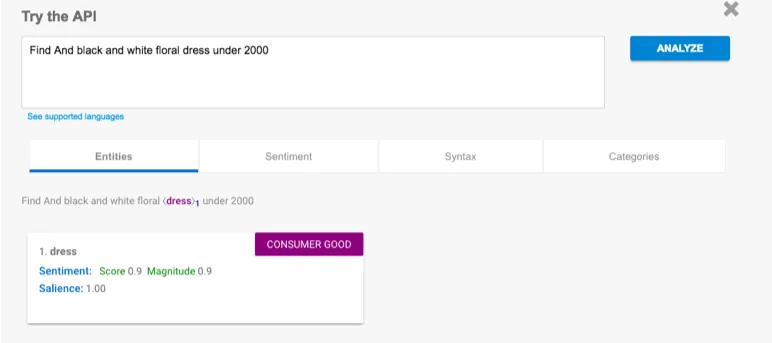](/images/2019/06/Picture4.webp)*
*Figure: Entity classification from* Google NLP
[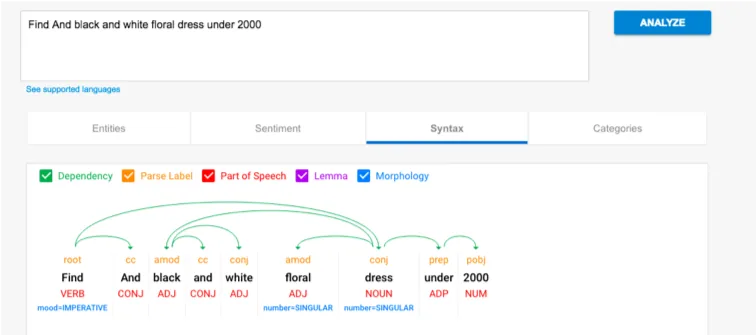](/images/2019/06/Picture5.webp)
*Figure: Part of Speech from* Google NLP
As you see from above figures, Google NLP identify the entity as “dress”, but doesn’t identify the colors “black and white”. With respect to part of speed tagging, its similar to Watson NLP, recognizing “And” and as conjunction (“CONJ”) and not as brand.
The above is true for any of the available NLP implementation (that is available today), where it fails to understand all the correct context of the sentence. The use case was pretty simple. Even if we train the NLP implementation on these examples, it would fall short as you need to plugin specific NLP rules for such conditions to get the desired results. As the complexity and context that needs to be inferred increases, training would also not help as you can never come up with a generalized model for such conditions. That is the single most limitation if we only rely on today’s generation of NLP implementation.
*Based on my experience on building a sophisticated shopping* *personalized advisor, none of the out of the box AI NLP implementation fitted the requirements. A simple* *scenario is these 3 sets of sentences - “black and white dress”, “and black dress” and “blue jeans and white shirt”. In all these 3 examples, the use of word “and” means different meaning. In the first case, its represents a combined color ““black and white”, in second instance “and” represent a brand and in third instance two queries joined by a conjunction (i.e. and). Even with required training, a generalizing model was not possible with any of the available solutions. These are just one of the many examples I am highlighting. Imagine the complexity when dealing with medical literature. In our case, we ended up building our domain specific NLP implementation which worked for all such scenarios.*
In general, while designing chatbot solutions, start with a closed domain and what kind of questions the chatbot needs to answer. Don’t start building a general purpose chatbot from start, as it would be difficult to get the required accuracy. Secondly, if you are using any cloud vendor or third party implementation, ensure your use cases can be simply solved by the default implementation or you need to build components to work around it.
## What are typical use cases for building a chatbot?
In today’s digital age, customers are looking for instant information and speedy resolution to all their queries.
Chatbots provides an efficient way to stay connected with end customers directly and provides information at their fingertips - be it through a messaging chat application or through voice enabled service like Alexa and Google Home.
Some of the typical use cases are listed below -
- Ability to know your customers and directly interact with them over various channels, like retail brands directly connecting to their end customers.
- Improve customer engagement, interaction and provide speedy resolution.
- Scaling customer service operations by providing relevant information 24 by 7 at customer’s finger trip.
- Understand customers and their preferences better to provide hyper personalized service, like a personal assistant.
- Provide an ability to interact with connected devices, like Smart Homes in a natural and intuitive way.
- Provide expert guidance, like a financial assistant chatbot providing investment suggestions.
## What are the high level steps for building an AI chatbot?
Following are the high level steps to build an AI chatbot
- Define the business use case and end goal for building the chatbot.
- Define Conversation interfaces
- Define what kind of questions needs to be answered
- Define conversation/dialog flow on how various interaction would happen with the user. For instance, booking a flight is one dialog flow, booking a hotel is another dialog flow, etc. Within a dialog flow, what would be interaction flow with the user.
- Define how to capture the feedback from the user regarding the answers provided. Feedback can be explicit, like the user rating the answer or implicit on how much time a user spends looking at the answer and follow up activity after that.
- Question / Answer exploration
- Identify existing sources (if any) for questions, like website FAQ, call center logs etc.
- Create representation of Questions that would be asked.
- Create variations of questions for training the chatbot to understand the language and be able to generalize well.
- Identify source of answers - whether it would be programmed response or coming from internal knowledge sources and documents (like available technical manuals for troubleshooting device related queries)
- Pick up a Technology approach
In this step, you will decide how to implement the chatbot. There are 2 approaches - building your own chatbot implementation using available frameworks (like TensorFlow, NLP implementations like NLPTK) and custom components or using an existing platform service like Google NLP, Amazon Lex or Azure Bot service.
In both the approaches, you would need the train the chatbot implementation to recognize the question intent, domain and the language. Existing platform services have simplified this process by providing required utilities that makes it easier to create chatbots. For more details, kindly refer to “How do you build chatbot using chatbot platforms”.
- Pick up a delivery channel
In this step, you will decide how to expose the chatbot to end users through the required channel. The channel can be web, mobiles or voice enabled devices.
Your chat implementation would typically expose an API (to ask questions and get responses) which can be called by a channel implementation. You can also release your chatbot implementation over third party services like Facebook Messenger or voice enabled services like Amazon Alexa. For more details, kindly refer to “How do you Integrate chatbots with third party services”.
- Release, Monitoring and Feedback
Once the chatbot is released, you would typically store all the user interactions to help you analyze the user behavior and their preferences better. The user and behavior data in turn would be used to provide a more personalized service. How would you use this new user information, depends on your use case. For instance, if a travel chatbot is recommending a new holiday trip, it can suggest options based on your last trip interaction. You need a build a recommendation system that looks at the history of the user interaction in the past and suggest options. For details on how to build recommendation systems, kindly refer to Recommendations Chapter of Real AI book.
Another important point is to capture feedback from the user at regular intervals to understand if chatbot is providing the right information. The feedback captured will be used to improve the chatbot implementation, which can lead to training the chatbot implementation with new information. For instance, your chatbot may not be trained on recognizing certain entities and concepts and as a result the responses would not be proper. You need to plan for building and releasing incremental models based on the feedback.
## How do you Integrate chatbots with third party services?
As part of your chatbot technology implementation, your chat implementation would typically expose an API (to ask questions and get responses) which can be called by a channel implementation
The channel can be web, mobiles or voice enabled devices. If you already have an existing mobile application, you can embed this as part of the mobile application.
You can also release your chatbot implementation through third party chat enabled services like Facebook messaging application or through voice enable service like Amazon Alexa as a skill.
All of these chat enabled services provides a framework to plugin your own implementation. The framework provides hooks or code interceptors for intercepting the chat message. You need to extend their framework and plugin your own implementation For example, if a user asks a question on Facebook messenger, the question would be handed to your chat implementation through predefined hooks. You would process the message and send the response back, which would be sent back to the user.
Similarly, if you need to make your chatbot available over Alexa, you need to wrap it as an Alexa Skill using Alexa Skills Kit interface. Once your skill is enabled in Alexa by the user, any voice messages would be intercepted by your skill and you can provide the required implementation and responses as per your chatbot.
For more details, kindly refer to “How do you build chatbot using chatbot platforms”.
## How do you build chatbot using chatbot platforms?
A chatbot platform provides you a set of services to design, develop and deploy your chatbot. They provide you with a framework and guided set of utilities to build a chatbot.
Cloud providers like AWS, Azure, IBM, Google Cloud provides you a set of services that help you to create conversations, understand the conversation language using NLP techniques, hooks to take required action and deliver the solution via APIs.
The fundamental approach adopted by each of these providers is same. They allow developers to
- Design conversation flows using some visual interface or tooling provided by cloud provider
- Through these conversation flows you
- Provide a set of questions and multiple ways you can ask the same question
- Define what is the Intent of the question. For example, for the question -” Find cheapest flight from US to UK”, the intent is to find the lowest air fare.
- What entities of interest to extract from the Intent. The chatbot provider needs to be made aware of these entities. In above example, entities are country list -, UK, US. These entities can be generic which are recognized automatically by the cloud provider or the cloud provider provides a mechanism where you can provide or train these entities (including synonyms etc.) through some tooling provided by the cloud provider.
- Use the entities extracted to carry out the required action for the intent. For instance, in the above example, call a flight API service providing UK and US as “from” and “to” locations.
- Provide the response.
- Test and expose the chatbot through an endpoint
- The cloud vendor typically provides an ability to expose the functionality for your chatbot through an endpoint, like a REST API.
The above technology work for simple to medium complexity flow - like FAQ, pointed questions and answers for customer query, fixed step of steps (booking a cab etc.) etc. Anything which requires sophisticated handling of queries, like the shopping advisor example, needs to be custom developed using NLP and other techniques.
*Info -* *Microsoft has a QnA service (*[*https://www.qnamaker.ai*](https://www.qnamaker.ai)*) that lets you create bot from FAQ.*
## What is not real about Chatbots?
Chatbot are examples of Weak AI. Current generation of chatbot can be thought of smart dialog systems driven through techniques like NLP and fixed conversation flows.
Out of the box, a chatbot doesn’t understand any domain. We need to train the chatbot to understand the domain. Also, based on the complexity of the domain, you would incrementally train and add subdomains. For instance, a chatbot helping you book a cab is an example of fixed domain, while a chatbot helping assisting doctors for cancer treatment would be trained on various types of cancer incrementally. As mentioned in the shopping advisor example, understanding the meaning of the same word in different context is difficult for the current generation of NLP implementation to resolve and you need to rely on custom techniques to handle such conditions.
Now, let's look at some marketing gimmicks around AI chatbots -
- INGEST AND KNOW IT ALL chatbots - These are chatbots being marketed where you can ingest millions of documents, like medical literature and can ask questions, which can provide expert assistance like diagnosis of diseases. Such kinds of systems unless trained appropriately will never provide desired accuracy.
By appropriately, I mean it can take years to train these systems. The fundamental problem with these systems is that, they still don’t understand the complete language and complexity of the domain. You typically end up with custom domain adoptions and infinity language rules, which is definitely not smart enough to manage in longer run. The predictions of such systems are usually not accurate.
- Self learning chatbots - How often you have heard this terminology called self learning chatbots. This again is a misconception, where chatbots learns on its own. You have to train chatbot on what you what the chatbot to learn. Usually you would capture the user behavior details through their interaction with the chatbot application. This would include capturing user analytics information like capturing his likes or dislikes in some way, either through explicit or implicit means. Explicit information can be a user rating a product and implicit can be the time a user spent looking at a response.
Once you know the user well and have its data, its becomes a recommendation problem on what you want to recommend to the user. So, you end you building a recommendation algorithm to recommend something. For instance, for a fintech application, this would mean recommending similar stocks based on what stock he views regularly or his portfolio.
Different domain and use cases, would need different recommendation algorithms and that needs to be developed as part of the chatbot. However, the learning is boxed, for instance if you have a chatbot which assist you in booking restaurants, it can recommend you similar restaurants, but it can’t recommend your places to stay, it only knows about your restaurants taste.
Well, someone can build a recommendation system which tracks what users eat and where they stay and then try to come up with a correlation which provide a recommendation, as the system now knows - “user eating XYZ, most likely are adventurous. So, recommend some trekking place.'' Again, in this case, recommendation is boxed on what you know and what you want to recommend. I don’t know if any such hypotheses exist, but only through data and feedback that can be inferred. The point is, all of these hypotheses, data and feedback needs to be designed and developed, and saying chatbots learns on its own it's quite misleading.
- General purpose, generative chatbots – A chatbot which is capable of learning new concepts from scratch and provide responses like Human. As it learns from open domain, the chatbots would start behaving similar to the famous Microsoft Tay chatbot (which was forced to shut down on its launch day), as it started learning unwanted details from tweets and started posting inflammatory and offensive tweets. This is a classic example of what I quoted earlier - “[AI can learn, but can’t think](/books/download-real-ai-a-definitive-handbook)”. The generative chatbots are formulating the response based on probability of words and creating a grammatically correct sentence, without understanding the real meaning of it.
As I mentioned earlier, the first focus should be on getting domain specific chatbots right and with the current techniques we are far away from realizing the vision.
## Will chatbots make human agents obsolete?
To answer this question, lets understand what functionality chatbots currently provide.
Current chatbot implementation do well for handling fixed set of dialogs with the user, repetitive tasks and certain initial aspects of customer service tasks. Wherever there is a fixed set of processes and flows to automate, chatbot can be used to provide 24 \* 7 support for any queries. If human expertise is used for answering basic set of questions where answers are readily available, it would be eventually be replaced.
But in real-life scenarios, most of the conversation usually doesn’t follow a fixed flow paradigm. But if the conversation moves from basic questions to questions which need further analysis, or the topic of conversation gets changed, you need a sophisticated chatbot implementation to take care of various conversation flows, identify the context switch, identify intents which your chatbot may not be aware of and create queries to find that information from your knowledge source. You are now moving from fixed set of flows to more dynamic flows which needs to be interpreted by your chatbot. Building such complex chatbot implementations requires sophisticated domain specific adoption using machine learning techniques and custom solutions. Current out of the box chatbot services fall short of building such chatbot implementations.
And even if you have all the data in the world at your disposal, infinite processing and computation power, using the current generation technology and research, you can never build a system that can compete with an expert human in the field. Taking even a 5 year horizon from now, I don’t think we can develop such a level of intelligent chatbots.
For instance, can chatbots or an assistant, help doctor to recommend cancer treatments accurately and consistently. The answer is No.
The information provided from chatbot can aid doctors to take a clue from the answer provided, it may be right or wrong. You can never certify this. The chatbot would always act as assistance to an expert person to get some job done. Ultimately, these systems are throwing a bunch of answers based on some probabilities. The answers are limited to what you have fed into the system, you can’t infer a new knowledge on the fly or can correlate information like a human expert to come to any conclusion.
While, there are research going on to use deep neural nets for conversation flows, we are still quite far away of building truly conversational interfaces which understands the nitty-gritty of language and domain. Also, the answers provided needed to be explainable and unless you have a way to backtrack on why a particular answer was provided, such deep neural systems can’t be used for use cases which requires auditability and explainability.
In short, enjoy the smart chatbots that gives a perception on being intelligent, but intelligence is a long way away.
## Can AI generate dynamic responses to questions
You can use deep learning to build a chatbot. Various deep learning architectures are available to solve specific variety of use cases. For instance, for computer vision (i.e. image recognition) you would use a convolutional neural network as the starting point, for language translation or text generation you would go with recurrent neural network and so on.
For understanding chat conversations, you would start with a variant of recurrent neural network. You will build a sequence to sequence model. A sequence to sequence model in simple words consist of 2 components, the first component (encoder) tries to understand context of input sentence through its hidden layers and the second component (decoder) takes in the output from encoder and generates the response.
The above techniques require you to have a large set of training data, containing questions and responses. The technique works in a closed domain, but as the responses are dynamic in nature, putting it directly to your end users can be a bit risky. Secondly, these techniques don’t work when you want to interpret the input sentence to extract the information and formulate a response on your own, like the shopping advisor query use case that we discussed above.
In case of open ended domain, the chatbots would start behaving similar to Microsoft Tay chatbot example I gave earlier.
*Tip - With RNNs, the response/answer is dependent on its previous states (or earlier states). So, for deep conversational use case, where context needs to be available, the RNNs doesn't work. You need to employ variants on RNN called LSTM. (Long Short Term Memory networks). There are a lot of research going around this area. Going through various deep learning architecture is outside the scope of the book.*
## SUMMARY
The current generation of chatbots are weak form on AI, which offers an ability to understand the intent of the input message/question. In order for chatbot systems to understand the intent, it needs to be trained with the corresponding domain. You can ask the same question in multiple ways and the chatbot implementation can still infer the intent.
For dialogs, the current technology offers defining fixed conversation flows, so the interactions are boxed and finite.
Chatbots do well for managing productivity and certain aspects of customer service tasks. However, as the complexity of domain increases, current technology falls short, as even after sufficient training you would not get the required level of accuracy. You would need to rely on a combination of other machine language technologies and solutions like rules, inferences, custom domain metadata to get the solution delivered. These become a one-off solution, which becomes difficult to generalize. For some cases, even the one-off solution would be very complex, like building an advisor for recommending cancer treatments accurately and consistently.
While, there are research going on using deep neural nets, we are still quite far away from building a true conversational chatbot which understands the nitty-gritty of language and domain. Also, the answers provided needed to be explainable and unless you have a way to backtrack on why a particular answer was provided, such deep neural systems can’t be used for use cases which requires auditability and explainability.
---
# Anthos: A Definitive Handbook
URL: https://navveenbalani.dev/books/anthos-a-definitive-handbook
Type: book | Date: 2020-04-12
Anthos is an open hybrid and multi-cloud application platform that provides a consistent development and operations experience for cloud and on-premises environments.
In this book, we will look at the key components of Anthos and how to build applications that can be deployed on cloud or on-premises environment. We will
build a multi-cloud application that would be deployed on Google Cloud and Amazon AWS and managed using a single consistent interface.
We would also look at how to modernise existing legacy/on-premise workloads and manage hybrid environments using Anthos.
[](https://amzn.to/3fIl7Dk)This book is part of our “The Definitive handbook” series. Our vision in the – “The Definitive handbook” series is to enable our readers to understand the technology in simple terms and provide a go-to reference and a recipe for building any real-world application using the latest technology.
Pre-order of the book is available at Amazon -
---
# Scalable and Secure Microservices Architecture using Google Cloud
URL: https://navveenbalani.dev/articles/scalable-and-secure-microservices-architecture-using-google-cloud
Type: article | Date: 2020-04-05 | Topics: cloud
Google Cloud provides a host of services and capability to build scalable and secure web and microservices architecture.
Following architecture can be used for deploying web and microservices in production on Google cloud.
### Scalable Web Architecture using Google Cloud
### Scalable Microservices Architecture using Google Cloud
The following table describe the usage of key google cloud components
| | |
| --- | --- |
| Google Cloud Services | Usage |
| VPC | Custom VPC, Firewall rules for the project |
| Cloud Armor | Logs all incoming request . Provides DDoS and web attack protection. Policy is configured to direct web and api request to respective KBE (Ingress) Load Balancers |
| Load Balancer | Global Load Balancer (Ingress), directs request to specified KBE Cluster |
| KBE Cluster | Private Kubernetes Cluster |
| Cloud NAT | Logs all outbound connections and control outbound/internet connectivity for your application |
| Cloud Endpoints | API Management, Logging, Monitoring and Authentication for APIs. Endpoints are deployed as sidecars in each Pod. |
| CloudSQL | Managed SQL Database |
| Google Cloud SQL Proxy | Provides secure access to your Cloud SQL. Deployed as a sidecar in each Pod which requires connectivity to Cloud SQL |
| BigTable | No-SQL storage for storing application and behaviour analytics |
| BigQuery | Querying BigTable and structured data from CloudSQL to derive user/behaviour analytics |
| Cloud Logging | Logging, storing, analysing and monitoring of Logs for all cloud services |
| Google Storage | Storing and accessing Logs (archival etc) |
| Container Registry | Registry for application/docker images |
For more details on how to setup a production topology using Google Cloud, kindly refer to this [tutorial](/articles/setting-up-production-topology-on-google-cloud).
---
# Next wave of industrial automation
URL: https://navveenbalani.dev/talks/next-wave-of-industrial-automation
Type: talk | Date: 2020-03-03 | Topics: iot, opinion
The combinatorial power of technologies like AI, IoT, Cloud and Blockchain will lead the next wave of industrial automation.
Read my interview/views with Industrial Automation magazine on how emerging technologies will lead the next wave of industrial automation
Link -
---
# Internet Of Things – Application Of IoT In Manufacturing
URL: https://navveenbalani.dev/posts/2020-01-24-internet-of-things-application-of-iot-in-manufactu
Type: post | Date: 2020-01-24 | Topics: iot
Internet Of Things – Application Of IoT In Manufacturing
#iot #internetofthings
https://lnkd.in/fUKARQZ
---
# Free Video Lectures : Building Blockchain Apps using Ethereum & Hyperledger Fabric
URL: https://navveenbalani.dev/articles/free-video-lectures-building-blockchain-apps-using-ethereum-hyperledger-fabric
Type: article | Date: 2020-01-19 | Topics: blockchain
In this video series, you will learn how to build blockchain applications using two widely used blockchain platforms - Ethereum and IBM Hyperledger Fabric. You will understand blockchain concepts and architecture in detail, along with how to build public and private blockchain applications. As part of the video series, we would cover 2 use cases - "How to build a crowdfunding application on Ethereum" and "How to build a Trade Finance application of IBM Hyperledger Fabric". The concepts listed in the video are generic enough, to help users build any blockchain applications for public and enterprise domain,The source code for the video series is also made available on GitHub.
This course is a video representation, modelled after of our book titled 'Enterprise Blockchain - A Definitive Handbook' which was released in Nov 2017. It is the first book to describe how to build Enterprise Blockchain applications for any Industry.
The course is now freely available on Udemy -
Some more details about this course -
***If the book already exists the why the video course?***
The book is always a reader's favorite and primary instrument. But we do believe that a video course can create a lasting impact on the student by teaching them through visuals and audio presentations. The learning can be more interactive and subject area becomes more easy to understand.The video series is an expanded version of the book with explanation of the application and step-by-step source code in detail.
***Are you looking for Blockchain training?***
Blockchain is fast becoming the 'must know' technology for any IT professional - be it a developer, architect or a business analyst. The course is designed to provide you with the systematic approach towards understanding Blockchain concepts and its application. Although the course prerequisites does mention about having basic programming skills, it is not necessary to be a programmer to understand the core Blockchain concepts. For anyone who do not have prior knowledge or experience with Blockchain, this course will aid in uplifting your career value as a good Blockchain professional.
***What the course would cover ?***
In this course we will start with a broad overview of the Blockchain platform in terms of its features, benefits and principles and then deep dive into the architecture and implementation. You will explore different components of the Blockchain architecture viz Digital Tokens, Smart Contract, Ledger, Security, Consensus and Nodes. You will also explore two most popular implementations of Blockchain - Ethereum and IBM Hyperledger Fabric. Both Ethereum and Hyperledger Fabric are constantly evolving and as we move along we will ensure continuous updates to this course so that you do not miss out on the latest feature or function. As part of the course, the students would go through a hands-on exercise on how to build a crowdfunding application on Ethereum platform and a trade finance application on IBM Hyperledger Fabric. This is the first course to cover on how to build real-world blockchain applications using Ethereum & BM Hyperledger Fabric.
***How this course is designed ?***
Lectures in this course averages not more than 10 minutes and consist around 32 lecture session. Each day if we take out 10 minutes, you can complete the course in a month's time. The course covers two major Blockchain implementations which can be used for building public and enterprise blockchain applications. Upon subscription, you will get free regular updates on the new and upcoming Blockchain features and thereby keeping the course content enriched, enhanced and up-to-date.
***How this course is different from other blockchain course ?***
Our focus on the video series is to provide a practical guidance for building blockchain applications for public and private blockchain use cases. This is the first course which provides a neutral architecture for blockchain application and what it takes to design and develop blockchain applications. The blockchain videos series doesn't focus on cryptocurrency or mining concepts, but instead focus on using the blockchain technology for building value driven application. Through this practical course, we describe what's possible to build with current generation of blockchain platform and technology and what lies in the future.
---
# Blockchain Reference architecture
URL: https://navveenbalani.dev/articles/blockchain-reference-architecture
Type: article | Date: 2020-01-11 | Topics: blockchain
Blockchain design of today has moved beyond [cryptocurrency](https://www.google.co.in/search?dcr=0&q=cryptocurrency&spell=1&sa=X&ved=0ahUKEwjZxLyO-5fXAhUSTY8KHRSkDDIQvwUIJCgA). It has evolved into a platform that supports industry-wide use cases suitable for public and enterprise needs. The reference architecture shown below will serve as a foundation for building or implementing blockchain applications for industry-wide use cases. It depicts a layered architecture that provides components and services necessary to implement blockchain applications for enterprise needs. It can be used to develop a blockchain of single or multiple networks (involving multiple business units or organizations) based on the business goals and objectives. One can follow the reference architecture to design both permissioned (private) as well as permissionless (public) blockchain applications.
##
The above reference architecture can be used to build any blockchain
applications. The architecture is divided into logical layers of importance.
These layers are Application, Smart Contract, Integration, Distributed Ledger
and Security. Let’s look at each of these layers and its components:
### Application
The application layer is where your end user or
client application sits. The client application typically kick starts your
business workflow by initiating a transaction. The transactions are executed by
the nodes using smart contract. The client application could be implemented in any
software language and can run on a wide variety of operating systems. The
application could use a command line interface (CLI) tool as provided by any
blockchain framework implementation or it could use language specific SDK
(Software Development Kit) to communicate with nodes on the network. As the
blockchain evolves beyond its traditional image of digital crypto currency
based network, we are seeing different types of clients and tools supporting
the blockchain framework. The client application can also listen to various
types of events occurring on the blockchain network and perform the necessary
actions on those events. The event may be as simple as providing status update
to the application from the network. One can also have a separate dedicated application
to monitor the blockchain network.
### Smart Contract
Smart contract is a software code that represents
transactions in the blockchain network. It is a collection of business rules or
conditions that are invoked by the nodes in the blockchain network. Smart
contract can have its own execution runtime or a virtual machine environment.
It can be made to run in a secured context, like a virtualized container. Smart
contract can be implemented in any software languages, the popular being, but
not limited to, Java, Python, Go, JavaScript and Scala. Smart contract can be
also written as services and placed in registries so that client can look up
for the same in a location independent way. The registries can be secured, and
access can be controlled so that only authorized clients can act upon that
contract. Smart contract itself can be made secured using cryptographic hash algorithms
so that it’s content (software code and related metadata) are made
confidential. Smart contract can also be programmed to communicate or broadcast
transaction state transitions in the form of events. It could be lifecycle
events of the contract itself. The application client can listen to these
events and handle them accordingly.
### Integration
In today’s world of disruptive technologies where
application integration and communication has become so imperative, no one
platform can stand in isolation. Blockchain is no different. Blockchain network
should be able to access any data outside of the network. The data could be
part of any external application or system that can provide significant value
to the blockchain workflow. Similarly, external system must also be able to
communicate with the blockchain network. One approach could be to setup an
external event hub, as a medium to exchange data with external systems through
event processing. An external application can listen on to a specific event on
the hub and accordingly perform some task. On the other hand, a smart contract
can listen to events coming from external systems and accordingly execute the
business function. The following section explains some other interesting use
cases in the integration scenario:
#### Artificial Intelligence (AI) Integration
Blockchain as we know is essentially a
distributed ledger with a decentralized and automated approach towards
transaction settlement process based on consensus. So, where does AI fits into
blockchain? AI can be influenced by data. Blockchain is a database with loads
of transactions that can be made available to branches of AI like machine learning
that can apply complex algorithms on data to optimize a particular business
function. The branch of AI can also be used to improve the overall business
process or workflow. AI algorithms can detect significant anomalies and perform
predictive modeling or analysis to find indicators that can reduce the transaction
cost and increase the revenue of business for all parties across the blockchain
network. AI solutions can also be employed for consensus between systems that
need to work autonomously. The
combinatorial power of AI and blockchain could be a real game-changer in the
future.
#### Cloud Integration
Blockchain architecture can be extended to
implement a component hosted on the cloud that can provide application
integration services like routing, data transformation, protocol translation,
extended certificate authority etc. This component can act as a middleware,
offering its capabilities as a ‘blockchain as a service' function in the cloud.
The blockchain implementation can provide adapters to connect to the middleware
component from within the blockchain network and outside of the network. The blockchain middleware component can be
hosted in a secured ‘sandboxed’ environment or inside a secured virtualized container.
An external application can interact with the blockchain middleware using
adapters and upon obtaining valid certificates to access the blockchain
network.
#### IoT integration
A new wave of integration will involve arbitrary
devices to communicate with the blockchain network. Different types of IoT
devices or sensors can inject data into the blockchain network that can then be
validated by the blockchain nodes. A standardized middleware can be implemented
that can take the data from the device and perform the necessary conversion and
transformation of data as required by the blockchain network. The peers or the
nodes in the blockchain network can then go about validating this data using a
specific consensus algorithm using smart contracts.
---
Note - For more details on blockchain & IoT
integration, refer to this overview article - [/articles/blockchain-and-enterprise-iot)
---
### Distributed Ledger
This distributed ledger is the core persistent
layer in the blockchain architecture. It provides a decentralized and
distributed database containing the transaction entries. These entries are
recorded in the order of its occurrence and composed into hashed blocks. The
database or the ledger, therefore, represents a chain of hashed blocks of
transactions with each block referring to the previous block in the chain. The
ledger is shared across the blockchain network, which means every node has a
copy of the ledger, and each node verifies the transactions independently. When
every node agrees and confirms the authenticity of the transaction, the ledger
is said to be in consensus. The
blockchain network uses different consensus algorithms to arrive at the
consensus. The consensus algorithm is a set of rules and conditions that
governs the transaction. The blockchain network implemented for the public has
a permissionless ledger, while in a private network or a consortium, a ledger
can be made permissioned. A permissioned ledger introduces some form of access
control in the way transactions are accessed and managed.
#### Ledger Conduits
For a permissioned-based blockchain network, one can implement a
pattern called ledger conduits. Conduits can be thought of as private channels
in the blockchain network where two or more nodes perform transactions even
more privately. The nodes must be members and authorized to use these conduits.
Conduits are small networks inside a large network. Such a pattern further
enforces security when implementing blockchain in an enterprise.
#### Consensus Algorithms
The blockchain network typically is governed by anonymous entities or
nodes that are not trusted. The consensus is all about providing the trust
factor in the network. Each node can update the blockchain network with data in
the form of transaction that eventually needs to be verified before it can be
officially recorded as part of block in the ledger. There are different
consensus algorithms that convey how the block (of transactions) is created and
validated, thereby enforcing trust in the network.
##### Practical Byzantine Fault Tolerance (PBFT)
This is the consensus based on majority. Each node updates and
validates the blockchain network based on certain given set of rules or
conditions. If majority of the nodes in the network reflects the same result
upon update, then the network is said to be in consensus. There could be few
rogue nodes that could violate the network rules, but their outcome is not
accepted as it goes against the accepted algorithm. The algorithm should
fulfill the necessary conditions, and all the nodes must agree and execute the
same conditions to derive at the desired output.
##### Proof-of-work (PoW)
One of the first and traditional algorithms devised is the
Proof-of-Work. Bitcoin-based blockchain network and Ethereum use this algorithm.
Unlike PBFT, PoW does not need consensus based on majority. It is an algorithm
that takes enormous computing effort. Only nodes with greater computing power
can take up the PoW. The first node that completes the task with the desired
output gets a chance to create the block and is compensated for its efforts.
PoW typically involves some kind of cryptographic hashing to achieve the
desired target or outcome. We will talk of PoW in detail in Chapter 2.
##### Proof-of-Stake (PoS)
With PoW, one needs enormous computing power that results in high-energy
consumption. This may not be desirable. PoS overcome this by providing an
alternative approach called the stake of the user. The user possessing or
owning highest digital currencies (or some asset) gets a chance to create the
block in the blockchain network. So instead of investing in high power
computing nodes, one can rather buy out cryptocurrency (or own assets) and
increase their stake to validate and create a block of transactions.
### Security
We talked about security earlier in the components of blockchain
section. Security is one of the important components in the blockchain
architecture. Based on the implementation of blockchain - whether
permissionless or permissioned, required security and consensus strategies are
applied. In public blockchain, every node can participate in the network, while
in the permissioned network you have some form of access control that only
allows required nodes to participate in a transaction.
Every entity in the blockchain network must be bound to an identity.
In a permissionless network, entities are typically restricted to users
participating in the transaction, while in case of a permissioned network, the
entities comprise of organization, nodes, users and anything that has a role to
play in the blockchain network.
For a permissioned blockchain, Public Key Infrastructure (PKI)
platform can be used where a trusted Certificate Authority (CA) can issue
crypto credentials. The crypto credentials could take the form of certificates
and keys. Private keys can be used for signing and public key for verification.
It results in a trusted network where all the participants know who they are
and their roots of trust. Now as the parties involved in the blockchain network
might leverage their own crypto credentials, possibly setting up their own CA,
it is essential that the blockchain implementation provides a plug-and-play
service or a level of abstraction to effectively manage, verify and validate
entities using different security mechanism across the network.
In short, the blockchain security should be equipped with five effective measures viz. authentication, access control, integrity, confidentiality, and non-repudiation.
In the next series, we will go over how to build applications using Hyperledger fabric and Ethereum -
Building Blockchain Applications Using HyperLedger -
Building Blockchain Applications Using Ethereum -
---
# Blockchain Reference Architecture
URL: https://navveenbalani.dev/technology-bytes/blockchain-reference-architecture
Type: newsletter | Date: 2020-01-11
Blockchain design of today has moved beyond cryptocurrency. It has evolved into a platform that supports industry-wide use cases suitable for public and enterprise needs. The reference architecture shown below will serve as a foundation for building or implementing blockchain applications for industry-wide use cases. It depicts a layered architecture that provides components and services necessary to implement blockchain applications for enterprise needs. It can be used to develop a blockchain of single or multiple networks (involving multiple business units or organizations) based on the business goals and objectives. One can follow the reference architecture to design both permissioned (private) as well as permissionless (public) blockchain applications.

The above reference architecture can be used to build any blockchain applications. The architecture is divided into logical layers of importance. These layers are Application, Smart Contract, Integration, Distributed Ledger and Security. Let’s look at each of these layers and its components:
## Application
The application layer is where your end user or client application sits. The client application typically kick starts your business workflow by initiating a transaction. The transactions are executed by the nodes using smart contract. The client application could be implemented in any software language and can run on a wide variety of operating systems. The application could use a command line interface (CLI) tool as provided by any blockchain framework implementation or it could use language specific SDK (Software Development Kit) to communicate with nodes on the network. As the blockchain evolves beyond its traditional image of digital crypto currency based network, we are seeing different types of clients and tools supporting the blockchain framework. The client application can also listen to various types of events occurring on the blockchain network and perform the necessary actions on those events. The event may be as simple as providing status update to the application from the network. One can also have a separate dedicated application to monitor the blockchain network.
## Smart Contract
Smart contract is a software code that represents transactions in the blockchain network. It is a collection of business rules or conditions that are invoked by the nodes in the blockchain network. Smart contract can have its own execution runtime or a virtual machine environment. It can be made to run in a secured context, like a virtualized container. Smart contract can be implemented in any software languages, the popular being, but not limited to, Java, Python, Go, JavaScript and Scala. Smart contract can be also written as services and placed in registries so that client can look up for the same in a location independent way. The registries can be secured, and access can be controlled so that only authorized clients can act upon that contract. Smart contract itself can be made secured using cryptographic hash algorithms so that it’s content (software code and related metadata) are made confidential. Smart contract can also be programmed to communicate or broadcast transaction state transitions in the form of events. It could be lifecycle events of the contract itself. The application client can listen to these events and handle them accordingly.
## Integration
In today’s world of disruptive technologies where application integration and communication has become so imperative, no one platform can stand in isolation. Blockchain is no different. Blockchain network should be able to access any data outside of the network. The data could be part of any external application or system that can provide significant value to the blockchain workflow. Similarly, external system must also be able to communicate with the blockchain network. One approach could be to setup an external event hub, as a medium to exchange data with external systems through event processing. An external application can listen on to a specific event on the hub and accordingly perform some task. On the other hand, a smart contract can listen to events coming from external systems and accordingly execute the business function. The following section explains some other interesting use cases in the integration scenario:
## Artificial Intelligence (AI) Integration
Blockchain as we know is essentially a distributed ledger with a decentralized and automated approach towards transaction settlement process based on consensus. So, where does AI fits into blockchain? AI can be influenced by data. Blockchain is a database with loads of transactions that can be made available to branches of AI like machine learning that can apply complex algorithms on data to optimize a particular business function. The branch of AI can also be used to improve the overall business process or workflow. AI algorithms can detect significant anomalies and perform predictive modeling or analysis to find indicators that can reduce the transaction cost and increase the revenue of business for all parties across the blockchain network. AI solutions can also be employed for consensus between systems that need to work autonomously. The combinatorial power of AI and blockchain could be a real game-changer in the future.
## Cloud Integration
Blockchain architecture can be extended to implement a component hosted on the cloud that can provide application integration services like routing, data transformation, protocol translation, extended certificate authority etc. This component can act as a middleware, offering its capabilities as a ‘blockchain as a service’ function in the cloud. The blockchain implementation can provide adapters to connect to the middleware component from within the blockchain network and outside of the network. The blockchain middleware component can be hosted in a secured ‘sandboxed’ environment or inside a secured virtualized container. An external application can interact with the blockchain middleware using adapters and upon obtaining valid certificates to access the blockchain network.
## IoT integration
A new wave of integration will involve arbitrary devices to communicate with the blockchain network. Different types of IoT devices or sensors can inject data into the blockchain network that can then be validated by the blockchain nodes. A standardized middleware can be implemented that can take the data from the device and perform the necessary conversion and transformation of data as required by the blockchain network. The peers or the nodes in the blockchain network can then go about validating this data using a specific consensus algorithm using smart contracts.
Note — For more details on blockchain & IoT integration, refer to this overview article — [http://navveenbalani.com/index.php/articles/blockchain-and-enterprise-iot/](http://naveenbalani.com/index.php/articles/blockchain-and-enterprise-iot/)
## Distributed Ledger
This distributed ledger is the core persistent layer in the blockchain architecture. It provides a decentralized and distributed database containing the transaction entries. These entries are recorded in the order of its occurrence and composed into hashed blocks. The database or the ledger, therefore, represents a chain of hashed blocks of transactions with each block referring to the previous block in the chain. The ledger is shared across the blockchain network, which means every node has a copy of the ledger, and each node verifies the transactions independently. When every node agrees and confirms the authenticity of the transaction, the ledger is said to be in consensus. The blockchain network uses different consensus algorithms to arrive at the consensus. The consensus algorithm is a set of rules and conditions that governs the transaction. The blockchain network implemented for the public has a permissionless ledger, while in a private network or a consortium, a ledger can be made permissioned. A permissioned ledger introduces some form of access control in the way transactions are accessed and managed.
## Ledger Conduits
For a permissioned-based blockchain network, one can implement a pattern called ledger conduits. Conduits can be thought of as private channels in the blockchain network where two or more nodes perform transactions even more privately. The nodes must be members and authorized to use these conduits. Conduits are small networks inside a large network. Such a pattern further enforces security when implementing blockchain in an enterprise.
## Consensus Algorithms
The blockchain network typically is governed by anonymous entities or nodes that are not trusted. The consensus is all about providing the trust factor in the network. Each node can update the blockchain network with data in the form of transaction that eventually needs to be verified before it can be officially recorded as part of block in the ledger. There are different consensus algorithms that convey how the block (of transactions) is created and validated, thereby enforcing trust in the network.
Practical Byzantine Fault Tolerance (PBFT)
This is the consensus based on majority. Each node updates and validates the blockchain network based on certain given set of rules or conditions. If majority of the nodes in the network reflects the same result upon update, then the network is said to be in consensus. There could be few rogue nodes that could violate the network rules, but their outcome is not accepted as it goes against the accepted algorithm. The algorithm should fulfill the necessary conditions, and all the nodes must agree and execute the same conditions to derive at the desired output.
Proof-of-work (PoW)
One of the first and traditional algorithms devised is the Proof-of-Work. Bitcoin-based blockchain network and Ethereum use this algorithm. Unlike PBFT, PoW does not need consensus based on majority. It is an algorithm that takes enormous computing effort. Only nodes with greater computing power can take up the PoW. The first node that completes the task with the desired output gets a chance to create the block and is compensated for its efforts. PoW typically involves some kind of cryptographic hashing to achieve the desired target or outcome. We will talk of PoW in detail in Chapter 2.
Proof-of-Stake (PoS)
With PoW, one needs enormous computing power that results in high-energy consumption. This may not be desirable. PoS overcome this by providing an alternative approach called the stake of the user. The user possessing or owning highest digital currencies (or some asset) gets a chance to create the block in the blockchain network. So instead of investing in high power computing nodes, one can rather buy out cryptocurrency (or own assets) and increase their stake to validate and create a block of transactions.
Security
We talked about security earlier in the components of blockchain section. Security is one of the important components in the blockchain architecture. Based on the implementation of blockchain — whether permissionless or permissioned, required security and consensus strategies are applied. In public blockchain, every node can participate in the network, while in the permissioned network you have some form of access control that only allows required nodes to participate in a transaction.
Every entity in the blockchain network must be bound to an identity. In a permissionless network, entities are typically restricted to users participating in the transaction, while in case of a permissioned network, the entities comprise of organization, nodes, users and anything that has a role to play in the blockchain network.
For a permissioned blockchain, Public Key Infrastructure (PKI) platform can be used where a trusted Certificate Authority (CA) can issue crypto credentials. The crypto credentials could take the form of certificates and keys. Private keys can be used for signing and public key for verification. It results in a trusted network where all the participants know who they are and their roots of trust. Now as the parties involved in the blockchain network might leverage their own crypto credentials, possibly setting up their own CA, it is essential that the blockchain implementation provides a plug-and-play service or a level of abstraction to effectively manage, verify and validate entities using different security mechanism across the network.
In short, the blockchain security should be equipped with five effective measures viz. authentication, access control, integrity, confidentiality, and non-repudiation.
Blockchain can be thought of as a next wave of network revolution after the Internet, specifically in the business world. The self-regulated environment that offers consensus, provenances in terms of identity management, security in terms of cryptography and policies will pave the way for a new generation of applications that will provide a more robust infrastructure support to the blockchain network. There are many different flavors of blockchain existing today, from a permissionless ledger like Ethereum to a permissioned one like IBM HyperLedger. The industry use cases of blockchain have evolved from cryptography currency-centric financial domain to various other industries like Insurance, Supply Chain, Healthcare, IoT, etc. Based on the use cases, you would go with permissionless or permissioned blockchain or even a combination of two where public consensus would drive private business transactions.
Thinking in blockchain has already started, and the combinatorial power of Cloud, Big Data, AI, IoT and the Distributed Ledger will lead to innovative business solutions.
Learn how to build Blockchain applications with my free course —
Originally published at -
---
# Enterprise Blockchain Reference Architecture - blockchain…
URL: https://navveenbalani.dev/posts/2020-01-11-enterprise-blockchain-reference-architecture-block
Type: post | Date: 2020-01-11 | Topics: blockchain, architecture
Enterprise Blockchain Reference Architecture - #blockchain #architecture #enterpriseblockchain
---
# Comparing IoT Cloud Providers - Azure, IBM, Amazon, GE Predix , Google Cloud and Open Source
URL: https://navveenbalani.dev/articles/comparing-iot-cloud-providers-azure-ibm-amazon-ge-predix-google-cloud-and-open-source
Type: article | Date: 2019-12-21 | Topics: iot
This article is part of IoT Architecture Series -
The following table summaries the various capabilities offered by the IoT cloud providers. We had gone through the platform capabilities in this article series.
| | | | | | | |
| --- | --- | --- | --- | --- | --- | --- |
| **Platforms** | **Microsoft** | **IBM** | **Amazon** | **Open Source** | **GE Predix** | **Google Cloud** |
| Device SDK | Azure IoT Device SDK, Connect TheDots.io | IBM Watson IoT Platform Client Library, Watson IoT Platform Device recipes, Paho Library | Device SDK for AWS IoT | Paho Library, Cyclon.js, and many other options | Predix Machine | MQTT Client |
| Protocol Supported | HTTP, AMQP MQTT | MQTT, HTTP | MQTT, HTTP | MQTT, AMQP, HTTP etc. | MQTT, HTTP | MQTT, HTTP |
| Core platform – IoT Messaging platform | IoT Hub, Event Hubs, Azure IoT Central, Azure Digital Twins | Watson IoT Platform, IBM Maximo (Asset Management) | AWS IoT | Protocol Bridge, Apache Kafka | Rabbit MQ | Cloud IoT Core, Cloud Pub/Sub |
| Core platform – Database option | DocumentDB Storage (high-performance tables, blobs), Microsoft SQL | MongoDB, Cloudant NoSQL, ObjectStorage, Informix Time Series data, etc. | Amazon DynamoDB, Amazon Redshift | Cassandra (or alternatives like MongoDB) | Asset Data, Time Series, Redis, Postgre SQL, Blobstore | Time Series, Cloud Bigtable |
| Analytics platform – Real-time Streaming | Time Series Insights, Microsoft Stream Analytics | IBM Analytics Engine, IBM Streaming Analytics | AWS Glue, Amazon Kinesis | Apache Spark Streaming | Analytics Runtime | Cloud Pub/Sub, Cloud Dataflow, BigQuery |
| Analytics platform – Machine Learning | Azure ML | Watson Studio, SPP Modeler (offline) | Amazon Machine Learning, AWS SageMaker, AWS IoT Analytics, Amazon Lookout for Equipment | Apache Spark MLlib (and other options) | Custom ML Support (Python, Java, MATLAB) + Pre-built industrial analytics and Data science services | Google AI platform, Vertex AI |
| Alerts and Event handling | Notification Hubs, PowerBI | Embeddable Reporting, IBM Push Notifications | AWS IoT Events, AWS Lambda, Amazon Quick Sight, Amazon Simple Notification Service | Custom, Zeppelin (Dashboards), etc. | Mobile SDK, Dash board Seed | Google Data Studio, Firebase Cloud Messaging |
| Edge Computing | Azure IoT Edge | IBM Edge Application Manager | AWS IoT Greengrass | Custom | Predix Edge | Edge TPU, Anthos |
As mentioned in earlier articles, there are various other complementary services offered by IBM, Amazon, Microsoft and Predix that could be leveraged and used in an IoT solution, like caching, geospatial locations, mobile push events, etc. There might be many more components, which could be used in the above stack, but we listed only those services that provide end-to-end integration in the IoT stack.
From the strategy perspective, all platform providers have the same strategy of providing a set of services to enable development of scalable IoT applications. Clearly, just providing the platform would not provide any unique capability and we would see a lot of tie-ups and partnership from device manufacturers to network providers, open source adopters to start-up’s providing innovative solutions. Apart from partnerships, the real requirement is to develop and provide end-to-end industry solutions on top of the IoT stack as a set of offerings which can be customized based on requirements. For instance, design model of the services used with a connected car solution should not change across car manufacturer. The only thing that would change is device library that is fitted in the car (telematics device) or installed via the OBD port.
With this we conclude our IoT series.
---
# Setting up production topology on Google Cloud
URL: https://navveenbalani.dev/articles/setting-up-production-topology-on-google-cloud
Type: article | Date: 2019-12-20 | Topics: cloud
In this article, we would be deploying a set of microservices (as containers) on Google Kubernetes Cluster. We would use Google Endpoints for API management and deploy the google endpoint container along with our microservices container.
Containers are
becoming a standard way to run and scale microservices across multiple cloud
providers. With Kubernetes, the job of deployment, scaling, and management of
containerized applications on cloud or on promises is now mainstream and
extremely streamlined.
To build a production
grade environment, however, you need a host of other components like Virtual
Private Network (VPN), endpoint management for microservices, load balancer to
balance request over various protocols (HTTP, HTTP(s), Web socket), Configuring
SSL, Health monitoring of services, Network configuration like Whitelisting of
IPs, Network address translation (NAT) for Outbound connections, and ensuring
logging at various entry points in your application.
In this blog, I will go through the high-level steps to create a production ready environment on Google cloud for deploying microservices. The steps outlined are generic and can be applied to build your production topology on similar lines.
We would further create an Ingress Controller (of type Load Balancer) and expose our application microservices over HTTPS. All incoming HTTPS requests would go to a Load balancer, which would direct them to one of the nodes in the Kubernetes Cluster. In the nodes, the requests would first go to Google endpoint (which would validate the endpoint key and logs all endpoint request) and then to the respective microservice endpoints.
## Environment and Solution Overview
We would be
deploying a set of microservices (as containers) on Google Kubernetes Cluster.
We would use Google Endpoints for API management and deploy the google endpoint
container along with our microservices container.
We would further
create an Ingress Controller (of type Load Balancer) and expose our application
microservices over HTTPS. All incoming HTTPS requests would go to a Load balancer,
which would direct them to one of the nodes in the Kubernetes Cluster. In the
nodes, the requests would first go to Google endpoint (which would validate the
endpoint key and logs all endpoint request) and then to the respective
microservice endpoints.
There are
additional requirements on ensuring only authorized IPs access our microservices.
We will learn how to whitelist the IPs using two approaches - Google Cloud
Armor and Nginx Ingress Controller (instead of the default Google Ingress
Controller).
Similarly, for
outbound connections, we would be connecting to third-party services. The
third-party services employ similar IP whitelisting requirements, and we’ll
need to provide our set of outbound IPs that would connect to these third-party
services. For this requirement, we would
be use Google Cloud NAT to provide our private Google Kubernetes Engine (GKE)
clusters the ability to connect to the Internet, as well as Static outbound IPs
that we can configure and provide to third-party services to whitelist on their
servers.
There are
additional requirements on ensuring only authorized IPs access our microservices.
We will learn how to whitelist the IPs using two approaches - Google Cloud
Armor and Nginx Ingress Controller (instead of the default Google Ingress
Controller).
Similarly, for outbound connections, we would be connecting to third-party services. The third-party services employ similar IP whitelisting requirements, and we’ll need to provide our set of outbound IPs that would connect to these third-party services. For this requirement, we would be use Google Cloud NAT to provide our private Google Kubernetes Engine (GKE) clusters the ability to connect to the Internet, as well as Static outbound IPs that we can configure and provide to third-party services to whitelist on their servers.
## High-Level Steps
The following are
the high-level steps that we would carry out to build and deploy our
microservices configuration. It is assumed that the Google project is already
created.
### Solution 1 - Using Google Ingress Controller
1. Create a VPN
2. Create a
private instance of Google Kubernetes Cluster.
3. Create Cloud
NAT configuration.
4. Download the
microservice application and deployment scripts from GitHub.
5. Build the
microservice container.
6. Push the
microservice container to the google container registry.
7. Deploy endpoint for the project.
8. Create
Workload, Service, and Ingress (GCE ingress).
9. Invoke the
microservice.
10. Configure
Cloud Armor.
11. Test the
microservices with Cloud Armor.
### Solution 2 - Using Nginx Ingress Controller
The Solution 1
above uses default Google Ingress Controller. We can also use Nginx Ingress Controller
as it provides a lot of add-on features like IP whitelisting, rule
configuration, HTTP(s) redirect etc. The deployment process is the same as
described in Solution 1, except for Point 7 and Point 8. For Point 7, we would
install Nginx ingress first on our Kubernetes Cluster and then deploy the Nginx
Ingress configuration for our application (instead of GCE ingress). We don’t
need Cloud Armor as the whitelisting of IPs is supported through Nginx Ingress
directly.
[Click here for the next article](/articles/building-production-topology-with-google-cloud-part-1)
---
# Internet of Things - Application of IoT in Manufacturing
URL: https://navveenbalani.dev/articles/internet-of-things-application-of-iot-in-manufacturing
Type: article | Date: 2019-12-18 | Topics: iot
This article is part of IoT Architecture Series -
Large manufacturers have been using some automation and smart technology to streamline and optimize their processes and improve their operation and production efficiency. However, as manufacturers start moving towards the next industrial revolution (Industry 4.0 or Industrial Internet of Things(IIoT)) and technologies available today that can analyze massive volume, variety, and velocity of data generated by various machines and sensors, there arises an opportunity to streamline this information to further improve the manufacturing process and most importantly start designing and developing connected products that can enhance customer satisfaction and services and open up avenues for new financial business models.
*Note
– The term Industry 4.0 and Industrial Internet of Things are usually used interchangeably, but they have
different context and reference. Industry 4.0 is a term coined by the German government,
it marks the fourth*[*industrial
revolution*](https://en.wikipedia.org/wiki/Industrial_revolution) *and can be described as the digitalization of industrial
sector, especially for manufacturing. Industrial Internet of Things is about
enabling and applying IoT across industries. Also check out Industrial Internet
Consortium (**) a non-profit
organization, founded by AT&T, Cisco, GE, IBM and Intel to collaborate
and set the architectural framework and direction for the Industrial Internet
of Things*
---
Let’s take an example of a leading elevator
manufacturing company which supplies elevators across the globe. The elevators
already have some instrumentation built in, like door sensor, a weight sensor
which triggers an alert like beep in case of overload,
etc., but the elevator company has no
visibility on how the elevators are being used across the globe and therefore,
raises the following important questions:
Are these elevators working as expected and
utilized as per the specification?
Is there a failure condition?
What kind of failure has occurred?
How are failures to be handled?
What is the typical
acceptable downtime?
Which agency is handling the failure
condition?
How effective is the after-sales service in
that region?
Is there a competent expertise available to
handle a given failure condition?
Are the spare parts available to quickly
start the restoration process?
Proper application of IoT can address the
above questions by designing a connected solution that will help capture and
analyze the product usage, operational and failure data and ultimately improve
the customer satisfaction and services.
IoT can not only transform the end products
but the entire manufacturing process right from the start where the elevators are manufactured. The supply chain process and
logistics can also be streamlined to enhance operational efficiency and
productivity and deliver better financial gains.
IoT is an incremental journey; it’s an
evolution, and any manufacturing IoT realization can be broken down into
the following five phases:
- Monitoring & Utilization
- Condition based maintenance
- Predictive Maintenance
- Optimization
- Connecting ‘connected solutions.'
### Monitoring & Utilization
Monitoring and utilization are the first
steps of an IoT journey. This is an
umbrella phase which itself consists of
many requirements.
For the large scale manufacturer, to enable
seamless monitoring and utilization of their systems, the step usually
comprises of:
1. Asset Management
2. Identifying assets that need to
be monitored
- Instrumentation
- Leveraging existing
instrumentation investments (if any)
- Adding
new hardware capability (new sensors/actuators/microcontrollers) based on the
design and requirements of the connected solution.
- Handle Connectivity
- Adding connectivity to devices
as per above points (1) and (2). We would talk about various patterns, the device
directly connected to the core platform; intercommunication between devices or
a device gateway connected to the core platform which communicates with
existing devices using a low level or existing proprietary protocols.
- Perform Monitoring
#### Asset Management
To start with you need to identify the set
of physical assets that needs to be monitored.
For example, for an elevator manufacturing company an elevator is an asset,
which contains various sub-assets like doors, input control buttons (open,
close, call, alarm, etc.), elevator telephone, etc. Similarly, for a connected car
manufacturer, the car is an asset that contains various sub-assets like engine,
brakes, tires, etc. and for any
manufacturing plant, machinery equipment, conveyor systems, etc. are examples of assets that needs to be monitored. An asset contains a set of
metadata, for example, a car engine can have a manufacturer's name, capacity,
year of manufacturing, etc. Asset
management is perceived through asset
metadata and its dependencies with other assets. Manufacturers typically have a
software platform or an application to manage the lifecycle of its assets.
While moving towards implementing IoT, the existing asset management design or
application may not be sufficient or good enough for building next generation
connected solution. Right from requirements, design to simulation, creating
connected products and its lifecycle management, will require a completely new
approach and a set of next generation software products to realize a connected
solution. We envision a set of new
emerging software products to tackle requirements for designing connected
solution. For instance, understanding a dependency between a car engine, engine
oil, led indicators and brakes through the system’s metadata and making use of
analytics platform to perform analysis on the actual sensor data in a connected
car solution, could help derive correlations easily and suggest measures to
tackle failure condition. The design of connected products is a separate topic
in itself and outside the scope of this book.
#### Instrumentation
In the manufacturing world, some kind of instrumentation is already employed,
like the use case of the elevator, which we talked about earlier. The elevators
already have built-in sensors, but these sensors are not connected to any platform, (the platform here maps to core
platform in our architecture diagram - Refer Chapter 1) so as to enable
transfer and analysis of the data. Moreover,
the protocol and connectivity (maps to communication layer in our architecture
diagram-- Refer Chapter 1) for the various hardware components (or devices) in
the elevator and their interactions would be very proprietary in nature.
Based on the requirements of the connected
product, new hardware components (devices, microcontroller, sensors, etc.) might also be required. For instance, in a connected elevator design,
the elevators now have new requirements to maintain an optimum temperature for
smooth functioning, taking into account surrounding external factors (external
factors may vary in different regions). Now the new design could also break
down an operating ambient temperature into multiple levels of degradations,
monitor this remotely or via notification and use this information to schedule
services. For instance, take the following example where X is the optimum
temperature that needs to be maintained
and if X is greater than Threshold value, the degradations process starts.
Lastly, if no action is taken from the start of degradation beyond Y days, a critical
failure alert message is sent to the elevator company.
X being optimum temperature,
X > Threshold Value -> Needs
attention within 5 days. The elevator is
still functional but with limited load.
The load is cut down from 300 kg to 150 kg.
At this stage, details about the suggestive
spare part changes, the location of the
spare part, suggested service vendor nearest to the current location is also made available by the system. It’s easier
for the system to detect the GPS
coordinates of the connected system, look at the inventory and service vendors
based on the region and scheduled
maintenance services. At this stage, the elevator
is operational but with reduced load and have controlled the movement of people using the elevator.
X > Threshold Value (Date) – Y Days
–> Critical Failure alert. This is
final alert to repair the defective part, along with a good time to repair the
elevator based on people movement during that week and projections to ensure
minimum downtime and least impact on passengers. The above is only one
such example. A manufacturer could employ many such requirements, which would
require design changes right from microcontrollers to adding new hardware
components. Again, this is an incremental effort;
one can take gradual steps by identifying and adding new hardware
component and then connecting along the way to the core platform for data
transmission. The data is then used to correlate and perform analysis at the core platform layer to understand failure
conditions and patterns.
#### Handle Connectivity
There are three
general connectivity patterns, which allow
devices to communicate to the core platform
- Connecting device directly to
core platform
- Connecting devices to an
intelligent system and/or device gateway.
- Intercommunication with devices.
Based on the use cases, the connectivity
option would differ. If there is a requirement to process the data locally and
take action and/or a requirement to map
different proprietary protocols to a standardized protocol, a device gateway is
generally used which will translate the
incoming protocol instructions to that of the target platform. The requirement
also depends on the power consumption capacity of the device, and it may not make sense for all devices to connect directly to the core platform.
For the elevator manufacturing use case,
the devices (doors, motor temperature, shaft alignment,
etc.) is already instrumented and connected to a central device (microcontroller).
The central device can be IoT-enabled, or
a new device gateway can be installed which
talks to the central device. It can be done
by installing the required platform libraries and code that connect to the core platform, understands and
map the data from the controller into a
payload object (like JSON) and submits the payload to the core platform.
Libraries are available which supports
making a device IoT-enabled, like the Eclipse-based Paho
library (http://www.eclipse.org/paho/) which is an open-source client
implementation of MQTT that can be installed
on devices supporting C, Java, Android, Python, C++, JavaScript and NET programming model. This is of course with the assumption that the
core platform supports the MQTT protocol.
The choice of library depends on the device being IoT-enabled,
the programming language supported by the device (C, C++, JavaScript, etc.),
the protocols supported by the core platform (MQTT, AMQP, REST, etc.) and the client library available
for the device. One can also use REST style invocations to connect to the core platform. Core platform can provide SDKs
for various devices that provide APIs to
convert the device data into required payload supported by the core platform.
For example, open source projects like Connect-The-Dots
(https://github.com/Azure/connectthedots) allow devices to connect to Microsoft
IoT services.
Not all data from the IoT-enabled device need to be transferred to the core platform. The IoT-enabled device gateway can employ local
storage to filter out the data (like start and stop activity on each floor in case of elevators) and
transfer only relevant data to the platform. We don’t want to clog the network
and the platform with data that is not relevant and at the same time make sure
enough data is transmitted from the systems to analyze important indicators,
operational activities of various sensors, identify failures and use the
historical events and data for future prediction of machines. Identifying and
understanding the critical aspect of the data and prioritizing the same should be
a key decision factor for building IoT applications.
Edge gateways can also be used which is
geographically located closer to the devices or the device gateways,
which can normalize the data before moving it to the core platform. For
instance, to a global connected car manufacturer, it would make sense to have
edge gateways at respective locations which can then streamline data movement
to the core platform. We would see a lot
of such patterns evolving in future that would enable scalability and connectivity
of billion of devices.
As new production ready devices are manufactured for IoT, we envision the
required firmware and connectivity code would be part of the device design and
shipped with some standardized protocol support. In an ideal world, we should
have converged on one standardized protocol for IoT (like the AllJoyn protocol
which is gaining momentum) to make connectivity seamless, but in reality, many
such standardized protocols would exist, and there would be an integration
approach required to make them work seamlessly.
Another example is of water and waste water
manufacturing plant which uses SCADA network to gather, monitor and process
data. The manufacturing plant already employs sensors and proprietary protocols
that monitor temperature, relative humidity, pH, barometric pressure, and
various other environmental parameters. To be
agile and scalable, traditional manufacturing systems need to adopt
technologies to store and aggregate volumes of data from sensors, monitor
systems in real-time, analyze the data and give out insights which were not
possible earlier and eventually create predictive models to predict equipment
failure or a possible outcome.
This is especially true for manufacturing companies, which might have
already employed a wide variety of protocols. The ideal approach or pattern
would be to install an intelligent system of gateways to convert these
protocols and make them communicate securely with the core platform.
Manufacturers can incrementally move their legacy devices into the realm of IoT
ecosystem by connecting them to the outside world through intelligent gateways.
For instance, BACnet is the widely used protocol for smart building and
products like Microsoft AllJoyn Device System Bridge, allows existing devices
that use BACnet to connect to an AllJoyn
network, thereby enabling existing devices to connect with IoT core platform
and also with new AllJoyn devices.
In future, we would see the connected
product design being a key requirement as part of the manufacturing process.
#### Perform Monitoring
Once the devices are connected and data
from the devices is made available to the core platform, the monitoring part kicks in. The device data is usually stored in a database (possibly a
time series database) for further analysis and predictions and at the same time
can be acted upon by the system for real-time analysis. The monitoring phase
typically involves providing a dashboard to track the devices remotely across
the globe and how each device is being utilized
as per the specification. The specifications are available as part of the metadata
we talked about it earlier in Asset Management section.
For instance, in the case of the r elevator use case, the optimum
motor temperature should not be more than
40 degree Celsius or the air condition temperature inside the elevator should
be at least 18 degree Celsius at peak load.
Monitoring can also be used to detect if the elevators are installed and functioning as per the specification. For instance, every manufacturer provides a checklist for regular maintenance activity that can be tracked through remote monitoring. The following is a sample checklist, which is provided by the City of Chicago – Department of Buildings for compliance purpose. As you see, most of the test requirements can be handled by adding sensors and monitoring it remotely.
In the future, environmental requirements
like energy efficiency, passenger safety,
and control compliance can be met through the remote monitoring and used for
auditing and inspection eventually.
As the manufacturers start embracing IoT
with the concept of connected products in mind, we would see a new class of
products in future that will change the complete dynamics of manufacturing
process. Imagine a self-test on the elevator which automatically evaluates the
compliance parameters and publishes a report as part of the audit and quality
procedures in a connected environment. (In short, an elevator would be
compliant and secured 24 \* 7).
Once the systems and devices are being monitored, next step is to use the
information to provide timely maintenance of the assets based on the
specification and its operating condition. We refer to it as condition-based maintenance.
### Condition based maintenance
Condition-based Maintenance (CBM) is about using the actual data gathered from the
devices to decide what maintenance activity needs to be performed on the physical assets being
monitored.
The connected device provides a set of
continuous measurements (temperature, vibrations, air pressure, heat, etc.) for the physical asset. This data
along with the required operating specification of the physical assets can be
used to create rules for maintenance activities and taking corrective action.
For the elevator use case, we talked about
operating temperature requirement earlier as part of the instrumentation
design. With the device data being available, the maintenance service can be
scheduled whenever the degradation of asset starts.
For example,
X being optimum temperature,
X > Threshold Value –> Alert the
service professional. The service professional can inspect the elevator
remotely and approve the spare part suggested by the system. The elevators can
continue to be functional under limited load,
and the load sensor rule now triggers at 150 kg instead of 300 kg. This ensures at any given point; the load does not increase beyond the expected value in case of
degradation.
Take another example of a scheduled
maintenance service for your automobile. The service schedule is usually specified as part of the
manufacturer's operation manual based on the average operating condition rather
than the actual usage and condition of the automobile. Using condition-based
maintenance, the service and maintenance activity, like the oil change in your
vehicle should be triggered when the service and replacement is needed based on actual, rather than a
predetermined schedule.
There are two approaches to arrive at condition-based
maintenance:
The first approach is by creating predetermined rules based on the actual value provided by the devices and
executing the required action. For example, if the optimum temperature of an elevator is > 40 and load > 150 kg,
execute load alert/beep rule and start the elevator only when the load falls below 150 kg.
The rule can be a simple rule or a
combination of rules. The rules can be visually modeled
using a programming language or a tool supported by the core platform. The
rules are created using the parameters or fields of the device payload. In the
above example, optimum temperature, elevator load are the fields defined as
part of the payload.
The second approach is monitoring the
values and detecting an anomaly. The
anomaly detection is about identifying the data and events, which do not conform to the expected pattern as
compared to other items in the data set. For
example, assume you haven’t defined any rules for optimum temperature
functionality and data from the devices is being collected every second, say
15, 15, 17, 18 and on the third day you see this pattern 29,.30, 30, 29...,
clearly the values read on the first day are less than half of the values read
on the third day. This signifies
an anomaly in the system, which can trigger an alert for someone to inspect the
system. Another example would be in the case
of fire, where this might be detected as
an anomaly by the system indicating the dramatic rise in the temperature. There
could be another case where fire sensors itself could be tracking fire events.
These two cases could be combined to derive a correlation and thereby enabling
you to make a more precise observation.
All anomalies might not necessarily be real
problems, but detecting anomaly should be a key requirement to ensure any susceptive exceptions are being caught by the
system.
---
*Tip -
Anomalies can be detected using unsupervised machine learning algorithms like
K-means. Libraries such as Spark MLlib provide first class support for many
machine learning algorithms.*
---
In future, we
could see pre-built templates available for industry verticals which provide
the domain model, rules, process flows, machine learning models, anomaly detectors
and the job of the system integrator would be to map the device data into the
domain model, extend the data model and customize the flow based on the client
requirements.
There may be hundreds or thousands of such
rules in a complex manufacturing system,
and it becomes very imperative to capture such requirements as part of your
connected design. The connected design phase is yet to catch on, and most of the noise is around IoT
platforms and implementations. The futuristic software products will provide end-to-end
IoT implementations from a connected design perspective and also provide large-scale
simulations to simulate the design and the end product.
### Predictive Maintenance
Predictive maintenance is the ability of
the system to predict a machine failure. Predictive maintenance phase comprises
of 2 parts - one is the ability to predict when the machine/asset failure would
happen and secondly to perform maintenance activity before the malfunction
happens. Predictive maintenance is one of the most widely discussed topics in
the IoT ecosystem.
The first two phases of the manufacturing
IoT involved monitoring and condition-based maintenance. These phases can
provide us with enough historical data, learnings,
the correlation between the data, type of
failures and corrective action taken and
enabled to predict possible failures and what actions needs to be performed on the concerned asset.
In many places, you would read that
predictive maintenance is same or a part of condition-based maintenance. We
chose to call it out separately as the scope and implementations are quite
different. Both deals with ensuring the maintenance are carried out before
failure. The condition based maintenance primarily use monitoring, rules, and
anomaly detection techniques; while predictive maintenance takes a step further
to analyze volumes of historical or trend data, correlations, and machine
specifications to predict an outcome. Predicting an outcome is very complex and
an ongoing task, which requires being handled
separately.
A simple use case is using the information
of the assets and its lifecycle and actual 'wear and tear' data of the parts
provided through the connected devices; one
can possibly predict the remaining life
cycle of an asset and when should the maintenance be required. Imagine a dashboard, which lists the assets
and its metadata, like manufacturing date, installed date, type, etc. along with its actual usage and maintenance
activity carried out during condition based maintenance phase. It also depicts
external factors and predictions on remaining life cycle of the asset and a
maintenance date. These factors can be used to plan a minimum maintenance downtime,
schedule spare parts delivery and ensure maintenance is executed with least impact.
Secondly, every manufacturer typically has historical maintenance records of
the systems and usage data in some form, which needs to be converted into
required format and can be a valuable input to predict the maintenance
activity.
Going back to the elevator use case, take
the example of the elevator lift cables. Can a system predict when the elevator
lift cables need to be changed?
Manufacturing innovations are happening in elevator cables, like using super
light carbon fiber ropes that increase
the lifespan of the cables, but still changing the lift cables is a costly
maintenance activity and at the same time its failure can have a considerable downtime.
Ensuring availability of new lift cables, specialized technicians availability,
compliance check and all these factors can impact the business operations
considerably.
In order to carry out any predictive maintenance for elevator lift cables, the
manufacturer needs to look at what data points would be required to predict the
failure. As part of its Connect product
design, the manufacturer had probably installed a sensor to track the running
time or distance served by the cable, a sensor to detect if the elevator is
descending faster than its designated speed and to monitor the start and stop
instances of the elevator. Sensor input together with the cable’s specified
life expectancy can be used to predict when the lift cables need to be replaced. In an actual scenario, many more such data sets need to be provided to
predict outcomes.
Predictive maintenance involves building
out machine learning models based on volumes of data. Developing machine
learning models require considerable time and effort. It’s virtually impossible
to expect a system to devise a predictive model which is always 100% accurate
(not even human operate with that level of accuracy:)),
but should be considerable enough to suggest a cause of possible failure with
reasonable accuracy.
Open source scalable machine learning
models like Spark MLlib or commercial offerings like SPSS from IBM or Azure ML
for Microsoft can aid in building predictive models. The real challenge is
building feature sets (attributes) and using algorithms like Support Vector
Machines, Logistic Regression, and Decision Trees or an ensemble model using
multiple machine learning algorithms to
predict an outcome.
The model once developed can be integrated
into your IoT platform (as part of the Analytics Platform layer –refer Chapter
1) to predict outcomes in real-time. We would talk about this in detail in our
next chapter as part of the services offered by various IoT platforms.
In future, we should see specialized
pre-shipped predictive maintenance services targeted for various
industries/verticals like connected car, elevator maintenance, wind turbines, etc. These services would provide a
generalized machine learning model developed using various factors we talked
about earlier. System Integrators would play a key role in building the new machine
learning model or use existing machine learning models and integrate with the
IoT platform. For instance, take an example of a
connected car, using the OBD device (actual diagnostic data at runtime) + GPS
location, along with asset metadata (like type and make of car, manufacturing
date of various parts and its specifications), a generalized machine learning model
can be developed which can help predict maintenance activities and failures for
any car type. This assumes that you
should be able to look up the metadata for the car and its specifications, for instance,
the AUDI car type, model, maintenance service requirements would be different
as compared to BMW or an AUDI of a different model. The generalized data
model (a connected car would have different input/output parameters as compared
to a connected elevator) used by the machine learning model would also be a key
component in helping to build predictive
models effectively.
Many manufacturers are taking a step in this direction but building predictive
models with a good amount of accuracy is
not an easy task and this space would see a lot
of competition, partnership and innovations from manufacturers to software
platform provider to system integrators.
### Optimization
Optimization phase is all about identifying
new insights based on the existing data that can further help refine the
manufacturing process. A large volume of
data generated by the devices, together with events generated by the system and
various insights from predictive and condition based maintenance opens up the
door for identifying and realizing new requirements, which further enriches
connected solution design to derive
better outcomes.
Optimization can happen during every phase
viz- monitoring, condition, and predictive-based maintenance. We called this out
as a separate phase as this is an important activity to track on how applying IoT
optimizes the current process and the connected products. For instance, using the
outcome of predictive maintenance, one can understand failure patterns better
and look at corrective ways to schedule services across the globe and order
spare parts effectively and in turn optimize the supply chain process.
Going back to the elevator use case, if the
elevator is fully occupied and it stops
at multiple floors due to passengers wanting to enter, only to find that there
is no room to enter. This can annoy
passengers who are inside and outside of the elevator. These kinds of pattern (which are not failure conditions) can be detected
as part of monitoring phase and therefore it can be optimized by creating a
rule not to stop at floors when load is full other than the floors selected by
the passengers inside the elevator and notifying passengers waiting for the elevator
with the appropriate status. To inspect
the user has already taken another elevator, sensors can be applied to
track the movement and presence of persons on each floor and share the status at runtime, which is picked up by the
incoming elevator and not to stop at the corresponding floor.
Take another example of various 100 storey buildings (in future tall skyscrapers would be quite common), how would a
system optimize elevators to ensure maximum passenger satisfaction and least
waiting time for passengers taking the elevators, fewer stops per trip and an
organized traffic flow to prevent crowding of passengers. These are the cases
where optimization and innovation can play an important part, and that would mean looking at the elevator IoT solution
holistically and not just relying only on data provided by the elevators. It
would mean determining connected dots like passenger movements, crowd density
at each floor, or even devising smarter
algorithms to utilize the data available and suggest optimized steps/routes to
the elevator system.
As we move into the future of a connected
world, we would see various such use cases which primarily focuses on customer
satisfaction and employing new innovations
to solve existing problem using the connected information.
### Connecting ‘connected solutions'
In a connected world, the real innovation
would happen on how the data from one connected
system would be used by other connected systems and come up with new
business models that we haven’t thought of so far.
For example, let's assume the elevator
manufacturing company relies on a third-party vendor for their logistics and
shipment of machinery and spare parts. Getting real-time visibility into the
moving parts across the globe along with
the external factors could help plan the contingency better. For instance, if
it takes X amount of additional time to get spare parts from Y location as
compared to Z location, but due to real-time weather insight integrated system,
reporting extreme weather conditions at Y location for next three days, it’s better to order spare parts
from Z location to reach on time. The distance from Z location can be further
optimized based on real-time notifications from traffic systems that can
provide an alternate route to the manufacturing plant. Here insights from the
logistics aggregation company are offered as the value added services to
manufacturing systems.
Take another example of passengers waiting
for an elevator, what is the best way to keep the passengers engaged and
satisfied and not grumble about the delay. A
customer after checking-in to the smart connected hotel and waiting for the
elevator for few minutes and later having too many stops to reach at his 90th
floor, in one way can be engaged by providing complimentary vouchers for the
delay on his Smartphone (through beacons and hotel smart apps on mobile) or
through his hotel room card (which is digitized and provide various
information) or a call as soon as he reaches his room. In that way, the
customer would get the sense of being instantly connected and feel that the
hotel acknowledged the delay and cared about it.
Take another
example of how data from the connected car solution can be used to derive real
values like, traffic management, public safety, fleet management, after sales
service and industries like insurance that would tap into the data and devise
'pay per use' model based on actual usage of the car and based on driving/behaviour
pattern of the driver. The insurance underwriting
process would be changed to take into account these various connected
parameters to quote the insurance premium. Insurance companies might also
provide various value added services like tying up with service vendors for
after sales services or providing just in time insurance for a second person
driving the car. Privacy and security can pose a challenge, but they can be effectively handled through service level
agreements between car broker/owner and insurance companies.
The current generation does not hesitate to
share information on social media. Sometimes sharing information can be tricky
but often times you would want to do that
to improve your experience with the connected world as every smart business
then will be able to provide personalized service based on your personal
preference or characteristic. It will bring out positive outcomes and benefit
at large and will be appreciated by the
same people thereby creating a framework of
connected people and business.
In the next article, we will talk about a couple of use cases. We call this as start-up use cases, where start-ups and small organizations are tapping into IoT to create new innovative products from scratch. We would cover two such use cases – [connected car](/articles/internet-of-things-connected-car-use-case) and [connected home](/articles/internet-of-things-connected-home-application).
---
# Introduction to Hyperledger Fabric
URL: https://navveenbalani.dev/articles/introduction-to-hyperledger-fabric
Type: article | Date: 2019-12-18 | Topics: blockchain
Hyperledger was initiated by Linux Foundation as a base project to
create blockchain based technologies. The objective of Hyperledger project is
to collaboratively develop blockchain technologies through open source and
community-based development. Fabric is one of the blockchain project or
framework as part of Hyperledger initiative. The most distinguishing aspect of
Hyperledger Fabric is that it is a permissioned-based enterprise grade
blockchain platform and unlike Bitcoin or Ethereum, it does not deal with any
kind of crypto-currency or mining based concept.
Hyperledger Fabric is built on four core features:
**Shared Ledger** - One ledger
that contains transactional data and is distributed and shared across business
network
**Confidentiality** - Controlled
visibility and access to transactions through the concept of channels
**Smart Contract** - Business logic
rules shared across the business network
**Trust** - All the
entities in the business network own the copy of ledger and are able to verify
it thereby enforcing trust
## Core Component Model
In this section, we will talk about components or
the building blocks of the Hyperledger Fabric framework that makes it a more
complete permissioned enterprise blockchain solution.
### Peer (Node)
Peer is a node in the Fabric network that
performs the validation and updates to the blockchain data. A typical Fabric
network will have more than one peer node in the network. It is the peer where
the ledger is stored. Every peer maintains its own copy of shared ledger. A
peer may also have multiple ledgers by subscribing to multiple channels (see
Channel section). When transactions are delivered to the channel, it is then
synced across all the peers that are part of that channel thereby keeping them
in a consistent and trusted state. In a Fabric model, a peer can also perform a
role of endorser where it has the ability to simulate and verify the
transaction initiated by the client application. The validating peers will
simply verify the transactions that were invoked making sure the data is in a
consistent state before committing a block to the ledger. Fabric deployment
also allows for horizontal scaling where peers can be added to the blockchain
network as and when needed.
### Ordering Service
Ordering service or orderer is another important
component of the Fabric model. It is used to create and order blocks of
transactions before it is sent to the peers for commit. All the peers receive
the same block of transactions atomically and in the same order. The atomicity
guarantees the network to be in the state of consensus. Once the transactions
are received from the channel, the ordering service orders them according to
its occurrence. It creates a chain of hashed transaction ids with each
transaction pointing to the previous hashed transaction id thereby maintaining
the order for that block. After the transactions are ordered, they are grouped
and assigned as part of block for that channel. (See the below section for more
on Channel). Client applications and peers subscribe to these channels to send
or receive transactions respectively. Orderers provide two primary
functionalities viz. broadcast and deliver. Broadcast is used by client
applications to broadcast transactions and deliver is used by orderer to create
block of these transactions and send them to peers.
### Channel
Channel is a place for private communication
where parties to the business network can execute transactions in a
confidential way. Channels can be thought of as a partitioned topic in a
messaging system where each partition acts as a separate channel, and the
transactions in that partition are only visible to its subscribers. Every
channel is independent of another and has its own set of security policies and
chaincode (See the below section for more on Chaincode). Peers in the Fabric
model must be part of a particular channel. A peer can also be part of multiple
channels. Channel participants (peers) must be in the know of each other; it
means that only authorized peers can be part of the channel. This is achieved
using something known as genesis or the first block that contains the
configuration details of the channel that states which peers can be part of
this channel. One can create as many channels as needed and peers can be made
part of one or more channels. Every channel will manage its own distinct ledger
(transactions).
---
*Note- The channel
maps to the Ledger Conduits of our reference architecture.*
---
### Chaincode
Smart contract in Fabric model is known as chaincode. It is an
application code that represents business logic to invoke transactions. Using
chaincode one can read and update the ledger data. Chaincodes are executed on
peers. Hyperledger Fabric provides support for Go and Java programming language
for developing chaincode. When you write a chaincode, you are actually writing
business logic to manipulate or query the ledger data. Chaincode must be part
of the channel and can manipulate only the ledger of that channel. Peers of
that channel can use one or set of multiple chaincodes to execute a complex
business process workflow. Chaincode must be installed and eventually
instantiated. Chaincodes are installed on every peer that forms a part of the
channel. Each peer owns a copy of ledger, and therefore, chaincode must be
installed on each peer for a given channel. After installation, each chaincode
needs to be instantiated. Chaincode instantiation requires an endorsement
policy, which suggests which peer can endorse the chaincode transaction. Every
chaincode can have its own distinct policy. Policies can be customized to make
it more stringent or lenient based on the business requirement.
### MSP
Membership Service Provider (MSP) is one of the
core components of the Fabric model that provides an abstraction over creating
the identities for the network components like peers, orderers, users, etc. It
provides cryptographic credentials in the form of keys and certificates that
helps in authenticating and verifying network entities as they communicate with
each other. It in a way provides root of trust to the blockchain network. An
MSP may define its own protocol stack and rules to generate crypto credentials,
which are then used for signing and verification. You could think of a business
entity or an organization as one MSP. One or more MSP can be set up as part of
a consortium, and the structural metadata can be provided in the configuration
file. Based on the configuration, crypto materials can be generated. MSP is
identified by its id and is associated with its peers and orderers in the
network. Different network design topology can be thought of or devised with
respect to MSP, but the usual best practice is to have one MSP per
organization. One can use the cryptogen tool provided by the Fabric runtime, or
you can use Fabric CA server to generate crypto artifacts like certificates and
keys.
---
*Note - The MSP
maps to the abstraction level that we had talked about in Security layer of our
reference architecture.*
---
### Fabric CA
Hyperledger Fabric provides a Certificate Authority (CA) component
called Fabric CA, which can be used for managing the network identities of all
member organizations, their nodes and users. Fabric CA drives security using
cryptographically signed certificates. Every transaction whether read or update
must be signed using the certificate. Fabric CA server can be used to issue
certificates and associate it with different entities of the network like peer
nodes or orderer nodes. It can also be used to create or register a user. If
you already have users created in LDAP or Active Directory (AD), you can still
use Fabric CA to integrate with your existing LDAP or AD infrastructure.
Hyperledger Fabric provides a modular architecture, so you can plug-in
any CA implementation of your choice. Alternatively, you can also create your
own certificates and use it as part of the blockchain network. For instance,
while building the demo application later, we would use the tool called
cryptogen for generating the certificates for each entity in our blockchain
network.
As identity management and provenance has become a key principal of
the blockchain network, Hyperledger Fabric provides an abstraction called
Membership Service Provider (MSP), which provides a pluggable interface to
support various identity and credential management implementations. We
discussed MSP in detail in earlier section. The default implementation of MSP
leverages Fabric CA component as one of the providers for identity management.
---
*Note - The Fabric
CA maps to the Certificate Authority (CA) provider that we had talked about in
the security section of our reference architecture.*
---
In the [next article](/articles/the-trade-finance-use-case-using-ibm-hyperledger), we we build a trade finance application on Hyperledger Fabric
---
# Introduction to Blockchain
URL: https://navveenbalani.dev/articles/introduction-to-blockchain
Type: article | Date: 2019-12-17 | Topics: blockchain
Blockchain can be termed as another hype or buzzword making its way to
mainstream IT. It is a technology that will dramatically transform the way
businesses are conducted. Today, organizations big or small operate in a
network. It may have a customer, supplier, distributor, financial
intermediaries, global and local partners and so on. They all collaborate and
conduct economic activities to achieve certain common set of goals. It’s a
complex web of business entities that make money by offering services to each
other. In business terms, exchange of goods and services (also known as assets)
is called a transaction. It is a formal transfer of value and ownership of an
asset from one entity to another, i.e., parties to the business. Transactions
between these entities must be recorded and maintained in a book of account
also called a ledger. Each business entity or organization maintains its own
ledger, which consists of day-to-day transactions. Third party intermediary
often does the bookkeeping or maintaining of the ledger. This obviously leads
to increase in cost and in some way duplication of efforts as each entity in
the business network maintains its own ledger of transactions. There is no
clarity or transparency as to how the transactions are recorded and settled and
the process of reconciliation is often time-consuming. In a nutshell, the
current handling of accounts among the business network is less transparent and
inefficient. So, what is the technology solution for this problem?
The solution lies in creating a technology infrastructure that can
distribute or share the copy of ledger to all the entities in the business
network. This is where the blockchain comes into the picture. Blockchain is a
distributed ledger protocol that offers a more unique and innovative approach
towards maintaining transactions among business entities. Transactions are
validated by all the entities and created as unit of blocks. Blockchain
architecture can be applied to public or private business network. With public
applications, every business entity can view and validate the transactions,
though no one can alter it. In a private setup, ledger is permissioned, which
means only authorized entities can act (like validate or view) on transactions.
Transactions, in general, cannot be tampered with, i.e., its state cannot be
altered. It means blockchain ledgers are immutable. Transaction payloads are
secured using cryptographic hash and digitally signed using public/private key
thereby certifying provenance. The digital signature proves the identity or the
ownership of the transaction or the digital token (asset) that is being
transacted. The blockchain transactions are generated with network-wide
consensus without the need of central server or authority. The consensus here
means all the entities in a business network agree on the validity, state of
data and originality of the transaction.
---
*Note –
Understanding blockchain 1.0 and 2.0.*
*Bitcoin-based
blockchain is popularly termed as blockchain 1.0. It is modeled around simple
database concepts with data insertion (transaction recording) happening
sequentially in the distributed ledger. There was no special logic involved.
Then came the modern blockchain applications that introduced the concept of
smart contracts. The smart contracts came under the blockchain 2.0 umbrella.
Smart contract represents a software code that performs some logic, then just
recording transactions. Blockchain platforms like IBM HyperLedger, Microsoft
Bletchley, Ethereum, etc. are all part of blockchain 2.0 world*.
---
Here are the benefits of a blockchain network in a nutshell:
- The blockchain network manages the transactions
without the need of any intermediary or central authority. It is self-regulated
and automated using smart contracts and consensus protocol.
- All the business entities are equipped with their
copy of ledgers, and therefore, the information is shared and transparent
across the network
- With blockchain, the data or the transaction
record is up to date, verified and consistent as all the business entities are
involved in performing the validation.
- Reliable and highly available as there is no
central point of failure.
- There is a significant reduction in cost as a
business need not maintain its own ledger and managed by any third-party
intermediaries.
- Transaction settlement and the process of
reconciliation are automatic and almost immediate. Unlike the manual process,
it does not require any mandatory number of business working days to make the
settlement.
- It mandates the use of single ledger where all
the transactions of a defined business network are recorded. It, therefore,
removes the data redundancy and the need to maintain separate ledger by each
business entity.
A blockchain network is setup based on the following principles:
**Consensus:** The network must
be in the state of consensus, i.e., the validity of the blocks of transactions
must be validated and agreed or accepted by all the nodes (or designated nodes)
in the blockchain network.
**Provenance:** Provenance
generally means place of origin. In the context of blockchain, it refers to the
origin of the digital tokens or assets. The nodes in the network must know who
is the owner of the digital asset and also track the change of ownership.
**Immutability:** In a blockchain
network, the ledger cannot be tampered with once the transactions are recorded.
A ledger may have valid or invalid transactions. An invalid transaction is
addressed by adding a new valid transaction of the same value. Data in the
blockchain network is append-only and not subject to modification.
## Components of Blockchain
The following
components are the principal building blocks that can be perceived as the
architectural cornerstones of an enterprise blockchain:
### Digital Tokens
Anything that can be transacted over the
blockchain takes the form of digital tokens. Digital tokens represent assets
that hold value and have some form of ownership. Assets can be a physical asset
like a car, house, cash, etc. and non-physical or tangible assets like patents,
copyrights, intellectual property, etc. Digital tokens are secured using
cryptographic hash algorithms which takes care of confidentiality aspect.
Tokens also have one more level of security in terms of authentication and
authorization. It must be signed by the owner to maintain secured identity. The
concept of authentication and authorization can be achieved with Public Key
Infrastructure (PKI) using private/public key cryptography.
### Smart Contract
Smart Contract is one of the core component of
modern day blockchain or the so called blockchain 2.0. It's a contract which defines and executes
transactions in the form of a software code written in a programming language
of choice. It comprises of business operations that act on the state of the
blockchain ledger. It contains business logic conditions that affect the state
of a digital token (asset) in terms of its value and ownership. The conditional
logic or the business rules compiled together makes up a well-defined contract
that suggests how this transaction will be carried out and hence, the term
'smart' contract. The smart contract can be written in any programming language
like Java, NodeJS, Scala etc. Smart contract can be made secured through
encryption and digital signing.
### Ledger
The blockchain ledger is an electronic health
record of a business. It is a system of records containing all transactions in
the order of its occurrence in a given business network. These transactions are
initiated by the client application and executed using smart contracts. The transactions by itself represent some
kind of transfer of value of digital tokens recorded in the ledger. The ledger
must be immutable, i.e., no one should be able to tamper with the transactions,
once recorded in the ledger. The blockchain ledger is shared across all
entities in a business network. Each node in the network maintains its own copy
of the ledger. In a private blockchain network, ledgers are often permissioned,
which means only authorized entities can act on a ledger.
### Security
Security in the blockchain can be enforced using
authentication and authorization. Different form of policies can be created
that can communicate different level of access controls for every step in the
blockchain workflow. One possible example could be say, only nodes with
appropriate permission levels can perform ledger validation. Another aspect of
security in the blockchain is the trust based communication. Trust based
communication can be established using cryptography digital certificates. Every
transaction occurring between entities in the network can be digitally signed
to protect its identity and verified using private/public key pair. The
transaction payload itself can be encrypted using crypto hash algorithms to
maintain confidentiality. In a public blockchain, every node in the network has
the visibility and access to the transaction and block creation. In a
permissioned blockchain, ledger access and manipulation to the ledger is
controlled through the use of access control policies and creation of private
conduits with only nodes within that conduit can transact with each other.
### Consensus
Consensus means agreement in majority. In a
blockchain, all the nodes are equipped with their copy of the ledger that is
synchronized as and when the new transaction occurs. Every new transaction when
validated and accepted by all the nodes in the network, the ledger is said to
be in the state of consensus. It means all the participants in the network
agree to and accept the current state of ledger. There are many aspects of the
blockchain workflow where the consensus is required. Consensus by itself can be
adhering to different policies and thereupon validating the same. The nodes
refer to existing set of checklist or rules or policies to validate different
lifecycle phase of transactions, right from its inception until it is finally
recorded in the blockchain. The consensus in some way implies network
integrity. The consensus as such cannot be broken through any kind of corrupt
or hacking practice. In order to break the consensus, a whole new blockchain
will need to be created with 'broken records, ' and that can be a huge task.
There are different industry-wide consensus protocols one can use in the
blockchain application viz. Proof-Of-Work, Proof-of-Stake, Practical Byzantine
Fault Tolerance and many more. We will briefly discuss the popular algorithms
in the ‘Consensus Algorithm’ section.
### Nodes
Nodes are the most important component in the network deployment model of blockchain. A node can be a physical box or different logical processes (nodes) in one physical box. They are the backbone of the blockchain architecture. Nodes collaborate with each other to form a peer model and work together to arrive at the consensus and keep the network in a consistent state. They typically validate and execute transactions in the network. Nodes in a blockchain can play various roles like the miners, validators, orderer, monitoring node, health check node, etc. (For more on miners and mining concept, you can refer to chapter 2 that explains permissionless Ethereum blockchain.) These roles assume more significance in a permissioned enterprise blockchain scenario. This is because in a permissioned blockchain, the network is managed and controlled using access control policies and these policies can be attached to the role of each node in the network. Each node in the network, by fulfilling its role equipped with set of policies, forms a group of powerful trusted entities that keeps the entire blockchain network more secure, stable, resilient and consistent.
In the next article, we will look at the [Blockchain Reference architecture](/articles/blockchain-reference-architecture)
---
# Smart Contract: Current and Future perspective
URL: https://navveenbalani.dev/articles/smart-contract-current-and-future-perspective
Type: article | Date: 2019-12-17 | Topics: blockchain
In this article, we will look at what applications are being developed using smart contracts, what are the current challenges and our view on the future of smart Contracts.
First, let’s understand the role of smart contract. Smart contract
defines and executes transactions in the form of a software code. It comprises
of operations that act on the state of the blockchain ledger. So, the current
capability is to manipulate and view the state in the blockchain and ensure
that the shared ledger stays consistent across all the nodes in the network.
If we decide to extend the behavior of smart contract beyond just
manipulating and retrieving the ledger state, like interacting with external
systems for data or a third-party service, then these new requirements or
extensions can impose challenges that need to be addressed. To understand this
in detail, let’s take an example of a DApp, where there is a requirement to
read data from a public website (say stock price or forecast) as part of the
smart contract functionality. Even if the data may not change in the future,
how can one verify and confirm that the data received is same, genuine and
unaltered throughout the network. In such a scenario, we would need a
third-party system, which provides a transaction proof of the data that was
accessed and retrieved at that moment. This third-party system providing
secured transactions and value is referred to as oracle in blockchain
terminology. So instead of smart contract accessing the public feed, the oracles
extract the information and push the data into the smart contract.
Let’s take another example of an existing business network or multiple
networks, already having its own set of enterprise data maintained in a data
store like relational databases or some legacy systems. How it can leverage
blockchain technology for trust, visibility and speedy settlement and how smart
contract can play a role here? Do we end up replacing legacy systems to make it
work with the blockchain network or do we find out a way to achieve consensus
on the existing enterprise data without replacing old systems?
To understand this, let’s take an example of a trade finance
application where multiple entities like banks (consortium of importer and
exporter banks), shipment and logistic firms, custom/port authorities, buyers
and sellers - all maintaining their own respective systems. They are looking to
form a consortium of a trade finance network with the objective to devise a
common smart contract that can be made accessible and visible to all the
entities along with enforcing trust and speedy settlement.
In order to realize this use case, each system would need to provide
their respective data in the form of attributes (we will refer to this as
shared business attributes) which is essential for trade to happen. Think of
shared business attributes as a common schema definition for a trade, where
each entity owns and provides their respective data and make updates to it. The
smart contract would then be bootstrapped with shared business attributes from
each system. Each entity based on where they are in the trade process, would
make necessary state changes to the smart contract and update the ledger and
their respective backend systems. For example, once the goods are delivered,
the shipment vendor would need to update their backend system, say a SAP
application (for their actual processing and reporting). In order for the
external application to receive data or attributes value via smart contract, it
needs to listen to the events generated from the blockchain network (say order
received event) and accordingly make updates to their backend system.
So, in a nutshell, the current generation of smart contracts and its
use cases would be around providing shared business attributes that will be
visible to all the concerned entities, while the rest of the functionality would
still happen in their respective systems (like SAP, CRM or Mainframe
system). The smart contracts of today
would need to work in tandem with external systems, be it a SAP or a bank
legacy application and not to replace existing systems.
In the future as blockchain platforms and smart contract technology
evolves, we envision a seamless integration between smart contracts and the
external systems. Most importantly the application integration should not break
the consensus and therefore there is a need to create a secured environment
(using crypto materials) that can seamlessly communicate with external systems.
We will refer to this as an ‘external contract container’ responsible for
integrating with the outside world. As we dwell deeper into this integration
scenario, it might also make sense that the ‘external contract container’
should not run on all the nodes. For example, the shipment entity or node
updating its SAP system need to happen only once and not by all the nodes
(other participants of the blockchain network). So we are looking at only
certain nodes, which are authorized based on their roles, running the ‘external
contract container’ to communicate with external systems. We provided only one
integration scenario, but there would be many such integrations patterns
emerging in the future.
As you see the function of smart contract will evolve in future to
cater to many such requirements, we are probably looking at the first
generations of blockchain smart contract technology. We also envision new
blockchain platforms with new consensus algorithms addressing external
application integration using smart contract technologies and many more
innovations in this space that will enable the business and consumer networks
perform business with trust and transparency as part of next generation
internet applications.
To conclude this section, the golden rule for any blockchain transaction is that it should be deterministic in nature. Using smart contracts allows us to manipulate the state in the blockchain in a consistent way. This is ideal for any use cases, which require shared visibility and trust across parties, where collaboration happens through an automated workflow and updates to the blockchain state is handled by smart contracts.
Learn how to build Blockchain applications with my free course -
---
# Build and deploy production-ready microservices on Google Cloud. Our…
URL: https://navveenbalani.dev/posts/2019-07-29-build-and-deploy-production-ready-microservices-on
Type: post | Date: 2019-07-29 | Topics: cloud, trends
Build and deploy production-ready microservices on Google Cloud. Our new book, now available on Amazon https://lnkd.in/fiV4PPz
---
# Production-Ready Microservices on Google Cloud Book
URL: https://navveenbalani.dev/books/production-ready-microservices-on-google-cloud-book
Type: book | Date: 2019-07-28
Containers are becoming a standard way to run
and scale microservices across multiple cloud providers. With Kubernetes, the
job of deployment, scaling, and management of containerized applications on
cloud or on promises is now mainstream and extremely streamlined.
To build a production grade environment,
however, you need a host of other components like Virtual Private Network
(VPN), endpoint management for microservices, load balancer to balance request
over various protocols (HTTP, HTTP(s), Web socket), Configuring SSL, Health
monitoring of services, Network configuration like Whitelisting of IPs, Network
address translation (NAT) for Outbound connections, and ensuring logging at
various entry points in the application.
In this book, I will go through the steps to
create a production-ready environment on Google cloud for deploying
microservices. The book follows a step by step tutorial approach and the steps
outlined are generic and can be applied to build your production topology on
similar lines.
The book assumes you are familiar with
Kubernetes and Google cloud. The book introduces some of the concepts briefly
while setting up the production environment and deploying the solution.
This book is part of our “The Definitive
handbook” series. Our vision in the – “The Definitive handbook” series is to
enable our readers to understand the technology in simple terms and provide a
go-to reference and a recipe for building any real-world application using the
latest technology.
This is our fourth – “Definitive handbook” series work, the first being – “Enterprise IoT” () which got acknowledged as one of the Top Computing book for 2016 by computingreview.com (). The second series book was “Enterprise Blockchain” (https://amzn.to/32AbDTK) and third one was “Real AI” (https://amzn.to/32w1UOx).
For more details, refer to the book
---
# AI Chatbots – Reality V/S Hype
URL: https://navveenbalani.dev/technology-bytes/ai-chatbots-reality-v-s-hype
Type: newsletter | Date: 2019-06-25
**AI chatbots gives a perception of being intelligent, but intelligence is a long way away.**
Uncover some of the real facts on chatbots and limitations associated with current AI chatbot platform and frameworks. The intent of the article is to help readers take informed decisions on how to design AI chatbots and workarounds with the existing chatbot implementation
## What are Chatbots?
A chatbot is a software program which carries out a conversation with a human. The conversation can be through textual methods, voice or even through recognizing human expressions.
Chatbot interactions can range from simple questions being answered like - “what is the outside temperature’, to sophisticated use cases which requires a series of dialogue to arrive at an outcome - like a chatbot for booking holiday trips or providing financial advice.
## What are the technologies used to build Chatbots?
Chatbots are not a new concept. Earlier technologies using fixed set of input from user to drive conversations or scanned the input message to find keywords and lookup information/responses from database. These were mostly rules based and keyword driven, without understanding the context and meaning of the input message. Based on the input, a predefined programmed response would be provided.
With the advent of AI, Chatbots uses technologies like Natural Language processing to understand the language and intent from the input message and take corrective action. As the system tries to understand the language, users asking the same questions in multiple ways, the system is now able to understand the intent. Once the intent is identified, you can extract the interested topic from the input.
*Info - Natural language processing (NLP) is a branch of AI to help systems understand, interpret and process human languages.*
For instance -
Find the cheapest flight from US to UK is similar to Find me lowest air fare from US to UK.
Here the intent is - cheapest or lowest flight
Topics are - Location: From location - US, To Location UK
Action - Search flights.
An AI open source package or an AI NLP cloud service can be used to develop chatbots. Let’s refer to this as chatbot implementation for future references. We would talk about chatbot implementation in detail during the course of this article
## What should I keep in mind for developing an AI Chatbot?
Chatbots work well when domain is well understood by the AI system.
As the AI chatbot relies on NLP to understand the semantics of the input message, unless the NLP parser is trained on the domain, the accuracy of recognizing the intent and topics of interest would be very low or not as per acceptable criteria.
Take an example of a shopping chatbot which advises user what to buy based on the latest fashion trends.
Consider 3 queries below from a user -
Query 1 - Show me medium size trending black and white dresses for Christmas party
Query 2 - Show me white color, 3 inches platform heels
Query 3 - Find And black and white floral dress under 2000
Here the chatbot needs to understand the following
* Understand the shopping language.
* Understand the intent - It's a shopping query
* Understand the domain - Its shopping query for apparel and shoes. (i.e. there can be multiple domains - grocery, electronics, books etc.)
* Understand clothing shopping category and terminology -
* Category - dresses, sandals etc.
* Variants - sizes (medium/large etc.), color (various colors and combinations like black and white), heel size (3 inches. etc.)
* Prices and ranges - 2000, etc.
* Brands like - AND, Nike etc.
Out of the box, any chatbot implementation wouldn’t understand the domain. You need to train the chatbot on the custom domain to recognize the context and the language.
For instance, out of the box NLP parsers would not recognize “AND” as a brand. Let’s inspect how well some of the leading Cloud AI NLP services recognizes the sentence - “Find And black and white floral dress under 2000”
Here is a snapshot from Watson NLP (out of the box) implementation.
*Figure: Keywords from Watson NLP*

*Figure: Concepts from Watson NLP*

*Figure: Part of Speech from Watson NLP*

As you see, the Watson NLP recognizes “white floral dress” as keywords and “Black” as concept. Ideally it should have recognized “black and white” as concept as we are looking for a combination of these colors.
The dress could also be a concept, as its quite generic. The floral can be keyword which has a dependency on dress. Identifying all the facts in the right way it's important, as based on the facts you would convert this to a search query to get the required details from the data store (or from respective search indexes).
For instance, the above should result as -
Color = “black and white”
Category = “Dress”
Gender = “Female”
Price < 2000
Pattern = “floral” or Keyword within category = “floral”
(where color, category, gender, price, pattern are all the columns or indexes you are searching against.)
The Watson NLP parser doesn’t recognize “And” as brand and recognizes “And” as a conjunction (“CCONJ”) in part of speech, which is expected as its not trained on it.
Let’s check how Google NP classifies this sentence. Here is a snapshot from Google NLP.
*Figure: Entity classification from*Google NLP

*Figure: Part of Speech from*Google NLP

As you see from above figures, Google NLP identify the entity as “dress”, but doesn’t identify the colors “black and white”. With respect to part of speed tagging, its similar to Watson NLP, recognizing “And” and as conjunction (“CONJ”) and not as brand.
The above is true for any of the available NLP implementation (that is available today), where it fails to understand all the correct context of the sentence. The use case was pretty simple. Even if we train the NLP implementation on these examples, it would fall short as you need to plugin specific NLP rules for such conditions to get the desired results. As the complexity and context that needs to be inferred increases, training would also not help as you can never come up with a generalized model for such conditions. That is the single most limitation if we only rely on today’s generation of NLP implementation.
*Based on my experience on building a sophisticated shopping personalized advisor, none of the out of the box AI NLP implementation fitted the requirements. A simple scenario is these 3 sets of sentences - “black and white dress”, “and black dress” and “blue jeans and white shirt”. In all these 3 examples, the use of word “and” means different meaning. In the first case, its represents a combined color ““black and white”, in second instance “and” represent a brand and in third instance two queries joined by a conjunction (i.e. and). Even with required training, a generalizing model was not possible with any of the available solutions. These are just one of the many examples I am highlighting. Imagine the complexity when dealing with medical literature. In our case, we ended up building our domain specific NLP implementation which worked for all such scenarios.*
In general, while designing chatbot solutions, start with a closed domain and what kind of questions the chatbot needs to answer. Don’t start building a general purpose chatbot from start, as it would be difficult to get the required accuracy. Secondly, if you are using any cloud vendor or third party implementation, ensure your use cases can be simply solved by the default implementation or you need to build components to work around it.
## What are typical use cases for building a chatbot?
In today’s digital age, customers are looking for instant information and speedy resolution to all their queries.
Chatbots provides an efficient way to stay connected with end customers directly and provides information at their fingertips - be it through a messaging chat application or through voice enabled service like Alexa and Google Home.
Some of the typical use cases are listed below -
* Ability to know your customers and directly interact with them over various channels, like retail brands directly connecting to their end customers.
* Improve customer engagement, interaction and provide speedy resolution.
* Scaling customer service operations by providing relevant information 24 by 7 at customer’s finger trip.
* Understand customers and their preferences better to provide hyper personalized service, like a personal assistant.
* Provide an ability to interact with connected devices, like Smart Homes in a natural and intuitive way.
* Provide expert guidance, like a financial assistant chatbot providing investment suggestions.
## What are the high level steps for building an AI chatbot?
Following are the high level steps to build an AI chatbot
* Define the business use case and end goal for building the chatbot.
* Define Conversation interfaces
* Define what kind of questions needs to be answered
* Define conversation/dialog flow on how various interaction would happen with the user. For instance, booking a flight is one dialog flow, booking a hotel is another dialog flow, etc. Within a dialog flow, what would be interaction flow with the user.
* Define how to capture the feedback from the user regarding the answers provided. Feedback can be explicit, like the user rating the answer or implicit on how much time a user spends looking at the answer and follow up activity after that.
* Question / Answer exploration
* Identify existing sources (if any) for questions, like website FAQ, call center logs etc.
* Create representation of Questions that would be asked.
* Create variations of questions for training the chatbot to understand the language and be able to generalize well.
* Identify source of answers - whether it would be programmed response or coming from internal knowledge sources and documents (like available technical manuals for troubleshooting device related queries)
* Pick up a Technology approach
In this step, you will decide how to implement the chatbot. There are 2 approaches - building your own chatbot implementation using available frameworks (like TensorFlow, NLP implementations like NLPTK) and custom components or using an existing platform service like Google NLP, Amazon Lex or Azure Bot service.
In both the approaches, you would need the train the chatbot implementation to recognize the question intent, domain and the language. Existing platform services have simplified this process by providing required utilities that makes it easier to create chatbots. For more details, kindly refer to “How do you build chatbot using chatbot platforms”.
* Pick up a delivery channel
In this step, you will decide how to expose the chatbot to end users through the required channel. The channel can be web, mobiles or voice enabled devices.
Your chat implementation would typically expose an API (to ask questions and get responses) which can be called by a channel implementation. You can also release your chatbot implementation over third party services like Facebook Messenger or voice enabled services like Amazon Alexa. For more details, kindly refer to “How do you Integrate chatbots with third party services”.
* Release, Monitoring and Feedback
Once the chatbot is released, you would typically store all the user interactions to help you analyze the user behavior and their preferences better. The user and behavior data in turn would be used to provide a more personalized service. How would you use this new user information, depends on your use case. For instance, if a travel chatbot is recommending a new holiday trip, it can suggest options based on your last trip interaction. You need a build a recommendation system that looks at the history of the user interaction in the past and suggest options. For details on how to build recommendation systems, kindly refer to Recommendations Chapter of Real AI book.
Another important point is to capture feedback from the user at regular intervals to understand if chatbot is providing the right information. The feedback captured will be used to improve the chatbot implementation, which can lead to training the chatbot implementation with new information. For instance, your chatbot may not be trained on recognizing certain entities and concepts and as a result the responses would not be proper. You need to plan for building and releasing incremental models based on the feedback.
## How do you Integrate chatbots with third party services?
As part of your chatbot technology implementation, your chat implementation would typically expose an API (to ask questions and get responses) which can be called by a channel implementation
The channel can be web, mobiles or voice enabled devices. If you already have an existing mobile application, you can embed this as part of the mobile application.
You can also release your chatbot implementation through third party chat enabled services like Facebook messaging application or through voice enable service like Amazon Alexa as a skill.
All of these chat enabled services provides a framework to plugin your own implementation. The framework provides hooks or code interceptors for intercepting the chat message. You need to extend their framework and plugin your own implementation For example, if a user asks a question on Facebook messenger, the question would be handed to your chat implementation through predefined hooks. You would process the message and send the response back, which would be sent back to the user.
Similarly, if you need to make your chatbot available over Alexa, you need to wrap it as an Alexa Skill using Alexa Skills Kit interface. Once your skill is enabled in Alexa by the user, any voice messages would be intercepted by your skill and you can provide the required implementation and responses as per your chatbot.
For more details, kindly refer to “How do you build chatbot using chatbot platforms”.
## How do you build chatbot using chatbot platforms?
A chatbot platform provides you a set of services to design, develop and deploy your chatbot. They provide you with a framework and guided set of utilities to build a chatbot.
Cloud providers like AWS, Azure, IBM, Google Cloud provides you a set of services that help you to create conversations, understand the conversation language using NLP techniques, hooks to take required action and deliver the solution via APIs.
The fundamental approach adopted by each of these providers is same. They allow developers to
* Design conversation flows using some visual interface or tooling provided by cloud provider
* Through these conversation flows you
* Provide a set of questions and multiple ways you can ask the same question
* Define what is the Intent of the question. For example, for the question -” Find cheapest flight from US to UK”, the intent is to find the lowest air fare.
* What entities of interest to extract from the Intent. The chatbot provider needs to be made aware of these entities. In above example, entities are country list -, UK, US. These entities can be generic which are recognized automatically by the cloud provider or the cloud provider provides a mechanism where you can provide or train these entities (including synonyms etc.) through some tooling provided by the cloud provider.
* Use the entities extracted to carry out the required action for the intent. For instance, in the above example, call a flight API service providing UK and US as “from” and “to” locations.
* Provide the response.
* Test and expose the chatbot through an endpoint
* The cloud vendor typically provides an ability to expose the functionality for your chatbot through an endpoint, like a REST API.
The above technology work for simple to medium complexity flow - like FAQ, pointed questions and answers for customer query, fixed step of steps (booking a cab etc.) etc. Anything which requires sophisticated handling of queries, like the shopping advisor example, needs to be custom developed using NLP and other techniques.
*Info - Microsoft has a QnA service (*[*https://www.qnamaker.ai*](https://www.qnamaker.ai/)*) that lets you create bot from FAQ.*
## What is not real about Chatbots?
Chatbot are examples of Weak AI. Current generation of chatbot can be thought of smart dialog systems driven through techniques like NLP and fixed conversation flows.
Out of the box, a chatbot doesn’t understand any domain. We need to train the chatbot to understand the domain. Also, based on the complexity of the domain, you would incrementally train and add subdomains. For instance, a chatbot helping you book a cab is an example of fixed domain, while a chatbot helping assisting doctors for cancer treatment would be trained on various types of cancer incrementally. As mentioned in the shopping advisor example, understanding the meaning of the same word in different context is difficult for the current generation of NLP implementation to resolve and you need to rely on custom techniques to handle such conditions.
Now, let's look at some marketing gimmicks around AI chatbots -
* INGEST AND KNOW IT ALL chatbots - These are chatbots being marketed where you can ingest millions of documents, like medical literature and can ask questions, which can provide expert assistance like diagnosis of diseases. Such kinds of systems unless trained appropriately will never provide desired accuracy.
By appropriately, I mean it can take years to train these systems. The fundamental problem with these systems is that, they still don’t understand the complete language and complexity of the domain. You typically end up with custom domain adoptions and infinity language rules, which is definitely not smart enough to manage in longer run. The predictions of such systems are usually not accurate.
* Self learning chatbots - How often you have heard this terminology called self learning chatbots. This again is a misconception, where chatbots learns on its own. You have to train chatbot on what you what the chatbot to learn. Usually you would capture the user behavior details through their interaction with the chatbot application. This would include capturing user analytics information like capturing his likes or dislikes in some way, either through explicit or implicit means. Explicit information can be a user rating a product and implicit can be the time a user spent looking at a response.
Once you know the user well and have its data, its becomes a recommendation problem on what you want to recommend to the user. So, you end you building a recommendation algorithm to recommend something. For instance, for a fintech application, this would mean recommending similar stocks based on what stock he views regularly or his portfolio.
Different domain and use cases, would need different recommendation algorithms and that needs to be developed as part of the chatbot. However, the learning is boxed, for instance if you have a chatbot which assist you in booking restaurants, it can recommend you similar restaurants, but it can’t recommend your places to stay, it only knows about your restaurants taste.
Well, someone can build a recommendation system which tracks what users eat and where they stay and then try to come up with a correlation which provide a recommendation, as the system now knows - “user eating XYZ, most likely are adventurous. So, recommend some trekking place.'' Again, in this case, recommendation is boxed on what you know and what you want to recommend. I don’t know if any such hypotheses exist, but only through data and feedback that can be inferred. The point is, all of these hypotheses, data and feedback needs to be designed and developed, and saying chatbots learns on its own it's quite misleading.
* General purpose, generative chatbots – A chatbot which is capable of learning new concepts from scratch and provide responses like Human. As it learns from open domain, the chatbots would start behaving similar to the famous Microsoft Tay chatbot (which was forced to shut down on its launch day), as it started learning unwanted details from tweets and started posting inflammatory and offensive tweets. This is a classic example of what I quoted earlier - “[AI can learn, but can’t think](http://navveenbalani.com/index.php/articles/download-real-ai-a-definitive-handbook/)”. The generative chatbots are formulating the response based on probability of words and creating a grammatically correct sentence, without understanding the real meaning of it.
As I mentioned earlier, the first focus should be on getting domain specific chatbots right and with the current techniques we are far away from realizing the vision.
## Will chatbots make human agents obsolete?
To answer this question, lets understand what functionality chatbots currently provide.
Current chatbot implementation do well for handling fixed set of dialogs with the user, repetitive tasks and certain initial aspects of customer service tasks. Wherever there is a fixed set of processes and flows to automate, chatbot can be used to provide 24 \* 7 support for any queries. If human expertise is used for answering basic set of questions where answers are readily available, it would be eventually be replaced.
But in real-life scenarios, most of the conversation usually doesn’t follow a fixed flow paradigm. But if the conversation moves from basic questions to questions which need further analysis, or the topic of conversation gets changed, you need a sophisticated chatbot implementation to take care of various conversation flows, identify the context switch, identify intents which your chatbot may not be aware of and create queries to find that information from your knowledge source. You are now moving from fixed set of flows to more dynamic flows which needs to be interpreted by your chatbot. Building such complex chatbot implementations requires sophisticated domain specific adoption using machine learning techniques and custom solutions. Current out of the box chatbot services fall short of building such chatbot implementations.
And even if you have all the data in the world at your disposal, infinite processing and computation power, using the current generation technology and research, you can never build a system that can compete with an expert human in the field. Taking even a 5 year horizon from now, I don’t think we can develop such a level of intelligent chatbots.
For instance, can chatbots or an assistant, help doctor to recommend cancer treatments accurately and consistently. The answer is No.
The information provided from chatbot can aid doctors to take a clue from the answer provided, it may be right or wrong. You can never certify this. The chatbot would always act as assistance to an expert person to get some job done. Ultimately, these systems are throwing a bunch of answers based on some probabilities. The answers are limited to what you have fed into the system, you can’t infer a new knowledge on the fly or can correlate information like a human expert to come to any conclusion.
While, there are research going on to use deep neural nets for conversation flows, we are still quite far away of building truly conversational interfaces which understands the nitty-gritty of language and domain. Also, the answers provided needed to be explainable and unless you have a way to backtrack on why a particular answer was provided, such deep neural systems can’t be used for use cases which requires auditability and explainability.
In short, enjoy the smart chatbots that gives a perception on being intelligent, but intelligence is a long way away.
## Can AI generate dynamic responses to questions
You can use deep learning to build a chatbot. Various deep learning architectures are available to solve specific variety of use cases. For instance, for computer vision (i.e. image recognition) you would use a convolutional neural network as the starting point, for language translation or text generation you would go with recurrent neural network and so on.
For understanding chat conversations, you would start with a variant of recurrent neural network. You will build a sequence to sequence model. A sequence to sequence model in simple words consist of 2 components, the first component (encoder) tries to understand context of input sentence through its hidden layers and the second component (decoder) takes in the output from encoder and generates the response.
The above techniques require you to have a large set of training data, containing questions and responses. The technique works in a closed domain, but as the responses are dynamic in nature, putting it directly to your end users can be a bit risky. Secondly, these techniques don’t work when you want to interpret the input sentence to extract the information and formulate a response on your own, like the shopping advisor query use case that we discussed above.
In case of open ended domain, the chatbots would start behaving similar to Microsoft Tay chatbot example I gave earlier.
*Tip - With RNNs, the response/answer is dependent on its previous states (or earlier states). So, for deep conversational use case, where context needs to be available, the RNNs doesn't work. You need to employ variants on RNN called LSTM. (Long Short Term Memory networks). There are a lot of research going around this area. Going through various deep learning architecture is outside the scope of the article.*
The current generation of chatbots are weak form on AI, which offers an ability to understand the intent of the input message/question. In order for chatbot systems to understand the intent, it needs to be trained with the corresponding domain. You can ask the same question in multiple ways and the chatbot implementation can still infer the intent.
For dialogs, the current technology offers defining fixed conversation flows, so the interactions are boxed and finite.
Chatbots do well for managing productivity and certain aspects of customer service tasks. However, as the complexity of domain increases, current technology falls short, as even after sufficient training you would not get the required level of accuracy. You would need to rely on a combination of other machine language technologies and solutions like rules, inferences, custom domain metadata to get the solution delivered. These become a one-off solution, which becomes difficult to generalize. For some cases, even the one-off solution would be very complex, like building an advisor for recommending cancer treatments accurately and consistently.
While, there are research going on using deep neural nets, we are still quite far away from building a true conversational chatbot which understands the nitty-gritty of language and domain. Also, the answers provided needed to be explainable and unless you have a way to backtrack on why a particular answer was provided, such deep neural systems can’t be used for use cases which requires auditability and explainability.
---
# Building Production Topology with Google Cloud – Part 7
URL: https://navveenbalani.dev/articles/building-production-topology-with-google-cloud-part-7
Type: article | Date: 2019-04-29 | Topics: cloud
### Google Cloud Production Setup Best practices
Following are some of the best practices to follow for hardening the production topology. Please note, this may not be an exhaustive list and more details would be added based on cloud services being used.
### VPC Network
- For compliance and audit, when you deal with sensitive regulated data, its best to isolate sensitive data in its own VPC network
- Use VPC security controls for finer controls around the network, sensitive data access and which services can be accessed.
- Use Internal IPs and private connections whenever possible. Use Cloud NAT and organization policies to further restrict which resources are allowed to use external IP addresses.
### Cloud SQL
- Use private IPs only.
- Use Cloud SQL proxy (or container image) for secured and encrypted connection to database
### GKE
- Use private instance of GKE and Google NAT for outbound access
- Define organization policies on image and use binary authorisation for images
- Keep your GKE version upto-date, Configure Node Auto-Upgrade for GKE nodes in pre-prod or equivalent environment before upgrading to production.
- For images, use a hardened container image, configure options like Shielded GKE nodes.
- Enable workload identity and don’t use the default service account. Use principles of least privilege for Google service accounts.
- Encrypt sensitive configuration data using secrets
- Based on your microservices topology and requirements, restrict network connectivity between PODs using policy.
- Clearly define namespaces and use RBAC to grant specific permission at the namespace level
### Cloud Armor
- Evaluate and configure preconfigured rules for common exploits.
- Configure and retain the audit logs on cloud storage based on compliance requirements. Setup an automated lifecycle to copy the logs.
- Apply appropriate rate limits
### Cloud Logs and Monitoring
- Ensure all logs are centrally logged and automated storage lifecycle to preserve the logs for compliance.
- Setup enough health monitoring for your application and infrastructure.
### IAM and ACLs
- Evaluate all the roles and access provided to the services. Document and audit it as part of release and keep monitoring it.
- Use the principle of least privilege and strictly avoid Basic roles in production.
### Google Cloud Storage
- Make sure google cloud buckets and objects have the right permission and visibility. Use principles of least privilege for granting access.
- Use required retention policy, versioning and bucket lock to ensure data regulations and compliance requirements.
- Used signed URLs to grant short term access to object to required access
### General Connectivity to VMs
- Use Identity-Aware Proxy for users requiring remote connectivity (without VPN) based on IPs and corporate access policies
Lastly, build automated scripts, following the above practices for creating the environments.
---
# Definitive Handbook Series - AI , Blockchain and IoT
URL: https://navveenbalani.dev/books/definitive-handbook-series-ai-blockchain-and-iot
Type: book | Date: 2019-04-16 | Topics: blockchain
Build Enterprise Application using AI, IoT and Blockchain
**Grab your free copy of Definitive Handbook Series from Amazon worldwide for next few days !!**
**REAL AI** - https://amzn.to/2Dbo3X1
**Enterprise IoT** - https://amzn.to/2XerJ1S
**Enterprise Blockchain** - https://amzn.to/2Grc5e3
### Promotion from 16 April - 19th April 2019
To get a free copy of the REAL AI book, kindly visit the [link](/books/download-real-ai-a-definitive-handbook)
---
# Build Enterprise Apps using AI, IoT and Blockchain
URL: https://navveenbalani.dev/posts/2019-04-16-build-enterprise-apps-using-ai-iot-and-blockchain
Type: post | Date: 2019-04-16 | Topics: ai, blockchain, iot
Build Enterprise Apps using AI, IoT and Blockchain
Grab your free copy of Definitive Handbook Series books from Amazon for the next few days !!
REAL AI - https://amzn.to/2Dbo3X1
Enterprise Blockchain - https://amzn.to/2Grc5e3
Enterprise IoT - https://amzn.to/2XerJ1S
---
# Are AI Chatbots Intelligent ?
URL: https://navveenbalani.dev/articles/are-ai-chatbots-intelligent
Type: article | Date: 2019-04-13 | Topics: ai
Welcome to the world of intelligent chatbots, your companion and conversation agents which would make your life smarter. A leading research paper even said by 2020, the average person will have more conversations with bots than with their spouse. So be ready to embrace this new life in a year from now.
Ok hold on, have you ever tried telling Siri or Google to “Find restaurants which doesn’t serve pizza”. At least they are both consistent in some way, they gave the same answer - suggesting restaurants which serve pizza.
Ok how about Sofia, the first citizen humanoid robot, which is making its way to every media event and giving interviews and boost of human like conversations. Well the truth is far from reality, it is providing an illusion of understanding conversation, but as you start asking intelligent questions you would realize it can answer fixed set of questions.
Well by now, you should be able to clear out the noise from reality. So, should I invest in chatbots with all these limitations? Yes, any technology would have its limitations, but you need to be aware of what you can build now, what to avoid and how to work around the limitations. I have seen many companies trying to build sophisticated chatbots using products from leading chatbot vendors and cloud offerings, spending million on dollars and hitting a roadblock.
If you go by what is being projected and start building it out, you would soon realize these limitations one way or the other. The problem is that most of the vendors claim it’s very easy to build a chatbot, but in reality, all of these techniques fall short when it comes to building a true conversational agent.
With current implementations of chatbot, we are probably at the first generation of AI chatbots which are more or less scripted and giving answers to pointed questions. What I mean by scripted is that it is trained to understand general vocabulary, entities, the metaphor, synonyms etc. The chatbot uses fixed set of flows to understand the context. For domain specific use cases, additional training is required, and you need to train on specific domain terminology and relationship between the words. While, there are research going on using deep neural nets, we are still quite far away from building a true conversational chatbot which understands the nitty-gritty of language and domain.
For instance, if you are building a shopping advisor chatbot, the term “black and white dress” implies “black and white” as color and dress as category. You might expect the color “black and white” is fairly generic and should be easily identified by the AI system, but that’s not really the case.
Based on my experience on building a sophisticated shopping personalized advisor, none of the AI NLP implementation fitted the requirements. A simple scenario is these 3 sets of sentences - “black and white dress”, “and black dress” and “blue jeans and white shirt”. In all these 3 examples, the use of word “and” means different meaning. In the first case, its represents a combined color “black and white”, in second instance “and” represent a brand and in third instance two queries joined by a conjunction (i.e. and). Even with required training, a generalizing model was not possible with any of the available solutions. These are just one of the many examples I am highlighting.Imagine the complexity when dealing with medical literature.
In order to get a realistic view of what an AI chatbots can achieve in today’s environment, current limitations and workaround and what to expect in the future, you can refer to my book [REAL AI](/books/download-real-ai-a-definitive-handbook) for more details.
---
# AI can learn, but can't think" . Uncover the REAL AI.
URL: https://navveenbalani.dev/posts/2019-04-06-ai-can-learn-but-can-t-think-uncover-the-real-ai
Type: post | Date: 2019-04-06 | Topics: ai
AI can learn, but can't think" . Uncover the REAL AI.
For the next 2 Days (6th and 7th April) , get the REAL AI book for free from Amazon – https://amzn.to/2WqLa7h. #ai #book #real_ai_book
---
# REAL AI - The quest towards human intelligence
URL: https://navveenbalani.dev/technology-bytes/real-ai-the-quest-towards-human-intelligence
Type: newsletter | Date: 2019-03-31
Since time immemorial, the human race has been fascinated with what machines could or couldn’t do. The quest for creating intelligence that can surpass human intelligence continues to grow and its coined in a term called “Artificial Intelligence (AI)”.
The term AI though was coined by Mr John McCarthy in 1955, the computer visionary who I am sure would have been glad that his Shakespearean display caught the eye of the researchers around the world as it ranked 4th in the Scopus scholarly database. It’s even fascinating to know that it didn’t appear in the top 10 searches the year before. A spectacular performance. One could relate it to a New blockbuster film opening weekend where it overtakes fading glories. But in the case of AI, it would be fair to say it’s a sequel story. The sequel story is only behind cancer for obvious reasons. (As most researchers/scientist belong to the medical discipline and the cure to cancer remains the last undiscovered El dorado in the field). The other 2 words in the list are two rather newly coined terms Blockchain and Big Data. No surprises here if you are following the technology trends, as all the 3 are linked to AI in some way or another, with a potential to create intelligent and trusted systems in future.
AI is the latest marketing buzzword that is made to find its place in every possible use case - from driverless cars to intelligent chatbots, from robots like Sophia to solving cancer problems, from winning games to providing human like intelligence. But is this current hype real or we have just started scratching the surface of intelligence.
In order to make the distinction on hype v/s reality, let’s go in some basic technical details of AI technology.
AI stands for artificial intelligence. Its an intelligence system put together artificially to learn and provide an output. Learning can be done by providing data to the AI system. Data can be big data, customer data, unstructured text, audio, visuals, environment surrounding details etc. Based on the data provided, an AI system would learn and identify hidden patterns and provide an output.
For instance, if an AI is recommending what food to order, it must know your food preferences, what you had ordered before, where do you usually order from, what days you usually order specific cuisine and lot of other details to recommend the right cuisine for you. The output can be a list of Top 5 food orders for today.
Similarly if an AI is assisting a doctor for providing options for cancer treatment, the system must have the complete patient medical history, must understand the the complete cancer domain (or the respective specialisation) and also periodically learn any new treatments or findings from medical journals. Understanding the complete cancer domain is a every complex process, where one needs to train the system to understand the medical terminology and the vast ever growing cancer literature, identify patterns and correlations from existing patients, their suggestive treatments and outcome and finally suggest options for treatment. There can be many more data points and this is a continuous process where system would be trained from the feedback and their outcome. While we keep hearing AI is helping solve cancer cases, this is far from reality and systems have just started to touch the fences.
To make life simpler, just remember the following distinction -
"**AI can learn, but can't think**".
Thinking would always be left to Human on how to use the output of an AI system. AI systems and their knowledge would always be boxed to what it has learned, but can never be generalised (like humans) to think outside the domain it has been trained on. Understanding this distinction is very important. Human intelligence with only few set of observations can learn, think and apply their learnings on different domains quite easily. A simple example would be of a doctor treating cancer patients can give you advice for common cold, but an AI system trained specifically on cancer data, may not even understand what common cold means, leave aside the treatment options. Building a generalised AI system may or may not happen in future. The current focus should be building domain specific intelligence and get it right.
AI can never be a replacement for Human Intelligence. While simple to medium outputs of AI can be automated to skip an Human expert, the majority of the decision making and critical intelligence would always needs Human intelligence.
While AI is been projected as the next big technology that can transform our world, we are far from away in releasing this vision. You may hear many successful AI marketing strategies, but AI is yet to deliver its true value. AI alone will not lead to transformation, but a combinatorial power of various technologies and advancements in computing power would bring it closer to its true potential.
Through this book, I plan to provide a realistic view on what AI system can achieve in today's environment and what to expect in future. I plan to draw the reality and bring you closer to Real-AI. Hence, the book is titled - "Real AI".
After going through several iterations on the format of the book, I started writing this book in a Question and Answer format as it provides direct answers to some of the questions the readers would want to know. The book is being written and available on my website - [**http://navveenbalani.com/index.php/books/download-real-ai-a-definitive-handbook/**](http://navveenbalani.com/index.php/books/download-real-ai-a-definitive-handbook/). The book will cover the following topics -
* AI Introduction - Real facts minus the hype.
* AI chatbots - The not so intelligent chatbots.
* Recommenders - The race towards personalised recommendations
* Predictions - The illusion of AI surpassing human intelligence
* Computational Creativity - An AI that can paint, sing or dance
* What’s in future - More buzzwords to keep you busy - The Ethical AI, Explainable AI, Auditable AI and the list would go on..
One chapter of the book (AI chatbots - The not so intelligent chatbots.) is available now.
The Real AI book is part of our “The Definitive handbook” series. Our vision in the – “The Definitive handbook” series is to enable our readers to understand the technology in simple terms and provide a practical go-to reference and a recipe for building any real-world application using the latest technology.
If you have any questions and comments on the book, please write to me at me@navveenbalani.com. You can purchase the book from Amazon at - (all royalty would go to charity) or download the free copy of the book from [http://navveenbalani.com/wp-content/uploads/2019/04/REAL-AI-BOOK-NB.pdf](http://navveenbalani.com/wp-content/uploads/2019/04/REAL-AI-BOOK-NB.pdf )
---
# Real AI A Definitive Handbook
URL: https://navveenbalani.dev/books/download-real-ai-a-definitive-handbook
Type: book | Date: 2019-03-27 | Topics: ai
Since time immemorial, the human race has been fascinated with what machines could or couldn’t do. The quest for creating intelligence that can surpass human intelligence continues to grow and its coined in a term called “Artificial Intelligence (AI)”.
The term AI though was coined by Mr John McCarthy in 1955, the computer visionary who I am sure would have been glad that his Shakespearean display caught the eye of the researchers around the world as it ranked 4th in the Scopus scholarly database. It’s even fascinating to know that it didn’t appear in the top 10 searches the year before. A spectacular performance. One could relate it to a New blockbuster film opening weekend where it overtakes fading glories. But in the case of AI, it would be fair to say it’s a sequel story. The sequel story is only behind cancer for obvious reasons. (As most researchers/scientist belong to the medical discipline and the cure to cancer remains the last undiscovered El dorado in the field). The other 2 words in the list are two rather newly coined terms Blockchain and Big Data. No surprises here if you are following the technology trends, as all the 3 are linked to AI in some way or another, with a potential to create intelligent and trusted systems in future.
AI is the latest marketing buzzword that is made to find its place in every possible use case - from driverless cars to intelligent chatbots, from robots like Sophia to solving cancer problems, from winning games to providing human like intelligence. But is this current hype real or we have just started scratching the surface of intelligence.
In order to make the distinction on hype v/s reality, let’s go in some basic technical details of AI technology.
AI stands for artificial intelligence. Its an intelligence system put together artificially to learn and provide an output. Learning can be done by providing data to the AI system. Data can be big data, customer data, unstructured text, audio, visuals, environment surrounding details etc. Based on the data provided, an AI system would learn and identify hidden patterns and provide an output.
For instance, if an AI is recommending what food to order, it must know your food preferences, what you had ordered before, where do you usually order from, what days you usually order specific cuisine and lot of other details to recommend the right cuisine for you. The output can be a list of Top 5 food orders for today.
Similarly if an AI is assisting a doctor for providing options for cancer treatment, the system must have the complete patient medical history, must understand the the complete cancer domain (or the respective specialisation) and also periodically learn any new treatments or findings from medical journals. Understanding the complete cancer domain is a every complex process, where one needs to train the system to understand the medical terminology and the vast ever growing cancer literature, identify patterns and correlations from existing patients, their suggestive treatments and outcome and finally suggest options for treatment. There can be many more data points and this is a continuous process where system would be trained from the feedback and their outcome. While we keep hearing AI is helping solve cancer cases, this is far from reality and systems have just started to touch the surface.
To make life simpler, just remember the following distinction -
"**AI can learn, but can't think**".
Thinking would always be left to Human on how to use the output of an AI system. AI systems and their knowledge would always be boxed to what it has learned, but can never be generalised (like humans) to think outside the domain it has been trained on. Understanding this distinction is very important. Human intelligence with only few set of observations can learn, think and apply their learnings on different domains quite easily. A simple example would be of a doctor treating cancer patients can give you advice for common cold, but an AI system trained specifically on cancer data, may not even understand what common cold means, leave aside the treatment options. Building a generalised AI system may or may not happen in future. The current focus should be building domain specific intelligence and get it right.
AI can never be a replacement for Human Intelligence. While simple to medium outputs of AI can be automated to skip an Human expert, the majority of the decision making and critical intelligence would always needs Human intelligence.
While AI is been projected as the next big technology that can transform our world, we are far from away in releasing this vision. You may hear many successful AI marketing strategies, but AI is yet to deliver its true value. AI alone will not lead to transformation, but a combinatorial power of various technologies and advancements in computing power would bring it closer to its true potential.
Through this book, I plan to provide a realistic view on what AI system can achieve in today's environment and what to expect in future. I plan to draw the reality and bring you closer to Real-AI. Hence, the book is titled - "Real AI".
After going through several iterations on the format of the book, I started writing this book in a Question and Answer format as it provides direct answers to some of the questions the readers would want to know. The book is being written and freely available on my website - [**/books/download-real-ai-a-definitive-handbook). The book will cover the following topics -
- AI Introduction - Real facts minus the hype.
- AI chatbots - The not so intelligent chatbots.
- Recommenders - The race towards personalised recommendations
- Predictions - The illusion of AI surpassing human intelligence
- Computational Creativity - An AI that can paint, sing or dance
- What’s in future - More buzzwords to keep you busy - The Ethical AI, Explainable AI, Auditable AI and the list would go on..
One chapter of the book (AI chatbots - The not so intelligent chatbots.) is available now.
The Real AI book is part of our “The Definitive handbook” series. Our vision in the – “The Definitive handbook” series is to enable our readers to understand the technology in simple terms and provide a practical go-to reference and a recipe for building any real-world application using the latest technology.
If you have any questions and comments on the book, please write to me at me@navveenbalani.com. You can purchase the book from Amazon at - (all royalty would go to charity) or download the free copy from VPC Networks - > VPC Network - > Create VPC Network.
We will create a
custom subnet in us-east1 region and specify the IP address range so that it is
large enough to accommodate our network. For instance, Kubernetes cluster would
assign each node a range of IP addresses from the IP address range specified, so
that each Pod can have a unique IP address. To know more about how to size the
cluster, please check out the Considerations for Cluster Sizing section at
The following is
a snapshot of the VPC network that we created for our application. You can use
a similar configuration based on your network topology. The below IP address
range configuration is large enough to suffice for most networks.
*Figure 1 - VPC Network Configuration*
*Figure 2 - VPC Network Configuration - Additional Settings*
## Create a Private Instance of Google Kubernetes Cluster.
Next, we would
create a private Google Kubernetes Cluster (GKE). A private cluster ensures
that all nodes and the master server (every cluster has a Kubernetes API server
called the master) are isolated from the public Internet. You can configure
which IPs have access to the master.
You can also set
up a Load Balancer that accepts public traffic and directs it to the cluster.
For more details, please refer to .
Go to Kubernetes
Cluster - > Clusters - > Create Cluster.
Follow the steps
below to create the cluster.
- Create a Standard
cluster. Provide the name of the cluster and zone as us-east1-b (i.e. that
should be part of the VPN region). The VPN that we created earlier was in the
us-east1 region. We can also create a Regional cluster.
*Figure 3 - Cluster Configuration*
- Enter the number
of nodes as 3 and the machine type based on your workloads. For our sample
microservices application, a small machine type is good enough. 3 nodes should
be good enough to start with since our cluster will auto scale based on
workloads.
*Figure 4 - Cluster Configuration – Node pools*
- Click Enable-VPC native and select the VPN network and subnet that was
created earlier in Step 1.
*Figure 5 - Cluster Configuration – Networking options*
- Select Enable
Http Load balancing for the load balancing component. Select Private Cluster
and Select Access Master using its external IP address and specify the IP
address. Click Enable master authorized networks and specify the IP which can
connect the master. We specify 0.0.0.0/0 for now to allow access from any IP
address for running the deployment scripts (or you can create a VM in the same
VPN network and connect to the master). Please remove the authorized network
once the deployment is done.
*Figure 6 - Cluster Configuration – Security options*
- Next, enable the logging features and create the
cluster.
*Figure 7 - Cluster Configuration – Logging options*
## Create Cloud NAT Configuration
In this step, we would create Cloud NAT. Cloud NAT allows VMs instances without external IP
addresses and private Google Kubernetes Engine (GKE) clusters to connect to the
Internet.
Cloud NAT implements outbound NAT
(i.e. network translation, mapping internal IP addresses to external IP) to
allow instances to reach the Internet.
Go to Network Services - > Cloud
NAT - > Create NAT Gateway
- Enter a name for gateway and select
VPC network as backend-vpc (created in Step 1).
- Select the region as us-east 1 (same
as the VPC region).
*Figure 8 – Create NAT Gateway*
- Click create new Cloud router. Enter the name and
click continue. Cloud Router enables dynamic routing for the VPC. For more
details, kindly refer to [**https://cloud.google.com/router/docs/concepts/overview**](https://cloud.google.com/router/docs/concepts/overview).
*Figure 9 – Create Router*
- In the NAT mapping, select Manual NAT IP
address. We don’t select automatic as we
would like to reserve a set of IPs that we can provide to external
services/partners to whitelist on their servers. Choosing automatic would
create and release IP based on workloads.
*Figure 10 – Create NAT Mapping*
- Select Create IP address and enter the name of
the IP address.
*Figure 11 – Create Static IP address*
- Similarly, create one more IP address. Two
external outbound IPs are sufficient for our network. You can add new IPs based
later, if you identify bottlenecks (through monitoring) in your network.
- The following image shows the summary of NAT
configuration. Click create.
*Figure 12 – NAT Gateway configuration*
- Once created, wait until the status is Running for changes to be effective.
*Figure 13 – Cloud NAT Status*
[Click here for next article](/articles/building-production-topology-with-google-cloud-part-2)
---
# Building Production Topology with Google Cloud - Part 2
URL: https://navveenbalani.dev/articles/building-production-topology-with-google-cloud-part-2
Type: article | Date: 2019-03-17 | Topics: cloud
In this section
we would go through the microservices application and deploy the application on
the Kubernetes Cluster.
- Download the project from GitHub.
git clone https://github.com/navveenbalani/google-cloud-kubernetes-secure-e2e.git
- Go to the google-cloud-kubernetes-secure-e2e
microservice folder. Our microservice comprises of these simple services listed
in server.js - echo, healthz, and fecthWebsite.
Echo service
listens over POST and sends the request message back as a response:
```
app.post('/echo', (req, res) => {
res
.status(200)
.json({message: req.body.message})
.end();
});
```
The healthz service provides a health status for
our services. A Service exposed through an Ingress must respond to health
checks from the load balancer. We would specify this URL in the readinessProbe
configuration while deploying our service.
The fetchWebsite tests out external connectivity from our private Kubernetes cluster. This basically checks if Cloud NAT is configured properly.
```
app.get('/fetchWebsite', (req, res) => {
request('https://navveenbalani.dev/', function (error, response, html) {
if (!error && response.statusCode == 200) {
res
.status(200)
.json({message: "ok"})
.end();
} else {
res
.status(500)
.json({message: error})
.end();
}
})
});
```
You can deploy your own microservices application
but add healthz (or a similar health checkup service) to indicate that the service is healthy and ready.
## Build the Microservice Container
In this section, we would build the container. Go
to the google-cloud-kubernetes-secure-e2e/microservice folder and execute the
following command:
1. Build the docker container
> sudo docker
build -t kube-e2e-solution .
- Run the container
> sudo docker run -p 49180:8080 -d kube-e2e-solution
- Execute the service
> curl -i
You should see a
200-status message as shown below.
*Figure 14 – Output of curl invocation command*
## Push the Microservice Container to the Google Container Registry
In this section, we would push the container
created in earlier step to Google Container Registry. Google Container Registry
provides secure private registry and access controls for your docker containers.
Follow the steps below -
1. Tag the image.
> sudo docker tag kube-e2e-solution gcr.io/navveen-api/kube-e2e-solution:v1
This assumes
that we would be deploying the container to the gcr.io region. Replace
navveen-api by our project name. For deploying to other regions, please refer
to .
1. Create a short
lived Access Token to push to container registry (For more details, kindly
refer to - ).
> sudo gcloud auth print-access-token
| sudo docker login -u oauth2accesstoken --password-stdin https://gcr.io
*Figure 15 – Output of access login token command*
1. Push the image
to your project (in this case below, navveen-api is the project name).
> sudo docker push
gcr.io/navveen-api/kube-e2e-solution:v1
You should see
the digest being printed as shown below.
*Figure 16 – Output of Docker push command*
[Click here for next section](/articles/building-production-topology-with-google-cloud-part-3)
---
# Building Production Topology with Google Cloud - Part 3
URL: https://navveenbalani.dev/articles/building-production-topology-with-google-cloud-part-3
Type: article | Date: 2019-03-17 | Topics: cloud
In this article, we would deploy the endpoint configuration for our microservices application. As mentioned earlier, we are using Cloud Endpoints for API management to secure, monitor, analyze, and set quotas on our APIs.
Endpoints support version 2 of the [OpenAPI
Specification](https://github.com/OAI/OpenAPI-Specification/blob/master/versions/2.0.md).
For more details, refer to .
The OpenAPI configuration file of
our microservice project is provided in script/kube-openapi-backend.yaml.
Open kube-openapi-backend.yaml and replace the host “apis.navveenbalani.dev” with the hostname where your API would be available. My APIs are available at apis.navveenbalani.dev. If you don’t have a host readily available, you can use .endpoints..cloud.goog in host name, replace api-name with the name for your api and YOUR-PROJECT-ID with your google project id. You can later use the host name and map it to the IP address in your DNS settings and use the host name to invoke your service. For more details, refer to Configuring DNS for Endpoints section at
Next, we would deploy the endpoints for the application
by following the steps below:
- Install Google Cloud SDK (if you haven’t already)
from ) on your local machine.
- With Google SDK installed, open a command prompt
and set the project. Replace navveen-api with your project id.
> gcloud config set project
navveen-api
- Go to scripts folder. Deploy the endpoint
configuration by running the following command: -
> gcloud endpoints services deploy
kube-openapi-backend.yaml
You should see similar messages being printed on
the console and a URL being provided at the end to manage your APIs.
*Figure 17 – Output of endpoint deployment*
- Next, create an API key to access the Endpoint.
Go to and select your GCP project.
- Click Create credentials, and then
select API key,
- Copy the key to the clipboard. We
will use the API key later when calling our endpoint.
- You
can further apply restrictions on the API key (like HTTP Referrer, IP address,
devices etc.) on who can invoke your endpoint based on your application needs. For
instance, if you want to ensure your application can be invoked by specific IP
addresses only, you can specify the list of IP addresses by clicking on the IP
address option.
## Create Workload, Service and Ingress
In this section,
we would create the workload, service, and Ingress for our application. Go to
the scripts folder of google-cloud-kubernetes-secure-e2e/scripts project and
run the following commands in google cloud sdk/shell.
1. Set the project. Replace Navveen-api by your
project id.
> gcloud config set project
navveen-api
- Connect to backend-custer
> gcloud container clusters
get-credentials backend-cluster --zone
us-east1-b
The backend-cluster is the kubernetes
cluster and zone is us-east1-b where our cluster is running.
- Deploying the workload (backend)
- The kube-backend-deployment-gcp.yaml deploys our microservices container (kube-e2e-service) and kube-esp (google endpoint runtime container) as shown below.
```
containers:
- name: kube-e2e-service
image: gcr.io/navveen-api/kube-e2e-solution:v1
ports:
- containerPort: 8080
- name: kube-esp
image: gcr.io/endpoints-release/endpoints-runtime:1
args: [
"--http_port", "8081",
"--backend", "127.0.0.1:8080",
"--service", "apis.navveenbalani.dev",
"--rollout_strategy", "managed",
]
readinessProbe:
httpGet:
path: /healthz?key=AIzaSyC0m7d4cc-
jOwJIzymv9ntObF1ukIMrTc-
port: 8081
initialDelaySeconds: 60
livenessProbe:
httpGet:
path: /healthz?key=AIzaSyC0m7d4cc-
jOwJIzymv9ntObF1ukIMrTc-
port: 8081
initialDelaySeconds: 60
ports:
- containerPort: 8081
```
All incoming requests would first be intercepted by the google endpoint container (kube-esp) which would will direct them to the microservices container (kube-e2e-service). The google endpoint container checks the API key and any rule that you have applied on the API key (quotas, IP address restriction, device restrictions etc.) and then forwards the request to respective endpoints in the microservices container.
- Open the
kube-backend-deployment-gcp.yaml and replace “apis.navveenbalani.dev” with the
hostname you provided in Step 7 while configuring the endpoint. The service
name determines which endpoint configuration should be called.
- Replace
AIzaSyC0m7d4cc-jOwJIzymv9ntObF1ukIMrTc- with the endpoint API key that you
generated in earlier step.
- The
readinessProbe and livenessProbe defines the health check URL for our service.
Once the container is started, the path mentioned in the URL would be invoked,
and if the response is 200, the container would be in ready state and should
start serving requests. Note, this would test the endpoint configuration, as
well as the actual microservice endpoint. We had discussed health check URLs in
Step 4 earlier, and through this configuration, we decide which service to
invoke for a health check.
- Deploy the
workload by running the following command.
>
kubectl apply -f kube-backend-deployment-gcp.yaml
- Navigate to
Kubernetes Engine -> Workload and you should see the status as green in a
few minutes as shown below once the heath check is done.
*Figure 18 – Status of workloads*
- Deploying the service
- The kube-backend-service-node-gcp.yaml exposes the service on each Node IP at a static port (using NodePort type). The port:8081 is the static port and targetPort:8081 is the port where the request needs to be sent, which is the kube-esp container that we discussed earlier.
```
spec:
type: NodePort
selector:
apps: backend-gcp
ports:
- port: 8081
targetPort: 8081
```
- Create the service by running the following command.
> kubectl apply -f
kube-backend-service-node-gcp.yaml
- Creating Ingress
In Kubernetes, an Ingress is a resource
that allows access to your services from outside the Kubernetes cluster.
Ingress resource consists of two components - a set of rules and an Ingress
Controller.
The set of rules allows inbound
connections to be directed to specific services in Kubernetes. An Ingress
controller, which is typically configured as an HTTP Load Balancer implements
the rules and direct connections to the respective services.
Follow the steps below to create
Ingress for our application.
- First, we would create a static IP for Http Load balancer. Go to VPC Network - External IP addresses -> Reserve Static Address. Enter a name for IP (copy it, as we will use this later) and select type as Global. LoadBalancer works only with Global Type.
*Figure 20 – Create Static IP address*
- Click Reserve and note the IP address. This is our external IP address where the service would be exposed. I have mapped this IP to my host api.navveenbalani.dev (in DNS). You can map this IP to your host name where apis would be available.
- Our services would be exposed over HTTPS (i.e.
for my configuration it’s as https://api.naveenbalani.dev).
Next, we would
create the SSL secret configuration, which consists of certificate and key for your
domain. This assumes that you already have the SSL certificates, otherwise you
can generate one using third party SSL provides like letsencrypt. Run the
following command
kubectl create secret tls kube-api-ssl-secret \ --cert /Users/naveenbalani/Downloads/api-naveenbalani-dev-ssl/certificate-merged.crt --key /Users/naveenbalani/Downloads/api-naveenbalani-dev-ssl/private.key
Where
/Users/naveenbalani/Downloads/api-naveenbalani-dev-ssl/certificate-merged.crt
is path to the certificate and
/Users/naveenbalani/Downloads/api-naveenbalani-dev-ssl/private.key is the path
to the private key
- Next, we will deploy the Ingress. Ingress configuration is provided in the kube-backend-ingress-ssl-gcp.yaml file. Open the file and replace “navveen-api-ip” with the static IP address name that we created in earlier step. Also replace apis.navveenbalani.dev with your host name. We also reference the SSL secret “kube-api-ssl-secret” that we created earlier for the host apis.navveenbalani.dev. We also define a rule, that all request to apis.navveenbalani.dev would be directed to kube-node-service-gcp (i.e. NodePort) that we created in Deploying the service section earlier.
```
kind: Ingress
metadata:
name: kube-ingress-gcp
annotations:
kubernetes.io/ingress.allow-http: "true"
kubernetes.io/ingress.global-static-ip-name: navveen-api-ip
spec:
tls:
- hosts:
- apis.navveenbalani.dev
secretName: kube-api-ssl-secret
rules:
- host: apis.navveenbalani.dev
http:
paths:
- backend:
serviceName: kube-node-service-gcp
servicePort: 8081
```
- Run the
following command to create Ingress.
>
kubectl apply -f kube-backend-ingress-ssl-gcp.yaml
- Go to Kubernetes
Engine - > Services and Ingress in Google cloud console and inspect the
Ingress configuration. You should see
the status of “kube-ingress-gcp” green in some time.
*Figure 22 – Status of Services & Ingress*
- Click
on kube-ingress gcp. Click on the backend services and select the backend
service where service port is 8081.
*Figure 23 – Ingress Detail*
*Figure 24 – Ingress Detail -> Backend: Port 8081*
- Next, click on the Health check link and on
the Heath check page you, should see the path (i.e look for Path variable)
that we have specified in the workload deployment file being used for the
health check.
*Figure 25 – Ingress Backend Service - > Heath Check*
*Figure 26 – Ingress Backend Service - > Heath Check -> Path*
With this, we have setup the Ingress. [Next, we would invoke our micro service.](/articles/building-production-topology-with-google-cloud-part-4)
---
# Building Production Topology with Google Cloud - Part 4
URL: https://navveenbalani.dev/articles/building-production-topology-with-google-cloud-part-4
Type: article | Date: 2019-03-17 | Topics: cloud
In this article, we would invoke the microservices that was deployed in earlier article. You can use a tool like CURL to invoke the echo micro service as shown below.
> curl --request POST \
--header "content-type:application/json" \
--data '{"message":"hello echo"}' \
""
(replace [AIzaSyC0m7d4cc-jOwJ](https://apis.navveenbalani.dev/echo?key=AIzaSyC0m7d4cc-jOwJ) with
your endpoint key)
You would see the response message being printed
in the console.
Next, execute the fetchWebsite service.
> curl -i
https://apis.navveenbalani.dev/fetchWebsite?key=[AIzaSyC0m7d4cc-jOwJ](https://apis.navveenbalani.dev/echo?key=AIzaSyC0m7d4cc-jOwJ)
You would see the message “ok’ being printed on
the console, denoting that your service can access internet (external IP) from
your private kubernetes cluster through Cloud NAT.
*Figure 27: Output of curl invocation*
Next, we would whitelist the IPs that can access
our service. We would use Cloud Armor and configure it with our kubernetes
cluster.
## Configure Cloud Armor
Google Cloud Armor works with [Global HTTP(S) Load Balancer](https://cloud.google.com/load-balancing/) to provide built-in defenses against infrastructure DDoS attacks. It provides IP and geo-based access control and a set of rich rules (currently in alpha) to
Let’s create Cloud Armor configuration for our
application. To demonstrate, we would use IP whitelisting to all IPs for now
and invoke our application. We would later change the configuration to deny all
IP address that should provide an unauthorized error.
Go to Network Security > Click Cloud Armor
-> Click Create Policy
*Figure 28:* Cloud Armor -> Create Policy
- Enter the name in the policy and select Allow in
rule action.
*Figure 29:* Cloud Armor -> Policy Details
- Click Next Step and enter ip - 0.0.0.0/0 (to allow all ip address) in the match and
priority as 0 (executed first) as shown in figure below.
*Figure 30:* Cloud Armor -> Policy Details -> IP Details
- Click Done to create the configuration. Wait for
a couple of minutes for changes to be effective.
- Next, we would add the configuration created above to our kubernetes cluster. We need to create a BackendConfig as shown below which references the “kube-armor-security-policy” created earlier and later add the BackendConfig configuration to our service configuration.
```
apiVersion: cloud.google.com/v1beta1
kind: BackendConfig
metadata:
namespace: default
name: kube-armor-config
spec:
securityPolicy:
name: "kube-armor-security-policy"
```
Run the command
to create the backend configuration.
> kubectl apply -f kube-backend-armor-gcp.yaml
- Then, delete the existing kube-node-service-gcp
by navigating to Kubernetes Engine > Services & Ingress in cloud
console. We would create a new configuration with the cloud armor backend
configuration created in the earlier step.
*Figure 31:* Service & Ingress -> Select & Delete
- Afterward, run the
kube-backend-service-node-armor-gcp.yaml file. The contents of the file are the
same as the kube-backend-service-node-gcp.yaml file with the additional
backend-config annotation that references the kube-armor-config created in the
earlier step.
```
metadata:
name: kube-node-service-gcp
labels:
apps: backend-gcp
annotations:
beta.cloud.google.com/backend-config: '{"ports": {"8081":"kube-armor-config"}}'
spec:
type: NodePort
selector:
apps: backend-gcp
ports:
- port: 8081
targetPort: 8081
```
Execute the command –
> kubectl apply -f
kube-backend-service-node-armor-gcp.yaml
After execution, wait for kube-ingress-gcp to be
back in green state.
## Test the Microservices with Cloud Armor
Next, test the microservices again with the new
configuration.
> curl -i
https://apis.navveenbalani.dev/fetchWebsite?key=[AIzaSyC0m7d4cc-jOwJ](https://apis.navveenbalani.dev/echo?key=AIzaSyC0m7d4cc-jOwJ)
You should see the message “ok’ being printed on
the console.
Next, go to Cloud Console -> Network Security
-> Cloud Armor and click on the kube-armor-security-policy. On the
kube-armor-security-policy page, click Logs to view the request logs. You can
inspect each incoming request (headers, message, ip address etc.) in detail by
inspecting the logs.
*Figure 32: Cloud Armor Logs*
To test out IP whitelisting, modify the existing
Kube-armor-security-policy
Policy. Click on Edit rule and select deny
instead of allow as shown below. Then, click update.
*Figure 33: Cloud Armor -> Policy Details - > Deny All*
Wait for a few minutes for changes to be
effective.
Next, execute the fetchWebsite service.
> curl -i
https://apis.navveenbalani.dev/fetchWebsite?key=[AIzaSyC0m7d4cc-jOwJ](https://apis.navveenbalani.dev/echo?key=AIzaSyC0m7d4cc-jOwJ)
You should see 502 Bad Gateway as a response as
shown below.
*Figure 34: Bad Gateway error*
With this, we have tested IP whitelisting. Change the configuration back to allow all IP Addresses. [Click here for next section.](/articles/building-production-topology-with-google-cloud-part-5)
---
# Building Production Topology with Google Cloud - Part 5
URL: https://navveenbalani.dev/articles/building-production-topology-with-google-cloud-part-5
Type: article | Date: 2019-03-17 | Topics: cloud
In
this chapter, we would deploy Nginx Ingress Controller instead of GCE.
NGINX, by default, provides a lot of additional
capabilities as compared to the default GKE Ingress controller like URL
rewriting, whitelisting, load balancing over HTTPS and websocket and advanced
features through Nginx Plus. For details, refer to .
It is assumed that you have executed Step 1 - 7 as per the previous article.
## Install Nginx Ingress
The first step is to install Nginx Ingress in our
cluster. Navigate to Cloud Console - > Kubernetes Engine -> Cluster.
Click on the connect button for backend-cluster. This will launch the cloud
shell as shown below. Click ok to Run in cloud shell to connect to the
backend-cluster.
*Figure 35: Cloud Shell*
Next, we will install Helm which allows us to install and manage Kubernetes applications and resources effectively. Helm has two parts: a client (helm) which runs on cloud shell and a server
(tiller) which runs inside of the kubernetes cluster and manages the
installation.
Install the latest version of Helm by running the
following command:
> curl -o get\_helm.sh
https://raw.githubusercontent.com/kubernetes/helm/master/scripts/get
> chmod +x get\_helm.sh
> ./get\_helm.sh
Next, we would Install Tiller. Run the following
commands to install the server-side tiller to the Kubernetes cluster. The below
command creates a service account and the cluster-admin role to manage the
cluster.
> kubectl create
serviceaccount --namespace kube-system tiller
> kubectl create
clusterrolebinding tiller-cluster-rule --clusterrole=cluster-admin
--serviceaccount=kube-system:tiller
> helm init --service-account
tiller
The following image shows the command
interactions and output at the google cloud shell.
*Figure 36: Cloud Shell -> Installation of Helm*
Next, we will install the Nginx Ingress through
Helm. Installing Nginx Ingress will configure a Service type of LoadBalancer in
our cluster which will route all the incoming requests as per the rules you
define in the deployment file (we will look at this later while deploying the
ingress.yaml file).
LoadBalancer should listen over an IP. The IP can
be automatically assigned by the network system or you can create a static IP
address and use the ip address while installing Nginx. We will create a static IP
address since this IP address can then be mapped to your domain name where you
want to expose the service for public consumption (i.e. similar to domain like api.naveenbalani.dev
that we went through in Solution 1). SSL certificate can also be installed on
the domain, so you can receive HTTPS requests.
Create a static IP address of type Regional and
select the region (select the same region as that of your VPN). Please note
that Global Type would not work with Nginx Ingress LoadBalancer. Following
image shows the configuration.
*Figure 37: Create Static IP*
Create the IP and note the IP address.
Next, go back to cloud shell and install
Nginx Ingress by running the following command. Replace 35.231.11.11 by the IP
from the earlier step.
> helm install --name
nginx-ingress stable/nginx-ingress \
--set
controller.service.loadBalancerIP=35.231.11.11\
--set rbac.create=true \
--set
controller.publishService.enabled=true
The above command would create a Nginx
Ingress Controller of type HTTP Load Balancer at 35.231.11.11.
You can also enable SSL while installing
Nginx Ingress. If you have an SSL certificate for your domain, you can enable
SSL while installing Nginx ingress.
First, you need to create the secret
based on your domain certificate and private key.
> kubectl create secret tls
backend-api-ssl-secret \
--cert /Users/navveenbalani//certificate.crt --key
/Users/navveenbalani//private.key
Next, you need to reference the
backend-api-ssl-secret while installing Nginx Ingress. Use the following
command to enable SSL during installation:
helm install --name nginx-ingress
stable/nginx-ingress \
--set
controller.service.loadBalancerIP=35.231.11.11\
--set rbac.create=true \
--set
controller.publishService.enabled=true \
--set controller.extraArgs.default-ssl-
certificate=default/backend-ssl-secret
After running the command, you should get the following
message on the console:
*The nginx-ingress controller has been installed.*
*It may take a few minutes for the LoadBalancer IP
to be available.*
To see the status of the Nginx Ingress
controller, run the following command:
> kubectl --namespace default
get services -o wide -w nginx-ingress-controller
If you see an external IP (the one that we
provided earlier), that implies the Nginx Controller is listening on the
configured external IP.
*Figure 38: Nginx Ingress Status*
If you navigate to Kubernetes Engine ->
Service & Ingress, you will see nginx-ingress-controller listening on the
ip address that we configured earlier as shown in the figure below. You would
also see a service named “nginx-ingress-default-backend”. The nginx-ingress-default-backend
service provides default backend which handles all URL paths and hosts the nginx controller doesn't
understand (i.e., all the requests that are not mapped with an Ingress).
Basically, a default backend exposes two URLs: - /healthz that returns 200 and / that return 404. You can use the Nginx default backend service
for the health check instead of providing your own heath check service implementation,
that we discussed earlier in Solution 1.
*Figure 39: Nginx Ingress Status in Cloud Console*
With the Ingress controller setup, we would
execute the deployment scripts.
[Click here for next section.](/articles/building-production-topology-with-google-cloud-part-6)
---
# Building Production Topology with Google Cloud - Part 6
URL: https://navveenbalani.dev/articles/building-production-topology-with-google-cloud-part-6
Type: article | Date: 2019-03-17 | Topics: cloud
## Create Workload, Service and Ingress
Go to the scripts folder of google-cloud-kubernetes-secure-e2e/scripts project and run the following commands in google cloud sdk/shell.
Set the project. Replace navveen-api by your project id.
> gcloud
config set project navveen-api
1. Connect to the backend-custer
> gcloud container clusters get-credentials
backend-cluster --zone us-east1-b
The
backend-cluster is the kubernetes cluster and the zone is us-east1-b where our
cluster is running.
### Deploying the workload
- The kube-backend-deployment-nginx.yaml deploys our microservices container (kube-e2e-service) and kube-esp (google endpoint runtime container). This file is the same as the kube-backend-deployment-gcp.yaml that we had described earlier in Solution 1, except that the name of deployment is backend-app-deployment-nginx (instead of backend-app-deployment-gcp).
- Open the
kube-backend-deployment-nginx.yaml and replace “apis.navveenbalani.dev” with
the hostname you provided in Step 7 while configuring the endpoint. The service
name determines which endpoint configuration
should be called.
- Replace
AIzaSyC0m7d4cc-jOwJIzymv9ntObF1ukIMrTc- with the endpoint API key that you
generated in the earlier step.
- The
readinessProbe and livenessProbe defines the health check URL for our service.
Once the container is started, the path mentioned in the URL would be invoked,
and if the response is 200, the container would be in the ready state and start
serving requests. Note, this would test the endpoint configuration as well as
the actual microservice endpoint. We had discussed the health check URL in Step
4 earlier, and through this configuration, we provide which service to invoke
for a health check. If you omit the health check configuration for nginx
ingress, it would still work as the default backend service (i.e.
nginx-ingress-default-backend service) that we discussed earlier provides a
health check service which returns 200.
- Deploy the
workload by running the following command.
> kubectl apply -f
kube-backend-deployment-nginx.yaml
- Navigate to
Kubernetes Engine -> Workload and you should see the status as green for *backend-app-deployment-nginx* in few
minutes.
- Deploying the service
- The kube-backend-service-node-nginx.yaml exposes the service on each Node IP at a static port (using NodePort type). The port:8081 is the static port and targetPort:8081 is the port where requests need to be sent, which is the kube-esp container that we discussed earlier.
```
spec:
type: NodePort
selector:
apps: backend-nginx
ports:
- port: 8081
targetPort: 8081
```
- Create the service by running the following command.
> kubectl apply -f kube-backend-service-node-nginx.yaml
### Creating Ingress
Follow the steps below to create Ingress
for our application.
- The Ingress configuration is provided in kube-backend-ingress-nginx.yaml file. This file is similar to kube-backend ingress-ssl-gcp.yaml that we had discussed in Solution 1 earlier. We have added an annotation “kubernetes.io/ingress.class: nginx” to denote we want to use Nginx Ingress instead of GCE.
```
apiVersion: extensions/v1beta1
kind: Ingress
metadata:
name: kube-ingress-nginx
annotations:
kubernetes.io/ingress.class: nginx
nginx.ingress.kubernetes.io/ssl-redirect: "false"
spec:
rules:
- http:
paths:
- backend:
serviceName: kube-node-service-nginx
servicePort: 8081
```
The rules specify that any incoming http request would be directed to kube-node-service-nginx service. The kube-node-service-nginx service would direct it to the endpoint runtime, which would further forward it to the actual microservice implementation.
- Run the
following command to create Ingress.
>
kubectl apply -f kube-backend-ingress-nginx.yaml
- Go to Kubernetes
Engine - > Services and Ingress in Google cloud console and inspect the
Ingress configuration. You should see the status of “kube-ngress-nginx” as
green in some time.
*Figure 40: Service & Ingress Status in Cloud Console*
- Test the
microservice by invoking the URL and you should see a response “ok” being
printed on the console.
> curl -i
http://35.231.11.11:80/fetchWebsite?key=AIzaSyC0m7d4cc-jOwJIzymv9ntObF1ukIMr-Tc
- Next, we would
modify our ingress file to whitelist IPs. We add the below annotation with
source range as 0.0.0.0/0 to allow IPs.
**nginx.ingress.kubernetes.io/whitelist-source-range:
"0.0.0.0/0"**
We have created a new file
“kube-backend-ingress-whitelist-all-nginx.yaml” which contains the added
annotation.
```
apiVersion: extensions/v1beta1
kind: Ingress
metadata:
name: kube-ingress-nginx
annotations:
kubernetes.io/ingress.class: nginx
nginx.ingress.kubernetes.io/ssl-redirect: "false"
nginx.ingress.kubernetes.io/whitelist-source-range: "0.0.0.0/0"
spec:
rules:
- http:
paths:
- backend:
serviceName: kube-node-service-nginx
servicePort: 8081
```
- Before running
the new configuration, delete the existing kube-ngress-nginx ingress (by
selecting kube-ngress-nginx and clicking delete from the Services & Ingress
page). Run the following command to create Ingress.
>
kubectl apply -f kube-backend-ingress-whitelist-all-nginx.yaml
- Test the
microservice again by invoking the URL and you should see a response “ok” being
printed on the console. This tests out the whitelisting for our ingress.
> curl -i
http://35.231.11.11:80/fetchWebsite?key=AIzaSyC0m7d4cc-jOwJIzymv9ntObF1ukIMr-Tc
- Next, we would
modify our ingress file to whitelist a specific IP. We add the below annotation
with source range as 35.194.8.213 to allow only request from IP address -
35.194.8.213 to access our service.
**nginx.ingress.kubernetes.io/whitelist-source-range:
"35.194.8.213"**
We have created a new file “kube-backend-ingress-whitelist-nginx.yaml” which contains the added annotation.
```
apiVersion: extensions/v1beta1
kind: Ingress
metadata:
name: kube-ingress-nginx
annotations:
kubernetes.io/ingress.class: nginx
nginx.ingress.kubernetes.io/ssl-redirect: "false"
nginx.ingress.kubernetes.io/whitelist-source-range: "35.194.8.213"
spec:
rules:
- http:
paths:
- backend:
serviceName: kube-node-service-nginx
servicePort: 8081
```
- Before running
the new configuration, delete the existing kube-ngress-nginx ingress (by
selecting it and clicking delete from the Services & Ingress page). Run the
following command to create Ingress.
> kubectl apply -f
kube-backend-ingress-whitelist-nginx.yaml
- Test the
microservice again by invoking the URL and you should see a 403 Forbidden error
being printed on the console. This tests out the whitelisting for our ingress.
> curl -i
http://35.231.11.11:80/fetchWebsite?key=AIzaSyC0m7d4cc-jOwJIzymv9ntObF1ukIMr-Tc
*Figure 41: 403 Forbidden Error*
We don’t need to use Cloud Armor with Nginx Ingress as Nginx Ingress controller provides whitelisting and many features out of the box. This completes the production step. For list of best practices to follow for production setup, check out the last part of the series
---
# Istio with GKE
URL: https://navveenbalani.dev/articles/istio-with-gke
Type: article | Date: 2018-12-20 | Topics: cloud
Istio is open services platform to manage service interactions across containers.
Istio basically is implemented as a sidecar proxy, which sits in front of Kubernetes Pods and inspects all inbound and outbound connection.
So all inbound and outbound connectivity to your application goes via the sidecar proxy. You can than apply various finer grained security profiles like which services can communicate to each other or route to services based on traffic weights (like in case of A/B testing or rolling out new version of services)
Istio provides a standard way to do service integration, service discovery, automate network functions and manage security policies. As each cloud vendor, provides different services/offerings to handle these capabilities, istio brings a level of uniformity and portability.
In the earlier article, we had setup a production topology on Google Cloud without istio -
In order to use Istio with earlier article, we would need to configure and run our micro services in istio enabled environment and inject
the sidecar in each pod. To create istio enabled environment, we have 2 options - Create a GKE Cluster and enable istio add-on during setup
or deploy open source istio into existing GKE cluster.
In the next article, I would modify the application to use istio and deploy it on GKE istio enabled cluster.
Tip -
As we use Google endpoints in our application, we would need to manually integrate Istio with existing Google Cloud Endpoints services
---
# Building Blockchain applications using Ethereum
URL: https://navveenbalani.dev/articles/building-blockchain-applications-using-ethereum
Type: article | Date: 2018-12-17 | Topics: blockchain, iot
In this article, we will introduce a permissionless blockchain implementation called Ethereum. The chapter will cover the core features of Ethereum platform, how to setup a local instance of Ethereum, deploy smart contracts and build an end-to-end sample application.
As per the Ethereum website -
“Ethereum is a decentralized platform
that runs smart contracts, applications that run exactly as programmed without
the possibility of downtime, censorship, fraud or third party interference.”
Let’s understand this definition in a
detail by understanding the terminology and core features of an Ethereum
platform.
### Core Features of Ethereum platform
In this section, we will talk about the core features of the Ethereum
platform.
#### Application
An application in an Ethereum platform is
referred to as a DApp (decentralized application). The DApp typically comprises
of a frontend and a backend code. The frontend code is developed using
programming languages like JavaScript. The frontend code communicates with the
backend code on the blockchain network. The backend code is referred to as a
smart contract and is typically developed using a higher-level language like
Solidity. The smart contract runs on the
decentralized Ethereum network. The DApp maps to the application layer of our
reference architecture.
---
*Note - The
frontend part of the DApp does not run on Ethereum network. So in an Ethereum context,
a DApp could be simply referred to as the smart contract running in the
Ethereum network.*
#### Smart Contract
We had described smart contract earlier
in Chapter 1. Smart Contract defines and executes transactions in the form of a
software code. It comprises of operations that act on the state of the
blockchain.
This smart contract acts as a digital
contract, which can be used to move value and ownership of assets between
parties in a given network or across networks. These contracts can be between a
consumer to consumer - like a wire transfer between individuals using their
cell phones without any intermediary, a business to business - like a trade
finance contract where multiple parties are involved viz. exporter bank,
importer bank and shipment vendor, a business to consumer - like an insurance
or a health contract which rewards people for their good health behaviors or
even between system to system - which enables system to work in a secure and
autonomous way, for instance, a contract that defines whether a new device can
connect seamlessly to your connected home.
The smart contract in an Ethereum network
runs inside an Ethereum Virtual Machine (EVM) and its available on every node
in the Ethereum network. Every node has the same copy of the smart contract and
runs the same code/logic. We would go through the process of developing and
deploying a smart contract during the course of this chapter.
The Smart contract maps to the smart
contract layer of our reference architecture.
---
*Note – Solidity
is compiled into bytecode that is executed on EVM.*
---
#### Ether and Gas
To run applications on the public Ethereum blockchain network, you
need ethers. Ether is a form of payment – a digital fuel that client applications
need to pay in order to deploy the smart contract and execute its
operations. Each operation requires some
computation; this computation work is referred to as a gas. Different
operations require different gas units, which is auto calculated by the system.
Based on the gas required, the client needs to pay the appropriate ethers.
Think of ether being paid for a gas, as a software service fee for executing
the code on the network.
---
Note - Ether is a form of digital currency,
similar to Bitcoin. But instead of using ether as a market currency, the design
of Ethereum platform uses ether as a means to run the decentralized
applications.
---
#### Ethereum Wallet
The Ethereum Wallet allows you to hold
and secure ethers and other crypto-assets created on Ethereum. It also allows
you to write, deploy and use smart contracts. We would soon see Ethereum Wallet
in action as part of our sample application demonstration. The Ethereum Wallet
can be mapped to the application layer of our reference architecture, which
provides a capability to interact with our Ethereum network.
One important point is to understand how
consensus is reached across the Ethereum network and data (i.e., blocks)
committed to Ethereum. In the next section, we will talk about this in detail.
## Consensus Algorithm in Ethereum
We briefly discussed in chapter 1,
different consensus algorithms like Proof-of-Work (PoW), Proof-of-Stake (PoS)
and Practical Byzantine Fault Tolerance (PBFT). Ethereum currently uses the PoW
algorithm and the plan is to move to PoS in a later release. Let’s understand
the PoW consensus algorithm in more detail and what problem it is trying to
solve in a decentralized public network.
Ethereum blockchain uses permissionless
consensus. Permissionless here means
that any node can join and participate in the network and execute or validate
the transactions. Out of all the public nodes in the network, majority of the
nodes, say 51% out of 100 must agree on the validity of the transaction to
arrive at a consensus. Once consensus is reached, the transaction is committed
to Ethereum. Now, in the absence of a central governing authority, how can one
assure that 51% of these nodes are genuine and no one has added or manipulated
nodes to drive transaction in their favor. That’s where the PoW algorithm is
applied to drive consensus throughout the network.
The following points explains the PoW
algorithm in simple terms
- In a PoW based Ethereum network, each node needs to solve a
mathematical puzzle to propose their transaction or to be more precise, an
intent to create and commit the block. To solve this mathematical puzzle, it
requires lot of computation, power (energy) and time in terms of CPU resources.
The nodes solving this puzzle are referred to as miners.
- The mathematical puzzle is all about finding a message digest based on
input message + the digest of the previous block.
---
*Note – A
message **digest** is a
cryptographic **hash** function
containing a set of digits created by a one-way **hashing** formula. Digest basically ensures data is not
altered and the integrity of the message is maintained between the sender and
receiver.*
---
- The mathematical puzzle should be less than the difficulty level of
the system. The difficulty level is an arithmetically derived number set by the
system. For more details, refer to the example below.
- Once the puzzle is solved, all other nodes should agree to the
solution and apply the same formula to arrive at a consensus.
- The node that is the first to solve the mathematical puzzle, and
eventually verified and agreed by all other nodes is rewarded for its work. In
the Ethereum network, this would imply a node being rewarded with some ethers
for solving the puzzle.
Given below is an example of PoW algorithm.
Let’s assume there is a chain of 2 blocks already committed on the
network. A new block 3 needs to be added to the existing chain. Let’s
understand the sequence of flow as to how this third block of transaction would
be committed:
Every node in the network will take up the challenge of creating the
third block and committing the same to the blockchain. For this to achieve,
each of the nodes will try to solve a mathematical equation. In the context of
Ethereum, it is a digest value that needs to be created and it has to be less
than some difficulty level preset by the system. The mathematical equation could
be something like the following:
Problem to solve: Calculate digest (3) which should be < (less
than) the difficulty level
*The equation and
its context:*
Let’s assume the difficulty level is preset as 000000000000000….. 781.
Now the *digest (3)* is calculated
using hash algorithm (say *sha256*) and
by creating the hash of the values: block 2, digest 2 and nonce
Note: Nonce can be any arbitrary value that is incremented every time
the node makes an attempt to find the correct *digest(3)* value. In short, nonce is incremented to find a solution
to the equation.
*Overview of the
solution:*
Now, each node would start solving this equation by incrementing the
nonce value. Let’s say B3 is the new block to be committed, B2 is the previous
block i.e. block 2 and D is the difficulty level. If equation is solved the
result is Yes, else it is No. The following snippet shows how a node tries to
solve the equation:
- Iteration 1 - Sha256
(Block 3, Block 2, 1) < D Outcome – No
- Iteration 2 - Sha256
(Block 3, Block 2, 2) < D Outcome – No
**...**
- Iteration 2000008
- Sha256 (Block 3, Block 2, 4000008) < D Outcome – Yes
The miner node will keep trying until the outcome is Yes. It is like a
rat race where every node attempts to be the first to get the outcome as ‘Yes’.
As you can see from the above snippet, at nonce value 4000008, the equation is
solved, i.e., the *digest(3)* value is
less than the difficulty level. The node that solves this equation propagates
the nonce value of 4000008 to all the other nodes in the network for
verification. All other nodes would simply take this nonce value and verify if
it is indeed less than the difficulty level. The other nodes just need one-step
to verify this equation with least computing power.
Once verified, the block will get committed, i.e., chained to the
previous block and the miner is rewarded with ethers for the work done.
---
*Note –* As you can see in above example, the blockchain is a chain of hashes, each linked to previous one, i.e., Digest of 3 contains Digest 2, Digest of 2 contains Digest 1 and so on. Adding a new block in between by an intruder implies changing the entire hash sequence till the very beginning, which seems virtually impossible.
In the [next part of the article](/articles/building-crowdsourcing-application-using-an-ethereum-platform), we will build a crowdsourcing application using an Ethereum platform.
---
# Building crowdsourcing application using an Ethereum platform
URL: https://navveenbalani.dev/articles/building-crowdsourcing-application-using-an-ethereum-platform
Type: article | Date: 2018-12-17 | Topics: blockchain
In this section, we will build a crowdsourcing application using an
Ethereum platform. Our crowdsourcing application has the following
requirements;
- Register a project that needs funding. The
minimum funding amount for a project can’t be changed after the initial setup.
- Multiple funders should be able to fund the
project.
- View the status of the funding at any interval.
- Update the status of project as it goes through
the process of funding.
- Funding of the project can be closed explicitly.
If the funding is closed explicitly, the funders should get their respective
amount automatically.
We will create a smart contract that will implement the above use case
requirement. To realize our use case, we will create a local private instance
of Ethereum, where all functions of the use case will be executed locally.
## Setting Ethereum on Local Environment
To set up an Ethereum network on a local environment, you will need to
download one of its implementation. We would go with Go Ethereum.
Go Ethereum is an implementation of Ethereum in Go programming language.
To get started, download Go Ethereum a.k.a. Geth for your operating
system from . The current
version of Geth at the time of writing this book is 1.7.1.
---
*Tip – If you are
on a MAC, use the following details to quickly install Ethereum using brew.*
*$ brew tap
ethereum/ethereum*
*$ brew install
ethereum*
---
To bootstrap your private Ethereum network, we need to create a
starting block or the first block termed as genesis block. A genesis block is
the block that contains configuration details of the Ethereum network. The
following JSON file is a sample custom genesis configuration that you will use
to bootstrap the Ethereum private network.
```
{
"config": {
"chainId": 1,
"homesteadBlock": 0,
"eip155Block": 0,
"eip158Block": 0
},
"alloc" : {},
"coinbase" : "0x0000000000000000000000000000000000000000",
"difficulty" : "0x20000",
"extraData" : "",
"gasLimit" : "0x2fefd8",
"nonce" : "0x0000000000000050",
"mixhash" : "0x0000000000000000000000000000000000000000000000000000000000000000",
"parentHash" : "0x0000000000000000000000000000000000000000000000000000000000000000",
"timestamp" : "0x00"
}
```
The above configuration file named start.json specifies the fields in
JSON format that sets up the Ethereum network. Some of the significant fields
are *difficulty level*, *gas limit*, *nonce*, *mixhash* hash
values (used for applying PoW), starting block number (i.e., *chainId*) and so on. You can also
bootstrap the network with predefined wallet accounts and ether by specifying
it in the *alloc* field. We will leave
the *alloc* field blank for now, as we
will focus on creating accounts and mining ethers locally as part of our
application.
In the next section we will create the above genesis block and set up
a local Ethereum network. To get started, download the project from the GitHub
repository – https://github.com/enterprise-blockchain-book/first-edition.git.
---
*Note -* For more details
on genesis block, refer to https://github.com/ethereum/go-ethereum/wiki/Private-network
---
### Creating Genesis Block
As a first step, we will bootstrap a local Ethereum network by
creating the genesis block using the above described start.json file. You can
follow the below steps:
- Open a terminal or command prompt and navigate to
ethereum/setup folder from the downloaded git project. Run the following
command:
geth --datadir=./data init start.json
It will create
the genesis block in the data folder. You should see a message at the end
–“Successfully wrote genesis state”
- Next execute the following command to start a
local instance of Ethereum using the data folder created in earlier step.
geth
--networkid 999 --ipcpath ~/Library/Ethereum/geth.ipc --rpc --rpcaddr
"127.0.0.1" --rpcapi="db,eth,net,web3,personal,web3"
--rpcport "8545" --datadir=./data
--rpccorsdomain "\*" console
---
Note - For
windows, use the same command without the ipcpath. -
geth
--networkid 999 --rpc --rpcaddr "127.0.0.1"
--rpcapi="db,eth,net,web3,personal,web3" --rpcport "8545"
--datadir=./data --rpccorsdomain
"\*" console
---
The following provides the
details of the above command line options:
- networkid – The
networkid value of 999 signifies a local environment. There are standard
predefined networkid values from 1 to 5, like 1 for Frontier which connects to
an actual Etherum network, 3 is for Ropsten which is a Test Ethereum
network. Any value other than these
predefined values implies a local instance.
- *ipcpath* – This is the
IPC endpoint file. IPC or interprocess communication allows local processes to
communicate with geth using the IPC endpoint.
- *rpc* - Enable remote procedure call of Geth
APIs over HTTP JSON-RPC protocol.
- *rpcaddr* and *rpcport* - Specify RPC address and RPC port
- *rpcapi* – List of Geth
APIs that would be enabled over RPC port
- *datadir* – The data
directory for the databases.
- *rpccorsdomain -* Comma-separated
list of domains from which to accept cross-origin requests from the browser. A
value of “\*” implies accept a request from all domains. Our web application
will use XMLHttpRequest to interact with Ethereum node using RPC protocol.
- o
*console –* This would start
the geth node instance and open the console.
---
*Note - To view all command line options, kindly
visit https://github.com/ethereum/go-ethereum/wiki/Command-Line-Options.*
---
After you execute
the command, you would see the below set of messages being printed on the
console, denoting IPC endpoint and RPC-HTTP location of the Ethereum node,
along with the Geth JavaScript console welcome message. Let’s refer to the said
console as ‘geth console’, and we would reference this later in this chapter.
You can also see some modules loaded at the end. We will use one of the module
web3 API to invoke certain useful functions.
“INFO
[08-15|17:55:27] IPC endpoint opened: /Users/Navveen/Library/Ethereum/geth.ipc
INFO
[08-15|17:55:27] HTTP endpoint opened: http://127.0.0.1:8545
Welcome to
the Geth JavaScript console!
instance:
Geth/v1.6.1-stable-021c3c28/darwin-amd64/go1.8.3 modules: admin:1.0 debug:1.0
eth:1.0 miner:1.0 net:1.0 personal:1.0 rpc:1.0 txpool:1.0 web3:1.0”
### Creating Main Account
In this section, we would create our first account using geth console.
Follow the steps below:
- On the geth console prompt, let's create an
account by invoking the web3 API *personal.newAccount()*method. You can replace ‘password’ by the password of your choice..
>
web3.personal.newAccount("password")
You will see the following public address and keystore location of the
account. The first account is designated as the main account (a.k.a. etherbase)
by default. This is the default address where the mining reward (i.e., ether)
would be credited.
"0x42d187a0fce3392e853770d360e850f2ea1681bc"
> INFO
[08-15|18:00:47] New wallet appeared url=keystore:///Users/Navveen/Downlo…
status=Locked
- You can view the list of accounts, by using the
web3 API method *personal.listAccounts()*
as shown below
>
web3.personal.listAccounts
The above method
will display the public address of the main account.
["0x42d187a0fce3392e853770d360e850f2ea1681bc"]
- Next, you would get the balance associated with
the main account as
>
web3.fromWei(eth.getBalance(eth.coinbase));
0
The *getBalance()* method returns 0, which is
as expected as we do yet have any ethers in the account.
### Creating Miners
In this section, we would start mining locally to add ethers to the
main account. Follow the steps below:
- Open a new terminal or command prompt and type in
the following command to connect to existing Ethereum geth node instance over
IPC port that we had set up earlier. We will provide the path to the existing
IPC endpoint location to the ‘geth attach’ command. Upon running the command it
will open up the console. Let’s refer to this console as ‘geth sub-console’; we
would reference this later in the chapter.
geth
attach ~/Library/Ethereum/geth.ipc
---
Note - For
windows, use the same command without specifying the ipc path as shown below.
If you recall earlier while starting the geth instance we did not specify ipc
path for windows.
### geth attach
---
You should see
the following message –
instance:
Geth/v1.6.1-stable-021c3c28/darwin-amd64/go1.8.3
coinbase:
0x42d187a0fce3392e853770d360e850f2ea1681bc
at block:
0 (Thu, 01 Jan 1970 05:30:00 IST)
datadir:
/Users/Navveen/Downloads/ethereum/setup/data
modules:
admin:1.0 debug:1.0 eth:1.0 miner:1.0
net:1.0 personal:1.0 rpc:1.0 txpool:1.0 web3:1.0
- On the prompt, enter the following command
>
miner.start(2)
This will start mining on the geth console. On the geth console, you
should see the messages “committed new block” being printed. The value of 2 signifies the number of
threads. It means the command will spawn two threads to perform mining in
parallel. You can specify any number of threads. Please note that threads are
expensive resources and therefore specifying large number of threads will take
up more system memory.
You can stop the mining after 30 minutes, and you should have enough
ethers in the main account. To stop mining, execute the following command
>
miner.stop()
- Go back to the geth console and type in the
following to get the balance of the main account.
>
web3.fromWei(eth.getBalance(eth.coinbase));
You would see
ethers in your account. For the crowdfunding application, we would need around
2000 ethers. So, make sure you have enough ethers; else you can start the
mining process again by issuing commands in geth sub-console as described
earlier.
With the main
account setup with enough ether balance, next we will create additional
accounts using the Ethereum Wallet application. We will also deploy and execute
our smart contract using the said application.
## Installing Ethereum Wallet
Ethereum Wallet provides a graphical interface to create and manage
accounts and execute smart contracts. You can download the Ethereum Wallet for
your operating system from the Download section at
Next, open the Ethereum Wallet, and this should connect to your running local Ethereum instance. You should see a message – *Private NET* on the application window as shown below. It effectively means the wallet is connected to the running local instance. Click on *Launch Application*.
You should see an *Account
Overview* screen as shown in the figure below. The Accounts section contains
the *Main Account* (*etherbase*) that we created earlier,
along with the ether balance that was mined locally.
### Creating Accounts
Next, we would create sample accounts for our crowdsourcing
application. We will create total of three accounts, two funder accounts and
one beneficiary account for which the money is being raised.
Earlier we created the main account using the Web3 APIs; this option
provides an alternate way to create accounts using the wallet interface.
For creating accounts, click on the *Add Account* link. Enter the password for the account and confirm
it. Next screen would display the password key files for your account and its
path. If you plan to use your account on other machines or phones, you can
simply import this key files to get access to your account.
---
Note – A pair of keys, a private key, and a public address defines every account in Ethereum. If you lose the key file, you will lose access to your account. So make sure to backup this key file when running in a production environment. The key file is available in Ethereum node’s data directory. For Mac, this is located at ~/Library/Ethereum, for Linux - ~/.ethereum and for windows at C:\Users\%username%\%appdata%\Roaming\Ethereum.
The key file is a hidden file; so make sure you have enabled the
appropriate option to view the hidden files.
---
Click on the newly created account. On the account details page, click on *Account 2* and rename it as *Funder1*. The following figure shows the details of *Funder1* account.
Now, click on the *copy address*
link located on the right side. A warning window will be displayed as the
account is on private network, click *copy
anyway*.
Next, click on *Transfer Ether and Tokens*. On the *Send* tab, select *From* as the Main Account (Etherbase), and the *To* field should be populated with the address of the *Funder1* account. If not, paste the address that you copied in the earlier step. Enter amount as 1000. If you click on *Show More Options,* you can specify the fee you are willing to pay for executing this transaction in the blockchain network. You can also select a higher fee for faster processing of the transaction. Since this is a private network, drag the fee slider to Faster. The following figure shows the *Send* tab with these details. Click *Send.*
On the *Send transaction* window, specify the account password to confirm the transaction. In this page, you would see the gas price, the estimated consumption fee in ethers from earlier selected option and the maximum fee, which you are willing to pay for the transaction.
If you go to *Wallets* tab and scroll down to *Latest Transactions* section, you would see a transaction entry for the above record and confirmation block counts (0 of 12.). To invoke this transaction, the miner needs to be started, as they would execute the transaction and commit the block. Start the miner again in the *geth sub-console* using the command *miner.start(2)* as described earlier and you would see the confirmation block count progressively increasing as shown in the figure below.
Once the confirmation count reaches 12 of 12, the block would be added
to the blockchain. If you click on it, you can view the transaction details and
block number mined for this transaction.
---
*Note – The number
of confirmations is the number of new blocks (in a sequence) that is appended
to a block of transaction. The 12 number implies, 12 new blocks were appended
to the block that contains your transaction. Once the confirmation is reached,
the transaction block is committed. The confirmation is required to ensure a
secure block is being committed to the blockchain and avoid orphaned blocks.
The orphaned block occurs when two miners produce blocks at the same time.
However, some public Ethereum network might require many blocks for
confirmation based on their use cases, which implies it might even take hour(s)
for a single block to be committed. For more details, refer to this excellent
article from* [*Vitalik Buterin*](https://blog.ethereum.org/author/vitalik-buterin/)*at
https://blog.ethereum.org/2015/09/14/on-slow-and-fast-block-times**/*
---
Similarly, create another account called *Funder2* and transfer 500 ethers from *Main Account*. For the beneficiary account, create an account and call it as *ProjectAI*. We will transfer the funds to *ProjectAI* account now using smart contract. Copy the address of *ProjectAI* account, as we would need this later once we deploy the contract. The following image shows the snapshot of all the accounts created so far along with its balance in ethers.
In the [next article](/articles/creating-and-deploying-ethereum-smart-contract), we would create the smart contract,
---
# Creating and Deploying Ethereum Smart Contract
URL: https://navveenbalani.dev/articles/creating-and-deploying-ethereum-smart-contract
Type: article | Date: 2018-12-17 | Topics: blockchain
In this section, we would implement and deploy the smart contract for
our use case.
The crowdsourcing contract is in ethereum/contract folder. Open the *CrowdSourceContract.sol* file. We will go
over the important code snippets of our contract. Our contract is written in
Solidity programming language. There are three main components to look at:
*CrowdFunding* - This is the
contract class.
*FundingProject* – A custom type
that hold project details as part of the contract.
*Funder* – A custom type
that holds funder details as part of the contract.
Let’s walkthrough the code:
We first specify the Solidity version required to compile our
contract.
pragma solidity ^0.4.11;
We then create the *CrowdFunding*
contract using the *contract* keyword
contract CrowdFunding {
The *CrowdFunding* contract contains the *FundingProject* and *Funder* custom types with required attributes. We then create instances of the custom types.
```
//Funding project details
struct FundingProject {
string name;
string email;
string website;
uint minimumfunds;
uint amountraised;
address owner;
string status;
}
//Funder who funds project.
struct Funder {
string name;
address fundedby;
uint amount;
}
//Multiple funders can fund project
Funder[] public funders;
//Instance
FundingProject public fundingproject
```
Next, we define methods/operations that would be exposed by our
contract.
The *CrowdFunding()* method shown below is the constructor of our contract which would initialize the project details. It expects parameters that are used to initialize the *FundingProject* type. We will show you how to pass these parameters once we instantiate the contract through our wallet interface in the next section.
```
function CrowdFunding (
string _name,
string _email,
string _website,
uint _minimumfunds,
address _owner
)
{
//convert to ether
uint minimumfunds = _minimumfunds * 1 ether;
uint amountraised = 0;
fundingproject =
FundingProject(_name,_email,_website,
minimumfunds,amountraised,_owner,
"Funding Started");
}
```
Next, we initialize the *Funder*
type and assign it to the *funders*
array as part of the *fundProject()*
method. The attribute *amountraised* of
the *FundingProject* type will be
updated to reflect the funder’s amount. It means the funder has provided
funding of that amount value. If the attribute *amountraised* is greater than *minimumfunds*
i.e. if the project meets the funding target then the amount is sent to the
beneficiary account named *ProjectAI*.
This is done using the *send()* method
of the *FundingProject.owner*
attribute. Following shows the code snippet
-
fundingproject.owner.send(fundingproject.amountraised)
The important thing to note is that the amount reaches the ProjectAI
account only when minimum funding amount is raised. Until that duration, the
amount transferred from Funder’s account is put on hold by the contract.
The below *fundProject*() method uses the payable modifier to receive ethers from the application (i.e., from Funders account who is funding the project)
```
function fundProject( string name) public payable {
if (stringsEqual(fundingproject.status ,"Funding Completed")) revert();
funders.push(Funder({
name: name,
fundedby: msg.sender,
amount: msg.value
})
);
fundingproject.amountraised =
fundingproject.amountraised + msg.value ;
if (fundingproject.amountraised >=
fundingproject.minimumfunds) {
if(!fundingproject.owner.send(fundingproject.amountraised )) revert();
fundingproject.status = "Funding Completed";
}
else {
fundingproject.status = "In Progress";
}
}
```
Next, we define the*stopFundRaising()* method. The said method returns all the money to the
respective Funders (if the funding target is not met) by iterating through the
funders array and calling the *send()*
method of *Funder.fundedBy* attribute for
each funder object in the array. Following shows the code snippet -
funders[p].fundedby.send(funders[p].amount)
The *stopFundRaising()* method
uses the *payable* modifier to send
ethers from the contract to respective funders account.
```
function stopFundRaising() public payable {
if (stringsEqual(fundingproject.status ,"Funding Completed")) revert();
fundingproject.status = "Funding Stopped";
//return money to all funders
for (uint p = 0; p < funders.length; p++) {
if(!funders[p].fundedby.send(funders[p].amount)) throw;
}
fundingproject.amountraised = 0;
}
```
Next, we define the *getProjectStatus()* constant method, that displays the status of the project at any interval.
```
function getProjectStatus() public constant returns(string) {
return (fundingproject.status);
}
```
We now have our *CrowdFunding*
contract ready, the next step will be to deploy the same. You can copy the
content of the CrowdSourceContract.sol file and navigate back to Ethereum
Wallet application. Click on *Contracts* from the top menu. On contracts window, navigate to *Deploy New Contract*. Select *Main Account* as the *From* option.
Paste the copied content inside the *Solidity Contract Source code* window. The resulting contract will
be converted to bytecode once it is successfully compiled. If there were an
error in the contract, you would see a message “could not compile source code.”
Once the contract is compiled successfully, select the contract *Crowd Funding* from *Select Contract to Deploy* dropbox as shown in the figure below and
enter the following details:
- Enter name as ProjectAI
- Enter any email address and website
- For minimum funds, enter 1000. This is the
minimum amount to be raised for this crowdfunding project.
- Enter the address of account ProjectAI (if you
recall, we had copied and saved this earlier)
- Click *Deploy*
On the *Create contract*
window, you would see the transaction fee and gas price for deploying the
contract as shown in the figure below. Enter the password of the *Main Account* and click *Send Transaction.*
If you go to *Wallets* tab and scroll down to the *Latest Transactions* section, you would see “Crowdsourcing Contract” being committed. Once all the confirmations are done, click on the transaction entry. You would see the transaction details and public address of the contract in the *To* column as shown in the figure below.
Click on the *Crowd Funding* public address link, and you would see the contract details. You can verify the contract details entered earlier. You will also see the status of the project as *Funding Started* as shown in the figure below.
Now, in the *Select function*
drop down, select *Fund Project* method
and enter name as “Fund from Funder 1”. In the *Execute from* option select Funder 1 and specify 700 as ether amount
as shown in the figure below.
Click Execute. On the Execute Contract window, specify the password
for *Funder1* and click *Send Transaction*. You should see the
amount raised as 700000000000000000000 and status of the project changed as “In
progress.” The 700000000000000000000 value is in wei units (1 Ether =
1000000000000000000 wei), the Wallet displays currency in wei units. You can
verify the transaction details in the *Latest
Transaction* view, and you should also see 700 ethers and transaction fee
deducted from the *Funder1* balance.
Next, go back to the contract (either by clicking on contract link
from the transaction view or by selecting *Contracts*
from the top menu and clicking on the specific contract address from the custom
contract list).
Now, select *Fund Project* method from *Select function* dropdown and this time, select *Funder2* and transfer 350 ethers as shown below.
Click *Execute* and send the transaction. Once the transaction is committed, you will see the status of the project changed to Funding Completed. You should also see 350 ethers and transaction fee deducted from the *Funder2* balance. The *ProjectAI* account would be credited with 1050 ether amount.
Next, we would execute the Stop Funding use case, where the amount funded by Funders would be transferred back to the Funders wallet if the funding target is not met.
For this use case, we would follow similar steps as described earlier
with the addition of executing the Stop Funding function. Let’s call this as
Use Case 2 (we would reference this later). To implement ‘Stop Funding’ use
case, carry out the following steps :
1. Create a new contract as per earlier guidelines and copy the content of CrowdFunding.sol in the new contract
2. Select *Crowd Funding* contract and provide the necessary details. Provide minimum funds as 500 and execute the contract.
3. Verify the project status as ‘Funding Started’.
4. Select the *Fund Project* method and transfer 200 ethers from *Funder1 account*. Execute the transaction.
5. Verify the minimum funding amount value is 200 for this project after the transaction is executed.
6. Now, execute the *Stop Fund Raising* method, select the *execute* from as *Main Account (or Funder1 Account)*. Click *Execute*.
7. The status of the project would be *Funding Stopped,* and you will see the 200 Ether transferred back to *Funder1 Account*. You can verify the balance of the Funder1 *Account*.
In the [next article](/articles/integrating-smart-contract-with-web-app), we will look at how to invoke the smart contract from a web application
---
# Deploying Trade Finance application on Hyperledger
URL: https://navveenbalani.dev/articles/deploying-trade-finance-application-on-hyperledger
Type: article | Date: 2018-12-17 | Topics: blockchain
###
In previous article, we showed you the network topology and the function of each network component. In this step of application deployment, we will set up this topology using Fabric based tools and commands. We will cover the whole network setup with the following steps
- Generating crypto keys and certificates
- Generating transaction configuration
- Starting the network
- Creating channel
- Joining peers to the channel
- Installing the chaincode
- Instantiating the chaincode
- Invoking the chaincode
- ●
Querying the ledger
#### Generating crypto keys and certificates
The first step will be to generate keys and certificates for every
organization and its associated entities like peers and orderer so that it can
be used to sign/verify as they communicate over the network. For this use case,
as mentioned earlier, we will use 'cryptogen' tool to generate the necessary
certificates. The following command generates the x.509 based crypto files.
```
OrdererOrgs:
- Name: Orderer
Domain: fte.com
Specs:
- Hostname: orderer
PeerOrgs:
- Name: Org1
Domain: app.fte.com
Template:
Count: 2
Users:
Count: 2
- Name: Org2
Domain: bnk.com
Template:
Count: 2
Users:
Count: 2
- Name: Org3
Domain: shp.com
Template:
Count: 2
Users:
Count: 1
```
cryptogen generate --config=./crypto-config.yaml
The above command uses the 'cryptogen' tool that reads the
'crypto-config.yaml.' file to generate the certificates. The 'crypto-config.yaml'
file depicts our network topology in a declarative way. The following
configuration shows the ‘crypto-config.yaml.’ file that has our orderer and
three organizations with peers and users.
Peers and users are denoted by numbers (using *Count* field) where you can specify how
many users and peers you would like to setup per organization.
#### Generating transaction configuration
Moving ahead, we will create transaction configuration artifacts.
These are stated as below:
- Genesis block
- Channel transaction configuration
We will use ‘configtxgen’ tool to generate the above artifacts. The
said tool will read the ‘configtx.yaml.’ file. The below configuration shows
the ‘configtx.yaml.’ file.
```
Profiles:
TradeFinanceOrdererGenesis:
Orderer:
<<: *OrdererDefaults
Organizations:
- *OrdererOrg
Consortiums:
TradeConsortium:
Organizations:
- *Org1
- *Org2
- *Org3
TradeFinanceOrgsChannel:
Consortium: TradeConsortium
Application:
<<: *ApplicationDefaults
Organizations:
- *Org1
- *Org2
- *Org3
Organizations:
- &OrdererOrg
Name: OrdererOrg
ID: OrdererMSP
MSPDir: crypto-config/ordererOrganizations/fte.com/msp
- &Org1
Name: Org1FTE
ID: Org1FTE
MSPDir: crypto-config/peerOrganizations/app.fte.com/msp
AnchorPeers:
- Host: peer0.app.fte.com
Port: 7051
- &Org2
Name: Org2BNK
ID: Org2BNK
MSPDir: crypto-config/peerOrganizations/bnk.com/msp
AnchorPeers:
- Host: peer0.bnk.com
Port: 7051
- &Org3
Name: Org3SHP
ID: Org3SHP
MSPDir: crypto-config/peerOrganizations/shp.com/msp
AnchorPeers:
- Host: peer0.shp.com
Port: 7051
Orderer: &OrdererDefaults
OrdererType: solo
Addresses:
- orderer.fte.com:7050
BatchTimeout: 5s
BatchSize:
MaxMessageCount: 5
AbsoluteMaxBytes: 10 MB
PreferredMaxBytes: 512 KB
Kafka:
Brokers:
- 127.0.0.1:9092
Organizations:
Application: &ApplicationDefaults
Organizations:
```
The ‘configtx.yaml’ file consists of profiles for ordering service and
channel. The orderer profile named 'TradeFinanceOrdererGenesis' will define a
consortium of our three organizations. The channel profile
'TradeFinanceOrgsChannel' will have a reference to this consortium and will
also imply that all the three organization's signature will be required to
create that channel.
The ‘configtx.yaml’ file also contains
information like the path to root certificates for our three organizations, the
endorsing peer with endpoint details and orderer default settings.
#### Genesis block
As a first step, we will create a genesis block or the first block of
the transaction. It is also called a configuration block, which will describe
our three peer organizations and an orderer stating their root certificates and
access policies. This block will initialize the blockchain network or channel.
The following command generates the genesis block
configtxgen -profile TradeFinanceOrdererGenesis -outputBlock
./channel-artifacts/genesis.block
The above command uses ordering service profile named 'TradeFinanceOrdererGenesis'
to generate ‘genesis.block’ file and place it in the ‘channel-artifacts’
folder. The ‘genesis.block’ file will be used to bootstrap the ordering
service.
#### Channel transaction configuration
Next, we will generate channel transaction configuration file. This
will be used to create the channel for our network. The following command
generates the channel transaction configuration file.
configtxgen -profile TradeFinanceOrgsChannel -outputCreateChannelTx
./channel-artifacts/channel.tx -channelID tradechannel
The above command uses channel profile named
'TradeFinanceOrgsChannel' to generate ‘channel.tx’ configuration file and
places it in the channel-artifacts folder. The said file will be used to create
the channel.
#### Starting the network
We will start the network by spinning up our nodes. To start these
nodes, we will use docker images provided by Fabric runtime. Docker provides a consistent environment to work with different
platforms like OS/Mac/Windows. Moreover, with Docker, you could also port your
application on the cloud. We will spin up the following nodes:
---
*Note: We will
only show few docker code snippets here. To view the entire code, you can
download it from the GitHub at *
```
image: hyperledger/fabric-orderer
environment:
- ORDERER_GENERAL_GENESISFILE=/var/hyperledger/orderer/orderer.genesis.block
command: orderer
volumes:
- ../channel-artifacts/genesis.block:/var/hyperledger/orderer/orderer.genesis.block
ports:
- 7050:7050
```
---
Node: Orderer (orderer.fte.com)
Below is the short docker snippet:
The above docker image will spin up the orderer container on port
7050. The important thing to observe is that we have bootstrapped our orderer
service with the genesis block we created earlier. It means the configuration
block will be created on the orderer service startup. We also specify the path
to root certificates and key here.
Node: Peer0 of Org1FTE(peer0.app.fte.com)
Below is the short docker snippet:
```
image: hyperledger/fabric-peer
environment:
- CORE_PEER_TLS_CERT_FILE=/etc/hyperledger/fabric/tls/server.crt
- CORE_PEER_TLS_KEY_FILE=/etc/hyperledger/fabric/tls/server.key
- CORE_PEER_TLS_ROOTCERT_FILE=/etc/hyperledger/fabric/tls/ca.crt
command: peer node start
ports:
- 7051:7051
```
The above docker image will spin up peer node container for the first
organization. It will use 7051 as a host and container port. It also specifies
path to crypto credentials used for signing and verification. The rest of the
peer nodes will also use the same above docker image and environment, but each
will use different host port. The below are the details of other peer nodes:
- Org1 MSP id: Org1FTE - peer1.app.fte.com -
8051:7051
- Org2 MSP id: Org2BNK - peer0.bnk.com - 9051:7051
- Org2 MSP id: Org2BNK - peer1.bnk.com - 10051:7051
- Org3 MSP id: Org3SHP - peer0.bnk.com - 11051:7051
- Org3 MSP id: Org3SHP - peer1.bnk.com - 12051:7051
Once all the nodes are up and running, we will go
ahead and create the channel.
#### Creating Channel
The channel creation process reads our previously generated channel
transaction configuration artifact to create the channel. The following command
creates the channel:
peer channel create -o orderer.fte.com:7050 -c tradechannel -f
./channel-artifacts/channel.tx
The above command reads our previously configured
artifact ‘channel.tx’ and creates the channel with the channel name as
‘tradechannel.' The ‘-c’ flag is used to specify the channel name. The channel
name can be any name of your choice. The ‘-f’ flag is used to specify the
configuration file, in this case, it is ‘channel.tx’ we generated using
‘configtxgen’ tool. The command returns the genesis block named
'tradechannel.block.' This block file is then used to make our peer nodes join
the 'tradechannel' channel.
#### Joining peers to the channel
Once the channel is created, the peer nodes should formally join the
channel to participate in the transactions on that channel. The following
command is used to onboard peers to the channel 'tradechannel'.
peer channel join -b tradechannel.block
The above command is supplied with the channel
block file 'tradefinance.block' we created in the previous (create channel)
command. The -b' option is used to specify the channel block file. You could be
wondering where the name of the peer node is provided for joining the
‘tradechannel’? The answer lies in the *CORE\_PEER\_ADDRESS*
environment variable. You have to set this environment variable with the value
of peer node address that you wish to join. Since we have 6 peer nodes, we must
run this command six times and change the value of the *CORE\_PEER\_ADDRESS* environment to point to the correct peer node
address each time we run the command. So, to join the first peer node from
Org1, set the *CORE\_PEER\_ADDRESS*
variable to the value 'peer0.app.fte.com:7051' and run the above command. You
then update the environment variable to point to the second peer node of the
Org1, i.e., peer1.app.fte.com:7051' and run the command. Similarly, you do this
for all the peer nodes in Org2 and Org3. This way you will have all the peers
now becoming part of the 'tradechannel' channel. In the next step, we will
install the chaincode (smart contract) on all the peer nodes.
#### Installing the chaincode
We will now install our trade finance chaincode file 'tradefinancecontract.go'
on every peer nodes. Peer node endorses and verifies transactions invoked using
the chaincode. The following command installs the chaincode in the peer node
file system:
peer chaincode install -n tradefinancecc -v 1.0 -p
github.com/hyperledger/fabric/examples/chaincode/go/tradecontract
The above command will install the chaincode
which is located in the path
'github.com/hyperledger/fabric/examples/chaincode/go/tradecontract' and give it
a name as 'tradefinancecc'. The path denoted is mapped to volume path on the
docker container. It points to 'hyperledger-fabric/chaincode/tradecontract' folder
that contains our chaincode file. The chaincode will be installed in the file
system of the peer node. Peer node address can be specified by setting the *CORE\_PEER\_ADDRESS* environment variable
as stated in the previous step. Since we have six peer nodes, you must run this
command six times with each time updating the said environment variable to
point to correct peer address. The '-n' option is used to provide a name to
chaincode, and '-p' option is used to specify the source path of our chaincode
file. In the next step, we will instantiate this chaincode.
#### Instantiating the chaincode
Now, the chaincode 'tradefinancecc' is installed on each peer, we will
instantiate the same. Instantiating the chaincode means initializing the
chaincode by invoking its init() method. The following command instantiates the
chaincode:
peer chaincode instantiate -o orderer.fte.com:7050 -C tradechannel
-n tradefinancecc -v 1.0 -c '{"Args":["init","FTE\_2","FTE\_B\_1","FTE\_S\_1","SKU001","10000","1000"]}'
-P "OR ('Org1FTE.member','Org2BNK.member','Org3SHP.member')"
The above command instantiates the chaincode on
the target peer (as mentioned in the *CORE\_PEER\_ADDRESS*
environment variable) and launches its own isolated docker container. The
command uses *Args* key field to pass
the function name *'Init'* and various
other parameters to initialize our trade finance smart contract. It also sets
the endorsing policy by specifying which organization peers will do the
endorsement. The policy is specified using '-P' option.
#### Invoking the chaincode
With the chaincode instantiated in earlier step, we can now invoke
business methods. Invoking means calling the *'Invoke'* method of the chaincode, which then calls the appropriate
business method based on the method name passed as a parameter to the command.
The following command invokes the ‘createLOC’ method of the chaincode.
peer chaincode invoke -o orderer.fte.com:7050 -C tradechannel -n
tradefinancecc -c '{"Args":["createLOC","FTE\_2"]}'
The above command invokes the *‘createLOC’* method on the target peer
(as mentioned in the *CORE\_PEER\_ADDRESS*
environment variable). You can point to any peer as transactions are invoked on
all peers. If you recall, every peer maintains a copy of the ledger, and
therefore, all peer will execute the transaction. Once the chaincode is
instantiated or any business method is invoked, it starts the chaincode
containers for all the peers. The above command executes *‘createLOC’* method by passing the trade id. The trade status is
then updated to the ledger. In the next step, we will query the state of the
ledger.
#### Querying the ledger
Now, since we have executed one business method named *‘createLOC'*, we will check if it indeed
updated the trade status. You can check the state of the ledger by giving the
following command:
peer chaincode query -C tradechannel -n mycc -c
'{"Args":["query","FTE\_2"]}'
The above command queries the channel by passing the trade id. The
query is executed on the target peer and returns the current state of the
ledger. If you view the log file of the container, you will see the trade
status changed to 'LOC created.'
This ends our fourth stage of design and implementation approach. In the next stage, we will demonstrate the complete end-to-end flow, fulfilling our trade finance smart contract as test cases by running a single script file. [Click here for next article.](/articles/end-to-end-test-execution-of-trade-finance-application)
---
# End-to-End Test Execution of Trade Finance application
URL: https://navveenbalani.dev/articles/end-to-end-test-execution-of-trade-finance-application
Type: article | Date: 2018-12-17 | Topics: blockchain
In this section, we will execute the entire network setup and business
workflow using a single script representing our test cases.
You can download the source code of the book from GitHub location –
https://github.com/enterprise-blockchain-book/first-edition.git, if you haven’t
downloaded it yet.
Go to hyperledger-fabric folder. The following shows the structure of
the hyperledger-fabric folder
- The docker file
- docker-trade-finance.yaml, discussed earlier that sets up the trade
finance blockchain network, resides in the root folder.
- The chaincode folder contains our trade finance
chaincode - tradefinancecontract.go.
- The crypto-config.yaml, explained in Defining
Network Topology section earlier, is used for generating cryptographic
artifacts for our entire network.
- The script folder contains the script file
script.sh, which runs the end-to-end trade finance application. The script is
bootstrapped in docker-trade-finance.yaml and executed upon the network
startup.
- The tradee2e.sh script is the entry point to the
application, which has commands to generate certificates and execute the
end-to-end trade application using docker runtime.
To start with, change directory to hyperledger-fabric and download the
IBM Hyperledger platform specific binaries by using the following command
curl -SSL https://goo.gl/QM1M4b | bash
You would see a bin folder created, which contains platform-specific
binaries, namely cryptogen and configtxgen which are used for generating
certificates and channel artifacts respectively
Let’s generate the certificates and channel artifacts for our
blockchain network using the following command.
./tradee2e.sh -m generate
The generate option calls the cryptogen for generating certificates
and configtxgen for channel artifacts based on our configuration file. We had explained the command and
configuration earlier in Application Deployment section.
You should see the following output.
This would generate the crypto artifacts in the crypto-config folder
and channel artifacts in the channel-artifacts folder.
If you inspect the crypto-config folder, you would see "ordererOrganizations" and "peerOrganizations" folder. If you navigate to the peerOrganizations-> bnk.com and drill down to respective folders, you would see the following structure as shown below.
The msp folder contains cryptographic credentials for [User1@bnk.com](mailto:User1@bnk.com). The keystore folder contains the
User1 private key and signcerts contains the public key certificate for
verification. We pass this msp path of [User1@bnk.com](mailto:User1@bnk.com)
in our script file (script.sh) to invoke functions on behalf of this user and
artifacts under this path are used for identification and verification.
Similarly, for all peers and users, we have a similar configuration and are
being referenced in the script.sh file.
Next, we would execute the application by running the following
script:
./trade2e.sh -m up
As discussed earlier, this would set up
the network using docker files and execute the script.sh file. The following
shows the output of running the script
- First, you would see channel -“tradechannel,” being created as shown in the figure below.
- Next, all peers would join the channel one by one. The following shows peer 0 joining the network. Similar messages would be displayed for peer 1, peer 2, peer 3, peer 4 and peer 5.
- Next, the chain code would be deployed on all peers. You would see a message – “Chaincode is installed on remote peer.”
- Next, the chain code would be instantiated on peer 1. You should see a message – “Chaincode Instantiation on PEER 1 on channel 'tradechannel' is successful.”
- Next, we would query the initial state after instantiation on different peers, say peer 2, which shows that chaincode is instantiated on all other peers as well.
- Next, we would execute the *createLOC* command using importer bank user (i.e., User1@bnk.com). Following shows the output of invocation. A successful message stating –“ Invoke:createLOC transaction on PEER PEER2 on channel 'tradechannel' is successful.” should be printed.
- Next, we execute the *approveLOC* method using [User2@bnk.com](mailto:User2@bnk.com) (exporter bank), *initiateShipment* method using [User2@app.fte.com](mailto:User2@app.fte.com) (Seller) , *deliverGoods* method using [User1@shp.com](mailto:User1@shp.com) (Shipment Org user) and *shipmentDelivered* method using [User1@app.fte.com](mailto:User1@app.fte.com) (Buyer). After every method invocation, we query the ledger to verify the trade status,
- At the final step, we query the status of the trade, which shows the expected output as ‘Trade completed” as shown below.
This completes an end-to-end invocation of trade finance blockchain application from grounds up. Another approach of building the blockchain application could be through an open development framework called Hyperledger Composer. Hyperledger Composer is an extensive, open development toolset and framework that makes developing blockchain applications easier. You can use Hyperledger Composer to quickly model assets, business networks, and transactions methods. The Hyperledger Composer generates an archive file that can be deployed to the blockchain network. Hyperledger Composer is under active development, and we would revisit the tooling environment in a later edition. For more details, refer to - https://hyperledger.github.io/composer/
---
# Extensions to Ethereum platform
URL: https://navveenbalani.dev/articles/extensions-to-ethereum-platform
Type: article | Date: 2018-12-17 | Topics: blockchain
In the earlier article, we have been talking about the permissionless open source Ethereum platform (available at https://ethereum.org/). Let’s refer to this as a Base Ethereum platform. The base Ethereum platform is good for public related use cases where every node can participate in a transaction. However, there are other scenarios which fall outside the public-permissionless kind of use cases and therefore may require extending the Ethereum platform.
To understand this, take the example of applying the base Ethereum
platform in an enterprise use case, like a complex trade finance application,
which comprises of a consortium of banks, traders, sellers, government agencies
and shipment vendors. For such a use case, only authorized entity/nodes are
required to work together to realize a business goal. This is an example of a
permissioned blockchain, where only known nodes/entity can join the network and
have the ability to commit the transactions. Now, to arrive at a consensus in a
permissioned blockchain, you probably need a different consensus algorithm,
where a group of nodes/entity, which is accountable, provides endorsement and
consensus for that transaction. For example, a trade finance blockchain network
may authorize an importer bank and a buyer as endorsers of the trade terms. It
means the terms cannot be deemed legal without their digital signatures.
Another aspect of the enterprise use case is the turnaround time. The
time required to propose and commit the transaction should be very fast for
such enterprise-level use cases. The concept of mining and solving complex
mathematical equations doesn’t make much sense for the permissioned network, as
it’s a network of known entities. Each of these entities in the permissioned
network has a specific role to play and collectively work towards realizing a
business goal through provenance and strong policy based consensus. For the
trade finance use case, the business goal could be end-to-end visibility,
accountability, secured trade, digitization, document confidentiality,
automation via smart contracts and time to settlement from months to day(s).
Another aspect of enterprise use case is the ledger visibility. As
there are transactions flowing throughout the network, it becomes imperative
that the data is visible only between interested entities part of the business
network. A simple example could be for instance, discounted product rates and
terms in the trade document should not be accessible to a shipment vendor.
There might be further requirements from regulations and audit side. So in
short, there is a need to define a private transaction channels where only
members within the channel has access to the data or ledger.
There might be many specific requirements that need to be addressed
for various other use cases, which would require modifications to the base
Ethereum platform or the Ethereum specification. There are many implementations
available, which has extended the base Ethereum platform to provide enterprise
specific capability. The following are
some of the extensions:
- Quorum - Quorum is an Ethereum-based distributed
ledger protocol with transaction/contract privacy and new consensus mechanisms.
Quorum addresses the requirements stated above by making extensions to the base
Ethereum platform.
For more details, refer to
- Hydrachain - HydraChain is an extension of the
base Ethereum platform, which adds support for creating permissioned
distributed ledgers through byzantine fault-tolerant consensus protocol.
- Hyperledger Burrow - Hyperledger Burrow is a
permissioned Ethereum smart-contract blockchain node. For details, refer to
https://github.com/hyperledger/burrow
---
*Note – As
blockchain being an ecosystem of business network, we are also seeing Alliances
and Consortiums being formed for driving blockchain platform and
implementations. For instance, The Enterprise Ethereum Alliance connects
Fortune 500 enterprises, startups, academics, and technology vendors with
Ethereum subject matter experts. We will see more alliances that will drive
Ethereum platform to provide enterprise-grade capabilities for handling the
most complex, highly demanding applications at the speed of business.*
---
In the [next section](/articles/smart-contract-current-and-future-perspective), we will talk about some of the current challenges in Ethereum platform
---
# Integrating Smart Contract with Web App
URL: https://navveenbalani.dev/articles/integrating-smart-contract-with-web-app
Type: article | Date: 2018-12-17 | Topics: blockchain
In this section, we would create a front-end web application that
would execute our smart contract. As mentioned earlier, the DApp comprises of a
frontend and a blackened code. We implemented the backend code for our
crowdsourcing application using smart contract. Now, to interact with the smart
contract and the blockchain network using a frontend application, we have a
wide range of options. You can develop using the Web3.js JavaScript library or
install a framework like Truffle that provides a development and testing
environment for building DApp.
For our use case, we would use the Web3.js library to interact with
our smart contract. We will execute the
same steps we carried out in Use Case 2, but this time, we would call the Stop
Fund Raising method of the contract through the user interface and check the
status of the project once the block has been committed to our local blockchain
network.
To get started, carry out steps 1 -5 as listed in Use Case 2 as a
prerequisite. Next, navigate to ethereum/web folder of the downloaded source
code location and open the home.html in any editor. Let’s look at some of the
important code snippets.
In home.html, we first add
web3.js library.
Next, we specify the public address of the contract. Replace the below
address with the address of the contract you created for this use case. (Tip:
Click on the newly created contract address in Ethereum Wallet and select *copy address* on the contract page)
var contract\_address =
"0x0EfBae3f8e3bc34b4A77E07c75dFd9f9A32f6bA2";
Next, we will initialize a variable with the contract details in JSON format. To get these details, click the *Show Interface* icon, as shown below, on the contract page and you will the relevant contract information in JSON format.
We have defined the contract\_abi variable and initialized it with the
above contract details.
var contract\_abi = [ { "constant": true,
"inputs": [], "name": "fundingproject",
"outputs": [ { "name": "name", "type":
"string", "value": "g" }, { "name":
"email", ….. "payable": false, "type":
"constructor" } ]
Next, we create the Web3 instance by providing the endpoint
address of our running Ethereum
instance.
web3 = new Web3(new
Web3.providers.HttpProvider("http://127.0.0.1:8545"));
Next, we create the instance of contract by providing the contract
details as part of contract\_abi variable
and address of the contract.
var contract\_instance =
web3.eth.contract(contract\_abi).at(contract\_address);
In our HTML page, we have added a button named *Stop Fund Raising*, once clicked will invoke the *getStatus()* method. The *getStatus()* method calls the *stopFundRaising()* method on the contract
instance. To execute the operations on the contract, we also provide the
account (the Main Account for this example), which would pay the transaction
fee to execute this transaction on the blockchain network. While running this,
replace the ‘*passw0rd’* value in the *unlockAccount* method below, with the
password of your Main account.
The following shows the *getStatus()* method.
```
function getStatus() {
//Unlock main Ether Base account and replace password with your account password
//This is a demo setup only, get this value through secured login credentials in actual environment
web3.personal.unlockAccount(web3.eth.accounts[0], 'passw0rd');
//Call the Stop Fund Raising method
contract_instance.stopFundRaising({from: web3.eth.accounts[0]}, function(error, result) {
if(error) {
console.error(error);
} else {
var hash = result;
console.log("hash"+hash);
checkHashStatus(hash, updateStatusFromContract);
}
});
}
```
Now, once the *stopFundRaising* method is executed, the transaction will be committed as a block in the blockchain network. As we are running this on the local network, it shouldn’t take more than a minute or so to execute. To track the transaction, we will store the returned hashed value of the submitted transaction. We then call the *getTransactionReceipt()* method passing the hash value as a parameter. The said method will be invoked recursively every one minute to check for the valid returned object. If the method returns a valid object, it implies the block is committed, and the transaction is complete. The following code snippet shows the *checkHashStatus()* which makes a call to the *getTransactionReceipt()* of the web3 API:
```
function checkHashStatus(hash, callback) {
web3.eth.getTransactionReceipt(hash, function(error, rcpt) {
if(error) {
console.error(error);
} else {
if(rcpt == null) {
setTimeout(function() {
//call iteratively till hash matches and block is mined
checkHashStatus(hash, callback);
}, 1000);
} else {
console.log(rcpt)
//call the function once block is committed
callback();
}
}
})
}
```
We also print the response from the *getTransactionReceipt()* method on the
browser console, and you can verify the hash, block number, address (contract
address) and other details like gas used for this transaction.
{blockHash:
"0x739f8a73aa5e7ccca62be65d2f43be732c82ac02693d298ce2af64354be9ee1b",
blockNumber: 39659, contractAddress: null, cumulativeGasUsed: 32083, from:
"0x6b8dc00c09dd3c240c0b964ccec6baf07ab038a5", to:"0x290298bf15d9546850161e3046233801f2488523"…}
Once we receive the transaction receipt, we print the status of the
project on the html page as shown below. The status is fetched by invoking the *getProjectStatus()* method on the
contract instance. The method returns the status as ‘Funding Stopped’.
document.getElementById("status").innerText = contract\_instance.getProjectStatus();
This completes one end-to-end transaction
of a web application invoking a smart contract.
---
Note - The above example uses ether
tokens for crowdfunding. As a next step, you can create your own digital token
for crowdfunding. You can extend the ECR20 Token Contract () as the starting point to create
your own Initial Coin offering (ICO) and club it with the crowd funding
contract logic, which will use your
coins for fund raising. Investors/Participant would invest in your idea by
buying your tokens with a hope that their investment and value in tokens
multiplies based on the success of the funded project.
---
In the [next article](/articles/extensions-to-ethereum-platform), we look at some of the challenges of Ethereum platform
---
# The Trade Finance Use Case using IBM HyperLedger
URL: https://navveenbalani.dev/articles/the-trade-finance-use-case-using-ibm-hyperledger
Type: article | Date: 2018-12-17 | Topics: blockchain
In this section, we will explore and implement the trade finance use
case. Let’s consider an international trade process. To carry out an
international trade, several parties or organizations need to coordinate with
each other. They typically include, but not limited to: buyer (importer), seller
(exporter), banks, shipping and logistics firms, port and customs authorities.
The international trade process of today is often time-consuming and
ineffective due to several regulations and documentation at each stage of the
process. This not only makes the trade process ineffective but also adds a huge
burden of cost.
Secondly, there is lack of visibility around the entire process, and
each party to the trade maintains their own truth of information. There is no
shared consensus and often arise lack of trust especially if they have not
conducted business with each other before.
As creating the entire trading process may not be pragmatic within the
scope of the book, we will implement a very simple trade finance use case that
will involve exporting goods from seller to buyer and cover the process of
creating and authorizing LOC and shipment using Hyperledger Fabric blockchain
technology.
---
*“Trade finance refers to financing a trade. In
simple terms, a trade is an exchange of goods and services between buyers and
sellers or importer and exporter. Trade can be a domestic or international
trade. Banks or financial institutions provide a different form of financing
avenues to support a trade. Financing does not only involve lending money but
also making sure appropriate documentation is carried out so that the trade
process is efficient and parties to trade can do business with confidence and
trust.”*
---
We will introduce a fictitious company named Free Trade Enterprise
(FTE) - providing a trade finance application to conduct free and fair trade,
transparent to all the parties. The application will be implemented using
Hyperledger Fabric blockchain platform. The application will enable parties to
the business execute a trade in a secured fashion by means of consensus and
provenance, so as to provide transparency and accountability thereby reducing
the time of financial trade from days to hours.
The FTE provides a marketplace model where trading can happen through
shared consensus by the parties involved in the business. The marketplace uses
many technologies apart from blockchain to make trading smooth and transparent.
The technologies could include artificial Intelligence to match prospective
sellers with buyers based on buyer's requirements, rating, and past trades. For
new buyers, recommendation systems could pick up best-rated and safe sellers
and trusted associated parties and provide optimization of trade based on
similar requirements.
Internet of Thing (IoT) technology can be used to automatically track
goods and shipments at various intervals. For instance, goods that require to
be transported over some optimum temperature, sensors can be employed that
update contracts automatically if the temperature is dropped to a certain
level. GPS coordinates can be tracked at various intervals to ensure real-time
event tracking of trades.
As you see the possibilities are endless and one can leverage a
combination of these technologies, backed by consensus through blockchain for
next generation trade platform.
The users of our trade finance application are categorized into four
distinct entities:
- Buyer (registered with FTE)
- Supplier (registered with FTE)
- Importer and exporter bank (part of larger
Banking Consortium)
- Shipper (Shipment and Logistics firm)
### The Trade scenario
A buyer (importer) registered with FTE wishes to buy 5 cartons of rich
baked almonds with each carton containing 500 packs. FTE provides a Fabric
blockchain platform where parties to the trade can create relevant
documentation using smart contract. The buyer initiates the process by making a
purchase inquiry to the seller. The seller views the purchase order and
registers a sales order against it with certain terms and conditions about the
sale. Once the sale contract is established, the importer bank will issue a
letter of credit (LOC) to the exporter bank. This is one way of providing
credit to the buyer on presentation of relevant documents, like bill of lading,
by the seller. Once the exporter bank receives and validates the terms in the
letter of credit, the seller approves the same, which initiates the shipment
process. The shipping company will scan the goods and prepare the bill of
lading (BOL) document, signifying the initiation of shipment process. Once the
buyer receives the goods, it endorses the bill of lading document thereby
indicating the completion of the trade.
In the above
process, we are not dealing with any physical documents like purchase order,
LOC or BOL but creating a smart contract and updating the status as the trade
progresses. As we move towards a digital world, we envision a future where
digital contracts would replace physical documentation as legitimate and legal
artifacts.
We will implement the above flow using
Hyperledger Fabric and start from the LOC creation process. We will assume that
buyer and the seller have entered into an agreement to perform a trade
involving the purchase of rich almonds. So, our smart contract is ready with
purchase and sale order details.
## Application Design and Implementation strategy
We aim to provide a universal design and implementation roadmap for a permissioned-based
enterprise blockchain. The stated approach is generic in nature and will
provide you with a fair idea on how to kick-start your blockchain
implementation in the enterprise. We will start with identifying business
entities and designing the network topology and end up showing implementation
and deployment. In the end, we will demonstrate the end-to-end test cases that
will fulfill our smart contract as it executes transactions and query through
the same to depict the final trade completion state.
The approach will have the following stages that can be used to design
and implement a permissioned enterprise blockchain application:
- Defining Business Network
- Designing Network Topology
- Defining Smart Contract
- Application Deployment
- ●
End-to-end Test Execution
### Defining Business Network
Defining business network involves identifying parties to the
business, their roles, and stake in the business. It involves creating users,
their roles and affiliations or departments. For our trade finance application,
we will use three different groups of business entities that will form the
business network to carry out the trade business. All these entities will
interact with the trade finance application and perform its respective function
to fulfill a smart contract to take it to its logical end. In short, it will
signify the completion of the trade in a free, transparent and trusted manner.
The following are the three entities or organizations we will configure:
1. Free Trade Enterprise (FTE)
2. Banking Consortium (BNK)
3. Shipping and Logistics firm (SHP)
### Free Trade Enterprise (FTE)
FTE will consist of registered buyers and sellers that make use of the
platform to discover each other and carry out trades. Their goal will be to
fulfill their purchase and sale orders respectively. They will interact with
the application to typically initiate the quotations or proposal and approve
them as smart contracts. The following table depicts the user organization of
FTE:
| | | |
| --- | --- | --- |
| **User Id** | **Role** | **Organization MSP Id** |
| User1 | Buyer | Org1FTE |
| User2 | Seller | Org1FTE |
As shown in the above table, we have two users
defined with the roles of buyer and seller respectively and an MSP id of the
organization to which the user belongs. (Note: MSP Id can be any arbitrary
value; it just identifies your organization). In Hyperledger Fabric, the users
can be created using Fabric CA client component. But one can also plug in their
own CA server implementation to create users or generate crypto credentials.
For our trade finance application, we have used the cryptogen tool provided by
Fabric runtime, to generate users and certificates. This is discussed in the
later section.
### Banking Consortium (BNK)
The banking consortium can be viewed as a consortium of various banks.
For our trade finance application, we will have an importer and an exporter
bank as a member of this consortium. Importer bank will be involved in the
process of LOC creation, which will be eventually approved by the exporter
bank. This will be all done using trade finance application provided by FTE
through the use of smart contracts. Just like FTE, the banking consortium will
also represent an MSP. The below table depicts its user organization:
| | | |
| --- | --- | --- |
| **User Id** | **Role** | **Organization MSP Id** |
| User1 | Importer Bank | Org2BNK |
| User2 | Exporter Bank | Org2BNK |
We will have users with the role of importer and
exporter bank respectively. The MSP id of the consortium will be Org2BNK
### Shipping and Logistics firm (SHP)
Our design will have a separate entity that will handle shipping and
logistics aspect of the trade. Once the seller verifies the LOC approval, the
shipper will initiate the shipping by creating the BOL document. This again
will be done using the smart contract. The below table depicts the user
organization of the shipper:
| | | |
| --- | --- | --- |
| **User Id** | **Role** | **Organization MSP Id** |
| User1 | Shipper | Org3SHP |
There will be only one user with the role name as a shipper and the
MSP id as Org3SHP
In the next stage of our design and
implementation approach, we will talk about designing a network topology.
### Designing Network Topology
Designing a network topology is a very significant step when it comes to implementing blockchain in the enterprise. For our trade finance application, the network topology or the deployment model will look like the following:
The above network topology defines a blueprint with many nodes or
deployment units that communicate with each other to execute or fulfill a
blockchain transaction. Our network design will comprise of six peer nodes
representing three different organizations viz. FTE, BNK and SHP and an Orderer
node. The model also depicts a channel that will be used by peers to validate
and execute transactions.
The Orderer node will be responsible for guaranteeing transaction
order and delivery. The orderer service is also used to create a channel that
provides a common communication infrastructure for peer and client nodes. Our
orderer node will be part of FTE organization (orderer.fte.com) hosted on port
7050. The orderer service is bootstrapped with genesis block also known as the
first block of the blockchain network that contains configuration details like
which organization will manage the orderer node and number of peers and users
managed by each organization.
Channel is another core component that provides a common
infrastructure for all the peers (part of that channel) to communicate. We will
have one channel termed as 'tradechannel' where our MSP instances like orderer
(orderer.fte.com) and peers from all the three organizations will participate
in the transaction. Each peer will have its own copy of ledger associated with
'tradechannel' channel. In short, all the peers will have visibility of every
trade finance transactions that will be carried out on this channel.
Every organization will host peer nodes. We will have two peers per
each organization - peer0.app.fte.com and peer1.app.fte.com as part of FTE,
peer0.bnk.com, and peer1.bnk.com as part of BNK and peer0.shp.com and
peer1.shp.com as part of organization SHP. One of the responsibilities of peer
is to execute the transactions and validate them against the endorsement
policy. The transactions itself will be part of chaincode that represents our
smart contract. And therefore, our chaincode named 'tradefinancecc' will be
installed on each peer. Peers itself can also become an endorser of
transactions. All the peers will form a part of channel ‘tradechannel’.
In the [next article](/articles/smart-contract-for-trade-finance-application), we will talk a bit about our trade finance smart contract, termed as 'tradefinancecc'. We will explore through the business methods and workflow that will represent the trade finance application.
---
# Smart Contract for Trade Finance application
URL: https://navveenbalani.dev/articles/smart-contract-for-trade-finance-application
Type: article | Date: 2018-12-15 | Topics: blockchain
In Fabric terminology, smart contracts are chaincodes. It has business
functions that are invoked as part of transactions to query and update the
state of the ledger. Our chaincode will be a smart contract termed as
'tradefinancecc'. It consists of necessary business methods that are invoked to
carry out the trade finance process. Chaincodes are installed on each peer and
run as an isolated docker container. The chaincode is typically stored in the *GOPATH/src* folder of your workspace. In
this stage, we will walk you through each method of our smart contract and
understand the trade finance application workflow. We will also look at how one
can use the core chaincode interface named *ChaincodeStubInterface*
to read and update the ledger state.
Before we look at each business method, let's look at the core methods of the chaincode. Every chaincode implements Chaincode interface (part of shim package) which has two core methods viz. *Init()* and *Invoke().*
```
package main
import (
…
"github.com/hyperledger/fabric/core/chaincode/shim"
…
)
```
As they are part of Chaincode interface, we need
to import the said interface and thereby implementing *Init* and *Invoke* method.
Let's look closely at the *Init*
method.
#### The Init() method
The Init method is invoked when the chaincode is instantiated by the client application. The below code shows the Init method:
```
func (t *TradeContract) Init(stub shim.ChaincodeStubInterface) pb.Response {
return setupTrade(stub);
}
func setupTrade(stub shim.ChaincodeStubInterface) pb.Response {
_, args := stub.GetFunctionAndParameters()
tradeId := args[0]
buyerTaxId := args[1]
sellerTaxId := args[2]
skuid := args[3]
tradePrice,_ := strconv.Atoi(args[4])
shippingPrice,_ := strconv.Atoi(args[5])
tradeContract := trade {
TradeId: tradeId,
BuyerTaxId: buyerTaxId,
SellerTaxId: sellerTaxId,
Skuid: skuid,
TradePrice: tradePrice,
ShippingPrice: shippingPrice,
Status: "Trade initiated"}
tcBytes, _ := json.Marshal(tradeContract)
stub.PutState(tradeContract.TradeId, tcBytes)
return shim.Success(nil)
}
```
The Init method is passed a 'stub' object that
references ChaincodeStubInterface interface. The said interface is typically
used to query/update the ledger. If you recall, we mentioned earlier in this
chapter that our smart contract would focus on trade finance workflow starting
from LOC creation stage. It means our smart contract is already initialized
with initial trade details. We have used *Init*
method to initialize our trade contract with predefined values passed from the
client application and fetched using *stub.GetFunctionAndParameters*
method call. These values signify that the trade has reached a point where
buyer and seller have agreed and accepted on the trade terms. The values
reflect buyer and seller details, order and product details and more
importantly, we now have a trade id. The newly initialized trade contract is
then stored in the ledger using *ChaincodeStubInterface.PutState*
method. Once the trade is initialized, we indicate it by returning the success
status as OK.
#### The Invoke() method
The next core method is Invoke. The Invoke method as the name suggests
will invoke our business methods. It will delegate the call to an appropriate
business method based on the method name passed in the parameter. Let’s look at
the code below:
```
func (t *TradeContract) Invoke(stub shim.ChaincodeStubInterface) pb.Response {
function, args := stub.GetFunctionAndParameters()
if function == "createLOC" {
return t.createLOC(stub, args)
} else if function == "approveLOC" {
return t.approveLOC(stub, args)
} else if function == "initiateShipment" {
return t.initiateShipment(stub, args)
} else if function == "deliverGoods" {
return t.deliverGoods(stub, args)
} else if function == "shipmentDelivered" {
return t.shipmentDelivered(stub, args)
} else if function == "query" {
return t.query(stub, args)
}
return shim.Error("Invalid function name")
}
```
First, we get the function name passed as an argument from the client
application. This is done using *ChaincodeStubInterface.GetFunctionAndParameters()*
method. Then based on the value retrieved, we invoke the appropriate business
method. To sum up, the below table depicts our business methods that will
fulfill our trade finance contract.
| | | |
| --- | --- | --- |
| **Method Name** | **Description** | **Contract State** |
| createLOC | Importer bank creates the LOC to be sent to exporter bank. Contract is updated with the importer bank details. | LOC created |
| approveLOC | Exported upon seeing and verifying LOC, approves the same. Contract is updated with the exporter bank details. | LOC approved |
| initiateShipment | The seller upon LOC approval will initiate . the shipment process. The contract will update the delivery date one month from the current date. | Shipment initiated |
| deliverGoods | Goods are then delivered by the shipper. Contract Is updated with the shipper details. | BOL created |
| shipmentDelivered | Shipment is finally received by the buyer which signifies the completion of trade | Trade completed |
In the [next article](/articles/deploying-trade-finance-application-on-hyperledger)[,](/articles/end-to-end-test-execution-of-trade-finance-application) we will implement our network topology as defined in stage two of the design and implementation approach
---
# Building application with Amazon IoT Platform
URL: https://navveenbalani.dev/articles/building-application-with-amazon-iot-platform
Type: article | Date: 2018-12-01 | Topics: iot
This article is part of IoT Architecture Series -
In this section, we would look at how to realize the IoT use case using Amazon Web Services (AWS). Similar to Microsoft Azure and IBM Bluemix, AWS offers a host of services to enable creating IoT applications.
Amazon (on 8th October 2015) announced the AWS IoT service at their AWS re: Invent event. AWS IoT makes it easier to build IoT applications. AWS IoT platform allows you to collect, store, analyze and take actions against large volumes of data streaming from your connected devices. This was an important update from Amazon as prior to this announcement; there were no direct IoT offering from Amazon like the IoT Hub from Microsoft or IBM Watson IoT Platform. However, this did not stop anyone from building an IoT application on AWS, as you could develop a custom application or host open source components (like Mosquito for MQTT) that provide similar functionality on AWS. With the acquisition of 21emetry (and its ThingFabric IoT platform) in March 2015, we feel they had closed this gap earlier, but there was no official announcement on how ThingFabric capabilities would be used in the context of AWS. We assume they leveraged the ThingFabric platform (MQTT and HTTP support) and the rules integration from ThingFabric, which allows connecting to various AWS services. Please note this is purely our viewpoint, and there is no official confirmation on how ThingFabric platform is leveraged (if at all) internally with the Amazon IoT offering.
Let’s analyze all the components –
**AWS
IoT Device SDK**
AWS IoT Device SDK simplifies the process
of connecting devices securely to the AWS IoT platform over MQTT protocol. The
device SDKs currently supports C SDK for Linux, libraries for Arduino platform
and Node.JS libraries for embedded platforms like BeagleBone, Raspberry Pi, etc.
All bi-directional
communication between devices and AWS IoT platform is encrypted through Transport Layer Security (TLS) protocol. We would talk about the security aspects in
the later section. The device SDK also allows an option of using third party cryptographic libraries and TLS 1.2
certificates for connecting devices to the AWS IoT platform securely.
*Tip -
The AWS IoT Starter Kits provides everything you need in a box to get started
with Amazon IoT platform. Just plug and play the device and it is connected to AWS IoT platform. You can
purchase the kits from Amazon.com.*
**AWS
IoT**
AWS IoT is a highly scalable and managed
cloud platform that allows devices to securely
connect and interact with AWS services and other devices over
standardized MQTT and HTTP protocol. AWS IoT also allows applications to
interact with devices even when they are offline by storing their latest state
and later syncing the state back to actual devices when they are connected
back.
The AWS IoT platform consists of a core set of capabilities as shown in the figure below. This includes a device gateway, device registry, rules engine and device shadows component.
Let’s understand each of the components –
- Device Gateway: The AWS IoT Device
Gateway is a highly scalable managed service that enables devices to communicate securely with AWS IoT. The Device
Gateway supports publish-subscribe model
and provides support for MQTT, WebSocket and HTTP 1.1 protocols. We had
discussed the publish-subscribe pattern earlier in our Chapter 1. The main
advantage of using this pattern is that it decouples sender and consumer
thereby allowing new devices to get connected and start receiving the messages
by subscribing to relevant topics.
- Device Registry: Device
Registry stores the metadata about the devices and acts as identity store of devices. Each
device is assigned a unique identity by Device registry during
registration. We had described the typical features of device registry earlier
in Chapter 1.
- Device Shadows: Device Shadows is a unique capability
provided as part of the AWS IoT platform that creates a virtual device or
shadow of the device that contains its latest state. The application can communicate with shadow/virtual device through
the APIs even if the actual physical device is offline. When the actual device
gets connected, AWS IoT automatically synchronizes the state and pushes changes
to the actual device based on changes that were
done on the virtual device.
- Rules Engine: Rules Engine is a highly scalable engine that
transforms and route incoming messages from devices to AWS services based on
business rules you have authored. Rules are authored using SQL-like syntax and query is made against a MQTT Topic to extract the required data from
the incoming message. The incoming message needs to be in JSON format. Here is
a sample query
**SELECT** **\*****FROM** 'iot/ccar-ad/#'**WHERE** speed **>**120
In above query, ‘'iot/ccar-ad/#’ is the topic where devices publish the following JSON message. In this case the rule would be evaluated to true as speed is 140 km/hour.
```
{
"deviceid":"audi22",
"speed":140,
"gps":{
"latitude":...,
"longitude":...
}
"tyre1":30,
.....
}
```
AWS IoT also provides various options for secure communication between devices and the AWS IoT platform. Understanding the end to end security strategy for your IoT application is a key step, as it includes devices, AWS IoT platform, and rest of AWS services being used as part of the IoT application. Let’s talk about it in detail in the next section.
**Device
Security, Authorization, and
Authentication**
Let’s understand how devices can securely
connect to AWS IoT platform and process of authorizing devices. AWS IoT
platform provides secure, bi-directional communication between devices and the
AWS cloud. Devices connect using a choice
of identity through one of the three
options – Digital certificates (X.509 certificate), AWS authentication through
user and passwords or leveraging their own
identity provider or third party providers like Google, Facebook using Amazon Cognito.
Based on identity choice, you choose which application protocol to be used for communication and how you want to
manage identities. For instance, you would typically choose X.509 certificate
with MQTT protocol as it would allow bi-directional
communication between devices and AWS IoT platform to be encrypted. Amazon
Cognito is used if you have already
invested in third-party identity
management and want to leverage it for IoT applications and HTTP protocol for
managing identities using AWS Identity and Access Management (IAM) service. We
would not recommend using HTTP protocol for devices unless a MQTT library doesn’t exist for that device.
*Note
- TLS requires digital certificates for authentication. AWS supports X.509
certificates that enable asymmetric keys to be
used with devices. AWS IoT command line interface (CLI) makes it easier
to create, manage and deploy X.509 digital certificates.*
Once a device is authenticated,
authorization is handled through
policies. Policies let you execute device operations (connect, publish,
subscribe, receive) based on the permissions defined. You create policies based
on your identity choices, for instance,
you create AWS IoT policies and attach it to
X.509 certificate and Amazon Cognito, while for
IAM user management, you create IAM policies through the IAM console.
Once authorized, the specific operations can be
performed. This completes the
device communication with the AWS IoT platform. Now your IoT application would
like to invoke other AWS services, like persisting the device data from topic
to DynamoDB or processing large volumes of data streams in real-time through
Amazon Kinesis stream instance. This is
handled through the rules instance as discussed earlier. In order to access the particular Amazon
Kinesis stream instance, you need to have a policy defined in IAM, which is
used by the rule instance to allow AWS IoT to access the Amazon Kinesis stream
instance securely. This ensures an end-to-end
secure connectivity between devices and Amazon IoT platform and from Amazon IoT
platform to rest of AWS services.
The following diagram shows an execution flow for a secured MQTT connectivity between devices and AWS IoT platform.
To summarize an execution flow for a
secured MQTT connectivity, the onus is on you to assign unique identities to
each device through Device Registry, create and manage certificates on the
devices and connect to Amazon IoT over TLS protocol using these
certificates. You can use Amazon Device SDK, which provides libraries for TLS based
authentication. Once devices establish a
connection, the Amazon IoT platform, in turn,
is responsible for authenticating your devices based on the client X.509
certificate, validating it based on public keys. Once authenticated,
authorization of operations happens based on the policies defined in the certificate and valid operations are executed. For instance, a device may only be able to read
messages from a topic and not publish on the topic. As discussed earlier, to
interact with other AWS services, you author rules and define how you want to
route the messages. For instance, you
can route the messages to Amazon Kinesis for processing large volumes of data
streams in real-time. In order to access
the particular Amazon Kinesis stream instance, you need to have a policy (roles and permissions) defined in IAM, and
your rule instance uses the policy to allow AWS IoT to access the Amazon
Kinesis stream instance securely.
### Storage
AWS provides various options for storage -
Amazon DynamoDB (NoSQL Database), Amazon
Redshift or Amazon Relation Database service. For IoT applications, the initial
choice is to use Amazon DynamoDB. Amazon DynamoDB is a highly scalable, high-performance NoSQL database with
single-digit millisecond latency at any scale. It is a fully managed database
service and provides first class support to trigger events based on data
modifications in tables via Amazon Lambda service. We would talk about Amazon Lambda
service in a later section.
Amazon Redshift is a fast, fully managed,
petabyte-scale data warehouse that delivers fast query by parallelizing queries
across nodes to analyze massive volumes of data. Depending on the volume of
data that needs to be analyzed over a period of time and complexity of analytics
queries, you can move over to Amazon Redshift or import the data from DynamoDB
to Redshift. You need to have the right schema design with Amazon Redshift as
it would impact querying, indexing, and
performance of your queries. For instance, if you need to find out the average power consumption of a connected city
based on each location at runtime, you are dealing with at least millions of
records. In such scenario, Amazon Redshift may be an ideal choice. Also, not
all device data needs to be treated equally and stored in Redshift, but only a
set of key actionable data sets, streaming from millions of connected devices,
which are used to derive actionable insights by running complex analytics
queries on it.
From an integration perspective, you can directly store the data from devices into DynamoDB using Amazon IoT rules engine. You need to author rules in Amazon IoT to trigger on specified MQTT topic, select the message and also provide the IAM role which has access to DynamoDB service and can perform required operations (like insert) on DynamoDB. The following shows an example of a rule which dumps all device data from topic ‘ccar’ into DynamoDB table ‘ccardb’:
```
{
"SQL":"SELECT * FROM 'topic/ccar'",
"ruleDisabled":false,
"actions":[{
"dynamoDB":{
"tableName":"ccardb",
"hashKeyField":"key",
"hashKeyValue":'${topic(3)}',
"rangeKeyField":"timestamp",
"rangeKeyValue":'${timestamp()}',
"roleArn":"arn:aws:iam::1xxx/iot-actions-role"
}
}]
}
```
The above assumes you have created a
DynamoDB table with the name as ccardb. As part of table name creation, you
specify the primary key attributes as Hash and Range or Hash. Choosing the
right Hash and Range is a key consideration, as this would impact how the data
is indexed and retrieved. In the above case, we choose topic name and timestamp
as hash and range values.
We talked about the time series domain earlier; you can design the DynamoDB schema in
a way that it can handle time series operations effectively.
To store the incoming data into Amazon Redshift,
you can use Amazon Kinesis Firehose. We will talk about Amazon Kinesis Firehose
in the next section. You specify the Amazon Kinesis stream instance name and
IAM role for access. The stream is configured to dump the data into Amazon Redshift.
Following shows an example:
```
{
"sql":"SELECT * FROM 'topic/ccar'",
"ruleDisabled":false,
"actions":[{
" firehose":{
"roleArn":" arn:aws:iam::2xxx/iot-actions-role ",
"deliveryStreamName":"ccarfst"
}
}]
}
```
**Amazon
Kinesis**
Amazon Kinesis platform provides real-time
data processing, enabling applications to capture a continuous stream of data from devices and other sources, analyze
it at runtime to generate real-time dashboards or trigger required action.
Amazon Kinesis platform consists of three services:
- Amazon Kinesis Firehose: Amazon
Kinesis Firehose lets you capture streaming data and store the data directly
into Amazon S3 and Amazon Redshift and make it available in near real-time for
reporting and analysis.
- Amazon Kinesis Streams: Amazon
Kinesis stream lets you build custom real-time highly scalable streaming
applications based on your requirements, such as real-time optimizations from multi-stage process flows. Let’s take an
example of a connected airport and one of the use cases is around providing
fastest journey time for passengers throughout the airport. The process would involve streaming data from multiple
connected sources and points of interest, like check-in counter, security
gates, existing passenger movements, baggage handling and services,
immigrations, etc. and come up with a specialized set of algorithms that could
correlate the data at real-time and predict passenger journey time and then
optimize it.
- Amazon Kinesis Analytics:
Amazon Kinesis Analytics service (currently not released at the time of writing this book) will make it easier
to extract and analyze data using SQL-like
queries and send the output of queries to specified services (like AWS Lambda)
to create alerts and take correction action in real-time. Prior to Amazon Kinesis Analytics service, you
need to create your own custom AWS Lambda functions to extract the data. The
incoming data is usually in JSON format,
and your custom functions would use the JSON APIs to extract the data and
execute custom rules and take action based on the outcome.
You can directly stream the data from
devices into Amazon Kinesis Firehose or Amazon Kinesis Streams using Amazon IoT
rules engine.
You need to author rules to trigger on specified MQTT topic, select the message and also provide the IAM role which has access the Kinesis instance. The following is configuration that needs to be set for accessing the Kinesis streaming instance:
```
"kinesis":{
"roleArn":"string",//IAM Role
"streamName":"string",// Kinesis stream instance name
"partitionKey":"string"// Kinesis stream partition key
},
```
Following is the configuration for Amazon Kinesis Firehose:
```
"firehose":{
"roleArn":"string",//IAM Role
"deliveryStreamName":"string"// Stream name
}
```
You can also use Amazon Kinesis Client
Library to build required applications (like real-time dashboards) which can
consume the stream data in real-time or emit data to other AWS services like
Amazon Lambda for event processing.
*Note
- Amazon Kinesis Aggregators is a Java framework that enables the automatic
creation of real-time aggregated time series data from Amazon Kinesis streams.
The project is available at
https://github.com/awslabs/amazon-kinesis-aggregators and provides a good start
on how to provide time series analysis on the incoming data*.
**Amazon
ML**
AWS provides Amazon Machine Learning service,
which provides end-to-end support, and tooling for creating, training and
fine-tuning machine learning models directly from supported data sources
(Amazon Redshift, Amazon S3 or Amazon RDS), along with deployment and
monitoring. The models can be executed
through APIs as part of your process to obtain predictions for your
applications.
Amazon ML provides interactive visual tools
to create, evaluate, and deploy machine learning models. Amazon ML also provides the implementation of
common data transformations, which is extremely helpful to prepare the data for
evaluation.
Amazon Machine Learning service is based on the same proven, highly scalable,
ML technology used by Amazon to perform critical functions like supply chain
management and fraudulent transaction identification. You could see various
machine learning algorithms (like classification, recommendation, etc.) in action on Amazon website.
**AWS
Lambda**
AWS Lambda allows you to run your custom
code in AWS cloud. You need to supply the code as Node.js (or Java) function
and create a deployment package with the required dependency. As mentioned
earlier, AWS Lambda functions can be executed asynchronously based on events
from other AWS services like Amazon Kinesis. You can specify this mapping from
AWS Lambda console, to associate your Lambda function with Amazon Kinesis
source name. AWS Lambda functions are a great way to invoke external services
(like invoking a REST call for workflow generation in a SAP system), sending
alerts and notifications on mobiles through Amazon Simple Notification Service or
any custom code that needs to be executed based on the desired condition.
Apart from the above services, AWS provides bunch of other services that can be used as part of the IoT applications like – Amazon ElastiCache for in-memory cache for storing asset metadata or using AWS CloudHSM service providing hardware appliance based secured key storage for handling sensitive data on cloud, for instance dealing with data from health care devices as per regulatory compliance. You can find all services at the products page at
Next, we will look at [how to implement the connect car solution using Amazon IoT platform](/articles/connected-car-solution-using-amazon-iot)
---
# Building Application with GE Predix IoT Platform
URL: https://navveenbalani.dev/articles/building-application-with-ge-predix-iot-platform
Type: article | Date: 2018-12-01 | Topics: iot
This article is part of IoT Architecture Series -
In this article, we would look at how to realize the IoT use case using Predix Cloud platform. As quoted from the Predix website – “Predix brings together GE’s legacy of industrial domain expertise with our deep investments in cutting-edge technology and data science. The result? An industrial cloud platform (PaaS) that helps you build connectivity into your Industrial Internet strategy – across all verticals.”
Predix platform is targeted towards creating Industrial Internet applications. The Predix platform provides out of the box support
for industry protocols like Modbus, DDS, and OPC-UA, which makes it easier to
integrate with existing industrial devices, along with a dedicated software
stack “Predix Machine” which can be run on edge devices or machine controllers
(in manufacturing plants) to do local analytics.
The
Predix platform is built on open source
CloudFoundry platform and provides a catalog of services to develop, compose
and deploy Industrial Internet
applications.
*Note - From
a strategy perspective, whether it’s IBM, Amazon, Microsoft or Predix platform,
all provides a scalable cloud platform (PaaS), development tools and set of
services (analytics, real-time streaming, databases, reporting, etc.) and device
SDKs targeted towards building IoT applications. All of these big players are
building an ecosystem of partners from working with Original Equipment
Manufacturer (OEM) to embed their device stack, or partnering with system
integrators, independent software vendors, start-ups and development
communities to enable them quickly to build internet of thing applications.*
In the [first article](/articles/internet-of-things-architecture-components-and-stack-view), we had discussed about a generic Enterprise IoT stack. The following shows our representation on how the Predix IoT services can be mapped to our generic Enterprise IoT stack.
Let’s go through the components in details.
**Predix
Machine**
Predix Machine is a software stack component
that can run on any class of devices (supporting Java runtime) or installed on
a device gateway and provides connectivity to the Predix Cloud platform. We had talked about smart gateway in Chapter
1 which provides local analytical and filtering support at the edge of devices.
The Predix Machine is an example of a
smart gateway providing analytical and operational services at the edge, along
with secured bi-directional connectivity
to industrial devices. Predix Machine can
integrate with existing industrial devices through its inbuilt support for protocols like Modbus, OPC-UA, MQTT or TCP and
then transmit the required data of interest from these industrial devices to
the Predix Cloud. For connectivity to Predix cloud, Predix Machine provides support
for secured HTTPS, MQTT, and WebSocket
protocol. Essentially, existing industrial devices can easily be connected to
the cloud for data collection, analytics, and remote monitoring.
*Tip –
Using other cloud platforms or solutions, you can still connect to Industrial
devices. There are alternatives like using the Modbus Driver i.e.* [*http://eclipse.github.io/kura/doc/kura-modbus-driver.html*](http://eclipse.github.io/kura/doc/kura-modbus-driver.html) *or building your own adapter and integrating it with your IoT Stack.*
Predix software stack is developed using
Java/OSGI framework and provides an OSGI based container for running
applications and services. Using the Predix
Machine Software SDK, you can customize the OSGI container to generate the
container code for only the required features. For instance, you can skip a generation of “Predix
Machine Store and Forward” feature if you don’t require local processing
on devices. If you are deploying the Predix
Machine to a gateway device, you would
need most of the feature set, and while
deploying it on the sensor nodes, you
would need to cut down the feature set to bare minimum. The documentation at ()
provides clear guidelines on the feature set, memory requirements, and footprint for each of these features and a list
of verified platforms where Predix
Machine was successfully installed and executed.
*Tip -
An open source alternative to Predix
Machine is Eclipse Kura. Eclipse Kura (*[*https://www.eclipse.org/kura/*](https://www.eclipse.org/kura/)*) is an open source OSGI based IoT gateway that
provides similar capabilities. For details, have a look at the Kura
architecture at -* [*http://eclipse.github.io/kura/doc/intro.html*](http://eclipse.github.io/kura/doc/intro.html)
For management of devices, the Predix EdgeManager service is provided. The
EdgeManager provides a single interface for monitoring devices, configuring
security and carrying out various device management functionalities.
**Core
Platform**
The core platform comprises of messaging
and storage services. The messaging middleware
service is offered by RabbitMQ (by Pivotal). Essentially, this is a scalable
secured RabbitMQ installation managed by
the Predix Cloud. The messaging
middleware service as described in Chapter 1 – IoT Messaging Middleware section
provides scalable, highly available and persistent reliable messaging between
devices and various cloud services. RabbitMQ by default supports the AMQP protocol.
RabbitMQ also supports MQTT protocol and programming APIs like Java, .NET, and Erlang.
From a storage service perspective, Predix provides a choice of Time Series service for
handling time series data, SQL Database (PostgreSQL) for SQL based interactions,
a high-performance Key-Value store
database and a Blobstore for handling very large object storages (like medical
images which span in GBs). The choice of
using one storage service as opposed to others depends on the application
requirements. We had discussed the requirements earlier during the course of this chapter. The storage services are in-line
with rest of the cloud providers.
Predix also provides an Asset Data service to
enable creating asset model that describes the logical structure and relationships
between the assets and create instances of the asset model. You can design the
asset model based on your requirements, for instance,
aircraft device equipment would be different from oil manufacturing equipment.
In future, we envision various pre-built asset
models available in the catalog to help kick start IoT application for various
industry verticals.
---
*Tip - We had explained the concept of the abstract data model as part of Solutions Layer section in first article. The abstract data model is a superset of Asset Data model**.***
---
The Asset service consists of a REST API layer, a query engine, and an Apache
Cassandra NoSQL graph database. The underlying representation of graph database
is available as RDF (Resource Description Format),
and each data can be represented as a triple (or tuple) of “Subject”, “Predicate” and “Object.” The object can be
a value or a reference pointing to a Subject. Using RDF provides flexibility
for modeling any domain (or any
information in the world) as a set of triples. You can design models and
relationship and later exploit these facts as part of the application. For
instance, you can model a vehicle engine as follows –
| | | |
| --- | --- | --- |
| Subject | Predicate | Object |
| /audi/aux566 | serialNumber | XXXX-YYYY-ZZZZ |
| /audi/aux566 | manufacturingDate | 2015-11-11 |
| /audi/aux566 | engineType | XX |
| /audi/aux566 | fuelType | Diesel |
| /audi/aux566 | Torque | XX RPM |
| /audi/aux566 | Power | XX KWT |
| /audi/aux566 | displacement | CMQ |
*Tip –
To know more about RDF and how to model entities and ontology, kindly visit
this link -* [*/articles/introduction-to-semantic-web)*/. There are ontology models available on
the web for various industries, like for automotives
you can refer to this link -* [*https://www.w3.org/community/gao/*](https://www.w3.org/community/gao/)*.*
**Analytics
Services**
Predix Analytics services provide an
environment for running analytics code as a service in Predix Cloud. The
Analytics services include the following set
of services -
- Analytics Catalog to catalog
your analytics artifacts. The catalog is the central repository for all your analytics artifacts.
- Analytical Orchestration to
create orchestration between analytics components.
- Analytics Runtime,
which provides a scalable runtime for executing analytics orchestration.
- Analytics User Interface to
upload your analytics artifacts to Analytics Catalog.
You can develop your analytics code in supported
languages such as Python, MATLAB or Java and publish
the analytics code to the Analytics Catalog.
*Note -
The analytics code needs to be developed and deployed as per the Analytics
process outlined in the Predix
documentation -* [*https://www.predix.io/docs/?r=45293#Qd2kPYb7*](https://www.predix.io/docs/?r=45293#Qd2kPYb7)*. Basically,
you need to package your code and provide a configuration file for deployment as per the outlined process.*
The Analytics services provide a very good
option of leverage existing skills and expertise for building analytics code.
Python and MATLAB are widely used in
building machine learning algorithms, and
one can tap into the existing ecosystem to build machine learning algorithms
and analytics component based on the industrial use cases.
Apart from your analytics code, there are
analytics services offered by ecosystem
partners/vendors like Geo-Enhance (by Pitney Bowes) for Geolocation tracking and
Anomaly Detection (by ThetaRay) to identify and detect unknown threats and
maintenance events to prevent outages. The analytics services from partners and
ecosystems would definitely grow over a period of time.
*Note
– The real value addition offered by any IoT cloud provider would be out of box
analytics services for various industries and industry solution templates (refer
to solutions layer section in Chapter 1) which can be quickly assembled to
create industrial solutions.*
The Analytics runtime service provides orchestration of analytic components from the
Analytic Catalog and executes them based
on rules, timers or events. The orchestration code is specified using the
standard BPMN (Business Process Modelling Notation) notation. There is a
series of step that needs to be performed
for orchestrating and running the analytical code, which is very well documented at Predix website (reference - [https://www.predix.io/docs/?r=212627#nQNINP9Q](https://www.Predix.io/docs/?r=212627#nQNINP9Q)).
**Custom
Solutions**
These are end-to-end IoT industrial solutions developed using Predix cloud services and third-party services. Apart from the above services, Predix cloud provides a bunch of other services that can be used as part of building IoT applications like – user account, authentication, and tenant management services, Mobile SDK for building industrial mobile applications, DevOps services or a Dashboard Seed service to setup contextual monitoring application. You can find all the services in the catalog view of Predix website at
In the next article, [we will implement the elevator solution using Predix IoT stack.](/articles/connected-elevator-solution-using-predix-iot-stack)
---
# Building Application with Open Source IoT stack
URL: https://navveenbalani.dev/articles/building-application-with-open-source-iot-stack
Type: article | Date: 2018-12-01 | Topics: iot
This article is part of IoT Architecture Series -
In this article, we will build an IoT stack using open source software. Many vendors are building their own platform for realizing their end to end use cases. Our assessment shows there are at least 100 plus providers providing IoT stack in some form or the other.
Well, the first question that should come
to your mind is why you need to build your own
IoT stack when there are multiple platform providers providing the same
functionality. We list some of the motivations below:
- Start-up providers – The
start-up ventures eyes IoT as the hot cake in the market today and are at the
forefront of building a cloud platform providing all kinds of cloud services,
exploiting various gaps to solve industry-specific
use cases.
- Hardware/Embedded software
manufacturers – Many embedded software manufacturers,
provides a cloud platform to store the data from the devices, like various OBD vehicle
device manufacturers. The data from devices are aggregated in the cloud and
analyzed using various tools and techniques.
- Internal evaluation and demos –
Software service providers and System Integrators starting their IoT consulting
journey or having an embedded software
practice and looking at ways to analyze continuous streams of data and build
predictive models as service offerings.
- Regulatory compliance - Industries
that can’t use cloud services due to compliance are building their own in-house platforms for monitoring and
condition maintenance activities.
Let’s look at our open source IoT stack. We have envisioned this using a popular set of integrated open source software providing high performance, high scalability, and low throughput capabilities.
**Open
Source Device SDKs**
The open source IoT platform provides support for wide variety of protocols like MQTT, AXMP, and HTTP protocol. For MQTT, we can leverage the Eclipse-based Paho library for connecting any device to the core platform or open source library like cyclon.js, which makes it easier to connect various devices using Node.js. We really liked the cyclone.js library and the extensions provided by the library to support various devices. The following is a snapshot of some of the devices supported by cyclon.js
Below is the sample code to connect to an analog sensor attached to pin “0” of a device, read the values and transmit the data to the cloud platform using MQTT protocol. It is just 20 lines of code.
```
var Cylon = require('cylon');
Cylon.robot({
connections:{
mqtt:{ adaptor:'mqtt', host:'mqtt://ourserver:port'},
arduino:{ adaptor:'firmata', port:'/dev/ttyACM0'}
},
devices:{
allimit:{ driver:'mqtt', topic:'llimit', adaptor:'mqtt'},
aulimit:{ driver:'mqtt', topic:'ulimit', adaptor:'mqtt'},
sensor:{ driver:"analogSensor", pin:0, upperLimit:900, lowerLimit:100}
},
work:function(my)
my.sensor.on("upperLimit",function(val){
my.aulimit.publish(val);
});
my.sensor.on("lowerLimit",function(val){
my.allimit.publish(val);
});
}
}).start();
```
**Protocol
Bridge**
This service acts as a router or gateway
for converting incoming protocols to the protocol supported by the core IoT
platform. For instance, if the core platform has Apache Kafka setup to process messages and the client
communicates using MQTT, then we could write a
MQTT server that will receive the data and convert it into the format
that Apache Kafka understands. The protocol bridge takes care of sending
messages to Apache Kafka over specified topics and determines which partition
the message is to be sent.
**Apache
Kafka**
Apache Kafka service provides us with a
highly scalable, low latency, fast and distributed publish-subscribe messaging
system.
Apache Kafka was developed at LinkedIn.
The following link is an excellent blog which talks about how Kafka was used and what problems it solved at
LinkedIn - http://www.confluent.io/blog/stream-data-platform-1/. Though Kafka was
not designed as a typical messaging system.
it found its roots in many applications, which required high throughput,
distributed messaging framework.
Similar to any publish-subscribe messaging
system; Kafka maintains feeds of messages in categories called topics.
Producers publish data to topics and consumers subscribe to topics to read
messages. In our case, the publisher is the protocol bridge that posts the
messages (data from devices) on specified topics. Topics are further
partitioned and replicated across nodes. For the connected car use case, we use
the main controller device id (the telematics device id or the hardware device
id connected to OBD port) as the partition id to ensure all messages from the
same device id ends up in the same partition.
Kafka can retain messages after the
specified time interval has elapsed, unlike other messaging systems that delete
messages as soon as they are consumed. Going through the entire capabilities of
Kafka and its working would require a book in itself. We suggest going through
the document http://kafka.apache.org/documentation.html, which provides an
excellent source of information on Apache Kafka.
### Cassandra
We use Apache Cassandra for storing the
continuous stream of data coming from devices. We create a Kafka consumer that listens to a specified topic, consumes the
message and stores the message in one of the Cassandra tables.
We use Cassandra for historical data
analysis to gain insights on various usages, aggregations,
and computations, build correlations, and to develop our machine learning
models iteratively for anomaly detection and predictive analytics. For developing
machine learning models, we use Spark Core libraries for connecting to our
Cassandra tables and perform data transformation and Spark MLlib libraries for
developing machine learning models.
**Apache
Spark Streaming**
Apache Spark streaming component from
Apache Spark project adds real-time data stream processing and data
transformation for further processing by systems. We chose Apache Spark as it’s
an ultra-fast in-memory data processing framework. It provides a stack of
libraries including SQL and DataFrames, MLlib for machine learning, GraphX, and
Spark Streaming. Apache Spark streaming supports real-time processing as well
as batch updates on top of Spark engine, which makes it the perfect choice for
applications which requires responding to real-time events and batch processing
via Hadoop jobs for complex data analysis. Apache Spark streaming component
provides first class integration with Apache Kafka using the Spark Stream Kafka
module (spark-streaming-kafka\_2.10 version was the latest when we tested the
integration). Details of integration are available at this link -
http://spark.apache.org/docs/latest/streaming-kafka-integration.html. There are
two approaches – Receiver based approach, which uses Kafka high-level consumer APIs
to consume the messages from a specified topic. This
is the old way and requires some workaround to ensure there is no data
loss during failures. The other approach is using a direct approach which
periodically queries Kafka for the latest offsets in each topic + partition and
uses the offset ranges to process data in batches. We have used direct approach
for integration and recommend using the same.
Once integrated, the streams of data start flowing in Apache Spark
Steaming layer, where you can do real-time
transformation, filtering and store the data for further analysis or invoke
machine learning models (like streaming linear regression).
**Apache
Spark MLlib**
Apache Spark MLlib service is used to build
machine learning models or combine multiple machine learning models using a
standardized API. Building a machine learning models requires a series of step
as discussed earlier –like cleansing and transformation, creating feature
vectors, correlation, splitting up data in training and test sets, selecting
algorithms for building up required models (prediction, classification,
regression, etc.) and iteratively training the model for required accuracy. Typically multiple tools are required to carry
out the tasks describe earlier and using Spark APIs and ML libraries everything
can be developed iteratively in a single environment.
### Custom Rules and Events
For custom rules and events, we create
custom application code which is executed
as part of the spark streaming flow and
triggers the required action based on the incoming data. Apache Zeppelin
project can be used to quickly build an
interactive data analytics dashboard. Zeppelin has built-in support for
Spark integration and SparkSQL. The project is under incubation and evolving.
### Implementation Overview
The implementation steps of realizing the connected car or elevator use case using the open source IoT stack is pretty much the same that we described earlier for IoT stacks from Microsoft, Amazon, and IBM, and it’s just a matter of replacing services provided by these vendors with open source offerings described above. Though we did not design a complete IoT stack, as we left out the device management capabilities, it still provides a decent perspective of building an end-to-end IoT solution using open source products. The device management and security aspect require developing custom components to meet the requirements. We leave this as an exercise for you to bring out the best of open source platforms and envision a complete IoT stack.
This completes the article series.
---
# Building application with IBM IoT Platform
URL: https://navveenbalani.dev/articles/building-application-with-ibm-iot-platform
Type: article | Date: 2018-12-01 | Topics: iot
This article is part of IoT Architecture Series -
In this article, we would look at how to realize the IoT use case using IBM IoT platform. IBM provides the Watson IoT Platform, which is a fully managed, cloud-hosted service that makes it simple to derive value from Internet of Things (IoT) devices. Together with IBM PaaS platform (Bluemix), you can rapidly build IoT applications from the catalog of services available in Bluemix. The catalog of services for an IoT application typically includes – storage services, rules, analytics services, stream analytics and machine learning. We went through this earlier when we talked about Microsoft IoT stack in detail. The strategy adopted by Microsoft and IBM is pretty much the same.
---
*Note –
IBM* *Bluemix is an implementation of IBM's Open
Cloud Architecture based on Cloud Foundry. Cloud Foundry is an open source
industry standard platform for building cloud applications in a vendor neutral
way.*
In the first article, we had discussed about a generic Enterprise IoT stack. The following shows our representation on how the IBM IoT services can be mapped to our generic Enterprise IoT stack.
Let’s go through the components in details
**Watson
IoT Platform Device Client Library**
These are client libraries, which make it easier to connect devices to the Watson
IoT Platform. The Watson IoT Platform provides client library in Python, Java,
Embedded C, Node.js, and C#. For details
on the client library API, please look at https://docs.internetofthings.ibmcloud.com/index.html
IBM Watson IoT Platform also offers device recipes, which provide code and detail steps to connect various devices to IBM Watson IoT Platform using MQTT protocol. (IBM Watson IoT Platform currently provides support for only MQTT protocol.). The device recipe is contributed by IBM, third party vendors, and the community.
You can also build your own device recipe using the open source Eclipse-based Paho
library (http://www.eclipse.org/paho/), which provides client implementations
of MQTT and MQTT-SN protocol for required devices. You need to pick up a
supported Paho library, like a Net for Windows 10 devices or C client for
devices supporting C programming language.
Following is the code snippet that can be used by devices to connect to IBM Watson IoT Platform using Watson IoT Platform Node.js library:
```
var Client = require("ibmIoTF").IoTFDevice;
var config ={
"org":"organization",
"id":"deviceId",
"type":"deviceType",
"auth-method":"token",
"auth-token":"authToken"
};
var deviceClient =new Client(config);
deviceClient.connect();
deviceClient.on("connect",function(){
var myQosLevel=2// QOS, message is delivered exactly once
client.publish("status","json",'{"d" : { "cpu" : 60, "mem" : 50 }}', myQosLevel);
});
```
**Watson
IoT Platform**
IBM Watson IoT Platform lets you connect a
wide variety of devices securely and collect and manage data in time series. Watson
IoT Platform follows the pub-sub model, where you create topics for
communication between publishers (like devices) and subscribers. Watson IoT
Platform also addresses security by providing a secure
channel for devices to connect to Watson IoT Platform using MQTT over TLS. It
provides device management infrastructure like web dashboards for managing and
monitoring the data usage, providing a set
of APIs for registering the devices, getting a list
of connected devices, events generated by devices and device diagnostic logs.
The APIs can be accessed at: https://docs.internetofthings.ibmcloud.com/devices/mqtt.html
To get started with Watson IoT Platform, you select the Internet of Things Platform service (i.e. available at ) in Bluemix and create an instance. This will assign an organization unit and ID, which is a unique ID provided by the Watson IoT Platform. Organizations act like a domain where data is only accessible from devices and applications in that domain. Once devices are registered, devices and API keys are bound to that organization. When an application connects to the Watson IoT Platform service using an API key, it registers with the organization that “owns” the API key. Using this combination, it makes it impossible for other devices and applications which are not part of the same organization to communicate with each other. Watson IoT Platform also provides storage of device data based on terms specified (in months). The following image shows a snapshot of Watson IoT Platform dashboard, depicting one registered device.
Once you register
the device, you get an authorization code, which is used, for connecting the
device to the Watson IoT Platform. As part of device registration process, you
can also store the device metadata like serial number, firmware or custom
attributes in JSON, which can be used further for device management activities.
Watson IoT Platform allows for firmware
updates, reboot, and factory reset commands,
which need to be supported and executed by the device. Think of this as a set of device commands, which a device agent runs on the device when it receives the
command input from Watson IoT Platform dashboard. You specify the command
actions through the Action tab in the dashboard or
the device command APIs. The APIs supported by Watson IoT Platform and sample
message formats are listed at the URL - https://docs.internetofthings.ibmcloud.com/devices/device\_mgmt/requests.html.
The IBM Watson IoT
Platform platform is powered by IBM’s core products and services which includes
MessageSight (rapid bi-directional messaging), Informix TimeSeries (time series
database), Data Power Gateway (secure gateway and integration), Cloudant (NoSQL
for storing device metadata), WebSphere Application Server Liberty Core (runtime
for Watson IoT Platform dashboard/web apps) and a host of other open source
projects.
---
*Tip -
To try a one-minute quick demo to see
MQTT accelerometer events from your phone to Watson IoT Platform, visit http://www.ibm.com/cloud-computing/bluemix/internet-of-things/(look
for play now button in 'Try it out now with our cool sample app' section.)*
### Storage
Watson IoT Platform by default provides
data storage capability and time series view of the data from devices. But it’s
better to use a separate storage for storing, accessing and analyzing volumes
of historical data, which can be used by services and applications that need to consume or augment the data with other
data sources. For the choice of storage, Bluemix
offers a variety of scalable database storage options like MongoDB, PostgreSQL,
Cloudant NoSQL, IBM DB2, ObjectStorage and Informix Time Series data. The
choice of using a specific database depends on the use case requirements, the volume of data that needs to be stored and what kind of processing needs to be executed. Typically MongoDB is widely used, and you can define the schema (document
design), which is tuned for better performance, especially when you are dealing
with time series domain.
### Node-RED
Node-RED is a tool for wiring together
hardware devices, APIs, and online
services in new and interesting ways. Bluemix provides a Node-RED visual editor for creating a flow for
your IoT application. For instance, you can create a flow, which would listen
to messages (topics from Watson IoT Platform), create rules in JavaScript,
execute various other Bluemix services or invoke external services. Every
functionality is available as a node and can be dragged in the visual editor to create flows by assembling
various services and rules for triggering actions. You can even add a custom
node to provide custom functionality. This feature is very useful when you want
to quickly build a small proof-of-concept (POC)
of an IoT application.
You can use the starter template – 'Watson IoT Platform Starter' in the Bluemix catalog to get started quickly with Watson IoT Platform and Node-RED. The starter template includes a sample flow that processes temperature readings from a simulated device. The image below shows the Watson IoT Platform Starter Kit in the catalog:
The following image shows the sample Node-RED workflow that receives data from the device through the input connector and throws an alert if the temperature is greater than some value.
**IoT Real-Time Insights** The IoT Real-time Insights is a recent addition to IBM IoT offerings, which works in conjunction with Watson IoT Platform to monitor and contextualize data from devices, and apply rules to trigger action. The offering allows you to combine existing master data available from asset management products (like Maximo from IBM) with runtime data from devices for triggering automated action (like an SMS or creating a work order in Maximo). We had discussed the use of asset management and how the data can be leveraged, in the manufacturing use case in [earlier article.](/articles/internet-of-things-application-of-iot-in-manufacturing)
*Note - The problem of integrating asset management solutions, IoT devices, workflow, etc. needs to be looked at holistically starting from how you design a connected product to the realization of the end product. In future, we could see a tight end to end integration between asset management products and IoT platforms.*
**IBM
Streaming Analytics**
IBM Streaming Analytics service provides
analyzing in-flight data in real-time. For those who are familiar with IBM
InfoSphere Stream product, the IBM Streaming Analytics is the same technology
now available on Bluemix. IBM Streaming Analytics service can analyze millions
of events per second and perform analysis with predictable low latency, which
is a key requirement for IoT application dealing with millions of connected
devices. The service allows you to ingest, analyze and correlate information
coming from thousands of real-time sources. In
order to build stream applications, you need to download Streams Studio
(an eclipse based environment) separately to build streams and deploy via the
Streaming Analytics dashboard. At the time of writing this book, we could not
find seamless integration of IBM
Streaming Analytics with Watson IoT Platform.
One approach is to use compatible toolkit and adapters (MQTTSource from
com.ibm.streamsx.messaging toolkit) in Streams Studio to integrate with Watson
IoT Platform. With this approach, the stream flow gets invoked when a message arrives at the MQTT topic defined in Watson IoT Platform, and you can execute the
required logic using streamflow
components. Once the stream is deployed
in Bluemix, you can invoke the stream as part of the Node-RED flow or in any application using the Stream REST API.
*Note
– When we talk about seamless integration in the above context, what we really mean is the ability of components like
Streaming Analytics or any components like Apache Spark Streaming to consume
data directly from Watson IoT Platform without the need to build custom
adapters or Node-RED flows. We assume this could be simplified through declarative configurations between Watson IoT
Platform and streaming (or any other) components that need to consume data from Watson IoT Platform.*
**Apache
Spark and Apache Spark Streaming**
Apache Spark is a fast and general purpose
engine for big data processing, with built-in modules for streaming, SQL, machine learning and graph processing. Bluemix
provides Apache Spark cluster service. Apache Spark is used for aggregating and transforming large volumes of data,
building analytics solution using Scala and Python, streaming and analyzing
data in real-time and even building machine learning models using Spark-MLlib module.
The Apache Spark streaming component
provides analyzing streaming data in real-time. This
provides one more option for real-time streaming other than IBM
Streaming Analytics. The choice of picking up one technology as opposed to
other depends on use case requirements, flexibility, the maturity of the product,
availability of skills and various other factors (and having doubts, you can reach out to us through the
forum at http://[enterpriseiotbook.com](http://www.entrpriseiotbook.com)).
Currently, there is no integration provided for Apache Spark streaming service
to consume data directly from Watson IoT Platform, but it could be just a
matter of building connectivity adapters,
and it’s a point in time statement. There are alternate options, like storing
the data from Watson IoT Platform into one of the storage database (like
ObjectStorage or MongoDB) and apply the Spark
programming model. For example, using Python or Scala to create RDD (Resilient
Data sources, abstract data model) to aggregate, transform and analyze data.
Please note that this is just our approach or one way to integrate Apache Spark
service with Watson IoT Platform. We may see an integrated
standard solution in the future.
**Machine
Learning**
IBM provides the predictive analytics
service on Bluemix. To build predictive models, you use IBM SPSS Modeler and
deploy the model using the administration dashboard of the predictive analytics
service. Currently, SPSS Modeler is not
available with Bluemix; you need to
purchase it separately or get an evaluation copy. The IBM SPSS Modeler is used
to build and test the predictive model and then the model needs to be exported and
deployed as part of predictive analytics service. To access the model at runtime,
you can use the REST API from your application (from the Node-RED flow) or web
application.
**Custom
Solutions**
These are end-to-end
IoT solutions developed using Watson IoT Platform and Bluemix services. Apart
from the above services, Bluemix provides a bunch
of other services that can be used for
building IoT applications like – Geospatial Analytics to track when devices
enter or leave the designated boundaries or mobile push services to send an
alert based on the analysis and Embeddable Reporting service to include
dashboards in your applications. You can
find all the services in the catalog view of Bluemix at https://console.ng.Bluemix.net/catalog/.
As part of Watson IoT Platform Recipes page, you could also find Application Recipes, which are end-to-end examples that can be used as a starting point for building IoT applications. The example application recipes include machine condition monitoring, geospatial analysis, track and trace, real-time dashboards for wearable and many more. These application recipes use Watson IoT Platform and various Bluemix services and are contributed by IBM and the open source community.
In the [next article](/articles/connected-elevator-solution-using-ibm-iot-stack), we will implement the the connected elevator solution that we had discussed in [earlier article](/articles/internet-of-things-application-of-iot-in-manufacturing).
---
# Building application with Microsoft IoT platform
URL: https://navveenbalani.dev/articles/building-application-with-microsoft-iot-platform
Type: article | Date: 2018-12-01 | Topics: iot
Microsoft provides a cloud computing
platform called Azure, which is a growing collection of integrated services
like analytics, database, mobile, networking, storage and web - for moving
faster, achieving more and saving money.
Microsoft provides a set of IoT services
(referred to as Microsoft Azure IoT services) over its Azure platform to help
build IoT applications rapidly. Microsoft recently launched the Azure IoT suite
(on Sept 29th, 2015) which offers pre-configured
IoT solutions built on Microsoft’s cloud platform and makes it easy to connect
devices securely and supports a broad set
of protocols. We will discuss the Azure IoT Suite
and its capabilities in detail during the course
of the chapter
In the [first article](/articles/internet-of-things-architecture-components-and-stack-view), we had discussed about a generic Enterprise IoT stack. Following diagram shows how the how components in the Enterprise IoT stack is mapped with Microsoft Azure IoT services.
**Azure
IoT Device SDK**
These are device SDK for different
platforms like Linux, Windows,
and real-time operating systems, which make it easier to get started on any device and
connect to Azure IoT platform. These are
optional, and a device manufacturer can
use the APIs to get started quickly or add its own
device connectivity code for connecting to Azure platform e.g. using a JavaScript
device API for Intel Edison device or an optimized C SDK for a Linux
device. The Azure IoT device SDKs is
available on GitHub at
https://github.com/Azure/azure-iot-sdks. The Azure IoT SDK connects devices to IoT
Hub. We will discuss IoT Hub in detail in the following section.
The following shows a C code snippet which uses the C device SDKS to connect to Azure IoT Hub. The template code can also be generated from the following page: https://azure.microsoft.com/en-us/develop/iot/get-started/
```
static const char* connectionString ="[device connection string]";
static char msgText[1024];
void main(void){
IoTHUB_CLIENT_HANDLE iotHubClientHandle;
IoTHUB_MESSAGE_HANDLE message;
/* Create IoT Hub Client instance */
iotHubClientHandle = IoTHubClient_CreateFromConnectionString(connectionString, AMQP_Protocol);
/* Setting Message call back so that we can receive Commands. */
IoTHubClient_SetMessageCallback(iotHubClientHandle, ReceiveMessageCallback,&receiveContext);
/* Now that we are ready to receive commands, let's send a message */
sprintf_s(msgText,sizeof(msgText),"{\"deviceId\":\"myFirstDevice\",\"data\":%.2f}", rand()%4+2);
message.messageHandle = IoTHubMessage_CreateFromByteArray((constunsignedchar*)msgText, strlen(msgText));
IoTHubClient_SendEventAsync(iotHubClientHandle, message, SendConfirmationCallback,&message);
/* Add your code here ... */
/* When everything is done, and the app is closing, clean up resources */
IoTHubClient_Destroy(iotHubClientHandle);
}
static IoTHUBMESSAGE_DISPOSITION_RESULT ReceiveMessageCallback(IoTHUB_MESSAGE_HANDLE message,void* userContextCallback)
{
const char* buffer;
size_t size;
IoTHubMessage_GetByteArray(message,(constunsignedchar**)&buffer,&size);
(void)printf("Received Message with Data: <<<%.*s>>>& Size=%d\r\n",(int)size, buffer,(int)size);
/* Some device specific action code goes here... */
return IoTHUBMESSAGE_ACCEPTED;
}
static void SendConfirmationCallback(IoTHUB_CLIENT_CONFIRMATION_RESULT result,void* userContextCallback)
{
IoTHUB_MESSAGE_HANDLE* message =(IoTHUB_MESSAGE_HANDLE*)userContextCallback;
(void)printf("Confirmation received for message tracking id = %d with result = %s\r\n", eventInstance->messageTrackingId, ENUM_TO_STRING(IoTHUB_CLIENT_CONFIRMATION_RESULT, result));
/* Some device specific action code goes here... */
IoTHubMessage_Destroy(*message);
}
```
*Tip - ConnectTheDots.io is another open source project created by Microsoft that allows devices to connect to Azure platform. It was developed before Azure device SDKs and does not use the SDK. Currently, it provides connectivity to Event Hubs only, which we would discuss later*
**Azure
IoT Hub**
Azure IoT Hub, a part of the recently released Azure IoT suite, is a fully managed bi-directional device to cloud connectivity bus, providing device management, device security and identity and MQTT protocol support apart from HTTP/AMQP.
Azure IoT Hub provides complete device
access through the use of its device identity
registry. It provides per device authentication and secures bi-direction connectivity between devices and IoT Hub. The
IoT Hub can also integrate with your custom device registry through the use of
a token service to create a device-scoped token for secure communication with
IoT Hub.
Each Azure IoT Hub allows a certain number of devices which can be simultaneously connected along with the frequency of message that can be transmitted per day by the devices. Scaling Azure IoT Hub is a matter of adding
additional IoT Hub units. Azure IoT Hub is capable of handling millions of
simultaneously connected devices and millions of events per seconds. For
details on IoT Hub units and pricing, kindly refer to this link -
https://azure.microsoft.com/en-us/pricing/details/iot-hub/.
Azure IoT Hub classifies the bi-direction
messaging capability as device-to-cloud and cloud-to-device messaging. The IoT
Hub implements 'at least once’ delivery guarantees for both device-to-cloud and
cloud-to-device messaging. It provides local storage of messages for up to 7 days for device-to-cloud messages
and a dedicated device queue for each connected devices for storing
cloud-to-device messages that are consumed by the devices securely. This eliminates the overhead of creating
separate queues for sending messages back to devices.
Azure IoT Hub and rest of the Azure services parameters can be configured through the Azure Portal.
**Event
Hubs**
Event Hubs is a highly scalable
publish-subscribe event processing service.
Event Hubs is a part of Azure Service Bus platform that is capable of
collecting millions of messages per second with low latency and high
reliability, which can be stored for further analysis (historical analysis by
machine learning models, auditing, batch processing,
etc.) or acted upon directly by stream analytics services. Event Hubs support
HTTP and AMQP protocol. Before the release of IoT Hub, Event Hubs was
used primarily to support IoT applications. However, Event Hubs only support
connecting devices to cloud and does not
support per device secure identity out of
the box, like the IoT Hub. The Azure device SDKs that we talked about earlier
makes it easier to connect to a variety
of device platforms and supports
connectivity to IoT Hub only, while device connecting to Event Hubs needs to
rely on AMQP and HTTP interfaces or use the open source project
ConnectTheDots.io. IoT Hub is specifically designed to handle IoT use cases,
taking into account device connectivity, identity and secure bi-direction
communication between devices and IoT Hub. It is therefore recommended to use
IoT Hub for IoT applications. In a typical enterprise IoT application, you would use IoT Hub and Event
Hubs in conjunction, where IoT Hub would handle secure device connectivity and handoff messages to Event Hubs for real-time
processing.
### Storage
The storage comprises of using various
options for storing the continuous streams of data. The storage options include SQL Database, DocumentDB (NoSQL) or
highly scalable, high-performance Blobs, Tables, and Queues. You also have a choice of
using HBase on HDInsight. HDInsight is an Apache Hadoop-based service on Azure cloud. As mentioned earlier, IoT Hub
provides the retention of messages for guaranteed delivery, but you would
typically use a dedicated storage option to store the messages for further
analysis and historical computations. Typically you would use DocumentDB, high-performance Blob or HBase based on volume
of data that needs to be stored and analyzed
**Azure
Data Factory**
Azure Data Factory service lets you ingest
data from diverse sources (cloud as well as on-premise sources), transform the
data and make it consumable for your application. Not all applications may require the use of
Data Factory, but we would like to mention this specifically, as your
application might need to be integrated with a diverse
set of data sources (and even on-premise databases) to correlate or to augment
information provided by device data.
**Azure
Stream Analytics**
The Azure Stream Analytics provides real-time
stream processing of millions of events per second, enabling you to compare and
correlate multiple real-time streams, query data using familiar SQL language
and create real-time dashboard and alerts.
---
*Note
- The data from Event Hubs can be directly consumed and analyzed by Azure Stream Analytics, without actually storing the
data using the storage options.*
Microsoft Azure also supports open source
streaming solutions like Apache Storm and Apace Spark Streaming as part of the
HDInsight services. PaaS vendors should provide support for open source
streaming platform solutions and make it easier to implement custom streaming applications
without the user worrying about its configuration, scalability or security. One
can also look at Azure Data Lake storage service that stores data of any size
and allows performing all types of processing and analytics. More details about
Azure Data Lake can be found at
https://azure.microsoft.com/en-us/solutions/data-lake/.
**Machine
Learning**
Azure Machine Learning provides a visual way
to build machine learning model that supports R and Python custom packages,
pre-built algorithms and enables us to build a custom
model by adding custom code based on the requirements. In future, we envision
support for more machine language libraries and expect this to be a marketplace for machine learning models. These
learning models will be specifically targeted
towards IoT use cases like predictive maintenance for vehicles, refrigerators, etc.
and you might have various such variants and pricing based on the optimization
and accuracy levels of the machine learning models.
**Events
and Reporting**
These services include sending
notifications, like an alert to mobile phones using push notification via the
Notification Hubs service or invoking an action using Azure APIs, for instance calling
the on-premise application (like a custom workflow exposed as web services) through
Logic Apps. Logic Apps lets you automate processes using visual tools and
provide connectors for easily integrating disparate data sources from cloud to
on-premises. You could also use PowerBI cloud service which allows visualizing
and analyzing the data using powerful and flexible dashboards. The Azure Stream
Analytics can feed real-time data events into PowerBI,
and you can design dashboards that use the data and can be updated at runtime.
For the PowerBI and Azure Stream Analytics
integration, while creating the Azure stream job instance you need to select PowerBI
as the output of the streaming job and provide the required settings. We would
go over the details in the implementation section. For the data to be made
available to PowerBI instance, you need
to create a query in the Query Tab of the stream
job instance, and output of the
query would be made available in PowerBI. You can then use the data to build
dashboards.
---
*Note
- You need to have a Microsoft Power BI account subscription to use it with
Azure Stream Analytics.*
---
**Custom
Solutions**
These are an end to end IoT solutions
developed using Azure services. Azure also
provides bunch of other services that can be used for building IoT solutions
apart from Azure IoT services like – the mobile push service to send an alert
based on the analysis, the Redis Cache for high throughput and low latency data
access or using the Azure APIs for building custom applications to consume the
information from Azure Portal.
You can find all these services in the product menu option of Azure
website at https://azure.microsoft.com/en-us/.
---
*Note- Most of the cloud services mentioned were not specifically designed for handling IoT requirements, like Event Hubs and Azure Stream Analytics, which can be used for other requirements as well like real-time fraud detection, while products like IoT Hub are specially designed to address IoT requirements. We expect more such offerings in future tailored towards realizing IoT use cases.*
### Implementation Overview
Let’s understand how to use these services,
by taking the example of the connected car use case we discussed earlier. The
connected car device manufacturer ties it up with Microsoft Azure platform for
using its cloud services to realize the various use cases we discussed in
connected car section using the Azure platform.
#### Hardware andConnectivity
The connected car device manufacturer takes
care of hardware devices and network provisioning (using GSM module or using
internet connectivity via Bluetooth or WI-FI from Smartphones). The device
manufacturer provides reliable connectivity and optimum network utilization
(2G/3G/4G LTE). To communicate with the Azure
platform, the device comes pre-installed with the connectivity code to
the Azure platform using the Azure Device SDKs.
The pre-shipped device comes up with the highest level of security, both on the hardware
and software side and a set of unique
codes (device ids) with ensures only authorized devices can talk to Azure
platform. The device manufacturer has provisioned all the devices (as part of
its device design and provision step) using Azure Device Management APIs, which are
exposed as HTTP REST endpoints. The device manufacturer also implements
commands like pause, start, stop, diagnose device which can be controlled through the IoT Hub. The device
software uses the Azure Device SDK to transmit the data from the connected car
securely to the Azure IoT platform using JSON format over AMQP protocol. The
device also provides a display unit which is used to display usage information
and communication from Azure IoT platform.
[In the next article, we will look at how to implement the IoT solution using Azure IoT Stack.](/articles/connected-car-iot-solution-using-azure-iot-stack)
---
# Connected Car IoT Solution using Azure IoT stack
URL: https://navveenbalani.dev/articles/connected-car-iot-solution-using-azure-iot-stack
Type: article | Date: 2018-12-01 | Topics: iot
This article is part of IoT Architecture Series -
In [previous article](/articles/building-application-with-microsoft-iot-platform), we went through the Azure IoT stack. In this article, we will go over building the connected car solution.
The solution strategy comprises of using
the Azure IoT services we described earlier to build the connected car IoT
application.
In order to receive messages on Azure platform and eventually start processing
the same, there are a bunch of activities that needs to be done. Our solution uses
two approaches to process the incoming
data – real-time and batch analysis. The real-time approach processes the continuous stream
of data arriving at IoT Hub from devices that includes taking the required
action at runtime (like raising an alert, sending data back to devices or
invoking a third party service for maintenance order), while batch analysis
includes storing the data for further analysis and running complex analytics
jobs or using existing Hadoop jobs for data analysis. The batch analysis
would also be used for developing and training the machine learning models
iteratively and then using these deployed models at runtime for real-time
actions.
The following image shows the Azure Management portal where a set of task needs to be executed.
The following are the high-level steps that need to be performed in Azure
Management Portal
1. Create Resource Group
2. Create an IoT Hub
3. Create Device Identity
4. Provision Hardware devices
5. Create Storage Service
6. Create Azure Stream Analytics
Jobs
7. Create Event Hubs
8. Create PowerBI dashboards
9. Create Notification Hubs
10. Create Machine Learning (ML) model
We had discussed all of the above capabilities in earlier article, except the Resource Group. A Resource Group basically is a container for all resources related to a specific application, which uses the same subscription information and is hosted in the same location. We create one resource group for the connected car, and all the resources would use this resource group. We would not go over the configuration steps in detail, but summarize one execution flow for the connected car use case which uses the above resources.
**Real-time
Flow**
The IoT Hub receives the data from the connected car device over AMQP protocol. Once the data is received, the stream of data is consumed by Azure Stream Analytic jobs. As part of configuring the Azure Stream Analytics job, you specify the input source as IoT Hub and specify the input format (JSON) and encoding (UTF-8). This would stream all data from IoT Hub to this Azure Stream Analytics job. As part of output configuration, you specify where you want to store the output of the job, for instance, Blob Storage, Event Hubs, PowerBI, etc. The following image shows the list of output options:
The IoT Hub receives the data from the connected car device over AMQP protocol. Once the data is received, the stream of data is consumed by Azure Stream Analytic jobs. As part of configuring the Azure Stream Analytics job, you specify the input source as IoT Hub and specify the input format (JSON) and encoding (UTF-8). This would stream all data from IoT Hub to this Azure Stream Analytics job. As part of output configuration, you specify where you want to store the output of the job, for instance, Blob Storage, Event Hubs, PowerBI, etc. The following image shows the list of output options:
In the Query Tab on the Azure Stream
Analytics job, you specify the query (SQL-like
queries), which works on the input data and produces the output. The output (in
JSON format) is delivered to the output
channel.
For our connected car scenario, we create two Azure Stream Analytics jobs. For the first job, we specify the input as IoT Hub. The query is to select all the incoming data. There are two output configuration specified; one output dumps the data into Azure Blob for further analysis and the other dumps the data into PowerBI for creating a dashboard. The following image shows the snippet of Query view:
For the second Azure Stream Analytics Job,
we create two inputs; the first input is
IoT Hub, and other is the Asset DB, which contains the asset metadata. For the
query, we create condition-based rules which trigger if conditions are not met (like speed >100 km/hour, low
engine oil, low tire pressure). The Azure Stream Analytics rules correlates
asset metadata and runtime data of the connected car to trigger conditions
based on asset specifications. The asset specification contains the asset
details and ideal permissible limit of the asset – be it car engine, tire pressure, engine oil, etc. This is simple
condition based maintenance. The result
from the rules is stored in output
storage. The output is stored in an Event
Hubs for further processing by various applications.
A custom Event Handler is created which acts as a consumer and picks
up the data from Event Hubs and uses the Notification Hubs APIs to push high
priority events to mobiles. The handler also sends updates to web dashboards
and sends the message back to the IoT Hub device queue for that device using
the device id. The connected car device receives the notification on the device
dashboard.
**Offline
Process**
Now, let’s discuss the offline process. The
offline process is mainly used for batch
processing, analyzing volumes of data, correlating data from multiple sources
and complex data flows. The other scenario is developing machine learning
models from these various data sets, training,
and testing iteratively to build models which can predict or classify with
reasonable accuracy.
**Building
Machine Learning Models**
Building machine learning models is an iterative process, and it involves a bunch of tasks as depicted in the diagram below.
For the connected car solution, we would
build two machine learning models – one for predictive maintenance and other
for driver behavior analysis.
The following list shows high-level steps to build machine learning
model using Azure ML. The steps listed below are generic and applicable to building any machine learning model.
- Select the data sources that
you would need for building the model. In the connected car scenario, our data
sources are Azure Blob (raw vehicle data), Azure Dynamo DB (Asset Meta Data) and
a second Azure Blob which contains historical records for vehicle maintenance
and driver classification. In the absence
of the historical records, it is still possible to build predictive models with
unsupervised learning techniques and later correlating the outputs manually and
deriving insights. The entire process tends to be very complex. Most of the
tools don't support this methodology and
expect you to provide labeled data (input
and output)**.** In future, data
generated from the connected product would be one key valuable asset, and you would see various data providers
providing such historical records (like trends) for analysis.
- The Azure Data Factory is an optional
data service added to the design to transfer and analyze the raw data and
create data process pipelines to make the data consumable. The Data Factory,
in particular, is useful if you need to integrate with multiple systems
and perform data processing to arrive at the desired output.
- The third step is about
preparing the data to be used by the model. This
involves cleaning and filtering the data, normalizing the data, creating
labeled inputs for classification and
most importantly creating relevant feature sets based on the use case
requirements. Selecting a feature set and building the model is a complex
exercise and requires thorough understanding and expertise on machine learning
and it’s outside the scope of this book. Preparation of data is the most
crucial and time-consuming step in
building the model. As part of this step,
you would also create train and test set. You would train the model using the
train set and test your model iteratively using the test set. Azure ML provides
visual composition tools to enable prepare
the data. Azure ML is available over the web,
and you can execute the entire end-to-end process without installing any
additional software.
- Once the data is prepared, you start building the model using
Azure ML by selecting the type of model (regression, classification, etc.) and algorithms associated with it and use the
data from the previous step. For instance, for the regression model, you could use neural network regression, decision
forest algorithms, etc. You can evaluate
all the models to understand which one performs better for your data set. As
mentioned this is an iterative step. For the connected car solution, we will
perform predictive maintenance using regression algorithms and for behavior analysis,
we use multi-class classification. The regression model output would be a
confidence score that indicates whether maintenance is required for the equipment or not. For behavior analysis, the model could be classified as aggressive, neutral, etc.
- Next step is publishing the
machine learning model as the web service so
that it can be consumed by the application
through an API call.
As mentioned earlier, the real challenge is building the machine learning model and training the model to predict a reasonable outcome. This requires a significant effort and training to get a reasonable prediction over a period of time. Azure Stream Analytics lets you combine data from multiple streams, so you could combine real-time and historical data and arrive at an outcome. For instance, you can also combine streams to detect an anomaly in real-time through machine learning models.
Currently, there are no pre-built machine learning models available for industries, and hence an offline process is required to build the model iteratively. In future, we envision machine learning models would be available as services for each industry like predictive maintenance for vehicles or specific machinery types. All then you have to do is provide the data to the machine learning models for prediction. We had discussed this concept in the earlier chapter where we had talked about Solution Template in [first article.](/articles/internet-of-things-architecture-components-and-stack-view)
**Integrating
Machine Learning Models with Real-time Flow**
Once our machine learning model is ready, as the last step we integrate the machine learning model with the runtime flow as shown below.
We added one more event handler to the existing flow, which calls our predictive model Azure ML service through the API. Based on the response, if maintenance is required the event handler invokes an external request to maintenance workflow system to initiate a work order for repair. The integration of driver behavior analysis is pretty much the same and in this case, the output goes to mobile and the web instead of a maintenance request.
This complete the Azure IoT implementation. Next, [we look at building IoT applications using IBM Cloud Stack](/articles/building-application-with-ibm-iot-platform)
---
# Connected Car Solution using Amazon IoT
URL: https://navveenbalani.dev/articles/connected-car-solution-using-amazon-iot
Type: article | Date: 2018-12-01 | Topics: iot
This article is part of IoT Architecture Series -
The strategy for building the IoT application on AWS is pretty much the same as discussed earlier for [IBM](/articles/building-application-with-ibm-iot-platform) and [Microsoft IoT](/articles/building-application-with-microsoft-iot-platform) offerings. You build IoT applications by composing the relevant AWS services and AWS IoT services. For instance, you could replace the Microsoft Azure services with services being offered by AWS for the connected car solution that we went through earlier. At the end of this article, we have provided a comparison chart of services offered by various IoT cloud platforms.
To summarize for the connected car solution, we went through three phases of implementation – real-time flow, offline/batch phase where we developed machine learning models and finally the third phase where we modified our real-time flow to integrate the machine learning model. We would not go over the entire steps in detail but summarize the integration below. Kindly refer to [Microsoft IoT implementation article](/articles/building-application-with-microsoft-iot-platform) for details on how we arrived at the final (the third) step of the solution.
Given below is the final step of the connected car solution using Amazon IoT.
#### Hardware and Connectivity
For connecting the hardware device to the
Amazon IoT platform, we use AWS IoT Device SDKs. We use MQTT protocol over TLS
for secure communication. We went through the details earlier in Device
Security, Authorization and Authentication section. We need to register the device in the registry, create certificates, assign policies
and use the relevant SDKs. The following are the high-level steps
1. Create Thing in Device Registry
2. Create Certificates and
Policies for secured communication
3. Attach Certificate to Thing
4. Generate SDKs
For the above steps, you can use AWS IoT
Web console or AWS CLI (command line interface) commands. As part of device
provision step, manufacturers would typically use AWS CLI as that would provide
an ability to automate the process and use their own private key to generate certificates using AWS command.
We use the web console and list down the
AWS CLI specific commands for reference.
- Create a new Thing by selecting the Create Thing button from the Create panel view. Give some logical name to your thing, which closely resembles your device. You will associate an actual device to this Thing later. Thing represents a virtual device, and you can perform any operations on it, similar to an actual device. We really liked this feature as it helped us to create an end application without even integrating a physical device.
The AWS CLI command
for creating a Thing is:
**>>**aws iot create-thing **--**thing-name "ccar-dev-mh2279"
Please note you need to have the right policies to invoke the create thing command. By default, root user has all the rights. If you create a new user, make sure he has the right policies to execute various AWS IoT commands. Attach is a sample policy document which allows most of the administrative IoT commands and can be used to create a new policy. Once the policy is created, you can assign it to the required users through IAM console.
```
{
"Version":"2012-10-17",
"Statement":[
{
"Effect":"Allow",
"Action":[
"iot:CreateKeysAndCertificate",
"iot:DescribeCertificate",
"iot:AttachPrincipalPolicy",
"iot:CreateThing",
"iot:list-things",
"iot:CreatePolicy",
"iot:AttachThingPrincipal",
"iot:DescribeEndpoint"
],
"Resource":"*"
}
]
}
```
- On the next screen, you can click on View Thing option to view the details about the Thing as shown below.
- Next, we need to create certificates and policies. One option is to select the Create a Certificate and Create a Policy from create panel view. The other option is to quickly generate all the steps using the Connect a Device option. This would generate certificates, policies, attach the policy to certificates, attach the certificate to Thing and also provide secret key and public key. Click on “Connect a Device” in the Detail view of Thing.
- Select an SDK based on the programming model supported by your device. We choose Node.js as we can test the integration easily from any available environment’s (laptops, phones, etc.) which supports Node.js runtime. Click on Generate Certificate and Policy
If you are using AWS CLI command, you need to use the AWS IoT *create-keys-and-certificate* command for creating certificate and keys, AWS IoT *create-policy* command for creating policy and for attaching policy to certificate you need to use AWS IoT *attach-principal-policy* command. Following shows the snapshots of the commands.
- In the next screen, download the public key, private key and certificate. Click Confirm.
- In the AWS IoT Node.js SDK screen, copy the generated code values as we would need this for connecting our Thing to AWS IoT platform. Click on Return to Thing detail.
- In the console, you would see the certificate and policy created. The policy document name would be typically -Policy. Click on it and you would see the policy document. The generated policy document grants all IoT operations to all resources, you can change this at runtime, by allowing only specific operations like publish or subscribe. This provides an ability to revoke or grant access to devices connecting the IoT platform without even touching the device.
- Now click on the certificate (which would have the longest name) and you would see the certificate attached to the Thing and to the policy document that was created. This completes one configuration. We would now communicate with the IoT platform with the generated artifacts.
We would use
Node.js for testing the secure connectivity with the IoT platform and
send/receive messages. The following steps assume that you have Node.js runtime
installed.
- Install the Amazon IoT Device
SDK by the following command
npm
install aws-iot-device-sdk
- Once installed, create a Node.js sample which would use the installed aws-iot-device-sdk module. There are a lot of samples provided in the examples directory of AWS IoT device SDK installation. Given below is sample Node.js file for testing. Save it as CCARTest.js. Replace host, clientId, thingName, caPath, cerPath, keyPath, and region value below based on your environment value. You would have received the value for your environment after the certificate was generated. For caPath certificate, download the root CA certificate which acts as a trusted source from Verisign for this location - https://www.symantec.com/content/en/us/enterprise/verisign/roots/VeriSign-Class%203-Public-Primary-Certification-Authority-G5.pem and save as root-CA.cert
```
var awsIot = require('aws-iot-device-sdk');
var device = awsIot.device({
host:"xx.iot.us-east-1.amazonaws.com",
port:8883,
clientId:"car-dev-mh2279",
thingName:"car-dev-mh2279",
caPath:"root-CA.crt",
certPath:"f42cec7751-certificate.pem.crt",
keyPath:"f42cec7751-private.pem.key",
region:"us-east-1"
});
device
.on('connect',function(){
console.log('connect');
//subscribe..
device.subscribe('topic/ccar');
//publish..
device.publish('topic/ccar', JSON.stringify({ speed:80}));
});
device
.on('message',function(topic, payload){
console.log('message received - ', topic, payload.toString());
});
device
.on('error',function(error){
console.log('error', error);
});
```
The above code
imports the 'aws-iot-device-sdk' module,
creates a device configuration by passing in the required parameters –
certificates, private key and other
parameters values as shown above. The configuration is used to create a secure
connection over TLS to the Amazon IoT platform. As you recollect, we had
attached the certificate to our Thing and policy in Amazon IoT. Based on the
thingName, the Amazon IoT retrieves the certificates and authenticates using
private and public key combination and once authenticated, it authorizes
operations based on the policy document attached to the certificate. Once the
device is connected, the connect call back method in our code is invoked. For
testing, our code acts as a publisher as well as the subscriber. In the connect method, we first subscribe to the topic named ‘topic/ccar’ and then publish a sample JSON request to ‘topic/ccar’. In a real world, the JSON data would be
an actual vehicle data from the connected car. The call back method is invoked whenever a message is received on the topic – topic/ccar. Our code simply displays the value in the
console.
- Next, run the above CCARTest.js file using the command node CCARTest.js. You would see the following output as shown below.
We are done connecting a virtual device to
Amazon IoT platform securely and even tested out sending and receiving a
message from Amazon IoT platform. Once
the message reaches the Amazon IoT platform, we next look at how to build
applications by composing the various AWS services.
#### Software Implementation Overview
The first step is to understand how you
want to process the incoming data based on your requirements and what AWS
services you would use to build your IoT applications. You then create rules
using the rules engine that would route incoming data to one or multiple AWS
services to process the data.
For our connected car application, we
create two rules; one rule routes the
message to a Kinesis Stream instance and the other
rule directly inserts the incoming data to Amazon DynamoDB tables. We
discussed the rule configuration in Storage section earlier.
For real-time dashboards and visualization,
we plan to use Amazon QuickSight. Amazon QuickSight is currently under preview
and integration looks promising. Amazon QuickSight integrates seamlessly with
DynamoDB and other AWS services, so it would be easier to pull the relevant
schema and build visualizations quickly. We would update this section with
latest updates once we get access to QuickSight. If you are planning to build
your own reporting, we suggest you to
hold on and try out the QuickSight once available. This looks similar to PowerBI from Microsoft,
which we had discussed earlier.
Before we talk about Kinesis stream
instance, we will look at how Machine Learning models are developed using Amazon
ML for the connected car use case. The approach and step required to build
predictive models are exactly the same as mentioned in Building the
Machine Learning Model section as part of the Microsoft IoT Stack. Instead of
using Azure ML we use Amazon ML, and we
choose to build machine learning models iteratively using offline process.
Amazon ML as discussed earlier provides interactive visual tools to create,
evaluate, and deploy machine learning models.
Amazon ML provides an implementation
of common data transformations, which is extremely helpful to prepare the data.
As part of the prepare data phase, you load the data. Our raw data from the connected car is
stored in Amazon DynamoDB. Currently, AWS ML tool does not support
directly importing the data from Amazon DynamoDB. It currently supports Amazon
Redshift, Amazon S3 and Amazon RDS (MYSQL only) only. So you need to make the
data available in S3 via CSV format or import the data into Redshift. For the
connected car use case, we develop two machine learning models (as discussed
earlier) – regression model for predictive maintenance and multi-class
classification for driver behavior
analysis.
Once the Amazon ML is developed, it can be consumed through the Amazon ML API. The AWS
ML APIs is available at
http://docs.aws.amazon.com/machine-learning/latest/APIReference/API\_Predict.html. The integration diagram described earlier in the Implementation
Overview section shows how predictive maintenance is included in the final step. The integration of driver behavior analysis is pretty much the same and in this case, the output goes to mobile and the
web instead of a maintenance request.
Coming back to Kinesis stream instance, we
use it for processing the continuous flow of data from devices in real-time.
Multiple applications can receive the streams of data and work in parallel. For
the connected car use case, we emit the data from the Amazon Kinesis stream
instance to 2 AWS Lambda components. One AWS Lambda component invoked the machine learning models using the APIs
and based on the outcome (if maintenance is required), invokes the external
maintenance system through a secured REST call for repairing of the equipment.
The second AWS Lambda component executes
the rule conditions (i.e. driving speed > 100 km/hour, geo-fencing
conditions). If the conditions are met, a
notification is sent to the registered mobile via the push notification
service. This
completes one end to end integration flow.
The Kinesis stream instance acts as the data stream processing backbone, allowing new integration logic to be added to existing flow by simply integrating with Kinesis stream instance. We talked about many use cases in earlier [articles](/articles/internet-of-things-connected-car-use-case) for the connected car, like driver assistance, recommendations based on driving patterns, usage-based insurance, etc. and each can be realized using separate AWS Lambda components or AWS services.
---
# Connected Elevator Solution using IBM IoT Stack
URL: https://navveenbalani.dev/articles/connected-elevator-solution-using-ibm-iot-stack
Type: article | Date: 2018-12-01 | Topics: iot
This article is part of IoT Architecture Series -
In the [previous article](/articles/building-application-with-ibm-iot-platform), we went through the IBM IoT stack. In this article, we will implement the connected elevator solution.
#### Hardware and Connectivity
In this section,
we would discuss the hardware and connectivity approach for the elevator use
case. The elevator manufacturer has already invested in Maximo (IBM Asset
Management solution) for managing the physical assets and workflows and now
wants to start the journey towards a smarter connected solution. We described
the set of phases in the second chapter and how can a manufacturer use each of
these phases to incrementally implement an IoT
solution. We will realize the elevator use case using IBM IoT stack
through the following phases viz. monitoring (which includes asset management),
condition maintenance and finally predictive maintenance.
We would not go into the details of each
phase again but only talk about the
implementation steps. The manufacturer as part of a connected design adds
various new sensors to the existing elevator control unit. The elevator
manufacturer as a first step leverages
its existing investment and tries to keep the connectivity and communication
protocol between elevator control unit and rest of components same and builds
up the device connectivity code using the
Watson IoT Platform Embedded C Device library and converts the non-proprietary
protocols to MQTT and deploys it in the elevator control unit. The elevator control unit device is provisioned with secure access as part of
the device registration process using Watson IoT Platform dashboard (or Watson
IoT Platform APIs).
The control unit can be thought of as a gateway that connects to Watson
IoT Platform and does local processing
and conversion. It collates the data from various sensors and maintains the
communication and wraps the sensor data into JSON data and sends it over MQTT
protocol to Watson IoT Platform.
#### Software Implementation Overview
The following are the high-level steps that needs to be performed in Bluemix
1. Create Watson IoT Platform
service
2. Register devices and get access
credentials
3. Provision devices (elevator
control device)
4. Create storage (database for
storing raw data from devices, asset mapping)
5. Create Node-RED flow (end to end execution flow)
6. Create Push Notification
Service (mobile notifications)
7. Create ML model (anomaly and
predictive maintenance)
The above step is just one of the
approaches to building end-to-end IoT application. Instead of Node-RED flow we
could also use IBM Streaming Analytics or Apache Spark service. As mentioned
earlier, this service does not have seamless integration with Watson IoT
Platform. As part of the solution, we
can create separate Node-RED flows as it’s easier to maintain and replace the
flow by Streaming Analytics services for high throughput cases where complex
requirements like correlating and working with multiple data sources are required.
Following shows the connected elevator solution using Watson IoT Platform and Bluemix services.
The Watson IoT Platform service receives
the data from the connected elevator over MQTT protocol. A Node-RED flow is created which receives the connected elevator device data from
the corresponding topic. To map the runtime data
from devices to physical asset in Maximo, a database (MongoDB) is used
to store the mapping.
We create multiple Node-RED flows as shown below;
they all listen to events from specified MQTT topic.
- A Node-RED flow stores the data
in MongoDB
- A set of Node-RED flows works
on data directly and evaluates the required monitoring and condition-based
rules.
- A Node-RED flow for predictive
maintenance which creates the abstract data model and calls the predictive
analytics service via the REST API
- A
Node-RED flow for
anomaly detection. Note this is bidirectional in the implementation diagram
above, as the response from anomaly is send to the mobile operator using push
notification.
- Based on the outcome, the
required action item is executed by the above flows (SMS via the push service
or invoking a work order in Maximo through REST call).
We have not covered the details of building
the predictive model as it was already discussed
as part Microsoft IoT solution. The
approach of building a machine model, whether using Microsoft or IBM tools or
open source options remains the same. You build the model and train the model
iteratively using the raw data from the connected devices, asset metadata and
historical maintenance records. The real challenge in building the model is
choosing the right features, cleaning and
aggregating the data, applying algorithms, training the model and continuously
iterating it to reasonably predict the outcome.
We
use the SPSS Modeler, which provides the
capabilities to prepare the data and build models, similar to Azure ML that we
discussed earlier. We use the SPSS Modeler to build predictive models and
detect anomaly.
Once the model is developed, it is deployed in Bluemix through the predictive maintenance dashboard and can be accessed through the Node-RED flow through the HTTP/REST API connector node. This completes the connected elevator implementation using IBM Watson IoT Platform and Bluemix.
In the next article, we would implement the IoT Solution using Amazon AWS Stack
---
# Connected elevator solution using Predix IoT Stack
URL: https://navveenbalani.dev/articles/connected-elevator-solution-using-predix-iot-stack
Type: article | Date: 2018-12-01 | Topics: iot
This article is part of IoT Architecture Series -
In [previous article](/articles/building-application-with-ge-predix-iot-platform) we went through the Predix IoT Stack. In this article, we will go through implementing the [connected elevator solution](/articles/internet-of-things-application-of-iot-in-manufacturing) using Predix IoT Stack
#### Hardware and Connectivity
In this section, we would discuss the hardware and connectivity approach for the elevator use case. We will realize the elevator use case using Predix IoT stack through the following phases we described in [earlier article](/articles/internet-of-things-application-of-iot-in-manufacturing) - viz. monitoring (which includes asset management), condition maintenance and finally predictive maintenance.
We would not go into the details of each phase again but only talk about the implementation steps. The manufacturer as part of his connected design exercise adds various new sensors to the existing elevator control unit to realize the requirements as mentioned in earlier article. The elevator manufacturer as a first step leverages its existing investment and tries to keep the connectivity and communication protocol between elevator control unit and rest of components same and installs the Predix Machine on the elevator machine controller. The Predix Machine acts as a gateway providing local storage, analytics, and filtering of events and also provides secured communication with the Predix Cloud. The Predix Machine component wraps the filtered data into JSON data and sends it over MQTT protocol to Predix Cloud platform. Through the Predix EdgeManager Web interface, the device is remotely monitored and managed.
#### Software Implementation Overview
The following are the high-level steps that needs
to be performed to build the IoT application
1. Generate the Predix Machine OSGI container artifact containing
the required features using Predix
Machine SDK.
2. Register devices and get access
credentials through EdgeManager.
3. Provision devices (elevator
control device) through EdgeManager and install the Predix Machine OSGI container from Step 1 on the devices.
4. Create storage services (Create
the asset model and store the model and instances using Asset Data service and
create Time Series service for storing raw time series data from devices).
5. Configure Message Topics for
communication from devices to Cloud and various Cloud services.
6. Create Analytical Code.
7. Deploy Analytics code in
Analytics Catalog.
8. Create Analytics Orchestration
configuration for the analytical code and execute analytics orchestration using
Analytics runtime.
9. Create web dashboards and/or create Mobile applications using Mobile
SDK for remote monitoring and management.
*Note –
We choose to use an example of running elevator machinery 24\*7, instead of
picking up a complex industrial use case like oil machinery or water management
plant. The steps outlined would be pretty much the same as described above with
the addition of complexities around integration with existing industrial
devices using protocols like ModBus or setting up a secured compliant network
infrastructure from existing manufacturing plants to Predix Cloud.*
The above implementation steps are just one of the approaches for building end to end IoT application. The following shows the connected elevator solution using Predix cloud platform and services.
The RabbitMQ service in Predix Cloud receives
the data from the connected elevator (controller device) over MQTT protocol.
The controller device has Predix Machine software stack installed and uses the
MQTT River component to send data to configured topics in RabbitMQ. A custom
service is deployed which subscribes to
the configured topic and uses the Time Series service to store the time series
data. The time series data represents a
timestamp and value for each sensors (like temperature, pressure , load etc)
which are continuously streamed from the devices, which can be stored and
filtered by Predix Machine software component on the elevator control device to
do local analysis and/or send it directly to the Predix cloud for analysis.
This provides an option of doing simple
condition based monitoring and triggering alerts locally and also send only the
relevant information over to the cloud.
The real advantage is that the device can be
remotely monitored, and the software stack can be updated remotely to
add new customizations.
*Tip -
We could also have used WebSocket protocol instead of MQTT. For supporting
WebSocket protocol, we need to use WebSocket River component in Predix Machine
software stack to connect to the Predix
cloud. The WebSocket River component can also directly post the time series
data from devices/sensors to Time Series Gateway component in Predix Cloud.*
The Analytics orchestration component is
triggered based on message arrival on the specified topic, and the required analytic workflow (it can be a single
workflow containing your analytical code) is
executed by the analytical engine/runtime.
For the elevator use case, two analytical components are developed, one for
detecting anomaly and other for predictive
analytics. The analytics code uses machine learning models and is developed
using Python and scikit-learn library.
The machine learning model uses time series data, asset data, and historical records as inputs for analysis and predictions.
The analytics code is uploaded to Predix Analytics catalog using Predix Analytics User service. Any dependent libraries need to be
specified in a configuration file as per the analytics development
process (reference - )
Once the analytic code is tested, you promote it to production state,
where it is executed by the analytics runtime.
*Tip -
As mentioned earlier, the approach of building a machine learning model,
whether using Microsoft, Amazon or IBM
tools or open source options like Python scikit-learn
library remains the same. You build the model and train the model iteratively
using the raw data from the connected devices, asset metadata and historical
maintenance records. The real challenge in building the model is choosing the
right features, cleaning( or filtering)
and aggregating the data, applying algorithms, training the model and
continuously iterating it to reasonably predict
the outcome.*
Based on the response of analytics service
(if maintenance is predicted or
required), the maintenance workflow service is triggered. The status is
updated in the Postgre SQL database which keeps the track of maintenance
activity.
A web dashboard is developed which pulls the data from the data sources (time
series, asset data and Postgre SQL database) that shows real-time updates on
the entire process and provides monitoring of the assets. The same information is also made available
in mobile applications and can also trigger/notify users to take corrective
action. The mobile application is developed using Predix Mobile SDK framework, which enables quickly building
applications using standards like HTM5 and JavaScript.
This completes an end-to-end execution cycle using Predix cloud.
In the next article, [we will look at how to build IoT solutions using Open Source stack](/articles/building-application-with-open-source-iot-stack)
---
# Internet of Things - Application Protocols
URL: https://navveenbalani.dev/articles/internet-of-things-application-protocols
Type: article | Date: 2018-12-01 | Topics: iot
In the [previous article](/articles/internet-of-things-communication-layer), we went through the communication protocols. In this article, we would go over the IoT application protocols.
#### Application protocols
Application protocols sit on top of TCP
layer. They use TCP as a transport layer to communicate application specific
messages. This section discusses some of the application protocols that can be used with embedded devices.
### MQTT
MQ Telemetry Transport (MQTT) is a
lightweight message-oriented middleware
(MOM) that is based on publish/subscribe
model. The protocol is designed to be used
for machine-to-machine communication that involves small data footprint. It works on the basis of hub/spoke topology. IoT devices are clients that
connect to MQTT broker over the TCP protocol. The client devices subscribe to the
messages published on a single or multiple topics. Topics itself can be
structured hierarchically allowing to design an appropriate taxonomy specific
to a particular domain, say home automation. MQTT broker supports multiple
concurrent connections involving a large number
of devices. This protocol is widely used in resource-constrained devices and networks
where high bandwidth is an issue. Another variant is MQTT-SN that is designed
to be used with sensor networks. It is
applicable where data packet loss during transmission is not an issue. MQTT-SN
works on a UDP transport.
### CoAP
The Constrained Application Protocol (CoAP), as the name suggests it is a protocol used with resource constrained devices and networks. The protocol is design to be used with machine-to-machine communication applications. It is modeled on the concept of HTTP (request/response) but uses low data
footprint. Unlike HTTP, CoAP runs over UDP transport with broadcast and
multicast feature. The protocol
is used in a client-server model and
supports REST style commands like GET,
POST, PUT, and DELETE. There also
exists HTTP-CoAP mapping that can be leveraged to communicate to CoAP devices
using HTTP protocol. CoAP also supports asynchronous model involving message
communication.
### AMQP
Advanced Message Queuing Protocol (AMQP) is
another popular message-oriented
middleware that has slowly made its place in the world of IoT. The protocol
supports both queue based and pub/sub messaging model. The messages can be processed in a transactional context. The AMQP
protocol operates on TCP transport and ensures reliable message delivery. Apart
from reliability, AMQP is also interoperable. Disparate client systems with
different software languages can interoperate with AMQ servers. From the IoT perspective, sensor
devices that generate loads of data are streamed to AMQ servers (either in a
raw or processed form), which is then consumed by receivers to perform
monitoring and analytics.
### WebSocket
WebSocket protocol supports a persistent
connection between a client and the server over a single TCP connection.
WebSocket protocol is used to facilitate near real-time communication and data
transfer from and to the server without the client/server polling for data
updates and transmitting relevant updates without an explicit request between client and server. In the context of IoT, WebSocket provides one of the
alternative ways to provide real-time
communication between devices and Cloud applications as compared to protocols
like MQTT and AMQP.
**AllJoyn** AllJoyn is a collaborative open-source software framework that makes it easy for devices to discover, publish/broadcast itself and communicate with each other. AllJoyn was created to promote
interoperability and seamless integration between devices and application
through a set of core features. AllJoyn [works across platforms](https://allseenalliance.org/developer-resources/alljoyn/docsdownloads) that range
from Android to iOS, Linux, OpenWRT Windows, OS X and embedded systems having
limited memory and processing power capability.
Interoperability between devices and
applications is the key to adoption and realization of a connected world and in
future standards like AllJoyn would help bridge the interoperability gap.
---
*Note
- The AllSeen Alliance manages the*[*AllJoyn
open source project*](https://allseenalliance.org/source-code)*with
software code using open standards to enable all the ‘things’ in the Internet
of Things to work together. The initiative includes more than*[*170 member companies*](https://allseenalliance.org/about/members)*including leading consumer
electronics manufacturers, home appliance makers, automotive companies,
Internet of Things cloud providers, enterprise technology companies, innovative
start-ups, chipset manufacturers, service providers, retailers and software
developers**.*
---
### DDS
DDS (Data Connectivity Standard) is part of OMG IoT standards, which enables network interoperability for connected machines, enterprise systems, and mobile device. DDS is a not a new protocol specification and was initially adopted for real-time communications. The DDS specification is available at . DDS is used by many industries where real-time communication is required between systems. You can find the set of case studies at this link -
#### Industry Protocols
Industry protocols are designed to implement
a connected solution specific to that industry. The protocols are proprietary
in nature and enables industrial automation of some sorts. The section will
describe some of the popular industry specific protocols.
### BACnet
BACnet is a communication protocol used to
create smart buildings. It enables building automation by providing
infrastructure for applications to monitor and control network of BACnet
devices. It facilitates the exchange of
information between building automation devices that aids in application
management building functions. The communications between devices are handled in three areas: objects, services, and transport. Objects represent
information about the device. Services are actions initiated by devices. These
services are classified in 5 categories:
object access, device management, alarm and event, file transfer and virtual
terminal. Transport represents the communication channel and the messaging
protocol. BACnet supports seven
transport layers that include the transport over Ethernet, ZigBee, Telephone line, etc. The typical use case
application would be to remotely monitor
heat, lighting, ventilation, elevators and other aspects of building systems
controlled by BACnet.
### SCADA
Supervisory Control and Data Acquisition (SCADA) is a system that enables remote control and monitoring of industrial devices. SCADA solution is a network of systems that work together to provide industrial automation. A typical SCADA set up will have an industrial device like gas measurement sensors that will emit measurement signals and send it to specialized processing unit called as Remote Terminal Units (RTU) or Programmable Logic Controller (PLC). The processing unit reads the signal and processes it into digital format to be transmitted to Human Machine Interface (HMI) panels or control room workstations for the end user to control and monitor the industrial process flow. There is also a supervisory system that acts as a server and sits between PLCs and HMI workstations. There will be another workstation that will act as a communication gateway responsible for sending the data to the cloud or internet where it can be processed and analyzed using data processing platforms and visualization tools. SCADA network transport operates on a wide variety of communication media (both wired and wireless) that uses TCP and UDP protocols (like Modbus TCP) with cellular, radio or satellite networks. SCADA applications are widely used in industries like manufacturing, transportation, oil and gas, electric power, distribution and utilities, process industries, water and waste control, agriculture/irrigation, etc.
### Modbus
Modbus is a serial communication protocol widely used in industrial automation applications. It uses standard RS-485 and RS-232 serial port for communication. In a typical SCADA network, many sensors are connected to PLCs. The communication is achieved through the use of Modbus protocol. Popular Modbus protocols include Modbus RTU and Modbus TCP. Modbus RTU is a serial protocol conceptualized on the master/slave model. It is the most popular and widely used protocol in industries like building automation. Modbus TCP also known as Modbus Ethernet protocol is a modern approach towards industrial automation. It works exactly like Modbus RTU but with greater throughput. Modbus TCP can be used to connect industrial devices to the outside Internet world.
[In the next article, we would go over the Core Platform Layer](/articles/internet-of-things-core-platform-layer)
---
# Internet of Things - Architecture, Components and Stack View
URL: https://navveenbalani.dev/articles/internet-of-things-architecture-components-and-stack-view
Type: article | Date: 2018-12-01 | Topics: iot
In order to realize and build Enterprise IoT applications, we first need to understand the key components, requirements, and complexity that go into building end-‐to-‐end IoT solutions.
An Enterprise IoT stack is a set of core capabilities and services that enable us to build IoT applications. In this chapter, we would walk through each component of an Enterprise IoT stack in detail, talk about the current challenges and how these components interact with each other.
The Enterprise IoT stack is later used as a reference to map the IoT services provided by leading commercial cloud offerings. Our intent in this chapter is to provide a first applicability stack that can be considered as a reference for building any IoT application along with leveraging commercial or open source technologies.
The IoT stack comprises of many layers, starting with devices, which communicate and send data to a core platform layer through different protocols based on the communication strategy. The core platform provides a set of key services to allow the devices to connect securely, store and replicate the data for fault tolerance and provide scalable technologies to accommodate millions of connected devices when required. Once the data is made available, the Analytics platform layer lets you analyze large volumes of data in real-‐time and batch/offline mode and discover actionable insights. The cognitive layer allows connected products to learn from behavior and insights and provide a natural extension to one’s digital life. On the top of the stack, we have the solutions layer, which provides end-‐to-‐end consumer or industrial IoT applications, developed using the various stack services. We would explain all these concepts in detail in the course of this chapter.
The IoT stack should also address security and management of IoT applications. The requirements include device management, device security, secured bi-‐directional communication between devices and IoT platform, application security, network topologies, service management aspects, deployment, and simulation.
Let’s start with our first layer.
Let’s start with our first layer.
### Device Layer
Devices are the 'things' of Internet of
Things. Every device around us has a potential to connect to the internet and give us some useful information.
Types and categories of such devices are increasing as more and more industries
are embracing the concept of IoT. So what kind of devices can fit the scheme of
things? They are termed embedded devices,
which are equipped to read, process and send information over the internet.
Embedded device has a chip or a circuitry called microcontroller that has all
the necessary ingredients to power or control the device. Ingredients typically
include a memory chip, an embedded processor, IO and network ports, etc. It may
also have a small OS running Linux that enables us to drive the device. The
ability to control the device and make it talk to the network is one of the key aspects in IoT.
The price of computing resources have fallen down dramatically in recent years and therefore it has become very cheap to build controller boards and circuitry that drive our computing needs. These boards, therefore, can be envisioned to embed in any object around us to make it a more real-time talking object. The object can emit data about itself. Instances of embedded devices include but not limited to: sensors, gateways, mobile phones and tablets, personal gadgets, home automation devices, gateways, printers, healthcare industry devices like glucometer, heart rate and BP monitors, imaging systems, fitness bands, emergency response systems, medication reminder device, voice devices signalling a condition etc. Also included are automotive industry devices like tire pressure monitor or a bigger concept like connected cars to drive road safety measures, supply chain industry devices like RFID reader and tags that enable efficient tracking of inventory during distribution, energy and utilities industry devices like smart grids, smart meters that helps monitoring and load balancing energy utilization, home automation industry devices like thermostat, home cam, smoke alarm, connected door lock etc.
#### Sensors
Sensors are devices that detect events and read changes in its environment, be it rotation and vibrations from machines, motion detection or temperature readings. Sensors play a very prominent role in the making of IoT as it can be programmed to sense the required environmental parameters that need to be monitored and convert them into meaningful data. Sensors by itself do not have input and output control or functions. The sensed information can be viewed in a console connected to another device like desktop or mobile. Sensors come in connected form and a single form. Connected sensors are a network of sensor nodes that capture information from the physical object or resource within a particular area and send the information over the network. For example, a collection of smart water sensors that measure the quality of water and indicate pollution levels by sensing different polluting ingredients in the water. A single sensor is a standalone device that emits signals based on the target object's movement. It could also be as simple as making an alert beep at regular intervals. For example, a medicine bottle may have a sensor that alerts with a beep to indicate the patient that it is now the time to take the medicine. Sensors may or may not be instructed. For instance, some sensors may be instructed to control its behavior through low-level programming API and information from the sensor is transmitted via a device gateway. Some sensors may have the capability to directly transmit the information to the internet. Sensors are low powered device and often equipped with a small longer life battery that runs for months or even years. Some sensors are even powered using solar energy.
#### Actuators
Actuators are devices that act with the
physical world based on the input received and carry out the required action. The
action can be a motion, lighting, emitting sound, controlling power, etc. An example would be the connected
door locks, which can be controlled
(locked or unlocked) using remote control device and the actuator being responsible for controlling the
movement of the lock motor.
#### Tagged devices or objects
Radio Frequency Identification (RFID) tags are smart barcodes that identify the device or a product and works in conjunction with the RFID reader to track the product information and send it across the network. These tags are attached to the products, and the reader scans the tag and extracts the product information and sends the data over the network or the cloud, which can then be further analyzed in real-time or offline. The concept also works on radio frequencies. Manufacturing, retail, and supply chain industries have long started using this concept. Even in automotive industry, vehicles are tracked with RFID during the inspection process. The concept is also making its mark in aviation and healthcare and many more industries. Near Field Communication (NFC) enables devices to communicate with each other over shorter radio frequencies. It works more like RFID, but the device with NFC protocol can act both as a reader and a tag and therefore it can also be used as a two-way communication. The ideal use case for
NFC is the contactless payments where one can use a NFC enabled Smartphone and tap
it to the payment terminal device to make the payment. Your card details are
securely stored in the mobile and read by the payment terminal device. Both
your Smartphone and the payment terminal use NFC to communicate with each other.
Beacons are another form of tagged devices that transmit signals or broadcast its location information using Bluetooth LE to the nearby Bluetooth enabled device. A smartphone can detect the beacon device and trigger an application to perform some contextual function. For example, you enter a retail store with a beacon installed denim department, and your smartphone detects the beacon signal and launches a beacon-enabled app that shows you the list of jeans brands available in the department. The communication happens on low radio frequency using Bluetooth LE or Smart Bluetooth that consumes less energy.
#### Devices for prototyping
Apart from real life industry devices, there also exists devices to prototype or test your IoT use cases. These are controller boards itself. Some of such known devices are Arduino, Raspberry Pi, Intel Galileo, Intel Edison Board, BeagleBone, etc. Using these boards, you can create a small prototype to demonstrate the working of IoT sitting at home. The board enables you to connect to different sensors and actuators and provides network ports for internet connectivity. The ready availability of these devices makes it an ideal choice of prototyping, but these devices can also be used to build commercially connected products.
In the [next article](/articles/internet-of-things-communication-layer), we will drill down in other components of the architecture.
---
# Internet of Things - Communication Layer
URL: https://navveenbalani.dev/articles/internet-of-things-communication-layer
Type: article | Date: 2018-12-01 | Topics: iot
In the [previous article](/articles/internet-of-things-architecture-components-and-stack-view), we wet through the devices layer of the architecture. In this article, we would go over the communication layer.
### Communication Layer
The device layer earlier discussed different types of devices with different networking abilities. Devices will communicate with communication layer to set up network connectivity and send the data to the Internet. This section will feature different communication strategies that one can use based on the available device. We will also discuss different communication protocols.
#### Communication Strategy
The section discusses different
communication strategies that can be used
with IoT devices. It will depict how devices will communicate with the Internet
to transmit or send data. The communication strategy is devised based on the
networking capability of each device. Talking
about device networking capability, hosts of IoT devices by itself are
unable to route data directly to the internet due to protocol incompatibility.
Though there are some that may be able to connect directly to the Internet. Devices that are unable to connect directly to the
Internet make use of something called
‘gateway’ or a 'hub.' We will talk about
device gateway in detail in next section.
**Device
Gateway**
An
IoT Device gateway is a device that glues or connects incompatible networks or
protocols and provides a means to connect devices to the internet. Low powered
devices like sensors connect to a gateway through protocols like Z-wave or
Bluetooth LE protocol, which in turn will communicate with the broadband router
to route the messages to the internet. A broadband router could use WLAN or WI-FI
to connect to the internet. Protocols
like ZigBee or Z-wave by itself are not equipped
or capable of talking to the internet directly,
and therefore gateway device is used. The
gateway will translate the incoming ZigBee data into IP data that can be then routed to the internet. Gateways can
also act as a firewall thereby securing
the devices from any malicious attack.
**Smart Gateway** We could also have something called as 'smart' gateways. Such gateways have their own local storage and embedded application to perform analytics on data streamed directly from the devices. These are also called edge gateways. They are configured right at the edge of the device so that the data need not be sent over the network to the internet and can be analyzed or filtered close to the device in the gateway itself. The concept is also called 'fog computing' - a term devised by Cisco. The benefits of edge gateways lie in reduced network traffic and bandwidth, increased efficiency in
terms of core data processing and delivering real -time processing.
---
*Tip –**Eclipse Kura is an open source
project that provides a platform for building IoT edge gateways. It is a smart
application container that enables remote management of such gateways and
provides a wide range of APIs for allowing you to write and deploy your own IoT application. We would revisit Kura in
Chapter 3.*
---
**Smartphone
as a gateway**
Another form of communication could be
through the use of smartphones. Instead of the gateway,
a device can talk to a smartphone through say Bluetooth protocol and the data
can be then channelized to the cellular network through a SIM card. This way a Smartphone
can act as a gateway and eliminates the need of having a dedicated gateway
device or a broadband router. A limitation to
this approach is that smartphone by itself will not automate the process of
data communication from the device to the internet. Manual intervention is required to set up the process of
communication, for instance launching the corresponding application on the
phone.
**Direct
connectivity**
Certain devices have the capability to connect directly to the Internet without the need of any gateway. It could be either through Wi-Fi or cellular network. Modern day microcontrollers are equipped with a Wi-Fi capability that enables devices to broadcast itself over the internet. The obvious advantage is that there is no need for any dedicated gateway thereby saving that one extra hop to send the data to the cloud or internet.
### Device-to-device
Another form is a device-to-device
communication. This form of communication defers the process of relaying data
to the internet. Devices communicate with each other to form a mesh network.
Devices communicate to collect information, report their existing states, send
alerts or perform discovery routines. The communication could be with or
without the human intervention. For example, a home security system may connect
with a nearby alarm system to alert if someone approaches a door. The alert
then can be sent to the internet so that if you are outside the home, you can
get the status update.
**API
Connectivity**
API-based communication is the new talk of the town. In this approach, devices communicate its state to an internet service provider (say A) which then uses an API (often a REST URL) to communicate to another service provider (say B) which then triggers action to another device. This kind of API-based communication eliminates the need of installing a shared gateway. This mode of communication is handy when there are multiple disparate devices associated with a vendor service that needs to shake hands to realize a use case.
#### Communication protocols
Communication protocol is responsible for network connectivity. In the parlance of IoT, we will define two forms of communication protocols, one that provides direct Internet connectivity and another that requires some form of gateway to route the data to the Internet. Let’s first look at the protocols that enable us to connect directly with the Internet. The following diagram shows a typical IoT communication model.
### Wi-Fi
Wi-Fi protocol needs no introduction; we
can’t imagine a world without Wi-Fi. With
Wi-Fi protocol, you can connect any device securely to a Wi-Fi gateway using
security options supported by the gateway. Wi-Fi devices consume a lot of power and may not be a good
option when it comes to connecting small constrained devices as it can quickly
become an overhead for these devices. There arises a need to create a standard
like Wi-Fi protocol which makes it easier to discover and connect devices seamlessly with the IoT
network. Hopefully, in future,
we would have new standardized protocols like Wi-Fi,
which caters to requirements of
low power consumption, longer battery life, etc. for connected products.
**Ethernet** Ethernet provides a wired option where devices need to be physically connected to communicate over the network. This option might work for connected solutions like home/office, where devices are generally fixed, but this is not an option for most of the
IoT applications, as it makes devices immovable.
---
*Tip - LoRaWAN* *(Long Range Wide Area Network) is the latest
addition to the new set of protocols to address the unique requirements for
IoT. It is optimized for low power consumption and to support large networks
with millions and millions of devices. The LoRa® Alliance @* [*https://www.lora-alliance.org/*](https://www.lora-alliance.org/) *plans to standardize the Low Power Wide
Area Networks being deployed around the world to enable Internet of Things
application.*
---
### Cellular
Cellular communication protocols include
the connectivity options like 2G, 3G, 4G, LTE, etc. that your phone uses to
connect to the cellular network. Similar to phones, this requires a data
subscription package from a cellular network provider. From an IoT perspective,
a device should not solely depend on cellular protocol but also allow itself to
connect to other protocols like Bluetooth LE or Wi-Fi, so as to use existing
connectivity options wherever available.
The second form of communication protocols requires a gateway to translate device specific commands into IP equivalent. Let’s look at some of these protocols:
**Bluetooth
LE**
Bluetooth Low Energy as the name suggests is a power efficient version of the standard Bluetooth protocol, specifically designed for devices where power consumption is a key requirement. With
Bluetooth LE supported on most of the new generation mobile platforms and
operating systems, it provides an option for Bluetooth LE devices to connect to
Bluetooth LE mobiles and devices instantly and connect to the cloud platform or
interact with the mobile application. Products like
health devices or smart watches can use Bluetooth LE and connect with a Smartphones
to send data to the cloud for further analysis.
### RFID
RFID protocol is used to communicate data
between RFID tags and readers. RFID tags
described earlier in *Device Layer* section
are primarily used for tracking objects, while RFID readers read the unique tag value, which is then
further processed by the system. A
typical example of RFID in the context of
IoT is to track and trace assets or products, where products are tagged by RFID tags and device gateway is
installed at entry and exit points which also act as a reader. The data (possibly depicting movements
of assets) is read by the reader and sent over to the cloud platform, which can
trigger warnings like an unauthorized movement of a particular asset.
### NFC
Near Field Communication (NFC) is similar
to RFID protocol with an exception that the NFC device can act as a tag as well
as a reader. NFC is also used for peer-to-peer communication between devices like NFC-enabled
Smartphone, which can share data if the
devices are near to each other.
NFC-enabled phones can communicate with other NFC-enabled
devices and appliances like washing machine, microwave,
etc. by installing the required application on the phone, which can help
control the device or appliance remotely.
**ZigBee / Z-wave** ZigBee and Z-wave protocols are used with devices having constrained environment like low processing power, memory and battery life. These protocols are typically used in home automation to create smart homes. They operate on low-frequency radio networks. The frequency can be increased by forming a mesh network topology (connecting similar devices to form a mesh thereby extending communication range). ZigBee and Z-wave cannot directly connect to the internet as they do not support IP networking. You would need a gateway device to route the data to the internet.
In the [next article](/articles/internet-of-things-application-protocols), we will look at some of the communication protocols for IoT.
---
# Internet of Things - Connected Car Use case
URL: https://navveenbalani.dev/articles/internet-of-things-connected-car-use-case
Type: article | Date: 2018-12-01 | Topics: iot
This article is part of IoT Architecture Series -
Before we deep dive into connected car use case, let’s understand a vehicle in the context of IoT. A vehicle can be viewed as a complex system comprising of various subsystems like engines, wheels, doors, brakes, etc. employing many sensors, actuators which are typically controlled by many embedded software devices called an electronic control unit (ECU). Similar to our manufacturing use cases for an elevator, the vehicle subsystems needs to be monitored and serviced through condition and predictive-based maintenance and can employ IoT to derive these insights. As the user is now directly associated with his vehicle, new insights and business models can be derived from the connected vehicle solution. We will discuss more about it in the coming sections. Let’s first start with a formal definition of a connected car. As per Wikipedia – “A connected car is a car that is equipped with Internet access, and usually also with a wireless local area network. This allows the car to share internet access with other devices both inside as well as outside the vehicle.”
From a hardware perspective, the car can
connect to the internet, through built-in telematics boxes which connect to the
Internet usually through GSM module (or
through Bluetooth or WI-FI tethering via your Smartphone if telematics box
supports its) and it’s tightly integrated with the car system. The other means
of connecting the car is to plug-in a device to the OBD (on board diagnostics)
port of the car to extract the vehicle data. The device can have an in-built GSM
module or rely on internet connection from the Smartphone through WI-FI,
Bluetooth or a USB cable. If you search
for the term “OBD” on Amazon, you would see tons of manufacturers
providing OBD devices, which can plug into any car OBD port.
---
*Note - OBD 2 port would be generally available in all
modern cars, however you still might have exceptions, so it’s better to check
your car manual for support (for
instance, from 1996, all cars in the US were required to be OBD II equipped,
while in India, it was mandated from mid of 2013)*
---
### IoT Strategy
Let’s talk about the connected car use
case. With millions of cars without
pre-fitted telemetry devices, a hypothetical start-up company thought of
exploiting the area of the connected car.
The same technology from high-end cars
can be made available at a fraction of
the cost with
various value added services. The start-up company decided to target the
following use cases:
**Hardware
Devices**
- Providing OBD 2 Port device
connector (sourcing OBD II device and
adding connectivity options)
### Software Services
- Location Tracking
- Real-time performance
monitoring of the car
- Condition based maintenance
- Predictive maintenance
- Pre-shipped performance events
(change car oil, low tire pressure ) + location based services (nearest
available service station)
- Creating custom alerts
(geo-fencing, high-speed driving, weather data)
- Driver assistance
- Behavior analysis of the driver
- Recommendation based on driving
patterns
- Speak to me (understand your
car better)
- Connected solutions -
Integration with home automation systems (especially for individual owners),
after sales services, remote diagnostics, usage based Insurance, service repair
discounts, etc.
The above use cases apply to both individuals as well as fleet management companies who could monitor cabs remotely, create alerts for driver speed, analyze driver’s behavior pattern, issue smart invoices based on maps, wait time and actual distance covered.
### Hardware Devices
Instead of manufacturing or making devices,
the start-up company partners and sources OBD 2 devices directly from
manufacturers. Using OBD 2 device, it adds the connectivity code to connect to
their cloud IoT platform and transformation code to transform OBD II port data
into a customized binary format to minimize the size of data being transferred. The device supports various
connectivity options like GSM, 4G LTE modules or relies on internet connection
from smart devices through various protocols like Bluetooth, WI-FI or a USB
connector. The start-up company decides
to build its own customized IoT platform,
instead of using services from platform providers. We would talk about one such
open source IoT platform stack in next chapter, along with various commercial
IoT offerings.
### Software Services
The software services listed earlier are
developed and deployed as cloud services. Primarily, the OBD 2 data and GPS
location are made available continuously
to the IoT platform in a customized compressed format (think of this a zipped
JSON format). Let’s inspect some of the
information available as part of the OBD port. The values can be retrieved by using the PIDs (Parameter Ids)
codes from OBD II port. For instance, to retrieve the vehicle speeds, the
standard PID 0D code needs to be used. Some of the informations that can be
retrieved are:
- Vehicle speed
- Engine RPM
- Diagnostic trouble codes (generic
set of codes, but extended by car manufacture’s to add their own diagnostic code)
- Coolant temperature
- Air flow rate
- Absolute Throttle Position
- Absolute load value
- Fuel status
- Fuel pressure
- Type pressure
- Battery voltage
The above is only a minimal set of data
from the car. Your car is already equipped with hundreds of sensors and with
the car now being connected; the data
generated through the car is being utilized
for various other use cases.
Once the OBD and GSP data is available to
the IoT core platform, the platform can start consuming it. We would not go in
depth about the IoT core platform, and
more details can be found in Chapter 1 where we talked about IoT stack. To explain in simple steps, our IoT core
platform would read the continuous stream of vehicle data, uncompress the same,
persist and analyze the data, execute the required cloud services (condition
monitoring, rules, behavior analysis) and
notify the user to his mobile device. A
mobile application or web based application is provided to the user to view the
data in real-time offered by various services. In Chapter 3, we would talk
about how to realize the connected car use case using commercial cloud IoT
offerings. Given below are the set of use cases with brief implementation
details and how the data can be visualized
in a mobile application:
**Location
Tracking:** Provides a map view and location of the
car on mobile or web application.
**Real-time
performance monitoring of the car:** Provides real-time
graphical and tabular view of the performance data of the car from OBD port
**Condition based maintenance:** We discussed this in [previous article with the manufacturing use case](/articles/internet-of-things-application-of-iot-in-manufacturing). The same approach is applicable for a vehicle, to detect utilization, detect anomaly (faults from normal deviations) and detect if maintenance is required and provide alerts.
**Predictive
maintenance:** We also discussed this earlier with
the manufacturing use case. This phase performs predictive maintenance activity
of the vehicle using the various approaches discussed earlier as part of the
manufacturing process.
**Pre-shipped
events:** Events and rules shipped as part of the
initial software and events executed till date and action taken. These are used as part of condition-based
maintenance.
**Create
custom rules and action**: Custom rules and event
created by the user or the fleet manager (managing the fleet of cars). Rules
are basically IF – THEN statements, For instance, if a teenager drives a car during a specified time interval, the
following rule can be created -
*IF vehicle speed > 80 km/h and time between 4:00 –
6:00 pm, trigger an SMS.*
*IF
GPS coordinates > geo-fencing coordinates, trigger an SMS.*
The second rule is also applicable for
fleet managers managing the fleets to track that vehicle doesn't go beyond a certain boundary or a mapped
region due to cross region license restrictions.
**Driver
assistance:** This feature provides various assistance
to the driver, like route planning which can minimize fuel consumption or advise the user not
to take the regular route due to weather conditions and suggest
alternatives.
**Driver behaviour analysis:** Classifies the driver’s ability over a period of time
based on the vehicle data (vehicle speed, RPM, throttle position, etc.),
idling, accelerometer (tracking rapid lane changes), brake pressure,
accelerator pedal position, GPS data (GPS calculated vehicle speed) and driver
past history.
The parameters can be fed into a machine
learning model which can then classify the driver as – novice, unsafe, neutral,
assertive or aggressive.
---
*Tip -
Standard OBD-II protocol doesn’t provide
parameters like brake pressure, accelerator pedal position, but it’s generally provided by car manufacturers
through custom parameter ids. The OBD hardware device should know the parameter
ids to extract the relevant value.*
---
**Recommendation
based on driving patterns:** This involves analysis of
the driver driving patterns over a period of
time and providing recommendations on how best to drive the car and
utilize the capabilities of the car. For instance, suggesting how to save fuel
based on driving patterns (driving at second gear constantly in a geared car),
less use of brakes and slowing down the accelerator instead during speed
breakers or avoiding sharp turns and yielding at specific locations (tracked
via GPS, accelerometer, and steering
angles).
**Speak
on:** This feature provides value added services
where you can speak to a car using natural language and car responds to questions
about car features or provide recommendations based on the data gathered from
above use cases. Imagine this being a
smart SIRI system that is optimized for the connected car and understand the
context of the connected car to answer the question effectively.
**Connecting
connected solutions:** Here we will see how data from the connected car can be used by other
connected systems. We list some of the use cases below -
- After Sales services – This use
case involves how after sales services and maintenance activity would change
for providing better service maintenance and monitoring based on actual usage
and identify car break down before and suggest corrective action. We went
through the set of elevator manufacturing use cases earlier, and the same is applicable for maintenance activity for a
connected car.
- Usage-based insurance – This
use case involves how Insurance companies can utilize the data from a connected
car like actual utilization and driver behavior
analysis for creating personalized car insurance quotes.
Integration
with connected systems – This use case
provides rules and connectivity via exposed APIs in a secure way to connect
with other connected systems – like home automation. For instance, starting
your coffee machine as soon as your car reaches x distance from your home or
reserving a parking lot before your car reaches the shopping mall. The other
use cases are using the connected car data for autonomous driving, smarter
cities (traffic management), etc.
---
# Internet of Things - Connected Home Application
URL: https://navveenbalani.dev/articles/internet-of-things-connected-home-application
Type: article | Date: 2018-12-01 | Topics: iot
This article is part of IoT Architecture Series -
Connected home is an idea of creating a
home where virtually everything is connected
to the internet, from doors to lighting system, appliances (television,
refrigerator, washing machine, etc.) and
everything you can imagine of is connected and controlled remotely.
Before we delve into the use case, let’s
understand the current landscape of a connected home and challenges that needs
to be addressed. The real challenge in a
connected home is using a standardized protocol for communication. Current
vendors are taking a step in this direction, for instance providing a hub
(think this as a device gateway) and a set of compatible devices which can
communicate to the central hub. The devices include sensors to detect movements
(when people arrive and leave home), vibrations, temperature, switches (to
control small appliances like a thermostat) and lighting systems (like bulbs,
led, etc.). The protocol used for
communication is usually non-standardized, proprietary and low-frequency radio
protocol like ZigBee or Z-wave which is
typically used by lighting system (bulbs, led, etc.)
When we mean non-standardized, we mean that
it is not possible to bring a connected TV from a different manufacturer, or a
connected washing machine from a different vendor and make it talk to your
connected home ( or hub we talked about).
You don’t want to have multiple hubs and manage each one of them
independently and some devices might not need a hub and can talk to the cloud
platform directly via WI-FI. Everyone is providing a hub model and set of APIs
(open source, proprietary) and prompting device manufacturers to build around
the APIs for connectivity.
The real use cases are not about providing
seamless connectivity, but once connected, what value you want to derive from a
connected home. It’s not only about home automation, but how would you use the
vast amount of data generated to come up with new business models and innovative
solutions.
Let’s talk about one such case, where you
would like to optimize the electricity usage across your home, predict
electricity usage for the current month based on actual usage and optimize it
for the remaining days in a month and identify patterns and recommendations
from the system. Unless you gather data
across these connected devices to understand the usage and electric consumption
from the devices, it would be difficult to come up with services such as
- Home Electricity Utilization
- Home Electricity Monthly Prediction
- Home Electricity Optimization
- Home Electricity Usage Patterns
- Home Electricity Recommendation Savings
- Self-Optimization – Apply Recommendation
Energy is a valuable resource, and even a 10% reduction and savings
would mean a lot to consumers as well as to the environment. We still see
energy and load shedding happening in places and technology innovations like
this could help resolve such problems in near future.
Let’s talk about options for seamless
integration. One way is making all the devices talk to a common cloud platform
and analyze the data, but it has its own
challenges. The protocols and data formats would be different for different
devices; the devices should be modified to add connectivity code to talk to the
common platform and security needs to be looked at holistically. A common device gateways can be used which does this
conversion, filters out the data and talks to cloud platform, but it would mean
the rest of the devices connects to that common device gateway in a
standardized way using a standardized protocol, else the device code needs to
be changed to talk to the device gateway. The set of integration
challenges would remain, but in future,
we could see some convergence on a standardized protocol
like AllJoyn, or using Google operation system (Brillo) as most smart
systems now ships with some Android
capability (like Smart TV, refrigerators,
etc.).
IoT is a big
ecosystem, and it would not be about one particular IoT platform or using one
IoT protocol, but how large volume and variety of data can be consumed,
correlated from multiple sources and analyzed to offer better outcomes – like
optimization of electricity usage, predictive maintenance for connected
components and better after-sales services of connected product to name a few. From an implementation
perspective, we are looking at continuous machine learning models which learn
from the data and provide optimization. The model updates can happen in near real-time
in future, where feedbacks are continuously
observed for better optimization.
Partnership would
be equally important where a connected TV already have pre-shipped device
connectivity to support a particular cloud platform (say, Microsoft Azure, IBM Bluemix
or Amazon AWS). But you could have one device supporting Azure, other IBM, and the
problem still needs to be resolved, as a System Integrator don’t want to add
device connectivity code for each device and manage it.
We believe the connected home has a great future and would be part of consumer digital extension, but still, it has a long way to go and reap its benefits. Current products do provide connectivity to basic home appliances, tracking movements and behavior. Home automation is just a start, but real benefits can be seen only when there is seamless connectivity across all the connected products in a home, from doors to lighting systems, to any appliances (television, refrigerator, washing machine). This should be independent of any vendor or supported protocol. More importantly through data analytics, one should be able to derive observations and optimization that can benefit the end consumer. Imagine an effective energy optimization plan derived based on actual usage from a home (keeping security aspects in mind) being shared by other home systems to provide suggestions and patterns on how other home users can optimize their home energy consumption.
In the next article, we will look at how to implement IoT solutions using various cloud platforms
---
# Internet of Things - Core Platform Layer
URL: https://navveenbalani.dev/articles/internet-of-things-core-platform-layer
Type: article | Date: 2018-12-01 | Topics: iot
This article is part of IoT Architecture Series -
### Core Platform Layer
The core
platform layer provides a set of capabilities to connect, collect,
monitor and control millions of devices. Let’s look at each of the components
of the core platform layer.
#### Protocol Gateway
An Enterprise IoT platform typically supports one protocol end to end like AMQP or MQTT as part of the overall stack. However in an IoT landscape, where there are no standardized protocols where all vendors can converge on, an Enterprise IoT stack needs to provide support for commonly used protocols, industry protocols, and support for evolving standards in future.
One option is to use a device gateway that
we had discussed earlier to convert device proprietary protocols to the
protocol supported by the platform for communication, but that may not always
be possible as devices may connect directly or the device gateway may not
support the protocol supported by the IoT stack. In order to support handling multiple protocols, a protocol gateway
is used, which does the conversion of the protocol supported by your IoT stack.
Building an abstraction like protocol gateway would make it easier to support
different protocols in future.
The protocol
gateway layer provides connectivity to the devices over protocols
supported by the IoT stack. Typically the communication is channelized to the
messaging platform or middleware like MQTT or AMQP. The protocol gateway layer can also act as a facade for supporting
different protocols, performing conversions across protocols and handing off
the implementation to corresponding IoT messaging platform.
#### IoT Messaging Middleware
Messaging middleware is a software or an
appliance that allows senders (publishers) and receivers (consumer’s consuming
the information) to distribute messages in a loosely coupled manner without
physically connected to each other. A message middleware allows multiple
consumers to receive messages from a single publisher,
or a single consumer can send messages to multiple senders.
Messaging middleware is not a new concept; it has been used as a backbone for message communication between enterprise systems, as an integration pattern with various distributed systems in a unified way or inbuilt as part of the application server. In the context of IoT, the messaging middleware becomes a key capability providing a highly scalable, high-performance middleware to accommodate a vast number of ever-growing connected devices. Gartner, Inc. forecasts that 4.9 billion connected things will be in use in 2015 and will reach 25 billion by 2020.
The IoT messaging middleware platform needs
to provide various device management aspects like registering the devices,
enabling storage of device meta-model, secure connectivity for devices, storage
of device data for specified interval and dashboards to view connected devices.
The storage requirements imposed by an IoT platform is quite different from a
traditional messaging platform as we are looking at terabytes of data from the
connected devices and at the same time ensuring high performance and fault
tolerance guarantees. The IoT messaging middleware platform typically holds the device data for the specified
interval and in-turn a dedicated storage service is used to scale, compute and
analyze information.
The device meta-model that we mentioned
earlier is one of the key aspects for an
Enterprise IoT application. A device meta-model can be visualized as a set of metadata about the device, parameters
(input and output) and functions (send, receive) that a device may emit or
consume. By designing the device meta-model as part of the IoT solution, you
could create a generalized solution for each industry/verticals which abstracts
out the dependency between data send by the devices and data used by the IoT
platform and services that work on that
data. You can even work on a virtual device using the device model and build
and test the entire application, without physically connected the device. We would
talk about the device meta-model in detail in the solution section.
All the capabilities of the IoT stack,
starting from the messaging platform right up to the cognitive platform are
typically made available as services over the cloud platform, which can be
readily consumed to build IoT applications.
We would revisit the topic in detail in
Chapter 3 when we talk about the IoT
capabilities offered by popular cloud vendors and using open source software.
#### Data Storage
The data storage component deals with storage of continuous stream of data from devices. As mentioned earlier we are looking at a highly scalable storage service which can storage
terabytes of data and enable faster retrieval of data. The data needs to be
replicated across servers to ensure high availability and no single point of
failure.
Typically a NoSQL database or high
performance optimized storage is used for storing data. The design of data
model and schema becomes a key to enable faster retrieval, perform computations
and makes it easier for down processing systems, which use the data for analysis. For
instance, if you are storing data from a connected car every minute, your data
can be broken down in ids and values, the id field would not change for a
connected car instance, but values would keep on changing – for instance like
speed =60 km/hour, speed =65 km/hour, etc. In that case instead of
storing key=value, you can store key=value1, value2 and key=timeint1, timeint2
and so on. The data represents a sequence of values for a specific attribute
over a period of time. This concept is referred to as time series, and database, which supports these requirements, is called as Time Series database. You could
use NoSQL databases like MongoDB or Cassandra and design your schema in a way
that it is optimized for storing time
series data and doing statistical computations.
Not all use cases may require the use of time series database, but it is an important concept to
keep in mind while designing IoT applications.
In the context of an enterprise IoT application, the data storage layer should also support storage and handling of unstructured and semi-structured information. The data from these sources (structured, unstructured and semi-structured) can be used to correlate and derive insights. For instance, information data from equipment manual (unstructured text of information) can be fed into the system, and sensor data from the connected equipment can be correlated with the equipment manuals for raising critical functional alerts and suggesting corrective measures. The IoT messaging middleware service usually provides a set of configurations to store the incoming data from the devices automatically into the specified storage service.
In a future article , I would talk about various storage service options provided by cloud providers for storing a massive amount of data from connected devices.
#### Data aggregation and filter
The IoT core platform deals with raw data
coming from multiple devices, and not all
data needs to be consumed and treated equally by your application. We talked about device gateway pattern earlier which can filter data before sending
it over to the cloud platform. Your device gateway may not have the luxury and
computation power to store and filter out volumes of data or be able to filter
out all scenarios. In some solutions, the devices can directly connect to the
platform without a device gateway. As part of your IoT application, you need to
design this carefully as what data needs to be
consumed and what data might not be relevant in that context. The data
filter component could provide simple rules to complex conditions based on your
data dependency graph to filter out the incoming data. The data mapper
component is also used to convert raw data from the devices into an abstract
data model which is used by rest of the components.
In some cases, you need to contextualize
the device data with more information, like aggregating the current data from
devices with existing asset management software to retrieve warranty
information of physical devices or from a weather station for further analysis.
That’s where the data
aggregation components come in which
allows to aggregate and enrich the incoming data. The aggregation component can also be
part of the messaging stream processing framework that we will discuss in the
next section, but instead of using complex flows for just aggregating information,
this requirement could be easily handled without much overhead using simplified
flows and custom coding, without using a stream processing infrastructure.
### Analytics Platform Layer
The Analytics Platform layer provides a set of key capabilities to analyze large volumes of information, derive insights and enable applications to take required action.
#### Stream Processing
Real-time stream processing is about processing streams of data from devices (or
any source) in real-time, analyze the information, do computations and trigger
events for required actions. The stream
processing infrastructure directly interacts with the IoT Messaging Middleware component
by listening to specified topics. The stream processing infrastructure acts as
a subscriber, which consumes messages (data from devices) arriving continuously
at the IoT Messaging Middleware layer.
A typical requirement for stream processing
software includes high scalability, handling a large volume of continuous data,
provide fault tolerance and support for interactive queries in some form like
using SQL queries which can act on the stream of data and trigger alerts if
conditions are not met.
Most of the big data implementations
started with Hadoop which supported only batch processing, but with the advent
of various real-time streaming technologies and changing the requirement of
dealing with massive amount of data in real-time, applications are now
migrating to stream based technology that can handle data processing in real-time.
Stream processing platform like Apache Spark Streaming enables you to write
stream jobs to process streaming data using Spark API. It enables you to
combine streams with batch and interactive queries. Projects already using
existing Hadoop-based batch processing
system can still take the benefit of real-time stream processing by combining
the batch processing queries with stream based interactive queries offered by
Spark Streaming.
The stream processing engine acts as a data processing backbone which can hand off streams of data to multiple other services simultaneously for parallel execution or to your own custom application to process the data. For instance, a stream processing instance can invoke a set of custom applications, one which can execute complex rules and other invoking a machine learning service.
#### Machine Learning
Following is the Wikipedia definition of
Machine Learning –
*“Machine
learning explores the study and construction of algorithms that can learn from
and make predictions on data.”*
In simple terms, machine learning is how we
make computers learn from data using various algorithms without explicitly
programming it so that it can provide the
required outcome – like classifying an email as spam or not spam or predicting
a real estate price based on historical values and other environmental factors.
Machine learning types are typically classified into three broad categories
- Supervised learning – In this
methodology we provide labeled data (input and desired output) and train the
system to learn from it and predict outcomes. A
classic example of supervised learning is your Facebook application
automatically recognizing your friend’s photo based on your earlier tags or
your email application recognizing spam automatically.
- Unsupervised learning – In this
methodology, we don’t provide labeled data and leave it to algorithms to find
hidden structure in unlabeled data. For
instance, clustering similar news in one bucket or market segmentation of users
are examples of unsupervised learning.
- Reinforcement learning –
Reinforcement learning is about systems learning by interacting with the
environment rather than being taught. For instance, a computer playing chess
knows what it means to win or lose, but how to move forward in the game to win
is learned over a period of time through
interactions with the user.
Machine learning process typically consists of 4 phases as shown in the figure below – understanding the problem definition and the expected business outcome, data cleansing, and analysis, model creation, training and evaluation. This is an iterative process where models are continuously refined to improve its accuracy.
From an IoT perspective, machine learning models are developed based on different industry vertical use cases. Some can be common across the stack like anomaly detection and some use case specific, like condition based maintenance and predictive maintenance for manufacturing related use cases.
#### Actionable Insights (Events & Reporting)
Actionable Insights, as part of Analytics
Platform layer, are set of services that make it easier for invoking the
required action based on the analyzed data. The action can trigger events; call
external services or update reports and dashboards in real-time. For example, invoking a third party service
using an HTTP/REST connector for creating
a workflow order based on the outcome of
the condition based maintenance service or invoking a single API for mobile
push notification across mobile devices to notify maintenance events.
Actionable insights can also be configured
from real-time dashboards that enable you to create rules and actions that need
to be triggered.
The service should also allow your application custom code to be executed to carry out desired functionality. Your custom code can be uploaded to the cloud or built using the runtimes provided and integrate with rest of the stack through the platform APIs.
### Cognitive Platform Layer
Let's first understand what is cognitive
computing. Cognitive computing are
systems that are designed to make computers think and learn like the human brain. Similar to an evolution of a human
mind from a newborn to teenager to an
adult, where new information is learned and existing information augmented, the
cognitive system learns through the vast amount of information fed to it. Such a
system is trained on a set of information or data
so that it can understand the context and help in making informed decisions.
For example, if you look at any learning
methodology, a human mind learns and understands the context. It can answer questions based on learnings and
also make informed judgments based on prior experiences. Similarly, cognitive systems are modeled to learn from past set of reference
data set (or learnings) and enable users to make informed decisions. Cognitive
systems can be thought of as non-programming
systems which learn through the set of information, training, interactions and
a reference data set.
Cognitive
systems in the context of IoT would play a key role in future. Imagine ten years down the line where every piece of system is connected to the internet and
probably an integral part of everyday lives and information being shared
continuously, how you would like to interact with these smart devices which
surround you. It would be virtually talking to smart devices and devices
responding to you based on your action and behavior.
A good example can be a connected car. As soon as you enter the car, it should recognize you automatically, adjust your car seats, start the car and start reading your priority emails. This is not programmed but learned over time. The car over a period of time should also provide recommendations on how to improve the mileage based on your driving patterns. In future, you should be able to speak to devices through tweets, spoken words, gestures and devices would be able to understand the context and respond accordingly. For instance, a smart device as part of connected home would react differently as compared to devices in a connected car.
For a connected
home, a cognitive IoT system can learn from you, set things up for you based on
your patterns and movements, be it waking you up at the right time, start your
coffee vending machines, sending you a WhatsApp message to start the washing
machine if you missed to start it based on your routine or take care of the
home lighting system based on your family preferences.
Imagine putting a smart controller and set of devices around your home, which
observes you over a period of time and
start making intelligent decisions on Day 10 and continuously learn from you
and your family interactions.
From an implementation perspective, at a
very high level, building a cognitive platform requires a combination of
various technologies like machine learning, natural language processing,
reinforcement learning, domain adoption through various techniques and
algorithms apart from the IoT stack capabilities that we have discussed
earlier. The cognitive platform layer should enable us to analyze structured,
semi-structured and unstructured information, perform correlations, and derive
insights.
This is one of the areas where we would see a lot of innovation and investment happening in future and would be a key differentiator for connected products and extension to one’s digital lives.
### Solutions Layer
This section will discuss industrial or consumer applications built on top of the IoT
stack leveraging the various services (messaging, streaming, machine learning, etc.) offered by the IoT stack.
Solutions can be broken down into two parts – Solution Templates and Applications. The following diagram shows the concept of Solution Templates and Applications.
Solution Templates are a common set of services which are developed for specific or generalized use case that provides a head start to build IoT applications and is extended to build custom IoT applications. Building an IoT application requires a common set of tasks and services, configurations of components via dashboard or APIs and the entire process can be simplified and abstracted through the use of solution templates. The key component of a solution template is the abstract data model. The solution’s abstract data model is a combination of device data model that we discussed earlier in IoT Messaging Middleware section plus your application data model specific to that domain/industry/vertical use case. The services from the solution template use the abstract data model for communication, instead of directly dealing with data from sensors. The abstract data model is different for different industries. A connected car abstract data model would be different from connected-home, but if the abstract data model is properly envisioned
and designed, it can provide the much-needed
abstraction between devices and platforms.
As an example, for a connected car
solution, the abstract data model could be a vehicle's runtime data + GPS data
+ asset data of the vehicle, which constitutes the device meta-model and the
application data model. The abstract data model then can be used for various
other connected car use cases. It is more like creating a template that can be applied to
different connected solutions within the same domain or industry. For example,
a connected vehicle solution for sedan may be different for an SUV. But a
common abstract data model, to some extent,
gives the basic connected car functionality applicable to all connected cars
irrespective of model or make. Some examples of solution templates could be
remote monitoring, predictive maintenance or geospatial analysis.
One can use solution templates to build an application based on customer requirements. Please note a predictive maintenance requirement would be different for each industry, the devices, and equipment across manufacturing plants that needs to be connected would be different, data from devices would be totally different, the historical data would be different and lot of effort would be required to just connect and integrate the manufacturing equipment to the platform. However, the steps required building a predictive maintenance system should be pretty much the same. For instance, it would require working with existing asset management solutions to identify master data for equipment, connect to multiple data sources to extract, cleanse normalize, aggregate the data (for instance the data from historical database) and convert it to a form which can be consumed by services (the abstract model) and develop machine learning models which uses the abstract model to predict outcomes. All these common steps and services can be abstracted into a solution template and application provider can use this template for providing implementations or integrations based on the requirements.
Let’s take another
example, a manufacturing company already knows what parameters are required for
servicing an equipment, what information needs to be monitored, what is
remaining lifecycle of the machinery (not on actual, but based on when it was
bought) and what are the external factors (temperature, weather, etc.) which
can cause a machine to possibly fail. This information
can be easily turned into an abstract
data model. Machine learning models can be
developed and executed which uses this abstract data model to predict
machinery failures. The only task remaining would be to map the data from the
sensors to the abstract model. The abstract data model provides a generic
abstraction of the data dependency between devices and the IoT platform.
However, existing platform and solutions in the market are far from the concept of building solutions templates, which build on the abstract data model due to multiple factors – heterogeneity of devices, domain expertise, and integration challenges. In future, not just the platform, but the solution templates and applications being offered would be a key differentiator between various IoT cloud offerings. An IoT cloud provider would enter into partnership with manufacturing unit and system integrators to build viable, generic and reusable solutions.
### IoT Security and Management
Building and deploying an end-to-end enterprise IoT application is a complex process. There are multiple players involved (hardware providers, embedded device manufacturers, network providers, platform providers, solution providers, system integrators) which increase the complexity of integration, security, and management. To address the complexity holistically, an enterprise IoT stack needs to provide a set of capabilities which would ease the overall process and take care of end to end cross cutting concerns like security and performance. In this section, we will talk about key aspects at a minimum, which should be addressed by an enterprise IoT stack.
### Device Management
Device management includes aspects like
device registration, secure device provisioning and access from device to cloud platform and cloud platform to device, monitoring and administration,
troubleshooting and pushing firmware and software updates to devices including
gateway devices. A device gateway might also include local data storage and
data filter component as discussed earlier, which needs to be updated in case of new versions or support
patches.
An enterprise IoT platform should provide
administration console and/or APIs to
allow devices to register on the platform securely. The device registration capability should allow fine-grained access and permissions on what operations the device
can carry out in the context of that application. Some devices may require only
one-way communication from cloud to device for handling firmware updates and some
others would need a bidirectional communication like gateways. Some devices may
only have read access while some device can post messages to the platform. The
security aspects should provide configuration related security as well as
security over the specified protocol. For instance, even if an intruder gets access to the devices, the intruder may
not be able to post the messages to the platform. Device SDKs should provide
libraries that are safer to access thereby ensuring that there is no
vulnerability in the communication process.
### Monitoring and administration
Monitoring and administration are about managing the lifecycle of the device. The lifecycle operations include register, start, pause, stop activities and the ability to trigger events/commands to and from devices. A pause state could be a valid requirement in use cases like a health tracking devices as opposed to a connected car. The ability to add custom states based on the requirements should be a part of the monitoring and administration capabilities. Monitoring should also capture various parameters to help troubleshoot devices like device make, software installed, library installed, last connected date, last data sent, storage available, current status, etc. For instance, a device gateway may have stopped functioning due to it running out of storage space. This could happen if the remote synchronization
service was not running to transfer out
the storage data from the device and clear the space. Monitoring can also identify suspicious
activity, and therefore needs a mechanism to address it.
Lastly, the device management should provide capabilities to update the firmware, software and dependent libraries on
the devices securely through administrative commands or auto-update features. Deploying device updates across millions
of devices still needs to be solved at large. In next section, we would talk
about various deployment options.
### Deployment
Deployment of IoT applications needs to be looked at holistically, right from IoT devices, networks, and topology, cloud services and end solutions and taking care of end-to-end security. We are already seeing a lot of partnership in this space, where device manufacturers are partnering with cloud providers that enable devices to register with the cloud provider in a secured way. The deployment and management of devices is an area that needs a lot of attention and innovations and we feel the next investments would happen in this space. This would include providing an end to end set of tools and environment to design and simulate connected products, deployment, and management of millions of devices, using docker images for device updates, testing network topologies to services and solutions which build up the IoT application.
This completes our architecture series. [In the next article, we will look at Applications of IoT in various industries](/articles/internet-of-things-application-of-iot-in-manufacturing)
---
# Trade Finance application on IBM Hyperledger Fabric
URL: https://navveenbalani.dev/articles/trade-finance-application-on-ibm-hyperledger-fabric
Type: article | Date: 2018-05-03 | Topics: blockchain
Follow this tutorial on how to design enterprise blockchain application.
https://www.youtube.com/watch?v=4vxrFLadU0w
---
# Our third definitive handbook series book – Real Artificial…
URL: https://navveenbalani.dev/posts/2018-04-28-our-third-definitive-handbook-series-book-real-art
Type: post | Date: 2018-04-28 | Topics: ai
Our third definitive handbook series book – Real Artificial Intelligence is available for pre order on Amazon.
https://amzn.to/2HXVNed
---
# Real Artificial Intelligence: A Definitive handbook : Preorder available
URL: https://navveenbalani.dev/books/real-artificial-intelligence-a-definitive-handbook-preorder-available
Type: book | Date: 2018-04-24 | Topics: ai
I am happy to share, our third definitive handbook series book - Real Artificial Intelligence is available for pre order on Amazon.
[](https://www.amazon.com/dp/B07Q3Y28TJ/ref=as_li_ss_il?ie=UTF8&linkCode=li2&tag=enterpriseiot-20&linkId=e85e7fd8da1dba3d58098091f5450004&language=en_US)
Our aim in this book is to provide a real view of AI, where it exists today and what we can achieve in future.
Through this book, we plan to answer the following questions in a vendor neutral way -
• If we have all the data, can AI help to build any possible solution?
• Can AI platforms developed for solving quiz, solve cancer problems?
• Does an AI platform learn on its own?
• Can we build Enterprise AI solutions by just using AI, ML and Cognitive services from cloud vendor?
• Is today’s generation of chatbots a glorified version of if–then-else-entity based rules?
• Does a true Investment AI assistant exist today?
• Is general intelligence a reality or myth?
• Is there a recipe to build a successful AI project?
• Will AI ever take away jobs ?
The Real AI book is part of our “The Definitive handbook” series. Our vision in the – “The Definitive handbook” series is to
enable our readers to understand the technology in simple terms and provide a practical go-to reference
and a recipe for building any real-world application using the latest technology.
Real AI would be a series of book. Volume 1 of Real AI, planned to be released in August 2018, would focus on applying AI for computer vision technology using a real-world use case.
---
# Build blockchain applications - enterpriseblockchain
URL: https://navveenbalani.dev/posts/2018-04-20-build-blockchain-applications-enterpriseblockchain
Type: post | Date: 2018-04-20
Build blockchain applications - https://lnkd.in/fWJXGcC #enterpriseblockchain
---
# Building blockchain application using Ethereum and IBM Hyperledger…
URL: https://navveenbalani.dev/posts/2018-03-19-building-blockchain-application-using-ethereum-and
Type: post | Date: 2018-03-19 | Topics: blockchain
Building blockchain application using Ethereum and IBM Hyperledger Fabric
@ https://lnkd.in/frBXiyf
---
# Building Blockchain Apps using Ethereum & Hyperledger Fabric - Video Series
URL: https://navveenbalani.dev/articles/building-blockchain-apps-using-ethereum-hyperledger-fabric-video-series
Type: article | Date: 2018-03-04 | Topics: blockchain
I am happy to share, our video lecture series - Building Blockchain Apps using Ethereum & Hyperledger Fabric is now live at Udemy. The URL is
In this video series, you will learn how to build blockchain applications using two widely used blockchain platforms - Ethereum and IBM Hyperledger Fabric. You will understand blockchain concepts and architecture in detail, along with how to build public and private blockchain applications. As part of the video series, we would cover 2 use cases - "How to build a crowdfunding application on Ethereum" and "How to build a Trade Finance application of IBM Hyperledger Fabric". The concepts listed in the video are generic enough, to help users build any blockchain applications for public and enterprise domain,The source code for the video series is also made available on GitHub.
Use the following links to get upto 90% discount. There are limited coupons available, grab one now -
---
# Our Tech4Good "Internet of Birds" platform is one of the finalists in…
URL: https://navveenbalani.dev/posts/2018-02-20-our-tech4good-internet-of-birds-platform-is-one-of
Type: post | Date: 2018-02-20
Our Tech4Good "Internet of Birds" platform is one of the finalists in Best Mobile Innovation for Education in Global Mobile awards 2018.
---
# Internet of Birds nominated for Best Mobile Innovation for Education in GLOMO 2018
URL: https://navveenbalani.dev/articles/internet-of-birds-nominated-for-best-mobile-innovation-for-education-in-glomo-2018
Type: article | Date: 2018-02-16 | Topics: mobile, opinion
I am happy to share that our deep learning image recognition platform - Internet of Birds that I developed from grounds up, its nominated for **Best Mobile Innovation for Education**in Global Mobile awards 2018 . The details are available at .
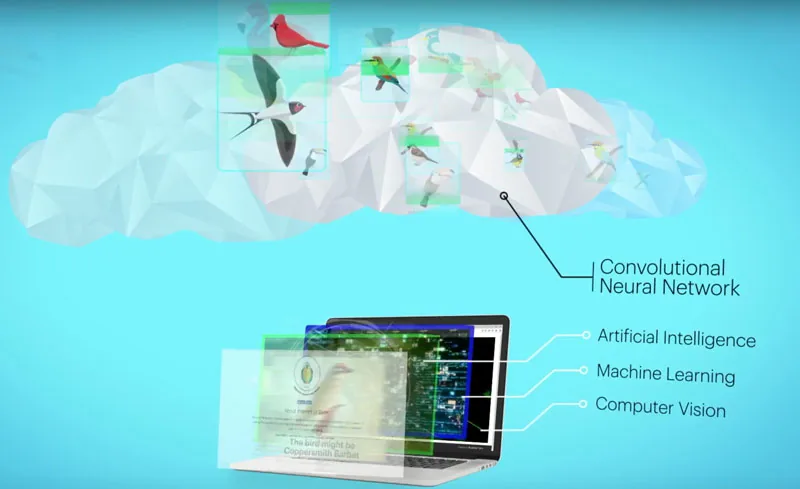
IoB is a citizen science platform by Accenture Labs in collaboration with BNHS. IoB is the first platform to identify birds from the Indian subcontinent through the power of Artificial Intelligence, Deep Learning and Image Recognition. Try out IoB @ http://internetofbirds.com
Some of my previous talks, where i presented on IoB and its innovation -
1.
2.
3.
---
# The Blockchain Motivation
URL: https://navveenbalani.dev/articles/the-blockchain-motivation
Type: article | Date: 2017-11-27 | Topics: blockchain
Here is a short video on how combinatorial power of blockchain, smart contracts, and technologies like IoT & Artificial Intelligence would enable to deliver value-driven intelligent applications in future.
---
# Blockchain Summit Mumbai Conference - Consensus AI for Blockchain
URL: https://navveenbalani.dev/talks/blockchain-summit-mumbai-conference-consensus-ai-for-blockchain
Type: talk | Date: 2017-11-25
At the blockchain summit, I talked about building real-world blockchain applications and use of Consensus based Artificial Intelligence to deliver trust, transparency and efficiency. For more details, refer to my book - "[Enterprise Blockchain](/books/enterprise-blockchain-book)"
Here is the video snippet of the presentation -
---
# Looking forward to speak on building enterprise blockchain…
URL: https://navveenbalani.dev/posts/2017-11-23-looking-forward-to-speak-on-building-enterprise-bl
Type: post | Date: 2017-11-23 | Topics: blockchain
Looking forward to speak on building enterprise blockchain applications at the #Blockchain Summit Mumbai conference. #Ethererum #Hyperledger #ConsensusAI
---
# Image, Computation Creativity and Edge computing - Aegis showcase
URL: https://navveenbalani.dev/talks/image-computation-creativity-and-edge-computing-aegis-showcase
Type: talk | Date: 2017-11-18
Presented our innovation - "InternetOfBirds.com" , Offline-AI application which recognizes images/birds without internet connectivity and use of Generative adversarial network for generating test/train data.
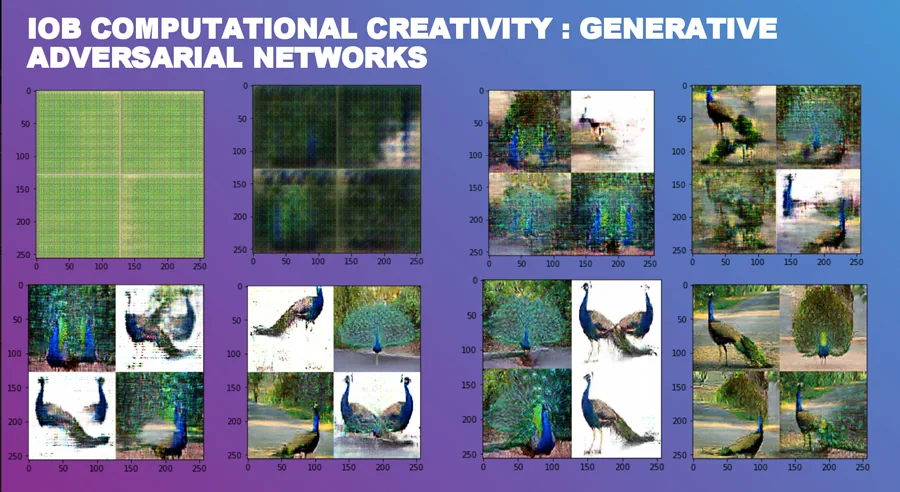
---
# Showcasing our Deep Learning Platform "InternetofBirds.com"…
URL: https://navveenbalani.dev/posts/2017-11-17-showcasing-our-deep-learning-platform-internetofbi
Type: post | Date: 2017-11-17 | Topics: trends
Showcasing our Deep Learning Platform "InternetofBirds.com", Offline-AI application and Generative Adversarial Network innovation
at 8th Annual Aegis Graham Bell Awards 2017 #innovation #AGBA #AGBA2017 #DataScience #Anlaytics #Accenture
---
# Enterprise Blockchain Book
URL: https://navveenbalani.dev/technology-bytes/enterprise-blockchain-book
Type: newsletter | Date: 2017-11-01
I am happy to share my new book on Enterprise Blockchain is now available worldwide. You can order it from [amazon](http://amzn.to/2xMLOQv). Over to the introduction of the book –
---------------------------------------------------------------------------------------------------Before we start with a formal introduction to blockchain, let us take you for a moment to a possible future that should realize sooner than we expect.

You are on a vacation outside your home country, at a shopping mall and receive a notification saying there is a sale on luxurious watches. You haven’t been to this store before. You pick up a watch and you wonder if the watch is genuine and worth the price. You start a mobile application and place it on the watch. The application recognizes the watch and displays the complete lifecycle of the watch, like where it was manufactured and the GPS coordinates, what parts make up the watch, where it was designed, when it left the manufacturing unit, who was the dealer, custom clearance certificate, what is the warranty period, how much custom duty you need to pay (if any) if you bring this watch back to your home country and even showing and comparing similar watches. You purchase the watch based on these details and now feel even more connected to the watch brand and establish a trust with the shopping store for selling genuine products.
Take another example; you need to transfer money overseas, you open a mobile application, provide the beneficiary mobile number and money is transferred instantly. You can even select from the multiple transfer rates from multiple providers, view their ratings and choose one of them. You now have full control on how you can move your money across the globe without any central authority.
You are heading back to the airport and receive a message on your instant messenger; the message gets blocked instantly, the messenger classifies this as fake news. You are saved from distraction and later check why the message was blocked.
So far, we talked about consumer applications; let’s take an example of a complex B2B process like an international trade finance which currently takes days to complete the trade process. If the entire workflow is automated, self-regulated and equipped with enough consensus between various parties carrying out the trade, it can provide a window of opportunity for new buyers and sellers to handshake, implement and execute trade seamlessly with lot of trust and confidence.
In all the scenarios that we described earlier and possibly in all our future applications, data would be a central point for businesses, consumers, and even system interaction. For businesses, data and its state would be used to establish trust and compliance between parties and for optimizing the businesses. For consumers, it would be about providing a better experience, personalized engagements and even authenticity of data, be it for news, price or an event. For systems, data would be crucial to establish the trust and compliance for autonomous functionality between devices in a connected world.
Now in a data-driven world, you need to establish trust and compliance between parties, you need governance, regulation and accountability through automated workflow and digital contracts rather than central authority and finally a piece of technology that can enable to realize this goal. Once these basic parameters are enabled, it opens endless opportunities to move any value (from services to digital assets) across the network in a secure and transparent way. The technology enabler that can aid in realizing this opportunity is blockchain.
We view blockchain as an enabler to provide consensus of data. The consensus can be between business-to-business, business-to-consumer or consumer-to-consumer. We call blockchain an enabler, as blockchain alone will not lead to realizing the opportunities we talked about earlier. The combinatorial power of blockchain, smart contracts, and technologies like IoT & Artificial Intelligence would enable to deliver value-driven intelligent applications.
While we described our vision, we are probably at the first generation of blockchain implementation where technologies are still evolving, and use cases are being realized.
Through this book, we aim to provide a reference for building any blockchain application. The book comprises of 3 Chapters. In Chapter 1, we start with providing a neutral vision and architecture for blockchain, without getting into vendor implementations. In chapter 2 and 3, we will demonstrate the working of two widely used blockchain implementations – Ethereum and IBM Hyperledger Fabric respectively and build an end-to-end demo using a hands-on approach. The source code for the book is available on GitHub, and all demos can be carried out in a local environment.
To summarize, as part of the book, we would cover the following –
* A vendor-neutral architecture for building blockchain applications.
* A detailed introduction to Ethereum and its core components. We would set up a local instance of Ethereum and build end-to-end applications on Ethereum blockchain using a hands-on approach. At the end, we would cover topics around extension to Ethereum blockchain, integration with the external world and the future of smart contracts.
* A detailed introduction to IBM Hyperledger and its core components. We would cover the enterprise capabilities provided by IBM Hyperledger 1.0. At the end, we would set up a local instance of Hyperledger 1.0 and build end-to-end applications on Hyperledger blockchain using a hands-on approach.
Our goal in this book is to provide a simplistic view of blockchain technology. The concepts and references laid down in the book will help you to build any real-world blockchain application. Our aim is to keep the book short, relevant, provide practical guidance and enough information to our readers to be productive.
The blockchain book is part of our “The Definitive handbook” series. Our vision in the – “The Definitive handbook” series is to enable our readers to understand the technology in simple terms and provide a go-to reference and a recipe for building any real-world application using the latest technology.
This is our second – “Definitive handbook” series work, the first being – “Enterprise IoT” which got acknowledged as one of the Top Computing book for 2016 by computingreview.com ().
We hope the information provided in the book would be a valuable resource in your blockchain journey.
Originally published at -
----------------------------------------------------------------------------------------------------------
---
# Enterprise IoT book acknowledged as one of the Top computing books…
URL: https://navveenbalani.dev/posts/2017-10-24-enterprise-iot-book-acknowledged-as-one-of-the-top
Type: post | Date: 2017-10-24
Enterprise IoT book acknowledged as one of the Top computing books. Thanks to all the readers and reviewers.
@ https://goo.gl/zgNWBC
---
# Enterprise Blockchain Book
URL: https://navveenbalani.dev/books/enterprise-blockchain-book
Type: book | Date: 2017-10-17 | Topics: blockchain
I am happy to share my new book on Enterprise Blockchain is now available worldwide. You can order it from [amazon](http://amzn.to/2iX3Zxw). Over to the introduction of the book -
---
Before we start with a formal introduction to blockchain, let us take you for a moment to a possible future that should realize sooner than we expect.
You are on a vacation outside your home country, at a shopping mall and receive a notification saying there is a sale on luxurious watches. You haven’t been to this store before. You pick up a watch and you wonder if the watch is genuine and worth the price. You start a mobile application and place it on the watch. The application recognizes the watch and displays the complete lifecycle of the watch, like where it was manufactured and the GPS coordinates, what parts make up the watch, where it was designed, when it left the manufacturing unit, who was the dealer, custom clearance certificate, what is the warranty period, how much custom duty you need to pay (if any) if you bring this watch back to your home country and even showing and comparing similar watches. You purchase the watch based on these details and now feel even more connected to the watch brand and establish a trust with the shopping store for selling genuine products.
Take another example; you need to transfer money overseas, you open a mobile application, provide the beneficiary mobile number and money is transferred instantly. You can even select from the multiple transfer rates from multiple providers, view their ratings and choose one of them. You now have full control on how you can move your money across the globe without any central authority.
You are heading back to the airport and receive a message on your instant messenger; the message gets blocked instantly, the messenger classifies this as fake news. You are saved from distraction and later check why the message was blocked.
So far, we talked about consumer applications; let’s take an example of a complex B2B process like an international trade finance which currently takes days to complete the trade process. If the entire workflow is automated, self-regulated and equipped with enough consensus between various parties carrying out the trade, it can provide a window of opportunity for new buyers and sellers to handshake, implement and execute trade seamlessly with lot of trust and confidence.
In all the scenarios that we described earlier and possibly in all our future applications, data would be a central point for businesses, consumers, and even system interaction. For businesses, data and its state would be used to establish trust and compliance between parties and for optimizing the businesses. For consumers, it would be providing a better experience, personalized engagements and even authenticity of data, be it for news, price or an event. For systems, data would be crucial to establish the trust and compliance for autonomous functionality between devices in a connected world.
Now in a data-driven world, you need to establish trust and compliance between parties, you need governance, regulation and accountability through automated workflow and digital contracts rather than central authority and finally a piece of technology that can enable to realize this goal. Once these basic parameters are enabled, it opens endless opportunities to move any value (from services to digital assets) across the network in a secure and transparent way. The technology enabler that can aid in realizing this opportunity is blockchain.
We view blockchain as an enabler to provide consensus of data. The consensus can be between business-to-business, business-to-consumer or consumer-to-consumer. We call blockchain an enabler, as blockchain alone will not lead to realizing the opportunities we talked about earlier. The combinatorial power of blockchain, smart contracts, and technologies like IoT & Artificial Intelligence would enable to deliver value-driven intelligent applications.
While we described our vision, we are probably at the first generation of blockchain implementation where technologies are still evolving, and use cases are being realized.
Through this book, we aim to provide a reference for building any blockchain application. The book comprises of 3 Chapters. In Chapter 1, we start with providing a neutral vision and architecture for blockchain, without getting into vendor implementations. In chapter 2 and 3, we will demonstrate the working of two widely used blockchain implementations – Ethereum and IBM Hyperledger Fabric respectively and build an end-to-end demo using a hands-on approach. The source code for the book is available on GitHub, and all demos can be carried out in a local environment.
To summarize, as part of the book, we would cover the following -
- A vendor-neutral architecture for building blockchain applications.
- A detailed introduction to Ethereum and its core components. We would set up a local instance of Ethereum and build end-to-end applications on Ethereum blockchain using a hands-on approach. At the end, we would cover topics around extension to Ethereum blockchain, integration with the external world and the future of smart contracts.
- A detailed introduction to IBM Hyperledger and its core components. We would cover the enterprise capabilities provided by IBM Hyperledger 1.0. At the end, we would set up a local instance of Hyperledger 1.0 and build end-to-end applications on Hyperledger blockchain using a hands-on approach.
Our goal in this book is to provide a simplistic view of blockchain technology. The concepts and references laid down in the book will help you to build any real-world blockchain application. Our aim is to keep the book short, relevant, provide practical guidance and enough information to our readers to be productive.
The blockchain book is part of our “The Definitive handbook” series. Our vision in the – “The Definitive handbook” series is to enable our readers to understand the technology in simple terms and provide a go-to reference and a recipe for building any real-world application using the latest technology.
This is our second – “Definitive handbook” series work, the first being – “Enterprise IoT” which got acknowledged as one of the Top Computing book for 2016 by computingreview.com ().
Stay tuned for the third series in the book, which is about “Real Artificial Intelligence”, planned to be released next year. For details, kindly visit this link -
For any comments, suggestions or queries, please reach us at [enterpriseblockchainbook@gmail.com](mailto:enterpriseblockchainbook@gmail.com)
---
---
# Top IoT Computing Book
URL: https://navveenbalani.dev/articles/top-iot-computing-book
Type: article | Date: 2017-10-10 | Topics: iot, opinion
I am happy to share my book on -"Enterprise IoT - A Definitive handbook" has been acknowledged as one of the Top computing book for 2016 by computingreviews.com (by ACM).
Here is the link for more details -
[](https://www.amazon.com/Enterprise-IoT-Definitive-Naveen-Balani-ebook/dp/B01724HIOC/ref=as_li_ss_il?ie=UTF8&qid=1508853069&sr=8-2&keywords=enterprise+iot&linkCode=li2&tag=enterpriseiot-20&linkId=9d2561969fe6d781bffa520bda5f8acb)I would also like to thank all the readers for their appreciations, reviews and inputs and for making it a best seller.
Stay tuned for the next enterprise series book, launching soon !!
---
# REAL AI Book
URL: https://navveenbalani.dev/books/real-ai-book
Type: book | Date: 2017-10-01 | Topics: ai
“*While AI means artificial intelligence, we need real implementation rather than marketing intelligence*”.
*Every one is talking about AI, implementing AI, but where are the tangible results? Barring few players, rest every other news is marketing and the real value of AI is yet to be delivered. There is a clear mismatch between what we can achieve today and what lays ahead in future.*
*Our aim in this book is to provide a real view of AI, where it exists today and what we can achieve in future. Through this book, we plan to answer these following questions in a vendor neutral way -*
- *If we have all the data, can AI help to build any possible solution?*
- *Can AI platform developed for solving quiz, solve cancer problems?*
- *Does an AI platform learn on its own?*
- *Can we build Enterprise AI solutions by just using AI, ML and Cognitive services from cloud vendors?*
- *Is today’s generation of chatbots a glorified version of if–then-else-entity based rules?*
- *Does a true Investment AI assistant exist today?*
- *Is general intelligence a reality or myth?*
- *Is there a recipe to build a successful AI project?*
The Real AI book is part of our “The Definitive handbook” series. Our vision in the – “The Definitive handbook” series is to enable our readers to understand the technology in simple terms and provide a go-to reference and a recipe for building any real-world application using the latest technology. The book is planned to be released early next year. If you like to provide topic and suggestions for the book, kindly write to me at me@naveenbalani.com
This is our third – “Definitive handbook” series work, the first being – “Enterprise IoT” which got acknowledged as one of the Top Computing book for 2016 by computingreview.com () and the latest being - "[Enterprise Blockchain](/books/enterprise-blockchain-book)".
---
# Using Generative Adversarial Network for Image Generation - Eclipse Conference
URL: https://navveenbalani.dev/talks/using-generative-adversarial-network-for-image-generation
Type: talk | Date: 2017-08-30 | Topics: ai
Generative Adversarial Network (GAN) is class of deep learning algorithm, comprising of 2 networks - a generator and discriminator, both competing against each other to solve a goal. For instance, for image generation, the generator goal is to generate real like images which discriminator can't classify as a fake or unreal image. The discriminator goal is to classify real images from fake ones. Initially the generator network would start off from blank images and keep on generating better images after each iteration, up to a point it start generating real like images. The discriminator network would take an input of real images and the images provided by the generator network and classifies the image as real or fake, up to a point where generator start generating real like images which is hard for the discriminator to discriminate. The same algorithm is being applied in other domains also. However, based on my experiments, lot of optimization need to happen for large image sizes. I had to create a custom generator/discriminator network to work against input size of 128\*128 and 256\*256 image pixels and lot of iterations to generate real-like images. The training data used was of Indian Bird.
Here is a snippet of my talk on GAN at the Eclipse Summit Conference, which demonstrates the experiment.
---
# Building solutions using AI , Blockchain and IoT
URL: https://navveenbalani.dev/talks/building-solutions-using-ai-blockchain-and-iot
Type: talk | Date: 2017-07-09
As part of IoT Slam 2017 conference, I presented on using the combinatorial power of artificial intelligence, blockchain and Internet of Things to build intelligent connected products . For details on the talk, kindly visit http://iotslam.com/speaker/naveen-balani/
The presentation is also available on youtube - https://www.youtube.com/watch?v=P9BGNQzQIR4
---
# I will be talking about the combinatorial power of AI, Cognitive &…
URL: https://navveenbalani.dev/posts/2017-06-21-i-will-be-talking-about-the-combinatorial-power-of
Type: post | Date: 2017-06-21 | Topics: ai, blockchain
I will be talking about the combinatorial power of #AI, #Cognitive & #Blockchain @ IoTSlam - https://goo.gl/R4VNTn
---
# Modern Data Warehouse
URL: https://navveenbalani.dev/talks/modern-data-warehouse
Type: talk | Date: 2017-05-16 | Topics: architecture
The new age modern data warehouse is about providing single integrated view across various kinds of data sources (structured, un-structured, streams, cognitive, iot), real-time analytics and use of techniques like AI/ML for learning from data and providing contextual, predictive and prescriptive analytics.
Following is the architecture view of a modern data warehouse.
At the ICT4D conference, I was part of the panelist for the Topic - "Big Data. Big Problems. Big Solutions ", where I talked about the evolution and need for a modern data warehouse architecture, challenges in adopting data warehousing for Non Profits and the work we are doing with NGO and Non-profits for social and economical impact.
More about the conference @ https://2017ict4dconference.sched.com/event/AIQv/big-data-big-problems-big-solutions. You can find the snippet of the presentation @
---
# Data in a IoT Context
URL: https://navveenbalani.dev/talks/data-in-a-iot-context
Type: talk | Date: 2017-04-09 | Topics: iot
The real value of Internet of Things is about deriving insights from data. IoT is not just about connectivity, but how to use the connected data in context of your application or for that matter other connected solutions to derive insights which can’t be uncovered before.
In order to derive actionable insights, you need to analyze the data (from sensors and multiple other sources). Data in IoT context can be broadly classified into 4 types – structured data (a sequence of data or time series information from sensors), unstructured data like images from cameras or drones, a combination of structured and unstructured data, like in case of augmented reality where you superimpose images and text to derive an outcome and fourth being behavioural data where devices learn from interactions, the cognitive aspects of the devices. Each of these use cases requires separate architecture and algorithms and based on the use cases, the computation need to happen on the Edge, cloud or an hybrid approach. For instance, if your use case is around security and surveillance, you would employ computer vision technologies at the edge for processing and analyzing the images locally as it doesn't make sense to stream the data over the cloud (in such cases, around 99% of the data would not be required). For employing computer vision technologies at the Edge, you can use technologies like [deep learning at the edge](/articles/applying-deep-learning-and-computer-vision-on-the-edge-gateway).
As part of the IoTShow (iotshow.in) event, I delivered a technical talk, where I used various use cases on how to infuse intelligence while creating connected products using technologies like deep learning, machine learning, natural language processing and cognitive iot.
Here is a snippet of the presentation that I gave at IoTShow conference. I will post the entire video once available.
---
# BigData and IoT
URL: https://navveenbalani.dev/articles/bigdata-and-iot
Type: article | Date: 2017-03-13 | Topics: iot, opinion
***"IoT is the senses,data is the fuel, and artificial Intelligence is the brain to realize the future of a smart connected world."***
Here is a short view on "BigData and IoT"
IoT is about devices, data and connectivity. The real value of Internet of Things is about creating smarter products, delivering intelligent insights and providing new business outcomes. As millions of devices get connected, internet of things will trigger a massive inflow of big data. The key challenge is visualising and uncovering insights from various types of data (structured, unstructured, images, contextual, dark data, real-time) and in context of your applications. I believe deriving intelligence from big data using artificial Intelligence technologies is the key enabler for smarter devices and a connected world.
The end goal is to harness the data coming from sensors and other contextual information to discover patterns and correlations in real-time to positively impact businesses. Existing big data technologies need to be augmented to effectively store, manage and extract value from continuous streams of sensor data. For instance, it is estimated that connected cars will send 25 gigabytes of data to the cloud every hour. The biggest challenge will be to make sense of this data, identifying data that can be consumed and quickly acted upon to derive actionable events.
The use of Artificial intelligence technologies like deep learning will be a key differentiator to derive insights rapidly from massive streams of data. With IoT, big data analytics would also move at the edge for real-time decision making, for instance detecting crop patterns in agriculture plants using drones at remote places, detecting suspicious activities at ATMs or predicting driver behavior for a connected car.
To sum it up, IoT is the senses, data is the fuel, and artificial Intelligence is the brain to realize the future of a smart connected world.
---
# No IoT without Artificial Intelligence
URL: https://navveenbalani.dev/talks/no-iot-without-artificial-intelligence
Type: talk | Date: 2017-03-04
"***No IoT without Artificial Intelligence" -** The real value of IoT is about delivering insights and providing new business outcomes.*
In order to derive actionable insights, you need to analyze the data (from sensors and multiple other sources). Data in IoT context can be broadly classified into 4 types – structured data (a sequence of data or time series information from sensors), unstructured data like images from cameras or drones, a combination of structured and unstructured data, like in case of augmented reality where you superimpose images and text to derive an outcome and fourth being behavioural data where devices learn from interactions, the cognitive aspects of the devices. Each of these use cases requires separate architecture and algorithms and based on the use cases, the computation need to happen on the Edge, cloud or an hybrid approach. For instance, if your use case is around security and surveillance, you would employ computer vision technologies at the edge for processing and analyzing the images locally as it doesn't make sense to stream the data over the cloud (in such cases, around 99% of the data would not be required). For employing computer vision technologies at the Edge, you can use technologies like [deep learning at the edge](/articles/applying-deep-learning-and-computer-vision-on-the-edge-gateway).
As part of the IoTShow (iotshow.in) event, I delivered a technical talk, where I used various use cases on how to infuse intelligence while creating connected products using technologies like deep learning, machine learning, natural language processing and cognitive iot. I will post the video once available. Thanks to [EFY](https://conferences.electronicsforu.com/) for inviting me to present the technical talk.
---
# Blockchain for Enterprise IoT
URL: https://navveenbalani.dev/technology-bytes/blockchain-for-enterprise-iot
Type: newsletter | Date: 2017-02-14
Blockchain can be viewed as a distributed decentralised database that holds transaction of every entity that is transacted through the network. Blockchain technology manifested from Bitcoin, a type of digital currency, created and held globally without any central authority or middleman. Bitcoin uses cryptography to control its creation and transactions, and a public ledger called the "blockchain" that I described earlier. The blockchain technology is now being adopted in non-financial industries like Supply chain, IoT, Digital Identity and many more.
Applying Blockchain technology to IoT can lead to many innovations and solve the problem around trust and compliance in a connected world. In a connected world, you would see a wide variety of devices that needs to be connected to get some work done. Many of these can be first time interactions, for instance, a home automation device like a security alarm, would need to integrate with various devices from different manufacturers which need to send the right context to raise an alarm to a security device. The fundamental question arises should the devices be allowed to connect and communicate with each other?
There are lots of challenges around authenticity in this simple use case, and everything, in the end, boils down to trust between the devices and who maintains the trust. For instance - can other devices be allowed to connect to my security device, what kind of operations can be performed on the security device, is this an authentic device being connected to my home system, is there a way to get the lifecycle and complete journey of the device from manufacturing plants to my home? These are some valid questions, which arise when you have a myriad of devices that needs to connect and communicate in an autonomous way.
I talked about consumer use cases, but the same question arises in virtually every industry, where assets/devices (across the globe) needs to be tracked, audited, be compliant or ensure they get replaced by genuine parts.
And to solve a part of this problem around trust and authenticity, you need an entity (basically set of entities), which can track the entire lifecycle of the devices and probably a set of smart contracts, which can help devices to connect to each other in a secured way, and carry out authentic operations. That’s where Blockchain technology comes into play, to solve the most critical puzzle in a connected world. I view Blockchain as an enabler along with various technologies that can solve the problem around trust, security, connectivity and operability contracts.
IoT is a huge ecosystem play, and we would have thousands of manufacturers that would manufacture billions and trillions of connected devices, multiple platforms, multiple connectivity options and definitely many Blockchain registries spanning across geographies to track the complete lifecycle of the device. The real challenge is not around the technology, but a mutual acceptance from the entire IoT ecosystem, its usage and government initiatives on setting up regional Blockchain registry. Once employed, it can also aid in other use cases like security and compliance, for instance ensuring devices that are not allowed to cross geographical boundaries.
To get started, you can use blockchain as a service from various cloud providers or experiment with open source blockchain platforms like Ethereum and setup your own contracts for your use cases. I will post a followup article on how to use Ethereum in my next article.
*The above extract is part of my book - Enterprise IoT. For more details, kindly refer to my book – “*[*Enterprise IoT*](http://amzn.to/2fHYfni)*”.*
---
# IoT at the Edge : Panel Discussion
URL: https://navveenbalani.dev/talks/iot-at-the-edge-panel-discussion
Type: talk | Date: 2017-02-11 | Topics: opinion
I was one of the panelist for the Topic - IoT at the Edge - Sensor and technologies at IoT Expo Conference (http://www.iotindiaexpo.com/)
I talked about how to apply artificial intelligence technologies like machine learning and deep learning on the edge, cloud and hybrid approach.I provided various use cases on how intelligence can be applied at each layer. Running these libraries required hardware optimization on the edge and in future, I see standardizations of runtime and library to run these libraries optimally. In the current scenario, bulk of the training still happens in the cloud and learning models are ported over to the Edge gateway for classification. I see lot of innovations happening in Edge gateway where we move from rules/analytics approach to a solution/domain intelligence gateway. I will post the video link once available.
---
# Applying Deep Learning and Computer Vision On the Edge Gateway
URL: https://navveenbalani.dev/technology-bytes/applying-deep-learning-and-computer-vision-on-the-edge-gateway
Type: newsletter | Date: 2017-02-03
Edge gateway is about providing real-time decision making at the edge. In this article, I will talk about how to apply computer vision at the edge for various security and surveillance activities. For instance, you would like to detect suspicious activities at the ATM, simple cases like people wearing helmets and entering the ATM to unusual movements or would like to capture and identify objects in remote areas using Drones like crops length to mining activities. In such scenario, you would need real-time decision making at the edge as it might not make sense to transfer the data over the cloud for processing, be it for latency issues, bandwidth, cost issues or there might be none or very limited connectivity. In this case you employ intelligence at the edge of the devices.

In order to build out the solution, you need to employ computer vision algorithms on the edge. You can build this using commercial available API’s or using various open source deep learning framework like Theano, TensorFlow, Cafe etc. Deep learning is a branch of machine learning for learning multiple levels of representation through neural networks. Neural network in image processing, automatically infer rules for recognizing images instead of you extracting thousands of features to detect images.
Various deep learning architectures are available like convolutional neural network (CNN), recurring neural network to solve specific problems like computer vision, natural language processing, speech recognition and achieves state of the art results.
For Computer Vision, we specially use a CNN network to identify images or use of the pre-trained instance (like Inception-v3 model released by Google is a 48 layer deep network which achieves start of the art results for classification and detection for images). For a computer, images are nothing but a vector or set of numbers/pixels. Convolutional Neural Networks learns features automatically using small frames of equal size images and each network gets the same input and interesting pieces are extracted. The extract of interesting pieces (which are again vector of numbers) is the heart of how CNN works. For instance, in case of a helmet image, some network would learn a round edge, some may learn a glass pane in the front and so on. The idea is irrespective of where the object is in the frame, you should be able to identify to image.
Prior to CNN for image detection, you would need to crop the images and provide area of interest. For instance, if you are detecting various categories of birds, you would usually crop the bird image and remove any surrounding context, like trees, bushes, sea, sky etc. and provide the bird image only. With CNN, the idea is to train with those images and let network figure this out (though cropping may help in some cases for increasing accuracy). Based on my experiments, the CNN is able to predict object most of the times which have surrounding context, with lower accuracy. With right amount of training and network optimization, accuracy can be increased significantly. You need to experiment and tune the network. As mentioned, the idea is to identify objects irrespective of where they are found in the image and I am sure lot of research is going on to improve the CNN networks. Having the right training data (images and label) is a must for training networks with such variations ( see on how I applied Image Recognition for recognizing birds in Indian subcontinent)

The image on the left, provides the stack view of employing deep learning API on the edge gateway. It consists of API, the learning model and the classification service which is used for classification of objects. There are lot of innovations happening to optimize the use of deep learning libraries on the edge. For instance, Qualcomm Technologies is introducing even more support for [TensorFlow](http://www.tensorflow.org/) — it’s now optimized for the Hexagon 682 DSP, which is integrated into the [Qualcomm Snapdragon 835 processor](http://www.qualcomm.com/products/snapdragon/processors/835).
So how do you go about implementing computer vision on the edge gateway. I will talk about one approach of building this out –
· Build your own CNN or Start with a pertained CNN network (like an Inception Model)
· Get the training and test data (images and labels)
· Train or retrain (i.e. transfer learning) the network.
· Optimize with learning rates, batch size etc. for desired accuracy. Get the trained model
· Use the trained model for classification.
· Deploy TensorFlow API and trained model on the edge (you can package this in docker images)
· Use the classification code on the edge gateway to detect objects.
The above article was part of the presentation that I made at a recent IoT conference, where I talked out how to build intelligent connected products using **Artificial Intelligence, Cognitive and Blockchain. To view the youtube video, please follow the link -**
The article was first published at -
---
# Building Intelligent Connected Products using Artificial Intelligence, Cognitive and Blockchain
URL: https://navveenbalani.dev/talks/building-intelligent-connected-products-using-artificial-intelligence-cognitive-and-blockchain
Type: talk | Date: 2017-01-14 | Topics: ai, iot, opinion
**Building Intelligent Connected Products using Artificial Intelligence, Cognitive and Blockchain**
My technical talk at IoTNext, where I talked about applying intelligence at the edge gateway and cloud. Topics covered - Deep Learning, Computer Vision at the Edge Gateway for security and surveillance, Cognitive IoT - Cognitive Cricket and Connected Car and Security and Trust compliance using Blockchain as a service.
https://www.youtube.com/watch?v=YdMWkJs8avw&t=209s
---
# Convolutional Neural Network with Internet of Birds
URL: https://navveenbalani.dev/articles/convolutional-neural-network-with-internet-of-birds
Type: article | Date: 2017-01-03 | Topics: ai
I am happy to share we are live with Internet of Birds platform.
Internet of Birds (IoB) is the first citizen science platform to identify birds from the Indian subcontinent through the power of Artificial Intelligence, Deep Learning and Image Recognition. IoB is a citizen science platform by Accenture Labs in collaboration with BNHS.
Internet of Birds is trained on Indian birds using a Convolutional Neural Network. I will share my findings on building the Internet of Birds platform in a later blog, where i would describe the challenges in building up a generic Image recognition service. The same learnings can be applied to any use cases. The end solution can be accessed as a service over the cloud or at the edge network ([for more details listen to my talk on - building connected products - edge gateway and CNN](/talks/building-intelligent-connected-products-using-artificial-intelligence-cognitive-and-blockchain)) for real-time decision making using Images as one of the context parameters.
The internet of birds website can be accessed at - http://internetofbirds.com. Here is the youtube video on IoB -
https://youtu.be/vLH0pqEtzRI
More news @
---
# Internet of Birds (IoB) ( is a first of its kind citizen science…
URL: https://navveenbalani.dev/posts/2017-01-02-internet-of-birds-iob-is-a-first-of-its-kind-citiz
Type: post | Date: 2017-01-02
Internet of Birds (IoB) (http://internetofbirds.com) is a first of its kind citizen science platform that specifically identifies birds found in the Indian subcontinent through the power of Artificial Intelligence, Image Recognition and Deep Learning @ https://lnkd.in/f7YEdJv
---
# Cognitive IoT in Sports
URL: https://navveenbalani.dev/articles/cognitive-iot-in-sports
Type: article | Date: 2016-11-19 | Topics: ai, architecture, iot
Cognitive Internet of Things is about enabling current IoT technologies with human-like intelligence. The end goal is to provide expert advice based on the domains being targeted. Cognitive IoT can be applied on the edge gateway or in the cloud as part of the solution.
Let's see how we can apply Cognitive IoT technologies for Sports domain. In Sports domain, there are actually 3 primarily use case -
- Learning from an expert/coach (or visually) and improving one’s game
- Personalization - where all information is personalized to improve a player's game
- Continuous learning to keep a player improving his game based on how is he is playing from current and past records.
I will talk about an example of cricket. (I call this as connected cricket -) ).The real value that we want to derive is to enable batsman understand their game better, help them master various batting strokes like cover drive, pull shot etc., analyse their performance continuously to be an expert batsman, for instance what should I do to bat like Sachin Tendulkar.
With respect to a baller, the baller would like to understand how well he is bowling, his speed, his run-up, the way he delivers the ball, spin variations, all these insights can improve his game continuously (so there is a feedback loop) and how similar he is bowling to an expert baller, may be like Ashwin.
So let’s talk about how do you go about realizing it.
1. *Embedded device on cricket ball (without increasing form factor)*
2. *Embedded device on cricket bat, pads, gloves*
3. *A Connected Stadium.*
For an architecture stack perspective, you have the low powered embedded device installed inside the ball or embedded as part of the design and manufacturing process, its provides at least 6 Axis combo sensor for accelerometer and gyroscopes reading to identify any movement in 3d space. A Motion SDK is installed on top of the device to identify any movements in general and communicate the reading to the cloud. In cloud, we have the learning model or the training data. Basically, we would ask an expert batsman to bat and play various expert strokes like cover drive etc. and record their movements from sensors (bats/pads etc) as well as visuals (postures etc), this would be used as the training / test data and comparison would be made against it. As we are comparing 3D models, machine learning approaches like dimension reduction can be employed ( and many new innovation approaches) to compare two motion and predict the similarity. Similar training data is captured from an expert baller, along with other conceptual information like hand movements, pitch angles etc.
The feedback is continuously captured and the system provides guidance for improving a player’s game. The player tracks all this information on his mobile and can now look at these insights and suggestions on how he can be an expert in his game. For instance, a player can ask a system “what is takes to master a cover drive like Sachin” and the system analyses the motion information from batting strokes (sensors on bats, pads etc.), visual information (postures etc.), compares it with an expert model and provide an accuracy score and suggestions to improve a players’ game. The key here is that the cognitive system understands the domain and its trained on the domain to provide an expert advice or suggestion.
The same technique and concept can be applied in any game to get cognitive insights. In future, technology would be a key enabler in Sports.
*The following is part of my presentation that I delivered at IoTNext. I will update the article with the youtube video once available.*
---
# Enterprise Internet of Things Stack and Architecture
URL: https://navveenbalani.dev/articles/enterprise-internet-of-things-stack-and-architecture
Type: article | Date: 2016-11-16 | Topics: architecture, iot
Here is an end to end view of how to build connected products using an Enterprise IoT stack. The Enterprise IoT stack provides core set of capabilities, platform, services and architecture patterns to build end to end connected products.
The following table summarizes the offerings from commercial players and open source alternatives.
### Comparison of IoT Platform Stack
The reference is part of my book - Enterprise IoT.
| | | | | | |
| --- | --- | --- | --- | --- | --- |
| Platforms -> | Microsoft | IBM | Amazon | Open Source | Predix |
| | | | | | |
| Device SDK | Azure IoT Device SDK ConnectTheDots.io | IBM Watson IoT Platform Client Library Watson IoT Platform Device recipes Paho Library | Device SDK for AWS IoT | Paho Library, Cyclon.js, and many other options | Predix Machine |
| Edge Gateway | Azure IoT Gateway SDK | Edge Analytics SDK | AWS Greengrass | Eclipse Kura and many other options | Predix Machine |
| Protocol Supported | HTTP AMQP MQTT | MQTT | MQTT HTTP | MQTT, AMQP, HTTP etc. | MQTT, Web Socket, HTTPs |
| Core platform – IoT Messaging platform | IoT Hub, Event Hubs | IBM Watson IoT Platform | AWS IoT | Protocol Bridge, Apache Kafka | RabbitMQ |
| Core platform – Database option | DocumentDB, Storage (high-performance tables, blobs), Microsoft SQL | MongoDB, Cloudant NoSQL, ObjectStorage, Informix Time Series data, etc. | Amazon DynamoDB, Amazon Redshift | Cassandra (or alternatives like MongoDB) | Asset Data, Time Series, Redis, Postgre SQL, Blobstore |
| Analytics platform – Real-time Streaming | Microsoft Stream Analytics | IoT Real-Time Insights, IBM Streaming Analytics | Amazon Kinesis | Apache Spark Streaming | Analytics Runtime |
| Analytics platform – Machine Learning | Azure ML | Predictive Analytics service (on Bluemix) + SPP Modeler (offline) | Amazon Machine Learning | Apache Spark MLlib | Custom Analytics Support (Python, Java, MATLAB) |
| Alerts and Event handling | Notification Hubs, Power BI | Embeddable Reporting, IBM Push Notifications | AWS Lambda, Amazon Quick Sight, Amazon Simple Notification Service | Custom, Zeppelin (Dashboards), etc. | Mobile SDK, Dashboard Seed |
For more details on the how to realize the architecture with various use cases, kindly refer to my book - “[Enterprise IoT](http://amzn.to/2fHYfni)”.
---
# Applying deep learning and computer vision on the Edge Gateway
URL: https://navveenbalani.dev/articles/applying-deep-learning-and-computer-vision-on-the-edge-gateway
Type: article | Date: 2016-11-11 | Topics: ai, architecture, iot
Edge gateway is about providing real-time decision making at the edge. In this article, I will talk about how to apply computer vision at the edge for various security and surveillance activities. For instance, you would like to detect suspicious activities at the ATM, simple cases like people wearing helmets and entering the ATM to unusual movements or would like to capture and identify objects in remote areas using Drones like crops length to mining activities. In such scenario, you would need real-time decision making at the edge as it might not make sense to transfer the data over the cloud for processing, be it for latency issues, bandwidth, cost issues or there might be none or very limited connectivity. In this case you employ intelligence at the edge of the devices.
In order to build out the solution, you need to employ computer vision algorithms on the edge. You can build this using commercial available API’s or using various open source deep learning framework like Theano, TensorFlow, Café etc. Deep learning is a branch of machine learning for learning multiple levels of representation through neural networks. Neural network in image processing, automatically infer rules for recognizing images instead of you extracting thousands of features to detect images.
Various deep learning architectures are available like convolutional neural network, recurring neural network to solve specific problems like computer vision, natural language processing, speech recognition and achieves state of the art results.
For Computer Vision, we specially use a CNN network to identify images or use of the pre-trained instance (like Inception model released by Google which is a 22 layers’ deep network which achieves start of the art results for classification and detection for images). For a computer, images are nothing but a vector or set of numbers/pixels. Convolutional Neural Networks learns features automatically using small frames of equal size images and each network gets the same input and interesting pieces are extracted (for more details, please refer to how CNN works). The extract of interesting pieces (which are again vector of numbers) is the heart of how CNN works. For instance, in case of helmet, some network would learn a round edge, some may learn a glass pane in the front and so on. The idea is irrespective of where the object is in the frame, you should be able to identify to image.
Prior to CNN for image detection, you would need to crop the images and provide area of interest. For instance, if you are detecting various categories of birds, you would usually crop the bird image and remove any surrounding context, like trees, bushes, sea, sky etc and provide the bird image only. With CNN, the idea is to train with those images and let network figure this out (though cropping may help in some cases for increasing accuracy). Based on my experiments, the CNN is able to predict object most of the times which have surrounding context, but with lower accuracy. As mentioned, the idea is to identify objects irrespective of where they are found in the image and I am sure lot of research is going on to improve the CNN networks. Having the right training data (images and label) is a must for training networks with such variations.
On the left hand side, is the stack view of employing deep learning API on the edge gateway. It consists of API, the learning model and the classification service which is used for classification of objects. There are lot of innovations happening to optimize the use of deep learning libraries on the edge.
So how do you go about implementing this. I will talk about one approach of building this out -
1. Build your own CNN or Start with a pertained CNN network (like an Inception Model)
2. Get the training and test data (images and labels)
3. Train or retrain (i.e transfer learning) the network.
4. Optimize with learning rates, batch size etc. for desired accuracy. Get the trained model
5. Use the trained model for classification.
6. Deploy TensorFlow API and trained model on the edge (you can package this in docker)
7. Use the classification code on the edge gateway to detect objects.
*The following is part of my presentation that I delivered at IoTNext. I will update the article with the youtube video once available.*
---
# Building Cognitive Solutions - A Definitive Handbook
URL: https://navveenbalani.dev/books/building-cognitive-solutions-a-definitive-handbook
Type: book | Date: 2016-08-27 | Topics: ai
Let me first start with an introduction on "Cognitive Computing". Cognitive computing are systems that are designed to make computer’s think and learn like human brain.Similar to an evolution of a human mind from new born to child to an adult, where new information is learned and existing information is augmented, cognitive system’s learn through the vast amount of information fed to it and training on a set of information,so it can understand the context and help in making informed decisions.
For example, if you look at any learning methodology, a human mind learns and understand the context, but its equipped to answer questions in an examination/interview which it might not have seen before, but using the experiences and past learning,a informed judgement can be made. Similarly cognitive systems are modelled to learn from past set of reference data set (or learning) to help users make informed decisions. Cognitive systems can be thought of as a non programming system which learns through the set of information, training, interactions and a reference data set.
From a technology perspective, at a very high level, building a cognitive systems requires technologies that can understand the language,context, entities and relationship (NLP), learn through a set of supervised or unsupervised learning (Machine learning methodology), domain adoption through various techniques, technologies to help source, curate and manage content, runtimes to build out the components together in a loosely coupled manner and wide variety of tooling’s and methodology to enable making cognitive applications. I envision most of the cognitive capabilities offered as service over a cloud (a marketplace for cognitive and smart apps) which can be used individually or as a composite to create applications. The key here is domain adaptability, else we are looking at a general purpose AI system, which in my view would not provide precise and accurate suggestions or predictions. Most of the first generation cognitive services are focused on providing API without any provision to train or adapt to use cases. Even if they provide a provision for training and recognizing new terms etc, based on my experiences it doesn't work out well. For instance, take the example of Google NLP, Watson NLP APIs or any open source NLP framework like standford or Apache NLP, which provides general NLP parsing (based on wikipedia it can recognize common terms etc..), but fails to solve any real use case on its own. The point is you can't just rely on the bare APIs, you need to build upon it to solve for any real use case. When it comes to solving enterprise solutions,you are looking at precise suggestions at the top and most of AI engines in the market are actually general purpose AI , which fails to get the level of accuracy required from an AI system. Even if you train a general purpose AI, there are "n" number of factors to get the required level of accuracy. I haven't seen a AI system or design, which is build from the ground up to make it easy for end consumers, enterprises or users to adapt to required use cases.
Through my upcoming book - "Building Cognitive Solutions - A Definitive Handbook", I would share my experiences on building a cognitive solution, the right way. There are lot of misconceptions on how to build cognitive applications and this would be the first practical guide on building cognitive solutions.
I plan to show a general methodology to build cognitive applications and the recipe to build and end to end cognitive solution. The book would also cover "deep learning" and new approaches to build cognitive solutions. This would follow the same style as my earlier handbook -" [Enterprise IoT - A Definitive handbook](http://amzn.to/2brLQ4B)"
I am looking out for contributors/co-author for my book, who are experts on deep learning and would like to contribute and share their knowledge with the wider audience. Kindly reach me at me@naveenbalani.com for more details.
---
# Connecting the Intel® Curie™ Compute Module to the AWS IoT Platform
URL: https://navveenbalani.dev/articles/connecting-the-intel-curie-compute-module-to-the-aws-iot-platform
Type: article | Date: 2016-08-25 | Topics: iot
The Intel® Curie™ module uses the Intel® Quark™ system on a chip, which provides a complete low-power solution for wearable devices and consumer and industrial edge products. The Intel® Curie™ module has a built-in six-axis combination sensor, Bluetooth\* low energy radio, and low power usage, making it the perfect board for building “always-on” projects like health and fitness monitors.
To start prototyping and developing apps, you can use the Arduino\* development board—also called Genuino 101\* or Arduino 101\*—which ships with the Intel® Curie™ module. To start developing, you can use the Arduino IDE and write the program (called a sketch in Arduino) that reads the values of your sensors.
The sensor data is then transmitted to the AWS IoT platform over MQTT using the supported network. The Intel® Curie™ module provides support for Bluetooth low energy, so one option is to connect the module to a smartphone over Bluetooth and use the smartphone’s cellular or Wi-Fi connectivity as a hub to connect to the Internet. The Intel® Curie™ module provides dedicated Bluetooth low energy libraries, which make it easier to communicate with other devices that support Bluetooth (for details, see the Intel® Curie® Bluetooth LE Library). The other option is to connect the Intel® Curie™ module to an Intel gateway using Bluetooth, with the Intel gateway then connecting to the AWS IoT platform. Other options are available, as well, such as using a Wi-Fi shield with an Arduino 101 board to enable the development board to connect to the Internet directly. Your choice of network strategy depends on the use case and how the final product will be used.
For complete details of my article, visit
---
# Enterprise IoT - Fourth Edition Available
URL: https://navveenbalani.dev/articles/enterprise-iot-4-edition-available
Type: article | Date: 2016-07-28
The fourth edition of my book - Enterprise IoT : A Definitive handbook is out. This is the most comprehensive book on understanding IoT and how to implement IoT applications using IoT cloud offerings from Microsoft, IBM, Amazon, GE Predix and open source software.
Thank you readers for your comments and your valuable feedback. The first edition was released in October 2015. The biggest challenge in any technology book is to keep it relevant and updated with the latest updates. I opted for self publishing this book and being a publisher for this book, I could handle the distribution to ensure timely updates are available to my readers. If have bought the digital copy (through Amazon kindle), all updates to the book is delivered free. Make sure you sync your copy of the book. Please note Amazon Kindle might not push the updates automatically based on your settings and you need to manually sync to get the latest updates.
If you are new to Internet of Things or even an expert in the field of Internet of Things, you would find the book a valuable resource on how to build Internet of Things. Over to my book -
***"Internet of Things is a vision where every object in the world has the potential to connect to the Internet and provide their data so as to derive actionable insights on its own or through other connected objects"***
The book covers the following topic -
\* A detailed overview of key components of Internet of Things and most comprehensive view of an Enterprise IoT stack.
\* How to apply IoT in context of real world applications by covering detailed use cases on manufacturing, automotive and home automation.
\* Understand the technical strategy and how to implement IoT applications using Microsoft Azure and IoT Suite, IBM Internet of Things Foundation and BlueMix, Amazon IoT and AWS services, GE Predix Industrial IoT cloud platform and various open source technologies like Apache Kakfa, Apache Spark and map it to our Enterprise IoT Stack.
\* Includes a bonus chapter on Cognitive IoT, Cognitive IoT architecture and Blockchain
[](https://www.amazon.com/Enterprise-IoT-Definitive-Naveen-Balani/dp/1518790860/ref=as_li_ss_il?ie=UTF8&*Version*=1&*entries*=0&linkCode=li2&tag=enterpriseiot-20&linkId=88dd0e7bc2b1ad49e6452293d8659da3)
The 4th edition of the book is also re-edited to take care of user's feedback. [You can buy the book from Amazon](http://amzn.to/2aiAing).
Also checkout, some of the other IoT computing books at
---
# Enterprise IoT - Fourth Edition Available
URL: https://navveenbalani.dev/technology-bytes/enterprise-iot-fourth-edition-available
Type: newsletter | Date: 2016-07-28
The fourth edition of my book – ***Enterprise IoT : A Definitive handbook*** is now available. This is the most comprehensive book on understanding Enterprise IoT and how to develop IoT applications using IoT cloud offerings from Microsoft, IBM, Amazon, GE Predix and open source software.
Thank you readers for your comments and valuable feedback for the previous editions. If you have bought the digital copy (through Amazon kindle), make sure you sync your copy of the book. All updates are available for free. Please note Amazon Kindle might not push the updates automatically based on your kindle settings and you need to manually sync to get the latest updates.
I believe the concepts and content laid down in the book would be a valuable resource to build any IoT application and be a part of your IoT journey. Over to my book –
***“Internet of Things is a vision where every object in the world has the potential to connect to the Internet and provide their data so as to derive actionable insights on its own or through other connected objects”***
The book covers the following topic –
\* A detailed overview of key components of Internet of Things and most comprehensive view of an Enterprise IoT stack.
\* How to apply IoT in context of real world applications by covering detailed use cases on manufacturing, automotive and home automation.
\* Understand the technical strategy and how to implement IoT applications using Microsoft Azure and IoT Suite, IBM Watson IoT Platform and BlueMix, Amazon IoT and AWS services, GE Predix Industrial IoT cloud platform and various open source technologies like Apache Kakfa, Apache Spark and map it to our Enterprise IoT Stack.
\* Includes bonus chapters on Cognitive IoT, Cognitive IoT architecture and Blockchain.
The 4th edition of the book is also re-edited to take care of user’s feedback. [You can buy the book from Amazon](http://amzn.to/2aiAing).
*The article is extracted from my blog - *
---
# Build IoT Applications with Azure IoT and Intel Devices and Gateway
URL: https://navveenbalani.dev/articles/build-iot-applications-with-azure-iot-and-intel-devices-and-gateway
Type: article | Date: 2016-07-25 | Topics: iot
Azure is an open, flexible, enterprise grade cloud computing platform and a growing collection of integrated services such as analytics, database, mobile, networking, storage, and web for building scalable solutions rapidly. Microsoft provides Azure IoT Suite as part of its preconfigured IoT solutions built on the Azure platform and makes it easy to connect devices securely. Azure supports a broad set of protocols, and Azure IoT Suite consists of set of IoT services (referred to as Azure IoT services) to help build IoT apps rapidly. These services enable you to collect data from devices, analyze data streams in motion, store and query large data sets, and analyze and visualize both real-time and historical data. Services include Azure IoT Hub, Azure Machine Learning, Azure Stream Analytics, Azure Notification Hubs, and Microsoft Power BI. You can combine these services with other Azure services, such as those for data and storage, to store device data in an Azure Blob or use cognitive services to build intelligent IoT apps.
Azure IoT Hub is a fully managed bidirectional device to cloud connectivity bus that provides device management, device security, identity, and MQ Telemetry Transport (MQTT) protocol support with HTTP and Advanced Message Queuing Protocol (AMQP). Azure IoT Hub provides complete device access through its device identity registry. It provides per device authentication and secure bidirectional connectivity between devices and Azure IoT Hub. Azure IoT Hub can also integrate with your custom device registry through a token service to create a devices coped token for secure communication. In addition, Azure IoT Hub provides local storage of messages and a dedicated device queue for each connected device for storing device messages that devices consume securely, eliminating the overhead of creating separate queues for sending messages back to devices.
[Click here to read the complete article](https://software.intel.com/en-us/articles/using-microsoft-azure-iot-suite-with-intel-iot-devices-and-gateways). This article of mine is exclusively available on Intel IoT developer zone.
---
# Kubernetes and Google Cloud Platform
URL: https://navveenbalani.dev/articles/kubernetics-and-google-cloud-platform
Type: article | Date: 2016-07-25 | Topics: cloud
This article assumes you are familiar with Docker, if not [click here to read this article](/articles/micro-services-with-docker-part-1-the-why "Micro Services with Docker (Part 1 – The WHY)").
Kubernetes is an open-source production grade container management system. It helps you effectively manage and scale container applications in a clustered environment.
Kubernetes is (extract from Github):
- **lean**: lightweight, simple, accessible
- **portable**: public, private, hybrid, multi cloud
- **extensible**: modular, pluggable, hookable, composable
- **self-healing**: auto-placement, auto-restart, auto-replication
While deploying and orchestrating docker containers, you have two choices - Docker Swarm and Kubernetes. Docket Swarm was build specifically for solving docker orchestration in a standardised way and exposes standard docker APIs which can be used for communication with containers. Kubernetes builds upon 15 years of experience of running production workloads at Google and provides first class support for running docker containers.
Having tried both Docker Swarn and Kubernetes in production environments, I feel the best way to build and orchestrate docker containers is through Kubernetes. The horizontal auto scaling feature and self discovery via external descriptors makes its easier to manage dependencies. Kubernetes has a learning curve but provides greater flexibility and features. I also feel the dependency and configuration between containers is easier to maintain using Kubernetes.
One of the key feature that was missing in Kubernetes earlier, was the ability to manage and run federated services across cluster (geographical distributions workloads). This is an important feature, as we had to manually take care of this via geo centric load balancers. Kubernetes 1.3 (released on July 6) introduces cross-cluster service discovery, stateful workloads for applications and many more features.
We are running on GCP and I will post my experience when we move over to Kubernetes 1.3. So far GCP and Kubernetes have provided us one of the best option to build and scale container applications in a production environment. (Updated - [here is the link to the production article](/articles/setting-up-production-topology-on-google-cloud))
If you are building and orchestrating docker containers, give Kubernetes a try and you won't be disappointed. Also do ensure you build services (micro services) the right way and lay out right set of dependency to leverage the power and capabilities of container management solutions.
---
# Kubernetes is the most effective way to manage and scale containers
URL: https://navveenbalani.dev/posts/2016-07-25-kubernetes-is-the-most-effective-way-to-manage-and
Type: post | Date: 2016-07-25
Kubernetes is the most effective way to manage and scale containers
https://lnkd.in/frUS5ek
---
# Introduction to Intel Edison Module
URL: https://navveenbalani.dev/articles/introduction-to-intel-edison-module
Type: article | Date: 2016-07-21 | Topics: iot
The [Intel® Edison Module](https://software.intel.com/en-us/iot/hardware/edison) is a tiny SD card–sized computing chip designed for building Internet of Things (IoT) and wearable computing products. The Edison module contains a high-speed, dual-core processing unit, integrated Wi-Fi\*, Bluetooth\* low energy, storage and memory, and a broad spectrum of input/output (I/O) options for interfacing with user systems. Because of its small footprint and low power consumption, the Edison module is an ideal choice for projects that need a lot of processing power without being connected to a power supply.
The Edison module is meant to be embedded in devices or development boards for connectivity and power options. To get started, Intel® provides the [Intel® Edison Kit for Arduino\*](http://www.intel.com/buy/us/en/product/emergingtechnologies/intel-edison-kit-462187) and [Intel® Edison Breakout Board Kit\*](http://www.intel.com/buy/us/en/product/emergingtechnologies/intel-edison-breakout-board-kit-432539), which you can use for rapid prototyping. For production deployment, you can also create a custom board.
The article of mine is exclusively available on Intel IoT Developer Zone. [Click hear to read the complete article](https://software.intel.com/en-us/articles/what-is-the-intel-edison-module "Naveen Balani Intel Edison Article").
---
# Blockchain and Enterprise IoT
URL: https://navveenbalani.dev/articles/blockchain-and-enterprise-iot
Type: article | Date: 2016-07-17 | Topics: blockchain, iot
Blockchain can be viewed as a distributed decentralized database that holds transaction of every entity that is transacted through the network. Blockchain technology manifested from bitcoin, a type of digital currency, created and held globally without any central authority or middleman. Bitcoin uses cryptography to control its creation and transactions and a public ledger called the "block chain" that I discussed earlier. The block chain technology is now being adopted in non-financial industries like Supply chain, IoT, Digital Identify and many more.
Applying Block chain technology to IoT can lead to many innovations and solve the problem around trust and compliance in a connected world. In a connected world, you would a wide variety of devices that needs to be connected to get some work done. Many of these can be first time interactions, for instance a home automation device like a security alarm, would need to integrate with various devices from different manufacturers which needs to send the right context to raise an alarm to a security device. The fundamental question arises should the devices be allowed to connect and communicate with each other?
There are lots of challenges around authenticity in this simple use case and everything in the end boils down to trust between the devices and who maintains the trust. For instance - can other devices be allowed to connect to my security device, what kind of operations can be performed on the security device, is this an authentic device being connected to my home system, is there a way to get the lifecycle and complete journey of the device from manufacturing plants to my home? These are some valid questions, which arise when you have a myriad of devices that needs to connect and communicate in an autonomous way.
And to solve a part of this problem around trust and authenticity, you need an entity (basically set of entities), which can track the entire lifecycle of the devices and probably a set of contracts, which can help devices to connect to each other in a secured way, and carryout authentic operations. That’s where Blockchain technology comes into play, to solve the most critical puzzle in a connected world. I view Blockchain as an enabler along with various technologies that can solve the problem around trust, security, connectivity and operability contracts.
IoT is huge ecosystem play, we would have thousands of manufactures that would manufacture billions and trillions of connected devices, multiple platforms, multiple connectivity options and definitely many Blockchain registries spanning across geographies to track the complete lifecycle of the device. The real challenge is not around the technology, but a mutual acceptance from the entire IoT ecosystem, its usage and government initiatives on setting up regional Blockchain registry. Once employed, it can also aid in other use cases like security and compliance, for instance ensuring devices, which are not allowed to cross-geographical boundaries.
*The above extract is part of the 4 edition of my book - Enterprise IoT. The 4th edition is planned to be released by end of July.*
---
# Intel Curie is an amazing coin sized innovate module. Checkout my…
URL: https://navveenbalani.dev/posts/2016-07-13-intel-curie-is-an-amazing-coin-sized-innovate-modu
Type: post | Date: 2016-07-13
Intel Curie is an amazing coin sized innovate module. Checkout my article for details -
https://lnkd.in/f8uGG73
---
# Enterprise IoT Book -3 Edition Available
URL: https://navveenbalani.dev/books/enterprise-iot-book-3-edition-available
Type: book | Date: 2016-07-02 | Topics: iot
The Third edition of Enterprise IoT book is now available. The book is updated to cover the latest GE Predix Platform.
**The most comprehensive guide on understanding Enterprise IoT and how to implement IoT applications using IoT cloud offerings from Microsoft, IBM, Amazon, GE Predix and open source software.**
"***Internet of Things is a vision where every object in the world has the potential to connect to the Internet and provide their data so as to derive actionable insights on its own or through other connected objects***" - ***Naveen Balani***
The object can be anything - a vehicle, machinery, airport, city, people, phone or even a shoe. From a connected vehicle solution, you can understand the driver behaviour and vehicle usage patterns, from a connected machines solution you can determine when do machines need servicing, from a connected airport solution you can understand many things like - how much time the passenger needs to wait for check-in and security, from an operating perspective it could help to optimize the passenger movement and ensure the right equipments are available at the right time to ensure quick serviceability and finally say, from a connected footwear solution you can understand how much you have run so far and your app can automatically purchase a new pair of shoes based on the remaining shoe life.
As we can see, it's not just about connectivity, but how to use the connected data in context of your application or for that matter other connected solutions to derive insights which can't be uncovered before. Today we are seeing data (both structured and unstructured) growing by leaps and bounds available through mediums like blogs, social media, transactional systems etc. With advent of IoT, you will see a large volume of raw data emitting from devices like sensors. Such huge and complex set of data, if not attended to, can go wasted and opportunity lost in terms of building smart environment around us. While focusing on issue of addressing this web of complexity, often understanding the real benefit of IoT is lost and most importantly how to get started on IoT.
In this book, our focus is to provide a clear vision on Internet of Things and everything you should know to get started on applying and building Enterprise IoT applications in any industry. The concepts listed down in the book are applicable across industries. Till date, it's difficult to find a single perspective of what does an Enterprise IoT stack actually mean and our intent is to provide an applicability guide that can be taken as reference for building any IoT application.
In the course of the book, we would describe some of the key components of Internet of Things through our Enterprise IoT stack. We would look at how to incrementally apply IoT transformations to build connected products in various industries. At the end, we would understand the technical strategy and how to build IoT applications using IoT cloud offerings from Microsoft, IBM, Amazon and Predix and even build one using open source technologies. To summarize, as part of the book we would cover the following -
\* A detail overview of key components of Internet of Things and most comprehensive view of an Enterprise IoT stack.
\* How to apply IoT in context of real world applications by covering detailed use cases on manufacturing, automotive and home automation.
\* Understand the technical strategy and how to implement IoT applications using Microsoft, IBM , Amazon and GE Predix IoT offerings and various open source technologies and map it to our Enterprise IoT Stack.
\* Includes a bonus chapter on Cognitive IoT and Cognitive IoT architecture
For question of the book, reach me at me@naveenbalani.com
---
# Getting Started with Intel Curie and Intel Devices
URL: https://navveenbalani.dev/articles/getting-started-with-intel-curie-and-intel-devices
Type: article | Date: 2016-06-27 | Topics: iot
The Intel® Curie™ Compute Module is an Intel® Quark™ system on a chip that provides a complete low-power solution for wearable devices and consumer or industrial edge products. The module has a built-in six-axis combination sensor, includes a Bluetooth\* low energy (Bluetooth LE) radio, and features low power usage and pattern-matching capabilities for analyzing sensor data, making it the perfect board for building “always-on” projects like health and fitness trackers. Because of its coin sized form factor and astonishingly low price (projected at $10), it provides endless opportunities to innovate and create affordable, well-connected products and solutions
Follow these set of articles to get started with Intel Curie on IBM, Amazon and Microsoft IoT platform. These articles of mine is available on the Intel IoT developer zone -
[WHAT THE INTEL® CURIE™ COMPUTE MODULE MEANS TO MAKERS](https://software.intel.com/en-us/articles/what-the-intel-curie-compute-module-means-to-makers)
[USING THE IBM WATSON\* IOT PLATFORM WITH INTEL® IOT DEVICES AND GATEWAYS](https://software.intel.com/en-us/articles/using-the-ibm-watson-iot-platform-with-intel-iot-devices-and-gateways)
[USING MICROSOFT AZURE\* IOT SUITE WITH INTEL® IOT DEVICES AND GATEWAYS](https://software.intel.com/en-us/articles/using-microsoft-azure-iot-suite-with-intel-iot-devices-and-gateways)
[USING AMAZON WEB SERVICES\* (AWS\*) IOT WITH INTEL® IOT DEVICES AND GATEWAYS](https://software.intel.com/en-us/articles/using-amazon-web-services-aws-iot-with-intel-iot-devices-and-gateways)
[NAVIGATING THE LANDSCAPE OF IDES](https://software.intel.com/en-us/articles/navigating-the-landscape-of-ides)
---
# Announcing Cittin Runway Advisor - A Cognitive fashion platform
URL: https://navveenbalani.dev/posts/2016-06-14-announcing-cittin-runway-advisor-a-cognitive-fashi
Type: post | Date: 2016-06-14
Announcing Cittin Runway Advisor - A Cognitive fashion platform
https://www.youtube.com/watch?v=824GtEIvd6s
---
# Announcing Cittin Runway Advisor GA Release. For more details, visit
URL: https://navveenbalani.dev/posts/2016-06-14-announcing-cittin-runway-advisor-ga-release-for-mo
Type: post | Date: 2016-06-14
Announcing Cittin Runway Advisor GA Release. For more details, visit - https://lnkd.in/bzJG6Xv
https://lnkd.in/bUpPUxF
---
# Introduction to Machine Learning
URL: https://navveenbalani.dev/articles/introduction-to-machine-learning
Type: article | Date: 2016-03-17 | Topics: ai
Following is the Wikipedia definition of Machine Learning –
*“Machine learning explores the study and construction of algorithms that can learn from and make predictions on data.”*
In simple terms, machine learning is how we make computers learn from data using various algorithms without explicitly programming it so that it can provide the required outcome – like classifying an email as spam or not spam or predicting a real estate price based on historical values and other environmental factors.
Machine learning types are typically classified into three broad categories
- Supervised learning – In this methodology we provide labeled data (input and desired output) and train the system to learn from it and predict outcomes. A classic example of supervised learning is your Facebook application automatically recognizing your friend’s photo based on your earlier tags or your email application recognizing spam automatically.
- Unsupervised learning – In this methodology, we don’t provide labeled data and leave it to algorithms to find hidden structure in unlabeled For instance, clustering similar news in one bucket or market segmentation of users are examples of unsupervised learning.
- Reinforcement learning – Reinforcement learning is about systems learning by interacting with the environment rather than being taught. For instance, a computer playing chess knows what it means to win or lose, but how to move forward in the game to win is learned over a period of time through interactions with the user.
Machine learning process typically consists of 4 phases as shown in the figure below – understanding the problem definition and the expected business outcome, data cleansing, and analysis, model creation, training and evaluation. This is an iterative process where models are continuously refined to improve its accuracy.
From an IoT perspective, machine learning models are developed based on different industry vertical use cases. Some can be common across the stack like anomaly detection and some use case specific, like condition based maintenance and predictive maintenance for manufacturing related use cases. For more details on use of machine learning in context of IoT, refer to my book -
---
# Enterprise IoT Book – 3rd Edition Released.
URL: https://navveenbalani.dev/posts/2016-03-11-enterprise-iot-book-3rd-edition-released
Type: post | Date: 2016-03-11
Enterprise IoT Book – 3rd Edition Released.
The third edition of the Enterprise IoT book is out now. Now learn how to develop IoT applications using GE Predix Cloud platform.
The most comprehensive guide on understanding Enterprise IoT and how to implement IoT applications using IoT cloud offerings from Microsoft, IBM, Amazon, GE Predix and open source software. For more details, visit http://amzn.to/1UlGiv9
---
# Enterprise IoT Book - Third Edition
URL: https://navveenbalani.dev/technology-bytes/enterprise-iot-book-third-edition
Type: newsletter | Date: 2016-03-09
The third edition of my book - "Enterprise IoT" is released.
The third edition now covers the GE Predix Cloud platform and how to build IoT applications using Predix cloud services.
This is the most comprehensive book on understanding Enterprise IoT and how to implement IoT applications using IoT cloud offerings from Microsoft, IBM, Amazon, GE Predix and open source software. The book provides a detailed Enterprise IoT stack and also compares the offerings from various IoT cloud providers.
If you have purchased the kindle version earlier, you can sync your copy of the book to receive the updated version. All updates to kindle version is free -).
For more details, visit -
Looking forward for the feedback.
---
# The Third edition of my book “Enterprise IoT” is released. Now learn…
URL: https://navveenbalani.dev/posts/2016-03-09-the-third-edition-of-my-book-enterprise-iot-is-rel
Type: post | Date: 2016-03-09
The Third edition of my book “Enterprise IoT” is released. Now learn how to build IoT applications using GE Predix Platform, in addition to IBM, Amazon and Microsoft IoT offerings that was covered in previous editions. For more details, visit http://amzn.to/1R5WKKw
---
# Cognitive IoT Book
URL: https://navveenbalani.dev/books/cognitive-iot-book
Type: book | Date: 2015-12-07 | Topics: ai
Cognitive Internet of Things is about enabling current IoT technologies with human-like intelligence. Cognitive systems in the context of IoT would play a key role in future.
Download this short ebook (under 15 pages) to get an overview on Internet of Things and Cognitive Computing, its architecture and synergies between them.

The book comprises of 4 parts -
1. Introduction to Internet of Things.
2. Introduction to Cognitive Computing.
3. Cognitive Internet of Things
4. Architecture of a connected world.
Download free or buy from -
1. Smashwords - Navigate to this link - and apply coupon code - SS49Y to get it for free.
2. Amazon Kindle Store- Navigate to this link - and purchase it. (Amazon doesn't allow free listing :( )
Enjoy reading it.
---
# Cognitive IoT - Introduction & Ebook
URL: https://navveenbalani.dev/technology-bytes/cognitive-iot-introduction-ebook
Type: newsletter | Date: 2015-12-07
Cognitive Internet of Things is about enabling current IoT technologies with human-like intelligence. Cognitive systems in the context of IoT would play a key role in future.
Download this short ebook (under 15 pages) to get an overview on Internet of Things and Cognitive Computing, its architecture and synergies between them.

The book comprises of 4 parts -
1. Introduction to Internet of Things.
2. Introduction to Cognitive Computing.
3. Cognitive Internet of Things
4. Architecture of a connected world.
Download free or buy from -
1. Smashwords - Navigate to this link - and apply coupon code - SS49Y to get it for free.
2. Amazon Kindle Store- Navigate to this link - and purchase it. (Amazon doesn't allow free listing :( )
Enjoy reading it. Comments welcome !!
---
# Cognitive IoT : Introduction & Ebook
URL: https://navveenbalani.dev/posts/2015-12-07-cognitive-iot-introduction-ebook
Type: post | Date: 2015-12-07
Cognitive IoT : Introduction & Ebook
Cognitive Internet of Things is about enabling current IoT technologies with human-like intelligence. Cognitive systems in the context of IoT would play a key role in future. Download this short ebook (under 15 pages) from https://t.co/RyHKsMnbD2 to get an an overview on Internet of Things and Cognitive Computing, its architecture and synergies between them
---
# Cognitive IoT Ebook Free Download
URL: https://navveenbalani.dev/articles/cognitive-iot-ebook-free-download
Type: article | Date: 2015-12-06 | Topics: ai, iot
“Internet of Things is a vision where every object in the world has the potential to connect to the Internet and provide their data so as to derive actionable insights on its own or through other connected objects“
"Cognitive computing are systems that are designed to make computers think and learn like a human brain. Similar to an evolution of a human mind from a newborn to teenager to an adult, where new information is learned and existing information augmented, cognitive system learn through the vast amount of information fed to it. Such a system is trained on a set of information or data so that it can understand the context and help in making informed decisions."
Cognitive Internet of Things is about enabling current IoT technologies with human-like intelligence.
This is a short ebook under 15 pages targeted to get an overview on Internet of Things and Cognitive Computing and synergies between them.
The book has 4 sections -
1.Introduction to Internet of Things.
2.Introduction to Cognitive Computing.
3.Cognitive Internet of Things
4.The architecture of a connected world.
[Click Here](/images/2015/12/Cognitive_IoT_Book.pdf) to download this ebook free.
Enjoy reading it.
---
# Reference for building Enterprise IoT Applications
URL: https://navveenbalani.dev/posts/2015-11-06-reference-for-building-enterprise-iot-applications
Type: post | Date: 2015-11-06
Reference for building Enterprise IoT Applications
The paperback copy of the Enterprise IoT book is now available. This is the only book which provides details on how to build Enterprise IoT applications using commercial IoT offerings from Microsoft, Amazon, IBM IoT and even open source technologies. It also compares the IoT offerings from various cloud providers. Hope the concepts and content laid down in the book would be a useful resource to build any IoT application and be a part of your IoT journey.
Grab a special 40% off on the paperback copy on the launch, visit - http://enterpriseiotbook.com/40-off-on-enterprise-iot-book/
---
# Cognitive Retail Platform
URL: https://navveenbalani.dev/articles/cognitive-retail-platform
Type: article | Date: 2015-10-30 | Topics: ai
### Cognitive Retail Platform
Happy to announce *Cittin Cognitive Retail Cloud Platform* , an end-to-end cognitive, digital marketing and analytical platform for retail.
Checkout Peffy - The personalized cognitive shopping application powered by Cittin Cognitive Retail Cloud Platform, which showcases some of our platform cognitive services.
---
Checkout the youtube video for more details on the Peffy Application
From a technology perspective, the Peffy application showcases the use of various machine learning algorithms, cognitive computing, natural language processing, personalisation and visual search through the usage of Cittin Cognitive Retail platform. Checkout the live demo at [http://peffy.in/](http://peffy.in/ "Peffy")
Stay tuned for more updates.
For queries and questions, reach out to me at naveen@cittin.io
---
# Enterprise IoT Book
URL: https://navveenbalani.dev/books/enterprise-iot-book
Type: book | Date: 2015-10-27
Over the last few months, we have been working round the clock to release the first edition of our book - ***Enterprise IoT - A Definitive Guide***. This is the first book which provides details on how to build IoT applications using commercial IoT cloud services and open source technologies.
In this book, our intent is to provide a first of a kind reference on how to get started on building Enterprise IoT applications. As part of the book we have covered the following -
A detail overview of key components of Internet of Things and the most comprehensive view of an Enterprise IoT stack.
How to apply IoT in context of real world applications by covering detailed use cases on manufacturing, automotive and home automation.
1. Understand the technical strategy and how to implement IoT applications using Microsoft, IBM and Amazon IoT offerings and various open source technologies and map it to our Enterprise IoT stack.
We even updated our book prior to release to accommodate the latest and greatest IoT offerings, including the Amazon AWS IoT (released on 8th October 2015) and Microsoft IoT Suite (released on 29th September 2015).
We believe the concepts and content laid down in the book would be a useful resource to build any IoT application and be a part of your IoT journey.
For more details, visit [http://enterpriseiotbook.com/](http://enterpriseiotbook.com/ "Enterprise IoT Book")
---
# Future of Cognitive Retail
URL: https://navveenbalani.dev/articles/future-of-cognitive-retail
Type: article | Date: 2015-10-25 | Topics: ai
The Future of Retail, powered by Cittin Cognitive Runway Advisor.
---
# Enterprise IoT Book
URL: https://navveenbalani.dev/posts/2015-10-25-enterprise-iot-book
Type: post | Date: 2015-10-25
Enterprise IoT Book
This is the first book which provides details on how to build IoT applications using commercial IoT cloud services and open source technologies. We believe the concepts and content laid down in the book would be a useful resource to build any IoT application and be a part of your IoT journey. More details at http://enterpriseiotbook.com/
---
# Enterprise IoT Ebook Available
URL: https://navveenbalani.dev/books/enterprise-iot-ebook-available
Type: book | Date: 2015-10-24 | Topics: iot
Glad to announce the first book on Enterprise IoT book is now available worldwide. Order it from - [Amazon](http://amzn.to/29pj0US)
***"Internet of Things is a vision where every object in the world has the potential to connect to the Internet and provide their data so as to derive actionable insights on its own or through other connected objects***"
The object can be anything - a vehicle, machinery, airport, city, people, phone or even a shoe. From a connected vehicle solution, you can understand the driver behaviour and vehicle usage patterns, from a connected machines solution you can determine when do machines need servicing, from a connected airport solution you can understand many things like - how much time the passenger needs to wait for check-in and security, from an operating perspective it could help to optimize the passenger movement and ensure the right equipments are available at the right time to ensure quick serviceability and finally say, from a connected footwear solution you can understand how much you have run so far and your app can automatically purchase a new pair of shoes based on the remaining shoe life.
As we can see, it's not just about connectivity, but how to use the connected data in context of your application or for that matter other connected solutions to derive insights which can't be uncovered before. Today we are seeing data (both structured and unstructured) growing by leaps and bounds available through mediums like blogs, social media, transactional systems etc. With advent of IoT, you will see a large volume of raw data emitting from devices like sensors. Such huge and complex set of data, if not attended to, can go wasted and opportunity lost in terms of building smart environment around us. While focusing on issue of addressing this web of complexity, often understanding the real benefit of IoT is lost and most importantly how to get started on IoT.
In this book, our focus is to provide a clear vision on Internet of Things and everything you should know to get started on applying and building Enterprise IoT applications in any industry. The concepts listed down in the book are applicable across industries. Till date, it's difficult to find a single perspective of what does an Enterprise IoT stack actually mean and our intent is to provide an applicability guide that can be taken as reference for building any IoT application.
In the course of the book, we would describe some of the key components of Internet of Things through our Enterprise IoT stack. We would look at how to incrementally apply IoT transformations to build connected products in various industries. At the end, we would understand the technical strategy and how to build IoT applications using IoT cloud offerings from Microsoft, IBM, Amazon and Predix and even build one using open source technologies. To summarize, as part of the book we would cover the following -
\* A detail overview of key components of Internet of Things and most comprehensive view of an Enterprise IoT stack.
\* How to apply IoT in context of real world applications by covering detailed use cases on manufacturing, automotive and home automation.
\* Understand the technical strategy and how to implement IoT applications using Microsoft, IBM , Amazon and GE Predix IoT offerings and various open source technologies and map it to our Enterprise IoT Stack.
\* Includes a bonus chapter on Cognitive IoT and Cognitive IoT architecture.
---
# Enterprise IoT Book
URL: https://navveenbalani.dev/technology-bytes/enterprise-iot-book
Type: newsletter | Date: 2015-10-24
Over the last few months, we have been working round the clock to release the first edition of our book - ***Enterprise IoT - A Definitive Guide***. This is the first book which provides details on how to build IoT applications using commercial IoT cloud services and open source technologies.
In this book, our intent is to provide a first of a kind reference on how to get started on building Enterprise IoT applications. As part of the book we have covered the following -
* A detail overview of key components of Internet of Things and the most comprehensive view of an Enterprise IoT stack.
* How to apply IoT in context of real world applications by covering detailed use cases on manufacturing, automotive and home automation.
* Understand the technical strategy and how to implement IoT applications using Microsoft, IBM and Amazon IoT offerings and various open source technologies and map it to our Enterprise IoT stack.
We even updated our book prior to release to accommodate the latest and greatest IoT offerings, including the Amazon AWS IoT (released on 8th October 2015) and Microsoft IoT Suite (released on 29th September 2015).
We believe the concepts and content laid down in the book would be a useful resource to build any IoT application and be a part of your IoT journey.
Updated 6th November - The paperback copy of the book is now available worldwide. For more details, visit
---
# Happy to announce my book on Enterprise IoT is officially available…
URL: https://navveenbalani.dev/posts/2015-10-24-happy-to-announce-my-book-on-enterprise-iot-is-off
Type: post | Date: 2015-10-24
Happy to announce my book on Enterprise IoT is officially available. For more details, visit https://lnkd.in/e3yS2rF
---
# Compare IoT Platform Stack
URL: https://navveenbalani.dev/articles/compare-iot-platform-stack
Type: article | Date: 2015-10-23 | Topics: iot
### Comparison of IoT Platform Stack
The reference is part of my book - Enterprise IoT.
| | | | | | |
| --- | --- | --- | --- | --- | --- |
| Platforms -> | Microsoft | IBM | Amazon | Open Source | Predix |
| | | | | | |
| Device SDK | Azure IoT Device SDK,Connect TheDots.io | IBM Watson IoT Platform Client Library,Watson IoT Platform Device recipes, Paho Library | Device SDK for AWS IoT | Paho Library, Cyclon.js, and many other options | Predix Machine |
| Protocol Supported | HTTP,AMQP MQTT | MQTT | MQTT, HTTP | MQTT, AMQP, HTTP etc. | MQTT,Web Socket, HTTPs |
| Core platform – IoT Messaging platform | IoT Hub,Event Hubs | IoT Foundation | AWS IoT | Protocol Bridge,Apache Kafka | RabbitMQ |
| Core platform – Database option | DocumentDB,Storage (high-performance tables, blobs), Microsoft SQL | MongoDB, Cloudant NoSQL, ObjectStorage, Informix Time Series data, etc. | Amazon DynamoDB, Amazon Redshift | Cassandra (or alternatives like MongoDB) | Asset Data,Time Series, Redis, Postgre SQL, Blobstore |
| Analytics platform – Real-time Streaming | Microsoft Stream Analytics | IoT Real-Time Insights,IBM Streaming Analytics | Amazon Kinesis | Apache Spark Streaming | AnalyticsRuntime |
| Analytics platform – Machine Learning | Azure ML | Predictive Analytics service (on Bluemix) + SPP Modeler (offline) | Amazon Machine Learning | Apache Spark MLlib | Custom Analytics Support(Python, Java, MATLAB) |
| Alerts and Event handling | Notification Hubs, PowerBI | Embeddable Reporting, IBM Push Notifications | AWS Lambda,Amazon Quick Sight, Amazon Simple Notification Service | Custom, Zeppelin (Dashboards), etc. | Mobile SDK,Dash board Seed |
---
# IoT For Insurance Apps
URL: https://navveenbalani.dev/talks/iot-for-insurance-apps
Type: talk | Date: 2015-07-07
My latest presentation on IoT at the AllState Innovation week . I talked about how Internet of Things is digitizing our world, by providing us with prolific amounts of data, and new delivery models that allow businesses to engage in new value creation and how new insurance models would evolve in a connected world. More details at the following link -https://www.allstate.com/india/news-articles/innovation-week-day-4.aspx
---
# Cognitive Computing, IoT and Synergies
URL: https://navveenbalani.dev/articles/cognitive-computing-iot-and-synergies
Type: article | Date: 2015-06-20 | Topics: ai, iot
Let me first start with an introduction on "Cognitive Computing". Cognitive computing are systems that are designed to make computer’s think and learn like human brain.Similar to an evolution of a human mind from new born to child to an adult, where new information is learned and existing information augmented, cognitive system’s learn through the vast amount of information fed to it and training on a set of information,so it can understand the context and help in making informed decisions.
For example, if you look at any learning methodology, a human mind learns and understand the context, but its equipped to answer questions in an examination/interview which it might not have seen before, but using the experiences and past learning,a informed judgement can be made. Similarly cognitive systems are modelled to learn from past set of reference data set (or learning) to help users make informed decisions. Cognitive systems can be thought of non programming systems which learns through the set of information, training, interactions and a reference data set.
From a technology perspective, at a very high level, building a cognitive systems requires technologies that can understand the language,context, entities and relationship (NLP), learn through a set of supervised or unsupervised learning (Machine learning methodology), domain adoption through various techniques, technologies to help source, curate and manage content, runtimes to build out the components together in a loosely coupled manner and wide variety of tooling’s and methodology to enable making cognitive applications. I envision most of the cognitive capabilities offered as service over a cloud (a marketplace for cognitive and smart apps) which can be used individually or as a composite to create applications. Best way to get started with building cognitive applications, its through the [Cognitive Services Zone](https://console.ng.bluemix.net/solutions/watson) on bluemix
So where does Internet of Things fits into the cognitive world. I assume you are aware of IoT, if not, please read my introductory blog at - [IOT - Are you connected?](/articles/iot-are-you-connected)
Let's start with high level view of an IoT Cognitive Systems Architecture. The real value of IOT applications is realized by enabling them as part of existing applications and higher value added services to create new innovative business solutions.

IoT is not just limited to devices and sensors, but how do you derive real insights from the sensor data, filter and analyze the data and use the information with multiple data sources, understand and infer relationship in context of the use case to augment current application with new offerings or build new innovate solutions. The architecture talks about the evolution of an application, building on the value chain and how various cloud services and offering are used to enable smarter applications.
Let's take an example of a cognitive IoT application. I have taken a very simple example to get the technology and benefits across.
1. I step out of my home and the home electricity turns into a power saver mode.
2. I step into the car and the car recognizes me.
3. My car seats are automatically adjusted.
4. My favorite music station is set and play list is started.
5. An aggregated news for the day is available and tailored for me on my dashboard and read it out by the dashboard device. If I am travelling, weather forecast and news related to the place I am travelling is available as an add-on.
6. As I pass by malls, my car reminds to purchase stuffs.
7. I sync my digital cart and get my purchases quickly. No need to move around, find things and put it to a physical cart.
8. I come back to my car, I start interacting with the Car in Natural human language instead of typing in numbers and searching for things.
9. I ask for good places for lunch which I haven’t visited. Based on my past experience’s and cuisine preference,ratings from third party sites, a set of recommendations are provided. I choose one of them.
10. GPS devices are synced up based on my response and direction’s changed.
11. Alternative route is automatically selected based on traffic sensor’s which the GPS device is subscribed to.
12. I have lunch, I don’t need to carry cards, I am being recognized. The best credit card (after checking available offers for that restaurant) from my digital wallet is automatically selected and used for the payment. Welcome to smart cashless transactions.
13. I come back home, lights are back up again, all devices started.
14. I say “good night”, lights are dimmed and tell my clock to wake me up at 7:00 am after checking my flight status.
As you see in the above example, the real value is derived from how data from sensors are used as part of the broader ecosystem and how cognitive capabilities and learning are used to provide value added services.
These are just one of the many experiences. The real experiences would be technology touching our every day lives and making it easier and a better place to live. I gave a consumer driven example, but IoT benefits can be leveraged across industries - connected cars, aviation, manufacturing, predictive maintenance, healthcare, insurance etc..
With the context set, I suggest to read my follow on blog on "[Architecture of a Connected World](/articles/architecture-of-a-connected-world-iot-and-beyond)".
---
# Cognitive Computing, IoT and Synergies
URL: https://navveenbalani.dev/technology-bytes/cognitive-computing-iot-and-synergies
Type: newsletter | Date: 2015-06-19
Let me first start with an introduction on "Cognitive Computing". Cognitive computing are systems that are designed to make computer’s think and learn like human brain.Similar to an evolution of a human mind from new born to child to an adult, where new information is learned and existing information augmented, cognitive system’s learn through the vast amount of information fed to it and training on a set of information,so it can understand the context and help in making informed decisions.
For example, if you look at any learning methodology, a human mind learns and understand the context, but its equipped to answer questions in an examination/interview which it might not have seen before, but using the experiences and past learning,a informed judgement can be made. Similarly cognitive systems are modelled to learn from past set of reference data set (or learning) to help users make informed decisions. Cognitive systems can be thought of non programming systems which learns through the set of information, training, interactions and a reference data set.
From a technology perspective, at a very high level, building a cognitive systems requires technologies that can understand the language,context, entities and relationship (NLP), learn through a set of supervised or unsupervised learning (Machine learning methodology), domain adoption through various techniques, technologies to help source, curate and manage content, runtimes to build out the components together in a loosely coupled manner and wide variety of tooling’s and methodology to enable making cognitive applications. I envision most of the cognitive capabilities offered as service over a cloud (a marketplace for cognitive and smart apps) which can be used individually or as a composite to create applications. Best way to get started with building cognitive applications, its through the [Cognitive Services Zone](https://console.ng.bluemix.net/solutions/watson) on bluemix
So where does Internet of Things fits into the cognitive world. I assume you are aware of IoT, if not, please read my introductory blog at - [IOT - Are you connected?](http://naveenbalani.com/index.php/2014/11/iot-are-you-connected/)
Let's start with high level view of an IoT Cognitive Systems Architecture. The real value of IOT applications is realized by enabling them as part of existing applications and higher value added services to create new innovative business solutions.

IoT is not just limited to devices and sensors, but how do you derive real insights from the sensor data, filter and analyze the data and use the information with multiple data sources, understand and infer relationship in context of the use case to augment current application with new offerings or build new innovate solutions. The architecture talks about the evolution of an application, building on the value chain and how various cloud services and offering are used to enable smarter applications.
Let's take an example of a cognitive IoT application. I have taken a very simple example to get the technology and benefits across.
1. I step out of my home and the home electricity turns into a power saver mode.
2. I step into the car and the car recognizes me.
3. My car seats are automatically adjusted.
4. My favorite music station is set and play list is started.
5. An aggregated news for the day is available and tailored for me on my dashboard and read it out by the dashboard device. If I am travelling, weather forecast and news related to the place I am travelling is available as an add-on.
6. As I pass by malls, my car reminds to purchase stuffs.
7. I sync my digital cart and get my purchases quickly. No need to move around, find things and put it to a physical cart.
8. I come back to my car, I start interacting with the Car in Natural human language instead of typing in numbers and searching for things.
9. I ask for good places for lunch which I haven’t visited. Based on my past experience’s and cuisine preference,ratings from third party sites, a set of recommendations are provided. I choose one of them.
10. GPS devices are synced up based on my response and direction’s changed.
11. Alternative route is automatically selected based on traffic sensor’s which the GPS device is subscribed to.
12. I have lunch, I don’t need to carry cards, I am being recognized. The best credit card (after checking available offers for that restaurant) from my digital wallet is automatically selected and used for the payment. Welcome to smart cashless transactions.
13. I come back home, lights are back up again, all devices started.
14. I say “good night”, lights are dimmed and tell my clock to wake me up at 7:00 am after checking my flight status.
As you see in the above example, the real value is derived from how data from sensors are used as part of the broader ecosystem and how cognitive capabilities and learning are used to provide value added services.
These are just one of the many experiences. The real experiences would be technology touching our every day lives and making it easier and a better place to live. I gave a consumer driven example, but IoT benefits can be leveraged across industries - connected cars, aviation, manufacturing, predictive maintenance, healthcare, insurance etc..
With the context set, I suggest to read my follow on blog on "[Architecture of a Connected World](http://naveenbalani.com/index.php/2015/05/architecture-of-a-connected-world-iot-and-beyond/)".
**Disclaimer**: The post has been extracted from my website - . The content of my site and posts does not reflect the opinions, thoughts, strategies or future intentions of my employer. These are solely my personal opinions. All Rights Reserved.
---
# Architecture of a Connected World
URL: https://navveenbalani.dev/technology-bytes/architecture-of-a-connected-world
Type: newsletter | Date: 2015-05-26
How do you visualize a connected architecture, a world where devices play an integral part of our lives in future,how do devices communicate and what is cognitive IoT, can devices learn from human behaviors,how about social profile for devices interlinked with your actual profiles,read this blog for a futuristic view of connected Things -
---
# Architecture of a Connected World , IoT and beyond
URL: https://navveenbalani.dev/articles/architecture-of-a-connected-world-iot-and-beyond
Type: article | Date: 2015-05-17 | Topics: architecture, cloud, iot
In my last few blogs, I talked about synergy between **[Cognitive computing and IOT](/articles/iot-cognitive-systems-architecture "IOT Cognitive Systems Architecture")**, a high level architecture and how these technologies would impact our **[day to day lives](/articles/smart-apps-iot-and-cognitive-computing "Smart Apps, IOT and Cognitive Computing")**.As we are talking about billions of connected devices (As per Gartner report , by 2020, about 26 billion devices will be connected to the Internet),I also mentioned about requirements around minimal power consumption, minimal transfer of data, better addressing and discoverability, real time consumption of signals and whole lot of technology challenges and a vision for a new architecture for a connected world.
In this blog, I would like to deep dive into my architecture vision of a connect world.
Let' start with what exists today. Creating an IoT Solution, requires a fundamental set of capabilities which is provided by an IOT platform. An IoT platform enables creating IoT solutions rapidly and at a minimum provides the following base set of capabilities.
1. An ability to register and connect things (devices)
2. Ability to send and receive messages using some protocol.
3. Manage subscription of these devices.
4. Storage of messages.
5. Visualization of messages.
6. Analyzing the messages.
7. Taking action after analyzing the messages.
8. Security and Privacy
9. Life cycle and governance.
The end IoT solution is comprised of an IoT platform and a set of capabilities/services to realize the business outcome. For instance an IoT solution would rely on services that helps in analyzing and filtering volumes of messages, creating flows and rules to determine what action needs to be executed, real time monitoring and services that would leverage and correlate existing data and use existing solutions to create new solutions and derive outcomes delivered over various channels.
With respect to IOT protocols, standards like MQTT & CoAP have evolved which are better suited for constraint environments than the standard web protocol (HTTP) and choosing a protocol depends on your application needs. There are evolving proposals like HPACK - Header Compression for HTTP/2 for compressing header fields in the requests which can be looked at for constrained devices. The point is with existing or new protocols, the IoT platform and sender/receiver needs to be aware of the protocol.
Also supporting a new device/hardware configuration, requires an effort to make a set of libraries available which helps to get started on the device. I talked about the current set of devices and programming model, in my earlier blog - "[IOT Experimentation Kit](/articles/iot-experimentation-kit "IOT Experimentation Kit")". The programming model supported for each device would be different. Also management of billions of devices, life-cycle, code update’s and firmware upgrades are still not be solved at large.
While existing IoT platforms provides a kick start, there is a need for a higher level of abstraction for devices, protocols, life cycle management and deployment in the near future.
Secondly with devices being an integral part of our lives in a connected world, I envision a much stronger interconnect not just between machines, but also machine to human interaction and the whole cognitive aspects around it, where machines and humans (as well as machine to machine interaction) interacts using natural language, understand the context (based on the domains where IoT is applied) , learn's over a period of time from your behavioral patterns and suggest recommendations.
With the above aspects in mind, I propose the following
1. An abstract communication protocol for devices.
2. A Twitter based architecture model for IoT (let’s call it iTweet) with sophisticated event driven capabilities.
3. A deployment model similar to container solutions like Docker for IoT.
### A New IoT Cognitive Architecture
Don't you think it would be cool if device can tweet about their status using natural language (instead of signals) and followers could pick up their status and do the next level of processing or take no action.
How about a car engine oil component communicating #change oil, which is followed by your maintenance engine guy which comes and changes the car oil. Here individual components can be followed by device or humans who may end up taking a corrective action.
How about you communicating to device #Wakeup at 7:00 after checking PNR #XXX or once your start you car, you get all reports of your car components in your dashboard -
#oilcc ok
#cartyrefront1 ok
#cartyrefront2 ok
#cartyrefront3 ok
#cartyrefront4 less by 2%
#enginecc ok
How about you asking question about your car via a iTweet -
@nb -> what is the mileage @xyz so far.
How about your car learning from your behavior and data and providing suggestions via iTweets -
@xyz -> @nb you can improve the mileage by the following...
The implementations and deployment can vary. You can have a private community to receive/restrict messages and follow various public communities (weather forecasts etc) to utilize the data and act on it.
With respect to protocol, the application/device doesn't need to worry about underlying protocols (MQTT,Coap etc) and communicate via the highest level of abstraction -> the human natural language. The device can be equipped to take care of underlying implementations or hand off all communications to a controller which decides the next course of action and provides the next step to these devices. The device itself may not be equipped to handle context, understanding languages and context and have the lowest power consumption and totally rely on the controller which communicates the right signals for devices to carry out.
Even a simple curl like implementation can use by device to send messages and bulk of processing happening in controllers , like
#devicexx icurl "engine being shut down"
As we deploy IoT in different domains, the devices, controllers and underlying implementation would be well equipped to handle languages and context for that domain. The controller can leverage cognitive services to understand the language and the context in that domain. A connected home would use a different terminology than a connected car.
This is just one aspect, how about a private WhatsApp group for your devices, sharing their status and taking corrective action or a social community of connected cognitive devices, interconnected with your actual social profiles. Gartner predicts [***Customer experience innovation***](http://www.gartner.com/technology/topics/trends.jsp) is one of Top Trends for 2015 and coming up with innovate solutions would be a key going forward.
I have talked about the consumer perspective only, but the same concepts can be extended to any service lifecycle of an object in any industry, right from its inception to its predictive maintenance and using this information as part of existing application or new value added solutions to create innovate products and make lives safer and simpler. In future, you can setup digital twins of industrial objects, that let's you tune service lifecycle parameters and get real-time visibility and make correction actions from mobile devices.
**Docker for IoT (Deployment, Upgrades and more)** -
How about developing a code which runs on a constrained device as well as run on our Laptop.?
As we look at developing new IoT based applications, deploying it to devices and supporting multiple hardware configurations, rolling out new changes, we need a container technology like docker to take care of many such challenges. Docker is gaining momentum as it solves a key problem (read my blog on [Micro Services with Docker](/articles/micro-services-with-docker-part-1-the-why "Micro Services with Docker (Part 1 – The WHY)")). I have seen some early traction already and companies are coming up with solutions to deploy docker containers to constraint devices. Imagine you can use your existing skills like Node.js, python to build out applications and deploy to connected device. Also roll out and upgrades means changing docker images, which would make it whole lot easier. Watch out this space as we see new technology enablers which would make it easier for rapid IoT deployments.
Stay tuned, exciting times ahead.
**Disclaimer**: The content of this site and posts does not reflect the opinions, thoughts, strategies or future intentions of my employer. These are solely my personal opinions. All Rights Reserved.
---
# Micro Services with Docker (Part 1 - The WHY)
URL: https://navveenbalani.dev/articles/micro-services-with-docker-part-1-the-why
Type: article | Date: 2015-05-11 | Topics: architecture, cloud
Before, I dwell into what is docker and micro services architecture, let's look at the evolution of how applications were designed, developed and deployed over the years.
### Development and Deployment History
It all started with a single tier architecture, moved on a to a two tier architecture, the classic 3 tier architecture and various N Tier architecture's for scaling applications. Frameworks such as Apache Struts provided a kick start, the simplicity of dependency injection with Spring framework gained momentum, AJAX simplified creating asynchronous web applications and environments like Node.js ( JavaScript based) simplified event-driven programming using callbacks without the overhead of using multiple threads.
Application development was divided into well-defined modules and tools like ANT and Maven helped in dependency management and building up a application from these loosely coupled modules. Application dependency was versioned into maven dependency files and modules explicitly stated which version of modules they depend on.
Applications were deployed and tested over multiple environment - development, unit test environment, pre-production and production and as each of these environments were different, there were significant effort required to ensure new changes doesn't break existing one and existing applications. For instance, deploying a new version of web application would require stopping, deploying a application like a brand new one (hot deployment being turned off in production). OGSI technologies tried to simply this a bit. We also saw multiple teams using the same production instance, might even cause other applications to fail, for instance's deploying a new library at an application level and your web application started failing as it's not compatible with it. In Short, changes were never totally isolated and deploying new changes and making application live in production required a significant effort. I still remember one of my client's deployment, where deploying a common application's from third party organization might stretch an entire weekend for other applications to confirm if the API was working and it was all or none effort at the end. How often you have heard of this statement - "It works in my machine", "Its a different environment, need to look into it"
As we move towards the devOps adoption, deployment cycles cutting down from months to weeks to day(s) and build applications for the cloud, the earlier development and deployment approaches provides a significant hindrance on time to market for these new generation of applications.
### Deployment Challenges
'With challenges, comes new Innovate Solutions" - and what are the challenges we faced over these years -
1. How do I ensure the application that I develop runs on any environment as-is, be it Laptop, data centers or cloud.
2. How do I manage the dependency and isolate my application changes.
3. How do I build and compose the end application's from these loosely couple application/modules. How to build a plug-n-play architecture.
4. How do I roll out and isolate each module changes. Virtually, I am thinking of a dedicated virtual server run time for my application, minus the overhead and cost of a physical server.
5. How do I build a scalable application? Can I scale each modules independently?
Well, luckily we have an answer now. The above problems can be solved using a container technology like Docker and designing the application into a small set of independent deployable services (micro services).
Stay tuned, In my next article, I will talk about the How part - how docker solves the problem and what it means to designing a mirco services architecture.
---
# IOT – Are you connected?
URL: https://navveenbalani.dev/technology-bytes/iot-are-you-connected
Type: newsletter | Date: 2015-05-11
It’s 5:30 am in the morning, I have a flight to catch at 7:00 am, I wake up, get ready and rush to catch up the flight to see its late by 1 hour, I didn’t receive any sms on the flight delay.. I wish I could have checked the flight status before leaving or would be better my alarm could have rang after checking my flight status, changed my taxi booking and given me sufficient time to sleep. Well, I am not day dreaming and welcome to the world of IOT, where such kind of experiences is a reality. These are just one of the many experiences. The real experiences would be technology touching our every day lives and making it easier and a better place to live.
If you haven’t heard about IOT, IOT is **Internet of things**, is a scenario where an object (like the clock I described earlier) can be uniquely identified in a real world and has an ability to send and receive data (usually very small quantities). To track the data and send/receive information, the object should be equipped with some kind of sensors and controllers, plus connected to the some medium (internet) to send/receive information. IOT can be thought of Object + Sensor/Controller’s + Medium (Internet). Though technologies have been around, its now under a new umbrella, to take care of new possibilities and opportunities.
With IOT, the number of devices would outnumber the people in near future by easily an X factor. From a consumer perspective, a user may have atleast 10 -12 devices that would be IOT enabled (like consumer goods, watches, alarms, refrigerators, a/c, light bulbs), a government would have different needs (traffic signals, buses and whole lot of infrastructure to make life easier). The possibilities are endless in an IOT world and as we are talking about trillions of devices, that imposes requirements around minimal power consumption, minimal transfer of data, better addressing and discoverability, real time consumption of signals and whole lot of technology challenges and a vision for a new architecture for a connected world. I would blog about the architecture vision in my next series.
With IOT, from a business perspective it’s also a very viable proposition, it’s a perfect blend of collaborative opportunities from hardware’s, network, software’s and integration providers to make things happen. It’s an ecosystem play. For instance, going back to my alarm example, unless the taxi booking service provide an API, the controller wouldn’t be able to reschedule the booking or even simply an API is not exposed by the flight application, the status can’t be checked.
Now, for those who would like to get their hands dirty, I advise to pick up Raspberry pi or Arduino devices to get started building your IOT applications. Follow the rest of the blog on my website @ . Here are some articles to get started on IOT -
* [A peep in to the future of connected world](http://naveenbalani.com/index.php/2015/04/smart-apps-iot-and-cognitive-computing/)
* [How do I get started with IOT](http://naveenbalani.com/index.php/2015/04/iot-experimentation-kit/)
* [Using phone as a connected device](http://naveenbalani.com/index.php/2015/04/iot-iphone-android-as-a-connected-device/)
Read the follow up article on a connected architecture vision , check the link for details -
---
# IOT Cognitive Systems Architecture
URL: https://navveenbalani.dev/articles/iot-cognitive-systems-architecture
Type: article | Date: 2015-05-02 | Topics: ai, architecture, cloud, iot
Following is a high level view on how I visualize an IOT Cognitive Systems Architecture. The real value of IOT applications is realized by enabling them as part of existing applications and higher value added services to create new innovative business solutions.
Over the next few years, most of the capabilities (leaving out some of the hybrid cloud use cases) would be available as cloud services, enabling creating of smart business applications through a plug and play architecture. I evasion an ecosystem of cloud services (much like an apple or an android app/play store), where applications can be assembled from multiple providers to provide higher value solutions.

PS- The above are some of my rough drafts on my upcoming book on "Advanced Computing - A Futuristic View" which covers IOT, Cognitive, Big Data, Cloud Services, Analytic and Smart Applications.
---
# Smart Apps, IOT and Cognitive Computing
URL: https://navveenbalani.dev/articles/smart-apps-iot-and-cognitive-computing
Type: article | Date: 2015-04-29 | Topics: ai, cloud, iot, trends
# Smart Computing - IOT meets Cognitive Computing
A peep in the future of connected world -
1. I step out of my home and the home electricity turns into a power saver mode.
2. I step into the car and the car recognizes me.
3. My car seats are automatically adjusted.
4. My favorite music station is set and play list is started.
5. An aggregated news for the day is available and tailored for me on my dashboard and read it out by the dashboard device. If I am travelling, weather forecast and news related to the place I am travelling is available as an add-on.
6. As I pass by malls, my car reminds to purchase stuffs.
7. I sync my digital cart and get my purchases quickly. No need to move around, find things and put it to a physical cart.
8. I come back to my car, I start interacting with the Car in Natural human language instead of typing in numbers and searching for things.
9. I ask for good places for lunch which I haven't visited. Based on my past experience's and cuisine preference,ratings from third party sites, a set of recommendations are provided. I choose one of them.
10. GPS devices are synced up based on my response and direction's changed.
11. Alternative route is automatically selected based on traffic sensor's which the GPS device is subscribed to.
12. I have lunch, I don't need to carry cards, I am being recognized. The best credit card (after checking available offers for that restaurant) from my digital wallet is automatically selected and used for the payment. Welcome to smart cashless transactions.
13. I come back home, lights are back up again, all devices started.
14. I say "good night", lights are dimmed and tell my clock to wake me up at 7:00 am after checking my flight status.
These are just one of the many experiences. The real experiences would be technology touching our every day lives and making it easier and a better place to live.
---
# IoT Experimentation Kit
URL: https://navveenbalani.dev/articles/iot-experimentation-kit
Type: article | Date: 2015-04-11 | Topics: experimental, iot
Here are some of the various options by which you can start your experimentation with IoT.
1. **Sphero** - A bluetooth enabled robotic device which can receive various commands.Use the Sphero SDK for Android and IOS for interacting via smart phones to Sphero. The smart phone can be IoT enabled as per my earlier article - **[Phone as a connected device](/articles/iot-iphone-android-as-a-connected-device "IOT – IPhone, Android as a connected device")** and receive commands from the internet to light up the Sphero based on signals and various notifications (like important emails), drive a Sphero using the Chariot or use Sphero as a controller to games. You can order one via - http://store.gosphero.com/. The power of Bluetooth gives you a lot of connectivity options to experiment with various other devices.
I am working on a sample where my phone is connected to Sphero via Bluetooth and the phone is also connected to the IoT platform to receive commands from the web, which is interpreted by the smart phone and provided to Sphero for carrying out the required action. I will post the tutorial once ready. I am also looking at a way where the Sphero can directly be connected to the IoT foundation, eliminating using the smart phone as a workaround.
**You can also add cognitive capabilities to Sphero**, like interact with Sphero using natural language interfaces, like a chat interface or voice commands. Currently you can carry out the experiment via the smart phone which is connected to IoT and the smart phone can use the Sphero SDK to communicate to Sphero via bluetooth protocol.
2. **Raspbery Pi 2 - Starter Kit**. Here is the list of items which I recommend.
Raspberry Pi 2 with 1 GB RAM
ProtoPi prototyping kit with breadboard and jumper wires for working with GPIO embedded capability
Enclosure Kit
Wifi adapter for internet connection
5V, 2A power adapter
8 GB class 10 microSD card with NOOBS pre-installed
Various Electronic Components, like LEDs, Switches and Registers.

I am working on a sample which capture images, uses the Image services to recognize known images or category of images and send messages to mobile phones if a new image is identified. Stay tuned for more updates.
3. **Arduino -**Is the widely used IoT device which fueled the IoT economy, you can power the device as well as push the code using a USB cable. You can use an IDE - http://www.arduino.cc/en/main/Software , to develop and push code to the device. Stay tuned for the upcoming ArduinoBoard Zero - http://www.arduino.cc/en/Main/ArduinoBoardZero which provides a powerful 32-bit extension of the Arduino UNO platform. I plan to use it to create a project on wearable technology.
4. **BeagleBoard black** is a credit-card-sized Linux computer that connects to the Internet and runs software such as Android 4.0 and Ubuntu. The programming language is Javascript based and
the familiar Node.js. I haven't yet played with BeagleBoard device and would post my findings once I have evaluated BeagleBoard.
---
# Invoking Alchemy Face Detection service using JQUERY
URL: https://navveenbalani.dev/articles/invoking-alchemy-face-detection-service-using-jquery
Type: article | Date: 2015-04-03 | Topics: ai
Here is a sample reference on how to invoke Alchemy Face Detection service using JQUERY. The details were not available on the website, so I decided to build one quickly. I would use this only for quick experimentation as it exposes the client key on the browser side.
Here is the index.html file -
File Upload
Here is the Javsacript file (script.js) code
$(function()
{
var files;
// Add events
$('input[type=file]').on('change', prepareUpload);
$('form').on('submit', uploadFiles);
function prepareUpload(event)
{
files = event.target.files;
}
function uploadFiles(event)
{
event.stopPropagation();
event.preventDefault();
$.ajax({
url :'http://access.alchemyapi.com/calls/image/ImageGetRankedImageFaceTags?apikey=yourkey&outputMode=xml&imagePostMode=raw',
type: 'POST',
data : files[0],
cache: false,
processData: false,
contentType: 'application/x-www-form-urlencoded',
success: function(data, textStatus, jqXHR)
{
if(typeof data.error === 'undefined')
{
console.log('Data: ' + jqXHR.responseText);
}
else
{
console.log('ERRORS: ' + data.error);
}
},
error: function(jqXHR, textStatus, errorThrown)
{
console.log('ERRORS: ' + textStatus);
}
});
}
});
---
# IOT - IPhone, Android as a connected device
URL: https://navveenbalani.dev/articles/iot-iphone-android-as-a-connected-device
Type: article | Date: 2015-04-02 | Topics: iot
Simplest way to get started with IBM IOT foundation is to use your mobile phone as a connected device with IBM IOT foundation platform.
To get started, download the source code for Iphone or Android application from GitHub. You can use XCode to build iphone application or Android studio for Android application.For Android application, simply import the project in Android studio, build and create an APK file and copy it over to your phone or use the emulator to test out the connectivity to IOT platform.
1. IoT Starter for iOS -
2. IoT Starter for Android -
When you launch the application, at the login screen you would be presnted with the following information:
- IoT Organization ID
- Device ID
- Device authorization token
Enter the value and your device would be connected to the IOT foundation. Send text messages and it should be received in IOT dashboard.
I got lot of emails about how to setup this up, so I decided to update this tutorial with a youtube video. Here is the link to my latest youtube video - , which shows you how to run a sample Android application which connects to IOT foundation and send messages.
---
# Social Match Making using Watson Personality Insights
URL: https://navveenbalani.dev/articles/social-match-making-using-watson-personality-insights
Type: article | Date: 2015-02-24 | Topics: ai
Lot of information is shared by the user through various social media posts, blogs and opinions. With so much information being shared, how can this unstructured information be leveraged to tailor useful information to the user. If you start start analyzing, you would come across a variety of applications which are currently untapped. I am presenting one such application called "Social MATCH MAKING".
Social Match Making is a term I coined to use insights from a user activity (blogs, tweets, usually various matrimonial/finder websites employ about yourself details) to understand the social and physiological aspects and use this to compare traits from other prospects/users. For example, in Indian tradition, usually a "kundli" or astrology birth chart is compared to see if a match is compatible using various scientific calculations and planetary positions. Similarly you could use Insights to compare traits and arrive at a conclusion.
Give it a try, use the Watson Personality Insights and compare traits from users to find like minded or persons from opposite kind from your social media groups. You can easily build an application, that sources profiles from social media groups or geo-locations to analyse and compare profiles based on social and cognitive characteristics. Not only social mediums, this concept can be used within a community, intranet or an enterprise or to to drive events (movies, restaurants, places of interest any more) matching a user interest.
I liked the concept of Watson Personality Insights, but I feel in the current form its provides limited capability, particularly requiring a 2000 words to arrive at proper analytics. Getting those 2000 words is a challenge and the implementation could have been way better.
---
# Watson Personality Insights Service using PHP
URL: https://navveenbalani.dev/articles/watson-personality-insights-service-using-php
Type: article | Date: 2015-01-21 | Topics: ai
Here is a sample reference of using Watson Personality Insight service with PHP. Since this is not readily available as part of the BlueMix Watson examples, I am sharing this in my blog,
The testservice.php is the sample test client which uses the WatsonService.php. The following code is for reference only.
testservice.php
...................
getInsights($text);
?>
............................
WatsonService.php
............................
auth = $auth;
$this->wsurl = $parsedUrl . "/api/v2/profile";
}
/\*\*
\* Create request for Watson PI service
\*/
public function getInsights($datatext) {
try {
$datax = array(
"contentItems" =>
array(
$datarr = array(
'userid' => 'dummy',
'id' => 'someid',
'sourceid' => 'freetext',
'contenttype' => 'text/plain',
'language' => 'en',
'content' => $datatext)));
$data\_string = json\_encode($datax);
$curl = curl\_init();
//print "ok";
//print $this->auth;
curl\_setopt($curl, CURLOPT\_HTTPHEADER, array(
'Content-Type: application/json',
'X-SyncTimeout: 60',
'Authorization: Basic ' . $this->auth,
'Content-Length: ' . strlen($data\_string))
);
curl\_setopt($curl, CURLOPT\_SSL\_VERIFYPEER, FALSE);
curl\_setopt($curl, CURLOPT\_POST, true);
curl\_setopt($curl, CURLOPT\_POSTFIELDS, $data\_string);
curl\_setopt($curl, CURLOPT\_URL, $this->wsurl);
curl\_setopt($curl, CURLOPT\_RETURNTRANSFER, true);
$result = curl\_exec($curl);
if(curl\_errno($curl))
{
echo 'error:' . curl\_error($curl);
}
//print $result;
curl\_close($curl);
return $result;
} catch(Exception $e) {
echo '
There Was an Error Accessing Watson User Modelling Service!!!
';
echo $e->getMessage();
}
}
}
................................
---
# Watson Content Curation & Ingestion Best Practices
URL: https://navveenbalani.dev/articles/watson-content-curation-ingestion-best-practices
Type: article | Date: 2014-12-15 | Topics: ai
The blog contains some of the best practices and guidelines for sourcing and evaluating content for Watson enabled applications. *Given below is my personal view and recommendations (not endorsed) and should not to be used as a reference for all set of requirements as each client requirements would be different*.
## **Content Sourcing Considerations**
Building an application that’s built with Watson requires the right kind of data and content. Watson system answers the question from the content that is ingested in the system. Based on the use case, you would source content within your enterprise or get the information from externally sources, like crawl the web for information like medical journals, financial reports etc. or a combination of both.
As you ingest content in Watson, you need to ensure that you own the content or the content is publicly available and free to use. Please look at the license requirements associated with the content.
Alternatively, you can also tap into to the Watson Content Marketplace to leverage different sources of content based on your use cases. For instance, if you are building a travel application, you can tap into the heath care content from Watson Content Marketplace which provides details on vaccination as part of a user's travel. The Watson Content Marketplace makes this possible by bringing together different sources of data for developers and content providers, including general knowledge, industry-specific content and subject matter expertise.
As part of content sourcing strategy, you would also determine the lifecycle strategy for managing the content, for instance frequency of adding new content, handling updates to the existing content and validity of the content.
Watson currently support's HTML, PDF documents, Word documents as part of its ingestion process. Any other format's need to be converted into one of these formats. Watson currently doesn't crawl the content. The content needs to be managed and uploaded in Watson through its user interface (referred to as Watson Experience Manager).. The above statements is true at the time of writing this blog.
## **Content Validation**
Content validation is a critical piece in every Watson engagement. To start with, content needs to be in one of the formats which is supported by Watson.
Here are the general guidelines around content validation -
- Content should be in english language. (other languages are being supported)
- Content should be in one of the supported format - Microsoft Word formats (expect 2003), HTML and PDF.
- The content should be in UT-8 format.
- If content contains scanned images/text (OCR), it needs to convert into either one of the supported format.
- The content should not be password protected.
- Content should not contain any personal identifiable information. Any personal identifiable information needs to be handled by the application outside of Watson.
- Images are currently not processed by Watson. Identify substitute for images if important information is being conveyed by images, like flowcharts, process flows which needs to be answered. An image centric content, like financial charts only would not work with Watson. You can use the Watson Image detection service to get the details of the images.
- If the content contains tables, ensure the table has well defined heading. For instance and HTML format would typically have header row and column tag. On other hand, a div css style tables might not be work as expected as relevant met-data for understanding the context of the table might not be available.
Watson strength lies in unstructured data analysis. For instance, you can feed it a medical journal or blog and it will understand what facts, relationship and meaning of the sentence is contained in the documents. On the other hand if you have content only related to financial data and want to do mathematical computation on it, the use case might not be a good fit for some of the Watson products like Watson Engagement Advisor.
## **Content Structuring Practices**
Content can be ingested into Watson "as-is" without any modifications, but typically content like HTML would have many noise elements like navigation headers, sidebars of links which would interfere with the actual body of the element and would be contained in the answer presented to the user.
Watson doesn't modify the content, so it’s better to cleanse and strip off such elements which doesn't add any value to the content.
In some cases, based on the content evaluation outcome, some content would need to be modified/structured to aid Watson to understand the content with less amount of training time. If you relate the analogy to a book, a book with index, chapters and sections is easy to read, understand, infer information quickly and interpret, rather than a book with only pages of text.
Here are some of the recommended practices on structuring content -
- The document should contain well defined sections with section title. For example, in HTML, the section title would be through the standard h1, h2, h3.. tags and content within each of the sections would be treated as the body of the content for those section, for word documents if through style formatting (h1, h2.) and PDF is characterized by FONT sizes or FONT style.
- Organize and structure content into logical section's, preserving the hierarchy of the content. Think of this as a book example given earlier, with well-defined chapters and sections.
- Remove noise from the content, examples include navigation links like headers, sidebars etc. which doesn't add value to the content. If you are crawling external websites, remove the header/footers, navigation links, and menu to include the actual body of content. Cleansing the content would also ensure the user's would get the relevant information without the extraneous noise.
- Identify substitute for image's (Watson doesn't process images currently) if important information is being conveyed by images, like flowcharts, process flows which needs to be answered.
- Identify how structured data i.e. data from tables (i.e. html tables) would be used in the context of the use case.
- If content source contains PDF documents, try to get to the source of document (if available) as important structured/hierarchy information is lost during conversion.
- Invest in content (source, organize, structure, cleanse, update) as end users get responses to questions from your content sources.
---
# IOT – Are you connected?
URL: https://navveenbalani.dev/articles/iot-are-you-connected
Type: article | Date: 2014-11-25 | Topics: iot, trends
It’s 5:30 am in the morning, I have a flight to catch at 7:00 am, I wake up, get ready and rush to catch up the flight to see its late by 1 hour, I didn’t receive any sms on the flight delay.. I wish I could have checked the flight status before leaving or would be better my alarm could have rang after checking my flight status, changed my taxi booking and given me sufficient time to sleep. Well, I am not day dreaming and welcome to the world of IOT, where such kind of experiences is a reality. These are just one of the many experiences. The real experiences would be technology touching our every day lives and making it easier and a better place to live.
If you haven’t heard about IOT, IOT is **Internet of things**, is a scenario where an object (like the clock I described earlier) can be uniquely identified in a real world and has an ability to send and receive data (usually very small quantities). To track the data and send/receive information, the object should be equipped with some kind of sensors and controllers, plus connected to the some medium (internet) to send/receive information. IOT can be thought of Object + Sensor/Controller’s + Medium (Internet). Though technologies have been around, its now under a new umbrella, to take care of new possibilities and opportunities.
With IOT, the number of devices would outnumber the people in near future by easily an X factor. From a consumer perspective, a user may have atleast 10 -12 devices that would be IOT enabled (like consumer goods, watches, alarms, refrigerators, a/c, light bulbs), a government would have different needs (traffic signals, buses and whole lot of infrastructure to make life easier). The possibilities are endless in an IOT world and as we are talking about trillions of devices, that imposes requirements around minimal power consumption, minimal transfer of data, better addressing and discoverability, real time consumption of signals and whole lot of technology challenges and a vision for a new architecture for a connected world. I would blog about the architecture vision in my next series.
With IOT, from a business perspective it’s also a very viable proposition, it’s a perfect blend of collaborative opportunities from hardware’s, network, software’s and integration providers to make things happen. It's an ecosystem play. For instance, going back to my alarm example, unless the taxi booking service provide an API, the controller wouldn't be able to reschedule the booking or even simply an API is not exposed by the flight application, the status can’t be checked.
Now, for those who would like to get their hands dirty, I advise to pick up Raspberry pi or Arduino devices to get started building your IOT applications. If you are in India, these are available from Amazon.
Here are some articles to get started on IOT -
- [A peep in to the future of connected world](/articles/smart-apps-iot-and-cognitive-computing "Smart Apps, IOT and Cognitive Computing")
- [How do I get started with IOT](/articles/iot-experimentation-kit "IOT Experimentation Kit")
- [Using phone as a connected device](/articles/iot-iphone-android-as-a-connected-device "IOT – IPhone, Android as a connected device")
---
# Sample Watson QA Request Response
URL: https://navveenbalani.dev/articles/sample-watson-qa-request-response
Type: article | Date: 2014-09-27 | Topics: ai
Here is a sample raw JSON request for Watson Q/A service.
{"question" : {
"evidenceRequest" : {
"items" : 5
},
"questionText" : "what is ebola?"
}
}
You can use client tools like POSTER in the chrome browser to test out invocations. Given below is a sample invocation request with required parameters.
---
# What is Cognitive computing
URL: https://navveenbalani.dev/articles/what-is-cognitive-computing
Type: article | Date: 2014-03-29 | Topics: ai, trends
Cognitive computing are systems that are designed to make computer's think and learn like human brain.Similar to an evolution of a human mind from new born to child to an adult, where new information is learned and existing information augmented, cognitive system's learn through the vast amount of information fed to it and training on a set of information,so it can understand the context and help in making informed decisions.
For example, if you look at any learning methodology, a human mind learns and understand the context, but its equipped to answer questions in an examination/interview which it might not have seen before, but using the experiences and past learning,a informed judgement can be made. Similarly cognitive systems are modelled to learn from past set of reference data set (or learning) to help users make informed decisions. Cognitive systems can be thought of non programming systems which learns through the set of information, training, interactions and a reference data set.
From a technology perspective, at a high level, building a cognitive systems requires technologies that can understand the language, context, entities and relationship (NLP), learn through a set of supervised or unsupervised learning (Machine learning methodology), domain adoption through various techniques, technologies to help source, curate and manage content, runtimes to to build out the components together in a loosely coupled manner and wide variety of tooling's and methodology to enable making cognitive applications.
I envision most of the cognitive capabilities offered as service over a cloud (a marketplace for cognitive and smart apps) which can be used individually or as an composite to create applications.
Stay tuned, there are lot of challenges to address in this space and ample room for innovation, it's just getting started !!
---
# IBM Developer works Published Articles
URL: https://navveenbalani.dev/articles/ibm-developer-works-published-articles
Type: article | Date: 2013-07-19 | Topics: opinion
Here is the link to my published articles on IBM Developer works. My first article was published in 2001 and the topic was on Web Services Architecture.
### References -
1. **[IBM Developer Works article](http://www.ibm.com/developerworks/views/global/libraryview.jsp?site_id=1&contentarea_by=global&sort_by=Date&sort_order=2&start=1&end=48&topic_by=-1&product_by=-1&type_by=All%20Types&show_abstract=true&search_by=Naveen%20Balani&industry_by=-1 "Naveen Balani's Developer Work articles")** ( Some of the references are not linked as IBM developerWorks moved over to a new platform) . You can find all the articles published on IBM on my website. **[Click here to visit the link](http://www.ibm.com/developerworks/views/global/libraryview.jsp?site_id=1&contentarea_by=global&sort_by=Date&sort_order=2&start=1&end=48&topic_by=-1&product_by=-1&type_by=All%20Types&show_abstract=true&search_by=Naveen%20Balani&industry_by=-1)**
2. Interview with DeveloperWorks - **[https://www.ibm.com/developerworks/community/blogs/yinmeetsyang/entry/interview\_with\_naveen\_balani31?lang=en](https://www.ibm.com/developerworks/community/blogs/yinmeetsyang/entry/interview_with_naveen_balani31?lang=en "Interview with Developerworks")**
3. My article on Spring Series was awarded the Top article for last 10 years (2000-2010) for DeveloperWorks WebZone. Thank you readers for your votes, comments and views.
---
# Definitions and Quotes
URL: https://navveenbalani.dev/articles/definitions-and-quotes
Type: article | Date: 2012-09-18 | Topics: opinion
This includes definitions, random quotes and answers.
- Internet of Things - "***Internet of Things is a vision where every object in the world has the potential to connect to the Internet and provide their data so as to derive actionable insights on its own or through other connected objects"***
- Who wins the race between Man and Machine - "***If Machine could dream, it wins. Else machine would alway assist Human in getting things done***". I don't think ever machine could dream :)
- Would jobs be lost to Machines due to Automation and AI - Machines and AI system would always assist Humans to get work done. I assume when computers were invented and computing kicked in, there were similar fears of job getting lost, but it made things easier. The key here is adaptability, we need to adapt to new ways of doing things. I am not a fan of the prediction which says - " X jobs would go by 202x" and I envision there would be even more jobs as we would have different problems to solve due to everything being connected and digitized. Service organization might also use the opportunity to reduce employee strengths in name of automation and AI.
- Whats next of computing - Smarter technology by utilizing the vast and untapped amount of data.
- 3 Top Technology Trends - IoT, Smart Systems (AI, ML, Digital ..etc), VR
- Dynamic BPM - **Adapting the same business process dynamically based on various conditions and constraints.** Dynamic BPM needs a proper design to get the dynamic capabilities right.
---
# PHP applications using WebMatrix
URL: https://navveenbalani.dev/articles/php-applications-using-webmatrix
Type: article | Date: 2012-05-03 | Topics: architecture
Gone are the days when PHP developers had to turn away business because the clients used Windows Servers. If you are a PHP developer and have been looking for a cost-effective and easy way to begin developing web sites for clients on Windows, WebMatrix is your new best friend. With WebMatrix, Microsoft has created a new point of entry into the world of Windows web development. WebMatrix allows you to create web sites quickly and in your preferred web programming language. This article discusses what WebMatrix can do for you as a PHP developer.
**[Download](/images/2012/05/WebMatrix.pdf)**the tutorial on how to develop PHP applications using WebMatrix.
---
# Configure LDAP with Websphere Lombardi Edition
URL: https://navveenbalani.dev/articles/configure-ldap-with-websphere-lombardi-edition
Type: article | Date: 2011-09-09 | Topics: architecture
Out of the box, WebSphere Lombardi Edition installation comes configured with a single federated internal repository that provides default groups and users for Lombardi environment. You can create new users and groups in the internal repository and use the users and roles as part of the business process definition. Alternately, many organizations uses LDAP for users and group management and you would want to source the users and groups from LDAP and use it as part of your business process. You can use the internal Lombardi repository in conjunction with an external security provider (like LDAP). This blog describes how to configure LDAP with WLE and use it as part of Business processes.
In this blog, you will learn how to:
- Setup users and groups in LDAP
- Configure LDAP with WebSphere Lombardi Edition.
- Associate LDAP Roles with WLE Process
[Click here to download the article.](/images/2011/09/LDAP-WLE-Tutorial.pdf)
[Click Here to download the sample ldap-sample-user-groups.ldif file](/images/2011/09/ldap-sample-user-groups.ldif_.txt).
---
# Developing php applications using web matrix
URL: https://navveenbalani.dev/articles/developing-php-applications-using-web-matrix
Type: article | Date: 2011-05-15 | Topics: architecture
WebMatrix is a free web development tool from Microsoft that includes everything you need for web site development. WebMatrix provides an integrated environment for building, testing, and deploying web sites. This integrated environment includes an embedded IIS web server, database, and programming template that lets you get started with web site development, which includes PHP and .NET applications. If you use any of the widely used blog and content management solutions based on the PHP programming language (such as WordPress, Joomla, or Drupal) or .NET-based solutions (such as DotNetNuke), WebMatrix allows you to configure and download these applications quickly through its Open Gallery feature.
Recently, I published an article on web matrix on dzone on how to get started with developing php applications using web matrix. Checkout the the [**article**](http://css.dzone.com/articles/webmatrix-why-php-developers) for more details.
---
# Spring on Cloud
URL: https://navveenbalani.dev/articles/spring-on-cloud
Type: article | Date: 2011-04-20 | Topics: cloud
Recently heard the news about the launch of VMWare Spring Source [Cloud Foundry](http://www.cloudfoundry.com/): an open source “Platform as a Service” (PaaS) which allows easy deployment of applications written using Spring, Rails and other modern frameworks. The open source cloud deployment seems interesting, where you could eventually host spring based applications over cloud. Cloud Foundry is available under the widely adopted Apache License, version 2.0.
The new Cloud Foundry offers more support for languages, cloud deployment vendors and cloud capabilities and is probably based on there initial Cloud Foundry offering which was launched some time in 2009.
I have requested for an environment ,by [signing up for a beta account](http://www.cloudfoundry.org/). In future blog, I would post my views on [Cloud Foundry](http://www.cloudfoundry.com/). Stay tuned.
---
# Resolving URL file access is disabled in the server configuration
URL: https://navveenbalani.dev/articles/resolving-url-file-access-is-disabled-in-the-server-configuration
Type: article | Date: 2011-02-12 | Topics: architecture
I was trying out the simplexml\_load\_file function for parsing RSS feeds on my hosting server using the following code-
$rss = simplexml\_load\_file('http://naveenbalani.com/index.php/feed/');
and got the following exception on my hosting server -
"URL file access is disabled in the server configuration"
After googling through the documentation, I noticed that the simple\_xml\_load uses furl\_open function to get files remotely. This function, due to security issues was not supported on my hosting server (and probably most of the hosting providers.)
The option was to use CURL library to parse remote urls , along with simple\_xml function. Here is the modified code which should work on most of the hosting servers.
```
```
---
# Parsing XML data in PHP
URL: https://navveenbalani.dev/articles/parsing-xml-data-in-php
Type: article | Date: 2011-02-04 | Topics: architecture
If you are planning to deal with XML data in PHP , for instance parsing an RSS feed or pattern matching (finding images or elements in an XHTML) , than probably you need an XML library which extracts the data for you.
The [SimpleXML](http://php.net/manual/en/book.simplexml.php) extension provides a very intuitive API to convert XML to an object and traverse elements easily.The only disadvantage is that it loads entire document in memory, so for very large XML files, performance could be an issue.
If performance is a consideration, you can go with [XMLReader](http://www.php.net/manual/en/intro.xmlreader.php) , which is an XML pull parser, which doesn't load entire document in memory, instead it traverses each node on the way.
There are many special purpose libraries available, like [simple pie](http://simplepie.org/) (which is used by wordpress internally for RSS feeds) but I found it too overloaded while dealing with simple fields and didn't offer XPATH capability to get required nodes quickly and you end up dealing with pattern matching capability with simple pie.
The following code uses simple xml and fetches the latest RSS feeds from my website. I have used curl library to deal with http connections, as its more secured and supported on my hosting server.
```
channel->item as $item) {
echo "
" . $item->title . "
";
echo "
" . $item->description . "
";
}
?>
```
The signer may need to be added to local trust store "C:/W75/java/jre/lib/security/cacerts"
located in SSL configuration alias "DefaultSystemProperties
---
# Travel blog on wordpress
URL: https://navveenbalani.dev/articles/travel-blog-on-wordpress
Type: article | Date: 2011-02-02 | Topics: personal
I have been working on my travel blog for quite some time and finally managed to make it live at - . With the framework in place, I can easily add more contents to it.
The blog - , provides my experiences on how to use wordpress to create a travel blog.
---
# Invoke webservices from Android
URL: https://navveenbalani.dev/articles/invoke-webservices-from-android
Type: article | Date: 2011-01-27 | Topics: mobile
This is ongoing blog on [Getting Started with Android](../index.php/tag/android/). In [earlier blog](../index.php/2011/01/getting-started-with-android/), I provided an architecture overview of android application, followed by setting up the development environment for Android and creating and running a simple application.
In this blog, I would describe how to invoke web services (soap based services) via Android. In my next blog, I would follow it up with how to invoke REST based services. For trying out the tutorial, you need to have the android development environment setup as mentioned in my [previous blog](/articles/getting-started-with-android-creating-android-application).
There are two ways in which invoke web services
- Raw APIs : Use the HttpClient and XML parser to manually create a soap request and parse the soap response.
- Using a soap client library : like KSOAP library which does the low level work for parsing and dealing with soap messages – For Android, there is library available at . Its good to see some active development for KSOAP 2, I remembered I wrote the first article on KSOAP 2 way back in 2003 ( )and good to see it back in development for android.
I would start development with the later approach, but I plan to use RAW APIs in the follow up post -
Download the KSOAP2 library , go to , click on downloads link on the menu, and download the latest release artifact – . In the release artifact page, click on "View raw file" and select "Save Link as" and download the jar file which has all the required dependencies.
Next we would create a sample android project which would invoke a .NET web service. I decided to host a simple .NET web service in my website , so it would easier for you all to try out the sample . The web service is available at
This is a simple .NET service, with one operation called todayMessage(), which display “Wassup Android from a .NET application “ as output.
To create an andrioid project. Start eclipse.
- Select File > New > Project.
- Select Android > Android Project, Click Next.
- Enter the following information for the project -
Project name - AndroidClientService
Build Target - Android 2.3
Application name - WasuppTodaysMessage
Package name - org.android.websevice.client.samples
Create Activity - AndroidClientService
Min SDK Version - 9
- Click Finish
This would create a Project called AndroidClientService in your workspace.
Next , add the ksoap2-andriod dependency to the project. Select the AndroidClientService, click properties , click on Java build path , click on Libraries , select Add External Jars and add the ksoap2 library (ksoap2-android-assembly-2.5.2-jar-with-dependencies.jar) and click Ok.
Next, open up the WasuppServiceClientAndroid class and replace the onCreate method with the following onCreate() method as shown in listing below. Following shows the complete code listing.
This project would invoke the web service and display – “ “ on the device when the application is executed. To build the project, select Project -> Clean
```
package android.websevice.client.samples;
import org.ksoap2.SoapEnvelope;
import org.ksoap2.serialization.SoapObject;
import org.ksoap2.serialization.SoapSerializationEnvelope;
import org.ksoap2.transport.HttpTransportSE;
import android.app.Activity;
import android.os.Bundle;
import android.widget.TextView;
public class AndroidClientService extends Activity {
private static final String SOAP_ACTION = "http://www.naveenbalani.com/webservices/WassupAndroidService/todaysMessage";
private static final String OPERATION_NAME = "todaysMessage";
private static final String WSDL_TARGET_NAMESPACE = "http://www.naveenbalani.com/webservices/WassupAndroidService/";
private static final String SOAP_ADDRESS = "http://naveenbalani.com/WassupAndroid.asmx";
@Override
public void onCreate(Bundle savedInstanceState) {
super.onCreate(savedInstanceState);
TextView textView = new TextView(this);
setContentView(textView);
SoapObject request = new SoapObject(WSDL_TARGET_NAMESPACE,
OPERATION_NAME);
SoapSerializationEnvelope envelope = new SoapSerializationEnvelope(
SoapEnvelope.VER11);
envelope.dotNet = true;
envelope.setOutputSoapObject(request);
HttpTransportSE httpTransport = new HttpTransportSE(SOAP_ADDRESS);
try
{
httpTransport.call(SOAP_ACTION, envelope);
Object response = envelope.getResponse();
textView.setText(response.toString());
}
catch (Exception exception)
{
textView.setText(exception.toString());
}
}
}
```
To run the AndroidClientService Android application, click on it and select Run As > Android Application.
On the eclipse console, you would see the following similar message –
[AndroidClientService] Performing android.websevice.client.samples.AndroidClientService activity launch
[AndroidClientService] Automatic Target Mode: launching new emulator with compatible AVD 'AVD'
[AndroidClientService] Launching a new emulator with Virtual Device 'AVD'
[AndroidClientService] Waiting for HOME ('android.process.acore') to be launched...
You should see the Android AVD being launched. After the above message, it takes a while (2-3 minutes) for the first time to get the Android home page on the emulator.
After the device is started, you should see the following message on console..
[AndroidClientService] Uploading AndroidClientService.apk onto device 'emulator-5554'
[AndroidClientService] Installing AndroidClientService.apk...
[AndroidClientService] Success!
[AndroidClientService] Starting activity android.websevice.client.samples.AndroidClientService on device emulator-5554
If the application doesn’t show up on the emulator, Click on Menu option on the emulator and you would see the WasuppTodayMessage android application and message being displayed.

Issues encountered during invoking the web services application from Android Emulator
- Unknown host exception –
If you get the following exception - “java.net.UnKnownHostException: naveenbalani.com’, than you need to add required domain name server which emulator would use to resolve domain.
A list of network limitations on emulator is available at -
As per the documentation – “
"At startup, the emulator reads the list of DNS servers that your system is currently using. It then stores the IP addresses of up to four servers on this
list and sets up aliases to them on the emulated addresses 10.0.2.3, 10.0.2.4, 10.0.2.5 and 10.0.2.6 as needed.
On Linux and OS X, the emulator obtains the DNS server addresses by parsing the file /etc/resolv.conf. On Windows, the emulator obtains the addresses by calling the GetNetworkParams() API. Note that this usually means that the emulator ignores the content of your "hosts file"
Now, to add the domain name server, click on Run configurations and select AndroidClientService and add the following
-dns-server ns15.unitechost.in
in the additional emulator command line options as shown below. Click Run to run the configuration

- Security
If you get a permission issue while accessing internet, you need to add the following line in to allow application to access internet
Here is the complete listing of AndroidManifest.xml
```
<?xml version="1.0" encoding="utf-8"?>
<manifest xmlns:android="http://schemas.android.com/apk/res/android"
<%%KEEPWHITESPACE%%> package="android.websevice.client.samples"
<%%KEEPWHITESPACE%%> android:versionCode="1"
<%%KEEPWHITESPACE%%> android:versionName="1.0">
<%%KEEPWHITESPACE%%> <application android:icon="@drawable/icon" android:label="@string/app_name">
<%%KEEPWHITESPACE%%> <activity android:name=".AndroidClientService"
<%%KEEPWHITESPACE%%> android:label="@string/app_name">
<%%KEEPWHITESPACE%%> <intent-filter>
<%%KEEPWHITESPACE%%> <action android:name="android.intent.action.MAIN" />
<%%KEEPWHITESPACE%%> <category android:name="android.intent.category.LAUNCHER" />
<%%KEEPWHITESPACE%%> </intent-filter>
<%%KEEPWHITESPACE%%> </activity>
<%%KEEPWHITESPACE%%> </application>
<%%KEEPWHITESPACE%%> <uses-sdk android:minSdkVersion="9" />
<uses-permission android:name="android.permission.INTERNET"></uses-permission>
</manifest>
```
---
# Getting Started with Android – Creating Android Application
URL: https://navveenbalani.dev/articles/getting-started-with-android-creating-android-application
Type: article | Date: 2011-01-20 | Topics: mobile, trends
This is ongoing blog on [Getting Started with Android](http://naveenbalani.com/index.php/tag/android/). In [earlier blog](/articles/getting-started-with-android), I provided an architecture overview of android application. In this blog, I would setup the development environment for Android and create a simple hello world application.
I would say are two ways you could develop Android applications-
- The web development way: - Utilizing your web development skills like- HTML, CSS 3 and JavaScript (JQuery libraries). For instance, software’s like [PhoneGap](http://www.phonegap.com/) let you create web applications and uses a native bridge to run your applications to most leading mobiles- Android, IPhone and Blackberry.
- Android SDK : - Using the Android SDK and third party android Java libraries to create applications using IDE like Eclipse.
I would start development with the later approach, but I plan to include web development also as part of this android series.
Here are the software’s you would need to create Android applications –
*Eclipse IDE* – I plan to use Eclipse IDE. You would need to install the Eclipse SDK “classic” platform. I have used the latest version 3.6. Download it from [here](http://www.eclipse.org/downloads/packages/eclipse-classic-361/heliossr1).
*Android SDK Starter Package* - Download the android starter package windows installer from - . The Starter package lets you choice and installs Android SDK components. Run the Android SDK Starter Package installer. The Android SDK Starter Package requires Java 5 or 6 and it would detect during installation. Once you install Android SDK Starter Package, run the SDK Manager.exe from installed location. On the Choose packages to install, click Cancel as we would install required packages only. Note that the applications developed on new versions of android are not backward compatible, for instance applications developed on 2.3 would not work on 2.2, but applications developed on 2.2 should continue to work on 2.3. (how ever this may no be the case always, so its best to test out the application on emulator).
Click on Available Packages and select SDK platform 2.3 (latest version) and Samples for SDK API 9 as shown below. This would installed Android SDK and its dependent components.
*Android ADT* – Android development toolkit is an eclipse plug-in, which provides an integrated environment in eclipse for building and testing android applications. You can use the update manager in eclipse and install the ADT automatically or download the ADT Plugin zip from - and install it manually. I prefer to use download the plug-in and install it manually. Once downloaded, follow these instructions –
- Start eclipse . Click on Help -> Install New Software
- Click on Add. In the Add Repository, Click Archive and provide the location of downloaded ADT zip file. Enter Name as ADT local. Click Ok
- Click on Developer Tools and Click Next
- Click Next. Accept the licenses and Click Finish.
- This would install ADT plug-in. Restart eclipse
- Next specify the location of Android
- Click on Windows -> preferences
Next, Click on Android. In the Android preferences, click SDK location, click Browse and provide the location Android SDK location. Click Apply.
To check our installation was fine, we will create a hello world application and run it via Android emulator. Before running the Android application, you need to create an Android Virtual Device (AVD). AVD as the name suggest is a virtual device that emulates an android device and runs the application. The eclipse plug-in internally used android avd command, to create the AVD.
- Click on Window > Android SDK and AVD Manager. On the Virtual devices editor,Click New
- Specify the Target as Android 2.3- API Level 9. (or the android environment which you want to create applications) , specify size of SD card and skin for the emulator as shown below. Click Create AVD.

Once the AVD is created, we will create a simple hello world application by carrying out the following
- Select File > New > Project.
- Select Android > Android Project, Click Next.
- Enter the following information for the project -
Project name - WasuppAndroid
Build Target - Android 2.3
Application name - Wasupp Android
Package name - org.android.samples
Create Activity - Wasupp
Min SDK Version - 9
- Click Finish
This would create a Project called WasuppAndroid in your workspace, Open up the Wasupp class and replace the onCreate method with the following onCreate() method as shown in listing below. Following shows the complete code listing.
```
package org.android.samples;
import android.app.Activity;
import android.os.Bundle;
import android.widget.TextView;
public class Wasupp extends Activity {
/** Called when the activity is first created. */
@Override
public void onCreate(Bundle savedInstanceState) {
super.onCreate(savedInstanceState);
TextView tv = new TextView(this);
tv.setText("Wasupp, Android");
setContentView(tv);
}
}
```
This project would display - Wasupp, Android on the device when the application is executed. To build the project, select Project -> Clean
To run the WasuppAndroid Android application, click on it and select Run As > Android Application.
On the eclipse console, you would see the following similar message –
[WasuppAndroid] Performing org.andrroid.samples.Wasupp activity launch
[WasuppAndroid] Automatic Target Mode: launching new emulator with compatible AVD 'AVD'
[WasuppAndroid] Launching a new emulator with Virtual Device 'AVD'
[WasuppAndroid] Waiting for HOME ('android.process.acore') to be launched...]
You should see the Android AVD being launched. After the above message, it takes a while (2-3 minutes) for the first time to get the Android home page on the emulator.
After the device is started, you should see the following message on console..
[WasuppAndroid] Uploading WasuppAndroid.apk onto device 'emulator-5554'
[WasuppAndroid] Installing WasuppAndroid.apk...
[WasuppAndroid] Success!
[WasuppAndroid] Starting activity org.andrroid.samples.Wasupp on device emulator-5554
If the application doesn’t show up on the emulator, Click on Menu option on the emulator and you would see the Wasupp android application and message being displayed.

With the environment up and running, in the next blog we will look at how to create Android applications.
### Issues faced during running the AVD -
I got the following issue while running the AVD. I was using IBM JDK and had to switch it to Sun JDK to make the emulator work.
"- WasuppAndroid] Failed to install WasuppAndroid.apk on device 'emulator-5554!
- WasuppAndroid] (null)
- Launch canceled!"
Turning the debug on, I notice the problem seems to be with the keystore classes.
---
# Creating a travel blog using wordpress
URL: https://navveenbalani.dev/articles/creating-a-travel-blog-using-wordpress
Type: article | Date: 2011-01-13 | Topics: architecture
I have been working for some time on creating my travel blog on word press. Here are some insights on my experiences on creating a travel blog on word press that you may find helpful -
### Selecting a theme for travel blog
Wordpress offers numerous free themes, but finding the right theme is always a challenge. I was looking was a 3 column type layout, where I could configure categories and posts on the home page dynamically – more like a newspaper theme. Goggled through Top 20 , Top 50 travel themes and you would find loads of them ..Some of the short listed themes which I evaluated were – [Gorilla Travel Magazine theme](http://gorillathemes.com/traveler-magazine/) which offered a magazine style layout , [Global new themes](http://www.instantshift.com/2010/08/10/global-news-a-free-wordpress-news-theme/) which was freely available, which had a good magazine layout but I had to customize it heavily to covert it to travel blog. Finally, I bought a theme and customized it, as it offered a magazine style layout and I was able to use it for my travel blog[.](http://naveenbalani.com/travel) Though I need to add lot of stuff and contents on my site, but using the theme, I am able to organize my content effectively.
### Image Gallery
A travel blog needs to have a good Image Gallery. For Image Galley, I went with two plug ins, [**NextGen Gallery**](http://alexrabe.de/wordpress-plugins/nextgen-gallery/) plugin which is widely used and [**Photo Gallery FX**](http://www.flashxml.net/photo-gallery.html) plugin a Flash XML based plug-in. Along with NextGen Gallery, I used [**WordPress NextGen Gallery**](http://hybridindie.com/) **[View](http://hybridindie.com/)** which offers JQuery showcase for my Image Gallery.
I liked the the NextGen Gallery widget which I have used as a side-bar for my sideshows, picking up the required images from the Image Gallery. I also found the Photo Gallery FX plugin gallery very attractive and have used this in the Image Gallery category sections, Have a look at the Image Gallery section at [Image Gallery section](http://naveenbalani.com/travel/index.php/category/discover/las-vegas/lasvegas-image-gallery/).
The Photo Gallery FX plugin can be used with multiple post, but only drawback is you need to manually create the XML files required by Flash plugin.
### Editing Images
Cutting down Image size and creating thumbnails for my images was other daunting task. I went with Picasso to cut down the image size without comprising much on the image quality. I also used the thumb nails from Next Gen Gallery plugin to good effect where ever required. (mainly on my home page, to optimize loading the home page)
### Videos Editing
I decided to host the videos of my site and created flash videos for optimizing space and bandwidth on my site. For editing video, I used [Any Video](http://www.any-video-converter.com/products/for_video_free/) converter, which is capable of creating snippets of videos and provide an option to export it as Flash videos.
Embedding flash videos was done through **Easy Flash Embed plugin** which required the URL of the flash video. Have a look at the Video gallery created so far at - [Video Gallery](http://naveenbalani.com/travel/index.php/category/discover/las-vegas/lasvegas-videos/)
### Selecting the right sub domain for travel blog
Once I had the theme customized and working locally, next was to upload it to my subdomain. Since I was using wordpress 3.0 , I used the multi site feature for creating a new subdomain to host this.
Hope this gives you some insight if you plan to create your own travel blog. Enjoy: )
---
# Getting Started with Android
URL: https://navveenbalani.dev/articles/getting-started-with-android
Type: article | Date: 2011-01-07 | Topics: mobile
Android is an open source development platform for mobile phones based on Linux, created by Google and Open Handset Alliance. The latest release of Android is 2.3. As a developer you won’t interact with Linux directly, instead you would use the Android application framework (android apis and sdk) for creating applications.
Android applications are written in the Java language, but compiled and converted into the compact Dalvik Executable (.dex) format, which runs on a non JMV environment (known as Dalvik VM). The Davlik VM is optimized for constraints environments like mobile phones and tablets. The core Java libraries provided by Android are different from Java library (Java SE and Java ME), although there are significant overlap with the standard Java library, so you can program with familiar Java APIs.
Following shows the layered architecture model for android
- Application and widgets: - These are end user applications like contacts or web browsers or any custom application developed by a vendor which is available for the user.
- Application framework: - Application framework provides the high level APIs that you would use to create an android application. All Android applications follow a life cycle and runs it in its own VM.
- Android Runtime: - The Android runtime consist of Dalvik VM and core Java libraries.
- Native Libraries – Native Libraries are codes written in native code languages like c and c++ and compiled for a particular mobile hardware device.
- Linux Kernel - Android uses Linux internally as the operating system and all operating system functions like power management, wifi and so on.
***"The future would be mobile in coming years and I bet on Android to be the leading operating systems for all devices. "***
In next blog , I will continue my ongoing blog and describe how to install the android sdk on the eclipse environment , followed by a sample android application.
---
# Moving towards BPMN 2.0
URL: https://navveenbalani.dev/articles/moving-towards-bpmn-2-0
Type: article | Date: 2010-12-25 | Topics: architecture
The Business Process Modeling Notation (BPMN) is a standard for modeling business process modeling. BPMN provides a set of graphical notations for modeling business processes.
To model a business process flow, you can simply start of with modeling the events that starts the process, the activities that get performed as part of process, and the end result of the process flow. You can also optionally place the events and activities into swimlanes or pools that denote what roles (system or a user role) are performing the process. Business decisions and branching of flows is modeled using gateways. A gateway is similar to a decision symbol in a flowchart.
Following shows the BPMN diagram of a sample Loan processing system, modeled using WebSphere Lombardi edition.

The primary goal of BPMN is to provide a notation that is readily understandable by all business users. Another goal is to ensure that that BPMN notation can be mapped to languages like WS-BPEL for execution, although not all constructs can be mapped to BPEL.
The latest version of BPMN 2.0 (which is in beta) supports a formal metamodel for BPMN constructs and important constructs like conversations for correlating two processes , event handling (for suppresses and non interrupting events) and transactions and compensations. With BPMN 2.0 adoption at least the tooling aspects should be streamlined, where you can export BPMN models from one tool to another in a standard way. With respect to runtime model for BPMN , BPMN 2.0 provide a mapping of BPMN model to BPEL , so a vendor can comply to the BPMN - BPEL conformance model.
In my view, a BPMS (Business Process Management System) vendor should support both the capability - direct deployment of BPMN models to runtime without going through BPEL generation where it makes sense, while in some cases you would require activity in BPMN model implemented as BPEL flows. This is probably based on the requirements and most importantly how you model and implement the BPM process.
---
# Updating wordpress to new version
URL: https://navveenbalani.dev/articles/updating-wordpress-blog
Type: article | Date: 2010-12-23 | Topics: architecture
Recently, I updated my wordpress to latest version of wordpress 3.0.3. The latest version of wordpress (3.0 and above) provides support for multisite, so you could install multi blogs and manage this using a single wordpress database and install. Earlier this feature was provided with wordpress MU, but with 3.0, wordpress MU was merged with wordpress. This is pretty useful; as I have multiple blogs on my sub domains which uses multiple wordpress database, which now can be managed easily with multi site.
I carried out the following instructions for upgrading wordpress 2.8.x to 3.0.3, but the same should work for earlier versions also.
### Take a backup of your wordpress post by following these steps
1. Logon to wordpress dashboard.
2. Click Tools and select export option
3. Click on Export option; select All Authors in Restrict Author option as shown in figure below and click Dowload export file.
Alternately, take a backup of entire wordpress database using phpAdmin. This is required only as a backup if your wordpress upgrade fails or some issue with the upgrade, but that’s unlikely.
### Take a backup of your existing wordpress install
1. FTP to your web domain using a client like FileZilla and copy all contents of wordpress to your local drive.
Alternately, you can create a local wordpress environment using XAMPP and verify the update and then move the changes to your hosting environment. For creating the local environment which is a replica of your existing site, read my blog – [Create y0ur own wordpress blog](/articles/creating-your-own-wordpress-blog)
### Download and install the new version of wordpress
1. Download the latest version of wordpress and extract it to any folder say c:\wordpress
2. As you are doing an upgrade, you may want to create a index.html (the default document based on your hosting configuration), notifying visitors that your site would be down during the upgrade.
3. FTP to your web domain using a client like FileZilla. Delete the WP-includes and wp-admin folder from your wordpress install on your web domain.
4. Copy all files and directory from c:\wordpress to wordpress. This would overwrite wp-content folder and replace all the files in root wordpress install. This would copy new version of wp-admin and wp-includes back to your wordpress install on your web domain.
5. Run the wordpress upgrade script by navigating to http://yourserver/wp-admin/upgrade.php. This would update your existing wordpress database to latest version of database
6. Remove the index.html created in Step 2.
That’s it, you should be up and running with new version of wordpress.
---
# The Web Services Tutorial
URL: https://navveenbalani.dev/articles/the-web-services-tutorial
Type: article | Date: 2010-12-13 | Topics: architecture
If you are looking to get started with web services development, these series of my blog should provide you enough details with tutorials on how to go about developing web services.
- [Introduction to JAX-WS](/articles/jax-ws-stack-for-developing-code-first-web-services)
- [Create code first web services](/articles/jax-ws-stack-for-developing-code-first-web-services)
- [Create Contract first web services](/articles/creating-contract-first-web-services-using-jax-ws-stack)
- [Intercept SOAP messages](/articles/intercepting-soap-messages)
- [Web Services Interoperability - Invoking real world .NET web services using Java](/articles/web-service-interoperability)
If you are looking to get started with CXF framework for Web service development, the following blogs would be useful
- [Introduction to CXF and CXF Architecture](/articles/apache-cxf-architecture-overview)
- [CXF and Spring Tutorial](/articles/cxf-and-spring-tutorial)
- [Create Web Services using CXF and XSD first approach](/articles/create-web-services-using-xsd-first-approach)
- [Deploying CXF Web Services in WebSphere Process Server](/books/deploying-apache-cxf-services-on-websphere-process-server)
If you are looking for some inputs on which web service framework to choose, refer to the following blogs
- [Criteria for choosing Web service framework](/articles/evaluating-web-service-frameworks)
- [Comparing Spring Web Services and CXF](/articles/comparing-spring-web-services-and-apache-cxf)
---
# Web Service Interoperability
URL: https://navveenbalani.dev/articles/web-service-interoperability
Type: article | Date: 2010-12-07 | Topics: architecture
This is an ongoing blog to Web Services development. In my previous [blog](../index.php/2010/11/jax-ws-stack-for-developing-code-first-web-services/), I talked about JAX-WS framework in detail and how to create code first and contract web services. In this blog, I would describe how to invoke .NET web services using JAX-WS.
The promise of web services lies is the interoperability between services that are running on different platforms and implemented using different programming languages. A web service created in a .NET platform can be invoked by any client application implemented in different programming language like Java. As web services are defined in terms of service interfaces based on standards like XML, SOAP and WSDL, implementation of web services using Java or .NET is matter of realization of the specification.
With the web service specifications laid down, there was frequent interoperability issues, like a .NET client wasn’t able invoke a Java web service, as it used some RPC encoding mechanism which was interpreted differently by .NET client. In order to make sure that vendors providing web services implementation interoperate with each other, the Web Services Interoperability Organization (WS-I), an open industry organization was formed to promote Web services interoperability across platforms, operating systems, and programming languages. One of the concrete work products of WS-I is the Basic Profile. A basic profile narrows the scope of specifications to a reasonable set of rules and guidelines that are best suited to help interoperability. JAX-WS supports WS-I standard and the WSDL artifacts generated from code-first approach adheres to WS-I Basic Profile 1.1 standard. The WS-I Basic profile disallows the use of any encoding mechanism as they might be interpreted differently by different vendors. Adhering to WSI Profiles ensures that your services can interoperate within any platform.
## Invoking NET Services
The process of generating web service clients doesn’t differ for .NET or Java web services, as you generated web service clients from WSDL and XML Schema definitions. You will take a publicly available .NET WS-I Compatible service located at ** .** This web service retreives US Theaters and Movie Showtimes information based on the a valid US zip code and a radius supplied by the web service clients.
### Creating Web Service Client
You will start off by generating the JAX-WS artifacts from the Theatre and Movie Showtimes WSDL using the wsimport tool. You will then create a web service client, which uses artifact code generated to invoke the Theatre and Movie Showtimes web service.
For generating the JAX-WS artifacts , navigate to navigate to bin directory which contains all the compiled class files (previously created as a result of executing compile.bat) [[JF1]](file:///C:/Documents%20and%20Settings/Administrator/Desktop/Getting%20Started%20with%20Web%20Services.doc#_msocom_1) and run the following command.
**wsimport -keep -p com.nb.beginjava6.netservice.client **
The following artifacts get generated from the WSDL
- JAXB Classes (ArrayOfMovie, ArrayOfTheater, ArrayOfUpcomingMovie, Movie, Theater and UpcomingMovie): These are generated by reading the schema definitions defined in Theatre and Movie Showtimes WSDL.
- The RequestWrapper and ResponseWrapper classes: The Wrapper classes were discussed earlier. As there are two operations defined in WSDL, 4 wrapper classes are generated. The GetTheatersAndMovies (Request Wrapper) and GetTheatersAndMoviesResponse (Response Wrapper) for getTheatersAndMovies operation and GetUpcomingMovies and GetUpcomingMoviesResponse for getUpcomingMovies operation.
- Service class (MovieInformation): This is the class that your clients will use to make requests to the web service.
- Service Interface (MovieInformationSoap): This class contains the service interface for the Theatre and Movie Showtimes web service.
As discussed earlier in the web service client creation section, you will use the above generated artifact for creating the web service client. A sample reference code is provided in com.nb.beginjava6.netservice.client package. The code for web service client is provided below.
```
package com.nb.beginjava6.netservice.client;
import java.util.List;
public class MovieWebServiceClient {
public static void main(String[] args) {
if (args.length < 1) {
System.out.println("Specify Valid Zip Code and Zip Code Range");
System.exit(-1);
}
String zipCode = args[0];
int radius = 0;
if (args.length == 2) {
radius = Integer.parseInt(args[1]);
}
MovieWebServiceClient client = new MovieWebServiceClient();
client.getMovieInformation(zipCode, radius);
}
private void getMovieInformation(String zipCode, int radius) {
MovieInformation movieService = new MovieInformation();
MovieInformationSoap port =
movieService.getMovieInformationSoap();
ArrayOfTheater theaterInfo = port.getTheatersAndMovies(zipCode,
radius);
System.out.println("Theater List is : "
+ theaterInfo.getTheater().size());
List theatreList = theaterInfo.getTheater();
for (int i = 0; i < theatreList.size(); i++) {
System.out.println("Theatre Name : " +
theatreList.get(i).getName());
List movieList =
theatreList.get(i).getMovies().getMovie();
for (int j = 0; j < movieList.size(); j++) {
System.out.println("Movie Name : " +
movieList.get(j).getName());
}
System.out.println("End of Movies for Theatre :"
+ theatreList.get(i).getName());
}
}
}
```
Code: The code listing for web service client calling a .NET service.
The web service client code listed above does the following:
- Creates an instance of service class (MovieInformation).
- Retrieves a proxy to the service, also known as a port, by invoking getMovieInformationSoap on the service. The port implements the service interface defined by the service.
- Invokes the port's getTheatersAndMovies method, passing in a valid US zip code and radius.
- Gets the reponse i.e ArrayOfTheater from the service.
- Get the List of theatres using the getTheater() method on ArrayOfTheater object.
- For each theatre , prints the theatre name and gets movie listing object (ArrayOfMovie) for that theatre using the getMovies() method on the theatre object.
- Get the List of Movies from ArrayOfTheater object and prints the Movie name at the console.
Execute the web service client by providing the valid US Zip code (like 78750) and range (say 100) using the following command.
```
java com.nb.beginjava6.netservice.client.MovieWebServiceClient 78750 100
```
At the console you will receive the following output. The following shows movie listing for one Theatre . Similarly the information will repeat for all theatres.
```
Theater List is : 21
Theatre Name : Alamo Drafthouse Lake Creek
Movie Name : Dj Vu
Movie Name : Rocky Balboa
Movie Name : Stranger Than Fiction
Movie Name : The Departed
Movie Name : We Are Marshall
End of Movies for Theatre :Alamo Drafthouse Lake Creek
```
You have now successfully invoked a .NET service using a JAX-WS client.
Hope the web service development blogs have given you a speed start to developing web services.
---
# Intercepting Soap Messages
URL: https://navveenbalani.dev/articles/intercepting-soap-messages
Type: article | Date: 2010-12-01 | Topics: architecture
This is an ongoing blog to Web Services development. In my previous [blog](../index.php/2010/11/jax-ws-stack-for-developing-code-first-web-services/), I talked about JAX-WS framework in detail and how to create code first and contract web services. In this blog, I would describe how to intercept soap messages.
Many web service design uses soap headers to send information which it not related to actual payload of the message, like user id and password for accessing the resource, sending tokens for application processing. Standards like WS- Security standards requires security context to be set in soap headers.
JAX-WS provides concepts of handlers to intercept soap messages. Handlers can be easily plugged into the web service container supporting the JAX-WS 2.0 runtime environment to do additional processing of inbound and outbound messages. Handlers also can be used to validate the SOAP request and also to log the interactions. JAX-WS defines two types of handlers: protocol handlers and logical handlers.
### Protocol Handler
Protocol handlers are specific to a protocol such as SOAP, which access or change any part of the message, including the message header. The JAX-WS specification defines the SOAPHandler interface for dealing with SOAP Binding. You need to implement the SOAPHandler class for intercepting and manipulating soap messages. You will look at how to create a Soap handler in the following section.
### Logical Handler
Logical handlers are protocol-agnostic and can’t manipulate any protocol-specific parts of a message, such as the soap header. Logical handlers act only on the payload of the message. JAX-WS specifies the LogicalHandler interface, which needs to be extended for intercepting the payload or the soap body in case of soap messages.
### Handler chain
Multiple handlers can be combined into an ordered group called a handler chain. The syntax of a handler chain is defined by [JSR-109: Implementing Enterprise Web Services](http://www.jcp.org/en/jsr/detail?id=109) specification. Multiple handlers may optionally use a service name, port name, or protocol pattern in their description to apply some chains to certain ports and protocols for web services, thus limiting the handler execution for other web services. Logical handlers are executed before SOAP handlers, maintaining the original order in the chain.
## Creating Soap Handlers
JAX-WS provides a plug-in framework for handlers. It also defines the life cycle of handlers and the way handlers interact with the client and server. You will now look at how to configure handlers on server and client.
Creating and Configuring SOAP Handler on Server
You can configure handlers in a handler chain either by using the annotation @javax.jws.HandlerChain on the service end point implementation or through the web services deployment descriptor that is packaged along with the web archive. Using the @javax.jws.HandlerChain annotation is much simpler if handlers needs to be executed for a particular service.
### Creating and Configuring Sever Side SOAP Handler
You will modify the Order Process Web Service developed in earlier [blog](/articles/jax-ws-stack-for-developing-code-first-web-services) , and provide the @javax.jws.HandlerChain annoation for configuring handler , along with handler configuration. The following provides the code listing for Order Process Web Service with the @javax.jws.HandlerChain annotation.
```
package com.nb.beginjava6.service;
@WebService(serviceName = "OrderProcess",
portName = "OrderProcessPort",
targetNamespace = "http://nb.com/beginjava6/orderprocess")
@HandlerChain( file="handlers.xml")
@SOAPBinding(style=SOAPBinding.Style.DOCUMENT,use=SOAPBinding.Use.LITERAL,parameterStyle=SOAPBinding.ParameterStyle.WRAPPED)
public class OrderProcessService {
//…. Implementation remains same.
}
```
Code: The code listing for order process service which configures soap handler.
The handler.xml file is located in same package com.nb.beginjava6.service and defines the following configuration as per the JSR 109 specification.
```
com.nb.beginjava6.service.OrderProcessServerHandler
```
The jws:handler-class tag, provides the handler class name com.nb.beginjava6.service.OrderProcessServerHandler. If you need to define multiple handlers, you will define < jws:handler> … configuration for each of them. Following provides the code listing for the OrderProcessServerHandler.
```
package com.nb.beginjava6.service;
import java.util.Iterator;
import java.util.Set;
import javax.xml.namespace.QName;
import javax.xml.soap.SOAPHeader;
import javax.xml.soap.SOAPHeaderElement;
import javax.xml.ws.handler.MessageContext;
import javax.xml.ws.handler.soap.SOAPHandler;
import javax.xml.ws.handler.soap.SOAPMessageContext;
import org.w3c.dom.NodeList;
public class OrderProcessServerHandler implements
SOAPHandler {
public Set getHeaders() {
return null;
}
public boolean handleMessage(SOAPMessageContext messageContext) {
try {
Boolean outboundProperty = (Boolean) messageContext
.get(MessageContext.MESSAGE_OUTBOUND_PROPERTY);
if (outboundProperty.booleanValue()) {
// System.out.println("\nOutbound message:");
// Outbond processing..
} else {
SOAPHeader soapHeader = messageContext.getMessage()
.getSOAPHeader();
if (soapHeader != null) {
//Extract all Soap Headers
Iterator iterator = soapHeader.extractAllHeaderElements();
if (iterator.hasNext()) {
SOAPHeaderElement he = (SOAPHeaderElement)
iterator.next();
System.out.println("Inbound message");
System.out.println("SOAP Headers");
NodeList list = he.getChildNodes();
//Extract Child Nodes userid and tokenId for AuthToken element
for (int i = 0; i < list.getLength(); i++) {
System.out.println(list.item(i).getLocalName()
+ ":" + list.item(i).getTextContent());
}
}
}
}
} catch (Exception e) {
e.printStackTrace();
return false;
}
return true;
}
public boolean handleFault(SOAPMessageContext arg0) {
// TODO Auto-generated method stub
return false;
}
public void close(MessageContext arg0) {
// TODO Auto-generated method stub
}
}
```
Code: The code listing for server soap handler.
Let’s analyze the important APIs in the above code listing. The OrderProcessServerHandler implements the SOAPHandler interface. The SOAPHandler extends the base Handler interface which provides the handleMessage(C context), handleFault(C context) and close(MessageContext context) method, where C extends the MessageContext interface. The MessageContext abstracts the message context that is processed by a handler in the handleMessage and handleFault methods. There are two sub interfaces of MessageContext, LogicalMessageContext which provides access to the contained message for Logical Handlers and SOAPMessageContext interface which provides access to SOAP message for SOAP Handlers.
The handleMessage method provides an entry point for intercepting soap messages. The method is invoked for normal processing of inbound and outbound messages by the JAX-WS runtime. In the above code listing, the following steps are performed.
- Get the SOAPHeader from SOAP Message
- Get all the headers elements in SOAP header , using the extractAllHeaderElements() method on SOAPHeader
- Iterate through the elements and get the SOAPHeaderElement from the SOAPHeader
- Get the child nodes associated with SOAPHeaderElement and print it on the console.
Later you will see how to add soap headers in the client handler, which is extracted by the above soap handler and printed on the console.
### Creating and Configuring a Client SOAP Handler
Handlers can be configured on the client using a @HandlerChain annotation or programmatically using API defined by JAX-WS.
Creating and Configuring Client Side SOAP Handler
You will create a web service client named OrderSOAPHandlerClient, which configures handler chains programmatically. Handler chains are configured on the client side at runtime by setting a chain directly on a BindingProvider (the port proxy) or by using a HandlerResolver.
The code listing provided below shows how to set the handler on the BindingProvider. The code is exactly the same as OrderClient, with required modifications in processOrder() listed in bold. Rest of the code implementations remains same as in OrderClient and not shown for simplicity.
```
package com.nb.beginjava6.service.client;
import java.net.MalformedURLException;
import java.net.URL;
import java.util.List;
import javax.xml.namespace.QName;
import javax.xml.ws.Binding;
import javax.xml.ws.BindingProvider;
import javax.xml.ws.handler.Handler;
public class OrderSOAPHandlerClient {
public static void main(String[] args) {
//Get the URL , similar to OrderSOAPClient
OrderSOAPHandlerClient client = new OrderSOAPHandlerClient();
client.processOrder(url);
}
public void processOrder(URL url) {
OrderProcess orderProcessingService = new OrderProcess(url, qName);
OrderBean order = populateOrder();
OrderProcessService port = orderProcessingService.getOrderProcessPort();
//Instantiate the Handler passing in user id and token id.
OrderProcessClientHandler handler = new OrderProcessClientHandler( "john", "XYXYXZZ");
Binding binding = ((BindingProvider) port).getBinding(); // Get the handler chain from binding and add your soap handler to it.
List handlerList = binding.getHandlerChain();
<%%KEEPWHITESPACE%%> handlerList.add(handler);
<%%KEEPWHITESPACE%%> //Set the handlerList to handler chain
binding.setHandlerChain(handlerList);
OrderBean orderResponse = port.processOrder(order);
System.out.println("Order id is " + orderResponse.getOrderId());
}
}
```
Code: The code listing for web service client which configures the client handler.
In the above code listing , the OrderProcessClientHandler represents the client soap handler that is added to the handler chain. In order to get acess to hander chain , you need to get the Binding object from the proxy (OrderProcessService) port and call the getHandlerChain() on the Binding object. One you have acess to handler chain , you add the handler(OrderProcessClientHandler) to it. Next you need to set the handler chain back on the Binding object using the setHandlerChain() method.
Before running the OrderSOAPHandlerClient, let’s look at the following code listing for client soap handler OrderProcessClientHandler. The handler creates a RequestInfo element (which contains user id and token id element) and adds the RequestInfo element to the soap header.
```
package com.nb.beginjava6.service.client;
import java.util.Set;
import javax.xml.namespace.QName;
import javax.xml.soap.SOAPElement;
import javax.xml.soap.SOAPHeader;
import javax.xml.ws.handler.MessageContext;
import javax.xml.ws.handler.soap.SOAPHandler;
import javax.xml.ws.handler.soap.SOAPMessageContext;
public class OrderProcessClientHandler implements
SOAPHandler {
private String userId;
private String tokenId;
public OrderProcessClientHandler() {
}
public OrderProcessClientHandler(String userId, String tokenId) {
this.userId = userId;
this.tokenId = tokenId;
}
public Set getHeaders() {
// TODO Auto-generated method stub
return null;
}
public boolean handleMessage(SOAPMessageContext context) {
try {
Boolean outboundProperty = (Boolean) context
.get(MessageContext.MESSAGE_OUTBOUND_PROPERTY);
<%%KEEPWHITESPACE%%> if (outboundProperty.booleanValue()) {
<%%KEEPWHITESPACE%%> System.out.println("\nOutbound message:");
SOAPHeader header = context.getMessage().getSOAPHeader();
if (header == null) {
<%%KEEPWHITESPACE%%> context.getMessage().getSOAPPart().getEnvelope()
<%%KEEPWHITESPACE%%> .addHeader();
<%%KEEPWHITESPACE%%> header = context.getMessage().getSOAPHeader();
<%%KEEPWHITESPACE%%> }
SOAPElement reqHeader =
header.addChildElement("RequestInfo",
<%%KEEPWHITESPACE%%> "requestinfo", "urn:orderprocess");
reqHeader.addChildElement("userId",
"requestinfo").addTextNode(userId);
<%%KEEPWHITESPACE%%> reqHeader.addChildElement("tokenId", "requestinfo")
<%%KEEPWHITESPACE%%> .addTextNode(tokenId);
} else {
System.out.println("\nInbound message:");
}
context.getMessage().writeTo(System.out);
} catch (Exception e) {
e.printStackTrace();
return false;
}
return true;
}
public boolean handleFault(SOAPMessageContext arg0) {
// TODO Auto-generated method stub
return false;
}
public void close(MessageContext arg0) {
// TODO Auto-generated method stub
}
public String getTokenId() {
return tokenId;
}
public void setTokenId(String tokenId) {
this.tokenId = tokenId;
}
public String getUserId() {
return userId;
}
public void setUserId(String userId) {
this.userId = userId;
}
}
```
Code: The code listing for client soap handler.
The code listing for client side soap handler is similar to the server side, expect it adds the required soap header information to out going soap message. The handleMessage() check if it’s an out bound request ands carries out the following steps :
- Checks is the header is null, if yes adds a header by getting the soap envelope and calling the add header method on it.
- Adds a child element with local name as “RequestInfo” , prefix as “requestinfo” and namespace as “urn:orderprocess” to soap header using addChildElement method as listed below.
```
SOAPElement reqHeader = header.addChildElement("RequestInfo",
"requestinfo", "urn:orderprocess");
```
- Similarly , the userId and tokenId element is added to reqHeader created in above step.
Before running the OrderProcessClientHandler, make sure that the OrderProcess Web Service is running as mentioned in earlier [blog](/articles/jax-ws-stack-for-developing-code-first-web-services), if not run the OrderWebServicePublisher class.
Execute the OrderProcessClientHandler web service client by providing the WSDL URL for the OrderProcess Web Service using the following command.
java com.nb.beginjava6.service.client.OrderSOAPHandlerClient
The following soap message will be printed at the console, where the OrderSOAPHandlerClient is executed. As you see in listing below the soap header contains the RequestInfo element that’s added by the client handler OrderProcessClientHandler.
Outbound message: Request being sent to Web Service
```
johnXYXYXZZA123JohnSmith1111
```
Inbound message: Response received from Web Service
```
A123JohnSmithA12341111
```
Order id is A1234
On the Server side, where the OrderWebServicePublisher is running, you will see the following being printed at the conssole. The server soap handler OrderProcessServerHandler as discussed earlier intercepts the incoming soap message , extracts the soap header and prints it on the console.
Inbound message
SOAP Headers
userId:john
tokenId:XYXYXZZ
*processOrder called for customerA123*
*Number of items is 1*
Thus you have sucesfully configured soap handlers on the client and server.Based on your requirments , your clients can pass in security or context information in the soap header and on the server , you can the extract the information from the soap header , validate the credentials and throw a expection if credentials are not satisfied.
In next blog , I would describe how to invoke a real world .NET web service using JAX-WS APIs.
---
# Introduction to IBM MQSeries and Triggering
URL: https://navveenbalani.dev/articles/introduction-to-ibm-mqseries-and-triggering
Type: article | Date: 2010-11-24 | Topics: architecture
In this blog , I would provide an introduction to MQSeries messaging and triggering concepts.
## 1. Basic MQSeries messaging concepts
### Queuing
*Queuing* is the mechanism by which messages are held until an application is ready to process them. Queuing allows you to:
- Communicate between programs (which may be running in different environments) without having to write communication code.
- Select the order in which a program processes messages.
- Balance loads by arranging for more than one program to service a queue when the number of messages exceeds a threshold.
A *message queue*, known simply as a *queue*, is a named destination to which messages can be sent. Messages accumulate on a queue until they are retrieved by a program that services that queue. The physical nature of a queue depends on the operating system on which the queue manager is running.
Queues reside in and are managed by a *queue manager,* which is a system program that provides queuing services to applications. It provides an application programming interface so that programs can put messages on queues and get messages from them.
### Channels
*Channels* are communication links used by distributed applications. There are two categories of channels in MQSeries:
- *Message channels*, which are unidirectional, and transfer messages from one queue manager to another.
- *MQI channels*, which are bi-directional, and transfer calls from an MQSeries client to a queue manager, and responses from a queue manager to an MQSeries client.
### Triggering
The queue manager defines certain conditions as *trigger events*. If triggering is enabled for a queue and a trigger event occurs, the queue manager sends a trigger message to a queue called an *initiation queue*. The presence of the trigger message on the initiation queue indicates that a trigger event has occurred. Trigger messages generated by the queue manager are not persistent.
The program that processes the initiation queue is called a *trigger-monitor application*, and its function is to read the trigger message and take appropriate action based on the information in the trigger message. Normally this action is to start some other application to process the queue that generated the trigger message. From the point of view of the queue manager, there is nothing special about the trigger-monitor application -- it is simply another application that reads messages from a queue (the initiation queue).
If triggering is enabled for a queue, you can create a *process-definition object* associated with it. This object contains information about the application that processes the message that caused the trigger event. If the process definition object is created, the queue manager extracts this information and places it in the trigger message, for use by the trigger-monitor application. The name of the process definition associated with a queue is given by the ProcessName local-queue attribute. Each queue can specify a different process definition, or several queues can share the same process definition.
To a queue manager, a trigger monitor is like any other application that serves a queue, except that it serves only initiation queues. A trigger monitor is usually a continuously running program. When a trigger message arrives on an initiation queue, the trigger monitor retrieves that message. It uses information in the message to issue a command to start the application that processes the messages on the application queue.
## 2. Scenario
To get the concepts clear, we will build a sample application that takes orders from customers and then, when the number of orders reaches a maximum value, the system processes and dispatches the order. Users can track their orders using a link on the home page. Using MQSeries as the middleware, the application will store orders on a queue (App.OrderQ), then trigger a predefined event (a Java program) to process the orders and update the process queue (App.ProcessQ), which enables customers to track their orders. This kind of application can be used for asynchronous processing.
The Index page is used by customers to place and track their orders. See Figure 1 below.

*Figure 1.*
When you click **Place Your Order**, you are presented with an Order page as shown in Figure 2 below.

*Figure 2.*
When you click **Submit**, the order servlet populates the order object (order bean), places it on the order queue, and generates an order number, which is displayed in Figure 3 below. The order number is used to track the order.

*Figure 3.*
To track an order, click **Track Your Order** on the main page, enter the order number, and click **Submit**. If the order placed on the order queue has not yet been triggered, you will receive the message shown in Figure 4 below. This is because the application specifies a Trigger Type of Depth and Trigger Depth of five in the properties associated with the App.Orderq queue, and therefore the trigger will not fire and update App.ProcessQ queue until there are five messages in the order queue.

*Figure 4.*
Figure 5 below shows a snapshot of the triggering event for App.OrderQ.

*Figure 5.*
Click **Place Your Order** four more times and enter four more orders. Then click **Track Your Order** and enter any one of the order numbers. You should see the message, as shown in Figure 6 below.

*Figure 6.*
This completes the application.
## 3. Setting up queues, channels, triggers, and process definitions for the queues in our application
You could set up queues using the MQSeries Explorer, which you can access via the MQSeries Program Menu or through MQ Commands. I have provided a setup file for our application.
1. Extract the zip file [mqapp.zip](/images/2010/11/mqapp.zip) to a temporary location and run mqsetup.bat to set up queues, channels, triggers, and process definitions for our application.
2. Add the path where MQSeries in installed (C:\MQSeries\bin) to your environment variable.
3. Use MQSeries Explorer to see the queues and channels that have been created. You will see that a queue manager named Application.QManager has been created along with four queues: App.ErrorQ,App.InitiateQ, App.OrderQ, and App.ProcessQ, as shown in Figure 7 below.

*Figure 7.*
Expand the **Advanced** option of Application.QManager and click **Channels** to explore APP.Channel. Clients communicate to MQSeries through this channel. Click **Process Definitions** to see that the entry PERFORM.PROCESS has been created. Click PERFORM.PROCESS and select **Properties** and the window below opens. The Application Identifier specifies the Java program that we want to execute when the trigger fires. This process definition is associated with App.OrderQ.

*Figure 8.*
Click on **Queues** and select App.OrderQ. Click on it, select **Properties**, and then select the **Triggering** menu. The entries are described below.
- Trigger Control: On -- Triggering is enabled.
- Trigger Type: Depth -- Trigger will fire when Trigger Depth is reached.
- Trigger Depth: 5 -- Trigger will fire when five messages are placed on the queue.
- Initiation Queue Name -- Queue for temporarily holding the queued messages as described above under Triggering.
- Process Name: PERFORM.PROCESS -- Process definition to execute when the trigger is fired.
We have now set up the required queues, channels, and process definitions for our queue. In this application, the trigger fires only once when the trigger depth is reached. The trigger control is then automatically set to Off. The next step is to set up the Web interface for our application. In my next blog, we would go through setting up web interface for the application. This Tutorial of mine was first published by IBM developerWorks. All Rights reserved.
---
# Creating Contract First web services using JAX-WS Stack
URL: https://navveenbalani.dev/articles/creating-contract-first-web-services-using-jax-ws-stack
Type: article | Date: 2010-11-18 | Topics: architecture
This is an ongoing blog to Web Services development. In my previous [blog](/articles/jax-ws-stack-for-developing-code-first-web-services), I talked about JAX-WS framework in detail and how to create code first web services. In this blog, I would describe how to create Contract first web services.
### Contract First Web Service
With Contract First approach for web services development, you start off with defining the XML Schema/WSDL contract for your service instead of Java code. One you have defined a WS- Compatible WSDL, you can take any programming language like Java or .Net for its implementation.
*Note : For Contract First Web service development , you must be have a good idea about XML , XML Schema and WSDL specification.*
As you have already analyzed the WSDL and XML Schema for Order Process Web Service , you will take the same WSDL artifact and look at how to generate the implementation stubs from WSDL and publish it.
### Generating Implementation Stubs from WSDL
The JAX-WS specification provides a detail mapping from a service defined in WSDL to the Java classes that will implement that service. You already looked at how the WSDL was generated from JAX-WS annotations defined on OrderProcessService service implementation and how th Java objects (inputs ad output to service methods) were converted into XML schemas and referenced in WSDL messages based on JAXB specification. This process is the reverse of code first approach , of generating java implemetations from WSDL and Schema contracts.
### Generating Implementation Stubs from WSDL
The process outlined here is similar to Creating Web Service client process described in my earlier [blog](/articles/jax-ws-stack-for-developing-code-first-web-services), with the intention of using the generated JAX-WS artifacts for creating service implementation. As you recollect , the wsimport based on the WSDL generates the JAXB binding classes along with service interfaces from the WSDL. You will implement the service interface generated to provide your implemetation and later publish it.
For simplicity , lets generate the JAX-WS artifacts in a seperate package, navigate to bin directory which contains all the compiled class files (previously created as a result of executing compile.bat) and run the following command.
*Note: Before running the wsimport command, make sure you have published the web service by running the OrderWebServicePublisher*
**wsimport -keep -p com.nb.beginjava6.service.contractfirst http://localhost:8080**
### /OrderProcessWeb/orderprocess?wsdl
Note: The artifacts generated will be same as mentioned earlier in my previous [blog](/articles/jax-ws-stack-for-developing-code-first-web-services), in creating web service client section.
You will implement the OrderProcess service interface that generated by the wsimport tool to provided required implementation for the service.The code for service implemetation is provided below.
```
package com.nb.beginjava6.service.contractfirst;
import javax.jws.WebService;
@WebService(serviceName = "OrderProcess",
portName = "OrderProcessPort",
endpointInterface="com.nb.beginjava6.service.contractfirst.OrderProcessService",
targetNamespace = "http://nb.com/beginjava6/orderprocess")
public class OrderProcessContractService implements OrderProcessService {
//The @WebMethod annotation is defined in the OrderProcessService interface.
public OrderBean processOrder(OrderBean orderBean) {
System.out.println("OrderProcessContractService called");
orderBean.setOrderId("BC15");
return orderBean;
}
}
```
**Code: The code listing for order process contract service.**
The OrderProcessContractService class implements the service interface OrderProcessService (generated by wsimport tool) and provides the @WebService annotation. The @WebService annotation attaributes defined is similar to earlier OrderProcess web service implementaion, with one more attribute , endpointInterface added to it , which defines the interface class , i.e "com.nb.beginjava6.service.contractfirst.OrderProcessService".
You don’t need to define @WebMethod annotation for processOrder methods , as the annotation is already defined for the method in the generated OrderProcessService interface. Following code shows the listing of OrderProcessService interface.
```
package com.nb.beginjava6.service.contractfirst;
import javax.jws.WebMethod;
import javax.jws.WebParam;
import javax.jws.WebResult;
import javax.jws.WebService;
import javax.xml.ws.RequestWrapper;
import javax.xml.ws.ResponseWrapper;
/**
* This class was generated by the JAXWS SI.
* JAX-WS RI 2.0_02-b08-fcs
* Generated source version: 2.0
*
*/
@WebService(name = "OrderProcessService", targetNamespace = "http://nb.com/beginjava6/orderprocess")
public interface OrderProcessService {
/**
*
* @param arg0
* @return
* returns com.nb.beginjava6.service.contractfirst.OrderBean
*/
@WebMethod
@WebResult(targetNamespace = "")
@ResponseWrapper(localName = "processOrderResponse", targetNamespace = "http://nb.com/beginjava6/orderprocess", className = "com.nb.beginjava6.service.contractfirst.ProcessOrderResponse")
public OrderBean processOrder(
@WebParam(name = "arg0", targetNamespace = "")
OrderBean arg0);
}
```
**Code: The code listing for generated service interface.**
The processOrder method listed above defines @RequestWrapper and @ResponseWrapper method , in addition to @WebMethod. The @RequestWrapper and @ResponseWrapper as discussed in my previous [blog](/articles/jax-ws-stack-for-developing-code-first-web-services) , wraps the input (OrderBean) and output (OrderBean) parameter of the method (processOrder) with a wrapper class , which is required for resolve overloading conflicts in document literal mode.
### Publishing the Order Process Contract Web Service
The process of publishing the web service remains the same irrespective of code-first or contract first development approach.
### Publish the Order Process Web Service
You don’t need to generate any JAX-WS artifacts , as you have already generated required JAX-WS artifacts by running the wsimport tool , when you imported the WSDL. Publish the Order Process Contract Web Service by running the following web service publisher client.
**java com.nb.beginjava6.service.publish.OrderWebServiceContractFirstPublisher**
This will publish the Order Web Service at location .You can verify if the web service is running by displaying the Web Services Definition Language (WSDL) generated of the Order Process web service by opening the browser and navigating to the following location:
Following provides the source code of the **OrderProcessContractService** The code is excalty similar to earlier code for publishing the **OrderWebServicePublisher** client , except the location of the web service and service implementation differ.
```
package com.nb.beginjava6.service.publish;
import javax.xml.ws.Endpoint;
import com.nb.beginjava6.service.contractfirst.OrderProcessContractService;
public class OrderWebServiceContractFirstPublisher {
public static void main(String[] args) {
Endpoint.publish("http://localhost:8081/OrderProcessContractWeb/orderprocess",
new OrderProcessContractService());
}
}
```
**Code: The code listing for publishing order process contract web service.**
### Generating Web Service Clients from WSDL
The process of generating web service clients doesn’t differ if you are using code-first or contract first development approach, as you generate web service clients from WSDL.
### Creating Web Service Client
You can use the same web service client that you created for code-first approach. As the WSDL/Schema definitions are same for both of these services expect the soap:address location in WSDL , you will execute the same web service client by passing in the WSDL URL of the OrderProcessContractService.
Execute the web service client by providing the WSDL URL for the OrderProcessContract Service using the following command. Refer to my previous [blog](/articles/jax-ws-stack-for-developing-code-first-web-services) , about details on the OrderClient.
java com.nb.beginjava6.service.client.OrderClient
When the web service is executed, you will see the following output at the console, where the **OrderWebServiceContractFirstPublisher** is running.
*OrderProcessContractService called*
At the console where the web service client is executed, you will receive the following output.
*Order id is BC15*
You have successfully implemented your web services using a contract first development approach. In next blog, I would describe how to intercept SOAP messages.
---
# JAX-WS Stack for Developing Code First Web Services
URL: https://navveenbalani.dev/articles/jax-ws-stack-for-developing-code-first-web-services
Type: article | Date: 2010-11-09 | Topics: architecture
Java API for XML Web services (JAX-WS) is a technology designed to simplify the construction of web services and web service clients in Java. Before looking at the API’s and features offered in the JAX-WS stack, let’s understand the need for a web service stack.
As web services uses SOAP as the communication protocol, web service clients interacting with web services needs to formulate the soap request message, which comprises of soap body containing the payload. On the server side, where the web service is deployed, the server (typically referred to as web service container) must accept the soap request, parse the soap request and look at which method to invoke on the web service implementation. The server must also convert the soap request message into the input object accepted by actual method implementation for the web service. Similarly once the method is executed; the server must convert the response into a soap message before sending the response back to client. The client must than convert the soap response into the required response output object.
You definitely need a framework for these tedious low level tasks of generating or parsing SOAP messages by client and server, converting objects to and from soap messages and tasks like handling soap attachments. JAX-WS provides a complete web service stack which eases above task of developing a deploying web services. JAX-WS supports the WS-I Basic Profile 1.1, which ensures the web service developed using the JAX-WS stack can be consumed by any clients developed in any programming language which adheres to WS-I Basic Profile standard. JAX-WS also includes the **Java Architecture for XML Binding (****JAXB****)** and **SOAP** **with Attachments** **API** **for Java (SAAJ).**
**JAXB** provides data binding capabilities by providing a convenient way to map XML schema to a representation in Java code. The JAXB shields the conversion of XML schema messages in soap messages to Java code without having the developers to know about XML and SOAP parsing. JAXB specification defines the binding between Java and XML Schema. **SAAJ** provides a standard way of dealing with xml attachments contained in soap message.
JAX-WS also speeds up web service development by providing a library of annotations to turn plain old Java classes into web services and specifies a detailed mapping from a service defined in WSDL to the Java classes that will implement that service. Any complex types defined in the WSDL are mapped into Java classes following the mapping defined by the Java Architecture for XML Binding (JAXB) specification.
Note: JAX-WS was previously bundled with [Java Platform, Enterprise Edition 5](http://java.sun.com/javaee/) (Java EE 5) platform. JAX-RPC an earlier web service offering was renamed JAX-WS. JAX-WS 2.0 speciation is developed under [JSR 224](http://jcp.org/en/jsr/detail?id=224) of the [Java Community Process](http://jcp.org/) (JCP).
## Developing Web services
You can develop a web service using one of two approaches:
- Contract-First : Start with a WSDL contract and generate Java class to implement the service.
- Code-First: Start with a Java class and use annotations to generate both a WSDL file and a Java interface.
The Contract-First wsdl approach requires a good undertanding of WSDL and XSD (XML Schema Definition) for defining message formats. It’s a good idea to start with Code-First if you are fairly new to web services. Later you will look at how to start web service development using the Contract-First approach.
## Code-First Web service
Using the Code-First approach, you start with a Java class, or classes, that implement features you want to expose as services. Code-First approach is particularly useful where Java implementations are already available and you need to expose implementations as services. The complete source code for the application is available [here](/images/2010/11/CodeFirst.zip).
### Developing a Order Processing Web Service
You will create a Order processing web service. The Order processing web service accepts order and shipping information , along with ordered items and generates a confirmation id as response. The code for the Order processing service is provided below. A dummy implementation is provided which prints the customer id and number of items at the console and returns back a dummy order id “A1234”.
```
package com.nb.beginjava6.service;
import javax.jws.WebMethod;
import javax.jws.WebService;
import javax.jws.soap.SOAPBinding;
import com.nb.beginjava6.service.bean.OrderBean;
//JWS annotation that specifies that the port Type name of the Web Service is
//"OrderProcessPort", the service name is "OrderProcess", and the targetNamespace
//used in the generated WSDL is "http://nb.com/beginjava6/orderprocess"
@WebService(serviceName = "OrderProcess", portName = "OrderProcessPort",targetNamespace = "http://nb.com/beginjava6/orderprocess")
//JWS annotation that specifies the mapping of the service onto the SOAP message
//protocol. In particular, it specifies that the SOAP messages are document-literal.
@SOAPBinding(style=SOAPBinding.Style.DOCUMENT,use=SOAPBinding.Use.LITERAL)
public class OrderProcessService {
@WebMethod
public OrderBean processOrder(OrderBean orderBean) {
//Do processing...
System.out.println("processOrder called for customer"
+ orderBean.getCustomer().getCustomerId());
//No of items ordered
System.out.println("Number of items is "
+ orderBean.getOrderItems().length);
//Process Order.
//Set the Order Id.
orderBean.setOrderId("A1234");
return orderBean;
}
}
```
Code: The code listing for order process service.
Note: The JAX-WS annotations used are part of the [Web Services Metadata for the Java Platform](http://www.jcp.org/en/jsr/detail?id=181) specification (JSR-181).
The starting point for developing a JAX-WS web service is a Java class annotated with the **javax.jws.WebService** annotation. As you have noticed the OrderProcessService is annotated with WebService annotation. The WebService annotation defines the class as a web service endpoint.
*Note: A Java interface mapped from a WSDL port type is called a **Service Endpoint Interface****.*
The OrderProcessService class (class with @ javax.jws.WebService annotation) implicitly defines a **Service endpoint interface** (SEI) which delares methods that a client can invoke on the service. All the public methods defined in the class, unless the method is annotated with a **@WebMethod** annotation with the exclude element set to true gets mapped to WSDL operations. The **@WebMethod** annotation is optional and used for customizing the web service operation. Apart from the exclude element, the javax.jws.WebMethod annotation provides the operation name and action elements which are used to customize the name attribute of the operation and soap action element in WSDL document. Alternately if the OrderProcessService had implemented an interface, you can specify an explicit interface by adding the **endpointInterface** element to the WebService annotation. In the Contract First Web Service section you will look at how to use the **endpointInterface annotation.** Similar to **endpointInterface**, you can define the target namespace and port name for the web service using the **targetNamespace** and **portName** respectively. These values defined are mapped to the generated WSDL definition, like serviceName property value gets mapped to the WDSL service name, port name property value gets mapped to WSDL port name. These properties are optional; if undefined, default values will be derived from the class name.
Note: There is a certain set of requirements for creating a valid JAX-WS endpoint implementation. For instance, the implementing class must be annotated by @WebService or @WebServiceProvider annotation, methods needs to be exposed using @WebMethod and must have JAXB compatible parameters and return types for converting XSD schema to Java objects. Please look at JAX-WS 2.0 specification [JSR 224](http://jcp.org/en/jsr/detail?id=224) for detailed requirements.
Next you specify the optional **@****SOAPBinding** annotation at the class level which specifies binding associated with the web service. You had looked at the two soap communication style RPC or Document in Web Service SOAP Communication Style section, you specify those settings in the @SOAPBinding annotation. The default propety values for SOAPBinding attributes are listed below.
| | | |
| --- | --- | --- |
| Attributes | Possible Values | Default Value |
| Style | SOAPBinding.Style.RPC SOAPBinding.Style.DOCUMENT | SOAPBinding.Style.DOCUMENT |
| Use | SOAPBinding.Use.LITERAL SOAPBinding.Use.ENCODED | SOAPBinding.Use.LITERAL |
| parameterStyle | SOAPBinding.ParameterStyle.BARE SOAPBinding.ParameterStyle.WRAPPED | SOAPBinding.ParameterStyle.WRAPPED |
The style attribute specifies the soap binding style and maps to style atribute on the soap:binding and soap:operation elements in the WSDL Document . The use attribute maps to the use attribute on the soap:body in the WSDL Document. The soap prefix mentioned here refers the soap namespace defined in the WSDL, which typically is bound to the URL “http://schemas.xmlsoap.org/wsdl/soap/”. For WS-I complaint web services the style can be Document or RPC, while use needs to be Literal. Document literal style is preferred way of web service communication.
The parameterStyle is used with conjunction with document style attribute and defines how the web service request/reponse messages needs to be interpreted by a Web service provider/consumer.The **SOAPBinding.ParameterStyle.WRAPPED** tells the web service provider that the root element represents the name of the operation and child element following the root element represents the pay load.The SOAPBinding.ParameterStyle.WRAPPED is useful where you have defined different methods with same signature, and the web service container uses the operation name (which is root element in SOAPBinding.ParameterStyle.WRAPPED) to invoke the corresponding method on the web service. In case of SOAPBinding.ParameterStyle.BARE the entire payload will be passed to the service method, there will be no root element which wraps the payload. Hence in case of **SOAPBinding.ParameterStyle.BARE**, you can't have different methods processing the same message, for instance methods like **processOrder (OrderBean orderBean)** and **getOrderStatus (OrderBean orderBean)** unless the web service provider (the web service container) handles this in some way.
*Note: As per the WS-I specifications an endpoint (which maps to a class in Java) that supports multiple operations (maps to methods in Java) must unambiguously identify the operation being invoked based on the input message that it receives. This is only possible if all the operations specified in the wsdl:binding associated with an endpoint have a unique operation signature (methods with different signature).*
Based on the parameterStyle, the schema artifact generated with WSDL (which you will look in next section) contains the payload or a root wrapper element which wraps the payload. Let’s understand this concept in detail by publishing the web service and looking at the generated schema and WSDL artifact.
*Note: The WS-I Basic Profile requires that operations within a wsdl:portType have unique values which imply overloaded methods are not supported. Hence while designing web services one should not expose overloaded methods.*
### Publishing the Order Process Web Service
Once the web service is implemented , you need to generate any artifacts required by service to deploy the service , package the web service as a deployed artifact , typically a a Web Archive (war) and deploy the war file to any compliant sever which supports JAX-WS 2.0 specification.
*Note: The Open source application server GlassFish Application Server from Sun, Tomcat with Java WSDP (Web services developer pack) and Sun Java Application Server are some of the compliant servers for JAX-WS deployments.*
For testing purpose, Java 6 bundles a light weight web server to which web service can be published by invoking a Simple API call. You will look at how to test your web services using this approach.
Publish the Order Process Web Service
You will generate the JAX-WS portable artifacts for the Order Process web service by runing the **wsgen** tool. The wsgen tool generates JAX-WS portable artifacts used in JAX-WS web services. The tool reads a web service endpoint implementation class (SEI) and generates all the required artifacts for web service deployment, and invocation. The wsgen tool will generate the WDSL file and XSD schema for the web service, which needs to be published to the outside world.
For generating the JAX-WS artifacts , run the following command.
Run the following command from source folder to compile the Java files and place the class
files into their respective folders:
**javac com\nb\beginjava6\service\\*.java com\nb\beginjava6\service\bean\\*.java** **com\nb\beginjava6\service\publish****\\*.java**
After compiling the project , run the following command:-
### wsgen -cp . com.nb.beginjava6.service.OrderProcessService –wsdl
*Note: Before running the wsgen tool, make sure you have included the JAVA\_HOME\bin folder in the environment PATH variable.*
wsgen tool provides lot of options , like generating the WSDL and shema artifact for the service by providing the –wsdl option.
As per the JAX WS specification, if you have specified the document wrapped parameter style, each method (annotated with @WebMethod) in your service is converted to two wrapper Java bean classes: one for the method input and one for the method output. The input wrapper bean holds the input parameter and output wrapper bean holds the output parameter. Also the name of input Java wrapper bean must same as the method name, while the output wrapper bean must be same as method name with a ‘Response’ suffix.
As discussed earlier for document wrapped style, the web service request consists of root element which represents the name of the operation and child element following the root element represents the pay load, hence the wrapper Java elements are generated in case of document wrapped parameter style where the root element name maps to the method name. Let’s analyze the Java wrapper bean generated for processOrder() method.
*Note: The javax.xml.ws.RequestWrapper and javax.xml.ws.ResponseWrapper annotations can be used to customize the name of the generated wrapper bean classes.*
For the **OrderProcessService,** as there is one method processOrder, hence two Java classes ProcessOrder (input) and ProcessOrderResponse (output) gets generated in com.nb.beginjava6.service.jaxws package. The generated source code for ProcessOrder is providing below.
```
@XmlRootElement(name = "processOrder", namespace = "http://nb.com/beginjava6/orderprocess")
@XmlAccessorType(XmlAccessType.FIELD)
@XmlType(name = "processOrder", namespace = " http://nb.com/beginjava6/orderprocess")
public class ProcessOrder {
@XmlElement(name = "arg0", namespace = "")
private com.nb.beginjava6.service.bean.OrderBean arg0;
//Gettter and Setter
}
```
Code: The code listing for generated request wrapper class.
As you see in the above code, the ProcessOrder holds the OrderBean and provides JAXB annotations on top of it. The @Xml specific annotations represents the JAXB meta data, which is used by JAXB to map Java classes to XML Schema constructs. JAX-WS uses this mapping to generate XML Schema named type and global element declarations that are referred to from within the WSDL message constructs generated for each operation. For instance, the **@XmlType** annoation specfies the ProcessOrder will be mapped to complex XSD element type “processOrder”which contains an element “arg0” which is of type “orderBean”. All these is transparently carried out behind the scenes with the JAXB framework.
Once the artifacts are generated , you will publish the Order Process Web Service by running the following web service publisher client.
### java com.nb.beginjava6.service.publish.OrderWebServicePublisher
This will publish the Order Web Service at location .You can verify if the web service is running by displaying the Web Services Definition Language (WSDL) generated of the Order Process web service by opening the browser and navigating to the following location:
Before we start analyzing the WSDL and Schema artifacts, let’s analyze the code for the **OrderWebServicePublisher.** Following provides the source code of the **OrderWebServicePublisher** client.
```
package com.nb.beginjava6.service.publish;
import javax.xml.ws.Endpoint;
import com.nb.beginjava6.service.OrderProcessService;
public class OrderWebServicePublisher {
public static void main(String[] args) {
Endpoint.publish("http://localhost:8080/OrderProcessWeb/orderprocess",
new OrderProcessService());
}
}
Code: The code listing for publishing order process web service.
```
The Endpoint.publish () method provides a convenient way to publish and test the JAX-WS web service. The publish() takes two parameter, location of the web service and the JAX-WS web service implementation class. The publish() methods creates a light weight web server at the URL specified , in this case local host and port 8080 and deploys the web service to that location. The light weight web server is running in the JVM and can be terminated by calling the endpoint.stop() conditionally or terminating the **OrderWebServicePublisher** client .
### Analyzing the Generated WSDL
To view the generated Order Process web service WSDL, type in the following URL location in the browser:
Let’s analyze some important WSDL aspects and look at how the WSDL and schema artifacts were generated based on JAX-WS metadata.
We will start off with analyzing the XSD generated. The XSD generated is imported in WSDL file using the **xsd:import** tags as shown below, the **schemaLocation** specfied the location of XSD.
```
```
Type the schemalLocation () in the browser and you will see the schema definitions in browser. Let’s analyze the important definitions. The schema definition starts off with targetNamspace and tns declaration, which maps to the tagetNamespace ‘http://nb.com/beginjava6/orderprocess” that we have defined in the @WebService annotation for OrderProcessService.
Based on the two wrapper bean classes ProcessOrder and ProcessOrderResponse generated by wsgen tool that was discussed earlier, the following schema elements are generated. The element “**processOrder**” is of type “**processOrder**” which represents a complexType containing one element whose name is “**arg0**” and type “**orderBean**”. You can see a one to one mapping between the ProcessOrder class and processOrder complex type**.**
Similarly the element ‘processOrderResponse” is of type “processOrderResponse” whose definitions maps to class ProcessOrderResponse.
```
```
The orderBean type definition illustrated below maps to the OrderBean class. The orderBean type definition comprises of customer element whose type is customer, orderId whose type is String , orderItems (which is an array as it specifies maxOccurs attribute as “unbounded”) whose type is orderItem and shippingAddress whose type is address.
```
```
Similarly the rest of the schema definitions for customer, orderItems and address are defined which maps to Customer, OrderItem and Address Java bean respectively.
With the schema definitions analyzed, let’s revisit the message definitions in WSDL. The WSDL message definitions are listed below. The WSDL specifies the messages “**processOrder**” and “**processOrderResponse**” whose part elements are processOrder and processOrderResponse that we have looked in scheme definitions. The portType specifies the operation ‘processOrder” whose input message is “processOrder” and output message and “processOrderResponse”.
```
```
Next the WSDL bindings are defined, which defines the soap:binding style as “document” and soap:body use tag as “literal” for input and output message formats for operation ‘processOrder”. The WSDL definitions generated maps to @SOAPBinding annotation that you had defined on OrderProcessService class.
```
```
Next the WSDL service are defined, which specifies the port and corresponding binding type , along with actual location of the service , which is typically a http location, which in this case is
```
```
With this we have analyzed the generated WSDL and Schema artifacts. The following listing illustrates a sample soap request message sent by web service client when it invokes the processOrder operation.
```
</pre>
<?xml version="1.0"?>
<soapenv:Envelope xmlns:soapenv="http://schemas.xmlsoap.org/soap/envelope/" xmlns:ns1="http://nb.com/beginjava6/orderprocess" xmlns:xsd="http://www.w3.org/2001/XMLSchema">
<soapenv:Body>
<ns1:processOrder>
<arg0</strong>><customer><customerId>A123</customerId><firstName>John</firstName><lastName>Smith</lastName></customer><orderItems><itemId>11</itemId><qty>11</qty></orderItems></<strong>arg0>
</ns1:processOrder>
</soapenv:Body>
</soapenv:Envelope>
<pre>
```
As you see in the above listing , the soap body contains the wrapper root element “**processOrder**” which maps to the method name “processOrder” in the OrderProcessService web service. This is how the web service container identifies which method to invoke in case of document-literal style. The child element (**arg0**) following the root element represents the soap payload which maps to the input parameter (OrderBean) of processOrder method in OrderProcessService class. The web service container behinds the scenes convert the soap payload to OrderBean class using JAXB and invoke the method processOrder. Once the method is invoked, the response object (OrderBean) from the method is converted to required soap response transparently by the web service container before transmitting the response back to web service client.
### Creating Web Service Clients
You will now look at how to create web service clients from WSDL. JAX-WS comes with a tool called wsimport which is used for generating JAX-WS portable artifacts form WSDL. The portable artifacts typically generated are:
- Service Endpoint Interface (SEI)
- Service
- JAXB generated classes from schema types
- Exception class mapped from wsdl:fault (if any) .
The artifacts generated are used by clients to invoke the web service. The web service clients don’t need to deal with any soap format, like creating or parsing soap messages. This is handled by the artifact code which is generated. The web service client in turn deals with Java object (the JAXB generated classes) which eases developing web service clients and invoking operations on the web service.
### Creating Web Service Client
You will generate the JAX-WS artifacts from the OrderProcess WSDL using the wsimport tool. You will then create a web service client, which uses artifact code generated to invoke the Order process web service.
For generating the JAX-WS artifacts , navigate to bin directory which contains all the compiled class files and run the following command.
*Note: Before running the wsimport command, make sure you have published the web service by running the OrderWebServicePublisher.*
*wsimport -keep -p com.nb.beginjava6.service.client*
*http://localhost:8080/OrderProcessWeb/orderprocess?wsdl*
The –keep option signifies to keep the genrated files and –p option specifies the package name where the artifact needs to be genrated. The **http://localhost:8080**
**/OrderProcessWeb/orderprocess?wsdl** specfies the location of the WSDL file.
Note: wsimport provides lot of options for customization, for detail options type in wsimport at command prompt.
The following artifacts get generated from OrderProcesService WSDL
- JAXB Classes (Address, Customer, OrderBean and OrderItem): These are generated by reading by reading the schema definitions defined in OrderProcesService WSDL.
- The RequestWrapper and ResponseWrapper classes (ProcessOrder and ProcessOrderResponse): The Wrapper classes are discussed earlier, to wrap the input and output for document literal wrapped style.
- Service class (OrderProcess): This is the class that your clients will use to make requests to the web service.
- Service Interface (OrderProcessService): This class contains the interface your service implements.
You will now look at the how to create a web service client using the above generated artifact. A sample reference code is provided in com.nb.beginjava6.service.client package. The code for web service client is provided below.
```
package com.nb.beginjava6.service.client;
import java.net.MalformedURLException;
import java.net.URL;
import javax.xml.namespace.QName;
public class OrderClient {
final QName qName = new QName("http://nb.com/beginjava6/orderprocess",
"OrderProcess");
public static void main(String[] args) {
if (args.length != 1) {
System.out
.println("Specify the URL of the OrderProcess Web Service");
System.exit(-1);
}
URL url = getWSDLURL(args[0]);
OrderClient client = new OrderClient();
client.processOrder(url);
}
private static URL getWSDLURL(String urlStr) {
URL url = null;
try {
url = new URL(urlStr);
} catch (MalformedURLException e) {
e.printStackTrace();
throw new RuntimeException(e);
}
return url;
}
public void processOrder(URL url) {
OrderProcess orderProcessingService = new OrderProcess(url, qName);
System.out.println("Service is" + orderProcessingService);
OrderBean order = populateOrder();
OrderProcessService port =
orderProcessingService.getOrderProcessPort();
OrderBean orderResponse = port.processOrder(order);
System.out.println("Order id is " + orderResponse.getOrderId());
}
private OrderBean populateOrder() {
OrderBean order = new OrderBean();
Customer customer = new Customer();
customer.setCustomerId("A123");
customer.setFirstName("John");
customer.setLastName("Smith");
order.setCustomer(customer);
// Populate Order Item.
OrderItem item = new OrderItem();
item.setItemId("11");
item.setQty(11);
order.getOrderItems().add(item);
return order;
}
}
```
*Code: The code listing for order process web service client.*
The web service client code listed above does the following
- Creates an instance of OrderProcess class by passing in WSDL URL of the OrderProcess Web Service, along with QName of the service.
- Creates an instance of OrderBean and populates order information in the populateOrder() method
- Retrieves a proxy to the service, also known as a port, by invoking getOrderProcessPort() on the service. The port implements the service interface defined by the service.
- Invokes the port's processOrder method, passing the OrderBean instance created in Step 2.
- Gets the OrderBean reponse from the service , and prints the Order ID.
*Note: Before running the OrderClient, make sure you have published the web service by running the OrderWebServicePublisher.*
Compile the client class and then execute the web service client by providing the WSDL URL for the OrderProcess Web Service using the following command.
*java com.nb.beginjava6.service.client.OrderClient*
*http://localhost:8080/OrderProcessWeb/orderprocess?wsdl*
When the web service client is executed, you will see the following output at the console, where the **OrderWebServicePublisher** is running.
*processOrder called for customer A123*
*Number of items is 1*
At the console where the web service client is executed, you will receive the following output.
*Order id is A1234*
As you see in the client code, you don’t deal with any soap or xml based format for invoking web service operation, instead you deal with generated JAXB classes for inputs and outputs messages and use the service interface and service class objects which acts as stubs for web service invocation. The stubs are responsible for creating soap requests from JAXB annotations and converting soap response back to Java object.
You have now successfully created and published your web service and executed it via web service client. In [next part](/articles/creating-contract-first-web-services-using-jax-ws-stack), I will describe how to create contract first web services using the same example.
---
# A day at IBM Software Universe 2010 India Conference
URL: https://navveenbalani.dev/talks/a-day-at-ibm-software-universe-2010-india-conference
Type: talk | Date: 2010-11-09
The Sixth annual edition of IBM India's flagship business and technology event, Software Universe was held today at Grand Hyatt, Mumbai.
From our Mumbai BPM Software Labs, we had demos and presentations on Industry specific BPM solutions developed using WebSphere Industry Content Pack. IBM WebSphere Industry Content Packs provide assets to improve time-to-value, reduce risk for BPM Banking, Insurance, Healthcare, Telecom, Industrial Product Lifecycle Management solutions. For more details on Industry Content pack, refer to the [WebSphere Industry Content Pack web site](http://www-01.ibm.com/software/integration/wicp/) .
We had 4 demos catering to Telecom, Insurance, PLM and Healthcare industry.
The key note was presented by Steve Mills and agenda was around Smarter Planet. The event was well planned. It was a whole day event, with an entertainment event at the end.
I guess some of the session recordings would be available in some time over the web, so for those who couldn’t manage to catch the event, I will post the URLs when I get it.
---
# Spring IOC Tutorial
URL: https://navveenbalani.dev/articles/spring-ioc-tutorial
Type: article | Date: 2010-11-04 | Topics: architecture
In my [previous blog](/articles/introduction-to-spring-framework), I provided an architecture overview of the Spring framework. In this blog, I will follow it up with a simple example of using IOC using Spring. The complete source code for the application is available for [download here.](/images/2010/11/spring-ioc-example.zip "spring-ioc-example") However, in this blog we would build the code from scratch.
I'll take the use case of online credit card enrollment that we have discussed earlier in [Part 1](/articles/introduction-to-spring-framework). With respect to the implementation, the credit card enrollment requires that the user interact with the following services:
- A credit rating service that queries the user's credit history information
- A remote credit linking service that inserts and links customer information with credit card and bank information for the purpose of automatic debits (if required)
- An e-mail service that e-mails the user about the status of his credit card
Three interfaces
For this example, I assume that the services already exist and that it is desirable to integrate them in a loosely coupled manner. The listing 1 below show the application interfaces for the three services.
### Listing 1. CreditRatingInterface
```
public interface CreditRatingInterface {
public boolean getUserCreditHistoryInformation(ICustomer iCustomer);
}
```
The credit rating interface shown in Listing 1 provides credit history information. It requires a Customer object containing customer information. The implementation is provided by the CreditRating class.
### Listing 2. CreditLinkingInterface
```
public interface CreditLinkingInterface {
public String getUrl();
public void setUrl(String url);
public void linkCreditBankAccount() throws Exception ;
}
```
The credit linking interface links credit history information with bank information (if required), and inserts credit card information for the user. The credit linking interface is a remote service whose lookup is made through the getUrl() method. The URL is set by the Spring framework's beans configuration mechanism, which I discuss later. The implementation is provided by the CreditLinking class.
### Listing 3. EmailInterface
```
public interface EmailInterface {
public void sendEmail(ICustomer iCustomer);
public String getFromEmail();
public void setFromEmail(String fromEmail) ;
public String getPassword();
public void setPassword(String password) ;
public String getSmtpHost() ;
public void setSmtpHost(String smtpHost);
public String getUserId() ;
public void setUserId(String userId);
}
```
The EmailInterface is responsible for sending e-mail to the customer regarding the status of his or her credit card. Mail configuration parameters such as SMPT host, user, and password are set by the previously mentioned beans configuration mechanism. The Email class provides the implementation.
### Spring keeps it loose
With all the interfaces in place, the next thing to consider is how to integrate them in a loosely coupled manner. The following Listing 4 provides the implementation of the credit card enrollment use case.
### Listing 4. CreateCreditCardAccount
```
public class CreateCreditCardAccount implements
CreateCreditCardAccountInterface {
public CreditLinkingInterface getCreditLinkingInterface() {
return creditLinkingInterface;
}
public void setCreditLinkingInterface(
CreditLinkingInterface creditLinkingInterface) {
this.creditLinkingInterface = creditLinkingInterface;
}
public CreditRatingInterface getCreditRatingInterface() {
return creditRatingInterface;
}
public void setCreditRatingInterface(
CreditRatingInterface creditRatingInterface)
{
this.creditRatingInterface = creditRatingInterface;
}
public EmailInterface getEmailInterface() {
return emailInterface;
}
public void setEmailInterface(EmailInterface emailInterface) {
this.emailInterface = emailInterface;
}
//Client will call this method
public void createCreditCardAccount(ICustomer icustomer)
throws Exception {
boolean crediRating =
getCreditRatingInterface().
getUserCreditHistoryInformation(icustomer);
icustomer.setCreditRating(crediRating);
//Good Rating
if(crediRating){
getCreditLinkingInterface().linkCreditBankAccount(icustomer);
}
getEmailInterface().sendEmail(icustomer);
}
Note that all the setter methods are implemented by Spring configuration beans. All the dependencies (that is, the three interfaces) can be injected by the Spring framework using these beans. The createCreditCardAccount() method will then use the services to carry out the remainder of the implementation.
```
The following Listing 5 provides the Spring configuration file for our application.
### Listing 5. Spring Configuration
```
<– standard bean declaration –>
<– reference bean declaration wired as a property using the ref bean tag –>
http://localhost/creditLinkServicelocalhostmycompanyadmin@mycompanyadmin.commyuseridmypassword
```
From version 2.0, Spring framework introduced XML Schema support for configuration schema validation. The major advantage of XML Schema support was that it allowed custom namespaces from other modules and frameworks to added in configuration file which simplifies Spring configurations.
### Run the application
To run the example application you must first download the source code project from the resources section. We would be using Maven tool to build and run the sample application. Please download the latest version of Maven from resources section if you don't have Maven installed on your system.
Next, extract the source code to a folder such as *c:\* and a *SpringProject* folder will be created. You would find the following structure as shown in figure below.
### Figure 1. The source code structure
The pom.xml is the maven build file for the project. The following listing provides the pom.xml file. Please look at the in-line comments for explanation of the tags.
### Listing 6. Maven build file
```
4.0.0spring-seriesspring-series-part-onejar1.0-SNAPSHOTspring-series-part-onehttp://maven.apache.orgsrcsrc**/*.properties**/*.xmlmaven-compiler-plugin1.51.53.0.2.RELEASEorg.springframeworkspring-core${spring-version}trueorg.springframeworkspring-context${spring-version}
```
From version 3.0, Spring introduced module based sources and binaries, so instead of having one spring.jar dependency as in earlier release in pom.xml, you would find relevant module dependency as part of pom.xml. For our example, we require only spring-core and spring-context module.
Open up the command prompt, change the directory to *SpringProject*, and type in the following at command prompt > mvn clean install.
It will build the source code and put the class files under the target folder. The following figure 2 shows the output generated upon running the mvn clean install command
### Figure 2. Build output
You will now execute the Java client program CreateCreditAccountClient by giving the following command on the command prompt window
mvn exec:java -Dexec.mainClass=springexample.client.CreateCreditAccountClient
This will run the CreateCreditAccountClient class, which in turn will create a Customer class object and populate it and also call the CreateCreditCardAccount class to create and link the credit card account. The CreateCreditAccountClient will also load the Spring configuration files through ClassPathXmlApplicationContext. Once the beans are loaded, you can then access them through the getBean() method as shown, finally, in Listing 6.
### Listing 6. Loading the Spring configuration file
```
ClassPathXmlApplicationContext appContext =
new ClassPathXmlApplicationContext(new String[] {
"spring/springexample-creditaccount.xml"
});
CreateCreditCardAccountInterface creditCardAccount =
(CreateCreditCardAccountInterface)
appContext.getBean("createCreditCard");
```
Upon executing this command, the following output as shown in figure 3 below would be displayed. If you look at the INFO: log event highlighted in output below, you would see the beans : createCreditCard, creditRating, creditLinking and email being loaded by the Spring container based on the springexample-creditaccount.xml file.
### Figure 3. Project output
### In conclusion
In this second article of the *Spring Series*, we looked at a simple example on how the IOC pattern (as implemented by the Spring IOC container) works and how to inject dependencies, or services, into a working credit card account application rather than having to build them in from the ground up. Stay tuned for more article in the series.
The Spring series articles was originally published in June 2005 by IBM DevelopeWorks. Based on the readers inputs, this article is now updated to latest 3.0.5 release.
---
# Introduction to Spring Framework
URL: https://navveenbalani.dev/articles/introduction-to-spring-framework
Type: article | Date: 2010-11-01 | Topics: architecture
Spring is an open source framework created to simplify the complexity of enterprise application development. Spring framework addresses all tier of application development in a consistent manner. Spring framework provides a layered architecture comprising of well defined modules, where each modules can be used independently to simplify some area of enterprise development.
In this first article of the *Spring Series* , I introduce you to the Spring framework. I start by describing the functionality of the framework in terms of its underlying modules and then discuss two of the most interesting modules, Spring aspect-oriented programming (AOP), and the Inversion of Control (IOC) container. I then use several examples to demonstrate the workings of the IOC container in a typical application use case scenario. The examples will also lay the foundation for an expanded discussion, later in this series, of the how the Spring framework implements AOP constructs through Spring AOP.
Spring framework is a lightweight open source layered application framework created to simplify the complexity of enterprise application development. Spring has become the de facto framework for creating Java based enterprise applications.The Spring framework provides the following functionality:
- Lightweight IoC container for lifecycle and dependency management of objects.
- AOP functionality for modularizing cross-cutting concerns and providing services to Plain Old Java Object(POJOs) in a declarative fashion, like transaction management, logging, messaging, and exposing POJO using one of the remote technologies like RMI, HTTP , web services, and so on.
- Consistent abstraction layer, which provides integration with various standards like JPA (Java Persistence API), JDBC, JMS, and third party APIs like Hibernate, Top Link, JDO.
- MVC framework, which provides a highly configurable Model View Controller implementation via strategy interfaces and accommodates numerous view technologies including JSP, Portlets, Velocity, Tiles, iText, and POI.implementation.
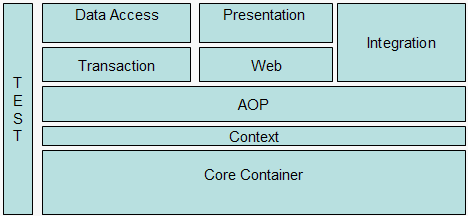
Spring framework assists in POJO development where all the features described above can be applied to POJOs, and the Spring IoC container provides the necessary infrastructure to assemble POJOs to create required application. The following diagram as shown in the Figure 1 provides an overview of the various functionality offered by the Spring framework. Each of the functionality is provided by well defined Spring modules. Each of the functionality can be used independently to simplify some area of enterprise development. The Spring modules are built on top of the core container, which defines how beans are created, configured, and managed, as shown in above Figure 1. The functionality of each component is as follows:
- **The core container**: The core container provides the essential functionality of the Spring framework. A primary component of the core container is the BeanFactory, an implementation of the Factory pattern. The BeanFactory applies the *Inversion of Control* (IOC) pattern to separate an application's configuration and dependency specification from the actual application code.
- **Spring context**: The Spring context module builds on the core module and provides context information to the Spring framework. The Spring context includes enterprise services such as JNDI, EJB, e-mail, internalization, validation, and scheduling functionality. The enterprise services functionality is provided through the specialized ApplicationContext object , which is an extension to BeanFactory.ApplicationContext is typically used by all applications as it provides various enteprise services.
- **Spring AOP**: The Spring AOP module integrates aspect-oriented programming functionality directly into the Spring framework for managing application crosscutting concerns like transaction, logging, security and other concerns through its configuration management feature. As a result you can easily AOP-enable any object managed by the Spring framework.
- **Spring Transactions**: The Spring transaction module provides support for declarative as well as programmatic transaction management that can be applied to Plain Old Java Objects (POJO). Spring Transaction module offers an abstraction for dealing with various transaction manager implementations like Hibernate, JTA, JDBC or application server specific transaction manager implementations like WebSphere or Weblogic. With this feature, your component can be decoupled from the specific API required by the corresponding transaction manager implementation.
- **Spring Persistence framework**: Spring Persistence supports JDBC as well as integration with Object Relationship Mapper (ORM) frameworks. Spring JDBC module provides an abstraction layer which provides resource management and exception translation. The Spring JDBC module provides meaningful exception hierarchy for managing the exception handling and error messages thrown by different database vendors. The exception hierarchy simplifies error handling and greatly reduces the amount of exception code you need to write, such as opening and closing connections. Spring DAO's JDBC-oriented exceptions comply to its generic DAO exception hierarchy.The Spring ORM module plugs into several ORM frameworks to provide a consistent way to deal with Object Relational tools, including JDO, Hibernate, and iBatis SQL Maps as well as support for the standard Java Persistence API(JPA). All of these comply to Spring's generic transaction and DAO exception hierarchies.
- **Spring Web**: The Spring Web module builds on top of the context module, providing contexts for Web-based applications. The Spring web module provides framework for web integration and common functionality with other web frameworks can integrate with like Spring MVC and Spring portlet.
- **Spring presentation** : The presentation framework is supported by Spring MVC framework module and Spring Portlet MVC framework module. The Spring Model-View-Controller (MVC) framework is a full-featured MVC implementation for building Web applications. The MVC framework is highly configurable via strategy interfaces and accommodates numerous view technologies including JSP, JSF, Struts, Velocity, Tiles, iText, and POI. The Spring Portlet MVC framework provides a MVC framework for creating portal based applications. The portlet MVC frameworks support the Java Portlet specification, which promote interoperability between various portlets containers.
- **Spring integration**: The integration framework provides integration with popular technologies like Remoting (EJB, RMI, Spring Hessian, Burlap),JMS,Email,Web services and REST in a consistent manner.
- **Spring Test**: Spring Test module supports the testing of Spring components with JUnit or TestNG.Since Spring promotes POJO based development, where all the functionality can be tested without the need for an external container, like EJB or Application Server.
Spring framework functionality can be used in any J2EE server and most of it also is adaptable to non-managed environments. A central focus of Spring is to allow for reusable business and data-access objects that are not tied to specific J2EE services. Such objects can be reused across J2EE environments (Web or EJB), standalone applications, test environments, and so on, without any hassle.
| | | |
| --- | --- | --- |
| | | | | --- | --- | | | | |
The basic concept of the Inversion of Control pattern (also known as dependency injection) is that you do not create your objects but describe how they should be created. You don't directly connect your components and services together in code but describe which services are needed by which components typically in a configuration file or using code metadata like Java annotations. A container (in the case of the Spring framework, the IOC container) is then responsible for hooking it all up.
For instance, take the following example of an online credit card enrollment account use case. For simplicity the online credit card enrollment use case carry out three steps, verifies the credit rating, links the customer account with credit card if credit rating is good and emails the user about the status of credit card (approved or rejected) . Each of these steps is implemented as Java classes i.e. CreditRating, CreditLinking and Email, respectively. Now in traditional application development without IOC, the following code snippet would be used by credit card application process as part of the createCreditCardAccount() method shown in Listing 1.
```
public void createCreditCardAccount(ICustomer icustomer) {
CreditRatingInterface creditRating = new CreditRating();
CreditLinkingInterface creditLinking = new CreditLinking();
EmailInterface email = Email();
boolean crediRating = creditRating.getUserCreditHistoryInformation(icustomer);
icustomer.setCreditRating(crediRating);
//Good Rating
if(crediRating) {
creditLinking.linkCreditBankAccount(icustomer); }
email.sendEmail(icustomer);
}
```
As you see in the above code, in the createCreditCardAccount() method we have created an instance of CreditRating, CreditLinking and Email object. Secondly if any of these objects would have dependency on other objects, the object would be needs instantiated in that scope (i.e. in that class or method). These dependencies can grow based on our application and manageability could become a difficult task. You may not realize that most of the time your object would be stateless and would eventually require one shared instance of object in your application, rather than creating a creating a new object for every request. Apart from object creation, you could also have configuration in your code i.e like looking up the Data source connection factory using JNDI.
Applying IOC principles would make your design modular and move out the object code creation code and configuration outside of the application code and manage these dependencies typically in some external configuration file. A container (like the Spring framework's IOC container) is then responsible for creating the beans, managing the dependency and assembling the application from these loosely coupled beans. In the Spring IOC example section, you will look at how to apply IOC principles using Spring by taking the sample example of a Credit card enrollment use case that we had discussed above.
In a typical IOC scenario, the container creates all the objects, wires them together by setting the necessary properties, and determines when methods will be invoked. The three implementation pattern types for IOC are listed in the table below.
| | |
| --- | --- |
| Type 1 | Services need to implement a dedicated interface through which they are provided with an object from which they can look up dependencies (for example, additional needed services). |
| Type 2 | Dependencies are assigned through JavaBeans properties (for example, setter methods). |
| Type 3 | Dependencies are provided as constructor parameters and are not exposed as JavaBeans properties. |
The Spring framework uses the Type 2 and Type 3 implementations for its IOC container.Spring framework support XML based configuration or Java annotations to manage bean configurations and dependency. For this example we would go with XML based configurations. Typically most of the applications uses XML based configurations. Java annotations support was added from Spring 2.5 release.
*Aspect-oriented programming*, or AOP, is a programming technique that allows programmers to modularize crosscutting concerns,or behavior that cuts across the typical divisions of responsibility, such as logging and transaction management. The core construct of AOP is the *aspect*, which encapsulates behaviors affecting multiple classes into reusable modules.
AOP and IOC are complementary technologies in that both apply a modular approach to complex problems in enterprise application development. In a typical object-oriented development approach you might implement logging functionality by putting logger statements in all your methods and Java classes. In an AOP approach you would instead *modularize* the logging services and apply them declaratively to the components that required logging. The advantage, of course, is that the Java class doesn't need to know about the existence of the logging service or concern itself with any related code. As a result, application code written using Spring AOP is loosely coupled.
AOP functionality is fully integrated into the Spring context for transaction management, logging, and various other features.Spring provides its own AOP implementation through the Spring AOP module. For advanced AOP scenarios, Spring provides support for AspectJ. However, Spring AOP module should be sufficient in most common applicable scenarios.
The core of Spring's design is the org.springframework.beans and org.springframework.context which provides Spring IOC implementation.The org.springframework.beans package typically isn't used directly by users, but serves as the underlying medium for much of the other functionality. The next-highest layer of abstraction is the BeanFactory interface, an implementation of the Factory design pattern that enables objects to be created and retrieved by name. BeanFactory can also manage relationships between objects.
BeanFactory interface is typically not used by applications directly. The Spring IOC container implementation which is typically by applications is theApplicationContext interface which builds on top of the code BeanFactory.
The ApplicationContext concept is the foundation of Spring as an IOC container. IOC moves the responsibility for making things happen into the framework and away from application code. As I'll show in the next examples, the Spring framework uses JavaBean properties and configuration data to figure out which dependencies must be set.
Because org.springframework.context.ApplicationContext is a simple interface it can be implemented for a range of underlying storage methods. The following is the example of FileSystemXmlApplicationContext which loads beans definitions files from the file system or from URLs in Listing 2.
```
ApplicationContext context = new
FileSystemXmlApplicationContext("mybean.xml");
```
Beans defined in XML files are lazily loaded, which means that the beans themselves will not be instantiated until they are needed. To retrieve a bean from ApplicationContext you can simply call the getBean() method passing in the name of the bean you want to retrieve, as shown in Listing 3.
```
MyBean mybean = (MyBean) context.getBean("mybean");
```
Each bean definition can be a POJO (defined by class name and JavaBean initialization properties) or a FactoryBean. The FactoryBean interface adds a level of indirection to the applications built using the Spring framework.
In this first article of the *Spring Series* article, I introduced you to the basics of the Spring framework. I started by discussing the functionality of Spring's layered architecture and then offered a closer look at two of them: Spring AOP and the IOC container.
In [next part](/articles/spring-ioc-tutorial) , I will take a simple example and show you how the IOC pattern (as implemented by the Spring IOC container) works and how to inject dependencies, or services, into a working credit card account application rather than having to build them in from the ground up.
The Spring series articles was originally published in June 2005 by IBM DevelopeWorks. Based on the readers inputs, this article is now updated to latest 3.0.2 release.
***"The Spring Series article was awarded the best article in the decade (2000 -2010) from IBM developerWorks and it generated 3x times views as compared to second best article , with highest number of ratings and feedback. Thank you readers for your comments, ratings and feedbacks for making this articles special".***
---
# Do you need to move from Spring to Java EE 6
URL: https://navveenbalani.dev/articles/do-you-need-to-move-from-spring-to-java-ee-6
Type: article | Date: 2010-10-19 | Topics: architecture, opinion
I recently read an interesting post on TSS- “[Moving from Spring to Java EE 6: The Age of Frameworks is Over](http://www.theserverside.com/discussions/thread.tss?thread_id=61023)”. I am sure, everyone would have its perspective on the above blog and here are my views on this.
But before that, let’s step back and look and why frameworks like Spring was invented in the first place. In my view, primarily it was created as an alternative to J2EE stack, to keep it simplified, POJO centric and testable without the need for a container. Then came in support for various abstractions layers – JDBC, Transactions, ORM, JMS which can be applied POJO in a consistent manner and support for plugging in any web framework , all backed by principle of dependency injection. What it offered was a choice to programmers (and that’s very important) and didn’t restrict it usage to any specific API directly. Using Spring, one could create modular components which could be run against a J2SE environment(derby and local transaction manager for your local test environment) and then promoted to use capabilities offered by J2EE Applications servers like JNDI, JTA and so on.
Over the years, J2EE tried to catch on, tried to create specifications and standardizations which were well adopted and tested by the framework like Spring or ORM providers like Hibernate. Specifications are good, but lot of time goes in creating specifications and it takes even lot more to get these specifications incorporated into the release of J2EE servers and stacks. Though specifications were created, you would still see vendor specific extensions required to run a particular feature. I mean, can you still take an Enterprise application (running on latest J2EE spec), which has couple of EJBs (3.0 or 3.x), uses transaction and JMS services and run it on a server which supports the same J2EE specs. Probably No, Yes, May be with the latest specification, may be with vendor specific extensions (?). Let’s look at the latest release features to find more of this information.
The latest release of J2EE has support for Dependency injection (JSR-299 contexts and Dependency Injection for the Java EE platform specification), which is same as offered by Spring, Bean Validation (standard Bean validation offered by Apache projects, but now using standard annotations), streamlined development (through the use of POJO, JPA for persistence and revised EJB approach) and extensibility to add in vendor specific extensions in a consistent way. If you look at these goals, these matches with principles which I had listed earlier on why Spring was invented, only thing it took J2EE probably too long (probably 6-7 years assuming Spring starting gaining widely adopted in 2003) to arrive at this specification. Even though J2EE has the principles now, it still restricts its usage to that of a container, for instance I can run spring in a standalone environment (J2SE environment with local database and transaction support) as well as promote it to full fledged J2EE application, running on multiple application servers.Also there are no approaches provided on how to test individual components (in and outside the container) using a pure J2EE stack. I seriously feel, there should be specification around testing of components.
To conclude with some thoughts -
- I can achieve everything in Java EE 6 using Spring , but not the other way round.
- I can get Java EE 6 (or 7.x or 8.x ) features in a container that’s doesn’t uses Java EE 6 (or 7.x or 8.x ..) using Spring.
- I don’t think having a vendor specific extension in Java EE 6 can categorize to all vendor requirements, given that getting anything as part of standard usually takes a very long time. The choice needs to be provided, whether I use pure Hibernate APIs or JPA using a standard way.
- J2EE 5.x and now 6.x Spec is good start, but will take a while for J2EE 6.X (and future versions) to be adopted and catch up with Spring.
- J2EE future versions should be streamlined further to Java (POJO) with enterprise services, along with a test driven methodology.
- Finally it’s up to your requirements and what applications you are building.
---
# Open JDK Community and Google
URL: https://navveenbalani.dev/articles/open-jdk-community-and-google
Type: article | Date: 2010-10-15 | Topics: opinion
IBM recently announced that it would be joining the OpenJDK effort with Oracle. As per the press release
"Specifically, the companies will collaborate in the OpenJDK community to develop the leading open source Java environment."
This is good for the community as well as both of these organizations to collaborate and innovate on a Open Java platform and enhance the considerable amount of investments that has been spent in Java since the inception.
IBM was also supporting the development of Apache Harmony project (Apache-licensed Java SE implementation) and it seems they will shift it focus now on Open JDK.
Now what happens to Google Andriod, which uses Apache Harmony library and lawsuit filed by Oracle.In my view, an ideal world strategy would be open up the Java collaboration so all organizations can collaborate.Sun built Java , but other organizations actually benefited and made profits from building Java products and applications. Java was successful as organizations embraced it and built applications and products on it. Google also innovated with Java and built out very leading useful applications for web, mobiles , cloud and enterprise.I don't understand the legal aspects of it,but innovation doesn't need to have a barrier.
I would like to hear your views and opinion on this, please post your comments.
---
# Looking at Enterprise OSGI and Apache Aries
URL: https://navveenbalani.dev/articles/looking-at-eneteprise-osgi-apache-aries
Type: article | Date: 2010-10-09 | Topics: architecture, trends
Apache Aries is an open source project for creating Enterprise OSGI Applications. Enterprise OSGI is all about using OSGI concepts, programming model and technologies in Enterprise Java space in a standard way, like JPA, JTA, JMX and so on.
With Enterprise OSGI, you also need to provide some way of dealing with dynamic nature of OSGi applications, where osgi components can activated or deactivated at any time ,managed and wired together with other components to form a solution. That's where the the Blueprint Container specification was introduced in the latest OSGi specification, which provides a simple and easy programming model for creating dynamic applications in the OSGi environment.
The Blueprint Container uses dependency injection using a XML based configuration for managing the component configurations, similar to Spring. The concepts are similar to my earlier article - [Getting Started with Spring and OSGI](/articles/getting-started-with-osgi-and-spring-dm) , where I showed how to use Spring applications in OSGI container.
Apache Aries provides an implementation of Blueprint container and containers for JPA, JTA, JMX on how to use enterprise Java services in a OSGI environment. Apache Aries is currently in Apache Incubator and provide quite a few samples to evaluate and try the Blueprint container implementation.In my view, the future of Enterprise OSGI is promising and would provide a way for creating and dealing with dynamic applications in Java world. Similar to other programing model, the benefit of Enterprise OSGI programming model in the near future would be applicable based on the requirements and not all applications would require this behavior.
---
# Creating your own wordpress blog
URL: https://navveenbalani.dev/articles/creating-your-own-wordpress-blog
Type: article | Date: 2010-09-04 | Topics: architecture
As part of creating my new blog site, I was evaluating various blog and content managements systems, namely Wordpress, Joomla and Drupal. I created a demo site using Wordpress, Joomla and Drupal, but finally went with word press due to its simplicity, plug-in architecture and numerous freely available themes. Wordpress is an open source plug-in based bogging and content management software.
Each of these content management systems can be setup in a local windows environment using XAMPP. XAMPP is a very easy to install Apache Distribution for Linux, Solaris, Windows and Mac OS X. The package includes the Apache web server, MySQL, PHP, Perl, a FTP server and phpMyAdmin.
Once you have downloaded wordpress, you can copy the wordpress folder in htdocs folder of xampp location. Next step would be to start up the XAMMP control, by clicking on the xampp-control.exe and then start the Apache server and MySql server as shown below.
Logon to the MySql server console and create a database for wordpress. Once database is created, type in the wordpress url – i.e. to start the one click install process, which would ask you for blog name and database properties (name , user id and password), Within a minute you should be up and running with wordpress blog.
You can also migrate your blog across wordpress versions, if you plan to do that; you can refer to my earlier blog at – [Migrating wordpress blog acrosss domains](/articles/migrating-wordpress-blog-acrosss-domains)
Basically you can setup everything in your local environment and then push it to your domain using the steps mentioned in above link.
Start exploring wordpress by finding various themes (google them - 100 best wordpress themes :)) and apply it by copying it in wordpress\wp-content\themes directory and activate it through Appearance -> Themes option in the word press console. Similarly for plug in, you can copy it in wordpress\wp-content\plugins folder and activate it through Plugins option in the word press console.
Some of the plugins, I have been using in this blog is - Amazon Showcase (for Amazon) , All in One SEO Pack (for Search engine optimizations) , Google Analyticator (for Google analytics) , Share and Follow and Social Media Widget (social networking) , Google XML Sitemaps (for XML sitemaps) , WP-Polls ( for managing Polls) and WP-reCAPTCHA (a must to avoid spams). The theme that’s being used in my site is Scarlett, which I have customized it a bit.
Hope this would give you some insights on how to setup a blog quickly using wordpress. Start blogging !!
[](http://www.anrdoezrs.net/ok79shqnhp4955C7CB465C66C69)
---
# Lost in the GPS world
URL: https://navveenbalani.dev/articles/lost-in-gps-world
Type: article | Date: 2010-09-04 | Topics: personal
I am in US these days and relying on the GPS device to find my way out in US. So far so good, as my assumption was as long as you have a GPS device, you wouldn’t get lost. Well how about GPS device not acquiring satellite signals when you are in mid-way returning back to home, well luckily for me the GPS satellite signal gave up at a street, where I knew how to get back.
My GPS device was acquiring satellite signals and giving up frequently from last 2 days and finally found out the firmware of the device need to be updated after searching through various blogs which reported the same problem. I am using GARMIN nuVi GPS. I am not impressed by there piece of hardware, which doesn’t tells me what the real problem is , fails to acquire signals frequently and even a message to upgrade the firmware would be good to get around this issues. I know need to have a backup plan, get and understand map and directions as I don’t went to be lost in the GPS world :).
***- - I envision an intelligent car in future which tracks my driving and head me back when I get lost -***
---
# Selecting a rich user interface technology
URL: https://navveenbalani.dev/articles/selecting-a-rich-user-interface-technology
Type: article | Date: 2010-08-12 | Topics: architecture, trends
User interface is one of the key external visible faces for any application. Getting the user interface design right and picking up a rich user interface technology is the key for a successful project. Selecting a Rich user interface technology depends on various criteria. In my view, some of key criteria for selecting a Rich user interface technology include the following -
- Tooling and debug environment.
- Remote debugging support.
- Support for unit test and Integration test.
- Licenses, Road Map and support - Open source support (Active community, Jira fixes, resolutions)
- Customization and extensions. Turnaround time to introduce new changes after deployment.
- Skill set of available resources
The last two points are also a major enabler for selecting a user interface technology. For instance if your organization had skilled Java script resources, then you could pick up any Java Script AJAX framework like EXT JS or DOJO. On the other hand, if your organization has skilled Java resources (not really web developers) you could very well use GWT. The GWT is a development toolkit, which provides a set of core Java APIs to write AJAX based applications in Java, which is later complied to JavaScript that runs on widely supported browser (which GWT supports). The development environment (eclipse extensions) lets you debug AJAX based applications which is quite useful as compared to using Java Script directly. I would really like to see a graphical way of creating AJAX applications in GWT and it seems with the recent Google acquisition of [Instantiations](http://instantiations.com) ,they could provide this capability with GWT toolkit. One of the features, I would like to see in GWT is to make the generated code more readable, so I can add my code extensions easily if there are issues with the generated code.
Adobe Flex on the other hand has a different model – where you create Rich applications (using Action Script – which is similar to Java Script) based on Abode Flash platform using Flex Builder which provides Debugger and Profiler capability. The Flex applications runs on a browser which needs to have Flash plug-in installed. The Flash plug-in ensures cross browser compatibility on the browser, but then you have to move away from the browser native functionality and need to have Flex Skills in your organization. With the HTML 5 specification, some of the Rich internet application functionality would be uniformly supported and one needs to look at trade of using Flex in future for features which are not supported by HTML.Personally I see Flash going away with HTML 5 and with mobile adoption.
With respect to code maintenance and debugging applications, if you have large scale web projects, writing and organizing Java scripts code is difficult as compared to other technology like GWT.
In my view, based on your requirements you carefully need pick up a user interface technology and look the roadmap support for that technology. Hopefully this blog gave you some of the insights on how to select a rich interface technology.
---
# Looking at Apache Wink JAX-RS framework
URL: https://navveenbalani.dev/articles/looking-at-apache-wink-jax-rs-framework
Type: article | Date: 2010-08-09 | Topics: architecture, trends
Apache Wink is a Java based framework for building RESTful applications. It provides implementation of JAX-RS specification and is currently under Apache incubation.
Apache wink provides a service module for developing JAX-RS compatible RESTful services and client modules for creating RESTful clients. Apart from JAX-RS standard representations, Apache Wink provides and ability to expose resources using various representations formats like RSS, Atom and CSS formats.
*From the official site* -
*"Apache Wink 1.1 is a complete Java based solution for implementing and consuming REST based Web Services. The goal of the Wink framework is to provide a reusable and extendable set of classes and interfaces that will serve as a foundation on which a developer can efficiently construct applications."*
The following is the high level architecture of Apache Wink, which seems pretty standard as followed by any service stack.
In my view, I am not sure why there are conflicting Apache projects providing RESTful capability. Though Apache Wink provides more representations like ATOM, RSS, but primarily it would be used for JAX-RS specification.
I guess if they are embedding Apache Wink implementation in existing Apache web services stacks like CXF and AXIS 2 to standardize REST implementations, client APIs and representations format code , across stacks it makes sense, but one more project providing RESTful implementation seems an overkill and they could very well utilize this effort for standardizing the REST integration in there existing stacks. That's an outsider view looking at these projects :). In my view, one should be able to use Wink as a stand-alone RESTful stack or as embedded JAX-RS implementation shipped with existing Apache web service stacks using some configurations (Spring or Non-Spring based).
---
# Apache CXF Book Indian Print Available
URL: https://navveenbalani.dev/books/apache-cxf-book-indian-print-available
Type: book | Date: 2010-08-05 | Topics: architecture
The Indian print of my Apache CXF Book is available now for order. So if your are in India, you can order it from this [link](http://www.grenleaf.com/idtitle.aspx?titleid=2020). This is the first published book on Apache CXF framework. You can also download the [sample chapter](/articles/sample-chapter-for-apache-cxf-web-service-book) of the book to get more details about Apache CXF framework.
---
# Deploying Apache CXF services on WebSphere Process Server
URL: https://navveenbalani.dev/books/deploying-apache-cxf-services-on-websphere-process-server
Type: book | Date: 2010-08-01 | Topics: architecture
In this blog, we will look at how to deploy CXF application on WebSphere Process Server (WPS). One of the readers had asked me on how to deploy the sample application from the [Chapter 2](http://books.naveenbalani.com/wp-content/plugins/download-monitor/download.php?id=2) in WPS, since my book covers deployment on tomcat server only. It was a good exercise for me to validate if the sample CXF application run on other servers as I haven't tried this before.
I was able to run the application successfully with a modification to the module class loading policy . Given below are the steps required to deploy the sample CXF application in WPS. The version of WPS used was 7.0.
1. Build the war file (orderapp.war) as mentioned in Chapter 2.
2. Logon to WPS Administration Console
3. Go to *Applications -> Application Types - > WebSphere Enterprise applications*. Click Install
4. In next screen , provide the location of orderapp.war file.Click *Next*
5. On the next screen, click *Fast Path* and click on *Next*
6. On the *Install New Application* screen, Click on *Step 3 Map virtual hosts for Web modules* and select the orderapp.war file to map it to default\_host virtual host
7. On the *Install New Application* screen, Click on *Step 4 Map context root for Web modules* and enter the context root as /orderapp. Click *Next*
8. On the Summary screen, click Finish.
9. The orderapp.war would be deployed. On the confirmation screen, click *Save* to save the configuration to master configuration.
Next, you need to change the class loading policy for orderapp web module, to ensure that the CXF libraries, CXF JAX-WS and JAX-RS runtime and dependent files present in web module (all jar files in WEB-INF\lib) are loaded first , instead of WPS library to avoid any conflict. If you don't change the class loading policy , the application deployment would be successful but would receive the following exception when you run the application -
com.ibm.ws.webcontainer.servlet.ServletWrapper service SRVE0068E: Uncaught exception created in one of the service methods of the servlet CXFServlet in application orderapp\_war. Exception created : java.lang.NoSuchMethodError: org/apache/ws/commons/schema/XmlSchema.getSchemaDocument()Lorg/w3c/dom/Document;
at org.apache.cxf.service.model.SchemaInfo.getElement(SchemaInfo.java:109)
at org.apache.cxf.wsdl11.ServiceWSDLBuilder.buildTypes(ServiceWSDLBuilder.java:267)
at org.apache.cxf.wsdl11.ServiceWSDLBuilder.build(ServiceWSDLBuilder.java:188)
at org.apache.cxf.wsdl11.ServiceWSDLBuilder.build(ServiceWSDLBuilder.java:148)
To change the class loading policy , follow these steps
1. Go to *Applications* -> *Application* Types - > *WebSphere enterprise applications* and select *orderapp\_war*
2. Click on *Manage modules*
3. Click on *orderapp.war*
Change the class loader order to "*Classes loaded with local class loader first (parent last)*" and click *Apply*. *Save* the configuration.
1. Start the *orderapp\_war enterprise application*
2. Run the web service client as mentioned in Chapter 2
Note if you plan to use CXF JAX-WS implementation with WAS/WPS , you would not be able to leverage the WS-Specifications (like WS-Security) offered by WAS/WPS container for that application and instead need to rely on CXF WS-Specification implementation.
To know, more about how to develop SOAP and Restful web services, get a copy of my Apache CXF Web Service Book.
---
# Driving Business Agility using BPM
URL: https://navveenbalani.dev/talks/driving-business-agility-using-bpm
Type: talk | Date: 2010-07-25 | Topics: architecture
The WebSphere Technical conference (WTC 2010) was conducted in Bangalore, India last week. As usual, I gave presentations on BPM track. This time my presentation was about "Driving Business Agility using BPM". I build upon a use case as part of presentation and showed how to enable agility using various agility enablers incrementally. One of the key concepts highlighted was that some of agility enablers needs to be incorporated at design time , while some of agility enablers can be introduced at run time , so one needs to know about the various agility enablers in IBM BPM suite. I talked about the six agility enablers - policy based assembly , service selection, rules , events , services selection and analysts and when through each of these in detail using a use case scenario.
Keeping the agility enablers in mind , is the key for making processes agile which can respond to business changes with very low latency.
For more details on WTC-2010, you can view the following WTC blog - [Driving Business Agility using BPM](http://www.ibmsoftwaretraining.com/driving-business-agility-using-bpm-wtc-2010/)
---
# Looking at SpringRoo framework
URL: https://navveenbalani.dev/articles/looking-at-springroo-framework
Type: article | Date: 2010-07-02 | Topics: trends
Spring Roo is a lightweight developer tool for rapid java application development. The recent Spring Roo 1.1.0.M1 release allows developers to build working web applications – complete with a Google Web Toolkit (GWT) front end.
I tried a quick prototype using Spring Roo 1.1.0.M1 release. My initial impression was it was good for prototype mode and speed starting new applications, which can be extended further. I still need to understand its scope, on how they plan to use it for existing applications which already uses Spring or for enterprise application integration. I feel with Spring Roo , they have templatized common patterns further,created some best practices for code generation, like creating entity persistence object using JPA, web ui , unit test generation , automation QA test using Selenium and build projects.
In my view ,rapid application development in Java is not new , though it was limited, for instance using tools to create persistence ORM objects , creating dynamic UI from domain objects but it was not collectively applied to entire product development. Since Spring already had an abstraction layer on various underlying technology , next step they thought was to abstract the template even further using Roo. As I mentioned earlier, the scope needs to be defined , I can generate something quickly but then it needs to be customized heavily based on various requirements - like Organizations User interfaces guidelines , security , integration with other systems and so on. Once you have customized it, how do you sync up with the generated code if you need to make changes.
Typically I haven't seen one to one map between a screen and a domain object , the screen would have various other layouts and may need to pull data from combination of sources. There are various teams in project doing different tasks - User interfaces , services integration , writing data queries (stored procedure), writing persistence code , which might be working parallelly and how does the rapid development works in the case. There are many challenges in enterprise application development and my initial impression with Spring Roo rapid development framework is the usage - it is limited to certain scopes and not the entire enterprise application.
---
# Accessing DB2 Everyplace applications using J2ME devices
URL: https://navveenbalani.dev/articles/accessing-db2-everyplace-applications-using-j2me-devices
Type: article | Date: 2010-06-29 | Topics: architecture
This tutorial assists developers with building DB2 Everyplace mobile applications using J2ME DB2 Everyplace MIDP ISync APIs and deploying the application in the J2ME environment using J2ME Toolkit.
Part one of this two-part tutorial uses the DB2Everyplace J2ME MIDP ISync Client APIs to create a Sample Address Book database on a J2ME Emulator/Device from a remote DB2 database. The Address Book database on the J2ME Emulator/Device is stored using J2ME Record Store Management System. [Download Part 1 of the tutorial.](/images/2010/07/access-db2everyplace-mobile-j2me-part1.pdf)
Part two builds an address book application that accesses the Address book database, performs updates to it and then synchronizes it with the remote DB2 Address database. We shall use DB2 Everyplace MIDP APIs to access the Address Book database and perform updates to it. [Download Part 2 of the Tutorial](/images/2010/07/access-db2everyplace-mobile-j2me-part2.pdf)
This article was first published by IBM developerWorks. All rights reserved by IBM and Author.
---
# Migrating wordpress blog acrosss domains
URL: https://navveenbalani.dev/articles/migrating-wordpress-blog-acrosss-domains
Type: article | Date: 2010-06-20 | Topics: architecture
Recently, I migrated my word press domain from my earlier site (soaweb.co.in) to my new web site (naveenbalani.com). Here are the steps, I followed
1. Exported my earlier wordpress database using phpAdmin
2. Installed word press on my new website. Just copied the wordpress install files on new domain web root.
3. Created a new database for the new domain.
4. Imported the database.zip from Step 1 to new database.
5. Changed the following 2 records in wp\_options table which mentioned my old wordpress blog URL
*Update option\_value column with “newUrl” where option\_name =”siteurl*
*Update option\_value column with “newUrl” where option\_name =”home”*
1. Changed the wp-config.php of the new domain to point to new database
2. Logon to Word Press and change the path of uploaded media content files for future uploads to relative one. Navigate to Settings > Miscellaneous Settings and change it to Store uploads in this folder to / wp-content/uploads.This might be optional, but in my case the hosting provider had appended the complete path , instead of relative one.
I than did a search on my new wordpress blog table to find out references of my earlier url (soaweb.co.in) and found
there where still entries remaining in wp\_posts table. The wp\_posts table stores the revision history, if you have enabled it.I had enabled revision history, so I went ahead and deleted all my revsion history since I didn't require it any more , using the following SQL command in phpAdmin
*DELETE FROM wp\_posts WHERE post\_type = "revision";*
Few other references (the guid column) pointed to my earlier blog url, so did a mass replace using the following command. The guid was the short url of the blog. This technique you can use to replace all references quickly.
UPDATE wp\_posts SET guid = REPLACE(guid,"soaweb.co.in" ,"naveenbalani.com")
That’s it, I now have my website up and running.
One of the things, I realized was that in my earlier blogs, the URL references and images was hard coded, instead of referencing them. This required an extra effort to move the urls to the new domain. Other thing, I noticed was, that I had used Rich text (imported my content from words), in that case the export didn’t handle the special characters well (like bullets), I had to change that manually.
I tried the entire setup on my local environment using xampplite environment and than moved it over to my hosting provider. Hope this would give you some insights if you plan to move your word press blog. And if you have been following my blog on soaweb.co.in , this would now be redirected to this website.
---
# Twitter to launch its own shortening url service
URL: https://navveenbalani.dev/articles/twitter-to-lauch-its-own-shortening-url-service
Type: article | Date: 2010-06-19 | Topics: trends
I was reading an article that very soon Twitter would launch its official link shortening service for all users. The URL would be something like t.co/naveenbalani.com/dynamicbpm. Instead of a cryptic url , you should be able to create a human readable url (limit is around 20 characters) containing your original link and meta keywords.This is great as a user would know which site he is heading. This should avoid possible Spams and make the links more readable. For search engines, it means searching the information based on the meta-key works in the URLs, similar to tagging a tweet with a meta-keyword, which lets the search be more efficient.
Other feature, I guess that the Twitter official link shortening service would provide is the monitoring of tweets and links (number of visits, ranks) and very soon you might find analytics (similar to google analytics) on your tweets. This can probably leads to marketing and other revenue generation options for your tweets in future :)
In my view this would definitely impact the various tweet shortening services like bit.ly, share.es as I feel users would prefer Twitter official link shortening service and host of other services (basically analytics) that they might offer later. The possibilities are endless. I guess existing services should probably look at how effectively they could automatically create the meta information from your posts and create meaningful urls, or convert your existing tweets urls with relevant ones.
Currently the Twitter official link shortening service feature is enabled, through a handful of twitter accounts (like @TwitterAPI) to test out this functionality , but ultimately it would be rolled out to all.
This would mean new plug-in for wordpress, joomla, drupal and other CMS when the new twitter URL shortening service is available. Stay tuned .
---
# What is Dynamic BPM
URL: https://navveenbalani.dev/articles/what-is-dynamic-bpm
Type: article | Date: 2010-06-12 | Topics: architecture
Dynamic BPM is the ability to support process change at any time, with very low latency. Dynamic BPM implies that your business processes are more agile and flexible so it can easily adapt dynamically based on business needs.
**So how is Dynamic BPM different from earlier BPM solutions.**
In my view, the initial SOA BPM solutions focused on streamlining business processes, aligning Business and IT content, process automation and standardizing IT interfaces. Most of the earlier processes weren't designed with agility and dynamicity in mind and if they were, they might not that have the platform and tooling to support dynamicity required for today's business environment. With technology being evolved, we have better ways now to achieve agility as compared to earlier models. Â Now, based on dynamicity associated with today's business environment, business needs to sense environmental changes and adapt quickly and respond appropriately to these changes. That's where Dynamic BPM comes into play.
In my view, agility can be introduced at design/modeling time or at runtime. A BPM platform needs to have the right tools and technology to assist you in creating these agility behaviors to make process dynamic. For instance, let's take an example of Loan application written in some language, say Java. Now while designing Loan types, you would typically create an abstract class for Loan and later add implementation for specific types like Auto Loan, Home Loan and so on. Based on Loan type you carry out a different function, but more or less your process remains same. So what have you ensured as part of your design, is that the new Loan implementations can be added easily by extending the Loan class. Similar, while designing BPM processes, you should have an ability to model this behavior, so new extensions or functionality) can be easily added when new Loan types are added, without changing your businesses process. This is an example of design time agility.
Let's take another example of Loan approval process where you might have defined a human task for approving the interest rate. During the process execution, the rate of interest changes and the user who is carrying out the task requires an exception approval to disburse the loan based on the earlier negotiated rate, in that case the user can create a dynamic/adhoc task and assign it to the required approver and wait on it till task gets completed. This can be considered an example of agility being introduced during runtime without changing your existing process.
Modeling your Business process taking in account the agility behavior is one of the key aspects of dynamic processes. In my future blog, I would talk about the various agility parameters and different ways to achieve agility.
---
# Kindle my books
URL: https://navveenbalani.dev/articles/kindle-my-books
Type: article | Date: 2010-06-10 | Topics: trends
I recently ordered the [Kindle Wireless Reading Device](http://www.amazon.com/gp/product/B0015T963C?ie=UTF8&tag=sw0fd-20&linkCode=as2&camp=1789&creative=9325&creativeASIN=B0015T963C)
device (with its new revised pricing), I was surprised to find kindle ships free to my country. I like reading a lot and have been evaluating ebook readers for some time.
For those like me :) , who likes to get behind the technology driving this amazing e-reader device, the technology behind amazon kindle (and most other e-readers) is e-link. So when every you hear about e-link products, you know its about an e-reader device. The e-link technology focuses on creating lightweight, flexible display with ultra low power.
The new Amazon 2 kindle device provides an ability to play MP3 files, so I could listen to podcasts and talks. The Amazon kindle also provides a PDF document conversion utility which would really help to get my pdf e-books on kindle.
Before buying kindle 2 devices, I did my research and downloaded [Kindle for PC](http://www.amazon.com/gp/redirect.html?ie=UTF8&location=http%3A%2F%2Fwww.amazon.com%2Fgp%2Ffeature.html%3Fie%3DUTF8%26docId%3D1000426311&tag=sw0fd-20&linkCode=ur2&camp=1789&creative=390957) where I can try out my various pdfs, e-books, and documents, to get a feel of reading the books on a kindle. I really liked the notes and bookmark features that I could associate with my pages. I would suggest you download the [Kindle for PC](http://www.amazon.com/gp/redirect.html?ie=UTF8&location=http%3A%2F%2Fwww.amazon.com%2Fgp%2Ffeature.html%3Fie%3DUTF8%26docId%3D1000426311&tag=sw0fd-20&linkCode=ur2&camp=1789&creative=390957), just to get the feel of the actual viewing experience and the features.
Usually while traveling, I like to catch up on my presentations, so an ability to view power point presentations would be really nice in a kindle. However, I couldn't find a good conversion utility to convert the presentations into kindle format. Well I converted my PPT in PDF format and then viewed it in Kindle for PC application, and the images came fine.
I was also looking at IPad , I really liked the IPad functionality as it consumes most of the media types along with providing a e-reading viewing experience. I went with Kindle as I was looking out specifically for a nice e-reader device. You can also install the free kindle for IPad software on IPad and evaluate it. Happy reading !!
***With everything going digital in future, the future of kindle holds good.***
[Amazon.com Widgets](http://ws.amazon.com/widgets/q?ServiceVersion=20070822&MarketPlace=US&ID=V20070822%2FUS%2Fsw0fd-20%2F8010%2F8b407ecd-e98a-49f3-a420-dbb19a06699e&Operation=NoScript)
---
# Getting Started with OSGI and Spring DM
URL: https://navveenbalani.dev/articles/getting-started-with-osgi-and-spring-dm
Type: article | Date: 2010-06-08 | Topics: architecture
In this article we will look at how to create bundles using the Spring framework and then deploy them in a Felix runtime environment. You will see how the core OSGi framework dependency is removed through a simple Spring-based configuration.
In this article, you will revisit the order application developed in [part 1 of the series](/articles/getting-started-with-osgi). The application will now use Spring DM to build and package the bundles. The application client will invoke the service component to process the order and the server component will print the order ID. The article will help you understand the concept of Spring DM and its use with the Felix-based OSGi container.
### System requirements
To run the examples in this article, make sure the following software is installed and set up on your machine:
- Java 5 or higher
- Ant build tool
- Felix binary distribution
- Spring DM bundles
- [Source code project for this tutorial](/images/2010/06/osgispring_orderapp.zip)
After the above distribution is installed, set up the following environment variables: (by way of example set ANT\_HOME=C:\apache-ant-1.7.0).
- JAVA\_HOME (for Java)
- ANT\_HOME (for Ant)
Next add the following to the PATH environment variable:
- JAVA\_HOME\bin
- ANT\_HOME\bin
### Spring DM
Spring DM includes JARs or bundles that help deploy Spring applications in an OSGi environment. Spring DM-based applications can make use of services offered by the OSGi environment. These types of applications provide ease and convenience in the development of OSGi-based applications. Spring DM offers the following benefits in the OSGi environment:
- Modularizes the application into dynamic bundles and provide runtime services to these bundles.
- Provides versioning capability to the modules.
- Modules are bundled as services that can be dynamically discovered and consumed.
- Modules can be installed, updated and uninstalled dynamically
- Takes advantage of the Spring framework in configuring the application as OSGi modules
- Provides seperation of business logic and configuration thereby making development easy and convenient
### Order Application Revisited
We will revisit the order application developed in part 1 of this series. As you can see, the classes, currently, are strongly coupled with the OSGi framework. Now you will remove this strong coupling and make the classes as simple POJOs with the use of Spring DM. Let's look at the revised OrderClient.java, below.
### Listing 1. The client component OrderClient
```
package order.client;
import order.OrderService;
public class OrderClient {
private OrderService orderService;
public void setOrderService(OrderService orderService) {this.orderService = orderService;
}
public void removeService() {
this.orderService = null;
}
public void start() {
orderService.processOrder();
}
public void stop() {
System.out.println("Bundle stopped");
}
}
```
The OSGi framework dependency is completely removed. The class is a plain POJO with the start() method simply processing the order. There is no use of ServiceTracker class.
### Listing 2. OrderService implementation
```
package order.impl;import order.OrderService;
public class OrderServiceImpl implements OrderService {
public void start() {
System.out.println("Order Service registered");
}
public void stop() {
System.out.println("Order Service stopped");
}
public void processOrder() {
System.out.println("Order id: ORD123") ;
}
}
```
Similarly, the above OrderServiceImpl too a simple POJO with the processOrder() method. There is no association with the OSGi core components. Also neither client nor service classes implement the BundleActivator. The bundle lifecycle here is managed by Spring DM.
So, how do these simple POJOs work as OSGi components? The magic lies in the Spring configuration files. It is here where you define the OSGi part.
But before you define XML files, there are some changes to be made to the manifest files. The manifest will include import packages that will contain Spring DM files. This will ensure that Spring will now take over the management and lifecycle of OSGi bundles. The code snippets below illustrates the service and client manifest files.
### Listing 3. Service Manifest
```
>Manifest-Version: 1.0Bundle-ManifestVersion: 2
Bundle-Name: Order Service
Bundle-SymbolicName: orderservice
Bundle-Version: 1.0.0
Import-Package: org.springframework.beans.factory.xml,
org.springframework.aop, org.springframework.aop.framework,
org.aopalliance.aop, org.xml.sax, org.osgi.framework,
org.springframework.osgi.service.importer.support,
org.springframework.beans.propertyeditors,
org.springframework.osgi.service.exporter.support,
org.springframework.osgi.service.exporter
Export-Package: order
```
### Listing 4. Client Manifest file
```
Manifest-Version: 1.0Bundle-ManifestVersion: 2
Bundle-Name: Order Service Client
Bundle-SymbolicName: orderclient
Bundle-Version: 1.0.0
Import-Package: org.springframework.beans.factory.xml,
org.springframework.aop, org.springframework.aop.framework,
org.aopalliance.aop, org.xml.sax, org.osgi.framework,
org.springframework.osgi.service.importer.support,
org.springframework.beans.propertyeditors,
org.springframework.osgi.service.importer,
org.springframework.osgi.service.exporter.support,
order
```
You will create two XML files each for service and client components. For the service, the orderservice.xml XML file will define the order service implementation bean and the orderservice-osgi.xml XML file will define the order service interface and refer to its implementation. Similarly for the client, XML files will define the order client bean and refer to order service components. The service and client XML files reside under their respective META-INF/spring folder. The below code shows the service XML file
### Listing 5. Service XML file orderservice.xml
```
</pre>
<?xml version=”1.0″ encoding=”UTF-8″?>
<beans xmlns=”http://www.springframework.org/schema/beans”
xmlns:xsi=”http://www.w3.org/2001/XMLSchema-instance”
xsi:schemaLocation=”http://www.springframework.org/schema/beans
http://www.springframework.org/schema/beans/spring-beans.xsd”><bean name=”orderService”/>
</beans>
<pre>
```
### Listing 6. Service OSGi XML file orderservice.xml
```
<?xml version=”1.0″ encoding=”UTF-8″?><beans xmlns=”http://www.springframework.org/schema/beans”
</pre>
xmlns:xsi=”http://www.w3.org/2001/XMLSchema-instance”
xsi:schemaLocation=”http://www.springframework.org/schema/beans
http://www.springframework.org/schema/beans/spring-beans.xsd”>
<bean name=”orderService”/>
</beans>
<pre>
```
You could actually provide both the bean and OSGi definition in one XML file. It is not necessary to create two sperate files. Here we are making two sperate files so that we distinguish between the interface definition and configuration. Managing and maintaining these files becomes easier. The beauty of a Spring-based configuration is that it will allow you to test your order service bean outside the OSGi container.
To be able to actually do this, you will have to install the relevant Spring DM jars in Felix.
### Listing 7. Portion of Felix configuration
```
<pre>felix.auto.start.1= \
<%%KEEPWHITESPACE%%> file:/felix-1.0.4/bundle/org.apache.felix.shell-1.0.1.jar \
<%%KEEPWHITESPACE%%> file:/felix-1.0.4/bundle/org.apache.felix.shell.tui-1.0.1.jar \
<%%KEEPWHITESPACE%%> file:/felix-1.0.4/bundle/org.apache.felix.bundlerepository-1.0.3.jar \
<%%KEEPWHITESPACE%%> file:/osgi_spring/order/springlib/aopalliance.osgi-1.0-SNAPSHOT.jar \
<%%KEEPWHITESPACE%%> file:/osgi_spring/order/springlib/jcl104-over-slf4j-1.4.3.jar \
<%%KEEPWHITESPACE%%> file:/osgi_spring/order/springlib/log4j.osgi-1.2.15-SNAPSHOT.jar \
<%%KEEPWHITESPACE%%> file:/osgi_spring/order/springlib/org.apache.felix.main-1.0.1.jar \
<%%KEEPWHITESPACE%%> file:/osgi_spring/order/springlib/slf4j-api-1.4.3.jar \
<%%KEEPWHITESPACE%%> file:/osgi_spring/order/springlib/slf4j-log4j12-1.4.3.jar \
<%%KEEPWHITESPACE%%> file:/osgi_spring/order/springlib/spring-aop-2.5.1.jar \
<%%KEEPWHITESPACE%%> file:/osgi_spring/order/springlib/spring-beans-2.5.1.jar \
<%%KEEPWHITESPACE%%> file:/osgi_spring/order/springlib/spring-context-2.5.1.jar \
<%%KEEPWHITESPACE%%> file:/osgi_spring/order/springlib/spring-core-2.5.1.jar \
<%%KEEPWHITESPACE%%> file:/osgi_spring/order/springlib/spring-osgi-core-1.0.2.jar \
<%%KEEPWHITESPACE%%> file:/osgi_spring/order/springlib/spring-osgi-extender-1.0.2.jar \
<%%KEEPWHITESPACE%%> file:/osgi_spring/order/springlib/spring-osgi-io-1.0.2.jar</pre>
```
As you can see from what we've demonstrated above, the Felix congifuration file will have the Spring DM bundles defined. You can download the Spring DM bundle and put in the folder of your choice. Once the jars are put in the appropriate folder, make the relevant entries in the Felix config file specifying these jars to be installed at the Felix startup.
You can then proceed with the steps of installing the client and service bundles in the Felix runtime environment as per the [previous article](/articles/getting-started-with-osgi). Once installed, you should be able to start and stop the bundles and see the same results. You will notice that unlike a Felix-based OSGi, this time it is Spring DM that is managing the bundle lifecycle.
### Conclusion
The power of the Spring framework has made development of OSGi applications simpler and more effective. OSGi itself also has revolutionized the way Java applications are bundled. OSGi, in association with Spring, has provided a solid foundation to the development of enterprise-wide applications.
This article of mine was first published by IBM developerWorks. All rights reserved by IBM and author.
---
# Introduction to Cloud Computing
URL: https://navveenbalani.dev/articles/introduction-to-cloud-computing
Type: article | Date: 2010-06-02 | Topics: cloud
Cloud computing is an IT computing style that delivers IT services (infrastructure, software, data store and information) in a simplified way to end users over internet. So how is different from existing models. Well the fundamental differences are how these services (infrastructure, software, data store and information) are provided and how they are accessed by users. A most common example is Google Apps which provides web based office tools to end users. So you just need a web browser to access the office suite of applications, where you can create, save, share documents online, without installing any dedicated software (office tools) on your computer. This is an example of Software as a Service cloud offering.
Google App Engine is another example which provides the infrastructure to run your business enterprise applications. This is an example of Software as well as Infrastructure level services offered over the web. Your applications can take advantage of the same scalable technologies that's used by Google applications. More ever, you can create your application, deploy it and run it for free using Google App Engine. There are some restrictions for free account - like 1GB of storage and up to 5 million page views a month. The registration process to setup the account is pretty simple. I got the activation code over SMS. Google App Engine supports Java or Python runtime environment. If you are using Java , you can use standard Java technology - Java servlets, JSP, JPA and Java Mail. For developing applications you can use the Google App Engine SDK. I plan to develop few applications using Google App Engine SDK and deploy it in my Google cloud. I will follow up my experiences in a separate blog.
The other characteristics of cloud computing environment comprises of providing an ability to scale (increase or decrease resources) resources as and when required. For instance, take an example of trading application , in the current scenario, dedicated servers needs to be maintained for peak loads (and even that is not sufficient) and still maintain the servers after the trading hours where it would be under utilized. Wouldn't it be nice if additional resources (software or hardware) can be added at runtime based on your application demands and than decreased it during non peak hours. The ability to increase or decrease capacity is one of the key characteristics of cloud computing environment. This is usually achieved through a concept of virtualization. Virtualized as the name suggests is about creation of virtual (can be considered as a clone) version of a resource, rather than the actual physical resource. The resource can be hardware or software. The virtualized resource usually would represent an entity that you would like to scale, like an OS or an Application Server. The virtualized resource runs on the runtime platform (called as hyper visors) which is capable of running these multiple virtualized resources. Examples of hypervisors are VMWare ESX and ESXi.
The other example is Amazon which offers a host of cloud computing services over the internet. The Amazon Elastic Compute Cloud provides an ability to increase or decrease server capacity within minutes using web services APIs. You can have complete control over your virtualized resources and provide storage and messaging services which can be used by your applications.
The other benefits of cloud computing are with respect to lower power consumption usage, Green IT initiatives as you consolidate your servers and resources and used it as and when required.
In my view, list of vendors and clouds services/ cloud based applications would definitely increase over a period of time and very soon we would have our space in the cloud. Lets not get into the security aspects now :) , will post it in a future blog, but for now dive into the cloud.
*Before I sign off today, I envision - "**The future is cloud**"*
---
# Getting Started with OSGI
URL: https://navveenbalani.dev/articles/getting-started-with-osgi
Type: article | Date: 2010-06-01 | Topics: architecture
The OSGi is a specification that defines and communicates the modularity of a Java application in a more dynamic way. Traditionally, a Java application is modularized as a JAR bundle. But working with JAR files has its limitations:
- JAR bundles are resolved through a class path environment variable, which doesn't provide a robust framework to manage JAR dependencies.
- JAR bundles can't be versioned; therefore, you can't track the history of created or modified JAR bundles.
- There's no framework to update the JAR files dynamically at run time whenever there's a code change.
To address the above issues, you can use the OSGi framework because it redefines the modular system of Java. An OSGi-based system has the following advantages over the traditional JAR modules:
- OSGi provides a robust integrated environment where bundles can be published as services and exported for other bundles to use.
- OSGi provides versioning of bundles for every new deployment. You can therefore track the history of bundle creation and changes.
- With OSGi, you can update the bundles dynamically at run time whenever there's a code change.
There are currently three known implementations of OSGi:
- Equinox
- Knopflerfish
- Felix
To get started with OSGI, lets develop a sample application - order application with client-side and server-side components. In this example we could cover OSGI API. In next blog, we would introduce Spring. Then we would package these components as OSGi bundles. The client invokes the service component to process the order. The service component has a method that processes the order and prints the order ID. After reading this article, you can apply the concepts and features of Apache Felix to build and package Java component classes as OSGi bundles. To develop and run the examples in this article, make sure the following software is installed and set up on your machine:
- Java 5 or higher
- Ant build tool
- Apache Felix 1.0.4 or higher
### Order application
Let's look at how to create an order application bundle using a Felix-based OSGi framework. The application has two components: OrderClient.java (on the client side) and OrderService.java (on the server side). The client component is bundled as client.jar, the server component as order.jar. Lets first look at the OrderClient class.
### Listing 1. The client component OrderClient
```
public class OrderClient implements BundleActivator {
<%%KEEPWHITESPACE%%> private ServiceTracker orderTracker;
<%%KEEPWHITESPACE%%> private OrderService orderService;
<%%KEEPWHITESPACE%%> public void setService(OrderService orderService) {
<%%KEEPWHITESPACE%%> this.orderService = orderService;
<%%KEEPWHITESPACE%%> }
<%%KEEPWHITESPACE%%> public void removeService() {
<%%KEEPWHITESPACE%%> this.orderService = null;
<%%KEEPWHITESPACE%%> }
<%%KEEPWHITESPACE%%> public void start(BundleContext context) throws Exception {
<%%KEEPWHITESPACE%%> orderTracker =
<%%KEEPWHITESPACE%%> new ServiceTracker(context, OrderService.class.getName(), null);
<%%KEEPWHITESPACE%%> orderTracker.open();
<%%KEEPWHITESPACE%%> OrderService order = (OrderService) orderTracker.getService();
<%%KEEPWHITESPACE%%> if (order == null) {
<%%KEEPWHITESPACE%%> System.out.println("Order service not available");
<%%KEEPWHITESPACE%%> } else {
<%%KEEPWHITESPACE%%> order.processOrder();
<%%KEEPWHITESPACE%%> }
<%%KEEPWHITESPACE%%> }
<%%KEEPWHITESPACE%%> public void stop(BundleContext context) {
<%%KEEPWHITESPACE%%> System.out.println("Bundle stopped");
<%%KEEPWHITESPACE%%> orderTracker.close();
<%%KEEPWHITESPACE%%> }
}
```
As you can see in Listing 1, OrderClient invokes the processOrder method on the OrderService component to print the orderID when the client.jar bundle is started. The class implements the BundleActivator interface, which has two callback methods: start() and stop(). The Felix container calls the implemented start() and stop() methods when the client bundle is started and stopped.
Let's look closely at the start() method. In the start() method, you first get the reference of the ServiceTracker class. You can think of this class as a factory class. Then you get the service reference from this factory class by calling its getService method. The ServiceTracker is constructed with the following parameters: bundle context and the name of the OrderService class.
### Listing 2. OrderService implementation
```
public class OrderServiceImpl implements OrderService, BundleActivator {
<%%KEEPWHITESPACE%%> private ServiceRegistration registration;
<%%KEEPWHITESPACE%%> public void start(BundleContext context) {
<%%KEEPWHITESPACE%%> registration =
<%%KEEPWHITESPACE%%> context.registerService(OrderService.class.getName(), this, null);
<%%KEEPWHITESPACE%%> System.out.println("Order Service registered");
<%%KEEPWHITESPACE%%> }
<%%KEEPWHITESPACE%%> public void stop(BundleContext context) {
<%%KEEPWHITESPACE%%> System.out.println("Order Service stopped");
<%%KEEPWHITESPACE%%> }
<%%KEEPWHITESPACE%%> public void processOrder() {
<%%KEEPWHITESPACE%%> System.out.println("Order id: ORD123") ;
<%%KEEPWHITESPACE%%> }
}
```
The server side order.jar file contains two components: the OrderService interface and OrderServiceImpl class. The interface has an abstract method processOrder that's implemented by the OrderServiceImpl class. The class also implements a BundleActivator interface that's invoked by the Felix container to start and stop the order.jar bundle. The start() method registers the OrderService component in the registry for the client bundle to use. Registering is the same as exporting the objects for other bundles to use.
---
### Communication through Manifest
The question really is, how does the client bundle know about the registered service bundles? This communication is handled through the use of Manifest files. In the Manifest file, you provide the reference of bundles as part of import and export packages. The client bundle Manifest typically imports the service component package, while the service bundle Manifest exports its own package. Note that when bundle A imports a package of bundle B, then bundle B has to export its own package. The communication fails without the proper import and export definition.
### Listing 3. Client Manifest file
```
Manifest-Version: 1.0
Bundle-ManifestVersion: 2
Bundle-Name: Order Service Client
Bundle-SymbolicName: orderclient
Bundle-Version: 1.0.0
Bundle-Activator: order.client.OrderClient
Import-Package: org.osgi.framework, org.osgi.util.tracker, order
```
### Listing 4. Service Manifest file
```
Manifest-Version: 1.0
Bundle-ManifestVersion: 2
Bundle-Name: Order Service
Bundle-SymbolicName: orderservice
Bundle-Version: 1.0.0
Export-Package: order
Bundle-Activator: order.impl.OrderServiceImpl
Import-Package: org.osgi.framework
```
With your order application, the client.jar bundle Manifest has the entry Import-Package: org.osgi.framework, org.osgi.util.tracker, order. This effectively means that the client bundle imports core OSGi packages and the OrderService package. Similarly, the order.jar bundle Manifest has the entry Export-Package: order. This means that the bundle exports its packages for the client to use. OSGi throws runtime errors if the imports and exports aren't explicitly declared.
The Manifest file also has other information, such as the name of the bundle activator class. The activator class is responsible for invoking start() and stop() methods in the bundles. In this case, the activator class for the client.jar bundle is OrderClient and OrderService for the order.jar bundle.
---
### Deployment
Before deploying and playing around with bundles:
1. Create the directory structure shown in Figure 1 under your root C:\osgi folder, and put the components covered previously in this article into it:
- The Java code goes into the respective package folders (both client and service).
- Manifest files go into respective META-INF folders (both client and service).**Figure 1. Code directory structure**
The next step is to deploy these bundles. For building the source code, we would use ANT. A sample build file is provided in each steps below. You use the Felix OSGi container to deploy the client and service bundles following these steps:
1. Copy the following build.xml in service folder and run it using ANT.
```
```
1. Copy the build.xml in client folder and run it using ANT.
```
```
After you execute the above build files, client.jar and order.jar bundles are created in the client/bin and service/bin folders, respectively.
1. Start the felix runtime using the following command
java -Dfelix.config.properties=file:/felix-1.0.4/conf/config.properties -jar /felix-1.0.4/bin/felix.jar
Every time you start the Felix run time, it prompts you for the profile name. The profile name acts more like a project name. You can provide any name as your project profile. With every subsequent start of the Felix run time, if you provide the same profile name previously entered, Felix loads all the installed bundles associated with that project name. If you give a new profile name, then you need to install the bundles explicitly again:
1. Install the bundle by providing the following commands on the Felix shell:
- install file:service/bin/order.jar
- install file: client/bin/client.jar
- start service\_bundle\_id
- start client\_bundle\_id
To indicate the IDs of the bundle, you can give the ps command. You have to first start the service bundle and then the client bundle. Upon starting the respective bundles, the following output is displayed (see Figure 2).
### Figure 2. Program output
You can also update the bundles by providing the command update bundle\_id at the Felix shell. The bundle is updated on the fly at run time.
---
### Conclusion
This article briefly described the features and concepts of the OSGi framework and demonstrated how you can use it to create dynamic JAR bundles. You learned about building and packaging components as OSGi bundles and running them in a Felix runtime environment. You also looked at creating bundle Manifest files, which act as a communication interface between bundles.
OSGi has given a new dimension to the way JAR bundles are built and managed. Stay tuned for Part 2 of this series, which will show you how the Spring framework takes over the responsibility for managing bundles from OSGi in an OSGi environment.
This article of mine was first published by IBM DeveloperWorks at http://www.ibm.com/developerworks/webservices/library/ws-osgi-spring1/. All rights retained by IBM and the author.
---
# Implementing the web services MVC pattern
URL: https://navveenbalani.dev/articles/implementing-the-web-services-mvc-pattern
Type: article | Date: 2010-05-31 | Topics: architecture
In my [previous blog](/articles/applying-mvc-pattern-to-web-services), I had provided the architecture pattern for calling static and dynamic web services using MVC Pattern. In this blog, I would go a bit deeper on the implementation and construct and show how you can apply this to existing MVC pattern and key components of the architecture. The key components you need to implement are the static services navigator file, the SOAP client, the UDDI client, the services utility, and the interaction with the MVC pattern, as you can see in Figure below.
### Figure 1. Key components of the Web services architecture
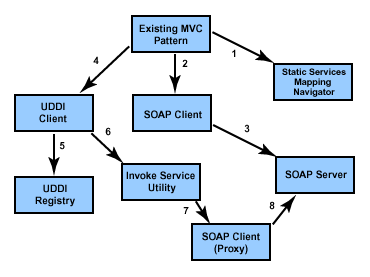
To provide an implementation, I have designed a sample MVC pattern with a Web service architecture applied to it. I will provide an implementation based on the architecture depicted in Figure 2. This architecture is dynamically invoked using a static services mapping navigator file. The implementation primarily shows you how Web services can be called using various APIs and how it can be applied to your existing MVC framework.
### Figure 2. Sample Web services architecture
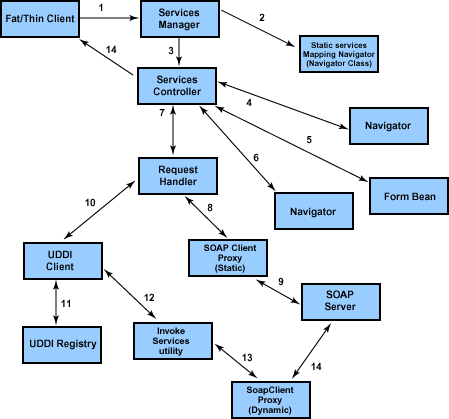
### Implementing the services manager
The *services manager* is the servlet, which interacts with the client. It creates an instance of the services controller and delegates the request/response parameters to it. During initialization, it loads the static services navigation file and populates the Navigator class.
---
### Implementing the Navigator class
The Navigator class is a static class whose responsibility is to parse your static navigation services file. Part of this file is shown in the listing below:
The Navigator class parses the navigation file and, based on serviceCount, populates a vector of size N counting objects of services. The object service class consists of three variables and accessors to the variables, namely serviceimplemenation, serviceimplemenationurn, and the methodName. The Navigator class also populates the formbean, package name, serviceCount, and dynamicLookup, and adds the variables to the same vector. Finally, the vector object is put into a hashmap with the service type as key (cheapestAirFare) and vector as an object.
The Navigator class thus has the following methods:
- ParseNavigationFile(pathofNavigationFile): Parses the navigation file and populates the hashmap.
- get/set ServicesCount(serviceType): Gets the servicesCount (number of static services registered) associated with serviceType. The set method for each variable is set during parsing.
- get/set formBean(serviceType): Gets the formBean associated with serviceType.
- get/set staticRequestHandler(serviceType): Gets the RequestHandler class associated with serviceType for static services.
- get/set dynamicRequestHandler(serviceType): Gets the RequestHandler class associated with serviceType for dynamic services.
- get services(serviceType,count): Gets the corresponding service object from a vector based on the element at which it is stored. First, based on serviceType, you get the corresponding vector object from the hashmap; then, using count as an index to the vector, you get the corresponding services object.
- get/set dynamicLookUp(serviceType): Gets the dynamicLookUp entry associated with serviceType.
All the above setter methods are populated when the static services mapping navigator file is parsed and getters are called by the services controller, which controls the whole flow dynamically.
---
### Implementing the ServicesController
The ServicesController class acts as an application controller, routing incoming client requests to appropriate request handlers and formbeans. These handlers interact with SOAP services statically as well as dynamically and coordinate view production via JavaServer Pages. The controller subsystem is responsible for:
- Calling the appropriate formbean based on the Navigator class.
- Routing incoming client requests to appropriate request handler code based on the Navigator class.
- Providing required model data for the presentation layer by consolidating responses from request handlers.
- Handling exceptions in a uniform way.
Let's walk step by step through the logic for your services controller.
1. Get the service type from the JavaServer Page.
```
serviceType = request.getParameter(serviceType);
```
2. Call the corresponding formbean.
```
IFormBean
```
is a Java interface class consisting of a processClientRequest (HttpServletRequest request) method, which all your formbeans extend.
```
IFormBean IformBean =
(IFormBean) class.forname(Navigator.getformBean(serviceType));
```
3. Call the formbean processClientRequest(HttpServletRequest request) method.
```
IformBean.processClientRequest(HttpServletRequest request)
```
4. Get the servicesCount from the Navigator class.
```
int Count = Navigator.getServicesCount(serviceType)
```
5. Create a temporary storage space (that is,Vector storeResults) to store all the results received from
```
requestHandlers
.
```
6. For each service count, call the request handler. IStaticRequestHandler is an Java interface class consisting of a processRequest(Services service,IFormBean iformBean) method, which all the RequestHandlers extend.
```
while(count &amp;amp;gt; 0)
{
IStaticRequestHandler requestHandler = (IStaticRequestHandler)
class.forname(Navigator.getstaticRequestHandler(serviceType);
```
7. Get the Services object based on count and service type from the Navigator class.
```
Services services =
Navigator.getservices(serviceType,count);
```
8. Call the requestHandler processRequest(Services service) method and pass the services object to it.
```
String tempdata =
requestHandler.processRequest(services,IformBean)
```
9. Store the results obtained in the storeResults vector.
```
storeResults.addElement(tempdata);
```
10. Decrement the count and end the while loop. Now you have the results of all static services invoked by the requestHandlers in the storeResults vector.
11. Check if DynamicLookup is enabled from the Navigator class.
```
boolean flag =
Navigator.getdynamicLookUp(serviceType)
```
12. If it is enabled, then look up your dynamic request handler class from the Navigator class. IDynamicRequestHandler is a Java interface class consisting of a processRequest(String serviceType,IFormBean IformBean) method, which all your dynamic request handlers extend.
```
IDynamicRequestHandler dynamicrequestHandler = (IDynamicRequestHandler)
class.forname(Navigator.getdynamicRequestHandler(serviceType);
```
13. Call the processRequest(serviceType) method and get back the data obtained by calling SOAP services looked up in the UDDI registry.
```
Vector dynamic =
dynamicrequestHandler.processRequest(serviceType,IformBean)
```
14. Put the vectors (static and dynamic) in the HttpRequest attribute and call the appropriate JSP based on serviceType. The corresponding JSP page takes the data from the HTTP requestattribute and displays the data to the user.
```
getServletContext().getRequestDispatcher
("/servicetype.jsp").forward(request,response);
```
---
### Implementing the FormBean
The FormBean retrieves the user-entered query from the HttpServlet request parameter. The services controller refers to the Navigator class's getformBean(serviceType) method for instantiating the corresponding formBean, as shown in step 2 of the logic above. After getting the formBean instance, the processClientRequest() method is executed, which populates the user queries from HTTP request parameters. For instance, for a cheapestAirFare service, the processClientRequest(HttpServletRequsr request) method of the cheapestAirFare class would be:
```
String country1 = request.getParameter("Country1");
String country2 = request.getParameter("Country2");
```
---
### Implementing of the static RequestHandler
The execute method of the static request handler, as shown in step 8 of the listing above, accepts the services object and formBean as input parameters. The job of each request handler is to call the SOAP client, pass the services object methods, and get back the result, like this:
```
String result = SOAPClient.process(services.getServiceImplemenation
(),services.getServiceImplemenationUrn(),services.getMethodName,IformBean);
```
---
### Implementation of the SOAP client
The job of each SOAP client is to send a query to a SOAP server and get back the results of that query. Figure 3 shows how a SOAP client communicates with a SOAP server. All the required parameters, like methodName, targetObject, and the location of the service, you get from requestHandler (via the Navigator class).
### Figure 3. A SOAP client communicating with a SOAP server
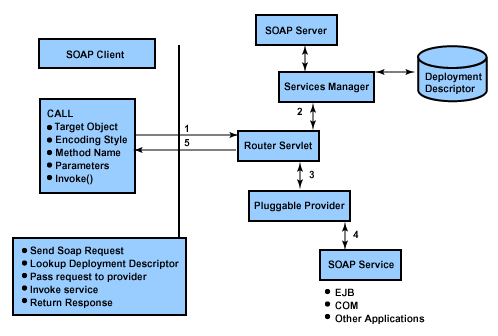
Here is some of the logic for the static client:
1. Create and initialize a new org.apache.soap.rpc.Call object.
```
Call call = new Call();
```
2. Set the target URN, method name, and parameters of the first service.
```
call.setTargetObjectURI(serviceUrn );
call.setMethodName(methodName );
```
3. Populate the parameter to be passed to the SOAP server.
```
Vector params =new Vector();
Parameter country1Param = new Parameter( "country1",String.class,
country1,,Constants.NS_URI_SOAP_ENC);
params.addElement(formBean.getCountry1());
Parameter country2Param = new Parameter(
"country2",String.class,country2,Constants.NS_URI_SOAP_ENC);
params.addElement(formBean.getCountry2());
call.setParams(params);
```
4. Set the target URL of the first service.
```
Response resp =null;
URL url =new URL (serviceImplementation);
```
5. Invoke the corresponding service.
```
Resp =call.invoke(serviceImplementation, serviceUrn);
Parameter result=resp.getReturnValue();
```
6. Get the result object from the SOAP server.
```
String farerate = (String ) result.getValue();
```
---
### Implementing the dynamic request handler
The job of each dynamic request handler is to call the UDDI client's processRequest(serviceType,IformBean) method, pass serviceType and formBean to it, and get back the results:
```
//Call The UDDI Client
Vector results = UDDIClient.processDyanmicRequest(serviceType,IformBean);
```
---
### Implementing the UDDIClient
UDDIClient communicates with the UDDI registry to find out whether a particularserviceType is available or not. It uses UDDI APIs to interact with the UDDI registry, as shown in Figure 4.
### Figure 4. serviceType interacting with the UDDI registry via UDDI APIs
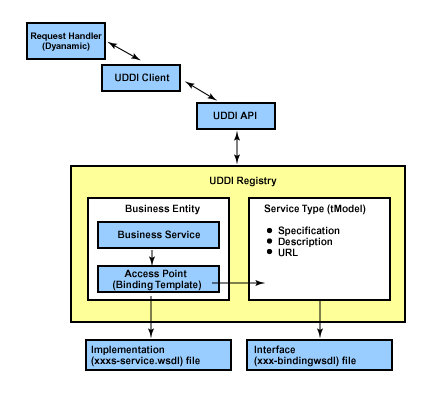
The listing below contains the logic for using the UDDI APIs to search for a particular serviceType in a UDDI directory. Once you have this serviceType, you use it to obtain the location(acessPoints) of the service and the WSDL document associated with that service.
1. Create an instance of the UDDI proxy.
```
UDDIProxy proxy =newUDDIProxy();
```
2. A location vector is required to store the location of each service obtained from UDDI.
```
Vector locationVecor = new Vector(1,1)
```
3. A WSDL location vector is required to store the location of WSDL documents for each service obtained from UDDI.
```
Vector wsdlVector = new Vector(1,1)
```
4. A results vector is required to store results obtained by invoking services obtained from UDDI.
```
Vector servicesVector = new Vector(1,1)
```
5. Set the inquiry and publish APIs.
```
String inquiryAPI ="http:/ibm.com/services/uddi/publishap";
String publishAPI ="http:/ibm.com/services/uddi/publishapi";
proxy.setInquiryURL(inquiryAPI);
proxy.setPublishURL(publishAPI);
```
6. Find the business entity associated with the serviceType.
```
BusinessList businessList = proxy.find_business(serviceType,null,0);
BusinessInfos bis =businessList.getBusinessInfos();
Vector v2 =bis.getBusinessInfoVector();
```
7. Find the business services associated with the business entity. For example, find all service providers providing the cheapestAirFare service.
```
for (int i2 =0;i2 &amp;amp;lt; v2.size();i2++){
BusinessInfo businessInfo = (BusinessInfo)v2.elementAt(i2);
ServiceInfos serviceInfos = businessInfo.getServiceInfos();
Vector v3 =serviceInfos.getServiceInfoVector();
```
8. Find the binding detail associated with each service.
```
for (int i3 =0;i3 &amp;amp;lt; v3.size();i3++){
ServiceInfo si =(ServiceInfo)v3.elementAt(i3);
String skey =si.getServiceKey();
BindingDetail bindingDetail =
proxy.find_binding(null,skey,null,0);
Vector v4 =bindingDetail.getBindingTemplateVector();
for (int i4 =0;i4 &amp;amp;lt; v4.size();i4++){
BindingTemplate bindingTemplate =
(BindingTemplate)v4.elementAt(i4);
```
9. Collect the access points from the binding template AccessPoint.
```
accessPoint = bindingTemplate.getAccessPoint();
```
10. Add the access point to your location vector.
```
locationVecor.addElement(accessPoint.getText());
```
11. Get the WSDL document for each service.
```
TModelInstanceDetails tid =bt.getTModelInstanceDetails();
Vector v5 =tid.getTModelInstanceInfoVector();
for (int i5 =0;i5 &amp;amp;lt; v5.size();i5++){
TModelInstanceInfo tii =
TModelInstanceInfo)v5.elementAt(i5);
InstanceDetails inst =tii.getInstanceDetails();
OverviewDoc od =inst.getOverviewDoc();
OverviewURL ou =od.getOverviewURL();
wsdlVector.addElement(ou.getText())); }}}}
```
12. Call the dynamic service utility method for providing mapping to the correct service utility classes to invoke.
```
for(int int i5 =0;i5 &amp;amp;lt;locationVecor.size();i5++)
{
IServiceUtility serviceUtility = (IServiceUtility)
DynamicServiceReistry.locate(locationVecor.elmentat(i5),
wsdlVector(i5));
String result= serviceUtility.processDynamicRequest(formbean);
servicesVector.addElement(i5,result);
}
//Return servicesVector
```
---
### Implementing the DynamicServiceRegistry
The DynamicServiceRegistry class is the mapper class, which gives us the correct serviceUtility to invoke based on the location of a service and its WSDL name. The listing below shows how the code works.
```
public IServiceUtility locate(String location,String wsdl) {
if(location.equals("http://location1/service/rpcrouter") &amp;amp;amp;&amp;amp;amp;
wsdl.equals("http://location/wsdl/cheapest-airface.wsdl"))
//Invoke Corresponding service utility class
IServiceUtility serviceUtility = (IServiceUtility)
class.forname("classname.packagename"+dynamicService1));
//Similarly for remaining services
else
// log all new services found to provide implementation
// of newly services obtained at a later stage
{
Log.newService('New Service Found At' +location +
"WSDL Document " + wsdl);
}
```
---
### Implementing the ServicesUtility
Each service utility class extends the IServiceUtility class, and implements the processDynamicRequest(formBean). For each dynamic service obtained, the corresponding services utility class is invoked. Each service utility class has it own implementation, since the URN name and method name each needs to invoke will be unique. For a new dynamic service that has been added, you could use a tool such as WebSphere Application Developer Studio that can dynamically generate a SOAP client based on a WSDL file obtained; or, the SOAP client can be coded by referring to a WSDL document, which will contain the method name to invoke and the URN of the Web service. After discovering the newly added service, the IDynamicServiceRegistry class can be updated to add an entry for the newly found service and corresponding service utility classes can be coded. Thus, serviceUtility classes will call the dynamic SOAP client for each service; the dynamic client performs the same job that the static SOAP client discussed above does, and gives back the result to the request handler.
---
### Conclusion
This completes the sample implementation of this architecture. Your implementation will differ, depending on own your MVC pattern, but the logic determining how you access static and dynamic services at the same time will remain the same. I hope the sample outlined here helps you build your own implementations.
This article of mine was first published by IBM DeveloperWorks.All rights retained by IBM and the author.
***This is the first proposed architecture on Web services for dynamic orchestration using a MVC pattern. The article is cited in my patents as prior arts and used in many conferences. The article was published in June 2002.***
---
# Approach to handle pagination in dynamic pages
URL: https://navveenbalani.dev/articles/approach-to-handle-pagination-in-dynamic-pages
Type: article | Date: 2010-05-28 | Topics: architecture
Many Web-based applications include the requirement to display some part of the user search results in chunks of pages. For example, think of the typical search engine, say Google, which displays search results in chunks of 10 or more items per page.
In this blog, I will describe how to implement this design requirement using features provided by DB2 ® Universal Database TM (UDB) and how to cache the results using a stateful bean or session. Though this example is specific to DB2 and JSP, the same approach can be used with any relational database and dynamic pages technique.
We will consider two approaches:
\* Querying the database to get records in chunks using the rownext() feature of DB2
\* Caching results in stateful session beans or HttpSession
### The scenario
We shall consider these approaches by looking at a scenario for a product-based Web site which allows the user to search for products offered based on category, price, brand, and so on. The results will be displayed in chunks of user-defined page sizes, say 10 or 20 items.
Here are our sample table definitions:
```
CREATE TABLE Product_Category(
category_id integer not null,
category_name varchar(200), not null
category_decription varchar2(500)
)
CREATE TABLE Product (
product_id Integer not null,
product_name varchar2(50) not null,
prod_category_id integer not null,
product_decription varchar2(100) not null,
product_price decimal(15,2),
product_status char(1) default 'Y',
product_width decimal(5,2) not null,
product_length decimal(5,2) not null,
product_created_date timestamp,
product_netweight decimal(10,3),
constraint PK_PRODUCT_ID PRIMARY KEY
(product_id),
constraint product_category_fk foreign key
(prod_category_id)
references Product_Category (category_id))
```
### Using DB2 features to achieve pagination
This approach is good for applications where you have a chance to do some design work before the database and application go into production.
Here we assume that the user wants the products to be displayed in chunk of 20 results per page. As we know, the rows in a relational table have no specific order, so the SQL query needs to be designed to allow the data to be retrieved in a particular order using an ORDER BY clause on the primary key, which in our case is our product id.
DB2 allows you to order a result set on the fly and fetch an arbitrary number of rows from the beginning or end of this result set.
Here is a query to select first 20 records from our product table based on the category "Books."
```
SELECT PRODUCT_ID, PRODUCT_NAME, PRODUCT_DESCRIPTION,
PRODUCT_PRICE, PROD_CATEGORY_ID
FROM PRODUCT,PRODUCT_CATEGORY
WHERE
PRODUCT.PROD_CATEGORY_ID
= PRODUCT_CATEGORY.CATEGORY_ID
AND
PRODUCT_CATEGORY.CATEGORY_ID = 'Books'
ORDER BY PRODUCT.PRODUCT_ID
FETCH FIRST 20 ROWS ONLY
```
The ORDER BY will force a sort of the entire result set in memory, so we're not doing this to improve DB2 server performance (although sending only 10 rows to the client may improve network performance).
If the order is not a factor and we just want to get the first 20 rows based on the user criteria, then we can eliminate the ORDER BY to save the sort on the DB2 server:
```
SELECT PRODUCT_ID, PRODUCT_NAME, PRODUCT_DESCRIPTION,
PRODUCT_PRICE, PROD_CATEGORY_ID
FROM PRODUCT,PRODUCT_CATEGORY
WHERE
PRODUCT. PROD_CATEGORY_ID
= PRODUCT_CATEGORY.CATEGORY_ID
AND
PRODUCT_CATEGORY.CATEGORY_ID = 'Books'
FETCH FIRST 20 ROWS ONLY
```
Since the application needs to display say 20 results per page, we can make use of the row\_next() feature provided by DB2.
Below is an example of how to select results from rows numbered 21 to 40. We assume that the user has selected category as "Books" and product description as "Application Servers".
```
SELECT * FROM (
SELECT PRODUCT_ID, PRODUCT_NAME,
PRODUCT_DESCRIPTION, PRODUCT_PRICE,
rownumber() OVER
(ORDER BY PRODUCT_ID)
AS ROW_NEXT
FROM PRODUCT,PRODUCT_CATEGORY WHERE
PRODUCT.PROD_CATEGORY_ID
= PRODUCT_CATEGORY.CATEGORY_ID
AND
PRODUCT_CATEGORY.CATEGORY_ID = 'Books'
AND
PRODUCT.PRODUCT_DESCRIPTION LIKE
'Application Servers'
)
AS PRODUCT_TEMP WHERE
ROW_NEXT BETWEEN 21 and 40
```
In the case of a Web-based application, the parameters "21" and "40" can be specified at run time. Here is the modified query:
```
SELECT * FROM (
SELECT PRODUCT_ID, PRODUCT_NAME,
PRODUCT_DESCRIPTION, PRODUCT_PRICE,
rownumber() OVER
(ORDER BY PRODUCT_ID) AS ROW_NEXT
FROM PRODUCT,PRODUCT_CATEGORY
WHERE
PRODUCT. PROD_CATEGORY_ID
= PRODUCT_CATEGORY.CATEGORY_ID
AND
PRODUCT_CATEGORY.CATEGORY_ID = 'Books'
AND
PRODUCT. PRODUCT_DESCRIPTION LIKE
'Application Servers'
)
AS PRODUCT_TEMP WHERE
ROW_NEXT BETWEEN ? and ?
```
The rownumber() function allows the developers to assign row numbers to results sets on the fly.
If the row\_next clause is removed ( ROW\_NEXT BETWEEN ? and ? ), all the rows that matched the criteria will be returned.
The SELECT \* FROM clause in case above can be thought of as a temporary table holding the entire result set that matches the criteria and than returning that set of results specified in the row range.
Using the rownumber() feature will cause an additional performance impact on the system as the database first fetches all rows that matches the criteria and returns only those rows specified in the range.
Next we look at the trade-offs and advantages of this approach and when it's an appropriate choice.
Trade-offs for this approach
- Transactions and performance impact
In this approach, the transactions need to be handled programmatically by the developer. In our scenario, if we assume that products are updated only once daily, say at midnight, we can use the lowest transaction isolation level of READ\_UNCOMITTED.
Using the row\_next feature definitely will have some performance impact on the database application as compared to a query without the row\_next feature. Also this approach requires us to hit the database each time to get next sequence of result sets based on the range of rows.
- Code portability
Fetching an arbitrary number of rows from the beginning or end of this result set is provided by almost every RDBMS system, though the SQL syntax varies. Hence if we move from one database vendor to other, we might have to modify the query accordingly.
- Providing seamless back button functionality
If our design requires browser back button functionality and the user is interested in viewing the latest information from the database each time, then this design can provide a possible solution. The drawback is that this may require a hit on the database for each results page, which might affect the performance drastically.
Basically the URL query will have the search parameters embedded which can be fed to our SQL Query. Here is a possible URL query:
http://localhost:8050/ProductSearch?
minprize=50& maxprice=100& pagecount=20& resultsPerpage=10
When the user clicks on browser back button, the previous URL to be displayed in browser will be:
http://localhost:8050/ProductSearch?
minprize=50&maxprice=100&pagecount=10&resultsPerpage=10
We'll assume that the latest page id is available in the session. So the browser back button can be tracked as follows:
```
if(!session.getAttribute("pageID).equalsIgnoreCase
(request.getAttribute("pageCount")){
//Then user has clicked the back button
//Get possible search parameters, pagecount
//and resultsPerPage from URL and formulate
//a dynamic URL and post the information back
//to the servlet.The URL would be
http://localhost:8050/ProductSearch?minprize=50&
maxprice=100&pagecount=10&resultsPerpage=10</p>
return;
//Done display the results screen page
}
```
Using this approach the user will be able to view the latest information from the database.
Next we move on to our second approach, which is widely used in many applications.
### Caching result sets in stateful beans or HttpSession
This is one of the widely used approaches to pagination in which results are cached in some stateful object like session beans or HttpSession. The choice between HttpSession or stateful bean depends upon the size of the data to be retrieved. If there is large amount of data one should definitely go for the stateful session bean method.
In this approach we would get all the results from the database in one go and store the results in our stateful session bean.
Here is a possible query to retrieve all the books that are available in our product table:
```
[
SELECT PRODUCT_ID, PRODUCT_NAME, PRODUCT_DESCRIPTION,
PRODUCT_PRICE, PROD_CATEGORY_ID
FROM PRODUCT
WHERE
PRODUCT. PROD_CATEGORY_ID
= PRODUCT_CATEGORY.CATEGORY_ID
AND
PRODUCT_CATEGORY.CATEGORY_ID = 'Books'
```
Here is our design of our remote interface stateful bean:
```
public void setSearchResults(Category category)
throws RemoteException
public Category getPerPagSearchResults(String page_count)
throws RemoteException
Here is what typical Category and Product objects would look like:
public class Category extends java.io.Serializable {
private String category_id,
private String category_name,
//Holds an Array List of products under that category.
private ArrayList products;
}
public class Product extends java.io.Serializable {
private String product_id;
private String product_name;
private String product_desc;
private String product_price;
}
```
Here are the steps required to achieve pagination:
1. Get the result set based on the search criteria.
2. Loop though the result set and store each product object in our product ArrayList.
3. Store the array list of project objects in the category object.
4. Call our remote method setSearchResults and store the category object.
5. In order to get results to be displayed per page, call the remote method getPerPagSearchResults() passing the page\_count (such as 10 or 20) to retrieve the corresponding records.
Here is our typical implementation of getPerPagSearchResults(String page\_count):
```
//Check if Product List contains at least page_count products
int len = category.getProduct_list().length>page_count
? page_count : category.getProduct_list().length
ArrayList product_tempList = new ArrayList();
for( int i = page_count+1 ; i < len ; i++){
//Loop though the product list array and get
//corresponding records
product_tempList.add(category.getProduct_list().get(I);
}
//return category object containing an arraylist of
//products containg records from page_count
//to page_count+10 or product_list.length if
//product_list.length is less than page_count+10
return product_tempList
```
The product list can be iterated and all the product information can be displayed at that point. Whenever the next button is clicked the next page\_count can be passed to our servlet, which does the same process listed above.
Trade-offs for this approach
- Transaction and performance impact
In this approach, fetching the result set based on the search criteria needs to be handled by the developer, while maintaining the state of our category object to implement caching is handled by the EJB Container. This provides an additional layer for managing our client state.
This approach will definitely provide better performance than our earlier one, as we will avoid subsequent database calls and will have caching of result sets.
Since we are caching the results, it is possible that the user might be viewing stale data. Because of this issue, this approach is well-suited for an application where the data is not constantly updated. For example if you are updating your products list every night at midnight, then the viewer will likely not be viewing stale data when using the application throughout the day.
- Code portability
This approach provides a vendor-neutral approach as our caching logic can be moved from one EJB container to another without changing our code. However we might have to modify our EJB vendor-specfic deployment descriptor if the code needs to be run on different EJB containers.
- Providing back button functionality using this approach
Consider an example where the browser cache is disabled and the user clicks on the browser back button. That would result in the browser requesting the JSP page again. Now suppose we navigate across different search criteria pages. As per this design only the latest search results will be displayed, as we are keeping our latest search results in the Stateful bean. So in order to track which search criteria the user is working on, we can store the search criteria in the session and compare it with request parameters present in the URL when user clicks on the browser back button.
Here is sample code that is present in the JSP which displays Search Results page:
SearchCriteria searchObjSession = (SearchCriteria)
session.getAttribute("SearchCriteria")
Next we would get search parameters from the URL .Here we assume that URL is:
http://localhost:8050/ProductSearch?minprize=50&maxprice=100
&pagecount=10&resultsPerpage=10
Here is the sample code:
```
SearchCriteria previousSearch = new SearchCriteria();
If(request.getAttribute("minPrice") != null){
previousSearch.setMinPrice(request.getAttribute("minPrice"))</p>
//and so on for remaining parameters
//Next we would compare our SearchCriteria object from session with our PreviousSearch object:
if(!searchObjSession.equals(previousSearch)){
//User is trying to view previous search results
//Show an error to user that he is allowed to work on latest
//search criteria only or else
//depending on your business logic you can give a call to
//database with previous search
//criteria and store it in our Stateful bean and display the
//results back to the user.
//Redirect him to Search Criteria Page or Search Results Page
// return;
}
```
**Which approach is best for me?**
Based on your requirements you can apply a combination of both approaches. The most widely used approach is that which provides caching of result sets.
Consider a scenario where we want to display only the latest 20 products that have been added. The first approach definitely can be used since in this case sorting of the result sets and providing only 20 records would be a job for the database system. This scenario is very useful if your database is located remotely as this will ensure only 20 records flow over the network layer.
### Conclusion
We've talked about how to achieve pagination using two possible approaches. Depending upon your application and business needs, one of these approaches can be used to solve the pagination problem for your Web applications.
This article of mine was first published by IBM DeveloperWorks at -http://www.ibm.com/developerworks/data/library/techarticle/0307balani/0307balani.html.All rights retained by IBM and the author.
&amp;lt;A HREF="http://ws.amazon.com/widgets/q?ServiceVersion=20070822&amp;amp;MarketPlace=US&amp;amp;ID=V20070822%2FUS%2Fsw0fd-20%2F8003%2F34b0bfca-73fa-4e85-be5a-01e2b6e00b80&amp;amp;Operation=NoScript" mce\_HREF="http://ws.amazon.com/widgets/q?ServiceVersion=20070822&amp;amp;amp;MarketPlace=US&amp;amp;amp;ID=V20070822%2FUS%2Fsw0fd-20%2F8003%2F34b0bfca-73fa-4e85-be5a-01e2b6e00b80&amp;amp;amp;Operation=NoScript"&amp;gt;Amazon.com Widgets&amp;lt;/A&amp;gt;
---
# Applying MVC Pattern to web services
URL: https://navveenbalani.dev/articles/applying-mvc-pattern-to-web-services
Type: article | Date: 2010-05-26 | Topics: architecture
Web services can be invoked statically using a WSDL service interface and service implementation documents, or dynamically by retrieving the service type definitions and the service implementation via UDDI. But until now, you couldn't do both at the same time. You can now do this using the Model View Controller pattern (or MVC); this architecture supports both dynamic and static Web services. This article is primarily a design exercise and assumes that you know about design patterns and the MVC system. Please look to the resources to learn more about MVC.
The MVC paradigm is a way of breaking an application, or even just a piece of an application's interface, into three parts: the model, the view, and the controller.
The model represents enterprise data and the business rules that govern access to and updates of this data. Often the model serves as a software approximation to a real-world process, so simple real-world modeling techniques apply when defining the model.
A view renders the contents of a model. It accesses enterprise data through the model and specifies how that data should be presented. It is the view's responsibility to maintain consistency in its presentation when the model changes. This can be achieved by using a push model, where the view registers itself with the model for change notifications, or a pull model, where the view is responsible for calling the model when it needs to retrieve the most current data.
A controller translates interactions with the view into actions to be performed by the model. In a stand-alone GUI client, user interactions could be button clicks or menu selections, whereas in a Web application, they appear as GET and POST HTTP requests. The actions performed by the model include activating business processes or changing the state of the model. Based on the user interactions and the outcome of the model actions, the controller responds by selecting an appropriate view.
The MVC architecture has the following benefits:
- Multiple views using the same model. The separation of model and view allows multiple views to use the same enterprise model. Consequently, an enterprise application's model components are easier to implement, test, and maintain, since all access to the model goes through these components.
- Easier support for new types of clients. To support a new type of client, you simply write a view and controller for it and wire them into the existing enterprise model.
**An example of MVC in Web services** Consider the example of a hosting site which finds the cheapest airfare between two destinations based on user queries. The hosting site looks up known Web services, which are registered in a Static Navigation Service file. This is a static look up of Web services, as the Web services interface and implementation are known to the system. The Static Navigation Service file is an XML file with entries like the following:
The explanation of each entry is given below:
- type (*required*): When the user selects a service, its type is set in a hidden parameter field which is passed to the controller servlet. The type which is set corresponds to the entry that is mapped in this file. This attribute is required, as our servlet dynamically creates and invokes Web services based on this parameter.
- serviceimplemenation1: The first static service target URL where the first Web service is located.
- serviceimplemenation1urn1: The first static service target URN (Uniform Resource Name). The URN uniquely identifies the service to the client.
- methodName1: The method name to call the corresponding URN for serviceimplemenation1urn1.
- dynamicLookup: There are two possible values -- *yes* or *no*. A *yes* entry implies the performance of a dynamic lookup in UDDI for the corresponding service, while a *no* implies the opposite.
- nextscreenid= (*required*): This identifies which screen should be invoked, based on the service type. This attribute is required as the servlet dynamically calls the corresponding screen based on this parameter.
The variable N defined in Static Navigation File above implies that there can be N service implementations providing the same Web service: This architecture invokes all of these services and consolidates the results of all the services for the user.
---
**The architecture model** The architecture can be visualized as the model presented in below Figure . 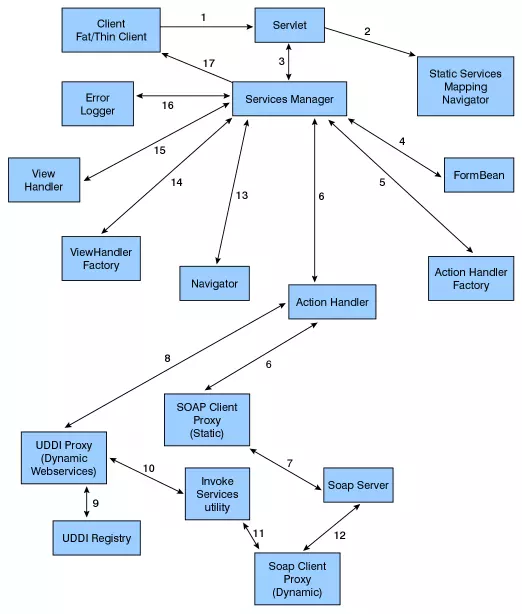 The graphic shows the interactions between the various components involved in this example, numbered according to the steps involved in the process of finding the cheapest fare. The table explains each of these steps in turn. **Table 1: Process steps in the Cheapest Airfare application**
| Steps | Explanation |
| --- | --- |
| 1 | The flat/thin client selects the required service which is being looked for -- for example, cheapest airfare service between the UK and the US. |
| 2 | The servlet creates a new instance of the Service Manager and sends request and response objects to the Service Manager. |
| 3 | The servlet loads the static Service Mapping Navigator file, which contains definitions of service types (for example, cheapest airfare service), as well as the service provider and its urn. These services are static, as they are known to the system. |
| 4 | The Services Manager calls the corresponding formBean by instantiating the formBean factory. The formBean factory takes the service type from the http request parameter and calls the corresponding formBean. For example, if the service type is cheapestService, the formBean called is cheapestServiceFormBean. The corresponding formBean retrieves the user-entered query from the Httpservlet request parameter (for example, US and UK) and populates itself. |
| 5 | The Services Manager instantiates the corresponding ActionHandler depending on the service type and method name (N) using the ActionHandler Factory. For example, if the service type is cheapestAirFare and the method name is getRate, then the ActionHandler factory would instantiate cheapestAirFaregetRateActionHandler. For a corresponding service type, there can be many service implementations -- hence there should be the same number of action handlers, since each may perform different logic. As for the return type, for some services this might be a simple string -- for others it might be an XML document. So the corresponding action handlers must process those and ultimately return a common type -- for example, a string. In this case, the string would represent a price such as $3000. |
| 6 | The Services Manager now invokes a method on ActionHandler, which performs various operations like invoking the SOAP Client and passing the required service implementor URLs, URN, and method name. The Services Manager is also responsible for placing the results it receives from the SOAP client into the common data -- which contains the results from all of the action handlers. For example, the cheapest airfare for serviceimplemenation1urn1 would be $3000; for others it would be $3200, and so on. |
| 7 | The SOAP client communicates with the SOAP server and invokes the required services. This logic is part of each action handler. |
| 8, 9, 10 | This comes into play if the dynamic Web services lookup is enabled in the navigation file. The UDDI proxy communicates with the UDDI registry to find all business entities corresponding to the service name and find their service implementor's URL, URN, and the corresponding method name to invoke -- and then invokes the service utility class. |
| 11 | The service utility calls the SOAP client dynamically for each service implementation and passes the service implementation URL, URN, and method name. The service utility class is responsible for dynamically creating a SOAP request and getting the response back from the SOAP server. |
| 12 | The SOAP client dynamically communicates with the SOAP server and invokes the required services. |
| 13 | The Service Manager gets the next screen name from the Static Services Mapping Navigator file based on the current service type. |
| 14 | The ViewHandler factory calls the corresponding view handler based on the screen name. |
| 15 | The ViewHandler populates the view by retrieving data from the common data object. |
| 16 | If any system error occurs during the course of these activities,control will be passed to the error logger which redirects to the Error Page. |
| 17 | Finally, the data is displayed to the client. |
The main advantage of this system is that this design is good for component-based development or for services where the overall architecture remains the same, and components can easily be plugged in. The listing below is some sample code of what an ActionHandler factory might look like. In this example, IActionHandler is an interface which is extended by all action handlers. **Listing 1: Sample ActionHandler Factory**
public class ActionHandlerFactory {
public IActionHandler getActionHandler(String serviceType ,
String methodName)
{
IActionHandler iaction = null;
try
{
String className = serviceType + methodName + "ActionHandler";
iaction = (IActionHandler) Class.forName(className).newInstance();
}
catch (Exception e) {
e.printStackTrace();
}
return iaction;
}
}
**Listing 2 below is a code snippet of how an action handler might look.**
public class cheapestAirFaregetRateActionHandler implements IActionHandler {
public void performProcess(Formbean formbean, String serviceUrl,
String serviceUrn, String methodName, CommonData commonData)
{
//Type cast FormBean to current formbean i.e cheapestServiceFormBean
cheapestServiceFormBean chServiceformBean = (cheapestServiceFormBean) FormBean
//Get the destinations name from chServiceformBean
String country1 = chServiceformBean.getCountry1();
String country2 = chServiceformBean.getCountry2();
// Create and initialize the org.apache.soap.rpc.Call object.
Call call =new Call();
//Set the target URI .Method Name of service implementation1
// serviceUrn = urn:fare
call.setTargetObjectURI (serviceUrn );
// methodName=getRate
call.setMethodName (methodName );
Vector params =new Vector();
//Populate the parameter to be passed to soap server
Parameter country1Param =new Parameter(
"country1",String.class,country1, ",Constants.NS\_URI\_SOAP\_ENC);
params.addElement(country1Param);
Parameter country1Param =new Parameter(
"country2",String.class,country2,Constants.NS\_URI\_SOAP\_ENC);
params.addElement(country2Param);
call.setParams(params);
Response resp =null;
// Set the url of service implemenation1
// serviceUrl = http://airservice.com/rrpcrouter
URL url =new URL (serviceUrl);
// Invoke the corresponding service
Resp =call.invoke (serviceUrl, serviceUrn);
Parameter result=resp.getReturnValue();
//Get the result object from soap server
Object o = result.getValue();
// Do processing on result to get back the result in string ,
//and put the data in commonData
}
}
This completes the architecture for calling static and dynamic web services via the MVC Pattern. In the next blog, I would provide some implementation details to the MVC Pattern. Stay tuned.
This article of mine was first published by IBM DeveloperWorks.All rights retained by IBM and the author.
***This is the first proposed architecture on Web services for dynamic orchestration using a MVC pattern. The article is cited in my patents as prior arts and used in many conferences. The article was published in June 2002.***
---
# Create web services using XSD first approach
URL: https://navveenbalani.dev/articles/create-web-services-using-xsd-first-approach
Type: article | Date: 2010-05-25 | Topics: architecture
In this blog, we will look at how to create web services starting from XSD. You will probably start with XSD, when you are using contract first development and defining contract for your web services or have an existing XSD that you would want to use as part of web service development. Lot's of industry schemas is available as XSD such as ACORD and while developing industry solutions for interoperability, you would typically use XSD approach if a standard schema is available for that industry domain. XSD would provide the input and output message format for web service operations.
We will revisit the sample example of Order process application that I had listed in my blog - [CXF and Spring Tutorial](/articles/cxf-and-spring-tutorial) . In that blog, I had used the code first approach, where I started with Java code and exposed it as web services.
First we would create the contract for the Order Processing web service. We would name this as Order.xsd. Following shows the listing of Order.xsd. For simplicity, we would use the same Order.xsd schema for input and output operations.
Once you have created the contract, there are two alternatives that you have. First alternative is to create a WSDL and include the XSD as part of it and than use the CXF WSDL2Java to create a service implementation. Next approach is to generate Java objects from XSD and used the generated object for input and output operations while creating web services. In this later approach, you don't need to create a WSDL and instead can start off with Java code and use the generated object as input and output parameter for service methods. We would go with the second approach.
Next we would generate the Java type objects for XML Schema using XMLBeans . XMLBeans is a technology for accessing XML by binding it to Java types. Before that, let's create the project structure for our web service project. To get started, I have provided the project source code in a zip file. [Download the project](http://books.naveenbalani.com/wp-content/plugins/download-monitor/download.php?id=5) and unzip it any drive.
The schemas folder contains the Order.xsd and src contains the source code for web service project. The build.xml contained in cxfxsdfirst folder, is the ant build file for building and running the project. The build.xml requires CXF\_HOME environment variable to be set to CXF distribution as it uses CXF and dependent library files from CXF\_HOME\lib for building and running the code .
Next we would, generate the Java XML schema code for *Order.xsd* by running the following command.
ant buildOrderXMLBean
This *buildOrderXMLBean* uses the org.apache.xmlbeans.impl.tool.XMLBean class to generate Java types for Order.xsd. After running the above command, the generated compiled files would be packaged inside jar file named orderxmlbeans.jar and copied into build folder. The *order* element defined in Order.xsd would be mapped to the generated Order class. We would use the Order class as input and output parameter for the web service operation.
Next, we would create a service interface and service implementation for Order Process service. The service interface and implementation is exactly the same as Order Process service that was developed in code first approach in my earlier blog, hence I will no got into much details on explaining the code. If you need more details, please refer to my earlier post-[CXF and Spring Tutorial](../index.php/2010/05/cxf-and-spring-tutorial/)
Following shows the service interface. The source code is available in cxfxsdfirst/src/demo/order
package demo.order;
import javax.jws.WebService;
@WebService
public interface OrderProcess {
Order processOrder(Order order);
}
Note that the Order class parameter comes from the generated Java types. That's the only difference from code first approach in terms of service interface and implementation, where we have had created the Order java bean upfront.
The implementation class is OrderProcessImpl.java. Following shows the listing
package demo.order;
import javax.jws.WebService;
@WebService
public class OrderProcessImpl implements OrderProcess {
public Order processOrder(Order order) {
String orderID = validate(order);
order.setId(orderID);
return order;
}
//Rest of the code commented out. Refer to downloaded code
}
Next, we would create a Stand-alone server named Server.java that would publish the order process server. The following shows the code listing. The code is available in cxfxsdfirst/src/demo/order.
package demo.order;
import java.io.BufferedReader;
import java.io.IOException;
import java.io.InputStreamReader;
import org.apache.cxf.databinding.DataBinding;
import org.apache.cxf.jaxws.JaxWsServerFactoryBean;
public class Server {
public static void main(String[] args) {
// Service instance
OrderProcess orderProcess = new OrderProcessImpl();
//AddressVerifyProcess orderProcess = new AddressVerifyProcessImpl();
JaxWsServerFactoryBean restServer = new JaxWsServerFactoryBean();
restServer.setServiceBean(orderProcess);
restServer.setAddress("http://localhost:8080/");
try {
restServer.setDataBinding(org.apache.cxf.xmlbeans.XmlBeansDataBinding.class.newInstance());
} catch (IllegalAccessException e1) {
e1.printStackTrace();
} catch (InstantiationException e1) {
e1.printStackTrace();
}
restServer.create();
BufferedReader br = new BufferedReader(new InputStreamReader(System.in));
try {
br.readLine();
} catch (IOException e) {
}
System.out.println("Server Stopped");
}
}
The code above uses the JaxWsServerFactoryBean for publishing the Order Process service class over address . The most important code of the Order Process is the following line.
restServer.setDataBinding(org.apache.cxf.xmlbeans.XmlBeansDataBinding.class.newInstance());
This tells the CFX framework to uses XmlBeans data binding , instead of default JAXB data binding.
Next , we would create a stand-alone client that would invoke the Order Process service. The client and Spring configuration file s similar to one developed for code first. If you need details of the explanation of the code. please refer to Developing a client section in [CXF and Spring Tutorial](../index.php/2010/05/cxf-and-spring-tutorial/) blog.
The client code is available in - cxfxsdfirst/src/demo/order/client folder. Following shows the code listing for Client.java
package demo.order.client;
import demo.order.OrderProcess;
import demo.order.Order;
import demo.order.impl.OrderImpl;
import org.springframework.context.support.ClassPathXmlApplicationContext;
public final class Client {
public Client() {
}
public static void main(String args[]) throws Exception {
ClassPathXmlApplicationContext context
= new ClassPathXmlApplicationContext(new String[] {"demo/order/client/client-beans.xml"});
OrderProcess client = (OrderProcess) context.getBean("orderClient");
Order order = Order.Factory.newInstance();
order.setCustomerID("C001");
order.setItemID("I001");
order.setQty(100);
order.setPrice(200.00);
Order orderResponse = client.processOrder(order);
String message = (orderResponse.getId() == null) ? "Order not approved" : "Order approved; order ID is " + orderResponse.getId();
System.out.println(message);
}
}
The following shows the client-beans.xml, the Spring configuration file which is used by Client.java.
The following definition tells the CXF framework to use XMLBeans data binding framework.
Next, we would see our code in action. The outline is same as one defined in Running the code section of my earlier blog “ [CXF and Spring Tutorial](../index.php/2010/05/cxf-and-spring-tutorial/)
Navigate to cxfxsdfirst and type in the following command
- ant build
This would build the source code.
- ant server
This would execute the Java class - demo.order.Server and publish the OrderProcess service over address [http://localhost:8080](http://localhost:8080/) .You can see the WSDL for OrderProcess service by typing the URL - in the browser
- ant client
Open up a new window and type the above command. The would execute the Java class - demo.order.client.Client and invoke the OrderProcess service. You would see the order id being displayed in the console.
To know, more about how to develop SOAP and RESTful web services, get a copy of my Apache CXF Web Service Book -
[Click this link to buy the book.](http://amzn.to/2ctLEmu)
---
# Extending WIFI range by connecting two router wirelessly
URL: https://navveenbalani.dev/articles/extending-wifi-range-by-connecting-two-router-wirelessly
Type: article | Date: 2010-05-23 | Topics: experimental
I wanted to extend the WIFI coverage at my home and was looking out for options to how to extend it. One solution was to have two wireless routers and connect it via an ethernet cable. Other solution was to buy an N plus router, but that didn't help as I had only a slight improvement in my existing coverage, plus the additional N plus USB connector. I than decided to look out for some information on how to connect two routers wirelessly. I had a DLink DI-52 wireless model and wanted to extend it using a wireless device. I had heard about third party router firmware's which provide support for a wireless Bridge mode that connects two routers wirelessly.
I decided to evaluate DD-WRT, the widely used third party firmware which supports many router devices, unfortunately it didn't support my device. Before trying this, please make sure your devices is supported from the DD-WRT website. I decided to get a compatible device (WRH54G) and installed the DD-WRT firmware on it. The firmware installation went without any flaws. After installation, I went to the DD-WRT router admin page and connected the device as a router bridge to my existing wireless connection. That's it , I now have WIFI coverage in my entire home and as and when ever required I can move my second wireless device (WRH54G) an get more coverage , since the two routers now connect wirelessly. The DD-WRT firmware also offered me a host of functionality, like QOS and tracking which was not provided my default router firmware.
Hope this would give you some insights on how to connect two routers wirelessly and one more viable option to extend WI-FI coverage.
&amp;amp;amp;amp;amp;amp;amp;amp;amp;amp;lt;A HREF="http://ws.amazon.com/widgets/q?ServiceVersion=20070822&amp;amp;amp;amp;amp;amp;amp;amp;amp;amp;amp;MarketPlace=US&amp;amp;amp;amp;amp;amp;amp;amp;amp;amp;amp;ID=V20070822%2FUS%2Fsw0fd-20%2F8010%2F600b4f48-d1ba-4387-b32d-aa8ce2016e51&amp;amp;amp;amp;amp;amp;amp;amp;amp;amp;amp;Operation=NoScript" mce\_HREF="http://ws.amazon.com/widgets/q?ServiceVersion=20070822&amp;amp;amp;amp;amp;amp;amp;amp;amp;amp;amp;amp;MarketPlace=US&amp;amp;amp;amp;amp;amp;amp;amp;amp;amp;amp;amp;ID=V20070822%2FUS%2Fsw0fd-20%2F8010%2F600b4f48-d1ba-4387-b32d-aa8ce2016e51&amp;amp;amp;amp;amp;amp;amp;amp;amp;amp;amp;amp;Operation=NoScript"&amp;amp;amp;amp;amp;amp;amp;amp;amp;amp;gt;Amazon.com Widgets&amp;amp;amp;amp;amp;amp;amp;amp;amp;amp;lt;/A&amp;amp;amp;amp;amp;amp;amp;amp;amp;amp;gt;
---
# Apache CXF Architecture Overview
URL: https://navveenbalani.dev/articles/apache-cxf-architecture-overview
Type: article | Date: 2010-05-20 | Topics: architecture
The Apache CXF framework helps you to develop web services using standards based programming model and also provides a flexible deployment model for deploying web services. In this blog, I would provide an overview of CXF Architecture. The architecture of CXF is built upon the following components:
\* Bus
\* Frontend
\* Messaging and Interceptors
\* Service Model
\* Data bindings
\* Protocol bindings
\* Transport
The following figure shows the overall architecture:
### Bus
**Bus** is the backbone of the CXF architecture. The CXF bus is comprised of a Spring-based configuration file, namely, cxf.xml which is loaded upon servlet initialization through SpringBusFactory. It defines a common context for all the endpoints. It wires all the runtime infrastructure components and provides a common application context. The SpringBusFactory scans and loads the relevant configuration files in the META-INF/cxf directory placed in the classpath and accordingly builds the application context. It builds the application context from the following files:
\* META-INF/cxf/cxf.xml
\* META-INF/cxf/cxf-extension.xml
\* META-INF/cxf/cxf-property-editors.xml
The XML file is part of the installation bundle's core CXF library JAR. Now, we know that CXF internally uses Spring for its configuration. The following XML fragment shows the bus definition in the cxf.xml file.
The core bus component is CXFBusImpl. The class acts more as an interceptor provider for incoming and outgoing requests to a web service endpoint. These interceptors, once defined, are available to all the endpoints in that context. The cxf.xml file also defines other infrastructure components such as BindingFactoryManager, ConduitFactoryManager, and so on. These components are made available as bus extensions. One can access these infrastructure objects using the getExtension method. These infrastructure components are registered so as to get and update various service endpoint level parameters such as service binding, transport protocol, conduits, and so on.
CXF bus architecture can be overridden, but one must apply caution when overriding the default bus behavior. Since the bus is the core component that loads the CXF runtime, many shared objects are also loaded as part of this runtime. You want to make sure that these objects are loaded when overriding the existing bus implementation.
You can extend the default bus to include your own custom components or service objects such as factory managers. You can also add interceptors to the bus bean. These interceptors defined at the bus level are available to all the endpoints. The following code shows how to create a custom bus:
SpringBeanFactory.createBus("mycxf.xml")
SpringBeanFactory class is used to create a bus. You can complement or overwrite the bean definitions that the original cxf.xml file would use. For the CXF to load the mycxf.xml file, it has to be in the classpath or you can use a factory method to load the file. The following code illustrates the use of interceptors at the bus level:
...
The preceding bus definition adds the logging interceptor that will perform logging for all outgoing messages.
### Frontend
CXF provides the concept of frontend modeling, which lets you create web services using different frontend APIs. The APIs let you create a web service using simple factory beans and JAX-WS implementation. It also lets you create dynamic web service clients. The primary frontend supported by CXF is JAX-WS. We will look at how to use the Frontend programming model in the next chapter.
**JAX****-WS**
JAX-WS is a specification that establishes the semantics to develop, publish, and consume web services. JAX-WS simplifies web service development. JAX-WS defines Java-based APIs that ease the development and deployment of web services. The specification supports WS-Basic Profile 1.1 that addresses web service interoperability. It effectively means a web service can be invoked or consumed by a client written in any language. JAX-WS also defines standards such as **JAXB** and **SAAJ**. CXF provides support for complete JAX-WS stack.
JAXB provides data binding capabilities by providing a convenient way to map XML schema to a representation in Java code. The JAXB shields the conversion of XML schema messages in SOAP messages to Java code without the developers seeing XML and SOAP parsing. JAXB specification defines the binding between Java and XML Schema. SAAJ provides a standard way of dealing with XML attachments contained in a SOAP message.
JAX-WS also speeds up web service development by providing a library of annotations to turn Plain Old Java classes into web services and specifies a detailed mapping from a service defined in WSDL to the Java classes that will implement that service. Any complex types defined in WSDL are mapped into Java classes following the mapping defined by the JAXB specification.
As discussed earlier, two approaches for web service development exist: Code-First and Contract-First. With JAX-WS, you can perform web service development using one of the said approaches, depending on the nature of the application.
With the Code-first approach, you start by developing a Java class and interface and annotating the same as a web service. The approach is particularly useful where Java implementations are already available and you need to expose implementations as services.
You typically create a **Service Endpoint Interface** (**SEI**) that defines the service methods and the implementation class that implements the SEI methods. The consumer of a web service uses SEI to invoke the service functions. The SEI directly corresponds to a wsdl:portType element. The methods defined by SEI correspond to the wsdl:operation element.
@WebService
public interface OrderProcess {
String processOrder(Order order);
}
JAX-WS makes use of annotations to convert an SEI or a Java class to a web service. In the above example, the @WebService annotation defined above the interface declaration signifies an interface as a web service interface or Service Endpoint Interface. In the Contract-first approach, you start with the existing WSDL contract, and generate Java class to implement the service. The advantage is that you are sure about what to expose as a service since you define the appropriate WSDL Contract-first. Again the contract definitions can be made consistent with respect to data types so that it can be easily converted in Java objects without any portability issue.
WSDL contains different elements that can be directly mapped to a Java class that implements the service. For example, the wsdl:portType element is directly mapped to SEI, type elements are mapped to Java class types through the use of Java Architecture of XML Binding (JAXB), and the wsdl:service element is mapped to a Java class that is used by a consumer to access the web service.
The WSDL2Java tool can be used to generate a web service from WSDL. It has various options to generate SEI and the implementation web service class. As a developer, you need to provide the method implementation for the generated class. If the WSDL includes custom XML Schema types, then the same is converted into its equivalent Java class.
### Simple frontend
Apart from JAX-WS frontend, CXF also supports what is known as 'simple frontend'. The simple frontend provides simple components or Java classes that use reflection to build and publish web services. It is simple because we do not use any annotation to create web services. In JAX-WS, we have to annotate a Java class to denote it as a web service and use tools to convert between a Java object and WSDL. The simple frontend uses factory components to create a service and the client. It does so by using Java reflection API. In Chapter 3 we will look at how to develop simple frontend web services
The following code shows a web service created using simple frontend:
// Build and publish the service
OrderProcessImpl orderProcessImpl = new OrderProcessImpl();
ServerFactoryBean svrFactory = new ServerFactoryBean();
svrFactory.setServiceClass(OrderProcess.class);
svrFactory.setAddress("http://localhost:8080/OrderProcess");
svrFactory.setServiceBean(orderProcessImpl);
svrFactory.create();
### Messaging and Interceptors
One of the important elements of CXF architecture is the Interceptor components. Interceptors are components that intercept the messages exchanged or passed between web service clients and server components. In CXF, this is implemented through the concept of Interceptor chains. The concept of Interceptor chaining is the core functionality of CXF runtime.
The interceptors act on the messages which are sent and received from the web service and are processed in chains. Each interceptor in a chain is configurable, and the user has the ability to control its execution.
The core of the framework is the Interceptor interface. It defines two abstract methods ”handleMessage and handleFault. Each of the methods takes the object of type Message as a parameter. A developer implements the handleMessage to process or act upon the message. The handleFault method is implemented to handle the error condition. Interceptors are usually processed in chains, with every interceptor in the chain performing some processing on the message in sequence, and the chain moves forward. Whenever an error condition arises, a handleFault method is invoked on each interceptor, and the chain unwinds or moves backwards.
Interceptors are often organized or grouped into phases. Interceptors providing common functionality can be grouped into one phase. Each phase performs specific message processing. Each phase is then added to the interceptor chain. The chain, therefore, is a list of ordered interceptor phases. The chain can be created for both inbound and outbound messages. A typical web service endpoint will have three interceptor chains:
\* Inbound messages chain
\* Outbound messages chain
\* Error messages chain
There are built-in interceptors such as logging, security, and so on, and the developers can also choose to create custom interceptors.
### Service model
The Service model, in a true sense, models your service. The Service model is a framework of components that represents a service in a WSDL-like model. It provides functionality to create various WSDL elements such as operations, bindings, endpoints, schema, and so on. The following figure shows the various components that form the Service model:
The components of the Service model can be used to create a service. As you can see from the above figure, the service model's primary component is ServiceInfo which aggregates other related components that make up the complete service model. **ServiceInfo** is comprised of the following components that more or less represent WSDL elements:
\* **InterfaceInfo**
\* **OperationInfo**
\* **MessageInfo**
\* **BindingInfo**
\* **EndpointInfo**
A web service is usually created using one of the frontends offered by CXF. It can be either constructed from a Java class or from a WSDL. CXF frontends internally use the service model to create web services. For example, by using a simple frontend, we can create, publish, and consume web services through factory components such as ServerFactoryBean and ClientProxyFactoryBean. These factory classes internally use the service model of CXF.
### Data binding
Data binding is the key for any web service development. Data binding means mapping between Java objects and XML elements. As we know, with web service, messages are exchanged as XML artifacts. So there has to be some way to convert these XML into Java objects and vice versa for the application to process as service and client. Data binding components perform this mapping for you. CXF supports two types of data binding components ”**JAXB** and **Aegis**. CXF uses JAXB as the default data binding component. As a developer, you have the choice of specifying the binding discipline through a configuration file or API. If no binding is specified, then JAXB is taken as a default binding discipline. The latest version of CXF uses JAXB 2.1. JAXB uses annotations to define the mapping between Java objects and XML. The following code illustrates the use of JAXB annotations:
@XmlRootElement(name="processOrder", namespace=" http://localhost/ orderprocess")
@XmlAccessorType(XmlAccessType.FIELD)
@XmlType(name="processOrder", namespace= " http://localhost/orderprocess")
public class OrderProcess {
@XmlElement(name="arg0", namespace="")
private order.Order arg0;
//Gettter and Setter
¦.
}
As shown in the previous code, the @Xml specific annotations represents the JAXB metadata that is used by JAXB to map Java classes to XML schema constructs. For example, the @XmlType annotation specifies that the OrderProcess class will be mapped to complex XSD element type 'processOrder' that contains an element 'arg0' of type 'Order' bean.
CXF also supports the Aegis data binding component to map between Java objects and XML. Aegis allows developers to gain control of data binding through its flexible mapping system. You do not have to rely on annotations to devise the mapping. Your Java code is clean and simple POJO.
Aegis also supports some annotations that can be used to devise binding. Some of the annotations that can be used with Aegis are:
\* XmlAttribute
\* XmlElement
\* XmlParamType
\* XmlReturnType
\* XmlType
In Aegis, you define the data mapping in a file called .aegis.xml, where MyJavaObject is the object that you are trying to map with XML. Aegis reads this XML to perform the necessary binding. Aegis also uses reflection to derive the mapping between Java object and XML. The following code fragment shows the sample Aegis mapping file:
The above XML fragment states that a string parameter of a method named sayHi of the bean HelloWorld should be mapped to a name as greeting.
You can configure your web service to use Aegis data binding as follows:
### Protocol binding
Bindings bind the web service's messages with the protocol-specific format. The messages, in web service terminology, are nothing but an operation with input and output parameters. The message defined in the web service component is called a logical message. The logical message used by a service component is mapped or bound to a physical data format used by endpoints in the physical world.
Bindings are directly related to port types in a WSDL artifact. Port types define operations and input and output parameters which are abstract in nature. Port types define the logical message, whereas binding translates this logical message into actual payload data defined by the underlying protocol. The following WSDL portion shows the sample binding details:
As you can see from the above sample binding fragment, the binding is defined using the element. This element has two attributes, namely, name and type. The name attribute identifies the binding, and the type attribute maps it with the port type. The name attribute of the binding element is used to associate with the endpoint. The child elements of the parent element define the actual mapping of the messages with the protocol format. In the previous case, the communication protocol used is SOAP 1.1.
CXF supports the following binding protocols:
\* SOAP 1.1
\* SOAP 1.2
\* CORBA
\* Pure XML
### Transports
Transport defines the high-level routing protocol to transmit the messages over the wire. Transport protocols are associated with the endpoints. One endpoint can communicate with another using a specific transport protocol. Transport details are nothing but networking details. Service endpoints are a physical representation of a service interface. Endpoints are composed of binding and networking details. In a WSDL artifact, transport details are specified as part of the element. The port element is a child of the service element. The WSDL portion following shows the sample transport details:
As you see from the above XML fragment, transport details are specified as part of the service element. The service element has one child element as port element. The port element maps to binding as defined by the binding element and provides details of the transport. The previous example shows SOAP as binding protocol and HTTP as a transport protocol. In Chapter 4, the various transport protocols are explained in the context of web services development.
CXF supports the following transports for its endpoints:
\* HTTP
\* CORBA
\* JMS
\* Local
### Summary
In this blog , we looked at the various components of the CXF Architecture. Each of these concepts , is explained in context of web service development through examples in Apache CXF Web Service CXF Book.
To know, more about how to develop SOAP and RESTful web services, get a copy of my Apache CXF Web Service Book. [Click here to buy the book.](http://amzn.to/2ctLEmu)
---
# Service classification using ontology models
URL: https://navveenbalani.dev/articles/service-classification-using-ontology-models
Type: article | Date: 2010-05-19 | Topics: architecture
In SOA, we generally talk about identifying the services, implementing it, composing it and governing the services. The key factor that missing out here is service classification and service capability model. Understanding what type of service exists like technical, common services, industry specific, business services, what are the capabilities supported by services, like service supporting only swift format for payment transfer, what are relationship between services and business process , would help to effectively utilize these services.
Service classification is an important step in realizing and creating an effective SOA implementation. .A Good classification system can simplify the task for finding services, promoting re usability and service composition. It is easier to search for services using query like - "find all services serving home loan". In the above query, home loan is a entity, which is part of your classification system.
Classifying the services can describe the capability of services -like "the transaction time for the service's, security requirements for the service" and other service capabilities based on your requirements.
In order to create entity and relationships, you can use Ontology Web language and than create taxonomies. Taxonomy is a system of hierarchical types that can be used to describe entities. The types are expressed in a class and subclass system. For instance in the above example - Loan is type of entity, which has sub classes Home Loan and Auto Loan.
The classification system would be typically created in your Service Registry. For creating OWL files you can use open source toolkit like Protege or Jena framework. The meta-model created using ontology can be used by the runtime (for instance an [ESB](/articles/esb-frameworks)) to pick up the right service based on the service context.
---
# Sample chapter for Apache CXF Web Service Book
URL: https://navveenbalani.dev/articles/sample-chapter-for-apache-cxf-web-service-book
Type: article | Date: 2010-05-17 | Topics: architecture
I am happy to share with you the preface and sample chapter of my Apache CXF Web Service Book.Comments welcome.
[Download the Sample Chapter for Apache CXF Book](/images/2010/06/nb-apache-cxf-sample-chapter-2-developing-a-web-service-with-cxf.pdf)
---
# AJAX and Web 2.O Tutorial
URL: https://navveenbalani.dev/articles/ajax-and-web-2-o-tutorial
Type: article | Date: 2010-05-16 | Topics: architecture
AJAX enables a dynamic, asynchronous Web experience without the need for page refreshes. It incorporates the following technologies:
- XHTML and CSS provide a standards-based presentation.
- Document Object Model (DOM) provides dynamic display and interaction.
- XML and XSLT provide data interchange and manipulation.
- XMLHttpRequest provides asynchronous data retrieval.
- JavaScript binds everything together.
The core of AJAX technology is a JavaScript object: XMLHttpRequest. This object is supplied through browser implementations -- first through Internet Explorer 5.0 and then through Mozilla-compatible browsers.
### XMLHttpRequest
With XMLHttpRequest, you can use JavaScript to make a request to the server and process the response without blocking the user. As you create your Web site and use XMLHttpRequest to perform screen updates on the client's browser without the need for refresh, it provides much flexibility and a rich user experience. Examples of XMLHttpRequest applications include Google's Gmail service, Google's Suggest dynamic lookup interface, and the MapQuest dynamic map
[Read the rest of the tutorial](/images/2010/06/wa-ajax-pdf.pdf) on how to build a sample AJAX application.
This article of mine was first published by IBM DeveloperWorks.All rights retained by IBM and the author.
---
# Comparing Spring Web Services and Apache CXF
URL: https://navveenbalani.dev/articles/comparing-spring-web-services-and-apache-cxf
Type: article | Date: 2010-05-16 | Topics: architecture
### Spring web services at a glance -
Spring web services is focused on creating contract-first document oriented web services. Spring web services, being a product of Spring, offer first class support of using Spring configurations and integrating with Spring framework.
Spring promotes contract-first development completely and provides an ability to plug-in various XML APIs (SAX, DOM, STAXM, XOM, JDOM..) to handle XML messages. Using Spring web services, you can always ensure the XML contract (xml schemas) is marshaled correctly into Java objects. Spring web services support JAXB 1 and 2, Castor, XMLBeans, JiBX, and XStream as part of its XML Marshalling support.
Spring web-service provides options to secure web services using Acegi security and provides ability to encrypt/decrypt messages and support for webservices security standards.
### CXF at a glance
Apache CXF is an open source web service framework that provides an easy to use, standard-based programming model for developing web services. Web services can be implemented using different application protocols like SOAP, XML, JSON, RESTful HTTP, and support various transport protocols like HTTP or JMS (JavaMessage Service).
CXF supports both code-first and contract first development and provides first class support for using Spring configuration.CXF supports all of the widely used web service specifications.
**Which one should I use ?**
The choice of selecting a web services stack depends on multiple factors like standards compliance, ease of development , deployment options, unit testing options, integration with leading frameworks like Spring, flexibility and extensibility and so on.
In my view, the strict enforcement on using contract first development only with spring web services can become a bottle neck, depending on your requirements.
There might be scenarios where you would want to use code-first development and can easily generate contracts that way you intended. If you are aware of how Java objects are generated to XML and limitations associated with it, this would also help you to generate the right XML format. For instance, in CXF you can start with a XSD first approach as mentioned in my [blog](/articles/create-web-services-using-xsd-first-approach).
CXF provides support for code first and contract first development, and provides ability to plug-in various flexible binding mechanisms. Leaving the choice of code-first and contract first development to a user based on their requirements is a big plus.Using CXF, you could achieve what Spring web services offer today, although it doesn't support the numerous XML API options and binding support offered by Spring web-services, but it should suffice for most of the requirements.The Object/XML Mapping that was initially provided by Spring Web Services project is now part of Spring 3.0 distribution. In my view this is a good move as you could deal with marshaling and un-marshaling xml payloads with various bindings like JAXB, Castor in Spring applications using the abstraction supported and probably might be able to plugin-in other web services stacks like CXF that want to leverage the Object/XML Mapping framework. But for Web Services support , leave it to CXF.
To know more about CXF framework , get a copy of my book-
---
# CXF and Spring tutorial
URL: https://navveenbalani.dev/articles/cxf-and-spring-tutorial
Type: article | Date: 2010-05-16 | Topics: architecture
In this blog we will look at how to develop a simple web service using CXF and *Spring-based configurations*. We will take a use case of a Order Processing Application and than develop a web service and client for this use case.
### The Order Processing Application
The objective of the Order Processing Application is to process a customer order. The order process functionality will generate the customer order, thereby making the order valid and approved. A typical scenario will be a customer making an order request to buy a particular item. The purchase department will receive the order request from the customer and prepare a formal purchase order. The purchase order will hold the details of the customer, the name of the item to be purchased, the quantity, and the price. Once the order is prepared, it will be sent to the Order Processing department for the necessary approval. If the order is valid and approved, then the department will generate the unique order ID and send it back to the Purchase department. The Purchase department will communicate the order ID back to the customer.
For simplicity, we will look at the following use cases:
- Prepare an order
- Place the order
The client application will prepare an order and send it to the server application through a business method call. The server application will contain a web service that will process the order and generate a unique order ID. The generation of the unique order ID will signify order approval.
*In real world applications a unique order ID is always accompanied by the date the order was approved. However, in this example we chose to keep it simple by only generating order ID.*
### Developing a service
Let's look specifically at how to create an Order Processing Web Service and then register it as a Spring bean using a JAX-WS frontend.
*The Sun-based JAX-WS specification can be found at the following URL: *
JAX-WS frontend offers two ways of developing a web service : ”Code-first and Contract-first. We will use the *Code-first* approach, that is, we will first create a Java class and convert this into a web service component. The first set of tasks will be to create server-side components.
*In web service terminology, Code-first is termed as the Bottoms Up approach, and Contract-first is referred to as the Top Down approach.*
To achieve this, we typically perform the following steps:
- Create a **Service Endpoint Interface (SEI)** and define a business method to be used with the web service.
- Create the implementation class and annotate it as a web service.
- Create beans.xml and define the service class as a Spring bean using a JAX-WS frontend.
### Creating a Service Endpoint Interface (SEI)
Let's first create the SEI for our Order Processing Application. We will name our SEI *OrderProcess*. The following code illustrates the *OrderProcess* SEI:
```
package demo.order;
import javax.jws.WebService;
@WebService
public interface OrderProcess {
@WebMethod
String processOrder(Order order);
}
```
As you can see from the preceding code, we created a Service Endpoint Interface named *OrderProcess*. The SEI is just like any other Java interface. It defines an abstract business method *processOrder*. The method takes an Order bean as a parameter and returns an order ID String value. The goal of the *processOrder* method is to process the order placed by the customer and return the unique order ID.
One significant thing to observe is the *@WebService* annotation. The annotation is placed right above the interface definition. It signifies that this interface is not an ordinary interface but a web service interface. This interface is known as **Service Endpoint Interface** and will have a business method exposed as a service method to be invoked by the client.
The *@WebService* annotation is part of the JAX-WS annotation library. JAX-WS provides a library of annotations to turn Plain Old Java classes into web services and specifies detailed mapping from a service defined in WSDL to the Java classes that will implement that service. The *javax.jws.WebService* annotation also comes with attributes that completely define a web service. For the moment we will ignore these attributes and proceed with our development.
The *javax.jws.@WebMethod* annotation is optional and is used for customizing the web service operation. The *@WebMethod* annotation provides the operation name and the action elements which are used to customize the *name* attribute of the operation and the SOAP action element in the WSDL document.
The following code shows the *Order* class:
```
package demo.order;
import javax.xml.bind.annotation.XmlRootElement;
@XmlRootElement(name = "Order")
public class Order {
private String customerID;
private String itemID;
private int qty;
private double price;
// Contructor
public Order() {
}
public String getCustomerID() {
return customerID;
}
public void setCustomerID(String customerID) {
this.customerID = customerID;
}
public String getItemID() {
return itemID;
}
public void setItemID(String itemID) {
this.itemID = itemID;
}
public int getQty() {
return qty;
}
public void setQty(int qty) {
this.qty = qty;
}
public double getPrice() {
return price;
}
public void setPrice(double price) {
this.price = price;
}
}
```
As you can see, we have added an *@XmlRootElement* annotation to the *Order* class. The *@XmlRootElement* is part of the **Java Architecture for XML Binding (JAXB)** annotation library. JAXB provides data binding capabilities by providing a convenient way to map XML schema to a representation in Java code. The JAXB shields the conversion of XML schema messages in SOAP messages to Java code without having the developers know about XML and SOAP parsing. CXF uses JAXB as the default data binding component.
The *@XmlRootElement* annotations associated with *Order* class map the *Order* class to the XML root element. The attributes contained within the *Order* object by default are mapped to *@XmlElement*. The *@XmlElement* annotations are used to define elements within the XML. The *@XmlRootElement* and *@XmlElement* annotations allow you to customize the namespace and name of the XML element. If no customizations are provided, then the JAXB runtime by default would use the same name of attribute for the XML element. CXF handles this mapping of Java objects to XML using the JAXB Binding.
### Developing a service implementation class
We will now develop the implementation class that will realize our *OrderProcess* SEI. We will name this implementation class *OrderProcessImpl*. The following code illustrates the service implementation class *OrderProcessImpl*:
```
@WebService
public class OrderProcessImpl implements OrderProcess {
public String processOrder(Order order) {
String orderID = validate(order);
return orderID;
}
/**
* Validates the order and returns the order ID
**/
private String validate(Order order) {
String custID = order.getCustomerID();
String itemID = order.getItemID();
int qty = order.getQty();
double price = order.getPrice();
if (custID != null &amp;amp;amp;amp;amp;&amp;amp;amp;amp;amp; itemID != null &amp;amp;amp;amp;amp;&amp;amp;amp;amp;amp; !custID.equals("")
&amp;amp;amp;amp;amp;&amp;amp;amp;amp;amp; !itemID.equals("") &amp;amp;amp;amp;amp;&amp;amp;amp;amp;amp; qty &amp;amp;amp;amp;gt; 0
&amp;amp;amp;amp;amp;&amp;amp;amp;amp;amp; price &amp;amp;amp;amp;gt; 0.0) {
return "ORD1234";
}
return null;
}
}
```
As we can see from the preceding code, our implementation class *OrderProcessImpl* is pretty straightforward. It also has *@WebService* annotation defined above the class declaration. The class *OrderProcessImpl* implements *OrderProcess* SEI. The class implements the *processOrder* method. The *processOrder* method checks for the validity of the order by invoking the *validate* method. The *validate* method checks whether the *Order* bean has all the relevant properties valid and not null.
Next we will look at how to publish the OrderProcess JAX-WS web service using Spring configuration.
### Spring-based server bean
What makes CXF the obvious choice as a web service framework is its use of Spring-based configuration files to publish web service endpoints. It is the use of such configuration files that makes the development of web service convenient and easy with CXF.
Spring provides a lightweight container which works on the concept of **Inversion of Control (IoC)** or **Dependency Injection (DI)** architecture; it does so through the implementation of a configuration file that defines Java beans and its dependencies. By using Spring you can abstract and wire all the class dependencies in a single configuration file. The configuration file is often referred to as an Application Context or Bean Context file.
We will create a server side Spring-based configuration file and name it as *beans.xml*. The following code illustrates the *beans.xml* configuration file:
```
Let's examine the previous code and understand what it really means. It first defines the necessary namespaces. It then defines a series of statements. It imports cxf.xml, cxf-extension-soap.xml, and cxf-servlet.xml. These files are Springbased configuration files that define core components of CXF. They are used to kick start CXF runtime and load the necessary infrastructure objects such as WSDL manager, conduit manager, destination factory manager, and so on.
```
The ** element in the *beans.xml* file specifies the *OrderProcess* web service as a JAX-WS endpoint. The element is defined with the following three attributes:
- *id* specifies a unique identifier for a bean. In this case, *jaxws:endpoint* is a bean, and the *id* name is *orderProcess*.
- *implementor* specifies the actual web service implementation class. In this case, our implementor class is *OrderProcessImpl*.
- *address* specifies the URL address where the endpoint is to be published. The URL address must to be relative to the web context. For our example, the endpoint will be published using the relative path */OrderProcess*.
The ** element signifies that the CXF internally uses JAX-WS frontend to publish the web service. This element definition provides a short and convenient way to publish a web service. A developer need not have to write any Java class to publish a web service.
### Developing a client
In the previous section we discussed and illustrated how to develop and publish a web service. We now have the server-side code that publishes our *OrderProcess* web service. The next set of tasks will be to create the client-side code that will consume or invoke our *OrderProcess* web service. To achieve this, we will perform the following steps:
- Develop the client-beans.xml to define the client factory class as a Spring bean using JAX-WS frontend
- Develop a client Java application to invoke the web service
### Developing a Spring-based client bean
We will create a client-side Spring-based configuration file and name it as *client-beans.xml*. The following code illustrates the *client-beans.xml* configuration file:
```
```
The ** element in the *client-beans.xml* file specifies the client bean using JAX-WS frontend. The element is defined with the following three attributes:
- *id* specifies a unique identifier for a bean. In this case, *jaxws:client* is a bean and the *id* name is *orderClient*. The bean will represent an SEI.
- *serviceClass* specifies the web service SEI. In this case our SEI class is *OrderProcess*
- *address* specifies the URL address where the endpoint is published. In this case the endpoint is published at the URL address: *http://localhost:8080/orderapp/OrderProcess*
** signifies the client bean that represents an *OrderProcess* SEI. The client application will make use of this SEI to invoke the web service. Again, CXF internally uses JAX-WS frontend to define this client-side component.
### Developing web service client code
We will now create a standalone Java class to invoke our *OrderProcess* web service. The following code illustrates the client invocation of a web service method:
```
public final class Client {
public Client() {
}
public static void main(String args[]) throws Exception {
// START SNIPPET: client
ClassPathXmlApplicationContext context
= new ClassPathXmlApplicationContext(new String[]
{"demo/order/client/client-beans.xml"});
OrderProcess client = (OrderProcess) context.
getBean("orderClient");
// Populate the Order bean
Order order = new Order();
order.setCustomerID("C001");
order.setItemID("I001");
order.setQty(100);
order.setPrice(200.00);
String orderID = client.processOrder(order);
String message = (orderID == null) ?
"Order not approved" : "Order approved;
order ID is " + orderID;
System.out.println(message);
System.exit(0);
```
As you can see from the above code, we have the *main* method that first loads the *client-beans.xml* configuration file. It uses the Spring application context component *ClassPathXmlApplicationContext* to load the configuration file. The context component's *getBean* method is passed the bean ID *orderClient*. This method will return the *OrderProcess* SEIcomponent. Using the SEI, we then invoke the web service method *processOrder*. One thing to observe here is that the client always uses the interface to invoke a web service method.
We have now finished developing server and client side components. To summarize, we created the *OrderProcess* service endpoint interface and the implementation class. We then created server and client-side Spring-based configuration files and finally we created the client application. The relevant components are developed and we are all set to run or execute our code. But before we do that, you will have to create one final component that will integrate Spring and CXF.
We need to wire Spring and CXF through *web.xml*. The following code illustrates the *web.xml* file:
```
contextConfigLocationWEB-INF/beans.xml
org.springframework.web.context.ContextLoaderListener
CXFServletCXF Servlet
org.apache.cxf.transport.servlet.CXFServlet
1CXFServlet/*
```
Let's go through the above piece of code. The *web.xml*, as we know, is the web application configuration file that defines a servlet and its properties. The file defines *CXFServlet*, which acts as a front runner component that initiates the CXF environment. It defines the *listener* class *ContextLoaderListener*, which is responsible for loading the server-side configuration file *beans.xml*. So upon the web server startup, the order process web service endpoint will be registered and published.
### Running the program
Before running the program, we will organize the code so far developed in the appropriate folder structure. You can create the folder structure, as shown in the following screenshot, and put the components in the respective sub folders. Following shows the code layout of the project
The developed code will go into the following:
- The Java code will go into the respective package folders
- The *beans.xml* and *web.xml* will go into the *webapp\WEB-INF* folder (the folder name - WEB-INF should be in caps)
- The *client-beans.xml* file will go into the *demoorderclient* folder
Once the code is organized, we will go about building and deploying it in the Tomcat server. It will typically involve three steps:
- Building the code
- Deploying the code
- Executing the code
### Building the code
Building the code means compiling the source Java code. We will use the ANT tool to do this. The ANT file is provided in *Chapter2orderapp* folder. The following code illustrates the sample *build.xml* build script:
```
```
Alongside *build.xml*, you will also find *common\_build.xml* in the same folder. The *common\_buid.xml* refers to *CATALINA\_HOME* environment variable to find location of tomcat installation. Please set *CATALINA\_HOME* environment to point to tomcat installation installation. Open the command prompt window, go to *C:/orderapp* folder and run the **ant** command. It will build the code and put the class files under the newly created *build* folder. The following figure shows the output generated upon running the *ant* command.
### Deploying the code
Having built the code, we will deploy it. Deployment effectively means building and moving the code archive to the server deploy path. We will be using the Tomcat web container to deploy and run the application. To deploy our built code, navigate to *project root* folder, and enter the following command:
### ant deploy
This will build the WAR file and put it under the Tomcat server *webapp* path. For example, if you have installed the Tomcat under the root folder, then the WAR will be deployed to */Tomcat/webapp* folder.
### Executing the code
Following code deployment, we are all set to run the Order Process Application. You will execute the Java client program *Client.java* to invoke the Order Process web service. The program will invoke the *processOrder* method that will generate the order ID if the specified order is approved. Before running the client program, we need to start the Tomcat web server. There are several ways of starting the Tomcat server depending on the Tomcat version that is installed. Once the server is started, you need to run the client program by giving the following command at the command prompt window:
### ant client
Upon executing this command, it will print the order id on the console. Thus we have successfully executed the order processing web service.
### Summary
In this blog we provided an overview of a sample Order Processing Application and saw how to develop a web service with Spring-based configuration. We also saw how to build, deploy, and execute a web service using ANT and Tomcat.
To know, more about how to develop SOAP and RESTful web services, get a copy of my Apache CXF Web Service Book -
[](https://www.amazon.com/Apache-CXF-Web-Service-Development-ebook/dp/B0057EUR9I/ref=as_li_ss_il?ie=UTF8&qid=1474088993&sr=8-2&keywords=cxf&linkCode=li2&tag=enterpriseiot-20&linkId=a7da16794dec62f516a6e5c2c1b59f61)
---
# Deliver web services to Mobiles
URL: https://navveenbalani.dev/articles/deliver-web-services-to-mobiles
Type: article | Date: 2010-05-16 | Topics: architecture, mobile
Are you interested in delivering web services to mobile applications. Read the following hands-on tutorial on . :- [Deliver Web services to mobile apps using KXML](/images/2010/06/wi-wsvs-pdf.pdf)
This article of mine was first published by IBM developerWorks. All rights reserved by IBM and author.
---
# Evaluating Web service frameworks
URL: https://navveenbalani.dev/articles/evaluating-web-service-frameworks
Type: article | Date: 2010-05-16 | Topics: architecture
There are lots of web service frameworks available today which lets you create and deploy web services. The choice of selecting a web services stack depends on multiple factors like standards compliance, ease of development , deployment options, unit testing options, integration with leading frameworks like Spring, flexibility and extensibility and so on. **So how do I evaluate web service frameworks** ?.
In my view the following are some of the important evaluation criteria for selecting a web service stack-
- Standards compatible - Support for JAX-WS and JAX-RS
- Development approaches - Code first , Contact first
- Enablers - Attachments (MOTM) , SOAP Header support, Interceptors
- XML Bindings - POJO , XSD , JAXB, SDO, JSON
- WS-Specification - WS-Addressing , WS-Security , WS-Policy
- Ease of development - Expose existing functionality as web services or expose POJO as service.
- Ease of testing - Using embedded light weight servers, JUnit support
- Tooling - WSDL2Java , WSDL Validator, Eclipse plug-in, Â Build support (Maven, ANT, Custom Maven actions to simply development)
- Packaging and Deployment options- Light weight containers, J2EE support , Application server supported.
- Open source Support - Active community , Quick Jira resolutions.
- Transports - JMS , HTTP
- Performance - Usually this is difficult to evaluate unless we have performance benchmarkes posted.
- Roadmap - Published roadmap to get new standards integrated
Some of the widely used web service frameworks are AXIS 2 , Spring web services (which supports only contract first) , CXF (formerly XFire), METRO. My personal preference at the moment as compared to other frameworks is CXF as it makes service development easy and standard based. It provides a framework for services development in general - supporting REST and SOAP Based services and confirming to all the criteria listed below.
CXF is also getting widely adopted by other leading frameworks like Apache Service Mix, FUSE as there web service stack. Any one developing web services, should evaluate CXF and see if it meets there requirements.
To know more about CXF Architecture , please read the my earlier blogs - [CXF Architecture](/articles/apache-cxf-architecture-overview) or try out a tutorial on [CXF](/articles/cxf-and-spring-tutorial)
If you need code first as well as contract first development approaches, than Spring web services is ruled out. If you need to compare Spring an CXF, please visit my earlier post on - [Comparing Spring Web Services and Apache CXF](/articles/comparing-spring-web-services-and-apache-cxf) . This would give you some insights on the two frameworks.
I plan to provide a quick comparison on CXF ,METRO and AXIS 2 in future blogs and how each of these frameworks supports the above criteria. Stay tuned.
---
# ESB frameworks
URL: https://navveenbalani.dev/articles/esb-frameworks
Type: article | Date: 2010-05-16 | Topics: architecture
Application integration is the biggest challenge today for many enterprises. Building an Enterprise Service Bus (ESB) is probably the quickest and most cost-effective way to address this challenge. In this article, you gain insight on ESBs, and how to model and construct ESB service-oriented architecture frameworks.
Service-Oriented Architecture (SOA) is an approach to defining integration architectures based on the concept of a service. The key components of a SOA include services, dynamic discovery, and messages.
- A service is a callable routine that is made available over a network. A service exposes an interface contract, which defines the behavior of the service and the messages it accepts and returns. The term service is often used interchangeably with the term provider, which specifically denotes the entity that provides the service.
- Interfaces are often published in public registries or directories where they are categorized based on different services offered, just as businesses and their phone numbers are listed in a phone book's Yellow Pages. Clients (service consumers) can look up a particular service by dynamically querying for services based on various categorization features. This process is referred to as the dynamic discovery of services.
- Service consumers or clients consume services through messages. Because interface contracts are platform- and language-independent, messages are typically constructed using XML documents that conform to an XML schema.
The figure below illustrates the various roles in a SOA.
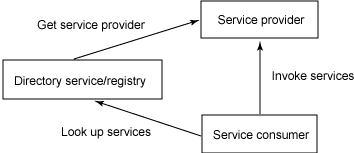
### Web services as a SOA
Web services are built on top of open standards and platform-independent protocols. A Web service uses the XML-based Simple Object Access Protocol (SOAP) over HTTP for communication between service providers and consumers. Services are exposed as interfaces defined by Web Service Definition Language (WSDL), whose semantics are defined in XML. Universal Description, Discovery and Integration (UDDI), a language-independent protocol, is used to interact with registries and look for services. All of these features make Web services an excellent choice for developing SOA applications.
### ESB: An Introduction
When you enable or add Web service interactions that use existing Internet and intranet infrastructure between systems in an architecture, you can create many individual point-to-point integrations, which are difficult to maintain. As organizations move towards service-oriented architectures, which host various deployed services, they require infrastructure service that provides robust communication, intelligent routing, and sophisticated translation and transformation of services.
Application servers provide features like life connection pooling, transaction management, and life cycle management that free the programmer from writing new code for each application. Similarly, an ESB provides common communication and integration services. Because ESBs also use industry standards for most of the services they provide, they facilitate cross-platform interoperability and become the logical choice for companies looking to implement SOA.
The ESB is not a new software product, but a new way to integrate applications, coordinate resources, and manipulate information. Unlike many previous approaches for connecting distributed applications (such as RPC or distributed objects), the ESB pattern enables the connection of software that runs parallel on different platforms, is written in different programming languages, and uses different programming models.
### Capabilities of the Enterprise Service Bus
An Enterprise Service Bus exhibits these minimum, or mandatory, capabilities:
- **Communication**
Supports routing and addressing for at least one messaging style (such as request/response, or publish/subscribe), and at least one transport protocol that is or can be made widely available. This enables location transparency and service substitution, which enables the decoupling of the consumer view of services from their implementation.
- **Integration**
Supports several integration styles or adapters. It enables the provision of services based on these integration capabilities, and decouples technical aspects of service interactions and the integration of services in the enterprise.
- **Service interaction**
Supports an interface definition format and associated messaging model (such as WSDL and SOAP) to allow the decoupling of technical aspects of service interactions.
- **Management and autonomic**
Provides a consistent administration model across a potentially distributed infrastructure, including control over naming, routing, addressing, and transformation capabilities. This enables the management of services in the enterprise.
More advanced ESBs typically offer a number of additional value-added features, including:
- **Adapters**, to enable connectivity to packaged and custom enterprise applications, as well as to leading technologies.
- **Service orchestration engines**, to support both long-running (stateful) and short-running (stateless) processes.
- **Quality of service and service-level capabilities**.
- **Presentation services**, to enable the creation of personalized portals that aggregate services from multiple sources.
### Typical architecture of an Enterprise Service Bus
The architecture of an ESB is centered on a bus. The bus provides message delivery services based on standards such as SOAP, HTTP, and Java Messaging Service (JMS). It is typically designed for high-throughput, guaranteed message delivery to a variety of service producers and consumers. The ESB enables the use of multiple protocols (such as synchronous and asynchronous) and performs transformation and routing of service requests. The ESB enables services to interact with each other based on the quality of service requirements of the individual transactions. It also supports different standards such as SOAP, XML, WSDL, JMS, J2EE, JAX-RPC, and so on.
The following figure illustrates component types that can connect to an ESB:
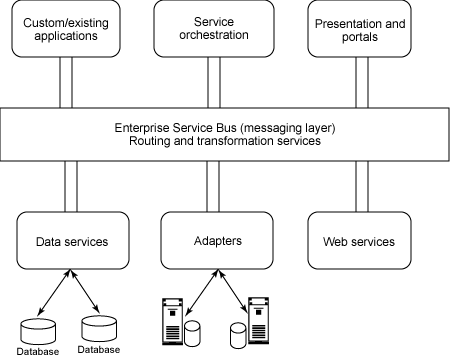
- Custom applications, based on standards like J2EE and Struts, which plug into the ESB to provide a user interface to enterprise services.
- Service orchestration engine, which hosts long running business processes, based on standards like Business Process Execution Language (BPEL).
- Adapters, typically built to the Java Connector Architecture (JCA) specification, enable integration with a wide variety of enterprise applications.
- Presentation and portals enable the creation of personalized portals that aggregate services from multiple sources.
- Data services which provides real time view of data from heterogeneous data sources.
- Web services provides a standard means of connectivity to legacy and proprietary integration technologies.
### Benefits of ESB
Today's fast-paced business world demands the ability to change and adapt rapidly. With an Enterprise Service Bus, you can integrate your business applications and processes quickly and easily as you respond to business challenges and opportunities when they arise.
The ESB pattern can improve operational performance and reduce costs while it simplifies the task of connecting dissimilar applications across a network of different operating systems using open standards such as SOAP, XML, WSDL, JMS, J2EE, JAX-WS, and others.
This article of mine was first published by IBM DeveloperWorks. All rights retained by IBM and the author.
---
# Future of web is Semantic - Introduction and Beyond
URL: https://navveenbalani.dev/articles/introduction-to-semantic-web
Type: article | Date: 2010-05-16 | Topics: architecture
In general, semantics is the study of meaning. (The word "semantic" comes from the Greek semantikos, or "significant meaning," derived from sema, or "sign.") Semantic Web technologies help separate meanings from data, document content, or application code, using technologies based on open standards. If a computer understands the semantics of a document, it doesn't just interpret the series of characters that make up that document: it understands the document's meaning.
The Semantic Web provides a common framework that allows data to be shared and reused across application, enterprise, and community boundaries. You can think of the Semantic Web as an efficient way to represent data on the World Wide Web, or as a database that is globally linked, in a manner understandable by machines, to the content of documents on the Web. Semantic technologies represent meaning using ontologies and provide reasoning through the relationships, rules, logic, and conditions represented in those ontologies.
Technologies that make up the Semantic Web
To represent the Semantic Web, you'll use the following technologies:
- A global naming scheme (URIs)
- A standard syntax for describing data (RDF)
- A standard means of describing the properties of that data (RDF Schema)
- A standard means of describing relationships between data items (ontologies defined with the OWL Web Ontology Language)
Let's take a closer look at these technologies.
A global naming scheme: URIs
A URI is simply a Web identifier, like the strings starting with http or ftp that you often see on the World Wide Web. Anyone can create a URI, and the ownership of URIs is clearly delegated, so they form an ideal base technology on top of which to build a global Web. In fact, the World Wide Web is such a thing: anything that has a URI is considered to be "on the Web." Every data object and every data schema/model in the Semantic Web must have a unique URI.
A Uniform Resource Locator (URL) is a URI that, in addition to identifying a resource, provides a means of acting upon or obtaining a representation of that resource by describing its primary access mechanism or network location. For example, the URL http://www.webifysolutions.com is a URI that identifies a resource (Webify Solutions' home page) and implies that a representation of that resource (such as the home page's current HTML code, as encoded characters) is obtainable through HTTP from a network host named www.webifysolutions.com.
A Uniform Resource Name (URN) is a URI that identifies a resource by name in a particular namespace. You can use a URN to talk about a resource without implying its location or how to dereference it. For example, the URN urn:ISBN:1-0-7666-98-0 is a URI that, like an ISBN book number, allows one to talk about a book, but doesn't suggest where and how to obtain an actual copy of it.
### A standard syntax to describe data: RDF
RDF is a specification that defines a model for representing the world, and a syntax for serializing and exchanging that model. The W3C has developed an XML serialization for RDF. RDF XML is the standard interchange format for RDF on the Semantic Web, although it is not the only format. For example, Notation3 is an excellent plain text alternative serialization to RDF XML.
RDF provides a consistent, standardized way to describe and query Internet resources, from text pages and graphics to audio files and video clips. It offers syntactic interoperability, and provides the base layer for building a Semantic Web. RDF defines a directed graph of relationships. These are represented by object-attribute-value triples -- that is, an object O has an attribute A with the value V.
Listing 1 provides an example of RDF XML.
Listing 1. An RDF XML example
Webify Solutions1-800-4WEBIFY
The piece of RDF in Listing 1 basically makes a statement about a resource, which in this case is the company http://www.w3.org/Organization/contact#WebifySolutions. The company can be identified by the URI http://www.w3.org/Organization/contact#WebifySolutions; its name is Webify Solutions, its e-mail address is info@webifysolutions.com, and its phone number is 1-800-4WEBIFY.
The directed graph of relationships illustrated in Figure 1 represents this.
Figure 1. RDF graph that describes the contact details of Webify Solutions
### A standard means to describe the properties of data: RDF Schema
RDF Schema is a semantic extension of RDF. It provides mechanisms to describe groups of related resources and the relationships between those resources.
The RDF Schema class and property system is similar to the type systems of object-oriented programming languages such as the Java language. RDF differs from many such systems. Rather than define a class in terms of the properties of its instances, the RDF vocabulary description language describes properties in terms of which classes of resource that the properties apply to.
Both RDF and RDF Schema are based on XML and XML Schema. The existence of standards for describing data (RDF) and data attributes (RDF Schema) enables the development of a set of readily available tools to read and exploit data from multiple sources. The degree to which different applications can share and exploit data is sometimes called syntactic interoperability. The more standardized and widespread these data manipulation tools are, the higher the degree of syntactic interoperability, and the easier and more attractive it becomes to use the Semantic Web approach as opposed to a point-to-point integrated solution.
A standard means to describe relationships between data items: Ontologies that use the OWL Web Ontology Language
Before multiple applications can truly understand data -- and treat it as information -- semantic interoperability is required. Syntactic interoperability is all about parsing data correctly. It requires mapping between terms, which in turn requires content analysis.
This content analysis requires formal and explicit specifications of domain models, which define the terms used and their relationships. Such formal domain models are sometimes called ontologies. Ontologies define data models in terms of classes, subclasses, and properties.
With the W3C-recommended OWL Web Ontology Language, you can express ontologies. OWL (Ontology Working Language) adds more vocabulary to describe properties and classes than RDF or RDF Schema: among other things, it can describe relations between classes (such as disjointness), cardinality (for example, "exactly one"), equality, richer typing of properties, and characteristics of properties (such as symmetry).
The OWL Web Ontology Language is designed for use by applications that need to process the content of information rather than just presenting information to humans. OWL facilitates greater machine interpretability of Web content than that supported by XML, RDF, and RDF Schema by providing additional vocabulary along with formal semantics. OWL has three sublanguages: in order of decreasing expressiveness, they are OWL Full, OWL DL, and OWL Lite.
- The OWL Web Ontology Language taken as a whole is called OWL Full. OWL Full uses all OWL language primitives and allows combinations of those primitives in arbitrary ways with RDF and RDF Schema. OWL Full is fully upward-compatible with RDF, both syntactically and semantically: any legal RDF document is also a legal OWL Full document. It is unlikely that any reasoning software can support every feature of OWL Full, as it offers maximum expressiveness and the syntactic freedom of RDF with no computational guarantees.
- OWL DL supports those users who want maximum expressiveness without losing computational completeness. OWL DL is a sublanguage of OWL Full language constructs with restrictions such as type separation (for example, a class can not also be an individual or property, and a property cannot also be an individual or class).
- OWL Lite supports those users primarily needing a classification hierarchy and simple constraint features. The advantage of this language is that it is both easier to understand and easier to implement than the other two; however, it restricts expressivity. For example, while OWL Lite supports cardinality constraints, it only permits cardinality values of 0 or 1.
Examples of ontologies include catalogs for online shopping sites like Amazon.com, domain-specific standard terminology like UNSPSC (a terminology used for products and services), or various taxonomies on the Web, like the "My Yahoo" categories.
Next, I'll take a closer look at the components of OWL.
### Components of OWL Web Ontology Language
The basic components of OWL include classes, properties, and individuals, which you'll examine in turn.
### Classes
Classes are the basic building blocks of an OWL ontology. A class is a concept in a domain. Classes usually constitute a taxonomic hierarchy (a subclass-superclass hierarchy).
Classes are defined using the owl:Class element. OWL comes with two predefined classes: owl:Thing and owl:Nothing. owl:Thing is the most general class, which contains everything; owl:Nothing is an empty class. Every class you define is a subclass of owl:Thing and a superclass of owl:Nothing. Examples of classes in a banking domain might include Account or Customer.
Listing 2 presents an example of an OWL class.
Listing 2. OWL class example
The code in Listing 2 specifies that SavingAccount is a class that is a subclass of Account.
OWL supports six main ways to describe classes. The simplest of these is a named class. The other types are intersection classes, union classes, complement classes, restrictions, and enumerated classes. Listing 2 illustrates two of these ways of describing classes: a restriction defines SavingAccount as a subclass of the named class Account.
Properties
Properties have two main categories:
- Object properties, which relate individuals to other individuals.
- Datatype properties, which relate individuals to datatype values, such as integers, floats, and strings. Owl makes use of XML Schema for defining datatypes.
A property can have a domain and range associated with it. Each property can be be put into one of the following categories:
- Functional: For a given object, the property takes only one value. Examples include a person's age, height, or weight.
- Inverse functional: Two different individuals cannot have the same value. For example, the bankNumber or SSN properties are unique for each person.
- Symmetric: If a property links A to B, then one can infer that it links B to A. Examples of symmetric properties includes "is sibling of" or "is same as".
- Transitive: If a property links A to B and B to C, then one can infer that it links A to C. For example, if A is taller than B and B is taller than C, then A is taller than C.
You can apply various restrictions to classes and properties. For example, cardinality restrictions specify the number of relationships that a class of individuals can participate in.
### Individuals
Individuals are instances of classes, and properties can relate one individual to another. For example, you might describe an individual named Smith as an instance of the class Person, and might use the property hasEmployer to relate Smith to the individual Webify Solutions, signifying that Smith is an employee of Webify Solutions.
Listing 3 offers an example of an OWL individual.
### Listing 3. An OWL individual
| |
| --- |
| |
rdf:type is an RDF property that ties an individual to a class of which it is a member. Listing 3 indicates that SmithAccount is an instance of type Account.
Figure 2 illustrates the basic building blocks of an OWL ontology.
**Figure 2. OWL ontology that describes the Webify Solutions organization**
---
### Business value of ontologies
IT systems organize meanings using relational data models, flat files, object-oriented models, or proprietary data models. From time to time, the demands of changing business needs require that you add new entities and relationships to the relational data models or object-oriented models.
Moreover, if an organization uses many applications provided by various vendors, you might replicate the same model across application databases. Say, for instance, that a banking firm provides a variety of products to serve various types of customers. A corporate customer might require a fraud detection facility, for instance, while a normal customer might use only online banking functionality. Normally, several vendors provide the applications for the bank, but each application replicates the same common information -- accounts, customers, and so on -- in an application-specific database. As the organization adds products to meet ever-growing business needs, the same redundant information becomes scattered around the enterprise.
A number of services definitely are common to all the applications being developed -- viewing bank transactions and wire transfers, for instance. Each of these services is also replicated in a fashion specific to each application, leading to point-to-point integration.
If the bank adapts an ontology-driven approach, it can capture and represent its total product knowledge in a language-neutral form and deploy the knowledge in a central repository. With this shared, adapted ontology, the organization can provide a single, unified view of data across its applications. This unified view allows for precise retrieval of information and seamless enterprise integration, as business processes and various data sources can map to each other through a common meta-model. Thus, the shared ontology eliminates point-to point integration and simplifies application integration, reducing data redundancy and providing the same semantic meaning across applications, which eases the bank's maintenance and upgrades.
---
### Benefits of the Semantic Web to the World Wide Web
The World Wide Web is the biggest repository of information ever created, with growing contents in various languages and fields of knowledge. But, in the long run, it is extremely difficult to make sense of this content. Search engines might help you find content containing specific words, but that content might not be exactly what you want. What is lacking? The search is based on the contents of pages and not the *semantic meaning* of the page's contents or information about the page.
Once the Semantic Web exists, it can provide the ability to tag all content on the Web, describe what each piece of information is about and give semantic meaning to the content item. Thus, search engines become more effective than they are now, and users can find the precise information they are hunting. Organizations that provide various services can tag those services with meaning; using Web-based software agents, you can dynamically find these services on the fly and use them to your benefit or in collaboration with other services.
---
### Role and value of semantic technology in SOAs
To properly model and manage a service-oriented architecture (SOA), enterprise architects must maintain active representations of the services available to the enterprise. Specifically, to discover and organize their services, the architects must use best practices that model and assemble services using metadata, encapsulate business logic in metadata for dynamic binding, and manage with metadata. Ontologies provide a very powerful and flexible way to aggregate, visualize, and normalize this service metadata layer.
An ontology is a network of concepts, relationships, and constraints that provide context for data and information as well as processes. Ontologies enhance service discovery, modeling, assembly, mediation, and semantic interoperability. They improve the way people browse, explore, and interact with complex metadata information spaces. A business ontology is a formal specification of business concepts and their interrelationships that facilitates machine reasoning and inference. A business ontology ties systems together using metadata, much as a database ties together discrete pieces of data. This abstraction provides agility and flexibility, as interfaces can be changed and new resources and subscribers added easily, even while the system is running.
Semantics are the future of service-oriented integration. Semantic technologies provide an abstraction layer above existing IT technologies, one that enables the bridging and interconnection of data, content, and processes across business and IT silos. Finally, from the human interaction perspective, semantic technologies add a new level of semantic portals that provide far more intelligent, relevant, and contextually aware interactions than those available with the traditional point-to-point integration approach for portal-based information delivery.
---
### Conclusion
In this article, you went through the core standards that make up the Semantic Web's technologies and learned why organizations might want to adopt those technologies. With Semantic Web technologies, organizations can provide a single, unified view of data across their applications, which allows for precise retrieval of information, simplifies enterprise and SOA integration, reduces data redundancy, and provides uniform semantic meaning across applications. All this eases development, maintenance, and upgrades across the enterprise.
This article of mine was first published by IBM DeveloperWorks in 2005 .All rights retained by IBM and the author.
---
# J2EE and SOA Architecture
URL: https://navveenbalani.dev/articles/j2ee-and-soa-architecture
Type: article | Date: 2010-05-16 | Topics: architecture
In this article, you'll learn how to design and develop *service-oriented architecture* (SOA) frameworks using the Java 2 Platform, Enterprise Edition (J2EE). By adapting an SOA framework, your organization can maximize loose coupling and reusability between systems. This article will take a high-level overview of several iterations over an SOA framework that will meet the needs of a fictional corporation. The sample frameworks developed here can be easily adapted to suit your business needs.
### SOA and Web services: An introduction
An SOA is a distributed software model. The key components of an SOA include *services, dynamic discovery,* and *messages.*
- A *service* is a callable routine that is made available over a network. A service exposes an interface contract, which defines the behavior of the service and the messages it accepts and returns. The term *service* is often used interchangeably with the term *provider,* which specifically denotes the entity that provides the service.
- Interfaces are often published in public registries or directories where they are categorized based on different services offered, just as businesses and their phone numbers are listed in a phone book's Yellow Pages. Clients (service consumers) can look up a particular service by dynamically querying for services based on various categorization features. This process is referred to as the *dynamic discovery* of services.
- Service consumers or clients consume services via *messages.* Because interface contracts are platform- and language-independent, messages are typically constructed using XML documents that conform to XML schema.
The figure below illustrates the various roles in an SOA.
### Figure 1. The roles in an SOA
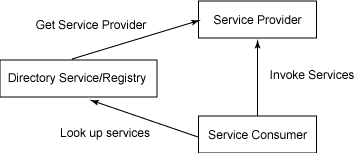
Web services as a SOA
Web services are built on top of open standards and platform-independent protocols. A Web service uses SOAP (an XML-based protocol) over HTTP for communication between service providers and consumers. Services are exposed as interfaces defined by WSDL (Web Service Definition Language), whose semantics are defined in XML. UDDI, a language-independent protocol, is used for interacting with registries and looking for services. All of these features make Web services an excellent choice for developing SOA applications.
---
Using the J2EE 1.4 platform for developing SOA/Web services frameworks
Version 1.4 the of J2EE platform provides complete Web services support through the new JAX-RPC 1.1 API, which supports service endpoints based on servlets and enterprise beans. JAX-RPC 1.1 provides interoperability with Web services based on the WSDL and SOAP protocols. The J2EE 1.4 platform also supports the Web Services for J2EE specification (JSR 921), which defines deployment requirements for Web services and utilizes the JAX-RPC programming model. In addition to numerous Web services APIs, the J2EE 1.4 platform also features support for the WS-I Basic Profile 1.0. The WS-I Basic Profile standards allow Web services to overcome the barriers of different programming languages, operating systems, and vendor platforms so that multiple applications can interact. This means that J2EE 1.4 offers cross-platform Web services interoperability in addition to platform independence and complete Web services support.
Under J2EE 1.4, a Web service client can access J2EE applications in two ways. The client can access a Web service created with the JAX-RPC API; behind the scenes, JAX-RPC uses a servlet to implement the Web service. A Web service client can also access a stateless session bean through the service endpoint interface of that bean. Web service clients cannot access other types of enterprise beans. The second option descried -- exposing stateless EJB components as Web services -- has a number of advantages:
- **Leveraging existing business logic and processes:** In many organizations, existing business logic has already been coded using EJB components; exposing it through Web services is the best possible option for making those services available to the outside world. An EJB endpoint is a good choice because it keeps business logic located in the same tier with the endpoint.
- **Concurrency support:** An EJB service endpoint implemented as a stateless session bean need not worry about multi-threaded access, since the EJB container must serialize requests to any particular instance of a stateless session bean.
- **Secure access to services:** Enterprise beans permit various method-level security features to be declared in the deployment descriptor. The method-level roles are mapped to an actual principal domain. Using EJB components as Web service endpoints brings this method-level security to Web service clients.
- **Transaction considerations:** An EJB service endpoint runs in a transaction context specified in the deployment descriptor. The container handles the transactions, so the bean developer doesn't need to write transaction-handling code.
- **Scalability:** Almost all EJB containers provide support for the clustering of stateless session beans. So, as load increases, additional machines can be added to a cluster, and Web service requests can be directed to those various servers. By modeling Web services as EJB endpoints, you can make the services scalable and increase their reliability.
- **Pooling and resource utilization:** An EJB container provides pooling of stateless session beans. This improves resource utilization and memory management. By modeling Web services as EJB endpoints, such features can easily be extended to make Web services respond effectively multiple client requests.
With all of these advantages in mind, the following sections will show you how to expose stateless EJB components as Web services in your architecture.
---
### Designing your SOA/Web services framework
Consider the example of a corporation where various systems -- such as those for billing, finance, and invoicing -- need to interact with each other. In addition, some of these applications need to be exposed to the outside world so that various business partners can interact with them. You also need to design a Web-based solution for various applications -- such as the various data entry operations for entering invoices or finding the status of bills. The best choice is to design a loosely coupled system based on services. These services are backed by open standards, so any business partner can invoke them.
These considerations should point you toward a Web services/SOA framework, with your various services and business processes exposed as Web services via stateless EJB components. The figure below illustrates a SOA for internal corporate applications.
**Figure . A service-oriented architecture for internal corporate applications**
The various components interacting in the SOA framework are listed below. It's a typical MVC 2 framework.
- **Client:** The user interacts with various applications via the Web browsers that serve as clients for your application. For example, a billing department user may enter billing details and post that information to the application. JSP pagess and XMHTML can be used for rendering the client pages.
- **Application controller:** The application controller is your main controller servlet. It takes care of initialization and delegates requests and responses to the request processor.
- **Request processor:** This is a Java class that performs preprocessing of requests by invoking the corresponding request handlers to carry out the required processing. This invocation is modeled as a command pattern.
- **Request handlers:** Request handlers carry out specific request activities, like interacting with services for adding or retrieving information from various enterprise information systems (EISs). Request handlers rely on business locators to find the corresponding services then accesses the desired EIS information through those services.
- **Business locators:** These are responsible for hiding the complexity of looking up services; they also provide caching logic. A business locator can take many forms -- for instance, it could be a Web service locator, an EJB component locator, or a JMS locator.
- **Session Facades:** These provide a simplified view of a complex object by aggregating methods from multiple systems or services. Session facades are wrappers around the EJB Web services methods.
- **EJB Web services:** With the EJB 1.4 specification, Web services endpoints can be modeled as stateless session beans. As discussed above, there are a number of advantages to this technique.
- **Data access interfaces:** These access the EIS by using various techniques, like EJB-CMP, JDO, DAO, and various persistence technologies; the access technique used depends on interface requirements and the volume of data to be fetched, inserted, or updated. This layer is responsible for interacting with the EIS and returning data back to corresponding EJB Web service methods in the format that those methods expect.
- **MQSeries/JCA/CCF:** Existing mainframe-based services can be exposed as Web services, thus revealing them to the outside world. Web service clients interact with EJB Web services using the HTTP-based SOAP protocol. The EJB methods post requests to an MQSeries queue via the JMS protocol. (Using MQSeries is one way to interact with mainframe-based applications.) The MQSeries server on the mainframe side triggers the corresponding COBOL-based programs that provide the logic necessary for interacting with back-end systems like IMS DC. These programs then post the response back to the queue, which in turn is retrieved by the application logic and posted back to the EJB methods. SOAP messages can be transferred over various protocols, like HTTP, HTTPS, and JMS, but currently for uniformity this example will use HTTP and HTTPS only.
These components provide the foundations of your service-oriented architecture for internal corporate applications. Next, you can move on to expose your services to the outside world.
---
### Exposing services to the outside world
If you're going to expose services to external users, you need some kind of security constraints that make sure that only authorized users can access the services. One way to do this is to provide an additional Web service layer that filters out forbidden Web service requests and supplies logging and security constraints. This filter should also provide a facility for exposing to each client only the subset of services authorized for that client.
The below figure illustrates the service-oriented architecture for external corporate applications. It exposes fine-grained services to the outside world.
**Figure 3. A service-oriented architecture, exposed to the outside world**
Here are the basic functional units of this architecture:
- **External clients:** These can include Web-based clients, mobile clients, or clients coded in the .NET environment, Perl, or any other programming language; all of these clients send requests for various services. As long as you conform to the WS-I Profiles, there should be no interoperability issues.
- **Corporate firewall:** Based on its security policies, the sample corporation has imposed a firewall between its intranet and the Internet, restricting incoming packet information.
- **Web Services Gateway:** For this example, I have chosen to use the Web Services Gateway product included with WebSphere Application Server 5.0 as the gateway to expose external services. Web Services Gateway is a middleware component that provides an intermediary framework between Internet and intranet environments during Web service invocations. With the Web Services Gateway, developers and IT managers can safely externalize a Web service so that it can be invoked by clients from outside the firewall. It includes a model for the management of services (deployment, undeployment, etc.) and filters (custom code that acts on the requests and responses that flow through the gateway). It handles only incoming SOAP/HTTP requests, and requests passing through the gateway may be sent to a Java class, an EJB component, or a SOAP server (which could even be another gateway). It provides security (basic authorization) on the individual methods of a Web service, as well as for the gateway as a whole. Using the Web Services Gateway, a request from the client can be transformed into any messaging protocol required by your service. For example, your clients' requests may come in as SOAP over HTTP, but internally you might be using SOAP over the JMS protocol; your Web Service Gateway can provide the conversion from one protocol to the other.
- **EJB services:** There is no change in the EJB services. The rest of the process is similar to the intranet-based services provided by the architecture illustrated in Figure2.
---
### Coarse-grained services using EJB components
The processes you've seen so far expose fine-grained Web services to clients. As long as each business service is executed in a single business process, this set-up will work fine. But suppose a customer wants to perform a wire transfer of funds. It makes sense in such a case to provide a single, coarse-grained interface, with the customer providing all the needed information, including the amount to be transferred, the sending and receiving banks' information, and so on. Also, in such a scenario validation needs to be performed before any execution of business logic. You should keep all these considerations in mind when designing the methods for a Web service, and also bear in mind the overhead of parsing and formulating XML requests and responses in addition to a network call.
Taking these factors into consideration, you can model Session Facades as EJB Web service endpoints. Session Facades can validate a request before delegating it to corresponding Web service methods. In this way, you provide coarse-grained services to your Web service clients.
The figure below illustrates the next iteration of your service-oriented architecture for external corporate applications. This version of the architecture exposes coarse-grained services to the outside world.
### Figure 4. Service-oriented architecture with coarse-grained services
Here, the bulk of the implementation remains the same as the one outlined in Figure 3. The only difference is that you've exposed Session Facades as the Web service endpoints. The EJB Web services can be modeled as local rather than remote interfaces. Using session facades and method-level security, you can restrict the services to be executed. Using the Web Service Gateway can also impose security measures for Web service clients. Depending on requirements, you can go for some combination of coarse-grained and fine-grained services, exposing both to external clients by tuning your Web service gateway middleware.
This article of mine was first published by developerWorks at - [Design service-oriented architecture frameworks with J2EE technology.](http://www-128.ibm.com/developerworks/webservices/library/ws-designsoa/index.html) All rights retained by IBM and the author.
All rights retained by IBM and the author.
---
# JAX-WS Web Services Tutorial
URL: https://navveenbalani.dev/articles/jax-ws-web-services-tutorial
Type: article | Date: 2010-05-16 | Topics: architecture
Using Java API for XML Web Services (JAX-WS) technology to design and develop Web services yields many benefits, including simplifying the construction of Web services and Web service clients in Java, easing the development and deployment of Web services, and speeding up Web services development. This tutorial walks you through how to do all of this and more by developing a sample order-processing application that exposes its functionality as Web services. After going through this tutorial, you'll be able to apply these concepts and your newly acquired knowledge to develop Web services for your application using JAX-WS technology.
Read my following tutorial initially published on IBM developerWorks. All rights reserved by IBM and author.
[Design and Develop JAX WS Web services](/images/2010/06/nb-ws-jax-pdf.pdf)
---
# MVC Applied to Web Services
URL: https://navveenbalani.dev/articles/mvc-applied-to-web-services
Type: article | Date: 2010-05-16 | Topics: architecture
The Model-View-Controller (MVC) pattern is fairly useful in software engineering of object-oriented applications. This article takes a look at how it can be applied to the call static or dynamic Web services.
- [Web services architecture using MVC style](/articles/applying-mvc-pattern-to-web-services)
- [Implementing the Web services MVC architecture](/articles/implementing-the-web-services-mvc-pattern)
---
# Recovering from external usb drive failure
URL: https://navveenbalani.dev/articles/recovering-from-external-usb-drive-failure
Type: article | Date: 2010-05-16 | Topics: experimental
One day, my western digital external drive, all of sudden stopped working.The USB drive was not being detected in bios also. I wasn't sure if my external SATA-USB connector was problematic or the SATA drive itself had an issue. I started looking out for information on how to recover my data and came across a you tube video which described how to open up the Western digital USB drive. Since I didn't drop my USB drive, I was sure that most probably the problem could be with the USB-SATA converter. I decided to open up the USB drive, though I knew this would negate the warranty, but has limited choices and wanted to get back my data.
I opened up the USB drive, thanks to this video and removed the SATA drive from -USB connector
Next, I connected the SATA drive to my desktop. I had to de-assemble my desktop system and connect the SATA drive to my primary drive as I didn't had any more cables to connect it to a secondary drive. When I restarted my server, atleast the drive got detected, but couldn't boot as the drive was not bootable. I than goggled for bootable disk drives. During my search, I came across Ubuntu OS and downloaded the OS ISO image and cut it on a CD drive. With this, I was able to load the Ubunto OS from the CD drive itself. The Ubuntu OS recognized the SATA drive and through the UI interface, I was able to access my data on the USB drive. I than copied all data from previous external drive to a new external drive. That's it. It took two days of my weekend with this experimentation, but at least I recovered my data and found my SATA drive was fine and had issues with SATA-USB connector.
Later, I bought a SATA-USB 2.5 case and plugged my SATA driver on the external case and got USB drive detected on my system again ..Hurray !!
Hope this would give you some directions on how to recover your data from SATA drive if the issues lies with USB-SATA connector. If not, you can than you probably need to look for Data recovery services.
---
# Spring Series Tutorial
URL: https://navveenbalani.dev/articles/spring-series-tutorial
Type: article | Date: 2010-05-16 | Topics: architecture
Spring is an open source framework created to address the complexity of enterprise application development.
Start to build lightweight, robust J2EE applications using Spring technology with the following Spring series articles**. The Spring series articles was rated as the best article and has the highest visits and ratings of all time , in last 10 years (2000-2010) of IBM devloperWorks**. Thanks to all the readers. I will be updating the Spring series with the latest release, for now enjoy the articles.
- [Spring Series - Introduction to Spring framework](/articles/spring-series-tutorial-introduction-to-spring-framework)
- [Spring Series Hibernate](/articles/spring-series-tutorial-when-hibernate-meets-spring)
- [Spring Series MVC](/articles/spring-series-tutorial-swing-into-spring-mvc)
- [Spring Series JMS](/articles/spring-series-tutorial-spring-jms)
To get started on Spring 2 framework, View my book **[Beginning Spring Framework 2](http://www.amazon.com/Beginning-Spring-Framework-Thomas-Velde/dp/047010161X)**
---
# The complete pervasive computing tutorial
URL: https://navveenbalani.dev/articles/the-complete-pervasive-computing-tutorial
Type: article | Date: 2010-05-16 | Topics: architecture
DB2 Everyplace is an offering from IBM for pervasive computing.
The series of articles will get you started with DB2 Everyplace on Java and .NET environment and would share my experiences on the product.
1. [Building Wireless Java Applications Using DB2 Everyplace](/articles/building-wireless-java-applications-using-db2-everyplace)
2. [Creating a Mobile Application for Palm Devices Using DB2 Everyplace](/articles/creating-a-mobile-application-for-palm-devices-using-db2-everyplace)
3. [Synchronizing Wireless Application Data Using DB2 Everyplace](http://www-128.ibm.com/developerworks/db2/library/techarticle/0211balani/0211balani.html)
4. [Building DB2 Everyplace mobile applications using .NET 2003](http://www-106.ibm.com/developerworks/db2/library/tutorials/dm0311balini1/index.html)
5. [Synchronizing DB2 Everyplace mobile apps using .NET 2003](http://www-106.ibm.com/developerworks/db2/library/tutorials/dm0312balini2/dm0312balini2-a4.pdf)
6. [Build and access DB2 stored procedures using mobile clients](http://www-128.ibm.com/developerworks/edu/dm-dw-dm-0405balani-i.html)
7. [Accessing DB2 Everyplace using J2ME devices](/articles/accessing-db2-everyplace-applications-using-j2me-devices)
---
# The Mobile Computing J2ME Series
URL: https://navveenbalani.dev/articles/the-mobile-computing-j2me-series
Type: article | Date: 2010-05-16 | Topics: architecture, mobile
The following articles of mine are some of the resources to get started on developing mobile applications.
A series of article for building J2ME applications.
- [Build Smart J2ME Apps Part 1](/articles/build-a-smart-j2me-mobile-application-tutorial-part-1)
- [Build Smart J2ME Apps Part 2](/articles/build-a-smart-j2me-mobile-application-tutorial-part-2)
Using XHTML on Mobile devices
- [XHTML applications go mobile](/articles/deliver-xhtml-applications-to-mobile-devices)
Creating XML Based Mobile applications using KXML2
- [Getting Started with KXML2 and J2ME](/articles/getting-started-with-xml-mobile-and-j2me)
Creating Database driven mobile applications
- [Mobile database access](/articles/j2me-mobile-database-access-tutorial)
Developing mobile applications for EPOC and Symbian OS devices
- [Writing in EPOC](/articles/epoc-mobile-tutorial)
---
# Web Services over JMS
URL: https://navveenbalani.dev/articles/web-services-over-jms
Type: article | Date: 2010-05-16 | Topics: architecture
This article provides an architecture and sample application for using JMS as the transport for Web service invocations. Although the articles using AXIS framework , but overall architecture remains same for web service communication over JMS tutorial
This article assumes that you are familiar with the AXIS processing system. The software required for the examples is as follows:
- IBM WSDK (WebSphere SDK for Web Services).
- MQSeries 5.2 with JMS support pack ma88\_win.zip.
- Sample code ws-jms.zip.
This article assumes that the above software is installed and configured.
### Introduction to the Apache AXIS framework
The Axis framework is a Java-based, open source implementation of the latest SOAP specification, SOAP 1.2, and SOAP with Attachments specification from the Apache Group. The following are the key features of this AXIS framework:
- **Flexible Messaging Framework:** It provides a flexible messaging framework that includes handlers, chain, serializers, and deserializers. A handler is an object processing request, response, and fault flow. A handler can be grouped together into chains and the order of these handlers can be configured using a flexible deployment descriptor.
- **Flexible Transport Framework:** Axis provides a transport framework that helps you create your own pluggable transport senders and transport listeners. In this article you shall be building your own JMS Transport and listeners for sending and receiving SOAP messages.
- **Data Encoding support:** Axis provides automatic serialization of a wide variety of data types as per the XML Schema specifications and provides a facility to use your own customized Serializer and Deserializer.
- **Additional Features:** Axis provides full support for WSDL as well as Logging, Error, and Fault Handling mechanisms.
### Overview of the AXIS architecture
The core components of the AXIS Architecture include:
- **AxisEngine:** This acts like a central controller for other components. It can be implemented on the server side as well as the client side.
- **MessageContext:** The MessageContext class ia a wrapper for SOAP requests and responses. It provides context information about a message to other components in the AXIS message-processing system.
- **Handlers and Chains:** Handlers are the basic building blocks in the AXIS system. A handler takes a MessageContext and performs actions and returns back to the calling code. A chain is a special handler that represents a sequence of other handlers.
- **Transport:** Provides transport for messages to get into the AXIS engine and the return of response messages to the client.
- **Serializers and Deserializers:** These are required for conversion of data from native format to XML and from XML back to native format.
- **Deployment files:** AXIS system defines an XML based deployment descriptor known as a Web Service Deployment Descriptor (WSDD) that defines configuration of the AXIS system on the server side as well as the client side.
---
### Designing the JMS SOAP framework
JMS defines a standard way for Java applications to create and exchange messages via Message Oriented Middleware (MOM) . You will be using MQSeries as your MOM. You will be developing a Point to Point (P2P) message based system, which allows messages to be exchanged between the producer and the consumer through a channel called a queue. A queue is a destination to which a producer sends messages and from which the receiver takes messages. Each message is consumed by only one receiver in this model.
[Figure 1](http://www.ibm.com/developerworks/webservices/library/ws-jms/#figure1) depicts the architectural overview of your JMS SOAP framework system using AXIS.
### Figure 1. JMS SOAP Architecture
A striking feature of AXIS is that it allows the framework to configure on the server side as well as the client side for client message based processing. In this case you shall be configuring the Axis framework on the server as well as the client side using AXIS based deployment descriptors. The server side deployment descriptor will tell the AXIS server on the server side which Web service to invoke. The client side deployment descriptor will tell the AXIS server on the client side which transport handler to use for transportation of SOAP messages. You shall be building your own JMS Transport handler for transportation of SOAP messages.
The above framework can be demonstrated using the following steps:
- The JMSSOAP client constructs the org.apache.axis.client.Call object and sets the location, call parameters, service, method name and the transport mechanism (that is, JMSMqseries Transport). It then invokes the AXISClient.
- The AXISClient checks the transport object in the deployment descriptor (client-deploy.wsdd) and loads the transport handler(JMSSOAPHandler) deployed for JMSMqseries Transport.
- The JMSSOAPHandler receives the SOAP request wrapped in a MessageContext object and puts the SOAP request into RequestQueue.
- When the message arrives at RequestQueue, the JMSSOAPListener event onMessage() is fired which takes the SOAP request, and creates an instance of the AXISServer engine.
- The AXISServer engine then invokes the corresponding Web service and passes the request parameter to it.
- The AXISServer then receives the response from the Web service and places a SOAP response in the ResponseQueue.
- The JMSSOAPHandler gets notified when the SOAP message is placed in the ResponseQueue. It then receives the SOAP message from the ResponseQueue and returns control back to the JMSSOAP Client.
- The JMSSOAP client then receives the SOAP message, extracts the results and displays it at the console.
### Building the application framework
Before you run the application, you need to set up Queue Manager and Queues, bind to JNDI for JMS communication, set up the AXIS framework in WSDK and deploy the server and client side AXIS based descriptors. [Download](/images/2010/05/ws-jms.zip) the zip file containing the batch file for setting up the MQSeries queues and the source code and deployment descriptors for the application. Extract the zip file to your C: drive.
### Setting up the queues
- Run the mqsetup.bat file provided in the C:\mqjms\batch folder. This batch file requires the bin folder of an MQSeries installation (such as C:\mqseries\bin) to be set in your environment path variable. After running the batch file, you should see a message "All valid MQSC commands were processed". Open the MQSeries explorer using Start -> Programs -> IBM MQSeries -> MQSeriesExplorer to make sure that queue mangers and queues have been created. Figure 2 shows that a QueueManager "MQJMS.QManager" has been created and is running.
### Figure 2. Queue manager configuration for MQSeries
- Click on the "Queues" folder below "MQJMS.QManager" on the Left pane. You should see that two queues "RequestQueue" and "ResponseQueue" have been created as shown in Figure 3.**Figure 3. Request/response queue configuration for MQSeries**
This completes the setup of queues.
### Setting up JMS and JNDI administration
In your application, the JNDI access makes use of the file-based FSContext version available from http://java.sun.com/products/jndi/index.html. The FSContext .jar file is also included in MQSeries JMS Support pack ma88\_win.zip. Just extract ma88\_win.zip to a folder, say C:\ProgramFiles\MQSeries\Java, and add the folder C:\ProgramFiles\MQSeries\Java\lib and C:\ProgramFiles\MQSeries\Java\bin to your system's PATH environment variable. Also add all the jar files in C:\ProgramFiles\MQSeries\Java\lib folder to your system's CLASSPATH environment variable. You can also run the classpath.cmd batch file provided in C:\mqjms\batch folder which sets the necessary path and CLASSPATH variables. Just modify the MQ\_JAVA\_INSTALL\_PATH variable in the classpath.cmd file to point to your MQSeries JMS installation directory.
Modify the JMSAdmin.config configuration file in C:\ProgramFiles\MQSeries\Java\bin used by MQSeries JMS administration to indicate the context factory and Web address of the JNDI implementation that the application will use. Uncomment the following line:
`INITIAL_CONTEXT_FACTORY=com.sun.jndi.fscontext.RefFSContextFactory`
and comment out the remaining two INITIAL\_CONTEXT\_FACTORY variables. Also uncomment the following line:
`PROVIDER_URL=file:/C:/JNDI-Directory`
and comment out the remaining two PROVIDER\_URL variables.
A sample configuration file is provided for reference in the C:\mqjms\batch folder.
Make a directory named JNDI-Directory on the C: drive for storing JNDI objects. Change to the C:\ProgramFiles\MQSeries\Java\bin directory and run the JMSAdmin batch file and you should see the the **InitCtx** variable.
Type in the following one after the other:
`def qcf(MQ_JMS_MANAGER) qmgr(MQJMS.QManager)`
press **Enter**
`def q(JMS_RequestQueue) qmgr(MQJMS.QManager) queue(RequestQueue)`
press **Enter**
`def q(JMS_ResponseQueue) qmgr(MQJMS.QManager) queue(ResponseQueue)`
press **Enter**
You have now bound the queues to JNDI objects.
### Setting up the AXIS framework in WSDK
WSDK comes with a beta version of AXIS. So you just need to setup and deploy the AXIS framework on WSDK. To do this, use the following steps:
- The axis directory contains the required structure for deploying the AXIS framework in WSDK. It contains a web.xml file in the WEB-INF directory which contains a mapping for registering the org.apache.axis.transport.http.AxisServlet servlet. Also copy the required AXIS framework classes from C:\wsdk\lib to the C:\wsdk\services\applications\axis\WEB-INF\lib folder.
- The deployment folder in C:\wsdk\services\applications\axis\deployment directory contains the PriceServiceDeploy.wsdd file, which is the deployment descriptor for deploying your Web service named "PriceService".
Next, you move on to deploying the AXIS framework. Use the following steps:
- Open up the windows command prompt, change the directory to C:\wsdk\bin. Set the path variable to include C:\wsdk\bin and C:\wsdk\sdk\bin and run the following command: wsdkconfig. The wsdkconfig tool starts up. Click the **Next** button to proceed to the configure services section and select the application\axis services as shown in Figure 4. Click **Next** two times and click **Finish** finally to deploy the AXIS framework. You should receive the message "The application server has been configured for WSDK".
### Figure 4. Deployment the AXIS Framework on WSDK
Next, let's move on to deploying your Web service.
### Deploying your Price Web service
For deploying your Price Web service, follow these steps:
- Change the directory to C:\mqjms\batch and execute the classpath.cmd batch file to put the required classes in your CLASSPATH environment. Change the directory to C:\mqjms and compile your source files by typing in:`javac naveen\jms\*.java`
- Start the WebSphere Application server associated with WebSphere Studio Application Developer by navigating to Start -> Programs -> IBM WebSphere SDK for Web Services -> Start App Server.
- Change the directory to C:\wsdk\bin and execute the following command to deploy the Price Web service:`axisDeploy c:\mqjms\naveen\jms\PriceServiceDeploy.wsdd -l http://localhost:80/axis/services/AdminService`where C:\mqjms\naveen\jms\PriceServiceDeploy.wsdd is the location of your deployment file and http://localhost:80/axis/services/AdminService is the URL where your AXIS framework is deployed.After executing the above command you should receive the message "- Processing file c:\mqjms\naveen\jms\PriceServiceDeploy.wsdd"
Done processing
- Now you need to configure your JMSMqseries Transport on the client side. To do this, execute the following command:`java org.apache.axis.utils.Admin client c:\mqjms\naveen\jms\jmsclient-deploy.wsdd`The option client indicates that deployment information is for client side only. You are now done with the deployment of your architecture.
---
### Analyzing the application code
### Analyzing the JMSSOAPClient.java file
Start with line numbers 30-44 of your JMSSOAPClient.java file.
| |
| --- |
| ``` Service service = new Service(); Call call = (Call) service.createCall(); call.setTargetEndpointAddress(new java.net.URL(endpointURL)); QName qname= new QName("PriceService", methodName); call.setOperationName(qname); call.addParameter("price", XMLType.XSD_STRING, ParameterMode.PARAM_MODE_IN); call.setTransport(new JMSMqseriesTransport()); call.setReturnType(XMLType.XSD_FLOAT); ``` |
In Listing 1, you begin by creating an org.apache.axis.client. Call object and then set the location of webservice; call parameters, service, method name and the transport mechanism (JMSMqseries Transport) to it.
Line 51: `Float price = (Float) call.invoke(params);`.
You then invoke your Price Web service. Since you have defined your own custom Transport mechanism, the AXISClient checks the transport object in the deployment descriptor (client-deploy.wsdd) and loads the transport handler (JMSSOAPSender) deployed for "JMSMqseriesTransport" Transport. So **JMSSOAPSender** gets invoked and control gets transferred to it.
Now move on to analyze JMSSOAPSender.java.
### Analyzing the JMSSOAPSender.java file
Line 24: `public class JMSSOAPSender extends BasicHandler`.
Your JMSSOAPSender extends the **org.apache.axis.handlers.BasicHandler** to classify itself as a handler to the AXIS System.
In the constructor, you create a context of the Initial Context factory to look up your Request Queue.
`Listing 2. JMSSOAPSender.java
public void invoke(MessageContext msgContext)`
| |
| --- |
| ``` // Get a string representation of SOAP Envelope SOAPEnvelope soapEnvelope = axisMsg.getSOAPEnvelope(); Element envElement = soapEnvelope.getAsDOM(); String strSOAPBody = XMLUtils.ElementToString(envElement); ``` |
You then send the SOAP message to the Request Queue by calling `sender.send(jmsMsg)` at line 91 and then wait until the reply message arrives at the Response Queue at line 96: `TextMessage replyMsg = (TextMessage) receiver.receive();`
At line 103 you wrap the response in to the org.apache.axis.Message object and set the response object in msgContext by calling the setResponseMessage method so that the response is available to the JMSSOAPclient, as follows:
| |
| --- |
| ``` org.apache.axis.Message responseMsg = new org.apache.axis.Message(replyMsg.getText()); msgContext.setResponseMessage(responseMsg); ``` |
When a message arrives at the Request Queue, the JMSSOAPListener.java onMessage (javax.jms.Message msg) gets executed as it is listening asynchronously on the Request Queue.
Now move on to analyze the JMSSOAPListener.java code.
### Analyzing the JMSSOAPListener.java file
At line 79 you create an instance of AxisEngine, MessageContext and associate with the engine as follows:
| |
| --- |
| ``` AxisEngine engine = getAxisEngine(); msgContext = new MessageContext(engine); ``` |
The getAxisEngine() method at line 53 is responsible for creating the AxisServer configuration from the configuration file, located at:
`"C:\WSDK\WebSphere\installedApps\wsdk.ear\axis.war\WEB-INF\server-config.wsdd".`
Lines 101-107 get the response from MessageContext and convert it to a string representation using helper methods as discussed in Analyzing the JMSSOAPSender file.
At line 119 you send a response to the Response Queue by calling:
`sender.send(jmsResponseMsg);`
This results in the execution of JMSSOAPSender, which was suspended as it was waiting for a message to arrive at the Response Queue.
JMSSOAPSender receives the message and transfers the response back to JMSSOAPclient which displays it at the console.
Next let's move on to see your code in action.
---
### Running the application
For running the application, execute this sequence of steps:
- Start your JMSSOAPListener by changing to the directory C:\mqjms and typing in:
**java naveen.jms.JMSSOAPListener**You should receive the message "JMSSOAPListener ready to receive messages".
- Next, open a new command window and change the directory to C:\mqjms\batch and run the classpath.cmd variable to initialize the CLASSPATH variable. Then run the JMSSOAPClient by typing in following command:
**java naveen.jms.JMSSOAPClient**.You should receive the following output snippet messages:
JMSSOAP Sender called
JMS-SOAP Request: < SOAP-ENV ....>
Sending JMS-SOAP Request to Request Queue
Sent JMS-SOAP Request to Response Queue
Waiting to Receive JMS-SOAP Response from Response Queue
Received JMS-SOAP Response from Response Queue
JMS-SOAP Response:
End of JMSSOAPSender
The Price is $1500.5Your JMSSOAPClient has successfully used JMS as the transport medium for sending and receiving SOAP messages.
- At the JMSSOAPListener console you should see the onMessage() event gets fired when a new SOAP request arrives at the Request Queue. The JMSSOAPListener creates an instance of AXISServer and passes the SOAP request to it and than receives the response back and places it on the Response Queue. You should receive the following output message at the console:
onMessage event Executed
Getting response message from Price WebService
Sending JMS-SOAP Response to the Response Queue
Waiting for Next JMS-SOAP Requests
You have successfully used the JMS protocol for communicating with your SOAP requests. This architecture can be applied for synchronous as well as asynchronous processing of SOAP messages.
This article of mine was first published by IBM developerWorks. All rights reserved by IBM and author.
---
# Apache CXF Web Service Book
URL: https://navveenbalani.dev/books/apache-cxf-web-service-book
Type: book | Date: 2010-05-16
The Apache CXF framework helps you to develop web services using standards based programming model and also provides a flexible deployment model for deploying web services. Developing SOAP and RESTful applications can be made easy by using Apache CXF framework. However, getting started with developing web services using the Apache CXF framework is not easy.
This is the **first** book that gives details on how to use the Apache CXF framework for developing SOAP and REST web services. It is a hands-on practical guide that simplifies working with CXF framework as it covers all major aspects with real-world examples. The chapters cover the various CXF features in detail and each has systematic steps with practical, simple examples to implement these features on your web services.
The book introduces the Apache CXF framework and its features such as Frontend API, Data Bindings, Transports, Spring-based configuration, and CXF tools. It also has chapters on SOAP and RESTful services. It will help you create RESTful services that support XML as well as the widely accepted Java Script Object Notation (JSON) format. It explains the components of CXF architecture that help developers customize the Apache CXF framework to suit the target application. The book covers both code-first and contract-first approaches for service deployment. You will see how to develop services in a flexible deployment model offered by CXF, unit test them in a stand-alone environment, and finally promote them in an application server environment.
The instructions in this book will help developers to build their application according their requirements by using any of the frontends supported by Apache CXF framework. The various CXF frontend APIs covered in this book provide a wide variety of options in developing and deploying your application.
The book introduces some advanced concepts such as Interceptors and features that will add extra capability to your service component. It will help you take advantage of different transport features offered by the CXF runtime such as HTTP, HTTP(S), and JMS protocols.
Finally, the book mentions various tools that help developers creating web services as well as creating Java and JavaScript-based web services clients which invoke a real-world .NET web service. These tools are standard batch files that can be easily executed from the Windows command shell by following the instructions in the book.
What you will learn from this book
> - Become familiar with the different features of Apache CXF architecture and set up the CXF environment
> - Develop a simple web service using CXF-based Spring configuration
> - Build a web service using contract-first and code-first approaches in simple frontend APIs such as JAX-WS
> - Create dynamic web service clients by using various CXF frontend APIs
> - Develop web services with different transports by configuring various CXF transports such as HTTP, HTTP(S), JMS, and CXF Local
> - Create RESTful services that support JSON and XML as the message formats
> - Develop services with features such as Interceptors by implementing advanced CXF features
> - Attain configuration and dependency management by integrating web services with the de facto Spring framework
> - Unit test POJO services in a stand-alone environment as well as promote applications to the Tomcat container for production ready deployments
> - Speed-start developing web services by using CXF tools effectively
> - Basics of Spring framework and IOC container for readers who are not acquainted with Spring framework
>
> Amazon Link to buy CXF book
> [](https://www.amazon.com/Apache-CXF-Web-Service-Development-ebook/dp/B0057EUR9I/ref=as_li_ss_il?ie=UTF8&qid=1474088993&sr=8-2&keywords=cxf&linkCode=li2&tag=enterpriseiot-20&linkId=a7da16794dec62f516a6e5c2c1b59f61)
---
# Recommended Spring Books
URL: https://navveenbalani.dev/books/recommended-spring-books
Type: book | Date: 2010-05-16 | Topics: architecture
To get started with Spring framework quickly, checkout this [Spring Series tutorial](/articles/spring-series-tutorial) . The series would be shortly updated with latest Spring version.
In my view, the following books are best resources to get started on Spring. This includes my book on Spring :)
Beginning Spring framework provides readers to get started with Spring framework quickly. In this book we don't assume the user is aware of any J2EE Concepts and try to cover Spring 2 using a tutorial format.
Spring Recipes is a excellent book providing a problem solving approach using Spring framework. However for a beginner, in my view the approach of using problem solution approach might be a bit too much as he may not be aware of what problem exists in J2EE stack and how Spring overcomes these approach. If a user is aware of J2EE concepts and have some Java and J2EE experiences, than Spring Recipes is his best bet to get working on Spring. Also watch out for the Spring Recipes book update , which might hit Amazon soon.
---
# Dynamically select adapters based on context using WebSphere Business Services Fabric
URL: https://navveenbalani.dev/articles/dynamically-select-adapters-based-on-context-using-websphere-business-services-fabric
Type: article | Date: 2010-05-10 | Topics: architecture
Learn how to dynamically invoke resource adapters using WebSphere® Business Services Fabric’s policy framework.
## Scenario overview
Company XYZ recently acquired Company ABC to expand its printing business. Company XYZ uses a DB2 Enterprise Information System (EIS) to store and retrieve customer data, but Company ABC uses a file-based data storage mechanism. The processes of the two companies need to be integrated into one system that uses both of the existing data storage mechanisms (DB2 EIS and file system).
The integrated solution design needs to be adaptable and able to retrieve or update information in the appropriate EIS, based on user log-in.
In addition, company XYZ is planning integration with other third-party vendors for printing services, in which customer data would be sourced from third-party systems. In short, the company is looking for a solution that allows generalized access to multiple systems and that enables adding new backend systems or third-party vendors incrementally without requiring changing its business processes.
For the sake of simplicity, we won’t address the overall business solution in this article, but will deal only with retrieving the appropriate customer information based on user context. We'll use WebSphere Adapters to integrate the databases, and Fabric to select the appropriate adapter implementation based on user context.
Following are the steps required to achieve the integration:
1. Create a Service Component Architecture (SCA module) based on the WebSphere Adapter for Flat Files.
2. Create an SCA module based on the WebSphere Adapter for JDBC (Java™ Database Connectivity).
3. Create a generic interface to abstract calls to the adapter implementations for Flat File and JDBC.
4. Test the Adapter for Flat File and Adapter for JDBC SCA implementations.
5. Use the Fabric policy framework to select the correct adapter implementation based on the user context.
6. Test the integrated solution.
7. Manage changes.
[Click Here](/images/2010/05/bpm-naveen.pdf) to download the complete article.
The article of mine was first published by IBM at - http://www.ibm.com/developerworks/websphere/library/techarticles/1005\_jain/1005\_jain.html. All rights reserved by author and IBM.
---
# J2ME Mobile database access tutorial
URL: https://navveenbalani.dev/articles/j2me-mobile-database-access-tutorial
Type: article | Date: 2010-05-09 | Topics: mobile
This tutorial shows you how to build a database application using J2ME Record Management System. You will also learn how to craft a MIDlet that performs the necessary logic of creating and accessing the DB2 database application and deploys it to a J2ME environment.
This tutorial of mine was first published by IBM developerWorks. All rights reserved by IBM and Author.
[Download the Tutorial](/images/2010/06/wi-data-a4.pdf)
---
# Deliver XHTML applications to mobile devices
URL: https://navveenbalani.dev/articles/deliver-xhtml-applications-to-mobile-devices
Type: article | Date: 2010-05-07 | Topics: mobile
In this tutorial, you'll learn how to deliver XHTML applications to XHTML-enabled mobile devices. We will develop a sample XHTML mobile application that posts requests to a Java servlet and receives responses in XHTML format. We'll deploy and test the application using the Nokia Mobile Internet Toolkit. Developers who want to extend their Internet applications to wireless devices will want to read on and see how it's done.
This tutorial of mine was first published by IBM developerWorks. All rights reserved by IBM and Author.
[Download the Tutorial](/images/2010/06/wi-xhtml-pdf.pdf)
[Download the Sample code for the Tutorial](/images/2010/06/wi-xhtml-mob.zip)
---
# Build a smart J2ME mobile application tutorial Part 2
URL: https://navveenbalani.dev/articles/build-a-smart-j2me-mobile-application-tutorial-part-2
Type: article | Date: 2010-05-05 | Topics: mobile
This tutorial series shows how to build a mobile database application using the J2ME Record Management System and later synchronize it with a remote Cloudscape database. This is where you will also learn how to craft a MIDlet that performs the necessary logic for creating and accessing the database application and deploying it to a J2ME environment.
In this second tutorial, you'll synchronize the order information stored in the J2ME Record Management System with a remote, open source CloudscapeTM database. You'll build your own two-way synchronization logic. The mobile application will supply all the information necessary for a remote sever-based application to act upon, ship the ordered product, and update the product information in a remote Cloudscape database. The mobile user can track the status of the order by synchronizing with this database.
This tutorial of mine was first published by IBM developerWorks. All rights reserved by IBM and Author.
[Download the Tutorial](/images/2010/06/wi-smart2-a4.pdf)
[Download the Sample code for the Tutorial](/images/2010/06/wi-smart2source.zip)
---
# Build a smart J2ME mobile application tutorial Part 1
URL: https://navveenbalani.dev/articles/build-a-smart-j2me-mobile-application-tutorial-part-1
Type: article | Date: 2010-05-02 | Topics: mobile
This tutorial is the first in a two-part series designed as a step-by-step guide to building a smart J2ME mobile application. In this tutorial you learn how to build a simple mobile application for order placement. The example application uses the Java 2 Platform, Micro Edition (J2ME) record management system (J2ME RMS) to
store order information and a MIDlet to perform the necessary logic of creating and accessing the database application. You learn how to work with the J2ME RMS, craft a MIDlet, and deploy the resulting application to a J2ME environment.
This tutorial of mine was first published by IBM developerWorks. All rights reserved by IBM and Author.
[Download the Tutorial](/images/2010/06/wi-smart-pdf.pdf)
[Download the Sample code for the Tutorial](/images/2010/06/wi-smartsource.zip)
---
# Spring Series Tutorial – Spring JMS
URL: https://navveenbalani.dev/articles/spring-series-tutorial-spring-jms
Type: article | Date: 2010-04-30 | Topics: architecture
In this fourth and final installment of th*e Spring Series* , I introduce you to features of the Spring JMS (Java Message Service) framework. JMS defines a standard way for Java applications to create and exchange messages through a Message Oriented Middleware (MOM).
As in the previous articles of this series, I use a simple example to demonstrate the features of Spring JMS. You'll follow along as I develop a point to point (P2P) message-based system, using the Spring JMS framework to integrate with IBM's WebSphere MQ through a JMS Interface. Upon completing the exercise, you'll be able to send and receive simple text messages through the system.
[Download the article source](/images/2010/06/wa-spring3-SpringProjectPart3.zip) before you begin. The examples was tested on IBM WebSphere MQ 5.3. You will also need Apache Ant to run the example application.
### Spring JMS
Spring's JMS abstraction framework simplifies the use of JMS APIs and smoothly integrates with JMS providers such as IBM's WebSphere MQ 5.3. The package *org.springframework.jms.core* provides the core functionality for using JMS in Spring. Its template classes simplify the use of the JMS by handling the creation and release of resources.
Like most other Spring template classes, the JMS template classes provide helper methods that perform common operations. In cases that require more sophisticated usage, the classes delegate the essence of the processing task to user-implemented callback interfaces. The JMS classes offer convenience methods for sending a message, consuming a message synchronously, and exposing a JMS session and message producer to the user.
Along with *org.springframework.jms.core*, the following JMS packages comprise Spring JMS functionality:
- **org.springframework.jms.support**
: Provides functionality to translate JMSExceptions. The translation code converts the checked JMSException hierarchy to a mirrored hierarchy of unchecked exceptions.
- **org.springframework.jms.support.converter**
: Provides a MessageConverter abstraction to convert between Java objects and JMS messages.
- **org.springframework.jms.support.destination**
: Provides various strategies for managing JMS destinations, such as a service locator for destinations stored in JNDI.
- **org.springframework.jms.connection**
: Provides an implementation of the ConnectionFactory suitable for use in standalone applications. The connection package also contains an implementation of Spring's PlatformTransactionManager for JMS. This allows for the integration of JMS as a transactional resource into Spring's transaction management mechanisms.
---
### IBM WebSphere MQ
As previously mentioned, the example application will use the Spring JMS framework to integrate with IBM's WebSphere MQ through a JMS Interface. WebSphere MQ provides reliable, resilient application integration by passing messages between applications and Web services. It uses queuing and transactional facilities to help preserve the integrity of messages across the network. WebSphere MQ reduces the risk of information loss and the need to reconcile communicating IT systems.
WebSphere MQ provides a consistent application programming interface (MQI) across all its supported platforms, which helps make integrated programs portable. In addition to its standard interface, WebSphere MQ also fully implements the JMS interface, including support for publish-and-subscribe messaging. The WebSphere MQ Explorer tool enables the entire MQ network to be administered and configured remotely. The administration and configuration tool is based on the open source Eclipse framework and is extensible.
---
### The Spring JMS template
The Spring framework provides two implementations of the JmsTemplate. The class JmsTemplate uses the JMS 1.1 API and the subclass JmsTemplate102 uses the JMS 1.0.2 API. My example application uses the JmsTemplate102.
The JMS template is used to send and receive JMS messages. Spring employs a callback mechanism to coordinate JMS messaging. The MessageCreator callback interface creates a message given a Session provided by the calling code in JmsTemplate. To allow for more complex usage of the JMS API, the callback SessionCallback provides the user with the JMS session and the callback ProducerCallback exposes a Session and MessageProducer pair.
Listing 1 shows the configuration of the JMS template used for the example application. The listing is an extract from the *spring-mqseries-jms.xml* file.
### Listing 1. JMS template configuration
| |
| --- |
| false20000 |
The jmsQueueTemplate bean is wired with a JMS connection factory and a JMS destination resolver for resolving destination queue names supplied by JMS clients through JNDI. The connectionFactory property specifies how to get a connection to a JMS provider. In the case of the example, Listing 2 shows how to retrieve the connection factory from JNDI.
### Listing 2. Configuring a JMS connection factory through JNDI
| |
| --- |
| MQ\_JMS\_MANAGER |
As you can see, the JndiObjectFactoryBean is wired to an internalJmsQueueConnectionFactory. The JndiObjectFactoryBean uses the JndiTemplate property for JNDI lookup. Spring will look up the connection factory in JNDI using the environment property and initial context specified in the JndiTemplate. Listing 3 shows the configuration of the JndiTemplate configuration bean.
### Listing 3. JNDI template configuration for JNDI lookup
| |
| --- |
| com.sun.jndi.fscontext.RefFSContextFactory file:/C:/JNDI-Directory |
The above configuration specifies the initial context factory as com.sun.jndi.fscontext.RefFSContextFactory and the provider URL as the file-based *file:/C:/JNDI-Directory* for JNDI lookup. For the purpose of the example application, the JNDI access will use the file-based FSContext version configured for binding MQ queues to JNDI.
With the JMS template defined, the next step is to wire it into the example application, after which you can use it to send and receive messages.
---
### Spring JMS implementation
The JMS template can be wired into an application to send and receive JMS messages. In Listing 4 you can see how I wired the JMS template from Listing 1 into my example application.
### Listing 4. Wiring JmsTemplate into an application
| |
| --- |
| |
As you can see, I wired jmsQueueTemplate into both the JmsSender application bean and the JmsReceiver bean used to send and receive messages. Listing 5 shows relevant code for the JMSSender class.
### Listing 5. JMSSender using JmsTemplate to send JMS messages
```
public class JMSSender {
private JmsTemplate102 jmsTemplate102;
public JmsTemplate102 getJmsTemplate102() {
return jmsTemplate102;
}
public void setJmsTemplate102(JmsTemplate102 jmsTemplate102) {
this.jmsTemplate102 = jmsTemplate102;
}
public void sendMesage(){
jmsTemplate102.send("JMS_RequestResponseQueue",
new MessageCreator() {
public Message createMessage(Session session)
throws JMSException {
return session.createTextMessage("This is a sample message");
}
});
}
```
The JMSSender class sends JMS messages with the jmsTemplate102.send() method. The first parameter to the send() method is the JNDI queue name, which specifies where messages should be sent. (You'll see in a moment how the WebSphere MQ's queue name is bound to JNDI.) The second parameter for the send() method is the MessageCreator class. Given a Session provided by the calling code in the JmsTemplate, this class provides a callback interface to create a JMS message.The next step is to create a simple text message using the JMS Session class. The message will be delivered to the WebSphere MQ server's queue on the execution of the code. Listing 6 shows the JMSReceiver application bean code using the JmsTemplate to receive a JMS message.
### Listing 6. JMSReceiver using JmsTemplate to receive a JMS message
```
public class JMSReceiver {
private JmsTemplate102 jmsTemplate102;
public JmsTemplate102 getJmsTemplate102() {
return jmsTemplate102;
}
public void setJmsTemplate102(JmsTemplate102 jmsTemplate102) {
this.jmsTemplate102 = jmsTemplate102;
}
public void processMessage(){
Message msg = jmsTemplate102.receive("JMS_RequestResponseQueue");
try{
TextMessage textMessage = (TextMessage) msg;
if( msg!=null){
System.out.println(" Message Received -->" +
textMessage.getText());
}
}catch(Exception e){
e.printStackTrace();
}
}
}
```
The JMSReceiver class uses the jmsTemplate102.receive() method to receive JMS messages synchronously.The receive() method specifies the JNDI queue name from which to retrieve messages. The processMessage() method of JMSTemplate class will be called by the receiving JMS clients. The JSMTemplate bean property *receiveTimeout* (listed in the JMSTemplate configuration) specifies the amount of time receiving clients will wait to synchronously receive messages from the queue.And with that the application code is done! My next step is to configure the WebSphere MQ queues and bind them to JNDI objects.
---
**Queue manager setup**Before I can run the application, I need to set up the WebSphere MQ queue manager and queues and bind them to JNDI. You can follow along with this part of the example, if you like: just download the batch file for setting up the WebSphere MQ queues and the source code and deployment descriptors for the application. Extract the zip file to your C: drive.**Set up the queues**
Run the *mqsetup.bat* file provided in the *C:\SpringSeriesPart4JMS\batch* folder. This batch file requires that you set in your environment path variable the bin folder of an MQ installation (such as *C:\mqseries\bin*). After running the batch file, you should see the message "All valid MQSC commands were processed." To open the MQ Explorer and check that queue managers and queues were created, select **Start -> Programs -> IBM MQSeries -> MQSeriesExplorer**. Figure 1 shows that the example application QueueManager MQJMS.QManager was created and is running.
### Figure 1. QueueManager Configuration for WebSphere MQ
Click the **Queues** folder below MQJMS.QManager on the left pane of your application screen. You should see that one queue RequestResponseQueue was also created, as seen in Figure 2.
### Figure 2. Request/response queue configuration for WebSphere MQ
This completes the setup of queues.**Set up JMS and JNDI administration**In the example application, the JNDI access makes use of the file-based FSContext version available from the JNDI homepage. The *FSContext.jar* file is also included as part of WebSphere MQ's JMS support. Add the folders *\MQSeriesInstallable\MQSeries\Java\lib* and *\MQSeriesInstallable\MQSeries\Java\bin* to your system's PATH environment variable. Also, add all the jar files in the *\MQSeriesInstallable\MQSeries\Java\lib* folder to your system's CLASSPATH environment variable. You can also run the *classpath.cmd* batch file provided in the *C:\SpringSeriesPart4JMS\batch* folder, which sets the necessary path and CLASSPATH variables. To do so, just modify the MQ\_JAVA\_INSTALL\_PATH variable in the *classpath.cmd* file to point to your WebSphere MQ JMS installation directory.Next, modify the *JMSAdmin.config* configuration file in the *\MQSeriesInstallableDirectory\Java\bin* used by the MQSeries JMS administration to indicate the context factory and address of the JNDI implementation that the application will use. Uncomment the following line:
| |
| --- |
| ``` INITIAL_CONTEXT_FACTORY=com.sun.jndi.fscontext.RefFSContextFactory ``` |
and comment out the remaining two INITIAL\_CONTEXT\_FACTORY variables. Also uncomment the following line:
| |
| --- |
| ``` PROVIDER_URL=file:/C:/JNDI-Directory ``` |
and comment out the remaining two PROVIDER\_URL variables.
You'll find a sample configuration file provided for reference in the *C:\SpringSeriesPart4JMS\batch* folder.
To store JNDI objects, make a directory named *JNDI-Directory* on your C: drive. Switch over to the *\MQSeriesInstallableDirectory\Java\bin* directory and run the *JMSAdmin* batch file and you should see the the *InitCtx* variable.
Type in the following, one after the other:
def qcf(MQ\_JMS\_MANAGER) qmgr(MQJMS.QManager)
press Enter
def q(JMS\_RequestResponseQueue) qmgr(MQJMS.QManager)
queue(RequestResponseQueue)
press Enter
You have now bound the WebSphere MQ queues to JNDI objects, which can be looked up as application clients through JNDI. All that is left to do is see the code in action!
---
**Running the example**To run the example, download the Spring framework and all its dependency files from [spring sourceforge download](http://prdownloads.sourceforge.net/springframework/spring-framework-1.2-rc2-with-dependencies.zip?download) and extract it to, for example, c:\. The folder *C:\spring-framework-1.2-rc2* (or latest versions) will be created.To run the Spring application, extract the article source code to any folder, such as *c:\*. The folder *SpringSeriesPart4JMS* will be created. As previously mentioned, you will also need to have Apache Ant and its Spring dependency jar files installed. Copy the Spring libraries -- namely *spring.jar* from *C:\spring-framework-1.2-rc2 \dist* and *commons-logging.jar* -- from *C:\spring-framework-1.2-rc2\lib\jakarta-commons* to the *SpringSeriesPart4JMS\lib* folder. Also copy all jar libraries from the *\MQSeriesInstallableDirectory\Java\lib* directory to the *SpringSeriesPart4JMS\lib* folder. This contains MQseries and JMS-related libraries. You now have the build dependency set.Next, open up the command prompt and change the directory to *SpringProject4* and type the following at command prompt:
| |
| --- |
| **> ant -f build-jmssender.xml.** |
This will build and run the SendMQSpringJMS class, which calls the JMSSender class for sending a text message to the WebSphere MQ RequestResponse queue. SendMQSpringJMS also loads the spring configuration files through its ClassPathXmlApplicationContext. Once the beans are loaded, JMSSender can be accessed through the Spring ApplicationContext getBean() method (see Listing 7).
**Listing 7. Loading the Spring configuration for the example application**
```
ClassPathXmlApplicationContext appContext =
new ClassPathXmlApplicationContext(new String[] {
"spring-mqseries-jms.xml"
});
JMSSender jmsSender = (JMSSender)
appContext.getBean("jmsSender");
```
Once the message is delivered on the queue, run the JMS receiver client to retrieve it. Open up the command prompt, change the directory to *SpringProject4*, and type:
| |
| --- |
| **> ant -f build-jmsreceiver.xml** |
This will build and run the ReceiveMQSpringJMS class, which calls the JMSReceiver class to receive a text message from the WebSphere MQ RequestResponse queue. The following message prints at the console:
| |
| --- |
| **Message Received --> This is a sample message.** |
In conclusion
In this final article in the Spring series, you learned the fundamentals of the Spring JMS framework. I first introduced the essential components of the example application -- the Spring JMS framework and IBM's WebSphere MQ 5.3 -- then showed you how to use a Spring JMS templates to send and receive messages from the WebSphere MQ queue. While the example is very simple, you can apply the outlined steps to applications of greater complexity.
I hope this series introducing the essential modules of the Spring framework has been useful to you. The Spring series was written on Spring framework 1.0 release in June 2005. This article of mine was first published by IBM DeveloperWorks. All rights retained by IBM and the author.
---
# Spring Series Tutorial - Swing into Spring MVC
URL: https://navveenbalani.dev/articles/spring-series-tutorial-swing-into-spring-mvc
Type: article | Date: 2010-04-25 | Topics: architecture
In this third installment of the Spring Series, I introduce you to the Spring Model-View-Controller (MVC) framework. As in the previous articles, I use a banking example to show you how to model and build a simple application. The example application will encompass some of the techniques you've already learned -- such as dependency injection -- but will primarily demonstrate features of Spring MVC.
[Download the article source](/images/2010/06/wa-spring4-SpringSeriesPart4JMS.zip) before you begin.
### The Spring MVC framework
The Spring framework provides a full-featured MVC module for building Web applications. With Spring's pluggable MVC architecture, you can choose whether you want to use the built-in Spring Web framework or a Web framework such as Struts. The framework is highly configurable through strategy interfaces and accommodates multiple view technologies such as JavaServer Pages (JSP) technology, Velocity, Tiles, iText, and POI. The Spring MVC framework is view agnostic, so does not push you to use only JSP technology. Spring MVC separates the roles of the controller, the model object, the dispatcher, and the handler object, which makes them easier to customize.
Spring's Web MVC framework is designed around a DispatcherServlet that dispatches requests to handlers, with configurable handler mappings, view resolution, locale, and theme resolution as well as support for upload files. The default handler is a very simple Controller interface with just one method, ModelAndView handleRequest(request, response). Spring provides a controller hierarchy that can be subclassed. If your application needs to process user entry forms you might subclass AbstractFormController. If you need to process a multi-page entry into a single form you can subclass AbstractWizardFormController.
An example application will help you learn about these features first hand. The banking application will allow users to retrieve their account information. In the process of building it, you'll learn how to configure the Spring MVC framework and implement the framework's view layer, which will consist of JavaServer Pages technology with JSTL tags for rendering the output data.
---
### Configure Spring MVC
To start building the example application, configure Spring MVC's DispatcherServlet. Register all configurations in your *web.xml* file. Listing 1 shows how to configure the sampleBankingServlet.
### Listing 1. Configuring the Spring MVC DispatcherServlet
| |
| --- |
| sampleBankingServlet org.springframework.we.servlet.DispatcherServlet 1 |
The DispatcherServlet loads a Spring application context from the XML file whose name is based on the name of the servlet, with *-servlet* appended to it. In this case, the DispatcherServlet will load its application context from the *sampleBankingServlet-servlet.xml* file.
### Configure application URLs
The next step is to configure the URLs that you want the sampleBankingServlet to handle. Again, you will register these configurations in the *web.xml* file.
### Listing 2. Configure the URLs that you want to handle
| |
| --- |
| sampleBankingServlet\*.jsp |
Load the configuration files
Next, load the configuration files. To do this, register the ContextLoaderListener for Servlet 2.3 specifications or ContextLoaderServlet for Servlet 2.2 containers and below. Use ContextLoaderServlet for backward compatibility. The ContextLoaderServlet will load the Spring configuration files when you start the Web application. Listing 3 registers the ContextLoaderServlet.
### Listing 3. Register the ContextLoaderServlet
| |
| --- |
| context>servlet-name> org.springframework.web.context.ContextLoaderServlet 1 |
The contextConfigLocation parameter defines the Spring configurations files to load, as shown in the servlet context below.
| |
| --- |
| contextConfigLocation/WEB-INF/sampleBanking-services.xml |
The *sampleBanking-services.xml* file represents the configuration and bean configuration of services for the example banking application. If I wanted to load multiple Spring configuration files, I could use a comma as a delimiter in a tag.
---
### A Spring MVC example
The example banking application allows users to view account information based on a unique ID and password. Although Spring MVC offers other options, I'll use JSP technology for my view pages. This simple application will consist of one view page for user input (ID and password) and a second page to display the user's account information.
I start with a LoginBankController that extends Spring MVC's SimpleFormController. SimpleFormContoller provides the functionality to display the form upon receiving an HTTP GET request and process the same form data upon receiving an HTTP POST. LoginBankController uses AuthenticationService and AccountServices services for authentication and carrying out account activities. Listing 5 in "Configure view properties" describes how to wire AuthenticationService and AccountServices to LoginBankController. Listing 4 shows the code for the LoginBankController.
### Listing4 : LoginBankController
```
public class LoginBankController extends SimpleFormController {
public LoginBankController(){
}
protected ModelAndView onSubmit(Object command) throws Exception{
LoginCommand loginCommand = (LoginCommand) command;
authenticationService.authenticate(loginCommand);
AccountDetail accountdetail = accountServices.getAccountSummary(loginCommand.getUserId());
return new ModelAndView(getSuccessView(),"accountdetail",accountdetail);
}
private AuthenticationService authenticationService;
private AccountServices accountServices;
public AccountServices getAccountServices() {
return accountServices;
}
public void setAccountServices(AccountServices accountServices) {
this.accountServices = accountServices;
}
public AuthenticationService getAuthenticationService() {
return authenticationService;
}
public void setAuthenticationService(
AuthenticationService authenticationService) {
this.authenticationService = authenticationService;
}
}
```
### Configure view properties
Next, I must register the page that displays on receipt of the HTTP GET request. I register the page in the Spring configuration using the formView property, as Listing 5 shows. The sucessView property represents the page which displays after form data is posted and logic is successfully executed in the doSubmitAction() method. Both the formView and sucessView properties represent the logical name of the view defined, which maps to the actual view page.
### Listing 5. Register the LoginBankController
| |
| --- |
| trueloginCommandspringexample.commands.LoginCommand |
loginaccountdetail
The commandClass and commandName tags determine the bean that will be active in the view page. For example, the loginCommand bean will be accessible through *login.jsp*, which is the application's login page. Once the user submits the login page, the application can retrieve the form data from the command object in the onSubmit() method of the LoginBankController.
### The view resolver
Spring MVC's *view resolver* resolves each logical name to an actual resource, that is a JSP file that contains account information. I use Spring's InternalResourceViewResolver, as shown in Listing 6.
### Listing 6. The InternalResourceViewResolver
| |
| --- |
| org.springframework.web.servlet.view.JstlView/jsp/.jsp |
The user's login name resolves to the resource */jsp/login.jsp* and the viewClass becomes JstlView, since I've used JSTL tags in my JSP pages.
Authentication and account services
As previously noted, the LoginBankController has Spring's AccountServices and AuthenticationService wired into it. The AuthenticationService class handles authentication for the banking application. The AccountServices class handles typical banking services such as viewing transactions and wire transfers. Listing 7 shows the configuration for the banking application's authentication and account services.
### Listing 7. Configuring authorization and account services
| |
| --- |
| |
You register the above services in the *sampleBanking-services.xml*, which is then loaded in a *web.xml* file, as previously discussed. With the controller and services configured, this simple application is complete. Now let's see what happens when I deploy and test it!
---
### Deploy the application
I deploy the example application in a Tomcat servlet container. Tomcat is the servlet container that is used in the official reference implementation for the Java Servlet and Java ServerPages technologies. If you've not already done so, [download jakarta-tomcat-5.0.28.exe](http://archive.apache.org/dist/jakarta/tomcat-5/v5.0.28/bin/) and run it to install Tomcat to any location you'd like -- c:\tomcat5.0, for instance.
Next, download the example code and extract it to a drive, say *c:\*. Once you create the Spring project folder, open it and copy the *spring-banking* subfolder into *c:\tomvat5.0\webapps*. The spring-banking folder is a Web archive that contains the Spring MVC example application. The lib folder contains the Spring framework, Spring-related MVC libraries, and JSTL tag libraries and jar files required by the application.
To start the Tomcat server, issue the following command:
cd bin C:\Tomcat 5.0\bin> catalina.bat start
Tomcat should start up and deploy the Spring MVC example application.
---
### Test the application
To test the application, open your Web browser and point to http://localhost:*tomcatport*/springbanking and replace *tomcatport* with the port where you run your Tomcat server. You should see the login screen shown in Figure 1. Type in the user ID of "admin" and the password of "password" and press the Login button. Any other user ID or password will result in an error from the authorization service.
### Figure 1. Spring MVC example login screen
Once you successfully log in, you'll see the account detail page shown in Figure 2.
### Figure 2. Spring MVC example account detail screen
### In conclusion
In this third article in the *Spring series*, I introduced you to the features of the Spring MVC framework. I showed you how to configure and develop a Spring MVC application, how to configure and inject dependencies into Spring MVC controllers, and how to develop application views using JavaServer Pages technology, as well as how to integrate your pages with the Spring MVC view layer. To conclude the article, I showed you how to deploy the application in a Tomcat servlet container and test it in your browser.
Stay tuned for the next article in the *Spring series*, in which I'll show you how to integrate JMS-based applications with the Spring framework.
This article of mine was first published by IBM DeveloperWorks.All rights retained by IBM and the author.
---
# Spring Series Tutorial - When Hibernate meets Spring
URL: https://navveenbalani.dev/articles/spring-series-tutorial-when-hibernate-meets-spring
Type: article | Date: 2010-04-22 | Topics: architecture
In the previous installment of this series, I introduced the seven modules of the Spring framework, including Spring AOP and the inversion of control (IOC) container. I then used a simple example to show you how the IOC pattern (as implemented by the Spring IOC container) works to integrate disparate systems in a loosely coupled manner.
Now, I pick up where I left off and, with an example similar to the one you encountered last time, demonstrate Spring's persistence support. Because this banking example incorporates the declarative transaction handling of Spring AOP and the persistence backbone of Spring Hibernate, I'll start with a closer look at each of these technologies.
[Download the article source.](/images/2010/06/wa-spring2-SpringProjectPart2.zip)
### Spring AOP
Software systems are typically composed of several components, each responsible for a specific area of functionality. Often, however, these components carry additional responsibility beyond their core functionality. System services such as logging, transaction management, and security frequently find their way into components whose core responsibility is something else. The result is sometimes known as code tangling, or more simply, "a mess." Aspect-oriented programming is a programming technique that seeks to resolve this problem by promoting separation of concerns as a core programming concept.
With AOP, you still define a system's common functionality in one place, but you can declaratively define *how* and *where* to apply this functionality. If you modularize crosscutting concerns, such as logging and transaction management, it becomes possible to add new features to your code without modifying each class individually. Such modularized concerns are known as *aspects*.
## Did you know?
You can use Spring framework functionality in any Javaâ„¢ Enterprise Edition (JEE) server. Also, you can adapt most of it to non-managed environments. A central focus of Spring is to allow for reusable business and data-access objects that are not tied to specific JEE services. You can reuse such objects across JEE environments (Web or Enterprise JavaBeans(EJB)), standalone applications, test environments, and so on, without any hassle.
Take an enterprise application, for example. Such applications often require services such as security and transaction support. Obviously, you could write the support for these services directly into each class requiring it, but you would likely end up rewriting the same transaction-handling code for numerous transactional contexts. If you used Spring AOP for transaction handling you could place the appropriate method calls declaratively, rather than having to place each one individually.
Spring AOP provides several aspects that make it possible to declare transaction policies for JavaBeans. For example, TransactionProxyFactoryBean is a convenience proxy class that can intercept method calls to an existing class and apply a transaction context to a transaction bean. You'll see this class in action in the upcoming example.
---
### Hibernate
The Spring framework provides integration support for Hibernate, JDO, and iBATIS SQL Maps. Spring's support for Hibernate is first class, incorporating lots of IOC convenience features and addressing many typical Hibernate integration issues. The framework's support for Hibernate is in compliance with Spring's generic transaction and data access object (DAO) exception hierarchies.
Spring provides significant support for using the OR mapping layer of your choice to create data-access applications. Regardless of which technology you choose, much of Spring's OR mapping support is accessible in a library format, since everything is designed as a set of reusable JavaBeans. OR mapping inside an ApplicationContext or BeanFactory yields the benefits of ease of configuration and deployment.
Hibernate is a full-featured, open source OR mapping framework for the Java platform. Hibernate lets you develop persistent classes following common Java idiom -- including association, inheritance, polymorphism, composition, and the Java collections framework. The Hibernate Query Language (HQL), designed as a minimal object-oriented extension to SQL, is an elegant bridge between the object and relational worlds. Hibernate also allows you to express queries using native SQL or Java-based Criteria and Example queries. Hibernate uses XML (*\*.hbm.xml*) files to map Java classes to tables and JavaBeans properties to database tables.
All SQL database management systems are supported through JDBC technology. Hibernate integrates elegantly with all popular JEE application servers and Web containers.
---
### A working example
An example banking application will let you see for yourself how well Spring AOP and Hibernate work together. The bank account use case allows a user (Customer) to open one or more bank accounts in a single transaction. The user can apply for multiple bank accounts, choosing from either a checking or savings account type.
An application database (Cloudscape) holds all customer and account information. In this case, assume an association of *1:N* between the Customer and Account classes. In a real-life scenario the association might need to be modeled as *m:n* to allow for joint accounts.
Since users must be able to apply for multiple accounts in a single transaction, you'll first implement a DOA pattern for database interaction. You'll then set up Spring AOP's TransactionProxyFactoryBean to intercept method calls and declaratively apply a transaction context to the DOA.
---
### Hibernate in action
In the Spring framework, resources such as a JDBC DataSource or a Hibernate SessionFactory can be realized as beans in an application context. Application objects that need to access resources simply receive references to such pre-defined instances through bean references (more on this in the next section). In Listing 1, you can see an excerpt from the example banking application: an XML application context definition that shows how to set up a JDBC DataSource with a Hibernate SessionFactory on top of it.
### Listing 1. JDBC DataSource and HibernateSessionFactory wiring
| |
| --- |
| org.apache.derby.jdbc.EmbeddedDriverjdbc:derby:springexample;create=trueupdatenet.sf.hibernate.dialect.DerbyDialecttrue 'T', false 'F'false52060050falseCustomer.hbm.xmlAccount.hbm.xml |
Listing 1 shows how to configure a data source bean (exampleDataSource) for the example application database, which is Cloudscape. The exampleDatasource bean is wired to the Spring Hibernate SessionFactory. Note that *\*.hbm.xml* denotes the OR mapping files for the example application.
With the data source and session factory set up, the next step is to wire in the DAO, in this case CustomerDAOImpl, to use the SessionFactory. Next, you insert Spring's TransactionProxyFactoryBean, which will intercept method calls to the application's CustomerDAOImpl object and declaratively apply a transaction context to it.
In this example in Listing 2 as shown belo, the addCustomer method of the CustomerDAOImpl class is executed as part of the transaction, with a transaction attribute of PROPAGATION\_REQUIRED. This attribute is equivalent to TX\_REQUIRED with respect to the EJB container. You use PROPAGATION\_REQUIRED if you want the methods to always run in a transaction. If a transaction is already running, the bean method will join in that transaction or the Spring lightweight transaction manager will start one for you. If you want a new transaction to always begin when the component services were called, you would use the PROPAGATION\_REQUIRES\_NEW attribute.
### Listing 2. Wiring together the application DAO and TransactionManager
| |
| --- |
| PROPAGATION\_REQUIRED |
And with that the application wiring is done. Now take a closer look at the source code.
---
### Analyze this!
If you haven't already done so, [download the article source](/images/2010/06/wa-spring2-SpringProjectPart2.zip). Extract the source zip file to any location on your desktop, say *c:\*. A folder called *SpringProjectPart2* will be created. The *src\spring* folder contains the Hibernate mapping files and Spring configuration file for the example application. The *src\springexample\hibernate* file contains the source code for the application.
Here you will find two classes, namely Customer and Account, which are mapped to two tables using Hibernate mapping files. The Customer class represents customer information and the Account represents the account information for a customer. As previously mentioned, I modeled the two classes in an *1: N* relationship, where one Customer can hold multiple Accounts. Listing 3 shows the Hibernate mapping file for a Customer object.
### Listing 3. Hibernate mapping file for Customer object
| |
| --- |
| |
set name="accounts" and the one-to-many class tag denote the association between the Customer and Account. I have defined a mapping for the Account object in the *Account.hbm.xml* file.
CustomerDAOImpl.java represents the application DAO, which inserts customer and account information in the application database. CustomerDAOImpl extends Spring's HibernateDaoSupport, which simplifies session management using the Spring HibernateTemplate. Thus, you can save or retrieve data through the getHibernateTemplate() method. The getCustomerAccountInfo() shown below does a *find* of Customer and its account information using HQL through getHibernateTemplate().find method, as shown in Listing 4.
### Listing 4. DAO implementation
public class CustomerDAOImpl extends HibernateDaoSupport
implements CustomerDAO{
public void addCustomer(Customer customer) {
getHibernateTemplate().save(customer);
// TODO Auto-generated method stub
}
public Customer getCustomerAccountInfo(Customer customer) {
Customer cust = null;
List list = getHibernateTemplate().find("from Customer customer " +
"where customer.userId = ?" ,
customer.getUserId(),Hibernate.STRING);
if(list.size() > 0){
cust = (Customer) list.get(0);
}
return cust;
}
All of this should be fairly easy to grasp. Now let's see the code in action!
---
**Run the application**To run the example application you must first [download the Spring framework](http://prdownloads.sourceforge.net/springframework/spring-framework-1.2-rc2-with-dependencies.zip?download) and all its dependency files. Next, extract the framework to, say, *c:\* and a folder such as *C:\spring-framework-1.2-rc2* (for the current release version) will be created. You must also download and extract [Apache Ant](http://ant.apache.org/) and [Cloudscape](https://www14.software.ibm.com/webapp/iwm/web/preLogin.do?source=cloudscape) before continuing. After downloading Cloudscape, extract it to *c:\* , for instance, and a folder such as *C:\Cloudscape\_10.0* will be created.Next, extract the source code to a folder such as *c:\* and a *SpringProject2* folder will be created. Next modify the *build.xml* file entry, replacing *C:\spring-framework-1.2-rc2* with the location where you installed Spring and *C:\Program Files\IBM\Cloudscape\_10.0* with the location where you installed Cloudscape.Open up the command prompt, change the directory to *SpringProject*, and type in the following at command prompt: **build**.This will build and run the CreateBankCustomerClient class, which in turn will create a Customer class object, populate it with some data, create an Account object, populate it, and add it to the Customer object.The CreateBankCustomerClient will then call the CustomerDAOImpl.addCustomer class to add the customer and account information. Once inserted, the CreateBankCustomerClient will call the CustomerDAOImpl.getCustomerAccountInfo method to get the customer and account information based on the userid. You will see the userid being printed on your console if CreateBankCustomerClient is successfully executed. You can also query the Cloudscape database to retrieve customer and account information.
---
**In conclusion**In this second article in the fourth-part Spring Series I've shown you how to integrate Spring Hibernate and Spring AOP. The result is a sturdy persistence framework that allows you to carry out transactions declaratively.In the next article in this series I'll introduce the Spring Model-View-Controller (MVC) module and show you how to use it to simplify the creation of Web-based applications.This article of mine was first published by IBM DeveloperWorks.All rights retained by IBM and the author.
---
# Spring Series Tutorial - Introduction to Spring framework
URL: https://navveenbalani.dev/articles/spring-series-tutorial-introduction-to-spring-framework
Type: article | Date: 2010-04-20 | Topics: architecture
Spring is an open source framework created to address the complexity of enterprise application development. One of the chief advantages of the Spring framework is its layered architecture, which allows you to be selective about which of its components you use while also providing a cohesive framework for J2EE application development.
In this first article in my four-part *Spring Series*, I introduce you to the Spring framework. I start by describing the functionality of the framework in terms of its underlying modules and then discuss two of the most interesting modules, Spring aspect-oriented programming (AOP), and the Inversion of Control (IOC) container. I then use several examples to demonstrate the workings of the IOC container in a typical application use case scenario. The examples will also lay the foundation for an expanded discussion, later in this series, of the how the Spring framework implements AOP constructs through Spring AOP.
### The Spring framework
The Spring framework is a layered architecture consisting of seven well-defined modules. The Spring modules are built on top of the core container, which defines how beans are created, configured, and managed, as shown in Figure 1.
### Figure 1. The seven modules of the Spring framework
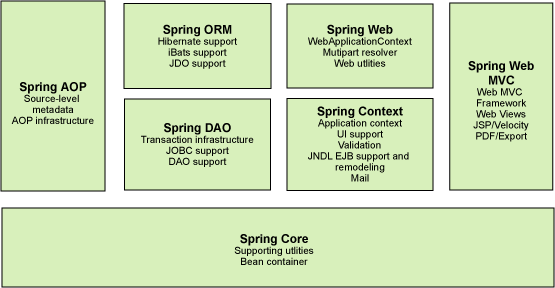
Each of the modules (or components) that comprise the Spring framework can stand on its own or be implemented jointly with one or more of the others. The functionality of each component is as follows:
- **The core container**: The core container provides the essential functionality of the Spring framework. A primary component of the core container is the BeanFactory, an implementation of the Factory pattern. The BeanFactory applies the *Inversion of Control* (IOC) pattern to separate an application's configuration and dependency specification from the actual application code.
- **Spring context**: The Spring context is a configuration file that provides context information to the Spring framework. The Spring context includes enterprise services such as JNDI, EJB, e-mail, internalization, validation, and scheduling functionality.
- **Spring AOP**: The Spring AOP module integrates aspect-oriented programming functionality directly into the Spring framework, through its configuration management feature. As a result you can easily AOP-enable any object managed by the Spring framework. The Spring AOP module provides transaction management services for objects in any Spring-based application. With Spring AOP you can incorporate declarative transaction management into your applications without relying on EJB components.
- **Spring DAO**: The Spring JDBC DAO abstraction layer offers a meaningful exception hierarchy for managing the exception handling and error messages thrown by different database vendors. The exception hierarchy simplifies error handling and greatly reduces the amount of exception code you need to write, such as opening and closing connections. Spring DAO's JDBC-oriented exceptions comply to its generic DAO exception hierarchy.
- **Spring ORM**: The Spring framework plugs into several ORM frameworks to provide its Object Relational tool, including JDO, Hibernate, and iBatis SQL Maps. All of these comply to Spring's generic transaction and DAO exception hierarchies.
- **Spring Web module**: The Web context module builds on top of the application context module, providing contexts for Web-based applications. As a result, the Spring framework supports integration with Jakarta Struts. The Web module also eases the tasks of handling multi-part requests and binding request parameters to domain objects.
- **Spring MVC framework**: The Model-View-Controller (MVC) framework is a full-featured MVC implementation for building Web applications. The MVC framework is highly configurable via strategy interfaces and accommodates numerous view technologies including JSP, Velocity, Tiles, iText, and POI.
Spring framework functionality can be used in any J2EE server and most of it also is adaptable to non-managed environments. A central focus of Spring is to allow for reusable business and data-access objects that are not tied to specific J2EE services. Such objects can be reused across J2EE environments (Web or EJB), standalone applications, test environments, and so on, without any hassle.
---
### IOC and AOP
The basic concept of the Inversion of Control pattern (also known as dependency injection) is that you do not create your objects but describe how they should be created. You don't directly connect your components and services together in code but describe which services are needed by which components in a configuration file. A container (in the case of the Spring framework, the IOC container) is then responsible for hooking it all up.
In a typical IOC scenario, the container creates all the objects, wires them together by setting the necessary properties, and determines when methods will be invoked. The three implementation pattern types for IOC are listed in the table below.
| | |
| --- | --- |
| Type 1 | Services need to implement a dedicated interface through which they are provided with an object from which they can look up dependencies (for example, additional needed services). |
| Type 2 | Dependencies are assigned through JavaBeans properties (for example, setter methods). |
| Type 3 | Dependencies are provided as constructor parameters and are not exposed as JavaBeans properties. |
The Spring framework uses the Type 2 and Type 3 implementations for its IOC container.
### Aspect-oriented programming
*Aspect-oriented programming*, or AOP, is a programming technique that allows programmers to modularize crosscutting concerns, or behavior that cuts across the typical divisions of responsibility, such as logging and transaction management. The core construct of AOP is the *aspect*, which encapsulates behaviors affecting multiple classes into reusable modules.
AOP and IOC are complementary technologies in that both apply a modular approach to complex problems in enterprise application development. In a typical object-oriented development approach you might implement logging functionality by putting logger statements in all your methods and Java classes. In an AOP approach you would instead *modularize* the logging services and apply them declaratively to the components that required logging. The advantage, of course, is that the Java class doesn't need to know about the existence of the logging service or concern itself with any related code. As a result, application code written using Spring AOP is loosely coupled.
AOP functionality is fully integrated into the Spring context for transaction management, logging, and various other features.
---
### The IOC container
The core of Spring's design is the org.springframework.beans package, designed for use with JavaBean components. This package typically isn't used directly by users, but serves as the underlying medium for much of the other functionality. The next-highest layer of abstraction is the BeanFactory interface, an implementation of the Factory design pattern that enables objects to be created and retrieved by name. BeanFactory can also manage relationships between objects.
BeanFactory supports two object modes.
- **Singleton** mode provides a shared instance of the object with a particular name, which will be retrieved on lookup. Singleton is the default and most often used object mode. It is ideal for stateless service objects.
- **Prototype** mode ensures that each retrieval will result in the creation of an independent object. Prototype mode would be best used in a case where each user needed to have his or her own object.
The bean factory concept is the foundation of Spring as an IOC container. IOC moves the responsibility for making things happen into the framework and away from application code. As I'll show in the next examples, the Spring framework uses JavaBean properties and configuration data to figure out which dependencies must be set.
### The BeanFactory interface
Because org.springframework.beans.factory.BeanFactory is a simple interface it can be implemented for a range of underlying storage methods. The most commonly used BeanFactory definition is the XmlBeanFactory, which loads beans based on definitions in an XML file, as shown in Listing 1.
### Listing 1. XmlBeanFactory
```
BeanFactory factory = new XMLBeanFactory(new FileInputSteam("mybean.xml"));
```
Beans defined in XML files are lazily loaded, which means that the beans themselves will not be instantiated until they are needed. To retrieve a bean from BeanFactory you can simply call the getBean() method passing in the name of the bean you want to retrieve, as shown in Listing 2.
### Listing 2. getBean()
```
MyBean mybean = (MyBean) factory.getBean("mybean");
```
Each bean definition can be a POJO (defined by class name and JavaBean initialization properties) or a FactoryBean. The FactoryBean interface adds a level of indirection to the applications built using the Spring framework.
---
### An IOC example
The easiest way to understand inversion of control is to see it in action. I conclude this first article in the three-part *Spring Series* with an example that demonstrates how you can inject application dependencies (rather than build them in) through the Spring IOC container.
I'll take the use case of opening an online credit card account as my starting point. With respect to the implementation, opening a credit card account requires that the user interact with the following services:
- A credit rating service that queries the user's credit history information
- A remote credit linking service that inserts and links customer information with credit card and bank information for the purpose of automatic debits (if required)
- An e-mail service that e-mails the user about the status of his credit card
---
### Three interfaces
For this example, I assume that the services already exist and that it is desirable to integrate them in a loosely coupled manner. The listings below show the application interfaces for the three services.
### Listing 3. CreditRatingInterface
```
public interface CreditRatingInterface {
public boolean getUserCreditHistoryInformation(ICustomer iCustomer);
}
```
The credit rating interface shown in Listing 3 provides credit history information. It requires a Customer object containing customer information. The implementation is provided by the CreditRating class.
### Listing 4. CreditLinkingInterface
```
public interface CreditLinkingInterface {
public String getUrl();
public void setUrl(String url);
public void linkCreditBankAccount() throws Exception ;
}
```
The credit linking interface links credit history information with bank information (if required), and inserts credit card information for the user. The credit linking interface is a remote service whose lookup is made through the getUrl() method. The URL is set by the Spring framework's beans configuration mechanism, which I discuss later. The implementation is provided by the CreditLinking class.
### Listing 5. EmailInterface
```
public interface EmailInterface {
public void sendEmail(ICustomer iCustomer);
public String getFromEmail();
public void setFromEmail(String fromEmail) ;
public String getPassword();
public void setPassword(String password) ;
public String getSmtpHost() ;
public void setSmtpHost(String smtpHost);
public String getUserId() ;
public void setUserId(String userId);
}
```
The EmailInterface is responsible for sending e-mail to the customer regarding the status of his or her credit card. Mail configuration parameters such as SMPT host, user, and password are set by the previously mentioned beans configuration mechanism. The Email class provides the implementation.
### Spring keeps it loose
With all the interfaces in place, the next thing to consider is how to integrate them in a loosely coupled manner. In Listing 6 you can see the implementation of the credit card account use case.
### Listing 6. CreateCreditCardAccount
```
public class CreateCreditCardAccount implements
CreateCreditCardAccountInterface {
```
public CreditLinkingInterface getCreditLinkingInterface() { return creditLinkingInterface; } public void setCreditLinkingInterface( CreditLinkingInterface creditLinkingInterface) { this.creditLinkingInterface = creditLinkingInterface; } public CreditRatingInterface getCreditRatingInterface() { return creditRatingInterface; } public void setCreditRatingInterface(CreditRatingInterface creditRatingInterface) { this.creditRatingInterface = creditRatingInterface; } public EmailInterface getEmailInterface() { return emailInterface; } public void setEmailInterface(EmailInterface emailInterface) { this.emailInterface = emailInterface; } //Client will call this method public void createCreditCardAccount(ICustomer icustomer) throws Exception{ boolean crediRating getCreditRatingInterface().getUserCreditHistoryInformation(icustomer); icustomer.setCreditRating(crediRating); //Good Rating if(crediRating){ getCreditLinkingInterface().linkCreditBankAccount(icustomer); } getEmailInterface().sendEmail(icustomer);
}
Note that all the setter methods are implemented by Spring configuration beans. All the dependencies (that is, the three interfaces) can be injected by the Spring framework using these beans. The createCreditCardAccount() method will then use the services to carry out the remainder of the implementation.In Listing7 you can see the Spring configuration file. I used the arrows to highlight definitions.
### Listing 7. The config file
```
define createCreditCard definition
class="springexample.creditcardaccount.CreateCreditCardAccount">
-->inject creditRatingInterface dependency via creditRating reference bean
">-->inject creditLinkingInterface dependency via creditLinking reference bean
">">-->inject emailInterface dependency via email reference bean
/property>
http://localhost/creditLinkService-->set url property value
```
### Run the application
To run the example application you must first [download the Spring framework](http://prdownloads.sourceforge.net/springframework/spring-framework-1.2-rc2-with-dependencies.zip?download) and all its dependency files. Next, extract the framework to, say, c:\ and a folder such as C:\spring-framework-1.2-rc2 (for the current release version) will be created. You must also download and extract Apache Ant before continuing.
Next, extract the [source code](/images/2010/06/wa-spring1-SpringProject.zip) to a folder such as c:\ and a SpringProject folder will be created. Copy the Spring libraries, namely spring.jar from C:\spring-framework-1.2-rc2\dist and commons-logging.jar from the C:\spring-framework-1.2-rc2\lib\jakarta-commons to the SpringProject\lib folder. With these things done, you have the necessary build dependencies set.
Open up the command prompt, change the directory to SpringProject, and type in the following at command prompt > build.
This will build and run the CreateCreditAccountClient class, which in turn will create a Customer class object and populate it and also call the CreateCreditCardAccount class to create and link the credit card account. The CreateCreditAccountClient will also load the Spring configuration files through ClassPathXmlApplicationContext. Once the beans are loaded, you can then access them through the getBean() method as shown, finally, in Listing 8.
Listing 8. Loading the Spring configuration file
```
ClassPathXmlApplicationContext appContext
new ClassPathXmlApplicationContext(new String[] {
"springexample-creditaccount.xml"
});
```
CreateCreditCardAccountInterface creditCardAccount (CreateCreditCardAccountInterface) appContext.getBean("createCreditCard");
---
### In conclusion
In this first article of the four-part *Spring Series* I introduced you to the basics of the Spring framework. I started by discussing the seven modules that comprise Spring's layered architecture and then offered a closer look at two of them: Spring AOP and the IOC container.
Since learning is best accomplished by doing, I then used a working example to show you how the IOC pattern (as implemented by the Spring IOC container) works to integrate disparate systems in a loosely coupled manner. In this example you saw how simple it was to inject dependencies, or services, into a working credit card account application rather than having to build them in from the ground up.
Stay tuned for the next article in this series, where I'll build on what you learned here as I show you how the Spring AOP module provides persistence support in enterprise applications, as well as get you started with the Spring MVC module and related plug-ins.
This tutorial of mine was first published by IBM developerWorks. All rights reserved by IBM and Author.
---
# EPOC Mobile Tutorial
URL: https://navveenbalani.dev/articles/epoc-mobile-tutorial
Type: article | Date: 2010-04-18 | Topics: mobile
In this article , we will look at how to create Java applications on EPOC-based devices. We will build a Java application that accesses a database of contact information and deploy and test the application on a Nokia-based emulator. To run the sample application, you'll need the Nokia 9200 Communicator Series SDK for Symbian OS . This article assumes that you are familiar with Java Swing programming, and gives you a brief introduction to the JavaPhone 1.0 APIs, which give Java programs access to a selection of native services on the phone used by our application.
### An overview of Java on Symbian OS
The basis of the Symbian OS Java environment is the Personal Java Application Environment, which implements version 1.1.1 of Sun's specification; it is partly based on legacy code from Symbian's Version 5 Java Runtime environment. Symbian OS also provides an implementation of the JavaPhone 1.0 set of APIs, which gives Java programs access to a selection of invaluable native services on the phone. These include:
- **Java Telephony API**: Allows Java programs to create and terminate outgoing calls, listen for and answer incoming calls, and detect changes in the call state.
- **Calendar and Address Book API**: Allows Java programs to read, write, and modify contact details, calendar items, and to-do items, working transparently with data in native Symbian format. We will be using the contact book APIs to store and retrieve our application information.
- **javax.comm** : Allows Java programs to discover, configure, send, and receive data on available ports (serial and infrared).
- **P2P Wireless Datagram API**: Allows Java programs to exchange datagrams with other devices via UDP or SMS.
We can test the application we develop here on an emulator before deploying it to an actual device. As noted, we will be using the Nokia 9200 Series Symbian OS SDK (Java edition), which can be downloaded from the Forum Nokia Web site . The SDK includes an emulator, the PersonalJava application environment, tools, and utilities to deploy and run the applications.
### Building Java apps on the Symbian platform
Let's take a look at the high-level steps required to build a Java application on the Symbian platform:
1. Write the Java code in your favorite editor.
2. Compile the code to Java class files.
3. Create the .txt and .aif support files. (These are needed if you want the application to appear on the phone's extras bar and to have its own icon on the phone's screen.)
4. Test under the WINS emulator (this requires a PC running Windows 95/98/NT/2000).
5. Copy the class, .txt, and .aif files to the target machine. The class files do not have to be recompiled.
6. Test your application on the device.
7. Create an SIS installation file for easy deployment of your application.
We'll be following the first four steps in the list to develop our sample application. For more on deploying the completed app to a real Symbian OS device
### Introduction to the Java Phone APIs
As our application relies on the Java Phone APIs for storing data in Symbian format, we'll look at some of them, namely javax.pim.addressbook and javax.pim.database, before going into the details of our code. Using these APIs, we can store and retrieve our contact information.
The ContactDatabase class is an abstraction modeling a database storing contact information. ContactDatabase implements the javax.pim.database.Database interface and stores information associated with contacts. This information is organized in the form of Items. A ContactCard, which stores information about an individual contact, is a subclass of Item that can be retrieved from the ContactDatabase.
To open the contact database, we can use the static method ContactDatabase.openDatabase(). After we've opened the database, we can manipulate it. Each row of a database corresponds to a ContactCard object. This object stores details of a contact in ItemFields, which can be aggregated further to produce AggregateFields.
The ContactDatabase class has static final fields that correspond to the name and value fields (and parameter name and parameter value fields) of the vCard specification . If a field in the vCard specification has property named N, then the ContactDatabase will contain a static String field called N. The ItemFields of ContactCard map to these fields. Hence, the ContactCard equivalent field to the vCar property named N will be a static String field ContactDatabase.N.
For example, a few of the fields in the ContactDatabase class are listed below:
- public static final java.lang.String N
- public static final java.lang.String FN
- public static final java.lang.String TEL
- public static final java.lang.String ADR
These specify name, formatted name, telephone number, and structured delivery address, respectively.
A field such as ContactDatabase.N can be an aggregate composed of up to five parts, as follows, where the integer represents the index of the respective component part.
1. FAMILY\_NAME
2. GIVEN\_NAME
3. ADDITIONAL\_NAMES
4. PREFIXES
5. SUFFIXES
These part values are defined as fields of ContactDatabase. For instance:
### Listing 1. Defining the fields of ContactDatabase
| |
| --- |
| ``` public static final int FAMILY_NAME ``` |
is the index in the N field of the family name (and has the value 0). Similarly:
### Listing 2. Defining more fields
| |
| --- |
| ``` public static final int GIVEN_NAME ``` |
is the index in the N field of the given name (and has the value 1).
An ItemField can have a parameter value associated with it. A parameter has a name and a value. In a ContactDatabase the name is always TYPE:
### Listing 3. Naming a parameter
| |
| --- |
| ``` public static java.lang.String TYPE ``` |
Some example values are given below in Listing 4.
### Listing 4. Further example values
| |
| --- |
| ``` public static final java.lang.String HOME public static final java.lang.String WORK ``` |
The values are all TEL field TYPE parameter values referring to home and work numbers, respectively. Similarly, Listing 5 includes some of the parameter values associated with an ADR field:
### Listing 5. Parameter values associated with ADR
| |
| --- |
| ``` public static final java.lang.String HOME public static final java.lang.String WORK ``` |
These indicate home and work addresses, respectively. We will be using the above fields while building our Java phone book application.
A record is inserted into the contact database in the form of contact cards. The contact cards contain ItemFields or an AggregateField. This can be added by using the contactCard addItem() method:
### Listing 6. Inserting a new record
| |
| --- |
| ``` ContactCard contactCard = new ContactCard(); ItemField name = new ItemField(ContactDatabase.N, "Value"); contactCard.addItem(name); ``` |
To retrieve the data, we could use the items() method of the ContactDatabase to search for a particular record:
### Listing 7. Searching for a record
| |
| --- |
| ``` private ContactDatabase addressbook; Iterator result = addressbook.items(ContactDatabase.N, "Value To Search"); ``` |
After getting the result, we could get each record as follows (we'll use ContactCard as our example):
### Listing 8. Getting each record
| |
| --- |
| ``` ContactCard contact = (ContactCard)(results.next()); ``` |
After getting the ContactCards, we could use the getFields() or getField() method to get ItemField or AggregrateField:
### Listing 9. Retrieving data
| |
| --- |
| ``` AggregateField name = (AggregateField)contact.getField("N"); if(name != null) { name.getField(ContactDatabase.FAMILY_NAME).getString(); // Index 0 name.getField(ContactDatabase.GIVEN_NAME).getString(); // Index 1 } ``` |
With this information under our belts, we now have sufficient knowledge to build and run our sample application.
---
### Sample application: code analysis
Download the [sample.zip](/images/2010/06/wi-sample.zip) file. This file contains the javaphonebook directory; extract it to your C: directory. The javaphonebook directory contains the JavaPhoneBook.java application. This application represents a phone book, which stores contact information using the Java Phone APIs we discussed in the previous section.
Let's analyze the code in JavaPhoneBook.java in some detail, starting with line 40.
### Listing 10. Setting up a keyboard listener
| |
| --- |
| ``` public class JavaPhoneBook extends CFrame implements CBAListener ``` |
Because Nokia 9200 Series communicators do not, by default, have a pointer, the user interacts with applications via the keyboard, also known as the *Command Button Array* (CBA). Hence the JavaPhoneBook extends CFrame with implements CBAListener so that user interaction takes place through CBActionEvents. The CBA responds to CBActionEvents and hence the CFrame (which extends the Frame class) implements a CBAListener interface, which in turn extends the EventListener interface.
Lines 43 to 47 define the TextFields for user inputs firstname, lastname, workph, address, and homeph.
### Listing 11. Defining TextFields for user input
| |
| --- |
| ``` private TextField firstName = new TextField(12) // and so on; ``` |
Lines 49 to 52 define the Menu and MenuItem for the add, find, and clear actions, which can be accessed from drop-down menus when the application is deployed and run. (You'll see how this works in the next section.)
### Listing 12. Defining drop-down menu
| |
| --- |
| 49 private Menu editMenu=new Menu("Main Menu"); private MenuItem createItem=new MenuItem("Add Information",new MenuShortcut(KeyEvent.VK\_N)); private MenuItem findItem=new MenuItem("Find Information", new MenuShortcut(KeyEvent.VK\_F)); private MenuItem clearItem=new MenuItem("Clear Fields", new MenuShortcut(KeyEvent.VK\_C)); |
Line 54 creates an instance of the CBAHandler; lines 56 to 58 create a new CBA for add, find, and close operations.
### Listing 13. Creating a new CBA
| |
| --- |
| ``` static final int ADD = EikCommandButtonGroup.BUTTON1; static final int FIND = EikCommandButtonGroup.BUTTON2; static final int CLOSE = EikCommandButtonGroup.BUTTON4; ``` |
In lines 60 to 62, we declare variables for accessing the ContactDatabase, ContactCard, and Iterator to iterate over ContactCards.
### Listing 14. Declaring variables
| |
| --- |
| ``` private ContactDatabase addressbook; // The contact database private Iterator results; // Used to iterate through the search results. private ContactCard currentContact; // The currently active ContactCard ``` |
Lines 71 to 90 build the UI part of the application. Lines 98 to 107 create ActionListeners for menu events and handlers to catch CBA events.
### Listing 15. Building a UI
| |
| --- |
| ``` editMenu.add(createItem); editMenu.add(findItem); editMenu.add(clearItem); menuBar.add(editMenu); createItem.addActionListener(this); findItem.addActionListener(this); clearItem.addActionListener(this); // Add the CBA Handler Events cba = new CBAHandler(this); cba.setText(ADD, "Add \n Information"); cba.setText(FIND, "Find \n Information"); cba.setText(CLOSE, "Close"); cba.activate(); ``` |
Line 113 calls the openDataBase() function that opens the contact address database.
### Listing 16. Opening the contact address database
| |
| --- |
| ``` addressbook = ContactDatabase.openDatabase() ``` |
Lines 126 to 146 react to user actions, calling the add, find, and close functions, as appropriate. If the action is add, for instance, the createRecord() function is executed. This function creates an AggregateField (as discussed earlier) to store user-entered names and addresses, and an ItemField to store work and home phone numbers in the form of name-value pairs.
### Listing 17. Calling user-requested functions
| |
| --- |
| //Name in this order: Family name, given name AggregateField name = new AggregateField(ContactDatabase.N); name.addField(new ItemField(ContactDatabase.N, lastName.getText())); // Family name name.addField(new ItemField(ContactDatabase.N, firstName.getText())); // Given name //Work telephone number ItemField workTel = new ItemField(ContactDatabase.TEL, workph.getText()); workTel.addParameter(new Parameter(ContactDatabase.TYPE, ContactDatabase.WORK)); //Home telephone number ItemField homeTel = new ItemField(ContactDatabase.TEL, homeph.getText()); homeTel.addParameter(new Parameter(ContactDatabase.TYPE, ContactDatabase.HOME)); //Organization : for storing address AggregateField org = new AggregateField(ContactDatabase.ORG); org.addField(new ItemField(ContactDatabase.ORG, address.getText())); |
Next, lines 215 to 233 create a ContactCard, as shown in Listing 17 below, to store the fields we created above. We then add that ContactCard to the contact database. Thus, our ContactCard holds the AggregrateField and ItemFields.
### Listing 18. Creating a ContactCard
| |
| --- |
| ContactCard contact = new ContactCard(); contact.addField(name); contact.addField(workTel); contact.addField(homeTel); contact.addField(org); // Add the ContactCard record and ensure we can also update or delete it currentContact = (ContactCard)addressbook.addItem(contact); |
In this way, a record (in the form of a ContactCard) is inserted into the ContactDatabase.
When we do a find operation, we search based on the lastName field. Thus, when the user clicks on the Find Information button, the displayRecord() routine is executed. Basically, we use the items() method of the ContactDatabase as discussed earlier to get the ContactCard with a lastName field that matches the text entered by the user. The logic starts on line 175:
### Listing 19. Beginning of find operation logic
| |
| --- |
| ``` Iterator results = addressbook.items(ContactDatabase.N, lastName.getText()); ``` |
Lines 247 to 289 get the ContactCard and retrieve the values associated with it. First we use the getField("N") method of the ContactCard APIs to retrieve the AggregateField consisting of names; then we retrieve the values of the first and last name from the AggregateField object. We follow the same procedure for the remaining fields and display their values in the appropriate fields in our user interface.
### Listing 20. Find operation, continued
| |
| --- |
| ContactCard contact = (ContactCard)(results.next()); currentContact = contact; // Get the name Aggregate field and split it apart to retrieve last and first name AggregateField name = (AggregateField)contact.getField("N"); if(name != null) { lastName.setText(name.getField(ContactDatabase.FAMILY\_NAME).getString()); firstName.setText(name.getField(ContactDatabase.GIVEN\_NAME).getString()); } |
Now that we've taken a look at the high points of our application's code, let's see how to build it so you can experiment with it on your own.
---
### Building the application
Run the buildPhone.bat file that compiles the JavaPhoneBook.java file and creates JavaPhoneBook.jar in that same directory. buildPhone.bat assumes that the %epocroot% variable has been set; this generally happens during installation of the Symbian Nokia SDK. %epocroot% points to C:\Symbian\6.0\NokiaJava\erj, where C:\Symbian\ is the directory where you have installed the SDK.
Next, we shall create the classes that need to be deployed to the Symbian Environment on the Nokia emulator. Version 6.0 of the Symbian platform is delivered as two complete communicator reference designs (aka DRFDs): *Quartz,* for pocket-sized, palmtop devices, and *Crystal,* for powerful, keyboard-based, wireless information devices. Each device family has a shell program -- Extras on Crystal, and the Launcher on Quartz -- that allows the user to run application programs. Quartz is a tablet communicator with convenient pocket-sized, palmtop form factor.
To run an application from either shell program, you need at least the following two files:
- An EPOC application file (.app), which, at minimum, contains a unique identifier (UID) to identify the program.
- An application information file (.aif) to specify the icon and caption that will represent the phone on a menu screen.
Other files might also be required, depending on the programming language of the application. For example, a Java program needs an additional text file (.txt) to specify the correct command line to the JVM when the application is launched.
AIF Builder is an application that runs on your development machine (not the device or the emulator) to help you easily create the required files. It works with several device families and programming languages.
Open the AIF Tool Builder from Program Files -> Symbian 6.0SDK -> Development Tools. Select New from the File menu, and select Java as the application language in the Application Details pane, as shown in Figure 1.
### Figure 1. AIF Builder Application Details pane
Type in JavaPhoneBook in the Application Name field. For Application UID, type in 0x01000000, which uniquely identifies the application. Each application must have its own UID. A UID is a 32-bit number, which you can get as you need from Symbian . During development, you can choose temporary UIDs within the range from 0x01000000 to 0x0fffffff. Care must still be taken to ensure that no two programs have the same UID; such a conflict could stop a program from loading correctly, typically leading to NotFound errors.
Finally, type in the following as the Java Command Line Text field value:
| |
| --- |
| ``` -cp JavaPhoneBook.jar -Dcom.symbian.appName="JavaPhoneBook" navexamples.JavaPhoneBook ``` |
This tells the JVM on the emulator or device to run the appropriate class file for the JavaPhoneBook application.
Next, select the DRFD's pane (see Figure 2) to select the device family or families for which the application is written. In the DRFD's To Generate For option list, check only the box next to Crystal, as we are developing for Crystal-based devices. In the Location to Generate Files field, select the directory where you have the JavaPhoneBook.jar file and the files extracted from sample.zip; you can use any existing folder as the output directory for temporary files.
### Figure 2. AIF Builder DRFDs pane
Click on the Generate button and four files will be created: JavaPhoneBok.aif, JavaPhoneBok.app, JavaPhoneBok.txt, and a temporary file named JavaPhoneBook.rss.
---
### Running the application
We'll need to move the JavaPhoneBook folder to the applications directory where the emulator or device can find it. Copy the directory to C:\Symbian\6.0\NokiaJava\Epoc32\Wins\c\System\Apps. Note that you only need the three files we generated at the end of the last section (excluding the temporary file) plus the JavaPhoneBook.jar, so the remaining files in the JavaPhoneBook directory can be deleted. When you run the emulator, the application JavaPhoneBook will now appear in the Extras section of the emulator menu as shown in Figure 3 below. (To run the emulator, select Program Files- > Symbian 6.0 SDKS -> Nokia Java -> Emulator(rel).)
### Figure 3. Emulator Extras menu
Click on Open and the screen in Figure 4 appears. Enter the information requested and select Add Information, which is nothing but a CBA button that fires the appropriate createRecord() method. The information is added to the ContactDatabase.
### Figure 4. Adding an address to the database
You could also add information from the menu section. Press the F1 key on your keyboard to access the drop-down menus. Select Main Menu -> Add Information as shown in Figure 5. This menu event corresponds to the menu events that we have programmed.
### Figure 5. Using a drop-down menu
Select Clear Fields from the Main Menu to clear all the information. Then type in the last name of the person for whom you want to search and click Find Information as shown in Figure 6.
### Figure 6. Searching the database
You should see the data being populated in the remaining fields if the last name is found in the ContactDatabase, as shown in Figure 7.
### Figure 7. Search results
Thus, we have successfully built our phone book application.
### Deploying the application on an actual device
To deploy our application to a real Symbian OS device, we must create a Symbian installation (SIS) for it. The SDK includes the necessary tool for this, an executable named makesis.exe. This tool needs a .pkg (package) file as input that contains the application information and files that need to be deployed. Refer to the Symbian developers' Web site to learn how to create an SIS file for any application.
---
### Conclusion
We've now built a sample Java-based application on the Symbian platform and deployed and tested it on our Nokia emulator. This application build can be transferred on to our actual Nokia 9200 series devices. You should now be able to use your existing Java background and your new knowledge of the Java Phone APIs to start developing applications for this useful class of devices. Now you need to put your creativity to work and think about what kind of apps Symbian users need!
This article of mine was first published by IBM DeveloperWorks . All rights reserved by IBM and author.
---
# Getting started with KXML2 and J2ME
URL: https://navveenbalani.dev/articles/getting-started-with-xml-mobile-and-j2me
Type: article | Date: 2010-04-15 | Topics: mobile
This tutorial will detail the use of kXML 2, a small XML pull parser specially designed for constrained environments, to access, parse, and display XML files for Java 2 Micro Edition-enabled devices. This tutorial will demonstrate how to build a mobile application that brings XML data to wireless J2ME devices, and will instruct the reader in how to craft a MIDlet that performs the necessary logic and deploys it to a J2ME environment.
KXML2 due to its low memory footprint , is ideal for dealing with xml contents on various mobiles which support Java.
Download the tutorial and sample code for the tutorial to get started with KXML2.
[Download the Tutorial](/images/2010/06/wi-kxml-pdf.pdf)
[Download the Sample code for the Tutorial](/images/2010/06/wi-xmlj2me.zip)
This tutorial of mine was first published by IBM developerWorks. All rights reserved by IBM and Author.
---
# Building Wireless Java Applications Using DB2 Everyplace
URL: https://navveenbalani.dev/articles/building-wireless-java-applications-using-db2-everyplace
Type: article | Date: 2010-04-14 | Topics: architecture
This article demonstrates how to build a JavaTM application that accesses DB2 Everyplace Enterprise data built using the MAB, deploy it and test it locally on a Nokia Emulator. This article assists developers by:
- Providing an overview of Java development support on MAB
- Installing and configuring the Nokia Communicator 9200 SDK emulator for the sample application using MAB
- Building, deploying and testing the sample Java application
- Running the sample application
---
### Overview of Java support on MAB
DB2 Everyplace is a relational database designed for personal digital assistants (PDAs), handheld personal computers, mobile phones, and embedded devices. DB2 Everyplace is part of IBM's solution for mobile computing. With DB2 Everyplace, mobile professionals, such as sales people, can access vital data that they need even when they are on the road.
MAB is an integrated toolkit for developing DB2 Everyplace applications running on handheld devices. MAB makes it easy to write robust applications on a more powerful development platform (MAB is supported on Windows NT with Service Pack 4 or higher, Windows 2000 and Windows CE for deployment to handheld devices. Using the MAB builder, you can generate Java applications to support devices such as Symbian that access the DB2 Everyplace database without writing a single line of code.
---
### Installing and configuring the tools
This article assumes that you have already installed DB2 Everyplace, MAB builder and the required tools . However, for the sample application we discuss in this article, you will have to install the Nokia 9200 Communicator SDK.
### Installing the Nokia 9200 Communicator SDK
Use the following steps to install the Nokia 9200 Communicator SDK:
- Download the Nokia 9200 Communicator Series SDK for Symbian OS from [http://www.forum.nokia.com](http://www.forum.nokia.com/). You will have to register to download the SDK. A Windows desktop emulator is included with the SDK. Please note that these procedures are based on SDK Version 1.2, and this application has been tested on Windows 2000.
- Install the SDK in the default installation directory (C:/Symbian/6.0/NokiaJava). When asked to choose the components to be installed, choose all of the components, including the Perl and JRE. If you already have a Java Development Kit (JDK) 1.2 (Java 2) or higher on your Windows desktop, you can choose to use that one and not install the JRE that comes with the installation.
- Install the DB2 Everyplace engine and JDBCTM driver on the emulator. These files are in the directory C:/DB2Everyplace/DB2e/Clients/EPOC6/DB/wins when you install DB2 Everyplace in C:/.
- Copy db2e.dll, db2e.lib, and db2ejdbc.dll to C:/Symbian/6.0/NokiaJava/Epoc32/Release/wins/urel.
- Copy db2ejdbc.jar to C:/Symbian/6.0/NokiaJava/erj/ext. The DB2 Everyplace engine does not have an install program for the Emulator at this time. This is a one-time step to be completed at setup.
**Note:** If you have other version(s) of Perl installed, the application build process may fail if the other Perl version appears before the Symbian SDK's Perl in the PATH environment variable. If this happens you will have to set the PATH appropriately. Click **Start -> Control Panel -> System -> Advanced -> Environment Variables -> System Variables**, select **PATH** and click **Edit**. Verify that C:/Perl/bin appears before any other Perl version.
---
### Building, deploying and testing the sample Java application
In this exercise, we will build a sample Address Book application using MAB and deploy it in the Nokia Emulator. Click **Start -> Programs ->** **IBM** **DB2 Everyplace -> Mobile Application Builder** to launch the MAB Environment and then follow these steps:
1. Select the **Start a new project** option
2. Name the project, such as JavaBook, as shown in Figure 1.
3. Select **SymbianOS V6-Crystal** as the target device.
4. By default, the application ID is 0x1000911B . When we create a new project, we have to specify the application ID that uniquely identifies the application.
5. Click **Finish**.
### Figure 1. Create a new project screen
****
Loading the table definitions for the sample address book
Once the project is defined, you can start loading the table definitions for the tables that will be used in the application. DB2 Everyplace MAB includes an option to import table definitions into the project file. These definitions can then be used further when creating forms or referencing columns of other tables on a form. The following steps will load the address.ddl (sample directory from [0210balani.zip](/images/2010/06/0210balani.zip) file):
1. Right-click on **Tables** and select **Import Table**, as shown in Figure 2, below.
2. The **Import table** definition window opens. Select the address.ddl file that contains the definition for your tables and click on **Open**. When the tables are loaded, they appear under the Table section of the project tree window.
### Figure 2. Importing table definitions
****
Building the user interface
With the table definitions loaded into the project pane, we are now ready to start creating forms for the application. There are two ways to create a form within MAB:
1. Create the form manually
2. Use the Form Creation wizard to automatically generate the form
This article describes how to use the Form Creation wizard. Take the following steps to create the forms:
1. Right-click on the **Address** table and select **Launch Form Creation Wizard**. The Form Creation Wizard appears as shown in Figure 3 below. Select all the database columns to include in the form by checking the boxes, as shown in Figure 3.
**Figure 3. Form Creation Wizard: Selecting database columns**
2. In the next window, choose the Database Operations that we want to associate with the forms by selecting all the boxes, as shown in Figure 4 below, and then click **Finish**.
**Figure 4. Form Creation Wizard: Database Operations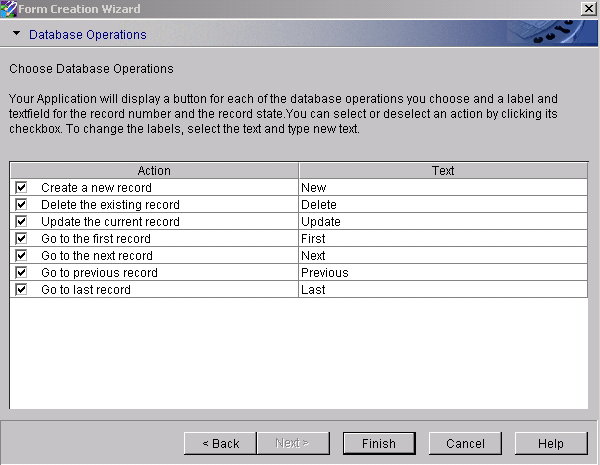**
3. After taking the above steps, the Address form will be included in the Forms section. Select the **Form1** and delete it, as this is a blank default form.
Analyzing the Address form
The following steps will allow you to analyze the newly created Address form.
1. After selecting the Address form, on the right-hand pane you will see the Address form. At this screen, select the **New** button in the Address form, as shown in Figure 5.
**Figure 5. Address form **
2. Highlight **SymbianOS V6-Crystal** and look into the "Database Location" in the Properties pane as shown below in Figure 6. The value associated with Database Location identifies the location of the database, which by default is \system\data\db2e. We need to set up our database tables in that location so that our application can access the tables. The value \system\data\db2e is mapped to the location where your application will be deployed. For example, if we are testing it in the Nokia Emulator and you have installed the SDK in C:\Symbian\6.0\NokiaJava, then the location of the database is C:\Symbian\6.0\NokiaJava\Epoc32\Wins\c\System\Data\db2e.
**Figure 6. Database location**
3. When you click on the **Menus** option, a menu will be created for each action, such as New, Delete and so on. Click on **New** under Menus and then click on the **Events** tab at the bottom of the pane. The following screen appears, as shown below in Figure 7.
**Figure 7. Creating a new menu**
4. Click on the value associated with the **Menu Select** option to display the following screen (Figure 8). You can also view events here for deleting and updating records.
**Figure 8. Menu Select**
5. Click on the **Field1Form2** value associated with the "FirstName" field in the Address form as shown below (Figure 9) and navigate to the **Properties** pane.
**Figure 9. Choosing a value in the Address form screen**
6. The "Data field" property field in the **Properties** pane shows which value of Field1Form2 is mapped to which column in the database. "Data source" denotes the table it is mapped to. Thus, in this way all the *fieldvalue* values are linked to the column of the database.
### Building the application
Now that we have installed and configured our tools and have set the databases up properly, we can build the application by selecting **Build -> Build** from the menu. If everything has been done correctly, you will get the message *Application build was successful*. If you get an error, make sure that you have set up the configuration properly by installing the tool and setting the path to it in the Preferences window.
Building the application creates many intermediate files. These files are used by MAB, and changing them could result in an error in your project. The following is the list of the created files:
**\*.java:** Source files for the application
**\*.class:** Class files of the application
**\*.bat:** Scripts called to deploy, copy the required files to it in Nokia Emulator and start the Emulator
**.aif:** Application information file, Symbian platform-specific files
**.app:** Application file containing the UID, Symbian-platform specific files
**.txt:** File containing the command line parameters for pjava.exe (a JVM-executable file)
**.jar:** Jar files containing the classes to be deployed in Nokia Emulator
**.pkg:** Package files containing the list of components that need to be deployed
**.sis:** The file that needs to be deployed on an actual device (not the Emulator) containing all of the required classes and packages. The **.sis** file can be copied to the actual device using the infrared port or cable connection and the application will appear in the self-made icon "ApplicationName," in our case "JavaBook" in the Extras screen. We will look into this when we run the application.
### Testing the application
Before testing the application, we need to create our sample address book. To do this, unzip the 0210balani.zip file to any directory; a folder sample will be created. The sample directory contains BuildAddress.java, SetupAddressDB.bat and the Address.ddl files. For creating the database, modify SetupAddressDB.bat so that the set **DB2EVERYPLACE\_LOCATION** and **MAB****\_LOCATION** to point to the location where you installed DB2 Everyplace and MAB builder. When you run SetupAddressDB.bat, it compiles and runs the BuildAddress.java file. The BuildAddress class creates the Address table in the directory C:/Symbian/6.0/NokiaJava/Epoc32/Wins/c/System/Data/db2e/, which was mapped earlier while analyzing the Address form and populates it with some dummy values. If you get an error while running the file, make sure you have set the correct path of **DB2EVERYPLACE\_LOCATION** and **MAB****\_LOCATION**. After running SetupAddressDB.bat, you will receive the following message:
| |
| --- |
| Table: Address created Results from table Address : FirstName= Raj , LastName= Malhotra. |
### Running the application on the Nokia Emulator
Now you can build the Nokia application by selecting **Build -> Test** from the Nokia menu. The Nokia Emulator will pop up, as shown below in Figure 11. Normally there is a one-minute delay as the JVM takes time to load. Navigate to the JavaBook application as shown below in Figure 11.
### Figure 11. Opening the JavaBook application
Click on **Open Link** to open the JavaBook application. The following screen appears with the data pre-populated (which was inserted when the SetupAddressDB script was executed). See Figure 12.
### Figure 12. Address data pre-populated in JavaBook
Enter the information you want to insert in the database on their respective fields and click on the **F1** key of the keyboard. The menu appears as shown in Figure 13, below. Click the **New** button to insert the data into the database.
### Figure 13. Adding new information to the database
When you click on the **F1** key, the Menu appears. Click on the **Navigations** menu and select **Last** to view the last record in the database to verify that the data is inserted properly. See Figure 14.
### Figure 14. Viewing the last record in the database
You can use the various actions and navigations menus to insert and verify the information and to see the application flow.
---
### Summary
This article shows how to use the features of DB2 Everyplace to successfully create, deploy and test our sample Java application. This application build can be transferred to an actual Nokia 9200-series device.
This article of mine was first published by IBM developerWorks. All rights reserved by IBM and author.
---
# Creating a Mobile Application for Palm Devices Using DB2 Everyplace
URL: https://navveenbalani.dev/articles/creating-a-mobile-application-for-palm-devices-using-db2-everyplace
Type: article | Date: 2010-04-12 | Topics: architecture
This article describes how Mobile Application Builder (MAB) can be used to build wireless applications and, together with IBM DB2 Everyplace, deliver enterprise data into wireless devices. It can also be used to access and perform updates to this data.
The purpose of this article is to help you:
- Understand and use the features of DB2 Everyplace
- Configure and install DB2 Everyplace
- Build, deploy, and test a sample Palm application
---
### Overview of DB2 Everyplace
DB2 Everyplace is a relational database designed for personal digital assistants (PDAs), handheld personal computers, mobile phones, and embedded devices. DB2 Everyplace is part of IBM's solution for mobile computing. With DB2 Everyplace, mobile professionals, such as sales people, can access vital data that they need even when they are on the road.
The DB2 Everyplace solution consists of the following components:
- **The database:** A relational database system designed with a small footprint for small devices.
- **The Sync server:** A bidirectional synchronization server that moves data between the DB2 Everyplace database and enterprise databases.
- **Mobile Application Builder:** A rapid application development tool for creating DB2 Everyplace applications that can run on mobile devices.
### The database engine
This relational database engine delivers persistent storage for record sets and provides the ability to modify and retrieve records using SQL. Data in a DB2 Everyplace database can be accessed using several different methods:
- Using the Command Line Processor (CLP) to issue SQL statements.
- Using an application that uses ODBC or JDBC as a call-level interface.
Synchronization server
Sync Server is a client/server program that manages the data synchronization process from the mobile DB2 Everyplace database to the source database. Sync Server enables two-way data synchronization from the mobile database to a source database, as well as from the source database to the mobile database. The source database can be any relational database.
### Mobile Application Builder
The Mobile Application Builder (MAB) is an integrated toolkit for developing DB2 Everyplace applications running on mobile devices. MAB makes it easy to write robust applications on a more powerful development platform (MAB is supported on Windows NT®, Service Pack 4 or higher, Windows 2000®, and Windows XP Professional®) for deployment to mobile devices. Then these applications can run on Palm OS-based devices (for which C language applications are generated), or any device that supports a JavaTM Virtual Machine (Java language applications are generated).
This article describes how to develop a Palm C language application using MAB to build and test our Palm application. Our application will be developed using Version 8.1 of DB2 Everyplace. In a future article, we will synchronize our application with a relational data store.
Version 8.1 also supports Java, and a future article, Building Wireless Java Applications Using DB2 Everyplace, describes how to build a Java application and deploy it to a mobile device that supports a Java Virtual Machine.
---
### Configuring the environment
This section describes how to install the MAB and the associated tools, all of which are available for download at .
Step 1: Install the Mobile Application Builder
To install MAB, run AppBuilderENU.exe, accept the defaults and the setup will install the MAB to \DB2Everyplace\ApplicationBuilder.
Step 2: Set up the build environment for MAB
All of the following tools are used by the MAB and must be installed. The tools only need to be installed once on a particular workstation.
### Install Cygwin
Run cygwin-b20.1-full.exe by double-clicking the **.exe** file from Windows Explorer. The default installation directory is c:\cygnus.
### Install GNU PRC- Tools
Follow these steps to install the PRC tools, which contains the cross-compiler and other utilities.
1. Double-click **prc-tools2.0.exe**.
2. On the **Select Components** page of the installation wizard, select the **C** and **C++ Tool Chain** component of the PRC-Tools. Optionally, install the tool documentation and sample programs.
3. On the **Choose Destination Location: PRC Tools** page, specify the destination folder, or accept the default directory (c:\Program Files\PRC-Tools).
4. On the **Choose PalmDev Location** page, specify the destination folder for the tool chain documentation and sample programs, or accept the default directory (c:\PalmDev). The installation wizard prompts you to choose a location for these files whether you have chosen to install them or not.
### Install the Palm OS SDK
Follow these steps to install the Palm OS SDK, which contains the Palm OS C libraries and header files.
1. Go to the Palm OS SDK version 4.0 home page located at and click **I Agree** to comply with the license information. A Palm 4.0 SDK page is displayed.
2. Click **Windows** in the **Palm OS SDK for CodeWarrior and/or PRC-Tools** section to download sdk40.zip.
3. Extract sdk40.zip to any directory, and run the Palm OS SDK 4.0 executable file.
4. On the **Select Installation Type** page, select **PRC Tools 2.0**. The installation path is set to the same path you specified when installing PRC-Tools 2.0 above on the **Choose PalmDev Location** page. The default was c:\PalmDev. A new directory named sdk-4 is created.
### Install the PilRC resource compiler
To install the PilRC resource compiler, which is used to create Palm program resources (for instance, text strings used in an application), extract pilrc.zip to \h-i586-cygwin32\bin. For example, C:\Program Files\PRC-Tools\H-i586-cygwin32\bin.
**Set up the** **PALM** **Emulator and ROM images**
Follow these steps to install the Palm Emulator and ROM images for the Palm Emulator.
1. Download the Palm Emulator from . You also need to register for the ROM images for the level of PalmOS used in the devices you are registering applications for.
2. Save the zip file to the MAB installation directory. (for example, c:\DB2 Everyplace\ApplicationBuilder\bin), and unzip the file in this directory. The emulator.exe file must be located in the MAB installation directory in order for the user interface to find it when you test an application using the Test toolbar or menu item.
Step 4: Set up the Palm Emulator for testing
1. Start the emulator by double-clicking on **emulator.exe** from c:\DB2 Everyplace\ApplicationBuilder\bin.
2. From the popup window, select **New** to start a new emulator session. In the **New Session** window as shown in Figure 1, select the location of the ROM file you downloaded from . Click **OK** to see the Palm Emulator.
### Figure 1. New Emulator session
3. Right-click anywhere on the emulator screen and then click **Install Application/Database**
4. Select **Install Other** to install the database engine.
5. Select the following files:
| |
| --- |
| C:\DB2EveryPlace\DB2e\Clients\PalmOS\DB2eCAT.prc C:\DB2EveryPlace\DB2e\Clients\PalmOS\DB2eCLI.prc C:\DB2EveryPlace\DB2e\Clients\PalmOS\DB2eComp.prc C:\DB2EveryPlace\DB2e\Clients\PalmOS\DB2eRunTime.prc C:\DB2EveryPlace\DB2e\Clients\PalmOS\Samples\SampleCLP\DB2eCLP.prc |
### Setting environment properties
By default, the MAB builder automatically links the Palm prerequisite tools. Because we have already installed the development tools using their separate installation programs using the default file system path recommended, we now must tell MAB where the tools are installed. To do this, go to **File -> Preferences -> Palm Tools** and click **Browse** to find the location in which the tools are installed, as shown in Figure 2.
**Figure 2. Telling** **MAB** **where the tools are installed**
Now we are done setting up the MAB development environment.
---
### Building, deploying, and testing our sample Palm application
Now let's build a sample address book application and deploy it in our Palm emulator.
1. Launch the MAB environment by clicking **Start -> Programs ->** **IBM** **DB2 Everyplace -> Mobile**
2. Select **Create a New Project**.
3. Name the project SampleAddressBook.
4. Enter SAB as the application name.
5. Select **Palm OS** as the target device.
6. Select the default application ID, **DBA1**. This ID is registered in the application ID database and can be used for testing purposes. You can change the application ID when you are ready to deploy your application.
7. Click **Finish**.
### Figure 3. Creating a project for sample address book application
### Loading the table definitions for SampleAddressBook
After the project is defined, you can start defining the tables to be used in the application. DB2 Everyplace MAB includes an option to import table definitions into the project file. These definitions can then be used further when creating forms or referencing columns of other tables on a form. To load our address.ddl (from the [sample.zip](/images/2010/06/sample.zip)) file:
1. Right-click **Tables** and select **Import Table**, as shown in Figure 4.
### Figure 4. Loading table definitions
2. From the Import table definition window, select **address.ddl**, then click **Open**. When the tables are loaded, they appear in the table section of the project tree window.
### Building the user interface
With the table definitions loaded into the project pane, we are now ready to start creating forms for the application. There are basically two ways to create a form within MAB:
- Create the form manually.
- Use the form creation wizard to automatically generate a form for a table.
We will use the wizard, as follows:
1. Right-click on the Address table and select **Launch Form Creation Wizard**.
2. Select all the database columns to be included in the form, as shown in Figure 5.
### Figure 5. Form creation wizard
3. Click **Next**, which enables us to choose the database operations that we want to associate with the forms.
4. Select all of the available actions as shown in Figure 6, then click **Finish**.
### Figure 6. Setting available database operations
5. Now you can find the Address form in the Forms section. Delete **Form1**, because this is a blank default form.
### Creating events for the address form
1. Select the address form and click **New** as shown in Figure 7.
### Figure 7. Using the address form
2. Select the Events tab as shown in Figure 8 and you will see a Tap event and the Address create record associated with the Tap event. A tap event can be compared to a click of a mouse that generates some action. For example, in the above application when you click the **New** button, the function associated with the New button gets fired. This means that when a user clicks the New button, a new row is created.
### Figure 8. Creating a Tap event
3. Click **Address create record**, and the Event Action and Target form appears.
4. Click **Create Record**, select **Set Message** and select the following notification events (Figure 9):
### Figure 9. Selecting notification events
5. Create similar events for deleting and updating records.
### Building the application
Build the application by selecting **Build -> Build** from the menu. If the build is successful, you see a message. If you get an error, make sure that you have set up the configuration properly by installing the tools and setting the path in Preferences as we described in Setting environment properties.
When we build our application, many intermediate files are created in order to create the final Palm executable file (\*.prc). These files are used by Mobile Application Builder and changing them could result in an error in your project. These are the files:
- \*.prc - Palm application executable. This is the final output created when a project is built successfully.
- \*.bin - Executable Palm resources in application
- \*.c - Source code for application
- sql\*.h - Header files your application needs to access the DB2 Everyplace engine functions.
- \*.h - Header file used to generate application.
- \*.makefile - Used to build executable application for Palm.
- \*.rcp - Definition of Palm resources in application.
- ibm\_pab-sections.\* - Related to multiple code segment support.
### Testing the application
Before testing the application, create the sample address book.
1. Select **Application** from the Palm emulator and select **DB2e** **CLP**, which is included with DB2 Everyplace.
2. Enter the following SQL statement in the Query field as shown in Figure 10 and click **Execute**.
| |
| --- |
| CREATE TABLE Address (FirstName Char(30), LastName Char(30) not null primary key , Address char(30), Country char(30), PhoneNumber char(15)) |
### Figure 10. Create the sample address book
For the address book example, I used **LastName** as the primary key. In a future article I will talk about data synchronization and we will need a primary key. In your situation, it's probably better to have a different primary key. Just remember that if you insert a new name, the last name must be different from a previous name or you will get an error.
### Loading the sample address book application in our Palm Emulator
1. Right click anywhere on the emulator screen and click **Install Application.Database**.
2. Select **Install Other** to select the path of DB2 Everyplace engine and select the sample address book application file **PersonalAddressBook.prc** from your projects directory.
3. Right-click anywhere on the emulator screen and click **Reset -> Soft Reset** to accept your changes.
4. On the Palm Emulator, click **Applications** and choose **SAB** (this is the name gave the application when we created the project.) Our Application appears as shown Figure 11. Then click **New**.
### Figure 11. Adding a new address
5. When you click **New**, you get a notification message as shown in Figure 12.
### Figure 12. Confirmation requested
6. Click **OK** and you see a message indicating that the creation was successful.
You can navigate through the application using various control buttons (Tap events) to see the application flow. For example, you can navigate to the first record by clicking the **First** button. You can navigate through records using **Next** and **Previous** buttons and you can delete and update records as well.
---
### Summary
Using DB2 Everyplace, you have successfully created, deployed, and tested a sample application. This application build can now be transferred onto Palm devices.
This article of mine was first published by IBM developerWorks. All rights reserved by IBM and author.
---
# Interview at developerWorks
URL: https://navveenbalani.dev/talks/interview-at-developerworks
Type: talk | Date: 2010-03-23 | Topics: opinion, personal
*From the archives — this interview was originally published on IBM developerWorks' "Yin meets yang" community blog on March 23, 2010, conducted by Valerie Skinner of the developerWorks team. It is republished here as it appeared: a snapshot of where the journey stood in 2010, as a software architect and developerWorks Master Author.*
**Tell me about yourself and what you're currently working on…**
I work as a Software Architect with India Software Labs, Mumbai. I am part of WebSphere Business Services product development team and currently working towards our next release of the product.
**What has your IT career journey been like? How did you get started? Did you choose a specialty or did it evolve?**
I started my IT career in year 2000. I have always been keen to learn about new technologies and wanted to specialize on software design and architecture. Early in my career, I used to spend most of my time researching on various technologies and contributing articles, white papers on it.
I started off with a services organization where I was involved in designing and developing solutions for banking and insurance firms primarily on Java and J2EE stack. I was always looking out for opportunities where I could work on challenging assignments and get to design and architect solutions and products. Over these years, I have played various roles right from a developer to an architect and have worked on product development as well as designing and architecting solutions.
**What IT project are you most proud of?**
I would say all projects that I have worked on have helped me in my career in some way or the other. Early in the career, I worked on various services engagement projects where I was implementing solutions for US banking and insurance firms. One particular implementation of a security algorithm that I did seems to still be in use in their various banking solutions.
Next, I would like to mention a BPM workflow implementation project, where I was involved in architecting and realizing an end-to-end BPM workflow solution, where we wanted to replace the customer's existing process and fully automate it. Being in a startup firm, you handle a lot of responsibilities, and I owned the entire business process solution and database design. There were various design challenges, integration challenges, and various strategies required in terms of planning and execution to make it successful. An interesting thing about this project was that it was the first BPM workflow implementation for a particular environment and stack, which had its own challenges.
The other project that will always remain special is Business Service Fabric, which I have been working on since its inception, and which was acquired by IBM in 2006. Product development is completely different from software services engagements, and working on this product has immensely helped me increase my technical knowledge over the years.
**I love your blog post where you share your philosophy of "Just go for it", as a technical author of over 50 articles. Do you have any personal techniques, like goal setting, that help you succeed?**
I always try to keep myself updated on ongoing trends and technology. I usually try to learn something new every year and then come up with a blog, white paper, book, or article — some medium I can share with the community.
When I started, I never set any personal goals about the number of articles I needed to publish. I simply have a passion for writing, and I feel publishing your work in some medium is the best form of sharing your technical work, giving back to the community, and collaborating with them.
**Obviously you need technical acumen, but what are the other important skills to be a good technical author?**
I feel you should have a deep understanding of the subject you want to write about. When you write about topics, you must know your target audience and pitch it at the right level — beginner, intermediate, or advanced. A good technical author should aim at simplifying existing technology information, or write about topics in simplified terms.
**What new technologies or products are you learning about this year?**
I am planning to get myself updated on the Spring Framework 3.0 release and update my Spring series article, which was widely appreciated by readers. Last year, I wrote a [book on Apache CXF](https://www.amazon.com/Apache-CXF-Web-Service-Development/dp/1847195407); this year, I am planning to write a book on advanced web services development. I also plan to learn about the Apache Incubator projects — the Apache Shiro framework and Apache Aries.
**How do you use developerWorks?**
Apart from publishing articles and tutorials, I use developerWorks to read blogs and articles, look for resolutions to issues in forums, or respond in forums whenever I can. I have created blogs on dynamic BPM and the semantic web, and created a BPM group to form a community around BPM — a place to share experiences and knowledge and stay connected with the developerWorks community.
**What publications / websites do you read / visit?**
Apart from developerWorks, I visit InfoQ, TheServerSide, and MSDN, and read community blogs on various technologies.
**When you're not working, what interests or passions do you enjoy?**
When I am not working, I like to read about any topics that interest me, watch movies, listen to music, and catch up with friends. At some point, I would like to write a movie script and direct it. 🙂
---
# Building SOA Composite Business Services
URL: https://navveenbalani.dev/talks/building-soa-composite-business-services
Type: talk | Date: 2009-09-24 | Topics: opinion
As part of IBM one day campus event, I presented to the IIT Mumbai faculty and students on "Building composite business services". I talked about how businesses can adopt business process modelling and build process models for automating their processes. I talked about the evolution of BPM , the move towards dynamic and smart business processes and how organization can build agile composite business services. The agility comes from designing the business processes the right way, so it can be adapted through external rules/configuration without redeploying the processes for every change.
---
# Build workflow document-enabled applications using DB2 Content Manager V8.2
URL: https://navveenbalani.dev/articles/build-workflow-document-enabled-applications-using-db2-content-manager-v8-2
Type: article | Date: 2005-10-29 | Topics: architecture
Learn how to set up and integrate LDAP with IBM® DB2® Content Manager for authentication and authorization. This tutorial walks you through the design of a sample claims workflow-based application and the assignment of user roles to work nodes using the DB2 Content Manager Client for Windows.
[Click here](/images/2005/10/db2-content-management.pdf) to download the tutorial.
[Click here](/images/2005/10/db2workflow-claimfile.zip) to download the source code used in the tutorial.
The tutorial was first published by IBM. All rights reserved by Author and IBM.